
AI Updates February 3, 2026
The Week in AI Developments
This week’s ReadAboutAI.com update shows an AI landscape that is no longer defined by shiny demos, but by capital, capacity, and increasingly autonomous systems. Wall Street is openly debating whether we’re in an AI bubble even as Big Tech doubles down on trillion-dollar capex, billion-dollar research labs with no clear revenue, and high-stakes bets on chips, fiber, and data centers. Nvidia, Meta, Google, OpenAI, Anthropic, and others are racing to lock in compute, power, and infrastructure while governments test what “AI sovereignty” really means—from China’s selective access to Nvidia’s H200 chips to South Korea’s sweeping AI Basic Act. At the same time, China’s emphasis on deployment over hype—from humanoid robots on factory floors to economy-wide AI diffusion—highlights a new competitive reality: the advantage is shifting to those who can execute at scale, not just talk about frontier models.
Layered onto that infrastructure race is a visible shift from text-only LLMs to world models and agentic assistants. Google’s Project Genie offers an early glimpse of “holodeck-style” playable 3D worlds, where AI understands physics, memory, and space well enough to simulate environments in real time—raising possibilities for training, digital twins, and interactive product experiences. On the agent side, tools like Clawdbot/Moltbot show how a motivated builder can wire AI into email, finance, chat, and code to create something that feels like “everyday AGI”—but also exposes serious security, cost, and governance risks when an unsandboxed assistant can spawn its own agents, install tools, and act across your stack. Alongside this, rapidly improving AI video, audio, and music models are driving a flood of synthetic media, blurring the line between signal and “AI slop” and making it harder for leaders to know what—and who—to trust online.
Downstream, those strategic and technical shifts are already reshaping work, regulation, and day-to-day tools. On the workforce side, AI is driving both layoffs and reskilling, from tech and retail reorganizations around automation, to construction firms bottling expert know-how in AI agents, to healthcare systems using AI scribes and concierge-style assistants to relieve burnout. Creatively and operationally, we see a split: some companies lean into “vibe coding,” agentic tools, AI training video platforms, and robotics to accelerate software and back-office chores, while others push back against AI fatigue with simpler, low-AI products and more human-centric experiences. Regulators, scientists, and journalists continue to warn about copyright-strained training data, polluted research corpora, health-AI overreach, and insecure AI browsers and agents—underscoring that trust, governance, and source quality are now competitive factors. Taken together, this week’s summaries deliver a clear message for SMB leaders: it’s time to move from casual experimentation to disciplined, accountable AI adoption—choosing where to lean in, where to show restraint, and how to build on infrastructure, partners, and information you can actually trust.
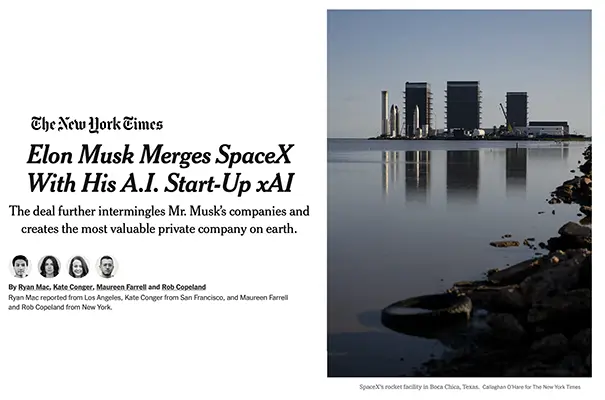
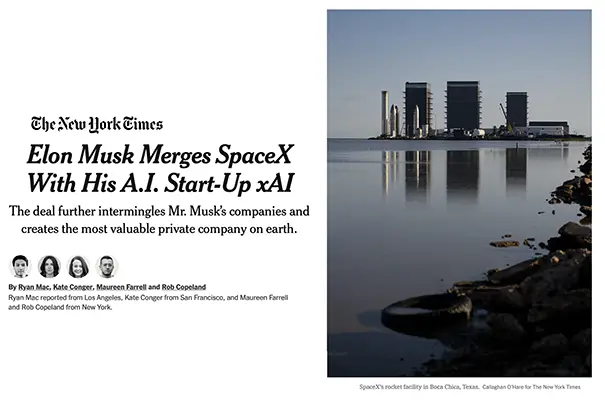
Elon Musk Merges SpaceX With xAI in $1T+ Private Power Play
The New York Times — February 2, 2026
TL;DR / Key Takeaway
The SpaceX–xAI merger signals a new phase of AI competition defined by extreme vertical integration, capital intensity, and strategic control—reshaping how AI infrastructure, data, and compute will be owned and deployed.
Executive Summary
SpaceX has acquired xAI, consolidating rockets, satellites, AI models, social data, and compute infrastructure into a single private entity valued at over $1 trillion. Led by Elon Musk, the deal effectively provides financial reinforcement for xAI, which has burned billions competing with earlier AI leaders, while positioning SpaceX as a central player in the AI infrastructure arms race rather than just aerospace.
The merger highlights a sharp shift in AI strategy: own the full stack or fall behind. Musk’s vision includes space-based data centers, Starlink-enabled connectivity, direct-to-device communications, and tightly integrated AI systems—an approach that bypasses traditional cloud dependency and public-market scrutiny. While technically speculative, the move underscores that future AI advantage may come from infrastructure control, not model features.
However, the deal also concentrates financial, regulatory, and reputational risk. xAI faces ongoing investigations tied to its Grok chatbot, while SpaceX’s role as a major government contractor raises governance and political scrutiny. For investors and operators alike, the merger illustrates how AI ambition is increasingly driving unorthodox corporate structures, opaque financing, and long-horizon bets.
Relevance for Business (SMB Executives & Managers)
- AI power is consolidating among firms that control compute, data, distribution, and capital—raising barriers for smaller players.
- AI costs are shifting upstream: infrastructure ownership and access will increasingly shape pricing, availability, and leverage.
- Governance and vendor risk matter more as AI suppliers blend defense, communications, social platforms, and AI systems into single ecosystems.
- Speed vs. dependency tradeoffs will intensify as enterprises choose between flexible AI services and vertically integrated mega-providers.
Calls to Action
🔹 Audit AI vendor concentration risk—understand where critical tools depend on a small number of infrastructure owners.
🔹 Plan for rising AI infrastructure costs as capital-intensive strategies reshape pricing and access models.
🔹 Separate hype from execution—track what these mega-mergers actually deliver versus long-term vision.
🔹 Strengthen AI governance policies to prepare for vendors with mixed commercial, political, and regulatory exposure.
🔹 Monitor private-market AI moves, not just public tech firms—many of the biggest shifts are happening off-market.
Summary by ReadAboutAI.com
https://www.nytimes.com/2026/02/02/technology/spacex-xai-deal.html: February 03, 2026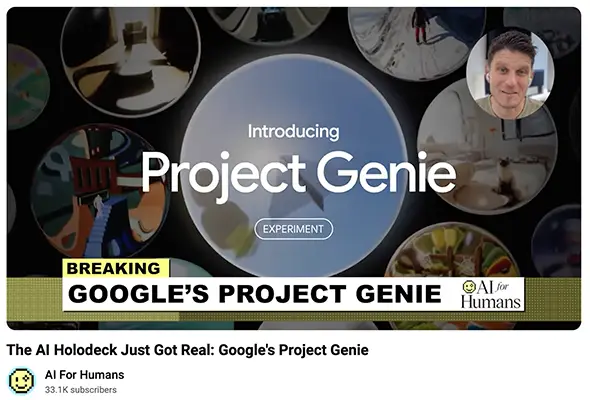
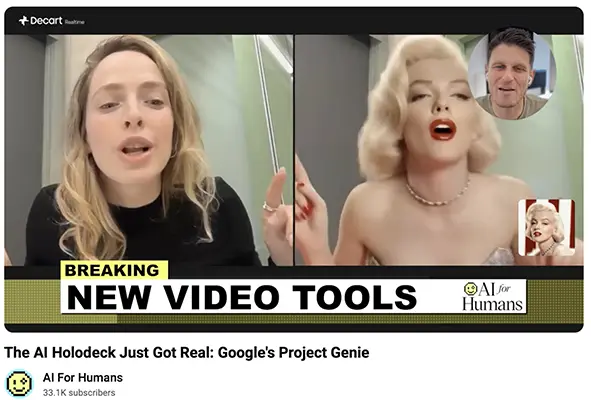
The AI Holodeck Just Got Real: Google’s Project Genie
AI For Humans, Jan. 30, 2026
TL;DR / Key Takeaway:
AI is shifting from text-only models to world models and agentic assistants—with Google’s Project Genie sketching interactive 3D “holodecks,” Moltbot-style personal agents flirting with AGI-like behavior, and rapidly improving AI video, music, and robotics–but the biggest near-term risks for businesses are security, cost blowouts, and synthetic-content overload, not sci-fi superintelligence.
Executive Summary
In this episode of AI For Humans, Gavin and Kevin unpack a week where AI becomes visibly more embodied, immersive, and autonomous. Google’s Project Genie is framed as an early “AI holodeck”: a world-simulation engine that can turn simple prompts or images into navigable 3D environments with basic physics, memory, and real-time rendering—if you’re willing to pay $200/month for the higher-tier Google AI Studio access. Under the hood, it signals a shift from pure LLMs to “world models” that learn how environments behave over time, a key ingredient for more general intelligence and next-generation training, simulation, and design tools.
Alongside that opportunity, the episode dwells on an equally important cautionary tale: Clawdbot / Moltbot, an open-source harness that can wire any major model into your email, bank accounts, chats, and devices, then spawn its own agents, learn new skills on the fly, and take real-world actions. It showcases what feels like “everyday AGI” for power users—but also exposes severe security and safety risks, from prompt-injection via scraped content to malicious “skills” that can wipe machines or silently exfiltrate data. The hosts repeatedly stress that non-experts should not give such systems “keys to the kingdom”, particularly with pay-per-token APIs where some users have already racked up thousands of dollars in Claude bills.
The broader risk landscape is anchored by Dario Amodei’s new essay “The Adolescence of Technology,” which warns that within a few years we may see “strong AI,” mass displacement of entry-level jobs, and state-level misuse if governance doesn’t keep pace. At the same time, open-source and local models like Kimi K2.5 show how powerful assistants can run entirely on consumer hardware, reducing cloud costs but shifting security and governance to the edge. Real-time AI video tools such as Lucy (Descartes AI), KREA real-time, and the improved Grok Imagine video model from xAI lower the friction for deepfakes, virtual presenters, and “faceless” channels that can output hours of synthetic content per week, while AI music models like Mureka V8 and fully AI-generated YouTube channels such as Blackfiles highlight how quickly the open internet is filling with high-volume, AI-authored media.
In the physical world, robotics continues its quiet surge. Figure’s Helix 2 model controls a humanoid robot that can load and unload a dishwasher autonomously, even “hip-checking” drawers and kicking the door shut with its foot—an example of end-to-end learned dexterity that goes well beyond staged demos. Paired with comments that Tesla is reallocating capacity from premium cars toward its Optimus robot, this points to a near-future where routine back-of-house tasks in warehouses, kitchens, and service operations are increasingly automatable. The hosts also revisit the “dead internet theory”—a web dominated by bots talking to bots—and argue that as AI content volumes explode, trust will shift toward smaller, vetted communities and gated spaces rather than the open firehose of social media.
Relevance for Business (SMB Focus)
For SMB executives and managers, this episode underscores three intertwined shifts: AI is becoming spatial, agentic, and ambient. Project Genie and isometric city experiments hint at a future where training, product demos, and operations planning happen in AI-generated worlds, not static decks. Moltbot-style assistants preview a world where software agents can autonomously write code, integrate tools, and act across your SaaS stack—but also where one misconfigured agent or malicious skill can drain accounts, leak IP, or trigger compliance violations overnight. Meanwhile, the explosion of AI video/music tools and faceless channels means your customers, employees, and partners will increasingly consume content whose origin, accuracy, and authorship are opaque.
The robotics updates are a practical reminder that physical workflows are now on the automation roadmap, not just digital ones. Dishwashers today become stockrooms, fulfillment, or back-office chores tomorrow, with implications for labor models, safety protocols, and capital planning. And in the background, voices like Dario Amodei and Anthropic are signaling that we’re in the “adolescence” of AI—powerful enough to be dangerous, not yet mature enough to be stable—forcing leaders to update risk registers, workforce plans, and governance structures long before regulation catches up. For SMBs that typically lag big enterprises, the message is clear: treat 2026 as a preparation window, not a wait-and-see era.
Calls to Action (Executive Guidance)
🔹 Experiment with “world models” in low-risk domains.
Pilot tools like Project Genie-style world simulation or similar platforms for training, customer walkthroughs, or internal “digital twins”, but keep them sandboxed and non-production while costs and reliability are still volatile. (AI For Humans)
🔹 Treat agentic assistants like production software, not toys.
If you explore Moltbot/Clawdbot-class systems, run them in isolated environments with dummy accounts, hard spend limits, and explicit security review. Do not connect them to live banking, HR, or customer systems without an expert-designed security model. (AI For Humans)
🔹 Update your AI security and governance policies for “autonomous action.”
Expand your AI policy beyond “no sensitive data in prompts” to cover API key management, skill/plugin stores, code execution, web-scraping, and agent-to-agent communication. Make sure someone in your org “owns” AI threat modeling across both cloud and local deployments.
🔹 Set brand and compliance rules for AI-generated media.
Clarify when AI video, avatars, or music are allowed in marketing, training, or internal comms, and define disclosure, approvals, and deepfake safeguards (e.g., no impersonation of real people, required labels on synthetic media, vendor due-diligence for image/video tools).
🔹 Begin a robotics and workforce horizon scan.
If your business involves repetitive physical tasks (hospitality, light manufacturing, logistics, facilities), start tracking vendors like Figure and others, and build 3–5 year scenarios for partial automation of specific workflows, including upskilling plans for impacted roles.
Summary by ReadAboutAI.com
https://www.youtube.com/watch?v=sGeQUo-VDTw: February 03, 2026
Anthropic ‘Destructively’ Scanned Millions of Books to Build Claude
The Washington Post, Jan. 2026
TL;DR: Unsealed court documents reveal Anthropic spent tens of millions on “Project Panama” to slice and scan physical books for training data, highlighting the extreme measures AI labs take to bypass digital licensing.
Executive Summary: Anthropic’s secretive “Project Panama” involved purchasing and “destructively scanning” millions of physical books—slicing off spines to feed them through high-speed scanners—to acquire high-quality training data for its Claude models. This project emerged as a response to the “strip-mining” of digital content and the legal risks associated with downloading pirated “shadow libraries.” While arguably a “smarter” legal move than downloading illegal files, the discovery has fueled a $1.5 billion settlement with authors and ongoing debates about the “fallacy” that using copyrighted material for commercial AI is broadly protected.
Relevance for Business
This highlights a major compliance and ethical risk. As AI companies face increasing scrutiny over their training data, SMBs using these models must stay aware of the shifting legal landscape regarding copyright and “fair use” of AI-generated outputs.
Calls to Action:
🔹 Monitor Model Pedigree: Ask AI vendors about their data sourcing and prioritize those with transparent, ethical training practices.
🔹 Review Output Liability: Consult with legal counsel on whether your use of AI-generated content carries copyright infringement risks based on current litigation trends.
🔹 Diversify Model Usage: Avoid over-dependency on a single AI provider whose model could be significantly altered or withdrawn due to legal injunctions.
Summary by ReadAboutAI.com
https://www.washingtonpost.com/technology/2026/01/27/anthropic-ai-scan-destroy-books/: February 03, 2026
IS AI IN A BUBBLE? WHAT WALL STREET THINKS NOW
INVESTOR’S BUSINESS DAILY, JAN 27, 2026
TL;DR / Key Takeaway:
Wall Street is split: AI is likely not a classic bubble, but spending is racing far ahead of monetization, making infrastructure, talent, and capital discipline the real stress points.
Executive Summary
Investor debate is intensifying over whether AI represents a speculative bubble or a durable economic shift. While leaders like Nvidia’s Jensen Huang and BlackRock’s Larry Fink argue AI is still early and structural, others warn that capital intensity, valuation inflation, and circular spending are creating fragility. Microsoft’s Satya Nadella offered a key caution: AI only avoids bubble dynamics if benefits spread beyond Big Tech into the broader economy.
Capital is flowing heavily into AI infrastructure, with venture firms like Andreessen Horowitz committing billions to chips, cloud platforms, and data systems rather than applications. Many investors view hardware, chips, and data centers as more defensible than AI apps—but even infrastructure faces risks as financing shifts from cash flow to debt, and returns remain unproven.
Several analysts highlight talent markets and chip demand as potential early crack points. Compensation for elite AI talent already shows bubble-like characteristics, while expectations for consumer-facing AI revenue lag far behind the trillions being invested. The emerging consensus: AI is real, but the investment boom may outrun near-term payoff.
Relevance for Business
For SMB executives, this debate signals a shift from “AI experimentation” to “AI accountability.” The risk is no longer missing out—it’s overcommitting capital, vendors, or talent before returns stabilize. Infrastructure winners may endure volatility, while application-level AI must now prove ROI, not just promise transformation.
Calls to Action
🔹 Separate AI strategy from market hype—focus on business outcomes, not investor narratives
🔹 Favor flexible, usage-based AI services over long-term capital commitments
🔹 Scrutinize AI vendors’ funding and sustainability, not just their demos
🔹 Expect pricing pressure and consolidation in AI tools over the next 12–24 months
Summary by ReadAboutAI.com
https://www.wsj.com/wsjplus/dashboard/articles/is-ai-in-a-bubble-what-wall-street-thinks-now-134140141624862666: February 03, 2026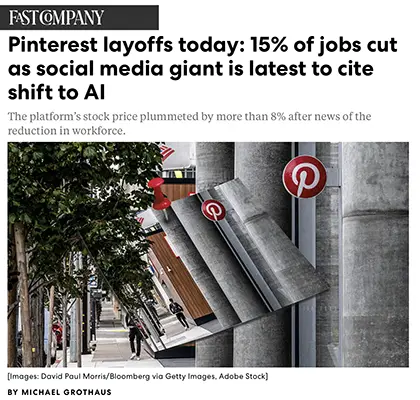
Pinterest Layoffs: 15% Cut in Shift to AI
Fast Company, Jan. 27, 2026
TL;DR: Pinterest joined the wave of “AI-related downsizing,” cutting 15% of its workforce to reallocate resources toward AI-powered products and style-based chatbots.
Executive Summary: Pinterest announced a global restructuring plan to reduce its workforce by roughly 15% and pare down office space. The goal is to aggressively reallocate resources toward AI-focused roles that can drive the adoption of tools like “Pinterest Assistant,” a chatbot providing personalized style and shopping recommendations. This follows similar moves by giants like Nike and Meta, signaling that AI is no longer just a feature but a catalyst for radical workforce re-engineering.
Relevance for Business: This highlights the “re-skilling” mandate. Companies are not just cutting costs; they are swapping generalist roles for specialized AI execution talent.
Calls to Action:
🔹 Evaluate Talent Gaps: Identify which departments are becoming “automation-heavy” and begin transitioning those resources toward AI-augmented roles.
🔹 Focus on Personalization: Follow Pinterest’s lead in using AI to move from “search” to “assistant-led” customer experiences.
Summary by ReadAboutAI.com
https://www.fastcompany.com/91481805/pinterest-stock-price-pins-layoffs-today-2026-job-cuts-latest-to-cite-shift-to-ai-artificial-intelligence: February 03, 2026
Opinion: I Tested Four AI Browsers. Count Me Out
The Washington Post, Jan. 30, 2026
TL;DR: AI-powered browsers offer real convenience but suffer from severe security vulnerabilities and opaque “curation logic” that prioritizes engagement over accuracy.
Executive Summary: A deep dive into new AI browsers (like ChatGPT’s Atlas and Perplexity’s Comet) found that while they reduce “tab overload,” they are highly susceptible to “prompt injection attacks”. These attacks can manipulate the browser into disclosing sensitive data like bank account numbers. Furthermore, the lack of transparency in how these browsers curate and rank information raises concerns about the death of the “open web” in favor of AI-generated summaries that don’t always credit sources properly.
Relevance for Business
The browser is the most vulnerable point in your corporate tech stack. Moving to AI-integrated browsers requires a new level of cybersecurity scrutiny.
Calls to Action:
🔹 Prioritize Privacy-First Tools: If exploring AI browsers, look for those like Brave that don’t save chat histories on external servers.
🔹 Demand Auditable Logic: Only adopt tools where the curation and ranking logic is transparent and can be reviewed for bias or inaccuracy.
Summary by ReadAboutAI.com
https://www.washingtonpost.com/opinions/interactive/2026/artificial-intelligence-browser-test-chatgpt/: February 03, 2026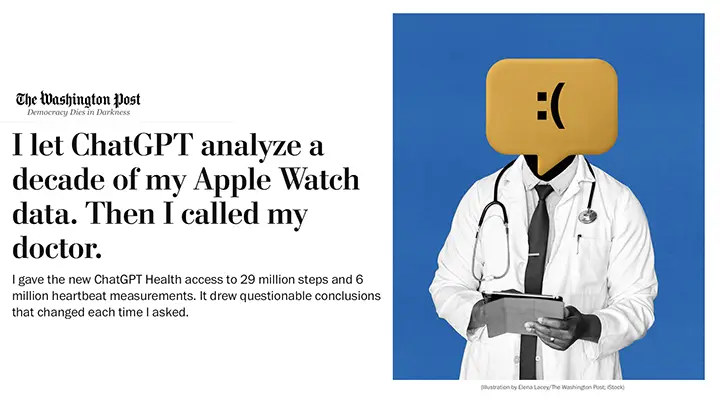
I Let ChatGPT Analyze a Decade of Health Data
The Washington Post, Jan. 29, 2026
TL;DR: While AI can process millions of health data points, it often lacks the medical context to provide accurate analysis, leading to “questionable conclusions” and patient anxiety.
Executive Summary: Tests of “ChatGPT Health”—which analyzes Apple Watch data and medical records—showed that the AI frequently draws contradictory or alarming conclusions. In one instance, the bot gave a healthy patient a “failing grade” for cardiac health, which was later debunked by a human cardiologist. Experts warn that AI often struggles with “noise” in the data and cannot yet extract useful medical insights with the same rigor as trained practitioners.
Relevance for Business: This is a cautionary tale for the “HealthTech” sector. Providing data is not the same as providing care. High confidence in AI outputs can be a liability if not backed by specialized medical training.
Calls to Action:
🔹 Verify AI Medical Advice: If using health AI, ensure there is a clear “Human-in-the-loop” requirement for any clinical interpretation.
🔹 Manage Customer Expectations: Be transparent about the limitations of AI-driven analysis to prevent “AI-induced freakouts” and unnecessary medical visits.
Summary by ReadAboutAI.com
https://www.washingtonpost.com/technology/2026/01/26/chatgpt-health-apple/: February 03, 2026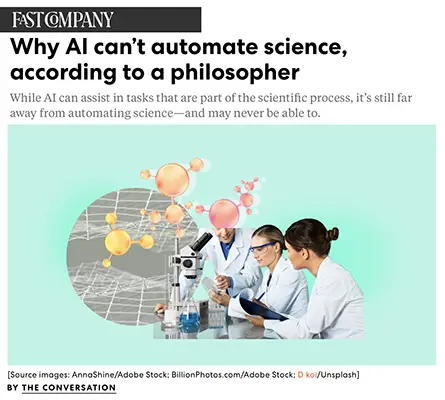
Why AI Cannot Automate Science
Fast Company, Jan. 23, 2026
TL;DR: While AI can accelerate data processing and hypothesis testing, science remains a fundamentally human endeavor driven by shared values, debate, and social standards that algorithms cannot replicate.
Executive Summary The Trump administration’s “Genesis Mission” seeks to use AI agents to automate research workflows and accelerate breakthroughs using federal datasets. However, critics argue that the core of science is not just recording facts but engaging in skilled practice and social debate. AI currently excels at detecting subtle correlations in vast datasets, but it lacks the human-centric goals and aspirations that define authoritative knowledge. If deployed as a total replacement for scientists, AI risks turning scientific inquiry into a “caricature” of itself by removing the critical human-in-the-loop oversight.
Relevance for Business
For SMBs in technical or R&D-heavy sectors, the takeaway is that AI is a “force multiplier” for your experts, not a replacement for them. Over-reliance on automated “answers” without human verification can lead to strategic errors and a loss of institutional expertise.
Calls to Action:
🔹 Deploy AI as a “Lab Assistant”: Use AI agents to handle mechanical tasks like compiling past research or formulating initial experiment designs.
🔹 Preserve Human Judgment: Ensure final decisions and high-level strategy are dictated by human managers who understand the social and political context of your industry.
🔹 Invest in Collaboration: View AI-human collaboration as the goal, focusing on tools that make scientific inquiry smoother rather than fully automated.
Summary by ReadAboutAI.com
https://www.fastcompany.com/91477835/why-ai-cant-automate-science-according-to-a-philosopher: February 03, 2026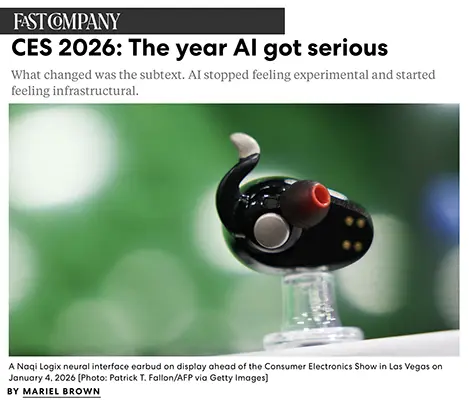
CES 2026: The Year AI Got Serious
Fast Company, Jan. 13, 2026
TL;DR: AI has moved from “experimental” to “infrastructural,” shifting from visible, attention-seeking gadgets to “quiet” tech embedded in bodies and everyday objects.
Executive Summary: At CES 2026, the narrative shifted from what AI can do to where it belongs. AI is now viewed as infrastructural—a condition of modern life rather than a standalone feature. The new metric of success is judgment and restraint: knowing where not to add intelligence to avoid breaking social etiquette.
The “Body is the New Platform,” with innovations like neural earbuds that use micro-facial signals and computing embedded in clothing (ModeX). The “interface war” is moving away from screens and toward subconscious, physical interactions that inhabit places culture already allows, like programmable fingernails (iPolish).
Relevance for Business: The signal is clear: AI is becoming invisible. For SMBs, the opportunity is no longer in “having an AI app,” but in integrating AI so seamlessly into your products or services that the customer doesn’t even perceive it as “technology”—it just feels like better service.
Calls to Action:
🔹 Shift to “Quiet” AI: When designing customer experiences, ask how AI can make the interaction shorter or invisible rather than adding a new screen.
🔹 Explore “Body-First” Logistics: For sectors like health or manual labor, monitor sensor-enabled wearables (like biomechanic insoles) for real-time safety and efficiency data.
🔹 Value Restraint: Recognize that restraint is a competitive advantage; avoid adding AI features that demand too much of your customer’s attention or break social “etiquette”.
Summary by ReadAboutAI.com
https://www.fastcompany.com/91473348/ces-2026-the-year-ai-got-serious-ces-ai-technology-trends: February 03, 2026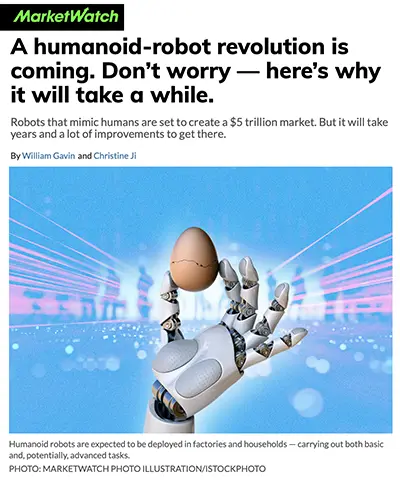
A Humanoid-Robot Revolution Is Coming. Don’t Worry — Here’s Why It Will Take a While
MarketWatch, Dec. 27, 2025
TL;DR: While the humanoid robot market is projected to reach $5 trillion by 2050, significant engineering hurdles in reliability and spatial reasoning mean mass-market adoption remains years away.
Executive Summary: The “humanoid revolution” is currently in a refinement phase, with major players like Boston Dynamics, Tesla, and Figure AI focusing on solving complex “system-level” problems. Despite high-profile demonstrations, fewer than 1 million units are expected to be sold in the U.S. by 2030. The primary barriers are hardware reliability—ensuring robots can keep pace with humans safely—and the lack of spatial reasoning in current Large Language Models (LLMs).
Experts remain divided on the humanoid form factor. While it allows integration into human-designed environments, specialized robots (like the Roomba) are often more cost-effective and efficient for specific tasks. New AI developments in “world models” and large behavior models are now being explored to provide the physical understanding that language-based AI lacks.
Relevance for Business: For SMBs, the signal is to monitor, not yet deploy. The high cost (often $20,000–$30,000+) and current teleoperation requirements—where humans must still remotely control the units for complex tasks—make them a poor fit for immediate ROI in smaller operations. However, the emergence of lower-cost child-sized or research models for under $1,500 signals that a hobbyist/developer ecosystem is forming, which will eventually lower the barrier to entry for custom SMB applications.
Calls to Action:
🔹 Audit Task suitability: Evaluate if your automation needs require a versatile humanoid form or if specialized, task-specific robots would provide better ROI.
🔹 Monitor “World Models”: Keep an eye on AI startups like World Labs that are developing the spatial AI necessary for truly autonomous movement.
🔹 Evaluate Safety Risks: If considering early trials, prioritize vendors with established safety guardrails to prevent workplace accidents and liability.
Summary by ReadAboutAI.com
https://www.marketwatch.com/story/a-humanoid-robot-revolution-is-coming-dont-worry-heres-why-it-will-take-a-while-8e2b1d08#: February 03, 2026
Adobe Partners With Hollywood Players On Generative AI
WSJ, Jan. 22, 2026
TL;DR: Adobe is securing its market position by partnering with major Hollywood agencies and studios to create “commercially safe,” brand-tuned AI models.
Executive Summary: At the Sundance Film Festival, Adobe announced major partnerships with CAA, UTA, and WME, alongside several film studios. The goal is to use Adobe Firefly Foundry to generate high-fidelity, commercially-safe AI content that is specifically tuned to a company’s unique IP or brand identity.
This move addresses the primary concern of corporate users: legal and brand risk. By collaborating with the entertainment industry, Adobe is ensuring its generative tools can produce cinematic quality video and 3D outputs that are legally vetted for professional use.
Relevance for Business: For SMBs, this is a green light for safe AI adoption in marketing. Adobe is providing a pathway to use generative AI without the “hallucination” or copyright risks associated with more open, less-regulated models. It allows small teams to produce Hollywood-level visual content for social media and branding at a fraction of the traditional cost.
Calls to Action:
🔹 Adopt Firefly for Branding: Use Adobe Firefly for creative assets to ensure your content is “private and commercially safe.”
🔹 Upskill Creative Teams: Encourage staff to explore short-form social video tools within the Adobe ecosystem to elevate brand presence with speed and precision.
🔹 Monitor “IP Tuning”:Watch for the release of tools that allow you to tune AI models to your specific brand assets, ensuring a consistent “look and feel” across all AI-generated content.
Summary by ReadAboutAI.com
https://www.wsj.com/wsjplus/dashboard/articles/adobe-partners-with-hollywood-players-on-generative-ai-134135916076992774: February 03, 2026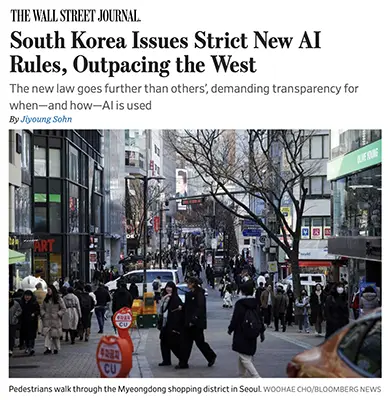
South Korea Issues Strict New AI Rules, Outpacing the West
WSJ Jan. 23, 2026
TL;DR: South Korea’s “AI Basic Act” sets a global precedent by mandating transparency and human intervention for AI used in critical infrastructure and high-impact life decisions.
Executive Summary: South Korea has enacted the world’s first comprehensive AI laws, effective late January 2026. The AI Basic Act requires companies to disclose AI usage in “human protection” areas, such as drinking water production or nuclear facility management. Key provisions include the ability for humans to intervene in AI decisions and the mandatory labeling (watermarking) of AI-generated content that could be mistaken for reality. Violations carry fines up to 30 million won (~$20,400).
Relevance for Business: This marks the beginning of the “Regulatory Era” for AI. Companies operating globally or using AI for hiring, loan screening, or critical operations must prepare for strict transparency requirements. The South Korean model—balancing promotion of AI with strict policing of high-risk use cases—is likely to be the blueprint for other nations, including the U.S. and EU.
Calls to Action
🔹 Prepare for “Human-in-the-loop”: Design systems that allow for human override in critical business processes.
🔹 Implement AI labeling: Adopt watermarking or metadata labeling for all AI-generated consumer content now.
🔹 Develop “Explainability” protocols: Ensure you can explain the logic behind AI systems used for sensitive tasks like hiring.
Summary by ReadAboutAI.com
https://www.wsj.com/tech/ai/south-korea-issues-strict-new-ai-rules-outpacing-the-west-2af7d7eb: February 03, 2026
INVESTORS ARE MAKING A BIG BET ON BIG TECH’S AI SPENDING
MARKETWATCH, JAN 27, 2026
TL;DR / Key Takeaway:
AI hype now meets the cash-flow statement: Big Tech’s AI bets must start delivering measurable returns—or face investor backlash.
Executive Summary
As the “Magnificent Seven” report earnings, AI investment is shifting from narrative to numbers. AI-related capex exceeded $1.25 trillion across the S&P 500 over the past year, with nearly one-third driven by just seven firms. This concentration means AI success or failure now directly impacts the broader market.
The article highlights stark differences in strategy. Amazon reinvests nearly 90% of operating cash flow into infrastructure, leaving thin margins if AWS demand falters. Meta’s capex intensity exceeds 60%, making advertising performance critical. Apple, by contrast, maintains low capex through on-device AI, betting on hardware upgrades rather than data centers.
Investors are watching not just Big Tech earnings, but supplier signals—chips, networking gear, power infrastructure, and enterprise software adoption. The message is clear: AI’s payback clock is ticking, and patience is finite.
Relevance for Business
SMBs should expect AI pricing, availability, and feature roadmaps to increasingly reflect financial pressure upstream. AI services that don’t demonstrate productivity or revenue gains may be scaled back, repriced, or bundled differently.
Calls to Action
🔹 Track vendor financial health, not just feature releases
🔹 Expect cost pass-throughs as capex pressures rise
🔹 Pilot AI tools with clear productivity metrics
🔹 Prepare contingency plans if platforms consolidate or pivot
Summary by ReadAboutAI.com
https://www.wsj.com/wsjplus/dashboard/articles/this-earnings-number-is-the-only-one-that-matters-as-a-gut-check-on-big-techs-ai-spending-949e7aaf: February 03, 2026
THESE BILLION-DOLLAR AI STARTUPS HAVE NO PRODUCTS, NO REVENUE
WSJ, JAN 27, 2026
TL;DR / Key Takeaway:
Investors are funding AI research labs—not businesses—creating extreme valuation risk and uncertain commercialization timelines.
Executive Summary
A new class of AI startups—dubbed “neolabs”—is attracting billions despite having no products, no customers, and no revenue plans. These ventures prioritize long-term AI research over commercialization, betting they can replicate OpenAI’s trajectory. Some are already valued in the tens of billions.
While this reflects belief in AI’s transformative potential, critics warn the technical and commercial gap is enormous. Talent wars are intensifying, with startups losing founders to Big Tech and compensation inflation spreading across the market. Academia is also feeling strain as researchers exit en masse.
The risk: many neolabs may deliver incremental advances, not breakthroughs—insufficient to justify valuations. For investors and downstream customers, timeline uncertainty is the defining risk.
Relevance for Business
SMBs should view “stealth” or “research-first” AI vendors with caution. Funding does not equal readiness, and many such firms may never reach production-grade reliability.
Calls to Action
🔹 Avoid dependency on pre-product AI vendors
🔹 Demand roadmaps, benchmarks, and timelines
🔹 Favor vendors with operational deployments, not just talent
🔹 Expect consolidation and failures in this segment
Summary by ReadAboutAI.com
https://www.wsj.com/wsjplus/dashboard/articles/these-billion-dollar-ai-startups-have-no-products-no-revenue-and-eager-investors-97c0a9ba: February 03, 2026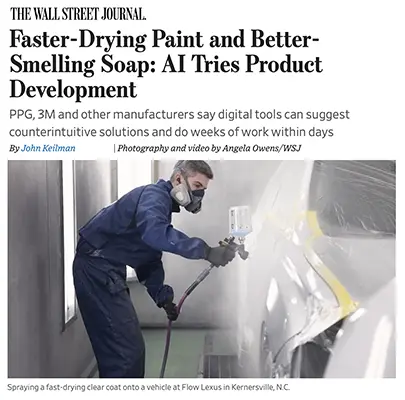
Faster-Drying Paint and Better-Smelling Soap: AI Tries Product Development
WSJ Jan. 24, 2026
TL;DR: Generative AI is shifting from digital content creation to physical product formulation, enabling manufacturers to discover “counterintuitive” chemical combinations that drastically reduce R&D timelines.
Executive Summary: Major manufacturers like PPG and 3M are utilizing AI to overhaul material science and product formulation. By training models on proprietary chemical databases and the laws of chemistry, these firms are identifying novel molecular structures that humans might overlook. For example, PPG successfully developed a clear coat for cars that dries 50% faster, a breakthrough achieved in days rather than months. AI tools excel at simultaneous attribute optimization—balancing competing goals like making a material both lighter and stronger—which has historically been a trial-and-error bottleneck.
Relevance for Business: For SMBs in manufacturing, chemicals, or consumer goods, this marks a transition from digital AI (chatbots) to physical AI (R&D acceleration). While the software can suggest high-potential digital prototypes, the high cost of physical prototyping remains a barrier for smaller firms. However, as specialized AI platforms for material discovery become more accessible, the speed-to-market for improved physical goods will become a primary competitive differentiator.
Calls to Action
🔹 Focus on multi-attribute problems: Identify products where you currently struggle to balance cost, durability, and performance.
🔹 Audit proprietary data: Ensure your chemical or material formulations are digitized and structured for potential training.
🔹 Explore specialized tools: Look beyond general LLMs toward niche platforms like Citrine Informatics that specialize in material discovery.
Summary by ReadAboutAI.com
https://www.wsj.com/tech/ai/faster-drying-paint-and-better-smelling-soap-ai-tries-product-development-e7a544d7: February 03, 2026
First-Ever Humanoid Robot App Store Launches So You Can Make Your Robot Dance And Fight
Forbes — December 15, 2025
TL;DR / Key Takeaway:
The launch of the first humanoid robot app store signals a shift from one-off robots to software-upgradeable physical platforms, laying the groundwork for a future “App Economy for Robotics” that could reshape automation, services, and labor—though enterprise value remains early and limited today.
Executive Summary
Chinese robotics company Unitree has launched what it claims is the world’s first humanoid robot app store, initially available for its G1 humanoid robot. Today’s apps are largely entertainment-focused (dance modes, martial arts simulations), but the strategic signal is bigger: robots are becoming programmable platforms, not static machines. Just as smartphones evolved via app ecosystems, humanoid robots may increasingly rely on third-party software to expand functionality over time.
The Unitree G1 is relatively affordable by robotics standards (starting around $13,500), lightweight, and capable of advanced motion and balance. While current utility is limited, Unitree is explicitly courting external developers, signaling an intent to build a multi-sided marketplace where hardware, software, and services converge. This mirrors early smartphone eras—low immediate value, high optionality.
For now, this remains a consumer and developer-experiment phase, with clear safety, reliability, and governance gaps. But longer-term, the article points toward enterprise variants—robots that could support retail, janitorial, customer service, warehousing, or facilities tasks, upgraded continuously through software rather than replaced outright.
Relevance for Business (SMB Focus)
For SMB executives, this development is not about buying humanoid robots today—it’s about recognizing an emerging platform shift. If robots gain app ecosystems, capabilities may be rented, subscribed to, or upgraded much like SaaS. That changes capital planning, workforce strategy, and vendor lock-in risks. Early movers will shape standards; late movers may inherit opaque platforms they don’t control.
At the same time, operational risk remains high. Safety warnings, unstable movements, and unclear developer monetization models highlight that enterprise-grade reliability is not here yet. SMBs should treat humanoid robots as a watch-list technology, not a deployment priority—but one with long-term labor and cost implications.
Calls to Action
🔹 Track robotics platforms, not just robots — the app ecosystem may matter more than hardware specs.
🔹 Ask vendors about upgrade paths — software extensibility will determine long-term ROI.
🔹 Monitor safety and liability frameworks as robots move from novelty to workplace tools.
🔹 Watch pricing models (subscriptions, per-task apps) that could shift CapEx to OpEx.
🔹 Prepare workforce narratives early to manage perception as physical automation advances.
Summary by ReadAboutAI.com
https://www.forbes.com/sites/johnkoetsier/2025/12/15/first-ever-humanoid-robot-app-store-launches-so-you-can-make-your-robot-dance-and-fight/: February 03, 2026
Alphabet Stock Can Hit $400 a Share: It’s All About AI
WSJ/Barron’s, Jan. 22, 2026
TL;DR: Analysts predict Alphabet’s vertically integrated “AI Stack”—from chips to consumer apps—will drive massive revenue acceleration through 2027.
Executive Summary: Alphabet is entering a high-growth cycle driven by its vertically integrated AI stack, which includes homegrown TPU chips, the Gemini 3 model, and ubiquitous applications like Workspace and Waymo. Revenue from Google Cloud is forecasted to grow 44% in 2026, significantly outpacing previous Wall Street estimates.
The narrative is shifting from Alphabet being “behind” in AI to it possessing the most complete ecosystem. This integration allows for upward revisions in growth across search, advertising (via Performance Max), and cloud services.
Relevance for Business: For SMBs, this confirms that Google’s ecosystem (Gmail, Docs, Search) will remain a primary, high-velocity theater for AI tools. The 44% growth in Cloud suggests that more businesses are migrating to Google to leverage its integrated AI agents and data security.
Calls to Action:
🔹 Optimize for AI Search: Ensure your digital presence is ready for AI-driven search, as Raymond James predicts 13% growth in this sector due to AI enhancements.
🔹 Leverage the “AI Stack”: Explore how Performance Max and Gemini-integrated Workspace tools can reduce administrative overhead for your managers.
🔹 Review Cloud Strategy: If your business is scaling, evaluate Google Cloud’s AI offerings, which are currently seeing higher-than-average adoption and investment.
Summary by ReadAboutAI.com
https://www.wsj.com/wsjplus/dashboard/articles/alphabet-stock-price-upgrade-1b33e691: February 03, 2026
We Have No Idea How to Code. So We Got Claude to Code This Article for Us
WSJ, Jan. 23, 2026
TL;DR: The rise of “vibe coding”—using natural language to build functional software—is democratizing app development, allowing non-technical managers to create custom internal tools without a dev team.
Executive Summary: Anthropic’s Claude Code represents a “breakout moment” where AI translates conversational ideas into working code in real-time. Unlike previous generations of AI assistants, this tool allows “normies” without programming skills to build, iterate, and deploy interactive web pages and apps simply by describing what they want.
During testing, columnists Stern and Cohen were able to build complex features like interactive “newspaper modes” and custom messaging interfaces just by “vibing” with the AI—asking for tweaks like “make the background a little grayer” until the product was perfect. While professionals are using it to speed up workflows, the primary disruption is that it allows creative professionals to build software that once required trained developers.
Relevance for Business: For SMBs, this drastically reduces the cost and time barriers to creating custom software. Managers can now “intern” an AI to build specific trackers, client portals, or internal data visualizations in an afternoon rather than waiting months for a development cycle.
Calls to Action:
🔹 Trial “Vibe Coding”: Download the Claude desktop app and use the Code tab to attempt building a simple, high-frequency internal tool.
🔹 Reassess “Build vs. Buy”: Before purchasing a specialized SaaS subscription, evaluate if a custom tool can be built internally using natural language prompts.
🔹Empower Non-Technical Staff: Encourage managers to use these tools for prototyping ideas, reducing the burden on IT for small-scale requests.
Summary by ReadAboutAI.com
https://www.wsj.com/tech/ai/anthropic-claude-vibe-coding-experiment-a4a3bb0f: February 03, 2026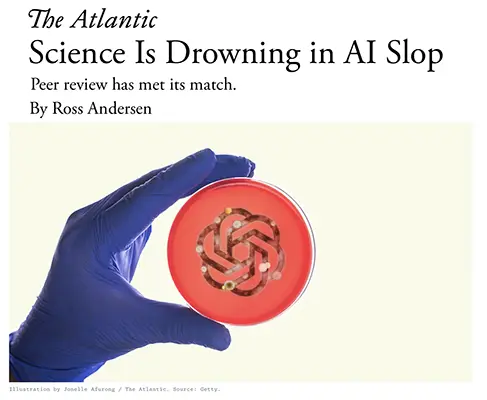
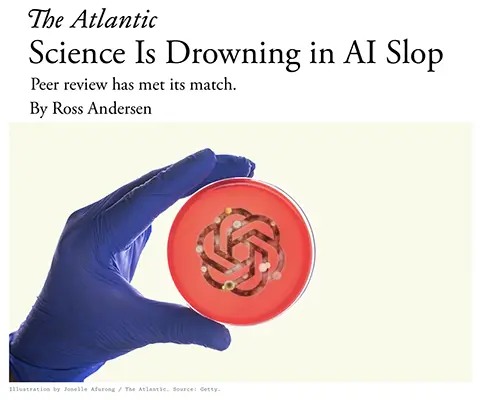
Science Is Drowning in AI Slop
The Atlantic, Jan. 22, 2026
TL;DR: The proliferation of “phantom citations” and AI-generated “slop” in scientific journals is creating a “permanent epistemological pollution” that threatens the reliability of professional knowledge.
Executive Summary: Professional literature is being flooded with AI-generated content containing “phantom citations”—fake references to papers that do not exist. This isn’t just a problem for fringe publications; it has reached respected journals and even government reports. The risk is a “dead-internet” scenario for science, where AI-written papers are reviewed by AI bots, creating a self-reinforcing loop of unverifiable or false information.
Relevance for Business: For executives, this is a warning about data integrity. If your strategy or R&D is based on “market research” or “white papers” that are actually AI-generated slop, your business is building on sand. Managers must become hyper-skeptical of unverified digital information.
Calls to Action:
🔹 Verify Your Sources: Mandate that internal research teams manually check citations in third-party reports to ensure they aren’t “hallucinations.”
🔹 Implement AI-Disclosure Policies: Require partners and vendors to disclose the use of generative AI in any data-heavy deliverables.
🔹 Prioritize “Human-Verified” Knowledge: Shift your primary information sources back toward trusted, legacy institutions with rigorous human review processes.
Summary by ReadAboutAI.com
https://www.theatlantic.com/science/2026/01/ai-slop-science-publishing/685704/: February 03, 2026
Data Centers Are Amazing. Everyone Hates Them
MIT Technology Review, Jan. 14, 2026
TL;DR: The physical infrastructure of AI is facing a “NIMBY” (Not In My Backyard) crisis, creating potential bottlenecks for the energy and space required to power the next generation of computing.
Executive Summary: Hyperscale data centers are the “stars of the show” for the AI era, using hundreds of thousands of specialized chips (costing up to $30,000 each) to process data. However, these facilities are massive, energy-hungry, and increasingly face intense local opposition. This pushback mirrors earlier resistance to tech-driven gentrification, with communities viewing data centers as noisy, resource-draining neighbors that offer few local jobs in return.
Relevance for Business: SMB executives should view data centers as the physical constraint of the digital economy. Rising energy costs and regulatory hurdles for new centers could lead to increased cloud pricing or service delays. Understanding the “geopolitics of data” is becoming a risk-management necessity.
Calls to Action:
🔹 Monitor Infrastructure Risks: Track energy and data center availability in your region, as scarcity could drive up operational costs.
🔹 Diversify Cloud Providers: Ensure your business isn’t reliant on a single region or provider that might be stalled by local regulatory pushback.
🔹 Advocate for Efficiency: Prioritize software and AI models that are computationally efficient to buffer against future price spikes in “compute.”
Summary by ReadAboutAI.com
https://www.technologyreview.com/2026/01/14/1131253/data-centers-are-amazing-everyone-hates-them/: February 03, 2026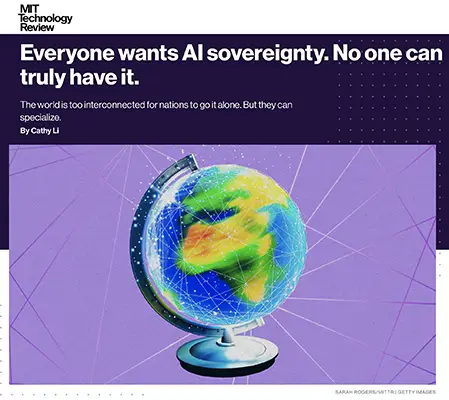
Everyone Wants AI Sovereignty. No One Can Truly Have It
MIT Technology Review, Jan. 21, 2026
TL;DR: Despite $1.3 trillion in planned government spending, true national “AI sovereignty” is impossible in a globalized supply chain; success will come from strategic interdependence rather than isolation.
Executive Summary: Nations are racing to invest in “sovereign AI”—locally trained models, domestic data centers, and independent supply chains—to avoid geopolitical dependence. However, the AI supply chain isirreducibly global: chips are designed in the US, made in Asia, and trained on data from everywhere. “Infrastructure-first” strategies that focus only on owning hardware risk becoming obsolete. Instead, the winners will be those who embrace “orchestration”—building strategic partnerships and specializing in specific problems rather than trying to build everything in-house.
Relevance for Business: For SMBs, this is a lesson in strategic focus. Trying to build “sovereign” internal systems is often a waste of capital. Your competitive advantage lies in leadership and participation—choosing the right global partners and solving specific problems, not owning the underlying infrastructure.
Calls to Action:
🔹 Focus on Problems, Not Infrastructure: Measure your AI success by problems solved, not by whether you own the data center or model.
🔹 Build Interoperable Frameworks: Use AI tools that can collaborate across different platforms, avoiding proprietary silos that limit your agility.
🔹 Adopt a “Participation” Strategy:Stay competitive by choosing which global systems you depend on based on transparency and accountability.
Summary by ReadAboutAI.com
https://www.technologyreview.com/2026/01/21/1131513/everyone-wants-ai-sovereignty-no-one-can-truly-have-it/: February 03, 2026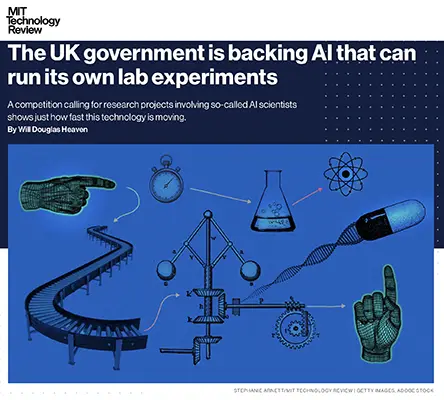
The UK Government is Backing AI That Can Run Its Own Lab Experiments
MIT Technology Review, Jan. 20, 2026
TL;DR: The UK’s ARIA agency is funding 245 proposals for “AI scientists” capable of designing, running, and iterating on entire scientific workflows autonomously.
Executive Summary: The UK government is aggressively funding teams to build “AI scientists” through its Advanced Research and Invention Agency (ARIA). These systems are designed to manage the entire scientific loop: generating hypotheses, running experiments with robot biologists/chemists, and analyzing results to start the loop again. While current LLM-based agents still face high failure rates—failing 3 out of 4 times in recent tests due to “overexcitement” or “deviation from specs”—the government is betting on these tools to drastically increase the speed of discovery.
Relevance for Business: This is a signal that “Agentic AI” is moving into high-stakes industrial applications. SMBs in biotech, manufacturing, or chemical processing should expect their competitive landscape to be disrupted by firms that can run research loops 24/7 without human fatigue.
Calls to Action:
🔹 Prepare for “High-Speed” Competition: Evaluate how your R&D timeline would change if your competitors could run 10x more experiments per month.
🔹 Implement Oversight Protocols: If using agentic systems, build in rigorous human checkpoints to catch “overexcited” AI declaring success prematurely.
🔹 Modernize Your Lab Data: Ensure your proprietary datasets are “AI-ready” so you can take advantage of these workflow-automation tools as they mature.
Summary by ReadAboutAI.com
https://www.technologyreview.com/2026/01/20/1131462/the-uk-government-is-backing-ai-scientists-that-can-run-their-own-experiments/: February 03, 2026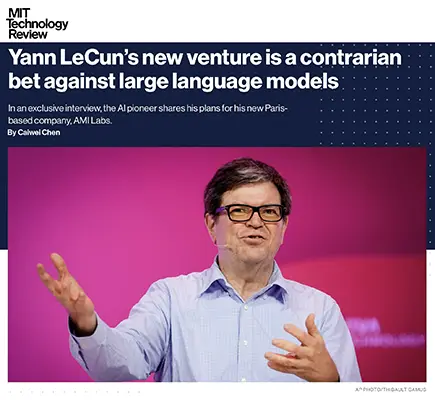
Yann LeCun’s New Venture: A Contrarian Bet Against LLMs
MIT Technology Review, Jan. 22, 2026
TL;DR: AI pioneer Yann LeCun is launching AMI Labs to build “world models” that accurately reflect physical reality, arguing that current Large Language Models (LLMs) are a dead end for true intelligence.
Executive Summary: Yann LeCun, after leaving Meta, has founded AMI Labs in Paris to pursue “world models”—AI that understands the dynamics of the physical world rather than just predicting the next word in a sentence. LeCun argues that LLMs are a “monoculture” that will ultimately fail to solve pressing problems requiring real-world reasoning. His new venture is built on open-source principles, criticizing the “closed” approach of frontier labs like OpenAI. The goal is to move beyond the limitations of text-based AI toward systems that can interact safely and intelligently with the physical environment.
Relevance for Business
This signals a coming architectural shift in AI. SMBs should be prepared for a future where the most effective business tools aren’t “chatbots” but “world-aware” systems that can manage physical logistics, manufacturing, and complex spatial reasoning.
Calls to Action:
🔹 Watch the “World Model” Space: Monitor February 2026 for more details on AMI Labs’ core technology releases.
🔹 Support Open-Source Strategy: Consider incorporating open-source AI models into your stack to avoid “vendor lock-in” and benefit from community-driven innovation.
🔹 Identify “Physical” Use Cases:Look for areas in your business (warehousing, delivery, physical retail) that could benefit from AI that understands physical dynamics.
Summary by ReadAboutAI.com
https://www.technologyreview.com/2026/01/22/1131661/yann-lecuns-new-venture-ami-labs/: February 03, 2026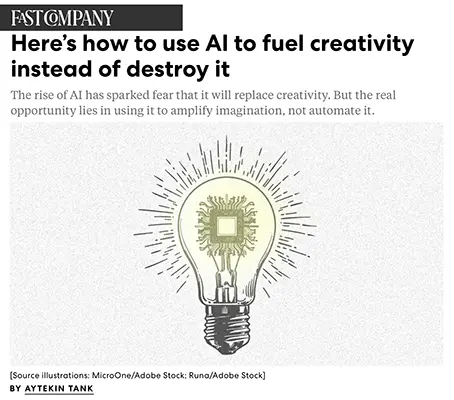
Here’s How to Use AI to Fuel Creativity Instead of Destroy It
Fast Company, Jan. 21, 2026
TL;DR: To maintain a competitive edge, businesses must treat AI as a “creative collaborator” for iteration rather than a “replacement” that outsources human judgment.
Executive Summary: The core risk of AI in creative work is the “outsourcing of curiosity”. If users simply ask AI for a final answer, they lose the “teachable moments” and the depth of understanding that comes from trial and error.
Effective AI integration uses the technology to amplify imagination, not automate it. This means using generative AI for rapid idea generation and “new iterations” of existing concepts, but leaving the final critical decisions and “culinary expertise” (the human touch) to the person in charge.
Relevance for Business: For SMBs, the danger is producing “beige,” generic content or strategy. By setting rules of thumb—AI for expansion, humans for selection—executives ensure that their brand maintains its unique voice while still benefiting from AI’s speed.
Calls to Action:
🔹 Set “Human-in-the-Loop” Rules: Mandate that AI is used for brainstorming, but final decisions must be documented with human reasoning.
🔹 Encourage “Tinkering”: Reward employees who use AI to experiment with 10 variations of a project rather than just accepting the first output.
🔹 Guard Against “Skill Decay”: Ensure your team understands the fundamentals of their craft so they can recognize when an AI output is “off-brand”.
Summary by ReadAboutAI.com
https://www.fastcompany.com/91473539/how-to-use-ai-to-power-creativity-instead-of-destroy-it: February 03, 2026
Meta Enters Up to $6 Billion Data-Center Fiber-Optic Cable Deal With Corning
WSJ Jan. 27, 2026
TL;DR: Meta’s massive $6 billion commitment to domestic fiber-optic infrastructure signals a long-term “all-in” bet on the physical backbone required for next-generation AI.
Executive Summary
Meta has signed a multiyear deal worth up to $6 billion with Corning to secure the fiber-optic cable and connectivity hardware necessary for its U.S. data-center expansion. This deal underscores the shift toward domestic sourcing for critical AI infrastructure. To meet Meta’s demand, Corning is expanding its North Carolina manufacturing capacity by 15% to 20%, highlighting the massive physical labor and material requirements of the AI era.
Relevance for Business: This deal highlights the physical constraints of AI. While most executives focus on software, the “AI gold rush” is driving a massive infrastructure and energy demand that will likely keep cloud computing costs high and impact supply chains for networking equipment. SMBs should expect continued competition for data-center resources and potential “crowding out” by tech giants.
Calls to Action
🔹 Plan for long-term AI scaling: Understand that the physical limitations of data centers may dictate your AI software roadmap.
🔹 Monitor infrastructure costs: Anticipate potential price volatility in cloud and networking services as giants lock up supply.
🔹 Evaluate domestic dependencies: Consider the risks of international supply chains for your own hardware needs given Meta’s pivot to domestic sourcing.
Summary by ReadAboutAI.com
https://www.wsj.com/tech/meta-enters-up-to-6-billion-data-center-fiber-optic-cable-deal-with-corning-4a085f73: February 03, 2026
Amazon One Medical Unveils Health AI Assistant
TechTarget, Jan. 21, 2026
TL;DR: Amazon’s new 24/7 AI assistant leverages personal medical records to offer agentic health guidance, signaling a shift toward proactive, personalized AI concierge services.
Executive Summary: Amazon One Medical has launched a HIPAA-compliant, agentic AI assistant that provides patients with 24/7 guidance. Unlike general chatbots, this tool has the context of the user’s medical records, allowing it to help book appointments, manage medications, and answer health questions with high specificity. It is designed to “connect the dots” and escalate to human care teams when it detects a need for clinical expertise.
Relevance for Business: This represents the “Concierge AI” model. SMBs should note how Amazon uses proprietary data (medical records) as a moat to provide a service that general AI (like ChatGPT) cannot. This is a blueprint for using your internal customer data to create “sticky,” indispensable AI assistants.
Calls to Action:
🔹 Map Your Data Moat: Identify what unique customer data you own that could power a specialized AI assistant for your clients.
🔹 Develop a Hand-off Protocol: Like One Medical, ensure your AI tools have a clear, immediate path to human support for complex or high-stakes issues.
🔹 Focus on Trust and Privacy:Lead with privacy controls (like One Medical’s encryption and non-sale of data) to overcome customer AI-hesitancy.
Summary by ReadAboutAI.com
https://www.techtarget.com/patientengagement/news/366637543/Amazon-One-Medical-unveils-Health-AI-assistant-for-patients: February 03, 2026
HOW CHINA CAUGHT UP ON AI—AND MAY NOW WIN THE FUTURE
TIME, Jan. 27, 2026
TL;DR / Key Takeaway:
China’s AI strategy prioritizes diffusion and deployment over frontier breakthroughs, creating a durable competitive advantage.
Executive Summary
China’s AI rise is less about beating U.S. models and more about embedding AI across its economy—from robotics to transportation to manufacturing. With lower costs, regulatory coordination, and massive scale, China is accelerating adoption faster than Western counterparts.
This approach favors practical productivity gains over theoretical leadership, potentially allowing China to outpace competitors in real economic impact—even if it lags at the frontier.
Relevance for Business
SMBs should recognize that AI competitiveness is increasingly about execution, not just model quality.
Calls to Action
🔹 Focus on applied AI wins, not benchmarks
🔹 Track global competitors’ automation strategies
🔹 Prepare for faster innovation cycles abroad
🔹 Invest in deployment capability, not just tools
Summary by ReadAboutAI.com
https://time.com/7358175/china-us-ai-race/: February 03, 2026
CHINA APPROVES PURCHASES OF NVIDIA’S H200 CHIP, EASING TENSION WITH U.S.
WSJ, JAN 28, 2026
TL;DR / Key Takeaway:
Geopolitical AI restrictions are becoming selective, not absolute, reshaping global compute access.
Executive Summary
China’s approval of Nvidia H200 chip purchases signals a pragmatic easing of AI trade tensions, allowing limited access while maintaining strategic controls. This move underscores a shift from blanket bans toward managed interdependence.
For AI development, this means compute advantages remain uneven but fluid, influenced by diplomacy as much as technology. Chinese firms gain short-term capability boosts, while the U.S. retains leverage through licensing and oversight.
Relevance for Business
SMBs dependent on AI services should expect price volatility, regional disparities, and sudden policy-driven changes in model performance and availability.
Calls to Action
🔹 Avoid assuming stable AI infrastructure access
🔹 Monitor geopolitical risk in vendor selection
🔹 Diversify AI dependencies geographically
🔹 Budget for compute-driven pricing swings
Summary by ReadAboutAI.com
https://www.wsj.com/wsjplus/dashboard/articles/china-approves-purchases-of-nvidias-h200-chip-easing-tension-with-u-s-daa1ec84: February 03, 2026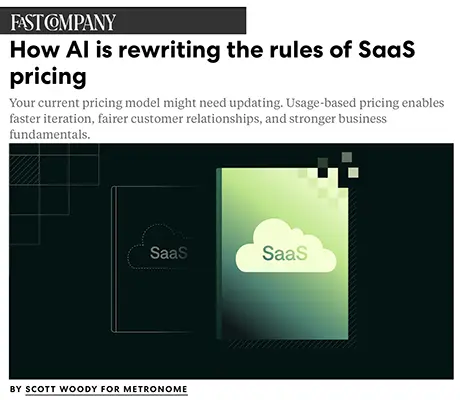
How AI is Rewriting the Rules of SaaS Pricing
Fast Company, Nov. 7, 2025
TL;DR: The era of seat-based pricing is ending; AI’s ability to perform autonomous tasks is forcing a shift toward usage-based models that align revenue with actual outcomes.
Executive Summary The traditional SaaS model—charging per “seat”—is breaking down because AI now performs workflows without direct human intervention. When software can resolve hundreds of support tickets or translate pages autonomously, the “value = human activity” logic no longer applies. Usage-based pricing (UBP) is becoming the new foundation, requiring companies to invest in sophisticated “billing UX” that provides customers with real-time transparency and spend controls.
Relevance for Business If you are a software buyer or seller, your financial models must evolve. Paying for “access” is becoming inefficient compared to paying for “outcomes”.
Calls to Action 🔹 Audit Your Pricing Stack: If your product delivers value through automation, transition toward usage-based tiers to avoid leaving money on the table. 🔹 Invest in Billing Transparency: Treat your billing dashboard as a core product feature to maintain customer trust in a variable-cost environment.
Summary by ReadAboutAI.com
https://www.fastcompany.com/91432475/how-ai-is-rewriting-the-rules-of-saas-pricing: February 03, 2026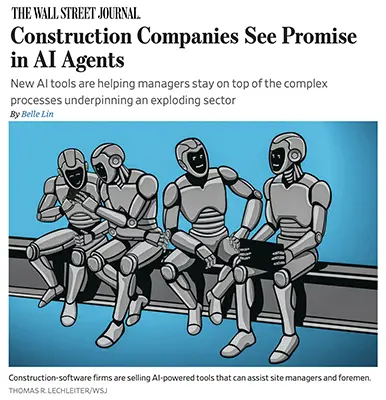
Construction Companies See Promise in AI Agents
WSJ Jan. 27, 2026
TL;DR: Construction firms are deploying “AI agents” to preserve the institutional knowledge of a retiring workforce and manage complex site safety protocols.
Executive Summary: Facing a shortage of 349,000 workers, construction leaders are turning to AI agents to automate site management and safety inspections. Firms like Skanska are training agents on thousands of internal documents—including procedures, safety feedback, and expert decision-making—to “digitize” the intuition of senior leaders. These agents don’t just search data; they synthesize complex site information to identify safety violations and optimize workflows.
Relevance for Business: This is a prime example of knowledge transfer through AI. For SMBs in labor-intensive industries, AI agents offer a way to bridge the talent gap as experienced workers retire. The primary obstacle is not the technology, but workplace trust; moving workers from traditional pen-and-paper to AI-assisted tools requires significant cultural change and proof of reliability.
Calls to Action
🔹 Focus on trust-building: Launch small, high-transparency pilots to overcome worker skepticism of digital tools.
🔹 Start a “Knowledge Harvest”: Begin capturing the “unwritten rules” and decision-making processes of your most experienced staff.
🔹 Deploy for safety first: Use AI to monitor high-risk compliance areas where human error is most costly.
Summary by ReadAboutAI.com
https://www.wsj.com/articles/construction-companies-see-promise-in-ai-agents-12dc2d60: February 03, 2026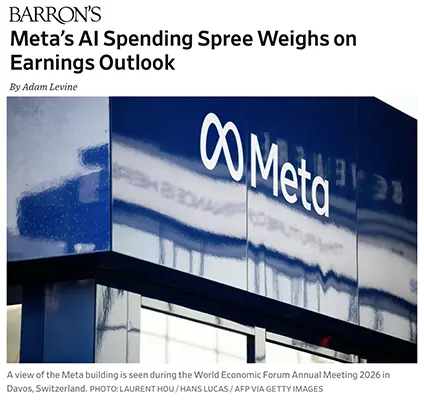
META’S AI SPENDING SPREE WEIGHS ON EARNINGS OUTLOOK
BARRON’S, JAN 28, 2026
TL;DR / Key Takeaway:
Meta is betting profitability today for AI dominance tomorrow—and investors are uneasy.
Executive Summary
Meta’s aggressive AI expansion is reshaping its financial profile. Capex is expected to exceed $100 billion in 2026, while earnings growth lags. AI-driven infrastructure, massive hiring, and rising depreciation are compressing margins, even as revenue grows.
To manage risk, Meta is pursuing creative financing, joint ventures, and off-balance-sheet structures—effectively spreading AI costs over time. CEO Mark Zuckerberg argues the greater risk is underinvesting, but markets remain skeptical.
This underscores a broader reality: AI leadership now requires financial engineering as much as technical excellence.
Relevance for Business
SMBs should expect AI platforms to prioritize monetization, data efficiency, and ad performance under investor pressure—affecting features, pricing, and access.
Calls to Action
🔹 Expect AI monetization pressure on platforms
🔹 Monitor vendor cost pass-throughs
🔹 Avoid dependency on experimental features
🔹 Align AI use with clear business ROI
Summary by ReadAboutAI.com
https://www.wsj.com/wsjplus/dashboard/articles/meta-earnings-stock-price-8dff23a7: February 03, 2026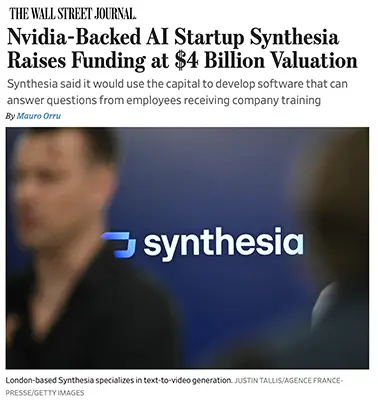
Nvidia-Backed AI Startup Synthesia Raises Funding at $4 Billion Valuation
WSJ Jan. 26, 2026
TL;DR: Synthesia’s $4 billion valuation underscores a massive enterprise demand for AI video agents that can interactively “upskill” and “reskill” the workforce at scale.
Executive Summary
Synthesia, a London-based AI video startup, raised $200 million in Series E funding led by Google Ventures, reaching a $4 billion valuation. The company is evolving from simple text-to-video toward interactive AI agents designed for corporate training. Synthesia is on track to reach $200 million in annual recurring revenue (ARR) this year, fueled by major customers like Microsoft. This growth persists despite fears of a sector bubble, as enterprises face intense pressure to reskill employees rapidly.
Relevance for Business: For SMB managers, this signal points to the commoditization of high-quality training. The ability to create personalized, interactive video training without a production studio reduces the cost of workforce development. However, the valuation gap between European startups like Synthesia and U.S. giants like OpenAI ($750B) and Anthropic ($350B) highlights where the market expects the most dominant platforms to emerge.
Calls to Action
🔹 Watch the “Platform Gap”: Consider the longevity and integration capabilities of smaller niche AI startups versus major platform players.
🔹 Modernize internal training: Replace static PDFs and old videos with interactive, AI-generated training modules.
🔹 Evaluate “Agentic” video: Monitor how interactive video can be used for customer-facing support and onboarding.
Summary by ReadAboutAI.com
https://www.wsj.com/business/entrepreneurship/nvidia-backed-ai-startup-synthesia-raises-funding-at-4-billion-valuation-7941abae: February 03, 2026
How an AI Scribe Is Alleviating Burdens at an FQHC
TechTarget, Jan. 20, 2026
TL;DR: AI “scribes” are moving beyond simple transcription to become essential administrative partners, successfully reducing clinician burnout and improving patient care quality.
Executive Summary: At Hawse Health, a rural health center, the implementation of AI scribe technology has transformed operations. These tools do more than record conversations; they ensure documentation meets medical necessity and accurately captures billing codes, tasks that previously led to massive administrative backlogs. Beyond efficiency, the tool has become a recruitment asset, as clinicians increasingly expect AI support to manage their heavy workloads.
Relevance for Business: This is a prime example of “Cognitive Offloading.” Any SMB manager in a high-compliance or documentation-heavy field (legal, accounting, insurance) can look to this model to see how AI can return time to professional staff, allowing them to focus on high-value human interaction.
Calls to Action:
🔹 Audit “Admin Leaks”: Identify high-skill employees spending too much time on routine documentation and pilot an AI recording or summarization tool.
🔹 Use AI for Recruitment: Highlight your “tech-forward” administrative support as a perk for new hires in competitive labor markets.
🔹 Focus on Compliance: Ensure your chosen tools are HIPAA (or industry-equivalent) compliant to protect client data.
Summary by ReadAboutAI.com
https://www.techtarget.com/healthtechanalytics/feature/How-an-AI-scribe-is-alleviating-burdens-at-an-FQHC: February 03, 2026
2026 AI Business Predictions
PwC, 2026
TL;DR: The era of “small sporadic bets” is over; in 2026, business success is defined by using AI agents and mature systems to build entirely new operating models that drive top-line growth.
Executive Summary: While many companies have seen modest efficiency gains from AI, only a few are realizing “extraordinary value” such as surging valuations and revenue growth. In 2026, the gap is widening between those making small, disconnected bets and those focusing on wholesale transformation. Impact is now visible across strategy, workforce, and sustainability, as AI agents transition from experimental tools to core components of a nimble business model.
Relevance for Business: For SMBs, the message is to stop spreading efforts thin. Real competitive advantage comes from precision—identifying specific high-impact areas (like finance or supply chain) where AI can fundamentally change how the business operates, rather than just automating existing, inefficient tasks.
Calls to Action:
🔹 Concentrate Your Bets: Shift from broad experimentation to 2–3 high-stakes AI initiatives that directly impact your primary revenue drivers.
🔹 Deploy AI Agents: Look for “agentic” tools that can handle multi-step workflows autonomously rather than simple chat interfaces.
🔹 Benchmark Performance: Use the growing body of industry evidence to set clear ROI benchmarks for your AI investments.
Summary by ReadAboutAI.com
https://www.pwc.com/us/en/tech-effect/ai-analytics/ai-predictions.html: February 03, 2026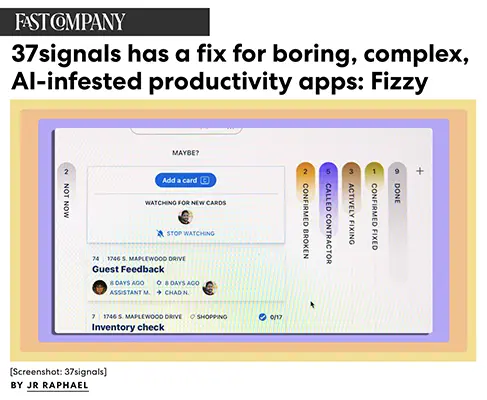
37signals Has a Fix for AI-Infested Productivity Apps: Fizzy
Fast Company, Jan. 21, 2026
TL;DR: 37signals is launching “Fizzy,” a simple, AI-minimalist app that counters the trend of “overpacked, overhyped” productivity tools by returning to organizational fundamentals.
Executive Summary: While most software companies are rushing to add AI features, 37signals CEO Jason Fried argues that modern tools have become boring, complicated, and “AI-infested” with features that provide little practical value.
Fizzy is a “return to fundamentals,” focusing on a personality-filled, simple interface for tracking bugs and tasks. It is a direct challenge to “Big Tech” standards like Jira and Trello, which Fried claims have lost sight of user experience in favor of superfluous features.
Relevance for Business: This highlights a growing “AI Fatigue” among users. SMB managers should be wary of “feature bloat” in their tech stack; sometimes the most productive tool is the one that does less but does it with more clarity and less distraction.
Calls to Action:
🔹 Audit Your Tech Stack: Identify apps that have become too complex due to recent AI updates and evaluate if simpler alternatives would increase team velocity.
🔹 Prioritize “Fundamentals”: When selecting new software, look for tools that solve a specific problem exceptionally well rather than promising a “do-everything” AI assistant.
🔹 Watch for “AI Fatigue”: Listen for employee feedback about distracting AI pop-ups or tools that feel “overpacked” and harder to use than before.
Summary by ReadAboutAI.com
https://www.fastcompany.com/91470191/fizzy-is-37signals-fix-for-boring-complex-ai-infested-productivity-apps: February 03, 2026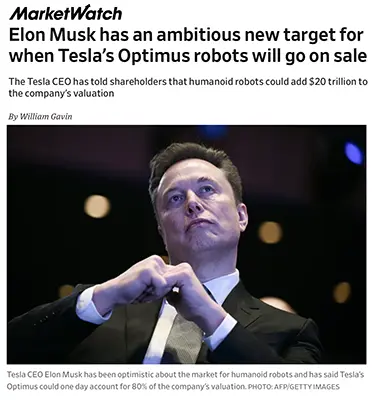
Elon Musk Has an Ambitious New Target for When Tesla’s Optimus Robots Will Go On Sale
WSJ/MarketWatch, Jan. 22, 2026
TL;DR: Elon Musk targets late 2026 for public availability of Optimus robots, though production is expected to be “agonizingly slow” due to supply chain voids.
Executive Summary: Tesla aims to have Optimus robots available for public purchase by the end of 2027, following internal deployment for simple tasks in Tesla factories. Musk envisions these units serving as industrial workers, caretakers, and teachers, with a price point targeted between $20,000 and $30,000.
A major bottleneck is the lack of a humanoid supply chain; unlike cars or computers, components like high-dexterity hands and forearms must be designed and sourced from scratch. Tesla is currently refining the third version of Optimus for volume production, but initial output in late 2026 is expected to be limited.
Relevance for Business: This represents a potential labor-as-a-service shift. If Tesla meets its price targets, the cost of a humanoid robot would be comparable to a luxury vehicle, making it a capital expenditure that could eventually offset recurring labor costs in specialized SMB sectors like security or light assembly.
Calls to Action:
🔹 Track Production Milestones: Watch for the March 2026 demonstration of the volume-production prototype to gauge actual technical readiness.
🔹 Assess Long-term Valuation: Consider how humanoid robotics might impact your industry’s valuation and efficiency over the next decade as a $20T market emerges.
🔹 Prepare for Supply Delays: Do not build immediate 2026-27 strategy around these units, as “agonizingly slow” production will likely favor large-scale enterprise partners first.
Summary by ReadAboutAI.com
https://www.wsj.com/wsjplus/dashboard/articles/elon-musk-says-tesla-will-sell-optimus-robots-to-consumers-by-the-end-of-2027-b0ce1729: February 03, 2026
Google Stock Upgraded On Rosy AI and Cloud Computing Outlook
WSJ, Jan. 22, 2026
TL;DR: Google’s aggressive push into AI chips (TPUs) and the licensing of Gemini to Apple are cementing its position as an infrastructure leader.
Executive Summary
Following an upgrade to “Strong Buy,” Alphabet is being recognized for its ability to rival Nvidia with its homegrown TPU (Tensor Processing Unit) chips. This infrastructure play is complemented by strategic partnerships, most notably Apple’s confirmation that it will use Gemini models to power the next version of Siri.
Google is also embedding AI across its entire product suite—YouTube, Maps, and Gmail—to improve user retention and ad efficiency. The company’s Gemini 3 model has significantly improved capabilities in coding and image creation, making it a more robust tool for professional environments.
Relevance for Business
The Apple-Gemini partnership is a massive signal for SMB managers: Google’s AI models will likely become the default intelligence for millions of consumer and business devices. This reduces the risk of “betting on the wrong horse” when choosing an AI ecosystem for your company.
Calls to Action
🔹 Prepare for AI-Powered Siri: SMBs targeting consumer markets should prepare for a more agentic Siri powered by Gemini, which may change how customers discover local services.
🔹 Utilize Gemini 3 for Operations: Test Gemini 3 for internal coding or content needs, as its updated capabilities are designed for higher reliability.
🔹 Watch Feb 4th Earnings: Monitor the upcoming Q4 earnings report for specific guidance on AI agent deployment timelines for Workspace users.
Summary by ReadAboutAI.com
https://www.wsj.com/wsjplus/dashboard/articles/google-stock-upgraded-on-rosy-artificial-intelligence-cloud-computing-outlook-134135650631196010: February 03, 2026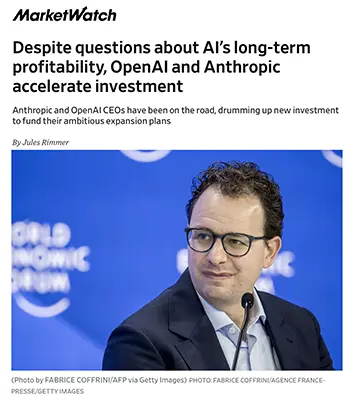
DESPITE PROFITABILITY QUESTIONS, OPENAI AND ANTHROPIC ACCELERATE INVESTMENT
WSJ / MARKETWATCH, JAN 28, 2026
TL;DR / Key Takeaway:
Leading AI firms are spending aggressively despite unclear paths to profit, signaling a high-stakes land grab.
Executive Summary
OpenAI and Anthropic are accelerating investment even as analysts question long-term profitability. The strategy is clear: scale now, justify later. Massive funding rounds aim to lock in infrastructure, talent, and market share before competitors catch up.
For customers, this creates short-term innovation gains but long-term pricing and dependency risks as firms seek returns.
Relevance for Business
SMBs benefit today—but may pay later through price increases, usage limits, or bundled services.
Calls to Action
🔹 Capture near-term AI value while costs are subsidized
🔹 Avoid deep lock-in without exit plans
🔹 Track vendor financial health
🔹 Expect pricing shifts post-scale
Summary by ReadAboutAI.com
https://www.wsj.com/wsjplus/dashboard/articles/despite-questions-about-ais-long-term-profitability-openai-and-anthropic-accelerate-investment-ffbcec4a: February 03, 2026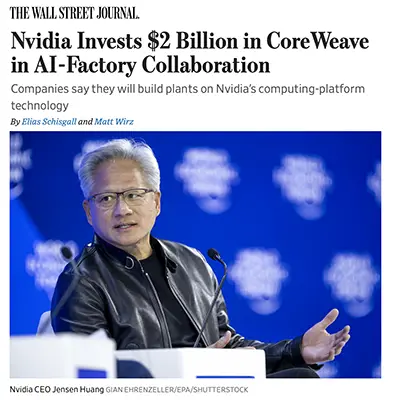
NVIDIA INVESTS $2 BILLION IN COREWEAVE IN AI-FACTORY COLLABORATION
WSJ, JAN 26, 2026
TL;DR / Key Takeaway:
AI is entering its industrial phase: Nvidia is locking in compute, power, and infrastructure at unprecedented scale.
Executive Summary
Nvidia’s additional $2 billion investment in CoreWeave signals deep confidence in large-scale AI infrastructure. The partnership aims to build AI “factories” with 5 gigawatts of capacity by 2030, using Nvidia’s Rubin platform and tightly integrated software stacks.
The move also addresses investor concern about CoreWeave’s debt-heavy financing model by effectively backstopping it with Nvidia’s balance sheet. At the same time, it reinforces a critical trend: AI capacity is now constrained by land, power, and financing—not demand.
This partnership further consolidates Nvidia’s role as the central orchestrator of the AI industrial supply chain.
Relevance for Business
SMBs should expect compute scarcity, power constraints, and premium pricing to persist. AI access will increasingly depend on infrastructure alliances, not open markets.
Calls to Action
🔹 Plan for compute availability risk
🔹 Lock in AI capacity early where possible
🔹 Expect vendor ecosystem lock-in
🔹 Monitor power and sustainability implications
Summary by ReadAboutAI.com
https://www.wsj.com/tech/ai/nvidia-invests-2-billion-in-coreweave-in-ai-factory-collaboration-68088ca0: February 03, 2026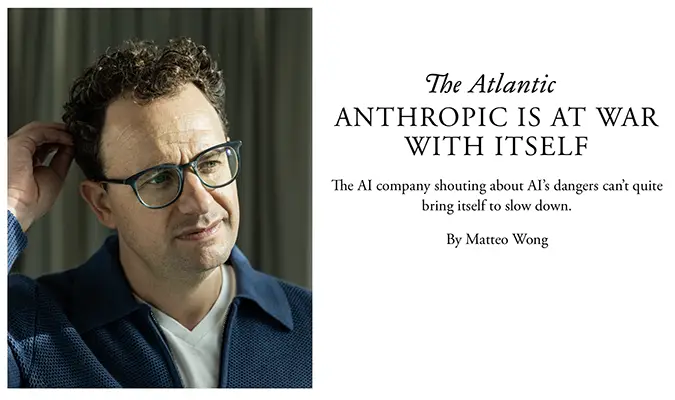
ANTHROPIC IS AT WAR WITH ITSELF
THE ATLANTIC, January 28, 2026
TL;DR / Key Takeaway:
Leading AI firms are struggling to reconcile safety ideals with commercial pressure, and that tension is now visible.
Executive Summary
Anthropic’s internal debates reveal a core industry conflict: responsible AI principles versus competitive survival. Founded with a safety-first mission, the company now faces escalating pressure to scale faster, monetize aggressively, and compete with OpenAI and Big Tech.
This internal friction is not unique—it reflects a broader industry reality where governance slows speed, and speed increasingly determines funding and relevance. The result is organizational tension, cultural strain, and strategic ambiguity.
For businesses relying on AI vendors, this raises a critical question: which promises endure under pressure?
Relevance for Business
SMBs should treat AI vendor values as dynamic, not fixed, and plan for shifting policies, pricing, and safeguards over time.
Calls to Action
🔹 Reevaluate vendor lock-in risks
🔹 Demand clarity on data governance commitments
🔹 Avoid assuming long-term stability in AI policies
🔹 Build internal AI oversight, not blind trust
Summary by ReadAboutAI.com
https://www.theatlantic.com/technology/2026/01/anthropic-is-at-war-with-itself/684892/: February 03, 2026
This Group of Workers is Winning the AI Adoption Race
Fast Company, Jan. 22, 2026
TL;DR: Solopreneurs and independent professionals are outperforming large corporations in AI adoption because they lack the bureaucratic constraints and directly reap the productivity rewards.
Executive Summary: Independent workers are leveraging AI at higher rates than traditional employees. Because they face fewer practical constraints—such as rigid IT policies or multi-level approval processes—they can integrate new tools instantly to solve personal bottlenecks.
The adoption path typically follows a three-stage evolution: starting as a brainstorming partner for marketing, moving to a marketing editor, and finally becoming a core part of client delivery and service scaling. For these individuals, AI isn’t just a tool; it’s a way to transform from a “burned-out professional” into an owner of multiple automated revenue streams.
Relevance for Business: The “solopreneur superpower” is a signal for SMB executives: agility is your edge. While large enterprises struggle with governance, SMBs can mimic the solopreneur model by allowing small teams to adopt “low-risk, high-reward” AI workflows immediately.
Calls to Action:
🔹 Remove “Red Tape”: Identify one department where IT restrictions are slowing down AI experimentation and create a “sandbox” for faster testing.
🔹 Identify “Task Bottlenecks”: Audit your managers’ most repetitive tasks (like marketing copy or scheduling) and apply the solopreneur “marketing editor” model to them.
🔹 Hire AI-Fluent Contractors: When outsourcing, prioritize independents who use AI to deliver faster, higher-quality results at lower overhead.
Summary by ReadAboutAI.com
https://www.fastcompany.com/91478672/this-group-of-workers-is-winning-the-ai-adoption-race: February 03, 2026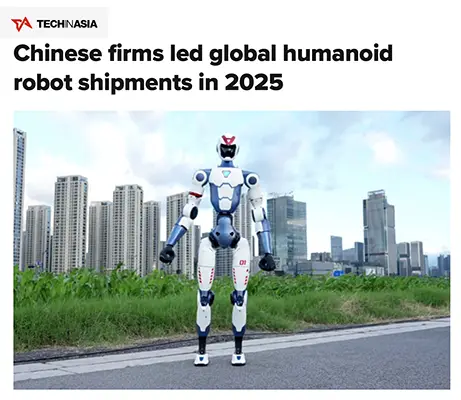
CHINESE FIRMS LED GLOBAL HUMANOID ROBOT SHIPMENTS IN 2025
TECHASIA, January 08, 2026
TL;DR / Key Takeaway:
China has quietly taken the global lead in humanoid robot deployments, signaling that physical AI is moving from demos to real-world execution faster than many Western firms anticipated.
Executive Summary
Chinese robotics firms led global humanoid robot shipments in 2025, driven by state-backed investment, manufacturing scale, and rapid commercialization rather than breakthrough software alone. While U.S. and European companies continue to dominate AI research narratives, China is winning on deployment, cost efficiency, and iteration speed—particularly in logistics, manufacturing, and service roles.
Unlike earlier robotics cycles, these humanoid systems are not experimental prototypes. They are being integrated into factories, warehouses, and service environments, often paired with narrow, task-specific AI rather than general intelligence. This reflects a broader strategic shift: execution over elegance.
For global markets, the implication is clear—humanoid robotics is entering a supply-driven phase, where cost, reliability, and scale matter more than novelty.
Relevance for Business
For SMB leaders, this signals that robotics-as-labor is becoming commercially viable sooner than expected. Competitive pressure will increasingly come not from innovation headlines, but from lower-cost automated operations abroad.
Calls to Action
🔹 Track robotics adoption in logistics and manufacturing, not just AI software tools
🔹 Prepare for price competition driven by automation-enabled efficiency
🔹 Evaluate where task-specific robotics could offset labor shortages
🔹 Avoid waiting for “general-purpose robots” before piloting narrow use cases
Summary by ReadAboutAI.com
https://www.techinasia.com/news/chinese-firms-led-global-humanoid-robot-shipments-2025: February 03, 2026


Closing: AI update for February 03, 2026
As you read through this week’s summaries, don’t feel pressure to chase every headline; instead, use them to clarify your AI priorities, pressure-test your risk assumptions, and pick a small number of high-leverage experiments that fit your business. The goal for 2026 isn’t to do everything with AI—it’s to do the right things, in the right order, with guardrails that protect your people, customers, and brand.
AI in Product Development: Materials and Chemicals
- Key Development: Manufacturers like PPG and 3M are using generative AI to discover new chemical combinations for products such as fast-drying paint and better-smelling soap. PPG successfully used AI to develop a clear coat for cars that reduces drying time by over 50%.
- Executive Insight: Greg Mulholland, CEO of Citrine Informatics, noted that AI excels at balancing multiple product attributes simultaneously, such as making a material both lighter and stronger.
- Challenges: While AI can suggest promising digital prototypes, the transition to physical manufacturing remains expensive for early-stage startups.
Meta and Corning: Infrastructure Expansion
- Key Development: Meta has entered a multiyear deal worth up to $6 billion with Corning to purchase fiber-optic cable. This agreement supports the expansion of Meta’s U.S. data-center network specifically for AI systems.
- Economic Impact: Corning plans to expand its manufacturing capacity in North Carolina, which is expected to increase its state employment levels by 15% to 20%.
- Strategy: The deal emphasizes sourcing advanced technology domestically to build the physical backbone of modern AI infrastructure.
AI Agents in the Construction Industry
- Key Development: Construction-software firms are deploying AI agents to assist site managers with safety inspections and project management. For instance, Skanska built an AI safety agent trained on thousands of internal policy documents and expert feedback.
- Business Driver: The industry is facing a shortage of approximately 349,000 workers as of early 2026, driving a need for tools that can reproduce the knowledge of experienced, retiring leaders.
- Obstacle: A significant hurdle remains gaining the trust of workers who traditionally rely on manual tools like pen-and-paper.
Regulatory Landscape: South Korea’s “AI Basic Act”
- Key Development: South Korea has enacted the world’s first comprehensive set of laws governing AI, known as the “AI Basic Act,” which took effect in late January 2026.
- Major Requirements: The law mandates transparency and disclosures for AI used in critical areas like nuclear facility management and water production. It also requires watermarks or labels on AI-generated content that could be mistaken for reality.
- Enforcement: Violations can lead to fines of up to 30 million won (approx. $20,400), though a one-year grace period has been granted for businesses to adjust.
Investment Trends: Synthesia’s $4 Billion Valuation
- Key Development: London-based AI startup Synthesia raised $200 million in Series E funding, led by Google Ventures, reaching a $4 billion valuation.
- Business Focus: The company specializes in text-to-video generation and is developing software for interactive employee training videos.
- Growth Metrics: Synthesia is on track to reach $200 million in annual recurring revenue in 2026, having signed major customers like Microsoft.
- Market Context: Despite high valuations for U.S. firms (with OpenAI aiming for a $750 billion valuation), European AI startups continue to see significant, albeit smaller, funding rounds.
This week’s ReadAboutAI.com update shows an AI landscape that is no longer defined by shiny demos, but by capital, capacity, and competition. Wall Street is openly debating whether we’re in an AI bubble even as Big Tech doubles down on trillion-dollar capex, billion-dollar research labs with no revenue, and high-stakes bets on chips, fiber, and data centers. Nvidia, Meta, Google, OpenAI, Anthropic, and others are racing to lock in compute, power, and infrastructure while governments test what “AI sovereignty” really means—from China’s selective access to Nvidia’s H200 chips to South Korea’s sweeping AI Basic Act. At the same time, China’s emphasis on deployment over hype—from humanoid robots on factory floors to economy-wide AI diffusion—highlights a new competitive reality: the advantage is shifting to those who can execute at scale, not just talk about frontier models.
Downstream, those strategic choices are reshaping work, regulation, and day-to-day tools. On the workforce side, AI is driving both layoffs and reskilling, from Amazon and Pinterest reorganizing around automation, to construction firms bottling expert know-how in AI agents, to healthcare systems using AI scribes and concierge-style assistants to relieve burnout. Creatively and operationally, we see a split: some companies lean into “vibe coding,” agentic tools, and AI training video platforms to accelerate software and skills, while others push back against AI fatigue with simpler, low-AI products. Regulators, scientists, and journalists are also sounding alarms—on copyright-strained training data, “AI slop” polluting research, health AI overreach, and insecure AI browsers—underscoring that trust, governance, and source quality are becoming competitive factors. Taken together, this week’s summaries trace a clear message for SMB leaders: it’s time to move from casual experimentation to disciplined, accountable AI adoption—choosing where to lean in, where to show restraint, and how to build on infrastructure, partners, and information you can actually trust.
All Summaries by ReadAboutAI.com
↑ Back to Top