
AI Updates March 31, 2026

This week’s collection suggests that AI is entering a more disciplined and more consequential phase. The loudest signal is no longer just that models are improving; it is that the companies building them are making harder strategic choices about where real value will come from. OpenAI’s retreat from Sora and its apparent concentration on enterprise, coding, and frontier-model competition, Google’s widening multimodal push, and Meta’s internal restructuring around AI agents all point to the same conclusion: the market is shifting from experimentation and novelty toward execution, monetization, and organizational redesign.
At the same time, this week’s coverage makes clear that adoption is not a clean upward curve. Businesses are buying tools faster than employees are learning to use them. Workers are increasingly anxious about what AI means for entry-level and administrative roles. Public distrust remains high even as usage spreads. And the governance questions are getting sharper: disclosure in published content, trust in AI-assisted decisions, vendor stability, and the risks of building workflows on tools whose strategic priorities may change overnight. In other words, AI is not settling down into a simple productivity story. It is becoming a management, workforce, and trust story at the same time.
For SMB executives and managers, the practical takeaway is straightforward: this is a moment to become more selective, not more passive. The strongest opportunities are increasingly visible — coding assistance, customer service automation, research acceleration, domain-specific tools, and workflow agents — but so are the failure modes: poor training, weak governance, unstable vendors, and rushed assumptions about labor savings. The organizations that benefit most will not be the ones chasing every new release. They will be the ones that choose durable use cases, train their people well, and treat AI adoption as an operating model decision rather than a software purchase.
Summaries



OpenAI’s Strategic Retrenchment, Google’s Expanding Multimodal Push, and the Next Phase of AI Competition
AI for Humans podcast transcript — March 27, 2026
TL;DR / Key Takeaway: The clearest signal from this episode is that OpenAI appears to be narrowing its priorities around enterprise adoption, coding, and frontier-model competition, while Google is broadening across voice, audio, interface generation, and consumer utility, reinforcing that the AI market is now being shaped as much by focus, distribution, and product execution as by raw model quality.
Executive Summary
This episode’s strongest business signal is the hosts’ argument that OpenAI is pulling back from experimental or consumer-adjacent bets—most notably Sora/video efforts and “spicy chat”—in order to concentrate on enterprise relevance, coding, and its next frontier model, “Spud.” The important takeaway is not that AI video is disappearing; the transcript itself makes the opposite case. Rather, the implication is that OpenAI may be reallocating scarce focus toward areas where revenue, defensibility, and competitive pressure are highest. That reads less like a collapse of ambition than a strategic retrenchment under pressure, especially as the hosts repeatedly frame Anthropic as shipping faster and competing more aggressively in business use cases.
The second major signal is that Google continues to widen its surface area. In the transcript, the hosts highlight improvements to Gemini 3.1 Flash Live for faster voice-based interaction, a browser-style demo that points toward AI-rendered interfaces, and Lyra3 Pro for music/audio generation. Their interpretation is especially important for executives: the value is not novelty alone, but reduced interaction friction, faster response times, and the possibility that AI becomes more embedded in everyday workflows through voice, translation, and lightweight interface generation. In other words, the next competitive edge may come from responsiveness and usability, not just benchmark performance.
The remaining items—Mistral’s open-source voice model, Runway’s simplified multi-shot video workflow, Meta’s TRIBE v2 brain-scan work, and the SMASH ping-pong robot—are more uneven in immediate business value. Mistral and Runway matter because they lower barriers: one through open-source voice access, the other through easier video assembly. Meta’s brain-model work is more “watch closely” than “act now”; the hosts themselves frame its long-term implications through a mix of scientific intrigue and concern about how such capabilities could eventually serve ad-driven optimization. The robot demo is best understood as a reminder that robotics progress remains real but uneven, with flashy point demonstrations not yet equivalent to broad commercial readiness.
Relevance for Business
For SMB executives and managers, this episode matters because it reinforces that the AI market is entering a more disciplined phase. Leaders should pay less attention to whether a company launches many flashy features and more attention to which capabilities vendors are willing to double down on, sustain, and integrate into dependable business products. OpenAI’s apparent narrowing suggests that not every AI feature category will remain strategically important to every vendor, which increases vendor-dependence risk for teams building on noncore tools or APIs.
Google’s updates matter for a different reason: they suggest AI is becoming more ambient and more usable. Faster voice interaction, live multimodal agents, translation, and interface rendering all point toward AI being woven into ordinary work rather than reserved for special “AI tasks.” That has implications for workflow design, training, customer interaction, and software purchasing. Businesses may soon evaluate AI tools less on whether they can generate content and more on whether they reduce time, clicks, and cognitive load in real operating environments.
The broader strategic message is that power may continue concentrating with firms that control distribution, data, and compute ecosystems. The hosts explicitly note Google’s YouTube advantage and ByteDance/TikTok’s video data advantage in AI video. For smaller organizations, that means tool selection should account not only for current output quality, but also for which vendors have the infrastructure, data flywheels, and financial staying power to keep improving quickly.
Calls to Action
🔹 Review your vendor exposure if any workflow depends on niche or experimental AI features that could be deprioritized or discontinued.
🔹 Track AI tools that reduce friction, especially voice, translation, and lightweight interface-generation features that may improve everyday productivity faster than headline-grabbing model releases.
🔹 Treat frontier-model announcements cautiously until they translate into measurable gains in coding, workflow speed, reliability, or customer outcomes.
🔹 Monitor open-source voice and simplified video tools as lower-cost options for marketing, training, and content production pilots.
🔹 Keep an eye on neurotech and robotics, but classify them as longer-horizon signals unless a concrete, near-term business use case emerges.
Summary by ReadAboutAI.com
https://www.youtube.com/watch?v=MZyfI0g3Uzg: March 31, 2026
WHEN CLAUDE MET CLAUDE: WHY IS ANTHROPIC SPONSORING AN EXHIBITION ABOUT MONET?
The Atlantic | Matteo Wong | March 25, 2026
TL;DR: Anthropic’s sponsorship of a Monet exhibition at San Francisco’s de Young Museum — complete with AI-powered typewriter kiosks — is examined critically as an example of AI companies purchasing cultural legitimacy rather than earning it, and raises an honest question about whether technology brand-building through art sponsorship changes the ethical calculus of those companies’ underlying practices.
Executive Summary
This is an opinion-adjacent cultural commentary piece, not a business news article. Its primary claim — that Anthropic and other AI companies (OpenAI is also cited, via a Versailles chatbot and a Cannes film project) are deploying arts sponsorships to soften the public perception of disruptive technology — is framed as critique rather than fact. The author’s firsthand account of the typewriter kiosk at the de Young is useful: the experience was shallow, the AI restated exhibit wall text, and the physical props (fake books, Anthropic-branded stationery) read as aesthetic cosplay rather than substantive engagement with art or ideas.
The editorial position is explicit and should be treated as such. The author is making an argument, not reporting a finding. The argument — that sponsoring classical art while training models on millions of books without author consent is a form of reputational laundering — is a legitimate critique worth noting, but it is not a neutral assessment. What the piece does document factually: the Monet exhibition sponsorship occurred; the typewriter installation was real and available to museum visitors; Anthropic declined to answer questions about it; and OpenAI has pursued similar cultural partnerships.
The business signal worth extracting: AI companies are investing meaningfully in brand reputation and public trust — not just through product performance but through cultural positioning. This is a response to real and growing public unease about generative AI’s effects on creative industries, authorship, and human expression. Whether museum sponsorships change that dynamic is debatable; that the companies perceive a reputational problem worth spending on is not.
Relevance for Business
For SMBs, this piece is lower-priority as a direct operational input. Its relevance is contextual: the public trust deficit around AI is real and is being actively managed by the largest players. Organizations that deploy AI in client-facing or creative contexts should be aware that cultural and reputational framing is part of the competitive landscape, not just product features. Brand exposure from AI use — positive and negative — is a real consideration, particularly for businesses in creative services, publishing, education, or professional services where clients have strong feelings about the human vs. AI origin of work product.
Calls to Action
🔹 Monitor how AI companies manage public trust narratives — this will inform the broader cultural environment in which your own AI use is perceived by clients and employees.
🔹 Consider your own AI narrative — if your business uses AI in client-facing work, having a clear and honest position on that use is more defensible (and more durable) than leaving it ambiguous.
🔹 Deprioritize this piece as an immediate operational action item — it is a cultural commentary, not a business development, and its relevance to most SMBs is background context rather than decision input.
Summary by ReadAboutAI.com
https://www.theatlantic.com/technology/2026/03/claude-monet-ai-typewriter/686535/: March 31, 2026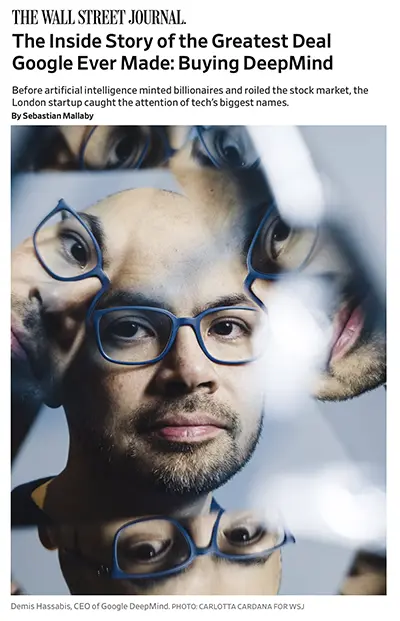
THE INSIDE STORY OF THE GREATEST DEAL GOOGLE EVER MADE: BUYING DEEPMIND
Wall Street Journal | March 25, 2026
TL;DR: An exclusive book excerpt from Sebastian Mallaby’s forthcoming biography of Demis Hassabis reveals that Google’s $650 million acquisition of DeepMind in 2014 was shaped by an early bidding war with Facebook, a principled negotiation over AI safety governance, and Hassabis’s deliberate test of whether Zuckerberg truly understood AI’s singular importance — all of which reads as the origin story of the current AI power structure.
Executive Summary
This is a book excerpt — narrative history, not breaking news — and should be read as such. It provides no new operational intelligence about AI capabilities or business applications, but offers genuine strategic context for understanding how the current AI landscape was shaped by decisions made over a decade ago. The core facts: Google acquired DeepMind in January 2014 for $650 million. Facebook was a competing bidder and was rejected, in part because Hassabis concluded that Zuckerberg did not truly understand AI’s primacy over other technology trends. DeepMind’s co-founders negotiated successfully for an AI safety and ethics oversight board as a condition of the sale — a meaningful early instance of founders demanding governance structures as part of an acquisition, which Google accepted specifically because of its conviction that Hassabis represented the future of its AI strategy.
The framing most useful for business leaders: the AI governance structures now being debated at policy and enterprise levels were already being negotiated in private acquisition rooms in 2013–2014. Safety and oversight were not afterthoughts imposed on AI by regulators — they were built into the founding architecture of one of the field’s most consequential institutions by the people who understood the stakes. The excerpt also illustrates how talent concentration drove competitive dynamics — Facebook’s pivot to recruiting Yann LeCun directly after losing the DeepMind bid created FAIR (Facebook AI Research), which became foundational to Meta’s current AI position.
Editorial note on the source: This is a promotional excerpt from a book publishing March 31. The narrative is compelling and the sourcing (30+ hours of interviews with Hassabis over three years) is credible. It should be read as authorized history — Hassabis’s perspective is central and largely unchallenged within the excerpt.
Relevance for Business
This article’s primary value for SMB leaders is contextual intelligence, not operational guidance. Understanding that the AI companies now dominating enterprise software were shaped by early principled debates about safety, governance, and who should control transformative technology puts current AI governance conversations in perspective. The book itself — “The Infinity Machine” by Sebastian Mallaby, publishing March 31 — is worth noting for executive reading lists. Mallaby wrote “More Money Than God” and “The Man Who Knew” (about Alan Greenspan), both regarded as definitive accounts of their respective topics. His treatment of AI’s origin story is likely to become a reference point.
Calls to Action
🔹 Add to reading list — “The Infinity Machine” (Mallaby, Penguin Press, March 31, 2026) is likely to be a defining narrative account of how the current AI landscape was built. Relevant for any leader who wants strategic context beyond current product coverage.
🔹 Note the governance precedent — DeepMind’s founders insisted on independent AI ethics oversight as a condition of acquisition in 2013. That instinct is relevant context for how your own organization structures oversight of AI systems today.
🔹 Monitor how the book’s narrative shapes policy and investor conversations about AI governance — origin stories matter for how industries regulate themselves.
🔹 Deprioritize this as an immediate operational action item — it is valuable strategic context, not a decision trigger.
Summary by ReadAboutAI.com
https://www.wsj.com/wsjplus/dashboard/articles/deepmind-google-demis-hassabis-5bd6de54: March 31, 2026
CHINA IS WINNING THE AI TALENT RACE
Source: The Economist | Date: March 25, 2026
TL;DR: China now produces and retains more top AI researchers than the U.S., a structural shift with long-term implications for where AI innovation originates and who controls it.
Executive Summary
Based on original analysis of NeurIPS 2025 — the world’s largest AI research conference — The Economist documents a measurable and accelerating shift in the global AI talent balance. In 2019, roughly 29% of top AI researchers began their careers in China; by 2025, that share had reached 50%. The U.S. share fell from 20% to 12% over the same period. Nine of the top ten undergraduate institutions represented at NeurIPS 2025 were Chinese. Graduates of Tsinghua University alone outnumbered those of MIT four to one.
China is not just producing more AI researchers — it is retaining them. In 2019, about one-third of Chinese-trained researchers stayed in China. By 2025, that figure was 68%. The reversal is driven by both pull (rising university rankings, government recruitment incentives, competitive salaries) and push (U.S. visa uncertainty, funding cuts, and a chilling atmosphere around Chinese-born researchers at American institutions).
The Economist appropriately flags methodological limits — NeurIPS may overrepresent Chinese researchers due to academic incentive structures, and America’s leading AI talent is increasingly concentrated in non-publishing frontier labs. The data is directionally significant, but the full picture is more complex than a single conference ranking suggests. American institutions still retain the majority of Chinese researchers who complete graduate degrees in the U.S., and 87% of Chinese-born NeurIPS authors from 2019 remained in America by 2025. The trend, however, is moving against the U.S.
Relevance for Business
For SMB executives, the direct implication is not about geopolitics — it is about where competitive AI innovation will originate over the next five to ten years. If China’s talent base produces frontier models at lower cost (as DeepSeek suggested in early 2025), U.S.-centric AI vendors may face sustained price and capability competition they have not previously encountered. This affects vendor selection, pricing assumptions, and the durability of current AI tool investments. It also has supply-chain and compliance dimensions for businesses operating in regulated sectors or with government contracts, where AI provenance and vendor origin are increasingly scrutinized.
Calls to Action
🔹 Monitor how the U.S.-China AI talent gap evolves — it is a leading indicator of where AI capability and pricing power shifts over the next decade.
🔹 If you use or evaluate AI tools, begin noting vendor origin and training data provenance — this will become a compliance and procurement consideration in regulated industries.
🔹 Do not treat this as an immediate operational threat, but incorporate geopolitical AI risk into any 3–5 year technology strategy conversations.
🔹 Watch for lower-cost Chinese-origin AI models (following the DeepSeek pattern) entering enterprise software stacks through third-party integrations — often without explicit disclosure.
Summary by ReadAboutAI.com
https://www.economist.com/interactive/science-and-technology/2026/03/25/china-is-winning-the-ai-talent-race: March 31, 2026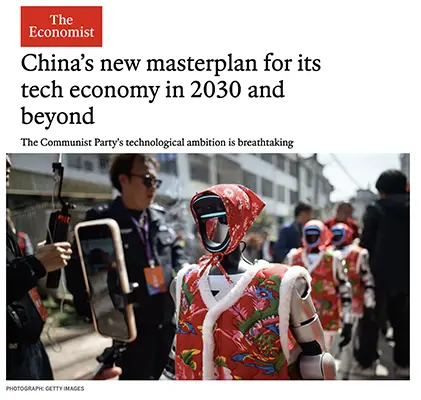
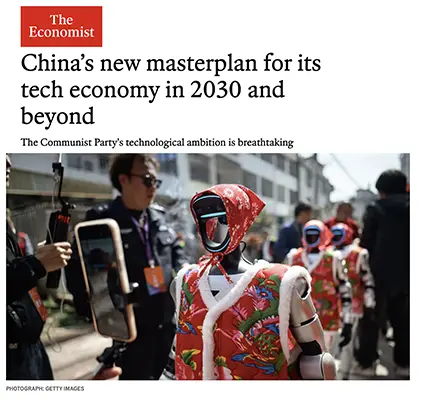
China’s New Masterplan for Its Tech Economy in 2030 and Beyond
The Economist | March 24, 2026
TL;DR: China’s 15th Five-Year Plan sets an extraordinarily ambitious technology agenda — including AI dominance, humanoid robots, quantum computing, and brain-computer interfaces — but a track record of missed targets and escalating U.S. countermeasures means the plan is as much a geopolitical signal as a reliable roadmap.
Executive Summary
China’s newly adopted 15th Five-Year Plan mandates commercial deployment of drones, AI-powered robotics, hydrogen energy, and brain-computer interfaces within five years, with “frontier breakthroughs” in fusion power and quantum computing to follow. The plan functions as a state coordination mechanism: sectors named in the plan unlock central and local government funding, attract private capital, and draw the professional infrastructure needed to commercialize technology. In this sense, the plan is both a roadmap and a market-making instrument. The AI component is particularly credible — China’s 2017 declaration of AI ambitions was dismissed by Western experts, then validated by DeepSeek’s January 2025 model release, which matched leading American systems.
However, credibility is not uniformity. China’s catch-up successes — EVs, solar, AI — all occurred in fields with mature markets and proven technology. The current plan targets frontier domains where commercial viability is genuinely uncertain: is there a market for humanoid robots? Can quantum computers be made practical? China’s planners appear to assume “yes” across every category simultaneously, which risks spreading capital and talent too thin. Additionally, the plan’s ambition will almost certainly trigger a renewed U.S. technology export response — the same dynamic that followed Made in China 2025 and produced semiconductor restrictions.
Relevance for Business
SMB executives should treat this as strategic context, not an operational trigger. The near-term business signal is in AI and robotics, where China’s investment is real and accelerating. For any business with supply chain exposure to Chinese manufacturing, technology sourcing, or competitive markets where Chinese firms participate, the pace of automation and AI-enabled productivity in Chinese industry will increase. For businesses evaluating AI vendors or tools from Chinese-linked firms, geopolitical friction and potential export controls create vendor-dependency and continuity risk. The broader implication: the AI competitive environment is a two-pole race with real resource commitment on both sides, and the pace of capability development will remain high regardless of which plans succeed or fall short.
Calls to Action
🔹 Monitor U.S. government responses to China’s plan, particularly any new technology export controls — these will affect the availability and pricing of semiconductors and AI hardware.
🔹 Assess supply chain exposure to Chinese manufacturing in sectors the plan targets: robotics, EVs, smart logistics — these will see intensifying state-backed competition.
🔹 Treat Chinese AI capability as real and advancing — the DeepSeek episode demonstrated that dismissing Chinese AI as derivative is a strategic error.
🔹 Deprioritize the more speculative elements (fusion, quantum, brain implants) as near-term business factors — these remain genuinely uncertain even with state backing.
🔹 Flag for future review in 12–18 months: whether U.S.-China technology decoupling accelerates in response to this plan, creating vendor landscape shifts for AI and hardware procurement.
Summary by ReadAboutAI.com
https://www.economist.com/finance-and-economics/2026/03/24/chinas-new-masterplan-for-its-tech-economy-in-2030-and-beyond: March 31, 2026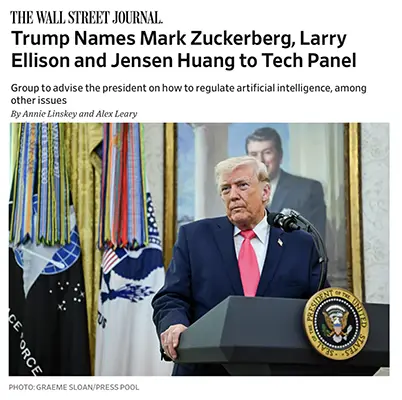
Trump Names Zuckerberg, Ellison, and Huang to Federal AI Advisory Council
The Wall Street Journal | Annie Linskey and Alex Leary | March 25, 2026
TL;DR: The Trump administration has assembled the most commercially powerful AI advisory council in U.S. history — but its composition raises legitimate questions about whose interests will shape federal AI policy.
Executive Summary
President Trump has appointed 13 technology industry leaders — including Meta CEO Mark Zuckerberg, Oracle’s Larry Ellison, Nvidia’s Jensen Huang, Google co-founder Sergey Brin, and Dell’s Michael Dell — to the President’s Council of Advisors on Science and Technology (PCAST). The council, which may expand to 24 members, will be co-chaired by David Sacks (White House AI and crypto czar) and adviser Michael Kratsios. Its stated mandate: advise the administration on AI regulation and emerging technology policy.
The signal here is structural, not ceremonial. This administration is formally embedding the CEOs of the dominant AI infrastructure companies — chip supply (Nvidia), cloud and enterprise software (Oracle), social/AI platforms (Meta), and compute ecosystems (Google/Dell) — directly into the policy-shaping process. That is a meaningful concentration of influence. Several council members or their companies have also made financial contributions to Trump administration initiatives, a conflict-of-interest dynamic the article notes but does not resolve.
Trump’s framing centers on U.S. AI competitiveness and a “light-touch” regulatory posture. What is being claimed is that industry expertise will produce smarter policy. What is not yet demonstrated is how dissenting voices — smaller firms, civil society, academic researchers, labor — will factor into recommendations that could shape AI rules affecting all U.S. businesses.
Relevance for Business
For SMB executives, the practical implication is this: AI regulation in the U.S. is now being shaped primarily by the companies that sell AI infrastructure. That creates a regulatory environment likely to favor permissive deployment rules, reduced compliance friction for large platforms, and limited mandatory safeguards — at least in the near term.
This matters for vendor decisions (the companies on this council will have early read on regulatory direction), competitive positioning (large incumbents with a seat at the table gain structural advantage in shaping rules that apply to everyone), and compliance planning (SMBs should not assume a stable or predictable regulatory framework will emerge quickly — advisory councils can move slowly and their output is non-binding until codified).
The notable corporate willingness to join — a sharp contrast to Trump’s first term — signals that big tech has made a strategic calculation: proximity to this administration is now considered less risky than distance.
Calls to Action
🔹 Monitor, don’t react: This council is advisory; no binding AI rules have changed. Track its formal outputs before adjusting compliance posture or vendor strategy.
🔹 Flag the conflict-of-interest dynamic internally: If your organization is evaluating AI governance frameworks or compliance standards, note that current federal guidance is being shaped by parties with direct commercial interests in the outcome.
🔹 Prioritize vendor diversification in AI procurement: Concentration of policy influence among a small set of AI vendors is a dependency risk. Avoid single-vendor lock-in while the regulatory landscape is still forming.
🔹 Assign someone to track PCAST outputs: When recommendations are published, they will likely signal which regulations are coming — and which aren’t. That’s a strategic planning input, not just a policy curiosity.
🔹 Revisit in 6–12 months: Advisory councils produce recommendations on long timelines. Unless your business is directly engaged in AI product development or federal contracting, this warrants monitoring rather than immediate action.
Summary By ReadAboutAI.com
https://www.wsj.com/wsjplus/dashboard/articles/trump-to-name-mark-zuckerberg-larry-ellison-and-jensen-huang-to-tech-panel-ded1ec6f: March 31, 2026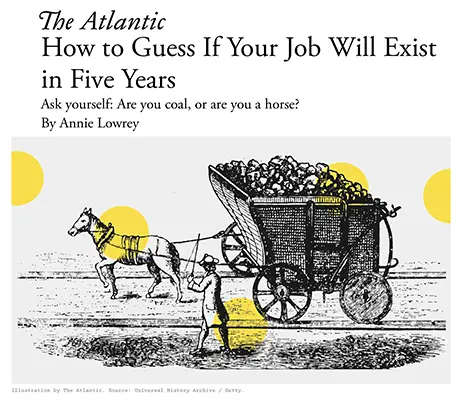
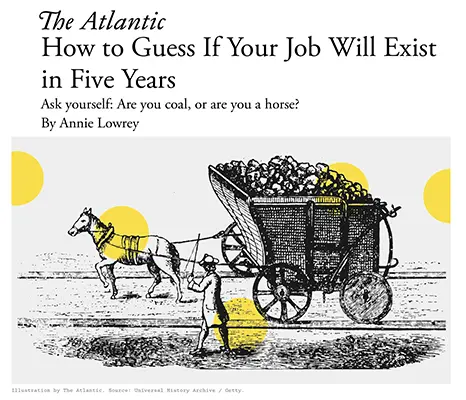
HOW TO GUESS IF YOUR JOB WILL EXIST IN FIVE YEARS
The Atlantic | Annie Lowrey | March 25, 2026
TL;DR: A well-argued essay uses historical economic precedent — the “Jevons paradox” and the horse-vs.-coal distinction — to push back on both AI alarmism and AI dismissiveness, concluding that AI’s labor market effects will be varied, sector-specific, and shaped as much by regulation and friction as by capability.
Executive Summary
This is an opinion essay, written with intellectual rigor and appropriate caveats, that makes three substantive arguments worth extracting. First, the Jevons paradox — the historical pattern in which efficiency improvements in a resource increase rather than decrease its total consumption — likely applies to AI-enabled labor: making tasks cheaper and faster tends to expand the scope of those tasks, not eliminate them. The radiologist example is apt: predictions of AI obsolescence for radiologists in 2016 have not materialized, in part because cheaper imaging drove higher volumes of tests, and in part because FDA review processes slow AI deployment in regulated industries.
Second, the horse vs. coal framing is analytically useful. “Horses” are roles where the human is performing a function that AI replicates directly and does better — demand collapses. “Coal” roles are those where AI efficiency drives more demand for the underlying function, and humans remain needed to execute it, even as the work changes. The author’s honest conclusion is that most workers will experience both simultaneously in different parts of their roles, with outcomes varying significantly by industry, regulation, and the specific nature of their work.
Third, and most important for business leaders: the outcome is not predetermined. Government policy (regulation, taxation, labor protection), FDA-style review processes, and the inherent friction of deploying AI in complex real-world environments will shape how fast and how broadly AI displaces or complements human work. Block’s Jack Dorsey firing half his employees because of AI is one data point; software engineering employment growing 6% year-over-year in the same environment is another.
The essay acknowledges its own limitations honestly — the author notes that transitions are rarely smooth, that major economic shifts have historically involved “wrenching mass migration” and prolonged suffering, and that the social and political consequences of rapid job displacement are real even when humans ultimately adapt.
Relevance for Business
For SMB executives, this essay is worth reading in full, particularly if you are navigating difficult internal conversations about AI and jobs. The coal/horse framework is genuinely useful for role-level analysis. For each function in your organization, ask: is AI creating more demand for this type of work (coal), or does AI do the work itself, reducing need for the human (horse)? The answer will differ by role and context, and the honest answer is often “we don’t know yet.” The Jevons paradox reminder is particularly relevant for SMBs that fear AI will eliminate demand for their core services — in many cases, cheaper AI-assisted delivery expands total market demand rather than contracting it.
Calls to Action
🔹 Use the coal/horse framework for a structured internal conversation about AI’s role-by-role impact in your organization. This is more useful than generic “AI will change everything” framing.
🔹 Identify which of your key roles are most likely horse vs. coal — roles involving physical presence, relationship management, regulatory compliance, or complex judgment under uncertainty are more coal-like; roles involving high-volume routine information processing are more horse-like.
🔹 Do not catastrophize or dismiss — the honest answer from credible economists is that AI’s labor effects are real, varied, and not yet deterministic. Communicate this uncertainty to your team rather than false certainty in either direction.
🔹 Watch for Jevons effects in your own market — if AI makes your core service cheaper or faster, does that expand the number of customers who can access it, or does it simply reduce revenue per engagement? The answer shapes your AI adoption strategy significantly.
🔹 Monitor regulatory friction as a legitimate business factor — the FDA review process is one example of how regulation meaningfully slows AI deployment and creates durable demand for human expertise in regulated domains. Know where your industry’s equivalent friction points are.
Summary by ReadAboutAI.com
https://www.theatlantic.com/ideas/2026/03/ai-job-loss-jevons-paradox/686520/: March 31, 2026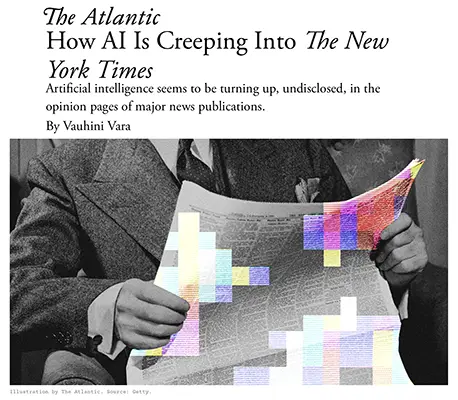
HOW AI IS CREEPING INTO THE NEW YORK TIMES
The Atlantic | Vauhini Vara | March 25, 2026
TL;DR: Undisclosed AI use is appearing in the opinion and personal essay sections of major U.S. newspapers — including The New York Times, Wall Street Journal, and Washington Post — raising a governance and trust problem for any organization that publishes or relies on written content under a named author’s authority.
Executive Summary
This is an investigative piece, not an opinion column, and it surfaces a concrete and documented pattern. Researchers at Stony Brook University, using an AI detection tool called Pangram, scanned thousands of articles across major U.S. publications and flagged likely AI use in the opinion sections of the Times, Journal, and Post — suggesting undisclosed AI assistance is more prevalent than editorial policies acknowledge. A specific case: a “Modern Love” column in the Times was flagged by multiple detection tools as likely containing AI-generated content; the author confirmed using AI tools (ChatGPT, Claude, Copilot, Gemini, Perplexity) as a “collaborative editor,” but denied generating content wholesale.
The governance failure is clear regardless of where one draws the line. All three publications have AI policies requiring disclosure of “substantial use.” None appear to be enforcing them consistently. The Times told the reporter that journalism there “is inherently a human endeavor” — a framing rather than an enforcement mechanism. OpenAI reportedly built a watermarking tool capable of detecting AI output with high accuracy but has not released it, with at least one reported consideration being concern that users would reduce ChatGPT usage if watermarking were deployed.
Limitations of the analysis are real and should not be dismissed. AI detection tools produce false positives, and AI-influenced writing is not binary. The percentage estimates vary significantly across tools. The author and researcher acknowledge these constraints. This is a pattern signal, not a verdict on specific articles.
The second-order concern, explicitly raised in the article, is more significant than stylistic homogenization: AI output has been shown in multiple studies to be measurably more persuasive than human writing in shifting political opinions— and if that output is appearing undisclosed in prestigious publications, the implications for public discourse are not trivial.
Relevance for Business
For SMB leaders, this story matters in two directions. First, any organization that publishes content under named authors — blogs, thought leadership, newsletters, client communications — now faces a version of this governance problem. The reputational exposure from undisclosed AI use in bylined content is real, particularly in professional services, consulting, or any business where trust in the author’s voice is a competitive asset. Second, the detection technology is real and accessible — clients, partners, journalists, or competitors can run your content through AI detection tools. The absence of a clear internal AI authorship policy is a liability, not a neutral position.
Calls to Action
🔹 Prepare an internal AI authorship policy now — define what constitutes “AI-assisted” vs. “AI-generated” for your organization’s published content, and where each requires disclosure. This policy protects you, not just the reader.
🔹 Apply this policy to all bylined content — blog posts, op-eds, LinkedIn articles, client newsletters, and proposals written under a specific person’s name should have clear internal guidelines on permissible AI use.
🔹 Do not assume detection is impossible — Pangram and similar tools are accessible to anyone. Treating AI disclosure as optional because “no one will know” is increasingly a bad bet.
🔹 Monitor how major publications evolve their AI disclosure policies over the next 6–12 months — their policies will likely become the de facto standard that clients and partners begin to expect from professional content broadly.
🔹 Assign governance ownership — someone in your organization should be responsible for AI content standards and know where the lines are. Right now, most SMBs have no one in that role.
Summary by ReadAboutAI.com
https://www.theatlantic.com/culture/2026/03/how-ai-creeping-new-york-times/686528/: March 31, 2026
AI TOKENS: HOW TO NAVIGATE AI’S NEW SPEND DYNAMICS
WSJ / Deloitte CIO Journal (Sponsored Content) | January 14, 2026
Editorial note: This is sponsored content from Deloitte. The framework is analytically sound and practically useful. Readers should note the consulting firm’s inherent interest in positioning AI cost management as a complex, professional-services-worthy problem.
TL;DR: AI is now the fastest-growing line item in corporate technology budgets — driven by token-based pricing that is variable, nonlinear, and poorly tracked — and most organizations lack the cost governance frameworks to manage it effectively.
Executive Summary
The core argument of this piece is financially important and often overlooked: AI costs are fundamentally different from traditional software costs, and most existing budget frameworks are not designed to manage them. Where traditional software costs are tied to subscriptions or licenses (predictable, per-seat), AI costs are denominated in tokens — small units of data processed during each interaction — making them variable, consumption-driven, and difficult to forecast. Cloud computing bills rose 19% in 2025 for many enterprises as AI became central to operations. Yet according to Deloitte’s own survey, only 28% of global finance leaders report clear, measurable value from AI investments — and nearly half expect it will take up to three years to achieve ROI from basic AI automation.
The piece identifies three distinct AI consumption models with different cost structures: buying AI through packaged software (tokens abstracted into subscription fees — predictable but opaque); consuming AI through APIs (tokens explicit and metered — transparent but volatile); and running AI on owned infrastructure (tokens fully internalized, requiring GPU, storage, networking, and power management — most cost-efficient at scale, but with high upfront commitment). Deloitte modeling suggests that an on-premises “AI factory” can deliver more than 50% cost savings over three years compared to API-based or cloud approaches — but only once token production reaches a sufficient scale threshold, and noting that roughly 50% of that infrastructure cost is non-GPU (power, networking, facilities).
The practical governance prescription is sound regardless of source: treat AI like energy or capital allocation — apply FinOps disciplines, implement real-time monitoring, set per-unit budgets by team, enforce ROI thresholds before approving AI projects, and rightsize model selection to task complexity.
Relevance for Business
This is a cost management story with immediate relevance for any SMB that is spending meaningfully on AI tools.Most SMBs are in the API consumption tier — paying per query to OpenAI, Anthropic, Google, or similar providers — which means their costs are directly token-driven, even if the invoices don’t show it that way. As usage scales — more employees, more complex prompts, more automated workflows — costs will grow nonlinearly in ways that catch organizations off guard.
The practical SMB implication: AI spend needs a budget owner, usage visibility, and per-project ROI criteria — now, not after the first surprise invoice. The scale required for an on-premises AI factory is irrelevant to most SMBs, but the FinOps principles apply at any size.
Calls to Action
🔹 Assign a budget owner for AI spend: If no one in your organization is accountable for AI cost as a line item — separate from general IT or software budgets — establish that ownership now.
🔹 Audit your current AI consumption: Which tools, which teams, which use cases are generating the most AI cost? Many SMBs don’t have this visibility. Get it.
🔹 Set per-project ROI criteria before approving AI initiatives: Establish a simple threshold — “this project must reduce X hours of work by Y% to justify Z in AI spend” — and apply it consistently.
🔹 Right-size model selection: Using the most powerful (most expensive) AI model for every task is a common and costly error. Simpler tasks should use simpler, cheaper models.
🔹 Implement basic spend monitoring: Most API providers offer usage dashboards and budget alerts. Turn them on. This is an easy governance step that most small organizations have not yet taken.
Summary by ReadAboutAI.com
https://deloitte.wsj.com/cio/ai-tokens-how-to-navigate-ais-new-spend-dynamics-373e1642: March 31, 2026
Disney Exits OpenAI Deal After AI Giant Shutters Sora Video App
The Hollywood Reporter | Alex Weprin | March 24, 2026
TL;DR: OpenAI is shutting down the standalone Sora AI video app just months after launch, triggering Disney’s exit from a $1 billion investment deal — a clear signal that AI product strategy remains highly unstable and that enterprise partnerships built on specific AI features carry real discontinuity risk.
Executive Summary
OpenAI is closing its Sora video generation app, which launched only last fall. The shutdown is not a retreat from AI video entirely — OpenAI says video capabilities will continue within the broader ChatGPT platform — but the standalone product is being discontinued. The immediate consequence: Disney is exiting the $1 billion investment deal it signed with OpenAI in December, which included an agreement to license Disney characters for use in Sora. Disney’s stated intent had been to integrate the technology into Disney+.
The business risk here is vendor dependency on immature products. Sora launched with significant IP controversy — OpenAI had to walk back its initial approach to celebrity likenesses and studio IP within days of launch. The product never stabilized commercially. Its closure mid-lifecycle means partners, users, and API customers who built on top of it now face transition costs. The Sora episode is a compressed version of a pattern that will recur: AI capabilities get announced and partnered around before they are proven, then pivoted or discontinued as strategy shifts.
The competitive beneficiary named in the article is Google, which now has the only scaled AI video generation platform — though it has not yet resolved its own IP licensing issues and is facing related lawsuits.
Relevance for Business
The core lesson for SMB executives is vendor and feature risk. Any AI tool that is new, standalone, or in active development carries discontinuity exposure. This applies not just to video generation, but to any AI feature or platform where a vendor’s strategic priorities may shift. Building workflows or partnerships that depend on a specific AI product’s continued existence is high-risk in the current environment. The Disney situation — a $1 billion deal unwound in months — illustrates that this risk exists even at scale. For smaller businesses, the same dynamic plays out in software subscriptions, API integrations, and vendor relationships that evaporate when a product is sunsetted.
Calls to Action
🔹 Audit current AI tool dependencies — identify any workflows, integrations, or vendor agreements that depend on a specific feature or product that could be discontinued or folded into a larger platform.
🔹 Build portability into AI integrations — where possible, avoid deep vendor lock-in for features that are new, standalone, or described as “beta” or “evolving.”
🔹 Monitor AI video generation as a category — it remains commercially viable and strategically important, but the vendor landscape is unstable. Google’s Veo and others will fill the Sora gap; evaluate alternatives in 6–12 months when the dust settles.
🔹 Apply IP and legal review before any partnership that involves licensing your brand, characters, or content to an AI platform — the Sora IP controversy should inform the contract terms you demand.
🔹 Treat AI partnerships like early-stage vendor relationships — with shorter commitment horizons, exit provisions, and contingency plans.
Summary by ReadAboutAI.com
https://www.hollywoodreporter.com/business/digital/openai-shutting-down-sora-ai-video-app-1236546187/: March 31, 2026
ChatGPT, Claude, and Gemini Entered the WSJ Bracket Pool. One Might Actually Win.
Wall Street Journal | March 24, 2026
TL;DR: Three leading AI models outperformed most human participants in a March Madness bracket pool by applying disciplined probabilistic strategy — a useful, accessible illustration of where AI genuinely adds value in competitive decision-making under uncertainty.
Executive Summary
The Wall Street Journal secretly entered Claude (Anthropic), ChatGPT (OpenAI), and Gemini (Google) into its 124-person office March Madness pool, providing each with the same statistical data, scoring rules, and permission to search the web. The assignment was explicit: not to predict the most likely outcome, but to find the optimal strategy for winning a pool — a subtly different problem that rewards contrarian picks in low-ownership outcomes.
After the first weekend, all three AI models are alive with intact Final Fours. Claude holds the best win probability of the three (6th out of 124 brackets), having made the contrarian pick of No. 3 seed Illinois as champion — chosen by only 3.2% of pool participants. Gemini and ChatGPT played it safer. Claude’s edge-seeking logic — explicitly framed by the model itself as analogous to portfolio construction — correctly identified two upset wins and avoided the only No. 1 seed to lose. All three models outperformed the pool average after the first weekend.
This is an entertainment story, but it has a real signal embedded in it: AI models can process scoring incentive structures, public pick distributions, and real-time news (player arrests, injuries) and translate them into a coherent, reasoned strategy faster and more consistently than most humans. There was also a notable failure mode early on: all three models initially produced structurally invalid brackets, misreading the bracket format entirely. The error had to be corrected before any useful analysis could begin — a reminder that AI outputs require human validation even in well-defined tasks.
Relevance for Business
The practical signal here is not about sports. It’s about AI as a decision-support tool in competitive, probabilistic environments: market analysis, bid strategy, pricing decisions, competitive positioning. The models demonstrated the ability to synthesize multiple data inputs, account for what competitors are likely to do, and identify contrarian opportunities with asymmetric upside. That logic applies directly to business strategy.
The failure mode — initial structural errors in reading the bracket — is equally instructive. AI tools perform best when the problem is clearly defined and the output can be verified. When the setup is wrong, the output is confidently wrong. Human oversight at the framing stage remains essential.
Calls to Action
🔹 Take note of the decision-framing capability: Consider whether AI tools are being used in your business not just to answer questions, but to optimize strategy given a specific scoring environment (e.g., bid margins, pricing tiers, competitive proposals).
🔹 Test AI on a low-stakes competitive problem in your business domain to build intuition about where it adds value and where it fails.
🔹 Do not skip human validation of AI-structured outputs. The bracket error is a real-world reminder: AI can misread the structure of a problem and produce confident, detailed, completely wrong results.
🔹 Monitor AI benchmarking coverage as a useful proxy for relative model capability — especially as Claude, ChatGPT, and Gemini continue to diverge in strategy and performance across different task types.
🔹 Deprioritize as a standalone story — treat this as illustrative context, not a data point requiring action.
Summary by ReadAboutAI.com
https://www.wsj.com/sports/basketball/ncaa-bracket-ai-chatgpt-claude-gemini-82d997f1: March 31, 2026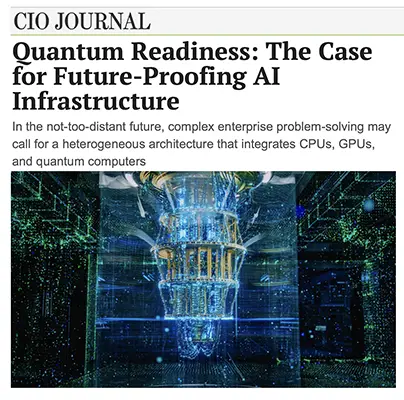
QUANTUM READINESS: THE CASE FOR FUTURE-PROOFING AI INFRASTRUCTURE
WSJ / Deloitte CIO Journal (Sponsored Content) | March 19, 2026
Editorial note: This is sponsored content from Deloitte. The quantum computing timeline projections are sourced from Deloitte’s own consultants and should be treated as informed estimates, not independently verified forecasts. The article is inherently designed to expand the scope of infrastructure consulting conversations.
TL;DR: Deloitte’s quantum computing advisers argue that commercially relevant quantum use cases are 24–36 months away, and organizations building AI infrastructure today should begin thinking about how quantum processing units (QPUs) will eventually need to integrate with their existing GPU architectures — before, not after, they make major infrastructure investments.
Executive Summary
The article makes a forward-looking argument: organizations currently scaling up AI infrastructure around GPUs risk building systems that will require costly re-engineering when quantum computing becomes commercially relevant. Deloitte projects the first commercial quantum use cases within 24–36 months, with early applications in molecular design, financial risk modeling, and options pricing — problems where quantum systems can outperform classical supercomputers on specific calculation types.
The technical framing is useful: quantum computers are not substitutes for GPUs or CPUs — they solve fundamentally different types of problems using different mathematics. The most likely enterprise architecture, per this article, is heterogeneous: CPUs + GPUs + QPUs working together, with quantum computers handling specific, computationally intensive sub-problems (such as exact molecular calculations), feeding results back into classical machine learning systems. This hybrid model is already being explored in state-of-the-art research environments.
The practical readiness case is two-part: first, infrastructure decisions made today (AI data center builds, GPU cluster designs, networking architectures) should account for eventual quantum integration rather than require full replacement; second, developing internal quantum literacy takes years — organizations that wait until quantum is commercially deployed before building skills will be behind. The article advocates for “quantum-inspired computing” on GPUs as a transitional step: using GPU-scale approaches to complex optimization problems that builds capability and architecture patterns useful for eventual QPU integration.
What the article does not say clearly: for the vast majority of enterprises — and virtually all SMBs — quantum computing is not a near-term operational concern. The 24–36 month timeline for “first commercially relevant use cases” refers to specialized applications in science-intensive industries, not general enterprise workloads. The readiness argument applies most directly to organizations making major, long-horizon infrastructure investments today.
Relevance for Business
For most SMBs, this article is a horizon-monitoring item, not an action item. Quantum computing’s near-term commercial relevance is concentrated in financial services, pharmaceuticals, materials science, and advanced logistics — industries with specific optimization problems that classical computers handle poorly at scale. If your business is not in one of those sectors and is not building proprietary AI infrastructure, the practical relevance is low today.
The exception: if you are making multi-year technology infrastructure commitments in 2026 — AI infrastructure investments, data center decisions, long-term cloud architecture choices — the argument to consider future hybrid architecture flexibility at the design stage is reasonable and costs little to incorporate as a factor.
Calls to Action
🔹 Monitor, don’t act: For most SMBs, quantum computing is a 3–5+ year horizon item. Put it on your annual technology radar review, not your 2026 roadmap.
🔹 Exception: if you are in financial services, pharma, or advanced manufacturing and making major infrastructure decisions in 2026, add quantum integration flexibility as a design criterion — not a full roadmap, but a stated consideration.
🔹 Assign a designated technology horizon watcher: Quantum is one of several emerging technologies (alongside neuromorphic computing, advanced robotics, and next-generation networking) that warrant monitoring without immediate investment. Someone in your organization should own that tracking function.
🔹 Calibrate the timeline claims: The 24–36 month estimate for first commercial quantum use cases comes from Deloitte’s own consultants and should be read as motivated optimism. Independent analysts place general enterprise quantum relevance further out.
🔹 Deprioritize for most SMBs unless sector-specific: The ROI case for quantum readiness planning today is real for science-intensive large enterprises. For most SMBs, appropriate awareness is sufficient.
Summary by ReadAboutAI.com
https://deloitte.wsj.com/cio/quantum-readiness-the-case-forfuture-proofingai-infrastructure-cb1525c1: March 31, 2026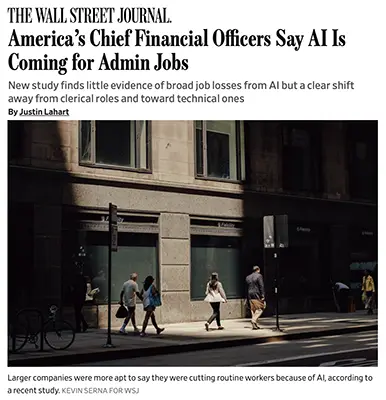
America’s CFOs Say AI Is Coming for Admin Jobs
Wall Street Journal | March 24, 2026
TL;DR: A rigorous study of ~750 CFOs confirms AI will primarily eliminate clerical and administrative roles, not yet knowledge work — but the displacement of “stepping stone” jobs raises a real workforce planning issue for managers today.
Executive Summary
A working paper published through the National Bureau of Economic Research, based on a survey of approximately 750 CFOs across finance, tech, manufacturing, and professional services, delivers the most grounded near-term picture yet of AI’s workforce impact. The findings: AI had essentially no measurable employment effect in 2025, and most CFOs expect only a modest headcount reduction of roughly 0.4% in 2026 relative to what it otherwise would have been. This is not a wave — it is a measured shift.
The more significant finding is directional: CFOs were twice as likely to say AI would reduce jobs in clerical and administrative roles — bookkeeping, customer service, data entry — as they were to say it would enhance them. For technical, skilled roles, the inverse is true: AI is more likely to complement than replace. This mirrors the pattern economists call “skills-biased technological change,” most recently seen when personal computers hollowed out routine office work in the 1980s and 1990s. Those jobs didn’t disappear overnight, but their share of employment shrank steadily.
A notable split by company size: larger firms (500+ employees) are actively cutting routine roles while keeping technical headcount flat, using AI to extract efficiency. Smaller companies are doing the opposite — keeping routine staff while adding technical workers to pursue growth. The study has one notable limitation: it only surveys established companies, missing the job creation that often comes from AI-native startups.
Relevance for Business
This study matters to SMB leaders on two levels. First, workforce planning: the window to reskill or redeploy employees in clerical functions is open now but narrowing. Waiting until roles are clearly redundant creates harder transitions. Second, hiring: roles that were once reliable entry points into organizations — administrative assistants, data clerks, customer service reps — are under structural pressure. Companies need to decide deliberately whether to fill those roles as they turn over, or redesign the workflow.
The size-based divergence is particularly relevant: SMBs that treat AI as a growth accelerator rather than a cost-cutter are in a stronger strategic position, both for talent retention and competitive differentiation. The risk of following large-enterprise playbooks — pure efficiency-through-reduction — is that it hollows out organizational capability and morale without building new capacity.
Calls to Action
🔹 Act now on workforce mapping: Audit which roles in your organization are primarily clerical or routine-cognitive. These are the first to be structurally pressured, and planning now costs less than reactive reductions later.
🔹 Reframe AI deployment as capability-building, not just cost reduction — particularly relevant for SMBs competing against larger, leaner enterprises.
🔹 Review hiring decisions for admin/clerical backfills: Before replacing a departing admin or customer service employee, evaluate whether AI tools can redistribute the workflow.
🔹 Prepare manager-level guidance on how to discuss AI and job security with teams. Employee anxiety is real and affects productivity.
🔹 Monitor: Track the next quarterly edition of the Duke/Atlanta Fed/Richmond Fed CFO survey for updated employment expectations as 2026 progresses.
Summary by ReadAboutAI.com
https://www.wsj.com/tech/ai/ai-admin-job-market-6a1c3436: March 31, 2026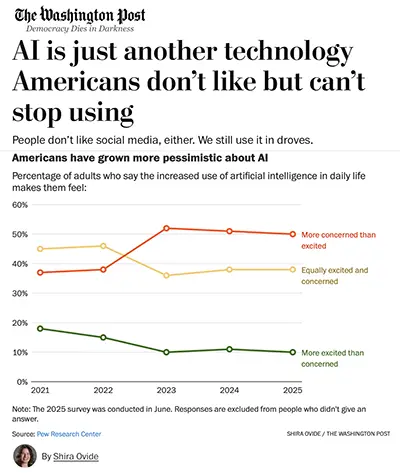
AI Is Just Another Technology Americans Don’t Like But Can’t Stop Using
The Washington Post | March 26, 2026
TL;DR: Public disapproval of AI is real and rising, but history suggests it won’t stop adoption — though it may create governance friction and erode employee and customer trust in ways leaders should actively manage.
EXECUTIVE SUMMARY
This Washington Post opinion-analysis piece, published March 26, 2026, makes a structural argument: American public distrust of AI is growing but unlikely to meaningfully slow deployment, based on the parallel with social media. Pew Research data shows a majority of Americans are now more concerned than excited about AI — a sentiment that has worsened since 2021 — and AI currently ranks below the Democratic Party and Iran in NBC News favorability polling. Yet the author’s central claim is that attitude and behavior diverge: people said they didn’t like social media either, and kept using it in dramatically increasing numbers.
The article is honest about the limits of that analogy. One expert cited — an MIT political science professor — flags a critical difference: AI distrust may suppress usage in a way social media distrust did not. Social media can be used passively without trusting its content. AI tools require users to trust the outputs enough to act on them. If employees or customers don’t trust AI-generated recommendations, summaries, or decisions, the productivity gains don’t materialize. This is a practical risk for SMBs deploying AI in customer-facing or decision-support roles.
On the regulatory side, the article notes emerging political pressure: Senator Bernie Sanders has introduced legislation to halt new data center construction until AI regulation is enacted. Governor Ron DeSantis has publicly challenged the logic of subsidizing AI companies whose own leaders predict massive job displacement. These are early-stage signals, not enacted policy — but they indicate that the political environment around AI infrastructure is shifting, which could affect compute availability and cost over a 2–4 year horizon. The article does not independently verify claims made by industry lobbying groups (such as the AI Infrastructure Coalition’s assertion that AI approval grows with usage), and leaders should treat those as advocacy positions, not findings.
RELEVANCE FOR BUSINESS
The relevance here is not technical — it’s organizational and reputational. Two risks deserve attention:
Internal adoption risk. If the majority of Americans distrust AI, a portion of your workforce does too. Deploying AI tools without addressing that distrust — through transparency about how they work, clear policies on what decisions AI does and doesn’t make, and explicit human oversight structures — will generate friction, resistance, and potential errorsas employees either avoid the tools or over-trust outputs they shouldn’t.
Customer-facing exposure. Using AI in customer service, communications, or decision-making without disclosure creates reputation and trust risk that the social media analogy underscores. Meta’s usage kept growing even as its reputation collapsed — but legal liability, employee attrition, and brand erosion followed over time. The better outcome is proactive governance, not reactive damage control.
For the near term: public backlash is unlikely to produce restrictive U.S. federal regulation before 2027 at the earliest. But it is already affecting how employees, customers, and local officials respond to AI deployment — and those relationships matter for SMBs in ways they may not for large platforms that can absorb reputational friction.
CALLS TO ACTION
🔹Treat the social media parallel as a caution, not a reassurance. History shows technology can scale despite public disapproval — but also that deferred governance creates compounding liability. The SMBs that build ethical AI frameworks now will be better positioned as regulation tightens.
🔹Before deploying customer-facing AI, develop a clear, plain-language disclosure policy. State what AI is doing, where human review applies, and how errors are corrected. This protects trust and reduces legal exposure.
🔹Address internal AI skepticism directly. Survey employees on AI comfort levels, communicate governance guardrails, and avoid framing AI as a labor replacement in internal communications — even if that’s a real long-term consideration.
🔹Monitor federal and state AI regulation developments, particularly around data centers, labor protections, and sector-specific rules (healthcare, finance). Assign someone in your organization to track this quarterly — the political momentum is building.
🔹Do not assume employee adoption equals employee trust. Usage metrics alone will not tell you whether your team trusts AI outputs enough to act on them. Build feedback mechanisms into any AI workflow deployment.
Summary by ReadAboutAI.com
https://www.washingtonpost.com/technology/2026/03/26/americans-dont-trust-ai-will-probably-keep-using-it-anyway/: March 31, 2026
THE MOST INNOVATIVE COMPANIES IN APPLIED AI FOR 2026
Fast Company | Mark Sullivan and Victor Dey | March 24, 2026
TL;DR: The applied AI landscape has decisively shifted from text generation to autonomous agents — the 20 companies on this list reveal where real revenue is being generated today, which business functions are being restructured first, and which infrastructure problems are now commercially addressable.
Executive Summary
Fast Company’s 2026 applied AI list is less a celebration of novelty than a useful map of where AI is generating measurable business outcomes right now. The dominant pattern across the 20 companies: AI is moving from assistive tools to autonomous agents that take action, complete multi-step tasks, and operate across systems with minimal human initiation. The two functions furthest along in commercial deployment are software development and customer service— both now supported by a competitive ecosystem of mature, revenue-generating products.
The numbers behind several entries are notable for their scale and speed. Cursor surpassed $2 billion in annualized revenue and is used by 64% of the Fortune 500. Lovable reached $200 million ARR and 500,000 paid users, enabling non-technical users to build and deploy full applications in natural language. Sierra (AI customer service agents) reached $150 million ARR and a $10 billion valuation eight quarters after launch. ServiceNow extended AI agents across HR, finance, IT, and operations — not just support desks — with 1,000+ enterprise deployments. Gong’s AI sales agents report a 35% increase in win rates for teams using its deal-signal trackers.
Two entries address infrastructure problems that SMBs will encounter as they scale AI: Credo AI offers governance tooling — model trust scores across 95 use cases and an agent registry for real-time oversight — directly relevant to any organization deploying agents at scale. Temporal addresses agent reliability — the problem of multi-step workflows failing mid-execution when APIs time out or state is lost. Its inclusion in OpenAI’s Agents SDK is a credibility signal. Sardine’s agentic financial crime platform is the most concrete example of AI being used to fight AI-enabled fraud — a real and growing threat.
On the “vibe coding” / no-code development front: Lovable, Bolt.new, and Cursor together represent a compressed window in which non-technical leaders can prototype and deploy software without engineering teams. This is not future-state — these are products with millions of users today.
Relevance for Business
This list functions as a sector-by-sector diagnostic for SMB leaders. The relevant question is not “which of these companies is impressive?” but “which of these categories touches a function I own, and how far along is commercial adoption?” Customer service automation (Sierra, Nice/Cognigy), sales intelligence (Gong), document intelligence (Adobe), financial crime detection (Sardine), and software prototyping (Lovable, Bolt) are all past early-adopter stage. Governance tooling (Credo AI) and agent reliability infrastructure (Temporal) are early-stage but strategically important — organizations that deploy agents without governance frameworks are accumulating invisible risk.
The cost pressure implication is direct: tools like Lovable and Cursor are already enabling large enterprises to deliver software with smaller teams. SMBs that compete for technical talent, or that depend on outsourced development, face a changed cost structure for custom software.
Calls to Action
🔹 Identify your highest-friction business function — customer service, sales, software development, or document management — and assess whether a commercially mature AI agent solution exists in that category. Several on this list do.
🔹 Test a no-code or low-code AI development tool (Lovable, Bolt) on one internal prototype. If your business has needed a custom internal tool but lacked development resources, the barrier is now materially lower.
🔹 Do not skip governance — if you are deploying more than one or two AI tools, evaluate Credo AI or comparable agent registry/oversight solutions. The volume of AI tools in enterprises is growing faster than the ability to track what they are doing.
🔹 Audit your fraud prevention approach — AI-enabled financial fraud is real and accelerating. Sardine’s model (behavioral biometrics, device intelligence, consortium risk signals) represents a new threat model that legacy fraud detection was not designed for.
🔹 Monitor agent reliability as a category — the failure mode of multi-step AI workflows (lost state, API timeouts, incomplete tasks) is not a theoretical risk. Temporal’s rapid growth reflects real enterprise pain. Before deploying agentic workflows in production, understand what happens when they fail mid-task.
Summary by ReadAboutAI.com
https://www.fastcompany.com/91495408/applied-ai-most-innovative-companies-2026: March 31, 2026
The Most Innovative AI Companies of 2026
Fast Company | March 24, 2026
TL;DR: AI capability is accelerating — not plateauing — and the companies shaping what tools you’ll use next year are already pulling ahead.
EXECUTIVE SUMMARY
Fast Company’s annual ranking surfaces a clear pattern: AI investment is still accelerating, not consolidating. Tech companies poured hundreds of billions into data center infrastructure over the past year, and the feared ‘scaling wall’ — the worry that making models larger would stop producing smarter results — has not materialized. Instead, model release cadence has sped up, partly because AI coding tools are now writing the code used to build the next generation of models. That feedback loop is compressing development timelines in ways that weren’t anticipated even 18 months ago.
Google’s Gemini 3 is the headline development. Released by Google DeepMind in November 2025, these multimodal models were built from the ground up to process text, images, video, audio, and code — not retrofitted to do so. Gemini 3 now powers Google Search AI Overviews (reportedly reaching 2 billion monthly users), the Gemini chatbot (750 million monthly active users), and Google’s enterprise platform Gemini Enterprise, which has grown to 8 million paid seats. The competitive signal: Google has moved from being a fast follower to a pace-setter, and that shifts pressure onto every other vendor in the enterprise AI stack.
Anthropic’s Claude Code is equally significant from an SMB operations perspective. Originally an internal tool, it was released commercially in May 2025 and reached a $1 billion annual revenue run rate within six months. Anthropic reports that 70–90% of its own new code is now written by Claude Code — a figure that, if it holds for enterprise customers, has direct implications for software team sizing, hiring, and procurement. Customers include Netflix, Spotify, Salesforce, and KPMG. Vendors building on top of Anthropic’s models should note that Anthropic is not expected to be profitable until 2028, creating continued dependency on investor funding and potential pricing volatility.
Beyond the platform leaders, the list highlights meaningful specialization. Abridge (clinical documentation) reports that 250 of the largest U.S. health systems will use it in 2026, with clinicians spending 60% less time on after-hours charting. Darktrace has automated 90 million cybersecurity investigations, narrowing them to under 500,000 critical incidents — a signal that AI-assisted security triage is no longer experimental. Cohere is building enterprise-grade ‘sovereign AI’ — models that can be hosted within a company’s own security perimeter — which matters acutely for regulated industries. And infrastructure-level players like Cerebras and Mithril are attacking the chronic undersupply of compute and its cost structure, which remains the primary constraint on how fast organizations can actually deploy AI at scale.
RELEVANCE FOR BUSINESS
For SMB leaders, this list is less a celebration and more a competitive clock. The companies on it are building the tools your larger competitors will use in the next 12–24 months. Three signals stand out:
Vendor concentration risk is real. Google, Microsoft, and Anthropic are widening their infrastructure moats. If your current or planned AI tools run on their models or clouds, your pricing, reliability, and feature roadmap are increasingly subject to their strategic priorities — not yours. Cohere’s ‘sovereign AI’ positioning exists precisely because this risk is real for enterprises that need data governance control.
AI coding tools are changing software economics now, not eventually. Claude Code reaching $1B ARR in six months is not a venture story — it’s a signal that developers are already using AI to write production code at scale. For any SMB that relies on software development — internally or through vendors — this shifts expectations around speed, cost, and team composition.
Specialization is the next phase of enterprise AI adoption. General-purpose chatbots are giving way to domain-specific tools with measurable outcomes: 60% reduction in chart time (Abridge), 97% error-detection accuracy (Abridge vs. 82% for off-the-shelf GPT-4o), 50% reduction in legal document review time (GC AI). Leaders should expect AI vendor selection to become more like selecting a qualified domain specialist and less like choosing a productivity platform.
CALLS TO ACTION
🔹 Do not wait for AI to feel ‘settled.’ The companies on this list are creating the defaults. SMBs that defer adoption decisions are not avoiding risk — they are deferring it while the landscape consolidates around them.
🔹 Audit your current AI vendor stack for concentration risk. If more than two of your tools run on the same foundation model (e.g., OpenAI or Anthropic), map the downstream exposure if pricing or availability changes.
🔹 Assess your software development workflows now. If you have an in-house dev team or a software vendor, ask how they are using AI coding tools and what productivity benchmarks have changed. The gap between teams using and not using these tools is widening.
🔹 If you operate in healthcare, legal, or finance, evaluate domain-specific AI vendors (Abridge, GC AI, OpenEvidence) over general-purpose tools for compliance-sensitive workflows. Domain-specific accuracy and audit trails matter more than cost at this stage.
🔹 Monitor the Google vs. OpenAI vs. Anthropic model race. Gemini 3’s rise introduces real competitive pressure at the model layer. Your AI tool vendors’ performance may improve or degrade as they adapt — watch for product updates tied to model migrations.
Summary by ReadAboutAI.com
https://www.fastcompany.com/91495412/artificial-intelligence-most-innovative-companies-2026: March 31, 2026
This Single ChatGPT Prompt Can Do Hours of Market Research in Minutes
Fast Company / Inc. | Ben Sherry | March 23, 2026
TL;DR: ChatGPT’s upgraded Deep Research feature can produce a credible, cited market analysis report in under 30 minutes — a genuine productivity gain for early-stage research — but the output requires expert review to separate usable insight from filler and to account for data the tool could not access.
Executive Summary
OpenAI recently upgraded its Deep Research feature to run on GPT-5.2 (previously on o3) and added the ability to prioritize specific websites during research. The feature directs an AI agent to autonomously search the web, compile findings, and produce a structured, cited report. In a documented test, a prompt for a niche local business idea produced a ~4,000-word report in 21 minutes, including competitor identification, customer persona development, market sizing, and a strategic pivot recommendation — findings a marketing professor described as genuinely impressive.
The limitations are material and worth naming explicitly. The AI produced report contained unnecessary complexity and bulk that required editorial trimming. Many websites block AI agents from scraping their content, meaning the tool’s research has blind spots it cannot always self-disclose — users must specifically prompt it to flag inaccessible sources. The tool does not surface adoption frequency data or repeat purchase projections without explicit prompting. And the quality of the output is directly dependent on the quality of the input prompt — a poorly structured prompt produces a poorly structured report.
This is a demonstrated capability, not a claim. The use case is well-matched: early-stage research, competitive landscape surveys, idea validation. It is not a substitute for primary research, proprietary data, or expert judgment.
Relevance for Business
For SMBs, this is a high-value, low-cost tool for work that previously required either significant staff time or expensive outside research. A 21-minute, $20-tier output that surfaces local competitors, market sizing, and customer personas is meaningful for small teams evaluating new markets, products, or pivots. The key execution risk is treating the output as finished work — it requires critical review, especially where data sources were inaccessible. Leaders should also note that this tool is available to competitors at the same price point, which raises the bar on research quality across the board.
Calls to Action
🔹 Act now — test Deep Research on one live business question your team is currently working on. Use it as a first-pass research layer, not a final deliverable.
🔹 Build prompt discipline — invest 15 minutes in crafting a detailed prompt before running the agent. Use ChatGPT’s voice mode or prompt-writing assistance to develop the input. Quality in, quality out.
🔹 Always prompt the agent to list sources it could not access — then manually retrieve that data. Treating a gap-free report as complete is the primary failure mode.
🔹 Apply expert review before acting on output — have a knowledgeable person assess whether the report’s conclusions hold up, particularly on market sizing and competitive claims.
🔹 Monitor OpenAI’s continued upgrades to this feature — the shift to GPT-5.2 and source prioritization materially improves reliability, and further improvements are likely.
Summary by ReadAboutAI.com
https://www.fastcompany.com/91506061/this-single-chatgpt-prompt-hours-market-research-minutes-heres-how: March 31, 2026
Why Your Employees Aren’t Using the AI You Bought
Fast Company | Varun Puri | March 23, 2026
TL;DR: Enterprise AI spending hit $37 billion in 2025, but three-quarters of companies are still stuck in pilot mode — not because the tools fail, but because organizations are providing compliance-level training instead of the practice-based learning that actually changes behavior.
Executive Summary
Despite a 200% year-over-year increase in enterprise AI spending in 2025, adoption is failing at the human layer. The data is damning: enterprises average 200 AI tools deployed, but only 28% of employees know how to use their company’s applications, and only 7.5% have received what could be called extensive AI training. When employees lack support for sanctioned tools, they route around IT — using consumer AI tools outside company oversight. Critically, 57% of employees are reluctant to admit to their managers that they use AI, and nearly half admit to faking competence to avoid appearing incompetent.
The article’s core argument is well-supported: AI fluency, like clinical skills or sales technique, is built through practice and real-time feedback, not video modules and PDF prompt libraries. Organizations doing this well embed AI coaching into existing workflows (Morgan Stanley’s GPT-powered advisor assistant), build internal communities of practice (PwC’s firmwide prompting initiative), or use structured certification programs (Google Cloud’s 15,000-rep training program). The data supports the investment: companies with a formal AI strategy report 80% adoption success, versus 37% for those without one. In 2025, 42% of companies abandoned most of their AI initiatives — up from 17% the year prior.
The “zombie center of excellence” framing is an important call-out: teams that have consumed large budgets deploying platforms that no one uses in their daily work create the appearance of AI maturity without the substance.
Relevance for Business
This article directly addresses the most common SMB AI failure mode: buying the license, skipping the enablement, and declaring the initiative “underway.” For SMBs, the risk is proportionally higher — smaller teams mean lower slack to absorb failed initiatives, and the cost of an abandoned AI investment is not just financial but reputational and morale-eroding. The shadow IT risk is also acute: employees using unsanctioned AI tools creates data governance exposure that SMBs are poorly equipped to manage. The path forward is practical: invest in structured, practice-based training, measure behavior change (not completion rates), and build communities of internal use-case sharing.
Calls to Action
🔹 Assess now — survey your team on actual AI tool usage, not self-reported familiarity. The gap between what leadership assumes and what employees are actually doing is likely larger than expected.
🔹 Replace compliance training with practice-based enablement — one structured hands-on session is worth more than ten video modules. Identify 2–3 high-value workflows and train directly on those.
🔹 Create a low-stakes internal sharing mechanism — a Slack channel, a monthly 30-minute session, or even a shared prompt library where employees can trade what’s working. Peer learning drives adoption faster than top-down mandates.
🔹 Measure behavior change, not training completion — track whether specific tasks are actually being done differently, not whether employees checked a box.
🔹 Prepare a shadow IT policy — if employees are using AI tools outside your sanctioned stack, you need a governance framework that acknowledges reality rather than pretending it isn’t happening.
Summary by ReadAboutAI.com
https://www.fastcompany.com/91508168/why-your-employees-arent-using-the-ai-you-bought: March 31, 2026
ARE BOTS REPLACING WORKERS? THESE SKEPTICS AREN’T SO SURE
Source: The Wall Street Journal | Date: March 25, 2026
TL;DR: Most corporate claims linking layoffs to AI are overstated or misleading — “AI washing” is widespread, current technology cannot replace workers at scale, and leaders who cut prematurely risk operational and reputational damage.
Executive Summary
The WSJ examines the growing practice of “AI washing” — companies citing artificial intelligence as the driver of layoffs when the actual causes are more conventional: slower growth, overhiring, or cost pressure. Forrester Research estimates that of the 1.2 million U.S. jobs eliminated in 2025, fewer than 100,000 were primarily attributable to AI. The rest followed the standard playbook. AI is being used as a narrative tool — it sounds more innovative and forward-looking than admitting to a revenue miss or a headcount correction.
The incentives are clear: blaming AI rather than strategy can boost stock value, signal technological sophistication, and soften the PR impact of cuts. It also recalibrates the employer-employee power dynamic by creating a sense of inevitability around job loss. But the operational reality does not support the narrative. Cybersecurity constraints, regulatory compliance requirements, and the high cost of enterprise AI tooling and the engineers who manage it mean that AI is not yet a cost-effective replacement for most human functions at scale. Gartner predicts that half the companies that replace customer-service workers with AI bots will rehire humans by next year.
The article appropriately distinguishes between long-term displacement risk (real) and current-cycle job losses (mostly not AI-driven). Forrester’s projection of 6.1% of U.S. jobs lost to AI by 2030 is a credible middle-range estimate — meaningful but not catastrophic, and several years away.
Relevance for Business
For SMB leaders, this piece cuts both ways. On the workforce side: if you are considering AI-justified headcount reductions, be clear-eyed about whether the capability actually exists to do the work — cutting before tools are ready creates operational gaps and erodes customer experience. On the culture side: employees are watching how leaders communicate about AI and job security. Opaque or hype-driven messaging increases anxiety and attrition among your best people — who have options. On the competitive intelligence side: when a competitor announces AI-driven workforce reductions, treat it with appropriate skepticism before drawing conclusions about their efficiency gains.
Calls to Action
🔹 Do not make workforce decisions based on AI capability promises that have not been validated in your specific operating context — verify before you cut.
🔹 Audit any planned AI-driven role eliminations against realistic tool capability, compliance constraints, and true total cost (including engineering and oversight overhead).
🔹 Communicate clearly and honestly with your team about AI’s role in your organization — vague or inflated claims accelerate attrition among high performers.
🔹 Be skeptical of competitor AI-workforce announcements — apply the same scrutiny you would to any unverified competitive claim.
🔹 Monitor Forrester’s 6.1% displacement projection as a planning baseline, not as a trigger for immediate action — map it to your specific role categories over a 3–5 year horizon.
Summary by ReadAboutAI.com
https://www.wsj.com/wsjplus/dashboard/articles/are-bots-replacing-workers-these-skeptics-arent-so-sure-755143b1: March 31, 2026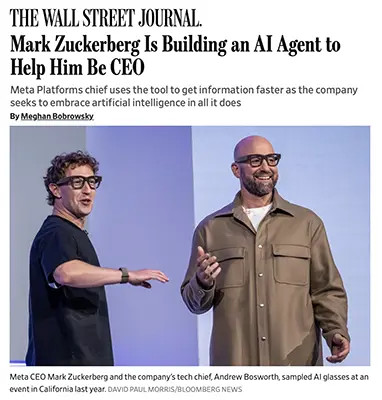
Mark Zuckerberg Is Building an AI Agent to Help Him Be CEO
Wall Street Journal (Exclusive) | March 22, 2026
TL;DR: Meta is restructuring itself as an AI-native organization from the top down — with Zuckerberg building his own executive AI agent — and is using performance reviews and cultural pressure to accelerate adoption across its 78,000-person workforce.
Executive Summary
Meta is not simply deploying AI tools — it is reorganizing around them. According to the WSJ, Zuckerberg is personally building an AI agent designed to accelerate his access to information, bypassing the layers of people that typically mediate information flow to a CEO. The broader goal is explicit: flatten organizational structure, accelerate decision-making, and remain competitive with smaller, AI-native startups that operate with a fraction of Meta’s headcount.
The operational changes are real and already underway. Meta has tied AI tool usage to employee performance reviews — a structural incentive that goes well beyond voluntary adoption. Employees are attending AI tutorials multiple times a week, participating in hackathons, and building their own internal tools. One significant example: “Second Brain,” an internal tool built by a Meta employee on top of Claude, is functioning as an “AI chief of staff” — indexing documents, querying project files, and acting on behalf of users. There is even an internal channel where employees’ personal AI agents communicate with each other autonomously. Meta has also acquired Manus, a personal agent startup, for internal deployment.
The organizational ambition is significant: Meta’s new applied AI engineering teams will have up to 50 individual contributors reporting to a single manager — an ultraflat structure that only functions if AI is handling a substantial portion of coordination, synthesis, and information management. This is not a future-state announcement. It is already being built. The article also notes real employee anxiety about layoffs beneath the cultural framing of excitement and empowerment — a tension worth noting for any leader managing a similar AI adoption push.
Relevance for Business
This story is directly relevant for SMB executives on multiple dimensions. First, it sets expectations for what serious AI adoption looks like at scale — it is not about deploying a tool, it is about redesigning how information flows, how decisions get made, and how organizations are structured. Second, the performance review linkage is a governance signal: mandating AI usage creates adoption and also creates anxiety, resistance, and risk of superficial compliance. Leaders should think carefully about how to incentivize genuine adoption versus performative adoption. Third, the tools described — personal agents with access to internal files, chat logs, and colleague communications — raise data governance and confidentiality questions that many SMBs are not yet prepared to address.
Calls to Action
🔹 Use this as a benchmark, not a blueprint: Meta’s approach is calibrated to a 78,000-person company with the resources to build custom agents. The signal for SMBs is the direction — flatter structures, AI-mediated information flow — not the specific implementation.
🔹 Examine your information bottlenecks: Where do leaders in your organization spend time waiting for information or coordinating through layers? Those are the highest-value AI agent use cases to explore first.
🔹 Develop an AI tool governance policy before mandating use: If you plan to make AI usage a performance expectation, define what responsible use looks like first — especially for tools with access to internal communications and files.
🔹 Monitor the “Second Brain” category of tools — AI agents that index internal documents and act as organizational memory. These are becoming practical for SMBs now, not in three years.
🔹 Have an honest conversation with your team about AI and job security. Meta’s own employees are anxious despite enthusiastic leadership framing. Transparency reduces the anxiety tax on productivity.
Summary by ReadAboutAI.com
https://www.wsj.com/tech/ai/mark-zuckerberg-is-building-an-ai-agent-to-help-him-be-ceo-eddab2d5: March 31, 2026https://www.wsj.com/wsjplus/dashboard/articles/metas-ai-makeover-starts-at-the-top-c2372e21: March 31, 2026
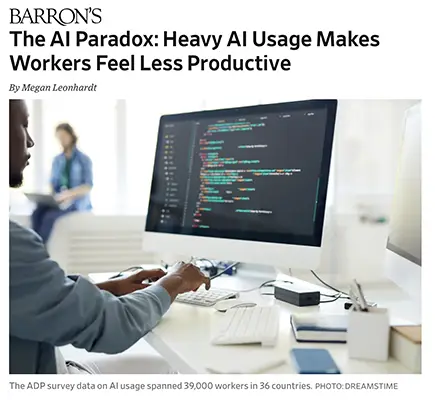
THE AI PARADOX: HEAVY AI USAGE MAKES WORKERS FEEL LESS PRODUCTIVE
Source: Barron’s (originally ADP Research) | Date: March 25, 2026
TL;DR: A large global survey finds that daily AI users are four times more likely to feel less productive — a friction signal that leaders should treat as a change management problem, not a technology failure.
Executive Summary
ADP surveyed 39,000 workers across 36 countries and found that employees using generative AI tools daily were four times more likely to report feeling less productive than those who do not use AI. The finding is counterintuitive on its surface but has a plausible explanation: AI is being deployed primarily to automate routine tasks — email triage, document summarization, message drafting — the very activities that generate a sense of daily accomplishment. When AI removes those tasks, workers experience a psychological productivity gap even if output has nominally improved.
A second factor: current AI tools still require significant human verification. Workers are not simply handing off tasks — they are supervising outputs, correcting errors, and carrying the cognitive overhead of deciding when to trust the tool. That adds friction rather than removing it. These findings are consistent with broader economic data: U.S. labor productivity rose 1.8% in Q4 2025 and 2.1% annually — above recent trend, but not a breakout driven by AI. Most economists attribute gains to investment and labor-market dynamics rather than AI directly.
Importantly, AI-heavy users did report higher engagement, lower stress, and greater job security confidence — a meaningful counterweight. This suggests the productivity paradox may be transitional, not structural, but the transition requires deliberate management.
Relevance for Business
The AI rollout problem for most SMBs is not access — it is adoption quality. Deploying tools without redesigning workflows around them produces exactly the friction this data describes. If your team is using AI to do old tasks in new ways rather than doing fundamentally different work, you are unlikely to see the productivity gains that justify the investment. The survey also surfaces a measurement gap: productivity metrics designed for pre-AI workflows will misread post-AI performance. Leaders who do not update how they define and measure productive work will draw incorrect conclusions about AI’s value — in either direction.
Calls to Action
🔹 Audit how AI is actually being used in your organization — if it is primarily handling routine task automation, evaluate whether workflow redesign is needed to capture higher-order value.
🔹 Update productivity metrics to account for output quality and decision support, not just task throughput — old measures will produce misleading signals.
🔹 Treat adoption friction as a change management signal, not a technology problem — training and workflow integration matter as much as tool selection.
🔹 Do not interpret low productivity sentiment among AI users as evidence that AI is not working — distinguish between psychological adjustment and actual output decline.
🔹 Monitor whether productivity gains accelerate as AI tools mature and verification requirements decrease — the economic case for AI is still forming.
Summary by ReadAboutAI.com
https://www.wsj.com/wsjplus/dashboard/articles/heavy-ai-usage-makes-workers-feel-less-productive-0eb79832: March 31, 2026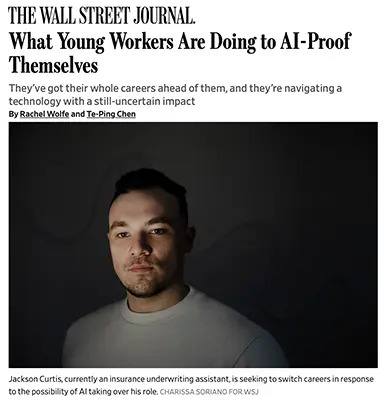
WHAT YOUNG WORKERS ARE DOING TO AI-PROOF THEMSELVES
Wall Street Journal | March 22, 2026
TL;DR: A meaningful share of young workers — particularly those in data-heavy, office, and tech roles — are actively rerouting their careers in response to AI displacement anxiety, with measurable consequences for the entry-level talent pipeline SMBs depend on.
Executive Summary
The article profiles young workers navigating career decisions in the context of AI uncertainty, supported by several data points: 59% of Americans ages 18–29 view AI as a threat to their job prospects (Harvard survey); Stanford research found a 16% employment decline between late 2022 and September 2025 among workers ages 22–25 in highly AI-exposed occupations such as software development and customer service; and enrollment at vocational-focused community colleges has grown nearly 20% since 2020.
The responses among young workers fall into three broad categories: pivoting to trades and in-person work(electricians, firefighters, food service entrepreneurs) that are seen as physically and socially irreplaceable; embracing AI as a career accelerator by founding startups or building AI-native skills; and choosing fields perceived as AI-resistantsuch as diplomacy, medicine, and skilled trades. The common thread is that AI anxiety is now a real and active factor in early career decision-making — not just a theoretical future concern.
The data point worth flagging for employers: Stanford’s finding of a 16% relative employment decline in highly AI-exposed roles among workers ages 22–25 is real structural evidence, not just sentiment. This is not about perception — AI tools are already displacing entry-level software and customer service work at measurable rates. Meanwhile, a Jobs for the Future survey found that among 16-to-34-year-olds, 44% have considered an AI-prompted career shift — a share that drops to just 4% among those 55 and older.
Relevance for Business
For SMB executives, this article is a talent pipeline story with near-term operational implications. Three dynamics converge: entry-level roles in tech and office support are becoming harder to fill as young workers reroute away from them; the workers entering those roles are increasingly anxious about their long-term viability; and the supply of trade and in-person skilled workers is growing while the supply of office-support candidates may tighten.
SMBs that rely on entry-level office, customer service, or technical support roles should expect increased recruitment friction and higher turnover as young workers treat those positions as temporary transitions rather than career paths. Conversely, SMBs that can authentically position AI tools as career development assets — not replacement mechanisms — will have a meaningful talent advantage.
Calls to Action
🔹 Assess your entry-level talent pipeline: Which roles do you hire entry-level workers for that are in AI-exposed categories? Anticipate recruitment difficulty increasing and plan accordingly.
🔹 Reframe AI in your employer brand: If you want to attract young workers who are AI-capable, your company’s positioning on AI needs to be honest and specific — not generic reassurance.
🔹 Review onboarding for AI-adjacent roles: Young workers entering tech-adjacent roles are arriving with more AI anxiety and more AI skill variation than before. Your onboarding should account for both.
🔹 Monitor the trades talent market: If your business requires physical or trade skills, the increase in vocational enrollment is a positive supply signal — but it will take several years to mature.
🔹 Do not over-index on the anxiety narrative: The article reflects real trends but is told through anecdotal profiles. The data points cited are real; the urgency of any individual SMB’s response depends on their specific role mix.
Summary by ReadAboutAI.com
https://www.wsj.com/economy/jobs/ai-jobs-young-people-careers-14282284: March 31, 2026
META TAKES A SWIPE AT TESLA WITH $9 TRILLION STOCK GOAL IN HALF THE TIME
Barron’s / WSJ | Callum Keown and Anita Hamilton | March 25, 2026
TL;DR: Meta’s new executive pay structure — targeting a $9 trillion market cap by 2031, requiring a 500%+ stock gain — is simultaneously an AI talent retention play and a public declaration that Meta intends to be the dominant AI company, with the layoffs announced the same day making clear that AI investment and workforce reduction are two sides of the same strategy.
Executive Summary
Meta disclosed executive compensation packages for six senior leaders (not including Zuckerberg) that only pay out in full if the company reaches a $9 trillion market cap by 2031 — a target requiring ~45% annualized stock returns over five years from a current base of $1.51 trillion. The structure is explicitly framed as a competitive counter to Tesla’s $8.5 trillion pay package for Musk, but on a five-year timeline versus Tesla’s ten. On the same day, Meta confirmed it was cutting several hundred workers in sales, recruiting, and virtual reality.
The signal for AI strategy is embedded in the compensation structure, not the headlines. A $9 trillion valuation in five years requires Meta to be perceived as one of the most valuable technology platforms on Earth — a peer to Apple and Microsoft, not merely the owner of Facebook and Instagram. The only credible path to that valuation is AI monetization at scale: AI-native advertising, AI agents generating direct revenue, AI-reduced operating costs, and AI as the core value proposition of its consumer products. The compensation structure is therefore a bet on AI as Meta’s primary value driver — and the simultaneous layoffs are how the cost structure gets aligned with that bet.
For context: Meta is currently the seventh most valuable U.S. company. Reaching $9 trillion would require it to surpass every company currently above it and then roughly double again. This is framing as much as target-setting. The real business signal is what it tells you about Meta’s strategic posture and how it is competing for the small pool of senior AI talent currently in play across the industry.
Relevance for Business
The immediate SMB relevance here is AI talent cost pressure. When the largest technology companies compete for AI talent with nine-figure compensation packages, they compress the available pool and inflate costs across the market — including for the mid-level AI engineers, data scientists, and product managers that SMBs might realistically recruit. More strategically, Meta’s bet that AI can drive a 6x increase in market value is a signal about where enterprise value is expected to accrue over the next five years. Companies that are net consumers of AI tools rather than builders of AI capability are on the wrong side of that value shift. The layoffs — concurrent with aggressive AI investment — illustrate the workforce arithmetic that is becoming standard at large tech firms and will cascade into smaller markets.
Calls to Action
🔹 Monitor AI talent market dynamics — compensation inflation at the top of the market affects mid-market hiring with a lag. If you are planning to recruit technical AI talent in the next 12–24 months, set realistic expectations now.
🔹 Treat Meta’s AI product roadmap as a competitive signal — Meta’s consumer platforms (Facebook, Instagram, WhatsApp) reach billions of users. AI features deployed there will shape customer expectations for AI experiences broadly, including in SMB contexts.
🔹 Note the concurrent layoff + AI investment pattern — this is becoming the standard large-company playbook. Understanding the logic prepares you to explain it to your own team and to make your own version of these trade-offs intentionally rather than reactively.
🔹 Deprioritize the valuation target as a direct business input — whether Meta reaches $9 trillion is not operationally relevant to most SMBs. The talent and product dynamics it signals are.
🔹 Revisit in 12 months — Meta’s AI monetization results in 2026 earnings will provide a real-world test of whether the AI-as-primary-value-driver thesis is materializing or remains aspirational.
Summary by ReadAboutAI.com
https://www.wsj.com/wsjplus/dashboard/articles/facebook-meta-stock-price-pay-package-bb9a3297: March 31, 2026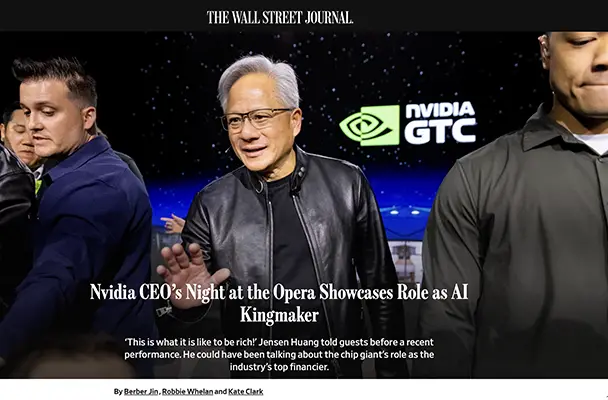
Nvidia CEO’s Night at the Opera Showcases Role as AI Kingmaker
Wall Street Journal | March 23, 2026
TL;DR: Nvidia has quietly built an investment and financing web that makes it simultaneously the supplier, investor, and creditor of virtually every major AI company — a structural lock-in that raises serious long-term competitive and antitrust concerns for any business dependent on the AI ecosystem.
Executive Summary
This is one of the most consequential AI infrastructure stories of the year. The WSJ, drawing on interviews with dozens of executives, investors, and advisers, details how Nvidia — generating $68 billion in quarterly revenue at a 75% gross margin — has deployed its cash to become the financial backbone of the AI industry it supplies. Nvidia has invested in OpenAI ($30B), CoreWeave ($2B), Groq (acquired via a $20B licensing deal), Reflection AI ($800M), and dozens of other startups, while simultaneously providing those same companies with chips to buy and infrastructure to rent.
The mechanism is not formal coercion. Nvidia’s investments don’t require recipients to use its chips — but the financial dependencies created are so deep that companies have effectively ruled out alternatives. CoreWeave executives have privately told competitors they won’t use non-Nvidia chips for fear of disrupting the relationship. Poolside chose Nvidia over AMD despite AMD’s competitive offer, because Nvidia’s financial package was larger. The pattern repeats across the AI startup ecosystem.
The Groq acquisition is particularly telling: Nvidia paid $20 billion — more than it has ever spent — to license a competitor’s chip design and hire away its leadership. The deal was structured as a licensing agreement, not an acquisition, which allowed it to avoid standard antitrust review. Democratic senators have already sent Huang a letter expressing concern that the transaction was structured to evade regulatory scrutiny. Whether regulators act or not, the precedent is set: Nvidia can neutralize competitive threats by buying them, often without triggering a formal review.
Relevance for Business
For SMB executives, this is a vendor concentration and platform dependency story at scale. The entire AI infrastructure stack — from chips to cloud to model providers — is increasingly organized around a single company’s financial interests. If you are using AI tools that run on Nvidia chips, are hosted on CoreWeave, are built by OpenAI, or are deployed via any of a dozen Nvidia-backed providers, your AI cost structure and access are ultimately subject to Nvidia’s pricing and relationship decisions. This isn’t immediate risk — but it is the architecture of the market you’re operating in.
The antitrust signals are also worth watching. If regulatory pressure eventually forces structural changes to Nvidia’s investment network, it could create short-term disruption for companies inside that ecosystem.
Calls to Action
🔹 Understand your AI stack’s ownership map: Know which components of your AI tools and infrastructure have Nvidia investment or financial dependency. This is not a reason to avoid those tools, but it is context for vendor risk assessment.
🔹 Monitor antitrust developments: The Senate inquiry into the Groq deal is an early signal. Watch for FTC or DOJ action that could affect Nvidia’s investment relationships or chip allocation practices.
🔹 Assess AMD and alternative chip access: As AMD and other competitors mature, knowing your switching options has real strategic value — even if you don’t intend to switch now.
🔹 Factor Nvidia dependency into AI cost projections: Nvidia’s 75% gross margins on chips that its own investees are buying signals that AI infrastructure costs are likely to remain elevated. Budget accordingly.
🔹 Assign an internal review of which AI vendors you rely on have deep Nvidia financial ties, and what that means for pricing leverage and supply stability over a 3-year horizon.
Summary by ReadAboutAI.com
https://www.wsj.com/tech/nvidia-ai-market-competition-9db60e4c: March 31, 2026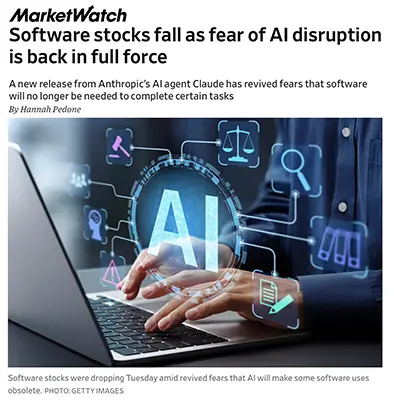
SOFTWARE STOCKS FALL AS FEAR OF AI DISRUPTION IS BACK IN FULL FORCE
Source: MarketWatch | Date: March 24, 2026
TL;DR: Anthropic’s expanded “computer use” capability for Claude triggered a 4.3% single-day drop in the software sector ETF, reflecting investor concern that AI agents could eventually replace per-seat software licensing — even if the near-term business reality is unchanged.
Executive Summary
On March 24, shares of major software companies fell sharply after Anthropic released an update enabling Claude to operate a computer autonomously — opening files, using a browser, and executing developer tools without human intermediation. The iShares Tech-Software ETF dropped 4.3% on the day, extending what has been a brutal year: the ETF is down 23.5% year-to-date, versus a 4.2% decline in the S&P 500.
The mechanism driving the selloff is investor concern about software seat displacement: if an AI agent can navigate software interfaces on a user’s behalf, traditional per-user licensing models face long-term pressure. Mizuho analyst Daniel O’Regan noted the selloff reflects fear, not fundamentals — near-term business conditions for these companies have not materially changed. A secondary driver was ETF-level basket selling, where index funds and custom baskets pull down entire sectors indiscriminately regardless of individual company quality.
This is a fear-driven market event, not a product-driven earnings event. Claude’s computer-use capability is real and expanding, but the jump from “AI can navigate a browser” to “businesses no longer buy software licenses” involves substantial execution, reliability, governance, and enterprise adoption hurdles that are not resolved. The article appropriately credits both product signal and market psychology.
Relevance for Business
For SMB leaders, there are two distinct implications. First, if you hold software company equity, the sector is experiencing volatility that will likely continue as AI agent capabilities expand — this is a genuine structural question, not noise, even if the timeline is uncertain. Second, if you are a buyer of SaaS tools, the AI agent disruption thesis is worth monitoring: tools that exist primarily to structure human workflows may face pricing pressure or displacement pressure from capable AI agents within 3–5 years. That does not mean canceling contracts today — but it should inform multi-year SaaS commitments and vendor dependency decisions.
Calls to Action
🔹 If renewing multi-year SaaS contracts, factor AI agent displacement risk into your dependency analysis — especially for workflow automation, data entry, or task management tools.
🔹 Monitor Anthropic and competitor “computer use” capabilities over the next 12 months — reliability and enterprise-grade performance are the real adoption gates, not the announcement itself.
🔹 Do not treat the stock selloff as a business signal to act on immediately — this is investor sentiment, not a change in your software’s near-term functionality or vendor viability.
🔹 Assign internal review of which tools in your stack are most exposed to AI agent substitution — rank by task-automation potential, not cost alone.
🔹 Watch for enterprise AI agent pilots at companies similar to yours — early case studies will surface the real displacement timeline faster than analyst projections will.
Summary by ReadAboutAI.com
https://www.wsj.com/wsjplus/dashboard/articles/software-stocks-fall-as-fear-of-ai-disruption-is-back-in-full-force-c5cdf640: March 31, 2026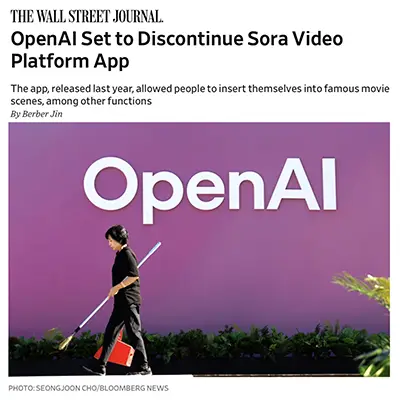
OPENAI SET TO DISCONTINUE SORA VIDEO PLATFORM APP
Wall Street Journal (Exclusive) | March 24, 2026
TL;DR: OpenAI is killing its Sora video product — consumer app, developer API, and ChatGPT integration — to focus computing resources and talent on productivity and coding tools ahead of a planned IPO, signaling a clear strategic pivot away from consumer creative AI.
Executive Summary
Less than a year after launching Sora to significant fanfare, OpenAI is shutting down the entire video product line: the consumer app, the developer API, and in-ChatGPT video functionality. CEO Sam Altman announced the changes internally. The stated rationale is a resource reallocation toward productivity and coding tools — including the consolidation of ChatGPT, the Codex coding tool, and a browser into a single “superapp” — with an eye on a potential IPO as early as Q4 2026.
This is a meaningful signal about OpenAI’s strategic priorities and its financial reality. Consumer creative AI — video generation, image tools, entertainment features — is being deprioritized in favor of enterprise-facing productivity and coding capabilities, which carry higher revenue potential and better align with the business case OpenAI needs to make to public market investors. Sora was a compelling technical demonstration, but it did not find durable commercial traction.
The broader pattern here is important: AI product categories that generated excitement in 2024–2025 — text-to-video, generative art, consumer creative tools — are being abandoned or deprioritized by the leading labs as the market clarifies around enterprise productivity and agentic coding. OpenAI is not the only company making this pivot; it is simply the most prominent example.
Relevance for Business
For SMB leaders, this development has several practical implications. First, any workflows built around Sora — video creation, content automation, marketing production — need an alternative source. The developer API is also going away, so any third-party tools built on top of it may also be affected. Second, this is a useful reminder that building workflows on early-stage AI consumer products carries real discontinuation risk. Vendor stability should be a factor in AI tool selection, not just capability. Third, the strategic pivot toward productivity and coding tools is directionally relevant: the next wave of OpenAI’s product investment will focus on where it believes enterprises will spend money, which is useful intelligence for SMBs evaluating what AI tools to build expertise in.
Calls to Action
🔹 Act now if you use Sora: Identify any Sora-dependent workflows or tools and begin evaluating alternatives. Runway, Pika, and similar video AI platforms remain operational.
🔹 Audit AI tool dependencies generally: This is a good moment to review which AI tools in your stack are early-stage consumer products versus enterprise-grade platforms with stable vendor commitments.
🔹 Monitor OpenAI’s superapp launch: Consolidating ChatGPT, Codex, and a browser into one product is a significant platform move. Understanding what it can do for your business is worth attention.
🔹 Note the signal for AI investment strategy: OpenAI’s pivot toward productivity and coding is a leading indicator of where enterprise AI capability will concentrate. Align your team’s AI skill-building accordingly.
🔹 Revisit in 60 days: The superapp and its business productivity features will become clearer as OpenAI moves toward its IPO timeline.
Summary by ReadAboutAI.com
https://www.wsj.com/wsjplus/dashboard/articles/openai-set-to-discontinue-sora-video-platform-app-a82a9e4e: March 31, 2026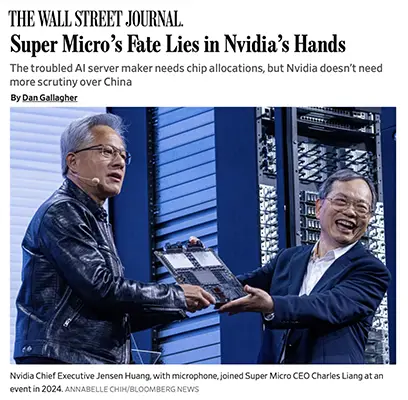
Super Micro’s Fate Lies in Nvidia’s Hands
Wall Street Journal (Heard on the Street) | March 24, 2026
TL;DR: A federal indictment of a Super Micro co-founder for allegedly smuggling Nvidia chips to China has put the AI server maker’s survival entirely in Nvidia’s hands — and Nvidia has every reason to let it fall.
Executive Summary
Super Micro, already under scrutiny for accounting irregularities and a 2024 short-seller report, suffered a fresh blow when board member and co-founder Wally Liaw was arrested on federal charges of helping smuggle Nvidia’s top-tier B200 chips to China. The company itself was not named as a defendant, but its stock dropped one-third in a single day and remains down 26% for the year. Analysts at Bernstein called the development a serious credibility threat that could affect business regardless of legal outcome.
The structural reality is stark: Super Micro’s survival depends entirely on continued GPU chip allocations from Nvidia. Without them, the business collapses. With them, even scandal hasn’t stopped the company from projecting $40 billion in revenue for fiscal year 2026 — nearly 10 times its pre-AI baseline. But Nvidia holds all the leverage. It can likely replace Super Micro’s volume quickly, especially with the upcoming Vera Rubin chip lineup, and it has a pressing incentive to distance itself from any China export-control controversy at a time when the Trump administration is tightening AI technology restrictions.
The deeper risk is structural, not just reputational: Super Micro’s gross margins hit a record low of 6.3% despite booming sales, its executive compensation has been disproportionately tied to revenue growth over profit quality, and it burns cash regularly. Analysts have called for a full leadership overhaul, including replacing the CEO and refreshing the board. The company is financially fragile behind impressive topline numbers.
Relevance for Business
For SMB executives, this is a supply chain and vendor risk story. Any business relying on AI infrastructure that flows through Super Micro servers — whether directly or via cloud providers — should monitor for potential delivery disruption if Nvidia withdraws chip allocations. More broadly, this illustrates how the entire AI infrastructure layer is subject to geopolitical and governance risk that can materialize suddenly. Companies evaluating AI server vendors should scrutinize not just performance specs, but governance quality and vendor stability.
Calls to Action
🔹 Monitor: Track whether Nvidia issues a formal statement on chip supply continuity with Super Micro — this is the single variable that determines the company’s near-term fate.
🔹 Assess exposure: If your AI infrastructure or cloud vendor relies on Super Micro hardware, ask your provider about contingency plans or alternative hardware sourcing.
🔹 Note for vendor selection: Factor governance track record and ownership structure into AI hardware vendor decisions — not just price and performance.
🔹 File for context: This case is an early, concrete example of how U.S.-China technology export controls can create sudden operational disruptions in the AI supply chain.
🔹 Ignore for now unless you have direct Super Micro exposure — the story is worth tracking but does not require immediate action for most SMBs.
Summary by ReadAboutAI.com
https://www.wsj.com/finance/stocks/super-micros-fate-lies-in-nvidias-hands-ac3157ab: March 31, 2026
COMPANIES AREN’T RIPPING OUT BUSINESS SOFTWARE FOR AI. HERE’S WHAT THEY’RE DOING INSTEAD.
Wall Street Journal (CIO Journal) | March 23, 2026
TL;DR: Large enterprises are not replacing their core business software (Salesforce, SAP, Workday) due to AI — instead they’re using AI-driven market uncertainty as leverage to negotiate better deals and using AI coding tools to build custom capabilities on top of existing systems.
Executive Summary
Despite a significant selloff in enterprise software stocks driven by AI disruption fears, the CIOs and CDOs at major companies — FedEx, EY, Cisco, Grant Thornton, Lowe’s — are not ripping out their core platforms. The reasons are practical: ERP and CRM systems handle regulatory complexity, multi-geography requirements, and compliance obligations that current AI tools cannot reliably replicate. Building and maintaining custom replacements also requires ongoing engineering resources that most organizations would rather deploy elsewhere.
What is changing is the bargaining environment and the margin of customization. The AI threat to legacy vendors has created negotiating leverage: companies are pressing vendors for better pricing and roadmap commitments. In parallel, “vibe-coding” — using AI-assisted coding tools to quickly build small apps, custom workflows, and automations — is enabling both large enterprises and SMBs to extend their existing systems without purchasing expensive vendor upgrades. EY is using vibe-coding to build SAP customizations it would otherwise have paid for; Cisco replaced a presentation software tool with an internally built AI agent, saving nearly $5 million annually.
The longer-term trajectory is visible: AI agents are beginning to replace specific software application functions, with the software becoming a data source rather than a primary interface. Grant Thornton’s CIO described this directly — core systems shift from operational tools to data repositories, while AI agents become the interface through which employees interact with them. This is not imminent disruption; it is a structural drift with 3–5 year implications for enterprise software strategy.
Relevance for Business
This is one of the most directly actionable articles in this collection for SMB executives. Three practical takeaways apply immediately. First, SMBs have real options to reduce software costs today using AI coding tools — vibe-coding a custom CRM, a workflow automation, or an internal tool is genuinely feasible at smaller scale and without large engineering teams. Second, your software vendor relationships are subject to renegotiation. The market uncertainty affecting Salesforce, SAP, and Workday applies to their SMB tiers as well — pricing, contract flexibility, and roadmap commitments are all negotiable in a way they weren’t two years ago. Third, the build-vs-buy calculus is shifting: for non-differentiating software functions, AI coding tools are lowering the cost of building custom solutions to the point where SMBs can realistically evaluate the option.
Calls to Action
🔹 Audit your software subscriptions against actual usage and vendor AI roadmaps: Which vendors are adapting aggressively? Which are not? Underperforming vendors in an uncertain market are renegotiation candidates.
🔹 Test vibe-coding for one internal tool or workflow this quarter: The threshold for building a small custom app has dropped significantly. Identify one low-stakes internal process and use an AI coding tool to build a simple solution.
🔹 Engage your major software vendors on their AI integration plans: The question is not whether to replace them — it is whether they are building the AI agent integrations that will keep them relevant in a 3–5 year horizon.
🔹 Evaluate your CRM at SMB scale: The article specifically notes that smaller companies are more successfully building their own CRM tools with AI coding assistance. If you’re paying for more CRM than you use, this is worth investigating.
🔹 Do not make premature platform replacements: The evidence is clear — replacing mature enterprise systems with AI-native alternatives today introduces more risk than it eliminates. Augment; don’t replace.
Summary by ReadAboutAI.com
https://www.wsj.com/tech/ai/companies-arent-ripping-out-business-software-for-ai-heres-what-theyre-doing-instead-793c3a37: March 31, 2026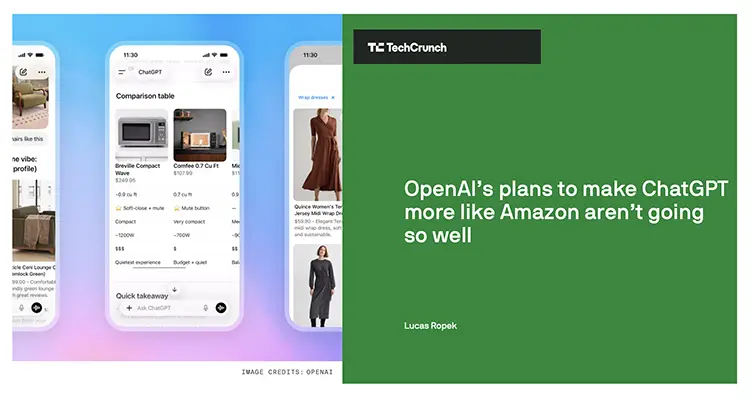
OpenAI’s Plans to Make ChatGPT More Like Amazon Aren’t Going So Well
TechCrunch | Lucas Ropek | March 24, 2026
TL;DR: OpenAI is quietly retreating from its “Instant Checkout” e-commerce feature after users didn’t use ChatGPT to actually make purchases — pivoting instead to product discovery and research, which reframes ChatGPT as a pre-purchase influence layer rather than a transactional platform.
Executive Summary
OpenAI launched “Instant Checkout” last September, allowing users to add products to a cart and complete purchases directly within ChatGPT. The feature was positioned as a step toward making ChatGPT a transactional commerce hub. It has not worked. OpenAI acknowledged the feature “did not offer the level of flexibility” expected and is deprioritizing its standalone development. A source reported to The Information confirmed that users simply were not using ChatGPT to complete purchases, and an October study found that e-commerce sites were generating little revenue from ChatGPT referral traffic.
The strategic pivot is meaningful: OpenAI is now positioning ChatGPT as a product discovery and comparison tool— surfacing side-by-side product images, pricing, features, and reviews — rather than a direct transaction channel. This is built on the Agentic Commerce Protocol (ACP), an open standard developed with Stripe, where merchants provide product data and retain their own checkout experience. The model shifts the battle to the top of the purchase funnel: if ChatGPT influences what consumers decide to buy before they go to a merchant’s site, it becomes a powerful (and potentially costly) new layer in the customer acquisition stack.
What to monitor: OpenAI has not abandoned commercial ambitions in this space — it has reframed where it exerts influence. A ChatGPT that steers product research without executing purchases still concentrates significant power over consumer attention and purchase intent.
Relevance for Business
For businesses that sell products online, this is a watch-now signal. ChatGPT influencing product discovery means that how your products appear in AI-generated comparisons may become as important as your search ranking or ad spend. The Agentic Commerce Protocol means OpenAI is building an infrastructure layer that merchants will need to participate in to remain visible — which creates a new vendor dependency and potential cost center. The failure of Instant Checkout also illustrates a broader point: AI cannot force behavior change in users. The same principle applies internally — tools that don’t fit how people actually work will be ignored, regardless of the platform’s ambitions.
Calls to Action
🔹 Monitor how your products appear in ChatGPT product searches — test queries relevant to your category now to understand your current visibility baseline.
🔹 Track the Agentic Commerce Protocol — if OpenAI’s product discovery layer gains traction, early participation in merchant data-sharing agreements may improve visibility and reduce cost-of-acquisition friction.
🔹 Do not restructure e-commerce strategy around ChatGPT as a transaction channel yet — the evidence is that users are not converting through AI chatbots at meaningful rates.
🔹 Assign someone to monitor AI referral traffic in your analytics — if you are not already tracking what share of site visits originate from AI platforms, establish that baseline now.
🔹 Revisit in 6 months — OpenAI’s product discovery pivot is new and unproven. The outcome will become clearer as merchant adoption of ACP either gains or loses momentum.
Summary by ReadAboutAI.com
https://techcrunch.com/2026/03/24/openais-plans-to-make-chatgpt-more-like-amazon-arent-going-so-well/: March 31, 2026
OpenAI Hires Former Meta Executive to Lead Ad Push
Wall Street Journal (Exclusive) | March 23, 2026
TL;DR: OpenAI has hired a veteran Meta ad executive to build its advertising business — a significant strategic pivot for a company whose CEO once called ads a “last resort,” signaling that subscription revenue alone cannot sustain OpenAI’s capital needs.
Executive Summary
OpenAI has named Dave Dugan — previously VP of Global Clients and Agencies at Meta, where he spent over a decade — as VP of Global Ad Solutions. He will report directly to COO Brad Lightcap. The hire is the strongest signal yet that OpenAI is serious about advertising as a revenue stream, not just a pilot. Earlier this year, OpenAI began testing ads on the free tier and lower-cost ChatGPT subscription tiers.
The strategic backdrop is financial pressure. OpenAI’s infrastructure and model development costs are enormous, and the company clearly cannot sustain its ambitions on subscription revenue alone — particularly at lower price tiers that attract the highest user volume. CEO Sam Altman publicly stated reservations about ads as recently as two years ago, describing the combination of ads and AI as “uniquely unsettling” and naming advertising a “last resort.” The gap between that framing and this hire is meaningful: the company’s capital requirements have apparently overridden its founder’s stated preferences.
The credibility risk is real. OpenAI has stated that ads would not influence ChatGPT’s responses and that user conversations would not be sold to advertisers — but users’ trust in AI-generated answers depends on believing the system is not commercially compromised. Dugan’s background is specifically in large brand relationships (Publicis, top global advertisers), which suggests OpenAI is initially targeting premium brand advertising rather than performance/targeted advertising — a model less likely to raise immediate editorial integrity concerns, but still one that introduces a new incentive layer.
Relevance for Business
For SMB executives, this development has two layers of relevance. First, as users of ChatGPT: the introduction of advertising into AI interfaces is a structural change in how these tools work and what interests they serve. Leaders should understand that free or low-cost AI tiers may increasingly exist within an ad-supported model, which is worth factoring into enterprise vs. consumer tool decisions. Second, as potential advertisers: OpenAI’s entry into digital advertising will eventually create new placement inventory — one that sits inside AI-generated responses, which may have very different reach, engagement, and measurement dynamics than traditional digital channels.
Calls to Action
🔹 Monitor: Watch how OpenAI implements ads in practice — specifically whether ad placement affects the neutrality or quality of ChatGPT responses for business use cases.
🔹 Evaluate tool tiers with intent: If your team is using free or low-cost ChatGPT tiers for business-critical tasks, consider whether an ad-supported environment is appropriate for those use cases.
🔹 Flag for your marketing team: OpenAI ad inventory will eventually be a real consideration for digital advertising budgets — worth tracking as the format becomes clearer.
🔹 Note the governance question: If you have an AI use policy, consider whether it needs to address the use of ad-supported AI tools for sensitive or client-facing work.
🔹 Revisit in 6 months: The ad product is nascent. Concrete format, targeting, and transparency details will matter more than the hire itself.
Summary by ReadAboutAI.com
https://www.wsj.com/tech/ai/openai-taps-former-meta-executive-to-lead-ad-push-60d39af2: March 31, 2026
EHR GIANTS HAVE ENTERED THE AI ARENA. WHAT DOES IT MEAN FOR STARTUPS?
Source: TechTarget / Health IT and EHR | Date: March 23, 2026
TL;DR: Legacy EHR platforms are now bundling AI-native features that directly compete with health AI startups — but switching costs, workflow depth, and cross-platform integration keep established niche players viable for now.
Executive Summary
Major EHR vendors including Epic and athenahealth (healthcare software companies), have begun rolling out “AI-native” clinical documentation capabilities — features that previously differentiated startups like Abridge, Nabla, and Suki. The incumbents moved slower than expected, which allowed those startups to build meaningful market share and customer loyalty. That window is now closing.
The competitive threat is real but not decisive. EHR vendors carry deeper pockets and broader distribution, but they also carry a hundred competing priorities. Health AI startups argue their edge lies in clinical focus, AI-first architecture, and the friction of switching — health systems that have invested in deploying a tool like Abridge are unlikely to rip it out for a bundled alternative. Change management costs are a genuine moat.
A secondary advantage for startups: cross-platform integration. Many health systems run multiple EHRs across hospitals and acquired practices. A vendor like Suki can operate across Epic, PointClickCare, and others — something native EHR tools cannot replicate. The more strategic play for startups may be expanding into agentic workflows — moving from point-solution automation to end-to-end clinical processes — a complexity level where incumbents are unlikely to follow quickly. The article is largely sourced from startup leaders themselves, so competitive claims should be weighted accordingly. Independent market validation is limited.
Relevance for Business
Healthcare-adjacent SMBs — whether vendor, operator, or buyer — face a structural pattern emerging across all enterprise software: platform incumbents are absorbing AI features that were once the province of specialists. The “good enough” AI built into existing platforms creates real pressure on niche software budgets. For buyers, this is a near-term cost opportunity but a long-term vendor consolidation risk. For operators evaluating health AI tools, switching now may be premature; waiting 12–18 months will clarify which startups survive the compression. The pattern is not unique to healthcare.
Calls to Action
🔹 If you use health AI point solutions, audit whether your EHR vendor now offers comparable native functionality — and whether the switching cost is justified by the feature delta.
🔹 If you are evaluating health AI vendors, prioritize those with demonstrated cross-platform integration and clinical workflow depth over those competing on single-feature automation.
🔹 Monitor how agentic workflow capabilities develop among health AI startups — that is the differentiation frontier, not documentation alone.
🔹 Apply the broader pattern: review your software stack for cases where incumbent platforms (CRM, ERP, collaboration tools) are absorbing features you currently pay specialists for.
🔹 Assign internal review of any niche software contracts due for renewal in 2026 — the “bundled AI” question should be part of that evaluation.
Summary by ReadAboutAI.com
https://www.techtarget.com/searchhealthit/feature/EHR-giants-have-entered-the-AI-arena-What-does-it-mean-for-startups: March 31, 2026
LILLY SVP: IN LIFE SCIENCES, THE AI-ENABLED FUTURE IS BUILT WITH SOFTWARE
WSJ / Deloitte CIO Journal (Sponsored Content) | March 6, 2026
Editorial note: This is sponsored content produced by Deloitte in partnership with the WSJ CIO Journal. The perspectives belong to a named Lilly executive and a Deloitte consultant. The framing is promotional and optimistic. It is treated here as industry perspective, not independent analysis.
TL;DR: Eli Lilly’s software engineering leader argues that AI adoption in life sciences requires treating the company as a technology company — building internal software capability, democratizing AI access beyond data scientists, and preparing for a future where human and AI workers operate in parallel.
Executive Summary
Gokul Radhakrishnan, SVP of Software Product Engineering at Eli Lilly, articulates a practical framework for enterprise AI adoption in a knowledge-intensive, highly regulated industry. His central argument: AI adoption is no longer a data science problem — it is a software engineering problem. Engineers who are close to users and use cases are better positioned to identify and build AI-powered solutions than specialists operating in centralized data science teams. This democratization of AI development — enabling engineers to build multiple product versions in the time it previously took to build one — is creating a structural shift in how enterprise software gets made.
On agentic AI, Radhakrishnan is measured: today’s agents are largely automated tasks wrapped in AI framing. The more important future state is managing human and AI workers in parallel — a shift that requires not just technology but cultural change. He emphasizes that in a scientific organization, hard evidence of AI effectiveness is required to drive adoption; appeals to transformation alone do not move scientists.
The advice to “move forward with conviction” and build rather than over-plan is reasonable and consistent with what is working in practice. However, the article is produced by Deloitte and should be read as professional services framing— the practical examples remain useful, but readers should calibrate for the consulting firm’s inherent interest in encouraging enterprise AI investment.
Relevance for Business
For SMB leaders, this is most valuable as a validated blueprint for AI adoption culture, drawn from a large enterprise in a highly regulated industry. Key transferable insights: start with use cases closest to actual users; give software engineers (not just data scientists or consultants) the tools and mandate to build with AI; demonstrate value empirically before expecting cultural buy-in; and think now about how your organizational structure will accommodate both human and AI “workers.” SMBs in professional services, healthcare-adjacent sectors, or other knowledge-intensive fields will find the most direct relevance.
The claim that life sciences companies must “operate like a tech company today” is a useful provocation — not prescriptive advice, but a genuine challenge to how SMB leaders think about their technology capability as a competitive differentiator.
Calls to Action
🔹 Evaluate whether your AI adoption is too centralized: If AI deployment sits only with IT or a specialist team, it may be missing the practitioners closest to actual work. Broaden access deliberately.
🔹 Identify your highest-value AI use cases by proximity to users: Workflows where employees can immediately see time savings or quality improvement are the right starting points — not enterprise-wide transformations.
🔹 Build internal demonstration capacity: In knowledge-intensive teams, peer-demonstrated results drive adoption faster than leadership mandates. Create the conditions for internal champions to share wins.
🔹 Monitor the parallel human-AI workforce model: The concept of managing human and AI agents in tandem is no longer theoretical. Assign someone in your organization to track what this means for your specific context.
🔹 Treat this as perspective, not prescription: The article is sponsored content from a consulting firm. The framework is useful; the urgency framing should be read with that context in mind.
Summary by ReadAboutAI.com
https://deloitte.wsj.com/cio/lilly-svp-in-life-sciences-the-ai-enabled-future-is-built-with-software-2d2d3e67: March 31, 2026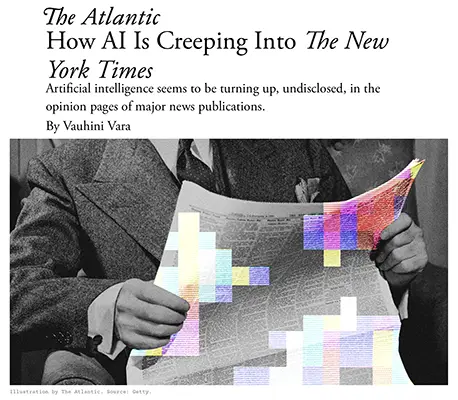

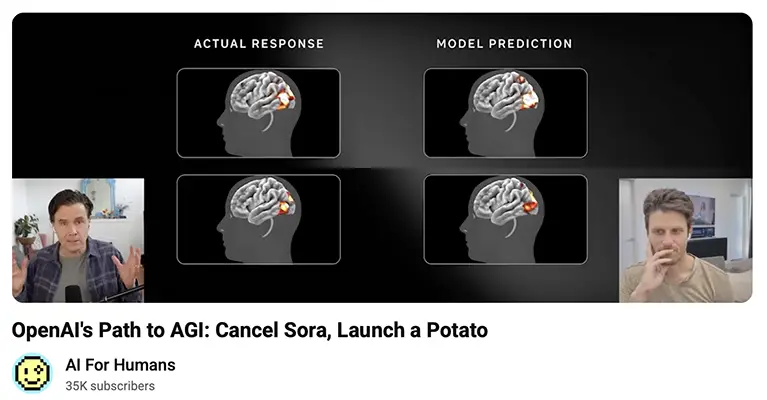
WHAT THIS WEEK ADDED UP TO: AI update for March 31, 2026
This week’s developments point to an AI market that is becoming more disciplined, more selective, and more consequential for everyday business decisions. The biggest shift is not simply that the technology keeps improving, but that companies and organizations are being forced to decide where AI creates durable value, where it introduces new risks, and which bets are actually worth sustaining. Across this set, the broader pattern is clear: AI is moving out of its novelty phase and deeper into questions of execution, workforce impact, trust, cost, and vendor stability.
Closing wrap-up:
Taken together, these summaries show an AI market that is still advancing rapidly, but with less room for fantasy and more demand for managerial judgment. The question for leaders is no longer whether AI matters; it is which bets are durable, which risks are acceptable, and how to build trust while the technology and the market keep moving.
🔹 Major AI companies are narrowing their focus toward areas with clearer business value, especially enterprise adoption, coding, and scalable product integration.
🔹 The most meaningful competition is shifting toward practical deployment, not just headline-grabbing demos or model claims.
🔹 Workforce disruption is becoming more immediate, especially for administrative, support, and entry-level work that organizations have long used as training ground roles.
🔹 Trust, disclosure, and governance are becoming central management issues, not secondary ethical side topics.
🔹 AI decisions are increasingly economic decisions, shaped by infrastructure costs, vendor dependence, and the need for more selective adoption.
All Summaries by ReadAboutAI.com
↑ Back to Top