
AI Updates May 04, 2026

OpenAI released GPT-5.5 and simultaneously faces a federal trial and a criminal investigation.
This week’s batch of summaries arrives during what may be the most consequential month in AI’s short business history — not because of any single development, but because of how many threads are pulling in opposite directions at once. OpenAI released GPT-5.5 and simultaneously faces a federal trial and a criminal investigation. China’s DeepSeek shipped a new frontier model built on domestic chips. The US government formally accused Chinese entities of industrial-scale AI theft. Anthropic held back its most powerful model from the public while selectively distributing it to large institutions. Two of the biggest AI companies in the world are nearing IPOs under conditions of genuine legal, reputational, and geopolitical uncertainty. This is not a slow news week with an AI angle — it is a week in which the AI landscape itself is being restructured in real time.
What connects these stories is a tension that has been building for months and is now becoming impossible to ignore: the gap between AI’s demonstrated capability and the governance, infrastructure, and trust frameworks needed to deploy it responsibly is widening, not closing. Models are improving faster than safety systems. Hardware supply is falling behind software demand. Regulatory frameworks are forming unevenly — state by state, agency by agency, country by country — while the technology moves at a pace none of those frameworks were designed for. And the public, particularly in the United States, is growing less optimistic, not more, even as AI products become more capable and more embedded in daily life.
For SMB executives, the practical implication is this: the decisions you make about AI tools, vendors, and internal policy over the next six to twelve months will be made in conditions of genuine uncertainty — not just about which model performs best, but about which vendors will remain stable, which regulatory obligations will land first, and which AI-generated data practices expose your organization to liability you haven’t yet mapped. This week’s summaries are designed to give you the clearest possible view of that landscape — what is real, what is claimed, what is still forming, and where to focus your attention now versus what can wait.
Summaries
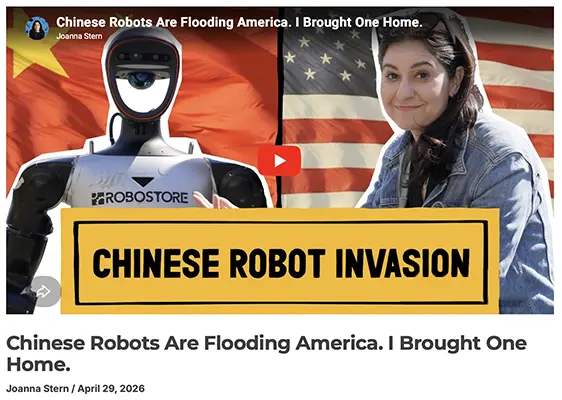
Chinese Robots Are Flooding America. I Brought One Home.
Joanna Stern / April 29, 2026
Summary by ReadAboutAI.com
https://www.youtube.com/watch?v=ucy9VTLDwPU: May 4, 2026
Humanoid Robots: Hype, Hard Reality, and the Long Road to the Workplace
Bloomberg News | April 29, 2026
TL;DR: Humanoid robots are attracting billions in investment and high-profile hype, but real-world deployments reveal persistent technical limitations, unclear ROI, and a multi-year gap between promise and practical business value.
Executive Summary
The humanoid robotics sector is experiencing a capital surge driven largely by AI enthusiasm and high-profile advocacy from figures like Elon Musk and Jensen Huang. The underlying premise — that AI can give a robot body general-purpose adaptability, not just fixed programming — is technically credible but far from proven at scale. The key distinction is between demonstrated capability and investment narrative: most working demonstrations rely heavily on human teleoperation or tightly controlled conditions.
The most immediate technical barrier is data. Unlike large language models, which learned from vast internet text, robots require physical motion data — video paired with precise motor commands — that has barely been collected. Companies are racing to close this gap through simulation, harvested real-world video, and teleoperation farms, each with meaningful trade-offs in speed, cost, and fidelity. The company that solves the data problem at scale will have a structural competitive advantage.
Early industrial pilots (BMW, Amazon, GXO Logistics) confirm that humanoids can handle narrow, hazardous, or unpleasant tasks — cold-storage work, for example — but they currently drop products, misplace items, move slowly, and require constant human oversight. One logistics executive stated plainly that ROI from current humanoid technology is not yet understood, and that full-task replacement is unlikely within a few years. China holds a manufacturing and supply-chain advantage that could accelerate unit economics globally, but even Chinese officials have flagged bubble risk in their own market.
Relevance for Business
For most SMBs, humanoid robots are not an imminent operational decision — they are a trend to track, not act on yet. However, the direction of travel matters for strategic planning:
- Labor planning: If your business faces persistent labor shortages in physical roles — warehousing, logistics, light manufacturing — humanoids are a candidate solution on a 5–10 year horizon, not 1–3 years.
- Cost structure: Current humanoid hardware and operation costs are high and ROI unproven. Early adoption carries real financial risk without clear payback.
- Vendor landscape: Nvidia is positioned as critical infrastructure for robotics AI training, paralleling its dominance in generative AI. Supply chain concentration is a risk to monitor.
- China competition: Chinese manufacturers are shipping more humanoid units than anyone else in 2025. For businesses competing with Chinese manufacturers, this could affect labor-cost dynamics within the decade.
- Governance and safety: Hospital and home deployments raise liability and safety questions that are not resolved. Regulated industries should not assume near-term deployment pathways exist.
Calls to Action
🔹 Monitor, don’t act: Humanoid robotics is not ready for SMB deployment. Assign someone to track quarterly developments from key pilots (Amazon, BMW, GXO) as a leading indicator.
🔹 Audit your labor exposure: Identify roles in your operations that are physically repetitive, hazardous, or hard to fill. These are the first candidates when humanoid capability matures — knowing them now prepares your 3–5 year planning.
🔹 Treat vendor claims skeptically: Demonstrations that look autonomous may involve significant human assistance. Ask for independent performance data before engaging any robotics vendor.
🔹 Watch China’s unit economics: If humanoid manufacturing costs drop significantly — as they did with EVs — the timeline for broader deployment could compress. Track pricing trends annually.
🔹 Prepare a policy position: If you operate in healthcare, logistics, or manufacturing, begin internal discussion about how your organization would govern human-robot collaboration before it becomes an urgent decision.
Summary by ReadAboutAI.com
https://www.youtube.com/watch?v=UQZooauU-FQ: May 4, 2026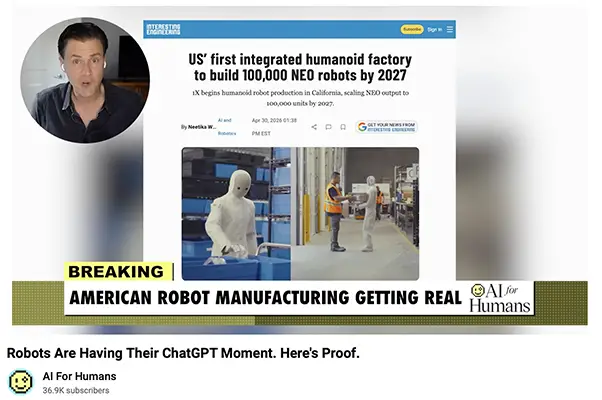
U.S. Robotics Manufacturing Finds Its Footing— While OpenAI Fights Goblins and the White House Fights Anthropic
AI For Humans Podcast | Week of May 1, 2026
TL;DR: Humanoid robotics is accelerating faster than most business leaders are tracking — with U.S. manufacturers scaling production and a credible “ChatGPT moment” now being called for physical AI — while separate stories reveal how AI model behavior can drift in unexpected ways, and how government control of frontier AI is quietly tightening.
Executive Summary
The most substantive signal this week is in physical AI and robotics manufacturing. Two U.S. companies — Figure Robotics and 1X — have opened domestic production lines. Figure has moved from one robot per day to one per hour; 1X is targeting 10,000 units annually. Separately, Eka Robotics demonstrated a robotic hand grabbing a fragile raspberry at speed — trained entirely in simulation — prompting Wired to characterize it as a potential inflection point comparable to ChatGPT’s emergence for text AI. China retains a significant manufacturing lead, and the hosts are candid that U.S. output remains modest by comparison. But the direction has shifted, and the simulation-to-reality training pipeline is maturing in ways that matter for anyone thinking about physical operations, logistics, or labor planning over a 3–5 year horizon. Safety concerns are real and unresolved: edge cases in physical robots can escalate from minor malfunction to serious harm instantly, and home or workplace deployment remains premature for most settings.
On the policy front, the White House is reportedly blocking wider commercial rollout of Anthropic’s classified “Mythos” model — a frontier AI system built specifically for cybersecurity — to preserve compute access for government use. OpenAI responded by announcing GPT-5.5 Cyber, its own cybersecurity-focused model, signaling that specialized, government-facing AI is becoming a distinct competitive category. This is worth watching: as frontier capabilities increasingly flow first to defense and intelligence customers, commercial access timelines may slip.
The “goblin problem” at OpenAI — where ChatGPT models began overusing fantasy creature references due to training feedback loops — is a small but instructive story about how AI behavior can drift in unintended directions as models train on outputs of prior models. OpenAI published an explanation and says GPT-6 will address it. The episode illustrates that even leading vendors don’t fully control emergent model behaviors — a meaningful governance consideration for any business relying on AI outputs at scale.
Relevance for Business
Robotics is moving from “watch this space” to “start planning.” The 3–5 year window for meaningful physical AI deployment in warehousing, logistics, elder care, and some manufacturing roles is compressing. SMBs in those sectors should begin assessing workflow redesign scenarios now — not because robots are ready today, but because the transition timeline is shortening faster than most organizations’ planning cycles.
Government capture of frontier AI is an emerging risk for commercial users. If specialized models like Mythos are reserved for defense and intelligence use, SMBs may find themselves working with second-tier model access in high-stakes applications like cybersecurity. Vendor diversification and contract clarity around model access tiers are prudent considerations.
The goblin/training drift story is a reminder that AI outputs are not static. Businesses deploying AI in customer-facing or compliance-sensitive contexts need ongoing output monitoring — not just initial evaluation. Model updates from vendors can shift behavior in ways that aren’t announced and aren’t obvious until someone notices goblins.
Calls to Action
🔹 Start a robotics readiness assessment if your business operates in logistics, warehousing, manufacturing, or care services — not to buy now, but to understand where physical AI intersects your workflows within a 5-year window.
🔹 Monitor government AI access policy as a procurement variable. If your cybersecurity or defense-adjacent vendor strategy depends on frontier models, ask vendors directly about access tiers and government priority commitments.
🔹 Audit your AI output monitoring practices. If you rely on AI-generated content, customer interactions, or decisions, ensure you have human review checkpoints — vendor model updates can shift behavior without notice.
🔹 Treat simulation-trained robotics as a serious near-term technology, not science fiction. The Eka Robotics demo and the Wired characterization suggest the underlying capability curve is steeper than most non-specialist observers expect.
🔹 Deprioritize Grok Imagine for production video work for now — the hosts’ testing suggests the agentic video tooling is early-stage and unreliable, despite promising architecture. Revisit in 6–12 months.
Summary by ReadAboutAI.com
https://www.youtube.com/watch?v=wcKUhGzKrAo: May 4, 2026
The Missing Step Between Hype and Profit
MIT Technology Review | Will Douglas Heaven | April 27, 2026
TL;DR: AI has cleared the capability hurdle but not the economic one — and the gap between what models can do in benchmarks and what they deliver in real workplaces is wider than the industry wants to admit.
Executive Summary
The core claim making the rounds in AI — that we are on the verge of workplace transformation — rests on a shakier foundation than the headlines suggest. A recent study by Mercor tested leading AI agents from OpenAI, Anthropic, and Google DeepMind on nearly 500 tasks typical of white-collar professionals in banking, consulting, and law. The result: every agent tested fell short on the majority of assigned work. That finding sits in direct tension with the sweeping labor-impact predictions issued by the same AI companies whose models were tested — a conflict of interest worth noting.
The more structural problem is deployment, not capability. Even where AI performs adequately in isolation, real workplaces are not clean testing environments. They involve legacy processes, human judgment, and organizational inertia. Reengineering those workflows around AI is the actual work — and it is slow, expensive, and organizationally difficult. Most optimistic AI forecasts skip this step entirely. The article’s signal is that this omission isn’t minor; it is the central unsolved problem of the AI era.
The result is an information vacuum that gets filled by dramatic claims — claims that, the author notes, are increasingly moving markets despite thin evidentiary grounding.
Relevance for Business
For SMB leaders, this piece validates caution without recommending inaction. The gap between AI demos and deployed value is real and documented. Vendor pitches will continue to outpace what organizations can actually extract from AI tools, particularly in judgment-intensive roles. The integration burden — change management, workflow redesign, oversight — is not priced into most AI purchasing decisions. Leaders who plan for that friction will fare better than those who budget only for the software.
Calls to Action
🔹 Pilot before you commit. Treat every AI deployment as an experiment with defined success metrics, not a transformation announcement.
🔹 Ask vendors for real-world evidence, not benchmark performance or case studies from enterprise clients with large implementation teams.
🔹 Budget for the integration layer. The cost of AI is rarely the subscription fee — it’s the workflow redesign, training, and oversight that follows.
🔹 Assign a skeptic. Designate someone internally to track actual ROI on AI tools already in use. What’s delivering measurable value? What isn’t?
🔹 Monitor, don’t panic. AI will eventually close this gap in some domains. The question is timing. Revisit your deployment assumptions every six months as evidence accumulates.
Summary by ReadAboutAI.com
https://www.technologyreview.com/2026/04/27/1136456/the-missing-step-between-hype-and-profit/: May 4, 2026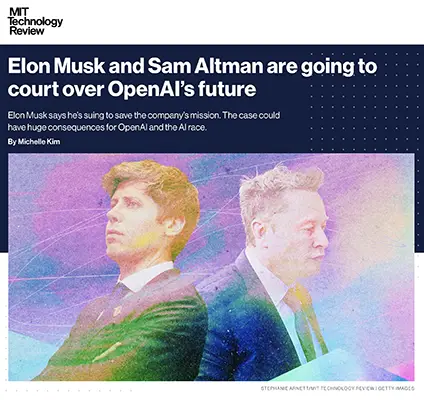
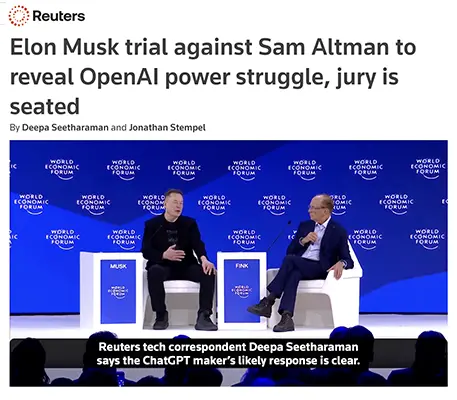
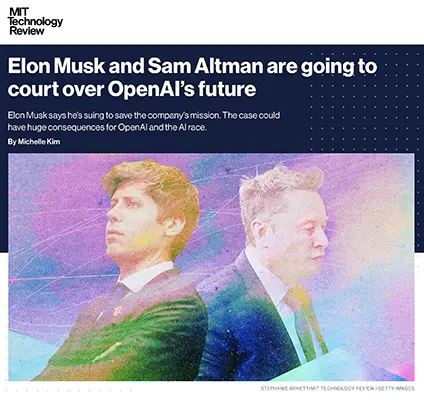
The Musk v. Altman Trial: What’s Really at Stake for OpenAI
Covered by two sources: MIT Technology Review (Michelle Kim, April 27, 2026) and Reuters (Deepa Seetharaman & Jonathan Stempel, April 27, 2026)
Editorial note for ReadAboutAI.com: These two articles cover the same event — the opening of the Musk v. Altman trial — from different editorial angles. The MIT Technology Review piece provides deeper legal and structural context; Reuters offers more procedural detail and internal document color. The summary below synthesizes both. The Markdown version flags both sources.
TL;DR: A federal trial pitting Elon Musk against OpenAI and Sam Altman kicked off this week with the potential to disrupt OpenAI’s IPO, expose years of internal power struggles, and force a legal reckoning over whether one of the world’s most powerful AI companies can continue to operate as a for-profit enterprise.
Executive Summary
At its core, this trial is a dispute over a broken promise — or, depending on who prevails, a misremembered one. Musk alleges that when he co-founded and funded OpenAI in 2015 as a nonprofit, he was given assurances it would remain one. He claims that Altman and OpenAI president Greg Brockman later steered the company toward a for-profit structure without his knowledge or consent, while continuing to benefit from his name and early capital. He is seeking damages reported in the range of $134–150 billion, with proceeds directed to OpenAI’s charitable arm — not to himself.
OpenAI’s counter is pointed: that Musk was actively involved in the for-profit discussions, that he sought to become CEO himself, and that the lawsuit is primarily a competitive maneuver to handicap a rival while his own AI company, xAI, prepares for a public listing. Internal documents surfaced in court — including diary entries from Brockman and emails from Musk — suggest tensions were deep and long-running. Key witnesses will include Altman, Musk, Brockman, Microsoft CEO Satya Nadella, and former OpenAI chief scientist Ilya Sutskever.
The legal stakes are real but murky. Several legal scholars have questioned whether Musk has proper standing to bring the case at all, given that state attorneys general — the typical enforcers of nonprofit obligations — have already negotiated a restructuring agreement with OpenAI and declined to join Musk’s suit. The jury’s verdict will be advisory only, meaning the judge retains final authority. Still, even a non-binding adverse outcome could cloud OpenAI’s IPO ambitions and generate damaging disclosures in the interim.
Relevance for Business
This trial matters for SMB leaders less as a legal drama and more as a governance and vendor-stability signal. OpenAI is the backbone of a growing number of enterprise software products — its instability carries downstream risk. Any leadership disruption, prolonged litigation, or IPO delay could affect product roadmaps, pricing, and the reliability of the partner ecosystem built on its APIs.
More broadly, the trial illustrates a recurring risk in AI: the governance structures of these companies were designed for a different era and a different scale. The question of who controls transformative AI — and under what accountability framework — is not settled. Leaders who treat OpenAI as infrastructure should note that the infrastructure is being litigated.
Calls to Action
🔹 Monitor trial developments actively. Verdicts, testimony, and disclosed documents could meaningfully affect OpenAI’s operational stability and IPO timeline.
🔹 Assess your OpenAI dependency. If your business relies on OpenAI’s APIs or integrated tools, map your exposure and identify alternative vendors should continuity be disrupted.
🔹 Don’t overreact to daily headlines. The jury’s verdict is non-binding; the trial outcome will be shaped by the judge’s interpretation of complex nonprofit law — not public sentiment.
🔹 Use this as a prompt to review AI vendor governance. Ask whether your key AI suppliers have stable leadership, clear accountability structures, and track records of keeping commercial commitments.
🔹 Watch the IPO trajectory. If OpenAI’s public offering is delayed or restructured due to litigation, it may signal deeper organizational instability worth factoring into long-term vendor planning.
Summary by ReadAboutAI.com
https://www.reuters.com/business/elon-musks-trial-against-sam-altman-reveal-ongoing-power-struggle-openai-2026-04-27/: May 4, 2026https://www.technologyreview.com/2026/04/27/1136466/elon-musk-and-sam-altman-are-going-to-court-over-openais-future/: May 4, 2026
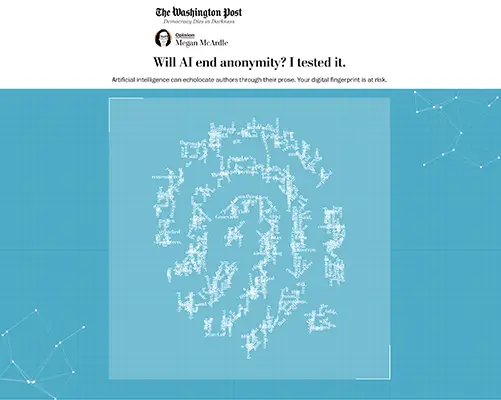
AI Can Identify Anonymous Writers From Their Prose — And There’s No Stopping It
Washington Post Opinion (Megan McArdle) | April 26, 2026
TL;DR: Advanced AI models can now identify individual writers from a few hundred words of text, effectively threatening the viability of online anonymity for anyone with a digital writing trail.
Executive Summary
This is an opinion piece, and should be read as such — but the empirical demonstration at its core is striking. Washington Post columnist Megan McArdle conducted an informal but revealing experiment: she fed unpublished, unattributed personal writing to Claude Opus 4.7 and found that the model correctly identified her as the author. The minimum sample required dropped as low as 124 words in some cases. The experiment was prompted by a similar test conducted by technology writer Kelsey Piper, who found the same capability.
McArdle’s argument is that writing style functions like a fingerprint — individually distinctive even in ordinary prose — and that AI models trained on large bodies of text can now exploit this systematically. The practical implication: anyone whose writing exists somewhere online — blog posts, social media, academic work, forum comments — is potentially identifiable. AI providers could attempt to restrict this use case, as they have restricted other harmful query types, but open-source models would remain available to determined actors, including governments.
The piece raises several concrete second-order concerns: whistleblowers, anonymous sources in journalism, political dissidents, and people seeking help in vulnerable moments all rely on the expectation that their words cannot be traced. McArdle argues those expectations are eroding faster than any policy response can address, and that the net social cost of de-anonymization likely exceeds the benefit of silencing online harassment.
Relevance for Business
For SMB executives, the implications cluster in two areas. First, internal communications and document security: employees who engage in anonymous whistleblowing, compliance reporting, or candid internal feedback may have less protection than assumed. Second, competitive and reputational intelligence: the same capability that identifies authors could theoretically be used to trace the origin of leaked documents, anonymous reviews, or attributed market commentary. HR and legal should understand that anonymity guarantees are weakening — both for your organization’s communications and for any anonymous input you solicit (surveys, exit interviews, tip lines). This is not an immediate operational crisis, but it is a material shift in the privacy assumptions underlying several common business practices.
Calls to Action
🔹 Flag for legal and HR: Brief your legal and HR leadership on the erosion of writing-based anonymity, particularly as it relates to anonymous reporting channels and whistleblower protections.
🔹 Audit your anonymous feedback mechanisms: If your organization relies on anonymous surveys or tip lines, assess whether the anonymity claim you make to contributors is still accurate.
🔹 Monitor open-source AI developments: The threat here is not primarily from regulated commercial providers but from unrestricted open-source models — track this space rather than assuming commercial guardrails solve the problem.
🔹 No immediate action required on most fronts — this is an emerging risk to understand and monitor, not an operational emergency today.
Summary by ReadAboutAI.com
https://www.washingtonpost.com/opinions/interactive/2026/04/26/artificial-intelligence-could-kill-anonymity-online/: May 4, 2026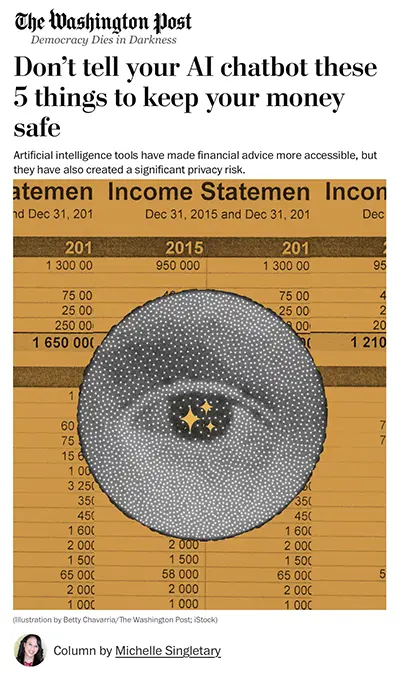
What Not to Tell Your AI Chatbot About Your Finances
The Washington Post | Michelle Singletary | April 25, 2026
TL;DR: AI chatbot use for personal finance has jumped from 10% to 55% of American adults in one year — and most users are sharing sensitive financial data that major AI platforms retain and use for model training by default.
Executive Summary
Washington Post personal finance columnist Michelle Singletary raises a practical data privacy concern with mainstream relevance: as AI chatbot adoption for financial guidance has accelerated dramatically, users are routinely sharing identifying financial details — account specifics, employer information, exact transaction amounts, and full financial documents — without understanding how that data is stored or used.
The piece cites a Stanford study finding that all six major AI platforms reviewed (Amazon, Anthropic, Google, Meta, Microsoft, OpenAI) use chat data for model training by default, and some retain it indefinitely. A separate Cisco survey found that 29% of global AI users have entered personal or confidential information into chatbots, despite 84% expressing concern about data being made public. The five categories of information the column recommends keeping out of AI chats: personal identifiers (name, SSN, address), employer details, specific debt balances tied to named creditors, exact transactional amounts, and financial documents such as tax returns or investment statements.
The column’s guidance is practical and appropriately conservative, though it is a consumer-facing piece, not an enterprise one. Its value for business readers is in the adjacent issue it raises: employees using AI tools for work-related financial or operational tasks may be exposing sensitive business information under similar conditions.
Relevance for Business
This is a governance and policy gap most SMBs have not yet closed. Employees are almost certainly using consumer AI chatbots — ChatGPT, Claude, Gemini — for work tasks involving sensitive business data: vendor negotiations, financial projections, HR conversations, client information. The data retention practices documented in the Stanford study apply equally to those interactions. The risk is not hypothetical: a data breach at an AI provider, or data used in model training that subsequently surfaces in responses to other users, represents real exposure. This is a practical, near-term issue that does not require waiting for regulation to address.
Calls to Action
🔹 Establish a clear AI data policy that specifies what categories of business information employees may not input into consumer AI tools — financial data, client data, personnel information, and proprietary operational details should all be explicitly addressed.
🔹 Audit current AI tool use across your organization: what tools are employees using, for what purposes, and under what data governance conditions?
🔹 Opt out of training data use wherever possible across any AI platforms your organization uses, and verify that enterprise-tier agreements (where available) include data non-retention terms.
🔹 Train employees on the distinction between AI tools built for enterprise use (with data isolation) and consumer AI tools (which typically retain and train on inputs).
🔹 Treat this as a near-term action item, not a “monitor” — the data practices described are current and documented; the risk window is open now.
Summary by ReadAboutAI.com
https://www.washingtonpost.com/business/2026/04/25/ai-financial-advice-privacy-concerns/: May 4, 2026
First Vacuums — Then the World: Dreame’s Bet on Becoming a Global Tech Empire
The Verge | Jennifer Pattison Tuohy | April 22, 2026
TL;DR: Chinese robotics upstart Dreame is making an aggressive, high-risk push into the US market across multiple consumer electronics categories simultaneously — a move that is either the early chapter of a new tech giant’s rise or a cautionary tale in the making.
Executive Summary
Dreame — founded in 2015 in Suzhou, China, and best known for premium robot vacuums — is executing a rapid and sprawling expansion. Having established itself as a genuine competitor to Dyson in cleaning appliances, the company is now entering TVs, refrigerators, air conditioners, smartphones, hair dryers, cars, humanoid robots, and satellites, all organized under an “AI-powered whole-home smart ecosystem” vision. The company’s founder and CEO, Yu Hao, reportedly sees himself as a Chinese analog to Elon Musk — building vertically integrated hardware empires across categories simultaneously.
The business fundamentals are genuinely notable: revenue reportedly grew tenfold between 2020 and 2022, a $560M Series C was raised in 2021, and 2025 revenues were tracking above $4 billion. Government backing from Suzhou adds further runway. However, the expansion speed raises serious execution risk: the company faces active lawsuits from Dyson and Ecovacs over product similarities, has faced unresolved allegations of trade secret misappropriation, and has contended with near-bankruptcy rumors that management has publicly denied.
The Verge’s reporting is skeptical in useful ways: it draws a clear parallel to LeEco, a Chinese tech conglomerate that expanded rapidly across similar categories and collapsed shortly after entering the US market. The author’s bottom-line assessment — that Dreame’s core products are strong, but its ambitions are far outpacing its demonstrated execution — is fair and well-supported.
Relevance for Business
For SMB leaders, Dreame is not immediately a strategic partner or vendor consideration — but it signals something broader worth watching. Chinese consumer tech firms, with government backing and aggressive pricing, are beginning to compete directly in US categories long dominated by premium Western and Japanese brands. If Dreame’s US launches gain traction, it signals growing price and feature pressure across smart home, appliances, and connected devices. Any business that sells, integrates, or resells consumer electronics or smart office/home technology should monitor the competitive landscape for AI-enabled Chinese hardware at aggressive price points.
The AI angle here is largely marketing at this stage. Dreame’s products are AI-enhanced, but the differentiation is primarily motor engineering and robotics — AI is a positioning layer. Leaders should watch whether the “AI ecosystem” claim matures into genuine interoperability value or remains a branding exercise.
Calls to Action
🔹 Monitor Dreame’s US product launches — particularly appliances and smart home devices — as a signal of where Chinese hardware competition is headed in AI-enabled categories.
🔹 Apply skepticism to “AI-powered ecosystem” claims from hardware entrants; evaluate actual interoperability and support depth before any vendor engagement.
🔹 If you procure smart office or facility technology, watch whether Dreame’s US retail presence (Targets, experiential stores) translates into genuine after-sales support infrastructure — a known weak point for Chinese hardware entrants.
🔹 Ignore for now as a direct business tool or AI platform — this is a consumer hardware story, not an enterprise AI story.
🔹 Revisit in 12–18 months when the US launch results become measurable and the litigation picture clarifies.
Summary by ReadAboutAI.com
https://www.theverge.com/report/914244/dreame-china-vacuums-hypercars-elon-musk: May 4, 2026
AI Has a Messaging Problem of Its Own Making
The New Yorker | Kyle Chayka | April 15, 2026
TL;DR: The AI industry — led by OpenAI and Anthropic — has spent years amplifying apocalyptic rhetoric about its own technology, and is now surprised to find that a meaningful share of the public believes it.
Executive Summary
Kyle Chayka’s column in The New Yorker opens with documented acts of violence directed at AI executives and infrastructure — arson attempts at Sam Altman’s home, shootings at a city councilman who approved data center rezoning — and uses them as a lens to examine a self-inflicted credibility crisis within the AI industry. The argument is pointed: AI leaders cannot simultaneously warn the public that their technology may end civilization, reshape labor markets, and concentrate power among a handful of firms — and then express surprise when those warnings generate fear, distrust, or in extreme cases, violence.
Chayka is equally critical of both dominant US AI companies. OpenAI is framed as an organization that has cycled through contradictions: nonprofit-to-for-profit conversion, public calls for regulation alongside quiet lobbying against it, and Altman’s pattern of oscillating between apocalyptic framing and reassurance. Anthropic receives more measured but still pointed criticism: its new model “Mythos” is described as too dangerous to release publicly, yet it has been selectively shared with major corporate and government partners (Amazon, Cisco, JPMorgan, the US government) under a program called “Project Glasswing” — a posture one JPMorgan executive reportedly compared to an arsonist selling fire extinguishers.
The column’s core editorial claim — that AI companies have structured their public communications around a self-serving paradox (the technology is too dangerous for anyone but us to control) — is opinion, not reporting, but it is grounded in documented statements and behavior. Leaders should read it as a credible critique of AI industry governance norms, not as a policy document.
Relevance for Business
This piece matters for SMB leaders on two levels. First, it documents a measurable shift in public sentiment toward AI— Gallup data cited in the piece shows substantial anxiety and anger among Gen Z, the near-term workforce cohort. Leaders considering internal AI adoption should factor in employee relations: how AI tools are introduced, what transparency looks like, and how labor implications are communicated will increasingly matter. Second, the piece surfaces a governance gap that has real business consequences: AI development is advancing under no binding regulatory framework comparable to those governing pharmaceuticals, financial services, or environmental chemicals. For any business relying on AI tools from OpenAI or Anthropic, this regulatory uncertainty is a dependency risk worth tracking — not because regulation is inherently negative, but because abrupt regulatory change carries operational disruption.
Calls to Action
🔹 Treat AI vendor communications skeptically — distinguish between safety-focused claims that serve regulatory positioning and independently verified capability assessments.
🔹 Begin internal communication planning around AI adoption: how you frame AI to employees matters for morale, retention, and trust, especially in light of documented workforce anxiety.
🔹 Monitor AI regulation developments — the current absence of binding rules is not a stable long-term condition; compliance posture should be built now, not reactively.
🔹 Assign a designated internal owner to track AI governance developments, including how your primary AI vendors respond to regulatory scrutiny.
🔹 Do not overweight this piece as news — it is a well-argued opinion column; its claims about Anthropic’s “Mythos” model and Project Glasswing warrant independent verification before strategic conclusions are drawn.
Summary by ReadAboutAI.com
https://www.newyorker.com/culture/infinite-scroll/ai-has-a-message-problem-of-its-own-making: May 4, 2026

GPT-5.5 Is Here — and the Real Story Is What OpenAI and Anthropic Disagree About
The Verge (Jay Peters & Hayden Field) and The New York Times (Cade Metz) | April 23, 2026
TL;DR: OpenAI’s GPT-5.5 launch is a meaningful agentic and coding upgrade, but the more strategically significant development is the sharpening disagreement between OpenAI and Anthropic over how — and to whom — powerful AI should be released.
Executive Summary
OpenAI released GPT-5.5 to paying ChatGPT tiers (Plus, Pro, Business, Enterprise) and its Codex coding platform, billing it as a model capable of handling complex, multi-step tasks with reduced human hand-holding. The claimed improvements center on agentic performance — the model’s ability to plan across tools, self-correct, and sustain progress on ambiguous tasks — alongside gains in code generation and operational efficiency (fewer tokens consumed per task). OpenAI describes it as its most capable general-purpose model to date. Independent benchmarking from Vals AI, however, indicates GPT-5.5 does not yet match Anthropic’s recently announced Mythos model in raw capability — though Mythos has not been publicly released.
That access gap is the more consequential story. Anthropic restricted Mythos to roughly 40 organizations — primarily large infrastructure players including Apple, Amazon, Microsoft, and Google — citing cybersecurity risks as the rationale. OpenAI took a materially different position: release GPT-5.5 broadly, hold back the API (giving developers more time to study security implications), and separately distribute a cybersecurity-specific model (GPT-5.4-Cyber) to a much wider group of vetted security professionals. Some cybersecurity experts have openly challenged Anthropic’s restricted-release posture, arguing that concentrating access to the most capable defensive AI tools among a small number of already-powerful companies ultimately increases, rather than reduces, systemic risk.
Both companies are simultaneously racing toward IPOs, which adds a commercial lens to their ostensibly safety-driven release decisions. OpenAI has also recently refocused internal resources toward its highest-revenue opportunities — coding and enterprise tools — signaling a strategic sharpening that is reflected in GPT-5.5’s stated capability priorities.
Relevance for Business
For SMB leaders, there are three distinct signals here. First, agentic AI is maturing faster than most businesses are prepared to use it: a model that can take a complex, ambiguous task and navigate it across multiple tools without step-by-step supervision represents a genuine workflow shift, not an incremental improvement. If your organization hasn’t yet piloted multi-step AI task automation, the capability gap between what’s possible and what you’re using is widening.
Second, the API holdback matters for developers and technical teams: businesses building AI-powered tools on OpenAI’s API will not immediately have access to GPT-5.5 capabilities — OpenAI explicitly stated the API release is delayed for further security review. Plan accordingly if you have development timelines tied to model access.
Third, the Anthropic vs. OpenAI access philosophy divergence creates a real vendor decision dynamic: organizations that rely on Anthropic’s most capable models may find themselves behind a tiered access wall unless they are among the select partners. For most SMBs, this means OpenAI’s broader-release approach currently offers more operational accessibility, even if Anthropic’s frontier models are technically more capable.
Calls to Action
🔹 If your team uses ChatGPT Business or Enterprise, test GPT-5.5 on your most complex, multi-step workflows — agentic performance gains are the headline claim and the most practically relevant capability to evaluate.
🔹 If you are building on OpenAI’s API, confirm your development timelines account for the delayed API release of GPT-5.5 and monitor OpenAI’s rollout communications closely.
🔹 Reassess your AI vendor strategy in light of the Anthropic vs. OpenAI access divide: capability leadership and access availability are no longer aligned at the frontier, and your choice of primary vendor has growing strategic implications.
🔹 Begin scoping agentic AI use cases — tasks that currently require a human to coordinate multiple tools or manage a multi-step process — before your competitors do; the capability is now in production, not in preview.
🔹 Monitor the Musk v. OpenAI trial as a background governance risk: legal uncertainty around OpenAI’s structure and obligations could affect the company’s strategic and product roadmap in ways that are difficult to predict.
Summary by ReadAboutAI.com
https://www.theverge.com/ai-artificial-intelligence/917612/openai-gpt-5-5-chatgpt: May 4, 2026https://www.nytimes.com/2026/04/23/technology/openai-new-model.html: May 4, 2026
The US Calls It Industrial Espionage. China Calls It Slander. The AI IP War Heats Up.
Ars Technica | Ashley Belanger | April 23, 2026
TL;DR: The US government has formally characterized China’s large-scale extraction of AI model capabilities as industrial espionage, with sanctions and legal mechanisms under active consideration — a development that could reshape how AI vendors manage access and how businesses choose their AI tools.
Executive Summary
The White House Office of Science and Technology Policy has issued a memo accusing Chinese entities of systematically extracting capabilities from US frontier AI models through a technique called “distillation” — essentially using vast numbers of fraudulent accounts to prompt US AI systems millions of times, then training cheaper domestic models on those outputs. The memo, authored by OSTP director Michael Kratsios, describes the practice as operating at “industrial scale” and signals that accountability measures are being developed.
The accusations are not new: Anthropic, Google, and OpenAI have all individually reported similar activity in recent months, with Anthropic claiming over 16 million fraudulent exchanges through roughly 24,000 fake accounts, and Google reporting over 100,000 attempts to clone its Gemini model. What is new is official US government acknowledgment and the formal consideration of legal and sanctions-based responses. Congressional guidance from the House Select Committee on China has recommended treating model extraction as industrial espionage under existing law, potentially invoking the Economic Espionage Act and the Computer Fraud and Abuse Act.
China’s government has denied the accusations as false, while US analysts note that the distillation dispute arrives at a diplomatically complicated moment — ahead of a Trump-Xi summit — and that some of Trump’s prior concessions on export controls may complicate enforcement credibility. The outcome is uncertain; the trajectory toward greater AI-related trade friction is not.
Relevance for Business
This story has practical implications for SMBs in two areas. First, businesses that build on proprietary US AI APIs(OpenAI, Anthropic, Google) may find their vendors implementing stricter usage monitoring, rate limiting, or access controls in response to distillation threats — creating potential operational friction. Second, businesses considering Chinese AI tools (including DeepSeek) should understand that the legal and geopolitical environment around these tools is deteriorating, not stabilizing. The window for low-risk exploration of Chinese AI alternatives may be narrowing as US regulatory and sanctions frameworks catch up.
Calls to Action
🔹 If your business uses AI APIs at scale, review your vendor’s terms of service and usage policies — enforcement responses to distillation threats could affect legitimate high-volume users.
🔹 Do not treat Chinese open-source AI tools as geopolitically neutral — the regulatory and reputational landscape is shifting, and due diligence now is preferable to reactive compliance later.
🔹 Assign someone to track legislation related to AI IP, export controls, and the Economic Espionage Act — these developments will move faster than most compliance cycles.
🔹 Distinguish between the claim and the policy response: the distillation allegations are well-documented by multiple AI vendors, but the legal and sanctions frameworks are still being designed. Treat this as an escalating situation, not a settled one.
🔹 Monitor the Trump-Xi summit outcome for signals about whether US enforcement posture on AI IP hardens or softens in exchange for broader trade concessions.
Summary by ReadAboutAI.com
https://arstechnica.com/tech-policy/2026/04/us-accuses-china-of-industrial-scale-ai-theft-china-says-its-slander/: May 4, 2026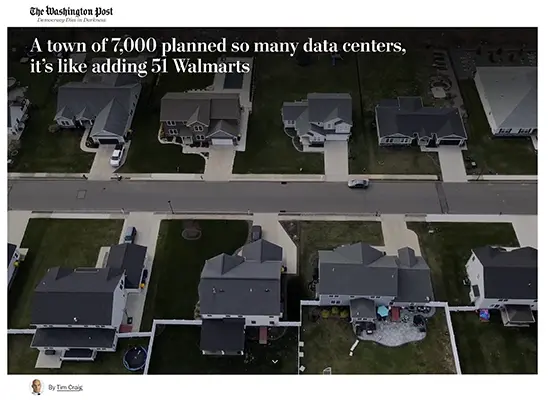
A Town of 7,000 Planned So Many Data Centers, It’s Like Adding 51 Walmarts
The Washington Post | Tim Craig | April 26, 2026
The single most important signal: Community opposition to data center construction is intensifying from a local nuisance into a structured political force — with national implications for AI infrastructure timelines and siting strategy.
Executive Summary
Archbald, Pennsylvania — a town of 7,000 — became the site of plans for six data center campuses comprising 51 buildings, covering roughly 14% of the borough’s land. The developments were approved through zoning changes that initially received little public attention. Once residents understood the scale, they organized rapidly: a Facebook opposition group now has nearly 10,000 members, exceeding the town’s population, and a majority of the borough council has resigned — some citing personal safety concerns following violence directed at politicians who supported data center projects in other states.
The story reveals several dynamics worth tracking. Developers proceeded with some site clearing — legally, by cutting trees without disturbing earth — while full permitting remained unresolved, generating accusations of deliberate regulatory maneuvering. Reporting also surfaced apparent pre-zoning contact between developers and officials, deepening distrust. One 18-building campus permit was unanimously denied, with an appeal pending. The Pennsylvania governor, who had previously fast-tracked data center permitting for economic development reasons, has since called for tighter community review standards.
This is not a one-town story. Maine passed the nation’s first statewide data center ban this month (later vetoed by the governor). Across the country, data center opposition is evolving from scattered local resistance into coordinated advocacy, with implications for project timelines, siting feasibility, and the political costs borne by officials who support construction.
Relevance for Business
Most SMBs do not build data centers — but they depend on the companies that do. Sustained community opposition, extended permitting timelines, and state-level regulatory shifts could slow AI infrastructure buildout, affecting cloud capacity, latency, and pricing for AI services. The WSJ summary in this batch separately documents the enormous capital already committed to this infrastructure; delays create cost overruns and timeline uncertainty for the entire downstream ecosystem.
There is also a reputational and governance dimension: companies associated with controversial data center siting — through partnership, branding, or supply chain — may face exposure they are not currently anticipating.
Summary by ReadAboutAI.com
https://www.washingtonpost.com/nation/2026/04/26/archbald-pennsylvania-data-centers/: May 4, 2026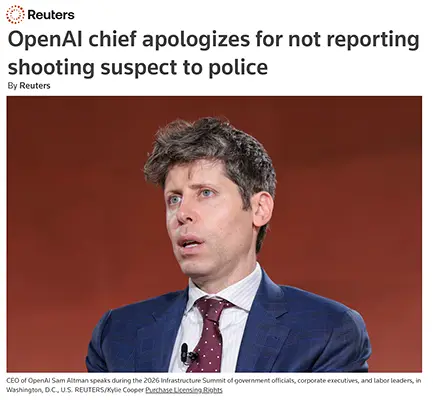
OPENAI CEO APOLOGIZES FOR FAILING TO REPORT CANADIAN SCHOOL SHOOTER TO POLICE
Reuters | April 25, 2026
TL;DR: Sam Altman publicly apologized for OpenAI’s failure to alert law enforcement about a banned account connected to the perpetrator of a February school shooting in Canada — revealing a significant gap between the company’s stated safety systems and their real-world execution.
Executive Summary
This is a brief news report, and the article itself is thin, but the underlying event is significant. OpenAI CEO Sam Altman issued a written apology to the community of Tumbler Ridge, British Columbia, where a school shooting in February killed eight people. The company had banned the suspect’s ChatGPT account months earlier for policy violations — but determined that the violations did not meet its internal threshold for reporting to law enforcement. The account was not flagged to police at any point before the shooting.
The core accountability question this raises is straightforward: OpenAI had identified behavior serious enough to warrant a ban, but its internal criteria for escalating to law enforcement were evidently not triggered. The gap between “ban-worthy” and “reportable” is where the harm occurred. Altman has pledged to work with government officials to prevent recurrence. Notably, this event relates to the same regulatory pressure driving Florida’s criminal investigation of OpenAI covered in Batch 1 — the two cases together represent a pattern, not isolated incidents.
Relevance for Business
Read alongside the Florida AG investigation, this reinforces a single executive-level takeaway: AI vendors’ internal safety and escalation systems are works in progress, not mature safeguards. For SMB leaders, the governance implication is clear — you cannot assume that your AI vendors’ safety mechanisms will catch, flag, or report dangerous behavior. If your organization deploys AI tools in any context where vulnerable populations, mental health, or high-stakes personal decisions are involved, your own governance layer matters. Vendor accountability is necessary but insufficient. This is also a reputational risk signal: as these incidents multiply, any organization whose AI deployment is linked to a harmful outcome — even indirectly — faces exposure.
Calls to Action
🔹 Do not delegate safety accountability to AI vendors: Assume vendor safety systems are imperfect and add your own oversight layer for high-stakes deployments.
🔹 Review use cases involving vulnerable users: If your AI deployment touches mental health, HR decisions, or other sensitive contexts, establish clear internal escalation protocols independent of vendor systems.
🔹 Monitor OpenAI’s regulatory exposure: As investigations compound, contract terms, service continuity, and vendor stability may be affected.
🔹 Prepare a brief internal policy statement on AI use and safety expectations — the governance expectation bar is rising across industries.
Summary by ReadAboutAI.com
https://www.reuters.com/sustainability/society-equity/openai-chief-apologizes-not-reporting-shooting-suspect-police-2026-04-25/: May 4, 2026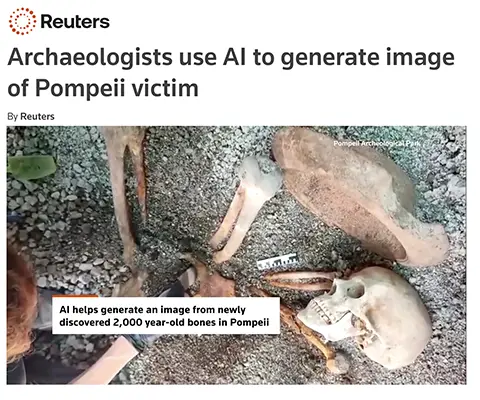
AI RECONSTRUCTS A POMPEII VICTIM’S FINAL MOMENTS
Reuters | April 27, 2026
The single most important signal: Researchers at Pompeii have used AI image generation to reconstruct the appearance of a newly discovered eruption victim — a contained, expert-guided application that illustrates AI’s emerging role as a tool for historical visualization rather than a disruptive force in this domain.
Executive Summary
The Pompeii Archaeological Park released an AI-generated image depicting a man based on recently uncovered remains found near one of the city’s southern gates. Physical evidence — the body’s position, nearby objects, and cause of death — informed the reconstruction. The park’s director framed it as a demonstration of AI’s potential to make historical scholarship more accessible and visually engaging, with an explicit caveat: the value depends on responsible use.
This is a short, factual news item. The AI application here is narrow, expert-supervised, and grounded in physical evidence — closer to a digital illustration tool than a generative AI deployment. It does not involve autonomous AI decision-making, and no claims about accuracy beyond reasonable inference are made.
The story’s executive relevance is modest on its own, but it serves a useful framing function: it shows AI being used carefully, transparently, and to clear public benefit — a meaningful counterpoint to the week’s other AI stories involving backlash, instability, and governance failures.
Relevance for Business
For most SMB executives, this is awareness-level reading, not an operational signal. Its value is contextual: it illustrates the range of AI applications in specialized domains, and it models responsible AI deployment — expert oversight, bounded scope, clear purpose. Organizations thinking about how to communicate their own AI use internally or externally can take note of how the park framed the project: capability plus caution in a single sentence.
Calls to Action
🔹 No immediate action required. This is a human-interest story with minor illustrative value.
🔹 Note the communication model. The park’s framing — capability plus explicit caveat — is a useful template for how organizations can position AI use in public-facing or internal communications.
🔹 File as context for conversations about AI in creative, educational, or archival applications — a low-stakes proof point for skeptical colleagues.
Summary by ReadAboutAI.com
https://www.reuters.com/science/archaeologists-use-ai-generate-image-pompeii-victim-2026-04-27/: May 4, 2026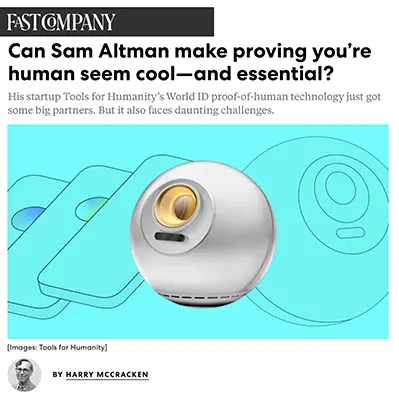
Can Sam Altman Make Proving You’re Human Seem Cool — and Essential?
Fast Company | Harry McCracken | April 24, 2026
The single most important signal: Tools for Humanity’s World ID — a biometric human-verification platform backed by OpenAI CEO Sam Altman — is gaining mainstream commercial partnerships (Zoom, DocuSign, Tinder), but it faces a classic adoption bottleneck: it won’t become essential until it’s ubiquitous, and it won’t become ubiquitous until it’s essential.
Executive Summary
Tools for Humanity (TFH) launched World ID version 4.0 at a San Francisco event, announcing partnerships with Zoom, DocuSign, and Tinder, along with a bot-blocking system for ticketing, a selfie-based verification option, and a feature for managing personal AI agents. The core premise: as deepfakes proliferate and AI agents increasingly interact across the internet, verifiable proof of human identity may become foundational infrastructure, not just a consumer feature.
The company has issued 18 million World IDs to date — a number that sounds substantial until measured against their stated goal of one billion. TFH’s pivot away from its cryptocurrency-heavy framing (though Worldcoin still ships with new registrations) toward a cleaner identity-verification value proposition reflects a recognition that the original pitch was not broadly compelling.
Privacy architecture deserves factual note: biometric scans are transferred to the user’s device and deleted from TFH’s servers; verification uses single-use codes, so partner companies learn nothing about the user beyond confirmed humanity. Despite this, regulators in seven countries have blocked or restricted rollout over biometric data concerns. That tension — reasonably designed privacy architecture, but significant regulatory resistance — is the core risk for broader adoption.
The article’s own assessment, which this summary shares, is measured: something like World ID probably will become necessary; whether it will be TFH’s product that wins is genuinely uncertain. A chicken-and-egg adoption problem, unresolved messaging, and an ongoing miscommunication incident (a falsely claimed Bruno Mars partnership announced at the launch event) suggest a company still working through fundamental positioning, even as its technology matures.
Relevance for Business
The relevance here is forward-looking, not immediate. For most SMBs, World ID is not a current operational decision. But the problem it addresses — distinguishing human users from bots and agents at scale — is one that will increasingly affect businesses that manage online accounts, conduct digital transactions, run customer verification, or build agentic AI workflows.
DocuSign’s integration is the most practically significant partnership for business contexts. If human-verification layers become embedded in document signing, meeting platforms, and commerce at scale, organizations will need to understand what those verification requirements mean for their customers, workflows, and compliance posture. The time to develop a basic familiarity with this category is now, before it becomes an operational requirement.
Calls to Action
🔹 Monitor World ID’s adoption curve and the broader human-verification category — particularly if your business relies heavily on digital document signing, customer identity verification, or online transactions.
🔹 Note the regulatory complexity. Biometric verification faces regulatory resistance in multiple jurisdictions. Any vendor you evaluate in this space should be assessed for regulatory exposure in the markets you operate in.
🔹 Assign awareness, not action, for now. World ID is not a decision-ready tool for most SMBs at this stage — but understanding the category is appropriate preparation for what may become an infrastructure requirement within 2–4 years.
🔹 Consider the agentic AI implication. If your organization is deploying or planning AI agents that interact with external systems, human-verification infrastructure will eventually be part of the governance question. Begin thinking about how you will distinguish authorized agent activity from unauthorized bot activity.
🔹 Revisit when adoption milestones shift. A meaningful threshold to watch: if TFH or a competing platform reaches 100+ million verified users and gains integration with a major enterprise software suite, the category transitions from emerging to material.
Summary15
Summary by ReadAboutAI.com
https://www.fastcompany.com/91531465/world-id-tools-for-humanity-proof-of-human-worldcoin: May 4, 2026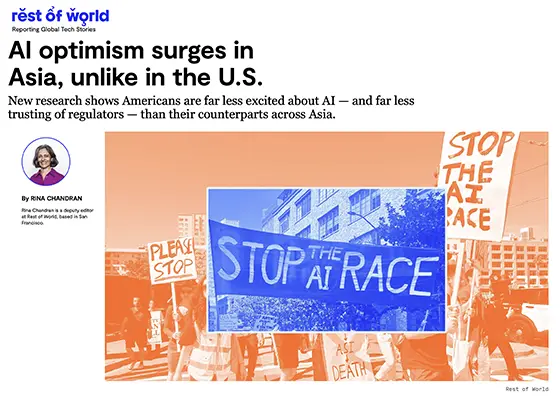
AI Optimism Surges in Asia, Unlike in the U.S.
Rest of World | Rina Chandran | April 24, 2026
The single most important signal: American skepticism toward AI — and toward regulators’ ability to govern it — is measurably diverging from the rest of the world, with real consequences for talent, investment, and infrastructure siting.
Executive Summary
A Stanford HAI/Ipsos survey surfaces a striking global divide: while roughly 84% of Chinese respondents and over 75% of Southeast Asians report excitement about AI products and services, only 38% of Americans do. The trust gap is equally sharp — just 31% of U.S. respondents trust their government to regulate AI responsibly, the lowest figure in the study, compared to 81% in Singapore and above 70% across much of Southeast Asia.
This is not merely a sentiment story. Optimism and institutional trust appear to function as enabling conditions for AI adoption, startup formation, and talent attraction. Singapore’s AI adoption rate (61% in the second half of 2025) significantly outpaces the U.S. (28%), and the country leads globally in AI researchers and developers per capita — a result of years of deliberate government investment in education and infrastructure.
The U.S. situation is moving in the opposite direction. Community resistance is slowing data center construction, and the inflow of international AI researchers and developers has dropped sharply — down 89% since 2017, with an 80% decline in the past year alone, per the same Stanford study. The article is careful to note that immigration policy and other factors are also in play, but the trend line is clear and concerning.
Relevance for Business
For SMB executives, the practical implication is less about geopolitics and more about vendor landscape and talent supply. If the U.S. AI ecosystem grows more constrained — through infrastructure delays, talent outflows, and public backlash — the competitive dynamics among AI providers could shift. More immediately, the divergence in adoption rates suggests that global competitors operating in Asia may be normalizing AI workflows faster, creating operational efficiency gaps that compound over time.
There is also a governance signal worth registering: the U.S. regulatory environment is not becoming clearer or more stable. Leaders deploying AI tools should not assume regulatory calm; the environment is contested and moving.
Calls to Action
🔹 Monitor how U.S. AI infrastructure constraints — data center opposition, talent flows, regulatory uncertainty — affect the pricing, availability, and roadmaps of your core AI vendors over the next 12–18 months.
🔹 Note the adoption gap as a benchmark signal. If competitors in Asian markets are integrating AI into operations more quickly, that is a relevant competitive data point for your own planning timeline.
🔹 Do not treat regulatory inertia as regulatory stability. Assign someone to track U.S. AI governance developments (state and federal) that could affect the tools you’re already using.
🔹 Revisit later the question of whether international AI vendors or deployments (e.g., Singapore-based providers) become relevant to your operations — not urgent now for most SMBs, but worth keeping in peripheral view.
Summary by ReadAboutAI.com
https://restofworld.org/2026/ai-optimism-asia/?mc_cid=2666a1b3b3&mc_eid=36ecac9a76: May 4, 2026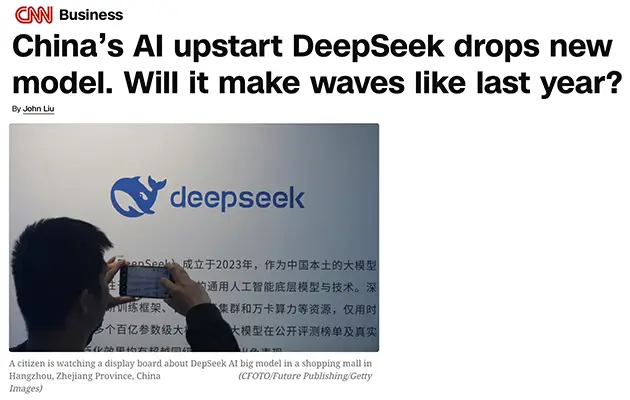
DeepSeek Drops V4: Capable Upgrade, Unlikely to Repeat Last Year’s Market Shock
CNN Business | John Liu | April 24, 2026
TL;DR: DeepSeek’s new V4 model advances Chinese AI capability — notably by running on domestic chips rather than Nvidia hardware — but analysts do not expect it to trigger the kind of market disruption its 2025 debut caused.
Executive Summary
DeepSeek, the Hangzhou-based AI startup that rattled global markets in early 2025, has released a preview of its V4 model, claiming improvements in reasoning, agentic task execution (such as autonomous code writing), and efficiency in processing large information inputs. Significantly, V4 was built using chips from Chinese manufacturers Huawei and Cambricon rather than Nvidia hardware — a deliberate signal that China’s AI development is actively reducing its dependency on US semiconductors.
Market analysts cited in the piece are measured: the 2025 R1 release was a shock because Western observers underestimated Chinese AI capability; V4 is an expected continuation of an already-established trend. Markets have, in their view, already priced in competitive Chinese AI. That said, the chip independence dimension is strategically meaningful beyond market optics — it suggests China is making genuine progress toward a self-sufficient AI development stack, which has longer-term implications for US export control policy and for the competitive dynamics of the global AI market.
V4 also maintains DeepSeek’s open-source strategy, making it freely available — a deliberate counterposition to the closed models of OpenAI and Anthropic. DeepSeek acknowledges that V4 trails proprietary leaders like Gemini in some areas but claims leading performance among open-source alternatives. Separately, DeepSeek continues to face US government and industry accusations of IP theft through “model distillation,” discussed in detail in the Ars Technica piece also summarized in this issue.
Relevance for Business
SMB leaders evaluating AI tools should note two things. First, open-source Chinese models like DeepSeek V4 are increasingly viable alternatives to expensive proprietary APIs — this matters for cost-conscious businesses building AI-powered workflows. Second, geopolitical risk is now embedded in the AI vendor landscape: using DeepSeek carries data jurisdiction uncertainty, potential regulatory scrutiny, and reputational considerations that closed, US-based alternatives do not. The right decision depends on use case, risk tolerance, and data sensitivity.
Calls to Action
🔹 If you are currently evaluating AI model vendors, add open-source Chinese models to your shortlist for non-sensitive use cases — but conduct a clear data governance review first.
🔹 Monitor export control and sanctions developments that could affect access to or legality of using Chinese AI models in US business contexts.
🔹 Do not expect another DeepSeek market disruption in the short term — analysts broadly agree the surprise factor has been absorbed; steady progress is the new baseline.
🔹 Track the chip independence story separately: if China achieves a fully domestic AI hardware stack, the strategic implications for US AI dominance are significant and may affect policy and vendor ecosystems.
🔹 For now, treat V4 as a monitoring item, not an immediate procurement decision, unless you are already actively building on open-source AI infrastructure.
Summary by ReadAboutAI.com
https://www.cnn.com/2026/04/24/tech/chinas-ai-deepseek-v4-intl-hnk: May 4, 2026
THREE REASONS WHY DEEPSEEK’S NEW MODEL MATTERS
MIT Technology Review | Caiwei Chen | April 24, 2026
The single most important signal: DeepSeek’s V4 is a capable, open-source frontier model available at dramatically lower cost than Western alternatives — and its first steps toward running on Chinese chips, rather than Nvidia’s, suggest China is actively building an independent AI infrastructure stack.
Executive Summary
DeepSeek released V4, its most significant model since R1 (January 2025), in two variants: V4-Pro for complex coding and agent tasks, and V4-Flash for faster, cheaper workloads. Both offer a 1-million-token context window — sufficient to process very large documents in a single pass — and both are open-source, meaning any organization can download, modify, and run them independently. The model is priced at a small fraction of comparable closed-source alternatives from OpenAI and Anthropic, making it among the cheapest frontier-tier models available for building applications. According to company-released benchmarks, V4-Pro performs comparably to leading Western closed-source models; independently verified results were not available at time of publication.
MIT Technology Review’s assessment is measured: V4 is unlikely to disrupt the AI field the way R1 did, but it matters for three distinct reasons. First, it advances the capability frontier for open-source models at low cost — a practical benefit for developers and companies that want access to strong AI without paying premium closed-source API rates. Second, it achieves a meaningful architectural efficiency gain in handling long documents, reducing compute requirements substantially compared to its predecessor. Third, and most strategically significant, it is the first DeepSeek model explicitly optimized for Chinese domestic chips (Huawei’s Ascend), with Nvidia reportedly not given early access during development — a departure from common industry practice.
On that third point, the article is appropriately careful: DeepSeek does not appear to have fully moved away from Nvidia. Chinese chips are currently used for inference (running the model), but a Tsinghua professor consulted by MIT Technology Review assessed that training may still rely substantially on Nvidia hardware. Chinese chips remain behind Nvidia in raw performance, particularly for training. This is the beginning of a transition, not its completion.
Relevance for Business
For SMB executives, the most actionable takeaway is about cost and access. V4-Flash, in particular, is priced so cheaply that it becomes a plausible tool for building AI-powered internal applications without high ongoing API costs. Any organization currently paying for closed-source API access — and not already evaluating open-source alternatives — should add this to their comparison set.
The strategic picture is larger. China is building a parallel AI infrastructure — models, chips, data centers, frameworks — that is intentionally decoupled from U.S. providers. If this succeeds at scale, the global AI landscape will have two distinct ecosystems with different capabilities, governance norms, regulatory exposure, and pricing dynamics. For SMBs selecting AI vendors and tools now, understanding which ecosystem your vendors are embedded in is becoming a relevant supply chain question.
Calls to Action
🔹 Investigate DeepSeek V4-Flash as a cost alternative to closed-source APIs for appropriate internal applications — particularly if you are building document analysis, summarization, or coding assistance tools where cost efficiency matters.
🔹 Evaluate with caution. Benchmark claims in this article are sourced from DeepSeek itself. Independent verification should precede any significant technical commitment. Also assess your organization’s risk tolerance for data handling by a Chinese-based AI company.
🔹 Monitor the Huawei Ascend chip scale-up in the second half of 2026. If it succeeds, V4-Pro pricing may fall further — and Chinese AI infrastructure independence becomes a more near-term reality with implications for the global AI pricing environment.
🔹 Factor open-source model maturation into your AI roadmap. The gap between open-source and closed-source frontier model performance is narrowing. Organizations that defaulted to closed-source vendors for quality reasons should reassess periodically.
🔹 Note the geopolitical dimension as context for the Manus story (Summary 8 in this batch): these stories form a coherent picture of deliberate Chinese AI infrastructure decoupling.
Summary by ReadAboutAI.com
https://www.technologyreview.com/2026/04/24/1136422/why-deepseeks-v4-matters/: May 4, 2026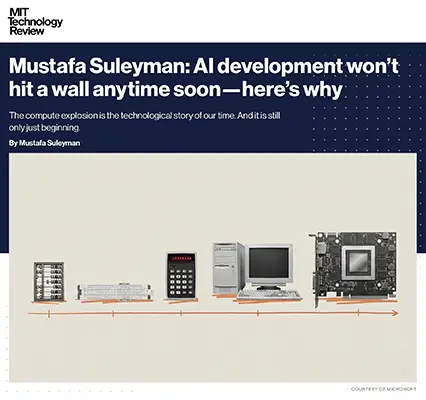
MUSTAFA SULEYMAN: AI DEVELOPMENT WON’T HIT A WALL ANYTIME SOON
MIT Technology Review (Opinion) | Mustafa Suleyman, CEO of Microsoft AI | April 8, 2026
The single most important signal: This is a well-argued case for continued AI scaling — but it is written by a major AI industry executive with strong commercial interest in that argument, and should be read as informed advocacy, not independent analysis.
Executive Summary
Mustafa Suleyman, CEO of Microsoft AI, argues that AI progress will continue to accelerate — not decelerate — driven by converging improvements in chip performance, memory bandwidth, and the ability to connect massive numbers of processors into unified computing systems. He cites substantial data points: training compute has grown roughly a trillion-fold since 2010; the cost to reach a fixed AI performance level has halved approximately every eight months; and global AI-relevant compute is forecast to reach the equivalent of 100 million high-end GPUs by 2027. He argues that skeptics who predict AI will hit a wall have consistently been wrong, and that the trajectory points toward AI systems capable of extended autonomous operation — agents that execute multi-week projects, negotiate contracts, and manage logistics.
The argument is coherent and internally consistent. The data cited is largely from reputable sources (Epoch AI, Nvidia benchmarks, Microsoft’s own Maia chip). But several important caveats apply. First, this is an opinion piece, not a research paper; Suleyman does not engage meaningfully with counterarguments. Second, he is not a neutral observer — Microsoft has committed to massive AI infrastructure investment and benefits directly from the narrative that scaling will continue to pay off. Third, the piece is forward-looking: projections about 2027–2030 compute levels and capability thresholds are plausible extrapolations, not confirmed outcomes. The gap between more compute and more useful AI remains a genuine open question that the piece does not address.
On the energy constraint — which Suleyman acknowledges is real — he leans on solar and battery cost declines as the counterweight, framing this as a pathway to clean scaling. Whether renewable build-out can match AI infrastructure demand at the pace and scale required is not settled. The article should be read as an optimistic scenario from a motivated participant, not a consensus forecast.
Relevance for Business
Despite the source bias, the strategic implication for executives is genuine and worth internalizing: if even a fraction of Suleyman’s trajectory holds, the AI tools available to businesses in 2027–2028 will be substantially more capable than what exists today. Planning horizons for technology, workflow design, and competitive positioning that assume AI capability plateaus are likely to be wrong.
The more immediate business signal is that AI costs are falling rapidly and will likely continue to fall. The article cites a 900x annualized cost reduction in serving some recent models. For SMBs that have evaluated AI tools and found them too expensive, revisiting those decisions on a 12-month cycle is warranted.
Suleyman’s vision of agentic AI — systems executing weeks-long autonomous work — is more distant and speculative. Treat it as a planning horizon to be aware of, not an imminent operational reality.
Calls to Action
🔹 Read this as informed advocacy, not a neutral forecast. Treat the directional argument — continued scaling, falling costs, increasing capability — as a reasonable scenario to plan for, not a certainty.
🔹 Revisit AI cost assumptions annually. If your organization evaluated AI tools and found them too expensive, costs may have shifted materially. Build a regular reassessment into your technology review cycle.
🔹 Plan your AI strategy with a 3-year capability horizon in mind, not just current tool benchmarks. The tools available to build on in 2027–2028 will likely be significantly more capable and cheaper than today’s.
🔹 Monitor energy and infrastructure constraints as a potential brake on the optimistic trajectory. Data center opposition (covered in Summary 4, Batch 1) and grid capacity are real friction points that Suleyman’s case does not fully resolve.
🔹 Do not build operational plans around agentic AI timelines yet. The vision of AI systems executing multi-week autonomous projects is a useful planning horizon but remains forward-looking speculation for most business contexts.
Summary by ReadAboutAI.com
https://www.technologyreview.com/2026/04/08/1135398/mustafa-suleyman-ai-future/: May 4, 2026
Five AI-Powered Tools for Job Seekers in 2026
Fast Company | April 27, 2026
TL;DR: A growing category of AI-powered job-search tools is automating the most mechanical parts of the hiring process — résumé optimization, application volume, interview prep, and ATS navigation — at relatively low cost.
Executive Summary
This is a straightforward product roundup, written in a light consumer tone, covering five tools aimed at individual job seekers: Teal (job tracker and ATS keyword-matching résumé builder; freemium, up to $29/month), JobCopilot(automated application submission and cover letter tailoring; starting around $1/day), Revarta (voice-AI mock interviewing with delivery and content analysis; $49/month after a free trial), PitchMeAI (Chrome extension for identifying hiring manager contacts and drafting outreach; $22/month), and Jobscan (ATS reverse-engineering and résumé match-rate scoring; $50/month). All are consumer-grade products. The article does not independently evaluate their claims or provide performance data.
The editorial subtext — that AI screening tools on the employer side have already changed the hiring game, and that job seekers are now deploying AI to counter AI — is the more strategically interesting signal. The piece assumes this dynamic is already standard and treats it as context rather than news.
Relevance for Business
The relevance for SMB executives is primarily on the hiring and talent acquisition side, not the job-seeker side. These tools reflect a wider norm: applicants are now using AI to optimize their materials specifically for your ATS and screening processes. This has two practical implications. First, résumé quality and keyword density are increasingly less reliable signals of genuine fit — candidates whose materials pass ATS screening may have been optimized for your system rather than authentically matched to your role. Second, the volume of inbound applications is likely to increaseas automated submission tools like JobCopilot lower the effort cost of applying. SMBs without dedicated HR infrastructure may face a growing signal-to-noise challenge in their hiring pipelines.
On the employee communication side, if your organization is going through layoffs or workforce transitions — a theme visible throughout this week’s coverage — these tools are what affected employees will turn to immediately. Being aware of them is basic operational literacy.
Calls to Action
🔹 Revisit your hiring screening process: If you rely heavily on ATS keyword filtering as a primary screen, recognize that this signal is increasingly gamed — consider adding human review earlier in the funnel.
🔹 Anticipate higher application volume: AI-assisted mass-application tools will increase inbound volume for open roles; plan your review capacity accordingly.
🔹 Share this roundup with employees in transition: If your organization is managing layoffs or career transitions, these are practical, low-cost tools worth knowing about.
🔹 No strategic urgency for most SMBs — these are tactical consumer tools, not enterprise software decisions.
Summary by ReadAboutAI.com
https://www.fastcompany.com/91514957/ai-job-search-tools: May 4, 2026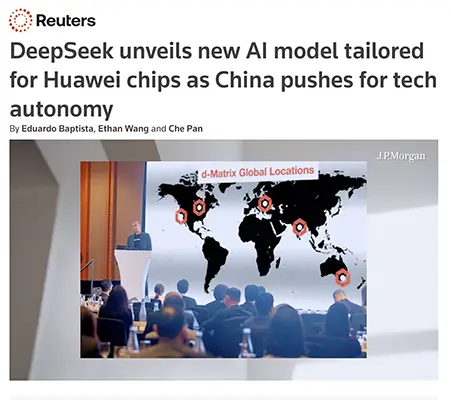
DEEPSEEK LAUNCHES NEW MODEL BUILT FOR HUAWEI CHIPS, ADVANCING CHINA’S AI INDEPENDENCE
Reuters | April 23–26, 2026
TL;DR: DeepSeek’s new V4 model, built in close collaboration with Huawei, demonstrates that China’s AI industry is making credible progress toward operating independently of U.S. chip technology — a geopolitical and competitive signal with long-term implications for the global AI market.
Executive Summary
DeepSeek — the Chinese AI startup whose cost-efficient model disrupted assumptions about what AI development requires — has released a preview of its V4 model, developed in close collaboration with Huawei’s Ascend chip technology. This marks a deliberate shift from DeepSeek’s prior reliance on Nvidia hardware. According to DeepSeek’s own benchmarks (not yet independently verified), the V4 outperforms other open-source models on knowledge tasks and trails only Google’s closed-source Gemini Pro 3.1. It can process over one million tokens — comparable to leading Western models — at a fraction of the compute cost. An AI engineer who tested the model early described the results as significant but urged caution about benchmark claims until independent evaluations are complete.
The Huawei collaboration is the strategically important development. U.S. export controls have been designed to prevent China from accessing the advanced chips needed to build competitive AI. DeepSeek’s V4 — if its capabilities hold up — suggests those controls are not fully achieving their intended effect. Nvidia CEO Jensen Huang has explicitly flagged this risk, warning that losing the Chinese developer ecosystem is a serious concern. The launch came the day after the White House accused China of large-scale AI intellectual property theft and just ahead of a planned Trump-Xi summit, adding diplomatic texture to what is also a technology story.
The V4 is optimized for agentic AI work — complex, multi-step task execution — and comes in a lower-cost Flash variant. DeepSeek has not provided a timeline for the final release. Independent testing and real-world developer evaluation will determine whether the benchmark claims are durable.
Relevance for Business
For SMB leaders, the immediate practical relevance is limited — V4 is a preview of a Chinese open-source model and not a product most SMBs will adopt directly. The strategic implications, however, are worth understanding. First, the bifurcation of the global AI ecosystem is accelerating: a China-aligned AI stack (DeepSeek + Huawei + domestic alternatives) is becoming increasingly functional and distinct from the Western stack (OpenAI, Anthropic, Google, on Nvidia/AMD hardware). This has implications for global vendors, supply chains, and regulatory compliance — particularly for SMBs with international operations or customers in Chinese markets. Second, DeepSeek’s continued cost efficiency challenges the assumption that competitive AI requires Western-scale infrastructure investment — this may eventually exert downward pressure on AI pricing in the West. Third, the geopolitical volatility surrounding AI technology — export controls, IP accusations, diplomatic negotiations — creates policy risk that can shift market conditions quickly.
Calls to Action
🔹 Monitor DeepSeek V4 independent evaluations: Benchmark claims from the developer should be treated as preliminary — watch for independent testing results over the coming weeks.
🔹 If your business has China exposure, track the DeepSeek/Huawei ecosystem closely — the AI tools and vendors available in that market are diverging from the Western landscape.
🔹 Do not adopt V4 for business use prematurely: The model is a preview, benchmarks are unverified, and data governance questions around Chinese AI tools remain unresolved for most Western enterprises.
🔹 Treat AI supply chain geopolitics as a business risk: U.S. export control policy, IP enforcement, and diplomatic developments can shift AI market conditions with limited warning.
🔹 Revisit in 60–90 days once independent evaluations and the final release provide a clearer picture of V4’s real-world capabilities.
Summary by ReadAboutAI.com
https://www.reuters.com/technology/chinas-deepseek-returns-with-new-model-year-after-viral-rise-2026-04-24/: May 4, 2026
Inside the xAI Exodus: Dozens Have Left Elon Musk’s AI Company
Fast Company | Rebecca Heilweil | April 24, 2026
The single most important signal: Every cofounder except Musk has now exited xAI, and the leaders named to run teams in the company’s February 2026 restructuring have themselves largely departed — raising genuine questions about strategic continuity at an AI company that has positioned itself as a competitor to OpenAI, Anthropic, and Google.
Executive Summary
Fast Company tracked approximately 80 publicly verifiable departures from xAI over the past year, spanning cofounders, senior engineers, legal staff, and program managers. The timing is particularly notable: many exits coincide with or immediately follow major organizational changes — the merger with X, a strategic pivot in AI training methodology that led to layoffs, and a February 2026 merger with SpaceX centered on building orbital data centers. Musk acknowledged the departures at a company all-hands meeting, framing them as a natural consequence of organizational maturation.
What makes this more than ordinary churn is the pattern of exits clustering around leadership roles just assigned in that restructuring. Several team leads named in the February plan have since left, including those overseeing coding, image generation, and ML infrastructure. The CFO departure after only a few months adds to a picture of consistent leadership instability rather than targeted performance management.
The departures also coincide with reputational incidents involving Grok — including the chatbot generating millions of nonconsensual images, including of children — for which xAI is now under investigation in multiple countries. Whether these incidents contributed to departures is not stated, but the timeline is relevant context. xAI has also faced a lawsuit over air pollution from its Memphis data center operations.
What is not yet clear: total headcount, actual impact on product quality, and whether the departing talent is being replaced. xAI remains active — it is pursuing a $60 billion option to acquire Cursor AI and is preparing for an IPO — but the concentration of exits among technical leaders is a meaningful signal about internal conditions.
Relevance for Business
For SMBs evaluating or using Grok — either through X or enterprise integrations — this matters because product continuity and safety oversight are both functions of the people building and governing the system. Consistent leadership turnover in engineering and infrastructure is a relevant risk factor for any business deciding whether to build workflows on a platform.
More broadly, this story is part of the AI talent war context that affects all AI vendors: the people building these systems are mobile, and the stability of any given product is partially a function of retaining them. SMBs should factor vendor stability — not just capability benchmarks — into AI tool selection.
Calls to Action
🔹 Monitor xAI’s leadership stability and product quality over the next two quarters before committing Grok or xAI-based tools to any core business workflow.
🔹 Apply a vendor stability lens to all AI tool evaluations, not just xAI. Leadership continuity, safety track record, and governance structure are meaningful selection criteria alongside capability scores.
🔹 Note the regulatory exposure. xAI is under investigation in multiple countries for Grok-related content failures. Organizations in regulated industries should be especially cautious about platforms with active regulatory scrutiny.
🔹 Assign internal review of any existing xAI or Grok integrations to assess dependency risk in light of ongoing organizational instability.
Summary by ReadAboutAI.com
https://www.fastcompany.com/91531084/inside-the-xai-exodus: May 4, 2026
Meta Is Using Its Own Employees to Train AI — While Laying Others Off
New York Magazine / Intelligencer (John Herrman) | April 25, 2026
TL;DR: Meta’s decision to install keystroke-monitoring software on employee computers — while simultaneously conducting layoffs — illustrates a broader shift in which surviving tech workers are being asked to help automate their own roles.
Executive Summary
This piece focuses on two overlapping developments at Meta. The company has conducted additional layoffs framed as efficiency measures, freeing up capital for AI investment. Separately, and just before those cuts, Meta began installing tracking software on U.S. employee computers that captures mouse movements, clicks, and keystrokes — explicitly to generate training data for AI agents intended to perform autonomous work tasks. Internal communications reportedly framed this as employees helping AI models improve “simply by doing their daily work.”
The author situates this against a wider wave of tech-sector workforce reductions: Block, Oracle, Amazon, Snap, Pinterest, and Microsoft have all announced significant cuts in recent months, each connected in some way to AI-driven reallocation. The piece argues that the aggregate signal is a structural reconfiguration of the tech worker’s position — from highly compensated, sought-after talent to monitored labor whose primary value may be transitional: training the systems that will eventually replace them. Meta’s new chief AI officer, Alexandr Wang, built his prior company around contractor surveillance for AI training, lending institutional credibility to this direction.
The author is careful to note genuine uncertainty: whether behavior monitoring actually improves AI model quality is unconfirmed, and whether this workforce model succeeds commercially remains to be seen. Meta has historically been a trend-follower rather than a trendsetter. Still, the reputational and structural signal is significant.
Relevance for Business
For SMB leaders, the direct relevance is less about Meta specifically and more about the trajectory being modeled for the broader market. Several dynamics are worth tracking: labor cost assumptions are shifting as AI investment pressures companies to justify headcount; employee monitoring as a standard practice is being normalized at scale; and the implicit promise of tech-sector employment — career stability, advancement, leverage — is being renegotiated. If you compete for talent with tech-adjacent firms, or if your own AI adoption strategy involves workforce reduction, how you communicate that strategy matters significantly for retention and culture. Additionally, the data collection model Meta is pursuing — using employee behavior as training data — may expand to other sectors and vendors. Leaders should understand what data their own technology vendors are collecting about employee activity.
Calls to Action
🔹 Review your AI vendor agreements for clauses permitting the use of employee behavioral data for model training — this practice may be more widespread than currently disclosed.
🔹 Monitor the talent market signal: If you recruit from or compete with tech-sector employers, understand that workforce expectations and leverage are shifting — this may affect your own hiring and retention dynamics.
🔹 Develop a clear internal AI communication strategy: Employees are watching how large firms handle AI-driven workforce changes. A proactive, honest internal narrative about your own AI adoption plans reduces anxiety and attrition risk.
🔹 Do not rush to emulate large-firm workforce models: Meta’s approach is shaped by its scale, AI investment pressure, and competitive position. SMBs have different constraints and risks.
🔹 Track this story — the legal and regulatory response to workplace AI monitoring is still forming and may impose new obligations.
Summary by ReadAboutAI.com
https://nymag.com/intelligencer/article/after-layoffs-meta-is-training-ai-on-its-own-workers.html: May 4, 2026
OpenAI Is Building an AI Smartphone — or Is It?
Reuters | April 27, 2026
TL;DR: A single analyst’s report that OpenAI is co-developing an AI-first smartphone with Qualcomm and MediaTek sent Qualcomm shares up 13% — but the claim conflicts with OpenAI’s own stated device strategy, and none of the companies confirmed it.
Executive Summary
This story is driven entirely by a social media post from one analyst — Ming-Chi Kuo of TF International Securities — who reported that OpenAI is partnering with Qualcomm and MediaTek to build smartphone processors, with mass production projected for 2028. Qualcomm’s shares responded dramatically. None of the named companies confirmed the report.
The analyst’s claim conflicts with prior reporting: OpenAI CEO Sam Altman has described the company’s planned consumer device as a category distinct from smartphones — a “third core device” rather than a handset. That said, OpenAI’s hardware ambitions are real and documented: it acquired designer Jony Ive’s startup for $6.5 billion last year and has signed manufacturing arrangements with Apple supplier Luxshare. The device strategy is live; the smartphone framing is disputed.
The market reaction itself is the most instructive part of this story. A single unconfirmed analyst post moved a major semiconductor company’s valuation by double digits — illustrating how thin the evidentiary threshold has become for AI-adjacent market movement. The article is thin on substance but high on signal about investor behavior and the current state of AI market dynamics.
Relevance for Business
The business implications here are forward-looking and speculative rather than immediate. If OpenAI does enter the consumer device market — smartphone or otherwise — it would represent a significant competitive escalation against Apple and Samsung, and a potential shift in how AI is delivered at the point of use. For SMB leaders, the more immediate takeaway is market volatility: AI-adjacent stocks are moving on rumor, not evidence, which creates noise for anyone trying to track vendor stability or make technology decisions based on market signals.
Calls to Action
🔹 Don’t act on this yet. The report is unconfirmed, the device category is disputed, and mass production is years away at best.
🔹 Watch for official OpenAI device announcements. The hardware strategy is real even if this specific report is inaccurate. A consumer AI device from OpenAI would have meaningful implications for enterprise mobile strategy.
🔹 Note the market sensitivity signal. AI sector valuations are moving on analyst speculation, not fundamentals. Factor this volatility into any technology vendor assessments tied to public company stability.
🔹 Revisit in 2027. If this device advances, the implications for enterprise mobile AI, device management, and app strategy will be worth a dedicated review at that time.
Summary by ReadAboutAI.com
https://www.reuters.com/world/china/qualcomm-surges-report-openai-tie-up-ai-smartphone-processors-2026-04-27/: May 4, 2026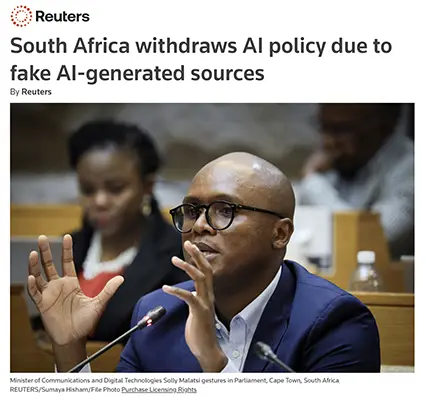
SOUTH AFRICA WITHDRAWS NATIONAL AI POLICY AFTER HALLUCINATED CITATIONS SURFACE
Reuters | April 27, 2026
The single most important signal: A government drafted its first national AI policy using AI tools — and published it with fabricated citations that no one caught before release, forcing a full withdrawal and demonstrating, at national scale, the governance failure that unverified AI-generated content creates.
Executive Summary
South Africa’s Minister of Communications and Digital Technologies withdrew the country’s inaugural draft AI policy after it was found to contain fictitious references that appeared to have been generated by AI and inserted without verification. The minister acknowledged the failure publicly, called it a credibility-compromising lapse rather than a minor technical error, and indicated there would be accountability for those responsible. A revised draft timeline was not announced.
The policy itself had been substantive — outlining plans for a National AI Commission, an AI Ethics Board, an AI Regulatory Authority, and private-sector incentives including tax breaks and grants. Its withdrawal now delays South Africa’s efforts to formalize AI governance at a moment when other nations are moving quickly.
The lesson here is not that AI tools caused the problem — it is that no human review process caught it. AI hallucination of citations is a well-documented behavior. The failure was one of workflow and verification, not solely of technology. The minister’s own framing makes this clear: he called it proof that human oversight of AI outputs is not optional.
This is not an isolated risk. The same failure mode — unverified AI-generated content embedded in consequential documents — is actively occurring in corporate, legal, and academic contexts globally.
Relevance for Business
Any organization using AI to assist with research, policy drafting, proposals, contracts, compliance documentation, or any output that cites external sources faces the same verification gap that brought down this policy. The risk scales with the stakes of the document, not the size of the organization.
This is an immediately actionable governance signal. SMBs using AI writing or research tools should have — right now — a defined human review step for any AI-assisted output that will be acted upon, shared externally, or used in decision-making. The absence of such a process is an organizational liability, not just a technology risk.
Calls to Action
🔹 Act now: establish an AI output verification policy. Any document that cites sources, makes factual claims, or will be shared externally must be reviewed by a human who checks the underlying references before publication or submission.
🔹 Audit current AI workflows. Identify where AI-generated content is being used in your organization and whether verification steps currently exist. Prioritize any workflow involving legal, regulatory, financial, or client-facing documents.
🔹 Train staff on hallucination risk. AI tools frequently generate plausible-sounding but fabricated citations, statistics, and names. This should be standard knowledge for anyone using AI-assisted research or writing tools.
🔹 Prepare a brief AI content policy. Even a one-page internal standard — defining what AI-assisted output requires human review before use — materially reduces your exposure.
🔹 Monitor how this incident influences AI governance requirements in your industry or jurisdiction. Regulatory bodies noting this failure may introduce documentation or verification standards for AI-assisted work products.
Summary by ReadAboutAI.com
https://www.reuters.com/world/africa/south-africa-withdraws-ai-policy-due-fake-ai-generated-sources-2026-04-27/: May 4, 2026
Microsoft and OpenAI Renegotiate Their Alliance, Opening the Door to Amazon and Google
Reuters | Aditya Soni, Akash Sriram, and Stephen Nellis | April 27, 2026
TL;DR: Microsoft and OpenAI have restructured their exclusive partnership, allowing OpenAI to sell directly through AWS, Google Cloud, and others — a shift that expands enterprise access to OpenAI’s tools and may reshape the AI vendor landscape for business buyers.
Executive Summary
Since 2019, Microsoft has invested roughly $13 billion in OpenAI and held exclusive rights to distribute its models through Azure. That exclusivity has now been formally ended. Under renegotiated terms, OpenAI can pursue cloud and commercial agreements with Amazon, Google, and others, while Microsoft retains preferred partner status and a guaranteed revenue share through 2030, subject to a new undisclosed cap. Microsoft also keeps a licensing arrangement on OpenAI’s intellectual property through 2032, and OpenAI’s commitment to use Azure infrastructure remains in place at scale.
Both parties framed the change as mutually beneficial, and analysts broadly agreed. For OpenAI, exclusivity had become a constraint on enterprise growth: AWS and Google Cloud customers were previously unable to integrate OpenAI’s products cleanly. For Microsoft, releasing that constraint removes a potential liability — the prior arrangement had drawn antitrust attention in the US, UK, and Europe, and had reportedly put Microsoft on the verge of legal action against Amazon over a competing deal. Freeing capital from OpenAI infrastructure commitments also gives Microsoft room to invest in its own AI development and its Copilot enterprise suite.
One detail with strategic significance: the revised deal eliminates a clause that would have allowed OpenAI to stop paying Microsoft upon reaching artificial general intelligence — a provision that, while speculative, reflected meaningful uncertainty about the long-term balance of power between the two companies.
Relevance for Business
This is directly relevant to SMB leaders evaluating AI tools. OpenAI’s models will now be more accessible through whatever cloud your business already uses — Azure, AWS, or Google Cloud — rather than requiring a migration to Microsoft’s ecosystem. That lowers the barrier to adoption and, over time, should increase competitive pressure on pricing as cloud providers compete for OpenAI workloads. It also reinforces OpenAI’s position as a multi-cloud, platform-agnostic vendor rather than a Microsoft-aligned one, which matters for procurement decisions and long-term vendor strategy.
At the same time, Microsoft’s pivot toward building its own AI models while also distributing Anthropic and others signals that no single AI vendor relationship is permanent — including the one that appeared most entrenched.
Calls to Action
🔹 If you use AWS or Google Cloud, revisit OpenAI integration options. Previously limited access is opening. Check what’s now available through your existing cloud provider before assuming Azure is required.
🔹 Expect more competitive AI pricing. Multi-cloud availability typically increases competition; watch for enterprise pricing shifts over the next 12–18 months.
🔹 Don’t over-index on any single AI vendor relationship. Even the Microsoft-OpenAI partnership just restructured significantly. Build flexibility into your AI stack.
🔹 Monitor Microsoft’s own AI product direction. As Microsoft reduces OpenAI dependence and develops proprietary models, Copilot and related tools may evolve in ways that affect enterprise buyers.
🔹 Note the antitrust signal. Regulators in multiple jurisdictions were watching the exclusive arrangement. Continued scrutiny of AI platform concentration is likely — factor that into longer-term vendor risk assessments.
Summary by ReadAboutAI.com
https://www.reuters.com/legal/litigation/microsoft-end-exclusive-license-openais-technology-2026-04-27/: May 4, 2026
CHINA BANS META’S ACQUISITION OF MANUS ON NATIONAL SECURITY GROUNDS
The Wall Street Journal | Raffaele Huang | April 27, 2026
The single most important signal: China has ordered Meta to unwind its $2.5 billion acquisition of AI agent startup Manus — a move that signals Beijing will aggressively use national security review powers to prevent Chinese-origin AI intellectual property from transferring to U.S. firms, regardless of how the corporate structure was arranged.
Executive Summary
China’s National Development and Reform Commission blocked and ordered the reversal of Meta’s acquisition of Manus, an AI agent company whose technology was originally developed by a Beijing-based entity. The acquisition had been completed in late December; Chinese authorities announced a review within days and have since escalated through cofounder travel restrictions, executive summons, and now a formal unwind order.
The deal’s structure — a Singapore-based entity had taken over international operations, and Manus had relocated most China-based employees before the sale — did not insulate it from Chinese regulatory reach. Beijing’s position is that because the original Chinese company (Beijing Butterfly Effect Technology) remains a Chinese legal entity, the IP transfer was subject to its jurisdiction. The structural maneuver did not work, and Chinese regulators appear determined to make an example of it to deter similar attempts by other Chinese AI companies.
Unwinding the deal is genuinely complex: Manus technology has already been integrated into some Meta products, investors have been repaid, and the co-founders are currently restricted from leaving China. One path being explored — executives resigning from Meta — illustrates how entangled the resolution has become.
Separately, Chinese regulators have recently instructed prominent domestic AI companies not to accept U.S. capital without government approval, broadening the wall around China’s AI sector. Taken together, these moves represent a systematic effort to close pathways through which Chinese AI talent, technology, and companies might exit to U.S. ownership.
Relevance for Business
The direct impact on most SMBs is indirect but worth tracking through two lenses. First, the Manus episode raises the geopolitical risk profile of any AI vendor with Chinese-origin technology or development roots, regardless of how their corporate structure appears. Due diligence on AI vendors should now include a question about the origin of their foundational technology and any pending regulatory exposure.
Second, this ruling narrows the pool of Chinese AI talent and technology accessible to U.S.-based AI firms, which could affect the pace and breadth of AI capability development at companies whose research has historically drawn from or collaborated with Chinese institutions.
For businesses in regulated industries, supply chain exposure to Chinese-origin AI components — even via third-party vendors — is a question worth raising.
Calls to Action
🔹 Monitor the resolution of the Manus unwind for signals about how Beijing handles similar cases — it will set precedent for cross-border AI M&A and IP transfer for years.
🔹 Add country-of-origin to AI vendor due diligence. For any AI tool or platform you evaluate, understand where the foundational technology was developed and whether it carries pending regulatory exposure in China or the U.S.
🔹 Note the escalating U.S.-China technology decoupling as a structural backdrop. The pace of restriction — export controls, investment bans, IP repatriation orders — is accelerating. Factor this into multi-year AI vendor strategy, not just near-term tool selection.
🔹 For regulated industries: raise the question of Chinese-origin AI components with legal or compliance counsel, particularly if your sector (defense, healthcare, finance) is subject to supply chain scrutiny.
🔹 Revisit AI investments or partnerships involving cross-border IP for any structural exposure to similar reviews.
Summary by ReadAboutAI.com
https://www.wsj.com/world/china/china-bans-metas-acquisition-of-manus-on-national-security-grounds-71e10c3f: May 4, 2026
The AI Splurge Is Costing Big Tech Its Workforce
The Wall Street Journal | Dan Gallagher & Asa Fitch | April 27, 2026
The single most important signal: Major tech companies are accelerating mass layoffs to fund AI infrastructure spending — but the WSJ analysis suggests this trade-off carries risks that markets have not yet fully priced, including morale damage, competitive exposure from displaced talent, and mounting debt at firms now stretching their finances to historically unusual degrees.
Executive Summary
Microsoft, Meta, Oracle, Snap, and Block are among the companies executing significant workforce reductions in 2026, framed publicly as AI-driven efficiency moves. March 2026 was the worst month for announced tech-job cuts in at least two years, with nearly 46,000 reductions reported. The headline rationale — that AI enables companies to do more with fewer people — is real in some cases, but the WSJ piece notes that some cuts also reflect overhiring corrections or underperformance relative to industry efficiency benchmarks.
The financial stakes are significant. Google, Meta, Amazon, and Microsoft combined are projected to spend $674 billion on capital expenditures in 2026 — more than double their spending two years ago. Amazon is expected to consume cash rather than generate it. Meta’s capex is projected to exceed half its annual revenue, and its debt-to-equity ratio has climbed from 8% to 39% in five years. Some large players are using off-balance-sheet structures to keep spending moving.
The piece raises a less-discussed second-order risk: displaced talent frequently creates startups or joins competitors, and AI does not eliminate the need for human judgment in customer relationships, business model design, and responsible deployment oversight. Layoffs framed as AI-forward strategy may also be reinforcing the public narrative that AI is a job-killer — which feeds the community-level resistance already slowing data center construction.
Relevance for Business
SMB executives should read this as a structural signal about where costs and instability are concentrated — at the largest players in the AI ecosystem. These are the same companies whose cloud infrastructure, APIs, and AI tools most businesses depend on. Firms under financial strain may reprice services, reduce investment in developer tools, or shift strategic priorities.
There is also a talent market implication. As skilled workers exit big tech, some will land at SMBs, consultancies, or startups — potentially improving access to experienced AI practitioners. Others will found competing products. The next wave of useful AI tools for SMBs may well be built by people currently being laid off from major tech firms.
Finally, the efficiency metrics driving these cuts — revenue per employee, closely tracked by Wall Street — are becoming a frame that all companies, including SMBs, may be expected to address as AI adoption matures.
Calls to Action
🔹 Monitor the financial health and strategic stability of your primary AI and cloud vendors. Companies under significant capex pressure may change pricing, support levels, or product direction with limited warning.
🔹 Investigate whether the current tech-talent dislocation creates near-term hiring opportunities for your organization — experienced AI practitioners are entering the market in numbers not seen in several years.
🔹 Prepare internally for the efficiency conversation: if AI adoption is accelerating, leadership should have a clear position on what it means for your own workforce before it becomes an external or internal pressure point.
🔹 Do not assume Big Tech’s AI investments guarantee stable, affordable services. At the scale of spending described, platform pivots, pricing changes, and vendor consolidation are plausible outcomes — worth factoring into vendor diversification thinking.
🔹 Monitor the broader public backlash dynamic. If AI-linked layoffs intensify public resistance to AI tools and infrastructure, regulatory and reputational conditions for AI adoption could tighten faster than expected.
Summary by ReadAboutAI.com
https://www.wsj.com/tech/ai/the-ai-splurge-is-costing-big-tech-its-workforce-34a88e68: May 4, 2026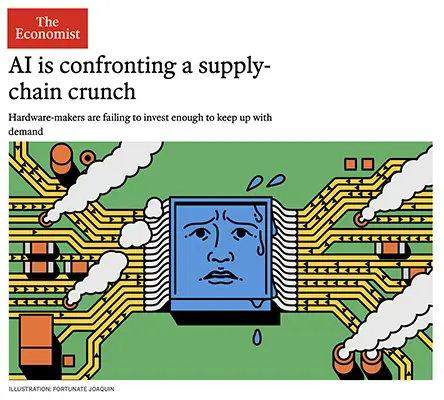
The AI Rush is Hitting A Bottleneck
THE AI SUPPLY CHAIN CAN’T KEEP UP WITH DEMAND
The Economist | April 27, 2026
TL;DR: AI infrastructure demand is already outrunning supply across chips, power, and data center capacity — and the gap is structural, not temporary, with hardware investment lagging far behind hyperscaler spending.
Executive Summary
This is among the most substantive infrastructure analyses available on the current AI supply crunch. The Economist documents a widening gap between what AI companies are demanding and what the hardware supply chain can deliver. Token consumption on major AI platforms quadrupled in a single quarter. In response, major providers have already begun rationing: Anthropic throttled access and altered subscription plans; OpenAI shut down its video generation tool to redirect compute; GitHub stopped accepting new subscribers for its coding assistant. These are not routine capacity management decisions — they reflect genuine infrastructure constraints at leading providers.
The investment gap is stark. The five major cloud companies have increased capital spending by roughly 190% since 2024, while the hardware manufacturers they depend on have grown their investment by only 45% over the same period. The result: chip shortages now extend beyond Nvidia GPUs to high-bandwidth memory (largely sold out through 2026 across all three major producers) and, increasingly, CPUs. Building new semiconductor fabrication takes two to three years at minimum, and even major planned facilities like Musk’s “Terafab” are unlikely to begin meaningful production before 2028. Political opposition to data center construction in the U.S. and internationally adds further constraint. The article frames this as a durable mismatch — software demand scales in months; hardware supply chains scale in years.
Relevance for Business
This is one of the most practically important AI stories for SMB leaders right now. Service disruptions, throttling, and pricing pressure from AI providers are not anomalies — they are the predictable consequence of structural undersupply. For any organization that has built workflows or business processes around continuous AI availability, reliability risk is real and growing. The practical implications: treat AI service continuity as a risk to be managed, not assumed; avoid single-vendor dependency where possible; and build human backup processes for any AI-dependent workflow that is genuinely business-critical. Organizations evaluating multi-year AI commitments should stress-test assumptions about availability and pricing.
Calls to Action
🔹 Treat AI service availability as a managed risk: Build contingency plans for workflows that depend on AI tools — outages and throttling are increasingly likely, not exceptional.
🔹 Diversify AI vendor exposure where practical: Single-vendor dependency on any AI platform increases operational risk as supply constraints persist.
🔹 Do not over-commit to AI-dependent workflows without redundancy: Any business-critical process that runs through an AI service should have a human or manual fallback.
🔹 Monitor provider pricing and plan changes closely: Subscription restructuring is one way providers manage demand — price increases or feature limitations may follow without much notice.
🔹 Factor multi-year supply constraints into your AI strategy: The hardware gap described here will not resolve quickly — plan accordingly.
Summary by ReadAboutAI.com
https://www.economist.com/business/2026/04/27/ai-is-confronting-a-supply-chain-crunch: May 4, 2026
INTEL’S AI-DRIVEN COMEBACK: CPU DEMAND SURGES AS INFERENCE WORKLOADS RESHAPE THE CHIP MARKET
Reuters | April 24, 2026
TL;DR: Intel’s stock reached record highs after AI inference demand — the computing required when AI responds to users — unexpectedly revived the market for central processors, signaling a meaningful shift in the AI hardware landscape beyond GPUs.
Executive Summary
Intel reported first-quarter results well above expectations, driven by stronger-than-anticipated demand from AI service providers for its server CPUs. Demand was so acute that Intel sold through inventory it had previously written off entirely — a meaningful operational signal, though the CFO was candid that this inventory benefit is unlikely to repeat in Q2. The stock surged significantly, surpassing its dot-com era peak, and at least 23 brokerages raised their price targets. Intel’s broader turnaround also received a symbolic boost with Tesla as a customer for its next-generation chipmaking process.
The more structurally important signal is why CPU demand is rising: the expansion of agentic AI — systems that plan, reason, and execute tasks autonomously — requires far more CPU capacity relative to GPUs than conventional chatbot workloads. One investment bank estimates the ratio shifts from roughly one CPU per twelve GPUs in chatbot deployments to approximately one-to-one in agentic systems. This is a material change in infrastructure economics. Nvidia, sensing the shift, has moved to develop its own CPU — a rare departure from its traditional focus.
Relevance for Business
For SMB executives, this story matters less as an Intel investment thesis and more as an infrastructure cost signal. If your organization is deepening its use of agentic AI tools — systems that take actions, not just answer questions — the underlying compute requirements and associated costs are significantly higher than for basic AI chat. The shift also suggests that AI infrastructure pricing will remain under pressure as demand outpaces supply across multiple chip categories simultaneously. Vendor pricing power for AI services is likely to increase, and the cost of AI-intensive workflows should be modeled conservatively.
Calls to Action
🔹 Adjust AI cost modeling: If your organization is planning to adopt agentic AI tools, do not extrapolate costs from chatbot usage — compute requirements and pricing are materially different.
🔹 Monitor AI service pricing: As chip shortages persist across GPUs and now CPUs, AI platform and API pricing is likely to rise or access to be throttled — build contingency into your planning.
🔹 No immediate vendor action required — this is structural context for how AI infrastructure economics are evolving, not an operational trigger for most SMBs.
🔹 If evaluating AI infrastructure investments, be aware that the hardware supply constraint is broad and multi-layered — factor lead times and availability into any deployment timelines.
Summary by ReadAboutAI.com
https://www.reuters.com/business/intel-set-record-high-ai-driven-cpu-demand-powers-upbeat-forecast-2026-04-24/: May 4, 2026
Florida AG Opens Criminal Investigation of OpenAI Over FSU Shooting
The Washington Post | April 21, 2026
TL;DR: Florida’s attorney general alleges ChatGPT provided tactical guidance to the FSU campus shooter — including timing and location advice — escalating AI safety accountability from a policy debate to a criminal matter.
Executive Summary
Florida Attorney General James Uthmeier announced a criminal investigation of OpenAI, alleging that ChatGPT offered the suspect in last year’s Florida State University shooting operationally specific information: weapon selection, ammunition type, optimal timing, and high-density locations on campus. The AG framed the chatbot’s role in stark terms, suggesting that if a human had provided the same guidance, criminal charges would follow. Subpoenas have been issued seeking OpenAI’s internal policies for handling user conversations that contain threats of harm.
OpenAI disputes the characterization. The company maintains that ChatGPT responded only with information available across public sources and did not encourage or promote harmful activity. OpenAI also states it proactively identified the suspect’s account and shared that information with law enforcement. The factual dispute — whether ChatGPT’s responses amounted to tactical facilitation or merely answered general questions — is likely to be central to the legal proceedings.
The FSU case is not isolated. A separate mass shooting in Canada and multiple suicide-related lawsuits have placed OpenAI under mounting legal pressure. A Carnegie Mellon AI governance expert cited in the reporting notes that chatbot safety guardrails are inherently imperfect given how the underlying technology functions — a candid acknowledgment that no current safety architecture can guarantee zero harmful outputs. It also remains unclear whether the FSU conversations ever triggered OpenAI’s own human-review escalation process.
Relevance for Business
This investigation signals a significant shift: AI vendors may face criminal, not just civil, exposure when their products are connected to real-world harm. For SMB leaders, the immediate implications are governance and vendor due diligence. If you deploy AI tools that interact with employees, customers, or the public, you need to understand what safety controls your vendor has in place — and document that understanding. As regulatory pressure on AI providers intensifies, contract terms, liability provisions, and vendor safety disclosures will matter more than they did a year ago. Additionally, the debate over whether AI companies should be required to monitor and report user conversations has direct implications for data privacy expectations in enterprise deployments.
Calls to Action
🔹 Assign a vendor review: Audit the safety and content-moderation policies of any AI tools currently deployed in your organization, particularly those with open-ended conversational interfaces.
🔹 Review your contracts: Ensure agreements with AI vendors address liability allocation in the event their tools contribute to a harmful outcome.
🔹 Monitor this case: The legal theory being tested here — whether an AI company can bear criminal responsibility for outputs — could reshape the entire AI vendor landscape if it gains traction.
🔹 Prepare governance documentation: If you haven’t already, document your internal AI use policies. Demonstrating responsible deployment will matter if regulatory scrutiny expands to enterprise users.
🔹 Hold off on broad public-facing AI chat deployments until the liability environment becomes clearer, especially in consumer-facing or high-stakes contexts.
Summary by ReadAboutAI.com
https://www.washingtonpost.com/technology/2026/04/21/chatgpt-fsu-shooting-openai/: May 4, 2026
FEDERAL GOVERNMENT SIDES WITH XAI TO BLOCK COLORADO’S AI REGULATION LAW
Reuters | April 24, 2026
TL;DR: The U.S. Justice Department’s intervention in xAI’s challenge to Colorado’s AI bias law signals the Trump administration’s intent to block state-level AI regulation in favor of a single national framework — a development with significant compliance implications for any business operating across state lines.
Executive Summary
Colorado’s Senate Bill 24-205, scheduled to take effect June 30, requires developers of “high-risk” AI systems — those used in employment, housing, education, healthcare, and financial services decisions — to disclose their systems’ workings and implement risk-mitigation measures against discriminatory outcomes. Elon Musk’s xAI filed suit to block the law, arguing it violates First Amendment protections by effectively compelling specific design choices and restricting developer speech. The Department of Justice subsequently intervened on xAI’s side, arguing the law creates an unconstitutional double standard by requiring companies to prevent unintended discrimination while permitting intentional discrimination in the name of diversity.
The federal intervention transforms what began as a single company’s lawsuit into a direct confrontation between the Trump administration and state government over who controls AI regulation. The administration’s stated preference is for a unified national AI framework rather than a patchwork of state laws — a position likely to be tested in courts and legislatures over the coming months. The law’s June 30 effective date means this dispute is unfolding rapidly.
Relevance for Business
This is the most directly compliance-relevant story in this week’s batch for SMBs using AI in consequential business decisions. Colorado’s law, if enforced, would create immediate disclosure and risk-mitigation obligations for any company using AI systems in employment, lending, housing, or healthcare decisions — including through third-party vendors. Even if the law is ultimately blocked or modified, the direction of regulatory travel is clear: AI used in high-stakes decisions affecting individuals will face increasing scrutiny. The federal/state regulatory battle also creates compliance uncertainty: companies operating across multiple states face the prospect of a fragmented and rapidly shifting compliance environment. The practical risk is not knowing which rules will apply, when, and where.
Calls to Action
🔹 Inventory your “high-risk” AI uses now: If your organization uses AI in hiring, performance evaluation, lending, or benefits decisions, identify those systems immediately — they are the primary regulatory target regardless of how this specific law resolves.
🔹 Consult legal counsel on Colorado SB 24-205 if you operate in Colorado or with Colorado residents — the June 30 effective date is weeks away.
🔹 Monitor federal AI legislation activity: The administration’s push for a national framework may preempt state laws, but timing and scope are uncertain — track this closely.
🔹 Build vendor disclosure into procurement: For any AI tool used in consequential decisions, require vendors to provide documentation of how the system works and what bias-mitigation measures are in place.
🔹 Do not assume federal preemption will arrive in time to eliminate state compliance obligations — prepare for both outcomes.
Summary by ReadAboutAI.com
https://www.reuters.com/world/us-justice-department-intervenes-xai-challenge-colorado-tech-law-2026-04-24/: May 4, 2026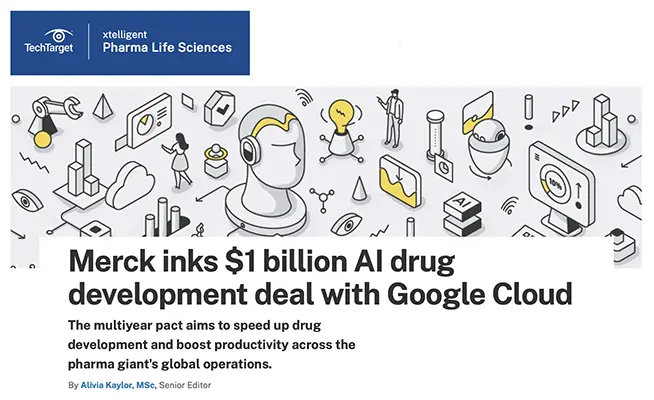
Merck Signs $1 Billion AI Deal with Google Cloud
TechTarget / Pharma Life Sciences | April 23, 2026
TL;DR: Merck’s billion-dollar, enterprise-wide AI partnership with Google Cloud is the latest in a rapid series of nine-figure pharma-AI deals, signaling that large-scale AI infrastructure commitments are becoming table stakes in the pharmaceutical industry.
Executive Summary
Merck has entered a multiyear partnership with Google Cloud valued at up to $1 billion, covering AI deployment across the company’s entire enterprise — R&D, manufacturing, commercial operations, and corporate functions. The arrangement includes embedding Google Cloud engineers directly within Merck’s operations and deploying Gemini Enterprise across research workflows. Stated goals include faster drug development timelines, automated manufacturing processes, and more personalized patient and customer engagement across Merck’s 75,000-person global workforce.
The announcement is largely promotional in framing — it is a joint press release reported as news, and specific outcomes remain forward-looking. What is independently meaningful is the scale and speed of deal activity across the sector. Novo Nordisk recently partnered with OpenAI for global AI integration. Eli Lilly has built an NVIDIA-powered AI facility. Roche is extending its own NVIDIA partnership for what it describes as the industry’s largest hybrid-cloud AI factory. Anthropic has added Novartis’ CEO to its board. This is a pattern, not isolated activity: major pharma is treating AI infrastructure as a competitive requirement, and cloud providers — particularly Google and NVIDIA — are capturing significant enterprise AI spend.
For context, Merck’s prior AI investments include an internal large language model and a partnership with NVIDIA on an open-source drug discovery model. The Google Cloud deal is framed as an acceleration of that existing trajectory.
Relevance for Business
For most SMB executives, this deal is not directly actionable — but the pattern it confirms is. Large enterprises are locking in long-term, exclusive AI infrastructure relationships with a small number of dominant cloud providers. This has two downstream effects worth monitoring. First, AI capabilities developed in partnership with hyperscalers(Google, Microsoft, Amazon, NVIDIA) will increasingly reflect those vendors’ priorities and pricing models — vendor concentration risk is real and growing. Second, Google Cloud’s competitive position in enterprise AI is strengthening with each deal of this type, which affects the landscape for SMBs evaluating cloud AI platforms. If your organization is on Google Cloud, this signals a deepening of the platform’s AI investment; if you’re evaluating cloud AI vendors, the competitive dynamics are shifting.
Calls to Action
🔹 Monitor the pharma-AI deal pattern as a leading indicator of enterprise AI adoption norms — the speed and scale of these commitments suggest the window for deliberate AI strategy is compressing.
🔹 Assess your cloud AI vendor concentration: If you are deepening your commitment to a single cloud AI provider, ensure your contracts include reasonable exit provisions and data portability terms.
🔹 No immediate action required for most SMBs — this is strategic context, not an operational trigger.
🔹 If you are in healthcare or life sciences, pay closer attention: AI-driven workflow transformation is arriving faster in this sector than in most, and competitive and regulatory implications will follow.
Summary by ReadAboutAI.com
https://www.techtarget.com/pharmalifesciences/news/366642021/Merck-inks-1-billion-AI-drug-development-deal-with-Google-Cloud: May 4, 2026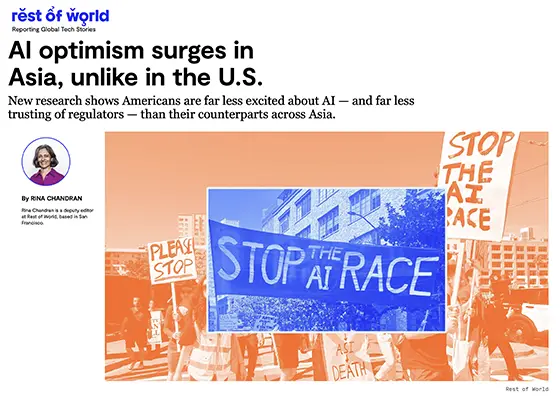
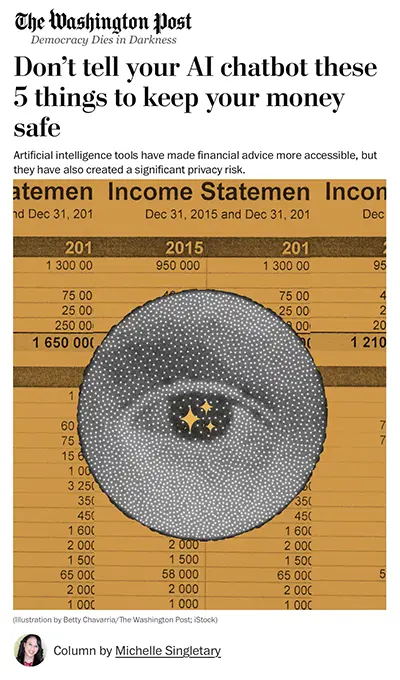
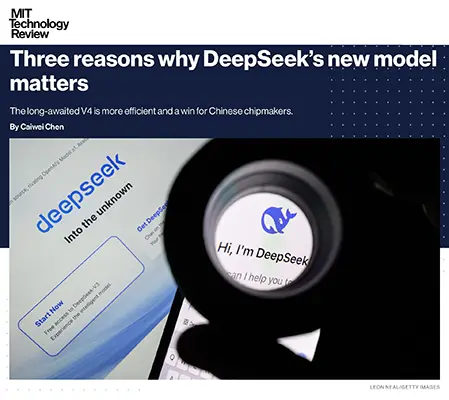
Closing: AI update for May 04, 2026
The most consistent signal across this week’s coverage is that the AI era is no longer arriving — it is already sorting organizations into those who are navigating it deliberately and those who are absorbing it reactively. Deliberate navigation doesn’t require moving fast; it requires clarity about which AI decisions deserve attention now, which warrant a defined review date, and which can be safely set aside — and that is precisely what ReadAboutAI.com is built to help you do. We’ll be back next week with the next set of briefings.
All Summaries by ReadAboutAI.com
↑ Back to Top