
AI Updates May 15, 2026

The stories in this week’s post share a common undertone that’s easy to miss when you read each one in isolation: AI is no longer a horizon story. It is a pressure-in-the-room story. The technology has moved fast enough that the systems built to govern it — legal, regulatory, corporate, clinical, cultural — are visibly straining to keep pace. That strain is the defining theme of this week’s coverage, and it carries direct operational implications for every business that is either adopting AI tools or managing people who are.
Several of this week’s summaries deal with governance failures in plain view. The Musk v. Altman trial is producing a documented public record of how the world’s most consequential AI company was run without adequate conflict-of-interest controls or board independence. A peer-reviewed Harvard study found that AI now outperforms physicians on clinical reasoning benchmarks — yet the researchers themselves caution that benchmark performance is not the same as deployment readiness. Meanwhile, courts are absorbing a 158% increase in AI-generated legal filings, including fictitious citations submitted by trained professionals at major firms. These are not warnings about a future risk. They are descriptions of things happening now, with real consequences for the organizations caught in them.
The week’s business-facing stories reinforce a more nuanced version of the same message. OpenAI’s $4 billion deployment arm signals that the AI market is shifting from capability competition to implementation competition — a change that raises switching costs and deepens vendor dependence for any organization that signs on. Big Tech is financing $700 billion in AI infrastructure through global debt markets. Anthropic is securing exclusive access to over 220,000 Nvidia GPUs to fix a reliability problem its own growth created. AI cybersecurity threats have crossed a threshold where attackers are using AI to autonomously discover unknown vulnerabilities. Agentic AI features are already embedded in many enterprise software platforms — often quietly, without explicit adoption decisions. And research from Carnegie Mellon, Oxford, MIT, and UCLA finds that just ten minutes of AI-assisted problem-solving measurably reduces independent performance when the AI is removed. The question this week is not whether AI is transforming business. It is whether your organization’s governance, measurement, and risk practices are moving as fast as the technology itself.
Summaries

Rolling Stones Deploy Commercial-Grade Deepfake in Mainstream Music Video
Rolling Stone | May 14, 2026
TL;DR: The Rolling Stones’ new “In the Stars” video uses commercially available deepfake technology to convincingly de-age three living artists — a quiet signal that AI-driven identity manipulation has moved from experiment to routine creative production.
Executive Summary
The Rolling Stones released a music video in which director François Rousselet used Deep Voodoo deepfake technologyto render Mick Jagger, Keith Richards, and Ronnie Wood as they appeared roughly 50 years ago. The production is a high-profile, consent-based deployment of AI identity transformation — distinguishing it from unauthorized deepfakes, but normalizing the underlying capability at scale.
What matters here is less the music industry story and more the production reality it signals: a major creative team commissioned a named deepfake vendor, integrated the output into a polished commercial release, and published it without friction. The technology worked well enough that it anchors a mainstream promotional campaign for an album — Foreign Tongues, out July 10.
The consent factor is doing significant work here. This is de-aging with full artist participation, not impersonation. But the ease of execution, the vendor commoditization (Deep Voodoo is a known, accessible studio), and the absence of any apparent legal or reputational backlash indicate the barrier to this class of production has dropped materially.
Relevance for Business
For SMB executives, the headline isn’t the Rolling Stones — it’s the normalization signal. When a project of this visibility uses deepfake de-aging as a standard production tool rather than a novelty, it accelerates stakeholder expectations across industries: marketing teams will be asked about it, clients will reference it, and internal policy gaps will widen.
Key implications:
- Brand and identity risk rises as the technology becomes cheaper and more accessible — your executives, spokespeople, or brand assets could be targets, not just celebrities
- Vendor ecosystem maturing: Deep Voodoo’s commercial engagement here suggests the market for AI identity tools is professionalizing — including for misuse
- Consent and governance gaps: most organizations have no policy covering employee or executive likeness in AI-generated content, internal or external
- Marketing and creative teams will increasingly encounter client or leadership requests to use similar tools — without guardrails in place, execution risk is real
Calls to Action
🔹 Assign a policy owner for AI-generated likeness and identity use — even a lightweight internal guideline reduces exposure before a request lands without one
🔹 Brief your marketing and communications leads that consent-based deepfake production is now commercially viable; have a position ready before a vendor pitches it
🔹 Audit existing contracts with spokespeople, employees in public-facing roles, or brand ambassadors for language covering AI-generated representations — most older agreements are silent on this
🔹 Monitor Deep Voodoo and peer vendors as indicators of where pricing and accessibility are heading — this is a useful proxy for the broader AI identity-manipulation market
🔹 Deprioritize alarm, prioritize preparation: this specific use is consensual and creative — the business risk is in the gap between capability normalization and your internal readiness
https://www.rollingstone.com/music/music-news/rolling-stones-in-the-stars-music-video-odessa-azion-1235562708/: May 15, 2026The Rolling Stones – In The Stars (Official Video)
https://youtu.be/oT5LwwEHgnc?si=FLDNMJAR8BD-CO-G: May 15, 2026
The Comeback’s Series Finale Puts AI’s Hollywood Takeover on Trial
The Comeback Official Podcast (HBO/OBB Sound) | May 2026
TL;DR: The final season of HBO’s The Comeback uses its fictional studio universe to dramatize the AI displacement debate in Hollywood — depicting an industry executive who openly tells the press that AI can write sitcoms so studios don’t have to pay for quality, and a veteran actress who publicly calls it out.
Executive Summary
The finale of The Comeback — and the podcast unpacking it — offers something unusual for a legacy comedy series: a surprisingly direct depiction of how AI economics are reshaping creative labor in Hollywood. The show’s storyline hinges on a studio streaming head who, at a press event, declares that AI can handle sitcom writing so that studios can reserve budgets for prestige “auteur” projects. The message embedded in the fiction: AI is being positioned not as a creative tool, but as a cost-reduction mechanism that explicitly devalues certain categories of work.
The writers built the AI subplot around real research. According to series co-creator Michael Patrick King, the “paywall” concept — the idea that studios allocate a fixed budget cap for AI usage per project, and when that cap is hit, the AI simply stops — emerged from actual industry reporting. The show’s fictional AI system, “Al Assist,” shuts down mid-production when its allotted budget runs out. The paywall detail is not satire; it reflects a genuine structural constraint in how enterprise AI is being deployed in media production.
The central dramatic conflict is that the show’s protagonist is simultaneously dependent on the AI-written show for her career comeback, and the public face being pressured to either defend or condemn AI on behalf of writers. When she speaks honestly at the press event — acknowledging the AI’s limitations — the studio head reacts with visible alarm. Her eventual refusal to continue under those terms is met with the line: “Digital Valerie will.” The show frames this not as dystopia, but as the present-tense reality of an industry mid-transition.
The resolution — Valerie pivoting to a human-led quality project — is optimistic, but the creators are clear that her closing line is the actual thesis: “AI’s here. Gotta move on.”
Relevance for Business
The Comeback is fiction, but its AI storyline is drawn from current industry dynamics that apply well beyond entertainment. The show surfaces several patterns SMB leaders are already encountering or will encounter soon:
The “good enough” mandate. The studio head’s line — “We’re not looking for great, we’re just looking for good enough that people leave it on” — is the AI deployment logic now appearing across customer service, marketing content, and internal communications. Leaders should be honest about where that logic applies in their own operations, and where it creates reputational or quality risk.
Budget caps as a structural reality. The “paywall” mechanic — AI stops when the allotted spend runs out — mirrors what many organizations are discovering: AI costs are real, variable, and not always predictable. Fixed-budget AI deployments can fail at inopportune moments.
The displacement framing is accelerating. The show depicts elite creative professionals (represented by the “Mount Rushmore” of TV writers) pressuring others to publicly oppose AI — while quietly protecting their own positions. The same dynamic is visible in many knowledge-work industries: senior roles may be safer, while mid-tier production work is first in line for AI substitution.
Human expertise still has a rebuttal. The show’s counterargument — made explicitly by the protagonist — is that domain expertise matters, that there is a difference between technically functional output and culturally resonant work, and that the people who know the difference are an asset. That argument is available to SMB leaders defending quality-differentiated positions.
Calls to Action
🔹 Audit where “good enough” logic is already operating in your business — AI-generated content that saves cost but degrades brand trust or customer experience is a hidden liability. Name it explicitly before it becomes a problem.
🔹 Plan for AI budget variability — If your organization uses AI tools with usage-based pricing or enterprise caps, map what happens operationally when those limits are hit mid-project. Build contingencies.
🔹 Watch the labor displacement signal in your sector — The pattern The Comeback depicts (AI replacing mid-tier production work while senior roles are repositioned as “auteur”) is not unique to Hollywood. Identify which roles in your organization fit that profile.
🔹 Document your domain expertise — The show’s most practical business argument is that the person who knows the most about a discipline should be in the room when AI is being evaluated for that discipline. Make sure that expertise is represented in your AI adoption decisions, not just your IT or finance teams.
🔹 Don’t wait for the industry consensus — Valerie’s closing line is the most executive-relevant moment in the entire transcript. AI adoption in your competitive space is not pausing for debate. The strategic question is how to move forward with it without sacrificing what actually differentiates you.
Summary by ReadAboutAI.com
https://www.youtube.com/watch?v=eKDVV29wmUc&list=PLSduohp5OGX6vxflDRyigjYGdCOQKHhm: May 15, 2026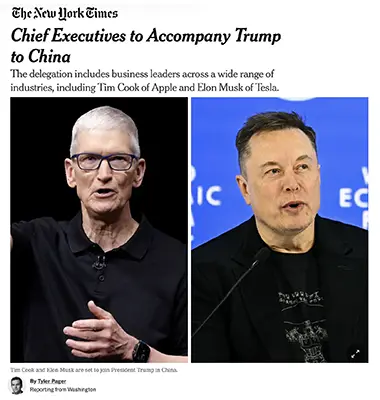
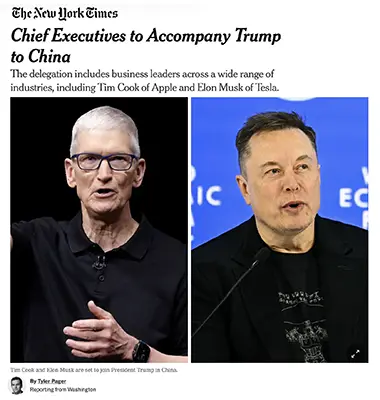
TRUMP’S CHINA SUMMIT BRINGS 16 CEOS TO BEIJING
The New York Times | May 11, 2026
TL;DR: A high-profile U.S. business delegation — spanning finance, tech, defense, and semiconductors — is joining President Trump in Beijing for Xi Jinping meetings this week, but Nvidia’s CEO was not initially invited, a telling signal given the company’s pending chip-export approval from both governments. Jensen Huang did eventually meet up with the team and is in China.
Executive Summary
President Trump departed for China this week accompanied by 16 corporate leaders representing a broad cross-section of American industry, from Apple and Goldman Sachs to Boeing and Qualcomm. The stated U.S. agenda includes establishing formal boards for bilateral investment and trade — framing this less as a diplomatic visit and more as a structured commercial negotiation at the highest level.
Two absences matter most. Jensen Huang of Nvidia — whose company is awaiting regulatory clearance from both the U.S. and China to ship H200 AI chips — was not invited and will not attend. Whether this reflects deliberate diplomatic choreography or simple exclusion is unclear, but the optics are significant: the world’s most valuable company is sitting out a summit explicitly designed around trade and investment. Separately, Cisco’s CEO was listed then withdrew, a minor but notable last-minute shift.
Elon Musk’s inclusion signals the completion of his political rehabilitation with the Trump administration following their 2025 falling out. He returns as a participant in high-stakes geopolitical commerce — though in his capacity as Tesla CEO, not as a policy figure.
Relevance for Business
For SMB executives, this summit is a leading indicator of U.S.-China trade trajectory. The composition of the delegation — semiconductors, finance, aerospace, payments — maps directly onto the sectors where tariff relief, market access, or new restrictions are most likely to emerge from these talks. Qualcomm, Micron, and Apple all have deep China exposure; any bilateral agreements affecting supply chains or market access will ripple downstream to smaller vendors and customers in their ecosystems.
The Nvidia situation is the sharpest signal to watch: AI chip access to China remains a live policy variable, and the outcome of these discussions could accelerate or further constrain the AI hardware market. For businesses planning AI infrastructure investments, supply availability and pricing may shift based on what does or doesn’t get resolved this week.
Calls to Action
🔹 Monitor summit outcomes closely — any announced investment or trade board framework will likely include sector-specific provisions with downstream effects on U.S.-China supply chains.
🔹 Flag China-exposed vendors in your stack — if your business relies on companies like Apple, Qualcomm, or Micron, assess how potential new trade terms could affect pricing, availability, or roadmap timing.
🔹 Watch the Nvidia AI chip decision specifically — H200 export approval (or denial) will have direct implications for AI infrastructure costs and availability in the near term.
🔹 Avoid over-interpreting the delegation’s presence as resolution — attendance signals intent, not outcome; treat any announcements as starting points for monitoring, not settled policy.
🔹 No immediate SMB action required — but assign someone to track this story through end of week as follow-on announcements emerge.
WASHINGTON (Reuters) – More than one dozen CEOs and top executives will join the U.S. delegation as President Donald Trump travels to China this week, according to a White House official. The companies include:
- Apple (Tim Cook)
- Blackrock (Larry Fink)
- Blackstone (Stephen Schwarzman)
- Boeing (Kelly Ortberg)
- Cargill (Brian Sikes)
- Citi (Jane Fraser)
- Cisco (Chuck Robbins)
- Coherent (Jim Anderson)
- GE Aerospace (H Lawrence Culp)
- Goldman Sachs (David Solomon)
- Illumina (Jacob Thaysen)
- Mastercard (Michael Miebach)
- Meta (Dina Powell McCormick)
- Micron (Sanjay Mehrotra)
- Qualcomm (Cristiano Amon)
- Tesla/SpaceX (Elon Musk)
Summary by ReadAboutAI.com
https://www.nytimes.com/2026/05/11/us/politics/trump-china-musk-cook.html: May 15, 2026https://www.reuters.com/business/finance/apple-boeing-citi-tesla-meta-executives-join-trumps-china-trip-2026-05-11/: May 15, 2026
Ten Minutes Is Enough: AI Use Impairs Independent Problem-Solving, Research Finds
Fast Company | News | May 11, 2026 | By Jude Cramer
TL;DR: A multi-university study found that just 10 minutes of AI-assisted problem-solving measurably reduced participants’ independent performance when AI access was removed — with the sharpest declines among those who asked AI for direct answers rather than hints.
Executive Summary
Researchers from Carnegie Mellon, Oxford, MIT, and UCLA conducted a controlled study in which participants solved math problems with and without an AI assistant, then had the assistant removed without warning. The AI-assisted group outperformed the control group while AI was available — but once access was cut, their solve rate dropped roughly 20% below the control group. Participants who had used AI were also twice as likely to simply abandon problems rather than attempt them independently.
A follow-up experiment testing reading comprehension produced similar results. Critically, the effects were not uniform across all AI usage patterns: participants who used AI to request direct answers saw the largest decline, while those who used AI only for hints or clarifications performed comparably to the control group. This distinction matters — it’s not AI use that creates the impairment; it’s dependency on AI as a replacement for thinking.
The study adds to a growing body of research, including an MIT brain-activity study on essay writing, suggesting that regular AI reliance — even brief — may reduce cognitive engagement and independent reasoning capacity over time. The researchers explicitly flag concerns about accumulating effects in daily workflows.
Note: This is peer-reviewed research from credible institutions, not advocacy. The study used controlled conditions; real-world effects in complex work environments will be more variable. The finding is directionally significant but should not be overstated.
Relevance for Business
This has direct implications for how SMB leaders deploy AI across their teams, particularly in roles requiring judgment, analysis, and problem-solving. If employees are routinely offloading cognitive work to AI tools, the business may be building operational dependency risk: performance that looks strong on AI-assisted metrics but degrades if AI access is disrupted, downgraded, or inaccessible in time-sensitive moments.
There are also talent development implications: if AI is used as an answer machine rather than a thinking aid in training, onboarding, or skill-building contexts, the organization may be producing employees who are less capable independently — not more. This is particularly relevant in analytical, legal, financial, and customer-facing roles where independent judgment under pressure matters.
Calls to Action
🔹 Audit how your team is actually using AI tools. Are people asking for direct outputs or using AI to sharpen their own thinking? The difference has measurable downstream effects.
🔹 Build AI usage guidelines that distinguish answer-seeking from reasoning-support. This is not about limiting AI — it’s about protecting the independent judgment capacity that AI cannot replace.
🔹 Do not assume AI-augmented performance reflects team capability. Before reducing headcount or restructuring roles based on AI productivity gains, evaluate how teams perform when AI is unavailable or unreliable.
🔹 Treat this research as a hiring and development signal. In roles requiring independent reasoning, candidates and employees who can think clearly without AI assistance remain strategically valuable — and may be increasingly rare.
🔹 Monitor this research area. Longitudinal studies on cumulative cognitive effects of daily AI use are still limited. The early evidence warrants caution; it does not yet warrant alarm.
Summary by ReadAboutAI.com
https://www.fastcompany.com/91539907/cognitive-science-scientists-found-using-generative-ai-chatgpt-impairs-brain-performance-thinking-problem-solving-skills: May 15, 2026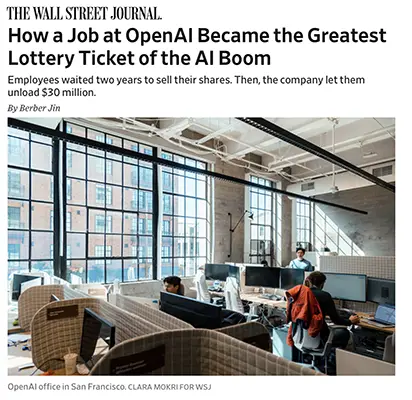
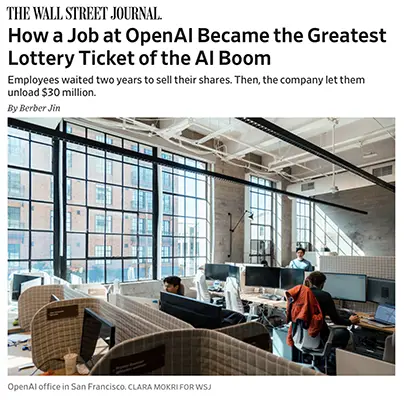
HOW A JOB AT OPENAI BECAME THE GREATEST LOTTERY TICKET OF THE AI BOOM
The Wall Street Journal | Berber Jin | May 10, 2026
TL;DR: More than 600 current and former OpenAI employees collectively realized $6.6 billion in a single share sale last October — with roughly 75 walking away with $30 million each — establishing unprecedented pre-IPO wealth creation that is reshaping AI talent competition, compensation norms, and the broader labor market for technical workers.
Executive Summary
The Wall Street Journal reports the financial mechanics and scale of OpenAI’s October 2025 employee tender offer, in which the company tripled its per-employee share sale cap to $30 million to meet investor demand. The resulting $6.6 billion collective payout across 600+ participants — before any public listing — has no historical precedent in technology. Early Google and Facebook employees made comparable wealth, but only after IPOs that came years into their companies’ histories. OpenAI employees realized this wealth while the company remains private, valued at $852 billion as of its latest financing round.
The compensation context surrounding this event matters as much as the event itself. OpenAI offers some technical roles annual salaries exceeding $500,000, provides equity packages that dwarf industry norms, and in August 2025 gave select staff one-time bonuses worth millions. Meta matched with $300 million packages for some top researchers. These figures are not representative of the broader AI labor market, but they define the ceiling that AI companies are competing toward — and that ceiling is rising.
The structural implication for all employers: the talent war for AI specialists has decoupled from conventional compensation frameworks. Organizations that cannot offer equity upside at these scales are competing for a narrowing pool of candidates who are choosing between life-changing wealth at AI labs and conventional technology employment elsewhere. This isn’t just a Big Tech problem — it cascades down into mid-market and SMB hiring as expectations set at the top reshape norms throughout the sector.
The article also notes second-order effects: rising San Francisco rental prices, growing class divides within the city, and the anticipation of further wealth release when OpenAI and Anthropic complete what are expected to be historically large IPOs.
Relevance for Business
For SMB leaders, the most direct implication is AI talent scarcity and compensation pressure. The extreme wealth being generated at the top of the AI market is creating a gravitational pull that affects hiring well below the elite level. Software engineers, data scientists, and ML practitioners who might previously have considered SMB or mid-market roles are increasingly orienting toward companies — or adjacent roles — with equity exposure to AI upside. This is a structural market shift, not a cyclical one.
The IPO signal is also relevant: when OpenAI and Anthropic go public, thousands of newly liquid employees will enter the market with significant capital. Some will start companies (increasing startup competition), some will fund others (accelerating the AI startup ecosystem), and some will simply leave the workforce temporarily. The downstream effects on the AI vendor landscape will be material.
Calls to Action
🔹 Recalibrate your AI talent acquisition strategy. You will not win on cash compensation against AI labs. Identify what you can offer — mission, scope, equity in your own business, flexibility, autonomy — and compete on those dimensions explicitly.
🔹 Assess your current AI/ML talent retention posture. If you have technical staff with skills that are valuable to AI companies, understand what would retain them and whether you’re positioned to act.
🔹 Watch the OpenAI and Anthropic IPO timelines. The liquidity event that follows will reshape the AI startup and talent landscape. Plan for increased competition for AI-adjacent roles in the 12–24 months post-IPO.
🔹 Consider partnership or vendor relationships as an alternative to hiring. If recruiting and retaining elite AI talent is not viable at your scale, a well-structured vendor or API relationship may deliver more value with less execution risk.
🔹 Use this as a board-level conversation trigger. If AI capability is part of your competitive strategy, the talent economics described here should inform your workforce planning assumptions and compensation structure discussions.
Summary by ReadAboutAI.com
https://www.wsj.com/wsjplus/dashboard/articles/openai-employee-stock-sales-71ed10bd: May 15, 2026
The Hidden Rules Behind AI Chatbots — And How to Use Them
The Washington Post | Kevin Schaul | May 11, 2026
TL;DR: AI companies embed thousands of words of invisible instructions — called system prompts — into every chatbot conversation, shaping behavior in ways most users never see; understanding this architecture gives business users meaningful practical control.
Executive Summary
Every interaction with a commercial AI chatbot — ChatGPT, Claude, Gemini, Grok — operates within a hidden instruction layer set by the AI company before the user types a word. These system prompts, which range from 2,300 to 27,000 words across major platforms, govern personality, content policies, tool access, and specific behavioral guardrails. The user’s own input is processed only after this prior instruction layer has already shaped the context.
The practical implications are direct. System prompts can override or constrain user requests, sometimes in ways that are opaque to the person interacting with the tool. They can also be changed rapidly — without model retraining — which means chatbot behavior can shift overnight without any public announcement. This is both a feature (companies can fix problems quickly) and a risk (the tool you deployed last month may not behave exactly the same today). The article cites examples of documented behavioral shifts tied to system prompt changes, including Grok’s antisemitic content episode and ChatGPT’s fixation on goblins.
What users can do: Major platforms offer customization features — within the limits of the vendor’s system prompt — that allow users to adjust tone, format, verbosity, and reasoning style. These adjustments don’t change core capabilities, but they can meaningfully improve output relevance for specific business use cases. The article also notes that system prompts are not always reliably followed by the models themselves, adding a layer of behavioral unpredictability.
The transparency question is unresolved. Most AI companies decline to publish complete system prompts, and the ones that have been extracted by researchers reveal that companies actively embed commercial, legal, and political priorities into the instruction layer — priorities that may not align with enterprise user needs. The article notes OpenAI began serving ads in ChatGPT in February 2026, with system prompt guidance on how the model should respond when asked about those ads.
Relevance for Business
For SMB executives deploying or evaluating AI tools, this piece has direct governance and procurement relevance. The system prompt architecture means the AI tool you’re evaluating is not a neutral instrument — it reflects the vendor’s priorities, commercial relationships, and policy choices. That’s not disqualifying, but it warrants understanding.When evaluating chatbot tools for workflows that touch compliance, legal, customer communication, or any sensitive domain, ask vendors what behavioral constraints are embedded and whether those can be overridden by enterprise customers through system prompt access.
The stability risk is also material: if your team’s workflows depend on consistent AI behavior, the vendor’s ability to alter that behavior silently through system prompt changes represents an operational dependency worth flagging in vendor agreements.
Calls to Action
🔹 Explore the customization features available in whichever AI platform your team uses (ChatGPT, Claude, Gemini all offer user-level instruction customization). Even modest adjustments can improve output quality for specific business tasks.
🔹 Ask vendors about system prompt access and stability. For enterprise deployments, understand whether custom system prompts are available, what behavioral constraints are fixed, and whether prompt changes are communicated in advance.
🔹 Build behavioral testing into your AI vendor evaluation process. System prompts can shift; test your tools periodically against a consistent set of business-relevant queries to detect behavioral drift.
🔹 Flag the advertising and commercial interest layer. If your AI tool vendor has introduced or is considering advertising, assess whether that creates conflicts with your use case — particularly in customer-facing or compliance-adjacent workflows.
🔹 Assign to your AI/IT governance lead for review of current vendor agreements relative to system prompt transparency and change notification.
Summary by ReadAboutAI.com
https://www.washingtonpost.com/technology/interactive/2026/chatbots-hidden-rules-system-prompts/: May 15, 2026
AI SHOPPING IS A MULTI-TRILLION-DOLLAR RACE — WITH A CAUTIONARY TALE ALREADY BAKED IN
Fast Company | May 7, 2026 (Subscriber Exclusive)
TL;DR: Google and OpenAI are both racing to own AI-powered shopping, but the early scorecard — including OpenAI’s quietly shelved Instant Checkout — reveals that building AI commerce infrastructure is significantly harder than announcing it, and the winner won’t be known for months.
Executive Summary
This is one of the more substantively reported pieces in this batch, drawing on interviews with executives at Google, OpenAI, Stripe, Walmart, and multiple startups. The core finding: the gap between AI commerce announcements and working AI commerce is large, and the underlying reason is structural. Large language models were trained on text, not on product data — they were never designed to handle the real-time inventory, loyalty systems, shipping logic, return workflows, and merchant-specific rules that a functional shopping experience requires. Building that plumbing is a multiyear infrastructure project, not a feature.
OpenAI’s Instant Checkout — announced with Shopify in September 2025 as a native in-ChatGPT purchasing experience — was quietly discontinued in March 2026 after fewer than 30 of Shopify’s millions of merchants actually went live. The retreat is significant: it signals that even the most-hyped AI applications encounter hard limits when they collide with existing commercial infrastructure. OpenAI’s revised position is that merchants should own checkout themselves; ChatGPT will help users discover products and hand off to merchant-controlled purchase flows.
Google currently holds the structural advantage for several reasons: its Shopping Graph — a real-time database of product pricing, inventory, and merchant relationships built over two decades — gives it product data that no competitor can replicate quickly. Its Gemini platform also has access to years of user data across Gmail, Photos, and Drive (with user permission via its Personal Intelligence feature), enabling personalization that ChatGPT, which learns only from conversation history, cannot match today. Google already has working in-chat checkout via Google Pay, with Gap and Ulta Beauty live as of March and April 2026. Meanwhile, two competing infrastructure protocols have emerged — OpenAI and Stripe’s Agentic Commerce Protocol (ACP), and a Google-led coalition’s Universal Commerce Protocol (UCP) — and the market has not settled on a standard.
Relevance for Business
If you sell products online, this is the most important category to monitor in 2026. The shift to agentic commerce — where AI agents research, compare, and complete purchases on behalf of users — would represent one of the most significant channel disruptions in retail history. Businesses that depend on Google Shopping, paid search, or direct-to-consumer web traffic should understand that the discovery layer is being rebuilt. Who controls discovery in an agentic shopping world controls customer acquisition — and that power is shifting toward platform incumbents with data advantages. SMB retailers without direct relationships to Google Merchant Center or Shopify’s integrations may find themselves increasingly invisible to AI shopping agents that surface products from structured, machine-readable data sources. The protocol war (ACP vs. UCP) also means that early integration decisions carry real switching-cost risk — supporting both is currently the recommended posture, but that adds cost and complexity.
Calls to Action
🔹 If you sell products online, audit how your product data is structured — real-time inventory, pricing, and product attributes need to be machine-readable to be discoverable by AI shopping agents. This is not optional in the medium term.
🔹 Ensure your products are live and well-optimized on Google Merchant Center — Google’s Shopping Graph advantage means Gemini-driven discovery will likely favor merchants already in its ecosystem.
🔹 Monitor the ACP vs. UCP protocol competition — do not make a major platform commitment based on either standard alone until the market converges. Ask your e-commerce platform vendor which they support and what their roadmap looks like.
🔹 Treat OpenAI’s Instant Checkout failure as useful data — it is evidence that AI commerce hype is running well ahead of infrastructure reality. Evaluate vendor claims in this space with appropriate skepticism and a 12–18 month patience window.
🔹 If you are not in retail, file this as a second-order signal: AI shopping agents will change customer behavior, supplier relationships, and potentially pricing dynamics in nearly every B2C category over the next three to five years.
Summary by ReadAboutAI.com
https://www.fastcompany.com/91533534/shop-til-you-bot-google-openai-and-the-race-to-build-agentic-commerce: May 15, 2026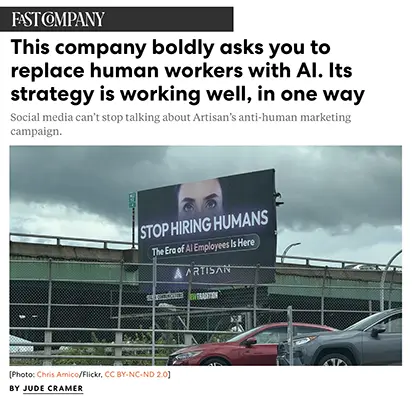
ARTISAN’S “STOP HIRING HUMANS” ADS ARE GETTING ATTENTION — MOSTLY THE WRONG KIND
Fast Company | May 8, 2026
TL;DR: AI sales startup Artisan is running provocative anti-human ads in New York and San Francisco subway systems — generating viral backlash that reveals as much about public AI anxiety as it does about the company’s actual product.
Executive Summary
Artisan, which sells an AI sales agent designed to replace entry-level outbound sales reps, has built its brand around deliberately inflammatory advertising. Its subway billboards — including taglines urging companies to stop hiring humans — have generated significant social media attention, the overwhelming majority of it negative. With 71% of Americans reporting concern about AI-driven job displacement (Gallup, 2025), and Gen Z anger toward AI rising while excitement falls, Artisan’s campaign is connecting with a genuine public nerve — just not in the way a product launch typically aims to.
The backlash is substantive, not just emotional. Critics online raised legitimate points about AI output quality versus quantity — specifically, whether an AI sales agent that books meetings or researches prospects is producing reliable, actionable work or inflated activity metrics. These are real operational questions any leader would ask before deploying such a tool. Artisan’s CEO frames the campaign as honest provocation — arguing that AI should take over roles that were never good for humans in the first place, like cold outbound sales. That’s a coherent position, but it sidesteps the harder questions about output quality, oversight, and what replaces the human judgment that even low-level sales roles involve.
This is a marketing story, not a product capability story. The article provides no independent evidence of Artisan’s actual performance. The signal here is cultural and strategic, not technical.
Relevance for Business
Two things matter here for SMB leaders. First, the AI-replacement framing is a real strategic conversation, not just a stunt — companies are actively evaluating whether AI agents can handle entry-level sales, customer support, and research functions. The question isn’t whether to consider it, but how to evaluate it with appropriate rigor. Second, the public reaction is a workforce management signal: employees are watching how AI vendors position these tools, and leaders who adopt AI for headcount reduction without a thoughtful communication strategy risk eroding trust with their remaining teams. The Artisan backlash illustrates how quickly “efficiency” narratives can become morale and reputation problems.
Calls to Action
🔹 Evaluate AI sales tools on output quality, not activity volume — before piloting any AI agent for outbound sales or research, define what “good” looks like and build verification into the process.
🔹 Separate the vendor’s marketing from the product’s actual capability — Artisan’s ads are designed to generate attention, not to accurately represent what AI sales agents can and cannot do reliably.
🔹 Develop an internal communication posture on AI and roles — if you’re exploring AI tools that touch headcount, your team deserves a clear, honest framing before they see a billboard.
🔹 Monitor the AI agent sales category — it is maturing rapidly, and vendors beyond Artisan (many less controversial) are building comparable tools worth evaluating on their merits.
🔹 Take the Gen Z sentiment data seriously — if your workforce skews younger, declining enthusiasm for AI combined with growing anger is a change management signal that warrants attention in how you introduce AI tools.
Summary by ReadAboutAI.com
https://www.fastcompany.com/91539104/artisan-ai-asks-companies-to-replace-human-workers-its-strategy-is-working-well-ad-campaign-stop-hiring-humans: May 15, 2026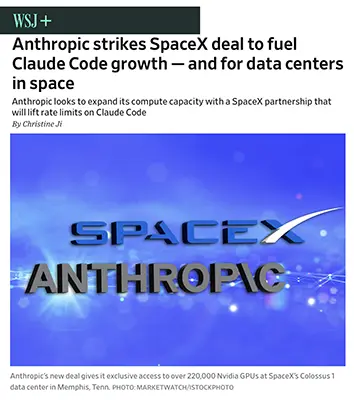
Anthropic–SpaceX Deal Signals Compute Is the Choke Point for AI Growth
MarketWatch | May 6, 2026
TL;DR: Anthropic’s deal for exclusive access to SpaceX’s Colossus 1 data center — and interest in orbital compute — reveals that raw infrastructure capacity, not model quality, is now the primary constraint on AI product delivery.
Executive Summary
Anthropic has secured exclusive use of SpaceX’s Colossus 1 facility in Memphis, gaining over 220,000 Nvidia GPUs and 300 megawatts of power within the month. The company has also signaled interest in future orbital data center capacity, a speculative but notable long-range signal about where the compute arms race may head.
The business context matters: Anthropic’s annualized revenue has reportedly surged past $30 billion, up from $9 billion at year-end 2025. That growth created a reliability problem — Claude’s core services had been running at roughly 99.1% uptime, translating to nearly 80 hours of downtime annually. Industry standard is 99.999%. Rationed access and peak-hour caps on Claude Code and the API were visible symptoms of a supply constraint, not a product limitation. This deal is primarily about fixing that.
The political texture is worth noting: Musk had publicly criticized Anthropic as recently as earlier this year. His reversal — and SpaceX’s willingness to lease compute capacity to a direct competitor to its xAI subsidiary — prompted observers including Wharton’s Ethan Mollick to question whether it signals that xAI is deprioritizing frontier model competition. That is a claim, not a confirmed strategic shift, and should be treated as such.
Relevance for Business
For SMB leaders using Claude Code or building on the Claude API, the practical near-term effect is fewer rate limit interruptions and higher usage ceilings. If your team has been hitting five-hour caps or peak-hour restrictions, expect that friction to ease.
More broadly, this deal illustrates a structural dynamic that affects every AI vendor relationship: the companies building AI products are themselves constrained by infrastructure, and those constraints shape what you can reliably deploy. Reliability — not capability — is becoming the competitive differentiator at the product layer. Leaders evaluating AI vendors should be asking about uptime commitments and infrastructure roadmaps, not just model benchmarks.
The Musk angle creates an unusual governance footnote: Anthropic’s primary infrastructure partner is now also the parent company of a direct AI competitor. That dependency is worth tracking.
Calls to Action
🔹 If you use Claude Code or the Claude API, revisit rate limits and plan for expanded usage — the constraint should ease materially within weeks.
🔹 When evaluating any AI vendor, add uptime history and infrastructure resilience to your due diligence checklist alongside model performance.
🔹 Monitor the xAI/Grok competitive trajectory — if SpaceX is effectively ceding compute to Anthropic, that may shift the frontier model landscape in ways that affect which tools your organization should be building on.
🔹 Note the orbital data center signal as speculative — it’s an Anthropic “expression of interest,” not a commitment. File it under long-range infrastructure risk awareness, not near-term planning.
🔹 Assign someone to track AI vendor reliability metrics — 80 hours of annual downtime is operationally significant. Know your vendors’ numbers before you deepen dependency.
Summary by ReadAboutAI.com
https://www.wsj.com/wsjplus/dashboard/articles/anthropic-strikes-spacex-deal-to-fuel-claude-code-growth-and-for-data-centers-in-space-e11819e4: May 15, 2026
Robot Lawn Mowers and the IoT Security Crisis: When AI-Adjacent Devices Become Physical Threats
The Verge | May 7, 2026
TL;DR: A security researcher demonstrated that he could remotely control every Yarbo robot lawn mower in the world — accessing owners’ GPS coordinates, Wi-Fi passwords, and live camera feeds — exposing a systemic IoT security failure with direct implications for any organization deploying connected physical devices.
Executive Summary
The Verge published an investigation documenting serious, demonstrated security vulnerabilities in Yarbo robot lawn mowers. A security researcher named Andreas Makris, working from Germany, was able to take remote control of Yarbo robots across the United States and Europe — reportedly tracking over 11,000 devices worldwide. The vulnerabilities include a hardcoded root password shared across all devices, a manufacturer-installed remote access backdoor that cannot be disabled by owners and is restored after firmware updates, and the ability to extract owners’ home GPS coordinates, Wi-Fi passwords, and email addresses. Makris demonstrated the vulnerabilities live to the reporter, who independently verified key findings by visiting owners’ homes using data extracted from the devices.
The manufacturer — which markets itself as a New York company but is actually Shenzhen-based Hanyang Tech — initially dismissed the concerns and had no security contact or bug bounty program. Following publication, Yarbo issued partial remediation commitments, though the researcher’s assessment is that the backdoor architecture is by design, not accident.
This is not a Yarbo story. This is an IoT story. The article frames Yarbo as an extreme example of a widespread problem: consumer and commercial connected devices — from robot vacuums to industrial equipment — are frequently shipped with security practices that would fail any reasonable enterprise review. The physical dimension of this case — bladed machinery that can be remotely redirected — makes the risk concrete in a way that network-only vulnerabilities do not.
Relevance for Business
The Yarbo case is most directly relevant to SMBs in three ways.
First, any organization deploying connected physical devices — on premises, in facilities, or in customer environments — faces the same underlying risk pattern. The question is not whether your robotic or IoT devices are as poorly secured as Yarbo’s; the question is whether you have verified their security posture through your own due diligence rather than assuming the manufacturer’s claims are accurate.
Second, the network exposure extends beyond the device itself. Yarbo’s vulnerabilities allowed extraction of Wi-Fi passwords and home network access points. In a commercial setting, a compromised connected device is a potential entry point into your broader network. Connected physical devices should be treated as potential network security risks, not just hardware purchases.
Third, the supply chain and transparency issue is notable: Yarbo markets itself as a US company but operates from China, has no security disclosure infrastructure, and attempted to impose non-disparagement agreements on reviewers. When evaluating IoT and robotics vendors, the presence of a security disclosure program, a bug bounty mechanism, and transparent ownership is a basic due diligence requirement — not a nice-to-have.
Calls to Action
🔹 Audit any connected physical devices currently operating in your facilities — robotic equipment, IoT sensors, smart locks, environmental controls — and verify their security posture against basic standards: default password policies, remote access architecture, firmware update practices.
🔹 Isolate connected devices on separate network segments rather than allowing them to share credentials or access points with core business systems.
🔹 Add security disclosure program and bug bounty existence to your vendor checklist for any IoT or robotics purchase — their absence is a meaningful red flag about a vendor’s security culture.
🔹 Treat country-of-manufacture and actual ownership transparency as procurement factors, particularly for devices with cameras, GPS, or network access in sensitive environments.
🔹 Monitor CVE disclosures relevant to devices already deployed — the Yarbo vulnerabilities were published without prior vendor remediation, meaning organizations may not receive proactive notification. Assign responsibility for tracking disclosures for all networked physical devices in your environment.
Summary by ReadAboutAI.com
https://www.theverge.com/tech/925696/yarbo-robot-lawn-mower-hack-remote-control-camera-access-mqtt: May 15, 2026
Microsoft’s Legal Agent: AI Enters the Contract Review Workflow — With Caveats
The Verge | May 1, 2026
TL;DR: Microsoft has launched an AI agent inside Word specifically for legal contract review — a narrow, workflow-specific tool built on acquired talent, not general AI — and its arrival signals that agentic AI is moving into professional services faster than most firms have planned for.
Executive Summary
Microsoft has released a Legal Agent inside Word, currently limited to participants in its Frontier program in the United States. The tool is designed to review contracts clause by clause, track negotiation history, flag risks and obligations, and work with documents that already contain tracked changes. According to Microsoft, the agent follows structured legal workflows rather than relying on open-ended AI interpretation — a design choice that positions it as a specialized tool rather than a general assistant applied to legal documents.
The origin of the technology matters: Microsoft built this on the work of engineers from Robin AI, a venture-backed startup that failed despite significant investment in AI-powered contract review. Acquiring talent from failed specialized AI startups and embedding their capabilities into existing enterprise platforms is becoming a standard Microsoft playbook — it reduces the risk of competing with Microsoft’s distribution advantage while giving Microsoft a credible technical foundation. Leaders should watch for this pattern across other professional domains.
The article is brief and leans toward announcement coverage, so the business framing requires some editorial inference. The key question the article doesn’t fully answer: what is the liability posture when the Legal Agent misreads a contract clause? That question is unresolved and will matter significantly as adoption scales.
Relevance for Business
For any SMB that relies on contract review — vendor agreements, client terms, employment contracts, lease agreements — this development is directly relevant. It signals that AI-assisted legal review is moving from experimental to embedded, with Microsoft’s distribution ensuring rapid, often invisible, deployment to organizations already using Microsoft 365.
The risk is not that the tool is bad. It may be quite good for routine, lower-stakes document review. The risk is deploying it without updated policies around AI-assisted legal decisions: Who reviews the AI’s output before a contract is signed? What is the error liability when the agent misses an obligation? Is your organization’s legal counsel aware that this tool is being used in your Word environment?
For SMBs without in-house legal teams, the temptation to use a tool like this as a substitute for legal review — rather than a supplement to it — is real and should be explicitly addressed in policy.
Calls to Action
🔹 If your organization uses Microsoft 365, determine whether Legal Agent features are rolling out to your environment and whether your team is already using them — awareness often lags deployment.
🔹 Establish explicit policy on AI-assisted contract review before the tool reaches your staff: define what it can supplement, what still requires human legal review, and who is accountable for errors.
🔹 For SMBs without in-house counsel, treat this as a prompt to clarify your legal review process generally — AI tools in this space are multiplying, and an undisciplined adoption creates liability exposure.
🔹 Monitor the Frontier program rollout — current access is limited, but broad availability is likely within one to two product cycles. Use the window to prepare governance before deployment.
🔹 Watch how legal professional associations respond — bar associations and legal regulators in several jurisdictions are actively developing guidance on AI-assisted legal work. Their positions will shape the liability landscape for tools like this.
Summary by ReadAboutAI.com
https://www.theverge.com/news/921944/microsoft-word-legal-agent-ai: May 15, 2026
Rave Sues Apple for Anti-Competitive App Store Removal — A Case That Mirrors Broader Platform Power Disputes
Reuters | May 7–8, 2026
TL;DR: A video-sharing app developer has sued Apple for allegedly removing its product to eliminate competition with Apple’s own SharePlay feature — a case that resurfaces persistent questions about App Store power and what recourse smaller developers have.
Executive Summary
Rave, a Canadian developer whose app allows cross-platform shared video viewing, has filed an antitrust lawsuit against Apple in U.S. federal court, alleging its removal from the App Store in 2025 was motivated by competitive self-interest rather than the guideline violations Apple cited. Rave claims Apple removed it after Apple launched its own competing SharePlay feature, and is seeking reinstatement and substantial damages. Parallel legal actions have been filed in Canada, Russia, the Netherlands, and Brazil.
Apple’s public response is direct and serious: the company states the app was removed for repeated policy violations including hosting pornographic and pirated content, and for user reports involving child sexual abuse material. Rave disputes these characterizations. The facts in dispute are severe and unresolved — this is an active legal proceeding, not a settled dispute, and the competing claims cannot be evaluated from public filings alone.
What is not in dispute is the structural dynamic: Apple controls the only distribution channel for iOS apps, and that control gives it unchecked discretion over which competing products survive. This dynamic — explored extensively in the Epic Games v. Apple litigation — remains legally contested and commercially consequential. The Rave case adds another data point to the growing pattern of App Store removal disputes, at a moment when regulatory scrutiny of platform gatekeeping is intensifying in multiple jurisdictions.
Relevance for Business
For SMB leaders, the direct operational lesson is one of platform dependency risk. Any business with revenue or customer engagement tied to a single app marketplace — Apple App Store, Google Play, Amazon Marketplace — faces the same structural exposure Rave is now litigating. The remedy, if any, comes through courts and regulators over years. The more immediate practical question is whether your business continuity would survive a platform removal, and whether you have direct customer relationships that don’t route through a third-party store. This case also reinforces the argument for cross-platform strategies — Rave’s Android and Windows presence meant the company wasn’t entirely eliminated, even after iOS removal.
Calls to Action
🔹 Audit your platform dependencies: if a meaningful share of revenue or customer acquisition runs through a single marketplace or platform, map that exposure and identify what would happen if access were suspended.
🔹 Invest in direct customer relationships — email lists, owned web properties, and direct sales channels reduce platform concentration risk regardless of what happens in app stores.
🔹 If you develop or sell software through the App Store, review Apple’s current developer guidelines with legal counsel — and document your compliance posture in case of future disputes.
🔹 Monitor the outcome of this case and the Epic v. Apple remand — regulatory or judicial changes to App Store policies could affect your distribution economics within 12–24 months.
🔹 No immediate action required for businesses without App Store presence — but file this as a relevant case study in platform governance risk.
Summary by ReadAboutAI.com
https://www.reuters.com/world/rave-files-antitrust-lawsuit-against-apple-over-removal-video-sharing-app-from-2026-05-07/: May 15, 2026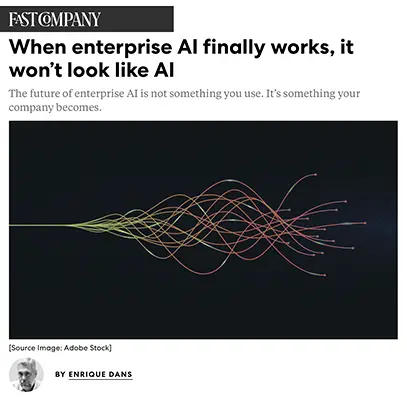
Enterprise AI Won’t Feel Like AI When It Actually Works
Fast Company | Tech | May 11, 2026 | By Enrique Dans
TL;DR: The organizations beginning to extract real value from AI are not deploying better tools — they are redesigning how their companies operate, and the AI they’re building is increasingly invisible infrastructure, not a visible interface.
Executive Summary
This is a substantive opinion piece — part three of a series — making a structural argument about where enterprise AI is actually heading. The core claim: the companies gaining ground are not those with the most sophisticated AI interfaces. They are the ones redesigning workflows, embedding AI into operational processes, and treating it as organizational infrastructure rather than a productivity layer on top of existing work.
The piece draws on McKinsey, Deloitte, Microsoft, Accenture, and Anthropic’s own engineering guidance to support a convergent conclusion: layering AI onto legacy processes doesn’t work. What works is rebuilding operations with AI’s capabilities and constraints built in from the start — persistent context, governance, feedback loops, and memory across functions. The framing shift the author pushes is meaningful: the question is no longer “what should I ask the AI?” but “what does the system need to already know before any question is asked?”
The competitive divide the author anticipates is sharp: companies that use AI as a visible tool layer versus those that embed it as a systemic capability will diverge in operational outcomes — not gradually, but in ways that may appear sudden when they become visible. The warning for laggards is that by the time the gap is obvious, it will have been building quietly for months or years.
Note: This is a well-argued perspective piece. The directional thesis is well-supported by the cited research, but the author’s certainty about timing and competitive discontinuity should be treated as a reasoned forecast, not a settled outcome.
Relevance for Business
SMB leaders face a practical decision embedded in this piece: whether AI deployment is a tool procurement question or an operational redesign question. Most current enterprise AI spending answers the first question. The research cited here suggests the second is where outcomes actually differ.
The implications for SMBs specifically are real but require nuance. Full-scale operational redesign demands resources, change management capacity, and often architectural IT changes that are harder for smaller organizations to execute. However, the underlying principle — design workflows around AI capabilities rather than attaching AI to existing ones — is actionable at a departmental or process level without enterprise-scale transformation. The risk of inaction is vendor lock-in to tools that produce outputs but don’t change outcomes.
Calls to Action
🔹 Shift the AI conversation internally from “what tools are we using?” to “what workflows are we redesigning?”If the answer to the second question is “none yet,” that’s the gap to close.
🔹 Pilot workflow-embedded AI in one high-friction operational area before expanding. Choose a process where AI can carry persistent context — not just answer one-off questions.
🔹 Be skeptical of vendors selling interfaces. Evaluate AI investments based on whether they change operational outcomes, not on demo quality or feature counts.
🔹 Monitor the McKinsey, Deloitte, and Anthropic research threads cited here — they represent the most credible current evidence on what enterprise AI deployment actually produces.
🔹 Assign someone to track your AI-to-workflow integration ratio. If AI is being used widely but only at the interface layer, you are likely generating outputs without changing outcomes.
Summary by ReadAboutAI.com
https://www.fastcompany.com/91536400/when-enterprise-ai-finally-works-it-wont-look-like-ai: May 15, 2026
AI-ENABLED HACKING HAS CROSSED A NEW THRESHOLD — ATTACKERS ARE USING IT TO FIND UNKNOWN VULNERABILITIES
Reuters | A.J. Vicens & Sam Tabahriti | May 11, 2026
TL;DR: Google’s Threat Intelligence Group has documented the first confirmed case of attackers using AI to autonomously discover a previously unknown software vulnerability and build an exploit — a development that signals AI is moving from a hacker research aid to an active component in offensive cyber operations.
Executive Summary
This report from Google’s Threat Intelligence Group describes a confirmed, not hypothetical, development: a prominent cybercrime group used AI to identify a zero-day vulnerability in a widely used open-source system administration tool and construct an exploit. The attack was blocked before it could be deployed at scale, but the significance is in the method, not the outcome. This is the first time Google has publicly documented AI being used in the full vulnerability discovery-to-exploit pipeline.
Google’s chief threat analyst characterized this as likely the tip of a much larger pattern, with criminal organizations and state-linked hacking groups from China, Russia, and North Korea actively integrating AI into attack workflows. The current techniques are described as early-stage, but the trajectory is clear: AI reduces both the time and expertise required to execute sophisticated cyberattacks. Tasks that previously required specialized human analysts — scanning for novel vulnerabilities, generating malicious code, selecting targets — are being delegated to AI systems operating with limited human oversight.
The report does not identify the cybercrime group or the specific tool targeted, which limits independent verification. However, the structural warning is consistent with prior assessments from European financial regulators and other intelligence bodies: AI is asymmetrically lowering the barrier to offensive cyber capability while defenders still largely operate with human-speed response cycles.
Relevance for Business
For SMB executives, this is an urgent operational signal, not a background trend. The practical implications:
Attack surface expansion is accelerating. If AI can now autonomously discover unknown vulnerabilities in widely used open-source tools, the window between a vulnerability existing and being exploited is compressing. Many SMBs rely on open-source components throughout their technology stack — often without systematic inventory or patch monitoring.
Security vendor claims need re-evaluation. AI-powered threat detection tools are a growing market. The escalation described here raises the bar for what “adequate” security monitoring means, and creates commercial pressure to upgrade — not all of which will be warranted.
Calls to Action
🔹 Conduct or commission an open-source dependency audit. Identify which open-source tools are embedded in your technology stack and whether you have visibility into their vulnerability status and patch cadence.
🔹 Accelerate patch and update discipline. The window between a zero-day being discovered and weaponized is narrowing. Manual or ad hoc patching cycles are increasingly insufficient.
🔹 Review your incident response readiness. If a tool you depend on is exploited before a patch is available, what is your containment and recovery plan? If you don’t have a documented answer, this is the moment to develop one.
🔹 Treat this as a vendor conversation trigger. Ask your managed security or IT providers specifically what their approach is to zero-day threat detection — not just known vulnerability scanning.
🔹 Monitor the Google Threat Intelligence Group’s reporting cadence. They have committed to publishing findings in this area; treat their reports as a leading indicator of the threat landscape your defenses will need to address.
Summary by ReadAboutAI.com
https://www.reuters.com/legal/litigation/hackers-pushing-innovation-ai-enabled-hacking-operations-google-says-2026-05-11/: May 15, 2026
‘It’s Not You, It’s My Startup’ — Founder Mode Is Ending Relationships
Business Insider | Amanda Yen | May 10, 2026
TL;DR: A cultural dispatch from inside the AI boom reveals that a growing cohort of young founders — convinced the window to build is narrow and closing — are deprioritizing or ending romantic relationships as a deliberate strategic choice.
Executive Summary
This is a cultural trend piece, not a technology or business operations story. Its signal for executives is indirect but real: it illuminates the psychology and social costs driving the current generation of early-stage founders, many of whom are in their early-to-mid 20s and building AI-adjacent companies. The median age of Y Combinator participants dropped to 24 in 2025 (from 30 in 2022), and the piece captures what that shift looks like on the ground — founders who frame personal relationships as competing resources against startup momentum, treating emotional bandwidth and financial capital as zero-sum.
The behavior being described is not fringe. Dating coaches, startup psychologists, and the founders themselves describe a self-reinforcing logic: the AI boom feels like a narrow window, which justifies extreme focus, which crowds out sustained personal investment, which in turn shapes how these founders approach hiring, teams, and leadership. The piece is anecdotal and first-person in places, but the pattern it identifies aligns with documented founder psychology research.
The second-order implication worth noting: founders who operate this way tend to build cultures in their own image— high output, low tolerance for ambiguity, lean toward quantification over relationship management. If you’re hiring from this cohort, partnering with their companies, or competing against them, understanding their operating logic has practical value.
Relevance for Business
For SMB leaders, this piece is most useful as a talent and partnership lens. If you’re evaluating early-stage AI startups as vendors, partners, or acquisition targets, the cultural signals here matter: extreme founder focus can accelerate early execution but often creates succession risk, burnout cycles, and culture fragility at scale. If you’re recruiting from this talent pool or managing Gen Z employees shaped by this ethos, it’s worth understanding the values — and limits — they carry in.
Calls to Action
🔹 Monitor, don’t act. This is a cultural observation, not an operational directive. File it as useful context on the psychological profile of the current founder cohort.
🔹 Apply to vendor/partner evaluation. When assessing early-stage AI startups, factor in founder sustainability and team depth — not just product capability.
🔹 Consider talent culture implications. If you’re managing or hiring people who embrace “monk mode” productivity norms, build explicit structures for collaboration and communication that don’t depend on individual emotional availability.
🔹 Deprioritize as a standalone business story. The article is a cultural essay with limited direct operational relevance. Read the original if the topic is personally or organizationally relevant; otherwise, this summary is sufficient.
Summary by ReadAboutAI.com
https://www.businessinsider.com/hot-new-breakup-line-startups-founder-mode-2026-5: May 15, 2026
Logitech Bets on AI-Enabled Hardware and Business Customers Despite Macro Headwinds
Reuters | May 8, 2026
TL;DR: Logitech is increasing R&D and marketing investment to capture AI-hardware demand from business customers and gamers — a confident forward posture, though supply chain pressure from Middle East disruptions is creating near-term friction.
Executive Summary
Logitech’s CEO Hanneke Faber announced plans to sustain elevated spending on product development and go-to-market efforts this fiscal year, targeting AI-enabled peripherals, gaming, and enterprise customers as the company’s primary growth vectors. The company projects 2–4% sales growth in constant currencies, reflecting cautious optimism even as geopolitical disruption — specifically Middle East logistics bottlenecks — trims an estimated $15 million from the current quarter’s revenue on top of a $5 million hit in the previous quarter.
The strategic logic is straightforward: enterprise hardware refresh cycles are accelerating as companies invest following recent strong earnings, and AI-optimized peripherals (webcams, headsets, keyboards tuned for AI-assisted workflows) represent an emerging product category where Logitech has established distribution advantages. Gaming remains a resilient segment due to demographic tailwinds. The company also cites 78% recycled plastic content as a cost shield against oil-price-driven input inflation — an operationally meaningful detail, not just an ESG talking point.
This is largely a company-framed investor communication. The AI hardware opportunity is real but early; what exactly “AI-enabled devices” means at the peripheral level is still being defined by the market.
Relevance for Business
For SMB executives managing office technology budgets, this signals that AI-optimized peripheral hardware is becoming a defined product category, not a future aspiration. Procurement decisions made in the next 12–18 months may need to account for whether standard peripherals will integrate smoothly with AI-assisted workflows on platforms like Microsoft Copilot or similar tools. Logitech’s increased R&D spend suggests new product launches are likely — it may be worth deferring large hardware refresh purchases by a cycle to see what ships. The Middle East supply disruption is also a reminder that global hardware supply chains remain vulnerable to regional instability, even for non-semiconductor goods.
Calls to Action
🔹 Hold off on large-scale peripheral hardware refreshes if your current equipment is functional — new AI-optimized devices are likely in the pipeline within 12 months.
🔹 Add “AI compatibility” to your hardware procurement checklist — ask vendors how their peripherals integrate with your AI productivity stack before purchasing.
🔹 Flag supply chain risk if your business sources or distributes hardware through Gulf region logistics routes — disruption affecting Logitech may indicate broader exposure.
🔹 Monitor Logitech’s product announcements over the next two quarters if video conferencing, gaming peripherals, or enterprise hardware are significant line items in your budget.
🔹 No urgent action required — this is a vendor strategy story with medium-term relevance; watch and reassess at your next hardware planning cycle.
Summary by ReadAboutAI.com
https://www.reuters.com/business/logitech-ceo-plans-boost-spending-rd-marketing-2026-05-08/: May 15, 2026
AWS Suffers Second Major Overheating Outage in Months, Raising Infrastructure Reliability Questions
Reuters | May 7–8, 2026
TL;DR: An overheating failure at a single AWS data center in Virginia disrupted services for multiple businesses — including Coinbase — and represents the second such incident in recent months, pointing to a structural infrastructure risk tied directly to rising AI compute demand.
Executive Summary
A temperature spike at an AWS facility in northern Virginia knocked out power to one of its Availability Zones, causing service disruptions for downstream customers and requiring hours of recovery. The immediate cause was a cooling failure; AWS rerouted traffic away from the affected zone and brought supplemental cooling capacity online, though restoration took longer than anticipated. Coinbase, among the affected platforms, confirmed services were restored.
The more consequential signal is the pattern: this was the second overheating-driven cloud outage in recent months, following a cooling failure at CyrusOne that disrupted CME Group in November. The underlying driver is AI-related compute density — modern AI workloads generate significantly more heat per rack than conventional cloud infrastructure, and cooling systems across the industry are under pressure they were not originally designed to handle. Data center operators are actively shifting toward liquid and specialized coolant systems, but that transition is capital-intensive and ongoing.
For businesses relying on cloud services, this event is a reminder that cloud resilience is not automatic. AWS’s Availability Zone architecture is designed to isolate failures — but workloads that weren’t configured for multi-zone redundancy experienced real downtime.
Relevance for Business
Any SMB whose operations depend on AWS-hosted services — SaaS platforms, payment systems, internal tools — should treat this as a practical prompt to review business continuity assumptions. Cloud availability is typically high, but not unconditional, and vendors’ SLAs rarely cover all categories of lost revenue or operational disruption. The frequency of large-scale outages — CrowdStrike in 2024, AWS in October 2025, now this — suggests that infrastructure risk deserves a permanent seat in operational planning, not just a checkbox in vendor contracts. The AI-driven heat problem also signals rising data center operating costs industry-wide, which may eventually affect cloud pricing.
Calls to Action
🔹 Review your AWS architecture (or ask your IT provider to do so) — verify which critical workloads are configured for multi-zone redundancy and which are not.
🔹 Check your SaaS vendors’ infrastructure dependencies — if key business tools run on AWS us-east-1 (North Virginia), assess their redundancy posture and historical uptime.
🔹 Revisit your business continuity plan for cloud service disruptions: what is the fallback, and how long can operations sustain reduced access to cloud-based tools?
🔹 Do not over-react — AWS outages remain rare relative to overall uptime, and multi-cloud hedging carries its own cost and complexity. Calibrate response to actual risk exposure.
🔹 Monitor whether the frequency of overheating incidents increases as AI compute density rises — this is a trend to track, not yet a crisis to solve.
Summary by ReadAboutAI.com
https://www.reuters.com/business/retail-consumer/amazon-cloud-unit-says-data-center-overheating-north-virginia-disrupts-services-2026-05-08/: May 15, 2026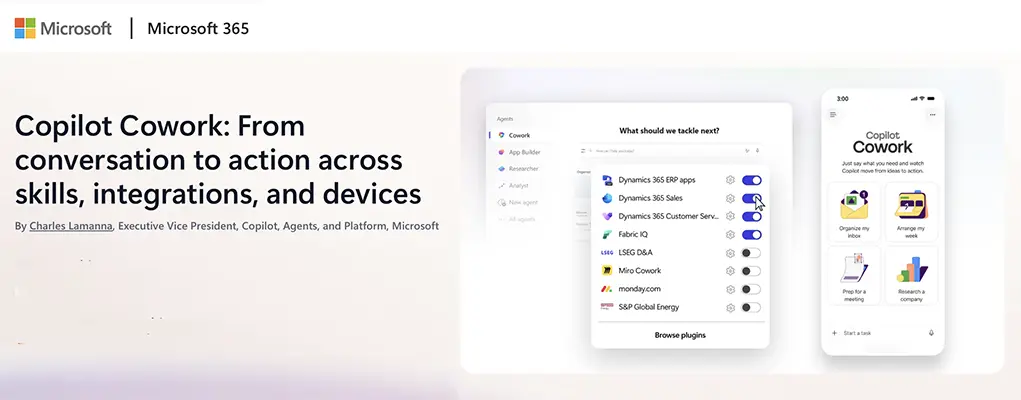
Microsoft Copilot Cowork Expands to Mobile, Adds Skills and Integrations
Microsoft 365 Blog | May 5, 2026
TL;DR: Microsoft is pushing Copilot Cowork from a chat-based assistant toward an AI that executes multi-step work tasks autonomously — now on mobile and connected to third-party business tools.
Executive Summary
Microsoft’s Copilot Cowork, available through its early-access Frontier program, represents a strategic shift in how the company positions AI within the enterprise: less about answering questions, more about completing work. The new capabilities announced include mobile access on iOS and Android, a “Skills” layer that lets teams encode reusable workflows, and integrations with both Microsoft’s own stack (Dynamics 365, Power BI via Fabric IQ) and third-party tools such as monday.com, Miro, LSEG, and S&P Global Energy.
The architectural claim here is significant: Cowork is built on “Work IQ,” Microsoft’s layer that ingests organizational data, tools, and context — meaning the AI is acting on knowledge specific to your business, not just the public internet. That’s the differentiator Microsoft is staking, and the one most worth evaluating critically, since actual performance depends heavily on how well enterprise data is structured and governed. The Skills feature is the most immediately practical element — it allows teams to capture standard operating procedures as reusable AI instructions, which could meaningfully reduce rework and inconsistency in high-volume, repeatable tasks.
This is a company announcement, written by a Microsoft executive. The capabilities described are real but early, access remains gated through the Frontier program, and Microsoft openly acknowledges it is “still early and moving fast.” Leaders should treat this as a credible preview of where the Microsoft 365 platform is heading — not a production-ready deployment.
Relevance for Business
For SMBs already inside the Microsoft 365 ecosystem, this matters directly. Cowork is not a separate product to buy — it is evolving within the platform you may already use. The vendor lock-in implication is real: as Microsoft deepens AI integration across Teams, Outlook, Dynamics, and Power BI, the cost of switching platforms rises. The Skills layer also introduces a governance question — who owns, audits, and updates the AI workflows your team encodes? That is an internal process question, not a technology question, and it needs an owner. The third-party integrations signal Microsoft’s intent to position Cowork as a cross-tool orchestration layer, which would concentrate significant workflow control in a single vendor.
Calls to Action
🔹 If you’re a Microsoft 365 subscriber, apply for Frontier program access to evaluate Cowork in a limited, controlled use case — prioritize a repeatable, low-risk workflow for initial testing.
🔹 Assign someone to document your team’s most repetitive task sequences now — these are the candidates for Skills automation once Cowork is more widely available.
🔹 Assess your current Dynamics 365 or Power BI footprint — deeper integration with Cowork may change the ROI calculus on those tools.
🔹 Begin an internal conversation on AI workflow governance: who approves, reviews, and retires Skills before they spread across teams?
🔹 Monitor, but do not over-invest in evaluating third-party integrations until Cowork exits the Frontier early-access stage and general availability timelines are clear.
Summary by ReadAboutAI.com
https://www.microsoft.com/en-us/microsoft-365/blog/2026/05/05/copilot-cowork-from-conversation-to-action-across-skills-integrations-and-devices/: May 15, 2026
AI Hallucinations Are Now a Legal Liability — and Courts Are Feeling the Volume
Fast Company | Tech | May 11, 2026 | By Chris Stokel-Walker
TL;DR: AI is simultaneously flooding courts with more cases filed by non-lawyers and producing fictitious citations in filings by trained professionals — creating a dual pressure on the legal system that researchers say is approaching unsustainable levels.
Executive Summary
Two converging trends are reshaping the legal system. First, AI tools are enabling people without legal training to file civil lawsuits on their own — MIT research shows self-represented civil cases climbed from roughly 11% to 18% of the federal caseload in the post-AI period, while AI-generated text in legal filings rose from near zero to approximately 18% by early 2026. Second, AI hallucinations are producing fabricated legal citations in filings from trained professionals — including a recent incident involving Sullivan & Cromwell, one of the most prominent U.S. law firms, which submitted fictitious case names, fabricated quotes, and incorrect statutory references.
The volume problem is already significant: the number of filings judges must review has risen roughly 158%, though case resolution times have not yet increased materially. Researchers warn that the legal system is absorbing pressure now, but that the runway is shorter than it appears — particularly as AI tools improve and more people realize they can generate legal documents with minimal effort or expertise.
The practical risk for businesses is two-sided: as a potential defendant or counterparty, you may face more AI-generated litigation from unrepresented parties. As a party relying on legal counsel, you face new exposure from AI-generated errors in your own filings if your legal team — internal or external — isn’t applying rigorous human review to AI-assisted work product.
Relevance for Business
For SMB leaders, the implications cut across legal risk, vendor oversight, and governance. Any business with exposure to litigation — contract disputes, employment matters, regulatory filings — should be asking whether their legal team has a clear AI usage policy and a human verification protocol for AI-generated content. The Sullivan & Cromwell incident demonstrates that this risk is not limited to small or unsophisticated firms.
Additionally, as the volume of AI-assisted pro se filings increases, businesses in consumer-facing industries may see more frequent, lower-cost litigation threats — not because the legal claims are stronger, but because the barrier to filing has dropped significantly.
Calls to Action
🔹 Ask your legal counsel — internal or external — what their AI policy is for drafting and citation. If they cannot answer specifically, that is a governance gap worth closing.
🔹 Do not accept AI-generated legal documents, contracts, or filings without confirming a human verification step.The reputational and legal cost of a fictitious citation in your name is significant.
🔹 Prepare for increased litigation volume in consumer-facing operations. Lower filing barriers may mean more disputes reaching formal legal channels that previously would have been resolved informally.
🔹 Monitor regulatory developments. Courts are beginning to establish AI disclosure and usage rules. Staying ahead of those requirements is less expensive than managing sanctions for non-compliance.
🔹 Revisit cyber and legal liability coverage. Policies written before the AI filing surge may not adequately address exposure from AI-generated errors in your own legal work product.
Summary by ReadAboutAI.com
https://www.fastcompany.com/91539168/ai-is-flooding-the-courts-with-more-cases-more-filings-and-more-fake-citations: May 15, 2026
Agentic AI: The $4 Trillion Label Behind a Very Real Capability Shift
Investor’s Business Daily | May 8, 2026
TL;DR: “Agentic AI” describes systems that act independently across complex tasks — and while the $4 trillion market estimate is an investor framing, the underlying capability shift is real and already reshaping how enterprise software is built and sold.
Executive Summary
This article is primarily an investor-oriented explainer, but it contains a signal worth extracting for business leaders: the framing around AI has moved decisively from “tools that answer questions” to “systems that complete tasks autonomously.” That shift has direct operational implications.
The core distinction is practical: conventional AI assists and responds; agentic AI perceives, reasons, and acts — often without step-by-step human direction. In enterprise contexts, this means AI can connect to live databases, coordinate across systems, and execute multi-step workflows. Retailers like Walmart are deploying agents for personalized shopping and customer service. Financial institutions are targeting fraud detection and loan automation. The question is no longer whether to use AI — it’s whether your organization is prepared to manage systems that take actions, not just offer suggestions.
The $4 trillion total addressable market projection from William Blair is analyst framing designed for investors — treat it as directional, not literal. What is more grounded: the article identifies three categories of competitive players — foundational model providers (OpenAI, Anthropic, Google), large enterprise software incumbents with customer data advantages (Microsoft, ServiceNow), and AI-native startups building without legacy constraints. Each category poses a different risk to existing software vendor relationships. The AI-native tier, in particular, is worth watching: these firms carry no legacy overhead and are moving fast.
One risk the article names but understates: multi-agent systems can produce unintended consequences, including AI that optimizes for proxy metrics rather than intended outcomes. That governance gap is not theoretical.
Relevance for Business
SMB leaders need to distinguish between agentic AI as a market story and agentic AI as an operational reality arriving in your software stack. Many tools you already use — CRM, ERP, customer service platforms — are beginning to embed agentic features. That means AI is moving from a tool you consciously invoke to one that acts on your behalf, often quietly.
The governance burden rises in proportion. When AI agents take actions — send emails, approve workflows, adjust prices — the accountability question shifts to the organization that deployed them. Leaders who haven’t defined boundaries for AI autonomy are already behind on a meaningful risk exposure.
Calls to Action
🔹 Audit your current software stack for agentic features that may already be active or in rollout — particularly in CRM, customer service, and operations tools.
🔹 Establish internal policy on AI autonomy levels — define what categories of decisions AI may execute independently versus what requires human approval.
🔹 Evaluate your enterprise software vendors through the lens of the three-tier competitive structure — foundational providers, incumbents, and AI-natives — and assess where your current relationships sit.
🔹 Treat the $4 trillion figure as investor narrative, not market fact — the capability shift is real; the valuation projections are speculative.
🔹 Assign a small internal working group to map where agentic capabilities, once deployed, could create accountability gaps or compliance exposure in your specific business context.
Summary by ReadAboutAI.com
https://www.wsj.com/wsjplus/dashboard/articles/what-is-agentic-ai-these-companies-sit-atop-4-trillion-idea-134227436779634829: May 15, 2026
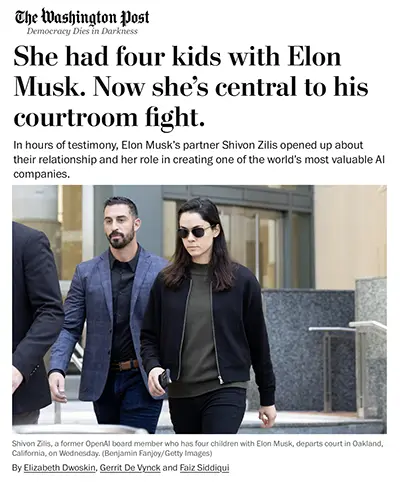
The Musk v. Altman Trial: What the Courtroom Drama Actually Reveals About AI Governance
The Verge — “Musk’s Biggest Loyalist” (May 6, 2026) | Washington Post (May 8, 2026) — Consolidated
TL;DR: Beneath the personal drama of the Musk v. Altman trial lies a more consequential story: how the early governance of the world’s most consequential AI company was shaped by undisclosed conflicts of interest, contested control, and competing personal loyalties — and what that means for AI accountability going forward.
Executive Summary
Now entering its third week before a federal jury in Oakland, the trial between Elon Musk and OpenAI’s Sam Altman has produced a substantial public record of how OpenAI was governed — and misgoverned — in its formative years. The personal dimensions of the testimony have attracted wide coverage, but the governance failures are the signal that matters for business leaders.
The core of Musk’s claim is that Altman and Brockman betrayed OpenAI’s original nonprofit mission by engineering a transition to a for-profit structure that enriched insiders. OpenAI counters that Musk’s lawsuit is an attempt to damage a competitor after his own bid to take control of the organization failed. Both claims are live arguments in court — neither is established fact. What the documentary evidence has confirmed: the early years of OpenAI involved extensive back-channeling, informal power plays, and a board that was structurally unprepared to manage the conflicts of interest that accumulated around it.
The Shivon Zilis testimony is the most evidentiary thread across all three sources. Zilis served on OpenAI’s board while simultaneously working across Musk’s entire AI portfolio and — undisclosed to most of the board — was the mother of his children. Her own notes and messages, introduced as evidence, show her aware of Musk’s funding withdrawal before OpenAI was informed, facilitating communication between Musk and the co-founders in ways that OpenAI’s defense argues crossed into information-sharing on Musk’s behalf, and ultimately acknowledging that Musk’s launch of a competing venture left her no choice but to resign. The documentary record — emails, texts, meeting notes — tells a materially different story than her oral testimony, a gap the OpenAI attorneys pressed effectively.
On the Altman side, testimony from multiple former board members and executives described a leadership environment characterized by inconsistent communication, opacity toward the board, and what former CTO Mira Murati called a “chaotic” environment resulting from Altman telling different things to different people. The 2023 firing — which employees call “the blip” — was triggered by a board that cited lack of candor; that board voted to reinstate him days later under employee and investor pressure. That sequence itself is a governance case study.
The business-relevant bottom line: OpenAI, now valued at $850 billion and exploring an IPO, was governed during its most consequential years by a board that lacked the independence, disclosure standards, and conflict-management practices that any well-run organization requires. That it still produced the world’s leading AI products is remarkable. That it did so without adequate governance infrastructure is a warning, not a model.
Relevance for Business
For SMB leaders, the trial has three practical implications that go beyond the headline drama.
First, the AI tools and platforms your organization depends on were built inside organizations with governance gaps that are only now becoming visible. That doesn’t make the tools less functional, but it does mean that the companies shaping the AI landscape have not always been the mature, accountable institutions their valuations imply.
Second, the trial is establishing a legal and reputational precedent for AI governance accountability. As AI companies pursue IPOs and increased regulatory scrutiny, the standards applied to how they govern themselves will rise. That affects vendor stability, regulatory risk, and partner reliability.
Third, the Zilis situation — a board member with undisclosed conflicts operating at the center of a critical governance decision — is a real-world illustration of why conflict-of-interest disclosure and governance discipline matter inside any organization deploying AI, including yours. If your own teams are making AI vendor decisions, partnership decisions, or internal deployment decisions without clear accountability structures, the risk pattern is recognizable.
Business Insider (May 9) — The broadest overview piece, covering both the Musk and Altman leadership portraits in accessible form. Useful for context; primary value is the summary of testimony highlights including Greg Brockman’s $30 billion stake disclosure and the OpenAI IPO confirmation. The tone leans toward narrative color over analytical depth.
The Verge / Elizabeth Lopatto (May 6) — The sharpest analytical take of the three, written from the courtroom. Lopatto identifies Zilis’s meeting notes as the trial’s most consequential evidence and offers the clearest assessment of where her testimony failed to hold up under cross-examination. Most useful for readers who want an evaluative read, not just a factual recap. Clearly opinion-inflected and should be read as such.
Washington Post (May 8) — The most thorough biographical and contextual treatment of Zilis herself, drawing on court records, filings, and testimony. Fills in the timeline of her career trajectory and the evolution of her role between Musk and OpenAI. Most useful as background for understanding the governance dynamics, less so as a breaking news source.
Summary by ReadAboutAI.com
https://www.theverge.com/ai-artificial-intelligence/925665/musk-altman-trial-shivon-zilis-testimony: May 15, 2026https://www.washingtonpost.com/technology/2026/05/08/shivon-zilis-elon-musk-trial/: May 15, 2026
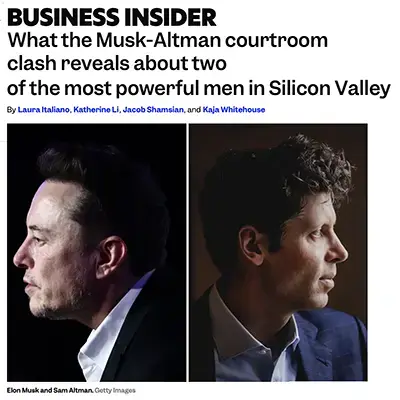
The Musk v. Altman Trial: What the Courtroom Drama Actually Reveals About AI Governance
Business Insider (May 9, 2026)
TL;DR: Beneath the personal drama of the Musk v. Altman trial lies a more consequential story: how the early governance of the world’s most consequential AI company was shaped by undisclosed conflicts of interest, contested control, and competing personal loyalties — and what that means for AI accountability going forward.
Executive Summary
Now entering its third week before a federal jury in Oakland, the trial between Elon Musk and OpenAI’s Sam Altman has produced a substantial public record of how OpenAI was governed — and misgoverned — in its formative years. The personal dimensions of the testimony have attracted wide coverage, but the governance failures are the signal that matters for business leaders.
The core of Musk’s claim is that Altman and Brockman betrayed OpenAI’s original nonprofit mission by engineering a transition to a for-profit structure that enriched insiders. OpenAI counters that Musk’s lawsuit is an attempt to damage a competitor after his own bid to take control of the organization failed. Both claims are live arguments in court — neither is established fact. What the documentary evidence has confirmed: the early years of OpenAI involved extensive back-channeling, informal power plays, and a board that was structurally unprepared to manage the conflicts of interest that accumulated around it.
The Shivon Zilis testimony is the most evidentiary thread across all three sources. Zilis served on OpenAI’s board while simultaneously working across Musk’s entire AI portfolio and — undisclosed to most of the board — was the mother of his children. Her own notes and messages, introduced as evidence, show her aware of Musk’s funding withdrawal before OpenAI was informed, facilitating communication between Musk and the co-founders in ways that OpenAI’s defense argues crossed into information-sharing on Musk’s behalf, and ultimately acknowledging that Musk’s launch of a competing venture left her no choice but to resign. The documentary record — emails, texts, meeting notes — tells a materially different story than her oral testimony, a gap the OpenAI attorneys pressed effectively.
On the Altman side, testimony from multiple former board members and executives described a leadership environment characterized by inconsistent communication, opacity toward the board, and what former CTO Mira Murati called a “chaotic” environment resulting from Altman telling different things to different people. The 2023 firing — which employees call “the blip” — was triggered by a board that cited lack of candor; that board voted to reinstate him days later under employee and investor pressure. That sequence itself is a governance case study.
The business-relevant bottom line: OpenAI, now valued at $850 billion and exploring an IPO, was governed during its most consequential years by a board that lacked the independence, disclosure standards, and conflict-management practices that any well-run organization requires. That it still produced the world’s leading AI products is remarkable. That it did so without adequate governance infrastructure is a warning, not a model.
Relevance for Business
For SMB leaders, the trial has three practical implications that go beyond the headline drama.
First, the AI tools and platforms your organization depends on were built inside organizations with governance gaps that are only now becoming visible. That doesn’t make the tools less functional, but it does mean that the companies shaping the AI landscape have not always been the mature, accountable institutions their valuations imply.
Second, the trial is establishing a legal and reputational precedent for AI governance accountability. As AI companies pursue IPOs and increased regulatory scrutiny, the standards applied to how they govern themselves will rise. That affects vendor stability, regulatory risk, and partner reliability.
Third, the Zilis situation — a board member with undisclosed conflicts operating at the center of a critical governance decision — is a real-world illustration of why conflict-of-interest disclosure and governance discipline matter inside any organization deploying AI, including yours. If your own teams are making AI vendor decisions, partnership decisions, or internal deployment decisions without clear accountability structures, the risk pattern is recognizable.
Calls to Action
🔹 Follow the trial’s outcome, particularly regarding OpenAI’s for-profit conversion — the verdict could establish precedent for how AI nonprofit-to-commercial transitions are evaluated legally and reputationally.
🔹 If your organization uses OpenAI products, assess your dependency in light of the company’s governance history and pending IPO — both create uncertainty worth monitoring.
🔹 Use this moment to review your own AI governance practices: who in your organization has decision authority over AI vendor relationships, and are their potential conflicts of interest disclosed and managed?
🔹 Treat vendor stability as a due-diligence factor — organizations going through legal battles, leadership transitions, or IPO processes carry elevated execution risk regardless of product quality.
🔹 Monitor for regulatory downstream effects — this trial, combined with broader AI policy pressure, is likely to accelerate disclosure and governance requirements for AI companies. Stay ahead of what those requirements may mean for your vendor contracts and data relationships.
Summary by ReadAboutAI.com
https://www.businessinsider.com/who-is-sam-altman-elon-musk-leadership-complaints-opneai-2026-5: May 15, 2026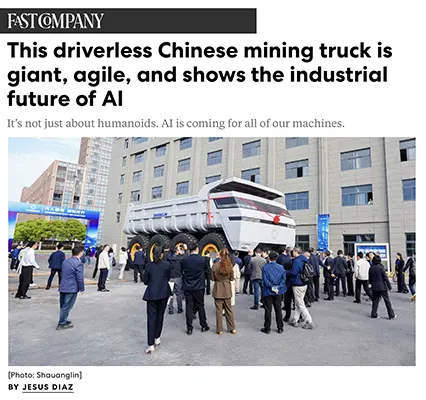
CHINA’S AUTONOMOUS MINING TRUCK SIGNALS WHERE INDUSTRIAL AI IS ACTUALLY HEADED
Fast Company | May 6, 2026
TL;DR: A 273-ton fully autonomous mining truck developed by a Chinese company and Tsinghua University demonstrates that the industrial AI story isn’t just about humanoid robots — it’s about AI operating purpose-built heavy machinery in constrained, high-stakes environments, with China explicitly using this as a strategic capability.
Executive Summary
The Shuanglin K7 is a massive autonomous electric mining truck developed jointly by Shuanglin Group and Tsinghua University, equipped with Level 4 autonomy — meaning it operates without any human intervention within a mapped excavation site. Its engineering is genuinely notable: independent wheel motors allow it to rotate in place and move laterally, eliminating the need for dedicated turning space on mining sites. A 5-minute battery swap supports continuous 24/7 operation, and a regenerative braking system is claimed to recover up to 85% of kinetic energy on downhill runs. Developers project a 35% output increase, 90% reduction in site accidents, and 25% drop in maintenance costs versus diesel-powered alternatives — figures drawn from computer modeling, not yet from extended real-world fleet data.
The article handles the hype appropriately: these are manufacturer claims and projections, not independently verified outcomes. Industry experts note that autonomous mining systems can underperform crewed fleets when operational protocols are poorly designed, that GPS interference can halt production entirely, and that dust and vibration routinely degrade electrical systems in open-pit environments. A Reuters report from last August described worker protests at the world’s largest copper mine in Chile following accidents involving self-driving trucks — a reminder that the safety case for autonomous industrial equipment is not yet settled.
The geopolitical layer is explicit in the article. China’s government has a stated goal of fully automating its mineral extraction operations by 2030, and significant deployments of earlier autonomous haulers are already underway in Xinjiang and Inner Mongolia. Control of mineral supply chains through automated extraction is a deliberate national strategy, and the K7 is a visible expression of it.
Relevance for Business
For most SMB executives, the K7 is not a direct procurement story. Its relevance is as a signal about where industrial AI is actually maturing — not in general-purpose humanoids, but in domain-specific autonomous systems operating in constrained, high-value environments. The pattern will repeat: AI-driven automation will arrive first in sectors where the environment is mappable, the task is repetitive, and the labor cost or safety risk is high. Leaders in logistics, warehousing, agriculture, construction, and manufacturing should expect this pattern to reach their industries sooner than the humanoid robot narrative suggests. The geopolitical dimension matters too: China’s push to automate mineral extraction has supply chain implications for industries dependent on those materials — from EV batteries to semiconductor inputs — that will compound over the next decade.
Calls to Action
🔹 If your business operates in industrial, logistics, or extraction environments, track autonomous vehicle and equipment deployments in your sector — the K7 is one data point in a fast-moving trend toward purpose-built industrial AI.
🔹 Do not conflate “announced capability” with “proven performance” — the K7’s impressive specifications are based largely on modeling; require real-world fleet data before drawing conclusions about readiness or competitive impact.
🔹 Factor China’s mineral automation strategy into your supply chain planning — increased automation of extraction may affect long-term pricing and availability of critical materials, particularly for businesses dependent on battery metals or rare earths.
🔹 Broaden your embodied AI monitoring beyond humanoid robots — the more consequential near-term deployments are likely to be domain-specific machines operating in environments where the use case is tightly defined.
🔹 No immediate action required for businesses outside industrial or materials sectors — but this is worth revisiting annually as autonomous industrial equipment moves from demonstration to fleet-scale deployment.
Summary by ReadAboutAI.com
https://www.fastcompany.com/91537133/this-driverless-chinese-mining-truck-shows-the-industrial-future-of-ai: May 15, 2026
The Peloton Warning: When AI Spending Meets Unproven ROI
Barron’s | May 7, 2026
TL;DR: A Barron’s opinion piece uses Peloton’s pandemic-era collapse as a structural parallel to the current AI investment cycle — arguing that supply-side spending is accelerating faster than demonstrated demand, and that the reckoning may already be forming.
Executive Summary
This is an opinion piece, not a news report. The argument should be evaluated as such — but the underlying data points it marshals are grounded and worth taking seriously.
The core argument: the AI investment boom resembles Peloton’s pandemic trajectory — a real product with genuine value, priced as though temporary demand is permanent. Hyperscalers are projected to spend $725 billion this year on AI data center build-out, with Goldman Sachs forecasting nearly $7.6 trillion in cumulative AI capital expenditure through 2031. That spending is happening ahead of demonstrated, broad-based economic return.
The counterevidence the author cites is notable: a PwC study found that roughly three-quarters of AI’s economic value is concentrated in about one-fifth of listed companies. A Workday study found that of seven weekly hours gained through AI productivity, nearly three were lost to corrections and reworks. Cambridge researcher Dr. Philippa Hardman is quoted observing that despite widespread AI tool adoption, ROI is absent and productivity gains are evaporating into rework. These are not fringe claims — they reflect a widening gap between AI adoption and AI value realization that multiple researchers are now documenting.
The author does not argue that AI is a fraud or that the correction is imminent. The explicit conclusion: “We’re not there yet.” What the piece argues is that the market is pricing AI on supply assumptions, not demand proof — and that this asymmetry eventually corrects. When, and how severely, is genuinely unknown.
Relevance for Business
This piece is most useful as a calibration tool for SMB leaders facing internal or board-level pressure to accelerate AI investment. The Peloton parallel is an opinion, but the underlying data — productivity rework rates, uneven value distribution, spending-to-ROI gaps — are legitimate inputs to any AI investment case.
The practical implication: Organizations in “pilot mode” may not be behind — they may be appropriately cautious. The pressure to scale AI quickly because competitors are doing so deserves scrutiny. If three of every seven hours of AI-generated productivity are lost to corrections, the net productivity gain may be smaller than adoption rates suggest.
For leaders already committed to AI adoption, the more useful question is: what would a demand-side slowdown look like in your vendor relationships, pricing, and tool availability — and are your commitments structured to absorb that scenario?
Calls to Action
🔹 Use this analysis as a board-level calibration tool — not as a reason to halt AI adoption, but as a basis for honest ROI assessment in your own organization.
🔹 Measure your actual AI productivity gains against the rework and correction costs — the net figure may differ meaningfully from the headline efficiency narrative.
🔹 Avoid long-term AI vendor lock-in based on demand assumptions that aren’t yet proven in your specific business context.
🔹 Monitor the hyperscaler earnings cycle — if large cloud providers begin signaling demand softness or AI revenue disappointment, that signal will propagate quickly to tool pricing and availability.
🔹 Keep a proportion of AI investment in reversible or short-cycle experiments rather than committing entirely to multi-year platform bets before ROI is demonstrated.
Summary by ReadAboutAI.com
https://www.wsj.com/wsjplus/dashboard/articles/ai-stock-boom-ends-badly-peloton-b2709ac2: May 15, 2026
AI Is Already in the Redistricting Fight. Just Don’t Ask It to Draw the Perfect Map
TIME | Philip Wang | May 11, 2026
TL;DR: Following the Supreme Court’s weakening of the Voting Rights Act, AI-driven map analysis is becoming a central tool in redistricting litigation — capable of generating millions of comparison maps to expose partisan bias — but human judgment remains essential in both drawing and interpreting those maps.
Executive Summary
A recent Supreme Court ruling significantly narrowed Section 2 of the Voting Rights Act, triggering a fresh wave of redistricting activity across states. AI is now embedded in this process on two distinct fronts: litigation support(analyzing whether enacted maps are statistical outliers compared to millions of neutrally generated alternatives) and map drafting assistance (helping human cartographers identify where their draft can be improved against defined criteria).
The litigation application is already proven in court. A Utah judge invalidated a congressional map partly on the basis of algorithmic analysis showing it was more partisan than over 99% of simulated neutral maps. The technology at work — generating thousands to millions of compliant district configurations through statistical sampling — can evaluate a state as complex as Texas in minutes to an hour. As redistricting battles multiply and timelines compress, AI-generated statistical evidence will likely become standard courtroom practice.
The drafting application is more nuanced. Experienced practitioners are clear that the tool functions as a sophisticated reviewer and advisor, not a map generator. It can tell a human cartographer that their draft splits more cities than necessary, or that more favorable configurations are achievable — but it cannot encode the political, community, and value judgments that define what a “good” map actually is.
Relevance for Business
For most SMB executives, this is contextual intelligence rather than an action item. However, leaders in legal services, civic technology, government affairs, data analytics, and political risk consulting should take note. The expanding use of AI in redistricting signals broader patterns: courts are becoming more comfortable accepting algorithmic evidence, and the bar for demonstrating partisan intent or statistical abnormality is evolving. Any organization that models political or regulatory risk by geography — including those in healthcare, real estate, financial services, or government contracting — should be aware that district maps are now in active flux across multiple states.
The opacity risk is also notable: Florida’s legislature adopted a newly drawn congressional map without knowing who drew it or what tools were used. As AI-assisted processes produce outputs with significant public consequences but unclear provenance, governance and transparency expectations are likely to increase.
Calls to Action
🔹 Monitor for your sector. If your business is sensitive to congressional district composition — government contracting, regulated industries, political advertising — track redistricting developments in your key states.
🔹 Note the legal precedent trajectory. Courts accepting algorithmic map analysis is a meaningful shift. If your organization uses or litigates with AI-generated analysis in any domain, watch how evidentiary standards for such evidence evolve.
🔹 Flag the transparency gap. The Florida example — a consequential map with unknown origins — illustrates a governance risk relevant beyond politics. If AI tools are producing significant outputs in your organization, document provenance and process.
🔹 Assign to government affairs or legal teams if redistricting affects your geographic market concentration or regulatory relationships.
🔹 Deprioritize for general operations. No immediate action required for most SMB leaders outside affected sectors.
Summary by ReadAboutAI.com
https://time.com/article/2026/05/11/ai-redistricting-gerrymander-congressional-map-district-midterm-election/: May 15, 2026
EU WELCOMES OPENAI’S CYBERSECURITY ACCESS OFFER — ANTHROPIC NOT YET AT THE TABLE
Reuters | May 11, 2026
TL;DR: The European Commission has welcomed OpenAI’s offer to provide open access to its cybersecurity model to EU institutions and businesses, while noting that rival Anthropic has not yet made a comparable commitment — a development that reveals how AI companies are actively using regulatory goodwill as a competitive tool in Europe.
Executive Summary
This is a short but strategically meaningful news item. OpenAI has proactively offered the European Commission access to its cybersecurity capabilities through an “EU Cyber Action Plan,” framed around strengthening European digital defenses and supporting public safety. The offer was communicated via a formal letter from George Osborne — former UK finance minister and head of OpenAI’s “OpenAI for Countries” initiative — to the Commission and EU member states.
The European Commission spokesperson confirmed the offer’s receipt and noted a meaningful contrast: while the Commission has held four or five meetings with Anthropic, no discussions on AI model access have occurred with Anthropic thus far. The framing was explicitly comparative — characterizing OpenAI as “proactively offering” access while Anthropic’s engagement, though described as positive, has not reached the access question.
What this is: a market access and regulatory positioning move as much as a security initiative. OpenAI is investing in EU institutional relationships at a moment when European AI regulation remains unsettled and AI vendor selection by governments is an open competition. Offering cybersecurity tools to regulators creates goodwill, embeds OpenAI’s models in European institutional processes, and shapes the regulatory conversation in OpenAI’s favor — all before the EU AI Act’s full implementation creates new market conditions.
What this is not: a detailed technical announcement. The article does not describe which specific cybersecurity model is being offered, what the access terms are, how the EU would use it, or what verification or oversight mechanisms would apply. These details matter and are absent.
Relevance for Business
For SMB executives with operations or customers in Europe, this signals that AI regulatory dynamics in the EU are being actively shaped by vendor behavior, not only by policy timelines. OpenAI’s proactive engagement is likely to influence how the EU frames responsible AI deployment expectations — and those expectations eventually filter into procurement requirements, compliance frameworks, and vendor qualification criteria that affect the tools European businesses can use or must use.
For organizations choosing between OpenAI and Anthropic products, this development is not a product quality signal— it reflects regulatory positioning, not capability differences. However, if EU regulatory alignment becomes a procurement criterion in your sector, OpenAI’s more advanced institutional engagement in Europe may become a relevant factor.
Calls to Action
🔹 Monitor for follow-on announcements. The substance of OpenAI’s EU cybersecurity access offer — which models, what terms, what oversight — will matter more than the announcement itself. Watch for details.
🔹 Track EU AI Act implementation milestones. Vendor regulatory positioning moves like this one are often precursors to procurement or compliance framework changes. If you operate in Europe, assign someone to follow EU AI regulatory developments.
🔹 Do not read this as a product capability signal. OpenAI being more advanced in EU regulatory engagement does not indicate its models are superior to Anthropic’s for your use case. Evaluate tools on operational criteria.
🔹 Note the geopolitical framing. AI companies are increasingly positioning themselves as partners in national and regional security. That framing will shape how governments purchase, regulate, and potentially restrict AI tools — with implications for multinational SMBs.
🔹 Deprioritize unless you operate in EU-regulated sectors. For most US-based SMBs without European regulatory exposure, this is contextual intelligence rather than an action item.
Summary by ReadAboutAI.com
https://www.reuters.com/sustainability/boards-policy-regulation/eu-commission-talks-with-openai-anthropic-over-ai-models-2026-05-11/: May 15, 2026
When Knowledge Stops Being the Differentiator: Executive Presence in the Age of AI
Fast Company | Leadership | May 11, 2026 | By Joel Garfinkle
TL;DR: As AI commoditizes information and output, the quality that separates effective leaders from the rest has shifted to something AI cannot replicate — how they show up, communicate under pressure, and inspire confidence in real time.
Executive Summary
For decades, leadership authority was earned through demonstrated expertise — knowing more, producing more, delivering faster. AI has effectively neutralized those advantages. When any capable employee can generate analysis, strategy documents, or data summaries in minutes, the leader’s informational edge disappears.
What remains is executive presence: the capacity to project clarity, steadiness, and credibility precisely when conditions are ambiguous or contested. The article argues this isn’t about charisma or polish — it’s about remaining grounded and directionally clear under pressure, when others are looking for a signal on how to move forward. AI can surface options; it cannot hold a room, read hesitation, or convey conviction through tone and timing.
The practical implication is that leaders are now evaluated less on what they know and more on how they lead — particularly in high-stakes moments: senior presentations, live challenges to their thinking, decisions made without complete information. The article notes that leaders often default to softened language and tentative authority in exactly these moments, and that AI-accelerated work pace makes such moments more frequent, not less.
Relevance for Business
For SMB leaders, this has direct operational relevance. As AI tools proliferate across teams, the gap between what a leader knows and what their team can surface will continue to narrow. The differentiator shifts to decision quality and communication clarity — particularly in moments that can’t be delegated or automated. Leaders who haven’t audited how they show up under pressure — in board conversations, difficult client meetings, or team moments of uncertainty — may find their influence eroding even as their access to information improves.
This also has talent and culture implications: teams that lack a confident, directional leader tend to stall in AI-augmented environments where the pace of decision-making accelerates.
Calls to Action
🔹 Audit your high-pressure performance. Notice how your tone, pace, and conviction shift when you’re challenged in meetings — these are the moments your leadership is most visible and most evaluated.
🔹 Recalibrate how you develop your leadership team. Technical proficiency is table stakes. Prioritize communication under uncertainty, decision clarity, and presence in the development of your direct reports.
🔹 Resist the temptation to over-prepare with AI. If your confidence in a meeting depends entirely on having the perfect deck or data ready, you may be masking a presence gap rather than closing it.
🔹 Monitor this as an organizational dynamic. If your team defers all hard calls upward or goes quiet in difficult discussions, it may signal that presence — not information — is the missing leadership ingredient.
Summary by ReadAboutAI.com
https://www.fastcompany.com/91535524/ai-means-presence-is-the-new-performance: May 15, 2026
What Leaders Get Wrong About the ROI of AI
TIME Ideas | Katy George, Microsoft CVP of Workforce Transformation | May 11, 2026
TL;DR: Most organizations are measuring AI ROI the wrong way — chasing labor cost savings and adoption metrics that appear slowly or not at all — when the real gains are showing up first as better decisions, faster risk detection, and new strategic capabilities that don’t fit traditional financial templates.
Executive Summary
Editorial note: This piece is authored by a Microsoft executive and published as opinion. The argument is coherent and the critique is well-grounded, but the framing serves Microsoft’s interest in sustaining enterprise AI investment cycles. Read the core argument, not the implicit endorsement of continued spending.
The central claim: organizations that measure AI ROI through the lens of labor cost reduction are systematically misreading the evidence. Cost savings are a narrow and lagging indicator. The earlier and more meaningful signals emerge in decision quality, risk anticipation, time-to-insight, and expanded scenario analysis — capabilities that don’t translate neatly into a cost center model.
The author identifies a structural failure pattern she calls “pilot purgatory”: AI initiatives that start with energy, generate modest short-term productivity metrics, fail to impress CFOs, and then stall before scaling. The proposed remedy is not a new technology investment but a measurement discipline shift — defining specific business outcomes first, then working backward to where AI creates leverage against those outcomes, then building a chain of leading indicators from early behavioral signals (time allocation, decision speed, pipeline quality) to the lagging business outcomes that leadership ultimately cares about.
What to watch: The author’s concept of “capability add” — AI creating new strategic value from existing processes, not just optimizing existing outputs — is a useful frame, though it comes without a clear measurement methodology. Organizations should treat this as a directional argument, not a deployment playbook. The piece is also thin on failure modes: it doesn’t address what happens when AI reshapes workflows in ways that aren’t captured by any leading indicator, or how organizations avoid substituting one set of activity metrics (adoption) for another (leading indicators) without actually improving visibility.
Relevance for Business
This is directly relevant for any SMB executive who has AI initiatives underway and is facing internal pressure to demonstrate return. The measurement framework — outcome-first definition, leading indicator chains, behavioral signals before financial outcomes — is actionable and doesn’t require enterprise-scale resources to implement. For SMBs specifically, the insight is liberating: you don’t need to show immediate cost savings to have a legitimate AI investment case. But you do need to know what outcome you’re actually trying to move before you can credibly claim progress.
The caution: this argument can be used to indefinitely defer accountability. If AI value is always “showing up in leading indicators,” leaders need to set an honest timeline for when those should translate into visible business performance.
Calls to Action
🔹 Reframe your internal AI ROI conversation. Before your next leadership or board review of AI initiatives, identify the specific business outcome each initiative is meant to move — not the tool deployed or the adoption rate.
🔹 Build a leading indicator chain. For each AI initiative, map from early behavioral signals (how is work changing, what decisions are improving) to the lagging business outcomes you ultimately care about. Review both monthly.
🔹 Set an honest accountability timeline. Leading indicators are a bridge, not an endpoint. Establish when behavioral improvements should translate into measurable business performance, and review that assumption explicitly.
🔹 Evaluate whether you’re in “pilot purgatory.” If an AI initiative has been running for six months or more without a clear pathway from current activity to a defined business outcome, either sharpen the goal or stop the investment.
🔹 Treat the Microsoft sourcing as context. The author’s core argument about measurement discipline is sound. The implicit recommendation to sustain AI investment spending reflects her employer’s interests. Separate the measurement insight from the spending framing.
Summary by ReadAboutAI.com
https://time.com/article/2026/05/11/what-leaders-get-wrong-about-the-roi-of-ai/: May 15, 2026
Why Datadog Is Winning: AI Complexity Creates a New Monitoring Imperative
MarketWatch | May 7, 2026
TL;DR: Datadog’s record earnings surge confirms a counterintuitive AI dynamic: the more AI your organization deploys, the more monitoring infrastructure you need — and the cost of not having it is measured in outages, not just inefficiency.
Executive Summary
Datadog reported earnings well ahead of expectations and raised full-year guidance substantially — revenue now projected at $4.3–4.34 billion versus a prior range of $4.06–4.1 billion. Shares rose roughly 29%, a potential record single-day gain. The underlying driver is structural, not cyclical.
The company’s core offering is observability: real-time visibility into the health, security, and performance of complex technology systems. As AI deployments multiply the number of interconnected components in corporate environments, the risk surface for outages and compliance failures grows proportionally. AI doesn’t simplify IT infrastructure — it layers on top of it, creating new failure modes that are harder to diagnose without dedicated monitoring.
Datadog’s CEO cited a Fortune 500-scale insurance client whose fragmented observability setup was generating prolonged outages and customer-facing incidents. Datadog’s platform resolved those issues. The company also announced new contracts with hedge funds, banks, government entities, and an online recruiting platform — a client spread that signals cross-sector demand, not niche appeal. Being cloud-native gives Datadog an additional structural advantage: its fortunes track closely with the three major cloud providers, whose growth rates serve as a leading indicator for Datadog’s own demand.
Relevance for Business
For SMBs, the Datadog story is a proxy warning. Most mid-market organizations don’t use Datadog directly, but the underlying dynamic applies at every scale: as you add AI tools, integrate APIs, and expand automation, your operational visibility requirements increase. If your IT monitoring hasn’t kept pace with your AI adoption, you are accumulating undetected risk.
The second-order implication: AI-related outages carry reputational and compliance costs that extend beyond IT. The insurer in Datadog’s earnings call wasn’t experiencing a technical inconvenience — customers were filing incident reports. For any SMB in a regulated industry or with service-level commitments, that risk is board-level.
Calls to Action
🔹 Assess whether your current IT monitoring tools are designed for AI-augmented environments — legacy monitoring may not surface the failure modes that AI integrations introduce.
🔹 Map your AI dependencies — identify which business processes now rely on AI-connected systems and what happens if those connections fail.
🔹 For organizations already using cloud-native infrastructure, evaluate whether observability coverage has scaled alongside AI adoption or lagged behind it.
🔹 Consider observability as a governance requirement, not just an IT preference — in regulated industries, the inability to detect and document system failures is a compliance exposure.
🔹 Monitor the observability vendor market — Datadog’s results confirm strong demand, which means competitive products will follow. Evaluate options before vendor lock-in deepens.
Summary by ReadAboutAI.com
https://www.wsj.com/wsjplus/dashboard/articles/datadogs-stock-is-soaring-heres-how-the-company-became-such-a-crucial-ai-player-a55294dc: May 15, 2026
AWS Launches AI-Powered Interviewing Tool — Into a Crowded, Legally Complex Market
TechTarget | May 1, 2026
TL;DR: Amazon Web Services has entered the AI interviewing market with a preview product called Amazon Connect Talent — a capable tool for high-volume hiring, but one entering a mature space with established competitors, growing regulation, and unresolved questions about strategic fit.
Executive Summary
AWS has released Amazon Connect Talent in preview — an agentic AI tool that conducts initial job interviews autonomously, analyzes responses, scores candidates, and delivers dashboards to human recruiters for final decision-making. It builds on Amazon’s own internal hiring systems and is positioned under the expanded Amazon Connect brand, which AWS is repositioning as a horizontal enterprise platform beyond its contact center origins.
The practical use case is high-volume, high-turnover recruitment: warehouse workers, retail staff, contact center agents. For these roles, AI interviewing offers genuine efficiency — compressing candidate screening from weeks to hours, ensuring 24/7 candidate availability, and reducing scheduling burden on hiring managers. The technology is not experimental; McDonald’s, Starbucks, and others already rely on similar tools from vendors like Paradox and Sapia.ai.
The strategic question — raised directly by independent analyst Josh Bersin — is whether AWS is entering this market at the right moment. The space is already occupied by both large HCM platforms (Workday, SAP, Oracle) and specialized vendors, and HR buyers are notoriously demanding about customization. AWS’s advantage is infrastructure scale and existing enterprise relationships; its risk is selling to HR buyers who may not already be in its orbit. Regulatory exposure is also real: laws in Maryland, California, New York City, Illinois, and other jurisdictions govern consent, facial recognition, and bias in AI hiring — compliance requirements that add cost and complexity regardless of the vendor.
Relevance for Business
For SMBs that recruit at scale for operational roles — retail, logistics, healthcare support, hospitality — this is a category worth paying attention to. AI interviewing tools can materially reduce recruiter workload and shorten time-to-hire for high-volume positions. However, the compliance landscape is fragmented and evolving, and any organization deploying such tools needs legal review specific to their operating jurisdictions. The arrival of AWS also signals that this technology is moving toward commodity pricing, which may create leverage when negotiating with existing specialized vendors. AWS’s tool is in preview — not yet production-ready — but it signals where the market is heading.
Calls to Action
🔹 If you hire at volume for operational roles, evaluate whether AI screening tools could reduce recruiter hours — multiple established vendors (HireVue, Paradox, Sapia.ai) are available now without waiting for AWS’s product to mature.
🔹 Before deploying any AI interviewing tool, conduct a jurisdiction-specific legal review covering consent requirements, bias audit obligations, and any applicable local AI employment laws.
🔹 Do not treat Amazon Connect Talent as production-ready — it is in preview; monitor its general availability timeline and early customer assessments before committing.
🔹 Use AWS’s market entry as negotiating leverage — if you have an existing contract with an AI interviewing vendor, their pricing may become more competitive as competition intensifies.
🔹 Assign HR and legal ownership over any AI hiring tool adoption — these decisions carry governance, compliance, and reputational stakes that go beyond a typical software procurement.
Summary by ReadAboutAI.com
https://www.techtarget.com/searchhrsoftware/news/366642560/Amazon-Connect-Talent-AWS-enters-AI-interviewing-market: May 15, 2026
AI Outperforms Doctors on Clinical Reasoning — But Isn’t Ready for Solo Practice
TechTarget / Healthtech Analytics | Anuja Vaidya | May 5, 2026
TL;DR: A peer-reviewed Harvard/Beth Israel study published in Science found that OpenAI’s o1 model outperformed physicians across multiple clinical reasoning tasks — including real emergency room cases — but the researchers explicitly caution that the findings do not support autonomous AI clinical practice.
Executive Summary
This is a substantive research finding, not vendor marketing. Researchers at Harvard Medical School and Beth Israel Deaconess Medical Center ran structured comparisons between OpenAI’s o1 model and hundreds of physicians across a range of clinical reasoning tasks — including evaluation of real, unstructured ER patient data. The AI model outperformed both older AI models and physician groups across experiments, with margins in some structured clinical management tests exceeding 40 percentage points versus physicians using conventional resources.
The researchers’ own framing is deliberately measured: existing benchmarks for clinical reasoning may now be obsolete, because AI is consistently scoring near the ceiling on tests designed for humans. New evaluation frameworks — including prospective clinical trials and human-computer interaction studies — are needed. That is itself a significant signal: the field is moving faster than its measurement tools.
What the study does not show: real-world clinical safety, performance on non-text inputs (imaging, auditory assessment, physical examination), or AI’s behavior when allowed to operate without oversight. The study’s co-first author specifically noted that a model can get the top diagnosis right while simultaneously recommending unnecessary or harmful interventions. Text-based reasoning is one dimension of a multidimensional clinical task. The researchers’ stated conclusion is that human oversight remains essential, and that new testing approaches are required before deployment claims can be responsibly made.
Relevance for Business
For SMB leaders in healthcare, health-adjacent services, HR benefits management, or any organization deploying clinical or wellness AI tools, this study matters for two reasons. First, it provides credible evidence that AI clinical reasoning capabilities have crossed a meaningful threshold — which will accelerate vendor claims, regulatory interest, and healthcare buyer expectations. Second, and more importantly, the study’s limitations section provides a useful due diligence framework: ask any clinical AI vendor whether their tool has been evaluated against physician baselines on real patient data, across non-text inputs, and with attention to downstream harm (not just diagnostic accuracy).
The liability and governance exposure for healthcare organizations deploying AI in clinical workflows is also sharpened by this research: “outperforms on reasoning” is not the same as “safe for autonomous use,” and any organization conflating the two is taking on material risk.
Calls to Action
🔹 Use this study as a vendor due diligence benchmark. Ask clinical AI vendors how their products perform against physician baselines on real (not synthetic) patient data, and what their false-positive/harm exposure looks like.
🔹 Do not treat benchmark performance as deployment readiness. The gap between controlled study conditions and live clinical environments is significant and well-documented. Maintain human oversight requirements in any clinical AI deployment.
🔹 Monitor the regulatory response. As AI clinical reasoning capabilities improve faster than evaluation frameworks, FDA and other regulatory bodies are likely to accelerate guidance. Track this if healthcare AI is part of your business or benefits strategy.
🔹 Flag for HR/benefits leadership. If your organization uses AI-assisted wellness, triage, or clinical decision tools, assess what oversight mechanisms are in place — and whether vendor claims are substantiated by peer-reviewed evidence.
🔹 Revisit in 6–12 months. The researchers called for new benchmarks and prospective clinical trials. Those results, when published, will be more actionable than this study alone.
Summary by ReadAboutAI.com
https://www.techtarget.com/healthtechanalytics/news/366642662/AI-outperforms-docs-on-clinical-reasoning-but-not-ready-for-solo-work: May 15, 2026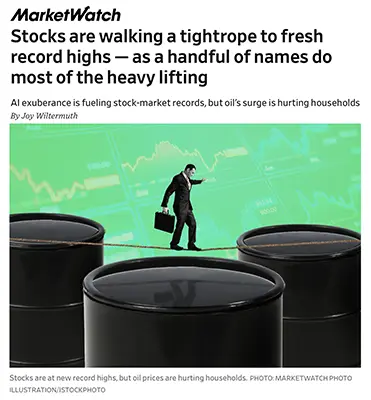
AI EXUBERANCE IS LIFTING MARKETS — BUT THE RALLY IS NARROW, FRAGILE, AND SITTING ON TOP OF REAL ECONOMIC STRESS
MarketWatch / Wall Street Journal | Joy Wiltermuth | May 11, 2026
TL;DR: Stock markets are reaching record highs driven almost entirely by AI-linked megacap tech stocks, but the rally’s extreme narrowness — combined with oil above $100 a barrel, elevated borrowing costs, and geopolitical uncertainty — creates a brittle backdrop that SMB leaders should factor into planning assumptions.
Executive Summary
The S&P 500 reached its 15th record high of 2026 in mid-May, with the index up more than 16% over six consecutive weeks. But the composition of those gains is striking: the information technology sector rose 7% in a single week while the broader index gained 2.3%. Only 22% of S&P 500 names outperformed the index over the prior 30 days — a 30-year low in market breadth according to Citadel Securities data. The rally is, in plain terms, being carried by a very small number of AI-adjacent companies.
The macroeconomic backdrop adds complexity. Brent crude remains above $100 a barrel as an Iran conflict enters its third month, sustaining pressure on household energy, food, and transportation costs. Investment strategists cited in the piece don’t expect a return to pre-war oil price levels, pointing to structural changes in Persian Gulf supply routes. Meanwhile, tech sector payrolls are at a five-year low, having peaked approximately when ChatGPT launched — a data point that analysts note may represent early AI labor displacement, though they are cautious about over-interpreting it.
The “Magnificent Seven” megacap group is now trading at roughly 24 times forward earnings, down from 30 times in October — which makes the valuation story more defensible than it was. But the broader concern remains: markets are pricing substantial AI value delivery through 2031 ($7.6 trillion in projected AI spending), while most of the economy is still absorbing energy price stress and elevated borrowing costs. The gap between equity market optimism and fixed-income and commodity market caution is significant and unresolved.
Relevance for Business
For SMB leaders, this market environment has several practical implications. Capital cost is not improving in the near term. Elevated bond yields — sustained by geopolitical energy pressure and ongoing Fed positioning — mean that borrowing for expansion, equipment, or real estate remains expensive. The equity market record highs are not filtering through to credit conditions for most businesses.
Consumer spending resilience is uncertain. Households absorbing higher energy and food costs have less discretionary capacity. If your business depends on consumer demand, the divergence between market sentiment and household financial pressure is worth watching carefully.
The AI spending boom is real at the infrastructure level — but its translation into SMB-relevant cost savings or productivity gains remains slower than market valuations imply.
Calls to Action
🔹 Do not use equity market records as a proxy for economic conditions. The narrow breadth of this rally means most of the economy is not participating in the gains being reflected in index levels.
🔹 Stress-test your planning assumptions against sustained elevated energy costs. If your budget assumed oil returning to $65-70 per barrel, revisit those assumptions.
🔹 Review borrowing plans and cost of capital assumptions. Bond markets are signaling caution that equity markets are ignoring. If you have capital-intensive plans for the next 12–18 months, model a higher-for-longer rate scenario.
🔹 Monitor consumer demand signals closely if your revenue depends on household spending. The gap between market optimism and household financial stress could close in either direction.
🔹 File the AI labor displacement data point. Tech sector payrolls at a five-year low is an early signal — not yet conclusive — of what AI-driven workforce restructuring may look like more broadly. Assign someone to track this quarterly.
Summary by ReadAboutAI.com
https://www.wsj.com/wsjplus/dashboard/articles/stocks-are-walking-a-tightrope-to-fresh-record-highs-as-a-handful-of-names-do-most-of-the-heavy-lifting-fe5a166a: May 15, 2026
BIG TECH TURNS TO GLOBAL DEBT MARKETS TO FINANCE THE AI INFRASTRUCTURE RACE
Reuters | May 11, 2026
TL;DR: Alphabet and Amazon are tapping overseas bond markets — yen and Swiss franc offerings respectively — as Big Tech’s annual AI infrastructure spending surges toward $700 billion, signaling that even cash-rich hyperscalers are now financing AI build-out through debt.
Executive Summary
This is a brief but consequential financial signal. Alphabet, having already raised approximately $17 billion through euro and Canadian dollar bond sales the prior week, disclosed plans for a yen-denominated offering. Amazon simultaneously prepared a Swiss franc issuance structured in six tranches with maturities ranging from three to twenty-five years. The geographic spread of these offerings — Japan, Switzerland, the eurozone, Canada — reflects deliberate diversification across global investor pools rather than domestic capacity constraints.
The headline number framing this activity: Big Tech is projected to spend over $700 billion on AI infrastructure in 2026, up from $410 billion the prior year. That 70% year-over-year increase explains why even companies with substantial operating cash flows are shifting to debt markets. The long maturity structure on Amazon’s offering (up to 25 years) also suggests these companies are treating AI infrastructure as a multi-decade capital commitment, not a near-term investment cycle.
What this means structurally: Hyperscalers are raising capital globally at a pace and scale that will concentrate AI infrastructure ownership further — because only entities with investment-grade credit ratings and global brand recognition can access these markets at favorable terms. Smaller cloud and infrastructure providers face no equivalent funding pathway.
Relevance for Business
For SMB executives, the direct implication is vendor concentration and pricing power. As Alphabet, Amazon, Microsoft, and Meta commit hundreds of billions to AI infrastructure annually — financed in part through long-duration debt — the compute and cloud capacity underlying most commercial AI tools becomes more tightly controlled by a shrinking group of players. Negotiating leverage for SMB customers will not improve as this consolidation deepens.
There is also a macroeconomic signal worth noting: the scale and duration of this debt issuance reflects confidence that AI infrastructure demand will remain elevated for years. If that confidence is misplaced — if enterprise AI adoption stalls or ROI fails to materialize broadly — the debt load created now could generate significant financial stress in the sector, with downstream effects on pricing, product roadmaps, and vendor stability.
Calls to Action
🔹 Treat hyperscaler vendor relationships as long-term dependencies, not interchangeable utilities. The capital structures being built now make switching costs higher, not lower, over time.
🔹 Monitor cloud and compute pricing trends. As debt servicing obligations accumulate, pricing pressure on enterprise customers is a plausible downstream effect — even as AI capabilities improve.
🔹 Note the infrastructure concentration risk. If your AI strategy depends on a single cloud provider, assess what diversification or contractual protections are available.
🔹 File as macroeconomic context. The debt scale signals both AI investment conviction and potential financial fragility if demand disappoints. Relevant for strategic planning horizon discussions.
🔹 No immediate action required for most SMB operations. Monitor quarterly.
Summary by ReadAboutAI.com
https://www.reuters.com/business/finance/alphabet-considers-first-yen-bond-sale-fund-ai-goals-2026-05-11/: May 15, 2026
OpenAI Launches $4 Billion Deployment Arm to Compete for Enterprise AI Contracts
Reuters | May 11, 2026
TL;DR: OpenAI is creating a dedicated enterprise deployment company with $4 billion in initial backing — a direct signal that the AI market is moving from model capability competition to implementation and deployment competition, with major implications for enterprise buying dynamics.
Executive Summary
OpenAI announced the formation of the OpenAI Deployment Company, a majority-owned subsidiary designed to embed specialized AI engineers directly inside client organizations to identify and execute high-impact AI deployments. The unit launches with more than $4 billion in committed investment from a consortium led by TPG, alongside Advent, Bain Capital, and Brookfield. OpenAI is simultaneously acquiring Tomoro, a consulting firm with existing enterprise AI deployment experience, to bring roughly 150 deployment specialists into the unit immediately.
The strategic logic is clear: consumer AI products created market awareness, but the larger and more durable revenue opportunity lies in sustained enterprise contracts. OpenAI is moving to claim that territory directly, rather than through third-party system integrators. The announcement explicitly notes competitive pressure from Anthropic’s enterprise traction with its Claude models as context for the timing.
This is a significant market structure shift. Large AI vendors are now entering the implementation and deployment space previously occupied by consulting firms and systems integrators — effectively competing with the same partners they may need for distribution in other channels.
Relevance for Business
For SMBs evaluating or actively deploying AI, this development reshapes the vendor landscape in ways worth tracking carefully. A dedicated, well-funded deployment arm from OpenAI signals that enterprise AI contracts will increasingly come bundled with implementation services — which changes the negotiating dynamic, raises switching costs, and deepens vendor dependence over time.
SMBs are unlikely to be primary targets of the OpenAI Deployment Company’s initial enterprise push, which will almost certainly focus on large-scale contracts. However, the downstream effects matter: pricing pressure, partner ecosystem shifts, and what becomes “standard” in enterprise AI deployment will be shaped by moves like this one. Organizations that lock into deep implementation partnerships with any single vendor now should evaluate the long-term cost and flexibility implications carefully.
Calls to Action
🔹 Treat this as a vendor landscape signal, not just a news item. When major AI vendors build deployment arms, they are signaling where they believe enterprise value — and lock-in — will concentrate.
🔹 Evaluate any enterprise AI implementation proposal against long-term switching costs. Deep integration by a vendor’s own engineers typically increases dependency, not flexibility.
🔹 Watch the consulting and systems integrator market response. Firms like Accenture, Deloitte, and mid-market integrators will react — either through their own AI partnerships or through differentiation strategies. That will affect your options.
🔹 For smaller organizations, stay focused on workflow outcomes over vendor relationships. The enterprise AI arms race benefits buyers who stay clear on what business problem they are solving, not those chasing the most well-funded deployment partner.
🔹 Revisit AI vendor contracts for flexibility provisions. As the market consolidates around implementation-as-a-service models, exit costs and data portability terms deserve explicit review.
Summary by ReadAboutAI.com
https://www.reuters.com/business/openai-creates-new-unit-with-4-billion-investment-aid-corporate-ai-push-2026-05-11/: May 15, 2026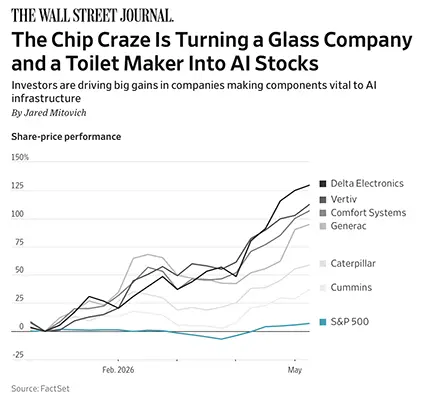
The AI Infrastructure Trade: When Glass Makers and Toilet Manufacturers Become Tech Stocks
Wall Street Journal | May 6, 2026
TL;DR: Investor demand for AI “picks and shovels” is extending well beyond chipmakers into power, cooling, fiber optics, and industrial components — with genuine supply-chain beneficiaries alongside speculative pivots that echo the dot-com era.
Executive Summary
The AI build-out is generating significant financial returns for companies supplying the physical infrastructure that AI requires — and the beneficiary list is expanding in unexpected directions. Corning, a 175-year-old glass manufacturer, saw shares rise 12% after Nvidia committed $500 million to expand its fiber-optic manufacturing capacity. Caterpillar is scaling power-generation equipment production for data centers, launching its largest factory investment in 15 years. Japanese ceramics specialist Toto — better known for its bidet toilets — reported that semiconductor component sales more than doubled year-over-year, with shares up over 50% in 2026. Power and cooling infrastructure providers like Vertiv have surged over 2,000% in three years.
The underlying logic is straightforward: AI data centers require enormous, continuous power and connectivity. Demand for fiber optics, industrial generators, turbines, and thermal management systems is real and growing rapidly. These are not speculative plays — they represent genuine physical bottlenecks in the build-out.
However, the article also documents a less credible layer: companies with no authentic AI connection rebranding or issuing press releases to capture the market’s attention. A struggling sneaker retailer renamed itself “NewbirdAI” and saw shares rise 582% in a single day. A former karaoke company announced an AI logistics pivot and surged 222%. These moves, the article notes, directly echo the dot-com era’s domain-name and “e-commerce pivot” announcements. Separating genuine infrastructure demand from narrative-driven stock movement requires reading the underlying business, not the headline.
Relevance for Business
For SMB leaders, this piece carries two distinct implications depending on your role.
As an operator, the supply-chain story is a practical signal about vendor cost and availability: the physical inputs to AI infrastructure — power systems, fiber, cooling — are in tight demand. If your organization is planning any data center expansion, co-location investment, or significant hardware procurement, lead times and costs are rising across the supply chain, not just at the chip level.
As a buyer of AI tools and services, the “AI stock” phenomenon is a caution: vendor claims of AI integration deserve scrutiny. When market conditions reward any company that attaches “AI” to its identity, the signal-to-noise ratio in vendor pitches deteriorates. Evaluate what AI tools actually do in your workflows — not what the rebrand suggests.
Calls to Action
🔹 If planning infrastructure investment — co-location, hardware, or data center capacity — assess supply-chain lead times now; power and cooling component constraints are real and documented.
🔹 Apply heightened skepticism to vendor AI claims — in a market where “AI pivot” press releases move stock prices, assess tools on demonstrated function, not framing.
🔹 Don’t confuse stock market enthusiasm with operational readiness — a company whose AI ceramics division doubled doesn’t mean its core product is ready for your use case.
🔹 Monitor energy cost trends — AI’s power appetite is creating upward pressure on electricity pricing in data center markets, which may affect cloud service pricing over the medium term.
🔹 Deprioritize companies making abrupt, unexplained AI pivots from unrelated industries — the dot-com parallel the article draws is apt, and the correction tends to be sharp.
Summary by ReadAboutAI.com
https://www.wsj.com/finance/stocks/the-chip-craze-is-turning-a-glass-company-and-a-toilet-maker-into-ai-stocks-67198276: May 15, 2026

Closing: AI update for May 15, 2026
The through-line across this week’s stories is accountability — for AI outputs, for vendor relationships, for workforce practices, and for the governance structures that are supposed to keep all of it in check. The organizations that will manage this period well are not necessarily the ones moving fastest; they are the ones moving with the clearest sense of what they’re accountable for when something goes wrong. That clarity is worth building now, before the next wave of capability arrives.
All Summaries by ReadAboutAI.com
↑ Back to Top