
AI Updates: October 30, 2026

This week the business press turned its attention from what AI can do to how it is being paid for. Anthropic’s public S-1 filing on October 26 gave reporters their first detailed look at the finances of a frontier AI lab, and within days the New York Times, the Wall Street Journal, the Economist, Barron’s, Bloomberg, Reuters, Business Insider and others had published their readings of it. With a Nasdaq listing planned under the ticker “ANT” and an investor roadshow that could begin as soon as November 9, the IPO has become the reference point for a much wider conversation about AI money. Part I collects 20 of those stories, more than half of them on the IPO itself, alongside reporting on the credit markets, supply chains and investor sentiment that will shape how it is received.
The filing is a study in contrasts. Revenue reached $16.3 billion in the first half of 2026, roughly 14 times the prior year. Against that, the Times tallies up to $807 billion in largely non-cancelable compute commitments, nearly half of sales flow through Amazon, Google and Microsoft cloud channels, and control stays with the cofounders and a company-created trust. Analysts reading the same document reached opposite conclusions: Barron’s sees proof of profitability in company-adjusted figures, while the Economist points to slowing growth and costlier compute. The financing around the IPO is tightening as well. Bloomberg reports double-digit yields on a growing share of data center debt, Pimco has cut its largest AI infrastructure positions roughly in half, and a $63 billion chip-lease deal for Anthropic closed only after Broadcom’s CEO stepped in personally. Suppliers are increasingly financing their own customers (Broadcom for Anthropic, Nvidia for Meta), and China’s AI-heavy STAR50 index has fallen about 40% since July, a reminder of how quickly sentiment can reverse.
Why should SMB leaders follow a listing priced in the trillions? Because the costs rarely stay with investors. AI demand has pushed flash storage prices up roughly fivefold in a year, and Apple has raised iPhone prices by an average of 13%. Data brokers are offering midsize companies up to $2 million for their internal records. AI vendors facing public-market scrutiny tend to protect margins through pricing, packaging and usage limits. As always, we separate disclosed figures from estimates and commentary, and we label the one opinion column in this set. Taken together, these stories work best as a vendor due-diligence briefing: know how your AI tools are financed, who stands between you and the model provider, and what measurable results you can show for what you spend.
Vendor-neutrality disclosure: Many stories in this post center on Anthropic. ReadAboutAI.com uses Anthropic’s Claude in its editorial production, including in preparing these summaries. We have no financial relationship with Anthropic, and its coverage is held to the same evidence standard as every other vendor’s.
Summaries: The Upcoming Anthropic IPO
Anthropic’s public S-1 filing on October 26 gave reporters their first detailed look at the finances of a frontier AI lab, and within days the New York Times, the Wall Street Journal, the Economist, Barron’s, Bloomberg, Reuters, Business Insider and others had published their readings of it. This first article is for context on how to imagine $1 Trillion.
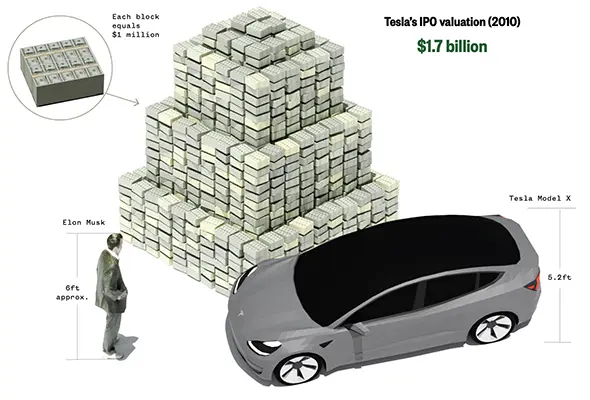
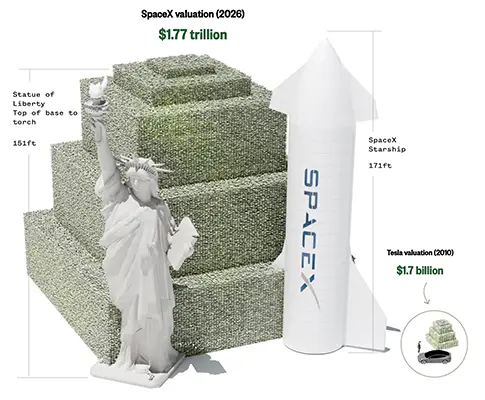
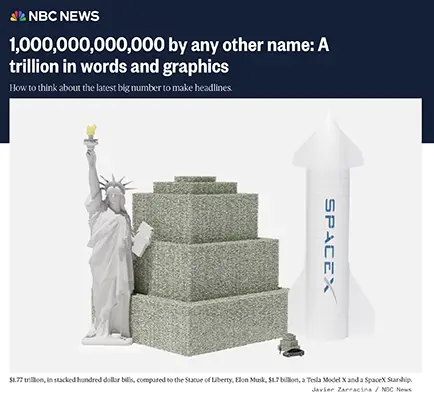
A TRILLION, VISUALIZED: WHAT SPACEX’S RECORD IPO SIGNALS AHEAD OF THE AI LISTINGS
Based on “1,000,000,000,000 by any other name: A trillion in words and graphics” | NBC News | Joelle Gross, Javier Zarracina, Jiachuan Wu, Ashley Mowreader and Joe Murphy | June 12, 2026
TL;DR / Key Takeaway: Trillion-dollar valuations are becoming the price tag for frontier AI, and because most people intuitively blur a billion and a trillion, leaders should translate these headlines into what they actually imply: revenue expectations so large that customers, including SMBs, will be asked to fund them.
EXECUTIVE SUMMARY
NBC News’ data-graphics team marked SpaceX’s June 12 market debut, which made Elon Musk the first trillionaire on paper, with a visual explainer on how big a trillion really is. The argument is about perception: people tend to treat a billion and a trillion as neighbors, when one is a thousand times the other. The piece uses time, stacked currency and purchasing power to close that gap; SpaceX’s $1.77 trillion offering valuation, for example, was nearly ten times the previous U.S. IPO record set by Alibaba in 2014. As mathematician John Allen Paulos told NBC, “we had no real reason to talk about such numbers” until recently.
The AI signal is a single line in the source, but it is the one that matters here: NBC noted that OpenAI and Anthropic were each valued near $900 billion, suggesting a trillion could become the norm. That has already proven conservative. Anthropic filed its public S-1 on October 26, with reports pointing to a listing as soon as November at a valuation of $1.5 to $2 trillion, up from a $965 billion private round in May. SpaceX is itself partly an AI story: it absorbed Musk’s xAI in an all-stock merger earlier this year.
One caution the graphics gloss over: valuation is not money. Stacks of $100 bills make a vivid image, but market capitalization is a price placed on expected future earnings, and it moves. SpaceX closed its first day near $2.1 trillion, then fell roughly 27% from its peak within days. Anthropic’s filing shows the gap between expectation and current economics: first-half 2026 revenue of $16.3 billion against a net loss of nearly $81 billion (it reported positive adjusted operating income). What is real: the scale of capital concentrating in a few AI firms. What is framing: “trillionaire” as a measure of wealth. What is uncertain: whether revenue grows into these prices.
RELEVANCE FOR BUSINESS
- Valuations are revenue forecasts with your name in them. A $1 to $2 trillion price implies a vendor must eventually earn many times today’s revenue, and much of that will come from business subscriptions, API usage and enterprise contracts. Expect pressure toward price increases, tiered packaging, usage-based billing and bundles designed to raise switching costs.
- Going public changes vendor behavior. Quarterly earnings expectations tend to pull attention toward higher-margin enterprise accounts; SMB tiers may be repriced or deprioritized. The upside is disclosure: S-1s and quarterly filings reveal risk factors, spending and dependencies that private vendors never had to share.
- Concentration risk is rising. Capital at this scale entrenches the few providers that control models, compute and distribution, which means less negotiating leverage and deeper dependency for smaller buyers.
- Stock volatility is a vendor-stability question, not only an investor one. Sharp swings can trigger reorganizations, cost-cutting and product retirements that reach customers.
- Timing: the next several months may bring Anthropic’s listing and, potentially, OpenAI’s. That makes this a sensible window to review AI contracts before renewals.
CALLS TO ACTION
🔹 Monitor: Anthropic’s IPO pricing and first results as a public company, plus OpenAI’s listing plans. Watch for pricing or packaging changes in the AI tools you already pay for, especially small-business tiers.
🔹 Assign internal review: Inventory which AI vendors your core workflows depend on, and check contracts for price-change notice periods, data-export rights and termination terms.
🔹 Test cautiously: Keep at least one workable alternative model or vendor for critical workflows, and build 12-month AI budget scenarios that include price increases.
🔹 Act now (low effort): Have someone skim the risk-factor section of Anthropic’s S-1. It is one of the most candid public looks at an AI vendor’s exposures and dependencies.
🔹 Ignore for now: Personal net-worth milestones. A trillionaire headline does not change any decision you need to make.
Vendor-neutrality disclosure: ReadAboutAI.com uses Anthropic’s Claude in its editorial production workflow. Anthropic is referenced here as market context only. Nothing in this summary is investment advice.
Editor’s note: The NBC source is dated June 12, 2026. Figures on Anthropic’s filing, valuation and financials were added from October 2026 reporting on its S-1 to bring the AI context current.
NBC News, “Visualizing a trillion: charts and graphics” (as Musk nears trillionaire status) June 12, 2026
How big is a trillion explainer:
- A stack of $100 bills worth $1 trillion would be about 679 miles high
- A trillion seconds ago was roughly 29,000 B.C.
- A trillion dollars would buy about 8,880 Boeing 737s, or match roughly 12 million years of a typical U.S. household’s income
The NBC News article is framed around Elon Musk and the SpaceX IPO, but it does mention AI valuations. One caution: it puts Anthropic’s valuation near $900 billion, which is now out of date next to this week’s talk of $1.5 trillion or more.
For everyday comparisons:
- One $100 bill is .11 mm thick (0.0043 inches).
- Stacked $100 bills: a stack worth $1,000 would be about 1 cm high (0.393 inches).
- Stacked $100 bills: a stack worth $1 billion would be about 5 meters tall (16.4 ft).
- Stacked $100 bills: a stack worth $1 trillion would be about 1,093 kilometers tall (679 miles).
- Spending a dollar a second: that takes 31 years for a billion and 31,000 years for a trillion.
Summary by ReadAboutAI.com
https://www.nbcnews.com/data-graphics/visualizing-trillion-charts-graphics-musk-nears-trillionaire-status-rcna349018: Anthropic IPO Articleshttps://frankumstein.com/PDF/What%20does%20one%20TRILLION%20dollars%20look%20like.pdf: Anthropic IPO Articles
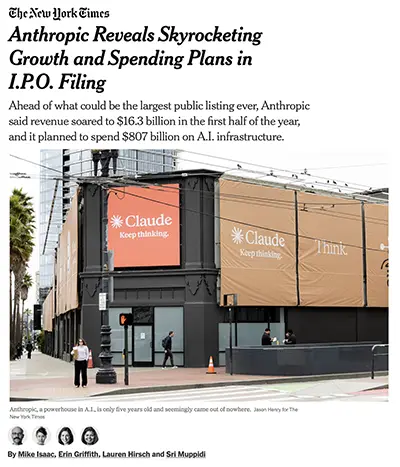
Anthropic Reveals Skyrocketing Growth and Spending Plans in I.P.O. Filing
The New York Times | Mike Isaac, Erin Griffith, Lauren Hirsch and Sri Muppidi | October 26, 2026
| TL;DR / Anthropic’s prospectus shows one of the fastest revenue ramps in corporate history, but it is paired with up to $807 billion in largely non-cancelable infrastructure commitments — making the IPO less a finish line than another funding round for a bet that demand keeps compounding. |
Executive Summary
The filing puts hard numbers on Anthropic for the first time: first-half 2026 revenue of $16.3 billion, roughly 14 times the prior year, driven mainly by businesses paying for Claude and its coding tools. The eye-catching $80.7 billion net loss is mostly a one-time $72.4 billion accounting charge tied to convertible notes; the operating loss was a far smaller $693 million. The more consequential figure is the Times’ own tally of up to $807 billion in data center, chip and compute contracts over ten years, many of which cannot be canceled. Anthropic warns that even an offering raising more than $100 billion may not be enough, and that it could need additional financing sooner than expected.
Two structural exposures stand out. Compute absorbed roughly half of operating expenses (nearly $9 billion in six months, more than all of last year), sourced from Amazon, Google, Microsoft, Nvidia and Broadcom — partners that are also investors, customers and, in some cases, competitors. The company itself flags the resulting conflicts of interest over access to compute. The prospectus is also unusually direct about catastrophic-risk scenarios and aboutpolitical and regulatory backlash linked to its pro-regulation stance. Share count and price are not yet set, and the third-quarter results Anthropic previewed privately to investors are not in the filing — so the near-$2 trillion valuation talk remains speculation until pricing.
Relevance for Business
For SMBs that buy Claude directly or through a cloud provider, this is a supplier risk document as much as an investment story. A vendor carrying hundreds of billions in fixed commitments needs usage to keep growing; public-market scrutiny will sharpen pressure on pricing, packaging and margins. Its dependence on the same hyperscalers that resell it also means your terms may increasingly be shaped by AWS, Google Cloud or Microsoft rather than by Anthropic alone. And the risk-factor section is a ready-made reference point for your own AI governance and vendor-risk reviews.
Calls to Action
🔹 Assign Internal Review: Map where your workflows depend on Claude — directly or through a cloud marketplace — and note renewal dates ahead of post-IPO pricing decisions.
🔹 Monitor: IPO pricing and Anthropic’s first public quarterly reports. Slowing growth against fixed compute commitments is the scenario most likely to change vendor pricing and terms.
🔹 Prepare Policy: Use the prospectus’s own risk disclosures (misuse, loss of control, regulatory exposure) as an input to your AI acceptable-use and vendor-risk policies.
🔹 Ignore for Now: The headline valuation. It matters to investors, not to your operating decisions.
| Vendor-neutrality disclosure: ReadAboutAI.com uses Anthropic’s Claude in its editorial production, including in preparing this summary. Coverage of Anthropic is held to the same evidence standard as all other vendors; readers should weigh it accordingly. |
Summary by ReadAboutAI.com
https://www.nytimes.com/2026/10/26/technology/anthropic-ipo-finances.html: Anthropic IPO Articles
Exclusive: Anthropic IPO Prospectus Lays Bare Deep Dependence on Big Tech Partners
Reuters | Echo Wang and Krystal Hu | September 29, 2026
| TL;DR / Nearly half of Anthropic’s sales run through Amazon and Google — companies that are also its investors, compute suppliers and rivals — and the filing shows that dependence growing, not shrinking, alongside a small number of very large customers who are not locked into long-term contracts. |
Executive Summary
Working from the confidential draft prospectus a month before the public filing, Reuters puts numbers on the channel story. 47% of Anthropic’s 2025 revenue (about $2.16 billion) flowed through Amazon and Google cloud marketplaces, up from 11% in 2023. Reuters estimates the platforms kept roughly 16 cents of every dollar sold that way. The two hyperscalers also collected 60% of Anthropic’s outstanding customer bills at year-end, so a billing dispute or delay upstream could hit its cash flow. Revenue is concentrated on the customer side too: two unnamed customers each provided 12% of 2025 revenue, and many large buyers can cut spending without long-term commitments.
Anthropic presents the partnerships as distribution reach no single company could build alone. It also concedes that partners gain visibility into its pricing and terms, which could shape how they allocate compute and how hard they sell Claude. One accounting point matters for every revenue figure in this coverage: Anthropic books the full value of marketplace sales as revenue and records the platforms’ cut as a marketing expense. OpenAI has argued this inflates Anthropic’s reported revenue by billions. Anthropic says the approach follows standard accounting rules. Treat this as a disputed framing question, not a finding of wrongdoing. Note also that these are 2025 figures from a draft filing; the later public S-1 updates them.
Relevance for Business
For SMBs, this is the clearest picture yet of who actually sits between you and your AI model provider. If you buy Claude through AWS or Google Cloud, your price, billing and support path run through a company with its own competing models and its own commercial interests. That is layered vendor dependence. It can bring convenience (consolidated billing, committed-spend credits), and it also adds exposure if relationships between the partners shift. Customer concentration also tells you something: the largest accounts shape a vendor’s roadmap and pricing, and SMBs are not among them.
Calls to Action
🔹 Assign Internal Review: Confirm whether your AI spend runs direct or through a cloud marketplace, and who you would call when billing, support or service-level terms break down.
🔹 Test Cautiously: Price the same AI usage both ways — direct and via your cloud provider. Marketplace fees and credits can change the real cost.
🔹 Monitor: Any change in Anthropic’s revenue-recognition approach or the gross-vs-net debate after the IPO. It affects how comparable vendor growth claims really are.
🔹 Revisit Later: Vendor concentration risk once Anthropic publishes its first public quarterly results.
| Vendor-neutrality disclosure: ReadAboutAI.com uses Anthropic’s Claude in its editorial production, including in preparing this summary. Coverage of Anthropic is held to the same evidence standard as all other vendors; readers should weigh it accordingly. |
Summary by ReadAboutAI.com
https://www.reuters.com/world/anthropic-ipo-prospectus-lays-bare-deep-dependence-big-tech-partners-2026-09-29/: Anthropic IPO ArticlesDon’t Expect Supersize Profits from Anthropic Soon
The Economist | Business section (unsigned, per house style) | October 26, 2026
| TL;DR / Behind Anthropic’s extraordinary growth, the prospectus points to slowing momentum, costlier compute, heavier dependence on Big Tech distribution and a shift toward owning infrastructure — all of which suggest thinner cash flow than the headline numbers imply, and more leverage for buyers. |
Executive Summary
The Economist credits the achievement: quarterly revenue rose roughly 30-fold, from $376 million in early 2025 to $11.6 billion in Q2 2026, and the company swung to an operating profit of nearly $1 billion in Q2. Compute spending fell from 251% of sales to 48% over that span — which Anthropic attributes to more efficient models (a company claim). The analysis then lays out why caution is warranted:
Growth is decelerating — third-quarter revenue rose about 45% sequentially, roughly a third of Q2’s pace, and the filing warns slowing could come faster than expected. Customers are pushing back: large buyers such as Meta and Microsoft are steering staff to in-house tools, OpenAI’s Codex is gaining, and companies are capping AI budgets after a brief spending free-for-all. Distribution is concentrated: nearly half of first-half revenue came through Alphabet, Amazon and Microsoft cloud channels, and sales and partnership costs nearly doubled as a share of revenue. Compute is scarce and expensive: Anthropic is paying about $3.1 billion a month for SpaceX-hosted Nvidia chips and launching “Anthropic Direct” to buy its own custom silicon — cheaper to run over time, but more capital-intensiveand likely to absorb cash flow. The founders call their approach “bold but sane”; the article doubts that balance is easy.
Relevance for Business
This is the most buyer-relevant piece in the batch. It describes a market where large customers already enforce spending discipline, run multiple vendors and build alternatives — signals that SMB negotiating leverage is improving. Heavy reliance on cloud marketplaces means your purchasing path (direct vs. through AWS, Azure or Google Cloud) can affect price, billing and support. And persistent compute scarcity suggests rate limits, capacity constraints and slower price declines may continue even as competition intensifies.
Calls to Action
🔹 Act Now: Put AI usage under the same controls as other cloud spend — budgets, caps and per-team attribution. Your larger peers already have.
🔹 Test Cautiously: Pilot a second AI provider on at least one core workflow (for example, a coding assistant) to preserve continuity and pricing leverage.
🔹 Assign Internal Review: Compare buying direct versus through your cloud marketplace for committed-spend credits, consolidated billing and support terms.
🔹 Monitor: Capacity limits and service-level changes from major AI vendors as signs of ongoing compute scarcity.
| Vendor-neutrality disclosure: ReadAboutAI.com uses Anthropic’s Claude in its editorial production, including in preparing this summary. Coverage of Anthropic is held to the same evidence standard as all other vendors; readers should weigh it accordingly. |
Summary by ReadAboutAI.com
https://www.economist.com/business/2026/10/26/dont-expect-supersize-profits-from-anthropic-soon: Anthropic IPO Articles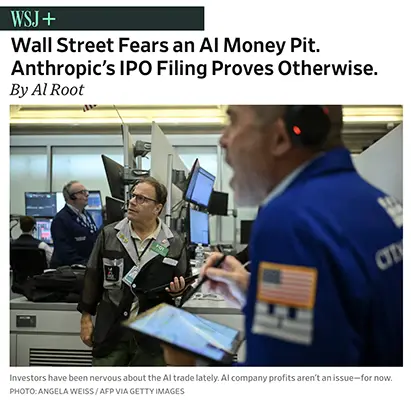
Wall Street Fears an AI Money Pit. Anthropic’s IPO Filing Proves Otherwise.
Barron’s | Al Root | October 26, 2026
| TL;DR / Barron’s argues the filing shows frontier AI can already turn a profit — a credible rebuttal to “money pit” fears, but one that rests on company-adjusted figures and explicitly sets aside the question that matters most to buyers: whether customers are getting their money’s worth. |
Executive Summary
The column’s thesis is that Anthropic’s $80 billion first-half loss is an accounting artifact of the company’s rising value, and that the real signal is adjusted net profit of $2.7 billion — a $4.4 billion swing from a year earlier — on revenue up 1,300%. The author extends the argument to SpaceX, which beat profit expectations, and to CoreWeave, whose compute capacity he values near replacement cost. The conclusion: if AI is this profitable, the leading players need far less outside financing, easing one of the market’s biggest credit worries. Caterpillar, which sells power equipment to data centers, is cited as a stock unfairly punished by AI-spending fears.
Read this as an argument, not a verdict. “Adjusted” profit is a measure the company defines; other coverage of the same filing reports a $693 million operating loss for the half, with profitability arriving only in the second quarter. The CoreWeave case is openly hypothetical — it assumes spot pricing and a halt to new spending. Most telling, the author concedes the next worry will be whether Anthropic’s paying customers see enough return, and leaves it for another day.
Relevance for Business
That deferred question sits squarely with SMB leaders: you are the customer side of the ROI test the market is about to apply. A profitable AI vendor is good news for continuity — it is less likely to vanish or be acquired abruptly — but profitable public vendors also defend margins, which can show up in pricing and usage limits. The piece is also a reminder of how far AI exposure now reaches: suppliers, equipment makers and lenders in your own ecosystem may be riding the same cycle.
Calls to Action
🔹 Act Now: Start documenting measurable results from your AI spend (time saved, cost per task, throughput) so you can defend — or cut — renewals on evidence.
🔹 Assign Internal Review: When assessing any AI vendor’s financial health, ask which metric is being cited — adjusted, operating or GAAP — and why.
🔹 Revisit Later: Neocloud economics, unless you rent GPU capacity directly.
🔹 Ignore for Now: The stock-picking angles (Caterpillar, CoreWeave). They don’t change SMB operating decisions.
| Vendor-neutrality disclosure: ReadAboutAI.com uses Anthropic’s Claude in its editorial production, including in preparing this summary. Coverage of Anthropic is held to the same evidence standard as all other vendors; readers should weigh it accordingly. |
Summary by ReadAboutAI.com
https://www.wsj.com/wsjplus/dashboard/articles/ai-anthropic-ipo-spacex-coreweave-529f5e28: Anthropic IPO Articles
Anthropic’s IPO Filing Is the Start of the ‘Put Up or Shut Up’ Era of AI
Fast Company | Chris Stokel-Walker | October 26, 2026
| TL;DR / The prospectus turns the AI debate from belief into scorecard — standout customer metrics on one side, revenue concentration, policy-violating usage and unproven payoff outside the tech sector on the other — and SMB results are part of the evidence the market will weigh. |
Executive Summary
The piece adds customer-level detail: about 250 customers paying more than $10 million a year, over 10,000 paying at least $100,000, net revenue retention near 900%, and roughly $6.6 million in revenue per employee. It also highlights less flattering disclosures: 5–7 cents of every revenue dollar comes from users who violate Anthropic’s terms and whom it presumably plans to remove; nearly half of revenue flows through cloud marketplaces run by firms that are also its suppliers and rivals; and the S-1 flags cheaper Chinese models as a competitive threat. An investor roadshow could begin as soon as November 9, against a targeted valuation reported here at $1.5 trillion.
The commentary splits along familiar lines. Apollo’s chief economist argues AI has “delivered zero financial payoff for corporate America outside of tech.” Journalist Tae Kim calls that premature, citing rising GPU rental prices and memory sold out through 2027 as proof of demand. Analysts Dan Ives and Gary Marcus agree the IPO will be a defining market test. One caution the article itself raises: 900% retention shows existing customers spending far more, not how broadly or durably that demand is spread. Treat the quoted views as perspectives, not findings.
Relevance for Business
The skeptic’s claim is, in effect, a claim about companies like yours — whether AI is moving revenue and margins outside the tech sector. That makes your own measured results strategically useful, both for budgeting and for vendor negotiations. The revenue concentration among very large accounts suggests SMBs are not the core customer, so roadmap and support priorities will follow the biggest buyers. Tighter enforcement against policy-violating usage means teams should confirm their use is compliant. Lower-cost Chinese models may pressure prices but bring data-handling and compliance questions of their own.
Calls to Action
🔹 Act Now: Define two or three business metrics for each AI deployment (cycle time, cost per task, output per employee) and track them quarterly.
🔹 Assign Internal Review: Compare your vendors’ acceptable-use policies against how your teams actually use AI tools.
🔹 Prepare Policy: Before adopting lower-cost models, including Chinese-developed ones, set rules for data handling, hosting location and regulatory compliance.
🔹 Monitor: The roadshow and first weeks of trading as a read on market confidence in AI vendors generally.
| Vendor-neutrality disclosure: ReadAboutAI.com uses Anthropic’s Claude in its editorial production, including in preparing this summary. Coverage of Anthropic is held to the same evidence standard as all other vendors; readers should weigh it accordingly. |
Summary by ReadAboutAI.com
https://www.fastcompany.com/91629897/anthropics-ipo-filing-is-the-start-of-the-put-up-or-shut-up-era-of-ai: Anthropic IPO Articles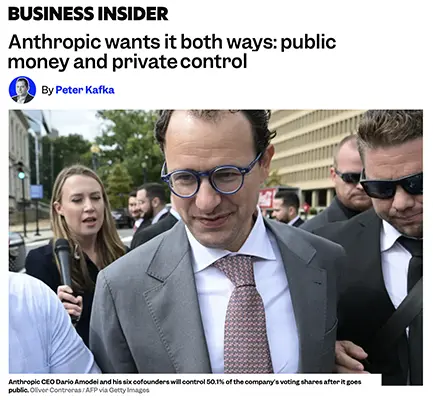
ANTHROPIC WANTS IT BOTH WAYS: PUBLIC MONEY AND PRIVATE CONTROL
Business Insider · Peter Kafka · October 26, 2026
| TL;DR / Anthropic’s IPO will sell shares without selling control: the seven cofounders will hold a majority of shareholder votes and a company-created trust will appoint most of the board, leaving public investors with economic upside but no real say. |
| Vendor-neutrality disclosure: This story centers on Anthropic. ReadAboutAI.com uses Anthropic’s Claude in its production workflow, including drafting these summaries. We have no financial relationship with Anthropic and present this coverage without endorsement. |
Executive Summary
According to the S-1, control is split between two insider groups. The cofounders will hold 50.1% of shareholder voting power through a special share class, and Anthropic’s Long-Term Benefit Trust will appoint four of the board’s seven directors. In combination, the founders decide shareholder votes while the trust shapes the board.
In theory the two groups could check each other. In practice, the article argues, they overlap heavily: Anthropic created and funds the trust, and the S-1 acknowledges that executives and trustees have worked together to select trustees. No shareholder — even a large institution — could force a change in direction.
Fact vs. framing: founder-controlled public companies are common (Alphabet, Meta, SpaceX). What is distinctive is the stated rationale: Anthropic ties its governance to the claim that its technology is too consequential to be steered by share-price pressure. Supporters see that as a safety feature; skeptics see insulation from accountability. The author expects most investors to accept the trade-off.
Relevance for Business
For SMBs, governance is a vendor-predictability question. A founder-controlled AI provider is less likely to change course under activist or quarterly-earnings pressure, which can mean steadier policies on safety, data use, and product direction. The trade-off is that customers and investors have little leverage if they disagree with a decision.
Watch how this structure plays out in practice. Product and pricing decisions at a mission-driven, insulated company may follow priorities that differ from a conventionally governed vendor’s.
Calls to Action
Revisit Later: Reassess after the first year of public reporting, when the company’s stated priorities can be compared with its actual decisions.
Monitor: Whether the trust-appointed directors ever diverge from management on major decisions — the first real test of this structure’s independence.
Assign Internal Review: Add governance and control structure to your due-diligence checklist for strategic AI vendors, alongside security and pricing.
Summary by ReadAboutAI.com
https://www.businessinsider.com/anthropic-ipo-control-private-trust-shareholders-vote-2026-10: Anthropic IPO Articles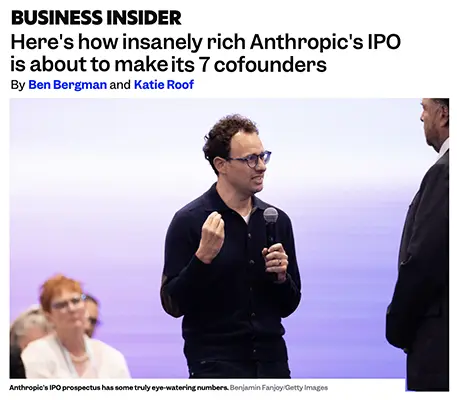
HERE’S HOW INSANELY RICH ANTHROPIC’S IPO IS ABOUT TO MAKE ITS 7 COFOUNDERS
Business Insider · Ben Bergman and Katie Roof · October 26, 2026
| TL;DR / The S-1 shows Anthropic’s seven cofounders hold nearly equal stakes of roughly 230–245 million shares each, while Amazon and Google each stand to own more than 5% — reinforcing how much of the AI economy’s value is concentrating among a few players. |
| Vendor-neutrality disclosure: This story centers on Anthropic. ReadAboutAI.com uses Anthropic’s Claude in its production workflow, including drafting these summaries. We have no financial relationship with Anthropic and present this coverage without endorsement. |
Executive Summary
The cap table is notable for its evenness: no single founder dominates, and cofounder and chief compute officer Tom Brown narrowly holds the largest stake. With the IPO price and share count not yet disclosed, dollar values are estimates. At the projected valuation of more than $1.5 trillion — up from $965 billion in May — each founder’s stake would be worth roughly $24 billion. The company plans to list on Nasdaq under the ticker “ANT.”
Strategic shareholders are the bigger story for business readers. Amazon and Google will each hold more than 5% after the offering, potentially worth more than $75 billion apiece at that valuation. A long list of venture firms also stand to profit, with most individual stakes reported to be in the 1–2% range.
What’s confirmed vs. estimated: founder share counts come from the filing; most venture stakes come from unnamed sources, and every dollar figure depends on a valuation that has not been set. The founders have also pledged to give 80% of their equity to philanthropy.
Relevance for Business
The headline wealth figures are less important than who else wins. Two of the largest cloud providers will hold major equity stakes in a leading model developer that also competes and partners with them — a web of overlapping interests that can influence pricing, distribution, and which AI tools are bundled into the platforms SMBs already use.
The valuation itself is a signal to watch. A listing above $1.5 trillion sets expectations for rapid revenue growth, and pressure to meet them often appears later as price increases, plan restructuring, or upselling.
Calls to Action
Ignore for Now: Founder net-worth headlines; they carry no operational signal for your business.
Monitor: The final IPO price and early trading as a gauge of investor confidence in AI model providers.
Assign Internal Review: Map how your AI tools reach you — directly or through a cloud platform — and where investor relationships could shape bundling or pricing.
Summary by ReadAboutAI.com
https://www.businessinsider.com/how-rich-anthropic-ipo-7-cofounders-2026-10: Anthropic IPO Articles
MISSION OVER MONEY: THE ANTHROPIC S-1’S PROFESSIONS OF FAITH
Business Insider (Discourse) · Henry Chandonnet · October 27, 2026
| TL;DR / An opinion column argues Anthropic’s S-1 reads more like a statement of belief than a financial filing, asking investors to buy into a mission and culture as much as a business. |
| Vendor-neutrality disclosure: This story centers on Anthropic. ReadAboutAI.com uses Anthropic’s Claude in its production workflow, including drafting these summaries. We have no financial relationship with Anthropic and present this coverage without endorsement. |
Executive Summary
The column uses religious satire to make a serious point: the filing is unusually long, mission-heavy, and filled with specialized terminology. The author counts “mission” 79 times against 17 for “money,” notes a 42-term glossary despite SEC guidance favoring plain language, and highlights sweeping claims about AI’s potential to cure disease and strengthen economies, alongside warnings that misused AI poses catastrophic risks.
Beneath the satire are facts worth noting: the cofounders receive equal salaries, will retain majority decision-making power after the IPO, and have pledged 80% of their equity to philanthropy, with the company matching employee donations. The S-1 also says Anthropic will turn down technically strong job candidates who fail its values screen.
Framing vs. fact: the “cult” comparison is the author’s framing, and the piece acknowledges that Anthropic promotes open internal debate. Its strongest argument is not about faith but about dependence — a DePaul professor suggests that as the economy leans on AI, companies may need investors and the public to believe in the vision for the business model to work.
Relevance for Business
For SMB leaders, the takeaway is how to read AI vendor communications. Mission language and ambitious claims, even in a regulated filing, are statements of intent, not demonstrated outcomes. Judge AI providers on contract terms, reliability, and measured results, not on vision statements.
The values-heavy culture is also a vendor-predictability signal. A company that screens hires on values and puts its mission first may make product and policy choices on principle, which can be stabilizing or surprising depending on how they align with your needs.
Calls to Action
Monitor: Whether Anthropic’s stated priorities hold under public-market pressure over its first few quarters.
Ignore for Now: The satirical framing — useful as commentary, not as a basis for decisions.
Assign Internal Review: When evaluating AI vendors, separate mission claims from verifiable commitments such as service levels, data terms, and audit rights.
Summary by ReadAboutAI.com
https://www.businessinsider.com/anthropic-ipo-s1-cult-claude-religion-language-2026-10: Anthropic IPO Articles
BROADCOM CEO INTERVENED TO SEAL $63 BILLION ANTHROPIC DEBT DEAL
The Wall Street Journal · Alexander Saeedy, Anissa Gardizy and Matt Wirz · October 26, 2026
| TL;DR / The largest AI infrastructure financing ever closed only after Broadcom’s CEO personally pushed reluctant banks and accepted higher rates — showing that even top-tier AI labs now depend on suppliers’ balance sheets to secure compute. |
| Vendor-neutrality disclosure: This story centers on Anthropic. ReadAboutAI.com uses Anthropic’s Claude in its production workflow, including drafting these summaries. We have no financial relationship with Anthropic and present this coverage without endorsement. |
Executive Summary
The $63 billion “Project North Star” deal lets Anthropic lease custom AI chips designed by Broadcom and Google. The structure matters more than the headline: a separate borrowing entity buys the chips, Anthropic’s lease payments repay the debt, and Broadcom guarantees the bank-funded portion — so Broadcom carries the risk if Anthropic cannot pay. Another roughly $18 billion of riskier debt carries no guarantee and depends on Anthropic alone; Blackstone is funding half of it.
Getting it done was hard. Some banks considered pulling out amid rising rates and AI-market jitters, and the deal closed only after weekend talks with Broadcom’s CEO, higher interest rates, and stronger guarantees. Banks also face a timing risk: they plan to sell about $22 billion of the debt to bond investors only once chips are delivered next year, and if rates rise first, they may have to sell at a loss. A predecessor deal is reportedly still not fully placed with investors.
Disclosed vs. reported: Anthropic’s S-1 estimates more than $125 billion in chip lease payments to Broadcom, while Broadcom and Google have committed $42 billion and $20 billion respectively to Anthropic. Critics call this pattern circular financing — suppliers funding the customers who buy their products — and the arrangement ties the financial health of all three companies together.
Relevance for Business
This shows what it now costs to stay at the AI frontier, and who ultimately absorbs the risk. For SMBs that build on Claude or similar models, a provider’s long-term pricing and stability depend partly on multi-year compute obligations that dwarf current revenue at most companies. Those obligations are now public, which gives buyers something concrete to evaluate.
It also confirms that financing conditions, not just technology, will shape the AI market. If lenders keep demanding more protection, compute costs rise across the industry — and those costs tend to reach customers through pricing and usage limits.
Calls to Action
Ignore for Now: The “circular financing” bubble debate as a buying signal — it is a long-horizon investor question, not an operational one.
Assign Internal Review: For any AI platform central to your operations, note its disclosed compute commitments and key supplier dependencies as part of vendor due diligence.
Monitor: How the $22 billion bond sale prices next year; weak demand would signal rising financing costs for AI providers.
Prepare Policy: Build multi-model flexibility into critical workflows so a pricing or capacity change at one provider does not halt operations.
Summary by ReadAboutAI.com
https://www.wsj.com/finance/broadcom-ceo-intervened-to-seal-63-billion-anthropic-debt-deal-c807754f: Anthropic IPO Articles
Why Anthropic’s Rivals Are Rooting for Its IPO
The Wall Street Journal (WSJ AI & Business newsletter) | Asa Fitch | October 27, 2026
| TL;DR / The AI race has entered a phase where access to affordable capital may decide winners as much as technology does. Anthropic’s IPO is the market’s test of whether that capital stays available, for Meta, OpenAI and everyone else. |
Executive Summary
The argument is straightforward. Anthropic will very likely raise its money, so the real question is whether investors have appetite left for everyone else. Equity markets have already absorbed SpaceX’s IPO and an Alphabet raise of nearly $85 billion. Meta is now seeking close to $100 billion, and OpenAI is aiming to list next year. The strain is visible: AI stocks fell broadly over the past month, CoreWeave dropped more than 35% and its bonds weakened, and Big Tech is expected to issue roughly $250 billion in bonds this year and $400 billion next year while interest rates remain high.
The most telling detail is a $63 billion chip financing for Anthropic. Broadcom and Google design the chips and TSMC manufactures them. A bank-funded special-purpose vehicle, backed by Broadcom guarantees, buys the hardware and leases it to Anthropic, whose lease payments repay the debt. Banks reportedly needed sweeter guarantees and higher rates to proceed. The structure works only if Anthropic keeps growing and the banks can resell the debt, which makes it a clear example of the circular financing that worries skeptics.
Relevance for Business
When capital, not technology, becomes the main constraint, power concentrates among the few firms that can raise it. For SMB buyers, that points toward fewer, larger AI vendors with more pricing leverage over time. It also creates a dependency chain: your AI tool may rest on financing structures that assume continuous growth. Tighter capital could show up as price increases, reduced free tiers or slower product expansion across the vendor landscape.
Calls to Action
🔹 Monitor: The IPO’s pricing and first weeks of trading. A weak reception would tighten capital for every AI vendor, including smaller ones you may rely on.
🔹 Assign Internal Review: For any AI tool central to operations, assess what happens if that vendor raises prices sharply or cuts features, and identify a fallback.
🔹 Prepare Policy: Build price-change and service-continuity protections (notice periods, data export, termination rights) into AI vendor contracts now.
🔹 Ignore for Now: The mechanics of special-purpose vehicles. The takeaway is the dependence on continued growth, not the structure.
| Vendor-neutrality disclosure: ReadAboutAI.com uses Anthropic’s Claude in its editorial production, including in preparing this summary. Coverage of Anthropic is held to the same evidence standard as all other vendors; readers should weigh it accordingly. |
Summary by ReadAboutAI.com
https://www.wsj.com/tech/ai/why-anthropics-rivals-are-rooting-for-its-ipo-ce347cd6: Anthropic IPO Articles
PIMCO OFFLOADS BILLIONS IN AI DEBT JUST IN TIME TO SKIRT LOSSES
Bloomberg · Laura Benitez · October 28, 2026
| TL;DR / The bond giant that created the template for off-balance-sheet AI data center financing has cut its largest positions roughly in half — a sign the most sophisticated lenders treat AI infrastructure debt as a trade to exit, not a long-term hold. |
| Vendor-neutrality disclosure: This source references a debt financing involving Anthropic. ReadAboutAI.com uses Anthropic’s Claude in its production workflow. We have no financial relationship with Anthropic and present this coverage without endorsement. |
Executive Summary
Pimco anchored two of the defining AI financings of 2025 — roughly $18 billion for Meta’s Louisiana data center and $10 billion for Oracle’s Michigan campus. Both used structures that kept the debt off the tech companies’ own balance sheets, and that model was copied across roughly half a trillion dollars of subsequent borrowing. According to filings and people familiar with the trades, Pimco now holds about half of each original position, having sold while the bonds traded above issue price. The Oracle-linked bonds have since slid to around 88 cents on the dollar.
Pimco also became more selective as the market grew: it declined a large debt deal for Broadcom and Anthropicearlier this year and passed on SoftBank and Oracle-linked deals — while still buying a $4 billion piece of a SpaceX AI financing. The pattern is selective participation, not retreat.
Framing to note: the “just in time” angle is partly hindsight; Pimco remains one of the largest holders of both data center deals, and both have lost value recently. The more durable signal is that early, well-positioned lenders bought at discounts and sold into strength, leaving later buyers holding the price risk. Industry voices remain split — Citadel’s Ken Griffin sees a bubble, while Blackstone’s Jon Gray argues demand is outrunning supply.
Relevance for Business
Off-balance-sheet structures mean the true scale of big-tech AI commitments is harder to see in headline financials. For SMBs choosing long-term AI platforms, published financial strength may understate how leveraged a provider’s infrastructure plans really are.
For the Anthropic IPO, the mention matters: Anthropic participates in the same debt-financed infrastructure buildout, and a respected lender passing on one of its deals shows that large institutional investors are already pricing AI infrastructure risk deal by deal. Expect prospectus-level scrutiny of compute commitments and financing structures.
Calls to Action
Ignore for Now: The bubble-or-not debate between investment titans; it does not change near-term SMB AI decisions.
Monitor: Track how Anthropic’s IPO filing discloses compute commitments and infrastructure financing — it will set a disclosure benchmark for the sector.
Assign Internal Review: If your organization holds bond funds or private credit exposure, ask your advisor how much is concentrated in AI data center debt.
Revisit Later: Vendor financial-health assessments for strategic AI platforms — reassess once more AI companies report publicly and disclosure improves.
Summary by ReadAboutAI.com
https://www.bloomberg.com/news/articles/2026-10-28/pimco-offloads-billions-in-ai-debt-just-in-time-to-skirt-losses: Anthropic IPO Articles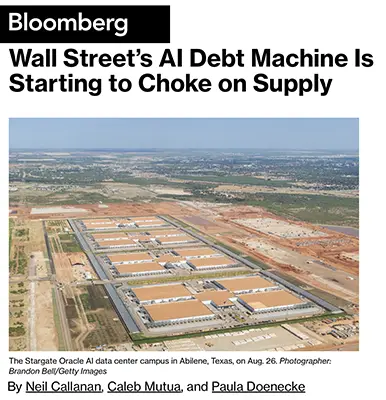
WALL STREET’S AI DEBT MACHINE IS STARTING TO CHOKE ON SUPPLY
Bloomberg · Neil Callanan, Caleb Mutua, and Paula Doenecke · October 28, 2026
| TL;DR / The debt markets financing AI data centers are approaching saturation, so the price and availability of capital — not customer demand — is emerging as the next constraint on the AI buildout. |
Executive Summary
Bloomberg’s conversations with more than 30 bankers, fund managers and private equity executives point the same way: raising money for data centers is materially harder than it was a few months ago. The evidence is in pricing. At least 18 data center financings in the junk-bond and leveraged-loan markets now carry double-digit yields, top-rated data center bonds have moved from below 5% to roughly 7% this year, and the cost of insuring debt issued by Oracle, Meta, Nvidia and SpaceX against default has hit records — levels usually associated with far weaker borrowers.
The bottleneck is structural, not just sentiment. Banks are reaching internal limits on sector exposure, offloading risk can take around five months, and insurers that typically absorb part of the risk say they are near capacity. Lenders are also scrutinizing contract off-ramps that let compute customers walk away if a project is delayed — a concern sharpened by Oracle’s force-majeure notice on a New Mexico campus and by stumbling IPOs from several AI infrastructure firms.
Fact vs. framing: Citadel Securities is not forecasting an imminent credit crunch, and tech giants still raised tens of billions this week. The real warning is concentration — much of the debt smaller GPU-cloud providers (“neoclouds”) still need may ultimately lean on the same few hyperscaler balance sheets, tying the system’s risk together. Lenders say they are getting “increasingly picky,” not walking away. Strong hyperscaler earnings could reopen the taps quickly.
Relevance for Business
The AI services SMBs buy sit on top of infrastructure financed largely with borrowed money. When capital gets more expensive, that cost eventually shows up in compute pricing, contract terms, and provider stability. The most exposed layer is the mid-tier: smaller cloud and AI infrastructure providers that depend on continuous refinancing. A vendor that cannot raise its next round of debt can cut capacity, reprice, or be acquired on short notice.
For readers following the Anthropic IPO, this is the backdrop public investors will price against: compute commitments, counterparty exposure, and how much infrastructure risk sits on — or off — a company’s balance sheet are likely to draw as much scrutiny as revenue growth.
Calls to Action
Ignore for Now: Trying to time AI purchases around credit-market swings — the effect on SMB pricing will lag and is not yet measurable.
Assign Internal Review: Map which of your AI tools run on smaller or specialized cloud providers rather than the major hyperscalers, and note where a single provider failure would disrupt operations.
Prepare Policy: For new or renewing AI contracts, ask about data export rights, transition assistance, and continuity terms if the vendor is acquired or loses capacity.
Monitor: Watch hyperscaler earnings and data center bond pricing over the next two quarters; sustained double-digit yields would signal pricing pressure reaching end users.
Summary by ReadAboutAI.com
https://www.bloomberg.com/news/articles/2026-10-28/wall-street-s-ai-debt-machine-is-starting-to-choke-on-supply: Anthropic IPO ArticlesThere’s Not Enough Money in the World to Pay for the AI Boom
The Washington Post | Shira Ovide | October 27, 2026
| TL;DR / The AI build-out has become a competition for the world’s capital — record stock sales, heavy borrowing and novel financing — with knock-on effects that reach far past tech, into borrowing costs, vendor survival and workforce decisions. |
Executive Summary
The piece uses three same-day signals to show the scale: Anthropic’s IPO filing, which describes the expected ~$100 billion raise as only the start of continued heavy investment; Meta’s plan to sell up to $95 billion in new stockafter acknowledging a tougher fundraising climate; and SpaceX’s $40 billion borrowing deal for AI chips. A draft paper by a Columbia finance professor estimates more than $10 trillion in AI build-out through 2032 — larger, relative to the economy, than household electrification, the interstate highways and the dot-com network backbone combined.
The second-order effects are the real story. The Treasury Secretary has said AI is creating short-term competition with the government for investor capital. Investors are growing selective, especially toward neoclouds — GPU rental firms that build first and collect later — and Gartner predicts as many as 80% could fail or be sold. Even profitable giants are feeling it: Microsoft is offering voluntary buyouts to about a quarter of its workforce as AI spending outpaces returns. A Moody’s executive frames investor pickiness as healthy, a useful counterweight to the headline’s alarm. The headline is rhetorical, and the $10 trillion figure is from unreviewed draft research; treat both as directional.
Relevance for Business
Three practical exposures for SMBs. Cost of capital: AI’s appetite for funding can keep borrowing costs elevated for everyone, including firms with no AI strategy. Vendor continuity: if smaller AI tools you rely on run on financially fragile infrastructure providers, consolidation or failure upstream becomes your outage. Workforce signaling: large employers trading headcount for AI infrastructure set expectations your own employees will notice — leaders need a clear position before the question is asked.
Calls to Action
🔹 Assign Internal Review: For smaller AI vendors, ask how they are funded and where their compute comes from; confirm data-export and exit terms in contracts.
🔹 Monitor: Credit conditions and lending rates if you have financing needs in the next 12–18 months.
🔹 Prepare Policy: Draft an internal statement on how AI investment relates to staffing, so managers can answer questions consistently.
🔹 Revisit Later: The $10 trillion estimate, once the research is finalized.
| Vendor-neutrality disclosure: ReadAboutAI.com uses Anthropic’s Claude in its editorial production, including in preparing this summary. Coverage of Anthropic is held to the same evidence standard as all other vendors; readers should weigh it accordingly. |
Summary by ReadAboutAI.com
https://www.washingtonpost.com/technology/2026/10/27/ai-companies-are-desperate-cash-dont-know-where-it-will-come/: Anthropic IPO Articles
Nvidia to Invest $3 Billion in Meta’s Equity Offering as They Expand AI Partnership
The Wall Street Journal | Megan Cheah and Fabiana Negrin Ochoa | October 27, 2026
| TL;DR / Nvidia is buying $3 billion of Meta’s new stock while Meta commits to deploying more Nvidia hardware — another case of suppliers financing their own customers to keep the AI build-out funded. |
Executive Summary
The deal is brief but revealing. Nvidia will put $3 billion into Meta’s planned stock offering, and Meta will expand its use of Nvidia chips and processors for its next-generation AI agents. The companies also plan to explore tools for monitoring agent behavior. This sits inside Meta’s plan to raise up to $95 billion through staged stock sales, starting with about $37.5 billion in common and convertible preferred shares. Meta’s shares fell on the news, while Nvidia’s rose slightly. The companies’ description of rising demand for “useful” AI agents is company framing, not demonstrated adoption.
Relevance for Business
This is the same pattern as Broadcom’s financing for Anthropic: chipmakers investing in the companies that buy their chips. That supports near-term demand but ties supplier and customer fortunes together, which magnifies the impact if AI spending slows. For SMBs, the practical signal is that even Meta, among the most profitable companies in the world, is raising outside money to fund AI. Expect cost recovery to show up in pricing and monetization across AI-enabled platforms, including advertising.
Calls to Action
🔹 Monitor: Meta’s advertising pricing and AI-agent features. Its rising AI costs may be passed to advertisers over time.
🔹 Revisit Later: Agent-monitoring tools from Nvidia and Meta, once something concrete ships. Oversight of AI agents will matter for any SMB deploying them.
🔹 Ignore for Now: The investment terms themselves. They are a financing story, not an operating one, for most SMBs.
Summary by ReadAboutAI.com
https://www.wsj.com/tech/ai/nvidia-to-invest-3-billion-in-metas-equity-offering-as-they-expand-ai-partnership-e8d3850a: Anthropic IPO Articles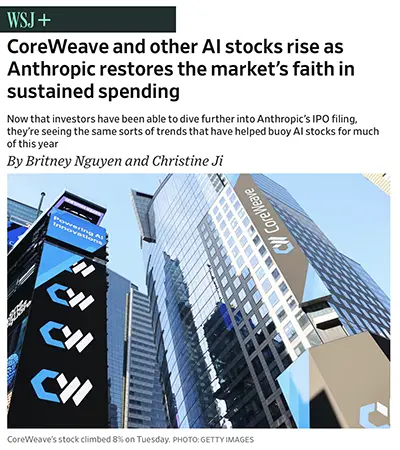
CoreWeave and Other AI Stocks Rise as Anthropic Restores the Market’s Faith in Sustained Spending
MarketWatch | Britney Nguyen and Christine Ji | October 27, 2026
| TL;DR / Anthropic’s filing set off a two-day relief rally in AI infrastructure stocks because its long-dated compute commitments read as guaranteed demand for chips, servers and data center capacity. That is a market mood, not proof that customers are getting a return. |
Executive Summary
After weeks of selling over AI overspending and debt, investors returned to the sector. The Nasdaq rose 1.2% on Tuesday after a 0.8% gain on the filing day. The biggest gains went to the stocks hit hardest earlier: neoclouds Nebius and CoreWeave (up 11% and 8%), along with storage, optical networking, server and connectivity makers. Analysts cited in the piece read Anthropic’s multiyear compute contracts as evidence that infrastructure demand will hold up, and one predicted a heavily oversubscribed IPO. The rally came even after Elon Musk warned over the weekend of shrinking capital access and “guppy-level death” for neoclouds.
The logic deserves scrutiny. The rally treats Anthropic’s spending commitments as a demand signal for its suppliers. But Batch 1 coverage showed those same commitments are a key risk for Anthropic if its growth slows. The bullish commentary comes mainly from portfolio managers and newsletter analysts, and it reflects sentiment more than new information. The more durable support comes from third-quarter results at chip suppliers such as TSMC and ASML, which point to real, sustained demand for advanced chips.
Relevance for Business
SMB leaders don’t need to track neocloud share prices. They do need to see that the AI supply chain is moving as one trade. Chips, memory, storage, servers and rented compute are all priced on the assumption that big labs keep spending. When that confidence holds, capacity stays tight and prices stay firm. When it breaks, the weakest links are the smaller, debt-funded infrastructure providers that some AI tools run on. Sentiment swings like this week’s are not a reliable guide to timing your own AI investment.
Calls to Action
🔹 Ignore for Now: Daily stock moves in AI infrastructure names. They reflect investor mood, not changes in what AI tools can do for your business.
🔹 Monitor: Neocloud financial health if any of your AI vendors run on providers like CoreWeave or Nebius.
🔹 Revisit Later: Hardware purchasing plans (servers, storage). Strong AI demand is keeping component prices and lead times tight.
| Vendor-neutrality disclosure: ReadAboutAI.com uses Anthropic’s Claude in its editorial production, including in preparing this summary. Coverage of Anthropic is held to the same evidence standard as all other vendors; readers should weigh it accordingly. |
Summary by ReadAboutAI.com
https://www.wsj.com/wsjplus/dashboard/articles/coreweave-and-other-ai-stocks-rise-as-anthropic-restores-the-markets-faith-in-sustained-spending-c71d7186: Anthropic IPO Articles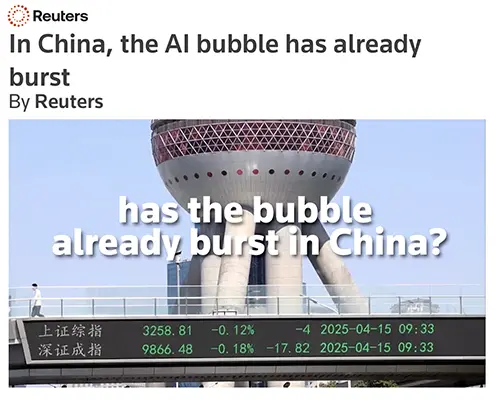
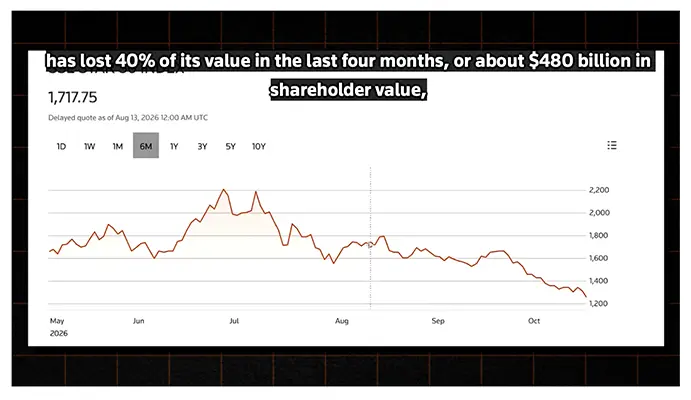
IN CHINA, THE AI BUBBLE HAS ALREADY BURST
Reuters · Reuters Asia markets team; written by Tom Westbrook · October 27, 2026
| TL;DR / China’s AI-heavy stock index has fallen about 40% in under four months, offering a live preview of how quickly an AI valuation reset can erase market value and shut the IPO window. |
Executive Summary
The STAR50 index of Chinese AI and semiconductor leaders has dropped roughly 40% since July, wiping out about $480 billion in value, while the broader CSI300 is down about 20%. Former retail favorites — humanoid-robot maker Unitree, several GPU makers, and optical-component suppliers — have lost half or more of their value. By comparison, U.S. AI stocks have so far led only a modest pullback of about 6% in the Nasdaq.
There was no single trigger. Traders cite stretched valuations, tax bills, and the threat of the U.S. barring Chinese equipment from data centers — a direct hit to optical suppliers. The exposure is unusually broad: Goldman Sachs estimates AI-linked stocks make up 42% of Chinese market capitalization and 57% of trading volume, in a market dominated by individual investors who bought partly because the theme appeared state-backed.
What to watch: even after the fall, the STAR50 trades near 100 times trailing earnings versus about 30 for the Nasdaq 100, so local managers expect further declines and a freeze on new tech listings. Some global banks see selective buying opportunities, so the outlook is genuinely contested.
Relevance for Business
For anyone tracking the Anthropic IPO, this is a cautionary data point: IPO windows depend on sentiment, and sentiment can reverse fast once valuations detach from earnings. A U.S. correction of even a fraction of this scale would affect timing, pricing, and investor appetite for AI listings.
There is also a supply-chain angle. U.S. moves to restrict Chinese optical components from data centers could tighten supply for networking equipment and reinforce cost pressure on cloud infrastructure — another factor that eventually reaches SMB technology pricing.
Calls to Action
Revisit Later: Reassess in Q1 2027 whether the decline spread beyond China or stayed contained.
Monitor: Nasdaq AI-stock valuations and IPO pricing for AI infrastructure firms as an early read on the Anthropic IPO environment.
Assign Internal Review: If you source networking or optical hardware, ask suppliers about Chinese component content and exposure to pending U.S. restrictions.
Ignore for Now: Direct comparisons between Chinese retail-market dynamics and U.S. markets — the structures differ significantly.
Summary by ReadAboutAI.com
https://www.reuters.com/world/china/china-ai-bubble-has-already-burst-2026-10-26/: Anthropic IPO Articles
Broadcom, Nvidia, Boeing, GM, UPS, JetBlue, and More Stocks That Explain Today’s Market
Barron’s | George Glover, Mariapaula Gonzalez and Kit Norton | October 27, 2026
| TL;DRIn a broad market roundup, the AI-relevant signal is that Anthropic’s filing confirmed the scale of its Broadcom chip partnership and lifted the wider data center supply chain, down to power and water-system suppliers. |
Executive Summary
Most of this roundup covers non-AI earnings: UPS, Boeing, JetBlue, GM’s move to Nasdaq and others. The AI thread is narrow but useful. Broadcom rose 4% after an analyst upgrade credited the filing with confirming the depth of Broadcom’s partnership with Anthropic. Nvidia said it would invest $3 billion in Meta’s share offering in exchange for expanded use of Nvidia hardware. Several companies cited data center demand as a growth driver, including Celestica, Bloom Energy and Pentair, a water-systems company expanding its data center business. Corning beat earnings but slipped, a sign that some investors remain uneasy about the cost of the build-out.
Relevance for Business
The value here is breadth, not depth. AI infrastructure demand now reaches power generation, cooling and water systems, and electronics manufacturing. SMBs in those supply chains may see both opportunity and competition for scarce components and skilled labor. For most readers, this is context rather than a call to act.
Calls to Action
🔹 Monitor: If you operate in power, cooling, construction or electronics supply, track data center demand as a source of both new business and input-cost pressure.
🔹 Ignore for Now: The individual stock moves. They carry little operating meaning for most SMBs.
🔹 Revisit Later: Consider whether this roundup earns a slot in the post or works better as a one-line mention in the introduction.
| Vendor-neutrality disclosure: ReadAboutAI.com uses Anthropic’s Claude in its editorial production, including in preparing this summary. Coverage of Anthropic is held to the same evidence standard as all other vendors; readers should weigh it accordingly. |
Summary by ReadAboutAI.com
https://www.wsj.com/wsjplus/dashboard/articles/stock-movers-f0207bd5: Anthropic IPO Articles
THE BELEAGUERED CHIP SELLERS GETTING THEIR REVENGE ON APPLE
The Wall Street Journal · Rolfe Winkler · October 28, 2026
| TL;DR / AI data center buyers are now outbidding even Apple for flash storage, and the resulting component inflation is flowing straight into what businesses pay for phones, tablets and laptops. |
Executive Summary
Demand from AI hyperscalers has pushed flash storage prices up roughly fivefold in a year, according to TechInsights. Two years ago Apple bought nearly twice as much flash as Microsoft, Amazon, Meta and Google combined; those companies now buy about twice Apple’s volume. Several hyperscalers have locked in long-term supply by agreeing to pay higher prices — something Apple historically refused to do.
Hyperscalers can absorb the cost more easily: storage is a small share of a data center’s budget, and the expense is depreciated over years. Apple, by contrast, is estimated to be paying about $25 billion this year for roughly the volume that cost $6 billion in 2025. The company has raised prices across nearly its entire lineup — an average of 13% on iPhones, including older models that normally get cheaper — and its famously high margins on storage upgrades are shrinking.
What’s established vs. estimated: the price increases are on Apple’s website; the cost and margin figures are analyst and WSJ estimates. Much of the article recounts Apple’s past hardball procurement tactics — useful color, but the business signal is the shift in bargaining power toward suppliers serving AI demand.
Relevance for Business
This is a clear second-order cost of the AI boom landing on businesses that may not use much AI at all. Device refresh budgets, storage-heavy configurations, and any hardware with significant memory content are exposed. If the most powerful buyer in consumer electronics could not avoid the squeeze, SMB purchasers have little leverage.
The procurement lesson also travels: in a scarce market, buyers willing to commit long-term win supply. For the Anthropic IPO storyline, it is a reminder that AI capital spending reshapes adjacent markets — costs and investor returns are not contained within the AI companies themselves.
Calls to Action
Monitor: Whether memory prices plateau in 2027 as new chip capacity comes online, which would ease pressure on device pricing.
Act Now: Re-baseline 2027 hardware budgets for higher device and storage costs; assume prior-year pricing no longer holds.
Test Cautiously: Extending device lifecycles by a year where performance allows, and right-sizing storage configurations rather than defaulting to upgrades.
Assign Internal Review: For planned bulk purchases, compare buying ahead now versus waiting — and ask resellers about price-protection terms.
Summary by ReadAboutAI.com
https://www.wsj.com/tech/apple-iphone-memory-chips-ai-c0084cc9: Anthropic IPO Articles
Micro1 is Making a $1 Billion Bet on AI’s Latest Data Craze
Business Insider · Stephen Council · October 26, 2026
| TL;DR / AI data brokers are now paying midsize companies up to $2 million for their internal records — Slack messages, documents, CRM data — creating a new revenue option for SMBs that comes with significant privacy, confidentiality, and employee-trust risks. |
| Vendor-neutrality disclosure: This source names Anthropic as a buyer of licensed data. ReadAboutAI.com uses Anthropic’s Claude in its production workflow. We have no financial relationship with Anthropic and present this coverage without endorsement. |
Executive Summary
Micro1 plans to spend $1 billion over the next year licensing internal company data for AI developers, including OpenAI and Anthropic, and says it pays $100,000 to $2 million per midsize company. Rival Mercor is making similar offers. Gartner projects spending on AI data will grow from under $1 billion last year to roughly $6.5 billion in 2027.
The demand has shifted toward ordinary business work. Model developers want full corporate data sets — messaging, documents, project tools, design files, CRM records — to build simulated workplaces where AI agents learn to do real jobs. Micro1 says it anonymizes the data, and the executives interviewed were comfortable with its privacy process. Those are company and seller assurances, not independent verification.
What is unresolved: current and former employees whose work fills these data sets typically receive no payment and no say, and a law professor quoted in the piece calls the practice ethically gray. Sellers are also told that early movers get the best prices — a classic urgency pitch worth discounting.
Relevance for Business
This is one of the most directly actionable stories for SMBs in this edition: midsize firms are the target sellers. A one-time payment is real money, but internal records contain customer information, client confidential material, partner data covered by contracts, and employee communications. Selling them could breach agreements or privacy law and damage trust with staff and customers.
There is also a strategic cost. Your workflows and institutional knowledge are part of your competitive edge. Licensing them helps train AI agents that may later be sold back to your competitors — or to you.
Calls to Action
Monitor: Regulatory and legal developments around workplace data licensing, which could create liability for sellers after the fact.
Prepare Policy: Establish a clear position on internal data licensing before an offer arrives: who can approve it, what is excluded, and how employees are informed.
Assign Internal Review: Have legal counsel review customer, vendor, and NDA contracts for restrictions on sharing or licensing data — CRM and client files especially.
Test Cautiously: If you consider an offer, start with narrow, non-sensitive data sets and require written terms on anonymization, usage limits, and deletion.
Summary by ReadAboutAI.com
https://www.businessinsider.com/micro1-invests-license-data-ai-model-development-2026-10: Anthropic IPO Articles
SERVAL TRIPLES VALUATION TO $3 BILLION AS BUSINESSES ADOPT AI WORKFLOW AUTOMATION
Reuters · Harshita Mary Varghese · October 29, 2026
| TL;DR / Investors tripled Serval’s valuation in ten months on the bet that AI agents can replace — not merely add onto — incumbent IT service platforms like ServiceNow, a claim buyers should test rather than accept. |
Executive Summary
Serval raised $150 million at a $3 billion valuation in a Sequoia-led round, up from $1 billion in December. Its AI agents automate IT operations tasks such as access requests, troubleshooting and asset tracking, and new funding will expand a tool that lets companies build their own automated workflows.
Company claim vs. demonstrated capability: the CEO positions Serval as a full replacement for platforms like ServiceNow and cites one customer migration completed in 45 days. That is a single, company-supplied example. Notably, Serval says customers still want human approval for sensitive actions — password resets, application access, system changes — and that IT and security teams retain control of agent permissions.
Relevance for Business
AI-native challengers to established enterprise software are giving buyers new negotiating leverage at renewal time, even for SMBs that never switch. But replacing a system of record carries real migration, data, and vendor-maturity risk, and a fast-growing startup’s roadmap and stability are less proven than an incumbent’s.
Set against the other stories in this batch, Serval shows a split market: credit for AI infrastructure is tightening while private valuations for AI applications keep climbing.
Calls to Action
Monitor: Independent customer references and retention data for AI-native IT platforms before treating them as replacements.
Test Cautiously: Pilot AI agents on low-risk, high-volume IT tasks before considering any platform replacement.
Prepare Policy: Define which actions AI agents may take without human approval — access changes and password resets should not be among them.
Act Now: Use AI-native alternatives as leverage in upcoming IT service-management renewals, even if you plan to stay.
Summary by ReadAboutAI.com
https://www.reuters.com/business/serval-triples-valuation-3-billion-businesses-adopt-ai-workflow-automation-2026-10-29/: Anthropic IPO ArticlesFrankumstein explains what $1 trillion looks like.
https://frankumstein.com/PDF/What%20does%20one%20TRILLION%20dollars%20look%20like.pdf
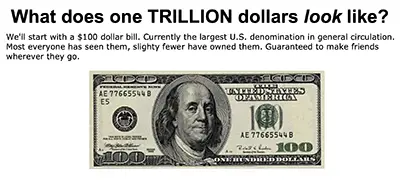

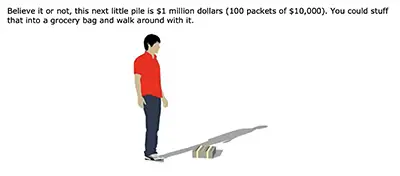
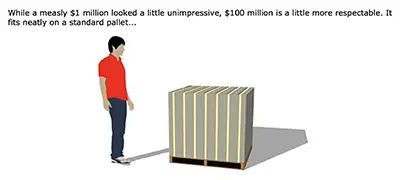
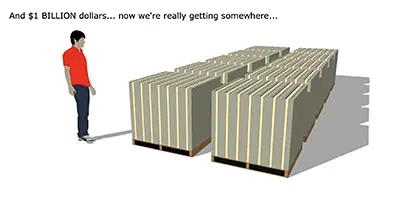

Infographic provided by Frankumstein.com
Closing: AI update for Anthropic IPO Articles: October 30, 2026
The Anthropic IPO will test whether investors still have the appetite to fund AI’s capital demands, but for SMB leaders the more useful test is closer to home: whether the AI tools you pay for deliver results you can measure. Use the months before your next renewals to document that value, confirm data-export and exit terms, and learn who sits between you and your model provider, so that a change in any vendor’s finances doesn’t become a change in your operations.
All Summaries by ReadAboutAI.com
↑ Back to Top