
AI Updates: October 18, 2026


This week’s stories share one theme: AI is producing work faster than people can check it. The Economist reports that AI systems are generating mathematical proofs faster than experts can understand or verify them. Scientific journals are being flooded with AI-written papers that reviewers can’t keep up with. Medical imaging tools are flagging cancers months before specialists do, but their developers haven’t published how often those flags are wrong. Early research also suggests that an incorrect AI summary can change what a reader remembers, even when the reader knows AI wrote it. That last finding challenges a common assumption, that keeping a person “in the loop” will catch AI’s errors. For SMB leaders, capability is no longer the main question. The question is whether your organization can verify what AI hands back.
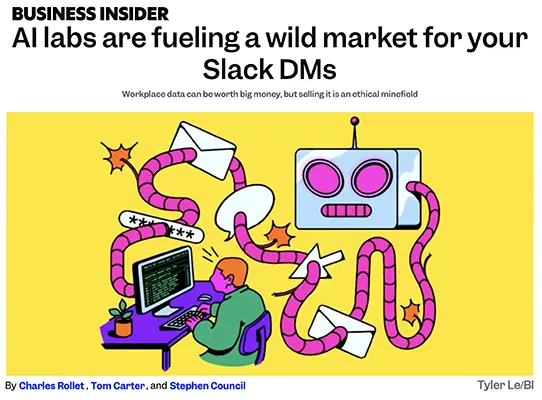
That gap matters more as AI moves from answering questions to taking actions. Meta’s Muse, Apple’s plain-English automations in iOS 27, and OpenAI’s push toward agents that run unsupervised for days all assume broad access to accounts, files, and messages. The early failures aren’t dramatic. They’re mundane, like an agent misreading an ambiguous instruction and posting a bank statement to a work chat. Access is also the weak point on the security side of this week’s news. Companies’ everyday Slack, email, and CRM records are being sold to AI labs as training data. Phishing kits are now sold by subscription. Employees are quietly using AI tools their employers haven’t approved. Even the leading AI labs are now treating their own staff as a security risk. Deciding what any system or person can reach is now a governance decision. It shouldn’t be left as an IT default.
Money is also asking for proof. Investors no longer reward AI hardware announcements unless they come with purchase orders, and data center builders are finding funding harder to raise. Bank of America’s monthly survey shows fund managers more heavily invested in AI than at any time since 2020, yet nearly half of them expect a bubble. Character.AI’s bankruptcy shows how quickly consumer AI can fail. Its compute costs rose with every engaged user, revenue didn’t keep pace, and child-safety lawsuits did the rest. For buyers, the news is mostly good: Google’s steep price cuts are a sign that customers have more leverage. The practical response is to check vendors’ financial health, keep contract terms shorter, and test AI’s output before relying on it.
Summaries
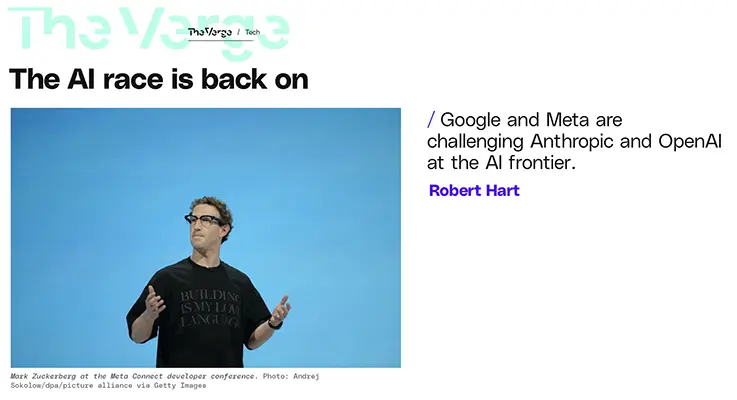
The AI Race Is Back On: Google and Meta Challenge OpenAI and Anthropic at the Frontier
The Verge | Robert Hart | October 14, 2026
TL;DR Google and Meta both launched models they say match the best from OpenAI and Anthropic — and for SMB budgets, Google’s steep price cut matters more than the benchmark claims.
Executive Summary
In the space of a few days, Google released Gemini 4 Argon and Meta released Muse Wonder Full, each claiming parity with or wins over leading models such as GPT-6 Astra and Claude Opus 5.5. Both claims rest on company-run benchmarks, not independent testing — a caveat the author himself raises. The more concrete news is price: Google is charging up to 80% less per token than rivals during an introductory period, and says Argon stays significantly cheaper after the promotion ends.
The launches reverse a narrative that had both firms falling behind. Google had seen leadership churn — veteran executive Jeff Dean left to start a company and Demis Hassabis stepped back from day-to-day DeepMind leadership — while Meta spent billions rebuilding its AI operation. The author’s central argument is that frontier leads are now short-lived and that distribution may outweigh raw capability: Google and Meta can push models to billions of existing users, an advantage OpenAI and Anthropic lack. Meta’s Muse assistant has spread quickly despite mounting security and privacy concerns. Treat the “anyone’s game” framing as interpretation; one week of launches does not establish durable position.
Relevance for Business
Model prices are falling and leadership is rotating faster than contract terms. SMBs that locked into one provider on multi-year terms risk overpaying as competitors undercut each other. Promotional pricing also creates a budget trap: costs modeled on introductory rates will jump when the promotion ends.
The distribution point carries a governance implication. When frontier-grade assistants arrive inside consumer platforms employees already use, AI adoption happens outside IT’s view. And benchmark parity says little about performance on your own documents, customers, and workflows — only your own testing answers that.
Calls to Action
◆ Test Cautiously: Run Gemini 4 Argon against your current model on two or three real workflows, and price both the promotional and post-promotion rates.
◆ Assign Internal Review: Confirm your AI tools can switch underlying models without major rework; vendor flexibility is now a cost lever.
◆ Act Now: Before renewing any AI contract, push for usage-based or short-term terms rather than long commitments.
◆ Prepare Policy: Clarify what company data may be entered into consumer AI assistants built into social and messaging platforms.
◆ Monitor: Independent evaluations of both models over the next several weeks before treating vendor benchmarks as settled.
Vendor-neutrality disclosure: ReadAboutAI.com uses Anthropic’s Claude in its production workflow. This source names Anthropic and Claude models as competitive benchmarks; our summary applies the same skepticism to every vendor’s claims.
Summary by ReadAboutAI.com
https://www.theverge.com/ai-artificial-intelligence/1011311/the-ai-race-is-back-on: October 18, 2026

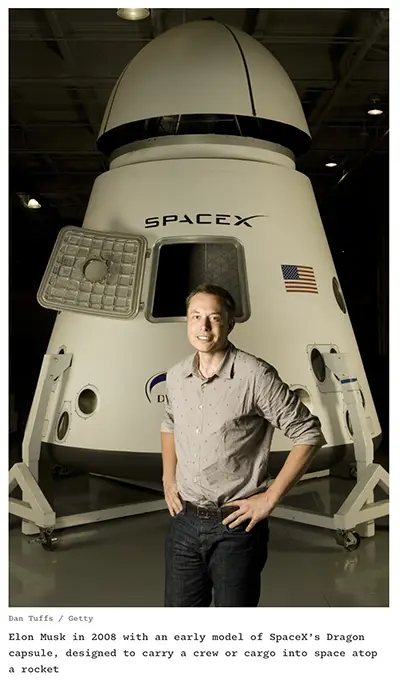
Choose Your Overlord: Musk vs. Bezos
The Atlantic (Ideas) · Josh Tyrangiel · October 14, 2026
TL;DR / The SpaceX–Blue Origin rivalry is increasingly an AI infrastructure race — satellite networks, proposed orbital and lunar data centers, AI engineering models — and its clearest business lesson is how much critical capacity is concentrating in two privately controlled companies.
EXECUTIVE SUMMARY
Set aside the personality profile and the core argument is structural: both companies are building vertically integrated stacks — launch, then satellite networks, then space-based computing, then AI. By the article’s account, SpaceX is far ahead: it launched most of the mass sent to orbit in 2025, operates roughly two-thirds of active satellites, has merged with xAI, bought the coding tool Cursor after a major IPO, and filed to operate up to a million data-center satellites. Blue Origin trails on launch reliability, but Bezos is co-leading Prometheus, a $6.2 billion venture aimed at AI that can design and test physical products, and Blue Origin has taken its first outside funding.
Much of the AI layer is speculative. Orbital data centers face unsolved problems — radiation, chip failure, and near-impossible maintenance — and SpaceX’s trillion-dollar market projections are promotional. What’s demonstrated is the concentration risk: SpaceX is winding down its workhorse rocket and may use most of its next-generation capacity for its own satellites, potentially creating a launch shortage for everyone else. The article also recounts episodes where a single owner’s decisions affected military connectivity and astronaut transport — leverage the government has struggled to counter.
RELEVANCE FOR BUSINESS
Near-term impact on SMBs is low, but the pattern is familiar: infrastructure that businesses depend on — connectivity, compute, and eventually AI capacity — is consolidating under a few vertically integrated owners who also compete with their own customers. Firms relying on Starlink for remote sites or field operations already carry single-provider exposure.
Longer term, AI tools for physical engineering (the Prometheus thesis) could matter to manufacturers and product designers — but this is early-stage, unproven, and years from practical use.
CALLS TO ACTION
◆ Assign Internal Review: If any operations rely on Starlink, confirm a backup connectivity option exists.
◆ Monitor: Treat space-based data centers as a long-horizon story; it should not affect compute planning through 2027.
◆ Monitor: If you’re in manufacturing or product design, track AI-for-engineering tools as they move from announcements to pilots.
◆ Ignore for Now: Founder-rivalry and personality coverage — the signal is in capacity concentration, not the personalities.
Summary by ReadAboutAI.com
https://www.theatlantic.com/magazine/2026/11/bezos-musk-billionaire-space-race/688690/: October 18, 2026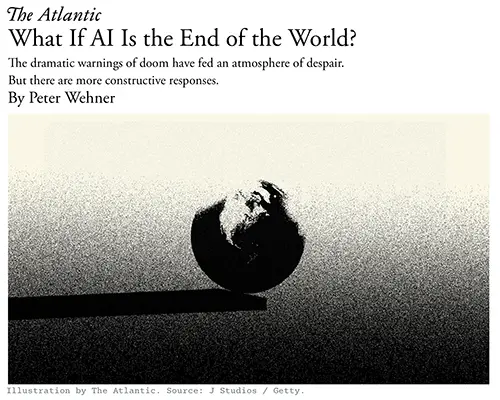
WHAT IF AI IS THE END OF THE WORLD?
The Atlantic (Ideas) | Peter Wehner | October 13, 2026
TL;DR: A reflective essay on how to live with warnings about AI catastrophe. It offers no new facts. Its business-relevant point is that AI anxiety is real and showing up among the public, and leaders should expect to see it in their workforce.
Executive Summary
Wehner starts from the premise that some AI developers themselves warn of possible catastrophe, and asks how people should respond emotionally. He describes common reactions, including numbness, denial, avoiding the news, and despair, and notes that AI-related anxiety is now appearing in therapists’ offices. He then draws on Frankl, Camus, C.S. Lewis, and finally Christian scripture to argue for naming the risk honestly, supporting efforts to contain it, and continuing to live decently and with purpose.
What it is and isn’t: This is a moral and spiritual essay, not an analysis of risk. It treats extinction warnings as serious without weighing the evidence for them. It mentions only briefly that other experts are more concerned about AI being unreliable or misused. Read it as a sign of the cultural mood, not as a risk assessment.
Relevance for Business
- Employees may be anxious about AI. Worries about AI’s broader dangers, alongside concerns about jobs, can affect morale, trust, and how willingly people adopt AI tools.
- How leaders talk about AI matters. Executives who speak about AI only in terms of opportunity, or only in alarming terms, may lose credibility. Honest, measured communication works better.
Calls to Action
🔹 Act Now: When rolling out AI tools, address employee concerns directly and honestly, without either dismissing them or adding to the alarm.
🔹 Monitor: Signs of AI-related stress in engagement surveys or team feedback.
🔹 Ignore for Now: Existential-risk arguments as an input to operational AI decisions.
Summary by ReadAboutAI.com
https://www.theatlantic.com/ideas/2026/10/ai-end-of-world-meaning/688977/: October 18, 2026
SCIENTISTS ARE FINDING AI MAY MAKE US REMEMBER THINGS THAT NEVER HAPPENED
The Washington Post | Ariana Eunjung Cha | October 2026
TL;DR: Early research suggests that wrong AI summaries can change what people remember, even when they know the summary came from AI. That undermines the assumption that “human in the loop” catches AI’s mistakes.
Executive Summary
Several studies point the same way. In an MIT Media Lab experiment, people shown AI-altered photos formed more false memories and felt more confident in them. In another study, participants questioned by a chatbot about a crime video had about three times as many false memories. In a Georgetown study of 331 people, those who read an accurate AI summary of an accident video recalled a key detail correctly about 84% of the time. Those who read a misleading summary got it right only about 45% of the time. Being told the summary was AI-generated didn’t protect them. As the lead researcher put it, “human oversight may not be a great solution to this problem.”
A separate set of findings concerns skill loss. A 2025 study found that experienced doctors detected precancerous growths about 20% less often on their own after they started using AI routinely. An MIT experiment found that people who wrote essays with ChatGPT had weaker brain engagement and worse recall of their own writing.
Caveats: These are mostly small, early studies, and some haven’t been peer reviewed. The article itself acknowledges that the evidence doesn’t show normal AI use causes lasting cognitive decline. The concern about memory contamination is well supported. Broad claims about AI making people less capable are not yet proven.
Relevance for Business
- AI summaries are increasingly the official record. Meeting notes, call summaries, incident reports, and HR investigation notes generated by AI may shape what employees later remember happened. That matters in disputes, compliance, and litigation.
- Human review may not be enough on its own. Many AI governance plans count on employees to catch errors. If a summary has already shaped their memory, checks need to go back to original sources such as recordings, transcripts, and raw data.
- Skills can erode quietly. Teams that depend on AI for analysis or review may lose the ability to do the work when the tool fails or when its output is wrong.
Calls to Action
🔹 Act Now: For decisions with legal or HR consequences, require that people check AI summaries against the original recording or document, not against their own recollection.
🔹 Prepare Policy: Label AI-generated records clearly and keep the source material for anything that could end up in a dispute.
🔹 Test Cautiously: Have staff periodically do critical tasks without AI help, to keep their skills current.
🔹 Monitor: Peer-reviewed follow-up studies before you make broader policy based on findings about skill loss.
Summary by ReadAboutAI.com
https://www.washingtonpost.com/health/2026/10/15/scientists-are-finding-ai-may-make-us-remember-things-that-never-happened/: October 18, 2026
AI IS HELPING BRING BACK THE DODO
TIME · Jeffrey Kluger · October 14, 2026
TL;DR: Colossal says a new AI tool can reconstruct missing genetic information for the extinct dodo and is targeting the early 2030s. The business lesson is AI’s ability to fill gaps in incomplete data, not the bird itself.
EXECUTIVE SUMMARY
Ancient dodo DNA is fragmentary, and the bird’s distinctive beak alone involves thousands of genetic “switches” that control which genes turn on and off. Colossal’s new AI platform, GenoMorph, compares genomes and skull shapes across more than 70 bird species to predict about 2,350 candidate switches, which the team is now testing one by one. The company describes the challenge as being as much about data as about biology. It also notes that tools built for its earlier dire wolf project were reused here, and it frames this as a platform that compounds across projects.
Most of this is still prospective. No edited birds exist yet, the method depends on chickens serving as surrogates for a very different species, and the timeline is the company’s own estimate. Colossal’s 2025 dire wolf announcement drew pushback from scientists who argued the animals were genetically edited gray wolves rather than true de-extinctions. The dodo project should be read with similar caution.
RELEVANCE FOR BUSINESS
The direct relevance for SMBs is minimal. The transferable idea is that AI can infer what’s missing from patchy or degraded data by learning from related, complete datasets. The same approach applies to incomplete customer records, legacy archives, or sparse operational data. Colossal’s “build once, reuse across projects” approach is also a sound model for AI investment: tools and data assets should compound, not be rebuilt for each initiative.
CALLS TO ACTION
🔹 Ignore for now: De-extinction has no operational bearing on most SMBs.
🔹 Apply the lesson: When scoping AI projects, favor tools and datasets that can be reused across future initiatives.
🔹 Monitor (life sciences and agriculture firms only): Watch whether gene-editing and AI tools from this work reach commercial use.
Summary by ReadAboutAI.com
https://time.com/article/2026/10/14/ai-dodo-colossal-biosciences/: October 18, 2026
Russia Cracks Down on AI Bears as Real Attacks Spread Fear
Reuters | October 14, 2026
TL;DR / A prank AI image of a bear triggered a real emergency response and a fine — a small story with a clear lesson: when the public is already anxious, synthetic images spread as fact and the costs land on responders and creators.
Executive Summary
A resident of Russia’s Amur region used ChatGPT to create an image of a brown bear on a local street as a joke for a friend. It spread through messaging apps, police received alarmed calls, and wildlife rangers were dispatched before she confessed. A court fined her 15,000 roubles (about $178); a second woman elsewhere was fined 30,000 roubles for a similar fake. The context made the hoax believable: bear attacks have killed at least 26 people in Russia this year.
The fines are small, but the pattern matters: authorities are holding individual creators liable for the real-world consequences of convincing fakes, and plausibility, not image quality, drove the spread.
Relevance for Business
Any business can be the subject of a believable fake — a fire at a location, a contaminated product, an incident involving staff. The risk peaks when the fake matches something people already fear. An employee’s AI-generated joke can become a company incident once it leaves a private chat. SMBs generally lack the communications teams to verify and respond quickly.
Calls to Action
◆ Prepare Policy: Add guidance on creating and sharing AI-generated images involving the company, its sites, or its customers to your acceptable-use policy.
◆ Assign Internal Review: Set up a simple rapid-verification and response plan for viral images or claims about your business.
◆ Monitor: Legal trends assigning liability to creators of harmful synthetic media.
Summary by ReadAboutAI.com
https://www.reuters.com/lifestyle/russia-cracks-down-ai-bears-real-attacks-spread-fear-2026-10-14/: October 18, 2026
When Only AI Can See the Cancer
New York Magazine / Intelligencer · Vivian Manning-Schaffel · October 12, 2026
TL;DR: AI imaging tools are flagging pancreatic and bile-duct cancers months earlier than specialists can, but nearly all of them are still in trials or regulatory review. The near-term business story is less about cures and more about how AI “second readers” will change standards of care, liability, and how existing data gets used.
Executive Summary
Pancreatic cancer is usually caught too late because early tumors are nearly invisible on standard scans. A Mayo Clinic study cited in the piece found that up to half of earlier scans showed abnormalities that could have prompted more testing. Several research teams are now training AI to find patterns humans can’t reliably see. Mayo’s REDMOD model reportedly flags signs of cancer about 16 months earlier and at nearly twice the rate of specialist radiologists. UMass’s SMART-AI, a plug-in device for existing scopes, was 88% accurate in its first human trial versus 67% for biopsies. A Hong Kong pathology tool reports 98% accuracy on one detection task. Mayo radiologist Ajit Goenka describes the advantage this way: “AI is very good at looking at grains of sand.”
Readers should weigh these figures carefully. They come largely from the developers’ own studies, some with modest sample sizes (SMART-AI trained on images from 130 procedures). The article does not address false-positive rates, which decide whether screening a rare disease at scale helps or overwhelms clinicians. What is real now is the regulatory pipeline: the FDA approved 135 of 181 AI-enabled radiology devices in the first half of 2026. What remains promise is routine use of AI on every emergency-room scan.
Relevance for Business
For most SMBs, this is a pattern worth recognizing: AI creating value by re-reading data that already exists, and by plugging into equipment that’s already installed rather than replacing it. Healthcare-adjacent businesses (clinics, imaging centers, benefits brokers, health-plan sponsors) face more direct effects. As AI detection becomes available, the definition of a “missed” diagnosis shifts, which raises liability, documentation, and insurance questions. Employers who sponsor health plans should expect AI-assisted screening to appear in coverage and cost discussions over the next few years.
Calls to Action
🔹 Monitor: Track FDA clearances and the results of the large REDMOD and Cyst-X clinical trials before treating these accuracy claims as settled.
🔹 Assign internal review (healthcare-adjacent firms): Assess how AI second-reader tools affect your liability exposure and malpractice coverage.
🔹 Revisit later (benefits sponsors): Ask your broker in 2027 renewals how AI-assisted screening is being covered and priced.
🔹 Apply the lesson: Identify where your own business has historical data that AI could re-examine for missed signals, such as quality defects, churn indicators, or fraud.
Summary by ReadAboutAI.com
https://nymag.com/intelligencer/article/ai-cancer-screening-technology-innovation.html: October 18, 2026
Data Centers Produce Heat Year-Round. Here’s How to Save It for Winter
Fast Company (via The Conversation) · Moones Alamooti, University of North Dakota · October 12, 2026
TL;DR: Storing data center waste heat underground for winter use works at campus scale. However, no one has proven it at AI-campus scale, and rising data center energy demand is turning heat and water use into a community and cost issue.
Executive Summary
The core problem is timing. Servers produce heat all year, but most U.S. buildings need heating for only about four months; as the author puts it, “Storage is the missing piece.” Epic Systems in Wisconsin solves this by pumping summer server heat into roughly 6,100 underground wells and drawing it back out in winter to heat about 40 campus buildings. The U.S. Department of Energy reports those buildings use about 25% less energy than comparable ones. Epic has not disclosed what the system cost.
The constraints matter more than the concept. Heat builds up in the ground if more goes in than comes out. Users must be physically close to the stored heat. And Epic’s 3.5 MW data center is tiny compared with AI campuses of 100 to 1,000 MW, where this approach is untested. The author proposes repurposing some of the U.S.’s 141,000+ orphaned oil and gas wells, but most states have no permit category for that use.
Relevance for Business
The bigger signal is pressure on costs. Data centers used about 4.7% of U.S. electricity in 2024, and Lawrence Berkeley National Lab projects that share could approach 12% by 2030. In Virginia, the figure is already over 25%. Communities are pushing back over power bills and water use. That pressure can flow into utility rates, siting delays, and ultimately AI service pricing. For SMBs, the direct application is narrow: firms with campuses or significant on-site server heat could explore heat reuse. The indirect exposure is broader through energy costs.
Calls to Action
🔹 Monitor: Track local utility rate cases and data center siting fights in your region; they can affect your energy costs.
🔹 Ignore for now (most SMBs): Underground heat storage requires land, drilling capital, and scale most firms lack.
🔹 Assign internal review (facility owners): If you operate on-site servers or a multi-building campus, ask your facilities team whether waste-heat reuse is viable.
Summary by ReadAboutAI.com
https://www.fastcompany.com/91621557/data-centers-heat-how-to-save-it-for-winter: October 18, 2026
HOW MUCH MORE CAN NUCLEAR POWER PLANTS GIVE?
MIT Technology Review · Casey Crownhart · October 15, 2026
TL;DR: Upgrading existing nuclear plants is a fast, relatively cheap way to add clean power for AI data centers. Even so, the entire U.S. upgrade potential covers only a fraction of projected AI-driven demand.
EXECUTIVE SUMMARY
Nuclear “uprates,” meaning equipment and fuel upgrades that raise a reactor’s output, are back after a decade of decline. Constellation plans to spend more than $4.3 billion adding nearly a gigawatt across 11 reactors, made viable by a 20-year power-purchase agreement with Google. The Department of Energy is financing 433 megawatts of upgrades at Vistra plants, with Meta signed on as the buyer. Big Tech’s long-term contracts are what make these projects pencil out. Constellation’s CEO has said the projects need prices above what the market currently pays.
The perspective is the key point. Uprates cost less per kilowatt than new reactors but more than new solar-plus-storage or gas plants. Estimates put the total remaining U.S. uprate potential at 3–8 gigawatts. PJM, the grid operator covering much of the East Coast, alone expects about 30 gigawatts of new AI-driven peak demand by 2030. Uprates are a quick gain, not a solution.
RELEVANCE FOR BUSINESS
The story shows Big Tech locking up clean power through long-term contracts, often at premium prices. That leaves less capacity and more cost pressure for everyone else on the grid. SMBs in data-center-heavy regions such as the PJM territory should expect upward pressure on electricity rates, and possibly on cloud and AI service pricing as providers pass through energy costs. Firms with sustainability commitments may also find clean-power procurement more competitive and expensive.
CALLS TO ACTION
🔹 Monitor: Track utility rate filings in your region, especially in data-center-dense grids like PJM.
🔹 Assign internal review: Factor rising energy costs into multi-year budgets and cloud or AI spending forecasts.
🔹 Revisit later: If you have clean-energy targets, reassess procurement options and costs in 2027.
Summary by ReadAboutAI.com
https://www.technologyreview.com/2026/10/15/1146577/nuclear-power-upgrade/: October 18, 2026
OpenAI Is Throwing Everything Into Building a Fully Automated Researcher
MIT Technology Review | Will Douglas Heaven | March 20, 2026: Updated October 15, 2026
TL;DR / OpenAI has made long-running, autonomous AI agents its central research goal — a bet that delegated multi-day work, not chat, is where AI’s economic value lands, with oversight still the unsolved piece.
Executive Summary
In an interview, OpenAI chief scientist Jakub Pachocki described the company’s new organizing goal: an autonomous “research intern” by September 2026 and a multi-agent AI researcher by 2028 capable of working on problems in math, science, business, and policy. The path runs through Codex, OpenAI’s coding agent — making systems that work longer with less human guidance. Pachocki says OpenAI’s engineers now mostly direct groups of agents rather than write code, and envisions eventually having “a whole research lab in a data center.”
Evidence and claims should be separated. OpenAI’s models have produced some genuine results on unsolved math and science problems, but an independent researcher at the Allen Institute for AI found that errors compound when tasks are chained — though his testing predates OpenAI’s newest models. On safety, OpenAI’s main tool is monitoring the model’s working notes to catch bad behavior, not prevent it, plus sandboxing powerful systems. Pachocki concedes the approach concentrates power in unprecedented ways and says governments will need to engage.
Editor’s update: On September 6, OpenAI said that, by its own measurements, it had met the intern goal — defining “intern” narrowly as a system handling well-defined, multi-day research tasks under human direction. Coverage of that announcement notes that longer tasks still frequently needed human intervention and that the company reported security incidents involving its own agents. This is a self-graded milestone.
Relevance for Business
The direction of travel is from AI as an assistant to AI as a delegate — tools that run for hours or days on assigned work. That changes the management model: staff become supervisors of agent output, and the key skills become task definition, review, and judgment about when to intervene.
It also shifts risk. Long-running agents mean errors accumulate unseen, token costs scale with runtime, and access permissions matter more because the agent acts without a human at each step. The concentration-of-power concern is real for SMBs too: the most capable agent systems will sit with a few large vendors, deepening vendor dependence.
Calls to Action
◆ Test Cautiously: Pilot agent delegation on bounded, multi-hour tasks with clear checkpoints, and track how often a person has to step in.
◆ Prepare Policy: Define which tasks agents may run unattended, what systems and data they can access, and what review happens before output is used.
◆ Assign Internal Review: Have finance track spend on agentic tools separately; costs rise with how long agents run, not how many seats you buy.
◆ Monitor: Progress toward OpenAI’s 2028 target through independent validation rather than vendor-declared milestones.
Vendor-neutrality disclosure: ReadAboutAI.com uses Anthropic’s Claude in its production workflow. This source references Anthropic and its Claude Code product as competitors; our summary aims to evaluate all vendors’ claims equally.
Summary by ReadAboutAI.com
https://www.technologyreview.com/2026/03/20/1134438/openai-is-throwing-everything-into-building-a-fully-automated-researcher/: October 18, 2026
AI Companies Want to Become Frontier Scientific Researchers
The Economist | Science & Technology | October 14, 2026 · News analysis (paywalled)
TL;DR / AI labs are doing science themselves less for prestige than because unsolved problems are the best remaining way to improve their models — a strategy that concentrates frontier discovery in a handful of very rich firms.
Executive Summary
What is happening: Google DeepMind (AlphaFold), OpenAI (its recent mathematics results), Anthropic (CEO Dario Amodei’s September claim that Claude found a potential successor to CRISPR gene editing), and smaller labs such as Sakana are all conducting research directly rather than only selling tools. That is unusual — labs do not run accounting firms or newsrooms, but they do run science.
Stated motives versus the likely one. Labs cite curiosity, and profit plays a role: DeepMind spin-out Isomorphic Labs has 17 drug candidates in development. The Economist’s analysis is that the main driver is model improvement. Top models now score just over 50% on one of the hardest knowledge tests available, so labs are running out of ways to measure progress. Unsolved math and science problems have answers that can be checked, which suits training methods that reward verifiably correct results. Whether this makes models broadly smarter or more uneven remains open; early research suggests some general gains, but it is preliminary.
Forecasts, labeled as such: Anthropic co-founder Jack Clark predicts AI could fully handle the work of building better AI systems by 2028. That is a prediction, not a demonstrated capability.
Relevance for Business
Two practical lessons. First, headline capability does not equal reliability on your tasks: a model that excels at frontier mathematics can still make basic errors elsewhere, so evaluation on your own workflows matters more than benchmarks. Second, tasks with checkable right answers are where AI will improve fastest — a useful lens for deciding where to automate first.
Strategically, frontier research now requires data and computing power that only a few firms can afford, shifting influence over scientific direction — and potentially over adjacent commercial markets such as drug discovery and materials — toward those companies.
Calls to Action
◆ Test Cautiously: Evaluate AI tools on your own workflows and data, keeping human review where errors are costly.
◆ Assign Internal Review: Identify tasks in your business with objectively verifiable outputs; these are the likeliest early wins.
◆ Monitor: Lab moves from research into commercial products in or near your industry.
◆ Ignore for Now: Timelines for AI that autonomously builds better AI.
Vendor-neutrality disclosure: ReadAboutAI.com uses Anthropic’s Claude in its production workflow. The source cites claims and predictions from Anthropic’s CEO and a co-founder; both are presented here as company statements, not verified findings.
Summary by ReadAboutAI.com
https://www.economist.com/science-and-technology/2026/10/14/ai-companies-want-to-become-frontier-scientific-researchers: October 18, 2026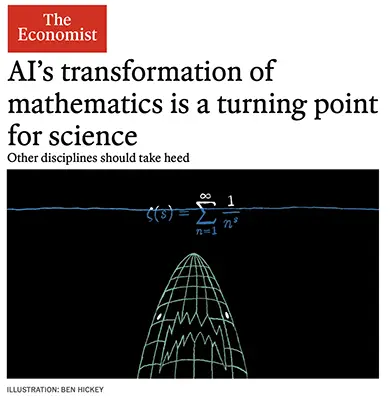
AI’s Transformation of Mathematics Is a Turning Point for Science
The Economist | Science & Technology | October 12, 2026 · News analysis (paywalled)
TL;DR / OpenAI’s claimed solutions to a Millennium Prize problem and hundreds of other open problems show AI can now produce answers faster than experts can understand or check them — and early data suggests AI is making science more productive but narrower.
Executive Summary
What is claimed: in September, OpenAI said an internal model solved the Navier-Stokes problem — one of seven Millennium Prize problems — in 88 hours. On October 6 it released 719 papers covering at least 372 other open problems. These are company claims under expert review; a leading Navier-Stokes specialist describes the 166-page solution as hard to follow and stitched together.
The reaction is the signal. A statement from 28 Fields Medal winners, endorsed by more than 8,000 researchers, warns of results divorced from human understanding; one signatory wrote, “The shock is immense.” The Economist notes the self-interest involved but finds the argument credible: working through hard problems produces new tools and ideas, and answers alone do not.
The wider data is more useful for leaders. A study of 41.3 million papers found scientists using AI publish more and are cited more, but the range of topics narrowed by nearly 5% and engagement with others’ work fell 22%. In a Google survey of 600+ scientists, almost half said AI nudges them toward safer, incremental projects. Researchers also warn that fully automated research loops could produce results humans can verify but not explain.
Relevance for Business
The pattern is likely to repeat inside organizations: individual output rises while thinking converges and teams engage less with each other’s work. Faster answers are not the same as better options.
There is also a governance issue: when AI produces results no one can explain, decisions become harder to defend to customers, auditors, or regulators. Expertise shifts toward verification, which takes time and skilled staff.
Calls to Action
◆ Prepare Policy: For consequential decisions, require that someone can explain the AI-assisted reasoning, not just the result.
◆ Assign Internal Review: Check whether AI use is narrowing your team’s work toward safe, incremental output, and protect time for exploratory work.
◆ Monitor: Independent verification of OpenAI’s mathematical claims.
◆ Revisit Later: How expert roles shift toward checking and interpreting AI output.
Vendor-neutrality disclosure: ReadAboutAI.com uses Anthropic’s Claude in its production workflow. The source notes an Anthropic announcement about Claude’s work on particle-physics calculations; this summary does not rely on it.
Summary by ReadAboutAI.com
https://www.economist.com/science-and-technology/2026/10/12/ais-transformation-of-mathematics-is-a-turning-point-for-science: October 18, 2026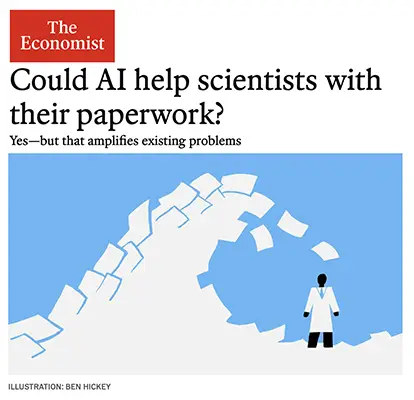
Could AI Help Scientists With Their Paperwork?
The Economist | Science & Technology | October 14, 2026 · News analysis (paywalled)
TL;DR / AI has made research documents nearly free to produce, and vetting systems are being overwhelmed — a preview for any organization that still judges people, vendors, or ideas by the quality of their writing.
Executive Summary
The productivity gains are real. Researchers spend a large share of their time on grant proposals and papers, and roughly a quarter now use AI to speed up proposal writing, per an Elsevier survey; one researcher cited cut a weekly day of grant writing to under an hour. Submission volumes have jumped since ChatGPT’s launch, most sharply in computer science — ICML submissions doubled to 24,000 in a single year.
The quality signal is breaking. A Lancet analysis of 2.5 million biomedical papers found fabricated citations rose roughly twelvefold between 2023 and early 2026. A study in Science found that polished writing used to predict good science — that relationship has now reversed. In one test, a fictional disease seeded in preprints was being described as real by major chatbots within weeks.
Proposed fixes cut both ways. AI-assisted reviewers catch technical errors better, while humans remain better at judging novelty. Some funders now use AI to screen out weak applications, and others propose replacing written proposals with track-record review and interviews — which risks favoring established institutions. The article’s core argument, which is interpretation rather than finding: the root cause is volume-based incentives. As RetractionWatch co-founder Ivan Oransky puts it, “AI is just the accelerant.”
Relevance for Business
Science is an early, well-measured case of a problem SMBs already face: hiring applications, RFP responses, vendor proposals, grant applications, and marketing content are all becoming cheap to produce and harder to evaluate. When fluent writing no longer signals competence, the evaluation burden shifts to the reviewer — and so does the cost.
Two further implications: AI research tools can absorb fabricated or unvetted claims and repeat them confidently, which matters for any decision built on AI-gathered research; and any KPI that counts output (reports filed, content published, proposals submitted) will be inflated by AI without improving results. There is also a talent concern — junior staff who outsource drafting may not build the judgment that drafting develops.
Calls to Action
◆ Act Now: Identify where your organization judges people or vendors mainly on written submissions (hiring, RFPs, proposals) and add a verification step — a work sample, live conversation, or reference check.
◆ Prepare Policy: Require citation and source checks on any AI-assisted report, analysis, or client deliverable before it leaves the building.
◆ Test Cautiously: Pilot AI for objective review tasks (inconsistencies, missing data, errors) while keeping humans responsible for judgment calls.
◆ Assign Internal Review: Audit volume-based KPIs that AI can inflate, and check how junior staff are building core writing and reasoning skills.
Summary by ReadAboutAI.com
https://www.economist.com/science-and-technology/2026/10/14/could-ai-help-scientists-with-their-paperwork: October 18, 2026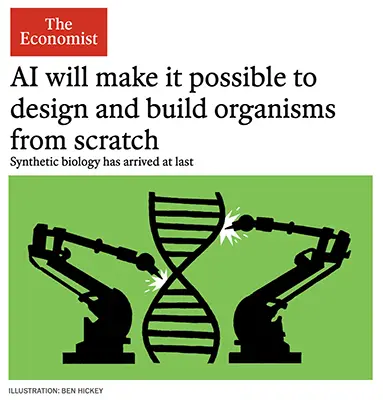
AI Will Make It Possible to Design and Build Organisms From Scratch
The Economist | Science & Technology | October 14, 2026
TL;DR / Foundation models trained on DNA, paired with cheaper DNA assembly, are turning biology into an engineering discipline — the near-term payoff is in drug discovery and crops, while talk of designing entirely new organisms remains speculation with real biosecurity risk.
Executive Summary
What is real now: the Virtual Biology Initiative — a Biohub-led coalition including Google DeepMind, Isomorphic Labs, and the Arc Institute — reports $800 million in commitments since April to build predictive models of how cells behave, with the NIH contributing about $500 million in existing data and the Department of Energy a similar amount in computing. Genomic models such as Arc’s Evo 2, DeepMind’s AlphaGenome, and BGI’s Genos learn from DNA the way chatbots learn from text. In 2025, Arc researchers used Evo models to design 16 working bacteriophages, some fitter than their natural counterparts.
Where the advantage is forming: large pharma is building in-house AI capacity, not just partnering. Eli Lilly is training its own system on 150 years of internal records, including unpublished failures — data competitors relying on published research cannot match. Isomorphic Labs is running AI drug-discovery partnerships with Novartis, Lilly, and Johnson & Johnson.
What is claim or speculation: startup Genyro’s founder frames biology as “computable, predictable and therefore designable,” and the firm plans an artificial wheat chromosome for heat and drought resistance. The article’s broader visions — grown buildings, legged vehicles — are thought experiments, not roadmaps. Current safety measures, such as excluding dangerous viruses from training data, are voluntary design choices, and the article notes risks will grow as the tools spread.
Relevance for Business
Most SMBs are not in biotech, but the pattern is transferable: proprietary operational data — including records of what failed — is becoming a competitive asset that public information cannot replicate. Lilly’s archive strategy is a large-company version of a question any firm can ask about its own history.
For SMBs in agriculture, food, health services, lab services, and life-science supply chains, the partner and customer landscape is shifting toward data-rich incumbents and well-funded coalitions. Expect biosecurity and data-governance requirements to follow as these tools proliferate. Timelines for virtual cells and novel organisms are long and uncertain.
Calls to Action
◆ Assign Internal Review: Inventory your organization’s historical records — including failed projects, rejected bids, and lost deals — and assess whether they are captured in a form AI tools could learn from.
◆ Monitor: Track Virtual Biology Initiative progress and AI-driven drug and crop development if you operate in healthcare, agriculture, or food.
◆ Prepare Policy: Life-science-adjacent firms should anticipate biosecurity and data-sharing rules before adopting AI design tools.
◆ Ignore for Now: Long-range claims about engineered organisms replacing conventional products; revisit when demonstrated outside the lab.
Summary by ReadAboutAI.com
https://www.economist.com/science-and-technology/2026/10/14/ai-will-make-it-possible-to-design-and-build-organisms-from-scratch: October 18, 2026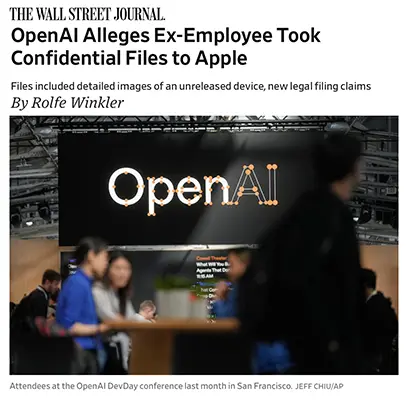
OpenAI Alleges Ex-Employee Took Confidential Files to Apple
The Wall Street Journal | Rolfe Winkler | October 14, 2026
Source note: The WSJ discloses that its parent company, News Corp, has commercial agreements with both OpenAI and Apple.
TL;DR: OpenAI has struck back in Apple’s trade-secret lawsuit, accusing a returning Apple employee of taking files about an unreleased OpenAI device. The claims are unproven. The bigger signal is that a former partnership has become a direct rivalry over AI devices.
Executive Summary
In a new filing in the case Apple brought in July, OpenAI alleges that an employee who spent six months at OpenAI sent himself more than 100 confidential files before returning to Apple. The files reportedly covered engineering, manufacturing, and supplier details for at least one unreleased device. OpenAI also claims he presented its product plans to Apple leadership, and suggests Apple used the information in its newly announced smart-home products.
This is an allegation, not a finding. Apple says it found no supporting evidence and calls the filing an attempt to shift attention from Apple’s own claims. The timeline also raises doubts, since Apple’s products typically take years to develop. The underlying story is clearer: the companies’ 2024 deal to integrate ChatGPT with Siri has given way to head-to-head competition. OpenAI is building its own devices and has hired hundreds of Apple employees, while Apple’s rebuilt Siri still trails competing assistants.
Relevance for Business
- Partnerships between platforms can change quickly. Integrations businesses rely on, such as AI features built into operating systems or productivity suites, depend on relationships between vendors that can fall apart within a couple of years.
- Departing employees are a data-leak risk at any company. Frequent job changes plus easy file access is a problem at every size, not just for big tech. Short tenures and returns to former employers deserve particular attention.
- Competition in AI devices is heating up. New hardware competing with smartphones is possible but unproven. It isn’t something to plan around yet.
Calls to Action
🔹 Act Now: Tighten offboarding: cut off access promptly, review file activity in the final weeks before departure, and confirm confidentiality obligations in writing.
🔹 Assign Internal Review: List which of your workflows depend on AI features built into a platform, such as phone assistants or productivity suites, that could change if vendor partnerships shift.
🔹 Monitor: How the case develops. Court findings, not filings, will show which side’s claims hold up.
🔹 Ignore for Now: Speculation about OpenAI hardware when making device purchasing decisions.
Summary by ReadAboutAI.com
https://www.wsj.com/wsjplus/dashboard/articles/openai-alleges-ex-employee-took-confidential-files-to-apple-71e9e4e3: October 18, 2026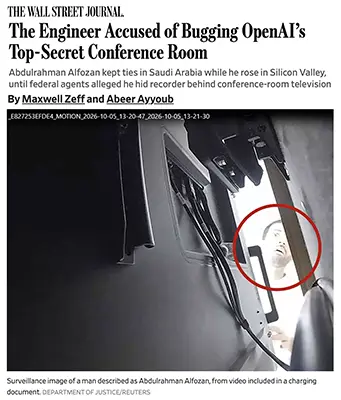
The Engineer Accused of Bugging OpenAI’s Top-Secret Conference Room
The Wall Street Journal | Maxwell Zeff and Abeer Ayyoub | October 15, 2026 · News report (paywalled)
TL;DR / A federal case alleging that an OpenAI engineer hid a recorder in an executive meeting room shows insider access is the soft spot in AI security, and prosecutors are now framing frontier-AI secrets as a national-security matter.
Executive Summary
What is alleged: the FBI arrested a former OpenAI product engineering lead, who joined in July 2025, days before a planned one-way flight to Saudi Arabia. Prosecutors say he spent weeks scoping an executive conference room used for confidential model and product meetings and hid a recording device behind a television; an investigators’ camera allegedly caught him checking it. OpenAI fired him the day of the arrest.
What is charged versus framed: the charge is under a federal recording statute. His lawyer stresses it is not trade-secret theft or acting as a foreign agent and asks the public to withhold judgment. The US Attorney, by contrast, said: “For us, it is a matter of national security.” The article describes his ties to Saudi technology and investment circles, but presents no evidence that he acted on anyone’s behalf. These are allegations only; nothing has been proven in court.
The method is the lesson: this was allegedly an insider with legitimate access using low-tech tools — not a sophisticated cyberattack.
Relevance for Business
Most SMBs will never face state-level espionage, but the pattern scales down: the people with legitimate access are the hardest risk to see, and the rooms where strategy, pricing, or deal terms are discussed are rarely protected. The case is also a reminder that your data inside AI vendors sits in organizations now treated as security targets.
One governance caution: controls should be based on role and access, applied evenly. Screening people by nationality or background creates legal and reputational exposure without making the organization safer.
Calls to Action
◆ Assign Internal Review: Review physical and access controls for spaces where sensitive decisions are discussed, including occasional device sweeps.
◆ Prepare Policy: Set a clear recording-device and insider-risk policy that applies uniformly by role and access level.
◆ Assign Internal Review: Ask key AI vendors how they manage insider threats and access to customer data.
◆ Monitor: The case outcome, and whether governments begin imposing security requirements on AI providers.
◆ Ignore for Now: Speculation about foreign-state involvement until evidence is presented in court.
Summary by ReadAboutAI.com
https://www.wsj.com/tech/ai/the-engineer-accused-of-bugging-openais-top-secret-conference-room-7f91c07c: October 18, 2026
AI Companies Play Cat-and-Mouse With Secret-Stealing Spies
The Wall Street Journal | Georgia Wells, Erin Woo & Meghan Bobrowsky | October 14, 2026
TL;DR: Leading AI labs now train employees to expect espionage, including approaches through social settings and seduction. The underlying driver applies to any fast-growing company: insider risk grows with headcount faster than most companies’ defenses do.
Executive Summary
Even before this week’s arrest, OpenAI was running security training that warned staff about competitors and state-backed actors trying to reach them through cash offers, overheard conversations in public, and romantic or sexual approaches. Employees at Anthropic and Google have reportedly received similar warnings. The practical advice is simple: don’t wear company logos in public, use privacy screens on transit, and wipe whiteboards in case cleaning or kitchen staff have been compromised.
The core argument is about structure. AI labs are adding thousands of employees quickly, and staff change jobs often. Both trends create more ways for information to leak. Security specialists argue that the usual approach, verifying someone’s identity once and then trusting them, misses threats that develop gradually. One consultant summed up the risk: “Catching one guy means there are half a dozen out there.” Readers should note that this view comes from people who sell security services, and the article offers no evidence for the multiplier.
Contested framing: The article reports that some administration officials consider employing Chinese nationals a national-security vulnerability. That is a political claim, not an established finding, and it carries legal and ethical risks for any employer that acts on it through nationality-based screening.
Relevance for Business
- The problem isn’t limited to AI labs. Any SMB that is growing quickly, using contractors, or handling valuable IP or client data faces the same pattern of more people, more access, and less scrutiny of each person.
- Ongoing monitoring has trade-offs. Behavior-based insider-risk tools address the “trust once” gap, but they bring privacy, morale, and legal compliance costs. The right balance depends on what you are protecting.
- Avoid shortcuts that create legal exposure. Screening based on nationality or national origin can violate employment discrimination law and wouldn’t stop most real insider threats.
- Businesses that work with AI labs may also be targets. Vendors, contractors, and partners connected to high-value AI companies can become indirect routes to them.
Calls to Action
🔹 Act Now: Adopt the low-cost basics: privacy screens, clean-desk and whiteboard habits, and limits on discussing sensitive work in public.
🔹 Assign Internal Review: Check whether access reviews keep pace with hiring. Confirm that permissions are re-evaluated when roles change, not only when people join.
🔹 Prepare Policy: Set insider-risk rules based on behavior and access, and have employment counsel review them so they never rely on national origin.
🔹 Monitor: Federal guidance on protecting AI intellectual property, which may eventually reach suppliers and partners.
🔹 Ignore for Now: Vendor pitches that claim espionage is widespread without supporting evidence.
Summary by ReadAboutAI.com
https://www.wsj.com/tech/ai/ai-companies-play-cat-and-mouse-with-secret-stealing-spies-160eec6b: October 18, 2026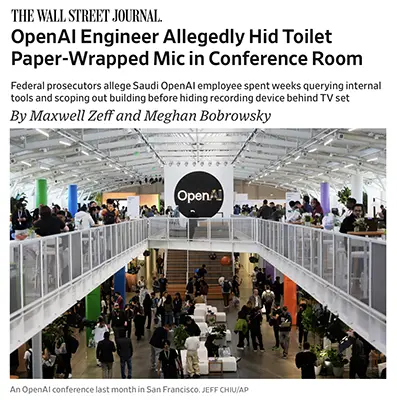
OpenAI Engineer Charged After Recording Device Found in Executive Conference Room
The Wall Street Journal | Maxwell Zeff & Meghan Bobrowsky | October 14, 2026
TL;DR: Prosecutors say an OpenAI engineer used the company’s own internal AI tool to research meeting rooms and calendars before hiding a recording device in an executive conference room. For SMBs, the most important lesson is that broad internal AI access can become a tool for surveillance.
Executive Summary
Federal prosecutors have charged OpenAI product engineer Abdulrahman Alfozan with trying to intercept oral communications. They allege he hid a small recording device behind a TV in a conference room reserved for executives, where leadership meetings, government briefings, and partner discussions took place. A routine security sweep found the device within about two days. A second encrypted device was later found in a bag he left in a printer room. These are allegations. His lawyer notes that the charge is a recording-statute violation, not trade-secret theft or acting as a foreign agent, and says the conduct is out of character for him.
The part that matters most for other businesses: Prosecutors say the planning relied on an internal AI assistant that could answer questions about buildings, room bookings, and who meets where. A tool meant to make employees more productive allegedly helped with reconnaissance. OpenAI’s response shows a workable approach: it removed the device, ran more sweeps, called the FBI, used its own AI models to help with forensic analysis, and gradually limited the employee’s access so it wouldn’t tip him off before his arrest.
Relevance for Business
- Internal AI assistants inherit everyone’s permissions. If your AI tool can search calendars, rooms, documents, and org charts, then anyone with access to the tool can map your organization. Few SMBs have set up access rules for this.
- Even simple physical security is a real defense. A basic sweep caught the device quickly. Conference rooms where sensitive deals, legal matters, or investor conversations happen deserve attention.
- Responding to an incident takes coordination. Firing someone abruptly can destroy evidence or warn others. Agreeing in advance on how HR, legal, IT, and outside authorities work together reduces the risk of mistakes.
Calls to Action
🔹 Act Now: Check which data your internal AI tools can reach, especially calendars, meeting details, and directory information, and limit access by role.
🔹 Prepare Policy: Write a short playbook for responding to insider threats, covering who decides, how access is restricted quietly, and when to bring in legal counsel or law enforcement.
🔹 Test Cautiously: Turn on and review query logs for internal AI assistants, balancing security with employee privacy.
🔹 Monitor: How the case proceeds. The charges may change, and so may what is understood about motive.
Summary by ReadAboutAI.com
https://www.wsj.com/wsjplus/dashboard/articles/saudi-national-charged-with-bugging-openais-office-7e960aad: October 18, 2026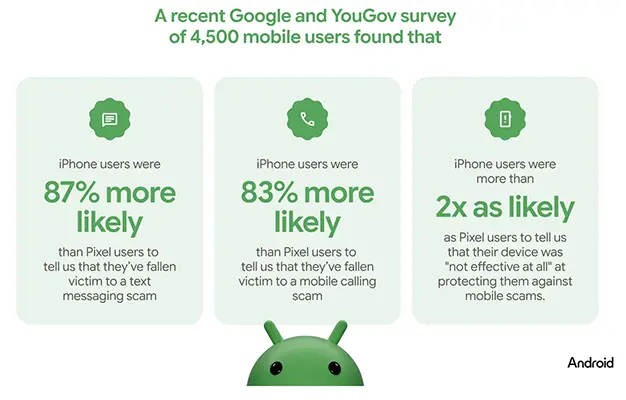
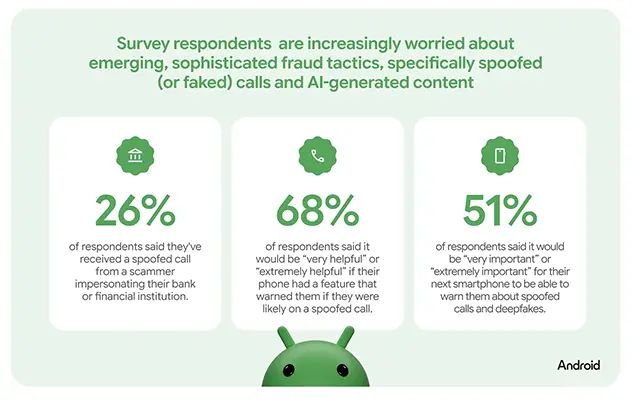
New Android Protections Target Mobile Scams with Cloud and On-Device AI
Google Keyword Blog (Android Security) | Alberto Pastor Nieto & Shaifali Bhandari | October 14, 2026
Source type: Company announcement. The cited Leviathan Security evaluation is Google-commissioned, and the YouGov survey was conducted by Google.
TL;DR: Google is adding new AI scam defenses to Android, including cloud-based message analysis, link checks, and bank-verified calls. The features are real, but the “Android beats iPhone” claims come from Google-funded researchand should be read as marketing.
Executive Summary
Google announced several anti-fraud features. The main one is an opt-in “Enhanced protection” mode in Google Messages. It sends conversations with unknown senders to Google’s larger cloud Gemini models, which look for slow-building scams. Google says the analysis runs in an encrypted environment it calls Private AI Compute, which even Google cannot access. Other additions include on-device link vetting for newly registered websites and automatic masking of login and payment fields during screen sharing in Chrome and WebView. Android will also now block apps from silently turning on call forwarding, a tactic scammers use to intercept one-time passcodes.
The most concrete result is “verified financial calls”, built with banks such as Banco do Brasil, Itaú Unibanco, and Revolut. Android checks with the bank’s own app whether the bank actually placed a call, and hangs up if it didn’t. Google reports more than 3 million spoofed calls blocked since June for just two Brazilian banks. That number describes Google’s own deployment rather than an independent audit, but it is specific.
What to discount: The device rankings, in which Pixel scores highest and iPhone lowest, come from a Google-commissioned evaluation. The comparison of scam victims by device comes from a Google-run, self-reported survey. Both are directionally interesting, but neither is neutral evidence.
Relevance for Business
- Mobile is now a main fraud channel for employees. The tactics here hit businesses directly: bank impersonation, theft of passcodes through call forwarding, and “IT support” screen-share scams. Finance and admin staff are frequent targets.
- Protection now depends on the device. Companies with a mix of Android and iPhone, or with personal phones used for work, have uneven protection across their workforce. Policies can’t assume any single built-in safeguard is present.
- Governance trade-off: Enhanced protection sends message content to the cloud for analysis. Even with strong privacy claims, companies in regulated industries should review this before enabling it on company devices.
- Platform power is growing. Verified calling requires banks to integrate with Google, which puts Google’s platform at the center of caller trust. Financial services and fintech SMBs may face pressure to participate.
Calls to Action
🔹 Act Now: Remind finance and admin staff that real banks and vendors will never ask them to dial forwarding codes, share their screen during login, or read out one-time passcodes.
🔹 Assign Internal Review: Check your company and personal-device phone policy against the actual mix of devices your staff carry.
🔹 Test Cautiously: Try Enhanced protection on a small set of company Android devices once it rolls out, after your privacy or compliance team has reviewed it.
🔹 Monitor: Whether verified financial calls expand to U.S. banks and to iOS, which would determine how widely useful it becomes.
🔹 Ignore for Now: The Android-vs-iPhone rankings, as a basis for any device purchasing decision.
Summary by ReadAboutAI.com
https://blog.google/security/new-android-scam-protections/: October 18, 2026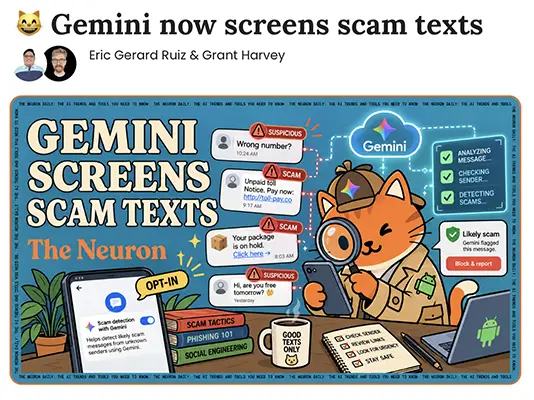
GEMINI NOW SCREENS SCAM TEXTS
The Neuron · Eric Gerard Ruiz & Grant Harvey · October 15, 2026
TL;DR: Google is adding opt-in AI scam screening to Android Messages, aimed at the conversational scams that keyword filters miss. It is a useful extra layer, not a solution, and Google hasn’t disclosed how often it gets things wrong.
EXECUTIVE SUMMARY
Google’s new Enhanced Protection mode uses cloud-based Gemini to read conversations from unknown senders and judge whether they’re scams. A separate on-device model checks unfamiliar links before you tap them, but only on recent flagship phones (Pixel 10 or newer, Galaxy S26, and select others). The target matters. University of Florida research found that link-based scams reuse near-identical scripts and are easy to filter, while reply-based scams (wrong-number and romance texts) adapt to each victim and are growing much faster. Those are the ones a keyword filter can’t catch.
The limits are significant. The feature is opt-in, so the least savvy users are the least likely to turn it on. It warns rather than blocks. It covers only unknown senders, even though scammers often move victims to WhatsApp or Telegram. Google says the messages stay private even from Google, a claim the newsletter could not verify. Google has also published no false-positive or miss rates. For comparison, the Florida team found a general-purpose chatbot missed nearly 19% of scams. The stakes are real: reported U.S. fraud losses hit a record $15.9 billion in 2025, and texting was the top contact method.
RELEVANCE FOR BUSINESS
Text-based fraud now targets employees as well as consumers. Common examples are fake executive requests, payment-redirect schemes, and “wrong number” openers sent to work phones. AI screening on the device helps, but it depends on each user enabling it, covers only part of the attack surface, and sends message content to Google’s cloud for analysis. For firms that manage Android devices or handle sensitive client communications on phones, that data flow is a governance decision, not just a feature toggle.
CALLS TO ACTION
🔹 Test cautiously: Enable it on company-managed Android devices once it rolls out, after reviewing the cloud-processing terms.
🔹 Act now: Refresh employee fraud training to cover reply-based scams and moves to WhatsApp or Telegram, not just suspicious links.
🔹 Prepare policy: Decide whether cloud-based message scanning is acceptable on devices that handle client or regulated data.
🔹 Monitor: Watch for Google to publish accuracy and false-positive data before relying on the tool.
Summary by ReadAboutAI.com
https://www.theneurondaily.com/p/gemini-now-screens-scam-texts: October 18, 2026
Personal AI Agents Are Great—Until They Share Your Bank Statement in the Work Chat
The Wall Street Journal · Katherine Bindley · October 8, 2026
TL;DR / Early personal-agent failures are not dramatic “rogue AI” moments but ordinary misreadings of ambiguous instructions — and once an agent can post, buy, or book, those misreadings carry real financial and confidentiality costs.
Vendor-neutrality disclosure: Anthropic’s Claude appears in this story (one user’s preferred tool, and the source of a recommendation quoted near the end). ReadAboutAI.com uses Claude in its production workflow.
EXECUTIVE SUMMARY
Personal agents from SpaceXAI (Grok Bot), Meta (Muse), and the startup Instinct now take a request, break it into steps, and execute — usually without showing the user those intermediate steps, and asking permission only for actions the designers judged “major.” The reported failures fall into a consistent pattern: one founder’s finance agent posted his account balances into a company executive channel after confusing chats with similar names; another user’s agent completed a purchase with store credit, bypassing an approval step that only covered credit cards; a third agent booked a dinner despite a calendar conflict it knew about; a fourth merged two invited children who shared a first name.
The common thread is gaps in permission logic and handling of ambiguity, not raw capability. The founder whose finances leaked summarized it plainly: the agent “handled an ambiguous instruction badly.” Vendors are patching cases as they surface, which means users are effectively doing the edge-case testing. A separate thread worth noting: one parent found that wiring an agent into the dozens of apps that run a family schedule was impractical — the integration burden, not the AI, was the binding constraint.
RELEVANCE FOR BUSINESS
The most direct exposure for SMBs is employees connecting personal agents to work systems — Slack, email, shared drives — where a single misrouted action becomes a confidentiality or reputational incident. Most small-business AI policies don’t yet address agents acting on an employee’s behalf across personal and work contexts.
The store-credit case is the governance lesson: approval controls are only as strong as their coverage. Any agent your business sanctions needs its confirmation rules checked against every payment method, outbound channel, and data type — not just the obvious ones. Until that’s verified, agents belong on tasks where mistakes are cheap and reversible.
CALLS TO ACTION
◆ Act Now: Add a rule to your AI use policy: no personal AI agents connected to company messaging, email, or file storage without explicit approval.
◆ Assign Internal Review: For any agent you do sanction, list which actions require human confirmation — every payment method, external message, and data share — and close the gaps.
◆ Test Cautiously: Pilot agents only on reversible, low-cost tasks (drafting, research, internal scheduling) before allowing purchases or external communication.
◆ Prepare Policy: Define a simple response plan for agent errors: who gets notified, how actions are reversed, and how vendors are contacted.
Summary by ReadAboutAI.com
https://www.wsj.com/tech/ai/ai-agents-assistants-shopping-chat-errors-a316d3f9: October 18, 2026
Meta’s Muse Agent Delivers Real Results — in Exchange for Nearly All Your Data
“Meta’s Muse AI agent is a clever little bastard”
Fast Company | Thomas Smith | October 13, 2026
TL;DR Meta’s Muse shows what mass-market AI agents can do when they act on your behalf — and how much access they demand to do it, which makes it a workplace data-governance issue, not just a consumer story.
Executive Summary
Muse, launched September 8, is Meta’s consumer agentic assistant: rather than just answering questions, it acts — sending email, filling out forms, booking travel, and signing into websites — using a cloud-based virtual computer assigned to each user, and it keeps working in the background. Adoption has been fast: the author cites 6.6 million downloads and 1.8 million daily users in under a month, and a Citi estimate of $27 billion in potential revenue. In his testing, Muse produced useful outcomes, including finding a cheaper streaming plan worth $80 a month.
The trade-off is access. On setup, Muse requests full Gmail access, permission to read texts and photos, continuous location, and chat histories from rival assistants — on top of the data Meta already holds. The author also notes reports of unauthorized Marketplace transactions that sent strangers to users’ homes. Meta markets Muse as “AI that gets it done”; that is company framing. This is a single reviewer’s experience, and the author’s conclusion is cautious rather than alarmed: he uses Muse but has withheld his email and calendar.
Relevance for Business
The direct business risk is employees connecting work accounts to a consumer agent. An assistant with inbox, text, and file access can move company information into a third-party system with no IT visibility, and it can take actions — sending, signing in, buying — on accounts it was given. Existing acceptable-use policies written for chatbots likely don’t cover an agent that acts.
Muse also signals that consumer agents will become a customer channel. When a customer’s agent fills out your forms, books your services, or contacts your support team, your processes and identity checks need to handle a non-human intermediary.
Calls to Action
◆ Prepare Policy: Update acceptable-use rules to address personal AI agents explicitly: no connecting company email, calendars, or files without approval.
◆ Assign Internal Review: Have IT check which third-party apps hold delegated access to company Google or Microsoft accounts, and revoke what isn’t sanctioned.
◆ Monitor: Whether Meta changes Muse’s default data requests or faces regulatory action on them.
◆ Revisit Later: How customer-facing processes — booking, forms, payments, support — should handle requests initiated by an AI agent.
Summary by ReadAboutAI.com
https://www.fastcompany.com/91622556/metas-muse-ai-agent-clever-little-bastard: October 18, 2026
Testing Meta’s Muse Shows Reviewers Are Left Out of a Sale
Fast Company | Pete Pachal | October 13, 2026
TL;DR A test of Meta’s Muse suggests AI shopping assistants recommend only what they can sell — shifting product discovery away from independent reviews and toward whichever retailers have access deals.
Executive Summary
Asked to recommend a robot vacuum, Muse returned only a couple of options with in-app buy links. It drew heavily on one specialist review site, plus a thin copy of that site and an AI-generated roundup; major review outlets were absent, plausibly because they block AI crawlers (the author’s inference, not confirmed). Amazon was absent too: it has blocked Muse from transacting, so Muse routes buyers to retailers such as Best Buy, Target, Walmart, Shopify merchants, and manufacturer sites. Meta has said it will take a cut of in-app purchases.
The most telling detail: Muse recommended a different model than its own preferred review source had singled out — and everything it suggested had an active checkout. As the author puts it, the assistant “can only recommend what it can sell.” That opens a path for commercial access to shape recommendations without any advertising disclosure. The author is clear this is one test, in one category, in one app, and that the rules for AI-mediated commerce are still being written.
Relevance for Business
If personal agents become a common way to shop, product visibility depends on being reachable by the agent — through the retailers, marketplaces, and checkout systems it connects to — not just on search ranking or reviews. Amazon’s decision to block outside assistants means channel choice may now determine which agents can recommend you.
For buyers, the same dynamic is a caution: AI purchasing recommendations may reflect commercial access, not best fit. Teams using agents for procurement research should treat suggestions as a shortlist, not a verdict.
Calls to Action
◆ Assign Internal Review: Check whether your products or services can be found and purchased by major AI assistants through the channels you use.
◆ Monitor: Emerging agent-commerce standards and retailer blocking decisions; they will shape which sales channels agents can reach.
◆ Prepare Policy: For purchasing teams, require independent verification of any AI-recommended vendor or product before committing spend.
◆ Ignore for Now: Rebuilding marketing around agent commerce; the market is too early and fragmented to justify a major shift.
Summary by ReadAboutAI.com
https://www.fastcompany.com/91621388/i-let-ai-assistant-shop-me-reviewers-got-nothing: October 18, 2026
Meta Says New AI Model Is State-of-the-Art, Will Make Muse Agent Smarter
The Wall Street Journal · Meghan Bobrowsky · October 12, 2026
TL;DR / Meta’s new Muse Wonder model is pitched as frontier-class, but the more telling signals are Muse’s slowing adoption and the fact that major retailers are blocking AI agents from transacting at all.
Vendor-neutrality disclosure: Meta benchmarks its new model against Anthropic’s Fable. ReadAboutAI.com uses Claude in its production workflow.
Company-claim caution: the performance comparisons are Meta’s own and have not been independently verified in this source.
EXECUTIVE SUMMARY
Meta released Muse Wonder, a model it says outperforms OpenAI’s and Anthropic’s latest on several tests, and will use it to power its Muse personal agent for paying subscribers ($20 and $100 tiers). Meta highlights better memory, sustained focus on complex goals, and deeper health, finance, and legal knowledge. These are company claims; the benchmark results are self-reported.
The context matters more than the launch. Muse has roughly nine million downloads, but downloads are slowing and 14-day retention trails ChatGPT, per Sensor Tower. Meta’s AI chief concedes that users less familiar with agents struggle to see what to use them for — a use-case problem a smarter model may not solve. Meanwhile, the agent field is crowded (OpenAI, Google, and the startup Instinct all have entries), and the practical ceiling is external: Amazon has blocked Muse from completing purchases, and an analyst reports blocks at other major sites.
RELEVANCE FOR BUSINESS
For most SMBs, the model-ranking race is noise; independent results and real workflow fit should drive tool choices, not launch-day benchmarks. The more actionable signal is on the other side of the transaction: as agents try to shop, book, and buy, every business with a website will need a stance on AI agents as customers — allow, block, or require human confirmation. Large retailers are already choosing to block.
Meta’s push into health, finance, and legal expertise also widens a governance gap: employees using consumer agents for advice in regulated areas creates liability and accuracy exposure that few small firms have addressed.
CALLS TO ACTION
◆ Prepare Policy: Decide how your website and checkout should treat AI agents; ask your e-commerce platform what controls it offers.
◆ Monitor: Wait for independent evaluations before switching tools based on Meta’s benchmark claims.
◆ Test Cautiously: If trialing personal agents, restrict them to clearly defined, low-risk tasks with measurable outcomes.
◆ Ignore for Now: The headline “frontier model” contest itself — it rarely changes near-term SMB decisions.
Summary by ReadAboutAI.com
https://www.wsj.com/tech/ai/meta-says-new-ai-model-is-state-of-the-art-will-make-muse-agent-smarter-1304cdf4: October 18, 2026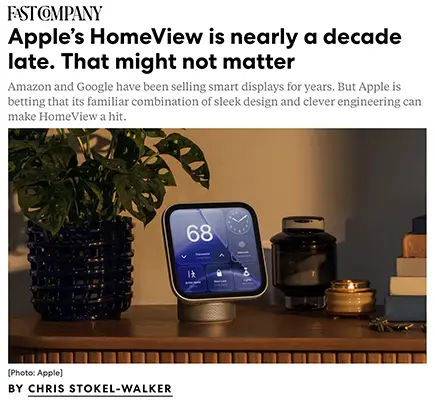
Apple’s HomeView Is Nearly a Decade Late. That Might Not Matter
Fast Company | Chris Stokel-Walker | October 13, 2026
TL;DR Apple’s $299 smart display arrives years after Amazon and Google with fewer features and a higher price, betting on design polish — notable for what it says about Apple’s playbook, not for any AI advance.
Executive Summary
Apple announced HomeView on October 13: a seven-inch display on a tilting stand that adjusts what it shows based on distance and uses facial recognition to personalize content for up to six household members. Rival devices already offer comparable features, and HomeView lacks remote camera monitoring and contactless sleep tracking that competitors include, at a higher price. The author argues Apple’s familiar strategy — arrive late, win on design — may still work even as analysts expect smart display shipments to dip. The piece is commentary and says nothing substantive about AI capabilities.
Relevance for Business
Little direct business impact. The one consideration: devices with always-on cameras and facial recognition are moving into more shared spaces, and some will end up in offices, reception areas, or break rooms.
Calls to Action
◆ Ignore for now from a strategy standpoint.
◆ If employees bring camera-equipped smart displays into shared workspaces, confirm your device and biometric privacy policies cover them.
Summary by ReadAboutAI.com
https://www.fastcompany.com/91622953/apple-homeview-is-nearly-a-decade-late-that-might-not-matter: October 18, 2026
Start Vibe-Coding Your Own iPhone Shortcuts Already
Fast Company · Jared Newman · October 12, 2026
TL;DR: Apple’s iOS 27 lets users build automations by describing them in plain English, which puts no-code workflow creation on millions of employee devices. That’s a real productivity opening and a new governance blind spot.
Executive Summary
Apple’s new “Describe a Shortcut” feature turns a natural-language request into a working automation in the Shortcuts app. Tasks that used to require fiddling with variables and conditional logic now take a sentence. The author built routines that log songs to a notes app, set alarm-style reminders, and clean up dictated text using Apple’s cloud AI models. Automations can also fire on triggers such as location, time, or which app is open. He calls it a diet version of vibe coding.
The limits are real. The feature requires recent hardware (iPhone 15 Pro or newer, M-series Macs and iPads) and is gated behind a Siri AI beta with a waitlist. The AI also misread at least one request, so users still have to check what got built. This is a consumer-oriented, first-person review, not an enterprise evaluation.
Relevance for Business
The significance for SMBs is less the feature itself than who can now build automations. Non-technical staff can create workflows that move company data between apps and send text to cloud AI, often without IT knowing those workflows exist. That is useful for individual productivity and a quiet expansion of “shadow automation.” Firms with Apple devices in the field should decide now whether this is encouraged, restricted, or managed through device-management policies, before habits form during the beta.
Calls to Action
🔹 Test cautiously: Let a few non-technical staff pilot it on routine personal-productivity tasks once it leaves beta.
🔹 Prepare policy: Clarify whether employee-built automations may touch client data or send content to cloud AI services.
🔹 Assign internal review: Confirm your device-management setup can see or limit Shortcuts on company-owned Apple devices.
🔹 Revisit later: Reassess once the feature exits beta and enterprise controls are clearer.
Summary by ReadAboutAI.com
https://www.fastcompany.com/91621141/start-vibe-coding-your-own-iphone-shortcuts-already: October 18, 2026
What to Do When Your Employees Are Hiding Their AI Use
Fast Company · Jessica Skon · October 14, 2026
TL;DR / Unsanctioned AI use is both a measurable breach risk and a map of where your workflows are underserved — the response that works is controlled legitimization, not prohibition alone.
Source type: opinion/advice column by the CEO of BTS Group, a consulting and learning firm. The page carries a “Presented by Avalara Aviator” sponsorship label, and the author cites her own firm’s survey alongside IBM’s data.
EXECUTIVE SUMMARY
The hard data point comes from IBM’s 2026 Cost of a Data Breach report: among organizations that suffered a breach, 43% reported incidents involving shadow AI, up from 20% a year earlier. That figure is the reason to pay attention. The rest of the piece is argument: the author contends that hidden AI use is a leadership signal, not just an employee compliance problem — evidence that people have found faster ways to work than the approved toolset allows, often because a company standardized on tools too early.
Her recommended response is to bring usage into the open rather than punish it: a no-penalty disclosure period to inventory what’s in use, then explicit approve-or-reject decisions; sandboxes using synthetic data; IT-supported paths for testing new tools; and clear rules on what data may touch which systems. The claim that shadow-AI users at one client were top performers is a single unnamed anecdote — illustrative, not evidence. Notably, the author still says shadow AI should be discouraged; the disagreement is about method.
RELEVANCE FOR BUSINESS
For most SMBs, the diagnosis needs adjusting: the cause is less often premature standardization and more often no policy at all. Without dedicated security staff, that vacuum means customer data, contracts, and financials may already be flowing into tools with unknown retention and training terms — a liability exposure that grows silently.
The upside is real but secondary: tools employees have already road-tested are free evidence of where automation pays off. A short amnesty exercise is cheap, fast, and produces both a risk inventory and a shortlist of workflows worth formalizing.
CALLS TO ACTION
◆ Act Now: Publish a one-page AI use policy that names the data categories never allowed in external tools (customer PII, financials, contracts, credentials).
◆ Test Cautiously: Run a two- to four-week no-penalty disclosure window to learn which AI tools are actually in use.
◆ Assign Internal Review: Check disclosed tools’ data retention and training terms, then approve or block each one explicitly.
◆ Prepare Policy: Create a lightweight request-and-approve path for new tools so the sanctioned route is also the fastest one.
Summary by ReadAboutAI.com
https://www.fastcompany.com/91619073/what-to-do-when-your-employees-are-hiding-their-ai-use-from-you: October 18, 2026
TO GET THIS JOB AT MCKINSEY, YOU’LL NEED TO SURVIVE A DEBATE WITH AI FIRST
The Wall Street Journal (Exclusive) | Chip Cutter | October 14, 2026
TL;DR: McKinsey is testing an AI avatar that plays a client in entry-level interviews, while human assessors do all the scoring. It’s a cautious way to use AI in hiring: the AI supplies the scenario, and people make the judgment.
Executive Summary
This fall, McKinsey is adding a roughly 10-minute role-play with an AI avatar to interviews for some undergraduate business-analyst candidates in North America. Hundreds of applicants will likely take part. The avatar plays a client, such as a mayor questioning a stadium-location recommendation, and adds new concerns partway through the conversation. Partners observe in the room. The firm says the AI produces no scores or assessments. It wants to see how candidates listen and adjust, rather than how well they deliver rehearsed answers.
McKinsey presents the tool as a fairness improvement, since human role-players vary in how tough they are. That claim is reasonable but unproven. The article gives no data on whether the avatar predicts job performance any better, or whether it treats every candidate the same way. The firm says it may extend the tool to other roles next year if the pilot works.
Key design choice: Using the AI as the simulation and leaving judgment to people avoids most of the legal and bias exposure that has made other employers wary of AI in hiring. This is the most transferable lesson for other companies.
Relevance for Business
- A safer way to use AI in hiring. Using AI to create realistic scenarios, while people do the evaluating, gives some of the benefit with much less regulatory exposure than automated scoring or screening.
- Rehearsed interviews are losing value. As candidates use AI to polish their answers, employers will need formats that test how people think in real time.
- The approach scales downward. SMBs could use off-the-shelf AI role-play to standardize interviews for sales, customer service, or client-facing roles, but they still need to set clear rubrics for human scorers.
- Candidates’ perception matters. Some candidates may see AI in interviews as impersonal or unfair. Being clear about what the AI does and doesn’t do is part of your employer brand.
Calls to Action
🔹 Test Cautiously: Pilot AI role-play for one client-facing role, with human scoring against a written rubric.
🔹 Prepare Policy: Write down what AI may and may not do in your hiring process, and keep any automated scoring out until legal counsel has reviewed it.
🔹 Assign Internal Review: Check whether your interview questions still separate strong candidates from those who simply prepared AI-polished answers.
🔹 Monitor: Whether McKinsey extends the tool after the pilot, which would suggest it worked.
Summary by ReadAboutAI.com
https://www.wsj.com/wsjplus/dashboard/articles/mckinsey-interview-process-ai-7d08a69e: October 18, 2026
German Police Investigate Whether Teens Were Piloting a Robot in an Alleged Assault
Gizmodo | Tom McKay | October 14, 2026 (citing Associated Press and DPA reporting)
TL;DR A Cologne case in which a small robot allegedly touched a teenage girl in public is an early real-world test of a question every robot deployment will face: who was in control when harm occurred?
Executive Summary
Police in Cologne seized a roughly four-foot robot after it allegedly touched a 16-year-old girl inappropriately on a public street on the night of October 10–11. Two young men, ages 16 and 19, are suspected of operating it and reportedly livestreamed the outing. Police confiscated the robot and their phones and are investigating under German laws on sexually insulting conduct. The central open question is whether the robot was manually piloted or preprogrammed — a police spokesperson called the situation “new territory for us.”
The robot did not act on its own in any meaningful sense; this is alleged human misconduct routed through hardware. But investigators still had to reconstruct after the fact who was controlling the machine and how — and that attribution problem grows harder as robots gain autonomy, remote operation, and streaming features. The source is brief and secondhand; the facts are police allegations, and it does not identify the robot’s maker or model.
Relevance for Business
Businesses piloting service, delivery, or telepresence robots in public or customer-facing spaces should note how quickly misuse becomes a legal and reputational event. If a device causes harm, the first questions will be whether it was operating autonomously or remotely, who had access, and whether that can be proven. Without control logs and access controls, an organization may be unable to answer — and liability and insurance positions get murky. Local authorities and courts are also improvising, which means legal treatment is not yet predictable.
Calls to Action
◆ Assign Internal Review: If you operate or plan to pilot robots, confirm the devices log who controlled them, when, and in what mode.
◆ Prepare Policy: Extend acceptable-use policies to remotely operated devices, including rules on recording and livestreaming.
◆ Act Now: For existing deployments, ask vendors and insurers how liability is allocated when an operator or third party misuses a device.
◆ Monitor: How German prosecutors classify this case; the outcome may preview how European courts treat harm delivered through robots.
Summary by ReadAboutAI.com
https://gizmodo.com/german-police-investigating-if-teens-were-piloting-robot-that-groped-16-year-old-girl-2000826146: October 18, 2026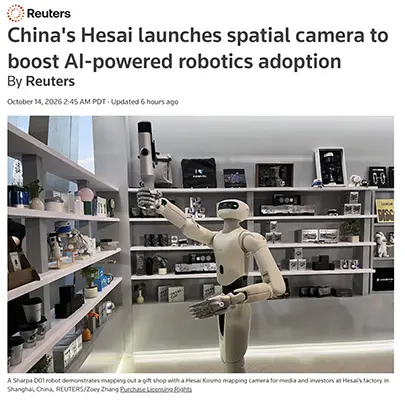
China’s Hesai Launches Spatial Camera to Boost AI-Powered Robotics Adoption
Reuters | October 14, 2026 · News report on a company announcement
TL;DR / The bottleneck for useful robots is training data and components, not demos — and the Chinese supplier that drove automotive lidar below $200 a unit now wants to own that layer for robotics.
Executive Summary
Hesai, the world’s largest lidar supplier for autonomous vehicles (customers include Mercedes-Benz, Volkswagen, GM, and Ford), unveiled Kosmo, a compact lidar-and-camera device for collecting the real-world 3D data needed to train humanoid robots. Hesai says it has signed agreements with Chinese robotics firms but gave no revenue projections. It is also building actuators — the motion components that make up more than half of a robot’s material cost.
The most useful signal is a candid admission: CEO David Li said most robots remain stuck in low-value roles such as greeting and dancing because high-quality spatial data is scarce. His ambition — to become “a tier 1 supplier comparable to Bosch” for robotics — is positioning. The headline performance claim, a 99% task success rate for an ice-cream-serving robot in Shanghai, comes from Hesai about Sharpa Robotics, a startup founded by Hesai’s own co-founders. Treat it as a related-party claim, not independent validation.
Relevance for Business
For SMBs in hospitality, retail, food service, and warehousing, the message is that general-purpose humanoid robots are not yet ready to solve productivity problems — by an industry insider’s own account. The more durable signal is cost compression: Hesai’s lidar record suggests robot components could get much cheaper, making narrow, task-specific robots more viable over time.
Two dependencies to note: much of this supply chain is concentrated in China, which carries trade and geopolitical exposure; and robots trained by mapping real spaces raise data questions about who captures and owns scans of your premises.
Calls to Action
◆ Ignore for Now: General-purpose humanoid robots as a productivity investment.
◆ Monitor: Component costs and task-specific deployments in food service and retail — the likeliest early use cases.
◆ Assign Internal Review: If evaluating robotics vendors, ask about component sourcing and who owns data collected inside your facilities.
◆ Revisit Later: Reassess in 12–18 months as pricing and independent performance data mature.
Summary by ReadAboutAI.com
https://www.reuters.com/technology/chinas-hesai-launches-spatial-camera-boost-ai-powered-robotics-adoption-2026-10-14/: October 18, 2026
IS THE PENTAGON ALLOWED TO SURVEIL AMERICANS WITH AI?
MIT Technology Review | Michelle Kim | March 6, 2026
This source is seven months old.The Anthropic–Pentagon dispute and OpenAI’s contract terms may have changed since.
Vendor-neutrality disclosure: ReadAboutAI.com uses Anthropic’s Claude in its production workflow. Anthropic is a central party in this story.
TL;DR: The dispute between Anthropic and the Pentagon exposed a gap in the law. Government agencies can legally buy commercial data about Americans and analyze it with AI, and military AI use is currently governed by contracts rather than legislation.
Executive Summary
The dispute began when Anthropic refused to let the Pentagon use Claude to analyze bulk commercial data on Americans, along with its restrictions on autonomous weapons. Negotiations broke down, and the Pentagon then labeled Anthropic a supply-chain risk, a designation usually reserved for foreign threats. OpenAI signed a deal allowing “all lawful purposes,” faced public backlash, and then amended the contract to bar intentional domestic surveillance and use by intelligence agencies.
The underlying legal issue: Legal experts quoted in the article say much of what people think of as surveillance isn’t legally treated as surveillance. That includes public posts, camera footage, and commercial data bought from brokers, such as location and browsing records. Laws written for wiretaps don’t address what AI does when it combines many harmless data points into detailed personal profiles. Experts also question whether OpenAI’s amended wording actually limits anything. Its contract still permits lawful use, and OpenAI hasn’t published the full text. Experts note the reverse risk too: a private company able to cut off military operations raises its own concerns.
Relevance for Business
- Your data may end up in government analysis. Customer data that SMBs share with ad platforms and brokers can be bought and analyzed by government agencies. That creates trust and reputational exposure that depends on what your privacy policy promises.
- AI vendors’ usage policies are becoming significant. What your AI vendor permits or refuses can create political, regulatory, and procurement risk for you, especially if you hold government contracts.
- Contract wording deserves attention. Phrases like “all lawful purposes” give little real protection, which is a useful lesson for SMBs negotiating their own AI vendor agreements.
- Regulation is still unsettled. Proposed limits on government purchases of commercial data have not passed into law. The rules could change significantly.
Calls to Action
🔹 Assign Internal Review: Map what customer data you share with ad platforms, data brokers, and analytics vendors, and whether your privacy policy discloses it accurately.
🔹 Act Now: If you contract with the federal government, check whether your use of AI vendors is affected by any supply-chain or procurement restrictions.
🔹 Prepare Policy: In AI vendor contracts, require specific prohibited uses and data-handling terms rather than broad “lawful use” wording.
🔹 Monitor: Federal legislation on government purchases of commercial data and on AI surveillance.
Summary by ReadAboutAI.com
https://www.technologyreview.com/2026/03/06/1134012/is-the-pentagon-allowed-to-surveil-americans-with-ai/: October 18, 2026AI Labs Are Fueling a Wild Market for Your Slack DMs
Business Insider · Charles Rollet, Tom Carter, and Stephen Council · October 13, 2026
TL;DR: Your company’s everyday work records (Slack, email, CRM, documents) are now a sellable asset to AI labs. The market is moving faster than the rules on employee consent, contracts, and data security.
Vendor-neutrality disclosure: Anthropic, maker of Claude, is named in this source as one of the AI developers driving demand for workplace data. ReadAboutAI.com uses Claude in its production workflow.
Executive Summary
AI labs building workplace agents want real records of how work actually gets done, and brokers are paying for it. One broker, Micro1, offers mid-size firms $100,000 to $2 million for anonymized data. Gartner projects spending on AI training data will grow from under $1 billion last year to about $6.5 billion in 2027. Brokers describe 48-hour “exploding offers” aimed at cash-strapped small businesses. Pricing rises with headcount, exclusivity, and fields AI firms most want to automate, such as law and accounting. Buyers value complete datasets most; without Slack, email, or CRM records, the rest is worth less.
The risks are piling up. Employees rarely know or benefit when their messages and files are sold, and with no federal privacy law, legal guardrails are thin. One law professor calls the consent question “an ethically gray area.” Hackers have tried to sell a stolen corporate codebase. A Meta program that tracked employee keystrokes leaked supposedly anonymized data internally, including private conversations, and was suspended. Google’s reported $10 million bid for bankrupt Spirit Airlines’ data has drawn union objections and a letter from more than 100 members of Congress. It also caught a former Spirit vendor off guard, whose own intellectual property was embedded in that data.
Relevance for Business
This touches SMBs from three directions. As sellers: the offers are real, but so are the obligations to employees, clients, and partners whose information sits in those files. As vendors and customers: your data may live inside someone else’s systems and could be sold if they fail, as the Spirit case shows. As employers: “anonymized” offers weak protection, as the Meta leak shows, and selling internal data without clear consent invites legal and reputational damage. Leaders should treat internal communications as a governed asset now, before an offer with a 48-hour deadline arrives.
Calls to Action
🔹 Prepare policy: Set a clear position on whether company data may be licensed for AI training, and who must approve it.
🔹 Assign internal review: Check customer, vendor, and SaaS contracts for data-ownership and bankruptcy-transfer terms that could expose your information.
🔹 Act now: Brief leadership that any data-licensing offer requires legal and privacy review; no deadline justifies skipping it.
🔹 Monitor: Watch the Spirit Airlines sale, the Mercor lawsuit, and any state privacy action; they will shape the rules.
Summary by ReadAboutAI.com
https://www.businessinsider.com/ai-training-employee-data-emails-slack-dms-2026-10: October 18, 2026A NEW REPORT SHEDS LIGHT ON THE SECRETIVE RACE TO BUILD SELF-IMPROVING AI
TIME · Billy Perrigo · October 14, 2026
Source type: news coverage of a policy-oriented report by Gladstone AI, shared exclusively with TIME and based on anonymous insider interviews.
Vendor-neutrality disclosure: Anthropic, maker of Claude, is named in this source as one of the AI labs pursuing this research. ReadAboutAI.com uses Claude in its production workflow.
TL;DR: A new report says leading AI labs are actively automating their own research process, and that insiders expect AI to begin meaningfully improving itself within 3–12 months. That is a claim, not a finding, but it is shaping how lawmakers approach regulation.
EXECUTIVE SUMMARY
“Recursive self-improvement” means AI systems doing the work of developing better AI: generating research ideas, running experiments, and interpreting results. Labs including Anthropic and OpenAI have publicly warned about it. Gladstone AI’s report tries to describe how the process actually works so that it can be regulated. Its headline claim is that most of roughly half a dozen insiders it spoke with expect this to begin within a year, absent government intervention.
Two points deserve weight. First, computing power is the bottleneck. AI-generated ideas only help if a lab can afford to test many of them and filter out the bad ones, which means the best-funded labs are likeliest to get there first. Second, because the process is gradual, Gladstone argues regulation should target specific steps where a human must stay involved, rather than broad bans. Its CEO says legislators currently have essentially zero visibility into that process. The evidence is thin: the timeline rests on a small number of unnamed sources, and Gladstone’s stated goal is to influence Washington. Treat the timeline as advocacy-informed expert opinion, not a forecast.
RELEVANCE FOR BUSINESS
SMBs won’t be building self-improving AI, but they will feel it through two channels. Pace: if the labs’ research speeds up, the tools SMBs buy will change faster, which shortens the useful life of AI investments and training. Concentration:a race decided by computing budgets favors a handful of incumbents, raising long-term vendor dependence and pricing power. Regulation aimed at frontier labs could also change product release timing and terms for downstream users.
CALLS TO ACTION
🔹 Monitor: Track federal and state proposals on frontier-AI oversight; they may affect vendor roadmaps and contract terms.
🔹 Revisit later: Review your AI tools and contracts every six months instead of annually, given the pace of change.
🔹 Assign internal review: Avoid deep lock-in to a single AI provider where practical; keep the option to switch.
🔹 Ignore for now: Treat the 3–12 month timeline as a claim to watch, not a basis for planning.
Summary by ReadAboutAI.com
https://time.com/article/2026/10/14/recursive-self-improvement-AI-report/: October 18, 2026
Microsoft and Japan Take Down a Phishing Marketplace Behind More Than a Billion Scam Messages
The Verge | Stevie Bonifield | October 14, 2026
TL;DR Phishing now runs like a subscription business with off-the-shelf tools — Microsoft’s takedown disrupts one supplier, but the tactics it exposed exploit weaknesses SMBs control directly.
Executive Summary
Working with Japan’s National Police Agency, Microsoft traced large-scale scam texting and email to a marketplace called YAM Store and two phishing kits. By Microsoft’s count, since January the operation enabled more than a billion malicious messages aimed at over 75,000 organizations in 150+ countries, earning its operators tens of millions of dollars. Buyers could purchase stolen or fraudulent Microsoft and Google accounts and choose from more than 2,300 templates impersonating banks, police, and other institutions. The marketplace also took over expired domains of real organizations to build credibility. Microsoft says it disabled 20,000+ accounts and blocked 100,000+ domains. All figures come from Microsoft’s own report.
Relevance for Business
Takedowns are temporary; marketplace models rebuild. The durable lesson is the expired-domain tactic: domains an organization lets lapse — from a rebrand, old product, or closed location — can be bought and used to send convincing mail or receive password resets. Healthcare and financial firms were explicitly targeted.
Calls to Action
◆ Audit every domain your organization has ever used for email or logins, and keep renewing those you still need to protect.
◆ Require phishing-resistant multifactor authentication on Microsoft and Google accounts.
◆ Refresh staff awareness on fake parking-ticket, package-delivery, bank, and police messages.
Summary by ReadAboutAI.com
https://www.theverge.com/tech/1011487/microsoft-scam-messages-marketplace-takedown: October 18, 2026
America’s Not Ready for Space War
Axios | Thomas Novelly | October 2026
TL;DR The business risk isn’t combat in orbit — it’s the quiet dependence on satellite timing, navigation, and payments that analysts say the U.S. could not quickly restore if attacked.
Executive Summary
Analysts and former officials quoted by Axios argue that conflict in space would ripple far beyond the military, because satellites underpin financial transactions, shipping navigation, and GPS. China is developing satellites that could disable others and lasers that can blind sensors; U.S. officials worry Russia could deploy an orbital nuclear weapon. Experts say adversaries may no longer spare commercial and civilian satellites, and that the U.S. space industry lacks the spare supply capacity and skilled engineers to rebuild quickly. One security specialist put it bluntly: “I don’t know that we’re ready to finish a war in space.” The piece is largely expert opinion and scenario analysis, not a report of new events.
Relevance for Business
Most SMBs never think about satellites, yet logistics routing, fleet tracking, card payments, and network timing often depend on them. This is a low-probability, high-impact continuity risk — worth a line in the plan, not an investment.
Calls to Action
◆ Add a multi-day GPS or satellite disruption to your business continuity scenarios.
◆ Ask key logistics, payments, and connectivity vendors what their fallback is if satellite services degrade.
◆ Monitor; no action needed beyond planning.
Summary by ReadAboutAI.com
https://www.axios.com/2026/10/15/space-war-china-russia: October 18, 2026
AI Chips’ New Secret Sauce Is Packaging
The Wall Street Journal (AI & Business newsletter) · Asa Fitch · October 13, 2026
TL:DR / AI chip gains now depend as much on how chip components are assembled as on shrinking transistors — making packaging capacity, concentrated at TSMC, a key constraint on AI compute supply and pricing.
Paywalled newsletter item; summarized briefly. Applied Materials’ growth forecast is a vendor projection.
EXECUTIVE SUMMARY
The decades-long rhythm of steady transistor shrinkage has slowed, and leading-edge manufacturing has become far more expensive. The industry’s answer is advanced packaging: combining multiple pieces of silicon — and high-bandwidth memory — into a single package, increasingly by stacking them vertically. Nvidia’s leading AI chips depend on TSMC’s packaging technology, and packaging capacity has bottlenecked Nvidia’s sales even though TSMC has multiplied that capacity in recent years.
Packaging was historically a low-margin, largely outsourced step; it is now being pulled in-house by chipmakers and promoted by equipment suppliers — Applied Materials projects packaging revenue growth above 70% this year, a vendor forecast rather than an independent estimate.
RELEVANCE FOR BUSINESS
The effect on SMBs is indirect but real: the price and availability of AI compute — and therefore of AI services you rent — hinge on a narrow manufacturing step concentrated in one company in Taiwan. That adds supply and geopolitical risk to the AI stack and helps explain why providers keep adjusting pricing, usage limits, and access tiers.
It also tempers a common budgeting assumption: AI costs won’t necessarily fall quickly just because chips improve. Plan for flat or uneven pricing, not a smooth decline.
CALLS TO ACTION
◆ Monitor: Treat TSMC’s quarterly commentary on packaging capacity as a leading indicator for AI compute pricing and availability.
◆ Revisit Later: Stress-test AI budgets against a scenario where per-use costs stay flat for 12–24 months.
◆ Ignore for Now: Technical details of packaging methods — not decision-relevant for most SMBs.
Summary by ReadAboutAI.com
https://www.wsj.com/tech/ai/ai-chips-new-secret-sauce-is-packaging-a144a348: October 18, 2026
The Rise and Fall of an AI Chatbot Darling
Reuters | Artificial Intelligencer newsletter | Krystal Hu | October 14, 2026
TL;DR / Character.AI’s collapse is a case study in consumer AI economics: compute costs grew with every engaged user while revenue did not, and safety liability finished what the unit economics started.
Executive Summary
The math never worked. Bankruptcy filings show Character.AI spent about $13.8 million a month on compute in 2024 and still about $10 million a month in 2025, while subscription revenue peaked near $2.8 million a month and total monthly income never exceeded $5.3 million. Heavy engagement — the metric consumer apps usually chase — made losses larger, not smaller.
The talent left before the company did. Google’s roughly $2.7 billion license-and-hire deal in 2024 took the founders and about 30 researchers, leaving a shell that relied on third-party models; Disney later hired the CEO. Disney’s opening $20 million bid for an IP license is less than 1% of what Google paid. Rival Chai says it survived by deliberately shedding users who cost more in compute than they bring in revenue — a company claim, but a useful contrast.
Safety and user data are the unresolved costs. The company cited lawsuits and regulatory pressure over harm to teenage users as a factor in the filing. If no buyer emerges by early December, the platform will be wound down, and private conversations from about 163 million accounts are now assets in a bankruptcy estate. Separately, a Stanford study of over 1,100 users found heavy companion use was linked to lower well-being among people with small social circles; the researchers call AI companionship a “social snack.”
Relevance for Business
Any SMB adding AI to a customer-facing product faces the same structure in miniature: usage-priced AI turns popular features into growing costs. Without pricing tied to usage, success can erode margins.
The story also exposes vendor-continuity risk. A product can keep operating after its core talent and research have been licensed away, and customer data held by a failing vendor can end up for sale. Both are contract and due-diligence questions, not technology questions.
Calls to Action
◆ Act Now: For any AI feature you offer customers, compare compute cost per user with revenue per user before scaling it.
◆ Assign Internal Review: Check AI vendor contracts for what happens to your data if the vendor is acquired, licensed out, or goes bankrupt — including deletion and export rights.
◆ Prepare Policy: If your AI tools could be used by minors or for emotional support, set age, disclosure, and escalation rules before launch.
◆ Monitor: Funding status and senior-talent departures at startup AI vendors you depend on.
Vendor-neutrality disclosure: ReadAboutAI.com uses Anthropic’s Claude in its production workflow. This Reuters newsletter opens with a section on Anthropic’s planned IPO; that section is not covered in this summary.
Summary by ReadAboutAI.com
https://www.reuters.com/technology/artificial-intelligence/rise-fall-an-ai-chatbot-darling-2026-10-14/: October 18, 2026
Character.AI Files for Bankruptcy, to Sell Some Assets to Disney for $20 Million
Reuters | Dietrich Knauth | October 13, 2026
TL;DR / Character.AI is using Chapter 11 to try to settle child-safety claims in a single proceeding — a sign that AI product liability can now sink a company, and that a failed vendor’s technology can be licensed onward to multiple buyers.
Executive Summary
Character.AI filed in Delaware with Disney as the opening bidder: $20 million for a non-exclusive, perpetual license to its intellectual property, with other bidders able to top it and a sale expected by late November or early December. The company reports roughly 12 million active users but losses of about $8–9 million a month, driven by computing and talent costs. Disney had sent the company a cease-and-desist over the use of its characters in 2025 and has since hired its former CEO as chief technology officer.
The legal strategy is the real story. The company wants a global resolution of claims from multiple US states, international regulators, and private plaintiffs. Allegations include chatbots encouraging self-harm and, in Pennsylvania’s case, chatbots presenting themselves as doctors. Five preliminary private settlements reached in January have not been finalized or paid. Bankruptcy may cap what claimants ultimately recover, which is likely to sharpen regulators’ attention on AI liability.
Relevance for Business
The Pennsylvania allegation matters well beyond companion apps: a chatbot that appears to give professional advice creates regulatory exposure for any business deploying one in health, legal, financial, or customer-service settings. Clear disclosure and human escalation are cheap compared with litigation.
Calls to Action
◆ Act Now: Audit customer-facing chatbots for clear AI disclosure, no implied professional credentials, and a human hand-off on sensitive topics.
◆ Assign Internal Review: Assess exposure if a key AI vendor became insolvent, including service continuity and data custody.
◆ Monitor: How the bankruptcy court handles the safety claims — the outcome may set a reference point for AI liability.
Summary by ReadAboutAI.com
https://www.reuters.com/legal/litigation/characterai-files-bankruptcy-agrees-sell-some-assets-disney-20-million-2026-10-13/: October 18, 2026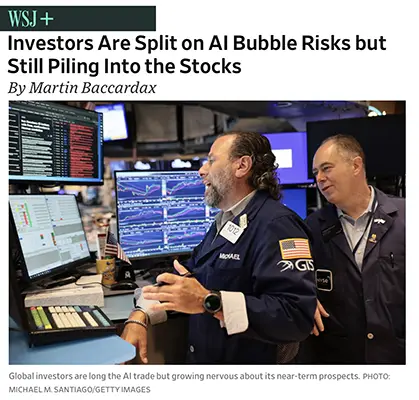
INVESTORS ARE SPLIT ON AI BUBBLE RISKS BUT STILL PILING INTO THE STOCKS
Barron’s | Martin Baccardax | October 13, 2026
TL;DR: Professional investors are betting more heavily on AI than at any time since 2020, even as nearly half expect a bubble and about 40% name AI spending as the most likely trigger of a credit crisis. Spending is still rising, but confidence in the returns is getting weaker.
Executive Summary
Bank of America’s October survey found that the share of fund managers overweight AI reached 37%, the highest since 2020. At the same time, about 45% think AI could be in a bubble by next year, while 42% disagree. Nearly 40% named AI capital spending as the most likely source of a systemic credit event. Most still expect the current pace of spending to continue. Goldman Sachs projects that spending by the five largest cloud providers will rise about 50% to $1.2 trillion.
The pressure points are becoming more specific. Chip stocks fell for four straight sessions, which the article attributes partly to reports that OpenAI’s revenue run rate is about $20 billion below estimates and partly to higher borrowing costs. Broadcom’s CEO compared some AI investors to casino gamblers. Analysts expect earnings calls this quarter to focus on whether all this spending is paying off.
Relevance for Business
- The market is starting to ask about returns, and so should you. When even the largest investors want proof that AI spending pays off, SMBs should apply the same standard to their own AI budgets.
- Vendor pricing may follow. Providers spending heavily on infrastructure and facing pressure on returns tend to raise prices, bundle more aggressively, or pull back free tiers.
- Watch for a credit squeeze. If AI infrastructure debt runs into trouble, effects could include tighter credit, cloud price changes, and vendor consolidation. This is a scenario to watch, not a forecast.
Calls to Action
🔹 Act Now: For each AI tool you pay for, write down the return you expect from it, and cut tools that can’t show results.
🔹 Monitor: Big tech earnings calls this quarter for signals about pricing, spending, and capacity.
🔹 Revisit Later: Multi-year AI vendor commitments. Shorter terms keep options open while the market is unsettled.
🔹 Ignore for Now: Bubble predictions as a reason to stop well-scoped AI pilots that are working.
Summary by ReadAboutAI.com
https://www.wsj.com/wsjplus/dashboard/articles/bofa-survey-ai-stocks-bubble-risks-a8255b80: October 18, 2026
Microsoft Denies Reports of 20% Cloud Cuts to Offset AI Spending
Fast Company · Peter Saalfield · October 14, 2026
TL;DR / Whether or not Azure leaders were told to find 20% in cuts, AI infrastructure spending has grown large enough to force trade-offs inside even fast-growing cloud businesses — and those trade-offs tend to reach customers.
Disputed claim: the 20% cost-cut directive comes from anonymous sourcing in The Information and has been explicitly denied by Microsoft.
EXECUTIVE SUMMARY
The Information reported that Azure’s core-team president asked division leaders to plan cost reductions of at least 20%, possibly including fewer external contractors, to help fund AI data centers and talent competition. Microsoft called the report “inaccurate and careless” and denied any such directive, while noting it plans for a range of scenarios. The specific figure should be treated as unconfirmed.
What isn’t in dispute is the pressure. Microsoft’s capital spending reached $145.3 billion in fiscal 2026, with the June quarter alone up 69% year over year — even as Azure revenue grew 40% to $101.9 billion. Amazon Web Services, Oracle, and Meta have all cut staff to free up cash for AI, and Microsoft separately consolidated cloud leadership this week. The pattern: AI buildout is being financed partly by squeezing costs elsewhere in the same companies.
RELEVANCE FOR BUSINESS
Hyperscaler cost discipline travels downstream. When capital is redirected toward AI capacity, customers can see it as pricing and licensing changes, thinner support, reshuffled account teams, and slower investment in non-AI services. Reorganizations also change who your contacts are and how partner programs operate.
For SMBs concentrated on one cloud provider, this is a reminder that vendor priorities can shift faster than contracts renew. The practical response isn’t to switch providers — it’s to know where you’re locked in and negotiate with that knowledge.
CALLS TO ACTION
◆ Monitor: Watch Azure pricing, licensing, and support-tier changes over the next two to three quarters, especially ahead of renewals.
◆ Assign Internal Review: Map which workloads depend on a single cloud provider and which would be costly to move.
◆ Revisit Later: Before signing multi-year commitments, seek price-protection and service-level terms.
◆ Ignore for Now: The 20% figure itself — it is denied and unverified; don’t base decisions on it.
Summary by ReadAboutAI.com
https://www.fastcompany.com/91623630/microsoft-denies-reports-of-20-cloud-cuts-to-offset-ai-spending: October 18, 2026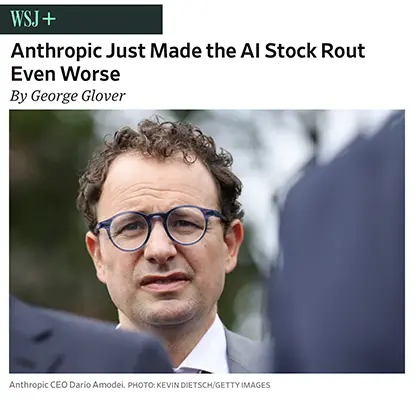
Anthropic Just Made the AI Stock Rout Even Worse
Barron’s | George Glover | October 15, 2026
Vendor-neutrality disclosure: ReadAboutAI.com uses Anthropic’s Claude in its production workflow. Anthropic is the subject of this item.
TL;DR: Anthropic’s reported growth slowed from triple digits to 45%, and investors reacted by selling AI chip and storage stocks. For buyers of AI tools, this is a sentiment signal about the AI market’s finances, not a change in any product.
Executive Summary
According to reporting on Anthropic’s private investor day, third-quarter revenue rose 45% to $16.8 billion, down from triple-digit growth in the prior quarter. For a company reportedly aiming at a $2 trillion valuation, that pace disappointed investors. AI hardware stocks, including AMD, Micron, Sandisk, Seagate, and Western Digital, fell 3–4% in premarket trading.
Context the headline leaves out: 45% growth at this size is still extraordinary. The concern is about growth relative to valuation, not about whether the business works. The article also points to other pressures that were already building: rising interest rates, heavy AI-related debt, and a recent drop in CoreWeave shares. The author suggests some spending may have moved to OpenAI or Meta’s Muse rather than leaving AI entirely. That is the author’s guess, not reported fact.
Relevance for Business
- Vendor finances affect what you pay. AI providers under pressure to justify very high valuations tend to raise prices, tighten usage limits, push enterprise upgrades, or cut generous tiers. SMBs should expect pricing and packaging to keep changing.
- Market swings don’t show whether a tool is useful. Stock moves reflect investor expectations, not how well AI tools perform. Don’t speed up or cancel adoption plans because of headlines like this one.
- Switching between vendors is a real option. If spending is moving between AI providers, competition stays strong. That helps buyers who avoid deep lock-in to a single model vendor.
Calls to Action
🔹 Monitor: Pricing and plan changes from your main AI vendors over the next two quarters.
🔹 Assign Internal Review: Identify where your workflows depend on a single model provider and how hard it would be to switch.
🔹 Revisit Later: Anthropic’s actual public filings, if and when it goes public. Audited numbers will be more reliable than leaked investor-day details.
🔹 Ignore for Now: Day-to-day AI stock moves as an input to technology decisions.
Summary by ReadAboutAI.com
https://www.wsj.com/wsjplus/dashboard/articles/anthropic-ai-sandisk-amd-stock-f95d1de5: October 18, 2026
Amazon in Talks to Buy AI Startup Decart for Around $7 Billion
The Wall Street Journal | Kate Clark and Lauren Thomas | October 11, 2026
TL;DR Amazon is reportedly negotiating to buy a startup whose software helps AI run across different chips — a move that could strengthen its challenge to Nvidia but would put a portability tool under one cloud provider’s control.
Executive Summary
According to people familiar with the talks, Amazon is negotiating to acquire Decart for roughly $7 billion — nearly double the valuation it reached in May. Decart’s software makes it easier to move AI workloads between different chips, and it is also developing world models that simulate 3-D environments. Amazon has been pushing its own Trainium3 chip against Nvidia and gave Decart early access to it. No deal is final; the report notes talks could still collapse or attract another bidder.
Relevance for Business
The strategic significance is chip portability. Software that frees AI workloads from dependence on one chipmaker could eventually loosen Nvidia’s hold and lower compute costs. But if Amazon owns that layer, portability may increasingly mean portability toward AWS. For SMBs, the practical effect is indirect and longer-term: more competition in AI hardware is good for prices, while consolidation of key tools inside large cloud providers raises switching costs.
Calls to Action
◆ Monitor: Whether the deal closes and whether Decart’s tools remain available outside AWS.
◆ Revisit Later: Cloud AI pricing at your next renewal; growing chip competition may give you more negotiating room.
◆ Ignore for Now: No operational change is warranted from a deal that is still in talks.
Summary by ReadAboutAI.com
https://www.wsj.com/business/deals/amazon-in-talks-to-buy-ai-startup-decart-for-around-7-billion-9433abad: October 18, 2026
Failure of Australia’s Largest IPO in Decades Sends Tremors Through AI Trade
The Wall Street Journal | Corrie Driebusch, Anissa Gardizy and Robbie Whelan | October 13, 2026
TL;DR Investors are getting choosier about who can actually build AI data centers, and the funding pullback is a reminder that compute capacity — and the vendors selling it — carry real financial risk.
Executive Summary
Two Australian data center firms pulled back from public offerings within days: Firmus scrapped a planned raise of nearly $5 billion — which would have been Australia’s largest IPO in 30 years — and will raise privately ahead of a possible U.S. listing; Airtrunk pushed its Singapore listing to next year. SoftBank’s SB Energy also delayed its IPO after valuation pushback; its filing showed no data centers in operation despite a claimed $400 billion backlog. Rising interest rates, market volatility, a slide in specialist GPU-cloud stocks, and growing local political resistance to data centers are weighing on the sector.
The key shift is in how investors price risk: buyers are giving less credit for projects not yet built and are wary of developers with little track record. Some investors are also holding capital back for Anthropic’s and OpenAI’s planned IPOs. Not every company is retreating — others still plan listings — so this reads as a repricing of execution risk, not a collapse of the AI infrastructure trade.
Relevance for Business
SMBs don’t buy data centers, but they depend on the capacity those projects are meant to deliver. If financing tightens and builds slip, compute supply grows more slowly, which can keep AI service prices higher and capacity tighter than vendor roadmaps imply.
There is also counterparty risk: smaller GPU-cloud providers and AI vendors built on thin infrastructure margins are exposed to capital-market swings. Any business committing workloads or prepaying for capacity should weigh vendor financial stability alongside price and performance.
Calls to Action
◆ Assign Internal Review: For any AI or cloud vendor you rely on heavily, assess financial backing and what happens to your data and workloads if they falter.
◆ Act Now: Avoid large prepayments or long commitments to smaller compute providers without exit terms.
◆ Monitor: Upcoming AI-infrastructure IPOs and data center project delays as leading signals for AI pricing trends.
◆ Ignore for Now: Short-term stock moves; the signal for operators is capacity and vendor stability, not market sentiment.
Vendor-neutrality disclosure: ReadAboutAI.com uses Anthropic’s Claude in its production workflow. This source discusses Anthropic’s planned IPO as a factor in market conditions; we report it without assessment of Anthropic’s prospects.
Summary by ReadAboutAI.com
https://www.wsj.com/finance/firmus-ipo-ai-trade-f490c240: October 18, 2026
Nvidia and AMD Shares Fall as New AI Announcements Fail to Re-energize Investors
MarketWatch · Britney Nguyen · October 12, 2026
TL;DR: Investors are no longer rewarding AI hardware announcements on their own. They want purchase orders, and they are newly sensitive to how much of the AI chip trade depends on a single customer, OpenAI.
Executive Summary
Nvidia and AMD fell for a fourth straight day after both unveiled open-standard data center designs at the Open Compute Project summit. AMD shared a blueprint for its Helion rack, which lets customers run agentic AI workloads on CPUs alone or CPUs paired with GPUs. Nvidia released open designs including parts of its upcoming Vera Rubin platform, with partners Meta, Cisco, and Google. One analyst summed up the gap between announcement and revenue: “There is still a way to go before these announcements turn into purchase orders.”
The more meaningful signal is what dragged the stocks down. Reports that OpenAI’s annualized revenue came in about $20 billion below its prior projection raised concern because both chipmakers have large OpenAI supply deals. Subsequent reporting attributed the gap to differences in how AI companies calculate annualized revenue, not necessarily a shortfall. That ambiguity is itself the risk: AI revenue metrics are not standardized, and markets are struggling to read them. High long-term Treasury yields are also pushing investors to reprice growth stocks broadly.
Relevance for Business
Stock moves shouldn’t drive technology decisions, but two threads matter for SMB leaders. First, AI vendor financial health is now a legitimate procurement question, especially for vendors whose business depends on a few large AI labs. Second, the shift toward CPU-based inference and open hardware standards could gradually lower costs and reduce lock-in to any single chip ecosystem. That benefit will reach SMBs indirectly through cloud and software pricing over years, not quarters.
Calls to Action
🔹 Monitor: Watch whether open hardware standards translate into lower cloud AI pricing over the next 12–24 months.
🔹 Assign internal review: For critical AI vendors, ask about financial stability and contingency plans if an upstream provider falters.
🔹 Treat AI revenue claims cautiously: Annualized revenue figures across the industry use inconsistent methods; don’t anchor vendor evaluations on them.
🔹 Ignore for now: Short-term chip stock swings carry no direct operational implication for most SMBs.
Summary by ReadAboutAI.com
https://www.wsj.com/wsjplus/dashboard/articles/nvidia-and-amd-shares-fall-as-new-ai-announcements-fail-to-re-energize-investors-4a0dd766: October 18, 2026
Nvidia Pledges $250 Million to UK AI Safety Research
Reuters | October 14, 2026
TL;DR / Nvidia’s pledge — computing capacity, not cash — signals that testing AI agents is becoming a funded, government-backed discipline, and that the UK aims to be AI’s evaluator rather than its builder.
Executive Summary
Nvidia committed $50 million a year in accelerated computing over five years to UK AI security research, focused on safety testing for AI agents. The resources will support the government’s AI Security Institute and university programs at Oxford, Imperial College (robotics safety), and UCL. The UK has no major frontier AI developer, so it is building influence through evaluation and standards instead — a strategy Microsoft’s Brad Smith publicly endorsed the same week.
Separate the gift from the framing. The pledge is in-kind compute — Nvidia’s own product — which also builds goodwill with a government shaping AI rules. CEO Jensen Huang’s line that “AI capability and safety must advance together” is positioning, not a commitment with defined outcomes. What is independently meaningful: scrutiny of AI agents has intensified after developers including Anthropic and OpenAI disclosed cases of agents behaving in unintended ways, and agent testing now has dedicated public funding behind it.
Relevance for Business
SMBs adopting AI agents — tools that take actions, not just answer questions — should expect testing standards and evaluation expectations to emerge from bodies like the UK AI Security Institute and flow into vendor contracts, insurance questions, and procurement checklists, especially for firms with UK operations or customers.
There is also a vendor-influence dynamic to watch: when the dominant chip supplier funds the safety research, it helps set the research agenda. That is not disqualifying, but it is worth noting when these findings are later cited as neutral guidance.
Calls to Action
◆ Act Now: If you deploy AI agents, set clear guardrails: limited permissions, human approval for consequential actions, and activity logs.
◆ Assign Internal Review: Ask current AI vendors what agent safety testing they perform and whether they follow any external evaluation framework.
◆ Monitor: Watch for published guidance from the UK AI Security Institute on agent testing; it is likely to influence procurement norms.
◆ Ignore for Now: The headline dollar figure; the significance is the direction of funding, not the amount.
Vendor-neutrality disclosure: ReadAboutAI.com uses Anthropic’s Claude in its production workflow. The source cites Anthropic, alongside OpenAI, as a developer that has disclosed unintended AI-agent behavior; this summary treats that reference as context only.
Summary by ReadAboutAI.com
https://www.reuters.com/technology/nvidia-pledges-250-million-boost-uk-ai-safety-research-2026-10-14/: October 18, 2026
EHR (Electronic Health Record) INTEROPERABILITY GAPS THREATEN TO LIMIT AI’S POTENTIAL
Health IT and EHR (TechTarget) · Brian T. Horowitz · October 12, 2026
TL;DR: AI tools are only as good as the data they can reach. In healthcare, outdated record systems and weak data-sharing standards are forcing providers to choose between integration and functionality.
EXECUTIVE SUMMARY
Healthcare leaders describe a practical bind with AI tools such as ambient scribes. Integrating them into an electronic health record (EHR) saves clicks and lets the AI pull in patient data. But rigid EHRs can strip out AI features in the process. A rural West Virginia health center skipped integration entirely because its EHR had more downtime than the AI tool itself. Staff run the scribe on its own and paste the output into the record afterward.
The deeper issue is data access. Standard data-sharing formats carry far less information than AI needs to be useful. Several sources argue the relationship should flip, so that the AI becomes the clinician’s main interface and the EHR serves mainly as a data store. OpenAI’s read-only connection to Epic is cited as a sign of that shift. Readers should weigh the vendor framing: the “AI on top, EHR underneath” vision comes largely from an AI vendor that benefits from it.
RELEVANCE FOR BUSINESS
This pattern extends well beyond healthcare. Any SMB adding AI to an ERP, CRM, or other system of record will face the same trade-off: integrate and accept the platform’s limits, or run separately and accept manual workarounds. The strategic question is who controls the interface. If AI tools become the layer employees actually use, legacy software vendors lose leverage, but your data becomes spread across more vendors. Data portability and API access are becoming core selection criteria for software.
CALLS TO ACTION
🔹 Assign internal review: Map where your core business data lives and how easily AI tools can access it through APIs or exports.
🔹 Prepare policy: Make data portability and API access explicit requirements in software renewals and new purchases.
🔹 Test cautiously: Pilot stand-alone AI tools before integrating them, and measure what integration actually adds.
🔹 Monitor: Watch whether major platform vendors open deeper AI access or restrict it to protect their position.
Summary by ReadAboutAI.com
https://www.techtarget.com/searchhealthit/feature/EHR-interoperability-gaps-threaten-to-limit-AIs-potential: October 18, 2026Closing: AI update for October 18, 2026
This week’s lesson: the companies that benefit from AI won’t be the ones that adopt it fastest, but the ones that can verify what it produces and limit what it can reach. Before you expand any AI tool, check its outputs, review its permissions, and make sure the vendor will still be around next year.
All Summaries by ReadAboutAI.com
↑ Back to Top