
AI Updates: November 7, 2026, The US Midterms and AI–Americans Vote Against AI
The U.S. 2026 midterms were not fought over AI, but AI was on the ballot in a way it has never been before. Voters went against data center development in nearly every local measure where it appeared; governors-elect in Texas, Ohio, Georgia and New Mexico campaigned on pausing or attaching conditions to new construction; and Democrats won control of the House and, by most accounts in this collection, the Senate. The 14 summaries in this post, drawn from The Wall Street Journal, Reuters, TIME, MIT Technology Review, CNBC, NPR, Axios, Business Insider, Fast Company and New York Magazine, look at what the results mean for the infrastructure, the money and the rules behind the AI tools businesses rely on every day.
The clearest thread is physical. Texas, Ohio and Georgia hold a large share of planned U.S. data center capacity, and what is at risk is the project pipeline, not facilities already approved. Meta’s president says new U.S. sites will be much harder to start, and markets drew a sharp line between cloud giants that already own capacity and debt-heavy AI infrastructure providers that depend on building more. Several sources also urge restraint: campaign pledges are not yet policy, authority in Texas is split among cities, counties and the legislature, and experts caution against claiming that data centers decided any single race. The likeliest outcome is a long stretch of uncertainty and slower build-out, not a clean stop.
For SMB leaders, the consequences will arrive through vendors and budgets. If capacity grows more slowly while demand keeps climbing, the steady decline in AI prices that many 2027 plans quietly assume may stall, and providers typically manage scarcity with rate limits, priority tiers and contracts that favor large buyers. On regulation, divided government makes sweeping federal AI law unlikely in the near term, so the action moves to the states, with California and New York already setting templates for disclosure and safety reporting. The summaries below separate reported facts from campaign rhetoric and analyst speculation, and each closes with calls to action sized for organizations that buy AI rather than build it.
Summaries
How a Blue Wave Crushed the Tech Right
Business Insider | Jacob Shamsian & Brent D. Griffiths | November 4, 2026
| TL;DR / The midterms ended two years of close alignment between Big Tech and Washington on AI, trading a friendly climate for congressional subpoena power and voter hostility to data centers — and markets suggest smaller AI-cloud providers, not the giants, are most exposed. |
EXECUTIVE SUMMARY
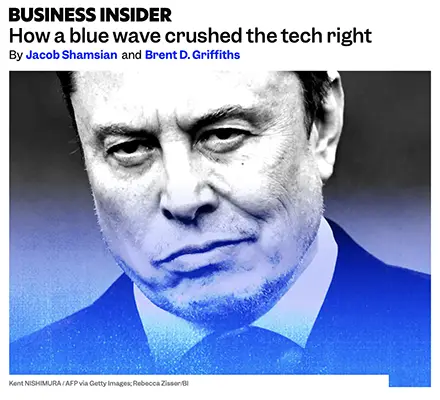
BI argues that the results rebuked the tech industry’s political bet: after courting the administration post-2024 to protect AI ambitions, the sector met strong voter resistance to data centers. Cited figures: an NBC News exit poll found 76% of voters would oppose a new data center in their community and 56% called AI and data centers a major factor in their congressional vote; by early counts, more than 30 of 50-plus local data center measures restricting construction passed.
The most decision-relevant signal is the market split. Microsoft, Amazon and Alphabet held up; chipmakers slipped; “neocloud” providers fell hardest (CoreWeave down 9%, Nebius more than 6%). Investors appear to be separating diversified giants from pure-play AI infrastructure firms that depend on continuous build-out. With control of Congress, Democrats gain the power to subpoena tech executives, making 2027 a year of hearings.
Framing note: the headline and characterization of the vote as a repudiation of the administration and of Silicon Valley’s vision are BI’s interpretation; other outlets stress cost of living and multiple drivers. BI does offer one useful contrarian point: increased oversight could become a convenient explanation for AI firms that miss lofty investor promises. Tech’s losses also weren’t uniform — a California billionaire wealth tax appeared headed for defeat.
RELEVANCE FOR BUSINESS
Vendor stability is the practical concern. Many AI startups and services run on neocloud capacity; if those providers face financing pressure, smaller AI vendors inherit the risk. Hearings may also surface disclosures about data handling, safety and pricing that affect how comfortable you are with specific vendors.
With a Republican White House and a Democratic Congress, sweeping federal AI law looks harder to pass in the near term; state and local action is the more immediate lever — and the one more likely to affect SMB operations.
CALLS TO ACTION
◆ Monitor: The financial health of smaller AI infrastructure providers; ask key AI vendors where their workloads run.
◆ Monitor: Congressional hearings in early 2027 for disclosures that bear on vendors you use.
◆ Revisit Later: Federal AI legislation — divided government historically slows major laws; reassess mid-2027.
◆ Ignore for Now: “Winners and losers” narratives about tech politics — act on concrete pricing, policy and vendor changes instead.
Summary by ReadAboutAI.com
https://www.businessinsider.com/how-a-blue-wave-crushed-the-tech-right-2026-11: The Midterms and AIThe Election Day Revolt That Threatens America’s AI Boom
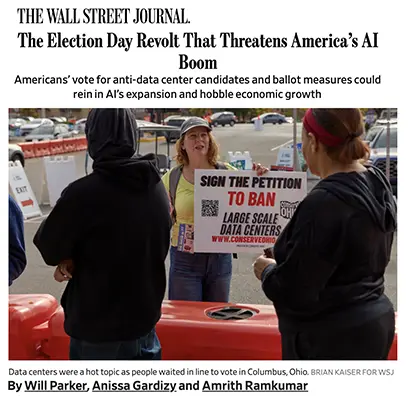
The Wall Street Journal | Will Parker, Anissa Gardizy & Amrith Ramkumar | November 4, 2026
| TL;DR / Voters in the states holding much of America’s planned AI capacity backed candidates and local measures to slow or stop data center construction — so AI compute may get scarcer and pricier in 2027, not cheaper. |
EXECUTIVE SUMMARY
The WSJ reports that the midterms turned data center opposition into a mainstream electoral force. Democratic winners from Ohio and Michigan to Texas and Georgia campaigned on pausing or restricting construction, and local restriction measures passed in towns across several states — a pattern the paper reads as bipartisan, not purely partisan. Geography is what makes this material: per Evercore ISI figures cited, Texas, Georgia and Ohio account for more than 40% of planned U.S. data center capacity, including major OpenAI and Meta projects.
The near-term effect is delay, not cancellation. Already-approved projects are expected to proceed; the exposure sits in the pipeline. As Sequoia’s Pat Grady put it, the vote will “probably elongate the timelines for the data-center build-outs.” Estimates of how much is at risk vary widely — one venture investor’s 25–35% figure for next year’s build-out was offered on a podcast, not as a sourced forecast. More telling: AI developers are flagging the risk themselves. Anthropic told investors in a securities filing that moratoriums could delay or block facilities it needs, and OpenAI leaders reportedly discussed resetting 2027 capacity expectations (single unnamed source).
The underlying trade-off is real on both sides: data centers have driven construction spending and local tax revenue but employ few people once running, while residents cite water, power bills and siting near homes. Critically, winning candidates offered few concrete policy details — the rules that will actually govern construction don’t exist yet.
RELEVANCE FOR BUSINESS
SMBs don’t build data centers, but they buy what runs in them. If capacity growth slows while demand keeps rising, the steady decline in AI prices many budgets quietly assume may stall. Expect providers to manage scarcity through rate limits, priority tiers and reserved-capacity contracts — mechanisms that favor large enterprise buyers and shift leverage toward incumbents.
Vendor roadmaps that depend on new capacity may slip, and firms in Texas, Ohio and Georgia face local second-order effects: softer construction employment and changes to the tax revenue data centers have been funding.
CALLS TO ACTION
◆ Monitor: Watch your main AI vendors’ pricing, usage limits and tier changes over the next two quarters for early signs of capacity tightening.
◆ Assign Internal Review: Check whether 2027 budgets assume falling AI costs; model a scenario where they hold flat or rise.
◆ Test Cautiously: Avoid multi-year commitments that depend on capacity a vendor hasn’t built yet; favor terms with repricing or exit options.
◆ Revisit Later: Reassess once newly elected officials publish actual proposals, likely in early-2027 legislative sessions — campaign pledges are not yet policy.
| Vendor-neutrality disclosure: ReadAboutAI.com uses Anthropic’s Claude in its production workflow. Anthropic is cited here as one of several AI developers named in the source; it receives no different editorial treatment on that basis. |
Summary by ReadAboutAI.com
https://www.wsj.com/tech/ai/the-election-day-revolt-that-threatens-americas-ai-boom-03a53b52: The Midterms and AI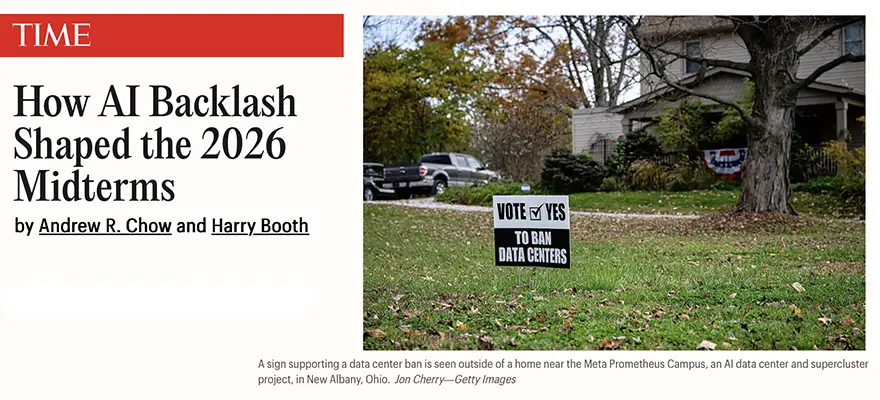
How AI Backlash Shaped the 2026 Midterms
TIME | Andrew R. Chow & Harry Booth | November 4, 2026
| TL;DR / AI-industry money proved more liability than asset this cycle, and hostility to data centers crossed party lines — so expect more state AI bills and more congressional scrutiny, but not sweeping federal law soon. |
EXECUTIVE SUMMARY
TIME’s distinctive contribution is on the limits of AI money. Super PACs backing fast, lightly regulated development largely failed to move races; one survey found three-quarters of likely voters were less inclined to back a candidate who took AI super PAC money, and some major donors pulled back promised funds. Pro-safety PACs outspent them in key races, with substantial funding from Anthropic — more than $40 million to Public First Action (restricted from election activity, per TIME), plus $5 million given separately by employees. TIME’s own verdict: neither side’s cash was decisive.
On data centers, polling from Blue Rose Research (a progressive firm) suggests local impacts — bills, noise, environment — matter far more to voters than existential AI fears, and that industry reassurances fail because trust is low. The backlash is not one-party: a Wisconsin Democrat branded as pro–data center moved toward restrictions before winning. AI deepfakes circulated but don’t appear to have decided races.
Looking ahead, TIME expects hearings, resistance to federal preemption of state AI laws, and a wave of state billsrather than sweeping federal law, given veto math. If Congress gridlocks, California’s SB-53 becomes the de facto national reference point. Industry is repositioning: OpenAI reportedly plans a policy and PR push, including rebranding data centers as “AI compute campuses,” and Meta is building bipartisan outreach. The pollster’s framing for 2028: AI is “arguably the least important that it will ever be again.”
RELEVANCE FOR BUSINESS
For SMBs, the regulatory action will come mostly from the states — a patchwork, with California setting the tone. That means compliance burden varies by where you operate and sell, not by a single federal standard.
The trust finding matters beyond politics: if voters discount tech-industry reassurances, customers may discount AI claims in your marketing too. Vendors’ political spending is also now visible and contested, adding reputational exposure to vendor choice.
CALLS TO ACTION
◆ Monitor: California SB-53 implementation and 2027 AI bills in the states where you operate.
◆ Prepare Policy: Keep any AI claims you make to customers specific and verifiable; generic reassurance is landing poorly with the public.
◆ Ignore for Now: Industry rebranding such as “AI compute campuses” — judge vendors by concrete commitments on cost and resource use, not terminology.
◆ Revisit Later: Federal preemption of state AI laws — TIME expects it to be harder to enact; reassess mid-2027.
| Vendor-neutrality disclosure: ReadAboutAI.com uses Anthropic’s Claude in its production workflow. This summary reports Anthropic’s political contributions as described by the source, alongside other AI-industry political spending; Anthropic receives no different editorial treatment on that basis. |
Summary by ReadAboutAI.com
https://time.com/article/2026/11/04/midterm-elections-results-ai-industry-data-centers/: The Midterms and AITexas Wanted to Power America’s AI Boom. Its New Governor Could Change Everything
Fast Company | Max Ufberg | November 4, 2026
| TL;DR / Texas, home to the largest share of planned U.S. data center capacity, elected a governor who campaigned on pausing new projects and ending their tax breaks — but how much she can change depends on a legislature and courts she doesn’t control. |
EXECUTIVE SUMMARY
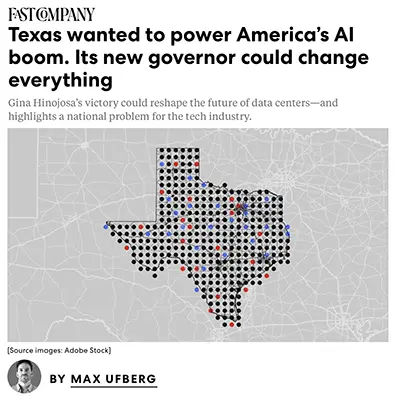
Fast Company explains why Texas specifically matters. The state drew AI infrastructure with cheap land, abundant energy, light regulation and a sales-tax exemption on data center equipment that the state comptroller projects will cost $3.2 billion in forgone revenue over two years. Jefferies estimates (as reported by the WSJ) put Texas at roughly a quarter of planned U.S. capacity, with 13.3 gigawatts of announced projects at risk under the proposed moratorium.
Governor-elect Gina Hinojosa’s agenda goes beyond a pause: ending subsidies, banning nondisclosure agreements that keep communities uninformed, giving residents more say, and requiring developers to show projects won’t raise household water or power bills. The backlash predates her win — Gov. Abbott had already halted new permits in September pending audits of water and power demand.
The piece’s most useful contribution is its caveats. A governor can direct agencies, but permanently repealing tax exemptions or giving counties zoning power requires the legislature, and a statewide moratorium could be challenged in court. The author also cautions against reading the result as a referendum on data centers alone; cost of living and the national climate played large roles. The durable risk for developers is years of regulatory uncertainty — and other states face similar limits on power, water and land.
RELEVANCE FOR BUSINESS
The site-selection logic for AI infrastructure is shifting from “where is it cheapest” to “where is it politically durable.”Hinojosa’s proposed requirement that developers prove no impact on household utility bills is a template other states may copy, adding cost and approval time.
For Texas-based SMBs — especially in construction, electrical, trades and commercial real estate — data center work has been a growth engine; a 12–24 month slowdown is a realistic planning scenario. The affordability debate driving the moratorium also touches commercial power rates.
CALLS TO ACTION
◆ Monitor: Track the 2027 Texas legislative session — that, not the governor’s office alone, will decide whether incentives and zoning rules actually change.
◆ Assign Internal Review: If revenue depends on data center projects, stress-test for delayed or cancelled Texas work.
◆ Monitor: Watch grid-interconnection and electricity-rate proceedings in your state; the utility-bill argument travels well beyond Texas.
◆ Ignore for Now: Predictions of a wholesale AI infrastructure exodus from Texas — the source itself notes alternative states face similar constraints.
Summary by ReadAboutAI.com
https://www.fastcompany.com/91634444/texas-wanted-to-power-americas-ai-boom-its-new-governor-could-change-everything: The Midterms and AI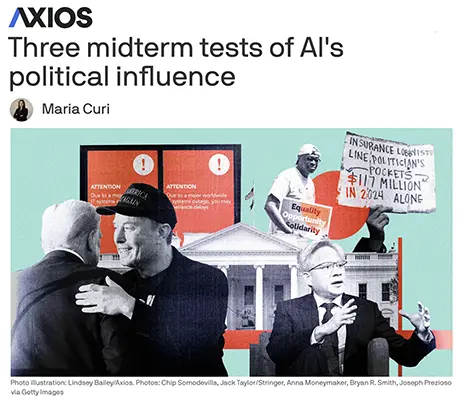
Three Midterm Tests of AI’s Political Influence
Axios | Maria Curi | November 2, 2026
| TL;DR / Written before votes were counted, Axios framed the midterms as the first real test of AI as a campaign issue — and the post-election coverage in this collection suggests AI regulation now has a larger constituency in Congress. |
EXECUTIVE SUMMARY
Axios posed three questions: did AI break through as a voting issue; did Elon Musk’s spending help or hurt his candidates; and how large a pro-safeguards bloc will the next Congress have? It highlighted a shift in tactics: advocacy groups such as Guardrails Alliance and Tomorrow Together made AI policy itself the campaign message, while industry-aligned super PACs (Public First, Leading the Future) spent more than $50 million across nearly 50 races with ads that largely avoided mentioning AI.
Races flagged included the Michigan Senate contest, where Abdul El-Sayed proposed a Cabinet-level AI agency and a ban on superintelligence, and House candidates with AI legislative records — including the sponsor of Colorado’s comprehensive AI law, California’s Scott Wiener on AI transparency, and a Minnesota candidate backing national bans on data center construction and NDAs.
Partial answers from post-election coverage: reporting summarized elsewhere in this collection says James Talarico won the Texas Senate race and lists El-Sayed among major Democratic Senate wins. Results for the House races Axios flagged aren’t covered by these sources. Editorial interpretation, not Axios’s claim: that industry PACs steered away from AI in their own ads suggests they saw the issue as a weak one with voters.
RELEVANCE FOR BUSINESS
AI regulation is moving from a technical niche to an electoral issue tied to jobs and affordability. That raises the odds of more state AI laws modeled on Colorado and California — with disclosure, transparency and impact-assessment duties that reach businesses deploying AI, not just those building it.
Big-ticket ideas like a superintelligence ban or a new federal agency are long-horizon; the nearer-term burden for SMBs is likely documentation and disclosure.
CALLS TO ACTION
◆ Prepare Policy: If you use AI in hiring, customer decisions or customer-facing content, start documenting which tools you use and how — transparency rules typically begin with disclosure.
◆ Monitor: Final results in the races Axios flagged, as an indicator of which AI bills gain sponsors in 2027.
◆ Revisit Later: Proposals for a federal AI agency or superintelligence ban — low near-term operational impact.
◆ Ignore for Now: The piece’s pre-election predictions themselves, now superseded by results.
Summary by ReadAboutAI.com
https://www.axios.com/2026/11/03/ai-election-politics-2026-midterms: The Midterms and AI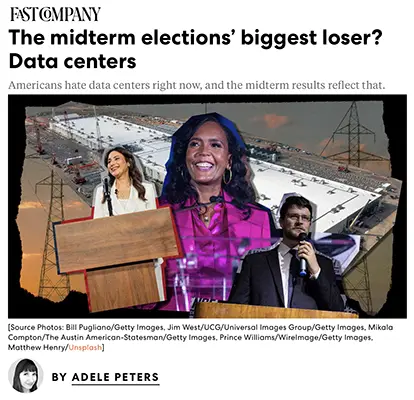
From Texas to Michigan, Voters are Turning Against Big Tech’s AI Buildout
The Midterm Elections’ Biggest Loser? Data Centers
Fast Company | Adele Peters | November 5, 2026
| TL;DR / Local data center restrictions passed almost everywhere they appeared on the ballot. Experts caution that the issue reinforced voters’ mood more than it decided any race — and that the likeliest industry response is to build where communities push back least. |
EXECUTIVE SUMMARY
By early counts, 38 of 39 local data center restrictions passed, ranging from temporary moratoriums to outright bans. Democratic governors-elect in Texas, Georgia, New Mexico and Ohio campaigned on statewide or conditional moratoriums, and congressional candidates ran directly against data centers. Michigan’s 7th District is the case study: a first-time candidate who made data centers his core issue unseated a Republican incumbent who had voted for legislation speeding data center construction.
The piece’s value is its restraint on causation. A Purdue technology-policy scholar says it’s too early to claim data centers swung any race; the defeated incumbent had other liabilities, and the economy and the Iran war also weighed on voters. What the results do establish is that the opposition is real and broad — had they gone the other way, the issue would have been written off.
The forward concern is about where the industry goes next. Opposition centers less on AI itself than on electricity prices, water and climate impact — problems that are addressable in principle, for example through developer-funded clean power. But the same scholar warns developers may simply seek out “the communities that don’t speak back,” concentrating impacts on places with the least capacity to resist.
RELEVANCE FOR BUSINESS
Community consent is now a supply constraint on AI capacity, alongside chips and power. The industry’s options — paying for its own clean energy, covering ratepayer impacts, or relocating — will shape how quickly capacity grows and how much of that cost gets passed through to customers.
For SMBs with sustainability or community commitments, the footprint of the data centers behind your AI tools is becoming a reputational question, not just a vendor’s problem.
CALLS TO ACTION
◆ Monitor: Whether major developers commit to funding their own clean power or covering local rate impacts — a sign of a negotiated path forward rather than relocation.
◆ Assign Internal Review: If you have sustainability commitments, ask your main AI vendors what they disclose about energy and water use for the facilities that serve you.
◆ Prepare Policy: If your business sits near a proposed project or supplies one, decide in advance how you’ll handle public positions; these local fights are heated.
◆ Revisit Later: Claims that data centers “decided” the election — more rigorous analysis will follow.
Summary by ReadAboutAI.com
https://www.fastcompany.com/91635809/the-midterm-elections-biggest-loser-data-centers: The Midterms and AI
7 Ways the Midterms May Affect the AI Boom
Fast Company (AI Decoded newsletter) | Mark Sullivan | November 5, 2026
| TL;DR / The roundup’s most useful idea is that the main brake on AI’s build-out is shifting from chips and power to politics — while markets shrugged off the election overall and singled out debt-heavy AI infrastructure firms for punishment. |
EXECUTIVE SUMMARY
This is an aggregation of reporting from Forbes, the New York Times, Bloomberg, Politico and two independent newsletters, so its claims carry their original sources’ weight. Most decision-relevant: Democratic House leadership says AI hearings and guardrail legislation are coming. One newsletter writer predicts Congress could pass rules within months that are tougher than the bipartisan FRONTIER Act, including mandatory testing and approval of the most powerful models — a single commentator’s forecast that depends on uncalled Senate races, filibuster math and a presidential signature.
On markets, the broad reaction was calm: the S&P 500 closed 1.6% higher the day after, consistent with investors’ historical comfort with divided government. The pain concentrated in CoreWeave, whose bonds fell toward distressed levels — but its stock had already dropped roughly 40% over the prior month on debt concerns. The election accelerated an existing problem rather than creating one.
Stratechery’s Ben Thompson argues that shortages of compute, memory and power will ease, but that political opposition is bipartisan and durable: “The final constraint is political.” The newsletter adds a speculative upside — slower build-out could ease the labs’ spending race and give safety work time to catch up — and tallies tech donors’ poor returns, including roughly $474 million from Elon Musk.
RELEVANCE FOR BUSINESS
Two practical points. First, federal AI rules are more plausible than at any time in the past two years, though timing remains uncertain. Second, the financial health of AI infrastructure vendors is now a live risk: leveraged providers face higher borrowing costs just as political friction slows new capacity.
If Thompson is right that the political constraint is lasting, tight AI capacity may persist rather than cycle out, which matters for pricing assumptions and vendor negotiating leverage.
CALLS TO ACTION
◆ Monitor: CoreWeave’s third-quarter results (November 10) for a public read on whether financing stress is slowing capacity delivery across smaller AI cloud providers.
◆ Assign Internal Review: Ask which AI vendors you depend on rely on heavily leveraged infrastructure providers.
◆ Revisit Later: Forecasts of fast federal AI legislation — reassess once Senate results are final and committee agendas are set in January.
◆ Ignore for Now: The argument that compute scarcity is good for AI safety — interesting, but speculative.
Summary by ReadAboutAI.com
https://www.fastcompany.com/91635796/7-ways-the-midterms-may-affect-the-ai-boom: The Midterms and AITexas Was the New Epicenter of the AI Data Center Buildout. That Might Be Kaput.
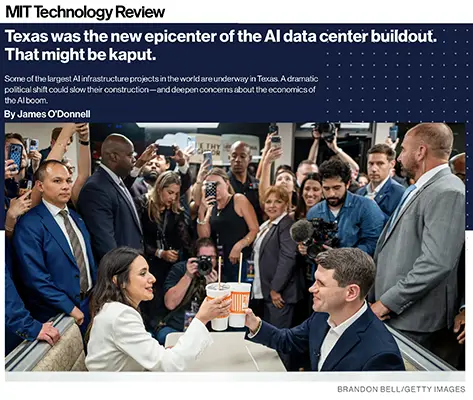
MIT Technology Review | James O’Donnell | November 4, 2026
| TL;DR / Texas’s political shift threatens some of the world’s largest AI construction projects, but approval authority is split among city, county and state — so campaign pledges may prove much harder to carry out than to make. |
EXECUTIVE SUMMARY
The stakes are large: projects underway include Stargate Frontier (about 1.8 gigawatts) and Nexus Hubbard (a planned 6.4 GW, the second-largest U.S. build). Beyond the governor and Senate races, MIT reports Democrats will control the Texas House for the first time in 24 years. The shift started before Election Day: industry insiders say the governor’s office went quiet in September, when Abbott directed a state regulator to halt permits.
The article’s real contribution is implementation reality. County results don’t line up neatly with data center geography — Ellis County, which leads in permit requests, voted Republican, as did several west Texas hubs, while border-area Cameron County flipped. Because no single office decides whether a project proceeds, local officials may resist statewide restrictions. Construction unions that backed some Democratic campaigns could push back on a moratorium, and the governor-elect herself supported data center tax breaks in 2023.
Framing note: the “kaput” headline and the claim that Big Tech fumbled its pitch to voters are the author’s interpretation; the reporting underneath is more measured. One under-noticed detail: lenders are already getting pickier about which projects they finance — a constraint that predates and compounds the political one.
RELEVANCE FOR BUSINESS
The likeliest outcome is a long period of uncertainty, not a clean stop. For planning, that uncertainty is the variable that matters: delayed capacity, contested permits and tighter financing all feed through to the AI services SMBs buy.
For Texas businesses in construction and trades, the interplay of unions, counties and the state will determine how much work actually slows — watch local decisions, not just statewide rhetoric.
CALLS TO ACTION
◆ Monitor: The new Texas administration’s first permitting actions in early 2027, and whether the Democratic-led Texas House advances moratorium legislation.
◆ Monitor: County-level decisions in major Texas data center hubs — they are the practical gatekeepers.
◆ Revisit Later: “Texas build-out is over” narratives; projects already under construction are generally expected to proceed.
Summary by ReadAboutAI.com
https://www.technologyreview.com/2026/11/04/1148043/texas-was-the-new-epicenter-of-the-ai-data-center-buildout-that-might-be-kaput/: The Midterms and AI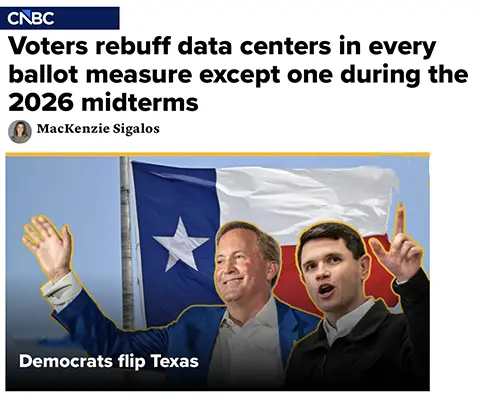
Voters Rebuff Data Centers in Every Ballot Measure Except One During the 2026 Midterms
CNBC | MacKenzie Sigalos | November 4, 2026 (updated November 5)
| TL;DR / Voters sided against data centers in 40 of 41 local ballot measures, and Ohio — home to what’s billed as the world’s largest planned AI campus — elected a governor who wants new projects to cover all of their utility costs and use union labor. |
EXECUTIVE SUMMARY
CNBC offers the cleanest scoreboard in this collection. Per Ballotpedia and CNBC’s own tallies, 41 data center measures appeared in 10 states, and voters went against development in every one except Harwood, North Dakota. Ohio alone had 21. A CNBC voter poll found 56% called data centers a crucial or major factor in their vote, with Democrats ranking the issue higher than Republicans.
Ohio is the article’s real focus. OpenAI has secured 8 gigawatts at a planned Ohio campus developed with SoftBank’s SB Energy and the U.S. Department of Energy, with phased capacity starting in 2028 and a total cost CNBC puts above $500 billion. Governor-elect Amy Acton’s conditional moratorium is more specific than most campaign pledges: projects would have to cover 100% of their utility costs and build exclusively with union labor. That’s a cost condition, not a ban, but a material one.
The financial backdrop matters as much as the vote. Chipmakers and AI cloud providers were already selling off in October on interest-rate and overspending worries, and every major hyperscaler except Microsoft has turned cash-flow negativefunding AI infrastructure, per CNBC. Political friction now lands on a sector with less financial cushion than its scale suggests.
RELEVANCE FOR BUSINESS
Acton’s terms preview what conditional approval may look like: developers absorbing the full cost of grid upgrades and paying union labor rates. Those costs don’t vanish; over time they surface in cloud and AI pricing.
For Ohio SMBs, the combination of a giant planned campus and a governor demanding cost guarantees creates a multi-year question about local power rates, construction demand and union labor availability.
CALLS TO ACTION
◆ Monitor: How Ohio’s new administration defines its conditional moratorium in early 2027; it’s the most concrete cost model on the table.
◆ Assign Internal Review: If your business is in Ohio or Texas, track utility rate cases tied to large-load customers; how grid costs are allocated affects commercial bills.
◆ Monitor: Hyperscaler cash flow and capex guidance in upcoming earnings; negative free cash flow plus political delay is the combination to watch.
◆ Revisit Later: Timelines for the Ohio campus; first capacity isn’t due until 2028 in any scenario.
Summary by ReadAboutAI.com
https://amp.cnbc.com/amp/2026/11/04/data-center-ballot-measures-2026-midterm.html: The Midterms and AI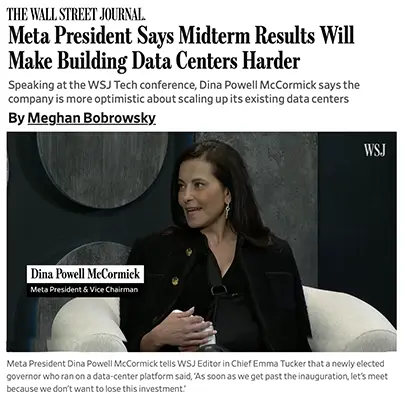
Meta President Says Midterm Results Will Make Building Data Centers Harder
The Wall Street Journal | Meghan Bobrowsky | November 4, 2026
| TL;DR / Meta’s president concedes new U.S. data centers will be much harder to start, signals the industry will lean on expanding existing sites and look abroad, and suggests some newly elected opponents may be open to dealmaking. |
EXECUTIVE SUMMARY
Speaking at the WSJ Tech conference, Meta President Dina Powell McCormick said starting new U.S. data center projects will be very challenging and expects much more review. Her proposed workaround: expanding existing campuses, where communities have seen benefits over several years. She also said hyperscalers are now asking whether to build outside the United States: “Do we need to build outside the United States?”
Fact versus framing: her claim that an unnamed governor-elect who ran against data centers privately asked to meet after inauguration is a single, unverifiable anecdote from an interested party, and it serves Meta’s interest in signaling that opposition is negotiable. The financial facts are firmer: Meta plans up to $145 billion in capex this year for its personal-agent ambitions, has proposed raising up to $97.5 billion through new stock offerings (including a new nonvoting share class), and reported negative free cash flow for the first time since its 2012 IPO.
RELEVANCE FOR BUSINESS
Two shifts follow if Meta’s read is right. Capacity growth concentrates at existing sites, favoring incumbents who already have campuses, permits and community relationships. And more AI compute may move offshore, which introduces data-residency, latency and regulatory questions for U.S. businesses whose AI workloads could end up running abroad.
Meta’s equity raise and negative cash flow are a reminder that even the largest buyers are stretching to finance the build-out; political delay raises that cost.
CALLS TO ACTION
◆ Assign Internal Review: Confirm where your AI vendors process your data and whether contracts restrict processing to specific countries; offshore capacity growth makes this more relevant.
◆ Monitor: Announcements of hyperscaler data center projects outside the U.S. as a signal of how seriously the industry is hedging.
◆ Monitor: Whether governors-elect who campaigned against data centers negotiate terms in early 2027, which would test Meta’s claim.
◆ Ignore for Now: The specific governor-elect anecdote until it’s independently confirmed.
Summary by ReadAboutAI.com
https://www.wsj.com/tech/ai/meta-president-says-midterm-results-will-make-building-data-centers-harder-f1d27c93: The Midterms and AI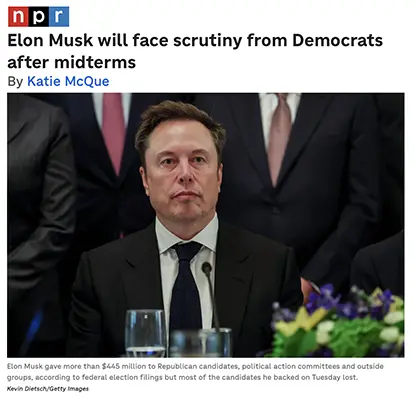
Elon Musk Will Face Scrutiny From Democrats After Midterms
NPR | Katie McQue | November 4, 2026
| TL;DR / Democratic control of Congress sets up investigations of Musk’s government contracts and his DOGE role, and a sweep of Texas statewide offices raises political friction for the AI data center and chip projects his companies are planning there. |
EXECUTIVE SUMMARY
NPR’s focus is accountability more than AI. Per OpenSecrets, Musk gave more than $445 million this cycle, at least $225 million of it directed to Texas, and the candidates he backed in the state’s marquee races lost; NPR reports Democrats won every statewide office in Texas. Democratic lawmakers say they will examine whether Musk used his administration role to benefit his companies, citing government contracts that an advocacy group tallies at $6.3 billion during his DOGE tenure and at least $10 billion since. A former White House ethics lawyer outlines the conflict-of-interest law that could apply. These are questions and allegations, not findings.
The AI-relevant detail is Texas infrastructure exposure: SpaceX is reportedly scouting Texas sites for large data centers, Tesla runs a major data center in Austin, and a $16.8 billion SpaceX AI chip-fabrication project in Texas was announced in August. Those projects now sit in a state government run by officials who campaigned against Musk’s influence. NPR adds that SpaceX and Tesla shares fell about 4% and 3% even as broader markets rose.
RELEVANCE FOR BUSINESS
For most SMBs this is context rather than a call to action. The practical thread, also covered in the Reuters summary, is that AI infrastructure tied to one politically exposed owner carries added permitting and oversight risk, which can flow to the compute and services built on it.
CALLS TO ACTION
◆ Monitor: Congressional hearing schedules in 2027 for findings that affect SpaceX’s compute or government business.
◆ Monitor: Texas permitting decisions on SpaceX’s planned data center and chip projects.
◆ Ignore for Now: The political back-and-forth itself, until hearings produce findings.
Summary by ReadAboutAI.com
https://www.npr.org/2026/11/04/nx-s1-6029650/elon-musk-midterms-democrats-texas-congress: The Midterms and AI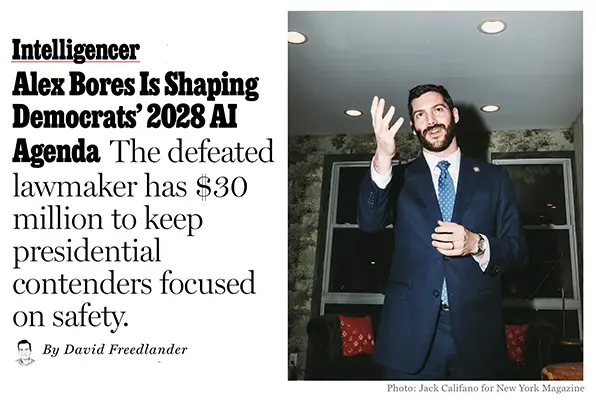
ALEX BORES IS SHAPING DEMOCRATS’ 2028 AI AGENDA
New York Magazine (Intelligencer) | David Freedlander | November 2, 2026
TL;DR / Key Takeaway: AI regulation is turning into a well-funded, organized campaign issue on both sides, which means the rules SMBs will eventually operate under are being shaped now by super-PAC money and early-state organizing, not just by legislation.
SUMMARY
Alex Bores, the New York legislator behind the state’s RAISE Act (AI safety-reporting rules that take effect January 1), lost a June congressional primary after Leading the Future, a super-PAC with major funding from OpenAI president Greg Brockman and Andreessen Horowitz, spent roughly $8 million against him. Pro-regulation groups, including one backed by $40 million from Anthropic executives and engineers, spent heavily on his side. He is now running Who Decides, an advocacy group with $10 million raised and $20 million more committed, which is placing organizers in early-primary and swing states to push 2028 Democratic candidates into firm positions on AI oversight: independent audits, safety-incident transparency and limits on self-improving systems.
The article shows a party split three ways: Bores’s oversight-focused middle path, a populist wing calling for data-center moratoriums, and strategists worried about alienating building-trades workers whose jobs depend on data-center construction. Leading the Future’s co-leader argues Bores is a proxy for rival AI interests and points to polling showing fewer than 1% of voters name AI as their top issue. Both sides claim momentum: two major LTF donors have pulled back, but the group says it still has $40 million and plans to operate across multiple election cycles.
Source note: Political feature from New York Magazine’s Power issue. Flagged for owner review because it covers 2028 presidential-primary strategy; it may belong in the separate elections post.
RELEVANCE FOR BUSINESS
For SMBs, the takeaway is not which side wins but that AI policy is now a durable, funded political fight. State laws such as RAISE target the largest model developers, but the obligations they set (incident reporting, published safety protocols, audits) tend to flow downstream into vendor contracts, terms of service and pricing.
The data-center debate also has local consequences: energy costs, permitting and community opposition are becoming campaign issues, which affects where AI capacity gets built and what it costs. Regulatory uncertainty is likely to persist through 2028, so leaders should plan for policy to keep shifting rather than wait for it to settle.
CALLS TO ACTION
🔹 Monitor: Implementation of New York’s RAISE Act and similar state laws, and whether your AI vendors change terms in response. 🔹 Monitor: Candidate AI platforms as the 2028 primary takes shape, especially on data centers, audits and AI-related job displacement. 🔹 Ignore for Now: The super-PAC fight itself; it has no direct operational impact on most SMBs.
Vendor-neutrality note: This article discusses political funding from Anthropic executives and employees. ReadAboutAI.com uses Claude in its production workflow; this summary takes no position on that spending.
Summary by ReadAboutAI.com
https://nymag.com/intelligencer/article/alex-bores-who-decides-pac-ai-2028-democratic-presidential-primary.html: The Midterms and AI
APPLE IS AN AI SAFE HAVEN — BUT SAFETY ISN’T CHEAP (POST-ELECTION UPDATE)
The Wall Street Journal (Heard on the Street) | Asa Fitch | November 3, 2026 — updated with post-election market data through November 5, 2026
TL;DR: The midterms tested the WSJ’s argument that Apple is an AI “safe haven,” and it largely held. When investors began to price in limits on data-center construction, the companies most dependent on the AI buildout fell hardest, and Apple, which spends relatively little on AI, held up best.
EXECUTIVE SUMMARY
Before the vote, the WSJ argued that Apple’s modest AI spending (about $9 billion in capital spending last fiscal year, compared with nearly $800 billion projected for the five largest cloud providers) made it a refuge in a shaky tech market. The column added that Apple’s valuation, about 35 times expected earnings, already reflected that.
The election put the idea to a test. After Democrats won control of both chambers, Apple rose 5.3% to a record close on Wednesday. Data-center operators fell 9–10% on worries about tighter oversight of new construction. On Thursday the sell-off spread: the Nasdaq dropped 5.5%, its worst day since April 2025, and AI chipmakers fell sharply. Nvidia lost roughly 7.5–9%, and AMD and Micron fell by double digits. Apple slipped only about 1.5%, and part of that dip followed news of a planned bond sale to fund share buybacks.
What this shows: The market did not divide simply into AI and non-AI stocks. It divided companies that depend on new AI construction from those that don’t. On Wednesday the large cloud providers also rose, as investors bet that slower construction would raise the value of the data centers they already own. Apple still pays for AI through rising memory-chip costs, which is why it fell on Election Day after guiding its margins lower. And two trading days is too short a period to call this a lasting shift.
RELEVANCE FOR BUSINESS
For SMB leaders, the election made AI policy a cost and timing issue. If states and Congress put more scrutiny on data centers, new AI computing capacity could arrive more slowly and cost more, which would show up in cloud and AI service pricing. Hardware costs are already rising whatever happens in politics, because AI demand keeps memory prices high. The Apple pattern also offers a lesson for strategy: companies that adopt AI selectively and don’t depend on an infrastructure race are proving more resilient than those that do.
CALLS TO ACTION
🔹 Monitor: Watch state and federal action on data centers, such as moratoriums, energy-cost rules and hearings, for effects on AI service pricing in 2027.
🔹 Act now: Keep higher hardware replacement costs in 2027 budgets. Memory-driven price increases don’t depend on the election.
🔹 Assign internal review: Ask your main AI and cloud vendors how construction delays or new data-center rules could affect their capacity and pricing.
🔹 Ignore for now: Don’t read two days of stock moves as a long-term verdict on any vendor.
Summary by ReadAboutAI.com
https://www.wsj.com/finance/stocks/apple-is-an-ai-safe-havenbut-safety-isnt-cheap-68fa76f6: The Midterms and AI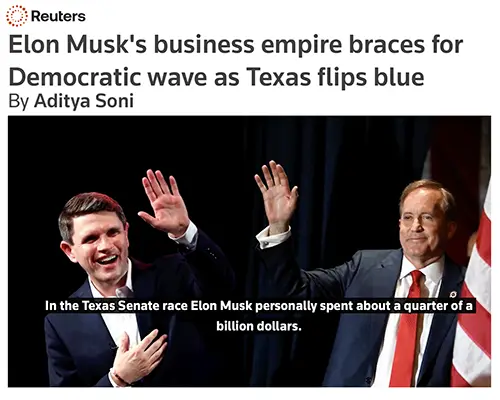
Elon Musk’s Business Empire Braces for Democratic Wave as Texas Flips Blue
Reuters | Aditya Soni | November 4, 2026
| TL;DR / The midterms put SpaceX’s aggressive AI compute expansion on a collision course with a hostile new Texas governor and a Democratic Congress — showing how a provider’s political exposure can become infrastructure risk. |
EXECUTIVE SUMMARY
Reuters frames Elon Musk as the biggest loser not on the ballot: roughly half a billion dollars spent backing Republican candidates, including in Texas, where Tesla and SpaceX are based. Both stocks fell about 5% the day after the vote.
The AI-relevant thread is SpaceX’s compute business. Renting capacity from its Colossus data centers near Memphis has driven revenue and the company’s first profit as a public company. SpaceX aims to grow from 1.7 gigawatts (end of September) to as much as 3 GW by year-end and 13 GW next year — targets that depend on fast approvals. Planned expansion at its Starbase site in Texas now faces a governor-elect who has sued for Musk–Abbott correspondence, opposed a potential state-park sale to SpaceX, and wants a construction moratorium. Federally, incoming House Oversight leadership has signaled scrutiny of Musk’s government contracts, DOGE role and Starlink decisions.
Fact versus framing: the stock moves and political positions are concrete. The capacity figures are company targets, not delivered capacity, and the scale of regulatory consequence is analyst expectation. Musk’s suggestion of orbital data centers as an escape route faces, per Reuters, major unresolved cooling and repair problems.
RELEVANCE FOR BUSINESS
Many SMB AI tools sit on a chain of providers: the app you buy runs on a model, which runs on rented compute. When a major compute supplier’s growth depends on permits in politically contested jurisdictions, delays can ripple down that chain as capacity limits, price changes or slipped features — even for buyers who never chose that supplier directly.
The episode also shows that a vendor’s political profile is now a business variable — through investigations, permitting friction and reputational association. The right response is neutral, consistent due diligence, not picking political sides.
CALLS TO ACTION
◆ Assign Internal Review: Map your AI supply chain one layer deep — which model providers you rely on and, where disclosed, where their compute comes from.
◆ Prepare Policy: Add regulatory and investigation exposure to standard vendor due diligence, applied the same way to every vendor.
◆ Monitor: Whether SpaceX hits its stated year-end 3 GW target — a public, early indicator of whether permitting friction is biting.
◆ Ignore for Now: Orbital data centers — not a near-term factor for planning.
Summary by ReadAboutAI.com
https://www.reuters.com/business/media-telecom/elon-musks-business-empire-braces-democratic-wave-texas-flips-blue-2026-11-04/: The Midterms and AIClosing: AI update for November 7, 2026
The midterms did not settle how AI will be built or governed in the United States, but they added a new constraint alongside chips and power: whether voters and local officials will agree to host the capacity. For now, the practical response for SMB leaders is to budget for AI costs that hold flat or rise, ask vendors where their compute comes from, and watch the early-2027 legislative sessions, where campaign promises will either become rules or fade.
All Summaries by ReadAboutAI.com
↑ Back to Top