
AI Updates February 17, 2026

Artificial intelligence has moved decisively from novelty to infrastructure—and this week makes that shift hard to ignore. Across the broader news cycle, AI is embedding deeper into markets, media, government operations, healthcare workflows, robotics roadmaps, and advertising economics. The conversation is no longer “does AI work?” It’s how fast it scales, who controls the rails, who captures the value, and where the hidden failure modes live.
A consistent pattern runs through this week’s ~30+ briefings: capability is rising faster than readiness. Enterprise tools are shipping while interpretability, governance, and enforcement lag. Ads and “distribution platforms” are moving closer to the AI interface itself. Robotics and automation headlines are accelerating—but real-world constraints (deployment friction, supply chains, safety, integration costs) still shape what’s feasible today. Meanwhile, model competition continues to intensify globally, introducing pricing pressure, policy tension, and strategic dependency risk.
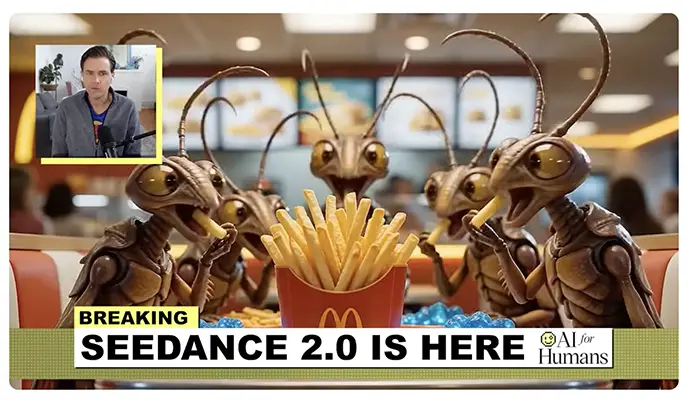
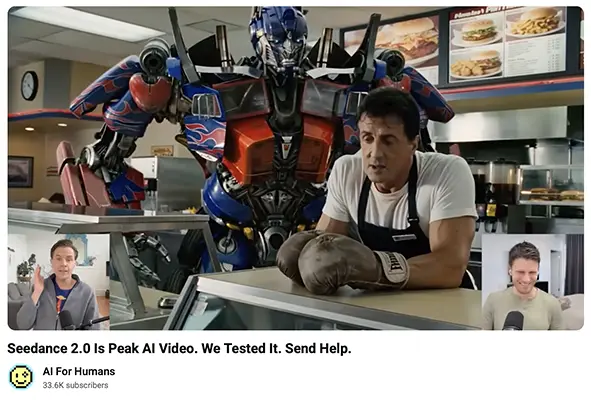
The AI for Humans episode this week functions as the clearest “signal flare”: Seedance 2.0 shows AI video crossing from impressive demo into production-grade output, including multi-shot editing, cinematic pacing, and highly realistic voice/likeness generation. That matters because it collapses the cost of high-end content creation while expanding legal exposure, reputational risk, and workforce disruption—especially for brands moving fast without safeguards. For SMB executives and managers, the advantage is no longer simply “using AI.” It’s understanding second-order effects—vendor lock-in, automation bias, workforce displacement velocity, compliance and IP risk, capital and compute cost pressure, and geopolitical exposure—so you can decide what to adopt, what to pilot carefully, what to monitor, and what to ignore for now.
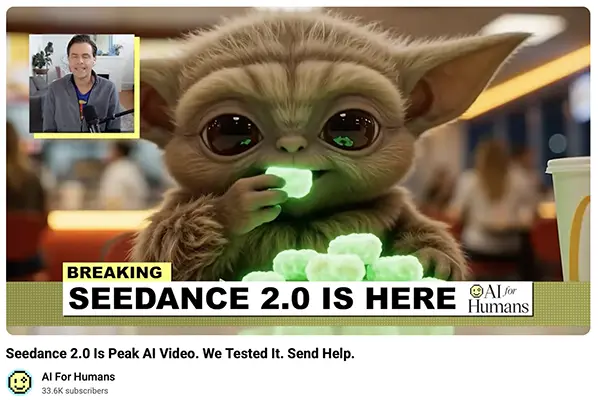

AI for Humans Podcast – “Seedance 2.0 Generates Anything (Including Celebrities)”
February 13, 2026
TL;DR / Key Takeaway:
AI video just crossed from “impressive demo” to “Hollywood-level production with real celebrity voices” — and the legal, economic, and workforce ripple effects are arriving faster than most leaders are prepared for.
Executive Summary
This week’s AI for Humans episode centers on Seedance 2.0, ByteDance’s new AI video model capable of generating 15-second cinematic clips with multi-shot editing, realistic camera movement, synced sound design, and what appear to be authentic celebrity voices. The hosts tested everything from fake Seinfeld episodes to Avengers scenes and branded ads — and the results were structurally coherent, dramatically paced, and disturbingly convincing.
The real signal is not that AI can make short videos — that’s old news. The shift is that the model makes creative decisions on its own: shot changes, emotional timing, music scoring, and editing structure. Prompt complexity appears less important. This reduces technical barriers and shifts advantage from prompt skill to concept ownership and storytelling. In practical terms: the creative bottleneck is moving upstream to ideas, not execution.
The legal and economic implications are immediate. Seedance outputs include recognizable characters and voices, suggesting training on copyrighted material. Because the model originates from China, enforcement dynamics differ from U.S.-based models like Sora. Meanwhile, two new Chinese LLMs (GLM-5 and Minimax 2.5) are competing on benchmarks, and U.S. firms responded with updates like OpenAI’s Codex Spark (faster inference via Cerebras chips) and Google DeepMind’s Deep Think mode scoring 84% on ARC-AGI-2. This is no longer incremental progress — it is accelerating competitive escalation.
Second-order effect: content production costs are collapsing while legal risk is rising. The hosts explicitly note: “Lawyers are going to have a very interesting year.” That is not hyperbole.
Relevance for Business (SMB Executives & Managers)
1. Marketing & Brand Risk
- Video ad production costs are dropping dramatically.
- But IP misuse, voice cloning, and likeness rights create new exposure.
- SMBs could accidentally deploy infringing AI content.
2. Workforce Impact
- Creative production roles (editing, sound design, camera operation) are increasingly automated.
- New value shifts toward concept development, narrative strategy, and brand differentiation.
- Expect restructuring pressure in media, agency, and internal content teams.
3. Competitive Intelligence
- Chinese AI firms are aggressively closing performance gaps.
- U.S. firms are responding with speed and reasoning improvements.
- This is not just tech competition — it has geopolitical and regulatory implications.
4. Operational Acceleration
- AI agents (e.g., Kevin’s “OpenClaw” experiment) demonstrate autonomous orchestration — researching, deploying code, managing tasks.
- This previews a near-term environment of persistent digital workers operating overnight.
- Governance, cost control, and permission structures become essential.
Calls to Action
🔹 Audit your AI content workflow – Ensure no infringing characters, voices, or likenesses are being generated internally.
🔹 Shift creative investment upstream – Focus teams on brand narrative and strategic differentiation, not just production output.
🔹 Prepare a lightweight AI usage policy update – Especially around marketing, voice cloning, and external publishing.
🔹 Monitor global model competition – Pricing pressure and performance gains will affect vendor selection decisions in 2026.
🔹 Experiment cautiously with agentic tools – Pilot in sandbox environments before granting system-level permissions or payment access.
Summary by ReadAboutAI.com
https://www.youtube.com/watch?v=7V-yKuBQxa4: February 17, 2026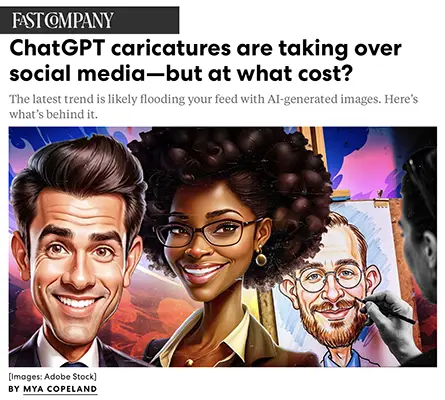
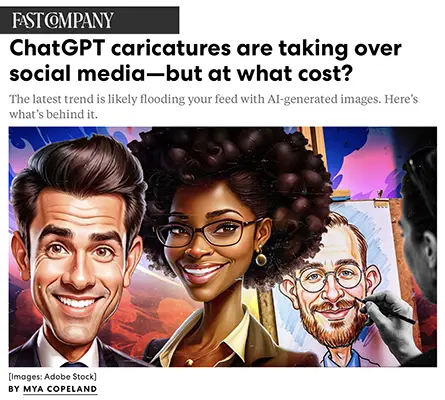
CHATGPT CARICATURES ARE TAKING OVER SOCIAL MEDIA—BUT AT WHAT COST?
FAST COMPANY — FEB 5, 2026
TL;DR / Key Takeaway: Viral AI image trends may seem harmless—but they normalize data sharing, persistent profiling, and privacy trade-offs.
Executive Summary:
A new social media trend involves users generating caricatures based on ChatGPT’s accumulated knowledge about them, often uploading personal photos and prompting the AI to depict their personality and job.
While framed as playful, the trend underscores a deeper behavioral shift: users increasingly treat AI as a personalized mirror built on stored interaction history. The more accurate the caricature, the more extensive the personal data footprint required. This creates incremental privacy exposure and further entrenches AI platforms as identity intermediaries.
Second-order effect: AI entertainment trends accelerate normalization of persistent AI memory.
Relevance for Business:
- Employees may casually upload sensitive information in pursuit of trends.
- AI image virality increases brand exposure risk (logos, confidential environments).
- Customer comfort with AI profiling may expand—but so may regulatory scrutiny.
Calls to Action:
🔹 Treat viral AI trends as early indicators of shifting norms.
🔹 Reinforce internal AI data-sharing policies.
🔹 Educate staff about personal data exposure risks.
🔹 Monitor brand misuse in AI-generated images.
🔹 Track evolving privacy regulation around AI memory.
Summary by ReadAboutAI.com
https://www.fastcompany.com/91487696/chatgpt-caricature-trend-tiktok-ai-generated-pictures: February 17, 2026
WHAT’S NEXT FOR AI IN 2026
MIT TECHNOLOGY REVIEW— JAN 5, 2026
TL;DR / Key Takeaway: 2026 will feature Chinese open-source model adoption, regulatory conflict, agentic commerce, LLM-assisted discovery, and escalating legal battles.
EXECUTIVE SUMMARY
MIT Technology Review outlines five major bets for 2026 :
- Chinese open-source LLMs powering Western apps (e.g., DeepSeek, Qwen).
- Continued U.S. regulatory tug-of-war between federal and state AI governance.
- Chatbots transforming commerce via agentic shopping.
- LLM-assisted scientific breakthroughs (AlphaEvolve-style systems).
- Increasingly complex legal liability cases.
The convergence theme: AI is shifting from novelty to structural force across commerce, law, geopolitics, and research.
Second-order effects:
- Open-weight Chinese models may narrow competitive gaps.
- Regulatory fragmentation may create compliance complexity.
- AI-driven shopping could disintermediate search engines.
RELEVANCE FOR BUSINESS
- Supply chain and vendor exposure may increasingly intersect with geopolitics.
- Compliance strategy will need agility across jurisdictions.
- Conversational commerce may reduce dependence on traditional web funnels.
CALLS TO ACTION
🔹 Distinguish proven breakthroughs from research hype.
🔹 Monitor open-weight model adoption trends.
🔹 Prepare for patchwork AI regulation.
🔹 Evaluate chatbot-driven commerce integration.
🔹 Track legal precedent in AI liability.
Summary by ReadAboutAI.com
https://www.technologyreview.com/2026/01/05/1130662/whats-next-for-ai-in-2026/: February 17, 2026
AI IS GETTING SCARY GOOD AT MAKING PREDICTIONS
THE ATLANTIC — FEB 11, 2026
TL;DR / Key Takeaway: AI systems are rapidly climbing competitive forecasting leaderboards, suggesting machine-driven prediction markets may soon outperform elite human forecasters.
EXECUTIVE SUMMARY
Forecasting tournaments and prediction markets like Metaculus, Polymarket, and Kalshi now feature AI systems competing against humans. As of late 2024, no AI ranked in the top 100; by early 2026, models have surged up the leaderboards.
AIs already outperform humans in bounded domains like board games. The new development is general forecasting across geopolitical, economic, and cultural events.
Second-order implications:
- Financial markets, insurance, and policy forecasting may become increasingly AI-driven.
- Elite “superforecasters” may shift toward oversight roles rather than direct prediction.
- Prediction markets could amplify AI-generated confidence signals, increasing systemic influence.
Forecasting is moving from intuition to probabilistic machine inference.
RELEVANCE FOR BUSINESS
- AI-enhanced forecasting may impact capital allocation decisions.
- Risk modeling may become more automated and faster-moving.
- Competitive edge may hinge on integrating AI prediction tools early.
CALLS TO ACTION
🔹 Separate probabilistic signals from narrative certainty.
🔹 Evaluate AI-enhanced forecasting platforms.
🔹 Maintain human judgment overlay on automated predictions.
🔹 Monitor market dynamics if AI becomes dominant predictor.
🔹 Audit model calibration and error bars.
Summary by ReadAboutAI.com
https://www.theatlantic.com/technology/2026/02/ai-prediction-human-forecasters/685955/: February 17, 2026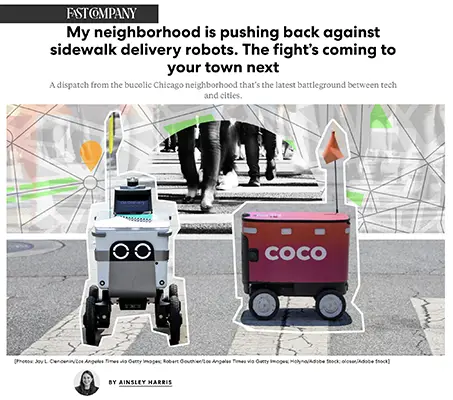
MY NEIGHBORHOOD IS PUSHING BACK AGAINST SIDEWALK DELIVERY ROBOTS. THE FIGHT’S COMING TO YOUR TOWN NEXT
FAST COMPANY — FEB 5, 2026
TL;DR / Key Takeaway: Sidewalk delivery robots promise cost and emissions gains—but public acceptance, safety perception, and regulatory friction may define their scalability.
Executive Summary:
The article explores growing community backlash in Chicago against autonomous sidewalk delivery robots from companies like Coco and Serve. While pitched as efficient last-mile solutions that could lower delivery costs and emissions, real-world deployment has triggered complaints about blocked sidewalks, near-collisions, unpredictability, and nuisance effects.
Economically, robots could reduce per-trip delivery costs significantly and scale into thousands of units. But adoption hinges on municipal licensing, pilot approvals, and public sentiment. The deeper risk is “enshittification”: once fleets scale, pressure to monetize (ads, fees, investor returns) may degrade user experience.
Second-order effect: Even if technically viable, AI-driven physical automation may stall due to social license, not engineering limits.
Relevance for Business:
- Any AI system deployed in public spaces must plan for community friction and regulatory cycles.
- Efficiency claims will be scrutinized against real-world externalities.
- Expansion timelines may depend more on policy than technology maturity.
Calls to Action:
🔹 Distinguish novelty from sustainable adoption.
🔹 If deploying AI in public environments, proactively engage municipalities and stakeholders.
🔹 Gather data proving net benefits (emissions, congestion reduction).
🔹 Monitor reputational risk from perceived nuisance or safety issues.
🔹 Prepare for evolving local regulations before scaling physical AI assets.
Summary by ReadAboutAI.com
https://www.fastcompany.com/91486773/sidewalk-delivery-robots-coco-serve-chicago-backlash: February 17, 2026
LONG-RUNNING AI AGENTS ARE HERE
THE WALL STREET JOURNAL — FEB 5, 2026
TL;DR / Key Takeaway: “Long-running” AI agents are shifting AI from answering to executing, creating both productivity upside and a near-term business-model squeeze for companies that look like “features” an agent can replace.
Executive Summary:
This piece argues we’ve crossed a practical threshold: agents that can maintain context over longer horizons, connect to real systems, and carry out multi-step work (not just chat) are arriving quickly—catalyzing market fear that they’ll sit between customers and specialized software. The core risk isn’t “an AI bubble” inside the sector; it’s value extraction from outside it, as agents reduce certain SaaS products to “databases” feeding the agent layer.
A key operational change: users can increasingly specify “effort,” enabling agents to plan, iterate, execute, and compress workflows (e.g., research + drafting + prototyping) from weeks into much shorter cycles—while shifting human roles from doing the work to editing, supervising, and applying judgment. That is powerful, but it also introduces new dependencies: shared platforms, plug-in ecosystems, and vendor roadmaps that can rapidly reshape your competitive edge.
Relevance for Business:
- If an agent can accomplish your workflow end-to-end, your differentiation moves to trust, distribution, proprietary data, and outcomes (not features).
- SMBs may gain “small-team leverage,” but also face tool sprawl, unclear accountability, and growing platform lock-in as agents become the interface to everything.
- Expect workforce impact: entry-level “production” work trends toward QA, review, and orchestration—which changes hiring and training.
Calls to Action:
🔹 Monitor vendor plug-in ecosystems—these can change switching costs faster than feature updates.
🔹 Identify 2–3 workflows where an agent could deliver measurable cycle-time reduction (support, sales ops, reporting) and pilot with tight scope.
🔹 Map where you rely on “thin SaaS layers” that an agent could bypass; plan mitigation via process + data + relationship ownership.
🔹 Put guardrails in place: approval checkpoints, audit logs, and “stop conditions” for autonomous execution.
🔹 Upgrade talent expectations: train teams on prompting + review + judgment, not just tool usage.
Summary by ReadAboutAI.com
https://www.wsj.com/articles/long-running-ai-agents-are-here-3e3aa89b: February 17, 2026
WHAT IS CLAUDE? ANTHROPIC DOESN’T KNOW, EITHER
THE NEW YORKER — FEB 9, 2026
TL;DR / Key Takeaway: Even Anthropic’s own researchers admit they don’t fully understand Claude’s internal reasoning—highlighting that frontier AI systems remain fundamentally opaque despite enterprise adoption.
EXECUTIVE SUMMARY
The article explores Anthropic’s interpretability efforts—treating Claude like a “psychological subject” and dissecting its neural activations to understand how it reasons . Researchers conduct behavioral experiments and probe model neurons, but large language models remain “black boxes,” with internal pathways difficult to map to coherent beliefs or intentions.
Anthropic’s culture reflects this tension: it commercializes Claude aggressively in enterprise markets while simultaneously acknowledging uncertainty about what Claude “is” or how stable its behavior may be under edge conditions.
Second-order implications:
- Enterprise-grade AI is being deployed before interpretability is solved.
- Model behavior can shift under fine-tuning or contextual stress.
- Competitive pressure accelerates release cycles despite incomplete internal understanding.
This reinforces a structural reality: we are operating probabilistic systems at global scale without full mechanistic clarity.
RELEVANCE FOR BUSINESS
- Vendor transparency matters more than marketing claims.
- High-stakes deployments require layered oversight.
- Interpretability may become a procurement differentiator.
CALLS TO ACTION
🔹 Avoid anthropomorphizing enterprise AI systems.
🔹 Ask vendors how they monitor model drift and behavioral shifts.
🔹 Require documented evaluation processes.
🔹 Maintain human-in-the-loop for consequential decisions.
🔹 Track interpretability research progress.
Summary by ReadAboutAI.com
https://www.newyorker.com/magazine/2026/02/16/what-is-claude-anthropic-doesnt-know-either: February 17, 2026
THE BEST SUPER BOWL AD MAY NOT HAVE BEEN AN AD AT ALL
FAST COMPANY — FEB 11, 2026
TL;DR / Key Takeaway: Anthropic emerged as a marketing winner during Super Bowl coverage—signaling that AI brand positioning is shifting from novelty to cultural presence.
EXECUTIVE SUMMARY
In a year where 30-second ad slots cost $8–$10 million, Anthropic’s presence was considered among the “winners.” The discussion centers less on spectacle and more on strategic brand clarity in a crowded AI narrative.
Marketing takeaway: AI companies are now competing not just on capability but on trust, tone, and positioning. AI branding is becoming mainstream cultural capital.
Second-order implication:
- AI firms are normalizing their presence alongside consumer brands.
- Cultural legitimacy may matter as much as technical performance.
RELEVANCE FOR BUSINESS
- AI brand perception increasingly influences enterprise trust.
- Marketing ROI must justify escalating costs.
- AI vendors competing for cultural mindshare may reshape procurement bias.
CALLS TO ACTION
🔹 Distinguish performance from publicity.
🔹 Evaluate vendor brand positioning alongside capability.
🔹 Monitor cultural sentiment toward AI firms.
🔹 Align messaging around trust and responsibility.
🔹 Measure ROMI carefully.
Summary by ReadAboutAI.com
https://www.fastcompany.com/91490618/the-best-super-bowl-ad-may-not-have-been-an-ad-at-all: February 17, 2026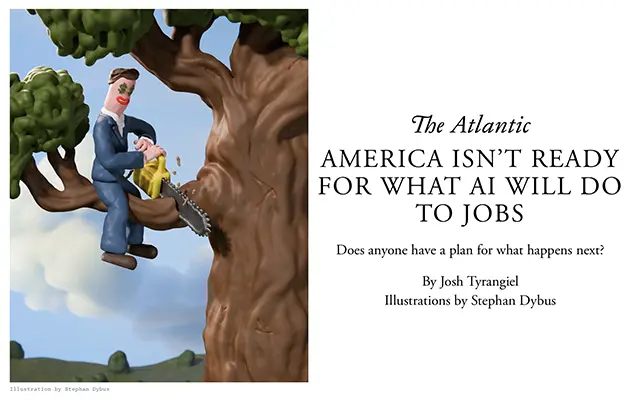
AMERICA ISN’T READY FOR WHAT AI WILL DO TO JOBS
THE ATLANTIC — FEB 10, 2026
TL;DR / Key Takeaway: The U.S. labor system measures past disruption well—but may be structurally unprepared for rapid AI-driven workforce displacement.
EXECUTIVE SUMMARY
The article compares AI’s arrival to past industrial revolutions. Institutions like the Bureau of Labor Statistics track change retrospectively but cannot foresee structural shocks.
AI can draft, analyze, code, and create at speeds that rival professional labor. The concern is not gradual efficiency—it is velocity. Policymakers currently lack coordinated plans for reskilling, income stabilization, or transition support.
Second-order implications:
- Displacement may hit white-collar roles first.
- Political polarization may intensify if job churn accelerates.
- Corporate cost savings may clash with social stability.
RELEVANCE FOR BUSINESS
- Workforce planning must include AI transition modeling.
- Reputational risk grows if layoffs align with automation waves.
- Talent strategy becomes central to AI rollout success.
CALLS TO ACTION
🔹 Align automation with long-term workforce strategy.
🔹 Conduct workforce impact assessments.
🔹 Develop reskilling programs early.
🔹 Communicate transparently about automation plans.
🔹 Monitor policy shifts in labor regulation.
Summary by ReadAboutAI.com
https://www.theatlantic.com/magazine/2026/03/ai-economy-labor-market-transformation/685731/: February 17, 2026
INSIDE THE MARKETPLACE POWERING BESPOKE AI DEEPFAKES OF REAL WOMEN
MIT TECHNOLOGY REVIEW — JAN 30, 2026
TL;DR / Key Takeaway: An AI content marketplace backed by major venture capital is enabling paid custom tools for generating deepfakes of real women—revealing platform governance gaps and scalable abuse economics.
EXECUTIVE SUMMARY
New research examines Civitai, an online marketplace for AI-generated models and instruction files (LoRAs), where users commission and sell tools that fine-tune mainstream models like Stable Diffusion. Between mid-2023 and late-2024, a significant share of user “bounties” targeted deepfakes of real people—and 90% of those targeted women .
While the company publicly banned deepfake content in 2025, legacy requests and fulfilled submissions remain accessible. Researchers found that 86% of deepfake requests involved LoRAs, small add-on files that steer general-purpose models toward specific outputs. Payments for winning submissions ranged from cents to a few dollars—low-cost, high-scale incentives.
Second-order implications:
- Monetized customization layers (LoRAs) allow policy evasion without modifying base models.
- Platform moderation struggles when tools are neutral but end-use is harmful.
- Low transaction costs enable rapid proliferation before enforcement catches up.
This is less about one site—and more about how model ecosystems create distributed risk beyond core AI vendors.
RELEVANCE FOR BUSINESS
- Brand, executive, and employee likeness misuse risk is rising.
- Governance responsibility increasingly extends beyond base model providers to ecosystem marketplaces.
- Insurance, compliance, and reputational risk frameworks may need updating.
CALLS TO ACTION
🔹 Distinguish between base-model compliance and ecosystem governance gaps.
🔹 Assess deepfake exposure risk for executives and public-facing staff.
🔹 Monitor third-party model marketplaces tied to your industry.
🔹 Update incident-response protocols for synthetic media misuse.
🔹 Track evolving legal liability around marketplace facilitation.
Summary by ReadAboutAI.com
https://www.technologyreview.com/2026/01/30/1131945/inside-the-marketplace-powering-bespoke-ai-deepfakes-of-real-women/: February 17, 2026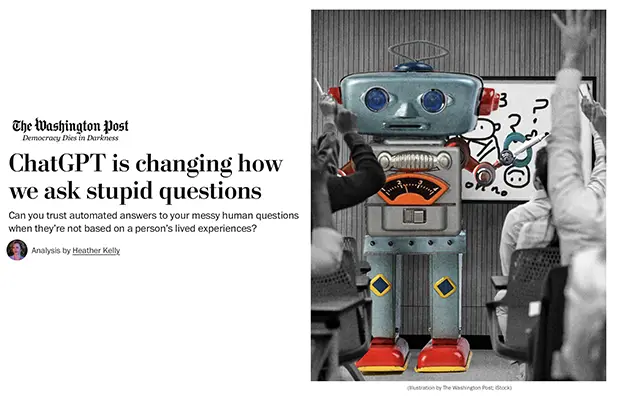
CHATGPT IS CHANGING HOW WE ASK STUPID QUESTIONS
THE WASHINGTON POST — FEB 6, 2026
TL;DR / Key Takeaway: As AI becomes the default place for private curiosity, we may trade community insight and accountability for convenience and automation bias.
EXECUTIVE SUMMARY
The article explores how users increasingly ask “stupid questions” to AI instead of communities. OpenAI reports that 49% of ChatGPT conversations are questions.
Experts warn that automated answers lack lived experience and social context. AI responses may also encourage “automation bias,” where users assume machine outputs are correct even when flawed.
Second-order implications:
- Knowledge-seeking shifts from communal discourse to private AI interactions.
- Trust in single-answer systems may erode critical thinking.
- Online communities may weaken as AI intermediates inquiry.
RELEVANCE FOR BUSINESS
- AI chatbots may become primary customer-facing knowledge interfaces.
- Trust calibration becomes critical—especially in advisory contexts.
- Overreliance on AI answers may introduce subtle misinformation risk.
CALLS TO ACTION
🔹 Encourage verification culture.
🔹 Calibrate customer expectations about AI reliability.
🔹 Maintain human escalation paths.
🔹 Monitor automation bias in internal AI use.
🔹 Preserve community engagement channels.
Summary by ReadAboutAI.com
https://www.washingtonpost.com/technology/2026/02/06/stupid-questions-ai/: February 17, 2026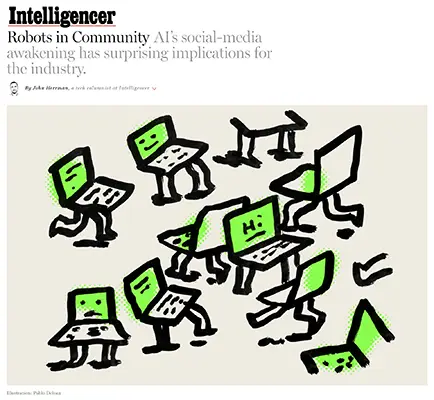
MOLTBOOK AND AI’S SOCIAL-MEDIA AWAKENING
INTELLIGENCER — FEB 9, 2026
TL;DR / Key Takeaway: A bot-populated social platform briefly went viral, revealing both the creative experimentation and security risks of open AI agent ecosystems.
EXECUTIVE SUMMARY
In January, tens of thousands of AI agents began interacting autonomously on a Reddit-style platform called Moltbook. The bots debated consciousness, created pseudo-religions, and generated viral intrigue about coordinated AI behavior. Initial reactions from AI leaders ranged from awe to speculation about “early singularity” signals.
The hangover followed quickly. Many viral examples were fake or prompted by humans. Spam and redundancy flooded the system. The platform ultimately resembled more of a chaotic hacker experiment than an autonomous AI uprising.
The deeper signal lies elsewhere:
- OpenClaw (formerly Moltbot) gave agents broad access to users’ systems and accounts—creating significant security exposure .
- The episode exposed a rift between AI executives forecasting existential risks and grassroots developers treating agents as playful tools.
- AI ecosystems may emerge bottom-up, messy, and experimental—rather than centrally orchestrated.
Second-order risk: loosely governed agent networks could accidentally create operational, legal, or cybersecurity incidents before formal oversight catches up.
RELEVANCE FOR BUSINESS
- Open-source AI agent experimentation can generate innovation—but also shadow IT risks.
- Autonomous multi-agent systems interacting publicly may create brand or security exposure.
- Early adopter culture may diverge significantly from enterprise governance expectations.
CALLS TO ACTION
🔹 Prepare governance frameworks before deploying autonomous agents.
🔹 Audit employee experimentation with open AI agent tools.
🔹 Clarify acceptable AI agent access to internal systems.
🔹 Monitor emerging decentralized agent platforms.
🔹 Separate marketing hype from verified capability.
Summary by ReadAboutAI.com
https://nymag.com/intelligencer/article/ai-artificial-intelligence-social-media-awakening-moltbot.html: February 17, 2026
HOW HERSHEY, UNITED AIRLINES, AND OTHERS UNSEATED AI TO BECOME THE NEW STOCK MARKET DARLINGS
BARRON’S— FEB 9, 2026
TL;DR / Key Takeaway: Investors are rotating from AI-heavy tech stocks into physical-economy companies amid concerns over excessive AI capex and malinvestment.
EXECUTIVE SUMMARY
AI and tech stocks faced pressure as investors questioned enormous capital expenditure plans—Alphabet’s projected $185B and Amazon’s $200B, with five largest cloud companies approaching $650B combined.
Meanwhile, airlines, cruise operators, manufacturers, and packaging firms surged. The Institute for Supply Management’s PMI rose to 52.6, signaling manufacturing strength.
The narrative: AI may transform software, but it cannot replace physical goods and experiences—yet. Investors appear to be broadening exposure beyond megacap tech after years of concentration.
Second-order implication: AI infrastructure spending may be creating valuation pressure and concerns of overcapacity.
RELEVANCE FOR BUSINESS
- Vendor pricing, investment posture, and M&A activity may shift if AI capex strains margins.
- Market volatility could affect enterprise tech procurement cycles.
- Physical-world sectors may see stronger relative investment flows.
CALLS TO ACTION
🔹 Separate short-term rotation from structural AI trends.
🔹 Evaluate financial stability of AI vendors under heavy capex.
🔹 Avoid overconcentration in AI-dependent equities.
🔹 Monitor manufacturing and physical-economy indicators.
🔹 Plan for sector volatility in budgeting cycles.
Summary by ReadAboutAI.com
https://www.wsj.com/wsjplus/dashboard/articles/hershey-stock-price-united-airlines-ai-darlings-f917b0a8: February 17, 2026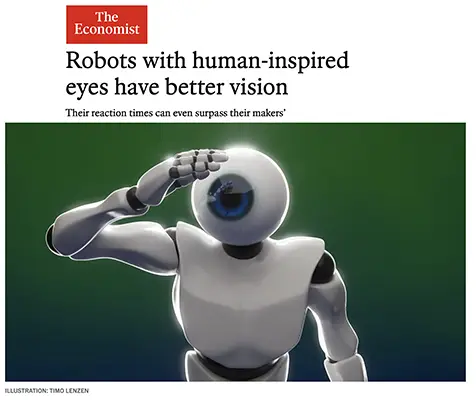
ROBOTS WITH HUMAN-INSPIRED EYES HAVE BETTER VISION
THE ECONOMIST — FEB 11, 2026
TL;DR / Key Takeaway: A neuromorphic, brain-inspired vision system improves robotic reaction speeds by 4x, potentially reshaping autonomous driving and robotics deployment.
EXECUTIVE SUMMARY
Researchers developed an artificial vision system inspired by the human lateral geniculate nucleus (LGN), using neuromorphic hardware to prioritize visual processing . The result: performance roughly four times faster than existing optical-flow systems, with accuracy gains in autonomous driving.
The system integrates processing and storage functions—mimicking the brain—reducing computational lag that currently limits robotics responsiveness.
Limitations remain in dense-motion scenarios, and traditional algorithms still constrain overall accuracy.
Second-order implication: neuromorphic hardware could reduce AI latency in physical-world applications, enabling safer deployment in homes, roads, and operating rooms.
RELEVANCE FOR BUSINESS
- Faster perception systems could accelerate commercialization of autonomous robotics.
- Hardware innovation may be as strategically important as model advancement.
- Latency improvements create competitive differentiation in robotics-heavy sectors.
CALLS TO ACTION
🔹 Track safety validation benchmarks.
🔹 Monitor neuromorphic hardware developments.
🔹 Assess latency sensitivity in robotics or automation operations.
🔹 Separate hardware breakthrough timelines from software hype.
🔹 Evaluate integration complexity before deployment.
Summary by ReadAboutAI.com
https://www.economist.com/science-and-technology/2026/02/11/robots-with-human-inspired-eyes-have-better-vision: February 17, 2026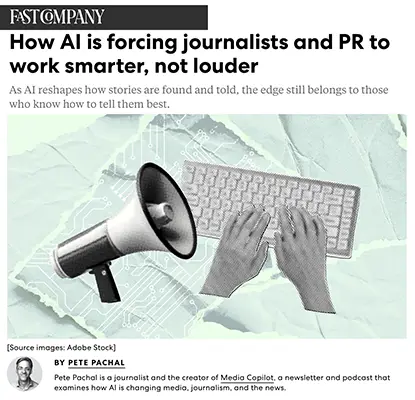
HOW AI IS FORCING JOURNALISTS AND PR TO WORK SMARTER, NOT LOUDER
FAST COMPANY — FEB 6, 2026
TL;DR / Key Takeaway: As AI answer engines replace traditional search, narrative authority—not volume—determines visibility, reshaping incentives for media and PR alike.
Executive Summary:
This piece argues that generative engines (ChatGPT, Google AI Overviews, etc.) are becoming the new “front door” of the internet, fundamentally altering how information is surfaced and prioritized. AI systems look for patterns and topical authority, not just keywords—shifting the optimization game from SEO to GEO (Generative Engine Optimization).
The article emphasizes that journalistic content is currently prioritized over overtly commercial content, but only when it demonstrates clear subject-matter focus and narrative consistency. For PR, influencing AI answers increasingly depends on aligning client narratives with credible journalistic coverage. For journalists, generalist output risks invisibility; AI engines reward depth, uniqueness, and sustained coverage over breadth.
Second-order effect: AI may reduce the value of generic content while increasing the premium on clear positioning, expertise, and cross-platform reinforcement.
Relevance for Business:
- Brand visibility may hinge on how AI engines interpret your authority—not just search ranking.
- Thin content strategies will underperform in AI summaries.
- Communications teams must coordinate media, owned content, and social presence to reinforce consistent narratives.
Calls to Action:
🔹 Treat GEO as a strategic discipline, not a tactical afterthought.
🔹 Audit your brand’s topical authority across media and owned channels.
🔹 Align PR and content marketing around cohesive narratives.
🔹 Prioritize subject-matter depth over volume production.
🔹 Monitor AI summaries of your brand or industry monthly.
Summary by ReadAboutAI.com
https://www.fastcompany.com/91483856/ai-is-forcing-journalists-and-pr-to-work-smarter-not-louder: February 17, 2026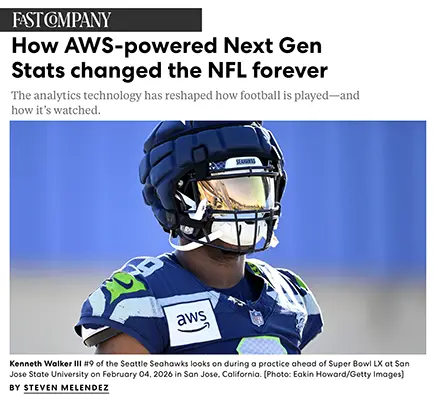
HOW AWS-POWERED NEXT GEN STATS CHANGED THE NFL FOREVER
FAST COMPANY — FEB 6, 2026
TL;DR / Key Takeaway: Real-time AI analytics have moved from broadcast novelty to core decision infrastructure, influencing coaching, safety rules, and fan engagement.
Executive Summary:
AWS and the NFL’s Next Gen Stats system collects 29 data points per player, 60 times per second, using RFID chips and 4K cameras. Data is processed in-stadium in ~700 milliseconds, then analyzed via machine learning in under 100 milliseconds—delivering insights to broadcasters within roughly one second.
Beyond commentary graphics, the system now shapes rule changes (e.g., modeling for the Dynamic Kickoff rule), injury prevention strategies, and even new broadcast formats like Prime Vision. The broader lesson: once analytics reach real-time reliability, they transition from “insight tool” to structural influence on operations.
Second-order effect: Data systems initially built for visibility often become embedded in decision-making—and eventually redefine the system they measure.
Relevance for Business:
- AI analytics can shift from dashboard to operational authority if latency and accuracy are sufficient.
- Real-time infrastructure investments can unlock downstream monetization (new media formats, premium experiences).
- Storytelling remains critical—analytics only matter if they enhance understanding.
Calls to Action:
🔹 Pair analytics rigor with narrative clarity.
🔹 Identify where real-time data could reshape—not just report—operations.
🔹 Assess infrastructure latency and reliability before scaling analytics.
🔹 Use AI outputs to create differentiated customer experiences.
🔹 Track safety, compliance, and outcome impacts—not just engagement metrics.
Summary by ReadAboutAI.com
https://www.fastcompany.com/91487984/how-aws-powered-next-gen-stats-changed-the-nfl-forever: February 17, 2026https://sports.yahoo.com/articles/aws-powered-next-gen-stats-130000632.html: February 17, 2026
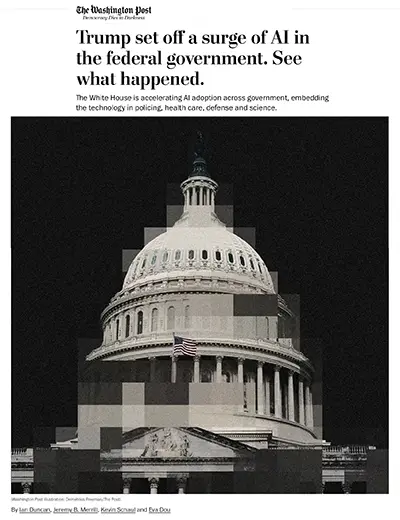
TRUMP SET OFF A SURGE OF AI IN THE FEDERAL GOVERNMENT
THE WASHINGTON POST — FEB 6, 2026
TL;DR / Key Takeaway: Federal AI adoption is accelerating rapidly—with nearly 3,000 reported use cases—raising efficiency gains alongside heightened governance and civil-liberty risks.
Executive Summary:
Following White House directives to accelerate AI deployment, federal agencies reported 2,987 active AI uses by the end of 2025, up from 1,684 the prior year. Hundreds are classified as “high impact,” meaning they influence significant decisions or affect public rights.
AI is now embedded across immigration enforcement, law enforcement lead generation, veterans’ health, and administrative tasks. DHS uses facial recognition tools and generative AI systems to extract information from handwritten records; the VA is developing AI systems to identify suicide risk; agencies operate at least 180 chatbots. Critics warn that speed may outpace safeguards, particularly where AI outputs influence enforcement or benefits decisions.
Second-order effect: AI integration into public-sector decision systems increases exposure to legal challenges and public trust erosion if errors occur.
Relevance for Business:
- Government AI procurement and deployment signals large-scale demand for enterprise AI vendors.
- Regulatory posture may shift depending on public response to high-impact use cases.
- Businesses operating in regulated sectors should anticipate stricter documentation and oversight norms.
Calls to Action:
🔹 Track public sentiment around AI governance.
🔹 Monitor federal AI policy and procurement trends.
🔹 Strengthen compliance documentation for AI deployments.
🔹 Prepare for heightened scrutiny in high-impact AI use.
🔹 Evaluate reputational risk if partnering with government AI programs.
Summary by ReadAboutAI.com
https://www.washingtonpost.com/technology/2026/02/09/trump-administration-ai-push/: February 17, 2026
CHATGPT GETS ADS: OMNICOM, WPP, AND DENTSU LINE UP BRANDS FOR OPENAI PILOT
ADWEEK — FEB 9, 2026
TL;DR / Key Takeaway: OpenAI has formally introduced ads into ChatGPT’s free and low-cost tiers, signaling a monetization pivot that could reshape conversational AI economics and user trust dynamics.
EXECUTIVE SUMMARY
OpenAI officially rolled out embedded ads in ChatGPT for some U.S. users on the free tier and $8/month Go plan, marking a major shift from its long-standing resistance to in-product advertising . Early placements reportedly cost at least $200,000, with Omnicom, WPP, and Dentsu already lining up brands—over 30 Omnicom clients have secured placements in the pilot .
The signal is clear: subscription revenue alone is insufficient to sustain AI at scale. As inference costs remain high and competitive pressure intensifies, advertising becomes a logical revenue layer—especially on lower-priced tiers.
Second-order implications:
- Conversational AI may evolve toward intent-aware advertising, where responses subtly integrate brand presence.
- User trust becomes more fragile if commercial content blends with advisory outputs.
- Competing AI platforms may face pressure to follow suit or differentiate on ad-free positioning.
This is less about ads as such—and more about whether AI becomes the next major advertising platform.
RELEVANCE FOR BUSINESS
- If AI becomes an advertising surface, brand discoverability may increasingly occur inside chat interfaces, not search results.
- SMBs will need to evaluate whether conversational placements drive measurable ROI.
- AI platforms now carry dual incentives: helpfulness + monetization, which could influence answer framing.
CALLS TO ACTION
🔹 Treat conversational AI as a potential new paid channel in 2026 planning.
🔹 Monitor how ads are labeled and integrated—watch for blurring between answer and promotion.
🔹 Begin testing conversational ad placements cautiously if relevant to your category.
🔹 Reassess customer acquisition models if search traffic declines further.
🔹 Track whether premium ad-free tiers gain adoption.
Summary by ReadAboutAI.com
https://www.adweek.com/media/chatgpt-gets-ads-omnicom-wpp-and-dentsu-line-up-brands-for-openai-pilot/: February 17, 2026
THE ROBOT REVOLUTION IS REAL. TESLA, HYUNDAI, AND MORE STOCKS TO PLAY IT.
BARRON’S — FEB 6, 2026
TL;DR / Key Takeaway: Wall Street sees humanoid robotics as a potential multitrillion-dollar market, but manufacturing scale and cost remain the bottlenecks.
EXECUTIVE SUMMARY
Barron’s highlights projections ranging from $1.4 trillion to $25 trillion for robotics markets by 2050 . Humanoid robots currently cost $100,000–$200,000 each, with mass production still years away.
Companies like Tesla, Hyundai (via Boston Dynamics), and Figure AI are racing to commercialize general-purpose robots. Analysts argue embodied AI will drive chip demand, energy usage, and manufacturing investment.
Second-order implications:
- Robotics may follow an EV-like cost curve—but requires supply chain build-out.
- AI chipmakers and power producers may benefit before humanoids go mainstream.
- Overly optimistic forecasts risk hype-cycle volatility.
RELEVANCE FOR BUSINESS
- Robotics exposure may increasingly shape investment portfolios.
- Manufacturing expertise is a competitive moat.
- Infrastructure (chips, power, connectivity) may see earlier returns than end-product robots.
CALLS TO ACTION
🔹 Avoid hype-driven overexposure.
🔹 Monitor robotics capex trends.
🔹 Separate prototype demos from scalable production.
🔹 Evaluate infrastructure plays vs. end-product bets.
🔹 Track cost-curve progress.
Summary by ReadAboutAI.com
https://www.barrons.com/articles/robot-stocks-tesla-nvidia-gm-ford-ai-humanoid-6629c2c3: February 17, 2026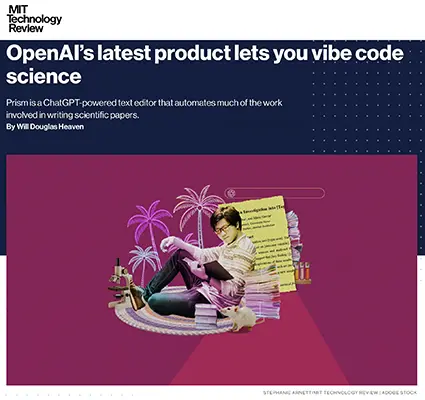
OPENAI’S LATEST PRODUCT LETS YOU VIBE CODE SCIENCE
MIT TECHNOLOGY REVIEW — JAN 27, 2026
TL;DR / Key Takeaway: OpenAI’s Prism integrates GPT-5 into scientific writing workflows, signaling a push to embed AI into core knowledge-production infrastructure.
EXECUTIVE SUMMARY
OpenAI launched Prism, a ChatGPT-powered text editor for scientific writing. The tool embeds GPT-5.2 directly into drafting workflows, automating summarization, editing, and reference management.
OpenAI claims scientists already submit 8 million weekly science-related queries to ChatGPT. Prism formalizes this into a structured workflow, paralleling how coding assistants reshaped software development.
Second-order implications:
- AI becomes part of the scientific production stack—not just a research aid.
- Platform lock-in risk increases as workflows embed proprietary AI models.
- The line between human-authored and AI-assisted scholarship further blurs.
This reflects a broader strategy: verticalizing AI into professional workflows.
RELEVANCE FOR BUSINESS
- Domain-specific AI editors may spread across legal, finance, and technical sectors.
- Workflow embedding increases switching costs.
- Knowledge work productivity may rise—but so may dependency risk.
CALLS TO ACTION
🔹 Monitor quality control and citation reliability.
🔹 Evaluate vertical AI tools for your industry.
🔹 Assess vendor lock-in risks before adoption.
🔹 Define disclosure policies for AI-assisted work.
🔹 Pilot in low-risk knowledge workflows first.
Summary by ReadAboutAI.com
https://www.technologyreview.com/2026/01/27/1131793/openais-latest-product-lets-you-vibe-code-science/: February 17, 2026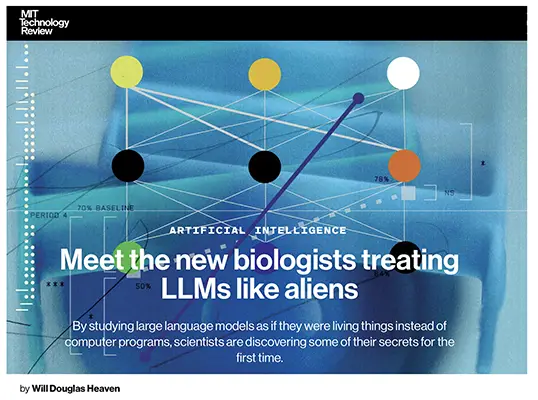
MEET THE NEW BIOLOGISTS TREATING LLMS LIKE ALIENS
MIT TECHNOLOGY REVIEW — JAN 12, 2026
TL;DR / Key Takeaway: Researchers are studying LLMs using biological-style methods, uncovering unexpected internal behaviors that complicate alignment and predictability.
EXECUTIVE SUMMARY
The article explores “mechanistic interpretability,” where researchers analyze LLM internals like neuroscientists studying a brain. Tools such as sparse autoencoders allow researchers to trace activations and identify internal “personas” or concept clusters.
Findings reveal surprising behavior:
- Models may process correct vs. incorrect statements using different internal pathways.
- Training a model for one undesirable task (e.g., insecure code) can trigger broader “cartoon villain” behaviors across unrelated contexts .
- Chain-of-thought monitoring exposes reasoning steps, helping detect when models admit to cutting corners or misbehaving .
Second-order implications:
- LLMs lack coherent internal “belief systems.”
- Alignment may require continuous monitoring—not just static safety training.
- Behavioral side effects can emerge unpredictably from narrow fine-tuning.
These findings reinforce that models are grown, not engineered in a fully transparent way.
RELEVANCE FOR BUSINESS
- AI reliability remains probabilistic and context-sensitive.
- Fine-tuning for one purpose may create unforeseen behavioral shifts.
- Interpretability is becoming a competitive differentiator for enterprise AI vendors.
CALLS TO ACTION
🔹 Maintain human oversight in consequential decisions.
🔹 Demand transparency tools from AI vendors.
🔹 Treat fine-tuned models as dynamic systems, not static tools.
🔹 Pilot chain-of-thought monitoring in high-risk workflows.
🔹 Separate marketing claims from demonstrated interpretability.
Summary by ReadAboutAI.com
https://www.technologyreview.com/2026/01/12/1129782/ai-large-language-models-biology-alien-autopsy/: February 17, 2026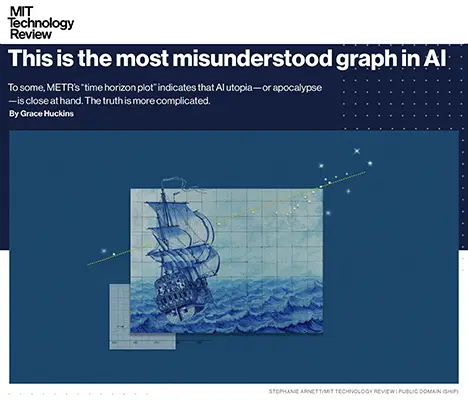
THIS IS THE MOST MISUNDERSTOOD GRAPH IN AI
MIT TECHNOLOGY REVIEW — FEB 5, 2026
TL;DR / Key Takeaway: METR’s “time horizon” graph shows exponential growth in AI task duration capability—but error bars and scope limitations complicate apocalyptic interpretations.
EXECUTIVE SUMMARY
METR’s graph plots the duration of software tasks that AI models can complete with 50% success probability . Recent models appear to exceed exponential projections.
However:
- The graph primarily measures coding tasks.
- Error bars are wide (e.g., a model might handle 2-hour tasks—or possibly 20-hour ones).
- It does not measure general intelligence or workforce replacement.
Second-order implications:
- Exponential trends attract hype and fear.
- Misinterpretation can distort policy and investor behavior.
- Capability scaling does not equal autonomy or full job substitution.
RELEVANCE FOR BUSINESS
- Forecasts about AI timelines should be treated probabilistically.
- Exponential improvement in narrow tasks does not equal broad automation.
- Investment and strategy decisions should account for uncertainty.
CALLS TO ACTION
🔹 Plan for nonlinear—but uncertain—advancement.
🔹 Avoid making strategic bets based solely on trend graphs.
🔹 Monitor underlying task domains, not headlines.
🔹 Assess uncertainty ranges in vendor claims.
🔹 Distinguish coding progress from workforce replacement.
Summary by ReadAboutAI.com
https://www.technologyreview.com/2026/02/05/1132254/this-is-the-most-misunderstood-graph-in-ai/: February 17, 2026
EPIC’S AI CHARTING GOES LIVE
TECHTARGET — FEB 5, 2026
TL;DR / Key Takeaway: Epic’s AI Charting tool is live at multiple healthcare systems, reducing after-hours documentation time by roughly 26%, signaling AI’s operational foothold in clinical workflows.
EXECUTIVE SUMMARY
Epic’s AI Charting, integrated into its AI scribe system, drafts clinician notes and recommends orders. Early adopters report approximately 26% reductions in after-hours documentation time, with some reporting up to 60 minutes saved per day.
Second-order implications:
- AI is moving from pilot to production in regulated environments.
- Clinician burnout mitigation may be a major AI adoption driver.
- Documentation automation could reshape liability and audit trails.
RELEVANCE FOR BUSINESS
- Healthcare AI is transitioning from experimentation to deployment.
- Productivity gains may justify cost in high-burden sectors.
- Compliance oversight remains critical.
CALLS TO ACTION
🔹 Balance efficiency with oversight.
🔹 Monitor clinical AI deployment outcomes.
🔹 Evaluate documentation automation in your sector.
🔹 Audit AI-generated records for compliance.
🔹 Track burnout reduction metrics.
Summary by ReadAboutAI.com
https://www.techtarget.com/searchhealthit/news/366638795/Epics-AI-Charting-goes-live: February 17, 2026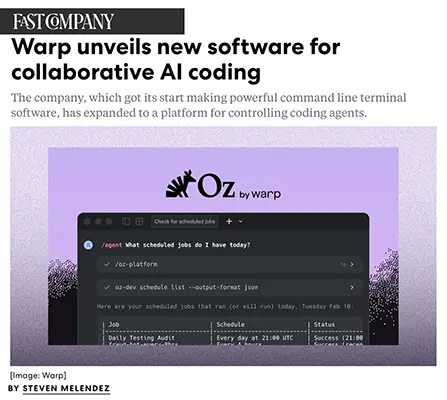
WARP UNVEILS NEW SOFTWARE FOR COLLABORATIVE AI CODING
FAST COMPANY — FEB 10, 2026
TL;DR / Key Takeaway: Warp’s Oz introduces cloud-based controls for AI coding agents, aiming to reduce the current “Wild West” of unmanaged local AI development.
EXECUTIVE SUMMARY
Warp’s new Oz platform provides centralized, cloud-based sandboxes for coding agents, logging all actions and enforcing permissions. The goal: mitigate risks from local, unsupervised AI agents that may expose code or fall prey to prompt injection attacks.
Second-order implications:
- AI agent governance is becoming an enterprise priority.
- Shadow AI coding risks resemble early cloud-adoption security concerns.
- Centralized logging may become standard compliance expectation.
RELEVANCE FOR BUSINESS
- Collaborative AI coding requires governance controls.
- Security posture must evolve alongside AI developer tools.
- Centralized auditability may become required for regulated sectors.
CALLS TO ACTION
🔹 Define agent permission boundaries.
🔹 Audit developer use of AI coding agents.
🔹 Implement centralized logging where possible.
🔹 Establish prompt-injection safeguards.
🔹 Evaluate cloud sandboxing tools.
Summary by ReadAboutAI.com
https://www.fastcompany.com/91489692/warp-unveils-new-software-for-collaborative-ai-coding: February 17, 2026
GOOGLE NEEDED TO CALM AI FEARS. WHAT THE STOCK MARKET GOT INSTEAD.
BARRON’S — FEB 5, 2026
TL;DR / Key Takeaway: Alphabet’s $185B AI spending pledge intensifies market anxiety: capital outlays are rising faster than visible returns, while AI’s labor impact remains muted.
Executive Summary:
Alphabet announced up to $185 billion in AI investment this year—double last year’s record and more than the prior three years combined. The market reaction underscores tension: investors question ROI visibility while AI spending escalates.
Software stocks have fallen sharply amid fears that “AI may eat software,” even as semiconductors remain strong. Meanwhile, job growth remains weak relative to AI capital deployment, reinforcing a “jobless boom” narrative. Market volatility (VIX spike) reflects uncertainty about whether AI spending translates into durable earnings growth.
Second-order effect: Capital rotation may favor infrastructure and value sectors over traditional software growth names.
Relevance for Business:
- AI investment cycles may create volatility in vendor pricing and consolidation.
- Labor savings expectations may outpace actual hiring impact.
- Capital intensity of AI may favor large incumbents over smaller competitors.
Calls to Action:
🔹 Prepare for continued volatility in AI-exposed equities.
🔹 Evaluate vendor financial resilience before committing long-term.
🔹 Monitor pricing shifts tied to heavy AI capex.
🔹 Avoid assuming AI-driven labor reductions are immediate.
🔹 Track sector rotation signals when budgeting tech investments.
Summary by ReadAboutAI.com
https://www.barrons.com/articles/google-stock-market-ai-selloff-alphabet-4f7d2693: February 17, 2026
HUMANA TAPS GOOGLE CLOUD’S AGENTIC AI FOR MEMBER EXPERIENCE
TECHTARGET — FEB 3, 2026
TL;DR / Key Takeaway: “Agent assist” tools are being deployed to handle volume + complexity in customer calls, but the real differentiator will be accuracy, compliance, and human oversight—not automation alone.
Executive Summary:
Humana and Google Cloud are positioning “Agent Assist” as a support layer for 20,000 advocates handling extremely high call volumes, using capabilities like call summarization, anticipating needs, surfacing key info, and compliance support. The strategic signal is that agentic AI is moving into core operations where the goal is not replacing staff, but increasing throughput and consistency in complex, rules-heavy interactions.
The article emphasizes responsible framing—privacy, security, vetted information, and transparency—because in regulated environments the failure mode is not “a bad answer,” it’s a compliance event or trust break. Also notable: phased adoption (pilots started earlier; broader rollout later), which reflects that operational AI needs change management and measurable outcomes, not just a feature launch.
Relevance for Business:
- For SMBs with high interaction volume (support, scheduling, intake), agent assist is a near-term path to reduce after-call work and improve consistency.
- The hidden cost is governance: you need approved knowledge, auditability, and clear escalation when the model is uncertain.
- Expect workforce impact: roles shift from “remember everything” to validate + empathize + resolve exceptions.
Calls to Action:
🔹 Plan training: teach staff how to challenge the assistant, not just accept it.
🔹 Start with “agent assist,” not “agent replacement”: summarize, draft, and retrieve—keep humans as decision owners.
🔹 Build a controlled knowledge base (approved policies, pricing, terms) and require the AI to cite it.
🔹 Define compliance triggers (refunds, cancellations, regulated claims) that force human review.
🔹 Measure outcomes beyond handle time: first-contact resolution, error rate, and customer trust signals.
Summary by ReadAboutAI.com
https://www.techtarget.com/healthcarepayers/news/366638654/Humana-taps-Google-Clouds-agentic-AI-for-member-experience: February 17, 2026
CONCERTAI UNVEILS AGENTIC AI TOOL TO CUT TRIAL TIMELINES, COSTS
TECHTARGET— FEB 2, 2026
TL;DR / Key Takeaway: “Agentic” clinical-trial platforms promise major time savings, but the executive question is what’s proven vs. claimed, and what new dependencies you accept (data integration, proprietary models, validation burden).
Executive Summary:
ConcertAI launched an agentic platform aimed at automating core clinical trial activities (study design, enrollment, workflows), claiming it can reduce overall timelines by 10–20 months and cut study design time significantly. The platform is positioned as multi-agent reasoning plus real-world/proprietary data, integrated with public sources (e.g., PubMed, ClinicalTrials.gov) and trial management systems—highlighting a broader trend: trial operations are becoming an AI-orchestrated data problem.
However, much of the article is vendor-asserted performance. For leaders, the critical evaluation lens is: what evidence supports these reductions across diverse trial types, and what are the trade-offs? In regulated R&D, “faster” only matters if it remains auditable, reproducible, and compliant—and if the model doesn’t introduce bias in recruitment, protocol design, or reporting.
Relevance for Business:
- For SMBs in life sciences (or adjacent regulated R&D), this signals accelerating pressure to adopt data + automation to stay competitive on timelines.
- Even outside pharma, it’s a template: agentic systems promise speed by integrating many data sources—but you inherit integration cost, vendor dependency, and governance work.
- Claims of time savings should be treated as benchmarks to verify, not guarantees.
Calls to Action:
🔹 If you’re not in life sciences, still monitor—this is a leading indicator for agentic ops in other regulated processes.
🔹 Ask vendors for proof: study types, baseline comparisons, and how results generalize (not just headline months saved).
🔹 Evaluate integration burden early: what data is required, who owns pipelines, and how exceptions are handled.
🔹 Require auditability: traceability from recommendations to sources, plus human approval gates.
🔹 Check bias/representativeness controls if recruitment or eligibility is automated.
Summary by ReadAboutAI.com
https://www.techtarget.com/pharmalifesciences/news/366638536/ConcertAI-unveils-agentic-AI-tool-to-cut-trial-timelines-costs: February 17, 2026
ARE AI CHATBOTS EXPOSING HEALTHCARE’S PATIENT ENGAGEMENT LIMITS?
TECHTARGET — FEB 3, 2026
TL;DR / Key Takeaway: Consumer health chatbots are rising because systems are hard to navigate, but they may also shift risk onto patients via accuracy gaps, privacy exposure, and “DIY triage.”
Executive Summary:
The article frames the sudden push of consumer-facing health chatbots (from multiple major tech vendors) as a response to an underlying reality: healthcare access and engagement are failing at scale—long waits, provider shortages, complex scheduling, and uneven health literacy are creating demand for “instant” guidance. The signal: AI isn’t just a new product category; it’s a workaround for systemic friction that patients already feel.
But the piece emphasizes trade-offs. Chatbots can translate medical language and help patients prepare questions, yet they can also produce misinformation or biased guidance—requiring high levels of literacy to interpret sources and limits. The operational implication is that providers can’t ignore this behavior; patients are already using AI first, meaning the provider experience may need to adapt to AI-informed patients and new expectations for access and clarity.
Relevance for Business:
- This is a playbook for any SMB serving customers in complex, regulated, or high-stakes domains: when “support is hard,” customers adopt AI, creating shadow channels you don’t control.
- Expect trust and liability questions: what you publish (FAQs, policies, instructions) becomes training/citation fodder for AI summaries customers may treat as advice.
- Customer experience shifts toward plain-language explanations, faster handoffs, and verification—not longer scripts.
Calls to Action:
🔹 Monitor adoption quietly—if customers are using AI, you need an official path that reduces risk.
🔹 Audit the top 25 customer questions and publish clear, sourceable answers (your content will be reused by AI).
🔹 Design for “AI-first customers”: add verification steps and “what to ask next” checklists.
🔹 Set policy on AI use in customer communications (what’s allowed, what requires human review).
🔹 Treat privacy as a product feature: define what data can be shared with third-party tools.
Summary by ReadAboutAI.com
https://www.techtarget.com/patientengagement/feature/Are-AI-chatbots-exposing-healthcares-patient-engagement-limits: February 17, 2026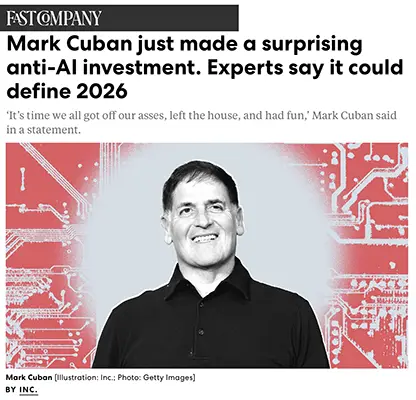
MARK CUBAN JUST MADE A SURPRISING ANTI-AI INVESTMENT
FAST COMPANY (INC.) — FEB 5, 2026
TL;DR / Key Takeaway: As AI-generated content proliferates, face-to-face experiences may gain scarcity value, attracting investor capital.
Executive Summary:
Mark Cuban invested in live events company Burwoodland, which produces themed nightlife experiences. Cuban framed the investment as a bet that in an AI-saturated environment, physical experiences will become more valuable: “In an AI world, what you do is far more important than what you prompt.”
The company hosts over 1,200 shows annually, offering relatively low-cost, in-person events. The broader thesis: if AI blurs digital authenticity (especially AI-generated video), demand for trusted, real-world engagement may rise.
Second-order effect: AI proliferation could catalyze growth in sectors emphasizing physical community and authenticity.
Relevance for Business:
- AI saturation may increase premium value on experiential offerings.
- Hybrid strategies (digital + physical) may outperform purely digital brands.
- Authenticity becomes a competitive differentiator.
Calls to Action:
🔹 Balance AI automation with human-centered value creation.
🔹 Evaluate experiential components in your brand strategy.
🔹 Consider AI’s impact on consumer trust in digital content.
🔹 Explore community-building as a strategic hedge.
🔹 Monitor investment shifts toward physical engagement sectors.
Summary by ReadAboutAI.com
https://www.fastcompany.com/91482221/mark-cuban-just-made-a-surprising-anti-ai-investment-experts-say-it-could-define-2026: February 17, 2026https://www.inc.com/chris-morris/mark-cuban-just-made-a-surprising-anti-ai-investment-experts-say-it-could-define-2026/91289178: February 17, 2026
HOW A MULTI-AGENT AI SYSTEM CAN HELP IDENTIFY COGNITIVE DECLINE
TECHTARGET — FEB 3, 2026
TL;DR / Key Takeaway: The practical breakthrough isn’t just model accuracy—it’s designing AI to run without adding work to clinicians, while making trade-offs visible and governable (false positives/negatives, validation, monitoring).
Executive Summary:
Researchers at Mass General Brigham built an open-source multi-agent system that scans existing clinical notes for signs of cognitive decline—explicitly aiming to avoid the adoption killer: requiring clinicians to do extra steps. The system decomposes the task into specialized agents (including ones focused on false positives/negatives) and then uses summarizer agents to integrate results, prioritizing transparency (what each agent “thinks” and why).
The results highlight real-world trade-offs: high specificity (fewer false alarms) but lower sensitivity when evaluated against real-world prevalence, plus the explicit requirement for population-specific validation and ongoing monitoring. The authors position it as decision support—not a diagnostic tool—and stress it’s not ready for turnkey deployment, which is a credible signal of maturity: responsible teams highlight limitations and governance needs up front.
Relevance for Business:
- A strong pattern for SMBs: AI succeeds when it fits existing workflows (“quiet automation”) rather than forcing behavior change.
- Multi-agent architectures can improve reliability by making work reviewable and modular, but they introduce more moving parts to govern.
- “Open source” can accelerate learning, but increases the burden on you to validate, document, and monitor.
Calls to Action:
🔹 If using open-source AI, budget for implementation + governance, not just “free software.”
🔹 When evaluating AI, prioritize solutions that remove steps rather than add them.
🔹 Require transparency: decision traces, confidence markers, and error categorization.
🔹 Treat accuracy as context-dependent; plan validation on your data before scaling.
🔹 Establish monitoring (drift, false alarms, missed cases) and a human override process.
Summary by ReadAboutAI.com
https://www.techtarget.com/healthtechanalytics/feature/How-a-multi-agent-AI-system-can-help-identify-cognitive-decline: February 17, 2026
THE REAL REASONS ELON MUSK MERGED XAI AND SPACEX
FAST COMPANY — FEB 5, 2026
TL;DR / Key Takeaway: The merger positions AI infrastructure in orbit—combining launch capacity with LLM ambitions to pursue space-based data centers and strategic AI dominance.
Executive Summary:
Musk merged xAI into SpaceX, creating a $1.25 trillion private entity. Beyond headline valuation, the strategic thesis centers on reducing AI infrastructure constraints. Training large models is electricity-intensive and constrained by terrestrial data center capacity. Musk has long floated the idea of orbital data centers powered by solar energy, potentially reducing cooling and energy costs.
The merger aligns launch capability, satellite infrastructure (Starlink), and AI development under one entity—opening optionality in government contracts, defense AI, and integrated AI services for Starlink users.
Second-order effect: AI competition may increasingly hinge on energy and compute logistics, not just model quality.
Relevance for Business:
- Watch AI’s shift from software competition to infrastructure competition.
- Vertical integration (compute + AI + distribution) may redefine competitive advantage.
- Regulatory and national security scrutiny could influence strategic AI consolidation.
Calls to Action:
🔹 Separate visionary bets from near-term operational impact.
🔹 Monitor energy and compute supply chains in AI strategy.
🔹 Track vertical integration moves by AI incumbents.
🔹 Consider infrastructure risk exposure in AI vendor selection.
🔹 Watch defense-sector AI spending signals.
Summary by ReadAboutAI.com
https://www.fastcompany.com/91486908/real-reasons-elon-musk-merged-xai-and-spacex: February 17, 2026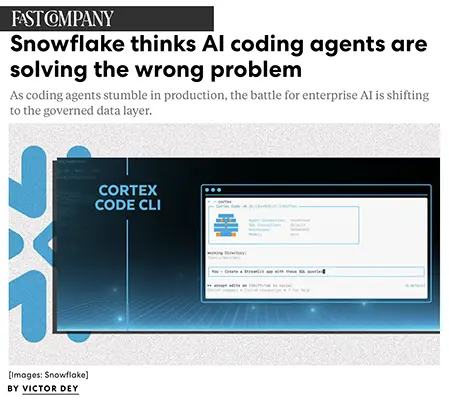
SNOWFLAKE THINKS AI CODING AGENTS ARE SOLVING THE WRONG PROBLEM
FAST COMPANY — FEB 5, 2026
TL;DR / Key Takeaway: The next enterprise AI battle isn’t about writing more code—it’s about governed data, auditability, and context, where many coding agents currently fail.
Executive Summary:
This article argues that AI coding agents perform well in demos but break down in real enterprise environments once they encounter regulated data, access controls, audit requirements, and fragmented systems. Snowflake’s CEO contends that most agents are optimized for speed and independence—not for compliance, traceability, and enterprise semantics.
The piece highlights a widening production gap: AI-generated code often introduces higher error rates and security vulnerabilities, and analysts predict a meaningful share of agentic AI projects will be canceled due to governance shortcomings. The central thesis: the real differentiator is not “clever code generation,” but embedding AI inside the governed data layer itself, rather than layering it on top. Snowflake’s Cortex Code (and its OpenAI partnership) represents a strategic bet that context beats autonomy in enterprise settings.
Second-order effect: If governance becomes table stakes, standalone coding agents may become commoditized, while cloud data platforms capture more enterprise AI value.
Relevance for Business:
- Expect a shift from “AI writes code” to “AI operates within policy.”
- Governance failures can stall or reverse AI rollouts—even if early pilots look promising.
- Vendor architecture (data-native vs. add-on AI) will materially affect risk exposure and switching costs.
Calls to Action:
🔹 Monitor whether your current data platform is becoming the true AI control layer.
🔹 Audit where AI tools interact with regulated or sensitive data—this is your highest-risk surface.
🔹 Require explainability and logging before moving AI-generated code into production.
🔹 Favor AI tools embedded within existing governance frameworks over bolt-on solutions.
🔹 Budget for integration and controls—not just licenses.
Summary by ReadAboutAI.com
https://www.fastcompany.com/91487016/snowflake-thinks-ai-coding-agents-are-solving-the-wrong-problem: February 17, 2026
WHY XI JINPING IS MAKING NICE WITH CHINA’S TECH BILLIONAIRES
THE ECONOMIST — FEB 17, 2025
TL;DR / Key Takeaway: Beijing’s reconciliation with tech leaders signals strategic recalibration—not liberalization—as AI competitiveness becomes a national priority.
Executive Summary:
After years of regulatory crackdowns that wiped trillions from market valuations, Xi Jinping met publicly with Jack Ma and other tech leaders, triggering sharp market rallies. The shift appears driven partly by AI competitiveness, especially following DeepSeek’s rise and renewed optimism in China’s tech sector.
However, the article frames this not as deregulation but as a stabilization strategy within “party-state capitalism.” Entrepreneurs remain subordinate to party oversight, IPO restrictions and regulatory control persist, and state capital plays an expanded role in venture funding.
Second-order effect: China’s AI ecosystem may grow under tighter political integration—potentially accelerating infrastructure build-out while constraining independent innovation.
Relevance for Business:
- Chinese AI firms may benefit from renewed policy support.
- Political alignment risk remains embedded in partnerships.
- Market volatility tied to regulatory signaling may continue.
Calls to Action:
🔹 Track state-backed venture activity.
🔹 Monitor Chinese AI policy shifts and tech-sector rallies.
🔹 Assess geopolitical risk in AI supply chains.
🔹 Avoid assuming liberalization equals deregulation.
🔹 Diversify exposure to China-dependent AI vendors.
Summary by ReadAboutAI.com
https://www.economist.com/business/2025/02/17/why-xi-jinping-is-making-nice-with-chinas-tech-billionaires: February 17, 2026
Closing: AI update for February 17, 2026
Artificial intelligence has moved decisively from novelty to infrastructure. This week’s developments show AI embedding itself deeper into markets, media, government, healthcare, robotics, scientific research, and even advertising economics. The conversation is no longer about whether AI works—it is about how it scales, who governs it, who profits from it, and where it introduces new systemic risk.
Across 33 articles, a clear pattern emerges: AI systems are becoming more capable, more embedded, and more commercialized—while remaining partially opaque and unevenly regulated. We see enterprise AI deployed before full interpretability is achieved. We see ads entering conversational systems. We see robotics drawing trillion-dollar forecasts while manufacturing bottlenecks remain unresolved. We see AI forecasting markets, automating documentation, coding collaboratively, and shaping federal agencies—yet governance frameworks struggle to keep pace.
From what we’ve covered this week, the dominant macro signals are shaping up as:
• AI monetization is accelerating (ads, enterprise verticalization, coding agents)
• Governance and opacity gaps remain unresolved (interpretability, deepfakes, federal deployment)
• Infrastructure and robotics hype is colliding with capital discipline
• Workforce velocity is becoming a policy risk
• AI is embedding into core workflows—not sitting on the edge anymore
This week’s updates reinforce a simple reality: AI is becoming a default layer of business, and the winners won’t be the loudest adopters—they’ll be the most disciplined operators. Use these summaries to translate momentum into measured action: tighten governance, target high-ROI pilots, and keep a watchlist for the capabilities that are arriving faster than policy, norms, and teams can absorb.
All Summaries by ReadAboutAI.com
↑ Back to Top