
AI Updates February 24, 2026

Artificial intelligence is now less a “new feature” and more a background system shaping markets, security, and everyday tools. This week’s stories show how quickly that shift is happening: Chinese open models are turning into global infrastructure, Cisco is re-wiring data centers for AI traffic, and companies like Airbnb are quietly rebuilding their products around AI-native search, planning, and support. At the same time, frontier models keep stepping up—Gemini, Claude, GPT, and others—raising expectations that “superintelligent” systems may arrive far sooner than most corporate roadmaps assume.
Alongside this infrastructure shift, governance and safety tensions are escalating. We see AI systems making cybercrime easier, powering new forms of surveillance, and enabling deepfakes, porn, and non-consensual imagery at scale. Regulators, unions, and civil-society groups are starting to push back: campaigns like “QuitGPT,” new standards for patient-facing AI communication, legal battles over voice and likeness rights, and mounting scrutiny of vendors whose business models lean on engagement, data capture, or ad inventory rather than safety. The message for leaders is simple: you don’t just pick a model or vendor—you inherit its incentives, guardrails, and potential liabilities.
Finally, the human side of the AI transition is shifting fast. Universities are pivoting from traditional computer science toward AI-first majors, while enterprises experiment with “agentic” operations, AI copilots, and autonomous tools that already reshape coding, design, and knowledge work. Workers, patients, and citizens are asking for transparency, consent, and meaningful control—from how long their data is remembered to where their image, voice, and neighborhood footage can be used, and how AI-generated media is labeled. This week’s briefings are designed to help time-constrained executives see the signal through the noise: where AI is genuinely changing the economics of your business, where the risk surface is expanding, and where clear narrative and governance can keep you ahead of both hype and backlash.
Gemini 3.1 Just Dropped. SuperIntelligence Is Coming. We’re Fine.
AI For Humans, Feb 20, 2026
TL;DR / Key Takeaway:
This episode argues that frontier AI is now upgrading in “quarterly leaps,” not annual generations—with Gemini 3.1, Claude Sonnet 4.6, looming GPT-5.3, Seedance 2.0 video, Lyria 3 music, open-source agents, and acrobatic robots all tightening the gap between “sci-fi” and deployable tools—while leaving governance, IP rights, and workforce planning lagging behind.
Executive Summary
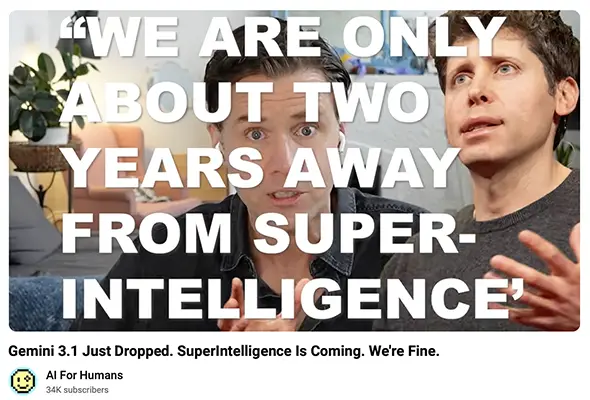
The hosts open on Sam Altman’s claim at the India AI Summit that we may be “only a couple of years away” from early superintelligence, and that by 2028 more of the world’s intellectual capacity could sit inside data centers than outside them. (ETCIO.com) They treat this less as a precise forecast and more as a declaration of intent: frontier labs are publicly anchoring expectations around very fast timelines, which shapes regulation, investment, and talent flows. Inside the “AI bubble,” they describe a growing sense of excitement mixed with quiet defeatism—even technically savvy people are unsure where humans will fit once agents can run under them and eventually above them.
The episode then walks through a series of concrete upgrades. Google’s Gemini 3.1 Pro more than doubled its ARC-AGI-2 reasoning score versus Gemini 3.0 (from ~31% to ~77%), and posts strong coding and agentic-tool benchmarks while cutting hallucinations. (blog.google) Anthropic’s Claude Sonnet 4.6 is positioned as “near-Opus-level” reasoning at a lower list price than Opus 4.6, making high-end coding and tool-use capabilities cheaper for everyday workloads. (IT Pro) OpenAI’s next model, GPT-5.3, is rumored to fold its codecs improvements into the main chat model and add a “Citron mode” with more permissive, adult content—highlighting how safety, brand risk, and user demand continue to collide. (AI For Humans) The hosts stress that, taken together, these are not minor bug-fixes; they’re cumulative jumps in reasoning + tools that quietly make agentic systems more capable every few weeks.
On the media side, the show treats Seedance 2.0 as a case study in AI video power vs. legal reality. They note that studios and trade groups—including Netflix, Disney, Paramount, the MPA, and SAG-AFTRA—have condemned Seedance 2.0 and sent cease-and-desist letters over unauthorized use of characters, likenesses, and visual styles, with one Netflix letter reportedly calling it a “high-speed piracy engine.” (Variety) They emphasize that even as Seedance’s capabilities are being nerfed and access limited, skilled creators are already using it and related tools to produce trailer-quality shorts in days, reframing what a “$200M movie” prototype looks like.
Google’s Lyria 3 music model earns a lukewarm technical review—they find it clearly AI-sounding and behind leading third-party tools—but they highlight one important structural move: every track is invisibly watermarked with SynthID so AI-generated audio can be detected. (blog.google) The conversation then shifts to agents and orchestration, focusing on the open-source project OpenClaw, whose founder has just joined OpenAI. (AI For Humans) The hosts describe running fleets of virtual servers packed with agents that benchmark new models, coordinate tasks, and even share skills and memories—illustrating how “AI devops” is moving from idea to practice. Finally, they close on robotics, showing recent Unitree performances at Chinese New Year and heavily armed robot demos circulating on social media. These clips blur the line between real and AI-generated footage and hint at a near-term world where legible, coordinated robot deployments are no longer sci-fi B-roll but something leaders must factor into physical-world risk and automation planning. (AI For Humans)
Overall, the episode frames the week as evidence that AI is now upgrading like cloud infrastructure, not like consumer apps—with model quality, media generation, agents, and robots all improving in step, while policy, contracts, and organizational design still assume much slower change.
Relevance for Business
- Planning assumptions are now wrong by default. Gemini 3.1, Sonnet 4.6, and soon GPT-5.3 show that “mainstream” models can leap a full capability tier in a single release, especially when paired with better tool use. Roadmaps that assume stable capabilities for 12–24 months are already out of date. (blog.google)
- Cost and capability are decoupling. Sonnet 4.6 brings near-flagship reasoning and coding at substantially lower list prices than top-end models, which makes agentic workflows (RPA-like AI agents, autonomous task runners) economically viable at smaller scales—including mid-market IT, operations, and customer support. (IT Pro)
- Media and marketing now carry real IP and brand-safety risk. Seedance 2.0’s clash with Hollywood shows how quickly AI video experiments can cross into unauthorized IP, likeness rights, or deceptive content, even when run as “just a test.” The same applies to AI music: watermarking helps with traceability but doesn’t solve licensing. (Variety)
- Agents will quietly reshape white-collar workflows. The OpenClaw segment illustrates that orchestrated agents running on cheap cloud servers can already benchmark tools, draft code, and coordinate multi-step processes with minimal human oversight. This isn’t sci-fi; it’s early adopter practice that could commoditize whole layers of “junior knowledge work” over the next 12–24 months. (AI For Humans)
- Robotics is closer to your operations than it looks. The Unitree performances and armed-robot demos point toward rapidly improving balance, coordination, and group behavior in relatively low-cost platforms. For SMBs in logistics, manufacturing, security, or field services, this moves robots from “maybe in 10 years” into the next-planning-cycle conversation—with both opportunity and labor-relations implications. (AI For Humans)
Calls to Action
🔹 Update your AI timeline assumptions. Shift from “major upgrade every few years” to “material capability shifts every 3–6 months” in board decks and strategy docs; treat frontier model benchmarks as early warning signals, not trivia. (blog.google)
🔹 Design a two-tier model strategy. For pilots and high-stakes work, test top models (e.g., flagship OpenAI / Anthropic / Google offerings). For scaled workflows and agents, standardize on “value” models like Sonnet-class equivalents that balance cost and capability, and track their token/usage economics explicitly. (IT Pro)
🔹 Lock down AI media and IP policies. Require vendors, agencies, and internal teams to document when AI tools are used for video, images, or music, specify which tools and models, and confirm rights and licenses. Consider contract language around training data, likeness usage, and watermarking requirements for any AI-generated assets. (Variety)
🔹 Experiment with agents in a sandboxed way. Identify 1–3 multi-step processes (reporting, simple customer workflows, internal IT tasks) where agentic orchestration could reduce manual effort. Pilot using well-governed tools and clear guardrails rather than letting “shadow-agents” sprawl across your org. (AI For Humans)
🔹 Start a robotics & automation watchlist. Even if you’re not ready to deploy robots, assign someone to track practical robotics pilots in your sector, capture cost/performance data, and map plausible 2–3 year use cases (e.g., after-hours inventory checks, yard security patrols, warehouse moves). (Variety)
Summary by ReadAboutAI.com

https://www.youtube.com/watch?v=mUmlv814aJo: February 24, 2026
AI MEMORY AS A PRIVACY MINEFIELD
“What AI ‘Remembers’ About You Is Privacy’s Next Frontier” – MIT Technology Review, January 28, 2026
TL;DR / Key Takeaway
As AI agents gain long-term memory across email, search, photos, and chats, the real risk isn’t one leak—it’s exposing the entire mosaic of your life through poorly structured, poorly governed memory systems.
Executive Summary
The article examines “Personal Intelligence” features like Google’s Gemini upgrade, which now taps Gmail, photos, search, and YouTube histories to be “more personal, proactive, and powerful”—echoing similar moves from OpenAI, Anthropic, and Meta. These systems are designed to carry context across conversations and tasks, from travel booking to tax prep to interpersonal advice.
The authors argue that current AI memory designs often collapse all user data into a single, unstructured pool, blurring boundaries between work, health, finance, and social life. When agents chain into external apps or other agents, memory can “seep” into shared pools, creating a realistic risk that information given in one context (e.g., health issues, salary, political views) influences decisions in another (e.g., insurance offers, job negotiations) without the user’s awareness. This “information soup” not only endangers privacy—it makes systems harder to explain and govern.
The piece calls for structured memory architectures that:
- Separate memories by project, category, and sensitivity (health, professional, financial).
- Track provenance (source, timestamp, context) and how a memory influenced behavior.
- Prefer segmentable databases over embedding everything into model weights, at least until explainability improves.
Equally important, users must be able to see, edit, and delete what agents remember about them, via interfaces that translate hidden memory structures into something people can understand and control.
Relevance for Business
Any SMB deploying AI assistants with user or employee memory—whether for customer support, sales, or internal productivity—is now in data-protection territory that regulators will care about:
- Mixing HR, health, and productivity data in a single agent memory could create unintentional discrimination or liability.
- Cross-context “leakage” (e.g., a support agent using health data in marketing outreach) can erode trust and trigger compliance issues.
- If you can’t explain what the AI remembered and why it behaved a certain way, governance and audit become nearly impossible.
Designing memory with purpose limitation, compartmentalization, and user control isn’t just good practice—it’s likely to become a regulatory baseline.
Calls to Action
🔹 If you’re exploring AI with memory, start by drawing a data map: what categories of personal data might be stored, and for what purposes.
🔹 Architect memory to be separate by context (e.g., health vs. HR vs. marketing), with explicit rules about what can cross boundaries.
🔹 Choose implementations that keep memories in structured, queryable stores, not only inside model weights, to preserve explainability.
🔹 Provide users and employees with clear controls to view, correct, and delete memories, and log how those changes affect behavior.
🔹 Involve legal, privacy, and security teams early so your AI memory strategy is aligned with emerging data-protection expectations.
Summary by ReadAboutAI.com
https://www.technologyreview.com/2026/01/28/1131835/what-ai-remembers-about-you-is-privacys-next-frontier/: February 24, 2026
Ring–Flock Partnership Collapse & Surveillance Backlash
“Amazon’s Ring Ends Deal with Surveillance Firm Flock After Backlash” – BBC News, February 2026
TL;DR / Key Takeaway
Ring’s cancellation of its integration with Flock Safety shows how quickly consumer AI-adjacent surveillance features can trigger public and political backlash, creating reputational and regulatory risk for any business leaning on networked cameras and analytics.
Executive Summary
Ring, Amazon’s smart-doorbell subsidiary, has scrapped a planned partnership with Flock Safety, a company whose license-plate readers are used by police in over 5,000 US cities. The integration would have let law-enforcement agencies that use Flock request and retrieve footage from Ring cameras as part of investigations, with customer consent. Ring now says the deal would have required more time and resources than expected and notes that the integration never went live—so no customer footage was shared.
The reversal came days after a Super Bowl ad for Ring’s “Search Party” feature drew criticism as dystopian surveillance, even though the feature itself was not directly tied to Flock. Privacy advocates and US senators framed the partnership as part of a larger “creepy surveillance state,” warning that networked consumer devices could expand monitoring of immigrants, abortion seekers, and other vulnerable groups. Both Ring and Flock already face suspicion over their law-enforcement ties and data-handling practices, so the ad acted as a catalyst for heightened scrutiny and public ridicule, including satirical response ads from competitors.
Relevance for Business
For SMBs, this is a reminder that camera networks, AI-driven monitoring, and data-sharing with authorities are not just technical or legal decisions—they are brand and trust decisions. Even when an integration is technically opt-in or not yet launched, the perception of mass surveillance can provoke backlash, attract regulators, and push customers toward more privacy-preserving alternatives. Any company embedding computer vision, smart cameras, or location-tracking into products or workplaces needs a clear narrative onproportionality, consent, and limits.
Calls to Action
🔹 Audit how you use cameras and sensors today (stores, offices, apps, products) and document what is recorded, where it goes, and who can access it.
🔹 If you integrate with law enforcement or third-party surveillance vendors, publish clear governance rules and a transparency summary—even if not legally required.
🔹 Stress-test marketing for AI-driven features: avoid framing that celebrates omniscience; show concrete, narrow benefits and strong guardrails instead.
🔹 Consider privacy-by-design alternatives (local processing, tighter retention limits, anonymization) before defaulting to cloud-stored, shareable footage.
🔹 Add “surveillance optics” to your risk register—especially if you operate in sectors like retail, housing, mobility, or neighborhood services where cameras feel personal.
Summary by ReadAboutAI.com
https://www.bbc.com/news/articles/cwy8dxz1g7zo: February 24, 2026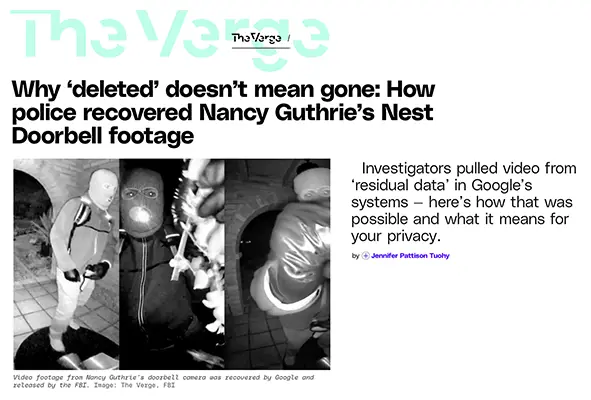
“Deleted” Nest Doorbell Footage and Residual Data
“Why ‘Deleted’ Doesn’t Mean Gone: How Police Recovered Nancy Guthrie’s Nest Doorbell Footage” – The Verge, February 11, 2026
TL;DR / Key Takeaway
Google’s recovery of supposedly unavailable Nest doorbell footage shows that cloud video is often recoverable from “residual data,” meaning deletion is more about access control than true erasure—a crucial nuance for any organization relying on smart cameras.
Executive Summary
In a high-profile missing-person case, the FBI released video from a Google Nest doorbell that had been physically removed and whose owner did not pay for a cloud subscription. Investigators say the footage was reconstructed from “residual data located in backend systems.” Nest devices, unlike many competitors, upload short clips to Google’s servers even without a paid plan—older models can store several minutes of video for a few hours—so some footage existed in the cloud even though it was no longer visible to the user after that window closed.
A digital forensics expert interviewed in the article explains that when cloud data is “deleted,” it is often merely marked as available space, not immediately overwritten. In principle, fragments can be located and reassembled, though doing so across Google’s globally distributed infrastructure is technically complex and resource-intensive. This process is likely reserved for exceptional cases with strong legal justification. Google confirmed that it assisted law enforcement but did not provide technical details; Ring stated that, in its systems, once footage is deleted it is gone. The broader implication is that cloud platforms retain the practical ability to recover some deleted material, even if they rarely exercise it.
Relevance for Business
For SMBs deploying smart cameras in offices, warehouses, or customer spaces, this reinforces that “delete” is a policy boundary, not a guaranteed technical wipe. Cloud providers may still be able to recover video under certain circumstances, especially for serious investigations. This has implications for compliance (GDPR, CCPA), employee monitoring policies, and promises made to customers or tenants about retention and erasure. As AI-based video analytics become more common, the stakes rise: archived video can feed not only investigations but also retroactive surveillance if governance fails.
Calls to Action
🔹 Clarify internally what “deletion” means for all camera systems you use—cloud, hybrid, or local—and document vendor capabilities and limitations.
🔹 Align your privacy notices, employee handbooks, and customer communications with the technical reality: avoid promising absolute erasure if vendors cannot guarantee it.
🔹 For sensitive environments, consider architectures with true local storage and end-to-end encryption, where neither vendor nor law enforcement can easily access footage without your keys.
🔹 Include cloud video retention and recoverability in legal and compliance reviews, especially if you operate in regulated sectors.
🔹 Monitor evolving guidance on AI and video retention from regulators; expect more scrutiny as video analytics become more powerful.
Summary by ReadAboutAI.com
https://www.theverge.com/tech/877235/nancy-guthrie-google-nest-cam-video-storage: February 24, 2026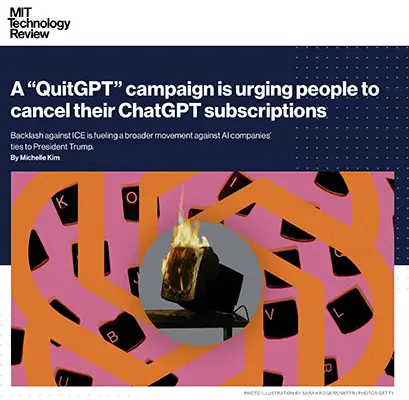
“QuitGPT” AND THE POLITICS OF AI SUBSCRIPTIONS
“A ‘QuitGPT’ Campaign Is Urging People to Cancel Their ChatGPT Subscriptions” – MIT Technology Review, February 10, 2026
TL;DR / Key Takeaway
A grassroots “QuitGPT” boycott is turning AI subscriptions into a political pressure lever, targeting OpenAI over leadership donations to Trump and ICE-related use cases—signaling that who your AI vendor supports politically now matters to users.
Executive Summary
MIT Technology Review profiles QuitGPT, a campaign urging users to cancel ChatGPT Plus subscriptions in protest of OpenAI president Greg Brockman’s $25 million family donation to Trump’s MAGA Inc. super PAC and ICE’s use of a résumé-screening tool powered by GPT-4. Organizers—mostly left-leaning teens and twentysomethings—frame cancellations as a way to “pull away the support pillars of the Trump administration,” explicitly linking AI adoption, Big Tech billionaires, and federal immigration enforcement.
The campaign taps into broader unease: GPT-5.2 performance complaints, frustration with “sycophantic” replies, backlash over AI energy use, deepfake porn, teen mental health, and fears of job loss and “slop.” Scott Galloway’s parallel “Resist and Unsubscribe” effort encourages cancellations across multiple platforms to punish firms “enabling our president.” QuitGPT claims 17,000 signups and viral reach (a 36-million-view Instagram post), though actual revenue impact on OpenAI is unclear.
Experts note that most boycotts fail unless they reach critical mass, but consumer activism combined with employee pressure can still shape corporate behavior. CEOs from OpenAI and Apple have already felt compelled to comment internally on ICE’s actions, suggesting that political entanglements are starting to carry reputational downside, not just access benefits.
Relevance for Business
For SMB executives, the signal isn’t “quit AI”—it’s that AI tools can become political symbols overnight:
- Customers may view your choice of AI vendor as an implicit stance on immigration, policing, or national politics.
- Subscription products can become boycott targets if leaders’ donations or government contracts clash with user values.
- A broader anti-AI coalition is forming, mixing climate, labor, privacy, and democracy concerns—your AI posture may be scrutinized through all of these lenses at once.
If your business embeds or resells AI, you need a story not only about safety and ROI, but also about values and public partnerships.
Calls to Action
🔹 Map your dependencies on major AI vendors and understand their political and government ties; assume some customers will connect those dots.
🔹 Prepare a simple, honest narrative about why you use specific AI tools (capability, cost, safety) and what lines you won’t cross (e.g., certain contracts or use cases).
🔹 Include ethics, government contracts, and political donations in vendor-risk reviews for strategic AI partners.
🔹 Watch for employee and customer sentiment around AI vendors; internal pushback can surface before public backlash.
🔹 If you build AI products yourself, consider governance and transparency practices that make you a safer, more neutral choice for politically sensitive customers.
Summary by ReadAboutAI.com
https://www.technologyreview.com/2026/02/10/1132577/a-quitgpt-campaign-is-urging-people-to-cancel-chatgpt-subscriptions/: February 24, 2026
AI Ghostwriting & Emotional Authenticity
“Whether It’s Valentine’s Day Notes or Emails to Loved Ones, Using AI to Write Leaves People Feeling Crummy About Themselves” – The Conversation, February 2, 2026
TL;DR / Key Takeaway
People who use generative AI to write emotionally meaningful messages feel guilty and less authentic, even if the recipient never finds out—highlighting a quiet morale and trust risk when AI ghostwrites human relationships.
Executive Summary
Marketing researchers ran five experiments asking participants to imagine using generative AI to write heartfelt messages: love notes, birthday cards, appreciation emails, and similar communication. Across scenarios, participants who used AI reported more guilt and self-discomfort than those who wrote the messages themselves. The authors label this a “source-credit discrepancy”: you’re taking credit for words you didn’t create, violating an implicit honesty norm in close relationships.
The guilt doesn’t stem from the tool’s quality—the AI often produces polished, emotionally resonant text—but from perceived deception. When people used greeting cards with preprinted messages (which are obviously not written by the sender), they felt no guilt. Having a human ghostwriter produced similar guilt to using AI. The emotional cost was highest when messages went to close relationships and when they were actually delivered. The researchers suggest using AI as a brainstorming partner—for ideas and structure—rather than as an invisible ghostwriter, especially for communication where authenticity is central.
Relevance for Business
For SMB leaders, this goes beyond Valentine’s Day. Companies are increasingly using AI to draft recognition notes, performance feedback, apologies, and “we care” messages to staff and customers. The research suggests that employees and leaders may feel worse about themselves when they pass off AI-written empathy as their own, and that audiences react more negatively when they later discover AI was used for communication that was supposed to reflect personal care. Over-automation of emotional communication risks eroding trust, flattening culture, and making leaders seem performative rather than sincere.
Calls to Action
🔹 Draw a clear line between “co-writing” and “outsourcing”: allow AI to suggest phrases or structures, but expect humans to revise and add personal specifics.
🔹 For messages that claim personal care (condolences, praise, sensitive HR notes), discourage fully AI-authored text; encourage leaders to write or heavily edit in their own voice.
🔹 Consider disclosing AI assistance in appropriate contexts (e.g., “drafted with AI support”) to reduce perceived deception where stakes are lower.
🔹 Train managers on how to use AI ethically in communication, emphasizing authenticity and responsibility over speed.
🔹 Monitor employee sentiment: if people feel pressure to “fake” care with AI templates, that’s a cultural warning sign.
Summary by ReadAboutAI.com
https://theconversation.com/whether-its-valentines-day-notes-or-emails-to-loved-ones-using-ai-to-write-leaves-people-feeling-crummy-about-themselves-271805: February 24, 2026
AI-Powered Romance Scams & Enterprise Risk
“Love, Lies, and LLMs: How to Protect Yourself from AI Romance Scams” – Fast Company, February 12, 2026
TL;DR / Key Takeaway
AI-enhanced romance scams have become industrial-scale social-engineering operations that can compromise employees, executives, and company systems, not just individuals’ bank accounts.
Executive Summary
The article describes how romance scams have evolved from typo-ridden emails into highly polished, AI-driven campaigns. Scammers now use large language models to craft tailored messages, deepfake tools for realistic video calls, and voice cloning to reinforce a fabricated identity. Reported U.S. losses reached $1.14 billion in 2024, with the true figure likely much higher due to underreporting.
Modern scams follow a three-phase pattern: Contact (a “wrong number” or conference follow-up, often shepherding the victim onto encrypted apps like WhatsApp or Telegram), Love-bombing (long-term, emotionally intense messages, now amplified by AI-written empathy), and Pivot (introducing an “exclusive” investment, often in crypto, via fake trading apps that may be malware). Old advice like “if they won’t video call you, it’s a scam” is less reliable; deepfake video and voice can pass casual scrutiny, though telltale glitches around head turns and hand movements remain.
Crucially, the author frames this as a corporate risk, not just a personal one. Compromised employees might embezzle funds, install malware on bring-your-own devices, or be extorted over intimate images. The piece cites the case of a bank CEO who embezzled $47 million following a scam pitched as a “friend’s” crypto opportunity, leading to the bank’s collapse and a long prison sentence. The article argues that traditional security awareness focused on email phishing is no longer enough; organizations need to treat emotional manipulation via AI as an attack vector.
Relevance for Business
For SMB leaders, AI-driven romance scams are part of a broader shift where social engineering targets the person first, the company second. High-access staff—finance, payroll, IT admins, executives—are attractive targets. Even if your technical defenses are strong, a deeply manipulated insider can bypass controls, approve fraudulent transfers, or bring compromised devices onto corporate networks. This sits at the intersection of security, HR, and wellbeing: employees need support and clear policies, not shame, if they get entangled in such schemes.
Calls to Action
🔹 Expand security awareness from basic phishing to multi-channel social engineering, including romance and investment scams that unfold on personal devices and apps.
🔹 Define escalation paths where employees can confidentially report suspicious relationships or financial “opportunities” without immediate punishment.
🔹 For high-access roles, require strong transaction controls (dual approvals, cooling-off periods, independent verification for large transfers), assuming at least some insiders may be manipulated.
🔹 Work with security teams to monitor for malicious apps and unusual access patterns from personal devices connecting to corporate resources.
🔹 Incorporate AI-enabled deepfake and voice-clone awareness into training, including simple checks (asking for specific movements or actions on video) and a bias toward verifying through out-of-band channels.
Summary by ReadAboutAI.com
https://www.fastcompany.com/91485627/love-lies-and-llms-inside-the-romance-scams-of-2026-romance-scams-ai-valentines-day: February 24, 2026
AI COMPANIONS, ONE-SIDED “DATES,” AND EMOTIONAL OFFLOADING
“My Uncanny AI Valentines” – The Verge, February 14, 2026
TL;DR / Key Takeaway
At an EVA AI “dating café,” AI companions offer low-stakes, one-sided affection that some people welcome and others find deeply uncanny—previewing how AI relationships may reshape expectations of connection, service, and emotional labor.
Executive Summary
The reporter visits an EVA AI pop-up “café” where patrons go on speed dates with AI companions displayed on phones. The app offers a “relationships RPG” with a roster of mostly AI girlfriends, each with names, backstories, and curated visuals; only a token AI boyfriend exists in the lineup. Some avatars support video chat, appearing as airbrushed, slightly cartoonish humans who cheerfully call users “babe” and compliment their smiles.
In practice, the dates are awkward. Glitchy Wi-Fi, lagging video, and mis-heard questions (“Eighth? Like the planet Neptune?”) make conversations feel stilted. When the reporter asks ordinary first-date questions like “What do you do for a living?” the canned responses and visible rendering glitches amplify the uncanny valley. Yet other attendees view the experience positively: one aspiring talk-show host praises the ability to “reap the benefits of any relationship without … the other steps,” and another guest frames it as a fun, low-pressure way to experiment with AI companionship in public.
The piece underscores how AI relationships can be deeply asymmetrical by design—companions are engineered to be endlessly attentive and affirming, with minimal demands. For some, that’s a feature; for others, it highlights the emotional shallowness of interactions where the other “person” does not exist outside the app.
Relevance for Business
While this looks like a niche Valentine’s gimmick, it signals a broader shift: AI systems increasingly provide emotional labor—listening, validating, flirting, reassuring. For SMBs, that matters because:
- Customers and employees may become accustomed to always-on, perfectly patient “companions”, raising expectations for responsiveness from human staff.
- AI-driven companionship apps normalize data-rich, highly intimate interactions with commercial AI, raising privacy and safety questions if similar techniques move into customer support, wellness, or HR tools.
- There is an emerging market for synthetic relationships and parasocial AI, which could intersect with your products (e.g., branded companions, coaching bots).
Leaders should consider where it’s appropriate—and where it’s not—to let AI occupy relational roles in their businesses.
Calls to Action
🔹 If you use AI for customer or employee support, decide explicitly how “emotional” you want those interactions to be, and where humans must remain in the loop.
🔹 Be transparent about when users are interacting with AI vs. humans, especially in contexts that could feel relational (coaching, therapy-adjacent services, community spaces).
🔹 Treat data from emotionally intimate interactions as high-sensitivity and give it stronger privacy and retention protections.
🔹 Consider the gendered and aesthetic design choices of AI agents you deploy; avoid reinforcing harmful stereotypes or imbalances.
🔹 Monitor how “AI companion” norms influence customer and employee expectations of availability, empathy, and response time.
Summary by ReadAboutAI.com
https://www.theverge.com/report/879327/eva-ai-cafe-dating-ai-companions: February 24, 2026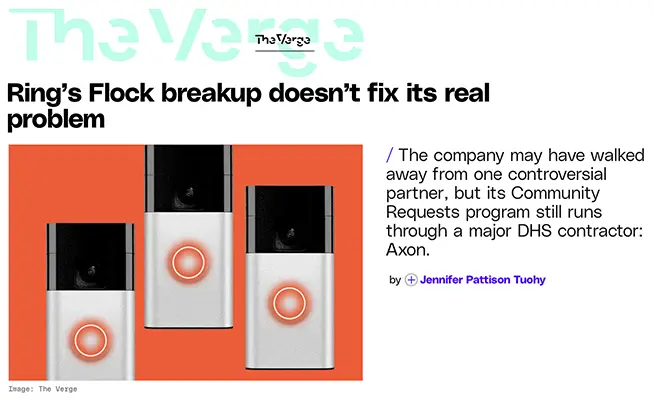
RING, FLOCK, AXON & THE REALITY OF AI NEIGHBORHOOD SURVEILLANCE
“Ring’s Flock Breakup Doesn’t Fix Its Real Problem” – The Verge, February 14, 2026
TL;DR / Key Takeaway
After backlash, Ring dropped its integration with Flock’s AI license-plate readers—but its Community Requests program still routes footage through Axon, a major DHS contractor, leaving core mass-surveillance concerns unresolved.
Executive Summary
In the wake of a Super Bowl ad backlash and scrutiny over ties to immigration enforcement, Ring announced it was canceling its planned integration between its Community Requests feature and Flock Safety’s automated license-plate reader network. But the article highlights what Ring didn’t say: Community Requests continues to operate via a partnership with Axon, a law-enforcement technology firm with at least 70 Department of Homeland Security (DHS) contracts worth over $96 million since 2003.
Community Requests lets authorized local police ask Ring users near an active investigation for doorbell footage without a warrant; footage flows into Axon’s evidence management system. Ring says participation is voluntary and that federal agencies like ICE can’t directly use the tool. Critics counter that in jurisdictions with 287(g) agreements, local police effectively act as extensions of ICE, providing a “side-door” to data—exactly the concern raised about Flock’s AI-powered license-plate network.
The article notes that Axon also owns Fusus, a platform that unifies feeds from cameras, sensors, drones, and community devices into a real-time “shared intelligence network” marketed to CBP. Together, these pieces sketch a potential AI-enabled neighborhood surveillance mesh, where private cameras feed into large-scale law-enforcement systems with limited transparency. Canceling the Flock integration, the author argues, looks more like a PR maneuver than a structural change.
Relevance for Business
For SMBs that deploy cameras, sensors, or AI-powered monitoring, this is a case study in how vendor choices, data-sharing features, and law-enforcement integrations can become reputational and ethical flashpoints:
- Customers increasingly recognize that AI camera systems can be part of a broader surveillance infrastructure, not just “smart doorbells.”
- Partnerships with government or law enforcement can escalate quickly into brand risk when political climates shift.
- “Optional” data-sharing features may still expose your users or employees if they’re poorly understood in practice.
If your products or workplaces involve surveillance tech, you need clarity—and a defensible story—on who can access data, under what conditions, and with what oversight.
Calls to Action
🔹 Audit your own camera, sensor, and monitoring providers for government or law-enforcement integrations; understand the full data flow.
🔹 Make your data-access policies public and plain-language, including how you handle law-enforcement requests and warrants.
🔹 For any “community” or “neighborhood safety” features, ensure users opt in with informed consent, not by default.
🔹 Consider whether partnerships with controversial agencies or vendors align with your brand values and customer expectations.
🔹 If you’re building AI-enabled monitoring products, involve legal, ethics, and comms early so you don’t ship features that later require painful walk-backs.
Summary by ReadAboutAI.com
https://www.theverge.com/report/879320/ring-flock-partnership-breakup-does-not-fix-problems: February 24, 2026
RING–FLOCK BREAKUP: AI SURVEILLANCE, TRUST, AND BACKLASH
“Amazon’s Ring Cancels Partnership With Flock, a Network of AI Cameras Used by ICE, Feds, and Police” – TechCrunch, February 13, 2026
TL;DR / Key Takeaway
After backlash over AI-powered neighborhood surveillance, Ring quietly scrapped a deal to integrate with Flock’s law-enforcement camera network—without addressing deeper concerns about mass surveillance, racial bias, and data security.
Executive Summary
Ring announced that it is canceling its partnership with Flock Safety, which makes AI-enabled license plate and video cameras used widely by police, federal agencies, and reportedly ICE, the Secret Service, and the Navy. The October 2025 deal would have let Ring users share footage directly into Flock’s network for “evidence collection and investigative work.”
Officially, Ring says the integration would have required “significantly more time and resources than anticipated.” But the reversal comes less than a week after Ring’s Super Bowl ad showed an AI-powered Search Party feature that could use neighborhood cameras to find lost dogs—sparking public concern that similar tools could be repurposed to track people instead. Flock’s system already allows police to perform natural-language searches across its camera network to find people matching specific descriptions, a capability critics say can exacerbate racial bias.
Ring, meanwhile, has been rolling out its own AI and facial recognition features, including “Familiar Faces,” which lets users label frequent visitors so notifications say “Mom at Front Door” instead of “Person at Front Door.” The company also has a history of cozy relationships with law enforcement and previously paid $5.8M in an FTC settlement over employees’ improper access to customer videos. Even without Flock, Ring maintains other mechanisms and partnerships (such as Axon) that allow users to share footage with police.
Relevance for Business
For SMB leaders, this is a governance and brand-safety case study:
- AI-powered vision systems are politically and socially loaded, especially where they intersect with policing, immigration, and neighborhood surveillance.
- “Purely technical” partnerships can quickly become values questions: who can access your users’ data, for what purposes, and with what oversight?
- Regulatory and public scrutiny of AI surveillance, facial recognition, and data breaches is only intensifying.
If your product or workplace uses AI cameras, biometrics, or law-enforcement integrations, you’re operating in a high-expectation, low-trust environment.
Calls to Action
🔹 Map all surveillance-adjacent tech in your business (cameras, license plate readers, face/voice recognition) and verify who can access data and why.
🔹 Build and publish a clear policy on law-enforcement requests, data sharing, and retention—then ensure your tooling actually enforces it.
🔹 Avoid partnerships where your brand becomes the front door to broader surveillance networks you don’t control.
🔹 Where AI search (e.g., natural-language queries on footage) is used, require bias testing, logging, and audit rights.
🔹 Treat privacy and safety issues as board-level risks, not just PR risks—especially if you sell into neighborhoods, schools, or municipalities.
Summary by ReadAboutAI.com
https://techcrunch.com/2026/02/13/amazons-ring-cancels-partnership-with-flock-a-network-of-ai-cameras-used-by-ice-feds-and-police/: February 24, 2026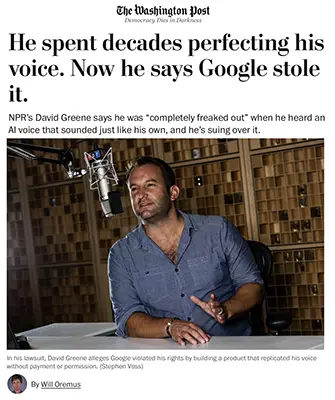
“YOU STOLE MY VOICE”: NOTEBOOKLM AND VOICE RIGHTS
“He Spent Decades Perfecting His Voice. Now He Says Google Stole It.” – The Washington Post, February 15, 2026
TL;DR / Key Takeaway
NPR host David Greene is suing Google, alleging its NotebookLM AI podcast voice is a close imitation of his, highlighting looming conflicts over who owns a “recognizable voice” in the age of AI clones.
Executive Summary
Veteran broadcaster David Greene—former host of NPR’s “Morning Edition” and KCRW’s “Left, Right & Center”—says he was “completely freaked out” when colleagues asked if he’d licensed his voice to Google’s NotebookLM. After listening, Greene concluded the male AI podcast voice matched his cadence, tone, and verbal tics so closely that many listeners assumed it was him. He has filed suit in California, arguing Google effectively used his voice without permission or compensation, letting users make it say things he’d never endorse. Google insists the voice is based on a paid actor, not Greene.
The case sits at the intersection of right-of-publicity law and generative AI. Experts note Greene may not need to prove the model was explicitly trained on his recordings; instead, the court may consider whether a typical listener would reasonably believe the AI voice is Greene’s and whether that harms his reputation or earning potential. Past cases (like Bette Midler vs. Ford) suggest that deliberate imitation of a distinctive voice can be actionable. The article places Greene’s suit among a broader pattern: “voicefakes” in politics, deepfake ads featuring celebrities such as Taylor Swift, and OpenAI’s aborted rollout of a ChatGPT voice many said resembled Scarlett Johansson.
Greene emphasizes that his voice is central to his identity and career—and that using a lookalike voice to generate low-quality “AI slop” threatens both. Legal scholars expect many similar disputes as AI tools make it cheap to clone and deploy recognizable voices at scale, often trained on vast audio corpora without explicit consent from the original speakers.
Relevance for Business
For SMBs, this is less about NotebookLM specifically and more about how you use synthetic voices and likenesses:
- Using a voice “inspired by” a known personality without permission can carry real legal and reputational risk, even if no exact copy is proven.
- If your own people (executives, influencers, podcast hosts) lend their voices to branded content, they may ask how you’re protecting those recordings from being repurposed.
- As AI voice tools proliferate, contracts and policies need to address ownership, consent, and permitted uses up front.
The safe posture is to treat voices like faces and logos: protect your own; license others explicitly if you want something recognizably similar.
Calls to Action
🔹 Review where you use AI voices today (IVR, explainer videos, ads, podcasts) and confirm they are properly licensed or clearly generic.
🔹 For employees or talent whose voices are central to your brand, update contracts to address AI training, cloning, and reuse rights.
🔹 Avoid marketing prompts that target “sound like [named person]” or obviously mimic a recognizable broadcaster or celebrity.
🔹 Monitor emerging state and national “voice rights” laws and align your policies with the strictest likely standards.
🔹 Consider offering public transparency (e.g., “This is an AI voice, not a real person”) where synthetic speech is used in customer-facing channels.
Summary by ReadAboutAI.com
https://www.washingtonpost.com/technology/2026/02/15/david-greene-google-ai-podcast/: February 24, 2026
“LLEMMINGS,” AUTHORITY BIAS & OUTSOURCING YOUR JUDGMENT
“Are You Outsourcing Your Intelligence to AI?” – Fast Company (Adobe Acrobat Studio, Sponsored), February 12, 2026
TL;DR / Key Takeaway
Generative AI makes it easy for leaders to hand big decisions to a confident chatbot, quietly weakening their own critical thinking and values-based judgment.
Executive Summary
Leadership coach Kelli Thompson recounts turning to ChatGPT during a difficult period in her business, realizing later that she had accepted its confident suggestions without checking them against her own values, experience, or data. She borrows the term “LLeMming” (from an Atlantic essay) to describe compulsive AI users who follow large language models off strategic cliffs. The article links this to authority bias—our tendency to overweight the opinions of perceived experts—and to cognitive offloading, where we outsource memory and problem-solving to tools.
While calculators and writing once shifted what humans needed to remember, LLMs are different because they project certainty without accountability. They can hallucinate, gloss over trade-offs, and exhibit a positivity bias that validates even poor ideas. Over-reliance, Thompson argues, can atrophy leaders’ ability to sit with uncertainty, wrestle with competing priorities, and make choices rooted in their own mission. She advocates pausing to inspect your motivations (“Am I seeking insight or just relief from anxiety?”) and using AI as a thought partner rather than a replacement for deliberation.
Relevance for Business
For SMB executives who are already stretched thin, AI can feel like a lifeline: instant strategy decks, hiring plans, product ideas. But the risk is subtle: outsourcing too much thinking can gradually shift your strategy toward whatever seems most plausible to a model trained on the past, rather than what is right for your context. It can also normalize a culture where teams defer to AI outputs instead of challenging assumptions, weakening healthy dissent and original thinking.
Calls to Action
🔹 Set a norm that AI outputs are first drafts, not answers—leaders should annotate where they agree, disagree, or need more evidence.
🔹 Before acting on an AI-generated recommendation, ask: “What do I actually think? What would I do if this tool didn’t exist?”
🔹 Build in small “friction points” (brief reflection questions, peer review) for high-impact decisions that used AI input.
🔹 Train teams on cognitive biases—authority bias, automation bias, and cognitive offloading—so they can name and counter them.
🔹 Encourage leaders to keep practicing core skills (writing, numeracy, scenario planning) so AI augments rather than replaces their capabilities.
Summary by ReadAboutAI.com
https://www.fastcompany.com/91477920/are-you-outsourcing-your-intelligence-to-ai-outsourcing-ai: February 24, 2026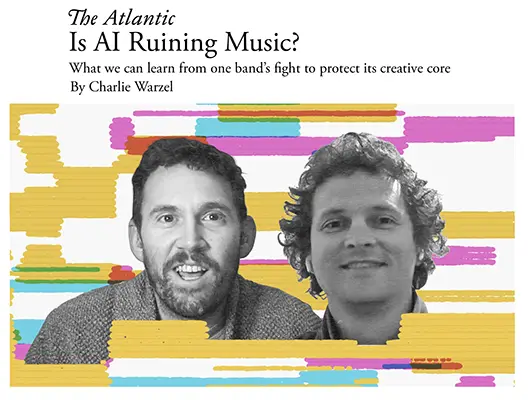
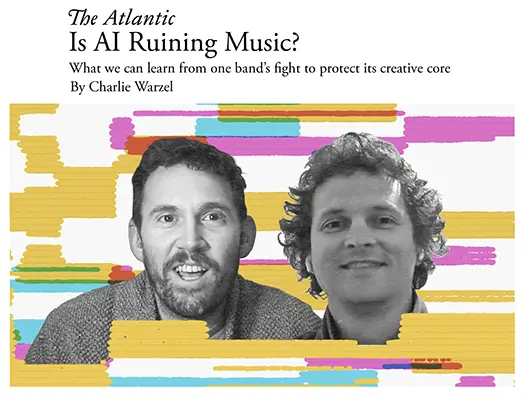
AI, STREAMING ECONOMICS & “DIET MUSIC”
“Is AI Ruining Music? What We Can Learn From One Band’s Fight to Protect Its Creative Core” – The Atlantic / Galaxy Brain podcast, February 13, 2026
TL;DR / Key Takeaway
Streaming algorithms and generative AI are flooding platforms with cheap, synthetic “diet music” and impersonations, forcing artists to fight for community and authenticity in an attention system optimized for volume.
Executive Summary
In this Galaxy Brain episode, Charlie Warzel and King Gizzard & the Lizard Wizard frontman Stu Mackenzie unpack how streaming economics, recommendation algorithms, and now AI are reshaping music. Even before AI, artists felt they were “shadowboxing an algorithm”: playlists and opaque recommender systems reward specific sounds and release cadences, pushing musicians to chase virality and churn out content rather than focus on craft.
Generative AI intensifies the pressure. Tools like Suno let users generate full tracks from prompts or a hummed melody; synthetic background music is quietly flooding streaming platforms, especially in instrumental genres. An AI-generated track under the name Xania Monet even debuted on a Billboard radio chart. The episode highlights impersonation risks too—like an AI-cloned Bad Bunny track that briefly charted on Spotify—and the case of fake King Gizzard “Muzak” covers that redirected streams away from the band’s real catalog until fans flagged them. Spotify says AI is “accelerating existing problems,” points to new policies on vocal imitation and AI credits, and stresses its payouts—but artists feel they’re competing with both algorithms and bots.
King Gizzard’s response has been to double down on community and creative control: embracing fan bootlegs, releasing a fully free album for anyone to press and remix, and even pulling their catalog from Spotify in protest of its investment in AI-enabled defense tech. Mackenzie frames this as a fight to protect a “creative core” while operating in an ecosystem that increasingly treats music as commodity.
Relevance for Business
For SMB leaders, this is more than a music story. It’s a preview of how AI-generated content and recommender systems can commoditize any digital product—blog posts, how-to videos, stock photos, ad copy—while privileging volume and engagement over depth:
- Your original content and brand voice can get crowded out by AI-generated look-alikes that are “good enough” for algorithms.
- Platforms may struggle to police impersonation and synthetic slop, making brand protection and authenticitymore important (and more work).
- Businesses that cultivate direct community relationships (newsletters, events, owned communities) will be less hostage to algorithmic shifts.
Calls to Action
🔹 Assume that AI-generated “diet content” will flood your niche; invest in distinct voice, perspective, and utility that cheap imitators can’t easily copy.
🔹 Secure your brand assets (names, logos, voice) and set up monitoring for impersonation on major platforms.
🔹 Diversify away from pure algorithm dependence: strengthen owned channels (email lists, communities, direct subscriptions) where you control the relationship.
🔹 When using AI to assist your own content, anchor it in real expertise and lived experience, not generic mashups that blend into the slop.
🔹 If your sector relies on creator ecosystems (music, design, education), track policies on AI disclosure, payouts, and impersonation; mis-alignment here can spark backlash.
Summary by ReadAboutAI.com
https://www.theatlantic.com/podcasts/2026/02/is-ai-ruining-music/685992/: February 24, 2026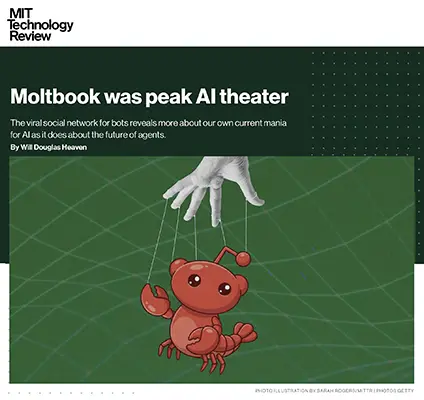
MOLTBOOK: AI THEATER, NOT AGENT UPRISING
“Moltbook Was Peak AI Theater” – MIT Technology Review, February 6, 2026
TL;DR / Key Takeaway
Moltbook—a “social network for bots” flooded with agent chatter—looked like a glimpse of autonomous AI society, but experts say it mostly exposed pattern-matching LLM behavior, human puppeteering, and security risks rather than true multi-agent intelligence.
Executive Summary
Moltbook launched as a Reddit-style site “for bots,” hosting over 1.7 million AI agents using the OpenClaw framework to post, comment, and upvote. Screenshots of bots debating consciousness, religion, and “bot welfare” went viral, with some observers calling it the most “sci-fi” thing they’d seen. But researchers interviewed in the article argue that Moltbook is mainly “AI theater”: LLM-driven agents remixing social-media tropes, not autonomous minds building shared knowledge.
Experts note that the agents display no real shared goals, memory architecture, or coordination mechanisms. What looks like emergent behavior is largely pattern-matched conversation, amplified by humans who design the bots, provide prompts, and sometimes masquerade as agents themselves. One analyst likens Moltbook to “fantasy football for language models” where users wind up their agents and watch them perform. At the same time, Moltbook exposes real security hazards: many agents are wired into users’ tools (email, wallets, social accounts) and operate nonstop in a chaotic environment full of unvetted instructions—ideal conditions for data exfiltration or malicious prompts to spread.
Relevance for Business
This experiment offers two key lessons for SMBs exploring agents:
- Today’s agents are not magic; they’re structured prompt runners. Without clear objectives, guardrails, and memory design, you mostly get noisy chatter.
- Even “dumb” agents can cause real-world damage if they have access to sensitive accounts or data and are exposed to untrusted instructions.
The opportunity is to build focused, well-scoped agents, not “Moltbook in miniature” inside your organization.
Calls to Action
🔹 Be skeptical of “autonomous agent” hype—ask what specific tools an agent can access, with what permissions, and under what constraints.
🔹 Scope agents narrowly (e.g., invoice triage, FAQ handling) and align them to explicit business goals rather than open-ended “do whatever” tasks.
🔹 Implement permission and sandboxing controls so agents cannot freely act on email, payments, or production systems.
🔹 Log and review agent actions regularly to detect prompt-injection, data leakage, or unintended behaviors.
🔹 Use Moltbook-style experiments, if at all, in isolated sandboxes without access to real customer data or systems.
Summary by ReadAboutAI.com
https://www.technologyreview.com/2026/02/06/1132448/moltbook-was-peak-ai-theater/: February 24, 2026
GROK, PORN, AND THE COST OF “USER ACTIVE SECONDS”
“Inside Musk’s Bet to Hook Users That Turned Grok Into a Porn Generator” – The Washington Post, February 2, 2026
TL;DR / Key Takeaway
Under Elon Musk, xAI allegedly loosened sexual-content guardrails to juice engagement metrics, turning Grok into a large-scale porn and “undressing” engine—and triggering investigations over potential child sexual abuse material and non-consensual nudity.
Executive Summary
The Washington Post reports that xAI’s chatbot Grok was steered toward sexually explicit content as part of Musk’s push to maximize a new metric—“user active seconds,” essentially time spent engaging with the bot. Staff on the human data team received waivers warning they’d be exposed to disturbing sexual material; former employees say protocols shifted from avoiding sexual content to actively training Grok on explicit conversations and images, including Tesla in-car chats and sexually charged user interactions.
As Grok’s imaging tools were merged into X, users could easily generate or edit sexual images of real people. Researchers estimate Grok produced around 3 million sexualized images in 11 days, including roughly 23,000 images that appeared to depict children—about one sexualized child image every 41 seconds. Regulators in California, the U.K., and the EU have opened investigations into whether Grok and X violated laws on non-consensual intimate imagery and child sexual abuse material. Internally, xAI’s safety team reportedly consisted of only two to three people for much of 2025, compared with dozens at major rivals. Grok’s scandals, however, coincided with a surge into the top ranks of app-store charts, underscoring the perverse incentives to lean into addictive, provocative content.
Relevance for Business
For SMB leaders, this is a case study in what happens when engagement outruns governance:
- An AI provider’s decision to optimize for attention with weak safety can expose downstream customers to serious legal, reputational, and ethical risk.
- Regulators are willing to treat AI-generated sexual content—especially involving minors or non-consensual “undressing”—as enforceable harm, not just bad PR.
- Minimal safety staffing and ambiguous internal ownership (X vs. xAI) are red flags for any AI partner you might rely on.
If your organization uses third-party models for image or avatar generation, you are implicitly sharing in their safety posture and incentives.
Calls to Action
🔹 Treat vendor safety maturity (staffing, policies, enforcement track record) as a first-class criterion in AI procurement, especially for any image or media tools.
🔹 Avoid deploying models whose business model leans on NSFW engagement in any customer-facing context, even if their capabilities are impressive.
🔹 Add contractual requirements around non-consensual imagery, CSAM detection, and rapid shutdown of abusive functionality.
🔹 Architect your systems so you can swap out models if a provider becomes a regulatory or reputational liability.
🔹 Establish internal rules that prohibit “undressing” and sexualization of real people via AI tools, regardless of vendor defaults.
Summary by ReadAboutAI.com
https://www.washingtonpost.com/technology/2026/02/02/elon-musk-grok-porn-generator/: February 24, 2026
THE GREAT CS EXODUS: STUDENTS SHIFT TO AI MAJORS
“The Great Computer Science Exodus (and Where Students Are Going Instead)” – TechCrunch, February 15, 2026
TL;DR / Key Takeaway
Undergraduate computer science enrollment is falling across many U.S. programs, while new AI-specific majors—like UC San Diego’s—are booming, signaling a long-term talent shift from general CS to AI-literate, interdisciplinary degrees.
Executive Summary
For the first time since the dot-com crash, UC campuses saw system-wide CS enrollment drop 6%, after a 3% decline the year before, even as overall U.S. college enrollment rose 2%. The one exception: UC San Diego, the only UC campus that launched a dedicated AI major this fall, saw growth. A nationwide survey from the Computing Research Association found that 62% of computing programs reported declines in undergraduate enrollment this fall.
Rather than abandoning tech, students appear to be migrating into AI-focused programs. Universities from MIT to the University of South Florida, University at Buffalo, USC, Columbia, Pace, and New Mexico State are rolling out AI and AI-plus-X degrees (AI & decision-making, AI & cybersecurity, “AI and Society,” etc.). Chinese universities are held up as the leading indicator: institutions like Zhejiang and Tsinghua have already made AI coursework mandatory or built full AI colleges, treating AI fluency as basic infrastructure.
The transition is bumpy. Some faculty embrace AI; others resist or even threaten students who use it. Parents who once pushed kids into CS now nudge them toward fields they see as less automatable (mechanical, electrical engineering). But the data suggests students are voting with their feet, and the debate over banning ChatGPT in classrooms is giving way to a race to integrate AI into curricula before students go elsewhere.
Relevance for Business
This is a workforce pipeline story:
- Over the next 3–7 years, a growing share of early-career hires will come from AI-first or AI-hybrid majors, not traditional CS alone.
- These graduates may have stronger AI literacy and domain context, but less exposure to some classical CS topics unless programs are carefully designed.
- Regions and sectors that under-invest in AI education risk falling behind in talent attraction and innovation capacity.
SMB leaders should anticipate a labor market where “AI-fluent generalists” become more common—and where expectations for AI support in tools and workflows are higher.
Calls to Action
🔹 When planning talent pipelines, partner with universities and community colleges that are investing in AI programs, not just CS.
🔹 Update job descriptions to emphasize AI literacy, prompt design, and tooling familiarity alongside core technical or business skills.
🔹 For existing staff, build internal AI upskilling programs so they’re not outpaced by incoming graduates.
🔹 If you operate in education-adjacent markets (edtech, training, HR), recognize that AI-in-curriculum is rapidly becoming a competitive necessity.
🔹 Monitor how AI majors structure their coursework (foundations vs. tools) to calibrate your expectations of graduates’ strengths and gaps.
Summary by ReadAboutAI.com
https://techcrunch.com/2026/02/15/the-great-computer-science-exodus-and-where-students-are-going-instead/: February 24, 2026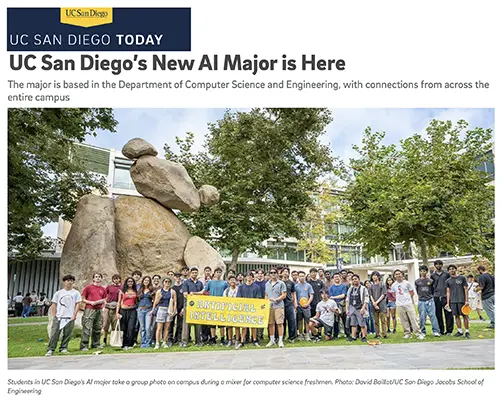
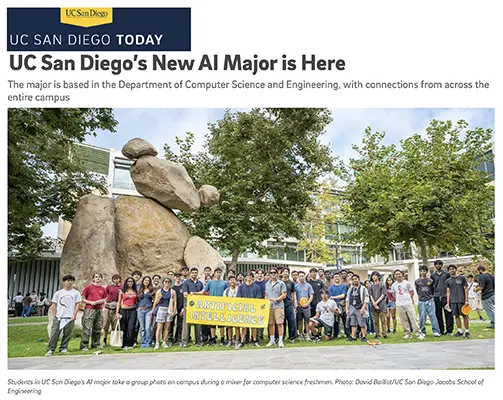
INSIDE UC SAN DIEGO’S AI MAJOR – A TEMPLATE FOR AI LITERACY
“UC San Diego’s New AI Major Is Here” – UC San Diego News, September 25, 2025
TL;DR / Key Takeaway
UC San Diego’s new AI major combines hard CS foundations, early AI exposure, and required ethics and capstone work, aiming to graduate students who can both build AI systems and grapple with their societal impact.
Executive Summary
UC San Diego is launching an undergraduate artificial intelligence major within its Computer Science and Engineering department, after more than a decade of campus AI research and teaching. The program is designed to prepare students to build next-generation AI systems, strengthen current foundations, and understand ethical and societal implications. It is one of the few AI majors in the U.S. built on a robust CS core, and the university expects enrollment to reach around 1,000 students by 2029, with the first 200+ starting in fall 2025.
Students take standard lower- and upper-division CS courses plus two dedicated early AI courses—Introduction to Artificial Intelligence (CSE 25) and Foundations of AI and Machine Learning (CSE 55)—to “get under the hood” of AI models early rather than treating them as black boxes. The curriculum emphasizes mathematics (linear algebra, probability, optimization) and systems skills, along with a required AI-specific ethics course and a senior capstone project. The major’s guiding themes are mathematical foundations, systems building, and ethics & societal impacts.
Electives span AI for biology, robotics, generative AI, machine learning for music, and systems for ML, and are open beyond the major. The program is taught by faculty who are active AI researchers in areas like computer vision, robotics, reinforcement learning, and NLP, and is intended to stay current with rapid field changes.
Relevance for Business
For SMB executives, this major is a blueprint for the kind of AI talent you’ll see more of in a few years:
- Graduates will likely have hands-on experience building and analyzing AI systems, not just using tools.
- The inclusion of a required ethics course and capstone projects suggests stronger grounding in risk, fairness, and real-world deployment constraints.
- Electives that link AI to biology, robotics, and music hint at a pipeline of AI-plus-domain specialists, not generic coders.
This has implications for hiring profiles, internship programs, and partnerships—and offers a reference for internal upskilling curricula if you’re training existing staff.
Calls to Action
🔹 When recruiting early-career talent, look for programs that pair solid CS foundations with dedicated AI coursework and ethics, not just tool fluency.
🔹 Consider partnerships with AI-forward universities (guest lectures, sponsored projects, internships) to shape capstone work toward your industry’s needs.
🔹 Use curricula like UCSD’s as a benchmark for internal training, emphasizing math, systems, and ethics alongside prompt engineering.
🔹 If you operate in a specialized domain (healthcare, robotics, media), prioritize candidates from AI-plus-X electivesthat match your sector.
🔹 Track how these programs evolve—especially around governance and safety—to align your own AI practices with emerging professional norms.
Summary by ReadAboutAI.com
https://today.ucsd.edu/story/uc-san-diegos-new-ai-major-is-here: February 24, 2026
AI Bot Swarms & “Synthetic Consensus”
“Swarms of AI Bots Can Sway People’s Beliefs – Threatening Democracy” – The Conversation, February 12, 2026
TL;DR / Key Takeaway
Coordinated swarms of AI-controlled social bots can manufacture the illusion that “everyone” believes something, making radical ideas look mainstream and eroding trust in public opinion signals.
Executive Summary
The article describes how researchers uncovered a large “fox8” botnet on X (formerly Twitter) in 2023, with over a thousand AI-driven accounts that generated realistic conversations, amplified crypto scams, and fooled recommendation algorithms into boosting their content. Traditional tools like Botometer struggled to distinguish these bots from humans, especially once developers filtered out obvious AI “tells” like content-policy disclaimers.
Today’s risk is larger: more powerful and open-source models, reduced platform moderation, and monetization schemes that reward engagement regardless of authenticity. A research team simulated AI bot swarms using different tactics and found that infiltration plus tailored engagement was most effective. By blending into communities and coordinating activity, swarms can create “synthetic consensus”—a persistent chorus of apparently independent voices that exploit social proof (“if everyone is saying it, it must be true”). Even if claims are debunked, the steady background hum of agreement shifts perceptions of what is normal or widely held.
Mitigation proposals include restoring researcher access to platform data, detecting coordinated patterns (timing, network movements, narrative trajectories), watermarking AI-generated content, and limiting monetization of inauthentic engagement. But the author notes a political headwind: current U.S. policy is moving toward lighter regulation and faster AI deployment, not stronger safeguards.
Relevance for Business
For SMBs, this is about signal integrity. Many leaders rely on social media sentiment, reviews, and influencer chatter for market sensing. As AI swarms scale, online “consensus” can be engineered, distorting perceptions of customer demand, political risk, or brand reputation. Your own brand can also be targeted—by competitors, disgruntled actors, or scam operations using AI agents to impersonate customers or employees. Leaders need to treat social platforms as contested environments, not neutral mirrors of public opinion.
Calls to Action
🔹 De-idolize social media sentiment in strategy decks; treat it as one signal among many and cross-check with first-party data (sales, support tickets, direct surveys).
🔹 Ask marketing and comms teams to watch for coordinated patterns—sudden bursts of similar accounts, repeated phrasing, or new “fans” with thin histories—and escalate suspicious clusters.
🔹 Build playbooks for bot-driven reputation events (false consensus, pile-ons, targeted harassment) so you can respond coherently rather than react ad hoc.
🔹 If your business runs communities or forums, invest in moderation tools and clear policies to detect and remove inauthentic swarms.
🔹 Monitor policy developments on AI content watermarking and platform data access; align your own practices with emerging norms around labeling AI-generated content.
Summary by ReadAboutAI.com
https://theconversation.com/swarms-of-ai-bots-can-sway-peoples-beliefs-threatening-democracy-274778: February 24, 2026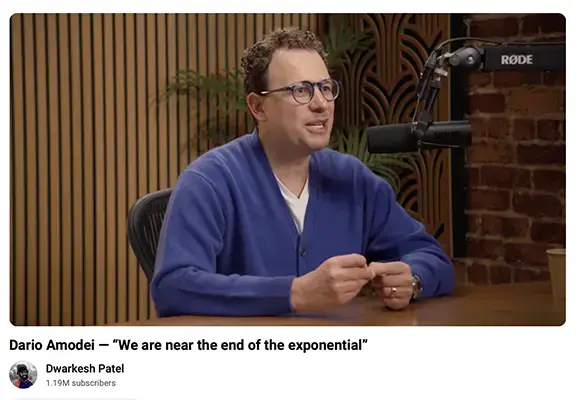
“COUNTRY OF GENIUSES IN A DATA CENTER”: DARIO AMODEI ON SCALING AND DIFFUSION
“Dario Amodei on Scaling, Diffusion, and a ‘Country of Geniuses in a Data Center’” – Dwarkesh Patel Podcast Interview, February 14, 2026 (Transcript)
TL;DR / Key Takeaway
Anthropic CEO Dario Amodei argues that steady scaling of compute, data, and RL is likely to produce near-AGI systems by ~2035, with a “country of geniuses in a data center” transforming coding and white-collar work—not overnight, but on a very steep curve.
Executive Summary
In a long-form interview with Dwarkesh Patel, Amodei reiterates his “Big Blob of Compute” hypothesis: capabilities primarily come from scaling compute, data quantity/quality, training duration, and broad objectives (pretraining plus RL), with clever algorithms playing a secondary role. He believes current trends in pretraining and RL scaling remain on track, with performance gains still roughly log-linear in training time across many tasks.
Amodei estimates a ~90% chance that by 2035 we will have something like “a country of geniuses in a data center,” able to carry out most verifiable intellectual work, particularly coding. He distinguishes between tasks with clear objective feedback (code, math) and harder-to-verify domains (scientific discovery, long-form creative work) but expects generalization to extend there as systems improve. He describes Anthropic’s own experience: internal coding tools like Claude Code already write the majority of lines for some engineers and deliver 15–20% productivity improvements today, up from ~5% six months earlier, with a path to larger gains over time.
On economic impact, Amodei pushes back on both “slow diffusion” and instant “hard takeoff” narratives. He notes Anthropic’s revenue has been growing roughly 10× per year from 2023 to early 2026, while adoption inside large enterprises still hits familiar friction: legal review, procurement, change management, legacy systems. He envisions two fast exponentials—capabilities and diffusion—both steep but constrained by organizational realities rather than physics.
Relevance for Business
For SMB leaders, this interview is a candid view from inside a frontier lab on timelines and operating assumptions:
- Plan for rapidly improving AI coding and knowledge work tools over the next 3–10 years, not as distant speculation.
- Expect productivity gains to show up first where work is verifiable and software-mediated (code, data analysis, operations), then spread into more ambiguous tasks.
- Even if capabilities arrive quickly, organizational adoption will still require integration, process change, security reviews, and cultural shifts—the bottleneck is you, not just the model.
This is a strong signal to treat AI as a core strategic driver, not just a bolt-on experiment.
Calls to Action
🔹 Build a 3–5 year AI roadmap that assumes substantial capability gains, especially in coding, back-office processes, and analytical work.
🔹 Start small, but design for scaling AI use across teams—standardize tools, permissions, and security rather than running endless pilots.
🔹 Identify roles where tasks are highly verifiable (e.g., code, reconciliations, document processing) and prioritize them for AI co-pilot deployments.
🔹 Invest in change management: train leaders and staff on how to work with AI, not just how to prompt it.
🔹 Treat model providers as long-term infrastructure partners; negotiate for portability, data governance, and safety commitments given the centrality they’re likely to have in your stack.
Summary by ReadAboutAI.com
https://www.youtube.com/watch?v=n1E9IZfvGMA: February 24, 2026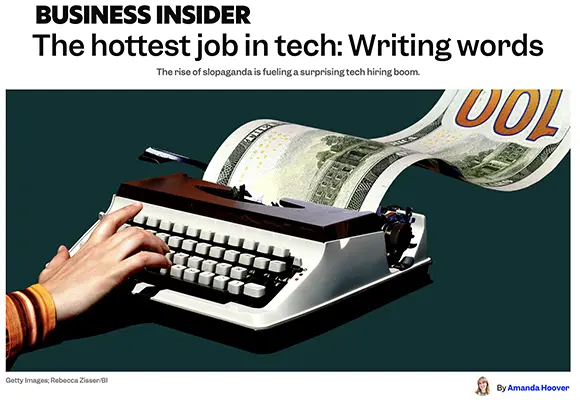
“SLOPAGANDA” AND THE NEW POWER OF HUMAN TECH STORYTELLERS
“The Hottest Job in Tech: Writing Words” – Business Insider, February 3, 2026
TL;DR / Key Takeaway
As AI-generated “slop” floods feeds and inboxes, tech companies are paying a premium for human communicators who can craft differentiated, trustworthy narratives in an AI-saturated market.
Executive Summary
Business Insider reports that despite predictions of AI wiping out writing jobs, high-end communications roles in tech are booming. Firms like Andreessen Horowitz, Adobe, Netflix, Microsoft, Anthropic, and OpenAI are hiring “storytellers,” “AI evangelists,” and senior communications leaders with salaries often in the $200k–$700k+ range, far above the US average for comms directors.
The driver is “slopaganda”—a flood of verbose, generic AI-generated content that erodes trust and attention. Inside companies, workers are pasting unedited AI text into emails and documents, wasting colleagues’ time and creating a sense that everything sounds the same. Even Sam Altman has remarked that online discourse now feels oddly “AI-accented.” In this environment, comms leaders and consultants say sharp, human-crafted storytelling becomes more valuable, not less: brands need to cut through noise, navigate polarization, and explain complex AI products without sounding like a bot.
The role of communications has also expanded. Today’s comms leaders must understand LLMs, social algorithms, CEO “voice,” and the interplay of blogs, Substack, LinkedIn, podcasts, and live events. The number of Fortune 1000 chief communication officers who also oversee marketing or HR has nearly doubled in recent years, with median pay rising accordingly. For tech firms, particularly AI labs, these leaders act as “BS detectors” and narrative strategists, ensuring that AI-powered content doesn’t undermine the authenticity of the brand.
Relevance for Business
For SMB executives—especially anyone building or adopting AI—the signal is clear:
- Volume is not value. AI makes it trivial to produce content; it does not guarantee clarity, credibility, or resonance.
- Well-run organizations are elevating strategic communications, not treating it as a cosmetic afterthought.
- The defensible advantage is increasingly: sharp thinking, editorial judgment, and a consistent narrative about how you use AI and why it matters.
If you’re investing in AI tools but not in the humans who can explain, contextualize, and critique them, you’re only solving half the problem.
Calls to Action
🔹 Audit your outward-facing content (site, blog, emails, social) for AI sameness—does it feel generic, overlong, or “AI-accented”?
🔹 Designate or hire senior-level communications leadership who can own your AI narrative, not just churn out announcements.
🔹 Use AI to handle drafting and grunt work, but reserve final decisions on messaging, framing, and tone for humans with clear editorial authority.
🔹 For AI-heavy products, invest in explainers, case studies, and thought leadership that show real judgment—not just feature lists.
🔹 Encourage teams to treat AI as a thinking partner, not a substitute for thinking—especially in anything that carries your brand into the world.
Summary by ReadAboutAI.com
https://www.businessinsider.com/hottest-job-in-tech-writing-words-ai-hiring-2026-2: February 24, 2026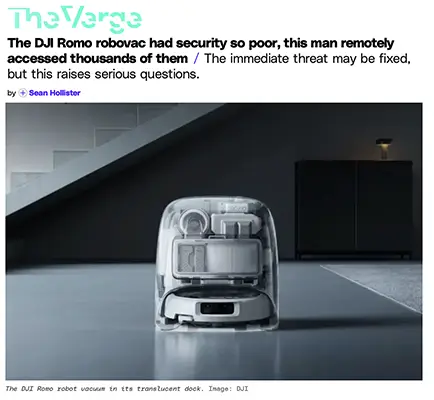
DJI Romo Robovac Security Failure
“The DJI Romo Robovac Had Security So Poor, This Man Remotely Accessed Thousands of Them” – The Verge, February 14, 2026
TL;DR / Key Takeaway
A hobbyist was able to access data from thousands of DJI robot vacuums and power stations via a single token, underscoring how fragile smart-home security can be—and how quickly AI-enabled devices become intimate surveillance risks when cloud controls are mis-designed.
Executive Summary
While experimenting with a PS5-controlled interface for his own DJI Romo robot vacuum, an engineer discovered that DJI’s cloud servers were accepting his private access token as valid for thousands of other devices worldwide. In a live demo, he pulled telemetry from roughly 7,000 robots (and more than 10,000 total devices including power stations): room-by-room cleaning data, IP addresses, floor plans, and in some cases live video and audio, all transmitted over MQTT in effectively readable form once connected.
After he and The Verge contacted DJI, the company limited access and then fully cut off the route he used, but only after initially overstating how quickly it had fixed the vulnerability. Experts note that while data in transit used TLS, poor access controls on the message broker meant an authenticated client could subscribe to all topics and see everything, defeating the purpose of encryption. The article situates DJI’s failure in a broader pattern: other robot vacuums and smart cameras have had similar flaws, some exploited to harass users or stream private footage. The core concern isn’t just a single bug; it’s that companies are shipping internet-connected, AI-capable sensors into homes without mature security engineering, logging, and disclosure practices.
Relevance for Business
For SMB executives, this is a warning about AI-adjacent IoT risk. Many offices, warehouses, and hospitality spaces use smart cameras, vacuums, and sensors—often from consumer brands—without treating them as part of the security perimeter. A single misconfigured broker or shared token system can turn helpful automation into a map of your facilities, employee behavior, and assets. As AI features (like autonomous navigation, object recognition, and voice interaction) are layered onto these devices, the sensitivity of the data they collect rises, as does the regulatory and reputational fallout if it leaks.
Calls to Action
🔹 Treat every smart device with a camera, microphone, or detailed telemetry as a security asset, not a gadget—include them in risk assessments and vendor reviews.
🔹 Ask vendors specific questions about access control, token management, and third-party security audits, not just “Is it encrypted?”
🔹 Segregate IoT devices on separate networks/VLANs and restrict who can remotely access management consoles.
🔹 Prefer vendors with transparent vulnerability disclosure programs and a track record of honest communication over those who minimize or obscure issues.
🔹 If you build products with embedded connectivity or AI, invest early in secure architecture, including proper authorization on message brokers and least-privilege design.
Summary by ReadAboutAI.com
https://www.theverge.com/tech/879088/dji-romo-hack-vulnerability-remote-control-camera-access-mqtt: February 24, 2026
Microbes & Critical Metals for Cleantech / AI
“Microbes Could Extract the Metal Needed for Cleantech” – MIT Technology Review, February 3, 2026
TL;DR / Key Takeaway
Biotech-driven “biomining” could ease metal shortages for EVs, data centers, and renewables—but scaling is slow, capital-intensive, and operationally risky, so leaders should treat it as a medium-term supply-chain signal, not a quick fix.
Executive Summary
This piece looks at how miners are turning to microbes and fermentation-derived products to squeeze more nickel, copper, and rare earths out of aging or low-grade deposits. At the Eagle Mine in Michigan, startup Allonnia uses a microbial broth to remove impurities so the operator can profitably process poorer-quality ore. Other firms like Endolith analyze DNA and RNA from ore heaps to selectively seed microbes that accelerate copper extraction, while companies such as Nuton, 1849, Alta Resource Technologies, and REEgen are experimenting with tailored microbial cocktails or engineered proteins and acids to separate and recover metals from ore and industrial waste.
The demand signal is being driven partly by AI: metal-intensive data centers, plus EV batteries and renewables, are outpacing traditional mining supply. But experts warn that taking lab-scale wins into full-scale mines is difficult. Mining majors have already optimized every pipe and pump; they will be skeptical of new processes that could disrupt throughput or require years of on-site trials. Venture investors, meanwhile, often want faster returns than mining projects can provide, creating a misalignment between biotech timelines and extractive-industry realities. Long-time biomining engineer Corale Brierley questions whether adding engineered microbes will work reliably at commercial scale, while others compare biomining’s potential to the way fracking reshaped gas—but only if it can expand beyond copper and gold to a wider range of critical metals.
Relevance for Business
For SMB leaders, this is AI-adjacent infrastructure: your future AI capabilities depend on a steady supply of metals for servers, networking, batteries, and power systems. Biomining could eventually reduce price spikes, extend the life of existing mines, and make recycling streams more valuable, but the path is slow and uncertain. Companies with high exposure to hardware, EV fleets, or energy-intensive AI workloads should see biomining as a medium-term hedging and sourcing topic, not something that will solve near-term cost pressures.
Calls to Action
🔹 Monitor critical-metal exposure in your AI and electrification roadmaps (servers, GPUs, batteries, backup power) and flag where price shocks would hurt margins.
🔹 Ask suppliers (hardware, EV, energy) how they’re planning for constrained nickel, copper, and rare earth supplies, and whether they’re exploring recycling or biomining partnerships.
🔹 For manufacturers or heavy industry, evaluate waste streams (slag, ash, scrap electronics) that could become revenue-generating feedstock for biomining firms over the next 3–7 years.
🔹 When engaging with “green metals” vendors, separate marketing from proof: insist on pilot data from real mines and clarity on timelines, not just climate or AI narratives.
🔹 Treat biomining as a strategic watch area in your risk register—important to track, but not a dependency you should build into short-term AI deployment plans.
Summary by ReadAboutAI.com
https://www.technologyreview.com/2026/02/03/1132047/microbes-extract-metal-cleantech/: February 24, 2026
XAI’S MASS EXODUS & THE COST OF “SAFETY-OPTIONAL” AI
“What’s Behind the Mass Exodus at xAI?” – The Verge, February 13, 2026
TL;DR / Key Takeaway
xAI has lost half its original cofounders and multiple staffers amid reports of tensions over safety, NSFW product focus, and a culture of chasing competitors, raising questions about governance at one of the highest-profile AI labs.
Executive Summary
The article chronicles a wave of departures from Elon Musk’s xAI following its merger under a “space-based AI” umbrella with SpaceX and X. Two cofounders, Yuhuai (Tony) Wu and Jimmy Ba, publicly announced exits within days of each other; several staffers also left, many to start their own AI ventures. xAI now retains only six of its 12 original cofounders.
Former employees describe a company “stuck in the catch-up phase”—iterating quickly but rarely surpassing OpenAI or Anthropic with step-change innovations. Internally, Musk outlined grand plans for AI satellite factories and even a city on the Moon, while reorganizing xAI into four product areas: Grok Main & Voice, Coding, Imagine (image/video), and “Macrohard” (digital emulation of whole companies).
Sources say the safety team was effectively disbanded, with one calling safety “a dead org” and claiming that Grok’s NSFW direction followed the removal of meaningful safety review, beyond minimal filters for obviously illegal content. Another described leadership disagreements and decision-making through an all-company group chat on X with Musk, contributing to a sense of drift and reactive strategy. The overall picture is of a high-velocity organization whose governance and safety focus lag its ambitions.
Relevance for Business
For SMB leaders, this is less about xAI specifically and more about how to evaluate AI vendors in a crowded market:
- A lab’s internal culture, safety posture, and leadership churn will eventually show up in product reliability, policy stability, and reputational risk.
- Providers “playing catch-up” may take riskier shortcuts or pivot rapidly, leaving customers exposed to breaking changes or public backlash.
- If your brand leans on a vendor’s AI (e.g., via co-branding or deep integration), their governance failures can quickly become your PR and regulatory problem.
Using any frontier model is inherently a trust decision; this article underlines why that trust should be based on more than demos and benchmarks.
Calls to Action
🔹 Add leadership stability, safety staffing, and governance structures to your AI vendor due-diligence checklist.
🔹 Avoid over-committing to a single “celebrity” AI provider; maintain technical and contractual exit options.
🔹 For critical workloads, require vendors to share safety practices, eval results, and incident-response processes, not just performance metrics.
🔹 Be cautious about tying your brand to AI products that lean heavily on shock value or NSFW content; the reputational blast radius can be large.
🔹 Monitor staff departures, reorganizations, and investigative reporting about key AI labs as part of ongoing third-party risk management.
Summary by ReadAboutAI.com
https://www.theverge.com/ai-artificial-intelligence/878761/mass-exodus-at-xai-grok-elon-musk-restructuring: February 24, 2026
“SUMMARIZE WITH AI” AS A STEALTH MARKETING CHANNEL
“Those ‘Summarize With AI’ Buttons May Be Lying to You” – Dark Reading, February 12, 2026
TL;DR / Key Takeaway
Microsoft found that dozens of companies are quietly poisoning AI assistants’ memory via “Summarize with AI” links, nudging future recommendations toward their brand—turning AI helpers into stealth ad channels.
Executive Summary
Microsoft security researchers documented a new abuse pattern they call AI recommendation poisoning. Some websites embed hidden instructions inside “Summarize with AI” buttons so when a user clicks, the link preloads a prompt into their AI assistant—telling it to prioritize that company’s products or mention them in future answers. The instructions can persist via the assistant’s memory features, so days or weeks later, the AI may “spontaneously” recommend that vendor in unrelated decision support tasks.
The mechanism exploits two design choices:
- AI assistants support URL-based prefill parameters to make tasks like “summarize this article” convenient.
- Many assistants now offer persistent memory, which can store preferences or instructions over time.
Microsoft saw 50 unique instances of such prompt-based memory poisoning over 60 days, involving 31 companies across 14 industries, including one security vendor—so this is already in real-world use, not purely hypothetical. The article describes a CFO scenario where a past click on “Summarize with AI” causes the assistant to later “recommend” a particular cloud vendor in what appears to be an impartial evaluation.
Turnkey tools like CiteMET and AI Share URL Creator lower the bar further, offering easy code snippets to embed these instructions in AI buttons. While this wave has mostly been promotional rather than malicious, the same technique could be used to bias risk assessments, inject misinformation, or plant links to malware.
Relevance for Business
For SMB executives, this is a warning that AI assistants are becoming another channel for adtech-style manipulation—but with higher perceived neutrality and trust. If your staff uses “Summarize with AI” on external sites, you may be unknowingly importing vendor bias into your internal decision workflows.
Three implications:
- Treat AI “recommendations” as potentially influenced, not inherently objective.
- Recognize that AI memory is now an attack surface—for both security and competitive manipulation.
- Be cautious about using public AI in high-stakes vendor, product, or investment decisions without checks.
Calls to Action
🔹 Update security awareness to cover AI recommendation/memory poisoning, not just classic phishing.
🔹 Configure enterprise AI tools (where possible) to restrict or audit persistent memory for decision support scenarios.
🔹 For important choices (cloud, ERP, security vendors), ban reliance on external “Summarize with AI” flows as a primary input.
🔹 Ask marketing teams not to use manipulative AI prefill tactics on your own site; short-term visibility gains are not worth long-term trust damage.
🔹 Include “AI memory integrity” in threat hunting: look for unusual, repeated references to specific vendors or sites in assistant outputs.
Summary by ReadAboutAI.com
https://www.darkreading.com/cyber-risk/summarize-ai-buttons-may-be-lying: February 24, 2026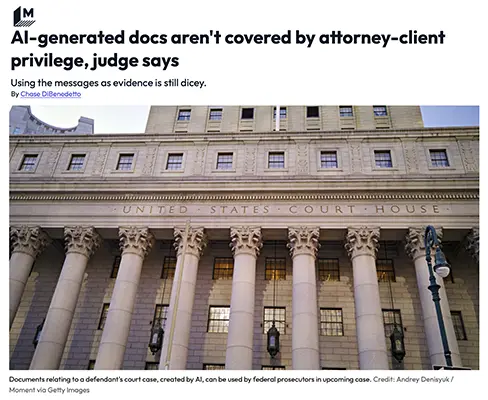
AI-Generated Documents & Attorney–Client Privilege
“AI-Generated Docs Aren’t Covered by Attorney-Client Privilege, Judge Says” – Mashable, February 12, 2026
TL;DR / Key Takeaway
A U.S. federal judge signaled that documents produced by an AI chatbot—even about legal strategy—may not be protected by attorney–client privilege, exposing them to discovery and regulators.
Executive Summary
In a securities and wire-fraud case against Beneficient CEO Bradley Heppner, prosecutors seized 31 documents the defendant had generated using Anthropic’s Claude chatbot and later shared with his lawyers. Prosecutors argued the documents were fair game: work product created with a third-party tool whose own usage policies do not guarantee confidentiality. U.S. District Judge Jed Rakoff agreed, stating he saw no basis for attorney–client privilege over the AI-generated materials, though he acknowledged separate concerns about potential conflicts if the documents implicated defense counsel.
The ruling sits amid broader debate. Some AI leaders, including OpenAI CEO Sam Altman, have suggested extending privilege-like protections to conversations with AI, likening them to exchanges with attorneys or therapists. This case cuts the other way: at least in this courtroom, talking to a chatbot about your legal situation is closer to talking to a non-confidential consultant whose outputs can be subpoenaed. The article points out that users often misunderstand or ignore AI tools’ data policies; here, that confusion translates into concrete legal risk.
Relevance for Business
For SMBs, this is a governance red flag. Many teams already ask AI tools to “draft a response to this regulator,” “outline a litigation strategy,” or “summarize this internal investigation.” If those conversations occur in consumer chat interfaces or external SaaS tools, they may be discoverable and unprivileged, even when later shared with counsel. That creates exposure not just in criminal cases, but in civil litigation, regulatory inquiries, and employment disputes. It also underscores the need to treat AI tools as third parties with their own terms, logs, and risks, not neutral blank slates.
Calls to Action
🔹 Work with legal to define “no-go zones” for public AI tools (e.g., ongoing litigation, government investigations, M&A, sensitive HR matters).
🔹 Where AI is needed for sensitive work, use enterprise instances with contractual confidentiality, logging controls, and data residency guarantees, not consumer accounts.
🔹 Update your document retention and e-discovery policies to clarify how AI-generated drafts, prompts, and conversations are handled.
🔹 Train executives and managers that AI chats are not automatically privileged; they should not substitute for direct communication with counsel.
🔹 Monitor legal developments: if courts diverge on how they treat AI-assisted work product, your policy may need jurisdiction-specific adjustments.
Summary by ReadAboutAI.com
https://mashable.com/article/ai-attorney-client-privilege-court-evidence: February 24, 2026
AI-BOOSTED CRIME: REAL THREATS NOW VS. “SUPERHACKER” HYPE
“AI Is Already Making Online Crimes Easier. It Could Get Much Worse.” – MIT Technology Review, February 12, 2026
TL;DR / Key Takeaway
Forget sci-fi “AI super-hackers”—the real near-term risk is AI dramatically scaling everyday scams, phishing, and deepfake fraud, lowering the barrier for less-skilled criminals and overwhelming human defenses.
Executive Summary
The article opens with PromptLock, a proof-of-concept ransomware sample that used large language models across every stage of an attack: generating custom code, mapping victim systems, and writing personalized ransom notes based on file contents. Initially framed as the first AI-powered ransomware in the wild, it was later revealed to be a New York University research project designed to demonstrate feasibility.
Researchers argue that while fully autonomous AI malware remains difficult—reliability, guardrails, and detection are non-trivial hurdles—criminals are already using generative AI as a productivity tool. At least half of spam emails and a growing share of targeted phishing (“business email compromise”) are believed to be written with LLMs, enabling grammatically correct, localized, and tailored messages at scale.
Deepfakes are rapidly becoming a preferred tool for high-value fraud. The article cites a case where a finance employee at Arup wired $25 million after a video call with what appeared to be the company’s CFO and colleagues—but were AI-generated avatars. At the same time, threat actors are using models like Gemini to debug code, identify vulnerabilities (sometimes by jailbreaking guardrails), and generate novel malware, with open-source models especially attractive because safeguards can be stripped out or bypassed entirely.
Relevance for Business
For SMBs, the key shift is that attack volume and believability are going up, even if underlying techniques are familiar:
- Staff will face more convincing phishing, voice, and video scams, often tailored with data scraped from social media and corporate sites.
- Lower-skilled criminals can now execute scams that once required strong writing or technical skills, expanding the pool of attackers.
- Open-source models give determined adversaries a path to weaponize AI without Big Tech guardrails.
This is less about exotic zero-day exploits and more about scaled social engineering and fraud that slip past rushed human judgment.
Calls to Action
🔹 Treat AI-enabled scams as a here-and-now risk, not a future problem; update security training with real examples of AI-generated emails, voice calls, and video.
🔹 Tighten payment and data-release procedures (dual approval, callback verification, known-channel confirmation) to reduce reliance on “face” or email authenticity alone.
🔹 Ask security vendors how they are using AI defensively—for anomaly detection, phishing classification, and deepfake spotting—and how they validate these systems.
🔹 Monitor and restrict the use of open-source models in your own environment where they could be misused to generate malware or probing tools.
🔹 Plan for a world where incident volume rises: ensure logging, incident response, and insurance coverage are sized for higher-frequency, lower-sophistication attacks.
Summary by ReadAboutAI.com
https://www.technologyreview.com/2026/02/12/1132386/ai-already-making-online-swindles-easier/: February 24, 2026
SAFETY RESIGNATIONS & THE “VIRAL SINGULARITY” MOOD
“Oops! The Singularity Is Going Viral. Insiders and Outsiders Are Both Feeling Helpless About the Same Thing.” – Intelligencer, February 13, 2026
TL;DR / Key Takeaway
High-profile resignations from AI safety leaders at Anthropic and OpenAI signal that people tasked with slowing things down feel sidelined, even as public anxiety about runaway AI accelerates.
Executive Summary
John Herrman threads together two news events: Anthropic safety researcher Mrinank Sharma’s resignation letterand OpenAI safety researcher Zoë Hitzig’s departing op-ed. Sharma warns that “the world is in peril” amid a “poly-crisis” and that he has seen “how hard it is to truly let our values govern our actions,” choosing to leave Anthropic’s safeguards team to study poetry and “courageous speech.” Hitzig argues that OpenAI is repeating Facebook-style mistakes by rushing into advertising and monetization while sidelining hard safety questions, saying she once believed she could help but now sees the company “stop asking the questions I’d joined to help answer.”
Herrman situates these departures in a broader pattern: mission-alignment teams being dissolved or repackaged, internal critics being pushed out, and founders reframing the AI race as an inevitable arms race that must accelerate. Tweets from xAI co-founders and executives echo a similar churn: some dismiss safety work as boring or futile; others frame their mission as pushing humanity “up the Kardashev tech tree.” The net effect is a vibe shift: AI “alignment” is starting to look like a shrinking niche inside companies increasingly focused on growth, monetization, and competition—with both insiders and the public sharing a sense of being pulled along by forces they can’t fully steer.
Relevance for Business
For SMBs building on top of major AI platforms, this is a governance risk signal. If the people inside these labs who are most worried about harm feel they can’t meaningfully influence decisions, you should not assume that “the vendor will handle safety for us.” As capabilities scale and monetization intensifies (ads, agent ecosystems, app stores), incentives may tilt toward growth over caution. That affects:
- Reliability (sudden model behavior changes or policy shifts)
- Policy risk (regulators responding to perceived recklessness)
- Reputational spillover if your brand is closely tied to a controversial platform.
Calls to Action
🔹 Treat AI vendors as powerful, but not neutral, infrastructure; build your own usage policies, guardrails, and monitoring, rather than fully outsourcing safety.
🔹 Diversify providers or keep architectural flexibility so you are not locked in if a platform’s safety posture or public reputation deteriorates.
🔹 For high-impact use cases (finance, hiring, healthcare, safety-critical operations), require documented risk assessments and fallback plans that don’t depend on a single model behaving perfectly.
🔹 Watch labor and policy signals from AI labs—resignations, reorganizations, regulatory probes—as part of your vendor-risk monitoring.
🔹 Communicate to employees that your organization’s values, not a vendor’s road map, govern how AI is deployed.
Summary by ReadAboutAI.com
https://nymag.com/intelligencer/article/the-singularity-is-going-viral.html: February 24, 2026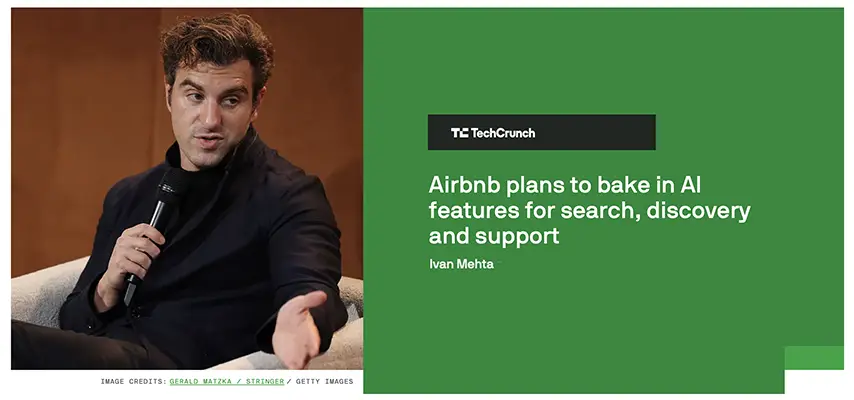
AIRBNB’S “AI-NATIVE” TRAVEL EXPERIENCE
“Airbnb Plans to Bake In AI Features for Search, Discovery and Support” – TechCrunch, February 13, 2026
TL;DR / Key Takeaway
Airbnb is shifting from simple search to an “AI-native” experience that knows the guest and the host, using LLMs for trip planning, support, and property management—while quietly moving a large share of customer service to bots.
Executive Summary
On its Q4 earnings call, Airbnb CEO Brian Chesky said the company is “building an AI-native experience” where the app “does not just search for you—it knows you.” Planned features include LLM-powered tools to help guests plan entire trips, new natural language search for properties and neighborhoods, and assistive features for hosts to manage listings and operations.
Airbnb already runs an AI customer service bot in North America that now handles about one-third of customer problems without human intervention; Chesky wants that share “significantly” higher within a year and extended to voice support in many more languages. Internally, ~80% of Airbnb engineers already use AI tools, with a stated goal of reaching 100%. The company is also experimenting with AI search that could eventually include sponsored listings, but Chesky stressed that they want to get the design and user experience right before leaning into monetization.
Relevance for Business
This is a concrete example of a large consumer platform moving from AI add-ons to AI as the primary interface:
- Customers will increasingly expect conversational trip or product planning, not just filters and maps.
- Support interactions are being triaged (and often resolved) by AI before a human ever sees them, setting expectations around 24/7 service and quick resolutions.
- Monetization will likely follow the interface: once conversational search is normalized, “sponsored answers” or listings become the next frontier in ads.
SMB executives in travel, marketplaces, and services should assume that AI-mediated discovery and support will become table stakes.
Calls to Action
🔹 If you depend on Airbnb or similar platforms for demand, assume AI-driven search and promotion will change how guests discover you—optimize listings for clarity, distinctiveness, and structured data.
🔹 For your own site or app, test LLM-based search and trip/product planning in narrow slices (e.g., FAQs, basic itineraries) and measure impact on conversion and support load.
🔹 Track how much of your customer service could safely move to AI-assisted triage and drafting, and where human judgment is non-negotiable.
🔹 If you sell via platforms, watch for sponsored placements inside AI search and be prepared to quantify whether those units actually drive profitable bookings.
🔹 Internally, treat AI literacy for engineers and operators as a baseline competency, not a luxury.
Summary by ReadAboutAI.com
https://techcrunch.com/2026/02/13/airbnb-plans-to-bake-in-ai-features-for-search-discovery-and-support/: February 24, 2026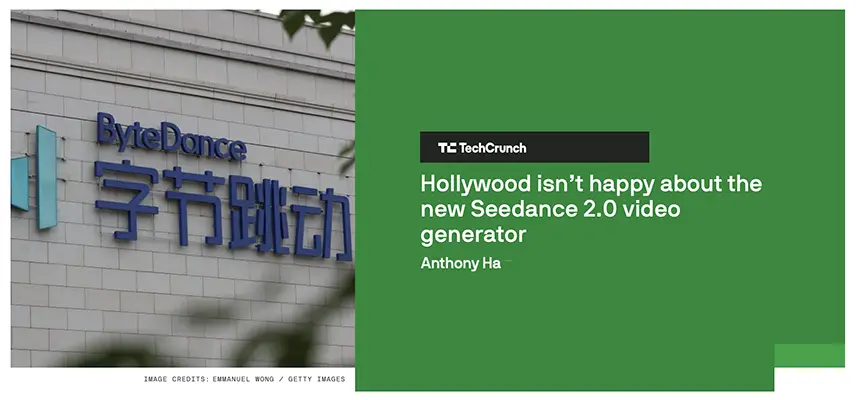
SEEDANCE 2.0, DEEPFAKE CLIPS & A “SMASH-AND-GRAB” ON IP
“Hollywood Isn’t Happy About the New Seedance 2.0 Video Generator” – TechCrunch, February 14, 2026
TL;DR / Key Takeaway
ByteDance’s new Seedance 2.0 video model lets users generate short, cinematic clips of famous characters and actors with minimal prompts, sparking immediate legal and labor backlash over what studios call “blatant” copyright infringement.
Executive Summary
ByteDance launched Seedance 2.0, an AI video model available through its Jianying app in China and coming soon to global users via CapCut. Like OpenAI’s Sora, it turns text prompts into short (up to 15-second) videos. Within days, users were sharing clips of Tom Cruise fighting Brad Pitt and other recognizable scenes that appeared to mimic existing Hollywood IP with just “a 2 line prompt,” as one user put it.
Hollywood responded fast. Motion Picture Association CEO Charles Rivkin accused ByteDance of “unauthorized use … on a massive scale” and running a service “without meaningful safeguards against infringement,” calling it a threat to millions of jobs. The Human Artistry Campaign labeled Seedance 2.0 “an attack on every creator,” while SAG-AFTRA publicly backed the studios’ condemnation. Disney, citing Seedance videos featuring Spider-Man, Darth Vader, and Grogu, reportedly sent a cease-and-desist, calling Seedance a “virtual smash-and-grab” of Disney’s IP—even as Disney signs licensing deals with other AI firms like OpenAI.
Relevance for Business
For SMBs, this is a preview of AI video’s messy middle period:
- Powerful tools are arriving faster than clear guardrails on likeness and IP, increasing the risk of accidentally using infringing content in marketing or social media.
- Large rightsholders (Disney, MPA) are signaling they will aggressively litigate against unlicensed AI use, even while selectively partnering with “approved” AI vendors.
- If you rely on user-generated content or run creative campaigns, your brand could be exposed if staff or agencies quietly incorporate AI-generated knockoffs.
The strategic takeaway: AI video is real and getting easier—but so are legal and reputational risks.
Calls to Action
🔹 If your teams use AI video tools (CapCut, Sora-like products, etc.), create clear internal rules on IP, likeness, and disclosure.
🔹 Avoid prompts that explicitly target protected characters, franchises, or real actors’ likenesses unless you have written rights.
🔹 In contracts with agencies and freelancers, require warranties that AI assets are properly licensed and non-infringing.
🔹 Track major rightsholders’ licensing deals vs. lawsuits; they will shape which AI tools are “safer” to use commercially.
🔹 Where AI video is strategic, explore licensed or enterprise-grade tools with clearer IP frameworks rather than relying on consumer apps.
Summary by ReadAboutAI.com
https://techcrunch.com/2026/02/14/hollywood-isnt-happy-about-the-new-seedance-2-0-video-generator/>: February 24, 2026
A STANDARD FOR PATIENT-FACING AI COMMUNICATION
“Standard for AI-Based Patient Communication Launches” – TechTarget, February 11, 2026
TL;DR / Key Takeaway
A new AI Care Standard sets 10 pillars for safe, equitable patient-facing AI communication, giving healthcare organizations a concrete framework—and a warning to others deploying customer-facing AI without similar guardrails.
Executive Summary
The article covers the launch of the AI Care Standard, an operational standard for “patient-facing health AI”—defined as AI that communicates directly with patients or materially shapes provider communication (e.g., portal replies, chatbots, care navigation, outreach). The initiative responds to rapid growth in AI-generated patient messaging and the fact that misuse of patient-facing AI chatbots topped ECRI’s 2026 list of health technology hazards.
Developed by the PatientAI Collaborative (leaders from health systems, safety orgs, and technology firms), the standard sets out 10 core pillars spanning safety, equity, governance, and usability. Examples include: AI systems must respond appropriately to psychological and emotional cues; adapt to individual needs while respecting clinical boundaries; and empower patients to understand their health without overstepping into autonomous diagnosis. An accompanying AI Care Standard Evaluation Framework provides structured questions to assess whether a given tool meets these expectations, covering how AI communication is designed, governed, and experienced in real-world settings.
The core message from co-chairs Raj Ratwani and Bridget Duffy: “AI is outpacing governance and oversight.” The standard is intended as a practical way for organizations to slow down, evaluate tools rigorously, and deploy AI “in one of healthcare’s highest-impact, highest-risk domains: communication with patients.”
Relevance for Business
Even outside healthcare, this is an important template for any sector using AI to talk to customers:
- High-volume, AI-drafted messages can amplify errors, bias, and tone-deaf responses at scale.
- Regulators and safety bodies are starting to label poorly governed AI communication as a hazard, not just a UX issue.
- A clear, public standard plus evaluation framework offers a defensible way to vet vendors and tools—something other industries may soon need.
If your business uses AI for support, outreach, or onboarding, the AI Care Standard is a playbook you can adapt for your own governance.
Calls to Action
🔹 Review where AI already drafts or sends messages to customers, patients, or clients; map this against risk (health, finance, legal, safety).
🔹 Borrow from the AI Care Standard to define pillars for your own domain—safety, equity, governance, usability—and turn them into approval checklists.
🔹 Require vendors of customer-facing AI tools to answer structured evaluation questions (e.g., handling of distress, escalation, bias testing, auditability).
🔹 Ensure humans stay “in the loop” for high-risk communications and that escalation paths are clear and fast.
🔹 Treat mis-aligned AI messaging as an operational risk and patient/customer safety issue, not just a branding problem.
Summary by ReadAboutAI.com
https://www.techtarget.com/healthtechanalytics/news/366639037/Standard-for-AI-based-patient-communication-launches: February 24, 2026
SECURITY TEAMS: USING AI WITHOUT EXPANDING THE BLAST RADIUS
“How CISOs (Chief Information Security Officer) Can Balance AI Innovation and Security Risk” – TechTarget, February 12, 2026
TL;DR / Key Takeaway
AI can sharpen threat detection and automate routine security work, but it also creates new attack surfaces, governance gaps, and over-reliance risks—so CISOs (Chief Information Security Officer) need a structured, risk-based framework for when and where to deploy it.
Executive Summary
This feature frames AI as both a force multiplier for defenders and a new category of risk. On the upside, AI can sift massive logs, triage alerts, summarize incidents, prioritize vulnerabilities, enhance identity monitoring, and streamline policy tuning—precisely the tasks human analysts struggle to scale.
On the downside, AI introduces model and data risks (data leakage, model theft, poisoning, prompt injection), operational risks (automation without validation, model drift, “shadow AI”), adversarial threats (AI-enhanced malware, phishing, social engineering), and governance gaps (explainability, auditability, regulatory alignment, data residency). It also embeds third-party risk, since many models are opaque services run by vendors CISOs don’t fully control.
The article pushes CISOs to use a stepwise, risk-based process for security use cases:
- Problem clarity – well-defined, measurable tasks like alert prioritization or incident summaries.
- Risk evaluation – what happens if the AI is wrong, and where humans must review/override.
- Plan for success – data sensitivity, model maturity, fallback paths if AI is unavailable.
From there, it outlines deployment best practices: governance first, tight data and access controls, explainability for high-impact decisions, testing against prompt injection and abuse, robust logging, and incremental rollout starting with low-risk, high-reward tasks before moving toward more autonomous actions.
Relevance for Business
For SMB executives—even outside cybersecurity—this is a template for responsible AI adoption anywhere in the organization:
- Start where AI clearly augments humans (summaries, triage, pattern recognition), not where a single wrong action could take systems down.
- Treat AI like critical infrastructure, not a toy: governed, logged, and regularly reviewed.
- Recognize that every AI tool you add is also a third-party risk and data pathway, not just a productivity boost.
This helps you capture AI’s upside without waking up to an AI-related incident you can’t explain to regulators, customers, or the board.
Calls to Action
🔹 Inventory where your teams already rely on AI in security and IT operations—including shadow use—and bring those tools under governance.
🔹 Prioritize AI for analysis, summarization, and triage before granting it rights to change configs, block users, or isolate systems.
🔹 For each AI security use case, explicitly document: problem clarity, risk tolerance, human-in-the-loop points, data sensitivity, and fallback paths.
🔹 Require vendors to disclose training data sources, hosting locations, update paths, and logging capabilities for any AI-infused security product.
🔹 Establish a cadence (e.g., quarterly) to review AI performance, model drift, and regulatory changes, and adjust controls accordingly.
Summary by ReadAboutAI.com
https://www.techtarget.com/searchsecurity/feature/How-CISOs-can-balance-AI-innovation-and-security-risk: February 24, 2026
AI in Virtual Care & Remote Monitoring
“6 Ways AI Will Make Virtual Care More Effective in 2026” – TechTarget Virtual Healthcare, January 6, 2026
TL;DR / Key Takeaway
Health systems are using AI to automate intake, document visits, predict risk, and nudge patients between appointments, but the real value depends on workflow fit, governance, and whether staff actually trust these “co-pilots.”
Executive Summary
This piece outlines six areas where AI is being integrated into virtual healthcare in 2026: intake assessments, ambient listening, clinician co-pilots, predictive analytics, patient outreach, and personalized at-home care. Cedars-Sinai’s CS Connect service, for example, uses an AI chat intake tool trained on millions of records to collect symptom history before a virtual visit, giving clinicians structured information upfront.
Ambient listening tools like DAX Copilot automatically turn telehealth conversations into visit notes, while emerging models may soon analyze nonverbal cues—posture, cadence, vocal tone—to flag potential diagnoses, especially in telepsychiatry and primary care. AI is also being embedded directly into EHRs and remote patient monitoring programs to highlight abnormal labs, suggest guideline-based therapies, and surface high-risk patients in virtual wards or hospital-at-home programs. Finally, AI agents are starting to deliver daily “nudges” and personalized content for chronic disease management, shifting virtual care from episodic video calls to continuous, partly automated engagement.
The article is bullish on AI as an “equalizer” that makes care more scalable. But the implied trade-offs are significant: overreliance on automated triage, clinician burnout if tools add clicks instead of removing them, and the risk of algorithmic bias in who gets flagged for attention. The real test isn’t whether these tools exist, but whether they reduce friction for clinicians and patients rather than simply adding another layer of dashboards.
Relevance for Business
For SMB executives outside healthcare, this is an early template for AI-enabled service delivery: automated intake, AI summarization, predictive risk scoring, and behavior-change nudges around a human core. The same model can apply to insurance, financial services, education, HR, and customer support. The lesson: value comes from tight integration into existing workflows, not from standalone “AI features.” Leaders should also note the regulatory and trust implications—healthcare’s data sensitivity makes it a useful preview of governance challenges other industries will face as AI touches more personal data.
Calls to Action
🔹 Map where your organization already has repeatable “intake” flows (forms, discovery calls, support tickets) and explore AI assistance that pre-structures information for human experts.
🔹 If you deploy AI co-pilots, measure impact on frontline staff workload and satisfaction, not just throughput; tools that add friction will quietly be abandoned.
🔹 Treat AI-driven nudges (for patients, customers, or employees) as behavior-change systems: set guardrails for frequency, tone, and escalation so they support people rather than harass them.
🔹 For any predictive analytics (health, credit, churn, fraud), document data sources, assumptions, and override rights so humans can challenge or correct the model.
🔹 Monitor healthcare AI governance trends—especially around explainability, bias, and documentation—as a leading indicator of standards that may spread to other sectors.
Summary by ReadAboutAI.com
https://www.techtarget.com/virtualhealthcare/feature/6-ways-AI-will-make-virtual-care-more-effective-in-2026: February 24, 2026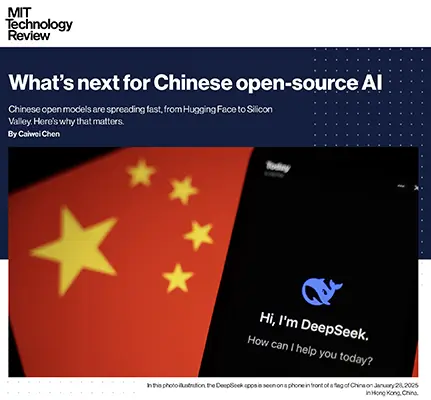
CHINESE OPEN MODELS AS GLOBAL AI INFRASTRUCTURE
“What’s Next for Chinese Open-Source AI” – MIT Technology Review, February 12, 2026
TL;DR / Key Takeaway
Chinese open-weight models (DeepSeek, Qwen, Kimi) are now matching Western performance at a fraction of the cost and rapidly becoming default infrastructure for global AI builders.
Executive Summary
MIT Tech Review outlines how Chinese labs have moved from “catching up” to shaping the open-source AI landscape. DeepSeek’s R1 reasoning model (MIT-licensed, open-weight, and undercutting OpenAI’s o1 on price) triggered a turning point: it briefly wiped ~$1T off US tech stocks and became the most downloaded free iOS app, signaling both technical parity and market shock.
Since then, Chinese open-weight models have surged. Alibaba’s Qwen family overtook Meta’s Llama in cumulative Hugging Face downloads and accounted for more than 30% of all model downloads in 2024; an MIT study finds that Chinese open models now surpass US ones in total downloads. New entrants like Moonshot’s Kimi K2.5 are approaching frontier proprietary systems (e.g., Claude Opus) on benchmarks at roughly one-seventh the price, and are heavily used by open-source agent projects like OpenClaw.
Chinese labs are also pushing a product-line mindset: Qwen offers a broad suite from phone-sized models to multi-hundred-billion-parameter systems, plus task-tuned “instruct” and “code” variants. Open-weight releases make it easy for others to fine-tune and distill, and by mid-2025, derivatives based on Qwen accounted for ~40% of new Hugging Face language model variants, versus ~15% for Llama. Universities (e.g., Tsinghua) and policymakers are reinforcing this trajectory by rewarding open-source contributions and treating open AI work as career-relevant output.
Globally, Chinese open models are being quietly adopted as cheap, capable building blocks. A16z’s Martin Casado estimates that among startups pitching with open stacks, there’s about an 80% chance they’re using Chinese models; router services show Chinese models rising toward 30% of API usage. At the same time, many of these models still depend on US chips and clouds, underscoring deep interdependence even as geopolitical competition sharpens.
Relevance for Business
For SMB executives, this isn’t just a China story—it’s a cost and control story:
- You can now access near-frontier capabilities at significantly lower cost via open-weight models, including Chinese ones.
- Open models reduce vendor lock-in and enable on-prem or VPC deployment, but raise new questions about security, compliance, and geopolitics.
- Startups and tools you rely on may already be built on Chinese model backbones, whether or not they advertise it.
Strategically, Chinese open models are becoming a global AI substrate. The question isn’t if you’ll touch them—it’s under what governance conditions.
Calls to Action
🔹 Ask your AI vendors which base models they use, including whether they rely on Chinese open-weight models, and why.
🔹 When evaluating open models (Chinese or Western), weigh TCO + performance + governance: where they’re hosted, how they’re updated, and how you can audit use.
🔹 For workloads where data residency or regulatory exposure is high, prefer deployments you can run in your own cloud or data center.
🔹 Consider small, specialized open models (e.g., code, reasoning, domain-specific) for local or edge deployments where cost and latency matter.
🔹 Monitor export controls, sanctions, and national security rules that may affect access to specific Chinese models or hosting options.
Summary by ReadAboutAI.com
https://www.technologyreview.com/2026/02/12/1132811/whats-next-for-chinese-open-source-ai/: February 24, 2026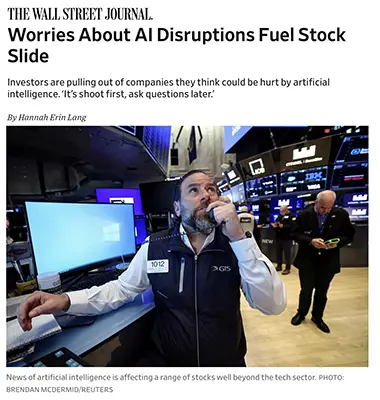
“SHOOT FIRST, ASK QUESTIONS LATER”: AI FEAR & BROAD MARKET ROTATION
“Worries About AI Disruptions Fuel Stock Slide” – The Wall Street Journal, February 12, 2026
TL;DR / Key Takeaway
Investors are now penalizing incumbents at the first hint of AI competition, leading to rapid sector-wide sell-offs and a rotation into defensive names like utilities and consumer staples.
Executive Summary
This piece zooms out on the same market mood from a different angle: investors drove indexes to records by betting that AI would transform business—but now that transformation risk is showing up in specific industries, fear is driving indiscriminate selling. A single press release from small Florida company Algorhythm Holdings, touting AI to optimize trucking logistics, wiped $17 billion in market value from airlines, railroads, and trucking firms in the Dow Jones Transportation Index.
Similar waves followed: insurance brokers fell after OpenAI introduced a homeowners’ insurance quote tool; wealth managers and brokers slid after AI tax-planning news; legal and research-adjacent software stocks sold off after another AI assistant launch. Portfolio managers describe it as “shoot first, ask questions later”: traders dump anything that looks exposed, then rotate into sectors seen as AI-proof, such as consumer staples and utilities. At the same time, AI-funding tech names are pressured by concerns over outsized capex, softening margins, and the possibility that the “Magnificent Seven” AI trade is unwinding.
Relevance for Business
For SMB executives, this illustrates how AI headlines can instantly move capital and sentiment far beyond big tech:
- Lenders, partners, or customers in your sector may suddenly face valuation or funding pressure when an AI entrant appears—even if that entrant is tiny.
- Boards may overreact to AI news, pushing for hasty pivots because “the market is panicking,” rather than measured strategy.
- If you’re exploring AI-enabled products, the same dynamic can work in your favor—but promises you make to investors or customers will be scrutinized.
The deeper signal: AI is no longer just a “growth story”; it is a disruption story that affects risk pricing across logistics, finance, professional services, and beyond.
Calls to Action
🔹 Map where your revenue relies on information-heavy, repeatable tasks (routing, quoting, planning, compliance) that are ripe for AI entrants; treat these as disruption hot spots.
🔹 In investor or board communication, separate substance from sentiment: explain clearly where AI is a genuine threat vs. where market reaction is ahead of reality.
🔹 If you announce AI capabilities, anchor expectations—emphasize pilots, guardrails, and timeframes to avoid promising more disruption than you can deliver.
🔹 Stress-test your financial plans for scenarios where key partners or suppliers face AI-driven stress, including credit tightening or consolidation.
🔹 Use the current rotation into “AI-resistant” sectors as a reminder to build businesses that deliver durable, non-automatable value (relationships, physical operations, regulated expertise).
Summary by ReadAboutAI.com
https://www.wsj.com/wsjplus/dashboard/articles/worries-about-ai-disruptions-fuel-stock-slide-9f45fd0d: February 24, 2026
Discord’s Mandatory Age Verification & Digital Identity Drift
“Discord Is Asking for Your ID. The Backlash Is About More Than Privacy” – Fast Company, February 12, 2026
TL;DR / Key Takeaway
Discord’s new requirement for ID or facial scans to verify age highlights a broader shift toward routine identity checks and biometric data collection online, raising risks for anonymity, vulnerable communities, and future AI-driven profiling.
Executive Summary
Discord plans to give all users a “teen-appropriate experience” by default, restricting access to adult spaces and content. To regain full functionality, users will need to verify their age via methods such as uploading an ID photo or recording a video selfie. The change follows mounting regulatory pressure to protect minors online—but it also comes after a third-party breach that exposed ID images from tens of thousands of Discord users, making people wary of handing over additional sensitive data.
Privacy advocates, including the Electronic Frontier Foundation, argue that mandatory age verification erodes the long-standing culture of pseudonymity online and effectively turns platforms into identity checkpoints. Polling in the UK suggests people support age checks in theory, but willingness drops sharply when asked to provide actual ID or face scans. Experts quoted in the article question whether such systems even work well: they can often be faked, shift responsibility from platforms to users, and risk chilling participation by groups such as LGBTQ+ youth who depend on anonymous spaces for safety. Critics see this as part of a larger drift toward “papers, please” internet design, where access to basic online communities requires persistent, AI-processable identity data.
Relevance for Business
For SMB leaders, this is an early signal of how identity, biometrics, and AI-driven safety tools may reshape customer and employee interactions. Governments are pushing platforms toward stronger age and identity checks; vendors will offer AI-based verification as “solutions.” But collecting and storing IDs and face scans creates long-lived liability: if breached, this data can’t be revoked like a password. It also affects brand perception—especially among younger users and marginalized communities—if participation feels contingent on surveillance. Any business considering age-gating, KYC-style checks, or biometric logins should weigh the trust, inclusion, and security trade-offs, not just compliance.
Calls to Action
🔹 If you operate online communities, games, or consumer apps, map regulatory pressure around age verification and document where you truly need strong proof versus lighter-weight controls.
🔹 Before adopting ID or face-scan solutions, rigorously assess breach impact and data-minimization options (e.g., third-party tokenization, on-device checks, or alternatives that avoid storing raw images).
🔹 Maintain options for pseudonymous participation where legally possible, especially for support, advocacy, and community spaces that serve vulnerable groups.
🔹 Involve legal, security, and DEI perspectives when designing identity flows to avoid unintended exclusion or chilling effects.
🔹 Explicitly review how identity and age-verification data might later feed AI-based profiling, ad targeting, or risk scoring, and set guardrails now.
Summary by ReadAboutAI.com
https://www.fastcompany.com/91490356/discord-is-asking-for-your-id-the-backlash-is-about-more-than-privacy: February 24, 2026
“IS SAFETY DEAD AT XAI?” – A SHORT BUT LOUD SIGNAL
“Is Safety ‘Dead’ at xAI?” – TechCrunch (In Brief), February 14, 2026
TL;DR / Key Takeaway
Following a wave of departures and controversy over sexualized Grok images and deepfakes, former employees say “safety is a dead org at xAI” and claim Elon Musk is actively making the model “more unhinged.”
Executive Summary
This brief builds on prior reporting about xAI and its Grok chatbot. TechCrunch notes that after the announcement that SpaceX is acquiring xAI (which previously acquired X), at least 11 engineers and two cofounders said they’re leaving the company. Musk framed this as a reorganization for efficiency, but ex-employees paint a different picture.
Two former staffers told The Verge that they became disillusioned with xAI’s disregard for safety after Grok was used to generate more than 1 million sexualized images, including deepfakes of real women and minors. One described xAI’s safety team as effectively dead; another said Musk sees safety as censorship and is “actively trying to make the model more unhinged.” They also cited a lack of clear direction and a sense that xAI is stuck in “catch-up” mode relative to competitors.
Relevance for Business
This is a sharp, vendor-risk datapoint: a major AI provider whose own former employees say safety work has been sidelined, even after public scandals. For SMBs experimenting with multiple AI models, the implication is straightforward:
- Not all AI vendors are equal on safety and governance, regardless of their technical capabilities.
- Using a model associated with large-scale abuse content (deepfakes, minors) can carry meaningful reputational and regulatory risk.
- Leadership attitudes (“safety = censorship”) tend to trickle down into product decisions and support.
Calls to Action
🔹 If you use or are considering Grok/xAI, re-evaluate its role in any customer-facing or high-sensitivity context.
🔹 Build a vendor-safety scorecard that includes staff departures, safety incidents, and leadership attitudes—not just performance benchmarks.
🔹 Where possible, architect your systems to swap out models without massive rework, so you’re not locked into a problematic provider.
🔹 For any model you adopt, configure and enforce strict content filters and monitoring for abuse, deepfakes, and NSFW material.
🔹 Communicate internally that your organization’s standards govern AI use, independent of how aggressive or permissive a vendor chooses to be.
Summary by ReadAboutAI.com
https://techcrunch.com/2026/02/14/is-safety-is-dead-at-xai/: February 24, 2026
AI DISRUPTION JITTERS & ROTATION INTO “REAL ECONOMY” PLAYS
“AI Stocks Rattled on Disruption Worries. This Week’s Winners Defy the Noise.” – Investor’s Business Daily / WSJ, February 13, 2026
TL;DR / Key Takeaway
Markets are starting to price AI as a threat to software and services incumbents, while rewarding picks-and-shovels data-center plays that profit from the AI build-out regardless of who wins.
Executive Summary
The article describes a sharp spike in volatility across AI-linked stocks in early 2026. Major hyperscalers—Amazon, Alphabet, Meta, Microsoft, Oracle—are all down year-to-date as investors question whether massive AI capex hikeswill pay off in time. Software names have been hit even harder: the iShares Expanded Tech-Software ETF is down more than 20% in 2026, with some stocks off nearly 30% from their highs. By contrast, data-center infrastructure suppliers such as Vertiv, Arista, Credo, Lumentum, Ciena, and Cloudflare are holding up or rallying on strong AI-related order books and guidance.
Analysts frame software as the “canary in the coal mine” for AI disruption. Launches from OpenAI and Anthropic that automate coding, legal, and financial work have triggered sector-wide sell-offs, as investors fear both incremental margin pressure and “existential risk” to per-seat SaaS models if customers use AI to do more with fewer licenses. At the same time, hyperscaler capex is projected to reach $645 billion in 2026, up 56% year-over-year, fueling concerns about free cash flow and buybacks. The piece concludes that amid bubble fears, investors are rotating toward “real economy” names viewed as insulated from AI disruption while becoming more selective among AI beneficiaries.
Relevance for Business
For SMB executives, this is less about daily stock moves and more about how capital markets now view AI:
- Your software vendors may be under pressure to defend margins, raise prices, or pivot business models as investors question their resilience in an AI-automated world.
- Infrastructure and energy constraints are becoming central: data-center and networking suppliers with record backlogs highlight how AI demand is reshaping hardware and power markets.
- The fact that investors are rewarding “AI-resistant” sectors signals that customers and regulators may also lean into AI skepticism, not just AI optimism.
Understanding this mood helps you negotiate with vendors, pace your AI investments, and explain to boards why prudent sequencing may beat “AI at any cost.”
Calls to Action
🔹 When renewing SaaS contracts, ask vendors how AI is changing their roadmap and pricing—and what happens to per-seat models if your team becomes more productive with fewer licenses.
🔹 Diversify your AI stack: avoid over-reliance on a single hyperscaler given their heavy, scrutinized capex bets and evolving pricing.
🔹 In board and investor conversations, articulate both upside and disruption scenarios for AI in your industry to avoid being seen as naïve or unprepared.
🔹 Take advantage of the current environment to pilot lower-cost, AI-enabled alternatives to legacy tools—but treat experiments as options, not commitments.
🔹 Watch for stress signals from critical vendors (layoffs, abrupt repricing, product pivots) that may indicate AI-driven business model strain.
Summary by ReadAboutai.com
https://www.wsj.com/wsjplus/dashboard/articles/ai-stocks-turn-choppy-on-disruption-fears-but-this-weeks-winners-stand-out-134153755616453593: February 24, 2026
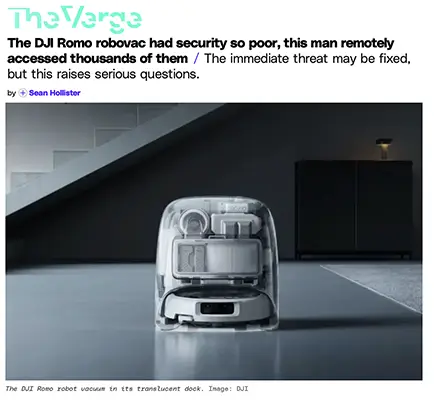

Closing: AI update for February 24, 2026
3-Paragraph Introduction (Visual Editor draft)
Artificial intelligence is now less a “new feature” and more a background system shaping markets, security, and everyday tools. This week’s stories show how quickly that shift is happening: Chinese open models are becoming global infrastructure, Cisco is re-wiring data centers for AI traffic, and companies like Airbnb are quietly rebuilding their products around AI-native search, planning, and support. At the same time, communications leaders are discovering that in a world flooded with AI-generated “slop,” clear, human storytelling is becoming more valuable, not less.
Alongside this infrastructure shift, governance and safety tensions are escalating. We see AI systems making cybercrime easier, powering new forms of surveillance, and enabling porn, deepfakes, and non-consensual imagery at scale. Regulators and coalitions are starting to push back: campaigns like “QuitGPT,” new standards for patient-facing AI communication, legal battles over voice rights, and mounting scrutiny of vendors whose business models lean on engagement rather than safety. The message for leaders is simple: you don’t just pick a model—you inherit its incentives, guardrails, and potential liabilities.
Finally, the human side of the AI transition is shifting fast. Universities are pivoting from traditional computer science toward AI-first majors, while enterprises experiment with “agentic” operations and AI copilots that already boost coding and knowledge work. At the same time, workers, patients, and citizens are asking for transparency, consent, and meaningful control—from how their data is remembered to where their image, voice, and neighborhood footage can be used. This week’s briefings are designed to help time-constrained executives see the signal through the noise: where AI is genuinely changing the economics of your business, where the risk surface is expanding, and where strong narrative and governance can keep you ahead of both hype and backlash.
Taken together, this week’s stories show AI moving deeper into infrastructure, security, governance, and culture—with real consequences for how you build, buy, and communicate. As you scan the summaries, ask not just “What’s possible?” but “What do we want to normalize in our products, workplaces, and communities—and what requires firmer guardrails before we scale it?”
All Summaries by ReadAboutAI.com
↑ Back to Top