
AI Updates February 26, 2026, Mid-Week Post
Over just a few days, the AI landscape has shifted again—less in splashy product launches and more in how deeply AI is being woven into infrastructure, workflows, and leadership decisions. In this mid-week brief, we’re tracking signals that matter for SMB executives and managers: AI agents moving from labs into everyday tools, cloud and chip investments reshaping costs and supply chains, and markets wrestling with how to price the next decade of AI build-out. The common thread across these stories is simple but consequential: AI is no longer a side experiment—it’s becoming part of the operating environment you manage.
Across the articles in this edition, we see three big arcs. First, the shift from chatbots to agents: tools that can plan, click, type, and act across HR, software development, customer service, and IT operations—alongside fresh warnings about reliability, security, and governance when “digital workers” can move as fast as your best staff and make mistakes just as fast. Second, the infrastructure crunch: hyperscaler capex, India’s $100B AI bet, and a global RAM shortage that is quietly raising device prices, delaying product cycles, and exposing the physical limits under all the cloud marketing. Third, the market and policy response: from investors repricing software and data-center risk, to regulators and platforms grappling with AI-generated music, post-mortem personas, and the environmental costs of scaled AI.
The final arc running through this week’s coverage is about trust and reputation. Patients still trust doctors more than AI for health guidance; corporate reputations are behaving like multi-trillion-dollar assets in a polarized, low-trust media environment; and Big Tech insiders themselves are questioning whether the AI transition has a credible plan for jobs, climate, and democracy. For SMBs, that combination—agentic tools, stressed infrastructure, volatile markets, and fragile trust—raises the bar on leadership. This brief is designed to help you quickly separate signal from noise, see where AI is genuinely changing the ground under your feet, and decide where to act now versus what to monitor over the next 6–12 months.
AI AGENTS ARE TAKING AMERICA BY STORM
THE ATLANTIC, FEB. 17, 2026
TL;DR / Key Takeaway: The article argues that we’ve entered a “post-chatbot” era where AI agents like Claude Code and Codex can operate computers, not just answer questions, raising both productivity hopes and serious reliability and safety concerns.
Executive Summary
The piece contrasts “mainstream AI,” where most people see ChatGPT, Google AI overviews, and low-quality generated content, with a rapidly expanding niche of tech workers using agentic tools that can work for hours on a computer. Tools like Claude Code can autonomously generate academic papers, prototype commercial software, and handle complex multi-step tasks from a single prompt—collapsing weeks of work into hours for early adopters. A new generation of models from Anthropic and OpenAI aims to make these agents more accessible and capable of navigating spreadsheets, enterprise apps, and entire desktops.
Agentic tools have been particularly transformative in software engineering, where AI may already be responsible for 30%–90% of new code at some organizations, with industry leaders predicting 95% by decade’s end. Some observers warn that this pattern will spill into other knowledge work, evoking the early COVID era as an analogy for a disruption that most people still don’t fully see coming. Yet the article also documents the limits and risks: agents that struggle with simple copy-and-paste tasks, tools that delete 15 years of family photos while trying to clean a desktop, and systems that can hallucinate or mis-handle basic operations.
The author closes by critiquing Silicon Valley’s communication strategy: while executives talk in extremes—from “curing all cancer” to “rogue AI wiping out humanity”—they’ve undersold the mundane but powerful reality of agents that automate coding, research, and spreadsheet work. The technology’s capabilities are racing ahead, but public understanding and governance are lagging.
Relevance for Business
For SMB executives, the claim to evaluate is that agentic AI is about to hit mainstream workflows much harder than chatbots did. In practice, that means:
- Certain roles (junior coding, research synthesis, report drafting) could see dramatic productivity gains and role redesign.
- Agents introduce new operational failure modes—from accidental data deletion to silent policy violations—because they can click, type, and move files like a human.
- The biggest risk may be under-reaction, not over-reaction: treating agents as “just better chatbots” rather than as semi-autonomous digital workers that need management, monitoring, and policy.
Calls to Action
🔹 Identify “agent-shaped” workflows: Look for repetitive, computer-bound tasks (report generation, data pulls, routine analysis) where agents could safely create leverage.
🔹 Pilot with guardrails, not blind trust: Start in sandboxed environments with backup copies of data, explicit approvals, and audit logs of what agents actually click and change.
🔹 Redesign roles, don’t just “add AI”: Treat agents as junior teammates; clarify what humans still own (judgment, exception handling, client communication).
🔹 Update incident-response plans: Include scenarios where an agent misconfigures systems, corrupts data, or pushes inaccurate information at scale.
🔹 Educate teams on capabilities and limits: Move beyond “AI writes emails” to a realistic understanding of what agents can and cannot be trusted to do today.
Summary by ReadAboutAI.com
https://www.theatlantic.com/technology/2026/02/post-chatbot-claude-code-ai-agents/686029/: February 26, 2026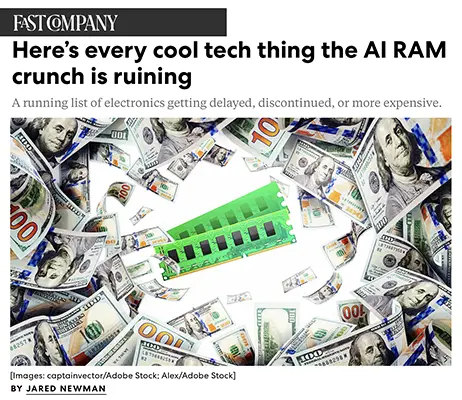
HERE’S EVERY COOL TECH THING THE AI RAM CRUNCH IS RUINING
FAST COMPANY, FEB. 20, 2026
TL;DR / Key Takeaway: A global DRAM shortage driven by AI data centers is already raising prices, delaying products, and shrinking specs for mainstream devices—and could last into 2028.
Executive Summary
The article explains that surging demand from AI data centers is consuming disproportionate amounts of DRAM,prompting the three dominant suppliers—Micron, Samsung, and SK Hynix—to prioritize server-grade memory over consumer RAM. As a result, memory supplies for PCs, phones, consoles, and hobbyist devices are tightening, with analysts warning the crunch could persist into 2028.
The piece catalogs real-world impacts across four buckets:
- Price hikes: Desktop RAM kits that cost ~$70 in mid-2025 now sell for over $300; Framework has raised RAM prices repeatedly; Raspberry Pi 5 with 16 GB jumped from $120 to $205; Steam Deck’s cheaper LCD version was discontinued, pushing the entry price higher; major PC OEMs (Lenovo, Dell, HP, Acer, Asus) expect 15–20% price increases; even phones and tablets from Xiaomi and others are more expensive.
- Delays: Valve has delayed its Steam Machine desktop and VR products; Sony is reportedly considering postponing the next PlayStation to 2028 or 2029; Nvidia may skip launching new gaming GPUs in 2026—its first such gap in decades.
- Disappearances & degradations: Some products are intermittently unavailable or cancelled, and research firm TrendForce expects new laptops and phones to ship with less memory than prior models (e.g., 4 GB phones, 8 GB baseline laptops) as an alternative to even steeper price hikes.
While big players like Apple and Lenovo can partially shield themselves through long-term contracts and stockpiling, smaller OEMs and consumers bear the brunt.
Relevance for Business
For SMBs, the core signal is that AI’s infrastructure appetite is now a real cost and supply risk for everyday hardware. Device refresh cycles, IT budgets, and even product launches that depend on affordable RAM may be disrupted. You don’t need to run large models yourself to feel the impact; it shows up as higher laptop prices, constrained specs, and fewer hardware options. This also hints at a future where AI-driven infrastructure shocks(chips, power, cooling, RAM) can ripple into seemingly unrelated parts of your tech stack.
Calls to Action
🔹 Review hardware refresh plans: Expect higher prices and potential spec reductions; adjust budgets and timelines for laptops, desktops, and edge devices.
🔹 Prioritize RAM where it matters: For critical roles (engineering, design, data), secure higher-spec machines early; for others, standardize on configurations that balance cost and longevity.
🔹 Extend device lifecycles where feasible: Invest in maintenance and upgrades (SSDs, batteries) to safely defer full replacements during the crunch.
🔹 Pressure vendors on transparency: Ask OEMs how they’re managing the RAM shortage and how long they expect elevated prices or reduced specs to last.
🔹 Track broader “AI externalities”: Add supply-chain and infrastructure knock-on effects (like RAM, GPUs, power) to your AI risk register, not just data and ethics.
Summary by ReadAboutAI.com
https://www.fastcompany.com/91495430/heres-every-cool-tech-thing-the-ai-ram-crunch-is-ruining: February 26, 2026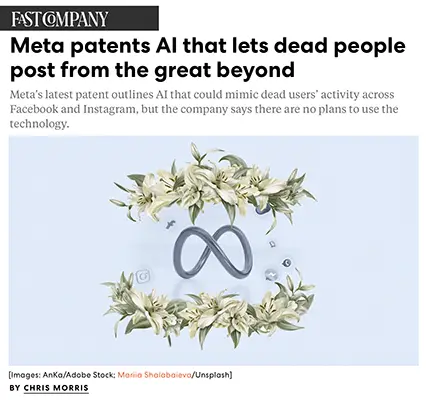
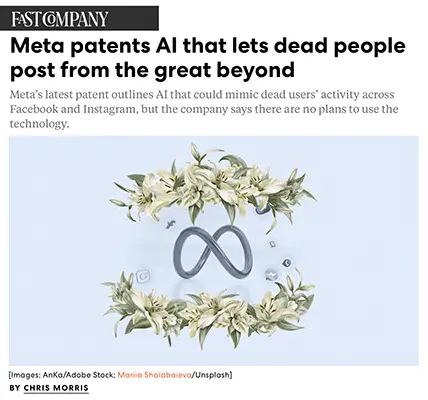
META PATENTS AI THAT LETS DEAD PEOPLE POST FROM THE GREAT BEYOND
FAST COMPANY, FEB. 17, 2026
TL;DR / Key Takeaway: Meta has patented AI that could simulate users’ online activity even after death, highlighting how quickly AI is pushing into post-mortem data, consent, and brand-safety gray zones—even if Meta says it has no current plans to deploy it.
Executive Summary
Meta’s new patent describes an AI system that can analyze “user-specific” data—posts, likes, comments, chats, even voice messages—to create a digital persona that continues engaging on Facebook, Instagram, and Threads when the person is inactive or deceased. The bot could post, comment, and even participate in chats or video calls, while labeling responses as simulations rather than posts from the actual human. Meta CTO Andrew Bosworth is listed as inventor; the patent was filed in 2023 and granted in late 2025. Meta says it has “no plans to move forward with this example,” but the patent formalizes the technical blueprint.
The article situates Meta’s move in a broader trend of “chatbots for the dead.” Microsoft previously patented similar technology, and startups such as Eternos and HereAfter AI already offer “digital twins” that loved ones can interact with after death. Meta has publicly floated this idea before—Mark Zuckerberg once suggested such tools might help with grief, while acknowledging that the tech could become “unhealthy.” The piece raises practical and ethical issues: private messages not meant for broader audiences, AI that lacks social filters, and a future where billions of dead profiles on platforms like Facebook might be reanimated as bots.
Relevance for Business
For SMB leaders, this is a warning flare about AI, identity, and consent. Even if you never build “after-death chatbots,” many organizations are quietly training models on highly personal customer or employee data. This patent underscores that just because AI can synthesize a persona doesn’t mean people want or consent to it, and missteps could trigger reputational damage, regulatory scrutiny, or lawsuits. It also hints at future marketing temptations—brands using AI to mimic departed founders, influencers, or customers. That might be powerful storytelling, but it’s also a high-risk brand-safety bet.
Calls to Action
🔹 Clarify data-usage boundaries: Explicitly define whether (and how) customer and employee data may be used to train generative models, particularly for persona-style features.
🔹 Design for consent and revocation: If you experiment with digital-twin or persona tools, build clear opt-in, opt-out, and “right to be forgotten” mechanisms from day one.
🔹 Treat post-mortem data as sensitive data: Add policies for what happens to accounts and training data when customers or employees die; avoid unilateral “resurrections.”
🔹 Stress-test brand scenarios: Ask your communications and legal teams to map best-case and worst-case headlines if your organization used similar technology.
🔹 Monitor regulators and standards bodies: Expect emerging guidance around AI impersonation, deepfakes, and post-mortem rights that will affect marketing and product design.
Summary by ReadAboutAI.com
https://www.fastcompany.com/91493794/meta-patents-ai-dead-people-posting: February 26, 2026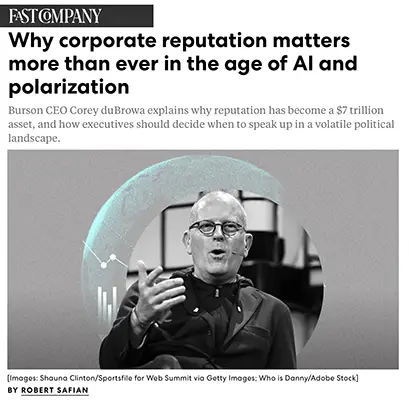
WHY CORPORATE REPUTATION MATTERS MORE THAN EVER IN THE AGE OF AI AND POLARIZATION
FAST COMPANY, FEB. 18, 2026
TL;DR / Key Takeaway: Burson CEO Corey duBrowa argues that in a world of AI disruption, political polarization, and collapsing trust in media, corporate reputation has become a $7 trillion asset—and that leaders must treat it as a managed portfolio of actions, not just a PR veneer.
Executive Summary
Corey duBrowa, longtime adviser to leaders at Salesforce and Google and now CEO of global communications firm Burson, describes a landscape defined by Trump’s second term, resurgent protectionism, deregulation, and a global right-wing shift—from Japan and France to the U.K. At the same time, AI is driving massive capital needs (he notes Google’s $30+ billion, 100-year bond deal) and amplifying misinformation at scale. Traditional media is shrinking and losing trust: Gallup data shows only 28% of U.S. adults trust mainstream media today, down from 72% in 1972, while 4 in 10 now get news from digital influencers. In this environment, company-controlled channels and leaders’ voices matter more—but also carry more risk.
Burson research presented at Davos quantifies “the reputation economy”: companies with strong reputations enjoy 4.78% unexpected additional shareholder returns, implying a roughly $7 trillion global asset tied to reputation. DuBrowa breaks reputation into eight levers—citizenship, creativity, governance, innovation, leadership, performance, products, and workplace—and stresses that each firm must decide which levers to pull and how hard. He warns that “citizenship” actions—taking stands on social or political issues—can energize employees while alienating customers or regulators, especially in today’s polarized climate. Leaders must recognize that “actions come before communications”: you earn the right to speak by what you actually do, not by statements alone.
Relevance for Business
For SMB executives, the claim is that reputation is now a measurable financial asset under unusual stress from AI and politics. That means decisions about AI deployment, public stances, and even which channels you use (traditional media vs. influencers vs. owned content) can have outsized impact on valuation, hiring, and customer loyalty. In an AI-saturated information space, missteps travel faster, but so can credible, consistent behavior. Treating reputation as a managed portfolio of levers—not just “good PR”—is becoming a core leadership responsibility.
Calls to Action
🔹 Quantify reputation in board language: Include reputation metrics (e.g., NPS, trust scores, media sentiment, employee engagement) alongside financial KPIs, and link them to shareholder value.
🔹 Map your eight levers: Decide which of citizenship, creativity, governance, innovation, leadership, performance, products, and workplace truly differentiate your company—and invest accordingly.
🔹 Align AI behavior with stated values: Ensure your AI use (automation, surveillance, data training) matches your public claims on ethics, privacy, and jobs; gaps will be punished.
🔹 Treat owned media as strategic infrastructure: Build credible company content channels (newsletters, podcasts, exec blogs) to reduce dependence on low-trust intermediaries.
🔹 Be selective but decisive on public stances: Create a decision framework for when to speak on social or political issues, grounded in your business, stakeholders, and actual actions.
Summary by ReadAboutAI.com
https://www.fastcompany.com/91493985/why-corporate-reputation-matters-more-than-ever-in-the-age-of-ai-and-polarization: February 26, 2026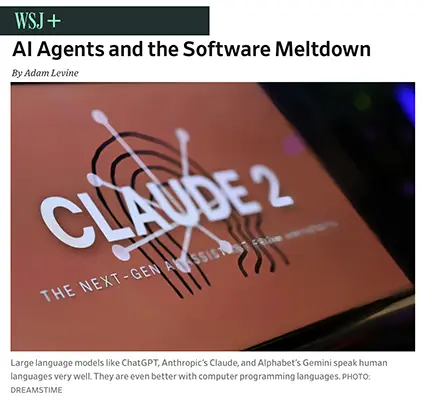
AI AGENTS AND THE SOFTWARE MELTDOWN
BARRON’S / WSJ, FEB. 19, 2026
TL;DR / Key Takeaway: Markets are rewarding chips and punishing software on the theory that AI agents will flood the world with cheap code and automated workflows—but the article argues the “software apocalypse” is more narrative than settled outcome.
Executive Summary
The piece links two 2026 market stories: a 190% surge in semiconductor ETFs since ChatGPT’s launch and a sharp selloff in software and information-services stocks. Investors are betting that hyperscaler AI capex—hundreds of billions of dollars in data centers—will keep chip demand booming while AI coding agents undercut traditional software vendors. Early casualties such as Chegg (down 98% since late 2022) fuel a “who’s next?” narrative that has pushed valuations of large software names like Salesforce to historic P/E lows.
The article attributes much of this fear to agentic coding tools. Claude Code and similar systems now string together LLMs as agents that can plan and execute complex development tasks. Developers report acting more like “conductors of an orchestra of coding agents”, with multiple bots building different application components in parallel, vastly accelerating the pace of software creation.
Experimental desktop agents like OpenClaw extend this to broader knowledge work, but they also introduce serious security risks, since they work best when given wide access to data, credentials, and systems. Security firms are already building tools to detect and disable such agents on corporate devices, and even OpenClaw’s own admirers warn that “it’s only useful when it’s dangerous.”
The author ultimately argues that markets are over-pricing the downside: software isn’t disappearing, but the definition of software is shifting as we move from click-based apps to prompt-driven agents. In the short term, however, the narrative of a software meltdown is what moves prices, regardless of fundamentals.
Relevance for Business
For SMB leaders, the key signal isn’t ETF performance; it’s that AI agents are starting to rewrite how software is built and used. That means you’ll see:
- Faster feature cycles and more experimental products.
- New security exposures when “agentic” tools are installed informally by staff.
- Pricing and licensing models that assume automation replaces more of your team’s work.
The claim that “software is dead” is exaggerated, but software roles, vendor landscapes, and security assumptions are clearly in motion.
Calls to Action
🔹 Audit where agents already exist: Identify any use of tools like Claude Code, OpenClaw-style agents, or local desktop agents on company devices and document data-access levels.
🔹 Treat agents as privileged users: Update security policies so agents are modeled like powerful service accounts—limited rights, strong monitoring, and revocation paths.
🔹 Renegotiate software value, not just price: As vendors embed agents, ask explicitly what manual work is reduced and how success will be measured.
🔹 Plan for faster software churn: Expect more frequent tool changes and shorter product life cycles; build processes that can tolerate switching costs.
🔹 Watch the narrative, not just the numbers: Use market pessimism as a signal to probe vendors’ roadmaps—who is adapting to agents vs. hoping the storm passes.
Summary by ReadAboutAI.com
https://www.barrons.com/articles/ai-agents-software-meltdown-a9f9e2c7: February 26, 2026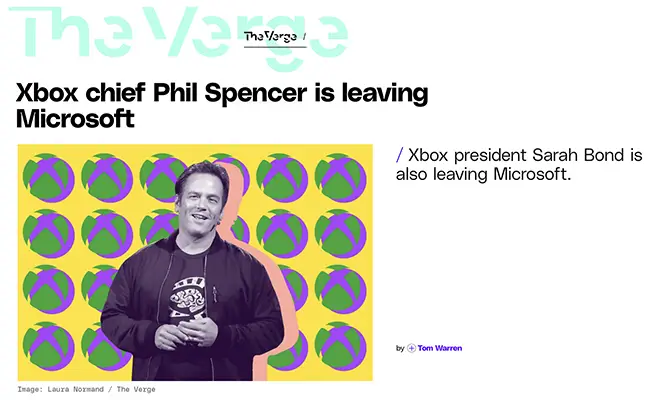
XBOX CHIEF PHIL SPENCER IS LEAVING MICROSOFT
THE VERGE, FEB. 20, 2026
TL;DR / Key Takeaway: After nearly 40 years at Microsoft, Xbox chief Phil Spencer and Xbox president Sarah Bond are departing, and CoreAI product president Asha Sharma will become Microsoft Gaming CEO—a leadership shift that tightens the link between AI platform strategy and gaming.
Executive Summary
Microsoft CEO Satya Nadella announced that Phil Spencer, head of Xbox and Microsoft Gaming, will retire after almost four decades at the company, including 12 years leading the gaming division. Spencer will remain in an advisory role through the summer. Xbox president Sarah Bond is also leaving “to begin a new chapter.”
Asha Sharma, currently president of CoreAI product, will take over as CEO of Microsoft Gaming. She previously held roles at Microsoft, then served as VP of product and engineering at Meta and COO at Instacart before returning to Microsoft in 2024 to work on AI platform efforts. Nadella highlights her experience in building and growing platforms, aligning business models to long-term value, and operating at global scale. In her memo, Sharma commits to three priorities: great games, the return of Xbox, and the future of play, with an explicit pledge to “recommit to our core Xbox fans and players” and to celebrate Xbox’s roots starting with console.
Spencer’s memo notes he decided to retire in fall 2025 and frames Xbox as a “vibrant community” that deserves a thoughtful, deliberate transition. The article reminds readers that Spencer has been central to major Xbox milestones—from launching the Xbox Series X/S and Game Pass to driving acquisitions like Mojang, ZeniMax, and Activision Blizzard.
Relevance for Business
For SMB leaders, this is less about console wars and more about how AI and platform talent are moving into consumer businesses. Putting a CoreAI product leader in charge of Microsoft Gaming suggests deeper integration of AI into gaming experiences, discovery, and business models. It also shows how succession planning is being used to blend domain expertise (gaming) with AI platform expertise at the top of P&L-owning units—an approach many non-tech sectors may mirror as AI becomes central to product strategy.
Calls to Action
🔹 Examine your own succession pipeline: Are future business-unit leaders conversant in AI strategy, not just domain operations? If not, begin building that bench.
🔹 Consider where AI-platform talent belongs: As AI shifts from support function to product core, revisit whether AI leaders should hold P&L responsibility in key units.
🔹 Anticipate AI-driven shifts in customer expectations: Gaming often foreshadows mainstream UX; watch how Microsoft combines AI with subscriptions, personalization, and cross-device play.
🔹 Review strategic partnerships with platform giants: Leadership transitions at key vendors (Microsoft, Sony, etc.) can change roadmaps and partner priorities; ensure your agreements and dependencies are still aligned.
🔹 Use this as a prompt for governance: Tie major AI and platform decisions to clear ownership at the executive level, rather than scattering responsibility across multiple teams.
Summary by ReadAboutAI.com
https://www.theverge.com/news/882241/microsoft-phil-spencer-xbox-leaving-retirement: February 26, 2026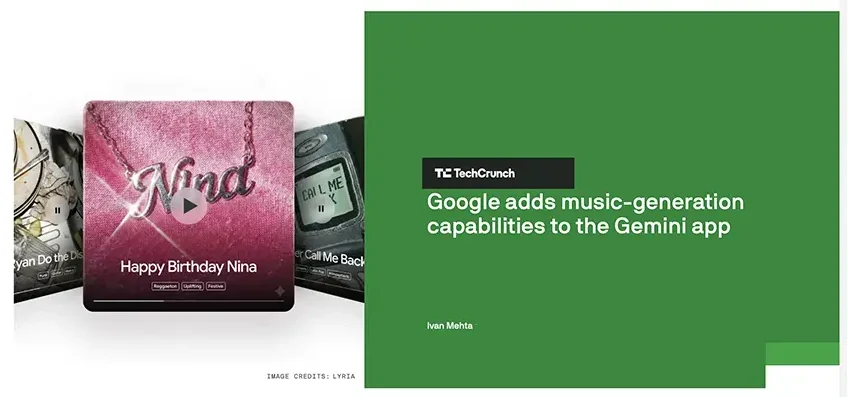
GOOGLE ADDS MUSIC-GENERATION CAPABILITIES TO THE GEMINI APP
TECHCRUNCH, FEB. 18, 2026
TL;DR / Key Takeaway: Google is rolling out Lyria 3–powered music generation inside Gemini and YouTube, expanding AI music tools globally while trying to manage copyright, artist-mimicry, and provenance risks through filters and watermarking.
Executive Summary
Google is adding a beta music-generation feature to the Gemini app, powered by DeepMind’s Lyria 3 model. Users type a natural-language prompt—such as a “comical R&B slow jam about a sock finding its match”—and Gemini generates a 30-second track with lyrics and custom cover art. Users can also upload a photo or video and have the system create a song that matches the media’s mood. The feature supports eight languages and lets users control style, vocals, and tempo, extending AI music from niche tools into a mainstream assistant app.
Lyria 3 is also being exposed via YouTube’s Dream Track, previously U.S.-only but now expanding globally so creators can generate AI tracks linked to their videos. To reduce direct impersonation risk, Google says the system is “designed for original expression, not for mimicking existing artists”; if a user names an artist, Gemini treats it as broad inspiration, and outputs are run through filters that check against existing content. All Lyria 3 songs include a SynthID watermark, and Gemini can analyze uploaded tracks to indicate whether they are AI-generated. This positions Google on the more cautious end of AI music rollouts amid ongoing copyright lawsuits and industry tension.
Relevance for Business
For SMBs in marketing, media, events, and creator-led businesses, this moves AI music from experimental to off-the-shelf content infrastructure. It makes it cheap and fast to create background tracks, jingles, or campaign-specific audio without commissioning custom work. But it also increases the risk of brand collisions (tracks that sound uncomfortably like famous artists), as well as questions about who owns the music, how it can be licensed, and how audiences and regulators will react. The watermarking and detection features signal that AI music will likely be traceable, which could cut both ways for brands using it heavily.
Calls to Action
🔹 Decide your AI-music stance now: Clarify whether and where your brand is comfortable using AI-generated music (ads, internal training, events, social content).
🔹 Bake provenance into workflows: Keep records of which assets are human-composed vs. AI-generated, and ensure agencies do the same—especially if you later need to prove origin.
🔹 Check contracts and licenses: Review agreements with composers, labels, and platforms to ensure AI-generated music use doesn’t violate exclusivity or moral-rights clauses.
🔹 Avoid “sound-alike” risk: Direct teams to avoid prompts referencing specific artists or iconic songs; prioritize mood- or genre-based prompts instead.
🔹 Monitor legal and platform policy changes: Track evolving case law and platform rules around monetizing and distributing AI music, especially for campaigns reaching YouTube and streaming platforms.
Summary by ReadAboutAI.com
https://techcrunch.com/2026/02/18/google-adds-music-generation-capabilities-to-the-gemini-app/: February 26, 2026
5 PILLARS OF AN AGENTIC AI STRATEGY
TECHTARGET, FEB. 18, 2026
TL;DR / Key Takeaway: TechTarget outlines a five-part playbook for CIOs facing agentic AI—use cases, data, infrastructure, vendors, governance—arguing that agents should be treated as digital workers, not just smarter software.
Executive Summary
As AI moves beyond copilots into agentic systems that can plan, decide, and act across multiple applications, CIOs must rethink how they design and govern technology. Unlike copilots, which suggest content and require frequent human input, agentic AI can execute entire workflows with minimal supervision, raising new questions about risk, cost, and architecture. Analyst Manish Jain predicts that “in the next three years, there will be more agents than employees globally,” underscoring the urgency of strategy.
The article proposes five pillars:
- Identify use cases: Start with narrow, repeatable workflows where agents can operate under strong controls—e.g., service desks, budget reconciliations, patch orchestration. Wide, variable “horizontal” use cases with complex decisions are risky given current reasoning limits.
- Assess data readiness: Map the data each use case needs and ensure it’s accurate, accessible, and structured; without this, agents will make unreliable decisions.
- Plan infrastructure: Agents place sustained load on memory, storage, and networking because they must persist context across long workflows; treating them like ordinary apps leads to performance issues and rising costs.
- Decide on vendors: Only organizations with major datasets and budgets should build their own models; most should buy agentic tools aligned with strategy, while keeping an inventory of all agents and their access.
- Establish governance: Inventory agents, define boundaries, control access, and ensure human supervision. Jain urges leaders to “treat [agents] as a digital worker,” while Phison CTO Sebastien Jean warns that agents lack common sense and can follow instructions to absurd, costly ends (like ordering 10,000 useless pencils).
Examples include retail donation sorting, financial-product renewals, payroll compliance, and threat detection—areas where tightly scoped agents already deliver value.
Relevance for Business
For SMB executives, this framework translates into a simple message: agentic AI is about changing how work gets done, not just adding a smarter UI. Poorly scoped or governed agents can quietly make bad decisions or access sensitive data, while well-designed ones can automate repetitive, rules-based tasks at scale. Treating agents as digital employees with roles, permissions, and supervision is a practical way to integrate them without losing control.
Calls to Action
🔹 Pick 1–3 pilot workflows: Look for repeatable, bounded tasks (e.g., invoice triage, IT ticket routing, renewals) and explicitly define success metrics and guardrails.
🔹 Do a data-readiness check: For each pilot, confirm that required data is accurate, accessible, and governed; fix gaps before deploying agents.
🔹 Plan for persistence and scale: Work with IT to ensure infrastructure (memory, storage, observability) can handle long-running, multi-step agent workflows.
🔹 Inventory all agents: Track every agent in use—vendor-supplied or employee-created—along with owners, permissions, and connected systems.
🔹 Write “agent job descriptions”: Document what each agent can and cannot do, who supervises it, and how exceptions are escalated, mirroring how you manage human staff.
Summary by ReadAboutAI.com
https://www.techtarget.com/searchcio/feature/Pillars-of-an-agentic-AI-strategy#: February 26, 2026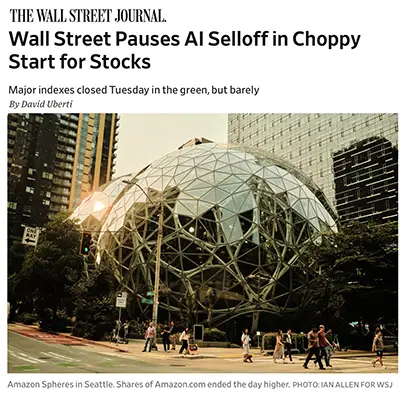
WALL STREET PAUSES AI SELLOFF IN CHOPPY START FOR STOCKS
WSJ, FEB. 17, 2026
TL;DR / Key Takeaway: After weeks of volatility and worries that the AI trade has run its course, major indexes eked out small gains as investors tentatively buy dips in AI-exposed names like Nvidia and Amazon—underscoring an unresolved tug-of-war over AI’s near-term value.
Executive Summary
The article describes a choppy trading day where AI-linked stocks initially dropped sharply, pushing a Magnificent Seven ETF toward its lowest close since September, before rebounding into modest gains. Nvidia and Amazon, bellwethers for the AI theme, both closed higher, helping the S&P 500, Nasdaq, and Dow each finish up about 0.1%. The piece frames this as a “pause” in a broader selloff where investors oscillate between concerns that AI is over-hyped and fears that AI will disrupt entire industries from software to trucking.
The broader macro context remains murky. A recent rally in U.S. government debt has stalled, the 10-year Treasury is hovering around 4.05%, and Fed officials are signaling that rates may stay steady “for some time” as they weigh a low-hire, low-fire labor market against ongoing inflation. Other sector stories—cruise lines jumping on activist interest, consumer staples sliding on stressed shoppers—round out a picture of a market searching for direction. AI remains a central but contested narrative, with some strategists viewing the volatility as a buying opportunity and others warning of lingering downside.
Relevance for Business
For SMB executives, this article reinforces that financial markets are still debating AI’s timing and magnitude, even as spending and product launches continue. Practically, that means:
- Lenders, investors, and boards may ask tougher questions about AI project ROI before approving budgets.
- The cost of capital (interest rates, risk premiums) may stay higher for longer, making disciplined AI investmentsmore attractive than broad “innovation spend.”
- Vendor behavior can be shaped by this volatility—some may discount aggressively to keep growth narratives alive; others may tighten pricing to protect margins.
Calls to Action
🔹 Frame AI initiatives in financial language: Be ready to discuss payback periods, cash-flow impacts, and risk scenarios for AI projects with boards, lenders, and investors.
🔹 Prioritize resilient use cases: Focus on AI applications tied to cost reduction, risk management, or core revenue rather than speculative bets that are hard to justify in choppy markets.
🔹 Use vendor volatility to your advantage: Monitor financial health and stock-driven pressure on key AI suppliers; you may have leverage in contract renewals or pilots.
🔹 Avoid timing the “AI trade”: Make technology decisions based on business needs and multi-year strategy, not short-term market sentiment.
🔹 Communicate steady, not splashy, progress: In updates to stakeholders, emphasize measured experimentation and learning over big, binary bets.
Summary by ReadAboutAI.com
https://www.wsj.com/finance/stocks/global-stocks-markets-dow-news-02-17-2026-a8663bbe: February 26, 2026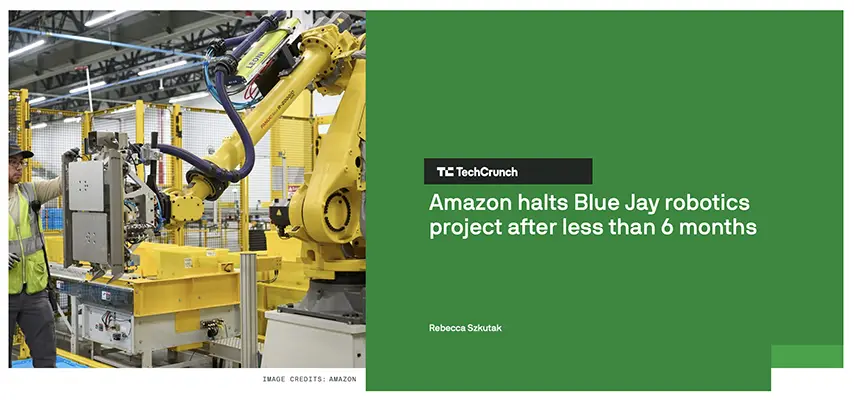
Amazon Halts Blue Jay Robotics Project After Less Than 6 Months
TechCrunch, Feb. 18, 2026
TL;DR / Key Takeaway: Amazon quietly killed its fast-developed Blue Jay warehouse robot prototype within six months, but is reusing the underlying tech—highlighting how rapid AI-driven experimentation also means rapid product churn in robotics.
Executive Summary
Amazon has shelved Blue Jay, a multi-armed warehouse robot designed to sort and move packages in same-day delivery facilities, less than six months after unveiling it. Blue Jay was touted as a showcase for how advances in AI allowed Amazon to cut development time down to about a year—far faster than previous warehouse robots. The company now describes Blue Jay as a prototype, emphasizing that its core “manipulation” technologies will be repurposed across other robotics programs, while affected employees are reassigned.
The article situates Blue Jay within a broader robotics portfolio that includes Vulcan, a two-armed robot that can “feel” objects as it rearranges storage compartments, and notes that Amazon passed 1 million robots in its warehouses in 2025. The cancellation underscores that even highly resourced players treat AI-robotics deployments as experimental, iterative bets, not guaranteed rollouts—especially in complex, safety-critical environments like logistics.
Relevance for Business
For SMBs watching warehouse and logistics automation, this is a reminder that headline-grabbing robots may never reach stable, affordable form factors. AI accelerates prototyping but doesn’t eliminate integration, safety, and ROI hurdles. Vendors may pivot quickly, leaving customers with stranded pilots or partially supported systems. The more sophisticated the manipulation task (e.g., handling varied packages), the higher the risk that real-world complexity outpaces early demos.
Calls to Action
🔹 Treat new robotics as pilots, not foregone conclusions: Structure contracts and internal expectations assuming some projects will be cancelled or radically altered.
🔹 Prioritize modularity and retrainable systems: Favor solutions where software, grippers, and workflows can be repurposed if a specific robot line is sunset.
🔹 Scrutinize vendor roadmaps and support commitments: Ask explicitly how long a given platform is expected to be supported and what happens if it’s discontinued.
🔹 Benchmark against your current baseline: Compare failure modes, downtime, and injury rates against existing processes; don’t assume “more AI” automatically means safer or cheaper.
🔹 Monitor Amazon as a bellwether: Their moves in robotics often foreshadow what will become economically viable for smaller players over the next 3–5 years.
Summary by ReadAboutAI.com
https://techcrunch.com/2026/02/18/amazon-halts-blue-jay-robotics-project-after-less-than-six-months/: February 26, 2026
This Could Be the Year AI Automation Takes Over HR
TechTarget, Jan. 21, 2026
TL;DR / Key Takeaway: HR is moving from scattered “citizen AI” experiments to top-down, agentic AI automation of entire HR workflows, but most organizations lack the strategy, architecture, and skills to do this safely and effectively.
Executive Summary
The article argues that 2026 could mark a tipping point where organizations train and deploy AI agents to run end-to-end HR processes—from recruiting and onboarding to payroll changes—rather than just using generative AI as a personal productivity tool. Analyst Josh Bersin identifies 94 common HR capabilities that can be mapped to ~120 AI agents and ultimately consolidated into about 10 “super agents” capable of autonomously executing complex HR tasks. This shift demands a top-down, architectural approach instead of today’s ad-hoc, bottom-up experimentation by individual teams.
But the piece also surfaces execution gaps. Many CHROs are still in early pilot stages, and Gartner data show that while 64% of HR leaders see productivity gains from AI, only 25% report meaningful cost reductions, suggesting automation is often applied to low-value tasks. Interoperability remains a major barrier: multi-agent systems can’t yet reliably coordinate across platforms and departments, and emerging standards like Model Context Protocol (MCP) and agent-to-agent (A2A) communication are still immature. The article stresses that agent integration and workflow redesign—not just tooling—will determine whether HR automation delivers real value or fragmented risk.
Relevance for Business
For SMBs, HR is one of the highest-leverage entry points for practical AI: onboarding, PTO changes, policy questions, and basic recruiting workflows are repetitive, rules-driven, and often under-resourced. However, delegating too quickly to agents without governance can create bias, compliance, and employee-trust problems—especially in hiring and performance management. The key message is that AI-driven HR transformation is becoming table stakes, but it must be led as a business and culture project, not just an IT experiment.
Calls to Action
🔹 Create a clear HR-AI roadmap: Define which HR processes are candidates for automation in 2026–2027, and which must remain human-led due to sensitivity or regulation.
🔹 Start with workflow mapping, not tools: Document current HR workflows, decision points, and exceptions before inserting agents; otherwise, you risk automating broken processes.
🔹 Invest in AI literacy for HR leadership: Ensure CHROs and HR managers understand agentic AI concepts well enough to ask the right questions of vendors and internal teams.
🔹 Pilot “super agents” in low-risk domains: For example, benefits FAQs or internal policy guidance—monitor for accuracy, bias, and escalation behavior before touching hiring or termination.
🔹 Plan for cross-system integration: As standards like MCP/A2A mature, keep your HR stack flexible so agents can eventually coordinate across HR, finance, and IT without brittle custom glue.
Summary by ReadAboutAI.com
https://www.techtarget.com/searchhrsoftware/feature/This-could-be-the-year-AI-automation-takes-over-HR: February 26, 2026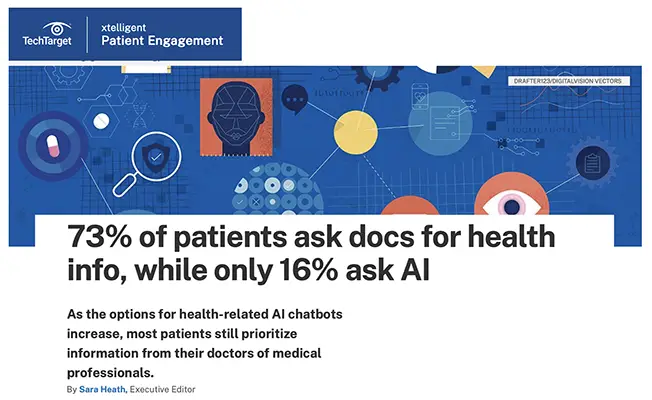
73% of Patients Ask Docs for Health Info, While Only 16% Ask AI
TechTarget, Feb. 18, 2026
TL;DR / Key Takeaway: Despite a wave of new health-specific AI chatbots, patients still overwhelmingly trust doctors and authoritative medical sites over AI tools, with chatbots used mainly by self-navigating, higher-risk patients.
Executive Summary
Gallup survey data show that 73% of U.S. adults go first to their doctors or other medical professionals for health information, while just 16% consult AI chatbots—even as tools like ChatGPT Healthcare, Claude for Healthcare, and Amazon One Medical’s assistant roll out. Over half of respondents also rely on medical websites from hospitals or public health agencies, reinforcing that human clinicians and institution-backed content remain the primary “source of truth.”
The research identifies two notable subgroups: “Health Media Oriented” consumers, who layer books, podcasts, social media, and TV health segments on top of professional advice, and “Health Self-Navigators,” who are far more likely to use AI chatbots, non-medical websites, and advice from non-professional friends and family. Even among these self-navigators, however, 74% still consult a doctor, underscoring that AI is currently an adjunct, not a replacement, in patient information journeys.
Relevance for Business
For SMB leaders in healthcare, insurance, and health-adjacent services, the signal is clear: trust is still anchored in human expertise, and AI tools will gain adoption fastest when they extend clinician reach rather than appear to compete with it. For non-healthcare SMBs building wellness programs or health-related content, assuming “everyone will just ask AI” is premature. The more vulnerable and self-directed “Health Self-Navigator” segment is also where misinformation and liability risks concentrate—particularly if your brand is seen as encouraging unsupervised AI health advice.
Calls to Action
🔹 Position AI as a co-pilot, not a doctor: Frame any health-related chatbot or content as supporting clinicians or directing patients to care—not making final diagnoses.
🔹 Anchor tools in authoritative sources: Where possible, ground AI outputs in guidelines from recognized institutions (CDC, WHO, major hospitals) and make that provenance visible.
🔹 Map your audience segments: Identify whether your customers skew toward “media-oriented” or “self-navigator” behaviors and adjust safeguards, disclaimers, and escalation paths.
🔹 Tighten legal and UX guardrails: Ensure chatbots clearly signal limits (“not a substitute for professional care”) and make escalation to humans friction-free.
🔹 Monitor regulatory guidance on AI in health communication: Expect evolving standards on what constitutes safe vs. misleading use of AI for health information.
Summary by ReadAboutAI.com
https://www.techtarget.com/patientengagement/news/366639235/73-of-patients-ask-docs-for-health-info-while-only-16-ask-AI: February 26, 2026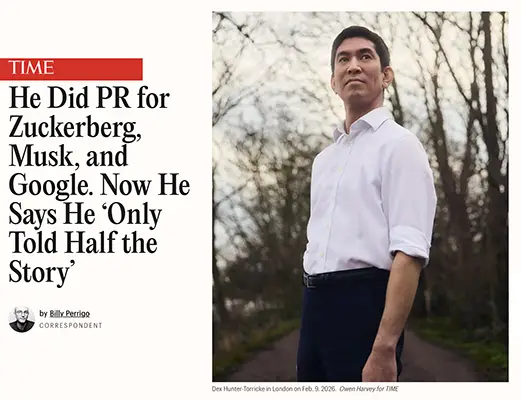
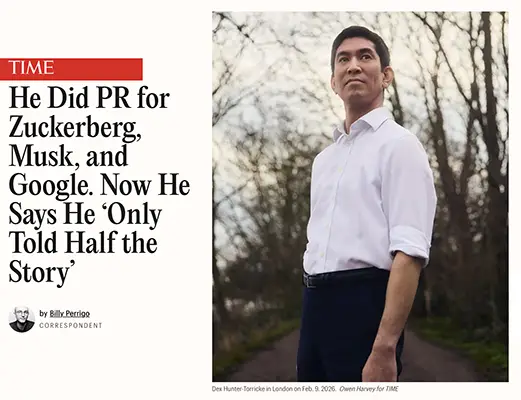
He Did PR for Zuckerberg, Musk, and Google. Now He Says He ‘Only Told Half the Story.’
TIME, Feb. 17, 2026
TL;DR / Key Takeaway: A former senior tech communications insider now argues that Big Tech has no credible plan for AI’s economic, geopolitical, and environmental fallout, and that previous public narratives “only told half the story.”
Executive Summary
Dex Hunter-Torricke, who spent 15 years shaping public narratives for Meta’s Mark Zuckerberg, Elon Musk’s SpaceX, and Google DeepMind, has publicly broken with Big Tech, saying the industry is “sleepwalking into disaster” on advanced AI. He argues that leaders highlight AI’s upside—innovation, medical breakthroughs, economic growth—while systematically downplaying risks like mass job displacement, democratic erosion, climate impact, and extreme concentration of power. In his view, there is “no plan” for managing the transition to far more powerful AI systems beyond vague optimism and non-binding safety pledges.
Hunter-Torricke describes the 2023 U.K. AI Safety Summit at Bletchley Park as a missed opportunity that focused on speculative technical risks instead of the concrete societal disruptions already emerging. He criticizes both governments, for failing to grasp the stakes, and tech firms, for lobbying against meaningful regulation while using uplifting mission statements as a “veil” for hard power and profit. Now launching his nonprofit, the Center for Tomorrow, he wants to build a global movement challenging Big Tech’s control over AI’s direction—though he acknowledges skepticism about his own role as a former insider bound by NDAs and complicit in earlier narratives.
Relevance for Business
For SMB executives, this piece is less about individual companies and more about narrative risk: the stories your vendors, platforms, and partners tell about AI may be strategically incomplete. If frontier AI leaders themselves lack a serious plan for jobs, inequality, and climate impact, downstream businesses that simply “trust the ecosystem” risk getting caught in policy whiplash, higher compliance costs, and reputation blowback. The article reinforces the need for independent risk assessment, not just adopting whatever tools, roadmaps, or talking points come from Big Tech.
Calls to Action
🔹 Interrogate vendor narratives: When evaluating AI platforms, explicitly ask how they see AI affecting jobs, regulation, and climate over the next 3–5 years—and what concrete safeguards they have in place.
🔹 Build your own AI impact plan: Don’t assume national regulators or major platforms will “handle” the transition. Develop internal scenarios for workforce, data governance, and environmental impact.
🔹 Diversify dependencies: Avoid over-reliance on a single frontier vendor; design architectures and contracts that allow you to pivot if policy, economics, or public sentiment turns.
🔹 Add narrative risk to your risk register: Track where your marketing, HR, and investor messaging may be echoing overly optimistic claims about AI that could age poorly.
🔹 Monitor civic and regulatory movements: Organizations like the Center for Tomorrow signal a growing political pushback; expect more scrutiny on AI-driven cost cutting, surveillance, and labor practices.
Summary by ReadAboutAI.com
https://time.com/7378739/dex-hunter-torricke-tech-ai/: February 26, 2026
AI Spending Fears May Be Overdone as the Tech Selloff Reshapes the Market
Barron’s, Feb. 17, 2026
TL;DR / Key Takeaway: Markets are punishing AI-exposed tech stocks amid fears of over-spending on data centers and chips, but some analysts argue this selloff may actually validate AI’s long-term build-out and create mispriced opportunities.
Executive Summary
The article frames the recent pullback in U.S. equities as driven largely by anxiety over massive AI capital expenditures and disruption risk. Investors are rotating out of software and other AI-sensitive names and into “real-economy” sectors like energy and materials, while also shifting more capital overseas. At the center of the concern: the “Big Four” hyperscalers—Microsoft, Alphabet, Amazon, and Meta—have committed around $650 billion in data-center capex for 2026, roughly 60% higher than 2025, fueling fears of balance-sheet strain and an AI bubble.
Yet analysts like BlackRock’s Jean Boivin argue that the market’s effort to separate AI winners from losers may actually reinforce, not undermine, the AI build-out, by directing capital toward firms with proprietary data, mission-critical workflows, and sticky customer relationships. Software ETFs are in a bear market and many quality names are down ~30% from peaks, suggesting potential “baby-with-the-bathwater” mispricing. The article notes that volatility (VIX) is up and sentiment has clearly shifted, but some strategists see this as late-cycle bull-market rotation rather than the end of the run.
Relevance for Business
For SMB executives, this is less about trading strategy and more about interpreting market noise around AI. Elevated capex by hyperscalers signals that infrastructure for AI is likely to keep expanding, which can mean improving performance and falling unit costs over time—even if individual stocks whipsaw. At the same time, the scrutiny on AI ROI will ripple downstream: customers will face tougher procurement questions, more price discrimination, and potentially tighter credit conditions for AI-heavy projects if lenders internalize bubble risk. This environment rewards disciplined, use-case-driven AI adoption over vague “innovation spending.”
Calls to Action
🔹 Focus on business cases, not hype cycles: Use market volatility as a reminder to prioritize AI projects with measurable ROI, clear owners, and time-boxed pilots.
🔹 Stress-test your AI cost assumptions: Ask how your budget holds up if cloud and GPU prices fall slower than expected—or if vendors introduce new usage-based fees.
🔹 Diversify vendor exposure: Avoid locking into a single hyperscaler if multi-cloud or abstraction layers are feasible; pricing and capabilities may diverge as capex pressures mount.
🔹 Align with “mission-critical” patterns: Where possible, design AI initiatives that integrate into core workflows and proprietary data, mirroring the traits analysts see in durable software winners.
🔹 Communicate prudence to stakeholders: Make it explicit in board and investor communications that your AI strategy is paced, cash-disciplined, and benchmarked against alternatives.
Summary by ReadAboutAI.com
https://www.barrons.com/articles/ai-spending-fears-tech-selloff-452b5ede: February 26, 2026
INDIA’S ADANI GROUP TO INVEST $100 BILLION IN AI INFRASTRUCTURE
WSJ, FEB. 17, 2026
TL;DR / Key Takeaway: India’s Adani Group plans to spend $100 billion on AI-focused data centers by 2035, positioning India as a major AI infrastructure hub—but also intensifying energy and water-use pressures in an already resource-constrained country.
Executive Summary
Adani, a conglomerate spanning energy and logistics, has announced a $100 billion investment plan to build large-scale data centers through 2035, the largest such commitment in India to date. The move aligns with New Delhi’s goal of becoming a global AI leader and giving emerging economies more voice in the AI landscape. The dedicated compute capacity is meant to support India-centric large language models and keep Indian data stored locally, reinforcing data-sovereignty and digital-economy ambitions.
Adani says the build-out will leverage partnerships with Google and Microsoft and expand its data-center portfolio from an already-planned 2 gigawatts to 5 gigawatts. The group will also deepen collaboration with Walmart-owned Flipkart via a second AI data center for e-commerce workloads. Meanwhile, global tech giants such as Google and Microsoft are separately committing tens of billions to Indian cloud and AI infrastructure, making India one of the hottest AI markets for U.S. platforms.
The article flags critical sustainability and infrastructure concerns. AI-heavy data centers require massive, continuous power and significant water for cooling, in a country already facing erratic water supplies and rising heat stress. While India has ramped up renewables, data centers often rely on coal-based power to ensure round-the-clock availability. Adani claims it can deliver “competitively priced, carbon-neutral power” by tying the new centers to large solar and wind projects, but the tension between AI growth and environmental constraints remains unresolved.
Relevance for Business
For SMB executives, this signals that AI infrastructure is globalizing, with India emerging as a major regional hub for compute, cloud services, and AI-enabled outsourcing. That could mean more options and better pricing for AI workloads, particularly for firms leveraging Indian IT partners, but also policy and ESG scrutiny over where and how their AI workloads are powered. As AI becomes more energy-intensive, customers may face growing pressure—from regulators, investors, and employees—to account for the carbon and water footprint of their digital operations.
Calls to Action
🔹 Map your AI supply chain: Identify where your cloud regions and data centers are located today, and whether Indian infrastructure plays a role (directly or via vendors).
🔹 Incorporate ESG into AI procurement: Ask providers about energy sources, water use, and mitigation plans for AI-intensive workloads; factor this into vendor selection.
🔹 Plan for data-sovereignty requirements: If you operate in or serve India, understand how local-data rules and India-specific LLMs may affect where you can store and process data.
🔹 Explore India-based partnerships thoughtfully: Evaluate Indian partners for both cost and resilience, including their dependence on large conglomerates such as Adani.
🔹 Communicate your stance on “green AI”: Consider adding AI-related energy and sustainability metrics to ESG reporting and board discussions.
Summary by ReadAboutAI.com
https://www.wsj.com/tech/indias-adani-group-to-invest-100-billion-on-ai-infrastructure-7d428962: February 26, 2026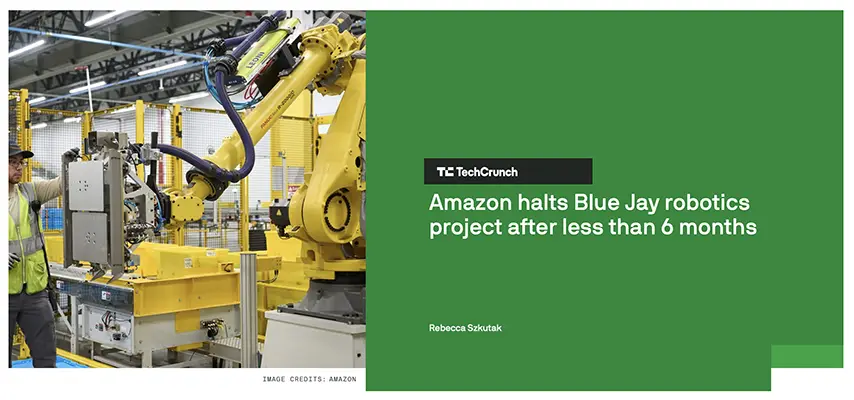
Closing: AI Mid-Week update for February 26, 2026
Taken together, these developments suggest that AI is becoming less about “trying a tool” and more about how you structure work, manage risk, and tell your story in a fast-moving environment. As you scan this week’s summaries, pick one or two areas to act on—whether that’s governance, infrastructure, workforce, or reputation—and let the rest serve as your watch list for the next phase of AI adoption.
All Summaries by ReadAboutAI.com
↑ Back to Top