
AI Updates February 28, 2026, Mid-Week Update II

Artificial intelligence spent this week reminding leaders that it is no longer a side story—it is now wired into markets, infrastructure, and political anxieties. On one end of the spectrum, a single “what if AI nukes white-collar work?” scenario was enough to jolt major indexes and expose just how narrative-driven and fragile investor sentiment has become. On the other, chip makers, cloud providers, and “neocloud” upstarts are pouring hundreds of billions of dollars into memory, data centers, and alternative compute, quietly turning AI from a product feature into long-term industrial infrastructure. The common thread: capital is now betting, hedging, and worrying around AI at system scale, not just app scale.
Inside organizations, the story is shifting from “try a chatbot” to “rebuild the workflow.” We see Anthropic pushing Claude deeper into email, contracts, finance, and legal work; SaaS vendors scrambling to prove they’re complements, not casualties, of agents; and buyers pushing back, demanding clear ROI, integration depth, and governance before signing new AI contracts. Some leaders are experimenting with bold redesigns—four-day workweeks funded by AI productivity gains, new content studios built around generative tools, or leaner teams amplified by automation—while others are discovering the hard way that agents with real permissions behave less like friendly assistants and more like uncontrolled scripts when guardrails are weak.
And beneath the infrastructure and software stories, this week is really about people, power, and trust. Trade-secret theft and model “distillation” fights show how quickly AI has become an IP and national-security asset. Workers worry less about being instantly replaced and more about being dragged into a landscape of AI slop, homogenized résumés, deepfake scams, and always-on cognitive load. At the same time, we see evidence that human strengths—judgment, emotional intelligence, unconventional thinking, the ability to set boundaries with tools—are becoming more valuable, not less. This post walks through these developments so that intelligent, time-pressed leaders can separate durable signals from weekly noise and decide where to act, prepare, or simply monitor.
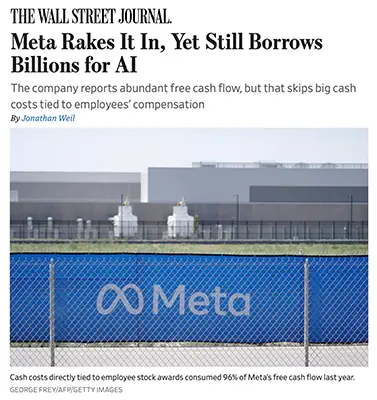
META RAKES IT IN, YET STILL BORROWS BILLIONS FOR AI
THE WALL STREET JOURNAL (FEB. 23, 2026)
TL;DR / Key Takeaway: Meta’s impressive free-cash-flow story masks huge cash costs for stock-based pay, forcing it to more than double its debt to fund AI data centers—highlighting how capital-intensive hyperscale AI really is.
Executive Summary
On paper, Meta generated $43.6 billion in free cash flow in 2025—enough to cover its $72.2 billion in AI-driven capex and still look like a “money-printing machine.” But the article shows that this metric excludes major cash outlays tied to stock-based compensation, including $18.4 billion in withholding taxes on vested shares and an estimated $23.6 billion of buybacks just to offset dilution. Combined, these cash costs consumed 96% of reported free cash flow.
To keep building data centers and AI infrastructure, Meta more than doubled its on-balance-sheet debt to $58.7 billion since 2021 and is also using off-balance-sheet financing for a separate $27 billion data-center project. At a $1.66 trillion valuation, Meta already trades at 38× its reported free cash flow, but if you adjust free cash to include these stock-linked cash costs, the valuation multiple jumps above 1,000×. The piece argues that standard free-cash-flow definitions understate the true economic cost of equity-based pay for big tech firms, and that Meta is an outlier in how extreme the effect is.
Relevance for Business
For SMB leaders, the takeaway is less about Meta’s balance sheet and more about what it signals about AI economics: if even Meta has to lean on debt and financial engineering to fund AI infrastructure, building your own large-scale compute is unrealistic. It also underscores that reported financial metrics—especially free cash flow—can hide meaningful costs, which matters when you’re evaluating vendors, partners, or potential acquirers.
Calls to Action
🔹 Assume that AI infrastructure at scale is capital-intensive; plan to consume it via cloud or partners, not build it yourself.
🔹 When assessing large vendors, look beyond headline free-cash-flow numbers to stock-based compensation and debt trends.
🔹 Recognize that hyperscalers facing heavy AI capex may eventually tighten pricing or change terms, especially for high-usage customers.
🔹 For your own company, be cautious about relying heavily on stock-based pay without modeling its true cash consequences over time.
Summary by ReadAboutAI.com
https://www.wsj.com/business/c-suite/meta-rakes-it-in-yet-still-borrows-billions-for-ai-d4de506d: February 28, 2026
MOVE OVER, SUPER BOWL: AI GIANTS TURN CHINA’S LUNAR NEW YEAR INTO A GIVEAWAY BLITZ
WALL STREET JOURNAL (FEB 16, 2026)
TL;DR / Key Takeaway: Chinese AI giants like Alibaba and ByteDance are using Lunar New Year as a massive user-acquisition event, spending hundreds of millions on giveaways to lock in chatbot users before the market saturates.
Executive Summary
With more than 600 million generative-AI users already in China, the Lunar New Year holiday has become a critical moment to capture remaining holdouts and deepen engagement. Companies are offering free tea, free meals, and even year-long access to robots or luxury EVs as prizes for using their chatbots. Alibaba is putting over $430 million behind a campaign that gives away items like bubble tea and food via its Qwen chatbot, driving over 120 million orders in just six days and integrating e-commerce, payments, and travel into a single conversational interface.
TikTok-parent ByteDance is pushing its Doubao chatbot with large prize pools, timed to the release of its Seed 2.0 model, while also debuting a video-generation model that has already attracted copyright backlash. Other players like Tencent, Baidu, Zhipu AI and MiniMax are handing out cash “lucky money” and other perks. Analysts caution that these promotions are unlikely to be sustainable, but companies hope early dominance in daily-use chatbots will protect their broader internet moats.
Relevance for Business
For SMB leaders, this is an extreme case study in subsidized AI adoption and ecosystem lock-in. Chinese platforms are showing how quickly conversational interfaces can become the default front door to commerce and services when heavily subsidized. It also illustrates the risk: if your business depends on someone else’s AI “super-app,” they may control discovery, data, and margins.
Calls to Action
🔹 If you sell into China or similar markets, monitor which super-apps and chatbots are becoming default purchasing channels, and adapt your distribution strategy accordingly.
🔹 Consider how local or industry platforms in your region might replicate this playbook—be cautious about over-relying on a single AI intermediary for customer access.
🔹 Think through loyalty and incentive programs: what low-cost, high-value rewards could you use to encourage customers to try AI-assisted channels without burning cash?
🔹 If you’re building AI products, recognize that user lock-in often comes from ecosystem integration (payments, travel, commerce), not just model quality; plan partnerships accordingly.
Summary by ReadAboutAI.com
https://www.wsj.com/tech/ai/move-over-super-bowl-ai-giants-turn-chinas-lunar-new-year-into-a-giveaway-blitz-cc59eb0b: February 28, 2026
Why World Models Will Become a Platform Capability, Not a Corporate Superpower — Fast Company (Feb 13, 2026)
TL;DR / Key Takeaway: World models—AI systems that model how environments behave—will likely become a shared platform layer, with competitive advantage coming from how well each company models its own reality, not from owning bespoke infrastructure.
Summary
The article argues that today’s large language models (LLMs) have “flattened” AI differentiation by turning linguistic intelligence into a commodity; many firms can access similar models from providers like OpenAI, Google, Anthropic, and Meta. But LLMs don’t understand causality, time, or physical context—they “predict words, not consequences.” World models, by contrast, are designed to learn how environments behave, incorporate feedback, and support planning.
Rather than each company building its own data centers and custom stacks, the piece predicts world models will be offered as a platform capability on top of shared cloud infrastructure, similar to databases or ERP systems. Platforms will handle heavy compute, simulation, and integration with sensors; differentiation will come from what variables companies choose, how they encode constraints, and how rigorously they close feedback loops between prediction and reality. Firms that treat world models as living representations of their operations—and are willing to be corrected by data—will gain “operational intelligence,” while those clinging to narrative convenience will lag.
Relevance for Business
For SMB leaders, the core message is that you probably won’t win by building AI infrastructure from scratch—you’ll win by using emerging platforms and then investing in your own data quality, process mapping, and feedback culture. In domains like logistics, maintenance, or pricing, advantage will come from systems that understand how small changes ripple across time, not from having the fanciest GPU cluster.
Calls to Action
🔹 Shift your AI conversations from “Which model or vendor?” to “What is our world model?”—what variables, constraints, and outcomes actually define your business.
🔹 Invest in data discipline and feedback loops (e.g., tracking predicted vs. actual outcomes) so future world-model platforms have high-quality signals to learn from.
🔹 Avoid over-investing in bespoke infrastructure; plan to ride platform offerings from cloud and industrial AI providers while keeping your data and process knowledge portable.
🔹 Pilot small “world-model-like” use cases (e.g., simulations of supply-chain delays or staffing levels) to build internal literacy before the tooling becomes mainstream.
Summary by ReadAboutAI.com
https://www.fastcompany.com/91488707/why-world-models-will-become-a-platform-capability-not-a-corporate-superpower: February 28, 2026
AI Stocks Reset in 2026: What’s Next for Apple, Nvidia, Google and Microsoft?
Investor’s Business Daily / WSJ (Feb 19, 2026)
TL;DR / Key Takeaway: After a euphoric 2025, AI stocks are in a volatile reset, with hyperscalers facing scrutiny over huge capex, uneven AI product uptake, and fears of a “SaaS-pocalypse” in software.
Summary
The article notes that AI-exposed tech stocks have stumbled in early 2026 as investors rotate into sectors like energy and health care. Apple has lagged peers in AI, modestly raising capex while leaning on partnerships with Microsoft’s OpenAI and Google’s Gemini models rather than building its own massive AI infrastructure—leaving it dependent on external platforms for core AI capabilities.
At the same time, hyperscalers such as Nvidia, Google, Meta, Amazon.com, and Microsoft face scrutiny for huge AI data-center capex—an estimated $645 billion in 2026, up 56% year-over-year—with concerns about debt, free-cash-flow pressure, and overbuilding. Software stocks have been hit even harder as investors worry that AI agents and open-source tools like “OpenClaw” could erode traditional SaaS economics and margins, fueling talk of a “SaaS-pocalypse.” Yet data-center infrastructure plays such as Vertiv, Lumentum, and Ciena are outperforming, reflecting investor preference for tangible infrastructure over higher-risk software bets.
Relevance for Business
For SMB executives, the reset underscores that AI’s economic plumbing is still unstable: hyperscalers may adjust pricing, incentives, or partner programs as they balance massive spend with profitability, and software vendors may experiment with outcome-based pricing or agentic models that change how you pay for automation. The article also highlights that even marquee AI names can struggle with adoption (e.g., underwhelming Copilot seat sales), reminding leaders to separate marketing narratives from actual customer behavior.
Calls to Action
🔹 Expect pricing and contract experimentation from software and cloud vendors as they respond to investor pressure—build flexibility into your renewal strategy.
🔹 When evaluating AI vendors, ask explicitly about their capex and monetization assumptions: are they chasing growth at any cost, or balancing sustainability and support?
🔹 Treat infrastructure-heavy offerings (data-center services, networking, power) as potentially more durable than speculative AI features layered on existing software.
🔹 If you rely heavily on one SaaS provider, assess “SaaS-pocalypse” scenarios: what happens if your vendor pivots to agents, raises prices, or bundles AI in ways that change your cost per outcome?
Summary by ReadAboutAI.com
https://www.investors.com/news/technology/ai-stocks-artificial-intelligence-stocks-2026-disruption-openclaw-feb17/#: February 28, 2026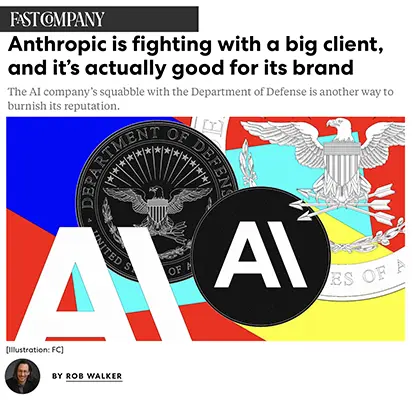
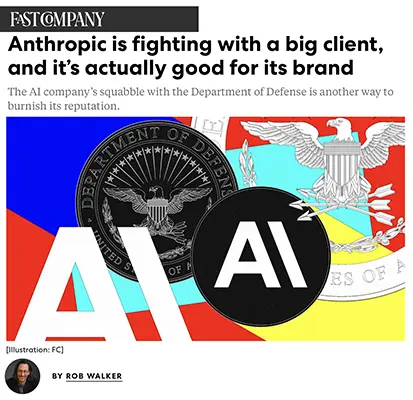
ANTHROPIC IS FIGHTING WITH A BIG CLIENT, AND IT’S ACTUALLY GOOD FOR ITS BRAND
FAST COMPANY (FEB 20, 2026)
TL;DR / Key Takeaway: A public dispute between Anthropic and the U.S. Department of Defense over “lawful use” of AI is doubling as brand positioning—casting Anthropic as the “cautious, responsible” alternative in the AI arms race.
Executive Summary
This Fast Company column describes a clash between Anthropic and the Pentagon over how broadly military programs can deploy the company’s AI systems. The Defense Department wants to use Anthropic’s technology across all “lawful use” scenarios; Anthropic is pushing back on applications like mass surveillance and autonomous weapons, leading the Pentagon to suggest it may review the relationship and even label the company a “supply chain risk.” That threat could also affect partners such as Palantir.
The article frames the dispute as on-brand for Anthropic, which has spent years cultivating a reputation for caution and AI safety—starting with its founders’ departure from a rival over concerns that commercialization was being prioritized over safety. Recent Super Bowl ads explicitly mocked that rival’s experiments with advertising inside consumer chatbots, portraying them as generators of “slop.” Now, being accused of excessive caution by the military reinforces Anthropic’s chosen identity as the “responsible” challenger in a crowded market. The author notes that in a moment of intense anxiety about AI’s downsides—privacy, jobs, misinformation—many users, employees, and regulators may find that stance attractive, even if it costs the company some near-term revenue.
Relevance for Business
For SMB executives, the lesson isn’t about choosing sides in a brand war—it’s that refusing certain customers or use cases can be a strategic brand decision. In a trust-sensitive space like AI, “we said no to X” can be as powerful a signal as “we built Y feature.” At the same time, government buyers are signaling that they may punish vendors who set their own ethical boundaries, which is a governance risk for any company working in sensitive domains.
Calls to Action
🔹 When adopting AI vendors, look beyond model quality and price to their red-line policies: what uses they refuse, how they handle government work, and how that aligns with your own values and risk tolerance.
🔹 Consider where your own organization might benefit from principled constraints—publicly declining certain categories of work can strengthen trust with employees and customers.
🔹 If you operate in regulated or defense-adjacent sectors, map the risk that taking ethical stances could trigger procurement backlash or “supply chain risk” labeling, and plan communications accordingly.
🔹 Use vendor disputes like this as case studies in board discussions about AI ethics, brand positioning, and long-term trust versus short-term revenue.
Summary by ReadAboutAI.com
https://www.fastcompany.com/91495420/anthropic-is-fighting-with-a-big-client-and-its-actually-good-for-its-brand: February 28, 2026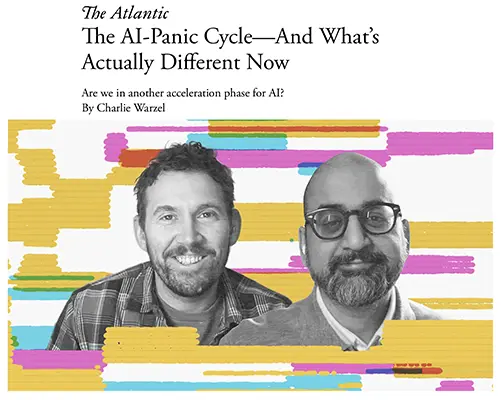
THE AI-PANIC CYCLE—AND WHAT’S ACTUALLY DIFFERENT NOW
THE ATLANTIC (PODCAST TRANSCRIPT, FEB 20, 2026)
TL;DR / Key Takeaway: In a podcast conversation, Charlie Warzel and Anil Dash argue that today’s hype spike is driven by coding agents that can actually take actions on systems, but the real risks are less sci-fi and more about security, spam, and shortsighted corporate adoption.
Executive Summary
Warzel opens by noting that Silicon Valley runs on hype cycles, but the current wave feels different: AI insiders themselves are spooked by what they’re building. The new trigger is coding agents—tools like Claude Code and experimental projects akin to “OpenClaw”—that can operate in the background, control software, and chain tasks together, moving beyond simple chatbots. Users are already delegating real work (from customer emails to app development and content creation) and some evangelists are likening this moment to February 2020 before COVID, warning that most people don’t yet understand how quickly their workflows could change.
Dash, a longtime technologist, contextualizes this within decades of machine-learning hype. He acknowledges a genuine technical inflection point—agents are more than “2% better chatbots”—but emphasizes how venture incentives and social media amplify panic, pushing both utopian AGI narratives and catastrophist takes. The pair highlight grounded concerns: agents could flood communication channels with spam and automated outreach; poorly governed deployments could increase security incidents; and businesses may use them to accelerate layoffs or strip out “friction” that actually protects customers. At the same time, a quieter movement of builders is experimenting with more constrained, humane uses of AI that respect collective needs rather than pure efficiency.
Relevance for Business
For SMB leaders, this episode is a calibration tool: agents are real and strategically important, but they’re not magic. The risk is reacting at the extremes—either ignoring them until competitors gain a productivity edge, or embracing them uncritically in ways that create security holes, annoy customers, or damage trust.
Calls to Action
🔹 Start with narrow, well-scoped agent pilots (e.g., automating internal reporting or QA checks) before giving tools access to customer-facing systems or financial accounts.
🔹 Involve security, compliance, and operations early; treat agents as new privileged users whose actions must be logged, rate-limited, and reversible.
🔹 Beware of “AI-panic FOMO” in vendor pitches; ask for clear baselines and metrics so you can separate real productivity gains from hype.
🔹 Monitor how agents might change your industry’s communication environment (email volume, customer expectations, spam levels) and adjust your own outreach and support strategies accordingly.
Summary by ReadAboutAI.com
https://www.theatlantic.com/podcasts/2026/02/the-ai-panic-cycle-and-whats-actually-different-now/686077/: February 28, 2026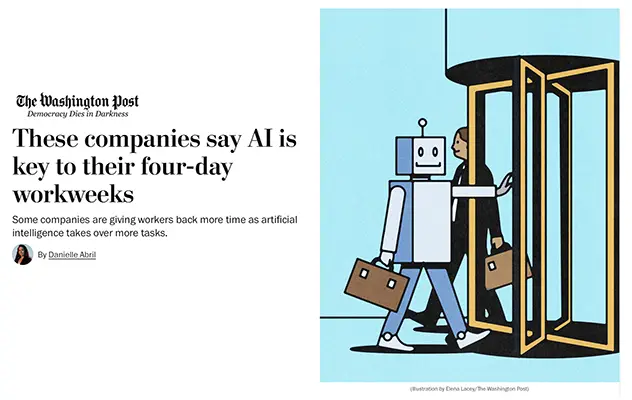
These Companies Say AI Is Helping Them Pull Off a Four-Day Workweek — The Washington Post (Updated Jan. 6, 2026)
TL;DR / Key Takeaway: A handful of smaller firms report that AI-assisted productivity gains are being reinvested into four-day workweeks with no pay cuts, using shorter schedules to attract and retain talent—though results depend heavily on process redesign and guardrails.
Executive Summary
The Washington Post profiles companies in software, design, HR services, and law that have adopted four-day workweeks, citing AI as a key enabler. At Convictional, a remote/hybrid goal-tracking startup, staff use AI for coding, marketing copy, meeting notes, and project breakdowns; leadership says output levels have stayed constant after moving to four days, and employee happiness has improved. Design/strategy firm RocketAir uses an internal AI tool to synthesize client data for product design and has run a four-day sprint model for three years, while Peak PEO and the Ross Firm (a Canadian law practice) use AI to automate invoices, document generation, research, billable-hour tracking, and call summaries.
Executives and researchers quoted in the article see AI plus four-day workweeks as a potential competitive response to burnout and talent scarcity—especially for smaller, remote-friendly businesses that can’t match big-company salaries. But leaders also describe new burdens: teaching staff to use AI safely and effectively, managing confidentiality and data-leak risks, and adapting to frequent model changes. A Boston College researcher notes that AI’s labor-savings potential could gradually push more employers toward shorter weeks, while high-profile voices like Jamie Dimon, Bill Gates, and Zoom’s Eric Yuan speculate (sometimes aggressively) about three- or four-day weeks in the long run—though those predictions are clearly aspirational, not current reality.
Relevance for Business
For SMB executives, this piece is less about adopting a four-day week tomorrow and more about how you choose to spend AI-enabled productivity gains. The default corporate reflex is to demand more output; these firms are betting that redistributing some gains to employees—via time off—improves retention, engagement, and creativity. The examples also show that AI-enabled schedule changes only work when paired with deliberate process redesign, training, and data governance.
Calls to Action
🔹 Quantify where AI is already saving time (coding, documentation, support) and decide explicitly whether to convert those gains into more output, more time, or a mix.
🔹 If considering a shorter week, pilot in one team with clear metrics (throughput, quality, customer satisfaction) before making organization-wide promises.
🔹 Invest in AI training and guardrails—especially around confidential data—before assuming you can sustain the same output with fewer hours.
🔹 Position schedule experiments as part of an overall talent strategy (recruiting, burnout prevention, DEI), not just a perk contingent on AI hype.
Summary by ReadAboutAI.com
https://www.washingtonpost.com/business/2025/12/31/ai-four-day-workweek/: February 28, 2026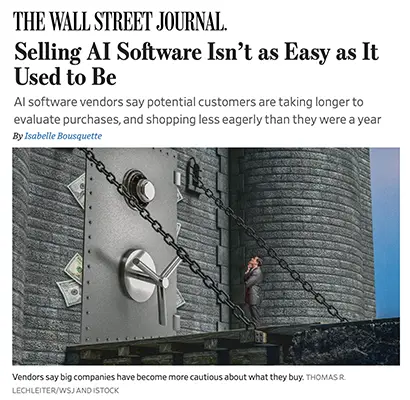
SELLING AI SOFTWARE ISN’T AS EASY AS IT USED TO BE
THE WALL STREET JOURNAL (UPDATED FEB. 18, 2026)
TL;DR / Key Takeaway: The AI buying spree is cooling as enterprises demand clearer ROI, stronger guardrails, and vendor staying power—lengthening sales cycles and squeezing weaker point solutions.
Executive Summary
After a 2025 boom in AI software spending—Gartner estimates more than $1.249 trillion in software outlays overall—vendors now report that big companies are slowing down and scrutinizing purchases. Deals that closed in 60–90 days last year are stretching to around six months, with finance and legal teams joining more procurement calls.
Analysts say many early adopters hit walls in 2025 pilots: not because models failed, but because organizations lacked guardrails, misunderstood the processes they were trying to automate, and struggled to measure financial returns. Only 11% of customer-service leaders surveyed by Gartner said generative AI met its primary business objective, despite that being one of the most mature use cases.
Spending is still growing—Gartner expects software outlays to rise nearly 15% this year—but buyers are more disciplined: they want solutions that integrate across silos, survive model churn, and come from vendors likely to be around in a few years. That favors big players bundling AI into suites (Microsoft, Google) and puts pressure on niche AI-only startups.
Relevance for Business
For SMB executives, this is both a warning and an opportunity. The warning: hype-driven pilot spending is no longer acceptable—you will be expected (internally and externally) to justify AI purchases with real outcomes. The opportunity: as buyers get pickier, you gain leverage to negotiate pricing, scope, and support, especially with smaller vendors hungry for durable references.
Calls to Action
🔹 Tighten your own AI investment criteria: insist on a clear use case, baseline metrics, and a measurement plan before signing new contracts.
🔹 Involve finance, legal, security, and operations early so they shape the purchase rather than block it late.
🔹 Prioritize vendors that can integrate with your stack and show credible runway, not just impressive demos.
🔹 Treat pilots as time-boxed experiments with explicit “scale / iterate / stop” decisions at the end.
Summary by ReadAboutAI.com
https://www.wsj.com/articles/selling-ai-software-isnt-as-easy-as-it-used-to-be-4933e401: February 28, 2026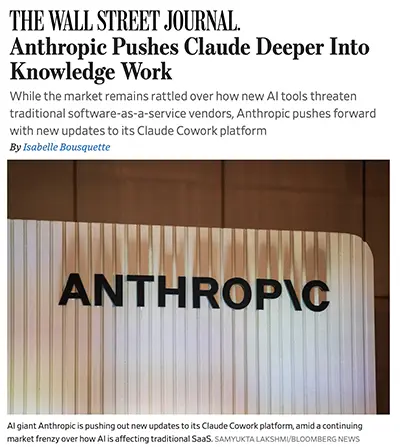
ANTHROPIC PUSHES CLAUDE DEEPER INTO KNOWLEDGE WORK
THE WALL STREET JOURNAL (FEB. 24, 2026)
TL;DR / Key Takeaway: Anthropic is turning Claude Cowork into a “front door for work”—embedding AI agents directly into enterprise apps and raising the stakes for how SaaS vendors and customers design workflows.
Executive Summary
Anthropic’s Claude Cowork platform lets companies build AI agents that understand internal context and plug into tools like Slack. The latest update adds direct integrations with Google Workspace (including Gmail), Docusign, LegalZoom, and other applications, plus “plug-ins” for finance, banking, equity research, and legal workflows.
Head of product Scott White describes Cowork as a centralized interface where knowledge workers invoke AI from inside the tools they already use, rather than copy-pasting between a chatbot and their apps. This aligns with a broader trend: “agentic coding” that began in software development is spreading into finance, legal, sales, HR, and operations. At the same time, markets are nervous that such agents could erode traditional SaaS value—recent Cowork updates coincided with a steep selloff in software stocks as investors questioned whether AI agents might displace existing vendors. Anthropic counters that Cowork is meant to augment, not replace, SaaS providers by helping users get more out of existing software.
Relevance for Business
For SMB leaders, the real shift is that AI is moving from a separate “assistant tab” to a layer inside your systems of record. That increases potential productivity, but it also raises governance questions: which workflows should an agent touch, what data can it see, and who is accountable when it makes a mistake? Choosing SaaS vendors now also means evaluating their AI integration roadmap and openness to agent orchestration.
Calls to Action
🔹 Identify 2–3 high-friction workflows (e.g., contracting, invoicing, pipeline review) where integrated agents could reduce context-switching.
🔹 Ask current SaaS vendors how they plan to support embedded agents, logging, and approvals instead of just offering a chat sidebar.
🔹 Establish policies for what data agents can access and how their activity is audited—treat them like new team members with permissions.
🔹 Pilot agent use in constrained domains (e.g., summarization and drafting) before granting authority to execute high-impact actions.
Summary by ReadAboutAI.com
https://www.wsj.com/articles/anthropic-pushes-claude-deeper-into-knowledge-work-23bd5abe: February 28, 2026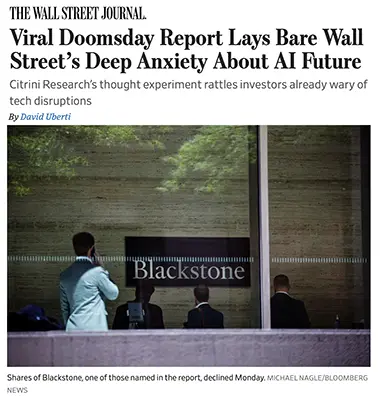
VIRAL DOOMSDAY REPORT LAYS BARE WALL STREET’S DEEP ANXIETY ABOUT AI FUTURE
THE WALL STREET JOURNAL (FEB. 23, 2026)
TL;DR / Key Takeaway: A single “what-if” AI scenario from a niche research shop helped trigger an 800+ point Dow drop, exposing how fragile and narrative-driven markets have become around white-collar AI disruption.
Executive Summary
Citrini Research published a 7,000-word “scenario” set in 2028, arguing that rapidly advancing AI could erase the long-standing scarcity premium on human intelligence, slashing costs in software, finance, logistics, and other white-collar sectors—and triggering mass job losses and financial contagion. Even though the report was framed as a thought experiment, not a forecast, it went viral and lined up uncannily with market moves on Feb. 23: software names like Datadog and CrowdStrike fell more than 9%, IBM dropped 13%, and financial players such as American Express, KKR, and Blackstone sold off sharply.
Investors rotated into defensives (energy, staples) and safe havens like Treasurys and gold, underscoring a “speed of disruption” fear: if AI cuts white-collar costs too quickly, the transition shock could overwhelm contractual protections and credit structures, even if the long-run economy is stronger. Analysts quoted in the piece emphasize that AI-linked repricing is happening earlier and faster than many expected, and that markets are becoming “trigger-happy” around AI headlines.
Relevance for Business
For SMB leaders, the signal isn’t the day-to-day volatility—it’s that AI’s impact on white-collar work is now a core macro risk narrative. Business models built on billable hours, manual analysis, or “monetizing interpersonal friction” (like logistics and delivery intermediaries) will be scrutinized not just by customers, but by lenders and investors. The article effectively says: capital markets are starting to price in AI-driven margin compression well before the disruption fully arrives.
Calls to Action
🔹 Stress-test revenue models that depend heavily on human expertise or transactional friction (consulting, SaaS, intermediaries).
🔹 In board and lender discussions, be prepared to explain how you’ll absorb AI-driven pricing pressure without destabilizing the business.
🔹 Avoid over-reacting to single AI headlines; instead, track multi-quarter trends in your own demand, margins, and customer behavior.
🔹 Treat AI not just as a cost-saver but as a strategic redesign opportunity—where can you create new value, not just cut?
Summary by ReadAboutAI.com
https://www.wsj.com/finance/stocks/global-stocks-markets-dow-news-02-23-2026-06a32080: February 28, 2026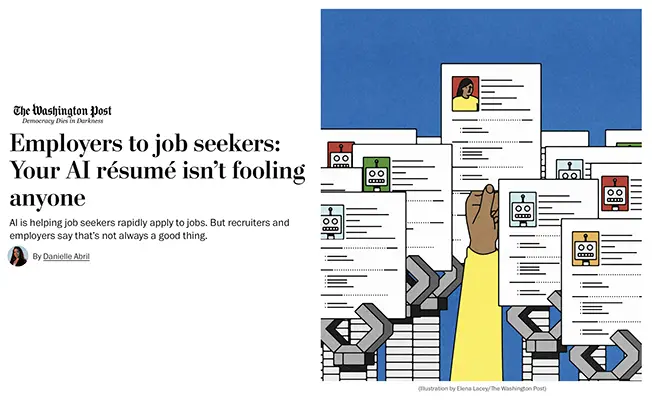
Employers’ New Plea to Job Seekers: Stop Relying on AI for Your Résumé
The Washington Post (Feb. 21, 2026)
TL;DR / Key Takeaway: Employers say heavy use of AI to generate résumés and application answers is creating homogeneous, obviously artificial submissions, making it harder to assess candidates and sometimes causing strong applicants to blend into the noise.
Executive Summary
The Washington Post reports that more job seekers are using AI tools—including auto-apply services—to generate résumés, cover letters, and even video responses. Employers describe a wave of applications with nearly identical phrasing, structure, and “too polished” language. In one case at outsourcing firm Oceans, over 300 candidates gave eerily similar answers to a video prompt about their “most controversial workplace conviction,” leading the hiring team to conclude that most had used AI.
HR leaders say they are not opposed to light AI assistance—adding relevant keywords, cleaning grammar, helping people organize their thoughts. But they draw a line at AI doing the whole job: auto-apply bots misread application questions, fill fields incorrectly, and strip away any sense of the candidate’s authentic interests or voice. Some employers now adjust instructions to explicitly ask applicants not to use AI for certain questions. Job seekers, for their part, argue that if employers use AI to screen and rank candidates, it feels fair to use AI to optimize résumés—but several people in the article report better results when they stopped using AI for core narratives, wrote customized résumés themselves, and reached out directly to recruiters.
Relevance for Business
For SMBs, this is a hiring-market signal: AI has increased volume and decreased signal quality in applicant pools. Over-automated recruiting processes risk an arms race where both sides use AI against each other, making it harder to spot adaptable, authentic talent. Leaders should ensure that AI in hiring is used for triage and support, not as a substitute for human judgment or candidate storytelling.
Calls to Action
🔹 Clarify in job postings which parts of the application should reflect the candidate’s own voice (e.g., personal statements, recorded answers), and say so explicitly.
🔹 If you use AI to screen résumés, treat its rankings as input, not verdict—and periodically review candidates below the cutoff to check for missed potential.
🔹 Train hiring managers to spot AI-generated sameness and to probe authenticity in interviews (“Tell me about a time you disagreed with AI’s suggestion”).
🔹 Consider publishing short guidance for applicants on how to use AI responsibly (e.g., grammar help is fine, auto-apply bots are not), reinforcing your culture of authenticity.
Summary by ReadAboutAI.com
https://www.washingtonpost.com/technology/2026/02/21/ai-resume-jobs/: February 28, 2026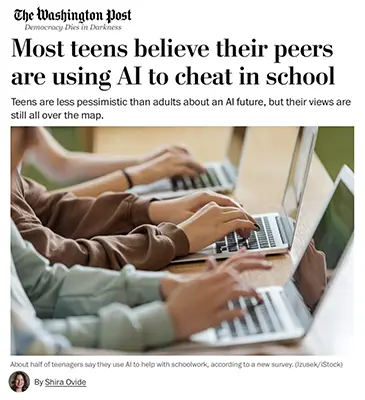
MOST TEENS BELIEVE THEIR PEERS ARE USING AI TO CHEAT IN SCHOOL
WASHINGTON POST (FEB 24, 2026)
TL;DR / Key Takeaway: A Pew survey finds ~6 in 10 U.S. teens think classmates use AI to cheat, while a smaller share use it for emotional support—raising questions about dependence, self-confidence, and how we educate the next workforce.
Executive Summary
Pew Research surveyed 1,458 Americans ages 13–17 and found that about two-thirds have used AI chatbots, mostly for information search and help with schoolwork. Nearly 60% say students at their school use AI to cheat at least “somewhat often,” though the poll didn’t define cheating or ask directly about their own behavior. A bar chart on page 2 shows roughly a third of teens saying cheating happens “extremely/very often.”
Teens who use AI for school work are more likely to use it for research and idea generation than for editing their writing—suggesting many are trying to draw a line between help and plagiarism. At the same time, researchers warn that the bigger risk may be psychological dependence, not copying. A Stanford study cited in the article found that students who initially had AI help on a creative task, then lost access, performed significantly worse on a later word-association test—apparently losing confidence in their own abilities. A Brookings report flagged similar concerns. About 12% of teens use AI for emotional support or advice, a use that most parents in the survey disapprove of, given the risk of misleading or hallucinated responses. Teens overall are somewhat more optimistic than adults about AI’s long-term impact, but their views are still divided.
Relevance for Business
This cohort is tomorrow’s talent pipeline. Many will arrive in the workforce fluent with AI tools, but some may also be over-reliant and under-practiced in independent problem-solving. The pattern mirrors what you may already see with junior employees pasting AI drafts into deliverables. Organizations will need to treat AI literacy and AI-resilient confidence as core skills, not afterthoughts.
Calls to Action
🔹 In hiring and internships, test for how candidates use AI, not just whether they can produce polished answers—ask them to work with and without tools.
🔹 Build training that explicitly addresses where AI assistance ends and personal accountability begins, especially for analysis, writing, and decisions.
🔹 For youth programs, scholarships, or early-career pipelines, partner with schools on healthy AI norms rather than assuming they are handling it alone.
🔹 Consider updating internal ethics policies to include AI misuse in learning and development (e.g., certifications, training exams), not only in production work.
Summary by ReadAboutAI.com
https://www.washingtonpost.com/technology/2026/02/24/pew-teens-ai-cheating-school/: February 28, 2026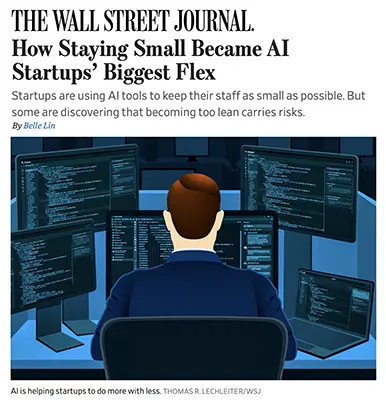
HOW STAYING SMALL BECAME AI STARTUPS’ BIGGEST FLEX
WALL STREET JOURNAL (FEB 23, 2026)
TL;DR / Key Takeaway: AI tools are enabling tiny, high-revenue AI startups to brag about revenue-per-employee—but going too lean can mean burnout, missed market demand, and weak enterprise relationships.
Executive Summary
The WSJ’s CIO Journal looks at a new Silicon Valley badge of honor: being an ultra-lean AI startup. Founders are using AI coding tools (Claude Code, Codex) and AI for sales and marketing to keep teams small while chasing big revenue. Median headcount at Series A startups fell from about 57 in 2020 to 44 in 2024, and there’s open talk of a “billion-dollar one-person company.” A popular “Top Lean AI Native Companies Leaderboard” now highlights firms with >$5M ARR, <50 employees, <5 years old, turning lean-ness into a recruiting and fundraising flex.
Companies like Fal and Flora track revenue per employee and deliberately hire slowly, arguing that a few “insanely productive” people augmented by AI beat large teams. Others, like Forethought, laid off 30–40% of staff and used AI to multiply output by an estimated 5–9x per person. But the article also surfaces the trade-offs: enterprise customers still expect human relationship-building, bespoke support, and consistent follow-through. Startups eventually had to bulk up sales and customer-success staff, and some realized they had been under-resourced—overworking employees and failing to capture demand. Investors warn that over-optimizing for efficiency can slow growth and leave openings for better-resourced rivals.
Relevance for Business
For SMB leaders, this is a useful counterweight to AI hype: yes, AI can raise output per person dramatically, but customer trust, complex deals, and sustained growth still require humans. Over-lean teams risk fragility—single points of failure, burnout, and inability to respond when opportunity appears. The smarter lesson is to treat AI as a way to delay some hires and upgrade role design, not to avoid building a team altogether.
Calls to Action
🔹 Benchmark your own revenue per employee and experiment with AI tools to raise it—but set guardrails around workload and customer responsiveness.
🔹 Be skeptical of vendors bragging about micro headcount; ask how they staff support and implementation and what happens if key people leave.
🔹 When you do hire, design roles assuming AI support (fewer rote tasks, more relationship and judgment work) rather than simply cutting positions.
🔹 In board and strategy discussions, resist “billion-dollar one-person company” fantasies; focus instead on right-sized, resilient organizations augmented by AI.
Summary by ReadAboutAI.com
https://www.wsj.com/articles/how-staying-small-became-ai-startups-biggest-flex-ec127320: February 28, 2026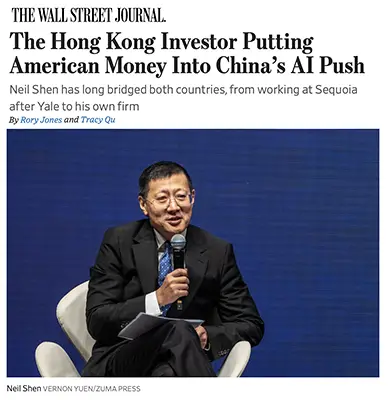
THE HONG KONG INVESTOR PUTTING AMERICAN MONEY INTO CHINA’S AI PUSH
WALL STREET JOURNAL (FEB 21, 2026)
TL;DR / Key Takeaway: Venture capitalist Neil Shen is channeling billions of pre-rule U.S. dollars into China’s AI ecosystem, highlighting how capital, talent, and geopolitics are colliding in the global AI race.
Executive Summary
The WSJ profiles Hong Kong–based investor Neil Shen, long regarded as one of the world’s top VCs. After building Sequoia China and betting early on firms like Alibaba, JD.com, Meituan, ByteDance, Shein, and PDD, Shen spun out his own firm (HSG) in 2023 and has raised nearly $9 billion from U.S. pension funds, endowments, and others.
New U.S. rules bar American venture funds from investing in certain Chinese companies developing advanced AI models. Shen has continued funding Chinese AI startups by relying on money raised before the restrictions and by avoiding firms that fall under current prohibitions, according to HSG. His portfolio spans large-model developers such as Zhipu, Moonshot AI, StepFun, and MiniMax, as well as robotics and AI-agent companies, and includes successes like Manus (sold to Meta for >$2B after an $85M valuation a year earlier) and MiniMax’s Talkie app, which has surged since its Hong Kong listing.
Shen believes the race to artificial general intelligence is now driven by deep-pocketed U.S. tech giants with unmatched compute budgets, but argues that China’s strengths—large pools of technical talent and consumer-app building—will keep it competitive in applied AI. At the same time, he faces mounting geopolitical risk: if U.S. investors can no longer back his China AI funds, his access to some of the world’s largest LPs could shrink. HSG is diversifying into private equity and expanding offices in Singapore, London, and Tokyo to hedge.
Relevance for Business
For SMB executives, the story underscores that AI supply chains are deeply geopolitical. U.S. capital, Chinese talent, export controls, and chip restrictions all shape which models, apps, and hardware reach your vendors and partners. Even if you never operate in China, your AI tools may be built by firms entangled in cross-border regulatory and funding tensions, which can affect long-term support and risk.
Calls to Action
🔹 When selecting AI vendors, ask where their capital, data centers, and R&D are based; geopolitical exposure is now part of vendor risk.
🔹 If you manage pensions or long-term investments, review allocations to China-exposed AI funds and understand how new U.S. rules may affect exits and liquidity.
🔹 Assume future export controls and investment restrictions could change which chips or models are available; avoid over-dependence on any one geography.
🔹 Use stories like Shen’s in leadership conversations about AI as a strategic, geopolitical infrastructure, not just a software feature.
Summary by ReadAboutAI.com
https://www.wsj.com/tech/ai/the-hong-kong-investor-putting-american-money-into-chinas-ai-push-e7487c0b: February 28, 2026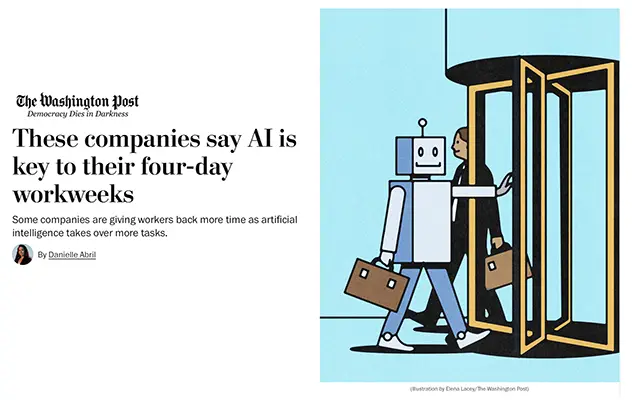
Closing: AI update for February 28, 2026: Mid-Week Update II
Taken together, this week’s stories paint AI as both non-optional infrastructure and an ongoing governance challenge: markets are repricing, vendors are repositioning, and people are quietly renegotiating how much of their work and identity they’re willing to hand to machines. As you scan the summaries below, the key question isn’t “Is AI good or bad?” but rather “Where does it genuinely strengthen our business—and what must we redesign so that it doesn’t quietly weaken it?”
All Summaries by ReadAboutAI.com
↑ Back to Top