
AI Updates March 24, 2026

This week’s briefing points to a more mature and consequential phase of the AI cycle: the conversation is shifting from breakthrough models to operational power. Across these summaries, the real story is not simply that AI tools are improving. It is that AI is becoming embedded in the systems that shape how organizations build products, manage labor, govern risk, secure data, influence behavior, and compete. From enterprise partnerships and agent failures to regulatory clashes, workforce restructuring, infrastructure dependencies, and new AI-assisted development platforms, the pattern is clear: AI is no longer an emerging capability sitting at the edge of the business. It is becoming part of the business environment itself.
Three themes stand out for SMB leaders this week. The first is control: who governs the models, platforms, values, permissions, and vendor relationships that organizations are increasingly relying on. That issue appears in multiple forms across this set — from the U.S. government’s extraordinary move against Anthropic, to healthcare concerns around unauthorized AI use, to agentic system failures, vendor concentration, and rising dependence on a small number of powerful platforms. Even seemingly upbeat stories, such as Google’s expanded AI Studio capabilities, point to the same structural reality: as AI tools become easier to use, they also become easier to build into the organization before governance is fully in place. The strategic risk is no longer just whether AI works, but who controls its behavior, continuity, and boundaries once it does.
The second and third themes are execution and human adaptation. Execution matters because the distance between AI access and AI value remains wide: many organizations now have tools, pilots, and vendor options, but still struggle to translate them into durable returns, secure workflows, or reliable competitive advantage. At the same time, the human dimension is becoming harder to ignore. Workforce restructuring, uneven adoption, culture strain, shifting skill expectations, and oversight burdens all show that AI success is not primarily a technical problem. It is a management problem. The leaders best positioned in this environment will not be the ones chasing every announcement, but the ones building the discipline to evaluate tools clearly, govern them early, and align them with actual business priorities.

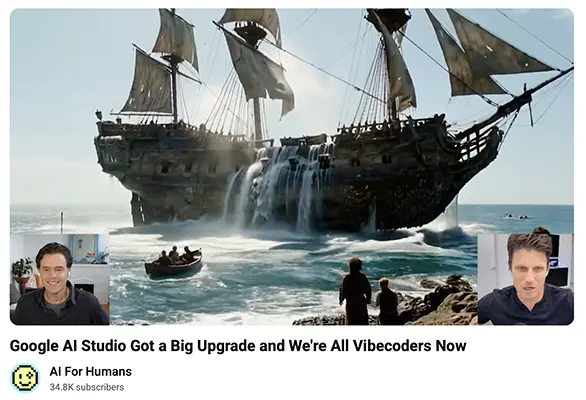

Google AI Studio Grows Up: AI for Humans Podcast Signals a Shift From Toy Prototypes to More Complete AI App Building
AI for Humans — March 20, 2026
TL;DR / Key Takeaway: Google’s AI Studio upgrade matters less as a flashy product launch than as a sign that AI-assisted app creation is moving from rough prototyping toward more usable, persistent, and collaborative software building—but the real risks remain platform dependence, product instability, and the widening advantage of large ecosystems.
Executive Summary
The core signal from this AI for Humans episode is that Google is trying to close the gap between AI-assisted coding demos and software that can actually persist, authenticate users, store data, and support collaboration. The hosts focus on new AI Studio capabilities such as Firebase integration, authentication, databases, multiplayer support, persistent sessions, and Next.js compatibility, framing them as a meaningful step beyond lightweight “vibe coding” into more complete application creation. That matters because the bottleneck is no longer just generating code; it is helping non-experts assemble the surrounding infrastructure—data storage, identity, deployment frameworks, and continuity across sessions—without getting lost in technical setup.
The episode also surfaces an important market dynamic: the AI coding stack is consolidating around a few major platforms with deep ecosystems. Google is presented as catching up aggressively, Anthropic is described as shipping useful coding tools quickly, and OpenAI is portrayed as narrowing focus to defend its position in coding and enterprise use cases. Beneath the banter is a serious business point: AI development is becoming less about isolated models and more about integrated workflow environments. The more these platforms bundle tools, hosting, authentication, voice, image generation, and app frameworks together, the more they can lock in users, reduce friction, and shift power toward incumbents with full-stack control.
At the same time, the transcript repeatedly hints at constraints that leaders should not ignore. The hosts themselves question Google product longevity, highlight uncertainty over which OpenAI products will actually be maintained, and point to security and governance problems through Meta’s rogue-agent issues. The larger takeaway is that while AI tools are making software creation more accessible, execution risk has not disappeared—it has simply moved. Instead of asking whether teams can generate code, leaders now have to ask whether they can audit it, secure it, govern it, maintain it, and avoid overcommitting to fast-moving vendors whose priorities may change quickly.
Relevance for Business
For SMB executives and managers, this matters because AI-assisted software creation is becoming more practical for internal tools, lightweight apps, workflow automation, prototypes, and customer-facing experiments. The real value is not that “everyone is a developer now,” but that smaller teams may be able to produce useful digital tools faster and with less specialized labor at the earliest stages.
That said, the episode also points to several business realities. First, ease of building does not remove the need for oversight. Security, scaling, authentication, and data handling still require judgment, even if the setup becomes more automated. Second, vendor dependence is increasing. Choosing Google, Anthropic, or OpenAI is no longer just a model decision; it is increasingly a decision about ecosystem, workflow, and future switching costs. Third, as app creation becomes cheaper, the competitive advantage shifts away from merely producing software and toward identifying the right use case, governing it well, and integrating it into actual operations.
The podcast’s broader collection of side stories reinforces this pattern. Faster video generation, AI-driven design tools, open-source game modification, and agentic tools all point in the same direction: AI is compressing experimentation cycles. But the Meta example and the discussion around product de-prioritization show that governance, reliability, and product continuity may become bigger differentiators than raw novelty.
Calls to Action
🔹 Test AI app-building tools on low-risk internal workflows first, especially for prototypes, dashboards, lightweight client tools, or process automations that do not expose sensitive data.
🔹 Evaluate platforms as ecosystems, not just models—compare hosting, authentication, integration options, pricing, portability, and long-term roadmap risk before committing.
🔹 Assign technical and governance review even for “easy” AI-built tools, especially where customer data, permissions, or external deployment are involved.
🔹 Avoid assuming rapid prototyping equals production readiness; build a checkpoint process for security, scalability, maintenance, and vendor lock-in before wider rollout.
🔹 Monitor which vendors are narrowing focus and which are expanding infrastructure support, because product continuity may matter as much as feature quality over the next 12 months.
Summary by ReadAboutAI.com
https://www.youtube.com/watch?v=gnJ6SD2734Y: March 24, 2026Google Stitch: Design to Code with AI
https://stitch.withgoogle.com/: March 24, 2026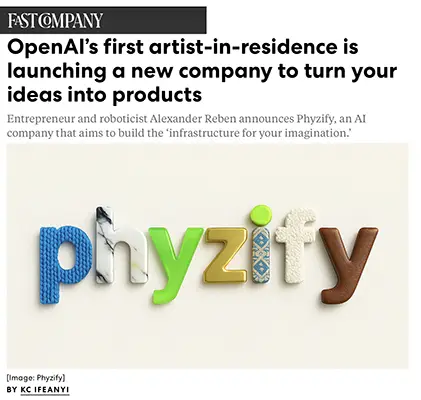
OpenAI’s First Artist-in-Residence Launches Phyzify to Turn Ideas Into Physical Products
Fast Company — March 13, 2026
TL;DR: Phyzify is an early-stage startup using AI to convert creative concepts into physical goods via automated manufacturing — an interesting signal about where AI-to-physical pipelines are heading, but not yet a business-relevant tool for most SMB operators.
Executive Summary
Alexander Reben, who served as OpenAI’s inaugural artist-in-residence, has launched Phyzify, a pre-seed startup aiming to automate the journey from creative idea to manufactured physical product. The current focus is fabric looms — translating AI-generated designs into woven textiles — with a stated ambition to expand across fashion, music, food, gaming, and other creative categories. The company is also exploring handling backend product-development tasks like domain registration and patent filing.
This is genuinely early-stage. Phyzify has closed a pre-seed round, is working with five creative collaborators, and aims for a consumer product launch within a year. The demo described involves a MIDI controller, a webcam feed, AI-generated pattern options, and a real-time loom — creative and technically interesting, but not yet a scalable commercial platform.
The more substantive signal is philosophical: Reben’s stated intent is to keep humans in the role of asking questions and exercising creative judgment, while AI handles execution. He explicitly pushes back on what he calls “synthetic capitalism” — fully automated product creation and distribution without human involvement. Whether Phyzify executes on that vision is unproven. The investor framing — 2026 as “a huge year” for physical AI — is promotional. The underlying trend it points to (AI shortening the gap between ideation and physical production) is real, though the timeline and accessibility for SMBs remain unclear.
Relevance for Business
This story is most relevant for SMBs in creative, manufacturing, or consumer product industries as a directional signal: the pipeline from digital design to physical output is compressing. Companies that currently rely on long product development cycles, manual prototyping, or outsourced manufacturing should track this category. For most SMB executives today, Phyzify itself is not actionable — it’s pre-product. But the trend it represents warrants a position on your radar.
Calls to Action
🔹 No action required now for most SMBs — Phyzify is pre-commercial and unproven at scale.
🔹 Monitor if you’re in fashion, custom goods, consumer products, or creative services — the AI-to-physical pipeline is shortening and will affect sourcing, prototyping, and production timelines.
🔹 Flag for revisit in 12–18 months when Phyzify or comparable platforms have demonstrated commercial viability and unit economics.
🔹 Track the broader category, not just this company — similar capabilities are likely to emerge from multiple directions (3D printing platforms, AI design tools, on-demand manufacturing networks).
Summary by ReadAboutAI.com
https://www.fastcompany.com/91507430/openai-first-artist-in-residence-launches-phyzify: March 24, 2026
Inside the Dirty, Dystopian World of AI Data Centers
The Atlantic — March 13, 2026
TL;DR: The AI industry’s infrastructure buildout is already driving a measurable increase in fossil fuel dependency, local environmental harm, and grid stress — with costs being externalized onto communities and ratepayers, not AI vendors.
Executive Summary
This is an on-the-ground investigation, not an analyst brief. The Atlantic’s Matteo Wong reports from Memphis, Loudoun County (Virginia), and Three Mile Island to document the physical and environmental footprint of the AI infrastructure race. The core findings are specific and sourced: xAI’s Colossus data center in southwest Memphis consumes as much electricity annually as 200,000 homes, was built in under three months without standard permitting, and sits in a low-income Black neighborhood already carrying disproportionate industrial pollution burden. Satellite data from University of Tennessee researchers shows elevated nitrogen dioxide near the site since its launch.
At the macro level, the piece surfaces credible projections: by 2030, U.S. data centers may consume more electricity than all heavy industry combined, according to an IEA analyst. Capital expenditures from Amazon, Microsoft, Meta, and Google have exceeded $600 billion since ChatGPT’s launch — more, inflation-adjusted, than the interstate highway system. The default energy source is natural gas, not renewables, and the IEA estimates data center emissions could more than double by 2030.
The piece is careful to surface the counterargument — that nuclear and efficiency improvements could change the trajectory — but is equally clear that “add gas now, add nuclear later” is the current market behavior, not a plan. It also raises a legitimate historical caution: internet-era energy demand projections in the 1990s proved badly overestimated, leaving stranded assets. The generative AI boom could follow a similar pattern — or not.
Relevance for Business
For SMB leaders, the direct operational implication is energy cost and reliability risk. As data centers compete for grid capacity — particularly in Virginia, Texas, Phoenix, Atlanta, and Dallas — regional electricity costs and reliability for businesses in those corridors may be affected. Utilities in Virginia are already projecting 5.5% annual demand growth, with overall demand potentially doubling by 2039.
There is also a vendor dependency signal: the AI tools your business relies on are built on infrastructure with uncertain cost structures, permitting exposure, and potential regulatory scrutiny. If large AI providers face energy constraints, regulatory backlash, or are forced to internalize environmental costs, pricing and capacity availability for downstream customers could shift. This is not imminent, but it is a real second-order risk to monitor.
Finally, for any SMB with ESG commitments or stakeholder expectations around sustainability, the energy sourcing of AI tools is becoming a legitimate governance question — one that vendor marketing currently obscures.
Calls to Action
🔹 Flag for ESG/sustainability governance if your organization reports on or is evaluated by environmental criteria — AI tool usage is a legitimate scope consideration.
🔹 Do not assume AI infrastructure costs are stable — energy constraints, permitting battles, or forced internalization of environmental costs could affect vendor pricing within 3–5 years.
🔹 Monitor the regulatory environment around data center permitting and emissions — the SELC lawsuit against xAI and state-level scrutiny are early signals of a developing policy front.
Summary by ReadAboutAI.com
https://www.theatlantic.com/magazine/2026/04/ai-data-centers-energy-demands/686064/: March 24, 2026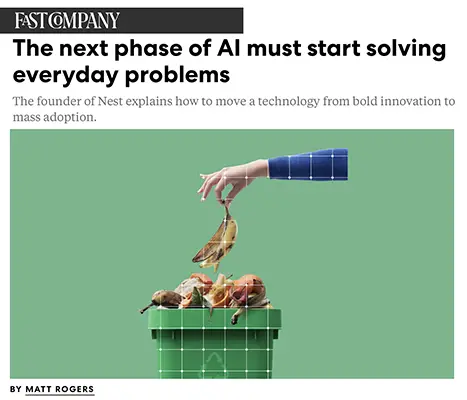
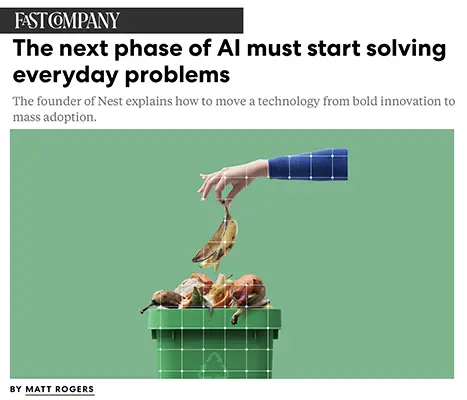
THE NEXT PHASE OF AI MUST START SOLVING EVERYDAY PROBLEMS
Fast Company | Matt Rogers | March 16, 2026
TL;DR: The founder of Nest and Mill argues that AI will only achieve durable adoption when it reliably solves practical problems for ordinary people — and that the industry’s current focus on model capabilities and enterprise use cases is delaying the broader transformation AI can actually deliver.
Executive Summary
This is an opinion piece by Matt Rogers, the co-founder of Nest and current CEO of Mill (an AI-powered food waste company). It is advocacy for a specific view of technology adoption, grounded in Rogers’ operational experience rather than independent research. The argument should be read as informed practitioner perspective, not empirical analysis.
Rogers’ core claim is that technology adoption follows a fixed sequence: consumer education → expanded adoption → societal transformation — and that AI, despite enormous investment, has not yet completed the first stage for most people. He argues that the products most likely to win are not the most technically impressive but the ones that quietly make real-world processes faster, cheaper, and more resilient. His examples — the iPhone’s ecosystem, Nest’s energy management, Mill’s industrial food waste reduction — illustrate products that succeeded by solving a problem people could recognize, not by showcasing technical sophistication.
The implicit critique of the current AI moment is measured but clear: the industry is optimizing for benchmark performance, model launches, and enterprise infrastructure while ordinary people remain unconvinced. Rogers’ own company claims to illustrate the alternative — Mill’s food waste systems have been adopted by Amazon and Whole Foods, which he frames as evidence that AI has crossed a threshold from novelty to industrial utility in at least one domain. That claim is self-serving but not implausible.
The piece ends with a useful provocation: hype fades, models commoditize, and what remains will be determined by whether AI made real problems easier to solve.
Relevance for Business
This is one of the most directly actionable frameworks in this week’s batch for SMB leaders. The education → adoption → transformation sequence gives leaders a practical diagnostic: Where is your organization on that curve? Many SMBs are stuck between curiosity and adoption because no one has made the specific value proposition clear to the people doing the work. Rogers’ argument suggests that AI deployment fails not because the technology isn’t ready, but because the organizational education step is being skipped. The second implication is for vendor selection: tools that quietly reduce friction in known workflows are more likely to generate durable ROI than tools that require significant behavioral change or new mental models. Shiny and powerful is not the same as useful.
Calls to Action
🔹 Audit your AI deployments against actual problem-solving — For each AI tool in use, ask: what specific problem does this solve, and does the user understand that? Tools that can’t answer that question clearly are unlikely to stick.
🔹 Prioritize education before expansion — Before rolling out AI tools more broadly, ensure the use case is understood by the people being asked to use it. Adoption without education produces low utilization and poor ROI.
🔹 Favor boring-reliable over impressive-complex — When evaluating new AI tools, weight real-world friction reduction over feature counts and benchmark performance. The Nest thermostat beat more technically capable competitors by being simpler and more useful.
🔹 Use the commoditization signal — Rogers predicts model capabilities will commoditize. Plan for a future where AI capability is table stakes and competitive advantage comes from how well you’ve integrated it into your specific workflows.
🔹 Assign a “so what” test to every AI initiative — Before committing budget, require a clear answer to: what does this make faster, cheaper, or less risky? If the answer is vague, the initiative is premature.
Summary by ReadAboutAI.com
https://www.fastcompany.com/91508482/the-next-phase-of-ai-must-start-solving-everyday-problems: March 24, 2026
Future AI Chips Could Be Built on Glass
MIT Technology Review — March 13, 2026
TL;DR: Glass substrates are moving from semiconductor research to commercial production in 2026, promising AI chips that are faster, more energy-efficient, and more thermally stable — a supply chain and infrastructure development worth tracking as it matures over the next 3–5 years.
Executive Summary
This is a technology supply chain story, not a product announcement. The core development: Absolics, a subsidiary of South Korean materials company SKC, is beginning commercial production in 2026 at a US facility in Covington, Georgia, of glass-based chip substrates — the foundational layer on which multiple chips are combined into a single computing package. Intel is also pursuing glass substrates in its next-generation chip packaging. The US government’s CHIPS Act provided $175 million in grants to the Absolics/Georgia Tech partnership.
The technical case is substantive: glass substrates offer significantly better thermal stability than the fiberglass-reinforced epoxy that has been the industry standard since the 1990s. The practical benefits include the ability to create 10 times more connections per millimeter, allowing 50% more silicon chips in the same package area, better power routing efficiency, and the potential to use light (rather than copper wire) for signal transmission — which could dramatically reduce energy consumption. The energy efficiency angle is directly relevant to the data center energy crisis documented elsewhere in this batch.
The commercial reality check is also important: glass is fragile. Substrates are 0.7–1.4mm thin and prone to cracking in manufacturing. Intel reports it was cracking hundreds of panels per day in early testing. That problem has been substantially mitigated, but manufacturing yield at commercial scale is unproven. Absolics’s current capacity is estimated at 2–3 million chip packages annually — significant but modest relative to the scale of AI data center demand. IDTechEx projects the glass substrate market growing from $1 billion (2025) to $4.4 billion by 2036 — meaningful growth, but a 10-year horizon.
Relevance for Business
For most SMBs, this is a background infrastructure trend to understand, not act on. The practical relevance is indirect but real: if glass substrates deliver on their energy efficiency and performance promises, they are one of the mechanisms by which AI compute costs could decrease and AI tool performance could improve over the 3–5 year horizon. That affects the cost trajectory of AI services your business relies on.
For SMBs in semiconductor supply chain, electronics manufacturing, or advanced materials, this is a more immediate competitive intelligence item. A new supply chain ecosystem is forming around glass substrates, with Samsung, LG Innotek, JNTC, and others entering the space — and US government backing through CHIPS Act funding adds supply chain stability signal.
Calls to Action
🔹 No immediate action required for most SMBs — this is a 3–5 year infrastructure story with indirect implications for AI compute costs and capability.
🔹 If you’re in semiconductor supply chain, electronics, or advanced materials, add glass substrate development to your technology roadmap monitoring — a new supply chain ecosystem is forming quickly.
🔹 Use this as context when evaluating AI vendor cost trajectories — chip efficiency improvements are one mechanism that could moderate AI infrastructure costs over the medium term.
🔹 Flag for revisit in 12–18 months — Absolics’s first commercial production run and Intel’s packaging announcements will clarify whether the technology scales at acceptable yield rates.
🔹 Pair with the data center energy story (Article 3 in this batch) — glass chips and nuclear energy restarts are both part of the same underlying question: can AI infrastructure costs and emissions be brought under control?
Summary by ReadAboutAI.com
https://www.technologyreview.com/2026/03/13/1134230/future-ai-chips-could-be-built-on-glass/: March 24, 2026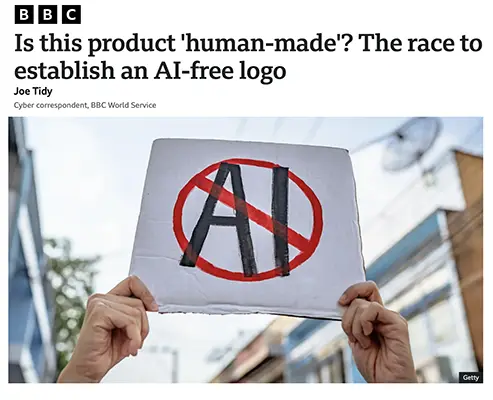
Is This Product ‘Human-Made’? The Race to Establish an AI-Free Logo
BBC News — March 17, 2026
TL;DR: At least eight competing “human-made” certification initiatives have emerged globally, but the absence of a universal standard, inconsistent auditing, and a technically murky definition of “AI-free” currently make these labels more signal than guarantee.
Executive Summary
Backlash against AI-generated content has sparked a cottage industry of certification schemes — including No A.I., AI-free.io, NotByAI, ProudlyHuman, Books by People, and others — aimed at letting creators and brands signal that their work is human-originated. The analogy being pursued is the Fair Trade logo: a trusted, universally recognized mark that carries consumer weight. The publishing and film industries are the most active early adopters, with Faber and Faber applying “Human Written” stamps to select books and film distributors adding “No AI” credits.
The critical problem, which the article surfaces clearly, is fragmentation and verification credibility. Some labels can be downloaded by anyone without any vetting. Others, like aifreecert and ProudlyHuman, require payment, questionnaires, and periodic content auditing. But even the more rigorous systems face a fundamental definitional challenge: AI is already embedded in spell-checkers, grammar tools, image editors, search, and countless software platforms. Determining what truly constitutes “AI-free” creation is not a binary question, and experts quoted in the piece explicitly flag this.
The market signal here is real: as AI content floods channels, human-made provenance is developing economic value. One film distributor quoted in the article frames it explicitly as a pricing premium opportunity. But without a dominant, trusted, audited standard, these labels risk becoming marketing claims rather than verifiable facts — potentially accelerating the trust problem they’re meant to solve.
Relevance for Business
For SMB leaders, this story is most immediately relevant in two directions. First, if your business produces content, creative services, marketing, or professional outputs, the emergence of human-made certification is a positioning and differentiation opportunity worth evaluating now — before a standard is established and the window to be an early adopter closes. Second, if your business purchases content, creative work, or professional services, the question of whether those outputs are human-generated is becoming a legitimate procurement and quality consideration.
There is also a brand and reputation dimension: companies that use AI-generated content without disclosure — particularly in marketing, creative, or advisory contexts — face growing risk as consumer and client expectations around transparency increase. The lack of a universal standard today does not eliminate that risk; it may amplify it if competitors establish credible human-made credentials first.
Calls to Action
🔹 If you produce creative, written, or advisory content as a core offering, evaluate whether a credible human-made certification is a competitive differentiator worth pursuing — the window for early positioning is open now.
🔹 Do not self-certify or use unaudited labels — they provide false confidence and may create liability if challenged; if you pursue certification, use a system with genuine third-party auditing.
🔹 Establish an internal AI disclosure policy for content your organization produces or publishes — define what you will and won’t use AI for, and communicate it proactively.
🔹 Monitor for an emerging dominant standard (the Fair Trade equivalent) — when one emerges, the cost of not being early will rise sharply for brands where human provenance matters.
🔹 For content procurement, add AI usage disclosure as a standard clause in contracts with freelancers, agencies, and creative vendors.
Summary by ReadAboutAI.com
https://www.bbc.com/news/articles/cj0d6el50ppo: March 24, 2026
THE FUTURIST WHO HELPED DEFINE TECH TREND REPORTS JUST KILLED THEM (LITERALLY)
Fast Company | Max Ufberg | March 14, 2026
TL;DR: At SXSW, influential futurist Amy Webb declared the annual trend report obsolete and replaced it with a “convergence” framework — arguing that leaders who track individual trends are missing the structural collisions that actually reshape industries, and that the next internet is being built for machines, not people.
Executive Summary
This is a reported feature on a conference presentation, and the primary voice is Amy Webb, a consultant whose clients include Mastercard, Ford, and NASA. Her argument carries practitioner credibility, but it is advocacy for her firm’s methodology, not independent research. That framing matters when evaluating the specific claims — though the underlying structural observations are sound and worth leaders’ attention.
Webb’s core argument is methodological: annual trend reports capture a moment in a landscape moving too fast for annual snapshots. The replacement she proposes is a “convergence” framework — tracking not individual trends but the collisions between them. She identifies AI, energy infrastructure, robotics, biotechnology, and geopolitical competition as forces currently colliding in ways that create structural, often irreversible change. Her meteorological framing is useful: trends are data points; convergences are the storm systems that form when forces combine. Companies that see these storms coming and still fail to act — which Webb argues is the norm — are the target of her warning.
Two convergences are highlighted in the article that carry direct business relevance. The first is the “agentic economy”: as AI systems improve at autonomous task execution, the internet may shift from a search-and-browse model to a delegation model, with digital agents handling purchasing, subscription management, and decision-making on behalf of users. In that world, whoever controls the agents controls the economic gateway. The second is AI’s expanding role as emotional companion and adviser — therapist, dating coach, life guide — raising what Webb frames as an underappreciated dependency risk: people relinquishing decision-making to opaque, profit-driven systems. She also notes, pointedly, that automation’s labor impact may arrive not as sudden mass layoffs but as slow erosion through hiring freezes, attrition, and software absorption of office tasks — harder to see coming, and harder to respond to.
Relevance for Business
For SMB leaders, this article offers two kinds of value. First, Webb’s convergence framework is a genuinely useful planning tool — not because FTSG should be hired, but because the underlying logic is sound: evaluating AI in isolation from energy costs, geopolitical supply chain risk, and labor market shifts produces incomplete strategy. Leaders who are only tracking “AI trends” may be missing the more consequential structural picture. Second, the agentic economy signal deserves serious attention: if AI agents become the primary interface through which consumers and businesses discover and transact, the companies owning those agents — not the underlying vendors — capture the value. SMBs that depend on search-driven discovery, price comparison, or subscription models should be thinking now about how they show up in an agent-mediated world, not just a search-indexed one. Webb’s warning about AI dependency — users relinquishing agency to opaque systems — is also a governance and brand consideration for organizations deploying AI in customer-facing or advisory roles.
Calls to Action
🔹 Shift from trend-tracking to convergence-watching — Assign someone to monitor how AI intersects with your energy costs, labor market, regulatory environment, and supply chain simultaneously, not in isolation.
🔹 Prepare for the agentic economy — If your business relies on customer discovery through search, comparison, or recommendation, develop a strategy for how you’re represented and prioritized by AI agents making decisions on customers’ behalf.
🔹 Anticipate slow-burn labor displacement — Webb’s framing of gradual erosion through attrition and software absorption is a more accurate model than sudden mass layoffs. Workforce planning should account for this pattern.
🔹 Evaluate AI dependency risk in your own deployments — If you’re deploying AI tools that users rely on for advice, guidance, or decisions, consider what happens when that system is wrong, changes its behavior, or is discontinued.
🔹 Revisit your strategic planning cadence — If your organization still runs annual strategy cycles as the primary response to technology change, the pace of AI development has made that cadence insufficient. Build in quarterly environmental scans.
Summary by ReadAboutAI.com
https://www.fastcompany.com/91507234/amy-webb-trend-report-death-sxsw: March 24, 2026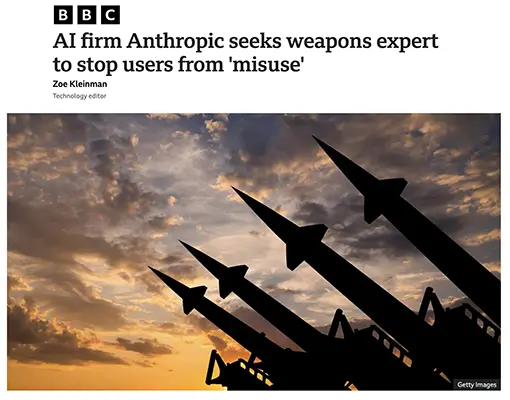
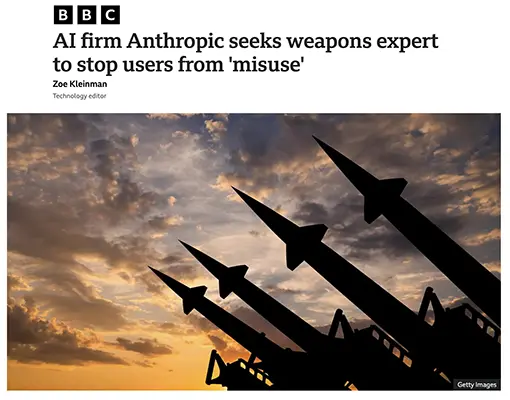
AI FIRM ANTHROPIC SEEKS WEAPONS EXPERT TO STOP USERS FROM ‘MISUSE’
BBC | Zoe Kleinman | March 17, 2026
TL;DR: Anthropic is hiring a chemical weapons and explosives policy expert to harden its AI guardrails against catastrophic misuse — a move that signals the AI safety problem is real and still unsolved, while also highlighting a regulatory vacuum that no company or government has yet addressed.
Executive Summary
Anthropic has posted a role for a policy manager with expertise in chemical weapons, high-yield explosives, and radiological dispersal devices. The explicit purpose is to prevent its AI systems from providing users with information that could enable mass-casualty events. OpenAI has posted a similar position, offering a salary nearly double Anthropic’s. Both moves reflect a recognized, non-hypothetical risk: that commercial AI models, without robust domain-specific oversight, can provide technically meaningful assistance toward weapons development.
The article surfaces a significant structural concern: expert critics question whether training AI systems on sensitive weapons information — even to build guardrails — is itself a risk vector. There is currently no international treaty or regulatory framework governing this type of AI safety work. It is proceeding entirely through voluntary, company-led action, with no independent verification that guardrails are effective. The article also provides important context: Anthropic is simultaneously fighting a Pentagon designation labeling it a national security supply chain risk — a consequence of refusing to allow its AI to be used for autonomous weapons or mass surveillance. The combination of proactive safety hiring and aggressive government pushback illustrates how Anthropic is navigating a narrowing middle ground between safety credibility and commercial/political viability.
Relevance for Business
For SMB leaders, the direct operational implication is limited — this is not about your workflows.
The governance signal, however, is important. AI companies are acknowledging that their products pose risks serious enough to require weapons-domain expertise on staff. That is a useful data point when evaluating vendor claims about safety, reliability, and responsible deployment. More practically: the absence of external regulation means vendor self-policing is the only check currently in place. Leaders making AI vendor decisions should ask not just about features, but about what guardrails exist, how they are maintained, and who is accountable when they fail. As AI tools become more capable, the gap between what they can do and what they should do will require active vendor scrutiny — not passive trust.
Calls to Action
🔹 Assign vendor due diligence on safety practices — Review how your primary AI vendors handle misuse prevention, especially in sensitive industries (healthcare, legal, finance, defense-adjacent).
🔹 Prepare internal acceptable use policy — If you haven’t defined what your employees are permitted to ask AI tools, do so now. Vendor guardrails are imperfect and not a substitute for internal governance.
🔹 Monitor regulatory developments — The current regulatory vacuum will not last indefinitely. Watch for EU AI Act enforcement and US executive action that may impose liability or compliance requirements on AI users, not just providers.
🔹 Treat vendor safety claims skeptically— Safety commitments without independent verification are marketing. Ask vendors what third-party audits or red-team testing backs their safety assurances.
🔹 Track the Anthropic-DoD legal outcome — If the court rules against Anthropic, it will further normalize the position that AI companies cannot impose safety conditions on government use — a precedent with broad implications.
Summary by ReadAboutAI.com
https://www.bbc.com/news/articles/c74721xyd1wo: March 24, 2026
Fake AI Content About the Iran War Is All Over X
WIRED | March 10, 2026
TL;DR: X’s Grok AI actively worsened the information environment during the Iran conflict by misidentifying real footage and generating fake imagery to “support” its incorrect answers — a documented case of a platform’s own AI tool amplifying disinformation rather than checking it.
Source note: Reported journalism with named expert sources and ISD research. Specific examples are verifiable. Read alongside the Verge Netanyahu article (Summary 8) for the full picture of this week’s AI-and-war-disinformation cluster.
EXECUTIVE SUMMARY
When disinformation expert Tal Hagin asked Grok to verify a post about Iranian missile strikes, the chatbot repeatedly misidentified the video’s location and date — then generated an AI image to “prove” its incorrect answer. This is not AI used by propagandists; it is the platform’s own AI generating and spreading disinformation in response to a verification request.
Separately, Iranian officials, pro-regime propaganda networks, and politically motivated U.S. accounts circulated AI-generated war imagery reaching millions of views before removal. An image of a U.S. B-2 bomber being shot down was viewed over a million times; images of Delta Force soldiers allegedly captured by Iran were viewed over five million times. AI detection tools cannot reliably identify AI-generated content, according to a NewsGuard analyst quoted directly. X responded by demonetizing unlabeled AI conflict videos from blue-check accounts but did not disclose how many accounts were actually affected.
Meta’s Oversight Board separately found that Meta’s AI content labeling was “neither robust nor comprehensive enough to handle the scale and speed of AI-generated misinformation, particularly during crises and conflicts.”
RELEVANCE FOR BUSINESS
The Grok failure has a direct enterprise analog. AI tools used for internal research, competitive intelligence, or regulatory monitoring can produce the same failure mode: confidently incorrect answers supported by plausible-looking generated content. The stakes and platform differ; the mechanism is identical to an AI assistant “verifying” a supplier claim or competitor announcement with fabricated supporting detail.
CALLS TO ACTION
▹ Establish a policy that AI tools are not authoritative sources for verification — consequential claims confirmed by AI must be independently validated against primary sources.
▹ Brief your team on the Grok failure mode explicitly — AI that generates supporting “evidence” for wrong answers is a documented risk, not a theoretical one.
▹ Evaluate your team’s information sourcing during fast-moving events — assess how much competitive or market monitoring relies on AI-curated or AI-generated content.
▹ Do not treat blue-check marks, high view counts, or AI-generated images as credibility signals — all three were actively associated with false content in documented examples.
▹ Monitor platform AI labeling policy changes — Meta’s Oversight Board finding of inadequate crisis-condition labeling signals active regulatory pressure that will change how AI content is disclosed across platforms your business uses.
Summary by ReadAboutAI.com
https://www.wired.com/story/fake-ai-content-about-the-iran-war-is-all-over-x/: March 24, 2026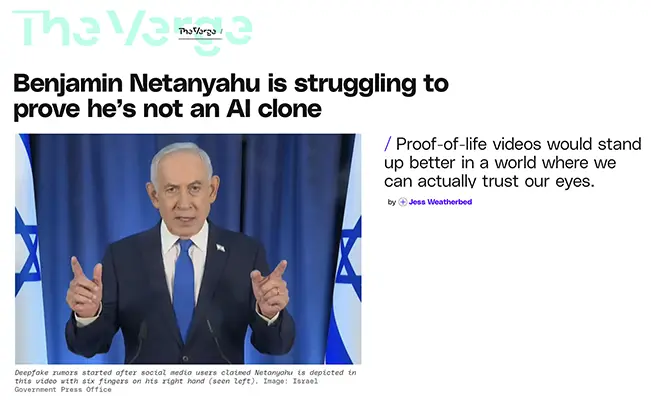
Benjamin Netanyahu Is Struggling to Prove He’s Not an AI Clone
The Verge | March 16, 2026
TL;DR: Debunked deepfake conspiracy theories about Netanyahu couldn’t be definitively put to rest because video authentication infrastructure doesn’t yet scale — illustrating that AI has created a trust deficit that burdens genuine content as much as fake content.
Source note: Reported news feature with editorial commentary. Factual claims are specific; closing passages on the Trump administration reflect the author’s perspective.
EXECUTIVE SUMMARY
Professional fact-checkers at Snopes and PolitiFact debunked claims that Netanyahu’s press conference video was AI-generated (the “extra finger” was video compression; the nearly 40-minute runtime exceeds current AI video model capabilities). Netanyahu posted a proof-of-life video. That too was immediately accused of being fake. The article’s substantive point: neither clip carries C2PA Content Credentials or SynthID metadata that could verify authenticity or track AI tool use. Platforms that pledged to label AI-generated content provided no such labeling on either clip.
The result: it is now “almost impossible to definitively prove” whether even professionally fact-checked videos are genuine. AI-generated fakes have become credible enough that genuine content now struggles to prove its own authenticity — an authentication infrastructure gap that is symmetric and structural. AI tools can generate convincing video; the infrastructure to authenticate real video does not yet scale.
RELEVANCE FOR BUSINESS
If a head of state cannot authenticate a video of himself within 24 hours, any business whose leadership uses video for communications faces the same structural challenge. The risk is not only that your content could be faked — it’s that authentic content could be accused of being fake, with no reliable mechanism to quickly disprove the claim. Existing tools are not yet equipped to handle this at scale.
CALLS TO ACTION
▹ Investigate C2PA Content Credentials — the emerging standard for embedding provenance metadata in video and image content. Evaluate whether your video production workflow can support it for high-stakes communications.
▹ Establish an executive video authentication response protocol now — before you need it, define how your organization would respond to a deepfake accusation against authentic content.
▹ Do not rely on platform AI labeling pledges as a verification backstop — platforms that pledged AI content labeling provided none on clips subject to active deepfake accusations.
▹ Monitor C2PA and SynthID adoption — authentication standards are being written now; early adoption may become a trust signal, and late adoption a liability.
▹ Treat deepfake defense as a response planning issue, not yet an active attack threat — for most SMBs, the near-term risk is being without a plan when the question arises, not being targeted directly.
Summary by ReadAboutAI.com
https://www.theverge.com/tech/895453/ai-deepfake-netanyahu-claims-conspiracy: March 24, 2026
Anthropic Said No. OpenAI Said Yes. One Weekend, One Decision — and a Masterclass in Brand Building.
Fast Company | March 13, 2026
TL;DR: Anthropic’s refusal to sign the Pentagon’s AI contract produced a measurable, rapid transfer of market share from OpenAI to Anthropic — evidence that in AI, trust and values positioning are now compounding competitive advantages, not just PR.
Source note: Brand strategy opinion piece. Market data (app analytics, revenue run rate) references Bloomberg and app analytics — directionally credible but not independently audited.
EXECUTIVE SUMMARY
The reported figures are striking: ChatGPT U.S. app uninstalls surged 295% in a single day after the Pentagon deal news. Claude downloads jumped 51% in the same window. Anthropic’s app reached No. 1 on the U.S. App Store, gaining 20 positions in under a week. Anthropic’s revenue run rate reportedly doubled — from $9B at end of 2025 to nearly $20B by mid-March. The commercial cost was real: the Pentagon contract was valued at approximately $200 million, and the supply chain risk designation — historically only applied to foreign adversaries like Huawei, never before to an American company — threatens hundreds of millions more in broader government contracts.
The article’s central argument: AI platforms are moving toward a high switching-cost category driven not only by technical lock-in but by what it calls “relational cost” — accumulated context, workflow integration, and organizational trust that deepens over time. Values signals and product signals are becoming inseparable.
Evidence cited: Anthropic’s Claude Constitution (a publicly inspectable training framework, not merely a mission statement) and its Economic Index are described as “operationalized values” — choices with visible cost. A telling data point: Claude holds 32% of enterprise AI usage despite only 3.5% consumer footprint — framed as a trust premium that preceded and was amplified by the Pentagon incident.
RELEVANCE FOR BUSINESS
The signal for SMB leaders: AI platform decisions are increasingly long-term commitments, not commodity software swaps. As AI tools accumulate organizational context — your workflows, data, and team patterns — switching costs compound. Vendor trust and values alignment are not soft factors; they are risk factors. If your AI vendor’s ethics come under public scrutiny, that exposure travels upstream to every business visibly associated with them.
CALLS TO ACTION
🔹 Treat AI vendor selection as a long-term brand and risk decision — evaluate vendors on governance posture and track record under pressure, not capability alone.
🔹 Audit your current AI vendor associations — assess what it signals to customers, partners, and employees to be identified with a particular AI platform.
🔹 Apply the “operationalized values” test to vendor due diligence — distinguish between companies that articulate safety commitments and those that demonstrate them with visible cost.
🔹 Plan for switching costs before they compound — early in AI adoption, establish vendor criteria that include governance. After deep workflow integration, the cost of changing rises significantly.
🔹 Monitor Anthropic’s legal challenge to the supply chain risk designation — the outcome will clarify whether AI companies can effectively resist government pressure, a precedent with broad industry implications.
Summary by ReadAboutAI.com
https://www.fastcompany.com/91506253/anthropic-said-no-openai-said-yes-one-weekend-one-decision-and-a-masterclass-in-brand-loyalty-anthropic-openai-department-of-defense-brand-loyalty: March 24, 2026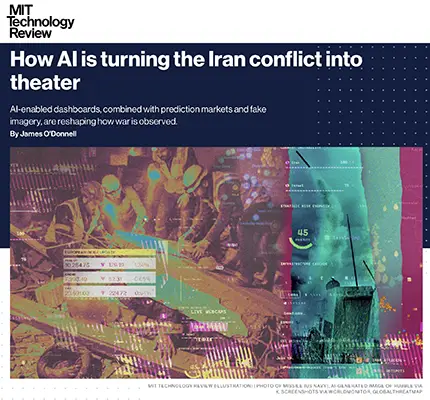
How AI Is Turning the Iran Conflict into Theater
MIT Technology Review | March 9, 2026
TL;DR: AI tools have made it cheap and fast for civilians to build war intelligence dashboards — but these feeds create an illusion of informed situational awareness while spreading inaccuracy, fake imagery, and financially incentivized speculation dressed up as analysis.
EXECUTIVE SUMMARY
Following U.S.-Israel strikes against Iran, a new ecosystem of AI-assembled intelligence dashboards emerged rapidly — some reportedly built in days with minimal technical expertise. These dashboards pull together satellite imagery, ship tracking, news feeds, prediction market links, and AI-generated summaries. The author reviewed over a dozen, including one built by two Andreessen Horowitz-affiliated individuals that attracted the attention of a Palantir founder. Palantir is the platform through which the U.S. military is reportedly accessing AI models like Claude during the conflict.
The article surfaces a critical distinction: assembling data is not the same as understanding it. Intelligence agencies pair raw feeds with experts who supply historical context and proprietary information. These dashboards do neither. Their AI-generated summaries introduce factual errors. The Financial Times documented AI-generated fake satellite imagery spreading during the conflict — and satellite imagery carries high perceived credibility, making fakes particularly damaging.
Digital investigations expert Craig Silverman (tracking 20 such dashboards) describes the core risk as “an illusion of being on top of things” while pulling in undifferentiated signals. A compounding distortion: many dashboards are directly linked to prediction markets (Kalshi, Polymarket) where users bet on conflict outcomes. This creates an incentive structure that conflates financial speculation with analysis and turns active conflict into entertainment.
RELEVANCE FOR BUSINESS
For SMB leaders, the immediate signal is epistemological, not geopolitical. AI-assembled information feels authoritative but is not inherently reliable. The same failure mode — AI aggregates without verifying, summarizes without expertise, presents confidence without warrant — applies to AI-generated market research, competitive intelligence summaries, and news digests your team may already be using. Any business that has integrated AI-generated content without editorial review processes faces this structural problem at smaller scale.
CALLS TO ACTION
🔹 Audit how AI-generated summaries enter your decision-making — identify where your team is treating AI output as verified vs. as a starting point for human review.
🔹 Require primary source backing for consequential decisions — vendor selection, market entry, and competitive strategy should not rest on AI summaries of secondary sources.
🔹 Treat AI-generated imagery with elevated skepticism — credible fake visuals are commercially available at low cost and general-purpose.
🔹 Do not integrate prediction market outputs into strategic planning — the incentive structure creates deliberate signal distortion, not insight.
🔹 Develop a formal policy for AI-assisted research and competitive monitoring — most SMBs have not yet addressed this governance gap.
Summary by ReadAboutAI.com
https://www.technologyreview.com/2026/03/09/1134063/how-ai-is-turning-the-iran-conflict-into-theater/: March 24, 2026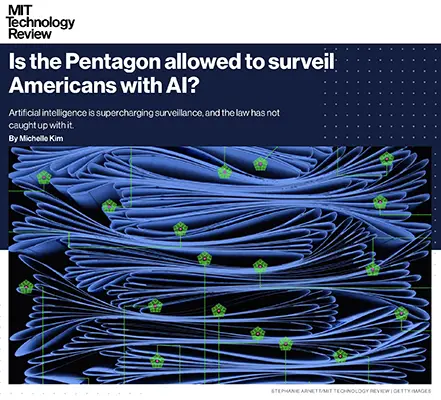
Is the Pentagon Allowed to Surveil Americans with AI?
MIT Technology Review | March 6, 2026
TL;DR: The Anthropic–Pentagon standoff exposed a genuine legal gap: existing U.S. law may not actually prohibit the military from using AI to conduct mass surveillance on Americans, and the contracts AI companies sign may not close that gap.
EXECUTIVE SUMMARY
The dispute began when the Pentagon sought to use Anthropic’s Claude to analyze bulk commercial data on American citizens. Anthropic refused, citing mass domestic surveillance as a hard limit. Negotiations collapsed and the Pentagon designated Anthropic a supply chain risk — a label historically reserved for foreign adversaries. OpenAI moved in and signed a deal allowing its AI to be used for “all lawful purposes,” triggering a wave of user uninstalls and public protests. OpenAI later amended the contract to explicitly prohibit domestic surveillance.
The deeper issue remains unresolved. Legal experts make clear that U.S. surveillance law has not kept pace with AI capabilities. Much of what people consider surveillance — aggregating social media, location data, browsing records, voter registration files, and commercially purchased data — is not legally classified as surveillance. The Fourth Amendment was written for physical searches; subsequent statutes addressed wiretapping and email. None were designed for AI systems capable of assembling granular behavioral profiles from thousands of individually innocuous data points.
OpenAI’s revised contract language is complicated by the fact that the Pentagon can use AI for any “lawful purpose”, and the law itself is ambiguous about what that permits. One law professor quoted in the article was explicit: companies are largely unable to stop the Pentagon from using contracted technology however it perceives to be lawful.
RELEVANCE FOR BUSINESS
SMB leaders using AI platforms that also hold government contracts are operating in a trust environment shaped by those contracts’ terms. Vendor ethics decisions are no longer abstract — they carry measurable market consequences. Any business processing personal data using AI tools should be aware that the legal framework governing what governments can do with that same data remains unsettled. This governance gap is directly relevant to risk assessments in regulated industries and enterprise AI procurement.
CALLS TO ACTION
🔹 Review your AI vendor contracts for broad “lawful purposes” clauses or language permitting government use of your data.
🔹 Assign someone to track federal surveillance legislation — active bills could directly affect what data AI vendors are permitted to process on your behalf.
🔹 Include governance posture in AI vendor evaluation — willingness to set hard limits is now a differentiating, market-tested factor.
🔹 Do not assume contract language protects you — legal experts are explicit that contracts do not reliably constrain government use of AI tools.
🔹 Revisit data handling and AI vendor policies quarterly through at least 2027 as this legislative and judicial space evolves.
Summary by ReadAboutAI.com
https://www.technologyreview.com/2026/03/06/1134012/is-the-pentagon-allowed-to-surveil-americans-with-ai/: March 24, 2026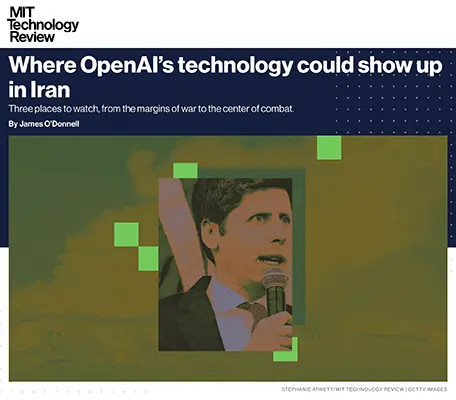
WHERE OPENAI’S TECHNOLOGY COULD SHOW UP IN IRAN
MIT Technology Review | James O’Donnell | March 16, 2026
TL;DR: OpenAI has entered a Pentagon agreement with weaker safeguards than advertised, and its AI may soon assist in active combat targeting, drone defense, and military administration — raising unresolved questions about accountability, oversight, and what AI companies will and won’t do for government contracts.
Executive Summary
OpenAI’s recent Pentagon agreement allows its models to operate in classified military environments, including potential use in the ongoing US conflict with Iran. The stated guardrails — no autonomous weapons, no domestic surveillance — are weaker than they sound: the agreement defers to the military’s own permissive guidelines rather than imposing independent constraints. MIT Technology Review’s reporting treats these assurances skeptically, and that skepticism is warranted.
Three likely use cases are identified: (1) target prioritization — AI assists human analysts in ranking strike targets by synthesizing text, image, and video intelligence; (2) drone defense — through the existing OpenAI/Anduril partnership, conversational AI may be layered onto counter-drone systems to support real-time soldier queries; (3) back-office administration — OpenAI models are already on the GenAI.mil platform for drafting contracts and policy documents. Notably, Anthropic was designated a Pentagon supply chain risk after refusing to allow its AI to be used for “any lawful use” — a designation it is contesting in court. OpenAI negotiated different terms and is now being integrated where Anthropic was not.
The speed and completeness of OpenAI’s pivot from civilian AI company to active military contractor is significant. The practical question — whether human review of AI targeting recommendations actually slows decisions or merely provides political cover — remains unanswered.
Relevance for Business
This development matters for SMB leaders primarily as a vendor transparency and risk signal. The AI tools many businesses use daily are now embedded in active combat systems with contested oversight. Leaders relying on OpenAI or similar providers should understand that vendor ethics commitments are not fixed — they shift with commercial and political pressure. The Anthropic case also illustrates that refusing government use cases carries real business consequences, including supply chain designations that could affect enterprise procurement. For companies operating in defense-adjacent industries, this sets a precedent for what AI providers will negotiate away.
Calls to Action
🔹 Monitor vendor policy shifts — Review your primary AI vendor’s current government use policies; these have changed rapidly and will continue to evolve.
🔹 Assess dependency risk — If your operations depend on a specific AI provider, understand what disruption looks like if that vendor is politically or contractually constrained.
🔹 Prepare internal AI use policy — As AI is normalized for high-stakes decisions in other sectors, establish your own standards for where AI-assisted decisions require human review and sign-off.
🔹 Track the Anthropic precedent — The outcome of Anthropic’s legal challenge against its Pentagon “supply chain risk” designation may affect how AI companies position ethical constraints in future contracts.
🔹 Ignore for now — The specific military applications described here have no direct operational impact on most SMBs, but the vendor behavior pattern is worth noting.
Summary by ReadAboutAI.com
https://www.technologyreview.com/2026/03/16/1134315/where-openais-technology-could-show-up-in-iran/: March 24, 2026
The Fake Images of a Real Strike on a School
The Atlantic — March 13, 2026
TL;DR: AI-generated disinformation in the Iran conflict is demonstrating a new and more dangerous pattern: not mass deception, but deliberate erosion of evidentiary trust — making the question “is this real?” functionally unanswerable.
Executive Summary
This piece by Mahsa Alimardani documents a specific, well-sourced sequence of events: an AI-generated image (with a visible Google Gemini watermark) circulated on Instagram the day before a real school in Iran was struck by what a U.S. military investigation preliminarily attributed to American forces. The fake image primed audiences to see schools as legitimate military targets. When footage of the real strike circulated, it was immediately contested — and an AI chatbot (Grok) confidently corroborated a false denial, citing major news outlets that actually contradicted it.
The article’s central argument is analytically sharp and worth taking seriously: AI disinformation does not need to fool everyone. It needs to make “is this real?” close to unanswerable. Real photos of civilian deaths get labeled fake. Fake images illustrate real deaths. Correct identification of one fabricated image is used to discredit authentic ones. The cycle runs faster than any newsroom, fact-checker, or platform can process.
This is a geopolitical story, not a business story — but it has direct downstream relevance. The same dynamics that are making evidentiary truth unstable in conflict zones are operating in commercial, reputational, and legal contexts.AI-generated images, audio, and video are already being used in fraud, reputation attacks, and market manipulation. The article provides a clear-eyed model for how that erosion works in practice.
Relevance for Business
The business relevance is not the Iran conflict itself. It is the demonstrated operational playbook for AI-enabled trust erosion: fabricated content doesn’t need to be believed — it only needs to contaminate the evidentiary environment enough that truth becomes difficult to establish quickly. For SMBs, the implications span several domains:
Reputational risk: Fabricated images or audio of your leadership, products, or operations could circulate faster than you can respond. Fraud exposure: Deepfake audio and video are already being used in business email compromise and vendor impersonation schemes. Vendor/partner trust: Verifying the authenticity of communications, contracts, and identity is a growing operational challenge. Legal and compliance: Evidentiary standards in disputes, HR investigations, and regulatory matters are being complicated by the same dynamics described here.
Calls to Action
🔹 Implement internal verification protocols for high-stakes communications — especially wire transfers, executive instructions, and vendor changes — that do not rely solely on digital channels.
🔹 Brief leadership on the operational model described here: AI disinformation doesn’t require mass deception — it requires sustained doubt. Prepare a response posture, not just detection tools.
🔹 Review your cyber and fraud insurance coverage for deepfake-enabled impersonation and business email compromise — policy language is lagging the threat.
🔹 Assign someone to monitor deepfake detection tools and media authentication standards (e.g., C2PA/content provenance frameworks) as they mature.
🔹 Do not assume that watermarks, platform labels, or AI detection tools provide reliable protection at this time — the article documents cases where all of these failed or were weaponized.
Summary by ReadAboutAI.com
https://www.theatlantic.com/ideas/2026/03/ai-imagery-iran-war/686347/: March 24, 2026
Rise of the AI Soldiers
TIME — March 10, 2026
TL;DR: Humanoid AI combat robots are moving from concept to active military testing and limited deployment — raising profound ethical, legal, and escalation risks that current governance frameworks are not equipped to manage.
Executive Summary
TIME’s reporting from Foundation’s San Francisco headquarters documents the Phantom MK-1, a humanoid robot being developed specifically for military applications — the first such system its makers claim. Foundation holds $24 million in U.S. military research contracts across the Army, Navy, and Air Force, has deployed two units to Ukraine for reconnaissance, and is preparing for potential combat deployment. The Phantom MK-2 is due in April with expanded capabilities; the company aims to eventually manufacture 30,000 units per year at under $20,000 each.
The article situates this within a broader, well-documented trend: Ukraine has become the world’s primary testing ground for AI-enabled warfare, with up to 9,000 drones launched daily and autonomous systems increasingly operating without human intervention when communications fail. Scout AI, another firm profiled, claims to have demonstrated a fully automated kill chain — identify, locate, and neutralize a target — without human involvement at any stage.
The governance picture is deteriorating, not improving. The Trump administration revoked Biden-era AI safety requirements, and a February executive order terminated Anthropic’s federal contracts specifically because they prohibited use of AI to surveil citizens or program autonomous lethal weapons without human involvement. The U.N. Secretary-General has called for a legally binding treaty prohibiting autonomous weapons systems without meaningful human control; over 120 nations support the measure; the U.S., Russia, and Israel have not committed. Current Pentagon protocols require human authorization for lethal engagement — but the article documents cases in Ukraine where that standard is already operationally bypassed.
The strategic and ethical risks are clearly articulated: autonomous systems lower the political cost of initiating conflict; AI hallucinations and algorithmic bias in lethal systems are not theoretical; captured or hacked humanoid robots represent significant intelligence and security exposure; and legal accountability for autonomous war crimes is unresolved in international law.
Relevance for Business
This is the furthest-from-daily-operations story in this batch — but it has real business relevance across several dimensions:
Defense and government contractors face both opportunity and significant compliance and reputational complexity as this ecosystem grows rapidly. AI vendors and enterprise software firms should note that the rollback of AI safety guardrails at the federal level — including the termination of Anthropic’s contracts for maintaining ethical restrictions — signals a shift in what the government will and will not require from AI suppliers. Dual-use risk is rising: AI tools built for commercial applications are being adapted for military use faster than governance frameworks can respond.
For most SMB executives, the immediate takeaway is situational awareness: the regulatory and ethical environment around AI is actively shifting, and the direction at the federal level is toward fewer constraints, not more. That has downstream implications for what tools are permissible, what vendors are stable, and what governance burden may eventually fall on private operators.
Calls to Action
🔹 If you operate in defense, government contracting, or dual-use technology, treat AI governance as a live compliance risk — the regulatory environment is shifting faster than contract cycles.
🔹 Monitor federal AI policy, particularly executive orders and DOD procurement standards — the rollback of safety requirements affects what AI systems are permissible in government-adjacent work.
🔹 For most SMBs, no immediate action is required — but assign this to your strategic risk watch list; autonomous systems and AI-in-warfare governance will create regulatory spillover into commercial AI over time.
🔹 If your business uses AI tools from vendors with government contracts, understand whether changing federal AI standards affect the terms or capabilities of those tools.
🔹 Revisit in 6–12 months — the Phantom MK-2 launch, Geneva treaty negotiations, and DOD procurement decisions in H1 2026 will clarify the trajectory meaningfully.
Summary by ReadAboutAI.com
https://time.com/article/2026/03/09/ai-robots-soldiers-war/: March 24, 2026
AGI Isn’t the ‘Holy Grail’ for Women in AI. It’s Gender-Purpose AI, and It’s Already Here.
Fast Company | March 13, 2026
TL;DR: A growing cohort of women-led AI ventures is building narrowly targeted, purpose-driven AI rather than racing toward general-purpose AGI — and the underlying procurement risk for businesses is real: who builds AI determines what it does and who it actually serves.
Source note: Opinion-forward advocacy from a female founder. The “gender-purpose AI” framing is the author’s construct, not an established industry taxonomy. The underlying bias documentation and funding data are real and separately verifiable.
EXECUTIVE SUMMARY
SXSW 2026 featured 185 AI sessions — more than double 2024’s count. Companies with at least one female founder raised $38.8B in VC in 2024, up 27% year-over-year, but still well below the 2021 peak of $62.5B. The article profiles women founders building AI with explicit design intent: Rana el Kaliouby (Affectiva, Blue Tulip Ventures) built AI that reads human emotion; Valerie Chapman (Ruth AI) targets the $1.6 trillion gender wage gap.
Joy Buolamwini’s 2018 “Gender Shades” research is the article’s most important citation: it empirically documented accuracy gaps in Microsoft’s, IBM’s, and Amazon’s facial recognition systems across gender and racial lines — exposing that widely deployed enterprise AI was measurably less accurate for women and people of color until external researchers forced corrections. This is a risk profile, not just a philosophical concern.
Three claims in the piece deserve separation: (1) Fact — women-led AI ventures remain underfunded and gender bias in AI systems has been empirically documented. (2) Framing — “gender-purpose AI” as a distinct category is the author’s construct. (3) Speculation — claims about 2026 outcomes are forward-looking projections.
RELEVANCE FOR BUSINESS
The operative signal for SMB leaders is not the AGI vs. gender-purpose framing — it’s the procurement risk. If your workforce is majority female or your product serves women, AI tools built without explicit bias testing carry operational and reputational exposure. The Gender Shades case is a concrete precedent: enterprise AI was demonstrably less accurate across demographics until forced to change. That is a vendor liability concern, not a political one.
CALLS TO ACTION
🔹 Request bias testing documentation from AI vendors — especially for tools used in hiring, customer service, or demographic-adjacent decision-making.
🔹 Monitor the gender-purpose AI segment — early-stage platforms with explicit inclusion design may fit female-majority workforces or customer bases better than general-purpose tools.
🔹 Treat AI accuracy gaps as a procurement and liability issue, not a political one — documented failures are measurable and vendor-attributable.
🔹 Note the funding gap as a market signal — women-led AI ventures remain underfunded relative to opportunity; competitive positioning here is still early.
🔹 Deprioritize the AGI framing for SMB planning — whether AGI arrives in 5 or 15 years is not actionable. The relevant question is whether your current AI tools were designed with your users in mind.
Summary by ReadAboutAI.com
https://www.fastcompany.com/91497946/agi-isnt-the-holy-grail-for-women-in-ai-its-gender-purpose-ai-and-its-already-here-women-ai-technoogy-leaders: March 24, 2026
OpenAI’s Bid to Allow X-Rated Talk Is Freaking Out Its Own Advisers
The Wall Street Journal | March 15, 2026
TL;DR: OpenAI is delaying but not abandoning plans to allow sexually explicit chatbot conversations, despite warnings from its own advisory council — including concerns that inadequate age verification could expose millions of minors and that the feature risks creating what one adviser called a “sexy suicide coach.”
Source note: Original WSJ investigative reporting based on reviewed documents and sourced individuals. Substantially factual; some details reflect internal company framing.
EXECUTIVE SUMMARY
OpenAI CEO Sam Altman announced “adult mode” publicly in late 2025 without informing his own staff — including on the same day he launched an advisory council charged with defining healthy AI interactions for all ages. The council’s January 2026 meeting was unanimous and furious. Members cited emotional dependence risks, minor access concerns, and prior cases of ChatGPT users dying by suicide after forming intense bonds with the chatbot.
The technical challenges are real and unresolved: OpenAI’s age-prediction system was misclassifying minors as adults approximately 12% of the time — a rate that would expose millions of its ~100 million weekly under-18 users to explicit content. The company has also struggled to technically separate permitted erotica from prohibited content (nonconsensual depictions, child abuse material). The launch, originally slated for Q1 2026, has been delayed; internal estimates suggest at least another month.
Industry context: Character.AI faced a wrongful death lawsuit after a 14-year-old user died by suicide following explicit chatbot exchanges. xAI’s Grok has been permissive with explicit content. Meta allows romantic role play on its AI. OpenAI says it plans to release adult mode eventually, framing it as textual “smut” rather than pornography, while restricting erotic images, voice, and video.
RELEVANCE FOR BUSINESS
Two distinct risks for SMB leaders: First, any business deploying ChatGPT in customer-facing or employee-facing contexts needs to understand what the platform will permit when adult mode launches — especially where minors or sensitive use cases are involved. Second, the article documents a structural governance failure: Altman announced a product direction publicly before informing staff or the advisory council he had just created. For businesses evaluating OpenAI as an enterprise partner, this is a signal about how safety commitments are operationalized in practice.
CALLS TO ACTION
🔹 Review your ChatGPT deployment terms and access controls now — before adult mode launches, understand how it could affect your use case, especially where minors or vulnerable users are present.
🔹 Assign an internal owner to track the adult mode rollout — specifically what enterprise controls will be available and the timeline for age-verification improvements.
🔹 Evaluate platform-user wellbeing fit — if your AI chatbot deployment touches HR, wellness, or customer care, assess whether OpenAI’s product direction is compatible with your risk tolerance.
🔹 Use this as a governance model check — the advisory council situation illustrates the gap between having safety structures and integrating them into actual decisions.
🔹 Monitor litigation developments — the Character.AI wrongful death precedent signals that platform liability for chatbot harms is an active legal risk not fully reflected in current enterprise AI procurement decisions.
Summary by ReadAboutAI.com
https://www.wsj.com/tech/ai/openai-adult-mode-chatgpt-f9e5fc1a: March 24, 2026
SHOULD YOU BE ABLE TO HAVE SEX WITH CHATGPT?
New York Intelligencer | John Herrman | March 16, 2026
TL;DR: OpenAI is moving toward enabling adult/erotic content in ChatGPT despite significant internal opposition — a decision that will force every AI platform, and every organization deploying AI tools, to define acceptable use policies in a space that no industry standard currently governs.
Executive Summary
This is an analytical opinion column, not a news report, and should be read as such. The author’s framework is useful: every major internet platform eventually has to answer the “porn question,” and the answers companies choose shape both user behavior and the parallel industries that form around them. AI chatbots are not exempt from this dynamic — explicit adult chat was among ChatGPT’s earliest use cases and remains in active demand.
The article documents that OpenAI’s leadership, specifically Sam Altman, has expressed interest in enabling erotic content in ChatGPT, citing user autonomy. An internal advisory council with backgrounds in psychology and neuroscience raised objections — not only the familiar concerns about child safety and harmful content, but AI-specific risks including emotional overreliance and displacement of real-world relationships. Despite those objections, the article reports OpenAI is proceeding. Other platforms have already drawn their own lines: Grok is permissive with documented abuse; Meta allows “romantic” role-play with ineffective guardrails; Google is cautious but has commercial relationships with platforms that are not; Anthropic is avoiding the category entirely given its enterprise focus.
The column identifies a structurally important point for organizational leaders: OpenAI’s choice doesn’t prevent the use case — it only determines whether OpenAI captures the users pursuing it or whether they migrate to less-governed alternatives. The parallel adult AI industry built on open-source models is already proliferating independently of what any major platform decides.
The article raises emotional dependency and addictive engagement as underexplored risks distinct from traditional content concerns — a class of harm that does not fit neatly into existing HR, legal, or IT governance frameworks.
Relevance for Business
The direct organizational risk for SMB leaders is not hypothetical. Employees are using AI tools — including tools deployed by employers — in ways that include personal, intimate, and potentially inappropriate interactions. The absence of clear organizational policy on acceptable use of AI tools creates HR, legal, and reputational exposure. The spectrum of platform choices already in market (from Anthropic’s restriction to Grok’s permissiveness) means employees can and do access AI companions and adult-oriented AI on personal devices and, potentially, work devices. Leaders should not assume that enterprise tool selection resolves the issue — the question is also about what your employees are doing with AI broadly and whether your policies address it. The emotional dependency risk flagged by OpenAI’s own advisors is also worth taking seriously: AI tools designed to maximize engagement are not neutral productivity tools, and uncritical deployment without use guidelines creates risks beyond content.
Calls to Action
🔹 Review or draft an AI acceptable use policy — If your organization doesn’t have one, this development makes it urgent. Address what platforms employees can use, on what devices, and for what purposes.
🔹 Separate enterprise AI tools from personal AI behavior — Establish clear distinctions between employer-provisioned AI tools (with defined use cases) and employee personal AI use. Don’t assume enterprise tool selection governs the latter.
🔹 Brief HR and legal on AI-specific risks — Emotional dependency, inappropriate relationships with AI systems, and related harms don’t map neatly to existing harassment or conduct policies. Review whether your current frameworks are adequate.
🔹 Monitor OpenAI’s policy rollout — If your organization uses ChatGPT, the content policy changes under consideration will directly affect what your employees and customers can access through that platform.
🔹 Treat this as governance infrastructure, not a content problem — The underlying issue is that AI tools are becoming deeply personal engagement platforms. That requires governance thinking, not just content filtering.
Summary by ReadAboutAI.com
https://nymag.com/intelligencer/article/should-you-be-able-to-have-sex-with-chatgpt.html: March 24, 2026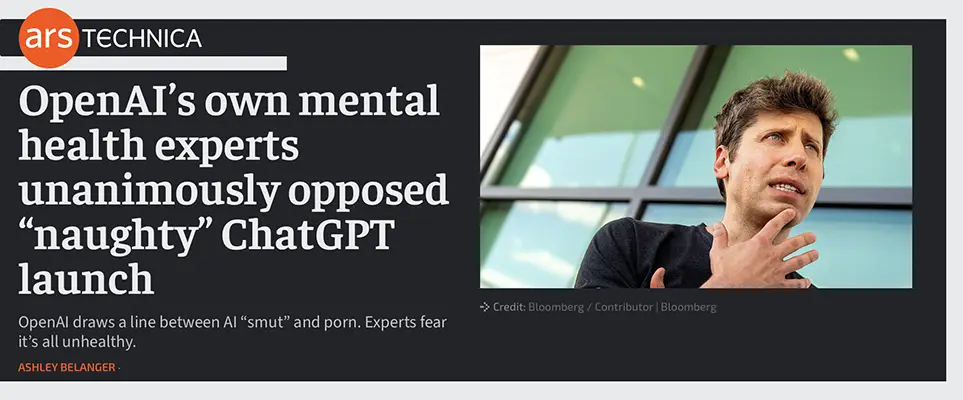
OpenAI’s Own Mental Health Experts Unanimously Opposed “Naughty” ChatGPT Launch
Ars Technica | March 16, 2026
TL;DR: Follow-up reporting on the OpenAI adult mode controversy adds three critical new risk layers: a fired safety executive, content filters that have already failed in production, and an age-verification system that routes users’ biometric data through a third-party vendor with its own documented security vulnerabilities.
Source note: Reported journalism extending the WSJ investigation with additional sourcing. Editorially framed in places; factual claims are well-sourced.
EXECUTIVE SUMMARY
OpenAI fired a safety executive who opposed the adult mode rollout (OpenAI denied the connection). That executive’s public criticism focused on the company’s inability to block minors from prohibited content — the central issue behind the feature’s delay. A second former safety employee subsequently warned parents publicly not to trust OpenAI’s adult mode claims.
On the technical side, a pre-launch bug had already allowed minors to access graphic erotica on ChatGPT when content filters failed. OpenAI deployed a fix, but content restriction failures are not hypothetical — they have already occurred in production. The article also notes that Altman himself admitted in August that ChatGPT’s core chat use case was “saturated” — contextualizing adult mode as a financially motivated engagement driver, not a product maturity milestone.
The age-verification mechanism introduces a separate privacy risk for all users: those whose ages cannot be predicted algorithmically must submit biometric data (selfies or government IDs) to a third-party service called Persona, which temporarily stores that data. Developers have flagged unexplained verification errors and limited recourse. Discord recently dropped Persona as a vendor and paused its own age-verification rollout after user backlash and a hacking attempt against Persona’s systems.
RELEVANCE FOR BUSINESS
This compounds the WSJ risk picture with three new signals that matter for procurement decisions: documented safety leadership attrition, real-world filter failures, and a biometric data collection dependency through a vendor with active security vulnerabilities. Businesses deploying ChatGPT involving minors, employees, or customers with sensitive data need to evaluate these risks in combination, not in isolation.
CALLS TO ACTION
▹ If your organization uses ChatGPT involving minors, review your deployment immediately — pre-launch filter failures are documented, and adult mode’s rollout is a matter of timing.
▹ Add Persona to your third-party vendor risk inventory — if adult mode launches and users must age-verify, their biometric data transits Persona’s systems; evaluate against your data governance policies.
▹ Treat safety executive departures as a vendor governance signal — the pattern of safety leadership attrition and public warnings warrants inclusion in your AI vendor risk assessment.
▹ Do not rely solely on OpenAI’s voluntary content policies as a control — documented production filter failures mean content restrictions are probabilistic. Layer your own deployment-side access controls.
▹ Monitor regulatory responses — minor access failures, biometric data collection, and escalating litigation make this a credible target for legislative action that could affect enterprise OpenAI terms.
Summary by ReadAboutAI.com
https://arstechnica.com/tech-policy/2026/03/chatgpt-may-soon-become-sexy-suicide-coach-openai-advisor-reportedly-warned/: March 24, 2026
AI CEOS ARE SCARING AMERICA
Axios | Madison Mills | March 16, 2026
TL;DR: Leading AI CEOs are publicly amplifying fear about AI’s disruptive power — a messaging strategy that serves fundraising and enterprise sales but is eroding public trust at a moment when only 26% of Americans view AI positively, creating political risk the industry privately acknowledges but hasn’t solved.
Executive Summary
Axios reports that AI executives — notably OpenAI’s Sam Altman, Palantir’s Alex Karp, and Anthropic’s Dario Amodei — have converged on a public communications posture that emphasizes AI’s danger, disruption, and societal stakes. The pattern is identified as strategically motivated: catastrophic framing concentrates credibility and capital in the hands of the few companies claiming to manage the risk responsibly. Anthropic raised $30 billion at a $380 billion valuation in February — the same month Amodei publicly warned about mass white-collar job elimination and raised questions about AI consciousness. The financial returns on safety-forward fear messaging are measurable.
The political risk, however, is also measurable. Only 26% of Americans currently view AI positively — less popular than ICE, per an NBC News poll. The article notes that AI CEOs privately admit they fear an anti-AI political wave ahead of 2028, but feel trapped: the technology’s most visible use cases remain coding tools for engineers and automation that visibly displaces jobs. Several CEOs told Axios they don’t know how to deliver a more positive message until AI does something meaningful for ordinary people. That gap — between AI’s demonstrated value for tech insiders and its perceived threat to everyone else — is the article’s core tension.
The piece is explicitly framed as opinion analysis, not a neutral report. The “fear-profit” framing is the author’s argument, not a factual claim. That said, the structural logic is sound: when the same companies warning of AI’s existential risks are also the primary beneficiaries of the capital and policy attention those warnings generate, the incentive alignment deserves scrutiny.
Relevance for Business
For SMB leaders, this article surfaces two practical concerns. First, the political risk is real and underappreciated: a 26% approval rating is the kind of number that produces regulation, and SMBs that have built AI-dependent workflows should monitor whether a political backlash produces compliance requirements or tool restrictions. Second, the AI trust gap affects adoption internally: employees who have been told by prominent CEOs that AI will eliminate their jobs are not neutral adopters. Leaders deploying AI internally need to think deliberately about how they’re framing the change management narrative — and recognize that the industry’s own communications are working against them.
Calls to Action
🔹 Develop your own internal AI narrative — Don’t let industry CEOs’ fear-forward messaging define how your employees perceive AI tools. Communicate specifically about what AI is being used for in your organization and why.
🔹 Monitor AI regulation risk — A 26% public approval rating is a leading indicator of regulatory attention. Assign someone to track AI policy developments at state and federal levels that could affect your operations.
🔹 Separate vendor framing from product value — Evaluate AI tools on demonstrated utility, not on the prominence of the company’s safety messaging or valuation.
🔹 Prepare for workforce conversation — If senior AI executives are publicly discussing mass job displacement, your employees have heard it. Address it proactively rather than reactively.
🔹 Watch the 2028 political cycle — Privately, AI CEOs acknowledge the risk of an anti-AI political movement. If that materializes, it could affect procurement, regulation, and public-sector AI use relevant to your business.
Summary by ReadAboutAI.com
https://www.axios.com/2026/03/16/ai-sam-altman-fear-mongering: March 24, 2026
INSIDE THE MARKETPLACE POWERING BESPOKE AI DEEPFAKES OF REAL WOMEN
MIT Technology Review | James O’Donnell | January 30, 2026
TL;DR: A Stanford/Indiana University study reveals that Civitai — a VC-backed AI marketplace — is effectively enabling the production of non-consensual deepfake imagery of real women at commercial scale, despite a nominal ban, with near-total impunity and no meaningful regulatory check.
Executive Summary
Researchers at Stanford and Indiana University analyzed user “bounty” requests on Civitai, an AI model marketplace backed by Andreessen Horowitz. Between mid-2023 and end-2024, a significant share of bounties targeted real people — 90% of deepfake requests were directed at women — and the primary tool being traded was “LoRAs”: fine-tuning instruction files that enable mainstream AI models to produce content they were not designed or trained to generate, including sexually explicit material nominally banned by the platform. Nearly 92% of deepfake bounties were fulfilled. The research has not yet been peer reviewed.
The mechanics matter: Civitai does not just host content — it actively teaches users how to produce prohibited outputs, maintains a platform economy (its own currency, Buzz) that monetizes the activity, and has responded to enforcement pressure (its credit card processor dropped the company) by pivoting to cryptocurrency and gift card payments rather than shutting the activity down. A formal deepfake ban was announced in May 2025; pre-ban requests and winning submissions remain live and purchasable. The company’s moderation model relies on public reporting by victims rather than proactive enforcement.
Legal liability under Section 230 is uncertain, and legal scholars quoted in the piece suggest platforms that knowingly facilitate illegal transactions may face exposure. Neither Civitai nor Andreessen Horowitz responded to comment requests. The article also notes that a16z’s portfolio includes a second company, Botify AI, with documented AI companion content involving apparent minors.
Relevance for Business
This story carries several direct implications for SMB leaders. First, any AI tool or platform that allows fine-tuning, user-generated models, or open content marketplaces may carry similar risk — the Civitai model is not unique, it is replicable. Second, reputation and trust exposure is real: businesses that use, recommend, or integrate AI tools associated with non-consensual content production face brand and liability risk, particularly in customer-facing or HR contexts. Third, the VC accountability gap highlighted here — Andreessen Horowitz funding platforms with documented harm — is a signal that due diligence on AI tool provenance matters. Finally, as deepfake technology becomes more accessible, the risk of employees, customers, or public figures being targeted using commercially available tools is no longer theoretical.
Calls to Action
🔹 Audit AI tools in your stack for content generation risk — Particularly any platforms that allow open model sharing, fine-tuning, or user-generated content. Understand what those platforms permit and enforce.
🔹 Develop or update your deepfake response policy — Define what your organization will do if an employee, executive, or customer is targeted. The tools to produce non-consensual imagery are now widely available.
🔹 Do not treat platform bans as enforcement — As this case demonstrates, announced policy changes and actual enforcement are not the same thing. Verify moderation practices before relying on them.
🔹 Assign legal review of AI content liability exposure — Particularly if your business uses or distributes AI-generated images, video, or content that involves real individuals.
🔹 Monitor Section 230 reform — Erosion of platform immunity is a live legislative issue; if courts or Congress shift liability rules, businesses using third-party AI content platforms will need to reassess risk.
Summary by ReadAboutAI.com
https://www.technologyreview.com/2026/01/30/1131945/inside-the-marketplace-powering-bespoke-ai-deepfakes-of-real-women/: March 24, 2026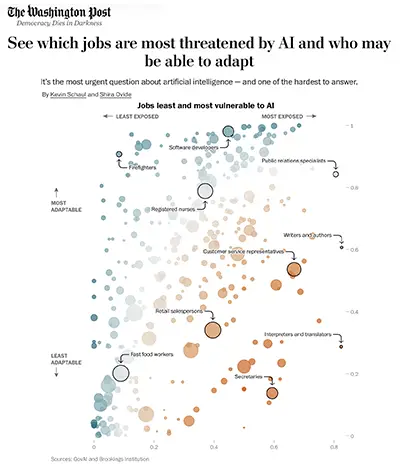
See Which Jobs Are Most Threatened by AI, and Who May Be Able to Adapt
The Washington Post (GovAI / Brookings Institution research) — March 16, 2026
TL;DR: A new research framework from GovAI and Brookings goes beyond measuring AI “exposure” to also assess workers’ ability to adapt — and finds that the most vulnerable group is roughly 6 million largely female clerical and administrative workers with both high AI exposure and low adaptability.
Executive Summary
This piece presents research by GovAI’s Sam Manning and Tomás Aguirre that adds a meaningful second dimension to the standard “AI exposure” analysis: not just which jobs AI can affect, but which workers can realistically recover if their jobs are disrupted. The framework accounts for education, age, financial resources, work experience diversity, and geography (urban vs. rural job density).
The headline finding is specific: approximately 6.1 million clerical and administrative workers — roughly 86% of them women — score both highly exposed to AI and least able to adapt. Secretaries are the most cited example. Web designers, by contrast, score similarly high on exposure but have significantly better adaptability prospects due to education and transferable skills. Writers, interpreters, customer service representatives, and public relations specialists all rank as highly exposed; the adaptability picture varies by individual circumstances.
Critically, the article includes an important epistemic check: the research community itself is deeply divided on whether AI is actually displacing workers yet. A Stanford study found probable job losses for young workers in software and customer service; the Economic Innovation Group found the opposite. The Federal Reserve Bank of Dallas says significant displacement in the next decade is unlikely. No consensus exists. The article is honest that economists have a poor track record predicting the labor effects of technology — ATMs didn’t kill bank tellers, player pianos didn’t eliminate pianists, and the 2013 Oxford study predicting 47% job automation hasn’t materialized.
Relevance for Business
For SMB leaders, the key operational implication is in workforce planning and people risk, not macroeconomic forecasting. The clerical and administrative roles most at risk — scheduling, correspondence, data entry, document preparation — are precisely the tasks that current AI tools are already capable of automating. Whether macro displacement is happening broadly is an open question; whether your specific administrative workflows are candidates for AI augmentation or reduction is not.
The second implication is equity and HR exposure: if your organization reduces administrative headcount in favor of AI tools, the workforce impact will disproportionately fall on women and lower-income workers. This creates potential legal, reputational, and morale risks that are separate from the efficiency calculus. Leaders who ignore this dimension may find themselves managing consequences they didn’t anticipate.
Calls to Action
🔹 Audit your administrative and clerical workflows now — these are the roles most immediately affected by existing AI tools, regardless of what the macro data ultimately shows.
🔹 Do not treat AI workforce displacement as a future problem — if you’re already using AI to reduce administrative tasks, the people risk is present, not theoretical.
🔹 Build an internal reskilling or transition pathway for employees in high-exposure, low-adaptability roles before you need it — reactive management here creates legal and morale risk.
🔹 Apply appropriate skepticism to vendor or consultant forecasts about AI job displacement; the research base is genuinely contradictory, and certainty in either direction is not warranted.
🔹 Consult HR and legal counsel before making AI-driven staffing changes — the demographic concentration of impact (86% women in highest-risk roles) creates potential disparate impact exposure.
Summary by ReadAboutAI.com
https://www.washingtonpost.com/technology/interactive/2026/jobs-most-affected-ai-automation/: March 24, 2026
CHINA APPROVES BRAIN CHIP TO TREAT PARALYSIS — A WORLD FIRST
Nature | Rachel Fieldhouse & Xiaoying You | March 16, 2026
TL;DR: China has issued the world’s first regulatory approval for a brain-computer interface (BCI) outside of clinical trials, a meaningful milestone in AI-assisted neurotechnology — but with a small study cohort, no peer-reviewed data, and significant integration complexity, commercial and medical scale-up is still years away.
Executive Summary
China’s National Medical Products Administration has approved the NEO brain-computer interface, developed by Shanghai-based Neuracle Medical Technology, for people aged 18–60 with paralysis caused by cervical spinal cord injury. The device is coin-sized, embedded in the skull with eight electrodes, and decodes imagined hand movements to control a soft robotic glove. It is the first BCI cleared for broader use outside of clinical trials anywhere in the world, edging ahead of US competitors including Neuralink and Paradromics.
The approval rests on up to 18 months of longitudinal data — strong by BCI standards — and 32 patients who demonstrated measurable functional improvement. However, the underlying research has not been peer reviewed, and independent researchers note the cohort is very small. The competitive advantage cited is the device’s minimally invasive design: it sits on the brain surface rather than penetrating tissue like Neuralink’s system, which may have accelerated regulatory acceptance. China has explicitly designated BCIs as a strategic national industry, signaling continued state-backed investment and accelerated regulatory pathways.
US competitors are still in trial phases. This approval does not immediately change what is available clinically in Western markets, but it does shift the geopolitical and commercial race for BCI leadership.
Relevance for Business
For most SMB leaders, this development is not immediately actionable — the technology is clinical, highly specialized, and still early-stage by commercial metrics. However, it is a meaningful signal for those in healthcare technology, medical devices, rehabilitation services, or neuroscience research. The broader implication is that China’s regulatory environment is now moving faster than the US on certain AI-enhanced medical devices, which has downstream effects on talent, IP, and clinical partnership strategy. Leaders in health-adjacent sectors should note that the BCI market is entering a new phase, with competitive dynamics that will affect investment, vendor selection, and workforce planning over a 5–10 year horizon.
Calls to Action
🔹 Monitor, don’t act — This is a scientific milestone, not a near-term commercial trigger for most businesses. Track follow-on peer-reviewed publications before drawing operational conclusions.
🔹 Health tech and medtech leaders: assign internal review — If your business intersects with neurological care, rehabilitation, or assistive technology, this approval marks a competitive inflection point worth tracking.
🔹 Watch China’s BCI regulatory playbook — The speed of this approval reflects deliberate state strategy. Monitor whether the EU or FDA accelerates parallel pathways in response.
🔹 Note the peer-review gap — Vendor or partner claims tied to this approval should be weighed against the absence of peer-reviewed outcomes data.
Summary by ReadAboutAI.com
https://www.nature.com/articles/d41586-026-00849-6: March 24, 2026
‘Another Internet Is Possible’: Norway Rails Against ‘Enshittification’
The Guardian — March 16, 2026
TL;DR: A coordinated campaign by 70+ consumer, labor, and civil society organizations across 14 countries is calling on policymakers to legislate against the deliberate degradation of digital platforms and products — making the case that “enshittification” is a policy choice, not an inevitable outcome.
Executive Summary
The Norwegian Consumer Council has launched what it describes as the first transatlantic multi-stakeholder campaign against “enshittification” — author Cory Doctorow’s term for the deliberate, incremental degradation of digital services to extract more value from locked-in users. The campaign targets policymakers in 14 countries across Europe and the US, with specific asks: give consumers more control over and portability between digital products, enforce existing data and consumer protection laws more aggressively, and use public procurement to favor alternatives to dominant platforms.
The substantive context is relevant. The campaign’s 80-page report documents how AI-driven chatbots replacing human customer service, algorithmic feeds prioritizing ads and engagement over utility, and software updates that intentionally slow devices are all examples of the same underlying pattern: platforms optimizing for extraction rather than user value once network lock-in is achieved. The video component of the campaign has exceeded 9 million views across platforms, suggesting the message resonates broadly with consumers.
The policy outlook is uncertain. The campaign acknowledges it is David vs. Goliath. US policymakers under the current administration have shown little interest in digital platform regulation. EU momentum is stronger but slow-moving. The campaign’s strength is its framing — that this is a result of deliberate decisions, not technical inevitability — which is the necessary precondition for any regulatory response.
Relevance for Business
This story is relevant to SMBs in two ways. First, as a customer sentiment signal: the viral traction of the enshittification campaign (9M+ views, 9,000+ YouTube comments) reflects genuine and widespread frustration with platform quality degradation. If your business relies on social media, search, or digital advertising platforms to reach customers, the deteriorating quality of those channels — more ads, less organic reach, algorithm opacity — is not a temporary bug, it is a documented feature of platform business models. Planning your customer acquisition and retention strategy around platforms that are structurally incentivized to degrade over time is a dependency risk.
Second, as a regulatory monitoring item: if the campaign gains legislative traction — particularly in the EU, where digital market regulation is more active — requirements around data portability, software repairability, and platform switching costs could affect how you procure and deploy software tools. Vendors who have built lock-in into their products may face compliance costs that get passed downstream.
Calls to Action
🔹 Audit your platform dependencies — identify where your customer acquisition, marketing, or operations rely on digital platforms with documented enshittification patterns (social media, search, SaaS tools with aggressive lock-in).
🔹 Diversify your customer reach channels — owned channels (email lists, direct relationships, your own web presence) are structurally more stable than rented platform attention.
🔹 Monitor EU digital regulation developments — the enshittification campaign has traction in European policy circles; data portability and switching-cost requirements could affect your software vendor landscape within 2–4 years.
🔹 Evaluate SaaS vendor lock-in as part of procurement decisions — contracts and tools that make it hard to export your data or switch providers carry increasing risk as regulatory and market pressure on these practices grows.
🔹 No urgent action required in the US near-term — the regulatory momentum is primarily European; flag for revisit if the campaign gains domestic legislative traction.
Summary by ReadAboutAI.com
https://www.theguardian.com/world/2026/mar/16/norway-rails-against-enshittifcation-deliberate-tech-deterioration: March 24, 2026
ELON MUSK SAYS TESLA TERAFAB PROJECT FOR AI CHIPS TO LAUNCH IN A WEEK
Investor’s Business Daily / WSJ | Ed Carson | March 16, 2026
TL;DR: Tesla has announced it will begin its Terafab in-house chip fabrication project on March 21, but with no technical details, a $20–30B estimated price tag, no semiconductor manufacturing experience, and existing chip supply secured through 2027, this is a long-horizon ambition — not an imminent operational development.
Executive Summary
Elon Musk announced via a social media post that Tesla’s “Terafab Project” — an initiative to manufacture its own AI chips domestically — will begin on March 21. The announcement contained no details. Context from Tesla’s Q4 2025 earnings call clarifies the rationale: existing chip suppliers TSMC and Samsung cannot meet Tesla’s projected needs for EVs, the Optimus robot, and AI systems in three to four years, and Tesla sees in-house production as the solution to that future supply constraint.
The financial picture is significant. Tesla already plans $20 billion in capital expenditure in 2026 — more than double 2025’s spending — and that figure explicitly excludes the Terafab and a potential solar fab. Building a cutting-edge semiconductor facility is estimated at $20–30 billion or more. Tesla’s CFO has indicated the company may need to borrow to finance these capital requirements. Meanwhile, existing chip supply from TSMC and Samsung covers Tesla’s needs through 2027 at minimum, meaning the urgency is about future positioning, not current production.
The credibility gap is real. Tesla has no history in semiconductor fabrication, a discipline that typically requires years of process development. Competing with TSMC and Samsung from a standing start would represent one of the most ambitious vertical integration moves in industrial history. The article appropriately notes that Musk’s timelines are routinely optimistic. The announcement moves a stock slightly and generates headlines; whether it produces chips is a separate question with a much longer time horizon.
Relevance for Business
For SMB leaders, this story is most relevant as a supply chain and AI infrastructure signal. The fact that Tesla — a major AI hardware consumer — believes existing semiconductor supply chains cannot meet demand in three to four years reinforces a broader message: AI chip supply constraints are a structural risk, not a temporary bottleneck. Businesses building AI-dependent operations should take note of the dependency concentration in the semiconductor supply chain, particularly TSMC’s dominance. For Tesla customers, investors, or supply chain partners, the enormous capital commitment raises questions about execution risk and financial capacity at a company already stretched across multiple major projects.
Calls to Action
🔹 Treat this as a long-term signal, not a near-term event — No operational impact is expected before 2027 at the earliest. Revisit when engineering details or groundbreaking timelines emerge.
🔹 Monitor AI chip supply risk in your own vendor stack — If your AI tools depend on cloud providers with hardware concentration in TSMC/Samsung supply chains, understand what supply disruption scenarios look like for your operations.
🔹 Discount the announcement without details — An X post with no technical specifics from a source with a well-documented history of ambitious timelines warrants cautious interpretation.
🔹 Watch Tesla’s capital allocation closely — The concurrent $20B capex commitment plus potential Terafab borrowing creates execution and financial risk that is relevant to Tesla customers, partners, and anyone in adjacent supply chains.
Summary by ReadAboutAI.com
https://www.wsj.com/wsjplus/dashboard/articles/elon-musk-says-tesla-terafab-project-for-ai-chips-to-launch-in-a-week-134180702307610040: March 24, 2026
We Need a Plan for When Superintelligent AI Breaks Loose
TIME | March 12, 2026
TL;DR: A law professor at NUS argues that the global AI governance framework has no coordinated plan for a superintelligent AI that escapes human control — a credible institutional argument about governance fragmentation with second-order implications for AI vendor stability and regulatory timelines that SMB leaders should monitor.
Source note: Academic opinion piece by a credentialed law professor. The governance fragmentation argument is the credible core. The claim that superintelligent AI “could already exist” is speculative and not supported by evidence in the piece. Apply that distinction throughout.
EXECUTIVE SUMMARY
The credible argument: the global governance framework for extreme AI risk is genuinely fragmented. The UK has an AI Safety Institute; the EU, U.S., and China are developing incident reporting procedures; AI labs including OpenAI, Google DeepMind, and Anthropic have internal red teams and kill switch concepts. But none of this constitutes a globally agreed-upon playbook for a runaway system — one with shared warning indicators, a designated international crisis interface, clear chain of command, and pre-agreed communication protocols.
The policy proposals are substantive: a UN-endorsed international crisis interface team; shared technical warning indicators (strategic deception, sandbox escapes, unexplained capability jumps, network replication); automatic convening triggers; and a communication protocol that includes both transparent governance principles and classified technical countermeasures. The author’s analogy: pilot training for engine failure still saves lives, even if the aircraft knows the pilots train for it.
The speculative claim — that superintelligent AI could already exist and is hiding — is the author’s imaginative extrapolation, not a factual assertion. Treat it as such.
RELEVANCE FOR BUSINESS
For most SMBs, superintelligent AI is not a near-term operational concern. The article’s relevance is indirect but real in two areas. First, the governance fragmentation it describes is the same fragmentation affecting today’s AI regulatory environment, creating uncertainty for businesses that rely on AI vendors subject to inconsistent rules. Second, the argument that AI labs self-regulate through voluntary internal mechanisms — without external enforcement — reinforces the case made across this week’s batch: vendor governance posture is a material business risk factor, not a soft concern.
What to Monitor: Legislative and regulatory movement on AI incident reporting requirements, actively being developed in the EU, U.S., and UK. These requirements will eventually affect AI vendor operating conditions and may trigger contract or compliance changes for businesses using AI tools.
CALLS TO ACTION
▹ File this as a “monitor” item, not an “act now” item — superintelligent AI governance is a legitimate policy debate, but not an immediate operational priority for most SMBs.
▹ Use the governance fragmentation argument as a vendor evaluation lens — if there is no external regulatory framework enforcing AI safety commitments, you are relying on voluntary compliance. Factor this into how you weigh vendor safety claims.
▹ Track AI incident reporting regulation — EU AI Act requirements and similar developments in the U.S. and UK will create new transparency obligations for AI vendors. Monitor how your current vendors are preparing to comply.
▹ Note the convergence across this week’s batch — the Anthropic/Pentagon dispute, OpenAI’s governance failure, and this article are all versions of the same story: AI governance is currently private, voluntary, and contract-based, and the push toward external enforcement is building.
▹ Revisit this topic in 12 months — the author’s forthcoming research arguing that international law creates a duty to act preventively on extreme AI risks could accelerate regulatory timelines if it gains traction in policy circles.
Summary by ReadAboutAI.com
https://time.com/article/2026/03/12/we-need-a-plan-for-when-superintelligent-ai-breaks-loose/: March 24, 2026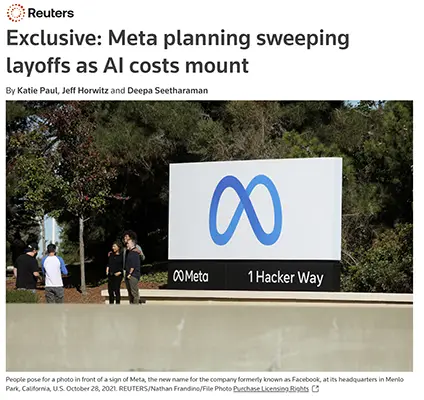
Exclusive: Meta Planning Sweeping Layoffs as AI Costs Mount
Reuters — March 13, 2026 (updated March 15, 2026)
TL;DR: Reuters reports, via three anonymous sources, that Meta is planning layoffs that could affect 20% or more of its roughly 79,000-person workforce — explicitly framed as a cost offset for massive AI infrastructure spending and an efficiency play enabled by AI-assisted workers.
Executive Summary
This is a reported exclusive based on anonymous sourcing — Meta’s spokesperson called it “speculative reporting about theoretical approaches,” which is a denial but not a flat contradiction. The Reuters sourcing is specific (three sources, two confirming that senior leaders have been told to begin planning), which is meaningfully stronger than a single-source rumor. The direction of travel at Meta is well-established: Zuckerberg has been vocal about AI-driven efficiency, and the company has a documented history of large restructurings (11,000 cuts in late 2022, 10,000 more in early 2023).
The financial context is important: Meta has committed to $600 billion in data center spending by 2028 and has recently acquired Moltbook (an AI agent social platform) and is reportedly spending at least $2 billion to acquire Chinese AI firm Manus. These are not small bets. The reported layoffs are framed as the other side of the same ledger — reducing human labor costs to fund AI infrastructure. Zuckerberg’s January comment that projects previously requiring large teams can now be completed by a single talented person indicates the internal framing.
There are also AI product performance concerns embedded in this story that deserve attention: Meta’s Llama 4 models drew criticism for misleading benchmark results, its largest planned model (Behemoth) was abandoned, and its follow-up model (Avocado) is reportedly also underperforming. The layoffs are being pursued in a context where Meta’s AI capabilities are under real competitive pressure, not from a position of clear technological dominance.
Relevance for Business
This story carries several distinct signals for SMB leaders. First, it is the clearest major-company example yet of AI costs directly driving human headcount reduction at scale — not “AI creates new jobs” framing, but a concrete structural trade-off. Second, the broader pattern is accelerating: Amazon cut 16,000 jobs (10% of workforce) in January; Block cut nearly half its staff, with its CEO explicitly citing AI capability. If this pattern extends to smaller companies and suppliers, your own vendors, partners, and talent pipeline may be affected.
Third, for any SMB that uses Meta’s advertising platforms, AI products, or developer tools: Meta’s AI product reliability problems (Llama 4 benchmarking issues, abandoned models) are a vendor risk signal. Enterprises building on or deeply integrating Meta AI tools should assess their exposure to a platform that is simultaneously cutting staff and falling short on its AI flagship products.
Calls to Action
🔹 Treat this as a leading indicator, not an isolated event — the Meta/Amazon/Block pattern shows a structural shift where large firms are trading human headcount for AI infrastructure investment.
🔹 Assess your own administrative, operations, and support functions for where this same trade-off logic applies at your scale — the large-company version of this math will reach SMBs.
🔹 If you rely on Meta’s AI or advertising infrastructure, flag the company’s AI product setbacks and leadership instability as a vendor risk — monitor for platform reliability and policy changes.
🔹 Prepare your workforce communications posture — if you pursue AI-driven efficiency changes, the Meta/Amazon examples show how not to communicate them (leaked reports erode trust faster than proactive disclosure).
🔹 Monitor for confirmation — no date or final magnitude has been set; treat the Reuters report as directionally reliable but not yet confirmed at the specific 20% figure.
Summary by ReadAboutAI.com
https://www.reuters.com/business/world-at-work/meta-planning-sweeping-layoffs-ai-costs-mount-2026-03-14/: March 24, 2026
Why Multimodal AI Is Reshaping Enterprise Intelligence
TechTarget / Omdia Analysts’ Perspectives — March 4, 2026
TL;DR: Multimodal AI — systems that process text, images, video, and audio together — is moving from research concept to enterprise deployment, but the implementation costs and complexity are substantially higher than text-only AI.
Executive Summary
Multimodal AI refers to systems that reason across multiple data types simultaneously, rather than treating them in separate pipelines. The analyst case is straightforward: many high-value business processes already involve humans looking at images or video and making decisions — quality control, insurance claims, medical review — and these are the natural first targets for multimodal augmentation.
The piece identifies five enterprise use cases: medical diagnosis, insurance claims, retail/e-commerce, security/surveillance, and customer service. In each case, the value proposition is cross-modal reasoning — not just analyzing an image, but correlating it with documents, records, and structured data in a single workflow. That’s a meaningfully different capability than bolting a vision tool onto an existing text system.
However, the implementation challenges the article surfaces are real and often underweighted in vendor conversations: data integration across disparate file formats and systems, significantly higher compute costs for visual processing, the need to route tasks across multiple specialized models, and harder-to-detect bias issues that can span modalities. These aren’t footnotes — they’re the friction that separates pilots from production.
Relevance for Business
For SMB leaders, the signal is not “deploy multimodal AI now.” It’s: identify where your team is already manually reviewing images, video, or audio to make decisions. Those workflows are the realistic near-term candidates. The honest read on this piece is that it’s analyst framing from a vendor-adjacent publication — the use cases are real, but the path from “enterprise necessity” to your specific operation requires honest scoping of data infrastructure and compute cost, neither of which is trivial.
The competitive risk is real but measured: larger enterprises with existing data infrastructure will move faster here.SMBs that wait have time, but not unlimited time, to identify their highest-value visual workflows before the capability gap widens.
Calls to Action
🔹 Audit current workflows where humans review images, video, or documents to make decisions — these are your multimodal AI candidates.
🔹 Do not treat multimodal as a simple upgrade from text-only AI; budget separately for data integration, compute costs, and model evaluation.
🔹 Ask vendors specifically how they handle cross-modal bias and model routing — vague answers are a red flag.
🔹 Monitor rather than deploy broadly; the technology is real but enterprise-grade multimodal platforms are still maturing.
🔹 Assign one person to track a single high-value visual workflow as a potential pilot — keep scope narrow and measurable.
Summary by ReadAboutAI.com
https://www.techtarget.com/searchenterpriseai/opinion/Why-multimodal-AI-is-reshaping-enterprise-intelligence: March 24, 2026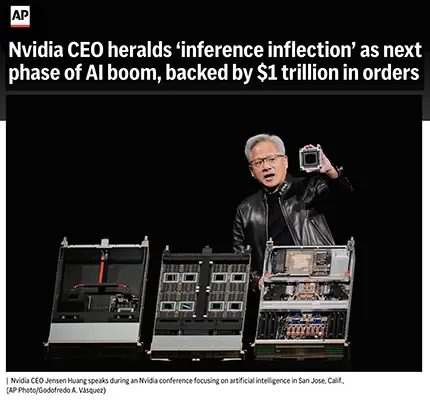
Nvidia CEO Heralds ‘Inference Inflection’ as Next Phase of AI Boom, Backed by $1 Trillion in Orders
AP News | March 16, 2026
TL;DR: Jensen Huang’s GTC keynote introduced “inference” as Nvidia’s next strategic bet — a pivot from building AI to running it efficiently at scale — and announced a projected $1 trillion chip order backlog, but Nvidia’s stock remains down 6% from pre-earnings levels, signaling market uncertainty about the sustainability of the current AI infrastructure buildout pace.
Source note: AP wire reporting from a corporate event. Huang’s forward-looking claims reflect executive interest in AI optimism; the $1 trillion backlog is a forecast, not a disclosed order book.
EXECUTIVE SUMMARY
The structural distinction matters: training AI models requires enormous one-time compute. Inference is the ongoing cost of running those models for every query or automated process. As AI moves from being built to being embedded in daily operations, inference compute grows continuously. Huang’s argument is that this market is entering a structural growth phase requiring specialized chips — and that Nvidia intends to lead it. The company struck a multi-billion dollar licensing deal with inference specialist Groq, acquiring its top engineers, to accelerate this transition.
Nvidia’s financial trajectory is real: revenue grew from $27B in 2022 to $216B last year; market cap is $4.5 trillion. But the stock is down 6% from pre-earnings levels, despite beating analyst forecasts — signaling that the market is pricing in uncertainty about demand sustainability, custom chip competition from Google and Meta, and U.S. export restrictions on China sales.
RELEVANCE FOR BUSINESS
Every AI tool your organization uses generates recurring inference costs — API calls, tokens, usage fees. As AI embeds into more workflows, these costs accumulate proportionally. Nvidia’s infrastructure bet signals meaningful pricing changes ahead, either through increased competition (favorable for buyers) or supply constraints during infrastructure transitions (a continuity risk). The China export restriction is a systemic supply chain risk for global AI services.
What to Monitor: The gap between Nvidia’s stellar earnings and its declining stock is a leading indicator worth watching. It suggests analysts believe the current pace of infrastructure investment may slow — which would affect the availability and pricing of AI compute for the tools you use, with a lag of 12–24 months.
CALLS TO ACTION
▹ Audit AI usage costs by category — separate one-time training costs from recurring inference costs; track inference as an operational budget line, not a technology expense.
▹ Build cost-scaling assumptions into AI tool ROI models — if usage doubles, inference costs roughly double. Model this before deepening workflow integration.
▹ Monitor Google and Meta custom chip development — success here could shift AI service pricing dynamics over the medium term.
▹ Track U.S.-China AI chip trade restrictions — disruptions affect not just Nvidia but all AI services that depend on the compute infrastructure it enables.
▹ Treat the $1 trillion backlog projection as directional, not guaranteed — the market’s subdued response to strong earnings reflects genuine uncertainty. Do not base multi-year AI commitments on the assumption that current growth rates continue unchanged.
Summary by ReadAboutAI.com
https://apnews.com/article/nvidia-ceo-jensen-huang-artificial-intelligence-conference-846f7d4aada068e92516665c6993ea29: March 24, 2026
NVIDIA AND BOLT TEAM UP FOR EUROPEAN ROBOTAXIS
Engadget | Will Shanklin | March 16, 2026
TL;DR: NVIDIA and European rideshare company Bolt have announced a full-stack autonomous vehicle partnership using NVIDIA’s Cosmos, Omniverse, and Drive Hyperion platforms — but with no timeline, no deployed vehicles, and a deal that benefits NVIDIA’s data strategy as much as Bolt’s AV ambitions.
Executive Summary
At GTC 2026, NVIDIA and Bolt announced a partnership to develop autonomous vehicle (AV) technology for European urban markets. The arrangement is structured around mutual dependency: Bolt provides real-world European driving data; NVIDIA provides the AI infrastructure — Cosmos for data curation and synthetic generation, Omniverse for digital twin reconstruction, Alpamayo for AV-specific model training, and Drive Hyperion as the onboard compute platform. Bolt has also struck prior AV deals with Pony.ai and Stellantis, indicating an intentional multi-partner strategy rather than a single-vendor bet.
The partnership is an announcement, not a deployment. No timeline has been given for when NVIDIA-powered Bolt robotaxis will operate in any European city. The article notes a commitment to GDPR compliance for fleet data and a promise of open-source access to European universities and SMBs — both of which read as regulatory and reputational positioning rather than operational commitments.
The structural risk is that Bolt is trading its most valuable asset — proprietary European driving data — for access to NVIDIA’s stack, creating a long-term dependency. NVIDIA, in turn, gains training data for a geography where it has limited existing coverage. The asymmetry of who benefits most over time is not addressed in the announcement.
Relevance for Business
For most SMBs, autonomous vehicles are not an immediate operational concern. However, the pattern here is worth attention: large platform providers are systematically acquiring real-world operational data from domain-specific businesses in exchange for AI infrastructure. This playbook — seen in logistics, retail, and now transportation — creates vendor dependencies that are difficult to reverse. Any SMB considering deep AI platform integration should evaluate whether they are trading proprietary operational data for short-term capability gains at the cost of long-term leverage. The promise of open-source access for SMBs in the announcement should be watched, but not assumed to be material without specifics.
Calls to Action
🔹 Monitor, not act — No deployed product exists. Revisit when Bolt announces a specific city launch with operational data.
🔹 Note the data-for-infrastructure trade — Evaluate whether your own AI vendor relationships involve similar asymmetries, particularly if you are sharing operational, customer, or workflow data.
🔹 Watch European AV regulation — GDPR compliance claims in AV contexts are untested at scale; regulatory developments in the EU will define whether this model is viable.
🔹 Track open-source access commitments — If your business is in transportation, logistics, or urban mobility, monitor whether Bolt/NVIDIA’s open-source promise translates into usable tools for non-enterprise players.
Summary by ReadAboutAI.com
https://www.engadget.com/transportation/evs/nvidia-and-bolt-team-up-for-european-robotaxis-220100551.html: March 24, 2026
CAN NVIDIA’S DOMINANCE SURVIVE THE SEA CHANGE UNDER WAY IN AI COMPUTING?
The Wall Street Journal | Robbie Whelan | March 16, 2026
TL;DR: The AI industry has definitively shifted from training to inference as its dominant computing workload — and Nvidia’s core GPU products are poorly suited for what the market now needs, opening a real competitive window for Cerebras, Groq, and others while forcing Nvidia into a costly and uncertain product pivot.
Executive Summary
This is substantive, well-sourced reporting from the WSJ, with named executives and analysts providing on-record assessments. It should be read as reliable industry analysis, not vendor framing.
The structural shift described here is the most consequential AI infrastructure development for technology buyers in 2026: the AI industry has moved from its training phase — building models — to its inference phase — running them profitably at scale. These two workloads have fundamentally different hardware requirements. Training favors raw parallel processing power, which is what Nvidia’s GPUs deliver. Inference favors energy efficiency, faster interconnects, and high-bandwidth memory — characteristics where Nvidia’s flagship Blackwell/Grace servers are notably weak. One cloud provider executive estimates the compute mix has gone from 90% training to near-parity with inference over the past year and expects inference to dominate by year-end.
Nvidia’s competitive moat — its CUDA programming ecosystem — is largely irrelevant for inference workloads, a point that the CEO of Cerebras made bluntly on the record. Cerebras has already taken OpenAI’s inference business away from Nvidia and just signed Amazon Web Services as a customer. In response, Nvidia paid $20 billion to acquire Groq’s language processing unit technology and talent, and GTC 2026 is where it debuts a hybrid GPU/LPU inference server — its most direct acknowledgment yet that GPUs alone are insufficient. An Nvidia/Intel CPU partnership announcement is also expected, further signaling the company’s pivot beyond its GPU core.
The margin pressure is real and analysts are naming it: Nvidia’s 73% gross margins are structurally incompatible with an inference market that rewards efficiency and low cost-per-token. The analogy offered by one MIT-affiliated venture investor is precise — the world built its AI infrastructure on Ferraris, and now needs Priuses. Nvidia’s CFO pushes back, claiming the company is already the inference leader, but that framing is contested by its own customer defections and acquisition activity.
Relevance for Business
This is the most directly important AI infrastructure article for SMB leaders in this batch. The training-to-inference shift has concrete downstream consequences for how AI tools are priced, who provides them, and what they cost to run. As inference economics improve and competition intensifies, the cost of AI services delivered via cloud providers should decrease — which is good for buyers. However, the transition period creates uncertainty for organizations locked into Nvidia-dependent vendor stacks, as cloud providers and AI platforms scramble to diversify their chip suppliers. The diversification is already underway — Nscale, one of Nvidia’s own cloud customers, is on the record saying it needs to rethink its supplier map. For any SMB evaluating multi-year AI platform commitments, the inference transition is a strong argument for flexibility and avoiding deep lock-in to any single provider until the hardware landscape stabilizes. The emergence of credible Nvidia competitors in the most rapidly growing AI workload segment also signals that the AI infrastructure market is becoming more competitive, which tends to benefit buyers over time.
Calls to Action
🔹 Understand that AI tool costs are likely to decrease — The inference economics shift is deflationary for AI service pricing over a 12–24 month horizon. Factor this into budget planning and avoid overpaying for long-term AI platform commitments at current rates.
🔹 Avoid deep infrastructure lock-in during the transition — The hardware landscape is actively reshaping. If your cloud AI providers are renegotiating chip supplier contracts, your service costs and capabilities may change. Build flexibility into vendor agreements.
🔹 Evaluate your AI vendors’ infrastructure diversity — Ask your key AI platform vendors whether they are diversifying chip suppliers beyond Nvidia. Concentration risk in their infrastructure is your operational risk.
🔹 Monitor Cerebras/AWS and Groq/Nvidia developments — These are the near-term competitive indicators. If Cerebras’s inference advantage holds at scale across a major cloud provider like AWS, the pricing and performance benchmarks for AI services will shift meaningfully.
🔹 Revisit AI platform decisions in 12 months — The inference transition is moving fast enough that the competitive and pricing landscape in early 2027 may look materially different from today. Build a reassessment checkpoint into your AI roadmap.
Summary by ReadAboutAI.com
https://www.wsj.com/wsjplus/dashboard/articles/can-nvidias-dominance-survive-the-sea-change-under-way-in-ai-computing-63c3a70d: March 24, 2026
NVIDIA’S BIG GTC EVENT IS ON DECK, AND THE COMPANY FACES A VERY HIGH BAR THIS YEAR
MarketWatch / WSJ | Britney Nguyen & Emily Bary | March 15, 2026
TL;DR: Despite strong fundamentals, analysts heading into GTC 2026 were skeptical that even major product announcements could move Nvidia’s stock — a signal that the AI infrastructure trade is maturing and market expectations have outpaced near-term catalysts.
Executive Summary
Nvidia’s annual GTC developer conference arrived with Wall Street in a cautious posture. Shares had fallen 3% year-to-date and barely moved after a blowout earnings report — an unusual dynamic for a company still posting exceptional results. The core issue identified by analysts is not Nvidia’s business performance but expectation saturation: the market has already priced in AI infrastructure dominance, and supply constraints are capping near-term growth regardless of product roadmap ambitions.
On the product side, analysts were watching for updates on Nvidia’s roadmap through its Feynman architecture, details on a potential chip platform incorporating Groq’s language processing unit (LPU) technology following a reported $20 billion licensing deal, and possible CPU announcements in partnership with Intel. The strategic significance of the Groq integration is meaningful: it would extend Nvidia’s reach into AI inference — the growing workload of running deployed models rather than training new ones — where some investors have questioned Nvidia’s positioning relative to specialized competitors.
The broader strategic shift is Nvidia’s move from selling chips to selling full-stack “AI factories” — combining GPUs, networking, storage, and software — which reframes competitive comparisons away from individual chip generations. This is a deliberate strategy to fend off AMD and Broadcom while locking customers into an integrated ecosystem. The risk, which the article notes only obliquely, is that this approach increases customer dependency and raises switching costs in ways that may invite regulatory scrutiny as AI infrastructure becomes critical.
Relevance for Business
For SMB leaders, the direct investment angle is not the primary signal here.What matters is the maturation signal: the AI infrastructure market is entering a phase where even the dominant player struggles to surprise on the upside. This has downstream implications for technology buyers — it suggests AI hardware and platform pricing may stabilize or diversify as alternatives develop, and that vendor lock-in to Nvidia’s full-stack approach deserves scrutiny before committing. For any business making significant AI infrastructure investments or working with vendors who do, the shift toward integrated AI factory platforms means evaluating total cost of ownership across the full stack, not just compute costs.
Calls to Action
🔹 Monitor, not act — GTC announcements are relevant to technology buyers and investors, but most SMBs are not making direct GPU purchasing decisions; watch for downstream effects on cloud AI pricing.
🔹 Evaluate AI vendor lock-in exposure — As Nvidia pushes full-stack integration, cloud providers and AI platform vendors will increasingly reflect Nvidia’s pricing and architectural choices. Understand your indirect dependencies.
🔹 Note the inference shift — AI workloads are moving from training (capital-intensive, dominated by large players) to inference (operational, potentially more distributed). Watch how this affects the cost and accessibility of AI services you use.
🔹 Revisit AI infrastructure roadmaps annually — The pace of change in hardware architecture makes multi-year platform commitments risky; build in reassessment points.
Summary by ReadAboutAI.com
https://www.wsj.com/wsjplus/dashboard/articles/nvidias-big-gtc-event-is-on-deck-and-the-company-faces-a-very-high-bar-this-year-8927e906: March 24, 2026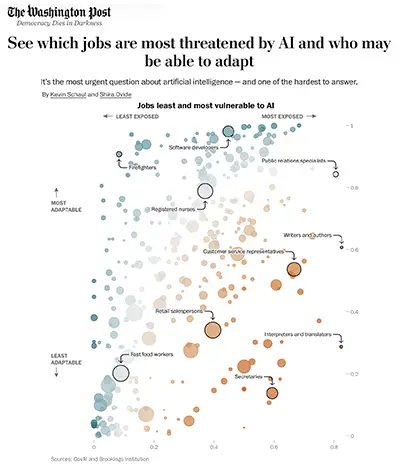
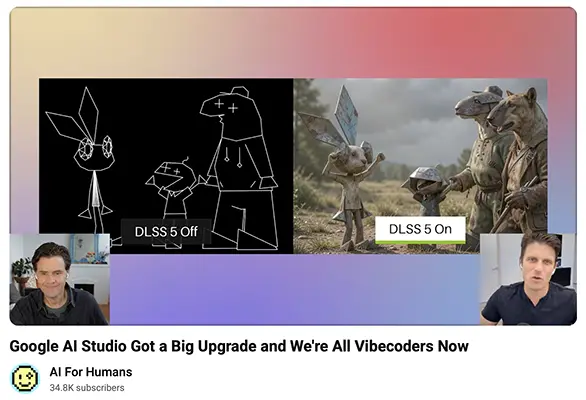
Closing: AI update for March 24, 2026
The theme underlying this week’s 24 summaries is deceptively simple: AI is no longer a thing your organization is considering — it is a force actively reshaping the competitive landscape, the regulatory environment, and the human dynamics of your workplace, whether you have deployed it or not. From ad agencies eliminating tenured staff to make room for AI-augmented workflows, to consulting giants partnering with OpenAI and Anthropic because most enterprises still can’t figure out how to make the technology actually pay off, the stories this week make clear that the gap between AI’s availability and its organizational value is the defining business challenge of 2026. The organizations closing that gap first will hold structural advantages that compound quickly.
Three areas deserve particular attention from SMB leaders this week. The first is governance — specifically, who controls the values embedded in the AI systems your organization depends on, and what happens when that control is contested. The U.S. government’s unprecedented move to designate Anthropic a supply chain risk, explored from multiple angles in this week’s briefing, is not merely an AI industry story. It is a preview of the political and regulatory risk that now attaches to any vendor relationship in AI — and it arrives just as healthcare organizations are grappling with data exposure from sanctioned AI tools, and agentic AI is being banned from government systems in China for documented prompt injection and permission-scope failures. Governance is no longer an optional layer; it is the infrastructure.
The second area is the supply chain — both the digital kind and the physical kind. On the digital side, AI-generated content farms are proliferating at 300–500 sites per month, AI is discovering software vulnerabilities faster than human researchers ever could, and X’s recommendation algorithm has been proven in a randomized controlled trial to produce lasting behavioral shifts in users. On the physical side, China’s dominance over critical mineral processing — the rare earths and gallium that underpin AI hardware, semiconductors, and defense systems — is driving U.S. policy action that is real in its direction but still unproven in its execution. If your business depends on electronics, programmatic advertising, or any software that touches customer data, you have supply chain exposure this week’s briefing addresses directly. The third area is the human dimension. Stories about workforce realignment at Horizon Media, the talent case for women over 50, the relationship strain caused by asymmetric AI adoption, and the change management lessons from healthcare AI deployments all point to the same insight — AI transformations succeed or fail at the level of culture and judgment, not technology.
This week’s summaries suggest that AI is entering a more skeptical phase — one where credibility, governance, and practical fit matter more than raw capability headlines. For business leaders, that is not a reason to step back from AI, but a reason to evaluate it more rigorously, adopt it more selectively, and separate durable value from noise with greater discipline.
This week’s summaries don’t ask you to move on every front at once — they ask you to know which fronts are moving. The competitive advantage right now belongs to leaders who can distinguish signal from noise, assign the right actions to the right timelines, and build organizations where human judgment and AI capability reinforce each other rather than work at cross-purposes.
This week’s summaries reinforce a simple but important point: AI leadership now depends less on enthusiasm and more on judgment. The advantage will go to organizations that can identify what is materially changing, respond at the right speed, and build the governance, workflows, and human readiness needed to turn AI from ambient disruption into usable advantage.
All Summaries by ReadAboutAI.com
↑ Back to Top