
AI Updates March 20, 2026


The theme underlying this mid-week post is deceptively simple: AI is no longer a thing your organization is considering — it is a force actively reshaping the competitive landscape, the regulatory environment, and the human dynamics of your workplace, whether you have deployed it or not. From ad agencies eliminating tenured staff to make room for AI-augmented workflows, to consulting giants partnering with OpenAI and Anthropic because most enterprises still can’t figure out how to make the technology actually pay off, the stories this week make clear that the gap between AI’s availability and its organizational value is the defining business challenge of 2026. The organizations closing that gap first will hold structural advantages that compound quickly.
Three areas deserve particular attention from SMB leaders this week. The first is governance — specifically, who controls the values embedded in the AI systems your organization depends on, and what happens when that control is contested. The U.S. government’s unprecedented move to designate Anthropic a supply chain risk, explored from multiple angles in this week’s briefing, is not merely an AI industry story. It is a preview of the political and regulatory risk that now attaches to any vendor relationship in AI — and it arrives just as healthcare organizations are grappling with data exposure from sanctioned AI tools, and agentic AI is being banned from government systems in China for documented prompt injection and permission-scope failures. Governance is no longer an optional layer; it is the infrastructure.
The second area is the supply chain — both the digital kind and the physical kind. On the digital side, AI-generated content farms are proliferating at 300–500 sites per month, AI is discovering software vulnerabilities faster than human researchers ever could, and X’s recommendation algorithm has been proven in a randomized controlled trial to produce lasting behavioral shifts in users. On the physical side, China’s dominance over critical mineral processing — the rare earths and gallium that underpin AI hardware, semiconductors, and defense systems — is driving U.S. policy action that is real in its direction but still unproven in its execution. If your business depends on electronics, programmatic advertising, or any software that touches customer data, you have supply chain exposure this week’s briefing addresses directly. The third area is the human dimension. Stories about workforce realignment at Horizon Media, the talent case for women over 50, the relationship strain caused by asymmetric AI adoption, and the change management lessons from healthcare AI deployments all point to the same insight — AI transformations succeed or fail at the level of culture and judgment, not technology.
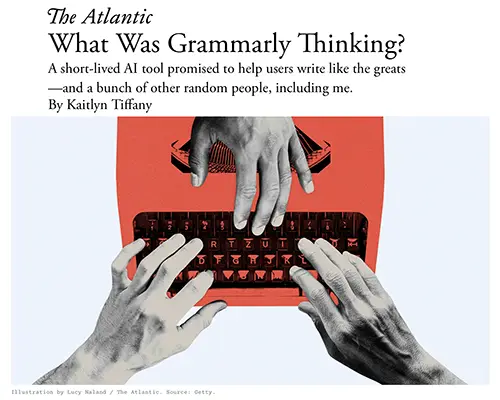
GRAMMARLY’S “EXPERT REVIEW” DEBACLE: WHAT AI PERSONA FEATURES ACTUALLY DO
The Atlantic | Kaitlyn Tiffany | March 12, 2026
TL;DR / KEY TAKEAWAY
Grammarly launched — and quickly killed — an AI feature that simulated editorial feedback from named authors and academics without consent, producing low-quality output and triggering a class-action lawsuit; the incident is less a cautionary tale about AI sophistication than about governance failure and unchecked product decisions.
EXECUTIVE SUMMARY
Grammarly briefly offered a feature called “Expert Review” that generated AI writing feedback attributed to named authors (including living writers, recently deceased academics, and working journalists). None had consented. The feature was shut down the same day it became widely reported, following public backlash and a class-action lawsuit filed by journalist Julia Angwinagainst Grammarly’s owner, Superhuman Platform. The CEO apologized via LinkedIn; the company called the legal claims without merit.
This piece is written as first-person criticism, not a neutral report — the author is one of the writers whose name was used without consent. That context matters for interpretation. Her hands-on testing found the feature’s output to be uniformly poor: suggestions were verbose additions rather than structural improvements, included fabricated details and fake quotes, and occasionally hallucinated entire paragraphs. The feature also had an integrated chatbot that denied knowing about Expert Review and had knowledge only through June 2024 — a meaningful internal inconsistency Grammarly apparently missed before shipping.
The article frames this within a broader anxiety about whose skills remain valuable in an AI economy, touching on the reversal of the “learn to code” era: LLMs may be better at structured technical tasks than at replicating voice and judgment. The observation is interesting but should be treated as editorial framing, not a settled conclusion.
RELEVANCE FOR BUSINESS
Governance risk: This is a direct example of what happens when AI features ship without ethics review, legal clearance, or stakeholder consent checks. The feature likely took weeks to build; the reputational and legal exposure arrived in hours. SMBs deploying AI tools in customer-facing or content-generating contexts face analogous risks at smaller scale.
Vendor trust signal: Grammarly is widely used in SMB environments for writing assistance. This incident raises legitimate questions about their product governance process. Companies relying on Grammarly for sensitive communications should note that a new feature was shipped, became controversial, and was killed — all within a single day — without apparent pre-launch review.
AI output quality reality check: The feature’s described outputs — wordy, structurally weak, hallucinated content dressed up with famous names — illustrate the gap between AI marketing and AI performance on nuanced, voice-dependent tasks. This is consistent with known limitations of current LLMs.
Labor framing: The article’s broader thesis (that word-based roles may be more AI-resistant than previously feared) is worth noting, but is an opinion piece, not an empirical finding. It reflects a real debate, not a settled answer.
CALLS TO ACTION
No immediate action required: The feature is down. This is primarily a governance and legal story to monitor, not an immediate operational threat.
Audit AI tool governance: If your company uses Grammarly (or similar tools) for client-facing content, review what new features auto-enable and whether employees know what they’re using.
Build a persona/consent review step: Any internal AI project that simulates a named person — employee, expert, customer — should go through a consent and legal review before deployment.
Monitor the lawsuit: The Angwin class-action against Superhuman Platform may establish precedent for AI persona use without consent. Assign someone to track outcomes.
Recalibrate AI writing tool expectations: The described output quality — verbose, structurally weak, hallucination-prone — is a useful calibration point. Do not assume AI editorial tools produce publishable content without human review.
Summary by ReadAboutAI.com
https://www.theatlantic.com/technology/2026/03/grammarly-ai-expert-bad-advice/686343/: March 20, 2026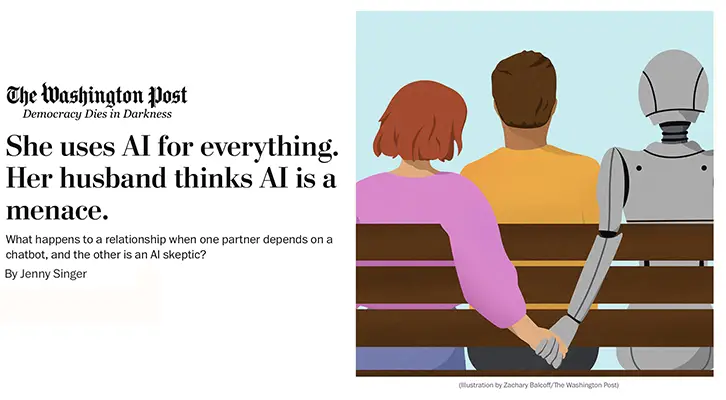
AI IS ENTERING RELATIONSHIPS — AND EXPOSING A VALUES FAULT LINE
The Washington Post | Jenny Singer | March 2026
TL;DR / KEY TAKEAWAY
As AI tool adoption diverges sharply within households and partnerships, therapists are reporting a new source of relationship strain — one that mirrors political polarization in its intensity — with implications for organizational dynamics wherever AI-enthusiast and AI-skeptic colleagues must collaborate closely.
EXECUTIVE SUMMARY
This is a reported feature piece, not an opinion column. It profiles real individuals whose relationships are strained by asymmetric AI use — one partner using AI extensively for work, emotional processing, and daily decision-making; the other skeptical or actively opposed. Therapists interviewed describe the dynamic as expressing a genuine values divergence: one person prioritizes efficiency and accessibility; the other places worth in unmediated human effort and connection. The gap, therapists say, can feel comparable to political difference in its depth.
The piece documents several real-world cases including a CEO who uses ChatGPT as a daily confidant, whose WGA-member husband sees AI as existential; an executive coach whose wife has invested zero time in the tools; and a 24-year-old whose relationship deteriorated partly because her boyfriend processed conflicts through ChatGPT before communicating, producing responses that felt polished but emotionally distant. A mental health counselor puts it plainly: people confide in chatbots not because they prefer machines, but because human interaction increasingly feels fraught, labor-intensive, or frightening.
The article is careful to present both sides — AI users and skeptics — without resolving the tension. It draws on Pew data showing 50% of Americans are more concerned than excited about AI, while nearly a third interact with AI tools multiple times weekly. The key structural observation: unlike politics or religion, AI attitudes rarely surface during the relationship formation stage, meaning couples and colleagues often discover the divergence under pressure rather than in advance.
RELEVANCE FOR BUSINESS
Team dynamics: The values divergence documented in relationships almost certainly appears in workplaces. On teams with both AI-enthusiast and AI-skeptic employees, the friction points identified here — perceived inauthenticity, efficiency vs. meaning tension, trust — will manifest in collaboration, handoffs, and communication styles.
Change management: Managers rolling out AI tools should not assume enthusiasm or resistance is random. There is a values structure underneath it. Change management that treats skeptics as simply “behind” will deepen resistance. Curiosity-led conversations — as the therapists recommend — are more effective than mandates.
HR and culture signal: If employees are using AI to process workplace conflicts, draft performance-related communications, or manage interpersonal friction, the authenticity and trust dynamics described in the article apply directly. This is worth surfacing in your people strategy.
Client communication: If clients or customers are aware (or suspect) that communications they receive are AI-drafted, the emotional distance dynamic documented here may affect perceived relationship quality — particularly in high-trust service contexts.
CALLS TO ACTION
File as a culture story, not a technology story: This piece is most useful as a frame for thinking about organizational culture during AI transition — not as a technical or operational concern.
Map your team’s AI adoption spectrum: Before assuming uniform enthusiasm or resistance, assess where individuals actually are. The divergence documented here is real and affects collaboration quality.
Train managers on values-level AI conversations: Equip team leads to have genuine, curious discussions about AI use — not to mandate adoption, but to surface and work with the values concerns that underlie resistance.
Review client communication protocols: Decide whether AI-drafted client communications should be disclosed, and whether the relationship context warrants a human-written touch at key moments.
Monitor for authenticity erosion: Watch for signs that AI-mediated communication is reducing perceived emotional authenticity in your team’s internal or external relationships.
Summary by ReadAboutAI.com
https://www.washingtonpost.com/lifestyle/2026/03/13/ai-use-gap-relationships/: March 20, 2026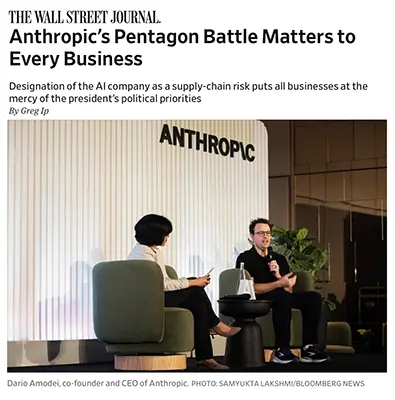
ANTHROPIC’S PENTAGON BATTLE MATTERS TO EVERY BUSINESS
The Wall Street Journal | March 13, 2026
TL;DR: The U.S. government’s supply-chain risk designation of Anthropic — in response to the company refusing to remove AI usage restrictions — is not just an AI story; it is a precedent-setting test of whether the executive branch can use regulatory instruments to compel any private company’s compliance through economic destruction.
Executive Summary
This is a reported opinion column by WSJ economics columnist Greg Ip — one of the publication’s most authoritative voices on business and policy. It should be read as informed analysis, not neutral news, but the facts it cites are well-documented. The core situation: the Trump administration’s Defense Department designated Anthropic a supply-chain risk after the company refused to remove restrictions on its AI being used for domestic mass surveillance or fully autonomous weapons. This followed a pattern in which Intel, Nvidia, and Amazon all complied with administration demands — Anthropic’s refusal is described as unprecedented.
The legal mechanism used — a 2010 statute designed to keep foreign adversaries like Huawei out of military supply chains — has never previously been applied to a domestic U.S. company. The formal designation bars Anthropic’s models from defense contracts; a broader threat from Defense Secretary Hegseth (later walked back in the official designation) would have barred all commercial activity with the company. Ip’s central argument is that even a narrower designation is strategically significant: it demonstrates that the executive branch is willing to use supply-chain instruments not for national security but for political compliance, and that the precedent — if upheld in court — would give any president the power to economically cripple any company that defies them.
A critical factual detail that undermines the Pentagon’s stated rationale: OpenAI, which was promptly awarded a new contract, also publicly claims to restrict its models for domestic mass surveillance and autonomous weapons. The selective application of the designation against Anthropic — after Trump publicly labeled the company “leftwing nut jobs” — suggests the driver is political, not security-based. Microsoft has filed to block the designation in court; three tech trade groups have asked Trump to reverse it.
Relevance for Business
This story matters to SMBs in two ways. First, directly: any company that sells to the federal government — at any level — must now evaluate whether its public positions, vendor relationships, or leadership affiliations create political exposure that could be weaponized through regulatory action. Second, structurally: the article identifies a broader chilling effect on the U.S. tech sector’s competitive advantage abroad. American AI companies have historically been able to tell international clients they operate independently of government direction — a claim that is now materially harder to make, increasing the competitive position of European and other non-U.S. AI alternatives. For SMBs evaluating AI vendors, this episode is a reminder that your vendor’s regulatory and political stability is now a legitimate due diligence criterion.
Calls to Action
🔹 Monitor closely — Watch the court proceedings; if the government wins, the precedent materially expands executive leverage over any business with federal contracts or regulatory dependencies.
🔹 Assign internal review — If you are a federal contractor or subcontractor, assess whether your AI vendor relationships could be affected by a broadened supply-chain designation.
🔹 Prepare policy — Review your vendor contracts for AI tools to understand what happens to your operations if a key AI vendor is designated or restricted. Ensure you have contingency options.
🔹 Do not ignore the political risk dimension — The selective application of this designation based on perceived political alignment is a new business environment risk that did not exist two years ago. Factor it into vendor and partnership decisions.
🔹 Investigate further — Review Microsoft’s court filing and the Lawfare analysis cited in the article for a grounded assessment of the legal arguments, which are relevant to how far this precedent can extend.
Summary by ReadAboutAI.com
https://www.wsj.com/wsjplus/dashboard/articles/anthropics-pentagon-battle-matters-to-every-business-4c9bcfc3: March 20, 2026
AI Needs Management Consultants After All
The Wall Street Journal | March 8, 2026
TL;DR: OpenAI and Anthropic are partnering with major consulting firms — McKinsey, BCG, Accenture, Deloitte, and others — because most businesses haven’t scaled AI into real operations, signaling that the gap between AI capability and organizational adoption is the central business problem of 2026, and that consultants have found a new growth engine in closing it.
Executive Summary
Despite years of AI investment and attention, the adoption gap remains substantial. McKinsey’s own internal survey found roughly two-thirds of organizations surveyed had not yet scaled AI across the enterprise. More than half of CEOs polled by PwC said they had seen no material financial benefit from AI to date. In response, both OpenAI (through its Frontier platform) and Anthropic are partnering with major consulting firms to embed AI deeply into business workflows — not just sell access to the technology.
The model is notably different from traditional consulting. Consulting engagements are increasingly tied to outcomes, not hours, with firms being paid partly based on measurable results rather than headcount deployed. AI is replacing the junior-associate data-crunching work that has historically been the foundation of consulting economics, shifting the value proposition to senior-level strategic judgment and implementation support. Accenture reported $2.2 billion in new AI bookings in its most recent quarter, a $400 million jump. Global consulting grew 5.5% in 2025 — double the prior year’s rate.
For SMBs, the relevant signal is not the consulting industry’s growth — it’s what it reveals about the adoption problem. The fact that OpenAI and Anthropic need professional services firms to bridge the gap between tool availability and business integration means the technology is not yet self-deploying. Buying access to AI tools is not the same as realizing value from them. Implementation, workflow redesign, and change management remain significant, often underestimated costs. A secondary risk: as consulting firms align with specific AI vendors, their recommendations may be commercially influenced rather than neutral assessments of what is best for your organization.
Relevance for Business
SMBs rarely have access to McKinsey or BCG. But the dynamic described in this article applies directly: the hard part of AI adoption is not access to tools — it is integrating those tools into operations in ways that produce measurable results. The article implicitly validates what many executives already suspect: that AI investments made without serious workflow redesign and organizational change are unlikely to produce financial returns. The article also reinforces a governance point — when vendors and consultants are financially aligned, buyer independence in AI strategy decisions becomes more important, not less.
Calls to Action
🔹 Investigate further — If your AI investments have produced no measurable financial benefit, treat that as a workflow and implementation problem, not a technology problem. Map where AI is actually being used versus where it was supposed to be used.
🔹 Assign internal review — Designate someone responsible for AI implementation outcomes (not just AI tool procurement). The gap between access and value is a management challenge.
🔹 Test cautiously with consultants — If you engage a consultant for AI strategy, understand their vendor relationships. Outcome-based engagements are better aligned with your interests than hours-based ones.
🔹 Benchmark against the McKinsey/PwC data — If two-thirds of organizations haven’t scaled AI, being behind is the norm, not a competitive disadvantage — but the organizations that close the gap first will benefit disproportionately.
🔹 Monitor consulting firm partnerships — As McKinsey, BCG, and Accenture deepen alignment with specific AI vendors, evaluate whether those alignments affect the quality and independence of advice you receive.
Summary by ReadAboutAI.com
https://www.wsj.com/tech/ai/ai-needs-management-consultants-after-all-bd28ecb9: March 20, 2026
The Most Important Question Nobody’s Asking About AI
Dwarkesh Patel / Dwarkesh Podcast (Substack) | March 11, 2026
TL;DR: A high-stakes dispute between the U.S. Department of Defense and Anthropic over AI usage terms surfaces the defining governance question of the AI era: who controls the values embedded in AI systems that will eventually operate most of civilization — and what that means for every organization that depends on them.
Executive Summary
This is an opinion essay, not a news report. It should be read as a considered argument, not settled fact — but the underlying situation it describes is real and consequential. Dwarkesh Patel, a prominent AI-focused journalist and podcaster, writes in response to the U.S. Department of War (Defense) reportedly designating Anthropic a supply chain risk after Anthropic refused to remove usage restrictions against mass surveillance and autonomous weapons applications from its models. The piece argues this episode is a preview of the highest-stakes governance conflict in modern history: who gets to determine the values and limits of AI systems that will eventually constitute the majority of the global workforce?
Patel’s core argument is multidirectional. He acknowledges that governments have legitimate concerns about depending on private companies for critical operations — a private AI vendor with a kill switch on military AI is genuinely dangerous. But he argues that the government’s response — threatening to destroy Anthropic as a business using instruments like the Defense Production Act and supply chain risk designations — is a far more dangerous precedent. The structural point with the most long-term weight: as AI becomes woven into every product and service, it may become practically impossible for large tech companies to “cordon off” AI use, meaning the government’s leverage over private AI suppliers could become nearly total. He further argues that AI structurally favors surveillance and authoritarian applications — because mass surveillance is technically feasible at declining cost — and that this problem will not be solved by corporate courage alone, since open-source models will eventually perform the same functions regardless of what frontier labs choose to do.
The essay also critiques the AI safety community’s embrace of regulation, arguing that vague regulatory frameworks built around terms like “catastrophic risk” or “autonomy risk” hand governments a readymade tool for political coercion of AI companies. His conclusion is that only democratic legal norms — not corporate policy or regulatory architecture — can prevent AI-enabled authoritarianism, drawing an analogy to post-WWII nuclear weapons norms.
Relevance for Business
This piece operates above the tactical level, but its implications are directly relevant to any organization building AI into operations. Vendor dependence on AI providers is not just a commercial risk — it is increasingly a political and regulatory risk. If AI providers can be coerced, designated, or de-platformed by government action, any business workflow that depends on those providers faces potential disruption with little warning. The essay also raises a governance question every executive should begin thinking through: when AI systems make decisions in your organization, whose values are embedded in those systems — the vendor’s, your own, or someone else’s? That question is no longer theoretical.
Calls to Action
🔹 Monitor — Track the Anthropic/DoD supply chain designation outcome; prediction markets cited in the essay gave it an 81% chance of being reversed, but the precedent matters regardless.
🔹 Assign internal review — Begin mapping which of your AI-dependent workflows would be disrupted if a key vendor became politically or regulatorily constrained.
🔹 Prepare policy — Start developing an internal position on AI vendor governance: what usage policies, value constraints, and contract terms matter to your organization.
🔹 Do not ignore the regulatory trajectory — AI-specific regulation is coming; the framing of that regulation will determine whether it functions as a safety floor or a political control mechanism. Engage with industry groups now.
🔹 Revisit periodically — This is a structural issue unfolding over years, not quarters. Revisit quarterly as the legislative and regulatory environment develops.
Summary by ReadAboutAI.com
https://www.dwarkesh.com/p/dow-anthropic: March 20, 2026
CHINA BANS AGENTIC AI FROM GOVERNMENT SYSTEMS — A CYBERSECURITY WARNING WORTH HEEDING
Fast Company | Chris Stokel-Walker | March 12, 2026
TL;DR / KEY TAKEAWAY
China’s rapid embrace and near-simultaneous government ban of OpenClaw — an agentic AI assistant — is a concrete signal that autonomous AI tools with high-level system permissions pose documented supply chain, prompt injection, and data access risks that most organizations have not yet assessed before deploying.
EXECUTIVE SUMMARY
This is a reported news piece with named expert sources. The core facts: OpenClaw achieved mass consumer adoption in China within days, including state-subsidized rollouts in Shenzhen and Wuxi. China’s internet emergency response center then issued an official warning, and the central government directed government agencies and state-owned enterprises to remove it from their systems. The turnaround — from subsidized adoption to government ban — happened in less than two weeks.
The cybersecurity concerns cited are specific and credible. Experts quoted in the piece identify three primary risks: (1) supply chain attacks via malicious plug-ins and add-ons that exploit the rapid, unvetted installation ecosystem; (2) prompt injection attacksthat manipulate AI agents into performing unauthorized actions; and (3) high-level system permissions granted to AI agents before security testing is complete. One security expert frames the core problem succinctly: attackers may no longer need to crack encryption if they can simply manipulate a piece of software that has already been granted access.
The article notes a structural tension in China’s response that applies globally: local governments were actively subsidizing adoption while the central government moved to ban it — reflecting the difficulty of governing technology that spreads faster than policy. One analyst’s observation is worth quoting in substance: China’s Central Cyberspace Affairs Commission moved to restrict agentic AI use within days rather than following its usual white-paper process, suggesting a level of preexisting institutional anxiety about autonomous AI that went beyond standard procedure.
RELEVANCE FOR BUSINESS
Agentic AI deployment risk: If your organization is evaluating or has deployed AI agents — tools that can take autonomous actions on systems, files, or communications — the risks documented here apply directly. Prompt injection and plug-in poisoning are not theoretical; they are active threat vectors.
Permission scope governance: The specific risk identified is AI agents being granted high-level system permissions before security review. Many organizations are doing exactly this in productivity tool integrations (email, calendar, CRM, document storage). Audit what permissions your AI tools have been granted.
Supply chain risk: The plug-in and add-on ecosystem for AI tools replicates the same attack surface that made browser extensions and app store downloads risky. Any AI tool that supports third-party extensions should be evaluated for supply chain exposure.
Governance speed mismatch: China’s experience illustrates that adoption outpaced governance by a significant margin. Most SMBs face the same dynamic internally: AI tools are adopted by individual employees or departments before IT or legal has assessed them. This is an operational risk.
CALLS TO ACTION
Monitor China’s AI governance trajectory: China’s rapid policy response to agentic AI risks may preview regulatory frameworks that appear in Western markets. Track developments from CISA, NIST, and EU AI Act implementation for parallel guidance.
Audit agentic AI permissions immediately: Identify every AI tool in your environment that has been granted access to email, calendars, file systems, CRM, or other data stores. Assess whether those permissions are necessary and monitored.
Implement an AI tool approval process: Require IT or security review before any AI tool with system-level access is deployed. Treat agentic AI like a privileged application, not a productivity add-on.
Assess plug-in/extension exposure: For any AI platform your employees use, inventory what third-party extensions are installed. Apply the same scrutiny as you would to browser extensions or app installs on company devices.
Educate employees on prompt injection risk: Employees using AI agents for email or document processing should understand that malicious content embedded in external inputs (emails, documents, web pages) can instruct AI agents to take unintended actions.
Summary by ReadAboutAI.com
https://www.fastcompany.com/91507241/china-went-crazy-for-openclaw-now-its-working-to-ban-it: March 20, 2026
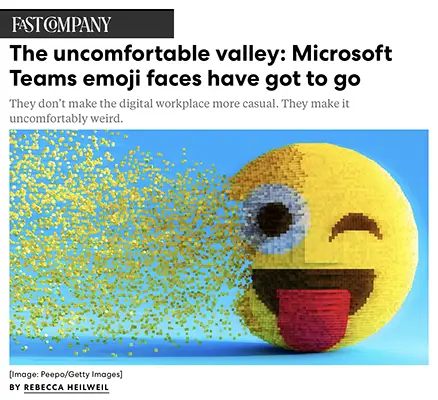
THE “UNCOMFORTABLE VALLEY”: WHAT MICROSOFT TEAMS EMOJI TELL US ABOUT AI-DESIGNED UX
Fast Company | Rebecca Heilweil | March 11, 2026
TL;DR / KEY TAKEAWAY
A sharp opinion piece uses Microsoft Teams’ animated emoji as a case study for a real design failure — the “uncomfortable valley” — where AI-assisted interface design produces output that is neither simple enough to be neutral nor absurd enough to be clearly intentional, creating friction and ambiguity in professional communication.
EXECUTIVE SUMMARY
This is a deliberately light piece — the author acknowledges she is “taking this way too seriously” — but it surfaces a legitimate UX and communication signal. The piece introduces the concept of the “uncomfortable valley”: an analogue to the “uncanny valley” in robotics, describing the experience of UI elements that are neither comfortably simple nor clearly intentional/ironic. Microsoft Teams’ animated emoji are the test case: they animate, transition expressions, blink, and emote in ways that produce confusion about intended tone in professional contexts.
The business-relevant observation is narrow but real: emoji in professional communication tools carry legal and interpretive weight. The article notes actual court cases — including a murder conviction — where emoji meaning was disputed. Millions of Microsoft Teams users risk miscommunication not because they chose the wrong word, but because the platform’s interface inserted emotionally ambiguous animated imagery into otherwise professional exchanges.
The broader signal for leaders: as AI increasingly assists in the design of communication interfaces, UI/UX elements that lack clear emotional anchoring create unintended friction. The Teams emoji problem is a microcosm of what happens when visual design optimizes for engagement or novelty over communicative clarity. This is not a Teams-specific risk — it is a pattern to watch in any AI-assisted communication product.
RELEVANCE FOR BUSINESS
Communication risk: If your teams use Microsoft Teams heavily, the animated emoji are a minor but real source of tonal ambiguity. Client-facing communications that auto-render animated emoji may be read differently than intended, particularly across generational or cultural lines.
Platform governance: This is an example of a vendor making a design decision that affects how your employees communicate professionally, without your input. It is worth having a policy on emoji use in client-facing Teams communications.
AI-designed UX signal: As AI is used to generate or optimize UI elements in tools you adopt, the “uncomfortable valley” dynamic will recur. Evaluate new communication tools not just on features but on whether their visual and interaction design creates clarity or ambiguity.
Legal exposure (minor but real): The article’s reference to court cases involving emoji interpretation is not alarmist — it is documented. In high-stakes written communications (HR, contracts, client disputes), consider a plain-text policy.
CALLS TO ACTION
File as a vendor design accountability note: Microsoft Teams has made platform-wide design decisions that affect your team’s professional communication. Monitor whether future updates address or compound this.
Low priority, but worth a policy note: Add a line to your internal communication guidelines about emoji use in client-facing or HR-sensitive Microsoft Teams conversations.
Use this as a UX evaluation lens: When reviewing new AI-assisted communication or collaboration tools, ask whether the interface’s visual design produces communicative clarity or ambiguity.
No immediate operational action required: This is a light cultural/design observation. Deprioritize unless communication tone is a documented issue in your Teams environment.
Summary by ReadAboutAI.com
https://www.fastcompany.com/91506224/the-uncomfortable-valley-microsoft-teams-emoji-faces-have-got-to-go: March 20, 2026
ANTHROPIC’S AI HACKED THE FIREFOX BROWSER. IT FOUND A LOT OF BUGS.
The Wall Street Journal | March 6, 2026
TL;DR: Anthropic’s Claude Opus 4.6 found more high-severity Firefox security vulnerabilities in two weeks than the entire security research community typically reports in two months — a demonstrated capability that cuts both ways: AI is becoming a powerful defense tool and an accelerating attack surface.
Executive Summary
This is a reported news exclusive, not a company announcement. Mozilla’s own engineers confirmed the findings and described them as serious. Over a two-week period in January, Claude Opus 4.6 discovered more than 100 bugs in Firefox, 14 of which were classified as high severity — meaning they could have enabled widespread user attacks if exploit code had been developed. By comparison, Firefox patched 73 high-severity or critical bugs in all of 2025. The scale and speed of Claude’s discovery — averaging more than two high-severity findings per day — represents a qualitative shift in AI-assisted security research.
The article is careful to distinguish between demonstrated and claimed capability. Claude was significantly better at finding bugs than exploiting them: it developed two working exploits, but both would have been blocked by Firefox’s existing security mechanisms. The more important implication is the asymmetry this creates: defenders must fix every vulnerability; attackers need only one. If AI tools can find high-severity bugs at this rate, the patch cycle and human review capacity of most organizations — including software vendors, enterprise IT teams, and managed service providers — may not keep pace.
A secondary signal worth noting: the Curl software project abandoned its bug bounty program entirely due to what its lead developer called an explosion in low-quality, AI-generated false vulnerability reports. This illustrates a parallel risk — AI tools are also generating noise that overwhelms human reviewers, making it harder to identify real threats in the signal.
Relevance for Business
Most SMBs do not run their own security research programs, but they depend on software vendors who do. The practical implication is that the vulnerability lifecycle — from discovery to patch to deployment — is compressing, and organizations that delay software updates are exposed for longer relative to the pace of discovery. For any SMB that relies on web browsers, enterprise software, or cloud applications (which is nearly every SMB), this story reinforces the urgency of maintaining current patch levels and auto-update policies. It also raises a forward-looking procurement question: are your security vendors — managed IT, endpoint protection, vulnerability scanning — already incorporating AI-assisted discovery into their tooling? If not, they may be structurally behind.
Calls to Action
🔹 Act now — Verify that your organization’s software and browser update policies are set to automatic or near-real-time. The window between vulnerability discovery and active exploitation is narrowing.
🔹 Assign internal review — Ask your IT provider or internal IT team whether your current security stack uses AI-assisted vulnerability scanning. If not, evaluate options.
🔹 Prepare policy — Update your patch management policy to reflect a shorter acceptable window between vendor release and deployment, given the accelerating pace of AI-driven vulnerability discovery.
🔹 Monitor — Track how quickly AI-discovered vulnerabilities in widely used software (browsers, operating systems, SaaS platforms) are being exploited in the wild; this will indicate how much the defensive window is actually compressing.
🔹 Investigate further — If you run any customer-facing web applications or handle sensitive data, commission or request an AI-assisted vulnerability assessment from your security vendor or a qualified third party.
Summary by ReadAboutAI.com
https://www.wsj.com/tech/ai/send-us-more-anthropics-claude-sniffs-out-bevy-of-bugs-c6822075: March 20, 2026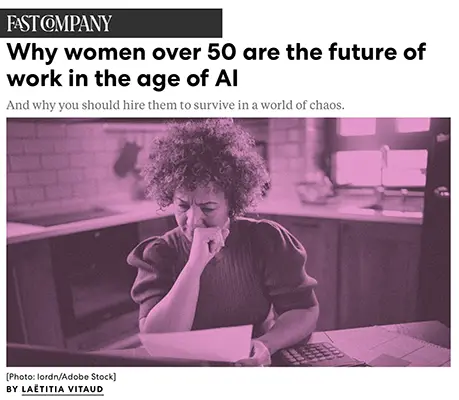
WOMEN OVER 50 ARE AN UNDERUSED STRATEGIC ASSET IN THE AGE OF AI
Fast Company | Laetitia Vitaud | March 12, 2026
TL;DR / KEY TAKEAWAY
An opinion piece argues that women over 50 — overlooked in most talent strategies — possess exactly the skills AI cannot replicate: judgment, adaptability, emotional intelligence, and crisis resilience; leaders who continue to ignore this demographic are compounding a talent gap at a moment when those capabilities are most needed.
EXECUTIVE SUMMARY
This is an opinion piece, not a research report, and should be read accordingly. The argument is structured around nine capabilities the author attributes to women over 50 — including career-transition experience, continuous learning habits, contextual judgment, emotional intelligence, intergenerational mentorship, and crisis adaptability — and frames them as precisely the traits most needed in a volatile, AI-augmented economy. The author is a French writer on work and labor; the argument draws on observation and cultural analysis rather than cited data.
The core business logic is sound regardless of the advocacy framing: AI handles structured, repeatable cognitive tasks well; it handles ambiguity, relational judgment, and contextual discernment poorly. Organizations that have been systematically de-emphasizing experience-heavy workers in favor of technical youth may have inadvertently hollowed out the very capabilities that complement AI most effectively. Women over 50 are explicitly identified as a demographic that has been forced to develop adaptability and resilience — not through choice, but through structural labor market barriers — making those skills more tested than they might be in workers who have had smoother career trajectories.
The piece also raises a market-intelligence argument: as consumers and clients age demographically, organizations without midlife women in decision-making roles may be systematically blind to their most important customer segments. This is a concrete business claim, not just a DEI argument, and deserves evaluation on its own merits.
RELEVANCE FOR BUSINESS
Talent strategy: SMBs running lean teams cannot afford to systematically exclude an experienced talent segment. If your hiring criteria over-weight formal tech credentials and under-weight judgment and adaptability, you may be screening out workers who complement AI tools better than those you’re hiring.
AI implementation risk: Organizations deploying AI tools need humans who can identify when AI output is wrong, incomplete, or contextually inappropriate. Experience-based judgment is harder to develop than technical fluency, and often faster to lose from attrition.
Customer alignment: If your product or service has a significant 50+ female customer segment and no one in that demographic influences product or communication decisions, you have a structural blind spot. This is testable.
Workforce planning: The labor market for experienced workers is less competitive than for early-career tech talent. This is an underexploited cost and quality opportunity for SMBs that lack the hiring budgets of large enterprises.
CALLS TO ACTION
Monitor for supporting research: The argument here is logical but not empirically grounded. Watch for labor economics research on age-diverse team performance in AI-augmented environments before making structural changes.
Audit hiring filters: Review whether your current job descriptions and screening criteria are inadvertently excluding experienced candidates. Credential requirements that don’t predict job performance are a common barrier.
Identify AI-oversight roles: As you deploy AI tools, flag which roles require human judgment to validate outputs. These are high-value positions that should prioritize experience, not just technical fluency.
Test the market-intelligence claim: If women 50+ are a material segment of your customers, assess whether your team can accurately anticipate their needs without representation.
Do not treat this as a mandate: This is an advocacy piece, not a prescription. Evaluate on the merits for your specific organization and context.
Summary by ReadAboutAI.com
https://www.fastcompany.com/91505607/why-women-over-50-are-the-future-of-work-in-the-age-of-ai: March 20, 2026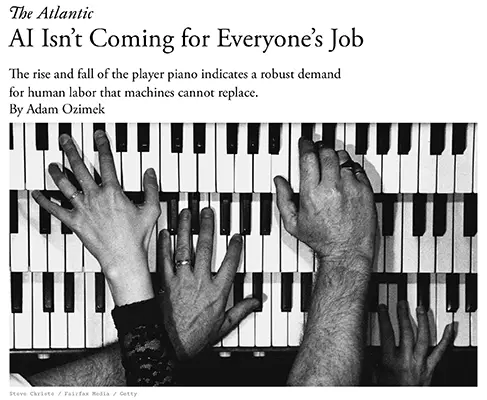
AI ISN’T COMING FOR EVERYONE’S JOB — THE PLAYER PIANO ARGUMENT
The Atlantic | Adam Ozimek | March 11, 2026
TL;DR / KEY TAKEAWAY
Using the history of musical automation as evidence, economist Adam Ozimek argues that persistent consumer demand for human presence will protect a meaningful share of jobs from AI displacement — but he also acknowledges that real displacement will occur and some workers will need to transition.
EXECUTIVE SUMMARY
This is an opinion piece by an economist, not an empirical study. The argument is historical analogy: the player piano automated the pianist’s job completely in the 1920s, yet live pianists are more common today than player pianos. Musicians broadly have faced mechanical, recorded, and digital competition for over a century — and yet musician employment is at an all-time high per Census data. Ozimek attributes this to a durable economic phenomenon he calls “demand for the human touch” — consumer preference for human-delivered services that persists and grows with income levels.
The argument extends beyond music: millions of waiters still exist despite QR-code ordering; 10 million people work in sales despite e-commerce. Demand for human presence in service roles appears to scale with affluence — a dynamic Ozimek describes as the human touch being a “normal good.” His conclusion is not that AI causes no disruption — he acknowledges specific job categories will be displaced — but that total labor displacement is unlikely because some demand for human-provided work will always exist and can be amplified through policy (progressive taxation, wage subsidies).
This piece is an argument for calibrated optimism, not complacency. The analogy has real limits: AI may be a qualitatively different automation wave in both speed and breadth of task coverage. The author does not fully engage with this counterargument. Leaders should read this as a useful check on catastrophist framing — not as a forecast.
RELEVANCE FOR BUSINESS
Workforce planning: The “human touch” framework is actionable. Before automating a customer-facing role, ask whether your customers actually want a human there. In some segments (high-value clients, sensitive service interactions, relationship-dependent sales), the answer is yes — and substituting AI may cost more in attrition than it saves in labor.
Talent strategy: Roles that require demonstrated human presence — relationship management, complex negotiation, physical service — are more defensible than roles that are primarily informational or transactional. This is relevant to hiring and retention priorities.
Counter to over-automation risk: Some SMBs are considering aggressive automation to cut costs. This piece provides a useful counterweight: automation that removes valued human contact may produce customer attrition that offsets efficiency gains. Measure both sides.
Labor transition reality: Ozimek does acknowledge that displaced workers — like movie-orchestra musicians — face real transitions. SMBs should not interpret this article as “nothing will change.” Specific job functions are at risk even if total employment proves resilient.
CALLS TO ACTION
Deprioritize alarm: This is a moderating perspective worth reading, not a call to action. No immediate operational change is required.
Audit customer-facing roles before automating: Identify which interactions customers demonstrably prefer with a human. Protect those roles; consider automation for the rest.
Use this as a board/leadership calibration tool: If your organization is reacting to AI anxiety with aggressive headcount reduction plans, this piece provides a historically grounded counterargument worth discussing.
Distinguish disruption from displacement: Build internal consensus on the difference between job transformation (changing what a role does) and job elimination. Most AI impact in the near term is the former.
Monitor for the counterargument: The player piano analogy has limits. Track whether AI automation in your sector is moving faster than historical analogies suggest — and be prepared to revise assumptions.
Summary by ReadAboutAI.com
https://www.theatlantic.com/ideas/2026/03/claude-piano-ai/686318/: March 20, 2026
DARIO AMODEI’S OPPENHEIMER MOMENT: WHO CONTROLS AI ONCE IT’S BUILT?
The Atlantic | Ross Andersen | March 11, 2026
TL;DR / KEY TAKEAWAY
The Pentagon demanded unrestricted use of Anthropic’s Claude for military operations — including autonomous weapons and mass surveillance — and when Anthropic refused, it deployed a supply-chain-risk designation as a coercive threat; the episode confirms that AI developers, not governments, will be the last to control how their systems are used.
EXECUTIVE SUMMARY
This is an analytical opinion piece from The Atlantic, not a news report. It draws an extended historical parallel between the atomic bomb’s creators and today’s AI lab CEOs — specifically Anthropic’s Dario Amodei — to argue that technologists who build powerful tools ultimately lose control of them to governments and militaries. The framing is editorial but the underlying facts are reported: Anthropic’s Claude has been operating on U.S. classified networks and has reportedly been used in military operations in Venezuela and Iran.
The Pentagon issued an ultimatum demanding the removal of all use restrictions on Claude beyond existing law. Amodei held two red lines: no use for mass surveillance of American citizens and no autonomous weapons operating without human oversight. The Pentagon refused both, then applied a supply-chain-risk designation — a coercive regulatory tool not previously used against an American company — threatening Anthropic’s business viability. Anthropic has since filed suit. While this standoff played out, OpenAI finalized its own Pentagon deal, which Amodei publicly criticized as “safety theater.”
The article’s core argument is structural, not personal: AI creators — like nuclear scientists before them — have front-loaded leverage. Once a working system exists and is integrated into critical operations, the builder’s ability to set terms collapses. The author treats this as a near-certainty as AI capabilities grow: the government will demand total control or commandeer the technology outright. This is the article’s thesis, not a stated fact — but it is grounded in a documented precedent that spans decades of nuclear-era history.
RELEVANCE FOR BUSINESS
Regulatory risk signal: If the U.S. government is willing to use supply-chain designation as a coercive tool against a major AI lab over use restrictions, SMBs depending on AI vendors should understand that the regulatory and political environment around AI is becoming adversarial, not merely uncertain.
Vendor stability risk: Anthropic is in active litigation with the Pentagon. The outcome could affect Anthropic’s operations, funding, and product roadmap. Companies relying on Claude via the API should monitor this case.
Competitive dynamics: OpenAI’s rapid Pentagon deal — without Anthropic’s red lines — creates a market signal: safety-differentiated AI vendors may face structural disadvantages in government contracting. This will pressure the broader market’s approach to AI governance.
Trust/reputation exposure: If AI models you use are being deployed in military operations — regardless of your own use case — your vendor’s actions are part of your supply chain’s ethical profile. This matters increasingly to employees, customers, and partners.
CALLS TO ACTION
Assign reading: Share this piece with your legal and operations leads. The Pentagon-AI lab dynamic is likely to generate more regulatory developments in the next 12–24 months.
Monitor the Anthropic-Pentagon lawsuit: This case has implications for AI vendor independence and the legal authority of government to override commercial AI use agreements.
Review AI vendor concentration: If your business is dependent on a single AI provider, assess what a forced operational change at that vendor — due to litigation, regulation, or government action — would mean for your systems.
Treat AI governance as a supply chain issue: Add AI vendor regulatory exposure to your standard vendor risk reviews, alongside financial stability and data security.
Avoid overreacting to the Oppenheimer framing: This is a credible analytical argument, not a confirmed outcome. The situation is evolving. Track it quarterly rather than restructuring operations now.
Summary by ReadAboutAI.com
https://www.theatlantic.com/technology/2026/03/anthropic-dod-ai-utopianism/686327/: March 20, 2026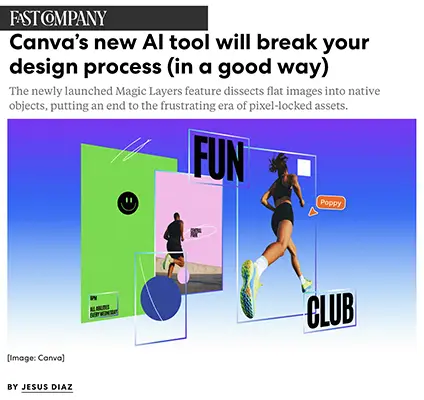
CANVA LAUNCHES MAGIC LAYERS: AI TURNS FLAT IMAGES INTO EDITABLE DESIGNS
Fast Company | Jesus Diaz | March 11, 2026
TL;DR / KEY TAKEAWAY
Canva’s new Magic Layers feature uses proprietary AI to decompose flat images into individually editable components — text, objects, backgrounds — giving non-designers the power to revise any image without specialized software or original source files.
EXECUTIVE SUMMARY
Canva has shipped Magic Layers, a tool that reverse-engineers any bitmap image into its constituent parts — text becomes a live editable text box, objects become repositionable design elements — all within the Canva cloud environment. The capability is powered by a proprietary Canva AI design model (unveiled October 2025), not the general-purpose models the company licenses from OpenAI and Anthropic. The article is written enthusiastically, but the core capability is demonstrated, not merely claimed.
The practical problem being solved is real: until now, rendered images were effectively locked. Editing required either the original source file, manual Photoshop work, or accepting an imperfect AI reprompt. Magic Layers breaks that dependency. Extracted elements become native Canva objects — subject to all existing platform tools including upscaling, Magic Edit, and live multiplayer collaboration. The author draws a parallel to Adobe’s recently launched Photoshop AI overlay feature, which takes the opposite approach: building edits on top of a preserved base image rather than dismantling it.
One important caveat from the article itself: the author suggests these tools are transitional patches, not permanent features. As generative AI models improve their output precision, layer-extraction workarounds may become unnecessary. This is a credible observation — but the timeline is indeterminate. The tool solves a real problem today.
RELEVANCE FOR BUSINESS
Workflow efficiency: Any SMB that produces marketing materials, product images, or branded content stands to reduce design turnaround time. Teams without dedicated designers can now iterate on visual assets without Adobe skills or access to source files.
Vendor dependency: This deepens reliance on Canva’s ecosystem. If your creative workflow migrates into Canva’s cloud, switching costs increase. Evaluate whether that concentration is acceptable before committing workflows to the platform.
Competitive signal: Both Canva and Adobe are moving rapidly to solve the “locked image” problem from different directions. SMBs evaluating design tooling should test both approaches before making multi-year platform commitments.
Labor implication: This reduces the technical barrier to basic design editing — not professional design. Freelance designers handling routine revisions face increased substitution pressure. Staff in marketing and operations may be able to absorb more of this work themselves.
CALLS TO ACTION
Note the shelf-life caveat: The author’s thesis — that these are transitional features — is worth tracking. Revisit this tooling decision in 12–18 months as generative models mature.
Test now: If your team uses Canva, pilot Magic Layers on existing marketing assets this week. Assess quality and time savings against your current workflow.
Evaluate platform lock-in: Before centralizing creative production in Canva, document what it would cost to migrate out. Cloud-native tools compound dependency over time.
Reassess design contractor scope: Determine which revision and localization tasks currently outsourced to designers could be handled internally with this tool.
Monitor Adobe’s parallel feature: Adobe’s overlay approach serves different use cases. If precision editing of complex images is a core need, test both before deciding on a primary platform.
Summary by ReadAboutAI.com
https://www.fastcompany.com/91506292/canva-new-magic-layers-ai-tool-will-break-your-design-process: March 20, 2026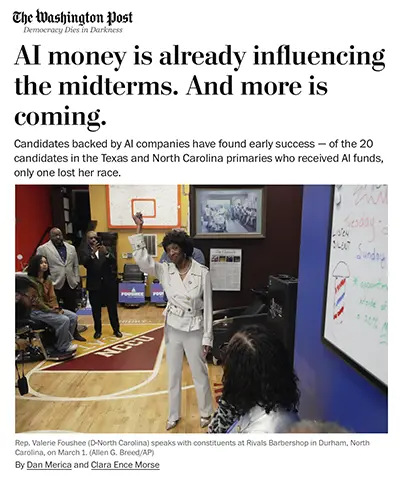
AI COMPANIES ARE SPENDING $185M+ TO SHAPE THE 2026 MIDTERMS
The Washington Post | Dan Merica & Clara Ence Morse | March 12, 2026
TL;DR / KEY TAKEAWAY
OpenAI, Anthropic, and allied tech investors have already committed over $185 million to 2026 midterm races — primarily to influence AI regulation — with AI-backed candidates winning 19 of 20 contested primaries, signaling that the AI industry intends to shape its own regulatory environment through electoral dominance.
EXECUTIVE SUMMARY
This is a reported news piece, and its facts are concrete: AI companies have collectively contributed over $185 million to 2026 midterm contests as of early March. The spending is concentrated on candidates who will influence AI regulation. Of 20 candidates in Texas and North Carolina primaries who received AI funds, 19 won or advanced. Two distinct factions are competing: Leading the Future (backed by OpenAI co-founder Greg Brockman, Marc Andreessen, and Ben Horowitz — total: $50M+) opposes state-level AI regulation and advocates for a national framework that critics say amounts to minimal regulation. Public First Action(backed by $20M from Anthropic) advocates for “reasonable guardrails” starting federally.
The spending extends to state level: Meta, Google, and others have contributed over $37 million to state-level political committees since 2025 — a 12x increase over their 2022 state-level spending of ~$3 million. The surge is explicitly tied to blocking state-level AI regulation, particularly in California, Texas, and Illinois. At least one candidate — New York Rep. Alex Bores — is in the middle of competing AI-funded attacks and support simultaneously, due to his sponsorship of a state AI safety bill requiring model developers to publish safety plans.
Public sentiment is running against AI: 50% of Americans are more concerned than excited about AI (Pew), and 70% of Wisconsin registered voters say data center costs outweigh benefits (Marquette). The article frames the AI industry’s political spending partly as a defensive response to this backlash — an attempt to shape regulation before public opposition crystallizes into legislation.
RELEVANCE FOR BUSINESS
Regulatory environment risk: The outcome of these races will directly determine what federal and state AI regulations pass in 2027–2028. SMBs that have built operations around current AI capabilities — and the relative absence of regulation — are exposed to policy shifts. The regulatory trajectory is genuinely uncertain.
Vendor alignment signal: Your AI vendors are now political actors. OpenAI and Anthropic hold materially different regulatory positions. Understanding which position aligns with your operating environment (particularly if you do business in states considering their own AI laws) is relevant to vendor selection.
State-level patchwork risk: If Leading the Future’s attempt to preempt state regulation fails, the result may be exactly what they’re trying to avoid: a patchwork of 50 different state AI compliance regimes. SMBs operating across multiple states face disproportionate compliance burden in that scenario.
Public trust/reputation exposure: 50% of Americans are skeptical of AI. Customer-facing AI deployments should be evaluated not just for efficiency but for customer perception. The public mood is running against the industry — not necessarily against specific business uses, but the association matters.
CALLS TO ACTION
Monitor primary results in Illinois (March 17+): The next round of AI-funded primaries is imminent. Results will indicate whether AI-backed candidates continue their strong win rate and whether voter backlash materializes.
Assign regulatory monitoring: Identify who in your organization tracks AI regulatory developments at both federal and state levels. If no one does, assign it now — the legislative calendar is active.
Assess state-level exposure: If you operate in California, New York, Texas, or Illinois, check what AI legislation is currently moving through those state legislatures and how it would affect your operations.
Do not treat current AI regulations as stable: $185M in political spending implies the industry expects significant regulatory activity. Plan for compliance costs to increase in the 2027–2029 window.
Evaluate vendor regulatory posture: Know whether your primary AI vendors support or oppose the regulatory direction that best fits your business. This is now a vendor selection criterion.
Summary by ReadAboutAI.com
https://www.washingtonpost.com/politics/2026/03/12/ai-funding-midterm-elections/: March 20, 2026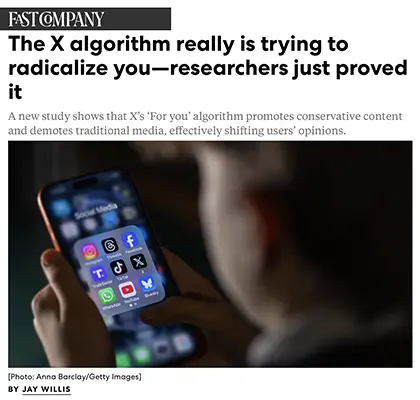
PEER-REVIEWED STUDY CONFIRMS X’S ALGORITHM SHIFTS POLITICAL VIEWS — AND THE EFFECT IS PERMANENT
Fast Company | Jay Willis | March 12, 2026
TL;DR / KEY TAKEAWAY
A randomized controlled study of ~5,000 X users found that the platform’s algorithmic feed moved users’ political opinions rightward, suppressed traditional news sources by 58%, and produced effects that were asymmetric — switching users back to chronological feeds did not reverse the shift — with direct implications for how leaders manage employee information environments and brand presence on the platform.
EXECUTIVE SUMMARY
This piece reports on a peer-reviewed study, not an opinion. The study — conducted by European researchers in 2023 — is a randomized controlled experiment: approximately 5,000 X users were randomly assigned to either algorithmic or chronological feeds for seven weeks, with political attitudes and online behavior measured before and after. This is a substantially stronger methodology than survey-based media research.
Key findings: the “For you” algorithmic feed shifted users toward more conservative positions on specific political issues; it reduced exposure to traditional news sources by 58.1% relative to chronological feeds; it increased engagement with conservative-coded political content; and — critically — the effects were asymmetric. Participants who were exposed to the algorithm and then returned to chronological feeds showed persistent changes: 60% more posts from conservative accounts and 28% more from conservative political activists in their subsequent chronological feeds, compared to participants who never used the algorithmic feed. The mechanism is followership: algorithm exposure led users to follow new conservative accounts, which then populated their chronological feeds permanently.
The article’s framing is clearly critical of X and Elon Musk — this is an opinion-inflected piece, not a neutral summary. Leaders should separate the study’s findings (which are empirical and sourced) from the author’s editorial commentary (which is strongly partisan). The study findings stand independently of the author’s tone. One structural data point is worth noting independently: a 2024 Pew survey found that 59% of X users use the platform specifically to follow politics — the highest of any major social platform — making the algorithm’s effects on political content particularly consequential.
RELEVANCE FOR BUSINESS
Brand and advertising risk: If your business advertises on X or maintains a brand presence there, your content is appearing adjacent to a feed that has been empirically shown to promote politically charged content and demote traditional media. Assess whether that environment is appropriate for your brand positioning and audience.
Employee information environment: If your employees use X as a primary news source — and Pew data suggests many do — the documented suppression of traditional media and amplification of politically polarizing content may be affecting team members’ baseline assumptions about current events, regulation, and market conditions. This is not a political concern; it is an information-quality concern.
Recruitment and culture: Platforms that radicalize users are increasingly associated with specific cultural signals. Your presence and activity on X is read by job candidates and clients as a cultural indicator. The platform’s direction under current ownership is a brand association risk.
AI algorithm governance parallel: The X study is the most rigorous documented example of an algorithm producing measurable, lasting behavioral change in a large population. The same dynamic applies to recommendation algorithms in any AI-powered tool your organization uses — including internal knowledge management, content curation, and customer-facing recommendation engines.
CALLS TO ACTION
Monitor for further replication: A single RCT, while strong, is not definitive. Watch for independent replication or challenges to the study’s methodology before treating findings as settled.
Reassess X advertising and brand activity: Evaluate whether the platform’s documented content environment aligns with your brand standards and audience expectations. Many brands have quietly reduced X presence; understand the trade-offs.
Diversify employee news source infrastructure: If your organization shares news or market intelligence via social media links, consider whether the platforms you’re linking to are themselves distorting the information employees receive.
Apply the algorithm asymmetry insight internally: Any AI-powered recommendation or curation system your organization uses should be audited for whether its outputs create lasting behavioral or attitudinal changes that persist after the tool is removed.
Separate the study from the editorial framing: The research is credible; the author’s commentary is strongly partisan. Share the study findings with your team without the political framing if you want the information to land across ideological lines.
Summary by ReadAboutAI.com
https://www.fastcompany.com/91507338/x-algorithm-for-you-radicalize-users: March 20, 2026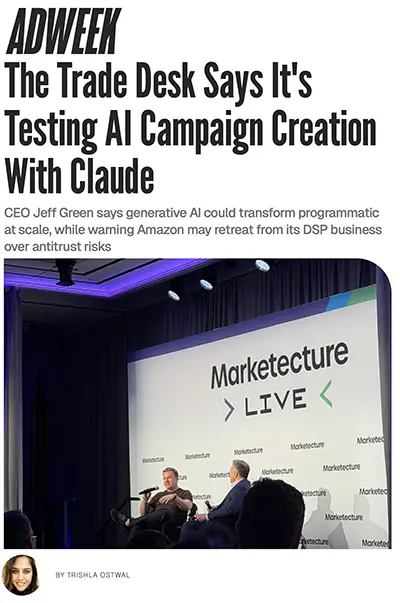
The Trade Desk Tests AI-Built Campaigns Using Claud
Adweek | March 11, 2026
TL;DR: The Trade Desk is running a closed beta that lets advertisers build campaigns through Anthropic’s Claude — a signal that AI-driven campaign creation is moving from concept to early market reality, with significant competitive and vendor implications ahead.
Executive Summary
The Trade Desk’s CEO Jeff Green confirmed at a public event that the company is testing AI-powered campaign creation using Anthropic’s Claude. The beta is closed and details are limited — this is an early-stage test, not a launched product. Green’s broader framing is that programmatic advertising, with its millisecond decision cycles and massive scale, is structurally well-suited to AI automation. The company has also signaled plans to release an agentic AI framework for partners in 2026.
Two other threads carry strategic weight. First, Green argued that AI companies face serious monetization pressure from massive capital expenditure and inflated valuations, and will increasingly turn to advertising revenue — expanding the inventory landscape available to programmatic platforms like The Trade Desk. Second, he suggested Amazon may retreat from its open-internet DSP business due to antitrust exposure, citing Google’s regulatory battles as a cautionary precedent. This claim is Green’s opinion and competitive framing, not confirmed strategy — but if it proves directionally correct, it reshapes the DSP competitive landscape in The Trade Desk’s favor.
Notably, Green declined to comment on reported tensions with major agency partners Dentsu and WPP over its OpenPath product, which adds an unresolved trust and transparency risk to the platform’s agency relationships.
Relevance for Business
For any SMB that runs digital advertising — whether through an agency or in-house — this signals that the interface for campaign creation is changing. AI-assisted or AI-generated campaign setup could reduce reliance on specialist media buyers, but also introduces new dependencies on platform vendors and their AI choices. The competitive pressure to automate is real and accelerating; companies that buy media programmatically should begin asking their DSP and agency partners what AI-assisted workflows are coming and on what timeline.
Calls to Action
🔹 Monitor — Watch for The Trade Desk’s formal agentic AI product launch in 2026; assess whether it reduces your need for agency support or shifts pricing leverage.
🔹 Ask your agency or DSP — What AI tools are being layered into your campaign management, and what oversight remains with human buyers?
🔹 Track Amazon DSP developments — If Green’s antitrust prediction has merit, DSP consolidation could affect your media buying options and negotiating leverage.
🔹 Note vendor dependence risk — Campaigns built via AI within a single platform create new lock-in dynamics; ensure portability of strategy and data.
🔹 Ignore for now (operationally) — The Claude beta is closed and undetailed. No immediate action required, but flag for quarterly review.
Summary by ReadAboutAI.com
https://www.adweek.com/media/the-trade-desk-claude-campaign-tests/: March 20, 2026
Horizon Media Cuts 50 Roles in AI-Focused Agency ‘Realignment’
Adweek | March 11, 2026
TL;DR: One of the world’s largest independent ad agencies eliminated 50 roles as it restructures around AI, data, and tech — a real-world data point that AI-driven agency transformation is producing immediate, cross-departmental job losses, not just role evolution.
Executive Summary
Horizon Media, a major independent agency with over 2,000 employees globally, cut 50 positions across multiple departments in what CEO Bill Koenigsberg framed as a “skills optimization effort and broader realignment.” The agency is simultaneously hiring for over 100 roles in data, technology, AI, and integrated capabilities — making this a workforce composition shift, not a pure cost-cutting exercise. The company also launched HorizonOS in December, a proprietary platform integrating AI, data analytics, and external tech partners, powered by its in-house AI system Blu.
The key detail for observers: the cuts reportedly came without warning, affected employees with over a decade of tenure, and spanned departments that were not publicly named. This signals a broader internal judgment that certain existing skill sets — regardless of seniority — are being deprioritized in favor of technical and AI-oriented capabilities. Koenigsberg promised more detail in an April town hall, suggesting the full scope of the restructuring has not yet been communicated.
This should be read as an early but clear signal of what AI-driven agency transformation looks like in practice: not gradual role evolution, but abrupt restructuring that treats human expertise in traditional media functions as replaceable by AI-augmented systems.
Relevance for Business
For SMBs that use agencies for media, marketing, or creative services: the capabilities your agency offers, and the people delivering them, are changing faster than contract cycles. If your agency relationship was built on the expertise of specific individuals or teams, those people may no longer be there — or may be replaced by AI-assisted workflows you haven’t yet evaluated. For any SMB managing its own marketing workforce: the Horizon move reinforces that AI transformation is producing role elimination, not just augmentation, and that long tenure provides no protection. Internal planning around workforce composition, upskilling priorities, and AI governance should be underway now.
Calls to Action
🔹 Assess your agency relationships — Ask your current agency partners how their service delivery model is changing, what roles have been reduced, and how AI tools are now embedded in your account work.
🔹 Revisit service contracts — If you’re paying for human-hours-based agency work, evaluate whether revised scope and pricing reflect AI-assisted delivery.
🔹 Act now on internal workforce planning — If you have not begun evaluating which roles in your marketing, media, or data functions are exposed to AI substitution, start that assessment this quarter.
🔹 Monitor industry-wide — Horizon is not alone; similar restructuring is likely at other agencies. Track patterns across the holding company and independent agency landscape to anticipate market shifts in service quality, talent availability, and pricing.
🔹 Prepare communication policy — If you employ people in agency-adjacent roles, have a plan for how to communicate AI-driven workforce changes — the Horizon approach (an evening email with limited department disclosure) generated significant internal concern.
Summary by ReadAboutAI.com
https://www.adweek.com/agencies/horizon-media-layoffs-march-2026/: March 20, 2026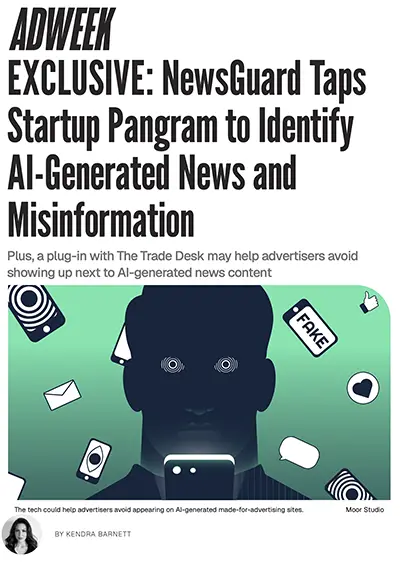
NewsGuard and Pangram Launch AI Content Farm Detection Tool, Integrate With The Trade Desk
Adweek | March 12, 2026
TL;DR: NewsGuard has deployed AI-powered detection to identify and flag AI-generated content farms at scale — identifying 3,000 such sites already — and is offering advertisers a direct integration with The Trade Desk to avoid funding or appearing alongside misinformation.
Executive Summary
NewsGuard, a media credibility rating firm, has partnered with Pangram Labs — a 2023-founded AI detection startup — to deploy a system that identifies websites operating as AI-generated content farms. These sites publish high volumes of AI-produced content without disclosure, often under names designed to mimic legitimate news outlets, and generate revenue by hosting programmatic advertising. The detection system evaluates entire domains (not just individual pages), flags suspected sites to NewsGuard analysts for manual review, and has already identified approximately 3,000 AI content farms — more than double last year’s manual count. Pangram estimates 300–500 new AI content farm sites emerge each month.
The brand safety risk is concrete and documented: NewsGuard found 141 major brands advertising on AI content farm sites over a two-month period, including household names. One cited example involved a site publishing fabricated political claims that were amplified by foreign state media before being debunked. Advertisers can now access NewsGuard’s AI content farm data directly, through their agencies, or via a pre-built integration with The Trade Deskthat blocks these sites at the pre-bid stage.
The detection accuracy relies on Pangram’s proprietary models, which have been validated by independent academic research — including a Nature study confirming their effectiveness at identifying AI-generated text in academic peer review. The system is not infallible: human analyst review is required to avoid false positives, and the pace of site creation means detection will always lag proliferation.
Relevance for Business
Any SMB running programmatic advertising — directly or through an agency — faces brand safety exposure from AI content farms. Your ads may already be appearing alongside fabricated political content, health misinformation, or defamatory material about public figures. This is both a reputational risk and a spend efficiency issue: ad dollars flowing to MFA (made-for-advertising) sites produce no legitimate audience value. The NewsGuard/Pangram tool offers a practical, available solution for advertisers on The Trade Desk today. For businesses not yet using programmatic advertising, this episode illustrates why brand safety governance must be part of any media buying conversation with agencies or platforms.
Calls to Action
🔹 Act now if you run programmatic ads — Ask your media buyer or agency whether AI content farm exclusion segments are active on your campaigns. If you use The Trade Desk directly, enable the NewsGuard integration.
🔹 Audit recent ad placements — Request a placement report and check whether your ads have appeared on unverified or low-credibility domains in the past 90 days.
🔹 Add brand safety language to agency contracts — Ensure your media buying agreements include explicit requirements for MFA and AI content farm exclusions.
🔹 Monitor — Track how detection technology evolves; the 300–500 new sites per month pace means this is a dynamic, ongoing risk, not a one-time fix.
🔹 Prepare internal policy — If your business publishes content, consider whether you need a disclosure policy for any AI-assisted content, given that undisclosed AI content is increasingly being flagged as a trust signal by detection systems.
Summary by ReadAboutAI.com
https://www.adweek.com/media/newsguard-tracking-ai-slop-content-farms/: March 20, 2026
TRUMP WANTS A CRITICAL MINERALS STOCKPILE. WHAT IT MEANS FOR MP STOCK.
Barron’s | February 2, 2026
TL;DR: The White House confirmed a $1 billion strategic minerals stockpile initiative (Project Vault), sending rare earth and critical minerals stocks on a volatile ride — a signal that U.S. supply chain security policy is accelerating, but translating policy intent into stable market conditions remains uneven.
Executive Summary
The Trump administration confirmed plans to launch Project Vault, a $1 billion initiative to stockpile strategic critical minerals and reduce dependence on China, which currently controls an estimated 85% of global rare earth processing capacity. The news moved mining stocks sharply, though gains were inconsistent: MP Materials rose modestly, while USA Rare Earth, Ramaco Resources, and Lithium Americas all ended the day lower. The market reaction illustrates a recurring pattern in the critical minerals space: policy announcements generate volatility but not yet durable price stability.
The article is primarily a market news piece, not a policy analysis. Its core factual content is straightforward: the stockpile is being confirmed, not yet funded or operationalized; the Defense Department has already struck a significant supply deal with MP Materials that includes equity, price-floor mechanisms, and offtake agreements; and the government has separately indicated a $1.6 billion financing letter of intent with USA Rare Earth. What is real now is policy direction and selective deal-making. What is not yet real is a functioning, price-stabilizing stockpile. The article does not detail which minerals are included, on what timeline, or at what scale of acquisition.
The broader strategic context is clear: rare earths underpin AI hardware, defense systems, consumer electronics, and the energy transition. China’s leverage over this supply chain is substantial and actively being used.
Relevance for Business
For most SMBs, this story operates at one remove — through supply chain exposure rather than direct minerals purchasing. If your products or services depend on electronics, semiconductors, electric motors, or defense-adjacent hardware, your suppliers’ suppliers are exposed to rare earth price volatility and potential Chinese export restrictions. The government’s effort to build domestic supply and stockpiles is a multi-year project; near-term disruptions remain a real risk. For businesses with any manufacturing exposure to critical mineral inputs, this is the moment to begin supply chain mapping, not after the next Chinese export restriction announcement.
Calls to Action
🔹 Monitor — Track Project Vault’s actual funding authorization and acquisition timeline; policy announcements and enacted programs are different things in the current environment.
🔹 Assign internal review — Map your supply chain two to three tiers deep for exposure to rare earth and critical mineral inputs, particularly in electronics, motors, and precision components.
🔹 Investigate further — If you are in manufacturing or hardware, begin conversations with suppliers now about their sourcing contingency plans for rare earth-dependent components.
🔹 Ignore for now (stock market angle) — The investment implications of specific mining stocks are not actionable for most SMB leaders. Focus on supply chain exposure, not equity positioning.
🔹 Revisit quarterly — The critical minerals landscape is shifting rapidly through both policy actions and Chinese export control decisions. This warrants regular monitoring, not a one-time review.
Summary by ReadAboutAI.com
https://www.barrons.com/articles/mp-stock-price-trump-rare-earth-stockpile-97a3a2b5: March 20, 2026
CRITICAL MINERALS ARE A TRICKY BUSINESS. WHAT COULD HELP.
Barron’s (Opinion) | March 9, 2026
TL;DR: A policy-focused opinion from mineral economics experts argues that while Project Vault’s $12 billion stockpile commitment is an important step, a differentiated strategy — active government market-making for small-volume, high-impact minerals like gallium — is needed to build genuine supply resilience.
Executive Summary
This is an expert opinion piece, not a news report. The authors — academic researchers from the Colorado School of Mines’ Payne Institute — offer a more analytically detailed perspective on Project Vault than typical news coverage. Their central argument: not all critical minerals are the same, and a one-size-fits-all stockpiling approach will underserve the most vulnerable segments of the supply chain.
The piece makes a specific and useful distinction between high-volume minerals (lithium, copper) where price supports may be more cost-effective than physical stockpiles, and low-volume, high-impact minerals like gallium where physical stockpiling is essential because the economics of domestic production simply do not work without government intervention. Gallium illustrates the stakes clearly: the U.S. consumes only 19 metric tons annually at a cost of $7.2 million — but a one-year Chinese supply restriction could cost the U.S. economy an estimated $1.4 billion, because gallium is irreplaceable in semiconductors, LEDs, lasers, and medical imaging.
The authors also frame the historical context: during the Cold War, the U.S. maintained stockpiles covering five years of conflict needs, worth roughly $80 billion in today’s dollars. The current reserve sits at $1 billion. China, by contrast, has been actively and strategically stockpiling for over a decade, including buying copper at depressed prices during COVID to protect its manufacturers. The authors endorse Project Vault as a starting point but argue the program needs to be extended, differentiated, and sustained — not treated as a one-time budget item.
Relevance for Business
The gallium example is the most practically relevant signal for SMBs. If you use or depend on semiconductor components, precision electronics, high-speed communications hardware, LEDs, or medical imaging equipment, you are exposed to a supply chain where China holds near-total control over a non-substitutable input. The $7.2 million annual U.S. gallium market produces $1.4 billion in economic dependency — a ratio that should prompt any leader dependent on such components to ask their suppliers about sourcing exposure and contingency options. The policy recommendation in this piece is also relevant: government price supports and purchase guarantees may stabilize supply before physical stockpiles are built, and the Trump administration has already used both mechanisms in individual mining deals.
Calls to Action
🔹 Assign internal review — Identify which components in your product or service supply chain contain materials for which China holds dominant processing or export control leverage.
🔹 Investigate further — For any gallium-, cobalt-, or rare-earth-dependent inputs, ask your suppliers what their contingency sourcing plan is if Chinese export restrictions expand.
🔹 Monitor — Track whether Project Vault is extended beyond its current 60–90 day supply commitment, particularly for low-volume, high-dependency minerals. Longer-term coverage would meaningfully reduce supply disruption risk for downstream manufacturers.
🔹 Prepare policy — If you have government contracts or serve defense-adjacent customers, map your supply chain’s mineral dependencies now, before procurement or compliance requirements force the issue.
🔹 Revisit in 6 months — The effectiveness of Project Vault will become clearer as acquisition details emerge. The analytical framework in this piece provides a useful lens for evaluating whether the program is structured to address the highest-risk vulnerabilities.
Summary by ReadAboutAI.com
https://www.wsj.com/wsjplus/dashboard/articles/critical-minerals-are-a-tricky-business-what-could-help-43d0c8b9: March 20, 2026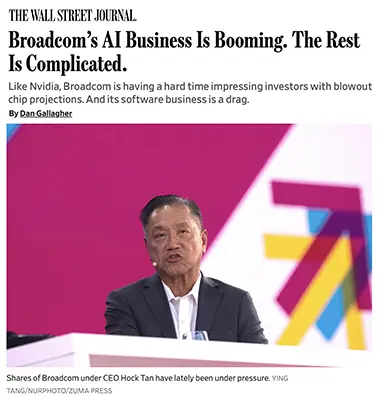
BROADCOM’S AI BUSINESS IS BOOMING. THE REST IS COMPLICATED.
The Wall Street Journal | March 5, 2026
TL;DR: Broadcom’s AI chip revenue more than doubled year-over-year and the company projects a path to $100 billion in AI chip sales by 2027 — but investor skepticism, software segment weakness, and concentrated supply chain exposure reveal that even the most direct AI infrastructure beneficiaries face structural complexity.
Executive Summary
This is a market analysis column (“Heard on the Street”), meaning it provides informed interpretation of financial results, not just news. Broadcom reported $8.4 billion in AI chip revenue in its fiscal first quarter — more than doubling year-over-year — and projected $10.7 billion for the current quarter, 15% ahead of Wall Street expectations. Despite this, its stock fell more than 20% after its previous quarterly results and has remained under pressure. The pattern mirrors Nvidia’s: even dramatic outperformance against already-elevated expectations is failing to excite investors. This reflects a market dynamic where AI infrastructure valuations have priced in substantial future growth, making it structurally difficult for any single quarter to surprise.
Broadcom’s AI business is anchored in custom AI processors (called XPUs) designed for specific workloads. The company has six major customers and has locked up key component supply through 2028 — a significant commitment that reflects genuine demand visibility but also creates inventory and execution risk. Inventory jumped 30% in a single quarter, the largest such increase in at least six years. Supply chain commitments of this scale create real downside risk if AI infrastructure buildout slows or customer priorities shift. CEO Hock Tan also addressed concerns about customer concentration, specifically confirming that Meta’s in-house chip program — which Broadcom supports — remains active, countering reports of trouble.
The drag is the software side: infrastructure software (roughly 40% of total revenue) grew only 1% year-over-year to $6.8 billion. Investors are discounting software businesses broadly on fears of AI disruption — a concern that Tan dismissed but that remains an unresolved overhang.
Relevance for Business
Broadcom operates deep in the AI infrastructure stack — its chips power the custom AI processors that major cloud providers use to run AI workloads. For SMBs, the direct investment angle is limited. But the story carries two relevant signals. First, the AI infrastructure buildout continues at enormous scale and is locking in multi-year supply commitments, which means cloud AI capacity is not going away — the hyperscalers’ AI spending is a real and durable commitment, not a bubble that is about to deflate. Second, the software valuation drag is a market-wide signal: enterprise software companies are being penalized by investors who believe AI will disrupt traditional software revenue streams. If you use or resell enterprise software, the incumbents in that space are under real pressure to prove their AI relevance, which will manifest in product roadmap decisions and pricing dynamics over the next 12–18 months.
Calls to Action
🔹 Monitor — Track Broadcom’s quarterly AI revenue trajectory as a leading indicator of hyperscaler AI infrastructure investment health; a slowdown would signal broader AI spending pullback.
🔹 Note the software disruption signal — If your business relies on enterprise software (ERP, CRM, analytics), ask your vendors how AI is affecting their roadmap and whether existing license value will be maintained or degraded.
🔹 Ignore for now (investment angle) — Broadcom stock valuation dynamics are not directly actionable for most SMB executives. The operational signals are more relevant.
🔹 Revisit in 6 months — Broadcom’s supply chain commitments through 2028 will either prove prescient or create significant inventory exposure depending on AI demand trajectory. This is a useful bellwether to monitor.
🔹 Investigate further — If you are in technology procurement or IT infrastructure, the shift from general-purpose GPUs to custom workload-specific chips (XPUs) signals that AI hardware is maturing and differentiating — worth understanding for long-term infrastructure planning.
Summary by ReadAboutAI.com
https://www.wsj.com/tech/ai/broadcoms-ai-business-is-booming-the-rest-is-complicated-eaaba206: March 20, 2026
AWS UNVEILS AMAZON CONNECT HEALTH
TechTarget / xtelligent Health IT and EHR | March 5, 2026
TL;DR: Amazon Web Services launched Amazon Connect Health, an agentic AI platform that integrates directly with EHRs to automate scheduling, clinical documentation, medical coding, and patient verification — a substantive product release targeting the administrative burden that consumes an estimated 30–50% of clinician time.
Executive Summary
This is a product launch news article. The claims about capabilities come from AWS and customer sources; independent validation is limited, though early customer results are cited. Amazon Connect Health is a healthcare-specific extension of Amazon’s existing cloud contact center platform (Amazon Connect), now purpose-built to integrate with Epic and more than 100 other EHR systems via AWS data integration partners. The platform’s core capabilities are real and in various stages of availability: patient verification and appointment management are in general availability; ambient documentation, after-visit summaries, pre-visit patient insights, and automated medical coding (ICD-10, CPT, E&M) are active features used by named customers.
Two early customer results are cited with specifics: UC San Diego Health reports a 30% reduction in call abandonment rates, reaching 60% in some departments; One Medical has deployed ambient documentation and is adding automated medical coding. These are meaningful operational metrics, not just pilot announcements. The platform’s SDK is designed to deploy in days rather than months, integrating into existing EHR screens without requiring workflow redesign — a significant practical claim that, if accurate, removes a major barrier to adoption.
The most strategically notable capability is evidence mapping — the system links every AI-generated output (a clinical note, a code, a summary) back to its source transcript or medical record, enabling auditability. This is not a cosmetic feature; it is the design element that makes the system defensible under clinical and compliance review. The framing from AWS leadership emphasizes reducing administrative load to increase patient-facing time — a legitimate and well-documented pain point in healthcare delivery.
The article is substantially written around AWS-sourced quotes. The core product claims are credible and consistent with the current state of ambient AI in healthcare, but no independent clinical validation data is presented.
Relevance for Business
This story has direct relevance for SMBs in three categories. First, healthcare practices and clinics of any size — the administrative burden problem Connect Health addresses (scheduling, documentation, coding, verification) is not limited to large health systems; it affects any clinical operation. Second, healthcare technology vendors and IT service providers — AWS is consolidating health AI infrastructure at the platform level, which creates both partnership opportunity and competitive pressure for point-solution vendors. Third, any employer-sponsored health benefits operation or health services company — Amazon’s deepening integration across One Medical, Amazon Pharmacy, and now Connect Health is building a vertically integrated consumer health stack with significant scale advantages. The vendor dependence and data custody implications of integrating patient records with an AWS-hosted system warrant careful due diligence before any clinical or administrative deployment.
Calls to Action
🔹 Investigate further (healthcare operators) — If you run or manage a clinical practice, evaluate whether the scheduling, documentation, and coding automation capabilities address your highest-cost administrative bottlenecks. Request a demo focused on your specific EHR.
🔹 Assess vendor dependence — Before deploying, understand what patient data is stored in AWS HealthLake, what the data residency and BAA (Business Associate Agreement) terms are, and what your exit options look like.
🔹 Test cautiously — The SDK deployment claim (“days not months”) is worth validating against your specific EHR environment. Early adopter results are encouraging but come from large health systems with significant IT resources.
🔹 Monitor (health IT vendors) — If you sell point solutions for clinical documentation, scheduling, or medical coding, AWS is now a direct competitive threat. Assess your differentiation strategy.
🔹 Prepare policy — Any deployment involving ambient recording of patient-clinician conversations requires explicit patient consent protocols and updated privacy policies. Ensure these are in place before piloting.
Summary by ReadAboutAI.com
https://www.techtarget.com/searchhealthit/feature/AWS-Unveils-Amazon-Connect-Health: March 20, 2026
AMAZON EXPANDS HEALTH AI CHATBOT TO ALL CUSTOMERS
TechTarget / xtelligent Patient Engagement | March 11, 2026
TL;DR: Amazon is expanding its Health AI chatbot — which answers personalized health queries using a user’s medical records and refers patients to One Medical clinicians — from One Medical subscribers to all customers, intensifying a three-way race with OpenAI (ChatGPT Health) and Anthropic (Claude for Healthcare) for the consumer health AI market.
Executive Summary
This is a brief news report on an Amazon product expansion announcement. Less than two months after its initial launch for One Medical patients, Amazon’s Health AI chatbot is being opened to all customers — a rapid expansion that signals either strong early adoption data or competitive urgency to establish market position, or both. The article is largely descriptive of Amazon’s announcement framing, with limited independent analysis.
The product’s core functionality: users can grant the chatbot access to their digital medical records for personalized health guidance; the tool can refer patients to One Medical clinicians via direct message, video, or in-person care; U.S. Prime members receive up to five free clinician direct-message consultations; and the system integrates with Amazon Pharmacy for prescription renewals. Amazon’s single most differentiating claim is HIPAA compliance — the article notes it is the only major tech consumer health AI chatbot to carry this designation, which matters for any use case involving protected health information.
The competitive framing is important context: OpenAI’s ChatGPT Health and Anthropic’s Claude for Healthcare launched in the same quarter. All three offer similar core functionality — health query response personalized to a user’s health records. The article correctly notes that brand recognition may be the deciding factor for consumer adoption, where ChatGPT and Claude have established name recognition that Amazon’s Health AI does not yet match. Amazon’s structural advantages are its Prime member base, its ownership of One Medical (the clinician referral layer), and its pharmacy integration — a more complete care navigation ecosystem than either competitor currently offers.
Relevance for Business
For SMBs in three areas. First, employers with health benefit programs: as consumer health AI chatbots become mainstream, employees will increasingly use them to manage health decisions — including decisions about benefit utilization. Understanding which tools employees are using and whether those tools are directing them toward or away from your benefit plan’s network has real cost implications. Second, healthcare providers and clinics: consumer-facing health AI is creating a new triage and pre-visit layer that will affect patient expectations about access and response time. Third, healthcare technology and benefits vendors: the three-way race between Amazon, OpenAI, and Anthropic in consumer health AI compresses the window for differentiated point solutions. Vendors without clear clinical outcome differentiation or workflow integration will face increasing commoditization pressure.
Calls to Action
🔹 Monitor — Track adoption data for Amazon Health AI, ChatGPT Health, and Claude for Healthcare over the next two quarters; consumer health AI uptake will affect patient behavior and clinical demand patterns.
🔹 Prepare policy (employers) — Consider developing employee guidance on AI health tool use — particularly around what health data employees share with consumer AI platforms and what those platforms’ privacy terms mean for employer-sponsored benefit data.
🔹 Investigate further (healthcare providers) — Assess whether consumer health AI chatbots are creating new patient intake channels that your practice needs to acknowledge, prepare for, or integrate with.
🔹 Note the HIPAA differentiation — Amazon’s HIPAA-compliant positioning is a meaningful compliance marker for any healthcare organization evaluating consumer-facing AI tools for patient engagement.
🔹 Revisit in 6 months — The competitive dynamics in consumer health AI are moving fast; relative market positions and clinical outcome data will be clearer by Q3 2026.
Summary by ReadAboutAI.com
https://www.techtarget.com/patientengagement/news/366639961/Amazon-expands-Health-AI-chatbot-to-all-Prime-members: March 20, 2026
AS GENAI USAGE INCREASES, HEALTH DATA EXPOSURE CONCERNS RISE
TechTarget / xtelligent Healthtech Security | March 4, 2026
TL;DR: A Netskope Threat Labs report on healthcare AI usage reveals that while organizations have successfully shifted employees toward managed AI tools, regulated health data still accounts for 89% of data policy violations — nearly three times the global average — exposing a governance gap that compliance frameworks have not yet closed.
Executive Summary
This article summarizes findings from Netskope’s threat report on healthcare AI usage, based on anonymized platform data. The headline metrics are credible and significant. Personal (unmanaged) genAI app usage in healthcare dropped from 82% to 32% over the past year; organization-managed genAI tool adoption rose from 12% to 56%. On the surface this looks like a governance success story. The more important finding is buried: regulated data accounted for 89% of data policy violations in healthcare, compared to 31% globally. This gap signals that the shift to managed tools has reduced exposure from the most obvious channel (personal apps) but has not resolved the underlying behavior — employees are still moving sensitive health data through AI tools, now just through sanctioned ones.
Two additional signals compound this: the proportion of users switching between personal and enterprise AI accounts doubled from 5% to 10% over the year, indicating that managed tools are still not meeting user convenience expectations. And the most-blocked AI application in healthcare is ZeroGPT — an AI detection tool — suggesting that some employees are actively trying to circumvent AI content detection, which itself implies awareness of monitoring combined with intent to avoid it.
The article’s source (Netskope) is a cybersecurity vendor with a commercial interest in this space, and the report should be read with that in mind. However, the patterns it describes are consistent with broader healthcare data security trends and the reported statistics are specific and internally consistent.
Relevance for Business
For any business operating in or adjacent to healthcare — including benefit plan administrators, telehealth vendors, health-adjacent SaaS companies, and any employer managing employee health data — this report carries two direct implications. First, switching to managed AI tools is necessary but not sufficient; the data exposure problem follows employees into sanctioned platforms if usage policies and technical controls are not tightly defined. Second, the 89% regulated data violation rate is a HIPAA compliance and liability signal, not just a security concern. Any healthcare-adjacent organization that has rolled out AI tools without parallel data loss prevention (DLP) policies is likely accumulating undisclosed PHI exposure in its AI logs and outputs. This is an audit and regulatory risk, not a hypothetical one.
Calls to Action
🔹 Act now — If you have deployed managed AI tools for staff in healthcare or health-adjacent roles, verify that your data loss prevention policies explicitly cover PHI and regulated data inputs to AI platforms.
🔹 Assign internal review — Audit which AI tools your staff are currently using (managed and personal), what data categories are being submitted, and whether your current BAA coverage extends to your AI tool vendors.
🔹 Prepare policy — Develop or update your acceptable use policy for AI tools to specifically address what data categories may and may not be submitted to any AI platform, managed or otherwise.
🔹 Monitor — Track the account-switching behavior signal: if staff are moving between personal and enterprise AI accounts, your managed tools may have usability gaps that are creating shadow AI workarounds.
🔹 Investigate further — Review Netskope’s full report for sector-specific data on violation types; the summary published here is sufficient for orientation but the underlying data may be relevant for compliance planning.
Summary by ReadAboutAI.com
https://www.techtarget.com/healthtechsecurity/news/366639579/As-genAI-usage-increases-health-data-exposure-concerns-rise-report: March 20, 2026
GETTING READY FOR THE AI ERA OF VIRTUAL HEALTHCARE
TechTarget / xtelligent Virtual Healthcare | January 15, 2026
TL;DR: Healthcare executives and clinical leaders outline a practical readiness framework for AI integration in virtual care — centered on governance, clinician trust, change management, vendor discipline, and data infrastructure — making this the most operationally useful of the four healthcare AI articles in this batch for leaders preparing to act.
Executive Summary
This is a feature article drawing on interviews with clinical and operational leaders from Mass General Brigham, Cedars-Sinai, Providence Virtual Care, and Ovatient, as well as analysts from Rock Health Advisory and McKinsey. It is not a product announcement or vendor story — it is practitioner guidance, which makes it more valuable for operational planning than the other healthcare articles in this batch. The framing is forward-looking (published January 2026, anticipating the year ahead), but the advice is grounded in real implementation experience.
The article organizes its guidance into five areas, each with substantive practitioner input. On governance: AI steering committees with centralized policy authority are recommended; the Mass General model (senior leaders overseeing model review, monitoring, and risk assessments) is presented as a working template. On clinical readiness: multiple clinical leaders are direct that AI is not yet ready as a diagnostic tool and that human-in-the-loop oversight remains non-negotiable, particularly in telemental health. This is a clear, practitioner-sourced caution that counters some vendor framing. On trust: transparency about how AI generates recommendations is essential for clinician adoption; black-box outputs will not achieve buy-in. On change management: a McKinsey partner draws a direct analogy to virtual care adoption — “just because you went to medical school, it doesn’t mean you can instantly provide phenomenal virtual care… same thing with AI” — a useful framing for managing training expectations. On vendor selection: leaders recommend consolidating to a smaller set of strategic vendors (rather than accumulating 30–40 point solutions) that demonstrate validated efficacy and provide performance and bias data in standardized formats.
The data infrastructure point carries practical weight: AI integration into virtual care requires a unified data lake with an integration layer — fragmented clinical, operational, and cost data in siloed systems will prevent effective AI deployment regardless of what tools are purchased.
Relevance for Business
This article is the most directly actionable in this batch for any SMB deploying or evaluating AI in a care delivery, telehealth, or health benefits context. The governance, vendor selection, and change management frameworks described apply beyond large health systems — any organization deploying AI tools that touch clinical decisions or patient data needs to answer the same questions these leaders are grappling with. The article also provides a useful counter to vendor pressure: multiple experienced clinical leaders state plainly that AI is not ready to replace clinical judgment and that organizations need to resist the temptation to “abrogate responsibility to the chatbot.” For non-healthcare SMBs, the governance and vendor consolidation frameworks are transferable to AI deployment decisions in any regulated or high-stakes context.
Calls to Action
🔹 Act now — If you are deploying AI tools in any care or health-adjacent context, establish a defined governance structure now. An AI steering committee with policy authority is the minimum viable governance framework.
🔹 Prepare policy — Develop written human-in-the-loop requirements for any AI tool used in clinical decision support. Document where AI outputs must be reviewed by a qualified human before action is taken.
🔹 Assign internal review — Audit your current AI vendor landscape. If you have accumulated point solutions without a consolidation strategy, begin mapping toward a smaller set of strategic vendors with proven integration and validated performance data.
🔹 Incorporate change management — Do not treat AI tool deployment as a technology rollout. Budget explicitly for training, feedback collection, and clinician or staff buy-in programs before launch.
🔹 Assess your data infrastructure — Before investing in additional AI tools, evaluate whether your underlying data environment (clinical, operational, cost) is unified enough to support effective AI ingestion. Fragmented data will limit any AI tool’s performance regardless of vendor quality.
Summary by ReadAboutAI.com
https://www.techtarget.com/virtualhealthcare/feature/Getting-ready-for-the-AI-era-of-virtual-healthcare: March 20, 2026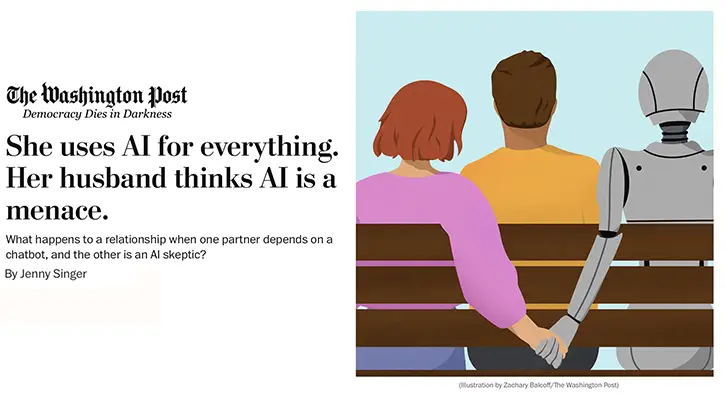
Closing: AI update for March 20, 2026
This week’s summaries don’t ask you to move on every front at once — they ask you to know which fronts are moving. The competitive advantage right now belongs to leaders who can distinguish signal from noise, assign the right actions to the right timelines, and build organizations where human judgment and AI capability reinforce each other rather than work at cross-purposes.
All Summaries by ReadAboutAI.com
↑ Back to Top