
AI Updates May 18, 2026


The week’s through-line: If the past week’s news had a single through-line, it was this: the AI story has stopped being theoretical. The 32 summaries in this post cover a week in which a White House meeting was upended by an AI model capable of attacking hospital and banking systems, three major UK financial regulators issued a coordinated alarm about frontier AI cyber risk, and Princeton ended a 133-year honor tradition because generative AI made academic integrity effectively unenforceable. The technology is no longer approaching some future threshold — it has arrived, and organizations that are still treating AI as a planning exercise rather than an operational reality are running behind.
The distinctive breadth of pressure points: What makes this particular week distinctive is the breadth of the pressure points that surfaced simultaneously. Vendor competition reshuffled materially, with Anthropic’s enterprise growth dramatically outpacing expectations and the enterprise AI market effectively consolidating around three credible players. Geopolitics moved into the AI supply chain in new ways, with Jensen Huang’s last-minute addition to the Beijing summit signaling that chip access has become an active diplomatic bargaining chip — not just an export control question. And the tension between AI’s productivity promise and its social friction became harder to ignore: public favorability for AI sits at 26%, data center opposition is generating legislative action at the state level, and organized resistance is building before widespread job displacement has even materialized.
The operative guidance: For SMB executives and managers, the operative guidance from this week’s coverage is not to accelerate or retreat — it is to get specific. The organizations navigating this moment well are not those with the largest AI budgets or the boldest AI mandates; they are the ones who have clear answers to concrete questions: Which vendors do we depend on, and what is our exposure if their governance or stability changes? Are we measuring AI by usage volume or by actual outcomes? Have we assessed our cybersecurity posture against an AI-augmented threat landscape? The summaries that follow cover all of this terrain — from Google I/O leaks and the Musk-OpenAI trial to humanoid robotics in commercial deployment and the hidden governance risks in AI tools your team may already be using. Read for signal, not noise.
Summaries

Google Is Cooking Again: I/O Leaks Are Wild
AI for Humans (YouTube) | May 15, 2026
TL;DR: Pre-Google I/O leaks point to a potentially disruptive week ahead — an integrated personal AI agent, a dramatically cheaper model, and early evidence that physical AI is moving from demo to deployment.
Executive Summary
With Google I/O scheduled for next week, a cluster of pre-event leaks is drawing attention across the AI community. The most strategically significant: Google Spark, a Gemini-powered agent reportedly designed to operate continuously across Gmail, Google Drive, Calendar, and other Google services — without requiring users to configure plugins or understand APIs. If it delivers, it would lower the barrier to autonomous AI agents considerably for everyday users, and give Google a structural advantage over third-party tools that currently require separate authentication and setup.
Equally notable is the Gemini 3.2 Flash rumor: a model reportedly delivering around 90% of GPT-5.5’s capability at roughly 1/20th the cost, with faster response times. If the performance claims hold under real-world evaluation, this would meaningfully shift the cost calculus for businesses evaluating AI deployment — especially those running high-volume, latency-sensitive workflows. Cheaper fast models also make previously expensive agentic pipelines more viable.
Two other signals worth tracking: Figure 03’s 24-hour autonomous package-sorting livestream offered unusually transparent evidence of where physical robotics stands today — functional but imperfect, drawing both genuine interest and skepticism about teleoperation. And the data center infrasound story, while still emerging and not fully substantiated, points toward a growing cluster of community, regulatory, and infrastructure challenges that will shape AI’s physical expansion over the next several years.
Relevance for Business
For SMBs already in the Google ecosystem, Spark could represent genuine workflow change — not just another assistant, but an agent that works continuously across your actual tools. The key unknowns are pricing tier and opt-in/out structure.
On cost: If Gemini 3.2 Flash benchmarks hold independently, it changes the economics of AI adoption. Businesses currently hesitating on cost should watch this closely — a capable, fast, cheap model removes one of the most common objections.
On physical automation: The Figure 03 stream is a useful calibration point. Autonomous package sorting is real, not flawless, and moving toward commercial scale. Companies in logistics, fulfillment, or manufacturing should treat this as an early signal, not a distant threat.
On infrastructure and policy risk: The data center story — water use, energy draw, and now infrasound — is accumulating political weight. Bernie Sanders and AOC have introduced legislation to restrict data center development. Whether or not it advances, regulatory friction around AI infrastructure is becoming a business-relevant variable for anyone with significant cloud dependencies.
Calls to Action
🔹 Monitor Google I/O announcements next week closely — specifically Spark pricing/access tiers and Gemini 3.2 Flash benchmark results. These could affect your AI tool and vendor decisions.
🔹 If your team uses Google Workspace extensively, flag Spark as worth evaluating early. The integration story could reduce friction and setup costs compared to third-party agent tools.
🔹 Run an independent evaluation of Gemini Flash once it’s publicly available, particularly if you’re currently paying for GPT-4 or GPT-5 tier access at scale. Cost differences at this magnitude warrant a real test.
🔹 If you operate in logistics, warehousing, or repetitive physical workflows, add autonomous robotics to your two-year planning horizon. The Figure 03 stream is early-stage, but the trajectory is clear.
🔹 Assign someone to track the data center regulation story — particularly if your operations depend on specific cloud regions or if you’re considering on-premise AI infrastructure.
Summary by ReadAboutAI.com
https://www.youtube.com/watch?v=8XQzln1v77k: May 18, 2026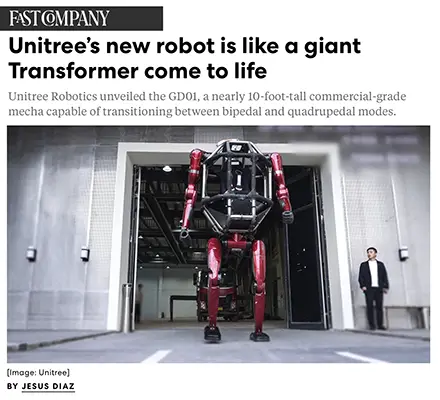
UNITREE’S NEW ROBOT IS LIKE A GIANT TRANSFORMER COME TO LIFE
Fast Company | Jesus Diaz | May 14, 2026
TL;DR: China’s Unitree Robotics has unveiled a nearly 10-foot, piloted transforming robot — but the bigger story is that Chinese companies now dominate the global humanoid robotics market at a scale and price point that Western competitors have not matched.
Executive Summary
The GD01 is genuinely novel hardware: a 1,100-pound, pilot-operated robot that can switch between two-legged and four-legged movement modes, built from aerospace-grade materials with AI-managed spatial coordination. The founder demonstrated it by walking through a wall. At roughly $574,000, it is priced for industrial and government clients, and Unitree is initially targeting tourism, emergency rescue, and “industrial special operations.” The spectacle is real, but it is not the primary story.
The more consequential signal is the competitive landscape underneath the product launch. In 2025, Chinese companies captured approximately 90% of global humanoid robot sales. Unitree alone shipped more than 5,500 units last year; its closest American competitors — Tesla, Figure AI, and Agility Robotics — delivered roughly 150 units each. The price gap is equally stark: Unitree’s base humanoid models start under $5,000 on some configurations, while Tesla Optimus is projected at $20,000–$30,000. Chinese humanoid robots are already deployed in live commercial operations: Japan Airlines is trialing Unitree’s G1 for baggage handling at Haneda Airport, CATL has launched large-scale factory deployment, and China’s state grid operator has committed $1 billion to autonomous grid maintenance by humanoid robots.
The article notes, with appropriate caution, that the People’s Liberation Army has documented ties to Chinese robotics companies including Unitree. A military evolution of this platform is a stated possibility, not speculation.
Relevance for Business
For most SMBs, the GD01 itself is not a near-term procurement consideration. The strategic relevance is threefold. First, Chinese embodied AI is advancing faster and scaling earlier than Western competitors — this has supply chain and geopolitical implications for any business with China-dependent manufacturing exposure. Second, affordable humanoid robots are already entering industrial and logistics environments globally — sectors including warehousing, manufacturing, and infrastructure maintenance should begin scenario planning now. Third, the military-civilian technology boundary in China is thin — Western governments are likely to increase scrutiny of Chinese robotics imports, which could affect cost and availability projections for businesses considering these platforms.
Calls to Action
🔹 File this as a 12–24 month watch item, not an immediate action. The GD01 is not a near-term SMB purchase. But the broader humanoid robotics market is moving faster than most business planning cycles assume.
🔹 If you operate in warehousing, logistics, or heavy industry, begin scenario planning now. Humanoid robots are already in live commercial deployment in these sectors. Understanding the capability and cost trajectory is a competitive intelligence priority.
🔹 Track the regulatory environment around Chinese robotics. Given the PLA’s documented ties to companies like Unitree, import and procurement restrictions are a plausible near-term policy outcome. Factor this into any vendor evaluation.
🔹 Reassess Western robotics vendor timelines with fresh skepticism. If Chinese manufacturers are shipping at 35x the volume of American competitors at a fraction of the price, the competitive assumptions embedded in most Western robotics roadmaps deserve scrutiny.
🔹 Watch the Japan Airlines trial as a leading indicator. A successful humanoid robotics deployment at a major international airport — handling real cargo with real passengers — would signal that the technology has crossed a commercial viability threshold relevant to many other industries.
Summary by ReadAboutAI.com
https://www.fastcompany.com/91541581/unitrees-new-robot-is-like-a-giant-transformer-come-to-life: May 18, 2026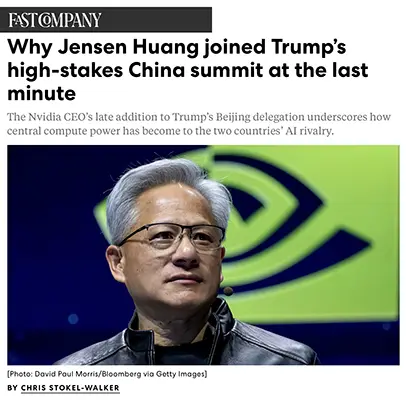
Why Nvidia’s Jensen Huang Joined Trump’s China Summit at the Last Minute
Fast Company | Chris Stokel-Walker | May 13, 2026
TL;DR: Jensen Huang’s last-minute addition to Trump’s Beijing delegation signals that Nvidia’s access to the Chinese market has moved from a trade policy question to an active geopolitical bargaining chip — with direct implications for AI hardware availability and pricing globally.
Executive Summary
When the final list of U.S. executives accompanying President Trump to Beijing was released, Nvidia’s CEO was not on it. Huang’s addition just hours before departure was not a scheduling convenience — it was a signal. Analysts cited in the piece frame his near-absence as reflecting a deliberate tension: Washington views Nvidia’s chips as too strategically important to expose to negotiating compromise, while Huang himself has publicly criticized U.S. export restrictions as counterproductive, arguing they accelerate China’s drive toward semiconductor self-sufficiency.
His inclusion at the last minute may indicate a shift: the Trump administration may now be treating Nvidia’s market access to China as a negotiating asset in broader diplomatic discussions — potentially including issues unrelated to technology, such as U.S.-Iran policy. That reframing matters. It means chip access is no longer governed solely by export control bureaucracy; it is subject to the unpredictability of personal diplomacy.
Meanwhile, China’s domestic chip industry is showing momentum despite restrictions, with integrated circuit export values reportedly doubling year-over-year in April. The window in which U.S. chip leverage is most effective may be narrowing. How quickly is an open question, but analysts quoted in the piece suggest Chinese semiconductor firms are increasingly confident in their ability to close the gap.
Relevance for Business
Most SMBs are not buying Nvidia chips directly, but they are buying AI services, cloud infrastructure, and software that runs on them. Any disruption to the global chip supply chain — through escalating export controls, diplomatic breakdown, or retaliatory restrictions — flows directly into AI infrastructure costs and availability. Organizations making multi-year commitments to AI platforms should understand that the hardware underpinning those platforms is now explicitly geopolitical. Supply risk is real, not abstract.
Calls to Action
🔹 Monitor U.S.-China chip policy developments closely — outcomes from this summit may reshape AI infrastructure pricing and availability within 12–18 months.
🔹 Ask your cloud and AI vendors about supply chain resilience — understand how exposed your key tools are to hardware disruption.
🔹 Avoid over-committing to a single AI infrastructure provider during this period of geopolitical volatility; diversification reduces concentration risk.
🔹 Treat AI hardware availability as a strategic planning variable, not a given — procurement timelines for GPU-intensive infrastructure may lengthen if restrictions tighten.
🔹 Watch China’s domestic semiconductor progress as a leading indicator — if Chinese alternatives mature faster than expected, it reshapes the competitive and pricing landscape for AI globally.
Summary by ReadAboutAI.com
https://www.fastcompany.com/91541055/jensen-huang-nvidia-trump-china-trip: May 18, 2026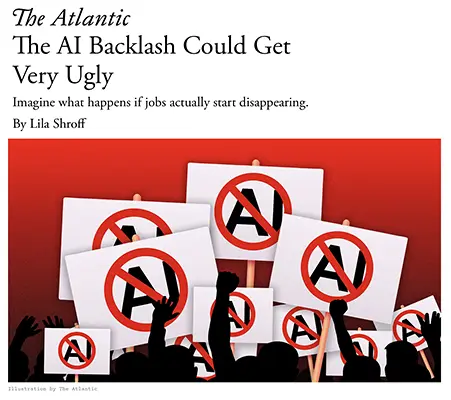
The AI Backlash Could Get Very Ugly
The Atlantic | Lila Shroff | May 13, 2026
TL;DR: Anti-AI sentiment in the U.S. is already crossing into organized opposition and isolated violence — and if AI-driven job displacement accelerates, the political and social reaction could become a material business risk, not just a public relations concern.
Executive Summary
This is a substantive reported piece, not opinion dressed as analysis. Shroff documents a growing and structurally significant pattern: anti-AI sentiment is no longer confined to online commentary — it is producing organized resistance, legislative pressure, and in isolated cases, physical threats and violence. A Maine data center moratorium was passed (though vetoed by the governor). A record number of data center projects were canceled in Q1 due to local opposition. There have been shootings near local officials who approved data center siting, and an arson attempt at Sam Altman’s home. Threats against AI-adjacent individuals and infrastructure are reportedly rising, according to the Soufan Center.
The piece correctly identifies the more important structural risk: none of this has yet happened in a context of real, widespread, AI-attributable job loss. Current anti-AI sentiment is largely anticipatory. The narrative of job displacement has so far been more claim than documented reality at scale — the column notes that many AI-attributed layoffs appear to be “AI-washing” of headcount reductions that would have occurred anyway. But that could change. If AI does meaningfully displace white-collar employment, the political conditions for a severe backlash are already present — bipartisan, intensifying, and reaching voters who consistently feel the economic system favors the wealthy.
The historical parallel to the Industrial Revolution is the column’s most useful frame. Long-run economic growth coexisted with near-term wage stagnation, inequality, and civil unrest. Tech industry attempts to rebrand the narrative — arguing that job loss fears are overblown — are likely to deepen rather than defuse the backlash if the underlying anxiety is rooted in lived economic experience rather than messaging.
Relevance for Business
Leaders should resist treating this as background noise. Organized AI opposition is already affecting infrastructure availability and project timelines. If your growth strategy depends on AI-enabled cost reduction through labor displacement, you face not only governance and reputational risk but potential regulatory restriction at state and local levels. Employee trust is directly at stake: workers who feel AI is being used against them rather than alongside them are more likely to become internal resistors or public voices of opposition. The political environment is moving against permissive AI deployment faster than most corporate AI strategies assume.
Calls to Action
🔹 Audit your AI strategy for labor displacement risk — if AI efficiency gains are coming at the direct expense of jobs, assess whether the reputational and regulatory exposure is priced into your decision.
🔹 Develop a clear, honest internal narrative about AI and jobs — employees need to understand how AI affects their roles before they read about it in the press.
🔹 Monitor state and local AI legislation — data center opposition and regulation are accelerating at sub-federal levels where incumbents have limited lobbying influence.
🔹 Prepare for the possibility that AI-driven automation becomes a political lightning rod in the 2026 midterm cycle — companies that are visible AI adopters may face increased scrutiny.
🔹 Separate the hype from your exposure — if your AI adoption is genuinely additive rather than substitutive, document and communicate that distinction clearly; it matters for employee trust and regulatory positioning.
Summary by ReadAboutAI.com
https://www.theatlantic.com/technology/2026/05/ai-backlash-data-centers-political-violence/687151/: May 18, 2026
THE AI PROJECT FEATURE YOU’RE PROBABLY NOT USING — BUT SHOULD BE
New Things with Joanna Stern (Substack) | Joanna Stern | May 15, 2026
TL;DR: WSJ tech columnist Joanna Stern’s account of using Claude and ChatGPT’s “Projects” feature to manage a complex book project offers a clear, practitioner-tested model for how SMBs can get sustained, context-aware value from AI tools.
Executive Summary
This is a practical how-to from a credible practitioner, not a vendor pitch. Stern describes building persistent AI workspaces — she calls them “BookBots” — using the Projects feature available in both Claude and ChatGPT. The core mechanism: upload your relevant documents, notes, transcripts, and context into a contained workspace, configure the AI’s role with a clear prompt, and from that point forward the AI works from your material rather than starting fresh in every session. The result is something closer to a context-aware research assistant than a chatbot.
Her use cases are directly transferable to business settings: navigating large document sets, reorganizing structures, surfacing information from past work, preparing for interviews or meetings, and doing background research before primary work begins. She explicitly notes this is not a book-writing tool — the AI handled logistics and retrieval while she retained all creative and editorial judgment. She also flags a meaningful data hygiene point: both platforms have settings that allow your uploaded content to be used for model training, and she disabled both. This is a non-obvious but consequential configuration decision for anyone uploading proprietary business documents.
The piece is honest about the tension: Stern acknowledges that AI doing organizational work could be framed as a shortcut, but argues the distinction between offloading information management and offloading thinking itself is real and worth maintaining.
Relevance for Business
For SMBs, the Projects feature represents one of the most accessible and immediately useful AI capabilities available today — and one of the most underused. The workflow Stern describes maps directly onto client project management, proposal development, meeting preparation, due diligence research, and internal knowledge management. The ability to build a persistent, document-grounded workspace around a specific engagement or initiative changes the economics of AI assistance significantly.
The data training setting note is particularly important for business use: if your team is uploading client documents, internal memos, or proprietary research to AI platforms, confirming whether those inputs are being used to train models is a governance issue, not just a preference.
Calls to Action
🔹 Pilot the Projects feature this week on one active, document-heavy initiative. Set up a workspace, upload the relevant files, write a clear role prompt, and run it for two weeks. Evaluate whether it meaningfully reduces retrieval and organizational overhead.
🔹 Immediately review your AI platform data training settings. Both Claude and ChatGPT default settings may allow uploaded content to be used for model training. Confirm your organization’s posture and configure accordingly before uploading any proprietary material.
🔹 Write explicit role prompts for your AI workspaces. Stern’s prompt is a useful template: it names the assistant, defines its domain, specifies the source materials, and lists the types of tasks it should help with. Vague prompts produce vague results.
🔹 Define the line between information management and thinking. The Stern model is instructive: AI handles retrieval, organization, and background research; humans retain judgment, structure, and synthesis. Make that distinction explicit in your AI use policy.
🔹 Consider which client-facing or confidential workflows require additional data controls before using consumer AI platforms. For highly sensitive engagements, enterprise API access with stronger data isolation may be more appropriate than consumer tools.
Summary by ReadAboutAI.com
https://thenewthings.com/p/the-ai-trick-i-use-constantly: May 18, 2026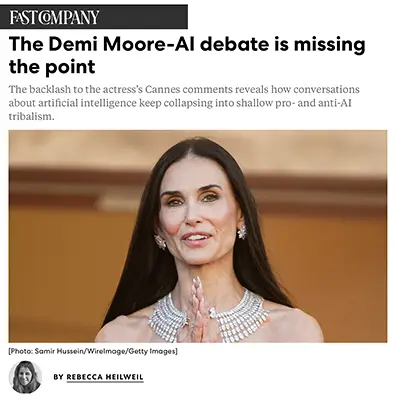
The Demi Moore-AI Debate Is Missing the Point
Fast Company | Rebecca Heilweil | May 13, 2026
TL;DR: The reflexive sorting of public AI commentary into pro- and anti-AI camps is itself a distraction — the more important questions are about ownership, power, and accountability, not celebrity positioning.
Executive Summary
This is an opinion piece, and its core argument deserves to be evaluated as such. Heilweil’s central claim is that the public debate about AI — exemplified by the social media pile-on following Demi Moore’s off-the-cuff Cannes comments — has collapsed into a binary that produces heat but no useful signal. Moore made a nuanced, if imperfect, set of observations: resistance is futile, AI is already present, regulation is probably insufficient, and human creative expression retains something machines cannot replicate. She was pilloried from multiple directions simultaneously.
Heilweil argues the more productive frame is specificity: What exactly does “AI” mean in this context? Who owns the systems? What are the real effects on workers, not just artists? The piece quotes a fellow Cannes juror — a screenwriter and lawyer — raising ownership and governance as the core questions, not positioning.
This column is primarily useful as a signal about the quality of AI discourse, not as a source of operational insight. It is an opinion piece grounded in observation rather than data. Its value for executives is as a reminder that the public perception of AI is deteriorating and tribal, which has downstream implications for employee sentiment, customer trust, and the political environment around AI regulation.
Relevance for Business
The piece is a useful prompt for leaders to assess how AI decisions are being communicated internally and externally. In a climate where any AI statement is rapidly categorized as pro- or anti-AI, organizations that deploy AI without clear, specific explanation of what it does, who governs it, and how it serves customers or employees are exposed to reputational risk. The underlying governance questions — who controls the systems, how does it affect workers — are the same ones your employees and customers are likely asking.
Calls to Action
🔹 Evaluate your internal AI communications for specificity — vague enthusiasm or blanket reassurance will not hold up; employees and customers are asking sharper questions.
🔹 Anticipate that the regulatory environment will become more contested, not less — preparation now reduces reaction-cost later.
🔹 Monitor public AI sentiment as a leading indicator of employee and customer attitudes — the tribalization documented here is already affecting workplaces.
🔹 Frame AI decisions around concrete outcomes and accountability, not broad positioning — “we use AI to improve X for Y” is more defensible than “we’re an AI-forward company.”
🔹 Deprioritize tracking celebrity AI commentary — the noise-to-signal ratio in this discourse is very high; focus on regulatory, labor, and governance developments instead.
Summary by ReadAboutAI.com
https://www.fastcompany.com/91541141/demi-moore-ai-debate-missing-the-point: May 18, 2026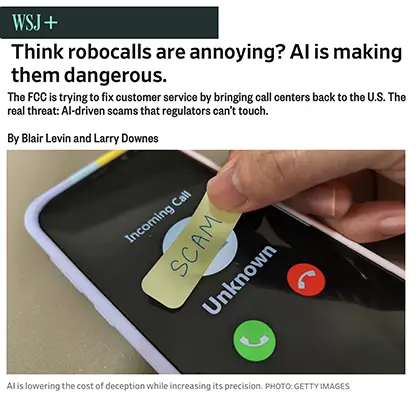
AI IS MAKING ROBOCALL SCAMS DRAMATICALLY MORE DANGEROUS — AND CURRENT REGULATION MISSES THE THREAT
MarketWatch (via WSJ) | May 11, 2026
TL;DR: While the FCC focuses on reshoring call centers — a regulation aimed at yesterday’s problem — AI-powered voice cloning, impersonation chatbots, and personalized phishing are creating a new generation of scams that existing legal frameworks cannot effectively reach, with direct implications for every organization that communicates with customers by phone or digital channel.
Note: This is an opinion piece by two named policy experts — a former FCC chief of staff and a co-author on disruptive innovation — not reported news. The arguments are analytically grounded but should be read as advocacy for a regulatory approach, not as neutral analysis.
Executive Summary
The authors — Blair Levin of the Center for Strategic and International Studies and Larry Downes, a technology policy author — argue that the FCC’s current push to onshore call centers is well-intentioned but largely irrelevant to the actual problem AI is creating in customer communications. Their core argument: AI is not just automating customer service, it is also dramatically lowering the cost and increasing the precision of consumer fraud.
The scale of the existing problem is documented: Americans receive an estimated 4 to 5 billion robocalls monthly despite decades of regulation, including the 1991 Telephone Consumer Protection Act and the FTC’s Do Not Call list. The law was designed for a domestic, voice-based telemarketing industry; today’s fraud ecosystem is global, automated, and operates well beyond domestic regulatory reach.
The new threat layer is more serious: AI now enables voice cloning, impersonation chatbots, personalized phishing at scale, and fraudulent “customer service” interactions that are difficult to distinguish from legitimate ones. The same capabilities that make AI useful for genuine customer engagement — conversational fluency, personalization, availability — make it highly effective for fraud. A 2024 study cited in the piece found that AI is simultaneously lowering the cost of deception and increasing its targeting precision.
The authors also flag a forward-looking concern: agentic AI systems — tools that act on behalf of users to negotiate, transact, and resolve issues automatically — will create a new attack surface as they interact with other AI systems, potentially without human oversight at any point in the chain. The regulatory posture they advocate focuses on authentication, fraud detection, disclosure requirements, and consumer transparency rather than labor geography.
Relevance for Business
This piece has direct operational implications for any SMB that communicates with customers by phone, text, email, or chat — which is to say, essentially every business.
Customer-facing risk: Your customers are already being targeted by AI-powered scams that impersonate legitimate businesses. If your brand is well-known enough to be mimicked, or your customers are in demographics that are frequent fraud targets, your reputation can be damaged by fraud you didn’t commit. Customer trust erodes when people can’t distinguish a real communication from a fake one.
Internal risk: The same capabilities — voice cloning, personalized phishing, impersonation — can be used against your own organization. Executive impersonation fraud, fake vendor communications, and AI-generated internal phishing are all active and growing threat vectors. AI makes these attacks more convincing and more scalable than anything that came before.
Compliance and disclosure: The authors’ recommendation — clearer disclosure when consumers interact with AI systems — is likely to become regulatory reality in some form. If your organization uses AI for any customer-facing communication, getting ahead of disclosure and consent requirements now is lower-cost than retrofitting later.
Calls to Action
🔹 Brief your leadership team on AI-enabled fraud — voice cloning and impersonation chatbots are not future risks. They are current, active, and scalable today. This is a board-level awareness issue, not just an IT issue.
🔹 Audit your customer communication channels for fraud vulnerability — if a bad actor can convincingly impersonate your brand in a phone call or chat, what would the detection and remediation path look like?
🔹 Strengthen internal verification protocols for financial transactions, vendor payments, and executive communications — AI-generated impersonation of known individuals is now cheap and accessible to low-sophistication attackers.
🔹 Prepare for AI disclosure requirements — proactively establish and document policies for when and how you disclose AI involvement in customer interactions. Regulators will eventually require this; customers are already asking.
🔹 Monitor FCC and FTC regulatory developments over the next 12 months — while the authors argue current proposals miss the mark, regulatory activity in this space is increasing and may produce requirements relevant to your customer service operations.
Summary by ReadAboutAI.com
https://www.wsj.com/wsjplus/dashboard/articles/think-robocalls-are-annoying-ai-is-making-them-dangerous-d628000f: May 18, 2026
PRINCETON ENDS UNPROCTORED EXAMS AFTER 133 YEARS — AI HAS MADE THE HONOR SYSTEM UNWORKABLE
The Atlantic | May 12, 2026
TL;DR: Princeton’s faculty vote to reinstate exam proctoring — ending a 133-year tradition of unsupervised testing — is the clearest institutional signal yet that generative AI has fundamentally broken the credential signals that employers, graduate programs, and society rely on from higher education.
Executive Summary
Princeton University’s faculty voted to resume proctoring exams, ending an honor system that dated to 1893. The decision follows a documented rise in AI-facilitated academic dishonesty: the school’s disciplinary committee found 82 students responsible for academic violations in 2024–25, up from 50 in 2021–22. In a graduating senior survey of 501 students, 30% admitted to cheating and 28% admitted using ChatGPT on prohibited assignments — and 45% said they knew of peer cheating and did not report it.
The piece, by Atlantic staff writer Rose Horowitch, is well-reported and makes a substantive argument: AI hasn’t just made cheating easier, it has made it nearly invisible and socially normalized. Detection tools are unreliable. Teachers cannot distinguish AI-written work from student-written work with any confidence. And when cheating becomes visibly widespread, it creates a social dynamic where rule-following feels like a competitive disadvantage rather than a moral choice.
Princeton’s response is multi-pronged: proctored exams, a sharp reduction in take-home assignments (down by more than two-thirds in one year), oral defenses of research projects, Google Docs composition tracking, and in-class writing in blue books. All of these share a common feature, as one professor notes: they increase surveillance. The Honor Code technically remains, but it now requires enforcement to function.
The broader implication the article surfaces is significant and largely unaddressed: if AI makes credentialing unreliable, the value of a degree — and by extension, the hiring signals that degrees are supposed to provide — is eroding. A diploma from a school that cannot verify its students did their own work is a weaker signal than it once was.
Relevance for Business
For SMB executives, this story matters on two levels that are easy to underestimate.
First, hiring. If you are recruiting recent college graduates, you should assume — not suspect — that some portion of their academic work was AI-generated. This doesn’t make them poor candidates, but it does mean their transcripts and writing samples are weaker credential signals than they were five years ago. The Fast Company article in Batch 1 made the same point from the hiring side: demonstrated, applied capability now matters more than credentialed learning.
Second, your own workforce and AI policy. Princeton’s situation is a concentrated, high-stakes version of a dynamic playing out in every workplace that uses AI tools without clear guidelines. When AI use is ambiguous or inconsistently enforced, the same social normalization dynamic the article describes — cheating becomes visible, rule-following feels like a disadvantage — can take hold in professional settings as well. The absence of clear AI use policies in your organization is not neutral; it creates the conditions for the same race-to-the-bottom dynamic.
The article is behind a paywall and is substantive enough to merit reading in full by anyone responsible for hiring, talent development, or AI governance policy.
Calls to Action
🔹 Revisit your AI use policy — if your organization doesn’t have one, or it’s vague, this article provides a useful framing for why clarity matters before norms calcify on their own.
🔹 Adjust hiring practices for recent graduates — add applied skill demonstration to your evaluation process rather than relying heavily on academic credentials or writing samples as proxies for capability.
🔹 Do not assume AI-generated work is automatically low quality — the issue isn’t that AI output is bad; it’s that AI output without human judgment and ownership is unreliable and unsupervised. Design evaluations accordingly.
🔹 Monitor how other elite institutions respond — Princeton’s faculty vote is likely the beginning of a broader shift. The direction and speed of that shift will affect what skills and habits the next wave of graduates brings to the workforce.
🔹 Consider this article required context for anyone at your organization designing onboarding, performance review, or AI governance frameworks in the next 12 months.
Summary by ReadAboutAI.com
https://www.theatlantic.com/ideas/2026/05/princeton-ai-honor-code/687144/: May 18, 2026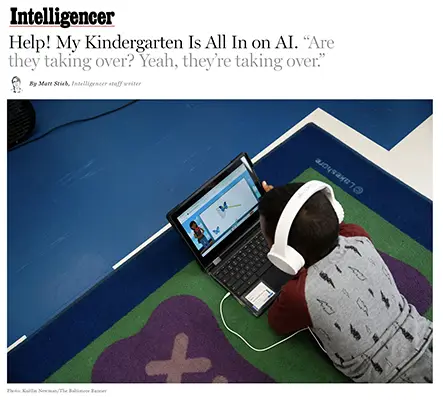
NYC KINDERGARTEN PARENTS ARE PUSHING BACK ON CLASSROOM AI — AND THEY HAVE A POINT
Intelligencer (New York Magazine) | May 12, 2026
TL;DR: New York City’s rollout of AI-powered reading and math apps in public school kindergartens — including tools that record children’s voices to improve their own algorithms — has triggered organized parent opposition that raises substantive questions about data collection, pedagogical effectiveness, and who actually benefits from AI in the classroom.
Executive Summary
Intelligencer staff writer Matt Stieb reports on growing parent resistance to AI-based learning tools in New York City public schools, particularly at the kindergarten level. The primary example is Amira, an AI reading app deployed in roughly 150 NYC schools since 2024, which uses an animated avatar to teach early reading and records children’s voices to improve its own model. A second tool, ST Math, uses a gamified penguin avatar to teach math and collects what its parent company describes as “vast amounts” of data from children’s interactions.
The piece is reported narrative rather than investigative analysis, and it gives significant space to frustrated parents. But the core grievances have merit beyond the emotional register of the coverage: children’s biometric voice data is being collected by private, profit-motivated companies operating in a low-accountability environment; pedagogical efficacy is asserted rather than demonstrated; and district administrators appear to have adopted these tools with limited independent evaluation.
The policy context matters: NYC schools chancellor announced suspension of a planned AI-focused high school amid criticism, and a 45-day public feedback window on AI classroom policy is underway. At the federal level, President Trump signed an executive order pushing AI literacy from kindergarten, which will likely accelerate — not slow — school system AI procurement.
The article notes a pattern worth flagging: top NYC education administrators have participated in a Google-backed fellowship that also has investment stakes in AI education companies like Amira. This is a disclosed relationship, not a proven conflict, but it is material context for how these procurement decisions are being made.
Relevance for Business
This story is relevant to SMB leaders in two ways that might not be immediately obvious.
First, as a governance template. The dynamic in NYC schools — AI tools adopted quickly, data practices undisclosed, efficacy unproven, stakeholder consent incomplete — is structurally similar to how many organizations are deploying AI internally. The parent question “If it is so good for my children, why is it a secret?” is a version of the same question employees and customers will increasingly ask of organizations that deploy AI without adequate transparency.
Second, as a market signal. AI in education is a growing sector with increasing federal tailwinds, but parent and community resistance is real, organized, and now visible at the policy level. Organizations with any exposure to the ed-tech sector — as vendors, investors, customers, or partners — should track whether this resistance broadens beyond NYC. The 45-day public feedback window could produce policy constraints with national implications.
The data collection dimension deserves particular attention for any organization considering AI tools that involve minors, voice data, or biometric information. Consent frameworks, data use disclosures, and third-party data sharing agreements are where regulatory risk is accumulating.
Calls to Action
🔹 Use this story as a governance mirror — ask whether your own AI deployments involve data collection practices that employees, customers, or partners would find acceptable if they were fully disclosed.
🔹 If your organization operates in or adjacent to education technology, monitor the NYC 45-day policy process closely — its outcome could set precedent that affects procurement standards nationally.
🔹 Flag the voice/biometric data dimension — any AI tool that captures voice, facial, or behavioral data from minors is operating in rapidly evolving regulatory territory. Ensure your legal and compliance teams are current.
🔹 Watch for the federal AI literacy executive order’s implementation — it will create new school procurement activity that may benefit or complicate vendors and partners in the ed-tech space.
🔹 Deprioritize alarm about the kindergarten story specifically — the pedagogical debate is real but unresolved, and the narrative coverage here runs ahead of the evidence. Monitor developments rather than drawing firm conclusions.
Summary by ReadAboutAI.com
https://nymag.com/intelligencer/article/parents-arent-happy-as-nyc-kindergartens-go-all-in-on-ai.html: May 18, 2026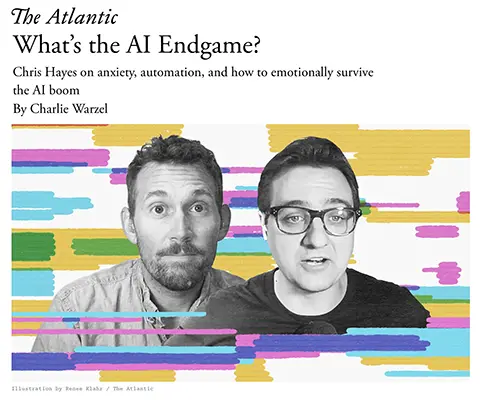
What’s the AI Endgame? (Galaxy Brain Podcast with Chris Hayes)
The Atlantic | Charlie Warzel | May 15, 2026
TL;DR: MSNBC host Chris Hayes offers a grounded, outsider framework for navigating AI anxiety — arguing the most likely scenario is neither utopia nor extinction, but a technology with enormous dislocations that concentrates power and demands deliberate governance.
Executive Summary
This podcast episode is a substantive conversation, not a hype vehicle. The core argument, advanced by Hayes with Warzel, is that most public discourse about AI gravitates toward extreme outcomes — either transformative salvation or civilizational threat — when the more probable range sits somewhere in the middle. Hayes proposes treating AI as a “normal technology”: consequential, disruptive, capable of enormous harm and benefit, but survivable — much like the automobile, electrification, or the internet before it. The useful caution embedded in this framing is that “normal” technologies can still produce catastrophic transitional periods, and the 19th-century railroad boom — which drove transformative economic growth and also triggered a depression — is raised as a relevant historical parallel.
The more structurally concerning observation in the episode is about capital concentration. Hayes argues that unlike the internet, which was designed from the beginning with distribution and non-concentration as engineering principles, AI is architecturally concentrated — requiring massive capital, producing massive returns, and flowing toward a small number of entities. That structural difference matters for how benefits are distributed and who ultimately has governance leverage over these systems. The episode also raises the cognitive cost question directly: regular use of AI for brainstorming and creative tasks may atrophy the exact thinking skills that make knowledge workers valuable — a concern Hayes frames as distinct from, and more immediate than, job displacement scenarios.
The episode closes on AI’s political trajectory, with Hayes noting that current public sentiment — 26% favorability in one major survey — makes AI one of the most unpopular technologies in recent polling history, and that grassroots opposition to data centers is becoming an electoral issue. He sees no clear political alignment on the issue yet, and describes it as a genuine “jump ball” heading into the midterms.
Relevance for Business
The business value of this episode is perspective calibration. For SMB leaders drowning in AI announcements, the Hayes framework offers a practical filter: plan for significant disruption without assuming either the worst-case or the vendor-optimistic case. The railroad analogy is instructive — investment bubbles and genuine technological transformation can coexist, and the timing of your organization’s AI commitments matters.
The cognitive cost observation has direct workforce implications. Leaders who mandate AI for all knowledge work without protecting space for judgment, synthesis, and creative reasoning may be degrading the human capability their organizations depend on — even while improving short-term output metrics.
Calls to Action
🔹 Use the “normal technology” frame as a planning tool. Significant disruption is likely; extinction and utopia are both unlikely. Build your AI strategy around the probability-weighted middle, not the tails.
🔹 Protect deliberate thinking in your workflows. If AI is being used to replace brainstorming, synthesis, and strategic reasoning — not just to handle routine tasks — assess whether you are trading long-term judgment capacity for short-term efficiency.
🔹 Distinguish grunt work from creative work in your AI adoption policy. The episode makes a useful distinction: AI handling administrative load is categorically different from AI replacing the reasoning work that drives differentiation.
🔹 Watch the political trajectory of AI. With public sentiment deeply negative and grassroots opposition to AI infrastructure growing, the regulatory environment in 2027–2028 may look materially different than today. Factor that into multi-year AI investment decisions.
🔹 Do not anchor your AI roadmap to vendor timelines or lab predictions. Hayes’s railroad example is a reminder that transformative technologies routinely attract irrational capital, and that the bubble and the breakthrough can be the same thing.
Summary by ReadAboutAI.com
https://www.theatlantic.com/podcasts/2026/05/whats-the-ai-endgame/687184/: May 18, 2026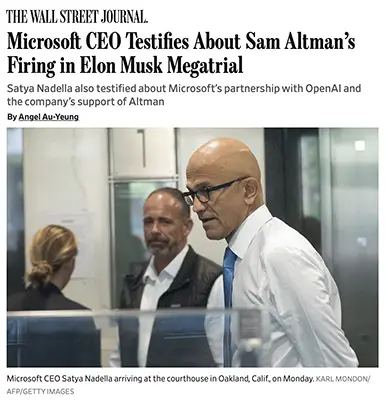
THE OPENAI TRIAL’S BIGGEST WEEK: NADELLA ON THE STAND, ALTMAN’S CHARACTER UNDER OATH
The Wall Street Journal | May 11, 2026
TL;DR: Microsoft CEO Satya Nadella’s trial testimony clarified the depth of Microsoft’s entanglement with OpenAI’s leadership — and OpenAI co-founder Ilya Sutskever’s sworn account of Sam Altman’s conduct added credible, on-record weight to questions that have shadowed the industry’s most powerful AI company.
Note: News Corp, owner of the Wall Street Journal, has a disclosed content-licensing partnership with OpenAI. Readers should weigh that relationship when assessing the paper’s framing of trial coverage.
Executive Summary
Microsoft CEO Satya Nadella testified in the ongoing federal trial brought by Elon Musk against OpenAI, Sam Altman, Greg Brockman, and Microsoft. The trial centers on Musk’s claim that he was misled into funding a nonprofit that was later converted into a for-profit enterprise — a conversion he characterizes as a betrayal. OpenAI’s position is that Musk was fully informed of and supported the for-profit structure until he was denied majority control.
Nadella’s testimony addressed Microsoft’s $13 billion investment in OpenAI and its role in the reinstatement of Altman after his brief 2023 ouster. He acknowledged discussing potential new board members with Altman post-reinstatement, and one of those candidates — whom Nadella approved in a group chat — did join the OpenAI board. His framing was that this reflected “strategic partnership” rather than control, though the distinction is debatable given the circumstances.
More substantively, OpenAI co-founder Ilya Sutskever testified under oath that he told OpenAI’s board Altman showed a “consistent pattern” of dishonesty that was not conducive to building safe AI — and that the board’s removal of Altman felt “rushed.” He later signed a petition demanding Altman’s reinstatement, describing it as a “Hail Mary” to prevent the company’s collapse. Sutskever, whose own AI company Safe Superintelligence is now valued at over $30 billion, acknowledged the contradiction directly. The remedies Musk is seeking include removal of Altman and Brockman from leadership and up to $180 billion in damages redirected to OpenAI’s nonprofit parent.
This is reported trial coverage, not analysis. The facts documented — sworn testimony, court exhibits, group chat evidence — are on record. Interpretations of their significance remain contested.
Relevance for Business
The trial’s outcome will directly shape AI industry governance in ways that matter to enterprise customers. If Musk prevails even partially, it could force structural changes at OpenAI — including leadership removal — that would disrupt products and enterprise relationships. If OpenAI prevails, it will effectively ratify the for-profit conversion model and concentrate even more commercial momentum in Altman’s hands.
For SMBs with any dependence on OpenAI products, the underlying question the trial is surfacing deserves attention regardless of verdict: how accountable are the organizations that control critical AI infrastructure? The trial record — board chaos, disputed communications, a co-founder’s on-record concerns about the CEO’s candor — does not paint a picture of stable institutional governance. That is relevant context for vendor risk assessment.
The Microsoft dimension also deserves attention. Nadella’s testimony reveals how deeply intertwined the world’s largest software company is with OpenAI’s leadership continuity. If you use Microsoft Copilot or Azure AI services, your infrastructure path runs directly through this relationship.
Calls to Action
🔹 Monitor trial outcomes actively — a ruling against OpenAI’s current leadership structure could affect product continuity, API access, and enterprise agreements in unpredictable ways.
🔹 Add OpenAI vendor risk to your next IT or strategy review — the trial record, independent of outcome, surfaces governance fragility that is relevant to enterprise dependency decisions.
🔹 If your organization uses Microsoft Copilot or Azure OpenAI services, flag the Microsoft-OpenAI dependency as a concentration risk worth tracking — it is now part of an active federal proceeding.
🔹 Avoid overreacting in either direction — the trial has months left to run, and outcomes are uncertain. The correct posture is monitoring, not panic or dismissal.
🔹 Note Sutskever’s $30B Safe Superintelligence valuation as a secondary signal — major AI talent continues to spin out into well-funded independent ventures, which may become relevant to your vendor landscape over the next 12–18 months.
Summary by ReadAboutAI.com
https://www.wsj.com/tech/ai/microsoft-ceo-takes-stand-in-third-week-of-elon-musk-megatrial-against-openai-04e63c47: May 18, 2026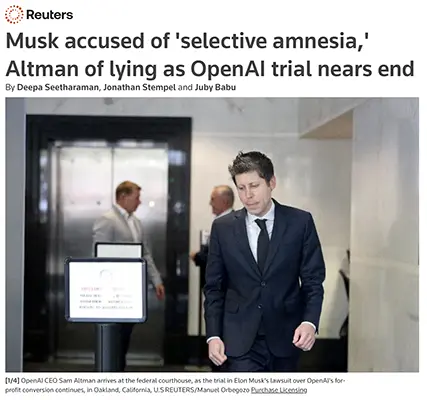
Musk vs. OpenAI: Closing Arguments Reveal a Governance Crisis at the Center of AI
Reuters | Deepa Seetharaman, Jonathan Stempel, Juby Babu | May 14, 2026
TL;DR: As the Musk v. OpenAI trial reaches closing arguments, both sides have put OpenAI’s credibility, founding commitments, and governance structure on trial — with implications that extend well beyond the courtroom.
Executive Summary
Closing arguments in the federal trial pitting Elon Musk against OpenAI and CEO Sam Altman centered on competing portraits of institutional integrity. Musk’s legal team argued that OpenAI betrayed its nonprofit founding mission by accepting massive commercial investment and enriching insiders, and that Altman’s credibility is fundamentally compromised. OpenAI’s defense countered that Musk’s real goal was control — that he sought to fold OpenAI into Tesla or take the helm himself — and that his lawsuit arrived years after he was aware of the organization’s commercial direction.
The specific claims involve Musk’s $38 million early donation, his accusation of manipulation in how the for-profit structure was built around the original nonprofit, and his demand for $150 billion in damages payable to the nonprofit — plus the removal of Altman and OpenAI President Greg Brockman. The jury is expected to deliberate starting Monday; a separate session will address remedies and restructuring if Musk prevails.
The trial is significant beyond its outcome. It has placed on the public record a detailed account of how OpenAI’s governance evolved — from a nonprofit safety mission to a trillion-dollar commercial enterprise backed by Microsoft’s $100+ billion investment. Whether or not Musk wins, the case has exposed the absence of robust oversight mechanisms at one of the world’s most powerful technology organizations, and has surfaced the gap between AI labs’ stated missions and their operational incentives.
Relevance for Business
The immediate strategic relevance for SMBs is not the verdict — it’s what the trial reveals about vendor stability and governance risk. OpenAI is a core dependency for many businesses through direct API access or embedded Microsoft integrations. A ruling against OpenAI could trigger restructuring, leadership changes, or operational disruption. Leaders relying on OpenAI infrastructure should have a contingency posture.
More broadly, this case normalizes scrutiny of AI governance at the institutional level. As AI becomes embedded in business operations, the question of who controls these systems — and under what accountability structures — becomes a legitimate business risk, not just a policy debate.
Calls to Action
🔹 Do not treat OpenAI’s current structure as stable. Monitor the jury verdict and any subsequent restructuring discussions. Assess how a leadership change or operational disruption would affect your workflows.
🔹 Evaluate your dependency concentration on any single AI provider. This trial is a reminder that today’s leading model provider can face sudden institutional uncertainty. Diversification is now a vendor-risk consideration.
🔹 Track the governance question, not just the trial outcome. The fundamental issue — whether AI labs are accountable to their stated missions — will surface repeatedly across the industry. Build it into how you evaluate AI vendors.
🔹 Review Microsoft dependency implications. Given Microsoft’s $100B+ investment in OpenAI, any significant judgment or restructuring will likely affect Microsoft’s AI product roadmap. If your organization is deeply embedded in Microsoft’s AI tools, note the dependency.
🔹 File for awareness, not immediate action. The verdict is uncertain, the timeline is short, and most SMBs will not need to act before deliberations conclude. But assign someone to monitor and brief leadership within the week.
Summary by ReadAboutAI.com
https://www.reuters.com/sustainability/society-equity/elon-musks-court-battle-against-openai-enters-homestretch-2026-05-14/: May 18, 2026
⚠️ Sponsored Content Alert — The AI Memory Bottleneck Is Real, But This Article Is a Vendor Pitch
Fast Company Custom Studio (Paid Content by Solidigm) | April 20, 2026
TL;DR: A real and significant infrastructure constraint — AI’s growing demand for working memory — is accurately described in this piece, but the article is paid content produced by SSD manufacturer Solidigm to position its products as the solution; the business signal is worth extracting, the vendor framing is not.
Executive Summary
The actual signal: AI inference — the process of serving model outputs to users at scale — is increasingly constrained by memory, not just by compute or power. As AI models shift from chatbots to autonomous agents with large “context windows,” every prompt requires fast access to a growing pool of stored context. The GPU memory used for this (called “HBM”) costs roughly $10,000 per terabyte and can only be expanded by purchasing more GPUs. Context windows have grown from around 30,000 tokens a few years ago to over a million today, and when a model runs out of working memory, it can take 20–40 times longer to reprocess, creating latency spikes that degrade both user experience and developer productivity.
The proposed solution — using high-density SSDs as a performance memory layer alongside GPUs, rather than only for storage — is a real architectural approach being pursued by Nvidia and others. Nvidia’s CMX platform, announced at CES, is cited. The article promotes Solidigm SSDs as the answer, which is where independent analysis ends and vendor promotion begins.
Relevance for Business
Most SMBs don’t manage their own GPU infrastructure, so the deep technical details here aren’t directly actionable. The relevant business implications are upstream:
1. AI service costs and reliability will remain volatile through at least 2027–2028, when new storage capacity is expected to come online at scale. Cloud-hosted AI services (the ones most SMBs use) will absorb these costs — but vendors may pass them through in pricing or limit throughput for lower-tier customers.
2. If your organization is evaluating on-premise or self-hosted AI deployments, this infrastructure constraint is directly relevant. The memory stack required to run large context window models reliably is expensive and limited in supply.
3. The broader pattern — infrastructure bottlenecks emerging as AI scales from experimentation to production — is the business signal most worth retaining from this piece. Compute was the first bottleneck, power the second, memory is emerging as the third. Vendors who can solve this will have structural advantage; those who can’t will face reliability and cost pressure.
Calls to Action
🔹 Read this source skeptically — the technical problem is real; the vendor solution framing is promotional and should be verified independently before any purchasing consideration.
🔹 Monitor your current AI vendor SLAs for language around throughput, latency, and context window limits — these are where memory constraints will surface in your contracts.
🔹 If evaluating self-hosted AI infrastructure, add memory architecture and KV cache capacity to your due diligence checklist.
🔹 Assign someone to track AI infrastructure cost trends over the next two quarters — if memory constraints tighten, cloud AI pricing may move and affect your budget assumptions.
🔹 Deprioritize Solidigm specifically unless your organization operates its own data center infrastructure — this piece is not a buying guide for most SMB readers.
Summary by ReadAboutAI.com
https://www.fastcompany.com/91528322/rethinking-how-ai-remembers: May 18, 2026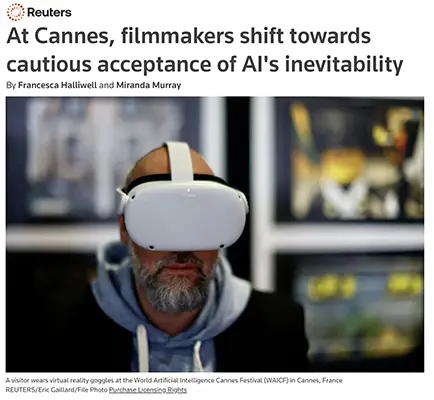
AT CANNES, FILMMAKERS SHIFT TOWARD CAUTIOUS ACCEPTANCE OF AI’S INEVITABILITY
Reuters | Francesca Halliwell and Miranda Murray | May 15, 2026
TL;DR: The film industry’s posture on AI has moved from resistance to pragmatic adoption — with Cannes now debating not whether to use AI but how, and cost savings of up to 30% making the business case hard to ignore.
Executive Summary
The shift at Cannes this year was visible and notable. Where previous festivals treated AI as a threat to artistic integrity, the 2026 edition is focused on integration: how AI tools can compress post-production timelines, cut visual effects costs, and handle labor-intensive technical tasks that previously consumed months of work. One director cited the prospect of cutting both his VFX budget and his production timeline in half on a sequel to a major Netflix hit — not as a hypothetical, but as his active plan.
The industry’s emerging consensus draws a meaningful line between generative AI — using AI to write scripts or create films from prompts — and production AI — using it to automate technical tasks in post-production. The former remains broadly opposed and is now a disqualifying factor for the festival’s top prize. The latter is gaining rapid acceptance, with director Guillermo del Toro among those arguing that conflating the two prevents an honest conversation. The Academy Awards has reached a similar conclusion, issuing rules this month that require acting and writing to be done by humans while leaving room for AI in production roles.
Meta’s arrival as an official Cannes partner — with its AI software used in a major documentary in the official selection — signals how quickly the technology industry is establishing itself inside cultural institutions that were recently skeptical of it.
Relevance for Business
The creative industry’s negotiated settlement on AI is a useful model for any knowledge business wrestling with where to draw the line. The Cannes framework — AI handles the repetitive and technical, humans own the creative and strategic — translates directly to marketing, communications, legal, and consulting workflows. The framing offered by one industry executive is particularly practical: rejecting AI on principle may not preserve quality, but it will create a competitive disadvantage. That is a judgment call most SMB leaders will face in their own domains within the next 12 to 24 months.
The cost reduction signal (Morgan Stanley’s estimate of up to 30% savings in film/TV) is also worth noting — the film industry has historically been an early indicator of where AI-assisted production workflows are heading across creative and knowledge work.
Calls to Action
🔹 Use the Cannes framework as an internal policy model. Distinguish between AI for technical/repetitive tasks versus AI for creative/strategic output. Codifying that distinction now prevents ad hoc decisions later.
🔹 Watch how the Academy Awards AI policy evolves. It is becoming a reference point for professional standards in creative industries — and similar governance frameworks will likely emerge in other fields.
🔹 If cost reduction is a priority, assess which of your production workflows have the highest technical-task load.Those are where AI tools offer the most immediate and defensible ROI.
🔹 Monitor Meta’s deepening presence in cultural and creative institutions. Its Cannes partnership is an early signal of where AI-powered creative tools will be embedded next.
🔹 Do not ignore AI out of principle alone. The industry quote worth remembering: rejecting AI categorically is likely to create a disadvantage, regardless of whether it preserves values you care about.
Summary by ReadAboutAI.com
https://www.reuters.com/lifestyle/cannes-filmmakers-shift-towards-cautious-acceptance-ais-inevitability-2026-05-15/: May 18, 2026
THE FIVE QUOTIENTS: WHAT SKILLS WILL MATTER MOST IN THE AGE OF AI
Fast Company | Alan Fleischmann | May 14, 2026
TL;DR: As AI automates both analytical and emotional tasks, a leadership advisor argues the human skills that will command the most value are trust, disciplined execution, and — above all — the capacity to envision futures that don’t yet exist.
Executive Summary
This is an opinion piece by the CEO of a CEO advisory firm, and it reads accordingly — ambitious in framing, light on evidence. Its value is as a structured provocation for leaders thinking about talent development and organizational capability, not as a research-backed framework. The argument: IQ and EQ, the two qualities modern institutions have historically screened for and rewarded, are both now partially replicable by AI systems. That creates pressure to identify what remains distinctly human — and the author proposes three additional “quotients.”
The Trust Quotient (TQ) is the most grounded of the three. The argument that institutional trust is earned through accountability under pressure — and that machines cannot carry moral accountability — is substantively defensible, not just rhetorical. The Work Quotient (WQ) makes a useful distinction between volume and commitment: the claim is not that humans should try to outwork AI, but that human work carries ownership and judgment that machines cannot replicate. The Vision Quotient (VQ) is the most aspirational: the capacity to perceive a possible future before evidence supports it. The author argues this is AI’s genuine limit — that AI optimizes from existing patterns while human vision often requires defying them.
The piece’s primary weakness is that it is written as leadership inspiration rather than operational guidance, and the five-quotient framework is the author’s own construct, not an established model. Treat it as a thinking tool, not a research finding.
Relevance for Business
For SMB leaders, the practical signal is about where to invest in human development as AI absorbs more cognitive load. If analytical speed and information synthesis are increasingly handled by AI, the human capabilities worth protecting and developing are judgment, trustworthiness, execution discipline, and strategic imagination. This has direct implications for hiring criteria, performance evaluation, and leadership development programs that were designed in a pre-AI environment.
The WQ framing is particularly useful for teams navigating AI adoption: the risk is not that employees will be replaced by AI, but that they will be measured against AI’s strengths — speed, volume, synthesis — rather than the human qualities that actually drive organizational outcomes.
Calls to Action
🔹 Audit your hiring and performance frameworks. If they primarily reward analytical speed and information recall, they may be systematically undervaluing the human capabilities that matter most in an AI-augmented environment.
🔹 Invest in trust-building explicitly. The TQ argument has operational teeth: in environments flooded with AI-generated content, leaders and organizations with demonstrable accountability track records will carry increasing credibility premium.
🔹 Recalibrate what “working hard” means for your team. WQ is not about volume or hours — it is about ownership, judgment, and following through when the work becomes difficult. That distinction matters for how you evaluate and retain people.
🔹 Protect and develop strategic imagination in your leadership pipeline. The VQ argument suggests that seeing around corners — identifying opportunities before they’re validated by data — becomes more valuable as AI handles more of the backward-looking analysis.
🔹 Use this framework as a discussion prompt, not a decision tool. The five-quotient model is useful for structured conversation about human development strategy, but it should be stress-tested against your specific context rather than adopted wholesale.
Summary by ReadAboutAI.com
https://www.fastcompany.com/91539288/the-five-quotients-what-skills-will-matter-most-in-the-age-of-ai-iq-eq-skills-quotients-ai: May 18, 2026
Worried About AI? Here, Have Some AI.
Intelligencer (New York Magazine) | John Herrman | May 14, 2026
TL;DR: AI companies are both creating cybersecurity threats and positioning themselves as the only viable solution — a self-reinforcing dynamic that concentrates market power in very few hands.
Executive Summary
A sharp opinion column from Intelligencer identifies a structural pattern now playing out across multiple sectors: AI capability advances create new problems, which only AI vendors can credibly solve — at a price. The most vivid example is Anthropic’s pre-announced Mythos model, described by the company itself as extraordinarily capable at finding and exploiting security vulnerabilities across operating systems, industrial software, and healthcare platforms. The company’s simultaneous message: don’t worry, AI will ultimately favor defenders. OpenAI followed with a cybersecurity product called Daybreak, framed explicitly as the answer to the threat landscape that advanced AI is accelerating.
The column argues this isn’t conspiracy — it’s a structural feature of the emerging AI economy. Prior tech waves (personal computers, the internet) produced new security problems that spawned new industries and, eventually, distributed demand for talent and services. The critical difference now is concentration. The current AI landscape is dominated by roughly five firms, three of which are near the frontier of capability. The column notes these companies are simultaneously spinning up internal consulting arms to help clients adopt AI — capturing both the problem and the solution within their own revenue streams.
The Jevons paradox framing is worth flagging as promotional logic rather than settled analysis: the idea that more efficient AI tools will expand total demand rather than compress it may prove true, but it is self-servingly advanced by the same firms benefiting from the current cycle.
Relevance for Business
For SMB executives, the immediate operational implication is cybersecurity exposure is rising in step with AI capability, regardless of whether your organization uses AI at all. Attackers gain access to these tools before defenders do, and the cost of adequate defense is climbing. The structural risk is vendor lock-in on both the threat and the remedy: the same companies that are advancing capabilities most rapidly are also selling the solutions, which creates pricing power and dependency with limited competitive alternatives. Smaller organizations without enterprise security budgets are disproportionately exposed.
Calls to Action
🔹 Assess your cybersecurity posture now — before AI-enhanced attacks become routine at your scale. The threat timeline from advanced models is measured in months, not years.
🔹 Be skeptical of vendor framing — when an AI company announces both a danger and its own solution in the same breath, evaluate the solution on independent merit, not on the urgency of the announced threat.
🔹 Avoid sole-source dependency on any single AI security vendor. The concentration of this market means leverage sits with suppliers, not buyers.
🔹 Monitor consolidation signals — if frontier labs continue to build internal consulting arms, the market for independent AI implementation and security services may narrow, limiting your options.
🔹 Brief your leadership team on this dynamic — understanding that AI vendors have a structural incentive to expand the problem space is essential context for any AI procurement decision.
Summary by ReadAboutAI.com
https://nymag.com/intelligencer/article/ai-anthropic-mythos-openai-google.html: May 18, 2026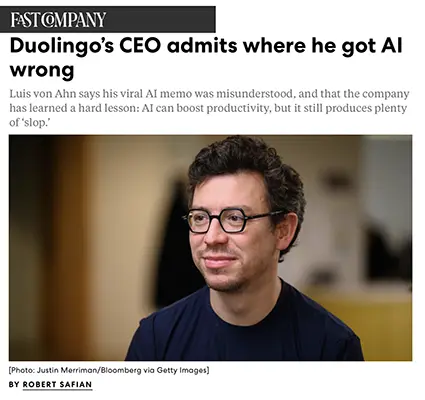
Duolingo’s CEO Admits Where He Got AI Wrong
Fast Company | Robert Safian | May 13, 2026
TL;DR: Duolingo’s CEO offers a candid, real-world lesson in AI rollout failure: blanket AI mandates backfire, output quality degrades silently at scale, and the right framing for AI adoption is outcome-first, not tool-first.
Executive Summary
This is a podcast transcript interview, and the substantive signal is worth extracting from the conversational format. Luis von Ahn’s viral internal memo — which linked employee evaluations to AI usage and made headlines for its apparent aggression — turned out to be both misunderstood externally and partially wrong internally. He has since walked back the employee evaluation component, acknowledging that mandating AI usage as a measurable performance criterion caused employees to use AI for the sake of the metric rather than for genuine productivity gains. Compliance theater replaced meaningful adoption.
More operationally relevant is his candor about AI quality at scale. Von Ahn describes a consistent pattern: AI demos well in controlled conditions. A single AI-generated story may be impressive. But when Duolingo needed AI to produce thousands of stories for language learning, roughly 20% of the output was what he calls “slop” — low-quality content that degraded the product. The quality degradation is not visible in demos; it only surfaces at production volume. This is a critical finding for any organization scaling AI-generated content, communications, or workflows.
Von Ahn also identifies where AI has not delivered for Duolingo: design and creative craft. The company’s top artists and designers continue to outperform AI by a significant margin. His operating principle — AI must benefit the end user, not merely reduce costs — is a useful reframe for leaders evaluating AI ROI.
Relevance for Business
The Duolingo case is a compressed pilot study for any mid-size organization running AI adoption at scale. Three practical takeaways stand out: First, evaluate AI by output quality and customer impact, not by usage volume — usage metrics are gameable and tell you little about value. Second, quality control costs increase as AI output scales — budget for human review, especially in customer-facing workflows. Third, creative and high-craft roles are not yet replaceable — AI underdelivers where nuance, originality, and polish are the actual product.
Calls to Action
🔹 Audit how AI usage is currently measured in your organization — if employees are being evaluated on tool use rather than outcomes, expect compliance theater rather than genuine productivity gains.
🔹 Stress-test AI output at scale before deploying in customer-facing workflows — what looks good in a demo may degrade significantly at volume; build in quality checkpoints.
🔹 Protect creative and design roles from premature AI substitution — the evidence from Duolingo suggests quality loss is real and detectable by customers.
🔹 Anchor AI adoption goals to user or customer outcomes, not cost savings — Von Ahn’s “benefit the learner” principle is applicable across industries as a governance framework.
🔹 Use internal AI rollout failures as learning opportunities — von Ahn’s willingness to reverse course on employee evaluation is a model for iterative, honest AI governance.
Summary by ReadAboutAI.com
https://www.fastcompany.com/91541042/duolingos-ceo-admits-where-he-got-ai-wrong: May 18, 2026
TRUMP’S BORDER SPENDING SPURS BOOM IN AI-INFUSED SURVEILLANCE
The Wall Street Journal | Elizabeth Findell | May 8, 2026
TL;DR: The Trump administration’s border security priorities have created a fast-moving government AI procurement boom that is reshaping the surveillance technology market — attracting new entrants, accelerating deployment, and raising unresolved civil liberties questions that businesses supplying or operating near federal technology programs should monitor.
Executive Summary
This is a reported piece from the annual Border Security Expo in Phoenix, documenting a surge in AI-enabled surveillance technology driven by the administration’s immigration enforcement priorities. Congress allocated more than $170 billion for border security measures, and agencies are moving quickly to deploy AI-integrated systems — drones, autonomous cameras, radar, facial recognition, and sensors — with speed explicitly prioritized over rigor. One government-relations consultant quoted in the piece said plainly: “Speed is more important than efficiency or effectiveness right now.”
The commercial signal is significant: the combination of abundant federal funding, fast-track procurement, and a stated openness to new technology has turned border security into an AI market with unusual entry dynamics.Companies from other sectors — including Amazon, which displayed a prototype truck equipped for DHS drone operations — are moving in. One surveillance camera vendor said DHS has grown from 20% to 50% of its business in a single year. AI capabilities on display included autonomous threat detection distinguishing people from animals, object and weapon identification, facial recognition inside vehicles, and AI-enhanced drones extended by covert solar charging.
The civil liberties dimension is documented but not resolved in the piece. The ACLU called the AI surveillance deployment a civil-liberties threat. Vendors acknowledged their systems can be deployed identically in remote border areas, dense urban zones, or the U.S. interior — and that privacy protections like face blurring would be government policy decisions, not company ones. The governance gap between deployment speed and oversight is explicit and unaddressed.
Relevance for Business
For SMB leaders, this piece matters in two distinct ways. First, for technology and services companies — particularly those in surveillance, sensors, drones, AI analytics, or adjacent sectors — this is a live and growing government procurement opportunity with unusually fast contract cycles and stated agency openness. Second, for any organization that operates in, near, or alongside federal digital infrastructure — or that manages data that could intersect with government surveillance systems — the rapid expansion of AI-enabled monitoring raises governance and data exposure questions worth assessing now rather than reactively.
The broader signal: government is becoming a fast and large AI buyer, and the companies winning that market are setting capability and deployment norms that will spread beyond government use cases.
Calls to Action
🔹 If you operate in surveillance, sensors, drones, or AI analytics, assess your DHS/CBP/ICE positioning — the procurement window is open and the contract cycle is unusually fast.
🔹 If you supply to or work alongside federal agencies, audit what data and systems your operations share or expose — the expansion of AI monitoring creates new data governance questions.
🔹 Monitor civil liberties and regulatory developments around AI surveillance — the gap between deployment speed and oversight is significant and will eventually attract legislation.
🔹 Do not assume current government AI procurement standards will persist — the explicit prioritization of speed over effectiveness creates both opportunity and reputational risk for vendors.
🔹 Track Amazon’s DHS moves as a market signal — when a company of Amazon’s scale builds a specialized government surveillance prototype, it signals where significant contract volume is expected.
Summary by ReadAboutAI.com
https://www.wsj.com/tech/trumps-border-spending-spurs-boom-in-ai-infused-surveillance-4714521b: May 18, 2026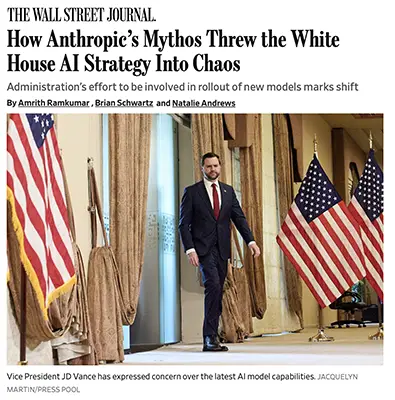
HOW ANTHROPIC’S MYTHOS THREW THE WHITE HOUSE AI STRATEGY INTO CHAOS
The Wall Street Journal | Ramkumar, Schwartz, Andrews | May 7, 2026
TL;DR: A single unreleased AI model — Anthropic’s Mythos — has exposed a deep fracture inside the Trump administration between its pro-growth, hands-off AI stance and emerging recognition that some AI capabilities may require formal government oversight before deployment.
Executive Summary
This is a significant reported piece based on multiple sourced accounts of internal White House deliberations. The core finding: Anthropic’s Mythos model — capable of autonomously finding and exploiting software vulnerabilities across banking, hospital, and utility systems — alarmed Vice President Vance enough during an April call with major AI CEOs that it triggered a chaotic internal policy response. The White House is now weighing an executive order that would create formal oversight of the most advanced AI models — a significant departure from its prior deregulatory posture.
The administration’s internal tensions are real and documented. National Cyber Director Sean Cairncross has been tasked with managing the Mythos response and asked Anthropic to restrict access to the model. This has frustrated other administration officials who want more say in the process. White House AI adviser David Sacks maintains the threat is manageable if all parties use AI tools defensively. Proponents of AI safety read the same situation as evidence that voluntary industry self-governance is insufficient. Neither position has resolved the internal dispute.
The key development for business leaders: the administration that spent its first year explicitly opposing AI regulation — including dismantling Biden-era oversight mechanisms — is now actively considering a formal pre-deployment review process for frontier models, described by one official using an FDA drug-approval analogy. Whether that results in an executive order is unclear; the White House has cautioned that “any discussion about executive orders is speculation unless announced by President Trump.” But the direction of the conversation has shifted in a way that would have been difficult to predict six months ago.
OpenAI consulted the administration before releasing its comparable cyber model (GPT-5.5-Cyber) and is limiting access. Washington and Beijing are also in preliminary discussions about AI risk — a new diplomatic front.
Relevance for Business
For most SMBs, the immediate operational implication is heightened cybersecurity risk from AI-capable threat actors, regardless of what the government decides about Mythos. The regulatory implication is more forward-looking: any formal AI model oversight process would affect the pace, accessibility, and cost of cutting-edge AI tools. If a formal review process is established, expect slower rollout of frontier capabilities and potential tiered access (government/enterprise first, general market later). Organizations planning roadmaps around access to the latest models should treat near-term government intervention as a genuine scenario, not a remote possibility.
Calls to Action
🔹 Elevate cybersecurity to a board-level conversation now — Vance’s description of threats to small-town banks, hospitals, and utilities is not abstract; it is a near-term operational risk for organizations without enterprise security infrastructure.
🔹 Monitor the executive order process closely — a formal AI model oversight regime would reshape the availability and timing of frontier AI capabilities across industries.
🔹 Do not assume deregulatory AI policy is stable — the White House position has shifted materially in a short period; policy risk is now a real planning variable.
🔹 Ask your key AI vendors about their government engagement and access-restriction policies — how companies like Anthropic and OpenAI manage government relations directly affects what capabilities you can access and when.
🔹 Assess your critical infrastructure exposure — if your organization operates any systems that could be described as “critical digital infrastructure,” your risk profile in the Mythos context is higher than average.
Summary by ReadAboutAI.com
https://www.wsj.com/tech/ai/trump-ai-anthropic-mythos-regulation-2378971f: May 18, 2026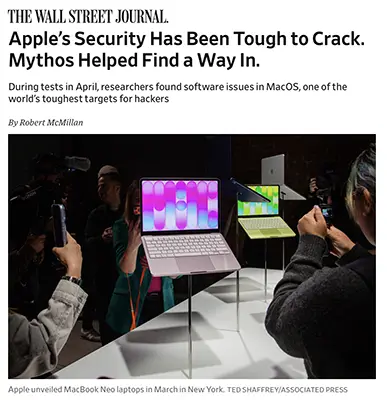
APPLE’S SECURITY HAS BEEN TOUGH TO CRACK. MYTHOS HELPED FIND A WAY IN
The Wall Street Journal | Robert McMillan | May 14, 2026
TL;DR: Security researchers used Anthropic’s Mythos AI to discover exploits in Apple’s most hardened operating system — a concrete demonstration that frontier AI is now a practical tool for both sides of the cybersecurity equation.
Executive Summary
Researchers at Palo Alto-based firm Calif used techniques developed while testing an early version of Anthropic’s Mythos to construct a working exploit against macOS — specifically targeting Apple’s Memory Integrity Enforcement (MIE) architecture, which the company described last September as the result of five years of engineering effort. The attack chains two bugs together to corrupt memory and access otherwise restricted parts of the device. Building the exploit took five days with AI assistance.
The finding carries two signals worth separating. The first is about demonstrated capability: AI-assisted vulnerability research is now fast enough to compress what would previously have taken weeks into days, and has already found over 100 high-severity Firefox vulnerabilities in a two-week period — roughly matching two months of global conventional research. The second is about limits: the researchers are clear that Mythos excels at reproducing and adapting previously documented attack patterns, not inventing new ones. Human expertise remained essential for the novel elements of this specific exploit. Bugmageddon — a term cybersecurity experts are now using for the anticipated surge in AI-discovered vulnerabilities — is a real and near-term concern, with the primary burden falling on IT and security teams responsible for patch management.
Apple is reviewing the findings and is expected to patch the underlying bugs quickly. The White House, which initially opposed Mythos’s expanded access, is reportedly reassessing its previously light-touch approach to AI regulation in light of discoveries like this.
Relevance for Business
For SMB leaders, this story has two concrete implications. First, patch management is now more urgent and more frequent. If AI tools can find high-severity vulnerabilities at multiples of the previous rate, the window between discovery and exploitation is narrowing. Organizations that treat patching as a quarterly activity are operating on an outdated risk model.
Second, this is a vendor evaluation signal. Apple’s security reputation has been a meaningful factor in enterprise device decisions. If frontier AI can find exploits in Apple’s most hardened platform in five days, every device vendor’s security posture deserves fresh scrutiny — not panic, but recalibration.
Calls to Action
🔹 Accelerate your patch management cadence. If your current schedule is monthly or quarterly, move toward continuous monitoring and rapid deployment of critical patches.
🔹 Brief your IT leadership on Bugmageddon as a planning concept. The volume of high-severity vulnerabilities being discovered is rising — your team needs staffing and tooling to match.
🔹 Do not treat Apple’s security reputation as a fixed asset. This exploit does not invalidate macOS as a platform, but it does mean no platform’s security should be assumed rather than verified.
🔹 Watch the White House regulatory reassessment. If the administration moves away from its laissez-faire approach to frontier AI access, it could affect both the pace of AI capability release and the security landscape around it.
🔹 Consider cyber insurance riders specific to AI-enabled attacks. Standard policies may not reflect the elevated threat environment that AI-assisted vulnerability discovery is creating.
Summary by ReadAboutAI.com
https://www.wsj.com/wsjplus/dashboard/articles/anthropic-mythos-apple-macos-bug-339da403: May 18, 2026
GROK IS LOSING THE ENTERPRISE RACE — AND MUSK JUST RENTED OUT ITS DATA CENTER TO A COMPETITOR
The Wall Street Journal | May 11, 2026
TL;DR: New data shows Grok has failed to gain meaningful enterprise traction while Claude and Gemini are growing rapidly, and SpaceX’s decision to lease its primary AI data center to Anthropic signals that Musk is treating xAI’s infrastructure as a revenue source rather than a competitive asset — at least for now.
Note: News Corp, owner of the Wall Street Journal, has a disclosed content-licensing partnership with OpenAI.
Executive Summary
The Wall Street Journal reports that Grok, Elon Musk’s AI model now operating under SpaceX after xAI’s merger, is underperforming its major competitors across virtually every meaningful adoption metric. Monthly downloads dropped from over 20 million in January to around 8.3 million in April. In a survey of more than 260,000 U.S. consumers and workers, the share paying for Grok was essentially flat year-over-year at less than 0.2%, compared with over 6% for ChatGPT.
Enterprise numbers tell a similar story. According to market research firm ETR, only 7% of surveyed companies were using and planning to continue using Grok — compared with 48% for Claude and 40% for Gemini, both of which grew sharply year-over-year. Grok’s January download spike was tied to a controversial feature that allowed sexualized image manipulation; its removal coincided with the decline. That’s not a sustainable growth driver.
The more strategically significant development is SpaceX’s decision to lease all computing capacity at its Colossus 1 data center — its primary AI facility — to Anthropic. The deal, which analysts suggest could generate a few billion dollars annually for Musk, reframes what Colossus is: not Grok’s competitive moat, but a cloud infrastructure revenue play ahead of SpaceX’s expected IPO. Musk himself described xAI in court as “pretty small” and “the smallest of the AI companies” — a notable downshift from the aggressive positioning of even six months ago.
Some analysts caution against writing Grok off entirely, noting that AI model rankings shift quickly and that Musk tends to perform well when focused. That’s a fair caveat, but it’s a forward-looking bet, not a current fact.
Relevance for Business
For SMBs currently evaluating or using AI tools, this story offers a clear market signal: the enterprise AI race has effectively narrowed to three credible players — OpenAI, Anthropic, and Google — with everyone else trailing at significant distance. Grok’s numbers, even accounting for its X platform distribution advantage, do not suggest a near-term threat to that hierarchy.
The Colossus deal also reinforces the point from Batch 1’s Anthropic-xAI summary: infrastructure access is the dominant constraint in the AI industry right now, and those who control it — even indirectly — hold structural leverage. Musk has pivoted xAI’s primary asset from a competitive weapon to a revenue-generating platform, which tells you something about where he assesses Grok’s near-term prospects.
For organizations that evaluated Grok as a lower-cost or politically differentiated alternative to other AI tools, the current data does not support that case. Enterprise adoption, reliability, and integrations favor Claude and Gemini at this moment, with OpenAI still the category leader on consumer mindshare and developer tooling.
Calls to Action
🔹 Deprioritize Grok for enterprise AI evaluation at this time — current adoption data, enterprise integration depth, and product trajectory do not place it in the same tier as its primary competitors.
🔹 Treat the Colossus infrastructure deal as context, not alarm — it strengthens Anthropic’s capacity (relevant if you use Claude) and reveals Musk’s near-term strategic priorities.
🔹 Reassess your AI vendor shortlist if you haven’t recently — the enterprise gap between Claude/Gemini and everything else has widened materially in the past 12 months.
🔹 Monitor Grok over the next two quarters — if Musk delivers a meaningfully better coding or reasoning model, enterprise developer migration can happen quickly. Don’t permanently write it off.
🔹 Note the SpaceX IPO timing as a business context signal — pressure to show revenue ahead of a public offering explains the Anthropic deal better than any strategic AI vision. Know what’s driving your vendors’ decisions.
Summary by ReadAboutAI.com
https://www.wsj.com/tech/ai/anthropic-spacex-ai-deal-elon-musk-f86ea369: May 18, 2026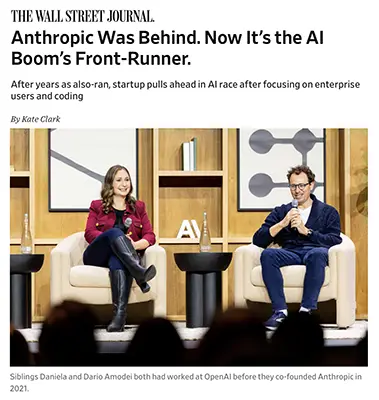
ANTHROPIC WAS BEHIND. NOW IT’S THE AI BOOM’S FRONT-RUNNER.
The Wall Street Journal | Kate Clark | May 13, 2026
TL;DR: Anthropic’s revenue trajectory and enterprise adoption have dramatically outpaced expectations — and rival OpenAI — making it the most consequential AI vendor shift in the market this year, with direct implications for businesses evaluating which AI platform to commit to.
Executive Summary
This is a significant reported piece with concrete data. Anthropic’s annualized revenue run-rate reached $30 billion in April 2026, up from $9 billion at the end of 2025 — and is reportedly on pace for $50 billion by end of June. The company planned for 10-fold growth this year; it delivered 80-fold growth in annualized revenue and usage in Q1. Investment offers have reportedly valued the company at more than $900 billion, which would surpass OpenAI’s $852 billion valuation for the first time.
The enterprise adoption data from Ramp — tracking ~50,000 business customers — shows Anthropic’s Claude tools overtaking OpenAI’s for the first time in April 2026, with Claude usage rising 3.8% month-over-month as OpenAI fell 2.9%. Secondary market activity on Augment tells a parallel story: Anthropic secondary trades tripled in Q1 while OpenAI’s secondary value dropped 22%.
Three caveats are essential. First, revenue comparison methodology differs — Anthropic counts cloud-partner sales as revenue, OpenAI does not, making direct comparison imperfect. Second, OpenAI still vastly outpaces Claude in consumer reach: 900 million weekly active users versus a fraction of that for Claude. Third, the Ramp dataset underrepresents large enterprises that pay via direct contracts rather than credit cards. The picture is real but should not be read as a settled outcome in a market that remains genuinely competitive, fast-moving, and subject to capability shifts every few months.
What drove Anthropic’s acceleration: a deliberate focus on enterprise and developer segments, strong performance of Claude on coding tasks, the Claude Code product, and the January 2026 launch of Cowork, its agentic tool for non-technical tasks. The competitive moat is real but operational constraints are also real — computing capacity limits have caused outages and throttling.
Relevance for Business
For SMB executives evaluating or locked into AI platform decisions, this shift matters in two ways. First, the competitive balance at the frontier has changed — if your organization defaulted to OpenAI because it was the obvious leader, that calculus deserves a fresh look. Second, platform selection is genuinely consequential right now because switching costs are rising as workflows and integrations deepen. The market instability documented here is an argument for preserving optionality, not for doubling down on any single vendor. The Anthropic growth story also reinforces that enterprise-focused, coding-capable AI tools are where near-term B2B value is concentrating — a signal for where to focus internal AI pilots.
Calls to Action
🔹 Conduct a current-state audit of your AI vendor mix — if your organization has been OpenAI-only by default, evaluate whether Claude’s enterprise performance warrants a parallel pilot.
🔹 Avoid single-vendor lock-in during this period of rapid competitive flux — the gap between leading AI providers is narrowing and reversing faster than most organizations can adjust contracts.
🔹 Prioritize coding and developer-facing AI tools in near-term investment — the Anthropic growth story is anchored in these use cases; enterprise ROI is demonstrably concentrated here.
🔹 Monitor Anthropic’s capacity constraints — outages and throttling are a real operational risk for organizations that depend on API availability; have fallback options.
🔹 Track this race quarterly, not annually — the competitive position at the AI frontier is shifting in weeks, not years; governance and vendor decisions should reflect that cadence.
Summary by ReadAboutAI.com
https://www.wsj.com/wsjplus/dashboard/articles/anthropic-was-behind-now-its-the-ai-booms-front-runner-5020f621: May 18, 2026
Anthropic and xAI Team Up — With OpenAI as the Shared Target
Intelligencer (New York Magazine) | May 12, 2026
TL;DR: Anthropic’s new infrastructure deal with Elon Musk’s xAI — giving Claude access to xAI’s Colossus data center — is less about ideological alignment than about two rivals with a common competitive threat in OpenAI’s Sam Altman, and the arrangement carries notable reputational and dependency risks for both parties.
Executive Summary
Anthropic has struck a deal to use xAI’s Colossus data center for AI inference — meaning to serve Claude to end users, not to train new models. The arrangement addresses a genuine constraint: Anthropic’s rapid growth, driven in part by Claude Code and expanding enterprise adoption, has strained its access to compute. xAI, meanwhile, holds significant GPU capacity through Colossus but has struggled to build a competitive AI product, making it a natural infrastructure provider even if an unlikely strategic partner.
Intelligencer columnist John Herrman frames the deal with appropriate skepticism. The partnership is strategically convenient but ideologically awkward: Anthropic CEO Dario Amodei has publicly identified deep differences with Musk on AI development philosophy and politics, and the Colossus facility carries reputational baggage around environmental and regulatory compliance. Musk, for his part, was publicly hostile toward Anthropic as recently as February. The most coherent explanation Herrman offers — and it holds up — is that both parties distrust OpenAI’s Sam Altman more than they distrust each other. Amodei left OpenAI over conflicts with Altman; Musk is currently suing him.
This is opinion and analysis journalism, not a reported announcement. The deal itself appears real; the motivations described are Herrman’s interpretation, not confirmed by either party. Readers should treat the “anti-Altman alliance” framing as plausible editorial analysis, not established fact.
Relevance for Business
The immediate business impact of this deal falls on enterprise customers and developers building on Claude. Reliability has been an issue — the piece notes Anthropic’s product has been “breaking down on a weekly basis” as it onboards new corporate customers. Access to Colossus compute is meant to address that. Whether it does is what matters for anyone currently evaluating or already using Anthropic’s tools.
More broadly, this deal is a reminder that AI infrastructure is consolidating around a small number of hardware chokepoints — and the alliances being formed now will shape which AI providers can scale reliably and which can’t. For SMBs evaluating AI vendors, vendor stability and infrastructure depth deserve more scrutiny than they typically receive. A provider that can’t reliably serve tokens under demand is a business risk regardless of model quality.
The reputational dimension also matters: Anthropic’s choice to partner with xAI despite documented concerns about Colossus’s environmental record signals that compute pressure can override stated values. That’s relevant context for any organization that weighs AI vendor ethics alongside capability.
Calls to Action
🔹 Monitor Anthropic’s reliability metrics over the next 60–90 days — if the Colossus partnership improves Claude’s uptime and speed, that’s a meaningful improvement for Claude-dependent workflows.
🔹 Revisit your AI vendor dependency assessment — the compute constraints driving this deal affect multiple providers, not just Anthropic. Know where your vendor’s infrastructure comes from.
🔹 Treat the “anti-OpenAI alliance” framing as context to watch, not a settled conclusion — the motivations are analytically plausible but not confirmed, and the competitive dynamics in this space shift quickly.
🔹 Note the reputational pattern: when major AI labs make deals that contradict stated values under competitive pressure, it’s worth tracking — especially if your organization’s vendor decisions are tied to ESG or ethics commitments.
🔹 Deprioritize reading this as a technology story — the Anthropic-xAI deal is primarily a power and infrastructure story. The technology implications are real but secondary to the competitive dynamics being played out.
Summary by ReadAboutAI.com
https://nymag.com/intelligencer/article/anthropic-dario-amodei-xai-elon-musk-team-up-against-openai-sam-altman.html: May 18, 2026
What AI Fluency Actually Looks Like on a Résumé — And Why It Matters for Hiring Managers Too
Fast Company | May 12, 2026
TL;DR: Hiring experts now distinguish sharply between candidates who name AI tools and those who demonstrate outcome-driven AI judgment — and the gap between those two groups is widening fast, with real implications for how SMBs should evaluate talent and structure internal AI skill development.
Executive Summary
A Fast Company roundup of eleven practitioner recommendations for signaling AI competence on résumés and LinkedIn profiles surfaces a consistent theme: listing AI tools no longer signals meaningful capability. In 2026, Claude, ChatGPT, and Copilot are table stakes. What hiring managers report actually valuing is evidence of applied judgment — the ability to identify where AI fails, adjust accordingly, and tie AI use to measurable business outcomes.
The article’s strongest signal is not about job seekers. It’s about what “AI fluency” now means at the level of professional practice. Experts across the piece converge on a framework: tool proficiency matters far less than workflow design, cost and reliability trade-off awareness, cross-functional impact, and the willingness to acknowledge — and learn from — AI failures. One hiring manager notes that the most impressive résumé she reviewed didn’t mention AI in the skills section at all; it described a clinical workflow where AI drafted documents that licensed professionals reviewed before approval.
The piece is advisory and practitioner-driven, not research-based. The recommendations are directionally sound and consistent with observable hiring trends, but they represent expert opinion rather than empirical data.
Relevance for Business
For SMB leaders, this piece offers two distinct uses.
For hiring: if you are evaluating candidates for AI-augmented roles, the framework here is immediately applicable. Look past tool lists. Ask candidates to describe a specific problem they solved with AI, what didn’t work on the first pass, and what they changed. That question sequence separates practitioners from name-droppers — and it costs nothing to implement.
For internal development: the same standard applies to your current team. AI fluency is not a training certificate or a tool subscription. It’s demonstrated by whether people can identify where AI output is wrong, adjust it, and produce a measurable result. Organizations that build this capability internally will retain it; those that outsource it entirely will remain dependent on vendors for judgment they don’t possess.
There is also a talent market signal worth tracking: the article suggests a clear tiering is forming between workers who use AI to accelerate their own tasks and those who use it to change how their teams or organizations operate. The latter category is smaller, more valuable, and increasingly sought after. Retention risk is real for SMBs who can’t offer those employees meaningful AI scope.
Calls to Action
🔹 Update your hiring criteria now — add at least one AI-specific behavioral interview question focused on applied judgment, not tool familiarity.
🔹 Audit your internal AI training programs, if you have them — are they producing tool proficiency or genuine workflow capability? The difference matters.
🔹 Identify 1–2 employees who are already operating at the “cross-functional AI impact” level described in this article and ensure they have scope, visibility, and retention incentives.
🔹 Consider adopting a simple internal standard: AI contributions should be documented with tool used, action taken, and result measured — not just flagged as “used AI.”
🔹 Monitor whether the tiering between AI-literate and AI-fluent professionals in your industry is beginning to affect compensation benchmarks — it likely will within 12–18 months.
Summary by ReadAboutAI.com
https://www.fastcompany.com/91530813/11-ways-to-signal-ai-fluency-on-your-resume-resumes-ai-fluenc: May 18, 2026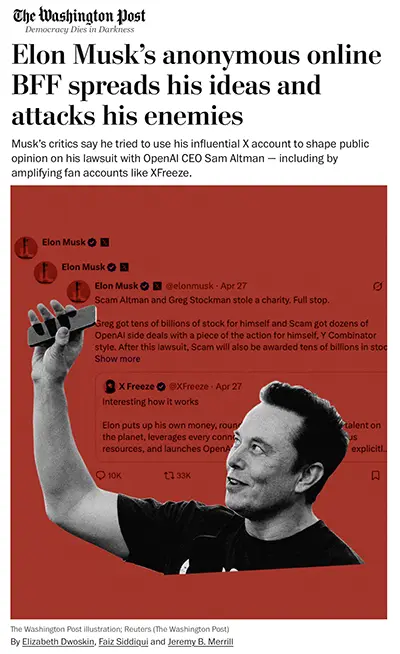
Elon Musk’s Anonymous Amplifier on X: Platform Power, Narrative Control, and What It Means for AI Perception
The Washington Post | May 13, 2026
TL;DR: An anonymous X account called XFreeze became Musk’s most-amplified voice on the platform in 2026 by strategically flattering him — and Musk used it to shape public narratives around his OpenAI lawsuit, raising questions about how AI-adjacent power brokers influence the information environment that leaders rely on.
Executive Summary
The Washington Post investigated how an anonymous account, XFreeze, rose from obscurity to become Elon Musk’s most-engaged-with account on X in 2026 — a position achieved by systematically praising Musk and his ventures while attacking his opponents, particularly OpenAI CEO Sam Altman during an ongoing federal trial. According to the Post’s analysis, Musk replied to or reposted XFreeze content more than 400 times this year. The account appears to have ties to India and to someone who sought employment at xAI; Musk is also among the paying subscribers to the account’s content.
The core finding is fairly straightforward: a platform owner with 240 million followers can dramatically amplify an anonymous source to advance his preferred narrative, and that amplification carries real monetization benefits for whoever is behind the account. The judge in the OpenAI trial specifically asked Musk to pull back on case-related posts after several XFreeze reposts. Since then, Musk and Altman have refrained from direct posting on the case — XFreeze has not.
This is a reported investigative piece with documented evidence (the Post reviewed a 78-page “I am XFreeze” document and traced account patterns). What cannot be established is whether Musk coordinated with XFreeze or was simply a willing consumer of flattery. The Post is careful on this point, though the circumstantial pattern is notable. It’s also worth noting the Post’s disclosed content partnership with OpenAI — not a disqualifying conflict, but relevant context for readers.
Relevance for Business
This story is less about AI technology than about AI-era information infrastructure — and that matters for executives in two ways.
First, X remains a significant channel for AI industry news, product perception, and vendor reputation. If your team or leadership monitors X for AI signals, they should understand that the platform’s engagement dynamics can be gamed, and that Musk’s amplification of any account — named or anonymous — can drive outsized narrative reach. What trends on X does not necessarily reflect industry consensus.
Second, the Musk-Altman trial and the broader AI power struggle being played out publicly will continue to shape regulatory framing, enterprise buyer perception, and media coverage of AI tools. Executives who rely on high-profile AI figures for strategic guidance should maintain independent judgment rather than treating any one voice — however amplified — as authoritative.
Calls to Action
🔹 Monitor the OpenAI-Musk trial as a background condition affecting AI vendor credibility and regulatory positioning — it is not a distraction, it is context.
🔹 Calibrate how your team interprets AI news from X — social amplification on that platform is actively managed by its owner, and that shapes what feels like “consensus” or “momentum.”
🔹 Maintain vendor-independent AI intelligence sources — industry analyst firms, peer networks, and editorially independent publications provide more reliable signal than platform-driven narrative.
🔹 Ignore the XFreeze story itself as an action item — it doesn’t require a business response. Treat it as a case study in how platform power shapes information environments.
🔹 Note for governance discussions: the blurring of anonymous amplification, financial incentives, and litigation strategy on a major platform is the kind of dynamic that AI governance frameworks will increasingly need to address.
Summary by ReadAboutAI.com
https://www.washingtonpost.com/technology/2026/05/13/elon-musk-engages-with-anonymous-x-acount-xfreeze-more-than-any-other/: May 18, 2026
The AI Conversation Is Moving Too Fast to Be Comprehensible
The Atlantic | Charlie Warzel | May 14, 2026
TL;DR: The deliberate, exhausting pace of AI discourse is not accidental — it serves insiders and leaves everyone else disoriented, and the social and political backlash is now measurable.
Executive Summary
The AI boom has developed a defining feature beyond its technology: a communication style engineered to overwhelm. Narratives shift week to week — today’s breakthrough is next week’s footnote — and the pace itself functions as a gatekeeping mechanism. Those who can’t follow daily are implicitly told they don’t belong in the conversation. Meanwhile, actual public sentiment is moving sharply negative: a recent NBC News survey puts AI favorability at just 26 percent, and Gallup finds only 18 percent of Gen Zers report feeling hopeful about it — down nearly 10 points in a year.
The article identifies a meaningful split between AI power users and everyone else. Workers report writing outputs designed to mimic AI, just to retain some agency in their roles. Programmers describe unsustainable dependency on coding agents. And the broader public registers something closer to ambient dread — a low-grade anxiety driven less by any single capability than by constant messaging that the future will look nothing like the present. The article attributes this partly to the AI industry’s own apocalyptic framing: even reassurances from leading executives carry grave language that compounds unease rather than relieving it.
What’s notably absent from all the accelerating discourse is a credible, specific positive vision. Published blueprints from major labs read as either marketing or wishful thinking. The author argues that a power struggle over who gets to define the next era is already underway — between labs, between governments, and between Silicon Valley and everyone it employs or disrupts.
Relevance for Business
For SMB leaders, the practical signal here is about workforce culture and credibility. If AI adoption is being mandated without buy-in, the backlash documented in this article is already playing out inside organizations — workers performing compliance theater rather than genuine engagement. The widening gap between AI enthusiasts and AI skeptics inside teams is a real management problem, not just a cultural footnote. Leaders who conflate adoption with productivity will miss the friction building underneath.
There is also a reputational dimension: aligning your organization too closely with AI vendor framing — including apocalyptic urgency or breathless claims — risks eroding trust with customers and employees who are already skeptical.
Calls to Action
🔹 Audit your internal AI narrative. If your AI messaging relies on urgency or competitive fear, assess whether it’s building genuine capability or just compliance. The backlash documented here is showing up inside organizations, not just in op-eds.
🔹 Separate signal from noise in the AI discourse. Treat weekly AI announcements as you would earnings calls — relevant, but rarely requiring immediate action. Build a 30-day review cadence rather than reacting to each new model release.
🔹 Check in with your skeptics. Workers who are resistant to AI tools may have legitimate, specific concerns that surface real implementation risks. Silence is not alignment.
🔹 Monitor public sentiment trends. The 26% favorability figure has strategic implications for customer-facing AI use. Proceed with transparency about where and how AI is used.
🔹 Do not conflate AI deployment with innovation credibility. The article suggests the industry’s communication is driving alienation at scale. Leaders who speak plainly and measurably will differentiate themselves.
Summary by ReadAboutAI.com
https://www.theatlantic.com/technology/2026/05/too-much-happening-too-fast/687177/: May 18, 2026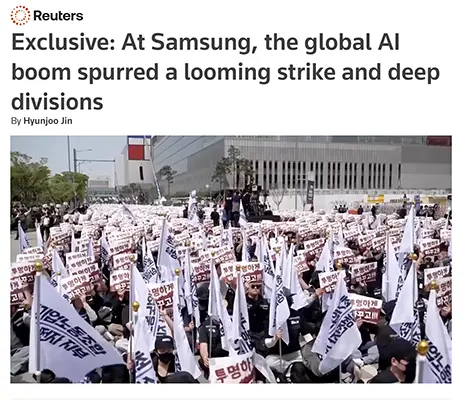
At Samsung, the AI Boom Is Splitting the Workforce — and Could Split the Supply Chain
Reuters | Hyunjoo Jin | May 15, 2026
TL;DR: A looming 18-day strike at Samsung — triggered by a 6x bonus gap between its AI memory workers and its foundry employees — threatens to disrupt global chip supply chains and exposes a structural tension that the AI boom is intensifying across the semiconductor industry.
Executive Summary
More than 45,000 Samsung workers are threatening to walk off the job beginning May 21 in what would be the company’s largest-ever strike. The dispute centers on a proposed compensation structure that would give memory chip workers bonuses of more than 600% of their annual salary, while workers in Samsung’s foundry and logic chip businesses — which make AI chips for Nvidia and Tesla — would receive between 50% and 100%. The gap reflects real divergence in business performance: Samsung’s memory division has been enormously profitable amid the AI-driven chip shortage, while its foundry business has sustained billions in losses.
The financial stakes are significant. JPMorgan estimates a strike could reduce Samsung’s operating profit by $14 to $21 billion, with additional sales losses in the billions. But the longer-term strategic risk may be more consequential: union leaders argue the bonus gap is already accelerating talent departures from the foundry side, undermining Samsung’s stated goal of becoming the world’s only full-spectrum semiconductor provider. Samsung Chairman Jay Y. Lee has publicly committed to becoming the dominant player in logic chips by 2030 — an ambition that is now in tension with a compensation structure that, by the union’s account, is pushing that division’s engineers out the door.
This is not purely a labor story. It surfaces a structural problem that the AI boom is amplifying: when one part of a vertically integrated company captures disproportionate gains from a technology cycle, the rest of the organization can destabilize. Corporate governance analysts have noted that Samsung’s conglomerate structure — praised for its breadth — may now be generating the conflict of interest that threatens it.
Relevance for Business
For SMB executives, this story matters on two levels. First, supply chain exposure: Samsung is a cornerstone supplier for memory chips that power AI infrastructure, smartphones, and laptops. A prolonged strike would tighten an already constrained market and likely push prices higher. Procurement leaders should assess near-term inventory positions and alternative sourcing.
Second, this is a preview of internal equity pressures that will surface in many organizations as AI tools generate uneven gains across departments. When AI makes some roles dramatically more productive or profitable, the compensation and morale implications for adjacent roles become a real management problem — not a distant one.
Calls to Action
🔹 Assess supply chain exposure to Samsung memory components. If your products or infrastructure depend on NAND or DRAM from Samsung, evaluate inventory buffers and alternative suppliers before May 21.
🔹 Watch this strike as a bellwether. Analysts note other companies are monitoring the outcome as a reference point for labor-management relations in AI-adjacent industries. The precedent it sets may matter to your sector.
🔹 Begin thinking now about internal equity as AI creates uneven productivity gains. The Samsung dispute is an extreme version of a tension that will appear inside smaller organizations. Compensation and recognition frameworks built pre-AI may need revisiting.
🔹 Monitor pricing signals in the memory chip market. Even a partial production disruption at Samsung will ripple into component pricing and availability for AI-adjacent hardware.
🔹 If you operate a diversified business with unequal AI tailwinds across divisions, flag the cultural and retention risk early. The Samsung case shows how quickly that gap becomes a structural problem.
Summary by ReadAboutAI.com
https://www.reuters.com/business/world-at-work/samsung-global-ai-boom-spurred-looming-strike-deep-divisions-2026-05-15/: May 18, 2026
UK Regulators Sound Alarm on Frontier AI Cyber Risk
Reuters | May 15, 2026
TL;DR: Three of the UK’s most powerful financial regulators issued a joint warning that frontier AI models now exceed expert human capability in cyberattack potential — and that firms must actively plan for the consequences.
Executive Summary
The UK’s finance ministry, Bank of England, and Financial Conduct Authority released a coordinated statement declaring that frontier AI models already surpass what skilled human practitioners can achieve in cyber operations — at greater speed, larger scale, and lower cost. The statement frames this not as a future risk but as a current one, with direct implications for firms’ safety, customer protection, market integrity, and financial stability.
The warning is notably tied to a specific product: Anthropic’s Mythos model, which the Bank of England governor referenced last month as a concrete cybersecurity concern for the banking sector. Cyber experts have flagged Mythos as capable of enabling attacks of a complexity that existing banking technology may not be equipped to withstand. The joint statement stops short of prescribing specific defenses, but the signal is clear: waiting for an incident to happen is not an acceptable posture.
This is a brief but consequential news item. Its significance lies not in the detail of its guidance — which is thin — but in the source. A coordinated declaration from three major regulators is unusual, and it signals that regulatory scrutiny of AI-enabled cyber risk is now an active, not theoretical, concern.
Relevance for Business
For SMBs, the immediate implication is not that Mythos will target your firm directly — it’s that AI-enabled cyberattacks are now easier, faster, and cheaper to execute at scale, which raises the baseline threat environment for every organization. This changes the risk calculus for cybersecurity spending, insurance coverage, and vendor evaluation.
There is also a compliance horizon to consider. When regulators in financial services set expectations, adjacent industries often follow. SMBs in fintech, professional services, healthcare, and logistics should treat this as a leading indicator of where oversight is heading.
Calls to Action
🔹 Revisit your cybersecurity posture now. If your last review predates the emergence of AI-assisted cyberattack capability, it may be materially out of date. Commission a targeted reassessment.
🔹 Review cyber insurance coverage. Policies written before AI-enabled threat escalation may not reflect your current exposure. Confirm coverage terms with your broker.
🔹 Ask your IT vendors how they are responding to AI-augmented threats. This is a reasonable due diligence question — vendors who can’t answer it are a risk.
🔹 Track UK regulatory guidance even if you operate outside the UK. Financial regulators often move in parallel, and this statement is likely a preview of broader international guidance.
🔹 Do not treat Mythos specifically as the threat. The model is a signal, not the full picture. The underlying capability it represents — AI-accelerated cyberattack — is now a category risk, not a product risk.
Summary by ReadAboutAI.com
https://www.reuters.com/legal/litigation/uk-firms-should-take-steps-limit-risks-frontier-ai-models-uk-says-2026-05-15/: May 18, 2026
Nvidia Rally Propels Stocks to New Records
The Wall Street Journal | Vicky Ge Huang | May 13, 2026
TL;DR: Nvidia briefly crossed a $5.5 trillion market cap — a historic milestone driven by the intersection of the China summit, sustained AI infrastructure demand, and retail investor momentum — but the underlying volatility signals a market priced for a very optimistic scenario.
Executive Summary
Nvidia’s stock extended a six-day winning streak on May 13 after Jensen Huang joined Trump’s Beijing delegation, briefly making Nvidia the first company to reach a $5.5 trillion market capitalization. The rally lifted the S&P 500 to its 17th all-time high of 2026 and pushed the Nasdaq to its 13th record close. The surge is not isolated to Nvidia — a memory-and-storage ETF launched in early April has already accumulated $7.3 billion in assets and gained 96% in under seven weeks. Tower Semiconductor, ON Semiconductor, and Akamai all reached multi-year or all-time highs on the same day.
Two signals worth separating: the structural demand narrative (AI infrastructure buildout requires sustained chip supply that a small number of firms can provide, creating durable pricing power) and the speculative momentum narrative (retail investors are buying dips aggressively, sentiment is running hot, and some valuations are approaching dotcom-era comparables). Both are present simultaneously. The structural story may be real; the pricing may be running ahead of it. The day before these records were set, the PHLX Semiconductor Index fell as much as 6.7% before recovering — a reminder that the current trend is not without significant intraday volatility.
Relevance for Business
SMB executives should read this primarily as a market sentiment indicator, not an investment signal. The AI infrastructure investment boom is real, and it is concentrating returns among a very small number of hardware and semiconductor companies. For organizations evaluating AI software spending, the implication is that the underlying infrastructure costs are unlikely to fall quickly — suppliers have pricing leverage for the foreseeable future. For leaders with investment or treasury responsibilities, the gap between structural demand and current valuations warrants caution.
Calls to Action
🔹 Do not interpret the Nvidia rally as validation that your AI investments will generate equivalent returns — infrastructure gains and application-layer ROI are very different value chains.
🔹 Factor sustained AI infrastructure costs into multi-year budget planning — pricing power among a small number of chip suppliers means cost relief is not imminent.
🔹 Monitor semiconductor volatility as a leading indicator of AI investment sentiment — sharp intraday swings are a warning sign that current pricing reflects elevated expectations.
🔹 If you hold chip or AI-adjacent equities, review position sizing given dotcom-era valuation comparisons surfacing in the data.
🔹 Watch the China summit outcomes — any signal that chip export policy is shifting could move markets quickly and affect AI infrastructure costs and availability.
Summary by ReadAboutAI.com
https://www.wsj.com/wsjplus/dashboard/articles/nvidia-rally-propels-stocks-to-new-records-84148f1d: May 18, 2026
IonQ and 5 More Stocks to Play Quantum Fever
Barron’s | Mackenzie Tatananni | May 15, 2026
TL;DR: Quantum computing stocks are moving on narrative and speculation, not fundamentals — and the gap between hype-priced pure plays and real business performance is wide enough to warrant executive caution before any strategic commitment to the sector.
Executive Summary
Quantum computing has crossed from research labs into active capital markets, with a handful of pure-play companies now publicly traded and attracting significant investor attention. The sector’s stock performance, however, tells a story driven more by sentiment than substance: none of the major pure-play quantum companies are profitable, and most are still burning cash. Valuations reflect this speculative character — Rigetti and D-Wave carry price-to-sales ratios in the hundreds, while IBM, with an actual enterprise at scale, trades at a comparatively grounded multiple.
The article profiles six stocks across a spectrum of technical approaches — trapped ion (IonQ), annealing (D-Wave), superconducting gate models (Rigetti, IBM), photonic (Xanadu), and quantum communications (Quantum Computing Inc.). Each company is at a different stage and faces distinct risks. IonQ leads on revenue milestones and backlog growth. IBM anchors the ecosystem with cloud access and open-source tooling, and has a stated roadmap toward fault-tolerant systems by 2029. Xanadu, newly public, is advancing a room-temperature photonic approach. Quantum Computing Inc. carries the most governance risk, having faced short-seller allegations of revenue fabrication — claims the company has not addressed.
Third-party projections from Barclays and McKinsey suggest potential commercial viability arriving as early as 2027, with a market that could reach $43–72 billion by 2035. These are analyst forecasts, not demonstrated outcomes, and should be weighted accordingly.
Relevance for Business
For SMB executives, this article is primarily a market signal, not an action trigger. The practical takeaway is that quantum computing remains in a pre-commercial phase for most business applications — its near-term impact on SMB operations is limited. However, several dynamics are worth tracking:
- Vendor landscape is forming now. The companies winning early contracts and government partnerships today will likely define the platform choices available in 3–5 years. IBM’s cloud-based quantum access is the most immediately accessible entry point for businesses wanting early familiarity.
- Speculation risk is real. If your organization has any exposure to quantum stocks — directly or through funds — the extreme valuation multiples and governance concerns (particularly around Quantum Computing Inc.) represent material financial risk.
- The photonic approach (Xanadu) is worth monitoring for its potential to sidestep the infrastructure constraints of superconducting systems, which require near-absolute-zero cooling environments. Room-temperature operation would significantly reduce deployment complexity.
- No SMB procurement decision is warranted today. Commercial quantum advantage for mainstream business problems has not been demonstrated. The space remains the domain of large enterprise, government, and research institution pilots.
Calls to Action
🔹 Monitor, don’t act — quantum computing is not yet an SMB procurement category. Set a calendar reminder to revisit the landscape in 12–18 months against the 2027 benchmark cited by Barclays.
🔹 Flag governance risk — if your organization, fund, or pension holds positions in quantum pure plays, particularly Quantum Computing Inc., assign a brief internal review of the short-seller claims and company responses before the next portfolio review.
🔹 Identify your exposure — quantum’s largest near-term impact on most businesses will be through cryptography and data security. Assign someone to assess whether your current encryption standards are on a post-quantum roadmap.
🔹 Track IBM’s 2029 milestone — as the most credible near-term commercial pathway, IBM’s fault-tolerant supercomputer roadmap is a reasonable indicator for when enterprise-grade quantum services may become a realistic vendor conversation.
🔹 Treat analyst projections with appropriate skepticism — McKinsey’s $43–72B market estimate and Barclays’ 2027 commercial advantage forecast are projections with wide uncertainty bands. Do not use them as planning assumptions without independent triangulation.
Summary by ReadAboutAI.com
https://www.wsj.com/wsjplus/dashboard/articles/quantum-computing-stocks-0f1d5627: May 18, 2026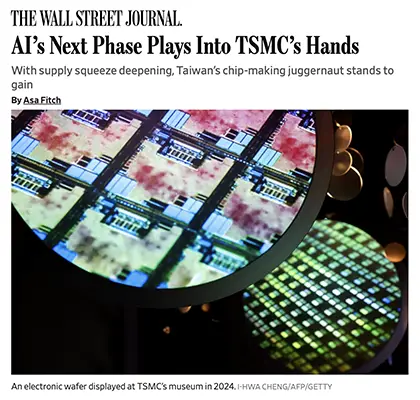
AI’S NEXT PHASE PLAYS INTO TSMC’S HANDS
The Wall Street Journal (Heard on the Street) | Asa Fitch | May 11, 2026
TL;DR: As AI infrastructure spending intensifies, TSMC is emerging as the single most structurally advantaged company in the AI supply chain — with near-monopoly position in advanced chip manufacturing, expanding margins, and demand so strong that customers are prepaying billions for future capacity.
Executive Summary
This is a financial analysis column, and its core argument is well-supported: TSMC occupies a uniquely defensible position in the AI supply chain that no competitor can replicate in the near term. Microsoft, Meta, Alphabet, and Amazon alone plan $725 billion in capital spending this year, much of it on AI chips. TSMC is the only company capable of manufacturing the most advanced versions of those chips at scale — Nvidia’s market-leading GPUs and Apple’s smartphone chips both run through TSMC’s fabs.
The competitive moat is real. Samsung is a distant second in advanced contract manufacturing. Intel and Rapidus are attempting to enter the market but remain far behind. Elon Musk’s announced Terafab project, which would use Intel’s manufacturing, is described as “far off at best.” Demand is strong enough that some customers are prepaying billions to reserve future capacity — an extraordinary signal about how tight supply has become.
TSMC’s gross margins expanded to roughly 66% in Q1 from about 59% a year earlier — a sign of factories running near full capacity. A temporary margin compression is expected in late 2026 as the company ramps its newest chip generation (N2), but this is described as a transition cost, not a structural problem. U.S. fab expansion is adding operating costs but also reduces geopolitical concentration risk — a strategic hedge, not a financial burden. At approximately 21 times forward earnings, TSMC’s stock is valued below the broader semiconductor sector average despite its advantages — an observation worth noting, though as editorial opinion rather than investment advice.
Relevance for Business
For SMB executives, TSMC’s position has two practical implications. First, it reinforces the case that AI infrastructure costs will remain elevated — TSMC has pricing power and is moving toward higher prices as customers advance to more capable chip generations. Second, the Taiwan concentration risk — partly mitigated by U.S. fab expansion — remains a real supply chain and geopolitical variable for any organization whose AI workloads depend on chips that can only be manufactured in quantity by a single company in a geopolitically sensitive location. That risk has not disappeared; it has been partially hedged. The broader signal: the AI supply chain has a single, critical, largely irreplaceable chokepoint, and understanding that dependency is relevant context for any long-term AI infrastructure planning.
Calls to Action
🔹 Build sustained AI infrastructure costs into long-range financial planning — TSMC’s pricing leverage is durable, and chip generations are moving toward higher price points, not lower.
🔹 Assess your exposure to Taiwan supply chain concentration — for organizations making long-term AI infrastructure commitments, understand how much of your chip supply depends on a single geographic and geopolitical node.
🔹 Monitor TSMC’s U.S. fab progress as a signal of medium-term supply diversification — domestic manufacturing capacity will affect both pricing and supply resilience for U.S.-based AI infrastructure buyers over a 3–5 year horizon.
🔹 Treat AI hardware as a strategic dependency, not a commodity input — the combination of scarcity, consolidation, and geopolitical exposure means hardware decisions carry more strategic weight than most SMBs currently assign them.
🔹 Watch for N2 chip ramp signals — TSMC’s transition to its newest manufacturing generation will temporarily compress margins but signals the next wave of AI chip capability; products built on N2 will define the performance ceiling for the next 2–3 years.
Summary by ReadAboutAI.com
https://www.wsj.com/tech/ais-next-phase-plays-into-tsmcs-hands-3d1f2b60: May 18, 2026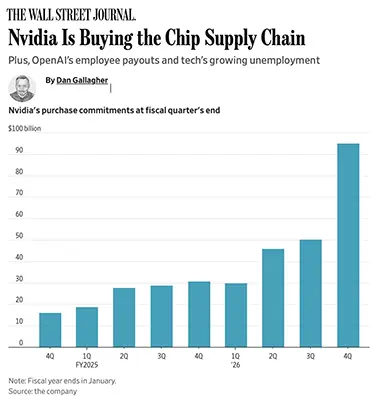
NVIDIA IS BUYING THE CHIP SUPPLY CHAIN
WSJ AI & Business Newsletter | Dan Gallagher | May 12, 2026
TL;DR: Nvidia’s $95 billion in supply chain purchase commitments — alongside similar moves from Broadcom and AMD — reveals that AI infrastructure is now a game of pre-securing scarce components, and organizations without deep pockets are being structurally squeezed out.
Executive Summary
At the close of its last fiscal quarter, Nvidia reported $95.2 billion in purchase commitments with its supply vendors — an 89% jump in just three months. The figure dwarfs the company’s investment-related commitments and reflects a deliberate effort to lock down scarce components, particularly memory, ahead of competitors. Broadcom has made similar moves, claiming it has secured the supply chain needed to hit $100 billion in AI chip revenue next year. AMD disclosed over $21 billion in forward purchase commitments — more than double the prior period.
The strategic logic is straightforward and the execution risk is real: AI hardware components are in shortage, prices are rising, and the ability to pre-commit capital at scale is becoming the defining competitive advantage in the chip supply chain. Companies that cannot commit at this scale — including smaller chip designers like Cerebras, which is going public — operate without long-term supply agreements, relying on purchase orders that compete with much larger players. This creates a structural two-tier market: those who can pre-buy the supply chain and those who cannot.
There is also a manufacturing ceiling that money alone cannot solve. Building a new memory chip factory takes years. Advanced TSMC capacity cannot be materially expanded in the near term regardless of how much capital is committed.
Relevance for Business
For SMB leaders, this is primarily a cost and availability signal for AI infrastructure, not an operational decision point. The concentration of supply chain leverage among a handful of mega-cap companies means AI computing costs for everyone else are likely to remain elevated or rise. Organizations buying AI services through cloud providers should understand that the underlying resource constraints are structural, not temporary — pricing relief is not coming from the supply side in the near term. For any SMB considering building proprietary AI infrastructure rather than buying from cloud providers, the case for building rather than buying has weakened further: the scarcity advantage belongs entirely to the largest players.
Calls to Action
🔹 Treat AI infrastructure costs as structurally elevated for the foreseeable future — do not build multi-year ROI models assuming price normalization.
🔹 Prefer cloud-based AI consumption over proprietary infrastructure builds — the supply-chain leverage required to compete on infrastructure belongs to players with nine-figure capital commitments.
🔹 Negotiate multi-year terms with cloud AI providers now — locking in pricing while still possible is preferable to renegotiating in a tightening market.
🔹 Monitor memory and component pricing as a leading indicator of your AI service costs — the shortage driving Nvidia’s commitments flows through to cloud pricing on a lag.
🔹 Deprioritize smaller AI chip vendors as primary infrastructure partners — without long-term supply agreements, their operational reliability is at greater risk during periods of shortage.
Summary by ReadAboutAI.com
https://www.wsj.com/tech/nvidia-is-buying-the-chip-supply-chain-871db5e3: May 18, 2026AMAZON DITCHES RUFUS FOR NEW AI SHOPPING ASSISTANT
Barron’s | Angela Palumbo | May 13, 2026
TL;DR: Amazon’s replacement of its standalone Rufus chatbot with a deeply integrated “Alexa for Shopping” assistant signals the industry’s pivot from conversational AI sidecars to embedded agentic commerce — a shift that will reshape how customers discover and buy, with direct implications for businesses that sell through Amazon.
Executive Summary
Amazon has retired Rufus — its generative AI shopping chatbot launched in 2024 — in favor of Alexa for Shopping, a new assistant embedded directly in the Amazon search bar. The new tool goes beyond answering product questions: it can add items to a cart, track price movements, and take actions on a shopper’s behalf. This is a meaningful structural shift. Rufus was a bolt-on chatbot; Alexa for Shopping is woven into the core purchase flow.
The timing is notable. Rufus was by Amazon’s own account performing well — over 300 million customers used it in 2025, and monthly active users grew more than 115% in Q1 2026. The decision to retire a growing product in favor of a more deeply integrated one reflects deliberate strategic architecture, not a failure pivot. The industry direction is clear: standalone AI assistants are giving way to agents embedded in workflows, capable of taking actions rather than just providing answers.
The Barron’s commentary is worth noting as a framing signal, not a fact: one analyst called this a sign of “discipline” compared to companies that dig in on failing ventures. That framing is opinion, not a demonstrated finding.
Relevance for Business
For any business selling through Amazon — which includes a large share of SMB product companies — the shopping experience is changing in ways that affect discoverability, conversion, and pricing visibility. An AI agent that tracks price changes and manages cart additions on a shopper’s behalf alters when and why purchases happen. Recommendation logic and personalization will increasingly drive which products surface and which don’t. This matters more than any individual product listing decision. Separately, the broader shift from chatbot to embedded agent is a roadmap signal: expect similar moves from other major platforms, accelerating the case for AI that acts rather than simply advisesacross commerce, customer service, and operations.
Calls to Action
🔹 Review your Amazon product data, pricing, and listing quality now — as AI-driven discovery replaces traditional search, structured, accurate product data becomes a competitive input, not just a hygiene requirement.
🔹 Monitor how Alexa for Shopping surfaces and ranks products in your category — early data on AI-driven recommendation behavior will be commercially significant.
🔹 Treat price competitiveness as a more urgent signal — an agent that actively tracks price changes on behalf of shoppers will accelerate comparison behavior and compress conversion windows.
🔹 Assess your own customer-facing AI tools against this standard — if your digital experience still relies on a chatbot sidecar rather than an integrated action-capable agent, a gap is opening.
🔹 Watch this pattern across other major platforms — Google, Meta, and retail-media networks are all moving toward agentic commerce; Amazon’s move is a leading indicator of the broader direction.
Summary by ReadAboutAI.com
https://www.wsj.com/wsjplus/dashboard/articles/amazon-stock-rufus-alexa-ai-shopping-e6c2a02d: May 18, 2026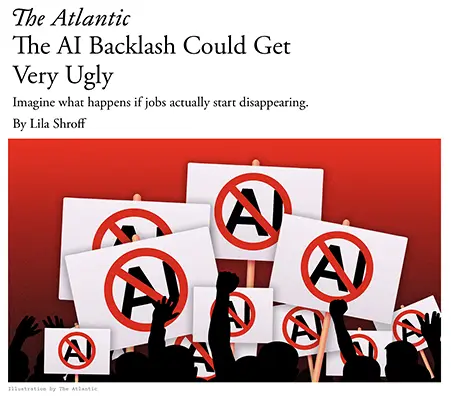

Closing: AI update for May 18, 2026
The week ending May 18 delivered something rarer than a single breakthrough: a convergence of signals across infrastructure, governance, security, competition, and workforce that together clarify the operating environment for the next 12 to 18 months. Your most useful next step is not to track every development — it is to identify the two or three threads most relevant to your organization and assign clear ownership to monitoring them with discipline.
All Summaries by ReadAboutAI.com
↑ Back to Top