
AI Updates March 22, 2026

Artificial intelligence is now showing up in almost every corner of the business news cycle — sometimes because it genuinely changes the story, and sometimes because attaching “AI” to a headline has become its own form of attention strategy. That dynamic is becoming easier to spot. Some of this week’s coverage reflects real operational shifts: AI moving deeper into cybersecurity, healthcare workflows, workplace software, mobility, interface design, and policy. But some of it also reflects a noisier media environment in which AI is increasingly used as a framing device, even when the underlying signal is more modest than the headline suggests.
That is why this mid-week set is useful. Taken together, these stories show that AI is no longer confined to one clean category such as chatbots or automation. It is spreading laterally into cars, maps, hospitals, creative tools, copyright battles, labor-market arguments, and emerging legislation. The more important pattern is not simply that “AI is everywhere.” It is that AI is becoming embedded into existing systems of work, governance, and infrastructure, often in ways that create new dependencies, new friction, and new oversight burdens at the same time they promise convenience or productivity.
For executives and managers, the takeaway is to read AI coverage more selectively and more strategically. Not every AI headline signals transformation, and not every product update deserves executive attention. But the accumulation does matter. Across these pieces, the recurring themes are clear: workflow integration is becoming more important than hype, governance is becoming more important than novelty, and second-order effects — labor pressure, compliance risk, trust erosion, vendor dependence, and policy uncertainty — are becoming harder to ignore. In other words, the real story is less about AI as spectacle and more about AI as a growing operating condition of modern business.


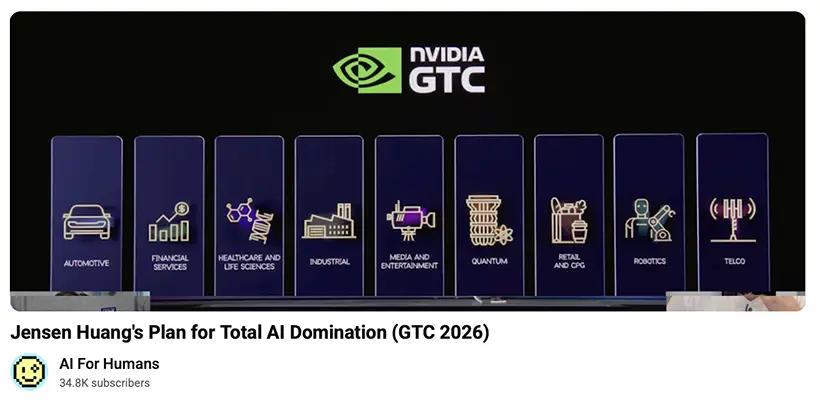
Jensen Huang’s “$1 Trillion” Vision at GTC 2026
AI for HumansPodcast, March 2026
TL;DR / Key Takeaway: NVIDIA’s GTC 2026 message was not just about faster chips; it was a bid to position NVIDIA as the infrastructure layer beneath enterprise AI, inference, robotics, and agentic software, with major implications for cost, dependency, and power concentration across the market.
Executive Summary
In this AI for Humans episode, the hosts interpret NVIDIA’s GTC 2026 keynote as a broad statement of strategic ambition: NVIDIA is no longer presenting itself as a chip company alone, but as the backbone of the AI economy. The most important signal is not Jensen Huang’s headline-grabbing “$1 trillion” projection by itself, but the underlying claim that AI demand is shifting decisively toward inference at scale—the ongoing compute required to run models in real-world use, not just train them. That framing matters because it suggests a future in which AI economics are driven less by one-time model creation and more by persistent infrastructure spend, recurring GPU demand, and deep reliance on platform providers.
The podcast also highlights NVIDIA’s effort to extend its influence upward into software and enterprise workflows. The discussion of OpenClaw / NemoClaw is especially notable because it suggests NVIDIA wants a stronger role in agent deployment, not just hardware supply. If that effort succeeds, NVIDIA could benefit whether enterprises choose proprietary or open-source models, because both still drive compute consumption. The hosts treat this as a meaningful strategic shift, though some of the claims around scale, adoption, and “enterprise readiness” remain more conference framing than demonstrated business outcome. The larger takeaway is that the AI stack continues to consolidate around players that control compute, tooling, and distribution simultaneously.
Other segments—such as DLSS 5, robot simulation, and chips in space—are more mixed in immediate business relevance. DLSS 5 signals how AI enhancement is spreading into adjacent product categories, but for most business readers it is more useful as evidence that AI is being embedded into existing digital experiences whether users ask for it or not. The robotics and space-compute discussion is more speculative. The robot simulation examples point to real momentum in synthetic training environments, but “chips in space” reads more like future-facing signaling than an operational near-term development. The podcast ends on an important counterweight: even if AI demand is real, bottlenecks may emerge from supply chain fragility, specialized manufacturing dependencies, and infrastructure constraints, not just from headline concerns like raw energy availability.
Relevance for Business
For SMB executives and managers, this matters because NVIDIA’s message reinforces a market reality: AI adoption increasingly means buying into an infrastructure and vendor ecosystem, not just testing a feature. As inference grows, AI may become a recurring operational cost embedded in software contracts, cloud usage, and workflow automation. That raises questions about budget durability, margin pressure, and long-term dependence on a small number of providers.
The enterprise-agent angle is especially relevant. If agent platforms become easier to deploy through NVIDIA-aligned tooling, more vendors will package automation as enterprise-ready. But easier deployment does not remove the need for governance, security review, data controls, and human oversight. In practice, firms may find that the biggest challenge is not whether agents are possible, but whether they are trustworthy, maintainable, and cost-justified once connected to business systems.
The broader competitive implication is that power may continue to shift toward companies that control the underlying stack: chips, cloud access, developer tools, and model-serving infrastructure. For smaller firms, this does not mean “do nothing,” but it does mean leaders should evaluate AI offerings with more discipline. The key issue is no longer just capability. It is who owns the dependency, who captures the margin, and who bears the execution risk.
Calls to Action
🔹 Review AI vendor exposure across your software stack and identify where your company is becoming dependent on GPU-heavy, inference-based services.
🔹 Treat agentic AI offerings cautiously, especially where vendors imply enterprise readiness before security, auditability, and workflow controls are fully proven.
🔹 Plan for recurring AI costs, not just pilot budgets; inference-heavy tools may create ongoing spend that scales with usage rather than with seats alone.
🔹 Watch infrastructure bottlenecks closely, including supply chain and compute constraints, because these can affect pricing, performance, and deployment timelines.
🔹 Separate keynote ambition from deployable reality by asking vendors what is live now, what requires custom integration, and what remains roadmap language.
Summary by ReadAboutAI.com
https://www.youtube.com/watch?v=-zDOqBXjlWk: March 22, 2026
WHY YOU SHOULD NOT BECOME AN AI EXPERT
FAST COMPANY — MARCH 18, 2026
TL;DR / Key Takeaway:
This opinion piece argues that most professionals are better off using AI to strengthen their existing domain expertise than trying to reinvent themselves around a fast-moving hype cycle they do not control.
EXECUTIVE SUMMARY
This is a POV essay, and its main argument is that many people chasing “AI expert” status are really chasing market sentiment rather than durable value. The author leans on the Gartner hype cycle and argues that AI investment has raced ahead of consistently measurable productivity gains, citing large capital flows, mixed evidence on enterprise returns, and uneven impact across occupations. The point is not that AI is unimportant. It is that the distribution of value is highly uneven, and much of the public conversation still assumes gains seen in software development will transfer easily across the rest of the economy.
The most useful signal for executives is that the article separates using AI well from building a career identity around AI itself. It argues that the stronger long-term position for most people is to deepen their understanding of real problems in their own field and learn how to collaborate with AI there, rather than chase generalized AI prestige. The article is especially skeptical of extrapolating from the experiences of founders, developers, and infrastructure insiders to marketers, client-service teams, or other work built around human coordination, strategy, and relationship management.
What is persuasive here is the warning against reflexive hype and shallow expertise. What is less certain is the author’s degree of pessimism about broader AI productivity gains, since those may still emerge unevenly over time. But the business lesson holds: technology expertise without domain depth is fragile, while domain expertise that can productively incorporate AI is more likely to endure.
RELEVANCE FOR BUSINESS
For SMB executives and managers, this matters because many organizations are facing a skills panic: who needs to become an AI expert, how fast, and in what form. This article suggests the answer is more measured. Most firms do not need everyone to become an AI specialist; they need people who understand the business well enough to apply AI where it is useful and ignore it where it is not.
That has hiring and training implications. Leaders may get more value by helping employees pair AI fluency with existing domain judgment than by pushing broad rebranding efforts or chasing fashionable job titles. In a noisy market, problem knowledge may be a more stable asset than tool-label expertise.
CALLS TO ACTION
🔹 Train for AI fluency inside real business functions, not as a detached prestige skill.
🔹 Be cautious of “AI expert” positioning that lacks domain depth or measurable business relevance.
🔹 Invest in people who understand your customers, workflows, and constraints first.
🔹 Track actual productivity gains by function, rather than assuming one success story generalizes across the firm.
🔹 Use AI to amplify existing expertise, not replace the need for it.
Summary by ReadAboutAI.com
https://www.fastcompany.com/91509048/why-you-should-not-become-an-ai-expert: March 22, 2026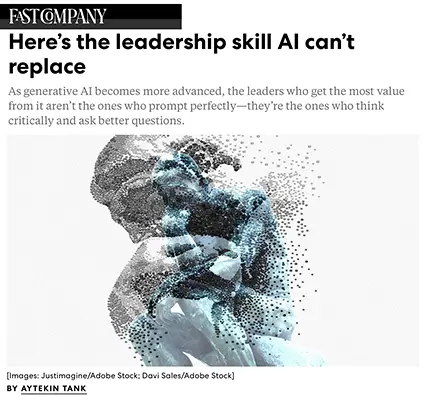
HERE’S THE LEADERSHIP SKILL AI CAN’T REPLACE
FAST COMPANY — MARCH 4, 2026
TL;DR / Key Takeaway:
As generative AI gets easier to use, the real leadership advantage shifts away from prompting tricks and toward judgment, context-setting, and the ability to ask better questions.
EXECUTIVE SUMMARY
This Fast Company piece is an opinion-driven leadership essay, but its core argument is useful: AI does not eliminate the need for leadership judgment; it may actually increase the value of it. The article uses a journalism example to show that even when AI can quickly generate plausible outputs, it often misses the deeper contextual issues that experienced humans recognize, such as what matters strategically, what is missing, and why a task matters in the first place. The author’s central point is that leaders who get the most out of AI are not simply the fastest users, but the ones who can frame the work properly.
The strongest signal here is that as chatbots become more conversational and easier to use, prompt engineering matters less than critical evaluation and iterative questioning. The article argues that effective leaders contextualize tasks within larger goals, treat AI outputs as starting points rather than final answers, and build teams that question, refine, and challenge machine-generated work instead of accepting it at face value. It also points to research around metacognition, suggesting that AI performance gains are uneven because people vary in their ability to think about their own thinking, spot weaknesses, and revise their approach.
For executives, the broader relevance is practical: AI may commoditize first drafts, but it does not commoditize editorial judgment, strategic framing, and trade-off recognition. What is real now is that AI can accelerate task execution. What remains stubbornly human is deciding which tasks matter, what good looks like, and when the output is directionally wrong even if it sounds polished.
RELEVANCE FOR BUSINESS
For SMB executives and managers, this matters because many teams are already using AI for drafting, brainstorming, research, and planning. The danger is not just bad output. It is that speed can create the illusion of adequacy, allowing weak assumptions or shallow thinking to move faster through the organization. The article’s underlying warning is that AI can magnify poor judgment just as easily as it can support good judgment.
That means leadership development should not focus only on tool fluency. It should also strengthen the human skills that determine whether AI is being used intelligently: context-setting, prioritization, critique, and the discipline to question “good enough.” In other words, better AI use may depend less on technical sophistication than on managerial maturity.
CALLS TO ACTION
🔹 Train teams to evaluate AI outputs critically, not just generate them quickly.
🔹 Frame AI-assisted work against larger business goals before asking the model to produce anything.
🔹 Treat outputs as drafts to interrogate, especially in customer-facing, strategic, or high-stakes decisions.
🔹 Invest in judgment-building for junior staff, so AI does not flatten their learning into passive acceptance.
🔹 Reward better questions, not just faster answers.
Summary by ReadAboutAI.com
https://www.fastcompany.com/91500902/heres-the-leadership-skill-ai-cant-replace: March 22, 2026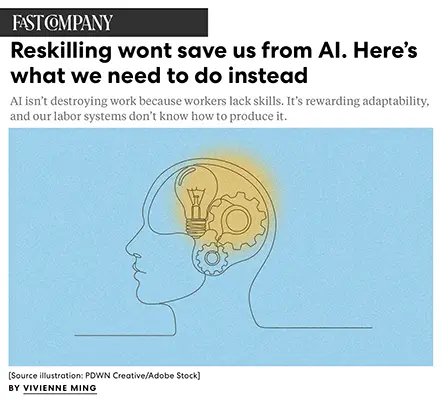
RESKILLING WON’T SAVE US FROM AI. HERE’S WHAT WE NEED TO DO INSTEAD
FAST COMPANY — MARCH 18, 2026
TL;DR / Key Takeaway:
This article argues that conventional reskilling is an inadequate answer to AI disruption because the deeper constraint is not credentials or technical training, but adaptability, meta-learning, and long-term human development.
EXECUTIVE SUMMARY
This is a POV essay, not a straight news report, and it should be treated as an argument rather than settled fact. The author’s central claim is that AI-driven labor disruption will not be solved simply by sending displaced workers through short training programs or pushing more people into coding and university credentials. Instead, she argues that the real differentiator is adaptability: the ability to learn, reorient, and operate in unfamiliar environments. The article uses historical analogies, internal company examples, and prior research claims to argue that most reskilling programs overestimate how quickly workers can move into more complex, less routine roles.
The strongest business signal here is not that reskilling is useless; it is that leaders may be overusing reskilling as a comforting narrative for a harder structural transition. The piece argues that AI may eliminate many routine and lower-complexity roles while expanding demand for more adaptive, high-judgment work that cannot be filled at scale through brief retraining alone. It also raises a more uncomfortable point: organizations may discover that AI does not just automate low-skill work, but also weakens the traditional career ladder that once helped develop human capability over time.
For executives, the takeaway is to treat workforce transition as a developmental and organizational design problem, not merely a training-budget problem. What is persuasive in the article is its emphasis on meta-learning, resilience, and experiential development. What remains more arguable is the breadth of its dismissal of reskilling. In practice, leaders will likely need both: targeted retraining for changing tasks and deeper investment in adaptability, judgment, and mobility across roles.
RELEVANCE FOR BUSINESS
For SMB executives and managers, this matters because many organizations are already defaulting to a familiar script: adopt AI, retrain staff, and assume the workforce will evolve fast enough. This piece warns that such a plan may be too narrow and too slow, especially if AI compresses entry paths, changes job design, and rewards workers who can navigate ambiguity rather than just master new tools.
The practical implication is that workforce strategy may need to shift toward internal mobility, apprenticeship-style development, cross-functional exposure, and environments where people build judgment through real experience. Training still matters, but the article argues that adaptability cannot be installed like software.
CALLS TO ACTION
🔹 Do not treat reskilling as a complete workforce strategy for AI disruption.
🔹 Invest in roles, rotations, and project structures that build adaptability, not just technical certificates.
🔹 Review whether AI adoption is quietly weakening junior development pathways.
🔹 Use retraining where appropriate, but pair it with experiential learning and managerial support.
🔹 Plan for longer transition timelines than vendor or policy narratives may suggest.
Summary by ReadAboutAI.com
https://www.fastcompany.com/91484887/the-reskilling-delusion-ai-reskilling-myth: March 22, 2026
THE NEW GOOGLE MAPS REDESIGN AIMS TO KEEP YOUR EYES ON THE ROAD, NOT YOUR SCREEN
FAST COMPANY — MARCH 12, 2026
TL;DR / Key Takeaway:
Google is using AI to redesign navigation around lower cognitive load rather than just more features, showing how AI’s near-term value often comes from interface improvement and decision support, not autonomous replacement.
EXECUTIVE SUMMARY
This article covers a major Google Maps redesign that uses 3D mapping, AI-assisted scene generation, more conversational voice guidance, and adaptive camera behavior to make turn-by-turn navigation easier to process while driving. The company’s stated goal is not just visual novelty. It is to reduce driver distraction and cognitive friction by making roads, overpasses, exits, crosswalks, and landmarks more intuitively legible. The piece also notes that Google used Gemini to help translate its satellite and street-scan data into these more realistic 3D views.
The strongest signal here is that AI is being applied to human-interface optimization, not only to chatbots or automation. Google says the redesign targets 14 error-prone driving moments, uses eye-tracking simulations, and aims to increase “total eyes on road” by making the interface easier to grasp with fewer glances. That is a useful reminder that some of AI’s most durable business value may come from reducing user confusion, improving decision timing, and lowering the mental burden of complex tasks.
What is real now is a more context-aware and visually informative navigation layer. What remains less proven is the magnitude of improvement, since the article notes that Google did not share quantified outcome data on time or frustration saved. For executives, the broader relevance is that AI-enhanced UX can be strategically important even when it looks incremental on the surface.
RELEVANCE FOR BUSINESS
For SMB leaders, this matters because it points to a practical AI pattern: the best near-term wins may come from redesigning workflows and interfaces around human attention, not from trying to replace people outright. In logistics, field service, sales routing, warehouse navigation, and customer-facing apps, reducing cognitive load can improve performance without requiring a dramatic organizational shift.
It also highlights the importance of measuring what users actually do, not just what a system can technically generate. Google’s emphasis on eye-tracking, difficult-route testing, and stressful decision points is a good model for applied AI design: focus on the moments where people break, hesitate, or misread the environment.
CALLS TO ACTION
🔹 Look for AI opportunities that reduce cognitive load, not only those that promise automation.
🔹 Prioritize applied UX improvements in high-friction workflows where users often miss steps or make avoidable errors.
🔹 Require behavioral evidence, such as attention, speed, or accuracy improvements, not just better-looking interfaces.
🔹 Use AI to improve context and timing, especially in mobile or operational environments.
🔹 Treat interface redesign as strategy, because better decisions at the point of action can compound quickly.
Summary by ReadAboutAI.com
https://www.fastcompany.com/91506736/the-new-google-maps-redesign-aims-to-keep-your-eyes-on-the-road-not-your-screen: March 22, 2026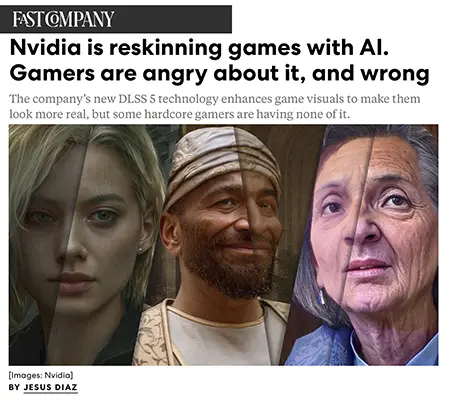
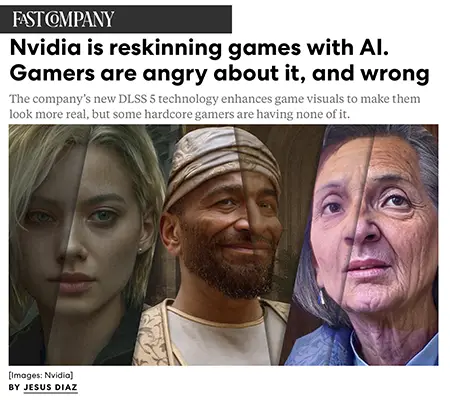
NVIDIA IS RESKINNING GAMES WITH AI. GAMERS ARE ANGRY ABOUT IT, AND WRONG
FAST COMPANY — MARCH 18, 2026
TL;DR / Key Takeaway:
Nvidia’s DLSS 5 points to a larger shift from AI-assisted upscaling to AI-mediated visual rendering, which could lower production burdens and improve fidelity — but it also raises real concerns about artistic control, aesthetic standardization, and platform dependence.
EXECUTIVE SUMMARY
This Fast Company piece is explicitly opinionated, and that matters for how it should be read. The article argues that backlash to Nvidia’s new DLSS 5 is overstated and that the technology is better understood as an enhancement layer than as “AI slop.” The key factual signal is that Nvidia is pushing beyond simple resolution upscaling toward real-time AI re-rendering that can materially alter textures, foliage, shadows, lighting, and some character presentation. That is a meaningful shift because it suggests AI is moving deeper into the visual pipeline, not just polishing the output after the fact.
Where the article is strongest is in showing that this is not being imposed automatically across all games. It notes that DLSS 5 is optional, requires a studio patch, and can be toggled by users, which undercuts the idea that Nvidia is unilaterally overwriting existing games. At the same time, the criticism it describes is not trivial: if AI rendering increasingly pushes visual assets toward one dominant aesthetic, developers may face subtle pressure to accept a platform-shaped visual standard. That is the more important business issue here, beyond the culture-war tone of gamer reaction.
For executives, the broader relevance is not about gaming fandom. It is about how AI can become an infrastructure layer that reshapes creative output while remaining technically “optional.” What is real now is improved rendering fidelity and reduced manual burden in some visual tasks. What remains to be watched is whether these tools preserve artistic differentiation or gradually centralize aesthetic power in the hands of the platform owner.
RELEVANCE FOR BUSINESS
For SMB leaders, this matters because the same pattern will appear across other creative industries: design, marketing, video, e-commerce imagery, and brand production. AI tools may improve quality and reduce labor, but they can also flatten style, shift control toward infrastructure vendors, and redefine what counts as “good enough” creative work.
It also reinforces a practical procurement lesson: when AI becomes embedded in the production stack, leaders should ask not only whether the output looks better, but also who controls the defaults, what gets standardized, and how much original intent is preserved. Efficiency gains are real; so is the risk of creative homogenization.
CALLS TO ACTION
🔹 Treat AI rendering tools as creative infrastructure decisions, not just quality upgrades.
🔹 Ask whether the tool preserves brand or artistic differentiation before adopting it widely.
🔹 Review opt-in, override, and patch requirements so platform control does not quietly expand.
🔹 Monitor whether AI-assisted visuals improve productivity without creating sameness.
🔹 Separate opinion-heavy backlash from the deeper governance question: who shapes the final output layer?
Summary by ReadAboutAI.com
https://www.fastcompany.com/91510549/nvidia-is-reskinning-games-with-ai-gamers-are-angry-about-it-and-wrong: March 22, 2026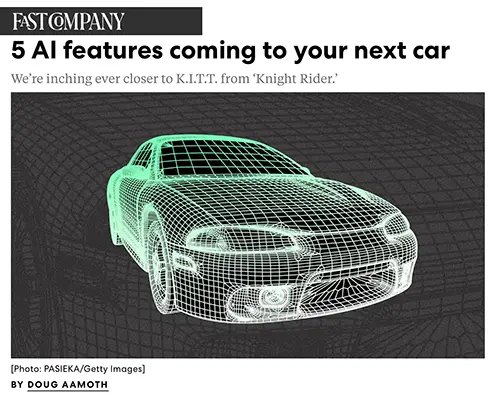
5 AI FEATURES COMING TO YOUR NEXT CAR
FAST COMPANY — MARCH 17, 2026
TL;DR / Key Takeaway:
AI is turning cars into software platforms, with the biggest near-term value in convenience, safety, and predictive maintenance — but this shift also increases cybersecurity, privacy, and vendor-dependence risk.
EXECUTIVE SUMMARY
This Fast Company piece presents a consumer-facing look at how AI is moving deeper into automobiles, from smarter voice assistants and advanced driver assistance to predictive maintenance, better EV range forecasting, and driver monitoring systems. The useful signal is not that cars are suddenly becoming fully autonomous. It is that automakers are increasingly treating vehicles as software-defined products, where onboard compute, cloud connectivity, and ongoing model improvements shape the ownership experience long after purchase.
Some of these use cases are practical and likely to arrive sooner than the more futuristic framing suggests. Better voice interfaces could reduce friction in basic in-car tasks. Predictive maintenance could improve uptime and lower surprise repair events. More accurate EV range prediction and battery preconditioning could reduce one of the main usability barriers to electric vehicle adoption. Driver monitoring may also improve safety, especially for fatigue and distraction detection. But the article also hints at the trade-offs: cars become more dependent on sensors, connectivity, software updates, and data collection, while interior monitoring raises obvious privacy and trust concerns.
What is real now is incremental intelligence layered onto existing vehicle systems. What remains more speculative is how reliably these features will work across brands and conditions, and whether consumers will accept the growing trade of more assistance in exchange for more surveillance and more software complexity. For leaders, the broader lesson is that AI in automotive is increasingly an infrastructure and governance story, not just a features story.
RELEVANCE FOR BUSINESS
For SMB executives and managers, this matters in two ways. First, for companies with vehicle fleets, AI-enabled maintenance, driver-state monitoring, and route/range optimization could improve uptime, safety, and operating efficiency. Second, it is another sign that products once viewed as durable hardware are becoming subscription-like software environments, with more frequent updates, more data extraction, and more dependence on vendor ecosystems.
That shift has procurement implications. Leaders evaluating fleets or transportation-heavy operations should think beyond sticker price and assess cybersecurity posture, data governance, update reliability, repair dependencies, and vendor lock-in. The convenience gains may be real, but so are the new operational exposures.
CALLS TO ACTION
🔹 Treat AI vehicle features as software-risk decisions, not just automotive upgrades.
🔹 Ask vendors how driver and vehicle data is stored, shared, and protected before adopting AI-heavy fleets.
🔹 Evaluate predictive-maintenance claims against actual downtime and service-cost data.
🔹 Be cautious with driver-monitoring tools unless privacy expectations and policy are clear.
🔹 Watch for vendor lock-in, especially where cloud services or proprietary servicing become central to vehicle performance.
Summary by ReadAboutAI.com
https://www.fastcompany.com/91498141/ai-car-features: March 22, 2026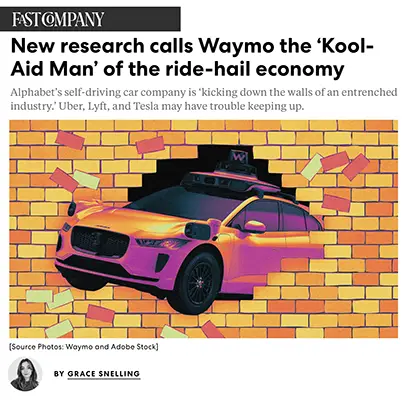
NEW RESEARCH CALLS WAYMO THE ‘KOOL-AID MAN’ OF THE RIDE-HAIL ECONOMY
FAST COMPANY — MARCH 16, 2026
TL;DR / Key Takeaway:
Waymo is no longer just a technology experiment; it is becoming a real competitive force in ride-hailing, which could pressure Uber, Lyft, and Tesla by shifting scale, margins, and control toward the operator with the strongest autonomous network.
EXECUTIVE SUMMARY
This article centers on a MoffettNathanson research note arguing that Waymo has built a meaningful lead in autonomous ride-hailing and is beginning to alter the structure of the U.S. ride-booking market. The most important signal is not the colorful “Kool-Aid Man” metaphor. It is the evidence that Waymo has moved from pilot-stage novelty to scaled operational presence, expanding from active operations in five U.S. cities in early 2025 to 10 by early 2026, while also testing in many more locations. The article says Waymo reached roughly 450,000 weekly rides by the end of 2025 and could more than double rides in 2026 if current projections hold.
That still leaves Waymo small relative to the total ride-hail market, but the strategic importance is larger than the current share number. Autonomous fleets potentially change the industry’s cost structure by reducing driver dependence, improving asset utilization, and giving the platform owner tighter control over service quality and expansion economics. The article suggests Uber may face a difficult position: partner with Waymo where helpful, but risk becoming a thinner distribution layer if the underlying autonomous fleet operator gains enough strength to go direct. Lyft appears even more exposed because it lacks the same strategic depth. Tesla, meanwhile, is presented as still behind because its robotaxi ambitions remain more heavily framed around future promise than fully driverless, multi-city operations at scale.
What is real now is Waymo’s growing operational footprint and credible momentum. What remains uncertain is how quickly autonomous economics will scale across cities, regulatory environments, and public acceptance levels. But for executives, the pattern is familiar: when one player controls the hardest layer of the stack, adjacent platforms may become more dependent and more vulnerable.
RELEVANCE FOR BUSINESS
For SMB leaders, this matters less as a transportation novelty and more as a platform-power story. The company that owns the autonomous layer may capture disproportionate value, while intermediaries face margin pressure and weaker negotiating leverage. That dynamic applies beyond mobility: AI often strengthens whoever controls the core model, data, infrastructure, or deployment network.
It also matters for companies with exposure to travel, logistics, local services, or urban mobility. If robotaxi networks continue to expand, they could gradually affect business travel patterns, delivery models, insurance, labor economics, and city-by-city transportation planning. Not immediate disruption for most firms — but not noise, either.
CALLS TO ACTION
🔹 Track Waymo as an operating business, not just an AV headline.
🔹 Watch who controls the customer relationship versus the fleet and autonomy layer.
🔹 Be cautious about Tesla-style robotaxi claims until fully driverless scale is demonstrated.
🔹 For mobility-adjacent businesses, monitor where autonomous fleets may alter local economics first.
🔹 Use this as a template for AI market structure analysis: the firm with the hardest-to-replicate layer often gains pricing power.
Summary by ReadAboutAI.com
https://www.fastcompany.com/91509686/waymo-self-driving-car-growth-threat-uber-lyft-tesla-ride-share-economy: March 22, 2026
PHOENIX HAS LIVED WITH WAYMOS LONGER THAN ANY U.S. CITY. HERE’S WHAT ITS MAYOR LEARNED
FAST COMPANY — MARCH 12, 2026
TL;DR / Key Takeaway:
Phoenix’s experience suggests robotaxis can deliver real transportation benefits, but successful deployment depends as much on city coordination, incident response, and infrastructure planning as on the vehicles themselves.
EXECUTIVE SUMMARY
This interview with Phoenix Mayor Kate Gallego is useful because it shifts the robotaxi conversation away from product demos and toward municipal operations. Phoenix has hosted Waymo’s public driverless service since 2020, giving the city one of the longest real-world records of living alongside autonomous vehicles. The mayor points to practical benefits such as improved overnight transportation access, airport connectivity, and some traffic-calming effects because Waymo vehicles follow speed limits and traffic rules more consistently than many human drivers.
The stronger signal, though, is that autonomous vehicle deployment is not just a vehicle issue — it is a city systems issue. The article highlights the importance of communication channels between the city, first responders, and the AV company; the ability to report confusing edge cases and have software updated; and the need for common safety standards across vendors, especially around how emergency personnel interact with vehicles. Gallego also points to longer-term urban design questions, including pickup/drop-off space, queuing, parking minimums, land use, and how AVs might interact with transit and density planning.
What is real now is that AVs can function as part of a city’s transportation mix under the right conditions. What remains uncertain is how well that model translates to denser, more complex cities and multi-vendor environments. The article is optimistic, but it also makes clear that governance, infrastructure adaptation, and operational coordination are inseparable from the technology itself.
RELEVANCE FOR BUSINESS
For SMB executives and managers, this matters because AV adoption will affect more than transportation companies. It has downstream implications for commuting patterns, airport access, logistics, real estate usage, parking demand, local retail access, and city-by-city operating conditions. As with many AI systems, value is shaped by the surrounding institution, not just the software.
For leaders in transportation-adjacent sectors, the article also offers a practical lesson: once AI systems operate in the real world, success depends on response protocols, stakeholder coordination, and process redesign. Deployment is not the finish line; it is the start of a long governance phase.
CALLS TO ACTION
🔹 Treat autonomous vehicles as a systems-integration issue, not only a product innovation story.
🔹 Monitor cities with sustained AV deployment for operational lessons before assuming broad rollout.
🔹 Pay attention to standards for emergency response and public-sector coordination.
🔹 For real-estate, mobility, and logistics planning, watch how AVs may change parking, curb use, and traffic flow.
🔹 Separate Phoenix-style success in a favorable environment from broader nationwide readiness.
Summary by ReadAboutAI.com
https://www.fastcompany.com/91507709/kate-gallego-interview-waymo-phoenix: March 22, 2026
DEEPFAKES ARE WARPING REALITY. THIS AI PROJECT TURNS THEM INTO A HISTORY LESSON
FAST COMPANY — MARCH 18, 2026
TL;DR / Key Takeaway:
The same generative AI tools used to deceive can also be used to educate and create empathy, but this does not reduce the underlying trust risk — it highlights how important context, consent, and governance have become.
EXECUTIVE SUMMARY
This Fast Company piece profiles “The Great Dictator,” an immersive installation shown at SXSW that uses AI-generated voice and video to place participants inside famous historical speeches. The project blends a participant’s likeness and vocal signature into archival-style footage using tools such as ElevenLabs and Runway, turning deepfake-like methods into a reflective, educational experience rather than misinformation. The core signal is not simply that AI can be used for “good” as well as “bad.” It is that the meaning of synthetic media increasingly depends on framing, consent, and institutional context, not just on the underlying technology.
That matters because synthetic media is becoming culturally normalized. The installation’s creators present AI as a way to renew attention to rhetoric, persuasion, empathy, and history. That may be valid in an art or museum setting, where participation is voluntary and the manipulation is explicit. But the same article indirectly reinforces a broader business reality: the tools required to create powerful synthetic experiences are becoming easier to access, while public trust in what is seen and heard continues to erode. In other words, even constructive uses of synthetic media sit inside a wider environment of credibility risk.
What is real now is the expansion of synthetic media beyond entertainment into education, culture, and public experience design. What leaders should monitor is whether institutions can build clear norms around consent, disclosure, provenance, and acceptable use before public confusion deepens further. The opportunity is creative; the governance burden is unavoidable.
RELEVANCE FOR BUSINESS
For SMB executives and managers, this matters because generative media is no longer limited to advertising experiments or fringe misuse. It is moving into training, marketing, public engagement, events, and institutional storytelling. That opens new creative possibilities, but also raises questions about brand trust, consent rights, reputational exposure, and audience confusion.
The broader business lesson is that responsible synthetic media use requires more than enthusiasm for creative tools. Organizations need clear disclosure standards, permissions processes, and policies around likeness, voice, archival material, and context. Without those, even well-intended uses can create backlash.
CALLS TO ACTION
🔹 Assume synthetic media needs governance, even when the use case is educational or artistic.
🔹 Create disclosure and consent standards before using AI-generated voice or likeness in public-facing work.
🔹 Train teams to distinguish constructive use from trust-eroding manipulation.
🔹 Review brand and legal exposure around voice cloning, likeness rights, and historical material.
🔹 Monitor provenance tools and policy developments, because trust infrastructure will matter more as synthetic content spreads.
Summary by ReadAboutAI.com
https://www.fastcompany.com/91510683/great-dictator-deepfakes-sxsw: March 22, 2026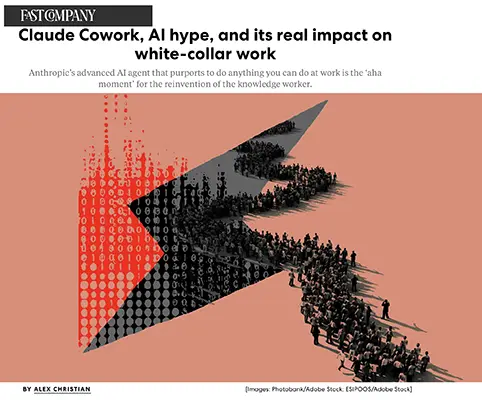
CLAUDE COWORK, AI HYPE, AND ITS REAL IMPACT ON WHITE-COLLAR WORK
FAST COMPANY — FEBRUARY 23, 2026
TL;DR / Key Takeaway:
Claude Cowork represents a more agentic form of workplace AI that could materially compress entry-level knowledge work, accelerate productivity for some users, and deepen concerns about compliance, oversight, and the future talent pipeline.
EXECUTIVE SUMMARY
This Fast Company article argues that Anthropic’s Claude Cowork is more consequential than earlier chatbot-style tools because it is positioned as a general workplace agent rather than a text assistant. According to the piece, Cowork builds on Claude Code, adds a more accessible interface, and can perform multi-step tasks across files, websites, screenshots, and documents, including organizing folders, turning invoices into spreadsheets, synthesizing research, and handling slide comments. The article presents it as an “aha moment” for knowledge work because nontechnical users may be able to direct complex digital tasks that previously required junior staff or specialized support.
The most important business signal is not that full white-collar automation has arrived. The article itself says that mass job displacement has not yet fully materialized. The more immediate concern is structural: if tools like Cowork absorb entry-level research, drafting, synthesis, and coordination work, companies may reduce junior hiring and weaken the development ladder that produces future mid-level and senior talent. The article cites concerns about declining entry-level openings, mentions a 35% drop in U.S. entry-level openings since 2023, and references a Stanford study finding a 16% relative decline in employment for early-career workers in highly exposed occupations since 2022.
The piece also usefully surfaces what is unresolved. Cowork is described as powerful, but not fully reliable: it still requires oversight, can make broader mistakes because of its access to local files and tools, and is not compliance-first, with conversation histories stored locally rather than within tightly regulated enterprise workflows. So the real executive takeaway is this: agentic AI may be more operationally useful than earlier chatbots, but it also creates bigger governance stakes because it can act across real work environments rather than merely generate text.
RELEVANCE FOR BUSINESS
For SMB executives and managers, this matters because tools like Cowork push AI closer to the center of daily office operations. Research, synthesis, spreadsheet work, file organization, and first-draft output are exactly the kinds of tasks many small and midsize firms rely on junior staff, contractors, or overstretched managers to handle. That means agentic AI may create real productivity leverage, but also force uncomfortable decisions about hiring, supervision, data access, and workflow redesign.
It also raises a strategic workforce issue. If companies lean too aggressively on AI for junior-level work, they may save money in the short term while undermining the long-term talent pipeline. Leaders should evaluate these tools not only by hours saved, but by how they affect training, judgment formation, institutional knowledge, and compliance risk.
CALLS TO ACTION
🔹 Pilot agentic workplace AI in bounded workflows first, especially where output can be reviewed easily.
🔹 Do not treat junior-role substitution as a pure efficiency win without assessing long-term talent-pipeline effects.
🔹 Review file access, local storage, and compliance exposure before allowing broad deployment.
🔹 Measure where AI truly reduces workload versus where it shifts oversight burden onto managers.
🔹 Use these tools to augment research and coordination carefully, while preserving human development paths.
Summary by ReadAboutAI.com
https://www.fastcompany.com/91495393/claude-cowork-ai-hype-and-its-real-impact-on-white-collar-work: March 22, 2026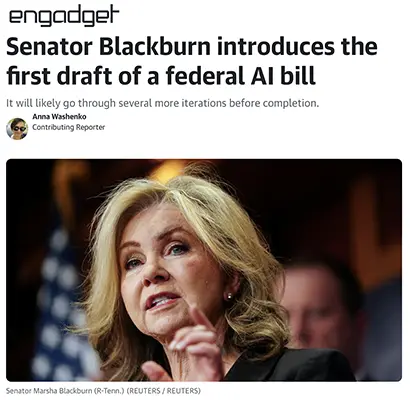
SEN. MARSHA BLACKBURN RELEASES DRAFT AI BILL FRAMEWORK
ENGADGET — MARCH 18, 2026
TL;DR / Key Takeaway:
The draft framework points toward a tougher U.S. AI policy agenda built around duty of care, copyright limits, child safety, likeness protection, transparency, and job-impact reporting — but it is still an opening bid, not settled law.
EXECUTIVE SUMMARY
This Engadget report covers Sen. Marsha Blackburn’s discussion draft for a federal AI bill, presented as an effort to turn the White House’s AI-rulemaking ambitions into legislation. The draft is notable because it takes a more interventionist approach than many industry-friendly AI proposals. According to the report, it would place a duty of care on AI developers to prevent foreseeable harm, reject unauthorized copyrighted-material use for training as fair use, require safeguards for users under 17, protect voice and visual likenesses from nonconsensual digital replicas, set new transparency expectations for AI-generated content, and require some firms and agencies to report AI-related layoffs and job displacement quarterly to the Department of Labor.
The strongest signal is not that these provisions will all become law. The article itself notes this is an early draft and will likely be heavily negotiated, diluted, or reshaped. But it does show where the next phase of U.S. AI governance pressure may come from: liability, creator rights, youth protections, disclosure rules, and labor effects. In other words, the conversation is moving beyond general AI optimism toward who bears responsibility when systems cause harm or shift social costs onto others.
For executives, this matters because even a draft like this can shape expectations, lobbying priorities, procurement questions, and risk planning. What is real now is that the policy agenda is getting more specific. What remains uncertain is which provisions survive and in what form, especially where the draft touches politically contested issues such as bias auditing and Section 230.
RELEVANCE FOR BUSINESS
For SMB executives and managers, this matters because a stricter federal AI regime would raise the bar for vendor diligence, content governance, product disclosures, child-safety compliance, and workforce reporting. Even firms that do not build AI models could still be affected through software vendors, marketing tools, HR systems, and customer-facing platforms.
It also signals that AI governance is broadening. Leaders should no longer think only about model capability or productivity. Policymakers are increasingly interested in harm prevention, consent, transparency, labor consequences, and accountability, which means AI risk is becoming more operational and legal, not just technical.
CALLS TO ACTION
🔹 Track U.S. federal AI policy as an emerging compliance issue, not just a political sidebar.
🔹 Review vendors for transparency, safety, and rights-management posture before rules harden.
🔹 Prepare for tighter standards around AI-generated content labeling and digital likeness use.
🔹 Coordinate legal, HR, and IT teams if AI deployment may affect jobs, reporting, or user safety.
🔹 Treat this draft as an early signal of regulatory direction, while avoiding assumptions that the final law will look the same.
Summary by ReadAboutAI.com
https://www.engadget.com/ai/senator-blackburn-introduces-the-first-draft-of-a-federal-ai-bill-202509852.html: March 22, 2026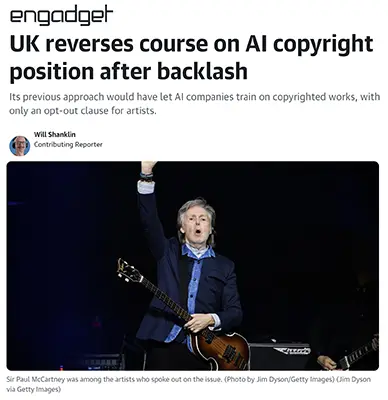
UK REVERSES COURSE ON AI COPYRIGHT POSITION AFTER BACKLASH
ENGADGET — MARCH 18, 2026
TL;DR / Key Takeaway:
The UK government’s retreat from an opt-out approach to AI training on copyrighted material is a meaningful political win for creators, but it leaves the underlying policy conflict unresolved.
EXECUTIVE SUMMARY
This Engadget report covers the UK government backing away from its previous position that would have allowed AI companies to train on copyrighted works unless rightsholders explicitly opted out. After backlash from artists and industry groups, the government said it “no longer has a preferred option” and will take more time before changing copyright law. That is an important shift because it signals that the political path toward broad training access without consent is less straightforward than many AI firms may have hoped.
The real signal is not that the UK has solved the issue. It has not. The government has moved from a controversial position to a more open-ended one, emphasizing the need to protect the country’s creative sector while also supporting AI growth. That means the core conflict remains in place: AI developers want broad access to training material, while creators want consent, compensation, and clearer legal boundaries. The article frames the reversal as a win for artists, and that is fair politically, but from a business standpoint it is better understood as a pause in a larger struggle over licensing, fair use analogs, and bargaining power.
For executives, this matters because copyright policy is becoming a structural constraint on model development, product design, and content strategy. What is real now is that creator backlash can change policy direction. What remains unresolved is how governments will balance innovation incentives with compensation and control for rightsholders.
RELEVANCE FOR BUSINESS
For SMB executives and managers, this matters beyond media and music. Any company using AI-generated content, training internal tools on proprietary material, or relying on vendors with unclear training practices may face legal, reputational, and contractual exposure if copyright rules tighten or fragment across jurisdictions.
The broader lesson is that AI product strategy increasingly depends on content provenance and licensing clarity. Leaders should not assume that today’s permissive practices will remain stable. Where training rights are unclear, governance risk can become a commercial risk.
CALLS TO ACTION
🔹 Ask vendors how their models were trained and what content rights they rely on.
🔹 Treat copyright uncertainty as a live business risk, especially in creative, publishing, and marketing workflows.
🔹 Review contracts for indemnity and liability language tied to AI-generated or AI-assisted content.
🔹 Monitor UK, EU, and U.S. policy divergence, since multi-market compliance may get more complex.
🔹 Favor tools and partners with clearer provenance and licensing discipline.
Summary by ReadAboutAI.com
https://www.engadget.com/ai/uk-reverses-course-on-ai-copyright-position-after-backlash-175630732.html: March 22, 2026
Clinical AI Gains Ground in a Resource-Constrained Hospital
TechTarget — March 17, 2026
TL;DR / Key Takeaway:
For smaller hospitals, clinical AI adoption is being driven less by hype than by staffing pressure and workflow friction, with success depending on whether tools fit existing systems and produce measurable operational gains.
Executive Summary
This article offers a grounded case study in why some community and rural hospitals are adopting clinical AI now: not because they want to be seen as innovative, but because labor shortages and workflow inefficiency are becoming harder to absorb. San Juan Regional Medical Center adopted Wellsheet, a clinical AI platform designed to surface relevant patient information and connect EHR workflows with evidence-based resources like UpToDate. The hospital’s stated goal is practical: reduce time spent searching across systems so clinicians can make decisions more efficiently.
That framing is important. The article repeatedly emphasizes that this was a workflow and access-to-information decision, not an abstract bet on AI. The system does not replace clinical judgment; it organizes patient-specific information, clinical pathways, and reference material inside the existing care environment. That kind of integration is the meaningful signal here. Many AI tools struggle because they add a new layer of work, but this example suggests adoption improves when AI is embedded into existing workflows rather than imposed as a separate destination.
Still, the article remains mostly a deployment narrative, not proof of outcome. The hospital plans to evaluate the investment using metrics such as discharge efficiency, length of stay, earlier identification of deterioration, and clinician satisfaction. Those are appropriate measures, but they are still forward-looking. So what is real now is workflow intent and operational rationale; what remains to be demonstrated is durable clinical and financial return.
Relevance for Business
For SMB healthcare leaders, this matters because it shows a realistic adoption pattern for organizations with limited resources. Smaller operators do not need every cutting-edge AI capability; they need tools that solve bottlenecks, reduce friction, and fit current systems. In that sense, this article is less about AI sophistication and more about disciplined purchasing. Leaders under margin pressure should note that workflow integration, not novelty, may be the more reliable predictor of value.
More broadly, the piece reinforces a useful principle for executive buyers in any sector: AI is easiest to justify when it improves access to information at the point of work and when performance can be measured in operational terms. The constraint is that even good workflow tools still create vendor dependence, implementation burden, and the need to prove results after the rollout.
Calls to Action
🔹 Evaluate AI tools against a specific workflow bottleneck, not a general innovation narrative.
🔹 Favor products that fit inside existing systems rather than requiring parallel work.
🔹 Set post-deployment metrics in advance, including throughput, discharge efficiency, satisfaction, and care-timing measures.
🔹 Be cautious about vendor claims until outcome data is available in your environment.
🔹 Treat clinician usability as a core ROI factor, especially in labor-constrained settings.
Summary by ReadAboutAI.com
https://www.techtarget.com/healthtechanalytics/feature/Clinical-AI-gains-ground-in-a-resource-constrained-hospital: March 22, 2026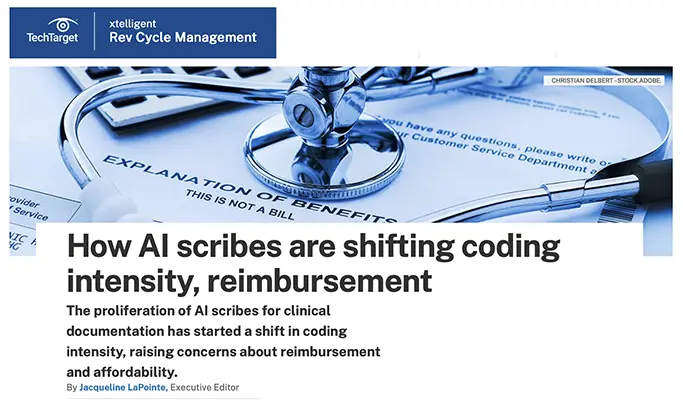
How AI Scribes Are Shifting Coding Intensity, Reimbursement
TechTarget — March 17, 2026
TL;DR / Key Takeaway:
AI scribes may reduce clinician burden, but early evidence suggests they can also increase billing intensity and reimbursement, raising affordability, compliance, and payer-trust concerns.
Executive Summary
This article highlights an important second-order effect of clinical AI adoption: AI documentation tools do not just save time — they can also change how revenue is captured. Citing recent analyses from Blue Cross Blue Shield Association/Blue Health Intelligence and Trilliant Health, the piece reports that AI scribes and ambient listening tools may be associated with more intensive coding patterns, including increased use of higher-acuity billing codes and diagnoses that are not always matched by corresponding treatment patterns. That does not prove intentional fraud or universal upcoding, but it does suggest that AI can materially affect reimbursement flows.
The article fairly presents the ambiguity. One interpretation is that providers were historically undercoding because documentation was incomplete, and AI is now helping them capture legitimate complexity more accurately. Another is that these systems, particularly when tuned around documentation completeness and revenue optimization, may push coding toward the upper edge of what rules allow, even when care itself has not materially changed. That distinction matters because the business consequences extend beyond provider productivity: patients may face higher bills, payers may increase scrutiny, and regulators may revisit coding guardrails.
What is real now is that AI scribes appear to improve physician workflow and reduce documentation burden. What remains unsettled is where better documentation ends and AI-enabled reimbursement inflation begins. For executives, that is the real signal. This is not only a workflow story; it is also a governance, billing, and trust story.
Relevance for Business
For healthcare leaders, this matters because AI scribes are often sold on burnout reduction and operational efficiency, but their downstream effects can trigger payer disputes, audit exposure, and reputational risk. Any productivity gain that is accompanied by unexplained reimbursement shifts could invite closer external review. That makes implementation a cross-functional issue involving clinical operations, compliance, revenue cycle, payer relations, and patient trust — not just physician enablement.
For SMB healthcare operators and managers, the broader takeaway is that AI systems can quietly reshape incentives inside existing business models. When a tool improves documentation, it may also change financial outcomes, pricing optics, and stakeholder perceptions. Leaders should treat this as a reminder that AI adoption often affects adjacent systems, not just the narrow workflow being automated.
Calls to Action
🔹 Review AI scribe outputs alongside coding patterns, not just clinician satisfaction or time saved.
🔹 Establish compliance monitoring for reimbursement shifts after deployment.
🔹 Separate documentation-improvement goals from revenue-maximization incentives in vendor evaluation and internal policy.
🔹 Prepare for payer scrutiny, especially if coding intensity rises faster than care patterns change.
🔹 Monitor patient-cost implications, since affordability concerns can become a reputational issue.
Summary by ReadAboutAI.com
https://www.techtarget.com/revcyclemanagement/feature/How-AI-scribes-are-shifting-coding-intensity-reimbursement: March 22, 2026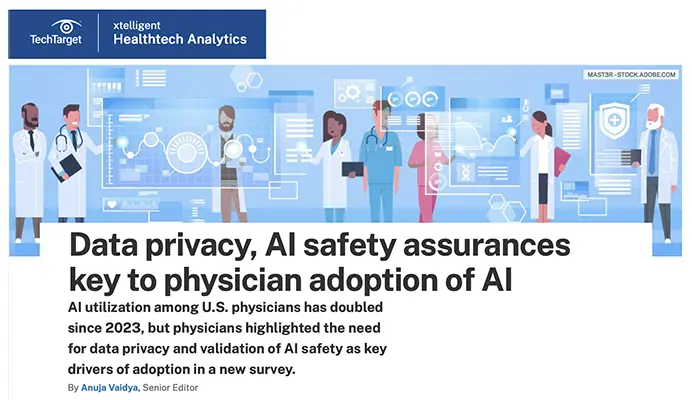
Data Privacy, AI Safety Assurances Key to Physician Adoption of AI
TechTarget — March 13, 2026
TL;DR / Key Takeaway:
Physician AI adoption is rising quickly, but trust remains conditional: privacy protections, validated safety, clear liability, and training are becoming the real gatekeepers of sustained healthcare AI use.
Executive Summary
This article reports that physician AI use has increased substantially, with an AMA survey showing adoption rising to 72% in 2026, up sharply from prior years. The most common use cases are practical and workflow-oriented rather than futuristic: summarizing research, generating discharge instructions and notes, documenting billing codes, and creating chart summaries. That matters because it suggests healthcare AI is becoming embedded first through administrative and information tasks, not wholesale clinical autonomy.
At the same time, the survey makes clear that adoption does not equal trust. Physicians remain cautious, with persistent concern about patient privacy, skill loss, liability, and the quality of AI tools. The strongest drivers of future adoption are not broader enthusiasm or more vendor marketing, but data privacy assurances from employers and EHR vendors, plus validation of safety and efficacy by trusted entities and continuous monitoring. Physicians also want more oversight, post-market surveillance, audits, and a clearer voice in implementation decisions.
That is the key executive signal: healthcare AI is no longer blocked primarily by awareness. It is now constrained by governance credibility. What is real now is growing usage in day-to-day clinical work. What remains unresolved is whether organizations can create the governance, training, and accountability structures necessary to scale that usage responsibly.
Relevance for Business
For healthcare organizations, this matters because AI rollout strategies that focus only on productivity gains may stall if clinicians do not trust the privacy, oversight, and liability framework around the tools. The article suggests the next phase of adoption will depend less on feature expansion and more on institutional assurance. Leaders that treat AI as a procurement exercise rather than a governance program may face internal resistance and uneven uptake.
For SMB executives more broadly, the lesson travels beyond healthcare: in regulated sectors, AI adoption increasingly depends on whether users believe the system is safe, reviewable, auditable, and aligned with professional responsibility. Trust architecture may become as important as technical capability.
Calls to Action
🔹 Prioritize privacy and oversight language in vendor selection and internal rollout plans.
🔹 Require evidence of safety, validation, and ongoing monitoring before expanding use cases.
🔹 Build role-specific training, since user confidence and skill preservation are now adoption issues.
🔹 Create clear accountability structures for liability, escalation, and adverse-event review.
🔹 Include frontline professionals in implementation decisions so adoption is shaped by actual workflow needs.
Summary by ReadAboutAI.com
https://www.techtarget.com/healthtechanalytics/news/366640254/Data-privacy-AI-safety-assurances-key-to-physician-adoption-of-AI: March 22, 2026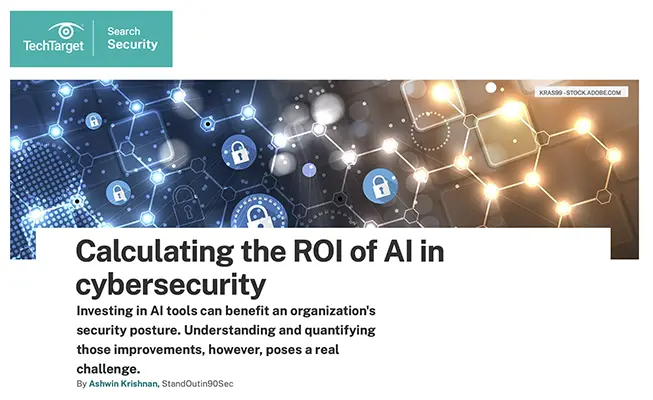
Calculating the ROI of AI in Cybersecurity
TechTarget — March 16, 2026
TL;DR / Key Takeaway:
AI in cybersecurity may improve speed, coverage, and labor efficiency, but proving ROI is still difficult because most value is indirect, reliability is uneven, and human oversight remains necessary.
Executive Summary
This TechTarget piece argues that organizations should stop trying to measure cybersecurity AI purely as a headcount replacement tool and instead evaluate it through throughput gains, risk reduction, and cost avoidance. That is a more realistic framing. In practice, AI may help analysts triage more alerts, review more configurations, and investigate more incidents without proportionally increasing staff. But the article is clear that the hardest part of the ROI case is that security value is often counterfactual: if a breach does not happen, it is difficult to prove AI prevented it.
The more useful signal here is not that AI makes security suddenly easy or precisely measurable. It is that security leaders need better baseline metrics before deployment, including mean time to detect, mean time to respond, vulnerability backlog, coverage gaps, and analyst throughput. The article also surfaces several limits that are often underplayed in AI purchasing discussions: shadow AI can distort ROI claims, weak data and immature workflows reduce returns, and low-confidence outputs still require human review. In other words, the real cost of AI in cybersecurity includes not just software spend, but also validation, governance, and operational discipline.
What is real now is that some cybersecurity teams can use AI to improve efficiency and possibly reduce external services costs. What remains less settled is whether those gains consistently justify enterprise spend across different environments. The article wisely resists overclaiming and instead frames AI ROI as directional and governance-dependent, not automatic.
Relevance for Business
For SMB executives and managers, this matters because cybersecurity AI is often pitched as a fast path to stronger protection with limited staff. The article suggests the reality is more nuanced: AI can help constrained teams do more, but only if the organization already has usable data, clear workflows, and a way to measure improvement. Businesses that lack clean asset inventories, good logging, or disciplined incident processes may buy AI before they are operationally ready to benefit from it.
It also matters because security AI creates a new budgeting conversation. The ROI case will often depend less on labor elimination and more on risk posture, avoided external spend, and improved response speed. For leaders, that means vendor decisions should be tied to concrete operational outcomes, not broad promises about “autonomous security.”
Calls to Action
🔹 Define security baselines before buying any AI tool, including alert volumes, response times, and vulnerability backlog.
🔹 Evaluate human-review requirements upfront, because oversight costs can materially reduce ROI.
🔹 Include shadow AI exposure in any cybersecurity AI business case so the analysis does not understate risk.
🔹 Prioritize workflow-fit over hype, especially for teams with limited security maturity.
🔹 Reassess quarterly, since both threat conditions and AI tool performance can change quickly.
Summary by ReadAboutAI.com
https://www.techtarget.com/searchsecurity/tip/Calculating-the-ROI-of-AI-in-cybersecurity: March 22, 2026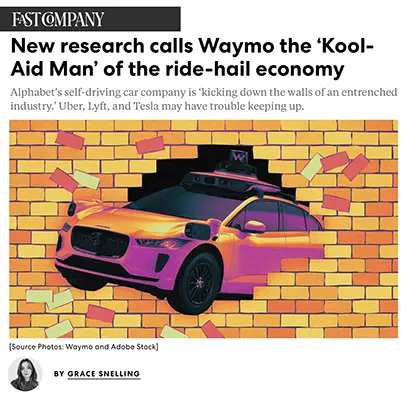
Closing: Mid-Week AI update for March 22, 2026
This mid-week roundup reinforces an increasingly important editorial truth: AI is now both a real business force and a media amplifier, which means leaders have to separate durable signals from attention-driven noise. The organizations that benefit most will likely be the ones that stay curious without becoming reactive, and that evaluate AI not by headline energy, but by operational value, governance readiness, and long-term fit.
All Summaries by ReadAboutAI.com
↑ Back to Top