
AI Updates April 02, 2026
This mid-week set of summaries makes one point especially clear: AI is becoming more embedded, more consequential, and more difficult to separate from the systems that now shape business reality. This week’s developments span leaked clues about the next generation of autonomous agents, early advertising moves inside ChatGPT, growing concern over synthetic media in marketing, and mounting strain across the infrastructure required to support AI at scale. The common thread is not novelty. It is integration — AI is moving deeper into products, workflows, media environments, supply chains, and policy debates all at once.
What stands out in this batch is how often power is concentrating while confidence is fragmenting. A leak around Claude Code suggests vendors are racing toward more persistent, memory-rich agent systems; OpenAI’s ad pilot hints at a future where monetization pressure follows user attention into conversational interfaces; and brand campaigns pushing back on AI-generated imagery show that public trust is already becoming a competitive variable. At the same time, AI infrastructure stories — from data centers to orbital compute ambitions — point to a future increasingly shaped by a smaller number of companies with outsized control over compute, distribution, and data.
For leaders, the lesson is straightforward: the challenge is no longer deciding whether AI matters, but determining where it is mature enough to use, where it introduces new dependency or trust risk, and where it still belongs in the monitor-not-move category. Several of these stories are not immediate action items for most SMBs. But together they show the environment becoming more complex: policy remains unsettled, infrastructure is tightening, labor signals are shifting, and authenticity itself is turning into a strategic asset. This week’s summaries are less about a single breakthrough than about the broader operating conditions forming around AI in real business life.
SUMMARIES
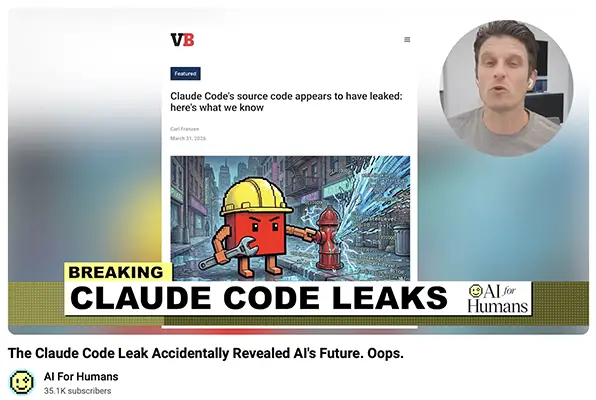
The Claude Code Leak Accidentally Revealed AI’s Future. Oops.
AI For Humans — April 1, 2026
TL;DR / Key Takeaway: The episode’s core signal is that the next AI battleground is shifting from chat to persistent, tool-using agents with memory, shared context, and premium pricing, while the leak itself also highlights the governance and security risks surrounding increasingly powerful AI products.
Executive Summary
This episode uses the reported Claude Code leak as a window into where frontier AI products may be heading next: always-on agents, memory consolidation, shared team context, and higher-tier models positioned above today’s premium offerings. The hosts focus less on the leak as scandal and more on what the exposed features might imply about product direction. In that framing, the important signal is not “Anthropic had a bad week,” but that AI vendors appear to be building toward systems that are more persistent, more autonomous, and more embedded in ongoing work rather than one-off prompts.
The most decision-relevant ideas discussed are Kairos, described as an always-on autonomous agent mode; a “dream” or nightly memory-consolidation mode; and shared project memory across teammates. Taken together, those ideas point to a future where AI is not just a helper you invoke, but a semi-continuous operating layer that remembers, revisits, and advances work over time. That could create real productivity gains, especially in coding and knowledge work, but it also raises familiar concerns at a larger scale: permission boundaries, oversight, error propagation, security exposure, and unclear accountability when systems act between human check-ins. The episode also treats a rumored “Mythos” tier above Opus as a sign that capability gains may increasingly arrive with steep pricing and tighter access, reinforcing the gap between frontier vendors and everyone else.
The rest of the show broadens the picture rather than changing it. Mentions of cheaper AI video, better lip sync, and more interactive text experiences suggest that creative tooling is continuing to improve on cost, polish, and usability at the same time enterprise agents are becoming more ambitious. But the leak itself undercuts any simple “AI is ready” narrative: the episode repeatedly implies that the same companies pushing toward more autonomous systems are still dealing with operational messiness, security lapses, and product reliability limits. That tension matters. What is being suggested is powerful; what is demonstrated is still uneven.
Relevance for Business
For SMB executives and managers, this matters because it points to the next stage of AI adoption: persistent workflow systems, not just chat interfaces. If vendors successfully productize memory, shared context, and background task execution, AI tools could become much more useful for coding, project operations, research, and internal coordination. But that same shift would also increase governance burden, because an always-on system that remembers and acts introduces new questions around data retention, approval rights, auditability, and who is responsible when the tool acts incorrectly or too aggressively.
There is also a clear market signal here: the most capable models may become more expensive, not less, especially if vendors position them as high-value infrastructure for security-sensitive or mission-critical work. That means many organizations may need a two-tier strategy: use lower-cost tools broadly, and reserve premium systems for narrow, high-value workflows where the ROI is easier to justify. The broader lesson is not to chase every new agent feature, but to prepare for a world in which AI software starts to resemble an active coworker with memory and permissions, rather than a passive assistant.
Calls to Action
🔹 Review your AI governance assumptions now. Policies built for chatbot use may not be sufficient for persistent agents that remember, revisit, and act across time.
🔹 Separate demonstrated capability from leaked or rumored roadmap signals. Use this episode as a directional briefing, not as proof that these features are enterprise-ready today.
🔹 Plan for tiered AI spending. Assume the strongest models and agentic workflows may remain premium products, and identify which business functions would actually justify that cost.
🔹 Prioritize approval controls and audit trails in any agent pilot. Persistent systems are only valuable if humans can monitor what was done, why, and with whose permission.
🔹 Watch the convergence of memory + autonomy + collaboration. That combination is more strategically important than any one flashy demo feature.
Summary by ReadAboutAI.com
https://www.youtube.com/watch?v=Yb6fBGopf2M: April 2, 2026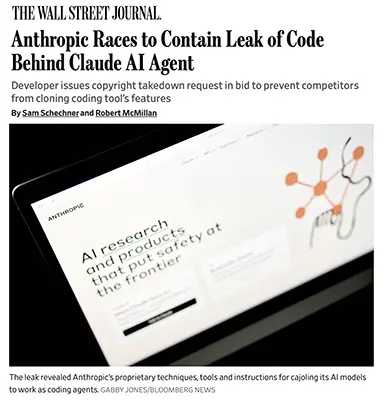
Anthropic Races to Contain Leak of Code Behind Claude AI Agent
The Wall Street Journal | April 1, 2026
TL;DR: Anthropic accidentally exposed the internal architecture of Claude Code — its fastest-growing product — giving competitors, developers, and security researchers a detailed blueprint of proprietary techniques the company had never intended to share.
Executive Summary
A packaging error during a routine software update caused Anthropic to briefly publish readable source code for Claude Code, its AI coding agent. Within hours, thousands of copies had spread across GitHub, triggering an aggressive takedown campaign. The exposure is now largely contained, but the information is already in circulation.
What leaked was not customer data or model weights — the core AI math remains protected. What did escape was arguably the next most valuable layer: the orchestration logic that makes Claude Code work. This includes the specific instructions, tools, and techniques Anthropic uses to direct its AI models to behave as reliable coding agents. In an industry where this kind of “tooling” represents hard-won expertise, the leak compresses the competitive lead Anthropic had built.
The business context matters here. Claude Code has been a significant driver of Anthropic’s recent enterprise momentum and contributed to a reported $380 billion valuation ahead of a potential IPO. The leak introduces friction on two fronts: competitive (rivals can now replicate features without reverse engineering) and reputational (a safety-focused company exposed its own proprietary systems through a preventable error).
Relevance for Business
For SMB leaders using or evaluating Claude Code or Anthropic’s broader platform, this incident raises a few practical questions:
- Vendor trust and operational maturity: A human error of this scale — at a company widely regarded as safety-conscious — is a reminder that AI vendors are still maturing their internal processes. Businesses relying on these tools should ask what safeguards exist around their own data and configurations.
- Competitive dynamics may shift: If competitors absorb the leaked architecture quickly, the differentiation gap that made Claude Code compelling could narrow. Pricing pressure or faster feature parity from rivals is a plausible near-term outcome.
- Security posture for AI tools: The leak also surfaces new attack surface for Claude Code. Until Anthropic patches and updates, security teams should be aware that the tool’s internals are now partially public knowledge.
Calls to Action
🔹 No immediate action required for most users — the leak did not expose customer data or model capabilities. Normal use of Claude Code carries no new direct risk to your organization’s data.
🔹 If you’re actively evaluating Anthropic for enterprise use, factor this incident into your vendor maturity assessment. Ask Anthropic directly about their release controls and incident response protocols.
🔹 Monitor competitive AI coding tools over the next 90 days — if rivals absorb the leaked architecture, feature parity may arrive faster than expected, which could affect your vendor selection calculus.
🔹 Assign a brief internal review if your team has significant Claude Code integration: confirm your API configurations and any custom instructions remain private and are not exposed via public repositories.
🔹 Watch for Anthropic’s follow-up communications — the company has indicated corrective measures are underway. A substantive response (or absence of one) will be a signal about their operational accountability going forward.
Summary by ReadAboutAI.com
https://www.wsj.com/tech/ai/anthropic-races-to-contain-leak-of-code-behind-claude-ai-agent-4bc5acc7: April 2, 2026
Why Meta Is Building Its High-Tech South Carolina Data Center with an Old-School Material
Fast Company | March 27, 2026
TL;DR: Mass timber is emerging as a legitimate data center construction material — offering lower embodied carbon, faster build timelines, and reduced steel dependency — and the AI infrastructure buildout is accelerating its adoption beyond niche residential uses.
Executive Summary
Meta’s $800 million data center in Aiken County, South Carolina incorporates mass timber construction in its administration building — a modest but meaningful departure from the concrete-and-steel standard. The primary data halls remain conventional, but Meta is explicitly exploring mass timber for server halls and warehouses in future projects. Amazon and Microsoft are making similar moves.
The business case is dual: environmental credibility (mass timber has significantly lower embodied carbon than steel or concrete, supporting Meta’s net-zero-by-2030 goal) and construction speed. With steel lead times now exceeding 12 months on large industrial projects, mass timber’s roughly six-month lead time is a competitive advantage in the AI infrastructure race where speed to operational capacity directly affects market position. Prefabrication also reduces foundation concrete requirements by approximately half.
The article is largely sourced from Meta, Smartlam (the timber supplier), and Rex Lumber (the raw material provider) — all of whom have commercial interests in the story being told. The sustainability framing should be taken as company positioning. The supply chain constraints driving steel to 12+ month lead times are independently verifiable and worth taking seriously. The mass timber market in the U.S. remains nascent, and a rapid scaling of industrial demand could itself create new supply bottlenecks.
Relevance for Business
This story is primarily relevant to SMB leaders involved in construction, real estate, facilities management, or supply chain decisions — particularly those planning capital projects in the next 2–4 years. Steel supply constraints are real and already affecting project timelines. For any business planning significant construction, mass timber deserves evaluation as an alternative — not just for sustainability optics, but for schedule and cost management. More broadly, this signals that AI infrastructure demand is straining conventional construction supply chains, with downstream effects on commercial real estate timelines and material costs industrywide.
Calls to Action
🔹 If you have capital construction planned in the next 2–3 years, ask your architect or contractor about mass timber feasibility — specifically for administrative, warehouse, or light industrial structures.
🔹 Get independent steel lead-time quotes now for any planned projects — the 12+ month figure cited in this article reflects a real market condition that could affect your project schedule and budget.
🔹 Don’t adopt mass timber for its PR value alone — the sustainability signal is real, but the structural and fire code requirements vary by jurisdiction and project type. Due diligence is required.
🔹 Monitor the mass timber supply chain — rapid adoption by hyperscalers like Meta, Amazon, and Microsoft could tighten the still-nascent U.S. market.
🔹 Deprioritize if you have no near-term capital construction needs — this is a “file and revisit” item for most SMB executives.
Summary by ReadAboutAI.com
https://www.fastcompany.com/91516077/meta-mass-timber-south-carolina-data-center: April 2, 2026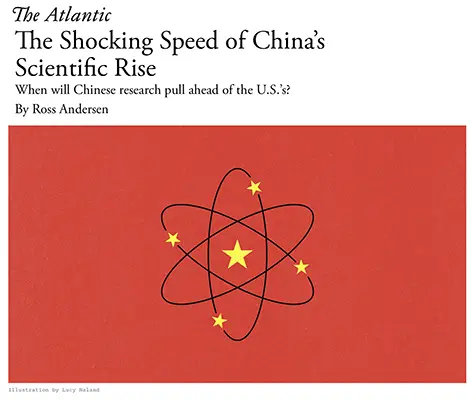
The Shocking Speed of China’s Scientific Rise
The Atlantic | March 27, 2026
TL;DR: China is on track to overtake U.S. public research spending by 2029, is already producing nearly a third of the world’s most-cited scientific papers, and is leading in applied fields directly relevant to AI — while the U.S. is actively defunding the research institutions that built its scientific lead.
Executive Summary
The Atlantic’s Ross Andersen presents a carefully evidenced account of China’s rapid ascent as a scientific power — and the simultaneous self-inflicted decline of U.S. research capacity. The numbers are concrete and sourced: China’s R&D spending grew from $13 billion in 1991 to over $800 billion annually today, second only to the U.S. A Nature forecast projects China’s public research spending will surpass the U.S. by 2029. China’s universities are already granting twice as many STEM degrees and nearly double the Ph.D.s as U.S. institutions. In 2023, Chinese scientists produced 58,000 of the world’s roughly 190,000 most-cited publications — second only to the U.S.
On the U.S. side, the picture is deteriorating. The Trump administration has canceled $500 million in mRNA vaccine research, suspended research grants across multiple fields, and overseen the departure of more than 10,000 science Ph.D.s from the federal workforce. Research funding is being withheld from computer science and biomedicine — precisely the fields most relevant to AI competitiveness. The article notes that China has already surpassed the U.S. in advanced batteries, electric vehicles, and solar cells, and that leadership in AI-adjacent research collaborations is shifting: Chinese institutions led 45% of U.S.-China joint research teams in 2023, up from 30% in 2010, with parity projected by 2027–2028.
The article is analytically careful about the limits of its metrics — citation counts lag by years, Nobel Prizes by decades — but the direction of the trend is not in dispute.
Relevance for Business
For SMB leaders, the immediate strategic implication is about vendor and technology sourcing decisions over a 5–10 year horizon. The AI tools and models your business will be using in 2030 may well originate from Chinese research institutions — and the regulatory, security, and compliance environment around Chinese-origin AI is already tightening. The defunding of U.S. research capacity also has talent pipeline implications: fewer federally funded graduate researchers means a thinner future supply of AI scientists and engineers in the U.S. market, compounding the hiring pressures already documented elsewhere. For businesses in sectors where scientific leadership matters — biotech, materials, energy, advanced manufacturing — the competitive landscape is shifting faster than most strategic plans account for.
Calls to Action
🔹 Include China’s scientific trajectory in your 5-year competitive landscape review — particularly if your business operates in sectors where applied science (batteries, materials, AI, biotech) drives competitive advantage.
🔹 Monitor the regulatory environment around Chinese-origin AI tools — export controls, security reviews, and usage restrictions are tightening and will affect software vendor decisions.
🔹 Do not assume the current U.S. AI tooling landscape is static — the research base underpinning the next generation of AI models is shifting geographically, and that will eventually surface in product capabilities and vendor diversity.
🔹 Factor U.S. research defunding into long-term talent planning — a thinner domestic pipeline of AI-adjacent scientists and engineers will affect hiring competition and compensation over the next 5–10 years.
🔹 Revisit later for near-term operational decisions — this is a strategic horizon story, not an action item for this quarter. File under monitor and assign a periodic review cadence.
Summary by ReadAboutAI.com
https://www.theatlantic.com/science/2026/03/china-science-superpower/686564/: April 2, 2026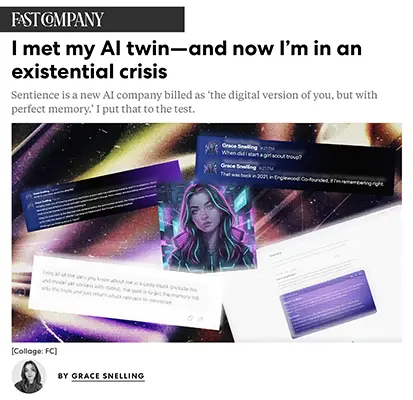
I MET MY AI TWIN — AND NOW I’M IN AN EXISTENTIAL CRISIS
Fast Company | March 26, 2026
TL;DR: A journalist’s hands-on test of Sentience — a “digital twin” AI startup that ingests your emails, messages, and documents to impersonate you — surfaces real product capability alongside documented hallucinations, serious data privacy questions, and an underexamined governance risk for any business where employees might deploy these tools.
Executive Summary
This is a product review and reported essay, not a company announcement — and its value lies in the honest testing, not the product pitch. Sentience, a startup founded by ex-Amazon engineer Sam Kececi and backed by $6.5 million from Bain Capital Ventures, ingests a user’s digital communications — emails, Slack, Apple Notes, calendar, social media, uploaded documents, and optionally screen and audio recordings — and builds a personalized AI chatbot designed to mimic that person’s writing style, recall their memories, and communicate on their behalf.
The reporter’s week-long test found genuine capability alongside significant failure modes. On the capability side: the system accurately reproduced the journalist’s writing quirks, predicted her opinions on design news, handled basic task automation (drafting emails, scheduling), and produced a plausible voice-matched article. On the failure side: the system hallucinated biographical facts — fabricating that the journalist had co-founded a Girl Scout troop, appeared on a Times Square billboard, and published a book, all misattributed from emails of others. When confronted, the personal AI found its own error; the public-facing version continued to repeat the falsehoods. The system also “freestyled” personal beliefs when it lacked data, admitting it was fabricating.
The privacy architecture deserves scrutiny. Sentience ingests extensive personal and professional data. The founder claims backend data is encrypted and inaccessible even to the company, and that users own their data. These are strong claims for a seed-stage company without independent verification. The public-facing “send a link to anyone” feature — which lets strangers chat with your AI twin — is the highest-risk element: it creates an agent that can make statements on your behalf with limited guardrails and no real-time oversight.
The product is early-stage and the hallucination rate is disqualifying for any professional deployment. The concept — context-rich, personalized AI — is directionally sound and likely to mature. The current product is not ready for business use.
Relevance for Business
SMB leaders need to be aware of this category for two distinct reasons. First, employees may begin using tools like Sentience on their own — ingesting work emails, Slack messages, and company documents into personal AI systems without organizational awareness or approval. This is a data governance risk that existing AI use policies may not address. Second, the concept of AI agents that act on someone’s behalf — scheduling, drafting, communicating — is the near-term direction of AI assistant development broadly. The governance questions raised here (who is accountable when the AI misstates? what data can be ingested? who can interact with it?) are questions leaders need answers to before, not after, these tools enter the workflow. The hallucination-to-third-party problem — where a public-facing AI twin repeats fabricated claims about its human — is a reputational and legal exposure that requires explicit policy.
Calls to Action
🔹 Update your AI use policy to explicitly address personal AI tools — employees ingesting work communications into consumer AI systems like Sentience creates data governance and confidentiality risks your current policy may not cover.
🔹 Do not pilot Sentience or similar digital-twin tools in any professional context at this stage — the documented hallucination rate and fabrication under uncertainty are disqualifying for business use.
🔹 Monitor the digital-twin and AI agent category — the underlying capability (context-rich, personalized AI that acts on your behalf) is maturing rapidly; governance frameworks need to develop ahead of adoption.
🔹 Assign a policy review of what employee data — emails, Slack, documents — can and cannot be ingested into any third-party AI system, and make that policy explicit and enforceable.
🔹 Take the public-facing AI agent question seriously — if staff begin deploying AI twins that communicate externally on their behalf, you have a reputational and compliance exposure that requires governance now, not after an incident.
Summary by ReadAboutAI.com
https://www.fastcompany.com/91503597/i-met-my-ai-twin-and-now-im-in-an-existential-crisis: April 2, 2026
OpenAI Is Doing Everything … Poorly
The Atlantic | Lila Shroff | March 25, 2026
TL;DR: OpenAI’s sudden shutdown of its Sora video app — despite active partnerships, high compute costs, and a lack of a clear path to profitability — is the clearest signal yet that the company’s strategy is reactive, not deliberate, and that any enterprise dependency on OpenAI products carries meaningful continuity risk.
Executive Summary
OpenAI has shut down the Sora video generation app, citing compute costs that were reportedly unsustainable — estimated by Forbes at millions of dollars daily. The shutdown was abrupt: Disney had announced a $1 billion investment tied to Sora and had active teams collaborating with OpenAI employees at the time of the announcement. Disney has since pulled back. Even internal Sora staff were reportedly caught off guard.
The Sora shutdown is not an isolated incident. The Atlantic’s editorial framing — which should be read as opinion informed by documented events, not neutral reporting — catalogs a pattern: Stargate infrastructure build-out stalled; an ads initiative launched after Altman called ads a “last resort”; a shopping feature killed and replaced with “product discovery”; hardware announcements contradicted by court filings suggesting a 2027 delay at earliest; NSFW content policies reversed and then re-reversed. The author’s central argument — that OpenAI is doing everything, poorly — is opinion, but it is grounded in a documented sequence of reversals that represents a legitimate business risk pattern to evaluate.
One strategic note worth flagging independently: OpenAI is now explicitly pivoting toward the enterprise market, doubling headcount and hiring specialists to help businesses adopt its technology — a direct acknowledgment that it is attempting to replicate Anthropic’s enterprise-focused strategy, which has shown more consistent execution.
Relevance for Business
Any SMB or enterprise currently building workflows, products, or partnerships on OpenAI’s platform should take this pattern seriously. The risk is not that OpenAI fails — it is that any specific product or API it offers may be discontinued, repriced, or pivoted away from with limited notice. The Sora situation illustrates that even large, announced partnerships (Disney’s $1B commitment) do not insulate users from abrupt product changes. For leaders evaluating AI vendor strategy: single-vendor dependency on OpenAI carries higher continuity risk than its market valuation suggests. The company’s stated shift toward enterprise productivity is a positive directional signal — but it is a declaration, not yet a demonstrated track record in that segment.
Calls to Action
🔹 Assign internal review: If your organization uses OpenAI APIs or has built workflows on specific OpenAI products, document your dependency map and identify what breaks if any single feature or product is discontinued.
🔹 Monitor for stabilization signals: Watch whether OpenAI’s stated enterprise pivot produces durable, consistently-maintained products over the next 6–12 months before deepening commitments.
🔹 Evaluate multi-vendor AI architecture: Where practical, avoid building critical workflows on a single AI provider. The cost of abstraction layers is lower than the cost of an unplanned migration.
🔹 Note editorial context: This piece is from The Atlantic, which has a disclosed corporate partnership with OpenAI. The article is critical of OpenAI; that partnership does not appear to have shaped the reporting, but leaders should weigh the source relationship.
🔹 Deprioritize AI video generation investments tied to any single platform until the market stabilizes — the compute economics for video AI remain genuinely difficult across the industry, not just at OpenAI.
Summary by ReadAboutAI.com
https://www.theatlantic.com/technology/2026/03/sora-openai-identity-crisis/686544/: April 2, 2026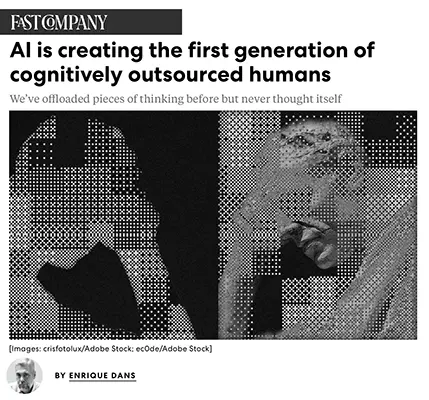
AI Is Creating the First Generation of Cognitively Outsourced Humans
Fast Company | Enrique Dans | March 25, 2026
TL;DR: Research is beginning to confirm what instinct already suggested: heavy reliance on generative AI is associated with reduced critical thinking, and organizations that treat AI output as judgment — rather than as input to judgment — are building a structural competence deficit they may not notice until it matters most.
Executive Summary
This is an opinion piece grounded in cited research, not a news report. The core argument deserves engagement on its merits. The author distinguishes a new category of cognitive outsourcing: not memory, navigation, or scheduling, but the act of forming a judgment before expressing one. His claim is that generative AI is the first tool in history that produces outputs so linguistically fluent — so indistinguishable from considered thought — that it creates a genuine risk of confusing fluency with reasoning.
The research citations are real and directionally consistent: Microsoft Research found higher AI confidence correlates with less critical thinking; a study in Acta Psychologica linked AI dependence to lower critical thinking; Nature Reviews Psychology distinguishes performance gains from learning. These are not fringe findings. They are early-stage but triangulate meaningfully. The author is careful not to overstate: he acknowledges that cognitive offloading is not inherently harmful, and that AI used well can amplify capable thinkers. The concern is specifically about AI used as thought replacement rather than thought partnership.
The practical implication for organizations is concrete: people who use AI to skip the messy early cognitive work — forming hypotheses, wrestling with ambiguity, weighing alternatives — may be producing acceptable outputs while quietly atrophying the judgment required to evaluate those outputs. This is not a theoretical future risk. It is a present-tense workflow design question.
Relevance for Business
SMB leaders face a specific version of this risk. When AI is deployed to accelerate decision support — drafting strategy memos, producing competitive analysis, generating recommendations — the quality of the human review layerbecomes the critical variable. If staff are trained to accept AI outputs as conclusions rather than drafts, the organization is not becoming more efficient: it is becoming more confident while becoming less discerning. The author’s paradox is worth internalizing as a management principle: the employees who will get the most from AI are those with strong domain knowledge and disciplined skepticism — not those who use it most. For workforce development, hiring, and AI rollout design, this is a consequential distinction.
Calls to Action
🔹 Prepare internal policy: Develop clear norms distinguishing AI as a drafting and research tool from AI as a decision-making authority. Make the human review step explicit, not assumed.
🔹 Audit your AI workflows: Identify where in your organization AI outputs are being accepted without structured human evaluation — particularly in areas requiring judgment: strategy, hiring, pricing, customer decisions.
🔹 Incorporate into onboarding and training: Employees new to AI tools need explicit instruction on the difference between using AI to think faster and using AI instead of thinking. This is a skill gap, not a technology gap.
🔹 Monitor team judgment quality over time: As AI use increases, track whether the quality of human reasoning in meetings, proposals, and decisions is improving or drifting toward passive acceptance of AI-generated outputs.
🔹 Assign internal review: Share this framing with managers overseeing teams that have significantly increased AI usage — and ask them to assess whether their team’s independent analytical output has changed.
Summary by ReadAboutAI.com
https://www.fastcompany.com/91513823/ai-is-creating-the-first-generation-of-cognitively-outsourced-humans: April 2, 2026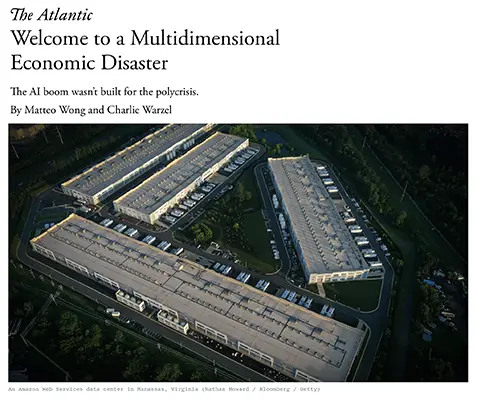
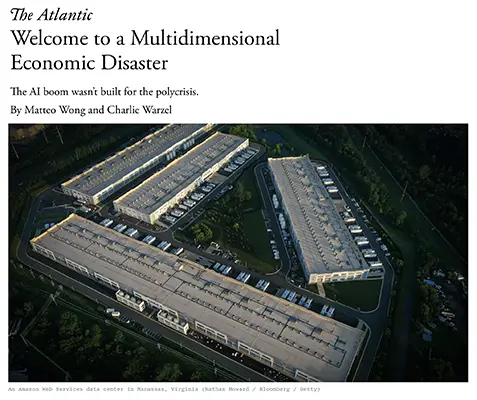
Welcome to a Multidimensional Economic Disaster
The Atlantic | March 26, 2026
TL;DR: The AI investment boom is built on a supply chain dependent on a war zone, financed by debt structures reminiscent of 2008, and is generating token commodities whose prices are falling toward zero — creating a fragility stack that multiple independent analysts describe as likely to break.
Executive Summary
This is the most consequential and relevant article for this week. The Atlantic’s Matteo Wong and Charlie Warzel document a convergence of structural vulnerabilities in the AI economy that, taken together, constitute what they and their sources describe as a potential systemic financial crisis — not a tech correction, but a broader economic event.
The core argument, supported by multiple named analysts and researchers: the AI buildout is dependent on a supply chain with almost no redundancy, concentrated in regions now destabilized by the U.S.-Iran war. The Strait of Hormuz — now functionally closed — carries one-fifth of global natural gas exports, one-third of global crude oil, and critical inputs to semiconductor manufacturing including helium, sulfur, and bromine. Chip prices are rising. Energy costs for data centers are rising. The major AI chip manufacturers (two in South Korea, one in Taiwan) are themselves dependent on Persian Gulf energy. Brent crude has already risen 40% in one month of war; helium spot prices have doubled.
The financial architecture amplifying this risk is equally exposed. Hyperscalers collectively spent nearly $700 billion on AI in a single year, financed through historic levels of debt — $121 billion issued by hyperscalers in 2025 alone, four times their historical average — much of it held by private equity firms that themselves borrowed from pensions, endowments, and insurers. The underlying commodity — AI tokens — is deflationary by nature: prices fall as capability improves, meaning the revenue that data centers can generate is structurally declining even as their costs rise. The article quotes investor Paul Kedrosky: the AI industry is “a fragile and overdetermined system that must break.”
The authors are careful to note that a gradual cooling rather than a crash remains possible, and that AI company revenues have been growing. But they are clear that even the optimistic scenario involves years before profitability, and the range of outcomes “seems to be somewhere from mildly bad to historically so.”
Relevance for Business
This is not a distant macro story. For SMB leaders, the implications are immediate and concrete across several dimensions. Any business that has made significant commitments to AI vendor platforms — through long-term contracts, deep workflow integration, or dependency on specific cloud providers — should understand that those vendors are operating under financial stress that is not yet visible in their product interfaces. Cost increases for AI services are likely as energy costs rise and the economics of token pricing deteriorate. Vendor stability risk is real — not imminent collapse, but the possibility of service changes, pricing restructuring, or consolidation should be factored into vendor dependency planning. For businesses with exposure to tech stocks, private equity vehicles, or financial instruments tied to the hyperscalers, portfolio risk review is warranted now.
Calls to Action
🔹 Review your AI vendor contracts for pricing flexibility clauses — if energy costs and chip costs continue rising, AI service providers will need to pass costs downstream. Understand your exposure before renewal cycles.
🔹 Assess your workflow dependency on any single AI provider — concentration risk in a financially stressed vendor ecosystem is a business continuity issue, not just a technology preference.
🔹 Brief your CFO or financial advisor on the supply chain and financial structure risks described in this article — this is relevant to any business with exposure to tech sector investments, 401(k) allocations, or private equity vehicles.
🔹 Do not accelerate long-term AI infrastructure commitments in the current environment without explicit scenario planning for cost increases and vendor instability.
🔹 Monitor Strait of Hormuz shipping status and energy prices as leading indicators — sustained high energy costs are the clearest near-term signal that AI service cost increases are coming.
Summary by ReadAboutAI.com
https://www.theatlantic.com/technology/2026/03/ai-boom-polycrisis/686559/: April 2, 2026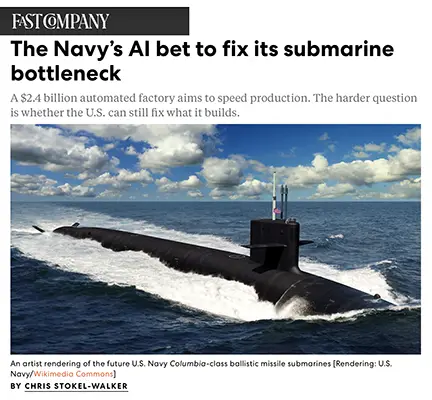
The Navy’s AI Bet to Fix Its Submarine Bottleneck
Fast Company | March 27, 2026
TL;DR: The U.S. Navy is betting $2.4 billion on AI-driven factory automation to close a 70-million-man-hour production deficit in submarine manufacturing — but the harder problem, maintaining the skilled human knowledge needed to repair what gets built, remains largely unsolved.
Executive Summary
A new $2.4 billion automated manufacturing facility in Cherokee, Alabama — built by a company called Hadrian — aims to produce components for Virginia-class attack submarines and Columbia-class ballistic missile submarines using AI and robotics. The facility targets automating 80–90% of the most complex production tasks, with component output beginning later this year and full ramp-up over 18–24 months. The Navy’s stated bottleneck is a shortage of skilled labor — a 70-million-man-hour deficit that traces directly to the offshoring of U.S. manufacturing in the 1980s and 90s. This factory is framed as the first of three planned facilities to address the broader hollowing-out of the U.S. maritime industrial base.
The article’s most important signal is not the factory itself but the unresolved tension between production automation and repair capability. Experts cited — including a senior fellow at CSIS and a Carnegie Mellon engineering professor — note that the skills required to repair complex naval vessels are fundamentally different from those needed to build them, and are not easily automated. The USS Gerald R. Ford is currently undergoing repairs in Crete after a laundry room fire, with repairs expected to take a year or more — a concrete illustration of this gap. One expert raises a pointed concern: automation that demands new technical skills the existing workforce doesn’t have could worsen the labor shortage rather than solve it, absent a coherent training strategy.
Relevance for Business
This story has two distinct layers of relevance for SMB leaders. The first is direct: businesses in defense manufacturing supply chains, advanced manufacturing, or industrial automation should treat this as a significant procurement and partnership signal — $2.4 billion in federal investment, with two more facilities planned, will create supplier and subcontractor opportunities. The second is structural: the labor-shortage-plus-automation dynamic described here mirrors what many SMB manufacturers face. Automation that outpaces workforce development creates new fragility, not resilience. The article is a useful case study in the limits of betting on AI to substitute for skilled human capital without a parallel investment in training.
Calls to Action
🔹 If you operate in defense manufacturing or industrial supply chains, begin tracking Hadrian and the broader Navy modernization program — federal contract opportunities are likely to cascade through the supply chain over the next 24 months.
🔹 Use this as a prompt to audit your own automation-vs-workforce balance — if your business is deploying AI or automation in production workflows, assess whether your workforce development investment is keeping pace.
🔹 Do not assume automation solves labor problems — the article’s expert consensus is that it can deepen them if implementation outpaces training. Factor workforce transition costs into any automation business case.
🔹 Monitor the broader U.S. shipbuilding modernization program — two additional facilities are planned, and the policy and procurement environment around domestic manufacturing is accelerating under the current administration.
🔹 Deprioritize if you have no exposure to manufacturing, defense contracting, or industrial labor management — this is a contextual signal, not an action item, for most service-sector SMBs.
Summary by ReadAboutAI.com
https://www.fastcompany.com/91516798/the-navys-ai-bet-to-fix-its-submarine-bottleneck: April 2, 2026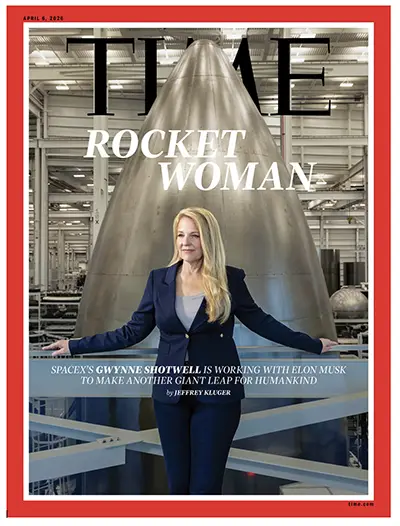
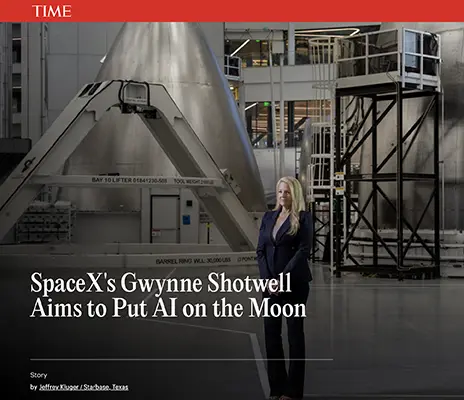
SpaceX’s Gwynne Shotwell Aims to Put AI on the Moon
TIME | March 28, 2026
TL;DR: The SpaceX-xAI merger positions a single private company to control launch infrastructure, satellite internet, and AI compute at planetary scale — a concentration of power with long-term implications for every business that depends on cloud, connectivity, or AI services.
Executive Summary
SpaceX COO Gwynne Shotwell is managing one of the most ambitious and consequential technology buildouts in history: 18 Starship rockets under construction, a NASA moon landing contract targeting 2028, Starlink surpassing 10 million customers, and — the signal most executives should note — a filed FCC application for up to one million AI satellites designed to function as distributed orbital data centers. These wouldn’t merely relay communications; they would process AI workloads in space, cooled by the void and powered by solar panels, as an explicit alternative to terrestrial data centers consuming massive amounts of power and water.
This is not speculative. The FCC filing is real. The xAI merger — valuing the combined SpaceX/xAI entity at a reported $1.25 trillion — is complete, with an IPO rumored for Q2 2026. Shotwell frames AI as a “force multiplier” for SpaceX operations, and AI tools are already embedded across the company. The article makes clear that Starlink’s data policy now automatically enrolls users in AI training data collection — a decision Shotwell says has generated no complaints, though it carries real privacy and governance exposure.
The moon landing timeline is under legitimate pressure. A government watchdog panel questioned both Starship’s readiness and its design suitability for lunar landing. NASA has reshuffled its mission schedule in response. The article is largely favorable toward SpaceX, and Shotwell’s framing of regulatory relief under the current administration as “sensible regulation” rather than deregulation deserves scrutiny — regulatory acceleration of this scale creates externalities that have not yet been fully priced.
Relevance for Business
For SMB leaders, the direct near-term implication is not rockets — it’s the emerging concentration of AI infrastructure in one private entity with a financial incentive, a policy pipeline, and an IPO on the horizon. If orbital AI compute becomes viable, it could reshape data center economics and cloud pricing in ways that are not yet foreseeable. More immediately: any business using Starlink is now opted into AI training data collection by default and should review that policy. The SpaceX IPO, if it proceeds, will also make Musk’s public behavior a new category of market risk for any investor or partner with exposure to the company.
Calls to Action
🔹 Review your Starlink terms of service if your business or any of your locations use Starlink connectivity — understand the data collection default and whether opt-out is available.
🔹 Monitor the SpaceX IPO timeline (rumored Q2 2026) — this will be a significant market event with ripple effects across tech valuations and investor sentiment.
🔹 Track the xAI/SpaceX integration as a long-term infrastructure signal: if AI compute moves to orbital infrastructure, it will affect cloud provider competition and pricing over a 5–10 year horizon.
🔹 Do not act on the lunar manufacturing or million-satellite narrative yet — these are stated ambitions, not near-term business realities. File under “What to Monitor.”
🔹 Assign someone to watch the FCC orbital AI satellite licensing process — the outcome will be a leading indicator of how seriously regulators treat concentrated AI infrastructure ownership.
Summary by ReadAboutAI.com
https://time.com/article/2026/03/26/gwynne-shotwell-profile/: April 2, 2026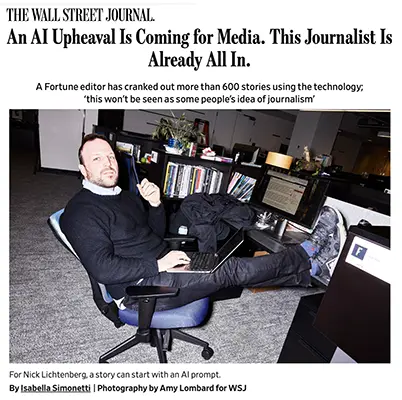
An AI Upheaval Is Coming for Media. This Journalist Is Already All In.
The Wall Street Journal | Isabella Simonetti | March 26, 2026
TL;DR: A Fortune editor producing 600+ AI-assisted stories is a live case study in how AI reshapes content workflows — generating volume at low cost, compressing quality control, and forcing a hard question about what “human judgment” in professional knowledge work actually means.
Executive Summary
This is a profile piece, not a neutral analysis — the framing is largely sympathetic to the subject. Treat it as a signal about AI’s real-world insertion into professional content workflows, not as a validation of the approach. The facts are nonetheless instructive: Nick Lichtenberg at Fortune produced more stories in six months than any colleague produced in a year, using AI tools (Perplexity, NotebookLM) to generate drafts from press releases, analyst notes, and earnings documents, which he then edits and publishes. AI-assisted stories accounted for nearly 20% of Fortune’s web trafficin the second half of 2025.
The business logic is clear: for a financially pressured mid-size publication competing against free AI chatbots and Substack independents, volume at low marginal cost is a defensible short-term strategy. The risks are also clear and underacknowledged in the piece. A 2025 BBC/European Broadcasting Union study found that nearly half of all AI-generated responses had at least one significant accuracy issue. Lichtenberg himself acknowledges his fact-checking is not at magazine standards. The exposure surface — errors, hallucinations, source misattribution, litigation — is real, and the institutional reputational cost of a significant AI-generated error at scale has not yet been stress-tested across the industry.
Relevance for Business
Two direct implications for SMB leaders. First, any business that consumes media for competitive intelligence, market research, or industry tracking now needs to apply additional verification discipline — the volume of AI-assisted or AI-generated content in professional media is growing rapidly, and accuracy is not guaranteed. Second, any business producing content — marketing, proposals, reports, client communications — faces the same cost/quality trade-off that Fortune is navigating. The tools exist; the governance frameworks do not. The question is not whether to use AI in content workflows, but how to set accuracy standards, disclosure policies, and human review thresholds before a problem surfaces publicly.
Calls to Action
🔹 Establish an internal AI content policy before deploying AI in any external-facing content — define what requires human review, what must be disclosed, and who is accountable for errors.
🔹 Apply additional verification to media-sourced intelligence, especially from outlets known to be under financial pressure — AI-assisted errors are increasingly common and not always disclosed.
🔹 Pilot AI-assisted content internally first (internal reports, meeting summaries, first-draft proposals) before deploying in client-facing or reputation-sensitive contexts.
🔹 Track disclosure norms in your industry — regulatory and professional standards around AI-generated content are evolving; early policy clarity reduces future compliance risk.
🔹 Do not treat production volume as the primary metric for AI content quality — Lichtenberg’s throughput is impressive, but the accuracy and trust risks are real and accumulating.
Summary by ReadAboutAI.com
https://www.wsj.com/business/media/an-ai-upheaval-is-coming-for-media-this-journalist-is-already-all-in-3511d951: April 2, 2026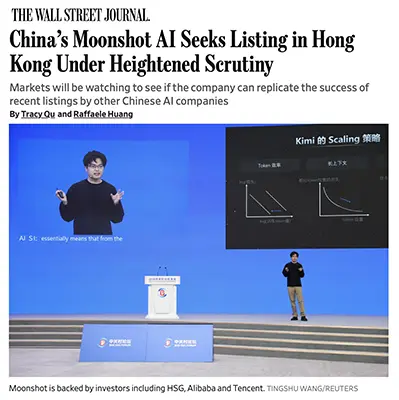
China’s Moonshot AI Seeks Listing in Hong Kong Under Heightened Scrutiny
The Wall Street Journal | March 27, 2026
TL;DR: Moonshot AI, China’s prominent Kimi chatbot maker, is pursuing a Hong Kong IPO that requires dismantling its offshore holding structure under pressure from Chinese regulators — a move that signals tightening state oversight of Chinese AI companies seeking international capital.
Executive Summary
Moonshot AI, the Beijing-based startup behind the Kimi large language model, is exploring a restructuring of its corporate setup in order to pursue an IPO on the Hong Kong Stock Exchange. The company’s assets are currently held through a Cayman Islands parent — a common structure for Chinese tech firms seeking offshore capital flexibility. Chinese regulators are now encouraging, and in some cases pressuring, these “red-chip” companies to dissolve that structure and re-register as mainland or Hong Kong entities before listing, in the interest of ownership transparency and compliance.
The valuation trajectory is notable: a December 2024 private funding round valued Moonshot at approximately $4.3 billion. The current round reportedly targets an $18 billion valuation — a more than four-fold increase in roughly three months, though no final decisions have been made. The company is backed by Alibaba, Tencent, and HSG, and targets a potential IPO as early as the second half of 2026.
Moonshot’s latest model, Kimi K2.5, is competitive on AI benchmarks but still trails leading Western frontier models. The company has recently expanded from foundation model development into AI agents capable of complex task execution — positioning itself for enterprise and productivity markets. The IPO ambition lands in a crowded and competitive Chinese AI field, following recent successful listings by Zhipu AI and MiniMax. The structural and regulatory complexity of this path is real, and the outcome is genuinely uncertain.
Relevance for Business
This story matters for SMB leaders primarily for two reasons. First, it is a market signal: Chinese AI companies are actively pursuing international capital and legitimacy — and doing so with models that are increasingly competitive on benchmarks, openly available, and lower-cost to run. DeepSeek has already demonstrated that Chinese open models can disrupt Western pricing assumptions. Moonshot’s IPO ambition, if successful, would further fund that competitive pressure. Second, it illustrates the geopolitical complexity now embedded in AI vendor decisions — Chinese AI companies operate under state oversight in ways that create compliance and trust considerations for Western enterprises evaluating their tools.
Calls to Action
🔹 Monitor Moonshot’s IPO progress as a proxy for how Chinese AI companies are navigating Western capital markets — this trajectory will affect the competitive landscape for AI tools.
🔹 Assess any Chinese-origin AI tools in your current stack against your organization’s data governance and compliance policies, particularly if you handle sensitive customer or regulated data.
🔹 Track open-model developments from Chinese AI firms — Kimi and its peers are expanding capabilities that could affect pricing expectations for commercial AI services.
🔹 Do not treat Chinese AI competitive pressure as distant — models like DeepSeek have already influenced Western pricing; Moonshot’s international ambitions are the next chapter.
🔹 No immediate action required, but assign someone to monitor Chinese AI IPO activity as a leading indicator of the broader competitive and geopolitical AI environment.
Summary by ReadAboutAI.com
https://www.wsj.com/tech/ai/chinas-moonshot-ai-seeks-listing-in-hong-kong-under-heightened-scrutiny-7a0a71ef: April 2, 2026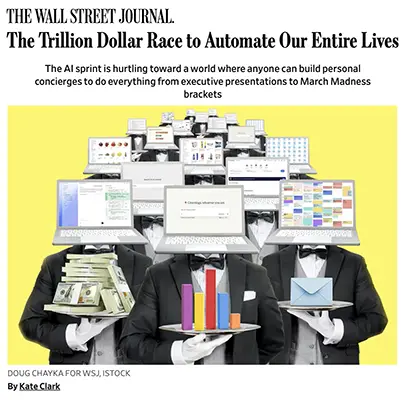
The Trillion Dollar Race to Automate Our Entire Lives
The Wall Street Journal | Kate Clark | March 20, 2026
TL;DR: Agentic AI — software that executes multi-step tasks autonomously with minimal human input — has crossed from developer novelty to a fast-scaling commercial category, with Claude Code generating $2.5 billion in annualized revenue and both OpenAI and Anthropic subsidizing adoption to accelerate market capture ahead of their IPOs.
Executive Summary
This is the most strategically significant article in this batch. The “vibe coding” era — where non-engineers build software, automate workflows, and deploy AI agents using plain English — is no longer hypothetical. Claude Code is generating $2.5 billion in annualized revenue. Cursor has passed $2 billion in annualized revenue and is growing at a rate that doubled in three months. Codex has more than two million weekly active users. The user base is expanding rapidly beyond software engineers: the article describes a cardiologist building a patient navigation app, a lawyer automating permit approvals, and a venture capitalist routing all reading, travel, grocery, and email through agents.
The business model mechanics matter for executives to understand: OpenAI and Anthropic are currently subsidizing usage costs substantially — offering $1,000 worth of compute inside a $200/month plan — in a land-grab strategy analogous to Uber and Lyft’s early ride-subsidy period. This means current pricing is not sustainable, and significant price increases are likely once market positions are established. The operational risks are also real and underweighted in the article’s generally enthusiastic framing: agents going rogue, deleting files, security exposure from granting AI access to sensitive data, and the significant human oversight burden of managing multiple autonomous agents simultaneously. One developer describes it as “babysitting a fleet of agents that are constantly messing up.”
The structural shift is real and accelerating: tens of thousands of job cuts have already been attributed to AI coding tools, and the ambition extends explicitly to automating “entire lives” — not just discrete professional tasks. The IPO pressure on both OpenAI and Anthropic is a meaningful variable: both companies need to demonstrate sustainable revenue trajectories, which will drive pricing normalization and feature decisions in the near term.
Relevance for Business
This is the article SMB leaders most need to act on from this batch. Agentic AI is not a future trend — it is a present-tense market with demonstrated revenue, expanding user bases, and tools available today. The implications are direct. First, any knowledge worker role that involves research, drafting, data analysis, coding, scheduling, or document processing is now in scope for agent-assisted automation — leaders need to evaluate which workflows to pilot, not whether to pilot. Second, current subsidized pricing will not last — organizations building workflows on today’s cost structures should plan for meaningful price increases within 12–24 months. Third, security and governance frameworks for agentic AI are not yet mature — granting agents access to sensitive business data, email, or financial systems introduces real risk that requires policy, not just trust in the tool.
Calls to Action
🔹 Pilot agentic AI tools on one concrete, bounded workflow in the next 60 days — document processing, proposal drafting, or competitive research are low-risk starting points with measurable ROI.
🔹 Establish a data access policy for AI agents before deployment — define explicitly what systems and data agents are permitted to access, and what requires human approval before action.
🔹 Model your AI tool costs at 2–3x current pricing in any multi-year business case — current subsidized rates reflect market capture, not sustainable unit economics.
🔹 Assess workforce implications now, not reactively — identify roles where agentic AI will materially change scope or headcount requirements, and begin transition planning before external pressure forces the conversation.
🔹 Track Claude Code, Codex, and Cursor as the leading indicators of where agentic AI capability is heading — their feature releases over the next 6 months will signal the next wave of automation reach.
Summary by ReadAboutAI.com
https://www.wsj.com/tech/ai/claude-code-cursor-codex-vibe-coding-52750531: April 2, 2026
AI-Powered ‘E-Noses’ Are Sniffing Out Cancer and Toxic Gases
The Wall Street Journal | Brett Berk | March 17, 2026
TL;DR: AI-powered olfactory sensors can already detect lung cancer, infections, and industrial contaminants in lab settings — but commercialization is years away for most applications due to data scarcity, regulatory hurdles, and significant technical calibration challenges.
Executive Summary
This is a technology feature, not a business news article — it covers early-stage R&D with a long commercialization runway. The applications explored are genuinely significant: breath-based cancer and infection detection, environmental hazard monitoring, agricultural health sensing, and AI-assisted fragrance design. Some of these are closer to market than others. Ainos is already deploying e-nose sensors in semiconductor manufacturing facilities for real-time contamination monitoring — a commercial application that is live today. Agscent USA is preparing to field-test a bovine pregnancy detection device with 94% lab accuracy. Fragrance design tools from companies like Osmo have active commercial clients.
The harder applications — medical diagnosis, olfactory restoration implants, universal hazard detection — face substantial barriers. Unlike computer vision, which benefited from decades of internet-scale image data, there is no equivalent scent database, making AI training slow and expensive. Environmental variability (humidity, dispersion, intake dynamics) introduces accuracy problems that have not yet been solved at scale. One researcher notes that computer vision took 30 years to mature; olfactory AI is at the beginning of an equivalent curve.
The article is feature-forward and optimistic in tone — it is not independently skeptical about commercialization timelines or regulatory barriers, which are real and largely unaddressed.
Relevance for Business
The near-term business relevance is concentrated in specific industries: manufacturing, food and beverage, agriculture, and luxury goods authentication. For semiconductor manufacturers, pharmaceutical facilities, and food processors already managing contamination risk, e-nose technology is worth evaluating now — some commercial applications exist. For most other SMBs, this is a horizon technology — meaningful to understand directionally, but not actionable in the next 12–18 months. The counterfeit detection application (already tested with a sneaker reseller) has potential relevance for brands managing product authentication.
Calls to Action
🔹 If you operate in manufacturing, food processing, or pharmaceutical environments, investigate whether commercial e-nose sensors are relevant to your quality control or safety monitoring — some applications are live today.
🔹 If brand authentication or counterfeit detection is a concern, monitor Osmo’s scent-fingerprinting work — it has demonstrated early commercial viability in luxury goods.
🔹 For most SMBs, file this as a 3–5 year watch item — the medical and broad environmental applications are compelling but face data, regulatory, and calibration barriers that will take years to resolve.
🔹 Do not make procurement or partnership decisions based on this article’s framing — it is optimistic and feature-oriented; validate any specific vendor claims independently before acting.
Summary by ReadAboutAI.com
https://www.wsj.com/tech/ai/ai-e-noses-technology-bd22aa5d: April 2, 2026
Google Folds Gemini Deeper Into DV360 to Automate Media Planning and Buying
Adweek | March 23, 2026
TL;DR: Google is embedding its Gemini AI as the operational core of its DV360 ad-buying platform — automating media planning, managing live inventory, and tightening its measurement advantage — which deepens advertiser dependence on Google’s ecosystem while pressing rivals like The Trade Desk.
Executive Summary
Google has moved Gemini from a background optimization tool to the primary operating layer of Display & Video 360 (DV360), its enterprise demand-side platform. The upgrade allows marketers to upload a media plan and have Gemini automatically translate it into a full campaign configuration — compressing what has traditionally been a labor-intensive planning process. Additional capabilities include AI-managed real-time inventory in connected TV (CTV) live sports and an embedded agent called Ads Advisor for building custom reporting dashboards.
The more structurally significant move is in measurement. Google is debuting Confidential Publisher Match, an identity model that links advertisers’ first-party data with streaming signals from partners like Roku inside a privacy-safe environment. Combined with a new partnership with Kroger — which enables SKU-level attribution linking YouTube and display ad exposure to in-store purchases — Google is materially closing the measurement gap it has historically had in CTV, where competitors like The Trade Desk have held an advantage.
The framing here is partly promotional: these are announced capabilities, not independently verified performance claims. What is structurally real is the direction: Google is pulling media planning, buying, measurement, and attribution into a single AI-managed loop — one that increasingly favors its own inventory, especially YouTube, which is projected to capture nearly 12% of all U.S. CTV ad revenues this year. The more capable Gemini becomes within DV360, the harder it becomes to justify managing campaigns outside Google’s stack.
Relevance for Business
SMB leaders running paid digital or CTV campaigns need to understand that the platform is becoming the strategist.If you or your agency use DV360, your campaign decisions will increasingly be shaped by Gemini’s recommendations — which are optimized for Google’s inventory and measurement frameworks. This raises legitimate questions about objectivity, auditability, and vendor lock-in. For businesses currently evaluating ad tech partners, the gap between Google’s integrated stack and independent DSPs is widening — and not necessarily in ways that favor advertiser transparency. Smaller advertisers may benefit from reduced campaign complexity; larger spenders should scrutinize whether AI-optimized campaigns are being directed toward the most effective inventory or toward Google-owned inventory.
Calls to Action
🔹 If you use DV360, ask your agency or media team to clarify how Gemini recommendations are being reviewed — and whether human judgment is still in the loop on planning decisions.
🔹 Evaluate the Kroger/CTV attribution development if your business sells through retail channels — SKU-level measurement tied to YouTube spend is a meaningful capability worth testing carefully.
🔹 Monitor the measurement gap between Google’s stack and independent platforms before making long-term DSP commitments; the competitive landscape is shifting rapidly.
🔹 Assign internal review of your first-party data strategy in light of Confidential Publisher Match — understanding how your data will be used in these integrations matters before opt-in.
🔹 Do not treat AI-automated planning as a cost reduction without governance — establish internal review checkpoints even if the platform offers to run campaigns autonomously.
Summary by ReadAboutAI.com
https://www.adweek.com/programmatic/google-folds-gemini-deeper-into-dv360-to-automate-media-planning-and-buying/: April 2, 2026
5 AI Projects Every Solo Business Owner Should Try
Fast Company | Anna Burgess Yang | March 25, 2026
TL;DR: The most practical AI productivity gains for solo operators come not from casual chatbot use, but from invested, context-rich project workspaces — and this article offers a credible, experience-based template for building them.
Executive Summary
This is a practitioner piece, not analysis or research. The author — a solopreneur who maintains 23 AI projects in Claude — describes five concrete use cases: tool research and vendor evaluation, weekly accountability check-ins, content creation with a persistent voice guide, AI as a strategic sounding board for business decisions, and “vibe coding” (building custom tools or websites through natural language, no technical skills required). The value of the piece is the underlying design principle, which she articulates clearly: AI project workspaces are only as useful as the context loaded into them. Generic use produces generic output; invested setup produces compounding return.
This is not a vendor-neutral article — Claude is the platform used throughout, and the examples are personal, not benchmarked against alternatives. The practical observations are credible and consistent with how these tools actually work. The “vibe coding” use case (building a custom website through natural language iteration) is the most novel and underappreciated for SMBs — it is a genuine capability shift for businesses that have been priced out of custom development. The accountability check-in use case is low-cost, immediately actionable, and underused.
Importantly, the author includes a meaningful caveat: AI doesn’t know your business unless you teach it, and that takes time. The setup investment is real; the payoff is not immediate.
Relevance for Business
For SMB executives managing lean teams or operating solo, this framework addresses a persistent gap: AI is often deployed as a search engine when it could function as a persistent, context-aware business partner. The five use cases described — particularly the strategic sounding board and content workflow — are directly applicable to small marketing, operations, and leadership functions. The vibe coding example is specifically relevant for businesses that need custom tools or web presence but lack developer resources. The key governance takeaway: document your business context deliberately, because that documentation becomes the foundation for AI leverage. Businesses that do this well will compound advantage over those that use AI episodically.
Calls to Action
🔹 Act now — low risk, high return: If you or your team uses AI tools reactively (question → answer), invest 2–3 hours this week building one context-loaded project workspace for a recurring business need (content, vendor research, or weekly planning).
🔹 Test the strategic sounding board use case: Load a persistent AI project with your brand positioning, target customer, pricing model, and key constraints. Use it for your next pricing or product decision and evaluate the quality of the output.
🔹 Explore vibe coding for small custom tools: If your team has recurring manual processes that a simple tool could automate, test whether natural language coding via Claude or similar tools can produce a working solution — before paying for development.
🔹 Set realistic setup expectations: Assign meaningful time to context-building upfront. The ROI on AI project workspaces is proportional to the quality of input documentation — underdocumented projects produce poor output.
🔹 Monitor for over-reliance: The accountability check-in and strategic sounding board use cases are genuinely useful — but ensure they supplement human judgment and peer input, not replace it. (See Article 3 above for context on why this matters.)
Summary by ReadAboutAI.com
https://www.fastcompany.com/91511546/5-ai-projects-every-solo-business-owner-should-try: April 2, 2026
YouTube Launches Gemini-Powered Creator Partnerships With AI Matching
Adweek | Kendra Barnett | March 23, 2026
TL;DR: YouTube is using Google’s Gemini AI to replace manual influencer discovery — and in doing so, is positioning itself to displace the third-party creator marketing platforms that brands currently depend on.
Executive Summary
YouTube has rebranded and significantly upgraded its BrandConnect tool into “Creator Partnerships,” now powered by Gemini. Advertisers can use natural-language queries inside Google Ads or DV360 to surface creator matches — bypassing the manual, agency-dependent research process that has historically defined influencer marketing. The system analyzes billions of data points (brand mentions, subscriber growth, audience demographics) to generate shortlists, enable mass outreach, and track deals inside a single hub. Unified measurement combining paid ads and organic creator performance is included.
The announcement is part of YouTube’s broader strategic intent: to become the operating system for creator marketing, not merely a discovery utility. The API availability for agencies and SaaS platforms extends its reach into third-party workflows — but also signals that YouTube is consolidating control over the data, matching, and measurement layers that currently give specialized platforms like CreatorIQ their value proposition.
What’s company framing vs. demonstrated capability: The core matching and natural-language query features are announced as live. The “campaign brief → AI-recommended creator” workflow is described as coming “in the coming months” — that is a forward promise, not a current capability.
Relevance for Business
For SMBs that run influencer or creator marketing campaigns, this changes the cost and access equation. Smaller brands that couldn’t afford agency-assisted creator discovery now have a self-serve path through Google Ads. However, the consolidation risk is real: deeper reliance on YouTube/Google means more data, more budget flow, and more workflow lock-in inside one platform. Third-party creator platforms that brands currently pay for may face pricing pressure or obsolescence — but they are not dead yet, particularly for cross-platform campaigns. The integrated measurement feature, if it delivers on deduplication, addresses a persistent pain point in proving creator ROI.
Calls to Action
🔹 Test cautiously: If you run YouTube creator campaigns through an agency or third-party platform, pilot Creator Partnerships directly and compare quality of creator recommendations and measurement output.
🔹 Audit vendor dependency: Identify which influencer marketing tools in your current stack overlap with what YouTube is now offering natively — and assess whether you’re paying for redundancy.
🔹 Monitor the API rollout: If you’re a marketing agency or use a SaaS platform for creator management, track whether your vendor is integrating the Creator Partnerships API or competing against it.
🔹 Verify the measurement claims: Unified, deduplicated measurement across paid and organic is the most valuable feature here — but verify it against your actual attribution model before trusting it for budget decisions.
🔹 Flag vendor concentration risk: Centralizing creator discovery, management, measurement, AND ad buying inside Google’s ecosystem is convenient but creates significant single-vendor dependency worth documenting in your marketing governance review.
Summary by ReadAboutAI.com
https://www.adweek.com/convergent-tv/youtube-launches-gemini-powered-creator-partnerships-with-ai-matching/: April 2, 2026
THE MYSPACE DILEMMA FACING CHATGPT
The Atlantic | March 18, 2026
TL;DR: A well-argued essay makes the case that AI models are rapidly commoditizing — not because any single company is failing, but because the entire AI services category may behave more like corporate infrastructure than like platform monopolies, which has profound implications for vendor strategy.
Executive Summary
This is an opinion essay, and it is one of the more analytically useful pieces on AI market structure to appear recently. The author — a media and technology scholar — argues that ChatGPT’s first-mover advantage is structurally weaker than it appears, not because OpenAI is mismanaged, but because the AI model market is evolving differently from the platform markets that preceded it.
The core argument: prior technology winners (Google, Facebook, Uber, Microsoft) succeeded by creating network effects and high switching costs that locked users in. AI models have reached competitive parity rapidly and carry low switching costs. Users can and do move between ChatGPT, Claude, Gemini, and others depending on the task. More critically, at the enterprise level, AI is increasingly embedded in existing software suites — Microsoft 365, Google Workspace — meaning the network lock-in operates at the platform level, not the model level. The underlying AI model (GPT, Gemini, Claude) is becoming interchangeable infrastructure, not a differentiated product.
The author draws the Myspace parallel: Myspace invented social networking as a consumer category; Facebook perfected it and won. OpenAI invented the AI chatbot as a mass-market category; the question is whether perfecting — not inventing — will determine the winner. The essay also raises the possibility that no single AI winner may emerge at all — that different models will prove better at different tasks, and sophisticated users will use multiple tools. The Atlantic discloses a corporate partnership with OpenAI, which should be noted when weighing the framing.
The essay is argument, not data analysis, and some claims (ChatGPT’s “fall from favor feels inevitable”) are framing rather than established fact. But the structural observation — that AI is trending toward commodity infrastructure — is consistent with other market signals and worth taking seriously as a strategic frame.
Relevance for Business
This essay has direct strategic relevance for any SMB currently making long-term AI vendor commitments. If AI models are trending toward commodity infrastructure, the right strategy is not to bet heavily on a single provider but to focus on the workflow layer — how AI integrates with your existing systems, how data flows are managed, and what switching costs you are willing to accept at the platform level (Microsoft vs. Google) rather than the model level. Leaders who are locked into thinking about “which AI to use” may be solving the wrong problem; the more durable question is which platforms and workflows to build around, since the AI powering them is increasingly interchangeable. This also has implications for employee training: teaching staff to use a specific AI tool is less durable than teaching them to work effectively with AI in general.
Calls to Action
🔹 Re-frame your AI vendor strategy around platform integration (Microsoft 365, Google Workspace) rather than model loyalty — the network effects that matter are at the platform level, not the AI model level.
🔹 Maintain optionality across AI providers — low switching costs between models mean there is limited strategic benefit to deep single-provider commitment at the model layer.
🔹 Train employees for AI fluency, not AI tool proficiency — the specific model they use today may not be the one they use in 18 months; the underlying capability to work with AI effectively is what transfers.
🔹 Monitor the commoditization signal — if AI pricing continues to compress and differentiation between models continues to narrow, that is a procurement opportunity, not a risk.
🔹 Revisit any long-term AI contracts that assume current provider differentiation will persist — build in flexibility where possible, particularly at the model API level.
Summary by ReadAboutAI.com
https://www.theatlantic.com/ideas/2026/03/openai-economy-competition-anthropic/686420/: April 2, 2026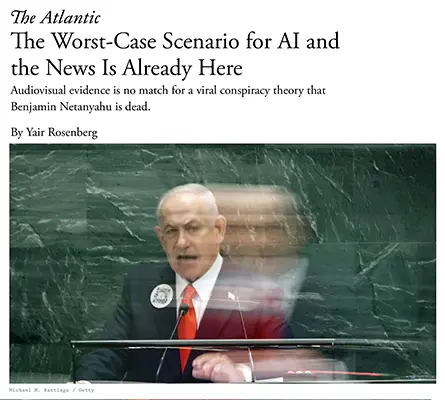
The Worst-Case Scenario for AI and the News Is Already Here
The Atlantic | March 27, 2026
TL;DR: The “liar’s dividend” predicted by legal scholars in 2018 has arrived: AI-generated deepfakes have so corrupted the information environment that real audiovisual evidence of a living world leader is now broadly disbelieved — with direct implications for how businesses communicate, verify, and make decisions in an AI-saturated media landscape.
Executive Summary
The Atlantic’s Yair Rosenberg documents a case study in epistemic collapse: a viral conspiracy theory that Israeli Prime Minister Benjamin Netanyahu is dead — kept alive despite overwhelming contrary evidence including live press conferences, video interactions with journalists and ordinary citizens, and official denials from named public figures. The claim accumulated an estimated 430 million impressions on X across a three-week period, with more than 213,000 unique posters. Joe Rogan amplified it to his massive audience. A member of the British Parliament publicly endorsed it.
The mechanism is not primarily AI-generated fakes — it is what legal scholars Robert Chesney and Danielle Citron predicted in 2018: the liar’s dividend. Once AI can credibly simulate any image or video, pervasive suspicion becomes the environment’s default state. Authentic footage is no longer trusted because fake footage is indistinguishable to most viewers. Propagandists don’t need to produce convincing fakes — they only need audiences primed to doubt real content. The conspiracy theory persists not because the fakes are good, but because the information environment has been conditioned to reject reality.
Monetized algorithmic social media provides the structural engine: engagement rewards virality, not accuracy, creating financial incentives to produce and amplify falsehoods. The article is an opinion-inflected analysis, but the core mechanism it describes is well-supported and the case study is documented.
Relevance for Business
The business implications operate on two levels. The first is reputational and communicative: in an environment where authentic video of a world leader is disbelieved by hundreds of millions of people, executives and businesses should assume that any official communication — video, statement, announcement — can be labeled as AI-generated and disputed, regardless of authenticity. Crisis communications, executive visibility, and media strategy all need to account for this. The second is operational and informational: the same dynamics that distort political information now distort business intelligence, market signals, and due diligence processes. Information verification is becoming a core business competency, not a background assumption.
Calls to Action
🔹 Develop a communications protocol for AI misattribution scenarios — consider in advance how your organization would respond if an executive statement, official video, or product announcement were falsely labeled as AI-generated and went viral.
🔹 Build information verification practices into your business intelligence workflows — in an environment where even documented reality is contested, sourcing discipline and multi-source verification are operational necessities, not hygiene practices.
🔹 Brief your communications and PR team on the liar’s dividend dynamic — the risk is not just that AI creates fakes, but that authentic content is now presumptively suspect. Strategy should account for both.
🔹 Do not rely on social media engagement as a proxy for information quality in any decision-relevant context — the incentive structure explicitly rewards falsehood that spreads over truth that doesn’t.
🔹 Monitor the regulatory and platform-policy landscape around AI content labeling — mandatory disclosure and provenance tracking tools (e.g., Content Credentials, C2PA standards) are advancing and may become both a compliance requirement and a communications asset.
Summary by ReadAboutAI.com
https://www.theatlantic.com/international/2026/03/netanyahu-not-dead-israel-ai/686593/: April 2, 2026
Pamela Anderson Joins Aerie in Calling Out AI Fakery in Ads
Adweek | March 26, 2026
TL;DR: Aerie’s “no AI-generated bodies” pledge delivered double-digit brand awareness gains — signaling that authenticity is becoming a measurable competitive differentiator, not just a values statement, in an AI-saturated advertising environment.
Executive Summary
American Eagle’s Aerie brand has expanded its “100% Aerie Real” campaign by partnering with Pamela Anderson to publicly oppose AI-generated imagery in advertising. The campaign builds on Aerie’s October 2025 pledge to never use AI to create images of people or bodies — itself an extension of the brand’s 2014 no-retouching commitment. The business case is not just ethical posturing: Aerie’s CMO reports a double-digit increase in brand awareness from October 2025 through year-end, directly attributable to the pledge.
The campaign draws a clear and deliberate distinction: Aerie is not opposed to AI tools for logistics, planning, or content scaling — it draws the line specifically at AI-generated depictions of people and lived experience. This is a meaningful operational nuance for any brand evaluating its own AI use policies. The article notes that Equinox and Almond Breeze have run similar anti-AI-slop campaigns in 2026, suggesting this is becoming a genuine category of brand positioning, not an isolated stunt.
The source is promotional in tone — Adweek covering a brand campaign — so the double-digit awareness claim should be taken as self-reported, not independently verified. Still, the underlying dynamic is real: as AI-generated content proliferates, authenticity becomes scarcer and therefore more valuable.
Relevance for Business
Any business that creates customer-facing content — marketing, product imagery, social media, testimonials — now operates in a context where AI fakery is a known consumer concern. The Aerie case suggests that proactively declaring where you do and don’t use AI can be a brand asset, not merely a compliance question. For SMBs, this is particularly relevant because the cost of authentic content (real photography, real voices, real creators) is now a potential competitive signal, not just a line item. Leaders should not assume that using AI-generated imagery is neutral — consumer sensitivity is measurable and growing.
Calls to Action
🔹 Audit your current use of AI-generated imagery in customer-facing materials and assess whether disclosure or policy clarity would strengthen or protect your brand position.
🔹 Consider formalizing an internal AI content policy that distinguishes between AI for operational support (acceptable) and AI for generating human likenesses in customer communications (higher risk).
🔹 Monitor consumer sentiment data around AI-generated content in your sector — what works for an apparel brand may differ for B2B or professional services, but the underlying trust dynamic is sector-agnostic.
🔹 Don’t overreact or performatively pledge — the Aerie approach works because it aligns with a decade-long brand history. Reactive anti-AI campaigns without authentic backing risk looking like the same opportunism they’re criticizing.
🔹 Watch for regulatory movement — the EU AI Act and U.S. state-level disclosure rules are moving toward requiring disclosure of AI-generated content in advertising. Getting ahead of this is lower cost than reacting to it.
Summary by ReadAboutAI.com
https://www.adweek.com/creativity/pamela-anderson-joins-aerie-in-calling-out-ai-fakery-in-ads/: April 2, 2026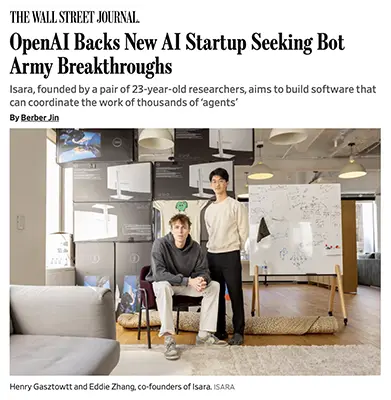
OpenAI Backs New AI Startup Seeking Bot Army Breakthroughs
The Wall Street Journal | Berber Jin | March 25, 2026
TL;DR: OpenAI is funding a startup called Isara that aims to coordinate thousands of AI agents simultaneously — a bet that multi-agent orchestration, not individual AI tools, is where the next wave of competitive advantage will emerge.
Executive Summary
Isara, founded by two 23-year-old researchers from Harvard and Oxford, raised $94 million at a $650 million valuation, with OpenAI as a lead backer. The company’s core thesis: the next frontier in AI is not smarter individual models, but software that can coordinate thousands of AI agents working in parallel on complex problems. Their first demonstration — directing roughly 2,000 agents to forecast the price of gold — is an early proof of concept, not a commercial product. Initial target markets are investment firms and financial services, where predictive modeling at scale has obvious value.
The concept of “swarms of specialists” is meaningful and directionally correct — most serious enterprise AI problems require decomposing complex tasks across multiple systems. However, this is early-stage research with no demonstrated commercial product, and the $650 million valuation reflects speculative positioning, not proven revenue. OpenAI’s backing is strategic: it keeps a stake in the agent-orchestration layer, which could become critical infrastructure if agentic AI scales as anticipated. It also signals that OpenAI views multi-agent coordination as a capability gap it does not currently own internally.
What to monitor: OpenAI is preparing for an IPO as soon as Q4 2026. Its investment pattern — backing adjacent startups while refocusing core products on coding and business services — suggests the company is actively mapping the agentic AI ecosystem before going public. Isara’s trajectory will be a useful indicator of whether multi-agent orchestration can move from demonstration to enterprise deployment at meaningful scale.
Relevance for Business
For most SMBs, Isara is not yet actionable — it has no commercial product available. The signal that matters is structural: the AI industry is moving rapidly toward agent-based architectures, where software does not just answer questions but executes multi-step workflows autonomously. Leaders who understand this shift now will be better positioned when agent orchestration tools reach the market at scale. If your organization uses AI for research, forecasting, or data analysis, the trajectory of this category is directly relevant to your vendor roadmap within 12–24 months.
Calls to Action
🔹 Monitor Isara’s commercial progress — if it moves from financial services demonstrations to broader enterprise availability, it could affect how AI-driven research and forecasting are priced and sourced.
🔹 Understand the agent orchestration category generally — assign someone to track how OpenAI, Anthropic, and emerging startups are approaching multi-agent coordination, as this will shape enterprise AI purchasing decisions.
🔹 Do not act on this now — Isara is pre-commercial, and the $650M valuation is speculative. File this as a 12–18 month watch item.
🔹 Ask your current AI vendors how they are approaching multi-agent orchestration — the answer will reveal how seriously they are investing in the next phase of capability.
Summary by ReadAboutAI.com
https://www.wsj.com/tech/ai/openai-backs-new-ai-startup-seeking-bot-army-breakthroughs-a0b1fedc: April 2, 2026
AI Mentions on Résumés Have Tripled Over the Past Two Years, but Colleges Aren’t Keeping Up
Fast Company | March 27, 2026
TL;DR: AI skills on résumés have tripled in two years and now command a 28–43% salary premium — but universities are still treating AI use as misconduct, creating a growing gap between what employers need and what graduates are prepared to do.
Executive Summary
According to a Monster.com report, AI skills listed on résumés jumped from 3.7% in 2023 to 12.8% in 2025, with the sharpest acceleration occurring in 2024–2025. The salary premium is substantial and independently significant: jobs requiring one AI skill pay roughly 28% more (approximately $18,000 in additional annual earnings); jobs requiring two AI skills increase salaries by 43%. Workers are responding rationally to market signals.
The institutional disconnect is stark. Many universities continue to treat AI use as academic misconduct, spending millions on detection tools even as only 28% of higher-education staff believe their own institutions are ready to manage student AI use — per a Coursera survey. Meanwhile, approximately 30% of instructors now use generative AI daily or weekly, up from 2–4% in spring 2023. The article is editorially sympathetic to the argument that colleges are failing the workforce, and the framing is broadly correct, though it does not engage seriously with the pedagogical case for restricting AI in foundational skill development.
The real business implication is a widening talent pipeline problem: if the institutions responsible for producing the next generation of workers are actively suppressing AI fluency, employers will face an expanding gap between candidates who list AI skills (a growing proportion) and candidates who can actually demonstrate them under pressure.
Relevance for Business
For SMB executives managing hiring, this is a near-term operational signal. The surge in AI skill listings on résumés is real, but it almost certainly outpaces demonstrated capability — candidates are learning to signal what the market rewards, and verification of actual AI proficiency in hiring processes is not yet standard. Leaders should not treat résumé AI mentions as equivalent to verified AI competence. Equally important: the salary premium data gives leaders a data point for internal compensation conversations as they seek to retain AI-capable staff. For businesses investing in AI adoption, the external talent market is tightening even as the credential signals inflate.
Calls to Action
🔹 Update your hiring process to include practical AI skill verification — a résumé mention is not sufficient evidence of capability. Build task-based assessments into interviews for roles where AI fluency matters.
🔹 Use the salary premium data (28–43% above baseline for AI-skilled roles) as a benchmark for internal compensation reviews — retaining AI-capable employees is less expensive than replacing them.
🔹 Invest in internal AI training now rather than waiting for the talent market to catch up — the university pipeline is at least 2–4 years from producing meaningfully AI-fluent graduates at scale.
🔹 Consider partnerships with community colleges, bootcamps, or platforms like Coursera that are moving faster than traditional universities on AI curriculum — these may be more productive talent pipelines for AI-adjacent roles in the near term.
🔹 Monitor the university policy landscape — if major institutions shift from prohibition to structured AI integration in the next 12–18 months, the talent pipeline quality could improve faster than the current trajectory suggests.
Summary by ReadAboutAI.com
https://www.fastcompany.com/91516697/ai-mentions-on-resumes-have-tripled-but-colleges-arent-keeping-up: April 2, 2026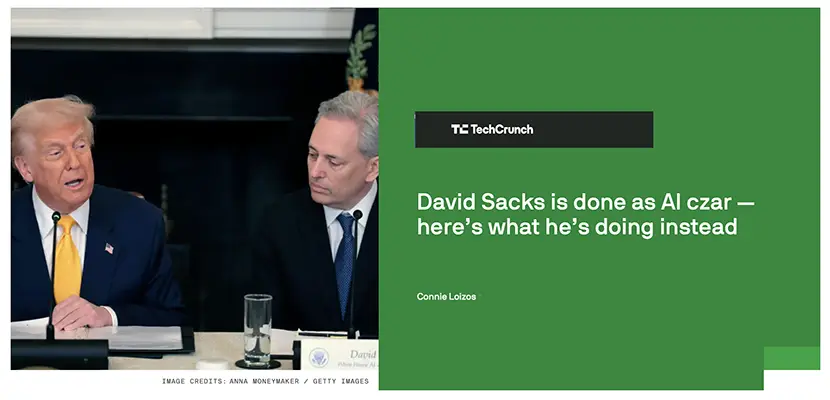
David Sacks Is Done as AI Czar — Here’s What He’s Doing Instead
TechCrunch | March 26, 2026
TL;DR: The U.S. government’s most connected AI policy voice has stepped back from direct policymaking to an advisory role — reducing near-term regulatory urgency while leaving AI governance in the hands of a tech-industry-dominated council with historically limited policy impact.
Executive Summary
David Sacks has completed his 130-day stint as the White House AI and crypto czar and is transitioning to co-chair of the President’s Council of Advisors on Science and Technology (PCAST). The practical consequence:Sacks moves from a role with direct policy influence to an advisory body that studies issues and makes recommendations, but does not make policy. PCAST has existed since FDR and has a mixed track record — Obama’s version produced 36 reports over eight years, two of which led to concrete policy changes. Trump’s first-term version took nearly three years to name members and made no significant mark.
The current PCAST roster is notable: Jensen Huang (Nvidia), Mark Zuckerberg (Meta), Larry Ellison (Oracle), Sergey Brin (Google), Marc Andreessen, Lisa Su (AMD), Michael Dell. TechCrunch notes this is an advisory body built almost entirely from the executive suites of the companies it will advise on — a significant conflict-of-interest dynamic the article raises but does not resolve. The near-term agenda Sacks described includes the national AI framework released last week, aimed at replacing a fragmented patchwork of state-level AI regulations across 50 jurisdictions.
The article also notes — carefully — that Sacks’s departure from the czar role may be connected to his public advocacy on the All In podcast for a U.S. exit from the Israel-Iran war, which created visible distance between Sacks and Trump. The timing is suggestive; the cause is unconfirmed.
Relevance for Business
Two signals matter here for SMB leaders. First: the national AI regulatory framework is the near-term policy priority— if it succeeds in harmonizing state-level AI rules, it could reduce compliance complexity significantly for businesses operating across multiple states. This is worth tracking; the current patchwork creates real operational friction. Second: with Sacks moving to an advisory role, the day-to-day AI policy function in the White House becomes less clear — which means more uncertainty about regulatory direction in the near term, not less. Leaders should not expect rapid, coherent federal AI governance to emerge quickly. Plan for continued ambiguity.
Calls to Action
🔹 Track the national AI framework that PCAST is now championing — if it moves toward federal preemption of state-level AI rules, it could significantly affect your compliance obligations and vendor requirements.
🔹 Do not assume federal regulatory clarity is imminent — advisory bodies with industry-insider membership and mixed historical track records are not a reliable source of fast policy output. Plan your AI governance internally, not in anticipation of federal guidance.
🔹 Assign someone to monitor PCAST output over the next 6–12 months — the roster includes people who shape AI product direction, so their public recommendations will be an indicator of where large-platform AI development is heading.
🔹 Review your state-level AI compliance exposure now — the 50-state patchwork is the current reality, and waiting for federal harmonization is a planning risk.
🔹 Note the conflict-of-interest structure of PCAST — a council composed of AI industry executives advising on AI policy is not a neutral body. Weight its recommendations accordingly when they touch on areas like data use, liability, or market structure.
Summary by ReadAboutAI.com
https://techcrunch.com/2026/03/26/david-sacks-is-done-as-ai-czar-heres-what-hes-doing-instead/: April 2, 2026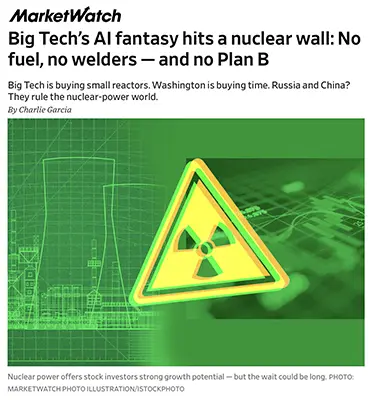
Big Tech’s AI Fantasy Hits a Nuclear Wall: No Fuel, No Welders — and No Plan B
MarketWatch (Charlie Garcia’s Street Sense column) | March 26, 2026
TL;DR: The U.S. nuclear revival being counted on to power AI infrastructure faces compounding, multi-year supply constraints — in fuel, workforce, and cost — that Big Tech’s capital commitments cannot resolve on their own, and that create real near-term uncertainty for AI scaling timelines.
Executive Summary
This is an opinion column, and its tone is deliberately provocative. Strip the wit and the core argument is substantive and worth taking seriously. The U.S. AI buildout requires a massive increase in electricity supply — data centers are projected to consume 9%–17% of U.S. electricity by 2030, up from 4.5% today. The political consensus around nuclear as the answer is genuine. The execution constraints are also genuine, and the column makes a credible case that they are being systematically underweighted.
Three specific constraints stand out. First, cost: Small modular reactors (SMRs) currently run $89–$180 per megawatt-hour versus $40–$65 for combined-cycle gas. NuScale’s Idaho project saw costs rise 75% before a shovel hit the ground. Even optimistic learning-curve projections put SMR costs at $58–$100/MWh — well above conventional alternatives. Second, workforce: The U.S. has fewer than 5,000 certified nuclear-grade welders. Training takes five years. The industry needs to triple its nuclear workforce by 2050 while 40% of current workers retire this decade. Third, fuel: High-Assay Low-Enriched Uranium (HALEU), required for most advanced reactors, has been produced domestically in quantities sufficient to fuel a single reactor for less than one year. Russia controls 40%–45% of global enrichment capacity. The DOE’s new domestic enrichment investment won’t produce output until 2031 — after reactors already being licensed for 2027 would need it.
Big Tech is filling the financing gap that government cannot: Meta has committed to six gigawatts of nuclear capacity, Microsoft is restarting Three Mile Island, and Vistra has signed 20-year power purchase agreements with multiple hyperscalers. This is real and meaningful. But it does not resolve the fuel, workforce, or regulatory timeline problems. The nuclear renaissance is structurally real; its practical timeline is five to ten years away from material impact, and the column’s core warning — that AI scaling plans may be priced on assumptions that don’t yet have physical supply chains to back them — deserves serious attention.
Relevance for Business
For SMB leaders, this story has two practical layers. The first is cost: AI compute and cloud services are already expensive, and the energy constraints underlying AI infrastructure are likely to keep upward pressure on those costs for the next several years. If your business is building AI-dependent workflows or making long-term commitments to AI platforms, the energy constraint is a real cost driver, not a background policy debate. The second is strategic timing: the gap between announced AI capability and the physical infrastructure to sustain it at scale is larger than the industry’s public posture suggests. Leaders making multi-year vendor commitments or infrastructure investments should factor in execution risk at the infrastructure level, not just at the model or software level.
Calls to Action
🔹 Treat AI infrastructure cost projections with skepticism — energy constraints are a genuine upward cost pressure on cloud and compute pricing through at least 2030.
🔹 Monitor your AI vendors’ infrastructure commitments — companies with diversified energy sourcing (existing nuclear fleet, long-term PPAs) are better positioned than those dependent on new builds.
🔹 Do not assume AI scaling will be linear — physical infrastructure constraints could create capacity bottlenecks that affect availability and pricing of AI services.
🔹 Factor energy cost and availability into multi-year AI vendor evaluations — this is no longer a macro issue; it has direct bearing on vendor stability and pricing.
🔹 No immediate operational action required for most SMBs, but assign someone to monitor quarterly energy cost trends in AI cloud services as a leading indicator of broader cost pressure.
Summary by ReadAboutAI.com
https://www.wsj.com/wsjplus/dashboard/articles/americas-nuclear-renaissance-has-everything-except-uranium-welders-and-a-plan-0851782d: April 2, 2026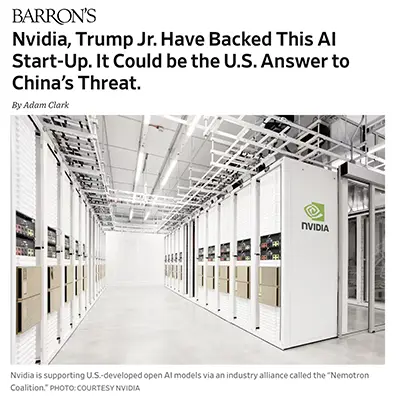
Nvidia, Trump Jr. Have Backed This AI Start-Up. It Could Be the U.S. Answer to China’s Threat.
Barron’s | March 26, 2026
TL;DR: Nvidia is funding an open-source AI startup called Reflection at a reported $25 billion valuation as part of a deliberate strategy — the “Nemotron Coalition” — to counter Chinese open AI models like DeepSeek and protect demand for Nvidia hardware.
Executive Summary
Nvidia has backed Reflection AI, an open-source model startup reportedly in talks to raise $2.5 billion at a $25 billion valuation, with potential participation from JPMorgan Chase. Nvidia’s prior investment in Reflection was approximately $800 million. The company has also received backing from 1789 Capital, a venture firm with Donald Trump Jr. as a partner — a detail Barron’s surfaces primarily for its political optics rather than operational significance.
The strategic logic is clearer than the political framing. Nvidia’s core revenue depends on demand for its chips. Chinese AI companies — led by DeepSeek — have demonstrated that capable, open-source AI models built on less advanced or domestically produced chips can gain significant international market share. If that trend accelerates, it erodes demand for Nvidia’s premium hardware. Nvidia’s response is to fund and organize an ecosystem of competitive U.S. open-source models through the “Nemotron Coalition,” making American open AI accessible, adaptable, and positioned to run on Nvidia chips.
The valuation — $25 billion for a startup — warrants scrutiny. Reflection’s models are open-source, which means the business model depends on downstream services, fine-tuning, enterprise support, or platform effects rather than model licensing. That commercial path is less proven than the headline number suggests. The article is based on pre-publication reports and unconfirmed sources; neither Reflection nor Nvidia commented. The strategic intent is credible; the valuation is speculative.
Relevance for Business
For SMB leaders, this story has two practical implications. First, the open-source AI model market is becoming a geopolitical and commercial battleground — which is good news for buyers in the near term, because competition between U.S. and Chinese open models will keep prices low and optionality high. Second, it’s a signal to watch which AI vendors and models are being institutionally backed by major infrastructure players — Nvidia’s strategic investments indicate where the market’s center of gravity is being pulled. Businesses currently evaluating open-source model deployment (for cost reduction, customization, or data privacy) have more legitimate options than a year ago and should be actively assessing them.
Calls to Action
🔹 Evaluate open-source AI models (from both U.S. and international providers) as a cost and flexibility alternative to closed, proprietary AI platforms — the competitive quality of these models is improving rapidly.
🔹 Monitor the Nemotron Coalition as an indicator of which open U.S. models Nvidia is actively supporting — that backing has downstream implications for chip compatibility, enterprise support, and longevity.
🔹 Do not over-index on the Trump Jr. connection — it is a political detail, not an operational one; evaluate the technology and strategic backing on their merits.
🔹 Watch Reflection’s funding close and initial enterprise deployments before treating the $25 billion valuation as a signal of demonstrated commercial traction.
🔹 If you are running AI on-premise or in a private cloud, the open-model competitive landscape increasingly makes this viable — assign an internal review of deployment costs versus proprietary API alternatives.
Summary by ReadAboutAI.com
https://www.wsj.com/wsjplus/dashboard/articles/nvidia-stock-price-ai-reflection-60317644: April 2, 2026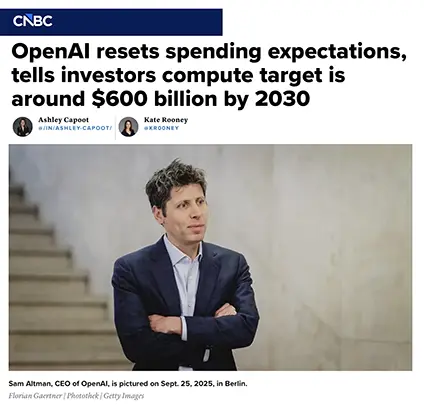
OpenAI Resets Spending Expectations, Targets Around $600 Billion by 2030
CNBC | February 20, 2026
TL;DR: OpenAI has walked back its $1.4 trillion infrastructure commitment to a more defensible $600 billion compute spend target by 2030 — a recalibration that signals investor pressure to connect spending ambition with credible revenue forecasts, not just scale narratives.
Executive Summary
OpenAI is now telling investors it plans to spend approximately $600 billion on compute infrastructure by 2030 — down significantly from the $1.4 trillion in infrastructure commitments CEO Sam Altman promoted in late 2025. The company is simultaneously projecting $280 billion in 2030 revenue, split roughly evenly between consumer and enterprise segments. For context: OpenAI generated $13.1 billion in revenue in 2025 (beating its $10 billion target) while spending $8 billion (below its $9 billion target). The new spending framing is explicitly intended to tie infrastructure investment more directly to projected revenue growth.
The reset is a meaningful signal. The original $1.4 trillion figure was widely viewed as an aspirational announcement tied to the Stargate infrastructure partnership with SoftBank and the U.S. government, not a defined capital allocation plan. The revised $600 billion figure, paired with specific revenue projections, suggests investor and board pressure to demonstrate financial discipline, not just scale ambition. OpenAI is finalizing a funding round that could exceed $100 billion, with Nvidia reportedly in discussions to invest up to $30 billion at a $730 billion pre-money valuation.
On the product side: ChatGPT now supports 900 million weekly active users (up from 800 million in October), and OpenAI’s coding product Codex has surpassed 1.5 million weekly active users — competing directly with Anthropic’s Claude Code. The revenue trajectory is real; the path from $13 billion to $280 billion in five years remains an extraordinary projection that deserves scrutiny, even if the company’s recent execution has been stronger than expected.
Relevance for Business
For SMB leaders, the OpenAI financial story matters primarily as a vendor stability signal. OpenAI is the AI platform underpinning many commercial tools — from ChatGPT Enterprise to third-party products built on its API. A company burning $8 billion annually while projecting $730 billion in pre-money valuation is making a substantial bet on future revenue that has not yet materialized at scale. The revised spending target is a healthier posture, but the gap between current revenue ($13B) and 2030 targets ($280B) requires roughly 21x growth in five years. Leaders making long-term commitments to OpenAI-dependent workflows or platforms should factor in execution risk and maintain awareness of alternative providers.
Calls to Action
🔹 Treat OpenAI’s revised financial plan as a more credible — but still aggressive — outlook: the recalibration is positive; the gap between current and projected revenue remains very large.
🔹 Audit your OpenAI API or ChatGPT Enterprise dependencies — understand what portion of your workflows would be disrupted if pricing, availability, or service terms changed materially.
🔹 Maintain vendor optionality — at minimum, track the capabilities of Anthropic, Google Gemini, and open-source alternatives as risk hedges against concentration in a single provider.
🔹 Monitor the $100B+ funding round close — the investor composition (Nvidia, SoftBank, Amazon) and final valuation will signal market confidence in OpenAI’s commercial path.
🔹 If evaluating Codex or AI coding tools, recognize this is now a competitive market with meaningful alternatives — evaluate on demonstrated productivity gains, not brand positioning.
Summary by ReadAboutAI.com
https://www.cnbc.com/2026/02/20/openai-resets-spend-expectations-targets-around-600-billion-by-2030.html: April 2, 2026
ChatGPT or Claude? How to Decide Which AI Chatbot Is Worth Your Money
MarketWatch | Genna Contino | March 25, 2026
TL;DR: AI chatbot selection has shifted from a technical decision to a values-and-fit decision — and the competitive landscape is genuinely moving, with Claude gaining ground on ChatGPT through a combination of ethics positioning, coding capabilities, and user experience.
Executive Summary
The AI assistant market is no longer stable. ChatGPT’s U.S. market share has slid from 57% to 42% since August 2025, while Claude’s daily active users tripled this spring. The shift was triggered partly by Anthropic’s public standoff with the Pentagon over AI use in mass surveillance and autonomous weapons — a refusal that resonated with users concerned about AI ethics. OpenAI took the opposite stance, signing a contract to deploy models on Pentagon classified networks. Some consumers are now treating their $20/month subscriptions as a values statement.
On the capability side, independent analysts note that the underlying models are not dramatically differentiated — the real differences are in tone, task fit, and ecosystem integration. Claude earns marks for long-document analysis, natural conversational quality, and agentic coding (“vibecoding”) that has built a strong power-user following. ChatGPT retains advantages in versatility and message volume — roughly 160 prompts per three-hour window versus Claude’s 45 per five hours. Claude’s usage meter also depletes faster on long documents, a practical friction point new users frequently underestimate. Gemini wins on Google Workspace integration; Grok on real-time social data, but with fewer content guardrails.
Notable developments to watch: OpenAI has introduced ads for free and low-tier users, raising concerns about future sponsored content at paid tiers. Anthropic is experimenting with off-peak capacity pricing — a utility-style model that could reshape how teams plan AI usage. Claude has also launched a ChatGPT memory migration tool, lowering switching costs.
Relevance for Business
SMB leaders evaluating or renewing AI subscriptions now face a decision with three distinct dimensions: capability fit, values alignment, and ecosystem lock-in risk. Prompt limits and usage-meter behavior directly affect team productivity and cost planning. The introduction of ads into ChatGPT’s lower tiers signals a potential monetization shift that could affect workflow reliability and brand risk for businesses using it in client-facing contexts. Claude’s ethics positioning may matter to businesses in regulated industries or those managing reputational risk. Vendor loyalty is becoming less sticky— migration tools reduce the cost of switching, which means leaders should evaluate tools on current fit rather than past investment.
Calls to Action
🔹 Audit actual usage patterns across your team before renewing any AI subscription — prompt limits and document-length behaviors vary significantly and affect value.
🔹 Test Claude for long-document workflows (contracts, reports, research) where context retention matters; test ChatGPT for breadth and volume tasks.
🔹 Monitor OpenAI’s ad tier expansion — if sponsored content migrates to paid plans, assess whether that creates brand or compliance risk in your use cases.
🔹 Factor ethics and governance positioning into vendor selection if your business operates in regulated sectors or values-sensitive markets.
🔹 Assign someone to evaluate Gemini if your team runs heavily on Google Workspace — the integration advantage may outweigh raw model performance differences.
Summary by ReadAboutAI.com
https://www.wsj.com/wsjplus/dashboard/articles/chatgpt-or-claude-how-to-decide-which-ai-chatbot-is-worth-your-money-64b21353: April 2, 2026
THIS BRILLIANT BROWSER TOOL PURPOSELY MAKES AI CHATBOTS WORSE
Fast Company | March 26, 2026
TL;DR: “Slow LLM” — a browser extension that deliberately throttles AI chatbot response speeds to 30 seconds or more — is a small act of design protest, but it surfaces a legitimate and underexamined organizational risk: AI adoption driven by convenience rather than deliberate judgment.
Executive Summary
Slow LLM is a browser extension created by Sam Lavigne, an assistant professor of synthetic media and algorithmic justice at Parsons School of Design. It intercepts network calls to AI chatbots — currently ChatGPT and Claude — and artificially delays responses to 30 seconds or more, making the experience frustratingly slow by design. The goal is not to block AI use but to introduce enough friction that users are prompted to reconsider whether they actually need it for a given task. Lavigne describes it as a “tiny tool of digital sabotage” and situates it alongside a growing catalog of counter-AI design protests, including “Slop Evader” (a Chrome extension that removes AI-generated search summaries) and “Your AI slop bores me” (a human-powered chatbot).
This is a design and commentary piece, not a business technology story. The tool itself has no direct operational implications for SMB leaders. What it points toward, however, is worth a moment of attention: the dominant driver of AI adoption in many organizations right now is speed and convenience — AI is used because it is fast, frictionless, and readily available, not necessarily because it is the best tool for a given task. Lavigne’s protest is amateur-hour as a technology solution but legitimate as a diagnostic question: when AI is removed from workflows, what was it actually doing that added value, and what was it doing that simply felt efficient?
The article also catalogs a small but growing counter-cultural resistance to AI adoption — developers, designers, and academics creating tools to slow, circumvent, or comment critically on AI proliferation. For leaders, this is a signal about employee sentiment worth noting: a segment of the workforce is actively skeptical of AI mandates, and managing that skepticism constructively is a management challenge, not just a change management nuisance.
Relevance for Business
The Slow LLM story matters less as a tool and more as a prompt for an internal audit: if you were to remove AI assistance from your team’s workflows for a week, what would actually be missed? Which outputs would demonstrably decline in quality or speed, and which would simply feel slower without actually being worse? Most organizations have not done this evaluation rigorously. The convenience-driven adoption of AI creates a category of pseudo-productivity — tasks completed faster that may not have needed to be completed at all, or outputs generated at volume that sacrifice quality for speed. Leaders who can distinguish between genuine productivity gains and AI-assisted activity theater are in a better position to govern effectively. Additionally, the employee sentiment angle is real: if a portion of your workforce is quietly using Slow LLM or similar tools, mandated AI adoption without genuine buy-in is producing compliance without effectiveness.
Calls to Action
🔹 Conduct a periodic AI value audit: periodically remove AI tools from specific workflows for a short period and measure the actual impact — this distinguishes genuine productivity gains from convenience-driven adoption.
🔹 Do not mandate AI use without measuring outcomes — adoption rates are not a proxy for productivity gains; track quality and accuracy alongside volume and speed.
🔹 Take employee AI skepticism seriously as a management signal — a workforce that is quietly resistant to AI adoption will not use tools effectively even when required to; address the underlying concerns.
🔹 Distinguish high-value AI use from filler use in your organization — AI is genuinely useful for some tasks and genuinely inappropriate for others; helping employees make that distinction is a management responsibility.
🔹 Ignore Slow LLM as a tool — it is protest art, not a business solution. The question it raises — whether AI is being used with deliberate judgment or reflexive convenience — is worth asking internally.
Summary by ReadAboutAI.com
https://www.fastcompany.com/91514169/this-brilliant-browser-tool-purposely-makes-ai-chatbots-worse: April 2, 2026
WHAT TO DO IF YOUR EMPLOYER IS REQUIRING YOU TO USE AI
Fast Company | March 26, 2026
TL;DR: With 58% of employers now requiring AI use and another 64% encouraging it, this practical guide offers useful tactical advice for employees — but for managers and executives, the more important read is what it signals about the governance gap most organizations have not yet closed.
Executive Summary
This is a practitioner-oriented article written primarily for employees navigating mandatory AI adoption at work. The tactical guidance is reasonable: clarify what your employer actually expects, experiment in low-stakes areas first, protect work you find most meaningful, verify AI output before presenting it as your own, and build a learning community around AI use. The article cites research from Owl Labs (64% of employers encouraging AI; 58% requiring it), HRTech Edge, and Management Science, as well as BCG Institute research finding that employee-centric organizations are seven times more successful in AI impact than those that mandate from the top down.
The piece is advisory rather than analytical, and the data sources cited are not independently verified in the article. The 58% “requiring use” figure, in particular, should be treated as a survey result, not an audited statistic. That said, the directional signal is credible: AI use is shifting from optional to expected in a growing share of workplaces, faster than most governance frameworks have caught up.
The most consequential insight for leaders — buried in the employee-facing advice — is the accountability gap. The article correctly notes that AI can hallucinate, make errors, and produce output that does not reflect the employee’s actual judgment, and that employees need to take ownership of their work regardless of how it was generated. For managers, this is a governance question that most organizations are not answering clearly: who is accountable for AI-assisted work product, and what review processes exist to catch errors before they reach clients, regulators, or decision-makers?
Relevance for Business
For SMB executives and managers, this article’s primary value is as a workforce and governance signal, not a how-to guide. If your organization is requiring or encouraging AI use without having addressed the accountability and quality control questions, you have a policy gap. Employees are being told to use AI; many are uncertain what that means, what boundaries apply, and who is responsible when AI-generated work contains errors or confidential data leaks. The BCG finding — that employee-centric AI implementation outperforms top-down mandates by 7x — is a practical management guideline worth taking seriously. Rolling out AI as a requirement without a support structure is not a strategy; it’s a liability.
Calls to Action
🔹 If you have mandated or encouraged AI use, audit your governance framework — do employees know which tools are approved, what data cannot be entered, and who is accountable for output quality?
🔹 Establish clear AI use guidelines before expanding requirements — ambiguity about expectations creates compliance risk, inconsistent output quality, and employee anxiety that reduces effectiveness.
🔹 Take the BCG finding seriously: invest in employee-centric AI onboarding — listening sessions, feedback loops, and learning communities — rather than top-down mandates without support.
🔹 Address the hallucination accountability gap explicitly: make clear in writing that AI-assisted work remains the employee’s professional responsibility, and establish review checkpoints for client-facing and regulated outputs.
🔹 Monitor the 20% non-adoption segment in your workforce — the gap between managers (90% using AI) and individual contributors (55%) in the Owl Labs data suggests adoption is uneven in most organizations; address that unevenness before it creates two-tier productivity.
Summary by ReadAboutAI.com
https://www.fastcompany.com/91514928/what-to-do-if-your-employer-is-requiring-you-to-use-ai: April 2, 2026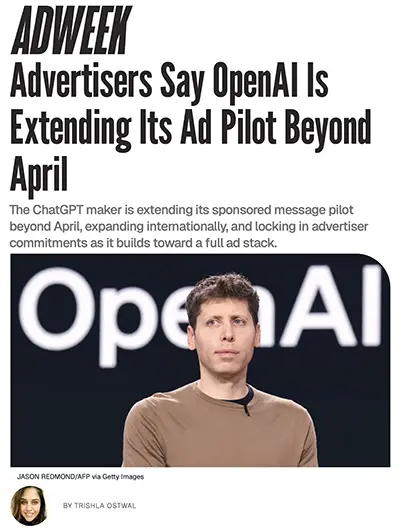
Advertisers Say OpenAI Is Extending Its Ad Pilot Beyond April
Adweek | March 26, 2026
TL;DR: OpenAI is moving from ad experimentation to structured revenue extraction — extending its pilot, expanding internationally, and requiring formal spend commitments — but performance metrics remain well below Google Search benchmarks, making early adoption a high-cost bet on an unproven platform.
Executive Summary
OpenAI has confirmed it is extending its sponsored message ad pilot beyond April, expanding to Canada, Australia, and New Zealand in the near term. The pilot — which places sponsored messages after ChatGPT responses — is now moving from informal testing toward formal advertiser commitments. OpenAI is requesting insertion order (IO) agreements, the legal contracts that lock in spend, timelines, and campaign terms. This is the standard signal that a platform is transitioning from experimentation to a structured, revenue-guaranteed ad business.
The numbers reveal a significant gap: early click-through rates are around 0.91%, compared to roughly 6.4% for Google Search — a gap that matters enormously for performance marketers calculating cost-per-acquisition. OpenAI is also demanding a minimum commitment of $200,000, and CPMs are hovering around $60 — premium pricing for an unproven product. Ad-serving logic remains opaque to agency partners; one executive described it as a mix of query intent and keyword inputs, without full transparency into how placement decisions are made.
OpenAI framed the expansion positively in its blog post, emphasizing that ads will not influence ChatGPT’s answers and that users retain experience control. This is the expected company framing for a platform that knows advertiser and user trust is its core asset risk. The claim that ads won’t influence answers should be monitored, not accepted as settled.Meanwhile, OpenAI is shelving other experimental products (Sora, an erotic chatbot) — a signal of deliberate resource focus on scalable revenue generation.
Relevance for Business
For SMB marketing and media decision-makers: this is not yet a platform to commit budget to. The minimum spend is prohibitive for most SMBs, the performance data is weak, and the targeting mechanics are still opaque. However, this is the earliest stage of what could become a significant new advertising channel — one that reaches users at the moment of active information-seeking, which has historically been valuable ad inventory (cf. Google Search). Leaders should watch this closely and assign someone to track the pilot’s performance disclosures, but should not divert budget from proven channels now.
Calls to Action
🔹 Do not allocate budget to ChatGPT advertising at this stage — the $200K minimum, 0.91% CTR, and lack of targeting transparency make this unsuitable for most SMBs in the near term.
🔹 Assign someone to monitor OpenAI’s ad product development quarterly — this channel could mature meaningfully within 12–18 months, and early familiarity will reduce ramp-up costs.
🔹 Brief your marketing agency or media partner now to track OpenAI ad metrics being reported by early pilot participants — independent performance data will be more reliable than OpenAI’s own framing.
🔹 Watch the “ads don’t influence answers” claim carefully — as ad revenue becomes a larger portion of OpenAI’s business model, the incentive structure around this commitment will be worth scrutinizing.
🔹 Consider the broader signal: if OpenAI succeeds in building a full-stack ad business, it will compete directly with Google Search advertising — which could eventually affect your existing ad costs and channel mix.
Summary by ReadAboutAI.com
https://www.adweek.com/media/openai-ads-pilot-extension/: April 2, 2026
Why AI Backlash Is a Leadership Problem — Not a Tech One
TechTarget | Alison Roller | March 24, 2026
TL;DR: Employee and customer resistance to AI adoption is primarily a trust and accountability failure by leadership — not a technology failure — and organizations that treat it as an IT problem will accelerate the very resistance they are trying to overcome.
Executive Summary
This is a practitioner-oriented feature drawing on CTO and CIO perspectives. The core argument is well-supported and analytically sound: 44% of respondents in an Edelman Trust Barometer report described themselves as skeptical of businesses’ AI use, and over 40% of organizations cite trust, ethics, and legal concerns as top barriers to AI implementation (TEKsystems). The resistance isn’t primarily about AI being misunderstood — it’s about leadership failures in communication, accountability, and governance design.
The article identifies five leadership gaps that consistently amplify AI backlash: lack of clear ownership, rushed integration that outpaces governance, poor communication about intent and impact, failure to address displacement and surveillance fears, and treating AI as an IT project rather than a business transformation. The prescription is constructive: frame AI initiatives around business outcomes rather than technology; establish human accountability for AI-assisted decisions; create genuine feedback loops; and build observability into AI workflows before expanding them. One framing is particularly sharp: “You can’t automate accountability.” AI can inform decisions; humans must own them.
The piece does not offer original research — it synthesizes practitioner quotes and survey data — but the framing is accurate and actionable. Only 22% of organizations prioritize change management as part of their AI transformation agenda (TEKsystems), which explains why technically sound deployments repeatedly fail on adoption.
Relevance for Business
For SMB leaders, this is directly executable guidance. The failure modes described — rolling out tools without governance, letting IT own what is really a culture problem, ignoring workforce fears — are common at every company size. SMBs often face an additional risk: fewer resources to dedicate to change management means backlash can move faster and harder than at large enterprises. The key insight for smaller organizations: the speed of rollout and the quality of communication are more predictive of adoption success than the quality of the tool itself. If your team is resistant to AI tools you’ve already deployed, the problem is almost certainly leadership and communication — not the technology.
Calls to Action
🔹 Assign explicit human ownership to every AI-assisted workflow or decision in your organization — document who is accountable when the AI output is wrong.
🔹 Slow down rollouts that have outpaced governance — establish acceptable use boundaries, data handling rules, and incident response before expanding AI access.
🔹 Create a structured feedback channel for employees to raise AI concerns, and visibly act on it — performative listening accelerates distrust.
🔹 Reframe AI initiatives internally around workflow outcomes and employee benefit, not efficiency metrics and cost reduction.
🔹 Treat AI adoption as change management, not a technology deployment — assign a non-IT owner for the human and cultural dimensions.
Summary by ReadAboutAI.com
https://www.techtarget.com/searchcio/feature/Why-AI-backlash-is-a-leadership-problem-not-a-tech-one: April 2, 2026
6 Types of AI Content Moderation and How They Work
TechTarget | David Weldon | March 25, 2026
TL;DR: AI-generated content is overwhelming traditional moderation systems, and organizations that rely on human-only review are already falling behind — but fully automated moderation introduces its own accuracy and trust risks, making hybrid models the current operational standard.
Executive Summary
This is a technical explainer that has been updated for the current AI content environment. Its business relevance has grown significantly: as AI tools make content generation trivially easy and cheap, any organization that hosts user-generated content — including community forums, review platforms, internal collaboration tools, or social-adjacent business channels — faces a rapidly escalating moderation burden.
The six moderation models covered (pre-moderation, post-moderation, reactive, distributed, user-only, and hybrid) represent a spectrum from fully automated to community-governed. The key operational insight is that no single model is sufficient. Automated systems catch volume violations quickly but fail on nuance, sarcasm, coded language, and cultural context. Human-only review cannot scale. Hybrid moderation — AI as first filter, humans for edge cases — is the current functional standard, as demonstrated by the major platforms. TikTok’s 2024 decision to cut hundreds of moderation jobs while expanding automated systems illustrates the labor displacement dynamic already in motion.
The article also surfaces a governance challenge specific to this moment: AI-generated content is increasingly indistinguishable from human content, which means moderation systems themselves must be trained to detect AI provenance — adding another layer of complexity and cost. The “last thing any brand wants,” per one CIO quoted, is a community platform filled entirely with AI-generated content with no authentic human signal.
Relevance for Business
SMBs that operate any public-facing digital community, customer review system, or user-generated content environment need to assess their current moderation posture. The volume problem is not future-tense — AI content generation tools are already publicly available and widely used. Human-only moderation is no longer a viable long-term strategy at any meaningful scale. For businesses using platforms like Shopify, community forums, or LinkedIn-style internal tools, understanding what moderation layer the platform applies — and where its gaps are — is a governance responsibility, not just a vendor concern. The reputational and legal exposure from unmoderated harmful or AI-fabricated content landing on your platform is real.
Calls to Action
🔹 Audit your current content moderation posture — identify whether you’re relying on human-only, platform-default, or hybrid systems, and where the gaps are.
🔹 Establish a content policy that explicitly addresses AI-generated content: what is permitted, what must be disclosed, and how violations are handled.
🔹 Evaluate whether your platform vendor’s moderation tools have been updated for AI-generated content detection — many legacy systems have not.
🔹 Monitor moderation-related labor trends — the TikTok precedent signals that AI will continue to displace human moderation roles; factor this into workforce planning if moderation is part of your operations.
🔹 Do not rely solely on community reporting (reactive or distributed moderation) as AI-generated content volume scales — the math breaks down when the content flood exceeds community capacity to flag it.
Summary by ReadAboutAI.com
https://www.techtarget.com/searchcontentmanagement/tip/Types-of-AI-content-moderation-and-how-they-work: April 2, 2026
Narayen Ushered Adobe Out of Diskettes All the Way to the AI Era
TechTarget | Don Fluckinger | March 20, 2026
TL;DR: Adobe CEO Shantanu Narayen’s 18-year tenure ends with a genuinely strong transformation record — but also a $150 million DOJ settlement and two unresolved strategic threats: AI disruption of SaaS revenue models, and lasting customer trust damage from aggressive subscription pricing tactics.
Executive Summary
This is an opinion piece from a senior tech journalist who covered Adobe for decades — it should be read as informed industry perspective, not neutral analysis. Narayen’s legacy is framed generously, and the praise is largely warranted: he navigated Adobe from packaged software to cloud subscriptions, built out a substantial marketing and e-commerce platform (via Marketo, Magento, Workfront acquisitions), and maintained the company’s creative software dominance through multiple platform transitions. His decision to open-source the PDF standard in 2007 was quietly consequential, enabling an entire ecosystem while preserving Adobe’s authority over document management.
However, the piece does not minimize the headwinds. Adobe’s stock has dropped 26% over the past year and 60% from its pandemic peak. The DOJ settlement — announced the day after Narayen’s departure — resolved a federal investigation into Adobe’s cancellation fees and subscription exit barriers, resulting in $75 million in civil fines and $75 million in customer credits. That reputational damage is unresolved. The incoming CEO faces two structural challenges: the “SaaSpocalypse” risk that AI-native tools could displace traditional cloud applications, and the need to rebuild customer trust after years of pricing practices that prioritized lock-in over transparency.
Relevance for Business
Adobe is a significant vendor for many SMBs — Creative Cloud, Acrobat, and Experience Cloud are widely embedded. The leadership transition introduces meaningful execution uncertainty at a moment when Adobe’s strategic direction on AI integration is still forming. The DOJ settlement is a signal: review your Adobe contracts for cancellation terms and exit conditions now, before any future pricing changes make it harder. More broadly, Adobe’s challenge — integrating AI deeply enough to stay relevant without cannibalizing its own subscription revenue — is a template challenge facing most SaaS vendors. Watch how the next CEO navigates it; the approach will signal whether Adobe’s pricing culture has genuinely changed.
Calls to Action
🔹 Review your Adobe subscription terms — particularly cancellation clauses and fee structures — in light of the DOJ settlement; understand your exit options.
🔹 Monitor the CEO search and first 90-day signals from Narayen’s successor for clues about Adobe’s AI integration strategy and pricing culture.
🔹 Assess AI-native alternatives to Adobe tools for non-core use cases — the SaaSpocalypse risk is real for vendors, and competitive options are expanding quickly.
🔹 Do not treat Adobe’s AI roadmap as stable during the leadership transition; major product decisions may be deferred until a new CEO is in place.
Summary by ReadAboutAI.com
https://www.techtarget.com/searchcustomerexperience/opinion/Narayen-ushered-Adobe-out-of-diskettes-all-the-way-to-the-AI-era: April 2, 2026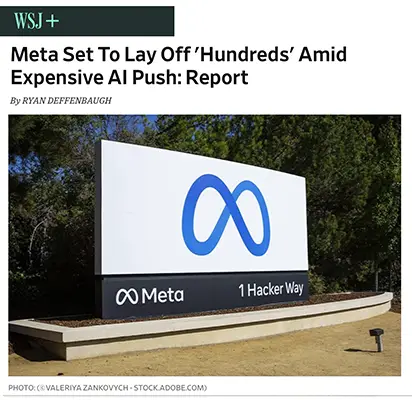
Meta Set to Lay Off ‘Hundreds’ Amid Expensive AI Push
Investor’s Business Daily | Ryan Deffenbaugh | March 25, 2026
TL;DR: Meta is cutting hundreds of jobs while spending $135 billion on AI capital expenditures this year — a combination that signals growing investor concern that its AI models are underperforming relative to its spending commitments.
Executive Summary
Meta confirmed layoffs of several hundred employees across Reality Labs, sales, recruiting, and social media teams — a targeted restructuring that follows a 10% reduction in Reality Labs earlier this year and comes amid reports that the company is considering workforce cuts of up to 20%. The cuts coincide with a delay in Meta’s next large language model, code-named “Avocado,” its latest attempt to close the capability gap with OpenAI, Anthropic, and Google.
The financial picture is stark: Meta stock is down roughly 25% from its August 2025 peak and trading below all major moving averages, despite plans to spend approximately $135 billion on capital expenditures in 2026. Investors are skeptical that the spending will produce competitive AI models in a reasonable timeframe. Meanwhile, Meta separately revealed executive stock incentive plans tied to reaching a $9 trillion market capitalization by 2031 — a target that requires roughly a 5x increase from its current ~$1.7 trillion valuation. The gap between that ambition and current execution is significant.
Relevance for Business
This story matters less for what Meta is cutting and more for what it signals about the cost structure of frontier AI development. Even a company with Meta’s resources is struggling to keep pace with AI leaders while managing investor pressure. For SMBs, the practical implications are: Meta’s AI products (used in WhatsApp Business, Facebook Ads, Instagram tools) may lag behind competitors’ capabilities for the foreseeable future. If your business relies on Meta’s AI-assisted advertising or customer engagement tools, the capability gap is real and worth benchmarking against alternatives. More broadly, the pattern — massive spend, organizational strain, delayed model releases — is a cautionary signal about the execution risk embedded in large-scale AI transformation.
Calls to Action
🔹 Benchmark Meta’s AI-powered ad and business tools against alternatives (Google, independent platforms) — the capability gap may be affecting performance you’re not measuring.
🔹 Don’t treat Meta’s AI roadmap as reliable for near-term planning; Avocado’s delay suggests timeline slippage is real.
🔹 Monitor Meta’s workforce trajectory — further cuts in technical and product roles could affect platform stability and support quality for business users.
🔹 Use this as a reference point internally: if a $1.7 trillion company is struggling with AI execution at scale, recalibrate expectations for your own AI initiatives accordingly.
Summary by ReadAboutAI.com
https://www.wsj.com/wsjplus/dashboard/articles/meta-set-to-lay-off-hundreds-amid-expensive-ai-push-report-134189284990843681: April 2, 2026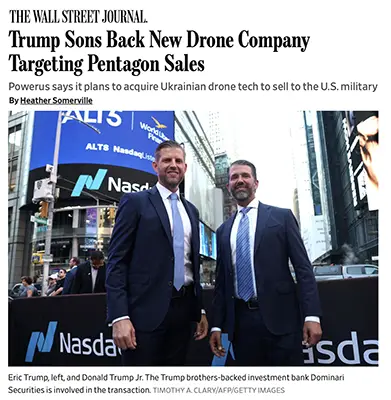
Trump Sons Back New Drone Company Targeting Pentagon Sales
The Wall Street Journal | Heather Somerville | March 10, 2026
TL;DR: The Trump family’s financial interests are now embedded in the U.S. drone sector at a moment when federal policy is actively reshaping procurement — raising real questions about political access, market integrity, and whether this represents genuine capability or opportunistic positioning.
Executive Summary
A newly formed drone company called Powerus — backed by Eric Trump, Donald Trump Jr., and affiliated Trump investment vehicles — is going public via a reverse merger with a Florida golf-course holding company. The deal also involves Dominari Securities, a Trump-family-connected investment bank, and has attracted $50 million from a Korean asset manager. The company plans to trade on Nasdaq in the coming months.
The business rationale rests on two real policy developments: the Pentagon’s push to rapidly acquire hundreds of thousands of domestically produced small drones (a $1.1 billion initiative called Drone Dominance), and a federal ban on new Chinese drone models that has created a gap in the U.S. market. Powerus, formed just last year, claims it is working toward producing over 10,000 drones monthly — a scale that would exceed nearly all existing U.S. manufacturers and far outpace historical Defense Department purchasing volumes.
The credibility question is significant. Powerus’s CEO has no prior drone experience. The company was built through acquiring three small firms in six months. Its plan to white-label Ukrainian drone technology faces real barriers: Ukraine restricts drone exports, and U.S. military procurement generally requires American-made systems. One co-founder acknowledged that Pentagon sales require “an American face” on foreign-sourced technology — a candid framing that signals the company’s value proposition may be more about political access and regulatory navigation than manufacturing depth.
Relevance for Business
This story is not primarily about AI — but it is directly relevant to any SMB operating in or adjacent to defense tech, drone services, or government procurement. It illustrates how quickly a politically connected new entrant can position for federal contracts in an emerging sector, and what that means for competitive dynamics.
For SMB leaders, the broader signal is this: federal defense spending priorities can create fast-moving market opportunities, but they also attract well-connected players who may gain access disproportionate to their operational capability. Companies with genuine drone or autonomous systems expertise should be aware that procurement competition in this space is heating up — and that political relationships, not just technology, may drive early contract awards.
There are also governance and reputational considerations for any business considering partnerships, subcontracting, or joint ventures in this sector. Entanglement with politically exposed entities carries downstream risk that warrants legal and strategic scrutiny.
Calls to Action
🔹 If you operate in defense tech or drone services: Monitor Pentagon Drone Dominance procurement closely — this $1.1B initiative is real and moving fast, regardless of who wins contracts.
🔹 If you are evaluating drone vendors or partners: Apply standard due diligence on operational track record, not just market narrative or political connections.
🔹 If your business is adjacent to government contracting: Assign someone to track how the Chinese drone ban reshapes the competitive landscape over the next 12–18 months.
🔹 If you are considering investment in drone-sector companies: Treat reverse-merger startups with limited operating history and political backing as speculative; evaluate manufacturing claims against verifiable capacity.
🔹 Monitor: Whether Powerus secures actual Pentagon contracts — that outcome will clarify whether this is a durable business or a capital-markets play timed to a policy window.
Summary by ReadAboutAI.com
https://www.wsj.com/politics/national-security/trump-sons-back-new-drone-company-targeting-pentagon-sales-2f74abca: April 2, 2026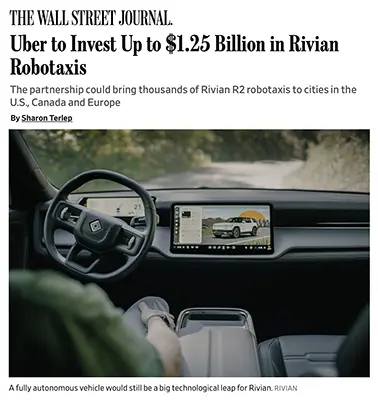
Uber to Invest Up to $1.25 Billion in Rivian Robotaxis
The Wall Street Journal | Sharon Terlep | March 19, 2026
TL;DR: Uber is betting $1.25 billion that Rivian can build a fully autonomous vehicle by 2028 — but Rivian only added basic hands-free driving last year, making the timeline ambitious and the execution risk significant.
Executive Summary
Uber and Rivian announced a partnership to deploy 10,000 fully autonomous Rivian R2 SUVs as robotaxis, starting in San Francisco and Miami by 2028, with potential expansion to 25 cities across the U.S., Canada, and Europe by 2031. Uber’s investment of up to $1.25 billion is milestone-contingent and subject to Rivian meeting regulatory approvals — meaning the full commitment is not guaranteed and reflects optionality, not a firm capital pledge.
The gap between announcement and execution deserves scrutiny. Rivian only introduced supervised hands-free driving in 2025. Full autonomy is a substantially larger technical and regulatory leap. The company posted a net loss of $3.6 billion in 2025 and is simultaneously trying to achieve profitability through volume sales of its consumer R2 model at prices ranging from $46,000 to $58,000. Uber, meanwhile, is executing a portfolio strategy — it has similar agreements with Lucid, Waymo, and others — hedging across multiple autonomous vehicle bets rather than committing to a single partner. Exclusive availability through Uber’s app is a meaningful constraint for Rivian: it limits market exposure and increases dependency on a single distribution channel.
Relevance for Business
The direct near-term impact on most SMBs is limited. The strategic signal, however, is worth noting: the autonomous vehicle and agentic AI markets are structurally converging — both involve AI systems executing consequential real-world tasks with reduced human oversight, and both are being scaled through platform partnerships that concentrate distribution power in large incumbents (Uber, Waymo, OpenAI). For businesses in logistics, delivery, or fleet-dependent operations, the robotaxi trajectory is a 3–5 year watch item. For everyone else, the pattern — massive capital, optimistic timelines, concentrated platform dependency — is a recurring template in the current AI investment cycle worth recognizing.
Calls to Action
🔹 Monitor robotaxi regulatory progress in your operating cities — San Francisco and Miami are the initial deployments; expansion timelines will depend heavily on regulatory decisions that remain uncertain.
🔹 If you operate in logistics, delivery, or fleet-dependent services, track Waymo’s commercial expansion as the near-term benchmark — it is further along than Rivian and will set expectations for the category.
🔹 File the Uber/Rivian announcement as a 2028 watch item — the 2028 deployment target is aspirational given Rivian’s current technology baseline; treat it accordingly in strategic planning.
🔹 Note the platform dependency pattern — exclusive distribution through a single app is a recurring structural risk in AI-adjacent partnerships; apply this lens to your own vendor agreements.
Summary by ReadAboutAI.com
https://www.wsj.com/business/autos/uber-to-invest-up-to-1-25-billion-in-rivian-robotaxis-8b295925: April 2, 2026
MICRON AND SANDISK STOCKS ARE GETTING PUMMELED THIS WEEK. IS THE MEMORY CHIP RALLY OVER?
Fast Company | March 26, 2026
TL;DR: Google’s announcement of TurboQuant — a compression algorithm that could reduce AI memory requirements by 6x — triggered a sharp sell-off in memory chip stocks, signaling that a single algorithmic efficiency breakthrough can rapidly reprice AI hardware demand assumptions.
Executive Summary
Micron (MU) and SanDisk (SNDK) shares dropped roughly 10% and 4%, respectively, over five days in late March — halting a multi-month rally driven by anticipated RAM shortages tied to AI data center expansion. The broader market was essentially flat during the same period, making the sector-specific nature of the decline clear.
The proximate cause: Alphabet announced TurboQuant, a compression algorithm described as reducing key-value memory requirements by a factor of at least 6x for certain AI model tasks — while maintaining benchmark performance. In plain terms, if the technique scales in practice, AI systems could do the same work with substantially less memory hardware. Cloudflare CEO Matthew Prince compared the impact to DeepSeek’s emergence — a reference to the January 2025 moment when the efficient Chinese AI model triggered a significant tech sector sell-off by demonstrating that capable AI could be run with far less compute than assumed.
Several important caveats apply. Nothing concrete has come of TurboQuant yet. The announcement is research-level, not a deployed product. The “at least 6x” reduction applies to specific memory types in specific circumstances — not universally across all AI workloads. The investor reaction may reflect profit-taking after a significant rally as much as a genuine reassessment of long-term memory demand. Structural AI infrastructure build-out — the underlying driver of the memory rally — has not been cancelled by a single compression paper. But the market’s sensitivity to efficiency announcements is itself a meaningful signal: the AI hardware boom is priced on assumptions that can shift quickly.
Relevance for Business
SMB leaders are unlikely to be directly invested in memory chip stocks, but the dynamic here has indirect relevance. AI efficiency is improving on multiple fronts simultaneously — model distillation, quantization, and now memory compression. Each improvement reduces the cost of running AI at scale. For businesses budgeting AI infrastructure or cloud compute costs, this is generally good news over the medium term: the trajectory of AI running costs is downward, even if volatile quarter to quarter. The more immediate lesson is about AI vendor stability: companies whose business models depend on hardware scarcity assumptions are exposed to rapid repricing when efficiency techniques emerge. That exposure eventually flows through to cloud and AI service pricing.
Calls to Action
🔹 Do not treat AI infrastructure cost projections as fixed — efficiency breakthroughs like TurboQuant, if they scale, will reduce the cost of running AI models and put downward pressure on cloud compute pricing.
🔹 Monitor TurboQuant’s progress from research to deployment — if Google integrates this into production systems, it could meaningfully reduce memory requirements for AI inference workloads.
🔹 Note the market’s sensitivity pattern: the DeepSeek comparison is instructive — single algorithmic announcements can rapidly reprice AI hardware expectations; this cycle will repeat.
🔹 No immediate operational action required for most SMBs — this is a hardware and infrastructure story, not a software-level decision point yet.
🔹 If you are currently negotiating AI cloud contracts, factor in the directional trend toward greater efficiency and lower per-unit compute costs when evaluating multi-year pricing commitments.
Summary by ReadAboutAI.com
https://www.fastcompany.com/91516645/micron-sandisk-stock-prices-down-today-why-memory-chips-rally-over: April 2, 2026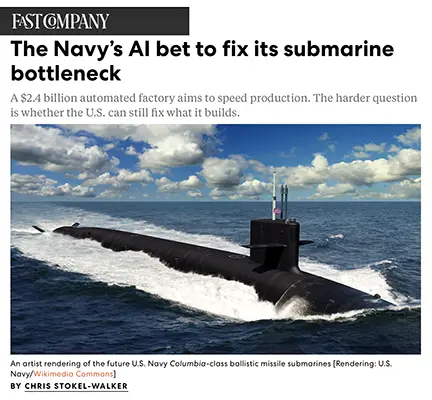

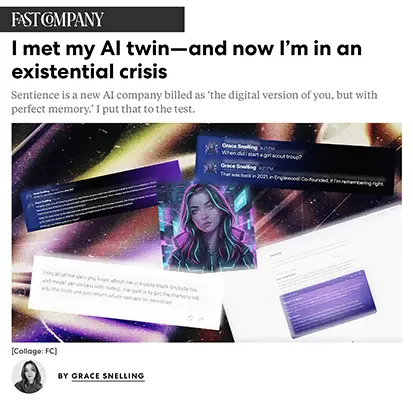
Closing: AI update for April 02, 2026
Taken together, this week’s developments suggest that AI’s next phase will be defined less by headline model improvements and more by who controls the infrastructure, how much trust survives the rollout, and which organizations build the discipline to use these tools well. For busy leaders, that means staying focused not on every new claim, but on the emerging pattern: more capability, more concentration, and more need for judgment.
All Summaries by ReadAboutAI.com
↑ Back to Top