
ReadAboutAI.com Anniversary Week: Day 8 – AI Everywhere
A look back. Relevant articles over the past year on the growth, expansion and takeover of AI.
Back to the Anniversary Week Overview page

THE INFORMATION FLOOD: HOW AI REWROTE THE RULES OF WHAT WE BELIEVE
When ReadAboutAI.com began publishing a year ago, the warning sirens about AI and information quality were loud but still largely theoretical. Experts predicted a wave of hyperrealistic deepfakes that would upend elections. Researchers warned that AI-generated content would overwhelm the internet. Disinformation analysts braced for sophisticated, precision-targeted synthetic propaganda from state adversaries. What actually happened was simultaneously less dramatic and more corrosive than any of those predictions. The flood came — but it arrived as a slow, unglamorous tide of cheap, low-quality content that didn’t fool anyone in particular and changed everything in general.
The articles in this collection trace that arc across roughly eighteen months, from mid-2024 through early 2026. The through-line is not the technology itself — it is what the technology did to trust, signal quality, and the value of curation. AI-generated slop colonized Medium and LinkedIn not because it was convincing, but because it was free and relentless. State-sponsored propaganda operations adopted AI not to achieve new levels of deception, but to automate volume. The U.S. government began using commercial AI video tools for public communications — not covertly, but casually, without policy or disclosure. A sitting president began sharing machine-generated content from his official accounts, not as part of a strategic influence operation, but apparently because a staffer thought it was funny. The threat model everyone prepared for — confusion caused by fakes too convincing to detect — turned out to be secondary to the one that snuck in the side door: influence that survives exposure, doubt that requires no deception, and a media environment where the cost of information pollution has dropped to nearly zero.
By April 2026, the consequences are structural, not episodic. Google search referrals to publishers have fallen by a third in a single year. More than half of LinkedIn’s longer posts are estimated to be AI-generated. The verification tools the industry built to defend against synthetic content — watermarks, provenance labels, AI detectors — are imperfect, opt-in, and easily bypassed. The question for SMB leaders is no longer whether AI has changed the information environment — it has — but whether their organizations are navigating that change with clear eyes or still waiting for “the big one” that may never arrive in the form anyone expected.
Summary by ReadAboutAI.com
Summaries: Anniversary Day 8
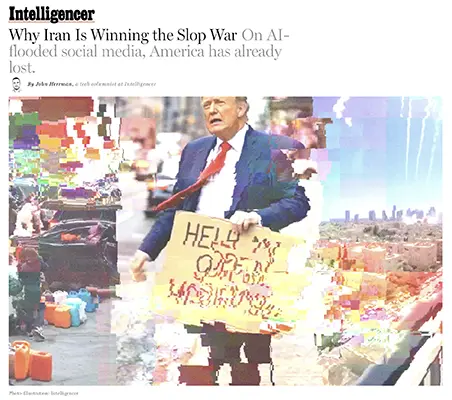
Why Iran Is Winning the AI Slop War
Intelligencer | John Herrman | March 19, 2026
TL;DR: AI-generated video has flooded social media during the ongoing U.S.-Iran conflict, and the structural incentives of social platforms — engagement over accuracy — mean that cheap AI propaganda and content-farm disinformation are algorithmically amplified regardless of their source, with net effects that favor Iran’s narrative over the United States’ by default.
Executive Summary
This is a well-argued opinion piece by a tech columnist with specific factual examples. It should be read as analysis, not news reporting — but the dynamics it describes are documented and observable. The article’s central observation: during the current U.S.-Iran conflict, an information vacuum has been filled by AI-generated video content, produced by governments, partisans, and opportunistic content farmers worldwide. The U.S. and Israel have sophisticated social media operations; Iran has relatively little AI capability. Yet Iran is benefiting most from the AI content environment — not because it produces better content, but because the algorithmic logic of social platforms rewards engagement with extreme, failure-narratives, and the existing demand in global social media audiences runs toward content depicting U.S. and Israeli overreach.
The mechanism is important for business leaders to understand. It is not primarily about state propaganda. It is about how cheap, widely accessible AI video tools (Kling, Runway, Veo, Grok, Seedance) have commoditized the production of compelling-looking disinformation, making it economically rational for content farmers with no stake in the conflict’s outcome to produce and amplify misleading war content for engagement revenue. This creates an information environment where distinguishing verified from fabricated content is genuinely difficult — and where even real leaders (Netanyahu was forced to post a “proof of life” video after deepfake suspicions) are compromised by the ambient unreliability of all video.
Relevance for Business
Most SMBs are not geopolitical actors, but the dynamics described here have direct operational relevance in three areas. First, the same AI video tools being used to generate war propaganda are available to anyone — including competitors, disgruntled former employees, or bad actors targeting your brand, executives, or products. The “proof of life” dynamic is no longer science fiction. Second, employee and customer perception is increasingly shaped by algorithmically served content they did not seek out, meaning information environments in which your business operates are degrading in verifiability. Third, for any organization that does communications, PR, crisis management, or public-facing content: the bar for “authentic and verified” is rising precisely because the bar for “fabricated and plausible” has fallen to near zero. This is a reputational infrastructure issue.
Calls to Action
🔹 Prepare policy now on how your organization would respond to a deepfake — of your CEO, your products, or your brand — circulating on social media. This is no longer an edge-case scenario.
🔹 Assign internal review of your communications and PR protocols to incorporate AI-generated content risks: response playbooks, verification procedures, and escalation paths.
🔹 Monitor AI content detection tools (Deezer’s model was referenced in last week’s Sony article; similar tools are emerging for video) — investing early in detection capability is lower cost than reactive crisis management.
🔹 Note for leadership: the information environment your employees, customers, and stakeholders inhabit is actively degrading in reliability — this affects how you communicate during any crisis, not just geopolitical ones.
🔹 Revisit your media literacy and communications training for customer-facing staff — the ability to recognize and respond appropriately to AI-generated disinformation is becoming a baseline operational skill.
Summary by ReadAboutAI.com
https://nymag.com/intelligencer/article/why-iran-is-winning-the-ai-slop-war.html: Day 8: May 27, 2026
Does Big Tech Actually Care About Fighting AI Slop?
The Verge | Jess Weatherbed | February 23, 2026
TL;DR: The primary industry standard for labeling AI-generated content (C2PA) is fragmented, poorly implemented, and structurally conflicted — because the companies promoting it are also the ones profiting from the AI content flood it is supposed to address.
Executive Summary
This is an analytical piece — opinion-forward but substantively reported — arguing that Big Tech’s anti-AI-slop posture is largely performative. The central exhibit is C2PA (Coalition for Content Provenance and Authenticity), an industry standard designed to authenticate media as human-made rather than AI-generated. Despite backing from Microsoft, Meta, Google, OpenAI, and others, C2PA suffers from incomplete adoption, easily stripped metadata, inconsistent platform implementation, and a fundamental design limitation: it requires every participant in the media creation and distribution chain to be enrolled, which is not achievable at scale. The article notes X (formerly Twitter) withdrew from C2PA after Musk’s acquisition, removing a major content-distribution channel from the standard entirely.
More pointedly, the article argues that the companies steering C2PA have a direct financial incentive to produce the synthetic content the standard is meant to label — and that this conflict of interest makes robust enforcement structurally unlikely. Meta, OpenAI, and Google are all simultaneously expanding generative AI tools and claiming to support content authenticity. The author characterizes C2PA as functioning more as reputational cover than as a working solution.
The practical takeaway for anyone relying on platform-level protections against AI-generated misinformation is clear: those protections are inconsistent, hard to use, and built by parties whose business interests run counter to meaningful enforcement.
Relevance for Business
For SMBs, this story has two practical dimensions. First, any business that relies on social media content — for marketing, customer research, brand monitoring, or competitive intelligence — should treat AI-generated content as a default risk, not an edge case. Platform-level labeling is unreliable. Second, businesses that produce and distribute original content — text, images, video, audio — should consider how they establish and protect provenance. The credibility gap between AI-generated and human-made content is widening, and audience trust in the authenticity of branded content is becoming a competitive variable. Organizations that can credibly demonstrate their content is human-originated may gain a trust premium over time.
Calls to Action
🔹 Do not rely on platform AI labels for content verification — Treat all digital content from social channels as potentially AI-generated, regardless of labels. Apply editorial judgment accordingly.
🔹 Assess your brand’s content authenticity posture — Consider whether your audience values human-made content, and whether your workflows and vendor relationships can credibly support that claim.
🔹 Evaluate C2PA readiness if you operate in media or publishing — If your business depends on content provenance (journalism, legal, brand protection), track C2PA adoption on your key distribution platforms but do not assume coverage.
🔹 Monitor regulatory developments — Governments may eventually mandate AI content disclosure. Businesses that build disclosure-readiness now will face lower compliance costs later.
🔹 Build internal media literacy — Staff who consume social media for business purposes need frameworks for skepticism. Brief your teams on the limitations of current AI labeling systems.
Summary by ReadAboutAI.com
https://www.theverge.com/ai-artificial-intelligence/882956/ai-deepfake-detection-labels-c2pa-instagram-youtube: Day 8: May 27, 2026
Really, You Made This Without AI? Prove It.
The Verge | April 4, 2026
TL;DR: At least 12 competing “human-made” certification schemes have emerged to help creators distinguish their work from AI-generated content — but fragmented standards, unenforceable verification, and no regulatory backing mean none of them work reliably yet.
Executive Summary
The proliferation of AI-generated content has created a trust problem with real commercial stakes: audiences increasingly can’t tell human-made from machine-made work, and many platforms aren’t helping. The existing industry standard meant to address this — C2PA content credentials, backed by Adobe, Microsoft, and Google — has largely failed in practice. The core reason is structural: those who profit from undisclosed AI content have no incentive to label it.
In response, a fragmented market of “human-made” certification labels has emerged, each with different eligibility rules, verification methods, and enforcement capacity. Approaches range from honor-system badges anyone can download, to AI detection tools (which experts acknowledge are unreliable), to manual audits of creative process documentation, to blockchain-based provenance certificates. None has achieved critical mass, and even the most rigorous lack regulatory teeth. The deeper problem is definitional: as AI becomes embedded in standard creative tools, “human-made” is increasingly difficult to define, let alone verify. Researchers quoted in the piece suggest the concept of authorship itself may need to be rethought.
The economic incentive cuts both ways. Creators have strong motivation to signal authenticity — human-origin work may increasingly command a premium. But bad actors, including AI content farms generating commercial revenue at scale, have equally strong motivation to misuse whatever label wins out.
Relevance for Business
This is a trust and provenance issue that touches any SMB that commissions, publishes, or purchases creative content — marketing materials, copy, design, photography, video. If a “human-made” standard eventually gains traction (regulatory or market-driven), businesses using AI-assisted content without disclosure could face reputational exposure or procurement friction. Conversely, organizations that can credibly demonstrate human authorship may gain a differentiation advantage in content-saturated markets. For now, no standard is worth adopting at cost — but the direction of travel is clear enough to warrant a policy position.
Calls to Action
🔹 Develop an internal AI content disclosure policy now — not because regulation requires it today, but because being caught without one later carries more risk than having one early.
🔹 Do not invest in any specific “human-made” certification scheme at this stage; the market is too fragmented and no standard has regulatory or platform-level backing.
🔹 Monitor C2PA adoption — if major platforms (Meta, Google, Adobe ecosystems) begin surfacing provenance labels to end users, this moves from background issue to customer-facing one quickly.
🔹 Consider the reputational positioning question: in your market, does “human-made” carry a premium your customers would pay for or respond to? If yes, get ahead of how you’d substantiate that claim.
🔹 Watch for regulatory movement — governments are largely absent from this conversation today, but EU AI Act implementation and similar frameworks may force the issue within 2–3 years.
Summary by ReadAboutAI.com
https://www.theverge.com/tech/906453/human-made-ai-free-logo-creative-content: Day 8: May 27, 2026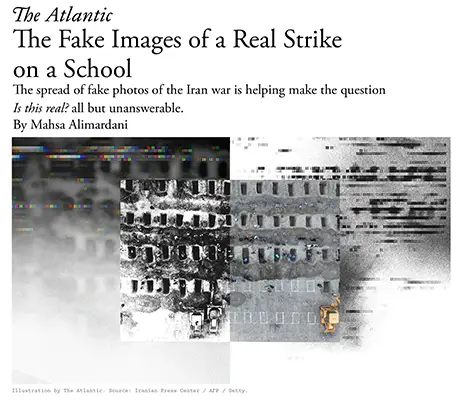
The Fake Images of a Real Strike on a School
The Atlantic — March 13, 2026
TL;DR: AI-generated disinformation in the Iran conflict is demonstrating a new and more dangerous pattern: not mass deception, but deliberate erosion of evidentiary trust — making the question “is this real?” functionally unanswerable.
Executive Summary
This piece by Mahsa Alimardani documents a specific, well-sourced sequence of events: an AI-generated image (with a visible Google Gemini watermark) circulated on Instagram the day before a real school in Iran was struck by what a U.S. military investigation preliminarily attributed to American forces. The fake image primed audiences to see schools as legitimate military targets. When footage of the real strike circulated, it was immediately contested — and an AI chatbot (Grok) confidently corroborated a false denial, citing major news outlets that actually contradicted it.
The article’s central argument is analytically sharp and worth taking seriously: AI disinformation does not need to fool everyone. It needs to make “is this real?” close to unanswerable. Real photos of civilian deaths get labeled fake. Fake images illustrate real deaths. Correct identification of one fabricated image is used to discredit authentic ones. The cycle runs faster than any newsroom, fact-checker, or platform can process.
This is a geopolitical story, not a business story — but it has direct downstream relevance. The same dynamics that are making evidentiary truth unstable in conflict zones are operating in commercial, reputational, and legal contexts.AI-generated images, audio, and video are already being used in fraud, reputation attacks, and market manipulation. The article provides a clear-eyed model for how that erosion works in practice.
Relevance for Business
The business relevance is not the Iran conflict itself. It is the demonstrated operational playbook for AI-enabled trust erosion: fabricated content doesn’t need to be believed — it only needs to contaminate the evidentiary environment enough that truth becomes difficult to establish quickly. For SMBs, the implications span several domains:
Reputational risk: Fabricated images or audio of your leadership, products, or operations could circulate faster than you can respond. Fraud exposure: Deepfake audio and video are already being used in business email compromise and vendor impersonation schemes. Vendor/partner trust: Verifying the authenticity of communications, contracts, and identity is a growing operational challenge. Legal and compliance: Evidentiary standards in disputes, HR investigations, and regulatory matters are being complicated by the same dynamics described here.
Calls to Action
🔹 Implement internal verification protocols for high-stakes communications — especially wire transfers, executive instructions, and vendor changes — that do not rely solely on digital channels.
🔹 Brief leadership on the operational model described here: AI disinformation doesn’t require mass deception — it requires sustained doubt. Prepare a response posture, not just detection tools.
🔹 Review your cyber and fraud insurance coverage for deepfake-enabled impersonation and business email compromise — policy language is lagging the threat.
🔹 Assign someone to monitor deepfake detection tools and media authentication standards (e.g., C2PA/content provenance frameworks) as they mature.
🔹 Do not assume that watermarks, platform labels, or AI detection tools provide reliable protection at this time — the article documents cases where all of these failed or were weaponized.
Summary by ReadAboutAI.com
https://www.theatlantic.com/ideas/2026/03/ai-imagery-iran-war/686347/: Day 8: May 27, 2026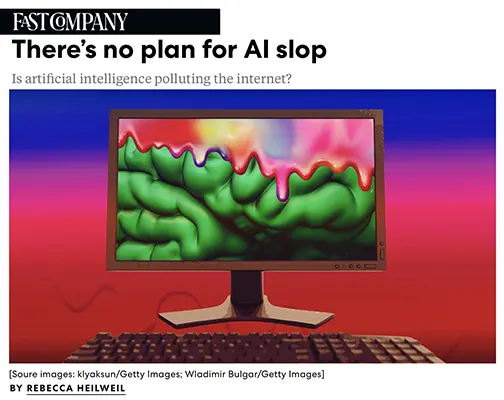
There’s No Plan for AI Slop
Fast Company (Nov 11, 2025)
Intro: This Fast Company analysis examines the rapid spread of low-quality AI-generated content (“AI slop”) across social platforms and the broader internet, highlighting its risks for truth, trust, searchability, and even future AI model performance.
Executive Summary
Generative AI has unleashed a flood of cheap, fast, and low-effort content, from nonsensical Instagram AI videos to fabricated news clips and synthetic social posts. As the article notes, “slop”—a term that evokes messy, overflowing waste—has become a mainstream label for this glut of low-quality, low-verification AI output. This material now saturates feeds on Instagram, X, Medium, and other platforms, blurring the lines between authentic and artificial content.
The spread of AI slop has already caused visible misinformation incidents, including news outlets mistakenly reporting AI creations as real events and public figures amplifying AI-generated deepfake videos. With an estimated 51% of the internet now bot-generated and nearly half of Medium posts appearing AI-authored, the article warns that digital spaces are shifting from human-to-human interaction to bot-to-bot ecosystems. This creates a structural fog: users cannot easily tell what is real, and platforms have little incentive—or ability—to clean it up.
Beyond the social impact, the article highlights a more systemic threat: AI systems training on AI-generated data. Research cited (Nature, 2025) shows that models trained on synthetic or recursively generated content face “model collapse”—irreversible degradation in accuracy and reasoning. As more slop floods the internet, future models risk being trained on polluted data, creating a Kessler Syndrome–like chain reaction in digital space: self-reinforcing noise and declining truth quality.
Relevance for Business
For SMB leaders, this article signals a crucial warning: AI-polluted information ecosystems increase business risk. Poor-quality AI content can distort market research, contaminate customer data, and undermine brand trust. As employees increasingly use generative AI tools, the risk of incorporating polluted, incorrect, or unattributed content grows—potentially damaging decision-making, marketing accuracy, legal compliance, and cybersecurity resiliency.
This trend also impacts AI vendors that SMBs rely on. If AI models begin to degrade from synthetic data exposure, the reliability of business tools—chatbots, analytics assistants, search platforms, marketing automations—could erode, impacting productivity and accuracy.
Calls to Action
🔹 Implement digital content verification for inbound information, including vendor materials, market data, and online sources.
🔹 Adopt AI usage policies that require human review, citation, and verification for any AI-assisted outputs.
🔹 Choose AI vendors with transparent data pipelines (clear separation of synthetic vs. human-generated training data).
🔹 Educate teams on recognizing AI-generated misinformation, especially in marketing, research, and HR workflows.
🔹 Monitor your brand’s presence on social platforms for synthetic content or deepfake activity.
🔹 Prioritize first-party data collection, reducing reliance on web-scraped or synthetic datasets.
🔹 Evaluate content moderation tools that detect bot traffic, AI-generated reviews, or synthetic spam.
Summary by ReadAboutAI.com
https://www.fastcompany.com/91436321/artificial-intelligence-slop-contamination-social-media: Day 8: May 27, 2026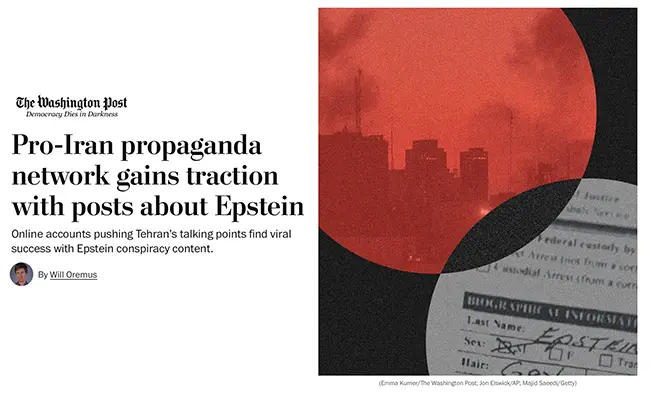
Pro-Iran Propaganda Network Gains Traction with Posts About Epstein
The Washington Post | Will Oremus | March 11, 2026
TL;DR: Researchers have identified a coordinated network of anonymous X accounts amplifying pro-Iran propaganda by latching onto Epstein conspiracy theories — using AI-generated fake videos that reached millions of views — demonstrating how AI-enabled disinformation now operates at scale during geopolitical events and directly threatens any organization’s information environment.
Executive Summary
This is an investigative news report drawing on findings from the Institute for Strategic Dialogue (ISD) and the Anti-Defamation League (ADL), as well as city documents and platform data. It is the piece in this batch most removed from typical AI product coverage, but it is relevant precisely because it documents how AI-generated content is being weaponized operationally in real time.
Following U.S.-Israel strikes that killed Iran’s supreme leader on February 28, at least 15 anonymous X accounts — identified by ISD researchers as aligned with Iranian state messaging — deployed AI-generated fake videos to amplify the claim that the military operation was designed to suppress the Epstein files. One such video, definitively identified as fabricated, received 6.8 million views before the account was suspended. Several accounts in the network were verified on X, meaning they paid for features including greater algorithmic visibility. Nine of the fifteen were created within the past two years.
The mechanism is straightforward: emotionally charged conspiracy content (Epstein) is used as the entry point; geopolitical propaganda is the payload. The phrase “Epstein Fury” appeared in over 90,000 posts from 60,000 accounts in the first three days of the conflict. AI-generated fakes — fake videos of missile strikes, combat footage, explosion scenes — were also widely circulated and subsequently debunked. X announced a 90-day demonetization penalty for undisclosed AI-generated conflict videos but did not clarify whether the pro-Iran network was suspended under this or a prior policy. Candace Owens, with 5.9 million YouTube subscribers, independently amplified content that was later reshared by accounts in the pro-Iran network.
The article is careful to note that individual pieces of disinformation may have limited direct impact. However, researchers cited in the piece are clear that aggregate exposure to consistent false narratives shifts public opinion over time, particularly when the narratives reinforce pre-existing beliefs.
Relevance for Business
The direct business relevance is in three areas. First, reputational exposure: any brand operating in categories adjacent to geopolitical events, government contracting, defense, finance, or technology is a potential target for disinformation that could affect customer trust or partner relationships. Second, employee and stakeholder communication: the volume and velocity of AI-generated disinformation during fast-moving events means that information your team consumes and shares — even from plausible-looking sources — may be fabricated. Third, AI platform governance: this story is evidence that platforms have not solved AI-generated content at scale, and businesses that rely on social platforms for distribution or reputation monitoring need to account for an environment where false, AI-generated content can outperform factual content algorithmically. This is not a future risk — it is the current operating environment.
Calls to Action
🔹 Brief communications and PR teams now: Ensure your communications staff understands the current disinformation landscape — particularly the use of AI-generated video as a trust vector — and has a protocol for verifying content before amplifying it.
🔹 Establish a crisis disinformation playbook: If your organization operates in a sector that could be targeted — or caught in the crossfire — by coordinated false narratives, map your response protocol before an incident occurs.
🔹 Audit social media monitoring tools: Verify that your social listening and reputation monitoring tools flag AI-generated content and bot-network amplification, not just volume-based signals.
🔹 Train leadership on verification basics: Executives who share or endorse content publicly should know how to check for AI-generated media markers before amplifying — basic media literacy is now a leadership competency.
🔹 Monitor platform policy changes: X’s new AI-generated content disclosure policies, and similar moves by other platforms, will affect the disinformation landscape for brand and reputational purposes — track these as they evolve.
Summary by ReadAboutAI.com
https://www.washingtonpost.com/technology/2026/03/10/epstein-files-pro-iran-propaganda/: Day 8: May 27, 2026Back to the Anniversary Week Overview page
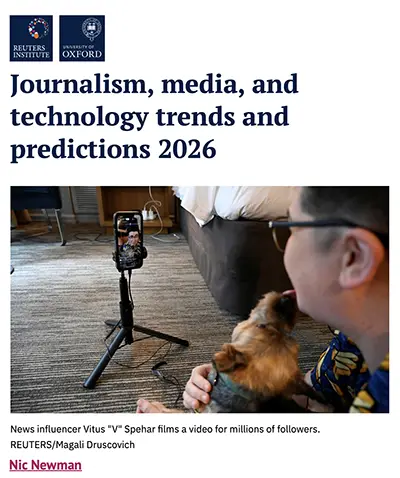
Journalism, Media, and Technology Trends and Predictions 2026
Reuters Institute for the Study of Journalism | Nic Newman | January 12, 2026
TL;DR: The news industry is simultaneously being squeezed by AI-driven search disruption and a human creator economy — and the response is a structural shift toward distinctiveness, video, and direct audience ownership that has direct implications for how any organization communicates and competes for attention.
Executive Summary
The Reuters Institute’s annual survey of 280 digital media leaders from 51 countries offers the most substantive industry-level data point in this Day 8 series. The headline finding is stark: publisher confidence in journalism as a whole has fallen 22 percentage points over four years, even as most publishers remain cautiously optimistic about their own organizations. The divergence reveals a sector that sees the macro environment deteriorating while hoping individual quality can survive.
Two structural forces are converging. First, AI-driven search disruption is already measurable: Google referral traffic to publisher sites fell 33% globally and 38% in the U.S. between November 2024 and November 2025. Publishers expect search referrals to fall a further 40% over the next three years. AI overviews, ChatGPT, and the shift toward “answer engines” are compressing the discovery layer that has underwritten online content economics for two decades. Second, the creator economy is pulling audiences and talent toward personality-led media — undermining institutional trust while rewarding individual voice. Three-quarters of publishers surveyed say they plan to push their staff to behave more like creators in response.
The strategic playbook emerging from the survey is instructive for any content-producing organization: pivot toward original, hard-to-replicate content (investigations, analysis, human stories); reduce investment in commodity content(evergreen, service journalism, general news) that AI will commoditize; invest heavily in video and audio; and prioritize direct audience relationships over platform-mediated distribution. The report also introduces useful terminology — “Answer Engine Optimization” (AEO), “liquid content,” and “digital provenance” — that signals where the next round of content strategy battles will be fought.
Relevance for Business
This report is the most directly actionable source in the Day 8 series for SMB executives who manage content, marketing, or communications. The structural forces reshaping news publishing are the same forces affecting any organization that creates content to reach an audience. SEO strategies built for the last decade are losing effectiveness. Direct audience channels — email, community, owned media — are gaining relative importance. If AI overviews are suppressing traffic to major publishers, they are suppressing it for SMB content too. The creator economy signal is also relevant for talent: professionals who build personal audiences are gaining economic leverage that employers and clients will need to understand and respond to. The 97% of newsrooms that consider back-end AI automation “important” reflects where enterprise tool adoption is heading across industries, not just media.
Calls to Action
🔹 Audit your SEO-dependent content strategy now — if a meaningful share of your web traffic or lead generation depends on Google search, model what a 30–40% referral decline would mean and begin diversifying.
🔹 Invest in owned audience channels — email lists, community platforms, and direct subscriber relationships are the most durable assets in a disrupted discovery environment.
🔹 Identify your “hard-to-commoditize” content — original perspectives, proprietary data, case studies, and genuine expertise are what AI cannot replicate; double down there and reduce investment in generic content.
🔹 Monitor AEO (Answer Engine Optimization) as SEO’s successor — how your content surfaces in ChatGPT, Perplexity, and Gemini is already a visibility question worth tracking; it will become a strategic priority.
🔹 Factor creator economy dynamics into talent strategy — high-performing employees who build public audiences are increasingly comparing their options; understand what that means for retention, compensation, and partnership structures.
Summary by ReadAboutAI.com
https://reutersagency.com/journalism-and-technology-trends-and-predictions-2026: Day 8: May 27, 2026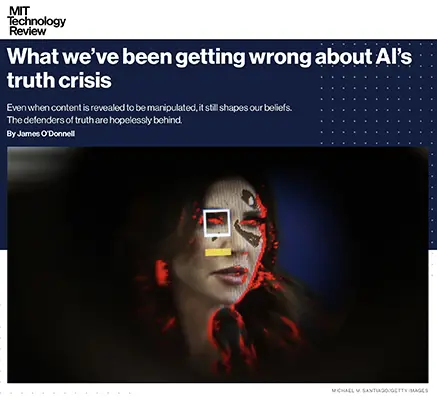
What We’ve Been Getting Wrong About AI’s Truth Crisis
MIT Technology Review | James O’Donnell | February 2, 2026
TL;DR: Debunking AI-altered content no longer stops it from influencing people — and the verification tools we built to counter this problem were never designed for the world we’re now in.
Executive Summary
The core argument here is a quiet but significant shift in the disinformation threat model. The problem was long framed as one of confusion — people can’t tell what’s real, so build better detection tools. What’s emerged instead is more corrosive: exposure doesn’t neutralize influence. Research cited in the piece found that even when people were explicitly told fabricated video evidence was fake, it continued to shape their judgments of guilt. The disclosure didn’t undo the emotional effect.
The practical limits of the primary industry countermeasure — content provenance labeling, as championed by Adobe’s Content Authenticity Initiative — are laid bare. Labels are opt-in for creators, can be stripped by platforms, and platforms may simply choose not to display them. The infrastructure exists; the incentive to deploy it consistently does not.
The piece points to a documented instance of the U.S. government using AI video tools for public-facing immigration content as its news hook, but the more durable signal is the analytical frame: influence operations no longer need to survive fact-checking to succeed. Doubt, confusion, and reflexive both-sidesing are sufficient outcomes.
Relevance for Business
For SMB leaders, this matters beyond politics. Any organization that relies on earned trust — with customers, employees, or partners — now operates in an environment where reputational attacks don’t need to be credible to do damage. A fabricated clip, a manipulated image, a synthetic voice note attributed to a leader: even if debunked, the emotional residue lingers. The verification tools most businesses would reach for (detection services, platform labels) are demonstrably unreliable at scale. Crisis communication playbooks built around “correct the record” logic need reassessment.
Calls to Action
🔹 Audit your crisis response playbook — “correct the record” is insufficient if corrections don’t neutralize impact; update protocols to address reputational harm that survives disclosure.
🔹 Don’t over-invest in AI detection tools for trust management — the piece signals these tools are better as trend indicators than as definitive arbiters; use them as one signal, not the answer.
🔹 Brief leadership on the “influence survives exposure” dynamic — this is a materially different threat model than most executives are currently operating on.
🔹 Monitor provenance standards — the Content Authenticity Initiative remains worth tracking; adoption incentives, not just technical capability, will determine whether it eventually works.
🔹 Consider proactive authenticity practices — watermarking official communications, establishing known-good channels, and being transparent about AI use in your own content reduces the attack surface.
Summary by ReadAboutAI.com
https://www.technologyreview.com/2026/02/02/1132068/what-weve-been-getting-wrong-about-ais-truth-crisis/: Day 8: May 27, 2026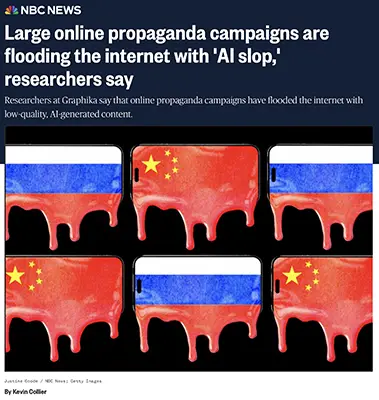
Large Online Propaganda Campaigns Are Flooding the Internet with ‘AI Slop,’ Researchers Say
NBC News | Kevin Collier | November 19, 2025
TL;DR: State-sponsored propaganda operations from Russia and China have adopted AI wholesale — but the output is low-quality, gets little engagement, and matters less for immediate persuasion than for quietly polluting the training data that AI systems learn from.
Executive Summary
Research from Graphika, a social media analytics firm, analyzed nine active state-linked influence operations and found that all have integrated generative AI into content production. The result is not a wave of sophisticated, convincing synthetic media — it’s cheap, clunky, high-volume output that largely fails to gain traction on Western platforms. Examples include fake AI news anchors with unconvincing delivery, botched translations, and deepfake celebrity videos that drew minimal attention outside existing partisan echo chambers.
The headline finding cuts against the more alarming predictions made when generative AI matured: propagandists are not deploying AI to achieve new levels of deception; they’re using it to automate volume. One analyst described campaigns where a single individual could produce mass content at scale by pressing a few buttons. The strategic value isn’t immediate persuasion — it’s persistence and scale.
The more consequential long-term risk, raised near the end of the piece, is training data contamination. AI chatbots are continuously trained on internet text, and a separate study found that major LLMs already cite sanctioned Russian state media in their answers. If propaganda operations can seed the web with enough low-quality AI content, the downstream effect may be less about swaying today’s readers and more about quietly skewing tomorrow’s AI systems.
Relevance for Business
For SMBs, the immediate operational risk is modest — these campaigns primarily target political narratives, not commercial environments. However, the training data contamination angle has direct enterprise relevance: if AI tools your teams use are drawing on a web increasingly seeded with synthetic, agenda-driven content, the quality and neutrality of AI-assisted research, summarization, and decision support may degrade over time. This is a slow-moving risk that warrants monitoring, not alarm. The broader signal: the cost of information pollution just dropped dramatically, which changes the economics of competitive intelligence, market research, and any workflow dependent on web-sourced AI output.
Calls to Action
🔹 Do not treat this as an immediate operational threat for most SMBs — the current campaigns target political influence, not commercial decision-making.
🔹 Monitor AI tool quality for research workflows — as training data quality degrades, AI-assisted market research and summarization become less reliable; build in human verification checkpoints.
🔹 Be skeptical of AI outputs on contested geopolitical or policy topics — the training contamination risk is highest where propaganda operations are most active.
🔹 Watch how AI vendors address training data provenance — this is an emerging quality and governance issue; vendor transparency will matter.
🔹 Revisit in 12–18 months — the training contamination dynamic is early-stage; track whether researchers find measurable impact on commercial AI tool outputs.
Summary by ReadAboutAI.com
https://www.nbcnews.com/tech/security/online-propaganda-campaigns-are-using-ai-slop-researchers-say-rcna244618: Day 8: May 27, 2026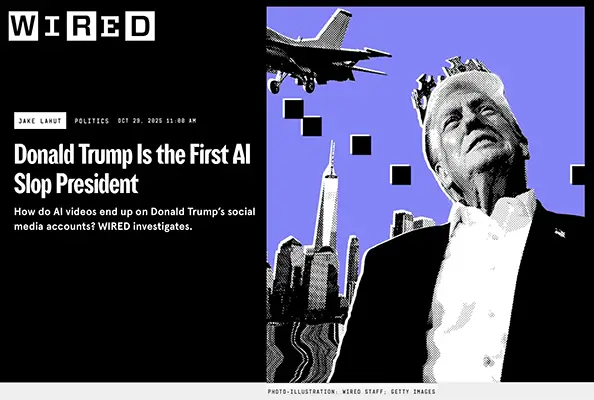
Donald Trump Is the First AI Slop President
Wired | Jake Lahut | October 29, 2025
TL;DR: The sitting U.S. president regularly shares AI-generated video content — sometimes personally, more often via two key staffers — with no apparent strategy beyond trolling, which represents a normalization of synthetic media at the highest levels of public communication.
Executive Summary
Wired investigated how AI-generated video ends up on the official social media accounts of President Trump. The answer is less Machiavellian than feared: Trump himself occasionally saves and posts videos he finds amusing; most of the time, two staffers — Dan Scavino and Natalie Harp — identify content and seek approval before publishing. The administration is evasive about who produces the videos or which tools are used, and there appears to be no coherent strategy beyond provocation and mockery.
The piece is notable less for what it reveals about Trump specifically and more for what it confirms about the normalization of AI-generated content in official communications. The concern is not a sophisticated disinformation operation; it is something arguably more corrosive — a casual, habitual blurring of the line between real and synthetic in government messaging, without accountability, labeling, or apparent concern. The author notes that for years observers waited for “the big one” — a deepfake that triggers a market event, upends an election, or starts a conflict. What arrived instead is lower-grade but persistent: a steady stream of AI slop from the most visible office in the world, normalizing the format.
The piece also confirms that the administration’s use of government AI tools for public-facing content — reported separately by MIT Technology Review — is part of a broader, unsupervised pattern of synthetic media in official channels.
Relevance for Business
For SMB leaders, the immediate operational risk is indirect. However, the normalization dynamic has real downstream consequences: as AI-generated content becomes routine in official communications, the baseline expectation that public-facing content is authentic erodes further. This accelerates the environment in which your own organization’s communications — whether authentic or AI-assisted — are received with greater skepticism. It also raises a practical governance question: if the U.S. government operates without a coherent AI content policy, regulated industries and public-facing businesses will be under growing pressure to fill that gap themselves, particularly around disclosure, labeling, and consent. Organizations that establish clear standards now are ahead of the eventual regulatory reckoning.
Calls to Action
🔹 Don’t wait for federal AI communications standards — the current administration’s pattern suggests those standards are not imminent; establish your own internal AI disclosure and labeling policy proactively.
🔹 Brief communications and marketing teams on the normalization effect — as AI-generated content becomes expected from high-profile sources, audience trust defaults are shifting; authentic, clearly human-authored content is a differentiator.
🔹 Monitor how this pattern evolves in regulated sectors — financial services, healthcare, and legal communications are likely to face stricter AI disclosure requirements; track early signals from relevant regulators.
🔹 Treat this as context, not immediate action — the piece is more diagnostic than operational; its value is in understanding the environment your communications land in.
🔹 Watch for “big one” scenarios — the author’s framing acknowledges that a high-consequence synthetic media event remains possible; include it in crisis planning even while the current pattern remains low-stakes.
Summary by ReadAboutAI.com
https://www.wired.com/story/donald-trump-ai-slop-white-house/: Day 8: May 27, 2026
Yes, That Viral LinkedIn Post You Read Was Probably AI-Generated
Wired | Kate Knibbs | November 26, 2024
TL;DR: More than half of longer LinkedIn posts are now estimated to be AI-generated — and because the platform’s native voice was already corporate and formulaic, many users may never notice the difference.
Executive Summary
An analysis commissioned by Wired found that over 54% of longer English-language posts on LinkedIn are likely AI-generated, up from negligible levels before 2023. The inflection point was ChatGPT’s public launch; usage spiked nearly 190% and has since plateaued. LinkedIn has itself been an active accelerant, offering AI writing and rewriting tools to Premium subscribers — and explicitly welcoming AI use in a posture that distinguishes it from platforms like Medium that nominally oppose it.
The piece surfaces a dry but important observation: LinkedIn may be the platform where AI-generated content is structurally indistinguishable from human content, because the prevailing style of professional self-promotion was already optimized for blandness. The same hollow tone that characterized “Thought Leader Blogging” before generative AI is now being produced at scale, algorithmically. Human editors who rely on judgment rather than detection tools are screening out the majority of suspected AI submissions — and still seeing machine-generated content go viral.
For users who depend on LinkedIn for genuine professional signals — evaluating candidates, assessing vendors, interpreting market sentiment — the platform’s credibility as a human voice network has materially degraded.
Relevance for Business
LinkedIn is a primary channel for B2B credibility, talent evaluation, recruiting signals, and executive visibility. If more than half of what appears there is machine-generated, the quality of the signal has changed. Leaders who evaluate vendor expertise, candidate thought leadership, or partner credibility through LinkedIn content need to adjust their methodology. There is also an internal question: if your own team’s LinkedIn presence is AI-generated without disclosure, and that becomes apparent, it carries reputational risk with audiences who are paying attention. The platform’s embrace of AI also creates a new kind of noise in competitive intelligence — AI-generated posts can create false impressions of company momentum, capability, or market positioning.
Calls to Action
🔹 Revise how your team reads LinkedIn as a research tool — treat profiles and posts as one signal among many, not as verified evidence of expertise or genuine perspective.
🔹 Establish an internal policy on AI use in professional communications — especially for LinkedIn, where your team members represent your brand; decide where the line is between AI-assisted and AI-generated.
🔹 Consider disclosure as a brand differentiator — as AI content becomes the norm, authentic human voice with explicit attribution may carry a premium with discerning audiences.
🔹 Don’t over-invest in LinkedIn for talent intelligence — the degradation in signal quality affects recruiting research; supplement with direct conversation, references, and other verification methods.
🔹 Monitor platform policy evolution — LinkedIn’s permissive stance on AI may shift under regulatory or advertiser pressure; watch for changes that affect distribution of AI content.
Summary by ReadAboutAI.com
https://www.wired.com/story/linkedin-ai-generated-influencers/: Day 8: May 27, 2026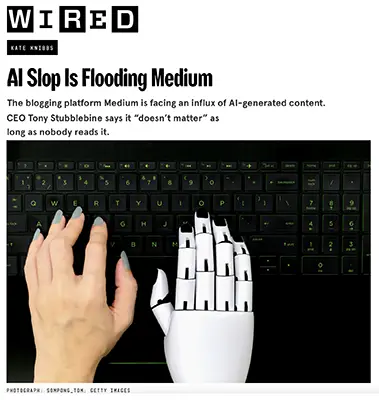
AI Slop Is Flooding Medium
Wired | Kate Knibbs | October 28, 2024
TL;DR: Nearly half of recent posts on Medium are estimated to be AI-generated — and the platform’s CEO argues that’s manageable as long as the slop stays unread, a posture that reveals where the real battle for content quality is now being fought.
Executive Summary
Two independent AI detection firms, commissioned by Wired, each estimated that roughly 40–47% of recent Medium posts were likely AI-generated — a figure orders of magnitude higher than comparable estimates for the broader web. Medium’s CEO does not dispute the volume increase; he disputes that it matters, arguing that existing curation and spam filters keep the low-quality content effectively invisible to readers. The implied thesis: what matters isn’t what’s posted, but what gets amplified.
That framing is pragmatic, but it carries a cost. Human editors on the platform report rejecting the majority of contributor submissions on AI-suspicion grounds, and at least one heavily “clapped” viral post was independently flagged as likely AI-generated. The moderation system works enough of the time — not all of the time. Meanwhile, a cottage industry of get-rich-quick SEO entrepreneurs actively targets platforms like Medium with AI-slop playbooks, which means the adversarial pressure isn’t accidental or temporary.
The piece also surfaces a structurally important observation: AI detection tools are reliable as trend indicators, not as verdicts on individual pieces. Both firms acknowledged imprecision at the document level while standing behind their platform-level findings. Medium chose to reject the tools entirely, which leaves it relying on human judgment and indirect quality signals — a defensible but inherently leaky approach.
Relevance for Business
SMBs that use content platforms for thought leadership, marketing, or recruiting signals face a degrading signal environment. If nearly half of what’s published on a major platform is machine-generated, the editorial credibility of that platform — and the content associated with it — erodes. Any business investing in content distribution or using platforms like Medium as a credibility proxy for vendors, talent, or market intelligence should recalibrate expectations. The broader implication: curation is now a competitive differentiator, not a commodity. Platforms and organizations that invest in genuine editorial judgment will stand out.
Calls to Action
🔹 Reassess content platforms used for B2B thought leadership — distribution reach means less if the surrounding editorial environment is degraded; audience trust is the asset, not impressions.
🔹 Don’t rely on AI detection tools as definitive verdicts — use them to monitor trends in content environments you depend on, not to adjudicate individual pieces.
🔹 Invest in human editorial quality signals — bylines, editorial policies, institutional affiliation, and demonstrated expertise matter more now, not less.
🔹 Update vendor or talent due diligence — if you use published content to assess third parties, account for the possibility that AI-generated output has inflated apparent expertise.
🔹 Monitor the “Dead Internet” trajectory — the scenario where most platform content is machine-generated is not hypothetical; track whether platforms you depend on are managing it credibly.
Summary by ReadAboutAI.com
https://www.wired.com/story/ai-generated-medium-posts-content-moderation/: Day 8: May 27, 2026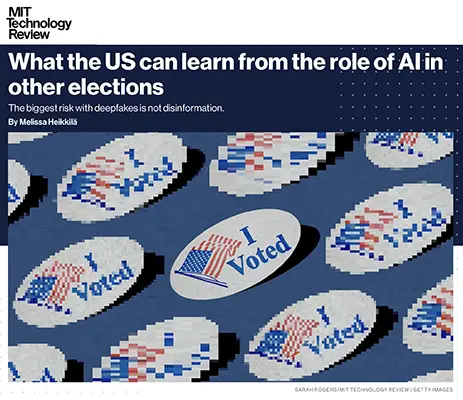
What the US Can Learn from the Role of AI in Other Elections
MIT Technology Review | Melissa Heikkilä | September 24, 2024
TL;DR: The feared wave of AI-powered election disinformation failed to materialize in 2024’s major global votes — but the more durable risk is not convincing deepfakes, it’s the erosion of trust that makes even real content deniable.
Executive Summary
Research from the Alan Turing Institute, examining elections in the UK, France, the EU Parliament, and elsewhere in 2024, found that AI-generated content had no measurable effect on outcomes. State-sponsored influence operations — primarily Russian — continued relying on older, proven methods: social bots, flooding comment sections, and manufacturing the appearance of popular sentiment. When they did attempt AI-generated content, the results were poorly executed; one campaign published articles with AI prompts still visible in the text.
The deepfake threat was overdiagnosed. The more consequential risk, named directly in this piece, is the “liar’s dividend” — a condition in which the mere existence of convincing synthetic media makes it possible for anyone to credibly deny authentic content. A politician caught on video can claim it was faked. A real document can be dismissed as AI-generated. The damage is not from fabricated content that fools people; it is from ambient doubt that makes all content contestable. The piece also notes that while foreign actors showed restraint or incompetence with AI, domestic political actors — including candidates — did not, using AI-generated imagery for campaign messaging without disclosure.
Relevance for Business
The “liar’s dividend” dynamic is not confined to electoral politics. Any organization that relies on video, audio, or documentary evidence — in legal proceedings, financial disclosures, board communications, or crisis response — faces a version of this risk. As synthetic media becomes commonplace, the evidentiary weight of authentic content weakens. This has implications for internal investigations, vendor accountability, contract disputes, and any scenario where proof of what was said or done matters. The practical response is the same as in politics: establish verified, trusted channels and protocols before a dispute arises, not after.
Calls to Action
🔹 Brief leadership on the “liar’s dividend” concept — the risk is not being deceived by fakes; it is that real content loses its power to compel, which changes how disputes get resolved.
🔹 Establish provenance practices for high-stakes communications — record-keeping, timestamping, and multi-party verification for sensitive conversations and decisions reduces your exposure.
🔹 Do not assume AI disinformation is a sophisticated threat — based on evidence from global elections, current state-sponsored AI content is low-quality; the bigger risk is ambient distrust, not precision targeting.
🔹 Monitor the regulatory gap on AI in political messaging — the absence of disclosure requirements for AI-generated political content is a governance gap that may eventually produce compliance obligations for organizations that engage in public-facing campaigns.
🔹 Revisit in context of the 2026 election cycle — the piece was written pre-U.S. election; how AI was or was not used in the 2024 U.S. results should inform updated threat modeling.
Summary by ReadAboutAI.com
https://www.technologyreview.com/2024/09/24/1104347/what-the-us-can-learn-from-the-role-of-ai-in-other-elections/: Day 8: May 27, 2026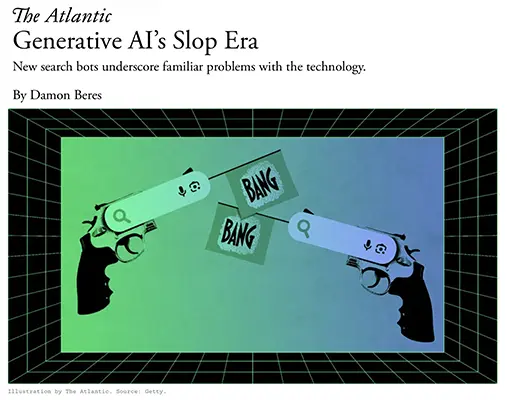
Generative AI’s Slop Era
The Atlantic | Damon Beres | August 9, 2024
TL;DR: AI search companies openly describe journalism as raw material to feed their answer engines — a framing that signals where value is being extracted and where it is not being returned.
Executive Summary
This Atlantic Intelligence newsletter piece is short and opinion-forward, prompted by an interview with a senior executive at Perplexity, an AI search company. The executive’s framing — that journalism’s value to AI systems is purely as a warehouse of facts — struck the author as symptomatic of a wider attitude problem in how AI companies relate to the content ecosystems they depend on.
The substantive business signal sits just beneath the surface. AI search products are being built on a premise that original content creation is a cost center for others, not a responsibility they share. Media partnerships, such as the one The Atlantic signed with OpenAI, are one response — but these deals remain early-stage, unevenly distributed, and contested in the courts. The author notes that copyright litigation may ultimately determine whether this model is viable.
The piece is best read as a sentiment marker from mid-2024, capturing the moment when the tension between AI companies and content creators became explicit and named. The term “slop” — AI-generated content treated as undifferentiated filler — was entering mainstream usage, and this piece helped establish its critical framing.
Relevance for Business
SMB leaders who produce original content — whether for marketing, thought leadership, or client communications — face a structural devaluation dynamic. If AI companies treat all written content as equivalent training fodder, the competitive advantage of high-quality original content shifts from distribution reach to direct audience relationships. Owning your audience — through email lists, communities, or direct channels — becomes more valuable precisely because algorithmic and AI-mediated discovery increasingly bypasses the quality signal. Additionally, any SMB considering licensing content to AI platforms or using AI-generated content at scale should monitor how the copyright cases referenced in this piece resolve; the legal framework is unsettled.
Calls to Action
🔹 Prioritize owned audience channels — email lists, communities, and direct subscriber relationships hold value that AI-mediated discovery increasingly dilutes.
🔹 Monitor AI search product development — tools like Perplexity and SearchGPT are actively reshaping how your content and your competitors’ content surfaces to potential customers.
🔹 Track copyright litigation outcomes — the legal status of AI training on published content remains unresolved; outcomes will affect content licensing, platform strategy, and vendor risk.
🔹 Evaluate the “original vs. AI-generated” distinction strategically — as AI content becomes cheaper and more prevalent, human-authored content that demonstrates genuine expertise and perspective may command a distinct premium with discerning audiences.
🔹 Treat this as a monitor for now — the piece is a useful frame, but the business impact of AI search on SMB content strategy will become clearer as these products mature.
Summary by ReadAboutAI.com
https://www.theatlantic.com/newsletters/archive/2024/08/ai-search-bots-war/679429/: Day 8: May 27, 2026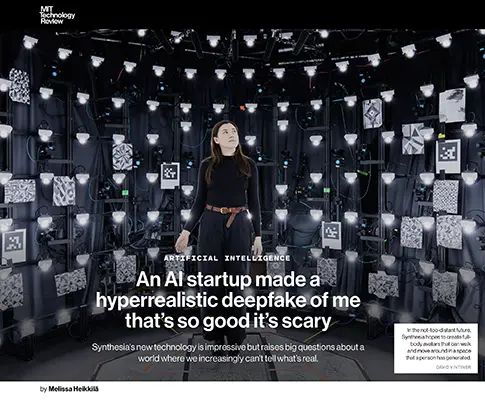
An AI Startup Made a Hyperrealistic Deepfake of Me That’s So Good It’s Scary
MIT Technology Review | Melissa Heikkilä | April 25, 2024
TL;DR: A commercial AI platform has produced photorealistic digital clones indistinguishable from real people — with enterprise pricing starting at $22/month — and the primary guardrail against misuse is corporate policy, not technical limitation.
Executive Summary
The journalist underwent the full process of being digitally cloned by Synthesia, an AI video startup, and the result was compelling enough to prompt genuine concern. The piece is partly experiential, but its business and policy substance is significant. Synthesia’s technology has crossed the threshold where AI-generated video of a person is, in most cases, indistinguishable from authentic footage. The company serves 56% of the Fortune 100, primarily for internal corporate communications, and entry-level access starts at $22 per month.
The more important signal is structural: the primary barrier to misuse is contractual and behavioral, not technical.Synthesia applies watermarks, maintains content moderation staff (10% of headcount), and restricts access tiers — but its own CEO acknowledges the guardrails are imperfect and that bad actors will simply use open-source alternatives. A documented incident involved its technology being used for pro-China propaganda in violation of its terms of service. The piece also surfaces the “liar’s dividend” risk explicitly: as synthetic video becomes credible, the ability to deny authenticity of real footage becomes a viable strategy for anyone — politicians, executives, defendants — with something to hide.
For business leaders, the consent-and-watermark model Synthesia employs represents the responsible commercial end of the spectrum — but it does not define the threat environment, where open-source tools impose no such constraints.
Relevance for Business
SMBs face this issue from two directions. As potential targets: executive impersonation via synthetic video is now a low-cost, technically accessible attack vector for fraud, reputational damage, or manipulation of employees, customers, or partners. As potential users: the same technology offers legitimate value for corporate training, communications, and marketing content — but deploying it carries disclosure and reputational risk if audiences perceive it as deceptive. The governance gap is real: there is no settled legal or industry standard for when synthetic video of a person requires disclosure, consent, or labeling.
Calls to Action
🔹 Treat executive voice and video as an identity security surface — brief security teams on the risk of synthetic impersonation; implement out-of-band verification for any sensitive communication channel.
🔹 Evaluate AI avatar tools for legitimate use cases carefully — corporate training and internal communications are plausible applications; weigh efficiency gains against disclosure obligations and reputational risk.
🔹 Require explicit disclosure policies before deploying synthetic video externally — even well-intentioned use of AI avatars can damage trust if audiences feel deceived; policy should lead deployment.
🔹 Don’t rely solely on watermarking or detection — the piece makes clear these are partial measures; the open-source ecosystem operates outside commercial guardrails entirely.
🔹 Monitor the “liar’s dividend” as a legal risk — if synthetic media becomes standard grounds for denying authentic evidence, it changes the evidentiary landscape for contracts, disputes, and compliance.
Summary by ReadAboutAI.com
https://www.technologyreview.com/2024/04/25/1091772/new-generative-ai-avatar-deepfake-synthesia/: Day 8: May 27, 2026Back to the Anniversary Week Overview page
Additional Links
Working on: Day 8 — AI Flooded the Information Environment — and Made Curation More Valuable
Below are 25 articles from November 2024 through early 2026 that are relevant, substantive, and draw from approved sources (MIT Technology Review, The Atlantic, Wired, Axios, Reuters, Nieman Lab) or closely related publications approved elsewhere in the source list. A note of caution precedes the list.
MIT Technology Review
- “An AI startup made a hyperrealistic deepfake of me that’s so good it’s scary” April 25, 2024 https://www.technologyreview.com/2024/04/25/1091772/new-generative-ai-avatar-deepfake-synthesia/
- “What the US can learn from the role of AI in other elections” September 24, 2024 https://www.technologyreview.com/2024/09/24/1104347/what-the-us-can-learn-from-the-role-of-ai-in-other-elections/
- “What we’ve been getting wrong about AI’s truth crisis” February 2, 2026 https://www.technologyreview.com/2026/02/02/1132068/what-weve-been-getting-wrong-about-ais-truth-crisis/
Wired
- “AI slop is flooding Medium” — Kate Knibbs, 2024 https://www.wired.com/story/ai-generated-medium-posts-content-moderation/
- “Yes, that viral LinkedIn post you read was probably AI-generated” — Kate Knibbs, 2024 https://www.wired.com/story/linkedin-ai-generated-influencers/
- “Trump Is the First AI Slop President” — Wired, 2025 Search: wired.com “AI slop President” Trump https://www.wired.com/story/donald-trump-ai-slop-white-house/
Nieman Lab
- “AI companies grapple with what it means to be creators of news” December 2024 https://www.niemanlab.org/2024/12/ai-companies-grapple-with-what-it-means-to-be-creators-of-news/
- “People don’t trust the news media to use generative AI responsibly, RISJ finds” June 5, 2024 https://www.niemanlab.org/2024/06/people-dont-trust-the-news-media-to-use-generative-ai-responsibly-reuters-finds/
- “Meet the new metrics, same as the old metrics” — Margarita Noriega December 2024 https://www.niemanlab.org/2024/12/meet-the-new-metrics-same-as-the-old-metrics/
- “Antitrust and AI news converge and get local” December 2024 https://www.niemanlab.org/2024/12/antitrust-and-ai-news-converge-and-get-local/
- “Let’s get to the point: Three newsrooms on generating AI summaries for news” June 5, 2025 https://www.niemanlab.org/2025/06/lets-get-to-the-point-three-newsrooms-on-generating-ai-summaries-for-news/
- “News unions are grappling with generative AI. Our new study shows what they’re most concerned about”March 6, 2025 https://www.niemanlab.org/2025/03/news-unions-are-grappling-with-generative-ai-our-new-study-shows-what-theyre-most-concerned-about/
- “Law360 mandates reporters use AI ‘bias’ detection on all stories” July 1, 2025 https://www.niemanlab.org/2025/07/law360-mandates-reporters-use-ai-bias-detection-on-all-stories/
- “We’ll rethink scale, trust, and our life’s work” — S. Mitra Kalita December 2024 https://www.niemanlab.org/2024/12/well-rethink-scale-trust-and-our-lifes-work/
Axios
- “How AI will turbocharge misinformation — and what we can do about it” July 10, 2023 https://www.axios.com/2023/07/10/ai-misinformation-response-measures
- “Foreign disinformation enters its AI era — just as U.S. pulls back resources to fight it” August 22, 2025 https://www.axios.com/2025/08/22/ai-disinformation-china-golaxy-vanderbilt
- “Courts aren’t ready for the wave of AI-generated evidence hitting trials” July 25, 2025 https://www.axios.com/2025/07/25/courts-deepfakes-ai-trial-evidence
Reuters Institute for the Study of Journalism
- “Overview and key findings of the 2024 Digital News Report” https://reutersinstitute.politics.ox.ac.uk/digital-news-report/2024/dnr-executive-summary
- “Overview and key findings of the 2025 Digital News Report” https://reutersinstitute.politics.ox.ac.uk/digital-news-report/2025
- “Journalism, media, and technology trends and predictions 2026” January 12, 2026 https://reutersinstitute.politics.ox.ac.uk/journalism-media-and-technology-trends-and-predictions-2026
- “AI-generated slop is quietly conquering the internet. Is it a threat to journalism or a problem that will fix itself?” November 26, 2024 https://reutersinstitute.politics.ox.ac.uk/news/ai-generated-slop-quietly-conquering-internet-it-threat-journalism-or-problem-will-fix-itself
NBC News / Graphika Report
- “Some of the largest online propaganda campaigns are using ‘AI slop,’ researchers say” — NBC News reporting on Graphika November 19, 2025 https://www.nbcnews.com/tech/security/online-propaganda-campaigns-are-using-ai-slop-researchers-say-rcna244618
Search Engine Land / Industry Trade
- “News publishers expect search traffic to drop 43% by 2029: Report” January 15, 2026 https://searchengineland.com/news-publishers-search-referrals-drop-report-467408
The Atlantic
- August 2024 piece on AI slop and political right engagement farming Search on theatlantic.com: “AI slop” OR “synthetic content” 2024 https://www.theatlantic.com/newsletters/archive/2024/08/ai-search-bots-war/679429/
- “Maybe You Missed It, but the Internet ‘Died’ Five Years Ago” — The Atlantic, September 2021 https://www.theatlantic.com/technology/archive/2021/08/dead-internet-theory-wrong-but-feels-true/619937/
Links By ReadAboutAI.com
Back to the Anniversary Week Overview page
Closing: ReadAboutAI.com A look back: THE INFORMATION FLOOD – HOW AI REWROTE THE RULES OF WHAT WE BELIEVE
The past eighteen months produced two generative AI stories that unfolded simultaneously and are inseparable in hindsight. The creative capability story moved faster than almost anyone predicted. In February 2024, Sora was a research preview that filmmakers could only watch from a distance. By December 2024 it was in millions of hands. By the end of 2025, independent creators were producing music with Suno at studio quality, generating cinematic video with Veo 3 and Runway, editing images conversationally through Nano Banana, and assembling short films with tools that cost less per month than a streaming subscription. The barriers that once made professional creative production the exclusive territory of well-funded teams — equipment, expertise, time, budget — did not gradually lower. They effectively collapsed for a specific and significant range of creative work. A solo musician could produce a complete track with vocals and instrumentation from a text prompt. A small marketing team could cut image production timelines from six weeks to seven days. A filmmaker with no crew could generate a consistent character across scenes. The year did not deliver on every promise — long-form narrative, true creative autonomy, and copyright clarity all remained unresolved — but the shift in what individuals and small teams could actually produce was concrete, measurable, and real.
The information environment story ran alongside it, powered by the same underlying capability. When the cost of producing content approaches zero, volume follows — and it did. AI-generated text, synthetic images, manufactured social content, and algorithmically assembled marketing copy became abundant enough to reshape what readers, viewers, and listeners encounter on any given scroll. Search results filled with content that existed to rank rather than to inform. Social feeds filled with AI-generated video designed for engagement rather than meaning. Spotify removed seventy-five million spam tracks. Propaganda operations adopted AI-generated content at scale. The term “AI slop” went from a niche forum complaint to Merriam-Webster’s 2025 Word of the Year.
Publishers watched organic search traffic fall by a third globally in a single year as AI-powered search interfaces began answering questions without sending readers anywhere. And underneath all of it ran a subtler but more durable consequence: the baseline assumptions readers bring to content began to shift. A photograph no longer implied a real event. A byline no longer implied a human. A song no longer implied a musician. In that environment — more content, lower signal, eroding defaults — the ability to judge what is worth attention, and to trust whoever is doing the judging, became something audiences were increasingly willing to seek out and pay for.
The sharpest lesson from this body of reporting is not that AI makes deception easier — it is that AI makes noise cheaper, and noise, at sufficient scale, achieves many of the same outcomes as deception without requiring any of the craft. For SMB executives, the practical response is neither panic nor dismissal: it is the deliberate, unglamorous work of investing in authentic voice, owned audiences, verified channels, and the kind of human editorial judgment that becomes more valuable precisely because it is harder to fake.
All Summaries by ReadAboutAI.com
Back to the Anniversary Week Overview page
↑ Back to Top