
ReadAboutAI.com Anniversary Week: Day 7 – Global Competition & Geopolitics, China’s AI Development
A look back. Relevant articles over the past year on the speed growing influence of China on AI Development.
Back to the Anniversary Week Overview page

Anniversary Week, Day 7: China Became a Defining Force in the AI Race
A year ago, the dominant frame for China in AI was skepticism — constrained by chip export controls, dependent on Western research, and trailing in model capability. That frame did not survive 2025. When DeepSeek R1 launched in January of that year, it did not just surprise observers; it reordered the assumptions underlying the entire competitive picture. A peer-reviewed RAND study tracking web traffic across 135 countries found that Chinese AI platforms surged by more than 460 percent in usage within two months of that launch. Every country in the dataset registered increased adoption. The story was not a geopolitical headline. It was evidence of a structural shift.
What the coverage across 18 months consistently showed was that China’s AI development was never primarily a story about a few flagship models competing against OpenAI. It was a story about depth: thousands of companies building domain-specific tools across healthcare, finance, logistics, law, and energy; state-backed investment flowing at scale; and a deliberate open-source strategy designed to seed global adoption — particularly in markets where U.S. platforms are too expensive, restricted, or absent. China’s mandatory AI registry, analyzed in a January 2026 Wired report, inadvertently produced the most detailed public map of any national AI ecosystem in the world. The picture it revealed was not a race to build the most powerful model. It was an industrial policy executed at breadth.
The tension this theme carries is real and should not be resolved cheaply in either direction. Chinese AI models have documented limitations — content censorship, incomplete training transparency, legitimate data governance concerns. U.S. platforms retain meaningful leads in frontier capability and enterprise adoption. But the structural conditions that allowed a single Chinese model release to shift global market share within weeks have not changed. Switching costs between AI platforms are low. Capability gaps narrow faster than most observers expect. And the contest for which AI tools become default in underserved global markets — a contest Bloomberg, Rest of World, and the Microsoft AI Economy Institute all documented — is not settled. Leaders who treat the China dimension as a geopolitical abstraction, rather than a vendor strategy question, are making a category error.
Summary by ReadAboutAI.com
Summaries: Anniversary Day 7

CHINA IS WINNING THE AI TALENT RACE
Source: The Economist | Date: March 25, 2026
TL;DR: China now produces and retains more top AI researchers than the U.S., a structural shift with long-term implications for where AI innovation originates and who controls it.
Executive Summary
Based on original analysis of NeurIPS 2025 — the world’s largest AI research conference — The Economist documents a measurable and accelerating shift in the global AI talent balance. In 2019, roughly 29% of top AI researchers began their careers in China; by 2025, that share had reached 50%. The U.S. share fell from 20% to 12% over the same period. Nine of the top ten undergraduate institutions represented at NeurIPS 2025 were Chinese. Graduates of Tsinghua University alone outnumbered those of MIT four to one.
China is not just producing more AI researchers — it is retaining them. In 2019, about one-third of Chinese-trained researchers stayed in China. By 2025, that figure was 68%. The reversal is driven by both pull (rising university rankings, government recruitment incentives, competitive salaries) and push (U.S. visa uncertainty, funding cuts, and a chilling atmosphere around Chinese-born researchers at American institutions).
The Economist appropriately flags methodological limits — NeurIPS may overrepresent Chinese researchers due to academic incentive structures, and America’s leading AI talent is increasingly concentrated in non-publishing frontier labs. The data is directionally significant, but the full picture is more complex than a single conference ranking suggests. American institutions still retain the majority of Chinese researchers who complete graduate degrees in the U.S., and 87% of Chinese-born NeurIPS authors from 2019 remained in America by 2025. The trend, however, is moving against the U.S.
Relevance for Business
For SMB executives, the direct implication is not about geopolitics — it is about where competitive AI innovation will originate over the next five to ten years. If China’s talent base produces frontier models at lower cost (as DeepSeek suggested in early 2025), U.S.-centric AI vendors may face sustained price and capability competition they have not previously encountered. This affects vendor selection, pricing assumptions, and the durability of current AI tool investments. It also has supply-chain and compliance dimensions for businesses operating in regulated sectors or with government contracts, where AI provenance and vendor origin are increasingly scrutinized.
Calls to Action
🔹 Monitor how the U.S.-China AI talent gap evolves — it is a leading indicator of where AI capability and pricing power shifts over the next decade.
🔹 If you use or evaluate AI tools, begin noting vendor origin and training data provenance — this will become a compliance and procurement consideration in regulated industries.
🔹 Do not treat this as an immediate operational threat, but incorporate geopolitical AI risk into any 3–5 year technology strategy conversations.
🔹 Watch for lower-cost Chinese-origin AI models (following the DeepSeek pattern) entering enterprise software stacks through third-party integrations — often without explicit disclosure.
Summary by ReadAboutAI.com
https://www.economist.com/interactive/science-and-technology/2026/03/25/china-is-winning-the-ai-talent-race: Day 7: May 26, 2026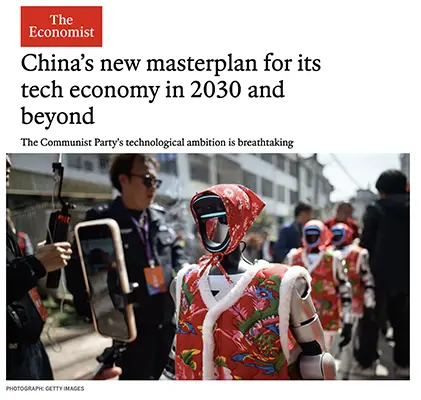
China’s New Masterplan for Its Tech Economy in 2030 and Beyond
The Economist | March 24, 2026
TL;DR: China’s 15th Five-Year Plan sets an extraordinarily ambitious technology agenda — including AI dominance, humanoid robots, quantum computing, and brain-computer interfaces — but a track record of missed targets and escalating U.S. countermeasures means the plan is as much a geopolitical signal as a reliable roadmap.
Executive Summary
China’s newly adopted 15th Five-Year Plan mandates commercial deployment of drones, AI-powered robotics, hydrogen energy, and brain-computer interfaces within five years, with “frontier breakthroughs” in fusion power and quantum computing to follow. The plan functions as a state coordination mechanism: sectors named in the plan unlock central and local government funding, attract private capital, and draw the professional infrastructure needed to commercialize technology. In this sense, the plan is both a roadmap and a market-making instrument. The AI component is particularly credible — China’s 2017 declaration of AI ambitions was dismissed by Western experts, then validated by DeepSeek’s January 2025 model release, which matched leading American systems.
However, credibility is not uniformity. China’s catch-up successes — EVs, solar, AI — all occurred in fields with mature markets and proven technology. The current plan targets frontier domains where commercial viability is genuinely uncertain: is there a market for humanoid robots? Can quantum computers be made practical? China’s planners appear to assume “yes” across every category simultaneously, which risks spreading capital and talent too thin. Additionally, the plan’s ambition will almost certainly trigger a renewed U.S. technology export response — the same dynamic that followed Made in China 2025 and produced semiconductor restrictions.
Relevance for Business
SMB executives should treat this as strategic context, not an operational trigger. The near-term business signal is in AI and robotics, where China’s investment is real and accelerating. For any business with supply chain exposure to Chinese manufacturing, technology sourcing, or competitive markets where Chinese firms participate, the pace of automation and AI-enabled productivity in Chinese industry will increase. For businesses evaluating AI vendors or tools from Chinese-linked firms, geopolitical friction and potential export controls create vendor-dependency and continuity risk. The broader implication: the AI competitive environment is a two-pole race with real resource commitment on both sides, and the pace of capability development will remain high regardless of which plans succeed or fall short.
Calls to Action
🔹 Monitor U.S. government responses to China’s plan, particularly any new technology export controls — these will affect the availability and pricing of semiconductors and AI hardware.
🔹 Assess supply chain exposure to Chinese manufacturing in sectors the plan targets: robotics, EVs, smart logistics — these will see intensifying state-backed competition.
🔹 Treat Chinese AI capability as real and advancing — the DeepSeek episode demonstrated that dismissing Chinese AI as derivative is a strategic error.
🔹 Deprioritize the more speculative elements (fusion, quantum, brain implants) as near-term business factors — these remain genuinely uncertain even with state backing.
🔹 Flag for future review in 12–18 months: whether U.S.-China technology decoupling accelerates in response to this plan, creating vendor landscape shifts for AI and hardware procurement.
Summary by ReadAboutAI.com
https://www.economist.com/finance-and-economics/2026/03/24/chinas-new-masterplan-for-its-tech-economy-in-2030-and-beyond: Day 7: May 26, 2026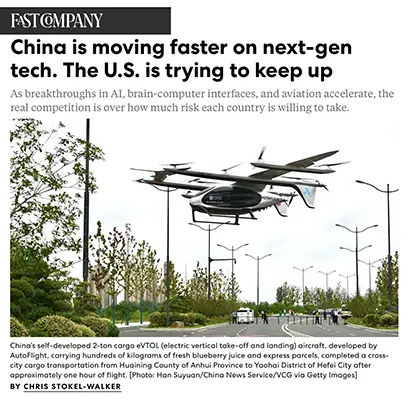
CHINA IS MOVING FASTER ON NEXT-GEN TECH. THE U.S. IS TRYING TO KEEP UP.
Fast Company | Chris Stokel-Walker | April 1, 2026
TL;DR: The U.S.-China technology race has moved from rhetoric to concrete milestones, with China demonstrating first-mover advantages in commercial brain-computer interfaces and electric aviation — and the real competition now is over regulatory risk tolerance, not just technical capability.
Executive Summary
This is a reported analysis piece, not a news brief, and it should be read as a framing document rather than a string of settled facts. Its core argument is credible and well-supported: the competitive gap between the U.S. and China in emerging technology is no longer a future concern but an active, multi-front race — with recent Chinese approvals of the world’s first commercial brain-computer interface device and a working five-ton electric air taxi as the headline examples.
The decisive variable is not raw innovation but regulatory velocity. China’s willingness to approve and deploy technologies before resolving downstream risks gives it a speed advantage that U.S. and European regulatory frameworks are structurally unable to match. Multiple independent experts quoted in the piece support this assessment, though they also note the tradeoffs: faster deployment creates geopolitical and safety risks, and heavy Western regulation has had the counterintuitive effect of protecting some domestic companies from Chinese market entry.
One underreported detail worth flagging: FDA staffing reductions have reportedly created an opening for Neuralink’s regulatory path, raising questions about whether deregulation in the U.S. is a deliberate competitive strategy or an unintended consequence of budget cuts. The article does not resolve this, and neither should leaders treat it as settled.
Relevance for Business
For SMB leaders, the strategic relevance is indirect but real. The standards that China sets in early deployment of AI, BCI, and aviation technologies will influence global norms — including what tools, platforms, and devices become available, at what cost, and under what governance frameworks. If China establishes commercial primacy in AI-adjacent hardware (sensors, chips, BCI interfaces), SMBs in affected industries may find their vendor options increasingly constrained or geopolitically complicated. Additionally, the regulatory divergence argument has direct implications for any SMB considering expansion into Asian markets or sourcing technology from Chinese vendors.
Calls to Action
🔹 Monitor developments in regulatory acceleration at U.S. agencies (FDA, FAA, FCC) — the pace of approvals will directly affect when emerging technologies become commercially viable for business use.
🔹 If your business operates in sectors adjacent to AI hardware, biotech, or aviation, assess your exposure to geopolitical supply chain risk from Chinese technology dominance.
🔹 Treat the BCI regulatory milestone as a directional signal — commercial brain-computer interfaces moving from research to approved products is a longer-term workforce and human-computer interaction issue worth tracking.
🔹 Note the regulatory tradeoff argument: faster deployment is not automatically an advantage; it can also create liability, safety, and interoperability risks for early adopters.
Summary by ReadAboutAI.com
https://www.fastcompany.com/91519208/china-is-moving-faster-on-next-gen-tech-the-u-s-is-trying-to-keep-up: Day 7: May 26, 2026https://www.reuters.com/technology/alibaba-accelerates-ai-push-by-releasing-new-open-source-models-text-to-video-2024-09-19/: Day 7: May 26, 2026
A MYSTERY AI MODEL HAS DEVELOPERS BUZZING: IS THIS DEEPSEEK’S LATEST BLOCKBUSTER?
Reuters | Eduardo Baptista | March 17–18, 2026
TL;DR: An anonymous, high-capability AI model called “Hunter Alpha” appeared on the developer platform OpenRouter and is widely suspected — but not confirmed — to be DeepSeek’s next-generation system being quietly tested, underscoring that Chinese AI capabilities are advancing faster and with less transparency than most Western observers expect.
Executive Summary
On March 11, an anonymous model called Hunter Alpha surfaced on OpenRouter — a platform that allows developers to query dozens of AI models through a single interface. The model carries no developer attribution and OpenRouter labels it a “stealth model.” When tested by Reuters, it described itself as Chinese-trained, cited a May 2025 knowledge cutoff matching DeepSeek’s own, and declined to identify its creator.
The technical profile is notable: Hunter Alpha is described as a 1-trillion-parameter model with a 1 million token context window — meaning it can process and remember an extremely large amount of text in a single session, a capability that typically comes with significant cost at scale. The model is free to use. Developer community analysis points to the system’s reasoning style as the strongest indicator of DeepSeek origin — reasoning patterns are hard to disguise because they reflect training methodology. However, at least one independent benchmarker concluded the evidence was inconclusive and that Hunter Alpha likely is not DeepSeek V4.
What is confirmed: the model is real, powerful, free, and already heavily used — it processed over 160 billion tokens within days of appearing, much of it driven by OpenClaw and other AI agent frameworks. What is not confirmed: who built it. DeepSeek has not responded to requests for comment. The stealth launch pattern itself is not unusual — another anonymous Chinese model (Pony Alpha) appeared on OpenRouter in February before Zhipu AI claimed it five days later.
Chinese outlets have reported that DeepSeek V4 could launch as early as April. DeepSeek’s parent company is a quantitative hedge fund, an unusual structure that gives it both the capital and the incentive to invest aggressively in AI capability.
Relevance for Business
This story is more signal than decision point — but it is a significant signal. DeepSeek’s pattern of releasing high-capability, low-cost models that close the gap with US frontier systems is continuing, and this may be its next iteration. If Hunter Alpha is DeepSeek V4 or a close predecessor, it would mean: a 1-trillion-parameter model with frontier reasoning, a 1 million token context window, and free or very low-cost access — a combination that, if sustained, continues to undercut the pricing assumptions behind US AI vendor strategies. For SMBs evaluating AI vendors, the continued credibility of Chinese open-weight models as enterprise alternatives is worth monitoring, even if data residency and geopolitical risk make them unsuitable for most Western businesses today. The competitive pressure they create on US providers benefits all AI buyers.
Calls to Action
🔹 Monitor the official DeepSeek V4 announcement, expected as early as April — if the capability profile matches Hunter Alpha’s, it will be a meaningful benchmark against US frontier models.
🔹 Do not rush to adopt Hunter Alpha or similar stealth models — provenance, training data, and data handling practices are unverified; the risks for business use outweigh the potential benefits until the model is officially attributed and audited.
🔹 Use Chinese AI model releases as a competitive benchmark reference, not as an adoption signal — their existence puts real pricing pressure on US AI providers, which benefits every AI buyer regardless of which tools you use.
🔹 If you are in AI procurement discussions, reference the competitive landscape (DeepSeek, Hunter Alpha, open-weight alternatives) explicitly — it gives you negotiating leverage on pricing and contract terms.
🔹 Assign a watchlist item for OpenRouter and similar developer platforms as early-warning channels for significant new AI capability releases, both attributed and anonymous.
Summary by ReadAboutAI.com
https://www.reuters.com/business/media-telecom/mystery-ai-model-has-developers-buzzing-is-this-deepseeks-latest-blockbuster-2026-03-18/: Day 7: May 26, 2026
CHINESE OPEN MODELS AS GLOBAL AI INFRASTRUCTURE
“What’s Next for Chinese Open-Source AI” – MIT Technology Review, February 12, 2026
TL;DR / Key Takeaway
Chinese open-weight models (DeepSeek, Qwen, Kimi) are now matching Western performance at a fraction of the cost and rapidly becoming default infrastructure for global AI builders.
Executive Summary
MIT Tech Review outlines how Chinese labs have moved from “catching up” to shaping the open-source AI landscape. DeepSeek’s R1 reasoning model (MIT-licensed, open-weight, and undercutting OpenAI’s o1 on price) triggered a turning point: it briefly wiped ~$1T off US tech stocks and became the most downloaded free iOS app, signaling both technical parity and market shock.
Since then, Chinese open-weight models have surged. Alibaba’s Qwen family overtook Meta’s Llama in cumulative Hugging Face downloads and accounted for more than 30% of all model downloads in 2024; an MIT study finds that Chinese open models now surpass US ones in total downloads. New entrants like Moonshot’s Kimi K2.5 are approaching frontier proprietary systems (e.g., Claude Opus) on benchmarks at roughly one-seventh the price, and are heavily used by open-source agent projects like OpenClaw.
Chinese labs are also pushing a product-line mindset: Qwen offers a broad suite from phone-sized models to multi-hundred-billion-parameter systems, plus task-tuned “instruct” and “code” variants. Open-weight releases make it easy for others to fine-tune and distill, and by mid-2025, derivatives based on Qwen accounted for ~40% of new Hugging Face language model variants, versus ~15% for Llama. Universities (e.g., Tsinghua) and policymakers are reinforcing this trajectory by rewarding open-source contributions and treating open AI work as career-relevant output.
Globally, Chinese open models are being quietly adopted as cheap, capable building blocks. A16z’s Martin Casado estimates that among startups pitching with open stacks, there’s about an 80% chance they’re using Chinese models; router services show Chinese models rising toward 30% of API usage. At the same time, many of these models still depend on US chips and clouds, underscoring deep interdependence even as geopolitical competition sharpens.
Relevance for Business
For SMB executives, this isn’t just a China story—it’s a cost and control story:
- You can now access near-frontier capabilities at significantly lower cost via open-weight models, including Chinese ones.
- Open models reduce vendor lock-in and enable on-prem or VPC deployment, but raise new questions about security, compliance, and geopolitics.
- Startups and tools you rely on may already be built on Chinese model backbones, whether or not they advertise it.
Strategically, Chinese open models are becoming a global AI substrate. The question isn’t if you’ll touch them—it’s under what governance conditions.
Calls to Action
🔹 Ask your AI vendors which base models they use, including whether they rely on Chinese open-weight models, and why.
🔹 When evaluating open models (Chinese or Western), weigh TCO + performance + governance: where they’re hosted, how they’re updated, and how you can audit use.
🔹 For workloads where data residency or regulatory exposure is high, prefer deployments you can run in your own cloud or data center.
🔹 Consider small, specialized open models (e.g., code, reasoning, domain-specific) for local or edge deployments where cost and latency matter.
🔹 Monitor export controls, sanctions, and national security rules that may affect access to specific Chinese models or hosting options.
Summary by ReadAboutAI.com
https://www.technologyreview.com/2026/02/12/1132811/whats-next-for-chinese-open-source-ai/: Day 7: May 26, 2026
MOVE OVER, SUPER BOWL: AI GIANTS TURN CHINA’S LUNAR NEW YEAR INTO A GIVEAWAY BLITZ
WALL STREET JOURNAL (FEB 16, 2026)
TL;DR / Key Takeaway: Chinese AI giants like Alibaba and ByteDance are using Lunar New Year as a massive user-acquisition event, spending hundreds of millions on giveaways to lock in chatbot users before the market saturates.
Executive Summary
With more than 600 million generative-AI users already in China, the Lunar New Year holiday has become a critical moment to capture remaining holdouts and deepen engagement. Companies are offering free tea, free meals, and even year-long access to robots or luxury EVs as prizes for using their chatbots. Alibaba is putting over $430 million behind a campaign that gives away items like bubble tea and food via its Qwen chatbot, driving over 120 million orders in just six days and integrating e-commerce, payments, and travel into a single conversational interface.
TikTok-parent ByteDance is pushing its Doubao chatbot with large prize pools, timed to the release of its Seed 2.0 model, while also debuting a video-generation model that has already attracted copyright backlash. Other players like Tencent, Baidu, Zhipu AI and MiniMax are handing out cash “lucky money” and other perks. Analysts caution that these promotions are unlikely to be sustainable, but companies hope early dominance in daily-use chatbots will protect their broader internet moats.
Relevance for Business
For SMB leaders, this is an extreme case study in subsidized AI adoption and ecosystem lock-in. Chinese platforms are showing how quickly conversational interfaces can become the default front door to commerce and services when heavily subsidized. It also illustrates the risk: if your business depends on someone else’s AI “super-app,” they may control discovery, data, and margins.
Calls to Action
🔹 If you sell into China or similar markets, monitor which super-apps and chatbots are becoming default purchasing channels, and adapt your distribution strategy accordingly.
🔹 Consider how local or industry platforms in your region might replicate this playbook—be cautious about over-relying on a single AI intermediary for customer access.
🔹 Think through loyalty and incentive programs: what low-cost, high-value rewards could you use to encourage customers to try AI-assisted channels without burning cash?
🔹 If you’re building AI products, recognize that user lock-in often comes from ecosystem integration (payments, travel, commerce), not just model quality; plan partnerships accordingly.
Summary by ReadAboutAI.com
https://www.wsj.com/tech/ai/move-over-super-bowl-ai-giants-turn-chinas-lunar-new-year-into-a-giveaway-blitz-cc59eb0b: Day 7: May 26, 2026
U.S.-China Competition for Artificial Intelligence Markets: Analyzing Global Use Patterns of Large Language Models
RAND Corporation | Austin Horng-En Wang and Kyle Siler-Evans | January 14, 2026
TL;DR: U.S. AI models still dominate globally, but DeepSeek’s January 2025 launch demonstrated that a credible Chinese alternative can erode that lead within weeks — and the structural conditions that enabled that shift have not changed.
Executive Summary
This is a peer-reviewed RAND research report, not journalism or vendor analysis. It draws on web traffic data across 135 countries from April 2024 through August 2025 — the most systematic cross-national dataset on AI platform adoption published to date. The methodology has real limits (it measures website visits, not API or app use, and likely undercounts Chinese models, which skew toward open-source local deployment), but the directional findings are credible and significant.
The headline numbers: U.S. AI platforms (ChatGPT, Gemini, Claude, and others) captured roughly 93 percent of global usage as of August 2025. But that dominance was not stable. When DeepSeek R1 launched in January 2025, Chinese platforms’ collective traffic surged by over 460 percent in two months, temporarily pushing Chinese models to 13 percent of global market share. That share has since receded to roughly 6 percent as U.S. platforms continued growing — but the foothold is real. Every country in the 135-nation dataset registered an increase in Chinese AI usage. Gains were sharpest in developing nations and countries with closer political ties to China.
The report’s most consequential finding is structural, not statistical: none of the three obvious explanations for Chinese model adoption — lower cost, broader language support, or diplomatic outreach — meaningfully accounts for the observed patterns. The real driver was capability parity. Once DeepSeek narrowed the performance gap sufficiently, users switched readily. Switching costs between AI platforms are low: no file formats to convert, no deep integrations to rebuild. The RAND authors conclude that U.S. dominance, while large, rests on a fragile foundation. Continuous performance superiority is required to sustain it — a condition that cannot be guaranteed indefinitely.
Relevance for Business
For most SMB leaders, this report does not require immediate action — but it changes the context for vendor decisions. The AI tools market is more competitive than it appeared 18 months ago. Chinese platforms now represent a real alternative for users in many markets, particularly those operating internationally or serving customers in developing economies.
The pricing data carries a specific operational signal: Chinese models charge roughly one-sixth to one-fourth the API cost of leading U.S. alternatives. This spread matters less for consumer use (where free tiers dominate) but more for enterprises building AI into workflows at scale. If your organization is evaluating AI vendors or negotiating API contracts, the Chinese competitive baseline is now a relevant factor — and one that may pressure U.S. providers to adjust pricing in cost-sensitive segments.
The broader risk is vendor concentration. If your organization is deeply integrated with a single AI platform and that platform loses its performance edge, switching — while technically easy — requires internal process change, retraining, and governance review. The time to map those dependencies is now, not when a disruption forces it.
Calls to Action
🔹 Acknowledge the competitive shift without overstating it. U.S. platforms still dominate; this is not a crisis. But it is no longer safe to assume the AI tool landscape is settled.
🔹 If you operate internationally, assess which AI tools your regional teams or partners use. Chinese platform adoption is highest in developing markets. This has data governance implications if employees are routing work through platforms with different privacy standards.
🔹 Review your AI vendor agreements for lock-in risk. Low switching costs cut both ways: your vendors know that too, which affects their incentive to retain you through performance rather than contractual friction.
🔹 Monitor Chinese model developments as a pricing signal. If DeepSeek and its successors continue to offer capable models at dramatically lower API costs, expect U.S. providers to face margin pressure — which may eventually benefit enterprise buyers.
🔹 Do not conflate geopolitical narrative with product decision. The question of which AI tools best serve your business should be evaluated on capability, cost, data handling, and compliance — not on national origin alone. That said, data residency and sovereignty concerns are legitimate factors to assess for any vendor, domestic or foreign.
Summary by ReadAboutAI.com
https://www.rand.org/pubs/research_reports/RRA4355-1.html: Day 7: May 26, 2026Back to the Anniversary Week Overview page
Global AI Adoption in 2025 — A Widening Digital Divide
Microsoft AI Economy Institute | January 2026
Note: This is a Microsoft-produced report. It is company-sponsored research and should be read accordingly. The underlying methodology — measuring AI diffusion through aggregated and anonymized Microsoft telemetry, adjusted for device market share and internet penetration — is described but not independently verified. The framing and conclusions are Microsoft’s own. That said, the dataset appears to be the most comprehensive cross-national AI usage measurement currently available publicly.
TL;DR: Roughly one in six people worldwide now uses generative AI tools, but adoption is accelerating faster in countries that invested early in digital infrastructure and AI policy — and the gap between Global North and Global South is widening, not narrowing.
Executive Summary
Global adoption of AI tools reached 16.3% of the world’s population by the end of 2025, up from 15.1% at mid-year — a meaningful gain for a technology still in early deployment. But the headline aggregate conceals a more consequential pattern: adoption in wealthier, more digitally developed economies is growing nearly twice as fast as in lower-income ones. The gap between the Global North (24.7% adoption) and Global South (14.1%) widened over the second half of the year.
The report’s most useful data points for business leaders are the country-level patterns. Leadership in AI adoption does not correlate simply with being the country that builds the most AI. The US leads in frontier model development and AI infrastructure but ranked 24th globally in actual usage among its working-age population at 28.3% — falling one position from mid-year. The UAE, at 64% adoption, leads the world by a wide margin — the result of a national AI strategy launched in 2017, a decade before much of the current policy conversation. Singapore (60.9%) and several smaller highly digitized European economies round out the top tier.
South Korea is the report’s most instructive case study. It jumped seven positions in the global rankings in a single half-year period — the largest move by any nation — driven by a combination of national AI policy formalization, dramatic improvement in AI model performance in the Korean language, and a viral consumer moment (AI-generated image styles that spread across Korean social platforms). The lesson: adoption accelerates when policy, product capability, and consumer familiarity align simultaneously. The report also provides benchmark data showing that GPT-5 performance on the Korean university admissions exam reached the top percentile — a near-complete reversal from earlier model performance that had been below adult reading level in Korean.
DeepSeek’s role in the global picture is also documented. The report finds DeepSeek adoption concentrated in markets where US AI tools are either too expensive or inaccessible — China, Russia, Iran, Cuba, Belarus, and notably Africa, where DeepSeek usage is estimated at two to four times the rate of other regions. The report frames this explicitly as a geopolitical dimension of AI competition: two nations racing to establish their AI tools as the default in underserved global markets.
Relevance for Business
For SMB executives, several signals are actionable. Your workforce’s AI fluency is shaped by the national and regional context in which they operate. If you operate internationally — or if you recruit globally — the adoption gaps documented here are a proxy for what you can realistically expect from employees in different markets in terms of existing AI familiarity.
The South Korea case study has a practical analog for organizations: AI adoption inside a company rarely happens uniformly. It tends to accelerate when leadership sets clear expectations, tools become reliably capable for specific tasks, and early adopters produce visible results that others want to replicate. Those three conditions — policy, product fit, and visible peer success — mirror what drove Korea’s national surge.
The US ranking gap is a useful counter to complacency. Infrastructure leadership does not automatically translate to workforce capability. Building AI into your organization requires active investment in enablement, not just tool procurement.
Calls to Action
🔹 Assess your team’s actual AI adoption rate, not just tool access. Having AI tools available is not the same as having a workforce that uses them consistently and effectively. Survey or measure actual usage.
🔹 Use the South Korea framework as an internal model. Adoption accelerates when policy (internal expectations and guidance), product capability (tools that actually work for your tasks), and peer visibility (people seeing colleagues succeed) align. Design enablement efforts around all three.
🔹 Account for adoption gaps in global teams. Employees in lower-adoption markets may have less baseline familiarity with AI tools. Onboarding and training should reflect that, rather than assuming uniform fluency.
🔹 Monitor DeepSeek’s global expansion as a vendor landscape signal. If you operate in markets where DeepSeek is gaining significant share — particularly in Africa or across sanctioned-state corridors — understand which tools your local partners and customers are actually using.
🔹 Do not conflate AI infrastructure investment with business readiness. The US example illustrates that building the best AI infrastructure does not guarantee your organization — or workforce — will use it effectively without deliberate adoption programs.
Summary by ReadAboutAI.com
https://www.microsoft.com/en-us/corporate-responsibility/topics/ai-economy-institute/reports/global-ai-adoption-2025/: Day 7: May 26, 2026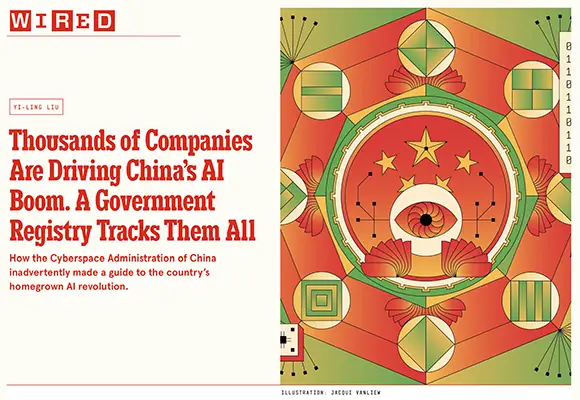
Thousands of Companies Are Driving China’s AI Boom. A Government Registry Tracks Them All.
Wired | Yi-Ling Liu | January 20, 2026
TL;DR: China’s mandatory AI registration system has inadvertently produced the world’s most detailed public map of a national AI ecosystem — revealing a development landscape far broader, and more sectorally diverse, than headlines about a handful of flagship models suggest.
Executive Summary
China’s internet regulator, the Cyberspace Administration of China (CAC), requires companies to register any AI product with “public opinion properties or social mobilization capabilities” before deployment. The registration process — which involves demonstrating how products avoid 31 categories of risk — was designed as a governance mechanism. It has become, as Wired reports, the most comprehensive public map of any country’s AI development landscape.
The registry reveals a Chinese AI ecosystem that is not primarily a story about a few flagship models competing with OpenAI. It is a story about thousands of companies building narrowly useful AI tools across every sector — patent drafting, obstetrics, power grid management, carbon accounting, humanoid robotics, children’s toys, traditional medicine diagnosis. The tools are largely built for, and often by, entities with deep knowledge of specific operational contexts.
State-linked entities make up roughly 22% of registry filings, often partnering with large tech firms. State Grid, for example, built a grid-optimization system using DeepSeek. PetroChina partnered with Huawei and iFlyTek on oil-and-gas applications. Foreign firms represent under 1% of filings — Ikea and Yum China (KFC’s parent) being among the few named examples.
The piece also surfaces a pattern that has direct relevance for Western businesses: Chinese AI firms are increasingly going global, sometimes deliberately obscuring their Chinese origins. The example of Butterfly Effect — which built a widely covered general-purpose AI agent, then relocated to Singapore and removed Chinese-language content from its online presence after US export controls tightened — raises a practical question about the origin transparency of AI tools available in Western markets.
What the registry doesn’t capture is the volume of Chinese AI products designed from the start for non-Chinese markets, which are not subject to CAC registration requirements.
This is journalism, not primary data analysis, though the underlying registry data is real and publicly accessible. The Trivium China consultancy is cited as having compiled and enriched the dataset — that is a named, credible source appropriate for attribution.
Relevance for Business
The signal for business leaders is twofold. First, China’s AI development is substantially more distributed and sector-specific than coverage of a few headline models implies. The implication: in almost any sector, there are likely Chinese-developed AI tools — some built by well-resourced organizations with deep domain expertise — that are either already available or will be. Second, the origin-obscuring behavior documented in the piece is a real due diligence challenge. Not every AI tool your vendors, integrators, or employees adopt will be straightforwardly identifiable as Chinese-origin.
Calls to Action
🔹 Broaden your competitive AI scan. In your sector, ask whether AI tools built by Chinese firms — domestic or internationally marketed — are already being used by competitors, partners, or customers.
🔹 Add origin and governance questions to AI vendor due diligence. Ask vendors where their underlying models were developed, who owns the company, and what data governance requirements apply. This is not blanket exclusion — it is informed procurement.
🔹 Monitor the “chuhai” trend. Chinese AI firms actively targeting Western markets — sometimes with Singapore or California addresses — are an accelerating trend. Treat this as market intelligence, not threat framing.
🔹 If operating in regulated industries, flag the registry’s censorship requirements. Any AI tool registered in China must demonstrate compliance with Chinese content standards, including political speech restrictions. That constraint may or may not transfer to internationally marketed versions — but it is worth verifying.
Summary by ReadAboutAI.com
https://www.wired.com/story/china-ai-boom-algorithm-registry/#: Day 7: May 26, 2026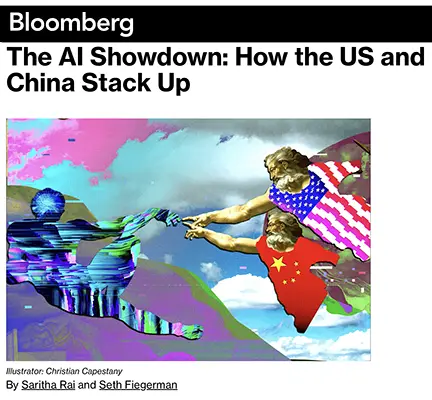
The AI Showdown: How the US and China Stack Up
Bloomberg | Saritha Rai and Seth Fiegerman | November 7, 2025
TL;DR: Ten months after DeepSeek’s emergence, Bloomberg’s comprehensive comparison finds that the US retains meaningful leads in frontier capability, talent, and capital — but China has closed substantial ground in efficiency, open-source reach, and state-backed investment.
Executive Summary
This is the most structurally comprehensive source in the set — a multi-dimensional explainer that maps the US-China AI competition across technology, state strategy, money, talent, and infrastructure. It is journalistic analysis, not primary data, and should be read accordingly. The competitive picture it describes is neither simple US dominance nor Chinese parity — it is a genuine and accelerating two-system contest with different strengths.
On the technology side, the US leads in frontier model capability and agent development. China leads in efficiency under hardware constraints and in open-source distribution strategy. The article notes that China’s embrace of open-source AI is not the result of an explicit government directive — it reflects a market-driven calculation by Chinese firms that open distribution is the fastest path to global adoption, particularly in markets where US proprietary tools are expensive, restricted, or absent.
The money figures are striking. US venture capital poured roughly $193 billion into AI startups in 2025. China’s AI capital expenditure was projected at up to $98 billion in the same year — with the majority coming from government sources. The scale of state investment in China’s AI ecosystem is a structural difference, not a temporary condition.
The talent dynamic is under pressure on both sides. The US has historically attracted global AI talent but faces risk from tighter immigration policy and reduced federal research funding. China, historically a source of talent leaving for Western institutions, is running structured programs to reverse that flow. Neither side has a locked-in advantage.
The infrastructure gap favors the US in chip quality but China in energy capacity and cost. China added substantially more power generation capacity in 2024 than the US. After Chinese AI companies flagged the cost burden of running domestic chips, the Chinese government moved to provide subsidized power. US firms, by contrast, face both high electricity costs and aging grid constraints. Energy is not an abstract concern — it is a near-term operational limit on US AI scaling.
The article also briefly addresses legal asymmetry: China’s courts have largely cleared AI training on copyrighted data, while US developers face an expanding body of copyright litigation that the article notes OpenAI has asked the Trump administration to preempt.
Relevance for Business
For SMB leaders, this piece provides useful orientation on what the competition actually looks like — beyond the shorthand of “US vs. China.” The practical implications: the AI tools your teams use are being shaped by a contest that has economic, regulatory, and geopolitical dimensions. Decisions about which platforms and vendors to adopt are, in a limited but real sense, bets on which technology ecosystem will persist, be affordable, and remain legally stable.
The energy and infrastructure constraints are worth tracking if you are evaluating AI at scale — large-volume processing, inference-heavy applications, or on-premise deployment will be affected by the cost and availability pressures described here.
Calls to Action
🔹 Understand your AI supply chain. Know whether the AI tools and APIs your business depends on trace back primarily to US, Chinese, or mixed-origin model development. This is not paranoia — it is vendor due diligence.
🔹 Monitor copyright litigation developments. Several ongoing cases involving leading AI labs could materially change what training data is permissible — and therefore what AI tools remain available or legally defensible to use.
🔹 Do not over-index on current capability benchmarks. The competitive gap between US and Chinese AI models has been narrowing faster than most observers expected. Today’s premium may not be tomorrow’s differentiator.
🔹 Track energy and infrastructure costs if evaluating on-premise AI. Power constraints are a real operational limit for US-based large-scale AI deployment — not a distant policy problem.
🔹 Prepare for continued vendor volatility. Export controls, legal rulings, and geopolitical events will continue to affect which AI tools are available, at what price, and under what terms.
Summary by ReadAboutAI.com
https://www.bloomberg.com/news/articles/2025-11-07/us-vs-china-who-s-winning-the-ai-race: Day 7: May 26, 2026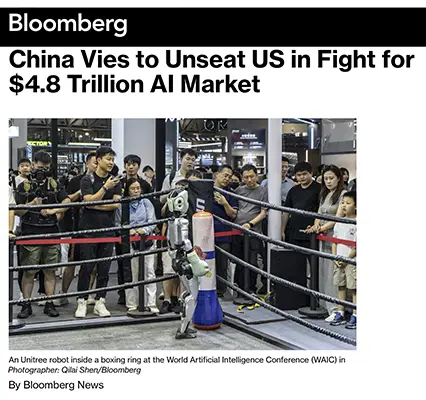
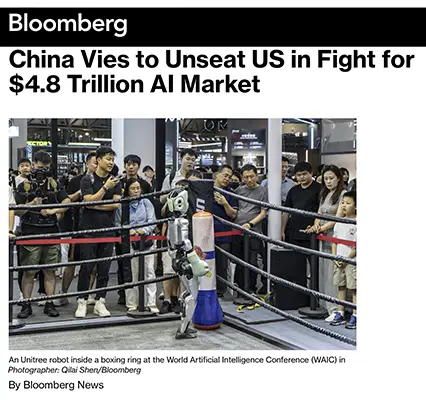
China Vies to Unseat US in Fight for $4.8 Trillion AI Market
Bloomberg News | July 30, 2025
TL;DR: China is pursuing global AI governance as a strategic extension of its industrial policy, using the 2025 World AI Conference to propose new international institutions and position Chinese AI as the accessible alternative for developing nations — a play with direct implications for how AI standards, data flows, and market access get structured globally.
Executive Summary
This Bloomberg article covers the 2025 World AI Conference in Shanghai and should be read as journalism, not independent analysis. Some framing reflects Chinese government communications. Read accordingly.
The substantive development is the proposed World AI Cooperation Organization — a Chinese-backed international body that would convene countries to establish AI governance frameworks. Details are thin: the organization is intended to be headquartered in Shanghai, and Chinese officials indicated it would work with countries willing to participate. No binding rules or membership requirements were disclosed.
The strategic logic is clearer than the institutional details. China is drawing from the same playbook it used with Digital Silk Road telecommunications infrastructure and 5G standards: position Chinese technology and governance frameworks at the center of global adoption before competing standards take hold. The Global South is the primary target audience — countries that, as one analyst quoted in the piece notes, lack the computing and power infrastructure needed for large-scale U.S.-style AI deployment. Chinese open-source models, offered freely, lower the barrier to entry for precisely these markets.
The governance contest is real. Neither the U.S. nor China has established binding global AI rules. China’s action plan emphasizes “openness” and “sovereignty” — language designed to appeal to governments wary of Western tech dominance while simultaneously advancing Chinese commercial interests. The U.S. was not visibly represented at the high-level governance session. Whether that reflects a strategic decision or an oversight is unclear, but the absence was noted by Bloomberg reporters on the ground.
AI pioneer Geoffrey Hinton, speaking at the event, called for international bodies to collaborate on AI safety — a rare point of convergence between Western AI critics and Chinese conference framing.
Relevance for Business
For SMB leaders, the immediate operational impact of a proposed Chinese governance organization is minimal. The relevance is indirect but real: who sets AI standards determines what compliance looks like, which vendors operate in which markets, and what data handling obligations apply.
If Chinese governance frameworks gain traction in developing markets — particularly in Africa, Southeast Asia, the Middle East, and Latin America — organizations operating in those regions may face a different regulatory environment than the one taking shape in the EU or U.S. Supply chain relationships, data residency obligations, and AI tool approvals could diverge along geopolitical lines.
The more immediate signal is the governance gap itself. There are no binding international AI rules. That creates legal uncertainty for any organization deploying AI across jurisdictions. The organizations that map their exposure now will be better positioned when frameworks eventually solidify — wherever they originate.
Calls to Action
🔹 Monitor international AI governance developments, particularly in markets where your organization operates or sources. The World AI Cooperation Organization proposal is early-stage, but similar initiatives have historically moved faster than expected once momentum builds.
🔹 If operating in Global South markets, assess which AI platforms and tools local partners or regulators are already gravitating toward — and what data governance standards apply.
🔹 Do not treat AI governance as a technology problem. It is increasingly a trade and regulatory issue. Assign governance monitoring to someone with both legal and operational context.
🔹 Prepare for a multi-standard world. The EU, U.S., and Chinese approaches to AI regulation are diverging. Organizations operating across jurisdictions should model what compliance looks like under each scenario.
🔹 Distinguish Chinese government positioning from Chinese product reality. The governance framing at this conference reflects diplomatic strategy. Evaluate Chinese AI tools on their actual capabilities and data handling practices — not on official narratives in either direction.
Summary by ReadAboutAI.com
https://www.bloomberg.com/news/articles/2025-07-30/china-prepares-to-unseat-us-in-fight-for-4-8-trillion-ai-market: Day 7: May 26, 2026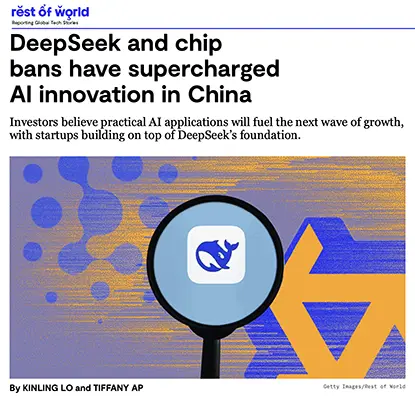
DeepSeek and Chip Bans Have Supercharged AI Innovation in China
Rest of World | Kinling Lo and Tiffany Ap | April 14, 2025
TL;DR: U.S. chip export restrictions, intended to slow Chinese AI development, have instead accelerated a structural shift in China’s AI ecosystem — pushing investment toward practical applications, consolidating model development among large incumbents, and hardening the case for open-source as a national strategy.
Executive Summary
This is a reported piece from Rest of World, drawing on investor and analyst commentary. It is journalism, not independent research. The framing reflects a particular argument — that chip restrictions backfired — and should be read with that in mind. The quotes from investors and analysts are attributed and add credibility, but the conclusions are not independently verified.
The core argument is well-supported: DeepSeek’s demonstration that a capable large AI model could be built using restricted chips at a fraction of Western training costs ($6 million versus $100 million-plus for comparable U.S. models, by DeepSeek’s own account — a figure that should be treated as a claim rather than an audited number) changed the investment logic inside China. Investors are now skeptical of backing smaller startups still trying to build foundation models from scratch. The capital is flowing toward application-layer companies — those building products and workflows on top of existing open-source foundations.
The consolidation dynamic is significant. Among China’s leading AI startups, several have already abandoned foundation model development. One pivoted to medical AI. Another adopted DeepSeek as its base and is repositioning as a solutions provider in finance, gaming, and legal services. The companies that will remain competitive at the model layer are the large incumbents: Alibaba, Tencent, Baidu, ByteDance — all of which have poured billions into new model releases since DeepSeek’s launch.
For U.S.-based AI companies, the Rest of World article raises an uncomfortable implication: if high-performing models can be built cheaply, the business case for billion-dollar training investments becomes harder to sustain. A PitchBook analyst quoted in the piece frames this plainly — the cost efficiency demonstrated by DeepSeek challenges the sustainability of large training budgets everywhere, not just in China.
Relevance for Business
This article is most useful for leaders trying to understand why Chinese AI tools are proliferating at the application layer. The model-layer race is consolidating to a small number of large players. The application-layer race is just beginning — and it is where most of the business value will be created and captured.
For SMB leaders evaluating AI tools, this means the relevant question is no longer which country built the underlying model — it is which application, workflow, or service built on top of it best serves your use case. The infrastructure is increasingly commoditized. The differentiation is in execution.
The chip restriction narrative also carries a counterintuitive lesson: constraints can accelerate innovation in ways that targeted interventions cannot fully predict. Organizations operating in constrained environments (budget-limited, compute-limited, or skills-limited) may find that the Chinese open-source AI ecosystem — built to work within hardware restrictions — is more practically deployable than alternatives designed for unlimited infrastructure.
Calls to Action
🔹 Shift your AI vendor evaluation focus from model providers to application-layer companies. The question is not which foundation model is most capable — it is which product built on that foundation solves your specific operational problem.
🔹 Treat DeepSeek’s cost claims as a directional signal, not a verified benchmark. The efficiency numbers have not been independently audited. But the directional implication — that capable models can be built at significantly lower cost — appears durable.
🔹 If considering open-source AI deployment for internal use, the Chinese open-source ecosystem (Qwen, DeepSeek, and others) is now genuinely capable and worth evaluating alongside Western alternatives like Llama.
🔹 Watch the application-layer startups, not just the model labs. The real competitive action in Chinese AI has shifted to companies building domain-specific products on top of open foundations — in healthcare, legal, finance, and logistics. Some of these will have global ambitions.
🔹 Resist the assumption that export controls have contained Chinese AI capability. The evidence suggests the opposite — that constrained access to frontier chips accelerated efficiency research and open-source strategy.
Summary by ReadAboutAI.com
https://restofworld.org/2025/china-ai-boom-chip-ban-deepseek/: Day 7: May 26, 2026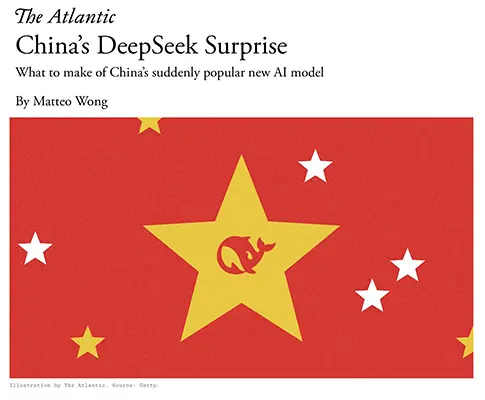
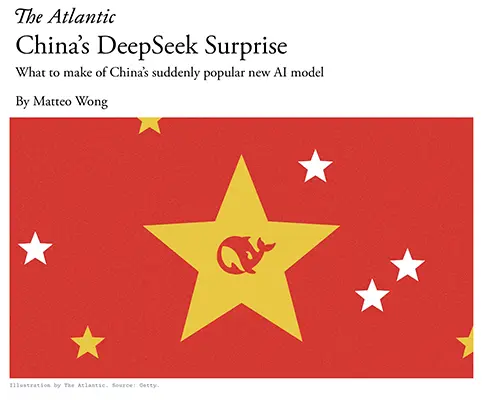
China’s DeepSeek Surprise
The Atlantic | Matteo Wong | January 27, 2025
TL;DR: DeepSeek’s R1 model — capable, inexpensive to license, and largely open — divided US observers between those alarmed by Chinese AI competition and those who saw it as a net benefit to innovation.
Executive Summary
The Atlantic’s Matteo Wong captures the live tension of the DeepSeek moment with more editorial texture. The core facts are consistent: a Chinese AI lab released a model that appeared competitive with OpenAI’s best reasoning-capable system at far lower licensing costs — roughly 95% cheaper per unit of output than OpenAI’s comparable model, by the article’s account. The model was not fully open-source — training data and fine-tuning details were not disclosed — but it was more open than any US frontier system, with code available to inspect, download, and modify.
The real issue is not who built it — it is what openness means strategically. US frontier labs have long used controlled access as a competitive moat. DeepSeek’s relative transparency gave researchers, startups, and developers worldwide the ability to study and build on its methods. That is a direct challenge to proprietary business models — and potentially a more durable form of competitive influence than any single capability benchmark. The article draws an analogy to Linux: open-source software became the standard for web infrastructure not because it was the best in any given moment, but because it was freely accessible and widely adopted.
The divide DeepSeek exposed was not primarily technical. It was between US actors who benefit from access to capable AI (startups, researchers, many developers) and those whose business models depend on maintaining AI as a scarce, controlled resource (OpenAI, Anthropic, and the investors behind them). Wong notes that Meta — which had positioned itself as the champion of open-source AI — found itself, at least momentarily, outflanked.
The censorship dimension is noted without resolution: DeepSeek refuses to answer questions about politically sensitive events in China. This is a real limitation and, in the article’s framing, a genuine tension — an authoritarian state’s AI, built on principles of openness that American companies have moved away from.
Relevance for Business
This piece is valuable context, not a direct operating guide. The signal for business leaders is that the geography of AI is now genuinely contested — not just at the level of geopolitics, but at the level of which tools developers adopt, what standards become dominant, and which pricing models persist. SMB leaders who rely on AI-enabled products and services should understand that the cost structures, capabilities, and governance of those tools are being shaped by competition that now has a clear second major actor.
The censorship limitation is a practical concern for any organization considering deploying DeepSeek or DeepSeek-derived tools for customer-facing or knowledge-work applications — particularly in regulated industries or contexts requiring completeness and political neutrality.
Calls to Action
🔹 Treat DeepSeek as a legitimate reference point, not a curiosity. Technical teams evaluating AI tools should include it in capability comparisons — its openness makes benchmarking straightforward.
🔹 Flag the censorship and completeness risk. Before deploying any DeepSeek-derived tool for business-critical tasks, verify how it handles sensitive, contested, or politically adjacent topics in your industry.
🔹 Monitor the open vs. closed model debate as a vendor selection signal. The article’s analysis suggests that US frontier labs may face sustained pressure to shift toward more openness. Watch how OpenAI and Anthropic respond to that pressure over the next 12 months.
🔹 Do not assume US tools will maintain permanent cost or capability premiums. Plan AI vendor strategy with the assumption of continued competitive pressure on pricing.
Summary by ReadAboutAI.com
https://www.theatlantic.com/technology/archive/2025/01/deepseek-china-ai/681481/: Day 7: May 26, 2026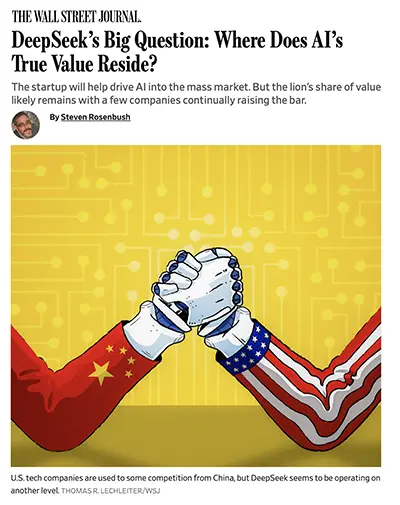
DeepSeek’s Big Question: Where Does AI’s True Value Reside?
Wall Street Journal | Steven Rosenbush | January 29, 2025
TL;DR: DeepSeek’s emergence forces a clarifying question — not just who leads in AI, but where value actually concentrates in an AI market that may be bifurcating between commoditized tools and high-margin applications.
Executive Summary
The market shock triggered by DeepSeek’s R1 model — which contributed to a sharp, rapid decline in tech stock valuations — was less about one Chinese startup than about a structural question the industry had been avoiding: if capable AI models can be built for a fraction of the cost of leading US systems, where does the durable business value in AI actually sit?
The WSJ analysis offers a useful frame: the mobile phone market. Android commoditized the handset category globally while Apple retained outsized value at the premium end. A similar bifurcation may be underway in AI — with open and lower-cost models (including DeepSeek) driving mass-market adoption, while a smaller number of frontier developers continue extracting premium value from the highest-capability tier. The article notes that OpenAI’s most cost-efficient small model now processes data at roughly 1/150th of the price of the original ChatGPT, while weekly active users grew from 100 million to 300 million in just over a year — illustrating the demand-expands-as-price-falls pattern.
The more forward-looking signal is where value migrates next. Microsoft’s Jared Spataro is quoted suggesting that as models commoditize, the real value shifts to the application layer — specifically, AI agents that solve defined business problems. US companies Salesforce and ServiceNow are identified as early movers in that space. The article also raises unresolved questions about intellectual property: OpenAI was investigating whether DeepSeek trained on its outputs through a process called distillation — using one AI’s responses to teach another, without direct access to proprietary training data. That question remained open at publication.
Relevance for Business
For SMB leaders, the DeepSeek moment reframes a question worth asking directly: are you paying premium prices for AI capability you could access more cheaply? The commoditization dynamic described here suggests that capable AI tools will continue to get less expensive and more accessible — which is broadly good for small and mid-sized businesses that previously couldn’t afford enterprise-tier AI. At the same time, the article’s “high-end theory” is a reminder that the tools your competitors are evaluating today may not be the ones that matter in 18 months. The value, increasingly, may lie not in the underlying model but in the business workflows and agent systems built on top of it.
The IP question is worth monitoring. If distillation practices are found to violate proprietary rights, the legal landscape for open-weight models — and the companies that build on them — could shift.
Calls to Action
🔹 Revisit AI vendor pricing now. If you are paying for premium model access primarily for common tasks, evaluate whether lower-cost alternatives have reached comparable capability for your use cases.
🔹 Watch the application layer, not just the model layer. The competitive differentiation in AI is moving toward what gets built on top of models — agents, workflows, integrations. That is where your strategic attention should focus.
🔹 Monitor the IP/distillation story. Legal clarity around how open-weight models are built — and whether distillation practices are permissible — could affect the reliability of the open-source AI ecosystem your vendors and tools may depend on.
🔹 Do not treat lower-cost AI as lower-quality AI. For many business tasks, commoditized models are sufficient. Reserving premium tools for genuinely complex tasks is a reasonable cost-management strategy.
Summary by ReadAboutAI.com
https://www.wsj.com/articles/deepseeks-big-question-where-does-ais-true-value-reside-35a36cd5: Day 7: May 26, 2026
Alibaba Accelerates AI Push by Releasing New Open-Source Models, Text-to-Video
Reuters | September 19, 2024
TL;DR: In September 2024, Alibaba released over 100 open-source AI models and entered the text-to-video market — a signal that China’s largest technology conglomerates were building competitive AI portfolios at scale, not ceding ground to U.S. players.
Executive Summary
This is a short news report from Reuters and should be read as an early data point rather than a comprehensive analysis. The article captures a moment in late 2024 when the scale and breadth of Chinese AI development became visible to international audiences.
Alibaba released more than 100 models from its Qwen 2.5 family, ranging from small to large in capability, covering mathematics, coding, and over 29 languages. The release was notably open-source — available for others to build upon — which differentiated Alibaba from Baidu (primarily closed) and placed it in strategic alignment with the open development model later associated with DeepSeek. Alibaba simultaneously unveiled a text-to-video product, entering a space already occupied by ByteDance’s Jimeng AI and drawing comparison to OpenAI’s video ambitions.
The business-relevant signal here is not the product itself but the strategic posture. By choosing a hybrid model — investing in both proprietary and open-source development — Alibaba was hedging against a future where commoditized base models reduce the value of any single proprietary offering. The volume of 100-plus models also signals a platform play: equip the entire ecosystem rather than compete on a single flagship.
Relevance for Business
This article is most useful as context for understanding why Chinese AI alternatives multiplied so rapidly by early 2025. The groundwork was laid well before DeepSeek made headlines. For SMB leaders, the implication is that Chinese AI models are not a recent phenomenon born of one breakthrough — they represent sustained, broad-based investment across multiple companies and product categories.
The text-to-video development is relevant for organizations in marketing, media, content production, or any sector where generative media tools are under evaluation. The competitive landscape for those tools now includes Chinese alternatives with significant engineering and infrastructure backing.
Calls to Action
🔹 Treat this as historical context, not an action item. The Alibaba release from September 2024 is part of the pattern that produced the current AI landscape — it does not require a response today.
🔹 If evaluating open-source AI models for internal deployment, recognize that the Qwen model family (from Alibaba) is among the most capable and widely available Chinese alternatives — with multilingual and multimodal coverage.
🔹 For organizations in media or content production, note that text-to-video capabilities from multiple Chinese providers have been maturing since late 2024. A competitive landscape review is warranted before committing to any single platform.
🔹 Monitor how Alibaba’s hybrid open/proprietary strategy plays out. It may offer a useful model for thinking about how your own organization sources and licenses AI tools — not dependent on a single vendor’s roadmap.
Summary by ReadAboutAI.com
https://www.reuters.com/technology/alibaba-accelerates-ai-push-by-releasing-new-open-source-models-text-to-video-2024-09-19/: Day 7: May 26, 2026Back to the Anniversary Week Overview page
Additional Sources
DEEPSEEK — THE JANUARY 2025 MOMENT
- Reuters — What is DeepSeek and why is it disrupting the AI sector? — January 27, 2025 https://www.reuters.com/technology/artificial-intelligence/what-is-deepseek-why-is-it-disrupting-ai-sector-2025-01-27/
- Wall Street Journal — DeepSeek’s Big Question: Where Does AI’s True Value Reside? — January 2025 https://www.wsj.com/articles/DeepSeeks-big-question-where-does-ais-true-value-reside-35a36cd5
- The Atlantic — DeepSeek and What It Means for China’s AI — January 2025 https://www.theatlantic.com/technology/archive/2025/01/deepseek-china-ai/681481/
- Foreign Policy — How DeepSeek’s AI Model Changes U.S.-China Competition — February 3, 2025 https://foreignpolicy.com/2025/02/03/deepseek-china-ai-artificial-intelligence-united-states-tech-competition/
- Financial Times editorial (referenced in multiple sources) — China is making technological leaps in AI despite export controls — January 2025 (Search FT.com directly for the January 27–28, 2025 FT editorial on DeepSeek)
CHIPS, EXPORT CONTROLS & THE HARDWARE CONTEST
- Reuters — Two Chinese chip firms plan $1.7 billion IPOs, bet US export curbs spur growth — July 1, 2025 https://www.reuters.com/world/china/two-chinese-chip-firms-plan-17-billion-ipos-bet-us-export-curbs-spur-growth-2025-07-01/
- Financial Times — China wants U.S. to relax AI chip export controls for trade deal (reported via CNBC/FT) — August 10, 2025 https://www.cnbc.com/2025/08/10/china-wants-us-to-relax-ai-chip-export-controls-for-trade-deal-ft-reports.html
- Bloomberg — US vs China: Who’s Winning the AI Race? — November 7, 2025 https://www.bloomberg.com/news/articles/2025-11-07/us-vs-china-who-s-winning-the-ai-race
- Council on Foreign Relations — China’s AI Chip Deficit: Why Huawei Can’t Catch Nvidia and U.S. Export Controls Should Remain — December 15, 2025 https://www.cfr.org/article/chinas-ai-chip-deficit-why-huawei-cant-catch-nvidia-and-us-export-controls-should-remain
- Reuters — China builds prototype EUV chip tool (referenced via CNAS) — December 2025 (Search Reuters directly for December 2025 EUV chip prototype story)
ALIBABA, QWEN & THE OPEN-SOURCE STRATEGY
- Reuters — Alibaba accelerates AI push by releasing new open-source models — September 19, 2024 https://www.reuters.com/technology/alibaba-accelerates-ai-push-by-releasing-new-open-source-models-text-to-video-2024-09-19/
- Reuters — Alibaba launches open-source AI coding model, touted as most advanced to date — July 23, 2025 https://www.reuters.com/world/china/alibaba-launches-open-source-ai-coding-model-touted-its-most-advanced-date-2025-07-23/
- Fortune — Why China’s open-source AI models are eating the world — November 25, 2025 https://fortune.com/2025/11/25/outside-the-u-s-and-europe-the-momentum-of-chinas-open-source-ai-models-is-plain-to-see/
- Reuters — China’s AI startup Zhipu releases open-source model GLM-4.5 — July 28, 2025 https://www.reuters.com/technology/chinas-ai-startup-zhipu-releases-open-source-model-glm-45-2025-07-28/
- Bloomberg — China’s Zhipu Says AI Price War Will Spread Internationally — January 8, 2026 https://www.bloomberg.com/news/articles/2026-01-08/china-s-zhipu-says-ai-price-war-will-spread-internationally
PRICING, MARKET SHARE & GLOBAL COMPETITION
- RAND Corporation — U.S.-China Competition for Artificial Intelligence Markets: Analyzing Global Use Patterns of Large Language Models — January 14, 2026 https://www.rand.org/pubs/research_reports/RRA4355-1.html(Flag as analyst/policy research, not journalism)
- Bloomberg — China Vies to Unseat US in Fight for $4.8 Trillion AI Market — July 30, 2025 https://www.bloomberg.com/news/articles/2025-07-30/china-prepares-to-unseat-us-in-fight-for-4-8-trillion-ai-market
- Rest of World — China’s AI boom is driven by DeepSeek and chip restrictions — 2025 https://restofworld.org/2025/china-ai-boom-chip-ban-deepseek/
- Bloomberg — China AI Competition Threatens Startups’ Success — October 14, 2025 https://www.bloomberg.com/opinion/features/2025-10-14/china-ai-competition-threatens-startups-success
- Bloomberg — Zhipu Raises AI Model Prices Again as China Monetization Push Accelerates — April 8, 2026 https://www.bloomberg.com/news/articles/2026-04-08/zhipu-hikes-prices-again-as-china-ai-monetization-wave-quickens
GEOPOLITICS, GLOBAL SOUTH & STRATEGIC IMPLICATIONS
Rest of World — DeepSeek’s new R2 model and China’s growing role in open-source AI — December 19, 2025 https://restofworld.org/2025/deepseek-china-r2-ai-model-us-rivalry/
Foreign Policy — How AI and Geopolitics Shaped Global Affairs in 2025 — December 26, 2025 https://foreignpolicy.com/2025/12/26/the-year-profit-beat-out-geopolitics-in-the-ai-race/
Reuters — China’s New Five-Year Plan targets AI expansion (referenced in multiple sources) — March 5, 2026(Search Reuters directly for March 2026 China Five-Year Plan AI coverage)
CSIS — An Open Door: AI Innovation in the Global South amid Geostrategic Competition — October 1, 2025 https://www.csis.org/analysis/open-door-ai-innovation-global-south-amid-geostrategic-competition (Flag as policy research)
Microsoft AI Economy Institute — Global AI Adoption in 2025 — January 9, 2026 https://www.microsoft.com/en-us/corporate-responsibility/topics/ai-economy-institute/reports/global-ai-adoption-2025/ (Flag: Microsoft-produced report — read accordingly)
Summary by ReadAboutAI.com
Back to the Anniversary Week Overview page
Closing: AI update for Anniversary Week Day 7- China Became a Defining Force in the AI Race
AI leadership will not be shaped by U.S. labs alone. Chinese firms increased pressure through price, openness, speed, distribution, and industrial scale, helping broaden the competitive field and forcing the rest of the market to respond. China’s role in AI became more visible not only as a source of capable models, but as a force affecting pricing, accessibility, product strategy, and the global shape of competition.
A year ago, the dominant assumption was that U.S. export controls had effectively placed a ceiling on China’s AI ambitions. The chip restrictions were working, the argument went — Chinese labs were resource-constrained, and the gap between U.S. frontier models and Chinese alternatives was wide enough to be strategically meaningful. January 2025 dismantled that assumption in a single week. DeepSeek’s R1 release did not just introduce a competitive model; it reframed the entire logic of the race. The question stopped being whether China could keep up and started being whether the U.S. model of expensive, compute-intensive development was actually the only path to frontier AI. The market reaction — nearly a trillion dollars wiped from U.S. tech valuations in a day — was not panic about one model. It was a structural reckoning with the possibility that algorithmic efficiency could substitute for hardware scale, and that export controls, however tight, could not contain a competitor willing to innovate around them.
The story that most people missed at the time was not DeepSeek’s model performance — it was what the response to DeepSeek revealed about the assumptions U.S. AI dominance had been resting on. Those assumptions are now on the table, and the decisions organizations make about AI vendors, data governance, and platform dependencies in the next 12 months will be shaped by a competitive landscape that is genuinely two-sided in ways it was not 18 months ago.
What followed over the next eighteen months confirmed that the DeepSeek moment was not an anomaly but a signal of a broader strategic shift. Chinese firms — Alibaba with Qwen, Zhipu, Moonshot, ByteDance — moved aggressively into open-source distribution, using price, accessibility, and global reach to expand influence in markets where U.S. platforms were expensive or unavailable. Qwen alone surpassed 700 million downloads on Hugging Face by early 2026, becoming the most widely used open-source AI system in the world.
RAND analysis documented Chinese models capturing roughly 13 percent of global AI platform traffic within two months of DeepSeek’s launch — with the strongest gains in developing economies and countries with close Chinese economic ties. The competitive pressure was not just on capability benchmarks; it was on the economics of AI itself. Chinese models priced at one-sixth to one-quarter of comparable U.S. offerings set a ceiling on what the market would bear, forcing pricing and product strategy adjustments across the industry. China did not win the AI race in the past year. But it fundamentally changed what the race is about.
All Summaries by ReadAboutAI.com
Back to the Anniversary Week Overview page
↑ Back to Top