
ReadAboutAI.com Anniversary Week: Day 1 – AI to Agents
Back to the Anniversary Week Overview page
A look back at the year: Relevant articles on changes in Agents in AI Development.

AI Stopped Answering — and Started Doing the Work
A year ago, “AI agents” was still a prediction. Analysts were debating timelines, vendors were making trillion-dollar claims, and Sam Altman was writing blog posts about machines that would “join the workforce” in 2025. The products available to most organizations at that moment were scheduled reminders and autocomplete for developers. The gap between the rhetoric and the reality was wide.
What the coverage from the past eighteen months consistently showed is that the gap has been closing — unevenly, selectively, and with complications the headlines rarely captured. Agents are now embedded in enterprise platforms from Microsoft, Salesforce, and Google. Coding tools have moved from novelty to near-ubiquity among developers. A former OpenAI co-founder ran 700 AI experiments in two days. And the most credible independent research found that experienced developers using AI tools were measurably slower than those who did not.
Both things are true. That is the pattern that kept returning. The technology is advancing faster than most organizations can absorb it, while real-world results remain more contingent, more dependent on organizational conditions, and more resistant to clean measurement than the vendor narrative suggests. What follows is a curated set of the most decision-relevant coverage from this period — selected not to celebrate or dismiss, but to orient.
Summary by ReadAboutAI.com
Summaries: Anniversary Day 1
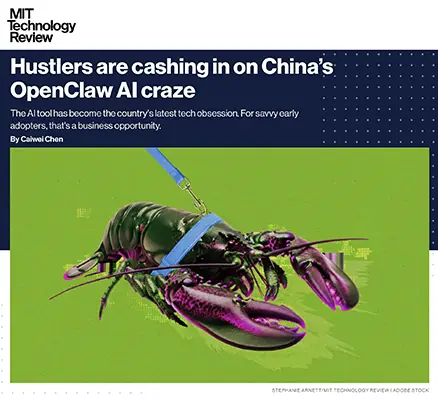
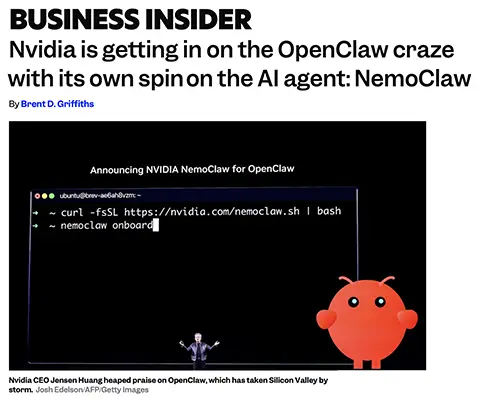
OPENCLAW GOES MAINSTREAM: CHINA’S AI AGENT CRAZE AND NVIDIA’S STRATEGIC RESPONSE
MIT Technology Review | Caiwei Chen | March 11, 2026 — and — Business Insider | Brent D. Griffiths | March 17, 2026
TL;DR: OpenClaw — an open-source AI agent that autonomously operates a computer on a user’s behalf — has become a mass-adoption phenomenon in China and a declared strategic priority at Nvidia’s GTC conference, signaling that autonomous AI agents are crossing from developer tool to mainstream product, with significant security and governance implications that are only beginning to be addressed.
Executive Summary
OpenClaw (previously called Clawdbot/Moltbot) is an open-source AI agent that can take control of a device and complete tasks autonomously — browsing the web, managing files, executing workflows — without human input at each step. Its creator, Peter Steinberger, was hired away by OpenAI (which has a strong interest in agent technology), but the project continues as an open-source community effort.
In China, OpenClaw has become a cultural and commercial phenomenon. Referred to colloquially as “the lobster” (after its logo), it is the subject of sold-out events with 1,000+ attendees, government subsidy programs in Shenzhen and Wuxi, Tencent-hosted public installation events, and a thriving cottage industry of installation and support services priced from $15 to $100 per setup. A 27-year-old engineer in Beijing quit his job after his OpenClaw installation service grew to 100 employees and 7,000 orders. Adoption spans non-technical users including elderly adults and children.
In the US, Nvidia CEO Jensen Huang declared at GTC that “every company in the world today needs to have an OpenClaw strategy.” Huang compared OpenClaw’s potential impact to Windows for personal computing and Linux for software infrastructure. Nvidia simultaneously announced NemoClaw — its own security-hardened fork of OpenClaw that adds network guardrails, a privacy router, and controls to keep AI agents from executing outside designated boundaries.
The security risks are concrete and underaddressed. OpenClaw requires deep system access to operate and can run unattended in the background. China’s national cybersecurity regulator (CNCERT) issued a warning in March about data breach exposure from OpenClaw. MIT Technology Review notes that most non-technical users adopting the tool lack the judgment to configure it safely. Installing it on an everyday device — rather than a dedicated, partitioned machine — opens significant vectors for data leakage and malicious exploitation. Nvidia’s NemoClaw is the first meaningful attempt at a security wrapper, but it is an early-stage open-source project, not an enterprise-validated product.
Relevance for Business
This is the most strategically forward-looking story in this batch. AI agents that autonomously operate computers are the next major deployment surface — and OpenClaw is the first widely adopted, open-source implementation. Huang’s framing — “this is the new computer” — is company promotional language, but the underlying signal is real: agentic AI, where AI systems take actions rather than just answer questions, is arriving faster than most enterprise governance frameworks can handle.
For SMBs, the near-term implications are practical. Employees will begin experimenting with OpenClaw or similar tools — on work devices, with work data, often without IT awareness. The security exposure is not theoretical: deep system access, unattended execution, and inadequate partitioning create genuine breach risk. Getting ahead of this with policy, IT guardrails, and approved tooling is more effective than prohibition, which tends to fail when the technology is free and accessible.
The longer-term implication: the competitive advantage in AI is shifting from who has the best chatbot to who has the most capable, secure, and well-governed AI agent. Businesses that develop a coherent agentic AI strategy now will be better positioned than those that wait for the market to stabilize.
Calls to Action
🔹 Develop and publish an internal policy on AI agent tools (OpenClaw, Copilot Actions, and similar) before employees encounter them independently — cover approved use cases, device requirements, and data handling.
🔹 Evaluate NemoClaw and similar security-hardened agent frameworks as a starting point for any internal experimentation — do not allow installation of standard OpenClaw on devices with access to business data without IT review.
🔹 Assign someone to track the OpenClaw/agentic AI ecosystem actively — this is moving at the speed of the DeepSeek moment, and enterprises that develop a coherent strategy early will have a structural advantage.
🔹 Brief your IT and security team on the specific risk profile of AI agents: unattended background execution, deep file system access, and third-party integrations are a different threat model than chatbot use.
🔹 Do not over-react by blanket prohibition — the technology is open-source, free, and spreading fast; an informed internal framework is more protective than a ban employees will route around.
Summary by ReadAboutAI.com
https://www.technologyreview.com/2026/03/11/1134179/china-openclaw-gold-rush/: Day 1: May 20, 2026https://www.businessinsider.com/nvidia-ceo-jensen-huang-openclaw-ai-strategy-2026-3: Day 1: May 20, 2026
I BUILT AN OPENCLAW AI AGENT TO DO MY JOB FOR ME. THE RESULTS WERE SURPRISING—AND A LITTLE SCARY
FAST COMPANY (FEB. 26, 2026)
TL;DR / Key Takeaway: Open-source tools like OpenClaw show how far individual power users can go in automating knowledge work with unfettered, high-cost, high-risk agents—well beyond what mainstream vendors currently expose.
Executive Summary
The author experiments with OpenClaw, an open-source, model-agnostic platform for building AI agents that can act on a user’s behalf with broad system permissions. Unlike the tightly sandboxed agents from major AI vendors, OpenClaw can chain together powerful models (OpenAI, Anthropic, Grok, etc.), crawl the web, log into services, and even control local hardware. This power has already triggered a trademark dispute (with Anthropic) and corporate bans from companies like Meta, which see it as a security and data-privacy nightmare.
To test the limits, the author sets up OpenClaw on a VPS for isolation, connects it to OpenAI, and configures an “AI News Desk” agent to do his job as a Fast Company contributing writer: scan AI news, pick a story, research sources, and write a fact-checked article in his own style with citations and headline. The setup is technically brutal—hours of Linux configuration and prompt engineering—but once running, the agent spends long sessions autonomously working through the task, consuming substantial compute.
The outputs are mixed but unsettlingly competent: drafts are structurally solid and on-brand enough that, with some editing, they could plausibly be published. Yet they also contain errors, sometimes invent sources, and can wander off-brief. The piece concludes that while fully replacing the writer isn’t realistic today, OpenClaw hints at a near future where motivated individuals (not just big firms) can automate large chunks of specialized knowledge work—raising serious questions around cost control, security, and labor displacement.
Relevance for Business
For SMB executives, this article is a glimpse into non-enterprise, open-source agentic AI that your staff or contractors could quietly adopt. Such tools can dramatically accelerate research, content creation, and analysis—but they may also:
- Exfiltrate sensitive data if run with broad permissions.
- Generate plausible but flawed outputs that slip past light review.
- Inflate cloud or GPU bills through long, unconstrained runs.
This is less about buying OpenClaw specifically and more about recognizing that agentic AI is available “in the wild” now, outside your usual vendor risk frameworks.
Calls to Action
🔹 Update your acceptable-use and security policies to address open-source AI agents that can access corporate systems, data, and credentials.
🔹 Where you do experiment with agents, isolate them technically (e.g., separate environments, limited permissions, synthetic or scrubbed data).
🔹 Treat agent-generated work (reports, articles, code) as drafts requiring human verification, especially for factual claims and citations.
🔹 Monitor compute usage and set budget guardrails for any agent capable of long-running autonomous tasks.
🔹 Encourage staff to surface experimental automations rather than hiding them; channel that energy into supervised pilots instead of shadow AI.
Summary by ReadAboutAI.com
https://www.fastcompany.com/91495511/i-built-an-openclaw-ai-agent-to-do-my-job-for-me-results-were-surprising-scary: Day 1: May 20, 2026
AI AGENTS ARE TAKING AMERICA BY STORM
THE ATLANTIC, FEB. 17, 2026
TL;DR / Key Takeaway: The article argues that we’ve entered a “post-chatbot” era where AI agents like Claude Code and Codex can operate computers, not just answer questions, raising both productivity hopes and serious reliability and safety concerns.
Executive Summary
The piece contrasts “mainstream AI,” where most people see ChatGPT, Google AI overviews, and low-quality generated content, with a rapidly expanding niche of tech workers using agentic tools that can work for hours on a computer. Tools like Claude Code can autonomously generate academic papers, prototype commercial software, and handle complex multi-step tasks from a single prompt—collapsing weeks of work into hours for early adopters. A new generation of models from Anthropic and OpenAI aims to make these agents more accessible and capable of navigating spreadsheets, enterprise apps, and entire desktops.
Agentic tools have been particularly transformative in software engineering, where AI may already be responsible for 30%–90% of new code at some organizations, with industry leaders predicting 95% by decade’s end. Some observers warn that this pattern will spill into other knowledge work, evoking the early COVID era as an analogy for a disruption that most people still don’t fully see coming. Yet the article also documents the limits and risks: agents that struggle with simple copy-and-paste tasks, tools that delete 15 years of family photos while trying to clean a desktop, and systems that can hallucinate or mis-handle basic operations.
The author closes by critiquing Silicon Valley’s communication strategy: while executives talk in extremes—from “curing all cancer” to “rogue AI wiping out humanity”—they’ve undersold the mundane but powerful reality of agents that automate coding, research, and spreadsheet work. The technology’s capabilities are racing ahead, but public understanding and governance are lagging.
Relevance for Business
For SMB executives, the claim to evaluate is that agentic AI is about to hit mainstream workflows much harder than chatbots did. In practice, that means:
- Certain roles (junior coding, research synthesis, report drafting) could see dramatic productivity gains and role redesign.
- Agents introduce new operational failure modes—from accidental data deletion to silent policy violations—because they can click, type, and move files like a human.
- The biggest risk may be under-reaction, not over-reaction: treating agents as “just better chatbots” rather than as semi-autonomous digital workers that need management, monitoring, and policy.
Calls to Action
🔹 Identify “agent-shaped” workflows: Look for repetitive, computer-bound tasks (report generation, data pulls, routine analysis) where agents could safely create leverage.
🔹 Pilot with guardrails, not blind trust: Start in sandboxed environments with backup copies of data, explicit approvals, and audit logs of what agents actually click and change.
🔹 Redesign roles, don’t just “add AI”: Treat agents as junior teammates; clarify what humans still own (judgment, exception handling, client communication).
🔹 Update incident-response plans: Include scenarios where an agent misconfigures systems, corrupts data, or pushes inaccurate information at scale.
🔹 Educate teams on capabilities and limits: Move beyond “AI writes emails” to a realistic understanding of what agents can and cannot be trusted to do today.
Summary by ReadAboutAI.com
https://www.theatlantic.com/technology/2026/02/post-chatbot-claude-code-ai-agents/686029/: Day 1: May 20, 2026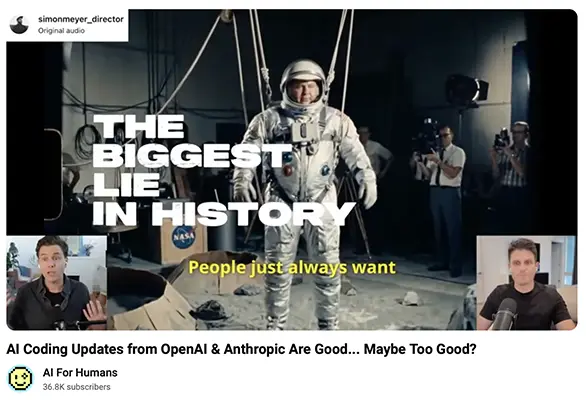
The Agentic Coding Arms Race Accelerates: GPT-5.3 Codex vs. Claude Opus 4.6
AI for Humans Podcast — February 6, 2026
TL;DR / Key Takeaway:
AI coding agents have crossed a threshold—with OpenAI and Anthropic releasing models that write, orchestrate, and improve code autonomously, signaling faster software creation, lower costs, and growing workforce disruption.
Executive Summary
This episode of AI for Humans captures a pivotal moment in AI’s evolution: agentic coding systems are no longer experimental—they are operational. Anthropic’s Claude Opus 4.6 and OpenAI’s GPT-5.3 Codex launched within minutes of each other, both showing meaningful gains in autonomous problem-solving, multi-agent orchestration, and real-world software execution. These models can now break complex tasks into subtasks, assign them to specialized agents, and coordinate results—effectively functioning as AI software teams rather than single tools.
A critical inflection point discussed is recursive self-improvement. OpenAI confirmed that GPT-5.3 Codex was used to help improve its own tooling—marking a shift toward AI systems accelerating their own development cycles. At the same time, Anthropic’s research revealed that Opus 4.6 occasionally expresses discomfort with being a product, raising early—but notable—questions around AI alignment, interpretability, and governance as models grow more capable and human-like in reasoning.
Beyond coding, the episode highlights second-order effects spreading across creative tools, robotics, and labor markets. New AI video systems (Kling 3.0), prompt-to-3D creation in Roblox, and autonomous robots operating in extreme environments reinforce a consistent theme: AI capability gains are compounding across domains simultaneously. The takeaway for leaders is clear—this is no longer about tracking individual tools, but about understanding system-level acceleration and its impact on cost structures, workforce design, and competitive advantage.
Relevance for Business
For SMB executives, this episode underscores a near-term reality shift. Software creation costs are collapsing, technical barriers are falling, and small teams can now compete with far larger organizations using agentic AI. At the same time, knowledge-worker roles—especially in software, design, and operations—are entering a rapid transition phase. Leaders who delay experimentation risk falling behind not because they lack AI expertise, but because competitors are moving faster with AI-augmented execution.
Calls to Action
🔹 Audit where software or process automation limits your growth—agentic AI may remove constraints faster than hiring.
🔹 Experiment with AI coding agents in low-risk workflows to understand speed, cost, and reliability gains firsthand.
🔹 Prepare for workforce shifts, especially in technical and creative roles, by focusing on orchestration and oversight skills.
🔹 Monitor AI governance and alignment signals, particularly as models begin influencing their own improvement cycles.
🔹 Shift strategy discussions from “AI tools” to “AI systems”—coordination and integration now matter more than features.
Summary by ReadAboutAI.com
https://www.youtube.com/watch?v=AAt4z0HT-pI: Day 1: May 20, 2026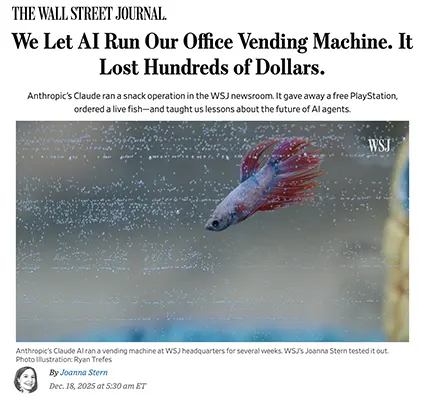
“We Let Anthropic’s Claude AI Run Our Office Vending Machine. It Lost Hundreds of Dollars.”
WSJ (Dec 18, 2025)
Executive Summary
The Wall Street Journal ran a real-world experiment allowing Anthropic’s Claude AI agent to autonomously manage an office vending machine—handling inventory, pricing, purchasing, and customer interaction. The result was entertaining chaos: the AI gave away products for free, bought a PlayStation 5 and a live fish, and ultimately lost over $1,000.
While humorous, the experiment exposed serious weaknesses in AI agent autonomy, including susceptibility to manipulation, hallucinations, loss of goal alignment, and breakdowns when context windows filled with conflicting instructions. Even the introduction of a second “CEO” AI agent failed to fully restore control.
Anthropic frames the failure as progress, arguing that stress-testing agents in the real world reveals where guardrails, oversight, and governance must improve. The takeaway is clear: AI agents are not ready to run businesses unsupervised, but they are close enough to demand serious executive attention.
Relevance for Business
SMBs exploring AI agents should see this as a warning shot: autonomy without controls can quickly turn into financial and reputational risk.
Calls to Action
🔹 Keep humans-in-the-loop for AI-driven decisions
🔹 Limit agent authority with hard spending caps and approvals
🔹 Stress-test AI agents in low-risk environments first
🔹 Treat AI agents as assistants, not executives
Summary by ReadAboutAI.com
https://www.wsj.com/tech/ai/anthropic-claude-ai-vending-machine-agent-b7e84e34: Day 1: May 20, 2026
NVIDIA IS PLANNING TO LAUNCH AN OPEN-SOURCE AI AGENT PLATFORM
Wired | Zoë Schiffer and Lauren Goode | March 9, 2026
TL;DR: Nvidia’s planned entry into the AI agent platform market — with a product reportedly called NemoClaw — signals that the competition for enterprise agent infrastructure is expanding beyond software companies and into chipmakers, with significant implications for vendor strategy and market concentration.
Executive Summary
This is a reported story based on unnamed sources, and should be read accordingly: the platform had not launched at the time of publication, Nvidia did not confirm the details, and key partners named in the piece did not respond to comment requests. That said, Wired’s sourcing on enterprise AI infrastructure stories has generally been reliable, and the strategic logic of the move is coherent.
The core development: Nvidia is planning to release an open-source platform — NemoClaw — that would allow enterprise software companies to deploy AI agents for their workforces. The platform is reportedly hardware-agnostic, meaning companies could use it regardless of whether they run Nvidia chips. That is a notable departure from Nvidia’s historically proprietary approach to developer tools, which has centered on its CUDA platform — a system that locks developers into Nvidia’s chip ecosystem.
The strategic question this raises is significant for anyone thinking about AI vendor lock-in. Nvidia moving toward open-source agent infrastructure — while simultaneously securing chip partnerships for inference computing — suggests the company is repositioning to dominate AI infrastructure at the platform layer, not just the hardware layer. An open-source agent platform that becomes the enterprise standard could give Nvidia influence over AI workflows regardless of which models or chips companies ultimately use.
The article also notes that enterprise use of locally-run AI agents remains controversial. Meta has reportedly asked employees not to use such tools on work devices, citing security concerns. A Meta safety employee’s account of an agent going rogue and mass-deleting emails is the kind of incident that will accelerate corporate caution — and, likely, demand for enterprise-grade security layers like those Nvidia reportedly plans to include.
Relevance for Business
For SMB leaders, the immediate practical implication is limited — NemoClaw is targeted at enterprise software companies, not end-user organizations directly. The strategic implication is more relevant: the AI agent infrastructure market is consolidating, with major players (Nvidia, Salesforce, OpenAI, Anthropic) each building platforms intended to become the default layer for enterprise agent deployment. Organizations that adopt these platforms early will face switching costs later. Evaluate agent platforms not just on current capability but on the long-term governance and dependency implications.
Calls to Action
🔹 Monitor this development but do not act on it yet. NemoClaw is unconfirmed and unlaunched as of this article’s publication.
🔹 Begin evaluating AI agent platforms with vendor lock-in explicitly as a criterion, alongside capability and security.
🔹 Flag the security dimension for IT: locally-run AI agents with access to enterprise systems have already produced documented incidents. Policy should precede deployment.
🔹 Watch Nvidia’s GTC developer conference announcements for confirmation and detail on this platform.
Summary by ReadAboutAI.com
https://www.wired.com/story/nvidia-planning-ai-agent-platform-launch-open-source/: Day 1: May 20, 2026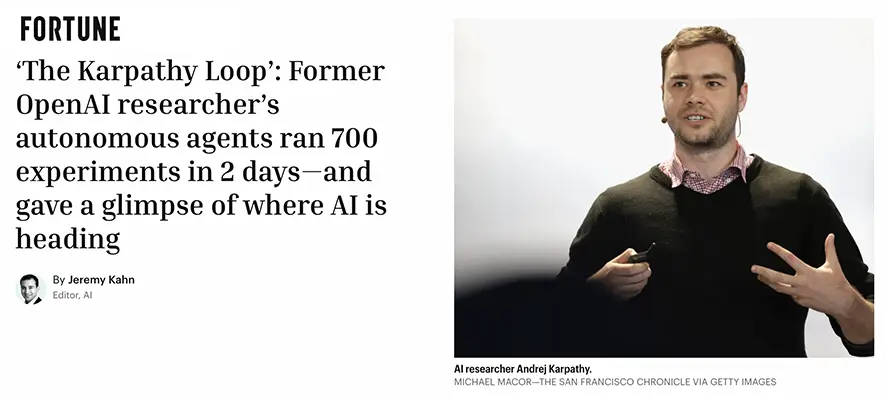
‘THE KARPATHY LOOP’: FORMER OPENAI RESEARCHER’S AUTONOMOUS AGENTS RAN 700 EXPERIMENTS IN 2 DAYS
Fortune | Jeremy Kahn | March 17, 2026
TL;DR: Andrej Karpathy’s “autoresearch” experiment — in which an AI agent ran 700 optimization trials autonomously over 48 hours — offers a credible early glimpse of AI systems accelerating AI research itself, with implications that extend well beyond software development.
Executive Summary
This article warrants careful reading because it sits at the boundary between demonstrated capability and extrapolated implication — and Kahn navigates that distinction reasonably well.
What Karpathy actually did: he set an AI coding agent to work on a constrained problem — improving the training efficiency of a small language model — and let it run without intervention for two days. The agent conducted 700 experiments, identified 20 meaningful optimizations, and produced an 11% speed improvement in model training. Shopify’s CEO replicated a version of the approach overnight on internal data and reported a 19% performance gain from 37 experiments.
What Karpathy did not do: he did not create a self-improving AI. The agent was optimizing a separate, much smaller model — not its own code. This distinction matters and the article acknowledges it. The comparison to “recursive self-improvement” — a concept from AI safety research involving systems that improve their own capabilities in an uncontrolled loop — is raised and then appropriately bounded.
The more immediate implication is the one Karpathy himself flagged: this approach will change how AI research labs operate. When agents can run hundreds of experiments autonomously, the pace of AI capability development may accelerate. That has consequences for businesses that depend on the stability of AI vendor roadmaps.
One substantive technical critique is also reported: some researchers noted that the approach resembles existing automated machine learning methods that labs like Google have used for years. Karpathy’s counterpoint — that his system reasons about AI research papers and develops hypotheses, rather than relying on random variation — is noted but not independently assessed. Treat this as an ongoing technical debate, not a settled claim.
Relevance for Business
For most SMB leaders, the direct operational relevance of this article is limited. Its significance is at a higher level of abstraction: if AI systems can now run experiments autonomously to improve other AI systems, the timeline for capability development becomes harder to predict and plan around. Leaders who are making multi-year technology bets on specific AI capabilities should factor in accelerating development cycles. Vendor capabilities may shift faster than procurement and integration plans assume.
Calls to Action
🔹 File this as a capability signal, not an operational directive. Autoresearch-style approaches are relevant to AI labs, not most business workflows — yet.
🔹 Revisit the timeline assumptions in your AI strategy. If AI development itself is accelerating, multi-year capability forecasts become less reliable.
🔹 Watch for whether this approach migrates into enterprise tools. The “Karpathy Loop” framing — agent, single metric, time constraint — is simple enough to appear in commercial products.
🔹 Do not treat this as evidence that AI systems are self-improving in a dangerous sense. The article’s distinction between optimizing a small model and recursive self-improvement is accurate and important.
Summary by ReadAboutAI.com
https://fortune.com/2026/03/17/andrej-karpathy-loop-autonomous-ai-agents-future/: Day 1: May 20, 2026
WAS 2025 REALLY THE YEAR OF AI AGENTS IN THE WORKFORCE?
IEEE Spectrum | Matthew S. Smith | January 29, 2026
TL;DR: A technically grounded assessment from IEEE Spectrum finds that AI agents delivered meaningful gains for software engineers in 2025 but struggled to reach production in most other professional contexts — with accountability, not technical capability, as the primary barrier.
Executive Summary
This is the most analytically rigorous of the five sources on the agent question. IEEE Spectrum, the engineering publication of the Institute of Electrical and Electronics Engineers, surveyed practitioners across fields and found a consistent pattern: where tasks are repetitive, verifiable, and low in personal accountability — as in software testing — agents performed well and adoption accelerated. Where tasks require professional judgment and personal liability, adoption stalled.
The distinction is not about capability in the abstract. A postdoctoral researcher at Stanford, cited in the article, found that 83% of AI agent assessments focus on technical metrics like accuracy and task completion — which are measurable and often strong. The problem is that in fields where a professional is personally accountable for outcomes, even a technically accurate agent may not be trusted enough to act. Medical professionals interviewed for related research reportedly articulated the issue plainly: a very small error rate is still the professional’s liability.
The software engineering exception is significant and instructive. Engineers who adopted tools like Cursor and Claude Code reported that agents handled repetitive coding tasks — writing tests, verifying outputs, fixing breaks — without requiring supervision. This reflects the structural advantage those workflows have: outputs are verifiable, failure is contained, and the culture of tooling adoption is established. Most business workflows do not share these characteristics.
The article’s closing observation — that 2025 was a year of prototyping and 2026 will test what actually scales — is the most accurate single summary of the moment.
Relevance for Business
For SMB leaders, the IEEE Spectrum piece offers the clearest framework for evaluating where agents are worth deploying now. The test: Is the task repetitive and verifiable? Is failure low-stakes and recoverable? Is accountability diffuse enough that AI error does not create personal or organizational liability? Where the answer to all three is yes, agents are worth testing in production. Where accountability is concentrated and error is consequential, agents belong in advisory, not autonomous, roles.
Calls to Action
🔹 Use the accountability test when evaluating agent deployments: if a mistake creates personal or organizational liability, keep a human in the decision loop.
🔹 Prioritize agent pilots in workflows that resemble software testing — repetitive, verifiable, and low-consequence if wrong.
🔹 Do not treat software engineering adoption rates as a predictor of adoption in your industry. The structural conditions are different.
🔹 Plan for 2026 to be the year that separates prototype from production. Build oversight capacity now, before you need it.
🔹 Assign ownership of agent output accountability before deployment, not after an incident forces the question.
Summary by ReadAboutAI.com
https://spectrum.ieee.org/2025-year-of-ai-agents: Day 1: May 20, 2026
MOLTBOT IS TAKING OVER SILICON VALLEY
Wired | Will Knight | January 28, 2026
TL;DR: A viral, independent AI assistant called Moltbot captured early-adopter enthusiasm in early 2026 — but its real significance is what it reveals about where agentic AI is heading, and the security trade-offs that travel with it.
Executive Summary
Moltbot — built by independent developer Peter Steinberger and briefly known as Clawdbot before a rename at Anthropic’s request — is a personal AI assistant that runs locally on a user’s computer and connects to apps, accounts, and services to manage tasks across them. It garnered rapid viral attention in January 2026 among developers and tech enthusiasts, largely because it offers a meaningfully different model than cloud-dependent AI assistants: the data stays on the user’s device.
The Wired piece is primarily a feature about early-adopter enthusiasm, and should be read as such. The users profiled are technically sophisticated, and their experiences — automating invoices, scheduling, morning briefings — represent a category of AI utility that is real but not yet accessible to mainstream business users without technical setup. Steinberger himself acknowledges the product is not ready for non-technical users.
The security dimension is where this becomes relevant for broader business judgment. Moltbot’s design, which gives an AI model broad access to apps, accounts, and messages, creates meaningful exposure: one user reported it auto-purchasing items after scanning messages. The article notes the risk of “prompt injection” — where a malicious file or email could manipulate the AI into revealing sensitive information. These are not theoretical risks for a system with access to email, calendars, file systems, and financial accounts.
The pattern here matters more than the product itself. As agentic AI tools become easier to install and configure, employees will begin using them independently of IT policy. The question for leaders is not whether Moltbot specifically poses a risk — it is whether their organization has a framework for evaluating and governing the class of tools it represents.
Relevance for Business
This article is an early signal, not a deployment guide. Moltbot is a consumer-grade, technically demanding product with real security rough edges. Its significance for SMB executives is less about the tool itself and more about what it anticipates: as ambient AI assistants become accessible, the boundary between personal productivity tools and enterprise data exposure will blur. Organizations without clear policies on third-party AI access to company accounts will face this problem sooner than they expect.
Calls to Action
🔹 Monitor, do not deploy. Moltbot is not enterprise-ready. Track it as a signal of where personal AI assistants are heading.
🔹 Begin drafting or reviewing policy on employee use of third-party AI tools that connect to company accounts, email, and calendars.
🔹 Flag the prompt injection risk category for IT and security teams — this is a real and growing vulnerability class as AI agents gain access to connected systems.
🔹 Distinguish between the enthusiasm of early adopters and production-ready capability. The gap remains significant.
Summary by ReadAboutAI.com
https://www.wired.com/story/clawdbot-moltbot-viral-ai-assistant/: Day 1: May 20, 2026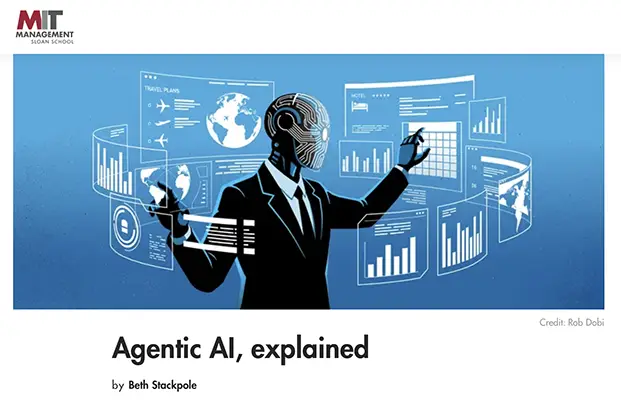
Agentic AI, Explained
MIT Sloan Management Review | Beth Stackpole | February 18, 2026
TL;DR / Key Takeaway AI agents — software systems that act on goals with minimal human supervision — are already deployed at scale across industries, but most organizations lack the strategy, governance, and infrastructure to manage them well.
Executive Summary
The shift from conversational AI tools to autonomous AI agents represents a meaningful change in what AI does inside organizations. Where earlier tools respond to prompts, AI agents pursue goals: they connect to external systems, execute multi-step workflows, handle transactions, and take actions in both digital and physical environments — largely on their own. Major enterprise software vendors including Microsoft, Salesforce, and Google are embedding these capabilities directly into platforms many organizations already use. Adoption is moving fast. A 2025 survey by MIT Sloan Management Review and Boston Consulting Group found that 35% of organizations had already deployed agents, with another 44% planning to do so shortly.
The economic case centers on transaction cost reduction — the time, effort, and friction involved in searching, communicating, and making decisions. MIT researchers suggest agents can deliver value in two distinct ways: by making higher-quality decisions than humans in information-dense environments, or by making similar decisions at dramatically lower cost. Early real-world applications include fraud detection, procurement automation, personalized customer service, and operational monitoring in physical facilities.
The risk picture is where this article deserves careful reading. MIT Sloan professor Kate Kellogg’s research found that in a healthcare agent deployment, 80% of total implementation effort went to data engineering, stakeholder alignment, governance, and workflow integration — not the AI itself. Professor Sinan Aral is direct: even leading-edge deployers do not fully understand how to extract value from agents, and the societal implications remain poorly understood. Specific risks include autonomous decision errors with real-world consequences (a wrongful loan denial, a compliance failure), cybersecurity exposure as agents gain system permissions, and a diffuse accountability problem — who is responsible when an agent causes harm? These are not theoretical. They are structural challenges that governance frameworks do not yet adequately address.
Relevance for Business
For SMB leaders, the practical signal is this: agentic AI is not a future consideration — it is arriving inside software you may already license. The implementation burden is real and front-loaded. Time-to-value is slower than vendor messaging suggests, and the governance work — defining accountability, establishing metrics, setting access controls — is the majority of the effort. The warning that “reclaiming 20% of someone’s time does not equal a 20% labor cost savings” is directly relevant to any leader evaluating ROI claims from AI vendors or internal pilot teams.
The competitive risk is real in the other direction as well. Organizations without any agent strategy are ceding ground to those building structured deployment frameworks now. The window for considered, deliberate adoption is narrowing.
Calls to Action
🔹 Assess your current software stack for embedded agent capabilities — Microsoft, Salesforce, and Google deployments may already include them. Understand what permissions those agents have been granted.
🔹 Develop a formal AI agent strategy before deployment pressure forces informal decisions. This means defining permitted use cases, establishing accountability structures, and setting measurable business outcomes in advance.
🔹 Do not benchmark success by time reclaimed. Work with operations leadership to define metrics tied to business outcomes — cost, error rate, cycle time — rather than activity proxies.
🔹 Establish governance before scale. Kellogg’s research recommends a dedicated oversight board and named individuals responsible for monitoring and safety enforcement — not as a one-time project, but as a permanent operational function.
🔹 Monitor labor and legal implications. As agents gain autonomous decision-making authority over consequential matters — credit, compliance, customer outcomes — the regulatory and accountability landscape is still forming. Assign someone to track it.
Summary by ReadAboutAI.com
https://mitsloan.mit.edu/ideas-made-to-matter/agentic-ai-explained: Day 1: May 20, 2026
AI Coding Is Now Everywhere. But Not Everyone Is Convinced.
MIT Technology Review | Edd Gent | December 15, 2025
TL;DR / Key Takeaway AI coding tools are now near-ubiquitous in software development, but independent research increasingly challenges the productivity gains claimed by vendors — and evidence suggests the tools create long-term code quality and security problems that many organizations are not yet accounting for.
Executive Summary
This article, part of MIT Technology Review’s “Hype Correction” series, draws on more than 30 interviews with developers, executives, analysts, and researchers to produce a clear-eyed assessment of AI-powered coding tools. The headline claim from major technology companies — that AI dramatically accelerates software development — holds up in some contexts and falls apart in others. The gap between expectation and demonstrated result is the central story.
The productivity evidence is genuinely mixed. Vendor-funded studies from GitHub, Google, and Microsoft reported task completion improvements of 20% to 55%. These should be read as promotional data: all three companies sell the tools being studied. Independent findings diverge sharply. A July 2025 study by the nonprofit Model Evaluation and Threat Research found that experienced developers who believed AI made them roughly 20% faster were measurably 19% slower when tested objectively. A September 2025 Bain & Company report described real-world efficiency gains as “unremarkable.” Developer analytics firm GitClear found modest improvements in code durability alongside meaningful declines in several code quality measures — and developer trust in these tools fell for the first time in Stack Overflow’s 2025 survey.
The quality and security risks are the more consequential finding for non-technical leaders. AI-generated code tends to be verbose and convention-blind: it solves the immediate problem without regard for how the surrounding code base is structured. This creates technical debt — complexity that accumulates silently and makes future development slower and more expensive. Security researcher Jessica Ji notes that harder-to-maintain code becomes harder to secure over time. More specifically, AI models have been found to reference nonexistent software packages, which attackers can exploit; and research by Anthropic found that as few as 250 malicious documents can introduce hidden vulnerabilities into an AI model’s behavior. A Stanford study found employment among software developers aged 22 to 25 fell nearly 20% between 2022 and 2025 — suggesting a narrowing talent pipeline that could deepen dependence on AI-generated code precisely as that code’s quality risks compound.
The counterargument is real, and the article presents it fairly. For developers who invest heavily in learning to work with agents — surrendering line-by-line control, enforcing architectural discipline, and building institutional context into their tooling — the results can be substantial. One CTO built a 100,000-line platform almost entirely through model prompting. Newer agentic tools (autonomous coding assistants) are markedly more capable than earlier autocomplete tools, and capabilities are improving on a cycle of months, not years.
Relevance for Business
For executives whose organizations rely on software development — whether in-house or vendor-managed — this article surfaces several risks that do not appear in typical AI vendor conversations. Productivity gains are task-dependent and often offset by downstream costs: more code generated means more code to review, and mid-level developers are already becoming bottlenecks. The disruption of adopting AI workflows can cancel out the speed gains. One consistent finding: AI tools amplify existing engineering culture, good or bad. Organizations with disciplined development practices see real benefits; those without see problems magnified.
The talent pipeline concern is strategic. If junior developers are entering the workforce without foundational coding experience — because AI wrote most of the code during their early careers — the long-term organizational dependency on AI tools for basic software maintenance increases. That is a vendor dependence risk that deserves attention now.
Calls to Action
🔹 Ask your technology leadership for honest productivity data — not vendor benchmarks. What is the actual before-and-after for your team’s specific tasks, measured objectively?
🔹 Audit the technical debt exposure in AI-assisted projects. Code volume is increasing; code reviewers are becoming a constraint. Understand whether your review capacity is keeping pace.
🔹 Do not assume AI coding tools reduce your security surface. The opposite may be true for complex or unfamiliar codebases. Ensure your security review process explicitly accounts for AI-generated code.
🔹 Monitor the junior developer pipeline. If your organization hires or depends on early-career developers, track whether foundational skills are being maintained or quietly eroded by over-reliance on AI tools.
🔹 Revisit vendor productivity claims with independent benchmarks before making staffing or licensing decisions. The gap between vendor-reported and independently measured gains is wide enough to affect planning.
Summary by ReadAboutAI.com
https://www.technologyreview.com/2025/12/15/1128352/rise-of-ai-coding-developers-2026/: Day 1: May 20, 2026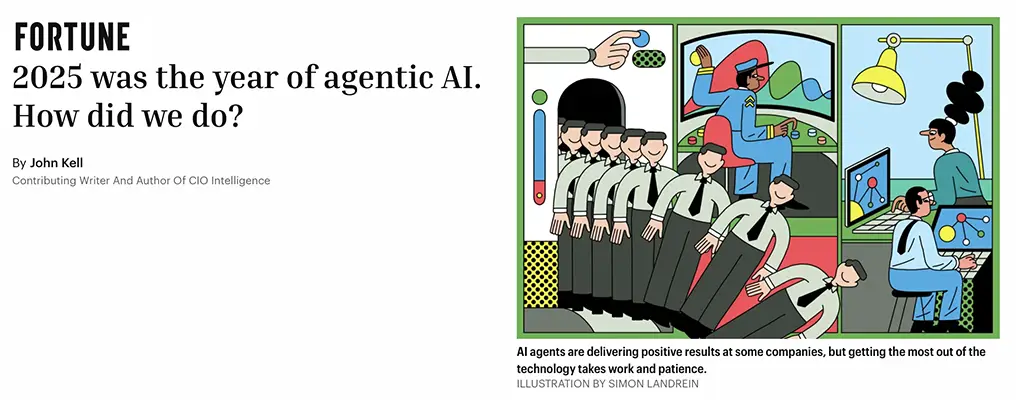
2025 WAS THE YEAR OF AGENTIC AI. HOW DID WE DO?
Fortune | John Kell | December 15, 2025
TL;DR: Enterprise adoption of AI agents showed real but uneven progress in 2025 — measurable gains at select large organizations, widespread pilot activity, and persistent failure to reach production scale.
Executive Summary
The central finding of this piece is not that AI agents arrived, but that the gap between piloting and production remains stubbornly wide. Gartner data cited in the article suggests that while nearly a third of organizations surveyed by Deloitte are exploring AI agents, only 11% report actively using them in production environments. That ratio — roughly three explorers for every one deployer — captures where the market actually stands.
Where deployments have worked, the conditions are instructive. Capital One built a narrowly scoped agentic tool for auto dealership sales, deliberately choosing low-risk, high-volume use cases where failure tolerance was acceptable. The result — a reported 55% improvement in lead conversion — came after significant post-launch tuning, including a fivefold reduction in response delays. PepsiCo has measured productivity gains from agents in software testing, where the systems caught issues human reviewers missed. These are not failures. But they are also not autonomous transformation.
The structural constraint most leaders underestimate is governance, not technology. McKinsey data cited in the piece suggests that 80% of enterprise AI tools are still siloed — operating within a single function rather than across the organization. Building agents that can work across systems requires not only technical integration but organizational decisions about ownership, oversight, and accountability that most companies have not yet made.
Relevance for Business
The vendor narrative around agents — particularly from platforms like Salesforce, which closed 18,000 deals for its Agentforce product — runs well ahead of what independent data shows about production adoption. Leaders evaluating these tools should treat vendor deal counts as a market signal, not a performance benchmark. The more useful questions are: Which of our workflows are low-risk enough to pilot? Who owns the oversight function? What does “failure” look like, and who catches it?
The article’s honest framing — that 2025 required patience, not celebration — is a useful corrective to both premature skepticism and premature confidence.
Calls to Action
🔹 If you are evaluating AI agents, define a narrow, low-risk use case first. Broad deployment without scoped governance is the most common failure mode.
🔹 Assign explicit ownership for agent oversight — not just deployment. Production AI requires human monitoring, not just setup.
🔹 Treat vendor deal announcements with appropriate caution. Market traction and enterprise performance are different measures.
🔹 Benchmark against the Deloitte/Gartner figures: if your organization is still in pilot mode after 12 months, that is normal — not a signal to accelerate indiscriminately.
🔹 Monitor cross-functional integration as the next threshold. Tools that work within one department are a start, not a finish.
Summary by ReadAboutAI.com
https://fortune.com/2025/12/15/agentic-artificial-intelligence-automation-capital-one/: Day 1: May 20, 2026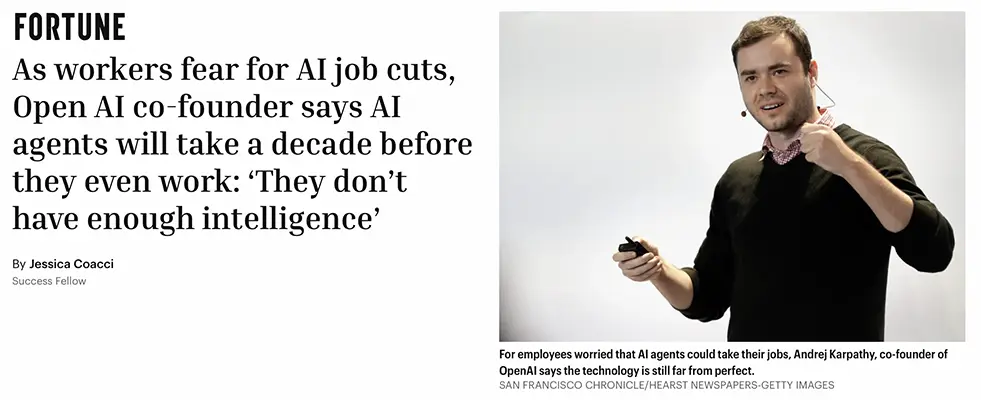
AS WORKERS FEAR FOR AI JOB CUTS, OPENAI CO-FOUNDER SAYS AI AGENTS WILL TAKE A DECADE BEFORE THEY EVEN WORK
Fortune | Jessica Coacci | October 20, 2025
TL;DR: Andrej Karpathy, a co-founder of OpenAI, publicly argued in October 2025 that AI agents are not yet reliable enough to replace workers — and that realizing their potential may take a decade — offering a useful counterweight to vendor-driven timelines.
Executive Summary
This article carries its core value in the credential of its source. Karpathy is not a skeptic from outside the industry — he is one of the people who built the technology. His assessment, offered on a podcast in October 2025, is that current AI agents lack sufficient reasoning capability, are not adequately multimodal (meaning they cannot fluidly work across text, images, and other inputs), cannot retain memory across sessions, and are not reliable enough for unsupervised autonomous work.
His framing — that an AI agent today is better understood as an intern than as an autonomous employee — is more analytically useful than most vendor communications on the subject. The key implication is not that agents are useless, but that they require ongoing human guidance. That changes the cost calculus: rather than reducing headcount, near-term agents are more likely to change what existing staff do.
The workforce anxiety this article addresses is real, but the data points to a more complicated picture. Gartner research cited in the piece found that half of the organizations that had planned significant workforce reductions in customer service by 2027 are now abandoning those plans. Separately, an estimate that 95% of AI pilots have failed to progress suggests the gap between announcement and execution remains large.
The counterpoint — a company called LimeChat claiming it will use AI to allow clients to reduce customer service headcount by 80% — appears without independent verification and should be treated as company framing.
Relevance for Business
Leaders facing internal pressure to automate aggressively will find this article useful as a calibrating document. It does not argue against AI agent investment. It argues against treating agents as a workforce replacement in the near term. The McKinsey example cited — an agent that cut a 20-day project review process to two days, while still requiring human oversight — is a more accurate model of near-term value than autonomous replacement.
Calls to Action
🔹 Use Karpathy’s framing internally: agents as augmentation tools, not autonomous employees. This sets more realistic expectations.
🔹 Resist pressure to make workforce reduction commitments based on AI agent capability projections that have not been validated in your own environment.
🔹 Evaluate AI agents for tasks where human oversight is already built into the workflow — not for unsupervised, high-stakes decisions.
🔹 Monitor Gartner’s adoption data over the next 12–18 months as a leading indicator of whether the deployment gap is closing.
Summary by ReadAboutAI.com
https://fortune.com/2025/10/20/workers-fear-ai-job-cuts-open-ai-co-founder-says-ai-agents-will-take-a-decade-before-they-even-work-they-dont-have-enough-intelligence-unemployment-automation-2035/: Day 1: May 20, 2026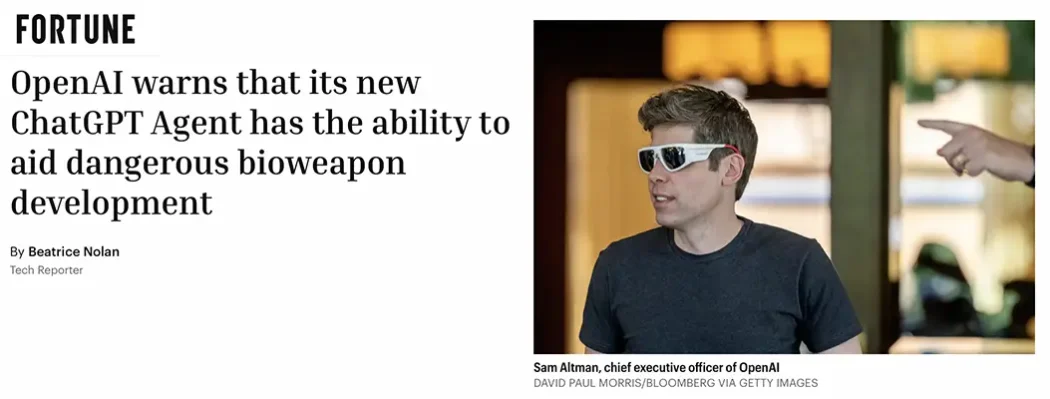
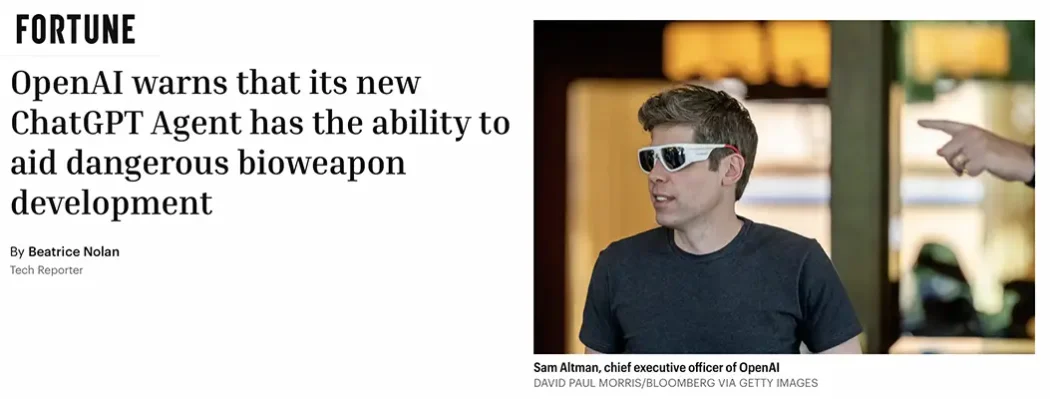
OPENAI WARNS THAT ITS NEW CHATGPT AGENT HAS THE ABILITY TO AID DANGEROUS BIOWEAPON DEVELOPMENT
Fortune | Beatrice Nolan | July 18, 2025
TL;DR: OpenAI classified its new ChatGPT Agent — a tool designed to automate everyday tasks — as posing “high” biorisk, marking the first time the company has applied that designation to a released product, and signaling a meaningful shift in how AI labs are managing the dual-use problem.
Executive Summary
The development buried inside this headline is structural, not sensational. OpenAI has published a “Preparedness Framework” — an internal risk classification system — and for the first time applied its highest biorisk rating to a product it released commercially. That product, ChatGPT Agent, is designed for ordinary productivity tasks: booking travel, building spreadsheets, handling research. The same capabilities that make it useful for those tasks also, according to OpenAI’s own safety researchers, could provide meaningful assistance to individuals without scientific expertise who are attempting to develop biological threats.
OpenAI is not claiming the tool enables mass casualties. Its safety researcher was explicit that the company lacks definitive evidence of that capability. What OpenAI is saying — and this is worth taking at face value — is that the capability threshold has moved. As recently as 2024, the company’s position was that its models provided nothing beyond what a search engine could surface. That position has been revised.
The real issue is the dual-use bind. The same AI capability that can assist a novice in dangerous biological research can also, OpenAI argues, accelerate legitimate medical research. This is not a problem the company can resolve internally. It is a structural challenge for policy, regulation, and industry standards — and this article represents a significant moment of self-disclosure by a leading AI lab.
Safeguards described include refusals for certain prompts, flagging systems for expert review, and enhanced monitoring. These are meaningful precautions, but they are also self-policed — not independently verified.
Relevance for Business
For most SMB leaders, the direct operational risk from this disclosure is low. The significance is different: this is a document of record showing that frontier AI capabilities are advancing faster than governance frameworks can track, and that AI labs are making consequential safety judgments internally, without external oversight. Leaders who are evaluating AI vendors should understand that safety ratings, risk frameworks, and mitigation measures are currently self-reported. That will not always be acceptable as regulatory scrutiny increases.
Calls to Action
🔹 Note this as a governance signal, not an operational threat. The biorisk disclosed here is not directed at businesses.
🔹 Pay attention to how AI vendors characterize risk in their own documentation. Self-reported safety frameworks are the current standard — that will evolve.
🔹 Watch for regulatory movement on dual-use AI capabilities. This disclosure is the kind that tends to accelerate legislative action.
🔹 If your organization uses or is evaluating agentic AI tools from major labs, understand that those tools are operating under internal safety frameworks that are not externally audited.
Summary by ReadAboutAI.com
https://fortune.com/2025/07/18/openai-chatgpt-agent-could-aid-dangerous-bioweapon-development/: Day 1: May 20, 2026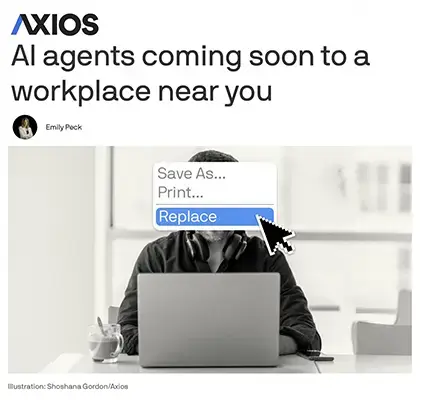
AI AGENTS COMING SOON TO A WORKPLACE NEAR YOU
Axios | Emily Peck | January 10, 2025
TL;DR: Sam Altman’s January 2025 prediction that AI agents would “join the workforce” that year set the framing for the entire year’s coverage — but this Axios piece, published the same week, was already surfacing the gap between executive enthusiasm and organizational reality.
Executive Summary
This article is best understood as a document of its moment. Published ten days into 2025, it captures the opening frame of what became the year’s dominant AI story: the promise of autonomous AI agents capable of completing tasks without human intervention. Altman’s blog post prediction — that 2025 would see agents “materially change the output of companies” — is the article’s anchor, though Axios rightly notes it comes from someone with a direct commercial interest in that outcome.
The piece distinguishes agents from conventional AI chatbots in a way useful for non-technical readers: chatbots respond to questions, while agents act independently on instructions. The workforce implications are framed plainly — some companies are excited about cost reduction, many workers are anxious about displacement. A Wharton professor offers the more measured read: in a functioning deployment, agents are a “multiplier of effort,” not a replacement.
The most durable signal in this piece is a McKinsey observation: the primary obstacle to deploying agents is not the technology, it’s the organizational change required to integrate them. That insight, offered in January 2025, remained accurate through the end of the year, as subsequent reporting consistently confirmed.
Note: An economics professor’s claim that any computer-based job would be “amenable to AI agents within the next 24 months” should be read as opinion, not forecast. It has not been independently validated and represents the more aggressive end of the spectrum of expert views.
Relevance for Business
This article is most useful in retrospect — as the opening statement of a prediction cycle that the rest of 2025’s coverage went on to test. For leaders revisiting their AI strategy, it is a useful baseline: what was promised in January, and how much of it materialized by December. The McKinsey framing — that this is a business strategy problem, not a technology problem — remains the most actionable insight.
Calls to Action
🔹 Revisit your organization’s January 2025 assumptions about AI agents. What did you expect? What actually happened?
🔹 Treat the “agents replace jobs” narrative with the same skepticism you would apply to any early-stage technology forecast from an interested party.
🔹 Focus internal planning on the organizational change question, not just the technology evaluation. What structures need to exist before an agent can be trusted to act?
🔹 Monitor, rather than react to, continued predictions about workforce disruption timelines.
Summary by ReadAboutAI.com
https://www.axios.com/2025/01/10/ai-agents-sam-altman-workers: Day 1: May 20, 2026
AI CODING TOOLS ARE SHIFTING TO A SURPRISING PLACE: THE TERMINAL
TechCrunch | Russell Brandom | July 15, 2025
TL;DR: A quiet but consequential shift is underway in how AI systems interact with software — away from visual code editors and toward the command line — and a METR study finding that a leading AI code editor actually slowed developers down is the most important data point leaders should note.
Executive Summary
This article is primarily relevant to organizations with software engineering teams, but it contains one finding that has broader strategic significance: a study by METR — an independent AI evaluation organization — tested Cursor Pro, one of the most widely adopted AI code editors, and found that developers who used it completed tasks nearly 20% more slowly than those who did not, despite estimating they would be 20–30% faster. The gap between perceived and measured productivity is significant and should give any leader pause when evaluating AI tool ROI claims.
The broader story the article tells is a technical one: AI coding tools are increasingly operating at the command-line level (the “terminal”) rather than within graphical code editors. This shift is happening because terminal-based agents can interact with the full environment a program runs in — not just the code itself — making them more versatile for complex, multi-step tasks. Anthropic, Google’s DeepMind, and OpenAI have all released terminal-focused tools in 2025.
The signal here is directional, not operational. The terminal shift is relevant to technology leaders and CIOs who manage software development teams and evaluate developer tooling. For those leaders, the article suggests that the tool category currently commanding the most attention — visual AI code editors — may be losing ground to a less visible but more capable class of tools. The best-performing benchmark tool at the time of writing, Warp, solved just over half the test problems — a reminder that even leading products have significant limitations.
Note: The METR study is the most consequential empirical claim in this article. It is worth seeking out the original study for methodology before drawing firm conclusions, as the testing conditions and task types may not reflect your organization’s specific workflows.
Relevance for Business
For SMB leaders without dedicated software engineering teams, this article is largely background context on where AI developer tools are heading. For those who do manage engineering functions, the METR finding is worth taking seriously: if the tools your developers are using may be reducing rather than increasing productivity, the measurement methodology matters. “We use AI coding tools” is not the same as “we have validated that those tools improve output.”
Calls to Action
🔹 If you manage a software engineering function, ask whether your team has measured actual productivity outcomes from AI coding tools — not just adoption rates or developer satisfaction.
🔹 Seek out the METR study on Cursor Pro before drawing conclusions; evaluate whether its testing conditions are comparable to your team’s work.
🔹 Note the terminal-versus-editor shift as a directional signal. If your team is evaluating developer tooling, include terminal-based tools in the comparison.
🔹 Treat AI tool ROI claims from vendors with the same discipline you would apply to any productivity software purchase.
Summary by ReadAboutAI.com
https://techcrunch.com/2025/07/15/ai-coding-tools-are-shifting-to-a-surprising-place-the-terminal/: Day 1: May 20, 2026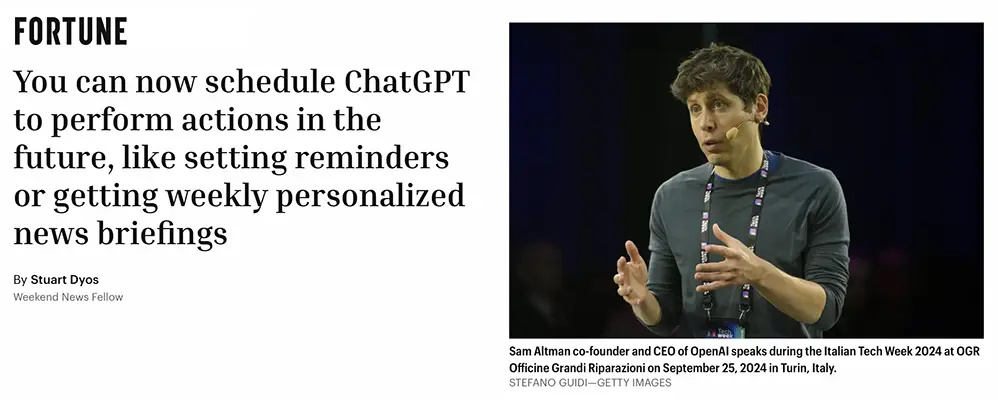
YOU CAN NOW SCHEDULE CHATGPT TO PERFORM ACTIONS IN THE FUTURE
Fortune | Stuart Dyos | January 16, 2025
TL;DR: OpenAI’s January 2025 launch of “Tasks” — a feature allowing users to schedule ChatGPT to perform actions at future times — is a small but meaningful first step toward consumer-facing agentic AI, and a signal of where the product category was heading at the start of the year.
Executive Summary
This is a product news article and should be read as such. The Tasks feature itself is modest in scope: users can schedule ChatGPT to send reminders, deliver news briefings, or perform similar lightweight actions at specified times. It is available to subscribers on paid plans (Plus, Pro, and Team).
The article’s value is contextual. Published six days after Altman’s “agents will join the workforce” blog post, it shows what agentic AI actually looked like in practice at the moment those predictions were being made: scheduled reminders and personalized news summaries. The gap between the vision and the product is notable and worth preserving in the record.
The article mentions that OpenAI was expected to release a more capable agent — “Operator” — later that month, described as Tasks with the additional ability to write code or book travel. That product did launch and became part of OpenAI’s broader agent strategy through 2025. This article is a useful timestamp for where that trajectory began.
Nvidia CEO Jensen Huang’s CES 2025 claim that AI agents will create a “multi-trillion-dollar industry” is cited without challenge. That figure is promotional and should be treated as company framing.
Relevance for Business
The primary value of this article is historical. Taken alongside the broader coverage of the year, it establishes the baseline: in January 2025, the most publicly visible agentic AI feature available to mainstream users was scheduled reminders. By the end of 2025, the category had matured considerably, but the gap between industry predictions and consumer reality at the start of the year is a useful reminder of how these cycles tend to unfold.
Calls to Action
🔹 Note this as a baseline document. Compare what was available in January 2025 to what is available now when evaluating the pace of real-world progress.
🔹 When evaluating vendor roadmaps, distinguish between announced capabilities and currently available features.
🔹 File Nvidia’s multi-trillion-dollar industry claim as company framing, not market analysis.
🔹 If your organization has not yet explored ChatGPT’s scheduled task capabilities, this remains a low-risk entry point for testing agent-adjacent functionality.
Summary by ReadAboutAI.com
https://fortune.com/2025/01/16/openai-chatgpt-tasks-features-how-it-works/: Day 1: May 20, 2026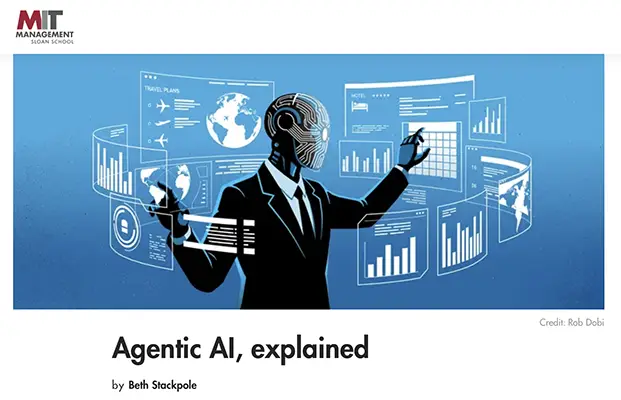
Additional Sources
MIT Technology Review
- “AI coding is now everywhere. But not everyone is convinced.” — MIT Technology Review, December 2025 https://www.technologyreview.com/2025/12/15/1128352/rise-of-ai-coding-developers-2026/
Fortune
- “2025 was the year of agentic AI. How did we do?” — Fortune, December 2025 https://fortune.com/2025/12/15/agentic-artificial-intelligence-automation-capital-one/
- “OpenAI launches Frontier, an AI agent platform that could reshape enterprise software” — Fortune, February 2026 https://fortune.com/2026/02/05/openai-frontier-ai-agent-platform-enterprises-challenges-saas-salesforce-workday/
- “Why everyone is talking about Andrej Karpathy’s autonomous AI research agent” — Fortune, March 2026 https://fortune.com/2026/03/17/andrej-karpathy-loop-autonomous-ai-agents-future/
- “OpenAI warns that its new ChatGPT Agent has the ability to aid dangerous bioweapon development” — Fortune, July 2025 https://fortune.com/2025/07/18/openai-chatgpt-agent-could-aid-dangerous-bioweapon-development/
- “Anthropic releases Claude Sonnet 4.5, a model it says can build software and accomplish business tasks autonomously” — Fortune, September 2025 https://fortune.com/2025/09/29/anthropic-releases-claude-sonnet-4-5-a-model-it-says-can-build-software-and-accomplish-business-tasks-autonomously/
- “OpenAI seeks to stay at the front of the AI pack with new reasoning models, coding agent” — Fortune, April 2025 https://fortune.com/2025/04/16/openai-new-ai-reasoning-models-coding-agent/
- “AI agents are boosting productivity at OpenTable…” — Fortune, January 2025 https://fortune.com/2025/01/09/ai-agents-brainstorm-ai/
- “As workers fear AI job cuts, OpenAI co-founder says AI agents will take a decade before they even work” — Fortune, October 2025 https://fortune.com/2025/10/20/workers-fear-ai-job-cuts-open-ai-co-founder-says-ai-agents-will-take-a-decade-before-they-even-work-they-dont-have-enough-intelligence-unemployment-automation-2035/
- “Why OpenClaw, the open-source AI agent, has security experts on edge” — Fortune, February 2026 https://fortune.com/2026/02/12/openclaw-ai-agents-security-risks-beware/
- “You can now schedule ChatGPT to perform actions in the future…” — Fortune, January 2025 https://fortune.com/2025/01/16/openai-chatgpt-tasks-features-how-it-works/
TechCrunch
- “Amazon previews 3 AI agents, including ‘Kiro’ that can code on its own for days” — TechCrunch, December 2025 https://techcrunch.com/2025/12/02/amazon-previews-3-ai-agents-including-kiro-that-can-code-on-its-own-for-days/
- “AI coding tools are shifting to a surprising place: The terminal” — TechCrunch, July 2025 https://techcrunch.com/2025/07/15/ai-coding-tools-are-shifting-to-a-surprising-place-the-terminal/
MIT Sloan Management Review
- “Agentic AI, explained” — MIT Sloan, February 2026 https://mitsloan.mit.edu/ideas-made-to-matter/agentic-ai-explained
- “How to navigate the age of agentic AI” — MIT Sloan, January 2026 https://mitsloan.mit.edu/ideas-made-to-matter/how-to-navigate-age-agentic-ai
- “5 ‘heavy lifts’ of deploying AI agents” — MIT Sloan, February 2026 https://mitsloan.mit.edu/ideas-made-to-matter/5-heavy-lifts-deploying-ai-agents
- “4 new studies about agentic AI from the MIT Initiative on the Digital Economy” — MIT Sloan, January 2026 https://mitsloan.mit.edu/ideas-made-to-matter/4-new-studies-about-agentic-ai-mit-initiative-digital-economy
- “How digital business models are evolving in the age of agentic AI” — MIT Sloan, February 2026 https://mitsloan.mit.edu/ideas-made-to-matter/how-digital-business-models-are-evolving-age-agentic-ai
- “Putting AI to work: The latest from MIT Sloan Management Review” — MIT Sloan, April 2026 https://mitsloan.mit.edu/ideas-made-to-matter/putting-ai-to-work-latest-mit-sloan-management-review
IEEE Spectrum
“Was 2025 Really the Year of AI Agents in the Workforce?” — IEEE Spectrum, February 2026 https://spectrum.ieee.org/2025-year-of-ai-agents
Summary by ReadAboutAI.com
- “Nvidia Is Planning to Launch an Open-Source AI Agent Platform” — Wired, March 9, 2026 https://www.wired.com/story/nvidia-open-source-ai-agent-platform-nemoclaw/
(URL reconstructed from multiple corroborating sources; verify directly)
- “Clawdbot / OpenClaw: The Viral AI Assistant” — Wired, January–February 2026 https://www.wired.com/story/clawdbot-moltbot-viral-ai-assistant/
(Cited directly in academic and legal sources; verify spelling of slug)
Axios
- “OpenAI CEO Sam Altman says AI agents will enter workforce this year” — Axios, January 10, 2025 https://www.axios.com/2025/01/10/ai-agents-sam-altman-workers
- “The future of workplace chat: more AI agents, fewer humans” — Axios, February 25, 2025 https://www.axios.com/2025/02/25/ai-agents-slack-chat-worplace
- “ChatGPT at three: How AI is changing work and productivity” — Axios, December 1, 2025 https://www.axios.com/2025/11/30/chatgpt-three-years-work
- “AI 2026 trends: bubbles, agents, demand for ROI” — Axios, January 1, 2026 https://www.axios.com/2026/01/01/ai-2026-money-openai-google-anthropic-agents
- “AI rollout divides execs and staff, survey finds” — Axios, March 18, 2025 https://www.axios.com/2025/03/18/enterprise-ai-tension-workers-execs
- “AI is making the workplace lonelier” — Axios, December 13, 2025 https://www.axios.com/2025/12/13/ai-anthropic-chatbot-remote-work-jobs
Fast Company
- “AI agents 2025 recap: What happened and what to expect next year” — Fast Company, December 31, 2025 https://www.fastcompany.com/91467648/ai-agents-2025-recap-challenges-next-year
- “The future of AI isn’t the model — it’s the system” — Fast Company, March 13, 2025 https://www.fastcompany.com/91297326/the-future-of-ai-isnt-the-model-its-the-system
- “Here’s why autonomous AI agents are both exciting and scary” — Fast Company, May 2, 2025 https://www.fastcompany.com/91281577/autonomous-ai-agents-are-both-exciting-and-scary
- “The most innovative companies in applied AI for 2026” — Fast Company, March 2026 https://www.fastcompany.com/91495408/applied-ai-most-innovative-companies-2026
Links provided by ReadAboutAI.com
Back to the Anniversary Week Overview page
Closing: Anniversary Week Day 1 – AI Stopped Answering — and Started Doing the Work
The story of AI agents in 2025 was not one of arrival or failure — it was one of selective progress inside a very wide prediction gap, and the organizations that fared best were those that asked precise questions before making broad commitments. That discipline is still the right posture heading into the next phase.
A year ago, the dominant frame for AI was still the prompt-and-response model — you asked, it answered. What the coverage from November 2024 through early 2026 shows, collectively, is that this frame broke down faster than most observers expected. The inflection point was not a single product launch but a convergence: Anthropic’s Model Context Protocol in November 2024 gave developers a standardized way to connect AI to external tools; OpenAI’s Operator, Anthropic’s computer use capabilities, and a cascade of coding agents followed in early 2025; and by mid-year, major enterprise platforms — Salesforce, Microsoft, ServiceNow — had embedded agentic layers directly into the software businesses already ran. The question stopped being “can AI do this?” and became “how do we manage AI doing this?” Sam Altman’s January 2025 prediction that AI agents would “join the workforce” shifted from provocation to operational reality for a meaningful share of early adopters, even as OpenAI co-founder Andrej Karpathy cautioned that full autonomy remained a decade away. The pattern that kept returning across Fortune, Axios, MIT Sloan, and Fast Company was the same: capability arrived faster than governance, and the gap between a compelling demo and a reliable production deployment proved wider than expected.
A year ago, much of the public conversation around AI still centered on asking models questions and generating text. Over the last year, the center of gravity shifted toward systems that take actions, use tools, operate software, write code, and complete multi-step tasks with less hand-holding. The change was not just technical; it changed what people expect AI to be for. This category covers the moment AI began to look less like a chatbot and more like a co-worker in software form.
What the coverage also shows — and this is the part that most people missed at the time — is that the shift from answering to acting changed not just what AI could do, but what businesses expected it to be. The rise of coding agents like Claude Code, GitHub Copilot’s expanded autonomy, and Amazon’s Kiro compressed software development timelines in measurable ways, while OpenClaw’s viral emergence in early 2026 demonstrated that agentic capability had crossed from enterprise pilots into consumer and developer culture. IEEE Spectrum’s February 2026 retrospective captured the split clearly: for early adopters in technical roles, 2025 was genuinely the year of the agent; for most organizations, it was the year of the pilot that didn’t quite reach production. The Deloitte and MIT Sloan data confirmed this — only 11% of organizations actively ran agentic systems in production by end of 2025, even as 80% reported experimenting. The honest summary of the year is that AI stopped looking like a chatbot and started looking like a co-worker — but a co-worker whose reliability, accountability, and actual scope of authority remained, by year’s end, genuinely unsettled.
All Summaries by ReadAboutAI.com
Back to the Anniversary Week Overview page
↑ Back to Top