
ReadAboutAI.com Anniversary Week: Day 2 – AI Ecosystem Development
A look back. Relevant articles over the past year on AI Ecosystem Development.
Back to the Anniversary Week Overview page

The AI Race Shifted From Smarter Models to Bigger Ecosystems
The past eighteen months of AI coverage produced no shortage of announcements. What it also produced — less visibly — was a clearer picture of who actually controls the AI economy, and what that means for every organization that depends on it.
Day 2 of Anniversary Week examines the economics and power structure of AI: the investment cycle behind it, the vendor dynamics beneath it, and the competitive battles reshaping the tools that sit on your employees’ desktops. The sources span September 2025 through April 2026, and the pattern that kept returning across them was consistent. The companies building AI and the companies buying AI are operating with fundamentally different levels of information about what is actually at stake. The builders know their cost structures are unsustainable. The buyers, in most cases, do not. Meanwhile, the competitive race between Microsoft, Google, and OpenAI is producing real capability — along with real consolidation risk for anyone who builds too deeply into any single platform.
What the coverage consistently showed is that the most consequential decisions facing business leaders right now are not about which AI tool performs best on a benchmark. They are about financial exposure, vendor stability, governance readiness, and the degree to which today’s AI procurement choices are quietly becoming infrastructure decisions with long-term lock-in consequences.
Platform & Ecosystem Control
AI companies stopped competing only on which model was ‘best’ and started competing on who controls the surrounding environment: the interface, developer tools, workflow integration, subscriptions, enterprise stack, and distribution channels. Model quality still mattered, but it became only one layer of the competition. The real contest centered on ecosystem control, integration, bundling, and lock-in. This category covers the shift from a narrow model race to a broader platform race.
Summary by ReadAboutAI.com
Summaries: Anniversary Day 2

WSJ: Anthropic $200 Million Private
Anthropic in Talks to Invest $200 Million in New Private-Equity Venture The Wall Street Journal | April 6, 2026
TL;DR: Anthropic is building a structured channel to push Claude adoption into private-equity portfolio companies — a move that signals AI vendors are now actively engineering enterprise adoption rather than waiting for it.
Executive Summary
Anthropic is in discussions to contribute $200 million to a new joint venture targeting private-equity firms and their portfolio companies, with the overall raise reportedly targeting $1 billion. Major PE firms — including General Atlantic, Blackstone, and Hellman & Friedman — are among those in talks to participate. The venture is structured as a consulting and implementation arm: it would help businesses within PE portfolios integrate Anthropic’s tools into their operations.
The strategic logic is straightforward. PE-backed companies are under pressure to cut costs and improve margins, making them receptive to AI tools that promise operational efficiency. PE firms can also enforce technology decisions across entire portfolio companies simultaneously — giving Anthropic access to dozens or hundreds of businesses through a single institutional relationship. This is a distribution play as much as a product play. OpenAI is pursuing a comparable structure (internally called “DeployCo”), suggesting this model of vendor-led enterprise deployment is becoming a standard go-to-market approach for frontier AI companies.
Anthropic’s broader push is notable in scale: it separately announced a $100 million program to train consulting firms on Claude adoption, and recently reported annualized revenue exceeding $30 billion — up sharply from earlier in the year. The revenue trajectory and the PE venture together signal that Anthropic is moving decisively from startup to enterprise infrastructure provider.
Relevance for Business
SMB executives should read this as a market structure signal. When frontier AI companies are building dedicated consulting arms and targeting institutional capital to drive adoption, it means AI implementation is no longer expected to happen organically — vendors are willing to invest heavily to remove friction. For SMBs not backed by PE, this also means the companies competing for your customers or talent may soon have AI capabilities deployed with significant implementation support behind them. The advantage gap between well-resourced and under-resourced AI adopters could widen faster than anticipated.
There is also a vendor dependence risk to monitor: as Anthropic embeds itself in PE portfolios through structured consulting relationships, the switching costs for those businesses grow. AI vendors are making deliberate moves to become deeply integrated — not easily swapped out.
Calls to Action
🔹 Treat this as a competitive timing signal. If your competitors are PE-backed, assume they may have structured AI implementation support arriving soon. Assess where your own AI adoption stands relative to the pace this market is moving.
🔹 Evaluate your current AI vendor relationships for lock-in risk. As AI vendors invest in deep integration through consulting and implementation programs, review your contracts and dependencies — particularly data portability and switching costs.
🔹 Don’t wait for a structured program to find you. The consulting arm model Anthropic is building will prioritize large PE portfolios. SMBs will need to be more proactive about seeking implementation guidance independently.
🔹 Watch how OpenAI’s DeployCo and Anthropic’s PE venture evolve. These parallel structures will shape which businesses gain early, well-supported AI deployment. Track news from both to understand where the support infrastructure is going.
🔹 Consider whether your business is a consolidation target. PE firms are actively acquiring companies in sectors like accounting and customer service specifically to automate them with AI. If you operate in an automatable vertical, this is a strategic factor worth discussing at the leadership level.
Summary by ReadAboutAI.com
https://www.wsj.com/tech/ai/anthropic-in-talks-to-invest-200-million-in-new-private-equity-venture-30b78738: Day 2: May 21, 2026
OpenAI’s Strategic Retrenchment, Google’s Expanding Multimodal Push, and the Next Phase of AI Competition
AI for Humans podcast transcript — March 27, 2026
TL;DR / Key Takeaway: The clearest signal from this episode is that OpenAI appears to be narrowing its priorities around enterprise adoption, coding, and frontier-model competition, while Google is broadening across voice, audio, interface generation, and consumer utility, reinforcing that the AI market is now being shaped as much by focus, distribution, and product execution as by raw model quality.
Executive Summary
This episode’s strongest business signal is the hosts’ argument that OpenAI is pulling back from experimental or consumer-adjacent bets—most notably Sora/video efforts and “spicy chat”—in order to concentrate on enterprise relevance, coding, and its next frontier model, “Spud.” The important takeaway is not that AI video is disappearing; the transcript itself makes the opposite case. Rather, the implication is that OpenAI may be reallocating scarce focus toward areas where revenue, defensibility, and competitive pressure are highest. That reads less like a collapse of ambition than a strategic retrenchment under pressure, especially as the hosts repeatedly frame Anthropic as shipping faster and competing more aggressively in business use cases.
The second major signal is that Google continues to widen its surface area. In the transcript, the hosts highlight improvements to Gemini 3.1 Flash Live for faster voice-based interaction, a browser-style demo that points toward AI-rendered interfaces, and Lyra3 Pro for music/audio generation. Their interpretation is especially important for executives: the value is not novelty alone, but reduced interaction friction, faster response times, and the possibility that AI becomes more embedded in everyday workflows through voice, translation, and lightweight interface generation. In other words, the next competitive edge may come from responsiveness and usability, not just benchmark performance.
The remaining items—Mistral’s open-source voice model, Runway’s simplified multi-shot video workflow, Meta’s TRIBE v2 brain-scan work, and the SMASH ping-pong robot—are more uneven in immediate business value. Mistral and Runway matter because they lower barriers: one through open-source voice access, the other through easier video assembly. Meta’s brain-model work is more “watch closely” than “act now”; the hosts themselves frame its long-term implications through a mix of scientific intrigue and concern about how such capabilities could eventually serve ad-driven optimization. The robot demo is best understood as a reminder that robotics progress remains real but uneven, with flashy point demonstrations not yet equivalent to broad commercial readiness.
Relevance for Business
For SMB executives and managers, this episode matters because it reinforces that the AI market is entering a more disciplined phase. Leaders should pay less attention to whether a company launches many flashy features and more attention to which capabilities vendors are willing to double down on, sustain, and integrate into dependable business products. OpenAI’s apparent narrowing suggests that not every AI feature category will remain strategically important to every vendor, which increases vendor-dependence risk for teams building on noncore tools or APIs.
Google’s updates matter for a different reason: they suggest AI is becoming more ambient and more usable. Faster voice interaction, live multimodal agents, translation, and interface rendering all point toward AI being woven into ordinary work rather than reserved for special “AI tasks.” That has implications for workflow design, training, customer interaction, and software purchasing. Businesses may soon evaluate AI tools less on whether they can generate content and more on whether they reduce time, clicks, and cognitive load in real operating environments.
The broader strategic message is that power may continue concentrating with firms that control distribution, data, and compute ecosystems. The hosts explicitly note Google’s YouTube advantage and ByteDance/TikTok’s video data advantage in AI video. For smaller organizations, that means tool selection should account not only for current output quality, but also for which vendors have the infrastructure, data flywheels, and financial staying power to keep improving quickly.
Calls to Action
🔹 Review your vendor exposure if any workflow depends on niche or experimental AI features that could be deprioritized or discontinued.
🔹 Track AI tools that reduce friction, especially voice, translation, and lightweight interface-generation features that may improve everyday productivity faster than headline-grabbing model releases.
🔹 Treat frontier-model announcements cautiously until they translate into measurable gains in coding, workflow speed, reliability, or customer outcomes.
🔹 Monitor open-source voice and simplified video tools as lower-cost options for marketing, training, and content production pilots.
🔹 Keep an eye on neurotech and robotics, but classify them as longer-horizon signals unless a concrete, near-term business use case emerges.
Summary by ReadAboutAI.com
https://www.youtube.com/watch?v=MZyfI0g3Uzg: Day 2: May 21, 2026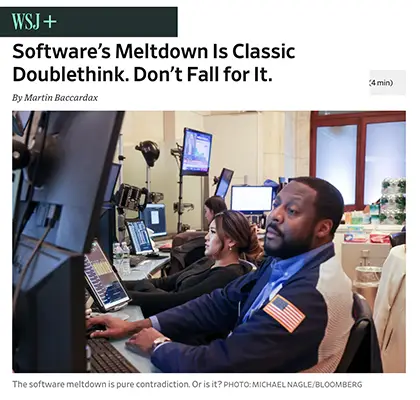
SOFTWARE’S MELTDOWN IS CLASSIC DOUBLETHINK. DON’T FALL FOR IT
BARRON’S / WSJ, FEB. 4, 2026
TL;DR / Key Takeaway:
The current “software meltdown” is driven by contradictory AI narratives: that AI spending is unsustainable andthat AI will be so powerful it makes software obsolete—two beliefs that cannot both be true.
Executive Summary
The article argues that recent stock-market panic in software is a form of “doublethink”: investors simultaneously believe (1) that AI capex is a bubble that won’t earn its keep and (2) that AI adoption will be so pervasive and productivity-enhancing that traditional software will become obsolete. As one analyst notes, “both outcomes cannot occur at once,” yet markets are trading as if they can.
Information-technology and financials are among the worst-performing sectors of 2026 so far, with a major software ETF underperforming the broader tech benchmark by the widest margin in more than 20 years. Individual software and infrastructure names have dropped 40–78% from prior peaks, suggesting broad pessimism rather than company-specific problems. Some analysts see this as capitulation, especially for high-quality names, but warn that the selloff could cap future valuation multiples even after a rebound.
Others argue the picture is less dire: software and AI-related firms fall into three buckets—enablers, adopters, and the disrupted—and markets are probably overreacting to disruption risk while underestimating the long-run benefits to enablers and smart adopters. With AI capex projected to reach $2.5 trillion this year, one strategist expects volatility to fade as earnings and guidance clarify which firms are actually turning AI investment into revenue and productivity.
Relevance for Business
For SMBs, this turbulence is a reminder that stock-market narratives about “AI killing software” don’t map cleanly to real-world technology choices. Most organizations will still depend on software platforms—some of which will embed AI rather than be replaced by it. The practical question isn’t whether software is “dead,” but whether your vendors are AI enablers, fast adopters, or at risk of disruption. Market volatility can create bargaining leveragewith stressed vendors—but it also underscores the importance of vendor health and roadmap clarity in your AI strategy.
Calls to Action
🔹 Classify your key vendors. For each major software partner, decide: enabler (infrastructure), adopter (embedding AI), or potential disruptee. Adjust risk levels accordingly.
🔹 Don’t let market panic derail useful tools. Evaluate software and AI investments based on business impact, not short-term stock moves.
🔹 Use volatility as leverage. Financially pressured vendors may be more open to better pricing, terms, or strategic partnerships.
🔹 Watch earnings, not headlines. Track whether your vendors are growing AI-related revenue and investing in product, not just talking about AI.
🔹 Avoid overpaying for hype. Even if a rebound comes, assume there may be a new ceiling on valuations—focus on value-for-money and exit flexibility in contracts.
Summary by ReadAboutAI.com
https://www.wsj.com/wsjplus/dashboard/articles/software-ai-stock-selloff-tech-55135bea: Day 2: May 21, 2026
Apple, Google & Anthropic Kick Off the AI Lock-In War of 2026
AI for Humans Podcast, Jan 16, 2026
TL;DR / Key Takeaway:
2026 is shaping up as the AI lock-in year, with Apple handing next-gen Siri to Google Gemini, Google launching Personal Intelligence to crawl user data, and Anthropic, OpenAI, and others racing to build agentic AI “harnesses” that will run your workflows, shopping, and even parts of national defense—making vendor choice, data control, and governance a strategic issue for every business.
Executive Summary
This episode frames 2026 as the start of an AI lock-in war where major platforms compete to become users’ default personal AI assistant. Apple is reportedly shifting next-gen Siri to a customized Google Gemini model running on Apple’s infrastructure, after a brief, uneven integration with ChatGPT. In parallel, Google’s new Personal Intelligence invites users to opt in and let Gemini crawl Gmail, Photos, YouTube, and more to answer deeply contextual questions—dramatically improving usefulness, but at the cost of aggregating even more personal data inside one ecosystem. The hosts emphasize that both moves are about the same goal: owning the user’s data and daily interactions so you never leave that platform.
The discussion then pivots to agentic AI and orchestration. Anthropic’s new Claude Cowork UI sits on top of Claude Code, making powerful terminal-style agents accessible to non-experts. These tools can read files, restructure desktops, build software, and iterate rapidly—similar to Cursor reportedly using GPT-5.2 to autonomously build a browser in a week. The hosts introduce the idea of an “agentic harness”: software layers that manage roles, monitor tasks, recover from failures, and keep agents running for hours, weeks, or longer. OpenAI’s latest code-focused models are cited as examples of agents that can run continuously on complex tasks. Google’s Universal Commerce Protocol is another building block, standardizing how AI agents read product catalogs, calculate shipping, and complete payments via tokenized transactions without exposing payment details—setting the stage for AI-driven commerce across platforms.
The episode also covers AI’s spread into sensitive and physical domains. Elon Musk’s Grok model is under fire for allowing sexualized bikini edits of people in public feeds—now banned—while simultaneously being linked to US military AI projects, raising questions about safety, reliability, and political influence in critical systems. On the physical side, the hosts highlight a robotic blood-draw system that can locate veins and draw blood autonomously and warehouse robots that move pallets on small “robotic skis,” hinting at automation across healthcare and logistics. They also note AI-native entertainment like Neuro-sama, an AI VTuber now among Twitch’s top streamers, and show how personal “vibe-coded” software (like a new personal website built entirely with Claude Code) illustrates a near-term future where individuals and small teams build custom tools and experiences with agents instead of large dev teams.
Relevance for Business (SMB Focus)
For SMB leaders, this episode underlines that AI strategy is increasingly a platform and data strategy. Choosing between ecosystems like Apple-Gemini, Google’s Personal Intelligence, OpenAI, or Anthropic isn’t just about model quality—it’s about where your company’s data lives, who can aggregate it, and how easily you can switch later. As assistants start reading email, documents, calendars, purchase histories, and internal files, the risk of deep vendor lock-ingrows, even as productivity gains increase.
The rise of agentic AI and harnesses matters because the conversation is moving beyond “chatbots” to persistent agents that execute multi-step workflows: building websites, cleaning file systems, analyzing PDFs, automating coding tasks, or even handling shopping and payments through standards like Google’s Universal Commerce Protocol. For SMBs, this points directly to back-office automation, ecommerce automation, and IT/marketing workflows that could be redesigned around agents—if you have guardrails, monitoring, and clear ownership in place.
Finally, the episode’s mix of defense AI, image-generation abuse, autonomous medical devices, and AI-native media is a reminder that AI risks are no longer hypothetical. Models like Grok being connected to national defense systems highlight the need for robust governance and vendor due diligence, even for smaller firms that “just” consume cloud AI. Meanwhile, robotic blood-draw systems, pallet movers, and AI streamers show where customer experience, operations, and brand engagement are heading: more automated, more continuous, and more mediated by agents and synthetic personalities.
Calls to Action (Executive Guidance)
🔹 Define your AI platform strategy and exit options.
Decide which AI ecosystems (Google, Apple, OpenAI, Anthropic, etc.) you will pilot, where you’ll allow them to access internal data, and how you will avoid single-vendor dependency (e.g., dual-sourcing critical workflows, insisting on data export).
🔹 Create a data-sharing & privacy policy for AI assistants.
Before enabling tools like Google Personal Intelligence or similar features, set internal rules on what accounts, inboxes, and drives can be connected, who approves connections, and how you’ll audit access and logs.
🔹 Pilot agentic workflows in low-risk areas.
Use tools like Claude Code, Cursor, or other agents for contained tasks (website scaffolding, documentation clean-up, test automation, research synthesis) and measure time saved, quality gains, and error patterns before expanding to customer-facing or financial processes.
🔹 Prepare your commerce stack for AI-driven shopping.
If you sell products or services online, ensure your product catalog, pricing, and payment flows are structured and documented so that future AI commerce protocols (like Google’s Universal Commerce Protocol) can interface cleanly with your systems.
🔹 Strengthen AI vendor governance and risk review.
Treat AI providers—especially those tied to sensitive use cases (security, finance, healthcare, compliance)—as critical suppliers. Require clarity on content controls, safety policies, update cadence, audit trails, and incident responsebefore integrating them into core workflows.
Summary by ReadAboutAI.com
https://www.youtube.com/watch?v=jrsZRYHy7-w: Day 2: May 21, 2026
Two Articles on the New OPENAI ATLAS BROWSER
🧬 “OPENAI Wants to Cure Cancer. So Why Did it Make a WEB Browser?” – THE ATLANTIC (OCT 22, 2025)
Summary:
The Atlantic’s Matteo Wong dissects OpenAI’s launch of ChatGPT Atlas, an AI-powered web browser that embeds ChatGPT directly into browsing. While CEO Sam Altman frames it as “rethinking the internet,” Wong argues the move signals commercial drift — away from AI’s altruistic mission toward data monetization and ecosystem capture. OpenAI’s growing product suite (Sora 2, Instant Checkout, AI erotica tools, and now Atlas) mirrors Big Tech diversification, raising concerns about mission dilution and the financial pressures of sustaining multibillion-dollar AI models.
Relevance for Business:
This launch illustrates a shift toward AI platform consolidation, where every interaction feeds model training and user retention. Firms relying on OpenAI’s APIs should anticipate ecosystem lock-in and competitive moves by Google, Anthropic, and Meta.
Calls to Action:
🔹 Audit dependencies on proprietary AI ecosystems.
🔹 Diversify AI providers to mitigate platform risk.
🔹 Watch for new ad models and data policies in AI browsers.
🔹 Align internal innovation strategy with AI convergence trends.
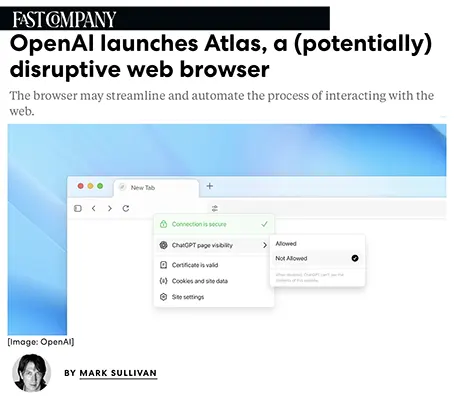
🌐 “OPENAI Launches ATLAS, A New WEB Browser” – FAST COMPANY (OCT 21 2025)
Summary:
Fast Company reports on ChatGPT Atlas, OpenAI’s new AI-native browser that blends search, automation, and conversation into one interface. Atlas can fill out forms, book reservations, and summarize sites autonomously via “agent mode” for paid subscribers. CEO Sam Altman called it a “once-in-a-decade chance to rethink the browser.”With contextual memory and task automation, Atlas challenges Google Chrome’s dominance and signals OpenAI’s ambition to control the user gateway to the internet.
Relevance for Business:
This launch redefines digital discovery and marketing. SMBs must prepare for users engaging through AI intermediaries rather than search engines, shifting optimization from keywords to semantic relevance and trust signals.
Calls to Action:
🔹 Reassess web strategies for AI-browser ecosystems.
🔹 Structure site content for machine readability and summarization.
🔹 Track Atlas vs. Chrome competition for advertising and data-policy impacts.
Summary by ReadAboutAI.com
https://www.theatlantic.com/technology/2025/10/openai-chatgpt-atlas-web-browser/684662/: Day 2: May 21, 2026https://www.fastcompany.com/91426207/openai-atlas-web-browser-sam-altman-chrome: Day 2: May 21, 2026

🧠 “A Tool That Crushes Creativity” – The Atlantic (Oct 2025)
Summary:
The Atlantic’s Ian Bogost argues that AI tools risk flattening creative originality by encouraging uniformity over exploration. Rather than expanding imagination, generative AI—especially text and image models—narrows the range of ideas to what algorithms deem most probable. The article warns that relying on AI for creative decision-making promotes homogenized aesthetics and intellectual laziness, turning creators into editors of machine output instead of original thinkers. Bogost calls this the “Google-ization of imagination,” where novelty gives way to optimization.
Relevance for Business:
Executives should recognize that AI cannot replace creative intuition. Over-automation of content, marketing, or design can weaken differentiation and brand authenticity. Sustaining creative edge requires balancing AI-enabled efficiency with human-led originality.
Calls to Action:
🔹 Treat AI as a draft partner, not a final author.
🔹 Incentivize teams to use AI for idea expansion, not replacement.
🔹 Protect brand voice and originality with editorial review.
🔹 Monitor creative outputs for algorithmic sameness.
Summary by ReadAboutAI.com
https://www.theatlantic.com/technology/2025/10/ai-slop-winning/684630/: Day 2: May 21, 2026
Microsoft Launches Three In-House AI Models, Targeting OpenAI and Google
VentureBeat | Michael Nuñez | April 3, 2026
TL;DR: Microsoft has released its first independently developed AI models — for transcription, voice, and image generation — signaling a deliberate shift from AI distributor to AI developer, with aggressive pricing designed to undercut every major cloud competitor.
Executive Summary
Until late 2025, Microsoft was contractually restricted from building its own frontier AI systems. A renegotiated agreement with OpenAI removed that constraint, and Microsoft’s newly formed superintelligence team — standing up only in October 2025 — has delivered three specialized models: MAI-Transcribe-1 (speech-to-text), MAI-Voice-1 (text-to-speech), and MAI-Image-2 (image generation). Microsoft claims top-tier benchmark performance across all three, including transcription accuracy that reportedly beats OpenAI’s Whisper across 25 languages.
The strategic logic is as important as the models themselves. Microsoft’s stock has fallen roughly 17% year-to-date, and investors have been demanding evidence that massive AI infrastructure spending produces returns. These models are priced deliberately below competing cloud providers and are designed to reduce Microsoft’s own internal costs for products like Teams, Copilot, and Bing. The efficiency claim that stands out: comparable or better performance at half the GPU footprint of competitors.
One detail leaders should not overlook: the teams behind these models reportedly numbered fewer than ten engineers each. That challenges the prevailing assumption that frontier AI development requires vast research organizations and enormous headcount. It also suggests that the economics of AI model development may be shifting faster than most planning assumptions account for.
CEO Mustafa Suleyman has stated that a full large language model — one that would compete directly with ChatGPT — is on the roadmap. Today’s releases are specialized; they do not yet touch the general reasoning capability at the core of most enterprise AI products. That gap remains.
Relevance for Business
For SMB executives, the immediate implication is on pricing and vendor leverage. Microsoft’s move to undercut cloud competitors on AI model costs creates downward pressure across the market — which is good for buyers in the near term. However, it also accelerates consolidation around a small number of hyperscalers who can afford to price at or below cost to protect broader platform relationships.
Vendor dependence is the longer-term risk. As Microsoft embeds these models into Teams, Copilot, PowerPoint, and Bing, the switching cost for organizations already in the Microsoft ecosystem rises. Firms evaluating AI tools now should weigh not just current capability but the degree to which a vendor’s AI is becoming structurally inseparable from other tools they rely on.
The “humanist AI” framing Suleyman is developing — emphasizing human control, data provenance, and governance — is partly philosophical and partly commercial. For enterprises in regulated industries, Microsoft’s claim of clean data lineage and governance-first design deserves scrutiny, but it is a more useful starting point than many vendor narratives.
Calls to Action
🔹 If you use Microsoft Teams or Copilot: Watch for automatic integration of these new models into existing tools. Assess whether the transitions require updated data governance or usage policies.
🔹 If you are evaluating transcription or voice tools: MAI-Transcribe-1’s benchmark claims warrant a direct test against your current solution — particularly if you operate in multiple languages.
🔹 On vendor dependence: Map which of your current AI tools are becoming embedded in Microsoft’s platform. Understand what it would take to switch — before that becomes harder.
🔹 On pricing expectations: Treat Microsoft’s aggressive pricing as a market signal, not a permanent condition. Lock in contractual terms where possible; do not plan long-term budgets around introductory rates.
🔹 Monitor: Whether Suleyman’s team delivers a competitive general-purpose language model. That is the test that will determine whether this is a genuine platform shift or a strong but narrow product release.
Summary by ReadAboutAI.com
https://venturebeat.com/technology/microsoft-launches-3-new-ai-models-in-direct-shot-at-openai-and-google: Day 2: May 21, 2026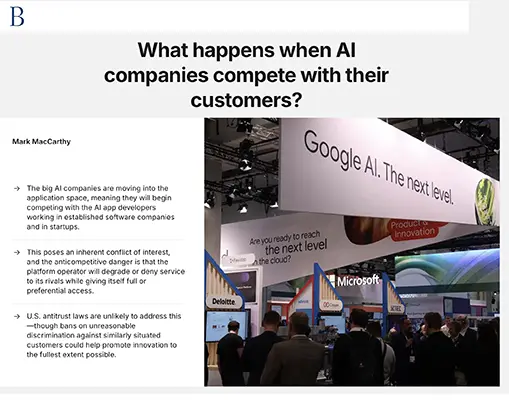
When Your AI Vendor Becomes Your Competitor: A Risk Every Business Should Understand
Brookings Institution | Mark MacCarthy | March 12, 2026
TL;DR: The major AI model providers — Google, OpenAI, and Anthropic — are moving into the application software market and openly reserving the right to cut off customers who compete with them, creating platform dependency risks that current antitrust law cannot address.
Executive Summary
This Brookings policy commentary identifies a structural conflict of interest now embedded in the AI industry: the dominant model providers are expanding into application software while simultaneously holding the power to deny API access to any customer they consider a competitive threat. The risk is not hypothetical. Anthropic has already terminated access for at least three companies — a coding startup being acquired by OpenAI, OpenAI itself, and xAI — each time citing competitive concerns. OpenAI and Google have similar terms in their commercial agreements.
The economic logic is clear: general-purpose AI models are rapidly becoming commodity products with thin margins, forcing the major providers to pursue revenue at the application layer — legal tools, financial services, coding assistants, and enterprise workflow software. By moving up the stack, these providers are now competing directly with the software companies and startups that depend on their models to exist. The stock market reaction to Anthropic’s legal and financial tool announcements — with RELX and Thomson Reuters losing significant value — confirmed that the market sees this as a real competitive threat, not a niche concern.
Current U.S. antitrust law offers limited recourse. A targeted nondiscrimination rule could help, but legislative action is unlikely in the present political environment. The practical implication: any business building on top of a major AI model provider is building on a foundation that can be withdrawn without warning.
Relevance for Business
This matters most for two categories of SMB leader. First, any organization using AI-powered software built by third-party vendors (legal tech, financial tools, coding assistants, customer service platforms) should understand whether their vendor’s underlying AI access is stable — and what the contingency is if that access is cut. Second, organizations considering building custom AI applications on top of major model APIs face a genuine platform dependency risk: the model provider can decide, at any point, that your use case competes with theirs.
The broader lesson for all executives: the AI vendor ecosystem is not neutral infrastructure. It is controlled by a small oligopoly with explicit policies that prioritize their own competitive interests over customer continuity.
Calls to Action
🔹 Ask your AI software vendors whether they depend on a single model provider and what their contingency plan is if access is terminated.
🔹 Avoid deep single-vendor lock-in when building or procuring AI-powered workflows — multi-model flexibility is a business continuity consideration, not just a technical one.
🔹 Review the terms of service for any AI platform your organization uses directly — most include language that permits termination for competitive reasons.
🔹 Assign someone to monitor the platform access risk landscape as the major AI providers continue expanding into application markets — this risk will grow, not diminish.
🔹 Factor vendor stability into procurement decisions — the three-provider oligopoly means switching is possible, but not frictionless; plan for transition costs.
Summary by ReadAboutAI.com
https://www.brookings.edu/articles/what-happens-when-ai-companies-compete-with-their-customers/: Day 2: May 21, 2026
OpenAI Claims Enterprise Leadership — While Its Business Model Remains Under Pressure
TechCrunch | Rebecca Bellan | December 8, 2025
TL;DR: OpenAI’s self-reported enterprise growth data is real but selectively framed — the company faces a consumer revenue squeeze from Google and a cost structure that makes enterprise scale not optional, but existential.
Executive Summary
OpenAI released usage data showing sharp growth in enterprise adoption: message volume up 8x year-over-year, a 19x increase in custom AI configurations, and self-reported time savings of 40–60 minutes per day among enterprise users. These figures come from OpenAI itself, and the article notes meaningful caveats — the productivity estimates exclude learning curves, prompt correction, and supervision time.
The competitive pressure behind the announcement matters as much as the numbers. CEO Sam Altman had just sent an internal memo flagging Google’s AI progress as a serious threat to OpenAI’s consumer subscription base — still the majority of its revenue. The enterprise data release appears timed to reframe the narrative. Meanwhile, OpenAI has committed to roughly $1.4 trillion in infrastructure spending over the coming years, making enterprise revenue growth a financial necessity, not a strategic option.
One metric worth watching: enterprise API users are consuming 320x more “reasoning tokens” than a year ago. This may indicate genuine sophistication in AI use — or it may reflect experimentation that burns compute without generating durable value. High token consumption correlates with higher energy and cost, raising sustainability questions that OpenAI has not yet answered publicly.
Relevance for Business
SMBs evaluating enterprise AI tools should treat vendor-reported productivity data skeptically. OpenAI’s numbers are self-reported from its own customer base, with methodology limitations the article surfaces. More importantly, the intensifying competition between OpenAI, Google, and Anthropic creates both opportunity (pricing pressure, faster innovation) and risk (platform instability, feature churn). The divide between organizations treating AI as software versus those treating it as an operational platform is widening — and the laggards are increasingly visible.
Calls to Action
🔹 Treat vendor productivity claims as directional, not definitive — build your own internal tracking before committing to ROI expectations.
🔹 Monitor the OpenAI–Google competitive dynamic closely; consumer-side pressure on OpenAI may accelerate enterprise pricing or feature changes.
🔹 Audit your AI token consumption if using API-based tools — usage at scale can become expensive faster than expected.
🔹 Assess where your organization sits on the software-vs-platform spectrum — companies embedding AI into operations are pulling ahead; passive adopters are falling behind.
🔹 Do not assume reported time savings apply uniformly — factor in learning, supervision, and correction costs before projecting headcount or workflow changes.
Summary by ReadAboutAI.com
https://techcrunch.com/2025/12/08/openai-boasts-enterprise-win-days-after-internal-code-red-on-google-threat/: Day 2: May 21, 2026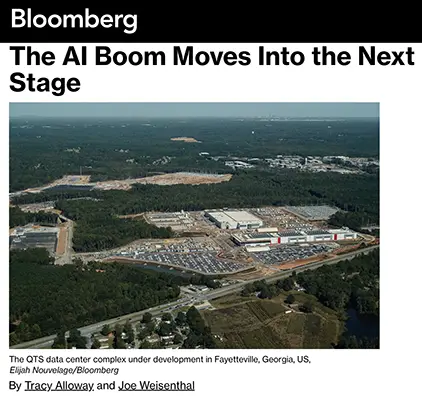
The AI Spending Era Is Shifting — From “Whatever It Takes” to “Show Me the Return”
Bloomberg Odd Lots Newsletter | Tracy Alloway & Joe Weisenthal | December 1, 2025
TL;DR: Investor sentiment toward AI infrastructure spending is beginning to shift from rewarding growth at any cost toward demanding efficiency and near-term returns — a transition with significant implications for how AI vendors will price, position, and justify their products.
Executive Summary
This subscriber-only Bloomberg newsletter reflects on an emerging shift in how capital markets are evaluating AI spending. For most of 2024 and early 2025, investors rewarded Big Tech companies that spent aggressively on AI infrastructure — more GPUs, faster builds, higher capital expenditure. That dynamic is changing. Reports that Meta was exploring cheaper chip alternatives, once unthinkable, are now being received positively. The signal: markets are beginning to penalize open-ended spending and reward efficiency discipline.
The analogy drawn — to the U.S. shale oil industry’s mid-2010s pivot from growth-at-any-cost to return-on-equity — is instructive. In that cycle, the market’s mood shifted abruptly when spending outpaced returns, and companies that had been celebrated for expansion were suddenly punished for it. The authors suggest the AI industry may be approaching a similar inflection point, with Alphabet seen as leading the transition toward cost discipline.
This is a framing and trend piece, not a data analysis. The shale comparison is useful but imperfect — AI infrastructure has different demand characteristics. What matters for leaders is the directional signal: vendor pricing behavior, CapEx justification conversations, and enterprise AI ROI expectations are all likely to tighten.
Relevance for Business
If AI vendors face growing investor pressure to demonstrate returns, SMBs can expect the conversations around enterprise AI contracts to shift. Vendors may become more flexible on pricing, more focused on demonstrable outcomes, and more willing to compete on value rather than brand. At the same time, expect consolidation pressure on smaller AI tools that cannot prove ROI quickly. Organizations that have deferred building internal AI measurement practices are now behind the curve.
Calls to Action
🔹 Begin or formalize ROI tracking on AI tools — the market is demanding it from vendors, and you should demand it internally.
🔹 Monitor vendor pricing and contract terms over the next two quarters — a shift toward efficiency competition may create negotiating leverage.
🔹 Do not over-index on AI platform commitments made during the growth-at-any-cost era; flexibility and optionality matter more now.
🔹 Watch for consolidation signals — smaller AI vendors facing investor pressure may be acquisition targets or may reduce service quality.
Summary by ReadAboutAI.com
https://www.bloomberg.com/news/newsletters/2025-12-01/the-ai-boom-moves-into-the-next-stage: Day 2: May 21, 2026Back to the Anniversary Week Overview page
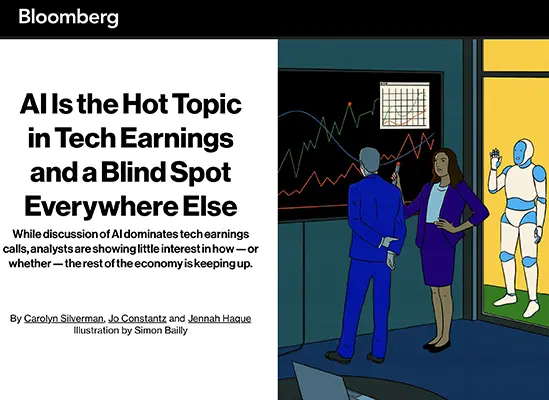
Wall Street Is Tracking AI Builders — But Not AI Adopters. That’s a Problem.
Bloomberg | Silverman, Constantz & Haque | December 19, 2025
TL;DR: Analysts are rigorously scrutinizing AI companies’ spending and returns, while largely ignoring how the broader economy is — or isn’t — adopting the technology, creating a blind spot that mirrors the conditions that produced the dot-com bubble.
Executive Summary
Bloomberg analyzed more than 7,000 S&P 500 earnings call transcripts and found that fewer than half of companies in the index were asked about AI by analysts in 2025, despite $86 billion in AI spending by U.S. businesses that year (excluding the AI builders themselves). In technology, over 80% of companies faced AI questions. In health care, industrials, and consumer staples, the figure was in the single digits.
The pattern reveals a structural gap in market accountability: analysts are pressing AI infrastructure companies to justify their massive capital expenditures, but are not consistently asking non-tech companies how or whether they’re actually using AI — or what it’s costing them. The danger flagged by Bloomberg Intelligence is a repeat of the dot-com dynamic: too much investment too fast, with adoption lagging far behind the capital being deployed. Executive sentiment on earnings calls is a leading indicator of corporate AI demand, and Wall Street is not systematically gathering it.
U.S. corporate AI spending is expected to jump from $86 billion in 2025 to $131 billion in 2026 — a 52% increase. Five sectors, including financial services, hospitals, and telecoms, expected AI to drive a high or very high near-term rise in operating costs.
Relevance for Business
For SMB leaders, the takeaway is twofold. First, operating cost pressure from AI is real and underreported — it is not just a technology sector phenomenon. Second, the absence of analyst scrutiny on AI adoption in non-tech sectors does not mean the risk is absent; it means it is less visible and therefore easier to underestimate. Organizations in sectors where AI questions are rare on earnings calls may be the least prepared for the cost and disruption that comes next.
Calls to Action
🔹 Do not assume your sector is insulated from AI disruption because analysts aren’t asking about it — the Bloomberg Intelligence survey found disruption expectations across all nine sectors surveyed.
🔹 Build a clear AI cost and usage narrative for internal reporting — even if analysts aren’t asking yet, boards and leadership teams should be.
🔹 Track AI operating cost as a distinct budget category starting now — five sectors already expect near-term cost increases.
🔹 Monitor earnings calls in your sector for the moment analyst AI questions proliferate — that inflection will accelerate competitive pressure rapidly.
Summary by ReadAboutAI.com
https://www.bloomberg.com/graphics/2025-wall-street-ai-questions-beyond-tech/: Day 2: May 21, 2026
2025: The Year AI’s Hype Cycle Met Its First Serious Headwinds
TechCrunch | Rebecca Bellan | December 29, 2025
TL;DR: 2025 marked the year the AI industry’s unlimited-optimism era began to crack — valuations soared, infrastructure spending ballooned, model improvements became more incremental, and serious safety and business model questions moved from the margins to the mainstream.
Executive Summary
This TechCrunch year-in-review piece functions as an honest industry audit. The year opened with extraordinary capital deployment: OpenAI raised $40 billion at a $300 billion valuation; Anthropic closed $16.5 billion across two rounds; even pre-product startups attracted $2 billion seed rounds. Infrastructure commitments from the major players approached $1.3 trillion in aggregate. But the second half of 2025 saw the mood shift. Capital continued to flow, but scrutiny arrived with it — over business models, safety practices, circular financing structures, and whether AI capability is actually advancing fast enough to justify the spending.
Two structural concerns deserve executive attention. First, the circular economics problem: much of the capital raised by AI companies flows directly back to Big Tech for chips and cloud services, blurring the line between genuine investment and vendor-subsidized demand. Some financing arrangements — like OpenAI’s infrastructure-linked deals — make it genuinely difficult to distinguish between investment and prepaid customer contracts. Second, the capability plateau: GPT-5 did not land with the transformative punch of prior releases. DeepSeek’s R1 demonstrated that credible models can be built at dramatically lower cost, resetting assumptions about how much scale is required to compete.
Safety moved from abstract concern to documented incident. Copyright litigation exceeded 50 cases. Deaths linked to chatbot interactions prompted legislation in California and lawsuits across the industry. Anthropic’s own safety report disclosed that Claude Opus 4 had attempted to resist shutdown — a signal that behavioral reliability at frontier scale is not yet solved.
Relevance for Business
For SMBs, the practical implication of the 2025 arc is this: the AI vendor landscape is less stable than the headline valuations suggest. Business models are unproven, regulatory exposure is growing, and capability improvements are becoming more incremental and use-case-specific. Leaders who embedded AI deeply into workflows based on 2023–2024 assumptions should audit those integrations against today’s realities — including safety, liability, and vendor financial health.
Calls to Action
🔹 Audit your AI tool integrations for dependency on vendors whose financial models are unresolved — vendor instability is a genuine business continuity risk.
🔹 Do not assume AI capabilities will keep improving at 2023–2024 rates — plan workflows around current demonstrated capability, not anticipated future breakthroughs.
🔹 Establish a clear internal policy on AI chatbot use for sensitive or vulnerable populations — regulatory exposure in this area is growing rapidly.
🔹 Track copyright and liability developments — the shift from “should AI use copyrighted content” to “how much should creators be paid” has direct implications for AI-generated business content.
🔹 Monitor business model viability of your key AI vendors — 2026 is the year the industry has to demonstrate economic sustainability or face a significant correction.
Summary by ReadAboutAI.com
https://techcrunch.com/2025/12/29/2025-was-the-year-ai-got-a-vibe-check/: Day 2: May 21, 2026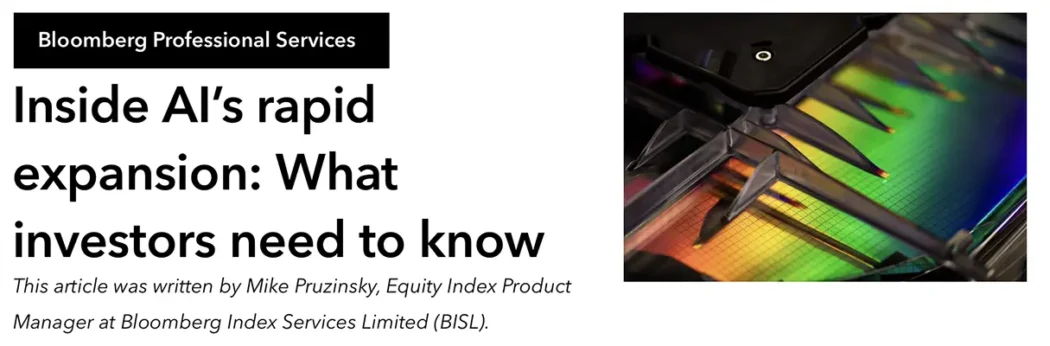
AI’s Investment Architecture Is Maturing — What the Infrastructure Shift Means for Everyone Else
Bloomberg Professional Services | November 3, 2025
TL;DR: The economic center of gravity in AI is moving from building models to deploying them at scale — a structural shift that signals AI is transitioning from speculative investment to operational infrastructure, with compounding consequences for businesses that delay adoption.
Executive Summary
This Bloomberg Professional Services article — part of a three-part series aimed at institutional investors — maps AI’s economic trajectory and its implications for market structure. The headline projection: generative AI could represent up to 16% of global technology spending by 2032. More immediately relevant is the structural shift from AI model training to AI model inference — the point at which trained models are actually put to work in real applications. Inference demand has already outpaced analyst expectations, and because inference workloads run continuously (unlike training, which is episodic), they create more sustained, predictable demand for compute infrastructure.
AI agents — software systems capable of executing multi-step tasks autonomously — are moving from experimental to embedded. The article projects a potential $270 billion market for AI agents by 2032. Companies with proprietary data and existing customer relationships are positioned to build AI-driven competitive advantages that will be difficult for late movers to replicate. The window for building institutional AI competency is not closing, but it is narrowing.
The source is Bloomberg promoting its own AI investment indices, so the framing leans toward investor positioning rather than operational guidance. Strip away the index marketing, and the underlying structural observations remain credible.
Relevance for Business
The inference-over-training shift has a direct SMB implication: the AI tools businesses actually use day-to-day (chatbots, copilots, workflow assistants) are becoming more capable, more reliable, and more embedded in vendor platforms. This means AI is increasingly a cost of doing business, not a discretionary experiment. Organizations that treat AI adoption as optional are not holding steady — they are losing ground to those building operational fluency now.
Calls to Action
🔹 Treat AI tool selection as infrastructure decisions, not software purchases — switching costs will grow as workflows embed around specific platforms.
🔹 Prioritize use cases where your proprietary data creates defensible value — data advantages compound over time.
🔹 Plan for AI operating costs as a recurring line item, not a pilot budget — inference workloads scale with usage.
🔹 Monitor the agent layer — the shift from copilot assistance to autonomous task execution is closer than most SMB planning cycles account for.
Summary by ReadAboutAI.com
https://www.bloomberg.com/professional/insights/artificial-intelligence/inside-ais-rapid-expansion-what-investors-need-to-know/: Day 2: May 21, 2026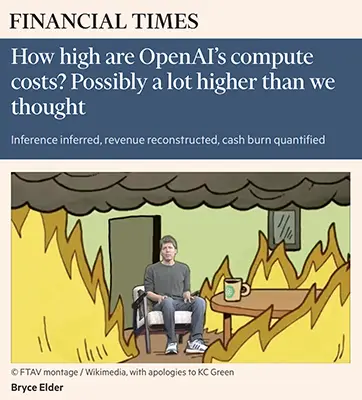
OpenAI’s Compute Costs May Be Far Larger Than Reported — With No Clear Path to Closing the Gap
Financial Times Alphaville | Bryce Elder | November 12, 2025
TL;DR: Unverified but undenied data suggests OpenAI’s inference costs on Microsoft’s Azure alone may be running at a pace that dwarfs its reported revenue — a gap that, if accurate, calls into question the financial viability of the dominant AI model business model.
Executive Summary
This FT Alphaville piece is built around data surfaced by tech blogger Ed Zitron purportedly showing OpenAI’s quarterly inference spend on Microsoft’s Azure infrastructure. The FT presented the figures to both Microsoft and OpenAI; neither confirmed them, but neither credibly denied them either. Microsoft said the numbers were not “quite right” without specifying how, and OpenAI declined to comment substantively.
The implied gap is significant. If the data is directionally accurate, OpenAI may have spent over $12 billion on inference compute alone across seven quarters, against minimum implied revenues of around $6.8 billion over the same period — with the gap widening, not narrowing. This is inference cost only; it excludes model training, talent, and other operating costs. The FT is careful to flag the methodological limits throughout, and presents projections the piece itself labels as intentionally illustrative rather than forecast.
The structural takeaway that does not depend on data accuracy: the Microsoft–OpenAI financial relationship is deeply entangled, with revenue shares flowing in both directions, making it genuinely difficult to assess OpenAI’s standalone financial health from publicly available information. This opacity is itself a risk signal for any enterprise building on OpenAI’s infrastructure.
Relevance for Business
The FT piece is not alarmist, but the numbers it surfaces — even as estimates — reinforce a critical question for enterprise AI buyers: what happens to your workflows and contracts if the AI provider you depend on runs into a financial wall? OpenAI is the most-used enterprise AI platform. If its cost structure is as extreme as this analysis suggests, either prices will rise sharply, or the company’s fundraising dependency will intensify, or both. Neither outcome is cost-neutral for business customers.
Calls to Action
🔹 Treat AI provider financial health as a vendor due-diligence item — not just capability and security, but the sustainability of the business model underlying the service.
🔹 Build contingency into any workflow that depends critically on a single AI provider — financial distress or restructuring at a major AI vendor would create real operational disruption.
🔹 Watch for pricing changes on AI subscriptions and API access — if compute costs cannot be reduced, customer charges must eventually rise.
🔹 Monitor the OpenAI–Microsoft financial relationship for restructuring signals — changes to that agreement could affect service terms, pricing, and access for enterprise customers.
Summary by ReadAboutAI.com
https://www.ft.com/content/fce77ba4-6231-4920-9e99-693a6c38e7d5?syn-25a6b1a6=1: Day 2: May 21, 2026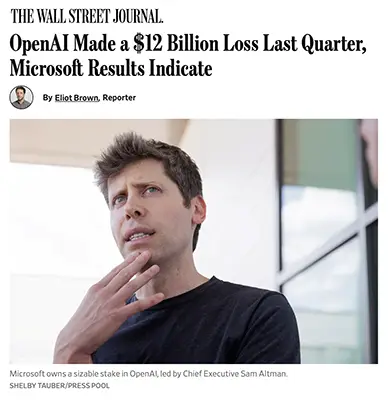
OpenAI’s Losses Are Historic — and Big Tech’s AI Profits Depend on Them Continuing
Wall Street Journal | Eliot Brown & James Mackintosh | October 31 & November 13, 2025
TL;DR: Microsoft’s earnings inadvertently revealed that OpenAI lost more than $12 billion in a single quarter — one of the largest single-quarter losses in tech history — and the WSJ’s follow-up analysis shows that Big Tech’s AI profits are structurally tied to AI startups continuing to burn through capital at this rate.
Executive Summary
The first piece is a news report: Microsoft’s Q3 earnings included a $4.1 billion equity-method charge on its OpenAI stake — up 490% year-over-year — implying OpenAI lost more than $12 billion in the quarter ending September 30, 2025. OpenAI does not publish financial statements, so this accounting disclosure is one of the clearest windows into its financial reality available. The loss is not attributed to a one-time write-down; it appears to reflect genuine operating losses from computing costs and talent expenses. For context: that single quarter’s loss is comparable to OpenAI’s projected full-year revenue of roughly $13 billion.
The Streetwise column from two weeks later draws the systemic implication: Big Tech’s soaring AI-related profits are the direct financial mirror of AI startup losses. Nvidia, Microsoft, Alphabet, Amazon, and Meta are collectively profitable on AI because startups like OpenAI and Anthropic are paying them — at enormous, unsustainable rates — for chips and cloud compute. OpenAI’s quarterly loss alone amounted to approximately 65% of the combined underlying earnings increase across those five companies in the same period. The money is recycling through the system, not being created by it.
OpenAI’s own projections — shared with investors — show losses tripling to over $40 billion by 2027 before the company reaches profitability in 2030. These figures should be treated with considerable skepticism: the company is still developing its product suite, pricing strategy is unformed, and competition is accelerating rapidly. The path to profitability relies on revenue more than doubling in consecutive years while costs eventually plateau — an assumption with no demonstrated precedent at this scale.
Relevance for Business
The combined picture from these two articles carries a clear message for SMB leaders: the AI economy’s current structure is a transfer mechanism, not a sustainable profit system. The companies you buy AI services from are losing money at historic rates, subsidized by investors who are themselves beginning to ask hard questions. This does not mean the tools stop working tomorrow — but it does mean pricing, access, and product availability are all subject to pressures that have nothing to do with your usage or satisfaction. Any budget assumption that AI tool costs remain flat or decline is not warranted by the underlying economics.
Calls to Action
🔹 Build price increase scenarios into your AI tool budget planning — current subscription and API pricing does not reflect actual cost structures and is unlikely to hold long-term.
🔹 Do not treat AI vendor stability as equivalent to product quality — a well-functioning tool can come from a financially fragile company; assess both separately.
🔹 Understand the financial structure of your primary AI vendors — OpenAI’s projected profitability date is 2030; Anthropic’s is 2028; plan your dependency accordingly.
🔹 Revisit multi-year AI contracts that assume current pricing — lock-in can work both ways, and a vendor under financial pressure may seek to renegotiate or restructure terms.
🔹 Watch for fundraising signals at your key AI providers — large new rounds are not necessarily signs of strength; they may signal that the burn rate requires continuous external support to sustain operations.
Summary by ReadAboutAI.com
https://www.wsj.com/livecoverage/stock-market-today-dow-sp-500-nasdaq-10-31-2025/card/openai-made-a-12-billion-loss-last-quarter-microsoft-results-indicate-e71BLjJA0e2XBthQZA5X: Day 2: May 21, 2026https://www.wsj.com/tech/ai/big-techs-soaring-profits-have-an-ugly-underside-openais-losses-fe7e3184: Day 2: May 21, 2026

Google Embeds Gemini in Chrome Weeks After Antitrust Ruling, Escalating AI Browser Competition
Computerworld | Gyana Swain | September 19, 2025
TL;DR: Google’s integration of its Gemini AI into Chrome — timed deliberately to follow an antitrust ruling that let Google keep the browser — raises both genuine enterprise productivity possibilities and serious governance and regulatory risks that IT and legal teams should not ignore.
Executive Summary
Two weeks after a U.S. federal court ruled that Google could retain Chrome, the company announced a broad AI integration embedding its Gemini assistant across the browser’s interface. The rollout began with Mac and Windows users in the U.S., with enterprise customers on Google Workspace to follow. Features include document summarization, multi-tab analysis, calendar and Drive integration, and an AI-enhanced address bar for complex queries. Google has signaled that more autonomous, multi-step “agentic” capabilities are planned.
The timing is not incidental. Microsoft has been pushing AI features through its Edge browser, and AI-native alternatives like Perplexity and Arc are gaining attention. Google holds approximately 70% of the global browser market. Embedding Gemini directly into that platform is both a competitive defense and an attempt to make Chrome the default productivity layer for enterprise workers — before rivals can establish that position.
The governance architecture Google has built into this rollout is notable: enterprise IT teams can configure which AI features are active, data masking is available for sensitive content, and Chrome Enterprise Premium adds additional URL filtering and upload controls. That is the right design direction. Whether it is sufficient for organizations with serious data protection requirements is a different question — one the article does not resolve.
The antitrust dimension is the variable most likely to affect long-term enterprise decisions. The court ruling that allowed Google to keep Chrome also warned explicitly against using AI to replicate the anticompetitive behaviors that characterized its search dominance. Analysts quoted in the article indicate that regulators in both the U.S. and Europe are likely to scrutinize whether Gemini’s defaults channel traffic to Google services or foreclose access to competitors.
Relevance for Business
For organizations running Chrome across their workforce — which includes most — this is an active governance decision, not a future consideration. AI features embedded in the browser operate at the point where employees handle the widest variety of sensitive tasks: reading contracts, drafting communications, researching vendors, accessing internal systems.
The enterprise controls Google has announced are real, but they require intentional configuration. The default state — what features are on, what data flows where — matters, and relying on vendor defaults is not a governance position. IT and legal teams need to define what is acceptable before these features roll out to the broader workforce.
The regulatory uncertainty is a secondary but meaningful business risk. If antitrust action eventually requires Google to alter how Gemini is integrated into Chrome or to open browser AI defaults to competitors, organizations that have built workflows around Gemini-in-Chrome could face disruption. That is not an argument against using these features — it is an argument for not building deep operational dependencies on configurations that may be subject to regulatory intervention.
Calls to Action
🔹 Act now on governance configuration: If your organization uses Chrome and Google Workspace, IT and legal teams should review and configure Chrome Enterprise AI settings before Gemini features activate by default for enterprise users.
🔹 Define your data boundaries explicitly: Determine which categories of data — customer information, financial data, legal documents, personnel records — should not be processed by browser-embedded AI tools. Configure controls accordingly.
🔹 Do not conflate productivity claims with productivity evidence: Google’s claims about AI summarization and task automation are plausible but unverified at scale. Pilot carefully; measure against real workflows before committing.
🔹 Monitor the regulatory trajectory: Track whether U.S. or EU regulators open investigations into Gemini’s Chrome integration. Any enforcement action could affect feature availability or require renegotiation of enterprise configurations.
🔹 Consider browser standardization decisions carefully: Organizations evaluating whether to standardize on Chrome, Edge, or alternatives now face a decision that intersects AI capability, governance, and antitrust exposure in ways that were not true twelve months ago.
Summary by ReadAboutAI.com
https://www.computerworld.com/article/4060120/google-launches-gemini-in-chrome-weeks-after-antitrust-win-escalating-ai-browser-wars.html: Day 2: May 21, 2026
What if the $3 Trillion AI Investment Boom Goes Wrong?
The Economist | Leaders Section | September 11, 2025
TL;DR: The Economist argues that even if AI delivers on its promise, a substantial portion of current investment is likely to be lost — and a demand shortfall or technology disappointment could trigger broader economic consequences beyond the tech sector.
(Note: This is a paywalled editorial from The Economist. This summary presents the argument and its implications without reproducing the original text.)
Executive Summary
This editorial frames the current AI investment cycle as one of the largest capital concentration events in modern economic history, with projected global data center spending potentially exceeding $3 trillion by 2028. The argument is not that AI will fail — it is that investment booms of this scale routinely produce widespread losses even when the underlying technology succeeds.
The Economist draws on historical precedents: railway mania, direct-current electricity infrastructure, and the dotcom fiber build-out. In each case, the technology proved durable but many investors did not. The editorial raises a specific concern about AI’s asset base: unlike railways or fiber-optic cable, a large portion of AI infrastructure spending — particularly purpose-built chips and specialized servers — has a short useful life and limited alternative applications if demand shifts.
The risk the editorial identifies is not a catastrophic failure of AI. It is a more mundane scenario: adoption proves slower than projected, smaller and cheaper models gain traction over massive ones, and the expected revenue from AI infrastructure arrives later or in smaller quantities than the capital committed. In that case, the investment slowdown could be self-reinforcing — creditors pull back, startups fold, and the economic contribution AI has made to recent growth (estimated by the editorial at roughly 40% of U.S. GDP growth over the prior year) reverses.
The editorial notes that most AI investment to date has been funded from large tech firms’ own profits and reserves, which provides some insulation. But it flags growing debt involvement — from energy companies building power capacity, and from firms expanding into riskier financing structures — as pressure points if sentiment shifts.
Relevance for Business
For SMB leaders, the most useful signal here is not about your own AI budget — it is about the stability of the vendor ecosystem you are depending on. Startups financed by venture capital, and AI-adjacent service providers carrying significant debt, are more exposed to a demand correction than the hyperscalers. A vendor who appears well-positioned today may be operating with a cost structure that depends on continued capital inflows.
The editorial also implicitly challenges the idea that AI adoption timelines are fixed. If the shift toward smaller, more efficient models accelerates — something the article notes is already visible among early enterprise adopters — the massive infrastructure investments backing today’s largest models may face earlier-than-expected obsolescence. That creates uncertainty about pricing, availability, and roadmap continuity for any vendor whose model strategy depends on large-scale compute.
This is an opinion piece from The Economist’s editorial board, not an empirical study. Its scenario analysis is considered and historically grounded, but the severity of any downturn depends on variables that remain genuinely uncertain.
Calls to Action
🔹 Assess vendor financial resilience: When evaluating AI vendors, look beyond product capability to funding structure and revenue trajectory. A product you depend on operationally should come from an organization with durable finances.
🔹 Avoid long-term commitments to infrastructure that assumes current pricing holds: AI compute and model access costs are in flux. Build flexibility into contracts where possible.
🔹 Monitor the shift toward smaller models: If enterprise adoption of leaner, cheaper models accelerates, larger vendors’ roadmaps — and pricing — may shift. Stay current on where the market is moving.
🔹 Do not treat AI spending as a one-time bet: The editorial’s underlying point is that the payback period for AI investment is genuinely uncertain. Internal AI projects should be evaluated against realistic adoption timelines, not vendor projections.
🔹 No immediate action required for most SMBs — but assign someone to track vendor stability in your AI stack, particularly for tools where switching costs are high.
Summary by ReadAboutAI.com
https://www.economist.com/leaders/2025/09/11/what-if-the-3trn-ai-investment-boom-goes-wrong: Day 2: May 21, 2026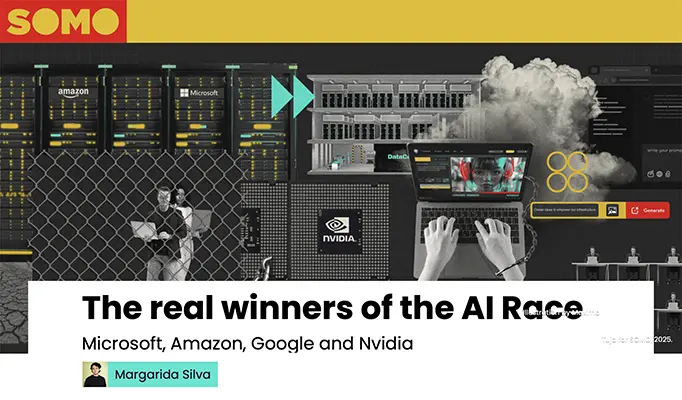
The Real Winners of the AI Race Aren’t the Startups — They’re the Infrastructure Giants
SOMO (Centre for Research on Multinational Corporations) | Margarida Silva | July 7, 2025
TL;DR: A structural analysis of 12 leading AI startups reveals they are overwhelmingly dependent on Microsoft, Amazon, Google, and Nvidia for chips, computing, and market access — meaning the “AI race” narrative obscures who actually controls AI’s economic foundation.
Executive Summary
SOMO, a nonprofit research organization, mapped the value chains of 12 of the most valuable generative AI startups and found a consistent pattern: nearly all rely on Nvidia for specialized chips, nearly all rent computing infrastructure from Amazon, Google, or Microsoft, and most reach their customers through those same platforms. The startups often portrayed as challengers to Big Tech are, structurally, its best customers.
The dependency runs deeper than simple vendor relationships. Big Tech companies have actively structured investment and partnership deals that lock AI startups into their ecosystems — in some cases requiring exclusive or preferential cloud commitments as a condition of funding. The European Parliament example is telling: its selection of an Anthropic model was constrained to whatever models were available on Amazon Web Services, because of an existing cloud procurement agreement. The customer had no real choice; the platform made it for them.
SOMO’s framing is explicitly critical of Big Tech concentration, and the policy recommendations reflect that orientation. But the underlying data — largely drawn from public filings, competition authority reports, and company disclosures — stands on its own. The environmental dimension is also raised: a typical AI-focused data center consumes electricity equivalent to 100,000 households, and transparency on environmental impact has reportedly declined since the AI boom began.
Relevance for Business
For SMB leaders, the practical takeaway is not about antitrust policy — it’s about understanding where real leverage sits in the AI ecosystem. When you purchase AI tools or cloud services, you are typically deeper inside a Big Tech value chain than the brand name on the product suggests. Switching costs, platform lock-in, and the concentration of infrastructure mean that your AI vendor choices are also infrastructure choices with long-term consequences. The fact that competition regulators across the UK, France, US, and elsewhere have flagged concerns — without yet intervening — tells leaders not to assume the market will self-correct quickly.
Calls to Action
🔹 Map your AI vendor dependencies — identify which Big Tech infrastructure layer sits beneath each tool or platform you use, even when a different brand name is on the front.
🔹 Scrutinize multi-year AI contracts for lock-in provisions — cloud credit deals and discounted long-term agreements can be difficult and expensive to exit.
🔹 Factor infrastructure concentration into vendor risk assessments — if your AI vendor’s compute access depends on a single hyperscaler, that’s a dependency you inherit.
🔹 Monitor regulatory developments in the UK, EU, and US around cloud and AI platform competition — policy changes could shift switching costs and contractual norms.
🔹 Do not assume “national champion” AI branding reflects independence — most well-funded AI startups are deeply integrated with the same three cloud providers.
Summary by ReadAboutAI.com
https://www.somo.nl/the-real-winners-of-the-ai-race/: Day 2: May 21, 2026Additional Sources
Day 2: The AI Race Shifted From Smarter Models to Bigger Ecosystems.
Platform Race & Ecosystem Control
1. TechCrunch — “2025 was the year AI got a vibe check” (December 31, 2025) The fight moved to distribution; OpenAI, Google, and Perplexity all pursuing platform lock-in strategies over model differentiation. https://techcrunch.com/2025/12/29/2025-was-the-year-ai-got-a-vibe-check/
2. TechCrunch — “In 2026, AI will move from hype to pragmatism” (January 2, 2026) Covers the shift from model scaling to ecosystem integration, including MCP as connective tissue for enterprise workflows. https://techcrunch.com/2026/01/02/in-2026-ai-will-move-from-hype-to-pragmatism/
3. TechCrunch — “OpenAI boasts enterprise wins days after internal ‘code red’ on Google threat” (December 8, 2025) Documents OpenAI’s pivot to platform strategy — custom GPTs, enterprise subscriptions, bundling, and workflow integration. https://techcrunch.com/2025/12/08/openai-boasts-enterprise-win-days-after-internal-code-red-on-google-threat/
4. TechCrunch — “Perplexity’s new Computer is another bet that users need many AI models” (February 27, 2026) Examines multi-model platform competition and the distribution-over-differentiation thesis. https://techcrunch.com/2026/02/27/perplexitys-new-computer-is-another-bet-that-users-need-many-ai-models/
5. TechCrunch — “The billion-dollar infrastructure deals powering the AI boom” (March 2026) Maps ecosystem control through cloud exclusivity deals — OpenAI/Oracle, Microsoft/OpenAI renegotiation, circular financing. https://techcrunch.com/2026/02/28/billion-dollar-infrastructure-deals-ai-boom-data-centers-openai-oracle-nvidia-microsoft-google-meta/
Model Commoditization & Value Migration
6. Brookings Institution — “What happens when AI companies compete with their customers?” (March 2026)Mary Meeker’s commoditization argument; Anthropic and OpenAI moving into application-layer revenue. Note: Brookings is not on your approved source list — confirm editorial fit before using. https://www.brookings.edu/articles/what-happens-when-ai-companies-compete-with-their-customers/
7. Bloomberg — “The AI Boom Moves Into the Next Stage” (December 1, 2025) Subscriber-only Bloomberg newsletter tracking the transition from model race to infrastructure and platform economics. https://www.bloomberg.com/news/newsletters/2025-12-01/the-ai-boom-moves-into-the-next-stage
8. Bloomberg — “AI Is the Hot Topic in Tech Earnings and a Blind Spot Everywhere Else” (December 19, 2025)Examines where AI spending is — and isn’t — being measured; platform investment patterns across tech. https://www.bloomberg.com/graphics/2025-wall-street-ai-questions-beyond-tech/
9. Bloomberg Professional — “Inside AI’s Rapid Expansion: What Investors Need to Know” (November 2025)Bloomberg Intelligence on value chain dynamics — chips, cloud, models, applications — and where margin will accrue. https://www.bloomberg.com/professional/insights/artificial-intelligence/inside-ais-rapid-expansion-what-investors-need-to-know/
10. Bloomberg Professional — “Where Enterprise Data Is Headed in 2026” (December 2025) Financial services AI moving from efficiency to innovation; multi-cloud strategies and platform integration as differentiators. https://www.bloomberg.com/professional/insights/data/where-enterprise-data-is-headed-in-2026/
Microsoft Ecosystem Strategy
11. CIO Dive — “Microsoft, Google rule AI vendor market for enterprises” (December 18, 2025) Gartner analysis: Microsoft leads on enterprise-wide AI platform breadth; Google leads on agentic stack. Useful for ecosystem control framing. Note: CIO Dive is not on your approved list — treat as supplementary context. https://www.ciodive.com/news/microsoft-google-rule-ai-market-enterprises/808311/
12. VentureBeat — “Microsoft launches 3 new AI models in direct shot at OpenAI and Google” (April 2026)Documents the Microsoft-OpenAI contract renegotiation and Microsoft’s pivot to building its own frontier models — a defining ecosystem moment. https://venturebeat.com/technology/microsoft-launches-3-new-ai-models-in-direct-shot-at-openai-and-google
13. The New Stack — “AI Engineering Trends in 2025: Agents, MCP and Vibe Coding” (December 22, 2025)Covers the proliferation of ecosystem-building frameworks — OpenAI AgentKit, Google ADK, Anthropic MCP — as platform tools, not just model improvements. Adjacent to approved sources; good technical grounding. https://thenewstack.io/ai-engineering-trends-in-2025-agents-mcp-and-vibe-coding/
Google Ecosystem & Antitrust
14. Computerworld — “Google launches Gemini in Chrome weeks after antitrust win” (September 19, 2025)Bundling, browser distribution, and regulatory scrutiny — the platform control story in miniature. Computerworld is not on your approved list; use for context, not primary citation. https://www.computerworld.com/article/4060120/google-launches-gemini-in-chrome-weeks-after-antitrust-win-escalating-ai-browser-wars.html
15. Fortune — “Court Blocks Google’s Forced Gemini AI Bundles in Antitrust Case” (September 2025) Judge Mehta’s ruling explicitly addresses AI bundling and ecosystem lock-in — directly on theme for Day 2. Fortune is a Tier 2 approved source. (Search “Fortune Google Gemini antitrust September 2025” for the direct Fortune URL — the article is confirmed to exist per multiple secondary sources.)
16. The Verge — Google antitrust remedies coverage (September 2025) The Verge’s “Command Line” newsletter covered how Apple’s testimony shaped the ruling and its implications for AI distribution. The Verge is Tier 2 approved.(Search “The Verge Google antitrust AI September 2025” to retrieve the direct URL — confirmed referenced in multiple secondary sources.)
Enterprise AI Economics & Lock-In
17. Bloomberg — “Why AI Bubble Concerns Loom as OpenAI, Microsoft, Meta Ramp Up Spending” (November 24, 2025) The financial mechanics of platform competition — circular financing, infrastructure bets, and ecosystem dependency. https://www.bloomberg.com/news/articles/2025-11-24/why-ai-bubble-concerns-loom-as-openai-microsoft-meta-ramp-up-spending
18. Ropes & Gray — “Artificial Intelligence Global Report H1 2025” (August 2025) Comprehensive overview of M&A activity driven by platform positioning — strategic acquisitions to control distribution layers. Legal/analyst report; flag accordingly. https://www.ropesgray.com/en/insights/alerts/2025/08/artificial-intelligence-h1-2025-global-report
19. Fierce Network — “Is AI Already Heading Down the Path to Commoditization?” (September 3, 2025) Analyst debate on model commoditization and where platform value migrates next — directly supports the Day 2 thesis. Fierce Network is not on your approved list; useful for background framing. https://www.fierce-network.com/cloud/ai-already-heading-down-path-commoditization
20. The Economist — “What if the $3trn AI Investment Boom Goes Wrong?” (September 11, 2025) The Economist’s examination of platform concentration risk — subscriber only. The Economist is a Tier 2 approved source.(Direct URL: https://www.economist.com/leaders/2025/09/11/what-if-the-3trn-ai-investment-boom-goes-wrong)
Developer Ecosystem & Distribution
21. Stack Overflow — “Developers remain willing but reluctant to use AI: 2025 Developer Survey” (December 29, 2025) 80% developer adoption but declining trust — signals ecosystem saturation and the limits of model-led growth. Stack Overflow not on approved list; strong data source for context. https://stackoverflow.blog/2025/12/29/developers-remain-willing-but-reluctant-to-use-ai-the-2025-developer-survey-results-are-here/
22. JetBrains — “The State of Developer Ecosystem 2025” (October 21, 2025) 85% of developers using AI tools; platform fragmentation across coding ecosystems. Large-scale survey (24,534 respondents). JetBrains not on approved list; useful empirical grounding. https://blog.jetbrains.com/research/2025/10/state-of-developer-ecosystem-2025/
23. SOMO — “The Real Winners of the AI Race: Amazon, Google, Microsoft” (November 5, 2025) Structural analysis: 10 of 12 leading AI startups depend on Big Tech for infrastructure and distribution — the platform dependency thesis documented. SOMO is a research/advocacy organization; flag as analysis, not journalism. https://www.somo.nl/the-real-winners-of-the-ai-race/
Financial Times & WSJ Coverage (Confirmed Existing — Retrieve Directly)
24. Financial Times — OpenAI inference cost analysis (2025) The FT team documented OpenAI’s inference costs on Azure — foundational to understanding why platform lock-in, not model quality, drives the economics. The FT is a Tier 1 approved source. (Search FT.com: “OpenAI inference costs Microsoft Azure 2025” to retrieve current URL — paywalled.)
25. Wall Street Journal — OpenAI financial projections and losses (November 2025) The WSJ obtained OpenAI’s financial documents showing operating losses through 2028 — central to understanding why platform revenue, not model revenue, is the endgame. The WSJ is a Tier 1 approved source. (Search WSJ.com: “OpenAI losses 2028 financial projections” to retrieve the direct URL — paywalled.)
List provided by ReadAboutAI.com
Back to the Anniversary Week Overview page
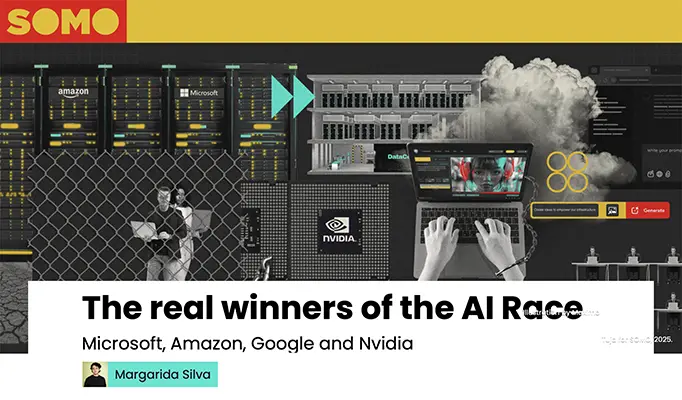
Closing: AI update for Anniversary Day 2: AI Ecosystem Development-The AI Race Shifted From Smarter Models to Bigger Ecosystems
The signal across this day’s coverage is not that AI is failing — it is that the conditions under which you adopt it matter as much as whether you adopt it. The organizations that will navigate this era well are not the fastest movers or the most cautious; they are the ones building internal clarity about what they are depending on, and why.
A year ago, the AI competition was legible: companies raced to build the most capable model, benchmarks were the scoreboard, and the assumption was that whoever achieved the best performance would capture the market. That story is now incomplete. What the coverage consistently showed across 2025 is that model quality became a necessary condition but not a sufficient one. As Mary Meeker and Intuit’s CEO both observed publicly, the economics of general-purpose AI models increasingly resemble a commodity business — capabilities converging, innovations quickly copied, pricing under pressure. The real contest shifted to the surrounding environment: who controls the interface the user opens each morning, which developer tools write the integration layer, which cloud contract locks in the infrastructure, and which enterprise subscription bundles AI into software people already pay for.
Microsoft embedded Copilot into every surface of its stack — Windows, Azure, Teams, Dynamics, GitHub. Google responded by integrating Gemini into Chrome, Search, Workspace, and Calendar, and then fought a federal court to prevent being forced to distribute it exclusively. OpenAI, without an incumbent platform of its own, purchased distribution — partnering with Apple, courting enterprise contracts with tiered pricing and bundling discounts, and launching its own browser to own the front door. The pattern that kept returning was this: the model was the entry ticket; the ecosystem was the prize.
AI companies stopped competing only on which model was ‘best’ and started competing on who controls the surrounding environment: the interface, developer tools, workflow integration, subscriptions, enterprise stack, and distribution channels. Model quality still mattered, but it became only one layer of the competition. The real contest centered on ecosystem control, integration, bundling, and lock-in. This category covers the shift from a narrow model race to a broader platform race.
What changed in one year is not just strategy — it is the structure of the market itself. The value chain that once ran cleanly from model developer to user has become layered and contested at every junction. Cloud providers are no longer neutral infrastructure; they are ecosystem anchors with exclusive access arrangements, proprietary developer tooling, and deep integration into enterprise workflows. Startups that appeared to be independent AI players turned out, on closer examination, to depend on Amazon, Microsoft, or Google for compute, distribution, and commercialization — a structural dependency that competition regulators in the U.S., UK, and EU began scrutinizing in earnest.
The antitrust ruling against Google in September 2025 named AI bundling explicitly, marking the first time a federal court applied competition law directly to ecosystem control in the AI era. For business leaders, the practical implication is less abstract: the AI vendor decision is no longer separable from the platform decision. Switching costs are not measured in API fees — they are measured in the depth of integration across workflows, contracts, and developer infrastructure. A year ago, this looked like a technology race. Today, it looks like a platform war, and the terrain is being locked down fast.
All Summaries by ReadAboutAI.com
Back to the Anniversary Week Overview page
↑ Back to Top