
ReadAboutAI.com Anniversary Week: Day 3 – AI Infrastructure Development
A look back. Relevant articles over the past year on AI Infrastructure Development.
Back to the Anniversary Week Overview page

AI Became an Infrastructure Story
A year ago, the AI conversation was still largely about what the technology could do. By mid-2025, the more consequential question had shifted: what does it take to run it? The answer turned out to involve power grids, transformer lead times, permitting queues, natural gas turbines, nuclear plant restarts, and satellite constellations. What looked like a software revolution was also, simultaneously, one of the largest infrastructure mobilizations in a generation — one that began straining physical systems long before most executives noticed it on their radar.
The pattern that kept returning in the coverage was the mismatch between the speed of AI ambition and the pace of physical infrastructure. Training and deploying advanced AI models requires enormous, sustained amounts of electricity — power that the existing grid, in most of the markets where AI infrastructure is concentrated, simply cannot deliver fast enough. Data center operators responded by building their own power plants. Cloud hyperscalers signed twenty-year nuclear contracts. Chip manufacturers accumulated multi-year order backlogs. The International Energy Agency projected that U.S. data centers alone would account for nearly half of the country’s entire electricity demand growth through 2030. The story was no longer primarily about algorithms. It was about land, power, hardware, and physical supply chains — the unglamorous substrate on which the AI economy depends.
What the coverage consistently showed was that this is not a problem with a simple solution or a near-term resolution. The IEA, Deloitte, RAND, and Bloomberg all converged on the same structural finding: the constraints are real, they are compounding, and they carry direct consequences for anyone who uses cloud services, plans AI workloads, or operates a business where energy is a meaningful cost. The articles gathered here trace that story from its earliest clear signals — in mid-2024, when grid warnings were already being filed — through late 2025 and into early 2026, when the largest AI companies began committing hundreds of billions of dollars to infrastructure they could not afford to wait for others to build.
AI Became an Infrastructure Story: Chips, Data Centers, and Power
The AI boom is not just about apps and models — it is also about chips, inference, compute, data centers, electricity, and industrial capacity. What once looked like a software story increasingly revealed itself as a hardware and infrastructure race. AI demand made the underlying stack far more visible: not just what tools can do, but what it takes to run them at scale. This category covers the rise of AI as an industrial system.
Read as a set, these pieces tell a coherent and cross-validated story: the energy demand from AI infrastructure is real, is already straining grids in concentrated markets, is flowing in measurable ways to electricity ratepayers, and will not be resolved quickly regardless of policy choices made now. The Bloomberg piece (June 2024) established the problem as current, not speculative. The IEA report (April 2025) provided the most rigorous quantification and the most considered policy framework. The WSJ piece (October 2025) showed that industry had already adapted by privatizing power supply — a stopgap, not a solution. Pew (October 2025) assembled the figures most directly relevant to consumer and business cost exposure.
Summary by ReadAboutAI.com
Summaries: Anniversary Day 3
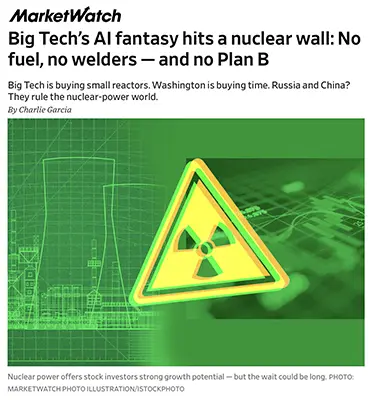
Big Tech’s AI Fantasy Hits a Nuclear Wall: No Fuel, No Welders — and No Plan B
MarketWatch (Charlie Garcia’s Street Sense column) | March 26, 2026
TL;DR: The U.S. nuclear revival being counted on to power AI infrastructure faces compounding, multi-year supply constraints — in fuel, workforce, and cost — that Big Tech’s capital commitments cannot resolve on their own, and that create real near-term uncertainty for AI scaling timelines.
Executive Summary
This is an opinion column, and its tone is deliberately provocative. Strip the wit and the core argument is substantive and worth taking seriously. The U.S. AI buildout requires a massive increase in electricity supply — data centers are projected to consume 9%–17% of U.S. electricity by 2030, up from 4.5% today. The political consensus around nuclear as the answer is genuine. The execution constraints are also genuine, and the column makes a credible case that they are being systematically underweighted.
Three specific constraints stand out. First, cost: Small modular reactors (SMRs) currently run $89–$180 per megawatt-hour versus $40–$65 for combined-cycle gas. NuScale’s Idaho project saw costs rise 75% before a shovel hit the ground. Even optimistic learning-curve projections put SMR costs at $58–$100/MWh — well above conventional alternatives. Second, workforce: The U.S. has fewer than 5,000 certified nuclear-grade welders. Training takes five years. The industry needs to triple its nuclear workforce by 2050 while 40% of current workers retire this decade. Third, fuel: High-Assay Low-Enriched Uranium (HALEU), required for most advanced reactors, has been produced domestically in quantities sufficient to fuel a single reactor for less than one year. Russia controls 40%–45% of global enrichment capacity. The DOE’s new domestic enrichment investment won’t produce output until 2031 — after reactors already being licensed for 2027 would need it.
Big Tech is filling the financing gap that government cannot: Meta has committed to six gigawatts of nuclear capacity, Microsoft is restarting Three Mile Island, and Vistra has signed 20-year power purchase agreements with multiple hyperscalers. This is real and meaningful. But it does not resolve the fuel, workforce, or regulatory timeline problems. The nuclear renaissance is structurally real; its practical timeline is five to ten years away from material impact, and the column’s core warning — that AI scaling plans may be priced on assumptions that don’t yet have physical supply chains to back them — deserves serious attention.
Relevance for Business
For SMB leaders, this story has two practical layers. The first is cost: AI compute and cloud services are already expensive, and the energy constraints underlying AI infrastructure are likely to keep upward pressure on those costs for the next several years. If your business is building AI-dependent workflows or making long-term commitments to AI platforms, the energy constraint is a real cost driver, not a background policy debate. The second is strategic timing: the gap between announced AI capability and the physical infrastructure to sustain it at scale is larger than the industry’s public posture suggests. Leaders making multi-year vendor commitments or infrastructure investments should factor in execution risk at the infrastructure level, not just at the model or software level.
Calls to Action
🔹 Treat AI infrastructure cost projections with skepticism — energy constraints are a genuine upward cost pressure on cloud and compute pricing through at least 2030.
🔹 Monitor your AI vendors’ infrastructure commitments — companies with diversified energy sourcing (existing nuclear fleet, long-term PPAs) are better positioned than those dependent on new builds.
🔹 Do not assume AI scaling will be linear — physical infrastructure constraints could create capacity bottlenecks that affect availability and pricing of AI services.
🔹 Factor energy cost and availability into multi-year AI vendor evaluations — this is no longer a macro issue; it has direct bearing on vendor stability and pricing.
🔹 No immediate operational action required for most SMBs, but assign someone to monitor quarterly energy cost trends in AI cloud services as a leading indicator of broader cost pressure.
Summary by ReadAboutAI.com
https://www.wsj.com/wsjplus/dashboard/articles/americas-nuclear-renaissance-has-everything-except-uranium-welders-and-a-plan-0851782d: Day 3: May 22, 2026
NVIDIA EXPECTS TO SELL $1 TRILLION IN AI CHIPS THROUGH 2027 — AND IT’S PUSHING FURTHER INTO INFERENCE
Business Insider | Geoff Weiss | March 16, 2026
TL;DR: Nvidia is defending its AI hardware dominance by moving aggressively into inference — the faster, cheaper, high-volume phase of AI deployment — through a $20 billion deal with chip startup Groq, as competitors begin to chip away at its position in this segment.
Executive Summary
At Nvidia’s 2026 GTC conference, CEO Jensen Huang announced the Nvidia Groq 3 LPX, a new inference chip that integrates Groq’s technology with Nvidia’s Vera Rubin architecture. The chip is claimed to accelerate inference workloads by up to 35 times and is expected to ship in the second half of 2026. Manufactured by Samsung, it builds on a $20 billion deal Nvidia struck with Groq in December 2025, which included licensing Groq’s technology and hiring its top engineers.
Huang simultaneously projected that demand for Nvidia’s Blackwell and Rubin AI systems will reach at least $1 trillion through 2027 — double the $500 billion projected through 2026. The inference-specific push is strategically significant: inference is the phase where AI models actually run and generate responses (as opposed to the training phase). As AI agents become more prevalent, inference demand is growing rapidly — and it is more cost-sensitive and repetitive than training, making it a natural target for specialized competitors. A growing number of rivals — from hyperscalers (Amazon, Google, Microsoft) to chip startups (Cerebras, Groq itself before the acquisition) — have been developing cheaper, more efficient inference-specific alternatives to Nvidia’s GPUs. OpenAI signed a reported $10 billion compute deal with inference chip startup Cerebras in January; the company had reportedly been dissatisfied with Nvidia’s inference performance. The Groq acquisition is Nvidia’s direct response to that pressure.
This is largely a vendor announcement with strong company framing. The 35x speed claim is Nvidia’s own; independent benchmarks are not yet available. The demand projections reflect Huang’s public statements, not audited forecasts.
Relevance for Business
For SMBs, this matters primarily through cost and availability of AI services. Inference is the operational cost driver behind every AI API call — every query to ChatGPT, Claude, or Gemini. If Nvidia successfully defends its dominance in inference, AI service pricing will remain largely governed by Nvidia’s supply chain and pricing power. If competitors gain ground, costs could fall faster. The article’s practical signal: the inference market is actively contested, which is good news for buyers. Do not lock into long-term AI infrastructure or API contracts that assume today’s cost structure will hold — this market is moving.
Calls to Action
🔹 Do not treat today’s AI API pricing as a stable cost baseline — the inference chip market is actively contested and costs may shift significantly within 12–24 months.
🔹 Monitor Nvidia’s Groq 3 LPX shipping timeline and independent benchmarks before making long-term infrastructure commitments tied to current inference performance assumptions.
🔹 If you are evaluating AI infrastructure investments (on-premise GPU clusters, dedicated compute), wait for independent validation of the new Nvidia Groq chip’s performance claims before committing.
🔹 For most SMBs: use API-based AI services rather than dedicated hardware — the infrastructure competition benefits buyers who remain flexible.
Summary by ReadAboutAI.com
https://www.businessinsider.com/nvidia-gtc-ai-system-groq-technology-inference-2026-3: Day 3: May 22, 2026
Sam Altman Is Losing His Grip on Humanity
The Atlantic | Matteo Wong | February 23, 2026
TL;DR The Atlantic argues that OpenAI’s Sam Altman — and the broader AI industry — has adopted a calculated rhetorical strategy of equating AI systems with human beings, which obscures real environmental costs, inflates AI valuations, and reflects a troubling detachment from what it means to be human.
EXECUTIVE SUMMARY
At an AI summit in India, Sam Altman deflected questions about AI’s energy consumption by comparing the resources required to train AI models to those expended across the entire evolutionary history of humanity. The Atlantic’s Matteo Wong dissects this not primarily as a technical error — though it is one — but as a deliberate rhetorical pattern common across AI leadership. Anthropic’s Dario Amodei made a nearly identical analogy the same week. Wong’s core argument: when AI CEOs compare their products to human beings or human development, they are either genuinely confused about the difference or are making a calculated PR move that serves investor narratives.
The practical implications are significant. AI data centers are fueling the construction of private gas-fired power plants and extending the lives of coal plants, collectively capable of producing greenhouse-gas emissions equivalent to dozens of major American cities. Altman’s response — that society must move to nuclear or renewables faster — sidesteps the possibility that the AI industry could itself slow down. Wong frames this as the industry treating environmental and human costs as acceptable collateral damage in pursuit of a self-defined higher mission.
This is an opinion piece and should be read as such. Wong does not offer technical rebuttals or alternative business models — he is making an ethical and cultural argument. The framing is pointed but substantiated by real statements and real data on energy consumption. Executives should take the environmental narrative risk seriously regardless of where they land on the broader philosophical argument.
RELEVANCE FOR BUSINESS
For SMB executives, this piece surfaces two practical concerns. First, AI’s energy consumption is becoming a mainstream reputational and regulatory issue. Organizations with ESG commitments or sustainability reporting obligations will increasingly need to account for AI usage in their carbon footprint disclosures. Second, the piece signals that trust in AI vendor messaging is declining — executives who uncritically repeat vendor framing about AI’s capabilities or societal role risk being associated with that credibility problem.
The analogy of AI to human cognition also has internal organizational consequences: how you frame AI to your employees shapes how they interact with and rely on it. Treating AI tools as human-equivalent can lead to over-delegation and accountability gaps.
CALLS TO ACTION
🔹 Do not adopt AI vendor language wholesale. When communicating about AI internally or externally, use accurate, measured language about what AI tools actually do.
🔹 Begin tracking AI energy consumption if your organization has ESG reporting requirements. This is a regulatory gap that is likely to close within 2-3 years.
🔹 Monitor AI energy/sustainability regulation in the EU and any states where you operate — this is an emerging compliance surface.
🔹 Use this piece as a calibration check. If your internal AI strategy relies on vendor-supplied talking points about AI’s transformative inevitability, ask whether that framing is serving your decision-making or distorting it.
🔹 (No urgent action required.) This is an opinion piece surfacing long-term reputational and environmental trends. Revisit in 6 months as regulatory momentum becomes clearer.
Summary by ReadAboutAI.com
https://www.theatlantic.com/technology/2026/02/sam-altman-train-a-human/686120/: Day 3: May 22, 2026
✅ SUMMARY: Inside OpenAI’S Stargate’s Megafactory with Sam Altman | the circuit
Bloomberg’s Emily Chang tours Project Stargate in Abilene, Texas—an ambitious AI datacenter initiative led by OpenAI, SoftBank, and Oracle, with its first build site, Project Ludicrous, scheduled for completion by mid-2026. The site spans roughly 1,200 acres and will house eight buildings containing up to 400,000 Nvidia Blackwell GPUs and 1.2 GW of capacity. Leaders including Sam Altman frame Stargate as a turning point in the AI infrastructure race, arguing that more compute drives better models, fueling the next wave of innovation despite emerging efficiency breakthroughs like DeepSeek.
Chang highlights that the real constraint is energy. AI racks now draw about 130 kW each, pushing builders toward wind-rich regions and closed-loop cooling systems that conserve water while maintaining uptime with gas-powered backup. She also examines risks—from overbuild and limited permanent jobs to local tax abatements (~85%) and supply-chain/geopolitical exposure (tariffs; chip and metal dependencies across Taiwan, Korea, Japan, and China). The takeaway: Stargate marks the dawn of an “intelligence super-highway”, but SMBs should expect cost volatility, compute bottlenecks, and a rising need for AI governance and energy awareness.
Summary by ReadAboutAI.com
https://www.youtube.com/watch?v=GhIJs4zbH0o: Day 3: May 22, 2026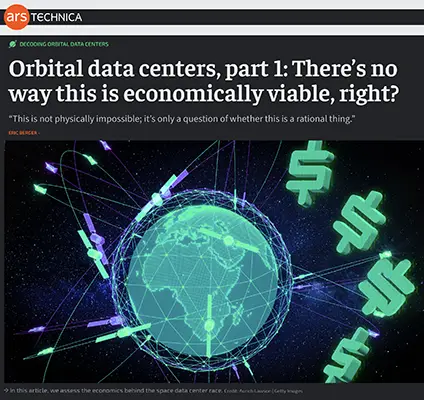
Orbital Data Centers: There’s No Way This Is Economically Viable, Right?
Ars Technica | Eric Berger | March 24, 2026
TL;DR: The economics of putting AI data centers in orbit are not impossible — but they depend on cost reductions that do not yet exist, and carry environmental and regulatory risks that remain poorly understood.
Executive Summary
The concept of orbital data centers — AI computing hardware mounted on satellites, powered by solar arrays, and cooled by radiating heat into space — has moved from theoretical to actively funded. SpaceX has announced plans for a constellation of up to one million satellites for this purpose. A startup called Starcloud has already launched an Nvidia GPU into orbit. Google’s Project Suncatcher (see Source 2) is pursuing a parallel path.
The economic case rests on three advantages: solar panels generate five to seven times more power in orbit than on Earth; land-based data centers face rising regulatory resistance and permitting delays; and AI’s expanding computing demands may eventually strain terrestrial power and land supply. But the cost math is not yet close. Replicating even one large ground-based data center would require hundreds of satellites. Deploying a million-satellite constellation is estimated to cost more than one trillion dollars — roughly one hundred times the scale of either Starlink or Starship individually.
The three decisive cost variables are launch costs (currently too high, projected to fall significantly with Starship reuse), satellite hardware (still expensive relative to terrestrial rack-mounted servers), and chip costs (SpaceX is pursuing vertical integration via the new Terafab initiative, a $20 billion chip fabrication project — a domain well outside its established competencies). Engineer Andrew McCalip, whose widely shared economic model frames much of the article’s analysis, notes that the numbers become plausible only if a single company controls both the launch infrastructure and the AI compute demand — which, in SpaceX and xAI, Elon Musk now does. The conflict of interest embedded in that framing should be noted.
Hidden costs are significant. Ground-based data centers already consume roughly 4–5% of U.S. electricity and are projected to reach 7–12% by 2028. Orbital data centers, once operational, would produce no emissions and use no water for cooling. However, the rocket launches required to build and maintain them produce carbon and black carbon aerosols. Satellite reentry deposits metals including lithium and aluminum into the upper atmosphere — a phenomenon scientists are only beginning to study. And the night sky impact of a million large, solar-paneled satellites would be substantial; astronomers have been given one month to respond to SpaceX’s FCC application for its constellation.
Relevance for Business
For most businesses, the direct impact of orbital data centers is years away. The relevance today is strategic context: the AI infrastructure buildout is large enough, and terrestrial constraints severe enough, that major players are entertaining solutions that would have seemed implausible five years ago. The underlying constraint — energy availability and permitting — is real now, even if space-based solutions are not.
For executives evaluating long-term cloud infrastructure costs and vendor dependencies, this article signals that the AI compute supply chain is being contested at a foundational level, with enormous capital and regulatory risk embedded in the winning path. The companies best positioned to control AI infrastructure at scale are those that can vertically integrate across chips, energy, and launch — a dynamic that favors very few players and raises concentration risk for everyone else.
Calls to Action
🔹 Monitor, do not act. Orbital data centers are not a near-term business decision for any organization outside the hyperscaler tier. The economics remain speculative.
🔹 Treat terrestrial energy constraints as a current risk, not a future one. The permitting and power problems that motivate this article are already affecting cloud pricing and availability.
🔹 Assign someone to track SpaceX’s FCC filings and orbital data center regulatory developments. The outcome will shape the competitive landscape for AI compute over the next decade.
🔹 Note the concentration risk. If orbital AI infrastructure becomes viable and is controlled by one or two vertically integrated players, dependency exposure for cloud customers increases substantially.
🔹 Flag environmental and regulatory unknowns as long-horizon risks. Satellite reentry chemistry and night-sky impacts are unsettled science — but could become material liabilities or regulatory friction points for the companies involved.
Summary by ReadAboutAI.com
https://arstechnica.com/space/2026/03/orbital-data-centers-part-1-theres-no-way-this-is-economically-viable-right/: Day 3: May 22, 2026
OpenAI, SoftBank Invest $1 Billion in Stargate Partner SB Energy
Bloomberg | Michelle Ma, Shirin Ghaffary, Brian Eckhouse | January 9, 2026
TL;DR: OpenAI and SoftBank’s joint $1 billion investment in an energy infrastructure firm — to build a 1.2-gigawatt data center in Texas — signals that AI’s largest players are moving beyond leasing compute capacity and into owning the power infrastructure beneath it.
Executive Summary
OpenAI and SoftBank have each committed $500 million to SB Energy, an infrastructure company that develops and operates data centers and renewable energy projects. The immediate purpose: SB Energy will build and operate a 1.2-gigawatt AI data center in Milam County, Texas, as part of OpenAI’s Stargate initiative — a $500 billion, four-year U.S. data center and infrastructure buildout that also involves Oracle and SoftBank.
The signal here is not the dollar amount — it is the strategic logic. Rather than contracting with an independent energy provider, OpenAI is becoming a capital partner in its own power supply. One gigawatt of power is roughly enough to supply 750,000 U.S. homes at any given moment. At this scale, AI infrastructure and energy infrastructure are effectively the same project.
SB Energy was originally a renewable and storage developer, backed by SoftBank. It has expanded into data center development and operations. The investment follows SB Energy having raised $800 million from Ares Infrastructure Opportunities the prior year. The article also notes that Meta simultaneously announced agreements for potentially more than six gigawatts of nuclear power — a data point that illustrates how broadly this pattern is spreading across the hyperscaler tier.
This is a brief news report, not a deep analytical piece. The facts are clear; the interpretation requires drawing on the broader context of AI infrastructure economics covered in Sources 1–3.
Relevance for Business
The practical implication for SMB leaders is not that they should invest in energy infrastructure. It is that the AI companies on which most organizations depend for AI services are making commitments at a scale and timescale — $500 billion over four years — that reflects a genuine bet on sustained AI compute demand. That scale of commitment is also a form of lock-in: infrastructure built for a specific AI growth trajectory is not easily redirected if demand moderates. The risk of overbuilding is real, as the article’s own passing reference to concerns about AI demand falling short of expectations acknowledges.
For organizations evaluating AI vendor stability, this article is relevant evidence: the major AI providers are not running on short-term contracts. They are building permanent infrastructure — and absorbing the financial risk that comes with it.
Calls to Action
🔹 Note the vertical integration pattern. Major AI providers are increasingly controlling their own energy supply — a dynamic that could affect how they price compute services over time.
🔹 Factor infrastructure commitment timescales into vendor assessments. A provider that has committed $500 billion over four years is making a durable institutional bet, not a quarterly pivot.
🔹 Monitor the Stargate initiative’s progress. Its first site in Abilene, Texas is under active development. Whether it proceeds on schedule is a useful indicator of AI infrastructure execution risk.
🔹 Be alert to overbuilding risk. If AI demand growth moderates, the capital committed to infrastructure of this scale creates financial pressure on the companies carrying it — with potential consequences for pricing, service continuity, or consolidation.
Summary by ReadAboutAI.com
https://www.bloomberg.com/news/articles/2026-01-09/openai-softbank-invest-1-billion-in-stargate-partner-sb-energy: Day 3: May 22, 2026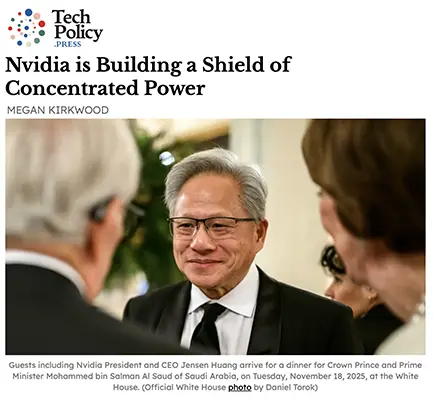
NVIDIA IS BUILDING A SHIELD OF CONCENTRATED POWER
Tech Policy Press | Megan Kirkwood | December 18, 2025
Note: This is an opinion-framed analysis piece by a researcher specializing in antitrust and digital markets. It is the third in a series. The author’s perspective is critical of Nvidia’s market position and the adequacy of regulatory response. It should be read as informed advocacy, not neutral reporting. The factual claims about investigations are drawn from named regulatory bodies and are verifiable.
TL;DR: Antitrust investigations into Nvidia’s near-monopoly in AI chip supply have been launched across the U.S., EU, UK, France, and South Korea — but each is now at risk of being abandoned as governments prioritize AI competition over market accountability.
Executive Summary
Nvidia controls an estimated dominant share of the market for AI-specialized computing chips (GPUs) and is the primary supplier of the CUDA software ecosystem on which most AI development depends. This article maps the regulatory scrutiny that dominance has attracted, then argues that the political urgency surrounding AI development is systematically undermining the credibility of those investigations.
The factual regulatory record is substantial. The U.S. Department of Justice delivered a subpoena to Nvidia in September 2024 seeking evidence of antitrust violations, reportedly focused on whether Nvidia makes switching to competitor chips harder and whether it allocates supply preferentially to exclusive customers. Bloomberg reported that Nvidia acknowledged allocating chips to customers deemed most likely to use them quickly — a practice regulators found concerning. The UK’s Competition and Markets Authority identified an interconnected web of over 90 partnerships involving the same firms (Google, Apple, Microsoft, Meta, Amazon, Nvidia) and flagged concerns about control of critical inputs for AI model development. France’s antitrust authority raided Nvidia’s offices in 2023 and concluded in June 2024 that the company likely abuses its dominance. The EU and South Korea have also opened inquiries. China launched an investigation over the Mellanox acquisition, then dropped it after trade agreements with the U.S.
The author’s analytical argument is that these investigations are now politically compromised. The U.S. AI Action Plan explicitly promotes “AI champions” to accelerate American leadership. The EU is building “AI factories” while simultaneously purchasing Nvidia infrastructure. The UK has announced multiple AI partnerships with U.S. tech firms including Nvidia. The author argues that no nation seeking to win the “AI race” will pursue meaningful antitrust enforcement against the supplier on which its AI ambitions depend. The piece cites AI Now Institute researchers who warn that deploying AI in public services concentrates power among deployers, leaving those served with less recourse.
The conflict of interest is real: if Nvidia chips are necessary to build sovereign AI infrastructure, then governments become Nvidia customers — and customers do not generally break up their suppliers.
Relevance for Business
For executives making AI infrastructure decisions, Nvidia’s market position is not abstract. It is the supply chain.Whether purchasing AI cloud services, building internal AI infrastructure, or evaluating vendor offerings, most paths run through Nvidia hardware or Nvidia-compatible software. The practical implications:
Vendor dependency risk is high. The article notes that even attempts to build alternative AI infrastructure often end up using Nvidia GPUs and CUDA software. There are emerging alternatives (AMD, Intel, Google TPUs, custom chips at major hyperscalers), but Nvidia’s lead is significant and software ecosystem depth gives it structural durability.
Pricing power is real. If antitrust enforcement is politically constrained and competitive alternatives remain limited, Nvidia retains substantial ability to set chip prices, allocate supply, and shape product roadmaps to its own advantage. Organizations dependent on AI compute should expect this to translate into pricing that does not follow normal competitive market dynamics.
The governance question matters. The author’s broader point — that embedding AI in public services concentrates power with deployers — applies equally to private enterprises. Organizations deploying AI-driven decision systems should ensure human review processes remain meaningful, not perfunctory.
Calls to Action
🔹 Assess your AI infrastructure’s Nvidia dependency. Whether through cloud services or direct hardware purchases, understand what share of your AI capability is bottlenecked on Nvidia’s supply and pricing decisions.
🔹 Monitor alternative chip providers. AMD, Intel’s Gaudi, and hyperscaler custom silicon (Google TPUs, Amazon Trainium, Microsoft Maia) are the most credible alternatives. Their viability is improving but remains limited for most use cases.
🔹 Track antitrust proceedings in the EU and UK. These jurisdictions have historically been more willing to act against large technology companies than the U.S. The outcome of Nvidia-specific investigations will affect chip pricing and procurement practices globally.
🔹 Build governance around AI-driven decisions. Regardless of the chip supply debate, the concentration of decision-making power through AI systems is a governance risk. Ensure accountability mechanisms are embedded from the outset, not retrofitted.
🔹 Do not treat “sovereign AI” commitments from governments as protection. The article’s central point is that national AI ambitions and market accountability are currently in direct tension — and ambition is winning.
Summary by ReadAboutAI.com
https://www.techpolicy.press/nvidia-is-building-a-shield-of-concentrated-power/: Day 3: May 22, 2026
Meet Project Suncatcher, Google’s Plan to Put AI Data Centers in Space
Ars Technica | Ryan Whitwam | November 4, 2025
TL;DR: Google is actively engineering solar-powered, orbital AI computing — moving the idea from speculation to funded prototyping, with a target launch of test satellites by early 2027 and commercial viability projected for the mid-2030s.
Executive Summary
Project Suncatcher is Google’s internal initiative to develop networks of AI-processing satellites in low-Earth orbit, solar-powered and connected via high-speed wireless optical links. The project is not a whiteboard concept: Google has published a pre-print study, is testing its latest AI processors (called TPUs — tensor processing units, the specialized chips Google uses for AI workloads) against radiation exposure, and has set a target of launching prototype satellites by early 2027.
The core technical bet is on power efficiency. Google’s analysis suggests that solar panels in a dawn-dusk sun-synchronous orbit receive nearly constant sunlight, making them up to eight times more efficient than surface panels. Terrestrial electricity costs are rising, and even full conversion to ground-level solar would fall short of what AI computing demands. Space avoids the problem at the source.
The key engineering challenge is inter-satellite communication. On the ground, data center nodes connect via ultra-fast optical cables. In orbit, satellites must communicate wirelessly at speeds of tens of terabits per second — requiring satellites to fly within a kilometer of each other. Google has demonstrated 1.6 terabits per second in early testing and believes this can scale. Its proposed “free-fall” (no thrust required) formation design would keep satellites in tight proximity with only modest station-keeping maneuvers.
Hardware durability is the other risk. Space hardware is typically expensive and ruggedized. Google is attempting to use commercial off-the-shelf chips in orbit — a cost-saving approach that requires chips to survive radiation exposure for at least five years. Early testing shows Google’s v6e TPU can handle roughly three times the radiation threshold the mission requires. The assumption is that commercial hardware will be more robust in space than historically assumed.
Google frames Project Suncatcher against its own long-timescale moonshot track record: Waymo took fifteen years from first prototype to near-commercial deployment. The mid-2030s target for viable commercial orbital data centers is consistent with that framing — but also clearly distant.
Relevance for Business
This article should be read alongside the Ars Technica orbital data center economics piece (Source 1). Together, they establish that two of the world’s largest technology companies — Google and SpaceX — are investing seriously in orbital AI compute, not as a PR exercise but as a long-range infrastructure hedge.
For business leaders, the direct implication is not operational but strategic positioning: the next generation of AI compute infrastructure may be controlled by a smaller number of vertically integrated players than today’s cloud market. If orbital data centers become viable in the 2030s, access to AI compute could become more — not less — concentrated. The companies building that infrastructure now are securing advantages that will compound.
This is a “monitor and understand” story for most organizations. It is an “act now” story for regulators, policymakers, and anyone whose long-term competitive position depends on open access to AI infrastructure.
Calls to Action
🔹 Treat this as a strategic signal, not an operational one. No business decision is required now; what is required is awareness that AI infrastructure competition is moving to a new terrain.
🔹 Monitor Google’s 2027 prototype launch timeline. Whether or not it proceeds on schedule will be a meaningful indicator of technical and economic progress.
🔹 Note the regulatory gap. Neither FCC filings nor international space law is currently calibrated for mega-constellations of AI computing satellites. That regulatory uncertainty is a risk for any company whose cloud infrastructure eventually depends on this.
🔹 Revisit your cloud vendor dependency analysis in 2028. By then, the viability of orbital compute will be clearer, and the implications for long-term cloud pricing and access will be more legible.
Summary by ReadAboutAI.com
https://arstechnica.com/google/2025/11/meet-project-suncatcher-googles-plan-to-put-ai-data-centers-in-space/: Day 3: May 22, 2026Back to the Anniversary Week Overview page
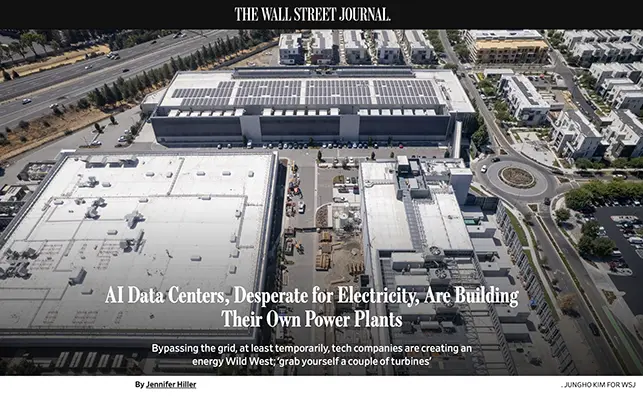
AI Data Centers, Desperate for Electricity, Are Building Their Own Power Plants
The Wall Street Journal | Jennifer Hiller | October 15, 2025
TL;DR: Unable to wait for an overloaded U.S. power grid to catch up, major AI data center operators are building private natural gas power plants — a stopgap measure exposing structural gaps in American energy infrastructure that may persist three to five years.
Executive Summary
The U.S. power grid cannot absorb the speed at which AI infrastructure is being built. Rather than wait, operators of large AI data centers are constructing their own on-site power generation — primarily natural gas turbines — to come online immediately. OpenAI and Oracle’s Stargate project in West Texas, Elon Musk’s xAI Colossus facilities in Memphis, and Meta’s Ohio campus are among the projects bypassing or substantially supplementing the grid. The WSJ characterizes the result as an “energy Wild West.”
The structural shortfall is not a temporary blip. The U.S. should be adding roughly 80 gigawatts of new power generation capacity annually to keep pace with combined demand from AI, cloud computing, crypto, and electrification, according to consulting firm ICF. It is currently building less than 65 gigawatts. Transmission infrastructure is moving in the wrong direction: the U.S. added 888 miles of new high-voltage lines in the most recent year reported, down from an average of more than 1,700 miles annually in an earlier five-year period. The shortfall in transformer supply — driven by supply chain problems predating AI demand, now compounded by a 10-fold increase in data center orders — has extended lead times for critical grid equipment. One analyst characterizes the power shortage as likely to last three to five years.
Natural gas is the default answer, but it has limits. Smaller turbines and fuel cells remain available in the near term; large turbines for utility-scale plants have multi-year order backlogs. The cost of building a new natural-gas plant has roughly tripled in recent years, according to the article. Complicating the picture further, current U.S. policy is curtailing renewable energy investment — analysts expect wind and solar project cancellations to rise as federal tax credits are rolled back — while simultaneously attempting to accelerate fossil fuel permitting. The energy mix for AI, at least through 2030, points heavily toward natural gas.
Relevance for Business
For SMB executives, the immediate implication is not “build your own power plant” — that is a hyperscale problem. The implication is cloud service reliability and cost. The companies building private power infrastructure are the same companies whose cloud platforms most SMBs depend on. Infrastructure investment at this scale affects cloud pricing, data center availability by region, and — over time — which providers maintain the capacity to grow with customer demand. Energy cost pass-through is a real risk: cloud pricing historically abstracts away infrastructure costs, but sustained elevated energy expenses at scale eventually surface in pricing. Additionally, the geographic concentration of AI data centers near natural gas infrastructure (West Texas, Appalachia) may influence where AI-dependent services are most reliably available and at what latency.
Calls to Action
🔹 Review your cloud provider’s data center locations and stated reliability guarantees. Ask whether they have disclosed energy sourcing strategy for their AI-infrastructure build-out.
🔹 If your business depends on high-availability cloud AI services, assess whether your vendor’s infrastructure investment trajectory is sufficient to sustain that availability through 2028.
🔹 Monitor energy policy developments — particularly the fate of renewable tax credits and permitting rules — as these will shape the medium-term cost and carbon profile of AI cloud services.
🔹 For organizations with ESG reporting obligations, note that AI-driven cloud workloads may increasingly be powered by natural gas, not renewables, regardless of vendor sustainability claims.
🔹 No immediate operational action required for most SMBs, but assign this to your IT procurement and sustainability leads as a watch item for vendor reviews in the next 12–18 months.
Summary by ReadAboutAI.com
https://www.wsj.com/business/energy-oil/ai-data-centers-desperate-for-electricity-are-building-their-own-power-plants-291f5c81: Day 3: May 22, 2026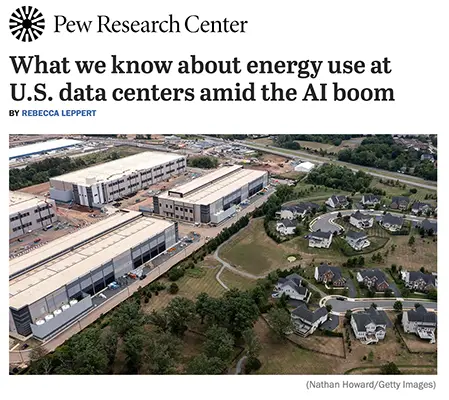
What We Know About Energy Use at U.S. Data Centers Amid the AI Boom
Pew Research Center | Rebecca Leppert | October 24, 2025
TL;DR: A Pew Research analysis consolidates the key figures on U.S. data center energy consumption — use is already at 4% of national electricity demand, is projected to more than double by 2030, and carries a concrete, measurable cost to American electricity ratepayers.
Executive Summary
This is a data synthesis piece, not original reporting. Its value is in assembling authoritative figures — drawn primarily from the International Energy Agency (IEA) and the Electric Power Research Institute — into a readable, source-attributed summary. It should be read as a reference document, not an investigative article.
The core finding: U.S. data centers consumed 183 terawatt-hours of electricity in 2024 — more than 4% of the country’s total. By 2030, IEA projects that figure will grow to 426 terawatt-hours, a 133% increase. A typical AI-focused large data center consumes as much electricity as 100,000 households annually; the largest ones under construction will consume 20 times that. Virginia alone — home to the largest concentration of data centers in the country — saw data centers consume roughly 26% of the state’s total electricity supply in 2023.
Who pays for the grid upgrades is a consequential policy question. In the PJM electricity market, which covers a wide swath of the eastern U.S., data center demand contributed an estimated $9.3 billion in additional costs to the 2025-26 capacity market. Translated to individual bills: residents of western Maryland are expected to pay roughly $18 more per month; Ohio residents around $16 more. A Carnegie Mellon study estimates data centers and cryptocurrency mining could add 8% to the average U.S. electricity bill by 2030 — and more than 25% in the highest-demand markets in Virginia. These are independent research findings, not industry projections.
On energy sourcing: as of 2024, natural gas supplied more than 40% of electricity to U.S. data centers. Renewables accounted for about 24%, nuclear for 20%, and coal for around 15%. Nuclear’s share may grow; several tech companies have announced deals with nuclear startups, and two retired plants are being considered for restart specifically to supply data center demand.
Relevance for Business
This piece gives SMB leaders reliable numbers with which to evaluate vendor claims and assess their own exposure. Two implications stand out. First, electricity bills for businesses in data center-dense regions are likely to rise materially, independent of AI adoption decisions — the grid upgrade costs are already embedded in rate structures. Second, vendor sustainability claims deserve scrutiny: with natural gas supplying the dominant share of data center power and coal still at 15%, broad claims of renewable-powered AI should be evaluated against actual IEA data, not marketing language.
Calls to Action
🔹 Use the IEA figures cited here (183 TWh in 2024, 426 TWh projected by 2030) as calibration benchmarks when evaluating any vendor or analyst claims about AI energy consumption.
🔹 If your business operates in Virginia, North Dakota, Nebraska, Iowa, or Oregon — states where data centers already consume 10-26% of total electricity — request a current rate outlook from your utility or energy broker.
🔹 For any business with sustainability reporting, note the actual energy mix: natural gas at 40%, renewables at 24%. Apply appropriate skepticism to vendor claims of 100% renewable AI operations.
🔹 If your state is weighing data center disclosure or renewable mandate legislation (California, Illinois, Minnesota, New Jersey, and Virginia have active discussions), monitor this as a potential procurement compliance issue.
🔹 No urgent action required for most SMBs — but this Pew piece is a useful reference document to share with finance, facilities, and sustainability leads.
Summary by ReadAboutAI.com
https://www.pewresearch.org/short-reads/2025/10/24/what-we-know-about-energy-use-at-us-data-centers-amid-the-ai-boom/: Day 3: May 22, 2026
Energy and AI International Energy Agency (IEA) Special Report
International Energy Agency (IEA) | April 2025
TL;DR: The IEA’s first comprehensive global report on AI’s energy implications projects that data center electricity consumption will more than double by 2030, warns that 20% of planned data center projects face delay risk from grid constraints, and argues that meeting AI’s energy needs without derailing broader energy goals requires deliberate policy, not just more generation capacity.
Executive Summary
This is a full-length IEA special report — the most authoritative and data-rich source among the four reviewed here. It should be weighted accordingly. Unlike the other sources, which are primarily journalistic, this report is based on a new global model, a comprehensive dataset of data center electricity demand, and structured consultation with governments, tech companies, and energy providers. It is not a neutral advocacy document — the IEA has institutional positions on clean energy — but its methodology is transparent and its findings are grounded.
The central finding on demand: Global data center electricity consumption totaled approximately 415 terawatt-hours in 2024 — roughly 1.5% of world electricity use, with the U.S. accounting for nearly half. By 2030, the IEA projects this nearly triples to around 945 TWh — slightly more than Japan’s entire current electricity consumption. AI is the primary growth driver. By decade’s end, U.S. data centers are projected to consume more electricity than the country’s entire domestic production of aluminum, steel, cement, and chemicals combined.
The central finding on risk: The IEA estimates that around 20% of planned data center projects could face meaningful delays due to grid constraints. Grid connection queues are long. Lead times for transformers and cables have roughly doubled in three years. Large gas turbine deliveries now face multi-year backlogs. The report notes that building new transmission lines takes four to eight years in advanced economies — longer than the planning horizon of most AI infrastructure investment.
The response is not simply “build more generation.” The IEA’s three-pillar framework calls for: (1) a diversified energy mix including renewables, natural gas, and emerging nuclear technologies such as small modular reactors; (2) accelerated grid investment alongside more flexible data center operations — including using spare server capacity as a grid-balancing tool; and (3) stronger coordination between technology companies, energy providers, and governments. The report also addresses AI’s potential upside for the energy sector itself: AI tools applied to grid management could, the IEA argues, unlock substantial transmission capacity without new infrastructure.
Relevance for Business
For SMB leaders, the IEA report is most useful as a framework for understanding the magnitude and timeline of the problem, not as an operations guide. Several implications stand out. The projection that U.S. data centers will account for nearly half of the country’s electricity demand growth through 2030 means that energy cost and availability will increasingly be shaped by AI infrastructure investment decisions made by a small number of very large companies. SMBs have no direct influence over that dynamic, but they have vendor and location choices that interact with it. The report’s emphasis on geographic concentration — half of U.S. data center capacity is in five regional clusters — reinforces the risk of local grid stress in those markets affecting cloud reliability and pricing. Finally, the IEA’s framing of AI as also a potential solution for energy optimization is worth tracking: applications that improve grid efficiency or industrial energy use may become meaningful business tools within this decade.
Calls to Action
🔹 Use the IEA’s 2030 projections (945 TWh globally, 426 TWh for U.S. data centers) as the most credible publicly available baseline when assessing energy-related claims from AI vendors or analysts.
🔹 Recognize that 20% of planned data center projects face delay risk — this has downstream implications for cloud capacity and AI service availability. Include infrastructure reliability in vendor due diligence for mission-critical AI tools.
🔹 If your organization has sustainability commitments, the IEA’s projection that natural gas and nuclear will together supply the majority of new data center power through 2030 should inform how you characterize the carbon footprint of AI-driven operations.
🔹 Monitor developments in small modular nuclear reactors (SMRs) — the IEA projects the first will come online around 2030. This is relevant context for understanding long-term energy sourcing claims from tech companies.
🔹 Assign a senior leader to track the IEA’s ongoing energy-and-AI workstream. This report will likely be updated; its findings carry significant weight with policymakers and will shape the regulatory environment for data centers and cloud services.
Summary by ReadAboutAI.com
https://www.iea.org/news/ai-is-set-to-drive-surging-electricity-demand-from-data-centres-while-offering-the-potential-to-transform-how-the-energy-sector-works: Day 3: May 22, 2026

ENERGY AND AI: WORLD ENERGY OUTLOOK SPECIAL REPORT
International Energy Agency (IEA) | April 2025
Note: This is a comprehensive policy research report from the International Energy Agency, a nonpartisan intergovernmental organization representing 32 member countries. It is the most authoritative global analysis of AI’s energy implications published to date. The IEA received input from Google, Microsoft, OpenAI, and other industry participants, which does not compromise the analysis but should be noted as context.
TL;DR: The IEA’s first comprehensive global analysis of AI and energy projects that data center electricity consumption will more than double by 2030 — while also finding that AI itself could unlock enough grid efficiency to offset that demand, if adopted broadly in the energy sector.
Executive Summary
Data centers consumed approximately 415 terawatt-hours (TWh) of electricity globally in 2024 — about 1.5% of total world electricity consumption. The United States accounts for roughly 45% of that total, China 25%, and Europe 15%. AI-focused data centers are already comparable in power draw to the most energy-intensive industrial facilities, such as aluminum smelters, but far more geographically clustered. Nearly half of U.S. data center capacity sits in five regional hubs. In Virginia alone, data centers consume approximately 25% of metered electricity supply.
The IEA’s base case projects global data center electricity demand rising to roughly 945 TWh by 2030 — slightly more than Japan’s total electricity consumption today — and approximately 1,200 TWh by 2035. AI is the primary driver, though growing demand for other digital services also contributes. The report is careful to present a range: a high-growth sensitivity case shows substantially larger numbers; a slower-growth scenario shows more modest expansion. The projections are not guarantees.
Meeting that demand will require a diverse energy mix. Renewables account for roughly half of the projected supply increase, supported by storage. Natural gas is expected to expand by approximately 175 TWh globally to serve data center load, particularly in the United States. Nuclear contributes a similar amount, with the first small modular reactors (SMRs) projected to come online around 2030. The IEA is explicit: no single energy source is sufficient.
The report’s most significant finding beyond demand projections is that AI itself could transform energy infrastructure. AI-enabled grid management could unlock up to 175 gigawatts of additional transmission capacity from existing lines — more than the entire projected increase in data center power load to 2030 in the IEA’s base case — without building a single new transmission line. AI is already being deployed in oil and gas operations, grid fault detection (reducing outage duration by 30–50%), renewable integration, and industrial efficiency. The sector is adopting AI, but not yet at the scale needed to realize its potential.
The IEA frames its recommendations around three pillars: the right energy mix for reliable 24/7 supply; accelerated grid investment and efficiency; and stronger dialogue between policymakers, the technology sector, and the energy industry.
Relevance for Business
This report is the most credible single source on the AI-energy nexus available. For executives, its practical value is threefold. First, it confirms that AI energy demand is a structural, not cyclical, phenomenon — and that the supply response will take years to build. Second, it reframes AI not only as a demand driver but as a potential tool for energy system optimization — a distinction that matters for organizations managing energy costs at scale. Third, it signals that the companies and countries building AI infrastructure now are making long-horizon bets in an environment with genuine uncertainty about the pace and scale of growth.
For SMB leaders, the IEA report provides the most authoritative backdrop against which to interpret all other coverage of AI and energy: it is more measured than vendor projections, more comprehensive than analyst estimates, and grounded in actual consumption data.
Calls to Action
🔹 Use this report as a reference point. When AI vendors, cloud providers, or news sources cite AI energy demand figures, the IEA’s 2025 Special Report is the most credible independent benchmark.
🔹 Pay attention to the AI-for-energy angle. Organizations with large energy footprints — manufacturing, logistics, real estate — should evaluate whether AI tools for grid management, facility optimization, or predictive maintenance are already applicable to their operations.
🔹 Do not treat 2030 projections as certainties. The IEA presents a base case and sensitivity scenarios. The gap between high and low estimates is large enough that both infrastructure overbuild and under-provision remain plausible outcomes.
🔹 Track SMR (small modular nuclear reactor) developments. The IEA projects the first commercial SMRs online around 2030. This technology, if it delivers on its timeline, will materially change the AI energy equation — and the cloud providers investing in it now may gain durable cost advantages.
🔹 Monitor grid policy in your operating regions. Interconnection reform, transmission investment, and demand-flexibility regulations are now directly linked to AI infrastructure availability and ultimately to cloud pricing.
Summary by ReadAboutAI.com
https://www.iea.org/reports/energy-and-ai: Day 3: May 22, 2026https://www.iea.org/reports/world-energy-outlook-2025: Day 3: May 22, 2026

Can US Infrastructure Keep Up with the AI Economy?
Deloitte Insights | Deloitte Research Center for Energy & Industrials | December, 2025
Note: This is an industry survey report by Deloitte, based on interviews with 120 U.S. data center and power company executives conducted in April 2025. It reflects practitioner perspectives, not independent research. Deloitte serves many of the companies discussed. Read accordingly.
TL;DR: A Deloitte survey of power and data center executives identifies seven structural gaps — from grid stress to skilled labor shortages — that are already slowing AI infrastructure buildout, with grid capacity the single most acute constraint.
Executive Summary
Deloitte projects that U.S. AI data center power demand could grow more than thirtyfold by 2035, reaching 123 gigawatts — up from approximately 4 gigawatts in 2024. The largest data centers now under planning call for up to 2 gigawatts of power each; early-stage campuses of 50,000 acres could require 5 gigawatts — more than the largest existing nuclear or gas plant in the United States. These numbers frame the scale of the problem. The more immediately useful content is the survey’s structured diagnosis of why the buildout is already stalling.
Seventy-two percent of survey respondents identified power and grid capacity as their primary infrastructure challenge. The survey identifies seven gaps, each with distinct causes and timelines:
Gap 1 — Peak demand vs. contracting baseload. As AI demand spikes, reliable baseload generation (gas, nuclear, coal) is being retired. New renewables are stuck in interconnection queues. In the top data center markets, load growth has been met primarily with additional gas generation — in direct tension with companies’ own clean energy commitments.
Gap 2 — Supply chain disruption. Critical components for power and data center construction are subject to import dependencies and tariffs. Construction material costs have risen 40% over five years.
Gap 3 — Timeline mismatches. Data centers can be built in one to two years. Most reliable power sources take longer — sometimes far longer. New gas plants not already under contract are not expected until the 2030s. Transmission infrastructure for renewables can take a decade or more.
Gap 4 — Cybersecurity. AI data centers are high-value targets, with numerous entry points across multi-country supply chains. Backup power security is also a vulnerability.
Gap 5 — Permitting. Environmental impact statements take more than two years to complete. State-level restrictions have more than doubled in the past year.
Gap 6 — Skilled labor. 63% of data center executives identify skilled labor shortage as their top workforce challenge. Turnover is high; competition with other industries is intense.
Gap 7 — Natural gas pipeline constraints. Even where gas is the chosen power source, pipeline capacity is often the binding constraint at the regional level.
The residential cost spillover is a politically sensitive second-order effect that the report surfaces: in eight of the nine top data center markets, residential electricity prices rose faster than the national average between 2023 and 2024.
The report’s recommended strategies — technology innovation, regulatory reform, computational task flexibility, new funding models, and fused infrastructure (colocating data centers with power generation) — are directionally sound, but most require years-long implementation.
Relevance for Business
This report translates the macroeconomic and policy-level infrastructure debate into operational terms. For SMB leaders, the key takeaways are:
Energy costs are rising in exactly the markets where AI infrastructure is concentrated. That pressure will propagate to cloud pricing. It is not a vendor decision; it is a physical and regulatory constraint.
The supply chain for AI infrastructure is stressed in ways that compound delay. Components, labor, permits, and grid connections are all in constrained supply simultaneously. This means hyperscaler expansion plans — and, by extension, AI compute availability and pricing — are subject to execution risk.
The recommendation to build flexible computing workloads (curtailing usage briefly during grid emergencies) is worth noting for organizations running AI workloads at scale: this flexibility may become a feature vendors offer, or a condition of favorable pricing, as grid stress increases.
Calls to Action
🔹 Understand where your AI compute is physically running. Cloud regions in Virginia, Texas, Ohio, and Georgia — the top data center markets — are experiencing the highest grid stress and the steepest residential power price increases.
🔹 Build flexibility into AI workload scheduling where possible. Computational task mobility — shifting non-urgent AI jobs to off-peak hours or alternative regions — is becoming a practical tool for managing infrastructure constraints.
🔹 Expect cloud pricing pressure to increase through 2027–2028. The infrastructure gaps described in this report are not resolving quickly. Factor this into multi-year AI budget planning.
🔹 Ask vendors about their backup power and cybersecurity posture. Data center security gaps are real and widening, particularly for supply-chain attack vectors.
🔹 Monitor permitting and energy policy at the state level. State-level restrictions on data centers and renewable energy are rising. This will affect where new capacity is built — and therefore where AI compute is most reliably available.
Summary by ReadAboutAI.com
https://www.deloitte.com/us/en/insights/industry/power-and-utilities/data-center-infrastructure-artificial-intelligence.html: Day 3: May 22, 2026
AI’s Power Requirements Under Exponential Growth
RAND Corporation | Konstantin F. Pilz, Yusuf Mahmood, Lennart Heim | July 2025
Note: This is a peer-reviewed policy research report from RAND, a nonprofit research institution. It is not vendor-sponsored. Projections are based on modeled extrapolations and carry stated uncertainty ranges. The report explicitly flags the limitations of its assumptions.
TL;DR: A RAND analysis finds that AI’s power demands are growing at a pace that U.S. infrastructure may not be able to meet — and that failure to close the gap could erode U.S. competitive leadership in AI while pushing infrastructure investment offshore.
Executive Summary
This RAND report addresses a direct policy question: what happens to U.S. AI competitiveness if the country cannot provide enough power to host the computing infrastructure AI development requires?
The scale of the projected demand is striking. AI data center power consumption grew roughly tenfold between 2020 and 2023. RAND’s median projection, based on continued exponential growth in chip supply, puts global AI data center demand at approximately 68 gigawatts by 2027 and 327 gigawatts by 2030. For context: California’s total power generating capacity is 86 gigawatts. A single AI training run for a frontier model could require as much as one gigawatt of sustained power at a single location by 2028 — equivalent to a large nuclear power plant.
The report is careful to note that these projections assume current growth trends persist, and that technical limits, chip supply disruptions, or geopolitical events could alter the trajectory. It also acknowledges that Goldman Sachs and McKinsey estimates are considerably more conservative. The range matters: even the lower-end projections describe a substantial infrastructure challenge.
The structural bottlenecks RAND identifies are not speculative — they are already occurring. Grid connection requests in Virginia, the country’s largest data center market, now take four to seven years. Supply chain lead times for emergency generators exceed one year. Permitting timelines for new power generation projects routinely run to multiple years. Meanwhile, most new U.S. generating capacity comes from wind and solar, which are intermittent — unsuited to data centers that require power reliability exceeding 99%.
The geopolitical dimension is the report’s sharpest contribution. If U.S. companies cannot build sufficient data center capacity domestically, they will build it elsewhere — as Microsoft’s $1.5 billion investment in Abu Dhabi’s G42 already illustrates. Chips exported for offshore data centers are harder to monitor, easier to smuggle, and more exposed to cyberattack. The report argues that compute concentration within U.S. borders is increasingly a national security interest, not just a commercial one.
Relevance for Business
For executives, this report does two things. First, it establishes that AI cloud infrastructure costs are structurally rising— not as a pricing decision by vendors, but as a consequence of genuine physical and regulatory constraints on power supply. This is not something AI vendors can solve unilaterally. Second, it signals that the window for domestic AI infrastructure investment may be narrowing — and that companies dependent on large-scale AI workloads should understand how their cloud providers are addressing the power gap.
SMB leaders do not need to engage with the technical modeling in this report. The executive signal is clear: the AI infrastructure supply chain has a physical constraint, that constraint is unlikely to resolve quickly, and the cost and availability implications will propagate to all AI users — not just the hyperscalers.
Calls to Action
🔹 Ask your cloud and AI vendors how they are securing power supply. This is now a legitimate due-diligence question for enterprise AI contracts.
🔹 Factor infrastructure risk into AI investment timelines. Projects that assume AI compute capacity will remain stable and affordable through 2028–2030 may need to be revisited.
🔹 Monitor energy policy developments. Permitting reform, nuclear power agreements, and grid interconnection rules are now directly relevant to AI infrastructure availability and pricing.
🔹 Note the national security framing. U.S. government policy on AI chip exports and data center location is likely to tighten. This could affect offshore AI service providers your organization relies on.
🔹 Do not treat efficiency gains as a solution. The report accounts for chip efficiency improvements and still projects a substantial power gap. The demand curve is outpacing the efficiency curve.
Summary by ReadAboutAI.com
https://www.rand.org/pubs/research_reports/RRA3572-1.html: Day 3: May 22, 2026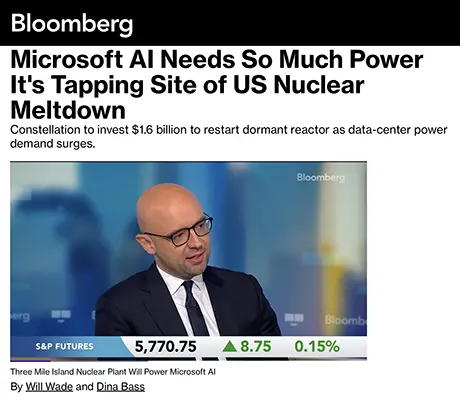
THREE MILE ISLAND NUCLEAR PLANT WILL RESTART TO POWER MICROSOFT AI
Bloomberg | Will Wade and Dina Bass | September 20, 2024
TL;DR: Microsoft’s agreement to purchase all output from a restarted Three Mile Island reactor for twenty years — the first time any tech company has secured a dedicated nuclear facility for its own use — marks a turning point in how the AI industry is sourcing power.
Executive Summary
Constellation Energy, the largest U.S. nuclear operator, announced a $1.6 billion investment to restart the undamaged reactor at Three Mile Island — the Pennsylvania site historically associated with the 1979 partial meltdown — and sell its entire 837-megawatt output to Microsoft under a twenty-year contract. The reactor was shut in 2019 for economic reasons, not safety ones. Constellation plans to rename it the Crane Clean Energy Center and seek an operating license extension through 2054.
The business logic is direct: Microsoft is overhauling its entire product line around AI. That has increased its data center power demand to a point where its own 2030 carbon-negative commitment is now in jeopardy, as the company itself acknowledged earlier in 2024. Nuclear power — which runs around the clock, produces no direct carbon emissions, and generates a consistent baseload load — matches data center operating requirements in ways that wind and solar, which are intermittent, do not. As Microsoft’s VP of energy put it, the alignment is simple: data centers and nuclear plants both run continuously.
Amazon moved in a parallel direction, agreeing to spend $650 million to acquire a data center campus directly connected to a nuclear plant in Pennsylvania. NextEra Energy has also stated it is considering restarting a closed Iowa reactor to serve data center customers. The article notes, however, that industry experts identify few other mothballed reactors suitable for restart beyond the three disclosed efforts. Supply of restartable reactors is limited.
The article is a brief news report, paywalled, with a narrow scope. It does not examine the full economic terms of the Microsoft deal or address broader infrastructure questions. Its value is as a timestamped marker of a significant trend: as of September 2024, major AI companies were willing to commit to twenty-year energy contracts and nine-figure investments to secure carbon-free, reliable power.
Relevance for Business
The Microsoft–Three Mile Island deal is a signal event in the AI energy story. Its implications extend well beyond nuclear power:
First, it illustrates the scale of AI companies’ power needs: when a company generating more than $200 billion in annual revenue views securing a single nuclear reactor as essential to its product strategy, the energy constraint is real.
Second, it raises a longer-term question about the environmental claims of AI providers. Nuclear power addresses operational carbon emissions from electricity. It does not address what Microsoft itself acknowledged: the embodied carbon in concrete, steel, and chips used to build data centers. The full climate picture is materially more complex than “powered by clean energy.”
Third, the scarcity of restartable reactors means nuclear power can only partially solve the AI energy problem in the near term. It is one tool in a constrained toolkit.
Calls to Action
🔹 Treat this as a market signal, not an isolated transaction. The pattern — major AI companies securing long-term, dedicated energy sources — is now established across Microsoft, Amazon, and Meta. It will affect cloud pricing and energy market dynamics over the next decade.
🔹 Revisit the carbon claims of your AI vendors. “Powered by clean energy” varies significantly in what it covers. Ask vendors specifically what share of their compute load is matched with 24/7 carbon-free power, versus annual renewable energy certificates that may come from distant sources.
🔹 Note the scarcity constraint. The market for restartable nuclear reactors is nearly exhausted. Future AI energy solutions will need to come from new nuclear, gas, or renewables — each with different cost and timing profiles.
🔹 Monitor whether this pattern reaches SMB-relevant cloud pricing. The costs of long-term energy contracts will eventually be reflected in cloud service pricing, particularly for compute-intensive AI workloads.
Summary by ReadAboutAI.com
https://www.bloomberg.com/news/articles/2024-09-20/microsoft-s-ai-power-needs-prompt-revival-of-three-mile-island-nuclear-plant: Day 3: May 22, 2026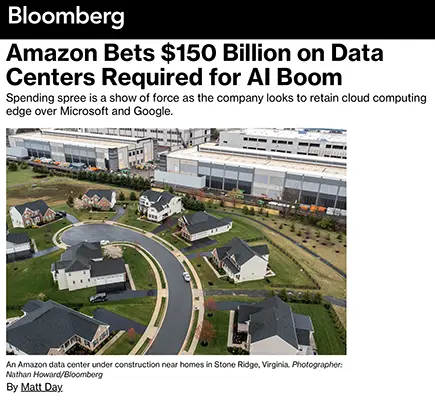
AMAZON BETS $150 BILLION ON DATA CENTERS REQUIRED FOR AI BOOM
Bloomberg | Matt Day | March 28, 2024
TL;DR: Amazon’s commitment of approximately $150 billion to data centers over fifteen years — already in progress at the time of publication — illustrates both the scale of AI infrastructure investment and the growing friction between that buildout and the power, land, and public tolerance required to sustain it.
Executive Summary
Amazon Web Services has committed to building or operating data centers around the world at a cumulative cost approaching $150 billion over the coming fifteen years, according to a Bloomberg tally of public announcements as of March 2024. This figure dwarfs comparable public disclosures from Microsoft and Google, though comparison is imprecise because companies define and report capital expenditure differently. AWS holds approximately twice the cloud market share of its nearest competitor (Microsoft) and is building to defend that lead as AI reshapes demand for computing services.
The article is most valuable not for the investment figure but for what it documents about constraint. In Virginia — historically the center of AWS’s U.S. infrastructure — Dominion Energy paused new data center connections for several months in 2022 because it could not keep up with demand. The utility projects its load will nearly double over fifteen years, driven primarily by data centers. In Oregon, Amazon’s electricity consumption from server farms has exceeded the local utility’s hydroelectric share, forcing a shift to natural gas. Getting power connected in prime data center markets now requires months of advance vetting from utilities — a significant change from five years earlier.
In response, Amazon is expanding geographically — pursuing Mississippi, Saudi Arabia, Malaysia, and other markets with available power and fewer permitting obstacles. In Mississippi, the company is building two campuses at a combined cost of approximately $10 billion, which the article describes as the largest corporate project in state history. The Mississippi buildout also illustrates the environmental tension: Amazon will help the local utility build solar farms, but will also operate its data centers with a new natural gas plant likely to run for decades. Environmental advocates quoted in the article argue that Amazon’s buying power is being used to entrench fossil fuel dependence rather than accelerate the energy transition.
AWS separately agreed to spend $650 million to acquire a data center campus directly connected to a nuclear power plant in Pennsylvania — a parallel data point to the Microsoft–Three Mile Island deal (Source 7).
Relevance for Business
This article is now approximately a year old as of the Anniversary Week publication date, which makes it useful as a baseline: the patterns it describes — geographic dispersion of data center buildout, power scarcity in prime markets, environmental tension between clean energy commitments and actual energy sourcing — have all deepened since March 2024. The Deloitte survey (Source 5) and IEA report (Source 6) provide the updated context. Read together, the Amazon article establishes that the current AI infrastructure constraints were visible and documented before they became a dominant public conversation.
For executives, the clearest implication is geographic: where data centers are being built, and what energy those locations can provide, will shape cloud availability, pricing, and reliability over the next decade. The shift from Virginia and Oregon into Mississippi, the Gulf South, and international markets is not incidental — it reflects where power can be secured. Organizations that depend heavily on specific cloud regions should understand the infrastructure constraints those regions face.
Calls to Action
🔹 Read this article in the context of what has happened since. The constraints described in March 2024 have become materially more severe by mid-2026. Use it as a baseline, not a current snapshot.
🔹 Track geographic diversification of cloud infrastructure. New data center hubs in Mississippi, Texas, and Gulf Coast states are relevant to organizations evaluating cloud region selection and redundancy planning.
🔹 Probe vendor sustainability claims with specificity. Amazon’s dual commitment to renewable energy goals and natural gas power plants in the same project illustrates how “clean energy” commitments can coexist with fossil fuel dependence at the operational level.
🔹 Note the NIMBY trend as a compounding constraint. Local opposition to data centers — noise, water use, electricity price impacts on residential customers — is growing in existing markets and will slow buildout in densely populated or well-organized communities.
🔹 Monitor the Mississippi and Gulf South buildout as a near-term capacity signal. These are among the markets most likely to come online first with significant new AI compute capacity, given available land and power.
Summary by ReadAboutAI.com
https://www.bloomberg.com/news/articles/2024-03-28/amazon-bets-150-billion-on-data-centers-required-for-ai-boom: Day 3: May 22, 2026
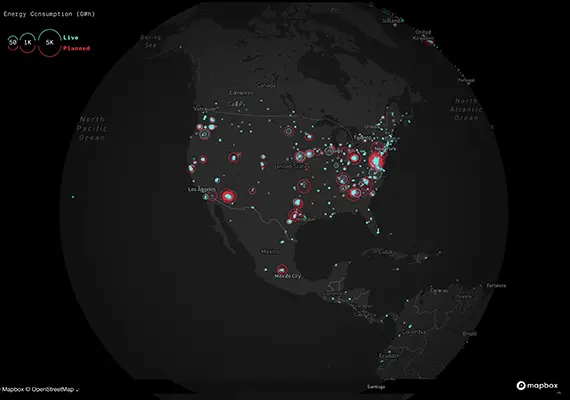
AI’s Energy Appetite Is Straining Global Power Grids
Bloomberg Technology | Josh Saul et al. | June 21, 2024
TL;DR: The surge in AI-driven data center construction is outpacing available electricity supply in major markets worldwide, creating multi-year grid connection backlogs, threatening outages, and pushing energy costs onto ordinary consumers and businesses.
Executive Summary
The scale of AI’s energy demand is no longer a future concern — it is a present infrastructure crisis. A single new data center can draw as much power as 30,000 homes. Running AI processes requires roughly 10 to 15 times more electricity than conventional computing, according to the CEO of NextEra Energy, the world’s largest private builder of wind and solar. The result: data center developers in Northern Virginia, West London, and southern Sweden are waiting two to four years just to connect to the grid. In some markets, the queue extends to 2030.
The numbers have outrun the green energy pledges. In Ireland, data centers are projected to consume a third of the country’s entire electricity supply by 2026. Bloomberg’s analysis found that planned data center capacity in several countries — including Ireland, Saudi Arabia, and Malaysia — already equals or exceeds their total renewable energy output. Microsoft has acknowledged that its AI investments are jeopardizing its long-stated goal to become carbon negative by 2030. Large cloud providers (Amazon, Google, Microsoft) have set clean-energy targets, but the gap between stated goals and actual supply is widening.
The cost of this infrastructure expansion will not stay inside tech company balance sheets. Goldman Sachs estimates U.S. utilities will need to invest roughly $50 billion in new power generation capacity to support data centers — costs that flow, at least in part, to residential and business electricity customers through rate increases. Meanwhile, large tech firms are competing in bidding wars for sites with existing grid access, driving up land and power costs in concentrated markets.
Relevance for Business
This is not primarily a story about large tech companies. It is a story about the infrastructure on which all businesses depend. Rising regional electricity prices — already documented in Ireland and projected in U.S. data center corridors — are an operational cost risk for any business in those markets. Grid reliability in high-density data center regions is under demonstrable strain; Dominion Energy reported 18 “load relief warnings” in a single spring. For businesses evaluating cloud infrastructure, facility locations, or regional expansions, energy availability and price stability are now relevant due diligence factors. The concentration of AI infrastructure in a small number of geographic clusters also creates supply chain dependencies that SMBs using cloud services may not fully price in.
Calls to Action
🔹 If your business operates in Northern Virginia, West London, parts of Ireland, or other dense data center markets, request a forward-looking energy cost projection from your utility or facilities team. Regional electricity price increases are documented and may accelerate.
🔹 When evaluating cloud or colocation vendors, ask about their facility locations, power sourcing, and grid resilience — not just uptime SLAs. These are interconnected.
🔹 Monitor utility rate filings in your state or region. Grid upgrade costs are increasingly allocated across all customer classes, not just data center operators.
🔹 If your organization has sustainability commitments tied to grid-sourced renewable energy, review whether your cloud providers can substantiate their clean energy claims — the gap between pledges and actual supply is material.
🔹 Treat this as a background risk to monitor, not an immediate operational decision — but assign someone to track regional energy policy developments annually.
Summary by ReadAboutAI.com
https://www.bloomberg.com/graphics/2024-ai-data-centers-power-grids/: Day 3: May 22, 2026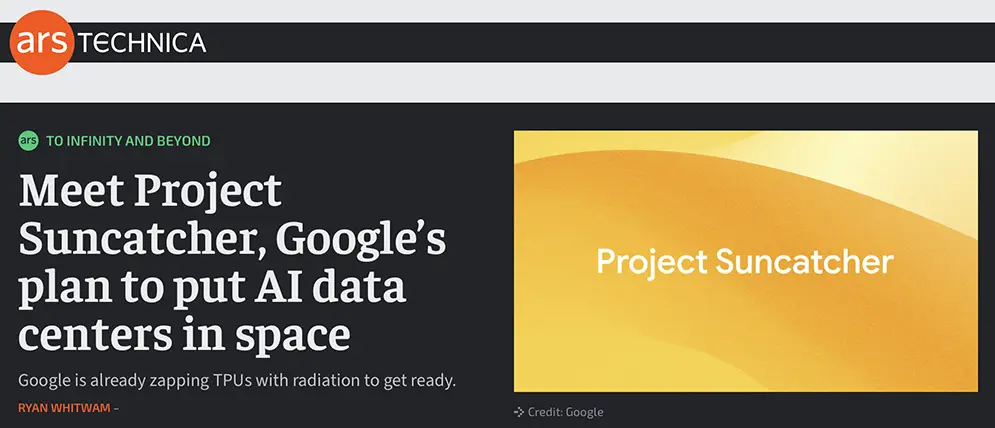
Additional Sources
AI Became an Infrastructure Story: Chips, Data Centers, and Power
POWER DEMAND & THE GRID
Bloomberg — AI’s Insatiable Need for Energy Is Straining Global Power Grids (June 2024) https://www.bloomberg.com/graphics/2024-ai-data-centers-power-grids/
IEA — Energy Demand from AI (ongoing reference report, 2025) https://www.iea.org/reports/energy-and-ai/energy-demand-from-ai
IEA — Energy Supply for AI (2025) https://www.iea.org/reports/energy-and-ai/energy-supply-for-ai
Pew Research Center — What We Know About Energy Use at U.S. Data Centers Amid the AI Boom (October 2025) https://www.pewresearch.org/short-reads/2025/10/24/what-we-know-about-energy-use-at-us-data-centers-amid-the-ai-boom/
MIT Technology Review — Hyperscale AI Data Centers: 10 Breakthrough Technologies 2026 (January 2026) https://www.technologyreview.com/2026/01/12/1129982/hyperscale-ai-data-centers-energy-usage-2026-breakthrough-technology/
NUCLEAR & ENERGY SOURCING
Bloomberg — Three Mile Island Nuclear Plant Will Restart to Power Microsoft AI (September 2024) https://www.bloomberg.com/news/articles/2024-09-20/microsoft-s-ai-power-needs-prompt-revival-of-three-mile-island-nuclear-plant
Bloomberg — Google Talks to Utilities About Nuclear Power for Data Centers (October 2024) https://www.bloomberg.com/news/articles/2024-10-08/google-talks-to-utilities-about-nuclear-power-for-data-centers
Bloomberg — Amazon Bets $150 Billion on Data Centers Required for AI Boom (March 2024) https://www.bloomberg.com/news/articles/2024-03-28/amazon-bets-150-billion-on-data-centers-required-for-ai-boom
Bloomberg — Meta Signs Multi-Gigawatt Nuclear Deals for AI Data Centers (January 2026) https://www.bloomberg.com/news/articles/2026-01-09/meta-signs-multi-gigawatt-nuclear-deals-to-power-ai-data-centers
Bloomberg Professional — AI Boom May Drive Over 60% Surge in U.S. Nuclear Capacity by 2050 (August 2025) https://www.bloomberg.com/professional/insights/artificial-intelligence/ai-boom-may-drive-over-60-surge-in-us-nuclear-capacity-by-2050/
CHIPS & SEMICONDUCTOR SUPPLY
TechPolicy.Press — Nvidia Is Building a Shield of Concentrated Power (December 2025) https://www.techpolicy.press/nvidia-is-building-a-shield-of-concentrated-power/
Reuters — Factbox: From OpenAI to Nvidia, Firms Channel Billions Into AI Infrastructure as Demand Booms(December 2025) https://www.investing.com/news/stock-market-news/factboxfrom-openai-to-nvidia-firms-channel-billions-into-ai-infrastructure-as-demand-booms-4423219 ⚠️ This is an Investing.com reproduction of a Reuters factbox —
Bloomberg — Nvidia Looks to Extend AI Dominance With New Blackwell Chips (March 2024) https://www.bloomberg.com/news/videos/2024-03-19/nvidia-looks-to-extend-ai-dominance-with-new-blackwell-chips
CAPITAL EXPENDITURE & THE BUILDOUT
Bloomberg — Microsoft to Spend $80 Billion on AI Data Centers This Year (January 2025) https://www.bloomberg.com/news/articles/2025-01-03/microsoft-to-spend-80-billion-on-ai-data-centers-this-year
Bloomberg — OpenAI, Oracle Expand Stargate With 5 New Data Center Sites in U.S. (September 2025) https://www.bloomberg.com/news/articles/2025-09-23/openai-oracle-expand-stargate-with-5-new-data-center-sites-in-us
Bloomberg — OpenAI, SoftBank Invest $1 Billion in Stargate Partner SB Energy (January 2026) https://www.bloomberg.com/news/articles/2026-01-09/openai-softbank-invest-1-billion-in-stargate-partner-sb-energy
Reuters (via Yahoo Finance) — SoftBank and OpenAI’s Stargate: Early Challenges (July 2025) https://finance.yahoo.com/news/softbank-openais-stargate-aims-building-001454842.html ⚠️ Locate the original Reuters wire
GRID STRAIN, PERMITTING & POLICY
Belfer Center (Harvard Kennedy School) — AI, Data Centers, and the U.S. Electric Grid: A Watershed Moment(February 2026) https://www.belfercenter.org/research-analysis/ai-data-centers-us-electric-grid ⚠️ Strong contextual reference; use for background framing only.
RAND Corporation — AI’s Power Requirements Under Exponential Growth (January 2025) https://www.rand.org/pubs/research_reports/RRA3572-1.html ⚠️ Use for background framing only.
Deloitte Insights — Can U.S. Infrastructure Keep Up With the AI Economy? (December 2025) https://www.deloitte.com/us/en/insights/industry/power-and-utilities/data-center-infrastructure-artificial-intelligence.html ⚠️ Vendor/analyst report — “This analysis was produced by Deloitte and represents analyst opinion.”
BROADER INDUSTRIAL FRAMING
Bloomberg Professional — AI Is a Game Changer for Power Demand (October 2025) https://www.bloomberg.com/professional/insights/artificial-intelligence/ai-a-game-changer-for-power-demand/
List Created by ReadAboutAI.com
Back to the Anniversary Week Overview page
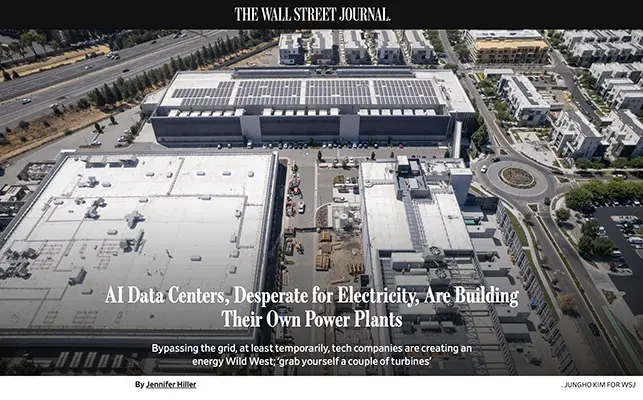
Closing: AI update for Anniversary Day 3: AI Became an Infrastructure Story
The infrastructure constraints documented across these sources did not emerge suddenly and will not resolve quickly; they are the predictable consequence of building an industry at speed without building the physical foundation beneath it first. For executives, the practical takeaway is straightforward: the cost and availability of AI compute over the next three to five years will be shaped less by which models win and more by which companies secured their power supply early — and that dynamic is worth factoring into every cloud vendor assessment and AI budget conversation you have in 2026.
The energy story that emerged alongside the capital story is the one most likely to shape AI’s trajectory through the rest of the decade. U.S. data centers consumed roughly 183 terawatt-hours of electricity in 2024 — more than 4 percent of national consumption — with projections pointing toward a doubling or more by 2030. That demand forced a reckoning with the physical limits of the existing grid: voltage fluctuations, interconnection backlogs, transformer shortages stretching to 200-week lead times, and communities beginning to push back on facilities that draw enormous power while creating relatively few permanent jobs. The response from the largest operators was telling.
Microsoft restarted Three Mile Island. Meta signed multi-gigawatt nuclear deals. Google opened nuclear supply discussions with utilities. Meanwhile, Nvidia’s near-total dominance of the AI chip market — 70 to 95 percent share by most estimates — drew regulatory scrutiny across three continents, while hyperscalers quietly built custom silicon to reduce their dependency. What changed in one year is the recognition that AI leadership is now partly an infrastructure and energy policy question, not just a technology one. The companies and countries that can secure reliable, scalable power will shape what gets built — and where.
All Summaries by ReadAboutAI.com
Back to the Anniversary Week Overview page
↑ Back to Top