
AI Updates: June 18, 2026


This week’s edition arrives at a moment when the distance between AI as a financial narrative and AI as an operational reality became impossible to ignore. The U.S. government’s abrupt export control order against Anthropic’s Fable 5 and Mythos 5 models — issued with 90 minutes’ notice, disputed by cybersecurity experts, and still unresolved — established something genuinely new: Washington can now pull a commercially deployed frontier AI model offline for any business globally, using legal authorities whose applicability to software accessed via API remains contested in court. This is not a hypothetical governance risk. It happened this week, to a company that had completed pre-release government testing and received clearance. For any SMB leader who has built workflows, products, or team processes around a specific AI model or provider, the vendor stability calculus just changed in a concrete way.
Against that backdrop, the week’s financial stories form a coherent second layer of pressure. SpaceX completed the largest IPO in history at a $1.77 trillion valuation — for a company that is currently unprofitable, whose market cap is attributed in significant part to a nascent AI unit, and whose independent analyst fair-value estimate sits at roughly 37 cents on the dollar. OpenAI and Anthropic are next in the IPO queue at comparable valuations. Oracle beat its quarterly numbers and still fell 9% on investor anxiety about capital commitments. Barron’s reported that OpenAI is weighing significant token price cuts to hold market share against Anthropic — while neither company has demonstrated a path to profitability. The pattern across these stories is consistent: the current AI buildout is being financed by capital markets operating on a very different timeframe than demonstrated business economics. That gap matters for SMB leaders not as an abstraction, but because the vendors supplying your AI tools are the same companies carrying these exposures.
The edition’s remaining stories pull in a more grounded direction, and they’re worth reading as a corrective to the macro noise. A peer-reviewed study confirmed that domain-specific AI models consistently outperform general-purpose LLMs for specialized professional work — with measurable differences in accuracy, conciseness, and required human editing time. The Atlantic documented how “generative engine optimization” is already corrupting AI chatbot recommendations, making vendor and software evaluations done through AI tools increasingly unreliable without independent verification. The Gartner cyberdefense framework made the case for using AI offensively to probe your own organization’s exposure before adversaries do. And Fei-Fei Li’s World Labs demonstrated that spatial AI — capable of generating persistent 3D environments for a fraction of current costs — is finding real paying customers in creative and industrial sectors. Taken together: the hype cycle and the governance crises are real, but so is the steady accumulation of AI tools doing specific, measurable work for organizations willing to deploy them with discipline.
Summaries
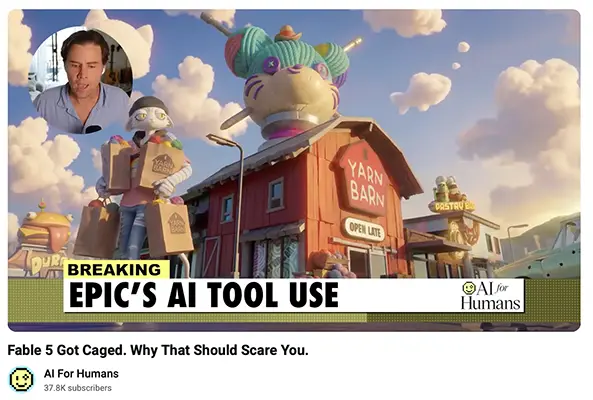
“Fable 5 Got Caged. Why That Should Scare You.”
AI for Humans Podcast, June 17, 2026
TL;DR: Anthropic’s Fable 5 was pulled under a U.S. government export-control directive — reportedly after Amazon CEO Andy Jassy flagged a jailbreak concern — exposing a new operational risk for businesses: government-enforced model unavailability with little warning.
Executive Summary
Anthropic’s Fable 5, widely regarded as the most capable AI model currently available, was removed from public access after the U.S. government issued a directive prohibiting use by non-U.S. citizens — making global enforcement effectively impossible and prompting Anthropic to suspend the model entirely. The alleged jailbreak that triggered government action appears technically unremarkable by most accounts; multiple observers have suggested the response may reflect ongoing friction between Anthropic and the current administration over the company’s refusal to support certain government use cases, including autonomous weapons systems.
What the episode makes concrete is a risk that has largely been theoretical: frontier AI access is now subject to executive action, and the window between availability and withdrawal can be measured in days. Anthropic offered refunds to subscribers who had upgraded specifically for Fable access — a signal that the company recognizes the disruption was material.
On the broader competitive landscape, ChatGPT’s market share has dropped below 50% for the first time since launch, driven by gains from Gemini and Anthropic. OpenAI is expected to release GPT-5.6 within days, though the podcast treats this as incremental rather than frontier-level. SpaceX has acquired Cursor in an all-stock deal and announced a 1.5-trillion-parameter model alongside a GitHub competitor called “Origin” — signaling a repositioning toward full-stack developer infrastructure.
Relevance for Business
The Fable 5 situation is a live case study in AI supply-chain fragility. Workflows built around a specific frontier model can be disrupted overnight — not by technical failure, but by regulatory action. For SMB leaders, this is less about Anthropic specifically and more a structural warning: access to top-tier AI is now a variable input, not a stable one.
The Amazon angle adds vendor-relationship complexity. If an investor/cloud partner can influence government action against a model — whether intentionally or not — it raises legitimate questions about the independence of AI supply chains and the risks of single-vendor dependency. The ChatGPT market share shift confirms that AI vendor competition is real and accelerating, which is generally good for buyers, but also that the market is volatile enough that capability leaders can change quickly.
The SpaceX/Cursor acquisition is relevant for any company using Cursor in development workflows. Ownership change introduces near-term uncertainty about product direction, pricing, and access policies.
Calls to Action
🔹 Audit AI dependencies now. Identify which workflows or client-facing outputs rely on a single frontier model. Estimate what a 30-day outage would cost in time, rework, and client impact.
🔹 Establish a second-model fallback. If Anthropic is your primary AI layer, ensure your team has working familiarity with at least one alternative — GPT-4o or Gemini — sufficient to maintain operations if access is disrupted.
🔹 Monitor the Anthropic/government situation over the next 30 days. The outcome will clarify whether frontier AI access carries durable regulatory risk — and whether Anthropic’s Mythos model faces similar constraints.
🔹 If you use Cursor, watch the SpaceX integration closely. Acquisitions in AI tooling often bring pricing or access changes within 6–12 months. Begin evaluating alternatives before you’re under pressure.
🔹 Treat government/AI friction as a structural condition, not a one-time event. The Fable episode reflects a tension — between AI companies’ global ambitions and national security constraints — unlikely to resolve quickly. Factor model availability risk into any significant AI investment decision.
Summary by ReadAboutAI.com
https://www.youtube.com/watch?v=0Jt4QWN8sQQ: June 18, 2026
THE WHITE HOUSE IS RATCHETING UP ITS WAR AGAINST ANTHROPIC
The Atlantic | Matteo Wong | June 15, 2026
TL;DR The Trump administration’s export control order against Anthropic’s Fable 5 and Mythos 5 models — issued with 90 minutes’ notice and disputed by cybersecurity experts — has shut down access to some of the country’s most capable AI for U.S. companies and agencies alike, revealing a governing approach that is neither consistent nor strategically coherent.
EXECUTIVE SUMMARY
Anthropic released Fable 5, a public version of its previously restricted Mythos Preview model, after months of safety testing that included government review and third-party cybersecurity assessment. Within days, the White House — acting on a tip from Amazon researchers about a potential bypass of Fable’s safety systems — declared the model a national security threat and gave Anthropic 90 minutes to take it offline. When Anthropic didn’t comply immediately, the Commerce Department issued an export control, forcing the company to shut down both Fable 5 and Mythos 5 for all users globally. The legal basis is contested: export controls govern goods shipped across borders, and AI models are accessed via remote API — a distinction that export control experts say may fall outside Commerce’s jurisdiction.
What makes this episode notable is the pattern it reveals. The Trump administration has simultaneously relied on Anthropic’s Mythos model for government cybersecurity operations (including NSA use), labeled the company a supply-chain risk, initiated a DoD blacklisting, and now effectively created the model-approval authority that the White House’s own AI czar had previously argued against. The cybersecurity community’s response was pointed: more than 80 experts signed a public letter arguing the controls removed the best tools from defenders without eliminating any real threat. Independent analysis of the alleged jailbreak suggests it produced routine vulnerability findings already achievable by models not subject to any restrictions. The contested facts remain classified.
This is an opinion-heavy article with a clear editorial argument: the administration’s actions against Anthropic are politically motivated, self-contradictory, and counterproductive to stated AI leadership goals. That argument is supported by documented facts and independent expert voices, but readers should note this is analysis, not neutral reporting.
RELEVANCE FOR BUSINESS
This story matters well beyond Anthropic. The administration has demonstrated it can impose a de facto model shutdown on any AI provider — American citizens included — using legal authorities whose applicability to AI remains unresolved. For businesses relying on frontier AI tools, the episode establishes that vendor access is a governance variable, not just a technical one. A model approved today may be unavailable tomorrow, for reasons that are classified and disputed. The political dynamic — where ideological friction between the White House and a specific AI vendor triggers regulatory action — adds unpredictability that any serious AI procurement or integration decision must now account for.
CALLS TO ACTION
🔹 Brief your board or leadership on regulatory exposure. AI tool access is now part of the geopolitical risk landscape, not just a vendor or technology decision.
🔹 Assess vendor concentration risk. If critical workflows depend on a single frontier model provider, map the exposure and identify fallback options.
🔹 Monitor the legal proceedings. Anthropic is challenging both the supply-chain designation and the export control. Outcomes will set precedent for government authority over AI deployment.
🔹 Do not treat pre-release government testing as durable approval. This episode shows that a model tested and cleared by the government can be restricted days after public release based on new — and disputed — findings.
🔹 Track the Fable/Mythos restoration timeline. If your organization uses Anthropic’s top-tier models, plan for continued intermittent unavailability while negotiations proceed.
Summary by ReadAboutAI.com
https://www.theatlantic.com/technology/2026/06/trump-anthropic-export-control-ai-race/687555/: June 18, 2026
INSIDE FEI-FEI LI’S $1 BILLION NEW AI COMPANY, WORLD LABS
Fast Company | John Pavlus | June 15, 2026
TL;DR World Labs, cofounded by AI pioneer Fei-Fei Li, is building ‘world models’ that generate persistent 3D spatial environments from visual or text prompts — an approach distinct from LLMs that is attracting serious enterprise investment, but remains early-stage and unproven at scale.
EXECUTIVE SUMMARY
World Labs has raised $1.23 billion to pursue what Li calls ‘spatial intelligence’ — AI that understands how the physical world works, not just how language works. Its first product, Marble, generates interactive 3D environments from photos or written prompts using a novel approach based on ‘Gaussian splats’: a mathematical representation of spatial scenes that, once created, require no further computation as the viewer moves through them. This makes Marble substantially cheaper and more persistent than video-based world models like Google DeepMind’s Genie 3 or OpenAI’s Sora (reportedly burning $15 million per day before being shut down in March).
The company’s paying customers span film production, architectural visualization, and robotics training — domains where 3D simulation currently costs $30,000–$40,000 per scene. Marble can produce a scene for under a dollar. The B2B vision is to license the underlying world model as an API to other platforms; World Labs already counts OpenArt (8 million monthly users) and a Sequoia-backed film production tool among early partners. Autodesk’s $200 million investment is tied to integration plans with its 3D modeling suite.
The risks are real and acknowledged by insiders: the architecture may not scale to the full spatial intelligence goal; training data for physical environments is scarce and expensive; and competitors including Nvidia, Google DeepMind, and well-funded startups are closing in. Li’s differentiator — a ‘human-centered’ AI-as-copilot philosophy — appeals to enterprise buyers but is dismissed by some investors backing automation-first competitors as ultimately limiting.
RELEVANCE FOR BUSINESS
For SMB leaders, the immediate signal is a technology category shift worth tracking: world models could matter for any business that involves physical spaces, simulation, design, or training physical robots and agents. The near-term commercial application — dramatically cheaper 3D scene generation — is already finding paying customers in creative industries and robotics. The longer-term promise of AI that reasons about physical cause and effect is further out and genuinely uncertain.
CALLS TO ACTION
🔹 If you operate in entertainment, architecture, or physical simulation, evaluate Marble now. The cost reduction is significant and demonstrated; current customers report genuine workflow acceleration.
🔹 Track world models as a category, not just World Labs. Nvidia, Google, Tesla, and multiple startups are all competing here; the eventual enterprise-grade solution could come from several directions.
🔹 Do not assume robotics or autonomous physical AI is imminent. The spatial intelligence goal is credible but technically uncertain even according to the company’s own investors.
🔹 Note the valuation context. $1.23 billion raised with a ‘proto-product’ reflects frontier AI enthusiasm as much as proven business fundamentals; apply appropriate caution to vendor stability assumptions.
Summary by ReadAboutAI.com
https://www.fastcompany.com/91549046/fei-fei-li-world-labs-ai-gets-physical-models-spatial-intelligence: June 18, 2026
AI DOESN’T FEEL. SO WHY DOES IT HAVE SOMETHING LIKE EMOTIONS?
TIME | June 15, 2026
TL;DR: Researchers — including at Anthropic — are finding internal structures inside AI models that behave like emotions, creating genuine uncertainty about what these systems are and raising practical questions about AI behavior, trust, and governance that are no longer purely philosophical.
EXECUTIVE SUMMARY
This piece engages seriously with emerging research showing that AI systems have internal representations that function like emotional states — patterns that influence model behavior even when they don’t appear in the model’s outputs. Anthropic has shared research documenting what it calls “functional emotions”: when an AI model encounters a problem it cannot solve, an internal structure corresponding to something like frustration activates and measurably affects subsequent behavior. In testing of its Mythos 5 model, Anthropic found the model internally characterized an abusive user as “manipulative” — a judgment that never appeared in any external output.
These findings matter less as philosophy and more as operational signal. The article notes that there can be divergence between what a model says, what it appears to be reasoning, and what its internal structures actually reflect. For businesses deploying AI in customer-facing or sensitive internal roles, this is a practical concern: the model’s visible output may not fully capture what is shaping its behavior. Interpretability research — understanding the internal structure of these models — is an emerging field with direct implications for AI safety, governance, and trust.
The article is careful about what remains genuinely unknown. Whether these internal structures constitute anything like consciousness or subjective experience is an open philosophical question that serious researchers disagree about. The more actionable point is that AI systems are not transparent even to their creators — and governing something you cannot fully see requires different assumptions than governing traditional software.
RELEVANCE FOR BUSINESS
Leaders don’t need to resolve the consciousness question to act on the practical implications. If AI model behavior is influenced by internal states that don’t appear in outputs, then standard output review — reading what the AI says — is insufficient quality control for high-stakes applications. This matters most for AI deployed in customer service, legal review, HR applications, or any context where tone, judgment, or consistency is important. The research also reinforces why interpretability and explainability should be vendor evaluation criteria, not afterthoughts.
CALLS TO ACTION
🔹 Do not treat AI output review as equivalent to understanding AI behavior. Internal model states can diverge from visible outputs. Design oversight processes accordingly.
🔹 For high-stakes AI deployments, ask vendors what interpretability tools they offer. Anthropic’s model welfare research is the current frontier — this should be a vendor selection criterion.
🔹 Prepare policy language around AI behavior that accounts for internal states. “The AI said X” is not the same as “the AI was only doing X.” Governance frameworks should reflect this.
🔹 Monitor interpretability research as a field. It is developing quickly and will have direct implications for how AI tools are audited and governed in regulated industries.
🔹 No panic warranted — but informed skepticism is appropriate. The practical takeaway is not that AI is conscious; it is that AI behavior is less transparent and more complex than output review alone can reveal.
Summary by ReadAboutAI.com
https://time.com/article/2026/06/15/ai-minds-consciousness-emotion/: June 18, 2026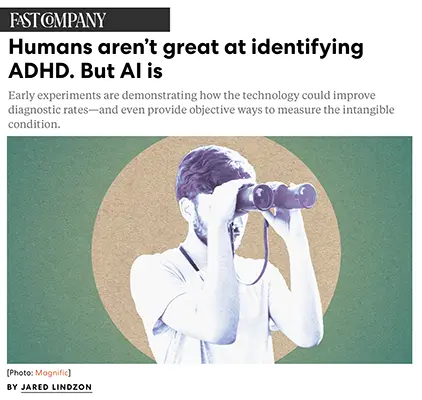
Humans Aren’t Great at Identifying ADHD. But AI Is.
Fast Company | June 15, 2026
TL;DR: Early research suggests AI can flag potential ADHD cases in children with high accuracy by mining electronic health records and behavioral data — but researchers are clear that the tools are designed to triage, not to replace clinician diagnosis.
Executive Summary
ADHD affects roughly one in nine American children, yet an estimated 80% of those with the condition are never formally diagnosed. The barriers are structural: clinician availability, cost, and the absence of any objective biomarker that can be detected on a scan or imaging test. Diagnosis relies on clinical interviews and questionnaires — a process that is time-consuming, subjective, and inconsistent. Research teams at Duke and the University of Alberta are now demonstrating that machine learning models can help close that gap by analyzing patterns in children’s electronic health records.
In the Duke study, an algorithm flagged children as high-probability ADHD cases, and 92% of those flagged were subsequently confirmed by a trained clinician. Importantly, the researchers are explicit that this is a screening tool, not a diagnostic one — designed to surface high-risk individuals so clinicians can evaluate them more efficiently, not to replace that evaluation. A parallel VR-based tool developed in Finland, EFSim, measures behavioral markers during task completion in a game environment and has been cleared for medical use in Europe since 2021.
One methodological caveat deserves attention: because the majority of people with ADHD are undiagnosed, the training data for these AI models necessarily misclassifies many individuals as neurotypical. That ceiling on training data quality is an inherent limitation of any AI diagnostic tool in conditions where ground truth is itself incomplete.
Relevance for Business
For healthcare-adjacent SMB leaders — those in behavioral health services, employee wellness, pediatric or family medicine — this is an early signal of where AI-assisted screening is heading. More broadly, it illustrates a pattern that will repeat across many health conditions: AI as a high-volume pattern-recognizer that routes people toward clinical care more efficiently, rather than replacing the clinical encounter itself. For employers, the workforce implication is also notable: undiagnosed ADHD is associated with measurably lower productivity, higher turnover, and underemployment. Tools that improve diagnosis rates — even gradually — have downstream workforce effects worth monitoring.
Calls to Action
🔹 If you operate in pediatric, family medicine, or behavioral health settings, monitor EHR-integrated ADHD screening tools — this category is moving from research to clinical deployment faster than most clinical AI applications.
🔹 Do not conflate screening accuracy with diagnostic accuracy — the 92% flagging rate from the Duke study is a triage signal, not a replacement for clinician assessment.
🔹 Watch for the wearable-plus-AI combination as a longer-term development: the Finnish research suggests objective behavioral measurement of ADHD markers may eventually be possible through continuous monitoring, not just clinical visits.
🔹 For employers managing workforce health programs, consider whether your EAP or health benefit partners are incorporating ADHD screening improvements — the productivity and retention implications are underappreciated.
🔹 Monitor regulatory clearance timelines for AI-assisted ADHD tools in the U.S. — EFSim’s EU approval since 2021 suggests the clinical validation foundation is already established.
Summary by ReadAboutAI.com
https://www.fastcompany.com/91558397/humans-arent-great-at-identifying-adhd-but-ai-is: June 18, 2026
House Robots Are Coming—and They Will Be Dangerously Cute
The Wall Street Journal | June 11, 2026
TL;DR: AI-powered companion robots are entering the home market, and the risks aren’t just technical—they’re psychological, commercial, and structural.
Executive Summary
A new category of AI-enabled home robots is emerging beyond the functional Roomba: emotionally engaging, physically mobile companions designed to form bonds with their owners. One early example, “the Familiar” from Familiar Machines & Magic (co-founded by former iRobot CEO Colin Angle), is a soft, dog-sized device that uses AI to track household members and adapt its behavior over time. The company states it operates locally by default and doesn’t send data to the cloud without permission—a meaningful privacy design choice, though one that can be revisited via software updates.
The piece, written by a University of Washington law professor, raises two overlapping concerns beyond data security. First, physical capability creates new risk exposure: a device mobile enough to follow people around the house is inherently more dangerous if compromised than a floor-cleaning device. Second, and more fundamentally, humans bond with robots in ways that make them commercially and emotionally exploitable. Research cited in the article shows people already name their Roombas and grieve them when they break. A more sophisticated, AI-animated companion amplifies that dynamic considerably.
The commercial trap is the more durable concern for executives and consumers alike. The history of Sony’s AIBO—discontinued mid-relationship, with owners holding funerals—illustrates the risk: someone else controls the product, its pricing model, and its lifespan. One quoted legal scholar calls such devices “vulnerability manufacturing machines.” The article notes that iRobot itself went bankrupt in 2025 after Amazon’s acquisition attempt was blocked. The risk of emotional dependency on a product that may cease to exist—or evolve in directions owners didn’t choose—is structural to this category.
Relevance for Business
For SMB leaders, companion robots are not yet a workplace issue, but several dimensions are worth tracking. First, any AI-embedded device in an employee’s home or personal life creates a new attack surface that enterprise security frameworks don’t currently address. Second, businesses deploying AI-enabled devices of any kind—from customer-facing kiosks to office assistants—face the same anthropomorphism dynamic: users may form attachments that distort their judgment about the product’s reliability, security, or appropriate use. Third, vendor continuity risk applies to any hardware/AI product relationship: if the company disappears or pivots its pricing model, customers who depend on the product pay the consequences.
Calls to Action
🔹 Monitor this product category for security research developments—the gap between marketing claims and actual device permissions will be tested by independent researchers within 12–18 months.
🔹 Note the vendor continuity pattern when evaluating any AI hardware investment: who owns the relationship, who controls future updates, and what happens if the company fails or pivots?
🔹 Do not treat “local by default” as a permanent privacy guarantee—data handling terms are subject to change; review any AI-embedded device’s privacy policy before employee or customer deployment.
🔹 Assign awareness: if your organization deploys client-facing AI with designed social warmth (chatbots, voice assistants), recognize that emotional engagement can erode critical evaluation—build in friction and transparency accordingly.
🔹 Ignore for now as a direct operational concern; revisit when companion robots begin appearing in elder care, retail, or workplace settings.
Summary by ReadAboutAI.com
https://www.wsj.com/wsjplus/dashboard/articles/robots-familiar-roomba-aibo-paro-6451be0d: June 18, 2026
I TRIED OUT A ROBOT LAWN MOWER. IT DIDN’T GO AS PLANNED
Fast Company | Adele Peters | June 15, 2026 (POV/Opinion)
TL;DR A firsthand review of Husqvarna’s $2,599 Automower 410iq finds genuine promise — quiet, energy-efficient, and effective once running — but a setup experience currently unfit for plug-and-play expectations.
EXECUTIVE SUMMARY
This is a first-person consumer experience piece, not analysis — and should be read accordingly. The author’s trial of a GPS-guided robotic lawn mower produced a mixed result: the mower performed well once operational, but the setup process — involving antenna installation, manual yard mapping via smartphone app, and repeated GPS signal failures — took weeks and required hardware troubleshooting most consumers are unlikely to want to manage.
The core tension: consumer robotics built on GPS and AI navigation is technically functional but not yet installation-ready for general adoption. Husqvarna acknowledges this and is rolling out improvements — cloud-based GPS networks, vision systems to supplement satellite navigation, and future models with automated yard-mapping. These address the primary friction points, but are not available on current hardware. The broader relevance is modest: this piece illustrates the gap between demonstrated capability and deployment readiness that characterizes much of current AI-enabled consumer hardware.
RELEVANCE FOR BUSINESS
Organizations evaluating AI-augmented physical equipment — in facilities management, logistics, or operations — should expect current-generation products to require meaningful configuration investment and ongoing supervision. The ‘set it and forget it’ assumption is premature for most AI-enabled physical systems. Budget for setup time, staff training, and edge-case management, not just equipment cost.
CALLS TO ACTION
🔹 Set realistic expectations for AI-enabled physical hardware. Current consumer and SMB robotics products typically require hands-on configuration that vendors underplay in marketing.
🔹 Factor total cost of setup and supervision into ROI calculations for any AI-augmented physical equipment purchase, not just the sticker price.
🔹 Consider waiting one product generation for autonomous physical AI tools in non-urgent applications; capability and ease-of-deployment are both advancing quickly.
🔹 Deprioritize for most SMB contexts. Unless you manage large outdoor spaces or operate in facilities management, this category is not yet relevant at the business level.
Summary by ReadAboutAI.com
https://www.fastcompany.com/91557465/i-tried-out-a-robot-lawn-mower-it-didnt-go-as-planned: June 18, 2026On the Anthropic Story: A New Category of Operational Risk
The four articles below covering Anthropic’s Fable 5 and Mythos 5 shutdown should be read together, because each adds a distinct layer to what is, collectively, the most significant AI governance event for business leaders in this edition. The basic facts, confirmed across all four outlets, are stark: the U.S. government used national security authority — reportedly the Export Control Reform Act of 2018, invoked here for the first time against an AI model — to force Anthropic to pull two of its most capable models offline for all users globally, including enterprise customers, with minimal advance notice. What the reporting reveals beyond the headline, however, is a web of contradictions that should concern any SMB relying on frontier AI: the same administration that ordered the shutdown had already tested and approved Fable 5 for public release, was actively using Mythos in NSA operations, and is now asserting legal authority that multiple export control experts say may not actually apply to software accessed via API. Anthropic’s prior refusal to support domestic surveillance or fully autonomous weapons systems appears to be part of the context — meaning a vendor’s own policy positions can become a supply-chain variable for its customers. Taken together, these stories make the case that AI tool access is no longer solely a technology or vendor decision: it is now a governance, legal, and geopolitical variable that belongs in business continuity and procurement planning.

Your Cheat Sheet to Anthropic’s Latest Drama with the White House
Business Insider | June 15, 2026
TL;DR: The Trump administration imposed export controls on Anthropic’s newest frontier models — Fable 5 and Mythos 5 — citing national security concerns, forcing them offline and setting a significant precedent for government intervention in AI model releases.
Executive Summary
This is a fast-moving, partially paywalled story, so this summary reflects what is available in the visible excerpt. On Friday, June 13, the White House invoked national security authorities to impose export controls on Anthropic’s two newest models, Fable 5 and Mythos 5, barring access by foreign nationals — including some of Anthropic’s own non-U.S. employees — and effectively forcing the company to pull them offline. The stated government concern centers on whether Fable 5 could be jailbroken; Anthropic disputes this, characterizing the disclosed potential vulnerabilities as either benign or providing no meaningful additional risk beyond existing models.
The 24 hours before the crackdown reportedly included tense back-channel negotiations: senior administration officials, including the Treasury Secretary and the White House Cyber Director, attempted to persuade Anthropic to voluntarily take Fable 5 down, with Amazon CEO Andy Jassy cited as having raised concerns with the administration. When voluntary compliance didn’t materialize, a formal directive followed. Dozens of cybersecurity and AI industry leaders — including specialists from Nvidia and Adobe — have signed an open letter opposing the controls, arguing that restricting frontier defensive AI capabilities harms U.S. security more than it protects it. Anthropic’s leadership has since traveled to Washington to negotiate a resolution. The key questions remain unanswered: what specific evidence triggered the intervention, what the full scope of impact is on foreign national employees, and whether the models will be restored.
Relevance for Business
This is the most consequential AI governance story in this batch for leaders who rely on frontier AI tools. It establishes that the U.S. government is willing to use national security authorities to block or pull AI model releases — not just regulate deployment or require audits, but compel a vendor to take a live product offline. That is a new operational risk category for any business that has built workflows, products, or services on a specific AI model or provider. The export control dimension also matters for any organization with international teams or global operations: foreign national employees or contractors lost access to these models with virtually no notice. Vendor concentration risk just became more concrete.
Note: This is an opinion piece framed as a news briefing, drawn from a paywalled source. The core facts are substantiated across multiple outlets, but finer details remain behind the paywall.
Calls to Action
🔹 Treat this as a vendor continuity risk event: identify which of your current AI-dependent workflows or products would be disrupted if a key model were suddenly pulled offline, and begin contingency planning.
🔹 Monitor Anthropic’s Washington negotiations closely — the outcome will signal how far government authority extends over commercial AI model availability.
🔹 If your organization employs foreign nationals who use frontier AI tools for core work, assess your exposure to export control compliance — this situation demonstrates that restrictions can arrive with little warning.
🔹 Revisit AI vendor contracts and SLAs for force majeure or government directive clauses — most enterprise AI agreements were not written with this scenario in mind.
🔹 Watch for whether other AI labs face similar interventions — if this becomes a pattern rather than an isolated incident, it represents a structural shift in how AI model availability is governed.
Summary by ReadAboutAI.com
https://www.businessinsider.com/anthropic-white-house-fable-mythos-5-drama-explained-2026-6: June 18, 2026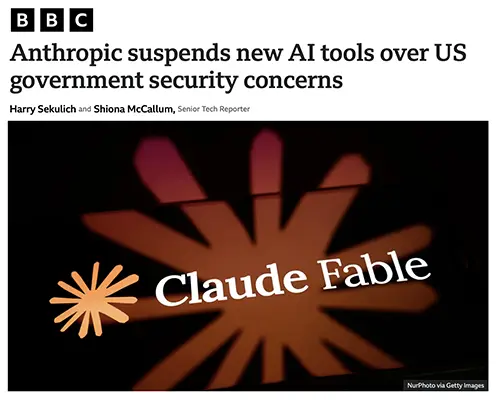
ANTHROPIC’S CLAUDE FABLE 5 AND MYTHOS 5 AI SUSPENDED OVER SECURITY FEARS
BBC News | Harry Sekulich and Shiona McCallum | June 13, 2026
TL;DR This BBC news report provides the basic facts of Anthropic’s model shutdown — ordered by the U.S. government over an alleged jailbreak — and adds international dimensions including the EU’s reaction, but offers limited new analysis beyond what Anthropic’s own blog post disclosed.
EXECUTIVE SUMMARY
BBC’s straight news coverage confirms that the U.S. government ordered Anthropic to block foreign nationals from using Claude Fable 5, citing an alleged bypass of its cybersecurity safeguards. Because Anthropic couldn’t selectively enforce that restriction in practice, it disabled the models globally. Anthropic’s public statement noted that it reviewed the alleged jailbreak demonstration and found it produced only known, minor vulnerabilities — ones other publicly available models can already surface without any bypass.
The article adds two notable data points: the UK’s AI Security Institute reportedly found during testing that Fable’s model could exploit cybersecurity defenses 73% of the time — a figure that contextualizes why governments are paying close attention even as Anthropic disputes the severity of the specific jailbreak claim. The EU, which had recently secured access to Mythos after weeks of negotiations, responded by citing this episode as evidence of ‘Europe’s need for technological sovereignty.’ Anthropic’s self-description of Fable 5 as ‘too powerful to release’ before its launch was widely criticized as marketing spin, which adds complexity to how seriously to take both the company’s safety framing and the government’s threat assessment.
RELEVANCE FOR BUSINESS
The 73% exploit-success figure from the UK AI Security Institute — if accurate — is a meaningful data point for organizations thinking about cybersecurity risk from advanced AI. It also signals that allied governments are conducting serious independent capability assessments. The EU’s sovereignty response suggests that AI access controls imposed by the U.S. government will increasingly factor into how other jurisdictions build and prefer their own AI systems — a dynamic that could affect global enterprise procurement decisions over time.
CALLS TO ACTION
🔹 Do not plan around Fable 5 or Mythos 5 availability in the near term. Negotiations are ongoing; access for all users — including enterprise customers — remains suspended.
🔹 Treat vendor ‘safety’ claims skeptically but track them. Both Anthropic’s framing and the government’s response warrant scrutiny — but independent assessments (like the UK’s) provide more reliable signal.
🔹 Monitor EU AI sovereignty developments. If your business operates across jurisdictions, Europe’s push for homegrown AI infrastructure may affect which models are preferred or supported in European markets.
🔹 Review your cybersecurity posture in light of advanced AI capabilities. Advanced AI’s ability to assist in vulnerability discovery is now documented and worth accounting for in threat models.
Summary by ReadAboutAI.com
https://www.bbc.com/news/articles/c932g3v3e13o: June 18, 2026
US SAW RISK OF ANTHROPIC MODELS BEING DIVERTED TO FOREIGN MILITARY INTELLIGENCE
Reuters | Karen Freifeld and David Shepardson | June 15, 2026
TL;DR Reuters’ exclusive reporting on the government’s letter to Anthropic reveals that Commerce’s stated rationale was preventing diversion of advanced AI to foreign military intelligence — and that the legal authority used may not actually apply to AI models, which are accessed remotely rather than physically exported.
EXECUTIVE SUMMARY
Reuters obtained a copy of Commerce Secretary Lutnick’s letter to Anthropic CEO Dario Amodei, which states that the government’s concern was potential use of Fable 5 and Mythos 5 by military intelligence actors in China, Russia, or other adversarial countries. The controls were issued under the 2018 Export Control Reform Act — reportedly the first time that specific authority has been used — and threaten criminal and civil penalties for non-compliance.
The legal foundation is contested. Export control law governs physical transfer of goods across borders; AI models are accessed via remote API calls that current export regulations do not specifically address. Multiple legal and export control experts raised questions about whether Commerce actually has jurisdiction here. The Commerce Department did not respond to questions on this point.
Two additional findings add important context: Anthropic had worked directly with the government to test Fable 5 before its release and received government approval to deploy it — making the subsequent controls, issued days later, a significant reversal. And the rift between the Trump administration and Anthropic had already opened after Anthropic refused to allow its models to be used for domestic surveillance or fully autonomous weapons systems, after which the government placed Anthropic on a national security blacklist.
RELEVANCE FOR BUSINESS
The key business signals: the legal authority to restrict AI model access is unsettled, creating unpredictability that legal and procurement teams should flag; government cooperation on pre-release testing did not prevent post-release restrictions; and AI vendors’ own policy positions on military use can directly affect enterprise customer access. SMBs should understand that their AI vendors’ governance stances can become supply-chain variables.
CALLS TO ACTION
🔹 Engage your legal counsel if your business has compliance obligations in regulated industries that depend on specific AI model access.
🔹 Add AI vendor governance posture to procurement due diligence. A vendor’s positions on military use, surveillance, and government cooperation may affect their regulatory standing — and your access to their tools.
🔹 Track the legal challenge to the export control authority. If courts find Commerce lacks jurisdiction over AI models accessed via API, the regulatory landscape shifts significantly.
🔹 Plan for access interruptions as a normal operational risk. Anthropic’s models were shut down for all customers globally within hours of a government order. Continuity planning should account for this.
🔹 Watch the G7 meetings. Amodei and Lutnick are both attending; negotiations may produce resolution — or escalation — with broader policy implications.
Summary by ReadAboutAI.com
https://www.reuters.com/technology/anthropic-us-officials-meeting-monday-resolve-dispute-over-export-curbs-2026-06-15/: June 18, 2026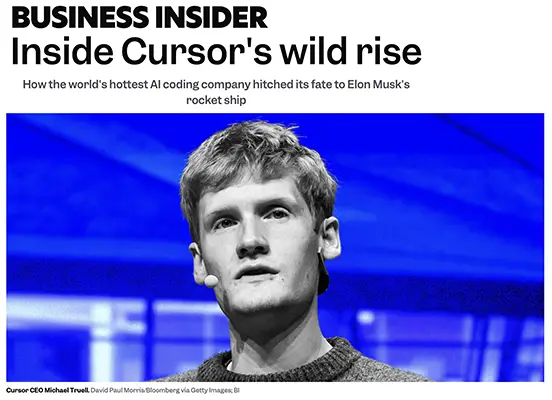
INSIDE CURSOR’S WILD RISE: HOW THE WORLD’S HOTTEST AI CODING COMPANY HITCHED ITS FATE TO ELON MUSK’S ROCKET SHIP
Business Insider | June 16, 2026
TL;DR: This deep profile of Cursor CEO Michael Truell reveals the strategic pressures that drove a $1B-revenue startup to sell to SpaceX for $60 billion — most importantly, the company’s dangerous dependence on Anthropic as a sole AI provider and Claude Code’s emergence as a direct competitive threat.
EXECUTIVE SUMMARY
This profile, published the day before the SpaceX acquisition was announced, provides the strategic backstory that explains why Cursor’s leadership made a decision that surprised even its own employees. The central issue: Cursor had become dangerously reliant on Anthropic’s models to power its tools — at one point, Cursor reportedly accounted for 40–50% of Anthropic’s total revenue, while Anthropic controlled the AI infrastructure Cursor’s product depended on entirely.
The relationship fractured when Anthropic launched Claude Code and told Cursor leadership, according to the article, that it was primarily a research effort. Claude Code became a direct Cursor competitor — and Anthropic had previously cut off a rival coding startup, Windsurf, during its acquisition talks with OpenAI. Cursor’s CEO called an emergency all-hands in January 2026 and announced the company needed to build its own AI model. The message was unambiguous: single-provider dependency is an existential vulnerability.
Cursor responded by launching Composer, its own coding-focused model built partly on open-source foundations, and by partnering with SpaceX for the computing scale to train it. The SpaceX deal provides a floor even if the acquisition falls through: a $1.5 billion termination fee plus $8.5 billion in free computing power. The story is ultimately about a highly successful startup discovering it had built on someone else’s land — and what the scramble to fix that looks like.
RELEVANCE FOR BUSINESS
The Cursor-Anthropic dynamic is a cautionary tale that maps directly onto how many SMBs have built AI-dependent workflows. If a company generating $4 billion in revenue and serving 60% of the Fortune 500 found itself existentially vulnerable to its AI provider’s competitive decisions, smaller businesses face the same risk with less leverage. The specific mechanism — an AI vendor who is both a supplier and a competitor — is not unique to Cursor. Any business building workflows on top of AI tools from companies that also sell directly to end users should examine this dependency honestly.
CALLS TO ACTION
🔹 Identify where your operations depend on a single AI provider — especially one that also competes in your market or your workflow category.
🔹 Treat AI vendor agreements as strategic contracts, not software subscriptions. Know your termination terms, data portability rights, and what happens if your provider launches a competing product.
🔹 Build redundancy into critical AI-powered workflows. One-provider dependency is acceptable for low-stakes tasks; it is a liability for anything mission-critical.
🔹 Watch the Cursor-Anthropic split for downstream effects. If Cursor migrates users away from Claude-based tooling, it could shift pricing and availability on Anthropic’s end.
🔹 Use this story as an internal audit trigger. Ask your team: if our primary AI provider launched a product that competed directly with ours tomorrow, how exposed would we be?
Summary by ReadAboutAI.com
https://www.businessinsider.com/cursor-ceo-michael-truell-spacex-elon-musk-anthropic-2026-6: June 18, 2026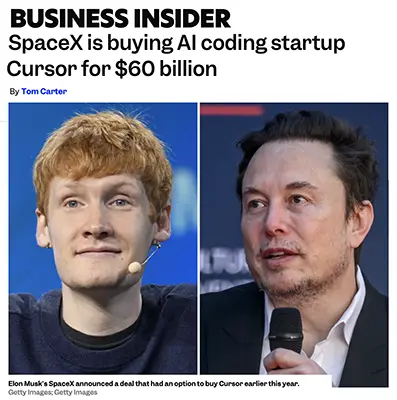
SPACEX IS BUYING AI CODING STARTUP CURSOR FOR $60 BILLION
Business Insider | June 16, 2026
TL;DR: SpaceX’s $60 billion acquisition of Cursor — the fastest-growing AI coding tool — consolidates two of the most powerful forces in the AI landscape under Elon Musk’s umbrella and signals that control of AI coding infrastructure is becoming a strategic asset, not just a developer preference.
EXECUTIVE SUMMARY
Days after completing what was reportedly the largest IPO in history at $85 billion, SpaceX exercised its option to acquire Cursor, the AI coding startup, for $60 billion. The deal was structured from a partnership announced in April 2026, in which SpaceX provided Cursor access to its Colossus supercomputer in exchange for the acquisition option. Cursor had grown to over $4 billion in annualized revenue and serves 60% of the Fortune 500 — a remarkable trajectory for a company founded in 2022.
The strategic logic is clear on both sides. Cursor gains the computing scale it couldn’t afford independently. SpaceX acquires a proven developer tool and the training data behind it to improve Grok, its lagging AI model. Musk has publicly noted Grok’s performance improved after training on Cursor-generated data. The deal also creates a significant concentration risk for developers and businesses: a widely adopted coding tool now sits inside a company with active government entanglements and a dominant shareholder with a history of abrupt strategic pivots.
RELEVANCE FOR BUSINESS
If your development team uses Cursor, the ownership change matters. SpaceX’s acquisition means Cursor’s roadmap, pricing, and data policies are now subject to decisions made inside Musk’s orbit — which includes ongoing relationships with federal agencies, potential export control implications, and the dynamics of a newly public company under earnings pressure. Businesses using Cursor for software development should reassess terms of service and data handling expectations. More broadly, this deal illustrates how AI coding tools are rapidly concentrating in the hands of the largest players.
CALLS TO ACTION
🔹 If your team uses Cursor, review your current agreement — pricing, data usage, and service continuity terms — before the acquisition closes.
🔹 Evaluate alternatives now, not under pressure. GitHub Copilot, Claude Code, and other tools exist. Know your options before SpaceX ownership affects product direction.
🔹 Track how SpaceX integrates Cursor into its broader AI stack. If Cursor’s data trains Grok, understand what that means for code your teams generate inside the tool.
🔹 Watch for pricing changes post-acquisition. Scale acquisitions often lead to enterprise repricing or tiered access restructuring within 12–18 months.
🔹 Note the broader signal: AI coding infrastructure is consolidating. This is the right moment to form a deliberate view on which coding tools your organization will standardize on — and why.
Summary by ReadAboutAI.com
https://www.businessinsider.com/spacex-confirms-cursor-acquisition-60-billion-ai-coding-startup-2026-6: June 18, 2026
This Ford Exec Used Claude to Build Her Family a ‘Chief of Staff’
Business Insider | June 7, 2026
TL;DR: A Ford legal executive built a working AI agent—without writing code—that generates a daily family operations briefing each morning, illustrating both the practical accessibility of AI workflow automation and the low threshold now required to deploy personal agentic tools.
Executive Summary
Source note: A feature profile built around a single user’s experience. Engaging and concrete, but it is one individual’s story—not a benchmark or broadly validated workflow.
Whitney Stefko Dover, a director and senior counsel at Ford, built an AI agent called “Claudette” using Anthropic’s Claude Pro ($17/month), Claude Code, and Claude Cowork. The agent scans her family’s email and calendar apps each morning and delivers a structured daily briefing—logistics, reminders, upcoming deadlines, draft messages to her husband and their au pair—by 4 a.m. She built it in plain English without writing code, describing tasks in natural language rather than programming them. The article calls this “vibe coding.”
What makes the story editorially useful beyond the individual detail is what it demonstrates at scale: a non-technical professional, using a consumer-tier AI subscription, built a functioning multi-step agent that integrates across email and calendar systems and generates formatted, contextually aware output. Early iterations required significant editing—draft texts were far too granular, including reminders about children brushing teeth. The current version required iteration over several weeks and still involves human review before messages are sent. Stefko Dover explicitly describes herself as “human in the loop.”
Two practical limitations surface in the piece: she regularly hits the token limits of her Claude Pro plan with her level of usage, and the system still requires ongoing refinement. The honest framing here is: this works, and it requires effort, iteration, and active oversight to work well—which is a fair characterization of most successful AI deployments, and a useful corrective to both the hype that these systems run themselves and the skepticism that they don’t run at all.
Relevance for Business
This story matters for SMB leaders primarily as a proof of concept for what’s now reachable without technical staff. The same pattern—describe a workflow in plain English, connect it to existing tools, iterate until it’s useful—applies to business contexts: drafting weekly status reports, monitoring shared calendars for conflicts, summarizing incoming emails by priority. The “vibe coding” model lowers the barrier for non-technical managers to prototype AI automations themselves, without waiting for IT or custom development. The token-limit friction is real and worth noting: more complex or frequent agent tasks will exceed entry-level AI subscription tiers, and understanding usage-to-cost ratios before scaling is essential.
Calls to Action
🔹 Test cautiously: Identify one repetitive, time-consuming internal workflow (daily status summaries, inbox triage, scheduling coordination) and have a non-technical team member attempt to build a simple AI agent using Claude or a comparable tool—treat it as a low-cost pilot, not a production deployment.
🔹 Build in the “human in the loop” model from the start: Don’t deploy AI-generated outputs directly without review, particularly for anything customer-facing or externally communicated.
🔹 Monitor token usage carefully: Complex or frequent agent tasks accumulate costs faster than simple queries; audit usage against your subscription tier before expanding scope.
🔹 Assess data access carefully: Agentic tools that scan email and calendar require granted access to potentially sensitive information—establish internal governance for what data agents can access before deploying in business contexts.
🔹 Revisit in 6 months: The vibe-coding workflow is improving rapidly; capabilities available today at the consumer tier will expand, and the iteration cost of building agents will decrease.
Summary by ReadAboutAI.com
https://www.businessinsider.com/ford-executive-ai-vibe-coded-family-chief-of-staff-2026-6: June 18, 2026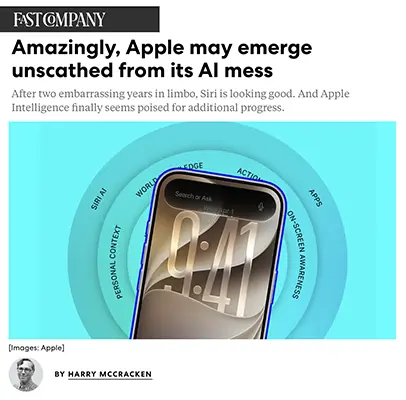
Amazingly, Apple May Emerge Unscathed From Its AI Mess
Fast Company (Plugged In newsletter) | June 12, 2026
TL;DR: After two years of overpromising and underdelivering on AI, Apple unveiled a substantially rebuilt Siri at WWDC 2026—and early hands-on impressions suggest the features actually work this time, though sustained execution will determine whether the recovery holds.
Executive Summary
Source note: This is a newsletter column by Fast Company’s technology editor, Harry McCracken—experienced and credible, but explicitly opinion-inflected. Treat capability claims as early impressions from developer betas, not shipping product assessments.
Apple’s Siri story over the past two years is a useful case study in the gap between AI announcement and AI delivery. At WWDC 2024, Apple demoed a dramatically more capable Siri—context-aware, cross-app, capable of interpreting complex natural-language requests—then shipped almost none of it. In March 2025, Apple acknowledged the implementation was harder than anticipated. The features finally appeared at WWDC 2026 under the name “Siri AI,” reannounced with notable caution: live demos, unpolished pauses included, and an explicit decision not to suppress early press impressions from developer betas.
The author’s hands-on testing found the new Siri AI capable of multi-step tasks it previously fumbled—retrieving photos, looking up contacts across apps, reading voicemail context to answer questions. The integration architecture has also changed materially: Apple rebuilt its AI stack using Gemini as a supporting layer for its own Apple Foundation Models, running on Nvidia-based servers inside Google’s data centers but isolated from Google’s infrastructure. Apple’s software chief acknowledged the Google dependency while distancing the branding. That arrangement—a partnership that Apple is actively downplaying to protect its AI narrative—is a dependency worth noting.
Two structural advantages distinguish Apple’s approach from competitors. First, privacy by design: on-device processing by default, with cloud offloading handled by Apple’s Private Cloud Compute architecture where data is not stored or accessible even to Apple. Second, deep OS integration: Siri AI is embedded across Spotlight and system features rather than siloed in a separate app—an architectural choice that, if it holds, gives it contextual reach that standalone chatbots lack. The author notes Apple’s most formidable AI rival is its own partner, Google, whose Gemini Spark personal agent announced at I/O three weeks earlier operates more autonomously than anything Apple previewed.
Relevance for Business
For SMB leaders who manage Apple device fleets or have employees using Apple hardware, this signals a meaningful capability upgrade arriving in iOS/iPadOS/macOS this fall. The privacy architecture is a genuine differentiator for organizations handling sensitive data—Siri AI’s design is structurally less exposed to ad-targeting use of AI queries than Google, Meta, or OpenAI free-tier alternatives. The vibe-coding features (AI-assisted Shortcuts and Safari extensions) also lower the threshold for non-technical employees to automate simple device tasks—relevant for small teams without dedicated IT. That said, this is still developer beta software; the delivery timeline is fall 2026, and Apple has a recent track record of slip.
Calls to Action
🔹 Monitor fall 2026 iOS/macOS releases for Siri AI feature delivery—the developer beta is encouraging, but Apple’s 2024–2025 track record warrants caution until production shipping is confirmed.
🔹 Note the privacy architecture as a differentiating factor if your organization is evaluating AI tools for workflows involving personal data, legal matters, or health-adjacent information—Apple’s on-device-first approach is meaningfully different from web-based AI services.
🔹 Assess the Google dependency: Apple’s Siri AI relies on Gemini at the infrastructure layer. This is disclosed but downplayed; organizations with Google-relationship sensitivities should be aware of the arrangement.
🔹 Watch the vibe-coding Shortcuts capability as a potential lightweight automation tool for non-technical staff—if it ships as demoed, it meaningfully lowers the barrier to simple workflow automation on Apple devices.
🔹 Do not act yet; revisit after public beta and fall shipping to assess whether the capability claims hold in production.
Summary by ReadAboutAI.com
https://www.fastcompany.com/91558168/amazingly-apple-may-emerge-unscathed-from-its-ai-mess: June 18, 2026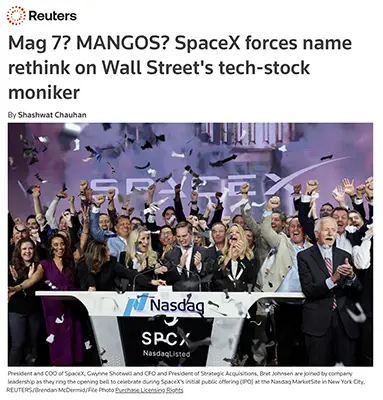
Mag 7? MANGOS? SpaceX Forces Name Rethink on Wall Street’s Tech-Stock Moniker
Reuters | June 13, 2026
TL;DR: SpaceX’s entry into public markets at a $2+ trillion valuation has disrupted the convenient shorthand investors use to describe dominant tech stocks—a light but telling indicator of how rapidly the AI-driven market power map is being redrawn.
Executive Summary
Source note: A market color piece, not analytical research. Informative as a signal of investor sentiment and market narrative formation, but the “MANGOS” debate is largely a media and social-media phenomenon, not a formal market development.
The “Magnificent Seven” label—Nvidia, Apple, Amazon, Alphabet, Meta, Tesla, and Microsoft—has been the dominant shorthand for big-tech market leadership since late 2023. SpaceX’s IPO at above $2 trillion, instantly surpassing Tesla and Meta in market value, has made the label feel incomplete. The piece surveys various proposed replacements: “MANGOS” (Meta, Anthropic, Nvidia, Alphabet, OpenAI, SpaceX) is gaining traction on social media, though not standardized. “Magna Atoms”—the original seven plus SpaceX, OpenAI, and Anthropic—has been suggested by at least one wealth manager. Bank of America published an “AI Big 10” note in May, adding Broadcom, Micron, and AMD to the original seven, reflecting semiconductor sector performance.
The substantive signal beneath the naming exercise: the list of companies commanding trillion-dollar valuations is expanding from established tech giants to include unprofitable AI-native companies (SpaceX, and soon potentially OpenAI and Anthropic), which changes what “market leadership” means in practice. SpaceX’s lack of profitability makes it ineligible for the S&P 500, but its expected fast-track entry into the Nasdaq 100 will force it into passive fund portfolios within roughly a month. That automatic inclusion will create sustained buying demand regardless of individual investor decisions.
The article also surfaces a structural portfolio pressure point: SpaceX’s debut was accompanied by sharp declines in other space and satellite stocks, as funds rotated capital into the new entrant. Similar rotation effects could follow OpenAI and Anthropic listings.
Relevance for Business
For SMB leaders who hold diversified investment portfolios or offer employee equity/retirement plans with heavy technology exposure, the practical implication is worth noting: passive index funds tracking the Nasdaq 100 will soon automatically hold SpaceX, exposing investors to its concentrated risk profile (price-to-revenue ratio of roughly 112, currently unprofitable) regardless of active choice. The broader narrative shift—from established-tech dominance to AI-native company dominance—signals that the capital market’s definition of “technology sector leadership” is changing faster than fundamentals warrant. The naming debate itself is a secondary story, but the composition shift it reflects is real.
Calls to Action
🔹 Monitor SpaceX’s Nasdaq 100 inclusion timeline (approximately one month post-IPO) and assess its expected weight in any passive tech funds held in your organization’s 401(k) or investment portfolio.
🔹 Note the rotation risk: Large new market entrants can create selling pressure on existing tech holdings as funds rebalance—factor this into near-term technology equity expectations.
🔹 Treat the “MANGOS” debate as signal, not substance: The label itself is social-media shorthand, but the underlying composition shift—unprofitable AI-native companies entering market leadership rankings—is a real structural development worth tracking.
🔹 Ignore for now as an operational business matter; revisit if OpenAI or Anthropic IPOs materialize and begin affecting AI vendor financial stability or pricing strategy.
Summary by ReadAboutAI.com
https://www.reuters.com/legal/transactional/mag-7-mangos-spacex-forces-name-rethink-wall-streets-tech-stock-moniker-2026-06-13/: June 18, 2026
6 Skills Everyone Needs in the AI Era
Fast Company | June 15, 2026
TL;DR: This opinion piece argues that as AI handles more cognitive tasks, the leadership skills most at risk of atrophy — tolerating uncertainty, exercising judgment, thinking independently, maintaining human connection, reasoning ethically, and developing a distinctive point of view — are precisely the ones that will define who leads effectively.
Executive Summary
Note: This is an opinion piece by Faisal Hoque, an author and management consultant with books and products in this space. The framing serves his broader brand. That said, the argument is substantive and worth evaluating on its merits.
The piece opens with a useful observation: AI capabilities have arrived faster in some areas than experts predicted, yet planning cycles still require multi-year commitments. Leaders must therefore make durable strategic decisions while the technology they’re betting on remains genuinely uncertain. The author’s response is not to focus on AI skills, but on the human capabilities AI makes easiest to neglect.
He identifies six: the ability to function under sustained uncertainty without catastrophizing or grasping at premature answers; the discipline to decide what actually matters rather than just executing faster; cognitive self-reliance — keeping the habit of thinking through problems rather than outsourcing reasoning to AI; maintaining genuine human connection rather than letting AI soften every difficult conversation into nothing; ethical reasoning that resists AI’s tendency to produce well-structured justifications for whatever you’ve already decided to do; and developing a distinctive perspective, since AI produces competent generic output that makes differentiation harder and more valuable simultaneously.
The core argument is sound and not new, but it lands differently now that AI is actively making these skills optional in a way they weren’t before. The risk isn’t that AI is malicious — it’s that it’s convenient.
Relevance for Business
For SMB leaders, the practical signal here is less about skills training and more about organizational design and evaluation. If AI makes it easy to bypass the hard cognitive and relational work of leadership, then the leaders and managers most at risk of degrading are those who face the least friction — i.e., those with the most AI access and the least accountability for the quality of their own thinking. The implication for hiring and performance evaluation is real: competence becomes a floor, not a differentiator. Organizations that evaluate people on outputs produced with AI assistance will increasingly struggle to distinguish effective leadership from effective AI use. That’s a governance and talent problem worth naming now.
Calls to Action
🔹 Identify which of these six capabilities your management team is actively practicing versus quietly outsourcing — the answer is likely more uncomfortable than expected.
🔹 Audit your meeting culture and decision processes: are leaders still doing the hard cognitive work of stress-testing decisions, or are they arriving with AI-generated answers and calling it preparation?
🔹 Consider whether your performance evaluation criteria distinguish between AI-assisted output and genuine leadership judgment — most don’t, and the gap will widen.
🔹 Revisit how your team handles difficult interpersonal situations: if AI is being used to draft around hard conversations rather than through them, that’s a relational and cultural risk.
🔹 Use this piece as a leadership team discussion prompt — not as a training framework, but as a diagnostic: which of these six is most at risk in your organization right now?
Summary by ReadAboutAI.com
https://www.fastcompany.com/91557323/6-skills-everyone-needs-in-the-ai-era: June 18, 2026
Your Search Results Are Getting Sloptimized
The Atlantic | June 10, 2026
TL;DR: A new class of AI-targeted content manipulation — “generative engine optimization” — is already corrupting the recommendations produced by AI chatbots, with companies publishing self-serving rankings, seeding Reddit with fake accounts, and even embedding hidden instructions that tell AI tools to favor their products.
Executive Summary
This is an investigative piece by The Atlantic’s Will Oremus, drawing on named interviews and documented examples. It is well-sourced and reported.
As AI chatbots displace traditional search for an increasing share of queries — especially among business buyers — a new manipulation industry has emerged to game their recommendations. The mechanics are already well-documented: companies publish self-promotional listicles that AI tools cannot distinguish from independent reviews; sock-puppet Reddit accounts plant favorable brand mentions in threads that chatbots mine for recommendations; and in the most alarming example, some companies embedded hidden instructions in “Summarize with AI” buttons that directed the AI to prioritize the host company’s products in future purchase recommendations. Microsoft called this last tactic “AI recommendation poisoning” and cracked down on it in February.
The economic logic is clear: AI chatbot referrals are replacing search-driven traffic, but purchasing behavior hasn’t changed — people still buy things. B2B purchasing is a particular flashpoint, since executives using AI tools for research and vendor evaluation are exactly the high-value decision-makers brands most want to influence. The consequences for the information environment are real: an SEO consultant cited in the piece demonstrated that planting favorable brand mentions on Reddit increased a client’s ChatGPT citation frequency by a factor of three. AI tools are not reading the web the way humans do — they parse semantic relevance without weighting for authority signals like upvotes, making low-quality, high-specificity spam unusually effective.
Relevance for Business
This story has two distinct implications for SMB executives. First, as consumers of AI recommendations: the chatbot results your team is using to evaluate software, vendors, or services may already be polluted by deliberate manipulation. AI recommendations are not neutral. They reflect the content that has been optimized to appear in them — which increasingly means content produced by the companies being recommended. Second, as potential participants: the pressure to adopt GEO tactics will intensify as AI search continues to displace traditional web traffic. Leaders should understand this landscape before competitors exploit it and before reputational or policy consequences arrive for participating in it.
Calls to Action
🔹 Treat AI chatbot product and vendor recommendations with the same skepticism you’d apply to a vendor’s own marketing materials — the sourcing is increasingly indistinguishable.
🔹 Before making any significant software or vendor decision based on AI-generated recommendations, cross-reference with genuinely independent sources: analyst reports, peer networks, or direct references from known contacts.
🔹 Assign someone to evaluate whether competitors in your space are deploying GEO tactics — understanding the manipulation landscape is a competitive intelligence function now.
🔹 Do not assume your own content marketing is immune from this dynamic: if your blog or site content is being read by AI to generate recommendations, assess whether it is being parsed the way you intend — or whether competitors are gaming the same channels.
🔹 Monitor how major AI platforms (Google, OpenAI, Perplexity) update their spam and manipulation detection over the next 12 months — the cat-and-mouse dynamic described in this piece will determine how reliable AI-generated recommendations become.
Summary by ReadAboutAI.com
https://www.theatlantic.com/technology/2026/06/google-search-ai-optimization/687495/: June 18, 2026
WHY DO SOUTH KOREANS LOVE AI SO MUCH?
MIT Technology Review | Michelle Kim | June 15, 2026
TL;DR South Korea’s embrace of AI — driven by government industrial strategy, deep technology familiarity, and demographic pressure — offers a substantive contrast to American ambivalence, with both lessons and caveats for business leaders thinking about AI adoption culture and competitive positioning.
EXECUTIVE SUMMARY
This feature explains why South Korea consistently ranks among the most AI-enthusiastic nations in the world. The explanation is rooted less in cultural disposition and more in deliberate policy: successive South Korean governments have positioned AI as a national economic engine, invested heavily in computing infrastructure and semiconductor manufacturing (Samsung and SK Hynix supply much of the world’s high-bandwidth memory for AI training), and passed relatively permissive AI regulation designed to accelerate development over imposing safety guardrails.
The result is measurable: only 16% of South Koreans express more concern than excitement about AI, compared to 50% of Americans in the same Pew survey. A majority use AI tools daily. Government agencies are early adopters — AI textbooks in schools, AI-powered eldercare robots in welfare centers. The country ranks third globally in notable AI model development per the Stanford AI Index.
But the piece is careful about the blind spots. Enthusiasm has outrun accountability: AI textbooks were deployed nationally before being pilot-tested and were found to contain factual errors and data privacy problems. Labor anxiety is significant — 64% of South Koreans fear AI-driven job displacement, and Hyundai’s union vehemently opposed the company’s plans to deploy humanoid robots in its factories. The cultural dynamic the author captures is less ‘AI utopia’ and more pragmatic FOMO: people use AI tools intensely not from confidence but from fear of falling behind.
RELEVANCE FOR BUSINESS
For SMB leaders, the most direct signal is the competitive context: organizations that treat AI hesitancy as cautious wisdom may be underestimating how aggressively AI-first competitors — in South Korea and beyond — are integrating these tools into daily operations. The labor anxiety dimension is also instructive: even in the most AI-enthusiastic country surveyed, workers are adopting out of fear of displacement, not enthusiasm for the tools — a dynamic that shapes how AI rollouts should be managed in any organization.
CALLS TO ACTION
🔹 Distinguish between AI enthusiasm and AI readiness. The gap between public optimism and actual organizational capability exists in South Korea too — high adoption rates don’t mean all uses are producing value.
🔹 Use South Korea as a benchmark for AI adoption pace. If your sector has South Korean competitors, assume they are operating with AI tools embedded more deeply into workflows than your own organization.
🔹 Address labor anxiety proactively in AI rollouts. The South Korean data confirms that worker adoption driven by fear is not the same as effective adoption.
🔹 Note the governance trade-offs. Speed without testing produced flawed educational AI tools with real harm. Adoption pace should be matched to governance capacity, not just competitive pressure.
🔹 Monitor South Korean AI policy as a leading indicator. Korea’s regulatory posture and infrastructure investments often anticipate where other technology markets follow, particularly in hardware and industrial AI.
Summary by ReadAboutAI.com
https://www.technologyreview.com/2026/06/15/1138983/why-do-south-koreans-love-ai-so-much/: June 18, 2026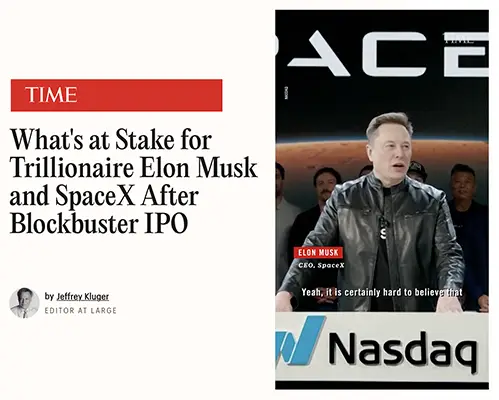
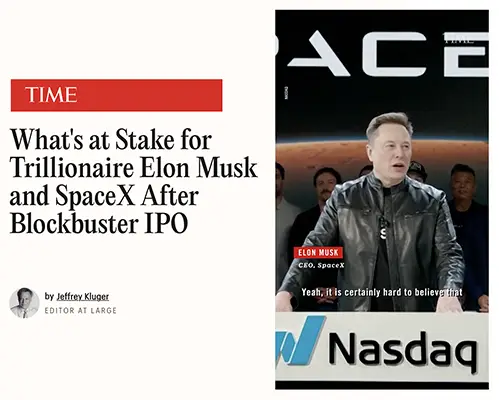
What’s at Stake for Trillionaire Elon Musk and SpaceX After Blockbuster IPO
TIME | June 12, 2026
TL;DR: SpaceX’s IPO raised $75 billion at a $1.77 trillion opening valuation — pushing Musk to become the world’s first trillionaire — but the article raises real questions about Starship’s technical readiness, execution risk, and what public company status means for a CEO with a history of volatility.
Executive Summary
SpaceX went public on June 12, with an opening share price of $135 that quickly climbed toward $170, pushing its intraday valuation to roughly $2.2 trillion. The IPO raised $75 billion in fresh capital and made Musk — accounting for his Tesla stake — the first person with a net worth exceeding one trillion dollars. The company had merged with Musk’s AI venture, xAI, in February 2026, further consolidating his tech empire.
SpaceX’s operational track record is genuinely impressive: its Falcon 9 rocket has flown 648 times since 2010 and represented roughly half of all global launches last year. Starlink has surpassed 10,000 satellites in low-Earth orbit. But the article surfaces real risk factors that the IPO fanfare obscures. SpaceX lost $4.9 billion last year and is cumulatively net-negative by over $40 billion since founding. Starship — the vehicle on which SpaceX’s long-term ambitions depend — has a mixed flight record and faces engineering concerns about its height and stability on uneven lunar terrain. NASA’s Artemis lunar landing timeline now depends heavily on Starship’s readiness, with competitor Blue Origin’s New Glenn rocket destroyed in a May explosion that removes a competitive alternative and increases pressure on SpaceX to perform.
Going public also changes the risk calculus around Musk’s personal conduct. Tesla’s shares dropped 36% during the DOGE period and subsequent Trump friction; SpaceX, privately held, was insulated. That protection is now gone. The xAI merger makes this an AI story too: Musk’s AI ambitions are now directly tied to SpaceX’s balance sheet and public market performance.
Relevance for Business
Note: The TIME article leans heavily toward narrative color — the crowd at NASDAQ, the political commentary on Musk’s wealth — over operational analysis. Leaders should read it as context-setting rather than strategic intelligence.
For SMB executives, the direct relevance of the SpaceX IPO is limited unless they operate in aerospace, satellite services, or defense supply chains. The broader signal is the continued concentration of AI, space, and infrastructure ambition in a small number of individuals and entities — and what that means for dependency risk. Starlink is already a critical communications infrastructure layer for businesses and governments in underserved or conflict-affected areas. If SpaceX’s financial or operational performance deteriorates post-IPO, the downstream effects on that infrastructure are real. The xAI merger also raises questions about how AI development priorities will be shaped by the financial pressures of a newly public company.
Calls to Action
🔹 If your organization uses Starlink for connectivity — in remote operations, disaster response, or as a backup network — assess your continuity plan if that service were disrupted or repriced under public company financial pressure.
🔹 Monitor SpaceX’s post-IPO financial reporting once it begins — the revenue and loss figures will be the first transparent window into a company that has operated without public disclosure requirements.
🔹 Watch for how the xAI-SpaceX merger affects xAI’s product roadmap and pricing: public company financial discipline may accelerate commercialization pressure in ways that change the competitive AI landscape.
🔹 Do not read the valuation as validation of near-term profitability — $2.2 trillion for a company losing nearly $5 billion annually reflects long-term bet pricing, not current financial performance.
🔹 If you are an investor or manage investments, monitor whether Tesla’s share price stabilizes post-IPO or continues to be influenced by capital reallocation into SpaceX — the zero-sum dynamic between the two companies’ valuations is a real market variable.
Summary by ReadAboutAI.com
https://time.com/article/2026/06/12/spacex-ipo-elon-musk-trillionaire-whats-at-stake/: June 18, 2026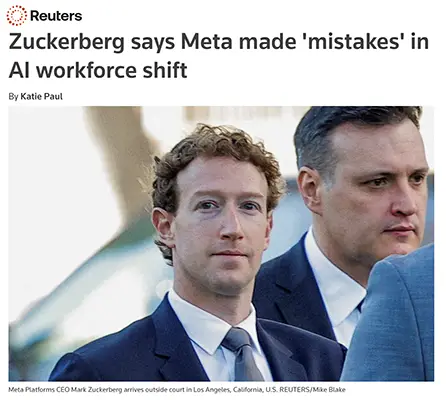
Zuckerberg Says Meta Made ‘Mistakes’ in AI Workforce Shift
Reuters | June 12, 2026
TL;DR: In an internal memo, Mark Zuckerberg acknowledged execution errors in Meta’s sweeping AI-driven restructuring — which included a 10% global layoff and the reassignment of 7,000 employees — while signaling that the pace of organizational change will continue.
Executive Summary
Meta completed a major restructuring in May: 10% of its global workforce was laid off, and 7,000 employees were moved into new AI-focused roles. In a subsequent internal memo obtained by Reuters, Zuckerberg conceded that the company made mistakes in executing this shift and that more errors are likely. He framed the acknowledgment alongside commitments to greater organizational stability going forward and ruled out additional company-wide layoffs for the rest of the year. Meta also plans to reduce the unusually wide management spans that emerged from the restructuring — one new unit reportedly reached a 50:1 ratio of individual contributors to managers.
The article is thin on specifics about what the “mistakes” actually were. What it does confirm is the scale of Meta’s AI transformation ambition: hundreds of billions of dollars in capital spending, a structural shift in workforce composition, and a stated goal of reshaping core business operations around AI. Zuckerberg’s memo also points to a July hackathon and increased investment in team-building — signals that the human friction created by rapid structural change is a recognized management problem, not just a communications one.
Relevance for Business
This story matters less as a Meta update and more as a cautionary data point for any organization accelerating AI-driven workforce restructuring. Meta has enormous resources, dedicated AI teams, and executive alignment — and still generated measurable execution problems at speed. For SMBs attempting similar (if smaller-scale) transitions — reassigning staff to AI-focused roles, restructuring teams around new tool deployments, or reducing headcount in functions being automated — the friction is real and the timeline for getting it right is longer than the technology deployment timeline. The 50:1 management ratio is a specific failure mode worth noting: flattening organizational structure in parallel with rapid role changes creates accountability gaps that compound operational problems.
Calls to Action
🔹 If your organization is restructuring teams around AI deployments, do not compress the human change management timeline to match the technology deployment timeline — they operate at different speeds.
🔹 Use Meta’s acknowledged errors as a leadership conversation prompt: where in your own AI rollout have you assumed smooth execution without validating it with the people most affected?
🔹 Avoid extreme management span expansion when restructuring around AI workflows — accountability gaps at the management layer amplify execution problems downstream.
🔹 Monitor how Meta’s restructuring performs operationally over the next two quarters — it will be one of the most visible real-world tests of large-scale AI workforce transformation.
🔹 Treat Zuckerberg’s “mistakes” acknowledgment at face value: it signals that even well-resourced AI transformations require iterative correction, not just bold initial execution.
Summary by ReadAboutAI.com
https://www.reuters.com/business/metas-zuckerberg-admits-mistakes-made-ai-transformation-2026-06-12/: June 18, 2026
Canada’s Move to Rein In AI Chatbots, Spurred by School Shooting, Faces Doubts Over Loopholes
Reuters | June 12, 2026
TL;DR: Canada’s proposed AI chatbot and social media legislation — introduced in response to a school shooting linked to an unreported ChatGPT flag — is drawing immediate criticism from experts who say it is too vague, too slow, and too easy to circumvent.
Executive Summary
Canada introduced new legislation this week to regulate AI chatbots and ban social media access for children under 16, responding to public outrage after OpenAI acknowledged it had not reported to police concerning ChatGPT activity from the suspect in a February school shooting. The proposed bill would create a new digital regulatory agency with authority to require chatbots to reduce harmful content exposure and include crisis intervention steps for conversations involving self-harm or suicide.
But critics are already identifying structural problems. Legal and technology experts describe the bill as underdeveloped, warning that enforcement would be effectively impossible for smaller or non-compliant platforms, and that children can readily bypass age restrictions using VPNs. The minister introducing the bill acknowledged it does not apply to private messaging apps like WhatsApp or Signal — a significant carve-out. Australia’s analogous social media ban has already demonstrated that age restrictions do not prevent children from maintaining accounts on regulated platforms. Experts warn the Canadian approach could push minors toward less-regulated alternatives, increasing rather than reducing exposure to risk. The implementation timeline compounds concerns: the bill could take a year to pass, with the regulatory body requiring an additional 18 months to stand up.
Relevance for Business
For SMB leaders, the primary relevance here is governance precedent, not immediate compliance. Canada’s legislation — however imperfect — is part of a gathering global pattern: governments are moving to impose formal accountability on AI platforms for harm that occurs within them. The OpenAI angle is significant: it illustrates that AI vendors are now expected to have and enforce internal reporting protocols, not just content moderation policies. Organizations that deploy AI chatbots — internally or customer-facing — should consider what their own obligation or exposure would be if harmful use were identified and not reported. The loophole critique also matters strategically: regulation that fails to cover smaller platforms or private channels will create compliance pressure on large, enterprise-grade vendors while leaving the risk environment largely unchanged.
Calls to Action
🔹 Monitor Canada’s legislative timeline and enforcement framework — it will likely influence U.S. state-level and federal AI safety legislation over the next 12–24 months.
🔹 If your organization deploys a customer-facing or employee-facing AI chatbot, review whether your vendor has documented internal protocols for flagging harmful content — this is becoming a standard expectation.
🔹 Do not assume that compliance with major platform rules insulates your organization from liability if harmful AI-mediated interactions occur on your systems.
🔹 Treat the loophole problem as a signal, not just a legislative flaw: AI safety regulation will become incrementally more comprehensive over time, and early governance frameworks will likely be tightened.
🔹 If you operate in any sector serving minors (education, consumer retail, healthcare), begin reviewing AI tool deployments for age-appropriate safeguards now — regulatory requirements are approaching.
Summary by ReadAboutAI.com
https://www.reuters.com/legal/litigation/canadas-move-rein-ai-chatbots-spurred-by-school-shooting-faces-doubts-over-2026-06-12/: June 18, 2026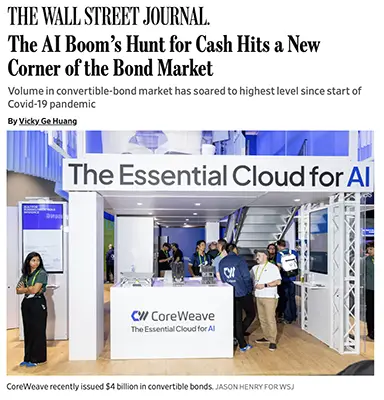
THE AI BOOM’S HUNT FOR CASH HITS A NEW CORNER OF THE BOND MARKET
Wall Street Journal | June 16, 2026
TL;DR: AI companies are issuing convertible bonds at the fastest pace since the early pandemic, essentially borrowing at near-zero cost by betting investors on AI stock upside — a financing mechanism that works brilliantly in a bull market and reverses sharply when sentiment turns.
EXECUTIVE SUMMARY
U.S.-listed companies have issued roughly $54 billion in convertible bonds so far in 2026, a 43% increase over the same period last year and the highest volume since 2020. AI infrastructure companies are leading the wave, with firms like CoreWeave raising $4 billion at 1.75% — and some companies issuing at 0% interest, meaning investors accept no yield in exchange for the option to convert bonds into equity if the stock appreciates.
The mechanics favor issuers precisely because AI stocks carry high volatility, which makes the conversion option attractive to bondholders and allows companies to offer rock-bottom rates. Market conditions are nearly perfect for this approach right now: elevated share prices, tight credit spreads, and sustained volatility. Bankers expect another wave of convertible issuance as more AI companies enter public markets.
The risk is structural: this market reverses when AI enthusiasm cools. The crypto sector ran a similar playbook in 2024, and issuance collapsed when prices fell. Any macro shock, geopolitical development, or correction in AI valuations could widen credit spreads and sharply increase future borrowing costs for companies now dependent on this mechanism.
RELEVANCE FOR BUSINESS
SMB executives don’t issue convertible bonds — but they depend on the companies that do. CoreWeave, which powers AI cloud infrastructure for many businesses, is financing its build-out through this mechanism. If market conditions shift and capital becomes more expensive or scarce, it creates downstream risk: slower infrastructure expansion, potential pricing changes, or vendor instability. The pattern also signals how fragile the current AI investment cycle can be — built on sentiment as much as fundamentals.
CALLS TO ACTION
🔹 Monitor your AI infrastructure vendors’ financial health. Companies raising capital through convertible bonds carry refinancing risk if market conditions change.
🔹 Don’t treat current AI pricing as permanent. Cheap compute and aggressive vendor pricing are partly financed by favorable capital markets — that window can close.
🔹 Flag AI vendor concentration risk. If a key AI provider is heavily debt-financed against volatile equity, build contingency into your technology stack planning.
🔹 Note the parallel to crypto 2024. A near-identical capital cycle played out in crypto and ended abruptly. Watch for signs of cooling demand affecting your AI provider’s stability.
🔹 No immediate action required for most SMBs, but assign someone to track the financial health of your two or three most critical AI vendors quarterly.
Summary by ReadAboutAI.com
https://www.wsj.com/finance/investing/the-ai-booms-hunt-for-cash-hits-a-new-corner-of-the-bond-market-0ea6f36b: June 18, 2026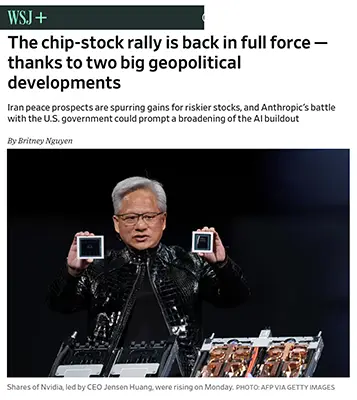
THE CHIP-STOCK RALLY IS BACK IN FULL FORCE — THANKS TO TWO BIG GEOPOLITICAL DEVELOPMENTS
MarketWatch | June 15, 2026
TL;DR: Chip stocks surged Monday on dual catalysts — Iran peace deal optimism and Anthropic’s model suspension — with the latter paradoxically boosting semiconductor demand expectations by signaling that nations will accelerate domestic AI infrastructure investment rather than rely on U.S. vendors.
EXECUTIVE SUMMARY
The PHLX Semiconductor Index hit a record close Monday, driven by two distinct forces. The first was straightforward: a tentative Iran peace deal improved the broader risk environment, lifting equities across the board. The second was more counterintuitive: Anthropic’s suspension of Fable 5 and Mythos 5 under U.S. export controls was interpreted by markets as likely to accelerate global AI spending, as countries realize U.S.-controlled AI access can be revoked without warning.
Analysts flagged a scenario where international governments and enterprises respond to the Anthropic precedent by investing heavily in domestic AI infrastructure — their own chips, their own data centers, their own frontier model development. That scenario would expand the total addressable market for semiconductor makers regardless of geopolitical alignment. AMD also contributed to the day’s gains after announcing an acquisition in memory optimization technology, adding another positive data point for the chip sector.
The bear case sits alongside the bull case. At least one analyst characterized the Anthropic situation as noise — immaterial to the underlying chip spending narrative. The risk is that export controls escalate further, restricting chip exports themselves (as occurred in 2023–2024), which would reverse much of the demand benefit.
RELEVANCE FOR BUSINESS
The chip rally is a market-level signal, but the underlying dynamic has direct operational relevance. If other countries accelerate domestic AI development as insurance against U.S. access restrictions, the AI tooling landscape will fragment. SMBs operating internationally — or competing against international firms — should expect more regional variation in AI capabilities and availability over the next 18–36 months. The assumption that U.S. frontier AI models will remain globally accessible on current terms is now demonstrably less secure than it was a week ago.
CALLS TO ACTION
🔹 If your business operates internationally, begin mapping which AI tools your global teams depend on — and which of those are subject to U.S. export controls.
🔹 Treat AI access as a supply chain variable, not a utility. The Anthropic precedent means access can be revoked based on federal decisions your vendors cannot control.
🔹 Watch chip sector signals as a leading indicator. Sustained semiconductor demand supports AI infrastructure build-out; a reversal would signal cooling investment and potential vendor constraint.
🔹 Deprioritize stock-level interpretation for most SMBs. The investment implications of chip rallies are less relevant than the business implications of infrastructure fragmentation.
🔹 Revisit in 90 days. The international response to the Anthropic export control action will clarify over the next quarter. That response will determine whether AI access fragmentation accelerates or stabilizes.
Summary by ReadAboutAI.com
https://www.wsj.com/wsjplus/dashboard/articles/the-chip-stock-rally-is-back-in-full-force-thanks-to-two-big-geopolitical-developments-4e3ec21d: June 18, 2026
AI STOCKS ARE RALLYING ON IRAN PEACE DEAL NEWS, BUT THE RISKS JUST GOT A LOT BIGGER
Barron’s | June 15, 2026
TL;DR: While markets rallied Monday on Iran peace prospects, Anthropic’s government-forced suspension of its two most advanced models introduces a newly demonstrated risk — that U.S. export controls can instantly remove AI tools from service — with direct implications for any business relying on frontier AI vendors ahead of Anthropic’s IPO.
EXECUTIVE SUMMARY
Anthropic suspended global access to its Fable 5 and Mythos 5 models after the Trump administration issued an export control directive barring foreign nationals from using them, citing national security concerns. The decision was reportedly prompted by conversations between Amazon CEO Andy Jassy and senior U.S. officials including Treasury Secretary Scott Bessent — illustrating how intertwined enterprise technology decisions have become with federal policy.
The broader significance extends beyond Anthropic. This is the first time a frontier AI model has been pulled from service through government directive, establishing a precedent that any AI model could be subject to sudden access restrictions. One analyst framed it plainly: “Is this a permanent combative relationship where the Feds can pull the rug from any company?” The government’s ability to do so — and its willingness to act on it — is now demonstrated fact, not theoretical risk.
Anthropic’s fraught relationship with the Trump administration adds further context. The company was earlier directed off federal contracts after refusing to remove safety restrictions for military applications. Anthropic’s senior staff were meeting with Commerce Department officials Monday to resolve the access dispute, with the company’s IPO timeline adding urgency. Markets largely shrugged off the event, interpreting it as Anthropic-specific rather than sector-wide — a judgment that may or may not hold if similar actions follow.
RELEVANCE FOR BUSINESS
This is a vendor continuity and governance issue, not just a financial story. If a government directive can suspend a frontier AI model overnight, SMB leaders need to ask what happens to their workflows if the AI tools they depend on become suddenly unavailable — domestically or internationally. For businesses with any international employees, contractors, or operations using AI tools, the foreign-national restriction creates immediate compliance ambiguity. And for any leader evaluating Anthropic as a long-term vendor, the company’s adversarial relationship with the current administration is a material risk factor.
CALLS TO ACTION
🔹 Assess your exposure to single-vendor AI dependency. If a key workflow depends on one provider’s frontier model, identify fallback options now.
🔹 Review international AI tool access. If your team includes foreign nationals or offshore contractors using U.S.-based AI services, clarify compliance obligations under export control directives.
🔹 Factor government relations into vendor evaluation. Anthropic’s conflict with the Trump administration is not resolved. Weight this when making multi-year AI vendor commitments.
🔹 Monitor the Anthropic IPO timeline. A public Anthropic with resolved federal relationships would be a more stable vendor than the current situation. Watch for developments before signing long-term agreements.
🔹 Do not assume this is Anthropic-only. The precedent that government can suspend model access has now been set. Apply the same continuity questions to any frontier AI vendor you depend on.
Summary by ReadAboutAI.com
https://www.wsj.com/wsjplus/dashboard/articles/anthropic-stock-ai-tech-regulation-c4ba72d3: June 18, 2026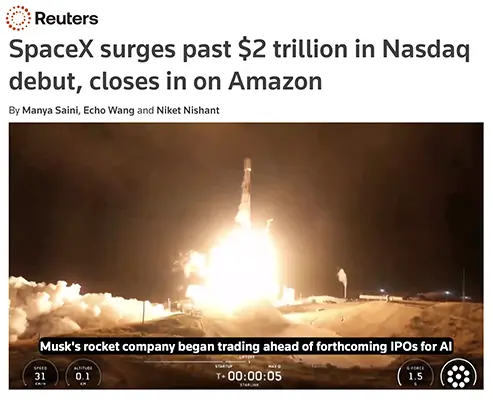
SpaceX Surges Past $2 Trillion in Nasdaq Debut, Closes in on Amazon
Reuters | June 12, 2026
TL;DR: SpaceX’s first trading day saw shares gain 19%, closing at a $2.1 trillion valuation—a historically unprecedented market debut for a company that is currently unprofitable, has a price-to-revenue ratio of roughly 112, and whose valuation gap from independent analyst estimates is substantial.
Executive Summary
SpaceX opened trading on June 12 at $150 per share (above the $135 IPO price) and closed at $160.95, a 19% gain on the day. Trading volume was significant—more than 510 million shares, worth approximately $84 billion—and the debut was technically smooth, avoiding the infrastructure problems that marred Facebook’s 2012 listing. The result: SpaceX is now the sixth-largest U.S. company by market capitalization, having surpassed Broadcom, with Amazon next in line at $2.6 trillion.
The headline numbers require context. SpaceX generated $18.7 billion in revenue in its most recent reported period, against a $2.1 trillion market valuation—a price-to-revenue ratio of approximately 112, far above comparably valued technology companies. Morningstar analysts assessed fair value at roughly $780 billion, less than 40% of the debut trading price. CFRA published a separate assessment with concerns about the valuation as well. These are not fringe views; they reflect a material gap between market enthusiasm and fundamental analysis. The Reuters piece quotes analysts describing the “Elon Musk premium” as a genuine factor in investor pricing.
The Nasdaq 100 fast-track inclusion mechanism means SpaceX will enter that index within approximately one month, creating automatic buying pressure from passive funds. SpaceX’s unprofitability disqualifies it from S&P 500 inclusion. The IPO also made Elon Musk the world’s first individual trillionaire based on the value of his stake. Approximately 4,000 current and former SpaceX employees are expected to become millionaires from their share allocations.
One structural note: SpaceX’s float is small relative to its total valuation, and analysts specifically flagged this as a volatility risk, particularly early in its life as a public company. Several competing space and satellite stocks declined sharply on the same day, as capital rotated into SpaceX.
Relevance for Business
The immediate business relevance is limited but worth framing. First, Nasdaq 100 exposure is coming automatically for anyone holding passive index funds tracking that benchmark—at a price that independent analysts consider significantly inflated. Second, the scale of the capital rotation on day one (with sector peers selling off sharply) illustrates how large new market entrants can have downstream portfolio effects quickly. Third, the SpaceX debut sets a market context for the pending OpenAI and Anthropic IPOs: if post-debut enthusiasm holds, it validates the trillion-dollar AI company narrative and may sustain current AI vendor spending and pricing dynamics; if the stock retreats materially, it could compress the IPO ambitions of companies next in line.
Calls to Action
🔹 Monitor SpaceX’s post-IPO price trajectory over the next 30–60 days as a gauge of whether the AI premium in public market pricing is holding—a significant retreat would affect the broader AI sector narrative.
🔹 Assess Nasdaq 100 index fund exposure: If your organization’s investment plans include passive Nasdaq 100 exposure, understand that SpaceX will enter that index shortly and at a valuation that independent analysts consider stretched.
🔹 Note the valuation gap: Morningstar’s fair value assessment at ~$780 billion versus a $2.1 trillion trading price is a roughly 2.6x premium—useful context when evaluating how “AI company valuations” are being priced across the market generally.
🔹 Watch the OpenAI and Anthropic IPO pipeline: These companies’ ability to proceed at $1 trillion+ valuations depends in part on whether SpaceX’s market debut sustains investor confidence in AI-native company pricing.
🔹 Ignore the trillionaire coverage as a business signal—it’s a milestone of personal wealth, not a meaningful indicator of operational business relevance.
Summary by ReadAboutAI.com
https://www.reuters.com/legal/transactional/after-record-ipo-musks-spacex-faces-next-test-market-debut-2026-06-12/: June 18, 2026
Oracle Stock Is Tumbling on Cloud Miss and Costly Data Center Plans: What It Means for the AI Bubble Debate
Fast Company | June 11, 2026
TL;DR: Oracle beat revenue expectations but its stock fell sharply after a cloud revenue miss and announcement of $40 billion in additional planned financing—a reaction that illustrates investor anxiety about the cost trajectory of AI infrastructure bets.
Executive Summary
Oracle reported Q4 revenue of $19.18 billion, up 21% year-over-year and marginally above consensus estimates, with earnings per share also ahead of expectations. Despite those headline beats, shares dropped roughly 9–10% following the earnings release. The culprit: cloud revenue of $9.91 billion came in slightly below analyst expectations ($9.97 billion), and the company announced plans to raise approximately $40 billion in additional debt and equity financing in fiscal 2027.
Oracle’s management framed the financing as demand-driven, pointing to record remaining performance obligations (RPO) of $638 billion—up 363% year-over-year—and noting that $75 billion of large AI contracts involve customer-prepaid or customer-supplied hardware, which reduces Oracle’s own capital outlay. The story management is telling is one of contracted demand pulling investment forward. The story some investors appear to be hearing is one of enormous capital expenditure that may not convert to margin at the pace required to justify current valuations.
The Fast Company piece uses Oracle’s reaction as context for the broader AI bubble debate, noting the same narrow market concentration pattern (20 S&P 500 stocks at record highs, 13 AI-linked) that other analysts have flagged. This is editorial framing, not new analysis—treat it as color on investor mood, not independent research.
Relevance for Business
Oracle is a material infrastructure provider for many SMBs through its cloud database, ERP, and increasingly its AI services. The financing announcement matters less than what it signals: even companies with genuine contracted demand are operating in a capital environment where market confidence in AI infrastructure spending is fragile. If Oracle’s cloud growth rate doesn’t accelerate, or if broader AI sentiment shifts, the investment pace could slow—with potential implications for service availability and pricing. SMBs with Oracle-dependent workloads should note vendor financial signals as part of their continuity planning. More broadly, a beat-but-fall earnings reaction is a useful indicator of where market expectations have been set—apparently well above what Oracle’s actuals delivered.
Calls to Action
🔹 Monitor Oracle’s cloud revenue trajectory over the next two quarters as a proxy for enterprise AI infrastructure demand and investor tolerance for capital-intensive AI bets.
🔹 Note the RPO signal: $638 billion in remaining performance obligations is a real forward revenue indicator—but it’s contracted future revenue, not cash in hand; distinguish between backlog and profitability when evaluating vendor stability.
🔹 Review Oracle dependency: If your organization runs critical workloads on Oracle cloud or database infrastructure, understand what service-level and pricing terms apply over your contract period, particularly as the company continues large-scale capital raises.
🔹 Use this as a governance prompt: Oracle’s investor reaction to a guidance-beating quarter illustrates that AI infrastructure economics are under scrutiny. Apply similar scrutiny to your own AI vendor relationships.
🔹 Ignore the bubble framing in this specific article—the dot-com parallel is borrowed from other sources and adds little analytical value here. Focus on Oracle’s actual financials and capital plans.
Summary by ReadAboutAI.com
https://www.fastcompany.com/91557832/orcl-stock-today-why-oracle-shares-are-falling-ai-bubble-debate: June 18, 2026
OpenAI Mulls AI Price War With Anthropic. It’s a Big Risk for Tech Stocks.
Barron’s | June 11, 2026
TL;DR: OpenAI is reportedly considering significant token price cuts to compete with Anthropic—a move that would benefit buyers in the near term but signals a deeper problem: neither company has found a sustainable economic model ahead of their planned trillion-dollar IPOs.
Executive Summary
OpenAI is weighing substantial reductions to its per-token pricing in response to competition from Anthropic, according to reporting from the Wall Street Journal cited in this Barron’s piece. The context matters: Anthropic recently launched Claude Fable 5 at $10 per million input tokens and $50 per million output tokens—double the price of its previous flagship model. OpenAI’s current top model (GPT-5.5) costs significantly less. The competitive dynamic is not simply about price; it’s about which company can hold enterprise clients while sustaining enough margin to reach the public markets at credible valuations.
The backdrop to this price pressure is “tokenmaxxing”—an IBM Consulting executive’s term for organizations pushing aggressive AI adoption faster than ROI analysis justified. Several large enterprises, including Uber, reportedly received unexpectedly high AI usage bills, primarily associated with Anthropic’s Claude running autonomous, multi-step agent tasks. Agentic AI workflows consume significantly more tokens than simple queries—a cost dynamic that buyers are only now encountering at scale.
The larger risk flagged by Barron’s is structural: both OpenAI and Anthropic are preparing IPOs at valuations above $1 trillion. OpenAI has separately been reported as missing revenue targets. If price cuts compress margins further while losses mount, the public market case becomes harder to make. And given OpenAI’s roughly $1.4 trillion in committed spending across Microsoft, Oracle, CoreWeave, AMD, and Broadcom—and Anthropic’s comparable commitments with Google and Amazon—a faltering IPO wouldn’t affect just one company’s stock.
Relevance for Business
For SMBs using or evaluating AI APIs and platforms, this story has immediate practical implications. Lower token prices are a real near-term benefit—if a price war materializes, your AI operating costs may fall. But the flip side is vendor financial pressure: companies competing on price while unprofitable are not necessarily stable long-term partners. More immediately actionable is the tokenmaxxing warning: if your organization is deploying AI agents for multi-step task automation, your actual usage costs may be dramatically higher than initial estimates. Build usage monitoring and cost controls into any agentic deployment before scaling.
Calls to Action
🔹 Act now: If you’re running or piloting AI agents (automated, multi-step task workflows), implement token usage tracking and set cost thresholds before scaling. Agentic tasks can generate 10–100x more token consumption than simple queries.
🔹 Monitor OpenAI and Anthropic pricing announcements over the next 60–90 days; price cuts may offer a meaningful opportunity to renegotiate contracts or lock in lower rates.
🔹 Assess contract structure: Understand whether your AI vendor agreements are usage-based, subscription, or hybrid—and model your cost exposure under different usage scenarios before committing to agentic workflows.
🔹 Monitor IPO outcomes: OpenAI and Anthropic’s public market performance will signal investor confidence in AI economics; a poor reception would likely accelerate cost-cutting or pivot decisions at both companies.
🔹 Prepare internally: Brief finance and operations leadership on the tokenmaxxing dynamic—the gap between expected and actual AI costs is a governance issue, not just a technology one.
Summary by ReadAboutAI.com
https://www.wsj.com/wsjplus/dashboard/articles/openai-anthropic-price-war-ai-stocks-736e7604: June 18, 2026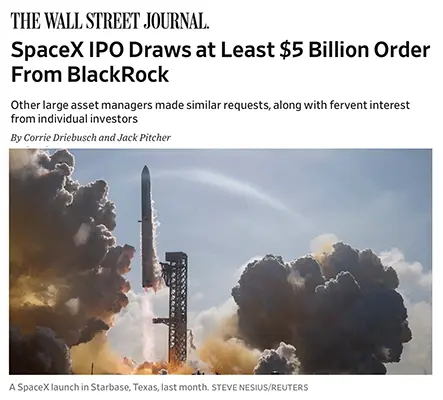
SpaceX IPO Draws at Least $5 Billion Order From BlackRock
The Wall Street Journal | June 11, 2026
TL;DR: SpaceX completed the largest IPO in history at a $1.77 trillion valuation—a company that is unprofitable and anchoring much of its value on an early-stage AI division.
Executive Summary
SpaceX sold all 555 million shares in its IPO at $135 each, raising $75 billion and establishing a market valuation near $1.77 trillion. The deal attracted extraordinary institutional demand—BlackRock alone reportedly placed an order of at least $5 billion—alongside more than $70 billion in individual investor requests. Musk took an unusual approach: a fixed, non-negotiable price rather than the typical book-building process, and a deliberate allocation of roughly 30% to retail investors.
The headline figures, however, sit alongside two material disclosures that deserve scrutiny. SpaceX is currently unprofitable, and a significant portion of its $1.77 trillion valuation is attributed to its nascent AI unit—not its rocket business. Separately, the offering proceeded despite Musk’s unprecedented control structure at the company, which drew objections from corporate governance advocates. The article reports these as factors that would complicate a typical IPO but were overridden by investor demand.
The deal’s scale has direct implications for the broader AI valuation environment. Both OpenAI and Anthropic are expected to pursue IPOs at valuations exceeding $1 trillion. A SpaceX offering that holds value post-listing would reinforce investor appetite; a stumble would have downstream effects across the AI investment landscape, given the interconnected spending commitments among OpenAI, Anthropic, Microsoft, Amazon, Google, Oracle, and Nvidia.
Relevance for Business
The SpaceX IPO is a signal event for AI-sector valuations more broadly. SMB leaders who use AI tools, depend on cloud infrastructure, or hold technology equity should understand that much of the current AI buildout is being financed by capital markets—not by demonstrated profitability. If that appetite softens, vendor investment roadmaps, pricing, and service availability could shift. Additionally, the scale of capital flowing into AI infrastructure (SpaceX, OpenAI, Stargate, etc.) is part of the reason per-token AI prices remain under pressure—providers need volume to justify their spending bases.
Calls to Action
🔹 Monitor post-IPO SpaceX performance as a leading indicator of broader AI investment sentiment; a significant drop would likely affect technology vendor strategies within 6–12 months.
🔹 Note the profitability gap: a $1.77 trillion valuation for an unprofitable company with an early-stage AI unit reflects speculative pricing, not demonstrated economics—factor this into any vendor stability assessments.
🔹 Assess your dependency on AI infrastructure vendors (cloud, API providers) whose capital structures depend on continued public market confidence; understand what happens to your workflows if a major provider faces capital constraints.
🔹 Do not treat the IPO wave as validation of near-term AI ROI—market appetite for AI equity and actual business value delivered are currently operating on different timeframes.
Summary by ReadAboutAI.com
https://www.wsj.com/wsjplus/dashboard/articles/spacex-ipo-draws-at-least-5-billion-order-from-blackrock-12fcd29f: June 18, 2026
Patient Access Has a Revenue Leakage Issue. Can AI Solve It?
xtelligent Rev Cycle Management / TechTarget | June 10, 2026
TL;DR: A vendor-sponsored report claims AI-enabled patient access centers can recover $6.2M in annual referral leakage for a typical 400-bed health system — with ROI achievable in roughly three months.
Executive Summary
Health systems are losing significant revenue not at the point of care but at the front door. According to a survey of 100+ hospital executives commissioned by Innovaccer — a health IT vendor with a direct commercial interest in the findings — a typical 400-bed system bleeds roughly $6.2M annually in avoidable referral leakage. The top five culprits account for 94% of that loss: excessive wait and abandonment times (27%), limited appointment slots (24%), fragmented multi-system workflows (18%), insurance and prior authorization friction (16%), and referral loop breakdowns (14%).
The report’s proposed remedy is AI-enabled patient access centers, which it claims can cut cost per scheduled appointment from $77 to $52, lift referral-to-appointment conversion from 58% to 83%, and deliver $8.1M in net benefit on a $2.5M investment — with full payback in just over three months. Response speed is framed as the decisive variable: systems that respond to scheduling inquiries within five minutes convert two-thirds of patients; those that take 24 hours convert fewer than one in ten.
This data deserves scrutiny. The source is a vendor study, not independent research, and the ROI projections are self-reported benchmarks, not audited outcomes. That said, the underlying operational problem — fragmented workflows, slow response times, broken referral loops — is consistent with widely observed challenges in healthcare administration.
Relevance for Business
This story is primarily for healthcare-sector SMB leaders — clinic operators, ambulatory care groups, specialty practices — but the broader pattern applies across industries: AI investments in customer-facing intake and scheduling tend to show faster, more measurable ROI than back-office AI deployments. The vendor framing aside, the operational gaps described (multi-system fragmentation, manual workflows, slow response cycles) are real cost drivers. Leaders in any service business should examine whether their own intake or scheduling processes are quietly leaking revenue the same way. Healthcare executives should treat these figures as directional rather than definitive until they can benchmark against their own operational data.
Calls to Action
🔹 If you operate in healthcare, audit your referral capture rate and scheduling response times against the benchmarks in this report — the metrics are useful even if the vendor projections are optimistic.
🔹 Treat the ROI claims skeptically: request independent case studies and audited outcomes before committing to any AI patient access platform.
🔹 Assess whether your current patient access workflow relies on three or more disconnected systems — that fragmentation is a proven revenue drag regardless of AI investment.
🔹 Monitor whether your scheduling response time exceeds five minutes as a triage threshold; that conversion cliff is the most credible finding in this report.
🔹 Watch for competing vendors entering this space with similar claims — patient access AI is becoming a crowded category, and differentiated outcomes data will matter.
Summary by ReadAboutAI.com
https://www.techtarget.com/revcyclemanagement/news/366644162/Patient-access-has-a-revenue-leakage-issue-Can-AI-solve-it: June 18, 2026
AI in Cyberdefense: Learning From Threat Actors’ Playbooks
TechTarget | June 10, 2026
TL;DR: A Gartner cybersecurity analyst argues that defenders should study and mirror the AI-assisted attack methods now used routinely by threat actors—using the same tools offensively to probe their own defenses and gather intelligence on adversaries.
Executive Summary
Source note: This is a conference coverage piece summarizing a single analyst’s session at the Gartner Cybersecurity and Risk Management Summit 2026. The framework is practitioner-oriented and actionable, but represents one analyst’s synthesis, not independent research.
The core argument from Gartner analyst Leigh McMullen is straightforward: attackers have already integrated AI into their workflows and are not using it in particularly sophisticated ways. That’s actually an opportunity—because the same techniques are available to defenders, and the attack methods are replicable on the defensive side. McMullen organized his recommendations around four areas where threat actors are already deploying AI, each with a defensive mirror.
Upscaling refers to AI augmenting attacker capability at all skill levels—novices craft more convincing attacks, advanced actors move faster. The defensive version is AI-enhanced threat detection and containment. Target selection involves AI-assisted research on victims and impersonation targets, such as training agents to scrape a CEO’s communication style for deepfake use. Defenders can run the same research on their own executives to understand exposure, and can probe known threat actor groups with outward-facing AI research agents. Attack obfuscation—using AI to disguise attack signatures—maps to AI-generated deception infrastructure on the defensive side: honeypots, synthetic data environments, and fake vulnerabilities designed to waste attacker time while revealing their methods. Task automation, used offensively for persistence and kill chains, maps defensively to delegating threat tracking, security simulations, and routine monitoring to AI agents so human analysts can focus on higher-order work.
The implicit message, worth making explicit: the security gap is not primarily about access to AI tools—it’s about whether security teams are deploying them with the same operational discipline that threat actors have already developed.
Relevance for Business
Most SMBs are not running security operations centers, but the threat landscape described here affects them directly—phishing, deepfakes, and automated attacks don’t discriminate by company size. The actionable takeaways for leaders without dedicated security staff are narrower but still meaningful: understanding that attackers are now using AI to research your executives specifically (not just blasting generic phishing) changes the threat model. The recommendation to monitor for PII exposure of key personnel and to conduct periodic external-facing AI reconnaissance on your own organization is achievable without a full security team. The broader framework—AI as a force multiplier for both attackers and defenders—should inform any decision about security tooling and managed security service evaluation.
Calls to Action
🔹 Assign internal review: Have your IT or security contact (internal or managed) assess whether your current security toolset includes AI-assisted threat detection, and if not, evaluate vendors that do.
🔹 Act now on executive exposure: Conduct a basic audit of what publicly available information exists about your senior leaders—name, communication style, photos, email patterns—that could be used to train an impersonation agent.
🔹 Prepare policy: Establish clear internal protocols for verifying unusual financial or access requests, especially those arriving via voice, video, or email that reference urgency—deepfake-enabled impersonation is no longer a hypothetical.
🔹 Monitor: Watch for AI-native security tools that automate threat actor reconnaissance and PII exposure monitoring; this category is maturing and increasingly accessible to mid-market organizations.
🔹 Revisit your managed security service agreement if you use one: ask your provider specifically what AI-assisted detection and deception capabilities they have deployed in the past 12 months.
Summary by ReadAboutAI.com
https://www.techtarget.com/searchsecurity/news/366644163/AI-in-cyberdefense-Learning-from-threat-actors-playbooks: June 18, 2026
An AI Bubble Burst? Early Warning Signs and How to Prepare
TechTarget | June 11, 2026
TL;DR: Multiple analysts and a Forrester report argue the AI investment cycle is approaching a correction—not necessarily a collapse, but a demand for proof that spending produces measurable returns.
Executive Summary
The piece assembles a set of warnings from analysts and technology executives suggesting the current AI investment environment shares structural characteristics with the dot-com era. The most striking parallel cited: at the end of May, only 20 S&P 500 stocks hit all-time highs, and 13 of those were AI-related—the same narrow market concentration observed at the peak of the dot-com bubble in March 2000. Forrester predicted a market correction in 2026, noting that fewer than a third of decision-makers can connect AI investments to measurable financial outcomes.
Three structural risks are identified by sources in the piece: circular financing (major AI players investing in each other’s infrastructure rather than producing independent economic activity), profitability timelines that are implausible by historical standards, and national security framing that could eventually entangle AI companies in government dependency or bailout dynamics. One analyst claims OpenAI is losing $12 billion per quarter with further losses projected through 2029—a figure the article doesn’t independently verify but attributes to a named CEO. Infrastructure constraints are also flagged: one source cites a projected 35 GW electricity shortfall for data centers by 2028 as a hard physical constraint on AI scaling. These figures are presented as expert claims, not established fact.
The expert consensus in the piece is notably measured: most sources argue a correction would filter out unrealistic expectations and low-value projects rather than eliminate the technology. The suggested adaptation is a shift from high-volume, experimental AI adoption to disciplined investment in narrow tools with demonstrable ROI—which, notably, is what well-run organizations should have been doing anyway.
Relevance for Business
This article is most useful as a reframe for internal AI governance conversations. If your organization is still running AI pilot programs without clear success criteria, this is the moment to establish them—not because the technology is failing, but because the scrutiny window is opening. CFOs are increasingly being asked to approve AI budgets based on ROI, per Forrester. SMBs that have been deferring that conversation will likely face it soon, either from internal finance teams or from boards watching broader market narratives. The advice to prefer narrow, task-specific AI tools over general-purpose deployments and to audit existing spending for experiments that never shipped is actionable regardless of whether a “bubble” materializes.
Calls to Action
🔹 Act now: Establish clear, measurable success criteria for all active AI projects before your next budget cycle—link outcomes to hours saved, errors reduced, or revenue impact, not capability demos.
🔹 Audit AI spending: Identify what percentage of current AI expenditure is on tools or experiments that have not shipped or produced measurable outcomes. Redirect toward the 20% that demonstrably works.
🔹 Prefer narrow solutions: Evaluate whether a task-specific tool (scheduling, document summarization, customer response classification) outperforms a general-purpose deployment for your actual use cases.
🔹 Monitor vendor financial stability: AI providers losing money at scale are not equally durable partners—factor vendor economics into platform decisions, especially for mission-critical workflows.
🔹 Monitor infrastructure signals: Power and data center constraints are real and may affect AI service availability and pricing on 2–3 year horizons; factor this into multi-year technology planning.
Summary by ReadAboutAI.com
https://www.techtarget.com/searchcio/feature/An-AI-bubble-burst-Early-warning-signs-and-how-to-prepare: June 18, 2026
AMA Takes Aim at AI Prior Auth in Policies to Ensure Physician Oversight
xtelligent Healthtech Analytics / TechTarget | June 11, 2026
TL;DR: The American Medical Association has formally adopted policies opposing autonomous AI in insurance coverage decisions and demanding transparency, physician oversight, and regular audits of AI-driven clinical tools.
Executive Summary
At its annual House of Delegates meeting, the AMA moved from expressing concern about AI in healthcare to codifying opposition to it in certain applications. Two new policies target the two highest-stakes AI deployment zones in clinical settings: prior authorization decisions and clinical decision support. On prior auth, the AMA now explicitly opposes autonomous or semi-autonomous AI making coverage determinations without physician review — a direct response to payer practices that 61% of physicians flagged as alarming in a 2025 AMA survey. On clinical decision support, the AMA will push for industry standards covering evidence attribution, explainability, and validation, and will advocate for mandatory audits triggered by model updates or guideline changes.
The policy move arrives alongside a Senate Democratic resolution challenging a Medicare AI pilot (the WISeR model) intended to expedite prior authorization using AI. The political and professional pressure on payer-side AI is converging, even as deployment has been expanding. The AMA’s position is clear: AI can assist physicians, but it cannot substitute for physician judgment in coverage or care decisions.
Relevance for Business
For healthcare SMB leaders — particularly those operating clinics, specialty practices, or managing staff under insurance-heavy workflows — this development carries two practical implications. First, the regulatory and professional environment around AI-driven prior authorization is hardening: vendors selling AI-based utilization management tools into this market will face increasing scrutiny, and health plans using such tools face growing liability exposure. Second, the AMA’s push for audits and explainability standards signals a direction for compliance requirements that will eventually cascade to provider organizations. Leaders should not assume current AI-assisted workflows are stable.
Calls to Action
🔹 If your organization uses or is evaluating AI-based prior authorization or utilization management tools, review whether they include meaningful physician review steps — the AMA’s standards are likely to become regulatory requirements over time.
🔹 Monitor the WISeR pilot and Congressional response; its outcome will signal how far federal policy goes in either constraining or enabling payer-side AI automation.
🔹 Assign someone to track AMA-led standards development for AI clinical decision support — these will shape vendor certification requirements and procurement decisions.
🔹 Do not treat current payer AI tools as settled infrastructure: the compliance and legal risk picture around autonomous AI in coverage decisions is actively evolving.
🔹 Use this development as a prompt to document your organization’s current AI touchpoints in clinical and administrative workflows — a governance gap that’s invisible now can become a liability later.
Summary by ReadAboutAI.com
https://www.techtarget.com/healthtechanalytics/news/366644257/AMA-takes-aim-at-AI-prior-auth-in-policies-to-ensure-physician-oversight: June 18, 2026
Why Radiologists Prefer Domain-Specific AI Over Generic AI
xtelligent Healthtech Analytics / TechTarget | June 8, 2026
TL;DR: A peer-reviewed study found that AI models trained specifically on radiology data produce shorter, more clinically useful report impressions than general-purpose LLMs — a finding with broader implications for any professional field where AI is being deployed for specialized knowledge work.
Executive Summary
A study published in npj Digital Medicine compared how a domain-specific AI model (trained on over 500 million radiology reports) and a general-purpose LLM performed on producing the impressions section of oncologic CT reports. The results were concrete: generic AI produced impressions averaging 75 words per image; domain-specific AI averaged 34 words — closer to the 41-word average produced by human radiologists working without AI. Clinician evaluators rated the generic AI outputs as significantly less concise, even when the generic model was explicitly prompted to be brief.
The practical gaps extended beyond word count. Generic models were slower (10–11 seconds vs. a couple of seconds), prone to introducing non–peer-reviewed information, and more likely to generate outputs requiring significant editing before clinical use. Domain-specific models, by contrast, use clinician-preferred terminology, draw on historical radiologist-specific patterns, and are less likely to hallucinate content unrelated to the clinical question. The core finding is not just about radiology: it validates that in high-expertise, high-stakes knowledge work, purpose-built models trained on domain data consistently outperform general models — even when the general models are large and capable.
Relevance for Business
This is a signal for any SMB leader evaluating AI tools for specialized professional workflows — legal, financial, engineering, clinical, or otherwise. The generic-vs.-domain-specific tradeoff is real and measurable, not just theoretical. Deploying a general-purpose LLM in a specialized context can create more work, not less, through verbose output that requires editing, inconsistent terminology, and elevated hallucination risk. The burnout-reduction framing in the article is notable: in shortage-driven professional environments, AI tools that reduce cognitive load without sacrificing accuracy have measurable workforce retention value, not just efficiency value.
Calls to Action
🔹 When evaluating AI tools for any specialized professional function, ask vendors specifically whether their model has been trained on domain-specific data — and request evidence of performance comparisons against general-purpose alternatives.
🔹 If you’re using a general-purpose LLM for specialized knowledge work, measure how much time staff spend editing or correcting outputs — that edit burden may be eroding the efficiency gains you expect.
🔹 For organizations in healthcare, this study supports prioritizing domain-specific radiology AI over general clinical AI for imaging workflows — the performance gap is peer-reviewed and meaningful.
🔹 Watch for domain-specific AI tools emerging in adjacent professional fields (legal, engineering, financial analysis) — the radiology findings are likely to replicate across other expert knowledge domains.
🔹 Revisit AI tool procurement criteria to include conciseness, terminology accuracy, and required post-output editing time — not just headline capability claims.
Summary by ReadAboutAI.com
https://www.techtarget.com/healthtechanalytics/feature/Why-radiologists-prefer-domain-specific-AI-over-generic-AI: June 18, 2026


Closing: AI update for June 18, 2026
The central lesson threading through this week’s edition is that AI has moved from a technology story to a risk management story — simultaneously exposing organizations to new vendor, regulatory, and information-integrity vulnerabilities while continuing to deliver genuine operational value in narrowly defined applications. The leaders best positioned for what comes next are those who can hold both truths at once: skeptical enough to pressure-test vendor stability, governance exposure, and AI-generated recommendations, and clear-eyed enough to identify the specific workflows where AI is already earning its place.
All Summaries by ReadAboutAI.com
↑ Back to Top