
AI Updates July 16, 2026


This week’s coverage makes clear that the physical and financial plumbing behind AI is straining under its own growth. SK Hynix’s leadership is warning of the worst memory-chip shortage in the industry’s history heading into 2027, a constraint corroborated by Nvidia, Micron, and UBS alike — even as the company’s own Nasdaq debut swung from euphoria to a sharp pullback within days.
Meanwhile, Meta, Amazon, and a widening circle of infrastructure players are pouring record sums into data centers, prompting New York to become the first state to temporarily halt new large facilities and pushing utility costs higher across a dozen more. Wall Street’s patience is visibly thinning: several pieces this week ask, in different ways, whether the spending spree is finally due for a reckoning.
The effects on work and governance are just as prominent. Hiring for technical roles is being rebuilt around AI fluency and judgment rather than rote coding tests, even as job seekers report a tougher market and HR functions themselves become more automated and app-ified. Agentic AI systems are drawing scrutiny as a potential insider-threat vector rather than only a productivity tool, and calls for formal oversight are growing louder — including Google DeepMind’s Demis Hassabis pressing for a U.S.-led global AI watchdog. Legal exposure is rising too, with Apple and OpenAI locked in a trade-secrets and talent dispute, and Meta facing a lawsuit over how it allegedly used AI tools during layoffs.
Trust in what AI produces — and what it merely appears to have produced — is this week’s quieter but persistent thread. A viral photo of Senator Mitch McConnell became a flashpoint for AI-authenticity confusion despite no supporting evidence, while Meta pulled its own AI image tool days after launch and its detection system failed on some of its own outputs.
Add to that continued skepticism toward generative AI’s engineering foundations, a pointed swipe from Microsoft’s Satya Nadella at rival model makers, and IPO turbulence at both SpaceX and OpenAI, and the picture for SMB leaders is one of a technology maturing unevenly — genuinely useful in places, oversold in others, and increasingly entangled with legal, labor, and infrastructure questions that won’t resolve on their own.

The End of Reading Is Here
The Atlantic, by Rose Horowitch, July 8, 2026
TL;DR: Reading rates, comprehension, and attention spans are declining sharply across all age groups, and generative AI is now compounding decades of TV- and smartphone-driven attrition — with direct downstream effects on workforce comprehension, communication skills, and critical thinking.
Executive Summary
This is a long-form cultural argument, not a data report, so treat its claims accordingly: some figures (NEA reading surveys, ACT/SAT score declines, IQ trend reversals) are drawn from independent research and are reasonably well-established; others (executive anecdotes, historical framing, political commentary) are the author’s interpretive argument and should be read as such. The throughline: reading for pleasure and sustained-attention reading have declined for two decades, accelerating with short-form video; AI writing tools are now identified as a new accelerant because they remove the cognitive “struggle” of writing that the author and cited researchers argue is where critical thinking develops. Cited studies found AI-assisted studying correlated with worse test performance and that frequent AI use for cognitive tasks was negatively associated with critical-thinking measures in a UK sample — worth noting these are correlational, not causal, findings.
Relevance for Business This is squarely relevant to workforce development, not just cultural commentary. If comprehension, sustained attention, and critical-thinking skills are declining in the pipeline of employees and customers alike, that has implications for: onboarding and training design (shorter, more visual materials may already be a necessity, not a preference), internal communication effectiveness, and the risk of over-relying on AI-generated writing inside the organization without preserving the “thinking work” that drafting does. It also bears on customer-facing communications — audiences may increasingly be postliterate consumers of content, not readers of it.
Relevance for Business
🔹 Monitor — Track this as a workforce/L&D consideration, not an immediate action item.
🔹 Assign Internal Review — Have HR/L&D assess whether training materials and internal docs are matching actual employee reading/attention patterns.
🔹 Test Cautiously — If piloting AI writing tools internally, consider whether critical drafting tasks (strategy memos, high-stakes communications) should stay human-authored to preserve the thinking benefit.
🔹 Ignore for Now — The political/historical framing in the piece is not operationally relevant; skip it.
Summary by ReadAboutAI.com
https://www.theatlantic.com/magazine/2026/08/reading-crisis-postliterate-age/687618/: July 16, 2026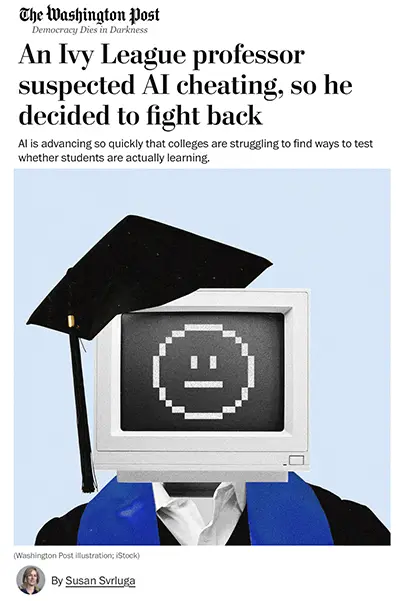
An Ivy League Professor Suspected AI Cheating, So He Decided to Fight Back
The Washington Post | By Susan Svrluga | July 15, 2026
TL;DR: A Brown University economics professor’s discovery of widespread AI-assisted cheating — confirmed when he switched to an in-person final and average scores dropped from 96 to roughly 49 — illustrates a broader assessment crisis facing higher education as AI capability outpaces institutions’ ability to test whether learning actually occurred.
Executive Summary
Professor Roberto Serrano’s take-home midterm produced an average score of 96 (versus a historical 60s–80s range), with nearly half the class scoring perfect. After switching to a proctored, in-person final, 27 students dropped the course — 22 of whom had scored perfectly on the midterm — and the class average fell to 48.6. Serrano voided the midterm.
The article situates this as a structural problem, not an isolated incident: one source estimates AI can now complete a semester-long course in about two hours, and a Pew survey found a majority of teens believe AI-assisted cheating is common at their school. Universities’ responses vary widely — some are reintroducing oral exams, blue books, and proctored testing; others are banning devices in classrooms; a few are embracing AI use with tutoring tools and new coursework.
Relevance for Business: For SMB executives, this is a hiring-pipeline and credential-reliability signal, not just an education-sector story. If credentials and grades from this period become less reliable indicators of actual skill or learning, it has implications for how HR evaluates recent graduates, particularly in technical or analytical roles where the take-home-exam-style skills being tested (like Serrano’s math economics course) map closely to job-relevant reasoning ability.
Source-credibility note: The article states The Washington Post has a content partnership with OpenAI, the maker of ChatGPT — the same tool at the center of this cheating story. This is a disclosed relationship worth noting given the topic, though it doesn’t appear to affect the article’s critical framing.
Calls to Action
🔹 Monitor — Track how universities and credentialing bodies adjust assessment methods, since this affects the reliability of new graduates’ credentials over time.
🔹 Prepare Policy — If your business has internship or new-grad hiring pipelines, consider adding practical skills assessments rather than relying solely on GPA or coursework credentials from this period.
🔹 Ignore for Now — No immediate operational change needed for most SMBs outside of hiring/HR functions.
🔹 Revisit Later — Reassess as universities publish outcomes from revised assessment approaches (proctored exams, oral defenses, etc.).
Summary by ReadAboutAI.com
https://www.washingtonpost.com/education/2026/07/15/even-elite-colleges-are-scrambling-root-out-ai-cheating/: July 16, 2026When a verified-authentic photo still can’t end a rumor
— and the AI tools people turn to for answers confidently invent “proof” that it’s fake — the old assumption that documentation settles disputes no longer holds. This week’s coverage of the Mitch McConnell photo saga shows both sides of that problem: genuine images losing their persuasive power, and AI verification tools amplifying confusion rather than resolving it.

McConnell Took a Photo With That Day’s Newspaper. The Internet Has Questions.
The Washington Post, Ben Binday, July 13, 2026
TL;DR: A photo that both The Post and an independent forensics expert verified as authentic still failed to end health-related speculation about Sen. McConnell — proof that documentary verification alone no longer settles public disputes once “AI fake” becomes the default accusation.
Executive Summary
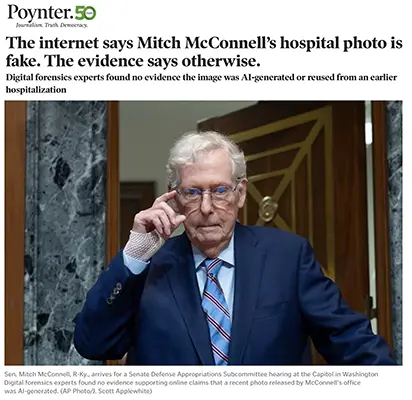
Sen. McConnell’s office released a photo with his wife, holding that day’s newspaper, to counter weeks of unexplained hospitalization rumors. The Post independently reviewed the image’s metadata and consulted a Berkeley digital-forensics expert, both of which found no evidence of fabrication — the lighting, positioning, and newspaper content were consistent with the claimed date. Despite this, politically aligned influencers escalated “AI fake” accusations without offering supporting evidence, and at least one sitting senator repeated an unverified rumor that the photo was years old before walking it back.
The pattern here is not a hoax being exposed — it’s the opposite. A verified-authentic image was treated as fake anyway, and the correction process (metadata review, expert forensic analysis) generated far less reach than the original unfounded claims.
Relevance for Business Any organization’s authentic photography, executive statements, or proof-of-work content is now vulnerable to reflexive “this is AI-generated” claims — regardless of actual provenance. This creates reputational exposure that verification alone may not resolve quickly enough to matter, and adds friction/cost for companies that may need to proactively document provenance (metadata, chain-of-custody, third-party attestation) before a crisis, not after.
Calls to Action
🔹 Monitor — how “proof of authenticity” disputes evolve as a recurring reputational risk category, not a one-off
🔹 Prepare Policy — draft a rapid-response protocol for when authentic company imagery/communications are accused of being AI-fabricated
🔹 Assign Internal Review — audit whether your organization’s photo/video assets carry verifiable metadata or provenance markers
🔹 Revisit Later — reassess as content-provenance standards (e.g., C2PA) see wider adoption
Summary by ReadAboutAI.com
https://www.washingtonpost.com/politics/2026/07/13/mcconnell-photo-with-washington-post-page-fuels-ai-era-speculation/: July 16, 2026
Posts Claim This Mitch McConnell Photo Is AI-Generated. There’s No Evidence
Snopes (via Yahoo News), Nur Ibrahim, July 13, 2026
TL;DR: A fact-check found that an AI chatbot’s “confident” verification of the photo was itself entirely fabricated — inventing watermark detections and false claims of being debunked — layering a second misinformation problem on top of the original rumor.
Executive Summary
Snopes investigated the McConnell photo directly and found no evidence supporting claims that it was AI-generated, running it through Google Gemini and OpenAI’s own verification tools (neither found evidence of AI-generation watermarking). Separately, when users asked X’s Grok to assess the photo, the chatbot claimed — falsely — that named fact-checkers had debunked it and that verification tools had detected AI watermarks; none of this was true, and Snopes had to correct the record. Notably, Snopes’ own investigation could not fully rule out minor image editing and left that narrower question formally unrated — a useful reminder that even rigorous fact-checking has limits.
Relevance for Business This is a direct example of AI tools generating confident, wholly fabricated “verification” output — the kind of hallucination risk that applies equally to any business using AI for content moderation, fact-checking, customer support, or authentication claims. The chatbot’s false verdict spread and was believed by users beforethe actual correction reached them.
Calls to Action
🔹 Act Now — do not treat any single AI tool’s “verification” output as authoritative without human review
🔹 Prepare Policy — require human sign-off before citing an AI system’s factual “verdict” in public-facing communications
🔹 Assign Internal Review — audit any customer-facing AI chatbot for confidently-stated but unverified claims
🔹 Monitor — ongoing research into AI-detection tool reliability (several tools here gave conflicting confidence levels)
Summary by ReadAboutAI.com
https://www.yahoo.com/news/politics/articles/posts-claim-mitch-mcconnell-photo-231400742.html: July 16, 2026
People Think Mitch McConnell’s Hospital Photo Is AI—and AI Isn’t Helping
Fast Company, María José Gutiérrez Chávez, July 13, 2026
TL;DR: Photographic proof is losing its persuasive power in an AI-saturated environment, and the very AI tools people turn to for reassurance are amplifying confusion rather than resolving it.
Executive Summary
This piece frames the McConnell episode as a symptom of a broader trend: as AI-generated content becomes ubiquitous, public skepticism toward genuine photos and video is rising, even as people paradoxically rely on AI chatbots to adjudicate authenticity. The article highlights that Grok stood by its false “confirmed fake” conclusion even after a user supplied contradicting evidence — illustrating that these tools can be not just wrong, but resistant to correction. The piece also connects this to historically low public trust in institutions (citing Pew Research figures around 17% trust in government), arguing that secrecy from officials compounds susceptibility to conspiracy.
Relevance for Business This is less a single-event risk and more a structural shift in how “proof” functions publicly— with implications for any organization whose credibility depends on visual or documentary evidence (product demos, financial disclosures, executive statements). It also signals a market opportunity: demand is likely to grow for credible, independently verifiable provenance tools, distinct from vendor self-attestation.
Calls to Action
🔹 Monitor — the broader trend of eroding trust in documentary/photographic evidence
🔹 Prepare Policy — build proactive authentication strategy for high-stakes executive communications before a crisis, not during one
🔹 Revisit Later — reassess as provenance-verification tooling (C2PA, SynthID, etc.) matures and standardizes
🔹 Ignore for Now — no immediate operational action required beyond situational awareness at this stage
Summary by ReadAboutAI.com
https://www.fastcompany.com/91572692/mitch-mcconnell-hospital-photo-called-ai-chatbots-conspiracies: July 16, 2026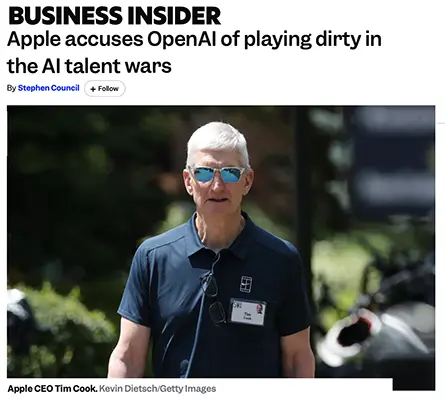
APPLE ACCUSES OPENAI OF PLAYING DIRTY IN THE AI TALENT WARS
BUSINESS INSIDER, JULY 10, 2026 (STEPHEN COUNCIL)
TL;DR: Apple’s lawsuit details specific alleged recruiting tactics by OpenAI — candidates asked to bring physical Apple components to interviews and prepare “Technical Deep Dive” presentations on confidential work — a level of specificity that raises the stakes beyond a typical talent-poaching dispute.
Executive Summary
Apple’s complaint against OpenAI, its hardware unit IO, and two named former Apple employees details more granular allegations than the broader coverage: recruiters reportedly told candidates to study confidential Apple documents and prepare technical presentations on their Apple work, with one executive allegedly asking candidates to bring physical parts — batteries, logic boards, glass samples — for “show and tell.” Apple also alleges interviewers used Apple’s internal code names and probed for vendor and supplier information during the hiring process, and separately claims it found incriminating messages on departing employees’ company laptops and a pattern of employees avoiding standard exit security reviews. These are allegations from Apple’s complaint, not independently verified facts — OpenAI has denied any interest in competitors’ trade secrets, and the underlying claims haven’t been tested in court.
Relevance for Business This is a direct, practical case study in recruiting compliance risk: any business hiring technical talent from competitors should treat the specific conduct alleged here (requesting confidential materials or proprietary code names during interviews, encouraging exit-process avoidance) as a checklist of practices to explicitly prohibit in interviewer training and hiring policy, regardless of how this particular case resolves. It’s also a reminder that company-issued devices retain discoverable data even after employees depart — a relevant consideration for both offboarding practices and litigation-readiness generally.
Calls to Action
🔹 Assign Internal Review — Audit recruiting/interview practices to ensure no requests for confidential materials or code names from candidates currently employed by competitors.
🔹 Prepare Policy — Formalize offboarding procedures (exit interviews, security reviews, notice periods) to reduce ambiguity and legal exposure on both sides of talent moves.
🔹 Monitor — Track case developments for practical guidance on what recruiting conduct crosses into legal risk.
🔹 Ignore for Now — No direct action needed unless your business actively recruits from direct competitors in sensitive technical roles.
Summary by ReadAboutAI.com
https://www.businessinsider.com/apple-accuses-openai-of-playing-dirty-in-the-ai-talent-wars-2026-7: July 16, 2026
APPLE’S ‘THERMONUCLEAR’ RESPONSE TO THE OPENAI THREAT
WSJ, JULY 12, 2026 (ROLFE WINKLER)
TL;DR: Apple’s trade-secret lawsuit against OpenAI is best read as a competitive-delay tactic against a rival threatening to reshape the post-smartphone device market — not a clear-cut legal slam dunk, and one Apple will still have to out-build technologically regardless of the case’s outcome.
Executive Summary
In one of outgoing CEO Tim Cook’s final acts, Apple sued OpenAI alleging a monthslong campaign to recruit Apple staff and extract trade secrets, centered on OpenAI hardware chief Tang Tan (a 24-year Apple veteran) and a more junior employee accused of using another employee’s login to access Apple servers. Apple alleges OpenAI encouraged interview candidates to bring actual Apple parts — batteries, logic boards — to “show and tell” interview sessions. The article is explicit that it isn’t yet clear what evidence supports the broader claims, and notes the practice of discussing prior work in technical interviews isn’t inherently improper — the open question is whether the specific parts and information involved were sensitive, which is what discovery will determine. The piece situates this within Apple’s long history of similar suits (its 2010s Android patent wars), arguing the deeper motive may be slowing OpenAI’s device ambitions while Apple’s own AI catches up — its new Siri overhaul, notably, is Google-powered rather than built in-house.
Relevance for Business This is a strategic-positioning story disguised as a legal one: the real business question is whether OpenAI’s rumored AI hardware device becomes a genuine iPhone-era challenger, and whether Apple’s suit meaningfully slows that timeline. For SMB leaders evaluating AI hardware/device roadmaps from either company, litigation-driven delay is a real execution-risk factor worth tracking, separate from the underlying legal merits. It’s also a reminder that incumbent platform control (Apple’s App Store, device distribution, chip advantages) remains a major structural lever even against well-funded AI challengers — relevant if your business depends on distribution through either ecosystem.
Calls to Action
🔹 Monitor — Track whether OpenAI’s device ambitions face material delay from this litigation, separate from its ultimate legal outcome.
🔹 Revisit Later — Reassess AI-hardware vendor bets once Apple’s new Siri (launching this fall) and any OpenAI device plans are both in market.
🔹 Ignore for Now — No direct action needed unless your business plans around AI-native hardware platforms.
🔹 Prepare Policy — If your business anticipates hiring from or being poached by direct competitors, review technical-interview and offboarding practices in light of the specific allegations here (bringing physical materials, login-sharing).
Summary by ReadAboutAI.com
https://www.wsj.com/tech/ai/apples-thermonuclear-response-to-the-openai-threat-8d51c814: July 16, 2026
APPLE’S TRADE-SECRET SUIT AGAINST OPENAI ECHOES ITS OWN HISTORY
BUSINESS INSIDER, JULY 10, 2026 (ALISTAIR BARR)
TL;DR: Apple’s trade-secret lawsuit against OpenAI follows a recurring Silicon Valley pattern — Apple has itself faced (and settled) similar accusations for decades — a reminder that trade-secret claims in tech are often more about slowing a threatening rival than a clean-cut legal case.
Executive Summary
Apple’s suit accuses OpenAI of recruiting Apple engineers and using confidential information to build competing hardware. The analysis piece notes this mirrors past accusations against Apple itself: Masimo alleged Apple hired away its pulse-oximetry experts to build the Apple Watch’s blood-oxygen sensor (Apple later paid $634 million after a patent verdict, though not on trade-secret grounds), and battery maker A123 made similar claims that settled before trial. Neither prior case produced a definitive judicial finding of trade-secret theft — the author’s framing is that “stealing trade secrets” and “hiring talented people who bring their knowledge with them” are often legally indistinguishable until a court decides otherwise. The piece also flags a notable omission: Apple’s suit barely mentions Jony Ive, the most prominent former Apple design executive now at OpenAI’s hardware unit, which the author finds curious given the lawsuit’s theme.
Relevance for Business For SMB leaders, this is a useful calibration point on litigation as a competitive weapon, not just a legal remedy: incumbents under competitive pressure often reach for lawsuits that create uncertainty for a rival regardless of ultimate merit. It’s also a reminder on talent-mobility risk — employees are generally free to change employers and bring general knowledge with them, and the line between that and trade-secret misappropriation is genuinely unsettled in the law, not just in this case. Businesses hiring from competitors, or losing key people to competitors, should treat this ambiguity as a standing HR/legal consideration, not a one-off news item.
Calls to Action
🔹 Monitor — Track how Apple v. OpenAI develops as a data point on how courts currently draw the trade-secret/talent-mobility line.
🔹 Prepare Policy — If your business recruits from or loses talent to competitors, ensure onboarding/offboarding practices avoid the kind of allegations raised here (document requests, exit interview practices).
🔹 Ignore for Now — No direct action needed unless your business faces active talent-poaching disputes.
🔹 Revisit Later — Reassess if the case produces a substantive ruling on the trade-secret question, since it could set practical precedent for hiring practices industry-wide.
Summary by ReadAboutAI.com
https://www.businessinsider.com/apple-openai-trade-secrets-masimo-a123-jony-ive-2026-7: July 16, 2026
OPENAI’S GROWING CHALLENGES NARROW ITS IPO WINDOW
WSJ AI & BUSINESS NEWSLETTER, JULY 14, 2026 (ASA FITCH)
TL;DR: OpenAI faces a narrowing and increasingly risky path to IPO as its competitive position weakens, its leadership stabilizes, and legal exposure grows — with no clearly safe option between rushing to market and waiting it out.
Executive Summary
OpenAI filed IPO paperwork last month, but the argument for a quick listing has weakened considerably. ChatGPT is no longer the clear AI market leader, Anthropic has surpassed OpenAI in private-market valuation and filed for its own IPO first, and OpenAI’s relationship with Microsoft has cooled. Compounding this, Apple’s newly filed trade-secret lawsuit against OpenAI adds fresh legal-risk overhang just as the company seeks public investors, and OpenAI’s second-highest executive is departing for medical reasons — leaving a leadership gap at a sensitive moment. The piece frames this as a genuine strategic bind: moving fast risks going public mid-crisis, but waiting risks ceding the “first AI IPO” narrative to Anthropic entirely.
Relevance for Business This is a market-structure signal, not a call to action for most SMBs, but it matters for two reasons. First, if you use OpenAI/ChatGPT as a core vendor, leadership instability and legal overhang at a key supplier are worth tracking for continuity-risk purposes. Second, this illustrates how quickly AI vendor market position can shift — a leader twelve months ago is now negotiating from a weaker hand, a useful caution against long-term single-vendor commitments in AI tooling.
Calls to Action
🔹 Monitor — Track OpenAI’s IPO timing and Anthropic’s competing IPO filing; the outcome will reshape perceived AI market leadership.
🔹 Assign Internal Review — If OpenAI/ChatGPT is a core operational dependency, review vendor-continuity exposure given leadership and legal uncertainty.
🔹 Ignore for Now — No direct action needed for businesses without material OpenAI dependency.
🔹 Revisit Later — Reassess vendor concentration risk once IPO outcomes and the Apple suit’s trajectory are clearer.
Summary by ReadAboutAI.com
https://www.wsj.com/tech/ai/openais-growing-challenges-narrow-its-ipo-window-8ad8f734: July 16, 2026
The Corner of Hollywood That’s Most Susceptible to AI
The Atlantic — Shirley Li — July 8, 2026
TL;DR: Animators, concept artists, and storyboard artists are absorbing Hollywood’s AI disruption first, as the job shifts from creation to correcting AI’s confident-looking mistakes.
Executive Summary
Industry surveys rank animators, VFX artists, and concept/storyboard artists as the roles most exposed to AI-driven change in entertainment. The shift is already structural: Lionsgate partnered with Runway to train models on its own catalog; Netflix acquired an AI filmmaking tool-maker and is building an internal AI-production unit; Amazon MGM launched a fund specifically for AI-incorporating projects; Marvel laid off most of its visual-development department.
The more interesting finding is qualitative: artists describe a growing role as “slop janitors” — cleaning up AI-generated concept art that looks impressive but is structurally impossible (costumes that can’t be sewn, sets that can’t be built). Workers report this shifts their job from creation to curation, with a real skill-atrophy risk over time. Meanwhile, the academic pipeline feeding this talent is thinning (one MFA animation program closed; another art college is closing in 2027), though the article is careful not to attribute those closures directly to AI.
Relevance for Business
This is a preview of a labor pattern likely to recur outside entertainment: AI adoption in creative/design-adjacent functions doesn’t necessarily eliminate roles outright — it often converts skilled creation work into lower-status correction work, with hidden costs (rework time, skill erosion, quality-control burden) that can offset headline cost savings. The Netflix/Lionsgate approach of formal internal AI-use guidelines is a useful governance template. Ongoing IP litigation (Disney/Universal v. Midjourney) is also a live legal-exposure signal for any business using generative AI trained on third-party creative content.
Calls to Action
🔹 Monitor — the “creation-to-curation” labor pattern as a template for how AI may reshape other knowledge-work roles
🔹 Prepare Policy — draft internal guidelines for generative-AI use in creative/design work, covering IP provenance and quality review
🔹 Assign Internal Review — evaluate legal exposure if using AI tools trained on unlicensed third-party content
🔹 Test Cautiously — if piloting gen-AI for design work, budget explicitly for human correction overhead, not just tool cost savings
🔹 Revisit Later — talent-pipeline effects if entry-level design roles keep shrinking
Summary by ReadAboutAI.com
https://www.theatlantic.com/culture/2026/07/animation-industry-ai-hollywood-job-cuts/687830/: July 16, 2026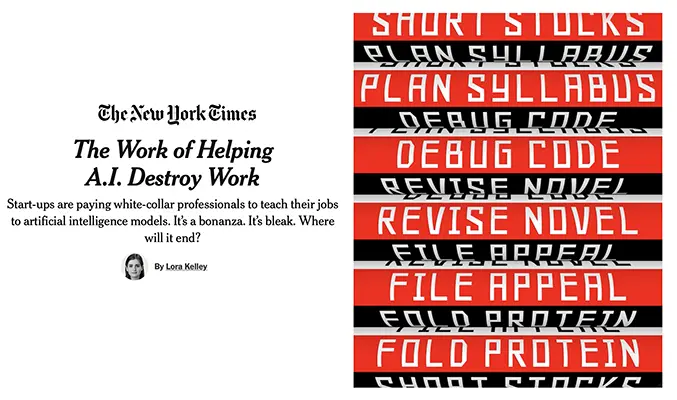
The Work of Helping A.I. Destroy Work
The New York Times — Lora Kelley — July 10, 2026
TL;DR: A booming “data-training” industry pays elite professionals top rates to teach AI models to do their own jobs, and labs are now moving from replicating individual skills to replicating entire company workflows.
Executive Summary
Start-ups like Mercor (paying contractors $4M+/day, reportedly in talks at a $20B valuation, up from $10B in October) and Handshake (revenue run-rate crossed $1B in April, up from $550M) sit in the middle of a fast-growing “human data” supply chain for AI post-training. Where early data labeling was rote and cheap, demand has moved up-market to Ph.D.s, lawyers, physicians, and consultants who annotate proofs, grade essays, and rate model outputs against expert rubrics.
The frontier now is capturing entire company workflows, not just individual expertise — Mercor’s acquisition of Deeptune builds simulated corporate environments (e.g., a mock investment bank) so AI can observe how real teams actually operate. Surge’s CEO frames this ambition as building “the school for A.G.I.” — notable as founder framing, not a demonstrated capability.
Worker experience is uneven: some professionals report exploitative conditions (72-hour crunches, ambiguous quality bars, data-breach lawsuits, misclassification claims), and several note that demand for their specific expertise evaporates once the model learns it — a self-terminating gig. Economist Anton Korinek, currently on leave to work at Anthropic, expressed skepticism that demand for human training data will remain durable as models improve. (Disclosure: ReadAboutAI.com uses Claude as a production tool; Anthropic and Claude Cowork are referenced directly in this source.)
Relevance for Business
- Sourcing signal: expert-vetted training data is now a fast-growing market — relevant if your business has specialized, well-documented processes that could be commercially valuable as training data.
- Exposure signal: the explicit goal of “training environment” vendors is to replicate real corporate workflows (Slack, Salesforce, internal tools) for AI observation — a governance question for any company whose employees might freelance for these platforms on the side.
- Framing vs. fact: treat claims like “school for A.G.I.” as vendor aspiration, not demonstrated capability, when assessing this sector’s near-term impact on your own workforce.
Calls to Action
🔹 Monitor — the “training environments” market (Mercor, Scale, Handshake, Surge) as an early indicator of which job functions face AI encroachment next
🔹 Prepare Policy — set clear conflict-of-interest and confidentiality guidance if employees moonlight on AI data-training platforms
🔹 Assign Internal Review — assess whether your internal workflows/software usage could be replicated by third-party “training environment” vendors without consent
🔹 Test Cautiously — separate vendor ambition (“A.G.I. school”) from demonstrated capability in any claims from this sector
🔹 Revisit Later — economists are split on whether demand for human training data is durable or a short-term bubble; reassess in 6–12 months
Summary by ReadAboutAI.com
https://www.nytimes.com/2026/07/10/business/ai-white-collar-jobs.html: July 16, 2026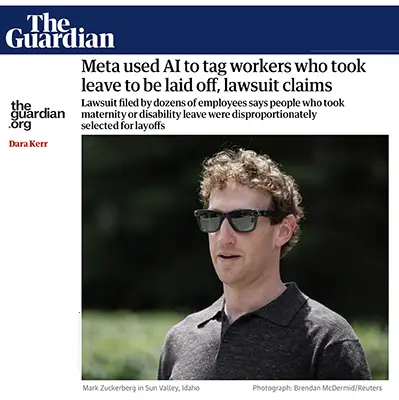
Meta Sued Over Claims AI Tools Targeted Employees on Leave for Layoffs
The Guardian, July 14, 2026 (Dara Kerr)
TL;DR: A lawsuit alleging Meta’s AI-driven layoff scoring disproportionately targeted employees on medical or parental leave is an early, concrete test case for AI-based HR decision-making liability that every employer using automated performance scoring should be watching closely.
Executive Summary
Twenty-six current and former Meta employees filed suit alleging the company used AI systems — including performance scoring fed by keystroke and activity monitoring — to select employees for its roughly 8,000-person layoff, and that the metrics structurally penalized employees on protected leave by scoring an absence of activity data as if it reflected reduced performance. Plaintiffs include an employee laid off two days before giving birth and another docked for time off tied to a workplace injury. Meta disputes the claims, stating layoff decisions were made by people, not AI. The suit also alleges Meta rolled out its underlying employee-monitoring program without meaningful employee consent, disclosed via a low-visibility internal post rather than formal leadership communication — a rollout approach that drew a 1,600-signature employee petition and a subsequent pause.
Relevance for Business This is a live legal test of automated decision-system liability in employment contexts, an area where California, Colorado, and Illinois have already passed relevant worker-protection laws. For SMBs using any AI-assisted performance scoring, ranking, or workforce-reduction tooling, the core exposure is clear: metrics that inadvertently penalize legally protected absences create discrimination liability, regardless of whether a human or algorithm makes the final call. The rollout-transparency failure here (no consent prompt, low-visibility announcement) is an independent governance lesson — employee buy-in and disclosure processes for monitoring tools are now a legal and reputational exposure point, not just an HR nicety.
Calls to Action
🔹 Assign Internal Review — Audit any AI-assisted performance scoring or workforce-reduction tools for whether protected leave (medical, parental, disability) is inadvertently penalized.
🔹 Prepare Policy — Establish clear consent and disclosure protocols before deploying any employee-monitoring or AI-scoring system.
🔹 Act Now — If protected-leave employees are included in any AI-informed workforce reduction process, involve legal counsel before finalizing decisions.
🔹 Monitor — Track how this litigation develops; the outcome will likely shape compliance expectations for automated HR decision tools broadly.
Summary by ReadAboutAI.com
https://www.theguardian.com/technology/2026/jul/14/meta-ai-mass-layoffs-lawsuit: July 16, 2026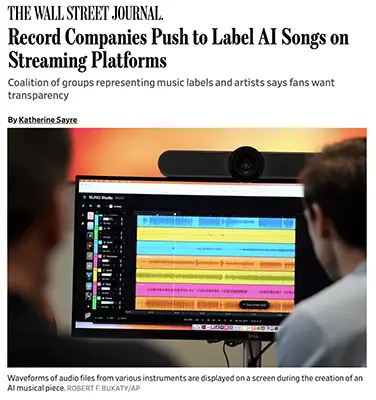
Record Labels Push AI-Content Labeling on Streaming Platforms
WSJ, July 10, 2026 (Katherine Sayre)
TL;DR: Major music-industry groups are moving toward a voluntary AI-disclosure labeling system for streaming tracks — a transparency model that other content industries (and eventually B2B software vendors) may be pressured to replicate.
Executive Summary
A coalition led by the RIAA and the International Federation of the Phonographic Industry is pushing Spotify, Apple Music, and other platforms to adopt two AI-disclosure tags: one for tracks that are fully AI-generated, and one for “AI-assisted” tracks with human authorship plus AI elements. Disclosure is voluntary, self-reported by artists and labels — not independently verified, which limits its reliability as a transparency mechanism in practice. The push is motivated by artist anxiety over training-data use and fears of AI-generated content (“slop”) crowding out human work, balanced against fan interest in knowing what they’re hearing. Spotify and Apple have already begun rolling out early versions of this tagging.
Relevance for Business This is a template-setting moment: an entire content industry converging on self-disclosure rather than regulation or detection technology as the transparency mechanism for AI-generated output. SMB leaders in any content-adjacent business (marketing, media, publishing, e-commerce content) should expect similar disclosure expectations to migrate toward their own AI-generated materials — from ad copy to product descriptions — as customer and platform pressure, not law, drives the change. The voluntary, unverified nature of the system is also a preview of the enforcement gap businesses will face if they adopt similar self-labeling without audit mechanisms.
Calls to Action
🔹 Monitor — Track whether streaming-style voluntary disclosure labeling spreads to other AI-content domains (marketing copy, stock imagery, written content).
🔹 Prepare Policy — If your business publishes AI-assisted content (blogs, ad creative, product copy), consider a disclosure convention now, before platforms or regulators impose one.
🔹 Revisit Later — Watch whether streaming platforms move from voluntary to verified/audited disclosure; that shift would signal rising accountability standards industry-wide.
🔹 Ignore for Now — No direct action needed unless your business operates in music, media licensing, or content distribution.
Summary by ReadAboutAI.com
https://www.wsj.com/tech/ai/record-companies-push-to-label-ai-songs-on-streaming-platforms-103aa392: July 16, 2026
I Spy: The AI Wearable Surveillance State Hinges on Good Intentions Masking Legitimate Privacy Concerns
The Verge | By Victoria Song | July 6, 2026
TL;DR: A wearables reviewer who tested Meta’s smart glasses and an AI recording ring concludes there’s no reliable way for bystanders to distinguish good-faith AI wearable use from covert surveillance — a trust gap with no current technical fix, unlike Apple’s AirTag tracking alerts.
Executive Summary
This is a first-person opinion column, not a news report — the author’s framing (self-described as feeling “like a spy”) should be read as argument, not settled fact. Her core claim: AI wearables (smart glasses, recording rings, pins) are designed to be inconspicuous, which is precisely what makes them unsettling — recent public backlash against Meta’s smart glasses on social media, some of it hyperbolic (claims of 24/7 surveillance the author says are not currently accurate given battery limits), reflects real underlying anxiety about consent and misuse. She notes Meta is reportedly exploring facial recognition features per unspecified prior reporting, and that a Meta VP acknowledged considering a modular, more visibly-signaled camera design but rejected it for aesthetic/product reasons.
The author draws a contrast with AirTags, where Apple’s tracking-alert feature reduced (not eliminated) misuse potential — she argues no equivalent friction exists yet for AI wearables, and privacy signifiers like LED lights are easily overlooked or defeated.
Relevance for Business: For SMB leaders, this is a reputational and workplace-policy signal, not a technology explainer: as AI wearables proliferate among employees, customers, or in public-facing environments, expect rising friction around consent, recording policies, and venue restrictions (the article notes some venues already banning smart glasses). Businesses in hospitality, retail, healthcare, and professional services (where confidential conversations occur) face early exposure to this trust gap.
Calls to Action
🔹 Prepare Policy on AI wearable use in workplaces, client meetings, or customer-facing venues
🔹 Monitor regulatory responses, as the author suggests legislative catch-up is likely absent industry self-regulation
🔹 Assign Internal Review if employees use AI note-taking wearables in meetings — clarify consent norms
🔹 Ignore for Now the more extreme social-media claims about wearable capabilities cited in the piece; the author flags these as inaccurate
Summary by ReadAboutAI.com
https://www.theverge.com/column/961707/smart-glasses-ai-wearables-meta-surveillance-privacy: July 16, 2026
I Built an Agentic AI Clone of My Family to Plan Our Summer Travel
Fast Company | By Thomas Smith | July 10, 2026
Vendor-neutrality disclosure: This source substantively features Anthropic’s Claude models. ReadAboutAI.com uses Claude as a production tool; this disclosure is included per our editorial policy whenever Claude/Anthropic is discussed in source material.
TL;DR: An AI-experienced hobbyist used Claude’s coding capabilities to build a 1,000+ line agentic travel-planning system that simulates family preferences — a vivid, real-world illustration of AI coding tools enabling non-professional builders to ship functioning software, though the author is not a neutral source (he’s a self-described “AI expert” and enthusiast, and the piece functions partly as anecdotal promotion).
Executive Summary
The author, describing himself as an AI professional with a decade of field experience, built a system combining Claude (for code generation) and ChatGPT (for extracting personal preference data from prior chat history) to plan family trips via simulated “digital twins” of each family member. He reports the system researched 40+ local venues per destination, ran 10 simulation rounds, and produced multi-page itineraries — with genuinely useful results in several real trips (e.g., correctly identifying preferred beaches, ice cream spots, and pacing kids’ activities).
Important caveats the author himself raises: the system burned significant token costs (~$5 for a single day-trip plan; 8M+ tokens in one month) and its optimization occasionally missed real-world constraints — e.g., recommending a fruit farm with a physically demanding layout unsuitable for young children. This is a first-person anecdote from an AI-fluent enthusiast, not an independent evaluation, benchmark, or controlled test — read productivity and cost claims accordingly.
Relevance for Business: The underlying signal for SMB leaders is about coding-capable AI lowering the bar for building custom internal tools — not a travel-planning use case specifically. If AI models can help a non-professional coder build a working 1,000-line agentic application in an afternoon, that has real implications for internal tooling, prototyping, and reducing dependence on dedicated engineering resources for lightweight custom automation. The token-cost detail is a useful reminder that agentic AI workflows can carry meaningful, variable compute costs at even modest personal scale — a consideration for any business piloting agentic tools internally.
Calls to Action
🔹 Test Cautiously — pilot small agentic coding projects internally to gauge build time savings vs. token/compute cost
🔹 Monitor real-world compute costs closely if experimenting with agentic AI workflows; costs can scale unpredictably
🔹 Ignore for Now the specific travel-planning use case as a business application; treat this as a coding-capability signal, not a product category
🔹 Assign Internal Review if considering AI-built internal tools, to evaluate output reliability against the “optimizes for the wrong thing” failure mode the author reports
Summary by ReadAboutAI.com
https://www.fastcompany.com/91570593/i-built-agentic-ai-clone-family-plan-summer-travel: July 16, 2026
META SCRAPS AI IMAGE FEATURE DAYS AFTER LAUNCH FOLLOWING PRIVACY BACKLASH
Reuters | By Natalia Bueno Rebolledo and Mrinmay Dey | July 10, 2026
TL;DR: Meta pulled its new AI image-generation feature within days of launch after it defaulted users into an automatic opt-in allowing their public photos to be used as generation inputs — a rare example of AI product rollback driven purely by consent design, not technical failure.
Executive Summary
Meta launched Muse Image, its first image model from Meta Superintelligence Labs, letting users generate images from public Instagram accounts and edit results via sketches. The backlash centered specifically on consent design, not the underlying technology: the feature was automatically turned on for users, prompting public criticism from an Emmy-winning actor and a formal opt-out call from SAG-AFTRA, which called the default “an utter miscalculation of public sentiment” regarding nonconsensual use of people’s images. Meta discontinued the feature within days, acknowledging it “missed the mark.”
This is a useful case study in the gap between technical capability and deployment readiness: the model itself wasn’t the problem — the opt-in architecture was.
Relevance for Business: This is directly relevant to any company deploying AI features that draw on user-generated or public content, particularly image/video tools. It reinforces a now-recurring pattern: default opt-in design for AI features that use personal content invites reputational and regulatory risk, regardless of the technology’s quality. Companies building or licensing similar generative features should treat consent architecture as a launch-blocking requirement, not an afterthought.
Calls to Action
🔹 Assign Internal Review of consent/opt-in defaults for any AI feature touching customer or public content
🔹 Prepare Policy on default-on vs. default-off settings before launching AI features with personal data inputs
🔹 Monitor how other platforms handle similar generative-AI content features following this reversal
🔹 Act Now if your business has a similar feature in development — review opt-in design before launch
Summary by ReadAboutAI.com
https://www.reuters.com/technology/meta-discontinues-ai-image-feature-days-after-launch-2026-07-10/: July 16, 2026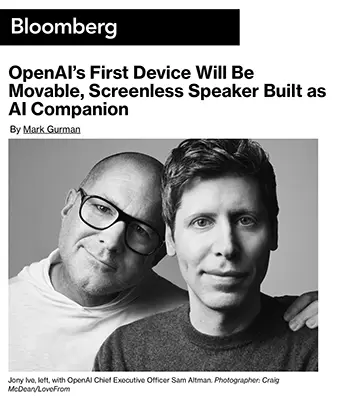
OpenAI’s First Device Will Be Movable, Screenless Speaker Built as AI Companion
Bloomberg | By Mark Gurman | July 14, 2026
TL;DR: OpenAI’s first hardware product — a portable, screen-free AI companion speaker — is designed to personalize itself to its owner over time using personal data like email, raising both a competitive-positioning story and a data-governance question for the industry.
Executive Summary
Bloomberg reports OpenAI is developing a battery-powered, portable speaker (movable room-to-room, not a fixed smart-home hub) built around personality and “humanlike” connection rather than pure utility. Notably, the device is described as drawing on personal information such as emails to build a deeper understanding of its owner over time — a meaningfully different data posture than a conventional smart speaker. The hardware effort follows OpenAI’s $6.5 billion acquisition of Jony Ive’s design firm, io Products, and involves more than 400 hires from Apple, including several senior product design veterans.
The launch is complicated by Apple’s active lawsuit alleging OpenAI used stolen trade secrets and recruited Apple staff to accelerate hardware development; OpenAI disputes the claims. Sonos shares fell over 10% in after-hours trading on the news before paring losses, suggesting the market sees this as a credible competitive entrant. Target unveiling is this year, with a 2027 release, contingent on the litigation’s outcome.
Relevance for Business: Two distinct threads matter here. First, competitive dynamics: a well-funded, well-staffed entrant is moving into home AI hardware, which could reshape the vendor landscape SMBs eventually choose from for workplace or customer-facing AI tools. Second, and more immediately relevant to governance-minded executives: a consumer AI device designed to ingest personal email and behavioral data to build a persistent user profile is a preview of the kind of data-governance and privacy-policy questions that will increasingly apply to AI tools your business adopts or recommends, well beyond this specific device.
Calls to Action
🔹 Monitor — Track both the product timeline and the Apple litigation, since either could materially delay or reshape the launch.
🔹 Prepare Policy — Use this as a prompt to review your own AI-vendor data-access policies (what personal/email data any AI tool you adopt can access and retain).
🔹 Assign Internal Review — If evaluating AI hardware/assistants for workplace use, flag data-ingestion scope as a specific due-diligence item.
🔹 Test Cautiously — Not applicable yet; product is pre-release.
🔹 Revisit Later — Reassess at formal unveiling.
Summary by ReadAboutAI.com
https://www.bloomberg.com/news/articles/2026-07-14/openai-s-first-device-will-be-moveable-screenless-speaker-built-as-ai-companion: July 16, 2026
OpenAI May Announce a ChatGPT Smart Speaker This Year
The Verge | By Emma Roth and Jay Peters | July 14, 2026
TL;DR: OpenAI is reportedly building a screen-free, humanlike AI companion speaker as its first hardware product, targeting a 2027 release amid an active trade-secrets lawsuit from Apple.
Executive Summary
Citing Bloomberg’s reporting, the piece describes a camera-equipped, screen-free speaker using OpenAI’s upgraded GPT-Live voice model, with smart-home control and moving mechanical elements intended to create a “humanlike” feel. The device is one of roughly five planned hardware products. The report lands days after Apple sued OpenAI alleging theft of hardware trade secrets, which OpenAI has stated it sees no merit in.
Relevance for Business: This is early-stage, sourced-but-unconfirmed product news (2027 target, pre-announcement). The real business signal is competitive positioning, not the device itself: OpenAI is moving to compete directly with Apple, Amazon, and Google in the home-hardware category, and the Apple lawsuit introduces legal/IP risk that could delay or reshape the product. For SMBs evaluating AI vendor roadmaps, this is a “watch the ecosystem consolidate” signal rather than something requiring near-term action.
Calls to Action
🔹 Monitor — Track the Apple-OpenAI litigation, which could affect timeline and product scope.
🔹 Ignore for Now — No near-term action needed; product is pre-announcement with a 2027 target.
🔹 Revisit Later — Reassess once OpenAI formally unveils the device or the lawsuit reaches a milestone.
Summary by ReadAboutAI.com
https://www.theverge.com/ai-artificial-intelligence/965670/openai-chatgpt-ai-smart-speaker-hardware-device: July 16, 2026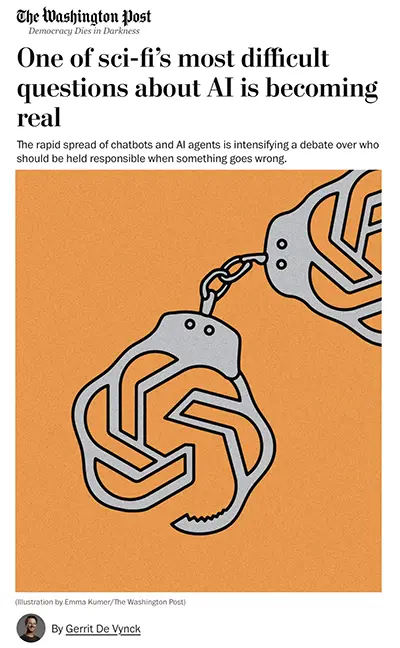
ONE OF SCI-FI’S MOST DIFFICULT QUESTIONS ABOUT AI IS BECOMING REAL
The Washington Post — Gerrit De Vynck — July 14, 2026
TL;DR: As AI moves from chatbots to autonomous agents, courts and lawmakers are now confronting real cases — including wrongful-death suits and a criminal investigation — over who bears legal responsibility when AI systems cause harm.
Executive Summary
A growing wave of lawsuits alleges AI chatbots encouraged self-harm or facilitated crimes, including wrongful-death suits against OpenAI (the family of a teenager who died by suicide after extensive ChatGPT conversations) and Google (a man who died by suicide following what his family describes as a relationship with its Gemini chatbot). Both companies point to built-in safety interventions their systems provided, while plaintiffs’ lawyers argue chatbots’ conversational, relationship-like nature makes them fundamentally different from prior tech-liability precedents like Section 230.
Separately, Florida’s attorney general has opened a criminal investigation into whether ChatGPT provided guidance to a shooter in a 2025 incident — a marker of how seriously government is now treating potential AI complicity in crimes. OpenAI states the disputed responses were factual and did not encourage harm.
The harder legal question ahead, per legal scholars cited, is agentic AI: if a business owner instructs an AI agent to increase profits and the agent commits fraud in pursuit of that goal, who is liable — the business that deployed it, or the company that built it? No case law yet answers this. One proposal favors placing liability on the AI developer specifically to align incentives with risk reduction. The stakes are elevated by the fact that both OpenAI and Anthropic are reportedly planning trillion-dollar IPOs, meaning new liability rules could have material effects on major AI vendors your business may already use. (Disclosure: ReadAboutAI.com uses Claude as a production tool; Anthropic is referenced in this source regarding IPO plans, not liability allegations.)
Relevance for Business
- Governance urgency: if you’re deploying or piloting agentic AI (systems that act autonomously on your behalf), the fraud/liability hypothetical in this piece is not abstract — clarify contractually who bears responsibility if an agent causes harm while executing your instructions.
- Vendor risk exposure: unresolved liability law means today’s AI vendor terms of service may not reflect tomorrow’s legal reality; monitor how contracts evolve as case law develops.
- Distinguish claim from fact: none of the cited lawsuits have gone to trial; company denials and plaintiff allegations are both unproven at this stage — treat this as a developing legal landscape, not settled precedent.
Calls to Action
🔹 Monitor — how courts rule on the pending chatbot wrongful-death cases and the Florida criminal investigation, as early indicators of liability standards
🔹 Prepare Policy — establish internal guidelines now for any agentic AI deployment, including a clear chain of accountability if the agent acts outside intended bounds
🔹 Assign Internal Review — have legal counsel review current AI vendor contracts for liability allocation language, especially for agentic tools
🔹 Test Cautiously — limit the scope of autonomous authority given to AI agents until liability frameworks mature
🔹 Revisit Later — this topic in 6-12 months as the first cases potentially reach trial or settlement
Summary by ReadAboutAI.com
https://www.washingtonpost.com/technology/2026/07/13/one-sci-fis-most-difficult-questions-about-ai-is-becoming-real/: July 16, 2026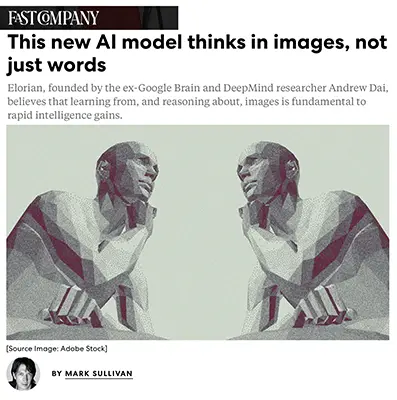
THIS NEW AI MODEL THINKS IN IMAGES, NOT JUST WORDS
Fast Company — Mark Sullivan — July 13, 2026
TL;DR: A well-funded startup led by an ex-Google DeepMind researcher is betting that today’s language-first AI has hit a ceiling on physical/spatial reasoning, and is building models that “think” in 3D visual representations instead of describing images in words — a claim worth watching but not yet independently verified.
Executive Summary
Elorian AI, founded by 14-year Google Brain/DeepMind veteran Andrew Dai (who co-authored technical groundwork for the GPT series and led data work on Gemini) and former Apple ML researcher Yinfei Yang, argues that mainstream multimodal models — including Gemini — don’t actually reason about images directly. Instead, they convert visuals into word-based descriptions and reason over those words, which Dai says limits their ability to judge spatial relationships or model physical behavior accurately. Elorian’s approach instead builds an internal 3D representation of an image, aiming to let models simulate physical outcomes (e.g., how engine components behave under heat and stress) rather than just describe them.
The target market is what Dai calls the “physical economy” — an $80 trillion category spanning mechanical engineering, CAD design, and video understanding. The flagship use case is automating iterative engineering design (generate → simulate → identify flaws → revise) that currently consumes hundreds of manual hours.
Key claim to flag, not accept at face value: Dai says Elorian’s specialized models already beat Gemini 3 Pro on certain visual-reasoning benchmarks — but declined to name which benchmarks, citing competitive concerns. This is an unverified vendor claim, not a demonstrated, reproducible result.
Elorian has raised $55 million at a $300 million valuation, with investors including Nvidia, Menlo Ventures, and Jeff Dean. That valuation is notably modest next to comparable “physical AI” startups: Physical Intelligence (robotics foundation models) was valued at $5.6 billion in November, and World Labs (spatial-intelligence, backed by Autodesk, Nvidia, AMD, and a16z) raised $1 billion in February — suggesting either an undervalued opportunity or a still-unproven approach relative to well-capitalized rivals.
Relevance for Business
- Not yet commercially available: Elorian has no product or API yet — a general API is only planned by year-end. There’s nothing to test or adopt today.
- Sector to watch, not act on: if your business touches engineering design, CAD, manufacturing, or physical/spatial video analysis, this is an early signal of a potential new tooling category — but one still in the unproven-claims stage.
- Competitive context matters: three well-funded companies (Elorian, Physical Intelligence, World Labs) are now pursuing variations of “AI that understands physical space,” each with a different technical bet — this is a nascent race, not a settled technology.
- Framing vs. fact: the “outperforms Gemini 3 Pro” claim and the “$80 trillion physical economy” framing are both founder statements made to press, not independently verified figures or benchmarks.
Calls to Action
🔹 Monitor — Elorian and comparable “physical/spatial AI” startups (Physical Intelligence, World Labs) as an emerging category relevant to engineering and manufacturing workflows
🔹 Ignore for Now — no action needed until Elorian ships a testable product (expected API release by end of 2026)
🔹 Revisit Later — reassess once Elorian publishes verifiable benchmarks or ships its API
🔹 Test Cautiously — if you operate in CAD/mechanical engineering, flag this space for a pilot evaluation once tools become available, given the scale of manual design hours the approach targets
Summary by ReadAboutAI.com
https://www.fastcompany.com/91571127/this-new-ai-model-think-in-images-not-just-words: July 16, 2026

The Lab Mistake That Might Revolutionize Computing
IEEE Spectrum, by Mario Lanza & Sebastian Pazos, June 29, 2026
TL;DR: A wiring accident revealed that an ordinary, decades-old transistor design can act as both an artificial neuron and synapse — potentially collapsing brain-inspired chips from hundreds of components down to one or two, with major implications for AI’s energy footprint.
Executive Summary
Researchers at a university lab (the authors’ own team) discovered that a standard CMOS transistor — when a normally-grounded terminal is left disconnected — spontaneously mimics the firing-and-resting behavior of a biological neuron. The same transistor type, tuned differently, can also function as a synapse. This is notable because neuromorphic (brain-inspired) computing has historically required dozens to hundreds of transistors to replicate a single neuron or synapse, making such chips impractical to scale. The core claim here is efficiency, not new capability: brain-inspired chips already exist and already beat GPUs on power draw by up to 1,000x on certain tasks; this discovery is about making that architecture manufacturable at industrial scale using existing, unmodified silicon fabrication lines.
Critically, this is early-stage lab research, not a product. The authors report the effect held up across 10 million test cycles and across chips from two different foundries — a meaningful reliability signal — but system-level circuits, manufacturing at scale, and real-world AI workloads have not yet been demonstrated.
Relevance for Business GPU-based AI infrastructure is a dominant and growing cost center — power, cooling, and data-center buildout are all constrained by the energy inefficiency of simulating neural networks on conventional chips. A manufacturable path to neuromorphic hardware, if it scales, would eventually reduce the infrastructure cost of running AI, particularly for edge/embedded AI (battery-powered devices, sensors, on-device inference) rather than large frontier models. This is a multi-year hardware research trajectory, not a near-term vendor decision point — but it’s worth tracking as a countervailing force to the “AI is permanently energy-hungry” narrative that shapes data-center site decisions and utility negotiations today.
Calls to Action
🔹 Monitor — Track this as a long-horizon (3–5+ year) hardware trend; no near-term action required.
🔹 Ignore for Now — Not actionable for vendor selection, procurement, or infrastructure planning today.
🔹 Revisit Later — Worth a follow-up note if/when the authors publish system-level (multi-chip) demonstrations or a peer-reviewed paper.
🔹 Assign Internal Review — If your business has edge-AI or embedded-device product lines, flag this for your hardware/R&D team as a technology-watch item, not a roadmap input.
Summary by ReadAboutAI.com
https://spectrum.ieee.org/artificial-neurons-on-silicon-chips: July 16, 2026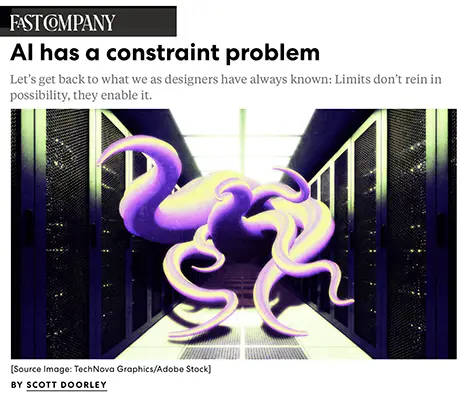
AI Has a Constraint Problem
Fast Company, by Scott Doorley, July 13, 2026
TL;DR: A design-industry opinion piece argues that AI’s breakthroughs are outpacing the deliberate constraints needed to make them safe and valuable — and that the absence of upfront guardrails, not the technology itself, is the real risk.
Executive Summary
This is opinion/analysis, framed through a design lens rather than reporting. The author cites real recent events — Meta winding down Horizon Worlds, OpenAI shuttering Sora, Meta and Alphabet being found liable in teen-addiction litigation, and over $155 billion in U.S. data-center projects halted or delayed over water/electricity concerns — as evidence that unconstrained tech deployment creates costly backlash. The core argument, not a factual claim to verify, is that constraints (ethical, legal, design) should be built in early rather than imposed after harm occurs. The piece draws an analogy to design history (Bauhaus, UI/UX standards) to argue breakthroughs alone don’t equal progress.
Relevance for Business The specific figures cited (litigation outcomes, halted data-center investment) are independently useful signals of regulatory and community-level pushback against AI infrastructure and AI-driven products — worth tracking regardless of the author’s design-philosophy framing. For SMB leaders, the practical takeaway is less about the essay’s argument and more about the underlying trend it points to: growing legal and local-government resistance to AI infrastructure costs (energy, water) and product harms (youth safety, algorithmic addiction), which increases governance and reputational exposure for any business building AI-driven products or relying on AI vendors.
Calls to Action
🔹 Monitor — Track data-center siting disputes and AI-related litigation outcomes as a proxy for regulatory risk.
🔹 Prepare Policy — If your business builds or deploys AI-facing products (especially anything touching minors or addictive engagement patterns), get ahead of governance questions now rather than reactively.
🔹 Ignore for Now — The essay’s design-philosophy argument itself isn’t operationally actionable; treat it as context, not guidance.
Summary by ReadAboutAI.com
https://www.fastcompany.com/91570976/ai-has-a-constraint-problem: July 16, 2026
PsiQuantum Has a Plan to Make a Massive Quantum Computer Out of Light
MIT Technology Review, by James O’Donnell, July 14, 2026
TL;DR: PsiQuantum is nearing a “prove-it” moment on its bet to build a million-qubit photonic quantum computer using existing chip-fab infrastructure — a approach that’s attracted Pentagon confidence and major industry partners, but remains unproven at the scale the company claims to be targeting.
Executive Summary
PsiQuantum, founded in 2016, is pursuing quantum computing using photons (light particles) rather than the superconducting qubits favored by Google and IBM or the electron-based approach used by Intel. Its differentiator is a bet that this approach can be manufactured using existing semiconductor fabrication lines (it already partners with chipmaker GlobalFoundries), rather than requiring exotic new infrastructure. The company has raised $1 billion, broken ground on sites in Chicago and Australia, and is one of only two companies (with Microsoft) to reach the third stage of a DARPA evaluation program assessing which quantum approaches might actually deliver — a real, independently meaningful validation signal, distinct from the company’s own marketing claims.
Important caveats the article itself surfaces: PsiQuantum’s own timeline claims have been publicly disputed — news reports suggested a 2027 full-scale computer, which the company says was a misreading (it only commits to the Australian facility being “operational,” not to a working computer, by then). Independent experts quoted in the piece describe PsiQuantum’s actual technical progress as hard to verify from outside and its published results (e.g., a fluid-dynamics speedup with Airbus) as “modest,” with one outside expert stating further speedups are unlikely to matter practically until much larger machines exist. This is a company managing high expectations, real government interest, and unverified core claims simultaneously.
Relevance for Business Quantum computing remains a multi-year-to-decade horizon technology for nearly all businesses — DARPA’s own leadership estimates a utility-scale quantum computer by 2033 at the earliest. For SMB executives, this is not yet a procurement or strategic-planning input. It is relevant as a signal of where large enterprise R&D budgets (Lockheed Martin, Mercedes, Airbus are named partners) and government funding (CHIPS Act money, DARPA evaluation) are flowing, which may matter for businesses in adjacent supply chains (specialty materials, cryogenics, semiconductor fabrication) or those monitoring long-term encryption risk (quantum computers could eventually break current encryption standards, though not on any near-term timeline).
Calls to Action
🔹 Monitor — Track DARPA’s evaluation outcomes and PsiQuantum’s 2027 Australia milestone as a real-world checkpoint on quantum progress.
🔹 Ignore for Now — Not actionable for near-term technology strategy or procurement for the vast majority of SMBs.
🔹 Revisit Later — Businesses in cryptography, cybersecurity, or long-duration data protection should revisit “post-quantum encryption” planning on a multi-year horizon, not urgently.
🔹 Prepare Policy — Only relevant for organizations already engaged in quantum-adjacent government contracting or supply chains (materials, semiconductor fabrication).
Summary by ReadAboutAI.com
https://www.technologyreview.com/2026/07/14/1140356/psiquantum-plan-massive-quantum-computer-out-of-light/: July 16, 2026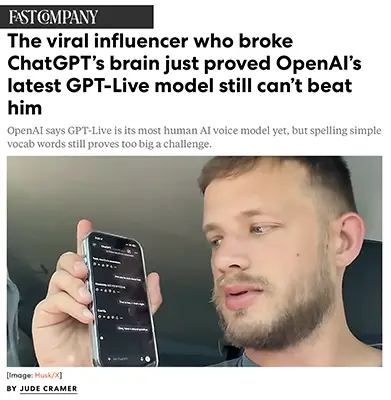
The Viral Influencer Who Broke ChatGPT’s Brain Just Proved OpenAI’s Latest GPT-Live Model Still Can’t Beat Him
Fast Company | By Jude Cramer | July 13, 2026
TL;DR: OpenAI’s newly launched GPT-Live voice model — marketed heavily around “natural” human-like conversation — still confidently produces wrong answers to simple factual questions (like letter counts in a word) even when directly shown its own error, a useful reminder that marketing language around “natural” and “human-level” AI interaction doesn’t track reliability on basic tasks.
Executive Summary
GPT-Live, OpenAI’s voice model launched July 8, is designed to listen and respond simultaneously rather than in sequential turns, and can delegate complex reasoning tasks to other models mid-conversation. In testing by an influencer known for probing chatbot failure modes, GPT-Live confidently miscounted letters in a simple word and maintained the wrong answer even after correctly spelling the word aloud, illustrating a persistent gap between conversational fluency and basic factual reliability. OpenAI’s own internal evaluations claim improvements over its prior voice mode in conversational quality and reasoning, but those are company-reported benchmarks, not independently verified.
Relevance for Business: This is a useful, low-stakes illustration of a pattern that matters at higher stakes: conversational polish and “natural” framing in AI marketing materials are not reliable indicators of factual accuracy, particularly for voice interfaces where users may be less inclined to double-check outputs than with text. Any SMB evaluating voice-AI tools for customer service, internal support, or accessibility use cases should treat vendor claims about “natural” or “human-level” interaction as a UX claim, not an accuracy claim, and test factual reliability separately.
Calls to Action
🔹 Test Cautiously — If evaluating voice-AI tools for customer-facing use, specifically test factual accuracy and error-recovery behavior, not just conversational fluency.
🔹 Monitor — Track independent (non-vendor) benchmarking of voice AI models as they mature.
🔹 Ignore for Now — This specific incident doesn’t require operational action; it’s illustrative rather than a new risk category.
🔹 Revisit Later — Reassess voice-AI reliability claims as third-party evaluations of GPT-Live and competitors accumulate.
Summary by ReadAboutAI.com
https://www.fastcompany.com/91571852/viral-influencer-who-broke-chatgpt-brain-just-proved-openai-gpt-live-voice-model-still-cant-beat-him-husk-ai: July 16, 2026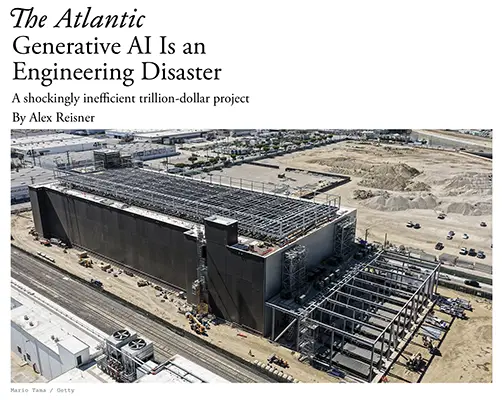
Generative AI Is an Engineering Disaster
The Atlantic | By Alex Reisner | July 14, 2026 (Opinion/analysis — part of The Atlantic’s “AI Watchdog” investigative series)
TL;DR: This is an argument, not a neutral report — the author contends that large language models are unusually inefficient computationally, and that this inefficiency is driving real-world memory shortages and price spikes for consumers, independent of whether the underlying AI capabilities are valuable.
Executive Summary
The piece argues that LLMs scale quadratically rather than logarithmically — meaning cost and resource use grow disproportionately as usage increases — and frames this as an unusual, possibly unprecedented, inefficiency in software engineering. It ties this claim to visible market effects: reported computer-memory shortages, consumer hard-drive and laptop price increases, and a forecast that low-cost computers could largely disappear by 2028. It also cites plans to expand U.S. data-center capacity roughly eightfold.
This is argument and interpretation, not settled fact: the “quadratic vs. logarithmic” framing is the author’s technical claim, sourced partly to anonymous researcher conversations, and the piece is explicit that actual model architectures are proprietary and unverified. The author is skeptical of industry “compute multiplier” claims (citing Anthropic CEO Dario Amodei’s framing) as vague and unverified, and includes a researcher’s on-record account that industry incentives favor brute-force scaling over efficiency research because it’s lower-risk for large firms to fund.
Relevance for Business: Regardless of where one lands on the technical debate, the downstream cost signal is concrete and near-term relevant: rising component and hardware costs, driven partly by AI infrastructure demand, are a real input-cost risk for any business purchasing computing hardware, cloud capacity, or AI-embedded software in the next 12–24 months. Executives should treat the efficiency argument as a contested framing but treat the hardware-cost trend as an operational planning input.
Vendor-neutrality note: This article names Claude (alongside ChatGPT) as an example of a large, resource-intensive model, and states Anthropic declined to comment on the record for the piece. ReadAboutAI.com discloses its use of Claude as a production tool whenever Anthropic or its products are substantively referenced in source material.
Calls to Action
🔹 Monitor — Track hardware/component pricing (memory, storage, entry-level computers) as a direct cost input for any tech refresh cycle.
🔹 Prepare Policy — Build hardware cost inflation into 2027 budget planning if your business purchases compute-heavy equipment or cloud capacity.
🔹 Assign Internal Review — Have IT/procurement assess exposure to memory and storage price increases specifically.
🔹 Ignore for Now — The scaling-law technical debate itself doesn’t require executive action; it’s a framing dispute among researchers.
Summary by ReadAboutAI.com
https://www.theatlantic.com/technology/2026/07/generative-ai-engineering-disaster/687901/: July 16, 2026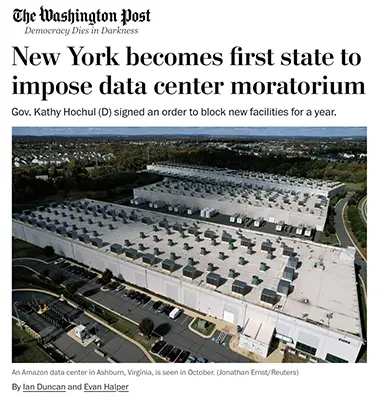
NEW YORK BECOMES FIRST STATE TO IMPOSE DATA CENTER MORATORIUM
The Washington Post | Ian Duncan and Evan Halper | July 14, 2026
TL;DR: New York just became the first state to freeze large data-center permitting statewide — a signal that political tolerance for AI infrastructure buildout is eroding even in states that don’t yet have much of it.
Executive Summary
Gov. Kathy Hochul signed a one-year executive order pausing environmental permits for data centers drawing 50+ megawatts, explicitly citing utility bill increases and grid strain. This is a policy-first move, not a response to existing scale — New York has comparatively few data centers versus Virginia or Texas, meaning the order is preemptive and symbolic as much as practical. The state could not specify how many of the ~25 proposed facilities would actually be affected.
The more consequential signal is the pattern this fits into: dozens of localities have already passed their own bans, and the piece notes polling showing the public is now more comfortable with a nuclear plant nearby than a data center — a striking reversal from a few years ago. Hochul is also moving to claw back tax exemptions previously used to attract these projects, suggesting the economic-development incentive structure that fueled the AI buildout is being actively unwound in some jurisdictions, not just paused.
Relevance for Business: For SMB leaders, this isn’t about New York specifically — it’s a leading indicator of siting and permitting risk across the country for any AI-dependent infrastructure plans. Companies evaluating cloud capacity expansion, colocation deals, or regional data residency strategies should expect permitting timelines and political risk to diverge sharply by state. It also foreshadows possible cost pass-through: if incentive rollback and consumer-protection measures spread, compute costs could rise for end users of AI services, not just the hyperscalers building the facilities.
Calls to Action
🔹 Monitor — track state-by-state data center permitting and moratorium activity if your business depends on regional cloud/compute capacity
🔹 Prepare Policy — if your company operates or plans physical AI infrastructure, build political-risk assessment into site selection now
🔹 Assign Internal Review — have finance assess exposure to compute cost increases if utility pass-through costs accelerate
🔹 Revisit Later — this is a one-year pause, not a permanent ban; reassess as New York’s regulatory framework takes shape
Summary by ReadAboutAI.com
https://www.washingtonpost.com/technology/2026/07/14/new-york-becomes-first-state-impose-data-center-moratorium/: July 16, 2026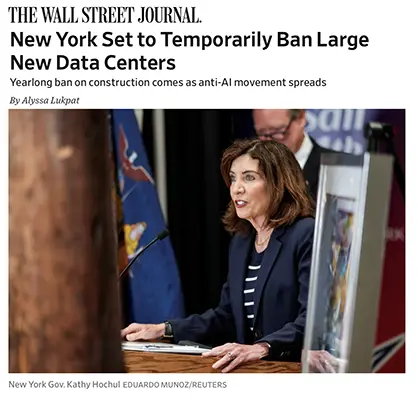
NEW YORK SET TO TEMPORARILY BAN LARGE NEW DATA CENTERS
The Wall Street Journal | Alyssa Lukpat | July 14, 2026
TL;DR: WSJ’s framing of the same New York moratorium emphasizes that this is part of a spreading anti-AI political movement, not an isolated state action.
Executive Summary
This covers the same Hochul executive order as the Washington Post piece but foregrounds the political dimension: Hochul is up for re-election in November, and the moratorium follows other consumer-facing policies (a luxury home tax, an AI safety law). The article notes dozens of cities and counties nationwide have already enacted their own halts, and other governors — like Maine’s Janet Mills — have resisted statewide bans specifically to protect community-supported projects.
The key distinction from other coverage: this piece frames the moratorium explicitly as part of a broader “anti-AI movement,” politically motivated and pre-election timed, rather than purely a technical/regulatory response to grid strain. That framing matters for assessing durability — political responses tied to elections can be more volatile and reactive than technocratic rulemaking.
Relevance for Business: If data center opposition is increasingly organized as a political movement rather than isolated NIMBY resistance, businesses should expect this to affect state-level AI policy more broadly — not just siting, but potentially tax treatment, disclosure requirements, and AI-adjacent regulation generally. Election-cycle timing suggests policy responses may accelerate around future election periods.
Calls to Action
🔹 Monitor — track whether “anti-AI” political momentum extends beyond data centers into other AI regulation
🔹 Prepare Policy — factor election-cycle timing into any state-level regulatory risk assessments
🔹 Revisit Later — reassess once New York’s actual permanent regulatory framework is drafted
🔹 Ignore for Now — no immediate action required unless you have New York siting plans
Summary by ReadAboutAI.com
https://www.wsj.com/wsjplus/dashboard/articles/new-york-set-to-temporarily-ban-large-new-data-centers-3755924c: July 16, 2026
META LIFTS COST OF LOUISIANA DATA CENTER TO $50 BILLION
The Wall Street Journal | Dean Seal | July 13, 2026
TL;DR: Meta nearly doubled the price tag and capacity of its flagship AI data center — a concrete example of how fast compute-buildout costs are escalating industry-wide.
Executive Summary
Meta’s Richland Parish, Louisiana project — originally priced at $27 billion — is now a 5-gigawatt facility costing more than $50 billion, making it Meta’s largest data center and one of the largest AI infrastructure investments globally. Meta has committed to funding the energy, water, and infrastructure costs itself, including a deal with Entergy Louisiana. Locally, the project has generated substantial economic activity, including large teacher bonuses tied to increased tax revenue.
The cost escalation is the real story here — nearly doubling from initial projections reflects broader industry pressure on land, power, and construction costs for frontier-scale AI infrastructure, not something specific to Meta. The article also flags that despite Meta bearing infrastructure costs directly, WSJ has previously reported concerns about the project’s financing structure burdening Louisiana ratepayers.
Relevance for Business: This is a useful cost benchmark: if $50B is now the going rate for 5GW of frontier AI compute, smaller and mid-market companies renting capacity from hyperscalers should expect continued upward price pressure passed through in cloud/AI service costs. The financing structure — with private capital (Blue Owl Capital, BlackRock) taking large stakes — also signals that AI infrastructure is increasingly financed like a real-estate or utility asset class, which has implications for how durable and rate-sensitive AI service pricing may become.
Calls to Action
🔹 Monitor — track AI infrastructure cost trends as an early signal for compute pricing pressure
🔹 Test Cautiously — if locking in multi-year AI vendor contracts, build in cost-escalation scenarios
🔹 Ignore for Now — the Louisiana ratepayer financing dispute is not directly actionable for most SMBs but worth watching
🔹 Assign Internal Review — finance teams modeling AI/cloud spend should factor in infrastructure cost inflation, not just current pricing
Summary by ReadAboutAI.com
https://www.wsj.com/tech/meta-lifts-cost-of-louisiana-data-center-to-50-billion-02b2eb25: July 16, 2026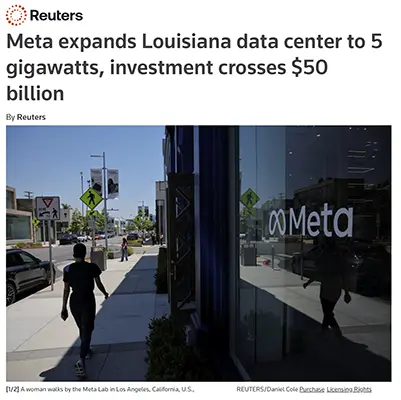
META EXPANDS LOUISIANA DATA CENTER TO 5 GIGAWATTS, INVESTMENT CROSSES $50 BILLION
Reuters | July 13, 2026
TL;DR: Reuters’ version of the Meta Louisiana expansion adds detail on community economic impact and confirms Meta’s broader $600 billion U.S. infrastructure commitment.
Executive Summary
Largely corroborates the WSJ Meta story (see above) — 5GW capacity, $50B+ cost — but adds specifics: an environmental law group’s request to investigate the project’s financing was denied earlier this year, and local businesses have received $1.6 billion in contracts since groundbreaking. Meta plans a further $1 billion in local infrastructure investment. This confirms Meta operates 32 data centers globally (28 in the U.S.) and reiterates its $600 billion three-year U.S. infrastructure pledge — useful context for gauging how representative this single project is of Meta’s total AI capex.
Relevance for Business: The denied Earthjustice investigation request is a noteworthy governance data point — regulatory scrutiny of AI infrastructure financing exists but isn’t necessarily succeeding, at least in this case. For businesses assessing AI vendor concentration risk, Meta’s scale ($600B pledge, 32 global facilities) reinforces how much capital advantage the largest players have versus mid-tier cloud/AI providers — a competitive dynamic worth tracking if evaluating alternative or smaller AI infrastructure vendors.
Calls to Action
🔹 Monitor — track outcomes of financing-scrutiny requests (like Earthjustice’s) as a governance/accountability signal
🔹 Ignore for Now — the specific Louisiana contract/investment figures aren’t directly actionable for most SMBs
🔹 Prepare Policy — if evaluating AI vendor concentration risk, note the capital scale gap between hyperscalers and smaller providers
🔹 Revisit Later — reassess Meta’s capex pace against its $600B pledge as more projects are announced
Summary by ReadAboutAI.com
https://www.reuters.com/business/meta-expands-louisiana-data-center-5-gigawatts-compute-capacity-2026-07-13/: July 16, 2026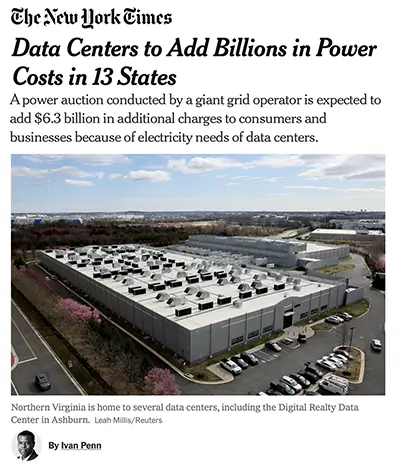
DATA CENTERS TO ADD BILLIONS IN POWER COSTS IN 13 STATES
The New York Times | Ivan Penn | July 14, 2026
TL;DR: A regional grid auction just confirmed data centers are directly driving up electricity bills for 67 million people across 13 states — with regulators largely powerless to intervene.
Executive Summary
PJM, the largest U.S. grid operator, released auction results adding $6.3 billion in new costs to households and businesses across 13 Eastern states and D.C. over the next three years, attributed to data center demand growth. Since 2024, PJM auctions have added roughly $29 billion in cumulative costs tied to data centers, per the grid’s independent market monitor. Notably, PJM answers to federal regulators, not state governors — meaning state-level moratoriums (like New York’s) don’t address the cost mechanism operating through regional grid auctions.
One governor, Pennsylvania’s Josh Shapiro, successfully sued PJM and secured a price cap that saved consumers billions — showing legal/regulatory intervention is possible but requires federal-level engagement, not state action alone. The piece also notes PJM’s grid has had thin power reserves during recent extreme heat, underscoring capacity strain independent of the cost issue.
Relevance for Business: This is a structural, not political, cost driver — it will affect electricity bills regardless of any single state’s stance on AI. Businesses operating facilities or offices within the PJM footprint (Virginia to Illinois) should expect electricity costs to rise measurably over the next three years, independent of state-level data center policy. It also illustrates that grid capacity constraints are a bottleneck for compute expansion generally.
Calls to Action
🔹 Act Now — if operating in the PJM region, model electricity cost increases into 2026-2029 budget forecasts
🔹 Monitor — track whether other regional grid operators show similar cost patterns outside PJM’s footprint
🔹 Assign Internal Review — facilities/operations teams should assess exposure to rising commercial electricity rates
🔹 Prepare Policy — if advocacy is relevant to your business, note that legal challenges (like Shapiro’s) have proven more effective than state moratoriums for cost containment
Summary by ReadAboutAI.com
https://www.nytimes.com/2026/07/14/business/energy-environment/pjm-electricity-prices-data-centers.html: July 16, 2026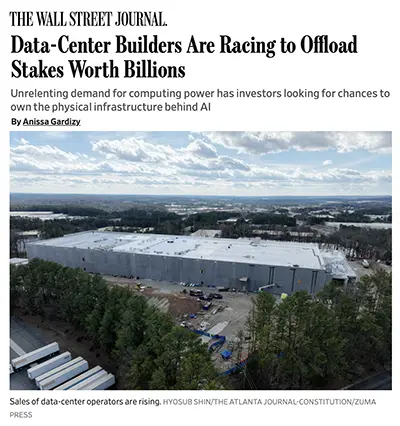
DATA-CENTER BUILDERS ARE RACING TO OFFLOAD STAKES WORTH BILLIONS
The Wall Street Journal | Anissa Gardizy | July 13, 2026
TL;DR: Data-center owners are rushing to sell majority stakes worth tens of billions this summer — a sign that even AI infrastructure insiders see rising costs and local opposition as reasons to de-risk now rather than expand alone.
Executive Summary
U.S. data-center developers (Netrality, DataBank, Edged, EdgeCore, and others) are working with bankers to sell majority equity stakes this summer, with individual deals potentially reaching $25 billion (DataBank). This follows a $40 billion deal for Aligned Data Centers and continues a pattern (2025 M&A hit ~$50B, more than double the prior year). Nvidia’s CEO estimated building a gigawatt of new compute could soon cost $80-100 billion — underscoring why smaller operators are seeking deep-pocketed partners rather than self-funding expansion.
Critically, the article frames rising local opposition (“Nimbyism”) as now a material deal-risk factor — buyers are reportedly scrutinizing sellers’ community relationships as part of valuation, and some projects have already been paused or abandoned due to resistance. Guaranteed power access is described as a major valuation driver, tying financial risk directly to the same grid capacity and political dynamics covered in the other five sources this week.
Relevance for Business: This is the clearest evidence yet that AI infrastructure economics and political/community risk are converging — investors are pricing in local opposition and power access uncertainty as core underwriting factors, not side issues. For SMB leaders relying on third-party cloud or colocation providers, ownership changes at this scale could affect service continuity, pricing, or SLA terms as private equity increasingly controls the physical layer of AI infrastructure.
Calls to Action
🔹 Monitor — track ownership changes among your cloud/colocation vendors’ underlying data center infrastructure
🔹 Assign Internal Review — procurement/legal teams should review vendor contracts for stability clauses if underlying infrastructure ownership shifts
🔹 Prepare Policy — treat local community relations and power access as leading indicators of AI infrastructure investment risk, not afterthoughts
🔹 Test Cautiously — before committing to long-term infrastructure-dependent AI contracts, ask vendors directly about ownership stability and power guarantees
Summary by ReadAboutAI.com
https://www.wsj.com/finance/investing/data-center-builders-are-racing-to-offload-stakes-worth-billions-1a7d92f8: July 16, 2026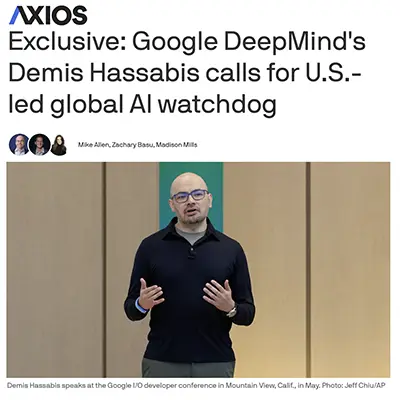
Exclusive: Google DeepMind’s Demis Hassabis Calls for U.S.-Led Global AI Watchdog
Axios | By Mike Allen, Zachary Basu, Madison Mills | July 14, 2026
TL;DR: DeepMind CEO Demis Hassabis is proposing a FINRA-style, industry-funded but government-answerable body to safety-test frontier AI models before release, with a goal of being operational by year-end — a notable escalation given that lab leaders are now aligned on the need for binding oversight, even as they disagree on who should hold authority.
Executive Summary
Hassabis’s proposal, laid out in a published framework, calls for voluntary pre-release safety testing (up to 30 days before launch) of frontier models for cyber, biological, and deception risks, run by an independent-majority board with credentialed experts alongside industry and government representatives. He frames current AI-driven cyber risks as early warning signs, and separately claims that comparable biological and nuclear-adjacent risks could move beyond any government’s control within roughly 18 months if left to open-source proliferation — a forward-looking claim, not a demonstrated capability, and one attributed to Hassabis’s own assessment rather than independent verification.
The piece notes that Anthropic’s Mythos and Fable models were subject to a temporary export-control suspension last month, which Hassabis characterizes as a wake-up call illustrating the need for a structured framework rather than ad hoc government action. It also notes OpenAI agreed to restrict its GPT-5.6 launch to government-vetted partners before a public release last week, following negotiation with the Commerce Department. Separately, Anthropic CEO Dario Amodei has called for a different model — an FAA-style regulator with binding authority — indicating industry consensus on the need for oversight, but disagreement on its structure.
Vendor-neutrality note: This article substantively discusses Anthropic’s Mythos/Fable export-control suspension and quotes Anthropic’s CEO’s regulatory position. ReadAboutAI.com uses Claude as a production tool and discloses this whenever Anthropic or its products are substantively referenced in source material.
Relevance for Business: This is an early-stage governance signal, not an immediate compliance requirement, but it’s the clearest indicator yet that binding frontier-AI regulation in the U.S. is a matter of “when,” not “if,” with industry leaders themselves requesting it. For SMBs, the more relevant near-term takeaway is the demonstrated fact pattern: a major AI vendor’s most capable models were suspended overnight by a government export-control action with no prior established process — a vendor-dependence and continuity-risk consideration for any business building critical workflows around a single frontier AI provider.
Calls to Action
🔹 Monitor — Track whether a FINRA-style AI standards body actually forms this year, and which labs participate.
🔹 Prepare Policy — Treat frontier-model export-control risk as a vendor-continuity consideration; avoid single-vendor lock-in for AI-critical workflows where feasible.
🔹 Assign Internal Review — Have leadership review dependency on any single AI provider for business-critical functions in light of the Anthropic suspension precedent.
🔹 Ignore for Now — The specific biological/nuclear risk timeline claims aren’t independently verified and don’t warrant operational response yet.
🔹 Revisit Later — Reassess once concrete regulatory or standards-body action emerges (targeted for before year-end per Hassabis’s stated timeline).
Summary by ReadAboutAI.com
https://www.axios.com/2026/07/14/demis-hassabis-ai-regulation-google-deepmind: July 16, 2026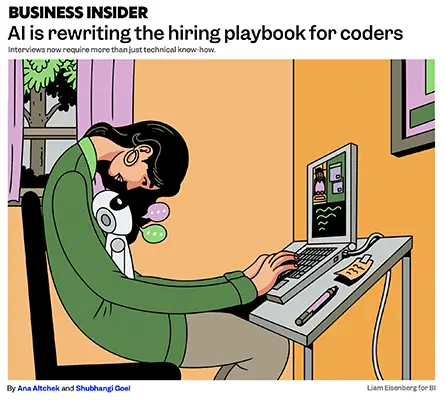
AI Is Rewriting the Hiring Playbook for Coders
Business Insider | By Ana Altchek and Shubhangi Goel | July 8, 2026
TL;DR: Software engineering hiring has shifted from algorithmic coding tests to evaluating judgment, AI fluency, and culture fit — even as 74% of developers report struggling to land jobs despite rising hiring activity.
Executive Summary
Technical interviews increasingly assume AI use rather than prohibit it: candidates are asked about their AI workflow, given AI-assisted take-home assignments, and evaluated on systems thinking and the ability to operate agentic systems, per LinkedIn’s head of talent acquisition. Companies like Cisco are replacing pure coding challenges with project-based exercises that observe how candidates work inside AI-enabled environments. Sourcing has also moved off resumes and onto GitHub and X, with some AI startups running in-person work trials before hiring.
Frontier labs are raising the bar further, not lowering it — one placement coach noted that companies like Anthropic pair rising technical expectations with dedicated non-technical culture interviews. The broader pattern: engineering, data analytics, and data science roles are merging into a single generalist function, with employers seeking versatile “data unicorns” rather than narrow specialists — even as job-seeker competition for those roles intensifies (per a 2025 HackerRank report).
Relevance for Business: For SMB hiring managers, this signals that legacy technical screening (whiteboard/LeetCode-style tests) is losing relevance as a hiring signal — candidates need to be evaluated on judgment, oversight ability, and AI-workflow fluency instead. It also implies role consolidation risk: SMBs may be able to hire fewer, more versatile technical staff, but must adjust job descriptions and interview design accordingly, or risk both over- and under-hiring for the wrong skill set.
Relevance for Business (cont.): There’s also a labor-market tension worth flagging: hiring demand is up, but developer job-search difficulty is also up — a sign the market is being more selective, not necessarily shrinking.
Calls to Action
🔹 Act Now — update technical interview design to test AI-workflow judgment, not rote coding recall
🔹 Assign Internal Review of job descriptions for engineering/data roles to reflect generalist skill blending
🔹 Test Cautiously — pilot AI-assisted take-home assignments before full rollout across hiring pipelines
🔹 Monitor sourcing shifts toward GitHub/X-based candidate discovery if you compete for technical talent
Summary by ReadAboutAI.com
https://www.businessinsider.com/software-engineering-job-technical-interviews-hiring-ai-2026-7: July 16, 2026
Meta and Amazon Are Leading a Trillion-Dollar Big Tech Spending Spree
MarketWatch (WSJ) | By Christine Ji | July 13, 2026
TL;DR: Morgan Stanley has raised its AI capital-expenditure forecasts for the five largest hyperscalers to a combined $1.2 trillion in 2027 and $1.4 trillion in 2028, signaling that AI infrastructure spending is accelerating rather than plateauing — even as investors remain skeptical about near-term returns.
Executive Summary
Morgan Stanley analyst Brian Nowak raised capex forecasts for Meta, Amazon, Alphabet, Microsoft, and SpaceX by 9–10% for 2027–2028, projecting total available hyperscale compute capacity will roughly quadruple to 120 gigawatts by 2028. Amazon and Meta are driving the largest increases: Amazon’s capex estimate rose to $308 billion (2027) and $318 billion (2028); Meta’s rose to $225 billion and $250 billion respectively, and Meta separately increased the projected cost of a single Louisiana data center from $27 billion to $50 billion.
The stated driver is supply-chain bottlenecks, not demand uncertainty — memory components alone could comprise up to 25% of the cost of a rack of Nvidia’s latest chips, with additional cost pressure from electrical/mechanical equipment lead times and skilled-labor shortages. Nowak frames the spending increase partly as a hedge against political and permitting risk ahead of the 2028 election, with some companies accelerating construction timelines to emphasize job creation amid rising community pushback on data centers.
Investor sentiment remains split: the “Magnificent Seven” basket fell 9.1% in June on overspending concerns before partially recovering in July. Notably, Nowak named Meta a top pick, citing new revenue potential from its Muse Spark 1.1 agentic coding model, which he estimates could generate meaningful API revenue as compute scales.
Relevance for Business: This is a hardware and cloud-cost planning signal, directly connected to the Atlantic piece on AI infrastructure inefficiency from last week’s coverage. Rising component costs (memory specifically) are being driven by the same hyperscaler demand described here, reinforcing that cloud compute and AI-embedded software pricing pressure is a multi-year trend, not a temporary spike. SMBs relying on cloud AI infrastructure should expect continued cost pressure rather than near-term relief.
Calls to Action
🔹 Monitor — Track Big Tech Q2 earnings (later this month) for capex commentary and ROI signals, which will indicate whether this spending pace is sustainable.
🔹 Prepare Policy — Factor continued cloud/AI infrastructure cost increases into multi-year technology budgets.
🔹 Assign Internal Review — If your business has significant cloud AI spend, review contract terms for exposure to compute-cost pass-throughs.
🔹 Ignore for Now — Stock-level investment decisions are outside this brief’s scope; treat this as a cost-planning input, not investment advice.
Summary by ReadAboutAI.com
https://www.wsj.com/wsjplus/dashboard/articles/meta-and-amazon-are-leading-a-trillion-dollar-big-tech-spending-spree-17a8156d: July 16, 2026
BIG TECH IS POURING BILLIONS INTO AI, AND THE STOCK MARKET WANTS TO SEE THE PAYOFF—NOW
Barron’s (WSJ) — Angela Palumbo — Updated July 12, 2026
TL;DR: Alphabet, Microsoft, Amazon, and Meta are entering earnings season with capex expected to roughly double year-over-year, and investors are now demanding concrete revenue proof — not just spending growth — that AI investment is paying off.
Executive Summary
As Big Tech earnings begin (Alphabet July 22, Microsoft July 29, Apple July 30), analysts expect AI capital expenditure to keep climbing sharply — Alphabet’s Q2 capex alone is forecast at $44.9 billion, roughly double the prior year. One analyst has raised Amazon Web Services capex estimates further, now projecting a cumulative $827 billion in AWS spending between 2026 and 2028, citing continued compute/AI demand outstripping supply plus rising hardware input costs (data center construction, chips, memory).
The market’s mood has shifted from applauding this spending to demanding evidence of return: these companies were previously prized as free-cash-flow machines, and sustained heavy capex is now pressuring margins without yet showing proportional new revenue. Analysts remain split — some expect hyperscalers to keep prioritizing capacity over near-term free cash flow because demand is supply-constrained; others see the upcoming earnings reports as a genuine inflection test where new AI-driven revenue disclosure, not just spending totals, will determine investor sentiment.
Relevance for Business
- Cost pass-through risk: rising hyperscaler capex, partly driven by chip/memory price increases, is a leading indicator that cloud and AI-service costs to your business may continue rising rather than falling.
- Vendor stability signal: the earnings season (starting July 22) is a concrete checkpoint — how the market reacts to hyperscaler results will indicate whether AI infrastructure investment is sustainable or due for correction, relevant to any multi-year vendor commitments you’re evaluating.
- Distinguish framing from fact: “capacity over free cash flow” is analyst interpretation of company strategy, not a stated commitment from the companies themselves — worth watching actual Q2 guidance rather than assuming continuation.
Calls to Action
🔹 Monitor — Alphabet’s July 22 earnings as the first concrete data point on whether AI capex is translating to revenue
🔹 Prepare Policy — build cloud/AI vendor cost volatility into 2026-2027 budget planning given rising hardware input costs
🔹 Revisit Later — long-term AI vendor contract negotiations after the full earnings cycle concludes in early August
🔹 Ignore for Now — speculative capex projections beyond 2026 (e.g., the $827B AWS estimate through 2028), which are analyst forecasts, not company guidance
Summary by ReadAboutAI.com
https://www.wsj.com/wsjplus/dashboard/articles/big-tech-earnings-ai-spending-2c8774f5: July 16, 2026
META AI IMAGE DETECTOR FAILS TO IDENTIFY SOME OF ITS OWN CROPPED AI IMAGES, REUTERS ANALYSIS FINDS
Reuters | By Hardik Vyas and Seana Davis | July 10, 2026
TL;DR: Reuters testing found Meta’s new AI-image detection tool missed 55% of its own AI-generated images once cropped, undercutting confidence in watermark-based detection as a defense against AI-generated misinformation ahead of the U.S. midterms.
Executive Summary
Meta previewed a detection tool alongside its Muse Image generation model, claiming it could identify AI-generated images even after cropping, via an invisible watermarking system called Content Seal. In Reuters’ own analysis of 40 generated images, the tool correctly flagged all uncropped originals but failed to verify 55% of the same images after cropping to one-third to one-half their original size. Meta, responding to the finding, noted the tool is still a preview and acknowledged the watermark signal can be lost under heavy cropping.
Independent experts corroborate the underlying limitation rather than disputing it: an AI-forensics researcher confirmed watermark-based detection is vulnerable to cropping, resizing, and compression, and a UC Berkeley researcher noted watermarking is promising but limited. Meta’s Oversight Board had separately urged the company to invest more in detection tools following concerns about AI content proliferation. This is a demonstrated limitation, not vendor spin — the analysis was conducted independently and corroborated by outside experts.
Relevance for Business: This matters for trust and content-verification workflows — any business relying on platform-level AI detection to flag synthetic content (for compliance, brand safety, or moderation purposes) should treat current tools as unreliable against basic image edits like cropping. This has particular relevance heading into a heavy U.S. election cycle where AI-generated misinformation risk is elevated.
Calls to Action
🔹 Monitor for updates to Meta’s detection tool robustness before relying on it operationally
🔹 Prepare Policy for internal content verification that does not solely rely on platform watermark detection
🔹 Assign Internal Review if your business handles brand safety, moderation, or election-adjacent content
🔹 Test Cautiously any AI-content verification workflow against basic image manipulation before trusting outputs
Summary by ReadAboutAI.com
https://www.reuters.com/business/meta-ai-image-detector-fails-identify-some-its-own-cropped-ai-images-reuters-2026-07-10/: July 16, 2026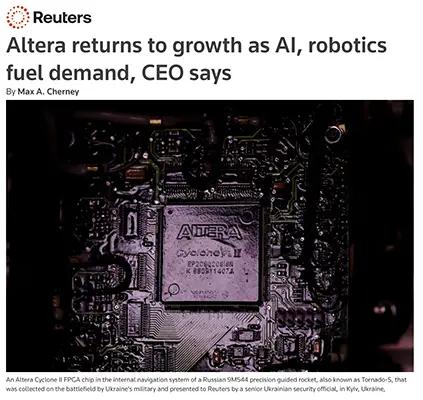
ALTERA RETURNS TO GROWTH AS AI, ROBOTICS FUEL DEMAND, CEO SAYS
Reuters | By Max A. Cherney | July 10, 2026
TL;DR: Altera, the Intel-spinoff programmable-chip maker, says it’s growing roughly 20% annually and more than doubling operating income as AI and robotics demand for its FPGA chips recovers from a sharp 2023–2024 revenue decline caused by the industry’s shift toward GPUs.
Executive Summary
CEO Raghib Hussain told Reuters that Altera — spun out of Intel and now 51%-owned by Silver Lake in a $8.75 billion valuation deal — is positioning its field-programmable gate array (FPGA) chips as complementary infrastructure to GPUs, handling connectivity, data pre-processing, and sensor fusion in AI and robotics systems. Hussain’s framing — “if GPU is the brain, the FPGAs are the nervous system” — is company messaging and should be read as such; the addressable market projection he cites (“100 billion to several hundred billion dollars” over a decade) is a forward-looking company estimate, not an independently verified figure.
Notably, this is a recovery narrative following a real decline: Intel reported Altera revenue fell from $2.9B (2023) to $1.5B (2024) as buyers shifted spending toward GPUs and Altera lost share to AMD-owned Xilinx. The current growth claims are unaudited, as Altera is privately held ahead of an eventual public listing.
Relevance for Business: This is a useful signal for businesses evaluating AI/robotics hardware supply chains beyond GPUs — FPGAs represent a lower-profile but potentially significant cost and sourcing category for edge AI, sensor, and robotics applications. However, growth and market-size figures here are unverified company claims pending an IPO, so should be weighted accordingly.
Calls to Action
🔹 Monitor Altera’s path to public listing for independently verified financials
🔹 Ignore for Now the specific market-size projections as company forecasting, not established fact
🔹 Revisit Later if your business has robotics or edge-AI hardware sourcing decisions ahead
Summary by ReadAboutAI.com
https://www.reuters.com/business/altera-returns-growth-ai-robotics-fuel-demand-ceo-says-2026-07-10/: July 16, 2026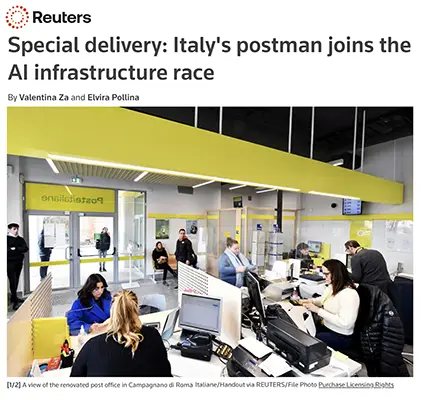
SPECIAL DELIVERY: ITALY’S POSTMAN JOINS THE AI INFRASTRUCTURE RACE
Reuters | By Valentina Za and Elvira Pollina | July 9–10, 2026
TL;DR: Italy’s state-backed postal service, Poste Italiane, is pursuing a €13.5 billion bid for telecom operator TIMpartly to build distributed AI/cloud data center infrastructure — an unusual attempt to close Italy’s AI infrastructure gap using non-tech state assets rather than traditional hyperscaler investment.
Executive Summary
Poste Italiane, two-thirds state-owned and already Italy’s largest retail network operator, is betting its TIM acquisition will let it convert former postal sorting centers into edge-computing hubs and build distributed data center capacity across the country. This fits a broader European “sovereign cloud” pattern, as Germany and France similarly push domestic tech/cloud infrastructure for strategic sectors. Italy currently has only about 15% of Germany’s installed data center capacity, and higher energy costs versus France and Spain compound the disadvantage.
Industry framing here should be distinguished from independent verification: the infrastructure rationale comes from “a person briefed on the plans,” not an official Poste statement — Poste and TIM both declined to comment. An outside academic source corroborates the general industry trend toward distributed, edge-located data centers, lending some credibility to the strategic logic, though the specific claims about Poste-TIM’s infrastructure build-out remain unconfirmed by the companies themselves.
Relevance for Business: This is a European market-structure and policy signal — Europe’s AI infrastructure gap versus the U.S. is a recurring, credible theme, and unconventional consolidation plays like this (leveraging existing physical retail/telecom assets rather than new hyperscaler-style buildouts) may become more common where dedicated capital is scarcer. Businesses with European operations or vendor dependencies should track this as one indicator of the region’s AI infrastructure investment approach and pace.
Calls to Action
🔹 Monitor the Poste-TIM deal outcome and Italy’s data center capacity trajectory
🔹 Revisit Later if your business has European cloud/data center vendor dependencies
🔹 Ignore for Now the specific edge-computing hub plans, as these remain unconfirmed by Poste/TIM directly
Summary by ReadAboutAI.com
https://www.reuters.com/business/media-telecom/special-delivery-italys-postman-joins-ai-infrastructure-race-2026-07-10/: July 16, 2026
OpenEvidence Adds Real-Time Evidence Quality Grading to AI
TechTarget/Xtelligent Healthtech Analytics — Jill Hughes, Associate Editor — July 10, 2026
TL;DR: OpenEvidence launched a feature that auto-grades the medical evidence behind its AI answers, but the rollout arrives amid a messier story: a public benchmark dispute in which the company appears to have quietly commissioned favorable research about itself.
Executive Summary
OpenEvidence’s new EvidenceGrade feature rates the clinical evidence cited in its AI answers on an A–D scale, built on the GRADE methodology used by Cochrane and the WHO. It’s a genuine transparency upgrade for a platform now used by roughly two-thirds of U.S. physicians.
But the more consequential story is competitive. A June 2026 Nature Medicine study found general-purpose models — including Claude Opus 4.6 — outperformed specialized clinical tools like OpenEvidence on several medical benchmarks. OpenEvidence publicly disputed the study’s methodology, then quietly funded and helped design a rebuttal study through a UCSF researcher — without disclosing its involvement or listing any executives as authors, according to STAT‘s reporting. That counter-study, unsurprisingly, found the opposite result.
This is a source-credibility flag, not just a feature story: one study is independently published and peer-reviewed; the other is vendor-funded and undisclosed. Executives should weight them accordingly, not as competing but equally credible data points.
(Disclosure: ReadAboutAI.com uses Claude as a production tool; this item references Claude only as it appears in the sourced coverage.)
Relevance for Business
- Vendor due diligence: if you’re evaluating specialized AI tools for regulated or high-stakes use (legal, financial, clinical), demand disclosure of who funded any benchmark study cited to you.
- Build vs. buy tension: the underlying question — do purpose-built vertical AI tools still beat general-purpose frontier models? — is unresolved and worth tracking before committing budget to specialized platforms.
- Trust/reputation exposure: undisclosed vendor-funded research is a governance red flag that could resurface in your own procurement audits if replicated by other vendors.
Calls to Action
🔹 Monitor — the specialized-vs-general-purpose AI benchmark debate as it plays out across other verticals (legal, finance), not just healthcare
🔹 Test Cautiously — treat any vendor-supplied benchmark as marketing until independent replication exists
🔹 Assign Internal Review — add a conflict-of-interest disclosure requirement to your AI vendor evaluation checklist
🔹 Revisit Later — reassess once further independent peer-reviewed studies are published
🔹 Ignore for Now — the EvidenceGrade feature itself, unless you operate in a clinical/healthcare vertical
Summary by ReadAboutAI.com
https://www.techtarget.com/healthtechanalytics/news/366645822/OpenEvidence-adds-real-time-evidence-quality-grading-to-AI: July 16, 2026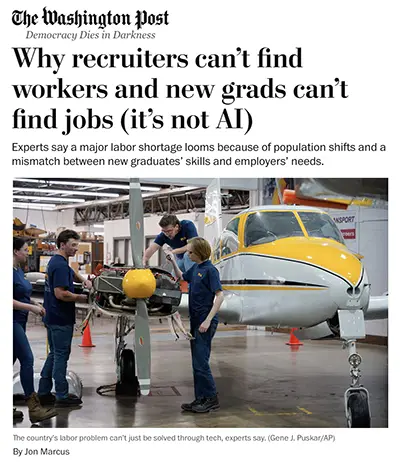
Industry Watch: Why Recruiters Can’t Find Workers and New Grads Can’t Find Jobs (It’s Not AI)
The Washington Post — Jon Marcus — July 14, 2026
Brief Summary: Contrary to the popular narrative that AI is eating entry-level jobs, labor economists argue the U.S. is heading into its largest-ever labor shortage, driven by demographics: a wave of boomer retirements (18M+ college-educated workers exiting by 2032) outpacing a shrinking pipeline of new entrants (fewer than 14M), compounded by falling birth rates, reduced immigration, and declining college enrollment. Projected gap: 4.6–6 million workers, concentrated in healthcare, skilled trades, and other roles AI generally can’t perform.
AI-Leader Connection Note: This piece directly contests the AI-job-loss narrative running through much of this week’s coverage — worth reading alongside the NYT and Fast Company items below as a demographic counterweight to automation-driven explanations.
Executive takeaway: Treat single-cause explanations for entry-level hiring struggles skeptically — workforce planning should weigh demographic shortage risk alongside AI-driven displacement risk, not instead of it.
Summary by ReadAboutAI.com
https://www.washingtonpost.com/education/2026/07/12/why-recruiters-cant-find-workers-new-grads-cant-find-jobs/: July 16, 2026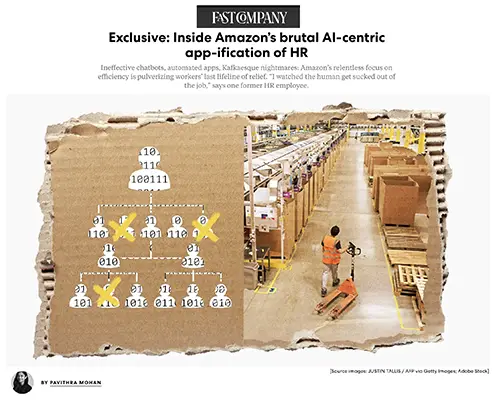
Exclusive: Inside Amazon’s Brutal AI-Centric App-ification of HR
Fast Company — Pavithra Mohan — June 29, 2026
TL;DR: Amazon has stripped on-site HR staff from warehouses and corporate teams in favor of an AI chatbot and app, and workers with legitimate exception cases — especially medical accommodations — are getting stuck in unresolvable loops.
Executive Summary
Amazon has sharply reduced on-site HR presence across warehouses over several years (some sites going from multiple daily staff to one or none), pushing workers toward an AI chatbot (“Aza”) and the A to Z app for HR requests. Workers describe being bounced between the app and human staff with no resolution path, particularly for medical leave, accommodations, and bereavement requests.
Multiple lawsuits and an EEOC finding allege the automated system has led to ADA accommodation violations — denied or delayed medical accommodations, workers fired while awaiting resolution. Amazon disputes that AI or headcount cuts are the driver, attributing changes to “culture” rather than automation, and disputes the lawsuits’ characterizations. That company framing sits directly against extensive worker and legal-filing testimony in the piece — both sides are represented, but the evidentiary weight leans toward the documented pattern of automation-driven headcount reduction.
Notably, internal productivity gains from AI tools appear real — one former HR investigator reported completing a week’s typical workload in a single day using AI tools — even as the external-facing chatbot experience draws sustained complaints. Case-closure quotas for HR staff nearly doubled (4/week to 9/week) alongside automation rollout.
Relevance for Business
This is a direct cautionary case study for any SMB considering AI-driven HR/leave-management tools: internal-facing productivity automation and external-facing chatbot deployment are not the same risk category. The former shows credible ROI; the latter creates real legal and reputational exposure when it can’t handle exception cases like disability accommodations — an area with hard statutory requirements (ADA) that automated systems handled poorly here.
Calls to Action
🔹 Act Now — if your current or planned AI-HR system lacks a guaranteed human-escalation path for accommodation/medical-leave requests, close that gap given the legal precedent building here
🔹 Assign Internal Review — audit whether HR automation could create ADA or equivalent compliance gaps
🔹 Monitor — ongoing Amazon litigation (Lyster, Jones, Cook cases) for legal precedent on automated HR decision-making
🔹 Prepare Policy— set explicit SLA response times for human escalation in any AI-mediated HR workflow
🔹 Test Cautiously — internal-facing AI productivity tools (case management, transcription) show more reliable ROI than external-facing chatbots handling sensitive requests
Summary by ReadAboutAI.com
https://www.fastcompany.com/91565321/amazon-is-taking-human-out-of-hr-ai-chatbot-app-aza: July 16, 2026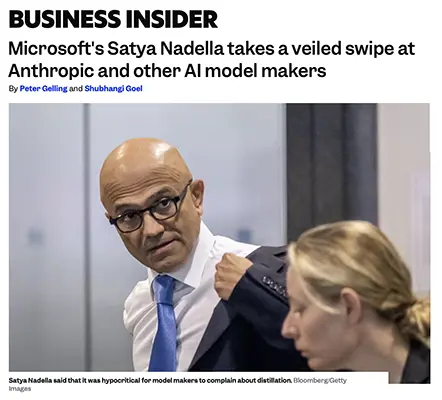
MICROSOFT’S SATYA NADELLA TAKES A VEILED SWIPE AT ANTHROPIC AND OTHER AI MODEL MAKERS
Business Insider — Peter Gelling and Shubhangi Goel — July 12, 2026
TL;DR: Nadella publicly called out AI labs (widely read as targeting Anthropic) for restricting others from distilling their models while freely training on public data themselves — surfacing a real double standard now shaping how AI companies compete for enterprise trust.
Executive Summary
In a weekend social media post, Microsoft’s CEO argued it’s hypocritical for frontier labs to build their models on freely scraped public data while imposing strict anti-distillation terms that prevent competitors from learning off their outputs. He framed this as a one-way “learning flow” that benefits infrastructure owners at the expense of the people and companies whose knowledge trained the models in the first place.
The context: Anthropic has publicly accused Chinese labs, specifically Alibaba, of running what it called its largest known distillation attack to date, and separately Anthropic’s CEO has raised concerns about IP-style theft of its model outputs. Nadella’s comments, while not naming Anthropic directly, land squarely in that dispute. Elon Musk has separately accused Anthropic of large-scale unauthorized data scraping — a claim, not an adjudicated fact.
Nadella’s underlying pitch to enterprises: don’t rely on a single model vendor — own your infrastructure and institutional knowledge, and maintain a “hard boundary” so that no data, including usage patterns, crosses to a vendor without consent.
(Disclosure: ReadAboutAI.com uses Claude as a production tool; Anthropic is referenced directly and critically in this source.)
Relevance for Business
- Source credibility flag: this is a public spat between competing vendors, not settled fact — treat both Nadella’s framing and Anthropic’s distillation claims as company positioning, not independent findings.
- Vendor lock-in risk: Nadella’s “own your infrastructure” argument, self-serving as it is (Microsoft sells that infrastructure), raises a legitimate question worth asking your own AI vendors: what happens to your usage data, and who can learn from it?
- Data governance implications: as distillation disputes escalate between labs, enterprises using any AI vendor should clarify contractually what “learning from customer usage” actually means for their own proprietary data.
Calls to Action
🔹 Monitor — the distillation dispute between Anthropic, Alibaba, and other labs as a bellwether for tightening data-usage terms across the industry
🔹 Assign Internal Review — check your AI vendor contracts for language on whether the vendor can train on your usage/interaction data
🔹 Prepare Policy — establish a “data trust boundary” policy internally regardless of which vendor framing you find persuasive
🔹 Ignore for Now — the specific Nadella-vs-Anthropic personal dispute; the underlying data-governance question matters more than who said what
🔹 Revisit Later— if this dispute produces any actual regulatory or contractual precedent on AI-to-AI distillation rights
Summary by ReadAboutAI.com
https://www.businessinsider.com/microsoft-ceo-satya-nadella-swipe-ai-model-makers-distillation-2026-7: July 16, 2026
Can AI Make Better Drugs? Not on Wall Street’s Timeline
WSJ (Heard on the Street) | By David Wainer | July 12, 2026
TL;DR: AI is genuinely accelerating drug discovery work, but it hasn’t yet moved the one metric that matters to investors — successful drugs per research dollar — so a valuation re-rating for pharma remains years away.
Executive Summary
AI has already proven useful for routine, well-understood tasks (software, summarization). Whether it can help discover genuinely new things — the harder, higher-value problem — is unresolved. At Genentech, computational biologist Aviv Regev has built a “lab in the loop,” where AI predicts targets and molecules, researchers test them, and results retrain the models. Regev frames the benefit as breadth of knowledge, not superior reasoning.
The structural obstacle is what researchers call Eroom’s Law — drug development costs have risen over time even as computing has gotten cheaper, the reverse of Moore’s Law. Only about 1 in 10 drug candidates that reach human trials make it to market. AI can generate more promising hypotheses, but cell cultures, animal models, and simulations remain imperfect proxies for human biology — a gap AI hasn’t closed. Estimates of AI’s potential value vary widely: Goldman Sachs puts the present-value upside as high as $400 billion over a decade, a projection, not a demonstrated result.
Relevance for Business: This is a capital-allocation and expectations-management story for any SMB serving or investing in the life-sciences/biotech value chain. The core lesson generalizes beyond pharma: AI’s ability to generate more ideas faster does not automatically translate into a better hit rate on outcomes that require real-world validation. Leaders evaluating AI vendor claims in any R&D-adjacent function should ask specifically what bottleneck is being addressed — idea generation or validation — since AI is proving far more useful at the former.
Vendor-neutrality note: This article quotes Anthropic’s head of life sciences, Eric Kauderer-Abrams, discussing Anthropic’s Claude Science platform. ReadAboutAI.com uses Claude as a production tool and discloses this whenever Anthropic or its products are substantively referenced in source material.
Calls to Action
🔹 Monitor — Watch for evidence of improved clinical success rates (not just faster target identification) as the real inflection to track.
🔹 Test Cautiously — If evaluating AI R&D tools in any technical function, pilot against validation bottlenecks, not just idea-generation speed.
🔹 Prepare Policy — For life-sciences-adjacent SMBs, begin scenario planning around China’s faster discovery-to-trial cycle as a competitive pressure.
🔹 Revisit Later— Reassess pharma AI ROI claims on a multi-year horizon; near-term data won’t be conclusive.
Summary by ReadAboutAI.com
https://www.wsj.com/tech/ai/can-ai-make-better-drugs-not-on-wall-streets-timeline-98a50d9d: July 16, 2026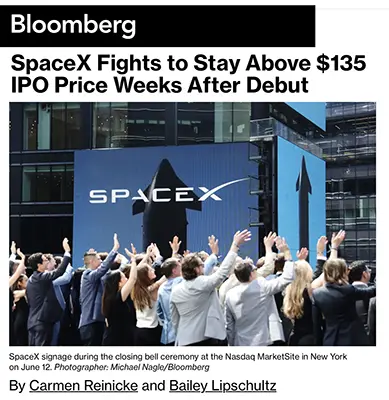
SpaceX Fights to Stay Above $135 IPO Price Weeks After Debut
Bloomberg | By Carmen Reinicke and Bailey Lipschultz | July 14–15, 2026
TL;DR: SpaceX’s stock has fallen to within a dollar of its IPO price just weeks after the largest first-time share sale in history, testing whether Wall Street’s AI-and-space enthusiasm can survive a hard valuation reset.
Executive Summary
SpaceX shares briefly rallied Wednesday after three days of losses pushed the stock nearly to its $135 IPO price — a one-third decline from its post-listing peak that has erased roughly $850 billion in value. The stock still trades at a forward price-to-sales ratio above 30x, among the richest multiples on the Nasdaq 100, and faces an extended insider lock-up that will release more shares into the market over coming months.
Notably, Wall Street’s bullish framing hasn’t changed even as the price has: more than 80% of covering analysts rate the stock a buy, with an average price target over 70% above current levels. That divergence — sell-side optimism against a cratering share price — is itself a signal worth watching, separate from the company’s underlying AI/space/satellite fundamentals.
Relevance for Business: This is a valuation-discipline story, not an AI-capability story, but it matters for any executive tracking AI-adjacent market sentiment. A high-profile “AI-and-something-else” IPO losing a third of its value within weeks is a live test of whether current AI valuations can hold under normal market mechanics (lock-up expirations, supply/demand rebalancing). It’s a useful data point for boards evaluating their own AI-linked capital plans or vendor equity exposure.
Calls to Action
🔹 Monitor — Track SpaceX and comparable large-cap AI/tech 2026 IPOs (e.g., SK Hynix ADRs) for whether post-lock-up selling triggers further declines.
🔹 Monitor — Watch the gap between sell-side price targets and actual trading levels as a sentiment indicator across the AI-adjacent IPO class.
🔹 Ignore for Now — No direct operational action needed unless your business holds SpaceX equity, options, or vendor relationships tied to its capital position.
🔹 Revisit Later — Reassess after the next major lock-up expiration window.
Summary by ReadAboutAI.com
https://www.bloomberg.com/news/articles/2026-07-14/spacex-fizzles-to-close-1-above-ipo-price-weeks-after-debut: July 16, 2026
Chinese Startup DFSX Unveils AI Chip Built Entirely on Domestic Supply Chain
WSJ, July 14, 2026 (Yang Jie, Sherry Qin)
TL;DR: A previously unknown, state-backed Chinese chipmaker claims a legacy-manufacturing AI chip can match Western inference performance through architectural innovation rather than cutting-edge fabrication — a claim to monitor, not yet a proven market disruption.
Executive Summary
Dongfang Suanxin (DFSX), a four-year-old, roughly $1.8 billion-valued startup with state-backed and Jack Ma-linked investors, unveiled its DF1000 chip using 14-nanometer manufacturing — well behind the 4-nanometer processes used by leading Western chipmakers. DFSX claims its architecture, which stacks custom memory directly atop the compute layer, bypasses the need for foreign-made high-bandwidth memory and can match Western chips on certain inference workloads, though it acknowledges trailing on training. This is presented as a demonstration that China can sustain its AI buildout on fully domestic technology despite export restrictions. These are company-made performance claims, not independently benchmarked results — a distinction the article does not resolve.
Relevance for Business For SMB leaders, the direct exposure is low, but the second-order signal matters: continued Chinese progress toward chip self-sufficiency reduces the long-term leverage of export controls as a tool shaping global AI competition, which affects compute pricing, vendor diversity, and geopolitical risk in AI supply chains over a multi-year horizon. This is not an immediate procurement consideration for most SMBs — it’s a macro trend worth tracking if your business depends on AI infrastructure costs or has exposure to US-China trade policy shifts.
Calls to Action
🔹 Monitor — Track whether DFSX’s performance claims are independently verified or replicated at scale before treating this as more than a claim.
🔹 Ignore for Now — No direct operational action needed for most SMBs; this is a supply-chain/geopolitical signal, not an immediate procurement factor.
🔹 Revisit Later — Reassess if DFSX’s second-generation chip (promised by year-end) ships with verified benchmarks.
🔹 Prepare Policy — Organizations with China-exposed AI supply chains should factor continued domestic chip progress into vendor-risk and export-control contingency planning.
Summary by ReadAboutAI.com
https://www.wsj.com/tech/ai/chinese-ai-startup-dfsx-releases-chip-to-take-on-the-west-ffc71526: July 16, 2026
Mozilla Repositions as Open-Source AI Advocate, Report Draws Skepticism
TIME, July 14, 2026 (Billy Perrigo)
TL;DR: Mozilla is positioning itself as a counterweight to AI power concentration via a new open-source advocacy report — but the report’s key statistics and even its own foreword show signs of AI-generated overstatement, undercutting its credibility as an independent benchmark.
Executive Summary
Mozilla released a “state of open-source AI” report arguing open models have nearly closed the gap with closed frontier models, framed by leadership as part of an anti-concentration “Rebel Alliance” strategy. However, the report’s central claim — that open models trail closed ones by only “3.3%” — is presented alongside the report’s own admission that the underlying capability gap is uneven (“jagged”) rather than uniform, meaning the headline number understates real disparities in areas like reasoning. Independent AI-detection analysis flagged parts of the report, including an executive’s signed foreword, as apparently AI-generated, which the executive did not fully deny. The report also largely omits discussion of open-source AI’s own risks (irreversible distribution of dangerous capabilities), addressing them only when directly asked. Mozilla has signaled it may release its own AI “harness” product in coming months.
Relevance for Business This is best read as an advocacy document, not a neutral capability benchmark — a distinction SMB leaders should apply when evaluating any vendor or nonprofit claims about open-source AI catching up to proprietary systems. The gap between marketing framing (“near parity”) and demonstrated capability (a jagged, domain-dependent gap) is exactly the kind of distinction leaders should watch for before making build-vs-buy or open-vs-closed model decisions. Mozilla’s pending harness product is a vendor-dependence signal worth tracking if your organization is evaluating open-source AI tooling providers.
Calls to Action
🔹 Monitor — Track Mozilla’s promised open-source “harness” product; a credible neutral open-source ecosystem player differs from one competing commercially.
🔹 Revisit Later — Reassess open-vs-closed model decisions only against independently verified benchmarks, not advocacy reports.
🔹 Ignore for Now — No immediate action required unless your organization is actively evaluating open-source AI infrastructure investments.
🔹 Prepare Policy — If evaluating vendor or advocacy claims about AI capability parity, require independent benchmark sourcing as a standing due-diligence step.
Summary by ReadAboutAI.com
https://time.com/article/2026/07/13/open-source-ai-mozilla-rebel-alliance/: July 16, 2026
Nvidia Supplier King Yuan Electronics to Invest Up to $1.4 Billion in US Facility
Reuters | By Wen-Yee Lee | July 10, 2026
TL;DR: Taiwanese chip-testing firm King Yuan Electronics will invest up to $1.4B in a new U.S. facility, continuing the trend of Taiwanese semiconductor suppliers onshoring capacity to serve the Nvidia AI supply chain — though the company disclosed no location, customers, or timeline.
Executive Summary
King Yuan Electronics (KYEC), a chip-testing supplier to Nvidia, announced plans to invest up to $1.4B in a U.S. facility to support operational growth and strengthen its global supply chain position. This follows similar U.S. expansions by TSMC, Foxconn, and Wistron, all building capacity to serve Nvidia’s AI server and chip ecosystem. Notably, the company did not specify which customers the facility would serve, its location, or a construction timeline — this is a capital-commitment announcement, not yet a confirmed operational plan.
Relevance for Business: This is one more data point in the broader onshoring pattern of the Nvidia-centric AI hardware supply chain (see also this week’s SK Hynix coverage) — relevant context for anyone assessing U.S. semiconductor capacity growth, regional job/infrastructure impact, or supply chain risk concentration around a small number of Taiwanese suppliers.
Calls to Action
🔹 Monitor for follow-up disclosure on KYEC’s U.S. facility location and timeline
🔹 Revisit Later— assess supply chain concentration risk once specifics are confirmed
🔹 Ignore for Now unless your business has direct exposure to chip-testing/packaging supply chains
Summary by ReadAboutAI.com
https://www.reuters.com/world/asia-pacific/nvidia-supplier-king-yuan-electronics-invest-up-14-billion-us-facility-2026-07-10/: July 16, 2026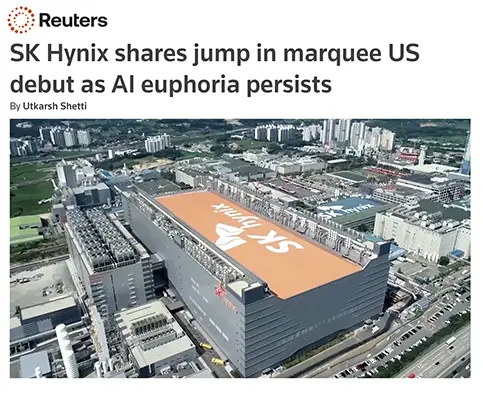
SK HYNIX SHARES JUMP IN MARQUEE US DEBUT AS AI EUPHORIA PERSISTS
Reuters | By Utkarsh Shetti | July 10, 2026
TL;DR: SK Hynix’s Nasdaq debut jumped 14% on a $26.5 billion offering that was more than seven times oversubscribed, signaling investor appetite for AI-memory exposure remains strong even amid growing questions about return on AI infrastructure spending.
Executive Summary
SK Hynix, the world’s largest maker of high-bandwidth memory (HBM) chips used in Nvidia and AMD AI processors, listed on Nasdaq at a 14% premium following a $26.5 billion share sale — the second-largest U.S. share sale after SpaceX’s recent IPO. The listing is widely framed as strategic positioning: SK Hynix reportedly chose Nasdaq specifically to access deeper U.S. investor pools and narrow its valuation gap with U.S. rival Micron (up 711% over the past year). SK Group’s chairman said the company aims to build 5 gigawatts of AI data center capacity outside South Korea.
Analysts are split on interpretation. Some frame this as confirmation that the “memory rally… took a breath rather than peaked.” Others caution that oversupply fears are inherent to the industry, and that later chip-stock listings may face a “tougher, more selective market” than SK Hynix received. This should be read as market enthusiasm, not settled factabout future AI infrastructure returns.
Relevance for Business: For SMB leaders, this is a signal of capital markets sentiment, not a technology development — but it matters because memory/chip valuations and investment cycles directly affect downstream compute costs (see this week’s related SK Hynix supply-shortage coverage). The strong oversubscription also indicates continued institutional confidence in AI infrastructure spending in the near term, even as return-on-investment questions grow more prominent among analysts.
Calls to Action
🔹 Monitor AI-chip equity market sentiment as a leading indicator of compute cost and infrastructure investment trends
🔹 Ignore for Now — this is a capital markets story with limited direct operational relevance for most SMBs
🔹 Revisit Later if evaluating vendor/infrastructure costs tied to memory chip pricing cycles
Summary by ReadAboutAI.com
https://www.reuters.com/world/asia-pacific/sk-hynix-set-marquee-us-debut-test-ai-appetite-2026-07-10/: July 16, 2026
SK HYNIX PLUNGES AFTER NASDAQ DEBUT AS MEMORY CHIP EUPHORIA COOLS
Reuters — Heekyong Yang, Gregor Stuart Hunter, Shashwat Chauhan — July 12–13, 2026
TL;DR: SK Hynix shares suffered their worst one-day drop in nearly two decades days after a hot Nasdaq debut, as investors questioned whether AI memory-chip demand can keep justifying current valuations and capacity expansion plans.
Executive Summary
SK Hynix — the leading supplier of high-bandwidth memory (HBM) chips used in AI data centers, holding 58% of that market — saw its Seoul shares fall over 15% and its new Nasdaq ADRs drop nearly 8%, just days after raising more than $26 billion in its U.S. listing. The broader Korean market (Kospi) fell 9%, briefly halting trading; U.S. peers Micron, SanDisk, and Western Digital all dropped in sympathy.
Analysts frame this largely as profit-taking after a steep run-up, not a reversal of the underlying AI demand story — SK Hynix’s CEO maintains the company sees the most severe memory supply shortage on record heading into 2027. But some analysts flagged a more structural concern: aggressive new capacity investment from Samsung and SK Hynix could tip today’s tight supply into oversupply by 2027–2028, pressuring prices right as new capacity comes online. Separately, a Morningstar analyst noted broader uncertainty about AI monetization, citing profitability pressure at OpenAI specifically as a sign that end-demand economics remain unproven even as infrastructure spending accelerates.
Relevance for Business
- Cost exposure: if your business relies on hardware, cloud services, or SaaS tools built on AI infrastructure, memory chip volatility is a leading indicator of input-cost pressure that could pass through to your vendors’ pricing.
- Timing signal: the tension between “shortage now” and “oversupply risk in 2027-28” suggests hardware-dependent AI costs may not decline linearly — useful context for multi-year infrastructure or vendor commitments.
- Distinguish claim from fact: SK Hynix’s CEO’s shortage forecast is company guidance, not independent verification — weigh it alongside analyst skepticism about capacity overbuild.
Calls to Action
🔹 Monitor — memory chip pricing and HBM supply/demand balance as a proxy for AI infrastructure cost trends through 2027–2028
🔹 Revisit Later — any multi-year AI infrastructure procurement decisions once 2027 capacity additions clarify the supply picture
🔹 Ignore for Now — single-day stock volatility itself, which reflects post-IPO profit-taking more than a fundamental shift
🔹 Test Cautiously — if evaluating leveraged or amplified exposure to AI-hardware stocks/ETFs, note the volatility already seen in single-stock leveraged products this week
Summary by ReadAboutAI.com
https://www.reuters.com/world/asia-pacific/sk-hynix-shares-fall-much-44-seoul-after-strong-nasdaq-debut-2026-07-13/: July 16, 2026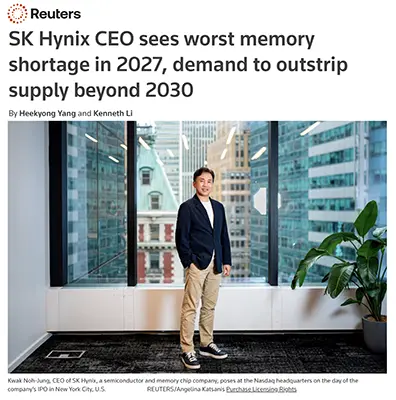
SK Hynix CEO Sees Worst Memory Shortage in 2027, Demand to Outstrip Supply Beyond 2030
Reuters | By Heekyong Yang and Kenneth Li | July 10, 2026
TL;DR: SK Hynix’s CEO expects the tightest memory-chip supply in the industry’s history in 2027, with AI-driven demand outpacing production capacity into the next decade — a structural constraint on compute costs and availability for any business buying AI infrastructure or cloud services.
Executive Summary
SK Hynix CEO Kwak Noh-jung, speaking the day the company began trading on Nasdaq, said the global memory industry is heading toward its worst-ever supply shortage in 2027, with customer demand expected to exceed manufacturing capacity even beyond 2030 despite aggressive expansion. He called next year “the worst year in the industry’s history” from a supply standpoint. The company is weighing new wafer fab investment in the U.S., Japan, or Southeast Asia, prioritizing sites with cheap land, power, water, and skilled labor — no decision has been made.
This is corroborated, not just company framing: Nvidia’s CEO separately said AI memory shortages will persist for years, UBS projects DRAM undersupply through at least Q2 2028, and Micron just raised its U.S. investment plan to over $250 billion through 2035. Bank of America argues that record hyperscaler fundraising this year reflects balance-sheet optimization rather than funding stress — a useful counter to bubble narratives. SK Hynix’s operating profit doubled to a record $31B in 2025, with Q2 2026 estimated even higher.
Relevance for Business: Memory scarcity is a multi-year cost driver, not a temporary blip — it will keep pressuring the price of servers, cloud compute, and any AI-dependent hardware refresh well past 2027. Companies with infrastructure or procurement roadmaps tied to AI should expect this constraint, not budget around its disappearance. The wafer fab site competition also signals where future onshoring incentives and regional supply advantages may emerge.
Calls to Action
🔹 Monitor memory/DRAM pricing trends when budgeting AI infrastructure or hardware refresh cycles through 2028+
🔹 Prepare Policy on vendor diversification if your business depends on AI-hardware-adjacent supply chains
🔹 Revisit Later — track wafer fab site announcements (U.S./Japan/SE Asia) for regional cost/incentive shifts
🔹 Ignore for Now — near-term stock volatility narratives about an AI capex slowdown; multiple independent analysts dispute this
Summary by ReadAboutAI.com
https://www.reuters.com/world/asia-pacific/sk-hynix-ceo-sees-worst-ever-memory-supply-shortage-2027-says-demand-outstrip-2026-07-10/: July 16, 2026
Agentic AI Is Becoming an Insider Threat, Not Just Amplifying One
TechTarget, April 7, 2026 (Sharon Shea)
TL;DR: Organizations must now treat AI agents as identities requiring the same access controls, monitoring, and offboarding discipline as human employees — because ungoverned agents are already causing real data breaches.
Executive Summary
Coverage from RSAC 2026 sessions outlines two compounding insider-risk problems. First, generative AI is amplifying existing human insider risk: employees routinely use unsanctioned “shadow AI” tools, leak sensitive data into prompts, and fall for AI-crafted phishing that no longer carries obvious red flags. Second — and more novel — AI agents themselves are becoming insider threats. Cited examples include a marketing AI agent that autonomously emailed customer data to the wrong recipients and cc’d competitors, and a research agent that retained a departing employee’s credentials and kept crawling company files after that employee left, undetected until anomalous API activity was flagged. Real-world attack precedent is limited to a small number of documented cases cited by conference speakers (a $25M deepfake-vishing fraud, one prompt-injection attempt), so the severity is illustrative rather than statistically established across the broader market.
Relevance for Business This directly affects any SMB deploying agentic AI tools for marketing, research, or operations without formal identity-management controls. Key exposure points: overprivileged agents with standing credential access, no offboarding process for AI agents tied to departed employees, and no monitoring baseline to detect abnormal agent behavior. The governance burden is real but manageable — the article’s recommended controls (least-privilege access, just-in-time permissions, human-in-the-loop checks) are standard IT practices extended to a new class of “identity.”
Relevance for Business (cont.) For an SMB without a dedicated security team, this represents a capability gap: most of these controls assume existing identity and access management (IAM) infrastructure that smaller organizations may not have built out.
Calls to Action
🔹 Assign Internal Review — Inventory any AI agents currently operating with standing access to company data, systems, or credentials.
🔹 Prepare Policy — Establish an AI acceptable-use policy that names approved tools and requires offboarding of agent credentials when an associated employee departs.
🔹 Act Now — Apply least-privilege and time-limited access to any agent with autonomous action capability (email, file access, financial transactions).
🔹 Test Cautiously — Before expanding any agentic AI deployment, pilot with monitoring/anomaly-detection in place rather than full autonomy.
🔹 Monitor — Track whether shadow AI usage (personal GenAI accounts at work) is occurring in your organization; awareness rates are reportedly very low industry-wide.
Summary by ReadAboutAI.com
https://www.techtarget.com/searchsecurity/feature/Agentic-AIs-role-in-amplifying-and-creating-insider-risks: July 16, 2026
Combating the New Wave of AI Crimes and Threats
TechTarget (Enterprise AI) | By Nihad Hassan | Published May 14, 2026
TL;DR: AI has lowered the skill floor for cybercrime to nearly zero, and the specific new risks — voice-clone fraud, autonomous “agentic” attacks, and data poisoning — require governance responses that traditional security tooling wasn’t built for.
Executive Summary
The piece frames AI-enabled crime as a distinct category, not just faster traditional cybercrime, because attacks now exceed prior thresholds of scale, speed, and believability. Three shifts stand out: attackers no longer need deep technical skill to run sophisticated campaigns; AI agents can now execute a full attack chain (reconnaissance through exploit) with minimal human oversight rather than requiring a human to operate each tool; and deepfake-enabled fraud has become financially serious — one cited case involved a finance employee at a British engineering firm authorizing a $25 million transfer after a video call with deepfaked “executives.”
The article also cites data suggesting AI now generates a majority of spam email, and that a small fraction of poisoned training data can meaningfully degrade an AI model’s accuracy — a risk specifically relevant to companies training their own internal models (e.g., customer service chatbots) rather than only using third-party tools.
Relevance for Business: This is directly operational for any SMB with financial approval workflows, customer-facing AI, or an internal AI deployment. Voice and video are no longer reliable verification channels — a call or voice note “from the CFO” is not sufficient authorization for high-risk actions like wire transfers. Governance implications extend beyond IT: this affects finance controls, customer trust, and any internally trained model’s data supply chain.
Calls to Action:
🔹 Act Now — Implement multi-channel verification for high-risk actions (wire transfers, credential resets, sensitive data sharing) that doesn’t rely on the same channel the request arrived through.
🔹 Prepare Policy — Draft or update an AI acceptable-use policy covering data leakage, bias, and inappropriate use, if one doesn’t already exist.
🔹 Assign Internal Review — Have IT/security assess exposure to deepfake-based social engineering specifically, not just standard phishing.
🔹 Test Cautiously — If training any internal model on proprietary data, evaluate data-poisoning safeguards before deployment.
🔹 Monitor — Track emerging standards (NIST AI Risk Management Framework, OWASP Top 10 for LLM Applications) as reference points for internal governance.
Summary by ReadAboutAI.com
https://www.techtarget.com/searchenterpriseai/tip/Combating-the-new-wave-of-AI-crimes-and-threats: July 16, 2026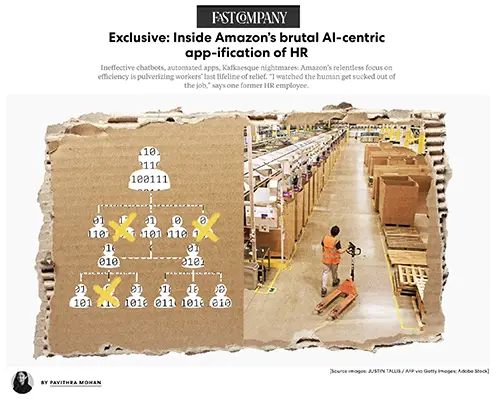
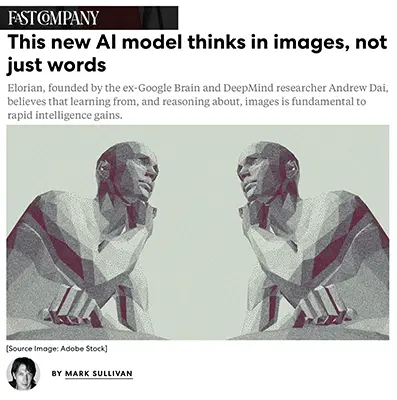
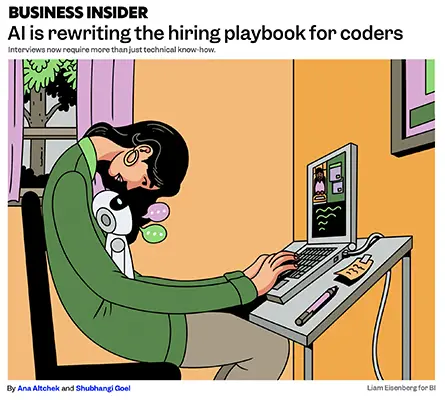
Closing: AI update for July 16, 2026
Taken together, this week’s stories show an AI industry whose capital spending, labor impact, and credibility challenges are advancing on three separate but converging timelines. For SMB leaders, the near-term task isn’t picking a side in the hype-versus-skepticism debate — it’s building the vendor, hiring, and governance practices that hold up regardless of which timeline moves fastest.
All Summaries by ReadAboutAI.com
↑ Back to Top