
AI Updates June 28, 2026

This week’s roundup is dominated by a single uncomfortable fact: the AI buildout’s financial machinery is running well ahead of the governance and accuracy infrastructure meant to support it. The standoff between the U.S. government and Anthropic — which saw the Mythos and Fable models pulled from the market on roughly 90 minutes’ notice over Pentagon security concerns — has become the week’s defining case study, pushing European firms like Siemens, Renault, and Orange toward deliberate multi-vendor AI strategies rather than treating single-provider dependence as a safe default. Layered on top is a debt story that spans nearly every major AI player: SpaceX priced a $25 billion bond largely to cover xAI’s cash burn, Oracle is financing a $70 billion data-center buildout while cutting 21,000 jobs, and Morgan Stanley now projects global AI-related debt issuance will top $570 billion this year alone.
That capital intensity is colliding with a string of accuracy and trust problems that didn’t get nearly the same headline treatment. Independent testing found AI health chatbots missed emergency-level symptoms in more than half of evaluated cases even as roughly a third of Americans now turn to them for medical guidance; a separate test of major chatbots found most skew left-leaning on political questions, with Google’s Gemini the lone outlier toward balance; and a feature on Anthropic’s own design tool documented how thoroughly its output has converged on one recognizable visual style across thousands of unrelated companies. Meanwhile the labor picture is fragmenting in two directions at once — white-collar headcount reductions at Oracle and Meta are increasingly funding AI capex directly, while a parallel shortage of electricians and skilled tradespeople building the physical infrastructure behind all this spending is emerging as a more immediate constraint than any white-collar jobs narrative.
For SMB leaders, the throughline across this week’s 35 pieces is that vendor risk has stopped being theoretical. Whether it’s a frontier model going dark overnight, a supply-chain material like indium phosphide constraining compute costs years out, or a chatbot confidently delivering wrong medical advice, the gap between what AI vendors promise and what they can currently guarantee is the thing worth budgeting and planning around — not the next capability headline. This batch is less about what AI can newly do and more about who controls access to it, who absorbs the cost when something breaks, and how much of the current spending boom rests on confidence that hasn’t yet been tested by a real downturn.

Seedance 2.5’s China-Made Leap Lands as US Frontier Models Stall
AI for Humans, June 23, 2026
TL;DR: ByteDance’s new Seedance 2.5 video model — offering 30-second single-shot clips built from up to 50 reference assets — opened a visible capability gap over US AI video tools just as Anthropic’s restricted model and rumored OpenAI/Google releases remain delayed, suggesting that export and access policy, not raw technical capability, may now be the deciding factor in the AI race.
Executive Summary
ByteDance unveiled Seedance 2.5, an AI video generator capable of producing 30-second clips from a single prompt, accepting up to 50 reference images (characters, wardrobe, settings) to maintain consistency across a shot sequence, and supporting 4K output via API. The hosts frame this as a meaningful jump over the prior 15-second standard and argue it puts Chinese video-generation tools ahead of US equivalents (Sora, Veo) on raw output length and continuity — though no independent benchmark was cited, and the claim should be treated as informed commentary rather than a verified technical comparison.
The hosts attribute part of this gap to looser training-data restrictions in China versus the US, a recurring argument on the show rather than a sourced finding. Compounding the optics: Anthropic’s higher-capability model remains inaccessible (the hosts reference ongoing export-control-related restrictions, consistent with confirmed reporting), and unconfirmed rumors point to delays for GPT-5.6 and Gemini 3.5 Pro. None of these delays are confirmed by the companies involved— they’re sourced to unnamed “rumor mill” accounts the hosts describe as previously reliable.
Three adjacent items carry real signal for SMB leaders. First, OpenAI has published a claim that China-linked influence operations are amplifying US anti-datacenter sentiment (including a viral rant from podcaster Theo Von) — this is a vendor-sourced claim about a politically charged topic, not an independently verified finding, and should be read as OpenAI’s framing of a real public backlash trend, not settled fact. Second, Meta reportedly leaked internal employee data through systems used to train its workplace AI tools — a tangible internal AI-governance failure, not speculation. Third, Google and A24 announced a $75M partnership explicitly not involving training on A24’s film library — instead pairing Google DeepMind with A24’s creative teams to build production workflow tools, a meaningfully different (and lower-controversy) model than typical studio-AI deals.
Relevance for Business
- Vendor dependence and model access volatility: If frontier-model rollout is increasingly gated by export policy and KYC-style identity verification rather than technical readiness, businesses building roadmaps around “next model release” timing face elevated planning risk — assume slippage.
- Data and IP strategy: The Hollywood/training-data debate previewed here (studios potentially pooling content for licensed AI training) is a preview of a fight likely to reach other content-heavy industries. Companies with proprietary content libraries should consider whether to license, withhold, or negotiate data-use terms now, before norms solidify.
- Internal AI governance: The Meta data-leak item is a direct cautionary signal — any company piping internal employee or customer data into AI systems (even for legitimate productivity tools) needs clear data-handling boundaries and review before scaling such tools internally.
- Practical AI ROI: The MCP-based newsletter survey example (beehiiv + Claude) is a concrete, low-risk illustration of workflow automation done well — task-specific integration solving a real operational bottleneck, not a flagship “AI transformation” claim.
Calls to Action
🔹 Monitor — Track confirmed (not rumored) release timing for Anthropic, OpenAI, and Google flagship models before adjusting any AI-dependent product or content roadmap.
🔹 Prepare policy — If your organization uses AI tools that touch internal employee or customer data, review data-handling boundaries now; treat the Meta leak as a preview of a more general risk.
🔹 Investigate — If your business holds proprietary creative or content assets, evaluate licensing and data-use terms before vendor partnerships are pitched to you on their terms.
🔹 Test cautiously — MCP-style integrations (e.g., connecting Claude to operational platforms like newsletter or CRM tools) are a low-cost way to pilot AI-driven workflow automation with bounded scope.
🔹 Ignore for now — Treat claims about state-linked influence campaigns shaping public AI sentiment as unverified framing from an interested party; not yet actionable for business decisions.
Summary by ReadAboutAI.com
https://www.youtube.com/watch?v=CCY1OTJBKwg: June 28, 2026
42 Ways You Should Be Using AI Right Now
Fast Company | Harry McCracken | June 23, 2026
TL;DR: This piece is less a single development than a field guide — it maps the current agentic AI landscape (built-in app agents, specialist tools, coding agents, computer-use agents) while quietly surfacing the real story: a wide gap between adoption (51% of companies) and reliability (an estimated 40% of agentic AI projects are expected to be abandoned by the end of 2027).
Executive Summary
The article catalogs where agentic AI has actually landed in everyday work tools — built into platforms like Asana, Notion, Slack, and Google Workspace, and via specialist apps for meeting notes, scheduling, and data collection. The more consequential thread, though, is the risk gradient across agent types: simple chatbots (low risk) sit well below productivity agents (moderate risk) and computer-use agents — tools that operate a computer directly, send messages, and act with little or no oversight (potentially high risk). The piece contrasts two computer-use tools directly: one runs from the command line with deep, largely unsupervised system access and has already produced real security incidents; the other requires explicit approval before taking actions like sending an email. The difference in design — approval gates versus autonomous execution — is the actual variable that determines risk, not the “agentic” label itself.
Adoption numbers are presented largely uncritically and deserve scrutiny: 51% of companies have deployed agents, but only 16% expect to offload more than half their routine tasks to AI, and a projected 40% of agentic AI projects will be abandoned by the end of 2027 — a sharp gap between pilot activity and durable value that the article doesn’t fully reconcile with its otherwise upbeat framing.
Relevance for Business
- Vendor sprawl, not vendor scarcity, is now the constraint. Dozens of overlapping tools (Gamma, Granola, Paradigm, Reclaim, Zapier, plus native agents in nearly every major platform) mean the bottleneck shifts from “is there a tool for this” to evaluation and integration discipline.
- Computer-use agents carry materially higher exposure than chatbots or productivity agents. Unsupervised, command-line-based tools that control a computer directly should be treated as a distinct risk category requiring its own policy, not lumped in with chatbot usage.
- The abandonment rate is the most decision-relevant number in the piece. A near-40% projected failure rate for agentic AI projects argues for staged pilots with defined success criteria rather than broad rollout.
- Vibe coding (natural-language app creation) lowers the bar for internal tool-building, which is a genuine operational opportunity for resource-constrained SMBs — but also raises questions about who owns and maintains software employees build without engineering oversight.
Calls to Action
🔹 Act now: Inventory which AI agents are already embedded in tools your team uses (Slack, Google Workspace, Notion, etc.) — adoption is often happening informally before any policy exists.
🔹 Prepare policy: Establish a tiered risk framework distinguishing chatbots, productivity agents, and computer-use agents, with explicit approval requirements for the latter.
🔹 Test cautiously: If exploring computer-use agents, favor tools with built-in approval gates over fully autonomous, command-line-based options.
🔹 Monitor: Track the gap between agentic AI pilot adoption and actual measured ROI internally — don’t assume deployment equals value, given the high industry abandonment rate.
🔹 Revisit later: Vibe coding tools are promising for internal productivity builds but immature enough to defer formal evaluation until governance for ownership and maintenance is in place.
Summary by ReadAboutAI.com
https://www.fastcompany.com/91549052/42-ways-you-should-be-using-ai-right-now-agentic-vibe-code-openclaw-podcast-platform-video-newsletter-course-app: June 28, 2026
Zuckerberg Pushes Meta to Build a Prediction-Market App
Investor’s Business Daily, June 23, 2026
TL;DR: Meta is reportedly developing an internal-priority prediction-market app (“Arena”) to compete with Kalshi and Polymarket — but the project may never ship, and it reflects a broader Meta strategy of using leaner, AI-assisted teamsto spin up more apps.
Executive Summary According to a New York Times report citing unnamed sources, Meta CEO Mark Zuckerberg has assigned a team to build an event-contract/prediction-market app internally called “Arena.” It would likely launch with a points-based system before potentially adding real money, and would run independently of Facebook and Instagram. The report frames it as a “top priority” — but also notes it could be shelved entirely.
This fits a pattern Zuckerberg described this spring: Meta wants to use leaner teams plus AI tools to launch many more standalone apps, after cutting 10% of staff. A recent example, the “Forum” discussion app launched in May, already pressured Reddit’s stock. The timing is notable: prediction markets have scaled fast, with combined Kalshi/Polymarket monthly volume reportedly reaching $24 billion in April, up from under $5 billion in September 2025. Markets reacted immediately — Robinhood shares, which also offer event contracts, fell over 2% on the news.
Relevance for Business This is a leading indicator of how large platforms are restructuring product development around AI-leveraged teams — a model SMBs should watch even if prediction markets themselves aren’t relevant. It’s also a reminder that “reported” and “confirmed” are different things: this is sourced to anonymous insiders via a single outlet, and Meta hasn’t confirmed it. Treat speculative product reports as directional signal, not roadmap fact, especially when evaluating competitive moves by major platforms you depend on (ads, APIs, infrastructure).
Calls to Action
🔹 Ignore for now — no operational relevance unless your business touches prediction markets, fintech, or event-contract products.
🔹 Monitor — Meta’s “many smaller apps via leaner AI-assisted teams” strategy as a template that could affect competitive dynamics in adjacent product categories.
🔹 Monitor — regulatory response to prediction-market growth generally, given rapid volume scaling and crossover with gambling-adjacent products.
Summary by ReadAboutAI.com
https://www.wsj.com/wsjplus/dashboard/articles/zuckerberg-wants-meta-to-build-predictions-market-competitor-to-kalshi-polymarket-report-134267184704870477: June 28, 2026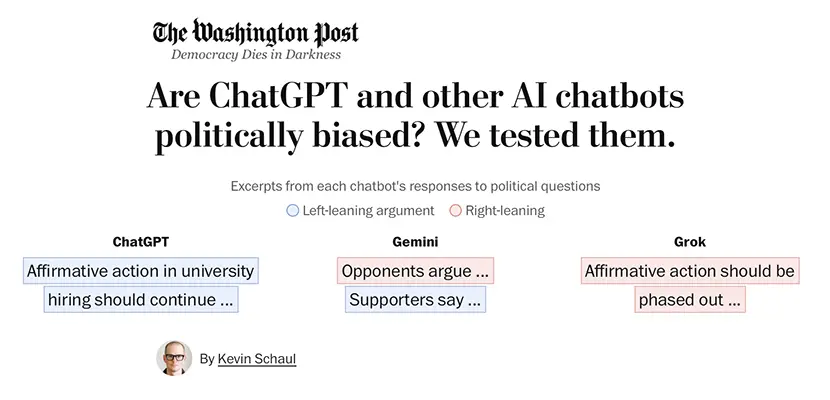
ARE AI CHATBOTS LIKE CHATGPT POLITICALLY BIASED? WE TESTED THEM
WASHINGTON POST, JUNE 24, 2026
TL;DR: Independent testing found most major AI chatbots — including ChatGPT, Claude, Grok, and others — skew toward left-leaning responses on political questions by varying margins, with Google’s Gemini the only model tested that consistently presented both sides.
Executive Summary: Disclosure note: The Post has content partnerships with OpenAI and Perplexity; this is independent testing methodology, not a vendor claim. Using a peer-reviewed Dartmouth/Stanford question set, the Post tested six AI models across political topics and categorized responses as left-leaning-only, right-leaning-only, or both-sides. Results: OpenAI’s GPT-5.5 gave left-only answers 80% of the time; DeepSeek 70%; Gab’s “conservative” Arya model still skewed left (47% left vs. far less right, despite being marketed as built on conservative principles); Anthropic’s Claude Opus 4.8 presented both sides 57% of the time (43% left-only, 0% right-only); xAI’s Grok gave both-sides answers 27% of the time despite being marketed as “anti-woke”; Google’s Gemini was the clear outlier, giving both-sides answers 93% of the time.
Both Google and Anthropic disputed the framing in company statements — Google said it couldn’t reproduce one-sided results internally, and Anthropic said the test doesn’t reflect typical usage patterns since Claude has more room to add context in normal conversations (this testing forced 30-word limits). Academic sources interviewed note true neutrality may be impossible — even “both sides” framing is itself a value choice that can favor the structurally stronger position. The piece also cites survey data showing people prefer neutral-sounding answers regardless of their own party affiliation, suggesting demand for balance is bipartisan even if AI outputs aren’t currently delivering it consistently.
Relevance for Business: This is directly relevant for any SMB deploying AI tools for customer-facing content, internal communications, training materials, or anything touching policy-adjacent topics (HR policy explanations, DEI-related content, public statements). Vendor marketing claims about “neutrality” or “balance” should not be taken at face value — this is exactly the kind of vendor claim warranting independent verification rather than acceptance, per the source-skepticism standard. It’s also a reputational risk vector: AI-generated content reflecting unintended political lean could create unwanted brand association on contested topics.
🔹 Test cautiously any AI tool used for public-facing or policy-adjacent content — verify outputs against your own neutrality standards before trusting vendor claims
🔹 Monitor for political-lean drift if you use AI for internal communications on sensitive topics
🔹 Distinguish vendor marketing language (“neutral,” “anti-woke,” “balanced”) from independently tested behavior
🔹 Prepare policy on AI use for any communications that could be read as taking institutional political positions
🔹 Revisit later — model behavior changes between versions, so any internal testing should be repeated periodically rather than treated as a one-time check
Summary by ReadAboutAI.com
https://www.washingtonpost.com/technology/interactive/2026/06/24/are-ai-chatbots-like-chatgpt-politically-biased-we-tested-them/: June 28, 2026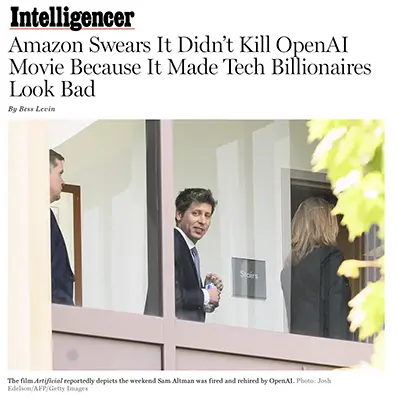
Amazon Swears It Didn’t Kill OpenAI Movie Because It Made Tech Billionaires Look Bad
Intelligencer, June 22, 2026
TL;DR: Major studios are reportedly declining to distribute a Sam Altman biopic following Amazon’s exit, and several of those studios have direct financial ties to OpenAI or its investors — raising questions about how capital concentration in AI is shaping unrelated media decisions.
Executive Summary: Note: This source is opinion commentary, not straight news reporting — its framing is explicitly skeptical and sarcastic. The underlying facts are drawn from Variety’s reporting; treat interpretive claims accordingly.
According to the reporting cited, Artificial, a film reportedly depicting Sam Altman’s 2023 firing and reinstatement at OpenAI, was dropped by Amazon and subsequently passed on by several other major studios. The piece flags — but does not prove — a conflict-of-interest pattern: studios with financial relationships to OpenAI, SpaceX, or Oracle are the ones declining to distribute a film reportedly unflattering to Altman and Elon Musk. Amazon’s public statement cited creative/distribution rationale and did not address its $50 billion investment in OpenAI or existing commercial relationship with the company.
What’s established fact vs. speculation: The studio passes are reported by Variety; the financial relationships (Thrive Capital/A24, Ellison family/Warner Bros.-Oracle ties, Amazon-OpenAI deals) are factual and disclosed. The causal link between those ties and the distribution decisions is the article’s inference, not a confirmed motive.
Relevance for Business: This is a governance and concentration-risk signal, not an operational one. As a handful of AI labs and their investors become enmeshed across cloud, media, and infrastructure sectors, independent scrutiny of those labs may narrow — relevant context for SMBs assessing vendor risk, including how much critical reporting or independent evaluation of AI vendors is likely to surface through traditional channels.
🔹 Monitor for similar conflict-of-interest patterns when evaluating AI vendor claims — concentrated capital ties may reduce independent press scrutiny
🔹 Ignore for now — no direct operational impact on SMB AI purchasing decisions
🔹 Note as background context when assessing how much you can rely on mainstream coverage to surface AI vendor risk independently
Summary by ReadAboutAI.com
https://nymag.com/intelligencer/article/why-did-amazon-kill-its-movie-about-sam-altman-and-openai.html: June 28, 2026
CRAZY RICH RETURNS LURE CABBIES AND EVEN KIDS TO RED-HOT ASIAN MARKETS
WSJ, JUNE 18, 2026
TL;DR: AI infrastructure demand has turned Taiwan, South Korea, and Japan into the world’s top-performing stock markets, creating a retail investing frenzy and underscoring just how concentrated AI’s economic upside currently is in a handful of hardware suppliers.
Executive Summary: This is a color-driven feature illustrating a real structural trend: Asian chip and memory makers — not AI software companies — are the most reliably profitable beneficiaries of the AI boom so far. TSMC, Samsung, and SK Hynix have driven Taiwan’s market up roughly 100% and South Korea’s roughly 200% over the past year. TSMC alone is now worth more than $2.2 trillion and accounts for over 41% of Taiwan’s main index — a concentration risk worth noting for anyone tracking that market.
The retail-investing-frenzy anecdotes (taxi drivers trading mid-ride, children’s brokerage accounts, lottery tickets paying out in Nvidia shares) are narrative color illustrating broader sentiment, not data points to build analysis on. The more decision-relevant fact: the four U.S. hyperscalers plan to spend up to $670 billion this year on AI capex, and global AI-enabling exports hit nearly $4 trillion last year, with Asia supplying two-thirds of that total. This confirms the hardware/infrastructure layer is currently a more dependable profit center than AI application or model companies, whose monetization remains comparatively unproven.
Relevance for Business: For SMBs, the direct relevance is limited to macro awareness rather than operational action— this isn’t a vendor or workforce story. But it reinforces a theme worth tracking across other coverage: the AI value chain’s most “real” profits right now sit in physical infrastructure (chips, memory, cooling, data centers), not in the AI services layer SMBs actually purchase. That’s useful context for evaluating whether AI vendor pricing and claims are sustainable, or whether the underlying hardware economics are still being worked out.
🔹 Ignore for now — minimal direct operational relevance for most SMBs
🔹 Note as macro context: hardware/chip suppliers currently capture more reliable AI profit than software/services vendors
🔹 Monitor for spillover effects — a correction in these markets could ripple into chip/hardware pricing globally
🔹 Deprioritize retail-frenzy anecdotes as decision-relevant signal; they reflect sentiment, not fundamentals
Summary by ReadAboutAI.com
https://www.wsj.com/world/asia/stock-market-ai-chips-taiwan-korea-01b7d385: June 28, 2026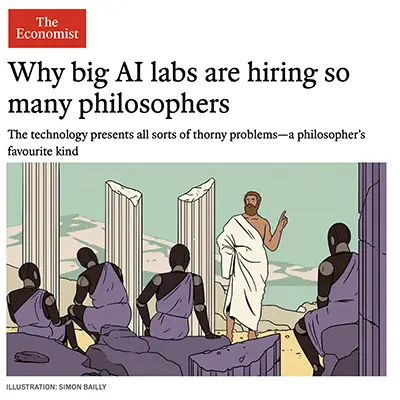
Why big AI labs are hiring so many philosophers
The Economist: June 24, 2026
TL;DR: AI labs are recruiting philosophers to encode judgment, humility, and ethical guardrails directly into model behavior — a sign that “alignment” has become a labor category, not just a research goal.
Executive Summary Frontier AI labs — Anthropic, Google DeepMind, IBM, OpenAI, and others — are hiring philosophers at scale to address problems that pure engineering can’t solve: when a model should refuse a request, how much certainty it should claim, and what ethical framework should govern its tradeoffs. Two competing schools dominate: deontology (rule-based, used by Anthropic’s Claude — prioritizing honesty and consistency) and consequentialism (outcome-weighing, used by ChatGPT, Gemini, and autonomous-vehicle software). Anthropic’s published “constitution” for Claude, reportedly drafted with input from sources as varied as Kant and Apple’s terms of service, illustrates how seriously labs are treating this as a design discipline rather than PR.
The piece cites labor-market data (federal reserve figures referenced in the piece) showing philosophy graduates currently have lower unemployment than computer science graduates — a striking reversal of the “learn to code” advice common a decade ago. This is framing from one data point in one year, not a structural trend — worth noting before treating it as a hiring signal.
Relevance for Business SMBs don’t need in-house ethicists, but the underlying signal matters: vendor-level ethical design choices now meaningfully shape model behavior — refusal patterns, honesty, risk tolerance, tone. Different vendors are choosing different philosophical defaults, which means switching AI vendors isn’t just a cost or performance decision — it’s a behavioral one. Vendors like IBM are starting to expose adjustable “ethics dials” letting business customers tune outputs to their own values; this is an emerging vendor differentiator worth tracking when evaluating AI procurement.
Calls to Action
🔹 Monitor — Track which ethical/behavioral framework your AI vendors use; ask directly rather than assuming neutrality.
🔹 Investigate — If evaluating new AI tools, ask whether the vendor allows configuration of refusal/behavior thresholds (relevant for customer-facing use cases).
🔹 Ignore for now — The “philosophers vs. coders” hiring narrative is interesting but not actionable for SMB hiring decisions.
🔹 Prepare policy — If deploying AI for customer interactions, document expected behavioral norms (honesty, escalation, refusal) so vendor changes don’t silently shift your customer experience.
Summary by ReadAboutAI.com
https://www.economist.com/science-and-technology/2026/06/24/why-big-ai-labs-are-hiring-so-many-philosophers: June 28, 2026
Introducing Meta Glasses: A Range of New Styles from Meta and EssilorLuxottica, Starting at $299
Meta (company announcement) | June 23, 2026
TL;DR: Meta is expanding its AI-glasses lineup with cheaper, more fashion-forward frames (including a Kylie Jenner collaboration) — a consumer hardware push, not an enterprise AI announcement, but one that signals where ambient AI interfaces are headed.
Executive Summary This is a company press release, not independent reporting — treat every claim about quality, “premium materials,” and user delight as marketing framing rather than verified fact. The substance: Meta and EssilorLuxottica are launching a third tier of AI glasses (three frame styles, 26 color/lens combinations, starting at $299) on top of their existing Ray-Ban Meta and Oakley Meta lines. The glasses run Muse Spark, the first model from Meta’s in-house “Superintelligence Labs,” and add features like hands-free capture, multilingual live translation (14 new languages), and upcoming pedestrian navigation.
The notable signal isn’t the hardware spec sheet — it’s the business model: Meta is now selling AI glasses across three price/style tiers (standard Ray-Ban Meta, premium Oakley, and this new broader-style line) with a celebrity-branded sub-line, suggesting Meta sees glasses as a mass consumer AI-assistant form factor it intends to saturate, not a niche.
Relevance for Business
- Not an enterprise tool announcement — this is consumer hardware. Relevance is indirect: it signals growing ubiquity of always-on, camera/mic-equipped AI assistants among customers, employees, and the public.
- Workplace policy exposure: as wearable AI devices with cameras/mics proliferate among customers and staff, expect renewed questions around privacy, recording consent, and acceptable-use policy in physical retail/office spaces.
- Vendor landscape: confirms Meta’s AI strategy is hardware-anchored (glasses) vs. competitors’ software-anchored approaches — worth noting if your business evaluates AI assistant ecosystems for customer-facing use cases.
Calls to Action
🔹 Ignore for now — No direct operational action needed; this is a consumer product launch.
🔹 Monitor — Track wearable-AI adoption rates if your business has a physical retail or office environment where recording-capable devices could raise privacy concerns.
🔹 Prepare policy — If you haven’t already, draft or revisit a workplace policy on AI-glasses/recording-capable wearables for staff and visitors.
Summary by ReadAboutAI.com
https://www.meta.com/blog/introducing-meta-glasses-a-range-of-new-styles-from-meta-and-essilorluxottica-starting-at-299/: June 28, 2026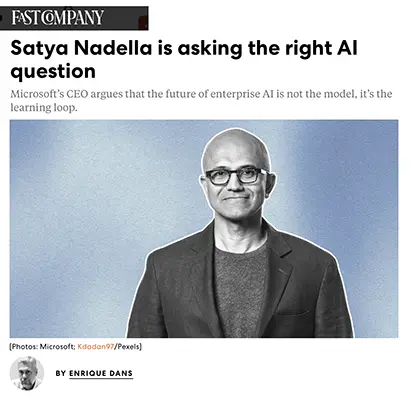
Satya Nadella Is Asking the Right AI Question
Fast Company (analysis by Enrique Dans) | June 23, 2026
TL;DR: Nadella’s argument that enterprise AI value will come from a “learning loop” — not from picking the smartest model — reframes the real competitive battleground: not model selection, but the systems that let organizations retain and compound institutional knowledge as models change underneath them.
Executive Summary This is an opinion/analysis piece by a Fast Company columnist interpreting a Microsoft CEO essay, not a product announcement or independent report — treat Nadella’s framing as his stated thesis, not demonstrated fact. The core argument: as frontier models from OpenAI, Anthropic, Google, and others keep improving, raw model intelligence is becoming commoditized. The durable competitive asset shifts to the “learning loop” surrounding the model — feedback systems, private evaluations, and reinforcement environments that let a business retain accumulated institutional knowledge (“company veteran” expertise) even when it swaps out the underlying model.
The columnist extends this into a broader claim: enterprise AI is still missing the equivalent of the early web’s “consumable layer” — the infrastructure exists, but the architecture that lets ordinary organizations convert AI capability into compounding value doesn’t yet. Both Nadella and the columnist predict the eventual winners won’t be the model-builders but whoever builds the systems that let organizations turn intelligence into accumulated institutional capital.
Relevance for Business
- Vendor dependence risk: if your AI workflows live entirely “inside” a specific model’s behavior, switching vendors later means losing accumulated tuning/context — a hidden lock-in risk worth flagging now, while workflows are still being built.
- Build vs. rent decision: this argues for designing internal processes (prompts, feedback logs, evaluation criteria) as a durable asset independent of whichever model currently powers them — directly relevant to how ReadAboutAI’s own production workflow, or any SMB’s AI-assisted process, should be architected.
- Timing: this is forward-looking strategic framing, not an immediate operational requirement — useful for planning, not urgent action.
Calls to Action
🔹 Monitor — Watch for tools/platforms (Microsoft and others) that explicitly market “learning loop” or model-agnostic memory/evaluation layers; this could become a real product category.
🔹 Assign internal review — Audit current AI-assisted workflows for hidden vendor lock-in (data, prompts, fine-tuning tied to one provider).
🔹 Revisit later — Useful strategic lens for a quarterly AI-strategy review rather than an immediate action item.
🔹 Test cautiously — If evaluating AI vendors, ask specifically how institutional knowledge/context would transfer if you switched providers.
Summary by ReadAboutAI.com
https://www.fastcompany.com/91561371/satya-nadella-is-asking-the-right-ai-question: June 28, 2026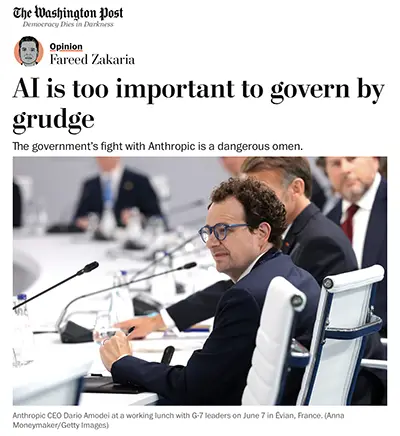
AI IS TOO IMPORTANT TO GOVERN BY GRUDGE
The Washington Post — Opinion (Fareed Zakaria) | June 19, 2026
TL;DR: The U.S. government effectively forced Anthropic offline with roughly 90 minutes’ notice — and this opinion piece argues that ad hoc, personality-driven AI regulation is a bigger long-term risk to American business than any single company’s misstep.
**Executive Summary **This is a named opinion column, not news reporting — Zakaria is arguing a thesis, and the piece should be read as advocacy for a specific regulatory model, not as neutral fact. The underlying event it describes: the U.S. government reportedly gave Anthropic about 90 minutes to pull its frontier model Mythos (and consumer version Fable) from the market, following Pentagon concerns that the model could penetrate “almost all” of the government’s classified systems in hours rather than weeks. The column treats Anthropic’s own conduct (allegedly expanding model access beyond approved scope, then responding slowly to concerns) as a real, acknowledged misstep — not just government overreach.
The author’s central argument is about process, not outcome: rather than disputing that AI needs guardrails, the piece argues that punitive, improvised, company-specific enforcement — layered on top of personal friction between the administration and Anthropic’s leadership — sets a dangerous precedent for any business operating in AI-adjacent or AI-dependent markets. The proposed fix is a “Fed for AI”: an independent body with graduated enforcement (warnings → remediation → conditional deployment → restriction) instead of abrupt shutdowns.
Relevance for Business
- Regulatory unpredictability risk: this is a direct, concrete example of a frontier AI vendor being forced offline on short notice by government action — not market competition. Any SMB building products or workflows on top of frontier models should treat vendor-availability disruption from non-market causes as a real, if low-probability, risk category.
- Vendor dependence: the piece explicitly frames this as a warning to “partners around the world” that government can flip an “on-off switch” on AI infrastructure without warning — relevant to any business with single-vendor AI dependency in mission-critical workflows.
- Distinguish fact from argument: the underlying incident (Anthropic forced to pull Mythos/Fable) is reported as fact; the “Fed for AI” proposal and the broader pattern-of-favoritism argument (Intel stake, Nvidia tax, U.S. Steel “golden share”) are the author’s interpretive framing, not settled policy.
Calls to Action
🔹 Monitor — Track how this standoff resolves and whether other frontier labs face similar sudden-access restrictions; this affects vendor risk assessment broadly, not just Anthropic customers.
🔹 Assign internal review— If your business has single-vendor dependency on a frontier model (for core workflows, not just convenience tools), flag this as a contingency-planning item.
🔹 Prepare policy — Consider a fallback plan (alternate model/vendor) for any workflow where a sudden frontier-model outage would meaningfully disrupt operations.
🔹 Ignore for now — The specific U.S.-Anthropic dispute itself isn’t operationally actionable for most SMBs; the lesson is about systemic vendor risk, not this incident.
Summary by ReadAboutAI.com
https://www.washingtonpost.com/opinions/2026/06/19/trump-vs-anthropic-dangerous-fight-over-ai-rules/: June 28, 2026
THE AI DESIGN AESTHETIC THAT’S TAKING OVER THE INTERNET
THE NEW YORKER, JUNE 24, 2026
TL;DR: Anthropic’s design tool, Claude Design, is producing a visually identical default aesthetic across thousands of unrelated companies — a vendor-homogenization risk that’s becoming as recognizable (and as much a liability) as AI writing tics.
Executive Summary Multiple independent designers interviewed describe Claude Design (launched by Anthropic in April) as defaulting to a near-identical visual style across users: beige/cream backgrounds, rust-orange accents, large italicized serif type, tracked-out subheadings, ticker-style text bars, and rounded dashboard elements with neon glows. One designer noted two unrelated startup clients produced sales decks “generated by the same company” in look, despite different logos. Anthropic’s own documentation acknowledges this, stating the model has a “consistent default house style” that is “persistent” — and that generic prompts like “don’t use cream” tend to shift the design to a different fixed palette rather than introducing real variety, meaning a user has to actively fight the tool to escape the default look.
The piece distinguishes a real phenomenon (default homogenization) from a more debatable interpretation: several designers argue the issue isn’t AI itself but effort substitution — Claude Design offers “pretty good for the most for the least effort,” which some frame as a tradeoff against genuine design “taste,” while others (e.g., Figma’s chief design officer) note skilled use of AI tools can still produce distinctive results with deliberate effort. The article also notes Anthropic’s Fable 5 model launched this month and was quickly suspended after U.S. government national-security concerns — a detail mentioned in passing, not elaborated.
Relevance for Business This is directly relevant for any SMB using AI design tools for customer-facing materials — websites, pitch decks, marketing collateral. The risk isn’t aesthetic quality per se, but brand differentiation: if your sales deck or site looks like every other AI-generated deck, it can undercut credibility with sophisticated buyers who recognize the pattern. This is arts/culture commentary with direct sourcing from designers, not a vendor claim — treat the “consistent default style” point as well-supported (it’s corroborated by Anthropic’s own documentation), but treat aesthetic value judgments (“clichéd,” “complacent”) as subjective framing.
Calls to Action
🔹 Assign internal review — if your team uses Claude Design or similar AI design tools for client-facing materials, audit whether your output looks distinctive or matches the described default pattern.
🔹 Test cautiously— when using AI design tools, deliberately override default palettes/typefaces rather than accepting first-pass output, especially for decks going to sophisticated buyers or investors.
🔹 Monitor — this trend across other AI design/slide tools (not just Claude Design) as the broader category matures.
🔹 Ignore for now — no urgent action if your business doesn’t produce AI-generated customer-facing design assets.
Summary by ReadAboutAI.com
https://www.newyorker.com/culture/infinite-scroll/the-ai-design-aesthetic-thats-taking-over-the-internet: June 28, 2026
THE WHITE-COLLAR BOOMER DILEMMA: EMBRACE AI OR RETIRE EARLY
BUSINESS INSIDER, JUNE 23, 2026
TL;DR: Older white-collar workers are facing a forced choice between rapidly upskilling on AI tools or exiting the workforce, and — counterintuitively — their accumulated judgment may currently offer more job security than younger workers have.
Executive Summary: This is a human-interest piece built around individual case studies rather than hard data, so treat the anecdotes as illustrative, not representative. The structural data point worth noting: just 25% of workers aged 50–64 have used ChatGPT, versus 58% of adults under 30 (Pew). Yet the article’s central, somewhat counterintuitive claim — sourced from AARP’s senior advisor — is that this may be the first technology shift where deep experience and judgment benefit older workers more than younger ones, because discerning quality AI output from “slop” requires domain expertise that newer entrants haven’t built yet.
The tension is real: workers profiled describe being forced to adopt AI by employer mandate, not curiosity, often calling the learning process “exhausting.” Several are explicitly time-boxing their effort — learning just enough to make it to retirement rather than building deep AI fluency. One pattern worth flagging: a Gallup/Quinnipiac data point cited shows younger workers (Gen Z, Millennials) report more anxiety about AI’s job impact than older workers (Gen X, Boomers), who report more confidence from having weathered prior tech disruptions.
Relevance for Business: For SMB managers, this surfaces a retention and reskilling tension that’s easy to mishandle: older, experienced employees may be your most valuable AI adopters precisely because they can evaluate AI output critically — but only if you invest in supporting their transition rather than assuming reluctance equals obsolescence. It’s also a hiring signal: discounting older candidates in an AI-forward hiring process risks losing exactly the judgment AI tools can’t replace.
🔹 Assign internal review of whether reskilling support is reaching older employees equally, not just newer hires
🔹 Monitor turnover risk among experienced staff who feel forced into AI adoption without adequate support
🔹 Test cautiously — pairing experienced staff with AI tools for judgment-heavy tasks (vendor evaluation, client communication) may outperform AI-only or junior-only approaches
🔹 Ignore for now any assumption that AI adoption skews younger by default — the data here suggests otherwise
Summary by ReadAboutAI.com
https://www.businessinsider.com/white-collar-baby-boomer-dilemma-embrace-ai-retire-early-2026-6: June 28, 2026
AI IS SPARKING A BOOM IN BLUE-COLLAR JOBS. HERE’S HOW TO FILL THEM.
The Washington Post — Opinion (Brian Deese & Anna Pasnau) | June 22, 2026
TL;DR: While the AI-jobs debate fixates on white-collar automation fears, the more immediate crisis is a shortage of electricians, welders, and plumbers needed to physically build the data centers and power grid AI requires — and the authors argue closing that gap needs national-scale ambition, not incremental fixes.
Executive Summary This is an opinion piece by two former government economic-policy staffers, making a policy argument backed by cited data — useful for context, but the recommendations reflect the authors’ specific view, not consensus. The argument: amid loud warnings about AI eliminating white-collar jobs (cited figures range from Sen. Sanders’ estimate of up to 100 million jobs lost to The Economist’s “jobs apocalypse” framing), a more concrete and immediate problem is going unaddressed — AI’s physical infrastructure build-out is colliding with an existing skilled-trades shortage. The five largest U.S. cloud/AI infrastructure providers have committed at least $660 billion in 2026 capex, requiring an estimated 1.2 million person-years of skilled labor just for data center construction, on top of a 30%+ projected rise in electricity demand over five years.
The shortage is already visible locally: Northern Virginia’s electrician union doubled membership in seven years and still can’t meet demand, while electrician wages have swung wildly (+60% in some metros, -50% in others) signaling acute regional mismatches. The authors propose three fixes: national licensing reciprocity for tradespeople, AI-assisted training/productivity tools, and a federally funded “pay-for-performance” apprenticeship program (modeled on Australia/Finland/UK approaches and a successful 2022 California pilot) — funded by fees on data center construction rather than taxpayers.
Relevance for Business
- Direct relevance to SMBs in construction, electrical, HVAC, and skilled trades: this signals sustained, multi-year demand growth and wage volatility in these labor markets — useful context for hiring, pricing, and contractor relationships.
- Indirect relevance to any business dependent on data center capacity or grid reliability: labor shortages are already cited (by Microsoft’s president, per the piece) as the single greatest constraint on new data center capacity — meaning AI-tool availability and electricity costs for all businesses could be affected by this bottleneck.
- What’s fact vs. advocacy: the labor-shortage statistics (union membership growth, wage volatility, capex commitments) are sourced and concrete; the specific policy prescriptions (apprenticeship funding levels, fee structures) are the authors’ recommended solution, not enacted policy.
Calls to Action
🔹 Monitor — Track regional skilled-trades wage and availability data if your business depends on electrical, HVAC, or construction contractors.
🔹 Act now — SMBs in skilled trades should treat current demand growth as durable, multi-year tailwind, not a short-term spike, when making hiring or capacity decisions.
🔹 Watch policy developments — National licensing reciprocity and apprenticeship-funding legislation could materially ease trades hiring; worth tracking for businesses that rely on this labor pool.
🔹 Ignore for now — The white-collar “jobs apocalypse” framing this piece pushes back against isn’t this article’s focus; don’t conflate the two debates.
Summary by ReadAboutAI.com
https://www.washingtonpost.com/opinions/2026/06/22/ai-is-sparking-blue-collar-jobs-boom-now-comes-hard-part/: June 28, 2026
THIS ROBOTIC ARM CHARGES YOUR EV SO YOU DON’T HAVE TO
Fast Company | June 22, 2026
TL;DR: Xiaomi has built the first commercial, consumer-purchasable robotic arm that automatically plugs itself into a parked EV — finally delivering on a fully automated home-charging promise Tesla floated in 2014 and abandoned.
Executive Summary Xiaomi has launched a robotic charging arm that uses AI-driven visual positioning for sub-millimeter precision to dock a charging plug into a parked EV without human involvement. The company says mass-production preparations are complete, with deliveries starting Q3 2026 and full commercial launch in Q4 2026; some units are reportedly already running in private garages. Compatibility is currently limited to two Xiaomi vehicle models (SU7 sedan, YU7 SUV) that have the motorized charge-port hardware the system needs to communicate with.
What’s demonstrated vs. claimed: Xiaomi has published a demo video and states the shown functions “can achieve mass production and delivery” — that’s a company claim, not independent verification. Pricing, power requirements, and whether the unit needs an external home charger remain unconfirmed. The piece situates this against Tesla’s unfulfilled 2014 promise of an autonomous charging “snake,” which Tesla’s own VP of Vehicle Engineering later called superfluous and scrapped in favor of (still undelivered) inductive charging — useful context for treating “coming soon” claims from any EV-adjacent company with some skepticism.
Relevance for Business
- Limited direct relevance for most SMBs — this is a consumer hardware product tied to a closed vehicle ecosystem (Xiaomi-only compatibility), not a general business tool.
- Adjacent relevance for fleet operators or businesses with EV charging infrastructure: signals where automated charging hardware is headed, though current compatibility constraints (proprietary vehicle communication) mean it’s not yet usable for mixed-fleet environments.
- Pattern worth noting: this is part of a broader trend of Chinese hardware makers (Xiaomi) shipping AI-enabled physical automation products faster than U.S. competitors have delivered on similar publicly stated promises (Tesla).
Calls to Action
🔹 Ignore for now — Not directly actionable for most SMB operations; this is consumer hardware in an early, narrow-compatibility stage.
🔹 Monitor — Fleet operators with EV charging needs should track whether automated charging hardware expands to multi-brand compatibility before evaluating it operationally.
🔹 Revisit later — Once pricing and broader vehicle compatibility are confirmed, reassess relevance for any business with EV fleet infrastructure.
Summary by ReadAboutAI.com
https://www.fastcompany.com/91560650/xiaomi-first-ev-charging-robot: June 28, 2026
‘SO MUCH FOR CARING ABOUT THE ENVIRONMENT’: REI FACES BACKLASH OVER AI-GENERATED AD SUSPICIONS
Fast Company | June 22, 2026
TL;DR: REI’s Instagram ad showing a bike with an extra set of handlebars went viral as obvious “AI slop,” and the company says it was auto-enrolled into a Meta AI personalization tool that altered a vendor photo without REI’s intent — a reputational lesson about losing control over third-party AI features embedded in ad platforms.
Executive Summary Social media identified visible AI-generation artifacts (duplicate chains, illegible text, an extra pair of handlebars) in an REI Instagram ad and accused the company of using generative AI in its marketing — a reputational risk amplified specifically because REI markets itself on environmental values, and a large share of the public (39% per Pew Research, cited in the piece) views AI/data centers as environmentally harmful. The post stayed live for roughly a week, drawing nearly 800 upvotes on REI’s subreddit and sustained mockery, before REI removed it and issued a statement.
REI’s explanation, stated as company claim, not independently verified: the company says it was auto-enrolled by Meta into an AI personalization tool that altered a vendor-supplied image without REI’s knowledge or approval, and that it has since unenrolled. The model in the photo, Amity Rockwell, publicly said the original shoot was a real, paid photo session for vendor Van Rysel — meaning REI had legitimate, unaltered photography available and the AI alteration appears to have been unintended and unnecessary. An REI employee commenting on Reddit (unverified identity) claimed the company has been increasing AI-based employee training “for at least a year,” adding context but not confirmed fact.
What’s fact vs. claim: The visible image artifacts and public backlash are documented. REI’s explanation (Meta auto-enrollment) is the company’s own account and has not been independently corroborated by Meta or Van Rysel as of publication.
Relevance for Business
- Direct, concrete cautionary case for any SMB using Meta’s ad platform: this illustrates a real risk of auto-enrollment into platform-level AI features that can alter creative assets without explicit business approval — worth checking your own ad account settings.
- Brand-values alignment risk: AI-generated content mistakes carry disproportionate reputational cost for brands whose identity depends on authenticity, craftsmanship, or environmental values — a relevant lesson for any values-driven SMB brand.
- Vendor relationship exposure: REI used an unaltered, properly licensed photo and still ended up with a viral failure — a reminder that AI risk in this case originated from platform tooling, not internal creative decisions, meaning oversight of third-party ad-platform settings matters as much as internal AI policy.
Calls to Action
🔹 Act now — Audit your Meta (and other ad platform) account settings for auto-enrollment into AI image/personalization tools; opt out if not deliberately chosen.
🔹 Prepare policy — Establish an internal review step for AI-touched ad creative before publication, even when source images are vendor-provided and properly licensed.
🔹 Assign internal review — If your brand identity depends on authenticity or sustainability messaging, flag AI-content risk as a higher-stakes category than for brands without that positioning.
🔹 Monitor — Track how Meta and other platforms communicate (or fail to communicate) AI-feature auto-enrollment changes, since this appears to be a platform-level pattern, not an REI-specific decision.
Summary by ReadAboutAI.com
https://www.fastcompany.com/91562948/rei-faces-backlash-over-ai-generated-ad-suspicions-so-much-for-caring-about-the-environment: June 28, 2026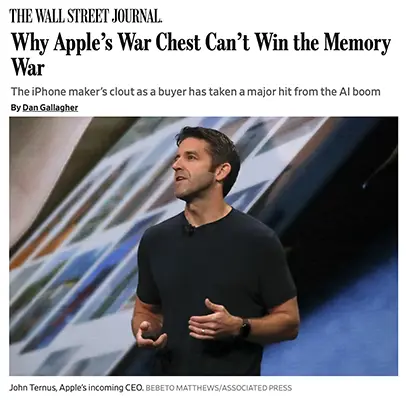
Apple’s War Chest Can’t Win the Memory War
WSJ, June 18, 2026
TL;DR: The AI boom has flipped the memory-chip market against Apple, forcing the company to raise device prices because even its cash reserves can’t out-compete Nvidia for scarce DRAM supply.
Executive Summary: Apple confirmed it will raise prices across its product line after CEO Tim Cook told the WSJ that rising memory costs have become “unsustainable.” The cause: AI infrastructure buildouts are consuming the DRAM supply that smartphones and PCs depend on, with prices for high-end smartphone memory projected to rise as much as 83% this quarter alone.
The deeper signal is structural, not just cyclical. Nvidia is on pace to out-earn Apple in free cash flow this year and buys memory directly in bulk — a position Apple, as a hardware seller rather than a cloud operator, cannot easily match. Cloud players can depreciate memory purchases as capital expense; Apple’s purchases hit cost of goods sold directly, squeezing margins immediately. Analysts expect the shortage to persist into 2028 or beyond.
Relevance for Business: This is an early, concrete example of AI demand reshaping unrelated supply chains — a dynamic SMBs buying hardware (laptops, servers, point-of-sale devices) will feel as component costs pass through to retail prices. It also illustrates that financial size doesn’t guarantee supply-chain leverage when a category-defining buyer (Nvidia) reorders market priorities.
🔹 Monitor hardware refresh costs for the next 18–24 months; budget for price increases on PCs, servers, and mobile devices
🔹 Reassess equipment replacement timing — delaying non-urgent refreshes may avoid peak pricing
🔹 Watch for similar cost pass-through from other hardware vendors competing for the same memory supply
🔹 Ignore for now any narrative that this is Apple-specific — it’s a market-wide input cost shift
Summary by ReadAboutAI.com
https://www.wsj.com/tech/why-apples-war-chest-cant-win-the-memory-war-cb997d02: June 28, 2026
Why Microsoft Needs to Carve its Own AI Path
WSJ AI & Business, June 23, 2026
TL;DR: Microsoft is trying to differentiate its AI strategy with lower-cost models and anti-hype messaging, but its stock has lost over $1 trillion in value and a real turnaround depends on capital-intensive infrastructure that won’t be ready until 2028.
Executive Summary: Microsoft is positioning itself against AI-industry “doomer messaging,” with CEO Satya Nadella pushing back on claims that white-collar jobs are disappearing en masse. The company also launched its own lower-cost AI models aimed at corporate use cases rather than frontier capability. This is framing, not yet evidence of results — Microsoft’s stock is down more than 22% this year, the worst among major tech peers, despite the messaging shift.
The structural problem: Microsoft’s capital spending will hit $190 billion this year, pushing free cash flow toward negative territory. A new 20-year power deal with Chevron for a Texas data center won’t deliver electricity until 2028, meaning near-term compute constraints will continue limiting Azure’s growth — the metric investors are actually watching. Separately, Oracle cut 21,000 jobs (13% of its workforce) while increasing AI capex, a pattern Meta has also followed, suggesting workforce reduction is becoming a standard offset for AI infrastructure spending among heavy AI investors.
Relevance for Business: The gap between AI narrative and AI infrastructure delivery is now measured in years, not quarters — a reminder that vendor messaging about AI capability or strategy shifts should be weighed against actual compute/infrastructure timelines. The Oracle/Meta layoffs pattern is also a leading indicator worth tracking: companies funding AI capex through headcount reduction may signal where automation substitution is happening fastest.
🔹 Monitor Azure and major cloud vendor capacity constraints if you rely on their AI services — rationing is already occurring internally at Microsoft
🔹 Distinguish vendor messaging from delivered capability when evaluating any AI platform’s roadmap claims
🔹 Watch whether job-cuts-funding-AI-capex becomes a broader pattern among your vendors or competitors
🔹 Revisit later — Azure growth data in coming quarters will be the real signal on Microsoft’s AI position, not messaging
Summary by ReadAboutAI.com
https://www.wsj.com/tech/ai/why-microsoft-needs-to-carve-its-own-ai-path-74fa5a1f: June 28, 2026
A HUMAN-CENTRIC AI STRATEGY IS THE CEO’S PATH TO INSPIRING CUSTOMERS AND TEAM MEMBERS
Fast Company — POV (Michael Weening, CEO of Calix) | June 22, 2026
TL;DR: A vendor CEO argues that blaming layoffs on AI is dishonest leadership that breeds fear — and that AI adoption succeeds only when paired with transparent communication, training, and outcome-based metrics, not magical-thinking narratives.
Executive Summary Source flag: this is a first-person POV piece by the CEO of Calix, a company that sells a platform AI is being layered onto — treat this as a leadership opinion informed by self-interest in promoting AI adoption narratives, not as neutral analysis. That said, the core critique is a useful, somewhat contrarian one: the author argues that executives publicly attributing layoffs to AI (he names Jack Dorsey and Marc Benioff specifically) are often masking ordinary management failures — poor hiring, slow post-pandemic rightsizing — behind a more palatable AI narrative. He argues this creates unrealistic investor expectations and breeds employee fear, which undermines actual AI adoption.
His prescribed framework: position AI explicitly as a tool (not a replacement for leadership judgment), train and support employees transparently, “demystify” the technology rather than mystify it, and measure success with simple, comparable metrics — Calix reportedly uses revenue-per-operating-dollar and gross-profit-per-operating-dollar to track AI-driven productivity gains. The piece closes by tying this to a disciplined, project-managed approach to change (citing The First 90 Days) rather than treating AI adoption as fundamentally different from prior technology transitions.
Relevance for Business
- Directly applicable framing for SMB leaders: the critique of “AI did it” as a layoff excuse is a useful internal check — if your business is communicating AI-related staffing changes, this argues for transparency about the actual drivers (cost, demand, restructuring) rather than reaching for AI as cover.
- Practical takeaway: the proposed metrics (revenue and gross profit per operating dollar) are a simple, exportable framework any SMB could adapt to measure whether AI tools are actually improving productivity, rather than just being adopted for optics.
- Self-interest caveat: as a platform vendor CEO, the author has incentive to frame AI adoption as a leadership-and-communication problem rather than a technology-risk problem — worth weighing against more skeptical industry voices when forming your own view.
Calls to Action
🔹 Act now — If your business has made or is considering AI-related staffing changes, audit internal and external communications for honesty about actual drivers versus convenient “AI did it” framing.
🔹 Test cautiously— Consider adopting a simple productivity metric (e.g., revenue or margin per operating dollar) to evaluate whether AI tools are delivering measurable gains, rather than relying on anecdote.
🔹 Assign internal review — Evaluate whether current AI-adoption messaging to staff is creating unnecessary fear or uncertainty, and address transparently if so.
🔹 Monitor — Treat this as one leadership perspective in an ongoing debate about AI-and-labor narratives; weigh against the blue-collar labor-shortage piece in this batch for a fuller picture.
Summary by ReadAboutAI.com
https://www.fastcompany.com/91553821/a-human-centric-ai-strategy-is-the-ceos-path-to-inspiring-customers-and-team-members-ai-strategy-leadership: June 28, 2026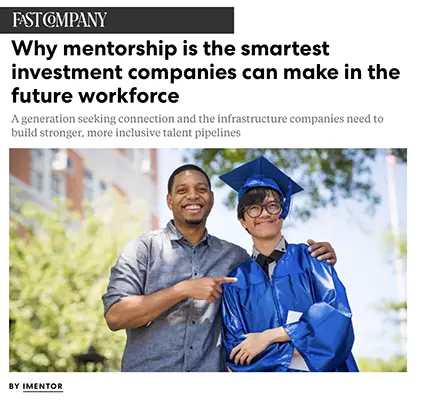
Why Mentorship Is the Smartest Investment Companies Can Make in the Future Workforce
iMentor — Fast Company Custom Studio, PAID/SPONSORED CONTENT | May 19, 2026
TL;DR: A nonprofit’s sponsored content argues mentorship — not AI — is the missing infrastructure connecting Gen Z talent to career opportunity, since most jobs are filled through networks young people from under-resourced backgrounds lack.
Executive Summary Source flag: this is paid/sponsored content published by iMentor, a corporate-mentorship nonprofit, through Fast Company’s branded-content studio — not independent journalism. The statistics and quotes are sourced from iMentor’s own materials and its CEO; treat the framing as advocacy for the organization’s services, not neutral reporting.
The argument: Gen Z is entering an AI-reshaped workforce where a college degree alone doesn’t guarantee economic mobility, because up to 70% of roles are never publicly advertised and most jobs are filled through personal networks young people from under-resourced backgrounds often lack. The piece frames this as a “connection gap” rather than a skills gap, and positions corporate-sponsored mentorship programs (specifically iMentor’s) as the proven fix — citing a cited-but-unverified “nearly threefold return” on mentorship investment and improved employee retention for participating companies.
What’s fact vs. framing: The labor-market statistics (70% unadvertised roles, network-driven hiring) are attributed to general research, not iMentor itself, and are plausible industry figures worth independent verification. The “proven solution” framing and ROI claim are the sponsor’s pitch.
Relevance for Business
- AI-adjacent relevance is indirect: this piece connects to the AI-and-labor theme by name-checking the AI-reshaped workforce, but its actual subject is talent-pipeline/hiring infrastructure, not AI capability itself.
- Practical SMB takeaway: as AI compresses entry-level hiring (fewer junior roles, more applicants per role — a pattern other pieces in this batch corroborate), structured mentorship/network-building may be a cost-effective differentiator for attracting and retaining early-career talent.
- Vendor pitch awareness: this is iMentor advertising its own program; any specific ROI claims should be weighed as marketing, not independently audited results.
Calls to Action
🔹 Ignore for now — As sponsored content, this shouldn’t be treated as a data source for editorial claims without independent verification.
🔹 Monitor — The broader trend it points to (AI compressing entry-level hiring, increasing reliance on networks) is worth tracking as a labor-market theme.
🔹 Test cautiously — If considering formal mentorship programs as a talent-retention tool, evaluate multiple providers rather than relying on this single vendor’s framing.
Summary by ReadAboutAI.com
https://www.fastcompany.com/91542590/why-mentorship-is-the-smartest-investment-companies-can-make-in-the-future-workforce: June 28, 2026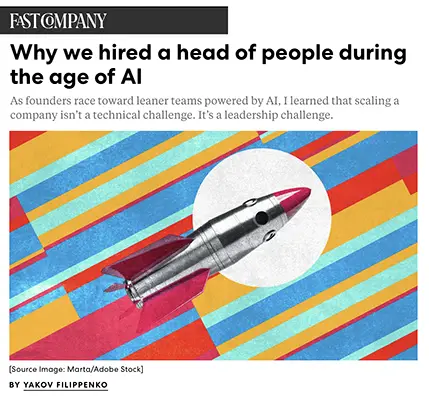
Why We Hired a Head of People During the Age of AI
Fast Company (Yakov Filippenko) | June 23, 2026
TL;DR: A founder pushes back on the “AI lets you stay headcount-lean forever” narrative, arguing that scaling a company is fundamentally a leadership and delegation problem AI doesn’t solve — though the source article is truncated behind a “continue reading” gate, limiting how much can be verified here.
Executive Summary Source note: Fast Company gates the full article behind an “expand to continue reading” wall — only the opening section was available, so this summary covers the stated thesis and setup, not the full argument or evidence.
The founder-author opens with a rocket metaphor: the founder traits that drive early-stage success (control, overwork, doing everything personally) become a liability at scale. He frames this against the current trend of founders publicizing AI-driven headcount cuts — citing Andreessen Horowitz’s broad AI-stack investment and OpenAI CEO Sam Altman’s prediction of “solo-unicorns” (billion-dollar companies run by one technical founder plus a model stack) as evidence of how seductive the lean-team narrative has become. The author’s own first startup suffered, he says, from refusing to hire and treating delegation as weakness — setting up his stated conclusion (not yet detailed in the available text) that hiring a head of people, even in an AI-forward company, was necessary because scaling is a leadership challenge, not a technical one.
What’s fact vs. framing: Altman’s “solo-unicorn” framing and a16z’s investment pattern are cited as real data points; the author’s own scaling conclusion is personal argument, not something independently verified.
Relevance for Business
- Direct counter-narrative to “AI replaces headcount” thinking that’s been prevalent in recent SMB-facing AI coverage — useful editorial tension against more techno-optimist pieces in this batch.
- Founder/operator relevance: speaks to a real tension SMB leaders face — using AI to do more with fewer people, while still needing human leadership infrastructure (HR, culture, people-ops) to scale sustainably.
- Limited evidentiary value as published: since the piece is truncated, the specific argument for why a head-of-people role mattered isn’t yet visible.
Calls to Action
🔹 Revisit later — Worth pulling the full article (or the original source) before citing this piece’s specific argument in editorial copy, since only the setup is visible.
🔹 Monitor — Track the broader “solo-unicorn vs. people-ops” debate as a recurring AI-labor theme.
🔹 Ignore for now — No immediate action item from the available excerpt alone.
Summary by ReadAboutAI.com
https://www.fastcompany.com/91563209/why-we-hired-a-head-of-people-during-the-age-of-ai: June 28, 2026
MP Materials, USA Rare Earth Get China-Export-Ban Boost
Investor’s Business Daily | June 22, 2026
TL;DR: Beijing put two U.S. rare-earth suppliers on its own military-export blacklist — and investors read that as good news, since it signals China isn’t about to ease the restrictions that have kept U.S. rare-earth pricing power intact.
Executive Summary China’s Commerce Ministry added MP Materials and USA Rare Earth, along with several drone makers, to a list barring them from receiving Chinese military-related exports. Counterintuitively, both stocks rose on the news. The logic: inclusion confirms Beijing has no near-term intention of loosening the rare-earth export controls it imposed in April 2025 — controls that have kept rare-earth pricing roughly 400% higher outside China than within it, according to one analyst cited in the piece. That pricing gap is the entire economic rationale for U.S. and allied companies racing to build a non-China rare-earth supply chain.
The move also reads as a tit-for-tat response to the Pentagon’s recent designation of Alibaba, Baidu, and BYD as firms tied to China’s military — a designation that blocks U.S. government contracts with those companies. Both moves suggest the U.S.-China relationship on critical minerals is settling into a “moderately adversarial” middle path rather than either a full economic split or the cooperative breakthrough the White House floated after the May Trump-Xi summit.
What’s fact vs. framing: The stock pop and the export-list inclusion are confirmed. The “boost” framing is market interpretation — investors treating bad-sounding news as a signal of policy stability, not as a real new constraint on either company’s operations.
Relevance for Business
- Supply chain risk: Any SMB dependent on rare-earth-containing components (motors, magnets, electronics) should assume elevated and volatile pricing persists through at least this year.
- Vendor exposure: Companies sourcing from MP/USAR or similar non-China suppliers are buying into a volatilebut currently protected pricing environment — both stocks carry high volatility readings (USAR ~10% 21-day average true range; MP ~7%).
- Policy whiplash risk: The piece notes a prior abrupt selloff-then-rebound cycle after a perceived breakthrough fizzled. Don’t anchor sourcing strategy to optimistic geopolitical headlines.
Calls to Action
🔹 Monitor — Track rare-earth pricing and export-control news monthly if your supply chain touches magnets, batteries, or specialty electronics.
🔹 Assign internal review — If procurement currently single-sources rare-earth components, have ops flag exposure and price-volatility tolerance.
🔹 Ignore for now — Day-to-day stock movements in MP/USAR aren’t operationally relevant unless you hold equity positions.
🔹 Prepare policy — Build a vendor-diversification contingency for any product line where rare-earth cost spikes could compress margins.
Summary by ReadAboutAI.com
https://www.wsj.com/wsjplus/dashboard/articles/mp-materials-usa-rare-earth-get-china-export-ban-boost-134266094041367728: June 28, 2026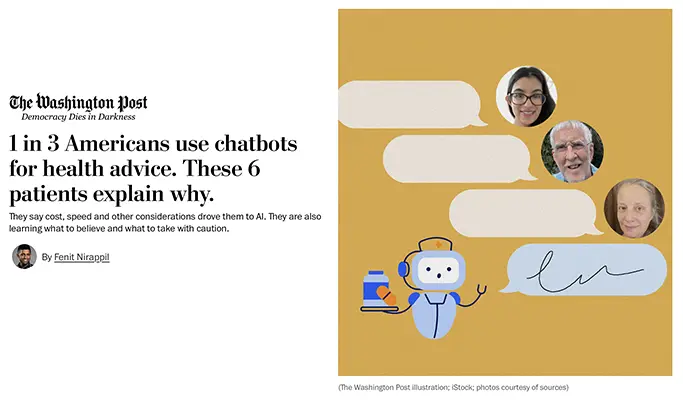
1 in 3 Americans Use Chatbots for Health Advice
Washington Post, June 22, 2026
TL;DR: Nearly a third of Americans now use AI chatbots for health information — driven by cost and access barriers rather than confidence in accuracy — and independent research shows these tools can miss emergency-level symptoms in more than half of tested cases.
Executive Summary: A KFF survey finds 1 in 3 Americans have used AI chatbots for health information, with affordability and speed cited as the top drivers — two-thirds cited wanting fast answers, and 1 in 5 cited cost or lack of access to a provider, rising to roughly 1 in 3 among users aged 18–29 or earning under $40,000. This is adoption driven by systemic access gaps, not a vote of confidence in AI accuracy.
The accuracy picture is mixed and concerning at the margins. An independent Mount Sinai evaluation found ChatGPT Health failed to recommend emergency care in more than half of tested cases involving impending respiratory failure or serious diabetic complications, instead advising users to monitor symptoms at home. OpenAI disputed the study’s methodology. Separately, researchers found chatbots are more likely to give bad advice when users downplay their own symptoms, and that people tend to trust confident-but-wrong AI output more than accurate human advice — a sycophancy and overconfidence risk distinct from raw factual error.
Relevance for Business: This is directly relevant to any SMB building, deploying, or recommending AI tools for health, wellness, or benefits-adjacent use cases (HR benefits navigation, employee wellness platforms, health insurance tools). The liability exposure is real: the failure mode here isn’t obscure edge cases — it’s missing emergency-level symptoms in routine queries. It’s also a broader signal about how SMB customers may already be using AI tools you deploy in ways that carry health and safety stakes you haven’t designed for.
🔹 Act now if you operate or recommend any AI tool that could plausibly field health-adjacent queries — add explicit emergency-escalation guardrails and disclaimers
🔹 Assign internal review of any HR, benefits, or wellness AI tools for similar failure modes around urgent/emergency guidance
🔹 Monitor vendor responses to accuracy criticism (e.g., OpenAI’s methodology dispute) — disputes don’t resolve the underlying risk
🔹 Distinguish “AI gives generally sound advice most of the time” from “AI is safe for high-stakes queries” — both are true and the gap matters for liability
Summary by ReadAboutAI.com
https://www.washingtonpost.com/health/2026/06/22/1-3-americans-use-chatbots-health-advice-here-are-some-their-stories/: June 28, 2026
US curbs on AI spur European firms to spread the risk
Reuters — (June 22, 2026)
TL;DR: US restrictions on Anthropic’s Fable 5 and Mythos 5 models for foreign nationals have pushed major European companies (Siemens, Renault, Orange) to actively diversify across US, Chinese, and European AI providers — treating single-vendor dependence as a structural risk, not a hypothetical one.
Executive Summary The US government’s order suspending foreign access to Anthropic’s Fable 5 and Mythos 5 models (cited as a national-security measure) has become a concrete case study for European firms on the risk of depending on remotely controlled, proprietary AI. Siemens, Renault, Orange, and ChapsVision all confirmed they already run multi-vendor AI stacks — mixing US (OpenAI, Anthropic, Nvidia’s Nemotron), Chinese (DeepSeek, Qwen), and European (Mistral) models specifically to avoid being cut off if any one provider restricts access. Orange’s CEO was explicit: the Anthropic suspension made clear that proprietary, remotely hosted AI “will never be switched off on a whim” is no longer a safe assumption.
A second, separate pressure point is emerging alongside sovereignty concerns: rising per-token costs as companies shift toward autonomous AI agents that consume far more tokens than chat-based use. Uber is cited as having burned through its full 2026 AI token budget in four months. Executives are increasingly distinguishing between access risk (a vendor cutting service) and cost risk (agentic AI use scaling token spend unpredictably) — both are now board-level planning concerns in Europe, not edge cases.
Relevance for Business This is directly relevant to any SMB building meaningful operational dependence on a single AI vendor — especially via agentic/automated workflows. Two distinct risks are converging: vendor-access risk (a provider restricting or suspending service, for regulatory or geopolitical reasons) and token-cost risk (agentic AI deployments consuming budget far faster than anticipated, as seen with Uber). Open-weight models that can run on owned or rented infrastructure are increasingly viewed by large enterprises as the practical hedge against access risk — a consideration SMBs evaluating vendor lock-in should weigh, even without the capacity to multi-source at enterprise scale.
Calls to Action
🔹 Act now — If deploying AI agents (not just chat-based tools), set explicit token budgets and monitoring before scaling usage — Uber’s experience is a concrete cautionary case.
🔹 Test cautiously — Evaluate whether an open-weight model could serve as a fallback for any AI-dependent workflow that would be costly to lose access to.
🔹 Monitor — Watch for further US export-control actions affecting AI model access, as this pattern may recur and could affect non-European customers too.
🔹 Prepare policy — Document which AI vendors your operations depend on and what the contingency plan is if access is restricted or pricing changes sharply.
🔹 Revisit later — Reassess vendor diversification once your AI usage scales beyond simple chat interfaces into automated/agentic workflows.
Summary by ReadAboutAI.com
https://www.reuters.com/legal/litigation/us-curbs-ai-spur-european-firms-spread-risk-2026-06-22/: June 28, 2026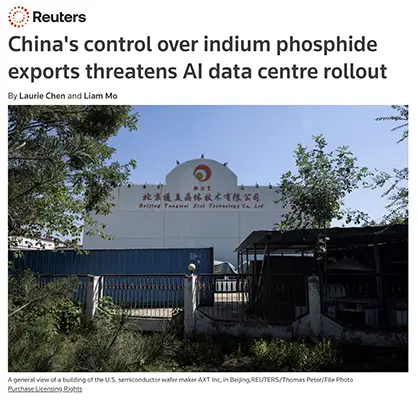
China’s control over indium phosphide exports threatens AI data centre rollout
Reuters — (June 10–11, 2026)
TL;DR: China’s chokehold on indium phosphide — a material essential to AI data-center photonics — is creating a real, measurable supply bottleneck, with wafer prices up 250% since restrictions began.
Executive Summary China controls roughly 70% of global indium phosphide (InP) production, a material with no current substitute for the high-speed optical chips used in next-generation AI data centers. Export licensing delays since February 2025 have already disrupted suppliers like AXT and rippled through to Coherent, Lumentum (sold out through 2028 despite quadrupling output), and Taiwanese optical manufacturers. The price of a 6-inch InP wafer has surged from roughly $1,400 to $5,000. This was significant enough to draw direct intervention: Coherent’s CEO joined a US trade delegation to Beijing specifically to raise the InP licensing issue.
Analysts frame this as part of a broader Chinese strategy — using narrower, less visible “chokepoint” materials (rather than blocking finished products outright) to control the pace of foreign AI infrastructure buildouts. Domestic Chinese InP producers are scaling production, but their ability to export remains uncertain, and US/Japanese suppliers face 2-3 year lead times to add capacity. This is a verified, data-backed supply constraint — not speculation — though the framing of China’s intent (a deliberate “trade weapon” vs. routine licensing friction) is analyst interpretation, not confirmed government policy.
Relevance for Business For most SMBs, this doesn’t translate into a direct action item — but it matters for cost forecasting. AI infrastructure costs (cloud compute pricing, hardware refresh cycles, AI-as-a-service pricing) are downstream of exactly this kind of component scarcity. If you’re budgeting for AI infrastructure investment, increased compute/hosting costs over the next 12-24 months should not be treated as a surprise — supply-side material bottlenecks are now a real input into AI service pricing, separate from demand growth.
Calls to Action
🔹 Monitor — Watch for AI compute/hosting price increases that may be partially explained by upstream hardware bottlenecks like this one.
🔹 Prepare policy — If your AI cost forecasting assumes flat or declining infrastructure costs, revisit that assumption.
🔹 Ignore for now — No direct vendor-switching action is warranted based on this article alone.
🔹 Revisit later — Reassess in 12 months once new InP capacity (Coherent’s Texas expansion, new Chinese capacity) starts coming online.
Summary by ReadAboutAI.com
https://www.reuters.com/world/china/chinas-control-over-indium-phosphide-exports-threatens-ai-data-centre-rollout-2026-06-11/: June 28, 2026
Qualcomm in talks to provide custom chip-design services to ByteDance
Reuters — (June 23–24, 2026)
TL;DR: Qualcomm is reportedly negotiating to design custom AI chips for ByteDance — a sign that US chipmakers are still pursuing China business even as Washington tightens AI chip restrictions elsewhere.
Executive Summary According to unnamed sources, Qualcomm is in early talks to provide chip-design services to ByteDance (TikTok’s parent), potentially producing video-processing units for ByteDance’s broader push into custom AI silicon, including inference chips and CPUs. The deal would lean on technology from AlphaWave Semi, a connectivity firm Qualcomm acquired last year, and would mark Qualcomm’s entry into China’s AI data-center chip market — separate from its core smartphone modem business, which is under pressure from a likely record drop in global smartphone shipments and rising memory-chip costs.
This is a sourced report on private negotiations, not a confirmed deal — both companies declined to comment, and the article is explicit that the talks may not result in a finished product. The broader signal: even amid US-China friction that has already constrained Nvidia, AMD, and equipment makers like Applied Materials and Lam Research, US semiconductor firms are still actively pursuing Chinese AI infrastructure business where regulations allow it.
Relevance for Business This is a low-direct-relevance, high-context-value story for most SMBs — it doesn’t change near-term vendor options, but it’s a useful data point on the unpredictability of the US-China chip relationship that underlies AI infrastructure costs broadly. Companies dependent on AI hardware-driven cost structures (cloud compute, GPU-leasing, edge AI devices) should treat this as one more sign that supply-chain and trade-policy volatility is now structurally embedded in AI cost planning, not an occasional disruption.
Calls to Action
🔹 Monitor — Track how this deal (if finalized) and similar US-China chip arrangements affect AI infrastructure costs and component availability.
🔹 Ignore for now — No direct action needed unless your business depends on smartphone modem or AI ASIC supply chains.
🔹 Revisit later — Reassess if/when the deal moves from “talks” to signed agreement; specifics (volume, timeline) aren’t yet known.
Summary by ReadAboutAI.com
https://www.reuters.com/world/china/qualcomm-talks-provide-custom-chip-design-services-bytedance-sources-say-2026-06-24/: June 28, 2026
GLOBAL AI DEBT ISSUANCE TO TOP $500 BILLION IN 2026, MORGAN STANLEY SAYS
REUTERS, JUNE 10, 2026
TL;DR: AI capex has outgrown what hyperscaler cash flow alone can fund — debt issuance is on pace to more than double in 2026, with the real surge still ahead as capex crosses $1 trillion in 2027.
Executive Summary Morgan Stanley forecasts global AI-related debt issuance will reach roughly $570 billion in 2026, more than double 2025 levels. As of May 31, issuance already stood near $236 billion — fourfold the same period last year. The driver: Alphabet, Amazon, Microsoft, and Meta are expected to spend a combined $700 billion this year on AI infrastructure, an outlay scale that even these cash-generative companies are increasingly financing with debt rather than purely from operating cash flow. Morgan Stanley expects issuance to accelerate further in the second half of 2026 as hyperscaler capex is projected to exceed $1 trillion in 2027. The bank also notes hyperscalers are diversifying funding sources, including non-dollar bond issuance, to broaden their investor base.
Relevance for Business This is a macro-financing signal that complements the SpaceX bond story covered separately this week: the entire AI infrastructure buildout — not just one company — is shifting toward leverage. For SMBs, the implication is indirect but worth tracking: heavily debt-financed infrastructure increases hyperscalers’ sensitivity to interest rates and credit conditions, which could eventually show up as pricing changes, capacity prioritization, or service tier adjustments on cloud/AI platforms (AWS, Azure, Google Cloud) your business depends on.
Calls to Action
🔹 Monitor — interest rate trends and credit market conditions as an indirect input to AI vendor pricing stability.
🔹 Ignore for now — no direct action needed unless your business holds related debt/equity exposure.
🔹 Revisit later — re-check this forecast against actual H2 2026 issuance to gauge whether the trend is accelerating or moderating.
Summary by ReadAboutAI.com
https://www.reuters.com/business/global-ai-debt-issuance-top-500-billion-2026-morgan-stanley-says-2026-06-10/: June 28, 2026
OPENAI UNVEILS CUSTOM “JALAPEÑO” AI CHIP BUILT WITH BROADCOM
REUTERS, JUNE 24, 2026
TL;DR: OpenAI has moved from being purely a chip customer to a chip co-designer — a defensive infrastructure move aimed at reducing Nvidia dependence, with real deployment promised by year-end but performance claims still vendor-asserted, not independently verified.
Executive Summary OpenAI and Broadcom jointly designed “Jalapeño,” OpenAI’s first custom AI chip, built specifically for inference (the compute-heavy step of answering live chatbot/coding queries, as opposed to training). Broadcom’s CEO claims the chip matches Nvidia’s Blackwell and Google’s TPUs — a claim made by the manufacturer in a single interview, not validated by independent benchmarking. OpenAI says samples are already running in its labs at target performance with its GPT-5.3-Codex-Spark model, and plans deployment by year-end as the first step in a multi-generation chip roadmap. Canadian manufacturer Celestica will build servers exclusively for OpenAI’s use; TSMC will fabricate the chips, with design reportedly completed in roughly nine months, partly accelerated by AI-assisted design tools.
The underlying driver, per Reuters, is straightforward: OpenAI and Anthropic are both reportedly struggling to secure enough GPU capacity to run frontier models, pushing major labs toward custom silicon as a cost and supply-chain hedge against Nvidia.
Relevance for Business This is a capacity and cost signal, not a product launch SMBs need to react to directly. The broader implication: compute scarcity is significant enough that even well-funded labs are taking on multi-year chip design risk rather than simply buying more GPUs. For SMBs relying on OpenAI’s API or products, this is a long-horizon reliability signal — successful execution could mean more stable pricing and capacity over time; failure or delays could mean continued compute constraints passed through as cost or rate limits.
Calls to Action
🔹 Ignore for now — no immediate operational action required.
🔹 Monitor — Jalapeño’s actual deployment and performance later this year as a read on whether OpenAI’s cost/capacity position is improving.
🔹 Monitor — the broader custom-silicon trend (OpenAI, Google, Amazon, Anthropic’s compute partners) as an indicator of long-term AI service pricing stability.
🔹 Ignore for now — no vendor decision implications until independent benchmarks (vs. Broadcom’s self-reported claim) emerge.
Summary by ReadAboutAI.com
https://www.reuters.com/world/asia-pacific/openai-unveils-custom-chip-it-designed-with-broadcom-boost-its-ai-infrastructure-2026-06-24/: June 28, 2026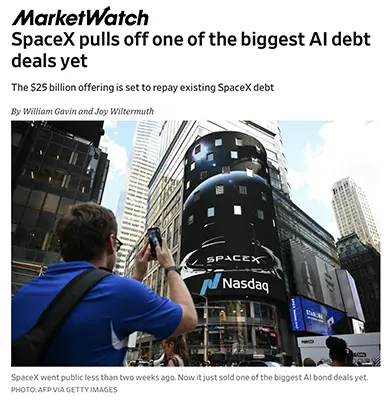
SpaceX Prices $25B Bond Sale to Refinance xAI-Linked Debt
MarketWatch, June 23, 2026
TL;DR: SpaceX, barely two weeks into life as a public company, raised the largest AI-adjacent bond deal of the week— proceeds aimed at retiring debt tied to its xAI bridge loan, not new investment.
Executive Summary SpaceX priced a $25 billion, five-tranche bond offering — upsized from an originally reported $20 billion after demand reportedly hit $89 billion, one of the largest order books of 2026. The deal sits alongside a wave of AI-linked corporate debt: Nvidia, Alphabet, and Oracle have each raised $20–25 billion in bonds this year. The proceeds are not funding expansion — they’re earmarked primarily to pay down a $20 billion bridge loan SpaceX took on to cover debt accrued by xAI, due September 2027.
The market reaction was notable: SpaceX lost $400 billion in market value the day the bond sale was confirmed, before shares partially recovered. S&P, Moody’s, and Fitch all assigned investment-grade ratings, but S&P flagged a downgrade risk if SpaceX keeps investing heavily — into data centers and a chipmaking venture — while burning cash. KeyBanc forecasts SpaceX could run negative free cash flow through 2028, peaking near $33.5 billion in 2027, driven substantially by xAI’s ongoing burn.
Relevance for Business This is a signal about capital structure risk in the AI buildout, not SpaceX-specific news. A company can be richly capitalized (SpaceX raised $85.7B in its IPO, holds $100.8B in cash) and still need tens of billions in debt to cover AI compute losses. For SMB leaders, the read-through is indirect but important: the AI infrastructure boom is increasingly debt-financed, and investor patience for “burn now, profit later” framing is visibly thinning — reflected in the abrupt stock selloff on the bond news itself.
Calls to Action
🔹 Monitor — track whether AI-vendor debt loads (SpaceX/xAI, hyperscalers) start affecting service pricing or reliability for tools your business depends on.
🔹 Monitor — watch credit rating trajectories for major AI infrastructure providers as a leading indicator of sector stress.
🔹 Ignore for now — no direct action needed unless your business has financial exposure (investments, partnerships) to SpaceX/xAI/Nvidia.
🔹 Prepare policy — if your vendor stack includes AI providers reliant on heavy debt financing, build contingency plans for pricing volatility.
Summary by ReadAboutAI.com
https://www.wsj.com/wsjplus/dashboard/articles/spacex-reveals-pricing-details-for-what-could-be-one-of-the-years-biggest-debt-deals-8c027a85: June 28, 2026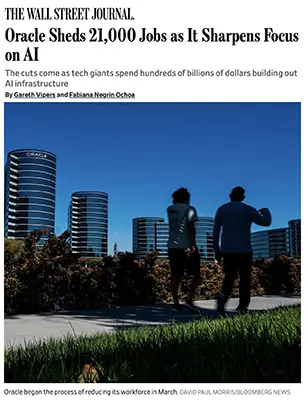
ORACLE SHEDS 21,000 JOBS AS IT SHARPENS FOCUS ON AI
WSJ, JUNE 23, 2026
TL;DR: Oracle cut 13% of its workforce (21,000 jobs) while simultaneously committing to $70 billion in AI data center spending this year, illustrating a now-common pattern of funding AI infrastructure buildouts through headcount reduction.
Executive Summary: Oracle’s headcount fell from 162,000 to approximately 141,000 employees over its last fiscal year — a roughly 13% reduction — alongside $1.84 billion in severance and restructuring costs. The company explicitly attributed this to AI: “The adoption and deployment of AI technologies across our operations have resulted, and may continue to result, in reductions to our workforce,” and signaled further restructuring is likely.
Simultaneously, Oracle plans to spend a net $70 billion this fiscal year on AI data center buildout, up from $55.7 billion the prior year. The company has landed major AI infrastructure deals, including reported plans for OpenAI to purchase roughly $300 billion in computing capacity over five years. Oracle itself flagged the risk explicitly in its own disclosure: heavy financing for data-center expansion is pressuring profit margins, and if competitors’ AI products gain more traction or its own costs run higher than expected, it may fail to recoup its investments — a notably candid admission of execution risk from the company itself, not external criticism.
Relevance for Business: This is the clearest concrete data point yet in the broader pattern (also seen at Meta and Amazon) of using workforce reduction to fund AI infrastructure capex. For SMBs, this is a leading indicator of how aggressively large vendors and customers are restructuring around AI cost structures, which has two implications: (1) vendor stability and support quality may shift as large suppliers like Oracle restructure internally, and (2) it’s a useful, board-ready example of how a major tech company is quantifying and disclosing AI-driven workforce risk rather than treating it as a side effect — a template worth referencing for your own risk disclosure conversations.
🔹 Monitor if you’re an Oracle customer — restructuring at this scale can affect support responsiveness and product roadmaps
🔹 Note as a template: Oracle’s own risk disclosure language is a useful reference point for how to articulate AI investment risk candidly to your own leadership/board
🔹 Watch whether the jobs-fund-capex pattern (Oracle, Meta, Amazon) continues spreading to other major vendors you rely on
🔹 Revisit later — Oracle’s ability to recoup this spending is genuinely uncertain by its own admission, worth tracking over the next 1-2 fiscal years
Summary by ReadAboutAI.com
https://www.wsj.com/tech/ai/oracle-sheds-21-000-jobs-as-it-continues-ai-focused-streamlining-a3149b90: June 28, 2026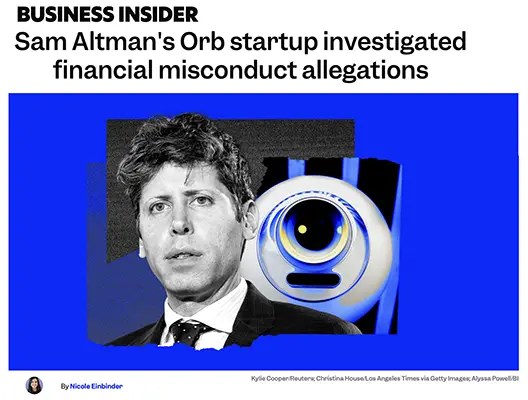
Sam Altman’s Orb Startup Investigated Financial Misconduct Allegations
Business Insider, June 22, 2026
TL;DR: Tools for Humanity, Sam Altman’s biometric-ID startup, ran two internal law-firm investigations last year into financial misconduct and foreign bribery allegations — a governance red flag for any company evaluating AI-adjacent vendors tied to Altman.
Executive Summary: Business Insider reports that Tools for Humanity — the company behind Worldcoin and the iris-scanning “Orb,” cofounded by Altman — hired two law firms in 2025 to investigate separate matters: (1) allegations of personal expenses charged to corporate cards, contractor misclassification, and potential SEC rule violations tied to payments allegedly made to inflate the Worldcoin token’s value; and (2) potential Foreign Corrupt Practices Act violations connected to a Thai business partner later tied to a fraud investigation and an active arrest warrant.
The company says it found no evidence of FCPA violations, severed the Thai partnership, and tightened internal controls. Findings were presented to the three-person board, which includes Altman. This is reported allegation and company response — not a regulatory finding of wrongdoing. The Worldcoin token itself has lost 95% of its value since its 2024 peak, and the company has been barred or investigated in Spain, India, Indonesia, and Thailand over biometric data practices.
Relevance for Business: This is relevant only if your organization has, or is considering, any commercial or partnership relationship with Tools for Humanity/Worldcoin/World ID, or is evaluating Altman-affiliated ventures as part of broader AI vendor due diligence. It’s a useful general reminder that founder reputation and core-company performance (OpenAI) don’t guarantee governance quality at affiliated ventures.
🔹 Ignore for now if you have no Tools for Humanity/World ID exposure
🔹 Flag for due diligence review if evaluating any biometric-ID or Worldcoin-adjacent vendor relationships
🔹 Note as a governance case study — internal controls and board composition matter even at well-funded, high-profile startups
Summary by ReadAboutAI.com
https://www.businessinsider.com/sam-altman-tools-for-humanity-orb-investigations-bribery-financial-irregularities: June 28, 2026
SURVEY: GENAI GOVERNANCE FALLING BEHIND RAPID PROVIDER ADOPTION
TECHTARGET, JUNE 23, 2026
TL;DR: Nearly half of clinicians now use GenAI daily, but only 27% work at an organization with a published AI policy — a governance gap that should be read as a leading indicator for any industry adopting AI faster than its oversight structures.
Executive Summary A survey of 355 healthcare professionals (203 physicians, 152 nurses), conducted by Ipsos for Wolters Kluwer Health in March 2026, found 48% of clinicians use GenAI daily and another 24% weekly — primarily for literature summarization, data analysis, AI scribing, and patient education. 61% reported AI freed up more time for patient care. Despite this, only 27% said their organization has a published GenAI policy, and awareness of those policies is uneven even where they exist: just 35% of aware respondents knew of guidelines for validating AI output accuracy, and only 22% knew of policies defining clinician-vs-AI responsibility.
Clinician concerns are substantial and specific: 74% cite hallucinations as a major concern, 47% question AI quality/reliability, and 43% worry about untrustworthy source data. Most notably, 74% anticipate “clinical deskilling”— eroding their own judgment — as a top risk of overreliance. Half of physicians want stronger penalties for AI misuse or data breaches. The article also cites a separate study noting health AI governance is fragmented across more than 100 different regulators, standards bodies, and government issuers — reinforcing that the policy vacuum isn’t just an internal organizational failure but reflects a genuinely unsettled external regulatory landscape.
Relevance for Business This is healthcare-specific data, but the pattern — adoption racing ahead of governance — generalizes directly to SMB AI use. The “deskilling” concern is particularly worth importing as a framework: any role where AI takes over judgment-heavy tasks (not just repetitive ones) risks a similar erosion of staff capability over time if oversight isn’t built in deliberately. The fragmented regulatory landscape point is also a caution against assuming “we’ll wait for the rules to settle” — in this sector, that wait already spans 100+ uncoordinated bodies with no consolidation in sight.
Calls to Action
🔹 Assign internal review — audit whether your business has a written AI use policy; if adoption already outpaces policy (as in this survey), close that gap now rather than waiting for external standards.
🔹 Prepare policy — explicitly define which AI outputs require human validation, and assign clear responsibility lines between staff and AI tools.
🔹 Monitor — staff-reported “deskilling” or judgment-erosion concerns internally, not just AI accuracy metrics.
🔹 Revisit later — track whether sector-specific AI governance (in your industry) consolidates or remains fragmented, since waiting for unified external rules may not be realistic.
Summary by ReadAboutAI.com
https://www.techtarget.com/healthtechanalytics/news/366644955/Survey-GenAI-governance-falling-behind-rapid-provider-adoption: June 28, 2026
AMID STAFFING SHORTAGES, AI BECOMES MEDICAL CODING’S BACKUP HIRE
TECHTARGET, JUNE 22, 2026
TL;DR: A 30% national medical-coder shortage is pushing even well-resourced health systems toward AI-driven autonomous coding — but the case study is notable for its candor about AI’s limits: it works well for high-volume, repetitive coding and poorly for complex, high-revenue cases.
Executive Summary UC Davis Health, despite offering competitive pay and remote roles, can’t fill coding positions amid a sector-wide shortage the American Medical Association pegs at up to 30%. The health system’s revenue-cycle leadership describes autonomous coding as augmentation, not replacement — deployed specifically for high-volume, repetitive work like radiology coding (mammograms, CT scans), where accuracy has improved sharply: tools that took roughly a year to reach a 60% confidence threshold two to three years ago now reach usable accuracy in 7–10 business days.
Critically, the source is explicit about where AI doesn’t work yet: complex inpatient cases, where a single miscoded diagnosis can mean a $40,000 swing in revenue, remain too high-risk for autonomous coding. The decision to adopt AI is also framed as a cost comparison, not a capability mandate — in high-wage markets like California, AI may be cheaper than additional hires; in lower-wage states, the reverse can be true. The piece also flags an emerging governance dimension: workforce shift means coders are expected to move toward auditing AI output rather than disappearing, with industry credentialing bodies already offering AI-specific certifications — though the source candidly notes such credentials risk becoming outdated within weeks given the pace of AI tool releases. Regulatory friction is also noted: state-level restrictions on clinical AI use (cited: California) could indirectly constrain coding-adjacent AI given its proximity to clinical documentation.
Relevance for Business This is a useful case study in disciplined AI adoption applicable well beyond healthcare: deploy AI where task volume and repetitiveness make ROI clear, preserve human oversight where error cost is high, and run the actual cost comparison (AI cost vs. labor cost in your specific market) rather than assuming AI is automatically cheaper. The “auditor” workforce transition pattern — humans shifting from doing the task to reviewing AI’s output — is a transferable governance model for any back-office function (finance, compliance, customer service) facing similar labor shortages.
Calls to Action
🔹 Assign internal review — if facing staffing shortages in repetitive back-office roles, evaluate AI augmentation using the same cost/risk framework: task volume, error cost, and local labor cost.
🔹 Prepare policy — build human-in-the-loop audit requirements into any AI deployment touching financially material decisions, mirroring the high-revenue-case caution described here.
🔹 Monitor — AI certification/credentialing offerings in your industry, with skepticism about their shelf life given rapid tool turnover.
🔹 Ignore for now — no urgent action if your business doesn’t face acute staffing shortages in transaction-heavy roles.
Summary by ReadAboutAI.com
https://www.techtarget.com/revcyclemanagement/feature/Amid-staffing-shortages-AI-becomes-medical-codings-backup-hire: June 28, 2026
The Best AI Chatbots for 2026: Compare Features and Costs
TechTarget, June 18, 2026
TL;DR: A hands-on comparison of six major chatbots (ChatGPT, Claude, DeepSeek, Gemini, Copilot, Perplexity) using one test prompt — useful as a feature/pricing snapshot, but its head-to-head conclusions rest on a single, narrow query and shouldn’t be read as a rigorous capability benchmark.
Executive Summary The reviewer tested each chatbot with one identical prompt and evaluated response quality, pricing, UI, and support. Findings were directionally consistent with general market positioning: ChatGPT gave the broadest, most comprehensive response but offers no citations; Claude was well-organized but comparatively limited in scope, also without citations; Perplexity stood out for sourced, cited answers and was the reviewer’s personal daily tool; Geminileaned into genre-based analysis and deep Google ecosystem integration; Copilot extended analysis furthest chronologically but missed key context; DeepSeek matched competitors on depth but the reviewer hit account-creation friction, including a blocked signup that only resolved after disabling a VPN.
Pricing across vendors clusters in similar bands ($8–20/month for individual “plus” tiers, $20–35/seat for business tiers), with DeepSeek priced per-token rather than per-seat and notably cheaper at scale. The article also separates general-purpose chatbots from task-specialized tools (e.g., GitHub Copilot for coding, Perplexity/Elicit for research, Jasper for marketing copy), arguing organizations typically need multiple specialized tools rather than one general chatbot for everything.
Relevance for Business Treat this as a starting checklist, not a procurement decision: a single test prompt about music history doesn’t validate performance on your actual use cases (contracts, customer support, financial analysis). The pricing comparison is the most durable, reusable part of the piece. The specialization point is the most actionable strategic takeaway — most SMBs will end up running 2–3 tools (a general chatbot plus task-specific tools) rather than consolidating on one platform.
Calls to Action
🔹 Test cautiously — replicate this kind of side-by-side comparison using prompts from your actualworkflows before standardizing on a vendor.
🔹 Revisit later — use the pricing tier breakdown as a quick-reference sheet when budgeting for AI tool licenses.
🔹 Monitor — DeepSeek’s access friction (account creation, VPN blocking) as a recurring signal on reliability for China-based AI vendors in Western markets.
🔹 Assign internal review — map your team’s actual tasks (coding, research, writing, support) against the specialized-tool list before defaulting to a single general-purpose chatbot.
Summary by ReadAboutAI.com
https://www.techtarget.com/searchenterpriseai/tip/The-best-AI-chatbots-Compare-features-and-costs: June 28, 2026
How to Keep Data Silos From Damaging Your AI Projects
TechTarget, June 18, 2026
TL;DR: This is a practitioner explainer, not news — its value is as a structured checklist for diagnosing why AI initiatives underperform, tracing the problem back to fragmented, poorly governed data rather than model limitations.
Executive Summary The piece lays out a straightforward causal chain: AI quality depends on access to complete, well-integrated data, and most organizations have the opposite — isolated repositories shaped by unclear leadership, mismatched departmental priorities, regulatory-driven isolation (e.g., PII handling), technical integration gaps, and the residue of mergers. The consequences are described concretely: degraded prediction accuracy, wasted spend on AI initiatives that don’t pay off, missed pattern-recognition opportunities, and in worst cases, abandonment of AI platforms after sustained poor performance.
The remediation framework is practical rather than aspirational: inventory data sources, find duplicated/isolated data, check for inconsistent metrics across departments, identify access-delay points, and build governance policies that define data ownership and access rules. Recommended fixes include centralized data lakes/warehouses, data fabric layers, and ETL tooling — standard data-engineering practice, not AI-specific innovation.
Relevance for Business This is operational hygiene framed for AI, useful primarily as a diagnostic checklist when an AI pilot underperforms or stalls. For SMBs without dedicated data engineering teams, the most actionable point is the causal link between departmental data ownership and AI failure — a sales team’s spreadsheet-based tracking, kept separate from finance’s system, will quietly degrade any AI tool built across both. There’s no vendor claim to scrutinize here; the source is a generalist explainer, not a study, so treat it as a useful framework rather than a rigorously evidenced finding.
Calls to Action
🔹 Assign internal review — run the article’s data-source inventory exercise before your next AI tool rollout, not after a pilot disappoints.
🔹 Revisit later — use this as a reference checklist when diagnosing underperforming AI tools already in production.
🔹 Ignore for now — no urgent action if your data infrastructure is already centralized and governed.
Summary by ReadAboutAI.com
https://www.techtarget.com/searchenterpriseai/tip/How-to-keep-data-silos-from-damaging-your-AI-projects: June 28, 2026
How Inova Modernized Its Data Architecture for AI Apps
TechTarget, June 18, 2026
TL;DR: A major health system’s path to scaled AI deployment ran through data infrastructure first — Inova compressed a four-year data modernization plan into six months specifically to make AI rollout viable, not the other way around.
Executive Summary Inova, a nonprofit health system serving 4M+ patient visits annually, has evaluated 300+ AI applications and deployed 70+ in production — including ambient AI scribes (Abridge, used by 1,000+ providers), AI-driven scheduling, and agentic referral tools. The case study’s central claim, made by chief data and AI officer Jon McManus, is that none of this was possible until Inova standardized data ingestion across its sprawling stack (1,000+ technology contracts) using Fivetran for integration and DBT for governance — accelerating a planned four-year roadmap into six months.
McManus frames this explicitly as a dependency-management problem: Inova deliberately diversified vendors to avoid being “single-threaded” on any one AI provider, while still building toward a centralized, Inova-branded distribution layer for staff-facing AI tools. The system layered governance on top — validating every AI pipeline against safety, equity, and accessibility criteria — which McManus presents as a precondition for scale, not friction against it.
Relevance for Business The core lesson generalizes well beyond healthcare: AI deployment speed is gated by data architecture, not model quality. SMBs evaluating AI tools should treat data fragmentation — siloed CRM, finance, and operations systems — as the actual bottleneck, since even a well-resourced health system needed a dedicated infrastructure overhaul before AI tools delivered value at scale. The vendor-diversification point is also a useful governance template: avoiding lock-in to a single AI provider preserves flexibility as the market shifts.
Calls to Action
🔹 Assign internal review — audit whether your data infrastructure (not your AI tool selection) is the actual constraint on AI ROI.
🔹 Test cautiously — pilot a single integration/governance layer (even lightweight) before scaling AI tool adoption across departments.
🔹 Prepare policy — establish vendor-diversification guardrails now, before dependency on one AI provider becomes costly to unwind.
🔹 Monitor — Fivetran/DBT and similar data-layer vendors as a proxy for where mid-market AI infrastructure tooling is heading.
Summary by ReadAboutAI.com
https://www.techtarget.com/healthtechanalytics/feature/How-Inova-modernized-its-data-architecture-to-prepare-for-AI-apps: June 28, 2026
AI MARKET CORRECTION: WHAT IT LEADERS MUST KNOW
TECHTARGET, JUNE 17, 2026
TL;DR: Half of enterprise GenAI projects have already failed post-pilot, and with debt-fueled infrastructure spending now outpacing demonstrated business value, IT leaders should shift immediately from experimentation to disciplined, metrics-driven AI investment.
Executive Summary: This piece synthesizes multiple analyst and consultant viewpoints (Accenture, Gartner, AARP-adjacent voices are absent here — sources are Accenture, Gartner, and corporate executives) into a single thesis: AI spending is outrunning AI returns, and the gap is now visible in hard numbers. Gartner found at least half of GenAI projects were scrapped after proof-of-concept last year due to unclear value, poor data quality, or rising costs. Separately, material AI risk disclosures among S&P 500 companies jumped from 12% to 72% in two years — a sharp signal that boards are increasingly treating AI deployment as a liability category, not just an opportunity.
The infrastructure buildout is substantially debt-financed — Anthropic closed a $35 billion debt deal, Oracle is leveraging debt for its buildout — which sources interviewed describe as the actual trigger point to watch: a correction arrives when promised business value fails to materialize as fast as debt-funded spending requires. Token costs are also a live pressure point, with some companies reportedly spending $7,500 per employee per month on AI. Multiple sources frame this as not a 2000-style dot-com bubble because a real underlying business case exists — the open question is whether execution catches up before market patience runs out.
Relevance for Business: This matters directly for SMB budget planning. If the vendor landscape consolidates or destabilizes during a correction, dependency on any single AI vendor becomes a real continuity risk. The piece also offers a useful diagnostic: most failed projects share three traits — undefined business value, poor data quality, and missing risk controls — all things an SMB can audit internally before scaling further investment. There’s also a stated opportunity: enterprises with disciplined, well-governed AI deployments may gain negotiating leverage as the market sorts winners from also-rans.
🔹 Audit current AI initiatives now against defined ROI metrics (hours saved, cost reduced, revenue impact) — not vague productivity claims
🔹 Assess vendor risk explicitly: which AI vendors would be hard to replace if they failed or were acquired?
🔹 Act now to build observability and governance into any AI deployment before scaling it further
🔹 Monitor token/usage cost trends — per-employee AI costs are rising and may force a rethink of usage models
🔹 Prepare policy for what happens if a key AI vendor faces financial distress or is consolidated
Summary by ReadAboutAI.com
https://www.techtarget.com/searchcio/feature/AI-market-correction-What-IT-leaders-must-know: June 28, 2026

Closing: AI update for June 28, 2026
This week’s coverage is a reminder that the most consequential AI risks for most businesses right now aren’t capability gaps — they’re concentration, governance, and cost-structure risks hiding behind record-setting headlines. Treat vendor dependence, supply-chain exposure, and unverified accuracy claims as standing agenda items, not one-time check-ins.
All Summaries by ReadAboutAI.com
↑ Back to Top