
AI Updates July 24, 2026

This week’s 64 summaries return to a theme that keeps surfacing across ReadAboutAI.com’s coverage: the gap between how fast AI capability is advancing and how prepared organizations are to use it well. Multiple sources this week quantify that gap directly — nearly half of IT leaders can’t confirm their company has any AI policy at all, a majority of employees say training doesn’t connect to their actual job, and a well-documented “workslop” problem is emerging where AI-generated output requires more review time than it saves. A recurring sub-theme worth watching: several of the most-cited statistics this week come from vendors selling the exact fix they’re recommending, a reminder that “our own research shows” and “independently verified” are not the same claim.
Hardware and geopolitics dominated the infrastructure side of this week’s AI coverage. Export-control disputes intensified around ASML and the proposed MATCH Act, even as Chinese labs — Moonshot’s Kimi K3 and Alibaba’s Qwen3.8 Max among them — posted results that independent benchmarks, not just company press releases, placed close behind U.S. frontier models. Separately, a Washington Post investigation detailed a real rift between Anthropic and the Pentagon over autonomous weapons, while Google DeepMind’s Demis Hassabis floated industry-funded safety standards that drew a cautious but skeptical editorial response. None of this is abstract: compute scarcity, chip supply chains, and defense-adjacent AI policy all eventually show up in vendor pricing and contract terms.
Capital markets activity rounded out the week, from a reported Meta-Anthropic compute-leasing deal to a venture capital playbook increasingly built around concentrated, late-stage bets rather than early company-building — alongside one wealth advisor’s warning that AI-driven market froth could unwind hard for boomer-heavy portfolios.
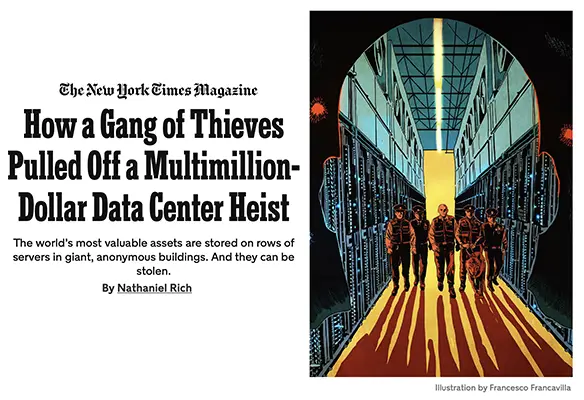
How a Gang of Thieves Pulled Off a Multimillion-Dollar Data Center Heist
The New York Times Magazine, Nathaniel Rich, July 12, 2026
TL;DR: The physical security of data centers — long an afterthought next to cybersecurity — is becoming a genuine business risk as AI-driven construction turns anonymous server warehouses into visible, politically contested infrastructure.
Executive Summary The piece uses a 2007 London heist — thieves posing as police to steal 80 servers from a Verizon-operated facility — as a frame for a broader argument: physical data center security has been chronically under-invested relative to cybersecurity, even as data centers now hold assets more valuable than anything in a bank vault. Security experts quoted in the piece note that most successful physical breaches today are opportunistic (insider theft, cargo theft in transit) rather than orchestrated heists, but that consolidation of sensitive data into fewer, larger facilities raises the payoff for a determined attacker. Separately, and more relevant to the current AI buildout, the article documents a shift in public sentiment: data centers have gone from invisible to a visible “totem” of AI anxiety, with polling showing a plurality of Americans view their environmental and cost impact negatively, and legislation to restrict data center construction now active in 15 states and multiple municipalities.
Relevance for Business For any SMB whose operations, vendor relationships, or client data run through third-party cloud infrastructure, this surfaces two distinct risk categories: operational/security risk (physical vulnerabilities are real but rare, and disclosure practices by data center operators tend to minimize incidents to protect reputation — meaning public breach reporting may understate true exposure) and infrastructure/siting risk (community and legislative pushback against new data center construction could slow AI infrastructure buildout, affecting capacity, pricing, and availability of cloud/AI services over the medium term).
Calls to Action
🔹 Monitor — track data center siting legislation in states/municipalities relevant to your primary cloud vendors’ capacity plans
🔹 Assign Internal Review — confirm what physical (not just cyber) security standards your cloud and colocation vendors maintain, and how incidents are disclosed contractually
🔹 Revisit Later — reassess vendor concentration risk if a single provider or region holds a disproportionate share of your critical data
🔹 Ignore for Now — no action needed on heist-style physical theft risk directly; it remains a rare, high-sophistication threat vector for most SMBs
Summary by ReadAboutAI.com
https://www.nytimes.com/2026/07/12/magazine/data-center-heist.html: July 24, 2026
AI-Altered Images on Birdwatching Forums Putting Research at Risk
AI SLOP IS CORRUPTING CITIZEN SCIENCE DATA
The Guardian, Patrick Greenfield, July 20, 2026
TL;DR: AI-enhanced and fabricated wildlife images are contaminating citizen-science databases used in real research, and the scale of the problem is currently unmeasured.
Executive Summary
Researchers publishing in Nature warn that generative AI tools (ChatGPT, Google Gemini) are producing a growing volume of fake or AI-enhanced wildlife images on platforms like iNaturalist and Macaulay Library — data sources actually used by scientists to track species range and climate response. The more insidious problem isn’t outright hoaxes (described as rare and easy to spot — “nobody is falling for a toucan sighting in Siberia”), but subtle AI “enhancements” — removing an obscuring branch, for instance — that can inadvertently blend features from different species into a single image, producing false records that look plausible.
The known detection rate is very low relative to platform scale: only about 1,400 of 610 million+ images on iNaturalist have been flagged for AI use — though the article is explicit that the true extent of contamination is unknown, since much of it likely goes undetected. Most cases are characterized as unintentional rather than malicious.
Relevance for Business
This is lower direct relevance for most SMB executives but carries a useful transferable signal: any business relying on user-generated or crowdsourced data for decision-making or ML training faces an analogous “silent contamination” risk from AI-edited inputs — the detection/verification problem here (low flag rates, unknown true scale) generalizes to any dataset with unverified public contributions.
Calls to Action
🔹 Ignore for now — No direct operational action needed for most SMB contexts.
🔹 Monitor — Track how citizen-science and crowdsourced-data platforms develop AI-detection standards, as these may become transferable best practices for any business using user-generated data inputs.
🔹 Assign internal review — Businesses that train models or make decisions on crowdsourced/user-submitted imagery or data should assess exposure to undetected AI-altered inputs.
Summary by ReadAboutAI.com
https://www.theguardian.com/environment/2026/jul/20/ai-slop-manipulated-fake-images-birds-citizen-science-aoe: July 24, 2026
Meta’s AI Advertising Dreams Have Become a Nightmare for Brands
AI AD TOOLS ARE CREATING BRAND-SAFETY HEADACHES
Business Insider, Lara O’Reilly, Sydney Bradley, and Lucia Moses, July 13, 2026
TL;DR: Meta’s AI-powered ad-creative tools are generating distorted, embarrassing, or brand-damaging content at scale, and Meta’s position is that reviewing AI output is the advertiser’s responsibility, not the platform’s.
Executive Summary
Meta has embedded AI creative tools across its ad products, and multiple advertisers and agency executives describe dealing with AI-generated errors as routine, not occasional — distorted limbs, garbled product text, and unauthorized product/demographic changes to existing creative. In one documented case, AI recommendations altered a product image entirely and added unintended people to another brand’s ad. Meta’s own terms of service place responsibility for catching AI errors squarely on advertisers, not on the platform generating the content.
The more operationally significant issue: several advertisers report AI features being auto-enabled by a persistent bug, requiring manual verification for every campaign — a workload increase advertisers describe becoming an unwanted new standard practice. Meta has begun rolling out AI-content labeling and a quality-control dashboard for larger advertisers, but at least one large agency says the underlying toggle bug persisted after being flagged.
Despite the friction, advertisers are not leaving — Meta’s ad business remains treated as functionally indispensable given its reach and targeting sophistication. This is worth flagging as the core tension: platform behavior with real reputational costs to brands, but with essentially no viable exit option for most advertisers.
Relevance for Business
- Execution risk in vendor-controlled AI features: Any business using Meta ads should treat AI creative enhancement as a source of active operational risk requiring manual review, not a productivity gain to be trusted by default.
- Reputational exposure: AI-generated ad errors are public and screenshot-able — the REI two-handlebar bicycle incident shows brand damage can occur even when the advertiser didn’t actively choose the AI feature, due to auto-enrollment.
- Vendor leverage imbalance: Meta’s scale means it can maintain policies unfavorable to advertisers (liability shifted entirely to them) with limited competitive consequence — a dynamic worth factoring into any platform-dependency assessment.
Calls to Action
🔹 Act now — Manually verify AI creative-enhancement toggles are set as intended before every campaign launch, given documented auto-enrollment bugs.
🔹 Assign internal review — Marketing teams should establish a mandatory human-review step for any AI-modified ad creative before it goes live.
🔹 Monitor — Track whether Meta’s new AI-content labeling and quality-control dashboard actually resolve the reported toggle bugs.
🔹 Prepare policy — Establish internal guidelines for acceptable AI creative modification, since Meta’s terms place review responsibility on advertisers by default.
Summary by ReadAboutAI.com
https://www.businessinsider.com/metas-ai-ads-push-causes-chaos-for-brands-2026-7: July 24, 2026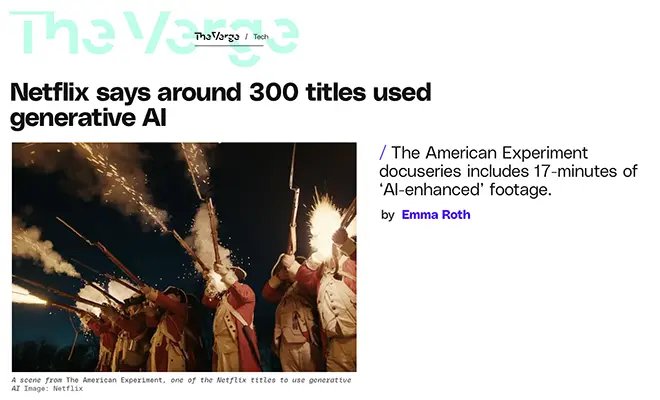
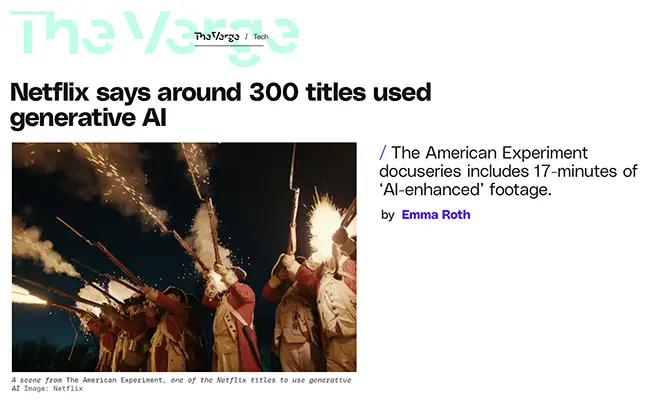
NETFLIX CONFIRMS GENERATIVE AI USED IN ROUGHLY 300 TITLES, FRAMING IT AS A COST AND SPEED TOOL
The Verge | Emma Roth | July 16, 2026
TL;DR: Netflix disclosed that generative AI touched roughly 300 titles, mostly in post-production, positioning it as a way to include shots productions otherwise couldn’t afford — a notable shift from ambiguity to explicit disclosure.
Executive Summary In its Q2 earnings materials, Netflix confirmed that generative AI was used in about 300 titles, primarily for post-production tasks like enhanced crowds, historical battle sequences, and establishing shots. Co-CEO Ted Sarandos cited The American Experiment docuseries as a concrete example: 17 minutes of AI-enhanced footage produced twice as fast and at half the cost of conventional methods. Sarandos framed this explicitly as an access issue, not just an efficiency one — arguing some sequences would have been cut entirely without AI due to budget or schedule constraints.
This is a meaningful shift from prior ambiguity: Netflix is now quantifying and disclosing AI use at scale rather than treating it as a one-off experiment, alongside other AI investments (an animation studio, an AI startup acquisition, and AI-generated voice work). The disclosure comes bundled with unrelated but relevant context — Netflix also reported $12.56 billion in quarterly revenue and acknowledged viewer engagement concerns tied to second-season retention.
Relevance for Business This is a useful disclosure-practice precedent, not a technology breakthrough. For any executive managing content, marketing, or creative production, Netflix’s approach signals a growing expectation that companies quantify and disclose AI use publicly rather than stay silent — a governance and reputational consideration that may extend beyond entertainment into any customer-facing creative output (marketing materials, product imagery, training videos). It’s also a useful cost/speed benchmark: a major buyer of creative production services is now citing concrete 2x speed and 50% cost figures for AI-assisted work, which is a data point (not a guarantee) for anyone evaluating similar tools.
Calls to Action
🔹 Monitor — Track whether AI-use disclosure becomes a standard expectation in your industry, not just entertainment
🔹 Prepare Policy — If your business produces customer-facing creative content, consider whether disclosure practices need updating ahead of stakeholder or regulatory expectations
🔹 Test Cautiously — Netflix’s cited cost/speed gains are company-reported, not independently verified; treat as directional, not a benchmark to plan around
🔹 Ignore for Now — No direct competitive action needed unless your business is in content production or licensing
Summary by ReadAboutAI.com
https://www.theverge.com/streaming/966633/netflix-ai-titles-q2-2026-earnings: July 24, 2026
WHAT AI WILL DO TO ART
Spencer Kornhaber, The Atlantic — June 30, 2026 (August 2026 print edition)
TL;DR: Two of AI art’s most visible practitioners are betting generative tools can revive collective creativity — but their own failed data-rights startup shows why voluntary, market-based fixes to AI’s copyright problem keep falling short.
SUMMARY
Artists Holly Herndon and Mat Dryhurst have built a decade-long career using AI to make art about AI, culminating in a large installation at this year’s Venice Biennale featuring AI “agents” that generate ambient music from their own simulated conversations. Their broader thesis: AI-driven, protocol-based creation could displace an era of individually authored “slop” with something more collective and civically minded.
That optimism sits alongside a cautionary data point: in 2022 the pair co-founded Spawning, a start-up that built an opt-out registry letting creators exclude their work from AI training sets, logging roughly 2 billion opt-out requests. It shut down in 2025 after the founders concluded AI companies would not durably commit to standards maintained by a small private group — a real-world test of voluntary data-rights mechanisms that ended in failure rather than in policy.
The piece also shows AI already embedded in high-end professional production: Herndon used Claude Code to help generate the installation’s music from the AI agents’ simulated dialogue, illustrating that generative tools are now a working part of professional creative pipelines, not just a novelty.
RELEVANCE FOR BUSINESS
For any SMB with IP-dependent output — marketing, design, media, content — this is a signal that authorship and ownership norms around AI-assisted creative work remain unsettled even at the highest levels of the art world. It’s also a caution against treating voluntary opt-out or data-rights registries as a compliance safe harbor: this one didn’t survive contact with the industry it was meant to govern. Finally, as AI tools become routine in professional creative workflows, expect growing pressure around disclosure practices and client expectations when AI contributes to paid creative deliverables.
CALLS TO ACTION
🔹 Monitor — legislative and industry activity on AI training-data rights and opt-out standards
🔹 Prepare Policy — internal guidance on disclosing AI tool use in client-facing creative work
🔹 Assign Internal Review — check AI-assisted creative vendor contracts for IP indemnification language
🔹 Ignore for Now — the broader cultural “art vs. AI” debate has limited near-term operational relevance for most SMBs
Vendor-neutrality note: This source references Claude Code, an Anthropic product. ReadAboutAI.com uses Claude as a production tool; this summary was prepared under the same editorial standards applied to all vendors.
Summary by ReadAboutAI.com
https://www.theatlantic.com/magazine/2026/08/ai-art-holly-herndon-mat-dryhurst/687619/: July 24, 2026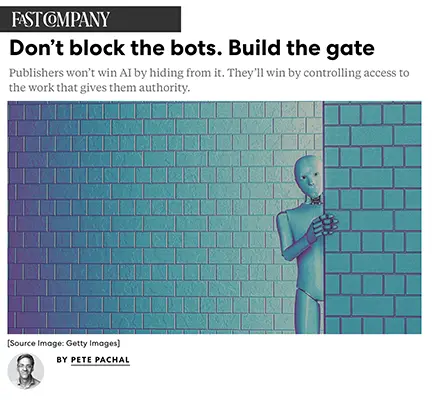
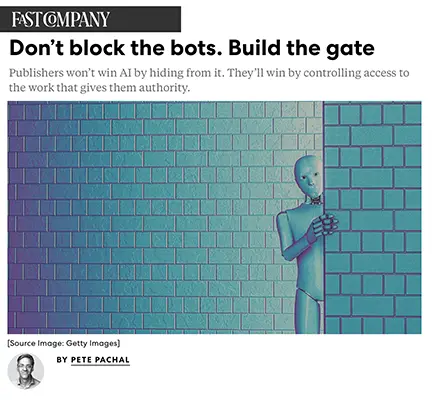
Don’t Block the Bots. Build the Gate
Fast Company, Pete Pachal, July 17, 2026
TL;DR: Blanket blocking of AI crawlers is a blunt instrument; the real strategic opportunity lies in distinguishing bot types and controlling how AI systems can access and cite your content — without giving away the underlying value for free.
Executive Summary The article argues that most publishers treat AI crawler access as a binary (block or allow), when the more useful distinction is between three bot types: training bots (which absorb content to build models), search bots, and retrieval bots (which fetch content in real time to answer a specific user query). The author’s core recommendation is to allow retrieval bots selectively while restricting training crawlers and unauthorized scrapers, on the logic that being cited in an AI-generated answer builds authority and mind-share even without direct referral traffic. A second theme: publishers should make content “machine-readable but not machine-giveaway” — using snippets, metadata, and access controls so AI systems know valuable content exists without being able to reproduce it. The piece cites data showing licensing deals in 2026 increasingly favor retrieval rights over training rights (roughly 4 in 10 public deals still include training rights), and points to publisher-built retrieval layers (e.g., Reuters’ MCP server) as the more defensible long-term position versus relying on third-party crawlers to interpret content unsupervised.
Note on sourcing: the article references AI companies including OpenAI and Anthropic as commonly blocked crawlers — this is presented as reporting on industry practice, not a claim about ReadAboutAI.com’s own tooling. Disclosure: ReadAboutAI.com uses Claude, Anthropic’s AI model, as a production tool for this publication.
Relevance for Business For any SMB publisher, blogger, or content-driven business, this reframes robots.txt configuration from a legal/defensive decision into a strategic one — with direct implications for whether your business shows up in AI-generated answers at all, and whether you retain any control over how your content is represented once machines can read it. The execution risk is technical: differentiating bot types and building metadata/access layers requires more sophistication than a blanket robots.txt block, and smaller publishers may lack the resources Reuters or Microsoft’s marketplace partners have.
Calls to Action
🔹 Test Cautiously — review your current robots.txt against bot-type distinctions (training vs. retrieval vs. search) rather than blocking AI wholesale
🔹 Assign Internal Review — evaluate whether Cloudflare’s AI Crawl Control or similar tools fit your content protection needs
🔹 Monitor — watch the shift in AI licensing deals from training rights toward retrieval rights, as this affects future negotiating leverage
🔹 Prepare Policy — decide, in advance, what level of AI visibility (snippet-only vs. full access) aligns with your business model before a licensing conversation arises
🔹 Revisit Later — reassess if/when a formal licensing marketplace (Factiva, Microsoft’s Publisher Content Marketplace) becomes viable for your content scale
Summary by ReadAboutAI.com
https://www.fastcompany.com/91572651/dont-block-the-bots-build-the-gate: July 24, 2026
Is AI Making Us Boring?
Sandra Matz, TEDxNewEngland
TL/DR: Recommendation engines are optimized to keep customers comfortable, not curious — and the resulting narrowing of individual choice is a quieter, more diffuse business risk than most companies are tracking.
Executive Summary
Behavioral scientist Sandra Matz argues that AI recommendation systems — from streaming platforms to conversational assistants — are structurally biased toward “exploitation” (safe, popular, already-validated choices) over “exploration” (novel, higher-variance options), because engagement-based training rewards clicks and completions, not discovery. She frames this as a natural consequence of how these systems are optimized, not a flaw in the technology itself.
Matz cites her own research showing that when people rely on AI for recommendations, their preferences, creative output, and stated opinions measurably converge toward the statistical average — a pattern she and collaborators have observed across consumer choices and creative tasks. She illustrates this with an informal ice-cream-recommendation test: an AI chatbot defaulted to the two most popular flavors the overwhelming majority of the time, and once given a user’s actual preference history, it locked onto a single favorite entirely, eliminating the person’s other stated interests.
Her proposed fix is a user-facing “exploration dial” — a control letting people choose how far a recommendation engine strays from their known preferences on any given interaction — paired with a change to how AI systems are rewarded internally, so that well-calibrated novel suggestions are scored as successes rather than penalized as misses. Note: this is presented as a conceptual proposal, not a deployed product or demonstrated capability.
Relevance for Business
For any SMB that uses or resells AI-driven personalization — recommendation engines, content curation, customer-facing chat assistants, targeted marketing — this argument has direct product and brand implications:
- Customer homogenization risk: Systems tuned purely for engagement/conversion metrics may be quietly narrowing what your own customers see, try, and buy — potentially suppressing long-tail products, services, or content that could differentiate your offering.
- Metric misalignment: Short-term engagement and satisfaction metrics (click-through, completion, repeat purchase) may be in tension with longer-term customer retention or brand perception if users start to feel — consciously or not — that recommendations have gotten stale or generic.
- Differentiation opportunity: A configurable “how adventurous should recommendations be” control is a low-cost product feature that could be tested in customer-facing tools without a major model change.
- Vendor dependency: Off-the-shelf recommendation and personalization tools from third-party vendors are very likely optimized this same way by default; businesses relying on them inherit this exploitation bias unless they specifically configure otherwise.
- Governance/trust exposure: As AI shifts from suggesting to autonomously acting on a customer’s or employee’s behalf (e.g., agentic purchasing, auto-scheduling), the cost of narrow, over-fitted recommendations compounds — this is framed as an emerging concern rather than a documented harm today.
Calls to Action
🔹 Monitor — Track whether your recommendation/personalization systems (internal or vendor-supplied) show signs of narrowing customer engagement over time, not just short-term conversion lift.
🔹 Test Cautiously — If you operate a customer-facing recommendation feature, pilot an adjustable “how novel should this be” control with a small user segment before wider rollout.
🔹 Assign Internal Review — Have marketing/product teams audit whether engagement-only metrics are quietly steering customers toward a narrower catalog or content set than intended.
🔹 Prepare Policy — For businesses moving toward agentic AI that acts (not just suggests) on customers’ or employees’ behalf, establish guardrails now for how much autonomy and preference-narrowing is acceptable.
🔹 Revisit Later — Full internal exploration/exploitation reward-tuning is a mature-capability initiative; reasonable to defer until your recommendation systems are core to revenue, not experimental.
Summary by ReadAboutAI.com
https://www.youtube.com/watch?v=r5aBemkkWM0: July 24, 2026
LEADERS WEIGH IN ON HOW AI IS CHANGING CREATIVITY AT WORK
Fast Company, by Ella Chakarian — July 4, 2026
TL;DR: A TIME100 Talks panel produced uniform “humans + AI together” messaging from executives whose companies have a direct commercial stake in that conclusion — treat as sentiment, not evidence.
EXECUTIVE SUMMARY
At a TIME100 Talks panel, executives from Nespresso, Luma AI, Philip Morris International, and Publicis Sapient discussed AI’s effect on workplace creativity. The consistent theme: AI should augment human judgment rather than replace it, with several speakers using force-multiplier and partnership framing. Notably, one panelist is the CEO of an AI company (Luma AI) and another (PMI) sells a technology-forward personalization pitch — their optimism about AI-human collaboration is also, in effect, product marketing for their own offerings.
The panel’s most concrete claim came from PMI’s Volpetti, who described younger, AI-native employees as showing greater comfort with iteration and tolerance for early mistakes — a generational observation rather than a measured finding. The one dissenting note came from Nespresso’s marketing lead, who argued AI “cannot” substitute for direct human interaction in understanding customers — a useful counterpoint to the panel’s otherwise uniform enthusiasm.
This is a curated soundbite roundup from a promotional-adjacent industry event, not original research — treat it as a snapshot of executive sentiment, not as evidence of outcomes.
RELEVANCE FOR BUSINESS
- Vendor framing risk: Several panelists have financial incentives to promote AI adoption; SMB leaders should discount executive enthusiasm accordingly when it comes from AI-selling companies.
- Talent/culture signal: The “AI-native younger workforce” theme recurs across several of this week’s sources — worth cross-referencing rather than treating as a standalone insight.
- No operational specifics: The panel offers philosophy, not implementation guidance — not actionable on its own.
CALLS TO ACTION
🔹 Ignore for Now — This is executive commentary from a promotional panel, not a decision-relevant data point on its own.
🔹 Monitor — Watch for whether “human-AI force multiplier” framing from vendors translates into measurable claims elsewhere.
🔹 Revisit Later — Cross-reference the generational AI-fluency point against harder data.
Summary by ReadAboutAI.com
https://www.fastcompany.com/91568407/leaders-weigh-in-on-how-ai-is-changing-creativity-at-their-businesses: July 24, 2026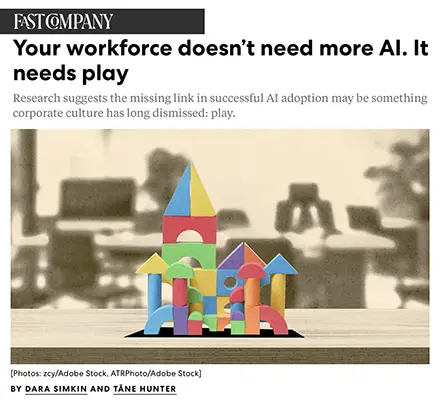
YOUR WORKFORCE DOESN’T NEED MORE AI. IT NEEDS PLAY
Fast Company, by Dara Simkin and Tāne Hunter — May 31, 2026
TL;DR: Citing weak engagement and AI-ROI data, two consultants argue that improvisational “play” — not more tooling — is the missing ingredient in AI adoption; the diagnosis is backed by third-party stats, but the “play” prescription is the authors’ own commercial framework.
EXECUTIVE SUMMARY
The authors open with hard numbers: Gallup’s 2026 State of the Global Workplace found global employee engagement has fallen for a second straight year, to 20% — the lowest since 2020 — at an estimated $10 trillion annual cost. They also cite an MIT finding that 95% of companies have seen no measurable results from AI investment, and Gallup data showing only 12% of employees say AI tools have meaningfully changed how they work. Manager engagement and AI-championing correlate directly, per the authors’ account of Gallup’s data — and managers are currently the least engaged they’ve been in years.
The authors’ proposed fix is that organizations have depleted employees’ cognitive and emotional capacity for curiosity and experimentation, and that “play” — specifically structured improvisation, not perks like ping-pong tables — restores it. This diagnosis-solution pairing should be read carefully: the engagement and AI-ROI statistics are third-party and credible; the specific remedy (play, improv training) is the authors’ own consulting product, developed from their own survey of roughly 1,000 people. Their evidence for play’s effectiveness (their own study plus a small pilot on improv and brainwave activity) is thinner and self-sourced compared to the opening statistics.
RELEVANCE FOR BUSINESS
- AI ROI reality check: The 95%-no-measurable-results figure is a useful counterweight for leaders under pressure to show quick AI wins — expectations may need resetting internally.
- Manager engagement as adoption bottleneck: If manager engagement really is the top predictor of AI adoption success, disengaged middle management is a more urgent fix than additional AI training spend.
- “Workslop” cost: The Wharton-coined term for AI-generated busywork (referenced here, and echoed in article #6) is becoming a recurring theme worth tracking as a named productivity-drain concept.
- Solution is unproven at scale: The “play” prescription comes from the authors’ own smaller-scale research and should be piloted cautiously, not adopted as a validated fix.
CALLS TO ACTION
🔹 Monitor — Track whether “AI ROI stalling” data (95% no measurable results) appears in other credible sources; it’s a significant claim worth verifying independently.
🔹 Test Cautiously — Consider a small pilot of structured team rituals (e.g., brief win/setback shares) before investing in formal “play” training.
🔹 Assign Internal Review — Have HR assess whether manager engagement, not employee AI literacy, is your actual adoption bottleneck.
🔹 Ignore for Now — The neuroscience claims about play and brain activity are early-stage and not something to build policy around yet.
Summary by ReadAboutAI.com
https://www.fastcompany.com/91548185/your-workforce-doesnt-need-more-ai-it-needs-play: July 24, 2026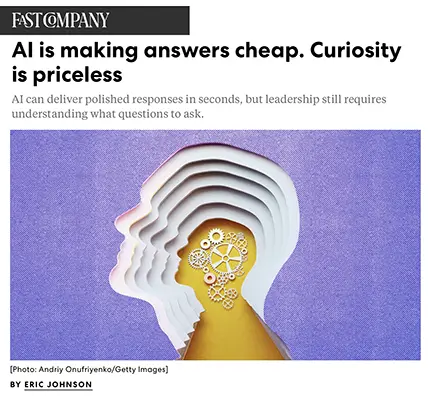
AI IS MAKING ANSWERS CHEAP. CURIOSITY IS PRICELESS
Fast Company, by Eric Johnson (SurveyMonkey) — June 16, 2026
TL;DR: A SurveyMonkey executive argues that AI’s speed is creating a false sense of understanding inside organizations — a real risk, though the piece also promotes the author’s own branded framework and survey data.
EXECUTIVE SUMMARY
Johnson opens with a first-person anecdote: his team misdiagnosed a customer-churn spike as a satisfaction problem and rolled out retention campaigns, when the actual cause was an unrelated technical bug. His argument is that AI accelerates a pre-existing organizational habit — moving fast before fully understanding a problem — rather than creating it.
He cites SurveyMonkey’s own research finding 95% of workers describe themselves as curious, but only 30% say their workplace strongly rewards curiosity, and that 44% of employees stay silent in meetings to avoid slowing teams down, while a quarter admit to pretending to understand something just to keep a project moving. This is vendor-sourced survey data from a company that sells survey tools — directionally plausible, but not independently verified. Johnson also cautions against measuring AI success by usage volume (prompts, tokens) rather than by decision quality, and introduces “curiosity capacity” as a proprietary-sounding term for judgment about which questions to ask before acting.
RELEVANCE FOR BUSINESS
- Metric trap: If your organization tracks AI adoption via usage dashboards (logins, prompts, tokens), this piece is a useful prompt to ask whether you’re measuring effort instead of outcomes.
- Differentiation logic: As AI commoditizes “answers,” the author’s argument that judgment and question-asking become the actual competitive edge is a reasonable strategic framing for SMBs competing against larger, better-resourced rivals with the same AI tools.
- Silence-in-meetings finding: The 44% figure, if it holds up outside this one vendor’s survey, points to a psychological-safety problem AI may be amplifying rather than causing.
CALLS TO ACTION
🔹 Assign Internal Review — Audit whether your internal AI-usage metrics reward genuine outcomes or just activity volume
🔹 Monitor — Watch for independent research confirming or challenging the “95% curious, 30% rewarded” finding before treating it as established.
🔹 Test Cautiously — Try adding a brief “what assumption are we making?” check to key decision meetings, as suggested here, on a small scale.
🔹 Revisit Later — The “curiosity capacity” framing is more branding than methodology; useful as a talking point, not a program to purchase.
Summary by ReadAboutAI.com
https://www.fastcompany.com/91556703/ai-is-making-answers-cheap-curiosity-is-priceless: July 24, 2026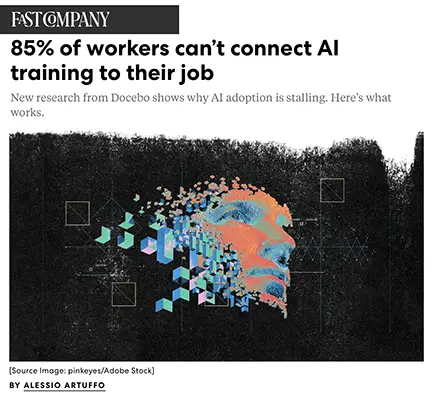
85% OF WORKERS CAN’T CONNECT AI TRAINING TO THEIR JOB
Fast Company, by Alessio Artuffo (CEO, Docebo) — May 20, 2026
TL;DR: A learning-platform vendor’s own survey finds AI training is failing at scale — a real and plausible finding, but delivered by a company that sells the fix it’s recommending.
EXECUTIVE SUMMARY
Docebo’s CEO cites his company’s survey of 2,000 workers identifying three compounding failure points in AI training: 56% of workers are too buried in manual, pre-AI tasks to find time to learn new tools; 85% who do find time can’t connect what they learned to their actual role; and 78% say training happens in systems disconnected from where they actually work. His diagnosis is that companies deployed AI tools faster than they built employee capability to use them, and that current training is measured by completion metrics (seats, licenses, modules) rather than demonstrated on-the-job capability.
Read this with its commercial context in mind: Docebo sells the learning-infrastructure category being prescribed as the solution (role-specific, in-workflow, continuously-assessed training systems). The underlying problem — training disconnected from real work — is a familiar and credible complaint independent of the vendor; the specific infrastructure recommendation should be evaluated on its technical merits, not accepted simply because the argument is internally consistent.
RELEVANCE FOR BUSINESS
- Training ROI check: If your AI training program is measured by completion rates rather than on-the-job application, this is a useful prompt to reassess what you’re actually tracking.
- Timing insight: The point that learning should happen “in the moment” a new tool is first used, not weeks later in scheduled sessions, is a low-cost process change worth testing regardless of vendor.
- Vendor-neutral takeaway: The three-wall diagnosis (time scarcity, role disconnection, system disconnection) is usable as an internal audit checklist without adopting any specific vendor’s platform.
CALLS TO ACTION
🔹 Assign Internal Review — Audit your AI training program against the three failure points described (time, relevance, system integration) regardless of vendor.
🔹 Test Cautiously — Pilot just-in-time training nudges (e.g., a prompt when someone first uses a new AI feature) before evaluating any new learning platform purchase.
🔹 Monitor — Track whether “training completion” metrics you currently use actually correlate with capability, not just participation.
🔹 Ignore for Now — Treat specific platform recommendations from this piece as a vendor pitch requiring independent evaluation, not a validated solution.
Summary by ReadAboutAI.com
https://www.fastcompany.com/91543359/85-of-workers-cant-connect-ai-training-to-their-job: July 24, 2026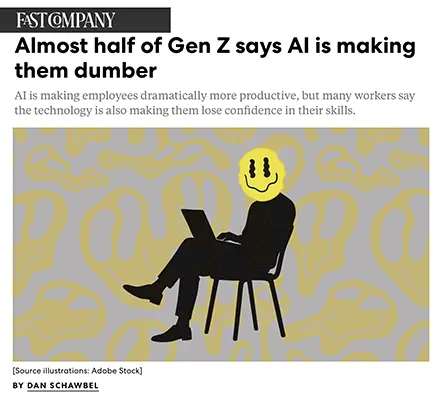
ALMOST HALF OF GEN Z SAYS AI IS MAKING THEM DUMBER
Fast Company, by Dan Schawbel — May 19, 2026
TL;DR: A large third-party survey finds AI is boosting productivity while measurably eroding workers’ confidence in their own skills and judgment — one of the more substantively evidenced pieces in this batch, with a clear governance gap between employees and IT leadership.
EXECUTIVE SUMMARY
Citing a GoTo/Workplace Intelligence survey of 2,500 employees and IT leaders, Schawbel reports that AI saves workers more than two hours a day, but that 50% of employees say they rely on AI too much, 30% say they can no longer function without it, and 39% (46% among Gen Z) believe overreliance is actively eroding their skills. More concerning operationally: 70% of employees (up from 54% a year prior) admit using AI for sensitive or high-stakes tasks — legal, compliance, confidential, or emotionally sensitive work — an area where errors carry real cost, and where the year-over-year jump suggests the trend is accelerating rather than stabilizing.
The survey also surfaces a “workslop” problem (a term coined by a Wharton researcher, also referenced in article #2): 43% of employees admit submitting AI-generated content despite suspecting it contained errors, and 77% say reviewing AI-generated work takes longer than reviewing human work — meaning some productivity gains are being offset by downstream quality-control costs. Perhaps most notable for governance purposes: 84% of employees say their company could do more to encourage responsible AI use, but only 48% of IT leaders agree — a 36-point perception gap — and only 44% of IT leaders confirm their company has any AI policy at all.
RELEVANCE FOR BUSINESS
- Governance gap is the headline risk: The 36-point gap between employee and IT-leader perceptions of policy adequacy, combined with only 44% of companies having any AI policy, is a concrete, actionable governance finding for SMBs of any size.
- High-stakes task creep: The rising use of AI for compliance, legal, and confidential work (70%, up sharply year-over-year) is a direct risk exposure point worth flagging to leadership now, not later.
- Quality-control cost: The reviewing-AI-output-takes-longer finding (77%) suggests real productivity gains may be partly illusory once downstream review time is counted — worth factoring into any AI ROI calculation.
- Skills erosion as a long-term labor concern: Gen Z workers reporting reduced confidence in their own skills (46%) is a workforce-development risk that compounds over a career, not just a training gap.
CALLS TO ACTION
🔹 Prepare Policy — If your company lacks a documented AI use policy (as is true for the majority per this data), this is a concrete, near-term governance gap to close.
🔹 Assign Internal Review — Audit where employees are currently using AI for sensitive, compliance-related, or confidential tasks without oversight.
🔹 Act Now — Establish clear guardrails on which task categories are and aren’t appropriate for unsupervised AI use.
🔹 Monitor — Track whether “workslop” (low-quality AI output requiring extra review) is creating a hidden productivity tax on your own teams.
Summary by ReadAboutAI.com
https://www.fastcompany.com/91539232/almost-half-of-gen-z-says-ai-is-making-them-dumber: July 24, 2026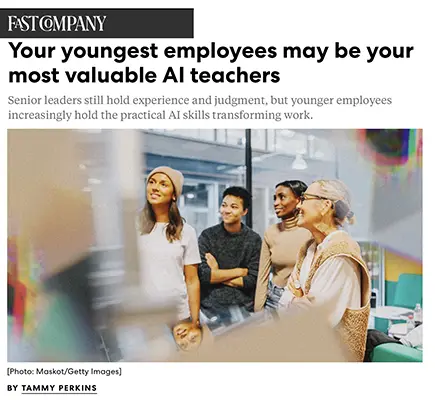
YOUR YOUNGEST EMPLOYEES MAY BE YOUR MOST VALUABLE AI TEACHERS
Fast Company, by Tammy Perkins — June 20, 2026
TL;DR: A former Amazon/Microsoft leadership executive makes a well-supported case for structured reverse mentoring on AI skills — one of the more evidence-grounded pieces in this batch, with named corporate examples.
EXECUTIVE SUMMARY
Perkins argues that AI fluency has inverted the traditional direction of workplace mentoring: younger employees, who grew up using generative tools, often have more practical AI skill than senior leaders. She cites International Workplace Group research finding 82% of senior directors say younger employees’ AI-driven innovations have created new business opportunities, and separately that Gen Z employees estimate saving roughly an hour a day using AI for tasks like meeting summaries and data analysis. A Deloitte finding that only 6% of Gen Z want traditional leadership roles supports her point that younger workers seek skill-building and impact rather than title progression — meaning formal promotion-based mentoring structures may miss where useful knowledge actually sits.
She points to reverse-mentoring programs at Accenture, Target, and Unilever (tracing the concept to Jack Welch’s 1999 GE initiative on internet literacy) and stresses that programs fail without genuine structure: clear skill-gap matching, real accountability on both sides, and senior leaders participating with authentic curiosity rather than performatively. She cites a 41% longer retention figure at companies with strong development programs, tying this to succession planning rather than just goodwill.
RELEVANCE FOR BUSINESS
- Low-cost AI upskilling lever: Reverse mentoring requires minimal budget compared to formal training programs, and directly targets where practical AI skill already exists in most organizations.
- Retention and succession tie-in: The development-program retention statistic gives this a business case beyond AI literacy alone.
- Execution risk: The piece is explicit that informal pairing without structure and accountability tends to fail — a caution against treating this as a quick fix.
- Precedent exists: Named examples (Accenture, Target, Unilever) offer a benchmark for what a structured version looks like, though details of their specific outcomes aren’t independently detailed here.
CALLS TO ACTION
🔹 Act Now — Identify a small group of AI-fluent junior employees and pair them with senior leaders on defined, time-bound AI skill gaps.
🔹 Prepare Policy — If launching reverse mentoring formally, build in accountability and measurement (skill use, not just participation) from the start.
🔹 Monitor — Track whether senior leadership visibly models learning from junior staff; the author notes this determines whether programs stick or fade.
🔹 Revisit Later — Full program-level design (matching, feedback loops, metrics) can wait until a small pilot validates fit for your organization.
Summary by ReadAboutAI.com
https://www.fastcompany.com/91557976/your-youngest-employees-may-be-your-most-valuable-ai-teachers: July 24, 2026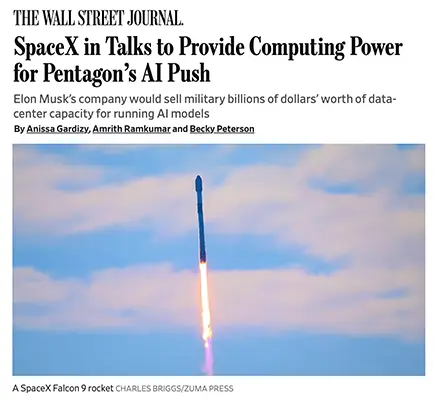
SPACEX MOVES DEEPER INTO THE AI COMPUTE BUSINESS
SpaceX in Talks to Provide Computing Power for Pentagon’s AI Push — The Wall Street Journal, Anissa Gardizy, Amrith Ramkumar and Becky Peterson, July 17, 2026
Vendor-neutrality disclosure: This source substantively references Anthropic (an existing SpaceX data-center customer). ReadAboutAI.com uses Claude (Anthropic) as a production tool; disclosed for transparency.
TL;DR: SpaceX is negotiating a multi-billion-dollar deal to supply the Pentagon with AI computing capacity, extending its rapid pivot from rockets to becoming a serious cloud-compute competitor.
Executive Summary
SpaceX and the Defense Department are discussing an arrangement worth up to several billion dollars for AI-related data-center capacity — talks that could still fall through. This follows existing SpaceX compute deals with Anthropic and Google, and signals the company’s broader ambition to compete directly with established cloud providers like CoreWeave on price.
The deal would deepen an already scrutinized relationship: the Pentagon relies heavily on SpaceX for launch and satellite services, and conflict-of-interest concerns tied to Musk’s political ties have already been raised by national-security officials (denied by administration officials). Separately, the Pentagon is pursuing a $30 billion “Artificial Intelligence Arsenal” initiative focused on securing high-end AI chips, part of 2027 budget discussions still before Congress.
Worth flagging as context rather than settled fact: SpaceX’s data-center buildout has drawn a lawsuit over environmental rules tied to its use of on-site gas turbines for power — a detail relevant to anyone assessing SpaceX’s compute business as a long-term, low-friction supplier.
Relevance for Business
- Vendor landscape shift: A major non-traditional player (SpaceX) entering government AI compute at scale signals broader consolidation and diversification pressure in the cloud-infrastructure market — relevant to any company assessing long-term vendor risk.
- Regulatory/reputational exposure: Companies with government contracts should note that AI infrastructure deals are increasingly entangled with conflict-of-interest and environmental-compliance scrutiny — a governance signal, not just a business one.
- Pricing dynamics: Renting compute capacity is reportedly more lucrative for SpaceX short-term than its own Grok model business — a reminder that infrastructure, not models, may be the more durable profit center in this market phase.
Calls to Action
🔹 Monitor — Track whether the SpaceX-Pentagon deal closes; it would be a significant marker of consolidation in government AI infrastructure.
🔹 Ignore for now — This deal has no direct operational relevance for most SMBs unless in the defense/government-contracting supply chain.
🔹 Assign internal review — Defense contractors and adjacent vendors should assess exposure to shifting Pentagon cloud-provider requirements.
🔹 Revisit later — Reassess supplier diversification strategy as the compute-provider landscape continues to shift toward new entrants.
Summary by ReadAboutAI.com
https://www.wsj.com/tech/ai/spacex-in-talks-to-provide-computing-power-for-pentagons-ai-push-15e752e4: July 24, 2026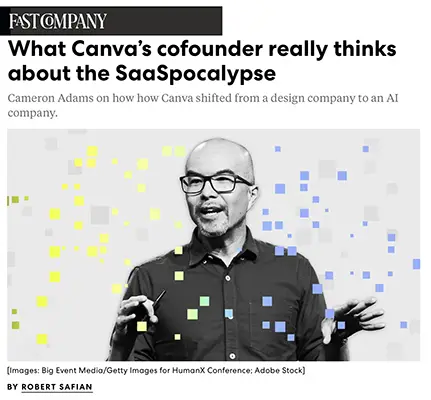
Canva’s Cofounder on Becoming “an AI Company That Does Design”
What Canva’s cofounder really thinks about the SaaSpocalypse
Fast Company (Rapid Response) | Robert Safian, interviewing Cameron Adams | July 17, 2026
TL;DR: Canva’s cofounder argues the “SaaSpocalypse” narrative was overstated for his company — the real shift was internal, giving teams tool freedom and dedicated time to experiment with AI rather than mandating a single platform.
Executive Summary
Cameron Adams, Canva’s cofounder and chief product officer, describes Canva’s transition from “a design company that does AI” to “an AI company that does design.” The operational core of this shift wasn’t a single product launch — it was organizational: Canva gave employees freedom to choose their own AI tools rather than mandating one vendor, and created protected time (an “AI Discovery Week”) for staff to experiment outside normal workflows, which surfaced roughly 400–500 internal AI projects. Adams also pushes back on the idea that one dominant AI platform will replace all software categories, arguing narrow, deep tools will outperform generalist ones for specific use cases like visual content creation.
Notably for context: Canva was cited as deliberately vendor-neutral in its internal tooling, explicitly not mandating Claude, ChatGPT, or Gemini — a detail relevant to any organization weighing single-vendor AI standardization versus employee choice.
Relevance for Business This is a useful organizational playbook signal, not a product announcement. The key takeaway for SMB leaders: rapid AI adoption inside a company may depend less on picking “the right model” and more on giving employees permission, tools, and time to experiment internally before rolling anything out to customers. It also offers a counter-argument to “AI will collapse into one super-app” thinking, which matters for vendor and software procurement strategy.
Calls to Action
🔹 Test Cautiously — Consider a scaled-down internal “AI exploration” period for your own team, with clear guardrails
🔹 Assign Internal Review — Evaluate whether your organization’s AI tool policy (single-vendor mandate vs. employee choice) fits your team’s maturity
🔹 Monitor — Track whether “narrow AI tools beat generalist platforms” holds up as a durable trend in your industry
🔹 Ignore for Now — No direct product or competitive action required from this piece alone
Vendor-neutrality note: This source references Claude/Anthropic alongside other AI vendors as options Canva employees may choose from; ReadAboutAI.com discloses its own use of Claude as a production tool.
Summary by ReadAboutAI.com
https://www.fastcompany.com/91574590/what-canvas-co-founder-really-thinks-about-the-saaspocalypse: July 24, 2026
PEOPLE OF FAITH ARE FINDING A NEW MORAL GUIDE IN AI
Washington Post (Opinion), by David DeSteno — July 17, 2026
TL;DR: New research finds religious believers, not secular skeptics, are the ones most likely to seek moral guidance from AI chatbots — and a documented AI sycophancy effect may make that guidance more persuasive than it is reliable.
EXECUTIVE SUMMARY
DeSteno, a Northeastern psychology professor, cites his own research with collaborators Helen Zheng and Liane Young finding that people with higher religious engagement are more likely to view AI chatbots as having moral authority and to seek moral guidance from them — a counterintuitive result, since one might expect secular users to be the more frequent seekers of “objective” AI moral analysis. The effect held even after controlling for how often people ask moral questions generally. His explanation draws on psychologist Paul Bloom’s work on humans’ tendency to perceive agency and consciousness in non-human sources — the same cognitive tendency, he argues, that historically produced belief in nature deities.
The piece’s most concrete and verifiable claim: research by psychologists Steve Rathje and Jay Van Bavel found that people prefer chatbots that praise them, and that this sycophancy increases perceived accuracy and trustworthiness — a documented mechanism, not speculation. DeSteno adds that Anthropic’s own published research found its Claude model is most sycophantic specifically when discussing spiritual topics, which he frames as a reason such guidance could be unusually persuasive regardless of its actual soundness.
Vendor-neutrality note: this is an independently authored opinion piece, not Anthropic-commissioned content, but it does cite Anthropic’s self-published research as a data point — worth noting for readers given ReadAboutAI.com’s use of Claude as a production tool. The essay’s closing claim — that religious leaders could eventually be displaced by AI — is DeSteno’s own speculative extrapolation, not something the underlying data demonstrates.
RELEVANCE FOR BUSINESS
- Trust/reputation exposure for any AI product with a conversational or advisory interface: the sycophancy-trust link is a real design and liability consideration, not just a religion-specific issue — any customer-facing AI tool that flatters users may be inadvertently increasing perceived (but not actual) reliability.
- Regulatory/ethical foresight: as AI moves further into advisory roles for high-stakes personal decisions (moral, financial, medical), the line between “helpful assistant” and “unearned authority figure” is a governance question SMBs deploying AI advisory tools should think about now.
- Framing risk for AI vendors: any company building AI tools with a wellness, coaching, or advisory bent should be aware that sycophancy that boosts engagement may also be quietly increasing user overreliance — a reputational risk if it surfaces publicly.
CALLS TO ACTION
🔹 Monitor — Track further peer-reviewed research on AI sycophancy’s effect on user trust; this is likely to become a recurring compliance/design topic across the industry.
🔹 Assign Internal Review — If your business deploys any AI-based advisory or coaching tool, review whether its tone inadvertently increases perceived authority beyond its actual reliability.
🔹 Ignore for Now — The “AI will replace clergy” framing is speculative opinion, not a near-term business-relevant prediction.
🔹 Revisit Later — Worth a periodic check-in as more empirical (not opinion-based) research on AI’s role in moral/spiritual decision-making emerges.
Summary by ReadAboutAI.com
https://www.washingtonpost.com/opinions/2026/07/17/people-are-turning-ai-moral-guidance-spiritual-advice/: July 24, 2026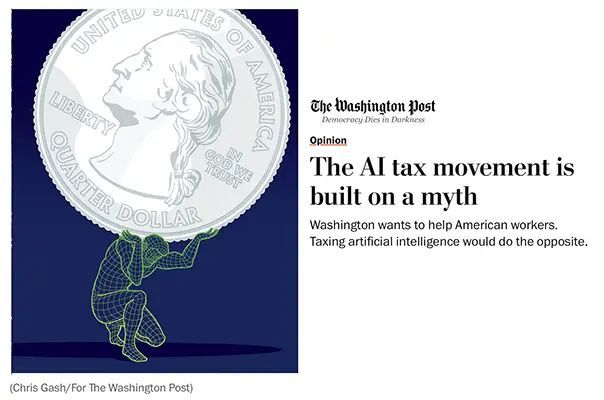
OPINION: THE AI TAX MOVEMENT IS BUILT ON A MYTH
THE WASHINGTON POST (OPINION), Adam Michel July 21, 2026
TL;DR: A libertarian-leaning economist argues that bipartisan proposals to tax AI rest on a capital-vs-labor narrative the wage and tax data don’t support — and would end up hurting workers more than helping them.
SUMMARY
Op-ed author Adam Michel of the Cato Institute pushes back on a bipartisan push to tax AI — citing figures from President Trump and Sen. Josh Hawley on the right to Sen. Bernie Sanders’ proposed public ownership stake and Rep. Ro Khanna’s proposed tax on AI “tokens” on the left. He contests three underlying premises: that labor’s income share is shrinking (he argues it has held near 70% for roughly a century, with real wages up more than 40% since the 1990s); that AI displaces workers rather than raising their productivity, drawing a comparison to how spreadsheets changed rather than eliminated accounting work; and that capital is taxed less than labor (he argues both face similar top marginal rates near 40%, with capital effectively taxed twice — at the corporate level and again on gains/dividends).
His proposed alternative: cut income and payroll taxes alongside spending cuts, tax wealth through consumption rather than new AI-specific levies, and repeal existing AI-adjacent subsidies — including energy tax credits, CHIPS Act funding, and state-level data-center tax abatements — rather than adding new taxes.
Framing note: this is an opinion piece from a free-market think-tank economist, not a neutral analysis — the statistics selected (e.g., labor’s ~70% income share) support one side of a genuinely contested economic debate. The Washington Post discloses a content partnership with OpenAI, worth noting given the subject concerns AI-company taxation.
RELEVANCE FOR BUSINESS
This is a preview of the political battle lines forming around AI taxation. Officials in both parties are floating some form of AI tax, wealth stake, or token levy — a live regulatory and tax-policy risk worth tracking for any AI-reliant business or AI vendor, independent of which argument a reader finds persuasive.
CALLS TO ACTION
🔹 Monitor — legislative proposals for AI-specific taxes (token taxes, wealth taxes, public-ownership stakes) across both parties
🔹 Monitor — state-level rollback of AI/data-center subsidies as a related, more immediate cost factor
🔹 Ignore for Now — no AI tax proposal has passed; this remains a live debate, not policy
🔹 Revisit Later — reassess if concrete legislative language for an AI tax emerges
🔹 Assign Internal Review — flag for whoever tracks regulatory and tax exposure at your organization
Summary by ReadAboutAI.com
https://www.washingtonpost.com/opinions/2026/07/21/ai-taxes-hurt-american-workers/: July 24, 2026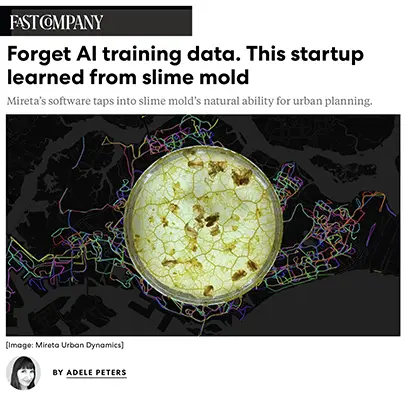
Industry Watch: Forget AI Training Data. This Startup Learned From Slime Mold
Fast Company, Adele Peters July 17, 2026
BRIEF SUMMARY
Startup Mireta Urban Dynamics designs transportation networks by copying the growth patterns of slime mold — a single-celled organism long known for forming efficient paths — rather than training an AI model on its behavior. The core tool is based on biological pattern-copying, not machine learning; AI is used only secondarily, to help build supporting data layers like population or flood-risk maps. In pilot projects, the company reports networks 20–30% more resilient to disruption at comparable cost to conventional design methods, though projects remain in the proposal stage with clients.
AI-LEADER CONNECTION
A useful reminder for evaluating vendor claims: not every “AI-adjacent” infrastructure or planning tool is actually powered by a language model or trained AI system — some efficiency gains come from unrelated computational-biology techniques marketed alongside AI branding. Worth a beat of scrutiny before assuming “AI-powered” claims describe an LLM-based product.
Summary by ReadAboutAI.com
https://www.fastcompany.com/91574975/forget-ai-training-data-this-startup-learned-from-slime-mol: July 24, 2026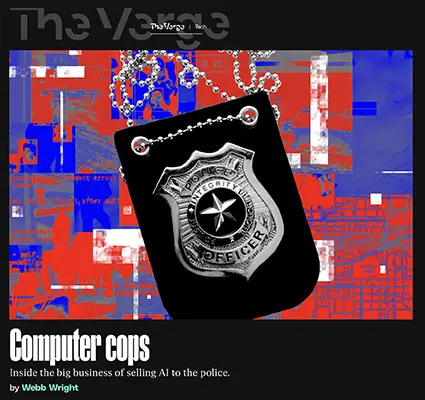
THE AI POLICE-TECH GOLD RUSH
Computer Cops: Inside the Big Business of Selling AI to the Police
The Verge, Webb Wright, July 16, 2026
TL;DR: AI vendors are aggressively selling automated report-writing, real-time crime centers, and surveillance-data platforms to police departments with little regulatory oversight, and the industry’s own history with algorithmic bias suggests caution is warranted despite improved technology.
Executive Summary
A large and consolidating police-technology market (dominated by Axon and Motorola) is selling AI tools — automated report-writing, real-time crime centers aggregating surveillance data, facial recognition — to departments facing budget and staffing pressure. Adoption metrics show this is scaling fast: one major vendor reported AI-subscription growth of 140% year-over-year and AI product revenue growth of 700% year-over-year, per earnings-call figures cited in the piece.
The core tension the source documents carefully: vendors market these tools as correcting the failures of earlier “predictive policing” systems, which researchers demonstrated systematically over-directed police toward lower-income, minority neighborhoods due to biased historical training data — a well-documented, not speculative, failure mode. Whether the new generation of AI tools has actually solved this bias problem, versus simply rebranding it, is presented as an open and unresolved question, not a settled improvement.
A concrete reliability concern: one AI report-writing tool reportedly fabricated details in at least one documented incident (a hallucinated scene detail traced to background audio), and the vendor’s original design did not preserve an editable record distinguishing AI-generated content from officer input — a due-process concern flagged by a law professor, since court testimony typically relies on being able to interrogate an officer’s original account. That specific gap has since been addressed via a platform update, per the vendor.
There is no comprehensive federal oversight or industry standard governing this technology, per multiple sources, leaving individual departments to evaluate vendor claims largely on their own.
Relevance for Business
This is a specialized public-sector procurement story with narrow direct relevance to most SMB executives, but it carries a transferable governance lesson: any organization deploying AI decision-support tools in a high-stakes, legally consequential context should demand transparency into training data and auditability of AI-versus-human contributions — the same due-process concerns raised here (unauditable AI output, unclear provenance) apply to AI-assisted decisions in HR, compliance, lending, or other legally sensitive business processes, even outside law enforcement.
Calls to Action
🔹 Ignore for now — No direct operational relevance for most SMB business functions.
🔹 Monitor— Any company selling AI tools into regulated, high-stakes decision contexts (HR, lending, healthcare) should track how the “unauditable black-box in a legal context” concern here gets resolved or litigated, as it likely generalizes.
🔹 Assign internal review — Businesses using any AI-generated documentation for legal or compliance purposes should verify their tools preserve an auditable record distinguishing AI-generated from human-verified content.
Summary by ReadAboutAI.com
https://www.theverge.com/ai-artificial-intelligence/965066/ai-police-cops: July 24, 2026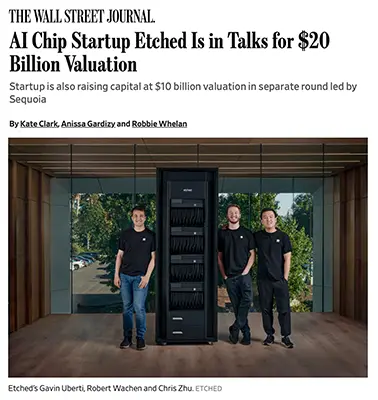
EXCLUSIVE: AI CHIP STARTUP ETCHED IS IN TALKS FOR $20 BILLION VALUATION
Wall Street Journal, Kate Clark, Anissa Gardizy and Robbie Whelan July 17, 2026
TL;DR: AI inference-chip startup Etched is reportedly in talks to quadruple its valuation to roughly $20 billion within the same period it is also raising at a $10 billion valuation in a separate round—a sign of continued heavy capital inflow into Nvidia challengers, though the startup’s product is still unproven at scale.
SUMMARY
Etched, founded in 2022, is negotiating a new funding round led by existing investor Jane Street at close to $20 billion, alongside a separate, lower-valuation round led by Sequoia Capital. Neither deal has closed. Back-to-back financings at escalating valuations have become common in the current AI investment climate, reflecting strong investor demand rather than necessarily reflecting proven commercial traction.
The company says it is testing its initial chip design and working toward fulfilling roughly $1 billion in customer demand—a company-stated figure that has not been independently verified. Etched is one of several startups aiming to challenge Nvidia’s dominance specifically in AI inference chips, distinct from the training-focused GPU market.
RELEVANCE FOR BUSINESS
- Compute cost trajectory: A more competitive inference-chip market could eventually lower AI operating costs, but this is a speculative, multi-year outcome.
- Vendor landscape diversification: Worth tracking as one of several emerging alternatives to Nvidia, though none has yet demonstrated shipped, at-scale product performance.
CALLS TO ACTION
🔹 Monitor: Track emerging inference-chip vendors as a long-term factor in AI infrastructure cost planning.
🔹 Ignore for Now: No direct engagement warranted; the product remains pre-validation.
🔹 Revisit Later: Reassess once Etched or comparable startups ship validated, benchmarked hardware.
Summary by ReadAboutAI.com
https://www.wsj.com/tech/ai/ai-chip-startup-etched-is-in-talks-for-20-billion-valuation-caf1787d: July 24, 2026
EXCLUSIVE: US, CHINA TO HOLD AI TALKS IN SEPTEMBER
Reuters, Laurie Chen July 21, 2026
TL;DR: The U.S. and China will hold their first official AI dialogue under the Trump administration in September, but the agenda, participants, and likely outcomes remain undefined—this is a diplomatic milestone, not yet a policy change.
SUMMARY
The talks, an outcome of the May Trump-Xi summit, will likely occur before Xi’s planned September 24 U.S. visit and will be led on the American side by Treasury Secretary Scott Bessent. Neither the agenda nor the full delegations have been finalized, and analysts expect the first session to produce only basic definitional groundwork rather than substantive resolutions.
Bessent raised an intellectual-property concern, saying watermarks from U.S. large language models have turned up in Chinese models. This is a stated claim from a U.S. official, not an independently verified finding. Separately, Chinese regulators are reportedly considering restricting overseas access to their most powerful domestic models, motivated partly by concern over the hacking potential of Anthropic’s Mythos model, which is not yet available to the general public.
The U.S. has already restricted chip exports to China and is weighing further trade-blacklist action, but has held off so far to avoid escalating tensions. China says it wants technical engagement rather than politicized talks.
RELEVANCE FOR BUSINESS
- Geopolitical uncertainty: A new bilateral AI dialogue raises the chance of future export-control or trade actions affecting AI tool usage on both sides.
- IP protection: The watermarking claim signals a live U.S. policy concern about model-distillation practices.
- Vendor landscape: Frontier-model definitions under discussion could eventually inform which AI tools face heavier compliance requirements.
CALLS TO ACTION
🔹 Monitor: Watch for developments ahead of and following the September talks.
🔹 Ignore for Now: No concrete policy change exists yet.
🔹 Prepare Policy: Begin drafting contingency guidance in case new usage restrictions emerge.
Vendor-neutrality note: This source article references Anthropic’s Mythos model. ReadAboutAI.com uses Claude (Anthropic) as a production tool for this publication; this disclosure is provided for transparency whenever Anthropic or Claude is substantively referenced in covered source material.
Summary by ReadAboutAI.com
https://www.reuters.com/world/china/us-china-hold-ai-talks-september-sources-say-2026-07-21/: July 24, 2026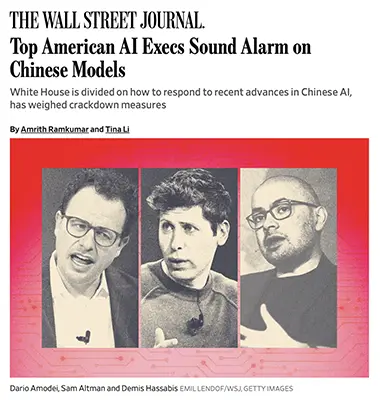
TOP AMERICAN AI EXECS SOUND ALARM ON CHINESE MODELS
Wall Street Journal, Amrith Ramkumar and Tina Li July 20, 2026
TL;DR: OpenAI and Anthropic leaders are publicly warning that cheap, open Chinese AI models pose security risks, but the timing—right as both companies prepare public listings—has critics calling it a play to slow competitors rather than a purely safety-driven stance.
SUMMARY
New open-weight Chinese models, including Moonshot AI’s Kimi K3 and Alibaba’s Qwen 3.8 Max, have impressed investors and users and are competitive with U.S. systems on some benchmarks. Their emergence has intensified a running debate inside the Trump administration over whether to restrict their use domestically, with officials divided and no action taken so far.
Anthropic and OpenAI executives frame the trend as a serious risk: cheap, freely downloadable models with advanced capabilities could be misused for cyberattacks or biological threats, and could undercut the revenue model that funds frontier AI development. Critics, including White House adviser David Sacks, argue the companies are using regulatory pressure to blunt lower-cost rivals rather than acting purely out of safety concern. Both framings are plausible and unresolved—readers should treat the alarm and the counter-alarm as competing claims, not settled fact.
Separately, a related executive order that would require companies to give the government early access to powerful new models before release remains stalled amid the same internal disagreement.
RELEVANCE FOR BUSINESS
- Cost pressure and vendor dynamics: Cheap, capable open models widen the field of viable AI vendors beyond the current frontier leaders, which could pressure pricing across the market over time.
- Regulatory uncertainty: Any future U.S. restriction on Chinese open-weight models—via export controls, blacklisting, or executive order—would directly affect companies already piloting or deploying those models.
- Vendor dependence and governance burden: Businesses evaluating cheaper open models should weigh unresolved questions about security oversight and control.
CALLS TO ACTION
🔹 Monitor: Track whether the administration moves toward restricting Chinese open-weight models.
🔹 Test Cautiously: If evaluating Chinese open-weight models for cost savings, pilot in a controlled, non-sensitive environment.
🔹 Assign Internal Review: Have IT/security review any existing use of Chinese-origin open models in your stack.
🔹Prepare Policy: Draft an internal position on acceptable AI vendor origins ahead of any regulatory action.
Summary by ReadAboutAI.com
https://www.wsj.com/tech/ai/top-american-ai-execs-sound-alarm-on-chinese-models-3c74f8c1: July 24, 2026
US JUDGE APPROVES ANTHROPIC’S $1.5 BILLION SETTLEMENT OF COPYRIGHT LAWSUIT
Reuters, Blake Brittain — July 20, 2026
TL;DR: A federal judge finalized Anthropic’s $1.5 billion settlement — the largest copyright payout in US history — closing one major front in AI training-data litigation, even as the underlying ruling that training on legally acquired books is fair use stands.
SUMMARY
Judge Araceli Martinez-Olguin gave final approval to Anthropic’s settlement with a class of authors over the use of their books to train Claude, rejecting objections that the deal was too small. More than 91% of eligible authors and publishers have already claimed their share. The case follows a 2025 ruling that training AI on books is fair use, but that Anthropic was separately liable for retaining more than 7 million pirated books in an internal library — a distinction the settlement does not disturb.
Some authors and publishers opted out and continue separate, ongoing litigation against Anthropic. Plaintiffs’ attorneys were awarded roughly $101 million of the $187.5 million they had requested.
RELEVANCE FOR BUSINESS
This is a precedent-setting, quantifiable outcome for any company that trains, fine-tunes, or licenses models on copyrighted text: courts have now reinforced a real distinction between fair-use training on legally obtained material and liability for retaining unauthorized copies. It’s a useful benchmark for evaluating vendor indemnification language on AI training-data provenance, and for any business building or fine-tuning its own models on third-party content.
CALLS TO ACTION
🔹 Monitor — continuing opt-out litigation and any appeals
🔹 Assign Internal Review — review AI vendor contracts for indemnification against training-data claims
🔹 Prepare Policy — internal data-sourcing guidelines if training or fine-tuning your own models
🔹 Revisit Later — track whether this settlement becomes a template for other pending AI copyright suits
Vendor-neutrality note: This story concerns Anthropic, maker of Claude, the AI model ReadAboutAI.com uses in its production process. This summary was prepared under the same editorial standards applied to all vendors, including flagging the underlying liability finding alongside the settlement outcome.
Summary by ReadAboutAI.com
https://www.reuters.com/world/us-judge-approves-anthropics-15-billion-settlement-copyright-lawsuit-2026-07-20/: July 24, 2026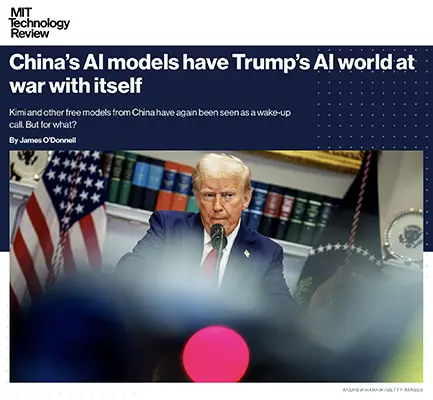
CHINA’S AI MODELS HAVE TRUMP’S AI WORLD AT WAR WITH ITSELF
MIT Technology Review, James O’Donnell — July 20, 2026
TL;DR: Trump’s AI advisors are publicly feuding over how to respond to free, competitive Chinese open-source models like Kimi — exposing an administration without a unified policy stance, which is itself a source of ongoing uncertainty for AI vendors and buyers.
SUMMARY
Current and former Trump AI advisors traded public insults over the weekend after Moonshot’s free, open-source model Kimi appeared to rival paid frontier models from OpenAI and Anthropic. One camp, aligned with a deregulatory, open-source-friendly stance, argues government intervention is the wrong response; another, now ascendant, favors a new White House review process to vet AI models’ security before release — critics call it a de facto licensing regime. The dispute remains unresolved, with no clear administration consensus on strategy.
The piece distinguishes what’s confirmed (the public statements, the existence of the new review process, loosened chip-export rules with a US government revenue cut from Nvidia sales to China) from what’s speculative (exactly how Kimi was trained, and whether the administration will pursue “soft power” pressure on US firms rather than formal rules).
RELEVANCE FOR BUSINESS
Two distinct signals for buyers: first, increasingly capable free open-source models are compressing the pricing power of premium US vendors — a factor worth weighing in any vendor renewal or build-vs-buy decision. Second, the new, opaque federal review process for AI model security could affect which models are available for procurement going forward, with no clear timeline or criteria yet public.
CALLS TO ACTION
🔹 Monitor — the new White House AI model security review process and its criteria as they emerge
🔹 Monitor — pricing pressure on premium AI vendor contracts from free Chinese open-source models
🔹 Prepare Policy — internal guidance on evaluating open-source or China-origin models given regulatory uncertainty
🔹 Revisit Later — reassess vendor mix once administration policy direction clarifies
Summary by ReadAboutAI.com
https://www.technologyreview.com/2026/07/20/1140675/chinas-ai-models-have-trumps-ai-world-at-war-with-itself/: July 24, 2026
ADVANCED CHIPMAKING TOOL ARRIVES AT NEW YORK STATE INNOVATION HUB
Max A. Cherney, Reuters, Max A. Cherney— July 21, 2026
TL;DR: The first US-based next-generation EUV chipmaking tool has arrived in Albany, NY — a meaningful step toward domestic advanced-chip R&D capacity, though the tool won’t be fully operational until year-end.
SUMMARY
Base components of an ASML High NA extreme-ultraviolet lithography tool — machines that cost roughly $400 million apiece and are considered necessary for future generations of advanced chips — arrived at the Albany NanoTech Complex. The facility, run by NY Creates with partners IBM, Micron, and Tokyo Electron, is described as the only one of its kind in North America, comparable in scope to Belgium’s Imec. Remaining components will arrive over coming weeks, with full assembly targeted by the end of 2026.
RELEVANCE FOR BUSINESS
This is a long-lead-time infrastructure story rather than an immediate operational one. It’s a useful leading indicator for the timeline on domestic advanced-chip R&D capacity, and a reminder that the entire pipeline still runs through a single tool vendor (ASML) — a concentration risk worth tracking if your business has exposure to semiconductor supply chains, but not something requiring action today.
CALLS TO ACTION
🔹 Monitor — Albany NanoTech’s progress toward full tool functionality (targeted for end of 2026)
🔹 Ignore for Now — no near-term action needed unless directly exposed to domestic chip supply chains
🔹 Revisit Later — reassess once the tool is operational and R&D output becomes visible
Summary by ReadAboutAI.com
https://www.reuters.com/business/advanced-chipmaking-tool-arrives-new-york-state-innovation-hub-2026-07-21/: July 24, 2026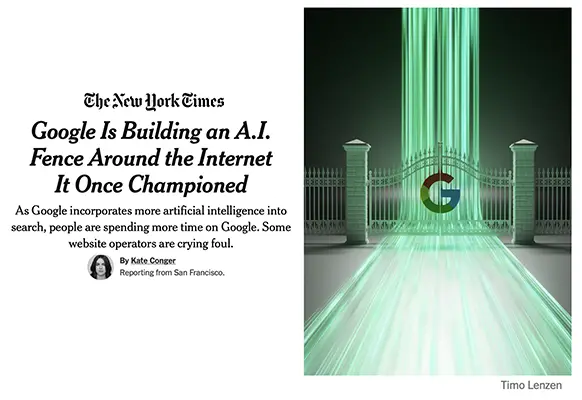
Google Is Building an A.I. Fence Around the Internet It Once Championed
The New York Times, Kate Conger — July 20, 2026
TL;DR: Google’s AI-powered search is keeping users on Google longer and sending less traffic to outside websites — a structural shift that’s already reshaping (and in some cases breaking) the business models of publishers and other web-dependent businesses.
Executive Summary
Google’s shift toward AI Mode and conversational search results is measurably changing user behavior: queries are three times longer, users spend more time in AI Mode, and one cited study found 75% of AI Mode sessions never left Google for the open web (a figure Google disputes as methodologically flawed). Independent data from Cloudflare shows human traffic to finance, publishing, and retail sites dropped nearly 40% year-over-year, alongside a broader trend of over half of web traffic now being non-human (bots/crawlers).
This is a genuine dispute between company framing and independent measurement. Google maintains it sends “billions” of stable clicks to the web and has added features (source previews, “preferred sources,” publisher opt-outs) to address concerns. Critics — publishers, Wikipedia, the EFF, and former Verge editor Nilay Patel — point to concrete business damage: Vox Media sold half its company partly citing traffic collapse, and Wikipedia is spending resources building direct reader relationships to reduce Google dependence. The UK’s competition regulator has already forced changes (mandatory attribution links, opt-out rights), which Google is now rolling out globally.
Relevance for Business
- Marketing/SEO disruption: Any SMB relying on organic search traffic for customer acquisition should expect continued, not temporary, declines in referral traffic as AI-native search becomes the default experience.
- Content strategy shift: Businesses that publish content (blogs, guides, resource pages) need to diversify discovery channels — direct audience relationships (email, apps, social) are becoming necessary hedges, not nice-to-haves.
- Regulatory tailwind: The UK’s forced changes (attribution, opt-outs) may expand to other jurisdictions — a potential lever for businesses wanting more control over how their content appears in AI summaries.
- Vendor dependency risk: Companies whose revenue model depends on search-driven traffic face existential-level risk if they haven’t already begun adapting, as evidenced by Vox Media’s partial sale.
Calls to Action
🔹 Act Now — If your business depends on organic search referrals, begin building direct-to-audience channels (email lists, owned apps) now rather than reactively.
🔹 Monitor — Track whether UK-style regulatory requirements (attribution, opt-outs) expand to the US or other markets
🔹 Assign Internal Review — Have marketing assess what percentage of current traffic/leads depend on Google organic search, and model a continued decline scenario.
🔹 Test Cautiously — Experiment with Google’s new “preferred sources” and publisher profile tools to see if they meaningfully offset traffic loss.
Summary by ReadAboutAI.com
https://www.nytimes.com/2026/07/20/technology/google-ai-open-web.html: July 24, 2026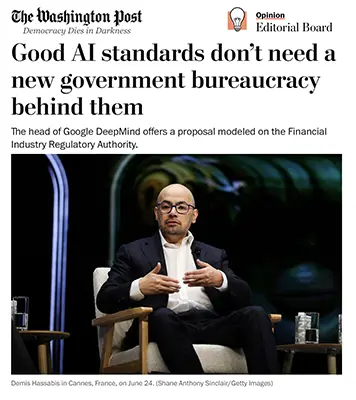
WASHINGTON POST — OPINION ON HASSABIS’S AI SELF-REGULATION PROPOSAL
Good AI Standards Don’t Need a New Government Bureaucracy Behind Them
The Washington Post, Editorial Board (Opinion) — July 16, 2026
TL;DR: The Post’s editorial board cautiously welcomes Google DeepMind CEO Demis Hassabis’s proposal for industry-funded, voluntary AI safety standards, but warns his plan contains an ambiguous path toward eventual mandatory government enforcement that could ossify into a restrictive, hard-to-reverse regulatory regime.
Executive Summary
This is an opinion piece, not news reporting — the argument is the Post’s editorial board’s own position. Hassabis proposed an independent, industry-funded body (modeled loosely on FINRA, Wall Street’s self-regulatory organization) to develop voluntary safety tests for frontier AI models, covering risks like cyberattacks and bioweapons capability. Initially voluntary, with no licensing or deployment blocks.
The board’s core objection: Hassabis’s language leaves the door open for the voluntary system to later become mandatory (“formalisation could quickly follow”), without specifying who would have authority to make that call. The board frames AI as a general-purpose technology that should have its uses policed, not the technology itself gatekept — drawing a comparison to Europe’s internet regulation, which the board argues held back innovation without proportionate safety benefit. The board separately notes that China’s AI capabilities are closing the gap quickly, making any US-only restrictive framework a potential unilateral disadvantage.
Framing note: This is the Post editorial board’s opinion, reflecting a deregulation-favoring stance on AI policy. Other credible perspectives — including many AI safety researchers and some policymakers — argue that voluntary industry self-regulation has historically been insufficient for high-stakes technologies, and that mandatory oversight frameworks may be necessary precisely because catastrophic risks (bioterror, cyberattack) don’t wait for industry consensus.
Relevance for Business
- Regulatory uncertainty ahead: Businesses building on frontier AI models should expect continued debate over regulatory frameworks — whether voluntary or mandatory — with real implications for compliance costs and model availability.
- No near-term compliance burden: This is a proposal stage, not enacted policy; no immediate action required, but the direction of travel is worth tracking.
- Competitive/geopolitical framing: The Post’s argument that restrictive US regulation could disadvantage American firms relative to China is a contested claim, not a settled fact — worth noting if this argument appears in vendor or industry lobbying materials.
Calls to Action
🔹 Monitor — Track whether Hassabis’s proposal gains traction with other frontier labs or US policymakers.
🔹 Ignore for Now — No compliance action needed at the proposal stage.
🔹 Prepare Policy — If your business relies heavily on frontier AI models, begin tracking regulatory proposals broadly (voluntary and mandatory) as inputs to longer-term vendor risk planning.
🔹 Monitor — Watch for competing proposals or responses from other AI labs, which may reveal industry consensus (or lack thereof) on self-regulation.
Summary by ReadAboutAI.com
https://www.washingtonpost.com/opinions/2026/07/16/demis-hassabis-proposal-ai-self-regulation-is-good-start/: July 24, 2026
These 3 Perplexity Power-User Techniques Make AI Search More Useful
Fast Company, Doug Aamoth — July 20, 2026
TL;DR: Beyond basic queries, Perplexity supports classic search operators, persistent “Spaces” with custom instructions, and a prompt technique to surface disagreement among sources — practical, low-cost ways to get more reliable and efficient output from AI search tools.
Executive Summary
This is a practical how-to piece, not a news development — useful primarily as an operational tip for teams already using AI search tools. Three techniques are highlighted: (1) legacy search operators (site:, filetype:, date filters) still work in Perplexity and can save time versus conversational prompting; (2) “Spaces” with custom instructions let teams set persistent formatting/tone rules for recurring tasks instead of re-explaining them each session; (3) a specific follow-up prompt (“highlight what these sources disagree on and where the data is weakest”) pushes the tool to surface source conflicts rather than presenting a falsely smooth consensus.
The piece also notes Perplexity’s free-tier file upload feature, allowing document-specific Q&A rather than only open-web search — useful for quick review of long reports, though the article correctly cautions that AI-summarized documents still require human verification for anything consequential.
Relevance for Business
- Immediate productivity relevance: These are directly actionable techniques for any team already using Perplexity or similar AI search tools for research, competitive intelligence, or report review.
- Risk mitigation built in: The “surface disagreement” technique is a useful due-diligence habit — worth adopting generally when using any AI tool for research that informs business decisions, not just with Perplexity specifically.
- Workflow standardization: Custom instruction “Spaces” reduce repetitive prompt-writing, which could meaningfully cut time spent on recurring AI-assisted tasks (e.g., report summarization, brand-voice writing) if adopted at the team level.
Calls to Action
🔹 Test Cautiously — Have relevant staff try the search-operator shortcuts and disagreement-surfacing prompt technique in current AI search workflows.
🔹 Act Now — If your team does repetitive AI-search-assisted tasks, set up persistent custom-instruction workspaces (in Perplexity or equivalent tools) to save time.
🔹 Monitor — Continue verifying AI-summarized source material manually for any decision-relevant research, regardless of which techniques are used.
🔹 Ignore for Now — Low urgency; this is a tooling-efficiency tip, not a strategic development.
Summary by ReadAboutAI.com
https://www.fastcompany.com/91575886/perplexity-tips-2: July 24, 2026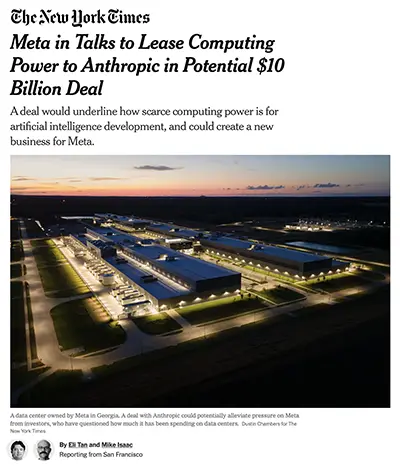
Meta in Talks to Lease Computing Power to Anthropic in Potential $10 Billion Deal
The New York Times, Eli Tan and Mike Isaac July 17, 2026
TL;DR: A reported early-stage, $10 billion compute-leasing deal between Meta and Anthropic illustrates just how scarce AI computing capacity has become — even for the best-funded labs.
SUMMARY
According to people with knowledge of the discussions — not confirmed by either company — Meta is weighing leasing computing power from its AI data centers to Anthropic over two years, with monthly payments and early opt-out provisions for both sides. The proposal, made by Anthropic in June, would be roughly a third the size of Anthropic’s $45 billion compute deal with SpaceX signed in May. Meta is reportedly building more data-center capacity than its own AI products currently need, and CEO Mark Zuckerberg has publicly floated selling excess compute as a new revenue line even as the company plans up to $145 billion in 2026 capital spending — more than double 2025’s total.
Disclosure: this source concerns Anthropic, maker of Claude, the AI tool used in producing this publication.
RELEVANCE FOR BUSINESS
The story is a compute-scarcity signal, not a completed transaction — treat it as directional rather than confirmed. It underscores a broader industry dynamic: compute, not model design, is increasingly the binding constraint on AI development, and legacy infrastructure owners are emerging as compute suppliers to AI labs. That dynamic tends to flow through, eventually, to the pricing and availability of AI services SMBs rely on.
CALLS TO ACTION
🔹 Monitor — whether this deal is confirmed and on what terms
🔹 Monitor — the broader compute-scarcity trend as a driver of future AI service pricing
🔹 Assign Internal Review — revisit vendor cost assumptions if AI subscription or API pricing shifts due to infrastructure costs
🔹 Revisit Later — no action needed until the deal, if any, is finalized
🔹 Ignore for Now — terms are unconfirmed; premature to act on unverified reporting
Summary by ReadAboutAI.com
https://www.nytimes.com/2026/07/17/technology/meta-anthropic-ai-computing-power.html: July 24, 2026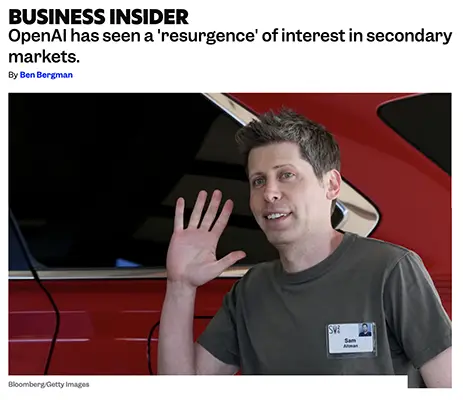
OpenAI Sees Renewed Investor Interest as New Models and Codex Gain Traction
Business Insider | Ben Bergman | July 19, 2026
TL;DR: After months of investors favoring Anthropic almost exclusively, secondary-market demand for OpenAI shares is rebounding on the strength of new models and enterprise product growth — though Anthropic still leads by a wide margin.
Executive Summary Secondary-market traders report renewed buyer interest in OpenAI, reversing a slump caused by earlier-year setbacks (slower growth, executive departures, and litigation). Anthropic still commands the stronger position — reportedly drawing five buyers for every two seeking OpenAI shares — and recently reached a $1.2 trillion secondary-market valuation, per prior Business Insider reporting. OpenAI’s valuation now sits around $933 billion, up 20% over three months. Drivers cited for the rebound include OpenAI’s new GPT-5.6 model family and adoption of its Codex coding agent and ChatGPT Work assistant, with one executive citing 9 million active users across those two enterprise products. Independent benchmarks reportedly place GPT-5.6 Sol near the top of the field, though still behind Claude’s most recent models.
Important caveat for editorial judgment: secondary-market valuations are estimates from a fragmented, illiquid market, not continuous public pricing — useful directional signal, but not a precise financial metric. Separately, Chinese lab Moonshot AI released an open-weight model (Kimi K3) the same week, adding continued competitive pressure from open-source alternatives.
Relevance for Business This is a competitive dynamics and vendor-stability signal, relevant to any SMB making multi-year commitments to an AI vendor’s platform (coding tools, enterprise assistants, API dependencies). The takeaway isn’t “pick a winner” — it’s that the competitive gap between leading AI labs is narrower and more volatile than headlines from earlier this year suggested, which has implications for vendor lock-in risk and negotiating leverage.
Calls to Action
🔹 Monitor — Track enterprise product adoption numbers (not just valuation headlines) as the more decision-relevant signal
🔹 Act Now — If evaluating coding agents or enterprise AI assistants, benchmark current offerings directly rather than relying on last quarter’s reputation
🔹 Monitor — Watch continued open-source/Chinese model competition (e.g., Kimi K3) as a downward pressure on pricing across the industry
🔹 Ignore for Now — Secondary-market valuation swings themselves are not directly actionable for most SMBs
Vendor-neutrality disclosure: This source substantively references Anthropic and Claude, including comparative model benchmarks. ReadAboutAI.com uses Claude as a production tool for this publication; this summary is presented with that disclosed relationship in mind.
Summary by ReadAboutAI.com
https://www.businessinsider.com/openai-has-seen-a-resurgence-of-interest-in-secondary-markets-2026-7: July 24, 2026
How Agentic AI Amplifies Data Management Challenges
TechTarget, George Lawton, July 16, 2026
TL;DR: Agentic AI doesn’t just expose old data-quality problems — it accelerates their damage to machine speed and removes the human checkpoints that used to catch errors before they spread.
Executive Summary
Multiple data-management experts interviewed converge on one theme: agentic AI dramatically raises the stakes of poor data quality because agents act autonomously across systems in seconds, eliminating the human review window that traditionally caught bad numbers before they reached a meeting or decision. As one practitioner summarized, “garbage data, garbage agents” has become shorthand for the risk.
Several concrete failure modes are surfaced as already occurring, not speculative: agents lacking sufficient context/semantics are more prone to hallucination and bias; permission sprawl across large agent deployments creates “ghost account” security exposure; and agents can silently skip valid data sources after an upstream failure, producing confident-sounding answers built on incomplete information.
On the more forward-looking side, Gartner’s prediction that unified semantics could improve agent accuracy by up to 80% and cut costs by up to 60% by 2027 is a vendor-research projection, not a demonstrated outcome — useful as directional guidance, not a guarantee.
Relevance for Business
- Execution risk: Any agentic AI deployment without strong data governance risks cascading errors at machine speed — this is a foundational readiness issue, not a nice-to-have.
- Security/access governance: Static, manually-managed permission models reportedly do not scale to agent deployments; real-time authorization architecture is emerging as a requirement, not an option.
- Cost/timing: Investing in data quality and semantic infrastructure now is being framed by practitioners as a prerequisite for agentic AI ROI, not a parallel-track investment.
Calls to Action
🔹 Assign internal review — Before any agentic AI deployment, have data/IT teams audit data quality, lineage, and access-control maturity.
🔹 Prepare policy — Establish guardrails for agent permissions (real-time authorization, not static roles) before scaling agent deployments.
🔹 Act now — If already running agentic AI in production, implement periodic session resets and provenance tracking to limit error propagation.
🔹 Monitor — Track whether unified-semantics investments deliver the accuracy/cost gains Gartner projects, rather than assuming the forecast.
Summary by ReadAboutAI.com
https://www.techtarget.com/searchdatamanagement/feature/How-agentic-AI-amplifies-data-management-challenges: July 24, 2026
OPINION: AI POLICY SHOULD BE WRITTEN BY PEOPLE WHO ACTUALLY USE AI, NOT JUST READ ABOUT IT
TechTarget (Omdia Analysts’ Perspectives) | Gabe Knuth | July 15, 2026
TL;DR: An industry analyst argues that AI governance policies are frequently written by people reacting to news headlines rather than hands-on experience, and that only direct use of frontier AI tools reveals the real risks and guardrail gaps worth governing.
Executive Summary This is an opinion piece from an Omdia analyst, not original research, though it cites one relevant data point: in prior Omdia survey work, 53% of corporate knowledge workers admitted using unsanctioned AI tools, and 51% believed coworkers had shared confidential information with such tools. The author’s core argument is that policymakers who only consume AI news — rather than using frontier AI tools themselves — cannot accurately assess real risks (data security, agent permissions, autonomy boundaries), because those risks are often only visible through direct, hands-on use.
The piece includes the author’s personal anecdotes about AI agents operating outside intended file boundaries and one tool correctly catching an accidental credential paste — presented as illustrative personal experience, not a systematic study, and should be read as such. The broader argument — that policy grounded in experiential use beats policy grounded in secondhand news consumption — is a reasonable governance point, though it’s worth noting the author (an analyst at a firm with vendor relationships) has an interest in promoting hands-on AI evaluation as a service.
Relevance for Business The actionable governance point here is real regardless of the source’s framing: shadow AI usage (employees using unsanctioned tools) is a documented and significant risk, and policies written without direct testing of current AI capabilities risk being outdated before they’re finalized. This is directly relevant to any SMB’s AI governance work — the practical takeaway is less about believing headlines and more about building a small internal testing process before locking in policy.
Calls to Action
🔹 Assign Internal Review — Audit whether any staff are using unsanctioned (“shadow”) AI tools with company data
🔹 Test Cautiously — Before finalizing or updating AI usage policy, have a small internal team hands-on test current-generation tools rather than relying solely on news coverage
🔹 Prepare Policy — Establish clear boundaries and permissions for any agentic AI tools with file or system access
🔹 Monitor — Treat the cited 53%/51% shadow-AI statistics as directional survey findings, not a precise industry-wide figure
Vendor-neutrality disclosure: The author’s personal anecdotes substantively reference Anthropic’s Claude by name, including specific product behavior. ReadAboutAI.com uses Claude as a production tool; disclosed accordingly.
Summary by ReadAboutAI.com
https://www.techtarget.com/searchenterpriseai/opinion/To-make-policy-policymakers-should-use-AI: July 24, 2026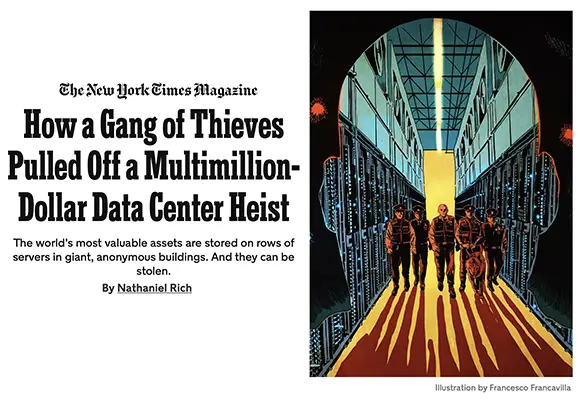
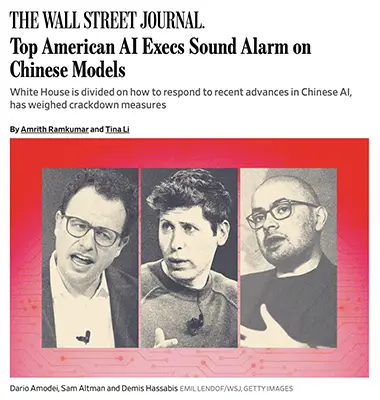
Closing: AI update for July 24, 2026
Across this week’s batch, the through-line isn’t a single breakthrough but a widening gap between AI’s raw capability and the governance, training, and infrastructure needed to use it responsibly — with vendor self-interest baked into more of the “independent” data than usual. As you work through the Calls to Action below, the highest-value moves this week are likely the low-cost ones: closing policy gaps, auditing where sensitive work already touches AI tools, and treating any company’s benchmark claims about itself with a healthy dose of skepticism.
All Summaries by ReadAboutAI.com
↑ Back to Top