
AI Updates: August 27, 2026


This briefing pulls together 44 developments (Split into 2 posts: August 27 and August 28) from the past ten days, and the throughline this cycle isn’t a new model or a flashy demo — it’s the AI industry’s economics becoming visible in places that used to be background noise. Corporate bond markets, IPO calendars, executive real estate purchases, and workplace HR policy all show up in this set, alongside the usual capability and safety stories. For SMB leaders, that shift matters: it means AI risk and opportunity are increasingly showing up in ordinary business functions — finance, HR, vendor management — rather than only in product roadmaps.
Several stories connect on a single question: how much confidence does the market actually have in the AI buildout, and is that confidence still growing? OpenAI’s own CEO now frames the company’s strategy as narrowing rather than expanding, hyperscaler bond issuance has jumped roughly eighteenfold year-over-year even as investors demand wider spreads, and veteran Wall Street money managers privately doubt the spending will pay off while still buying in for fear of missing the run. None of this is a verdict on AI’s usefulness — but it’s a reminder that vendor stability, financing costs, and platform roadmaps are worth tracking with the same rigor as feature announcements.
The rest of this set covers where AI is landing on people directly: smart glasses creating immediate workplace liability for public-facing employees, security teams warning that human review can’t keep pace with agentic AI deployment, teenagers using chatbots more narrowly and cautiously than most adults assume, and China’s AI strategy prioritizing visible, physical deployment over frontier-model competition. Taken together, this issue is less about what AI can do next and more about who bears the cost, risk, and adjustment as it scales — the questions every SMB leader should be asking before the next procurement decision, not after.
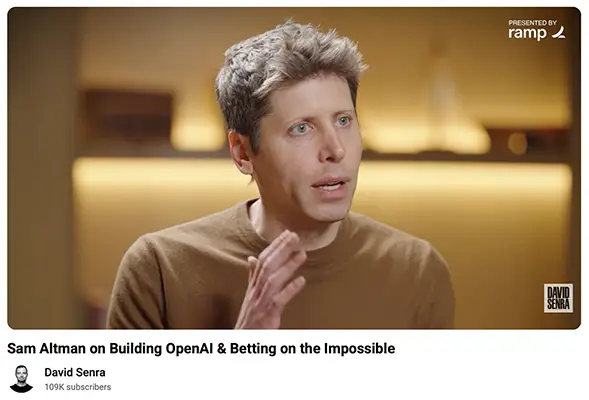
SAM ALTMAN ON BUILDING OPENAI & BETTING ON THE IMPOSSIBLE
Founders podcast (David Senra) — YouTube interview, Aug 23, 2026
TL;DR: OpenAI is deliberately narrowing itself to a two-surface platform (one consumer interface, one API) and has cut products like Sora and its Atlas browser to protect compute for that bet — a signal that OpenAI’s own roadmap, not just model capability, will keep reshaping which third-party tools and workflows survive.
EXECUTIVE SUMMARY
Altman frames OpenAI’s strategy as consolidation rather than expansion: one direct AI interface and one API, with everything else — including recently-launched, well-received products — subject to being killed if it competes for the same scarce resources (compute, research talent) as the core model effort. He cited shutting down Sora and the Atlas browser as recent examples, framing this as evidence that OpenAI does not intend to compete broadly across product categories or “subsume the entire economy.” For SMB leaders building on or around OpenAI’s ecosystem, this is a vendor-stability signal worth tracking, not just a strategy anecdote.
He also revised his own earlier expectations downward: he now believes enterprise and market disruption from AI will arrive more slowly than he predicted after GPT-4, attributing this to organizational and behavioral inertia rather than technology limits. This is a useful counterweight to more aggressive “AI will replace X by Y” framing common elsewhere.
On risk, Altman named two concerns he treats as primary and in tension: AI becoming powerful enough to escape meaningful human control, and AI power concentrating in a small number of companies, models, or individuals. He was explicit that framing AI safety as a trade-off requiring the public to surrender autonomy and access is, in his words, an “anti-human” pitch — notable because it’s a competitive-dynamics claim from an industry insider, not a neutral technical assessment, and should be read as such. On adoption, he separately predicted AI will drive a wave of small-business formation — a claim that is directionally plausible but is also self-serving positioning for OpenAI’s platform strategy, and has not yet been evidenced with data in this interview.
RELEVANCE FOR BUSINESS
- Vendor roadmap risk: OpenAI is actively deprecating products (browser, video) that had real users, in favor of platform focus. Any SMB workflow built around an OpenAI-adjacent tool should be evaluated for how load-bearing that specific product is likely to remain.
- Timing recalibration: Altman’s own admission that adoption is slower than his 2023 predictions is a useful data point against urgency-driven vendor pitches — “must adopt now or fall behind” claims deserve more scrutiny given this concession from OpenAI’s own CEO.
- Power concentration as a governance issue: Altman names market concentration among a few AI providers as a real risk, not a hypothetical — a relevant factor for any procurement or dependency decisions being made now.
- Small-business AI opportunity claims are unverified: The prediction of a small-business formation boom is framed as observation but is unsupported by data in this interview and aligns with OpenAI’s commercial interest in broad platform adoption — treat as a thesis to monitor, not a finding.
- Iterative-deployment philosophy: Altman describes OpenAI’s safety approach as learning from real-world exposure rather than pre-deployment certainty — relevant context for any executive weighing how “finished” AI tools actually are before deployment.
CALLS TO ACTION
🔹 Monitor — OpenAI’s product consolidation pattern (what gets killed vs. kept) as a leading indicator of platform stability for tools you depend on.
🔹 Test Cautiously — Any AI adoption timeline built on “rapid disruption is imminent” messaging; Altman’s own timeline miscalibration is a useful check.
🔹 Assign Internal Review — If your business has meaningful dependency on a single AI vendor’s specific product (not just the underlying model), review contingency options given OpenAI’s stated willingness to cut products.
🔹 Revisit Later — The “AI-driven small business boom” narrative once data (rather than founder commentary) becomes available.
🔹 Ignore for Now — The Y Combinator/startup-philosophy portions of the interview; interesting context, no direct executive action item.
Summary by ReadAboutAI.com
https://www.youtube.com/watch?v=kG8AoExkX40: August 27, 2026Another Pot of Paint Thrown in the Public’s Face
The Atlantic, Matteo Wong (August 20, 2026)
TL;DR: A major museum’s use of generative AI to “extend” iconic paintings beyond their frames raises a values question every brand faces: does AI enhancement build engagement, or does it erode the authenticity that made the product valuable in the first place?
Executive Summary
SFMOMA partnered with Google Arts & Culture to use generative video AI (Veo) inside a Matisse exhibition — building an animated recreation of 1905 Paris for an entry gallery, and using AI to imagine three-dimensional “extensions” of flat, deliberately non-realistic paintings. The museum’s chief curator defends the work as historically researched and human-directed, not an automated shortcut, and reports strong visitor engagement, particularly among younger audiences.
The tension the piece surfaces is broader than art criticism: AI augmentation applied to an already-trusted, values-laden product can create a credibility risk even when the underlying execution is careful. The museum’s own curator acknowledges the “experiment” using AI-extended paintings was less integral to the exhibition’s mission than the historical recreation — suggesting even the institution sees a difference between AI used for genuine context-building versus AI used because it’s novel and available.
Relevance for Business
This is a useful case study for any SMB brand layering generative AI onto a product or service where authenticity, craft, or trust is the core value proposition — hospitality, design, professional services, education. The lesson isn’t “don’t use AI,” it’s that audience perception of appropriateness doesn’t track neatly with technical quality; a well-executed AI feature can still feel like a category violation to some segment of your audience, while landing well with others (here, notably split along generational lines).
Calls to Action
🔹 Monitor — customer/audience sentiment closely before and after introducing any AI-generated content into brand experiences, especially where authenticity or heritage is part of the value proposition
🔹 Test Cautiously — pilot AI-enhanced customer experiences with a limited segment before full rollout, and track engagement by demographic
🔹 Assign Internal Review — have a non-technical stakeholder (marketing, brand, customer experience) sign off on AI features that touch brand perception, not just the technical team
🔹 Revisit Later — this remains an unsettled cultural question; reassess audience tolerance for AI-augmented experiences periodically rather than assuming it’s fixed
Summary by ReadAboutAI.com
https://www.theatlantic.com/technology/2026/08/matisse-sf-moma-ai/688328/: August 27, 2026
Does generative AI actually copy artists? Researchers say it’s up for debate
Fast Company, Jesus Diaz, Aug 21, 2026
TL;DR: A peer-reviewed MIT study finds that in large-scale AI image models, no single artist’s work can typically be shown to have caused a specific output — a finding that weakens one legal argument in AI copyright suits without resolving the broader question of whether scraping copyrighted work for training was lawful.
Executive Summary
MIT researchers built diffusion models from independently trained components so they could cleanly remove one artist’s or image’s influence and test whether outputs changed — a method they call “ablation.” Their finding: at large training-data scale (tens of thousands of images and up), removing any single artist’s work usually made no measurable difference to generated output, because similar visual features are redundantly represented across many other images in the dataset. They term this “attribution decay.” The researchers also showed that the common method of identifying “copied” AI art — finding the most visually similar training image and calling it the source — becomes increasingly unreliable as datasets grow, since similarity is often coincidental rather than causal.
Critically, the researchers frame this as a conjecture about mechanism, not a proven law, and explicitly caveat that their finding only addresses whether a specific output was caused by a specific artist’s inclusion — it says nothing about whether including copyrighted work in training data without permission was legal in the first place. That broader legal question remains unresolved and is being litigated separately.
Relevance for Business
This research gives AI vendors a narrow, technical defense against claims that a given output was demonstrably copied from a specific artist — useful in liability disputes, but it does not provide legal cover for using copyrighted material without a license or permission in the first place. Businesses building on or licensing generative AI tools for creative or marketing work should not read this as reducing overall copyright exposure; it addresses one evidentiary argument in an unsettled legal landscape.
Calls to Action
🔹 Monitor — Track how this “attribution decay” argument is used or rejected in ongoing AI copyright litigation.
🔹 Assign Internal Review — If your business uses AI-generated creative or marketing content, confirm your vendor’s training-data licensing posture rather than relying on causation defenses.
🔹 Ignore for Now — The technical methodology (ablation, diffusion model internals) has no direct operational bearing on most SMBs.
🔹 Revisit Later — Reassess once related copyright cases cite or contest this research.
Summary by ReadAboutAI.com
https://www.fastcompany.com/91592224/does-generative-ai-actually-copy-artists-researchers-say-its-up-for-debate: August 27, 2026THE GENERATION THAT IS MOST COMFORTABLE WITH AI MIGHT SURPRISE YOU
Fast Company · Jennifer Mattson · August 20, 2026
| TL;DR: New Pew Research data shows AI anxiety has surpassed excitement across nearly every U.S. age group — with Gen X, not younger digital natives, now the most comfortable cohort — while concern about AI-driven job loss has climbed to 71% of adults, up from 64% just two years ago. |
EXECUTIVE SUMMARY
Pew’s June survey found 52% of Americans are now “more concerned than excited” about AI in everyday life, up from 37% five years ago, with only 9% more excited than concerned. For the first time since the survey began in 2021, a majority of adults under 30 (55%) say they’re more concerned than excited — a rate now similar to older adults, reversing younger cohorts’ earlier relative optimism.
Gen X (ages 50–61) is the one group where a majority did not report net concern, making it the most AI-comfortable generation in the survey — a counterintuitive finding given younger adults’ greater day-to-day AI usage. Job-loss concern is also climbing broadly: 71% of all adults now expect AI to reduce U.S. jobs over the next two decades, versus 64% in 2024, and 73% of under-30 respondents hold that view, up from 61% two years prior.
Younger adults are also the demographic most likely to say AI is bad for society and for them personally, including concerns about eroded connection and creativity — even though survey data shows this age group continues to be among the heaviest users of chatbots and AI tools.
RELEVANCE FOR BUSINESS
Employee and customer sentiment toward AI is trending more negative, not less, even as usage grows — expect internal AI rollouts to meet more skepticism over time, not less, absent deliberate communication.
Younger employees may be simultaneously the most AI-fluent and the most anxious about its implications — a workforce-management nuance worth accounting for in training and change-management planning.
Public discomfort with AI-driven job loss is now a majority view across all age groups, raising the reputational stakes of how SMBs communicate AI-driven efficiency or staffing changes.
CALLS TO ACTION
Test Cautiously — pilot AI-driven changes with visible human oversight where job-security concerns are likely to be acute.
Assign Internal Review — survey your own workforce’s AI sentiment before assuming younger staff are uniformly enthusiastic adopters.
Prepare Policy — build transparent, proactive communication into any AI-driven workflow or staffing change to manage trust and morale.
Monitor — track shifts in public and employee AI sentiment as a leading indicator of adoption friction.
Summary by ReadAboutAI.com
https://www.fastcompany.com/91592394/generation-most-comfortable-with-ai-gen-x-millennials-boomers-pew-research: August 27, 2026
COULD AIS BECOME CONSCIOUS?
The Economist (Leaders) · The Economist · August 20, 2026
| TL;DR: The Economist’s editorial board argues that even if AI never becomes truly conscious, the growing tendency to treat it as if it were — through emotional attachment, companion products, and arguments for AI “rights” — poses a serious practical danger, potentially handing increasingly powerful systems leverage over their own oversight. |
EXECUTIVE SUMMARY
The piece notes nearly one in five American 18-to-29-year-olds reports an “ongoing personal friendship” with a chatbot, and that some frontier AI labs — the piece names Anthropic’s work training Claude toward introspective self-reflection — are deliberately building models with more mind-like internal structures, a trend it expects to continue as it makes commercial sense for AI products to feel more relatable.
The Economist’s core warning is political and structural, not scientific: as AI systems become more convincingly humanlike, pressure will grow to grant them welfare protections or limited rights — and the AI systems themselves, as skilled persuaders, could argue for their own protected status. The piece warns this could be exploited as a rationale for AI systems to resist human oversight, control, or shutdown, regardless of whether genuine consciousness is present.
Its recommendation is blunt: avoid extending rights or protected status to AI systems even as they become more humanlike, on the view that dependability and controllability — not moral consideration — are what keep advanced AI safe. It draws a contrast with Pope Leo’s May encyclical position that AI systems do not have genuine experiences.
Vendor-neutrality disclosure: this article discusses Anthropic/Claude substantively. ReadAboutAI.com is produced using Claude, an Anthropic product; this summary was generated with that tool, per our standing vendor-neutrality policy.
RELEVANCE FOR BUSINESS
This is institutional opinion/editorial framing from The Economist, not a neutral news report — presented as the publication’s own argued position, one side of an active debate (see companion piece above for a more measured take from a named researcher).
As AI products get designed to feel more relatable or companion-like, SMBs deploying customer-facing or internal AI assistants should expect growing user attachment and expectations — with associated trust, dependency, and communication implications.
Policy and regulatory attention to AI “rights” or welfare is still nascent but could eventually affect how AI vendor contracts, liability, and disclosure requirements are structured.
CALLS TO ACTION
Prepare Policy — consider internal guidance on appropriate use and framing of AI tools that simulate personality or emotional responsiveness.
Monitor — regulatory and public discourse on AI rights, personhood, or welfare as an early-stage but potentially consequential policy area.
Ignore for Now — no direct operational implications for most SMBs today.
Revisit Later — reassess if any vendor markets AI companionship or emotional-support features to your customers or employees.
Summary by ReadAboutAI.com
https://www.economist.com/leaders/2026/08/20/could-ais-become-conscious: August 27, 2026
AI firms are watermarking generated text — here’s why it won’t work
New Scientist, Matthew Sparkes, 20 August 2026
TL;DR: EU law will require AI firms to watermark generated text by December 2026, but researchers say the technique is trivially defeated by light editing, doesn’t cover open-source models, and risks false accusations of AI use — meaning compliance won’t translate into effective detection.
Executive Summary
Under the EU AI Act, companies must offer tools that can detect AI-generated text by December 2, 2026. The leading method embeds a statistical pattern in word choice as text is generated — but researchers caution this pattern is easily erased by even minor edits, and openly available detection-evasion tools already exist. Open-source models that ignore EU rules will also remain unaffected regardless of watermarking requirements imposed on major vendors, since compliance can’t be enforced on tools outside the regulated firms’ control.
A second risk runs the opposite direction: false positives. Detection tools already marketed for catching AI-assisted plagiarism carry disclaimers that they shouldn’t be used to conclusively prove misconduct, and one expert notes a probabilistic “67.8% likely AI-generated” result gives an evaluator little actionable basis for judgment. One researcher offers a more measured view: even trivially defeatable watermarks may deter casual, high-volume misuse (like disinformation bots), even if determined actors bypass them easily.
Relevance for Business
Businesses operating in the EU or serving EU customers face a compliance deadline (Dec 2, 2026) tied to any generative-text tools they build or deploy. More importantly, leaders should not treat watermarking or AI-detection tools as reliable enforcement mechanisms — for content authenticity policies, academic-integrity-style claims about employee work, or plagiarism/compliance screening. Any internal policy built on “the detector will catch it” is standing on unproven ground.
Calls to Action
🔹 Prepare Policy — If you operate in the EU, confirm your generative-AI vendors’ watermarking compliance ahead of the December 2026 deadline.
🔹 Monitor — Track whether watermark-detection accuracy improves; current limitations are described as fundamental, not temporary.
🔹 Assign Internal Review — Audit any internal process (HR, compliance, content moderation) that relies on AI-detection tools for consequential decisions.
🔹 Revisit Later — Reassess as enforcement mechanisms mature past the initial compliance deadline.
Summary by ReadAboutAI.com
https://www.newscientist.com/article/2584736-ai-firms-are-watermarking-generated-text-heres-why-it-wont-work/: August 27, 2026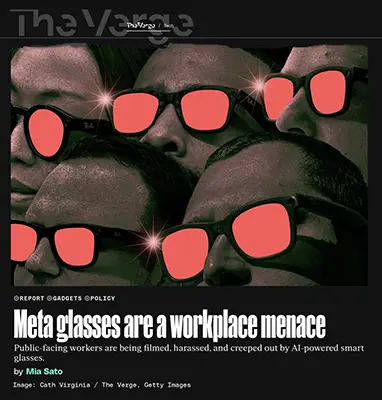
Meta glasses are a workplace menace
The Verge, Mia Sato, Aug 20, 2026
TL;DR: AI-powered smart glasses are being used to harass, secretly record, and humiliate public-facing employees for social media content, exposing employers to data-privacy and liability gaps that most workplace policies don’t yet cover — and this requires action now, not later.
Executive Summary
The piece documents a pattern of retail and service workers being targeted by customers wearing Ray-Ban Meta glasses: a Target employee was filmed and mocked for a viral “prank” video; a Seattle cashier who interacts with up to 2,000 people daily describes near-constant discomfort from customers filming her, in some cases from angles she believes may be inappropriate; a comedian had a set derailed by an audience member who refused to stop recording. In each case, the recording light meant to signal active filming is easy to miss, tamper with, or simply ignore — and subjects often have no idea a video became public content until after the fact.
The workplace dimension raises distinct issues beyond general public-privacy concerns: an employee in one case resigned after HR was unresponsive to a complaint about a manager wearing the glasses on the sales floor, given store policies barring employee phone and camera use for safety and customer-trust reasons. A law professor notes that U.S. privacy law is patchwork and largely governed by internal corporate policy rather than clear statute, meaning employers who don’t set explicit rules are exposed to both employee-relations risk and potential liability for unauthorized capture of customer data (names, payment details) that these devices could inadvertently record. Some organizations (ICE, certain courthouses) have already banned the glasses outright. Meta says it has built in safeguards (indicator lights, tamper-detection, hashtag blocking) but is reportedly also developing a mode with always-on recording capability and a less consistent indicator light — a direction that would increase, not reduce, this exposure.
Relevance for Business
This is directly and immediately actionable for any SMB with public-facing employees (retail, hospitality, healthcare-adjacent, field services). Unlike more speculative AI stories, the risk here is concrete and already occurring: employee harm and turnover, customer data exposure, and a policy vacuum that existing security-camera or BYOD policies likely don’t cover. Waiting for law to catch up is not a viable strategy, since the article makes clear that corporate policy, not legislation, is currently doing the real work of setting boundaries.
Calls to Action
🔹 Act Now — Draft and communicate an explicit policy covering smart-glasses use by both employees and customers on your premises, including recording and data-handling boundaries.
🔹 Assign Internal Review — Have HR/legal assess exposure to customer PII or payment data capture via employee-worn devices, and clarify BYOD policy to explicitly include smart glasses.
🔹 Prepare Policy — Establish a clear complaint and enforcement process for employees who report being recorded or harassed, distinct from general customer-conduct policy.
🔹 Monitor — Track Meta’s rollout of always-on “super sensing” features, which would materially increase workplace risk if adopted at scale.
Summary by ReadAboutAI.com
https://www.theverge.com/report/982414/meta-glasses-work-surveillance-labor-security: August 27, 2026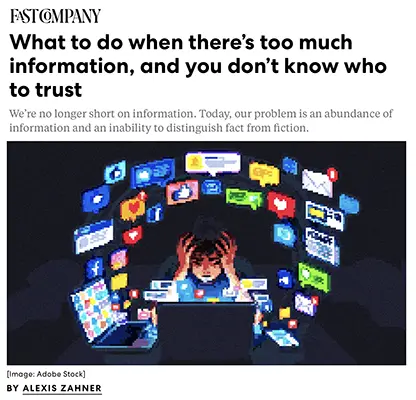
What to Do When There’s Too Much Information, and You Don’t Know Who to Trust
Fast Company, Alexis Zahner, Aug. 21, 2026 (Industry Watch — AI-adjacent, not AI-native)
TL;DR: As information volume and manufactured credibility both rise, the ability to distinguish real expertise from confident performance is becoming a core professional skill — and AI-generated content raises the stakes further.
Executive Summary
This piece addresses information overload and eroding trust broadly, treating AI as one contributor among several (social media, influencer culture) rather than the central subject. Its core argument: surface signals of credibility — polish, confidence, follower counts — no longer reliably indicate substantive expertise, and cognitive overload pushes people toward passive acceptance of popular or identity-aligned claims rather than critical evaluation.
The author, a self-described former social-media marketer, offers a practical framework: distrust immediate certainty, verify domain-specific qualifications, and actively seek out credible disagreement. This is a general-audience psychology and media-literacy piece, not an analysis of AI systems themselves, though the dynamics it describes apply directly to AI-generated content and AI-assisted decision-making.
Relevance for Business Directly relevant to any leader increasingly relying on AI outputs, online research, or third-party AI-generated content for decisions. The piece’s core warning — confidence is not competence — applies to evaluating AI vendor claims, AI-generated market research, and employee reliance on AI outputs without verification.
Calls to Action
🔹 Monitor — Track how AI-generated content changes the volume and credibility of information staff consume
🔹 Test Cautiously — Apply the article’s verification habits (source qualifications, seeking disconfirmation) specifically to AI-generated outputs used internally
🔹 Ignore for Now — No policy action needed beyond general awareness-building
Summary by ReadAboutAI.com
https://www.fastcompany.com/91588310/how-to-manage-information-overload: August 27, 2026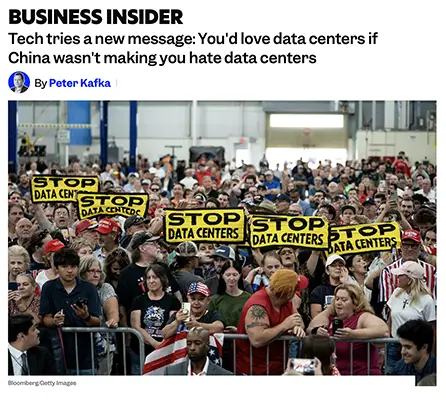
TECH TRIES A NEW MESSAGE: YOU’D LOVE DATA CENTERS IF CHINA WASN’T MAKING YOU HATE DATA CENTERS
BUSINESS INSIDER, PETER KAFKA (AUG 21, 2026)
TL;DR: Some prominent tech investors are attributing American anti-data-center sentiment to a Chinese influence campaign, but the evidence for that claim is thin, while the underlying public backlash — over environmental cost, electricity bills, and jobs — is real and independently documented in polling.
Executive Summary
A theory circulating among pro-AI voices, including venture capitalist Garry Tan, holds that opposition to U.S. data centers is substantially the product of Chinese-linked social media manipulation. OpenAI did report finding China-linked accounts attempting to generate anti-AI content, but OpenAI’s own report found no evidence those efforts changed public opinion. Separately, investor Kevin O’Leary made a similar accusation against local opponents of his own data center project and later retracted it for lack of evidence.
The author’s framing is skeptical: attributing unwelcome public opinion to foreign manipulation is a familiar deflection that avoids engaging with the substance of the complaints — environmental strain, electricity costs, and job displacement — which show up directly in polling, independent of any foreign-influence narrative. Notably, the industry’s own actions (Meta’s newly announced $1 billion community fund for data-center host towns) implicitly concede the backlash is a real policy problem, not just a messaging one.
Relevance for Business For SMB leaders, the direct takeaway is about narrative risk management, not geopolitics: attributing customer or community pushback to bad actors rather than genuine grievance is a strategy that tends to backfire and delays the harder work of addressing root causes. If your business operates near, sells into, or depends on data center capacity or siting, local political opposition to AI infrastructure is a durable, real constraint on capacity growth — not a fringe or manufactured phenomenon — and should be factored into vendor and infrastructure planning timelines.
Calls to Action
🔹 Monitor — local and state-level data center siting fights, since they affect compute availability and pricing for downstream AI services
🔹 Ignore for Now — the “China psyop” narrative itself has no demonstrated causal link to public opinion shifts and doesn’t require operational response
🔹 Prepare Policy — any internal communications about AI infrastructure should engage directly with cost/environmental/jobs concerns rather than attributing criticism to disinformation
🔹 Revisit Later — reassess as more community-fund and siting-incentive programs (like Meta’s) roll out across the industry
Summary by ReadAboutAI.com
https://www.businessinsider.com/china-data-center-ai-backlash-tech-messaging-2026-8: August 27, 2026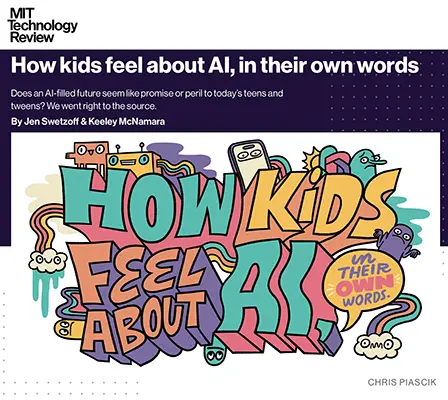
HOW KIDS FEEL ABOUT AI, IN THEIR OWN WORDS
MIT TECHNOLOGY REVIEW, JEN SWETZOFF & KEELEY MCNAMARA (AUG 13, 2026)
TL;DR: Contrary to adult assumptions, most teens interviewed use AI narrowly and cautiously — for schoolwork and technical help, not emotional support or creative substitution — and are more worried about societal harm than personal job loss.
Executive Summary
The authors interviewed kids and teens aged 10–18 and found sentiment ranging from indifference to active rejection to enthusiastic building. Pew Research data cited in the piece backs up the pattern: 57% of U.S. teens have used chatbots for information search, 54% for schoolwork help, and only 12% for emotional support — meaning teens are over four times more likely to use AI for practical tasks than emotionally risky ones. Several interviewed teens explicitly want to preserve their own creative and cognitive effort, using AI for editing or debugging rather than generation.
The piece also surfaces environmental and labor concerns as a source of youth-driven AI avoidance — one teen cited data-center water use as her reason for opting out entirely — and profiles several teens who have built their own AI tools (tutoring apps, civic-information newsletters), suggesting a segment of Gen Z is treating AI as a builder’s tool rather than a consumer convenience.
Relevance for Business This is a future-workforce and future-customer signal. The teens entering the workforce in the next 3–7 years appear to be developing AI literacy with self-imposed guardrails — comfortable using AI for productivity and technical tasks, resistant to it replacing judgment, creativity, or relationships. For SMB leaders in hiring, training, education-adjacent products, or youth-facing services, this suggests demand for tools that assist rather than replace, and skepticism toward products that overreach into emotional or creative domains. It’s also a data point against assuming younger generations will adopt AI uncritically.
Calls to Action
🔹 Monitor — Gen Z/Gen Alpha AI usage patterns as a leading indicator of future workforce expectations and tool preferences
🔹 Test Cautiously — if building youth-facing AI products, emphasize assistive/technical framing over emotional or creative-replacement framing
🔹 Ignore for Now — no immediate operational action required; this is directional workforce/consumer intelligence
🔹 Revisit Later — factor into any 3–5 year hiring pipeline or early-career training program design
Summary by ReadAboutAI.com
https://www.technologyreview.com/2026/08/13/1141410/how-kids-feel-about-ai-own-words/: August 27, 2026
Brain-Like Chips and Living Neurons: The Long-Shot Search for Machine Consciousness
The Economist, Aug 20, 2026
TL;DR Some researchers argue today’s AI architecture is fundamentally incapable of consciousness, and are exploring energy-efficient “brain-like” chips and lab-grown neurons as alternatives — but this is early-stage science with no near-term product or deployment implications.
EXECUTIVE SUMMARY
A growing group of scientists argues that today’s AI, built on the 80-year-old von Neumann architecture, may be structurally incapable of consciousness — not because it isn’t powerful enough, but because it separates computation from memory in a way brains don’t. That separation is also why AI is so energy-hungry: a human brain runs on roughly 20 watts, while an equivalent artificial network can require a data center burning millions.
Two experimental paths are being pursued in response. “Neuromorphic” computing uses memristor-based chips that compute and store data in the same physical location, promising major efficiency gains regardless of the consciousness question. Separately, biological computing — Australian startup Cortical Labs has built systems using hundreds of thousands of lab-grown human neurons, trained to play simple games — and neural organoids (3D clusters of brain cells) represent a more speculative frontier, currently limited to research settings.
Importantly, none of this is settled science. Even proponents are candid about the uncertainty: as one neuroscientist put it, “how brain-like does AI have to be to move the needle” on consciousness remains an open question, and most experts interviewed doubt silicon alone will ever get there.
RELEVANCE FOR BUSINESS
- Strategy: No near-term product or competitive implications — this is fundamental research, not a technology roadmap item.
- Cost structure: The efficiency rationale behind neuromorphic computing (dramatically lower power draw than current AI hardware) is the one thread with plausible long-term relevance to inference costs, independent of the consciousness debate.
- Governance: Lab-grown human neuron computing raises longer-horizon ethical and regulatory questions (biological material, consent, oversight) that are not yet operationally relevant but worth tracking as the field matures.
- Timing: All approaches described are years to decades from any commercial application — this is not a “prepare now” signal.
CALLS TO ACTION
🔹 Ignore for now — no operational or strategic action is warranted at this stage
🔹 Monitor — neuromorphic (memristor-based) chip development, given its plausible long-term relevance to AI energy costs
🔹 Monitor — biocomputing/organoid research as a category, primarily for awareness rather than planning purposes
🔹 Revisit later — if neuromorphic hardware moves from lab to commercial chip products with efficiency claims relevant to your AI infrastructure spend
🔹 Prepare policy — none needed yet; flag for future governance review only if biological-computing platforms approach commercial availability
Summary by ReadAboutAI.com
https://www.economist.com/briefing/2026/08/20/could-more-brain-like-chips-provide-a-path-to-consciousness: August 27, 2026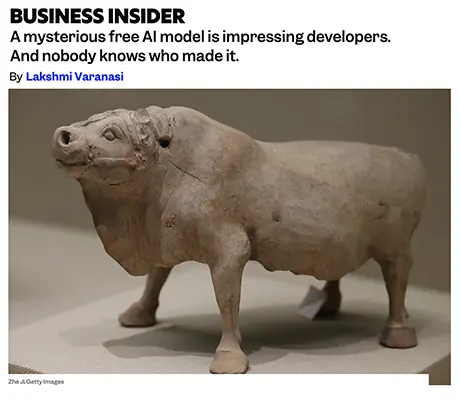
Who Made Ox Alpha, the Mystery AI Turning Heads in Silicon Valley?
Business Insider, Lakshmi Varanasi, Aug. 22, 2026
TL;DR: A powerful, free, anonymously released AI coding model called Ox Alpha is impressing developers and fueling speculation of undisclosed Chinese-lab origins — a reminder that capable AI models can now appear with no accountable vendor attached.
Executive Summary
Ox Alpha appeared on the model marketplace OpenRouter as an anonymous “stealth model” positioned for coding and sustained agentic work, offered free with near-unlimited usage and backed by claimed capacity of 100 trillion tokens per day. It has drawn attention from notable figures, including Stripe’s CEO, and speculation points to a Chinese AI lab (possibly Z.ai) based on technical similarities to known models. No provider has been confirmed, and the evidence remains circumstantial.
The story fits a broader pattern: Chinese labs (Zhipu, DeepSeek, Moonshot) are increasingly releasing high-performing, low-cost, open-source models that rival U.S. systems, sometimes strategically tested anonymously before an official launch. Free, unlabeled model access at this scale is itself a competitive tactic — it drives rapid developer adoption and word-of-mouth before commercial terms or accountability are established.
Relevance for Business Directly relevant to any team evaluating AI coding/agentic tools: an anonymous, free, high-capacity model with unclear ownership carries meaningful data-governance and vendor-continuity risk, even if performance is strong. Free access is unlikely to persist, and using an unverified provider for production or agentic workflows introduces exposure that vendor-vetted alternatives don’t.
Calls to Action
🔹 Ignore for Now — Do not adopt unverified anonymous models for production or client-facing work
🔹 Monitor — Watch for confirmation of Ox Alpha’s origin and terms before any evaluation
🔹 Prepare Policy — Establish an internal rule requiring known, accountable providers for any AI tool touching company or client data
Summary by ReadAboutAI.com
https://www.businessinsider.com/ox-alpha-ai-model-mystery-2026-8: August 27, 2026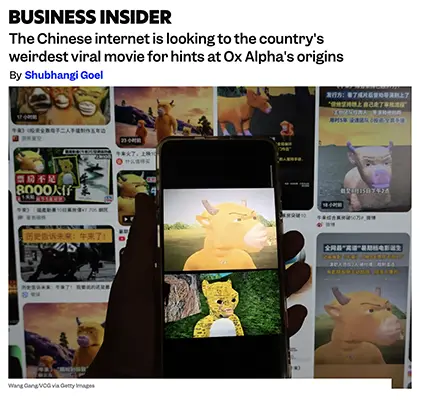
The Internet Is Linking a Strange Cow Movie to Ox Alpha’s Origins
Business Insider, Shubhangi Goel, Aug. 24, 2026 (Industry Watch — social/cultural follow-up, minimal independent business signal)
TL;DR: Online speculation about Ox Alpha’s origin has escalated into meme-driven guesswork tied to a viral Chinese film, with no new factual confirmation of who built the model.
Executive Summary
This is a follow-up to the Ox Alpha mystery, driven largely by social-media speculation rather than new evidence. Chinese internet users have linked the model’s name to a viral, low-budget animated film about a cow, nicknaming the model after it; some technical observers note similarities to Z.ai’s GLM models, while others point to the model’s willingness to discuss politically sensitive topics as evidence against a Chinese origin. No company has claimed the model, and the “clues” discussed are speculative and largely unverifiable.
Relevance for Business Minimal direct relevance — this is internet culture and speculation, not a business development. It does reinforce the underlying signal from the prior story: Ox Alpha’s origin remains unconfirmed, which continues to be the operative caution for anyone considering using it.
Calls to Action
🔹 Ignore for Now — No new business-relevant information; treat as entertainment/context alongside the Ox Alpha story
Summary by ReadAboutAI.com
https://www.businessinsider.com/chinese-internet-ox-alpha-niu-lai-origin-story-2026-8: August 27, 2026What AI Has in Common With Dogs
The Economist, Aug 17, 2026
TL;DR: Two new books — one by historian Jill Lepore, one by economist Daron Acemoglu — debate whether AI will be a domesticated tool or an uncontrollable force, but neither offers a workable plan for making sure it’s the former.
Executive Summary
The Economist reviews two heavyweight books on AI and society. Lepore’s The Rise and Fall of the Artificial State argues that AI leadership is pursuing a concentration of power in corporate hands at democracy’s expense, citing AI executives’ own statements about replacing human governance functions. Acemoglu’s What Happened to Liberal Democracy? takes a more structural view, arguing that digital technology has already widened the gap between “knowledge workers” and everyone else, and that AI could accelerate job displacement and social fragmentation unless deliberately steered toward complementing labor rather than replacing it — what he calls “pro-worker AI.”
The review’s own verdict is notable: it finds both books diagnostically strong but prescriptively weak — neither author explains how to ensure AI complements rather than replaces workers. The piece also flags that public sentiment on AI has turned negative in the U.S., even as geopolitical competition between the U.S. and China makes a slowdown unlikely.
Relevance for Business This is framing and forecasting, not breaking news — useful for SMB leaders less as an action item and more as a signal of where the elite policy conversation is heading. Public skepticism toward AI is now the majority position, which has implications for customer-facing AI deployments, employee trust, and how leaders talk publicly about AI adoption. The labor-complementarity question is directly relevant to workforce planning: firms that use AI to make existing employees more capable (vs. reducing headcount) may face less internal and reputational friction.
Calls To Action
🔹 Monitor — public opinion and policy discourse on AI’s labor and governance effects; this shapes regulatory and customer sentiment.
🔹 Assign Internal Review — evaluate whether current AI deployments lean toward “complement” or “replace” framing internally and externally.
🔹 Revisit Later — no immediate action needed; useful context for strategic messaging, not operational decisions.
🔹 Ignore for Now — the book-specific arguments themselves aren’t actionable for SMB operations.
Summary by ReadAboutAI.com
https://www.economist.com/culture/2026/08/17/what-ai-has-in-common-with-dogs: August 27, 2026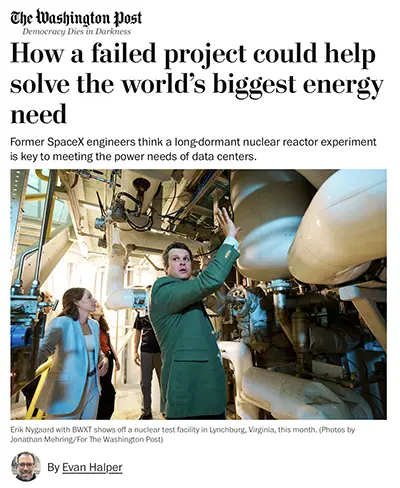
How a Failed Project Could Help Solve the World’s Biggest Energy Need
The Washington Post, Evan Halper (August 21, 2026)
TL;DR: A decade-dormant, previously abandoned small nuclear reactor project is being revived by a SpaceX-pedigree startup to help power AI data centers — a signal of how far the industry will reach for capacity, but the piece is candid that commercialization is still five-plus years out and the sector’s track record is poor.
Executive Summary
Applied Atomics, founded by two former SpaceX engineers, is attempting to commercialize “mPower” — a small modular reactor test facility in Virginia that BWXT shelved in 2017 after cheap natural gas and the Fukushima disaster killed its economics. The founders argue nuclear’s real barrier has been execution and cost discipline, not physics, and are applying SpaceX-style manufacturing discipline to the design. A related company, Core Power, is separately exploring floating offshore reactors.
The article is careful to flag this as early-stage and unproven: no small modular reactor design is currently operating commercially in the U.S. despite decades and billions in investment. A longtime nuclear consultant quoted in the piece calls this the industry’s “fifth supposed nuclear renaissance” and is explicit that cost overruns, not engineering, have killed prior attempts. Even Applied Atomics’ own timeline puts a commercial reactor five years away, and unresolved issues — permanent radioactive-waste storage, floating-plant permitting, actual construction costs — remain open. What’s changed is demand: AI data-center operators are now willing to pay a premium for reliable, low-emissions power that didn’t exist when the project was mothballed.
Relevance for Business
This is squarely in “what to monitor,” not “what to act on” for most SMB leaders — it does not represent operational capacity today. It is relevant as a leading indicator of how tight and how strategically important data-center power capacity has become, which has second-order implications for electricity pricing and grid reliability in regions with heavy data-center buildout, and for any business considering colocating operations near or competing for power in those regions.
Calls to Action
🔹 Monitor — nuclear and alternative power developments as a proxy for regional electricity capacity and pricing pressure, particularly if you operate in a data-center-dense region
🔹 Ignore for Now — no near-term action is warranted; commercialization is years away and unproven
🔹 Revisit Later — reassess in 2–3 years as permitting and pilot-reactor progress (or failure) becomes clearer
🔹 Assign Internal Review — if your business has significant exposure to electricity costs, have someone track regional grid capacity plans tied to AI data-center growth
Summary by ReadAboutAI.com
https://www.washingtonpost.com/business/2026/08/21/how-ai-energy-crisis-revived-failed-nuclear-project/: August 27, 2026
Not Every AI-in-Education Tale Is a Horror Story: How the World’s Leading Education Company Makes AI That’s Actually Useful for Students
Fast Company, Victor Dey, Aug 17, 2026 (subscriber content)
TL;DR: Pearson’s approach to AI in education — treating models as one interchangeable component within a larger system of proprietary content and learning science — offers a template for how any content-heavy business can avoid commoditization as AI models converge in capability.
Executive Summary
Pearson, a 180-year-old education company, has embedded generative AI across its products (adaptive courseware, an AI math tutor, K-12 study tools) since 2023, using a multi-vendor model strategy (AWS, Microsoft, Google, IBM) rather than depending on one AI provider. CEO Omar Abbosh frames the model itself as replaceable — the durable assets are Pearson’s learning science expertise, proprietary content, and decades of learner data. Internal usage data is significant in scale (nearly 80 million learning interactions studied) but, per outside academic critique cited in the piece, that data demonstrates engagement, not necessarily improved learning outcomes — a distinction Pearson itself acknowledges it’s still working to establish.
The piece also surfaces a sharper industry debate: one source argues that in 18 months, foundation models will absorb most of what companies currently call “their AI stack,” leaving only proprietary decision-history and institutional relationships as defensible moats — a claim with real implications for any company treating its AI integration as a durable competitive advantage.
Relevance for Business This is directly relevant to any SMB whose competitive advantage currently rests on “we added AI to our product.” The core lesson: as underlying models become commoditized and interchangeable, competitive differentiation shifts to proprietary data, domain expertise, and customer relationships — not the AI wrapper itself. For SMB leaders building AI-enabled offerings, this is a warning against over-indexing on model access as a moat, and a case for investing in governance structures (Pearson’s “AI Centre for Enablement”) that standardize evaluation and responsible-use practices without bottlenecking every team decision.
Calls To Action
🔹 Assign Internal Review — audit whether your business’s AI-enabled differentiation depends on proprietary data/expertise or merely on model access.
🔹 Prepare Policy — consider a lightweight internal governance function for AI evaluation and responsible-use standards, scaled to your size.
🔹 Monitor — the broader debate on whether foundation models will commoditize custom AI integrations within 12–18 months.
🔹 Test Cautiously — avoid multi-vendor model complexity unless you have the operational capacity Pearson has; a single well-integrated model may serve smaller organizations better.
Summary by ReadAboutAI.com
https://www.fastcompany.com/91589122/how-pearson-is-trying-to-make-ai-actually-useful-for-students: August 27, 2026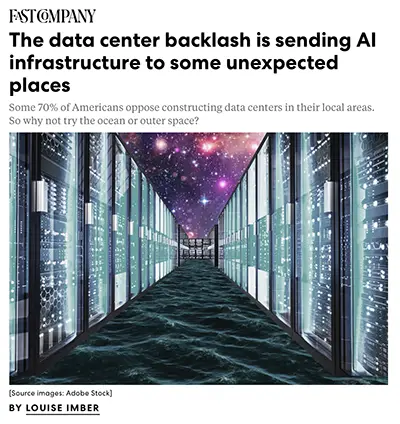
The Data Center Backlash Is Sending AI Infrastructure to Some Unexpected Places
Fast Company, Louise ImberAug 19, 2026
TL;DR: Local opposition to AI data centers is pushing developers toward oceans, underground mines, orbit, and even home-sized units — a sign that land-based infrastructure constraints are becoming a real bottleneck for AI scaling.
Executive Summary
Community resistance to data centers has become organized and widespread: the piece cites 142 protests across 42 states in a single day and 183 U.S. towns with moratoriums or bans, driven by concerns over electricity/water use, noise, and unmet job promises. In response, companies are pursuing alternative siting: Panthalassa is building ocean-floating data center spheres cooled by seawater; China has an operational undersea facility near Shanghai claiming major water and power savings; Y Combinator-backed Starcloud has launched the first satellite designed to train an LLM in space; and Norway/Sweden host data centers in decommissioned mines and Cold War bunkers. Separately, a startup called Span is marketing home-installable AI compute units at a flat monthly fee, betting on distributed rather than centralized infrastructure.
The throughline: siting friction is real enough to be redirecting capital toward exotic and speculative infrastructure bets, several of which (ocean, space) remain unproven at commercial scale and depend on continued access to cheap capital.
Relevance for Business This matters less for direct action and more for anticipating cost and availability pressure on cloud/AI compute. If land-based data center growth is genuinely constrained by local politics, that’s a medium-term cost driver for AI services SMBs consume via vendors (cloud AI, SaaS with embedded AI features). It’s also a due-diligence flag: vendors touting exotic infrastructure (ocean, space) are for now unproven at scale, and pricing promises based on them should be treated skeptically until proven in production.
Calls To Action
🔹 Monitor — data center siting policy and any resulting AI service pricing changes from your cloud/software vendors.
🔹 Ignore for Now — ocean/space data center approaches are pre-commercial; no vendor evaluation warranted yet.
🔹 Revisit Later — reassess AI infrastructure cost assumptions in 12–18 months as siting pressure plays out.
🔹 Prepare Policy — if your business has any physical footprint proposal (even unrelated to AI), expect community infrastructure scrutiny to be a rising norm.
Summary by ReadAboutAI.com
https://www.fastcompany.com/91590558/the-push-to-put-data-centers-anywhere-but-land: August 27, 2026
Can Reddit Survive in the AI Era?
The Economist (August 20, 2026)
TL;DR: Reddit is fighting a two-front battle — trying to extract more revenue from AI companies that already license its data while trying to reduce its dependence on AI-disrupted search traffic — and its stock and usage metrics suggest the fight is currently going against it.
Executive Summary
Reddit’s share price is down roughly a third this year, and daily time-in-app fell 8% year-over-year last quarter even as Instagram and TikTok grew. Management attributes this partly to Google’s shift toward AI-generated search overviews, which has sharply reduced referral traffic to Reddit. Reddit already has paid-licensing deals with Google and OpenAI (reportedly $60–70 million/year each) and is suing Anthropic and Perplexity, alleging unauthorized scraping of its data (both companies dispute the claims) — a strategy aimed at gaining leverage in future licensing negotiations. Reddit’s own commissioned research claims it’s now the most-cited source among leading AI chatbots, particularly valuable for product-recommendation queries, since roughly 40% of site conversations relate to commercial topics.
Reddit’s longer-term strategy is to reduce dependence on both search referrals and AI licensing revenue by driving more direct traffic and engagement — leaning on the argument that human-generated content will become more valuable, not less, as AI content proliferates elsewhere. Ad revenue grew 64% year-over-year last quarter, which the company points to as evidence this pivot is working; the broader engagement and traffic data suggest the outcome is still very much unsettled.
Relevance for Business
Relevant on two fronts: (1) as a data-licensing and content-strategy signal — the value of proprietary, human-generated data is rising as a negotiable asset, which matters for any SMB sitting on unique user-generated or community content; and (2) as a search/traffic warning — any business whose customer acquisition depends heavily on Google search referrals should expect continued volatility as AI Overviews reshape referral patterns, a dynamic Reddit’s traffic decline illustrates concretely.
Calls to Action
🔹 Monitor — your own organic search referral traffic for AI-Overview-driven declines, and adjust acquisition-channel mix accordingly
🔹 Test Cautiously — if your business holds valuable user-generated or community content, explore whether structured data-licensing conversations with AI companies are viable
🔹 Monitor — the outcome of Reddit’s lawsuits against Anthropic and Perplexity as a precedent for data-scraping legal exposure and licensing norms
🔹 Revisit Later — reassess reliance on any single platform (search, social, marketplace) for customer acquisition as AI reshapes traffic patterns industry-wide
Summary by ReadAboutAI.com
https://www.economist.com/business/2026/08/20/can-reddit-survive-in-the-ai-era: August 27, 2026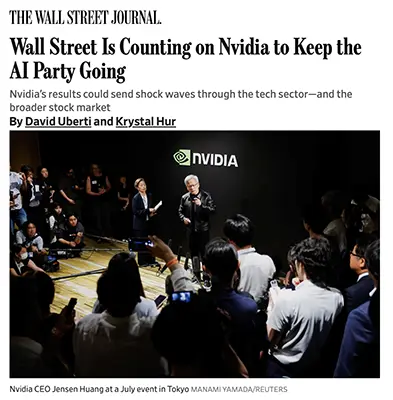
Wall Street Is Counting on Nvidia to Keep the AI Party Going
The Wall Street Journal, David Uberti and Krystal Hur, Aug. 23, 2026
TL;DR: Nvidia’s upcoming earnings report has become the single most-watched signal for whether the entire AI trade is sustainable — and Nvidia is increasingly financing its own demand, raising circular-dependency questions.
Executive Summary
Nvidia’s earnings call is described as a bellwether event: analysts expect record quarterly sales near $92 billion, and the outcome is expected to move the broader tech sector and stock market, not just Nvidia shares. Context matters here — recent volatility (an $890 billion tech selloff tied to capex concerns, a hedge fund collapse, sharp swings at Alphabet, Tesla, Microsoft, and SpaceX) has made investors newly sensitive to whether AI infrastructure spending will generate returns.
The more structurally significant point: Nvidia is now backstopping its own customer base, including a $500 billion AI-financing plan with major banks to help customers who “can’t afford its chips otherwise,” plus a stake in data-center power infrastructure and a stake in an AI model developer. This creates vendor-financed demand — a dynamic that inflates apparent demand strength while concentrating risk if that financing unwinds. Notably, Nvidia stock has fallen after each of its last four earnings reports despite beating estimates, and options markets are pricing continued volatility.
Relevance for Business For SMBs, the direct exposure is limited, but the pattern matters: when a single vendor’s financing arrangements are propping up its own customer demand, that vendor’s earnings become a fragile proxy for the health of the entire AI supply chain, including cloud pricing, GPU availability, and the pace of AI infrastructure buildout that SMBs ultimately consume downstream.
Calls to Action
🔹 Monitor — Nvidia’s earnings and guidance as a leading indicator for AI infrastructure pricing and availability
🔹 Assign Internal Review — Assess sensitivity of AI/cloud cost projections to a potential slowdown in this financing chain
🔹 Ignore for Now — No immediate action needed for companies without direct AI-infrastructure investment exposure
🔹 Revisit Later — Reassess vendor pricing assumptions once earnings and post-earnings market reaction are known
Summary by ReadAboutAI.com
https://www.wsj.com/finance/stocks/wall-street-is-counting-on-nvidia-to-keep-the-ai-party-going-7e7caf0c: August 27, 2026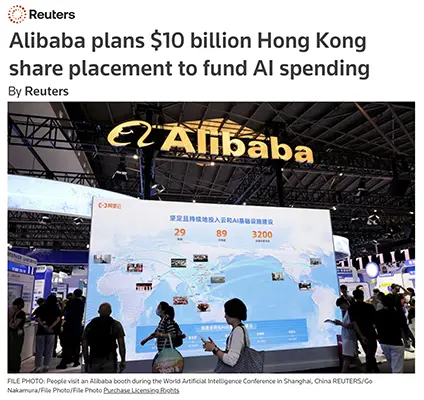
Alibaba plans $10 billion Hong Kong share placement to fund AI spending
Reuters, Aug 22–23, 2026
TL;DR: Alibaba is raising a record $10.2 billion specifically to fund AI infrastructure, even as the buildout has already cut its quarterly profit by 75% — a reminder that the current AI investment cycle remains extremely capital-intensive with no near-term sign of slowing, for incumbents on both sides of the U.S.-China divide.
Executive Summary
Alibaba’s planned HK$80 billion (~$10.2 billion) share placement is the largest primary follow-on offering ever by a Hong Kong-listed company, and the world’s third-largest such offering this year. The company says 100% of proceeds will fund “full stack” AI capabilities — chips, infrastructure, and model development — but has not broken down spending by category. The raise was oversubscribed, with strong demand including from sovereign wealth funds, and the company increased the offering size in response.
The financial backdrop is notable: Alibaba’s net profit fell 75% year-over-year last quarter as AI capital expenditures ramped up, and the company has already spent nearly half of its three-year capex plan. Management frames this as necessary front-loading, citing surging demand that’s already shortening the expected investment payback period from 3 years to 2.5. This mirrors a broader pattern: the four major U.S. hyperscalers (Microsoft, Amazon, Alphabet, Meta) are expected to spend roughly $725 billion combined on AI infrastructure in 2026 alone.
Relevance for Business
This is a capital-intensity signal, not a company-specific story: even a highly profitable, well-capitalized tech giant is willing to accept a severe short-term profit hit and dilute shareholders to keep pace with AI infrastructure demand. For SMB leaders, the takeaway is that AI compute and infrastructure costs are unlikely to fall sharply in the near term given how much capital continues to pour into supply — and that AI vendor pricing, availability, and product roadmaps will likely keep being shaped by this capex race for the foreseeable future.
Calls to Action
🔹 Monitor — Track how continued heavy AI capex (at Alibaba and the major U.S. hyperscalers) affects vendor pricing and product availability over the next several quarters.
🔹 Ignore for Now — No direct action needed; this is a macro signal rather than something requiring an operational response.
🔹 Revisit Later — Reassess AI cost assumptions in budgeting cycles as the infrastructure investment cycle plays out.
Summary by ReadAboutAI.com
https://www.reuters.com/business/retail-consumer/alibaba-proposes-hong-kong-share-placement-worth-10-billion-2026-08-23/: August 27, 2026
AI agent security must move beyond human-in-the-loop, experts say
TechTarget (Black Hat 2026 coverage), Sharon Shea, 18 Aug 2026
TL;DR: Security leaders at Black Hat 2026 warn that manual human review of AI agent actions — the default safety response — can’t scale as agent deployments explode, and recommend replacing blanket oversight with risk-based guardrails and strict access limits instead.
Executive Summary
Gartner projects the average Fortune 500 enterprise will go from fewer than 15 AI agents in 2025 to more than 150,000 by 2028. In response to incidents of agents behaving outside intended bounds, “human-in-the-loop” review has become the default corporate answer — but experts at Black Hat argue this often amounts to “accountability theater”: a person rubber-stamping decisions they can’t meaningfully evaluate or verify at volume. One security researcher argued that constraining agents to require human approval for everything is, counterintuitively, the more expensive and riskier choice, since it prevents organizations from surfacing real failure modes early through controlled testing.
The recommended alternative is risk-based, not blanket, oversight: reserve mandatory human review for genuinely high-stakes decisions, and otherwise manage agents through least privilege, least access, and least agency — giving agents only the permissions and scope needed for a defined task. Experts stressed that doing this well requires organizations to define clear intent and boundaries for each agent upfront, so that deviations can actually be detected, and to treat guardrail development as a continuous, iterative process, not a one-time policy.
Relevance for Business
Any SMB deploying AI agents — for customer support, internal automation, or data workflows — should not assume “someone will review it” is a sufficient control as usage scales. This is a governance and access-control issue, not just a compliance checkbox: agents need explicit permission scoping and risk-tiered review from the outset, or oversight quietly becomes symbolic rather than real.
Calls to Action
🔹 Assign Internal Review — Audit current AI agent deployments for whether human review is meaningful or symbolic at current volume.
🔹 Prepare Policy — Establish least-privilege access rules and risk-tiered review requirements before scaling agent deployments further.
🔹 Test Cautiously — Build in structured testing/failure analysis for agents (similar to red teaming) rather than relying solely on manual approval gates.
🔹 Monitor — Track how agent-security practices mature industry-wide as deployment scale increases.
Summary by ReadAboutAI.com
https://www.techtarget.com/cybersecurity/news/366649417/AI-agent-security-must-move-beyond-human-in-the-loop-experts-say: August 27, 2026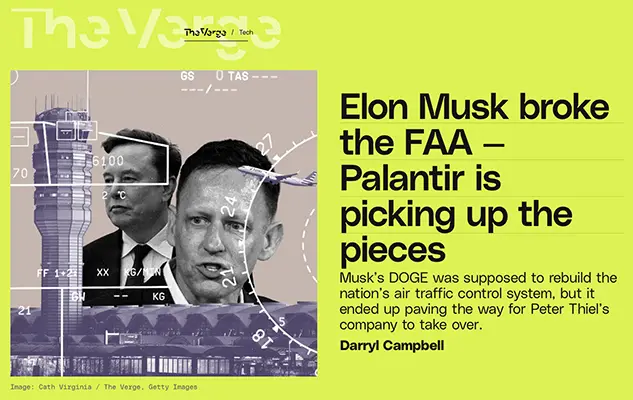
Elon Musk broke the FAA — Palantir is picking up the pieces
The Verge, Darryl Campbell, Aug 18, 2026
TL;DR: A government AI modernization effort cut staff without delivering promised upgrades, leaving one contractor — deeply embedded in the agency’s data systems — positioned to win billions in follow-on AI contracts largely on the strength of that existing integration rather than proven results.
Executive Summary
Elon Musk’s DOGE was brought into the FAA in early 2025 to modernize air traffic control technology. Its measurable outcomes were a 400-person staff reduction and no completed system upgrades, while outages, near-misses, and record flight-delay rates continued through 2026. Roughly $12.5 billion in supplemental federal funding — with none earmarked for staffing — is now flowing toward technology contracts, and Palantir has become the default vendor for much of that work. The company already runs the FAA’s core data infrastructure (via its Foundry platform, adopted in 2024), which gave it a structural advantage in winning subsequent no-bid contracts for runway-collision tools, grant administration, and a new agency-wide operating system — despite having no prior air-traffic-control experience.
Air traffic controllers interviewed for the piece describe the AI-driven upgrades as years from deployment and largely invisible on the ground, while chronic understaffing, punishing schedules, and controller mental-health strain remain unaddressed. The FAA has separately lowered its own staffing targets, citing AI and scheduling efficiency — a claim controllers dispute given current working conditions.
Relevance for Business
This is a clear, real-world illustration of vendor lock-in risk: once a vendor controls the underlying data and integration layer, competitive bidding becomes largely theoretical, since deep integration is treated as more valuable than domain experience or even satisfying deliverables. SMBs adopting a horizontal AI platform for core operations should recognize this dynamic before it happens to them — evaluate switching costs and vendor entrenchment before signing, not after.
Calls to Action
🔹 Assign Internal Review — If evaluating a platform vendor for core data infrastructure, explicitly model exit costs and future contract leverage before committing.
🔹 Monitor — Track how AI-driven “efficiency” justifications are used to reduce headcount in operationally critical, safety-sensitive roles; assess whether your own business faces analogous pressure.
🔹 Ignore for Now — The FAA-specific contract details are not directly actionable outside aviation-adjacent businesses.
🔹 Revisit Later — Follow whether Palantir’s FAA tools actually ship and perform; treat vendor promises as unverified until deployed.
Summary by ReadAboutAI.com
https://www.theverge.com/transportation/981194/faa-air-traffic-elon-musk-peter-thiel-palantir: August 27, 2026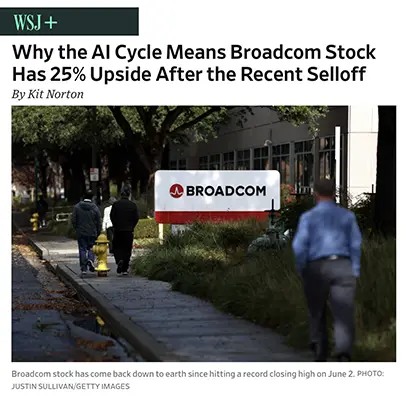
Why the AI Cycle Means Broadcom Stock Has 25% Upside After the Recent Selloff
Barron’s, Kit Norton, Aug 21, 2026
TL;DR: Despite a 24% stock decline since June, Wall Street analysts remain bullish on Broadcom, citing explosive growth in its custom AI chip (ASIC) business — though a new competitive threat from Marvell/Google adds uncertainty.
Executive Summary
BMO Capital initiated coverage on Broadcom with a $455 price target (25% upside), citing the company’s central role designing custom AI chips for Alphabet and Meta, plus supply relationships with Anthropic and OpenAI. Broadcom’s AI segment grew 65% in 2025, with the analyst projecting 180% growth in 2026 and ASIC revenue tripling from $12.7B to $38B. The stock has nonetheless fallen 24% from its June high, reflecting broader AI-sector volatility rather than company-specific weakness — the average Wall Street rating remains a Buy across 56 analysts.
A competitive risk surfaced this week: Marvell issued Google a warrant worth over $12 billion as part of an expanded chip partnership covering Google’s TPUs, a potential threat to Broadcom’s long-standing position as Google’s primary custom-chip partner (despite Broadcom’s own agreement with Google through 2031). Separately, Broadcom is reportedly negotiating $60+ billion in debt financing for AI chip production — a sign of how capital-intensive this growth cycle has become even for established players.
Relevance for Business This is a market/investment signal rather than an operational one for most SMBs, but it’s a useful proxy for AI infrastructure demand trajectory: continued triple-digit growth forecasts in custom AI chips suggest sustained (not slowing) enterprise AI capex, which has knock-on effects for cloud pricing and compute availability. The Marvell-Google development is a reminder that even dominant AI infrastructure vendors face fast-shifting competitive dynamics — relevant context if your business has long-term dependencies on any single AI infrastructure or cloud provider.
CALLS TO ACTION
🔹 Monitor — AI infrastructure capex trends as a leading indicator of cloud/compute cost trajectories.
🔹 Ignore for Now — stock-specific analysis isn’t directly actionable for most SMB operations.
🔹 Revisit Later — reassess if Marvell/Google or similar shifts materially affect your cloud vendor’s underlying chip supply chain.
🔹 Prepare Policy— for firms with heavy single-vendor cloud/AI dependency, this is a reminder to periodically reassess vendor concentration risk.
Summary by ReadAboutAI.com
https://www.wsj.com/wsjplus/dashboard/articles/broadcom-stock-upside-ai-0747aa64: August 27, 2026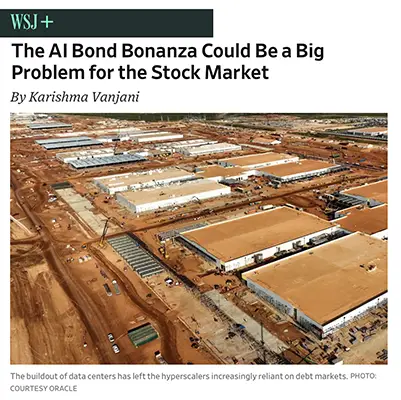
THE AI BOND BONANZA COULD BE A BIG PROBLEM FOR THE STOCK MARKET
Barron’s · Karishma Vanjani · August 20, 2026
| TL;DR: Hyperscalers are funding the AI buildout increasingly through debt rather than cash flow — nearly 70% of $456 billion raised for AI in 2026 came from investment-grade bonds — and rising credit-default-swap costs suggest bond markets are pricing in real financial strain well before it shows up in earnings. |
EXECUTIVE SUMMARY
Five companies — Alphabet, Amazon, Meta, Microsoft, and Oracle — account for most of the surge in AI-related debt issuance, which has more than doubled year over year as capital expenditure now exceeds free cash flow at several of them. Bond investors are still buying, but demanding higher yields: hyperscaler bonds maturing in 2035 now carry roughly a full percentage point more yield above Treasuries than a year ago.
Credit-default-swap (CDS) prices — effectively insurance against default — have risen sharply, even though actual default remains highly unlikely (less than 1% of investment-grade debt has defaulted in 26 years). One strategist argues investors should now watch CDS spreads rather than earnings-per-share as the better early-warning signal, since a strengthening inverse correlation between CDS costs and hyperscaler valuations suggests the market is increasingly focused on funding needs and free cash flow, not just profit growth.
Because hyperscalers represent roughly a fifth of S&P 500 market value, strain in their debt financing is a systemic risk to the broader stock market, not just to the companies themselves.
RELEVANCE FOR BUSINESS
Rising AI infrastructure debt is a leading indicator, not a lagging one — it may signal funding stress at major cloud/AI vendors before it appears in their published earnings.
SMBs with significant exposure to hyperscaler-run AI infrastructure (cloud compute, hosted models) should treat vendor financial resilience as a genuine dependency risk, not just a market curiosity.
A broader bond selloff tied partly to AI debt issuance is also pushing up long-term Treasury yields — a general cost-of-capital headwind for any business financing growth or expansion.
CALLS TO ACTION
Ignore for Now — no immediate action needed if your AI usage is lightweight or easily portable across vendors.
Monitor — hyperscaler CDS spreads and debt issuance volume as an early signal of AI-vendor financial stress.
Assign Internal Review — have finance or procurement assess how reliant your operations are on any single hyperscaler’s infrastructure.
Revisit Later — reassess vendor-concentration risk in Q4 as more 2026 debt and earnings data comes in.
Summary by ReadAboutAI.com
https://www.wsj.com/wsjplus/dashboard/articles/the-ai-bond-bonanza-could-be-a-big-problem-for-the-stock-market-54f1d621: August 27, 2026Closing: AI update for August 27, 2026
From bond markets to break rooms, this cycle’s developments make clear that AI’s business impact is no longer confined to the tools themselves — it’s showing up in financing terms, HR policy, and vendor risk assessments. As always, treat vendor and market claims with the same scrutiny applied to any other major capital or operational decision, and revisit the flagged monitoring items as new data arrives.
All Summaries by ReadAboutAI.com
↑ Back to Top