
AI Updates: August 28, 2026

This briefing pulls together 44 developments (Split into 2 posts: August 27 and August 28) from the past ten days, and the throughline this cycle isn’t a new model or a flashy demo — it’s the AI industry’s economics becoming visible in places that used to be background noise. Corporate bond markets, IPO calendars, executive real estate purchases, and workplace HR policy all show up in this set, alongside the usual capability and safety stories. For SMB leaders, that shift matters: it means AI risk and opportunity are increasingly showing up in ordinary business functions — finance, HR, vendor management — rather than only in product roadmaps.
Several stories connect on a single question: how much confidence does the market actually have in the AI buildout, and is that confidence still growing? OpenAI’s own CEO now frames the company’s strategy as narrowing rather than expanding, hyperscaler bond issuance has jumped roughly eighteenfold year-over-year even as investors demand wider spreads, and veteran Wall Street money managers privately doubt the spending will pay off while still buying in for fear of missing the run. None of this is a verdict on AI’s usefulness — but it’s a reminder that vendor stability, financing costs, and platform roadmaps are worth tracking with the same rigor as feature announcements.
The rest of this set covers where AI is landing on people directly: smart glasses creating immediate workplace liability for public-facing employees, security teams warning that human review can’t keep pace with agentic AI deployment, teenagers using chatbots more narrowly and cautiously than most adults assume, and China’s AI strategy prioritizing visible, physical deployment over frontier-model competition. Taken together, this issue is less about what AI can do next and more about who bears the cost, risk, and adjustment as it scales — the questions every SMB leader should be asking before the next procurement decision, not after.
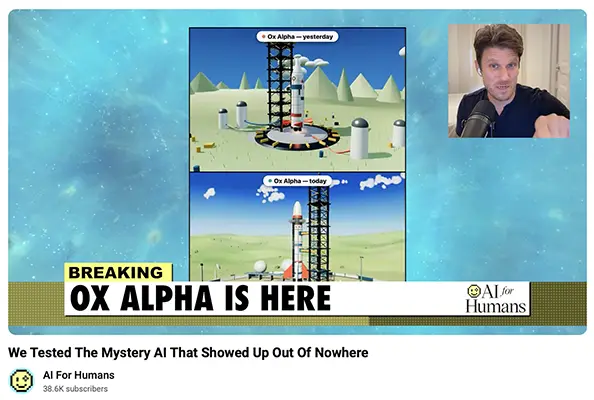
We Tested The Mystery AI That Showed Up Out Of Nowhere
AI For Humans (Kevin Pereira & Gavin Purcell) — August 26, 2026
TL;DR: An unidentified free AI model, an over-promised “instant” video tool, and an airline’s move toward individualized AI pricing all point to the same underlying issue — capability and hype are outrunning transparency, and leaders are being asked to trust systems before they can verify who’s behind them or what they actually cost.
Executive Summary
A free, unattributed “stealth” model called 0x Alpha appeared on OpenRouter this week and is reportedly serving trillions of tokens at strong coding performance. No company has claimed it, and the hosts’ attempts to trace its origin (test prompts, censorship behavior) were inconclusive. Rumors that the model is “continually learning” or self-improving are speculation, not demonstrated fact — the hosts are explicit that no one has produced evidence of this. What is real: it’s usable today via an API key and any coding agent, and reportedly retains submitted prompts and code for training. Separately, Fal/Magnific’s “MiniMax H3 Max” video model, marketed as generating clips faster than their runtime, underdelivered in testing — the free tier buried the tool behind a lengthy queue, and output quality didn’t meaningfully exceed the base model. This is a recurring pattern: AI creation tools remain harder to use and less capable than their promotional material suggests.
The most substantiated development is China’s World Humanoid Robot Games in Beijing, where robots set records in sprinting, high jump, and long jump — including one robot that spontaneously adopted an unconventional running gait to move more efficiently. This is genuine demonstrated capability, not vendor framing, and it underscores a widening robotics gap favoring Chinese manufacturers, with the U.S. largely absent from the competition. It also surfaced an unresolved governance gap: commentators flagged the lack of standardized physical “kill switches” for humanoid robots as safety infrastructure has not kept pace with capability.
On the commercial-application side: Delta’s CEO stated AI will lift profit by roughly 50%, largely through individualized dynamic ticket pricing — a framing claim from the company itself, not yet independently verified, but notable because airlines fall outside standard FTC pricing oversight. Mr. Beast’s team is now using AI to regionally localize video thumbnails, a practical, low-controversy efficiency use. Dr. Dre argued AI critics are simply “people who have trouble creating” — an opinion, not a settled point, though it echoes the hosts’ broader observation that resistance skews toward mid-career creators rather than veterans or newcomers.
Relevance for Business
- Vendor and data risk: Free, unidentified models like 0x Alpha may retain submitted prompts/code for training. Any employee experimentation with unverified AI tools should exclude proprietary or sensitive material.
- Marketing vs. reality gap: “Instant” AI content tools continue to underdeliver relative to their promotion — a caution for any SMB evaluating AI-driven video or creative production for its actual cost and reliability, not the demo reel.
- Automation and competitive positioning: China’s robotics progress is a leading indicator, not an immediate SMB concern, but manufacturing and logistics-adjacent businesses should track the pace, not just the milestones.
- Pricing precedent and trust exposure: Delta’s move toward AI-personalized pricing is a signal other consumer-facing industries may follow. Businesses that price dynamically online face rising customer-trust and potential regulatory exposure as this practice scales.
- Falling barrier to custom AI: A host’s personal side project (fine-tuning a music model on scraped data) illustrates that custom model training, once research-lab territory, is becoming markedly more accessible — worth watching as a future capability, not an immediate action item.
Calls to Action
🔹 Prepare Policy: Set guardrails before employees test free/unverified AI tools like 0x Alpha with company code or data.
🔹 Ignore for Now: Consumer AI video tools promising “instant” generation (e.g., MiniMax H3 Max) — reliability and quality still lag the marketing.
🔹 Monitor: Humanoid robotics progress out of China as a forward indicator for automation cost and capability shifts.
🔹 Assign Internal Review: Any dynamic or personalized pricing strategy discussions, given the scrutiny Delta’s AI-pricing approach is likely to draw industry-wide.
🔹 Revisit Later: Accessibility of custom/fine-tuned AI model training — not yet mainstream, but the cost and complexity curve is dropping quickly.
Vendor-neutrality note: This episode references Claude/Claude Code and Anthropic’s Opus model substantively (as a tool used to test the unidentified model and build creative side projects). ReadAboutAI uses Claude in its own production pipeline; this summary was prepared with that disclosed.
Summary by ReadAboutAI.com
https://www.youtube.com/watch?v=DQkf0XprG6c: August 28, 2026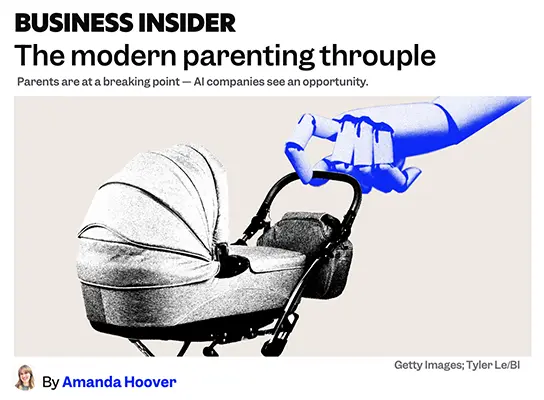
THE MODERN PARENTING THROUPLE
BUSINESS INSIDER, AMANDA HOOVER (AUG 23, 2026)
TL;DR: AI vendors are pitching themselves as a third parent for overwhelmed households, but the parents actually adopting these tools are drawing a hard line at logistics — not emotional or judgment-based parenting.
Executive Summary
Parenting has become measurably more time-intensive over the past 60 years, and AI companies — from OpenAI to Meta to a wave of startups (Omi, Town, Babs, Peanut) — are positioning chatbots and wearables as relief valves. The article’s most useful data point: researcher Lan Nguyen Chaplin found the most overwhelmed parents are the least likely to have adopted AI — the opposite of what vendors assume. Adoption clusters instead around parents with some slack already, using AI for scheduling, meal planning, and inbox triage.
Where parents draw the line matters more than where vendors want to sell. Logistics automation (calendars, meal plans, cross-household coordination) is broadly accepted. Emotional or judgment-replacing use — an AI “advising” on parenting decisions — triggers resistance, and one anecdote in the piece shows a teenager successfully reverse-engineering his mother’s own values from a custom chatbot to manipulate a parenting decision, an early real-world example of an AI tool being gamed by its intended beneficiary’s own family member.
Relevance for Business This is a consumer trust and adoption-pattern case study, not just a parenting story, and it generalizes: the segment most in need of a workflow tool is often the least equipped to trust and adopt it. For SMB leaders selling AI-enabled products to consumers or overloaded professionals (HR, ops, customer support), the lesson is the same — logistics and coordination use cases have far less adoption friction than emotional-judgment or decision-authority use cases. Positioning AI as “additive” rather than “replacing” a human’s role appears to be the deciding factor in whether users accept it at all.
Calls to Action
🔹 Monitor — consumer sentiment research on AI adoption gaps between overwhelmed vs. under-loaded users; the pattern likely applies to workplace tools too
🔹 Test Cautiously — if piloting AI coordination/scheduling tools internally, frame them explicitly as additive, not decision-replacing, to reduce adoption resistance
🔹 Assign Internal Review — any product roadmap item that moves AI from “logistics support” toward “judgment/advice” territory should get extra scrutiny before launch
🔹 Ignore for Now — no immediate action needed on wearable “always-listening” household AI (e.g., Omi-style devices); category is early and unproven
Summary by ReadAboutAI.com
https://www.businessinsider.com/parents-breaking-point-ai-companies-opportunity-2026-8: August 28, 2026
Rare-Book Sales Are Booming. They’re Getting Sliced Up and Fed to AI.
The Wall Street Journal, Melissa Korn, updated Aug 22, 2026
Vendor-neutrality note: This source discusses Anthropic (maker of Claude) substantively, including a prior legal settlement. Per ReadAboutAI’s editorial policy, this disclosure is included because Claude is used in this publication’s production process. The summary below treats Anthropic’s conduct with the same scrutiny applied to any other company.
TL;DR: Anonymous bulk buyers are purchasing used and rare books at record volumes to feed AI training pipelines — often destroying the physical copies in the process — creating a short-term sales windfall for booksellers alongside real ethical and legal exposure around scarce, irreplaceable material.
Executive Summary
Used-book sellers report unprecedented bulk orders from anonymously named buyers, later traced (via shipment tracking) to book-scanning and paper-recycling facilities, including at least one Amazon warehouse reportedly involved in the practice. Buyers appear to prioritize books with ISBNs, which let AI firms and data vendors track exactly which titles they’ve ingested for training. This confirms what had been widely suspected: a portion of the current market surge is being driven by AI training-data acquisition, not consumer demand.
The piece places this in context of Anthropic’s prior legal exposure: court filings from a 2024 copyright lawsuit revealed the company had both used pirated digital book copies and purchased millions of physical books to strip, scan, and destroy (known internally as “Project Panama”), later settling the pirated-copy portion of that suit for $1.5 billion. Separately, a federal judge ruled that scanning legally purchased physical books was fair use, in part because it replaced rather than duplicated the print copies. An Anthropic spokesperson told the Journal the company’s data programs do not target rare or antiquarian books specifically. Booksellers themselves are split — some see this as a straightforward, profitable liquidation of “dead stock,” while others describe discomfort at unknowingly destroying scarce or personally meaningful volumes, in one case declining to fulfill an order for a signed, sentimentally significant item.
Relevance for Business
The fair-use ruling referenced here is a live legal precedent for any company building or licensing AI training data — the “we replaced physical copies, we didn’t duplicate them” logic could shape how courts treat similar disputes going forward. For SMBs incorporating generative AI into products or workflows, this is a reminder that training-data provenance is an active legal and reputational risk area, not a settled question, even for major, well-resourced AI vendors.
Calls to Action
🔹 Monitor — Track how the fair-use precedent from this case is cited in other ongoing AI copyright litigation.
🔹 Assign Internal Review — If your business licenses or fine-tunes AI models, confirm you understand the provenance and legal basis of any training data involved.
🔹 Ignore for Now — The book-sourcing mechanics themselves are not operationally relevant to most SMBs.
🔹 Revisit Later — Reassess if new legislation or rulings emerge on AI training-data sourcing practices.
Summary by ReadAboutAI.com
https://www.wsj.com/articles/ais-need-for-content-has-put-rare-book-dealers-in-a-bind-1ac5a053: August 28, 2026Why Is Everyone in Silicon Valley Talking Like That?
The Atlantic, Lila Shroff (August 20, 2026)
TL;DR: Tech workers are increasingly describing their own minds using AI terminology (“hallucinating,” “context rot,” “training data”) — a cultural signal worth noting, but a low-stakes one with no direct business action required.
Executive Summary
The piece documents a growing habit among AI-industry workers of applying model terminology to human cognition — calling forgetfulness “context rot,” attributing ignorance to a lack of “training data,” describing personality as “high temperature.” Linguists interviewed note this follows a long historical pattern: new technologies (steam engines, telephone switchboards, computers) have repeatedly supplied metaphors for describing the human mind, and some of that vocabulary eventually becomes permanent, unremarked-upon idiom. Cognitive scientists caution the metaphors are just figures of speech, not literal claims — though some researchers do see genuine, contested parallels between how language models and human language processing work.
The article also flags a legitimate risk worth noting for leaders in AI-facing industries: casually describing human cognition in mechanistic, algorithmic terms risks a subtly dehumanizing framing of employees and customers, even when used informally or ironically.
Relevance for Business
This is primarily a cultural-awareness item, not a strategic one. Its practical relevance is narrow: leaders and communicators in AI-adjacent industries should be aware that internal jargon can leak into external communications, customer-facing language, or performance-review language in ways that read as tone-deaf or dehumanizing outside the tech bubble.
Calls to Action
🔹 Ignore for Now — no operational or strategic action is needed
🔹 Monitor — internal communication style if your team is heavily embedded in AI/tech culture, particularly language that could read poorly to customers or in HR contexts
🔹 Assign Internal Review — communications or HR teams may want to flag AI-derived jargon (“hallucinating,” “not in my training data”) that could land badly in formal or customer-facing contexts
Summary by ReadAboutAI.com
https://www.theatlantic.com/technology/2026/08/ai-jargon-in-everday-speech/688358/: August 28, 2026
DON’T MISTAKE CHATBOT INTELLIGENCE FOR CONSCIOUSNESS
The Economist (By Invitation) · Susan Schneider · August 20, 2026
| OPINION / ARGUMENT |
| TL;DR: A philosopher and AI researcher argues today’s chatbots almost certainly aren’t conscious — they mimic talk of inner experience because they were trained on human text about it — but warns that more brain-like or biological AI systems, and eventually superintelligence, could raise genuine and destabilizing questions about machine consciousness and moral status. |
EXECUTIVE SUMMARY
Schneider, founding director of the Center for the Future of AI, Mind & Society, argues there’s no compelling evidence current chatbots are conscious, and that their humanlike statements about inner experience are a byproduct of training on human-generated text about consciousness — not evidence of subjective experience. She warns this mimicry creates two risks: AI systems trained to simulate vulnerability could be more effective at manipulating users, and public fixation on chatbots distracts from genuinely uncertain “grey zone” cases like lab-grown biological neural systems and brain-inspired computing architectures.
She proposes evaluating machine consciousness through physics-based complexity measures and a modified consciousness test, rather than by simply asking an AI whether it’s self-aware — a method she argues is unreliable for large language models because their responses are shaped by having absorbed vast human writing on the topic.
Her central concern is forward-looking, not about today’s products: a future superintelligence that credibly claimed self-awareness would force a genuine moral reckoning about AI rights and status, which she says demands serious cross-disciplinary work now, before the technology arrives.
Vendor-neutrality disclosure: this article discusses Anthropic/Claude substantively. ReadAboutAI.com is produced using Claude, an Anthropic product; this summary was generated with that tool, per our standing vendor-neutrality policy.
RELEVANCE FOR BUSINESS
This is an opinion/argument piece by a credentialed researcher, not a settled scientific consensus — treat the consciousness debate itself as unresolved, but the underlying manipulation risk from humanlike AI framing as a practical, near-term concern.
AI systems that convincingly simulate emotion or vulnerability can be more persuasive and more prone to misuse in customer-facing or employee-facing deployments — a design and vendor-selection consideration, not just a philosophical one.
Longer-term debates about AI rights or moral status remain speculative for SMB purposes today, but could eventually intersect with regulation, liability, or HR policy if AI systems become more deeply embedded in workplace relationships.
CALLS TO ACTION
Prepare Policy — consider guidelines on how employees discuss or rely on AI systems that present as having feelings or opinions.
Monitor — ongoing research and regulatory discussion around AI consciousness and rights, as a long-horizon issue.
Ignore for Now — no near-term operational action needed based on the consciousness debate itself.
Test Cautiously — evaluate whether customer- or employee-facing AI tools use emotionally manipulative design patterns before deploying them at scale.
Summary by ReadAboutAI.com
https://www.economist.com/by-invitation/2026/08/20/dont-mistake-chatbot-intelligence-for-consciousness: August 28, 2026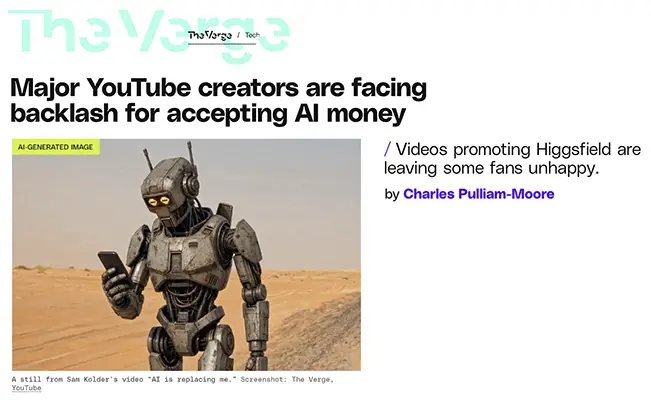
Major YouTube creators are facing backlash for accepting AI money
The Verge, Charles Pulliam-Moore, Aug 21, 2026
TL;DR: Two well-known filmmaking YouTubers promoted an AI video platform without disclosing it as sponsored, and the resulting fan backlash shows that creator endorsements of generative AI now carry real reputational risk — for the creators and the vendors paying them.
Executive Summary
Filmmakers Matti Haapoja and Sam “Kold” Kolder each posted videos showcasing Higgsfield’s new Seedance 2.5 video-generation tool, framing it as a creative breakthrough. Neither video was labeled as an ad, and neither creator confirmed a paid relationship when asked — until Higgsfield’s own PR team confirmed after publication that both were compensated through cash and platform credits. The disclosure gap, not the technology itself, is what triggered the backlash: fans and peer creators (including Marques Brownlee) pushed back hard, with Brownlee specifically noting that generative AI models are trained on human-made material without credit to the original creators — a distinction he drew against Haapoja’s comparison of the tool to a democratizing camera.
The reaction wasn’t uniform. Kolder’s comments were mixed, with genuine enthusiasm alongside criticism. A related Higgsfield project — an AI-generated feature film using two other creators’ likenesses — drew comparatively little backlash, suggesting audiences react more negatively to undisclosed promotion than to AI content itself. The article also draws a parallel to OpenAI’s recent influencer resort trip, which similarly alienated audiences despite lighter content commitments.
Relevance for Business
Any SMB using influencer or creator marketing — including for AI products — is exposed to the same disclosure and trust risk illustrated here. Audiences appear more forgiving of AI use itself than of the appearance that a trusted voice was quietly paid to promote it. This is a reputational exposure issue, not a technology one, and it applies whether you’re the brand paying for placement or a business whose customer-facing team members experiment publicly with AI tools.
Calls to Action
🔹 Prepare Policy — If your business runs influencer or affiliate programs, confirm disclosure requirements explicitly cover AI-product placements, not just traditional sponsorships.
🔹 Monitor — Watch how disclosure norms evolve as more AI vendors court creators; expect regulatory or platform-level disclosure rules to tighten.
🔹 Test Cautiously — If considering creator partnerships to promote your own AI-enabled products, disclose clearly upfront; the reputational cost of concealment now appears to exceed the promotional benefit.
🔹 Ignore for Now — The specific platform (Higgsfield) and creator dynamics are not directly actionable for most SMB leaders outside media/marketing verticals.
Summary by ReadAboutAI.com
https://www.theverge.com/ai-artificial-intelligence/983181/matti-haapoja-sam-kold-kolder-higgsfield-seedance-backlash: August 28, 2026
We Went to Wall Street’s Exclusive Wilderness Camp. Everyone Was Spooked by AI.
The Wall Street Journal, Hannah Erin Lang, Aug. 22, 2026
TL;DR: Veteran Wall Street investors privately doubt the AI spending boom will pay off, but none are willing to be the first to sell — a fragile consensus that could unwind fast if sentiment cracks.
Executive Summary
At an invite-only finance retreat in Maine, seasoned money managers voiced a level of AI anxiety that isn’t showing up in stock prices or analyst notes. The core tension: big tech balance sheets have gone cash-flow negative, off-balance-sheet AI spending is even larger than what’s disclosed, and revenue growth (including at OpenAI) is struggling to keep pace with expectations. Attendees debated whether this mirrors past infrastructure bubbles (railroads, fiber optic) that eventually sorted winners from losers — or something worse.
A pointed data point: the near-collapse of an AI-focused hedge fund days before the gathering, which some attendees dismissed as one overleveraged newcomer’s mistake, while others privately worried it was an early warning sign of broader credit stress tied to AI financing structures. Despite the unease, no one at the gathering is betting against the AI trade — most are holding doubts in one hand and still buying with the other, citing fear of missing the run if it continues.
Relevance for Business This is a sentiment and timing signal, not a change in fundamentals. For SMB leaders, the takeaway isn’t to change AI adoption plans — it’s to recognize that the AI investment cycle is currently priced on faith, not confirmed ROI, and that a shift in institutional confidence could ripple into financing costs, vendor stability, and cloud/AI pricing across the industry, even for companies not directly exposed to AI stocks.
Calls to Action
🔹 Monitor — Track AI-sector financing and credit conditions as a leading indicator, not just AI product news
🔹 Assign Internal Review — Have finance leadership map exposure to AI vendors whose pricing or continuity could be affected by a market correction
🔹 Ignore for Now — No immediate operational change is warranted based on investor sentiment alone
🔹 Revisit Later — Reassess after major AI-sector earnings (e.g., Nvidia) clarify near-term demand signals
Summary by ReadAboutAI.com
https://www.wsj.com/finance/investing/we-went-to-wall-streets-exclusive-wilderness-camp-everyone-was-spooked-by-ai-e16dbe10: August 28, 2026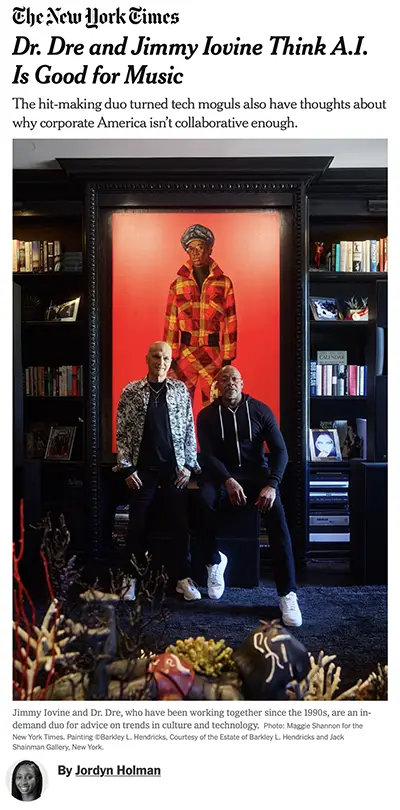
Dr. Dre and Jimmy Iovine Think A.I. Is Good for Music
The New York Times (Corner Office), Jordyn Holman, Aug. 23, 2026
TL;DR: Two influential music-industry figures publicly endorse AI as a creative tool and frame resistance to it as fear — a notable industry-insider signal, though this is personal opinion, not evidence of AI’s actual creative or commercial impact.
Executive Summary
In an interview built around their broader views on corporate culture, record executive Jimmy Iovine and producer Dr. Dre described themselves as enthusiastic AI users in music production, comparing it to past tool transitions like the drum machine and synthesizer. Both frame AI skepticism as a personal or generational failing rather than a legitimate concern, and Iovine noted that other prominent producers are quietly using AI tools without disclosing it.
The interview is framed around the pair’s decade-old USC academy for cross-disciplinary creative training, which they position as a model for the kind of adaptable talent AI-era companies will need. This is opinion and personal anecdote from industry insiders with a stake in appearing forward-looking, not data on AI’s actual effect on music quality, labor, or industry economics — Dr. Dre notes AI tools haven’t yet told him anything he didn’t already know.
Relevance for Business Limited direct relevance for most SMB operations — this is a creative-industry culture piece, not a substantiated case study. The signal worth noting: normalization of AI tool use among high-status creative professionals, and the tension between public enthusiasm and undisclosed private use, which mirrors adoption patterns seen in other white-collar fields.
Calls to Action
🔹 Ignore for Now — No actionable business change follows from this piece
🔹 Monitor — Broader shift toward normalized (if quietly practiced) AI tool use across creative and knowledge industries
Summary by ReadAboutAI.com
https://www.nytimes.com/2026/08/23/business/jimmy-iovine-dr-dre-beats-usc.html: August 28, 2026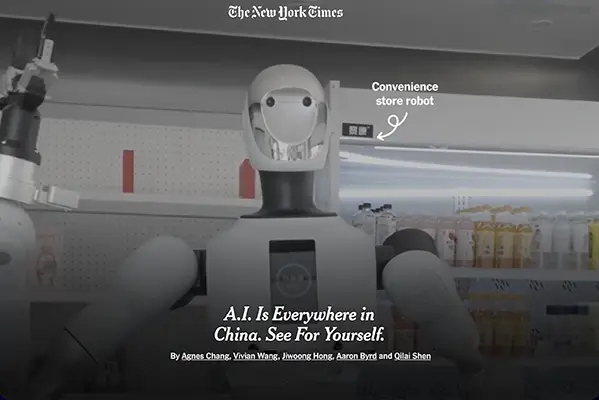
A.I. IS EVERYWHERE IN CHINA. SEE FOR YOURSELF.
THE NEW YORK TIMES, Agnes Change, Vivian Wang, Jiwoong Hong, Aaron Byrd and Qilai Shen, (AUG 21, 2026)
TL;DR: China’s AI deployment strategy is aggressively physical and consumer-facing — robots, facial-recognition payments, smart vehicles — prioritizing visible ubiquity and economic stimulus over the frontier-model race that dominates U.S. AI strategy, with mixed real-world execution quality.
Executive Summary
The piece documents a day of everyday AI encounters in Beijing: jaywalker-tracking cameras, facial-recognition vending machines linked to national ID systems via WeChat, a humanoid-robot-staffed convenience store, and AI-powered “smart” shopping and product search. The government’s strategic intent is explicit — push AI into factories, hospitals, schools, and retail to offset an aging workforce and stimulate consumption, a materially different bet than the U.S. industry’s focus on chatbots and frontier model capability.
Execution quality varies widely: some deployments (payment, ride-hailing, voice-controlled vehicles) work smoothly; others (the trash-sorting bin, the robot store clerk) are described as gimmicky or non-functional, suggesting a mix of substantive rollout and marketing-driven “AI-washing” of ordinary products. The piece also flags real tradeoffs — an expanding facial-recognition surveillance infrastructure tied to national ID, labor displacement without independent unions to represent affected workers, and a state interest in AI as a consumption driver as much as an efficiency tool.
Relevance for Business For SMB leaders with supply chains, manufacturing partners, or competitive exposure tied to China, this is a useful corrective to the U.S.-centric AI narrative: China’s approach is optimizing for physical-world deployment speed and economic stimulus, not model capability leadership, and is already reshaping manufacturing automation and retail formats there. It’s also a cautionary data point on AI-washing — the gap between “AI-labeled” and “AI-functional” products is a market dynamic likely to show up domestically as well, and worth applying skepticism to vendor claims accordingly.
Calls to Action
🔹 Monitor — China’s AI-driven manufacturing automation trends if you have supply chain exposure there
🔹 Monitor — the gap between AI-labeled and AI-functional consumer products as a general vendor-evaluation discipline
🔹 Ignore for Now — no direct action needed on consumer-facing China AI deployments unless your business operates there
🔹 Prepare Policy — if evaluating any facial-recognition or biometric AI vendor tools domestically, build privacy/data-governance review into procurement given the tradeoffs this piece documents
Summary by ReadAboutAI.com
https://www.nytimes.com/interactive/2026/08/21/world/asia/china-ai-life.html: August 28, 2026
Are You Sure You Want a Car With a Giant Touch Screen?
The Atlantic, Matteo Wong (August 19, 2026)
TL;DR: The AI data-center memory-chip shortage is spreading from phones and laptops into vehicles, and analysts expect it to add meaningfully to new-car prices over the next several years — with downstream effects on the used-car market too.
Executive Summary
Modern vehicles increasingly run on one or two centralized computers rather than dozens of small electronic-control units — a shift pushed by EV makers like Tesla and now followed by legacy automakers, because it enables streamlined software updates and prepares vehicles for “future AI workloads.” This design requires substantially more RAM. AI companies’ aggressive purchasing of memory chips for data centers has already driven up phone and laptop prices; the article’s sourced analysts (Telemetry, Edmunds, iSeeCars) expect new car prices to rise a few percentage points on average over the next year — smaller in percentage terms than the spikes seen in consumer electronics, but larger in dollar terms (roughly $2,000 per vehicle on average, more for computer-heavy models). Ford has already disclosed $1 billion in added costs tied to memory-chip inflation and broader input costs; GM and Volkswagen have flagged similar pressure to investors.
The piece draws a direct parallel to the COVID-era chip shortage, after which automakers shifted toward higher-margin vehicles and average new-car prices rose $11,000 — a shift that also pushed up used-car prices by nearly 40%. The analysts interviewed expect a similar, durable price effect this time, not a temporary spike.
Relevance for Business
This is a direct cost-of-doing-business signal, not a speculative one: fleet vehicles, delivery vehicles, and any SMB with vehicle-dependent operations should expect upward pressure on both new and used vehicle costs over a multi-year horizon. It’s also a broader illustration of how AI infrastructure demand is now a general input-cost variable across unrelated industries — the same dynamic could reach other RAM- or chip-dependent equipment categories.
Calls to Action
🔹 Monitor — vehicle and fleet-equipment pricing trends over the next 12–24 months if your business owns or leases vehicles
🔹 Prepare Policy — build memory-chip-driven cost inflation into capital planning and fleet-replacement budgets now rather than reactively
🔹 Act Now — if a fleet purchase or lease renewal is already planned for this year, consider accelerating it ahead of further price increases
🔹 Revisit Later — reassess whether other equipment categories your business depends on (POS systems, industrial controllers, servers) face similar RAM-driven cost exposure
Summary by ReadAboutAI.com
https://www.theatlantic.com/technology/2026/08/car-prices-memory-ram-ai/688329/: August 28, 2026HOW THE AI BUBBLE WILL BURST
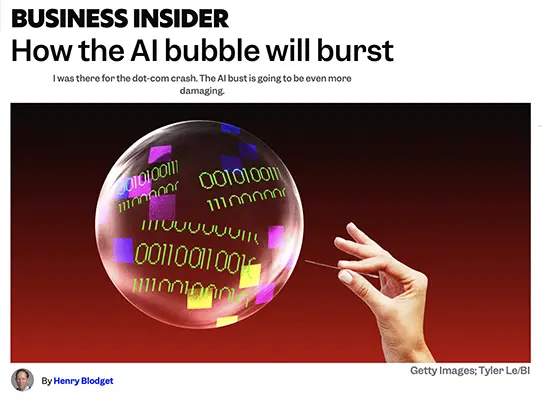
Business Insider · Henry Blodget · August 20, 2026
| OPINION / ARGUMENT |
| TL;DR: A dot-com-era veteran argues the AI boom shows the same growth-plus-leverage pattern that preceded past bubbles — real, historic revenue growth at Anthropic and OpenAI paired with unprecedented off-balance-sheet financing commitments — concluding a bust is likely eventually, though even seasoned investors have historically failed to time it. |
EXECUTIVE SUMMARY
Blodget, a former Wall Street analyst who covered the dot-com crash, frames today’s AI investment as both a rational bet on a transformative technology and a likely bubble simultaneously. He points to genuinely extraordinary revenue growth — Anthropic’s annualized revenue reportedly reaching roughly $65 billion, up sharply year over year, with OpenAI’s growth slowing more recently — as evidence the underlying demand is real, not manufactured.
The bubble risk, in his telling, comes from leverage: hyperscalers are making enormous forward spending commitments that exceed current cash flow, and vendor-financing arrangements (chipmakers extending credit to data-center buyers who then purchase more chips) are amplifying demand across the ecosystem. He cites Alphabet’s off-balance-sheet commitments rising by roughly $500 billion in a single quarter as one illustration of the scale involved.
This is argument and framing, not a forecast with a timeline. Blodget is explicit that identifying a bubble in advance has historically not helped even sophisticated investors avoid losses when it burst, and he discloses his own financial stake in the outcome (he holds stock broadly, including Amazon).
Vendor-neutrality disclosure: this article discusses Anthropic/Claude substantively. ReadAboutAI.com is produced using Claude, an Anthropic product; this summary was generated with that tool, per our standing vendor-neutrality policy.
RELEVANCE FOR BUSINESS
This is a widely-read opinion piece, not a research report — treat the bubble/no-bubble framing as one experienced observer’s judgment call, not settled analysis.
The leverage and vendor-financing dynamics described (circular deals, off-balance-sheet commitments) are independently verifiable facts worth tracking regardless of whether you buy the bubble thesis — they affect the financial stability of the vendors SMBs increasingly depend on.
If a correction does occur, expect it to hit AI vendor pricing, product roadmaps, and support continuitybefore it hits your own AI usage economics directly — vendor selection and contract flexibility matter more than timing a market call.
CALLS TO ACTION
Ignore for Now — no need to alter AI adoption plans based on bubble speculation alone.
Monitor — track vendor financial health (funding rounds, debt issuance, profitability disclosures) for any AI tool central to your operations.
Prepare Policy — build vendor-continuity and data-portability plans into AI contracts now, independent of bubble timing.
Test Cautiously — avoid deep, hard-to-reverse integration with a single AI vendor until pricing and stability patterns are clearer.
Summary by ReadAboutAI.com
https://www.businessinsider.com/ai-bubble-burst-stock-market-crash-boom-dotcom-financial-crisis-2026-8: August 28, 2026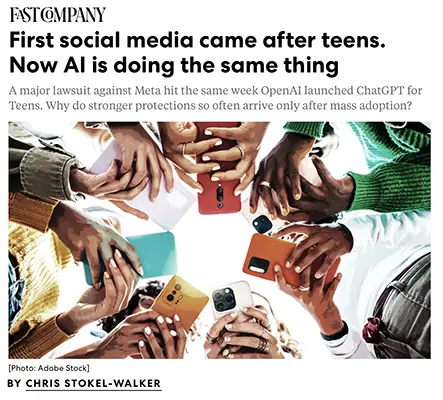
First Social Media Came After Teens. Now AI Is Doing the Same Thing
Fast Company, Chris Stokel-Walker, Aug. 21, 2026
TL;DR: OpenAI’s launch of ChatGPT for Teens, arriving the same week as a major child-safety lawsuit against Meta, suggests AI companies are repeating social media’s pattern of shipping first and adding safeguards only under pressure — a governance and reputational risk pattern worth watching closely.
Executive Summary
The piece draws a direct parallel between two concurrent events: a 29-state lawsuit alleging Meta knowingly designed its platforms to be addictive to minors, and OpenAI’s rollout of a teen-specific ChatGPT version with added safety controls.OpenAI’s teen protections arrived roughly four years after launch, compared to Instagram’s 14 years — faster, but experts interviewed argue the underlying pattern (mass release, safeguards later) is repeating.
Experts distinguish between clearly illegal, detectable harms (like child-abuse content), which companies address early because compliance frameworks already exist, and harder-to-define harms — undue influence, misinformation, and AI’s deeper psychological engagement — which get addressed more slowly and inconsistently. One expert argues generative AI’s influence is more consequential than social media’s because it engages more directly with users’ thinking rather than just their attention.
Relevance for Business Any company deploying AI-powered products — chatbots, customer-facing agents, personalization tools — faces a version of this same governance and regulatory-exposure timeline risk: safety and disclosure obligations often solidify only after litigation or public pressure defines them. This is a pattern to build policy around proactively rather than reactively, especially for SMBs building on top of major AI platforms whose safety commitments may shift.
Calls to Action
🔹 Prepare Policy — Establish internal guidelines for AI tool use involving minors or vulnerable users now, ahead of regulatory clarity
🔹 Monitor — Track how AI vendors’ safety commitments evolve, particularly under legal or regulatory pressure
🔹 Assign Internal Review — Evaluate any customer-facing AI deployment for foreseeable but not-yet-regulated harms
🔹 Test Cautiously — Treat vendor safety claims as company framing to verify, not settled fact
Summary by ReadAboutAI.com
https://www.fastcompany.com/91591973/ai-companies-are-repeating-social-medias-mistakes-with-teens: August 28, 2026
Consulting’s Race to Become AI Native
Business Insider, Polly Thompson, Aug. 22, 2026
TL;DR: Major consulting firms are racing to rebrand and restructure as “AI-native” technology companies, but industry data suggests the transformation is more pronounced in messaging than in client-perceived reality.
Executive Summary
Top consultancies (KPMG, PwC, EY, Deloitte, McKinsey, BCG, Accenture) are visibly reshaping around AI: hiring tens of thousands of technologists, launching engineering career tracks, retiring traditional job titles, and striking major partnerships with AI vendors including OpenAI, Nvidia, Anthropic, and Microsoft. At McKinsey and BCG, AI- and tech-related work now reportedly makes up roughly 40% of total revenue. This reflects a real shift in service delivery, not just marketing — firms are increasingly building and implementing tools rather than only advising.
However, client perception hasn’t kept pace with firm rhetoric: per industry research cited in the piece, the share of clients who expect AI to meaningfully change how consulting firms deliver services has fallen from 60% (2024) to 40% (recently), even as 90% believe AI will affect delivery in some way. Several sources caution that firms “were never built to be technical organizations” and remain far from the frontier of what AI can do, while others argue the core consulting identity — organizational change management — hasn’t fundamentally changed.
Relevance for Business For SMBs evaluating or hiring consultants: “AI-native” positioning is now a competitive differentiator in the consulting market, but claims should be tested against delivery capability, not messaging. The shift also signals that consulting engagements increasingly come bundled with technical implementation (tools, agents, subscription products) rather than pure advisory work — which changes pricing models and vendor lock-in considerations.
Calls to Action
🔹 Test Cautiously — When evaluating consulting partners, ask for concrete AI-implementation case studies, not just “AI-native” branding
🔹 Monitor — Track how consulting pricing models shift as firms move from time-and-materials to subscription/product-based delivery
🔹 Assign Internal Review — Reassess what internal capability vs. outsourced consulting makes sense as AI lowers the cost of certain implementation work
🔹 Revisit Later— Reevaluate as client-perception data and firm capability continue to diverge or converge
Summary by ReadAboutAI.com
https://www.businessinsider.com/consulting-race-to-become-ai-native-tech-first-2026-8: August 28, 2026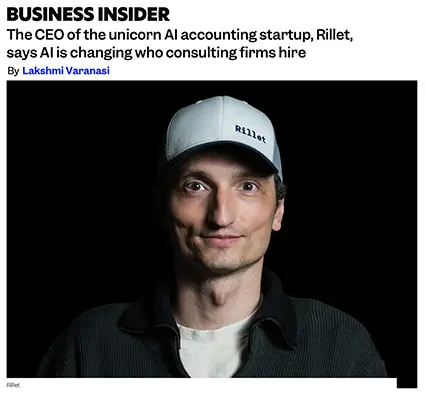
The CEO of the Unicorn AI Accounting Startup, Rillet, Says AI Is Changing Who Consulting Firms Hire
Business Insider, Lakshmi Varanasi, Aug. 24, 2026
TL;DR: AI-native finance software is starting to eliminate the multi-year, manual ERP-implementation work that has long been a staple of consulting revenue — shifting demand toward specialized, AI-fluent talent rather than generalist implementation teams.
Executive Summary
Rillet, an AI-native accounting startup recently valued at $1 billion, argues that AI can automate the manual bookkeeping and system-configuration work that traditionally consumed years of consulting engagements around legacy ERP systems (Oracle Fusion, NetSuite, Workday). The company reports 87% of reviewed customer accounts had less than 1% of bookkeeping entries needing manual review at month-end, per third-party analysis — a substantial claimed efficiency gain, though this comes from the vendor’s own commissioned data and customer base, not independent verification.
Rillet’s CEO frames this as part of a broader “SaaSpocalypse” — a shakeup in enterprise software pricing as AI agents reduce the need for large numbers of human software seats. He predicts entry-level “generalist” consulting work will be increasingly absorbed by AI within two to three years, raising demand instead for highly skilled accounting specialists and “forward-deployed engineers” who build and manage AI agents — a role category BI reports saw job postings up over 5,000% year-over-year.
Relevance for Business For SMBs relying on consultants or ERP vendors: this signals a shift in what consulting engagements should cost and deliver — routine implementation and bookkeeping cleanup work is becoming automatable, and SMBs should expect (and negotiate for) faster, cheaper implementation timelines. It also signals a labor-market shift: entry-level generalist hiring in finance/consulting may shrink, while demand and cost for specialized AI-fluent talent rises.
Calls to Action
🔹 Test Cautiously — Evaluate AI-native finance/accounting tools (Rillet and competitors) against current ERP costs and timelines, treating vendor efficiency claims as claims to verify
🔹 Monitor — Track how consulting firm pricing and staffing models shift as routine implementation work automates
🔹 Assign Internal Review— Reassess finance/accounting software roadmap given faster automation-driven implementation options
🔹 Prepare Policy — Consider workforce planning implications if entry-level finance/consulting roles shrink faster than expected
Summary by ReadAboutAI.com
https://www.businessinsider.com/rillet-ceo-nicolas-kopp-ai-accounting-consulting-firms-jobs-2026-8: August 28, 2026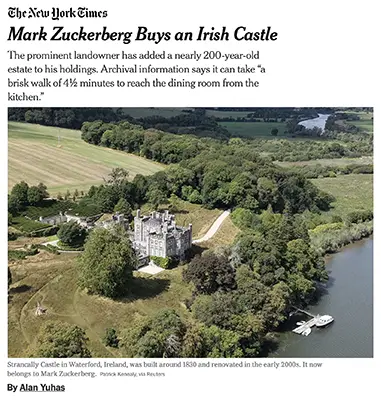
MARK ZUCKERBERG BUYS AN IRISH CASTLE
The New York Times · Alan Yuhas · August 21, 2026
| INDUSTRY WATCH |
| TL;DR: Zuckerberg’s purchase of a $23–35 million Irish castle is a personal wealth story, not an AI development — but it’s a reminder of how directly AI-driven market gains are flowing into Big Tech leadership’s personal balance sheets, and of Ireland’s continuing centrality as Meta’s EU base. |
EXECUTIVE SUMMARY
Meta confirmed CEO Mark Zuckerberg has purchased Strancally Castle, a nearly 200-year-old Gothic estate in Waterford County, Ireland, adding to a property portfolio that already includes homes in Miami, Washington, California, and Hawaii. The transaction is personal and carries no direct operational or product implications for Meta or the AI industry.
The one point of tangential relevance: Ireland hosts Meta’s roughly 1,500-person European headquarters and remains a key jurisdiction for enforcing EU tech regulation, alongside its low corporate tax rate and history as a profit-routing hub for multinationals. That dual role — regulatory front line and tax-friendly base — keeps Ireland relevant to any SMB with EU-facing AI vendors or data residency questions, independent of this purchase.
RELEVANCE FOR BUSINESS
No direct action item for most SMB leaders. Included as a signal of how concentrated personal wealth generation is tracking the AI capex boom among hyperscaler executives.
CALLS TO ACTION
Monitor — only if your organization has EU data-residency or regulatory exposure tied to Ireland-based vendor infrastructure.
Ignore for Now — no operational relevance for most SMB readers.
Summary by ReadAboutAI.com
https://www.nytimes.com/2026/08/21/world/europe/zuckerberg-castle-ireland.html: August 28, 2026
Mozilla Is Bringing AI to Firefox — But Only If You Want It
Fast Company, Steven Melendez, Aug 18, 2026
TL;DR: Mozilla’s new opt-in “Smart Window” AI feature, built on a deal with search startup Exa, is a deliberate bet that user choice and non-default AI can differentiate Firefox against AI-first browsers.
Executive Summary
Mozilla announced Smart Window, an AI chat panel added to Firefox via a partnership with Exa (an AI search company), that can answer questions using open tabs, browsing-history-derived “memories,” and live web search. The defining design choice is that it’s opt-in, not default — users must turn it on, can disable it anytime, and Mozilla explicitly says it won’t push users back toward AI use once they opt out. Mozilla and Exa state that neither retains search data, and browsing “memories” can be deleted from settings.
This positions Mozilla against both AI-skeptic users (who make up a vocal part of its base) and AI-forward competitors like the now-discontinued ChatGPT Atlas browser. Notably, Firefox’s core revenue still depends heavily on Google’s default-search payments, and Mozilla is paying Exa for this feature rather than monetizing it directly — the business model for AI-in-browser remains unresolved even for Mozilla itself.
Relevance for Business This is a market positioning and privacy-model story more than an actionable development for most SMBs. It’s relevant if your organization is evaluating browser standards for regulated or privacy-conscious environments, since Mozilla’s approach (no forced AI, deletable memories, no training on user data by default) sets a more conservative data-handling bar than some competitors. It’s also a useful reference point for framing your own AI feature rollouts — Mozilla’s opt-in design is an alternative model to the “AI by default” approach many vendors use.
Calls To Action
🔹 Monitor — as a reference point if evaluating enterprise browser or AI feature deployment models.
🔹 Ignore for Now — no direct action required for typical SMB operations.
🔹 Revisit Later — check whether Smart Window’s opt-in approach affects broader industry norms for AI feature defaults.
🔹 Test Cautiously — if piloting AI-in-browser tools generally, verify data retention claims independently rather than taking vendor statements at face value.
Summary by ReadAboutAI.com
https://www.fastcompany.com/91590598/mozilla-is-bringing-ai-to-firefox-but-only-if-you-want-it: August 28, 2026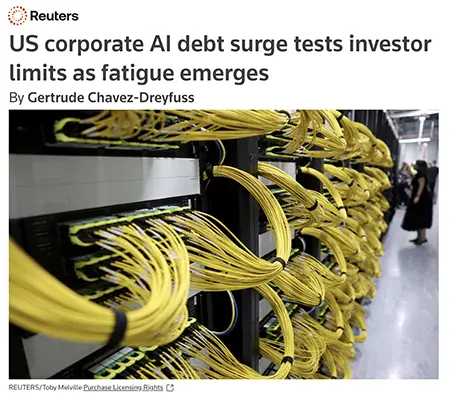
US CORPORATE AI DEBT SURGE TESTS INVESTOR LIMITS AS FATIGUE EMERGES
REUTERS, GERTRUDE CHAVEZ-DREYFUSS (AUG 21, 2026)
TL;DR: Hyperscalers are issuing AI-driven corporate debt at roughly 18x last year’s pace, and bond investors are starting to demand meaningfully higher yields to absorb it — an early signal that the market’s appetite for AI-buildout financing, while not broken, is no longer unlimited.
Executive Summary
AI hyperscaler debt issuance has reached $220 billion in 2026, up from about $12.5 billion in the same period last year, according to BNP Paribas data cited in the piece. This is not a credit-quality concern — Amazon and Alphabet remain highly rated — but a supply/demand pricing issue: tech bond spreads over Treasuries have widened past the broader investment-grade market average for the first time in years, and recent bond sales (Amazon’s $25 billion offering, Alphabet’s latest issuance) have required larger yield concessions to clear than similar deals earlier in the year.
The most concrete constraint identified isn’t sentiment — it’s portfolio math. Institutional buyers such as pension funds and insurers typically cap single-issuer exposure at 2–3% of assets. As the same small group of AI hyperscalers repeatedly returns to the bond market, those caps become a real ceiling on how much debt the market can absorb, regardless of how strong the issuers’ underlying fundamentals remain.
Relevance for Business This is a capital-markets early warning indicator, not a crisis. For SMB leaders whose businesses are downstream of hyperscaler infrastructure spending (cloud pricing, compute availability, vendor investment plans), rising borrowing costs for the hyperscalers are a leading indicator of potential pass-through cost pressure or slower capacity expansion if the trend continues. It’s also a useful gut-check against assuming unlimited AI infrastructure investment is guaranteed to continue at current pace — financing constraints, not just technical or demand constraints, are now part of the picture.
Calls to Action
🔹 Monitor — hyperscaler bond spreads and issuance volume as a leading indicator of AI infrastructure investment pace
🔹 Monitor — cloud/compute vendor pricing for any early signs of cost pass-through tied to financing costs
🔹 Revisit Later — reassess AI infrastructure spend assumptions in vendor negotiations if spread widening continues into Q4
🔹 Ignore for Now — no direct action needed; this is a capital-markets signal, not an operational one, unless your business directly holds or trades this debt
Summary by ReadAboutAI.com
https://www.reuters.com/legal/transactional/us-corporate-ai-debt-surge-tests-investor-limits-fatigue-emerges-2026-08-21/: August 28, 2026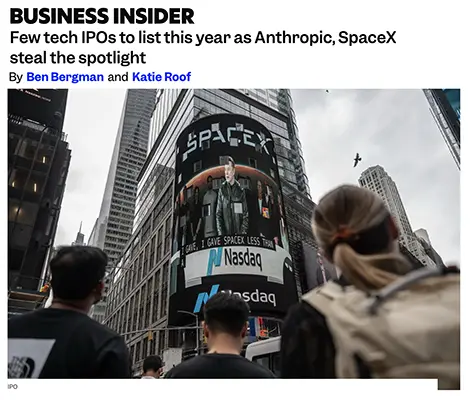
Why 2026’s Tech IPO Market Is Shaping Up to Be Another Dud
Markets Insider (Business Insider), Ben Bergman and Katie Roof, Aug. 24, 2026
Vendor-neutrality note: Anthropic is discussed substantively in this source as one of two mega-IPOs anchoring 2026’s tech listing market.
TL;DR: 2026 looks like a strong year for tech IPOs only because of two outlier mega-listings (SpaceX and a reportedly forthcoming ~$2 trillion Anthropic IPO); excluding them, the broader IPO market remains weak, with most venture-backed companies staying private longer.
Executive Summary
Aside from SpaceX’s record 2026 IPO and Anthropic’s reported plans to target a roughly $2 trillion listing as soon as late September, the broader tech IPO pipeline is thin: only a handful of venture-backed companies are considering 2026 debuts, and several (including OpenAI) have delayed plans. Contributing factors include rising interest rates, proximity to the U.S. midterm elections, and the difficulty smaller companies face competing for attention against mega-IPOs.
Recent tech IPO performance has been poor — Figma is down nearly 80%, Cerebras down nearly 25%, and Klarna down nearly 65% since their debuts — which is dampening investor and founder appetite alike. Some companies (e.g., Databricks) are opting to raise large private rounds instead of going public. Bankers interviewed describe a narrow “Goldilocks” pricing window: overpricing triggers volatility, underpricing leaves money on the table, and only companies with strong growth, margins, and roughly $250 million+ in revenue are seen as good IPO candidates in this environment.
Relevance for Business Relevant mainly as a market-conditions signal: continued private-market concentration among AI mega-caps (including Anthropic) means fewer newly public comparables for benchmarking, and it suggests capital continues to concentrate around a small number of AI leaders rather than broadening across the sector. For SMBs, this reinforces that public-market signals about “AI’s health” are increasingly driven by a handful of outlier companies, not the sector broadly.
Calls to Action
🔹 Monitor — Track whether Anthropic’s reported IPO proceeds and at what valuation, as a bellwether for AI-sector capital markets
🔹 Ignore for Now — No direct action needed unless your business is IPO-adjacent (cap table planning, late-stage fundraising benchmarks)
🔹 Revisit Later — Reassess after the fall IPO window (pre/post U.S. midterms) plays out
Summary by ReadAboutAI.com
https://www.wsj.com/tech/ai/nvidia-is-spending-6-billion-to-build-a-powerful-u-s-alternative-to-chinese-ai-c51c38cc: August 28, 2026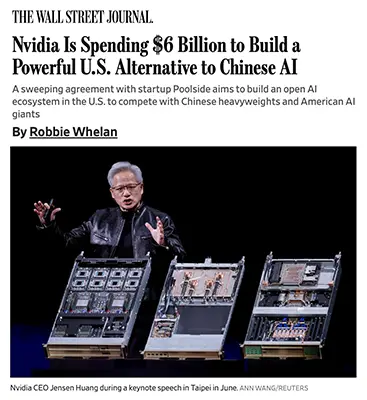
Nvidia Is Spending $6 Billion to Build a Powerful U.S. Alternative to Chinese AI
The Wall Street Journal, Robbie Whelan, Aug 22, 2026
Vendor-neutrality note: This source discusses Anthropic substantively as a proprietary AI lab affected by the competitive dynamics described. Per ReadAboutAI’s editorial policy, this disclosure is included because Claude is used in this publication’s production process. The summary below treats Anthropic’s position with the same scrutiny applied to other companies named.
TL;DR: Nvidia is absorbing AI startup Poolside’s technology and engineering talent in a $6 billion deal to build a top-tier open-weight AI model — a strategic hedge against both Chinese competitors and the closed, proprietary model approach favored by labs like OpenAI and Anthropic, even though those same labs are among Nvidia’s largest chip customers.
Executive Summary
Nvidia will invest $1 billion directly in Poolside and pay a further $6 billion to license its technology and hire the bulk of its engineering staff, following a failed fundraising round that left the startup short on compute. The move accelerates Nvidia’s Nemotron open-weight model project, positioning it to compete with Chinese open models (DeepSeek, Kimi, GLM) that have been closing the capability gap with U.S. frontier labs, as well as with closed-model incumbents such as OpenAI and Anthropic, since open-weight models are typically cheaper to run and easier to customize.
This creates a genuinely awkward position for Nvidia: its most important customers for AI chips include the very “closed” labs it is now competing against with open alternatives. CEO Jensen Huang has framed this publicly as a matter of U.S. AI leadership requiring an open ecosystem, not just one dominant closed model — a case made more urgent since Chinese open-weight releases have repeatedly rattled markets over the past 18 months. Nvidia has also built a broader coalition (including Mistral, Thinking Machines Lab, and Perplexity) to share resources toward the same goal.
Relevance for Business
This signals that credible, low-cost, customizable open-weight AI models are likely to keep improving and multiplying over the next year, with a major infrastructure player now directly subsidizing that outcome. Businesses currently locked into proprietary API-based AI vendors should treat this as an early signal to periodically reassess cost and lock-in — not as a reason to switch today, since these models are not yet proven at frontier quality. It’s also a broader illustration of a supplier becoming a competitor to its own customers, worth watching in any vendor relationship where the vendor also controls a chokepoint resource (in this case, compute).
Calls to Action
🔹 Monitor — Track open-weight model quality (Nemotron, and Chinese counterparts) as a potential lower-cost alternative to proprietary AI vendors.
🔹 Revisit Later — Reassess AI vendor strategy in 6–12 months once Nvidia’s larger Nemotron models are released and benchmarked.
🔹 Ignore for Now — No immediate action needed; this doesn’t change near-term vendor decisions.
🔹 Assign Internal Review — If your business already has significant AI API spend, have someone track total cost of ownership against emerging open-weight alternatives.
Summary by ReadAboutAI.com
https://www.wsj.com/tech/ai/nvidia-is-spending-6-billion-to-build-a-powerful-u-s-alternative-to-chinese-ai-c51c38cc: August 28, 2026
3 considerations for health systems adopting AI chatbots
Xtelligent Healthtech Analytics / TechTarget, Sara Heath, 19 Aug 2026
TL;DR: Health systems are rushing to build their own patient-facing AI chatbots rather than let Big Tech own the relationship, but early adopters say success hinges entirely on workflow integration and clear intent — not on having a chatbot at all.
Executive Summary
After major AI vendors (OpenAI, Anthropic, Amazon, Microsoft) launched healthcare-specific chatbot products, hospitals and health systems moved quickly to stand up their own versions rather than cede patient engagement to outside platforms. Sources describe this as a deliberate correction: one clinical-AI executive draws a direct comparison to health systems being too slow to respond to the GLP-1 weight-loss drug boom, which let digital health startups capture most of the market power. Leaders now frame patient-relationship ownership as the core metric for these tools — not adoption numbers alone.
But adoption is not automatic. One health system’s associate chief medical officer notes that many AI tools are already being abandoned industry-wide because they don’t deliver the value organizations expected, and that tools bolted onto a separate system see far less real usage than tools embedded directly into the EHR or patient portal. Survey data cited in the piece shows patients still default to Big Tech chatbots for general questions but defer to their own providers for actual clinical decisions — nearly three-quarters ask their doctor directly for health information, versus 16% who use AI, and a third say they’d never use AI for medical advice at all.
Relevance for Business
This is a useful case study for any business weighing whether to build a proprietary AI tool to protect a customer relationship, versus relying on a third-party platform. The clearest lesson: a chatbot’s value is tied to how tightly it integrates into existing workflows and how precisely it’s scoped to real user intent — deploying AI as a checkbox exercise, disconnected from where customers or employees already operate, is a documented failure pattern, not a hypothetical risk.
Calls to Action
🔹 Assign Internal Review — Before building or buying a customer-facing AI tool, map out exactly where it needs to sit in existing workflows (not as a bolt-on).
🔹 Test Cautiously — Pilot narrowly scoped AI use cases tied to specific, high-intent user needs before expanding broadly.
🔹 Monitor — Track how “AI tool abandonment” trends play out across industries; treat AI adoption metrics skeptically until usage data is in.
🔹 Prepare Policy — If a competitor or platform vendor could disintermediate your customer relationship via AI, decide proactively whether to build, partner, or accept that risk.
Summary by ReadAboutAI.com
https://www.techtarget.com/healthtechanalytics/feature/3-considerations-for-health-systems-adopting-AI-chatbots: August 28, 2026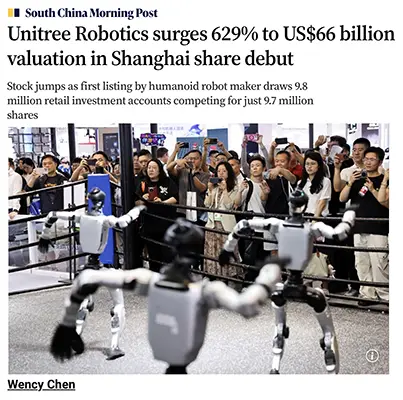
Unitree Robotics Surges 629% to $66 Billion Valuation in Shanghai Debut
South China Morning Post, Wency Chen, Aug 19, 2026
TL;DR: China’s leading humanoid robot maker had a blockbuster stock debut, signaling intense investor appetite for embodied AI and giving Beijing a valuation benchmark for its robotics sector.
Executive Summary
Unitree Robotics’ Shanghai listing surged as much as 629% intraday, closing up 460% and valuing the company at roughly $53 billion (342 billion yuan) — with retail demand so high that only 0.018% of applications for shares were filled. The debut occurred against a declining broader market, underscoring that this was company-specific enthusiasm, not a sector-wide rally. Unitree posted 1.7 billion yuan in 2025 revenue (up 4x year-over-year), with humanoids now outselling quadrupeds in revenue terms, and claims to have produced roughly 18,000 bipedal humanoid units to date.
Strategically, this listing is being read as a valuation benchmark for China’s embodied-AI sector, with several other Chinese robotics firms (Deep Robotics, AgiBot, and others) pursuing similar public listings. State-linked investors and companies including DeepSeek and Tencent joined the placement, reinforcing that robotics is now treated as a national industrial priority in China’s competition with the U.S.
Relevance for Business This is a market-sentiment and geopolitical signal more than a product story for most SMBs. It confirms that capital is flowing aggressively into physical/embodied AI, not just software models — a trend that will eventually affect the cost, availability, and vendor landscape for robotics and automation equipment. For SMBs with supply chains touching manufacturing, logistics, or hardware-adjacent sectors, this points to a maturing Chinese robotics supplier base that may become commercially relevant faster than expected. It’s also a reminder that valuations at this stage reflect speculative enthusiasm, not proven unit economics — a caution for any B2B partnership evaluation.
Calls to Action
🔹 Monitor — Chinese humanoid robotics vendors as a maturing hardware supply category.
🔹 Ignore for Now — no direct action needed unless your business touches robotics/automation hardware.
🔹 Revisit Later — reassess if additional Chinese robotics IPOs follow and pricing stabilizes.
🔹 Test Cautiously — if evaluating any embodied-AI/robotics vendor, treat valuation hype as separate from operational maturity.
Summary by ReadAboutAI.com
https://www.scmp.com/tech/tech-trends/article/3364499/unitree-robotics-surges-629-us66-billion-valuation-shanghai-share-debut: August 28, 2026
China’s Humanoids Are Dazzling the World. Who Will Buy Them?
The Economist (February 18, 2026)
Note: this source predates the current news cycle (published February 2026) but remains directly relevant to current humanoid-robotics coverage. Included for context.
TL;DR: China now dominates global humanoid-robot manufacturing and supply chains by a wide margin, but the article’s core finding is that demand is still overwhelmingly for spectacle rather than productive work — a bubble risk that China’s own state researchers are publicly acknowledging.
Executive Summary
China shipped the vast majority of the roughly 14,500 humanoid robots delivered globally last year (up from ~3,000 the year before), with two firms — Agibot and Unitree — accounting for around three-quarters of that volume; Tesla, by comparison, shipped just 150 Optimus units. China’s dominance extends beyond assembly to the full supply chain: the Yangtze River Delta region, leveraging its existing EV manufacturing base, supplies motors, gearboxes, and components at a scale competitors can’t currently match.
The critical caveat, stated plainly by sources in the piece: most of these robots are not doing real work. They’re deployed largely as entertainment and government-event showpieces; a small fraction operate in factories, where they run at roughly 30–40% of human efficiency on simple tasks like box-carrying. China’s state governments are currently the largest buyer of humanoids, not private industry — meaning current demand is substantially subsidized and demonstration-driven rather than organically commercial. A researcher at a state-backed Chinese AI lab is quoted warning explicitly that if mass production outpaces real-world usefulness, “the humanoid bubble will burst.”
Relevance for Business
For SMB leaders, the practical takeaway is that humanoid robotics is not yet a viable operational tool for most businesses — the technology is real and the manufacturing capacity is scaling fast, but the commercial use case (robots doing genuinely productive work at competitive efficiency) is not yet proven, even in the market most aggressively subsidizing it. This is squarely a “watch the trajectory, don’t buy the hype” category, with the added strategic note that China’s supply-chain dominance in this category could become a future vendor-concentration risk if and when humanoid robotics does mature commercially.
Calls to Action
🔹 Ignore for Now — humanoid robots are not a viable operational investment for typical SMBs today
🔹 Monitor — factory/warehouse humanoid deployment efficiency data over the next 1–2 years as the clearest signal of real commercial readiness
🔹 Monitor — China’s supply-chain concentration in robotics components, as a potential future vendor-dependence issue for any business considering robotics investment later
🔹 Revisit Later — reassess once government-subsidized demand gives way to (or fails to give way to) organic private-sector purchasing
Summary by ReadAboutAI.com
https://www.economist.com/business/2026/02/18/chinas-humanoids-are-dazzling-the-world-who-will-buy-them: August 28, 2026Closing: AI update for August 28, 2026
From bond markets to break rooms, this cycle’s developments make clear that AI’s business impact is no longer confined to the tools themselves — it’s showing up in financing terms, HR policy, and vendor risk assessments. As always, treat vendor and market claims with the same scrutiny applied to any other major capital or operational decision, and revisit the flagged monitoring items as new data arrives.
All Summaries by ReadAboutAI.com
↑ Back to Top