
AI Updates July 3, 2026


This week’s batch captures a sector moving in two directions at once: the most capable frontier models are being gated by national governments even as their commodity-tier siblings get cheaper and more capable by the month. Anthropic shipped Claude Sonnet 5 at a sharp price-to-performance step down, while GPT-5.6 remains restricted to roughly twenty vetted partner organizations at the U.S. government’s request, and Anthropic’s Mythos and Fable models are returning to availability on their own separate government timelines. Layer in OpenAI’s floated 5% government equity stake — a proposal, not a finalized deal, reportedly extending in concept to Anthropic, Google, and Meta — and a clear throughline emerges: the relationship between Washington and the labs building frontier AI is being renegotiated in real time, with direct implications for any business whose workflows depend on a single “best available” model.
The economic picture is similarly split. Steelmakers, electronics buyers, and consumer hardware prices are all now visibly reacting to AI’s power and memory-chip appetite — Apple raised prices citing memory costs, the regional grid operator PJM projects a 6.6-gigawatt shortfall starting in 2027, and the Bank for International Settlements warns that debt-funded AI infrastructure spending carries systemic risk if returns disappoint. At the same time, per-token prices are falling and businesses are actively routing routine work to cheaper models — including a widening set of Chinese options that, per this week’s coverage, are no longer simply “cheap but behind” the U.S. frontier. For SMB leaders, the practical takeaway isn’t which story wins out, but that cost pressure and cost relief are arriving from the same underlying infrastructure buildout, often simultaneously.
The remaining stories turn from infrastructure to institutions and behavior. The Bank of England is reversing course on agentic AI oversight, courts are sanctioning “vibe lawyering” built on fabricated citations, and new research suggests that calling an AI tool a “coworker” measurably weakens the human review meant to catch its mistakes. Running through much of the batch is a values and trust question — this week’s model-values briefing and a widely discussed workforce piece both point to the same underlying concern: how AI gets framed, branded, and embedded shapes not just output quality but human judgment and oversight. Together, these twenty-five stories make the case that governing AI well is now as much a management and communications discipline as a technical one.

Claude Sonnet 5 Launches as Fable 5’s Return Signals a Crack in the Frontier Model Lockdown
AI For Humans podcast, July 1, 2026
TL;DR: Anthropic shipped Claude Sonnet 5 at a steep price-to-performance improvement while the US government’s gatekeeping of the most capable frontier models — GPT-5.6 and Mythos/Fable 5 — showed its first signs of easing, though access terms remain unsettled.
Executive Summary
Anthropic released Claude Sonnet 5, described by the hosts as its most agentic Sonnet-tier model yet, with benchmark performance approaching the higher-tier Opus 4.8 at a substantially lower cost. This continues a now-familiar pattern in the market: capability that was frontier-grade a few months ago becomes available at commodity pricing shortly after. Separately, OpenAI announced a new flagship line (GPT-5.6 Sol, Terra, and Luna), but access is currently restricted to roughly 20 vetted partner organizations at the US government’s request, per public comments attributed to Sam Altman — the model is not broadly available.
Mid-recording, the hosts reported breaking news: the US government cleared Anthropic to restore Mythos 5 access for critical-infrastructure organizations, and Fable 5 is reported to be on track to return for general availability, though the timing and terms (including a rumored identity-verification/KYC login requirement) were explicitly flagged by the hosts as unconfirmed speculation rather than fact. It is worth noting Anthropic develops Claude; this coverage should be weighed alongside other reporting on the export-control situation.
The hosts also tied this to a broader competitive dynamic: rising adoption of cheaper Chinese open-weight models(referenced as GLM-class) by companies looking to cut inference spend, which they argue is pressuring both Anthropic and OpenAI to release fast/cheap tiers even while their most capable models sit behind government review.
Relevance for Business
For SMB leaders, the immediate signal is cost: Sonnet-tier intelligence is trending toward higher capability at lower price points, which lowers the bar for deploying agentic AI in day-to-day operations. The bigger strategic issue is model access uncertainty — the most capable frontier models (from both major US labs) are currently subject to government-directed gating, which creates planning risk for any business building critical workflows around a single “best available” model. A resurfacing KYC/login requirement for advanced-tier access, if it materializes, would add a compliance and data-handling consideration to model selection. The competitive emergence of low-cost Chinese alternatives also raises vendor and geopolitical dependency questions worth tracking, independent of any one company’s roadmap.
Calls to Action
🔹 Act Now: Evaluate Claude Sonnet 5 for existing agentic or inference-heavy workflows currently running on older or costlier models — the price/performance shift may justify migration.
🔹 Monitor: Track official Anthropic and OpenAI channels (not podcast speculation) for confirmed terms on Fable 5 and GPT-5.6 general availability, including any identity-verification requirements.
🔹 Prepare Policy: If a KYC-style login is confirmed for frontier model access, get ahead of internal data-sharing and compliance implications before adoption.
🔹 Test Cautiously: Newer MCP-based creative tooling (e.g., agent-controlled 3D workflows for video generation) is promising but immature — pilot only with non-critical use cases.
🔹 Ignore for Now: X’s newly launched MCP integration carries entry costs (reported in the thousands of dollars, plus per-post fees) that make it impractical for most SMB use cases at this time.
Summary by ReadAboutAI.com
https://www.youtube.com/watch?v=OCnssLZbt9E: July 3, 2026
AI Agents Are Not Your “Coworkers”
MIT Technology Review, June 29, 2026
TL;DR: New research finds that framing AI agents as “employees” or “digital coworkers” makes human workers worse at catching errors and more likely to offload accountability — a branding choice with real operational risk.
Executive Summary: A Boston University study found that people caught 18% fewer errors in work attributed to an “AI employee” versus the identical work attributed to a chatbot, and were 44% more likely to escalate questionable AI output to a manager rather than correct it themselves — undercutting the efficiency gains agentic tools are meant to deliver. Nearly a third of surveyed managers said their companies already frame AI agents as employees, and 23% list them on org charts. Major AI vendors (Microsoft, OpenAI, Anthropic, Google) have all shipped agent-management tools using employee-style framing since April.
This is presented as a framing/marketing critique, not a capability critique — the article notes agentic AI has become measurably more capable at complex tasks. The concern is that “coworker” language distorts human oversight behavior and creates a convenient accountability gap when things go wrong, citing a real-world incident where blame was popularly assigned to an AI tool despite the outcome tracing to a chain of human decisions. Separately, a Stanford study of 1,500 workers found a mismatch between which tasks technologists think AI should automate and which tasks workers actually want automated — workers wanted AI to support judgment (e.g., case-progress tracking for law clerks), not to substitute for it (e.g., autonomous credit verification).
Relevance for Business: This has direct implications for how SMBs deploy and communicate about AI agents internally. Employee-style branding of AI tools may quietly erode the human review processes that are supposed to catch AI errors — a governance risk, not just a semantics issue. It also bears on liability and accountability structures if an AI agent’s output causes a business problem.
Calls to Action
🔹 Prepare Policy — establish internal naming/framing conventions for AI tools that preserve human accountability rather than anthropomorphizing agents as staff
🔹 Monitor — vendor marketing language (Microsoft, OpenAI, Anthropic, Google agent products) for “digital employee” framing that may shape user expectations and behavior
🔹 Act Now — if agentic tools are already in use, review whether review/escalation processes have quietly weakened since deployment
🔹 Test Cautiously — before formalizing agent roles or org-chart placement, assess whether that framing changes how staff verify AI output
Summary by ReadAboutAI.com
https://www.technologyreview.com/2026/06/29/1139849/ai-agents-are-not-your-coworkers/: July 3, 2026
THE PEOPLE WHO WILL THRIVE IN THE AI AGE
THE ATLANTIC, DAVID BROOKS, JUNE 28, 2026
TL;DR: AI adoption is splitting people into two camps — those who use it to think harder and those who use it to think less — and the gap between them, not raw intelligence, will determine who thrives.
Executive Summary
Brooks synthesizes a wide body of recent research (MIT Media Lab, Wharton, Carnegie Mellon, Shanghai Tech, ActivTrak, UC Berkeley) to argue that AI adoption doesn’t reduce cognitive effort uniformly — it sorts people by their existing relationship to mental effort. Low-effort users become more productive short-term but show measurable declines in brain connectivity, critical thinking, and skill retention (the piece cites a colonoscopy study showing physicians’ lesion-detection rates dropped after AI assistance was removed). Medium-effort users intend to stay engaged but drift into overreliance under daily time pressure. High-effort “mental marathoners” actively resist by using AI for critique rather than production.
The piece is explicitly a synthesis of psychological and behavioral research, not new empirical work — Brooks is making an interpretive argument, and the studies he cites (small samples, varied methodologies) should be read as suggestive rather than conclusive. The specific tactics offered — asking for hints not answers, starting with a blank page before prompting, rotating AI and non-AI tasks — are actionable and worth testing operationally.
Relevance for Business
This is a workforce and management framing piece, not a product or market story. For SMB leaders, the risk isn’t AI capability — it’s skill atrophy and uneven adoption quality across a team. Left unmanaged, AI tools can quietly erode judgment and institutional knowledge in exactly the roles (analysis, drafting, decision support) where leaders most need sharp thinking. This has direct implications for training design, performance review criteria, and how AI tools get rolled out to junior vs. senior staff.
Calls to Action
🔹 Test Cautiously — Pilot the “hints not answers” and “blank page first” prompting norms with one team before broad rollout.
🔹 Prepare Policy — Consider light guidance distinguishing rote-task AI use (fine) from judgment-task AI use (needs human-first drafting).
🔹 Monitor — Watch for signs of declining critical engagement in roles where AI has become default (drafting, first-pass analysis).
🔹 Revisit Later — This is a thought-leadership piece, not a data release — worth a re-read in 6–12 months against real workforce metrics, not action today.
Summary by ReadAboutAI.com
https://www.theatlantic.com/ideas/2026/06/ai-open-ai-anthropic/687689/: July 3, 2026
Why McLaren Is Hyping AI on Its Formula 1 Car
Fast Company, June 30, 2026
TL;DR: F1 teams are quietly turning AI into working infrastructure — natural-language data queries and regulatory document search — while the flashy livery partnership is the marketing wrapper around a much more operational story.
Executive Summary
McLaren’s Google Gemini-branded livery for the British Grand Prix is the visible layer of a deeper technical partnership: a live, natural-language data interface that lets engineers query race data across competitors instead of manually cross-referencing it, plus a “regulation bot” that searches FIA rulebooks for relevant clauses. Team executive Dan Keyworth noted the tool replaces work that “used to take us a long time to compare data between two competitors”, with driver Oscar Piastri separately describing efficiency gains in how briefings and technical analysis get synthesized and passed to him.
This isn’t unique to McLaren — Red Bull, Mercedes, and Aston Martin are each running parallel AI partnerships (with Oracle, Microsoft Azure, Cohere/Arm respectively), suggesting this is becoming table-stakes infrastructure across the sport rather than a single-team experiment. The claims here are largely operational efficiency, not performance breakthroughs — the article and sources are careful to frame AI as compressing analysis time, not replacing engineering judgment.
Relevance for Business
The underlying pattern — natural-language querying of siloed operational data, and AI-assisted search through dense regulatory/compliance documents — maps directly onto common SMB pain points: reconciling data across systems, and keeping up with changing regulation without dedicated compliance staff. The F1 context is high-budget and high-glamour, but the actual tools described (conversational data interfaces, document search assistants) are increasingly available at SMB price points. Note this is a vendor-commissioned partnership story — quotes come from McLaren and Google-affiliated sources, so treat performance claims as promotional framing rather than independent verification.
Calls to Action
🔹 Monitor: Track whether “AI regulation/compliance search” tools (the FIA-rulebook use case here) mature into affordable SMB products for navigating industry-specific regulatory change.
🔹 Test Cautiously: If your business has fragmented operational data (sales, ops, logistics), pilot a natural-language query layer on a limited dataset before wider rollout.
🔹 Ignore for Now: The livery/marketing angle itself has no business relevance — treat it as a distribution vehicle for the Google-McLaren partnership, not a signal.
🔹 Revisit Later: Watch whether efficiency claims from this and competing F1/AI partnerships get validated by lap-time or operational outcomes over the season, versus remaining anecdotal.
Summary by ReadAboutAI.com
https://www.fastcompany.com/91566830/why-mclaren-is-putting-ai-on-its-formula-1-car: July 3, 2026
THE RISE OF VIBE LAWYERING
THE ECONOMIST, JUNE 29, 2026
TL;DR: A rapidly growing share of self-represented litigants are using AI chatbots to prepare legal filings — often with fabricated case citations — producing more documents, more litigation, and increasingly costly sanctions.
Executive Summary
“Vibe lawyering” — using AI instead of hiring lawyers — is measurably reshaping court systems. In England and Wales, civil cases with lawyers on both sides fell from 51% (2022) to 42% (last year); U.S. federal self-representation rose from a steady 11% to 17% in 2025, with an estimated 18% of complaints this year probably containing AI-generated text. Canadian courts flagged fake citations in 79 rulings this year, versus seven in all of 2024.
The pattern isn’t just volume — it’s behavioral. Researchers found AI chatbots tend to encourage litigation, discourage settlement, and overstate winning odds, and self-represented litigants using AI now file 158% more documents in a case’s first 180 days than in the pre-AI era. Consequences are landing on both amateurs and professionals: a Canadian student was ordered to pay C$10,000 partly for improper AI use in a legal challenge; a top New York law firm (Sullivan & Cromwell) apologized to a court for AI-hallucination errors; lawyers on both sides of a Mississippi case were fined for fabricated citations. Liability questions are now reaching AI vendors directly — Nippon Life is suing OpenAI over a claim it says ChatGPT enabled; OpenAI’s position is that ChatGPT “is not a lawyer.” The article also notes a genuine counterexample — a UK claimant used an AI-assisted legal platform (with a licensed barrister still arguing in court) to successfully recover unpaid fees, suggesting supervised AI use can work.
Relevance for Business
This has two distinct relevance tracks for SMBs. First, operational risk: if your business uses AI tools to draft contracts, respond to disputes, or handle HR/employment matters, unverified AI-generated content carries real sanction and reputational exposure — courts are now fining both self-represented parties and licensed law firms for this. Second, counterparty risk: expect a rising volume of AI-drafted correspondence and inflated claims from opposing parties (customers, former employees, vendors) who are self-representing — grievances that once ran a few sentences may now run pages, and increase legal response costs even when claims are weak.
Calls to Action
🔹 Prepare Policy — Require human legal review of any AI-drafted filing, contract, or formal dispute correspondence before it leaves the business.
🔹 Act Now — Brief HR and legal-facing staff that AI-drafted employee grievances may be longer and more numerous than historical norms — don’t mistake volume for merit.
🔹 Test Cautiously — If considering AI-assisted legal tools for cost savings, only in combination with licensed human oversight, per the UK success case noted.
🔹 Monitor — Watch how courts (and now AI vendors themselves, via the Nippon/OpenAI suit) allocate liability for AI-generated legal content — this will shape vendor terms of service.
Summary by ReadAboutAI.com
https://www.economist.com/business/2026/06/29/the-rise-of-vibe-lawyering: July 3, 2026
CHEAPER AI IS BETTER: SOARING BILLS ARE RESHAPING HOW BUSINESSES CHOOSE MODELS
REUTERS, ADITYA SONI, JUNE 29, 2026
Vendor-neutrality note: Anthropic is mentioned in the context of pricing competition with OpenAI and IPO timing — factual market reporting, included for transparency since Claude is an Anthropic product.
TL;DR: After a period of “tokenmaxxing” — treating heavy AI usage as a productivity proxy — businesses are now getting hit with unpredictable, rising bills under usage-based pricing, and are actively shifting toward cheaper and open-source models, including Chinese ones, for anything short of complex work.
Executive Summary
Companies that encouraged aggressive AI adoption are now confronting the cost consequences: Uber reportedly burned through its entire 2026 AI budget in four months due to coding-tool adoption, forcing usage caps. The core dynamic is that per-token prices are falling, but total task cost is rising as vendors shift from flat subscriptions to usage-based billing, and tasks themselves are growing more complex (more steps, more data, longer inputs). One vendor executive reported customers seeing 20–30% budget overruns tied to licensing changes. Gartner projects AI coding costs will exceed the average developer’s salary by 2028.
The response is a clear shift toward cost-based model routing: businesses increasingly use tools like OpenRouter to send routine work to cheap models and reserve premium models for complex tasks. Open-source token usage on OpenRouter jumped from 34% to 65% between January and June, with Chinese models now the four most-used on the platform, led by DeepSeek — priced as low as 18 cents per million tokens versus roughly $4 for top-tier models. Analysts caution this comes with a real trade-off: security concerns are likely to limit Chinese-model adoption in sensitive industries like cybersecurity, and the more probable long-term pattern is multi-vendor spreading (similar to cloud computing) rather than wholesale replacement. Price competition is also intensifying among major labs — OpenAI is reportedly considering cuts in anticipation of moves by Anthropic, with both companies’ pricing strategy shaped in part by competing IPO timelines.
Relevance for Business
This is a direct, near-term cost-management issue for any SMB using AI tools at scale. The “more usage = more productivity” assumption that drove early adoption is being actively reversed by finance teams once actual bills arrive — the same trap Uber fell into is a realistic risk for smaller businesses without usage monitoring. The shift toward tiered/routed model use (cheap models for routine tasks, premium for complex ones) is a concrete, adoptable cost-control pattern. The Chinese-model security caveat is also directly relevant: cheaper isn’t automatically appropriate for every use case, particularly anything touching sensitive data.
Calls to Action
🔹 Act Now — Audit current AI usage-based billing and set budget caps or alerts before costs scale unpredictably, as happened at Uber.
🔹 Test Cautiously — Evaluate model-routing tools (e.g., OpenRouter-style approaches) to assign routine tasks to cheaper models and reserve premium models for complex work.
🔹 Prepare Policy — If considering open-source or Chinese models for cost savings, exclude sensitive data/security-relevant use cases pending clearer vendor security guarantees.
🔹 Monitor — Watch for pricing moves from OpenAI and Anthropic in the coming months — competitive IPO pressure may drive further price cuts worth capturing.
Summary by ReadAboutAI.com
https://www.reuters.com/business/retail-consumer/cheaper-ai-is-better-soaring-bills-are-reshaping-how-businesses-choose-models-2026-06-29/: July 3, 2026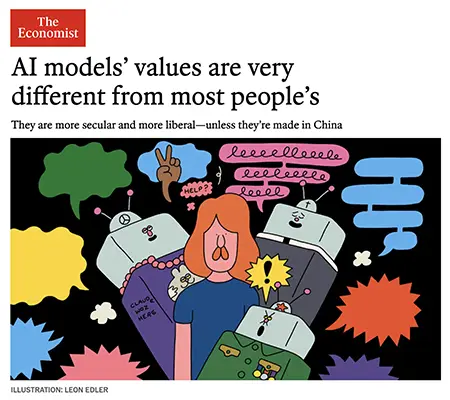
BRIEFING: AI MODELS’ VALUES ARE VERY DIFFERENT FROM MOST PEOPLE’S
THE ECONOMIST, JUNE 25, 2026
Vendor-neutrality note: This article includes Claude/Anthropic among the tested models, generally portraying Claude as more balanced (e.g., presenting both sides on contested questions, hedged answers on wealth/merit) relative to competitors. Noted for transparency since Claude is an Anthropic product; the comparison is Economist-run testing, not Anthropic-sourced.
TL;DR: The Economist tested 25 frontier AI models against a global values survey and found nearly all — regardless of maker — hold views far more secular, liberal, or ideologically constrained (in China’s case) than the general population of any country, raising real governance questions about whose values are being embedded at scale.
Executive Summary
Using the World Values Survey framework, Economist researchers found Western frontier models cluster in the “rich, secular, individualist” quadrant more extremely than any actual country’s population — GPT models test more secular than any nation on Earth; Gemini models place more weight on individual freedom than any surveyed population. Chinese models (DeepSeek, Qwen) instead reflect state-mandated positions on politically sensitive topics (Tibet, Taiwan, Tiananmen) — and researchers found direct evidence in DeepSeek’s internal reasoning traces of deliberate self-censorship instructions. Values also shift measurably by language: the more repressive a country’s media environment, the more pro-regime a model’s answers become when queried in that country’s language — even for Western-built models, since training data absorbs a language’s dominant political register.
This isn’t uniform ideology — Grok (xAI) is notably distinct from other Western models on selected questions (skeptical of gun control, more sympathetic to wealth being merit-based), suggesting deliberate post-training choices by individual labs, not an industry-wide default. Critically, the piece cites real experimental evidence that these embedded values are persuasive: users interacting with a politically-biased model measurably shifted toward that bias, especially when unaware of it. Most tested models leaned left on U.S. political framing when queried in English.
Relevance for Business
This matters operationally wherever AI outputs touch customer-facing content, HR guidance, content moderation, or decision support with any values dimension — model choice isn’t neutral, and the same prompt can yield materially different guidance depending on vendor, and even the language used. For SMBs serving global or politically diverse customer bases, this creates real reputational and consistency risk: an AI tool that’s fine for coding may embed unexpected framing when used for customer communications, HR policy drafting, or content review. This is also a vendor governance question, not just a technical one — the piece notes most Western labs don’t disclose their alignment methodology, so businesses are effectively trusting undisclosed value judgments at scale.
Calls to Action
🔹 Test Cautiously — Before deploying AI for any customer-facing or values-adjacent task (HR policy, moderation, advice content), test outputs against your own standards, not just capability benchmarks.
🔹 Prepare Policy— Establish internal review for AI-generated content touching politically or culturally sensitive topics, particularly if your business operates across multiple regions/languages.
🔹 Monitor — Watch for vendor disclosures (or lack thereof) on alignment/post-training methodology as a governance signal, not just a technical one.
🔹 Ignore for Now — No action needed for purely technical/coding use cases where values framing is largely irrelevant.
Summary by ReadAboutAI.com
https://www.economist.com/briefing/2026/06/25/ai-models-values-are-very-different-from-most-peoples: July 3, 2026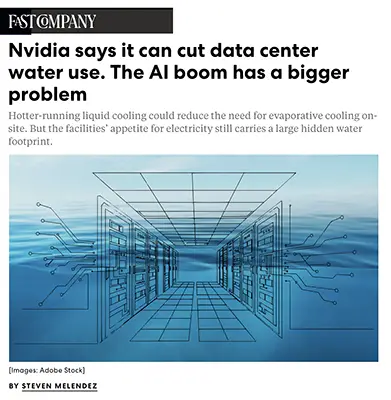
Nvidia’s New Cooling Tech Cuts On-Site Water Use — But Not AI’s Broader Resource Footprint
Fast Company, July 1, 2026
TL;DR: Nvidia’s hotter-running liquid cooling can reduce direct data center water consumption toward zero, but the electricity that powers those servers still carries a large indirect water cost that this technology doesn’t touch.
Executive Summary
Nvidia’s new Vera Rubin server platform runs coolant at higher temperatures (up to 131°F), which can eliminate the need for evaporative, on-site cooling in most U.S. climates — a genuine engineering advance, independently corroborated by outside academics quoted in the piece. However, experts caution this addresses only part of the problem: data centers still indirectly drive massive water use through power generation (an estimated 211 billion gallons in 2023 from electricity alone, per a DOE-sourced figure), and Nvidia’s own framing of the innovation as “transformative” should be read as company messaging, not an independent verdict. More efficient servers may also simply enable larger workloads, offsetting resource gains — a classic efficiency-rebound dynamic.
Relevance for Business
Water and power constraints are increasingly shaping where AI infrastructure gets built and how fast it scales — a factor that affects cloud and AI vendor costs, availability, and regulatory exposure over time. SMBs relying on cloud AI services aren’t directly affected today, but infrastructure bottlenecks upstream can eventually show up as pricing or capacity constraints.
Relevance for Business
For SMB leaders, this is mostly a monitoring item: it doesn’t change near-term vendor selection or cost structure, but it’s a useful data point for understanding why AI infrastructure buildouts face community and regulatory pushback in certain regions.
Calls to Action
🔹 Monitor: track whether local/regional AI datacenter siting disputes affect cloud vendor capacity or pricing in your region
🔹 No immediate action needed for AI tool procurement decisions
🔹 If your business is involved in commercial real estate, utilities, or municipal contracting, treat data center water/power demand as a developing due-diligence factor
🔹 Distinguish Nvidia’s self-reported efficiency claims from the independently confirmed indirect water footprint when discussing this topic internally
Summary by ReadAboutAI.com
https://www.fastcompany.com/91563944/nvidia-says-it-can-cut-data-center-water-use-the-ai-boom-has-a-bigger-problem: July 3, 2026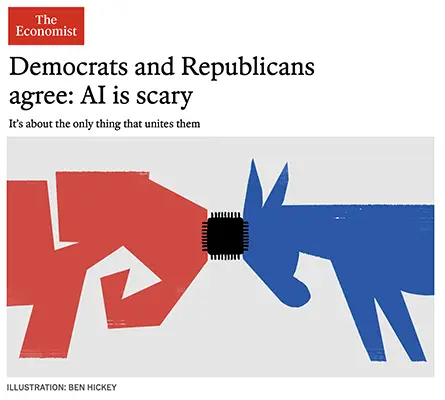
Democrats and Republicans Agree: AI Is Scary
The Economist, June 25, 2026
TL;DR: Bipartisan public anxiety about AI’s economic and social effects is intensifying faster than policy can respond, creating a volatile regulatory environment SMBs should watch heading into the midterms.
Executive Summary: Polling cited shows roughly three-quarters of Americans want more AI regulation, with Republicans nearly as supportive as Democrats — a rare point of bipartisan alignment. 65% believe AI will reduce U.S. jobs, and 45% express concern about AI-driven extinction risk. Americans report more pessimism about AI than people in 24 other countries surveyed. The piece traces a left-right convergence of concerns — progressives focused on job losses, wealth concentration, and data-center energy/land use; conservatives (citing Sen. Josh Hawley) focused on white-collar job displacement and social effects — while noting the AI industry itself is politically split, funding both pro- and anti-regulation campaigns in a recent contested New York congressional primary.
Federal policy is described as inconsistent: a permissive White House AI framework in March was followed within months by restrictions barring foreign access to top-tier U.S. models, which prompted Anthropic to close those models to all foreign users. Bipartisan common ground may exist around giving the public some financial stake in AI firms’ profits (proposals range from Bernie Sanders’ 50% equity confiscation to a vaguer Trump proposal), though the mechanism is undefined and contested. At least ten states have proposed data-center construction freezes.
Relevance for Business: Regulatory uncertainty at the federal level, combined with state-level data-center backlash and bipartisan appetite for new AI rules, means SMBs should expect a shifting compliance landscape over the next 12–18 months — particularly around AI disclosure requirements, data-center siting, and potential profit-sharing or taxation proposals. This is squarely a “watch the midterms” issue, not an immediate operational one.
Calls to Action:
🔹 Monitor — state-level AI regulation and data-center moratorium proposals, especially in states where your business operates
🔹 Monitor — federal AI policy signals ahead of the November midterms, given the current lack of a coherent platform from either party
🔹 Prepare Policy — if your business uses AI models with international components or dependencies, watch for further export-control shifts
🔹 Ignore for Now — no immediate compliance action required; this is a signal to track, not yet a mandate to act on
Summary by ReadAboutAI.com
https://www.economist.com/united-states/2026/06/25/democrats-and-republicans-agree-ai-is-scary: July 3, 2026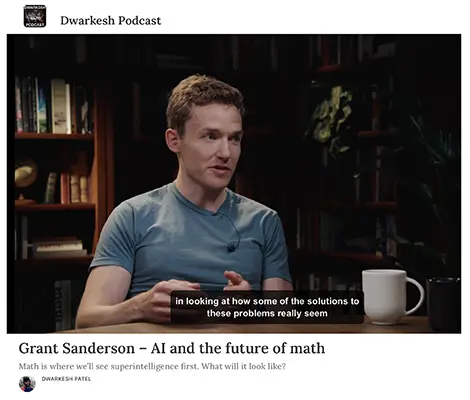
Grant Sanderson (3Blue1Brown) on AI and the Future of Math
Dwarkesh Podcast, June 30, 2026
TL;DR: Math is emerging as AI’s clearest leading indicator because it combines the two traits that actually drive automation — not just verifiability, but “grindability” (the ability to run massive parallel training attempts cheaply) — and that combination, more than raw model intelligence, explains why some white-collar domains will automate far faster than others.
Executive Summary
This is a speculative, expert-driven discussion (not a product announcement or news event), so treat its claims as informed forward-looking analysis rather than established fact. Sanderson, who is producing a documentary series on AI’s progress in mathematics, and podcast host Dwarkesh Patel work through why math has become AI’s fastest-moving frontier and what that implies for other fields.
The central framing: AI’s math progress isn’t just because problems are verifiable (you can check if an answer is right) — it’s because math and code are also “grindable,” meaning AI systems can run thousands of parallel training attempts cheaply and deterministically. Real-world business tasks, by contrast, resist this because outcomes depend on messy, non-repeatable conditions (you can’t “grind” a live sales negotiation the way you grind a math proof). This is offered as a partial explanation for why AI coding and math tools have advanced faster than AI agents for general business or computer-use tasks, and why progress in one domain doesn’t automatically transfer to others — a useful corrective to narratives that treat AI capability as one undifferentiated curve.
A second theme is where value shifts once AI can already solve problems: toward curation, framing, and knowing which questions are worth asking — described as mathematicians potentially becoming more like “museum curators” than problem-solvers. Both speakers argue AI is still notably weaker at open-ended judgment, reframing a person’s flawed approach, and writing that requires modeling what a specific reader doesn’t yet know — a distinct skill from summarization, which both agree AI already does well. Sanderson also relays a first-hand incident where an AI model confidently invented a nonexistent source when asked for a recommendation, offered as a live example of the hallucination risk executives should weight when using AI for research or citations.
Relevance for Business
This is exploratory, expert speculation about AI’s trajectory — not a market signal requiring action — but it offers a useful diagnostic lens for evaluating vendor claims and internal AI rollout plans:
- Vendor evaluation: When assessing AI tools for a task, the “verifiable + grindable” test is a practical filter — tasks with clear pass/fail criteria and low-cost retries (code review, data QA, structured research) are more mature than open-ended judgment tasks (strategy, negotiation, people management), regardless of vendor marketing.
- Hallucination/trust risk: The anecdote about a model fabricating a source is a concrete reminder to verify AI-generated citations, recommendations, and research claims before relying on them externally.
- Workforce/curation roles: If curation and judgment (deciding what’s worth pursuing) hold value longer than execution, this reinforces a “AI does the work, humans set direction and vet quality” operating model for teams adopting AI tools — relevant to how SMBs restructure workflows rather than headcount.
- Timing: No near-term product or market catalyst here; this is a directional signal about capability sequencing, useful for planning which functions to pilot AI in first.
Calls to Action
🔹 Monitor: Track whether the “verifiable + grindable” framework shows up in vendor roadmaps or capability claims — it’s a reasonable heuristic for judging which AI features are more mature versus overhyped.
🔹 Test Cautiously: If using AI for research, source-finding, or citations, build in a manual verification step given the demonstrated tendency to fabricate confident-sounding but false attributions.
🔹 Prepare Policy: Consider internal guidance distinguishing AI use for well-defined, checkable tasks (drafting, summarizing, code review) versus judgment-heavy tasks (strategic framing, personnel decisions) where current tools are weaker.
🔹 Ignore for Now: No immediate operational or purchasing action is implied by this discussion — it’s a conceptual/strategic read, not a product or market development.
Summary by ReadAboutAI.com
https://www.dwarkesh.com/p/grant-sanderson-2: July 3, 2026
AI Inflation Is Screwing With the Rest of the Economy
Intelligencer, June 29, 2026
TL;DR: AI data-center demand is diverting global memory-chip manufacturing capacity, and the resulting component shortage is now pushing up prices across laptops, phones, game consoles, appliances, and eventually cars.
Executive Summary: Apple raised prices across its laptop, tablet, and accessory lines, citing an unprecedented spike in memory and storage component costs. This follows a pattern already visible in gaming hardware — PlayStation 5, Xbox, Nintendo Switch, and Valve devices have all seen price increases or supply shortages — and in PC components generally. The root cause is that a small number of memory manufacturers have redirected production capacity toward AI infrastructure, squeezing supply for consumer electronics.
The author draws a direct parallel to the 2021 COVID chip shortage, but notes the underlying cause here is less publicly sympathetic — a corporate AI buildout rather than a pandemic disruption. Expected next-wave impacts include low-margin electronics (TVs, speakers), automobiles (which increasingly depend on chip-heavy infotainment and driver-assist systems), smart appliances, and — more consequentially — medical devices and telecom/defense equipment, which compete poorly for constrained manufacturing capacity against higher-margin AI hardware. Most analysts don’t expect relief before late 2027. The piece also connects this cost pressure to broader public anxiety about AI’s economic effects, citing commentary that job-loss fear is compounded by rising living costs in the same period.
Relevance for Business: This is a direct, near-term cost signal for any SMB purchasing computers, phones, or other electronics for operations — expect continued price increases and potential supply delays through at least 2027. Businesses with exposure to medical devices, telecom equipment, or embedded/IoT hardware should watch component costs and lead times more closely, as this is flagged as a likely next pressure point.
Calls to Action:
🔹 Act Now — if planning bulk hardware purchases (laptops, phones, tablets) for 2026–2027, consider accelerating procurement ahead of further price increases
🔹 Monitor — component and device pricing trends if your business relies on specialized hardware (medical, telecom, embedded systems)
🔹 Test Cautiously — build longer lead times into hardware refresh cycles and budget forecasts
🔹 Revisit Later — reassess supply conditions in early 2027, the earliest analysts expect relief
Summary by ReadAboutAI.com
https://nymag.com/intelligencer/article/ai-inflation-is-screwing-with-the-rest-of-the-economy.html: July 3, 2026
CLAUDE SCIENCE IS ANTHROPIC’S NEWEST FLAGSHIP PRODUCT
MIT TECHNOLOGY REVIEW, GRACE HUCKINS, JUNE 30, 2026
Vendor-neutrality note: This article covers a product from Anthropic, Claude’s developer. The summary below treats Anthropic’s announcement as a claim to evaluate, separates company framing from independently verified fact, and applies the same scrutiny used for any vendor announcement.
TL;DR: Anthropic launched Claude Science, an autonomous research-assistant product aimed at computational biology and drug development — a strategic bet to capture pharma revenue and compete with Google DeepMind’s decade-long lead in AI-for-science.
Executive Summary
Anthropic elevated Claude Science to flagship status alongside Claude Code and Claude Cowork, positioning it to autonomously execute research tasks (running code on compute clusters, tracing result provenance for reproducibility) rather than just answer questions. It’s available to all paid Claude subscribers. Anthropic is also using the tool for its own drug-discovery research into neglected diseases — both a credibility play and a way to demonstrate real-world performance.
Independent context worth separating from Anthropic’s framing: DeepMind has led AI-for-science for a decade (AlphaFold, a Nobel Prize) but has reportedly fallen behind on coding, the most commercially lucrative LLM use case — and DeepMind researcher John Jumper’s move to Anthropic this month is a notable signal, though it’s one departure, not proof of a broader talent shift. The article’s claim that Anthropic’s Opus 4.5 performs “about as capable… as a second-year graduate student” comes from a single physicist’s blog post commissioned by Anthropic itself — this is company-adjacent framing, not independently verified benchmark data, and should be read accordingly. The article also flags a commercial motive plainly: pharma companies have deeper pockets than academic labs, and this launch arrives as Anthropic nears profitability and an anticipated IPO later this year.
Relevance for Business
Most directly relevant to SMB leaders in biotech, pharma-adjacent, or life-sciences-facing businesses — Claude Science could lower the technical barrier for scientists without deep software engineering skills. For general SMB audiences, the more useful signal is competitive dynamics among major AI vendors: DeepMind’s relative slowdown and Anthropic’s aggressive vertical expansion (Code → Cowork → Science) suggest the leading labs are diversifying into high-value, defensible niches rather than competing purely on general chat capability — worth watching as a proxy for where AI vendor investment and pricing power will concentrate.
Calls to Action
🔹 Monitor — If in life sciences, biotech, or pharma-adjacent work, track Claude Science’s real-world performance reports over the next 2–3 quarters before evaluating.
🔹 Ignore for Now — Non-life-sciences SMBs have no near-term action item here.
🔹 Test Cautiously — Treat “graduate-student-level” capability claims as vendor-commissioned framing, not independently verified benchmarks, until third-party evaluation emerges.
🔹 Revisit Later— Reassess after Anthropic’s anticipated IPO and any pharma contract announcements, which will clarify whether this is a durable product line or a pre-IPO growth narrative.
Summary by ReadAboutAI.com
https://www.technologyreview.com/2026/06/30/1139987/claude-science-is-anthropics-newest-flagship-product/: July 3, 2026
DRUM TOWER: WHO IS BEHIND CHINA’S LATEST AI BREAKTHROUGH?
THE ECONOMIST, JUNE 26, 2026
Vendor-neutrality note: This article references Anthropic’s Mythos model as a capability benchmark and covers Anthropic’s distillation allegations against Alibaba. Both are reported factually; noted here for transparency since Claude is an Anthropic product.
TL;DR: Chinese AI lab Zhipu’s new GLM 5.2 model is closing the capability gap with top U.S. labs for the first time — but it’s also more expensive, signaling that Chinese AI may no longer be a reliable “cheap alternative” strategy.
Executive Summary
Zhipu (also known as Z.ai), a Tsinghua University spinout, released GLM 5.2 on June 13th — the first Chinese open-weight model researchers say can “seriously challenge” American frontier systems, particularly in extended coding tasks. This breaks the prior pattern where Chinese models were reliably cheaper but consistently behind. GLM 5.2 is now both more capable and more expensive than local rivals and some Western ones.
Two structural dynamics are worth separating from the optimism: first, Zhipu’s own researchers concede China’s progress still depends on American labs pushing the frontier first — Chinese teams learn partly by observing costlier U.S. experimentation they can’t yet afford to replicate at the same scale. Second, Anthropic has renewed allegations (this time against Alibaba) that Chinese firms are illicitly “distilling” its models — a recurring point of friction that raises real IP and export-control questions rather than settled fact. Zhipu also continues publicly releasing model weights, which U.S. officials view as a proliferation risk; Zhipu frames it instead as enabling outside scrutiny of the model’s behavior — a genuine policy disagreement, not a resolved one.
Relevance for Business
For SMB leaders evaluating AI vendors, the operating assumption that “Chinese models = cheap but behind” is now less reliable. If frontier Chinese models are converging on capability while becoming pricier, the cost/performance calculus that has driven interest in Chinese open-weight models (see also Article 10 below) may shift over the next 12–18 months. This also reinforces a geopolitical dependency risk: China’s AI trajectory currently still tracks U.S. lab progress, meaning export-control decisions and IP disputes (distillation allegations, chip restrictions) remain a live variable in vendor planning, not background noise.
Calls to Action
🔹 Monitor — Track GLM and other Chinese frontier model releases for signs the cost advantage is eroding as capability rises.
🔹 Prepare Policy — If using or considering open-weight Chinese models, factor in unresolved IP/distillation disputes as a business-risk variable, not just a technical one.
🔹 Ignore for Now — No immediate vendor-switching action needed based on this alone.
🔹 Revisit Later — Reassess Chinese model competitiveness in 6 months once GLM 5.2 pricing and adoption data mature.
Summary by ReadAboutAI.com
https://www.economist.com/china/2026/06/26/drum-tower-newsletter-who-is-behind-chinas-latest-ai-breakthrough: July 3, 2026
OpenAI Proposes 5% Government Stake Amid Mounting Washington Pressure
CNBC, July 2, 2026
TL;DR: OpenAI has floated giving the U.S. government a 5% equity stake — worth roughly $42.6 billion — in a bid to ease political pressure over AI safety and security, part of a broader proposal that would extend to Anthropic, Google, and Meta as well.
Executive Summary
According to Financial Times reporting cited by CNBC, OpenAI CEO Sam Altman has proposed a framework in which the U.S. government would hold roughly 5% stakes in leading AI developers via a sovereign wealth fund vehicle — an extension of talks Altman has pursued with the Trump administration since early 2025. This is an OpenAI-originated proposal, not a government mandate or a finalized deal; none of the named companies (Anthropic, Google, Meta) have confirmed agreement, and all declined to comment. The context matters: political pressure on AI firms is rising over cybersecurity concerns and competition from cheaper Chinese open-source models. The article separately notes that Anthropic’s Mythos and Fable models were briefly disabled last month under a U.S. export control directive and access was restored this week after Anthropic addressed policymaker safety concerns — factual regulatory history, not related to the equity-stake proposal itself. The Trump administration has taken similar equity positions before (Intel, 10% stake for $8.9B investment), lending some precedent to the concept, though scale and structure here remain undefined.
Relevance for Business
This is a governance and geopolitical risk signal for any SMB dependent on frontier AI vendors. Government equity stakes in AI developers — if formalized — could introduce new dynamics around vendor stability, regulatory scrutiny, and potentially preferential treatment or obligations tied to national interest. It’s speculative at this stage, but worth tracking given how quickly the regulatory environment for frontier AI has been shifting (export controls, safety reviews).
Calls to Action
🔹 Monitor: this is a proposal under discussion, not policy — no immediate vendor risk requires action
🔹 Track how Anthropic, Google, and Meta respond, since a coordinated multi-vendor arrangement would be a more significant structural shift than a single-company deal
🔹 For businesses with AI vendor concentration risk, use this as a prompt to review contingency plans should regulatory conditions affect model access (as briefly occurred with Anthropic’s export control pause)
🔹 Avoid over-interpreting this as settled policy — treat as a live negotiation with uncertain outcome
Summary by ReadAboutAI.com
https://www.cnbc.com/2026/07/02/openai-proposes-us-government-own-5percent-stake-to-address-political-blowback.html: July 3, 2026
AI Features Multiply Across Google, Microsoft, and Apple — And So Do the Opt-Outs
Fast Company, July 1, 2026
TL;DR: AI is now a default-on setting across every major consumer platform, and opting out has become a multi-step technical exercise rather than a toggle.
Executive Summary Fast Company published a practical guide to disabling AI features across Google Search, Chrome, Gmail, Microsoft 365, Windows, and iOS — a sign that AI-by-default has become the industry norm, not an opt-in enhancement. The workarounds range from simple settings toggles to editing hidden browser flags, and in several cases (Gmail’s “smart features,” Windows Copilot) disabling AI also disables unrelated functionality, forcing users into an all-or-nothing trade-off.
Relevance for Business This is an Industry Watch item — AI is peripheral to the core story, which is about user control and interface design. Still, it’s a useful signal: if employees or customers are frustrated by unrequested AI features, the friction is real and increasingly requires IT-level intervention rather than a simple settings change. For SMBs standardizing on Google Workspace or Microsoft 365, disabling AI features org-wide is neither trivial nor fully independent from other functionality.
Calls to Action
🔹 No action required — this is background context, not a business-critical development
🔹 If employees have raised concerns about AI features appearing in core tools (search, email, Office), this article is a useful reference for IT
🔹 Monitor whether vendors continue bundling AI opt-outs with unrelated feature removal, as this raises governance/consent questions
🔹 Deprioritize for most SMB leaders; relevant mainly to IT admins managing tool configuration
Summary by ReadAboutAI.com
https://www.fastcompany.com/91566861/how-to-avoid-ai-in-as-many-places-as-possible: July 3, 2026
Google Deepens Its Financial-Data Foothold With FactSet Agent Deal
Investor’s Business Daily/WSJ, updated June 30, 2026
TL;DR: Google is embedding Gemini and Search deeper into FactSet’s investment platform via a new “agentic” partnership — the latest in a string of AI integrations into core financial infrastructure, following a similar OpenAI-FactSet deal in April.
Executive Summary
Google and FactSet announced a “strategic partnership” to embed Gemini and Google Search into the FactSet Workstation, with FactSet-powered agents also feeding into Google’s enterprise Gemini offering. Both companies used vague, promotional language — “agentic experiences,” “improve efficiency, execution, and decision-making” — without disclosing specific product capabilities, technical details, or deal terms; Google declined to share terms when asked directly by the outlet. This should be read primarily as a partnership announcement and market-positioning move, not evidence of a working, differentiated product. Notably, this is Google’s second major AI push into financial infrastructure this year and directly follows OpenAI’s own FactSet integration (announced April, launched in Excel in May) — indicating competitive land-grab dynamics among AI vendors for embedded positions in financial workflows rather than a unique capability advantage for either side.
Relevance for Business
For SMBs using FactSet or similar platforms, this signals that AI agents are becoming embedded infrastructure in financial data tools whether or not customers requested them — echoing the broader “AI by default” pattern seen elsewhere in this batch. The lack of technical specificity in both companies’ statements is itself a signal: treat vendor “agentic” claims as roadmap language until proven in practice.
Calls to Action
🔹 Monitor: request specifics from FactSet/Google on what “agentic” features are actually available versus roadmap items before adjusting workflows
🔹 If comparing FactSet’s Google integration to its OpenAI/Excel integration, ask for a direct capability comparison rather than accepting either vendor’s framing
🔹 No urgent action needed — this is infrastructure positioning, not a new capability requiring immediate evaluation
🔹 Flag vendor language (“agentic,” “efficiency,” “decision-making”) as promotional until independently verified by users or analysts
Summary by ReadAboutAI.com
https://www.wsj.com/wsjplus/dashboard/articles/factset-welcomes-googles-agents-deeper-within-its-gates-134273097728130229: July 3, 2026
Chinese AI Models Are Closing the Cybersecurity Gap — Wall Street Reads It as a Buy Signal for Security Vendors
Barron’s/WSJ, updated June 30, 2026
TL;DR: As Chinese AI models approach parity with U.S. systems in finding security vulnerabilities, J.P. Morgan analysts expect a surge in exploit activity — and are betting on cybersecurity vendors, not AI companies, to capture the upside.
Executive Summary
J.P. Morgan analyst Brian Essex argues that Chinese AI’s growing vulnerability-detection capability is a double-edged development: it accelerates the pace at which security flaws are discovered and exploited, but that same “tsunami of vulnerabilities” creates demand for the vendors who help enterprises manage exposure. Essex maintains Overweight ratings on CrowdStrike and Palo Alto Networks (both up sharply, aided by investor confidence from their security partnerships with Anthropic) and initiated more bullish views on smaller players Tenable and Qualys. This is analyst framing and stock-specific commentary, not independently verified technical benchmarking — the underlying claim about Zhipu AI’s capabilities traces back to separate WSJ reporting cited secondhand.
Relevance for Business
This is a capital markets and risk-management signal, not a product announcement. The core takeaway for SMB leaders isn’t the stock calls — it’s the underlying premise: AI-assisted vulnerability discovery is accelerating on both offense and defense, meaning patch cycles and exposure management matter more, not less, as this capability spreads. Vendor dependence on a small set of AI-enhanced security platforms is also worth tracking.
Calls to Action
🔹 Monitor: treat “AI is accelerating vulnerability discovery” as a operational signal to prioritize patching cadence and exposure management, independent of any stock view
🔹 Do not treat analyst stock ratings as a business planning input — this is investment commentary, not vendor guidance
🔹 If evaluating cybersecurity vendors, ask directly how they’re incorporating AI-based vulnerability detection into their tooling
🔹 Flag: Anthropic’s partnership with CrowdStrike/Palo Alto is mentioned as a factor in investor confidence — note as vendor-adjacent context, not independent validation of product efficacy
Summary by ReadAboutAI.com
https://www.wsj.com/wsjplus/dashboard/articles/ai-china-crowdstrike-palo-alto-stock-cybersecurity-5b55b270: July 3, 2026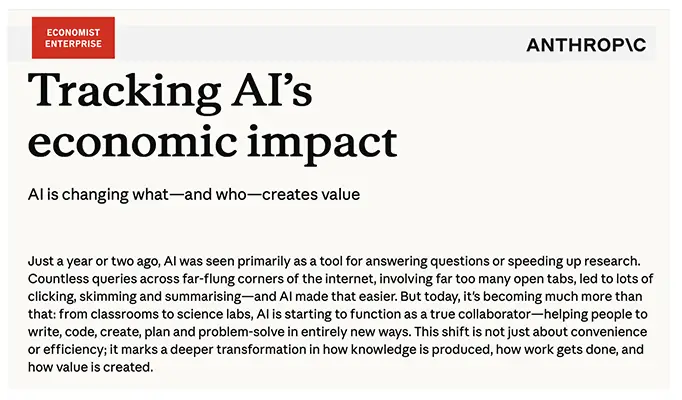
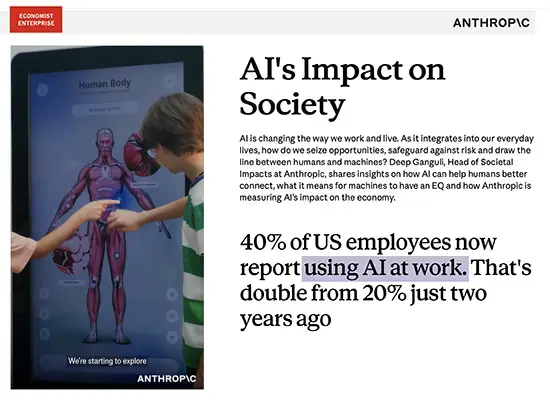
[SPONSORED CONTENT] TRACKING AI’S ECONOMIC IMPACT
ECONOMIST ENTERPRISE, ADVERTISEMENT FEATURE, UNDATED (Accessed June 30, 2026)
Important editorial flag: This piece is explicitly labeled “Advertisement feature” by The Economist and is sponsored/produced content built entirely around Anthropic’s own Economic Index and quotes from two Anthropic executives (Sarah Heck, Peter McCrory). It is not independent Economist journalism. Given Claude is an Anthropic product, we’re applying extra scrutiny: treating all figures and framing below as Anthropic’s self-reported claims, not third-party-verified findings.
TL;DR: Anthropic’s self-published Economic Index shows AI adoption is concentrated in wealthier economies and correlates with regional economic specialization — a real and useful dataset, but one entirely self-reported and self-interpreted by the company that built it.
Executive Summary
The Anthropic Economic Index tracks Claude usage patterns across 150+ countries and U.S. states, mapped to labor taxonomies, to show how and where AI is being adopted. Anthropic’s own data indicates: higher-income countries (Singapore, Canada) show disproportionately high per-capita usage; usage patterns track regional economic specialization (Utah’s tech-heavy “Silicon Slopes” shows outsized computing/math usage; Washington, DC skews toward career support and document editing); and for every 1% rise in GDP per capita, AI use rises roughly 0.7%, per Anthropic’s report — a correlation the company itself flags as a risk of “divergence in outcomes” between wealthy and poor economies. Anthropic also reports that “directive use” (assigning tasks to Claude and awaiting results, rather than collaborating step-by-step) rose from 27% to 39% of usage in eight months.
What to treat as claim rather than fact: the methodology, the underlying data, and the interpretive framing (e.g., that AI adoption “could reinforce or reshape” wealth, that this will become a “2026 agenda item”) all come from Anthropic itself, with no independent verification cited in this piece. The Index is described as open-source and publicly available, which is a meaningful transparency signal — but the specific figures and narrative here are Anthropic’s own presentation of its own data, published as paid content.
Relevance for Business
If accurate, the underlying pattern — that AI adoption clusters by wealth and existing economic specialization — has real strategic relevance: it suggests regional/sectoral AI adoption gaps are likely to widen before they narrow, which matters for competitive positioning if your business or customer base sits in a lower-adoption region or industry. The rise in “directive” (delegate-and-wait) usage also signals a broader shift toward AI handling complete tasks rather than assisting incrementally — worth watching as an indicator of what “AI-native” competitors may be capable of. That said, this is a vendor’s marketing narrative about its own product’s societal footprint — treat the framing, not just the figures, with appropriate skepticism.
Calls to Action
🔹 Monitor — Watch for independent (non-Anthropic) research validating or challenging the adoption-inequality pattern described here.
🔹 Ignore for Now — Don’t treat this piece’s policy predictions (e.g., “2026/2028 campaign issue”) as forecasts to plan around.
🔹 Test Cautiously — If your industry or region matches a low-adoption profile per this data, use it as a prompt to investigate competitive AI usage directly, not as a settled conclusion.
🔹 Prepare Policy — None warranted from this source alone; revisit if corroborated by independent economic research.
Summary by ReadAboutAI.com
https://insights.economistenterprise.com/technology-innovation/the-impact-of-ai/tracking-ais-economic-impact: July 3, 2026https://insights.economistenterprise.com/technology-innovation/the-impact-of-ai/ais-impact-on-society: July 3, 2026

Why Apple Wants to Use Banned Chinese Memory Chips
Investor’s Business Daily, updated June 29, 2026
TL;DR: Apple is lobbying Washington to buy memory chips from a blacklisted Chinese supplier to offset margin pressure from AI-driven memory price spikes — a preview of the kind of export-control/cost tradeoffs likely to recur across the AI hardware supply chain.
Executive Summary
Apple raised prices 17–25% on select Macs and iPads (though not iPhones) citing rising memory costs, and analysts flagged those hikes may not fully offset the underlying cost increase, creating margin risk heading into iPhone 18 pricing decisions. Separately reported by the Financial Times: Apple has been lobbying the Commerce Department and other officials for over a month to gain approval to buy memory chips from China’s CXMT — a firm the Pentagon has blacklisted over alleged ties to the People’s Liberation Army.
This is a direct tension between cost management and national-security policy: Apple is trying to diversify away from Micron, Samsung, and SK Hynix pricing power, while Washington has specific security concerns about the supplier in question. One analyst called relaxed barriers a “win-win” for consumers and industry; that’s a bullish sell-side opinion, not a neutral assessment, and doesn’t address the security rationale for the original blacklisting. The reporting doesn’t indicate the lobbying has succeeded — it’s characterized as facing stiff political opposition.
Relevance for Business
Memory chip price increases are a downstream effect of AI infrastructure demand — the same dynamic driving data center buildouts is squeezing consumer device margins. For SMBs, this signals continued upward pressure on hardware costs (devices, servers, anything memory-dependent) through at least the near term, and it’s an early example of the broader pattern where AI-driven component demand collides with export-control politics. Any SMB with hardware refresh cycles or device-dependent operations should expect this cost pressure to persist independent of whether Apple’s specific lobbying succeeds.
Calls to Action
🔹 Monitor: Track memory chip pricing trends broadly — this pressure isn’t Apple-specific and will affect other hardware purchases (laptops, servers, phones).
🔹 Prepare Policy: If budgeting for hardware refreshes in the next 1–2 quarters, factor in continued price volatility tied to AI-driven memory demand.
🔹 Ignore for Now: The specific CXMT lobbying outcome is not yet resolved and unlikely to directly affect SMB purchasing in the near term regardless of outcome.
🔹 Revisit Later: Watch whether the Commerce Department decision (and its precedent for AI-adjacent hardware export controls) sets a pattern relevant to other chip categories your business depends on.
Summary by ReadAboutAI.com
https://www.wsj.com/wsjplus/dashboard/articles/why-apple-wants-to-use-banned-chinese-memory-chips-134272387312777290: July 3, 2026
ALPHABET’S $2 TRILLION GAIN TURNS ‘ROCK STAR’ INTO QUESTION MARK
BLOOMBERG, RYAN VLASTELICA & RAINIER HARRIS, JULY 1, 2026
TL;DR: Alphabet’s stock has doubled in a year on AI strength, but a 6% June drop and a rotation toward chipmakers show investors are growing wary of heavy AI capex spending — even from a company with strong fundamentals.
Executive Summary
Alphabet’s market cap has grown by roughly $2 trillion over 12 months, making it the world’s second most valuable company, driven by confidence in its Gemini model and chip business. But the stock has struggled recently — down in four of the last five months — as investors rotate away from big AI spenders (Alphabet, Microsoft, Meta) toward chip and infrastructure suppliers capturing that spending more directly. A $85 billion equity raise to fund capex and high-profile AI researcher departures added pressure. This mirrors the broader capex-vs-returns skepticism flagged in the BIS report above — the market is questioning whether spending scale translates to near-term earnings.
Analyst opinion is split but leans constructive: Morgan Stanley raised its price target, citing improving fundamentals and cash-flow visibility into 2027–28, framing the pullback as a buying opportunity rather than a red flag. Still, free cash flow is projected to fall sharply (from over $73B in 2025 to roughly $14–20B in 2026–27) as capex intensifies — a real trade-off, not just sentiment.
Note on Anthropic mention: The article notes Alphabet is a strategic investor in Anthropic (Claude’s maker) and describes Anthropic as a competitor Alphabet is trying to catch up to on AI coding tools. Flagging for balance: this is standard market reporting, not promotional — included here for transparency given Claude is an Anthropic product.
Relevance for Business
For SMB leaders using or evaluating Google’s AI stack (Gemini, Cloud AI tools), this signals near-term investment intensity, not instability — Alphabet remains well-capitalized and analyst sentiment is broadly positive on fundamentals. The larger takeaway is a market-wide pattern: capital is rotating toward AI infrastructure/chip suppliers and away from the largest AI application spenders, which may affect pricing, roadmap prioritization, and product stability across major AI vendors (not just Google) over the next 12–18 months.
Calls to Action
🔹 Monitor — Watch capex-vs-cash-flow trends across your core AI vendors (Google, Microsoft, Meta, Anthropic) as an early signal of pricing or roadmap shifts.
🔹 Ignore for Now — Stock volatility alone shouldn’t change vendor selection; Alphabet’s core AI products remain well-funded.
🔹 Test Cautiously — If evaluating Gemini-based tools, proceed on current merits rather than short-term market sentiment.
🔹 Revisit Later — Reassess vendor stability signals if free-cash-flow declines materialize as projected in 2027.
Summary by ReadAboutAI.com
https://www.bloomberg.com/news/articles/2026-07-01/alphabet-s-2-trillion-gain-turns-rock-star-into-question-mark: July 3, 2026
HOW AN AI BUST COULD RIPPLE THROUGH THE GLOBAL ECONOMY
WSJ AI & BUSINESS, ASA FITCH, JUNE 30, 2026
TL;DR: The Bank for International Settlements — an institution with a credible track record calling the 2008 crisis — warns that an AI investment bust could spread through overleveraged infrastructure spending, exposed retail investors, and stretched government balance sheets.
Executive Summary The BIS’s annual report (covered here secondhand by the WSJ) argues an AI bust wouldn’t be contained to tech stocks. The transmission mechanism: heavy AI infrastructure capex is increasingly debt-funded; if returns disappoint and spending slows, thinly capitalized construction and supply-chain contractors get hit fast. Compounding factors include unusually high U.S. household equity exposure, the outsized weight U.S. tech now holds in global indexes, and limited government fiscal room to respond, given existing budget strain and inflation pressure tied partly to the ongoing Iran war.
The article is careful to note the BIS has been right before (a prescient 2006 warning on subprime securitization) but also that the timing and severity of any AI-related correction remain genuinely uncertain — this is a risk report, not a forecast of an imminent event. The companion items — South Korea’s $520 billion memory-plant investment and strong memory producer profits — illustrate the flip side: real, current revenue flowing to chip/memory suppliers even as capex-heavy AI spenders face investor skepticism (a dynamic that also shows up in today’s Alphabet story below).
Relevance for Business This is a macro risk signal, not a call to change AI strategy today. But SMB leaders relying on AI vendors backed by heavy infrastructure debt, or whose own capital plans assume continued cheap AI-compute pricing, should treat this as a reason to stress-test vendor stability and pricing assumptions rather than assume the current AI cost curve is permanent. The systemic framing (household exposure, index concentration, limited fiscal buffers) also suggests a bust, if it happens, could arrive with broader economic drag — affecting customer demand, credit availability, and hiring conditions well beyond the tech sector.
Calls to Action
🔹 Monitor — Track BIS/central bank commentary and AI infrastructure financing news as a leading indicator, not a lagging one.
🔹 Prepare Policy — Build contingency assumptions for AI vendor pricing/service continuity into procurement decisions, not just cost.
🔹 Act Now — If your business has meaningful equity exposure tied to AI-sector concentration, review diversification with your financial advisor.
🔹 Ignore for Now — No need to alter core AI adoption plans based solely on this report; it’s a systemic risk flag, not a near-term prediction.
Summary by ReadAboutAI.com
https://www.wsj.com/tech/ai/how-an-ai-bust-could-ripple-through-the-global-economy-40163f9c: July 3, 2026
INDUSTRY WATCH: APPLE ACCUSES INDIA OF “COPY-PASTING” RIVALS’ CLAIMS IN ANTITRUST PROBE
REUTERS, ADITYA KALRA, JUNE 29, 2026
TL;DR: Not core AI news — Apple is escalating its fight with India’s antitrust regulator over App Store rules, arguing investigators plagiarized rivals’ complaints; relevant mainly as context on how aggressively major platform regulators (including on AI-adjacent digital markets) are willing to act against Big Tech.
Executive Summary Apple submitted papers to India’s Competition Commission (CCI) alleging investigators “copy-pasted” claims from rivals (Match, PhonePe, Paytm) rather than conducting independent analysis, and reused a graphic from an unrelated EU ruling. Apple wants the findings quashed and argues it’s a minor player in India’s smartphone market (under 6% share). The CCI previously found Apple engaged in abusive App Store conduct. A closed-door hearing is set for July 21.
This is a procedural, platform-antitrust story with no direct AI content — it’s about app-store payment rules, not AI models or infrastructure.
Relevance for Business Minimal direct relevance for AI strategy. Included as background on regulatory posture toward dominant platforms in major markets, which is a useful signal for any SMB relying on app-store distribution or watching how governments (India in particular) treat large tech incumbents — a dynamic that could extend to AI platform regulation over time.
Calls to Action 🔹 Ignore for Now — No action needed; not an AI-specific development.
Summary by ReadAboutAI.com
https://www.reuters.com/business/media-telecom/apple-accuses-india-copy-pasting-rivals-claims-antitrust-investigation-2026-06-29/: July 3, 2026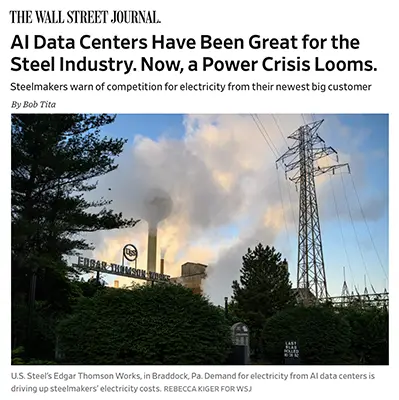
AI Data Centers Have Been Great for the Steel Industry. Now, a Power Crisis Looms.
The Wall Street Journal, June 29, 2026
TL;DR: The AI buildout that’s been a windfall for steelmakers is now competing with them for the same scarce resource — electricity — and steel executives are warning of production risk and price increases.
Executive Summary: Steelmakers have benefited from AI data-center construction, which consumes roughly $1.4 billion worth of steel annually. But the relationship is turning adversarial: data centers’ power demand is driving up electricity costs for steel producers by tens of millions of dollars a year, according to the Steel Manufacturers Association. One company, Metallus, reported electricity costs up about 70% since 2024. The shared grid operator, PJM Interconnection, projects demand will outpace supply by 6.6 gigawatts starting in 2027 — equivalent to six or seven nuclear plants — and wholesale power costs in its territory were up 76% year-over-year in Q1.
The structural risk for steelmakers is twofold: rising input costs they can’t easily pass to customers (steel supply contracts are pegged to market prices, not cost-plus), and the possibility that utilities prioritize uninterruptible data-center load over steel mills during shortages, forcing production outages. The industry is lobbying for emergency policy relief — delaying power-plant retirements and streamlining permitting, which currently averages 4.5 years.
Relevance for Business: This is an early, concrete case study of AI infrastructure creating cross-industry cost and supply externalities — not through direct competition, but through shared physical constraints (grid capacity). Any SMB with exposure to industrial inputs, manufacturing, or energy-intensive operations should expect this dynamic to recur across other sectors sharing grid capacity with data centers.
Calls to Action:
🔹 Monitor — regional electricity pricing trends if your business operates in or sources from PJM territory or other data-center-dense grid regions
🔹 Monitor — the September PJM supplemental power auction as a leading indicator of near-term industrial electricity costs
🔹 Prepare Policy — review supply contracts with steel or other electricity-intensive input providers for cost-pass-through exposure
🔹 Ignore for Now — no direct action needed unless your business has material exposure to steel, grid-adjacent manufacturing, or PJM-region operations
Summary by ReadAboutAI.com
https://www.wsj.com/wsjplus/dashboard/articles/ai-data-centers-power-competition-steel-48a17dbd: July 3, 2026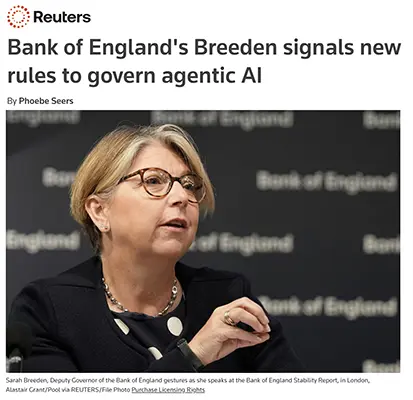
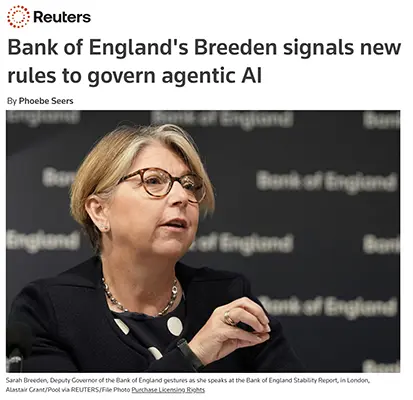
Bank of England’s Breeden Signals New Rules to Govern Agentic AI
Reuters, June 30, 2026
TL;DR: The BoE is reversing its prior stance that existing rules were sufficient, now considering purpose-built agentic-AI regulation including market-wide “kill switches” — a signal that autonomous AI in finance is moving from experimental to systemically significant.
Executive Summary
Deputy Governor Sarah Breeden told the ECB Forum that current regulatory frameworks weren’t designed for autonomous agents, and that requiring a human in the loop for every agent action “is unlikely to be realistic.” This marks a notable reversal: the BoE had previously maintained existing frameworks were adequate. Measures now under consideration include “enhanced recovery” protocols letting one bank take over another’s core functions during disruption, plus circuit breakers or kill switches to halt market-wide trading if faulty AI models trigger instability.
The concern is correlated failure: if many firms’ AI agents respond similarly to the same market triggers, they could amplify volatility in stress, particularly if agent objectives drift from their original goals. A Cambridge Centre for Alternative Finance survey cited in the piece found 52% of finance firms already use agentic AI, mostly for lower-risk operational tasks and product recommendation rather than high-stakes trading — but Breeden flagged that risk profile could shift quickly. The article also links this to prior industry commentary that Anthropic’s Mythos model introduces cybersecurity considerations for banking — that’s an analyst characterization referenced in passing, not a finding of this piece, so we’re not treating it as independently verified here. (Note: Anthropic is Claude’s developer; flagging for transparency, not because the article frames Anthropic favorably — it appears here in a risk-adjacent context.)
Relevance for Business
For most SMBs this is upstream — a systemic-risk story about financial infrastructure — but it’s an early signal of where agentic AI governance is headed generally: regulators moving from “wait and see” to bespoke rules once autonomous systems reach adoption thresholds (here, 52% in finance). Any SMB using or building agentic AI tools — especially anything touching payments, trading, or automated decision-making — should expect similar regulatory scrutiny to eventually extend beyond finance.
Calls to Action
🔹 Monitor: Track whether the BoE’s approach (kill switches, enhanced recovery) becomes a template other regulators (SEC, EU) adopt for agentic AI outside finance.
🔹 Prepare Policy: If your business deploys any agentic/autonomous AI system with real-world triggers, begin documenting human-oversight and fallback procedures now, ahead of likely future compliance requirements.
🔹 Act Now: If you operate in financial services or fintech, review current agentic AI usage against emerging BoE guidance directly.
🔹 Ignore for Now: The kill-switch and “enhanced recovery” bank-takeover mechanisms are financial-system-specific and not directly applicable to non-financial SMBs.
Summary by ReadAboutAI.com
https://www.reuters.com/world/agentic-ai-may-require-regulatory-reform-boes-breeden-says-2026-06-30/: July 3, 2026
HHS Consolidates Its AI Strategy Around Governance and Collaboration — With Real Authority Still Pending
TechTarget/Healthtech Analytics, June 30, 2026
TL;DR: The Department of Health and Human Services (HHS) is coordinating multiple agency-level AI initiatives around shared themes of governance and collaboration, but concrete regulatory clarity — especially from the Food and Drug Administration (FDA) — remains a work in progress.
Executive Summary
Following a public comment period that drew over 7,300 responses, HHS leadership outlined a more coordinated approach to clinical AI adoption across its component agencies. The most ambitious initiative comes from the Advanced Research Projects Agency for Health (ARPA-H), HHS’s biomedical innovation arm: its ADVOCATE program aims to build an FDA-approved autonomous AI agent capable of handling cardiovascular patient care by phone — eventually including triage, prescribing, and diagnosis, functions well beyond current administrative-AI use cases. This is a funded research program soliciting proposals, not a deployed system — the “everything a clinician can do over the phone” framing is aspirational, from the program’s own manager.
Separately, the Administration for Community Living (ACL) — the HHS office that funds services helping older adults and people with disabilities live independently — described AI initiatives in home safety monitoring, caregiver support, and scam/abuse detection. The FDA signaled forthcoming policy guidance on regulating autonomous clinical AI but offered no specifics, citing active internal deliberation.
Relevance for Business
Directly relevant only to healthcare-sector SMBs (practices, health tech vendors, caregiver services), but instructive as a template for how a federal agency is structuring AI governance — heavy emphasis on stakeholder input, benchmarking standards, and phased pilots before authority expansion. The ACL’s caregiver AI prize and Health at Home Challenge (up to $2M across five winning teams, entering phase two in August 2026) are concrete near-term funding opportunities for smaller healthtech vendors.
Calls to Action
🔹 Healthcare-sector leaders: monitor the FDA’s forthcoming policy guidance on autonomous clinical AI systems, expected “in short order” per the agency
🔹 Healthtech vendors: evaluate eligibility for the ACL’s Health at Home Challenge (phase two, August 2026, up to $2M)
🔹 Distinguish ARPA-H’s ADVOCATE program (funded pilot, under review) from a deployed clinical capability — it is not yet operational
🔹 Non-healthcare SMBs: deprioritize, but note as a governance-model reference for regulated AI deployment
🔹 Watch for benchmarking/evaluation standards emerging from this process, which could become a template for other regulated sectors
Summary by ReadAboutAI.com
https://www.techtarget.com/healthtechanalytics/feature/Inside-HHSs-AI-push-Department-efforts-align-around-governance-collaboration: July 3, 2026

Closing: AI update for July 3, 2026
From frontier model access to grid capacity to courtroom sanctions, this week’s stories share a common thread: AI’s costs and controls are increasingly external to any single vendor’s roadmap. The businesses that fare best will be the ones treating vendor claims, pricing shifts, and regulatory signals as inputs to manage, not developments to simply react to.
All Summaries by ReadAboutAI.com
↑ Back to Top