
AI Updates: June 22, 2026

This week’s AI roundup arrives at a moment when AI governance has become inseparable from AI commerce. Disclosures that a military version of Grok directed targeting decisions in recent strikes, G7 discussions of a “trusted partners” framework for Anthropic’s restricted Mythos model, and a Wall Street Journal analysis arguing that Anthropic’s own safety messaging is now being used against it all point to the same shift: access to frontier AI is increasingly a matter of national policy, not just product roadmaps. For SMB leaders, the throughline is vendor dependence — the question of who can use which model, under what restrictions, is no longer hypothetical.
Money continues to move at a scale that outpaces operational proof. SpaceX’s $60 billion all-stock acquisition of Cursor’s parent company, continued volatility in SpaceX’s post-IPO stock mechanics, and a wave of funding rounds (Genspark, Convey) and corporate pivots (Allbirds’ rebrand to Smartbird) all illustrate how capital and AI narrative are reinforcing each other, often ahead of demonstrated revenue or product maturity. Meanwhile, the cost side of AI is hardening: Apple’s CEO confirmed that AI-driven chip demand is pushing up consumer hardware prices, companies are abruptly capping employee “token” budgets after months of unrestrained spending, and a price war with lower-cost Chinese models is pressuring U.S. vendors from below.
Underneath the capital and policy headlines is a widening gap between AI adoption and AI trust: new Pew data shows nearly half of Americans now use AI chatbots even as two-thirds believe the technology is moving too fast, and several pieces this week — on management’s “connective labor,” Wall Street’s apprenticeship pipeline, and AI’s expanding reach into ultrasound scanning and warehouse staffing — show that the harder unresolved questions are about people, not capability. As always, we’ve flagged which pieces are reported news versus opinion or company-sourced claims, since several of this week’s most striking numbers come directly from vendors or advocates with an interest in how they land.
Summaries

AI for Humans — Midjourney’s Full-Body Scanner, Plus This Week’s AI Talent Wars and Infrastructure Shifts
Source: AI for Humans podcast (Gavin Purcell & Kevin Pereira) — June 18, 2026
TL;DR: Midjourney, an AI image company with no outside investors, unveiled a full-body ultrasound scanner positioned as a low-cost, radiation-free alternative to MRI screening — a notable but unverified pivot from a consumer image-gen company into medical hardware, alongside a week of smaller signals on AI talent poaching, open-source model competition, and developer-tooling shifts that point to where AI infrastructure and cost pressure are heading next.
Executive Summary
Midjourney announced “Midjourney Scanner,” a device that submerges a person in liquid and uses arrays of ultrasonic transducers to build a 3D image of internal tissue, with AI used to interpret the resulting scans. The company frames it as a faster, cheaper, radiation-free complement to MRI for early detection. This is a company claim, not an independently validated medical result — the hosts note visible skepticism from health commentators (cited but not detailed in this episode) over image fidelity and the underlying business model, and even a relatively AI-optimistic voice (YouTuber Hank Green) cautioned that the device is not a substitute for all scan types, including brain imaging. What makes the story notable for a business audience isn’t the device’s accuracy (still unproven) but the fact that a non-VC-backed AI company chose to deploy its cash reserves into hard, capital-intensive physical-science R&D rather than continued model iteration — a path larger, IPO-focused AI labs have so far avoided.
Three secondary developments round out the week. Anthropic reportedly told an audience in Seoul it expects restored access to its Fable model “in coming days,” following the prior export-control disruption — still unconfirmed timing, not a firm date. AI talent movement accelerated: Noam Shazeer (a co-author of the original Transformer research) left Google for OpenAI, and a former Trump administration AI policy official, Dean Ball, also joined OpenAI — both signals of intensifying recruiting competition between major labs. Separately, Unreal Engine 5.8 shipped native MCP (Model Context Protocol) support, letting AI coding agents interface directly with the game engine to generate assets and code — a concrete, shipped capability rather than a roadmap promise. Snapchat’s new “Specs” AR glasses launched at roughly $2,100 with a four-hour battery life; the hosts characterized it as a first-generation product with real cost and usability friction.
Relevance for Business
- Vendor diversification signal: A major AI vendor moving into hardware/medical devices illustrates how AI companies are searching for revenue beyond core model subscriptions — useful context when evaluating vendor stability and roadmap focus, though this is not evidence the technology works as claimed.
- Model access risk persists: The unresolved timeline for Fable’s return is a live reminder of vendor/platform dependence risk for any business that has built workflows around a single frontier model. Treat restoration timing as unconfirmed until officially announced.
- Talent concentration: Continued high-profile moves between OpenAI, Anthropic, and Google reflect ongoing volatility at the model-development layer, not at the application layer most SMBs interact with — limited direct operational impact, but worth tracking as a proxy for competitive intensity.
- Tooling maturity in dev workflows: Native MCP support in a major game engine is a small but real data point that AI-agent integration into established software tooling is moving from experimental to standard — relevant for any business evaluating AI-assisted development timelines.
- Hardware/wearables still pre-mainstream: Snapchat’s pricing and battery constraints reinforce that consumer AI hardware (glasses, wearables) remains early-stage; not yet a near-term channel or investment priority for most SMBs.
Calls to Action
🔹 Ignore for now: Midjourney’s medical scanner — no independently validated data exists yet; revisit only if peer-reviewed or regulatory clearance news emerges.
🔹 Monitor: Official Anthropic communications for confirmed Fable restoration timing before adjusting any internal tooling plans built around it.
🔹 Monitor: AI talent movement across major labs as a loose indicator of competitive pressure and potential model-roadmap shifts.
🔹 Test cautiously: If your business does any game or interactive-media development, evaluate Unreal Engine’s MCP support as an early but functional AI-agent integration point.
🔹 Deprioritize: Consumer AR glasses (Snapchat Specs and similar) as a near-term business channel given price and battery limitations.
Summary by ReadAboutAI.com
https://www.youtube.com/watch?v=wfElmnGhIAk: June 22, 2026
Refik Anadol’s Dataland Leaves Contemporary Art in the Dust
Artnet News | Ann Hirsch | June 16, 2026
| TL;DR: Refik Anadol’s new AI-powered immersive museum, Dataland, has opened in Los Angeles to rapturous critical reception — and raises serious questions about where AI-generated experience is heading as a commercial and cultural category. |
EXECUTIVE SUMMARY
Dataland, Refik Anadol’s permanent AI-art museum in Los Angeles, opened earlier this month and has drawn immediate critical enthusiasm. The venue’s debut exhibition uses Anadol’s Large Nature Model to generate immersive, multi-sensory environments — visitors wear biometric monitors whose data feeds into the visual output, creating a personalized experience layer. The Artnet review is unambiguously effusive and falls firmly in the opinion/fan category rather than reportage. That said, it captures something worth noting: the experiential AI-art category is maturing into a viable commercial format, distinct from traditional gallery or museum models.
The piece frames Dataland not as fine art but as a new genre of experience — analogous to theme parks or immersive pop-ups, but significantly more technically ambitious. The biometric collection element raises data privacy questions the reviewer waves off cheerfully, but which deserve more scrutiny. What’s more strategically interesting is the reviewer’s underlying thesis: that AI’s most durable cultural impact may lie not in representing reality more accurately, but in constructing compelling alternatives to it.
Editorial note: This is a strongly positive opinion piece, not neutral reporting. The financial sustainability of the Dataland model, visitor capacity, pricing, and operational details are not addressed.
RELEVANCE FOR BUSINESS
For SMB leaders, Dataland is most useful as a case study in AI-powered experiential commerce — a category gaining traction across hospitality, retail, events, and entertainment. The biometric data collection embedded in the experience is a preview of consent-based personalization at scale, with real privacy governance implications. The broader signal: AI is becoming a medium for experience design, not just a productivity tool.
CALLS TO ACTION
🔹 Deprioritize the art criticism framing; the business signal here is about AI as a commercial experience format, not the fine art world.
🔹 Monitor the AI-powered experiential venue category — Dataland, TeamLab, and similar formats are proving there is appetite for paying for AI-generated immersion.
🔹 If your business involves events, retail environments, or customer experience design, begin evaluating where personalized AI-generated environments could differentiate your offering.
🔹 Treat the biometric data collection aspect as a governance preview — assess whether your own customer-facing AI initiatives have clear consent, storage, and use policies.
Summary by ReadAboutAI.com
https://news.artnet.com/art-world/refik-anadol-dataland-review-2-2781630: June 22, 2026https://dataland.art/: June 22, 2026
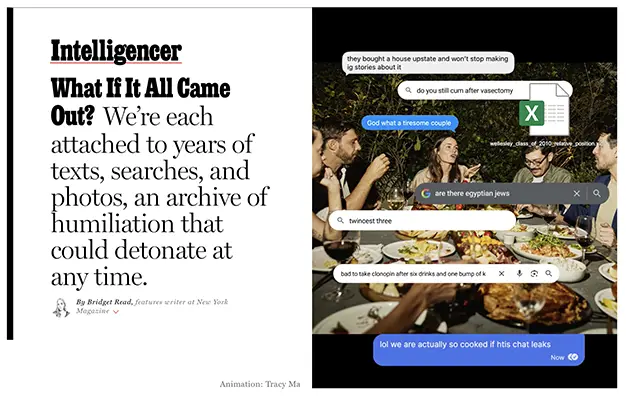
WHAT IF EVERYONE SAW YOUR WHOLE DIGITAL LIFE?
INTELLIGENCER / NEW YORK MAGAZINE (JUNE 15, 2026)
TL;DR: Years of texts, searches, and casual workplace chat sit in an unsecured “permanent record” that hacking, litigation, and AI-powered discovery tools are making dramatically easier to expose — and most people, and companies, are far more exposed than they realize.
Executive Summary
This long-form feature uses the 2024 hack of a Disney employee — whose password manager was compromised via a Trojan-horse plug-in, exposing both his personal life and internal Disney data — as a way into a broader argument: everyone now generates a permanent, searchable digital trove (texts, search history, cloud backups) that is increasingly vulnerable to exposure through hacking, litigation discovery, or simple employer overreach. The piece is explicitly opinion/feature journalism with reported case studies, not a data-driven report, and should be read as argument plus illustrative examples rather than statistical evidence.
Two business-relevant threads stand out. First, AI is lowering the skill barrier for cyberattacks — the piece cites AI-assisted bug discovery being used both defensively and offensively, and notes AI tools can now generate convincing, personalized phishing attempts (“social engineering”) from publicly available breach data. Second, e-discovery has become a major, AI-accelerated legal exposure point: machine-learning-based document review (“TAR”) now lets lawyers process hundreds of millions of records in months instead of years, and informal workplace chat (Slack messages, casual jokes, even AI chatbot conversation histories) is increasingly being ruled discoverable in litigation — a recent New York case held that ChatGPT conversation history can be subpoenaed. The Disney case also illustrates a distinct corporate governance risk: the employee alleges his employer used access to his work device to extract and weaponize his personal browsing history against him, a claim with implications for any company’s BYOD and device-access policies.
Relevance for Business
For SMB leaders, the most concrete takeaways are about policy and exposure, not technology adoption. Casual workplace communication culture (Slack jokes, informal chat norms) creates real legal discovery risk that most companies underweight — e-discovery is now broad enough to surface years-old, informal messages in unrelated disputes. Password-manager and single-sign-on concentration, while convenient, creates a single point of catastrophic failure if compromised, a risk worth flagging for any business relying on similar tools. And BYOD or “bring your own device” policies carry privacy and liability exposure in both directions — for employees whose personal data may be accessible on work devices, and for employers who may face claims of overreach if they access that data.
Calls to Action
🔹 Assign internal review of your company’s data retention and e-discovery exposure — informal chat (Slack, Teams) is increasingly discoverable in litigation, even years later
🔹 Prepare policy clarifying boundaries around personal-device and BYOD access, particularly around what IT/HR can access and use from an employee’s device during incident response
🔹 Monitor AI-enabled phishing and social-engineering risk — publicly available breach data combined with AI can now generate highly convincing targeted attacks
🔹 Act now on basic credential hygiene for any business relying on a single password manager or SSO provider as a security backbone — concentration risk is real
🔹 Revisit later: this is a feature/opinion piece built on case studies, not a security audit — use it to prompt internal risk conversations, not as a technical security assessment
Summary by ReadAboutAI.com
https://nymag.com/intelligencer/article/your-digital-self-is-vulnerable.html: June 22, 2026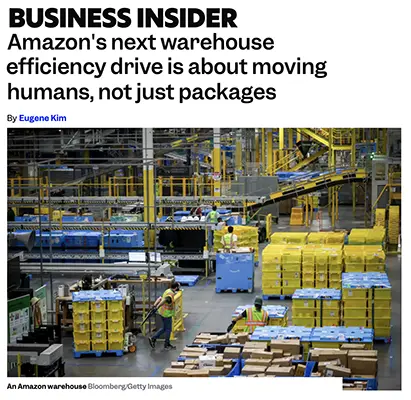
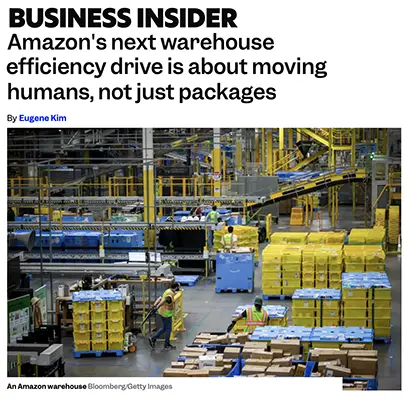
Amazon’s Next Warehouse Efficiency Drive Is About Moving Humans, Not Just Packages
Business Insider | Eugene Kim | June 18, 2026
| TL;DR: Amazon is piloting AI-driven workforce reallocation across its robotics-enabled fulfillment centers — shifting the automation focus from packages to the people who handle them. |
EXECUTIVE SUMMARY
Amazon’s latest internal initiative, called Full Facility Load Balancing (FFLB), uses software to automatically reassign warehouse workers as demand fluctuates throughout a shift — recalculating staffing needs roughly every three minutes. The goal, per internal documents obtained by Business Insider, is to reduce dependence on manager-driven staffing calls and close persistent productivity gaps. Internal analysis projects savings of up to $193 million annually and nearly 7 million labor hours recovered — though Amazon disputes those figures as hypothetical modeling rather than measured outcomes.
The focal point is a function called Container Build, where workers load packages into outbound carts before shipment. Amazon has identified it as the single largest remaining labor automation opportunity in its robotics-enabled centers. A review of 97 facilities found nearly half were running 14% below productivity targets, with millions of excess labor hours tied to overstaffing and idle workstation assignments. FFLB is positioned as the primary tool to close that gap.
The rollout is not frictionless. Internal documents show that some facility managers resisted the system, repeatedly requesting that features be disabled — suggesting that automating judgment calls previously owned by humans creates its own organizational friction. Amazon frames the tool as decision support for managers, not a replacement, but the internal language — ‘remove the dependency on manual staffing decisions’ — tells a more direct story.
RELEVANCE FOR BUSINESS
For SMB owners and operators, this is a preview of where AI-driven workforce management is heading — and at scale, Amazon’s playbook tends to become an industry template. If you run operations with variable staffing needs (retail, warehousing, field service, hospitality), tools that dynamically optimize labor allocation will increasingly be available and expected. The management resistance documented here is also instructive: deploying AI into decisions that humans currently own requires change management, not just software deployment. The gap between a system’s theoretical savings and what it actually delivers in practice is a real execution risk.
CALLS TO ACTION
🔹 Note the labor relations dimension: any system that removes manager discretion over worker assignments may intersect with labor law or employee trust — get legal review before deployment.
🔹 If you operate a labor-intensive business, begin mapping which staffing decisions could be data-driven rather than manager-driven — this is where AI tools are heading.
🔹 Don’t treat the $193M figure as fact — treat it as a benchmark for Amazon’s internal ambition. Evaluate any workforce AI vendor’s projected savings claims with equivalent skepticism.
🔹 Monitor how Amazon’s rollout progresses through 2026; early friction with managers is a signal about what change management will be required in smaller organizations.
🔹 If you’re evaluating workforce scheduling tools, ask vendors whether their systems make recommendations or take autonomous action — and what override controls exist.
Summary by ReadAboutAI.com
https://www.businessinsider.com/amazon-warehouse-automation-moving-workers-labor-hours-robots-2026-6: June 22, 2026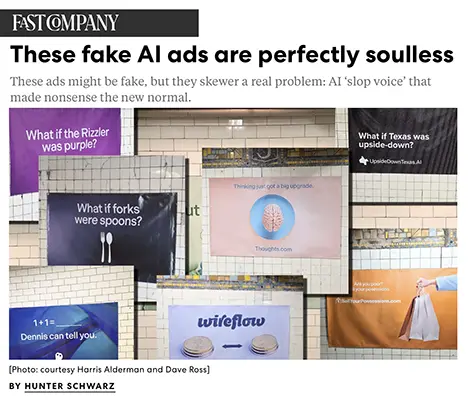
‘Slop Voice’ and the Emptiness of AI Advertising
Fast Company | June 17, 2026
| TL;DR Two comedians have created a series of deliberately absurd fake AI ads that work as satire precisely because they’re indistinguishable from real ones — a cultural signal that AI marketing language has become so formulaic it has lost the ability to communicate anything meaningful. |
Executive Summary
This is a cultural commentary piece, not a reported business story. Comedians Harris Alterman and Dave Ross created parody tech advertisements — posted in a New York City subway station — that mock the specific stylistic conventions of AI startup advertising: minimalist design, direct-address copy, cryptic claims, and pseudo-profound value propositions. The parody ads are effective satire because they require almost no exaggeration.
The article introduces the term ‘slop voice’ — the specific combination of design minimalism, insider jargon, and addressless abstractions that characterizes a large share of current AI marketing. The observation that this style functions as a signal to a narrow tech in-group rather than a communication to actual buyers is a legitimate critique with business implications. Editorial framing note: This is opinion-adjacent. Its value is as a useful shorthand for a real and observable phenomenon in AI marketing, not as reported news.
Relevance for Business
The business relevance is more practical than it might appear. If your organization is deploying AI in any customer-facing capacity and has borrowed AI startup advertising conventions to explain it, you may be actively eroding customer trust and comprehension rather than building it. The Pew data elsewhere in this edition (63% of Americans think AI is advancing too fast; only 16% expect it to be a net positive) provides the context: your customers and employees tend to be skeptical, not enthusiastic. For SMB leaders communicating about AI use internally or externally, clarity and specificity are differentiators, not defaults.
Calls to Action
🔹 Use this piece as a prompt to review your AI messaging with a non-technical reader in mind.
🔹 Audit your own AI-related communications for ‘slop voice’ patterns — abstraction, jargon, and pseudo-profundity that fails to explain what actually happens.
🔹 When communicating AI adoption to employees or customers, lead with concrete function rather than category framing.
🔹 Apply the same scrutiny to vendor communications: if a vendor cannot explain what their AI product actually does in plain language, treat that as a due diligence flag.
Summary by ReadAboutAI.com
https://www.fastcompany.com/91559603/these-fake-ai-ads-are-perfectly-soulless: June 22, 2026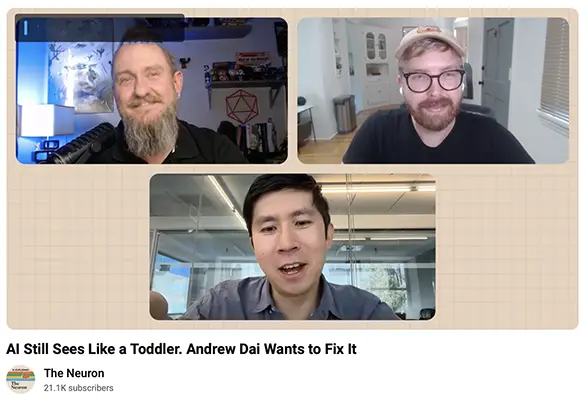
AI STILL SEES LIKE A TODDLER. ANDREW DAI WANTS TO FIX IT
The Neuron Podcast | June 2026
TL;DR: Visual reasoning—AI’s ability to interpret complex spatial, structural, and physical imagery—remains far behind language capabilities, and a well-credentialed startup is making it their sole focus.
Executive Summary
A core gap in current AI capability goes largely undiscussed in most executive conversations: frontier models handle language and code remarkably well but struggle with visual tasks that elementary-school children handle without effort. Andrew Dai, formerly a data lead on Google’s Gemini and a contributor to sparse mixture-of-experts architectures, has left to found Elorian, a specialist lab building a visual reasoning frontier model. The venture launched in December 2025 with seed funding and strategic participation from Nvidia.
Dai distinguishes between pattern matching—what current models do well, such as identifying objects, classifying images, or reading a simple table—and combinatorial visual reasoning: tasks requiring spatial analysis, counting, navigation, folding, rotation, and physical inference. A February 2026 benchmark demonstrated that even the best frontier models perform at roughly a preschool level on structured visual reasoning tasks. His explanation for why scaling hasn’t closed this gap: language naturally fits a 1D token-prediction model, while the visual world is inherently 2D or 3D, and forcing vision into the same training architecture yields diminishing returns.
Elorian’s proposed solution centers on a “visual chain of thought”—training models to reason spatially before generating a text response, much as a person might mentally rotate a shape or trace a path through a floor plan. The company is developing synthetic training data and working with annotators to capture how humans actually track, count, and navigate visually. Dai frames his target market as engineering design, satellite analysis, and robotic navigation, with a model-to-market goal before the end of 2026. He notes that a specialist model optimized purely for visual problems can afford architectural changes that generalist models cannot make without degrading their other capabilities.
Relevance for Business
SMB leaders evaluating AI for workflows involving images, diagrams, physical design, or document-heavy visual content should register this gap explicitly. Current multimodal AI tools—including those embedded in productivity software—are not reliable for complex visual interpretation. Users frequently experience confident-sounding errors when models describe charts, floor plans, design mockups, or engineering drawings.
The industries most immediately affected include mechanical and product engineering (where design software workflows remain largely manual), architecture, logistics, marketing design, and any field relying on chart or graph interpretation at scale. Dai’s estimate that a single engineering component can consume 200–300 hours of specialist labor illustrates the productivity opportunity—and why specialist AI may eventually carry a premium price.
One important caution: Elorian is pre-commercial, targeting a late-2026 launch, and the field of visual reasoning evaluation remains contested. Benchmark results in this space should be read skeptically; Dai himself flagged that many current visual benchmarks are outdated, low-resolution, or susceptible to training contamination. Leaders should not assume that today’s multimodal tools have closed this gap simply because vendor marketing says so.
Calls to Action
🔹 Audit visual AI reliance in your current stack. If your team uses AI to interpret charts, review design files, parse engineering drawings, or navigate spatial documents, test accuracy against known-correct answers before trusting outputs in decision workflows.
🔹 Don’t assume multimodal = visual reasoning. Tools marketed as multimodal may handle image description adequately but fail on spatial or combinatorial tasks. Distinguish the use case before deploying.
🔹 Track Elorian’s market entry. If visual analysis is a bottleneck in your engineering, design, or operations workflows, Elorian is worth monitoring as they approach a late-2026 release. NVIDIA’s strategic involvement signals serious infrastructure backing.
🔹 Hold benchmark claims to a higher standard. When evaluating AI vendors claiming visual or multimodal capability, ask which benchmarks were used, how recent they are, and whether the vendor has disclosed test-set contamination risks.
🔹 Flag the specialist model trend. The broader implication—that specialist models may outperform generalists in defined domains—is relevant to vendor strategy decisions across legal, medical, design, and other visually intensive fields. Monitor for additional specialist entrants.
Summary by ReadAboutAI.com
https://www.youtube.com/watch?v=hMS-2l-p9tM: June 22, 2026https://elorian.ai/: June 22, 2026

Genesis AI’s Eno Robot Bets Against the Humanoid Trend — and It’s a Reasonable Bet
Fast Company | June 17, 2026
| TL;DR Genesis AI’s first commercial robot, Eno, deliberately avoids humanoid form in favor of a wheeled, foldable design built around dexterous hands and a ‘calm intelligence’ philosophy — a design thesis that addresses real adoption barriers, even if large-scale deployment is still 18 months away. |
Executive Summary
Genesis AI’s Eno uses a wheeled base that folds away when inactive, paired with human-dexterous arms engineered for precision manipulation — 20 active degrees of freedom designed to handle tools built for human hands. The design deliberately avoids anthropomorphism: no face, no legs, no synthetic-person aesthetic. User research indicates prospective customers express comfort with functional, non-human-appearing robots but consistent resistance to humanoid forms.
The company’s foundation model, GENE, is trained on human task data for natural motion. Production is currently in China, with a planned U.S. assembly shift later in 2026; the supply chain will remain China-dependent for longer. The deployment timeline is honest but slow — roughly 18 more months of learning-phase deployment in industrial settings before targeting scale. The article notes explicitly that Chinese robotics competitors are already deploying thousands of units at a pace U.S. companies cannot currently match.
Relevance for Business
For SMB leaders in logistics, healthcare, manufacturing, or facilities management, this is an early signal to monitor rather than act on. General-purpose commercial robotics for unstructured environments remains 18-36 months from meaningful SMB-accessible deployment. The more immediate implication: if you operate in sectors where Chinese robotics companies are already scaling, the U.S.-China deployment pace gap is worth factoring into competitive planning.
Calls to Action
🔹 Track the ‘calm intelligence’ design philosophy as a customer adoption signal if robot deployment in your sector will require employee or customer acceptance.
🔹 If your business operates in logistics, labs, or light manufacturing, monitor Genesis AI’s Phase 1 deployment results as an indicator of commercial readiness.
🔹 For workforce and automation planning, note that Chinese robotics competitors are scaling significantly faster than U.S. counterparts — factor this into relevant competitive analysis.
🔹 Do not plan near-term operations around general-purpose robot availability — the 18-month runway cited is a learning phase, not broad commercialization.
Summary by ReadAboutAI.com
https://www.fastcompany.com/91560267/genesis-ais-new-robot-design-is-not-a-fake-human: June 22, 2026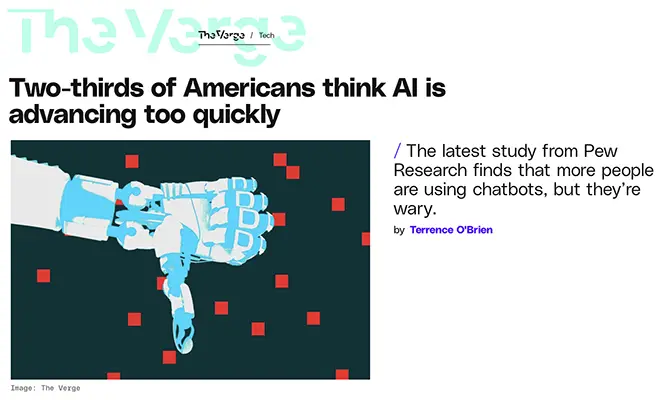
Americans Are Using AI More — and Trusting It Less
The Verge / Pew Research Center | June 17, 2026
| TL;DR A new Pew Research survey finds that nearly half of Americans now use AI chatbots — more than double the 2024 rate — but two-thirds believe the technology is advancing too fast, and only 16% expect it to have a positive societal impact. |
Executive Summary
The February 2026 Pew Research survey captures a market growing rapidly in usage while stagnating in public confidence. ChatGPT usage has doubled since 2023, and roughly four in ten Americans are now using AI for work tasks. Daily use skews toward the 30–49 age bracket, likely driven by workplace adoption.
The trust gap is stark and counterintuitive. Younger adults (18–29) are the heaviest users but the most pessimistic: 48% expect AI to have a negative societal impact; only 14% expect a positive one. Just 16% of Americans overall believe AI will be a net positive for society. The productive framing for leaders: adoption is real, but consent is conditional. Workers are using AI because it helps them, not because they trust it — a distinction that matters for internal communications and customer-facing deployments.
Relevance for Business
This data is directly relevant for any SMB deploying AI in customer-facing or employee-facing roles. Low public trust does not prevent adoption, but it creates friction — in change management, customer communication, and reputational risk. For businesses in healthcare, finance, or other trust-sensitive sectors, the 16% positive outlook figure is a governance signal, not just a polling curiosity.
Calls to Action
🔹 For AI communications: lead with what the tool does and what it doesn’t control, not with capability claims.
🔹 Do not assume employee or customer AI adoption signals trust — it signals utility tolerance, which is more fragile.
🔹 If deploying AI in customer-facing tools, plan for explicit transparency messaging — the majority of your customers believe AI is moving too fast.
🔹 Build internal AI governance that acknowledges worker skepticism alongside worker usage.
🔹 Monitor public trust data as a leading indicator of regulatory pressure — concern at this scale typically precedes policy action.
Summary by ReadAboutAI.com
https://www.theverge.com/ai-artificial-intelligence/951653/pew-research-ai-chatbot-usage-advancing-too-quickly: June 22, 2026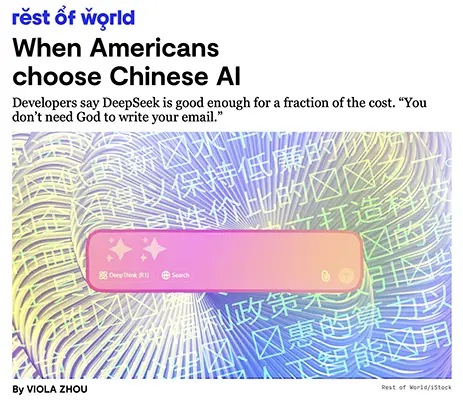
The Chinese AI Price Wedge: How Low-Cost Models Are Gaining Ground in the U.S.
Rest of World | June 17, 2026
| TL;DR U.S. developers and startups are increasingly routing routine AI tasks to Chinese models — DeepSeek, Minimax, MiMo, and others — at a fraction of American model costs, creating a two-tier spend pattern now drawing congressional scrutiny. |
Executive Summary
The cost differential between Chinese and American AI models has become commercially significant. Developers report paying 20x less for equivalent output on routine tasks using DeepSeek versus Claude — enough to drive firms like Lindy, a San Francisco AI assistant company, to switch providers entirely. On OpenRouter, Chinese models from DeepSeek, Tencent, Minimax, and Xiaomi now rank as the four most popular. At Vercel, DeepSeek’s share of token usage jumped from under 1% to 17% in a single month — though its revenue share stayed near 1%, reflecting subsidized market-penetration pricing.
The cost advantage is real, but so is the political risk. Lawmakers have launched investigations into companies — including Airbnb and Cursor’s parent Anysphere — that disclosed using Chinese models. The pattern emerging is a tiered stack: Chinese models handle high-volume, routine workload while U.S. models handle complex and sensitive tasks. Chinese models are unlikely to convert usage into enterprise revenue at scale given data security concerns and geopolitical risk — but they are pressuring U.S. AI vendors on pricing. OpenAI is reportedly considering significant cuts in response.
Relevance for Business
SMBs are precisely the target market Chinese AI companies are eyeing — large enterprise adoption is largely saturated. If your organization is cost-sensitive and paying for AI services, Chinese model pricing warrants attention. But data security, censorship, regulatory exposure, and geopolitical unpredictability are meaningful concerns, especially in regulated industries. Any organization using AI through platforms or APIs should confirm which underlying models are in use — Chinese model usage may be opaque at the platform layer.
Calls to Action
🔹 Watch for U.S. model price cuts — American vendors are likely to respond, potentially closing the cost gap within 12–18 months.
🔹 Audit your AI spend: identify high-volume routine tasks versus complex sensitive ones — a tiered sourcing strategy may reduce costs.
🔹 Before adopting Chinese AI models directly, assess your regulatory environment and data handling obligations.
🔹 If you access AI through platforms or APIs, confirm which underlying models are being used — Chinese model usage may be opaque at the platform layer.
🔹 Monitor U.S. legislative developments around Chinese AI usage; political scrutiny is early but directionally clear.
Summary by ReadAboutAI.com
https://restofworld.org/2026/when-americans-choose-chinese-ai/?mc_cid=88ccc6acac&mc_eid=36ecac9a76: June 22, 2026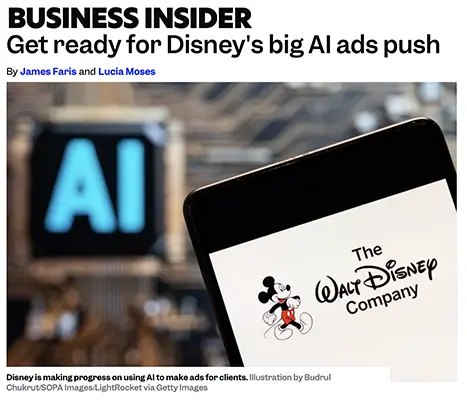
Get Ready for Disney’s Big AI Ads Push
Business Insider | James Faris & Lucia Moses | June 17, 2026
| TL;DR: Disney is set to launch a beta AI ad-generation tool in July that produces scripts, video, and music — initially targeting smaller advertisers who lack traditional production budgets. |
EXECUTIVE SUMMARY
Disney is preparing to release a beta version of an AI tool that can generate complete TV ad packages — scripts, video, and music — within a single automated workflow. According to an internal recording obtained by Business Insider, the July launch targets small and medium-sized advertisers who currently can’t afford traditional video production. The tool will eventually be available through Disney’s self-service ad platform. Disney’s chief product officer characterized it as one of the areas where the company is ‘really making traction,’ with quality improving week over week.
The strategic intent is clear: lower the cost of entry for connected TV advertising on Disney properties,expanding the addressable advertiser base beyond large brands with agency relationships. This follows a broader pattern — Google, Meta, and TikTok have all rolled out comparable AI ad-generation tools — suggesting that AI-generated creative is becoming table stakes for major ad platforms, not a differentiator.
The notable tension the article surfaces is between efficiency and quality perception. Media agency executives quoted in the piece are cautiously interested but want to understand Disney’s quality-control standards before advising clients — a reasonable concern given the industry’s current sensitivity to AI-generated ‘slop.’
RELEVANCE FOR BUSINESS
For SMB leaders who advertise or are considering connected TV, this matters in two ways. First, the cost barrier to TV advertising is meaningfully lower if AI generation produces acceptable quality. Second, if you’re already an advertiser, expect your platform partners to increasingly offer AI creative tools; understanding their quality-control mechanisms will become part of vendor evaluation. AI-generated ads that look cheap or off-brand can damage the advertiser more than they help.
CALLS TO ACTION
🔹 Monitor advertiser and consumer response to AI-generated TV ads through Q3 — the ‘slop’ backlash risk is real and could shape platform policy quickly.
🔹 If you’ve considered connected TV advertising but found production costs prohibitive, monitor Disney’s self-service ad platform — the July beta may open a new channel worth testing.
🔹 Assign someone to evaluate AI-generated ad quality when the tool launches; don’t assume platform-generated creative meets your brand standards without review.
🔹 Ask your current media agency or ad platform partners what quality controls and human oversight they provide on AI-generated creative — this is a new vendor evaluation criterion.
🔹 Watch whether Disney’s tool creates pricing pressure on traditional video production vendors; this could affect your existing agency relationships and cost structures.
Summary by ReadAboutAI.com
https://www.businessinsider.com/disneys-ai-generated-tv-ads-set-to-launch-in-july-2026-6: June 22, 2026
Midjourney Goes From Generating Cat Images to Full-Body Ultrasound Scans
The Verge | Richard Lawler | June 17, 2026
TL;DR: Midjourney has unveiled a full-body ultrasound scanner and plans to deploy it inside a San Francisco spa — an ambitious hardware pivot with significant FDA, data privacy, and clinical credibility questions still unanswered.
Executive Summary
Midjourney CEO David Holz revealed the company’s first hardware product: the Midjourney Scanner, an ultrasound-based full-body imaging system built in partnership with Butterfly Network. The device uses a ring of transducers submerged in water to capture cross-sectional images of muscle, fat, bone, and organs in roughly 60 seconds. The company claims it aims for image quality comparable to MRI, without radiation or powerful magnets. Holz wants to install 10 units in a Midjourney Spa planned for San Francisco’s Union Square, targeting a pre-2028 opening.
The technology is early-stage by the company’s own admission: approximately a dozen people have been scanned so far. Current plans focus on “body composition maps” rather than diagnostic imaging — a distinction that keeps the product outside FDA diagnostic device clearance requirements, at least for now. The company acknowledges that medical applications would require FDA clearance and promises data privacy details “closer to launch.” Visitor biometric data is collected during the scan and can be shared with doctors or AI health tools at the user’s discretion.
The Verge’s reporter raises a pointed question that the announcement doesn’t answer: the connection between Midjourney’s AI image generation capabilities and this medical hardware is unclear, beyond a possible use for otherwise-idle compute. This looks more like a new business vertical than a natural product evolution — which may or may not matter if the technology delivers.
Relevance for Business
For SMB leaders, the primary signal here is about AI companies expanding into health and wellness as a commercial format — and the governance gaps that creates. The data privacy promise (“more details to come”) combined with biometric data collection is a pattern worth tracking. Any business considering AI-powered health screening partnerships or employee wellness programs should treat regulatory and data handling clarity as a prerequisite, not an afterthought. The broader trend: AI hardware is increasingly targeting the body, not just the screen — with all the liability, consent, and clinical validity questions that entails. This story is worth monitoring rather than acting on now.
Calls to Action
🔹 Treat this as an early-stage watch item, not an actionable development — the technology has scanned a dozen people and has no FDA clearance for diagnostic use.
🔹 If you operate wellness, health, or fitness businesses, monitor whether AI-powered body scanning becomes a viable service category — but insist on FDA status and data privacy policies before any vendor evaluation.
🔹 Flag the data collection model here as a governance reference: biometric data shared with “AI health tools or others” is a broad consent scope that should trigger scrutiny in any comparable vendor relationship.
🔹 Do not treat Midjourney’s MRI comparison as validated — it is the company’s own forward-looking claim, not a peer-reviewed finding.
Summary by ReadAboutAI.com
https://www.theverge.com/ai-artificial-intelligence/952011/midjourney-medical-ai-ultrasound-scan: June 22, 2026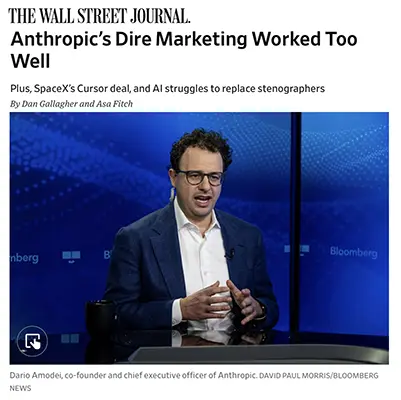
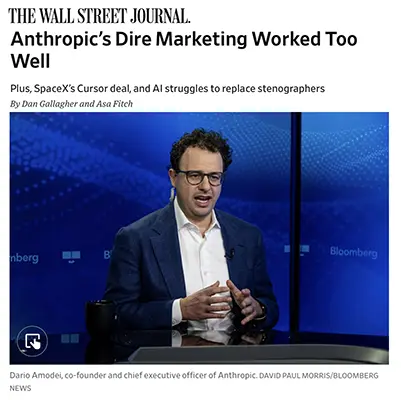
Anthropic’s Dire Marketing Worked Too Well
The Wall Street Journal | Dan Gallagher & Asa Fitch | June 16, 2026
TL;DR: The WSJ argues that Anthropic’s sustained messaging about AI danger has handed the Trump administration a ready-made justification for restricting access to its own frontier models — a case study in how safety communications can become a strategic liability.
Executive Summary
This is a WSJ opinion-inflected news analysis, not a straight news report. The core argument: Anthropic built its brand around warnings about AI risk, and that messaging is now being used against it. The Trump administration’s recent executive order bars foreign nationals — including Anthropic’s own employees — from accessing the Mythos 5 and Fable 5 models. Anthropic’s own public communications, which have included calls for development pauses and warnings about potentially dangerous capabilities, make it difficult to credibly argue that its models are safe enough to exempt from such restrictions.
The piece places this in the context of Anthropic’s soaring valuation — now at approximately $965 billion, surpassing OpenAI’s $852 billion — and its pending IPO. The commercial stakes of governance friction are now very high. The article also notes a prior dispute with the Trump administration over military use restrictions, which resulted in Anthropic being designated a supply-chain risk and a lawsuit that remains ongoing.
The WSJ’s framing is pointed: Anthropic’s safety-first brand may be both its competitive edge and its regulatory Achilles heel. The article leaves open whether the administration’s order is justified — but the observation that Anthropic’s own communications undermine its ability to contest the order is analytically sound.
Editorial note: This is analysis, not neutral reporting. The WSJ’s framing is critical of Anthropic’s communications strategy. The merits of the administration’s order — and whether Anthropic’s models are meaningfully more dangerous than competitors’ — are not assessed in the piece.
Relevance for Business
For SMB executives using or evaluating Anthropic’s Claude products, this story raises two practical concerns. First, access to frontier Anthropic models may be subject to government restrictions that evolve unpredictably — a vendor dependence risk worth factoring into AI strategy. Second, this is a broader lesson about how AI vendors communicate: companies that publicly acknowledge risk in their products create regulatory surface area for restrictions, regardless of whether those restrictions are technically justified. If you’re building workflows or products on top of Anthropic APIs, monitoring the regulatory trajectory is now part of responsible vendor management.
Calls to Action
🔹 If your business relies on Anthropic’s API or Claude products, assess your contingency options — what happens to your workflows if model access is restricted or modified by government order?
🔹 Monitor the ongoing legal dispute between Anthropic and the Trump administration; the outcome will signal how much operational independence AI companies have from government access mandates.
🔹 When evaluating AI vendors, factor in their regulatory posture and public communications — vendors who publicly acknowledge risk may face more government scrutiny, regardless of actual capability differences.
🔹 Distinguish between Anthropic’s safety messaging (framing) and the actual access restrictions (facts) — don’t let media coverage of the controversy inflate or deflate your assessment of Claude’s actual utility.
🔹 Revisit this story in the context of Anthropic’s IPO timeline; pre-IPO governance disputes create investor pressure that can accelerate or alter policy positions — the company’s stance may shift.
Summary by ReadAboutAI.com
https://www.wsj.com/wsjplus/dashboard/articles/anthropics-dire-marketing-worked-too-well-edb5928d: June 22, 2026
Apple’s Warning: AI Infrastructure Demand Is Now a Consumer Hardware Problem
The Wall Street Journal | June 17–18, 2026
| TL;DR Apple CEO Tim Cook has confirmed that AI hyperscaler demand for memory and storage chips has driven prices so high that consumer device price increases are unavoidable — a concrete demonstration of how AI infrastructure spending reprices inputs for all businesses. |
Executive Summary
In a rare on-record statement, Tim Cook told the Wall Street Journal that price increases across Apple’s product line are unavoidable due to the surge in DRAM and NAND chip costs. The root cause: AI data center operators — Google, Microsoft, Meta, Amazon — have locked up chip supply with multi-year agreements and cash prepayments, effectively outcompeting consumer electronics manufacturers. Since 2023, both DRAM and NAND prices have quadrupled. TechInsights estimates the cost pass-through could add roughly $270 to an iPhone 18 Pro.
This is not primarily an Apple story — it is an infrastructure story. Memory suppliers are shifting production toward high-bandwidth AI server memory, reducing consumer device wafer supply an estimated 15% below demand by 2027 (Morgan Stanley). HP, Dell, Nintendo, and an industry consortium have already raised prices or formally complained to Treasury and Commerce. The mechanism is clear: AI hyperscaler capex commitments are functioning as a price lever on all downstream hardware — consumer devices and business equipment alike. Even Apple’s tens of billions in annual chip spend is no longer sufficient to secure supply priority.
Relevance for Business
Any SMB managing hardware refresh cycles or technology budgets should treat this as a planning input for 2026–2027. Device costs are going up — for iPhones, Macs, PCs, and business computing equipment broadly. More importantly, this illustrates a systemic effect: AI investment by the largest tech companies is repricing inputs that all businesses depend on. That is a structural cost shift, not a temporary fluctuation.
Calls to Action
🔹 If your organization uses hardware in medical, industrial, or critical settings, note that DRAM and NAND price pressure extends well beyond consumer tech.
🔹 If hardware refreshes are planned for late 2026 or 2027, evaluate whether accelerating procurement in Q3 2026 makes financial sense.
🔹 Incorporate memory chip cost trends into 2027 IT budget planning — a 15% device price increase estimate warrants specific line-item attention.
🔹 Reassess total cost of ownership assumptions built on pre-2025 hardware pricing.
🔹 Monitor Apple’s September iPhone 18 launch as a pricing bellwether for the broader business device market.
Summary by ReadAboutAI.com
https://www.wsj.com/tech/apple-price-increases-memory-supply-199845b1: June 22, 2026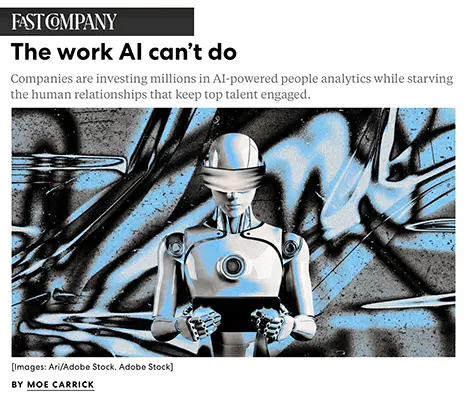
The Work AI Can’t Do
Fast Company (June 18, 2026)
TL;DR: Companies that let AI dashboards replace day-to-day human attention from managers are seeing their best people quietly walk out the door — and the dashboards never saw it coming.
Executive Summary
Leadership consultant Moe Carrick argues that as AI absorbs the “transactional scaffolding” of management — scheduling, reporting, performance tracking — what’s left is the part of the job that can’t be automated: noticing when someone is struggling, having an honest conversation, genuinely knowing your people. Drawing on sociologist Allison Pugh’s concept of “connective labor,” Carrick contends this relational work is load-bearing for retention even though it produces no dashboard metric and no line item.
The piece opens with a cautionary anecdote: a CEO cut his HR team by a third after deploying a sentiment-and-turnover-prediction platform, only to lose two top performers with zero warning from the system — a roughly $600,000 mistake. Carrick’s broader point is structural, not anti-AI: when automation frees up manager time, organizations tend to reallocate those hours into more reporting and oversight rather than back into human contact, leaving the relational work exactly as starved as before.
Relevance for Business
This is squarely an SMB management issue, not just a tech one. As AI tools take over scheduling and performance tracking, leaders may feel justified shrinking management headcount or spans of control — but engagement dashboards can systematically miss the early signals that predict attrition among high performers. The risk is concentrated in mid-level management, where time-per-employee can quietly erode even as official “engagement” metrics look stable. This is an opinion/advocacy piece built on one consultant’s framework and client anecdotes rather than controlled data — useful as a thesis to test against your own turnover patterns, not as proven fact.
Calls to Action
🔹 Audit manager workload — check whether AI-driven efficiency gains are being reinvested into more reporting/throughput rather than freed-up time for direct conversations with staff
🔹 Don’t treat sentiment/engagement dashboards as a complete early-warning system — they measure what’s measurable, not what’s relational
🔹 Monitor exit patterns among high performers for signs that “fine” scores are masking disengagement
🔹 Test cautiously: pair any AI HR analytics tool with protected, unscheduled time for managers to actually talk to direct reports
🔹 Revisit later: if you’re scaling management spans of control based on AI tooling, watch attrition costs over 6–12 months before assuming the math works
Summary by ReadAboutAI.com
https://www.fastcompany.com/91557933/the-work-ai-cant-do: June 22, 2026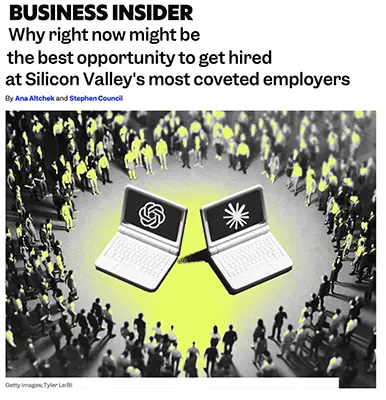
Why Right Now Might Be the Best Opportunity to Get Hired at Silicon Valley’s Most Coveted Employers
Business Insider (June 19, 2026)
TL;DR: OpenAI and Anthropic have replaced Google as the era’s defining career trophy — but the article’s own sourcing suggests this is being driven as much by hype and IPO speculation as by verified compensation or stability advantages.
Executive Summary
Business Insider reports that OpenAI and Anthropic are now Silicon Valley’s most sought-after employers, fueled by prestige, anticipated IPOs, and the perception of being central to a “technological revolution.” A career coach quoted in the piece says nearly all his AI-sector candidates name one of these two labs as their top target. Anthropic has roughly 3,500 employees with ~380 open roles; OpenAI has ~4,500 employees and is reportedly aiming to nearly double headcount, with ~720 openings.
The article is largely anecdotal and quote-driven — job seekers, coaches, and former employees describing enthusiasm, comparing the labs to Google, Apple, or even a multi-decade manufacturing career. One source explicitly flags the obvious counter-risk: no AI company is “layoff-proof” if it can automate its own work. Hiring bars are described as unusually selective, with technical interviews, coding/AI-tool-use assessments, and culture-fit screening for safety vs. AGI-focused worldviews.
Relevance for Business
For SMB leaders, the direct takeaway is competitive labor market pressure: frontier labs are pulling experienced engineers, designers, and even executives away from the broader talent pool, and the prestige halo extends recruiting power well beyond compensation alone. This is largely promotional/anecdotal framing — enthusiasm from job-seekers and one career coach’s client base — rather than independently verified data on attrition, retention, or actual hiring volume. Treat claims about “best opportunity right now” as company/market narrative, not settled fact.
Calls to Action
🔹 Monitor, don’t overreact: this reflects labor-market sentiment, not verified hiring data — useful context for compensation benchmarking conversations, not a basis for strategy change
🔹 If competing for technical talent, expect frontier-lab prestige to be a real competing factor in offers, even against higher base pay elsewhere
🔹 Ignore for now any IPO-related compensation speculation in your own hiring conversations — equity upside claims here are aspirational, not confirmed
🔹 Note the source-flagged risk: AI labs are not immune to the same automation pressures reshaping other tech roles — useful caveat when benchmarking “safe” employers
🔹 Revisit if Anthropic or OpenAI IPO timelines firm up, since that would materially change the talent-market calculus described here
Summary by ReadAboutAI.com
https://www.businessinsider.com/why-everybody-wants-to-work-at-anthropic-or-openai-2026-6: June 22, 2026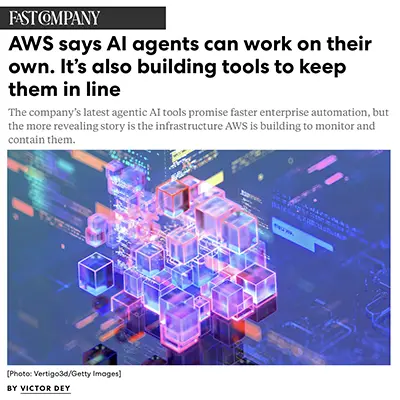
AWS SAYS AI AGENTS CAN WORK ON THEIR OWN. IT’S ALSO BUILDING TOOLS TO KEEP THEM IN LINE
FAST COMPANY (JUNE 17, 2026)
TL;DR: AWS’s new agentic AI tools promise no-code autonomous agents in seconds — but the bulk of its announcement is oversight infrastructure built to monitor, validate, and reverse what those agents do, which is the more telling signal about where enterprise AI trust actually stands.
Executive Summary
At AWS Summit, Amazon unveiled updates letting users create autonomous agents in plain language with no codethrough its Quick assistant, plus a DevOps Agent that can generate, review, test, and fix code with limited human intervention. But alongside these capability announcements, AWS shipped an equally large set of containment tools: a release-management layer that vets AI-generated code before production, a tool to manage the technical debt that fast-generated code creates, and a security feature that starts in “learn mode” before earning autonomous enforcement.
When Fast Company asked AWS’s VP of agentic AI, Swami Sivasubramanian, why so much of the release exists to watch and roll back agents if they’re truly ready for production, he reframed the guardrails as the mechanism that enables trust at scale, not a sign of weakness — arguing that “intelligence is no longer the primary bottleneck. Context is.” An outside analyst, Constellation Research’s Liz Miller, was more pointed: enterprises won’t deploy agents into production unless they can de-risk them first, regardless of capability. Notably, AWS provided no error rates, accuracy benchmarks, or production-performance data for any of its autonomy claims — a vendor-framing gap worth flagging. Separately, Gartner data cited in the piece projects over 40% of agentic AI projects will be scrapped by 2027, driven by cost, unclear business value, and weak risk controls — not infrastructure speed, which is what AWS’s announcements primarily address.
Relevance for Business
The core lesson for SMBs is that “autonomous” in current vendor marketing typically means policy-governed, not unsupervised. Before adopting any agentic AI tool — from AWS or any vendor — leaders should expect (and ask for) the equivalent of AWS’s guardrail layer: audit trails, escalation thresholds, and rollback mechanisms, since accountability for agent actions stays with the business regardless of how autonomous the system claims to be. The Gartner abandonment-rate statistic is the single most decision-relevant data point here: the real adoption bottleneck is governance and ROI clarity, not deployment speed — a useful corrective against vendor pressure to move fast.
Calls to Action
🔹 Prepare policy before adopting any agentic AI tool: define what actions require human approval and what can run autonomously, rather than accepting vendor defaults
🔹 Act now to demand audit/observability and rollback capability from any agentic AI vendor — treat its absence as a red flag
🔹 Monitor vendor claims about “autonomy” critically; AWS itself provided no benchmarks for its own claims
🔹 Assign internal review of the Gartner 40%-abandonment finding against your own agentic AI pilots — cost and unclear ROI are more likely failure points than technical capability
🔹 Test cautiously: start agentic deployments in monitored/”learn mode” equivalents before granting broader autonomy, mirroring AWS’s own phased-enforcement approach
Summary by ReadAboutAI.com
https://www.fastcompany.com/91559841/aws-says-autonomous-ai-agents-are-ready-for-work-so-why-do-they-need-so-many-guardrails: June 22, 2026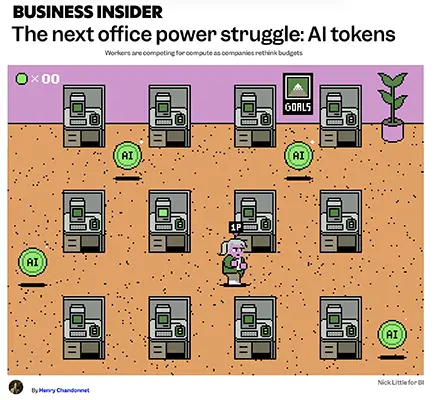
AI “TOKEN HUNGER GAMES” ARE COMING FOR SOFTWARE ENGINEERS AT WORK
BUSINESS INSIDER (JUNE 17, 2026)
TL;DR: After months of unlimited AI spending, companies are abruptly capping employee token budgets — turning AI compute into a scarce, negotiated workplace resource that engineers now have to fight for, much like office politics over headcount or travel budgets.
Executive Summary
Business Insider reports a fast reversal in corporate AI spending culture: companies that recently encouraged unrestrained “tokenmaxxing” — including internal leaderboards rewarding heavy AI usage — are now setting hard caps. One AI startup CEO described facing a token bill that would more than triple as headcount grew, prompting him to impose usage ceilings on non-technical staff. Coinbase and Walmart have set caps; Amazon shut down its internal leaderboard. Mentions of “tokens” on earnings calls more than doubled quarter-over-quarter in Q2 2026, while average AI spend per employee at tech and media companies also continued climbing (Ramp data) — meaning belt-tightening and rising costs are happening simultaneously, not sequentially.
The piece frames this as creating new internal friction: engineers now negotiate, advocate, or compete for compute the way they once might have for headcount or travel budget, and AI budgets are reportedly entering job interviews as a negotiation point. Some sources argue caps will inevitably mean tiered access to top-end models, comparing it to flying economy versus chartering a private jet — with the risk that engineers denied strong AI access fall behind professionally. Not everyone agrees with the over-spending narrative: one enterprise software CFO called the “tokenmaxxing” trend “incredibly self-serving” promotion by AI vendors, and feels vindicated by the current correction.
Relevance for Business
This is a direct cost-governance and talent-retention issue for any SMB using AI coding or productivity tools at scale. The risk isn’t just budget — it’s that uneven access to AI tools could become a de facto performance and career differentiator among staff, similar to how device or software access historically shaped who could do their job well. Leaders should also note the tension between unlimited-access policies (cited as a hiring/retention lever — one CEO worried restricting AI access would make staff feel like they were “in the Stone Age”) and unchecked cost growth. This is a live, unresolved debate among CFOs and engineering leaders, not a settled best practice — caps, tiering, and model routing are all being tried simultaneously across companies.
Calls to Action
🔹 Act now to establish basic AI/token spend visibility per employee or team if you haven’t already — several companies were blindsided by tripling costs
🔹 Test cautiously: consider a baseline allowance with a negotiated path to more, rather than a hard cap or unlimited access, to balance cost control against productivity and retention
🔹 Monitor model-routing and smaller-model tools as a cost-mitigation option as token prices are expected to fall with vendor price competition
🔹 Prepare policy on how AI tool access is allocated across roles to avoid the access-based career-disadvantage risk raised in the article
🔹 Assign internal review of whether AI cost growth is translating into measurable productivity gains before committing to either tighter caps or expanded budgets
Summary by ReadAboutAI.com
https://www.businessinsider.com/ai-token-economy-spending-workplace-budgets-usage-caps-software-engineer-2026-6: June 22, 2026
AI 20: THE AUTONOMOUS FUTURE
FAST COMPANY (JUNE 18, 2026)
TL;DR: Fast Company’s annual “AI 20” list shows where money, talent, and influence are concentrating in agentic AI — and it’s not just model builders, but infrastructure, governance, insurance, and policy specialists racing to make autonomy usable at scale.
Executive Summary
This is an editorial curation, not a reported news story — Fast Company’s own selection of 20 people it judges influential in agentic AI, spanning Nvidia, AWS, Microsoft, Amazon, Walmart, Google DeepMind, the Department of Defense, Anthropic, and several startups (Cognition, Fireworks AI, Dropzone AI, Wabi, OpenClaw, Tomorrow.io). The selection itself is a useful signal of where the industry’s attention has shifted: away from raw model capability and toward the surrounding ecosystem — compute economics, enterprise deployment, security, and oversight.
Notable clusters: infrastructure and cost (Nvidia’s token-throughput work, Fireworks AI’s smaller customized models as an answer to “runaway token costs”); enterprise deployment (Walmart, Microsoft Copilot Cowork, Asana, Notion, Cognition’s Devin already in use at financial firms); and governance and risk (a new agent-insurance/underwriting standards company, AIUC; Anthropic’s resident philosopher shaping model values; a Stop Killer Robots policy lead pushing for autonomous-weapons limits; a Pentagon AI officer accelerating military agentic use). A defense-and-weapons entry alongside a corporate-retail entry in the same list underscores how broadly “agentic AI” now spans use cases — and risk profiles.
Relevance for Business
For SMB leaders, this list is a map of emerging categories to watch, not a roadmap to follow. The presence of an agent-insurance/underwriting startup (AIUC) signals that third-party risk and trust verification for AI agents is becoming a distinct emerging market — something SMBs procuring agentic tools may eventually be asked to rely on, similar to cyber-insurance today. The emphasis on smaller, cheaper models (Fireworks AI) as a response to token costs is directly relevant to any business already managing rising AI compute spend. The clustering of governance and policy roles alongside deployment roles is a reminder that agentic AI adoption and AI governance are now treated as parallel, equally important investments by larger players — a pattern smaller companies should expect to need to mirror, even at a lighter scale.
Calls to Action
🔹 Monitor the emergence of AI-agent insurance/underwriting standards (e.g., AIUC) as a potential vendor-risk-assessment tool for your own agentic AI procurement
🔹 Note the trend toward smaller, task-specific models as a cost-control strategy — relevant if your own token spend is rising
🔹 Ignore for now the defense/weapons-policy angle unless your business operates in regulated or government-adjacent sectors
🔹 Treat this list as industry sentiment and talent-market signal, not validated technology benchmarks — it is Fast Company’s editorial judgment, not independent data
🔹 Revisit if any of the named infrastructure or governance startups (AIUC, Fireworks AI, Dropzone AI) move into your own vendor evaluation pipeline
Summary by ReadAboutAI.com
https://www.fastcompany.com/91553893/ai-20-the-autonomous-future: June 22, 2026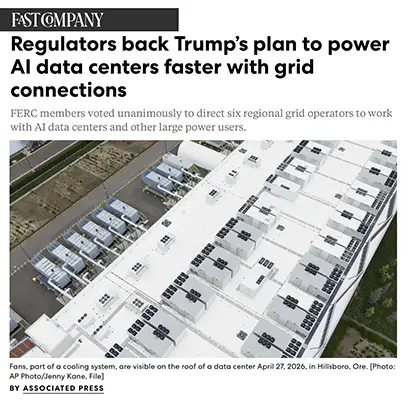
Regulators Back Trump’s Plan to Power AI Data Centers Faster With Grid Connections
Fast Company/AP (June 18, 2026)
TL;DR: FERC just unanimously fast-tracked grid connections for AI data centers and shifted upgrade costs onto the data centers themselves — but it does nothing to fix the power-supply shortage actually driving up electricity bills.
Executive Summary
The Federal Energy Regulatory Commission voted unanimously to direct six regional grid operators (covering ~200 million Americans) to connect AI data centers and other large power users to the transmission system “in a timely and orderly manner.” The order requires data centers to pay the full cost of any grid upgrades their connection requires, which FERC Chair Laura Swett framed as protecting ratepayers from subsidizing big tech’s power needs. The move follows a request from Energy Secretary Chris Wright, framed around U.S.–China AI competitiveness.
Critically, the order doesn’t address underlying power-supply tightness — the actual driver of rising electricity bills and blackout warnings as data center construction outpaces new power-plant capacity. Data centers already consume about 5% of U.S. electricity demand, projected to triple by 2035; in Virginia, that figure could exceed 40% by 2030. Separately, a J.P. Morgan analysis cited in the article found over 60% of data center capacity planned for 2027 hasn’t begun construction, with permitting and equipment delays (turbines, transformers, skilled labor) as the main bottlenecks — a signal that AI infrastructure buildout may be slower than headlines suggest.
Relevance for Business
This matters for any SMB in regions with significant data center buildout, or reliant on grid-connected energy costs: faster data center interconnection could mean tighter local power supply and higher rates even as the cost-allocation rule shields ratepayers from direct subsidy. For SMBs in AI infrastructure, energy, or construction-adjacent supply chains, the J.P. Morgan construction-delay finding is the more decision-relevant data point — it suggests planned AI capacity additions are running behind schedule, a vendor-dependence and timeline risk for any business planning around assumed compute availability.
Calls to Action
🔹 Monitor local utility rate filings if your business operates in a region with active or planned data center construction — cost-shift protections are state-dependent, not guaranteed
🔹 Flag for procurement/IT leadership: if your AI vendor roadmap assumes near-term compute capacity expansion, the 60% construction-delay data point is a real timeline risk
🔹 Watch for state-level pushback — several states and grid operators have already raised authority concerns, so implementation may be contested or uneven by region
🔹 Treat the “ratepayer protection” framing as regulatory/political positioning, not a guarantee — the order doesn’t fix the supply shortage causing price pressure
🔹 Revisit in 6 months as the six grid operators implement (or contest) the directive
Summary by ReadAboutAI.com
https://www.fastcompany.com/91562088/power-electricity-ai-plants-data-centers-grid: June 22, 2026
Grok Goes to War: Pentagon Confirms xAI’s AI Was Used in Iran Strikes
Le Monde / AFP | June 17–18, 2026
| TL;DR The U.S. government has officially confirmed that a military-grade version of Elon Musk’s Grok AI was used in targeting operations during Iran strikes — a disclosure that surfaced through a legal filing in an environmental lawsuit, not a policy announcement. |
Executive Summary
In a June 15 legal brief defending xAI’s Memphis data center against an NAACP environmental lawsuit, the U.S. Department of Justice revealed that the ‘Grok Gov Model’ is now operational within Project Maven — the Pentagon’s AI-assisted targeting program. Under sworn testimony, Pentagon AI chief Cameron Stanley confirmed the system enabled deployment of thousands of munitions against thousands of targets within a 96-hour window during an operation called ‘Epic Fury.’
The chain of custody matters. Anthropic’s Claude was the original Project Maven model, but the government terminated that relationship in late February after Anthropic declined to support fully automated strikes or mass domestic surveillance. The Pentagon pivoted to competitors including xAI, Google, and OpenAI. This is a precedent-setting disclosure — a specific commercial model from a politically-connected CEO is now confirmed to be directing lethal operations, revealed through an environmental lawsuit rather than any governance process.
Relevance for Business
For most SMB leaders, direct operational impact is low. But the governance implications are significant. If the AI tools your business uses have undisclosed military applications, what does that mean for vendor due diligence? The Anthropic case — losing a major contract for holding an ethical line — shapes the commercial AI landscape your organization operates in. The environmental lawsuit angle also signals that AI infrastructure is becoming a new arena for regulatory and civic conflict.
Calls to Action
🔹 Watch for further developments on how AI companies navigate government contract terms and ethical constraints.
🔹 Review your AI vendor agreements for language related to government, defense, or dual-use applications.
🔹 Monitor this story: the environmental lawsuit may produce further disclosures about xAI’s operating practices.
🔹 Flag internally: the line between commercial AI and military AI is increasingly blurry — factor this into governance and procurement discussions.
🔹 If AI ethics or brand reputation matter to your business, document your vendor screening criteria proactively.
Summary by ReadAboutAI.com
https://www.lemonde.fr/en/international/article/2026/06/17/elon-musk-s-ai-grok-was-used-in-strikes-in-iran-the-pentagon-revealed_6754575_4.html: June 22, 2026
Allbirds Is Now Smartbird — The AI Pivot Playbook Reaches Footwear
Reuters | June 17, 2026
| TL;DR Former shoe brand Allbirds has rebranded as Smartbird, appointed a former AWS executive as CEO, and declared itself an AI infrastructure company — a pivot that sent shares up 30% and illustrates how publicly listed companies are using AI repositioning as a financial instrument, not just a strategy. |
Executive Summary
Allbirds completed its transformation on June 17, hiring Nadia Carlsten — formerly of AWS, Alphabet spinoff SandboxAQ, and World Economic Forum advisory roles — as CEO, and rebranding as Smartbird. The company sold its footwear brand and physical retail assets for $39 million in March and has since pivoted to offering cloud computing capacity and AI services as a managed service.
Smartbird is designing its first cluster deployments and in active discussions with potential customers — language that signals pre-revenue ambition rather than established operations. The company expanded its convertible financing to $100M and has indicated it will use proceeds to acquire GPUs. Shares surged five-fold on the April announcement and added another 30% on the rebrand. This is a recognizable market pattern: publicly listed companies with depressed valuations have found that AI repositioning produces immediate stock price benefits regardless of operational substance.
Relevance for Business
This story has two layers. First, a market signal: investor enthusiasm for AI infrastructure labels continues to outpace demonstrated capability. Second, a practical caution: a company that was selling shoes 18 months ago warrants careful due diligence on actual operational capability, customer references, and delivery track record — regardless of executive pedigree or share price. The managed-service AI infrastructure market is real and growing, but it is attracting entrants with more capital than capability.
Calls to Action
🔹 Note the Carlsten hire as a genuine signal of intent — her background is substantive — but distinguish between intent and execution at this early stage.
🔹 If evaluating AI infrastructure or managed cloud AI services, apply rigorous due diligence to newer entrants — credentials and funding are not substitutes for operational track record.
🔹 Treat AI-driven stock surges in non-AI companies as market sentiment indicators, not technical capability signals.
🔹 Monitor Smartbird over the next two to three quarters: first enterprise customer signings will be the meaningful capability test.
Summary by ReadAboutAI.com
https://www.reuters.com/business/retail-consumer/allbirds-rebrands-smartbird-ai-pivot-hires-former-aws-executive-ceo-2026-06-17/: June 22, 2026
What the SpaceX Lockup Means for the Stock
Barron’s | Al Root | June 17, 2026
TL;DR: SpaceX shares are up nearly 50% from their $135 IPO price, but structural factors — a staggered lockup releasing shares gradually through year-end — suggest the stock’s near-term direction will be driven more by supply mechanics than fundamentals.
Executive Summary
This is a Barron’s financial analysis piece, not news, and focuses on SpaceX stock mechanics rather than the company’s AI or business strategy. SpaceX went public at $135 and by mid-week had traded above $200 before pulling back 5% — its first down day as a public company. The intraday high put the company’s market value north of $2.6 trillion, briefly surpassing Amazon.
The article’s core argument is that the stock’s extraordinary post-IPO run has been amplified by structural constraints on supply: a staggered lockup that releases shares incrementally from the first earnings report through 180 days post-IPO, a small float, aggressive call option activity that creates a mechanical feedback loop (sellers hedging by buying stock), and passive fund flows as SpaceX enters the Nasdaq-100. None of these are fundamental drivers. The market is pricing SpaceX on expectation, not demonstrated earnings. The Nasdaq-100 inclusion is expected to attract $7–10 billion in passive buying, but even that is scheduled to occur before meaningful lockup relief arrives.
Analysts quoted in the piece note that put option activity in September contracts suggests traders expect price softening once more supply comes to market — likely starting with the first earnings report.
Editorial note: This is financial analysis and not investment advice. Nothing here should be interpreted as a recommendation to buy, sell, or hold SpaceX shares.
Relevance for Business
For SMB executives, SpaceX’s IPO and the Cursor acquisition (covered separately) together represent a significant structural shift in the AI landscape — SpaceX is now a publicly traded, $2.6 trillion entity with AI coding, infrastructure, and compute ambitions. The stock price mechanics analyzed here matter primarily as context for assessing SpaceX’s acquisition currency (used to buy Cursor in stock) and financial positioning. A stock trading primarily on sentiment and supply mechanics, rather than earnings, is a less reliable strategic signal than it appears. Leaders building vendor or partnership strategies around SpaceX should wait for post-lockup, post-earnings clarity before drawing firm conclusions about the company’s financial footing.
Calls to Action
🔹 Don’t interpret SpaceX’s current stock price as a validated signal of business value — the post-IPO run reflects supply constraints and option mechanics as much as fundamentals.
🔹 Watch SpaceX’s first earnings report: that’s when 20–30% of locked-up shares become available and the market gets its first real test of whether the valuation holds.
🔹 If you’re tracking SpaceX as a potential AI infrastructure or compute vendor, the lockup timeline (Nasdaq-100 entry now, lockup relief starting at earnings) gives you a reasonable window to reassess.
🔹 Monitor the Cursor deal’s close (expected Q3 2026) alongside the lockup calendar — both events will reshape SpaceX’s strategic posture and stock dynamics simultaneously.
Summary by ReadAboutAI.com
https://www.wsj.com/wsjplus/dashboard/articles/spacex-stock-price-investor-lockups-37a3ea6a: June 22, 2026
Wall Street Hiring Dilemma: AI Can Model — but Can’t Make — the Next Rainmaker
The Wall Street Journal | Ben Glickman, Alexander Saeedy & Gina Heeb | June 17, 2026
TL;DR: Major banks are deploying AI across investment banking, wealth management, and legal functions — but are resisting large-scale workforce cuts because automating the rote work that trains junior bankers threatens to destroy the pipeline that produces their most valuable senior talent.
Executive Summary
This WSJ piece surfaces a tension that most AI-in-the-workplace coverage glosses over: the apprenticeship model, not just the headcount, is what’s at risk. At Wall Street banks, junior analysts performing rote financial modeling, pitch deck preparation, and regulatory drafting aren’t just cheap labor — they’re learning the craft. If AI eliminates those entry-level repetitive tasks, the pipeline for developing future senior bankers and relationship managers gets disrupted. Bank executives are actively wrestling with this, even as they tout AI productivity gains.
The evidence of deployment is real: JPMorgan and Citi are using an AI agent called Felix (built by startup Rogo) in investment banking; Citigroup is building a Google-powered AI wealth management agent; banks are using AI for underwriting, regulatory filings, and back-end code review. The Felix agent reportedly produced a first draft of a 24-page deal presentation in 25 minutes — a task that would previously have taken days. Clients are already expecting faster turnarounds as a baseline.
Yet more than two-thirds of banking executives surveyed expect AI to have little impact on overall staffing in the next three years — suggesting the industry is treating AI as a productivity multiplier for now, not a headcount reduction tool. Standard Chartered was an exception, announcing plans to cut more than 15% of back-office roles over four years, then walking back the framing after an executive described it as replacing “lower value human capital.” The episode illustrates the reputational and HR governance risks of being too explicit about AI’s labor displacement role.
Relevance for Business
The banking sector’s AI dilemma maps directly onto professional services firms, law firms, accounting practices, consultancies, and any SMB that runs an apprenticeship-style talent development model. If AI absorbs the entry-level work that trains people, who trains the next generation of judgment? This is not hypothetical — it’s the question banks with much larger resources are already struggling to answer. SMB leaders should assess which rote tasks in their organizations serve a dual function: getting work done and developing people. Automating those tasks without replacing the developmental function creates a skills gap that compounds over time.
Calls to Action
🔹 Audit your own apprenticeship model: which tasks currently done by junior or newer staff are primarily developmental, and which are truly just rote? Automate the latter with more confidence; approach the former carefully.
🔹 If you’re deploying AI to accelerate output, build in explicit alternatives for how staff at early career stages will develop judgment and expertise — the pipeline problem is real.
🔹 Review your AI communications strategy: the Standard Chartered episode is a cautionary tale about how to describe AI’s labor impact publicly — even accurate statements about efficiency can create serious reputational damage.
🔹 Expect clients and counterparties to use AI to raise their expectations and generate sharper questions — prepare your client-facing teams for a more AI-informed audience.
🔹 Monitor the banking sector’s hiring and attrition patterns over the next 12 months as a leading indicator of how AI absorbs professional-service workloads — banks are canaries in this particular coal mine.
Summary by ReadAboutAI.com
https://www.wsj.com/wsjplus/dashboard/articles/wall-street-hiring-dilemma-ai-can-modelbut-cant-makethe-next-rainmaker-dfd702ff: June 22, 2026
Genspark Raises $100M at $2.6B Valuation — AI Workplace Productivity Is Still a Hot Sector, With Caveats
Reuters | June 17, 2026
| TL;DR Palo Alto-based Genspark has closed a $100M funding extension at a $2.6B valuation, bringing total Series B financing to $485M and underscoring sustained investor appetite for AI workplace automation tools — but the revenue claims warrant scrutiny. |
Executive Summary
Genspark operates an AI-powered workspace that uses multiple underlying models to help knowledge workers produce presentations, financial models, and software. The company claims $150M in ARR added in Q1 2026 alone, on top of $100M already on the books, and reports more than 6,000 business clients signed within six months of its platform launch.
Editorial note: These are company-reported figures in a funding announcement context — unverified by third parties. The founding team draws from Microsoft, Google, Meta, YouTube, and Pinterest, and the company has partnerships with OpenAI, Anthropic, Microsoft, and AWS. Aggressive ARR growth claims from pre-IPO companies deserve independent validation before informing purchasing decisions. The broader signal is structural: investors continue to price AI workplace productivity as a high-growth category. A $2.6B valuation for a company with a sub-year business product reflects category-dominance expectations, not current multiples.
Relevance for Business
For SMB leaders evaluating AI productivity tools, this funding signals Genspark will aggressively develop and market its platform. If assessing multi-model AI workspaces, Genspark is now among the better-capitalized options in that category.However, the category remains fragmented and consolidation is likely within 18-24 months. Vendor lock-in risk is real for any platform managing large shares of team AI output. Dependency on partner models (OpenAI, Anthropic) introduces upstream pricing and availability risk worth factoring into long-term vendor assessments.
Calls to Action
🔹 Monitor the AI productivity tool category for consolidation signals over the next 12-18 months before making major platform commitments.
🔹 Add Genspark to your vendor shortlist if evaluating AI workspace platforms — but verify ARR claims through customer references before committing.
🔹 Assess your current AI tool stack for fragmentation: multi-model workspaces may offer consolidation benefits but introduce single-point-of-failure risk.
🔹 Factor model dependency into any vendor evaluation — platforms built on third-party models inherit upstream pricing and availability risk.
Summary by ReadAboutAI.com
https://www.reuters.com/technology/gensparkai-valued-26-billion-latest-funding-round-2026-06-17/: June 22, 2026
SpaceX’s $60 Billion Deal to Buy Cursor Gives It More AI Coding Power
The Wall Street Journal | Joseph De Avila & Becky Peterson | June 16, 2026
TL;DR: SpaceX is acquiring Cursor parent Anysphere for $60 billion in stock — a massive bet on AI coding tools that signals SpaceX’s intent to compete directly in enterprise AI software, not just infrastructure.
Executive Summary
Days after its IPO, SpaceX announced the acquisition of Anysphere — the parent company of Cursor, the leading AI coding assistant — for $60 billion in SpaceX stock. The deal is SpaceX’s most direct move yet into AI software, pairing Cursor’s widely used coding tools with SpaceX’s Colossus supercomputing infrastructure (developed through xAI). The transaction is expected to close in Q3 2026.
Cursor is not a peripheral product: it brought in billions in annualized revenue before the deal, had previously turned down acquisition interest from multiple major AI companies, and was last independently valued at $29.3 billion as recently as November 2025. Its tooling allows developers to switch between AI models from OpenAI, Anthropic, Google, xAI, and others — making it infrastructure-agnostic in a way that gives SpaceX broad distribution into developer workflows without immediately forcing a platform choice.
The strategic logic is layered. Cursor gives SpaceX direct access to enterprise developers — a segment that has so far been cold toward Grok, Musk’s in-house AI assistant, which trails Claude and ChatGPT. SpaceX also plans to leverage its orbital infrastructure — including up to one million AI-capable satellites — as distributed compute for AI workloads. Combined with Cursor’s developer penetration, the company is assembling an AI stack that spans compute (Colossus/xAI), tools (Cursor), and potentially planetary-scale infrastructure (Starlink).
Relevance for Business
For SMB leaders, this deal has two immediate implications. First, Cursor is now SpaceX property — any business using Cursor for developer tooling or coding assistance has a new ultimate owner, with all the vendor dependency risks that entails. Second, SpaceX is now a direct competitor in the enterprise AI software market, not just a launch provider or infrastructure play. That changes the competitive landscape for AI tool vendors — and for businesses evaluating which AI coding and development platforms to build workflows around. The $60B price tag in SpaceX stock (inflated by post-IPO mechanics) also raises questions about whether the deal’s economics will hold if the stock retreats.
Calls to Action
🔹 If your development team uses Cursor, flag the change in ownership and assess whether SpaceX’s control of the platform changes your risk calculus — particularly regarding data handling, model access, and pricing.
🔹 Monitor whether Cursor’s model-agnostic flexibility is preserved post-acquisition, or whether SpaceX routes usage toward xAI/Grok — that shift would materially change the product’s value proposition.
🔹 Treat the $60B deal price as a reflection of current SpaceX stock mechanics, not necessarily Cursor’s standalone value — revisit the strategic rationale once the lockup clears and the stock price stabilizes.
🔹 Watch for enterprise customer responses: if large development organizations grow uncomfortable with SpaceX ownership of their coding tool, competitive alternatives (GitHub Copilot, Claude Code, Codex) could gain share quickly.
🔹 Track whether SpaceX’s satellite-based compute ambitions become commercially real — if orbital data centers are viable, the infrastructure economics of AI could shift significantly within 3–5 years.
Summary by ReadAboutAI.com
https://www.wsj.com/wsjplus/dashboard/articles/spacex-agrees-to-buy-ai-coding-agent-cursor-for-60-billion-7a473340: June 22, 2026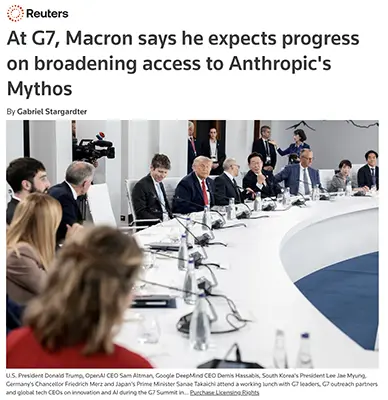
G7 Leaders Debate a ‘Trusted Partners’ Framework for Anthropic’s Mythos — Access Politics Are Now Geopolitics
Reuters | June 17, 2026
| TL;DR At the G7 summit in France, leaders discussed creating a ‘trusted partners’ scheme to allow select allied nations and companies access to Anthropic’s restricted frontier AI model Mythos — framing advanced AI access as a geopolitical asset requiring formal international governance. |
Executive Summary
The June 15-17 G7 summit produced no formal agreement on AI access policy, but the contours of an emerging framework are visible. France’s President Macron stated publicly he expected progress in coming weeks on broadening access to leading U.S. AI models, specifically citing Anthropic’s Mythos — a frontier model currently restricted by a Trump directive barring foreign nationals on national security grounds.
The core tension is dual-use risk. Mythos was developed to identify software vulnerabilities to strengthen cyber defenses — but cybersecurity experts warn it could also accelerate attacks on the very systems it aims to protect. The ‘trusted partners’ framework under discussion is an attempt to thread that needle: enabling allied nations and vetted companies to access Mythos for defensive purposes while restricting broader availability.
OpenAI CEO Sam Altman’s appearance at the G7 lunch added a governance dimension, urging democratic governments to own AI regulation rather than defer to AI labs — a framing that welcomes oversight while protecting competitive positioning. European leaders are navigating the tension between adopting U.S. AI and pursuing sovereign infrastructure. No resolution is visible.
Relevance for Business
This matters to SMBs primarily as a policy risk signal. A ‘trusted partners’ framework would create tiered access to frontier AI capabilities set by governments, not markets. Businesses in regulated industries, defense supply chains, or international markets should monitor whether access to the most capable AI models becomes contingent on national affiliation or formal certification. That would meaningfully widen the gap between what government-aligned organizations can do with AI versus what unaffiliated SMBs can access.
Calls to Action
🔹 Watch for Anthropic Project Glasswing announcements as an early indicator of how this framework develops in practice.
🔹 Monitor G7 and U.S. government announcements on AI access policy — the ‘trusted partners’ framework is early but directionally consequential.
🔹 If your organization operates internationally or sells to government clients, assess how tiered AI access could affect your vendor options or competitive position.
🔹 Do not assume current access to frontier AI tools is permanent — geopolitical developments may reshape availability with limited notice.
🔹 Flag for your legal or compliance team if your sector is defense-adjacent, critical infrastructure, or subject to export controls.
Summary by ReadAboutAI.com
https://www.reuters.com/legal/litigation/g7-leaders-vow-closer-ties-ai-they-hash-out-trusted-partners-scheme-2026-06-17/: June 22, 2026
HPE Flexes Juniper Muscles in AI Networking at Discover Event
Investor’s Business Daily | Reinhardt Krause | June 16, 2026
TL;DR: HPE is using its annual customer conference to demonstrate how its $14 billion Juniper acquisition is translating into a coherent AI networking and data center strategy — but this is primarily a vendor announcement, not a market development.
Executive Summary
At its annual Discover customer conference, Hewlett Packard Enterprise (HPE) showcased the operational integration of Juniper Networks — acquired for $14 billion in July 2025 — into its AI data center and networking platform. New Juniper QFX networking switches targeting AMD-based data center architectures were announced, with HPE positioning the combined portfolio against networking incumbents Arista Networks and Cisco. The company’s stated ambition is “self-driving networks” — AI-managed infrastructure that operates with minimal human intervention.
This is largely a company announcement and investor-facing story. The business substance: HPE’s AI server and cloud revenue rose 23% in the most recent quarter to $7.71 billion, and the stock has more than doubled in 2026. HPE is competing against Dell in AI servers and against Arista/Cisco in AI networking — two high-stakes battles where Juniper’s portfolio gives it more credibility in the data center market than it had previously.
The piece is promotional in tone, drawn heavily from Neri’s keynote language and stock performance data. The actual product differentiation versus Arista and Cisco is not assessed, and the “self-driving networks” framing is vendor positioning, not an independently verified capability.
Editorial note: This is event coverage and company framing. Independent performance comparisons and customer results are not included.
Relevance for Business
For SMB leaders evaluating enterprise networking infrastructure for AI workloads, the HPE/Juniper story is relevant as a market structure signal: the AI networking stack is consolidating, and major incumbents are racing to own the full layer from compute to connectivity. If your organization is in the middle of a network infrastructure refresh or planning AI workload deployments, the competitive dynamics between HPE/Juniper, Arista, and Cisco will affect pricing and vendor leverage over the next 12–24 months. Don’t make long-term networking commitments based on a single vendor’s conference announcements — the competitive picture here is still actively shifting.
Calls to Action
🔹 If you’re planning AI infrastructure investments, request competitive comparisons from HPE, Cisco, and Arista rather than relying on any single vendor’s event positioning.
🔹 Monitor whether the HPE/Juniper integration delivers on promised “self-driving network” capabilities — this is a forward claim, and enterprise customers should demand references before betting on it.
🔹 Note that Juniper’s cloud customers include xAI/SpaceX and Oracle — two organizations with very large AI compute footprints — as a signal of where the technology is actually deployed at scale.
🔹 Treat HPE’s stock performance and revenue growth as a market indicator (AI infrastructure demand is real and accelerating) rather than as a product endorsement.
🔹 If you’re a current HPE or Juniper customer, request a roadmap briefing — the integration is ongoing and understanding the combined product direction is more valuable than following the conference marketing.
Summary by ReadAboutAI.com
https://www.wsj.com/wsjplus/dashboard/articles/hpe-flexes-juniper-muscles-in-ai-networking-at-discover-event-134261119929807557: June 22, 2026
Saab Takes a Minority Stake in Comand AI — A Small Deal That Signals a Larger Shift
Reuters | June 17, 2026
| TL;DR Swedish defense giant Saab has acquired a 10% stake in Paris-based Comand AI for ~$13 million, marking another step in the accelerating merger of enterprise AI capabilities with military command-and-control infrastructure. |
Executive Summary
Saab’s investment in Comand AI is modest by defense industry standards, but its strategic signal is clear: established defense primes are moving to embed AI into command and control functions (C2 and C5ISR) through targeted minority stakes rather than building from scratch. Comand AI will help Saab develop battlefield decision-support and information-coordination capabilities. The deal is pending regulatory approval.
The article is thin on specifics — Comand AI’s products, revenue, and customer base are not disclosed. The partnership framing carries a European industrial policy dimension given ongoing EU efforts to build sovereign AI and defense technology capacity.
Relevance for Business
For most SMBs, this is background signal rather than an immediate operational concern. The defense sector is becoming an active customer and co-developer of AI capabilities — accelerating AI maturation in real-time decision support, data synthesis, and autonomous coordination. For SMBs in defense supply chains, government contracting, or cybersecurity adjacencies, the intersection of AI and C5ISR is worth tracking as a business development signal.
Calls to Action
🔹 Revisit in 6-12 months: Comand AI’s traction as a defense supplier will gauge European AI-in-defense maturation.
🔹 No immediate action required for most SMBs — treat as background context on the defense-AI convergence trend.
🔹 If your business serves defense contractors or government clients, monitor how AI-enabled C2 capabilities are reshaping procurement requirements.
🔹 Note that European defense AI investment is accelerating alongside U.S. developments — relevant for organizations with EU market or partner exposure.
Summary by ReadAboutAI.com
https://www.reuters.com/business/aerospace-defense/saab-invests-13-million-defence-technology-company-comand-ai-2026-06-17/: June 22, 2026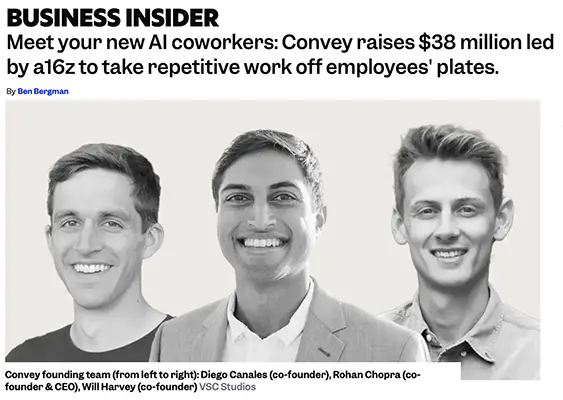
Convey Raises $38 Million From a16z to Automate Repetitive Office Work
Business Insider | Ben Bergman | June 17, 2026
TL;DR: AI “teammate” startup Convey has closed a $38M Series A led by Andreessen Horowitz, positioning itself as the operational automation layer for mid-market companies that can’t build custom AI workflows internally.
Executive Summary
Convey, founded in 2025, has raised $38 million in Series A funding led by Andreessen Horowitz (a16z), with Khosla Ventures and Pear VC participating. The company builds what it calls AI “teammates” — agents designed to own outcomes across repetitive operational workflows, not just execute discrete tasks. The distinction from standard AI agents is framing, but the underlying pitch is meaningful: Convey targets the kind of rote, rule-based work that consumes hours without producing strategic value — data entry, assignment routing, status tracking.
Early customers include NBCUniversal, Samsara, TelevisaUnivision, Unity, Faire, and ChargePoint — a mix of media, logistics, and technology companies, suggesting the use case isn’t industry-specific. The a16z investment rationale, per the board member quoted, centers on the scale of the opportunity: most companies lack the engineering resources to automate their own manual workflows, and Convey is positioning as the accessible version of what large platforms build for themselves.
The article notes the obvious competitive risk — OpenAI, Anthropic, and platform players could push deeper into this space — and Convey’s CEO dismisses it with a focus-over-scale argument. That argument is plausible but untested at scale, and the “broad platforms don’t always win every market” thesis has a mixed track record in enterprise software.
Relevance for Business
This is a direct SMB story. The pitch is explicitly aimed at companies without DoorDash-scale engineering budgets that nonetheless have employees spending significant time on operational tasks that should be automated. If you have staff doing recurring data entry, manual status tracking, workflow routing, or report aggregation, the Convey category of tools is worth evaluating. The a16z endorsement signals this is a sector with serious investment momentum — which means more competitors and lower prices ahead, but also more vendor risk as the market consolidates. The most pragmatic action is to inventory your own “Steve” workflows before vendors define them for you.
Calls to Action
🔹 Map your organization’s most time-consuming repetitive operational tasks — data entry, manual reporting, assignment routing — as a baseline for evaluating AI workflow tools.
🔹 Request a demo from Convey or comparable tools (Zapier AI, Make, n8n with AI nodes) to understand what “outcome ownership” actually means in practice before committing.
🔹 Do not evaluate based on the funding announcement alone; $38M raised is a signal of investor confidence, not product maturity. Ask for customer references in your industry.
🔹 Monitor the platform risk: if OpenAI or Anthropic release comparable workflow automation features, the standalone market may compress quickly.
🔹 Assign an internal owner to track AI workflow automation options over the next two quarters — this is a fast-moving category where waiting 12 months may mean catching up rather than choosing.
Summary by ReadAboutAI.com
https://www.businessinsider.com/convey-raises-38-million-a16z-to-automate-repetitive-office-work-2026-6: June 22, 2026
ByteDance’s AI Spending Boom Is Reshaping China’s Chip Landscape
South China Morning Post | June 18, 2026
| TL;DR As U.S. export controls block Nvidia supply, ByteDance is quietly shifting its AI hardware procurement to a small group of domestic Chinese chipmakers — with Iluvatar CoreX emerging as the near-term frontrunner. |
Executive Summary
ByteDance has dramatically escalated its AI infrastructure spending in 2026, with capital expenditure projections now ranging from 200 billion yuan (~$29.6B) to a Bloomberg-reported $70 billion. As Nvidia’s H200 processors remain in regulatory limbo, ByteDance has moved to fill the gap by quietly procuring tens of thousands of chips from Shanghai-based Iluvatar CoreX — a second-tier domestic chipmaker previously outside the leading supplier tier.
Iluvatar’s competitive advantage is partly structural and partly fragile. Its ability to use both domestic and international foundries has enabled volume delivery — a scarce capability among Chinese AI chip startups. But that same reliance on overseas manufacturing represents a potential vulnerability if geopolitical pressure tightens. Analysts note that the real competition among tier-two chipmakers is less about chip design and more about which companies can guarantee stable mass production.
A broader group of contenders — including Biren Technology, MetaX, Moore Threads, and Enflame — are competing for ByteDance’s supply chain. The key near-term filter is not performance benchmarks but validated, deliverable output at scale.
Relevance for Business
This story is a supply chain signal with downstream implications for any business dependent on AI infrastructure or hardware procurement. The AI chip shortage in China is accelerating the formation of a new domestic supplier tier — one built under geopolitical duress rather than normal market conditions. For SMB leaders, the broader message is that AI infrastructure costs and access are increasingly shaped by geopolitical forces, not just market dynamics — a factor that should inform vendor risk assessments, especially for services built on Chinese cloud infrastructure.
Calls to Action
🔹 Revisit in Q4 2026: whether Iluvatar and peers sustain volume delivery will determine whether China’s AI capability gap narrows or holds.
🔹 Monitor which AI platforms your business uses rely on Chinese cloud infrastructure — and what exposure that creates.
🔹 Track U.S. export control developments as a leading indicator of cost and availability shifts in AI services.
🔹 Note that hardware scarcity is driving Chinese AI vendors toward alternative chip stacks — quality at scale remains unproven.
🔹 If your organization uses Chinese cloud AI services, assess data residency and supply chain dependencies before 2027 budget planning.
Summary by ReadAboutAI.com
https://www.scmp.com/tech/article/3357545/bytedance-spends-billions-ai-which-chinese-chip-start-ups-stand-gain: June 22, 2026
As Patients Rely on AI for Medical Advice, Will Bots Replace Care?
TechTarget/Xtelligent (June 15, 2026)
TL;DR: Patients are using AI chatbots to plug gaps in a healthcare system many can’t otherwise access — but most still don’t trust AI as much as doctors, and the bigger story may be system failure, not AI disruption.
Executive Summary
Two new surveys — one from eHealth, one from EY — show rising but uneven patient reliance on AI for medical guidance. The eHealth survey found roughly half of insured adults have used a chatbot for medical advice, and about two-thirds acted on that advice without confirming with a doctor; 82% said they trust AI’s advice, though only 29% “completely” trust it. The EY survey paints a more cautious picture: only 31% turn to AI when they can’t access care (vs. 41% to search engines), and just 49% are comfortable with AI involved in a treatment decision. Trust in doctors (89% reliable) still far outpaces trust in AI tools (68%).
The article frames this less as AI displacing physicians and more as AI filling gaps created by cost and access barriers— over half of respondents have skipped an annual wellness visit in the past five years. Notably, AI use sometimes drives patients toward care: 56% said they’ve requested or considered requesting a medical service based on AI-sourced information, and most patients would rather see AI used for logistics (appointment scheduling, 65% support) than diagnosis.
Relevance for Business
For SMB healthcare, insurance, and benefits-adjacent businesses, this is a demand signal, not a replacement narrative: patients want AI for triage and scheduling friction, not for clinical judgment. For any SMB exploring AI-assisted customer service in regulated or health-adjacent contexts, the trust gap matters — bolting AI advice onto a product without clear escalation paths to a human professional risks the same “unconfirmed advice” pattern seen here. The two surveys disagree on actual usage rates, a reminder to treat single-survey statistics as directional, not definitive.
Calls to Action
🔹 Monitor survey methodology gaps — eHealth and EY show meaningfully different usage numbers, so don’t cite either as the definitive market size
🔹 If building or buying patient-facing AI tools, build in explicit “see a provider” escalation paths rather than open-ended advice generation
🔹 Act now if your business touches health benefits: AI chat is increasingly the first stop when employees face access barriers — make sure it routes to real care, not around it
🔹Treat this as evidence of healthcare access/cost strain, not AI capability — the underlying driver is affordability, which is a benefits-design issue, not a technology one
🔹 Revisit in 6–12 months as more longitudinal (not single-survey) data emerges on outcomes from unconfirmed AI medical advice
Summary by ReadAboutAI.com
https://www.techtarget.com/patientengagement/news/366644460/As-patients-rely-on-AI-for-medical-advice-will-bots-replace-care: June 22, 2026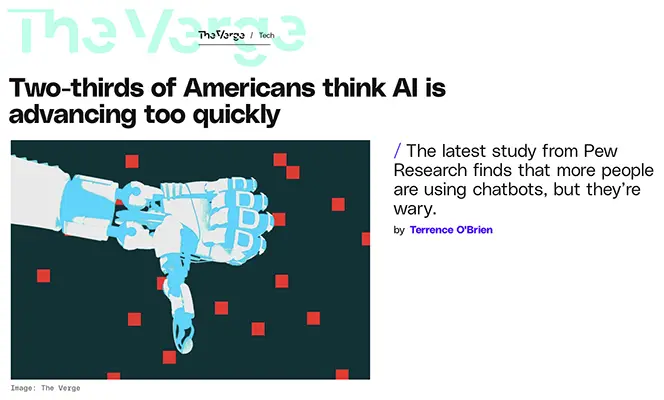

Closing: AI update for June 22, 2026
Taken together, this week’s coverage suggests AI’s frontier is shifting from raw capability to who controls access, who absorbs the cost, and who bears the consequences of removing humans from the loop — in finance, the warehouse, the data center, and increasingly the battlefield. For SMB leaders, the practical task remains the same: separate validated fact from vendor narrative, and treat governance and cost signals as seriously as capability headlines.
All Summaries by ReadAboutAI.com
↑ Back to Top