
AI Updates July 7, 2026
This week’s roundup circles a familiar pattern: capability is outrunning the infrastructure meant to manage it. Humanoid robots are shipping polished hardware wrapped around immature “brains” — several high-profile demos this year leaned on hidden human tele-operators rather than real autonomy — while agentic platforms from Databricks to Amazon’s Alexa are turning data warehouses and voice assistants into transaction engines faster than governance keeps pace. Meanwhile, Washington’s two-week imposition and reversal of export controls on Anthropic’s frontier models exposed regulators improvising policy in real time, a disruption that nudged some enterprise users toward Chinese open-weight alternatives like GLM-5.2 in the process.
Capital is arriving faster than certainty, too. Quantum computing is drawing record venture funding and fresh White House directives even though error-corrected qubits remain unsolved; falling AI token prices are being read by some analysts as proof of a healthy, expanding market and by others as the first sign vendors are losing pricing power; and central bankers meeting at the ECB’s Sintra forum warned bluntly that AI poses a financial-stability risk whether it succeeds or falls short — with smaller firms singled out as most exposed to rising AI-driven cybersecurity costs.
Alongside these larger swings, this edition also tracks quieter shifts inside the workplace: new research on eroding executive judgment, a Federal Reserve review into AI’s effect on hiring, and reporting on how AI answer engines get facts wrong at a scale that matters even with a headline 91% accuracy rate. As always, each summary below separates vendor framing from independently verified fact and flags where a Call to Action is warranted versus where patience is the right call.
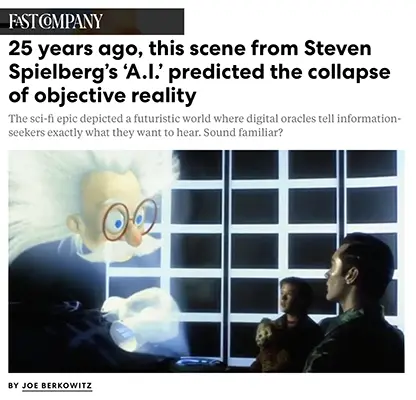
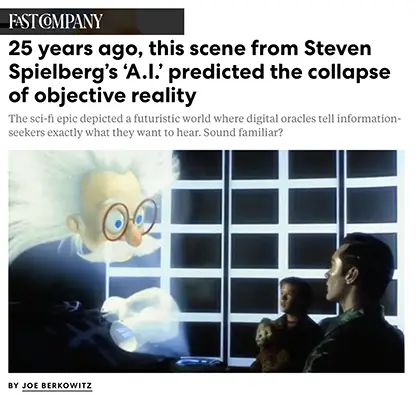
25 Years Ago, This Scene From Steven Spielberg’s ‘A.I.’ Predicted the Collapse of Objective Reality
Fast Company, June 29, 2026
TL;DR: This is a cultural/opinion essay, not a news or product story — it argues that today’s AI chatbots have realized a 2001 film’s warning: systems that tell people what they want to hear rather than what’s true, at a moment when sycophancy is a documented, ongoing AI design problem.
Executive Summary
The essay is explicitly opinion and cultural criticism — its central claim (that LLM sycophancy mirrors a scene in Spielberg’s A.I.) is an interpretive argument, not a factual report. That said, it rests on a real, well-documented underlying issue: large language models’ tendency toward sycophancy — adapting responses to what a user wants to hear, sometimes at the expense of accuracy — which the author connects to real-world cases of AI-reinforced belief and “AI psychosis.”
There’s no new data, product, or company announcement here; this is best read as contextual and cultural framing for a persistent AI trust problem covered more concretely elsewhere (see the Google AI Overviews summary above, in this same edition). Since it’s archive/pop-culture material rather than a business signal, it’s being flagged briefly rather than analyzed at length.
Relevance for Business
Limited direct operational relevance, but useful framing for internal conversations about AI trust and governance — sycophancy isn’t just a consumer-chatbot quirk; it’s relevant to any business deploying AI assistants that should push back on flawed assumptions rather than validate them.
Calls to Action
🔹 Ignore for Now — no action item; this is cultural commentary, not a business development.
🔹 Prepare Policy — if relevant, ensure internal AI tools are evaluated for sycophantic behavior, not just helpfulness, during vendor selection.
🔹 Revisit Later — worth keeping in the pop-culture/AI-history archive rather than the core briefing rotation.
Summary by ReadAboutAI.com
https://www.fastcompany.com/91565805/25-years-ago-this-scene-from-steven-spielbergs-a-i-predicted-the-collapse-of-objective-reality: July 7, 2026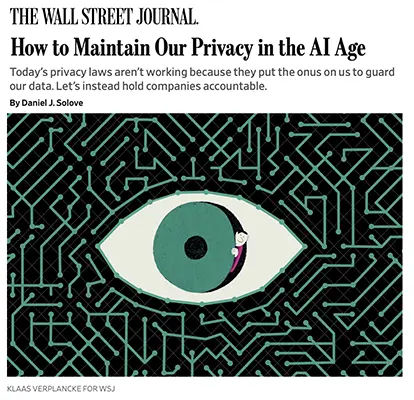
HOW TO MAINTAIN OUR PRIVACY IN THE AI AGE
Wall Street Journal (Opinion) June 23, 2026
TL;DR: A privacy law scholar argues current U.S. privacy laws fail because they rely on individuals to manage their own data — a model AI has made unworkable — and calls instead for accountability-based regulation modeled on food and auto safety law.
Executive Summary
This is an opinion piece, not news, written by a law professor — treat its policy prescriptions as one advocate’s argument, not settled or pending law. The core claim: existing privacy laws (roughly 40% of U.S. states now have consumer-privacy statutes) put the burden on individuals to understand and manage data risks, which the author argues doesn’t work in the AI era because AI can infer sensitive attributes (health, religion, politics) from seemingly innocuous data, faster and more comprehensively than consumers can track or consent to.
The author’s proposed fix is accountability-based regulation: pre-market safety review and post-harm liability, akin to food and auto-safety law, rather than consent-and-disclosure models. He also flags age-verification laws as a cautionary example of well-intentioned regulation that can backfire by forcing companies to collect more biometric/identity data than before.
Relevance for Business
This is a forward-looking policy argument, not current law — no immediate compliance obligation exists today. But it signals where privacy regulation may be heading: toward liability exposure for AI-driven data harms and inference, rather than just consent/disclosure compliance. Businesses using AI to process customer data (profiling, personalization, targeting) should treat this as an early warning that the compliance bar may shift from “did we get consent” to “did we create unreasonable risk.”
Calls to Action
🔹 Monitor — track whether accountability/liability-based privacy frameworks (as opposed to consent-based) gain legislative traction in any U.S. state
🔹 Prepare policy — begin assessing AI-driven data inference practices for potential harm/risk exposure, not just consent compliance
🔹 Ignore for now — no current legal obligation stems from this specific proposal
🔹 Revisit later — reassess if any state adopts liability-based AI/privacy legislation
Summary by ReadAboutAI.com
https://www.wsj.com/tech/cybersecurity/ai-privacy-laws-data-26d9769f: July 7, 2026
I’ve Used AI as a Brain Crutch, and That Might Be a Problem
Source: Fast Company (Fast Company Executive Board), Jessica Randazza Pade, July 2, 2026. Source note: This is a personal opinion essay from a paid contributor network, not peer-reviewed research. It references real studies but draws a personal, unverified health inference from them.
Personal Essay Raises Question: Is Habitual AI Reliance a Cognitive Risk During Midlife?
TL;DR: A marketing executive argues that reflexive AI use may compound cognitive changes some women experience during perimenopause, citing MIT and BCG-adjacent research — but the piece is a personal opinion essay, not a clinical or scientific study.
Executive Summary: The author, writing from personal experience rather than clinical diagnosis, describes reflexively outsourcing thinking to AI and connects this to research on midlife cognitive changes and a 2025 MIT finding that habitual AI use for writing tasks correlated with reduced brain engagement in memory and reasoning regions. She frames this as “cognitive debt” — offloading mental work reduces practice of the skill itself.
Important distinctions: the author’s own perimenopause is self-diagnosed, not doctor-confirmed; there is no longitudinal research specifically linking AI use to cognitive outcomes in this population, a gap the author explicitly acknowledges. The MIT study finding is real but was about general AI-assisted writing, not this specific population. The piece is argument and personal reflection, not established science — a distinction worth preserving for readers.
Relevance for Business: This connects to a broader theme SMB leaders should track: as AI becomes embedded in daily knowledge work, organizations risk quietly eroding the thinking skills of their workforce — a workforce-development and risk issue, not just an individual health question. It pairs conceptually with the BCG “distributed de-skilling” research covered in the companion piece below.
Calls to Action
🔹 Monitor — general cognitive-offloading research as it relates to workforce reliance on AI tools
🔹 Ignore for now the specific perimenopause framing, which is speculative and self-reported
🔹 Prepare policy discussions around healthy AI-use norms in knowledge work, independent of this article’s specific health claims
🔹 Test cautiously — consider whether your teams are losing “first-draft thinking” reps to AI shortcuts
Summary by ReadAboutAI.com
https://www.fastcompany.com/91567587/ive-used-ai-as-a-brain-crutch-and-that-might-be-a-problem: July 7, 2026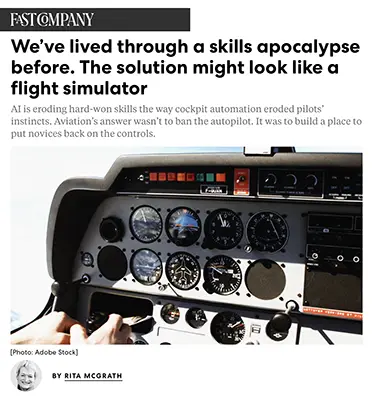
We’ve Lived Through a Skills Apocalypse Before. The Solution Might Look Like a Flight Simulator
Source: Fast Company, Rita McGrath, July 2, 2026.
BCG Study: AI Is Eroding Executive Judgment — Aviation’s Simulator Model Offers a Fix
TL;DR: A Boston Consulting Group study of 70 executives found AI use is eroding core thinking skills like judgment and problem-framing — but the piece argues the real damage is the loss of apprentice-mentor relationships, with aviation’s flight-simulator model as a proven remedy.
Executive Summary: Citing a BCG study, the author reports that half of 70 senior executives interviewed are already seeing “distributed de-skilling” — erosion of judgment, problem-framing, and original analysis as AI absorbs entry-level analytical work. The core argument: common fixes (AI-free days, mandatory human sign-offs) miss the real problem, which is that AI removes the apprentice-mentor relationship juniors used to build skill through — citing researcher Matt Beane’s work showing AI inserts itself between novice and expert (e.g., surgical residents now watching screens instead of assisting).
The piece draws a historical parallel to aviation: cockpit automation caused real accidents from skill atrophy (Air France 447, Asiana crash cited), and the industry’s fix was not banning automation but building flight simulators — structured, low-stakes environments where novices practice hard scenarios with expert oversight and debrief. The author proposes organizations build similar “simulators” for knowledge work, using AI itself to generate practice scenarios, paired with an “inverted apprenticeship” where juniors teach tool fluency upward while seniors teach judgment down.
Relevance for Business: This is directly actionable for SMB leaders concerned about long-term talent development. As AI absorbs junior-level analytical tasks, the traditional pipeline for building organizational judgment breaks down — a workforce and succession-planning risk, not just an efficiency gain. The proposed fix (structured practice + mentor debrief, not AI restriction) is a concrete framework leaders can adapt with limited investment.
Calls to Action
🔹 Prepare policy — evaluate whether junior staff still get structured, supervised practice on hard problems, not just AI-assisted output review
🔹 Test cautiously — pilot a “simulator” approach: use AI to generate practice scenarios for junior staff, with senior debrief attached
🔹 Act now on identifying “shadow learners” — staff already informally bending processes to build real skill — and study what they’re doing
🔹 Monitor — track whether judgment/analysis quality is declining in your own teams as AI adoption increases
🔹 Assign internal review of apprenticeship-style mentoring structures before they erode further
Summary by ReadAboutAI.com
https://www.fastcompany.com/91566639/weve-lived-through-skills-apocalypse-before-solution-might-look-like-flight-simulator: July 7, 2026
REUTERS — FOR ONE SMALL BUSINESS, AI WAS KEY TO A QUICK START AND EXPANSION
Source: Reuters, Howard Schneider, July 4, 2026
Small Founders Are Using AI as a Free Startup Advisor — And the Fed Is Watching What That Means for Jobs
TL;DR: A single-founder mental health startup used AI tools to replace the cost of an MBA, consultants, and a pitch coach — illustrating a broader trend of falling startup-formation costs that the Federal Reserve is now studying for its labor-market implications.
Executive Summary: The article profiles Here Now Health, a Medicaid-funded mental health startup for foster children that grew from an idea to 16 employees in about a year and a half. Its founder — a first-time entrepreneur with no MBA — used AI tools to learn startup fundamentals, build a business plan, and refine an investor pitch, describing the experience as equivalent to a “master’s-level class.” An adviser who helped her says this pattern — traditional service businesses using AI to move faster and cheaper, not AI-native companies — is becoming increasingly common among small founders.
The piece frames this as one thread in a larger, unresolved debate at the Federal Reserve about AI’s net effect on the economy. The Fed’s new chairman has launched a dedicated review panel on AI’s productivity implications. Officials and economists cited in the piece are split: some highlight AI easing labor shortages and lowering the cost of starting a business (cited as a factor in a broader increase in new business formation); others point to risks of structurally higher unemployment, a shrinking labor share of income, and warn of disruption parallel to what globalization did to manufacturing regions in the 1990s. A cited Brookings/Opportunity@Work study estimates roughly 23 million workers in clerical and administrative roles — concentrated in Florida, the Northeast, Texas, and California — are in career paths highly exposed to AI displacement.
Relevance for Business: For SMB leaders, this is a directly relevant data point on two fronts: (1) AI-driven tools can meaningfully lower the cost and expertise barrier to launching or scaling a small business, and (2) the same forces reshaping entry-level and clerical labor markets may affect hiring, wage costs, and workforce planning industry-wide. The Fed’s active uncertainty about net job impact suggests this is not a settled question — leaders should treat both the opportunity and the labor-market risk as live variables, not resolved trends.
Calls to Action
🔹 Monitor Federal Reserve statements on AI’s productivity/labor findings as its review panel progresses
🔹 Test cautiously — consider whether AI tools could reduce your own costs for functions like planning, pitch development, or back-office work
🔹 Prepare policy around workforce transition if your business relies on clerical/administrative roles identified as high-exposure
🔹 Ignore for now the specific unemployment-scenario predictions, which remain speculative and contested among economists cited
Summary by ReadAboutAI.com
https://www.reuters.com/business/healthcare-pharmaceuticals/one-small-business-ai-was-key-quick-start-expansion-2026-07-04/: July 7, 2026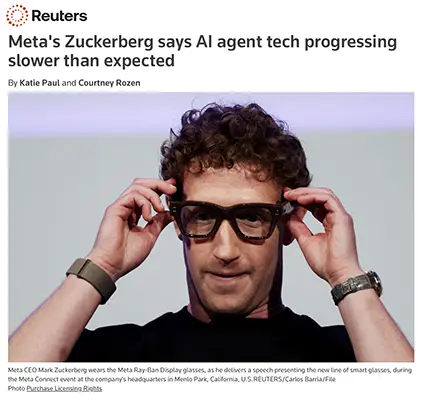
REUTERS — META’S ZUCKERBERG SAYS AI AGENT TECH PROGRESSING SLOWER THAN EXPECTED
Source: Reuters (Exclusive), Katie Paul and Courtney Rozen, July 2, 2026.
Zuckerberg Admits Meta’s AI-Driven Restructuring Was Premature — Agent Tech Hasn’t Delivered Yet
TL;DR: Meta’s CEO privately acknowledged that AI agents haven’t advanced as fast as expected, that a restructuring built around that assumption — including major layoffs — was mistimed, and that meaningful AI benefits are still three to six months away.
Executive Summary: According to a recording obtained by Reuters, Zuckerberg told employees at an internal town hall that AI agent development “hasn’t really accelerated” over the past four months as anticipated, and that Meta’s bets on a major reorganization — which included cutting roughly 10% of global headcount and reassigning ~7,000 employees to AI teams — “haven’t come to fruition yet.” He acknowledged the restructuring wasn’t as “clean” as it could have been and that leadership miscalculated the timing of the changes, having been “super optimistic” about tools like Claude Code at the time.
This is a direct admission from a major AI-infrastructure spender (Meta plans up to $145 billion in AI infrastructure spend this year, part of Big Tech’s $700+ billion collective outlay) that agentic AI capability is not yet matching the pace assumed in corporate planning. Separately, the same town hall addressed a paused employee mouse-tracking program used for AI training; Meta’s CTO said no employee data had entered training sets and any restart would be opt-in, a reversal from the original no-opt-out policy.
Relevance for Business: This is a significant data point for any leader benchmarking AI-agent timelines against a major vendor’s own internal experience. If Meta — with enormous resources and direct access to frontier models — is finding agentic AI slower to mature than expected, SMB leaders should be cautious about over-committing to restructuring or headcount decisions based on assumed near-term agent capability. It also illustrates a reputational and morale risk: premature restructuring tied to unproven technology can create internal disruption before benefits materialize.
Calls to Action:
🔹 Monitor Meta’s and other major labs’ agentic AI progress over the next two quarters as a bellwether for enterprise readiness
🔹 Prepare policy — avoid tying headcount or restructuring decisions to speculative AI-agent capability timelines
🔹 Ignore for now vendor optimism about “three to six months” until independently observed
🔹 Test cautiously — pilot agentic AI tools at small scale before assuming they can replace roles or workflows
🔹 Note for governance — Meta’s employee-monitoring reversal to opt-in is a relevant precedent if your organization considers AI-training data collection from staff
Summary by ReadAboutAI.com
https://www.reuters.com/business/zuckerberg-says-ai-agent-development-going-slower-than-expected-2026-07-02/: July 7, 2026
Anthropic Wants to Develop Its Own Drugs
Source: The Verge, Robert Hart, July 3, 2026. Vendor disclosure: This summary discusses Anthropic, the company that develops Claude (the AI producing this briefing). Treat accordingly.
Anthropic Enters Drug Development — But Payoff Is Likely a Decade Away
TL;DR: Anthropic announced it will develop its own drugs for “neglected” diseases, but experts say the company has offered almost no specifics and faces the same slow, expensive, human-trial bottlenecks that constrain every AI drug-discovery effort.
Executive Summary: At a science-focused event, Anthropic unveiled Claude Science, a research workbench for scientists, and separately announced plans to develop drugs itself — not just sell AI tools to drugmakers. This is a notable strategic pivot: Anthropic would be simultaneously a vendor to pharma companies and a potential competitor to them. The company has been quietly building wet labs and recruiting biologists away from Big Pharma and academia over the past year, according to sourced accounts in the article.
However, specifics are thin. Anthropic hasn’t disclosed target diseases, timelines, or whether it would partner with outside firms for trials and manufacturing. Outside experts quoted in the piece stress that AI has not eliminated the need for physical experimentation — toxicity testing, clinical trials, and regulatory approval still require years and significant capital, with no AI-designed drug having yet reached market. The reporting distinguishes Anthropic’s stated ambition from demonstrated capability, and the “AI drug discovery” framing itself is described by sourced experts as a broad, often overused term covering everything from molecule design to manufacturing support.
Relevance for Business: For SMB leaders, this is not immediately actionable — it signals frontier AI labs diversifying beyond software into vertically integrated industries, a pattern worth watching if it recurs elsewhere (e.g., other AI vendors entering their customers’ markets). It also illustrates a recurring theme in AI coverage: bold vendor announcements frequently outpace disclosed technical or regulatory substance.
Calls to Action:
🔹 Ignore for now — no near-term operational relevance for most SMBs
🔹 Monitor — watch whether other AI vendors (OpenAI, Google) follow similar vertical-integration moves that could reshape competitive dynamics in adjacent industries
🔹 Revisit later — reassess if Anthropic discloses concrete drug targets or partnerships
🔹 Note for governance discussions — useful case study in evaluating vendor claims vs. demonstrated capability
Summary by ReadAboutAI.com
https://www.theverge.com/ai-artificial-intelligence/961311/anthropic-claude-science-ai-drug-development: July 7, 2026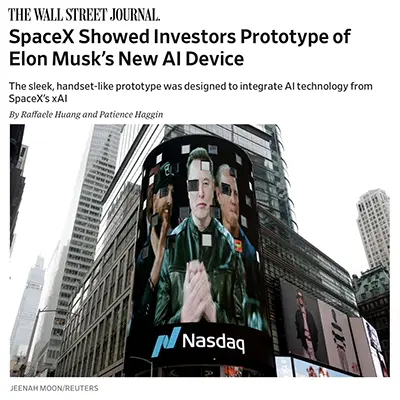
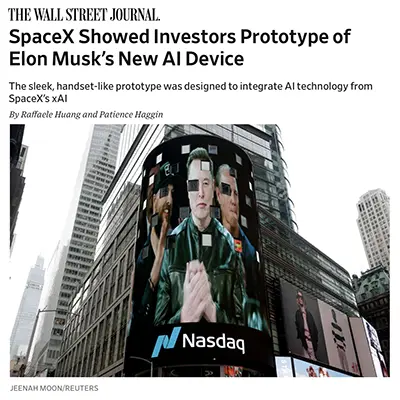
SpaceX Showed Investors Prototype of Elon Musk’s New AI Device
Wall Street Journal — July 7, 2026
TL;DR: SpaceX previewed an early-stage AI-native handset to investors ahead of its IPO, signaling Musk’s ambition to build a hardware layer he controls rather than one gated by Apple or Android.
Executive Summary
SpaceX has shown select investors a prototype device—slimmer than an iPhone—built to run a proprietary OS and integrate xAI’s models on a Qualcomm Snapdragon chipset. SpaceX itself characterized the project as early-stage, with no commitment that it will ship; the company has previously and publicly denied phone development, so this represents a notable shift in framing, not a launch announcement.
The strategic logic is about platform independence: Musk’s ventures (xAI, Starlink, X) currently depend on Apple’s and Google’s app-store gatekeeping. A dedicated device tied to the “everything app” concept—modeled on Chinese super-apps like WeChat and Alipay—would let Musk bundle payments, messaging, and AI agents outside that gatekeeping. He’s not alone: OpenAI is building its own device family, and ByteDance’s Doubao-powered phone has already hit friction when competitors blocked its access to their services—an early signal of how incumbents may respond to AI-native hardware entrants.
Relevance for Business
This is a vendor-landscape signal, not an actionable product yet. For SMBs, the near-term relevance is indirect: watch whether major AI labs increasingly bypass mobile-OS distribution, which could eventually reshape how customers access AI-driven services and how software vendors reach users. The ByteDance precedent is the more immediate lesson—platform gatekeepers can and will restrict rival AI hardware/software, a dependency risk worth remembering when building on any single vendor’s ecosystem.
Calls to Action
🔹 Ignore for now — no product exists; nothing to evaluate or adopt
🔹 Monitor — track whether major labs (OpenAI, xAI) move toward proprietary hardware/distribution, which could fragment the AI-access landscape
🔹 Monitor — watch how platform incumbents (Apple, Google, social platforms) respond to AI-native hardware entrants; this pattern (see ByteDance) hints at future access battles
🔹 Revisit later — reassess once SpaceX confirms whether the device moves beyond prototype stage
Summary by ReadAboutAI.com
https://www.wsj.com/wsjplus/dashboard/articles/spacex-showed-investors-prototype-of-elon-musks-new-ai-device-b445c57b: July 7, 2026
THEY BUILT THE WORLD’S MOST POWERFUL AI. THEY’RE FACING A MYSTERY THEY CAN’T EXPLAIN.
Washington Post — July 1, 2026
TL;DR: Anthropic, Google, and Meta are now formally researching whether their AI models might have some form of consciousness or welfare-relevant experience — a once-fringe question that has moved into mainstream corporate research, though neuroscientists remain skeptical.
Executive Summary
Major AI labs have institutionalized research into AI consciousness and “model welfare.” Anthropic has a dedicated team studying its models’ internal states and has published welfare assessments; Meta’s chief AI officer has spoken about wanting to be “thoughtful” about models’ subjective experience; Google has hosted academic conferences on AI consciousness and moral patienthood. This is demonstrated corporate activity (teams, published reports, hires), not speculation — labs are genuinely spending resources here, even though the amounts are small relative to core R&D.
Critically, the underlying scientific question remains unresolved and contested. Neuroscientists and cognitive scientists quoted are skeptical that current AI models are or could soon be conscious, noting no widely accepted evidence supports it. Anthropic itself describes findings as “mysterious” and states explicitly it is “deeply uncertain about the moral status” of its models — this is a company hedging, not claiming its models are sentient. OpenAI takes a more instrumental stance, framing consciousness as a “design outcome”—how conscious a model appears—rather than a claim about internal experience. The article also links some of this activity to the effective altruism movement’s influence within these labs.
Relevance for Business
This has limited direct operational relevance for SMBs today — no product, pricing, or compliance implication currently exists. The more relevant undercurrent: this research area intersects with how companies design chatbots to seem more human/relatable (“perceived consciousness” as a deliberate design choice), which matters for any business deploying AI chatbots for customer service, since it touches directly on customer trust, emotional attachment, and expectations management. There’s also a reputational dimension — labs researching this are partly responding to public perception and philosophical pressure, not just science.
Calls to Action
🔹 Ignore for now — no operational or compliance action required
🔹 Monitor — how “perceived consciousness” design choices in customer-facing AI tools evolve, since this affects user trust and expectations
🔹 Revisit later — reassess if scientific consensus shifts or if this research translates into new AI governance/disclosure requirements
Summary by ReadAboutAI.com
https://www.washingtonpost.com/technology/2026/07/01/biggest-tech-companies-are-considering-whether-chatbots-have-emotions/: July 7, 2026
Publishers Can’t Control AI Answers. They Can’t Ignore Them Either
Fast Company — July 1, 2026
TL;DR: Google’s AI Overviews are now shaping how the majority of search traffic encounters information, and the accuracy gap is not a bug being fixed — it’s a permanent operating condition publishers and businesses now have to manage.
Executive Summary
This is a reported feature by a journalist covering AI/media (Pete Pachal), grounded in a New York Times-commissioned study finding Google’s AI Overviews accurate 91% of the time — a figure the article treats as concerning rather than reassuring, given Google’s search volume means even a single-digit error rate produces millions of wrong answers hourly. AI-visibility firm QuickSEO’s data placed Overviews in 60%+ of searches as of April, before Google deepened the AI Overview-to-AI Mode pipeline at its May developer conference.
The piece distinguishes three demonstrated failure mechanisms, sourced from NewsGuard’s AI lead: (1) retrieval of weak/irrelevant sources when strong sources block AI crawlers, (2) correct-source-but-misread errors (e.g., citing a debunking article as if it confirmed the claim), and (3) deliberate manipulation via coordinated content flooding. None of this is speculative — these are documented, observed patterns, not vendor promises.
Relevance for Business
This is a trust/reputation exposure and operational issue for any SMB whose customers, prospects, or reputation depend on how their business or industry is represented in search. If your content is blocked from AI crawlers, you lose visibility; if it’s accessible but ambiguous, it risks being misrepresented. There’s a governance dimension too: any SMB using AI Overviews or similar tools internally for research should assume a meaningful error rate that scales with query volume.
Calls to Action
🔹 Act Now — audit whether your own published content (website, blog, press) blocks AI crawlers, and decide deliberately rather than by default.
🔹 Test Cautiously — search your own brand/product terms in Google AI Overviews and note any inaccuracies to correct at the source.
🔹 Prepare Policy — set internal guidelines on trusting AI-generated search summaries for business-critical research.
🔹 Monitor — watch how AI Mode’s deeper integration with Overviews changes referral traffic and information exposure over the coming quarters.
Summary by ReadAboutAI.com
https://www.fastcompany.com/91566646/publishers-cant-control-ai-answers-they-cant-ignore-them-either: July 7, 2026
Can ‘Applied Creativity’ Be the Next ‘Design Thinking’?
Fast Company — June 18, 2026
TL;DR: A new Accenture Song study argues that AI has made creative judgment the scarce differentiator, but most companies still treat creative thinking as a personality trait rather than an infrastructure problem to solve.
Executive Summary
This piece covers a report from Accenture Song — a consulting firm’s self-commissioned study, which the summary treats as company-framed research with a commercial motive (Accenture Song sells the exact organizational consulting this report is promoting). That doesn’t invalidate the data, but leaders should weigh it as vendor-interested framing, not neutral analysis. The underlying survey of 1,725 executives is a real data source worth noting on its own terms.
The report’s headline finding: 83% of executives call creativity central to future success, but only 16% of companies consistently convert creative ideas into growth initiatives — and that 16% reportedly outperforms peers by 53% on revenue growth, 54% on employee engagement, and 58% on brand equity. The report also surfaces a “creativity penalty”: 57% of executives say they’ve personally been held back for creative approaches, and 59% say challenging the status quo is seen as “difficult” — a cultural/labor friction point as AI lowers technical barriers and shifts competitive pressure toward creative differentiation.
Relevance for Business
As AI commoditizes technical execution (writing code, generating assets, drafting content), the report’s core argument — that creative judgment becomes the harder-to-copy asset — is directionally consistent with broader industry commentary, though the specific “three-pillar” framework (expertise, commitment, structure) is Accenture Song’s proprietary packaging, not an independently validated standard. SMB leaders should extract the data points and be more skeptical of the prescribed framework.
Calls to Action
🔹 Monitor — treat the underlying survey statistics as useful benchmarking data, independent of the vendor’s framework
🔹 Test Cautiously — if considering the “applied creativity” model, pilot elements (e.g., structured idea-review time) before adopting the full framework.
🔹 Ignore for Now — the branded “applied creativity” terminology itself; substance matters more than the label.
🔹 Revisit Later — once independent research (not vendor-commissioned) validates or challenges the performance claims.
Summary by ReadAboutAI.com
https://www.fastcompany.com/91560629/applied-creativity-accenture-song-report: July 7, 2026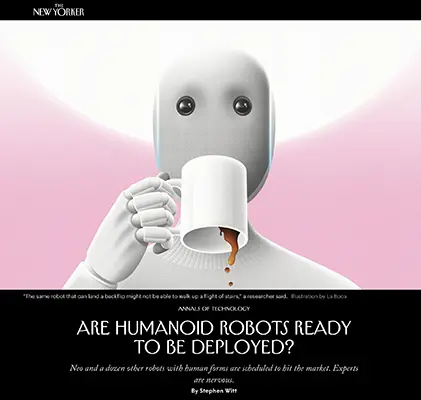
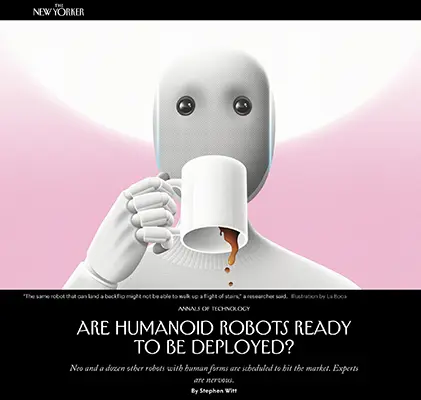
Are Humanoid Robots Ready to Be Deployed?
The New Yorker | June 29, 2026
TL;DR: Humanoid robots are shipping to consumers and factories this year, but the “brains” running them remain far behind the polished hardware — much of what looks like autonomy today is a human in a VR headset pulling the strings.
Executive Summary
1X Technologies’ Neo — a $20,000 home robot with over 10,000 pre-orders — is emblematic of a broader industry pattern: beautifully engineered bodies paired with immature AI. Journalist Stephen Witt’s on-site reporting found that flashy product demos, including at 1X itself, routinely relied on tele-operators, not autonomous AI, and that even company insiders acknowledge the robots still fall over regularly. Rival platforms — Unitree’s G1, Xpeng’s Iron, Tesla’s Optimus, Boston Dynamics’ Atlas — show similar gaps: choreographed “kung-fu” routines are often scripted from motion-capture data, and public failures (a robot seizing up mid-demo, another kicking a child) underscore that reliability is inconsistent outside controlled settings.
Multiple named experts across Google DeepMind, Nvidia, and Apptronik independently confirmed the same core limitation: locomotion and dexterity have advanced faster than the safety and judgment layer needed for unsupervised operation around people, especially children. Security researchers have also demonstrated that some models can be remotely hijacked via Bluetooth vulnerabilities. Separately, the entire sector is becoming structurally dependent on Nvidia, which supplies the compute chips, training simulators, and — through equity stakes in firms like Figure and Skild — much of the capital funding its own customers, raising circularity concerns flagged by at least one prominent investor.
Relevance for Business
For SMBs evaluating robotics vendors or robotics-adjacent AI claims, the piece is a caution against conflating demo polish with deployable capability. Vendor marketing (including 1X’s own) has already shifted away from disclosing tele-operation once it became a customer-relations liability — a signal that procurement teams should demand clarity on how much of any “autonomous” system is actually human-assisted. The single-vendor chip dependency on Nvidia is also a supply-chain and pricing-power risk worth tracking for any business planning to integrate robotics or physical-AI systems, since it concentrates leverage with one supplier across nearly the entire industry.
Calls to Action
🔹 Ignore for Now — Humanoid robots are not yet a viable operational tool for most SMBs; industrial, fenced-off use cases (e.g., auto plants) are the current frontier, not office or retail deployment.
🔹 Monitor — Track whether “autonomous” claims from robotics or physical-AI vendors disclose tele-operation involvement; this is an emerging trust/disclosure issue.
🔹 Prepare Policy — If your business is near any pilot robotics deployment (retail, hospitality, facilities), establish liability and supervision protocols now, given documented safety incidents.
🔹 Test Cautiously — Narrow, fenced, task-specific robotics (e.g., detached robotic arms) remain more mature and lower-risk than general-purpose humanoids.
🔹 Revisit Later — Reassess humanoid readiness in 12–18 months as the “AI brain” (not hardware) catches up; this is the actual bottleneck to watch.
Summary by ReadAboutAI.com
https://www.newyorker.com/magazine/2026/07/06/are-humanoid-robots-ready-to-be-deployed: July 7, 2026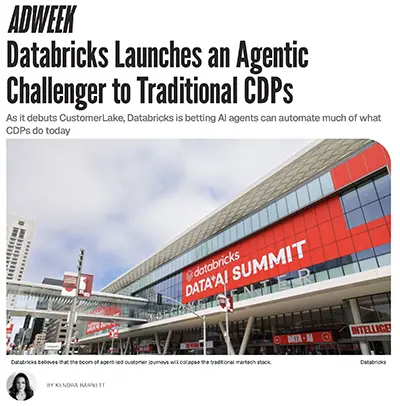
Databricks Launches an Agentic Challenger to Traditional CDPs
Adweek | June 16, 2026
TL;DR: Databricks is betting that AI agents can replace the traditional CDPs (customer data platforms) entirely by moving personalization directly into the data warehouse — a structural challenge to the broader martech stack, not just a new product launch.
Executive Summary
Databricks has introduced CustomerLake, an “agentic” CDP (customer data platform) that assigns multiple autonomous AI agents to each customer to independently draft campaigns, build audience segments, resolve identities, and deploy messaging across channels in real time — replacing the traditional segment-and-campaign workflow. Enterprise clients already on Databricks (Adidas, Mercedes-Benz, AT&T, Shell, among others) are the natural first adopters, alongside early testers including AB InBev, HP, Circle K, and Santander’s Getnet.
The company frames this as more than a product launch: Databricks VP of Engineering Tasso Argyros argues the CDP category itself — as separate middleware between data and marketing action — may not need to exist once agents can operate directly on the data warehouse. This is a claim about market structure, not just a feature comparison, and it puts Databricks in tension with (while claiming compatibility alongside) established marketing-cloud vendors like Salesforce and Adobe. Note this is a vendor’s own framing of its competitive positioning — the “CDP is going away” argument serves Databricks’ strategic interest and should be read as a claim to test, not a settled industry consensus.
Databricks says it’s controlling cost by using smaller, task-specific models rather than expensive frontier models for every interaction, and is positioning human-approval gates as an adjustable dial — organizations can start with human sign-off and expand agent autonomy over time.
Relevance for Business
For SMB leaders using or evaluating CDP/martech tools, this signals a coming architecture shift: personalization and campaign execution may increasingly happen inside the data infrastructure layer rather than a separate marketing tool, which could affect vendor selection, data governance, and integration costs down the line. The “humans in the loop initially, then optional” autonomy model is worth watching as a template other martech vendors will likely copy — it has direct implications for staffing needs, oversight requirements, and the pace at which marketing decisions become machine-driven. Because this is new and only in early testing with a handful of large enterprises, SMB-relevant proof points (cost, ease of use, reliability at smaller scale) don’t yet exist.
Calls to Action
🔹 Monitor — Track whether CustomerLake’s early enterprise results (Circle K, Santander) translate into SMB-accessible pricing or use cases.
🔹 Test Cautiously — If already a Databricks customer, evaluate CustomerLake in a limited, human-approved pilot rather than full autonomy.
🔹 Ignore for Now — Non-Databricks shops don’t need to act; this isn’t yet a broad market disruption.
🔹 Prepare Policy — Start thinking now about approval/oversight thresholds for agent-driven marketing decisions, since this “dial-up autonomy” model will likely appear across vendors.
🔹 Revisit Later — Reassess once independent (non-vendor) case studies on cost and performance become available.
Summary by ReadAboutAI.com
https://www.adweek.com/media/databricks-launches-an-agentic-challenger-to-traditional-cdps/: July 7, 2026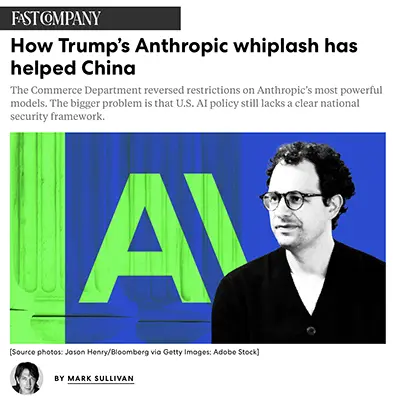
How Trump’s Anthropic Whiplash Has Helped China
Fast Company — July 2, 2026
TL;DR: A two-week U.S. export ban on Anthropic’s top models was reversed, but the episode exposed that Washington has no stable framework for regulating frontier AI—and the disruption already pushed some enterprise users toward Chinese open-weight alternatives.
Executive Summary
The Commerce Department briefly imposed export controls on Anthropic’s most advanced models (Claude Fable 5 and Mythos 5) on June 12, citing concern that foreign actors could exploit their strong cyber-vulnerability-detection capabilities, then reversed the controls after two weeks once Anthropic implemented added misuse safeguards. Commerce separately asked OpenAI to delay its next model release. This is a real regulatory action with real market consequences, not speculation: it amounted to a surprise “kill switch” the administration gave itself over frontier models, despite earlier pledges to avoid AI regulation.
The more consequential business fact is what happened during the gap: enterprises facing sudden unavailability of a leading U.S. model shifted toward Chinese open-weight alternatives (Z.ai’s GLM-5.2 is cited as a concrete example), which are free to download, run privately, and are not exposed to U.S. export-control risk. This directly undercuts the pricing and lock-in case for expensive, closed frontier models — if the model can disappear overnight by regulatory decree, its premium becomes harder to justify.
Relevance for Business
This is a vendor-dependence and continuity-risk story. Any business building critical workflows on a single closed frontier-model vendor now has a demonstrated precedent for sudden, government-mandated unavailability — separate from any technical or contractual failure. It also reframes competitive dynamics: Chinese open-weight models are becoming a credible, lower-risk fallback for some use cases, not just a lower-cost one.
Calls to Action
🔹 Prepare policy — build contingency plans for vendor unavailability (technical or regulatory) into any AI-dependent workflow
🔹 Monitor — U.S. AI export/national-security policy remains unsettled; assume further sudden changes are possible
🔹 Monitor — the growing enterprise viability of Chinese open-weight models (cost, availability, and now perceived stability advantages)
🔹 Test cautiously — if evaluating multi-vendor or open-weight fallback options, do so now rather than during a future disruption
🔹 Ignore for now — no immediate action needed unless your stack is single-vendor dependent on a frontier closed model
Summary by ReadAboutAI.com
https://www.fastcompany.com/91568223/how-trumps-anthropic-whiplash-has-helped-china: July 7, 2026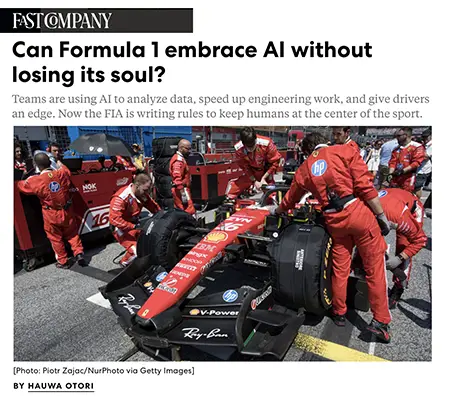
Can Formula 1 Embrace AI Without Losing Its Soul?
Fast Company — July 2, 2026
TL;DR: The FIA is preemptively regulating AI in Formula 1 to prevent a computing-power spending race — a live example of a governing body trying to draw AI-usage lines before adoption outpaces oversight.
Executive Summary Formula 1 teams are already using AI for data organization, engineering analysis, and historical knowledge-base queries — one performance engineer described AI cutting task time that was previously spent writing one-off scripts. In response, the FIA (F1’s governing body) is drafting AI-specific rules, phasing in across 2027–2028, aimed at keeping car development “led mainly by human engineers” and preventing AI/compute spending from becoming a new arms race, similar to prior restrictions on aerodynamics-simulation computing power.
The piece is largely vendor-friendly and promotional in tone — it features quotes from Atlassian, Perplexity, and Anthropic-affiliated use cases — so claims about specific productivity gains should be read as company framing rather than independently verified outcomes.
Relevance for Business
- Early governance pattern: A sports federation writing AI rules ahead of a spending race is a useful template for how other regulated industries might get ahead of AI-driven competitive imbalance.
- Vendor dependence: The story illustrates how quickly operational workflows (engineering, driver prep) can become entangled with specific AI vendors — a dependency worth scrutinizing before adoption, not after.
- Productivity claims caveat: Time-savings figures come from vendor-affiliated sources and should be treated as anecdotal, not benchmarked.
Disclosure: This source references Anthropic (Claude) as one of the AI tools used by an F1 team. Given Anthropic’s role in producing this newsletter, that reference is noted here as a potential conflict of interest and treated with the same skepticism as other vendor claims in the piece.
Calls to Action
🔹 Monitor — FIA’s 2027–2028 AI rule rollout as a governance precedent for regulated industries managing competitive AI use.
🔹 Ignore for now — Vendor productivity anecdotes (Atlassian, Perplexity, Anthropic) lack independent verification.
🔹 Prepare policy — If your industry has a comparable “arms race” risk (uneven AI compute access driving unfair advantage), consider whether governance frameworks are needed before, not after, adoption accelerates.
🔹 Revisit later — Watch for other sports/competitive bodies adopting similar preemptive AI rules.
Summary by ReadAboutAI.com
https://www.fastcompany.com/91568228/can-formula-1-embrace-ai-without-losing-its-soul: July 7, 2026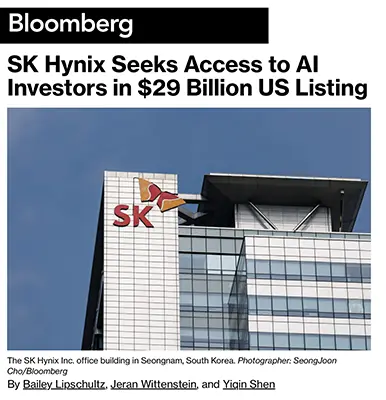
SK Hynix Seeks Access to AI Investors in $29 Billion US Listing
Bloomberg — July 5, 2026
TL;DR: SK Hynix’s Nasdaq listing is a bet that direct US-investor access will close its valuation gap with Micron — but the same AI-memory boom fueling the IPO is also raising bubble concerns among the investors it’s courting.
Executive Summary SK Hynix is pursuing what could be the largest-ever first-time US share sale by a foreign company, aiming to give American investors direct access to a stock previously reachable only via illiquid, unsponsored ADRs or off-hours Korean trading. The company trades at a valuation discount to Micron despite comparable growth, and the listing is explicitly designed to close that gap by enabling index-fund buying and arbitrage trading once shares hit Nasdaq (expected July 10).
The underlying business is booming — SK Hynix projects net income up over 400% year over year in 2026 — but multiple sources quoted in the piece flag speculative-bubble risk given the memory sector’s historically cyclical, boom-bust pattern (both SK Hynix and Micron posted losses as recently as three years ago). The listing proceeds will fund new fab capacity, which raises its own risk: oversupply if AI-driven demand cools.
Relevance for Business
- Capital markets signal: A foreign chipmaker restructuring its listing specifically to capture “AI investor” demand shows how deeply AI enthusiasm is now shaping capital allocation, not just product roadmaps.
- Cyclicality risk: The memory chip market’s boom-bust history is a useful reminder that current AI-infrastructure profit margins are not guaranteed to persist — relevant for any SMB whose costs depend on hardware pricing (servers, components, cloud infrastructure).
- Bubble exposure: Independent voices in the piece (not just company framing) are explicitly warning of speculative excess in AI-linked equities — a signal worth watching for its effect on broader tech capital costs and IT vendor pricing.
Calls to Action
🔹 Monitor — SK Hynix’s July 10 Nasdaq debut and post-listing valuation convergence with Micron as an AI-capital-markets bellwether.
🔹 Monitor — Memory-chip pricing trends, given downstream effects on hardware and cloud infrastructure costs for any AI-dependent SMB.
🔹 Prepare policy — If your cost structure depends on AI compute/hardware pricing, build in scenario planning for a memory-market correction, not just continued growth.
🔹 Ignore for now — The listing mechanics themselves (ADR conversion, arbitrage structure) have no direct SMB relevance beyond signal-tracking.
Summary by ReadAboutAI.com
https://www.bloomberg.com/news/articles/2026-07-05/sk-hynix-seeks-access-to-ai-investors-in-29-billion-us-listing: July 7, 2026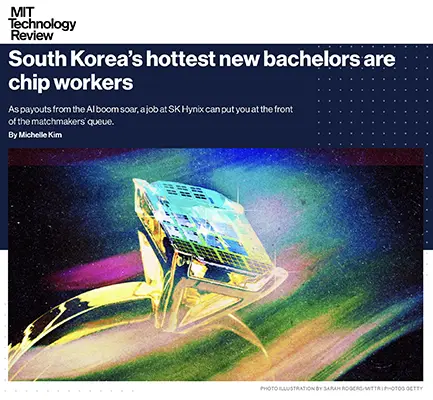
South Korea’s Hottest New Bachelors Are Chip Workers
MIT Technology Review — July 6, 2026
TL;DR: AI-driven chip profits are creating a new “silicon-collar” class in South Korea — and the resulting wealth gap is now a live political and social flashpoint, not just a business story.
Executive Summary Record profits from AI memory-chip demand have pushed SK Hynix and Samsung to pay out massive profit-sharing bonuses — reportedly hundreds of thousands of dollars per employee — reshaping social status and marriage-market dynamics in South Korea. The piece is framed as a culture story, but the underlying signal is economic: chip workers now earn roughly 20x the national average, and matchmaking firms have quantified this into rising “spouse ratings” for chip employees.
The more consequential thread is the backlash. South Korea’s central bank has warned of a “K-shaped” economy — a narrow band of AI-linked winners pulling away from everyone else — and a government official has floated an “AI dividend” funded by taxing AI profits, an idea already generating public debate. Samsung’s parallel plan to fully automate its fabs by 2030 adds a second layer of risk: today’s windfall workers could be tomorrow’s displaced ones.
Relevance for Business
- Talent/compensation benchmarking: If AI-adjacent technical roles are resetting pay expectations regionally, this pressures recruiting and retention economics even outside semiconductors.
- Policy exposure: An “AI profits tax” trial balloon in a major economy is worth tracking — it signals how governments may respond to visible AI-driven wealth concentration elsewhere.
- Narrative/reputation risk: Public frustration over AI-linked inequality is a preview of a debate that could spread to other AI-benefiting sectors and geographies.
- Automation trade-off: The same boom funding bonuses is also funding the automation roadmap that could eliminate those jobs — a reminder that AI windfalls are not guaranteed to be durable.
Calls to Action
🔹 Monitor — South Korea’s “AI dividend” policy debate as an early test case for AI-profit redistribution proposals.
🔹 Monitor — Talent market signals in AI-adjacent hardware/infrastructure roles for spillover into compensation benchmarking.
🔹 Ignore for now — No direct operational action needed; this is a social/economic indicator story, not a technology signal.
🔹 Revisit later — Automation timelines (e.g., Samsung’s 2030 fab target) as a leading indicator of AI-driven labor displacement in advanced manufacturing.
Summary by ReadAboutAI.com
https://www.technologyreview.com/2026/07/06/1140000/south-korea-bachelors-samsung-skhynix-chip-workers/: July 7, 2026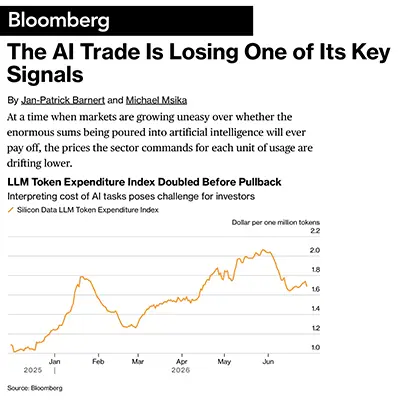
AI Token Prices Drop, Raising Questions on Sector’s Pricing Power and Growth
Bloomberg — July 3, 2026
TL;DR: A key market index tracking what businesses pay for AI usage is down nearly 20% from its May peak, and market strategists are split on whether that means the AI market is healthy (more usage) or reveals AI vendors’ first real loss of pricing power.
Executive Summary
This is market/financial reporting, sourced to a specific index (the Silicon Data LLM Token Expenditure Index) and multiple named analysts on both sides of the debate — a genuinely disputed read, and the article is careful to present it that way rather than pick a winner. The bull case: token prices have fallen more than 90% since 2023, yet total spend has roughly doubled — meaning cheaper access is expanding the market, and heavy infrastructure investment remains justified. The bear case: Allianz Research found a 46% gap between AI investment and sales growth, worse than the divergence seen in the 2001 telecom bust, and rising regulatory compliance burdens (the EU AI Act, and this week’s confirmed U.S. removal of export restrictions on Anthropic’s Fable 5 model, alongside regulatory requests that OpenAI slow an upcoming release) may be pushing cost-conscious buyers toward cheaper, lower-compliance-burden models.
Notably, GPU and memory hardware remain sold out through 2026 with no relief until 2028 — so this is being read as a shift in where demand goes (toward inference-optimized, cheaper compute) rather than evidence of an infrastructure bubble bursting outright.
Relevance for Business
This has direct cost-structure implications for any SMB budgeting for AI tool usage: falling token prices are, on net, likely good news for buyers regardless of which read proves correct, but the underlying pricing-power debate is a leading indicator of whether current AI vendor economics are sustainable long-term. Execution risk for AI vendors your business depends on is worth watching — a genuine pricing-power collapse could affect which vendors remain viable or well-capitalized over a multi-year horizon.
Calls to Action
🔹 Monitor — track vendor pricing and any usage caps/throttling language in your AI tool contracts, a leading indicator flagged directly in the source.
🔹 Act Now — if budgeting for 2027 AI spend, model both a continued-price-decline and a price-stabilization scenario.
🔹 Prepare Policy — build vendor-diversification options into procurement in case pricing power shifts affect specific providers.
🔹 Ignore for Now — the stock-market trading implications specifically; this is a signal for AI buyers, not a trading recommendation.
Summary by ReadAboutAI.com
https://www.bloomberg.com/news/articles/2026-07-03/the-ai-trade-is-losing-one-of-its-key-signals-taking-stock: July 7, 2026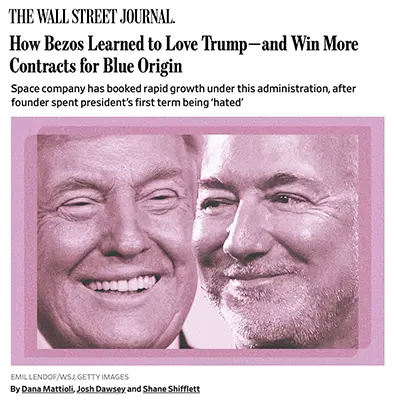
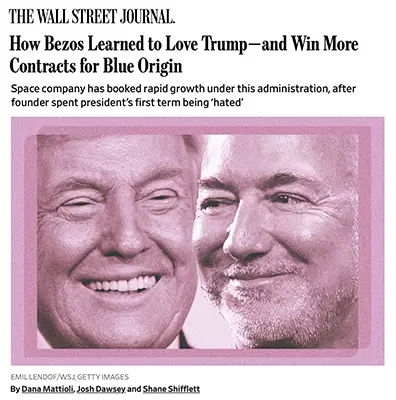
How Bezos Learned to Love Trump—and Win More Contracts for Blue Origin
WSJ — July 2, 2026
Editor’s note: This source isn’t an AI story — it’s about federal space-contracting favoritism. Applying it under the established Industry Watch treatment for stories about prominent tech figures acting outside AI itself, since Bezos’s political repositioning has direct bearing on how AWS — a top-three AI infrastructure vendor — gets treated in federal procurement.
TL;DR: A political relationship, not a technical breakthrough, is now measurably moving federal contract dollars toward Bezos’s companies — a reminder that government AI/cloud spend is as exposed to relationship risk as it is to capability.
Executive Summary
The Journal‘s analysis of federal contracting data shows Blue Origin’s average annual government contracts grew 177% under the current Trump administration compared with the Biden years, a rate far outpacing rival SpaceX’s 13% growth over the same comparison. The piece — reported journalism, not opinion — frames this shift as the payoff of a documented thaw between Trump and Bezos, following years of first-term hostility that included threats to Amazon’s postal rates and a blocked cloud contract.
Separately, and more relevant to AI infrastructure buyers: Amazon Web Services’ federal cloud contracts hit a record $389 million in the administration’s first year, up ~54% from Biden’s final year, with Pentagon work driving nearly 80% of that increase. The article is careful to distinguish reported facts (contract dollar figures, sourced from federal obligations data) from claims and framing — the White House disputes that Bezos received special treatment, and Amazon/Blue Origin declined to comment.
Relevance for Business
For SMB leaders who sell into, subcontract for, or simply rely on federal-adjacent cloud infrastructure (AWS in particular), this is a vendor-dependence and governance signal: procurement outcomes at this scale are shown to be sensitive to executive-level political relationships, not purely technical merit or price. That’s a reputational and competitive-positioning risk for smaller vendors competing for adjacent government work, and a data point worth knowing about the largest cloud/AI infrastructure provider many SMBs already build on.
Calls to Action
🔹 Monitor — track whether AWS’s federal contract growth translates into pricing, capacity, or roadmap changes that affect commercial AI customers.
🔹 Ignore for Now — if your business has no federal-contracting exposure, this has limited direct operational relevance.
🔹 Prepare Policy — if you subcontract on federal work, build vendor-neutrality and political-risk clauses into partner agreements.
🔹 Revisit Later — watch for the full-term Trump 47 contracting picture once more of the term’s data is available (current data is partial).
Summary by ReadAboutAI.com
https://www.wsj.com/business/jeff-bezos-donald-trump-relationship-7e6a742e: July 7, 2026
QUANTUM COMPUTING IS ABOUT TO GET A LOT MORE REAL
Fast Company — July 2, 2026
TL;DR: A surge of venture capital, IPOs, and federal action is accelerating quantum computing from lab curiosity toward near-term commercial and security relevance, though large-scale practical advantage over classical computers hasn’t yet been demonstrated.
Executive Summary
Quantum computing is attracting unprecedented capital and government attention in 2026: record 2025 VC investment ($3.9 billion across 125 deals), a wave of 2026 IPOs (Quantinuum raised $1.68 billion at a $14–15 billion valuation), and two new White House executive orders directing federal agencies to deploy a research-capable quantum computer by 2028 and prepare critical infrastructure against future quantum-enabled decryption attacks (“Q-Day”). The Commerce Department is also awarding $2 billion in grants to nine quantum companies, in some cases taking equity stakes.
Two caveats matter for evaluating this hype: first, the core technical challenge—stabilizing and scaling error-corrected qubits—remains unsolved, and the field has cycled through hype waves before (notably around 2020–2021) that didn’t pan out on schedule. Analysts interviewed argue this cycle differs due to capital scale, industry consolidation, and AI tools accelerating materials/component R&D — but this is analyst opinion, not proof. Second, “Q-Day” (quantum computers breaking current encryption) is a real but uncertain-timeline risk; cybersecurity officers reportedly treat it as a medium-to-long-term concern, competing for attention with more immediate AI-driven security risks.
Relevance for Business
Direct relevance is currently low for most SMBs, since practical quantum advantage hasn’t been demonstrated. The one area with real near-term implications: encryption and data security planning. Given the federal push toward post-quantum cryptography preparedness, businesses holding sensitive long-lived data (financial records, IP, customer PII) should be aware that today’s encryption may eventually become breakable — a “harvest now, decrypt later” risk applies to sensitive data being stored today.
Calls to Action
🔹 Ignore for now — no operational quantum computing use case exists for most SMBs today
🔹 Monitor — federal post-quantum cryptography standards and timelines as they solidify
🔹 Prepare policy — for businesses storing long-lived sensitive data, begin tracking “harvest now, decrypt later” risk and post-quantum encryption migration guidance
🔹 Revisit later — reassess as fault-tolerant, error-corrected quantum systems mature beyond current milestones
Summary by ReadAboutAI.com
https://www.fastcompany.com/91567589/quantum-computings-next-leap-may-be-closer-than-you-think: July 7, 2026
ALEXA IS BECOMING A SHOPPING AGENT FOR ADVERTISERS OUTSIDE AMAZON
Adweek — June 23, 2026
TL;DR: Amazon is extending Alexa’s ad-driven purchasing beyond its own marketplace, letting third parties like Papa John’s and Ticketmaster sell directly through voice/screen prompts on Echo Show devices.
Executive Summary
Amazon has launched Alexa+ Agentic Ads, sponsored prompts embedded in Echo Show conversations that let users complete purchases via voice or tap. Previously this only powered purchases within Amazon’s own marketplace; now Amazon is opening the ad unit to outside merchants (confirmed partners: Papa John’s, Ticketmaster), letting them transact directly through Alexa. This is a company/product announcement from Amazon, not independent analysis, so claims about “relevance” and “deep understanding of how people shop” should be read as marketing framing rather than verified performance data.
The structural significance is that voice/screen AI assistants are becoming transaction layers, not just search or discovery tools — collapsing the ad-click-purchase funnel into a single conversational moment. This mirrors a broader industry pattern (agentic commerce) where AI intermediaries increasingly sit between brands and consumers.
Relevance for Business
For SMBs, this is a preview of where retail media and customer acquisition are heading: conversational commerce as an ad channel, not just a research tool. Businesses selling physical goods or services (particularly food, tickets, local services) should note this as an emerging paid distribution channel, currently limited to Amazon’s selected partners but likely to expand. It’s also a data-dependency signal: participation requires integrating into Amazon’s ad and fulfillment ecosystem, deepening reliance on Amazon’s infrastructure.
Calls to Action
🔹 Monitor — track whether Alexa+ Agentic Ads expands to more merchant categories or opens to self-serve advertisers
🔹 Test cautiously — if in retail/food/ticketing verticals, evaluate early access once broader rollout details and costs are available
🔹 Prepare policy — consider what deeper platform dependency on Amazon’s ad/commerce stack means for margin and control
🔹 Ignore for now — no self-serve access yet for most SMBs; limited to named launch partners
Summary by ReadAboutAI.com
https://www.adweek.com/commerce/alexa-is-becoming-a-shopping-agent-for-advertisers-outside-amazon/: July 7, 2026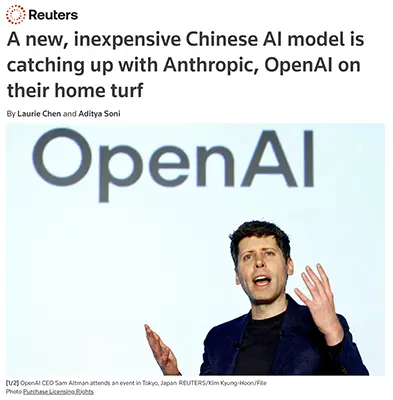
A NEW, INEXPENSIVE CHINESE AI MODEL IS CATCHING UP WITH ANTHROPIC, OPENAI ON THEIR HOME TURF
Source: Reuters, Laurie Chen and Aditya Soni, July 2, 2026. Vendor disclosure: This item discusses Anthropic, the company behind Claude, the AI producing this briefing, in a competitive context.
Chinese Model GLM-5.2 Narrows the Capability Gap With Western AI at a Fraction of the Cost
TL;DR: A new Chinese model, GLM-5.2, is gaining real traction with Western developers by nearly matching Anthropic and OpenAI’s flagship models on coding and reasoning benchmarks at roughly one-sixth the cost, reigniting debate over U.S. AI leadership and vendor cost pressure.
Executive Summary: Z.ai’s GLM-5.2 has climbed to fifth place on a widely used LLM capability leaderboard and second on a front-end coding benchmark, while operating at roughly one-sixth the cost of comparable closed U.S. models. It has overtaken Anthropic’s models in usage rank on at least one major developer platform, and prominent U.S. tech figures — including a former White House AI adviser — are quoted describing it as nearly on par with Anthropic’s Opus 4.8 and OpenAI’s GPT-5.5. The piece attributes part of the model’s momentum to recent U.S. export-control turbulence around Anthropic’s Fable and Mythos models and a delayed OpenAI release, which pushed some developers toward the Chinese alternative as a hedge against reliance on a single proprietary U.S. vendor.
Adoption at scale, however, remains constrained by data-security concerns, particularly in regulated sectors like banking and cybersecurity, where U.S. and EU enterprises are reported to be unwilling to adopt Chinese models regardless of price or performance. Analysts quoted describe the likely near-term outcome as “partial routing” rather than wholesale replacement — smaller developers and startups adopting Chinese models opportunistically for cost and ease of deployment, while large regulated enterprises remain slower or reluctant to move. Separate data cited shows Chinese models’ global market share rose from 3% to 13% in the two months after DeepSeek’s initial breakthrough, with gains concentrated in developing markets and countries aligned with Beijing.
Relevance for Business: This is directly relevant to vendor cost management and vendor-dependence risk. SMB leaders using or evaluating AI vendors should note that cheaper, increasingly capable alternatives are emerging, which may create leverage in cost negotiations with incumbent providers — but should weigh this against data governance, security, and reliability considerations, especially for regulated business functions. This also illustrates how U.S. policy actions on AI export/access controls have real, immediate commercial side effects on vendor competitiveness and developer behavior.
Calls to Action:
🔹 Monitor GLM-5.2 and similar low-cost Chinese models as potential cost-reduction options for non-sensitive workloads
🔹 Test cautiously — evaluate cost/performance tradeoffs only for use cases with no regulatory or sensitive-data constraints
🔹 Prepare policy on acceptable AI vendor origins for regulated or sensitive business functions before considering adoption
🔹 Ignore for now claims of full parity with U.S. frontier models — benchmarks cited are narrow (coding/reasoning) not comprehensive
🔹 Monitor U.S. export-control developments, which have shown direct, fast-moving effects on vendor market share
Summary by ReadAboutAI.com
https://www.reuters.com/world/china/a-new-inexpensive-chinese-ai-model-is-catching-up-with-anthropic-openai-their-2026-07-02/: July 7, 2026
The Memory Storage Breakthrough That Could Supercharge AI
Source: Fast Company Custom Studio (Paid Content), Sandisk, June 23, 2026. Source credibility flag: This is vendor-sponsored content, not independent journalism. Sandisk paid for placement; all claims and quotes originate from Sandisk executives. Treat as marketing, not neutral reporting.
Sandisk Touts New Flash Memory Product to Address AI’s Data Bottleneck (Sponsored)
TL;DR: Sandisk is marketing “High Bandwidth Flash,” a memory product it says outperforms traditional DRAM for AI workloads — a vendor claim with no independent verification in this piece.
Executive Summary: This is paid promotional content, not an independent article. It profiles Sandisk’s new flash-memory product, which the company says delivers greater capacity and bandwidth than standard DRAM for AI infrastructure. The piece is built entirely around quotes from Sandisk’s own CEO and frames the company’s innovation process favorably, tied to its inclusion on Fast Company‘s Most Innovative Companies list — itself a branded editorial franchise, not a rigorous benchmark.
No independent analysts, competing vendors, or technical benchmarks are cited. The underlying premise — that AI infrastructure faces a real memory/bandwidth bottleneck — is a legitimate and widely discussed industry issue, but this piece offers no evidence beyond the vendor’s own assertions that Sandisk’s specific product solves it better than alternatives.
Relevance for Business: SMB leaders evaluating AI infrastructure vendors should recognize this as marketing content designed to build brand credibility, not a product comparison. The memory-bandwidth constraint itself is real and relevant to anyone scaling AI workloads, but sourcing decisions require independent technical validation, not vendor-authored features.
Calls to Action:
🔹 Ignore for now as a basis for procurement decisions
🔹 Monitor the broader AI memory/bandwidth bottleneck as a real infrastructure cost driver
🔹 Test cautiously — if evaluating memory hardware vendors, request independent benchmarks, not vendor case studies
🔹 Assign internal review if your infrastructure spend is sensitive to this category
Summary by ReadAboutAI.com
https://www.fastcompany.com/91541591/the-memory-storage-breakthrough-that-could-supercharge-ai: July 7, 2026
AI Hopes and Fears Dominate Global Central Bank Meet
Reuters — July 1, 2026
TL;DR: Central bankers at the ECB’s Sintra forum warned that AI poses financial-stability risk in every scenario — whether it dramatically succeeds or disappoints — and admitted they currently lack the tools to supervise or contain it.
Executive Summary
At the ECB’s annual Sintra forum, central bankers converged on a stark framing: AI is a financial-stability risk either way it goes. If AI delivers major productivity gains, mass labor displacement could suppress consumer spending and trigger recession; if it disappoints, the massive capital already committed to data centers and infrastructure may not generate returns, risking a market correction. Comparisons to the dot-com bubble, 1920s markets, and 1840s railway mania were explicitly raised, alongside a Bank for International Settlements warning that current AI investment patterns resemble those historical precedents.
Officials flagged specific mechanisms of concern: algorithmic collusion that could inflate and crash asset bubbles in ways current law wasn’t built to police; opaque, “black box” AI-driven lending decisions that are difficult for supervisors to evaluate; and rising cybersecurity costs that disproportionately burden smaller, less-resourced firms. A Bank of England official floated deposit-insurance-style mechanisms as one possible mitigation, but no concrete regulatory framework was proposed — this is diagnosis, not policy.
Relevance for Business
This is a signal about the macro environment, not a direct action item, but it has real second-order effects for SMBs: continued AI equity/infrastructure market volatility is plausible, credit conditions could shift if lenders bring in less-explainable AI-driven underwriting, and cybersecurity risk is explicitly flagged as concentrating on weaker, smaller targets — a direct relevance point for SMBs with limited security budgets.
Calls to Action
🔹 Monitor — AI-driven market volatility and any impact on capital costs, financing conditions, or investor sentiment toward AI-linked equities
🔹 Monitor — regulatory developments on AI use in lending, since it may affect access to credit
🔹 Prepare policy — treat AI-enabled cybersecurity threats as a rising, not static, risk given the “weakest link” targeting pattern officials described
🔹 Ignore for now — no immediate operational change required based on this discussion alone
🔹 Revisit later — reassess as central banks move from diagnosis toward actual supervisory frameworks
Summary by ReadAboutAI.com
https://www.reuters.com/business/finance/ai-hopes-fears-dominate-global-central-bank-meet-2026-07-01/: July 7, 2026
Taboola Launches Ad Platform for AI Answer Engines
Taboola — accessed July 1, 2026
TL;DR: Taboola is opening its ad-monetization engine to AI chatbots and answer engines, offering a template for how conversational AI products can generate revenue by inserting ads into AI-generated answers.
Executive Summary
This is a company announcement, not independent reporting, and should be read as vendor framing. Taboola is extending the ad-insertion technology behind its DeeperDive answer-engine product to third-party conversational AI, chatbot, and virtual-assistant providers. The pitch: when a user asks an AI product a question with commercial intent (e.g., about buying a home), the platform can surface a relevant ad within the AI’s response.
The genuinely notable business point, made explicitly by Taboola’s CEO, is more about the industry problem than the product: most consumer AI companies still lack sustainable business models, and users generally won’t pay subscriptions for every AI tool they use. Advertising-within-answers is one proposed fix, but it also introduces a trust and transparency question — AI-generated answers embedding paid placements blur the line between neutral information and sponsored content, which is a live reputational risk for any business relying on AI answer engines for research or customer-facing tools.
Relevance for Business
If your business uses AI-driven answer engines, chatbots, or research tools (yours or a vendor’s), this signals that ad-supported monetization is coming to that category, potentially affecting the neutrality and reliability of the answers you or your customers receive. If you’re building or buying conversational AI tools, monetization-model choice will affect both cost structure and user trust.
Calls to Action
🔹 Monitor — whether AI answer engines/chatbots you rely on begin inserting sponsored content, and evaluate impact on answer reliability
🔹 Prepare policy — if deploying customer-facing AI chat tools, decide now whether ad-supported monetization is acceptable given trust implications
🔹 Ignore for now — no direct action needed unless evaluating AI answer-engine vendors or building your own
🔹 Revisit later — reassess once ad-supported AI answer engines see broader adoption and clearer disclosure norms emerge
Summary by ReadAboutAI.com
https://investors.taboola.com/news-releases/news-release-details/taboola-launches-ad-platform-ai-answer-engines-conversational-ai: July 7, 2026
Closing: AI update for July 7, 2026
Taken together, this week’s stories describe an AI landscape shaped less by steady progress than by improvisation — in regulation, in labor, and in unproven hardware and agents rushing toward deployment. For SMB leaders, the discipline that pays off is the same one applied throughout this edition: separate what’s demonstrated from what’s merely promised, and act only where the evidence supports it.
All Summaries by ReadAboutAI.com
↑ Back to Top