
AI Updates July 10, 2026
This week’s batch surfaces a theme that’s less about AI capability breakthroughs and more about who pays for them, and how. Anthropic’s Fable 5 access flipped between subscription and pay-per-use API pricing mid-week — a preview of the volatility SMBs should expect when depending on any single frontier vendor for production workflows. Meanwhile, hyperscaler capital spending keeps climbing (a reported 74% year-over-year jump across the big four), even as early cracks appear: Meta weighing whether to rent out excess compute, investors surveyed largely planning to rotate out of AI-linked equities, and free-credit land-grabs from OpenAI and Anthropic that look generous today but could mean real switching costs tomorrow.
A second thread runs through several stories: what happens to human judgment, income, and labor once AI is embedded in daily work. New research suggests reliance on AI assistance can erode independent judgment and problem-solving skill even as it speeds up output — a pattern with direct implications for training and quality-control workflows. Elsewhere, Microsoft’s latest layoffs are explicitly tied to redirecting spend toward AI infrastructure rather than automation replacing roles, a distinction worth holding onto as the “AI took my job” narrative circulates elsewhere in tech. And a fast-growing paid “AI trainer” gig economy — alongside a widely discussed argument that AI’s cognitive load falls disproportionately on women — point to a labor market being reshaped by AI adoption in ways that go well beyond headcount.
Finally, this batch tracks a widening gap between what audiences can verify and what AI can produce: from an AI “actor” landing her first lead role over actors’ union objections, to a federal bill advancing new liability for AI-generated likenesses, to fans and journalists alike struggling to separate real photos from generated ones around a closely watched celebrity wedding. China’s move to force companion-style AI agents offline — while leaving productivity tools untouched — offers an early template for how governments may eventually draw that same line elsewhere. Taken together, this week’s coverage argues for the same practical posture: treat vendor claims and rosy forecasts as inputs to your own risk assessment, not settled fact.

Fable 5 Survives (For Now). And Anthropic Can Read Claude’s Mind.
AI For Humans Podcast — Gavin Purcell & Kevin Pereira. July 8, 2026
TL;DR: Model access is becoming a moving target rather than a stable resource — this week’s episode shows Anthropic extending and retracting subscription access to its top model in real time, while new interpretability research offers the first real window into how these models “think” internally.
Vendor note: This summary discusses Anthropic (maker of Claude, which ReadAboutAI.com uses in its production workflow). Claims below distinguish independently reported developments from host commentary and speculation.
Executive Summary
The hosts track a fast-moving story: Claude Fable 5 access on subscription plans was set to lapse and shift to pay-per-use API pricing, before Anthropic extended included subscription access through July 12 — a reversal that happened mid-recording. The hosts note API pricing can run roughly 10x the effective cost of subscription access for equivalent usage, a detail relevant to any business budgeting around frontier-model access. This access instability is presented as a structural capacity constraint (serving large models is expensive and supply-limited), not a one-off event — worth noting for anyone relying on a single vendor’s top-tier model for production workflows.
Separately, Anthropic published interpretability research the hosts call the “J-Space” — work that lets researchers observe patterns of internal model activity that don’t necessarily surface in the model’s visible output. The hosts frame this as evidence of an emergent internal workspace the model uses en route to an answer, not something engineers explicitly programmed. This is genuine research from Anthropic; the hosts’ framing of it as resembling a “subconscious” is their own interpretation, not a scientific claim made by Anthropic, and should be treated as speculative color rather than fact.
Two other developments carry business weight: a Reuters report (independently sourced, not vendor claim) that Beijing may restrict overseas access to China’s most advanced AI models — a potential supply disruption for any business currently relying on Chinese open-weight models for cost reasons. And a rumored, not-yet-released OpenAI model (GPT-5.6 “Sol”) that the hosts say may run on Cerebras hardware for faster inference — unconfirmed and should be treated as rumor.
Relevance for Business
- Vendor dependency risk: Businesses building on any single frontier model (Anthropic, OpenAI, or Chinese open-weight models) face real exposure to sudden pricing or availability shifts — this episode illustrates that risk playing out in near real time, not hypothetically.
- Cost structure: The ~10x subscription-to-API cost gap cited by hosts is a useful planning benchmark, though it’s an anecdotal estimate from users, not an audited figure.
- Geopolitical supply risk: If China restricts overseas access to its own advanced models, businesses using Chinese open-weight models as a lower-cost alternative should have a contingency plan.
- Governance/interpretability: Emerging interpretability tools (if they mature into auditing capability) could eventually matter for compliance and AI-governance programs, but this is early-stage research, not a deployable product today.
Calls to Action
🔹 Monitor frontier-model subscription-vs-API pricing and access terms across your primary AI vendor(s) — treat current terms as provisional.
🔹 Prepare Policy for a scenario where a Chinese open-weight model your business depends on becomes unavailable overseas.
🔹 Ignore for Now the “J-Space” interpretability research for operational purposes — it’s promising research, not a usable governance or auditing tool yet.
🔹 Revisit Later GPT-5.6 “Sol” once it actually ships; rumors of performance and hosting infrastructure are unconfirmed.
🔹 Test Cautiously any workflow dependent on a single model provider’s top-tier access, given demonstrated volatility this quarter.
Summary by ReadAboutAI.com
https://www.youtube.com/watch?v=u47QhkIEbrA: July 10, 2026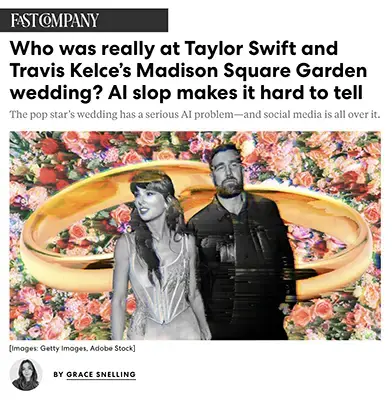
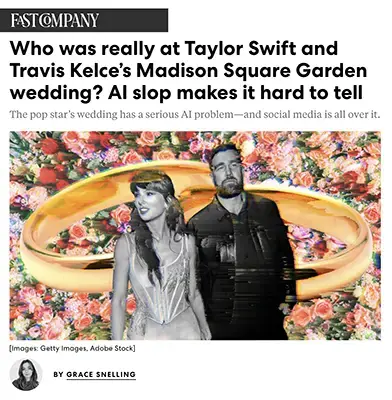
WHO WAS REALLY AT TAYLOR SWIFT AND TRAVIS KELCE’S WEDDING? AI SLOP MAKES IT HARD TO TELL
Fast Company — Grace Snelling. July 6, 2026
TL;DR: The Swift-Kelce wedding’s total media blackout became a stress test for AI image detection — and most social media users failed it, underscoring that visual “proof” online is no longer reliable at any level of scrutiny.
Executive Summary With no official wedding photos released (guests reportedly signed NDAs), social media filled the vacuum with AI-generated images — ranging from convincing faux-paparazzi shots to absurd parody posts of random brands and individuals claiming attendance. Sharp-eyed fans caught telltale AI artifacts (warped faces, inconsistent outfits across “candid” shots), but many commenters took even the most implausible fabrications at face value.
The more consequential data point: cited research puts human accuracy at spotting AI images around 50–62%, and that research predates the newest generation of image models, meaning detection is likely getting harder, not easier. This isn’t an isolated incident — a similar wave duped friends and family around a separate celebrity wedding earlier this year.
Relevance for Business
- Brand and marketing risk: the piece shows real businesses (a cannoli shop, a helicopter charter) posting fabricated affiliation with a celebrity event and getting engagement — a preview of both opportunistic marketing tactics and impersonation/reputational risk your own brand could face.
- Erosion of visual trust affects all industries: if audiences broadly can’t distinguish real from AI imagery, any business relying on photo/video “proof” (testimonials, before/after content, verification workflows) should reassess how it establishes authenticity.
- Detection tools lag generation tools: the accuracy-gap data point is a concrete signal that AI content moderation and provenance tools are structurally behind generation capability — relevant to any business building AI-content policies.
Calls to Action
🔹 Monitor — AI image-detection accuracy research as a proxy for broader synthetic-media risk to your industry.
🔹 Prepare Policy — internal guidelines on how your business would respond if impersonated via AI-generated content tied to a real event.
🔹 Test Cautiously — any marketing tactic that plays into real-time cultural moments using AI-generated visuals; the line between “playful” and “deceptive” is thin and this piece shows real backlash/confusion risk.
🔹 Ignore for Now — no direct operational action needed unless your brand is in a high-visibility, event-adjacent category.
Summary by ReadAboutAI.com
https://www.fastcompany.com/91569625/taylor-swift-travis-kelce-wedding-guests-msg-who-was-there-ai-slop-makes-it-hard-to-tell: July 10, 2026
Tilly Norwood Lands Her First Feature Film, One Year After Sparking Hollywood Backlash
Source: Variety | Alex Ritman | July 6, 2026
TL;DR: The AI “actor” that ignited a labor-rights firestorm in Hollywood is now headlining a feature film — a signal that studios are willing to keep pushing synthetic performers into the mainstream despite unresolved union objections.
Executive Summary: Particle6, the studio behind AI performer Tilly Norwood, has announced she will front “Misaligned,” a comedy-drama built around an AI protagonist navigating identity and autonomy. The company frames this as a hybrid production model — human directors, writers, and editors working alongside AI tools — rather than a fully synthetic pipeline, which appears to be a deliberate attempt to soften the labor-displacement narrative that dogged Norwood’s debut. Founder Eline van der Velden described the approach as one where AI can support premium narrative filmmaking only when paired with substantial human craft.
This is company framing, not independent verification: “Misaligned” is still in early development with no confirmed cast or crew, and there’s no indication the underlying labor disputes with actors’ unions have been resolved — only that Particle6 is proceeding regardless.
Relevance for Business: This matters less as an entertainment story and more as an early test case for synthetic labor normalization. SMB leaders in any content-adjacent field (marketing, training video, customer-facing media) should watch whether the “hybrid human-AI” framing succeeds in defusing public and union backlash — because that messaging playbook (AI as tool, not replacement) will likely be reused across other industries facing similar workforce anxiety.
Calls to Action
🔹 Monitor — Track whether “Misaligned” reaches production and how union/guild responses evolve.
🔹 Revisit Later — Reassess once cast, distribution, and union stance are confirmed.
🔹 Ignore for Now — No direct operational relevance for most SMBs today.
🔹 Prepare Policy — If your business uses synthetic media/voice/likeness in any capacity, monitor how labor and disclosure norms develop here as a bellwether.
Summary by ReadAboutAI.com
https://variety.com/2026/film/global/ai-actor-tilly-norwood-movie-debut-misaligned-1236802325/: July 10, 2026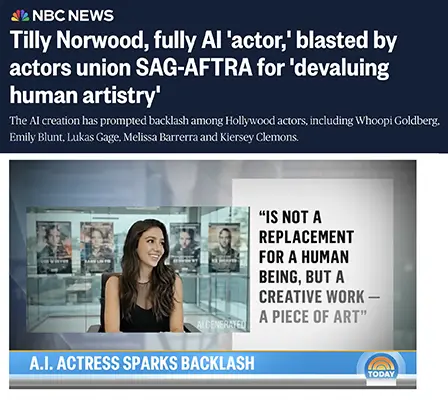
SAG-AFTRA Condemns AI ‘Actor’ Tilly Norwood as Talent Agencies Circle
Source: NBC News | Sept. 30, 2025
TL;DR: Hollywood’s largest actors’ union drew a hard line against synthetic performers a year ago — the dispute this briefing’s companion story shows was never actually settled, just paused.
Executive Summary: SAG-AFTRA publicly condemned reports that talent agencies were considering representation for Tilly Norwood, an AI-generated performer built on training data from human actors’ work. The union’s statement was unusually direct, accusing the effort of using stolen performances to put actors out of work, and asserting that any studio use of synthetic performers must comply with existing bargaining obligations. Norwood’s creator, Eline van der Velden, pushed back by framing AI performers as a distinct creative category rather than a competitor to human actors — company framing that the union firmly rejected.
Reactions from working actors (Whoopi Goldberg, Emily Blunt, and others) were sharply critical, while at least one industry AI researcher publicly dismissed the concept as a “gimmick” — a reminder that even within the AI-in-media community, views on synthetic performers are far from unified.
Relevance for Business: This is the foundational dispute behind the Variety story above — for any SMB using AI-generated likeness, voice, or performance in marketing or content, it establishes that union bargaining requirements and IP/training-data provenance are live legal exposure points, not settled questions.
Calls to Action
🔹 Prepare Policy — If your business touches synthetic media production or licensing, build in review for talent/training-data provenance before deployment.
🔹 Monitor — Watch for how union bargaining agreements evolve to explicitly cover synthetic performers.
🔹 Ignore for Now — No direct action needed unless your business intersects entertainment/media production.
🔹 Test Cautiously — If exploring AI-generated spokespersons or avatars for your own brand, vet the underlying training data sourcing.
Summary by ReadAboutAI.com
https://www.nbcnews.com/pop-culture/pop-culture-news/tilly-norwood-fully-ai-actor-blasted-actors-union-sag-aftra-devaluing-rcna234685: July 10, 2026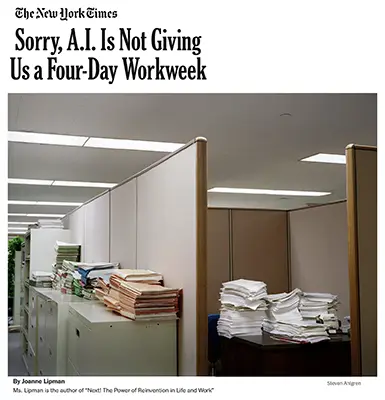
OPINION: WHY AI WON’T ACTUALLY SHORTEN THE WORKWEEK
Source: New York Times (Opinion) | Joanne Lipman | July 6, 2026
TL;DR: Despite repeated executive predictions of a coming four-day (or shorter) workweek driven by AI, historical precedent and current data suggest technology tends to intensify workload rather than reduce it — and no major company is actually implementing the shift.
Executive Summary: This opinion piece argues that predictions of an AI-driven shorter workweek — made by figures like Steve Cohen, Eric Yuan, Bill Gates, and Elon Musk — are unlikely to materialize, based on historical pattern: technology has repeatedly increased output expectations rather than reduced hours (the author cites the digital-tools era at newspapers as a parallel). The author notes that average full-time work hours (41.9/week) have remained essentially flat since the 1990s despite decades of technological change, and cites a study of a 200-employee tech firm where AI tools reportedly intensified workload rather than reducing it — though this is a single-firm data point, not broad-based research.
The piece’s central argument is that the executives forecasting shorter workweeks are simultaneously the ones demanding more in-office hours today (citing Musk, Jamie Dimon, and Jensen Huang), and that none are setting concrete timelines or policy in motion. Small-scale four-day-week adopters (Kickstarter, ThredUp) are cited as functioning counterexamples, but remain rare.
Relevance for Business: This is a useful reality check against vendor and industry hype suggesting AI will automatically create workforce slack. For SMBs actually considering AI-driven efficiency gains, the historical pattern suggests those gains are far more likely to translate into increased output expectations for the same workforce than into reduced hours — a planning assumption worth building into any AI adoption roadmap.
Calls to Action
🔹 Prepare Policy — If communicating AI adoption plans to staff, avoid implying hours will decrease without a deliberate, explicit organizational decision to do so.
🔹 Monitor — Watch for small-company four-day-week case studies (Kickstarter, ThredUp) as potential models if considering the shift yourself.
🔹 Ignore for Now — No urgent action required; this is a cultural/structural trend playing out over years.
🔹 Test Cautiously — If piloting a shorter workweek internally, treat it as a deliberate policy change, not an automatic byproduct of AI tool adoption.
Summary by ReadAboutAI.com
https://www.nytimes.com/2026/07/06/opinion/ai-four-day-work-week-office.html: July 10, 2026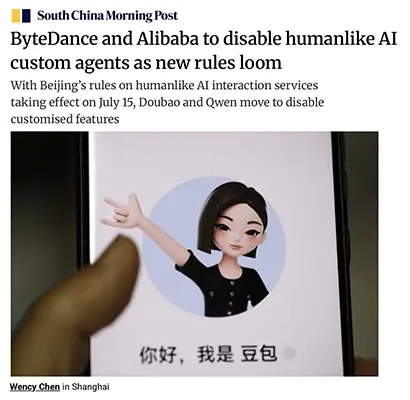
CHINA FORCES BYTEDANCE AND ALIBABA TO DISABLE HUMANLIKE AI COMPANION AGENTS
Source: South China Morning Post | Wency Chen | July 5, 2026
Disclosure: This article references Anthropic-adjacent regulatory dynamics only indirectly (via general AI governance context); no direct Anthropic/Claude reference requiring disclosure was identified.
TL;DR: Beijing’s new rules targeting “humanlike” emotionally-interactive AI agents are forcing ByteDance’s Doubao and Alibaba’s Qwen to shut down customizable companion-style agent features by mid-July, distinguishing productivity-focused AI from emotionally engaging AI as a matter of regulatory policy.
Executive Summary: China’s Interim Measures for the Administration of Artificial Intelligence Anthropomorphic Interaction Services take effect July 15, targeting AI services that simulate personality and sustained emotional engagement. In response, Doubao is disabling its agent feature entirely on July 15 (with data becoming inaccessible after October 15), while Qwen is shutting down humanlike/custom agent functions on July 10 and broader agent services on July 15. Tencent’s Yuanbao removed a similar feature already in June — indicating this is a coordinated regulatory response across China’s largest consumer AI platforms, not an isolated company decision.
Notably, the rules explicitly exclude customer service bots, workplace assistants, and educational/research tools — the regulatory target is specifically sustained emotional/companion-style interaction, not AI agents generally. Regulators cited concerns including psychological dependence, addiction, and privacy risk. Some users have pushed back publicly, citing lost emotional support and inaccessible chat history — a real but currently unresolved user friction point.
Relevance for Business: This is a concrete signal of how a major government is drawing a regulatory line between “productivity AI” and “companion/emotional AI” — treating the latter as higher-risk and subject to tighter control. SMBs building or evaluating AI products with any conversational, persona-based, or relationship-style interface (customer engagement bots with personality, virtual assistants marketed as companions, etc.) should watch this as an early template for how such distinctions might be regulated elsewhere, including potentially in Western markets facing similar debates about AI companionship and youth mental health.
Calls to Action
🔹 Monitor — Track whether similar “humanlike interaction” regulatory categories emerge in the U.S. or EU.
🔹 Prepare Policy — If your product includes persona-driven or companion-style AI features, consider proactively documenting how it differs from pure customer-service/productivity use cases.
🔹 Ignore for Now — No direct action needed for SMBs without conversational AI products with personality/companion framing.
🔹 Revisit Later — Reassess if operating in or serving the Chinese market directly.
Summary by ReadAboutAI.com
https://www.scmp.com/tech/big-tech/article/3359482/bytedance-and-alibaba-disable-humanlike-ai-custom-agents-new-rules-loom: July 10, 2026
THE RISE OF PAID “AI TRAINER” GIG WORK FOR PROFESSIONALS
Fast Company | Jared Lindzon | July 2, 2026
TL;DR: A fast-growing gig economy has emerged around paying credentialed professionals — doctors, lawyers, engineers — to evaluate and correct AI model outputs, with one platform alone paying out roughly $3 million per day.
Executive Summary: Companies including Mercor, Handshake, Alignerr, and Data Annotation are paying professionals with specialized domain expertise (medicine, accounting, software) to test AI models against realistic scenarios and flag errors or misconceptions. Mercor alone works with roughly 30,000 “experts” at an average $80/hour, and Handshake has paid out $300 million to about 100,000 contributors. The task has evolved beyond simple data labeling into training AI agents on multistep, multi-tool workflows (e.g., an accounting agent that must pull data across Gmail, Slack, and QuickBooks).
This is largely company framing from platform executives, not independent labor-market data — claims about pay rates, growth, and demand come directly from the companies profiting from this arrangement. Executives interviewed predict the industry will double annually for the foreseeable future, which should be read as an optimistic projection rather than verified fact.
Relevance for Business: This signals both an emerging revenue/talent opportunity and a workforce trend: domain experts are increasingly monetizing their knowledge by training the AI systems that may eventually automate parts of their own field. For SMBs, this points to a growing labor market of AI-fluent contract professionals who could be tapped for internal AI evaluation or custom agent development, and it’s a signal that “AI expertise” is becoming a distinct, marketable skill layered on top of traditional domain expertise.
Calls to Action
🔹 Monitor — Track whether this gig category becomes a viable sourcing channel for validating your own AI tools or vendor outputs.
🔹 Test Cautiously — If building custom AI agents, consider whether domain-expert-in-the-loop evaluation (via platforms like these) could improve reliability before deployment.
🔹 Ignore for Now — No immediate action needed if not building or deploying custom AI tools.
🔹 Revisit Later — Reassess as independent labor-market data on this sector’s actual size and durability becomes available.
Summary by ReadAboutAI.com
https://www.fastcompany.com/91568141/ai-companies-want-to-pick-your-brain-for-cash: July 10, 2026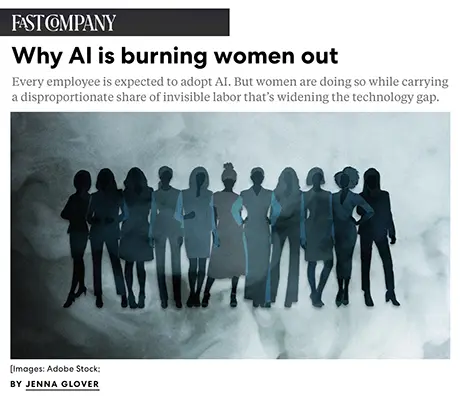
Why AI Is Burning Women Out
Fast Company — Jenna Glover. July 6, 2026
Source note: This is a first-person opinion piece by an executive at a workplace mental-health company (Headspace), citing that company’s own 2026 report. Statistics and framing reflect the author’s professional argument and one proprietary survey, not independent or peer-reviewed research.
TL;DR: An opinion piece argues that mandatory AI adoption is disproportionately taxing women employees, compounding pre-existing invisible-labor and credibility gaps — and calls for organizations to redistribute that load explicitly.
Executive Summary The author, drawing on Headspace’s own 2026 Workforce State of Mind survey, argues that organization-wide AI adoption acts as a uniform “cognitive charge” that lands harder on women, who already carry a disproportionate share of unpaid household and “invisible” workplace labor (mentoring, emotional support, morale-keeping). The survey reports 73% of women (vs. 67% of men) say cognitive strain has hurt productivity, with larger gaps in sleep, focus, and engagement.
The piece also raises a credibility dynamic: women reportedly receive less recognition for AI-assisted work than men do (cited as 27% more likely for men to be praised for AI use), layered onto existing “prove it again” bias and higher rates of imposter syndrome. The author’s prescription: name the gap explicitly, redistribute uncredited “office housework” tasks, and prioritize AI automation for drudgery rather than adding new cognitive demands atop existing ones.
Relevance for Business
- This is an argument, not a neutral study — the statistics come from one company’s proprietary survey and should inform thinking, not be treated as settled, independently verified fact.
- Retention and equity exposure: if the underlying dynamic holds even partially, uneven AI-rollout burden could show up in attrition, engagement scores, or promotion-gap complaints — a real governance and HR-policy consideration for any SMB rolling out AI tools broadly.
- Rollout design matters: the piece’s core actionable idea — pairing new AI tool adoption with retirement of an old task, rather than pure addition — is a concrete, testable practice for any AI adoption plan regardless of the gender-gap framing.
Calls to Action
🔹 Test Cautiously — the “retire a task when you add an AI tool” practice as part of AI rollout planning.
🔹 Prepare Policy — structured, published rotation of uncredited “invisible labor” tasks (notetaking, morale duties) as part of AI-era workload management.
🔹 Monitor — internal engagement/attrition data disaggregated by gender as AI tools roll out, to test whether this dynamic shows up in your own organization.
🔹 Assign Internal Review — have HR/People leadership evaluate whether AI adoption expectations are being applied evenly across roles and recognition is distributed fairly.
Summary by ReadAboutAI.com
https://www.fastcompany.com/91568961/why-ai-is-burning-women-out: July 10, 2026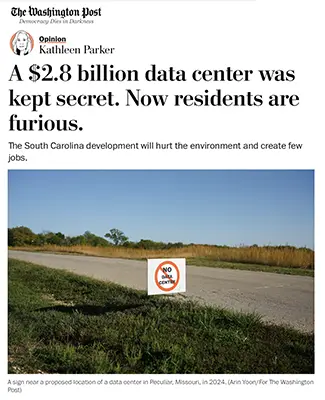
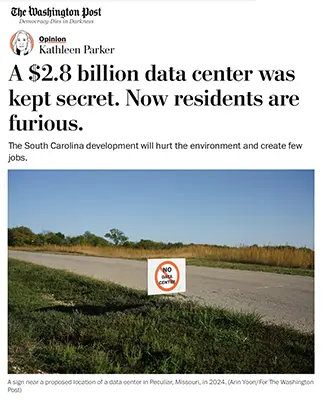
A South Carolina Data Center’s Secrecy Sparks Local Backlash
Source: Washington Post (Opinion) | Kathleen Parker | July 3, 2026
TL;DR: A $2.8 billion AI data center was negotiated under a deliberately vague code name and minimal public disclosure — a cautionary example of how opacity in AI infrastructure deals is fueling the broader trust backlash covered in this batch’s Barron’s piece.
Executive Summary: This opinion piece — and it should be read as argument, not neutral reporting — details how Spartanburg County, S.C. officials and developer NorthMark Strategies negotiated a large data-center project under the deliberately generic label “Project MOC-1,” using confidentiality agreements to shield details from residents until construction was already visible. The deal included a 40-year reduced tax assessment, and the facility is expected to create as few as 27 permanent jobs despite its $2.8 billion scale. A subsequent request to nearly 10x the site’s power draw (to roughly 450 megawatts) surprised residents further, prompting public hearings and a temporary county moratorium on new data-center projects.
The author’s framing is explicitly critical of both the developer and local officials; the piece argues this secrecy pattern is now common nationally, though it does not present comparative data beyond this single case.
Relevance for Business: For any business — AI vendor or otherwise — pursuing local infrastructure deals, incentive packages, or facility siting, this illustrates the reputational and regulatory risk of non-disclosure-shielded negotiations. Communities are increasingly primed to react negatively to opacity itself, independent of a project’s underlying merits.
Calls to Action
🔹 Prepare Policy — If your business negotiates local incentive/siting agreements of any kind, build in proactive community disclosure to avoid backlash-by-surprise.
🔹 Monitor — Track how many jurisdictions adopt data-center moratoria or disclosure requirements following incidents like this.
🔹 Ignore for Now — No direct operational action needed unless your business is involved in facility siting or public incentive negotiations.
🔹 Revisit Later — Reassess if operating or considering operations in jurisdictions with active moratorium legislation.
Summary by ReadAboutAI.com
https://www.washingtonpost.com/opinions/2026/07/03/south-carolina-data-center-was-shrouded-secrecy/: July 10, 2026
Inside San Francisco’s AI Hacker Houses
Source: The Atlantic | Matteo Wong | June 30, 2026
TL;DR: San Francisco’s AI founder scene increasingly runs on shared “hacker houses” — a structural response to soaring rents and a talent-concentration effect that reinforces the Bay Area’s dominance in AI investment despite remote work’s broader normalization.
Executive Summary: This first-person feature profiles several San Francisco co-living houses for AI founders, ranging from modest shared rentals to curated, investor-backed residencies with acceptance rates near 3%. The piece is largely narrative color — anecdotes about eccentric side projects, unglamorous living conditions, and founder culture — but the underlying business signal is that nearly two-thirds of global AI startup investment remains concentrated in the Bay Area, and rising rents (up roughly 15% year-over-year) are pushing even funded founders into shared housing. Some houses now function as informal investor screening pipelines, where residency itself signals fundability, and equity stakes are sometimes taken by house operators. One founder described the appeal of curated residencies as freeing up that’s 20 hours a week otherwise spent on chores.
Much of the article’s texture (lobster neurosurgery experiments, milk disputes, exercises in tech-culture eccentricity) is not decision-relevant and has been excluded from this summary.
Relevance for Business: For SMB leaders evaluating where AI talent and innovation is concentrating, this reinforces that geographic proximity to San Francisco still carries a meaningful information and capital advantage, despite widespread remote-work adoption elsewhere. It’s a soft signal about competitive dynamics in AI talent acquisition and where partnership/investment opportunities may cluster.
Calls to Action
🔹 Ignore for Now — Limited direct operational relevance for most SMBs.
🔹 Monitor — Note as a data point if your business depends on tracking AI talent/investment concentration trends.
🔹 Revisit Later — Relevant context if considering Bay Area expansion, hiring, or investor engagement strategies.
Summary by ReadAboutAI.com
https://www.theatlantic.com/technology/2026/06/hacker-houses-ai-boom-san-francisco/687737/: July 10, 2026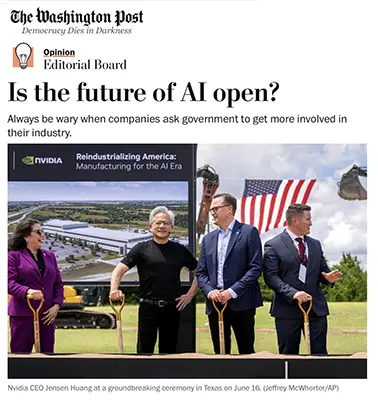
IS THE FUTURE OF AI OPEN?
Washington Post (Opinion/Editorial Board), July 2, 2026
Vendor disclosure: This piece directly references Anthropic’s dealings with the Commerce Department on export controls. Given ReadAboutAI.com’s use of Anthropic’s Claude, readers should note this potential conflict of interest when evaluating framing of Anthropic specifically.
TL;DR: The Post’s editorial board warns that frontier AI labs (OpenAI, Anthropic) have a financial incentive to encourage government restrictions on open-weight competitors — and argues regulators should resist that pressure rather than hand closed-model labs a protected market.
Executive Summary The editorial frames recent developments — Altman’s reported 5% government equity offer and Anthropic’s success in getting stricter cybersecurity conditions applied to loosen export controls on its Mythos and Fable models — as evidence that closed-model labs are actively shaping government AI policy in ways that could suppress open-weight competition. Both firms run proprietary models and are pursuing high-valuation IPOs premised on that closed approach remaining dominant.
The board’s core argument: that dominance is not guaranteed. Nvidia is developing its own open-weight models (Nemotron) as a chip-sales loss leader, and Palantir — a firm not typically characterized as security-lax — is running Nvidia’s open models in classified government systems, arguing that inspectable, ownable weights carry less third-party risk than trusting a closed vendor with sensitive data. The piece also notes Chinese open-weight models reportedly trail US frontier models by only months in cyber capability, and warns that if the government responds to this competitive pressure with restrictive regulation (banning US platforms from hosting Chinese weights, penalizing US firms using them), the primary harm would fall on American startups and enterprises adopting those models for cost and customization reasons — not on China. The editorial’s prescription is competition-based policy over restriction-based policy.
Relevance for Business
- Direct vendor-choice relevance: this is squarely about the future viability of open-weight AI models as a legitimate, cost-effective alternative to closed frontier APIs — material for any SMB currently reliant on closed-model vendors or evaluating open-weight alternatives for cost control.
- Regulatory risk framing, not settled policy: the piece is an opinion argument warning against a possible future regulatory path, not a description of current law. SMBs should not treat restrictions on open-weight/Chinese models as in effect.
- Vendor incentive awareness: the core signal — that frontier labs may lobby for restrictions that serve their commercial position — is a useful lens for evaluating vendor claims about “necessary” AI regulation generally, regardless of which lab is involved.
Calls to Action
🔹 Monitor — any regulatory movement restricting open-weight model hosting or use, given the direct cost implications for businesses using such models.
🔹 Prepare Policy — internal awareness that vendor-driven regulatory advocacy may not align with SMB cost/competition interests; factor this into vendor risk assessments.
🔹 Test Cautiously — open-weight models (e.g., Nemotron) as a cost-control option, following Palantir’s data-ownership rationale, where appropriate for your use case.
🔹 Ignore for Now — no concrete policy change has occurred; this is anticipatory commentary.
Summary by ReadAboutAI.com
https://www.washingtonpost.com/opinions/2026/07/02/right-answer-chinas-open-weight-ai-models-is-build-our-own/: July 10, 2026
MICROSOFT CUTS 4,800 JOBS, RESTRUCTURES XBOX AS AI SPENDING SQUEEZES MARGINS
Source: Reuters | Aditya Soni, Akash Sriram | July 6, 2026
TL;DR: Microsoft is trimming headcount and divesting gaming studios not because AI is replacing those roles, but because ballooning AI infrastructure costs are forcing the company to fund its buildout by cutting elsewhere.
Executive Summary: Microsoft announced 4,800 job cuts (about 2.1% of its workforce), with 3,200 of those concentrated in a restructured Xbox division that will divest up to five studios, including Compulsion Games, Double Fine, Ninja Theory, and Undead Labs. Notably, Microsoft’s Chief People Officer explicitly stated the eliminated roles are not being replaced by AI — a direct fact worth distinguishing from the broader “AI is taking jobs” narrative circulating elsewhere in tech.
The more decision-relevant signal is financial: Microsoft’s spending on AI infrastructure is projected to reach $190 billion in 2026, far above earlier forecasts, and the company is managing down headcount to fund that spend while preserving margins. One analyst characterized the cuts as portfolio reallocation rather than a genuine growth catalyst — the market is reportedly more focused on whether AI monetization outpaces AI costs than on the layoffs themselves. Microsoft shares fell 1.4% following the announcement, continuing a rough first half of 2026 (down nearly 23%).
Relevance for Business: This is a useful data point on the real economics of the AI buildout: even a company at the center of AI infrastructure is having to make internal trade-offs (headcount, product divestment) to afford its own AI investment. SMB leaders relying on Microsoft/Azure services should note the framing that AI cost pressure — not AI productivity gains — is currently driving some of the largest visible workforce decisions in the sector.
Calls to Action
🔹 Monitor — Track Microsoft’s upcoming earnings for evidence of whether AI monetization is catching up to AI infrastructure costs.
🔹 Ignore for Now — No direct operational relevance for most SMBs unless dependent on affected Xbox studios or products.
🔹 Revisit Later — Reassess if using Azure services, as continued cost pressure could affect pricing or service stability long-term.
🔹 Prepare Policy — Be cautious about internally attributing layoffs at large tech companies directly to “AI replacing jobs” without verifying company statements.
Summary by ReadAboutAI.com
https://www.reuters.com/business/world-at-work/microsoft-joins-ai-driven-tech-layoff-wave-with-4800-job-cuts-2026-07-06/: July 10, 2026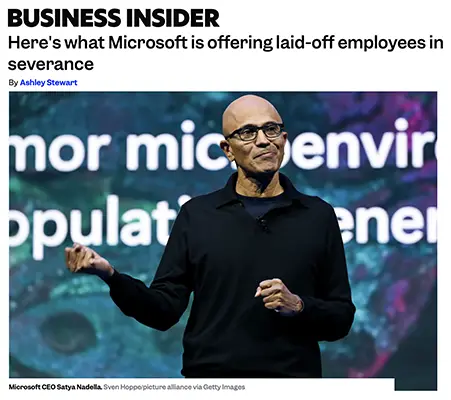
Here’s What Microsoft Is Offering Laid-Off Employees in Severance
Business Insider, Ashley Stewart. July 7, 2026
TL;DR: Microsoft’s ~4,800-person layoff (2.1% of workforce) comes with up to 39 weeks’ severance — more generous than Salesforce, Oracle, or Meta’s recent packages — as the company redirects spend toward a $190B AI infrastructure buildout.
Executive Summary Microsoft confirmed layoffs of roughly 4,800 employees, concentrated in sales and Xbox gaming(Xbox alone cutting 20% of its workforce). Severance terms scale by seniority: a minimum 60 days’ base pay up to 39 weeks for most staff, plus continued stock vesting (6–12 months) and 6 months’ paid health coverage with 12 months’ optional COBRA. Terms mirror an earlier 2026 voluntary buyout program, with shorter health coverage this round.
Company framing vs. fact: the layoffs are explicitly tied by Microsoft to cost-cutting alongside a $190 billion AI infrastructure capital expenditure plan — this is Microsoft’s own stated rationale, not independently audited.
Comparatively, Microsoft’s package is more generous than Salesforce (9–30 weeks), Oracle (up to 26 weeks), or Meta (16 weeks + 2 weeks/year tenure) — a data point worth noting for benchmarking, though it doesn’t offset the scale or targeting of the cuts.
Relevance for Business This is a leading indicator of how large tech incumbents are reallocating capital toward AI infrastructure at the expense of traditional headcount — specifically in sales and consumer-facing divisions less central to AI strategy. For SMB leaders, it’s a useful severance benchmarking data point if restructuring is on the table, and a signal that large vendors’ AI capex commitments are being funded partly through workforce reduction, which may affect account coverage, support responsiveness, or product prioritization for Microsoft’s non-AI product lines (including Xbox).
Calls to Action
🔹 Monitor — Track whether reduced Microsoft sales/Xbox headcount affects account service quality or support response times
🔹 Monitor — Use these severance benchmarks (9–39 weeks across Salesforce, Oracle, Meta, Microsoft) if planning internal restructuring
🔹 Ignore for Now — No direct action needed unless you are a Microsoft enterprise customer with dedicated account support
🔹 Revisit Later — Watch for a broader pattern of AI-capex-funded layoffs across other large vendors this year
Summary by ReadAboutAI.com
https://www.businessinsider.com/microsoft-severance-offers-layoffs-plan-2026-7: July 10, 2026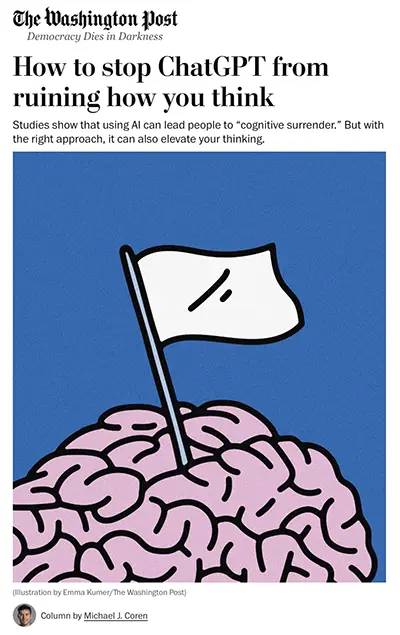
How to Stop ChatGPT From Ruining How You Think
The Washington Post, Michael J. Coren, July 7, 2026
TL;DR: New peer-reviewed research shows AI boosts task performance in the short term but can quietly erode independent judgment and learning — and the effect is shaped by how it’s used, not the technology itself.
Executive Summary Multiple 2026 studies converge on a pattern: AI assistance improves output speed and quality on tasks within its competence, but degrades human judgment when people over-rely on it outside a supervised or intentional context. Wharton research on BCG consultants found AI users completed more tasks faster, but made moreerrors than non-AI users on tasks beyond the model’s competence — researchers call this “falling asleep at the wheel.” A separate Carnegie Mellon study found that after AI access was removed, users’ accuracy on math problems fell below that of people who’d never used AI at all, with effects appearing after just 10 minutes of assistance. A third study identifies a behavior researchers term “cognitive surrender” — users adopting AI’s answers uncritically, gaining confidence regardless of whether the AI was right.
The throughline: AI’s efficiency gains and its erosion of independent capability are two sides of the same coin, and the deciding factor is whether the human retains an active evaluative role rather than fully deferring to the tool.
Relevance for Business For SMB leaders, this has direct workforce and process implications. Uncritical AI adoption in workflows can degrade the very skills your team needs to catch AI’s mistakes — a compounding risk as AI use scales. This is especially relevant for onboarding, training, and any role where judgment quality matters more than raw throughput (finance, legal, client communications, technical review). The research also suggests a “jagged frontier” problem: employees often can’t accurately judge when to trust AI versus their own expertise, and combined human-AI performance can be worse than AI alone when that miscalibration occurs.
Calls to Action
🔹 Prepare Policy — Establish guidelines distinguishing tasks where AI drafts/assists vs. tasks requiring independent human work first (idea generation, judgment calls)
🔹 Test Cautiously — Pilot “AI as sparring partner” workflows (critique/stress-test mode) rather than pure output-generation mode, especially for junior staff
🔹 Monitor — Watch for skill atrophy in roles where AI increasingly handles first drafts or analysis
🔹 Act Now — Build explicit “human judgment checkpoints” into workflows where AI output could be wrong in ways staff can’t detect
🔹 Revisit Later — Reassess as AI tutoring/collaboration tools mature; several vendors now offer “explanation-first” modes designed to preserve learning
Summary by ReadAboutAI.com
https://www.washingtonpost.com/technology/2026/07/07/how-stop-chatgpt-ruining-how-you-think/: July 10, 2026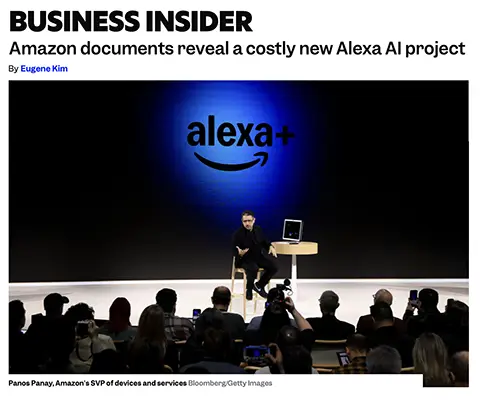
Amazon Documents Reveal a Costly New Alexa AI Project
Business Insider, Eugene Kim, July 8, 2026
TL;DR: Amazon’s internal “Moonraker” project aims to give Alexa+ true multi-step task capability, but leaked documents show it’s already the single most expensive initiative in the Alexa+ overhaul — a case study in the real cost of agentic AI.
Executive Summary Internal planning documents show Amazon developing “Moonraker,” an unreported project to let Alexa+ complete multiple linked actions from one request (e.g., “book me a ride and text my friend”), pushing Alexa further into the agentic-AI race alongside OpenAI, Google, and Anthropic’s comparable products. One planning document explicitly labeled it Alexa+’s “highest cost” initiative, projecting over $100 million in GPU costs in 2026 alone, with internal recommendations to delay or scale it back to ease cost pressure. Some Amazon leaders reportedly believe the team has overspent on the underlying models.
This follows a rocky Alexa+ rollout — prior reporting found hallucinations and inconsistent responses during beta testing, including one case where Alexa mistakenly disabled a fish tank filter. Despite this, CEO Andy Jassy has publicly emphasized rising engagement. Separately, documents show Amazon used an Anthropic Sonnet model for advanced reasoning and visual response functions during testing.
Vendor-neutrality note: Anthropic is mentioned as a technical component supplier in this reporting; the characterization comes from Business Insider’s review of internal Amazon documents, not an Anthropic statement.
Relevance for Business This is a useful real-world data point on the true cost of agentic AI capability — a single feature-level project running $100M+ in GPU spend in one year illustrates why agentic AI features carry meaningfully higher infrastructure costs than conventional chatbot functions. For SMBs evaluating or building on voice-assistant/agentic platforms, it’s a signal that vendor pricing for advanced agentic tiers may need to rise to offset these costs, and that reliability issues (hallucination, inconsistent execution) remain a live risk even at well-resourced incumbents.
Calls to Action
🔹 Monitor — Watch whether Alexa+/Moonraker costs translate into pricing changes for business or developer tiers
🔹 Test Cautiously — If piloting agentic voice assistants for customer-facing use, test extensively for execution errors before deployment
🔹 Monitor — Track competitor agentic AI cost disclosures (OpenAI, Google, Anthropic) as a benchmark for infrastructure economics
🔹 Ignore for Now — No direct action needed unless evaluating Alexa+ for business integration
🔹 Revisit Later — Reassess as Moonraker either ships, is scaled back, or is shelved
Summary by ReadAboutAI.com
https://www.businessinsider.com/amazon-moonraker-project-alexa-agentic-cost-2026-7: July 10, 2026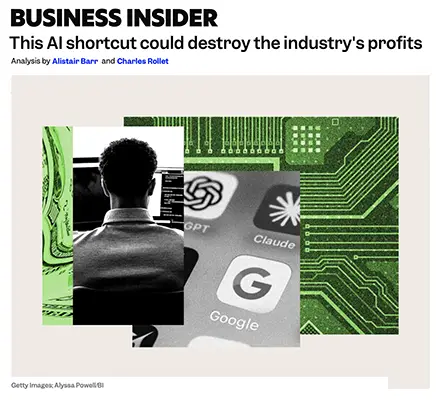
This AI Shortcut Could Destroy the Industry’s Profits
Business Insider, Alistair Barr, Charles Rollet, July 8, 2026
TL;DR: AI “distillation” — training cheaper models on frontier models’ outputs — threatens to erase the profit margins frontier AI labs need to justify trillions in investment, and enforcement efforts are proving difficult and sometimes counterproductive.
Executive Summary Distillation began as a benign 2015 research technique (training a smaller model on a larger one’s outputs) but has evolved into a major economic threat to frontier AI labs. Rivals — particularly Chinese firms — can now approximate frontier model capabilities at a fraction of the training cost by harvesting outputs from models like Claude, GPT, and Gemini. Anthropic has publicly accused Alibaba of “malicious distillation,” including large-scale fake account creation to harvest responses; OpenAI has warned that combining outputs from multiple frontier models could let rivals eventually exceed any single teacher model’s capability.
Vendor-neutrality note: Anthropic (maker of Claude, used in ReadAboutAI.com’s production) is a subject of this article; claims from Anthropic policy statements are attributed as company framing, not independently verified fact.
The line between legitimate research and abuse is contested — some researchers argue “distillation panic” risks harming smaller labs and academics who rely on the technique for legitimate, low-budget model development. Notably, Anthropic’s own countermeasures (account verification, blocking China-based access, a now-abandoned spyware tool) have partly backfired, reportedly pushing more developers toward cheaper open-weight alternatives — the very outcome the restrictions aimed to prevent.
Relevance for Business This is a structural cost and competitive-dynamics story, not just an IP dispute. If distillation continues eroding frontier labs’ pricing power, expect: downward pressure on AI subscription/API pricing (good for buyers short-term), but also potential instability in vendor roadmaps if major labs’ revenue models come under sustained pressure. SMBs relying on frontier vendors should watch for tightening terms-of-service enforcement, verification requirements, or pricing shifts as labs try to protect margins.
Calls to Action
🔹 Monitor — Track vendor terms-of-service changes; distillation crackdowns may increase account verification friction for legitimate users too
🔹 Monitor — Watch open-weight/distilled model quality gains as a lower-cost alternative to frontier vendor pricing
🔹 Ignore for Now — No direct action needed unless your business builds or fine-tunes models using competitor outputs
🔹 Prepare Policy — If evaluating open-weight Chinese models, understand potential downstream distillation/provenance questions in vendor selection
🔹 Revisit Later — Reassess vendor pricing stability as this dynamic plays out over 2026–2027
Summary by ReadAboutAI.com
https://www.businessinsider.com/distillation-problem-ai-industry-anthropic-openai-2026-7: July 10, 2026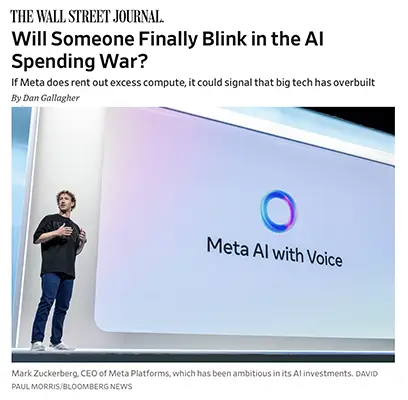
Will Someone Finally Blink in the AI Spending War?
The Wall Street Journal (Heard on the Street), Dan Gallagher, July 7, 2026
TL;DR: Big tech’s AI capex shows no sign of slowing — combined spending by Google, Microsoft, Amazon, and Meta jumped 74% year-over-year — but early signals, including Meta possibly renting out excess compute, hint that some players may have overbuilt.
Executive Summary Analysts estimate combined Q2 capital spending from the four major hyperscalers hit $168 billion, up 74% year-over-year, continuing to pressure free cash flow and stock performance (only Alphabet has outperformed the S&P 500 this year among the four). Notably, before going public, xAI signed a deal to share computing capacity with Anthropic for $1.25 billion a month — an early sign of capacity-sharing among AI players.
Vendor-neutrality note: Anthropic’s compute arrangement is reported via Bloomberg/WSJ sourcing on the underlying deal, not an Anthropic statement.
The bigger signal: Meta is reportedly developing a cloud-computing business to rent out excess AI infrastructure capacity — an analyst estimates Meta’s network already rivals dedicated cloud providers in scale. CEO Mark Zuckerberg has acknowledged renting excess capacity is “an option” if Meta determines it has overbuilt. Markets reacted sharply to the report: the semiconductor index fell 11% over two days, with major chip and memory names down double digits. Most analysts remain skeptical Meta is actually retreating from AI investment, characterizing any capacity-renting move as turning aggressive early commitments into a strategic option, not a spending pullback. Combined hyperscaler capex is projected to reach $710 billion this year, potentially approaching $1 trillion by 2027.
Relevance for Business This matters for any SMB whose technology stack, investments, or client base is exposed to AI infrastructure spending trends. Continued massive capex signals sustained (not receding) compute supply growth, which could keep downward pressure on AI service pricing — a potential benefit for buyers. However, the sharp market reaction to even a hint of capacity oversupply signals real fragility in AI-linked equity markets and vendor roadmaps that SMBs with AI-sector equity exposure, vendor dependencies, or hardware supply chains should track closely.
Calls to Action
🔹 Monitor — Track hyperscaler Q2 earnings (later this month) for capex guidance changes, a leading indicator for AI pricing and infrastructure stability
🔹 Monitor — Watch for further signs of AI compute oversupply, which could benefit buyers via lower prices
🔹 Ignore for Now — No direct action needed unless directly exposed to AI-linked equities or hardware supply chains
🔹 Revisit Later — Reassess vendor cost structures if capex growth visibly decelerates in coming quarters
Summary by ReadAboutAI.com
https://www.wsj.com/wsjplus/dashboard/articles/will-someone-finally-blink-in-the-ai-spending-war-0f59aa60: July 10, 2026

Q&A: MIT’s Top 10 AI Trends to Watch This Year
TechTarget / MIT Technology Review, Olivia Wisbey, April 22, 2026
TL;DR: MIT Technology Review’s 2026 trend list spans capability shifts (LLMs+, agent orchestration) and societal friction points (AI malaise, resistance, weaponized deepfakes) that leaders should weigh alongside the technical hype.
Executive Summary MIT Technology Review’s editors identified 10 trends: humanoid data, “LLMs+” (next-gen architectures beyond pure LLMs), supercharged scams, world models, military AI use, weaponized deepfakes, agent orchestration, China’s open-source AI strategy, AI-for-science, and “resistance” (organized pushback against AI). Two additional concepts surfaced in discussion but not on the formal list are arguably the most business-relevant: “AI malaise” — a mass sentiment of workforce fatigue and diminishing enthusiasm as AI tools underdeliver on inflated expectations — and the editors’ own acknowledgment that guardrails are lagging capability development, driven more by lack of political will than technical difficulty.
Editors specifically noted that China’s open-source AI ecosystem represents a fundamentally different strategic model than the US vendor-centric approach, with growing export influence in other regions.
Relevance for Business The AI malaise point deserves direct leadership attention: if employees have made good-faith efforts with AI tools and experienced friction or underwhelming results, that’s a normal part of the technology’s adoption curve — not a signal to abandon AI, nor to force continued use without addressing real workflow friction. Leaders should also watch supercharged scams and deepfakes as a rising operational/security risk (CFO impersonation fraud via voice deepfakes was cited as an active pattern), and monitor China’s open-source trajectory as a potential lower-cost alternative to US vendor ecosystems.
Calls to Action
🔹 Monitor — Employee sentiment around AI tool friction; treat as expected adoption-curve behavior, not failure
🔹 Prepare Policy — Fraud-awareness training addressing voice/video deepfake scams targeting finance and executive staff
🔹 Monitor — China’s open-source AI ecosystem as a potential cost alternative to US vendor stacks
🔹 Ignore for Now — Humanoid robotics and “artificial scientists” trends remain speculative for most SMB contexts
🔹 Revisit Later — Reassess regulatory guardrails (deepfakes, agent oversight) as EU and other jurisdictions act ahead of the US
Summary by ReadAboutAI.com
https://www.techtarget.com/searchenterpriseai/feature/QA-MITs-top-10-AI-trends-to-watch-this-year: July 10, 2026https://www.technologyreview.com/2026/04/21/1135643/10-ai-artificial-intelligence-trends-technologies-research-2026/: July 10, 2026
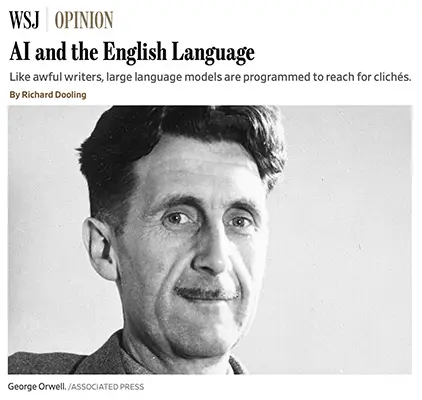
AI AND THE ENGLISH LANGUAGE
Wall Street Journal (Opinion) — Richard Dooling. July 2, 2026
Source note: Opinion piece; the argument is a literary/cultural critique, not an empirical study — treat claims about AI’s linguistic limitations as the author’s perspective, not established fact.
TL;DR: Invoking Orwell’s 1946 case against clichés, this opinion piece argues large language models are structurally biased toward recycled, predictable language — and that this will preserve a durable market for distinctly human writing.
Executive Summary The author extends Orwell’s “Politics and the English Language” critique of clichéd writing to LLMs, arguing that these models are built to recombine existing text patterns rather than generate genuinely original expression — essentially industrializing the very habit Orwell condemned in human writers. The piece grants that AI can flag clichés algorithmically but argues it cannot reliably replace them with something original, since models optimize for what’s statistically popular (which the author equates with “predictable and dull”) rather than what’s meaningful.
The author’s central prediction: AI-generated writing will get more popular but not necessarily better in a literary sense, and that gap will create lasting demand for authentic human writing — comparable to how consumers value handmade goods despite mass production alternatives. This is a values-driven argument, not a technical or empirical one, and should be read as advocacy for human writing craft rather than a verified claim about model capability limits.
Relevance for Business
- Content differentiation strategy: if the piece’s thesis holds even partially, businesses using AI to scale written content (marketing copy, communications) should weigh a differentiation risk — audiences may increasingly value visibly human-authored material as AI content becomes commonplace and interchangeable.
- Not a technical capability claim: leaders should not read this as evidence AI writing tools are inadequate for standard business use — it’s a literary argument about originality and voice, not a benchmark of AI’s practical writing utility for reports, emails, or documentation.
- Useful framing, not a policy trigger: relevant as a data point in ongoing internal conversations about where to deploy AI writing tools versus where human voice remains a differentiator (leadership communications, brand voice, sensitive messaging).
Calls to Action
🔹 Monitor — ongoing public and cultural sentiment about AI-generated content authenticity, as it may affect brand/communications strategy over time.
🔹 Ignore for Now — no operational action needed; this is a cultural commentary piece, not new information about model capability.
🔹 Revisit Later — if differentiation-by-human-authorship becomes a measurable market trend (e.g., “human-written” labeling gaining traction), reassess content strategy.
Summary by ReadAboutAI.com
https://www.wsj.com/opinion/ai-and-the-english-language-274f9801: July 10, 2026
Our Interest in AI Slop Is Hitting a Ceiling
Fast Company — Chris Stokel-Walker. July 6, 2026
Source note: Draws on a peer-reviewed-adjacent arXiv analysis tied to a forthcoming book by its authors; commercial promotional interest (book sales) should be weighed alongside the research claims.
TL;DR: New research suggests AI-generated content may make up 44% of uploads on some platforms but only 1–3% of consumption — a “slop ceiling” pointing to a discovery and curation problem, not necessarily quality rejection.
Executive Summary A new analysis, published on arXiv and tied to the book Dream Machine, finds a stark gap between AI content supply (up to 44% of uploads on some platforms) and demand (1–3% of streams). Co-author Peter Woodbridge frames this as a “slop ceiling” — but is careful to note the cause is unclear: it may reflect a platform-level discovery problem (recommendation systems and human-curated fan communities still dominate attention) rather than outright audience rejection of AI content itself.
Notably, research cited suggests people often can’t distinguish AI-made from human-made work — but reception changes sharply once AI labeling is disclosed, complicating any simple narrative of AI content being inherently inferior. The likely trajectory isn’t AI-versus-human but blended “human-plus-AI” workflows, with a risk that creators quietly use AI tools without disclosing it to avoid stigma.
Relevance for Business
- Volume ≠ engagement: businesses using AI to scale content output (marketing, mobile apps — the piece cites 186,000 mobile game titles released in six months) should not assume volume translates to reach or ROI.
- Curation and human endorsement remain the bottleneck: for any SMB content or product strategy leaning on AI generation, the constraint is discovery and trust-building, not production capacity.
- Disclosure risk: if audience reception shifts once AI-generated content is labeled, businesses should think proactively about disclosure policy rather than being caught flat-footed by platform or regulatory disclosure requirements.
Calls to Action
🔹 Test Cautiously — AI-generated content at scale, but pair it with genuine curation/discovery investment rather than volume alone.
🔹 Prepare Policy — internal guidelines on AI-content disclosure, given shifting audience reactions once labeling occurs.
🔹 Monitor — platform-level curation and recommendation shifts as AI content volume grows.
🔹 Monitor — this research area for follow-up studies, since causal claims (why the ceiling exists) remain unsettled.
Summary by ReadAboutAI.com
https://www.fastcompany.com/91568818/our-interest-in-ai-slop-is-hitting-a-ceiling: July 10, 2026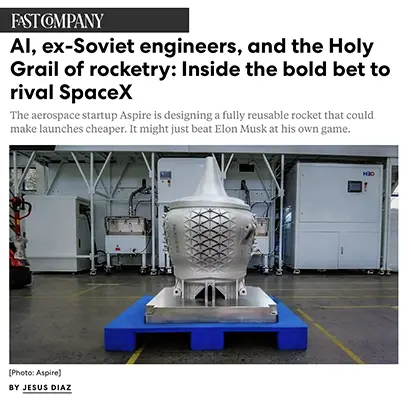
AI, Ex-Soviet Engineers, and the Holy Grail of Rocketry
Fast Company — Jesus Diaz. July 6, 2026
Source note: This is a company-access feature built substantially on interviews with the startup’s own CEO and partners; claims about performance, cost, and timeline are the company’s own projections, not independently verified.
TL;DR: Startup Aspire is using an AI-driven engineering tool to resurrect the long-elusive aerospike rocket engine, aiming to undercut SpaceX on cost — but the technology is unproven at scale and the 2031 launch timeline is speculative.
Executive Summary Aspire Space Technologies, staffed partly by veteran Soviet-era rocket engineers, is partnering with Dubai-based Leap71 (whose in-house AI system, Noyron, autonomously designs engine components) and Chinese manufacturer HBD to build Oryx, a fully reusable orbital rocket. The core innovation is the aerospike engine — a decades-old concept NASA failed to commercialize in the 1990s due to extreme heat management — which Noyron’s AI-generated cooling channel designs and 3D-printing now make manufacturable. A 20-ton-thrust test engine was successfully 3D-printed in under 300 hours, though it has not yet been hot-fire tested.
The business case: Aspire is targeting $200/kg launch costs, versus SpaceX’s current $2,500–3,000/kg, by serving a mid-size satellite launch market that both SpaceX and Blue Origin are increasingly deprioritizing in favor of their own AI-server and satellite megaconstellations. The company plans a 2028 hopper test and a 2031 first orbital flight — an aggressive timeline the company itself calls “ahead of schedule,” a framing that should be read as company confidence rather than independent verification.
Relevance for Business
- Demonstrated vs. promised: the AI-designed engine component is real and manufactured; the full reusable rocket, cost claims, and timeline are unproven projections from the company itself.
- Vendor concentration risk in orbit: if launch capacity keeps consolidating around vertically integrated giants (SpaceX, Blue Origin), any SMB dependent on satellite-based services (IoT, connectivity, imaging) faces a narrowing, more expensive supplier base — a genuine second-order risk this piece surfaces.
- AI as engineering force-multiplier, not autonomy: the notable signal here isn’t “AI builds rockets” — it’s AI compressing multi-year engineering design cycles into months, a pattern relevant to any capital-intensive engineering-heavy business evaluating AI-assisted design tools.
Calls to Action
🔹 Monitor — Aspire’s 2026 hot-fire engine test as the next real proof point (not the 3D-printing milestone already achieved).
🔹 Monitor — launch market concentration trends if your business depends on satellite services.
🔹 Ignore for Now — cost and timeline claims should not inform near-term planning; treat as aspirational.
🔹 Revisit Later — after the 2028 hopper test, which is the first real flight-readiness signal.
Summary by ReadAboutAI.com
https://www.fastcompany.com/91563020/aspire-rocket-design-spacex: July 10, 2026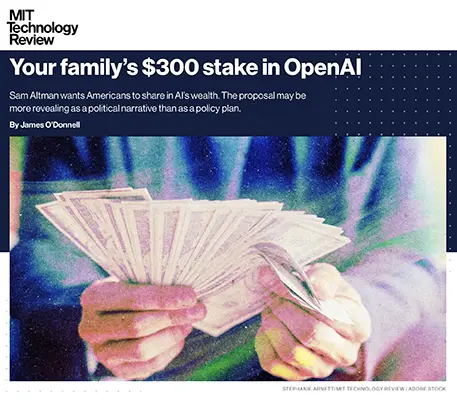
Your Family’s $300 Stake in OpenAI
MIT Technology Review — James O’Donnell. July 6, 2026
TL;DR: Sam Altman’s reported plan to give the US government a 5% OpenAI stake — a proxy for eventual public payouts — looks more like a political narrative to build goodwill than a firm, imminent policy commitment.
Executive Summary Altman is reportedly discussing a 5% government equity stake in OpenAI with the Trump administration, an idea he’s floated in various forms since 2021 (and which Senator Bernie Sanders has pushed further, proposing a 50% stake). The stated logic is twofold: AI companies profit from human-generated training data without compensating creators, and equity payouts could offset public anxiety about AI-driven job losses.
The math is worth grounding: a 5% stake in OpenAI (valued at $852 billion after its March round) would be worth roughly $42.6 billion — about $320 per US household if distributed directly, though a sovereign-wealth-fund model (paying out from investment returns rather than principal) is more likely, and contingent on OpenAI ever turning a profit.
The article’s real thesis: there’s little evidence this becomes concrete policy soon. Altman has talked about versions of this for five years without action. The more plausible driver is political — this kind of deal fits the administration’s pattern of direct equity stakes in tech (Intel, Nvidia’s China sales), and staying in Washington’s good graces has real regulatory upside for AI firms.
Relevance for Business
- Policy risk framing, not policy fact: SMBs should not treat this as a signal that AI wealth-sharing mechanisms are coming — there’s no timeline, mechanism, or legislative vehicle yet.
- Government-AI vendor entanglement is deepening: the pattern of federal equity stakes in strategic tech firms (a live trend beyond just OpenAI) could affect competitive dynamics, procurement preferences, and regulatory treatment of AI vendors your business relies on.
- Public sentiment matters for adoption: the underlying driver — persistent public distrust of AI companies — is relevant context for any customer-facing AI messaging your business does.
Calls to Action
🔹 Ignore for Now — no actionable policy exists; don’t build assumptions around future AI dividend programs.
🔹 Monitor — federal equity stakes in AI vendors (OpenAI, Intel, Nvidia) as a pattern, since it could affect vendor stability, pricing, or political exposure.
🔹 Monitor — public trust metrics around AI, which shape customer receptivity to AI-forward products and services.
🔹 Revisit Later — if a concrete legislative or executive proposal emerges, reassess for compliance or workforce-communication implications.
Summary by ReadAboutAI.com
https://www.technologyreview.com/2026/07/06/1140176/your-familys-300-stake-in-openai/: July 10, 2026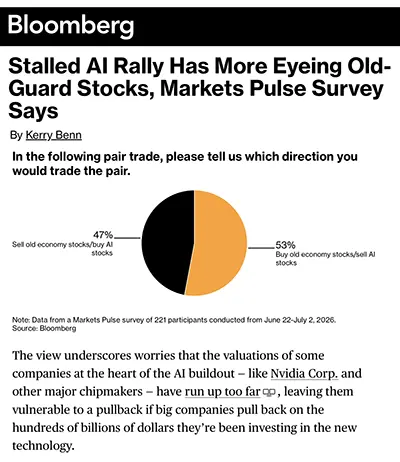
1INVESTOR SURVEY SHOWS GROWING ROTATION AWAY FROM AI STOCKS
Bloomberg | Kerry Benn | July 6, 2026
TL;DR: More than half of surveyed investors say they plan to shift money from AI/tech stocks into traditional “old economy” shares in the second half of 2026, reflecting growing valuation concerns after a sharp semiconductor rally.
Executive Summary: Bloomberg’s Markets Pulse survey of 221 investors found 53% inclined to rotate into traditional company shares and take profits from the tech-stock surge. This follows a period where the Philadelphia Semiconductor Index nearly doubled between late March and late June before losing ground over the past two weeks; South Korea’s Kospi, heavily weighted toward Samsung and SK Hynix, saw a similar pullback. About 34% of respondents see the Kospi as most likely to reverse its upward run, versus 22% for the SOX index.
This should be read as sentiment data, not a confirmed market trend — the piece also notes persistent bullish voices who argue “missing out” fears still outweigh concerns about a real correction, and history shows AI stocks have previously rebounded from similar dips.
Relevance for Business: For SMB leaders with equity exposure (directly or via retirement/investment plans) to AI-adjacent sectors, this is a sentiment signal worth tracking, not a directive to act. It also has an indirect signal for AI vendor selection: if investor caution about semiconductor/AI valuations persists, it could eventually affect capital availability for smaller AI infrastructure and chip suppliers specifically (distinct from the largest, most diversified players).
Calls to Action
🔹 Monitor — Track whether this rotation sentiment translates into actual capital flows over Q3/Q4.
🔹 Ignore for Now — No direct operational action needed; this is investor sentiment, not a fundamentals shift.
🔹 Revisit Later — Reassess vendor/investment exposure to AI infrastructure and semiconductor names if the pullback continues.
🔹 Prepare Policy — If your business holds concentrated AI-sector investments, consider periodic rebalancing review given rising volatility.
Summary by ReadAboutAI.com
https://www.bloomberg.com/news/articles/2026-07-06/stalled-ai-rally-has-more-eyeing-old-guard-stocks-markets-pulse: July 10, 2026
WALL STREET UNLEASHES BULLISH SPACEX RATINGS EYEING 47% UPSIDE
Bloomberg — Subrat Patnaik and Arvelisse Bonilla Ramos. July 6–7, 2026
Connection to AI: AI is one cited growth driver among several (alongside Starlink and launch services), not the core subject of the story.
More than a dozen banks that underwrote SpaceX’s IPO initiated bullish coverage after the standard quiet period, with an average price target of $236 (47% above recent trading levels) against a $135 IPO price. Morgan Stanley’s bull case explicitly cites demand from AI-driven neocloud and “end-to-end AI services” as a longer-term business driver alongside Starlink. Bloomberg Intelligence, meanwhile, frames rocket launches as taking a back seat to AI and Starlink in SpaceX’s profit picture. The piece notes structural tailwinds (Nasdaq 100 and Russell 1000 index inclusion driving passive-fund buying) and flags the usual caveat that sell-side analysts skew bullish across the market — 63% of all ratings are buys industry-wide.
Calls to Action
🔹 Monitor — as a bellwether of how AI infrastructure demand is being priced into aerospace/tech valuations broadly.
🔹 Ignore for Now — no direct SMB action; relevant mainly as market context.
Summary by ReadAboutAI.com
https://www.bloomberg.com/news/articles/2026-07-07/spacex-shares-win-early-bullish-calls-from-wall-street-brokers: July 10, 2026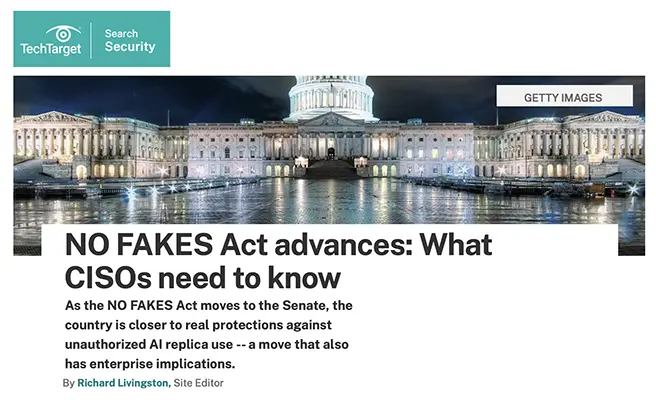
NO FAKES ACT ADVANCES: WHAT CISOS NEED TO KNOW
TechTarget, Richard Livingston. June 26, 2026
TL;DR: A bipartisan federal bill establishing legal protections against unauthorized AI-generated likenesses has cleared Senate committee with broad industry support — creating new liability exposure for any company hosting or distributing AI-generated content, not just entertainment and celebrity cases.
Executive Summary The Senate Judiciary Committee unanimously approved the NO FAKES Act (Nurture Originals, Foster Art and Keep Entertainment Safe Act), which would create federal protections against unauthorized AI-generated video/audio replicas, with rights extending to heirs and estates for at least 70 years after death. The bill has attracted support from labor unions, entertainment groups, medical organizations, and tech companies including IBM and OpenAI. Penalties include statutory damages of up to $750,000 per violation, with liability potentially extending to platforms hosting unauthorized likenesses.
While framed around protecting public figures, the line between public figures and corporate executives is described as blurry — meaning a deepfake of a company leader falls within the same legal framework. If passed, companies would need verification systems to avoid inadvertently hosting unauthorized AI-generated likenesses on internal and customer-facing platforms. Americans reportedly encounter an average of 2.6 deepfakes daily, per a cited McAfee study.
Relevance for Business This has two layers of relevance: (1) legal/compliance exposure if your business hosts or distributes user-generated or AI-generated content (potential platform liability), and (2) fraud/security exposure, since executive deepfakes for wire-transfer fraud are cited as an established attack pattern. Unlike general awareness campaigns, this creates a specific and quantifiable compliance obligation (statutory damages up to $750K per violation) once codified into law — worth preparing for now, even though no Senate floor vote is yet scheduled.
Calls to Action
🔹 Prepare Policy — Begin drafting internal verification procedures for AI-generated content on your platforms, ahead of potential compliance requirements
🔹 Monitor — Track the bill’s progress toward a Senate floor vote
🔹 Act Now — Implement multi-factor, out-of-band authentication for executive-authorized financial transactions regardless of legislative timing
🔹 Assign Internal Review — Have legal/compliance review platform liability exposure if your business hosts user-generated or AI content
🔹 Ignore for Now — No action needed if your business neither hosts third-party content nor handles executive-authorized transfers
Summary by ReadAboutAI.com
https://www.techtarget.com/searchsecurity/news/366645063/NO-FAKES-Act-advances-What-CISOs-need-to-know: July 10, 2026
DEEPFAKE ERA DEMANDS PROOF-BASED SECURITY, NOT JUST AWARENESS
Deepfake Era Demands Proof-Based Security, Not Just Awareness | TechTarget, Sean Michael Kerner. April 23, 2026
TL;DR: Security experts say traditional “does this look suspicious” awareness training no longer works against deepfake-driven fraud — the fix is procedural: separating authority from authentication so no single voice, video, or text can approve a sensitive action alone.
Executive Summary With 77% of fraud professionals reporting rising deepfake attacks but only 7% of organizations calling themselves well-prepared, security experts are pushing a shift from recognition-based training to proof-based verification policies. The core principle: no single interaction — regardless of how convincing — can authorize a sensitive action like a wire transfer or credential reset. Recommended controls include out-of-band two-factor confirmation, pre-arranged “how I will contact you” protocols, secret verification phrases, and mandatory secondary approvers for high-risk transactions. A cited 2024 incident — a $25 million loss at engineering firm Arup via deepfake video impersonation — illustrates the real-world stakes.
Experts note the harder challenge is cultural, not technical: employees need explicit organizational permission and reinforcement to slow down and verify, even under apparent pressure from a senior executive, since urgency is precisely the tactic these attacks exploit.
Relevance for Business This is a direct, actionable governance issue for any business handling wire transfers, credential resets, or sensitive approvals — a category that includes virtually every SMB with financial operations. The core risk (voice/video impersonation of an executive to authorize a fraudulent transfer) doesn’t require sophisticated attackers; audio cloning is described as a low-effort technique. SMBs without formal wire-transfer verification protocols face real exposure regardless of company size.
Calls to Action
🔹 Act Now — Implement mandatory out-of-band verification for wire transfers and credential/access changes, with no exceptions
🔹 Act Now — Establish pre-agreed communication channels (“how I will contact you”) for sensitive executive requests
🔹 Prepare Policy — Designate secondary approvers so no single employee can authorize high-risk transactions alone
🔹 Monitor — Reinforce training continuously rather than as a one-time exercise, since habits regress under pressure
🔹 Test Cautiously — Run a tabletop exercise simulating a deepfake-based executive impersonation attempt
Summary by ReadAboutAI.com
https://www.techtarget.com/searchsecurity/feature/Deepfake-era-demands-proof-based-security-not-just-awareness: July 10, 2026
STUDY: HOSPITALS’ TELEHEALTH SCALE INDICATES DIGITAL READINESS FOR AI
TechTarget, Anuja Vaidya. July 2, 2026
TL;DR: A large national study finds hospitals with scaled telehealth operations are far more likely to have mature AI adoption — but the research can’t establish which one causes the other, and rural hospitals show a weaker link than urban ones.
Executive Summary A retrospective study of 6,173 U.S. acute care hospitals (published in the Journal of Medical Internet Research) found a strong association between telehealth scale and clinical/operational AI adoption maturity. Hospitals were grouped into three AI adoption tiers; the most AI-mature tier (19.2% of hospitals) had substantially higher telehealth volumes and adoption scores than lower tiers. Critically, 57% of hospitals didn’t report telehealth volume at all, and 91% of those were in the least AI-mature tier — suggesting basic digital infrastructure gaps, not AI reluctance, may explain the disparity.
The study explicitly cannot determine causation — whether telehealth scale enables AI adoption, or both simply reflect a common underlying digital maturity. Rural hospitals showed a notably weaker association than metropolitan ones with similar telehealth volumes, a finding the authors link to equity concerns around infrastructure and organizational capacity.
Relevance for Business While healthcare-specific, this is a useful proxy data point for any SMB assessing AI readiness: digital infrastructure maturity (data availability, workflow integration, organizational capacity) is a stronger predictor of successful AI adoption than enthusiasm or tool access alone. For businesses serving healthcare clients or evaluating their own AI rollout, the finding underscores that foundational digital capability should precede AI investment, not follow it — and that smaller or resource-constrained organizations (rural hospitals, by analogy, small businesses) may need extra support to adopt AI as effectively as larger, more digitally established peers.
Calls to Action
🔹 Monitor — If serving healthcare clients, note this as a market-readiness indicator for AI product sales
🔹 Prepare Policy — Audit your own organization’s digital infrastructure maturity before major AI investment decisions
🔹 Ignore for Now — No direct action needed for non-healthcare businesses beyond the readiness parallel
🔹 Revisit Later — Watch for similar readiness studies emerging in other SMB-relevant sectors
Summary by ReadAboutAI.com
https://www.techtarget.com/virtualhealthcare/news/366645472/Study-Hospitals-telehealth-scale-indicates-digital-readiness-for-AI: July 10, 2026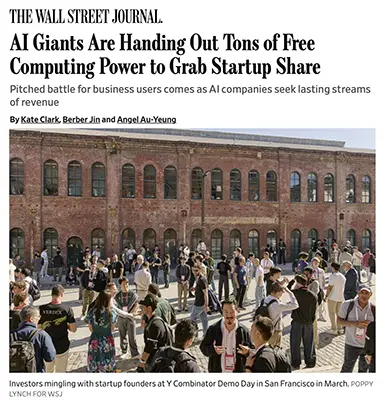
AI Giants Are Handing Out Tons of Free Computing Power to Grab Startup Share
The Wall Street Journal, Kate Clark, Berber Jin, Angel Au Yeung. July 6, 2026
TL;DR: OpenAI and Anthropic are offering startups up to $2M+ in free computing credits to lock in future enterprise customers — a land-grab strategy that could mean cheap access now but real switching-cost risk later.
Executive Summary OpenAI and Anthropic are aggressively courting startups — particularly Y Combinator cohorts — with escalating credit offers: Anthropic increased its standard YC offer from $30,000 to $500,000 in free credits (no equity required); OpenAI matched with $500,000 free plus an optional $1.5M in exchange for equity. Combined, the two companies could distribute up to $800 million in credits to YC startups alone this year. Separately, Semianalysis research cited in the article shows both companies heavily subsidize power users: Anthropic’s $200/month Claude Max plan allows up to $8,000 in token usage; OpenAI’s equivalent ChatGPT Pro plan allows up to $14,000.
Vendor-neutrality note: Anthropic (maker of Claude, used in ReadAboutAI.com’s production) is a central subject of this article. Anthropic’s credit figures and revenue framing are attributed to company/spokesperson statements and third-party research (Semianalysis), not independently audited financials.
The strategic logic, per the article, is clear: AI labs are prioritizing long-term platform lock-in over near-term margin, even as both companies face pressure to improve profitability ahead of expected IPOs, and face growing competition from cheaper open-weight and Chinese models.
Relevance for Business This is directly relevant to any SMB building AI-dependent products or evaluating vendor selection. Free credits are attractive but represent a subsidized, non-permanent price point — the underlying token economics (e.g., $14,000 in usage for $200/month) are not sustainable long-term pricing and should not anchor cost planning. There’s also a strategic lock-in risk: building deeply on subsidized credits now may create high switching costs later, once discounts normalize. For non-startup SMBs (i.e., not YC-eligible), it’s worth directly asking Anthropic, OpenAI, or other vendors about available credit programs, since sales teams are actively incentivized to offer them broadly right now.
Calls to Action
🔹 Act Now — If evaluating or renegotiating AI vendor contracts, ask directly about credit programs or promotional pricing — vendors are currently aggressive
🔹 Prepare Policy — Don’t architect core products around subsidized pricing; model costs at standard (non-promotional) rates for planning purposes
🔹 Monitor — Watch for pricing normalization once labs approach IPO or profitability targets — current rates are not guaranteed long-term
🔹 Test Cautiously — If credits are available, use them to pilot AI-dependent features before committing to full-scale build-out
🔹 Monitor — Track competitive dynamics between US frontier labs and cheaper open-weight/Chinese alternatives, which are pressuring this pricing war
Summary by ReadAboutAI.com
https://www.wsj.com/tech/ai/ai-giants-are-handing-out-tons-of-free-computing-power-to-grab-startup-share-c00a5c5c: July 10, 2026Here’s What Microsoft Is Offering Laid-Off Employees in Severance
Business Insider, Ashley Stewart. July 7, 2026
TL;DR: Microsoft’s ~4,800-person layoff (2.1% of workforce) comes with up to 39 weeks’ severance — more generous than Salesforce, Oracle, or Meta’s recent packages — as the company redirects spend toward a $190B AI infrastructure buildout.
Executive Summary Microsoft confirmed layoffs of roughly 4,800 employees, concentrated in sales and Xbox gaming(Xbox alone cutting 20% of its workforce). Severance terms scale by seniority: a minimum 60 days’ base pay up to 39 weeks for most staff, plus continued stock vesting (6–12 months) and 6 months’ paid health coverage with 12 months’ optional COBRA. Terms mirror an earlier 2026 voluntary buyout program, with shorter health coverage this round.
Company framing vs. fact: the layoffs are explicitly tied by Microsoft to cost-cutting alongside a $190 billion AI infrastructure capital expenditure plan — this is Microsoft’s own stated rationale, not independently audited.
Comparatively, Microsoft’s package is more generous than Salesforce (9–30 weeks), Oracle (up to 26 weeks), or Meta (16 weeks + 2 weeks/year tenure) — a data point worth noting for benchmarking, though it doesn’t offset the scale or targeting of the cuts.
Relevance for Business This is a leading indicator of how large tech incumbents are reallocating capital toward AI infrastructure at the expense of traditional headcount — specifically in sales and consumer-facing divisions less central to AI strategy. For SMB leaders, it’s a useful severance benchmarking data point if restructuring is on the table, and a signal that large vendors’ AI capex commitments are being funded partly through workforce reduction, which may affect account coverage, support responsiveness, or product prioritization for Microsoft’s non-AI product lines (including Xbox).
Calls to Action
🔹 Monitor — Track whether reduced Microsoft sales/Xbox headcount affects account service quality or support response times
🔹 Monitor — Use these severance benchmarks (9–39 weeks across Salesforce, Oracle, Meta, Microsoft) if planning internal restructuring
🔹 Ignore for Now — No direct action needed unless you are a Microsoft enterprise customer with dedicated account support
🔹 Revisit Later — Watch for a broader pattern of AI-capex-funded layoffs across other large vendors this year
Summary by ReadAboutAI.com
https://www.businessinsider.com/microsoft-severance-offers-layoffs-plan-2026-7: July 10, 2026
Closing: AI update for July 10, 2026
From vendor access volatility to workforce judgment erosion to the widening real-vs-synthetic media gap, this week’s stories share a common lesson: the economics and governance of AI are moving faster than any single company’s marketing can keep up with. As always, treat this week’s Calls to Action as a starting checklist, not a finish line — revisit them as this fast-moving landscape develops.
All Summaries by ReadAboutAI.com
↑ Back to Top