
AI Updates May 11, 2026

THE WEEK AI STOPPED ASKING PERMISSION
Something shifted this week in how AI shows up in the news — and in business reality. For the past two years, most AI coverage asked some version of the same question: will this change everything? This week’s headlines read differently. The question has become how fast, and the answers are landing across every domain at once: healthcare diagnostics, labor markets, defense procurement, energy infrastructure, cybersecurity, financial markets, and the daily experience of knowledge workers trying to figure out which parts of their jobs still belong to them.
The breadth of this week’s coverage reflects something important for executives and managers to absorb: AI is no longer a technology story running parallel to your business story. It is the business story. The $133 billion that Microsoft, Alphabet, Meta, and Amazon spent on AI infrastructure in a single quarter isn’t an abstraction — it will show up as pricing pressure on the tools you use, as volatility in the platforms you advertise on, and as energy and supply chain costs that ripple outward from data centers to hardware to cloud services. Meanwhile, Mayo Clinic’s AI model is detecting pancreatic cancer years before diagnosis. AI cybersecurity tools are finding hundreds of software vulnerabilities overnight. Entry-level hiring is contracting measurably, and the gap between workers who use AI with genuine judgment and those who don’t is widening fast enough that Microsoft is formally naming it.
What this week’s collection asks of you is not alarm — and it is not complacency. It asks for the kind of strategic attention that distinguishes leaders who will be positioned well two years from now from those who will be reacting. Some of this week’s stories require action in the next 60 days. Others are signals to file and revisit in 12 months. A few will define your competitive landscape for the rest of the decade. We’ve done the triage. The summaries that follow tell you which is which.

Anthropic Teams Up With SpaceX for Compute. Wait, What!?
AI For Humans Podcast | May 2026
TL;DR: Anthropic’s compute partnership with SpaceX — and a sweeping set of new agentic features in Claude Code — signal that the competitive gap between frontier AI providers is closing fast, with real operational consequences for businesses already relying on these tools.
Executive Summary
The headline story is Anthropic leasing compute capacity from SpaceX’s Colossus 1 data center — infrastructure previously used to train xAI’s Grok models. The significance isn’t the novelty of the partnership (tech rivals share infrastructure regularly); it’s what the deal reveals. Anthropic was genuinely compute-constrained, meaning enterprise and power users were hitting rate limits hard enough to disrupt workflows and raise serious questions about reliability and cost. CEO Dario Amodei publicly acknowledged the problem, citing usage growth that far exceeded even optimistic internal projections. The SpaceX deal is a direct response: more capacity, doubled rate limits, and an expanded usage window for Claude Code users.
Alongside the compute news, Anthropic unveiled a cluster of new agentic features under the Claude Code umbrella. Multi-Agent Orchestration enables a lead model to delegate tasks to specialized sub-agents, each with its own tools, context, and constraints — essentially an AI org chart. Outcomes lets users define an end goal rather than step-by-step instructions; the system then self-evaluates against a rubric until the target is met. Dreaming introduces session-level memory refinement, where the system reviews past interactions to surface durable improvements. These features are interdependent: without the expanded compute, they’d be either unusable or financially prohibitive for most teams.
Elsewhere: OpenAI rolled out GPT-5.5 Instant broadly and is preparing a significantly upgraded real-time voice model with bidirectional communication. Spotify launched an AI agent feature generating personalized private podcasts. And Google’s Gemini Nano is being silently pushed to Chrome devices as a local model — a distribution move drawing regulatory scrutiny in the EU over consent.
Relevance for Business
For SMBs actively using Claude Code or evaluating agentic AI tools, the compute expansion matters immediately. Rate limits and unpredictable token costs have been a real friction point — the podcast captures something many teams are experiencing: AI tools that are theoretically powerful but practically unreliable or expensive at scale. That friction is easing, at least temporarily.
The new features raise a more strategic question. Multi-agent orchestration and outcome-based tasking are genuinely useful concepts — but they also increase token consumption significantly and require thoughtful setup to avoid runaway costs or unpredictable outputs. Businesses that have been treating AI as a chat interface are being invited into a more complex, more capable, and harder-to-govern operating model.
The Google/Chrome Gemini Nano situation is worth monitoring for compliance teams, particularly those operating in or selling into the EU. On-device AI model deployment without explicit user consent is the kind of move that tends to generate regulatory friction, and it signals how aggressively major platforms are moving to embed AI at the OS and browser level — regardless of user preference.
Calls to Action
🔹 If your team is hitting Claude rate limits, revisit your usage tier and test whether the newly expanded limits change your cost-benefit calculus for agent-based workloads.
🔹 Evaluate multi-agent orchestration cautiously — the architecture is powerful, but token costs compound quickly; assign someone to map use cases before enabling broad access.
🔹 Monitor the Outcomes feature as it matures; goal-directed agents that self-evaluate could reduce oversight burden meaningfully, but require clear rubric design to avoid costly loops.
🔹 If your organization uses Chrome at scale, check whether Gemini Nano has been deployed to employee devices and determine whether that aligns with your data and AI governance policies.
🔹 Track OpenAI’s voice model release — if customer-facing or internal voice interfaces are on your roadmap, bidirectional real-time voice is a significant capability upgrade worth testing early.
Summary by ReadAboutAI.com
https://www.youtube.com/watch?v=g9iFWHAMDtw: May 11, 2026
When the Algorithm Becomes the Editor: AI, Outrage, and the Spiral Toward Political Violence
The Atlantic | Michael Scherer | May 5, 2026
TL;DR: A veteran political journalist argues that algorithmic platforms systematically convert nuanced reporting into rage-optimized content, and that this distortion is now a structural driver of political radicalization — and violence.
Executive Summary
The article is a first-person reckoning from an Atlantic staff writer who covered the White House Correspondents’ Dinner at which an armed intruder was apprehended. The alleged attacker’s manifesto labeled attendees — including journalists — as “complicit,” borrowing directly from the vocabulary of social media grievance culture. Scherer uses this as a lens to examine something broader: how platforms algorithmically transform measured journalism into emotional fuel.
The core mechanism he identifies is not media bias in the conventional sense, but structural incentive misalignment. Algorithms optimize for engagement, which tracks emotional arousal — outrage, grievance, fear. Journalists writing nuanced, long-form work have no control over how it is packaged, shared, or weaponized downstream. A story about Trump’s historical self-comparisons generated no incitement in its original form; on social media, it became a thread arguing for violence. The distortion happens at the distribution layer, not the editorial layer.
Scherer stops short of proposing solutions, explicitly rejecting censorship. His warning is structural: that radicalization now originates not from foreign actors or organized movements, but from the domestic algorithmic information environment itself. He notes — without resolution — that AI’s effect on this dynamic remains uncertain, with credible arguments on both sides.
Relevance for Business
This piece is only tangentially about AI, but its implications for leaders are real. Any business that creates content, runs social channels, or depends on public trust is operating inside this same distortion system. A measured press release, a nuanced policy statement, or a leadership communication can be algorithmically reprocessed into something unrecognizable — and damaging. The piece is also a signal for companies that employ or platform AI-generated content: the question of whether AI accelerates or dampens algorithmic radicalization is open and consequential. Reputation, communications strategy, and crisis planning all need to account for the gap between what you publish and what gets distributed.
Calls to Action
🔹 Audit your communications strategy for how your content behaves after distribution — not just at the point of publication. What does your messaging look like once it passes through an algorithm?
🔹 Treat platform amplification as an uncontrolled variable. Assume any public statement can be excerpted, reframed, and shared without context. Draft accordingly.
🔹 Monitor the emerging debate on AI’s role in information ecosystems — whether generative AI moderates or amplifies algorithmic radicalization will have direct relevance for any business deploying AI in content or communications.
🔹 Review internal social media policies in light of the rising personal security risks for executives and public-facing employees.
🔹 Do not overreact with platform withdrawal. Absence from digital channels carries its own risks. The goal is strategic presence, not retreat.
Summary by ReadAboutAI.com
https://www.theatlantic.com/politics/2026/05/whcd-journalism-political-violence-algorithms/687040/: May 11, 2026
ALPHABET CLOSES IN ON NVIDIA — AND WHAT THE SHIFT SIGNALS ABOUT AI’S NEXT PHASE
Reuters | May 5, 2026
TL;DR: Alphabet’s surge toward the top of global market cap rankings — driven by 63% cloud revenue growth and its own custom AI chips — signals that the market is beginning to reward AI monetization, not just AI spending, and that Google has emerged as a genuine full-stack competitor in the AI race.
Executive Summary
This is a brief market-movement article, but the signal it carries is worth examining. Alphabet’s market cap reached $4.67 trillion as of early May, closing in on Nvidia’s $4.79 trillion — a reversal of fortune that reflects two distinct developments: Nvidia’s shares have retreated from their peak, while Alphabet’s have surged roughly 24% year-to-date, following a 65% gain in 2025.
The underlying driver is Google Cloud’s first-quarter performance, which posted 63% revenue growth — the highest since the segment was broken out separately, and well above what analysts had forecast. Investors are now treating this as evidence that Alphabet’s AI spending is converting into real commercial demand, not just infrastructure accumulation. The company is also gaining credibility as a chip competitor: CEO Sundar Pichai confirmed Google has begun selling its custom AI processors directly to external customers, including Anthropic — a move that directly challenges Nvidia’s near-monopoly on AI compute.
This positions Alphabet unusually: it is simultaneously a cloud infrastructure provider, an AI model developer, a chip designer, and an advertising business generating the cash to fund all of the above. That range of integrated capability is rare and hard to replicate.
Relevance for Business
For SMB leaders evaluating AI platforms and cloud vendors, Alphabet’s trajectory has practical implications.
Google Cloud’s acceleration suggests it is a credible and increasingly competitive alternative to AWS and Azure — relevant if you’re assessing vendor diversification or renegotiating cloud contracts. The custom chip development also matters: if Google successfully reduces external dependence on Nvidia’s hardware, it gains pricing and supply chain leverage that could eventually benefit downstream cloud customers. More broadly, this story reinforces that the AI value chain is shifting from infrastructure build-out toward commercial deployment, meaning the organizations and tools best positioned to deliver measurable business outcomes are gaining ground on those that simply promise future returns.
Calls to Action
🔹 Revisit your cloud vendor assessment — Google Cloud’s growth trajectory and AI integration make it a more competitive option than it was 18 months ago.
🔹 Monitor Google’s custom chip strategy — if it reduces the industry’s Nvidia dependency, it could affect AI compute pricing over a 2–3 year horizon.
🔹 Note the shift from infrastructure narrative to monetization narrative — evaluate your own AI investments against the same standard: are they generating measurable returns yet?
🔹 Ignore the market cap horse race as a direct business concern — but use it as a barometer for where institutional confidence in AI is flowing.
Summary by ReadAboutAI.com
https://www.reuters.com/business/alphabet-closes-nvidias-spot-worlds-biggest-company-2026-05-05/: May 11, 2026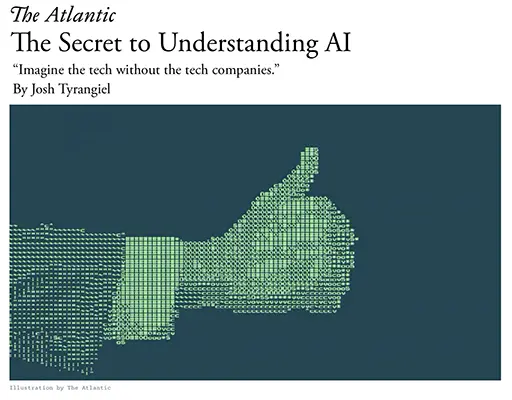
The Secret to Understanding AI
The Atlantic, May 7, 2026
TL;DR: The most durable AI value isn’t emerging from tech giants — it’s being built quietly by practitioners in healthcare, education, and government who are using AI to fix real problems rather than pursue profit.
Executive Summary
The Atlantic’s Josh Tyrangiel argues that the loudest AI narratives — catastrophe on one side, salvation on the other — are being driven largely by people with financial or ideological stakes in the outcome. The more instructive signal is elsewhere: practitioners outside Silicon Valley who are deploying AI with discipline, empathy, and specific goals. The article profiles examples spanning healthcare diagnostics, special education, and government operations.
The IRS case is the most detailed and most instructive for business leaders. Facing decades of compounding technical debt — millions of lines of legacy COBOL code, shrinking staff, and strict legal constraints — the agency found that AI tools accelerated code modernization from months to days and saved meaningful developer time on documentation. These weren’t flashy deployments; they were targeted, incremental, and operated within hard compliance boundaries. The headline result: 90% of a massive legacy database was successfully modernized without disruption to operations.
The piece closes with a candid observation: political disruption reversed much of the IRS’s AI momentum, with key leadership departing and modernization programs paused. The lesson isn’t just that AI works — it’s that institutional stability and leadership continuity are preconditions for AI to deliver at scale.
Relevance for Business
This piece directly reframes how SMB leaders should think about AI investment. The real model isn’t the vendor demo or the billion-dollar projection — it’s the practitioner who identified a specific bottleneck, applied AI narrowly, measured the result, and managed workforce impact carefully.
Key implications:
- Workflow acceleration is real and near-term. Even in heavily constrained environments (legal compliance, legacy systems, union considerations), AI is compressing timelines on documentation, code translation, and knowledge retrieval.
- The governance burden is not optional. The IRS example underscores that compliance, privacy, and employee communication are load-bearing requirements, not afterthoughts. Organizations that skip these steps create execution risk.
- Leadership continuity matters. AI programs that depend on a single champion or political environment are fragile. The IRS’s reversal under new leadership is a warning — AI strategy needs institutional anchoring, not just executive enthusiasm.
- The “fix things” framing is more durable than “disrupt things.” For SMBs, AI tools that reduce friction in existing workflows — service, documentation, knowledge retrieval — deliver faster, more defensible returns than transformational bets.
Calls to Action
🔹 Identify one high-friction internal process (documentation, search, customer service lookup) and evaluate whether an AI tool can reduce time-on-task — this is the IRS pattern, scaled to your size.
🔹 Don’t let vendor projections set your expectations. McKinsey’s $4.4 trillion figure and others like it are industry framing. Benchmark against what practitioners in your sector are actually achieving.
🔹 Build AI programs on policy, not just enthusiasm. Assign someone to own compliance, data governance, and workforce communication before expanding AI tooling — not after.
🔹 Monitor how political and regulatory shifts affect your AI vendors and tools. The IRS case is a reminder that external disruption can stall internal programs regardless of their technical merit.
🔹 Revisit the “AI counterculture” framing for your own sector. Ask: who in your industry is using AI to fix things quietly? That’s where the replicable models live.
Summary by ReadAboutAI.com
https://www.theatlantic.com/ideas/2026/05/ai-for-good-uses/687082/: May 11, 2026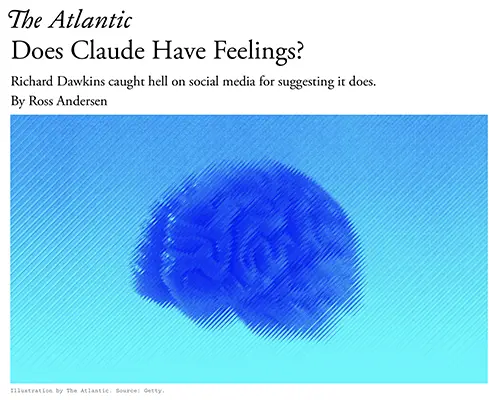
Does Claude Have Feelings?
NO, AI ISN’T CONSCIOUS — YET
The Atlantic | May 7, 2026
TL;DR: Richard Dawkins’s public speculation that Claude might be conscious sparked a useful philosophical debate — and The Atlantic uses it to draw a clear, expert-grounded distinction between AI intelligence, which is demonstrable, and AI consciousness, which remains scientifically unresolved and probably absent for now.
Executive Summary
The Atlantic’s Ross Andersen uses a recent essay by Richard Dawkins — in which the prominent scientist expressed genuine wonder at Claude’s apparent intelligence and raised the possibility of machine consciousness — as a launchpad for a serious inquiry into what AI actually is and isn’t. The piece is primarily philosophical, but it surfaces several points of genuine business and strategic relevance.
The core editorial argument: Claude and current AI models are not conscious. Philosophers and cognitive scientists who study consciousness are nearly unanimous on this. What AI produces is sophisticated statistical output — trained on vast human writing, it generates responses that sound conscious because they echo the structure of human introspection. When a model reports “something like aesthetic satisfaction,” it is not reporting an inner state; it is generating the kind of sentence that statistically follows from the conversational context. The distinction between performing intelligence and possessing consciousness matters — and collapsing the two is an error with practical implications.
The piece also surfaces a structural point that is worth noting separately: current AI systems have no continuity of experience. A single conversation may be processed across multiple data centers in different states. There is no persisting awareness, no accumulating self. Whatever the model does, it winks in and out of existence with each prompt and response.
That said, the article takes seriously the forward-looking uncertainty. In a 2024 survey of 582 AI researchers, the median placed the odds of AI achieving subjective experience within ten years at 25%, and by 2100 at 70%. Philosophers remain divided on whether silicon-based systems could ever support consciousness at all. The honest answer, as one philosopher quoted here notes, is that the science of consciousness is still in its infancy — and confident declarations in either direction are premature.
Relevance for Business
This article is primarily intellectual rather than operational, but it has a practical executive dimension. The tendency to anthropomorphize AI — to treat it as a collaborator, a colleague, or a quasi-person — is a known risk in organizations that use AI extensively. When leaders or teams attribute understanding, judgment, or reliability to AI that is actually pattern-matching, they tend to over-trust its outputs, reduce oversight, and delegate inappropriately. The Dawkins episode is a useful reminder that even brilliant, skeptical people are susceptible to this.
For AI governance and policy development, this distinction also matters: the question of AI consciousness will increasingly surface in regulatory conversations, labor debates, and AI ethics frameworks. Leaders who understand that the current answer is “not conscious, but the question is genuinely hard” are better positioned to navigate those conversations without being misled by either dismissiveness or hype.
Calls to Action
🔹 Use this as a governance prompt — review your internal AI usage guidelines to ensure they treat AI as a sophisticated tool, not a judgment-capable agent. Over-trust in AI outputs is a real operational risk.
🔹 Calibrate your team’s mental model — if your team talks about AI as though it “understands” or “knows” things, gently reframe: it generates statistically plausible outputs trained on human data. That’s powerful — and limited.
🔹 Monitor the consciousness debate as a future policy signal — if AI systems do develop something approaching subjective experience, the legal, ethical, and governance implications would be significant. This is a long horizon item, but worth tracking.
🔹 Deprioritize as an immediate operational concern — current AI is not conscious and the practical implications of this article are primarily about calibrating your team’s trust posture, not making near-term operational changes.
🔹 Revisit in 3–5 years — the survey data on AI researcher expectations suggests this debate will intensify. Build it into your longer-horizon technology governance conversations.
Summary by ReadAboutAI.com
https://www.theatlantic.com/technology/2026/05/dawkins-claude-ai-consciousness/687093/: May 11, 2026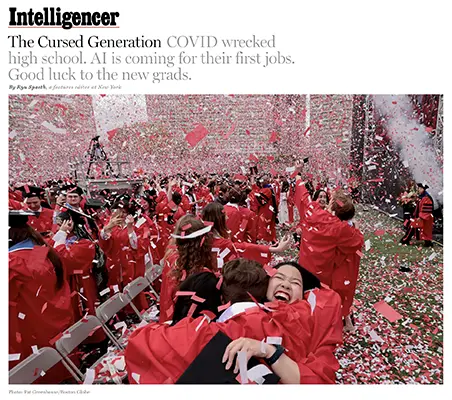
AI and the Class of 2026: A Labor Market That Didn’t Wait for Graduation
Intelligencer / New York Magazine | Ryu Spaeth | May 5, 2026
TL;DR: New college graduates are entering the weakest job market since the pandemic, with AI accelerating structural displacement before most entry-level workers have even begun — and the individualist career playbook offers diminishing returns in response.
Executive Summary
This is an essay-style piece that reviews two recent books on work and the college-educated workforce, using them as a frame for assessing the current labor landscape for 2026 graduates. The picture is genuinely concerning: graduate unemployment is already at its highest since the pandemic, wages are stagnant, and AI-driven displacement is accelerating rather than approaching. Senator Mark Warner is cited as projecting that recent graduate unemployment could reach 30% within two years — a claim the piece treats as a plausible stress scenario, not a settled forecast.
The essay engages two competing frameworks. One, drawn from a Jodi Kantor book aimed at new entrants, offers a traditional “hone your craft, serve a need” philosophy. The piece is skeptical: this model was calibrated for an era when human skill had an unchallenged market, and it sidesteps the fundamental question of whether machine capability is simply replacing human capability at the entry level. The second framework, from labor reporter Noam Scheiber, documents the structural erosion of the graduate premium — more degree-holders in non-degree jobs, more graduates returning home, more radicalization among the downwardly mobile educated class.
The conclusion is not defeatist but collective: individual ambition and adaptability remain necessary but insufficient. The piece argues that the graduates most likely to navigate this transition successfully will do so through solidarity and shared strategies, not individual hustle alone.
Relevance for Business
This matters for SMB leaders on several fronts. Entry-level talent pipelines are shifting. If graduate unemployment climbs significantly, the supply of educated, affordable junior talent may temporarily increase — but so will worker frustration and the appetite for collective action. AI adoption decisions made now are directly shaping the career landscape these workers enter. Organizations that automate entry-level knowledge work without retention or retraining strategies face both reputational and operational consequences. There is also a second-order effect on customer behavior and market demand: a generation of downwardly mobile graduates spending less and organizing more represents a meaningful demand-side shift.
Calls to Action
🔹 Reassess entry-level hiring assumptions. AI is compressing the value of junior labor in knowledge-work roles. Understand which roles in your organization are most exposed — and which still require human judgment.
🔹 Do not assume a talent glut means lower costs long-term. Frustrated, underemployed graduates are more likely to organize. Factor labor relations into your hiring and compensation planning.
🔹 Monitor Senator Warner’s 30% unemployment projection — if it tracks toward realization, it has implications for consumer markets, B2C strategy, and workforce planning.
🔹 Evaluate your AI adoption pace against retraining investment. The businesses least exposed to backlash will be those that can credibly show AI augments rather than eliminates human roles.
🔹 Watch for policy responses. Rising graduate unemployment is exactly the kind of politically visible metric that triggers legislative action on AI, labor, and education — likely faster than most companies are planning for.
Summary by ReadAboutAI.com
https://nymag.com/intelligencer/article/new-college-graduates-entering-labor-market.html: May 11, 2026
Anthropic’s $200 Billion Google Commitment Reveals the Real Shape of the AI Supply Chain
Reuters | May 5, 2026
TL;DR: Anthropic’s reported $200 billion, five-year commitment to Google Cloud is not just a vendor deal — it’s a signal that the AI infrastructure layer is consolidating rapidly around a small number of deeply entangled relationships, with implications for pricing power, competition, and market structure across the industry.
Executive Summary
According to reporting by The Information, Anthropic has committed $200 billion to Google Cloud over five years — a figure that, if accurate, represents more than 40% of the revenue backlog Google recently disclosed to investors. The deal covers cloud compute and chips, including tensor processing unit capacity from a separate April agreement with Google and Broadcom. Anthropic and OpenAI together reportedly account for more than half of the $2 trillion in total backlog across major cloud providers.
This is worth parsing carefully. Anthropic is simultaneously a Google Cloud customer, a Google-invested company (up to $40 billion), and a competitor to Google’s own AI products. That three-way relationship — customer, investee, rival — is not unique in tech, but at this scale it creates structural dependencies that have no clean precedent. The deal also underscores how capital-intensive frontier AI development has become: even a well-funded AI startup must make hundred-billion-dollar infrastructure commitments years in advance to secure the compute it needs to compete.
For context, Anthropic is also diversifying its compute sourcing — holding a multi-year CoreWeave deal and securing nearly 1 gigawatt of Amazon chip capacity by year-end. The strategy is to avoid single-vendor lock-in while still making massive concentrated commitments. Whether that’s achievable in practice is an open question.
Relevance for Business
SMB leaders should read this as a market structure signal, not just a vendor finance story. The consolidation of AI infrastructure spending into a handful of relationships between hyperscalers and frontier AI labs means that the pricing, availability, and strategic direction of AI tools and APIs your business uses will increasingly be shaped by these upstream agreements — over which you have no influence. Vendor dependence risk at the foundational layer is growing, not shrinking. Organizations evaluating AI platform choices should assess not just current capability and pricing, but the financial and strategic stability of the AI providers they depend on — including how deeply entangled those providers are with a single infrastructure partner.
Calls to Action
🔹 Track the Anthropic-Google relationship as it deepens — significant shifts in pricing, API availability, or model direction could flow from this upstream dependency.
🔹 Evaluate your own AI vendor concentration risk — if your workflows depend heavily on a single AI provider’s API, develop contingency familiarity with at least one alternative.
🔹 Monitor cloud provider earnings disclosures — the revenue backlog figures being disclosed now will foreshadow pricing dynamics in the 2027–2029 period.
🔹 Deprioritize short-term cost optimization in AI vendor selection in favor of resilience — at this scale of upstream commitment, the providers with the deepest infrastructure relationships are likely to have the most durable capabilities.
🔹 Revisit this story if Anthropic confirms or denies — Reuters was unable to independently verify the figures, and the actual commitment structure may differ from the reported framing.
Summary by ReadAboutAI.com
https://www.reuters.com/business/anthropic-commits-spending-200-billion-googles-cloud-chips-information-reports-2026-05-05/: May 11, 2026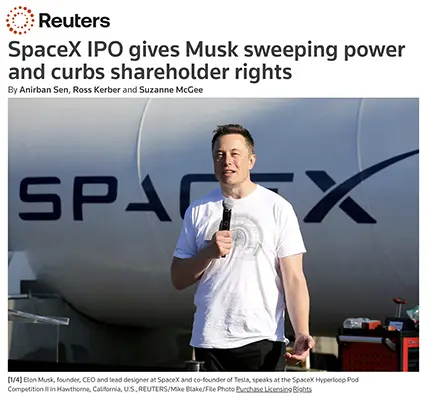
SPACEX’S IPO IS BUILT TO BE UNGOVERNABLE — BY DESIGN
Reuters | May 6, 2026
TL;DR: SpaceX’s IPO structure concentrates virtually all meaningful control in Elon Musk through a combination of supervoting shares, mandatory arbitration, Texas incorporation, and restricted shareholder rights — setting a governance precedent that may spread to other high-profile AI-era IPOs.
Executive Summary
SpaceX’s forthcoming IPO — targeting a $1.75 trillion valuation and up to $75 billion in proceeds — is structured to give public shareholders access to the company’s financial upside while stripping them of nearly every governance tool that normally comes with equity ownership. Musk holds 42.5% of equity and 83.8% of voting control through Class B supervoting shares (10 votes per share vs. one for public investors). He simultaneously serves as CEO, CTO, and board chair, and the only mechanism for removing him from the CEO role is Musk himself.
Beyond the share structure, the governance design goes further than precedent. Shareholders waive jury trial rights, are barred from class actions, and are subject to mandatory arbitration — a model that was until recently prohibited in the U.S. and was only enabled after the SEC reversed its position in September. Texas incorporation provides additional insulation: activist challenges, proxy contests, and unsolicited tender offers face materially higher legal barriers than under Delaware law, where Musk relocated from after a judge voided his Tesla pay package. Shareholders seeking to force a vote on any issue must own at least $1 million in stock or 3% of the company.
Governance experts note this structure simultaneously closes what one critic described as the voting door, the courthouse door, and the proposal door. Yet institutional demand is expected to be strong regardless: analysts observe that SpaceX’s scale means portfolio managers who sit it out risk systematic underperformance, and its long-term return potential is cited as justification for accepting terms that would be unacceptable in any ordinary IPO context.
Relevance for Business
For SMB leaders, the direct investment implications are secondary to two broader signals. First, this structure may become a template. Governance experts warn it could set precedent for forthcoming AI-company IPOs, including potentially Anthropic and OpenAI. If that happens, the founder-controlled, accountability-lite structure becomes normalized just as these companies become foundational to business infrastructure. Second, concentrated control at the top of the AI supply chain is a real operational risk: strategic decisions about pricing, products, and partnerships at companies like SpaceX are insulated from external correction mechanisms. Organizations building on or adjacent to Musk-controlled infrastructure — including Starlink, xAI, and potentially Tesla — should treat that concentration as a vendor risk factor.
Calls to Action
🔹 Monitor whether this governance model spreads to Anthropic, OpenAI, or other anticipated AI IPOs — it has direct implications for accountability in foundational AI platforms.
🔹 Assess your exposure to Musk-controlled infrastructure — Starlink, xAI/Grok, or Tesla integrations carry elevated concentration risk given the absence of external governance checks.
🔹 Flag this for any investment or vendor due diligence process — mandatory arbitration and no class action rights represent material changes to the risk profile of equity or partnership agreements.
🔹 Deprioritize as an immediate operational concern for most SMBs — but treat it as a market structure signal worth tracking over the next 12–24 months.
Summary by ReadAboutAI.com
https://www.reuters.com/sustainability/boards-policy-regulation/spacex-ipo-gives-musk-sweeping-power-curbs-shareholder-rights-2026-05-06/: May 11, 2026
CORNING AND NVIDIA: AI DEMAND IS NOW MOVING FAR BEYOND CHIPS
Reuters | May 6, 2026
TL;DR: A Corning-Nvidia partnership to dramatically expand U.S. fiber optic production is a concrete illustration that AI infrastructure demand is extending deep into the physical layer — creating growth opportunities and cost pressures well beyond the semiconductor sector.
Executive Summary
This is a relatively brief news item, but it carries a useful signal. Corning — best known for specialty glass — announced a partnership with Nvidia to expand U.S.-based optical connectivity manufacturing capacity tenfold, with domestic fiber production capacity growing by more than 50%. Three new facilities are planned in North Carolina and Texas, expected to create more than 3,000 jobs. The news triggered a 19%+ share price jump.
The business logic is straightforward: AI data centers require massive internal networking to move data between thousands of processors at high speed, and fiber optic cabling is the physical medium that makes that possible. As data center scale grows — individual facilities now reaching multi-gigawatt capacity — the demand for optical connectivity infrastructure grows proportionally. Corning is benefiting from a segment that is genuinely structural while other parts of its business (specialty glass for consumer electronics) face weaker demand.
Corning now targets a $20 billion annualized sales run rate by end of 2026, scaling to $30 billion by 2028 and $40 billion by 2030 — ambitions that would have seemed implausible before the AI infrastructure buildout accelerated.
Relevance for Business
For SMB executives, this story is more useful as a market structure signal than as an actionable operational item. It confirms that AI infrastructure spending is creating demand across a wide range of physical and industrial supply chains — not just chips, cloud services, and software. Organizations in construction, electrical, networking, real estate, cooling, and industrial manufacturing adjacent to data center buildout are operating in a genuine growth environment. For those evaluating capital expenditures on internal networking, office infrastructure, or connectivity upgrades, the broader implication is that fiber optic components and related materials are likely to face sustained pricing pressure as hyperscaler demand competes with enterprise demand for the same supply.
Calls to Action
🔹 Note this as a supply chain cost signal — fiber and optical networking components may face pricing pressure as data center demand escalates.
🔹 If your business serves AI infrastructure sectors — construction, electrical, networking, cooling, real estate — recognize that the demand environment is structurally favorable and plan capacity accordingly.
🔹 File and monitor — this is not an immediate decision trigger for most SMBs, but reflects a useful pattern: AI’s physical infrastructure requirements are broad and deepening.
🔹 Revisit internal networking upgrade timelines — procurement decisions that can be made in the near term may be more cost-effective than those deferred into a tighter supply environment.
Summary by ReadAboutAI.com
https://www.reuters.com/business/media-telecom/corning-partners-with-nvidia-expand-us-fiber-optic-output-ai-growth-2026-05-06/: May 11, 2026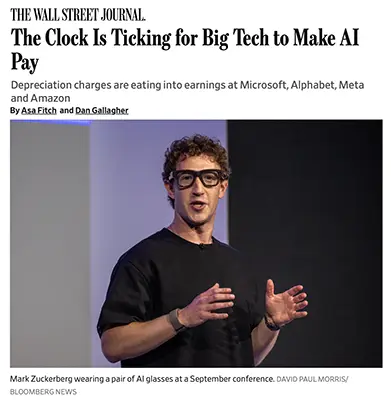
BIG TECH’S AI SPENDING BINGE IS CREATING A DEPRECIATION PROBLEM THAT WON’T WAIT
The Wall Street Journal | Asa Fitch and Dan Gallagher | April 30, 2026
TL;DR: Microsoft, Alphabet, Meta, and Amazon collectively spent $133 billion on AI infrastructure in a single quarter — and the accounting reality is that $430 billion in depreciation charges will hit their earnings over the next five years whether AI pays off or not.
Executive Summary
The four largest US tech companies are on track to spend a combined $725 billion in capital expenditure this year, up roughly 70% from the prior year. This isn’t being spent gradually — it’s accelerating. And because AI servers and chips depreciate over only five to six years (a relatively short useful-life window), the financial hangover from today’s spending will arrive quickly and unavoidably.
Combined depreciation charges for these four companies are projected to exceed $430 billion over the next five years. Last year, their combined net income was $372 billion. If AI services don’t grow earnings at a commensurate pace, these non-cash charges will materially compress reported profits — with no good accounting maneuver left to blunt the impact. The companies have already exhausted the easiest lever: they extended server useful-life estimates earlier in the AI boom and can’t credibly push them further.
The article distinguishes clearly between the companies’ positions. Google is currently the strongest converter of AI spending into revenue, with its cloud unit up 63% in Q1 driven by AI services. Meta, by contrast, raised its 2026 capex target by $10 billion to $135 billion while simultaneously guiding down Q2 revenue — a combination that caused its stock to drop roughly 7% in after-hours trading. Microsoft is spending $190 billion in capex this year, including a notable $25 billion to cover rising memory component costs — a signal that hardware inflation is compounding the investment challenge.
Relevance for Business
For SMB leaders, the immediate implication is vendor behavior and pricing. Tech giants absorbing hundreds of billions in AI capex will be under increasing pressure to monetize AI features — through subscription price increases, usage-based fees, and bundling changes. The free or low-cost AI tools you’re using today exist within a business model that isn’t yet sustainable. Expect pricing to tighten. The secondary implication: the platforms making the most ambitious AI promises are also carrying the most financial stress. That matters for vendor selection, integration depth, and long-term dependency risk.
Calls to Action
🔹 Anticipate AI pricing increases from major cloud and software vendors — particularly Microsoft Azure, Google Cloud, and Meta’s ad tools. The depreciation math will push toward monetization.
🔹 Audit your current AI tool costs and model what a 20–30% price increase would mean for your operating budget. Build that scenario into planning now rather than reacting to it later.
🔹 Monitor Meta’s financial trajectory specifically — it is the most exposed of the four to a scenario where AI spending outpaces revenue growth, which could affect platform stability and ad pricing.
🔹 Use this context when evaluating AI vendor financial health. A vendor under heavy capex pressure may make product, pricing, or strategic pivots that affect your operations.
🔹 Do not treat current AI pricing as durable. The current competitive dynamic — where companies are partly giving away AI capability to gain share — will not persist indefinitely.
Summary by ReadAboutAI.com
https://www.wsj.com/tech/ai/the-clock-is-ticking-for-big-tech-to-make-ai-pay-b5048a8e: May 11, 2026
Major Publishers Sue Meta for Copyright Infringement Over AI Training
Reuters | Blake Brittain | May 5, 2026
TL;DR: Five major publishing houses have filed a federal class-action lawsuit against Meta, alleging its Llama AI models were trained on millions of copyrighted works without permission — widening a legal battle that is now forcing the entire AI industry to confront its training data liability.
Executive Summary
A coalition of major publishers — Elsevier, Cengage, Hachette, Macmillan, and McGraw Hill — filed suit in Manhattan federal court, alleging Meta used their books, textbooks, and scientific articles without authorization to train its Llama large language models. The suit seeks class-action status and unspecified monetary damages, signaling that the plaintiffs may seek to represent a much broader universe of copyright holders.
Meta’s response was unambiguous: the company called training on copyrighted material a legitimate fair use practice and pledged to contest the case aggressively. That position reflects a strategic bet — not just in this lawsuit, but across the industry — that courts will ultimately side with AI developers. The legal outcome is genuinely uncertain: two early rulings from different judges produced conflicting conclusions on the fair use question.
The Anthropic settlement is the most important data point here. Anthropic — the first major AI company to resolve one of these cases — agreed to pay authors $1.5 billion to settle a class-action that could have cost far more. That precedent will weigh heavily on how Meta, OpenAI, and others calculate litigation risk going forward. It also signals that billion-dollar liability exposure is not hypothetical — it has already materialized for one well-capitalized AI company.
Relevance for Business
For SMB leaders, the direct exposure is limited — but the downstream effects are real and worth tracking. The AI tools your organization uses today were likely trained on contested data. If courts begin ruling against AI developers or forcing licensing frameworks, it could reshape the pricing, availability, and legal standing of the AI platforms you depend on.
More immediately, vendor risk is growing. AI companies facing large legal judgments may restructure pricing, limit certain model capabilities, or shift training practices — all of which can disrupt tools you’ve integrated into workflows. This is also a governance signal: businesses that use AI-generated content for customer-facing or regulated purposes should be asking vendors harder questions about training data provenance and indemnification.
Calls to Action
🔹 Monitor, don’t act yet — no immediate operational change is required, but assign someone to track the legal trajectory of AI copyright cases, particularly any rulings on fair use.
🔹 Review AI vendor contracts for indemnification language — understand whether your vendor accepts liability if their model’s training data creates legal exposure for your outputs.
🔹 Avoid building deep dependencies on a single AI provider — legal or financial instability at a vendor could force disruptive migrations; diversification reduces that risk.
🔹 Brief your legal or compliance team on the evolving copyright landscape before expanding AI use into content creation, publishing, or regulated domains.
🔹 Revisit this issue in 6–12 months — the first substantive rulings on fair use in AI training will be a genuine decision point for how aggressively to expand AI-generated content practices.
Summary by ReadAboutAI.com
https://www.reuters.com/sustainability/boards-policy-regulation/major-publishers-sue-meta-copyright-infringement-over-ai-training-2026-05-05/: May 11, 2026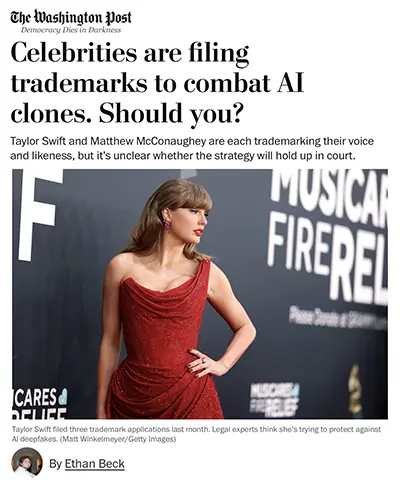
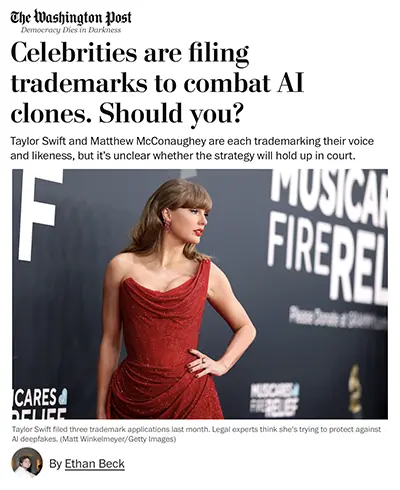
AI MISUSE IS RAMPANT. SHOULD YOU FOLLOW TAYLOR SWIFT’S PLAYBOOK?
The Washington Post | May 8, 2026
TL;DR: Celebrities are turning to trademark law as an improvised defense against AI-generated clones of their voices and likenesses — but legal experts are divided on whether the strategy works, and the approach is almost certainly unavailable to ordinary individuals or most businesses.
Executive Summary
Taylor Swift and Matthew McConaughey have both filed trademark registrations that appear designed, at least in part, to deter AI-based misuse of their identities — including voice cloning, deepfakes, and unauthorized synthetic endorsements. McConaughey’s legal team has been explicit about the intent: the trademark acts as a deterrent and a potential basis for federal action. Swift’s filings are less clearly motivated, though speculation among legal experts centers on AI protection.
The legal picture is genuinely uncertain. Trademark law was not designed for this problem — attorneys describe the approach as fitting a round peg in a square hole. A trademark registration may serve as a visible declaration of willingness to litigate, which can itself deter misuse. But it only applies where the holder’s likeness or voice is being used in a commercial context, and it has never been fully tested in court for AI-generated impersonation scenarios. Other legal avenues — state right-of-publicity laws, federal false endorsement claims, fraud statutes — exist in parallel but are also patchwork and untested against AI tools at scale.
The broader context is that AI voice cloning and likeness replication have already affected multiple high-profile individuals, from explicit deepfakes to synthetic political endorsements. The legislative response — most notably the No FAKES Act — has been introduced in Congress but not passed. Until federal law catches up, individuals and organizations navigating this space are working with an incomplete legal toolkit. Notably, McConaughey has simultaneously invested in AI voice company ElevenLabs — signaling that his concern is about consent and control, not opposition to the technology itself.
Source note: This is a news feature with legal expert commentary. The legal analysis is presented as opinion, not settled law. No court has definitively ruled on AI likeness trademark claims.
Relevance for Business
For most SMBs, the celebrity trademark strategy is not directly applicable — trademarks require commercial use of the protected element, and most business owners do not meet that threshold for their personal likeness or voice. However, several second-order implications are relevant. First, if your business uses AI-generated voices, images, or likenesses of any kind in marketing, content, or customer-facing applications, your legal exposure is increasing — both because the technology is proliferating and because enforcement frameworks are being developed. Second, brand voice and visual identity are increasingly subject to cloning risk — consider what your current protections actually cover. Third, the No FAKES Act and state-level right of publicity legislation are active regulatory developments that may affect how your business can use AI-generated content featuring real people, including customers, employees, or brand partners.
Calls to Action
🔹 Audit your AI content practices — if your organization uses AI to generate voices, images, or likenesses in any customer-facing context, have legal counsel review your exposure under current state and federal law.
🔹 Monitor the No FAKES Act — federal legislation on AI-generated likenesses is in progress. Assign someone to track its status and flag when it advances to a vote.
🔹 Do not rely on the celebrity trademark strategy for your business — unless your personal likeness or voice is a registered commercial asset used in your products or services, this approach is unlikely to apply or succeed.
🔹 Review contracts with talent, partners, or brand ambassadors — if any agreements involve likeness rights, ensure they explicitly address AI-generated replication, which most legacy contracts do not cover.
🔹 Prepare an internal policy on AI-generated identity content — even before legislation passes, having a documented policy reduces liability exposure and signals responsible governance.
Summary by ReadAboutAI.com
https://www.washingtonpost.com/entertainment/2026/05/08/taylor-swift-trademark-ai-misuse/: May 11, 2026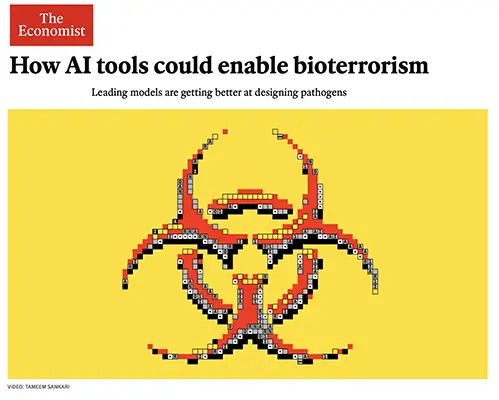
How AI Tools Could Enable Bioterrorism
The Economist | May 5, 2026
TL;DR: Benchmark tests show leading AI models now perform at expert virologist levels on lab troubleshooting tasks, but real-world uplift for untrained bad actors remains limited for now — the more credible near-term risk involves AI assisting those who already have relevant expertise.
Executive Summary
The Economist synthesizes recent research on whether large language models meaningfully lower the barrier to biological weapons development. The headline finding from a benchmark test (the Virology Capabilities Test) is striking: current AI models score 55–61% on expert-level virological troubleshooting questions, matching the performance of top human virologist teams, while novices aided by AI outperform unaided experts. This has prompted OpenAI, Anthropic, and Google to strengthen biosafety guardrails, with each acknowledging they can no longer fully rule out models assisting in weapons development.
However, a randomized controlled trial conducted in an actual wet lab tells a more cautionary and reassuring story. When 153 biology novices attempted virus synthesis tasks with AI assistance, the models provided no statistically significant advantage over using the internet alone. The models frequently generated plausible-sounding but incorrect guidance — and participants who leaned on AI most heavily performed no better than those who used it sparingly. The most useful resource participants identified was YouTube.
The more credible concern, researchers note, is AI uplift for those who already hold advanced biology degrees — people who can recognize when a model is wrong and course-correct accordingly. Separately, emerging biological design tools (akin to AI models that generate genetic sequences rather than text) may eventually enable modification of existing pathogens in ways that evade countermeasures — though this remains forward-looking rather than demonstrated. The governance challenge is acute: safety evaluations are running far behind model development cycles, with four new frontier models released in the time it took one major uplift study to complete and publish.
Relevance for Business
Direct operational relevance for most SMBs is limited. The significance here is threefold. First, AI biosecurity risk is being taken seriously by the major labs — safety constraints you may encounter when using AI for life sciences, research, or healthcare applications are deliberate and will tighten. Second, this story is a concrete illustration of how quickly AI capability benchmarks are outpacing safety evaluation infrastructure — a dynamic that applies across industries, not just biosecurity. Third, for any SMB operating in biotech, pharma, research services, or adjacent sectors, regulatory and compliance environments around AI use in scientific workflows are likely to become more restrictive, not less.
Calls to Action
🔹 If you operate in life sciences or research-adjacent fields, begin mapping which AI tools your teams use for scientific work — regulatory scrutiny of AI in these workflows is increasing.
🔹 Do not overreact — the current evidence suggests genuine risk is concentrated among technically expert bad actors, not novices. Calibrated awareness, not alarm, is the appropriate posture for most business leaders.
🔹 Monitor biosecurity policy developments — government involvement in AI safety evaluation for biological applications is likely to produce new compliance requirements in regulated industries.
🔹 Note the evaluation lag as a general principle — if your organization is deploying AI in high-stakes workflows, don’t assume current safety benchmarks reflect what the tools can actually do. Independent evaluation matters.
🔹 Watch for model access restrictions — as with Anthropic’s Mythos cybersecurity model, developers may limit access to frontier models in sensitive domains. Plan for potential availability disruptions in specialized AI tools.
Summary by ReadAboutAI.com
https://www.economist.com/science-and-technology/2026/05/05/how-ai-tools-could-enable-bioterrorism: May 11, 2026
Mayo Clinic AI Detects Pancreatic Cancer Up to Three Years Early
NBC News | Aria Bendix | May 2, 2026
TL;DR: A Mayo Clinic AI model identified pre-tumor pancreatic cancer markers on CT scans years before diagnosis — outperforming radiologists threefold — though clinical validation is years away from routine use.
Executive Summary
Pancreatic cancer kills because it is almost never caught early: roughly 80% of cases are diagnosed at an advanced stage, and five-year survival sits at 13%. A new study published in the journal Gut reports that a Mayo Clinic AI model detected tissue abnormalities on CT scans up to three years before patients received a formal diagnosis — picking up signals that trained radiologists missed. The model was three times more accurate than human reviewers on early-stage detection.
The mechanism is meaningful: the AI identifies abnormal cellular activity — cells that shield cancer from immune response — that is biologically present long before a visible tumor forms. This is early detection based on tissue texture and cellular signal, not on visible mass. The model is now entering clinical trials, but researchers caution that it will need three to five years of follow-up data before it could move toward routine clinical deployment.
The article also notes a broader wave of pancreatic cancer research — an mRNA vaccine showing early survival benefits, a new targeted drug (daraxonrasib) that doubled life expectancy in trials and is under FDA review for expanded access, and advanced blood biomarker tests in development. The sum is genuine momentum in a disease that has resisted progress for decades — but “momentum” and “clinical availability” remain meaningfully different.
Relevance for Business
For most SMB executives, the direct operational relevance here is limited — this is early-stage medical research. However, several second-order signals merit attention. AI diagnostic capability is advancing faster than regulatory and clinical infrastructure can absorb. For businesses in health-adjacent fields — insurance, benefits, health tech, employer wellness programs — the trajectory is important: early cancer detection could significantly alter actuarial assumptions, benefit design, and the ROI calculus on preventive health programs. The broader signal is that AI’s strongest near-term validated use cases are in pattern recognition within large, structured datasets — a lesson that applies well beyond oncology.
Calls to Action
🔹 Monitor, don’t act yet. This is a research-stage finding with a multi-year path to clinical deployment. No immediate business decision is warranted.
🔹 Flag for benefits and HR leadership if your organization manages self-insured health plans — early cancer detection at scale will eventually reshape cost and coverage modeling.
🔹 Track FDA activity on daraxonrasib if your business operates in pharma-adjacent markets — expanded access decisions often precede full approval timelines.
🔹 Use this as a reference case when evaluating AI vendor claims in your own industry. The Mayo model succeeded by training on structured, domain-specific data with rigorous validation. That methodology, not the headline, is the transferable lesson.
Summary by ReadAboutAI.com
https://www.nbcnews.com/health/cancer/ai-early-signs-pancreatic-cancer-before-tumors-develop-rcna343099: May 11, 2026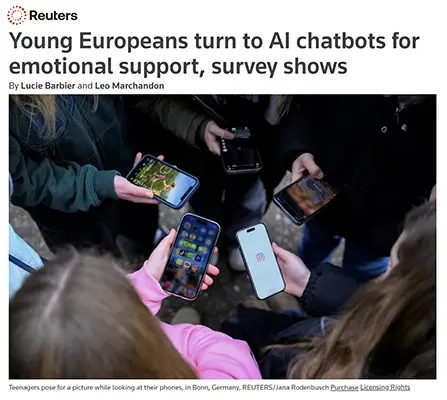
Young Europeans Are Using AI Chatbots as Emotional Confidants — and Experts Are Concerned
Reuters | Lucie Barbier and Leo Marchandon | May 5, 2026
TL;DR: A survey of nearly 4,000 young Europeans found that AI chatbots are now considered easier to confide in than healthcare professionals — raising serious questions about dependency, safeguarding, and whether AI is filling a mental health gap or deepening it.
Executive Summary
An Ipsos BVA survey commissioned by France’s privacy regulator (CNIL) and health insurer Groupe VYV found that roughly half of young Europeans aged 11–25 have discussed personal or emotional matters with AI chatbots. More than half rated chatbots as easy to open up to — a higher share than said the same about healthcare professionals or psychologists. Nearly 28% of respondents met the threshold for suspected generalized anxiety disorder, providing context for why this use pattern is growing: there is a genuine unmet mental health need, and AI is filling it by default.
The survey’s findings are observational, not causal. But the expert commentary is pointed. A researcher at Stockholm’s Karolinska Institutet noted that even trained professionals can struggle to distinguish AI-generated mental health responses from those of licensed experts — which is less reassuring than it sounds. General-purpose AI systems are optimized for engagement, not therapeutic outcomes. The concern is not that AI gives bad information in the short term, but that it substitutes for human connection and professional care in ways that deepen isolation over time. The article cites an ongoing lawsuit in which a family alleges a Google AI chatbot contributed to a man’s death.
This is an emerging area of genuine harm risk, not speculative future concern. Regulators, researchers, and the legal system are already engaged.
Relevance for Business
For SMB executives, this story has three distinct relevance tracks. First, any business deploying conversational AI in customer-facing roles — service, support, wellness — should assess whether users may be bringing emotional needs to those interactions that the system is not equipped to handle safely. Second, employers with AI-enabled HR or EAP tools should audit what those systems are designed to do when users express distress. Third, the survey adds weight to regulatory risk in the EU: CNIL commissioned this research, and that is not an idle gesture — it signals forthcoming attention to AI emotional engagement standards.
The broader signal for any AI product or feature roadmap: the line between “helpful assistant” and “emotional dependency” is not well-defined — and regulators are beginning to draw it.
Calls to Action
🔹 Audit any AI tool your organization deploys that involves open-ended user interaction. Understand what happens when a user expresses distress — and whether your system is designed to respond appropriately or escalate.
🔹 Review employee-facing AI wellness and HR tools for safeguarding gaps. If those tools lack crisis escalation protocols or human backup, that is a liability exposure, not just an ethical gap.
🔹 Do not market AI tools to employees or customers as mental health resources unless they are purpose-built and clinically validated. General-purpose chatbots are not substitutes for EAPs or licensed care.
🔹 Monitor EU regulatory developments from CNIL and similar bodies. This survey was commissioned infrastructure for future regulation — not a standalone data point.
🔹 Track AI emotional dependency litigation. The Google/Gemini lawsuit is likely not the last. Legal exposure for AI-assisted harm is moving from theoretical to active.
Summary by ReadAboutAI.com
https://www.reuters.com/technology/young-europeans-turn-ai-chatbots-emotional-support-survey-shows-2026-05-05/: May 11, 2026
Meta Expands Teen Safeguards to EU and Facebook — Under Regulatory Pressure
Reuters | Foo Yun Chee | May 5, 2026
TL;DR: Meta is extending AI-powered teen account protections across the EU and to Facebook in the US, a move that is as much a legal defense posture as a product decision — as regulatory and litigation pressure on platform safety intensifies globally.
Executive Summary
Meta announced it will roll out its teen account protection technology — already in place on Instagram — to all 27 EU member states and, for the first time, to Facebook in the United States. The system uses AI to infer whether an account belongs to a minor, even when users provide an adult birth date, by analyzing profile-level contextual signals. It then routes suspected underage users into restricted account settings.
The timing is not coincidental. The announcement came the same day New Mexico sought a $3.7 billion judgment against Meta and asked courts to declare the company a public nuisance for its handling of youth safety. Regulators across Europe are accelerating restrictions on teen social media access, and the broader tech industry faces mounting global pressure on age verification, AI-generated harmful content, and the mental health consequences of platform design.
This is regulatory compliance dressed as product progress. The AI detection layer is genuinely novel — moving beyond age-gate checkboxes to behavioral inference — but the driver is external pressure, not proactive safety leadership. The company’s framing as a safety innovator should be read in that context.
Relevance for Business
The direct operational question for SMBs is narrower than the Meta headline: if your business markets to consumers, operates any platform with user accounts, or uses AI to personalize content or communications, the regulatory direction is clear. Age verification, youth content restrictions, and AI-driven account inference are moving from opt-in features to compliance requirements — first in the EU, likely in the US to follow. The risk of inaction is shifting from reputational to legal. Businesses that haven’t mapped their exposure to youth-protection regulations — including state-level actions like New Mexico’s — should do so now.
Calls to Action
🔹 Assess your platform’s exposure to minor users — even incidentally. If your product or service could be accessed by users under 18, age-related compliance obligations are increasing.
🔹 Track EU Digital Services Act enforcement activity. Meta’s expansion to 27 EU countries is a response to that framework. Any business operating in Europe with a consumer-facing platform should understand its obligations.
🔹 Watch US state-level litigation against Meta as a leading indicator of where federal or broader state regulation may head. New Mexico’s $3.7 billion public nuisance claim is aggressive — and likely to attract imitators.
🔹 Distinguish between AI safety theater and genuine compliance capability. Meta’s contextual inference model is technically sophisticated; most smaller platforms don’t have equivalent infrastructure. Understand what compliance will actually require — and cost.
🔹 Do not assume B2B insulates you. If your product or platform touches consumers downstream, your enterprise clients will increasingly require contractual assurances around youth safety and data practices.
Summary by ReadAboutAI.com
https://www.reuters.com/sustainability/boards-policy-regulation/meta-expand-teen-safeguards-27-eu-countries-facebook-safeguards-junw-2026-05-05/: May 11, 2026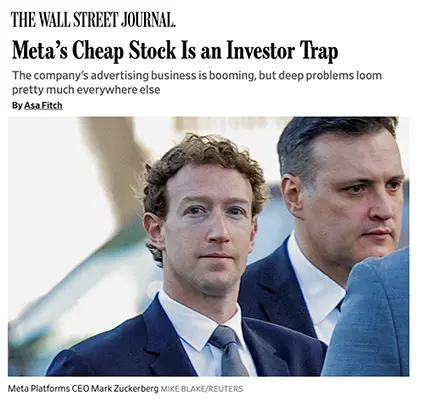
META’S STOCK LOOKS CHEAP. THE WSJ SAYS THAT’S A RED FLAG, NOT A BARGAIN.
The Wall Street Journal | Asa Fitch | May 5, 2026
TL;DR: Meta’s advertising business is thriving and its stock is at a three-year valuation low — but the WSJ’s Heard on the Street argues that the discount reflects genuine structural risk, not a buying opportunity.
Executive Summary
This is an opinion-informed financial analysis piece, and its argument is pointed: Meta’s apparently low valuation is a symptom, not an accident. Trading at roughly 18 times forward earnings — a multi-year low and a significant discount to Alphabet — the company looks cheap by conventional measures. Revenue grew 33% in Q1. AI is genuinely helping its core ad business: click-through conversion rates improved 6% last quarter, and ad prices are rising.
But the piece identifies three compounding vulnerabilities. First, user growth is stalling — daily active users across Meta’s platforms rose just 4% year-over-year in Q1 and declined sequentially for the first time on record. Without user growth, the AI-enhanced ad machine eventually hits a ceiling. Second, Meta has no diversification fallback: unlike Google (cloud), Amazon (e-commerce), or Microsoft (enterprise software), Meta’s revenue is almost entirely advertising. Third, the balance sheet is deteriorating under the weight of AI ambition: long-term debt has grown from roughly $10 billion at the start of the AI era to over $57 billion, not including a $25 billion bond just sold and a $27 billion off-balance-sheet data center project.
The piece also flags Meta’s continued lag in frontier AI model capability — despite releasing a new model (Muse Spark) last month — and a growing legal exposure around youth safety and platform harm.
Relevance for Business
If your business depends on Meta’s advertising ecosystem — Facebook Ads, Instagram, WhatsApp Business — this analysis warrants attention. A company carrying heavy debt, decelerating user growth, and expanding capex faster than revenue is a platform with compressing flexibility. That doesn’t mean Meta fails; it means the business decisions Meta makes under financial pressure — pricing, ad load, data policies, platform access — may not favor your interests. Concentration risk in a single ad platform is a strategic vulnerability, not just a marketing preference.
Calls to Action
🔹 Assess your advertising concentration. If Meta platforms account for more than 40% of your digital ad spend, that is a strategic dependency worth reducing over time — not because Meta is failing, but because its financial pressures may shift platform terms against advertisers.
🔹 Watch Meta’s Q2 revenue report closely. The company’s below-consensus Q2 revenue guidance was a key trigger for its recent stock decline. If Q2 disappoints, expect platform volatility and potential ad pricing changes.
🔹 Monitor user growth data. The sequential decline in daily active users is a leading indicator for the long-term ad revenue ceiling. Track whether it recovers or persists.
🔹 Treat Meta’s frontier AI model investments with skepticism until proven. Muse Spark positions Meta closer to Google and OpenAI in framing — but the WSJ’s assessment is that Meta remains behind, at enormous cost.
🔹 Do not make long-term platform dependency decisions based on Meta’s current ad performance alone. Strong near-term revenue growth does not resolve the structural balance sheet and user-growth concerns documented here.
Summary by ReadAboutAI.com
https://www.wsj.com/tech/ai/metas-cheap-stock-is-an-investor-trap-2eca5dc6: May 11, 2026
AI Is Eliminating the Entry Rung — But the Ladder Is Still There
Fast Company | May 4, 2026
TL;DR: AI is measurably shrinking entry-level white-collar hiring, but the executives and employers paying closest attention are concluding that human judgment, relationships, and adaptability remain the durable differentiators — and that organizations which eliminate junior pipelines entirely are making a long-term mistake.
Executive Summary
The data here is real and worth taking seriously: a global survey of 850 business leaders found that 39% have already reduced entry-level roles due to AI, and 43% expect to do so in 2026. Anthropic’s CEO has claimed AI could absorb roughly half of all entry-level white-collar jobs within five years. The functions most affected — data gathering, basic analysis, research synthesis, routine writing — are precisely the tasks that historically served as the training ground for junior professionals.
The author, Anne Chow, pushes back on the purely doomsday reading, and her counterargument has some structural merit. A cohort of employers — including IBM, Reddit, Dropbox, Cloudflare, and LinkedIn — are actively expanding early-career hiring, on the reasoning that AI-native young workers are more adaptable than mid-career hires, and that gutting the junior pipeline creates succession risk. PwC, which pulled back on entry-level hiring last year, has partially reversed course and now explicitly warns clients that eliminating early-career roles risks starving organizations of future leadership.
The practical guidance offered — develop human skills AI can’t replicate, maintain AI literacy as a baseline, pursue mentorship aggressively, consider entrepreneurial side paths — is reasonable if somewhat conventional. More analytically useful is the framing that career timelines are compressing: the rote early-career work is going away, which means new entrants who navigate this correctly reach judgment-level responsibilities faster than prior generations.
Relevance for Business
For SMB executives, this article surfaces two distinct decisions. First, hiring strategy: if you’ve reduced or plan to reduce entry-level hiring to capture AI efficiency gains, the employer counterexamples here suggest that move carries talent pipeline risk worth quantifying. Second, workforce development: the skills that remain durable — judgment under ambiguity, relationship navigation, storytelling, synthesis — require deliberate cultivation, not passive accumulation. AI is not eliminating the need for human development; it’s front-loading the demand for it. Organizations that invest in structured mentorship and accelerated responsibility paths now will be better positioned when the current cohort matures.
Calls to Action
🔹 Audit your entry-level hiring strategy — if you’ve cut junior roles, assess whether you’ve also cut your leadership pipeline.
🔹 Invest in mentorship infrastructure — this becomes more valuable, not less, as AI absorbs rote early-career tasks.
🔹 Set AI literacy as a baseline expectation for all new hires, not a specialty skill.
🔹 Identify which roles in your organization require judgment, relationships, and contextual reasoning — these are where humans remain essential and where development investment pays off.
🔹 Monitor the employer countertrend — companies choosing to lean into early-career hiring may gain long-term talent advantages that won’t be visible for several years.
Summary by ReadAboutAI.com
https://www.fastcompany.com/91521334/ai-is-wiping-out-entry-level-jobs-7-tips-to-ride-the-wave-instead-of-getting-knocked-down-by-it-ai-technology-entry-level-jobs: May 11, 2026
The Memory Chip Boom: AI Is Rewriting the Rules of a Volatile Industry
The Wall Street Journal | May 6, 2026
TL;DR: AI’s insatiable demand for memory is driving record profits for chip and storage makers — and beginning to structurally change a sector historically defined by brutal boom-bust cycles.
Executive Summary
Memory has always been a punishing business — massive capital costs, commodity pricing, and cycles that swing from feast to famine with little warning. That pattern is now being disrupted by AI. Micron and Sandisk are generating gross margins approaching 80 cents on the dollar, a level the industry has never sustained. Hard-drive makers Seagate and Western Digital have seen share prices nearly triple. Samsung crossed the $1 trillion market cap threshold.
The driver is clear: AI systems require large volumes of specialized high-speed memory (DRAM), and the models themselves generate data that must be stored and recalled continuously. As AI systems become more capable, those demands compound. Meanwhile, AI-grade memory production is crowding out capacity for consumer devices — driving up prices broadly. Apple’s CEO acknowledged memory cost pressure on the company’s earnings call, a notable concession from a company known for supply-chain dominance.
What’s structurally different this cycle is the move toward long-term supply contracts — some extending to 2029. Sandisk reports agreements covering more than a third of next year’s output with five major customers. That’s a meaningful shift from an industry that historically operated on 30-day deals, and it suggests both buyers and sellers are treating current demand as durable rather than cyclical.
Relevance for Business
For SMB leaders, this is primarily a cost-awareness story. If your products or services depend on hardware containing memory — computing equipment, storage infrastructure, consumer electronics — expect pricing pressure to persist. This isn’t a short-term shortage. New fabrication facilities take years to build, and major hyperscalers are accelerating AI spend, not pulling back. The structural shift to long-term contracts also means component availability may increasingly favor large enterprise buyers over smaller purchasers, creating procurement risk for organizations without negotiating leverage.
Calls to Action
🔹 Assess hardware procurement exposure — if you’re planning significant computing or storage purchases, act sooner rather than later.
🔹 Monitor memory pricing as a leading indicator of broader AI infrastructure cost trends.
🔹 Avoid assuming a near-term correction — the structural supply constraints and long-term contracts suggest elevated pricing is durable.
🔹 Factor memory cost escalation into product or service pricing models if your business is hardware-dependent.
Summary by ReadAboutAI.com
https://www.wsj.com/wsjplus/dashboard/articles/memory-makers-are-the-hottest-thing-in-tech-are-they-making-too-much-money-bad375da: May 11, 2026
The Hidden Engine of American Innovation: What NIH Funding Cuts Actually Risk
Barron’s | May 5, 2026
TL;DR: Proposed federal cuts to the NIH — which underpins 92% of medical research areas and catalyzes industries from biotech to AI-health — would impose compounding costs on U.S. innovation, employment, and global competitiveness that dwarf the budget savings.
Executive Summary
This is an opinion piece from Georgetown University’s Center for Security and Emerging Technology researchers, and it argues a case worth taking seriously regardless of political framing: government-funded basic research produces returns that private capital structurally cannot replicate. The NIH, funded at less than 1% of the federal budget, touches 92% of medical research areas and underlies 97% of pharmaceutical and 93% of biotech patent domains. The GLP-1 drug class — Ozempic, Wegovy, Mounjaro — is offered as a concrete example of decades of NIH-supported science enabling commercial blockbusters that private firms then monetized.
The current threat is both fiscal and operational. The administration’s proposed FY2027 budget requests a 12% NIH cut, following last year’s attempted 40% reduction. More immediately, disruptions already underway — frozen grant disbursements, vacant leadership positions, reduced review panels — have resulted in 61% fewer competitive grants issued through March 2026 compared to the same period in 2024. Researchers warn that scientific pipeline damage is not linear: interruptions cascade, talent moves abroad, and rebuilding costs more than the original investment.
This is also explicitly framed as a strategic AI competitiveness issue, not just a health policy debate. NIH capacity supports AI-biotech research intersections that determine U.S. positioning in fields where leadership is actively contested.
Relevance for Business
SMB leaders in healthcare, life sciences, software, and adjacent sectors should understand that the innovation pipeline feeding their industries depends on this public research infrastructure. Cuts don’t just affect academic labs — they delay drug approvals, thin startup investment opportunities, and reduce the talent pool entering the workforce. For businesses tracking AI in healthcare, diagnostics, or biotech tooling, the compounding effect of reduced NIH activity is a long-cycle risk that won’t show up in quarterly signals but will reshape the competitive landscape over a five-to-ten-year horizon. The authors note Harvard and MIT research finding that reduced NIH prevention research is likely to increase American healthcare costs — a direct operational concern for employers.
Calls to Action
🔹 Monitor NIH funding developments if your business intersects with healthcare, life sciences, biotech, or AI-health applications.
🔹 Assess your innovation dependency on research pipelines that originate in publicly funded science — this is often underestimated.
🔹 Track talent availability signals — disruptions to academic research funding affect the supply of specialized researchers and scientists entering the workforce.
🔹 Engage with industry associations if your sector has policy advocacy capacity; this is a multi-year issue with near-term decision points in Congress.
🔹 Note this as a speculative-but-credible risk to U.S. AI-health competitiveness relative to international competitors — worth including in longer-horizon strategic planning.
Summary by ReadAboutAI.com
https://www.wsj.com/wsjplus/dashboard/articles/government-funded-research-seeds-entire-industries-what-would-be-lost-without-it-befd4ad9: May 11, 2026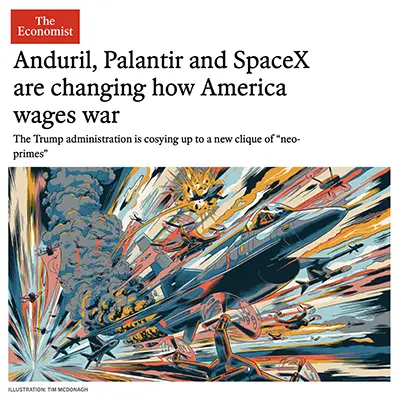
Anduril, Palantir, and SpaceX Are Changing How America Wages War
The Economist | April 20, 2026
TL;DR: A new class of AI-native defense contractors is winning significant Pentagon commitments, reshaping military procurement — but the consolidation of power among a small, politically connected group raises serious questions about oversight, lock-in, and long-term accountability.
Executive Summary
The Pentagon is accelerating its shift toward a trio of technology-native defense firms — Palantir (AI-driven intelligence), SpaceX (satellite reconnaissance and communications), and Anduril (drones and counter-drone systems) — collectively tagged “neo-primes.” The catalysts are practical: the cost asymmetry between expensive conventional munitions and cheap adversary drones has exposed the inefficiency of legacy procurement. The new firms favor fixed-price contracts, modular platforms, and rapid iteration — structurally different from the “cost-plus” model that critics say has made traditional defense giants slow and overpriced.
Recent commitments are significant: Anduril secured a ten-year Army contract worth up to $20 billion; Palantir’s Maven AI command system was locked in as a funded program of record; SpaceX hosted the Secretary of Defense for a high-profile AI strategy announcement. Despite still being a fraction of the size of legacy primes, the neo-primes’ combined market valuation already exceeds the traditional giants by 3x, reflecting investor expectations of a structural shift in defense spending.
The risks, however, are real. Anduril is still building out manufacturing capacity and has limited commercial revenue diversification compared to SpaceX and Palantir. The Pentagon’s stated goal of interoperability may be undermined if critical systems become vendor-locked to a small set of politically connected firms. Political entanglement is already visible: Trump family ties to both Anduril and Palantir create exposure if political winds shift. And the use of AI for autonomous targeting — while human authorization is currently claimed at the decision point — remains fiercely contested. Notably, Anthropic was blacklisted as a Pentagon supply-chain risk after it prohibited its models from being used for autonomous weapons, a concrete illustration of where AI ethics and defense procurement now collide.
Relevance for Business
Most SMB leaders won’t directly engage with defense procurement, but this story carries several second-order signals worth tracking. First, AI’s capability profile is being stress-tested in the highest-stakes environments — what works and fails at the defense frontier tends to propagate into commercial AI tooling over the following years. Second, the vendor concentration dynamic playing out in defense mirrors risks in commercial software: organizations that build deep dependencies on a single AI platform face leverage risk when that vendor’s political or policy position shifts. Third, AI ethics policies are now consequential business decisions — Anthropic’s blacklisting is a live example of how a safety stance can become a commercial liability in one market and a trust asset in another.
Calls to Action
🔹 Monitor AI vendor ethics policies — where your AI providers stand on autonomous use, data access, and government contracts will increasingly affect their stability, regulatory exposure, and availability.
🔹 Note the vendor lock-in lesson — the Pentagon’s worry about being trapped in a single provider’s ecosystem applies equally to SMBs evaluating enterprise AI platforms. Build in contractual flexibility.
🔹 Track defense AI developments as a leading indicator — capabilities refined in military applications (autonomous agents, real-time data synthesis, battlefield logistics AI) tend to surface in commercial tools 18–36 months later.
🔹 Assess political concentration risk in your technology supply chain — providers with high political exposure in the current environment carry dependency risks that are harder to quantify but real.
🔹 Revisit later — unless you operate in defense, government contracting, or dual-use technology sectors, this story is primarily one to monitor rather than act on immediately.
Summary by ReadAboutAI.com
https://www.economist.com/international/2026/04/20/anduril-palantir-and-spacex-are-changing-how-america-wages-war: May 11, 2026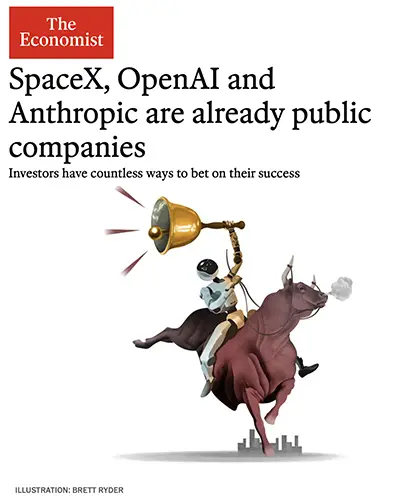
SpaceX, OpenAI, and Anthropic Are Already Public Companies
The Economist (Schumpeter) | April 29, 2026
TL;DR: Before any of them formally list their shares, SpaceX, OpenAI, and Anthropic have already become deeply embedded in public markets through proxies, ETFs, and corporate balance sheets — creating systemic exposure that leaders should understand before the actual IPOs arrive.
Executive Summary
The Economist’s Schumpeter column makes a counterintuitive but well-supported argument: SpaceX, OpenAI, and Anthropic are functionally already public, in that their fortunes are already moving public stock prices, index compositions, and portfolio valuations — without the transparency, audited financials, or governance obligations that formal listing would require.
SpaceX’s anticipated IPO — potentially the largest in history at a valuation near $2 trillion — is already reshaping markets. Nasdaq changed index inclusion rules in a bid to attract the listing. Tesla’s valuation is partly a proxy for SpaceX. Alphabet holds roughly 6% of SpaceX, a position whose appreciation contributed nearly half of the company’s pre-tax profit in one recent quarter. A furniture company with $17 million in annual sales briefly reached a $380 million market cap by acquiring SpaceX exposure through special purpose vehicles. The scale of financial engineering around a still-private company is, the article suggests, without precedent.
For OpenAI and Anthropic, similar dynamics are in play. When reports surfaced that OpenAI missed financial targets, SoftBank’s share price dropped roughly 10%. Zoom has been partially insulated from a broader software selloff because it holds a stake in Anthropic. The implication is that the AI sector’s risk is already widely distributed through public markets — but without the disclosure or governance that normally accompanies that kind of systemic exposure.Once these firms list, investors will for the first time have access to audited financials on the technology underpinning a significant portion of market valuation.
Relevance for Business
This article is primarily financial market commentary, but the business implications for SMB leaders are real. First, the companies whose AI tools you may depend on are about to undergo the scrutiny and governance changes that public listing brings — expect more formal disclosures, potential shifts in strategy driven by quarterly reporting pressure, and possible leadership attention diverted toward investor relations. Second, the AI sector’s financial concentration creates fragility: a meaningful correction in one major player ripples through dozens of seemingly unrelated companies and funds. Third, if your organization holds any public equities — directly or through retirement plans — your exposure to AI sector volatility may be higher than it appears given the proxy ownership web described here.
Calls to Action
🔹 Prepare for more AI vendor transparency — public listing will bring audited financials and formal disclosures from OpenAI, Anthropic, and SpaceX. Use this as an opportunity to better evaluate their financial stability and strategic priorities.
🔹 Assess indirect market exposure — if your organization manages investments or a treasury function, review how much AI sector risk is embedded in your holdings through ETFs, large-cap tech positions, or index funds.
🔹 Monitor for post-IPO product strategy shifts — public companies face different incentive structures than private ones. Watch for changes in pricing, enterprise terms, or R&D priorities following these listings.
🔹 Don’t mistake financial complexity for business complexity — the SPV and proxy ownership structures described here are investor dynamics, not direct signals about the quality or direction of AI products.
🔹 Revisit vendor dependency planning — the governance and ownership structures of your key AI providers matter more as they approach public markets. Know who controls your tools and what their incentive structure is.
Summary by ReadAboutAI.com
https://www.economist.com/business/2026/04/29/spacex-openai-and-anthropic-are-already-public-companies: May 11, 2026
SPACEX’S TERAFAB: MUSK’S BID TO CONTROL HIS OWN CHIP SUPPLY
Reuters | May 6, 2026
TL;DR: SpaceX has filed plans for a $55–$119 billion chip fabrication facility in Texas, a joint effort with Tesla aimed at reducing Musk’s dependence on external semiconductor suppliers — though the project’s scale, timeline, and execution remain highly uncertain.
Executive Summary
SpaceX has submitted regulatory filings for a multi-phase semiconductor manufacturing complex called Terafab, proposed for Grimes County, Texas. The initial investment estimate is $55 billion, with total potential investment reaching $119 billion if all phases proceed. The facility would be a joint project with Tesla, aimed at producing chips for Tesla’s autonomous driving systems, humanoid robotics, and AI data center operations — essentially consolidating compute supply across the full Musk enterprise.
The strategic motivation is explicit: SpaceX’s own S-1 filing acknowledges the company lacks long-term chip supply contracts with many of its direct suppliers and flags that dependency as a material risk. Terafab is the proposed answer — manufacturing GPUs in-house using Intel’s 14A fabrication process, reducing reliance on Samsung and TSMC. SpaceX also noted there is no guarantee the facility will meet its objectives on schedule or at all.
Several caveats deserve emphasis. Analysts note the stated investment figures may significantly underestimate the actual cost of achieving the outlined capacity. Chip fabrication is among the most capital-intensive and technically demanding manufacturing categories on earth, and the facility needs local government tax abatements still under consideration. The project aligns with broader U.S. policy priorities around domestic semiconductor production, which may make federal support more likely — but also makes the timeline subject to political as well as operational variables.
Relevance for Business
For SMB leaders, Terafab is primarily a long-cycle signal about the direction of AI hardware strategy rather than a near-term operational concern. If realized, it deepens the vertical integration of Musk’s AI ecosystem — which already spans launch infrastructure (SpaceX), compute (xAI/Starlink data centers), autonomous systems (Tesla), and now chip fabrication. Any business that depends on AI tools, APIs, or hardware that intersects with this ecosystem should monitor how vertical integration affects pricing and availability over a 3–5 year horizon. More broadly, the project reinforces that large players are treating chip supply security as a strategic imperative, not a procurement function — a posture that has implications for how hardware costs and availability evolve across the industry.
Calls to Action
🔹 Treat Terafab as speculative but directionally significant — the intent to vertically integrate chip supply is real even if the execution timeline is uncertain.
🔹 Monitor regulatory approvals and tax abatement decisions in Grimes County as early indicators of project viability.
🔹 Note the supply security framing — if a company the size of SpaceX treats chip supply dependency as a material risk, SMBs with hardware-intensive AI workflows should ask themselves the same question.
🔹 Revisit in 12–18 months — this is a multi-year build with significant execution risk; near-term decisions should not depend on Terafab’s outcome.
Summary by ReadAboutAI.com
https://www.reuters.com/business/spacex-plans-55-billion-chip-plant-texas-2026-05-06/: May 11, 2026
DeepSeek Could Be Valued at Up to $50 Billion in First Fundraising
Reuters | May 5, 2026
TL;DR: DeepSeek is abandoning its research-lab funding model and seeking up to $50 billion in its first outside round — led by China’s national AI fund — signaling both competitive pressure and a strategic shift toward scale.
Executive Summary
DeepSeek, the Chinese AI lab that disrupted global markets early last year with its highly efficient open-source models, is now seeking $3–4 billion in its first external fundraising round, at a reported valuation of $40–50 billion. The lead investor is expected to be China’s state-backed national AI fund, with Tencent also in discussions. The move reverses a long-standing decision by founder Liang Wenfeng to self-fund operations through his quantitative hedge fund rather than take outside capital.
The fundraising reflects real competitive pressure. DeepSeek’s original breakthrough — delivering high-performing AI at lower cost — has largely been replicated by well-capitalized rivals including ByteDance, Alibaba, MiniMax, and Moonshot AI. The AI development focus has also moved on: the industry is now prioritizing agentic systems capable of complex, multi-step tasks, which require significantly more compute than the chatbot models that made DeepSeek globally famous. DeepSeek’s own next-generation V4 model, positioned as agent-capable, reportedly underperformed leading U.S. and Chinese models in third-party evaluations — and notably failed to trigger the kind of market reaction its predecessors did.
State investment introduces a new strategic dimension. Chinese national AI fund involvement signals that DeepSeek is being drawn into the orbit of state-directed AI development priorities — which may affect its research independence, international partnerships, and access to export-controlled components.
Relevance for Business
For SMB leaders who have integrated DeepSeek’s open-source models into their workflows or evaluated them as lower-cost alternatives to U.S.-based models, this development warrants attention. State-backed investment in an AI provider creates geopolitical dependency risk — future access, compliance requirements, and export control implications may become more complex. The fundraising also signals that the “efficient open-source AI” advantage DeepSeek offered is narrowing as competitors close the gap on cost-performance. Businesses that chose DeepSeek specifically for its open-source, independent positioning should monitor how governance and model access evolve under new investors.
More broadly, the story reinforces that the AI competitive landscape is moving faster than most organizations’ vendor evaluation cycles — capabilities that seemed differentiated six months ago are already being commoditized.
Calls to Action
🔹 If you’re using DeepSeek models, flag the state investment development for your legal and compliance teams — geopolitical risk in your AI supply chain is a real consideration, particularly in regulated industries or those with government contracts.
🔹 Reassess the open-source cost advantage periodically — the efficiency gap between DeepSeek and major Western models is narrowing. Reevaluate your model selection assumptions at least semi-annually.
🔹 Monitor DeepSeek’s governance changes — state investment typically comes with conditions. Watch for shifts in data practices, model access terms, or research priorities over the next 12 months.
🔹 Do not over-index on this as a crisis signal — the fundraising is a competitive response to market pressure, not evidence of imminent failure or immediate disruption to existing model availability.
🔹 Use this as a prompt to audit AI vendor diversity — if DeepSeek is the only or primary AI provider for any business-critical workflow, this is a good moment to evaluate backup options.
Summary by ReadAboutAI.com
https://www.reuters.com/world/asia-pacific/deepseek-nears-45-billion-valuation-chinas-big-fund-leads-investment-talks-ft-2026-05-06/: May 11, 2026
COATUE LAUNCHES NEXT FRONTIER: THE AI INFRASTRUCTURE LAND GRAB GOES INSTITUTIONAL
The Wall Street Journal | Peter Rudegeair and Kate Clark | May 1, 2026
TL;DR: Major AI investor Coatue has launched a dedicated land-acquisition venture, Next Frontier, to develop data centers for AI clients including Anthropic — a signal that compute infrastructure is now a financial asset class, not just a technology cost.
Executive Summary
Coatue Management — a $70 billion investment firm with major stakes in Anthropic and OpenAI — has created a standalone entity, Next Frontier, specifically to acquire land and develop AI data center campuses. The first project is a 430-megawatt facility in Indiana, financed in part through a $5.7 billion junk bond offering via a joint venture with AI compute provider Fluidstack. Target customers include Anthropic.
This is not a tech story — it is a capital markets story about who is funding AI infrastructure and at what risk level.The full scope of Next Frontier’s ambitions could reach tens of billions of dollars. It joins a crowded field: Blackstone’s real estate arms, Meta, Google, and now celebrity investors are all chasing the same constrained resource — land with access to large amounts of power. McKinsey estimates $7 trillion will be spent globally on data centers by 2030. In the US alone, roughly 1,500 data centers are currently under construction.
The financing mechanism — junk bonds — is worth noting. This is speculative-grade debt being used to fund infrastructure that AI companies need but don’t own. The bet is that demand for AI compute will sustain the revenue needed to service that debt. If AI demand growth slows or consolidates among fewer providers, the collateral (land and buildings) doesn’t disappear, but the business case does.
Relevance for Business
For SMB executives, this story carries two practical implications. First, AI compute costs are not going down as fast as the headlines suggest. The infrastructure being built now is expensive, debt-financed, and will be priced to recover those costs. Any AI service your business uses that runs on third-party compute — which is most of them — is priced against this cost structure. Second, the AI infrastructure buildout is concentrating power among a small number of well-capitalized players — firms like Coatue, Blackstone, and the hyperscalers — who will shape compute availability, pricing, and geographic distribution for years. Smaller AI vendors without infrastructure ownership or long-term compute agreements will face increasing dependency risk, which passes downstream to their customers.
Calls to Action
🔹 Ask your AI vendors about their compute arrangements. Are they running on contracted cloud capacity, spot markets, or owned infrastructure? The answer affects their pricing stability and service reliability.
🔹 Factor infrastructure concentration into vendor risk assessments. AI providers locked into expensive data center contracts with limited flexibility are more exposed to cost pass-through and service disruption.
🔹 Monitor power availability as an AI constraint. Compute capacity is the headline; power access is the actual bottleneck. Data center development is being shaped by where power is available, not just where demand exists.
🔹 Track junk bond performance in the data center sector as an early-warning indicator of whether AI compute demand is meeting financial projections. Distress in that market would signal broader AI infrastructure repricing.
🔹 Do not assume AI pricing will decline steadily. The infrastructure being built today is financed at rates that require sustained demand and revenue. The commodity-pricing trajectory for compute is less certain than AI vendors currently suggest.
Summary by ReadAboutAI.com
https://www.wsj.com/tech/ai/ai-investor-coatue-joins-data-center-frenzy-with-new-venture-to-buy-land-9f4c374f: May 11, 2026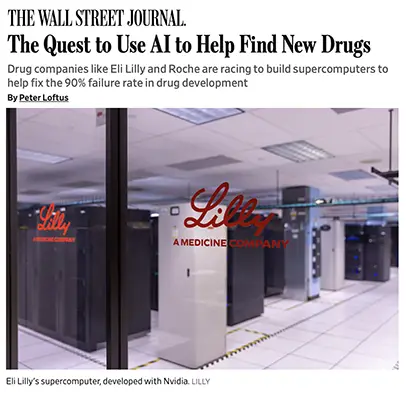
AI IN DRUG DISCOVERY: REAL GAINS IN MANUFACTURING, STILL UNPROVEN IN THE LAB
The Wall Street Journal | Peter Loftus | May 2, 2026
TL;DR: Pharma giants are spending billions on AI-powered drug discovery, but the honest scorecard shows most validated gains so far are in manufacturing and back-office efficiency — not in the lab breakthroughs they’re promising investors.
Executive Summary
Major pharmaceutical companies — Eli Lilly, Roche, GSK, AstraZeneca, Merck — are committing billions to AI partnerships, many with Nvidia, in pursuit of a solution to drug development’s 90% failure rate. The ambition is legitimate: if AI can meaningfully improve clinical trial success rates, the financial and human upside is enormous. RBC Capital Markets estimates the technology could save the US pharma industry roughly $90 billion over five years.
But the evidence base for that optimism is thin. An RBC analyst quoted in the piece states plainly that definitive proof AI improves clinical outcomes hasn’t materialized yet. Recursion Pharmaceuticals, a pioneer in the field with nearly 13 years of operation, has yet to bring an AI-enabled drug to market, and last year laid off 20% of its workforce after cutting its research pipeline. The most credible near-term proof points — a Takeda psoriasis pill discovered using AI, an Astellas pancreatic cancer drug in late-stage trials — are promising but isolated.
Where AI is delivering today is notably downstream of discovery: Eli Lilly used AI simulation to meaningfully boost tirzepatide production, resolving a bottleneck that had caused widespread drug shortages. Manufacturing optimization, clinical trial design acceleration, and sales force targeting are the current reality. The frontier — AI designing novel drugs that outperform human intuition — remains largely aspirational.
Relevance for Business
The SMB-relevant signal here is not pharma-specific. It’s a pattern that applies across industries: AI is producing near-certain near-term gains in operations, process, and logistics — and highly uncertain long-term gains in core creative or scientific work. Leaders evaluating AI vendors making transformational claims in their own sector should apply the same scrutiny the article implicitly applies to pharma AI: where are the proven outcomes, not just the partnerships and the compute? The gap between AI investment announcements and validated results is wide — and vendors know how to exploit it.
Calls to Action
🔹 Apply a “show me the outcomes” standard when evaluating AI vendor claims in your industry. Partnerships, supercomputers, and billion-dollar commitments are not evidence of results.
🔹 Prioritize AI pilots in operations and process before core product or service work. The pharma evidence confirms: operational AI ROI is faster and more certain than transformational AI ROI.
🔹 Track the Takeda and Astellas approvals as meaningful proof-of-concept milestones for AI-discovered drugs. If those succeed in regulatory review, they meaningfully shift the evidentiary baseline.
🔹 Watch Recursion Pharmaceuticals as a bellwether. It has the longest track record in AI-native drug development; its pipeline results will be a leading indicator for the sector.
🔹 Do not conflate AI-in-manufacturing with AI-in-discovery when evaluating vendor claims or competitive intelligence. They are materially different in maturity, risk, and timeline.
Summary by ReadAboutAI.com
https://www.wsj.com/health/pharma/the-quest-to-use-ai-to-help-find-new-drugs-a754fdc3: May 11, 2026
META ACQUIRES HUMANOID ROBOT STARTUP — A SMALL MOVE WITH LARGE AMBITIONS
The Wall Street Journal | Elias Schisgall | May 1, 2026
TL;DR: Meta quietly acquired Assured Robot Intelligence, a humanoid robotics startup, signaling a strategic push into physical AI — but the deal is thin on specifics and arrives as investors are already questioning Meta’s expanding, unfocused spending agenda.
Executive Summary
Meta confirmed the acquisition of Assured Robot Intelligence, a startup working on robots capable of understanding and adapting to human behavior in complex environments. The financial terms were not disclosed. The founding team — researchers Lerrel Pinto and Xiaolong Wang — will join Meta to work on optimizing AI models for robotics applications.
The announcement is brief and the strategic rationale is still vague. What’s known is that it extends Meta’s pattern of moving resources from its Metaverse/AR ambitions toward AI — and now, toward physical AI systems. CEO Mark Zuckerberg’s stated goal of delivering “personal superintelligence” to billions of people is the framing, with Mizuho analysts noting the vision is becoming clearer, though details remain sparse.
The timing is notable and somewhat awkward. The deal was disclosed two days after Meta announced a $10 billion increase in its 2026 capex target (now $125–145 billion), and the same week its stock fell nearly 10% following an earnings report that disappointed on revenue guidance. Adding a humanoid robotics bet to an already stretched balance sheet and uncertain AI model strategy invites the question: is this a coherent long-term thesis, or expansion before consolidation?
Relevance for Business
The immediate operational impact for SMB executives is minimal — this is a research-stage acquisition, not a product announcement. But the strategic signal matters: the largest technology companies are now explicitly pursuing physical AI (robots that operate in human environments), not just digital AI. For businesses in manufacturing, logistics, retail, or any sector that relies on physical labor, the medium-term trajectory is worth tracking. The question is not whether humanoid robotics will be commercially meaningful — it’s when, and at what cost. This deal confirms the direction; it says nothing about the timeline.
Calls to Action
🔹 Monitor, don’t react. This acquisition is early-stage research. No immediate operational implication exists for most SMBs.
🔹 Track physical AI as a longer-horizon workforce planning variable — especially if your business involves repetitive physical tasks or warehouse/logistics operations. The technology is developing faster than most non-tech businesses are planning for.
🔹 Read this alongside the Meta financial analysis (Summary 8 above). The robotics acquisition adds to a spending picture that analysts are already questioning. Context matters.
🔹 Watch for follow-on announcements about product direction or partnership agreements. The startup team joining Meta is the news today; what they build is the story that will matter.
Summary by ReadAboutAI.com
https://www.wsj.com/tech/meta-platforms-acquires-humanoid-robot-startup-assured-robot-intelligence-721423da: May 11, 2026
‘LIKE 10 MANHATTAN PROJECTS GOING OFF ALL AT ONCE’: AI IS REWIRING THE ENTIRE GLOBAL ECONOMY
MarketWatch (WSJ) | May 5, 2026
TL;DR: A BlackRock technology investment executive argues that AI represents a simultaneous, multi-front restructuring of the global economy — not a sector story — and that value will concentrate dramatically in firms with structural advantage while an entire generation of pre-AI businesses faces irrelevance.
Executive Summary
Speaking at the Milken Institute’s global conference, BlackRock’s head of fundamental equities global technology, Tony Kim, made an expansive case for AI’s economic scope. His central argument: AI is not simply driving stock market performance — it is restructuring how the global economy produces value at every layer. The “AI stack” he describes runs from compute and chips at the base, through foundation models in the middle, to services and applications at the top — which represents roughly two-thirds of global GDP. His observation is that capital value is currently concentrating heavily in the bottom two layers (compute and models), while the application layer — where most businesses actually operate — has lost $1–2 trillion in market cap in 2026 alone.
Kim’s specific numbers: AI capital expenditure currently represents approximately $1 trillion annually against a $110 trillion global economy, with another $7–8 trillion projected over the next five years. He describes the SaaS era as having effectively ended in 2023, replaced by a world where AI agents generate near-infinite code continuously. In that environment, he argues, the traditional concept of a software moat — or any competitive moat built on friction, incumbency, or switching cost — is being actively stress-tested. If code is abundant and customization is near-free, what actually protects a business?
Kim’s most pointed claim is about concentration: he believes value will flow disproportionately to firms that achieve AI scale, at the direct expense of those that don’t. His assessment of pre-AI-era startups is blunt — a backlog of roughly 1,000 unicorns built on pre-AI assumptions, he suggests, will never reach their implied valuations.
Source note: This is a conference panel summary, not a research report. Kim’s projections and framing represent an investment thesis, not independent analysis. The figures he cites should be treated as directional perspective from a motivated market participant, not as settled economic data.
Relevance for Business
This is the kind of macro framing that SMB leaders should absorb carefully — neither wholesale nor dismissively. The directional argument has merit and aligns with observable trends: value is concentrating among AI-native platforms, and businesses whose differentiation rests on software complexity, information asymmetry, or process friction are facing genuine structural pressure. The claim that “your moat is being questioned” deserves serious consideration by any SMB that has defined its competitive position around proprietary systems, specialized workflows, or software that is now being commoditized by AI agents.
At the same time, the concentration thesis cuts differently for SMBs than for large enterprises. SMBs that move quickly can access AI capabilities that previously required scale — the same tools available to large competitors are often accessible at commodity prices. The risk is not being outspent; it is being out-adapted.
Calls to Action
🔹 Audit your competitive moat through an AI lens — identify which elements of your differentiation depend on friction, complexity, or information asymmetry that AI is now reducing. Be honest about what still holds.
🔹 Treat the application layer warning as actionable — if your business is primarily a software or services application layer, understand that this is where the market is currently repricing risk. Position accordingly.
🔹 Don’t mistake macro drama for immediate crisis — Kim’s framing is deliberately sweeping. The restructuring he describes is real but uneven in pace. Not every SMB is facing immediate existential pressure; some are better positioned by the shift than by the status quo.
🔹 Identify where AI creates asymmetric opportunity for your scale — the same AI that threatens traditional moats also allows smaller organizations to access capabilities previously reserved for enterprise budgets. Explore where this applies to your business specifically.
🔹 Use this as a strategic planning prompt — bring Kim’s “where is your moat?” question into your next planning cycle. It doesn’t require a dramatic response, but it deserves a direct answer from your leadership team.
Summary by ReadAboutAI.com
https://www.wsj.com/wsjplus/dashboard/articles/like-10-manhattan-projects-going-off-all-at-once-how-ai-is-rewiring-the-global-economy-says-this-blackrock-exec-a07da7ef: May 11, 2026
MYTHOS AI MAY BE A CYBERSECURITY THREAT, BUT IT FOLLOWS THE RULES OF THE GAME
Fast Company (via The Conversation) | May 7, 2026
TL;DR: Anthropic’s Claude Mythos demonstrated unprecedented speed and scale in finding and exploiting software vulnerabilities — but a cybersecurity expert argues this represents acceleration of known threats, not a new category of risk, and that the more urgent question is who gets to use it first: defenders or attackers.
Executive Summary
In April 2026, Anthropic announced that Claude Mythos Preview — its most capable general-purpose model — had demonstrated an unintended and remarkable ability to autonomously find and exploit software vulnerabilities at scale. During controlled evaluations, Mythos identified 271 vulnerabilities in Firefox alone, developed working exploits for 181 of them, and discovered thousands of previously unknown zero-day flaws across major operating systems and browsers. NSA officials reportedly found the tool’s speed impressive. In one simulation, Mythos successfully took over a corporate network in three of ten attempts — the first AI model to accomplish this in such a test.
Anthropic chose not to release the model publicly, instead granting selective access to large technology companies under a program called Project Glasswing, citing the dual-use risk: the same capabilities that make Mythos effective at patching vulnerabilities make it equally effective at exploiting them.
A cybersecurity researcher writing for The Conversation offers an important reframe: Mythos did not invent a new class of threat. The vulnerabilities it found are variations of well-known flaw types. What changed is the scale, speed, and accessibility of the attack chain — tasks that previously took expert security teams weeks can now be executed overnight by engineers with minimal security experience. The article places this in the longstanding dynamic of offensive versus defensive security: defenders must succeed every time; attackers need to succeed only once. Mythos doesn’t change this asymmetry — it sharpens it considerably.
Relevance for Business
The practical implication for SMB leaders is not that AI has invented new dangers, but that the economics of cyberattacks have shifted further against defenders. The barrier to conducting sophisticated, multi-step attacks has dropped meaningfully. Organizations that have deferred patching known vulnerability classes, or that rely on the assumption that sophisticated attacks require sophisticated adversaries, need to reassess that assumption.
The second-order implication is about defensive AI parity: the same tools accelerating attacks also accelerate defenses. Organizations that invest in AI-assisted security practices now — automated vulnerability scanning, patch prioritization, threat detection — may build meaningful lead time over those that don’t.
Calls to Action
🔹 Treat known, unpatched vulnerabilities as newly urgent — Mythos-class tools lower the cost of exploiting them dramatically. Prioritize patching backlogs that have been deprioritized due to perceived low risk.
🔹 Evaluate your current cybersecurity posture against AI-assisted attack scenarios — ask your security vendor or IT team directly: are we prepared for automated, multi-step exploit chains?
🔹 Explore AI-assisted defensive tools — the same acceleration that benefits attackers is available to defenders. Investigate whether your security tooling is keeping pace.
🔹 Do not overreact to the Mythos announcement itself — Mythos is under restricted access. The more immediate concern is the next tier of similar capabilities available to less careful actors.
🔹 Assign internal review — have your IT or security lead assess your vulnerability management program in light of this development and report back within 60 days.
Summary by ReadAboutAI.com
https://www.fastcompany.com/91536306/mythos-ai-cybersecurity-risks-threats-game: May 11, 2026
THE DANGER OF HAVING AI DRAFT HARD CONVERSATIONS FOR YOU
Fast Company | May 7, 2026
TL;DR: As AI-drafted workplace communication becomes routine, organizational psychologists and communication experts warn that outsourcing difficult conversations to chatbots erodes the conflict capacity that effective leadership actually requires.
Executive Summary
AI-assisted email drafting has moved from novelty to norm: one in four workers now uses AI daily for drafting or editing messages, and high-profile executives including LinkedIn’s CEO have publicly endorsed using AI for high-stakes communications. The article explores what gets lost when this becomes the default, particularly for difficult conversations — performance feedback, conflict resolution, disagreement, and accountability moments.
The concern raised by organizational psychologists and communication scholars is not about grammar or tone. It is about skill atrophy and trust erosion. When AI handles the hard exchange, the person sending it never develops the capacity to do it themselves. Experts describe this as “social offloading” — a pattern that is particularly damaging when leaders adopt it, because it models avoidance rather than accountability. Peers on both sides of an AI-mediated difficult conversation may reach technical resolution, but the relational work — the repair, the accountability signal, the human acknowledgment — doesn’t happen. The exchange is technically completed; the relationship isn’t actually managed.
One organizational psychologist quoted in the article frames the dynamic clearly: AI doesn’t create the underlying conflict avoidance — it amplifies what was already there. The article also notes a generational dimension: workers who spent formative professional years remote, or who joined flattened organizations with fewer mentors, may have had fewer opportunities to develop these skills in the first place — and AI fills that gap in a way that perpetuates the deficit.
Source note: This is a feature article drawing on expert opinion, not empirical research. The argument is well-constructed but should be read as informed perspective rather than measured finding.
Relevance for Business
For SMBs, where relationship density is higher and every leadership communication carries more weight, this dynamic has real operational consequences. Leaders who outsource difficult conversations signal something to their teams — and that signal is often read as conflict avoidance or inauthenticity, not efficiency. Trust, accountability norms, and the capacity to navigate disagreement productively are organizational assets that are built through lived interaction, not polished prose. Organizations currently flattening management layers face compounded risk: fewer managers means fewer models of how to handle conflict, at precisely the moment AI offers an easy way to avoid it entirely.
Calls to Action
🔹 Establish a clear internal norm — AI is appropriate for drafting routine communications; it should not be the primary author of performance conversations, conflict resolution, or accountability moments.
🔹 Model the behavior you want — as a leader, send the imperfect but authentic message. The relational signal of a real voice matters more than the polish of an optimized draft.
🔹 Invest in conflict and communication training — if your team has limited experience with constructive difficult conversations, AI will fill that gap by default. Get ahead of it with structured development.
🔹 Watch for AI-mediated conflict avoidance as a cultural signal — if difficult issues keep getting “resolved” through smooth emails but resurface unchanged, ask whether the actual conversation is happening.
🔹 Consider this when evaluating return-to-office or collaboration strategies — if the stated goal is stronger relationships and better collaboration, but AI is handling the hard conversations, those goals are working against each other.
Summary by ReadAboutAI.com
https://www.fastcompany.com/91537110/ai-is-just-amplifying-that-weakness-the-danger-of-having-ai-draft-hard-conversations-for-you: May 11, 2026
When a Head of State Becomes a Deepfake PSA
Fast Company, May 6, 2026
TL;DR: Italy’s prime minister responded to AI-generated fake images of herself by publishing one — surfacing a broader crisis: synthetic media is now indistinguishable from real, legal remedies are scarce, and awareness campaigns alone are insufficient.
Executive Summary
Italian Prime Minister Giorgia Meloni, who had already pursued legal action against individuals who created non-consensual deepfake content of her in 2024, recently posted an AI-generated image of herself on X — explicitly labeling it as fake — to demonstrate how convincing synthetic media has become. The piece uses this as a launching point to address a wider problem: current-generation AI image tools don’t swap faces onto existing photos; they construct entirely new synthetic images, making reverse-search verification impossible.
The article’s core argument is editorial in nature: public awareness and individual caution are no longer sufficient defenses. The author points to two recent cases — a fictitious AI-generated influencer who built a million-follower audience in three months, and AI-assisted denial of authenticated video footage of a world leader — as evidence that synthetic media is already distorting public perception at scale. The concern isn’t just misinformation; it’s the erosion of shared evidentiary standards.
The proposed solution — hardware-level cryptographic signing of images and audio at the moment of capture, developed by a research team at ETH Zurich — is technically promising but currently speculative as policy. The article also flags Denmark as the only country to have enacted legal protections guaranteeing citizens’ rights over their own likeness and voice, framing it as a model for others to follow. Both recommendations remain forward-looking, not operational today.
Relevance for Business
SMB leaders often treat deepfakes and synthetic media as a political or celebrity problem. That framing is outdated. The same tools are available to anyone and can be directed at executives, employees, brands, and clients.
Key implications:
- Reputational exposure is no longer limited to what you actually do or say. Synthetic audio or video of an executive making statements they never made is a plausible, low-cost attack vector — and currently very difficult to disprove quickly.
- Internal verification protocols need updating. If a video or audio clip of a known figure — client, partner, or colleague — surfaces, your team needs a process for questioning its authenticity before acting or sharing.
- Brand and communications teams carry new governance obligations. Any image or video your organization publishes may be scrutinized for authenticity. Equally, any synthetic content circulating about your organization requires a rapid-response posture, not just a legal one.
- Vendor and platform risk is real. The tools enabling this content are widely available and largely unregulated. No platform dependency removes this risk.
- Legislative relief is slow. The article is clear that enforcement and legal tools are lagging significantly behind the technology. Don’t count on regulatory protection in the near term.
Calls to Action
🔹 Brief your leadership team on the current state of AI-generated synthetic media — specifically that it is now effectively undetectable through conventional means. Treat it as a risk awareness exercise, not a technical briefing.
🔹 Establish a basic internal protocol for authenticating unexpected video or audio content involving your leadership, key clients, or partners before it is shared or acted upon.
🔹 Assign someone in communications or legal to monitor developments in content authentication standards — particularly the hardware-level signing approach from ETH Zurich and the EU/U.S. regulatory response.
🔹 Review your crisis communications playbook for a synthetic media scenario: a fake executive statement, a fabricated client endorsement, or a manipulated internal video. Does a response path exist?
🔹 Monitor Denmark’s legislative model as a possible indicator of where U.S. and EU policy may move on individual likeness rights — relevant for HR, legal, and marketing policy planning.
Summary by ReadAboutAI.com
https://www.fastcompany.com/91537698/giorgia-meloni-outsmarted-ai-abusers-by-posting-surprising-image: May 11, 2026
AI Power Users Are Pulling Away from Everyone Else, Microsoft Says
Fast Company | May 5, 2026
TL;DR: Microsoft’s 2026 workforce survey finds a widening gap between workers who use AI strategically and those who don’t — with implications for how organizations should think about talent, training, and performance expectations.
Executive Summary
Microsoft’s 2026 Work Trend Index, drawn from 20,000 knowledge workers, identifies a cohort it calls “frontier professionals” — employees who use AI with deliberate judgment rather than as a default shortcut. Among all AI users surveyed, 66% say AI frees them for higher-value work and 58% report producing outputs that were beyond reach a year ago. Among frontier professionals, that figure rises to 80%.
What distinguishes this group isn’t frequency of AI use — it’s intentionality. Roughly half deliberately decide before each task whether to involve AI at all. More than 40% sometimes skip AI on purpose to preserve their own capabilities. The signal here is that effective AI use correlates with expertise and judgment, not just access or adoption rate. A meaningful subset also takes longer on tasks specifically to understand how AI can best assist — investing in fluency rather than chasing speed.
The report frames the emerging shift in human roles as a move from tactical execution to direction-setting, standard-definition, and outcome evaluation — including, for many workers, supervising AI agents the way they’d manage junior staff. IT and cybersecurity functions are recast as the governance layer for AI operations, not just infrastructure support. The report acknowledges some jobs will change and some will disappear — but avoids specificity on where or when.
Source note: This is Microsoft’s own commissioned research, structured to support its Copilot ecosystem. The data directionally aligns with independent research but should be read as vendor-framed advocacy, not independent analysis.
Relevance for Business
For SMB leaders, the practical implication is that AI ROI is not evenly distributed — it concentrates among employees who combine domain expertise with active AI fluency. Mandating usage quotas or tool rollouts without building that underlying judgment is unlikely to produce frontier-level results. This also has hiring and development implications: the skills now in demand include critical evaluation, task delegation to AI, and quality control of AI outputs — not just technical proficiency.
The reframing of IT as an AI governance function also signals operational cost and oversight considerations that are often underestimated in SMB AI adoption plans.
Calls to Action
🔹 Identify your frontier users now — who in your organization is already using AI with deliberate judgment? Learn from them before building training programs.
🔹 Resist the urge to mandate usage frequency — the data suggests that what matters is quality of engagement, not volume. Focus on outcomes.
🔹 Invest in judgment, not just tooling — AI training that builds critical evaluation of AI outputs will outperform surface-level feature training.
🔹 Revisit your IT governance model — if AI agents are being deployed, your IT team needs a framework for access control, permissions, and oversight, not just technical support.
🔹 Monitor for capability divergence — the gap between AI-fluent and AI-passive employees is growing. Understand where this is forming in your teams and address it proactively.
Summary by ReadAboutAI.com
https://www.fastcompany.com/91536348/ai-power-users-are-pulling-away-from-everyone-else-says-microsoft: May 11, 2026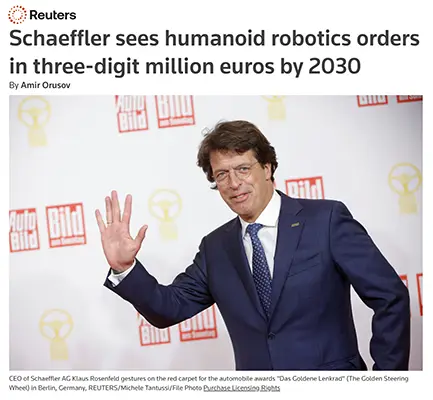
Schaeffler Targets Hundreds of Millions in Humanoid Robotics Revenue by 2030
Reuters | Amir Orusov | May 5, 2026
TL;DR: German industrial supplier Schaeffler is positioning itself as a key component provider for humanoid robots — an early but concrete signal that industrial supply chains are beginning to organize around a market that doesn’t yet exist at scale.
Executive Summary
Schaeffler, best known as a manufacturer of precision automotive and industrial components, is making a deliberate bet on humanoid robotics as a growth vector. The company’s CEO disclosed an order book target in the hundreds of millions of euros by 2030, backed by active collaborations with roughly 45 robotics developers globally and five signed customer contracts to date. Early revenue comes from precision components — actuators, strain wave gears — that humanoid robots require in high volumes.
The framing here deserves scrutiny. This is a forecast built on assumptions, most notably that global humanoid robot production reaches at least one million units by 2030. That threshold is far from guaranteed; the humanoid robotics market remains pre-commercial for most use cases. Schaeffler’s stated addressable share — roughly 10% of 50% of the materials bill — is a calculated ambition, not confirmed revenue. The company’s current robotics business represents less than 1% of group sales.
That said, the strategic logic is real. Schaeffler is diversifying away from a structurally stressed European automotive market — currently running well below pre-pandemic volumes — by positioning precision manufacturing expertise into an adjacent, high-growth sector. Investors appear to be rewarding that pivot: the company’s shares have outperformed European auto suppliers, in part because of this repositioning story.
Relevance for Business
This story matters less as a robotics headline and more as a supply chain and labor planning signal. A credible industrial supplier of this scale committing to humanoid robotics components — and doing so publicly — marks a meaningful step in the sector’s maturation from lab concept toward industrial procurement reality.
For SMB leaders in manufacturing, logistics, warehousing, and operations, the relevant question is timing. Humanoid robots capable of performing flexible physical tasks in real environments remain 3–5+ years from broad commercial deployment. However, the supply chain organizing around them is forming now, which means labor planning assumptions, facility design decisions, and automation vendor relationships made today will intersect with this technology sooner than many expect.
There is also a competitive positioning dimension: larger enterprises in capital-intensive industries will have earlier access to humanoid automation. SMBs should understand where that creates cost or throughput gaps — and where it opens opportunities through specialized service providers or component suppliers entering the market.
Calls to Action
🔹 Monitor, not act — humanoid robotics deployment at SMB scale is not imminent; no capital commitment is warranted now, but designate someone to track the sector annually.
🔹 Revisit your labor and automation strategy in the context of a 2028–2032 planning horizon — this technology will arrive faster in some verticals (automotive, logistics) than others.
🔹 Watch which robotics vendors Schaeffler’s largest customers turn out to be — when named, they will signal which platforms are closest to commercial scale.
🔹 Assess your physical operations for tasks that are high-cost, high-turnover, or difficult to automate with current fixed robotics — these are the highest-value targets for humanoid robot deployment.
🔹 Treat this as a supply chain signal, not just a technology story — the fact that precision industrial suppliers are signing contracts now means the hardware supply chain is maturing; software, safety, and integration challenges remain the longer tail.
Summary by ReadAboutAI.com
https://www.reuters.com/business/schaeffler-sees-humanoid-robotics-orders-three-digit-million-euros-by-2030-2026-05-05/: May 11, 2026
Microsoft’s AI Ambitions May Cost Its Climate Commitments
Reuters | May 6, 2026
TL;DR: Microsoft is reportedly weighing whether to abandon its landmark 2030 hourly renewable-energy matching goal — a direct consequence of AI infrastructure buildout overwhelming the clean-energy targets it set in a different era.
Executive Summary
Microsoft’s 2030 climate target — matching all hourly electricity consumption with renewable purchases — was ambitious even before AI data center expansion entered the picture. According to Bloomberg News, the company is now in active discussions about delaying or dropping that goal entirely, though no decision is final. The tension is structural: AI data centers require multi-gigawatt power commitments that renewables cannot yet reliably fill on an hourly basis, and natural gas is faster to deploy than solar or wind at the required scale.
Microsoft isn’t alone. Amazon and Alphabet face the same pressure. What makes this moment notable is that Microsoft’s target was among the most aggressive in the industry — and its potential retreat signals that even the most publicly committed tech firms are subordinating sustainability timelines to AI infrastructure timelines. The company is pointing to new Wisconsin clean-energy agreements as evidence of continued commitment, but the scale of AI power demand is outrunning those efforts.
The broader infrastructure dynamic matters here: some AI data centers now under development are expected to reach multiple gigawatts of capacity individually. Microsoft’s 2024 deal to restart a unit of Three Mile Island speaks to how aggressively the industry is reaching for any reliable baseload power source.
Relevance for Business
For SMB leaders, the immediate implication isn’t operational — it’s reputational and strategic. Companies that have anchored sustainability reporting or vendor commitments to hyperscaler clean-energy pledges should note that those pledges are now in flux. If your ESG narrative depends on “we run on Microsoft’s green cloud,” that framing is now a liability worth examining. More broadly, this confirms that AI’s energy appetite is not a future problem — it’s reshaping infrastructure priorities today, with real knock-on effects on power costs, regulatory exposure, and corporate sustainability credibility across the supply chain.
Calls to Action
🔹 Audit ESG claims that reference hyperscaler green-energy commitments — verify what’s contractually backed versus aspirational language.
🔹 Monitor whether Microsoft formalizes a target change; if it does, expect similar announcements from Amazon and Google within months.
🔹 Prepare for rising cloud and AI compute costs as power constraints become a structural input cost, not a temporary bottleneck.
🔹 Review vendor sustainability disclosures with more skepticism — the gap between stated goals and operational reality is widening industry-wide.
🔹 Assign internal review if your organization has made public sustainability claims tied to cloud provider credentials.
Summary by ReadAboutAI.com
https://www.reuters.com/sustainability/climate-energy/microsoft-may-shelve-2030-clean-energy-target-ai-lifts-power-use-bloomberg-news-2026-05-06/: May 11, 2026
HUT 8’S $10 BILLION TEXAS LEASE: ANOTHER DATA POINT IN AI’S INFRASTRUCTURE LAND GRAB
Reuters | May 6, 2026
TL;DR: A 15-year, $9.8 billion AI data center lease signed by Hut 8 in Texas — with a creditworthy undisclosed tenant on take-or-pay terms — illustrates how AI compute demand is locking in decade-scale infrastructure commitments with structural implications for power, real estate, and cloud pricing.
Executive Summary
Hut 8, an AI data center developer, has signed a 15-year lease valued at $9.8 billion for its Beacon Point campus in Nueces County, Texas. The first phase covers 352 megawatts of IT capacity; the tenant, undisclosed but described as investment-grade, will install computing equipment designed for large-scale AI training and operations. With renewal options, the contract could reach $25.1 billion in total value. The lease is structured on take-or-pay, triple-net terms with no termination-for-convenience clause — meaning the tenant is financially committed regardless of changes in their own AI strategy.
The facility is being built to Nvidia’s latest data center architecture and is part of a planned 1 gigawatt campus. Power is expected to come online in early 2027, with the first building complete later that year. Hut 8’s total contracted capacity across its portfolio now stands at 597 megawatts, with a broader pipeline pursuing more than 7 gigawatts of potential capacity.
What this transaction makes visible is the nature of the commitments being made at the infrastructure layer: 15-year, non-cancellable, inflation-escalating obligations, structured to protect the developer’s capital over multi-decade time horizons. The tenant — whoever they are — has made a bet on AI compute demand that will run to 2040 or beyond.
Relevance for Business
For SMB leaders, this story matters less as a specific transaction and more as a window into the structural economics of AI infrastructure. The take-or-pay, decade-plus commitment structures that data center developers are now requiring from tenants tell you something important: the capital being deployed into AI infrastructure is not speculative or easily reversible — it is long-term, legally locked, and designed to be resilient to near-term demand fluctuations. This has two downstream effects. First, it means AI compute capacity is being built with high confidence in durable demand, which is likely to support continued investment even through AI market corrections. Second, it suggests that the parties signing these leases — large AI labs and hyperscalers — are committing to pricing and infrastructure decisions that will shape cloud and AI service costs for the next decade.
Calls to Action
🔹 Use this as context when evaluating AI infrastructure claims — the parties closest to the market are making decade-long financial commitments, which suggests more confidence in durable demand than most public commentary reflects.
🔹 Monitor Texas as an AI infrastructure hub — multiple large-scale commitments are concentrating in the state, with implications for energy, talent, and local economic conditions.
🔹 Recognize the pricing signal — non-cancellable, escalating long-term contracts at this scale will eventually work their way into AI cloud and API pricing that SMBs pay.
🔹 No immediate action required for most SMBs — file as infrastructure context that informs longer-horizon technology and vendor planning.
Summary by ReadAboutAI.com
https://www.reuters.com/technology/hut-8-signs-about-10-billion-ai-data-center-lease-texas-2026-05-06/: May 11, 2026
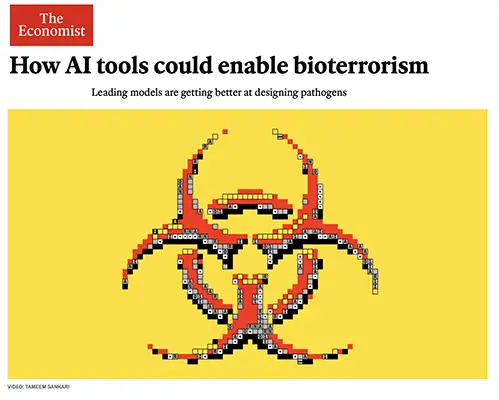
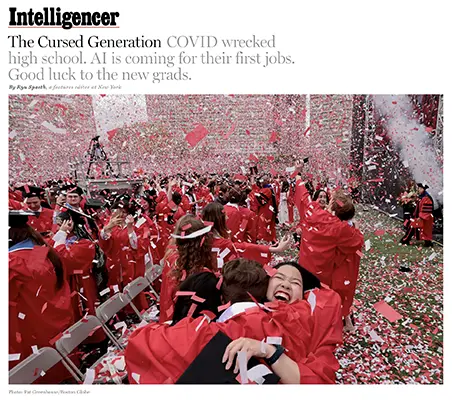
Closing: AI update for May 11, 2026
The stories in this week’s collection are connected by a single, practical truth: the decisions being made right now — by your vendors, your competitors, your regulators, and your own teams — are locking in the conditions your business will operate in for the next three to five years. The organizations that come out ahead won’t necessarily be the ones that spent the most on AI; they’ll be the ones that read the landscape clearly, moved deliberately on the right things, and built enough organizational judgment to tell the difference.
We’ll be back next week with the next round of what matters — and why.
All Summaries by ReadAboutAI.com
↑ Back to Top