
A Special Report: The Nvidia–Jensen Huang Scandal and What It Means for ReadAboutAI.com
Special Report: The Nvidia–Jensen Huang Scandal and What It Means for SMB Leaders
Nvidia, the company whose chips run most of the AI economy, is now investigating its own CEO. Jensen Huang has admitted to an extramarital affair with Alice Huang (no relation), an executive tied to Megaspeed, a Singapore data center company and major Nvidia customer. U.S. intelligence reportedly suspects she was passing information to Beijing. Within days, the story grew to include an independent board investigation led by outside counsel, a reported FBI inquiry, a shareholder lawsuit, bipartisan calls for congressional hearings, and hundreds of billions of dollars in lost market value. This special post collects 16 executive summaries from The New York Times, The Washington Post, The Wall Street Journal, Reuters, Fast Company, Business Insider, Intelligencer and The Atlantic. Separating what is confirmed from what is alleged is the most important skill for reading this story.
The coverage follows three threads that matter for business. The first is export controls. Reporting on Megaspeed describes how layered ownership structures and offshore compute rental may have let restricted chips serve Chinese firms. That puts cloud partners, resellers and data center operators under new enforcement scrutiny. The second is Washington. Disputed reports say senior officials were warned months ago, and the government’s revenue share in Nvidia’s China sales raises the question of whether political ties complicated oversight. Calls for tighter chip-export rules now come from both parties. The third is governance. Nvidia has no board chair, no named successor, a long-tenured board, and a CEO with more than 60 direct reports and no clear second-in-command. That makes the scandal a live case study in key-person risk.
For SMB executives, the direct effect today is small. No AI product, contract or service has changed. The second-order effects are real, though. Tighter export policy and more partner-channel enforcement could bring more volatile pricing and availability of AI compute in 2027. Vendors that depend on a single founder carry concentration risk that belongs in vendor reviews. And the board’s early handling, declaring no harm before investigating, is a cautionary example for companies of any size. Most allegations remain unverified, and some are actively disputed. The summaries that follow flag those distinctions throughout. The useful posture is to watch closely, not to react.
What to Know About the Nvidia Scandal and CEO Jensen Huang
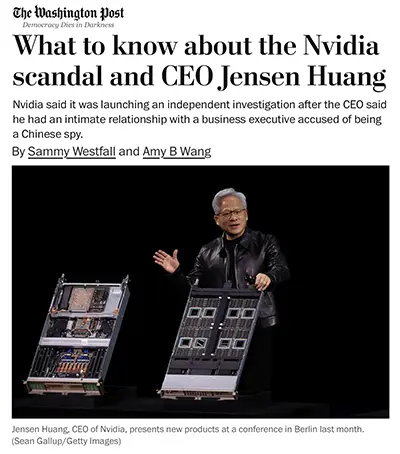
The Washington Post · Sammy Westfall and Amy B Wang · November 9, 2026
| TL;DR The world’s most important AI chip supplier is now investigating its own CEO. For leaders, the story is less about a personal scandal than about how much of the AI economy depends on one company and one person. |
Executive Summary
Nvidia’s board has opened an independent investigation, overseen by a committee of directors and outside counsel, after Jensen Huang told employees he had been unfaithful to his wife. The admission followed an October New York Times report that U.S. intelligence suspected Alice Huang of spying for China. She is an executive linked to Megaspeed, a Singapore data center company that has bought billions of dollars of Nvidia chips. Huang stays on as CEO during the inquiry. The board says it has no reason to believe national security or company secrets were compromised. That is a statement of current belief, not a finding.
The explainer is mainly useful as a fact baseline, and most of its business weight comes from context. Nvidia is worth more than $4.5 trillion and supplies the chips behind leading AI labs. Huang has been a prominent voice against chip export controls on China and has regular White House access. The Times also reported that President Trump was briefed on the intelligence a year ago and did not act. Trump has since defended Huang publicly. Shares fell more than 5% Monday morning, which is a market reaction, not a verdict.
What’s established: the investigation, the CEO’s admission and the stock drop. What’s claimed: the board’s confidence in Huang and its view that nothing was compromised. What’s unresolved: whether anything sensitive changed hands, and what the White House knew and when.
Relevance for Business
Nvidia sits upstream of nearly every AI product SMBs buy: cloud GPU capacity, model APIs and AI features inside SaaS tools. A leadership disruption or a regulatory crackdown would not hit smaller firms directly, but it could ripple through vendor pricing, capacity and roadmaps. Because the story is political, it could also shift export-control policy, which shapes global chip supply. Separately, the board’s response is a live case study in key-person risk and board independence, questions that apply to companies of every size.
Calls to Action
◆ Monitor: Follow the board investigation’s findings and any congressional testimony. Those, not headlines, will decide whether this becomes an operational story.
◆ Assign Internal Review: Map which of your AI vendors run on Nvidia hardware (most do) so you know your exposure if supply or pricing shifts.
◆ Ignore for Now: Current facts do not justify changing AI tool purchases or contracts.
◆ Revisit Later: Reassess once the investigation concludes or if China chip-export policy changes.
Summary by ReadAboutAI.com
https://www.washingtonpost.com/technology/2026/11/09/what-know-about-nvidia-scandal-ceo-jensen-huang/: NVIDIA ScandalThe Woman in the Middle of Nvidia’s Spy Scandal
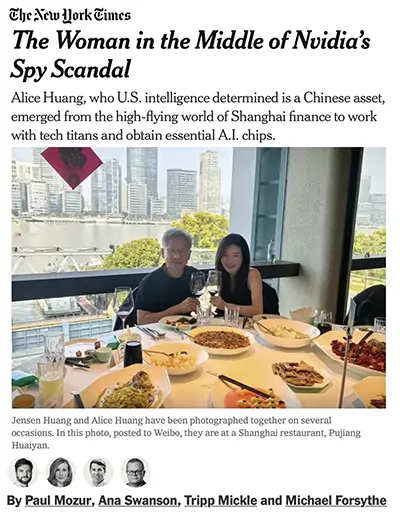
The New York Times · Paul Mozur, Ana Swanson, Tripp Mickle and Michael Forsythe · November 10, 2026
| TL;DR The Times reports that a Singapore shell structure let a China-linked network obtain more than $4 billion in Nvidia’s most advanced chips despite U.S. export controls. It is the clearest sign yet that chip controls are only as strong as the due diligence on customers further down the chain. |
Executive Summary
Drawing on 15 years of corporate records and interviews, the Times traces Alice Huang from Shanghai finance to running Megaspeed. The reported mechanics matter more than the biography. In 2023 a British Virgin Islands company bought a gaming firm’s Singapore unit, which then moved into a Singapore shell company. Four days after an ownership change, Megaspeed was named an Nvidia cloud partner. It went on to secure more than $4 billion in advanced chips, and Alibaba became its dominant customer through a Malaysian subsidiary. The route relies on a gap the article describes: U.S. rules block direct chip sales to China but still allow Chinese firms to rent computing power in Southeast Asian data centers.
Warning signs built up over time. In late 2024 a Commerce Department inspection found some delivered equipment still in boxes. Taiwan monitored her visits at Washington’s suggestion. Singapore barred her from leaving the country for part of 2025 during an import-declaration probe. That probe was closed against her for lack of evidence, but the inquiry into Megaspeed continues, and the company is still finishing a Malaysian data center with chips already secured.
Read critically: the spy determination comes from U.S. intelligence conclusions and unnamed sources, not public evidence. China denies the claims, and Nvidia, Megaspeed and Alice Huang declined to comment or did not respond. The documentary findings on corporate structure are the most solid part of the reporting, and the most relevant part for business.
Relevance for Business
Enforcement attention is likely to move from the chipmaker to the layer in between: cloud partners, resellers and data-center operators, especially in Southeast Asia. For SMBs, that could mean tighter know-your-customer checks, slower provisioning and possibly higher prices for GPU capacity bought through offshore or lesser-known providers. It also exposes a hidden dependency: many firms don’t know where their rented AI compute physically runs or who owns the operator.
Calls to Action
◆ Assign Internal Review: If you rent GPU capacity or use smaller AI infrastructure providers, ask where the hardware is located and who ultimately owns the provider.
◆ Prepare Policy: Add beneficial ownership and export-compliance attestations to your AI vendor due-diligence checklist.
◆ Monitor: Watch for Commerce Department or congressional action on the rental (“remote access”) route, which could change the pricing and availability of offshore GPU capacity.
◆ Ignore for Now: Details of the personal relationship have no bearing on business decisions.
Summary by ReadAboutAI.com
https://www.nytimes.com/2026/11/10/technology/alice-huang-megaspeed-nvidia-jensen-huang.html: NVIDIA Scandal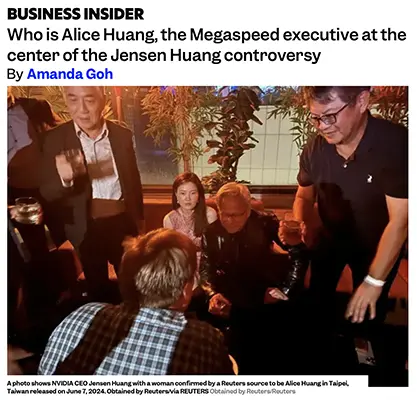
Who Is Alice Huang, the Megaspeed Executive at the Center of the Jensen Huang Controversy
Business Insider · Amanda Goh · November 8, 2026
| TL;DR The story’s business substance runs through Megaspeed, a Singapore Nvidia customer already under scrutiny over whether it helped Chinese firms get around U.S. chip export controls. That makes this as much a supply-chain compliance story as a personal one. |
Executive Summary
Business Insider pulls together the thin public record on Alice Huang, a Chinese national who served as a director of Megaspeed and is no relation to the Nvidia CEO. The key signal is the company, not the person. U.S. authorities were already examining whether Megaspeed and a Malaysian affiliate helped Chinese businesses get Nvidia chips despite export controls, and Singapore police have an ongoing investigation into the company. Corporate filings show Megaspeed began as the Singapore unit of a Chinese gaming company, with ownership routed through a British Virgin Islands entity. Layered structures like this make customer due diligence harder for any chip supplier.
The espionage allegation itself rests on U.S. intelligence assessments first reported by the Times. The coverage describes no charges, and Singapore says it has not investigated her over intelligence ties. Before Sunday’s admission, both Nvidia and Huang described their interactions as normal customer business. That framing is now harder to take at face value, though Huang’s note to staff did not name her or address the reported relationship directly.
Relevance for Business
Export controls are enforced along the whole reseller and data-center chain, not just at the chipmaker. Some SMBs resell or integrate AI hardware, or buy GPU capacity from offshore or lesser-known data-center providers. For them, who ultimately owns a partner is now a practical compliance question. The case also shows how a partner relationship can turn into reputational exposure quickly.
Calls to Action
◆ Assign Internal Review: If you buy or resell AI hardware or GPU capacity through intermediaries, especially Asia-based data-center providers, confirm their beneficial ownership and export-compliance attestations.
◆ Monitor: Watch the outcome of Singapore’s Megaspeed probe and any U.S. enforcement. Together they will show whether this is an isolated case or part of a wider crackdown on chip diversion.
◆ Prepare Policy: Clarify what executives must disclose about personal relationships with customer or supplier contacts.
◆ Ignore for Now: Speculation about the personal relationship does not change business decisions.
Summary by ReadAboutAI.com
https://www.businessinsider.com/who-is-alice-huang-executive-jensen-huang-nvidia-ceo-2026-11: NVIDIA Scandal
THE CHINESE WOMAN AT THE CENTER OF A SPY PROBE AFTER AN AFFAIR WITH JENSEN HUANG
The Wall Street Journal | Stu Woo and Raffaele Huang | November 9, 2026
TL;DR: The useful signal here is not the profile but the business model behind it. Compute-rental intermediaries like Megaspeed show how export controls can be bypassed without chips ever officially going to China.
Executive Summary
This WSJ piece traces Alice Huang’s career from Chinese state television to finance to a leading role at Megaspeed. Megaspeed was spun out of a Chinese videogame company in 2023, is based in Singapore, and joined an Nvidia partner program that typically brings priority chip access. It works as a middleman: it buys Nvidia hardware and rents the computing power, and Alibaba is reportedly an early and major customer. The Commerce Department began investigating possible diversion in late 2024. That probe stalled, and the Justice Department is now investigating. Megaspeed says investigators found no evidence of illegal activity. That is company framing, not a finding. Her current whereabouts are unknown, though people in contact with her earlier this year said she was in China.
The structural point matters more than the personal one. Because the U.S. bans exports of its most advanced chips to China, workaround markets have grown: smuggling, and renting Nvidia-powered capacity outside China. That second route is legally murky, and it is central to this case. Megaspeed is still active, reportedly seeking financing for data centers in China and Southeast Asia, including some using Nvidia’s newest Blackwell chips.
Relevance for Business
The Megaspeed model is a reminder that in AI infrastructure, who ultimately uses the hardware is often unclear. That opacity creates regulatory exposure for every company in the chain. As enforcement tightens, regional cloud and GPU-rental providers, especially those with links to China, face higher compliance burdens and possible blacklisting. For SMBs choosing cheaper offshore compute, the low price may come with supplier-continuity and reputational risk.
Calls to Action
🔹 Assign internal review: Map who owns and operates any third-party GPU or cloud capacity you use, including resellers and regional providers.
🔹 Prepare policy: Add ownership and export-control screening to vendor due diligence for AI infrastructure.
🔹 Monitor: Follow the Justice Department’s Megaspeed investigation. The outcome may set enforcement expectations for compute-rental intermediaries.
🔹 Ignore for now: Biographical and relationship details have no bearing on business decisions.
Summary by ReadAboutAI.com
https://www.wsj.com/wsjplus/dashboard/articles/the-chinese-woman-at-the-center-of-a-spy-probe-after-an-affair-with-jensen-huang-7bb406d2: NVIDIA Scandal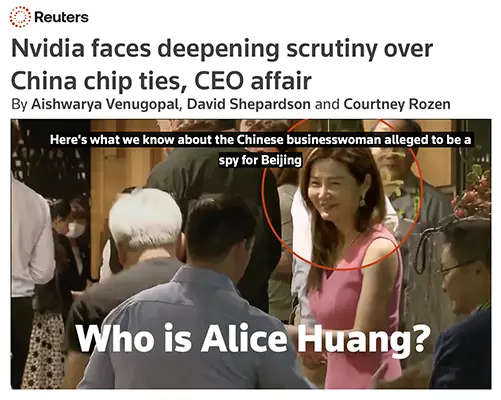
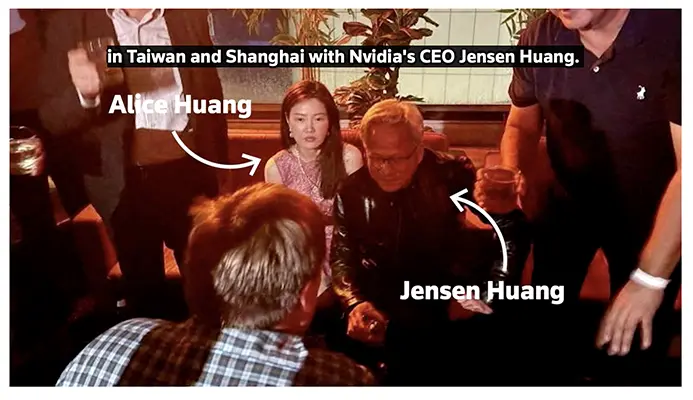
NVIDIA FACES DEEPENING SCRUTINY OVER CHINA CHIP TIES, CEO AFFAIR
Reuters | Aishwarya Venugopal, David Shepardson and Courtney Rozen | November 10, 2026
TL;DR: The story has moved from a personal scandal to an alleged export-control breach, with new reports linking the relationship to at least $7.5 billion in chip shipments to China and the first call from a Republican senator for Huang to resign.
Executive Summary
Reuters brings together a day of escalation. Nvidia lost about $430 billion in market value over two sessions as new reports came out. The Information reported that Alice Huang used her Nvidia ties to help move about 240,000 restricted H100, H200 and A100 chips into China, some of which ended up serving Alibaba and Tencent. The New York Times reported that the Secretary of State briefed the President about the intelligence in May, at least the second such warning in seven months. The White House disputes this. The President says Huang told him he had no idea the woman was a suspected spy, and that he believes him. The FBI is reportedly examining separately whether Huang was targeted.
Reuters is careful to say it could not independently verify most of these reports, and readers should apply the same caution. What is confirmed: the board hired Joon Kim, a former acting U.S. Attorney now at Wachtell Lipton, to lead the investigation. Republican Senator Kevin Cramer called for Huang to step down, citing “potential for extortion.” Senate Democratic Leader Chuck Schumer is pushing for new chip export restrictions. A separate FT report says other agencies pushed to put Megaspeed on the trade blacklist, but Commerce delayed it.
Relevance for Business
Two things changed. The political risk is now bipartisan and specific: one party wants Huang out and the other wants tighter export law. And the alleged scale of chip diversion turns a governance question into a possible compliance failure inside Nvidia’s partner channel. For SMBs, that points to tighter, slower and more audited global GPU supply chains. It also signals that AI hardware and cloud capacity may face more policy-driven pricing and availability swings in 2027.
Calls to Action
🔹 Monitor: Watch for any chip-export legislation in the new Congress and any decision to add Megaspeed or similar intermediaries to the trade blacklist.
🔹 Revisit later: Treat the $7.5 billion and 240,000-chip figures as unverified until the Justice Department or the board’s investigation confirms them.
🔹 Assign internal review: If your AI workloads run on providers in Southeast Asia or other non-U.S. regions, ask how tighter export enforcement would affect them.
🔹 Ignore for now: Speculation about Huang’s departure. The board’s investigation is only beginning.
Summary by ReadAboutAI.com
https://www.reuters.com/world/china/nvidia-ceos-affair-aided-75-billion-chip-shipments-china-information-reports-2026-11-10/: NVIDIA Scandal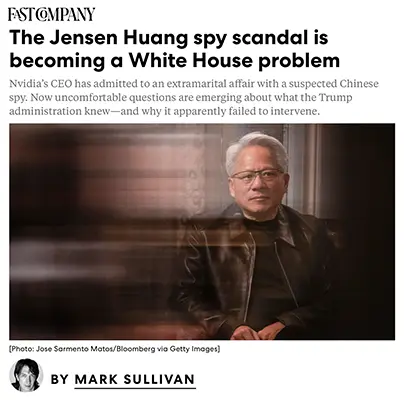
The Jensen Huang Spy Scandal Is Becoming a White House Problem
Fast Company | Mark Sullivan | November 9, 2026
TL;DR: The bigger question is no longer what Huang did. It is whether Nvidia’s political and financial ties to Washington weakened the government’s handling of a possible national security threat.
Executive Summary
This analysis moves the story from Nvidia’s boardroom to Washington. The government reportedly knew about Alice Huang’s suspected ties to Beijing for months and apparently never warned Huang. The piece raises the possibility that the administration had reasons to look away: AI stocks have driven much of this year’s market gains, and the government now takes a cut of approved Nvidia chip sales to China (25% on H200s, 15% on H20s). Readers should note that the idea the White House blocked a warning is framed as a possibility. It is not established.
The more concrete point concerns regulatory independence. According to Times reporting cited in the piece, a Commerce Department investigation into Megaspeed, which allegedly diverted restricted chips to China, stopped abruptly after Nvidia’s general counsel contacted investigators. He said a Trump-appointed official had cleared the contact. The case then moved to the Justice Department and is now a criminal investigation. There is no evidence of a direct instruction, but the sequence raises questions about Nvidia’s influence over its own regulators. One security researcher summed up the export-control gap bluntly: “We had no idea where those chips went.” Three House Republicans have asked Huang to a closed-door hearing, and the incoming Democratic chair of Senate Foreign Relations wants an investigation.
Relevance for Business
A business model that depends on regulatory goodwill carries political risk. When a government holds a revenue share in a company’s sales, the line between regulator and partner blurs. That tends to end in sharper scrutiny later, especially after a change of power in Congress. For SMBs buying AI services, expect more policy volatility around chips, export rules and AI infrastructure in 2027. The case also shows that channel partners and resellers can become a vendor’s biggest compliance risk.
Calls to Action
🔹 Monitor: Follow the Justice Department’s Megaspeed investigation and any January congressional hearings. Those are where findings, not allegations, will come out.
🔹 Assign internal review: If you buy GPU capacity or AI hardware through third-party resellers or regional cloud providers, confirm they are legitimate and compliant with export rules.
🔹 Revisit later: Expect AI policy in 2027 to be shaped by investigations as much as legislation. Build some flexibility into longer AI contracts.
🔹 Ignore for now: Speculation about White House motives is useful context, but nothing to act on until investigations produce evidence.
Summary by ReadAboutAI.com
https://www.fastcompany.com/91638546/the-jensen-huang-spy-scandal-is-becoming-a-white-house-problem: NVIDIA Scandal
The Spy Who Loved Jensen Huang: Everything We Know So Far
New York Magazine / Intelligencer | Bess Levin | November 9, 2026
TL;DR: The most important new detail is the timeline. Senior U.S. officials reportedly had a classified warning about the relationship months before it became public. That makes this an oversight problem as well as a corporate one.
Executive Summary
This is an explainer that pulls together existing reporting, most of it from The New York Times. The tone is pointed and often sarcastic, so readers should separate the reported facts from the commentary. The facts that matter: U.S. intelligence reportedly began monitoring Alice Huang more than a year ago and concluded that China’s Ministry of State Security had recruited her. A classified memo warning top officials reportedly went out this spring, before the President’s May trip to China. Huang was first left off that delegation, then added after media coverage. Megaspeed, her employer, reportedly bought more than $4.8 billion in Nvidia chips and has been under Commerce Department investigation for possibly diverting advanced chips to China.
The political response crosses party lines, which is worth noting. Incoming Democratic leaders have promised investigations. A senior House Republican called for an immediate pause on advanced AI chip shipments to China, a direct challenge to Huang’s long resistance to tighter export rules. The President has defended Huang and said he does not regret not acting on the earlier intelligence. Analyst views on Huang’s future conflict: one prominent analyst called talk of his replacement laughable. (Article 9 has the same analyst sounding more cautious.)
Relevance for Business
The useful point for leaders is policy direction, not gossip. A Republican call to pause chip shipments, plus Democrats taking over committee gavels in January, means export-control tightening now has bipartisan cover. That could reshape Nvidia’s revenue mix, its pricing power and global GPU supply. Separately, the timeline (warning in the spring, story public in November) shows how long a known risk can sit unaddressed when the person involved is powerful. That is a governance lesson that applies to companies of any size.
Calls to Action
🔹 Monitor: Watch for proposals to pause or restrict advanced chip exports. That is the policy most likely to move first.
🔹 Test cautiously: When you assess commentary-heavy coverage of this story, separate what was reported from what is tone. Use primary reporting for decisions.
🔹 Prepare policy: Review how your organization escalates known risks involving senior leaders, so warnings don’t stall at the top.
🔹 Ignore for now: Personal and family details have no bearing on business decisions.
Summary by ReadAboutAI.com
https://nymag.com/intelligencer/article/jensen-huang-spy-scandaleverything-we-know-so-far.html: NVIDIA Scandal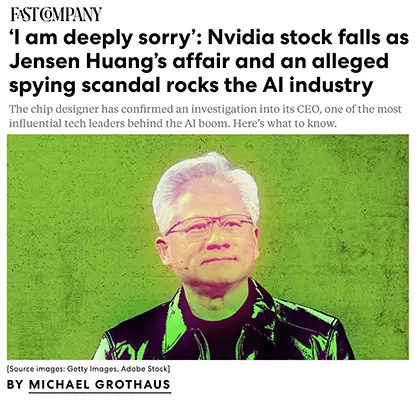
‘I Am Deeply Sorry’: Nvidia Stock Falls as Jensen Huang’s Affair and an Alleged Spying Scandal Rocks the AI Industry
Fast Company | Michael Grothaus | November 9, 2026
TL;DR: The confirmed affair is a personal story. The suspected intelligence connection is a market and supply-chain story, and it hit an AI sector that was already falling after the midterms.
Executive Summary
Nvidia’s board opened an independent investigation into CEO Jensen Huang after he confirmed an extramarital affair with Alice Huang (no relation), a senior executive at Singapore-based Megaspeed. Megaspeed is a major Nvidia customer, and U.S. intelligence reportedly believes she was gathering information for Beijing. Huang had earlier called their contact normal business. He then admitted the affair in a company-wide email and said he would cooperate fully. China denies the spying claim. The Secretary of State declined to comment, and the President spoke of Huang warmly but carefully.
What can be treated as fact is narrow: the affair is confirmed, and the investigation is real. The spying claim is an intelligence assessment as reported by the press. It is not a charge or a finding. Nvidia’s board says it has no reason to think secrets were compromised. That is company framing, issued before the investigation began. Investor reaction was quick. Shares fell more than 5% in premarket trading, and if that held, the decline over the past month passes 26%. Much of that slide came from post-midterm fears that a Democratic Congress will slow data center buildouts. One analyst called it a “black eye moment” and expects several congressional inquiries and a lasting drag on the stock.
Relevance for Business
The AI stack depends heavily on one supplier with one dominant leader, and this shows how much that matters. For SMBs, the direct exposure is not Nvidia stock. It is what comes downstream: cloud GPU pricing, chip export policy, and how willing the market is to keep funding AI infrastructure. A scandal that brings in Congress, export controls and key-person risk at the center of the AI supply chain makes AI vendor roadmaps harder to plan around, especially for vendors whose pricing assumes cheap compute keeps getting cheaper.
Calls to Action
🔹 Monitor: Track congressional inquiries and any proposed change to chip export policy. Those are the most likely ways this reaches cloud and AI service pricing.
🔹 Assign internal review: Ask your main AI and cloud vendors how exposed their capacity and pricing are to Nvidia supply disruption or policy shocks.
🔹 Ignore for now: Don’t change AI tools or projects because of the headlines. Nothing about current products or service availability has changed.
🔹 Revisit later: Reassess after the board’s investigation reports. It will separate allegation from finding.
Summary by ReadAboutAI.com
https://www.fastcompany.com/91638448/nvidia-stock-falling-today-jensen-huang-affair-spy-scandal-rocks-ai: NVIDIA Scandal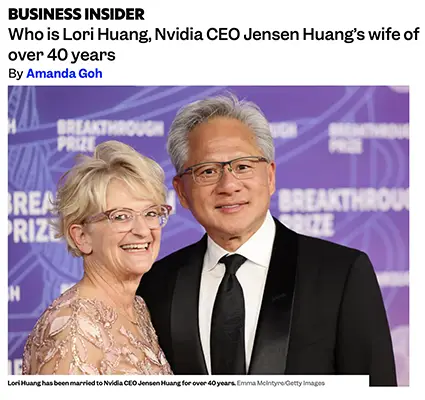
Who Is Lori Huang, Nvidia CEO Jensen Huang’s Wife of Over 40 Years
Business Insider · Amanda Goh · November 9, 2026
| TL;DR This is a human-interest profile with little business signal. Its one governance-relevant point is how closely Nvidia and the Huang family are intertwined. |
Executive Summary
Business Insider profiles Lori Huang, an electrical engineering graduate who met Jensen Huang in college and has been married to him for more than 40 years. The piece draws mostly on past interviews and university releases and adds no new facts about the investigation. The business-relevant details are that the couple’s two adult children hold product roles at Nvidia, and that the family foundation reports about $9.1 billion in net assets. Both underline how closely the company’s leadership and the founder’s family are linked.
Relevance for Business
The relevance is limited. The only takeaway is that family employment and a founder-centric culture add to the key-person concentration flagged in the other coverage. Readers gain little else, and going further would push a business briefing into personal territory.
Calls to Action
◆ Ignore for Now: The profile has no direct bearing on AI strategy or vendor decisions.
◆ Revisit Later: Return to it only if family roles or related-party questions become part of the board’s inquiry.
◆ Monitor: Watch for any board statement on governance or succession, which would be the substantive version of this story.
Summary by ReadAboutAI.com
https://www.businessinsider.com/who-is-nvidia-ceo-jensen-huang-wife-lori-2026-11: NVIDIA Scandal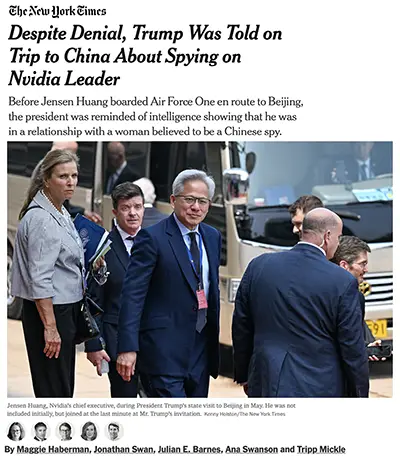
Despite Denial, Trump Was Told on Trip to China About Spying on Nvidia Leader
The New York Times · Maggie Haberman, Jonathan Swan, Julian E. Barnes, Ana Swanson and Tripp Mickle · November 10, 2026
| TL;DR Reporting that Trump was briefed again in May, before bringing Huang to Beijing, shifts part of the story from corporate governance to White House judgment. That makes China chip policy more volatile and more likely to be shaped by Congress. |
Executive Summary
People with knowledge of the matter told the Times that Secretary of State Marco Rubio briefed Trump aboard Air Force One in May, shortly before Huang joined the Beijing trip. That would make it at least the second briefing in seven months, and it contradicts Trump’s Monday statement that he hadn’t heard about it then. The White House disputed the reporting on background without giving specifics. Huang will not join Trump’s China trip next week, and Trump says he won’t raise the matter with Xi Jinping.
The policy backdrop is the business story. At the time of the May trip, the administration was weighing sales of Nvidia’s top Blackwell chips to China, a move Huang supported and many advisers opposed. Blackwell sales have not been approved, though less advanced H200 chips were later cleared for approved buyers.
Read critically: the account relies on anonymous sources, with one official confirming the briefing, and the White House disputes it. Leaders don’t need to settle who knew what. The point is that Nvidia’s policy wins are now tied to a contested political story, and that makes them easier to reverse.
Relevance for Business
Chip policy that rests on personal relationships can change quickly. If Congress moves to set export rules independently of the White House, the outcome is likely to be tighter and less predictable. That matters for the cost and supply stability of the AI infrastructure SMB vendors depend on. The direct impact on SMBs is low today. The main risk is pricing and availability volatility further out.
Calls to Action
◆ Monitor: Watch next week’s Trump–Xi meeting for any announcement on Blackwell or H200 chip sales.
◆ Monitor: Follow congressional oversight moves. Bipartisan action on chip exports would be a more durable signal than White House statements.
◆ Ignore for Now: The political back-and-forth over who was briefed when does not change near-term business decisions.
Summary by ReadAboutAI.com
https://www.nytimes.com/2026/11/10/us/politics/trump-china-trip-nvidia.html: NVIDIA Scandal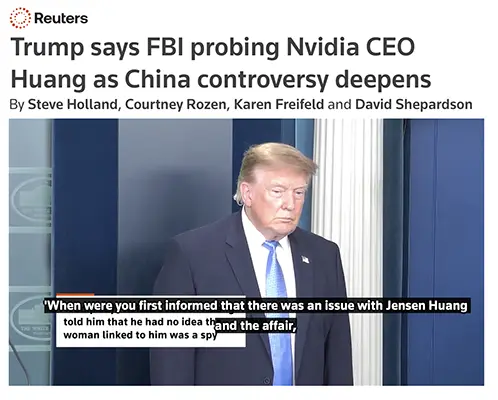
Trump Says FBI Probing Nvidia CEO Huang as China Controversy Deepens
Reuters · Steve Holland, Courtney Rozen, Karen Freifeld and David Shepardson · November 9, 2026
| TL;DR The matter now goes well beyond a board inquiry. Trump says the FBI is looking into it, shareholders have filed a proposed class action, and lawmakers say tighter limits on China chip sales are now more likely. Legal, regulatory and policy exposure are building at the same time. |
Executive Summary
Trump says the FBI is looking into Huang’s relationship while predicting the CEO will be fine. Shares closed down more than 4% on Monday. A proposed shareholder class action accuses Nvidia and Huang of hiding his ties to a suspected spy. Lawmakers and advocates told Reuters that Congress is now more likely to tighten China’s access to AI chips, and House Democratic leader Hakeem Jeffries backed adding chip-sale restrictions to the annual defense bill. China’s foreign ministry calls the accusations groundless.
The governance details are telling. Huang owns about 3.6% of Nvidia and runs an unusually flat structure with dozens of direct reports. Unlike Meta, though, Nvidia has no dual-class shares, so the board and shareholders hold more formal leverage than at many founder-led tech firms. Most analysts don’t expect him to step down. One Bernstein analyst summed up the key-person problem: “he is Nvidia.” Reuters also notes, as context, that Trump gave Huang a top science honor in October and disclosed trades in Nvidia shares the same day.
Read critically: the FBI’s involvement rests on Trump’s description, and the article includes no confirmation from the bureau. Class actions routinely follow sharp stock drops, so a filing alone says nothing about its merit.
Relevance for Business
The most concrete business consequence is policy. Export legislation tied to the defense bill could reshape Nvidia’s addressable market and, over time, global chip allocation and pricing. A federal inquiry plus litigation also stretches the period of uncertainty from days to months. Separately, the article is a reminder that flat, founder-centric structures concentrate risk, a pattern many SMBs share.
Calls to Action
◆ Monitor: Track chip-restriction provisions in the annual defense bill. That is the most likely channel for durable effects on AI infrastructure.
◆ Monitor: Watch for independent confirmation of an FBI inquiry before treating it as established.
◆ Revisit Later: Check how many decisions in your own organization depend on a single leader, and whether that is a deliberate choice.
◆ Ignore for Now: The class-action filing carries no near-term operational signal for Nvidia’s customers.
Summary by ReadAboutAI.com
https://www.reuters.com/world/asia-pacific/south-korea-says-nvidia-issues-wont-affect-contracted-gpu-supplies-2026-11-09/: NVIDIA Scandal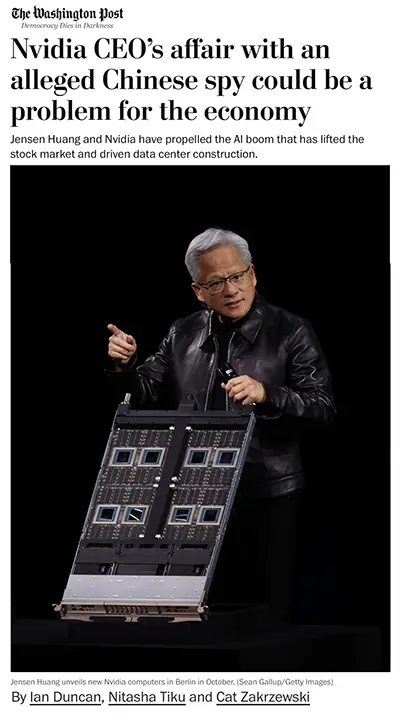
Nvidia CEO’s Affair With an Alleged Chinese Spy Could Be a Problem for the Economy
The Washington Post · Ian Duncan, Nitasha Tiku and Cat Zakrzewski · November 10, 2026
| TL;DR The Post treats the Huang scandal as a systemic risk. Nvidia has no clear successor, a long-tenured board and a CEO who helped shape U.S. chip policy on China, so a personal crisis now has market, political and supply-chain consequences. |
Executive Summary
The central argument is that Nvidia’s dependence on Huang is itself the risk. One analyst says the company has no real succession plan and calls Huang “kind of irreplaceable.” Nearly half of the 11-person board dates back to Nvidia’s earliest years, which leads a governance scholar to question whether directors can act independently. The scandal also lands while investors already worry about an AI spending bubble and “circular financing”, meaning Nvidia invests in customers who then buy its chips.
The political exposure is bipartisan. House Republicans have asked Huang to testify this month, and Democrats, fresh off midterm gains, see a test case for tech leaders’ influence over policy. The piece traces Huang’s close ties to the Trump administration: U.S. manufacturing pledges, a $25 million ballroom donation, and a China chip-export arrangement that gives the government a cut of revenue. Trump says Huang told him he didn’t know the woman was a spy, and that he believes him.
Read critically: most of the “economy” framing is commentary from analysts and advisers, not demonstrated impact. A roughly 4% share decline matters, but it is not a rout. The strongest factual signal is about governance. Concentrated founder control, a loyal board and political entanglement make a fragile combination, whatever the investigation finds.
| Vendor-Neutrality Disclosure This article quotes Ben Buchanan, identified as an adviser to Anthropic, which the article describes as an Nvidia partner. ReadAboutAI.com uses Anthropic’s Claude in its production workflow, and we note this for transparency. |
Relevance for Business
The lesson for SMBs is concentration risk, which also shows up at smaller scale. When a vendor’s value depends on one founder, that vendor’s governance becomes part of your risk. What to Monitor: if scrutiny reshapes China export policy, it could change Nvidia’s revenue mix and, in turn, AI infrastructure pricing. If confidence in AI’s flagship company weakens, funding for the AI startups many SMBs buy from could tighten. Neither outcome is established yet.
Calls to Action
◆ Assign Internal Review: Identify critical AI vendors whose leadership is concentrated in one founder, and ask about continuity plans at renewal.
◆ Monitor: Watch congressional hearings and any change in China chip-export policy. That is the most likely route to effects on AI pricing and availability.
◆ Prepare Policy: Use the moment to review your own key-person coverage and the disclosure rules for executives’ personal relationships with customers or suppliers.
◆ Ignore for Now: Ignore broad “AI bubble is bursting” predictions tied to this story. A single-day drop of about 4% is not evidence of systemic failure.
Summary by ReadAboutAI.com
https://www.washingtonpost.com/technology/2026/11/10/nvidia-ceo-jensen-huang-affair-could-be-problem-us-economy/: NVIDIA ScandalThe Spy Scandal That Lays Bare Nvidia’s Governance Vacuum
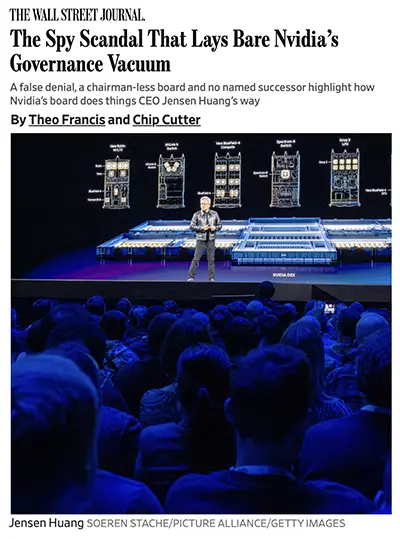
The Wall Street Journal | Theo Francis and Chip Cutter | November 9, 2026
TL;DR: The scandal exposed structural governance weaknesses that investors ignored while the stock rose: no chairman, no named successor, a long-tenured board and a CEO with no clear second-in-command.
Executive Summary
The WSJ treats the scandal as a governance stress test. Nvidia is worth trillions, yet it has no board chair (true of only about 1% of Russell 3000 companies), no public succession plan, and a board that has added just two directors in five years. Several independent directors have served for decades. Huang runs a flat organization with more than 60 direct reports and no obvious number two. Proxy adviser ISS had already given the board structure its riskiest rating last spring.
The sharpest criticism is about process. Nvidia first denied the relationship. Then, in announcing an investigation, the board said it saw no compromise of secrets or national security before the inquiry had started. One former Fortune 500 CEO quoted in the piece said such pre-judging is “how you lose credibility.” The piece also notes something governance experts find significant: Huang owns only about 3.6% of the company and has no supervoting shares. The board’s deference is therefore a matter of culture, not legal control.
Relevance for Business
This is the most transferable lesson in the batch. Founder-centered companies of any size face the same risks: key-person dependence, informal succession and boards that defer instead of overseeing. The order of events (deny, admit, then declare no harm before investigating) is a pattern for how to lose trust. For vendor decisions, a key AI supplier with a governance gap at the top is a risk to weigh, not just a news item.
Calls to Action
🔹 Act now: Write down, or update, a succession and emergency-coverage plan for your top leader and other critical roles.
🔹 Prepare policy: Set up a process for internal investigations that bars anyone from announcing conclusions before the facts are in.
🔹 Assign internal review: For critical AI and technology vendors, add governance and key-person risk to your vendor-risk checklist.
🔹 Monitor: Watch for board changes at Nvidia (a new chair, new directors, a named successor). They will show whether this leads to real reform.
Summary by ReadAboutAI.com
https://www.wsj.com/business/the-spy-scandal-that-lays-bare-nvidias-governance-vacuum-44f8c786: NVIDIA Scandal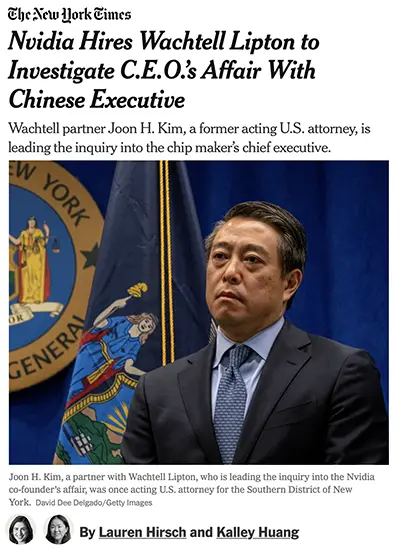
Nvidia Hires Wachtell Lipton to Investigate C.E.O.’s Affair With Chinese Executive
The New York Times · Lauren Hirsch and Kalley Huang · November 10, 2026
| TL;DR Hiring Wachtell, with a former acting U.S. attorney leading the work, signals the board wants a credible investigation. The board’s own long ties to Huang remain the open question. |
Executive Summary
Nvidia’s board has brought in Wachtell, Lipton, Rosen & Katz to advise on its inquiry into Huang. Joon H. Kim, a former acting U.S. attorney for the Southern District of New York who also helped investigate former New York governor Andrew Cuomo, is leading the work for the firm. The choice of investigator is strong. The weaker link is who the investigator reports to. According to the Times, members of the 10-person board have served a combined 161 years, several have ties to Nvidia’s 1993 investors or 1990s partners, and Huang has reportedly treated the board mainly as a governance formality.
Relevance for Business
The story is a compact lesson in how leadership investigations earn credibility: an independent, reputable investigator matters, but so does an independent body receiving the findings. Most SMBs have no independent board at all, so the practical question is who would investigate the owner or CEO if a similar situation arose.
Calls to Action
◆ Prepare Policy: Decide in advance who would oversee an inquiry into your top leader, for example outside counsel or an independent advisor, and how the findings would be handled.
◆ Revisit Later: Check whether Nvidia publishes the investigation’s findings or only a conclusion. That will show how seriously independence is being treated.
◆ Ignore for Now: The hiring announcement alone has no direct effect on customers or vendors.
Summary by ReadAboutAI.com
https://www.nytimes.com/2026/11/10/business/nvidia-wachtell-lipton-jensen-huang.html: NVIDIA Scandal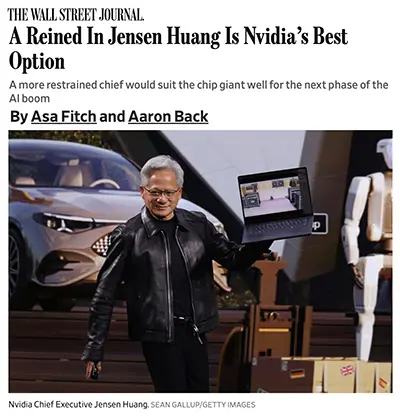
A REINED IN JENSEN HUANG IS NVIDIA’S BEST OPTION
The Wall Street Journal (Heard on the Street) | Asa Fitch and Aaron Back | November 10, 2026
Source type: analysis and opinion column
TL;DR: The column argues Nvidia should keep Huang but strip out his China-first approach. It says the scandal shows that the risk of chasing Chinese revenue far exceeds the reward.
Executive Summary
This is an argument, not reporting. The authors’ case: Nvidia’s push to keep selling into China, through compliant chip variants and a 25% revenue share with the U.S. government on H200 sales, no longer holds up politically. Direct China revenue is about 8% of total ($7.8 billion last quarter), so pulling back is affordable. The bigger unknown is indirect sales through places like Singapore, which Nvidia’s geographic reporting doesn’t break out. The authors expect Nvidia to need independent mechanisms for national-security oversight to keep Huang credibly, and possibly board changes, including adding a chairman.
The column also takes a wider view. Revenue growth is still above 90% a year, but it is expected to slow steadily. Nvidia’s stock trades at a forward earnings multiple of about 12, its lowest in over a decade, which reflects market doubt about how long the AI boom lasts. The authors suggest Nvidia may be shifting from the face of the boom to a critical but more ordinary equipment supplier. A more restrained CEO fits that phase. The “keep Huang” premise is the authors’ judgment, and it contrasts with the senator’s resignation call in #13.
Relevance for Business
The column sees what may be a shift in AI’s center of gravity: from growth-at-all-costs to risk-managed maturity. For SMBs, a more cautious Nvidia could mean steadier but not cheaper supply. Strong U.S. demand already outstrips supply, and tighter international controls won’t ease that. The column’s push for demand transparency, meaning knowing who your end customers really are, applies to any company selling into regulated or politically sensitive markets.
Calls to Action
🔹 Monitor: Nvidia’s earnings next week, for China revenue, guidance and any new compliance or governance commitments.
🔹 Revisit later: Assumptions about falling AI compute costs. A more cautious, more regulated supply chain may slow price declines.
🔹 Assign internal review: If you sell into sensitive markets, check whether you can verify who your end customers are.
🔹 Test cautiously: Treat the “keep Huang” conclusion as one informed view, not a consensus.
Summary by ReadAboutAI.com
https://www.wsj.com/business/a-reined-in-jensen-huang-is-nvidias-best-option-e79cb305: NVIDIA ScandalJENSEN HUANG’S APOLOGY MAY BE THE ONLY CORRECT USE OF AI
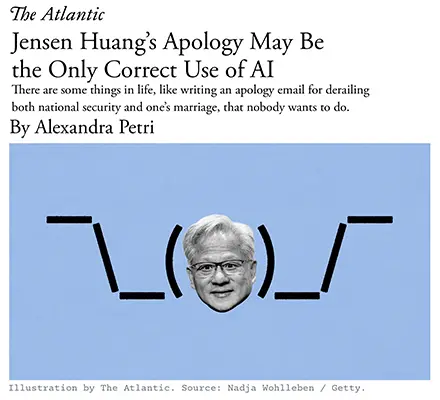
The Atlantic | Alexandra Petri | November 10, 2026
Source type: humor and satire
TL;DR: A satirical piece. Its one real signal is that Huang has said he uses AI to write first drafts, which raises a fair question about how authentic executive communications are in a crisis.
Executive Summary
Petri, a humor writer, jokes that if AI helped draft Huang’s apology email, it may be the rare AI use she supports, since no one wants to write such a message. She then notes that no training data could exist for an email this unusual. Most of the piece is comedy, including a parody James Bond villain apology. It closes by mocking Nvidia’s earlier claim that the relationship was “not unusual.” Her punch line: “Finally, organic demand for AI!”
Under the jokes is a real issue. Huang has said publicly that he uses AI for first drafts. The piece does not show or claim that AI wrote this apology. Even so, it points to a growing trust question: when leaders admit AI helps them write, stakeholders may doubt whether high-stakes apologies, disclosures or crisis statements are sincere.
Relevance for Business
This is light material, but the governance point is real. As AI drafting becomes routine, authenticity becomes a reputational issue, most of all in crisis communications, apologies and statements about personal accountability. SMB leaders should decide before a crisis where AI help is appropriate in executive communications and where it could backfire.
Calls to Action
🔹 Prepare policy: Set guidelines for AI use in sensitive executive communications such as apologies, layoffs and crisis statements.
🔹 Ignore for now: The piece is satire and needs no other action.
🔹 Revisit later: As AI-drafted communication becomes common, check whether stakeholders expect it to be disclosed.
Summary by ReadAboutAI.com
https://www.theatlantic.com/newsletters/2026/11/jensen-huang-ai-apology-nvidia/689366/: NVIDIA Scandal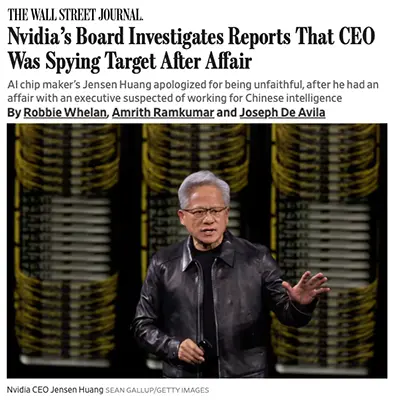
Nvidia’s Board Investigates Reports That CEO Was Spying Target After Affair
Nvidia’s Board Opens Probe Into Reports Its CEO Was a Foreign Intelligence Target
The Wall Street Journal | Robbie Whelan, Amrith Ramkumar and Joseph De Avila | November 9, 2026
Source type: News report. The espionage allegations are unproven: Nvidia’s board says it has no evidence of compromise, and Beijing denies the reports.
| TL;DR: The personal details will get the headlines, but the business story is key-person and governance risk at the company the AI economy depends on most, arriving just as Nvidia lobbies to loosen chip export limits. |
Executive Summary
Nvidia’s board has launched an investigation, led by independent directors with outside counsel, into reports that CEO Jensen Huang was the target of a foreign espionage effort. The reports center on his romantic relationship with Alice Huang (no relation), an executive at Megaspeed, a Singapore-based data center partner of Nvidia. U.S. officials reportedly concluded she was sharing information with the Chinese government. Jensen Huang has apologized publicly for the affair. The board says it has no reason to believe company secrets or national security were compromised and that it backs his continued leadership. China calls the spying reports groundless.
The governance stakes go beyond one executive. Nvidia is worth about $4.5 trillion, sells the chips most AI systems run on and has financially backstopped large parts of the AI industry. Huang has been the industry’s leading advocate for loosening chip export restrictions, and he has close ties to the White House, which has approved some sales of older Nvidia chips to China. Megaspeed belongs to a group of Southeast Asian data center operators under U.S. scrutiny for possibly routing chips or computing power to Chinese customers, and it was reportedly discussed for the government’s Entity List, which would have barred U.S. companies from doing business with it. A Republican senator and several House Republicans have called for congressional oversight, so the issue now draws pressure from both parties.
Relevance for Business
For SMBs, the immediate effect is indirect, but the episode shows how concentrated AI dependence is. Much of the AI market runs on one supplier led by one highly visible founder. Any disruption to Nvidia’s leadership, its standing in Washington or the direction of export policy can ripple into GPU pricing, cloud capacity and the roadmaps of AI vendors. The Megaspeed angle is also a reminder that AI infrastructure supply chains run through intermediaries whose ownership and compliance status can change quickly. Businesses that buy compute or hardware through third parties, especially in Asia, carry compliance exposure if those partners end up on restricted lists.
Calls to Action
◆ Monitor the board investigation’s findings and any congressional hearings. A change in leadership or a tightening of export rules would be the material signal.
◆ Assign internal review of any hardware or cloud-capacity suppliers with Southeast Asian intermediaries to confirm they don’t appear on U.S. restricted-party lists.
◆ Ignore for now the personal aspects of the story. They don’t change SMB technology decisions.
◆ Revisit later your AI vendors’ exposure to Nvidia-only infrastructure if policy volatility increases.
Summary by ReadAboutAI.com
https://www.wsj.com/tech/ai/nvidias-board-to-investigate-reports-that-jensen-huang-was-spying-target-c630325e: NVIDIA Scandal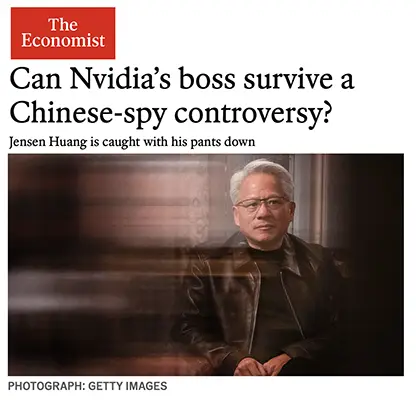
Can Nvidia’s Boss Survive a Chinese-Spy Controversy?
The Economist | Business section (unsigned, per house style) | November 9, 2026
| TL;DR / KEY TAKEAWAY A scandal around Nvidia CEO Jensen Huang, now under board investigation as a possible foreign-intelligence operation, exposes how much of the AI economy rests on one company and one leader, and will likely complicate the politics of chip export controls. |
Executive Summary
On November 8, Huang acknowledged a personal relationship with an executive at Megaspeed, a Singapore-based data-center firm and Nvidia customer, whom U.S. officials reportedly suspect of being a Chinese intelligence operative; the company was reportedly under surveillance over suspected GPU smuggling into China. Nvidia’s board opened an investigation and says it has no reason to believe national security or company secrets were compromised. Huang remains CEO for now. Members of Congress from both parties have signaled they want explanations.
The business stakes are concentration. Nvidia’s chips supply roughly two-thirds of the world’s AI computing power, the company is worth about $4.5 trillion, and Huang has been the industry’s chief promoter and financier, including backing for AI labs and a large data-center funding initiative. There is no obvious successor, and a Bernstein analyst described “considerable key-man risk.”
The policy angle: Huang has long lobbied to loosen restrictions on chip sales to China. His position predates the relationship, but his advocacy will now carry less weight, which may make export-control relaxation harder and adds to investor nervousness about AI spending after the midterms.
Relevance for Business
SMBs do not buy from Nvidia directly, but nearly every AI tool they use runs on its hardware. Leadership turmoil or tighter policy could affect chip supply, cloud capacity and ultimately AI pricing, adding to cost pressures already building from data-center scrutiny.
The story is also a governance case study at a scale anyone can recognize: a company whose value is tightly bound to one founder, with family members in senior roles and no visible succession plan. The same key-person question applies to small AI vendors that SMBs increasingly depend on.
Calls to Action
◆ Monitor: The board investigation, congressional inquiries and any shift in chip export policy toward China.
◆ Assign internal review: Note key-person and concentration risk in due diligence on critical AI vendors, especially small ones.
◆ Revisit later: AI and cloud budget assumptions if supply or pricing effects materialize.
◆ Ignore for now: Speculation about leadership succession; no operational action is warranted yet.
| Source note: Politically sensitive and fast-moving; flagged for owner review. Spy allegations are reported and under board investigation, not established. Facts may change before publication. |
Summary by ReadAboutAI.com
https://www.economist.com/business/2026/11/09/can-nvidias-boss-survive-a-chinese-spy-controversy: NVIDIA ScandalREADING THE NVIDIA COVERAGE AS A MEDIA CASE STUDY
HOW A STORY SPREADS:
TL;DR: The 18 articles above show more than what happened at Nvidia. They show how a news agenda moves from one newsroom to the next, and why the number of articles is not the same as the amount of verification.
Almost every story in this collection traces back to one origin: The New York Times’ reporting on U.S. intelligence concerns about Alice Huang. Communication researchers call what happened next intermedia agenda-setting. Elite outlets don’t only tell the public what to think about. They tell other newsrooms what to think about. Once the Times published, the story was validated, and every editor faced the same question: what is our version? Within days, Reuters, The Wall Street Journal, The Washington Post, Fast Company, Business Insider, Intelligencer and The Atlantic had all answered it, often citing the Times, or each other, along the way.
What followed was angle differentiation. No outlet gains by repeating the original, so each one reframed the story through its own beat and audience. Reuters added developments one after another. The WSJ focused on governance and investor risk. Fast Company went to policy and Washington. Business Insider produced search-friendly “who is” explainers. Intelligencer rounded up what was known, with attitude. The Atlantic wrote satire. The coverage also moved through a recognizable order: scoop, confirmation, explainer, profile, analysis, opinion, humor. Satire tends to arrive last, because a joke works only when the audience already knows the facts. Its appearance is a reliable sign that a story has reached peak awareness.
The story spread so fast because it carries almost every classic news value: elite figures, money, power, conflict, geopolitics and a personal transgression. The affair is the hook that brings readers in. Business outlets largely reframed it as governance, national security and market risk, a framing that fits their brand and their audience. Real-time analytics speed up the cycle. Editors can see within hours which angles draw readers, and they assign more of them. That is why questions like “who is Alice Huang?” produced several near-identical profiles across outlets.
For leaders, the practical lesson is to read high-volume stories with care. Repetition can feel like corroboration, but when many reports trace back to a single source, the volume amplifies that source and adds little independent confirmation. In the worst case, outlets end up citing each other in a loop, which is known as circular reporting. When Reuters notes that it “could not independently verify” a claim, that line deserves attention. When a big AI story breaks, three questions help: Where did this claim originate? Who has independently confirmed it? Is this new information, or a new angle on the same facts? As the attention cycle moves on, the investigations, filings and policy changes that come after will matter more than the headlines did.
What we saw is one of the best-documented patterns in communication research, and 18 articles show it unusually clearly. Comunications research gives us the vocabulary: this is intermedia agenda-setting, the idea that news organizations set each other’s agendas as much as they set the public’s.
It starts with an elite outlet. McCombs and Shaw showed that media tell audiences what to think about. Later research found that a few outlets, above all The New York Times, tell other newsrooms what to think about. Nearly every piece in your set traces back to the Times’ original reporting. Reuters cites the Times, The Information, Axios and the FT. Intelligencer is largely a curated retelling of the Times. Once the Times published, the story was validated, and every other editor had to answer one question: what is our version?
Then the angles split by outlet identity. No outlet can win by repeating the Times, so each one reframes the story through its own beat and audience. Your set shows this almost perfectly:
- Reuters: wire escalation, each new development layered on the last
- WSJ: governance, succession, investor risk
- Fast Company: tech policy, market impact and Washington
- Business Insider: “who is” explainers built for search and quick reads
- Intelligencer: “everything we know so far,” with attitude
- The Atlantic: satire
Scholars call this second-level agenda-setting, or framing. The object (Huang) stays fixed while the attributes outlets emphasize keep multiplying. That is how one event turns into 16 distinct articles.
The genres follow a predictable order. Big stories move through roughly this sequence: scoop, then confirmation, then explainer, then profiles of the people involved, then analysis, then opinion, then humor. Satire is a reliable sign that a story has saturated public awareness, because a joke only lands if the audience already knows the facts. When The Atlantic ran a comedy piece, the cycle was mature.
There is a power, money, sex, greed observation that fits classic news values. Galtung and Ruge’s news values include elite persons, conflict, negativity and the unexpected, and this story has all of them, plus geopolitics. What I find interesting is how the business press handles the sex angle. Mainstream outlets rarely lead with it. They turn it into governance, national security and market risk. That framing lets them cover a salacious story while staying within their brand. The affair is the hook that brings readers in. “Key-person risk” and “export controls” are what make the coverage feel respectable to run.
Audience demand completes the loop. Real-time analytics have shortened the feedback cycle. Editors can see within hours that Huang stories are drawing traffic, so they assign more. Search demand for “who is Alice Huang” produces exactly the BI and WSJ profiles you received. Anthony Downs’ “issue-attention cycle” describes how this peaks and then fades as novelty wears off or a new story arrives. ReadAboutAI.com will return to regular AI development coverage in the next post.
One caution the pattern raises: repetition can look like corroboration. When many outlets report the same claim, it feels confirmed. But if they all trace back to one source, as many do here, the volume only amplifies one piece of reporting and adds no independent verification. Reuters stating that it “could not independently verify” the reports it cited is a small, honest acknowledgment of this. Researchers call the worst version circular reporting.
The ReadAboutAI.com post is the last step in the chain. Curation is gatekeeping too. Choices about which 18 articles to include, how to order them, and the governance-and-policy framing in the intro is ReadAboutAI.com as a small intermedia agenda-setter for readers.
Summary by ReadAboutAI.com
https://www.youtube.com/watch?v=L0XZfQ7oG_g: NVIDIA ScandalClosing: AI update for November 12, 2026
Whatever the investigations conclude, the lasting lessons for leaders are already clear: know who sits behind your AI vendors, plan for the loss of any indispensable leader, and investigate before you announce conclusions. We’ll keep tracking the policy and supply-chain fallout, and regular AI developments coverage resumes with our November 15 post.
All Summaries by ReadAboutAI.com
↑ Back to Top