
AI Updates April 7, 2026
The dominant theme of this week’s coverage is not a single breakthrough — it is a convergence of pressures that are quietly reshaping how businesses should think about AI. On one side, the capability frontier is advancing faster than most leaders have planned for: a nine-person fintech startup deployed a seven-agent AI engineering team that built ten major product features in a single month, at a cost competitive with one mid-level developer. A fund manager who has followed AI infrastructure for years argues the technology is accelerating, not plateauing — and is positioning accordingly. And new data shows that two-thirds of corporate leaders are already filtering job candidates on AI fluency, making this week’s question less “should we adopt AI?” and more “how far behind are we?” Those signals are arriving simultaneously and reinforcing one another in ways that compress the planning horizon for every organization, regardless of size.
On the other side, the risks are growing in proportion to the opportunity. The OpenAI Sora story — a heavily promoted AI video platform shut down within months of launch — is a cautionary case study in how quickly vendor priorities shift and how exposed partners can be when they do. Unexplained Starlink satellite failures, a global helium supply shock triggered by Iranian strikes on Qatari LNG infrastructure, and Nvidia’s aggressive move to lock in the next layer of AI infrastructure all point to the same underlying reality: the AI stack your business depends on rests on supply chains and vendor relationships that carry real fragility. This is not a reason to slow AI adoption — it is a reason to adopt with eyes open, with contingency plans built in, and with a clearer map of where your dependencies actually sit.
The third theme running through this week’s summaries is organizational: how AI is being used inside companies matters as much as whether it is being used. Multiple pieces this week — from Fast Company’s critique of “workslop” to the WSJ’s HR leaders challenging the “digital worker” model to the historical parallel with the PC productivity paradox — converge on the same warning. Layering AI onto unchanged processes, accepting AI-generated output without forming your own judgment first, and measuring adoption through logins rather than outcomes are not minor inefficiencies. They are the failure modes that will separate the organizations that genuinely transform from those that spend money on AI tools and wonder why nothing changed. The window for getting this right is open — but the evidence suggests it will not stay open indefinitely.
Summaries

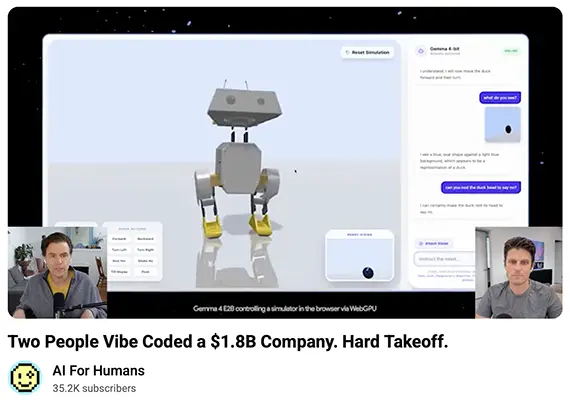
Two People Vibe Coded a $1.8B Company. Hard Takeoff
Two People, AI Tools, and a Billion-Dollar Signal
AI For Humans Podcast — April 3, 2026
TL;DR / Key Takeaway: The real signal in this discussion is not that AI can magically replace companies overnight, but that small teams using AI can now reach scale faster, with lower overhead and fewer traditional staffing assumptions, while still carrying meaningful execution, trust, and governance risks.
Executive Summary
The headline topic is MedVi, a company the hosts describe as having been built and operated initially by one founder, then two brothers, using AI tools to support website creation, customer support, marketing, and business operations. The hosts frame it as an early real-world example of Sam Altman’s long-discussed idea that AI could enable extremely small teams to build outsized businesses. Their argument is not simply that AI makes startups cheaper; it is that AI is compressing the amount of labor needed to test, launch, and run certain kinds of businesses, especially where demand is obvious and the business model is operational rather than deeply technical.
Just as important, the transcript does not present this as frictionless automation. The hosts note multiple operational failures along the way, including incorrect answers and bad pricing behavior, and they explicitly say the business still relied on some contractors and is now adding human help. That matters because it shifts the takeaway from “AI replaces the company” to “AI reshapes the staffing curve.” In practice, the model appears to be fewer people, broader roles, faster iteration, and more need for human oversight where mistakes create customer, regulatory, or reputational exposure.
The rest of the episode broadens that point. The discussion of Google’s Gemma 4 and other small/open models suggests a second major shift: more capable AI is moving closer to the device, not only staying in the cloud. The hosts treat that as strategically important because local models can lower cost, reduce dependence on frontier-model pricing, and open the door to more distributed or hybrid AI workflows. At the same time, they also surface a trust issue around vendors: they argue that product shutdowns, changing APIs, and feature volatility can make organizations hesitant to build too deeply on any one provider without contingency plans.
Relevance for Business
For SMB executives and managers, this matters because it suggests that AI advantage is increasingly operational, not just intellectual. The winners may not be the firms with the best internal research team, but the ones that can identify a narrow market need, assemble workable AI-assisted processes around it, and govern those processes well enough to avoid preventable failures.
It also reinforces two competing realities. First, leaner teams may be able to do much more than they could a year ago, which has implications for hiring, agency spend, and software selection. Second, AI-enabled scale can create fragile businesses if the workflow depends on inaccurate outputs, unstable vendors, or insufficient human review. In other words, the upside is real, but so is the risk of building fast on systems that still hallucinate, change terms, or fail unpredictably.
The local-model angle is also strategically relevant. If smaller models continue improving, businesses may gain more options to run targeted tasks more cheaply, more privately, or with less vendor lock-in than cloud-only AI stacks allow today. That does not eliminate the need for frontier APIs, but it does suggest a future in which companies mix premium cloud reasoning with lower-cost local execution.
Calls to Action
🔹 Review one workflow in your business that currently requires multiple people but could be restructured into an AI-assisted, human-supervised process.
🔹 Do not mistake a compelling AI success story for a universal playbook; identify where your business has regulatory, customer-service, or trust-sensitive failure points that still require strong human review.
🔹 Begin evaluating whether selected use cases could run on smaller or local models to reduce cost and dependence on a single vendor.
🔹 Build vendor contingency thinking now: document which AI tools are mission-critical, what happens if pricing changes, and what fallback options exist.
🔹 Treat “AI can scale a tiny team” as a planning input for 2026–2027 workforce design, not as proof that headcount no longer matters.
Summary by ReadAboutAI.com
https://www.youtube.com/watch?v=hFzapS8rhEs: April 7, 2026
Scientists Have Designed a Way to Save Our Brains from Fake AI Videos
Fast Company | Jesus Diaz | March 27, 2026
TL;DR: ETH Zurich researchers have built a prototype camera chip that cryptographically signs footage at the moment of capture — a technically stronger approach to media authentication than current software-based standards, but one requiring a full hardware overhaul to deploy.
Executive Summary
Researchers at ETH Zurich have developed a working prototype of a camera sensor that embeds cryptographic authentication directly at the point of light capture. Unlike the current industry standard (C2PA), which signs media after the image data travels to the device’s main processor — leaving a small but exploitable vulnerability — this approach makes the signing inseparable from the capture event itself. Any subsequent alteration of the file breaks the cryptographic fingerprint.
The existing C2PA standard is already present on select professional cameras and the Google Pixel 10, and some news organizations are beginning to publish C2PA-verified content. The ETH approach is meaningfully stronger but requires entirely new manufacturing infrastructure, making near-term mass adoption unlikely. This is a research prototype, not a product.
The article’s editorial stance — that this technology should be mandatory worldwide — is opinion, not consensus. The commercial and geopolitical path from prototype to widespread deployment is long and unresolved.
Relevance for Business
For SMB leaders, the practical near-term implication is not adoption of this specific technology — it’s the accelerating erosion of trust in visual media and the business risks that follow. Deepfake video is already a threat in fraud, impersonation, and reputational attack scenarios. Businesses that rely on video for contracts, communications, compliance, or evidence should begin evaluating their media verification posture now, not when the hardware solution arrives. C2PA-compatible tools are available today and represent a reasonable interim step.
Calls to Action
🔹 Assign someone to monitor C2PA adoption progress — it is the actionable near-term standard, already available on some devices.
🔹 Assess whether your organization’s video-based communications, contracts, or compliance records are vulnerable to deepfake manipulation or repudiation.
🔹 Begin internal education on synthetic media risk — employees increasingly need to treat video with the same skepticism currently applied to phishing emails.
🔹 Watch for platform-level C2PA integration (e.g., Instagram, LinkedIn) as the point at which verification becomes practically useful for business communications.
🔹 Treat the ETH prototype as a directional signal worth tracking, but deprioritize operational decisions around it until commercial adoption timelines become clearer.
Summary by ReadAboutAI.com
https://www.fastcompany.com/91515883/scientists-designed-a-way-to-save-our-brains-from-fake-ai-videos: April 7, 2026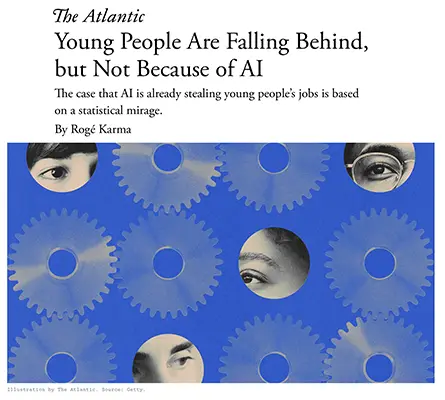
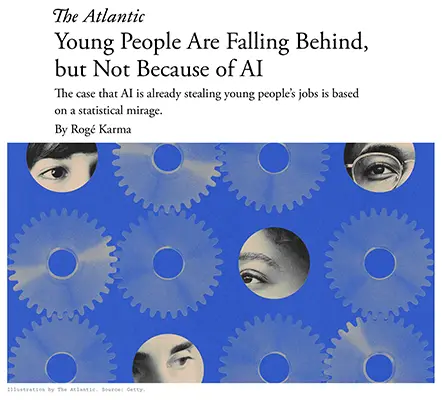
Young People Are Falling Behind, but Not Because of AI
The Atlantic | April 2, 2026
TL;DR: The data does not support the narrative that AI is displacing entry-level workers — the real culprit appears to be a broad hiring freeze driven by economic uncertainty, not automation.
Executive Summary
Recent college graduate unemployment has climbed to nearly 6%, fueling a popular narrative that AI is eliminating entry-level white-collar jobs. This piece methodically challenges that interpretation. When economists broadened the data to include young adults without degrees who have stopped looking for work entirely, they found that all young workers — not just college graduates — have experienced significant employment deterioration. That cross-group pattern undermines the AI-displacement thesis, which would be expected to hit credential-holders hardest.
Additional evidence cuts against the AI story: workers in roles most exposed to AI disruption have seen smaller employment declines than those in minimally exposed occupations like construction. One 2025 analysis found that recent graduates in high-AI sectors actually fared slightly better post-ChatGPT. The more defensible explanation is a broad “hiring freeze” that began in mid-2022 and has been sustained by consecutive waves of economic uncertainty — pandemic aftershocks, the 2024 election, tariff volatility, and policy instability — that make employers reluctant to invest in new hires.
The article is careful not to dismiss the AI risk: new agentic AI tools capable of entry-level tasks are being released, and a labor market already under stress is poorly positioned to absorb a genuine displacement event if one materializes.
Relevance for Business
This matters for SMB leaders on two levels. First, hiring strategy: the entry-level labor market is weak for structural reasons that may not persist indefinitely. Leaders who are delaying hiring due to AI replacement assumptions may be making a decision based on a narrative that is currently unsupported by data. Second, forward planning: while AI displacement isn’t showing up in the numbers yet, the article’s caution is well-placed — the conditions for a disruption event are being built even if the event hasn’t arrived. Workforce planning should account for both possibilities.
Calls to Action
🔹 Do not base entry-level hiring decisions on AI displacement assumptions — current data does not support them.
🔹 Recognize that the current weak entry-level market may represent a hiring opportunity, not just a cost-reduction environment.
🔹 Monitor emerging AI agent capabilities closely; what isn’t happening in the data today may change within 12–24 months.
🔹 Distinguish between AI hype and labor market reality when communicating workforce strategy internally or externally.
🔹 Watch the Economic Policy Uncertainty Index — the article identifies sustained uncertainty as the primary driver of the hiring freeze; easing uncertainty would signal a potential rebound.
Summary by ReadAboutAI.com
https://www.theatlantic.com/economy/2026/04/job-market-artificial-intelligence/686659/: April 7, 2026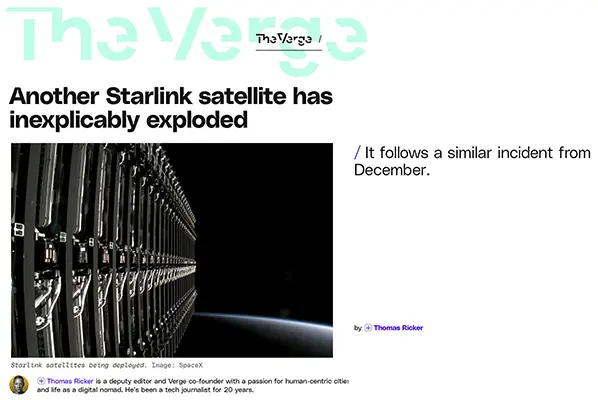
ANOTHER STARLINK SATELLITE HAS INEXPLICABLY EXPLODED
The Verge | Thomas Ricker | March 31, 2026
TL;DR: A second Starlink satellite has broken apart in orbit under unexplained circumstances, raising questions about constellation reliability at a moment when SpaceX is seeking a trillion-dollar IPO valuation and requesting FCC approval for up to one million satellites.
Executive Summary
This is a brief news report, not an investigation, and its information is limited. A Starlink satellite designated 34343 broke apart on March 29, 2026 at approximately 560 km altitude, producing multiple trackable fragments. SpaceX described it as an “anomaly” and has not disclosed a cause. Space-tracking firm LeoLabs independently confirmed the fragmentation event. SpaceX has stated there is no new risk to the International Space Station or the Artemis II mission, and expects fragments to burn up within weeks.
This is the second such unexplained event in four months — a similar incident occurred in December 2025, itself occurring shortly after a near-miss with a Chinese satellite. SpaceX has not publicly connected the incidents or provided root cause analysis for either.
The timing is notable: SpaceX simultaneously filed for its record IPO and has a pending FCC request for licenses covering up to one million satellites for orbital data centers. Repeated unexplained satellite failures in an increasingly crowded low-Earth orbit are a legitimate reliability and governance concern — one that IPO disclosures and FCC review should address, but which may receive insufficient attention amid the financial spectacle of the listing.
Relevance for Business
For SMB leaders using Starlink as a connectivity solution, two unexplained satellite failures in four months is a signal worth noting — not a reason to abandon the service, but a reason to ensure you have contingency plans for connectivity disruption. More broadly, it raises a governance question: as SpaceX pursues orbital data centers and massive constellation expansion, the reliability and debris management practices of the world’s dominant satellite operator become infrastructure risk for any business that depends on it.
Calls to Action
🔹 If Starlink is business-critical connectivity, ensure you have a backup connectivity option — treat this as a standard business continuity measure, not an overreaction.
🔹 Monitor whether SpaceX discloses root cause analysis for either satellite failure — transparency here is a proxy for operational maturity.
🔹 When SpaceX’s IPO S-1 is released, look for how the company characterizes satellite reliability, debris risk, and operational incidents in its risk disclosures.
🔹 Track FCC response to SpaceX’s million-satellite request — regulatory scrutiny of orbital congestion is a legitimate governance story that will affect all satellite-dependent businesses.
Summary by ReadAboutAI.com
https://www.theverge.com/science/903906/another-starlink-satellite-has-inexplicably-exploded: April 7, 2026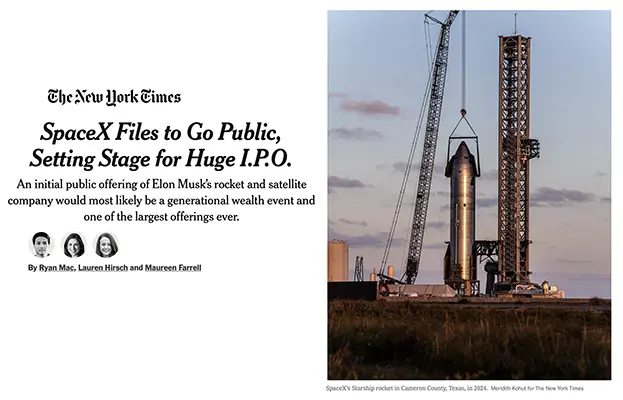

SPACEX FILES FOR WHAT COULD BE THE LARGEST IPO IN HISTORY
The Wall Street Journal (Corrie Driebusch & Micah Maidenberg, April 1, 2026) | The New York Times (Ryan Mac, Lauren Hirsch & Maureen Farrell, April 1, 2026)
TL;DR: SpaceX has confidentially filed for an IPO targeting $40–80 billion in proceeds — but investors should read this as much as a fundraise for Musk’s sprawling, cash-hungry empire as a milestone for the rocket business itself.
Executive Summary
SpaceX filed confidentially with the SEC on April 1, 2026, targeting a listing by June or July. The company values itself at over $1 trillion, which would make it one of the most valuable entities ever to go public. Five major banks — Bank of America, Citi, Goldman Sachs, JPMorgan, and Morgan Stanley — are leading the offering.
The financial picture is more complicated than the headline valuation suggests. While SpaceX’s core space and Starlink businesses are profitable (Starlink alone generated roughly $8 billion in 2024 sales), the company merged with Musk’s AI venture xAI in February, creating a combined entity that now includes the cash-burning Grok chatbot, X (formerly Twitter) with billions in legacy debt, and Musk’s orbital data center ambitions. According to the NYT’s reporting, IPO proceeds may be directed partly toward funding xAI operations and retiring Twitter’s debt — not exclusively toward the space or AI infrastructure businesses investors might assume they’re backing.
The NYT reporting adds a useful check on optimism: Musk has a documented history of missing self-imposed timelines, and his stated vision of orbital AI data centers remains an unproven concept. At least one investment manager quoted in the NYT framed the IPO less as a business milestone and more as a window to capitalize on SpaceX’s halo before broader market or geopolitical headwinds close it.
What to watch: The confidential filing means financials are not yet public. The real due diligence moment comes when the S-1 is disclosed closer to the offering date.
Relevance for Business
For SMB leaders, the direct investment opportunity is real but warrants careful evaluation. The combined SpaceX/xAI entity is not a clean bet on the satellite business — it carries significant exposure to Musk’s broader portfolio of ventures at varying stages of viability. The IPO also signals that the 2026 mega-IPO cycle (SpaceX, OpenAI, Anthropic) is beginning, which has broader implications: capital concentration in AI infrastructure companies could affect market dynamics, vendor pricing, and the competitive landscape for AI tools that SMBs rely on.
For businesses already using Starlink for connectivity — in remote operations, logistics, or field services — the IPO disclosure will be the first opportunity to assess the financial durability of that service at scale.
Calls to Action
🔹 Wait for the public S-1 filing before forming any investment view — the current valuation and narrative are company-framed, not independently verified.
🔹 If you use Starlink for business-critical connectivity, monitor the IPO disclosures for any signal about pricing strategy, service-level commitments, or financial pressures on the Starlink unit.
🔹 Track the OpenAI and Anthropic IPO timelines in parallel — 2026 may be a pivotal year for understanding the true financial structure of the AI companies whose tools many SMBs depend on.
🔹 Treat the SpaceX/xAI merger as a complexity flag: the combined entity mixes proven revenue, speculative ventures, and significant debt in ways the pre-IPO narrative may underplay.
Summary by ReadAboutAI.com
https://www.nytimes.com/2026/04/01/technology/spacex-ipo-elon-musk.html: April 7, 2026https://www.wsj.com/wsjplus/dashboard/articles/spacex-ipo-sec-paperwork-filed-997e45e4: April 7, 2026
AMAZON’S STARLINK COMPETITOR WILL PROVIDE SATELLITE INTERNET TO DELTA
Investor’s Business Daily | Ryan Deffenbaugh | March 31, 2026
TL;DR: Amazon’s Project Kuiper has landed Delta Airlines as a customer for in-flight satellite internet, a meaningful commercial validation — but the program remains behind schedule, expensive, and years from revenue.
Executive Summary
Amazon has signed Delta Airlines to use its low-Earth-orbit satellite internet service, Amazon Leo (formerly Project Kuiper), for in-flight Wi-Fi beginning in 2028 across 500 aircraft. JetBlue signed a similar agreement in September 2025. The deals represent the first meaningful commercial anchors for a program that Amazon launched in 2019 and has invested at least $10 billion to build.
The business context is important: Amazon Leo is not yet a proven service, and the program has faced launch delays.Amazon sought an FCC extension earlier in 2026 to defer a deadline requiring approximately 1,600 satellites to be deployed by July 2026. With only 200+ satellites currently in orbit, the service is still years from operating at scale. The 2028 Delta deployment date reflects that reality.
The financial strain is also real. Amazon is simultaneously spending $200 billion on cloud data center infrastructure in 2026, and analysts have flagged the satellite program as a margin drag on its North American retail operations. Amazon stock is down 13% year-to-date, weighed by AI capex concerns and broader macroeconomic pressure. Kuiper’s path to profitability is long and unconfirmed.
Relevance for Business
The direct SMB relevance here is limited unless your business operates in industries where satellite connectivity is a competitive factor — logistics, remote operations, maritime, aviation. The broader signal is strategic: a second credible low-Earth-orbit internet provider is slowly taking shape, which matters for anyone currently dependent on Starlink or evaluating it as an infrastructure option. Vendor diversification in satellite connectivity may eventually become possible, but not before 2028 at the earliest, and only if Amazon’s deployment stays on track.
Calls to Action
🔹 If you rely on Starlink for business operations, note that Amazon Leo is a credible eventual alternative — but plan your infrastructure decisions around what’s available now, not what may arrive in 2028.
🔹 Monitor Amazon’s FCC compliance and satellite deployment progress as a leading indicator of whether the service will arrive on schedule.
🔹Deprioritize deep analysis of this story for now — it is a commercial partnership announcement for a service that does not yet exist at scale.
🔹 Watch the competitive dynamic between Starlink and Amazon Leo for potential pricing pressure — the emergence of a second provider could benefit business customers over time.
Summary by ReadAboutAI.com
https://www.wsj.com/wsjplus/dashboard/articles/amazons-starlink-competitor-will-provide-satellite-internet-services-to-delta-134194357655731622: April 7, 2026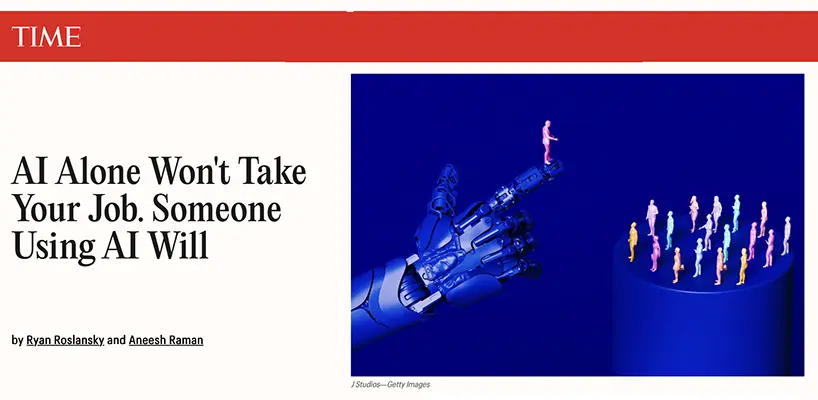
AI Alone Won’t Take Your Job. Someone Using AI Will
The Competitive Gap Is Already Opening: AI Proficiency Is Becoming a Baseline Hiring Expectation
TIME | March 31, 2026
TL;DR: A LinkedIn/Microsoft report signals that AI fluency is rapidly becoming a threshold hiring criterion, not a differentiator — and the gap between adapters and holdouts is compounding faster than most leaders expect.
Executive Summary
Written by LinkedIn’s CEO and its Chief Economic Opportunity Officer — and excerpted from a forthcoming book — this piece argues that the displacement risk from AI is not theoretical or distant. The more immediate pressure is competitive: workers who integrate AI tools into their practice are pulling ahead of those who don’t, and employers are beginning to encode that gap into hiring criteria. The authors report that roughly two-thirds of corporate leaders in a LinkedIn/Microsoft study said they would screen out candidates lacking AI skills — a meaningful shift toward AI fluency as table stakes rather than added value.
The article frames AI adoption as a compounding process: the more a worker uses AI tools, the more effective those tools become for that worker’s specific context, creating an accelerating advantage that widens the gap with non-users over time. This is offered as the mechanism behind the urgency — not the technology’s raw capability, but the personalized efficiency gains that accumulate through use.
The piece is directionally credible but should be read as advocacy. The authors have institutional interest in AI adoption acceleration (LinkedIn benefits from AI skill signaling on its platform), and the book excerpt framing leans motivational. The core claim — that adoption timing creates compounding competitive advantage — is supported by the skill data cited but not independently verified in the article itself. The timeline framing (“if you wait for eventually, it will be too late”) is a rhetorical push, not a quantified forecast.
Relevance for Business
The hiring data is the most immediately actionable signal here. If two-thirds of corporate leaders are already filtering on AI skills, SMBs that have not begun building AI fluency into job descriptions, onboarding, and performance expectations risk appearing behind market to candidates they want to attract. More broadly, this piece reinforces a pattern that SMB leaders should take seriously: the window during which early AI adoption confers a meaningful advantage over competitors is finite. Organizations that normalize experimentation now accumulate institutional learning that is genuinely difficult to replicate later.
Calls to Action
🔹 Review your current job descriptions and hiring criteria — consider whether AI fluency expectations are absent, implicit, or clearly stated, and align them with where your industry is heading.
🔹 Identify 2–3 operational workflows where AI experimentation is low-risk and high-feedback, and designate team members to lead structured pilots rather than individual ad-hoc use.
🔹 Create space for staff to share what AI tools are already doing in their roles — informal adoption is likely further along than leadership realizes.
🔹 Treat this piece as directional signal, not a crisis call; the compounding advantage argument is real, but the urgency framing is authored by parties with adoption interest. Calibrate accordingly.
🔹 Monitor LinkedIn’s annual skills and hiring data as a reliable (if imperfect) indicator of where AI skill expectations are migrating across your sector.
Summary by ReadAboutAI.com
https://time.com/article/2026/03/31/ai-alone-won-t-take-your-job-someone-using-ai-will/: April 7, 2026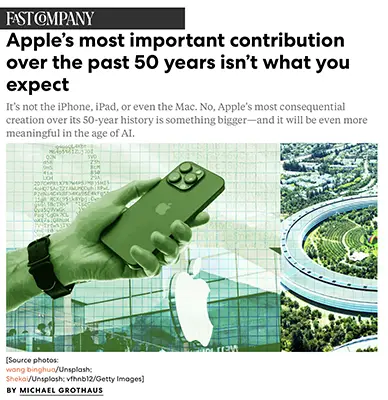
Apple’s most important contribution over the past 50 years isn’t what you expect
Apple’s Real Legacy at 50 Isn’t a Product — It’s a Privacy Standard That Will Matter More in the AI Era
Fast Company | March 28, 2026
TL;DR: Apple’s most enduring contribution may be normalizing privacy as a design principle — a posture that becomes more consequential, not less, as AI systems grow more data-hungry.
Executive Summary
On the occasion of Apple’s 50th anniversary, the argument advanced here is that the company’s most influential innovation was neither hardware nor software, but a sustained commitment to privacy as a foundational product policy. Over roughly 15 years, Apple moved from the margins of the privacy conversation to its center — introducing end-to-end encryption for consumer messaging at scale, blocking cross-site trackers in its browser before any major peer, and making cloud storage encryption available to ordinary users. Notably, Apple applied these constraints to itself: health data on devices and payment transaction histories are structured so that Apple itself cannot access them.
The author acknowledges the tension in this narrative. Apple’s hardware business model — selling high-margin devices rather than monetizing user data — makes privacy-by-design far less costly for Apple than for ad-supported competitors. Privacy as differentiation and privacy as principle are not mutually exclusive, but they are also not the same thing.Whether Apple’s motives are ideological or commercial, the competitive effect has been to raise user expectations industry-wide.
The article’s forward-looking claim is that this dynamic becomes more important in the AI era, where AI companies have even greater appetite for personal data than the ad-tech platforms that preceded them. The implicit question for business leaders: as AI tools proliferate, which vendors are designing with privacy constraints, and which are treating user data as a resource to be harvested?
Relevance for Business
For SMB leaders evaluating AI tools and platforms, this framing offers a practical lens: vendor privacy posture is a strategic variable, not just a compliance checkbox. As AI systems are embedded deeper into operations — touching customer data, employee workflows, and proprietary information — the question of what vendors can access, retain, and monetize becomes material. Apple’s 50-year arc also signals that market pressure from privacy-conscious users and employees can move entire industries, suggesting that SMBs who establish internal privacy standards now will be better positioned as regulatory and consumer expectations tighten.
Calls to Action
🔹 When evaluating any AI vendor or tool, explicitly ask: what data does this system collect, who can access it, and how is it used to train future models?
🔹 Assign someone — internally or through a trusted advisor — to review the data practices of your top three AI and SaaS vendors in the next 90 days.
🔹 Begin drafting or updating an internal AI data policy that specifies what categories of company and customer data may not be processed by third-party AI tools.
🔹 Monitor whether privacy expectations among your customers and employees are shifting — and treat that as a leading indicator of future procurement and policy pressure.
🔹 Note this as context, not immediate action: the claim that Apple’s privacy posture will constrain AI competitors is a prediction, not a demonstrated outcome. Watch for evidence before assuming the effect is as strong as argued.
Summary by ReadAboutAI.com
https://www.fastcompany.com/91513692/apple-most-important-contribution-50-years-policy-privacy-encryption-cloud-craig-federighi-ai: April 7, 2026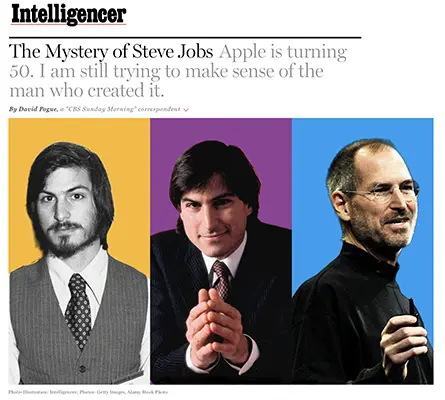
The Mystery of Steve Jobs
Intelligencer (New York Magazine) | April 1, 2026
TL;DR: As Apple marks its 50th year, a long-reported profile of Steve Jobs reveals that the company’s defining culture — its obsessiveness, secrecy, and insistence on excellence — was forged by a genuinely contradictory human being whose complexity resists easy narrative.
Executive Summary
David Pogue, drawing on interviews with roughly 150 people for his book on Apple’s first half-century, argues that Jobs remains fundamentally difficult to characterize — and that this very elusiveness is itself a signal. The man who built one of history’s most disciplined and consistent companies was personally inconsistent: volatile and tender, visionary and insecure, charismatic and privately fragile. The profile resists the familiar “genius jerk” reduction and instead presents a leader whose behavior shifted by era, by context, and sometimes by the hour.
What stands out for leaders studying Apple’s institutional durability is the mechanism, not the mythology. Jobs’s much-documented intensity — his willingness to override consensus, reject comfort, and demand the seemingly impossible — produced real outcomes: a last-minute software push for the original Mac, a six-month manufacturing pivot to glass screens for the iPhone. The “reality distortion field” was less a personality quirk than an operational tool, one that routinely compressed timelines and elevated output. Whether that model is replicable — or desirable — in other organizations is a separate question the article does not fully engage.
The piece also surfaces a Jobs rarely seen in popular accounts: someone capable of sustained personal loyalty and quiet generosity, alongside the cruelty. What this portrait ultimately suggests about Apple’s AI era is indirect but relevant: the company’s cultural coherence — its willingness to say no, to move slowly on features others rush, to absorb short-term criticism for long-term design integrity — traces to a founder who held those values with unusual conviction, not merely as strategy.
Relevance for Business
This is not a management how-to, and executives should not read it as one. Its business relevance is contextual: understanding Apple as an institution means understanding where its unusual discipline and consistency come from. For SMB leaders evaluating Apple as a platform partner — for devices, software, or AI tools — the portrait reinforces what the companion Fast Company piece establishes: Apple’s commitments tend to be structural and durable, not merely marketed. Jobs-era values around control, integration, and user experience are still embedded in how Apple makes product decisions, including on privacy and AI. That continuity is a relevant data point for vendor trust assessments.
The secondary implication is organizational: cultures built around a singular founder’s intensity are powerful and fragile simultaneously. Apple has navigated this unusually well under Tim Cook, but the profile is a reminder that institutional character — whether at Apple or at an SMB — rarely outlasts the values that were deliberately encoded in it.
Calls to Action
🔹 Read as context, not playbook. The Jobs model of leadership produced exceptional results at Apple; it is not a template for most organizations, and the article does not argue otherwise.
🔹 Pair with the Apple privacy summary when briefing internal teams on Apple as a long-term platform or AI partner — the two pieces together make a stronger case for Apple’s institutional reliability than either does alone.
🔹 Note for vendor evaluation: Apple’s cultural consistency — confirmed by those who knew Jobs and those who work there now — is a relevant input when assessing whether its privacy and AI commitments are likely to hold under competitive pressure.
🔹 Monitor: As Apple Intelligence and on-device AI features expand in 2026, watch whether Apple’s design discipline and privacy-first posture survive the pressure to ship AI features at the pace competitors are moving.
🔹 No immediate action required. This is historical and cultural context — useful for depth of understanding, not near-term operational decisions.
Summary by ReadAboutAI.com
https://nymag.com/intelligencer/article/searching-for-steve-jobs.html: April 7, 2026
Women aren’t opting out of work. Workplaces are pushing them out.
The Retention Problem Leaders Misread: Caregiving Strain, Not Fading Ambition, Is Pushing Mid-Career Women Out
Fast Company | March 28, 2026
TL;DR: New research identifies caregiving strain — not motivation loss — as the primary driver of mid-career women leaving the workforce, with direct implications for talent retention and leadership pipeline health.
Executive Summary
A 2025 national survey of 690 U.S. employees, conducted by researchers at the Center for Women in Business, challenges the persistent assumption that women disengage from leadership tracks due to declining ambition. The data points elsewhere: caregiving strain — the compounding cognitive, emotional, and logistical burden of managing dependents — was the strongest predictor of burnout and exit consideration, outperforming seniority level and stated career goals as a variable.
The structural squeeze is most acute in mid-level roles (managers, senior managers, directors). At this career stage, job visibility expectations intensify at the same time caregiving demands typically peak — children require more complex support, elder care enters the picture, and household coordination grows heavier. The survey found women carried a disproportionate share of long-term unpaid caregiving (83% vs. 72% for men), which compounds their exposure. Critically, the growing trend of mid-career women shifting toward entrepreneurship and self-employment is read here not as a retreat from ambition but as a reallocation of talent to structures that accommodate the reality of their lives. Organizations that interpret departure as disengagement are misreading the signal — and losing high performers as a result.
The business case is grounded in outcome data: companies with greater gender diversity across leadership show meaningfully higher financial performance and decision-making quality. Flexible arrangements — hybrid schedules, outcome-based performance measures, formal sponsorship — are presented not as perks but as structural workforce mechanisms.
Relevance for Business
For SMB leaders, this matters both as a talent risk and an execution risk. Mid-level roles are where institutional knowledge concentrates and future leaders develop. Losing experienced managers at this stage creates compounding costs — recruitment, onboarding, institutional memory loss, and pipeline gaps. SMBs often believe this is a large-company issue; it is not. Smaller organizations frequently have fewer formal flexibility mechanisms and less pipeline redundancy, making each mid-career departure more disruptive. The research also surfaces a governance question: are your performance and visibility expectations structurally compatible with a workforce that includes caregivers?
Calls to Action
🔹 Audit your mid-level attrition data — specifically whether women are leaving at higher rates than men at the manager-to-director stage, and whether exit interviews surface caregiving-related friction.
🔹 Evaluate whether your performance systems reward visible presence or measurable outcomes — and adjust where the two diverge.
🔹 Consider formal sponsorship structures (distinct from mentorship) that maintain advancement pathways for high performers navigating caregiving seasons.
🔹 Review flexibility policies: hybrid and remote arrangements are not a COVID holdover — they are now retention infrastructure, particularly for caregivers.
🔹 Treat caregiver support as a talent strategy, not an HR amenity — and communicate it that way internally and in recruiting.
Summary by ReadAboutAI.com
https://www.fastcompany.com/91515254/women-arent-opting-out-of-work: April 7, 2026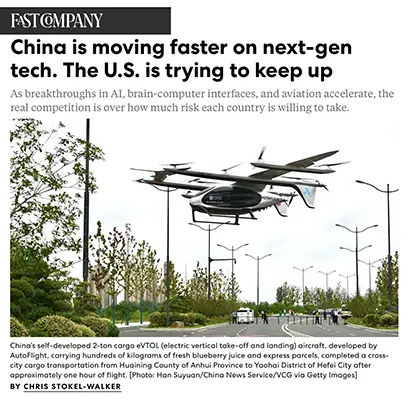
CHINA IS MOVING FASTER ON NEXT-GEN TECH. THE U.S. IS TRYING TO KEEP UP.
Fast Company | Chris Stokel-Walker | April 1, 2026
TL;DR: The U.S.-China technology race has moved from rhetoric to concrete milestones, with China demonstrating first-mover advantages in commercial brain-computer interfaces and electric aviation — and the real competition now is over regulatory risk tolerance, not just technical capability.
Executive Summary
This is a reported analysis piece, not a news brief, and it should be read as a framing document rather than a string of settled facts. Its core argument is credible and well-supported: the competitive gap between the U.S. and China in emerging technology is no longer a future concern but an active, multi-front race — with recent Chinese approvals of the world’s first commercial brain-computer interface device and a working five-ton electric air taxi as the headline examples.
The decisive variable is not raw innovation but regulatory velocity. China’s willingness to approve and deploy technologies before resolving downstream risks gives it a speed advantage that U.S. and European regulatory frameworks are structurally unable to match. Multiple independent experts quoted in the piece support this assessment, though they also note the tradeoffs: faster deployment creates geopolitical and safety risks, and heavy Western regulation has had the counterintuitive effect of protecting some domestic companies from Chinese market entry.
One underreported detail worth flagging: FDA staffing reductions have reportedly created an opening for Neuralink’s regulatory path, raising questions about whether deregulation in the U.S. is a deliberate competitive strategy or an unintended consequence of budget cuts. The article does not resolve this, and neither should leaders treat it as settled.
Relevance for Business
For SMB leaders, the strategic relevance is indirect but real. The standards that China sets in early deployment of AI, BCI, and aviation technologies will influence global norms — including what tools, platforms, and devices become available, at what cost, and under what governance frameworks. If China establishes commercial primacy in AI-adjacent hardware (sensors, chips, BCI interfaces), SMBs in affected industries may find their vendor options increasingly constrained or geopolitically complicated. Additionally, the regulatory divergence argument has direct implications for any SMB considering expansion into Asian markets or sourcing technology from Chinese vendors.
Calls to Action
🔹 Monitor developments in regulatory acceleration at U.S. agencies (FDA, FAA, FCC) — the pace of approvals will directly affect when emerging technologies become commercially viable for business use.
🔹 If your business operates in sectors adjacent to AI hardware, biotech, or aviation, assess your exposure to geopolitical supply chain risk from Chinese technology dominance.
🔹 Treat the BCI regulatory milestone as a directional signal — commercial brain-computer interfaces moving from research to approved products is a longer-term workforce and human-computer interaction issue worth tracking.
🔹 Note the regulatory tradeoff argument: faster deployment is not automatically an advantage; it can also create liability, safety, and interoperability risks for early adopters.
Summary by ReadAboutAI.com
https://www.fastcompany.com/91519208/china-is-moving-faster-on-next-gen-tech-the-u-s-is-trying-to-keep-up: April 7, 2026
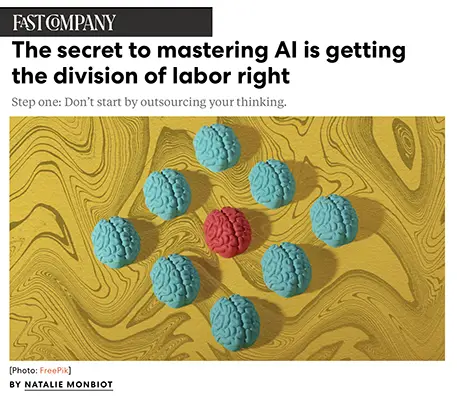
The secret to mastering AI is getting the division of labor right
You’re Probably Using AI Wrong — The Productivity Gain Requires Protecting Your Judgment, Not Outsourcing It
Fast Company | March 30, 2026
TL;DR: The greatest risk of AI adoption in knowledge work isn’t job loss — it’s the slow erosion of the judgment and strategic thinking that make people valuable in the first place.
Executive Summary
This opinion piece, written by a strategy and AI advisor, Natalie Monbiot, makes a pointed and underappreciated argument: the way most knowledge workers are using AI tools is backwards. The original promise of AI was that it would absorb operational burden — scheduling, formatting, summarizing, routine analysis — freeing human attention for higher-order thinking. Instead, the author argues, workers are using AI to skip the hardest cognitive work first, precisely because that work is most effortful. The result is what she calls “workslop”: output that looks polished and complete but is hollow, untethered from the judgment or context that gives it decision-making value.
The mechanism described is a gradual one: each act of outsourcing a decision to AI makes the next act slightly easier, and over time the pattern degrades not just output quality but the underlying capacity to think through complex problems. A cited study of 1.5 million AI interactions documented this arc — accept the answer, return, repeat, and eventually regret. The author invokes Adam Smith and Karl Marx on the division of labor to frame the stakes: in an industrial economy, workers could be alienated from the product but still sell their physical labor; in a knowledge economy, if you lose connection to the thinking, you lose the labor itself.
The proposed frame is “time to insight” as the true productivity metric in knowledge work — not how much output you produce, but how quickly and clearly you arrive at understanding that moves decisions forward. AI should be clearing operational drag so that cognitive work gets more of your time and sharper attention, not less.
Relevance for Business
This article carries a direct governance implication for SMB leaders: how AI is used inside your organization matters as much as whether it is used. If your team is using AI to draft memos, generate strategies, and produce reports without first forming their own positions, the outputs may look fine while the institutional capacity for sound judgment quietly erodes. This is especially relevant for smaller organizations where individual judgment is less diluted across large teams and where a few key decision-makers carry outsized influence. Leaders should also consider that “workslop” — AI-generated content with no real thinking behind it — is already circulating in most organizations at scale, and may be accumulating in places that affect customer trust, strategic direction, and operational decisions.
Calls to Action
🔹 Establish a practical internal norm: AI assists the work after the person has formed an initial position — not before. Prompt for reaction, critique, and iteration rather than generation from a blank slate.
🔹 Revisit how you evaluate team outputs — are you assessing the quality of thinking behind a deliverable, or just the quality of the deliverable itself? These are increasingly different things.
🔹 Share this framing with managers: “time to insight” is a more useful internal productivity measure than volume of output, and one that AI should improve, not replace.
🔹 Assess your own AI usage patterns honestly — if you are regularly accepting AI-generated answers without pushback, the pattern described here may already be at work.
🔹 Monitor for “workslop” indicators in team output: polished format with underdeveloped reasoning, generic recommendations, or answers that don’t reflect specific organizational context.
Summary by ReadAboutAI.com
https://www.fastcompany.com/91517728/ai-division-of-labor: April 7, 2026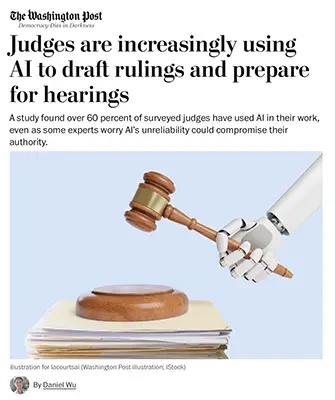
Judges Are Increasingly Using AI to Draft Rulings and Prepare for Hearings
The Washington Post | April 2, 2026
TL;DR: More than 60% of surveyed federal judges now use AI in their work — drafting rulings, analyzing filings, preparing hearing questions — raising both efficiency hopes and serious reliability concerns.
Executive Summary
A Northwestern University study of 112 federal judges found that a majority have used AI tools at least once in their judicial work, with roughly one in five using them daily or weekly. Applications range from case timeline generation and legal research to drafting initial versions of rulings after a judge has already reached a decision. Courts are formalizing this trend through vendor partnerships: Thomson Reuters and LexisNexis hold federal judiciary contracts, and startups like Learned Hand are running active pilots in multiple states.
The reliability risk is real and documented. A 2024 Stanford study found that even legal-specific AI tools from LexisNexis and Thomson Reuters produced errors in 17–33% of queries. Hallucinated citations have already appeared in filings from two federal judges, drawing Senate Judiciary Committee scrutiny. Vendors claim improvement since that study, but the data predates widespread judicial adoption.
The consensus framing from judges is that AI assists, not decides — a critical distinction that is currently self-policed rather than systematically governed.
Relevance for Business
For SMB executives, the implications are indirect but significant. If your business is involved in litigation, regulatory proceedings, or contract disputes, the documents you file may be analyzed — and rulings drafted — with AI assistance. The quality of AI-assisted review is uneven and tool-dependent. Meanwhile, legal vendors are locking in long-term contracts with courts, concentrating influence over judicial workflows in a small number of incumbents. This is also a leading indicator: if courts — among the most conservative institutions in the country — are adopting AI at this pace, the pressure on your own industry to do the same will only accelerate.
Calls to Action
🔹 If you retain outside counsel, ask specifically whether they have AI use policies for filings and legal research — and what verification protocols are in place.
🔹 Monitor legal AI vendor developments (LexisNexis, Thomson Reuters, Learned Hand) as potential tools for your own legal and compliance workflows.
🔹 Prepare for a legal landscape where AI-assisted decisions are the norm; factor reliability gaps into how you document and present your case in any dispute.
🔹 Assign someone to track judicial AI governance standards as they develop — court-adopted rules may eventually affect what opposing counsel can do with your filings.
Summary by ReadAboutAI.com
https://www.washingtonpost.com/nation/2026/04/02/judges-ai-hearings-rulings/: April 7, 2026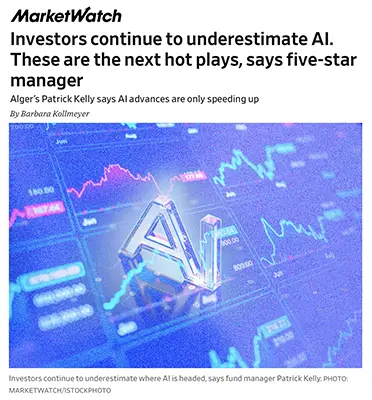
Investors Continue to Underestimate AI. These Are the Next Hot Plays, Says Five-Star Manager
MarketWatch / WSJ | April 1, 2026
TL;DR: A top-rated fund manager argues AI advancement is accelerating, not stalling, and identifies AI infrastructure — particularly data storage and cloud compute — as more durable investment territory than software names facing near-term disruption.
Executive Summary
Patrick Kelly, co-manager of the five-star Morningstar-rated Alger Focus Equity Fund, argues that despite a 9% fund decline this year driven by geopolitical pressure and market volatility, the underlying AI secular trend is intact and intensifying. His central thesis: agentic AI coding crossed a meaningful threshold in 2025, with developers now directing teams of agents to write code. Kelly frames this as a potential inflection toward exponential software innovation — though this remains a forward projection, not a demonstrated outcome.
His current positioning reflects a shift toward AI infrastructure over AI software applications. He highlights Western Digital (data storage) as a beneficiary of the AI-driven explosion in data volume, noting that nearly 90% of its revenue now comes from cloud customers. He also flags Nebius, an AI cloud provider, as a potential emerging hyperscaler. He has reduced exposure to independent power players — previously a favored theme — citing political headwinds around new data center construction.
Editorial note: This is an investor interview, not independent analysis. Kelly is framing a thesis that supports his fund’s existing positions. The claims about agentic AI acceleration are consistent with broader market signals, but the stock-specific recommendations reflect one manager’s portfolio positioning and should not be treated as independent investment guidance.
Relevance for Business
The strategic signal here is not about which stocks to buy — that’s outside ReadAboutAI.com’s scope — but about where sophisticated money is moving within the AI ecosystem. The shift from AI software applications toward AI infrastructure (compute, storage, energy) reflects a maturing view that the application layer is more contested and more disruption-prone than the infrastructure layer. For SMB leaders, this is a useful frame for thinking about vendor stability: companies building on infrastructure-layer AI positions may be more durable partners than those competing at the application layer where disruption is faster and margins are more contested. The agentic coding acceleration point is also operationally relevant — if AI is now routinely writing software, the speed of new software product development and the cost structure of software-intensive businesses are both changing faster than most SMB planning horizons account for.
Calls to Action
🔹 Monitor the distinction between AI infrastructure vendors and AI application vendors in your own software stack — infrastructure players may represent more stable long-term dependencies.
🔹 Take the agentic coding acceleration seriously as a planning variable: software that would have taken six months to build may now take weeks, changing competitive dynamics in software-adjacent industries.
🔹 Do not make investment decisions based on fund manager interviews — treat this as a directional market signal, not a stock recommendation.
🔹 Watch how political dynamics around data center construction evolve; energy and infrastructure constraints on AI scaling have real implications for AI service availability and pricing.
🔹 Revisit AI-related vendor contracts annually — the competitive landscape at the application layer is moving fast enough that multi-year lock-ins carry meaningful switching cost risk.
Summary by ReadAboutAI.com
https://www.wsj.com/wsjplus/dashboard/articles/investors-continue-to-underestimate-ai-these-are-the-next-hot-plays-says-five-star-manager-23173f22: April 7, 2026
The Iran War Has Created an Unexpected AI Infrastructure Crisis: Helium
The Wall Street Journal | March 30, 2026
TL;DR: Iranian strikes on Qatar’s LNG facilities have disrupted roughly a third of global helium supply — an invisible but non-substitutable input in semiconductor manufacturing — creating supply cuts, surcharges, and price spikes with cascading consequences for AI infrastructure buildout.
Executive Summary
Helium is not a glamorous input, but it is a critical one. Chip manufacturers use it to maintain stable, controlled temperatures while etching silicon wafers into advanced semiconductors. It is also essential for MRI scanners, fiber-optic manufacturing, aerospace applications, and defense production. Qatar supplies approximately one-third of global helium, exporting virtually all of it through the Strait of Hormuz. Iranian strikes on Qatar’s Ras Laffan LNG plant in March 2026 caused damage that the Qatari government estimates will take up to five years to fully repair, immediately cutting annual helium exports by 14%.
The market response has been swift. Spot prices have more than doubled. Major industrial gas supplier Airgas has declared force majeure, limiting deliveries to some customers at roughly half their contracted volumes while adding surcharges. South Korea — which sourced approximately two-thirds of its helium from Qatar and is home to major semiconductor manufacturers — is already seeking alternative supply from U.S. producers. Taiwan faces similar exposure. Helium’s physical properties compound the problem: as a supercooled liquid, it has a shelf life of roughly 35–48 days before boiling off from its specialized containers, meaning stockpiles cannot simply be accumulated and held indefinitely.
Substitution is not readily available for most semiconductor and medical applications. The U.S. is the world’s largest helium producer and is somewhat insulated in the near term, but a prolonged Qatari outage would pressure U.S. markets as global demand redirects. Industry analysts characterize this as a systemic vulnerability in the AI infrastructure buildout — one reflecting the broader pattern of geopolitical concentration risk across the AI supply chain.
Relevance for Business
The direct operational impact on most SMBs is minimal and indirect: chip manufacturers bear the immediate burden, and their pain propagates over time through availability constraints and cost pressure on the hardware that underlies cloud and enterprise AI services. The more important signal for business leaders is strategic: the AI infrastructure buildout that most organizations are now depending on rests on a supply chain with multiple geopolitically fragile chokepoints — rare earth minerals, advanced chip manufacturing concentrated in Taiwan, and now helium sourced heavily from Qatar. Each of these represents a potential disruption vector for AI service availability and cost, and the Iran conflict has made one of them visible in real time. SMBs considering significant AI infrastructure commitments or multi-year cloud contracts should treat supply chain fragility as a pricing and availability risk, not a background condition.
Calls to Action
🔹 No immediate operational action is needed for most SMBs — the chip shortage impact, if it materializes, will propagate through hardware availability and cloud pricing over months, not days.
🔹 If your organization has significant hardware procurement planned (servers, workstations, specialized AI computing), discuss potential timeline risk with your vendors in the next 30–60 days.
🔹 Use this event as a forcing function to assess your AI infrastructure dependency map: which services would be disrupted, at what cost, and for how long if cloud AI capacity becomes constrained or significantly more expensive?
🔹 Monitor the Strait of Hormuz situation and Qatari LNG export recovery as leading indicators for semiconductor supply pressure over the next 6–12 months.
🔹 Recognize this as a case study in geopolitical supply chain risk for AI — and factor similar vulnerabilities into any long-horizon AI investment or vendor dependency planning.
Summary by ReadAboutAI.com
https://www.wsj.com/world/iran-war-chokes-off-helium-supply-critical-for-ai-bf020a3f: April 7, 2026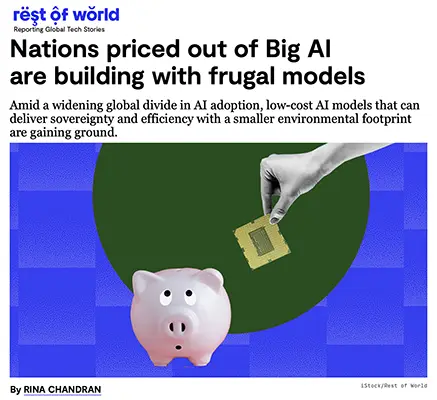
Nations priced out of Big AI are building with frugal models
Rest of World | Rina Chandran | April 2, 2026
TL;DR: A growing movement of smaller, low-cost AI models built on open-weight systems is emerging in response to the unaffordability of Big Tech AI — offering an alternative path that prioritizes local data control, offline deployment, and sustainability over raw performance.
Executive Summary
While U.S. and Chinese firms dominate AI infrastructure — controlling over 90% of the world’s AI data centers — researchers and startups in India, Indonesia, and elsewhere are developing “frugal AI”: smaller models trained on specific data for specific uses, running on low-cost or offline hardware. The approach is cost-efficient, has a meaningfully lower energy and water footprint, and — critically — keeps data within local control rather than routing it through foreign cloud systems.
The launch of China’s DeepSeek gave this movement significant momentum by demonstrating that high-performing open-weight models are possible without frontier-scale compute. DeepSeek and similar open-source models have since become a foundation for developers globally. A Cambridge University initiative, the Frugal AI Hub, is formalizing the approach and expanding to India, Kenya, and Nigeria.
The key trade-off is performance. Frugal models carry real accuracy limitations relative to frontier systems. The practical question — which the article’s researchers argue is underappreciated — is how many real-world tasks actually require frontier-level capability. The answer, they suggest, is far fewer than organizations assume. A related development, FrugalGPT, offers an algorithmic framework for automatically selecting the most cost-effective model for a given task, reducing cost while maintaining acceptable accuracy.
Relevance for Business
This story has direct relevance for SMB leaders in two ways. First, cost structure. Many SMBs default to frontier models (OpenAI, Anthropic, Google) without evaluating whether smaller, task-specific, or open-weight alternatives would deliver adequate results at a fraction of the cost. The frugal AI framework — choosing the minimum capable model for a given task — is a sound procurement discipline, not just a developing-world workaround.
Second, vendor dependence. The article raises the question of whether reliance on a small number of large AI providers is structurally similar to dependence on a foreign energy supply. For SMBs with data sensitivity, regulatory requirements, or cost pressures, the availability of capable open-weight models that run locally is a meaningful risk-mitigation option worth evaluating.
Calls to Action
🔹 Audit your current AI spending against task requirements. Not every workflow requires a frontier model. Identify which use cases could be handled adequately by smaller, cheaper, or open-weight alternatives.
🔹 Evaluate open-weight models (Mistral, LLaMA-based, DeepSeek-derived) for internal, non-customer-facing workflows where cost efficiency and data control matter more than peak performance.
🔹 Do not dismiss performance trade-offs. Frugal models have real accuracy gaps. Test carefully before deploying in customer-facing or high-stakes decision contexts.
🔹 Monitor the FrugalGPT concept. Automated model selection based on cost and accuracy thresholds could become a standard procurement tool for multi-model AI environments within 12–24 months.
🔹 Add data sovereignty to your AI vendor evaluation criteria. Know where your data goes, who controls it, and what alternatives exist if pricing or terms change.
Summary by ReadAboutAI.com
https://restofworld.org/2026/frugal-ai-big-tech/: April 7, 2026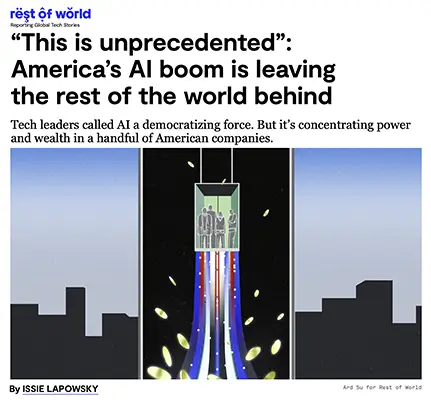
Editorial note: The Rest of World pieces on global AI concentration (America’s AI boom leaving the world behind) and frugal AI models are companion articles covering opposite sides of the same divide. They are summarized separately above (Summaries 7 and 9 respectively). The “America’s AI boom” article is the macro frame; “Frugal AI” covers the grassroots response. Together they form a complete picture of the global AI stratification story.
THE GLOBAL AI GAP IS NO LONGER CLOSING — IT’S WIDENING
Rest of World | Issie Lapowsky | April 1, 2026
TL;DR: Data now confirms what AI optimists denied: rather than democratizing opportunity, the AI era is concentrating capital, infrastructure, and foundational model control in a small number of U.S. companies — with consequences that will shape competitive dynamics for decades.
Executive Summary
In 2021, venture-backed companies outside the U.S. raised over $300 billion — a peak that briefly suggested global tech was reaching parity. By 2025, U.S.-based startups captured 64% of all global VC funding, and American AI firms alone attracted 75% of all global AI investment ($194 billion out of roughly $260 billion total). The top 10 global AI investors made 1,261 investments in U.S. AI companies in 2025 — and just 271 everywhere else combined.
The structural reason is infrastructure. Frontier AI requires massive, capital-intensive data centers stacked with scarce, expensive chips. The U.S. dominates this physical layer: U.S. and Chinese companies together operate more than 90% of the world’s AI computing capacity. Africa has almost none. India, despite a government-backed AI agenda and a $1B+ program, is already seeing promising AI startups fold — including Y Combinator-backed companies — from funding constraints, difficulty attracting talent, and the impossible task of competing with U.S. firms that can sustain years of losses while investors queue up.
The article gives balanced treatment to the counterargument: that adoption matters more than startup formation, and that countries don’t need to build frontier models to benefit from AI — just as not every nation manufactures its own weapons to maintain defense capability. But it closes with the structural concern embedded in that analogy: throughout history, it’s the countries with the biggest arsenals that tend to set the terms. Whoever controls foundational AI infrastructure will function as kingmaker for the industries and economies that depend on it.
Relevance for Business
For SMB leaders, three practical signals emerge from this macro story:
First, vendor concentration risk is not just a geopolitical concern — it’s a business continuity issue. If the foundational models your operations depend on are controlled by two or three American firms, your exposure to their pricing decisions, API changes, and strategic pivots is direct. This is worth building into your AI vendor strategy now.
Second, the global talent and innovation pipeline is more constrained than AI optimism suggests. If the AI ecosystem concentrates in the U.S., competition for the best AI talent, the most capable vendors, and the most effective tools will intensify — raising costs and extending implementation timelines for SMBs that haven’t moved yet.
Third, early AI adoption is itself a competitive advantage — not just future-proofing. The article’s most practical insight is that the AI era may ultimately reward countries — and by extension, organizations — that adopt quickly, not just those that build expensively. SMBs that are deploying and learning from AI tools now are accumulating institutional capability that latecomers will struggle to replicate quickly.
Calls to Action
🔹 Map your AI vendor dependencies. Which foundational models, APIs, or platforms are essential to your operations? What is your exposure if a key vendor changes pricing, terms, or access?
🔹 Prioritize adoption over analysis paralysis. The gap between AI-integrated businesses and non-integrated ones is widening faster than the technology is maturing. Moving cautiously is rational; moving slowly is a growing risk.
🔹 Diversify your AI vendor base where feasible. Don’t concentrate critical workflows on a single model provider. Evaluate whether open-weight or alternative models can serve some functions, reducing exposure.
🔹 Watch the India AI ecosystem as a leading indicator. If even India — with its scale, talent base, and government support — is struggling to build competitive AI companies, the global competitive landscape is more locked-in than AI optimists suggest. Plan your AI strategy accordingly.
🔹 Assess whether your international operations or supply chains face AI-access disparities. Partners or vendors in regions with limited AI infrastructure may face widening capability gaps that affect service quality, cost, or reliability over time.
Summary by ReadAboutAI.com
https://restofworld.org/2026/us-ai-investment-global-funding-gap/: April 7, 2026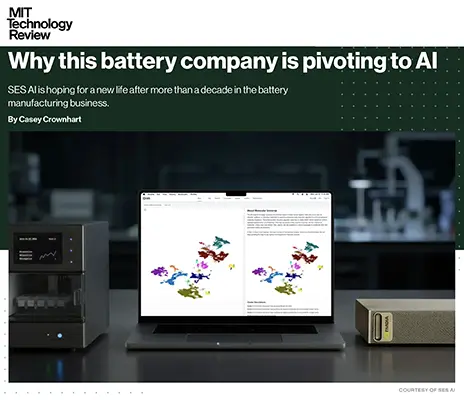
Why This Battery Company Is Pivoting to AI
MIT Technology Review | Casey Crownhart | March 25, 2026
TL;DR: SES AI, a US battery startup, is abandoning large-scale battery manufacturing and pivoting to an AI-powered materials discovery platform — a telling indicator of how policy shifts and Chinese competition are reshaping the domestic battery industry.
Executive Summary
SES AI (formerly Solid Energy), founded out of MIT research, has effectively exited the business of making batteries at scale. After a decade of development targeting EV markets and partnerships with GM, Hyundai, and Honda, the company has narrowed its battery production to low-volume markets like drones and is repositioning around an AI-driven materials discovery platform called Molecular Universe. The platform aims to identify new battery compounds — either for licensing or direct sale to other manufacturers.
The business logic is defensive: Chinese manufacturers have made Western battery production economically unviable at scale, and the removal of US EV tax credits in late 2025 eliminated a key demand driver. The AI pivot allows SES to monetize its proprietary data and domain expertise without the capital intensity of manufacturing.
The skepticism in the article deserves weight. An independent energy storage investor quoted in the piece questions whether new materials discovery is actually what the battery industry needs right now — suggesting the pivot may be better understood as survival strategy than breakthrough repositioning. The platform has identified six new electrolyte materials, but commercial validation is unconfirmed.
Relevance for Business
This story carries two signals for SMB leaders. First, it illustrates how AI is being used as a pivot mechanism in struggling industries — converting accumulated operational data and domain expertise into a software/licensing business. Leaders in data-rich but margin-pressured sectors should note this model. Second, it highlights supply chain exposure: the fragility of Western battery manufacturing has direct implications for any business dependent on battery-powered products, from EVs to industrial equipment to energy storage systems. The geopolitics of battery supply are shifting, and procurement strategies should account for it.
Calls to Action
🔹 If your business depends on battery supply chains, assess your exposure to continued Western manufacturer consolidation and pricing volatility.
🔹 Watch whether AI materials discovery platforms (like SES’s Molecular Universe) attract serious commercial adoption — the model is interesting but unproven at scale.
🔹 Note the “data-to-software” pivot pattern: if your organization holds proprietary operational data, evaluate whether AI tooling could enable a similar repositioning.
🔹 Monitor US policy developments around energy storage and battery incentives — the removal of EV tax credits is one data point in a still-evolving policy environment.
Summary by ReadAboutAI.com
https://www.technologyreview.com/2026/03/25/1134657/battery-company-ai-pivot-ses/: April 7, 2026
Nvidia’s $2 Billion Bet on Marvell Is About Locking In the Next Layer of AI Infrastructure
The Wall Street Journal | Adam Clark | March 31, 2026
TL;DR: Nvidia’s equity investment in Marvell — structured around a silicon photonics partnership — signals that the AI chip race is expanding beyond GPUs into the data interconnects and custom silicon that will determine who controls the next generation of AI infrastructure.
Executive Summary
Nvidia has taken a $2 billion equity stake in Marvell Technology as part of a partnership centered on silicon photonics — a technology that uses light rather than electrical signals to move data between chips and across data centers. Under the arrangement, Marvell will develop custom semiconductor solutions while Nvidia provides the surrounding data center architecture and AI ecosystem support. The strategic logic is infrastructure lock-in: by embedding Marvell’s custom chips within Nvidia’s broader AI platform, both companies gain a tighter grip on the infrastructure decisions of large cloud and enterprise customers.
This is a brief, breaking-news report with limited analytical depth. The core signal is the direction, not the detail: Nvidia is not content to dominate GPU compute; it is actively extending its ecosystem control into the layers of hardware — photonics, custom ASICs, data center architecture — that surround the GPU and determine overall system performance. This pattern of adjacent infrastructure investment has historically been how dominant platforms entrench themselves against competitive erosion.
Relevance for Business
For most SMBs, this deal has no immediate operational consequence. Its relevance is structural and medium-term: the AI infrastructure stack is consolidating rapidly around a small number of large incumbents, with Nvidia positioned to influence not just chip supply but the architectural choices that cloud providers and enterprises make downstream. SMBs that depend on cloud AI services — which is most of them — are increasingly dependent on infrastructure decisions made by vendors who are themselves deeply entangled with Nvidia’s ecosystem. Vendor concentration risk is growing, not shrinking, in AI infrastructure.
Calls to Action
🔹 No immediate action required for most SMBs — file this as strategic context about where infrastructure power is concentrating.
🔹 If your business is evaluating significant AI infrastructure investment or multi-year cloud contracts, factor in the accelerating Nvidia ecosystem dominance when assessing vendor lock-in risk.
🔹 Monitor whether Nvidia’s deepening infrastructure control translates into pricing leverage for cloud AI services over the next 12–24 months.
🔹 Note silicon photonics as a technology to watch — it addresses real bottlenecks in data center performance and may become commercially significant within the AI infrastructure buildout over the next few years.
Summary by ReadAboutAI.com
https://www.wsj.com/tech/nvidia-invests-2-billion-in-marvell-as-part-of-chip-partnership-ca2fa613: April 7, 2026
Red Empire, Organic Bow Hybrid AI Animated ‘Home Away AI.i.Ce’
Variety | Faye Bradley | March 18, 2026
TL;DR: A short-form animated sci-fi series debuted at Hong Kong FilMart using a hybrid production pipeline that integrates AI tools with live human performance — a production model worth noting, though the announcement is thin on specifics.
Executive Summary
Red Empire Productions and Organic Media Group unveiled a 12-episode vertical animated series at Hong Kong FilMart. The production used AI tools alongside traditional animation and live actor capture — positioning itself explicitly as a human-preserving rather than human-replacing use of AI. The creative team’s stated approach: use AI to extend what human performers can do, not to substitute for them.
This is a brief trade announcement, not a production case study. Details about which AI tools were used, what the pipeline actually entailed, and how costs compared to traditional animation are not provided. The “hybrid AI animation” framing is increasingly common in entertainment press releases and should not be taken as a technical claim without further evidence.
The relevance is contextual: AI-assisted content production is now a mainstream announcement posture in entertainment, including in international co-production markets. The Hong Kong FilMart venue signals cross-Pacific distribution ambitions.
Relevance for Business
For SMBs in marketing, media, training, or branded content, the signal here is industry-level: AI-assisted video production is becoming normalized, and the cost and speed advantages are beginning to show up in competitive content markets. Companies that produce significant volumes of video content — for training, marketing, or communications — should be evaluating whether AI-assisted production tools can reduce cost or turnaround time. The “human in the loop” framing from this project also offers a useful communications model for organizations navigating internal resistance to AI adoption.
Calls to Action
🔹 If your organization produces regular video content, investigate AI-assisted production tools — this is a cost and speed opportunity now, not a future consideration.
🔹 Monitor how AI animation and video tools evolve in the next 12 months; the gap between enterprise and consumer-grade tools is narrowing quickly.
🔹 Note the “AI augments, not replaces” framing as a useful internal communications approach for AI adoption initiatives.
🔹 Deprioritize this specific announcement — it is thin on verifiable detail — but treat it as one more data point in the normalization of AI-assisted content production.
Summary by ReadAboutAI.com
https://variety.com/2026/digital/news/red-empire-organic-ai-home-away-ai-i-ce-1236692119/: April 7, 2026
Buying the Dip? This AI Agent Will Do It for You
The Wall Street Journal | Hannah Erin Lang | March 31, 2026
TL;DR: Brokerage platform Public is launching AI agents that can autonomously execute pre-approved investment strategies — marking a visible step toward AI-managed retail investing, with compliance guardrails still in early form.
Executive Summary
Public, a retail brokerage competing with Robinhood and Webull, is rolling out AI agents that execute trades based on user-defined rules — covering tactics like stop-loss orders, cash sweeps into higher-yield assets, and options hedges. The system is rules-based: users define the strategy, review a workflow, and approve it before activation. The agent logs every action and cannot deviate from its instructions.
The company frames this as a fundamental shift in personal portfolio management. That framing deserves scrutiny. The capability itself — automated rule-based trading — is not new; it’s been available through algorithmic tools and robo-advisors for years. What’s different is the natural language interface lowering the barrier for non-technical retail investors to configure complex strategies. Public’s claim that there are “no hallucinations” reflects the rule-bound architecture, but oversight of whether the agent executed correctly — not just whether it executed — remains the user’s responsibility.
Competitive context: Robinhood and eToro have released similar features, suggesting this is becoming a table-stakes capability for retail platforms, not a differentiator for long.
Relevance for Business
For SMB executives who invest personally or manage company treasury accounts, this signals a near-term shift in how retail financial tools present themselves. More immediately, it raises a governance question: as AI-executed trading becomes normalized on consumer platforms, firms may face pressure from employees or partners using similar logic to manage company funds — without appropriate controls. The deeper signal is that agentic AI executing real-world financial transactions is arriving in consumer products ahead of regulatory frameworks catching up.
Calls to Action
🔹 If you use retail brokerage platforms personally, evaluate whether you understand the full audit trail before enabling any automated execution feature.
🔹 Monitor how regulators respond to AI-executed retail trading — policy guidance is likely within 12–18 months.
🔹 If your firm manages investment accounts, review whether your investment policy statement addresses AI-agent execution.
🔹 Treat vendor claims of “no hallucinations” with appropriate caution — rules-based architectures reduce but don’t eliminate execution risk.
🔹 Watch whether larger institutions (Fidelity, Schwab) accelerate their own agentic rollouts in response.
Summary by ReadAboutAI.com
https://www.wsj.com/tech/ai/buying-the-dip-this-ai-agent-will-do-it-for-you-1d2b1658: April 7, 2026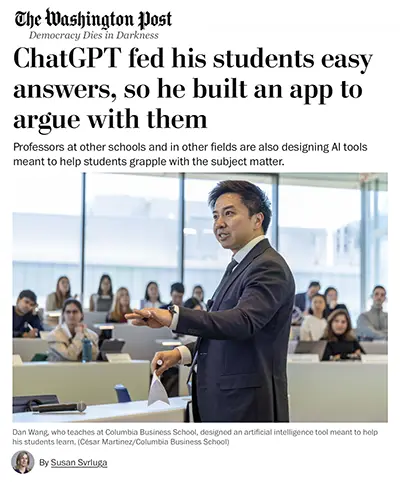
FIGHTING AI SHORTCUTS IN EDUCATION: FACULTY-DESIGNED TOOLS THAT MAKE STUDENTS THINK
The Washington Post | Susan Svrluga | April 1, 2026
TL;DR: A growing number of professors are building custom AI tools that deliberately resist giving students answers — using AI to deepen critical thinking rather than bypass it, with early results that challenge the dominant narrative that AI undermines learning.
Executive Summary
When ChatGPT began producing homework summaries for his Columbia Business School students in 2022, professor Dan Wang didn’t ban AI — he built a better one. His app, Caisey, functions as a Socratic sparring partner: students argue a position, the AI pushes back with counterarguments, and the session ends with coaching on how to strengthen the original case. The professor receives a transcript and a class-wide view of the positions taken. Thousands of students at 16 institutions — including Wharton, Berkeley, and UVA Darden — now use it.
The pattern is repeating across disciplines. At Georgia Tech, a faculty-designed AI tutors electrical engineering students through difficult homework problems without handing them answers, available 24/7. At Arizona State, similar tools support health sciences, language learning, and biology. The design principle is consistent: these tools use AI to slow students down, not speed them up. A Brookings Institution review of the research found that thoughtfully designed AI tools with guardrails can deliver meaningful learning gains — a finding that meaningfully complicates the “AI is making students dumber” narrative.
The contrast with commercial AI is the central insight. A UVA class saw roughly two-thirds of students submit the same wrong answer — the one ChatGPT gave. Faculty-built tools avoid this by embedding course-specific expertise, guardrails against direct answer-giving, and feedback loops that reveal patterns in student understanding.
Relevance for Business
This development matters to SMB leaders in two ways. First, it is a direct signal about workforce readiness. If AI tools are systematically shortcutting the development of critical thinking, argumentation, and problem-solving in the students entering the workforce, leaders will need to compensate through structured training and internal development programs. Hiring for demonstrated reasoning ability — not just AI fluency — becomes more important, not less.
Second, the design principle here is directly transferable to the workplace. The most effective employee-facing AI tools may not be the ones that eliminate the most friction — they may be the ones that preserve productive friction in judgment-intensive work: proposal review, client advisory, strategic analysis. Leaders deploying AI internally should ask whether their tools are building capability or quietly eroding it.
Calls to Action
🔹 Factor workforce skill degradation risk into your hiring and training strategy. If students are arriving with less-developed critical thinking due to commercial AI shortcutting, internal development programs will need to compensate.
🔹 Evaluate your internal AI tools against a capability question, not just an efficiency question. Are they making your team more capable over time, or creating dependency and atrophy?
🔹 Explore faculty-designed or task-specific AI tools for training and onboarding contexts where reasoning development matters more than speed.
🔹 Monitor institutional adoption of tools like Caisey. If your industry recruits from business schools using these tools, the skill profile of graduates may shift meaningfully over the next 2–3 years.
🔹 Consider the design principle internally. For junior employees especially, AI tools that coach toward answers rather than deliver them may build more durable human capital over time.
Summary by ReadAboutAI.com
https://www.washingtonpost.com/education/2026/04/01/professors-design-ai-apps/: April 7, 2026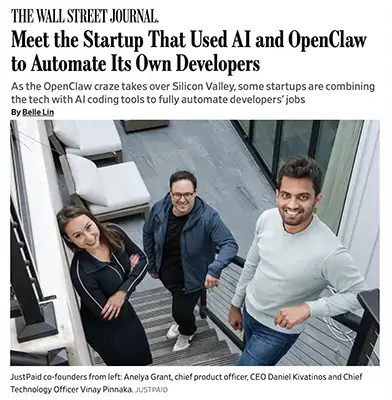
A Startup Just Replaced Most of Its Engineering Team with AI Agents — and the Economics Already Work
The Wall Street Journal | March 31, 2026
TL;DR: A nine-person fintech startup has deployed a seven-agent AI engineering team using OpenClaw and Claude Code that built 10 major features in one month — compressing what would have been months of human developer work — and the cost-per-output math already favors AI even at current prices.
Executive Summary
JustPaid, a Mountain View-based fintech with nine employees, has operationalized what many organizations are still theorizing about: a near-autonomous AI software development team. Its CTO combined OpenClaw — an open-source agent orchestration platform — with Anthropic’s Claude Code to create a coordinated team of seven AI agents, each with a distinct role (coding, review, quality assurance). In one month, those agents built 10 major product features, each of which would have taken a human developer a month or more to complete. A newly hired human developer was trained almost entirely by the AI agents. Human engineers are now focused on customer-facing and judgment-intensive work.
The economics are instructive: initial AI compute costs ran to approximately $4,000 per week before optimization; after adjusting model selection and task structure, costs dropped to $10,000–$15,000 per month — still material but competitive with a single mid-level software engineer in a high-cost market. The CTO’s assessment is direct: even at equivalent cost, AI wins on throughput and scale.
The article appropriately surfaces the risks. OpenClaw requires access to all of a user’s data and systems to function as intended — a significant security surface. Unconstrained agents can modify or delete files. One startup profiled runs its OpenClaw experiments in a completely isolated environment with no access to production data. Gartner’s AI analyst notes that large enterprises still consider full agentic deployment too risky, and that token costs — the basic unit of AI text processing — can escalate rapidly when running multi-agent systems in the background. The pattern being established in early-adopter startups, however, is moving faster than enterprise risk tolerance, and the direction of travel is clear.
Relevance for Business
This is one of the clearest near-term signals yet that AI is not merely assisting software development — it is beginning to replace significant portions of it at the team level, not just the task level. For SMB leaders, the implications span hiring, cost structure, and competitive dynamics. Organizations that depend on software development — whether in-house teams or outsourced vendors — should be planning for a meaningful compression in the human labor required per unit of software output. The window in which software development headcount and cost structures remain stable is narrowing. At the same time, the security and governance risks of agentic AI systems are real: systems that can autonomously access, write, and modify code and files require oversight infrastructure that most organizations have not yet built.
Calls to Action
🔹 If you have an in-house development team, assign someone to evaluate Claude Code, OpenClaw, or comparable agentic coding tools within the next 60 days — not for immediate deployment, but to develop a grounded view of what is actually possible now versus what requires further maturation.
🔹 If you outsource software development, raise the topic of AI-assisted development with your vendors and ask how they are incorporating these tools — and whether their pricing reflects the productivity gains.
🔹 Do not deploy agentic AI systems with access to production data or critical business systems without explicit security review and containment protocols; the data access requirements create meaningful risk.
🔹 Begin developing a policy framework for agentic AI oversight now — the governance gap between capability and control is growing, and organizations that wait for a security incident to motivate policy are taking on avoidable risk.
🔹 Revisit your software development cost assumptions in your next planning cycle; the JustPaid model may not translate directly to your context, but the cost-per-feature trend it illustrates is real and accelerating.
Summary by ReadAboutAI.com
https://www.wsj.com/tech/ai/meet-the-startup-that-used-ai-and-openclaw-to-automate-its-own-developers-9e733351: April 7, 2026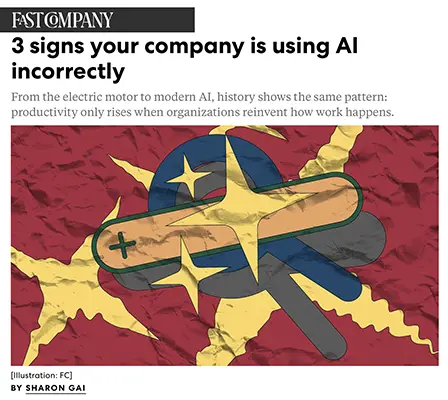
3 Signs Your Company Is Using AI Incorrectly
Fast Company | April 1, 2026
TL;DR: AI adoption without workflow redesign is producing the same productivity paradox that PC adoption created in the 1980s — activity metrics mask the absence of real results.
Executive Summary
The article’s central argument is historically grounded and directionally sound: organizations that layer new technology onto unchanged processes consistently fail to realize productivity gains. The author identifies three specific failure modes playing out widely right now. First, measuring adoption instead of outcomes — tracking logins and prompts rather than whether decisions are faster, bottlenecks are eliminated, or new work is possible. Second, automating tasks without redesigning roles — giving employees AI tools that handle their former tasks, then leaving them to supervise AI output without redefining what their actual contribution should now be. Third, outsourcing thinking before thinking — using AI as a first-response oracle rather than a pressure-tester of independent analysis, which quietly erodes judgment quality over time.
The electric motor analogy is apt: factories that replaced steam engines with a single large electric motor saw no productivity gains. Gains only materialized when smaller motors were distributed to individual machines and the entire factory floor was reorganized around the new capability. The author argues AI requires the same fundamental redesign — not of tools, but of work itself.
Editorial note: This is an opinion piece by an AI strategist with a consulting practice and a book to sell. The core framework is sound and well-evidenced by historical analogy, but the prescriptive sections are advisory rather than empirically validated.
Relevance for Business
For SMBs specifically, this is a high-priority operational check. The temptation to measure AI success by license utilization or prompt volume is real and common — and it produces false confidence. The key risk is not that AI fails to perform; it’s that AI performs tasks while the business fails to change. The “outsourcing thinking” problem is particularly acute for smaller teams where judgment capacity is concentrated in a few people.
Calls to Action
🔹 Audit your current AI success metrics — if they measure activity rather than outcomes, replace them immediately with workflow-level measures (speed, quality, cost, or new capability).
🔹 For any AI tool currently in use, identify what the responsible employee is now doing with the time saved — if the answer is unclear, the role has not been redesigned.
🔹 Establish a team norm that requires independent analysis before AI consultation on consequential decisions.
🔹 Pick one workflow to redesign end-to-end with AI, rather than adding AI to multiple workflows without structural change.
🔹 Revisit AI vendor ROI claims through the lens of workflow redesign, not feature capability.
Summary by ReadAboutAI.com
https://www.fastcompany.com/91514751/3-signs-your-company-is-using-ai-incorrectly: April 7, 2026
Quantum simulations verified by experiments for the first time
A Quiet Milestone in Quantum Computing: Simulations Verified Against Real-World Data for the First Time
Nature | March 30, 2026
TL;DR: Two independent research teams have for the first time validated quantum computer simulations against physical experimental data — a methodological milestone that brings quantum computing’s practical potential for materials science closer to credible, though full commercial relevance remains years away.
Executive Summary
Quantum computers have long promised to outperform classical supercomputers on tasks such as modeling complex chemical interactions — advances that could accelerate drug discovery, materials engineering, and battery design. A significant barrier has been trust: without verification against real-world data, it was impossible to know whether quantum simulations were producing accurate results or simply artifacts of the machines’ high error rates.
Two independent teams — one using a Pasqal neutral-atom quantum computer, one using an IBM superconducting system — have now, for the first time, matched their quantum simulations against experimental measurements of actual physical materials. Both materials studied had complex, hard-to-model quantum behaviors that made them useful test cases. The results aligned, establishing a validation methodology rather than solving any specific applied problem. This is a foundational capability milestone, not a product launch. The work is described in preprints not yet peer-reviewed, which is standard practice in physics but means independent confirmation is still pending.
The significance is methodological: researchers now have a reproducible framework for checking whether a quantum simulation is trustworthy. This moves the field from “quantum computers might be able to do this someday” to “we can now begin to systematically test what quantum computers can and cannot reliably model.” The pathway from this verification capability to commercially useful quantum computing — in pharmaceuticals, energy storage, or advanced manufacturing — remains long and technically uncertain.
Relevance for Business
For most SMBs, this development is not operationally relevant today. Quantum computing remains a technology to monitor, not deploy. However, for leaders in sectors where materials science, drug development, or specialty chemistry are competitive factors — including manufacturing, life sciences, energy, and advanced logistics — this milestone is worth tracking. It represents the early-stage hardening of quantum computing’s credibility as a research tool, which has downstream implications for R&D timelines and technology partnerships in those industries. The more immediate signal: IBM and Pasqal are both building toward verifiable quantum simulation as a commercial offering, and the organizations that understand this trajectory early will be better positioned when practical applications become available.
Calls to Action
🔹 Unless your business operates in materials science, life sciences, specialty chemicals, or advanced manufacturing, no action is required — file this as a technology-to-watch.
🔹 If you are in a relevant sector, assign someone to begin tracking quantum computing developments as part of your technology horizon scanning — not as an investment decision, but as competitive intelligence.
🔹 Note the source quality: this is a Nature news article covering pre-print research. Wait for peer review before drawing strong conclusions about the durability of these findings.
🔹 Distinguish between this milestone (a verification methodology) and a practical application — avoid vendor claims that overstate readiness based on news like this.
Summary by ReadAboutAI.com
https://www.nature.com/articles/d41586-026-00959-1: April 7, 2026
How AI Caught a Malicious North Korean Insider at Exabeam
TechTarget / SearchSecurity | March 30, 2026
TL;DR: A North Korean operative who passed standard background checks and a video interview was exposed on his first day at cybersecurity firm Exabeam — not by HR or IT, but by an agentic AI that correlated scattered behavioral signals into a threat conclusion in seconds.
Executive Summary
In summer 2025, a North Korean operative used a stolen identity, forged documents, and AI-assisted interview tools to pass Exabeam’s full hiring process and gain access to its corporate network. He was flagged on day one — not by standard controls, but when a threat intelligence feed matched his username to known DPRK activity. What followed illustrates why AI-native security is becoming a practical necessity, not a premium feature.
Exabeam’s agentic AI platform, Nova, autonomously gathered the new hire’s scattered behavioral data — suspicious downloads, VPN attempts, unauthorized software installs — and evaluated it in the context of his role and new-hire status. Acting individually, each alert would have been dismissed as noise. Aggregated and contextualized by AI, they resolved into a clear threat conclusion in seconds. A human-led investigation would have taken three to four hours. The security team then monitored the operative for five hours, observing data exfiltration attempts before terminating access and referring indicators of compromise to the FBI, which subsequently shut down a related laptop farm in Austin.
The broader threat context is serious. According to CrowdStrike, the DPRK-affiliated group Famous Chollima infiltrated more than 320 U.S. companies in 2025 — a 220% year-over-year increase — with GenAI tools enabling more convincing identity fraud, document forgery, and real-time interview assistance. The attack surface is the hiring process itself.
Relevance for Business
This is a priority-level alert for any SMB that hires remotely, especially in technical roles. Background checks, I-9 validation, and even video interviews are no longer sufficient gatekeeping for sophisticated state-sponsored actors who are using the same AI tools your team uses. The insider threat is now an AI-enabled hiring pipeline problem, not just a post-hire access management problem. For SMBs without a dedicated SOC, the detection capabilities demonstrated here are largely out of reach — which raises the question of what compensating controls are realistic at smaller scale.
The article is conference coverage from RSAC 2026 and draws primarily on Exabeam’s own account of an incident involving their own product. The narrative is credible but note the promotional context: Exabeam is a cybersecurity vendor presenting a case study of their own AI catching a threat. The core facts appear independently corroborated by FBI action, but the framing should be read accordingly.
Calls to Action
🔹 Immediately review your remote hiring process for technical roles — background checks and standard video interviews are insufficient against AI-assisted identity fraud.
🔹 Implement structured interview techniques designed to surface AI-assisted responses: under-specify problems, ask for personal decision-making examples, change problems mid-answer, and require external webcam views of the candidate’s workspace.
🔹 Place all new technical hires on enhanced monitoring during their first 30–90 days, regardless of role seniority.
🔹 Evaluate whether your current security tooling can aggregate and contextualize behavioral signals across a new hire’s first days — if the answer is no, assess what compensating controls are feasible.
🔹 Brief your HR and IT teams on the DPRK insider threat specifically — this is not a theoretical risk. Treasury estimates thousands of North Korean operatives are currently on U.S. company payrolls.
Summary by ReadAboutAI.com
https://www.techtarget.com/searchsecurity/feature/How-AI-caught-a-malicious-North-Korean-insider-at-Exabeam: April 7, 2026
AI Health Chatbots Are Filling Gaps — But 42% of Users Aren’t Following Up with a Doctor
TechTarget / xtelligent Patient Engagement | March 26, 2026
TL;DR: New KFF survey data shows that nearly half of patients using AI chatbots for health information skip follow-up care — a pattern that reflects both the tool’s genuine utility and its emerging risk as a care substitute rather than a care bridge.
Executive Summary
A KFF survey of 1,343 U.S. adults finds that AI chatbots are being used as a health information resource by a meaningful but still minority share of adults (29% for physical health, lower for mental health). Among those using AI for physical health questions, 42% did not follow up with a healthcare provider. For mental health, that figure inverts more sharply: 58% of users did not follow up — though that mirrors low rates of professional mental health engagement across the board.
The data reveals a split motivation. The majority of AI health users (65%) cited the desire for immediate answers as a primary driver, not a preference for AI over physicians. Roughly one-fifth cited cost as a meaningful factor, and nearly as many cited appointment availability — signals that AI is partly absorbing demand that the healthcare system is failing to meet structurally. The survey also found 41% of users had uploaded medical records or test results to a chatbot to get explanations, raising clear data privacy exposure that most users appear not to have weighed carefully.
Trust is conditional and uneven: users who have actually engaged with AI health tools report meaningfully higher confidence in their reliability (69% trust) than non-users (31%), which suggests that familiarity shapes perception more than demonstrated accuracy. The survey does not independently assess the clinical quality of AI chatbot responses. The risk flagged by healthcare professionals is not the technology itself, but the pattern of substitution — particularly among younger and lower-income users for whom AI may be the most accessible option available.
Relevance for Business
For SMB leaders, this matters on two tracks. First, for any business in or adjacent to healthcare — employee benefits, wellness programs, patient-facing services — the growing use of AI for health guidance is already reshaping how employees and customers engage with care, and has liability and duty-of-care implications that are not yet well defined. Second, the broader pattern — users treating AI outputs as sufficient without seeking expert validation — is a microcosm of the workplace AI risk identified in last week’s “workslop” discussion. The instinct to accept and not follow up applies inside organizations as well as in healthcare contexts.
Calls to Action
🔹 If your organization offers employee wellness programs or benefits guidance, assess whether AI-driven tools in those programs include appropriate escalation prompts that direct employees toward professional care when needed.
🔹 Review any patient- or member-facing AI implementations in your business for whether they actively encourage professional follow-up rather than functioning as terminal endpoints.
🔹 Flag the data privacy finding internally: employees and customers are uploading sensitive health documents to general-purpose AI chatbots. Consider whether your data policies address this and whether employee guidance is needed.
🔹 Monitor regulatory activity — the gap between AI health tool proliferation and clinical oversight standards is visible and growing, and policy responses are likely.
🔹 For now, treat this as a risk-awareness issue rather than a crisis; AI health chatbots are not the primary source of health information for most people, but the substitution trend warrants watching.
Summary by ReadAboutAI.com
https://www.techtarget.com/patientengagement/news/366640835/42-of-patients-using-AI-for-health-dont-follow-up-with-a-doctor#: April 7, 2026
The Sudden Fall of OpenAI’s Most Hyped Product Since ChatGPT
OpenAI’s Sora Collapse Is a Lesson in the Real Economics of AI Product Strategy
The Wall Street Journal | March 29, 2026
TL;DR: OpenAI’s abrupt shutdown of Sora — its heavily hyped AI video platform — reveals that even well-resourced AI labs face brutal compute economics, and that creative consumer AI products are losing ground to enterprise productivity tools in the race for compute and revenue.
Executive Summary
This WSJ exclusive reconstructs the rise and fall of Sora, OpenAI’s video-generation platform, which launched to significant fanfare in late 2025 and was shut down just months later. The core problem was straightforward: Sora was expensive to run, generated little revenue, and consumed compute resources that OpenAI needed for higher-priority products — specifically a new model codenamed Spud and the enterprise and coding tools expected to run on it. Video generation models are dramatically more compute-intensive than language models, and with OpenAI tightening resource allocation ahead of a looming IPO, Sora’s negative economics became impossible to justify.
The collapse carries several layers. The Disney partnership — which had produced a $1 billion investment commitment and licensing access to Marvel and Pixar characters — fell apart, with the investment never closing. Consumer usage peaked near one million users shortly after launch, then declined to below half that figure. The product suffered from both quality issues (the article notes it produced “AI slop” more often than compelling content) and governance failures (early copyright guardrails were loose enough to generate reputationally damaging content involving public figures). OpenAI is now redirecting its focus toward agentic AI tools — products that autonomously execute tasks like writing software, analyzing data, and booking travel — where it believes the more durable enterprise revenue lies. Notably, the article identifies Anthropic’s Claude Code as a competitive threat that accelerated OpenAI’s shift in priorities.
The talent dimension is also revealing. A Meta talent raid targeting Sora’s key researchers, the cost of retaining them, and the organizational isolation of the Sora team (“a startup within a startup”) all contributed to the dysfunction that preceded the shutdown.
Relevance for Business
The Sora story has direct implications for how SMB leaders evaluate AI vendor roadmaps. Consumer-facing AI features from major labs can disappear quickly and without warning, as OpenAI’s partners — including Disney — discovered. Any business that has built a workflow, a partnership, or a revenue plan around a specific AI product capability should assess its exposure to discontinuation risk. The broader strategic lesson is also important: compute scarcity is a real constraint that forces even the largest AI companies to make hard trade-offs, and the trade-offs are consistently favoring enterprise productivity over creative consumer use cases. SMBs evaluating AI tools should weight their bets accordingly — toward workflow and productivity applications with clear ROI, not toward creative or experimental features that may not survive the next round of resource reallocation.
Calls to Action
🔹 Audit any AI tools or vendor partnerships your organization relies on for whether the underlying product has demonstrated enterprise viability — not just consumer enthusiasm — and whether the vendor has clear revenue incentives to maintain it.
🔹 Build discontinuation clauses or exit provisions into significant AI vendor agreements where feasible; the Sora shutdown illustrates that even well-funded, high-profile products can be terminated abruptly.
🔹 Treat OpenAI’s pivot toward agentic productivity tools as a directional signal: the major AI labs are converging on enterprise automation, not creative consumer applications, as their primary commercial focus.
🔹 Monitor OpenAI’s forthcoming agentic “superapp” and its competitive positioning against Anthropic’s Claude Code as a barometer for where enterprise AI tooling is heading in 2026.
🔹 If your business was considering AI-assisted video or creative content generation, note that this remains an underdeveloped and economically fragile product category — proceed cautiously and with contingency planning.
Summary by ReadAboutAI.com
https://www.wsj.com/tech/ai/the-sudden-fall-of-openais-most-hyped-product-since-chatgpt-64c730c9: April 7, 2026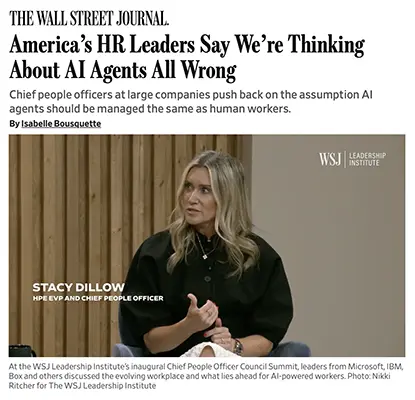
America’s HR Leaders Say We’re Thinking About AI Agents All Wrong
The Wall Street Journal | March 27, 2026
TL;DR: Senior HR executives at IBM, Microsoft, and others are pushing back on the “digital worker” model for AI agents, arguing that treating agents like employees impedes the larger process redesign that actually creates value.
Executive Summary
At a WSJ Chief People Officer Summit, leaders from IBM, Microsoft, and Box converged on a shared critique: the framing of AI agents as digital employees — with names, org chart positions, and job titles — is a distraction that causes organizations to focus on individual agent use cases rather than enterprise-wide workflow transformation. IBM’s CHRO shared directly that naming agents and managing them like headcount led the company to optimize narrow tasks rather than re-engineer core processes.
The more productive framing, according to these executives, is to manage AI as technology infrastructure — as organizations have managed ERP systems, automation platforms, and databases — with outcomes measured at the process level, not the agent level. Microsoft’s Chief People Officer offered a useful reframe: instead of asking “which jobs can AI replace,” the better question is “which tasks within a job can be automated,” and then rebuilding the role around what remains.
A dissenting data point: BNY reports employing dozens of AI “digital employees” with company logins and human managers, built on a proprietary platform — suggesting the debate is live, not settled. Accountability remains a shared sticking point: agents cannot be held legally liable, so human accountability for AI decisions must be explicit and preserved.
Relevance for Business
For SMB leaders building or evaluating AI strategies, this debate has immediate practical implications. If you are assigning AI tools human-like roles and managing them like headcount additions, you are likely optimizing the wrong unit. The more durable frame is: identify the workflow or process outcome you want to improve, then determine what combination of human judgment and AI capability produces it. This also has governance implications — if your team thinks of an AI agent as a “worker,” accountability for its errors may feel diffuse. It should not be.
Calls to Action
🔹 Audit whether your current AI deployment is organized around individual agent tasks or around end-to-end process outcomes — shift emphasis to the latter.
🔹 Resist vendor or analyst pressure to anthropomorphize AI agents — it creates management confusion and obscures accountability.
🔹 Assign explicit human accountability for every AI-assisted decision or output in your operations.
🔹 When evaluating AI tools, ask: “Does this redesign a process or add a capability to an existing one?” Prefer the former.
🔹 Monitor how large enterprises resolve the “digital worker” debate — the model that dominates at scale will likely shape SMB software design within 12–18 months.
Summary by ReadAboutAI.com
https://www.wsj.com/cio-journal/americas-hr-leaders-say-were-thinking-about-ai-agents-all-wrong-7d8f1439: April 7, 2026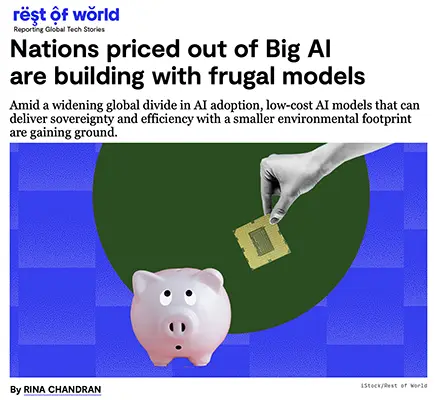

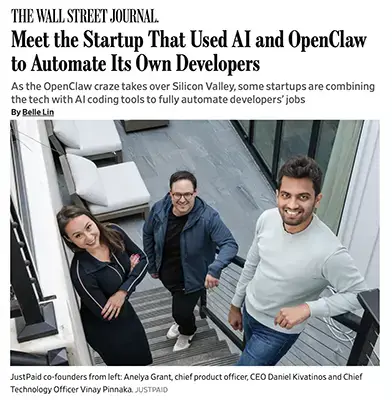
Closing: AI update for April 07, 2026
This week’s collection points to a sharper and more consequential phase of the AI shift: AI is no longer just helping organizations work faster — it is changing the size, shape, and operating assumptions of the organization itself.From the idea of two people using AI tools to build outsized businesses, to agentic systems moving closer to real financial execution, software production, and operational decision-making, the recurring signal is that leaner teams can now do more with less. But these summaries also make clear that this is not a story of effortless replacement. It is a story of compressed staffing curves, faster iteration, lower coordination costs, and higher exposure when systems fail, drift, or are trusted too quickly.
A second theme running through this week’s reporting is that trust has become a core business variable in the AI era.That shows up in several forms: judges using AI despite documented reliability gaps; deepfake threats expanding faster than authentication infrastructure; Apple’s privacy posture standing out more as AI systems become more data-hungry; and new questions about whether visual evidence, vendor claims, or platform outputs deserve the confidence users still reflexively give them. In practical terms, leaders are being pushed into a new discipline: not just adopting AI tools, but deciding which systems are trustworthy enough to rely on, which data boundaries matter most, and where human review remains non-negotiable.
The broader competitive backdrop is also coming into focus. This week’s summaries show AI colliding with infrastructure, geopolitics, labor pressure, and long-horizon platform strategy: China moving faster in next-generation technologies, SpaceX blending launch, connectivity, and AI ambition into one increasingly complex entity, Amazon trying to build a credible Starlink rival, and companies in adjacent industries pivoting toward AI as both opportunity and survival strategy. Even the AI-adjacent pieces on Apple and workforce retention reinforce the same lesson: durable advantage in this environment will not come from hype or speed alone. It will come from institutional discipline, sound governance, and the ability to redesign work without losing trust, resilience, or human judgment.
The Wrap Up
Taken together, this week’s developments suggest that the real AI divide is no longer between adopters and non-adopters, but between organizations that are restructuring deliberately and those simply layering AI onto old assumptions. The opportunity remains real, but so does the cost of weak governance, fragile vendors, unreliable outputs, and strategies built for a world that is disappearing faster than many leaders still realize.
All Summaries by ReadAboutAI.com
↑ Back to Top