
AI Updates May 25, 2026
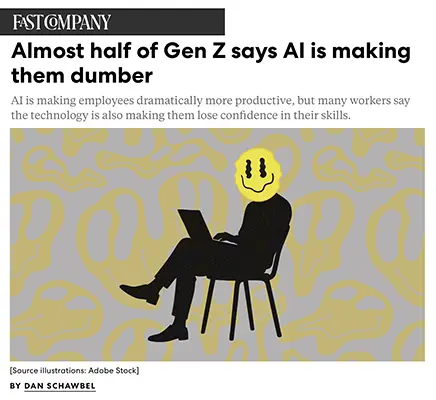
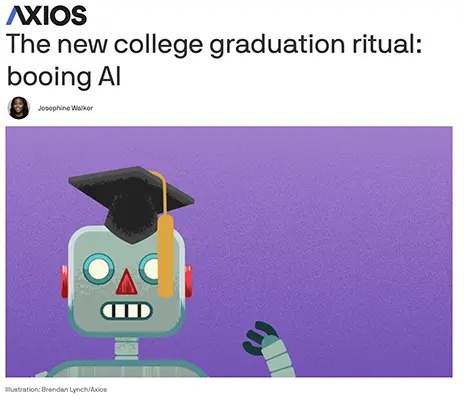
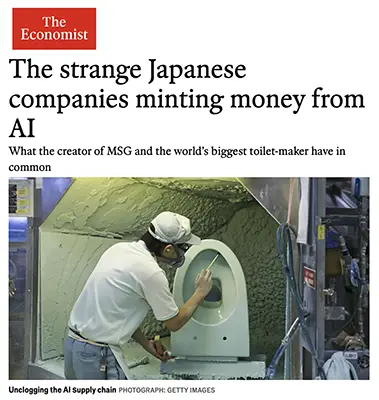
Something clarified this week that executives would be unwise to dismiss as a cultural footnote. Across graduation stages, research surveys, corporate earnings announcements, and a federal hallway in Washington, the same pattern surfaced from different directions: organizations are deploying AI faster than the trust, governance, and training structures needed to sustain it. The optics were vivid — tech executives booed at commencement ceremonies, a viral satire naming exactly what the crowds were reacting to — but the data underneath those images is what deserves your attention. Forty-six percent of Gen Z workers believe AI is degrading their own capabilities. Only 44% of IT leaders report having any AI policy in place. These are not sentiment signals. They are operational conditions already shaping the workforce you are hiring from and managing today.
The week’s stories extend well beyond the campus moment. At the federal level, a voluntary AI oversight order was pulled back hours before its signing, leaving the U.S. without a framework for reviewing frontier AI models — including systems already demonstrated to identify and exploit software vulnerabilities at scale. OpenAI is preparing a confidential IPO filing that could land by September, raising real questions about what public-market pressure will mean for pricing and product continuity. Google and Blackstone announced a $5 billion venture to build a credible alternative to Nvidia’s dominance in AI compute infrastructure. And a study of 2,000 workers found that 85% cannot connect the AI training they’ve received to their actual jobs — a finding that holds regardless of industry size or sector.
What connects these stories is not pessimism about AI — several pieces this week document genuine and significant capability advances — but rather a sharpening recognition that deployment without governance is not a competitive advantage; it is a liability deferred. The executives who drew applause this graduation season, rather than boos, did so by leading with what people bring to the table before introducing what AI can extend. That sequence — human value first, tool second — turns out to be not just better communication, but a more accurate description of how durable AI adoption actually works. The summaries below are organized to help you see where your organization sits in that picture, and what decisions are worth making now versus monitoring for later.
Summaries
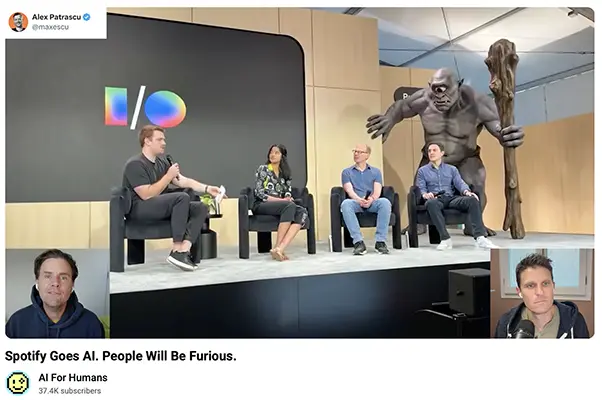
Spotify Goes All-In on AI Music — And the Music Industry Will Never Be the Same
AI for Humans Podcast | May 2026
TL;DR: Spotify’s sweeping AI music deal with major labels, distributors, and publishers marks the moment AI-generated and AI-remixed content moves from fringe experiment to mainstream platform infrastructure — with unresolved questions about who captures the value.
Executive Summary
Spotify has formalized what the industry long resisted: a structured framework allowing AI-assisted fan remixes using real artists’ voices and tracks, built on partnerships with Universal Music Group and other major label and publishing stakeholders. The program is opt-in for artists, which provides political cover but also creates a first-mover dilemma — publicly participating carries reputational risk, while sitting out may mean missing early revenue. The economic terms remain thin for creators on the consumption side: fans may pay an additional subscription fee to access remix tools, while label and distributor revenue sharing is already baked in. Spotify is also rolling out AI-generated personal podcasts and a standalone creation app, Studio by Spotify, as paid add-ons.
The broader media cost story got a sharp illustration at Cannes, where AI company Higgsfield screened a 95-minute feature film produced for $500,000 — 80% of which was compute cost alone. The film’s economics signal both a floor drop in production barriers and a ceiling question: whether streaming platforms, distributors, or audiences will actually pay for AI-generated content at scale.
The episode’s most consequential signal came from an OpenAI announcement that a general-purpose internal model — not a specialized tool — independently disproved a discrete geometry conjecture that had stood for 80 years. This matters beyond mathematics: it suggests frontier AI is beginning to produce novel reasoning, not just pattern retrieval. Hosts framed this as the early signal of AI contributing meaningfully to hard scientific problems, including medicine and energy — a different order of significance than creative applications.
Relevance for Business
For SMB leaders, the Spotify story is a preview of a broader dynamic: AI capabilities will be embedded into existing platforms as paid feature tiers, compressing what was once a competitive differentiator into a subscription line item. Creative and media businesses should anticipate that content production costs in music, video, and potentially other media categories are compressing — but distribution leverage and audience relationships, not production capability, will determine who captures value.
The AI music lawsuit context (Suno being sued over claimed licensing revenue destruction) is a live signal that legal liability around AI-generated outputs trained on proprietary content remains unsettled. Businesses using AI content tools should understand their vendor’s data provenance — not as a theoretical concern, but as emerging litigation risk.
The OpenAI math breakthrough is further out from immediate business decisions, but it reinforces a directional reality: AI’s utility ceiling is higher than most organizations are planning for, and the gap between current deployment and near-future capability is likely to close faster than five-year strategic plans assume.
Calls to Action
🔹 If you’re in media, music, or content production, treat Spotify’s move as market structure signal, not just a platform feature. Evaluate where your business sits relative to production cost compression and whether your competitive advantage is upstream (talent, relationships, curation) or downstream (distribution, audience).
🔹 Review your AI content tool vendors’ training data policies. The Suno lawsuit illustrates that licensing exposure won’t only land on the AI company — downstream users may face scrutiny as well.
🔹 Resist over-investing in AI creative tools as a differentiator. When platforms like Spotify embed these features as standard subscription tiers, the advantage window for early movers narrows quickly.
🔹 Monitor the OpenAI math/science reasoning thread. This is not immediately actionable for most SMBs, but organizations in pharma, biotech, engineering, or research-adjacent sectors should track whether general reasoning breakthroughs begin accelerating domain-specific applications.
🔹 Establish an internal position on AI-generated content. The volume of AI-generated books, music, and papers is already measurably increasing. Leaders should decide — before a vendor or competitor forces the question — what standards apply to AI content in their own operations, products, and communications.
Summary by ReadAboutAI.com
https://www.youtube.com/watch?v=pUn-iWnjy_0: May 25, 20262026 Commencement: AI Meets the Class of 2026 — And Gets Booed
The 2026 graduation season produced an unexpected recurring scene: corporate executives stepping to the podium to praise artificial intelligence and being met, repeatedly and loudly, with audience disapproval. From the University of Arizona to the University of Central Florida to a California art school, the pattern held — and the data behind it held too, with Gen Z registering sharper AI anxiety than any other generation surveyed. The six articles below cover that story from multiple angles: the news reports that documented it, the opinion piece that contextualized it, the satire that named what the crowds were reacting to, and the single counterexample — Steve Wozniak — that showed what a different approach looks like and why it landed.
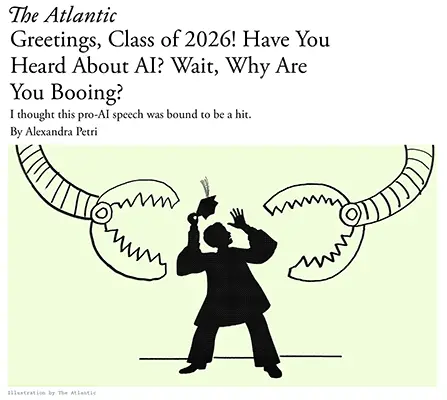
Greetings, Class of 2026! Have You Heard About AI? Wait, Why Are You Booing?
The Atlantic | Alexandra Petri | May 20, 2026
TL;DR: The Atlantic publishes satirical dark comedy that distills the exact posture graduates are rejecting — and in doing so, reveals what the other four news articles collectively document: that elite AI advocacy often sounds like cheerful indifference to human cost.
Executive Summary
This is a humor piece, not a news report, and should be evaluated as such. Alexandra Petri writes from the fictional perspective of a tech CEO addressing the Class of 2026 — speaking with transparent contempt for the graduates’ futures while demanding their gratitude. The piece functions as exaggerated mirror: it takes the “AI is inevitable, adapt or be left behind” rhetoric that real speakers have used in real ceremonies this graduation season and strips away the optimistic framing to expose the implied subtext.
The editorial signal worth noting is not the jokes but their target. Petri is not satirizing AI as technology — she is satirizing the social performance of AI enthusiasm by the executive class. The piece identifies the specific rhetorical features graduates have reacted against: the false solidarity, the financial insulation of the speaker, the demand to find opportunity in one’s own displacement. That these features are funny when exaggerated is precisely because they are recognizable when present in earnest.
For executives, the piece functions as an inadvertent stress test for AI messaging: if your internal or external AI communication could plausibly be parodied using Petri’s template, it is likely landing the same way with your audience, even if they are not booing audibly.
Relevance for Business
Satire that goes viral does so because it names something people already recognize. Petri’s piece has traction because the scenario it parodies — powerful people insisting that workers cheerfully accept economic disruption they did not choose — is not fictional. The business relevance is not the humor itself but the credibility gap it illustrates. When executive AI messaging defaults to enthusiasm, inevitability, and urgency without acknowledging displacement risk, it lands as what Petri’s fictional speaker makes explicit: indifference wearing optimism as a costume. SMBs that communicate about AI adoption with genuine specificity — what changes, for whom, and with what support — are operating in a meaningfully different register than the executives who inspired this satire.
Calls to Action
🔹 Use this piece as an informal communications audit — read your last internal AI announcement against Petri’s fictional speech. If the gap is smaller than it should be, revise before the next one.
🔹 Avoid the four rhetorical features Petri identifies as parody-ready: false solidarity with workers, financial insulation from consequences, demands for enthusiasm, and framing displacement as opportunity.
🔹 Do not dismiss satirical coverage as irrelevant to business — pieces like this shape how your employees and customers understand the gap between what executives say and what they mean.
🔹 Monitor The Atlantic’s broader AI coverage — the decision to run this piece signals that AI executive behavior has become culturally legible enough to satirize effectively at a mainstream audience level.
🔹 No immediate operational action required from this piece — treat it as a reputational weather instrument, not a strategy input.
Summary by ReadAboutAI.com
https://www.theatlantic.com/newsletters/2026/05/ai-commencement-speech/687236/: May 25, 2026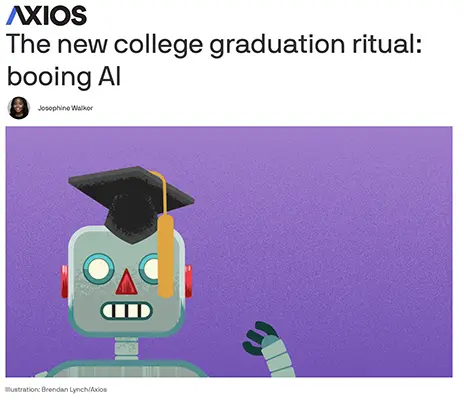
The New College Graduation Ritual: Booing AI
Axios | Josephine Walker | May 19, 2026
TL;DR: Repeated commencement boo-downs of AI-boosting speakers signal that the incoming workforce views AI as a personal economic threat — not just an abstract technology debate.
Executive Summary
A pattern has emerged across the 2026 graduation season: when speakers mention AI approvingly, they are met with audible and sustained crowd disapproval. The incidents span multiple institutions and speaker profiles — from former Google CEO Eric Schmidt at the University of Arizona, to a real estate executive at UCF, to a music industry CEO at Middle Tennessee State. The common thread is not the message but the messenger: senior executives who are financially insulated from AI displacement telling new entrants to a difficult job market to simply get on board.
The underlying data gives the crowd’s reaction context. Roughly 42% of Gen Z believe AI will harm job opportunities and wages for people like them — a higher share than any other generation surveyed in an Axios Harris Poll. A concurrent Gallup finding shows a 21-point gap in job-market confidence between younger and older Americans, with only 43% of those aged 15–34 saying it’s a good time to find work, versus 64% of those 55 and older. Corporate behavior validates the anxiety: Meta, Pinterest, and Block have each recently cited AI-enabled task automation in announcing layoffs.
The article offers a counterpoint: Nvidia CEO Jensen Huang drew no visible pushback at Carnegie Mellon with a more nuanced framing — acknowledging industry transformation while cautioning against fear rather than demanding acceptance. The distinction matters: tone, credibility, and acknowledgment of real stakes appear to affect how AI advocacy lands with this audience.
Relevance for Business
The incoming workforce’s relationship with AI is adversarial in ways that will show up inside organizations, not just in media clips. Leaders integrating AI into operations should anticipate that younger employees may resist adoption mandates — particularly when framed as inevitable rather than purposeful. Trust is an asset here, and “adopt or fall behind” messaging is actively eroding it with the generation businesses need to recruit and retain. The gap between exec-level enthusiasm and employee-level anxiety is a real friction point in AI rollout.
Calls to Action
🔹 Treat workforce AI skepticism as a change management issue, not a communication problem — internal rollouts that acknowledge legitimate concerns will move faster than mandates.
🔹 Audit how AI is being discussed by your leadership team — the tone and credibility of the messenger matter as much as the substance.
🔹 Monitor labor market signals for your sector — AI-driven headcount decisions at large firms will continue to shape candidate expectations and morale among current employees.
🔹 Review AI use cases where visible failure risk is high — public-facing automation errors (like the Glendale name-reading incident) compound trust damage quickly and disproportionately.
🔹 Watch the Gallup/Harris generational data — the 21-point job-confidence gap and the 42% AI-harm concern among Gen Z are baseline numbers worth tracking quarter to quarter as you plan hiring and retention.
Summary by ReadAboutAI.com
https://www.axios.com/2026/05/19/college-graduates-ai-commencement-speech: May 25, 2026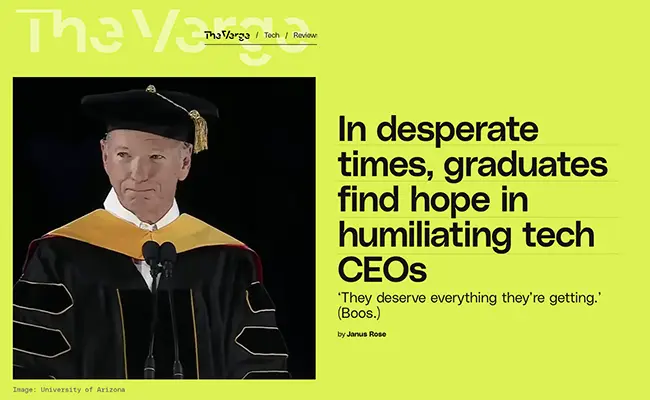
In Desperate Times, Graduates Find Hope in Humiliating Tech CEOs
The Verge | Janus Rose | May 21, 2026
TL;DR: The Verge frames commencement booing not as a mood but as a structural grievance — graduates are being told to embrace tools that are simultaneously eliminating their entry points into the workforce.
Executive Summary
Where other outlets reported the commencement protests as a social phenomenon, The Verge uses them as a lens for a sharper argument: that the gap between executive AI enthusiasm and graduate-level economic reality is not a misunderstanding — it is a conflict of interest. The article is explicitly opinion-forward and should be read as framing rather than reporting, but the underlying observations are grounded in real conditions.
The core tension the piece identifies is concrete: graduates are entering a job market where companies are justifying hiring freezes and layoffs partly on AI efficiency gains, while those same companies — and the executives addressing new grads — are demanding AI adoption. The Verge documents cases where graduates are not just unemployed but working gig jobs training the AI models that will compete with them for future employment. That dynamic, if it scales, is a meaningful labor market signal.
The piece adds institutional texture: the CalArts example, where a university president was booed after eliminating creative programs and installing AI corporate partnerships, illustrates that the backlash extends beyond individual speakers. Students are reacting to institutional choices, not just rhetoric. The Verge also notes a broader civic dimension — roughly 70% of Americans now oppose AI data center construction in their local area, with nearly half of proposed projects scrapped or delayed — suggesting that youth AI skepticism is developing organized political expression beyond social media outrage.
Relevance for Business
The “adopt-or-die” framing used by some executives is now actively counterproductive — with both recruits and, per the data center figures, communities where AI infrastructure must be built. For SMBs, the more immediate implication is internal: employees who feel that AI adoption benefits leadership at their expense are unlikely to be effective champions of the tools. The Verge’s framing also points to a reputational risk in how AI is communicated externally — associating your brand with the executive class of AI evangelism carries social cost with the demographic cohort you will be hiring for the next decade. The article is advocacy-heavy but the structural observation — that workers are being asked to participate in their own displacement — is worth taking seriously as an operational reality, not just a PR problem.
Calls to Action
🔹 Assess whether your AI messaging to employees mirrors the “inevitable, deal with it” posture — if it does, expect resistance proportional to perceived job risk.
🔹 Examine whether AI tools in your operation are reducing or eliminating roles that entry-level hires typically fill— and whether your talent pipeline accounts for this.
🔹 Monitor the data center opposition movement — at 70% local opposition nationally, siting and permitting constraints are a real infrastructure risk for AI-dependent service providers.
🔹 Avoid associating your organization publicly with the “tool” framing unless you can back it with genuine role-preservation evidence — it reads as dismissive to the workforce segment most affected.
🔹 Distinguish framing from fact in this piece — The Verge’s editorial posture is sympathetic to graduate concerns, but the structural observations about gig-based AI training labor and institutional program cuts are independently verifiable and worth monitoring.
Summary by ReadAboutAI.com
https://www.theverge.com/ai-artificial-intelligence/935602/graduates-boo-ai-ceos: May 25, 2026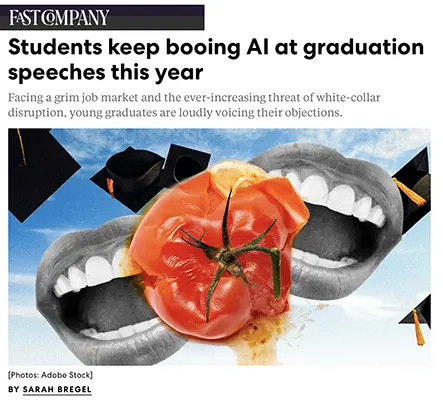
Students Keep Booing AI at Graduation Speeches This Year
Fast Company | Sarah Bregel | May 19, 2026
TL;DR: Fast Company documents the same commencement pattern with added institutional texture — including a university’s non-committal response to an AI system failure — and polling data showing Gen Z uniquely believes AI is making them less capable.
Executive Summary
Fast Company’s coverage covers the same incidents as other outlets but adds two elements worth noting separately. First, the institutional response to a concrete AI failure: when Glendale Community College’s AI name-reading system malfunctioned during graduation, the college issued an apology but stopped short of committing to discontinue AI use in ceremonies. That calculated hedge — apologizing for the failure while leaving the door open to continued deployment — is a posture many organizations are navigating. The response drew renewed audience disapproval, suggesting that process accountability matters to this audience, not just outcomes.
Second, Fast Company surfaces distinct workforce-capability polling. Research from GoTo indicates that roughly 46% of Gen Z workers feel AI is making them less intelligent — a higher share than the 39% of workers overall who said the same. This is a different concern than job loss. It suggests a segment of the incoming workforce is developing not just economic anxiety but a belief that AI use degrades their own skills and judgment. For organizations building AI-assisted workflows, this is a relevant attitude to understand — it goes beyond protest and signals a potential adoption friction that won’t resolve with better messaging alone.
Relevance for Business
The Glendale incident illustrates a governance and vendor accountability risk that SMBs face when deploying AI in high-visibility, time-sensitive contexts — ceremonies, client-facing events, onboarding processes. An AI failure in front of an audience, followed by a hedged institutional response, can compound reputational exposure beyond the original error. The GoTo research adds a skill-degradation concern that is separate from displacement anxiety: employees who believe AI is reducing their capabilities are unlikely to be strong advocates for AI-assisted workflows, regardless of how those tools perform objectively. Both signals suggest that internal AI deployment requires more active management than most SMBs are currently applying.
Calls to Action
🔹 Avoid deploying AI in high-visibility, low-tolerance-for-error contexts without tested fallback procedures — the Glendale case is a useful benchmark for what happens when public-facing AI fails without a recovery plan.
🔹 If an AI system fails publicly, respond with specific corrective commitments, not hedged language — vague institutional responses amplify rather than contain the damage.
🔹 Assess whether employees are being given AI tools without adequate training on their limitations — the “AI makes me dumber” sentiment is partly a product of poor implementation, not just ideology.
🔹 Monitor the GoTo and similar workforce research — the skill-degradation concern among Gen Z is a distinct signal from displacement fear and warrants a separate response in how you structure AI-human workflows.
🔹 Build feedback mechanisms into AI tool rollouts — employees who feel heard about AI’s limitations are more likely to engage constructively with adoption than those who feel overridden.
Summary by ReadAboutAI.com
https://www.fastcompany.com/91544965/ai-getting-booed-2026-commencement-speeches-graduation: May 25, 2026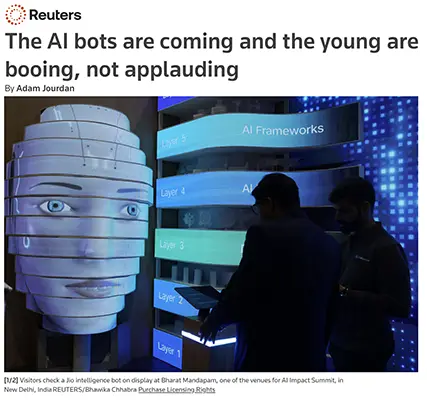
The AI Bots Are Coming and the Young Are Booing, Not Applauding
Reuters | Adam Jourdan | May 19, 2026
TL;DR: Reuters contextualizes the commencement protests within documented large-scale corporate AI-driven job cuts and a Gallup finding that Gen Z’s AI optimism has fallen sharply — placing youth anxiety within a global labor and policy story, not just a campus moment.
Executive Summary
Reuters provides the most data-grounded treatment of the commencement protests, situating them within a pattern of corporate AI-enabled workforce reduction that has real scale. Standard Chartered announced plans to cut over 7,000 jobs and replace roles with AI. Amazon has eliminated approximately 30,000 corporate positions in recent months in connection with AI and efficiency initiatives. Meta is planning to reduce its global workforce by 10% while installing AI training software on employee computers. Block cut nearly half its staff earlier this year. These are not speculative displacement scenarios — they are current events, occurring in the same quarter as the graduation protests.
The Reuters coverage also adds a Gallup snapshot that is distinct from the Axios/Harris data: Gen Z’s share saying AI’s risks outweigh its benefits has risen significantly over the past year, while those expressing hope or excitement have fallen sharply. Only 15% described AI as a net positive. Most respondents acknowledged the need to develop AI skills but reported that use of the tools felt like it hindered deeper learning — consistent with the GoTo skill-degradation finding in the Fast Company piece. Reuters also notes pushback on AI extends globally — Chinese courts, South Korean union actions, Hollywood scriptwriters, and India’s film industry are all cited — placing the U.S. grad reaction within a wider pattern.
Relevance for Business
Reuters grounds what other outlets treat as sentiment in documented, current-quarter corporate behavior — making it harder to dismiss the graduates’ concerns as generational anxiety rather than rational response to observable conditions. For SMBs, the relevance is two-layered: first, the labor market conditions being created by large-enterprise AI decisions will directly affect talent availability and cost; second, the regulatory and public pressure that follows sustained and visible labor displacement could accelerate governance requirements that SMBs are not currently prepared for. The global nature of the pushback — extending beyond the U.S. and beyond youth — is a meaningful signal that AI labor displacement is developing into a structured policy issue, not a cultural moment.
Calls to Action
🔹 Take the large-enterprise layoff data seriously as a labor market input, not just news — AI-linked headcount decisions at Meta, Amazon, Block, and Standard Chartered will shape the candidate pool, wage expectations, and morale context for your own hiring.
🔹 Anticipate governance pressure — multi-sector, multi-country pushback on AI labor displacement is a precondition for regulation; SMBs that have not begun preparing policy frameworks are behind the curve.
🔹 Use the Reuters corporate examples as a risk benchmark: if your AI use case mirrors the “replacing lower-value human capital” framing used by Standard Chartered, assess how that decision would land publicly and with your workforce.
🔹 Distinguish between AI tools that augment existing roles and those that eliminate them — this distinction is increasingly visible to employees and will affect retention and engagement.
🔹 Monitor international AI labor policy developments — actions in South Korea, India, and China suggest that workforce-AI governance is becoming a global standard, not a U.S. edge case.
Summary by ReadAboutAI.com
https://www.reuters.com/business/world-at-work/ai-bots-are-coming-young-are-booing-not-applauding-2026-05-20/: May 25, 2026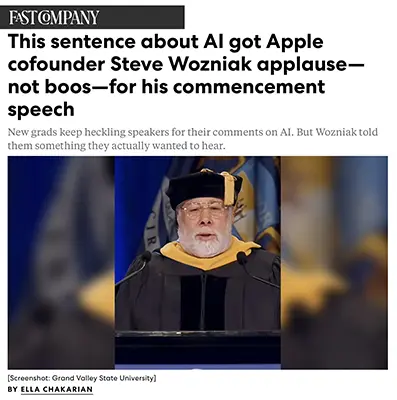
This Sentence About AI Got Apple Cofounder Steve Wozniak Applause — Not Boos — for His Commencement Speech
Fast Company | Ella Chakarian | May 20, 2026
TL;DR: Wozniak earned applause where other tech figures earned boos by affirming human intelligence rather than demanding its subordination to AI — a small but instructive case study in what credible AI communication actually sounds like.
Executive Summary
At Grand Valley State University, Apple cofounder Steve Wozniak navigated the same charged graduation-season climate that derailed Schmidt, Caulfield, and Borchetta — and came away with applause. The difference was not that he avoided AI as a topic. He reframed it: his opening remark positioned graduates themselves as the real intelligence in the room, with machine AI as a long-pursued but still incomplete imitation. The crowd responded warmly.
The contrast is instructive beyond its novelty. Wozniak’s posture is consistent with his publicly stated views — he has been openly skeptical of AI output quality, describing it as impersonal and overly polished. That skepticism gives his AI commentary a credibility that career AI boosters lack with this audience. He is a genuine technologist who has earned the standing to say that human judgment still matters, and he said it without hedging or pivoting to an “adopt or compete” warning. Delta Air Lines CEO Ed Bastian struck a similar chord at Emory — acknowledging that he experimented with AI for his speech but discarded the result for lacking warmth. Both cases suggest that honesty about AI’s limitations, coming from people with technology credibility, lands better than enthusiasm from people with financial stakes in AI’s expansion.
The article is thin on data and heavy on contrast with the boo incidents — it functions primarily as a counterexample, not an independent analysis. Its value is as a proof point, not a prescription.
Relevance for Business
The Wozniak episode offers a practical template for internal AI communication that executives can adapt: lead with what people bring that AI does not, rather than leading with what AI can do that people should fear or defer to. This is not spin — it is sequencing. The same underlying message (AI is significant and you should engage with it) lands differently depending on whether the speaker starts from human value or from technological inevitability. For SMBs communicating AI adoption to employees or customers, the Wozniak approach is lower-risk and more durable — and notably, it does not require downplaying AI’s capabilities. It requires acknowledging human ones first.
Calls to Action
🔹 Restructure internal AI announcements to lead with what your people contribute that AI tools do not — then introduce how the tools extend that capacity, rather than the reverse.
🔹 Note the Bastian example as a low-cost credibility signal: publicly acknowledging that you tested AI and found it wanting in a specific context reads as honest, not anti-AI, and earns more trust than uniform enthusiasm.
🔹 Assess the credibility gap between your AI messengers and their audience — Wozniak’s reception reflects decades of earned standing; executives without that standing should adjust their approach accordingly.
🔹 Do not over-index on this piece as a communications formula — Wozniak’s success reflects his specific biography and skeptical posture; replicating the words without the authenticity will not produce the same result.
🔹 File this as a positive benchmark alongside the boo incidents — together they define a range of responses that gives you signal on what the incoming workforce will and will not accept from leaders talking about AI.
Summary by ReadAboutAI.com
https://www.fastcompany.com/91545731/this-sentence-about-ai-got-apple-co-founder-steve-wozniak-applause-not-boos-for-his-commencement-speech: May 25, 2026
Almost Half of Gen Z Says AI Is Making Them Dumber
Fast Company | Dan Schawbel | May 19, 2026
TL;DR: A 2,500-person global study finds that AI is boosting productivity while quietly eroding worker confidence, skills, and judgment — and most companies lack the policies, training, or cultural norms to address it.
Executive Summary
The GoTo/Workplace Intelligence research surfaces a tension that productivity metrics alone won’t reveal: employees are faster, but many are less capable. Half of surveyed workers say they rely on AI too heavily. Nearly 40% believe this reliance is actively degrading their abilities — a figure that climbs to 46% among Gen Z. These aren’t edge-case complaints; they reflect a workforce that adopted AI quickly and is now recalibrating.
The governance gap is where leaders should focus. Only 44% of IT leaders report having any AI policy in place, and among those that do, the majority of employees say it needs improvement. Meanwhile, 60% of workers say they feel pressured to use AI regardless of whether the task warrants it — a recipe for misuse. That pressure is showing up in consequential places: 70% of employees now admit to using AI for sensitive tasks including legal, compliance, and emotionally complex decisions, up 16 percentage points in a single year.
There is also a compounding quality problem the article labels “AI workslop” — 43% of employees have submitted AI output they suspected was low quality or contained errors. The result: 77% of workers report that reviewing AI-generated work from colleagues takes more time than reviewing human-produced work. The efficiency gains are real, but they are being partially offset by a new quality review burden distributed across the entire workforce.
The article argues that the solution is not technological but organizational: role-specific training, functional AI policies, and leadership that models disciplined AI use. The workers who will add the most value, it concludes, are those who know when to use AI and when to override it — not simply those who use it most.
Relevance for Business
This research has direct operational implications for SMBs. Many smaller organizations have adopted AI tools without building the governance layer that makes adoption sustainable. The risks here are not abstract: employees using AI unsupervised on compliance, legal, or client-facing work creates measurable liability. The leadership gap identified in the study — IT leaders underestimating the problem by 36 percentage points relative to employee perception — is especially relevant for organizations where IT and HR functions overlap or are understaffed. The cost of cleaning up AI-generated errors is not captured in productivity dashboards, but it is real.
Calls to Action
🔹 Audit whether your AI adoption has outpaced your governance — if your team is using AI daily but you have no written policy, that gap is now a documented organizational risk.
🔹 Build or update an AI use policy that is specific enough to be useful — not a compliance document, but role-relevant guidance on where AI adds value and where human judgment is required.
🔹 Invest in skills alongside tools — identify which capabilities in your workforce are most at risk of atrophy (judgment, critical evaluation, creative problem-solving) and protect them deliberately.
🔹 Examine your quality review processes — if AI-generated output is circulating internally without consistent review, your team may be inheriting errors and quality debt that don’t show up as productivity losses until something goes wrong.
🔹 Model the behavior you expect — leaders who demonstrate when to use AI, when to question its output, and when to set it aside will have more impact on organizational culture than any policy document alone.
Summary by ReadAboutAI.com
https://www.fastcompany.com/91539232/almost-half-of-gen-z-says-ai-is-making-them-dumber: May 25, 2026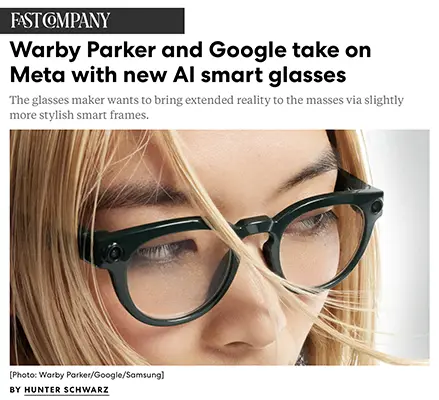
Warby Parker and Google Launch AI Smart Glasses to Challenge Meta
Fast Company | May 19, 2026
TL;DR: Warby Parker, Google, and Samsung have announced AI-powered smart glasses running Google Gemini and Android XR — a credible, design-forward challenger to Meta’s Ray-Ban frames in a market projected to grow from under $500M to $4.2B by 2028.
Executive Summary
The wearable AI hardware race now has a second serious competitor. Warby Parker’s first smart glasses, co-developed with Google and Samsung, integrate cameras, speakers, and the Gemini AI assistant into a lightweight everyday frame designed for all-day wear. They run Android XR, Google’s unified operating system for extended reality devices, positioning them as part of a broader platform play rather than a standalone product.
Pricing has not been disclosed; Meta’s Ray-Ban smart glasses currently range from roughly $390–$500. The Warby Parker product is designed to compete on style and mainstream accessibility rather than raw technical specs. The partnership leverages Warby Parker’s consumer brand and optical retail distribution, Google’s AI and OS infrastructure, and Samsung’s hardware manufacturing.
What’s demonstrated vs. what’s claimed: The product has been announced and shown at Google I/O; it is not yet available for purchase, with a fall launch expected. Performance claims — particularly around reducing smartphone screen time and enabling ambient AI assistance — come from the company’s own co-CEO and are promotional in nature. The underlying market growth projections (Bank of America, $4.2B by 2028) are analyst estimates, not confirmed outcomes. Privacy concerns around ambient cameras remain an unresolved friction point that has slowed adoption of similar products.
Relevance for Business
For most SMBs, this is a category to monitor rather than act on today. The more consequential question is whether ambient AI wearables become a standard workplace tool over the next 3–5 years — and whether they introduce new privacy governance obligations (recording in client meetings, capturing proprietary information, facial recognition exposure). Businesses with customer-facing or sensitive-environment operations should begin thinking about acceptable use policies before the hardware becomes widespread.
The Google-Samsung-Warby Parker alliance also signals that Google is executing a serious platform strategy for AI at the edge — integrating Gemini across glasses, phones, and XR headsets. This has downstream implications for businesses deep in Google’s ecosystem.
Calls to Action
🔹 Monitor, don’t act yet — the product hasn’t launched and pricing remains unknown; revisit when it’s available for purchase.
🔹 Begin drafting a wearable device policy for your workplace, particularly if you operate in environments with confidentiality requirements (legal, medical, financial, client-facing).
🔹 Track the Google Android XR ecosystem if your business relies heavily on Google Workspace — Gemini’s expansion into wearables may affect how your team accesses AI tools over time.
🔹 Watch Meta’s response — competitive pressure from a credible challenger typically accelerates feature development and may bring pricing down across the category.
Summary by ReadAboutAI.com
https://www.fastcompany.com/91544045/warby-parker-google-intelligent-eyewear: May 25, 2026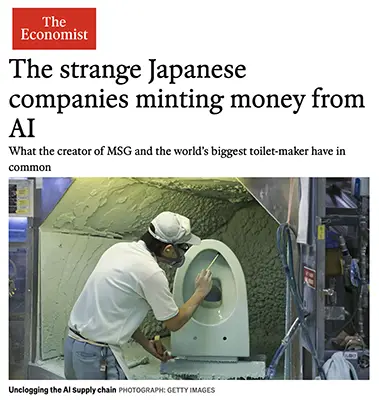
Japan’s Unlikely AI Winners: The Niche Suppliers Powering the Chip Economy
The Economist | May 14, 2026
TL;DR: A cluster of century-old Japanese companies — makers of seasoning, toilets, stationery, and textiles — have quietly become indispensable suppliers to the global AI chip industry, holding near-monopoly positions in obscure but critical materials.
Executive Summary
The AI infrastructure boom is creating concentrated value in places most observers aren’t looking. Japanese firms with roots in industrial chemistry, ceramics, and specialty materials now control bottleneck positions in the semiconductor supply chain. Ajinomoto, whose core business is flavor additives, holds over 95% of the market for a specialized chip insulation film originally derived from MSG byproducts. Toto, best known for high-end toilets, generates more than half its operating profit from ceramic components used in chip fabrication. Similar stories run through stationery brand Sakura, lens-maker Hoya, and century-old textile company Nitto Boseki — each a sole or dominant supplier of something essential to building AI processors.
Two dynamics explain this: Japan’s 1980s semiconductor dominance seeded a dense local supplier ecosystem, and Japanese corporate culture rewards deep, patient expertise over market timing. Ajinomoto spent 25 years developing its chip material before a major customer adopted it. That depth now translates into competitive moats that are very hard to replicate quickly.
The risk embedded in this picture is supply fragility. These same companies are notably slow to scale capacity when demand spikes. Their cultural patience that built the advantage now creates delivery friction that frustrates hyperscaler customers seeking rapid expansion.
Relevance for Business
For SMB leaders, the direct takeaway isn’t about buying Japanese stocks. It’s about supply chain visibility and concentration risk. The AI tools and infrastructure your business relies on are downstream of inputs controlled by a handful of niche suppliers operating with long lead times. Any disruption — geopolitical, production-related, or demand-driven — can propagate up through chip availability, cloud capacity, and AI service pricing. It also illustrates a strategic principle: deep, sustained expertise in a narrow domain can yield durable competitive advantage, even for unglamorous businesses.
Calls to Action
🔹 Monitor AI infrastructure pricing — capacity constraints at the materials layer can affect cloud compute costs over a 12–24 month horizon.
🔹 Assess your own supply concentration risk — identify where your operations depend on single-source or niche suppliers, especially in tech-adjacent inputs.
🔹 Don’t discount your own domain depth — this story is a reminder that specialized, long-held expertise has real strategic value; consider where your business holds equivalent knowledge.
🔹 Watch for AI compute capacity signals — slow expansion by key materials suppliers could constrain chip production and affect cloud availability or pricing in 2026–2027.
🔹 No immediate action required, but file this as context when evaluating AI vendor reliability or infrastructure costs going forward.
Summary by ReadAboutAI.com
https://www.economist.com/business/2026/05/14/the-strange-japanese-companies-minting-money-from-ai: May 25, 2026
These 5 Charts Show How ChatGPT Is Flooding Our Lives
The Washington Post | Kevin Schaul | May 20, 2026
TL;DR: Research-backed data across five domains — books, lawsuits, music, scientific papers, and web content — shows AI-generated output has moved from novelty to dominant force, shifting the burden of quality assessment onto readers, reviewers, and institutions.
Executive Summary
The volume signal here is unambiguous. Weekly English-language e-book releases on Amazon have nearly tripled since ChatGPT launched, with a National Bureau of Economic Research study finding that more than half of all new books now contain AI-generated text. Crucially, the economist behind the study draws a distinction: this isn’t the internet enabling talented writers to find audiences — it’s machines generating content at scale. AI-authored books attract fewer readers and lower ratings, but they are flooding the catalog regardless.
The legal system is absorbing similar pressure. MIT and USC researchers found that self-represented litigants now account for roughly 17% of federal non-prisoner filings, up from a historical average of 11%, with AI credited for the increase. More filings, more documents per case, and an onslaught of AI-fabricated citations are taxing judges — who have managed so far, but face a structural stress test if volume keeps climbing.
Across scientific publishing, music streaming, and the open web, the pattern repeats. ArXiv has tightened submission rules after a surge in low-quality papers strained its moderation team. One major music platform estimates more than 40% of uploaded tracks are now fully AI-generated. Researchers from Imperial College London, the Internet Archive, and Stanford found that up to a third of new web content in a given month is partly or wholly machine-made. The article’s underlying argument: AI hasn’t just lowered the cost of creation — it has severed the historical link between effort and signal value, and that burden now falls on everyone downstream.
Relevance for Business
SMB leaders face a version of this problem inside their own organizations: the volume of AI-generated content — proposals, reports, emails, research — is growing faster than anyone’s capacity to evaluate it. If a third of web content is AI-generated, the market intelligence, competitive research, and vendor materials your teams rely on carry new reliability risks. Vendor claims, industry reports, and even legal documents sourced externally deserve additional scrutiny. The article also reinforces a governance reality: institutions are being forced to retrofit quality controls after the fact, and companies that don’t act proactively will be doing the same.
Calls to Action
🔹 Audit your content intake processes — establish basic source-verification habits for market research, competitive intelligence, and vendor materials your teams use to make decisions.
🔹 Review any AI-assisted legal or compliance filings carefully before submission; the article’s data on AI-fabricated citations in court filings applies equally to any regulatory or contract context.
🔹 Do not assume volume equals quality in vendor-supplied content, RFPs, or third-party research — higher output volume is now a reason for more scrutiny, not less.
🔹 Monitor how AI-generated content is affecting the specific channels you rely on — trade publications, industry databases, job applications — and adjust review processes accordingly.
🔹 Consider establishing an internal policy on what AI-generated content your teams may submit externally on behalf of your company, before a governance gap becomes a liability.
Summary by ReadAboutAI.com
https://www.washingtonpost.com/technology/2026/05/20/data-shows-that-ai-slop-is-taking-over-books-lawsuits-music-science/: May 25, 2026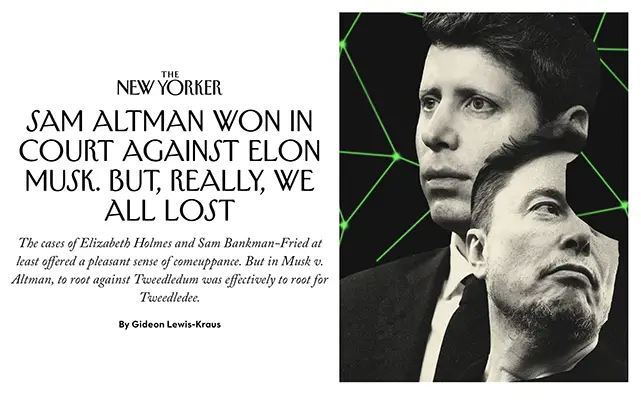
Sam Altman Won in Court Against Elon Musk. But, Really, We All Lost.
The New Yorker | Gideon Lewis-Kraus | May 20, 2026
TL;DR: A long-form critical essay on the Musk v. Altman trial argues that the jury’s verdict in Altman’s favor is beside the point — the trial exposed that neither man is a credible steward of transformational technology, and that governing AI by the character of its founders was always a structurally flawed premise.
Executive Summary
This is cultural criticism and analysis, not a news report. Its value is not in the facts of the verdict — covered elsewhere — but in the argument the author constructs around it. Lewis-Kraus uses the trial to advance a pointed thesis: the real failure on display was not Musk’s vindictiveness or Altman’s ethical flexibility, but the assumption that AI governance could be entrusted to individual actors at all. The comparison to a Manhattan Project is the essay’s sharpest observation — Altman himself apparently raised the analogy in 2015, while missing its central implication: the Manhattan Project was not a private venture.
The essay is most useful for executives as a governance provocation rather than a factual briefing. It asks: if the largest AI companies were built on good intentions that structural incentives then corrupted, what does that imply about how any organization — large or small — should think about the accountability gap between AI deployment and AI governance? The answer the essay implicitly provides is that personal trustworthiness is an insufficient foundation, and that institutional structure, documented process, and genuine oversight mechanisms are what actually determine whether AI is used responsibly.
The trial’s procedural details — Musk’s complaint exceeded the statute of limitations, the jury deliberated for two hours — are almost incidental to the essay’s purpose. Treat this as a considered editorial framing of an AI governance question that SMB leaders may find useful when thinking about their own internal standards.
Relevance for Business
The governance argument applies at every scale. SMB leaders don’t control frontier AI development, but they do control how AI is used within their organizations — and the essay’s implicit challenge is whether the governance structures inside your company are more robust than “trust the person in charge.” If the answer is no, that is worth addressing proactively. The essay also provides useful context for evaluating OpenAI as a vendor: its nonprofit-to-for-profit transformation, the board crisis, and this trial are all part of the same ongoing accountability story.
Editorial note: This is a long-form opinion essay. Preserve the argument, but note that it is framing — not reported fact. The author’s view that Altman’s character issues have been “priced in” is interpretive, not established.
Calls to Action
🔹 Use this as a governance prompt: ask whether your organization’s AI use policies rest primarily on individual judgment or on documented institutional structure — and close the gap if needed.
🔹 Evaluate OpenAI as a vendor with the full picture of its governance history in view — the for-profit restructuring, the board crisis, and ongoing litigation are relevant context for any long-term dependency on their products.
🔹 Monitor OpenAI’s expected IPO and the governance changes that precede it — the transition from private to public accountability will create new visibility into the company’s actual priorities.
🔹 Deprioritize the entertainment dimensions of this story and focus on its structural argument — which AI organizations have governance mechanisms that don’t depend entirely on the character of their founders?
🔹 Assign reading of this piece to anyone in your organization responsible for AI strategy or vendor selection — it provides useful critical context for decisions about which AI companies to depend on.
Summary by ReadAboutAI.com
https://www.newyorker.com/news/letter-from-silicon-valley/sam-altman-won-in-court-against-elon-musk-but-really-we-all-lost: May 25, 2026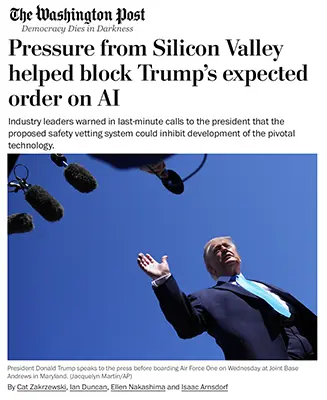
Pressure from Silicon Valley Helped Block Trump’s Expected Order on AI
The Washington Post | Zakrzewski, Duncan, Nakashima, Arnsdorf | May 21, 2026
TL;DR: Last-minute calls from Elon Musk, Mark Zuckerberg, and former AI czar David Sacks persuaded President Trump to cancel a planned AI oversight executive order hours before its signing, revealing just how directly tech industry lobbying shapes federal AI policy — and how uncertain the U.S. regulatory environment remains.
Executive Summary
The planned order would have created a voluntary pre-release review process allowing federal agencies up to 90 days to test frontier AI models for dangerous capabilities before public launch — a framework its drafters described as balanced and far less restrictive than mandatory alternatives. But tech leaders, led by Sacks and including Musk and Zuckerberg, argued that even a voluntary system could function as a de facto approval gate, slowing both major releases and incremental updates.
The episode is less about the policy specifics and more about the architecture of influence: a signing ceremony was already scheduled, invitations had gone out to executives, and some were en route to Washington when the cancellation came. The order is described as postponed rather than dead, but its future form is unknown. Internal disagreement within the administration persists — some officials argued that without any review process, adversaries including China could exploit AI vulnerabilities before U.S. defenses are prepared.
The cancellation also surfaces a genuine policy tension that won’t resolve itself: next-generation AI models are now capable of finding and exploiting software security flaws at scale, a capability that both national security advocates and critics of unchecked AI deployment cite as reason for oversight. That disagreement within the administration — between security hawks and innovation-first tech allies — is unresolved.
Relevance for Business
For SMB leaders, the practical takeaway is regulatory uncertainty, not regulatory burden — no meaningful federal AI governance framework is imminent. Companies building AI into their operations, or relying on AI vendors, should not count on federal standards to set their baseline. That responsibility falls to the organization. Additionally, the article illustrates that AI policy is being actively shaped by a small number of large technology companies whose commercial interests may not align with the needs of smaller operators or the broader market.
Calls to Action
🔹 Do not wait for federal AI regulation to define your internal governance standards — the timeline is indefinite and the outcome uncertain.
🔹 Monitor this story as the order is likely to be revisited; the final shape of any federal AI review process will affect vendors you work with, particularly those building or deploying frontier models.
🔹 Assess your exposure to AI-powered cybersecurity risks now — the capabilities that prompted this policy debate (AI that finds and exploits code vulnerabilities) are already deployed, regardless of what federal oversight looks like.
🔹 Evaluate your AI vendor relationships with an eye toward how those vendors would be affected by a future pre-release review requirement — delays in model updates could affect your operations.
🔹 Treat this as a signal, not a resolution — the political dynamics around AI regulation are active and unstable, and the next move could come quickly.
Summary by ReadAboutAI.com
https://www.washingtonpost.com/politics/2026/05/22/last-minute-lobbying-by-tech-industry-officials-led-trump-cancel-ai-order/: May 25, 2026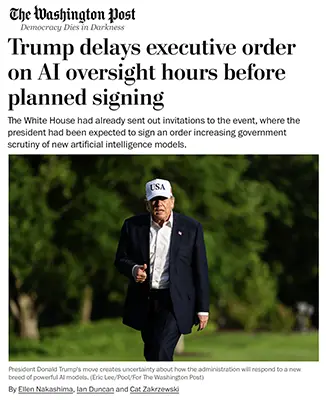
Trump Delays Executive Order on AI Oversight Hours Before Planned Signing
The Washington Post | Nakashima, Duncan, Zakrzewski | May 21, 2026
TL;DR: The Trump administration postponed signing a voluntary AI oversight order at the last minute, leaving the U.S. without a federal framework for reviewing advanced AI models — even as those models demonstrate capabilities with direct national security implications.
Editorial Note: This iis the second of 2 articles covering the same event. This piece was published earlier in the day and focuses on the policy substance and its security context; The article above, published later, focuses on the lobbying dynamics and internal White House deliberations. Both provide distinct value.
Executive Summary
The postponed order would have created a process for federal agencies — including the NSA and Treasury Department — to review frontier AI models up to 90 days before public release, testing for dangerous capabilities and preparing defenses ahead of potential exploitation. The administration framed it as a meaningful shift from its earlier hands-off stance. Former Biden-era officials described the draft as evidence the administration was taking AI threats more seriously.
The security context matters: Anthropic’s Mythos model, already withheld from public release due to its hacking capabilities, and similar systems from OpenAI, can identify and exploit software vulnerabilities at a level previously limited to experienced human hackers. The British government’s independent assessments have confirmed these capabilities. That the U.S. government currently has no formal review process for such systems — even a voluntary one — is the operative governance gap this article documents.
The article also surfaces a structural contradiction the administration has not resolved: Trump reversed Biden’s AI executive order in his first weeks in office, stripping the government of its existing oversight infrastructure. The new order would have directed a surge in cybersecurity hiring to partially address the resulting capacity gap — though one former official quoted in the piece described that measure as inadequate given the personnel already lost.
Relevance for Business
The security capabilities described in this piece are not hypothetical risks for a future version of AI — they are present in systems available or near-available today. Any organization running software infrastructure, handling sensitive data, or relying on cloud services faces an elevated and evolving threat environment that existing cybersecurity practices may not fully account for. The absence of a federal review framework also means that no external authority is systematically evaluating the safety of frontier AI models before they reach the market — including the models embedded in the business tools SMBs use daily.
Calls to Action
🔹 Elevate your cybersecurity posture now, independent of regulatory developments — AI-assisted attack capabilities are already in use and the federal oversight gap makes this a self-managed risk.
🔹 Ask your key software vendors what their posture is on AI-generated security vulnerabilities — particularly vendors who rely on frontier AI models in their products.
🔹 Monitor the status of the executive order when it is revisited; any pre-release review requirement will affect when and how your AI vendors can update or release new capabilities.
🔹 Do not assume vendor safety claims are independently verified — in the current regulatory vacuum, they are not.
🔹 Assign internal review of your most sensitive operational systems to assess exposure to AI-assisted attack vectors — this is a reasonable precaution given the capabilities now documented publicly.
Summary by ReadAboutAI.com
https://www.washingtonpost.com/technology/2026/05/21/white-house-tore-down-ai-rules-now-its-building-new-defenses/: May 25, 2026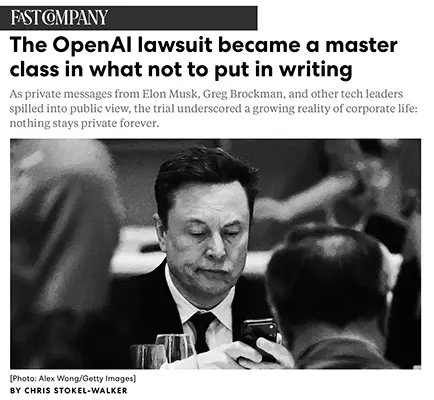
The OpenAI Lawsuit Became a Master Class in What Not to Put in Writing
Fast Company | Chris Stokel-Walker | May 19, 2026
TL;DR: The Musk v. OpenAI trial produced an involuntary transparency event for the AI industry — exposing how casually senior leaders communicate in writing — and the clearest lesson for executives is not to write less, but to write with more discipline.
Executive Summary
Elon Musk lost his lawsuit against Sam Altman and OpenAI, but the trial’s more durable output may be the lesson embedded in discovery: years of texts, Slack messages, emails, and private diary entries from some of the most powerful figures in AI became public record. The disclosures were often unflattering — revealing interpersonal hostility, financial preoccupations, and internal chaos during OpenAI’s leadership crisis — and they punctured carefully cultivated public images.
The article makes a useful contrast: Microsoft CEO Satya Nadella, by temperament or by strategy, had committed relatively little to writing and largely escaped the most damaging revelations. That instinct — not silence, but restraint and deliberateness in written communication — stands in contrast to a tech culture shaped by speed and informality.
Experts quoted in the piece draw competing conclusions. One corporate governance advocate warns that excessive caution can undermine institutional memory and erode accountability — organizations that stop documenting decisions lose the paper trail that protects them when things go wrong. A Cornell researcher frames the right response as documenting intent, rationale, and options, without the speculation and snark. The practical synthesis: the risk isn’t written communication itself — it’s informal written communication that reads badly out of context.
Relevance for Business
This trial is a high-profile illustration of a governance principle that applies at every scale. SMB leaders who use messaging platforms for sensitive decisions, partner negotiations, personnel matters, or strategic discussions are creating a discoverable record — whether or not they ever face litigation. The informality that makes tools like Slack and WhatsApp efficient also makes them risky. The article reinforces that the standard for written communication should be: would I be comfortable if this were read aloud in a legal proceeding? That standard is not excessive caution — it is professional hygiene.
Calls to Action
🔹 Review your organization’s written communication norms — particularly around sensitive decisions, personnel matters, vendor disputes, and strategic deliberations — and clarify what belongs in formal documentation versus informal channels.
🔹 Establish guidance on messaging platforms (Slack, Teams, WhatsApp, text): informal channels are discoverable and should be treated accordingly.
🔹 Train managers and senior staff that tone and context in written communications matter — the standard is whether a message can withstand external scrutiny, not just internal comfort.
🔹 Do not overcorrect into verbal-only decision-making; the article explicitly warns that eliminating documentation creates its own governance and accountability risks.
🔹 Monitor AI-adjacent litigation as a class — the OpenAI case is unlikely to be the last high-profile proceeding where internal AI industry communications become public, and the implications for vendor relationships and partnerships may extend to your operations.
Summary by ReadAboutAI.com
https://www.fastcompany.com/91544389/the-openai-lawsuit-became-a-masterclass-in-what-not-to-put-in-writing: May 25, 2026
A Booming Shadow Market of Sketchy A.I. Investments
The New Yorker | Kyle Chayka | May 20, 2026
TL;DR: A largely unregulated secondary market for pre-IPO AI company equity has exploded, with opaque layered investment structures, fees exceeding 15%, and warning signs that closely resemble prior speculative bubbles — presenting meaningful fraud and loss risk for anyone outside established venture networks.
Executive Summary
As OpenAI and Anthropic remain private at astronomical valuations, a secondary market in their equity has ballooned to accommodate outsiders desperate for exposure. The mechanism involves special-purpose vehicles (SPVs) — essentially bespoke investment entities — that buy equity from early shareholders like employees, then resell interests to outside investors. The problem is structural: by the third layer of SPV nesting, buyers may have no clear legal rights, no verified ownership documentation, and no certainty that the underlying shares can even be transferred without company approval. Anthropic has already updated its guidelines to explicitly flag unauthorized share sales as invalid.
The economics are similarly distorted. Rather than the standard venture model of sharing in long-term returns, many of these deals are structured around one-time broker fees — sometimes exceeding 15% of investment value — giving the middlemen no skin in the game after the transaction closes. Minimum buy-ins at the third-layer level can drop as low as five thousand dollars, dramatically widening the pool of potential buyers while diluting whatever protections normally apply to institutional investors. The article draws an explicit parallel to the cryptocurrency boom: people are treating speculative AI equity the way earlier cohorts treated obscure digital tokens.
The underlying dynamic is real: Anthropic’s valuation more than doubled in roughly three months after raising at $380 billion in February. The article notes, however, that if and when these companies IPO at trillion-dollar valuations, late-arriving retail investors are likely to face unfavorable entry points regardless of how they acquired exposure. The hype-to-fundamentals gap is the risk that these structures obscure rather than resolve.
Relevance for Business
This is primarily a personal financial risk alert for executives and managers who may be tempted by offers that appear to provide access to AI’s upside. It is also a signal worth monitoring for business reasons: the same speculative dynamics that fuel secondary market fever are inflating vendor valuations, affecting AI company capital priorities, and distorting the market signals that SMB leaders use to evaluate the staying power of AI vendors. A vendor whose business model depends on trillion-dollar valuations staying intact carries a different risk profile than one with durable unit economics.
Editorial note: This is an opinion-inflected column by a cultural critic. The financial mechanics described are real and sourced, but the framing is interpretive. Treat it as a well-reported warning, not a financial analysis.
Calls to Action
🔹 Avoid unsolicited secondary-market offers for AI company equity — the combination of multi-layer SPV structures, unverifiable ownership, and large broker fees is a documented pattern of financial risk and potential fraud.
🔹 Verify licensing before engaging any broker claiming to sell shares in private AI companies — Anthropic has explicitly stated that unauthorized share sales are invalid.
🔹 Apply skepticism to AI vendor stability proportional to how dependent their business model is on sustaining current private valuations — a company valued at a trillion dollars pre-IPO has a long way to fall if market sentiment shifts.
🔹 Monitor whether OpenAI or Anthropic announce IPO plans — public listings will clarify actual market-derived valuations and affect both the secondary market and the competitive landscape for AI products.
🔹 Deprioritize any investment approach to AI that involves informal or intermediary-only channels; if access requires multiple layers of brokers, that is a structural warning sign, not a feature.
Summary by ReadAboutAI.com
https://www.newyorker.com/culture/infinite-scroll/a-booming-shadow-market-of-sketchy-ai-investments: May 25, 2026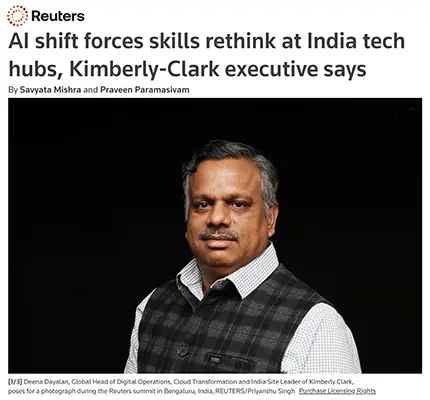
AI Shift Forces Skills Rethink at India Tech Hubs, Kimberly-Clark Executive Says
Reuters | Mishra & Paramasivam | May 20, 2026
TL;DR: A senior Kimberly-Clark executive confirms that AI is already redirecting hiring away from entry-level coding roles and toward workers who combine domain expertise with AI literacy — a shift that has direct implications for how any company structures its technology workforce.
Executive Summary
This is a brief but signal-rich news item from a Reuters industry summit. Kimberly-Clark’s global head of digital operations, speaking from Bengaluru, described a concrete change already underway: the company is de-emphasizing pure coding skills in favor of workers who can apply technology to specific business problems — supply chain, retail, and similar operational domains. Routine programming tasks are increasingly handled by AI automation and third-party providers; what remains scarce and valuable is the combination of business understanding and the ability to direct AI toward solving real problems.
The practical operational shift is notable: hiring is concentrating in experienced workers (four-plus years) while entry-level positions face structural pressure. At the same time, Kimberly-Clark is running company-wide AI training to retool existing staff rather than simply replacing them. Hiring criteria are also evolving — “must-have” skills and demonstrated learning capacity are replacing rigid job description matching. The article also notes that India’s global capability centers (GCCs) are themselves moving up the value chain from back-office support to engineering and product roles, compressing the window in which undifferentiated technical talent remains in demand.
Relevance for Business
For SMB leaders who rely on offshore development capacity — whether through vendors, GCCs, or direct hiring in India — this signals a skill mix shift already in progress at the enterprise level. Entry-level coding volume is declining in value while domain-specific product engineering rises. If your technology strategy depends on a large pool of affordable generalist coders, that model is under pressure. More broadly, the Kimberly-Clark approach — retrain existing staff for AI-adjacent roles rather than defaulting to replacement — offers a concrete model for smaller organizations navigating the same transition.
Calls to Action
🔹 Audit your technology role definitions — if your job descriptions emphasize coding volume over domain knowledge and AI tool proficiency, they may no longer reflect what creates value.
🔹 Prioritize domain expertise alongside AI literacy in your next round of technology hiring — the combination is what enterprise-level operators are now actively seeking and willing to pay for.
🔹 Consider a retraining strategy before defaulting to headcount changes — Kimberly-Clark’s company-wide AI training initiative is a model worth evaluating for your own context.
🔹 Revisit your offshore technology vendor relationships — if they’re built primarily around entry-level coding capacity, assess how AI automation is changing their service model and pricing.
🔹 Monitor this trend over the next 12–18 months as GCCs continue moving up the value chain — the talent landscape for technology roles in India will look materially different within that window.
Summary by ReadAboutAI.com
https://www.reuters.com/world/india/ai-shift-forces-skills-rethink-india-tech-hubs-kimberly-clark-executive-says-2026-05-20/: May 25, 2026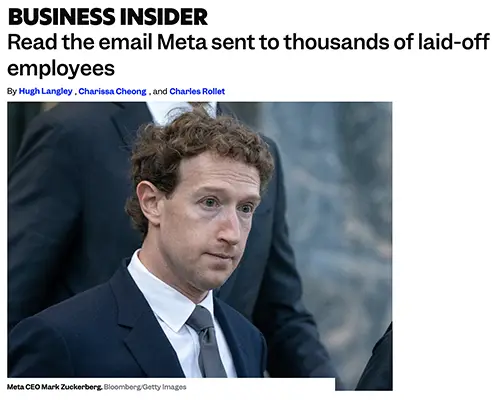
Read the Email Meta Sent to Thousands of Laid-Off Employees
Business Insider | Langley, Cheong, Rollet | May 20, 2026
TL;DR: Meta cut roughly 10% of its 78,000-person workforce — approximately 7,800 people — while simultaneously redirecting more than 7,000 employees toward AI initiatives, making explicit that headcount reduction and AI investment are two sides of the same strategic equation.
Executive Summary
The Business Insider piece is primarily a document disclosure — the actual layoff email Meta sent to affected employees — with minimal surrounding reporting. The email itself is standard corporate severance communication: non-working notice period, salary continuation, 16 weeks of base severance plus two weeks per year of service, 18 months of COBRA coverage, and immigration support for visa-sponsored workers. The tone is corporate-neutral.
The more consequential signal is in the numbers and the framing surrounding them. Approximately 7,800 positions are being eliminated. More than 7,000 employees are being redeployed to AI-focused work. Meta describes the reduction as necessary to “run the company more efficiently” and to “offset other investments.” The operational subtext is direct: AI investment is being financed, at least in part, by reducing the human workforce that was previously doing work AI is now expected to handle or enable.
This is not an isolated event. It reflects a broader pattern across large technology companies — labor costs being compressed to fund AI infrastructure, with the workforce being reconfigured rather than simply reduced. The layoff email’s specifics (visa guidance, COBRA terms, Alumni Portal logistics) are operationally useful context for HR leaders but carry no strategic signal beyond what the numbers already convey.
Relevance for Business
The Meta pattern is a leading indicator, not an outlier. Larger technology companies are actively rebalancing their workforce mix — reducing volume, increasing AI specialization — in ways that will eventually reshape the broader labor market for technology roles. For SMB leaders, the near-term implication is talent availability: laid-off Meta employees represent a pool of experienced technology workers entering the market. The medium-term implication is cultural and strategic — Meta is demonstrating publicly that AI investment justifies headcount reduction, a framing that will affect employee expectations and labor relations across the industry.
Calls to Action
🔹 Monitor the talent market — large-scale tech layoffs create near-term availability of experienced workers; if you have open technology roles, now is a reasonable time to recruit.
🔹 Examine your own workforce planning in light of this pattern — if AI tools are absorbing work your team currently does, proactive retraining is preferable to reactive reductions.
🔹 Assess your dependency on Meta’s platforms in the context of its AI pivot — products and APIs offered by Meta are increasingly shaped by AI investment priorities that may not align with your needs.
🔹 Track how Meta’s AI redeployment performs — 7,000+ employees redirected to AI work is a large organizational bet; its results will be informative for your own workforce strategy.
🔹 Do not interpret this as a simple efficiency story — the framing of AI investment as justification for headcount reduction sets a precedent that will affect employee relations, trust, and retention across the industry.
Summary by ReadAboutAI.com
https://www.businessinsider.com/read-meta-layoff-email-employees-2026-5: May 25, 2026
Exclusive: Meta Offers AI Rival Chatbots Limited Free WhatsApp Access, Sources Say
Reuters | Foo Yun Chee | May 19, 2026
TL;DR: Under EU regulatory pressure, Meta has proposed giving competing AI chatbots limited free access to WhatsApp’s API — but the offer is capped, comes with fees above the threshold, and has already been dismissed as inadequate by the rival AI companies most affected.
Executive Summary
The backstory matters here. Meta introduced a policy in January restricting WhatsApp to its own Meta AI assistant, then amended it in March to allow rivals to access the platform for a fee. The European Commission responded with a second charge sheet, viewing the policy as a threat to competition in the emerging AI assistant market. Under regulatory pressure, Meta has now submitted a revised proposal: rival AI chatbots get free WhatsApp API access up to a message volume limit, after which they face charges. Meta’s own AI does not use the WhatsApp API, meaning the fee structure would apply asymmetrically to competitors only.
The reaction from affected companies is telling. Two AI startups — one California-based, one French — that had filed original complaints with the Commission explicitly rejected Meta’s offer as insufficient. The EU’s stated priority is keeping the AI assistant market open and competitive; in that context, a proposal that provides limited free access and then charges rivals at scale is being treated as a minimum concession rather than a genuine remedy. The Commission has indicated the offer leaves room for further negotiation.
The structural issue is significant: WhatsApp’s scale — particularly in Europe and major emerging markets — makes it a meaningful distribution channel for AI assistants. A platform owner who controls both the channel and a competing AI assistant has an inherent competitive advantage that regulators are now trying to neutralize. The outcome of this case will set a precedent for how AI platforms can use distribution control to advantage their own AI products over competitors.
Relevance for Business
For SMB leaders, the direct operational relevance is limited unless your business uses WhatsApp as a customer communication channel. The broader strategic relevance is clearer: this case is an early test of whether large platform companies can use their infrastructure to foreclose competition in AI assistants — a question that will eventually affect which AI tools have meaningful market reach and which are effectively locked out of key distribution channels. It also illustrates that EU regulatory scrutiny of AI competition is active, consequential, and moving quickly.
Calls to Action
🔹 Monitor the EU Commission’s decision on Meta’s proposal — acceptance, rejection, or further negotiation will signal how aggressively regulators intend to enforce AI market openness in Europe.
🔹 If your business serves European customers via WhatsApp, stay informed about API access terms, which are currently in flux and may change based on regulatory outcomes.
🔹 Treat this as a signal about platform dependency risk — companies that control both the distribution channel and a competing AI product have structural leverage that regulators are only beginning to address.
🔹 Watch for similar cases involving other large platforms (Apple, Google, Microsoft) using infrastructure control to favor their own AI products — the Meta/WhatsApp case is likely to be the first of several.
🔹 Deprioritize any strategic dependency on a single platform’s AI assistant for customer-facing applications — regulatory uncertainty and competitive dynamics make diversification the more defensible approach.
Summary by ReadAboutAI.com
https://www.reuters.com/world/meta-offers-ai-rival-chatbots-limited-free-whatsapp-access-sources-say-2026-05-19/: May 25, 2026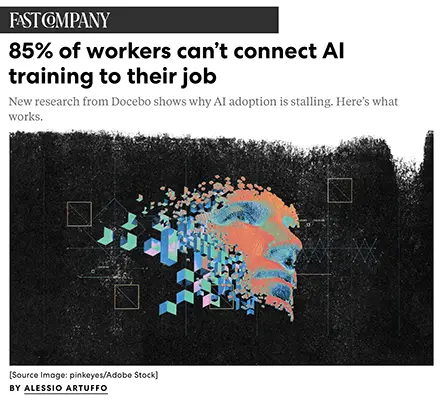
AI Training Isn’t Working: 85% of Workers Can’t Connect It to Their Jobs
Fast Company | May 20, 2026
TL;DR: A survey of 2,000 workers commissioned by learning platform Docebo finds that most AI training programs are failing to produce usable capability — not because the tools don’t work, but because training isn’t connected to actual roles or workflows.
Executive Summary
The core finding is straightforward and worth taking seriously: most organizations have deployed AI tools faster than they’ve built the human capacity to use them. According to Docebo’s survey, 56% of workers report being too buried in existing task loads to find time to learn the new tools. Among those who do receive training, 85% say they cannot apply what they learned to their specific job. And 78% say the training takes place in systems entirely separate from where their actual work happens.
The article frames this as a systemic design failure rather than individual resistance. Training programs are measuring the wrong outcomes — completion rates and licenses deployed rather than demonstrated capability. The author (Docebo’s CEO) argues that real AI readiness requires role-specific learning embedded in existing workflows, peer knowledge transfer, and skills data tied to actual job performance rather than course completions.
Source credibility note: This piece is authored by the CEO of Docebo, an enterprise learning platform vendor. The argument is directionally sound and consistent with broader research on technology adoption, but the data is self-commissioned and the recommended solutions align with Docebo’s product offerings. Weight the findings accordingly — the diagnosis rings true; the prescribed remedies should be evaluated independently.
Relevance for Business
This is among the most directly actionable findings for SMB leaders investing in AI. If your organization has purchased AI tools and run training sessions, this data suggests a high probability that meaningful adoption has not followed. The cost isn’t just the training spend — it’s the opportunity cost of tools that employees have access to but aren’t using effectively. Governance risk also grows when employees interact with AI tools they don’t fully understand. For SMBs without dedicated L&D functions, this problem is likely more acute than in large enterprises.
The corrective direction — embedding learning at the moment of first tool use, tying it to specific roles, and identifying internal power users as informal coaches — is practical and doesn’t require enterprise-scale infrastructure.
Calls to Action
🔹 Audit your current AI training approach — ask whether employees can demonstrate applied capability, not just whether they’ve completed a module.
🔹 Identify internal AI power users and create structured opportunities for peer knowledge transfer rather than relying solely on vendor-provided training content.
🔹 Shift from procurement metrics to performance metrics — measure whether AI use is changing actual work outputs, not just adoption rates.
🔹 Embed training at the point of first use — coordinate with tool vendors to surface guidance when employees encounter a feature for the first time, rather than scheduling stand-alone sessions.
🔹 Revisit role-specific AI use cases before your next training cycle — generic AI literacy programs are consistently less effective than role-mapped guidance.
Summary by ReadAboutAI.com
https://www.fastcompany.com/91543359/85-of-workers-cant-connect-ai-training-to-their-job: May 25, 2026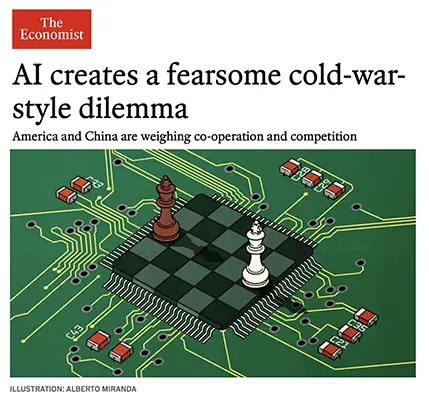
The AI Arms Race Has a Governance Problem: America and China Face a Cold War-Style Dilemma
The Economist | May 7, 2026
TL;DR: As AI capabilities approach thresholds that both governments consider strategically existential, the US and China are searching for a diplomatic framework — but deep mutual distrust, asymmetric incentives, and China’s track record of using safety dialogue for leverage make meaningful agreement unlikely in the near term.
Executive Summary
The article draws a direct structural parallel between AI governance and nuclear arms control — not as rhetoric, but as policy analysis. Both Washington and Beijing have concluded that frontier AI is too consequential to leave entirely ungoverned, yet neither is willing to be the first to slow its own development. The development of Anthropic’s Mythos model — reportedly capable enough at cyber-offense that it could not be publicly released — galvanized attention from state media in both China and Russia and accelerated calls for formal dialogue.
Three possible paths toward cooperation are outlined: strategic reassurance through parallel (non-coordinated) policy dialogue; shared safety testing standards without sharing underlying model data; and a formal treaty with verification mechanisms modeled on nuclear inspections. All three face serious obstacles. China’s past behavior — linking AI safety talks to chip export controls, sending political officials rather than technical experts to Geneva — suggests its stated interest in global governance is at least partly instrumental. American researchers are skeptical. Meanwhile, China views safety frameworks as potential tools for locking it into technological subordination.
The piece closes with a sober observation: historical precedent suggests that meaningful international safety standards tend to emerge only after a serious accident. The analogy is Bhopal and Chernobyl, not pre-emptive diplomacy.
Relevance for Business
Most SMB leaders don’t negotiate arms treaties, but this matters for several downstream reasons. Regulatory uncertaintyis the most immediate: if the US government moves toward mandatory government vetting of new AI models (a direction the Trump administration is reportedly considering), that affects how quickly new AI capabilities reach commercial products. Export controls on chips and AI software already constrain where and how cloud infrastructure gets built. And the prospect of AI-enabled cyberattacks at nation-state capability levels is a growing enterprise security concern, not a distant hypothetical. The governance vacuum at the top creates compliance and security complexity at every level below it.
Calls to Action
🔹 Monitor US AI regulatory developments — government vetting requirements for frontier models could affect the pace and nature of commercial AI product releases from major vendors.
🔹 Strengthen cyber resilience planning — the emerging category of AI-enabled cyberattack is not science fiction; assess whether your security posture accounts for more sophisticated automated threats.
🔹 Stay current on export control developments — ongoing US-China chip restrictions affect cloud infrastructure availability and pricing; factor this into multi-year vendor planning.
🔹 Treat geopolitical AI risk as a board-level topic — not for immediate action, but for informed awareness; the governance landscape for AI will shift materially in the next 2–3 years.
🔹 No operational changes needed now, but assign someone to monitor regulatory signals quarterly.
Summary by ReadAboutAI.com
https://www.economist.com/china/2026/05/07/ai-creates-a-fearsome-cold-war-style-dilemma: May 25, 2026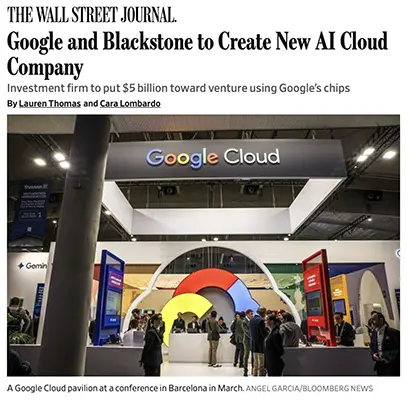
Google and Blackstone Launch a $5B AI Cloud Venture to Challenge Nvidia’s Dominance
The Wall Street Journal | May 18, 2026
TL;DR: Google and Blackstone are forming a new AI cloud company — backed by $5 billion in Blackstone equity and a projected $25 billion in total compute investment — that will sell access to Google’s custom AI chips, directly challenging Nvidia’s grip on the AI infrastructure market.
Executive Summary
This is one of the most significant structural moves in AI infrastructure in 2026. Google and Blackstone are launching an independent cloud company — the largest attempt yet to commercialize Google’s Tensor Processing Units (TPUs) to external customers — with an initial target of 500 megawatts of capacity by 2027 and substantial further expansion planned. Blackstone will be the majority owner; Google will supply chips, software, and services. A long-tenured Google executive will serve as CEO.
The strategic logic is clear on both sides. Google wants to monetize its custom silicon at scale and reduce Nvidia’s dominance over AI compute — it has until now supplied TPUs only to a handful of partners (Anthropic and Meta). Blackstone, already the world’s largest data center owner by its own account with over $150 billion in data-center assets, is consolidating its AI infrastructure bets through a new dedicated unit called Blackstone N1. This venture is BXN1’s second investment following a joint Anthropic-related deal announced earlier in May.
What this changes: Most major AI companies currently run on Nvidia chips via CoreWeave and similar providers. A well-capitalized Google TPU-based alternative with Blackstone’s data center muscle creates genuine supply-side competition — which, over time, could exert downward pressure on AI compute costs. But the timeline is real: 500MW of capacity targets 2027, and scaling from there takes years. This is a 3–5 year infrastructure play, not an immediate market shift.
Relevance for Business
SMBs don’t buy directly from infrastructure ventures of this scale, but the downstream effects are material. AI cloud compute pricing is one of the largest cost variables in enterprise AI deployment. If Google TPU-based alternatives gain credible market share alongside Nvidia/CoreWeave offerings, it introduces pricing competition that benefits buyers. It also increases the likelihood that major cloud providers (AWS, Azure, Google Cloud itself) will offer more diverse, competitive compute options. Vendor concentration risk — currently high given Nvidia’s dominance — decreases if this venture succeeds.
For businesses evaluating multi-year cloud or AI infrastructure commitments, this is a reason to avoid locking in long-term Nvidia-only dependencies without understanding the alternative landscape forming around Google’s chips.
Calls to Action
🔹 Treat this as a 2027+ story — no immediate procurement decisions hinge on this venture today, but track its progress as you plan infrastructure commitments beyond 12 months.
🔹 Avoid over-indexing on Nvidia/CoreWeave in any long-term AI infrastructure planning — the compute landscape is becoming more competitive, and optionality has value.
🔹 Watch Google Cloud pricing and TPU availability — this venture’s success would likely expand TPU access through Google Cloud in ways that affect every Google Cloud customer.
🔹 Monitor Blackstone N1 as a bellwether — as the largest private AI infrastructure investor consolidates its bets, its portfolio choices signal where institutional capital believes AI compute demand is heading.
Summary by ReadAboutAI.com
https://www.wsj.com/tech/ai/google-and-blackstone-to-create-new-ai-cloud-company-0e35b91f: May 25, 2026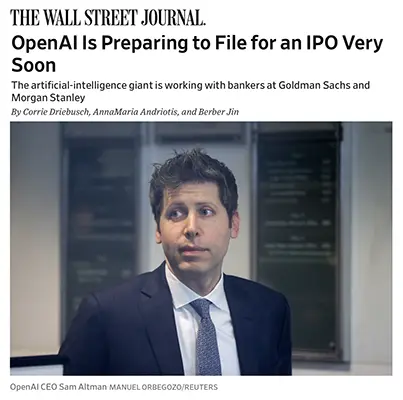
OpenAI Is Moving Toward an IPO — Possibly by September
The Wall Street Journal | May 20, 2026
TL;DR: OpenAI is preparing a confidential IPO filing with Goldman Sachs and Morgan Stanley advising, targeting a public debut as early as September 2026 — but faces unresolved questions about revenue sufficiency, massive capital commitments, and intensifying competition from Anthropic and Google.
Executive Summary
OpenAI’s IPO is no longer speculative — it is in active preparation. The company is working with Goldman Sachs and Morgan Stanley on a confidential filing expected imminently, with a target of being market-ready by September. The most recent private valuation stood at $852 billion. The legal obstacle posed by Elon Musk’s lawsuit has been cleared (the jury ruled for OpenAI; Musk has signaled an appeal), removing a significant near-term risk. Separately, SpaceX is moving toward its own IPO, and Anthropic is reportedly exploring a public offering as well, setting up a potential landmark period for AI company listings.
The financial picture is less clear. OpenAI recently missed internal revenue and user targets, faces enormous ongoing data center spending commitments, and is described as being in the middle of a major strategy pivot in response to faster-than-expected growth at Anthropic. The company’s CFO has reportedly counseled that more time may be needed before going public. The decision to proceed appears to reflect Altman’s preference and investor appetite rather than financial readiness consensus internally.
What to distinguish here: The IPO filing is confirmed as in progress. The September timeline is stated as a goal but described as fluid. Whether the company can demonstrate sufficient revenue trajectory to justify its valuation in a public market — where scrutiny is far higher than in private rounds — remains the central open question.
Relevance for Business
A public OpenAI matters to SMBs for several reasons. Public companies face earnings pressure and investor scrutiny that private ones do not — this may accelerate monetization of ChatGPT and API products, potentially through higher pricing, new paid tiers, or reduced access to free features. It also raises the stakes of OpenAI’s competitive position relative to Anthropic and Google, both of which are growing rapidly. Vendor stability is also a consideration: a public offering could bring governance clarity, but it also introduces quarterly earnings dynamics that don’t always align with product consistency.
For businesses that rely on OpenAI’s APIs or products, this is a moment to assess dependency and ensure you have a contingency understanding of alternatives.
Calls to Action
🔹 Assess your OpenAI dependency — if core workflows rely on ChatGPT or the OpenAI API, understand what it would take to migrate to an alternative (Anthropic’s Claude API, Google Gemini) should pricing or access policies change post-IPO.
🔹 Watch the S-1 filing closely — when OpenAI’s prospectus becomes public, the revenue and cost data disclosed will be the most detailed look yet at the real economics of frontier AI; it will be highly relevant for evaluating all AI vendors.
🔹 Don’t conflate valuation with stability — an $852B private valuation does not guarantee product or pricing continuity under public market pressure; plan accordingly.
🔹 Monitor Anthropic’s IPO signals — if Anthropic follows OpenAI to public markets, competitive dynamics between the two will intensify, which is generally positive for enterprise buyers.
🔹 No immediate vendor action required, but begin a low-urgency review of AI tool diversification as part of your next technology planning cycle.
Summary by ReadAboutAI.com
https://www.wsj.com/wsjplus/dashboard/articles/openai-ipo-filing-date-0ec95af5: May 25, 2026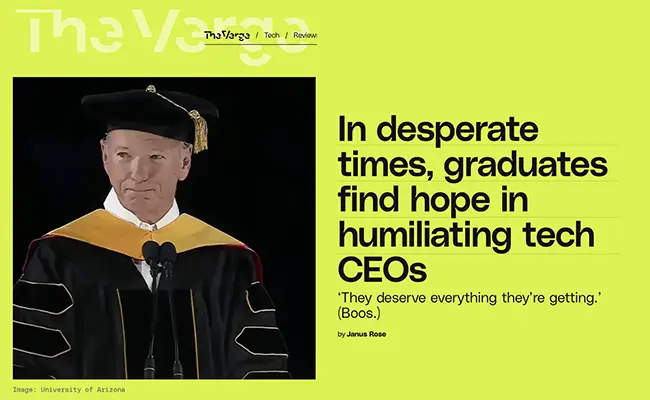
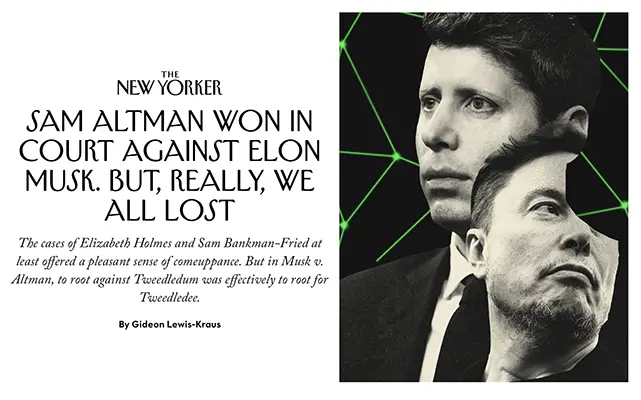
Closing: AI update for May 25, 2026
The common thread running through this week’s coverage is straightforward: the organizations best positioned to benefit from AI are those building the governance, training, and trust infrastructure that most are still skipping. Speed without structure is not a strategy — it is a debt that comes due in workforce friction, compliance exposure, and vendor dependency. Use these summaries as a diagnostic, not just a briefing.
All Summaries by ReadAboutAI.com
↑ Back to Top