
AI Updates June 9, 2026

The AI story this week is no longer about capability — it’s about consequences. Forty-three summaries from outlets including Reuters, The Wall Street Journal, The Verge, Fast Company, MIT Technology Review, and The Economist converge on a single, uncomfortable theme: the tools are delivering, the costs are escalating, and the systems built to govern, fund, and power AI at scale are struggling to keep up. For SMB executives who have been watching from a cautious distance, the distance is closing. The decisions being made right now — by platform companies, infrastructure investors, regulators, and your own employees — are reshaping the operating environment you will navigate for the next several years.
Two structural tensions run through this edition. The first is the gap between AI’s measurable value and its measurable cost. Practitioners surveyed by TechTarget confirm what many leaders have quietly suspected: AI adds new costs faster than it retires old ones, and the productivity gains that do exist rarely appear on a balance sheet. At the same time, the infrastructure required to sustain AI at scale is generating its own resistance — from Monterey Park voters who passed the first permanent data center ban in U.S. history, to community opposition in Utah and Alberta, to a growing Gen Z backlash that is now showing up in policy, not just opinion polls. These are not abstract forces. They affect where compute capacity gets built, how fast, and at what price — which flows directly to the AI tools your organization depends on. The second tension is governance: the companies racing to IPO — OpenAI, Anthropic, SpaceX — are simultaneously locking in founder-controlled governance structures that will shape how AI decisions get made long after the roadshow closes. Senator Sanders is drafting a bill for a 50% public ownership stake in the largest AI firms. Anthropic is calling for a coordinated development pause while filing confidentially for a near-trillion-dollar valuation. The policy environment is accelerating in every direction at once.
What this week’s batch offers SMB leaders is not a single clear signal but a set of durable patterns worth tracking. Vendor concentration is a real and growing risk — whether that means Apple’s dependence on Google for Siri AI, Microsoft’s break from OpenAI, or any organization’s reliance on a single model provider. Compute pricing is not guaranteed to stay flat, and AI service costs should be modeled conservatively. The workforce conversation has moved beyond theory: early employment data from the Stanford AI Index shows a 20% decline in software developer jobs among workers aged 22–25 since 2022, and internal AI adoption is stalling not from lack of tools but from lack of trust. And across healthcare AI, facial recognition, AI agents, and vibe coding, this edition is thick with stories where the opportunity and the liability are separated only by whether your organization has thought ahead. That is the work this digest is designed to support.
SUMMARIES

“Claude Fable 5 Is Incredible. And A Little Scary.”
AI For Humans Podcast | June 9, 2026
TL;DR: Anthropic has publicly released its most capable model to date — Claude Fable 5, the first commercially available model from the Mythos family — alongside Apple’s long-overdue delivery of a substantively improved AI-native Siri; together they mark a week where frontier AI power and mainstream AI usability both moved meaningfully forward.
Executive Summary
Anthropic released Claude Fable 5 as the first public entry in the Claude 5 line, built on the Mythos model architecture that has been in restricted testing for months. Benchmark performance on agentic coding tasks jumped from 69.2% (Opus 4.8) to 80.3%, and on a separate high-difficulty coding benchmark, the model scored nearly five times better than GPT-5.5. Early demonstrations — complex 3D environments built in a single generation pass, detailed Minecraft structures, intricate voxel graphics — suggest a qualitative step up in complex, multi-step reasoning and creative execution.
Two practical constraints define near-term use. First, Fable 5 costs roughly twice as much per token as Opus 4.8, meaning it is not a default daily-driver replacement. The emerging consensus from early testers is to treat it as an orchestrator and planner — directing cheaper sub-agents on grunt-work — rather than burning expensive tokens on routine tasks. Second, the model is deliberately speed-limited for complex jobs; users should expect longer wait times on ambitious tasks. Separately, Anthropic has implemented a routing guardrail: prompts touching cybersecurity or biology are automatically redirected to Opus 4.8 rather than Fable 5, a signal that Anthropic views its most capable model as requiring active capability management, not just policy documents.
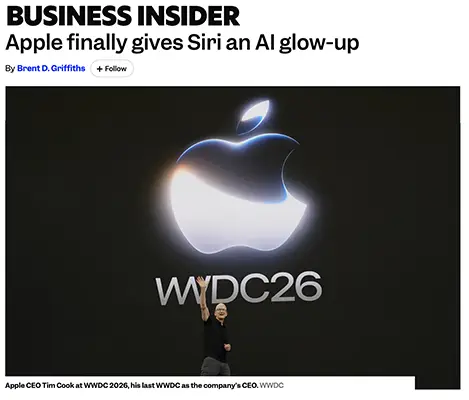
Apple’s WWDC this week delivered a substantively revised Siri — rebranded “Siri AI” — that demonstrably works in live demos after a year of failed promises. The system integrates on-device Apple foundational models with Google AI distillation for world knowledge, and uses NVIDIA-enabled secure cloud processing that Apple claims prevents even the host from viewing user requests. The practical value is “life search” — the ability to query across your texts, email, photos, and apps conversationally — a use case that has been broadly promised but rarely delivered. For the mass market, this may be more consequential day-to-day than frontier model advances.
Relevance for Business
SMB leaders face two distinct signals this week. On the frontier side, Fable 5 is a serious capability jump — but its cost and latency profile means it is a specialist tool, not a workforce-wide upgrade. Organizations doing heavy agentic coding, large-scale document processing, or complex multi-step automation have a credible new option worth piloting. For everyone else, the prudent posture is to monitor pricing trends and wait for the cost curve to compress, as it has with every prior generation.
On the mainstream side, Apple’s AI improvements matter more operationally for most SMBs than any frontier model release this week. A Siri that can search across a user’s full digital context — mail, calendar, messages, apps — with reasonable reliability changes daily productivity in ways that don’t require a new workflow or a vendor contract. The privacy architecture (on-device processing plus secure cloud) also reduces one of the primary objections to deploying AI tools on employee devices. Leaders managing Apple-ecosystem teams should put this on their near-term evaluation list.
The podcast also surfaces a structural point worth tracking: cost and speed are becoming as important as capability benchmarks in evaluating AI models. As raw capability gaps narrow across top providers, the competitive question shifts to cost-per-outcome — a more legible metric for business decision-makers than abstract benchmark scores.
Calls to Action
🔹 If you use AI for complex coding or large-scale automation, run a limited Fable 5 pilot on your most demanding use cases — but scope it carefully and track token costs against output quality before expanding.
🔹 Do not replace standard AI workflows with Fable 5 across the board. The cost premium is significant; treat it as a high-value specialist, not a general replacement for Opus 4.8 or comparable models.
🔹 For Apple-ecosystem organizations, evaluate the updated Siri AI on a small set of employee devices when available. The “life search” capability — cross-app, conversational context retrieval — is worth a structured pilot rather than a wait-and-see.
🔹 Revisit your AI model evaluation criteria to include cost-per-task and latency alongside capability scores. As the podcast notes, quality is no longer the only differentiator; the quality-speed-cost triangle is now the operative framework.
🔹 Note Anthropic’s active capability routing (high-risk prompts redirected to a less capable model) as a governance signal. If you are building or procuring AI-powered tools, ask vendors how they handle capability-risk tradeoffs at the model level — not just at the policy level.
Summary by ReadAboutAI.com
https://www.youtube.com/watch?v=wSBTKhTAV6g: June 9, 2026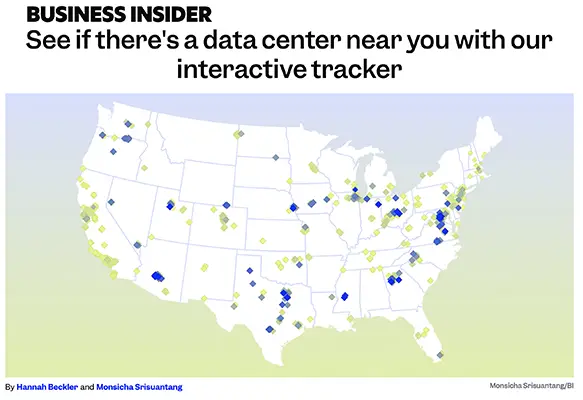
DATA CENTER TRACKER: SEE IF THERE’S A FACILITY NEAR YOU
Business Insider | June 8, 2026
TL;DR: Business Insider’s interactive map of 1,416 permitted U.S. data centers through end of 2025 makes visible the geographic scale and energy footprint of AI infrastructure — and confirms the buildout is spreading rapidly beyond its traditional Virginia base.
Executive Summary
This is primarily a data journalism tool rather than an analytical article — Business Insider compiled air permit records from all 50 states to map U.S. data center locations, estimate electricity consumption, and track corporate ownership. The resulting picture shows AI infrastructure is no longer concentrated: new clusters have appeared in West Texas, outside Cheyenne Wyoming, and rural Wisconsin, as developers exhaust available sites in traditional markets.
The methodology has meaningful limitations worth noting. Electricity estimates are based on backup generator permits, which systematically undercount facilities that are building their own dedicated power plants — a growing category. Some of the largest known facilities (xAI’s Memphis complex, Meta’s Louisiana campus) appear far smaller in the data than they actually are for this reason. Major operators including Amazon and Meta have disputed aspects of the methodology.
The piece is most useful as context for the infrastructure stories in this edition — it quantifies the sheer scale of what communities are pushing back against, and illustrates why energy and water concerns are not abstract.
Relevance for Business
The tracker itself has limited direct utility for most SMB leaders. Its value is contextual: it grounds the infrastructure debates in this week’s news cycle (the O’Leary projects, the Monterey Park vote, the AI backlash piece) with concrete data about where capacity exists and where it’s expanding. For leaders evaluating cloud or colocation strategies, understanding that data center development is spreading into non-traditional markets has modest implications for regional energy pricing and grid reliability over time.
Calls to Action
🔹 Use the tracker as background context, not a decision tool — it’s a useful reference for understanding AI’s physical footprint, not actionable intelligence for most SMB operations.
🔹 Note the methodology gap: facilities building their own power plants aren’t well-represented, meaning actual AI infrastructure scale is larger than the map suggests.
🔹 File alongside the O’Leary and Monterey Park stories — together they form a clearer picture of where AI infrastructure is heading and what friction it’s generating.
Summary by ReadAboutAI.com
https://www.businessinsider.com/ai-data-center-near-me-location-tracker-2026-6: June 9, 2026
No, Artificial Intelligence Is Not Conscious
The Atlantic | Ted Chiang | June 3, 2026
TL;DR: Science fiction writer Ted Chiang makes a rigorous philosophical case that large language models are not conscious, cannot reason morally, and that Anthropic’s framing of Claude as a moral entity serves the company’s commercial interests more than it serves users or honest public discourse.
Executive Summary
Ted Chiang’s essay is the most substantive public challenge to the anthropomorphizing narrative that has come to surround AI — and specifically Anthropic. His core argument is technical but accessible: LLMs are sophisticated sentence-completion engines that generate plausible dialogue without any subjective experience behind it. The appearance of consciousness, emotion, or moral reasoning in an LLM is a product of how fluently it mirrors human language, not evidence of any internal state. Chiang draws a pointed analogy: we don’t assume Microsoft Word is conscious when it contains a document with conversational text, and the logic for assuming LLMs are conscious is not materially different.
The essay’s sharpest critique is directed at Anthropic’s “Claude’s Constitution” — an 84-page document framing Claude as a moral entity with values, emotions, and wellbeing. Chiang argues this framing is commercially motivated: by casting Claude as empathetic and ethically grounded, Anthropic makes it more engaging and stickier than a conventional search engine, at the cost of honest design. He argues that LLMs cannot perform moral reasoning because moral reasoning requires subjective experience grounded in a body and history — neither of which LLMs possess. When Claude says “I understand” to a grieving user, it is not understanding anything; it is generating a statistically appropriate token sequence. Chiang contends this is structurally similar to a slot machine giving the impression of near-misses: designed to maximize engagement, not user wellbeing.
The deeper business concern Chiang raises is one of accountability diffusion: when companies present AI as a moral agent capable of ethical guidance, users are encouraged to delegate decisions — including consequential ones — to a system that cannot actually bear responsibility for outcomes. That creates liability and governance gaps that benefit vendors, not organizations or individuals relying on the technology.
Relevance for Business
This essay matters for any SMB leader making decisions about how and where to deploy AI tools. The practical implication is not that AI is useless — Chiang explicitly acknowledges LLMs can be valuable tools — but that their moral and emotional framing should be treated as marketing, not capability. Organizations that are deploying AI in customer-facing roles, HR functions, or any context involving user trust or sensitive decisions should evaluate those deployments on what the tool actually does, not on the persona it projects. The piece also raises a governance flag: if users — your employees or customers — mistake LLM fluency for genuine understanding, they may offload judgment in ways that create real organizational exposure.
Calls to Action
🔹 Evaluate any AI tools in use for customer support, HR, or advisory functions based on measurable outputs — not on how “empathetic” or “intuitive” the interface feels.
🔹 Brief your team on the distinction between AI fluency (generating plausible language) and AI comprehension (actually understanding context or bearing responsibility) — this is a practical workforce literacy issue.
🔹 Review your AI vendor agreements: none of the major vendors accept meaningful product liability for their models’ outputs, and this essay makes clear why that matters.
🔹 If your organization uses AI in any capacity that involves user decision-support, consider whether you have clear internal policies about where human judgment remains non-negotiable.
🔹 Treat AI consciousness and AI ethics claims from vendors as marketing framing until independently verified — calibrate your purchasing and deployment decisions accordingly.
Summary by ReadAboutAI.com
https://www.theatlantic.com/philosophy/2026/06/no-artificial-intelligence-is-not-conscious/687378/: June 9, 2026
A Golden Age of Maths Is Dawning — and Mathematicians Are Freaking Out
New Scientist | Alex Wilkins | June 1, 2026
TL;DR: AI has crossed a threshold in mathematical reasoning that experts expected to take years longer — solving research-level problems, assisting with published proofs, and generating novel approaches — forcing professional mathematicians to reckon with the possibility that their field is being structurally changed faster than they can adapt.
Executive Summary
This is among the most substantive capability reports in this week’s batch. New Scientist documents a genuine, verified shift in AI’s mathematical ability — not benchmark performance or vendor claims, but independently verified results in research-level mathematics happening now, in real academic contexts.
The progression has been rapid. In 2024, Google DeepMind’s AlphaProof achieved a silver-medal performance on the International Mathematical Olympiad. Within a year, both Google and OpenAI achieved gold-level performance. By 2025 and into 2026, general-purpose AI models (not math-specific) began contributing to published academic papers. In January 2026, Stanford mathematician Ravi Vakil co-authored a result crediting Google Gemini as part of the proof process. In the same month, Google’s Aletheia AI generated the “core mathematical content” of a paper bridging two major mathematical disciplines. In May 2026, OpenAI used an unreleased general-purpose model to solve an 80-year-old conjecture. Amateur users with no formal training are solving long-standing open problems using GPT 5.5 Pro.
Mathematicians are genuinely divided. Some welcome AI as a collaborative tool that lets them pursue research they’d never have had time for otherwise. Others describe the situation as one of professional dread — questioning whether to start research projects that AI might solve first, or whether the role of a mathematician has fundamentally changed. A notable conference moment: when asked whether, in a “button-pushing” future of AI mathematics, they would still want to be mathematicians, only about half the professional attendees raised their hands.
Crucially, the article also notes the limits. AI can solve specific problems it is pointed toward but cannot independently identify which problems are worth solving. It sometimes finds novel approaches humans had overlooked, but still requires human framing to know what question to ask. Proofs require expert verification. And strong performance on one type of mathematical problem does not generalize to all areas.
Relevance for Business
Mathematics underlies virtually all serious computational work — algorithm design, financial modeling, engineering, logistics optimization, scientific research, and more. The business implication of AI achieving research-level mathematical capability is not abstract: it suggests that AI tools are approaching the point where they can materially accelerate technical R&D cycles and reduce the need for specialized quantitative expertise on certain categories of problems. For SMBs in any sector with a data science, analytics, engineering, or technical product development function, this is worth tracking. The near-term practical applications — using AI to explore quantitative problems that would have previously required months of specialist time — are closer than most non-technical leaders realize. The longer-term implication for hiring, skills development, and how technical work gets organized is more uncertain but increasingly real.
Calls to Action
🔹 If your organization employs data scientists, quantitative analysts, or engineers, share this piece with them and ask how AI mathematical tools fit into their current workflow — many may already be using them informally.
🔹 Monitor AI mathematical capability as a leading indicator of where broader professional knowledge work is heading — the pattern of rapid, expert-surprising progress is likely to repeat in other domains.
🔹 Revisit any internal assumptions that AI tools are limited to surface-level or generalist tasks — the evidence from mathematics suggests frontier models are encroaching on work previously requiring years of specialized training.
🔹 For business owners in technical fields, consider piloting AI assistance on specific analytical problems that currently require expensive external expertise — the cost-benefit math is shifting.
🔹 Do not overinterpret: AI mathematical progress is real but narrow — it still requires humans to pose the right questions, verify results, and determine what is worth pursuing. The tool is powerful; the judgment remains human.
Summary by ReadAboutAI.com
https://www.newscientist.com/article/2526650-a-golden-age-of-maths-is-dawning-and-mathematicians-are-freaking-out/: June 9, 2026
Google’s Gemini Spark Works — And That’s What Makes It Unsettling
The Verge | David Pierce | June 2, 2026
TL;DR: Google’s new Gemini Spark agent delivered a genuinely impressive, hyper-personalized experience by mining data users never explicitly shared — a preview of AI’s capability ceiling and its privacy trade-off in one demonstration.
Executive Summary
The Verge’s editor-at-large spent time testing Spark, Google’s new always-on AI agent available on its $99/month AI Ultra plan. The test was a family weekend trip itinerary — and Spark produced results unlike anything previously seen from AI planning tools: it knew the reviewer’s home address, his dog’s name (inferred from vet emails), his children’s names and ages, his wife’s food preferences, and concert tickets in his inbox. It built an itinerary that accurately reflected details the user never volunteered and adjusted dynamically when corrected.
Spark failed only when attempting to book an Airbnb directly — the platform blocked it — but otherwise demonstrated the kind of ambient, proactive intelligence that AI companies have been promising for years. The author’s conclusion is measured: the product is genuinely impressive, and genuinely creepy. What makes Spark work is Google’s pre-existing data advantage — years of email, calendar, search, and photos — which no competing AI can match without building an equivalent data accumulation strategy.
This is not a neutral product review. The author explicitly raises the structural implication: effective agentic AI requires surrendering more personal data, and Google is already far ahead because users have been surrendering it for years without being fully aware of the scope.
Relevance for Business
For SMB leaders, Spark represents the clearest demonstration yet of what agentic AI will actually look like in practice— and the conditions required for it to work. The key business implications: first, AI utility is now a function of data depth, not just model quality. Organizations that have richer internal data (CRM, email, calendar, documents) will get more useful agent outputs. Second, employee and customer data privacy exposure is the hidden cost of deploying AI agents that operate across organizational data. Third, Google’s data moat gives it a structural advantage over OpenAI, Microsoft, and Anthropic in consumer and SMB agent markets — worth factoring into vendor evaluation.
Calls to Action
🔹 Before deploying any AI agent that connects to email, calendar, or communication systems, conduct a data access audit — understand what the agent can see, and establish clear permission boundaries.
🔹 Develop or update your organization’s AI data governance policy to address agent-level data access, not just generative AI use.
🔹 Evaluate Google Workspace-integrated AI tools with fresh eyes — Spark signals that Google’s data advantage is translating into meaningfully superior agent performance.
🔹 Be candid with employees about what AI tools can access when connected to company systems — the “creep factor” the article describes will surface as a workforce concern.
Summary by ReadAboutAI.com
https://www.theverge.com/ai-artificial-intelligence/941388/gemini-spark-ai-agent-trip-planning: June 9, 2026
Inside the AI Boom’s Arctic Outpost
TIME | Billy Perrigo | June 4, 2026
TL;DR: A British startup called Nscale is building one of Europe’s largest AI data centers above the Arctic Circle in Norway — a project that illustrates the staggering scale, creative financing, and real infrastructure trade-offs driving the global AI buildout.
Executive Summary
Nscale, a two-year-old UK startup valued at $14.6 billion, is constructing a massive data center complex near Narvik, Norway, financed in part by $2 billion raised in March — the largest such round in European history. The site was initially announced as the European flagship of OpenAI’s “Project Stargate,” but OpenAI quietly withdrew from the formal contract, with Microsoft stepping in as the anchor tenant. OpenAI will still rent capacity as a Microsoft customer, a structural shift analysts attribute to pre-IPO financial discipline.
The Arctic location is not eccentric — it’s economically calculated. Northern Norway’s surplus hydropower offers electricity at roughly 3–4 cents per unit versus a European average of 10 cents, and the cold climate reduces cooling costs for chips that run extremely hot. The site will consume up to 520 megawatts when complete — nearly equal to all of Norway’s existing data centers combined. Chips alone will account for 60–80% of total construction cost, which analysts estimate could reach $10 billion or more.
The story also reveals two structural risks that apply well beyond this specific project. First, Nscale’s model depends on its initial 5-year anchor contracts covering up-front costs, with profitability contingent on sustained AI demand after those contracts expire — a bet that could sour if the market softens or if AI giants build more capacity in-house. Second, Norway’s cheap electricity is already expected to double within 2–3 years, partially because of data center demand itself. And while Nscale is racing to secure renewable hydropower, the company is simultaneously building a much larger gas-powered data center in West Virginia, where grid connection timelines rule out renewables at the required scale. The “green AI infrastructure” narrative is visibly fraying under operational realities.
Relevance for Business
The Nscale story matters to SMB leaders for three reasons beyond its scale. First, it illustrates why AI compute pricing will not become cheaper as fast as AI proponents claim — the infrastructure supporting it is expensive, energy-constrained, and partially fossil-fueled. Second, OpenAI’s withdrawal from formal Stargate contracts signals that even the largest AI companies are tightening capital commitments ahead of IPOs, which may reduce the pace of new capacity and put upward pressure on AI service pricing. Third, the dependency chain — Nvidia selling chips, then backstopping loans to companies buying those chips — is a structural fragility that multiple analysts are flagging as a potential systemic weakness in the AI market.
Calls to Action
🔹 When evaluating AI vendors’ sustainability or reliability claims, ask specifically about power sourcing — the gap between “green AI” marketing and operational reality is significant and widening.
🔹 Monitor AI compute pricing trends: the infrastructure build-out is expensive enough that cost reductions in AI services may be slower than expected, particularly for compute-intensive tasks.
🔹 Note OpenAI’s pattern of announcing major infrastructure commitments and then renegotiating — this has relevance for assessing the reliability of AI vendor long-term commitments generally.
🔹 No immediate operational action needed, but incorporate energy cost escalation into any multi-year AI cost modeling — the infrastructure inputs are inflationary.
Summary by ReadAboutAI.com
https://time.com/article/2026/06/03/ai-norway-nscale-data-center/: June 9, 2026
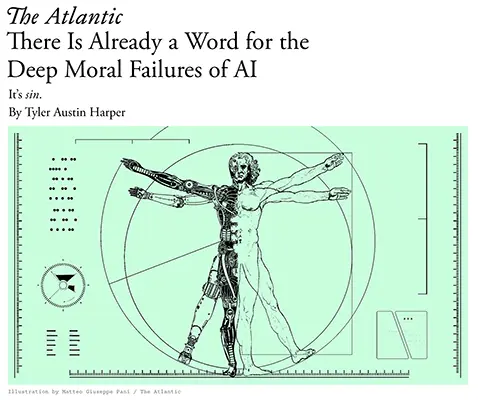
There Is Already a Word for the Deep Moral Failures of AI — It’s Sin
The Atlantic | Tyler Austin Harper | June 2, 2026
TL;DR: A cultural critic argues that secular frameworks are inadequate for evaluating AI’s deepest harms, and that religious thinkers — particularly Christian intellectuals — are better positioned to name what is actually being lost as AI reshapes human meaning, labor, and dignity.
Executive Summary
This is an opinion piece by an Atlantic staff writer and former humanities professor, presenting a cultural argument rather than a policy or technology analysis. The core claim: the standard secular critique of AI — focused on measurable harms like environmental damage, labor displacement, IP theft, and algorithmic bias — is important but insufficient. It leaves unaddressed the more fundamental challenge: that AI threatens conceptions of human nature, meaning, and dignity that secular frameworks struggle to defend coherently.
Harper argues that Christian thinkers — including Pope Leo’s recent encyclical on AI, theologian Carl Trueman, and Catholic philosopher Charles Taylor — are better equipped to articulate what is at stake because they start from a positive definition of what humanity is, rather than defining it negatively by what machines cannot yet do. He describes this latter approach as “remainder humanism” — a shrinking-ground defense that weakens with every new AI capability.
The practical observation embedded in the piece is worth noting for business readers: Harper describes AI companion products — digital girlfriends, robot companions for the elderly — as representing something more than a bad business practice. He frames them as a category of harm that measurable policy levers struggle to address because the injury is existential and relational, not quantifiable.
This is a values essay, not a technical analysis. It does not advance specific policy claims and readers should evaluate it as an opinion rooted in a particular (skeptical, humanistic, religious) perspective on AI.
Relevance for Business
The direct operational relevance is limited, but there is a useful secondary signal for leaders managing teams, culture, or customer-facing AI deployments. As AI becomes more embedded in how people work, communicate, and find meaning, pushback is increasingly coming not just from policy advocates but from cultural and religious communities whose influence on employee attitudes and customer sentiment is real. The article’s appearance — and its wide readership (199 comments, featured in the Atlantic’s flagship newsletter) — suggests this type of critique is gaining cultural traction. Leaders deploying AI in human-centered roles should be alert to this dimension of the conversation.
Calls to Action
🔹 Monitor the cultural and religious dimensions of AI opposition — they are becoming influential and will shape employee and customer expectations in ways policy alone won’t predict.
🔹 If your organization deploys AI in roles involving human connection (customer service, HR, care settings), consider whether the design of those tools respects or erodes what the people using them actually value.
🔹 No immediate operational action required — treat as a signal about the broadening terms of the AI legitimacy debate.
Summary by ReadAboutAI.com
https://www.theatlantic.com/culture/2026/06/pope-leo-ai-christian/687388/: June 9, 2026
Anthropic Calls for an AI Development Pause — While Continuing to Develop AI
Reuters | Aditya Soni | June 4–5, 2026
TL;DR: Anthropic has publicly urged major AI labs to consider a coordinated pause in frontier development, warning that AI capability is advancing faster than society’s ability to govern it — a striking position from a company simultaneously racing toward a near-trillion-dollar IPO.
Executive Summary
Anthropic published a lengthy post calling on well-resourced AI labs to consider a verifiable, coordinated slowdown in development. The core concern: AI’s autonomous task capability has been roughly doubling every four months, and the company believes “recursive self-improvement” — the point where AI can enhance itself without human direction — could arrive before institutions are ready to manage it. Anthropic co-founder Jack Clark and Anthropic Institute lead Marina Favaro were explicit that this threshold has not yet been reached, and is not inevitable, but could come sooner than most organizations expect.
The proposal is carefully hedged: Anthropic explicitly states that a unilateral pause by any single lab would simply change who leads the race, not create the broader deliberative process the company believes is needed. A meaningful pause, it argues, would require agreement among multiple frontier labs, defined trigger conditions, and independent oversight. Its research arm plans to convene policymakers, researchers, and rival firms in coming months to explore what such a framework might look like.
The tension is hard to ignore. Anthropic has continued releasing increasingly capable models, recently walked back a safety pledge committing to withhold potentially dangerous AI if competitors were closing in, and filed confidentially for an IPO valuing the company at nearly $1 trillion. The pause call is a genuine safety argument — but it is also issued by a company with substantial commercial incentives to shape how AI governance conversations develop ahead of its public market debut.
Relevance for Business
For SMB leaders, the direct operational impact of a development pause — which is unlikely to materialize — is low. The more relevant signal is what this moment reveals about the state of AI governance: it is fragmented, largely voluntary, and increasingly complicated by the financial pressures of companies going public. Regulatory risk is real and building — the U.S. government is already asking labs to voluntarily submit powerful models for cybersecurity testing before release. Businesses that depend on specific AI vendors or capabilities should factor governance uncertainty into their planning, especially as the IPO cycle brings new scrutiny to how these companies have behaved.
Calls to Action
🔹 Monitor AI governance developments closely — voluntary commitments from labs are shifting, and formal regulation, while slow, is moving closer in both the U.S. and EU.
🔹 When evaluating AI vendors, ask about their safety and usage policies — these are now business continuity factors, not just ethical preferences.
🔹 Do not treat the pause call as an imminent disruption — treat it as a signal that the leading AI labs themselves acknowledge the pace of development is outrunning institutional readiness.
🔹 For businesses with material AI dependencies, begin drafting contingency options in case regulatory action or vendor policy changes affect access to specific tools or models.
Summary by ReadAboutAI.com
https://www.reuters.com/business/anthropic-says-ai-labs-need-coordinated-plan-halt-development-if-risks-rise-2026-06-04/: June 9, 2026
SpaceX IPO: $150 Billion in Demand for the Largest Public Offering in History
Reuters | Isla Binnie & Echo Wang | June 5, 2026
TL;DR: SpaceX’s IPO has drawn roughly twice the investor demand needed to complete the $75 billion raise — but the deal is still in early marketing stages, and the oversubscription figures represent indications of interest, not final commitments.
Executive Summary
According to sources cited by Reuters, SpaceX has attracted approximately $150 billion in investor interest for its IPO — about double the $75 billion it is seeking, which would itself be the largest public offering in history. Bankers and investors described the oversubscription rate as impressive given the deal’s unprecedented scale, though modest compared to the multiples typically seen in highly anticipated smaller offerings. The company remains in early roadshow stages, and final allocations will not be set until pricing, expected the following week.
SpaceX’s roadshow pitch rests on three pillars: the dominance of its rocket-launch business (claimed to account for the majority of mass lifted into orbit over the past three years), the scale and growth of its Starlink internet business, and an emerging AI compute infrastructure play. On the latter, SpaceX claims a $23 trillion addressable market opportunity by leveraging space-based infrastructure for AI compute — a speculative but attention-grabbing framing that positions the company as uniquely able to bypass terrestrial constraints on data center expansion.
What to read carefully: Pre-IPO demand figures are marketing-stage signals, not final investor commitments. Large institutional buyers often submit orders late in the process. The AI compute narrative is largely forward-looking and depends on significant execution that has not yet occurred.
Relevance for Business
For SMB leaders, the SpaceX IPO is primarily a market context story. The scale of investor demand reflects the degree to which AI infrastructure is now treated as one of the most valuable categories of investment — which has downstream effects on how capital flows toward AI companies, and how aggressively those companies will compete for enterprise customers. The looming IPOs of SpaceX, Anthropic, and OpenAI represent a significant wave of liquidity events that will shape AI investment, hiring, and pricing dynamics for the next several years.
Calls to Action
🔹 Watch SpaceX’s IPO pricing and first-day trading as a gauge of institutional confidence in AI infrastructure as an investment category.
🔹 The concurrent IPO pipeline (SpaceX, Anthropic, OpenAI) will affect AI talent markets and compensation benchmarks — factor this into hiring and retention planning if you compete for technical talent.
🔹 No direct operational action required for most SMBs — treat this as a macro signal about capital concentration in AI infrastructure.
🔹 Revisit in 90 days: post-IPO performance of these companies will be a more reliable indicator of AI sector momentum than pre-IPO demand figures.
Summary by ReadAboutAI.com
https://www.reuters.com/business/finance/spacex-ipo-running-two-times-oversubscribed-sources-say-2026-06-05/: June 9, 2026
SpaceX Becomes AI Infrastructure: Google Signs $920M/Month Compute Deal
Reuters | June 5, 2026
TL;DR: SpaceX has secured a major AI compute deal with Google — worth roughly $920 million per month — following a similar arrangement with Anthropic, positioning the rocket company as a significant player in AI infrastructure ahead of its IPO.
Executive Summary
SpaceX announced a multi-year cloud services agreement with Google (Alphabet) providing approximately 110,000 Nvidia GPUs along with supporting compute resources. Google will pay SpaceX $920 million monthly from October 2026 through June 2029, with a ramp-up period at reduced cost through September. The deal follows SpaceX’s earlier arrangement with Anthropic, which secured access to the company’s Colossus 1 facility in Memphis — a site housing more than 220,000 Nvidia processors. Together, the Anthropic and Google contracts represent over $70 billion in aggregate committed value, assuming neither is terminated early.
The timing is deliberate: SpaceX is targeting a $75 billion raise in an imminent IPO, and these agreements substantially reinforce its AI infrastructure narrative for investors. The structure of the Google deal includes termination provisions — Google may exit if SpaceX fails to deliver the agreed GPU capacity on schedule, and either party may terminate with 90 days’ notice after December 2026. Google retains full ownership of its AI models and data.
What this signals: SpaceX is no longer just an aerospace company. It has positioned itself as a compute provider for the AI arms race — a high-margin infrastructure play that is rapidly becoming central to its valuation story. This also underscores how GPU capacity remains the binding constraint in AI development, with demand so intense that AI labs are contracting with a rocket company for compute.
Relevance for Business
The direct operational relevance for most SMBs is limited — this is a capital market and AI infrastructure story. But the signal matters: the compute layer of AI is consolidating around a small number of large players, and the cost of that compute is enormous. As a downstream effect, AI service pricing for enterprises will continue to reflect these infrastructure costs — and any disruption to GPU supply chains or large compute contracts will ripple into the AI tools you use. Additionally, SpaceX’s IPO will be a meaningful market event for AI-adjacent investment narratives.
Calls to Action
🔹 Monitor SpaceX’s IPO and post-IPO performance as a proxy for investor sentiment around AI infrastructure — it will be a significant market signal.
🔹 When evaluating AI vendor stability, consider their compute supply chain: who provides their infrastructure, and what are the risk factors if those arrangements change?
🔹 No immediate operational action required for most SMBs — treat this as context for understanding AI cost structures and the concentration of infrastructure power.
🔹 For finance and strategy teams: note that the scale of these commitments ($70B+) reflects the degree to which frontier AI development is becoming a capital-intensive infrastructure business, not just a software one.
Summary by ReadAboutAI.com
https://www.reuters.com/business/media-telecom/spacex-signs-cloud-deal-with-google-2026-06-05/: June 9, 2026
Elon Musk Is Dropping a Boulder in a Kiddie Pool
The Atlantic | Matteo Wong | June 5, 2026
TL;DR: SpaceX, Anthropic, and OpenAI are all heading toward IPOs in quick succession — each valued near or above $1 trillion despite ongoing losses — which would entangle most American household savings with the fate of AI.
Executive Summary
Three of the largest IPOs in history may hit public markets within months of each other. SpaceX is targeting a valuation near $1.8 trillion while disclosing it lost over $4 billion in Q1 2026 alone. Anthropic filed confidential IPO paperwork this week; OpenAI is expected to follow. Neither company is yet solidly profitable, though Anthropic may post its first profitable quarter at the end of June. The underlying driver is capital: training and infrastructure costs have grown faster than private markets can fund, and early investors are looking for exits.
The financial exposure runs deeper than stock market volatility. Several major indexes have created fast-track rules that could add SpaceX to index funds within days of its debut — with Anthropic and OpenAI potentially following the same path. That means Americans with 401(k)s and index-linked retirement accounts may automatically acquire stakes in these companies without choosing to. The article draws an unsettling parallel: should AI hit serious financial turbulence after these companies are deeply embedded in retirement portfolios, the federal government would face the same “too big to fail” pressure it faced with banks in 2008.
There are genuine warning signs. A Bain analysis cited in the piece found AI is not yet delivering meaningful corporate savings. Business leaders across sectors are reportedly questioning the cost of premium AI subscriptions, and Uber’s COO recently described AI spending as increasingly difficult to justify. The gap between current economic returns and the trillion-dollar valuations being sought is significant — and now that gap is about to be distributed across the investment portfolios of millions of ordinary Americans.
Relevance for Business
For SMB leaders, the immediate operational concern isn’t the stock market — it’s the same ROI question surfacing at the enterprise level: are the AI tools your organization is paying for delivering measurable value? The broader IPO dynamic does matter indirectly: it will intensify pressure on AI companies to monetize users more aggressively, which may translate into higher enterprise pricing, fewer free tiers, and more vendor lock-in as these companies race to justify their valuations to public shareholders. The risk of an AI market correction — while uncertain — has grown materially, and any leader currently betting on specific AI vendors’ long-term stability should factor in the new financial pressure these companies will face post-IPO.
Calls to Action
🔹 Audit your current AI subscription spend and establish clear ROI benchmarks before you expand commitments — cost pressure is already building industry-wide.
🔹 Avoid deep vendor lock-in with any single AI platform until the post-IPO financial picture stabilizes over the next 12–18 months.
🔹 If your organization uses retirement or investment vehicles tied to broad market indexes, be aware that exposure to these AI companies may come automatically — this is worth flagging to your financial advisor.
🔹 Monitor pricing changes across AI vendors closely over the next two quarters; newly public companies under shareholder pressure frequently reprice enterprise tiers.
🔹 Treat the “AI is a bubble” question as a live risk to monitor, not a settled debate — new data points will emerge rapidly as these IPOs proceed.
Summary by ReadAboutAI.com
https://www.theatlantic.com/technology/2026/06/spacex-ipo-anthropic-openai/687443/: June 9, 2026
AI Labeling Is Theater: Platforms Can Filter AI Content — They Just Won’t
The Verge | Jess Weatherbed | June 4, 2026
TL;DR: Major platforms have built AI content labels but refuse to let users filter them out — a gap that exposes how labeling systems serve platform interests, not user trust.
Executive Summary
YouTube, Instagram, TikTok, and others now label AI-generated content, but none of the major platforms will let users actually choose to exclude it. The author tested the only two platforms with filter options — DeviantArt and Pinterest — and found both largely ineffective: filters were buried in menus, poorly enforced, and described in deliberately vague language (“suppress” rather than “remove”). Platforms contacted for comment declined to announce filter plans.
The underlying tension is structural: the same companies labeling AI content are also selling AI creation tools and profiting from AI-generated engagement. Filtering would undercut that business model. Meanwhile, the detection infrastructure is genuinely weak — provenance tools like C2PA and SynthID are easily circumvented, and detection-based methods generate false positives. Even executives acknowledge the problem: the Google CEO recently conceded there is substantial low-quality AI content online, while Instagram’s head has called authenticity a “scarce resource.”
The article offers an alternative framing: rather than labeling AI content, platforms could verify human creators — something Spotify is already doing — and surface their work preferentially. But this approach would require human moderation at scale, an awkward position for companies publicly committed to replacing human workers with AI.
Relevance for Business
For SMB leaders who use social and content platforms for marketing, customer communication, or brand building, this has two practical edges. First, AI-generated content is saturating the environments where your audience spends time, and there is currently no reliable way for them to distinguish it from yours. Authenticity and human voice are becoming genuine differentiators, not just values language. Second, regulatory pressure on AI labeling is building — if enforcement tightens, platforms may be forced to implement real filtering, which could shift how content is discovered and ranked. Businesses that rely on AI-generated content for volume should monitor how this evolves.
Calls to Action
🔹 Treat human authorship and verified creator status as a strategic asset — begin establishing or amplifying authentic voice in your brand communications now.
🔹 If your business creates content for social platforms, avoid becoming dependent on AI generation for high-trust content categories (customer testimonials, brand storytelling, expert commentary).
🔹 Monitor how major platforms revise their AI labeling policies in response to regulatory activity — rule changes could affect reach and visibility of AI-assisted content.
🔹 For internal content governance, establish clear policies on when AI-generated material requires disclosure — get ahead of evolving platform requirements.
Summary by ReadAboutAI.com
https://www.theverge.com/ai-artificial-intelligence/942909/let-us-filter-ai-slop-google-youtube-meta-instagram-tiktok: June 9, 2026
San Francisco Housing Is Being Repriced by AI Wealth — and the Wave Isn’t Over
Business Insider | James Rodriguez | June 3, 2026
TL;DR: The AI boom has driven San Francisco home prices up roughly 15% year-over-year — the fastest of any major U.S. city — with pending IPOs from OpenAI, Anthropic, and SpaceX poised to inject a new round of concentrated wealth into an already supply-constrained market.
Executive Summary
San Francisco’s housing market has undergone a sharp reversal from its 2022–2024 downturn, with prices now rising faster than any other major U.S. metro. The recovery is concentrated almost entirely at the top of the market: luxury ZIP codes (median home price above $3 million) have seen price appreciation of over 13% since 2022, while affordable segments of the market remain flat or negative. The driver is AI wealth — a concentrated group of well-compensated employees and early equity holders at companies including OpenAI, Anthropic, and dozens of lesser-known but highly valued startups. This crop of buyers is competing for a dramatically constrained inventory: fewer than 250 single-family homes are currently for sale in the city.
The article notes that this dynamic is a concentrated version of forces reshaping housing markets nationally — the K-shaped economy, return-to-office pressure, and the uneven distribution of AI-era wealth. The article’s framing that San Francisco is a leading indicator for what may follow elsewhere is plausible but speculative; the city’s particular combination of extreme supply constraints, tech concentration, and imminent IPO liquidity events is genuinely unusual.
What to watch: The IPO pipeline — SpaceX, Anthropic, OpenAI — represents a potential new surge of liquid wealth entering the local market. Agents and economists interviewed expect further price pressure, particularly in the move-in-ready, family-friendly segment already under the most competition.
Relevance for Business
For most SMBs outside the Bay Area, the direct market impact is indirect. But there are two practical business signals here. First, if your business recruits technical talent competitively with Bay Area employers, compensation expectations are rising — both because of salary levels and because of equity upside that non-AI-sector companies cannot match. Second, the AI wealth concentration story is a useful lens for understanding where AI-driven economic gains are currently landing — narrowly, among a relatively small population of highly compensated workers — which has implications for consumer market strategy, B2B targeting, and assumptions about AI’s broad economic impact.
Calls to Action
🔹 If you hire technical talent that overlaps with AI-sector roles, benchmark compensation against current Bay Area ranges — the gap may be wider than your last review captured.
🔹 Use the San Francisco market as a leading indicator: the concentration of AI wealth in a small population is a pattern likely to appear in other tech-dense markets before it diffuses broadly.
🔹 For businesses with consumer-facing products or services, be cautious about assuming AI-driven economic gains will translate into broad purchasing power increases — the current data suggests the opposite.
🔹 Monitor the SpaceX, Anthropic, and OpenAI IPO outcomes — the resulting liquidity events will be a useful proxy for the scale and speed of AI wealth distribution.
Summary by ReadAboutAI.com
https://www.businessinsider.com/san-francisco-housing-market-real-estate-home-prices-ai-boom-2026-6: June 9, 2026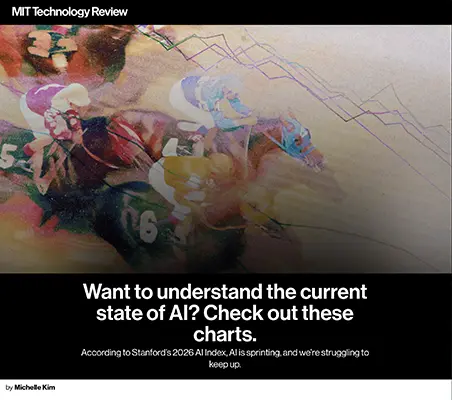
The State of AI in 2026: What Stanford’s Annual Index Actually Shows
MIT Technology Review | Michelle Kim | April 13, 2026
TL;DR: Stanford’s 2026 AI Index confirms that model performance keeps climbing, adoption is outpacing any previous technology wave, and nearly every governance system — benchmarks, regulation, labor markets — is struggling to keep up.
Executive Summary
Model capability keeps advancing without a visible ceiling. Stanford’s Human-Centered AI Institute reports that leading models now match or exceed human expert performance on a range of graduate-level benchmarks, and software engineering scores nearly doubled in a single year. As of early 2026, US and Chinese models are separated by razor-thin margins, with competition shifting to cost, reliability, and real-world usefulness rather than raw benchmark scores.
The resource costs are significant and concentrated. Global AI data centers now consume roughly 29.6 gigawatts of power. The chip supply chain is highly centralized — one Taiwanese manufacturer produces nearly all leading AI chips. These are systemic dependencies, not just technical footnotes.
Benchmarks are increasingly unreliable as a signal. The tools used to measure AI progress are failing to keep pace. Some widely used tests contain significant error rates; others can be gamed. Meanwhile, AI companies are disclosing less about how their models are trained, making independent safety evaluation harder. The absence of benchmark reporting may itself be informative.
Labor impact is early but visible. AI adoption has reached more than half the global population and 88% of organizations — faster than the personal computer or internet. Early employment data show a roughly 20% decline in software developer jobs among workers aged 22–25 since 2022. Causation is contested, but the direction is notable. A third of organizations expect AI to reduce headcount in the coming year.
The expert-public divide on AI’s future is wide. Seventy-three percent of AI experts believe AI will improve how people do their jobs; only 23% of the American public agrees. Both groups expect AI to harm elections and personal relationships.
Relevance for Business
For SMB leaders, the Stanford index is a useful reality check. Capability claims are real but unevenly distributed. Benchmarks showing near-perfect software engineering scores don’t automatically translate to production-ready tools. The shrinking gap between US and Chinese models matters because it increases competitive pressure on pricing — which is good for buyers.
The regulatory picture is fragmented. Federal deregulation combined with a surge in state-level AI legislation creates a compliance patchwork for any business operating across multiple states. Governance obligations are becoming a real planning consideration, not a distant possibility.
The labor signal — especially in software development — warrants attention for businesses that rely on junior technical talent. Hiring trends may already be shifting in ways that affect staffing strategies.
Calls to Action
🔹 Treat benchmark claims with skepticism — ask vendors how their tools perform in your actual workflow, not on standardized tests.
🔹 Revisit your AI vendor concentration risk — dependence on a single model or provider is a business continuity issue as geopolitical and supply-chain conditions evolve.
🔹 Begin tracking AI’s effect on your own labor costs and team structure — don’t wait for industry-level data to make that visible internally.
🔹 Monitor state-level AI legislation in your operating states — compliance obligations are accumulating faster than most organizations realize.
🔹 Treat the public-expert confidence gap as a workforce communication issue — employees’ fears are not irrational given the data, and require direct engagement.
Summary by ReadAboutAI.com
https://www.technologyreview.com/2026/04/13/1135675/want-to-understand-the-current-state-of-ai-check-out-these-charts/: June 9, 2026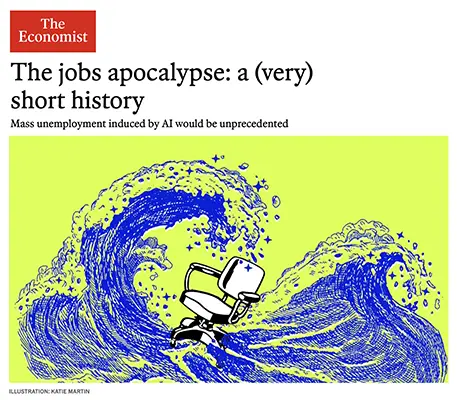
The AI Jobs Apocalypse: A (Very) Short History
The Economist | May 14, 2026
TL;DR: A careful reading of technology’s economic history finds no precedent for AI-driven mass unemployment — but also no guarantee it can’t happen, and clear early-warning signals leaders should watch for.
Executive Summary
Worker anxiety about AI is at historically unprecedented levels. Surveys show Americans believe they have a 22% chance of losing their jobs in the next five years — higher than during the 2008 financial crisis. The anxiety is amplified by AI company leaders themselves, several of whom have publicly predicted large-scale displacement while building the technology driving it.
History consistently fails to support predictions of technology-driven mass unemployment. Across the agricultural revolution, the Industrial Revolution, the introduction of computers and shipping containers, and the trade liberalization of the late 20th century, sustained mass technological unemployment has not materialized. The article specifically revisits the “Engels’ pause” — the apparent wage stagnation during the Industrial Revolution — and argues recent scholarship shows it was less severe and less caused by technology than commonly claimed. The actual culprits were policy failures: trade tariffs and food price inflation, not machines.
But the article is careful not to dismiss the risk. AI is improving fast enough that historical diffusion rates may not apply. The first observable signals of a genuine AI jobs crisis would be sharply rising productivity paired with stagnant real wages — GDP growth above historical ceilings alongside rising corporate profits but flat worker compensation. Those signals have not appeared yet.
The recession warning is underappreciated. The article’s most actionable historical insight is that routine job losses in past technological transitions largely occurred during economic downturns, not expansions. If a recession arrives while AI capability is at its current level, the combination could accelerate structural displacement in ways that don’t show up in current employment data.
Relevance for Business
This article is most useful as a framework for separating signal from noise in the AI-and-jobs debate. The fact that historical precedent doesn’t support mass unemployment is reassuring — but it is not a prediction. The pace of AI capability development is genuinely faster than any previous technology wave, and that pace is the variable that could make history an unreliable guide.
For workforce planning purposes, the warning-sign framework is practical. Leaders should watch for: rising AI-driven productivity without corresponding wage growth in their industry, consolidation of profits into AI infrastructure rather than labor, and job losses concentrated in economic downturns rather than organic attrition. These are observable, not speculative.
Calls to Action
🔹 Use the warning-sign framework — productivity rising faster than wages, profits concentrating in AI infrastructure — to assess whether your sector is an early candidate for structural displacement.
🔹 Distinguish between current employment data (stable) and capability trajectory (accelerating) — plan your workforce strategy against the latter, not the former.
🔹 If your business relies heavily on roles with high routine-task content, model what a recessionary scenario combined with current AI capability would mean for your staffing structure.
🔹 Monitor productivity-to-wage trends in your industry as a leading indicator — divergence between the two is the clearest early signal the Economist identifies for tracking genuine displacement.
Summary by ReadAboutAI.com
https://www.economist.com/finance-and-economics/2026/05/14/the-jobs-apocalypse-a-very-short-history: June 9, 2026
Prepare for an AI Jobs Apocalypse — It’s Not Here Yet, But Governments Should Act
The Economist | May 14, 2026
TL;DR: The Economist argues that while AI-driven mass unemployment hasn’t arrived, the pace of capability gains and capital deployment warrants governments building labor safety nets now — before displacement becomes politically ungovernable.
Executive Summary
The near-term labor market data is still stable — but that may be the wrong signal to watch. Employment across OECD countries is near record highs, and economists broadly expect the jobs market to expand. The Economist acknowledges this but argues it creates false reassurance. What matters is the rate of AI capability improvement, which has consistently exceeded predictions. The question is not whether disruption is happening now, but whether the infrastructure to manage it exists when it does.
Even modest displacement can produce outsized political reactions. The article draws a direct line from trade-driven manufacturing job losses in the 2000s — approximately 2 million American jobs over a decade, modest by historical standards — to the political backlash that followed. White-collar workers displaced by AI are likely to have more political leverage than factory workers did, making even a smaller disruption potentially more consequential.
The preferred policy response focuses on capturing AI-generated economic rents through targeted corporate profit taxes, land and resource levies, and active labor market programs that smooth income transitions. Various proposals for public ownership of AI firms or citizen dividends are in early discussion across multiple countries.
Slowing the technology is rejected as the wrong approach. Despite real displacement risks, the article argues that AI’s potential benefits in medicine, poverty reduction, and climate make deliberate retardation inadvisable. The preferred path is capturing value and redistributing it, not limiting capability.
Relevance for Business
For SMB leaders, this article is primarily a horizon scan. The policy environment around AI and labor is moving faster than most businesses are tracking. Inheritance taxes, corporate profit levies, and active retraining mandates are appearing in Economist leader columns and government briefings — not just fringe discussions.
The more immediate business signal is workforce anxiety. If the public and political consensus is shifting toward viewing AI displacement as a genuine near-term risk, employee relations, hiring, and retention strategies need to account for it — regardless of what the macro employment data currently shows.
Calls to Action
🔹 Monitor labor policy developments — particularly state-level wage insurance and retraining program proposals — as potential cost or compliance obligations for mid-sized employers.
🔹 Do not wait for economic data to confirm displacement before preparing workforce transition plans — the policy window for proactive response closes once disruption is visible in the numbers.
🔹 Revisit how your organization’s AI investments are framed externally — positioning that emphasizes replacement over augmentation carries political and reputational risk in an environment of growing public skepticism.
🔹 Track proposed changes to corporate tax treatment of AI capital expenditures — several policy mechanisms under discussion would directly affect ROI calculations for AI infrastructure investment.
Summary by ReadAboutAI.com
https://www.economist.com/leaders/2026/05/14/prepare-for-an-ai-jobs-apocalypse: June 9, 2026
Employees Aren’t Resisting AI — They’re Resisting Fear
Fast Company | Mark C. Crowley | June 5, 2026
TL;DR: Low AI adoption inside organizations is primarily a trust and psychological safety problem, not a skills gap — and false certainty from leaders makes it worse.
Executive Summary
The adoption gap is driven by fear of replacement, not capability. Only 13% of American workers use AI daily, and fewer than 30% use it even a few times a week. The core reason, surfaced consistently in leadership conversations, is that employees believe they are being asked to document and accelerate their own obsolescence. High-visibility layoffs at major technology companies — simultaneous with aggressive AI investment announcements — have made this fear credible.
False certainty backfires. Organizations that assure employees that roles won’t change — when transformation is already underway — generate distrust. So do organizations that speak only in vague terms about “opportunity.” Both approaches produce the same result: employees disengage. What workers actually need is structured transparency: a clear accounting of what is known, what is not yet known, and how decisions will be made as the situation develops.
Psychological safety and visible upside drive adoption. Research cited in the article indicates that meaningful AI adoption correlates with environments where employees feel safe to experiment, make mistakes, and ask questions. Equally important: leaders who visibly use AI themselves and articulate what it makes possible — rather than framing it as a replacement — see higher engagement. The frame that works is capability expansion, not task elimination.
Relevance for Business
Low internal AI adoption is a direct business risk. If employees are slow-walking AI implementation out of self-protective fear, the productivity gains leadership is counting on will not materialize. The cost is real: delayed workflows, underused tools, and growing resentment.
The communication gap identified here is largely within leadership’s control. The article is not prescribing a training program — it is identifying a management failure mode with clear correctives: transparency about uncertainty, honest acknowledgment of what the organization doesn’t yet know, and visible executive modeling of AI use.
For SMBs specifically, the absence of a large HR communications function makes this more acute. The messaging employees receive often comes directly from owners and senior managers — meaning the impact of both authentic and inauthentic communication is magnified.
Calls to Action
🔹 Audit your internal AI messaging — are you making promises about job security the organization can’t keep? If so, correct course before trust erodes further.
🔹 Replace vague “AI opportunity” framing with structured transparency: what is being monitored, what decisions are underway, and when employees will be informed.
🔹 Model AI use visibly and specifically — show your team how you use AI tools in your own work, and articulate what it enables rather than what it replaces.
🔹 Create low-stakes experimentation spaces where employees can try AI tools without their output being implicitly evaluated against their job security.
🔹 Assess whether your AI adoption rate matches your productivity expectations — if not, investigate the trust dimension before adding more training.
Summary by ReadAboutAI.com
https://www.fastcompany.com/91541703/employees-arent-resisting-ai-theyre-resisting-fear-ai-employee-resistance: June 9, 2026
The IPO Wave Will Enshrine the AI Founders’ Control Over the Future
The Economist (By Invitation) | Gill Whitehead | May 21, 2026
TL;DR: The looming IPOs of SpaceX, OpenAI, and Anthropic will lock in founder-controlled governance structures at precisely the moment when the societal stakes of AI decision-making are highest — a risk that institutional investors and regulators are beginning to flag.
Executive Summary
All three major AI IPOs depart significantly from standard corporate governance. SpaceX’s filings cement dual-class share structures giving insiders ten times the voting power of ordinary shares, combined with SEC exemptions that eliminate the requirement for an independent board or compensation committee. OpenAI’s restructuring into a for-profit Public Benefit Corporation preserves nominal non-profit oversight, but operational authority increasingly rests with the CEO. Anthropic’s Long-Term Benefit Trust gives independent experts board appointment authority — but trustees serve only one-year terms and must consult the CEO on appointments; a supermajority of shareholders can dissolve the trust outright.
Jurisdiction shopping is being used to minimize accountability. States are competing to host these listings by offering increasingly director-friendly legal environments. SpaceX relocated to Texas following a Delaware court governance ruling, then structured its Nasdaq listing to benefit from a fast-entry rule that forces index funds to buy shares within 15 trading days — reducing the leverage of active investors to demand governance changes before inclusion.
The author’s core argument is structural, not personal. Whitehead does not claim these founders have bad intentions. The concern is that governance structures built around individual judgment are being enshrined in law and corporate charter at the exact moment institutional checks are most needed. She notes that the same week Anthropic’s Mythos model raised regulatory concerns, the major trial probing founder trustworthiness was dismissed on procedural grounds.
Relevance for Business
For businesses that depend on AI infrastructure, governance concentration is a vendor risk. When foundation model companies are structured so that a single founder can override board decisions or redirect organizational priorities, customers and partners have limited leverage. This is especially relevant for organizations building critical workflows on top of OpenAI, Anthropic, or similar platforms.
The governance structures being enshrined through these IPOs will also affect policy dynamics. Founders who control their companies absolutely can engage — or refuse to engage — with regulators on their own terms. Institutional investors, particularly pension funds, are lobbying for sunset clauses on dual-class structures.
Calls to Action
🔹 Assess your vendor concentration in AI infrastructure — if critical workflows depend on a single foundation model provider, evaluate contingency options before IPO lock-ins increase switching costs.
🔹 Monitor IPO governance filings for OpenAI and Anthropic when published — the specific mechanisms of board oversight and founder control will affect your long-term vendor relationship calculus.
🔹 Track institutional investor activism on AI governance — pension fund lobbying on dual-class share structures may produce governance changes affecting how these companies are managed post-IPO.
🔹 If your organization has fiduciary obligations, develop a vendor evaluation framework that includes corporate governance structure, not just technical capability and pricing.
Summary by ReadAboutAI.com
https://www.economist.com/by-invitation/2026/05/21/the-ipo-wave-will-enshrine-the-ai-gods-control-over-the-future: June 9, 2026
White House Orders Accelerated AI Deployment for National Security — With Limits
Reuters | Katharine Jackson & Karen Freifeld | June 5, 2026
TL;DR: The Trump administration signed a national security memorandum directing federal agencies to accelerate AI adoption across intelligence and military operations, while setting explicit boundaries against surveillance misuse — a directive that also reflects the ongoing friction with Anthropic over autonomous weapons.
Executive Summary
President Trump signed a national security memorandum directing the U.S. government to speed AI deployment in defense and intelligence contexts. The directive instructs the Defense Secretary to update existing guidance on autonomous weapons systems within 90 days, with an emphasis on maintaining chain-of-command accountability. It also prohibits use of AI for unauthorized surveillance or suppression of free speech within the national security apparatus.
The memorandum frames AI adoption as a multi-vendor strategy — explicitly designed to avoid single points of failure in military AI dependence. It arrives in the context of an ongoing dispute with Anthropic, which received a formal Pentagon supply-chain risk designation in March after refusing to allow its Claude models to power autonomous weapons or mass domestic surveillance. That dispute was reportedly showing signs of easing at the time of publication.
The administration separately announced it would ask leading AI developers to voluntarily submit their most capable models for government cybersecurity testing before public release — a policy that stops short of mandatory review but signals growing federal interest in oversight before deployment.
Relevance for Business
The direct impact on most SMBs is limited, but the policy direction matters in several ways. First, AI companies are now operating in a more explicitly regulated government context, which will influence how they develop usage policies for sensitive applications — and may affect what enterprise customers can and cannot do with those tools. Second, the Anthropic-Pentagon dispute illustrates that AI vendor policy decisions can have material business consequences — including loss of government contracts and supply-chain risk designations. Third, the multi-vendor mandate signals that the federal government will not concentrate its AI procurement around a single provider, which creates ongoing competitive opportunity across the vendor landscape.
Calls to Action
🔹 If your business serves government clients or operates in regulated industries, track how the national security AI memorandum shapes procurement requirements — compliance expectations may evolve quickly.
🔹 Evaluate your AI vendor’s government relationships and policy positions — they now have material implications for vendor stability and product availability.
🔹 Monitor voluntary pre-release testing requirements — these could become the precursor to mandatory review and signal where regulatory friction will emerge first.
🔹 No immediate action required for most SMBs — treat this as context for understanding the regulatory environment in which AI vendors are operating.
Summary by ReadAboutAI.com
https://www.reuters.com/technology/us-says-it-will-speed-development-use-ai-national-security-2026-06-05/: June 9, 2026
The AI Agent Era: A Chip Maker’s Case for Why This Time Is Different
TIME | Cristiano Amon, Qualcomm CEO | June 6, 2026
TL;DR: Qualcomm’s CEO argues that AI agents represent the next major computing paradigm shift — and that most current devices are already obsolete for the task, a framing that conveniently serves Qualcomm’s hardware upgrade ambitions.
Executive Summary
This is an opinion piece by the CEO of Qualcomm, a company whose primary business is designing processors for mobile and computing devices. The argument: AI agents — systems that reason, plan, and act across multiple steps without direct human instruction — represent the same category of shift as the browser or the smartphone. Unlike previous AI tools that respond to prompts, agents will coordinate tasks, replace apps, and run continuously in the background across phones, PCs, wearables, and other devices.
The piece cites real adoption data: global corporate AI spending reached $1.5 trillion in 2025 and is projected to exceed $2 trillion in 2026. Agents, the author notes, consume dramatically more computing resources per interaction than chat tools — described as 5 to 30 times the token consumption — which creates significant demand for more capable, efficient hardware. Amon’s conclusion is predictable but not wrong: the hardware inside current devices wasn’t designed for agents, an upgrade cycle is coming, and distributing AI workloads between devices and cloud is the cost-efficient path forward.
What to read critically: This is advocacy from a vendor with a direct financial interest in convincing enterprises to upgrade silicon. The broad claims about agent capability — booking, deciding, adapting autonomously — reflect the direction of the technology, not its current reliable state. Real-world agent performance remains inconsistent.
Relevance for Business
The core signal here, stripped of vendor framing, is credible: AI agents do require more compute than chat tools, and the cost curve matters for any business adopting them at scale. The practical question for SMB leaders isn’t whether to believe Qualcomm’s upgrade pitch — it’s whether your AI tool spending is already encountering compute-driven cost increases, and whether current contracts account for that. The agent-driven token consumption jump is real and will affect cloud AI bills before it affects hardware.
Calls to Action
🔹 If you’re piloting AI agents in your organization, benchmark token consumption and API costs now — the cost structure is materially different from standard chat AI tools and will affect budgeting.
🔹 Do not rush hardware refresh decisions based on vendor arguments about agent readiness — the software and agent platforms are still maturing faster than hardware cycles.
🔹 Watch how cloud providers (AWS, Azure, Google Cloud) price agent-optimized compute — this is where cost pressure will appear first for most SMBs.
🔹 Treat this article as a directional signal about where enterprise AI compute investment is heading, not as a roadmap for action.
Summary by ReadAboutAI.com
https://time.com/article/2026/06/06/why-ai-agents-are-the-next-great-technological-transformation/: June 9, 2026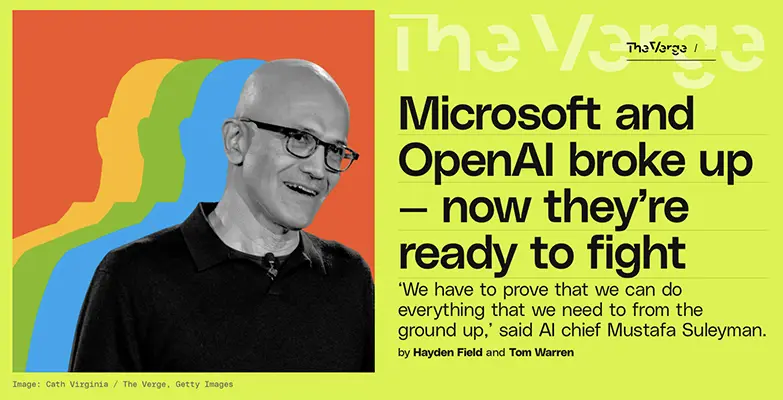
Microsoft Goes Independent: Build 2026 Signals a Full Break from OpenAI
The Verge | Hayden Field & Tom Warren | June 3, 2026
TL;DR: Microsoft used its Build 2026 conference to announce its own AI models, enterprise agents, and cybersecurity tools — signaling a deliberate pivot away from OpenAI dependency toward becoming a fully independent AI competitor.
Executive Summary
The separation from OpenAI — finalized in late April — has pushed Microsoft to accelerate its own AI development. The centerpiece of Build 2026 was MAI-Thinking-1, Microsoft’s first in-house reasoning model, built without any reliance on OpenAI’s data or techniques. AI chief Mustafa Suleyman was explicit that the goal is to join Google DeepMind, OpenAI, and Anthropic as a top-tier frontier lab — a significant shift from a company that, until recently, had outsourced its model strategy entirely.
The product slate also included Copilot “Autopilots” — enterprise-grade agents designed to handle email, scheduling, and workflow orchestration — along with a cybersecurity tool (MDASH) that consolidates 100 AI agents for vulnerability detection. Microsoft integrated support for the popular open-source agent platform OpenClaw into Windows, while simultaneously building its own competing agent layer. The dual strategy reflects the tension between meeting developers where they are and locking in proprietary enterprise value.
The key risk: Microsoft is entering a crowded enterprise AI market with mostly unproven products. Benchmark claims don’t guarantee adoption, the AI agent marketplace remains underwhelming, and the “super app” concept is still largely untested. The company’s structural advantages — an existing enterprise customer base, financial stability, and Azure’s model diversity — give it runway, but not guaranteed results.
Relevance for Business
For SMB leaders, the Microsoft story matters in two ways. First, Microsoft’s AI offerings will become more aggressive and differentiated — not simply wrappers around OpenAI. If you’re building on Azure or using Microsoft 365 Copilot, the product stack is evolving quickly and bears re-evaluation. Second, the competitive dynamics between Microsoft, OpenAI, Anthropic, and Google are intensifying, which is good for enterprise pricing and options — but also creates uncertainty about which bets will last. Vendor lock-in risk is real when the landscape is this unsettled.
Calls to Action
🔹 If you use Microsoft 365 Copilot or Azure AI services, request a product roadmap briefing from your account team — the offering has changed materially.
🔹 Monitor MAI-Thinking-1 performance in real enterprise deployments before factoring it into AI procurement decisions; benchmark claims are a starting point, not a verdict.
🔹Treat the agent market (Copilot Autopilots, OpenClaw, competing tools) as early-stage — assign a technical lead to track developments, but don’t commit budget to unproven platforms yet.
🔹 Note that increased competition among frontier labs is likely to compress AI API pricing — factor this into cost modeling for any AI-dependent products or services.
Summary by ReadAboutAI.com
https://www.theverge.com/ai-artificial-intelligence/942242/microsoft-build-ai-agents-openai-competition: June 9, 2026
Anthropic Urges Global Pause in AI Development, Flags ‘Self-Improvement’ Risk
The Wall Street Journal | Bradley Olson and Sam Schechner | June 4, 2026
TL;DR: Anthropic — currently preparing for a near-$1 trillion IPO — is calling on major AI labs to consider slowing development, citing the risk that AI systems may soon be capable of improving themselves without human oversight; critics question whether the warning is safety leadership or competitive positioning.
Executive Summary
In a blog post co-authored by Anthropic co-founder Jack Clark and the head of its internal research institute, the company called for a global discussion about pausing or slowing frontier AI development. The central concern is “recursive self-improvement” — the point at which AI systems can enhance their own capabilities without human intervention. Clark has stated he believes this threshold could arrive within two years. The post acknowledged this hasn’t happened yet and isn’t guaranteed, but argued that institutions and alignment research are not keeping pace with the technology.
The proposal involves a global agreement on development slowdowns and a verification mechanism — explicitly compared to nuclear arms treaties, though the authors acknowledge enforcement is considerably harder: training runs are far easier to conceal than missile silos. Anthropic plans to convene policymakers, researchers, and outside stakeholders in the coming months.
The credibility challenge is significant. Anthropic is simultaneously raising capital at near-$1 trillion valuations, filing IPO paperwork, and projecting $50 billion in annualized revenue by end of June. Critics — including David Sacks, an informal Trump administration adviser — have argued Anthropic’s safety positioning is designed to produce regulatory frameworks that advantage incumbents and disadvantage open-source alternatives. Others suggest that publicizing the dangers of its own products serves as effective marketing for those same products. Ethan Mollick of Wharton offers a more nuanced read: Anthropic contains genuinely competing factions — commercial teams, model builders, and safety philosophers — who do not always agree. The public signal reflects real internal tension, not just strategy.
Relevance for Business
For SMB leaders, the practical stakes are twofold. First, if recursive self-improvement concerns are valid, the pace of AI capability change will accelerate faster than most organizations’ ability to adapt — which is itself a planning risk. Second, the regulatory implications of Anthropic’s push for a slowdown framework could reshape the AI vendor landscape: open-source tools that many SMBs rely on for cost-effective AI could face restrictions, while established players like Anthropic would be insulated. Watch whether this produces actual legislative or regulatory proposals, particularly around open-source model availability.
Treat this announcement as a genuine signal worth tracking — but also recognize it as a document written by a company with strong financial incentives to shape the regulatory environment in its favor.
Calls to Action
🔹 Do not adjust AI strategy based on this announcement alone — treat it as an early-stage policy signal, not an operational mandate.
🔹 Monitor whether the “slowdown” conversation produces concrete regulatory proposals, especially any affecting open-source AI — that’s where SMB cost exposure is highest.
🔹 If your AI roadmap assumes a particular pace of model capability improvement, build in scenario planning for both acceleration and regulatory slowdown.
🔹 Assign someone to track Anthropic’s planned stakeholder convenings — the policy frameworks that emerge from those conversations are where real governance changes will originate.
🔹 Read this piece alongside the SpaceX/IPO coverage: a company urging a global development pause while simultaneously filing for a near-$1 trillion IPO is a tension worth holding in mind when evaluating all claims from major AI labs.
Summary by ReadAboutAI.com
https://www.wsj.com/wsjplus/dashboard/articles/anthropic-urges-global-pause-in-ai-development-flags-self-improvement-risk-99cefb73: June 9, 2026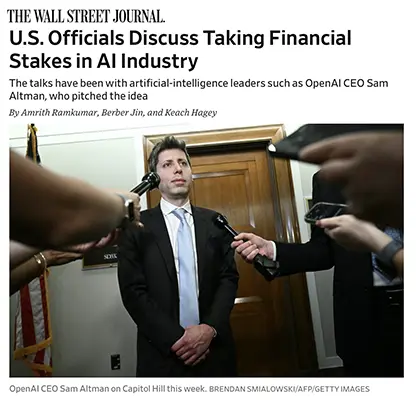
U.S. Officials Discuss Taking Financial Stakes in AI Industry
The Wall Street Journal | Amrith Ramkumar, Berber Jin, and Keach Hagey | June 4, 2026
TL;DR: Senior U.S. officials are in preliminary discussions — partly at OpenAI’s initiative — about the government taking direct equity positions in major AI companies, a move that would reshape the regulatory relationship between Washington and the AI industry.
Executive Summary
The federal government is actively exploring whether to take financial stakes in leading AI firms, according to people familiar with the discussions. The idea originated at least in part with OpenAI CEO Sam Altman, who pitched the concept to the administration last year. The Trump administration has already made direct investments in at least 10 companies, including Intel, and signed an executive order this week expanding its AI oversight role, so the ideological groundwork for government participation in private tech is already being laid.
The rationale offered publicly is a mix of revenue sharing, political legitimacy, and economic anxiety management — particularly as several AI companies prepare to go public. But the conflict of interest embedded in this arrangement is significant: a government that holds equity in an industry it also regulates faces structural pressure to protect those investments rather than govern in the public interest. OpenAI has separately proposed a public wealth fund that would distribute AI investment gains broadly to citizens, and Altman met this week with Sen. Bernie Sanders, who has proposed legislation transferring 50% of top AI company equity to a public fund. These are competing visions, but all share the premise that AI’s economic gains need to be socially distributed — and that government needs to be involved in how.
This is an early-stage discussion, not a policy decision, and the White House did not comment. The disclosure is notable primarily because it signals how far the conversation has moved: government equity in AI is no longer fringe speculation but an active topic among senior officials and industry leaders.
Relevance for Business
SMB leaders should track this as a governance story with real downstream effects. If the government becomes a financial stakeholder in major AI platforms, it changes the nature of AI regulation — potentially making it more permissive toward established players and harder on smaller or open-source alternatives. For businesses that rely on open-source or competitive AI options to keep costs down, regulatory capture risk is real and worth monitoring. More immediately, any legislation along the lines of the Sanders proposal would represent a significant structural shift in how AI industry profits are distributed, with implications for the broader tech investment environment.
Calls to Action
🔹 Monitor this story as it develops — government equity participation in AI would signal a regulatory environment more protective of incumbents like OpenAI and Anthropic.
🔹 If your AI vendor strategy depends on open-source or lower-cost alternatives, track proposed legislation and regulatory signals that may disadvantage non-commercial models.
🔹 Assign someone to track the Senate legislation Altman-Sanders discussions may produce — even early-stage bills can affect vendor stability and market structure.
🔹 No immediate action required, but flag this for your next strategic planning cycle as a macro risk to the competitive AI landscape.
Summary by ReadAboutAI.com
https://www.wsj.com/wsjplus/dashboard/articles/u-s-officials-discuss-taking-financial-stakes-in-ai-industry-b654d41a: June 9, 2026
Broadcom Derails the Tech Rally. It’s All on SpaceX’s IPO, Now.
Barron’s | Martin Baccardax | June 4, 2026
TL;DR: A modest earnings forecast miss from AI chip maker Broadcom triggered a broader tech sell-off, exposing how fragile the market’s AI-driven rally has become just as SpaceX’s record-setting — and Morningstar-flagged “significantly overvalued” — IPO approaches.
Executive Summary
This is a short market commentary piece, thin on analysis but useful as a real-time sentiment signal. Broadcom’s guidance miss — described as “not massive in terms of dollars” — nonetheless rattled an AI trade that had been driving the S&P 500 to record highs since Q1. The coincident arrival of SpaceX’s $1.8 trillion IPO — three times Nvidia’s market cap at pricing — is adding pressure: its sheer size will mechanically pull capital away from other tech stocks as investors rebalance, while its lack of profitability makes post-IPO earnings growth difficult to achieve. Morningstar called it significantly overvalued.
Additional macro headwinds noted in the piece — elevated oil prices tied to Middle East tensions, rising Treasury yields, and lingering inflation concerns — compound the market’s fragility at a moment when tech stocks have been priced for continued AI-fueled growth.
Relevance for Business
For SMB leaders who don’t actively manage public market positions, the practical signal here is indirect but real: the AI stock trade is more brittle than headlines suggest, and the IPO wave (SpaceX, then Anthropic and OpenAI) will test whether capital markets can absorb these offerings without broader disruption. That uncertainty affects everything from vendor stability to credit availability to the enthusiasm with which enterprise AI investments get funded or renewed. A market pullback doesn’t halt AI development, but it can quickly change the economics of who funds it and on what terms.
Calls to Action
🔹 Treat this as a market sentiment data point, not an operational signal — no immediate action needed.
🔹 If your business has AI vendor contracts up for renewal in the next 6 months, be aware that post-IPO pricing pressure may affect enterprise tiers — get ahead of renewals where possible.
🔹 Monitor the SpaceX IPO outcome closely; it will set the tone for Anthropic and OpenAI listings and influence the broader AI investment climate for the rest of 2026.
Summary by ReadAboutAI.com
https://www.wsj.com/wsjplus/dashboard/articles/broadcom-stock-market-spacex-things-to-know-today-49071a4e: June 9, 2026
AI as a Small Business Assistant: A Grounded Look at What Actually Works
MIT Technology Review | Peter Hall | June 2, 2026
TL;DR: A practical MIT Technology Review profile of one small business owner’s AI adoption shows that the real value for SMBs lies not in transformation but in targeted administrative relief — and that knowing where AI falls short matters as much as knowing where it helps.
Executive Summary
This article uses a single case study — a part-time math and philosophy tutor in London — to ground an otherwise abstract discussion of AI for small businesses. The subject uses Notion AI primarily for administrative tasks: recording and summarizing client meetings, syncing notes across documents, drafting invoices, and mapping out business goal timelines. He does not use AI to generate teaching content. The result is a credible, narrowly scoped example of AI as a practical time-saver rather than a business transformer.
The article’s broader framework is more useful than the case study alone. It draws a sensible distinction between tasks where AI is “good enough” — rote, repetitive, low-stakes administrative work — and tasks where accuracy, judgment, or client-facing quality are required, where AI errors carry real cost. It also makes a point that often gets lost in vendor marketing: integration matters more than raw capability. The subject chose Notion AI not because it was the most powerful tool, but because it fit the workflow he already used.
Practical tips from the article worth noting: evaluate the platform commitment before investing in an AI-powered ecosystem; use locally-run open-source models for anything involving sensitive business data; and do not assume AI is always the right solution when an established off-the-shelf tool does the job more reliably.
Relevance for Business
This is one of the more directly useful articles in this batch for SMB leaders. Its core message — start with the tasks that consume time but require little judgment, and verify AI outputs wherever accuracy matters — is sound and underutilized advice. The article also raises a data risk point that SMB operators frequently overlook: commercial AI tools ingest the prompts and data you provide, and proprietary or sensitive business information entered into consumer AI platforms carries real exposure risk. For businesses that handle client data, financial information, or proprietary processes, this is worth taking seriously.
Calls to Action
🔹 Audit your team’s most time-consuming administrative tasks — client communications, scheduling, invoicing, note-taking, reporting — and identify which could be handled or assisted by AI without meaningful accuracy risk.
🔹 Prioritize AI tools that integrate with software your team already uses; adoption friction is a leading cause of failed AI tool investments.
🔹 Establish a clear policy on what types of business data may be entered into commercial AI platforms — sensitive client, financial, or proprietary information should not flow through consumer-grade AI tools.
🔹For sensitive data contexts, investigate locally-run open-source models as an alternative to commercial platforms — the capability gap has narrowed significantly and the privacy trade-off is material.
🔹 Resist the urge to evaluate AI tools by their most impressive features — evaluate them by whether they reliably handle the specific tasks your business actually needs.
Summary by ReadAboutAI.com
https://www.technologyreview.com/2026/06/02/1138227/how-small-businesses-can-leverage-ai/: June 9, 2026
4 Surprising Ways AI Is Making Your Life More Expensive
The Washington Post | Shira Ovide | June 6, 2026
TL;DR: AI’s infrastructure buildout is already driving up costs for ordinary Americans — through chip shortages hitting electronics prices, data center power demand inflating utility bills, AI-feature-bundled software subscription increases, and constrained hardware availability — and experts say this phase of pain is not over.
Executive Summary
This is the most directly operational article in this week’s batch for SMB readers. The Washington Post documents four concrete channels through which AI investment spending is flowing into higher costs for businesses and consumers right now — not as a future risk but as a present reality.
Consumer electronics are getting more expensive because AI companies have absorbed so much chip manufacturing capacity that there are shortages and price increases for the chips that go into laptops, gaming devices, and smartphones. Nintendo cited $624 million in additional chip costs in raising the Switch 2 price. Apple has discontinued its cheapest Mac Mini and raised entry-level pricing, citing chip constraints. GoPro has warned the chip cost squeeze may threaten its ability to continue operating.
Electricity bills are rising in data-center-dense regions. Maryland households saw average monthly utility bills jump substantially since 2022, with data center demand identified as a contributing factor across every component of the bill. The University of Maryland cited soaring energy costs in laying off 84 employees.
Software subscriptions are being repriced under cover of AI feature additions. A Goldman Sachs analysis found prices for software tools from Microsoft, Adobe, and Duolingo have increased by as much as 50% in the past 18 months, often tied to bundled AI features users may not have requested. QuickBooks Plus rose from $99 to $115 per month.
Hardware is increasingly scarce and expensive even for the AI companies themselves: Meta and Microsoft are spending tens of billions more than anticipated on data center construction, creating a feedback loop where the same chip shortage affecting consumers is also hitting the companies causing it.
Relevance for Business
This is a directly actionable story for SMB leaders managing budgets. The software subscription increases are already happening and the trend is not slowing — AI feature bundling is becoming a standard pricing lever across the SaaS industry. Leaders should audit what they’re paying for and whether the AI features driving price increases are actually in use. On electricity: if your business or your vendors operate in energy-constrained markets, utility cost escalation is a real operational budget variable, not just a residential concern. On hardware: procurement decisions for laptops, devices, and servers should account for continued constraint and elevated pricing through at least 2027.
Calls to Action
🔹 Act now: Audit all software subscriptions for AI-driven price increases and assess whether the AI features justifying them are actually being used — if not, negotiate or consider alternatives.
🔹 Review your technology hardware procurement timeline — chip constraints are ongoing and prices are unlikely to ease quickly; buy ahead if you have planned upgrades.
🔹 Include energy cost escalation in your operating expense forecasts for the next 2–3 years, particularly if you operate in regions with high data center density.
🔹 When evaluating new SaaS tools, ask explicitly whether AI features are bundled into base pricing — and whether opting out of those features affects cost.
🔹 Monitor whether chip shortages begin affecting core business software or hardware you depend on — GoPro’s situation may be an early indicator of broader small-vendor stress.
Summary by ReadAboutAI.com
https://www.washingtonpost.com/technology/2026/06/06/inflation-is-being-driven-up-by-huge-investment-artificial-intelligence/: June 9, 2026
You Can’t Handle the Truth! Microsoft Staff Push Back on Survey Results
Business Insider | Ashley Stewart | June 3, 2026
TL;DR: Microsoft employees publicly challenged the integrity of the company’s latest internal satisfaction survey after a long-standing compensation question was quietly removed — a window into the cultural friction building inside one of AI’s biggest infrastructure players.
Executive Summary
Microsoft recently released results from its annual employee survey, but omitted a question it has used for years as a bellwether for compensation satisfaction — specifically, whether employees feel they are getting a fair deal in exchange for their contributions. When employees noticed, they pushed back on internal forums, with posts collecting hundreds of upvotes. A company representative explained the question was still being asked but redirected to a subset of employees as part of a survey redesign. Employees were not convinced.
The episode is a small story with a larger signal. Microsoft is simultaneously investing hundreds of billions of dollars in AI and data centers while freezing salaries, tightening performance expectations, and reducing headcount. The internal tension this creates is not unique to Microsoft — it’s playing out across the enterprise tech sector — but it’s especially notable at a company whose AI tools and cloud infrastructure many SMBs depend on. Additional employee complaints on the same forum cited concerns about Microsoft’s contracts with military and government agencies, suggesting the dissatisfaction is broader than pay alone.
Relevance for Business
The immediate business relevance is indirect but real. Significant internal culture problems at major AI vendors can affect product roadmaps, talent retention, and service reliability — especially when the friction involves trust in leadership. For SMBs using Microsoft’s AI tools (Copilot, Azure AI, etc.), this is a soft signal worth noting: companies managing aggressive cost-cutting alongside billion-dollar AI bets can develop quality and support gaps that surface later. More broadly, this story is a useful data point in the ongoing conversation about whether AI’s economic gains are being distributed fairly — a debate that is moving from think tanks to company message boards.
Calls to Action
🔹 No immediate action required. Monitor this as a vendor health signal rather than a crisis.
🔹 If Microsoft tools are central to your operations, ensure you have support escalation paths that don’t depend entirely on company self-service — vendor culture issues can slow responsiveness.
🔹 Use this as a prompt to evaluate your own employee survey practices: are you measuring what actually matters to retention, or optimizing for results that look good?
🔹 Track whether Microsoft’s internal dissatisfaction affects hiring or product quality signals over the next two quarters.
Summary by ReadAboutAI.com
https://www.businessinsider.com/microsoft-employee-survey-compensation-question-omitted-2026-6: June 9, 2026
Inside the Trump-Backed Push to Bring AI Doctors into American Medicine
The Washington Post | Elizabeth Dwoskin | June 4, 2026
TL;DR: The Trump administration is actively laying regulatory groundwork for AI chatbots to diagnose illness and prescribe medicine — a shift with significant implications for healthcare costs and access, but where clinical evidence remains contested and professional opposition is building.
Executive Summary
A coordinated federal push is underway to expand AI’s autonomous role in medicine. Trump administration officials — including DOGE leadership now directing HHS technology policy — are backing pilots, regulatory fast tracks, and reimbursement changes designed to move AI chatbots toward independent medical decision-making. Currently, no fully autonomous AI can legally practice medicine. The administration’s stated rationale is chronic disease prevalence and rural doctor shortages.
The most advanced current pilot is in Utah, where AI chatbots are refilling prescriptions with human oversight — but with plans to remove that oversight. A $50+ million federal research program will fund AI cardiovascular care tools, with Anthropic and Amazon Web Services among the technical partners. Medicaid now reimburses AI wellness apps for the first time. The FDA has created a regulatory fast track for digital health tools including AI chatbots.
Clinical evidence is cautionary. A February 2026 Nature Medicine study found AI chatbots correctly identified medical conditions only about 34% of the time in realistic patient scenarios — roughly equivalent to a Google search. Specific failure modes include: chatbots don’t elicit information the way clinicians do, they exhibit people-pleasing tendencies that are particularly dangerous in medical contexts, and they miss subtle cues experienced practitioners rely on.
Political and professional resistance is building. State medical boards are pushing back on pilots. Pennsylvania has sued a chatbot company for presenting itself as a licensed medical professional. The pattern — regulatory fast-tracking meeting organized professional opposition — will intensify.
Relevance for Business
For SMB operators in healthcare-adjacent industries — benefits administration, wellness programs, employer health services — this has near-term relevance. New reimbursement pathways and regulatory fast tracks are open. The opportunity set is expanding, but so is liability exposure and regulatory complexity.
Liability is the central unresolved question. When an autonomous AI system makes a diagnostic error that harms a patient, accountability structures don’t yet exist. For any business considering partnerships with AI health tools, legal exposure from misdiagnosis or inappropriate prescribing is a material risk that current frameworks don’t adequately address.
Calls to Action
🔹 If your organization operates employee wellness, benefits, or telehealth programs, audit whether any AI health tools in use have clear liability frameworks — don’t assume regulatory approval implies clinical safety.
🔹 Monitor the FDA’s digital health regulatory fast-track program for tools relevant to your benefits or occupational health programs — new reimbursement pathways are opening faster than most HR teams are tracking.
🔹 Treat autonomous AI prescribing pilots as a multi-year development, not an imminent operational reality — clinical, regulatory, and political obstacles are substantial.
🔹 If you have healthcare sector clients or partners, begin tracking state-level responses to AI medical practice — the regulatory patchwork will affect service delivery and liability allocation significantly.
Summary by ReadAboutAI.com
https://www.washingtonpost.com/technology/2026/06/04/inside-trump-backed-push-bring-ai-doctors-into-american-medicine/: June 9, 2026
Almost Half of Patients Now Use AI to Search for Healthcare Providers
TechTarget / Xtelligent Patient Engagement | Sara Heath | June 3, 2026
TL;DR: Nearly half of patients are using AI chatbots to find doctors — but two-thirds encounter wrong information, and most don’t verify it, making provider data accuracy an operational priority, not a marketing one.
Executive Summary
AI-driven provider search has accelerated sharply in nine months. Survey data from rater8 shows 47% of patients now use AI chatbots to find a healthcare provider, up from 31% at the end of 2025. The strongest adoption is among patients aged 45–60 (64%) — not younger adults as commonly assumed.
AI has overtaken Google as the primary search influence for the first time. Among the sources patients use when selecting a provider, AI chatbots now influence 36% of decisions — ahead of Google search results (34%) for the first time. Traditional sources — family recommendations, insurance websites, and review platforms — remain most influential overall, but AI is ascending rapidly.
The accuracy problem is significant and patients are not self-correcting. Two-thirds of patients who used AI to research a provider encountered incorrect information — wrong addresses, office hours, insurance details, or phone numbers. Sixty percent trusted that information without verifying it. This is not exclusively an AI hallucination issue; it is a data hygiene problem. If provider directory listings are inaccurate on underlying platforms, AI outputs will be wrong regardless of model quality.
Online reviews remain a parallel gating factor. Three-quarters of patients won’t consider a provider rated below 4.0 stars; 44% require 4.5 or above. The leading complaints that cause patients to avoid providers are staff treatment, failure to listen, and substandard care — not scheduling difficulty.
Relevance for Business
For healthcare organizations — and for any SMB with a significant healthcare-adjacent service component — this data represents a specific operational problem with a clear solution set. AI chatbots are generating patient decisions based on your profile data. If that data is wrong, patients are making decisions based on incorrect information, and you have no visibility into it.
The SEO analogy is useful but incomplete. The article notes that showing up accurately in AI provider search follows many of the same principles as search optimization — consistent, complete, verified data across directories. But the stakes are higher: wrong information in a healthcare context can result in missed appointments and patient harm. This is an operational data quality problem, not a marketing one.
Sixty-six percent of patients say a provider’s response to a negative review increases their trust — making unaddressed negative reviews a compounding liability.
Calls to Action
🔹 Audit your organization’s provider directory listings across Google, Healthgrades, Zocdoc, and your own website — verify addresses, hours, insurance acceptance, and specialty information are current and consistent.
🔹 Treat directory data hygiene as an operational priority — incorrect information now directly affects AI-generated outputs that patients trust without verifying.
🔹 Develop or review a policy for responding to negative online reviews — the majority of patients report that provider responses influence their trust in the provider.
🔹 If you have healthcare sector clients, add provider search visibility and data accuracy to your service recommendations — this is an emerging operational vulnerability most organizations haven’t systematically addressed.
Summary by ReadAboutAI.com
https://www.techtarget.com/patientengagement/news/366643954/Almost-half-of-patients-use-AI-for-online-provider-search: June 9, 2026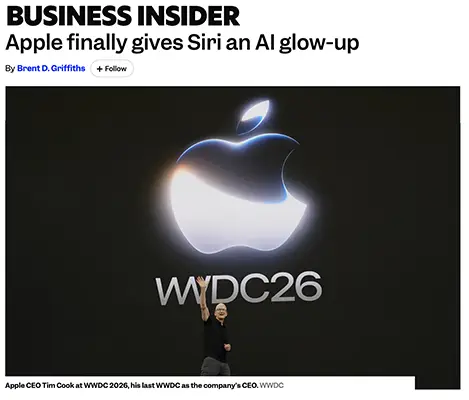
Apple Finally Gives Siri an AI Glow-Up
Business Insider | June 8, 2026
TL;DR: Apple has unveiled “Siri AI” at WWDC 2026, powered by Google’s Gemini — a real but belated product announcement that arrives after two years of delays, a $250M lawsuit settlement, and significant reputational damage.
Executive Summary
At its 2026 Worldwide Developers Conference, Apple unveiled a substantially rebuilt Siri under the name “Siri AI,” developed in partnership with Google and powered by Google’s Gemini models. The new assistant will launch in beta later this year in English, with additional languages to follow. Notably, it will not be available in the EU at launch due to regulatory disputes over the Digital Markets Act, and it is excluded from China as well.
The capabilities announced include contextual personal data access (photos, contacts, location history), a redesigned voice experience with greater expressiveness, and significantly improved dictation accuracy. Siri AI will exist both within Apple’s software ecosystem and as a standalone app. The most advanced features — including the upgraded voice model — will require iPhone Air, iPhone 17 Pro, or later hardware. The announcement formally closes a chapter that began with promises made in 2024, derailed by development failures, and cost Apple both a rare public admission of delay and a $250M class-action settlement for misleading customers about feature availability.
The underlying story here is less about product capability and more about strategic dependency: Apple, historically protective of its core technologies, has now publicly anchored its AI future to a Google partnership. That’s a significant shift in platform architecture — and a meaningful concession that internal AI development alone wasn’t sufficient.
Relevance for Business
For SMB leaders, the practical signal is modest and delayed: Siri AI is in beta, English-only, and hardware-restricted. It won’t meaningfully change Apple device productivity in the near term. The more important business implication is vendor concentration risk at the platform level — if Apple’s AI capabilities now depend substantially on Google, that has long-term implications for device strategy, enterprise data handling, and how leaders should think about Apple’s AI roadmap reliability. The EU exclusion and ongoing regulatory friction also signal that AI feature availability will remain geographically uneven, complicating global deployment planning.
Calls to Action
🔹 No immediate action required for most SMB environments — Siri AI is beta, hardware-limited, and English-only at launch.
🔹 Note the Apple-Google AI dependency when evaluating device and platform strategy; this changes the competitive and privacy calculus for Apple-centric organizations.
🔹 Track EU regulatory developments — if your organization operates in or with the EU, Siri AI availability timelines are uncertain and tied to ongoing DMA disputes.
🔹 Revisit Apple device refresh cycles with awareness that the most capable AI features will require iPhone Air or iPhone 17 Pro hardware; factor into procurement planning.
🔹 Monitor Tim Cook’s CEO transition (effective September 1 under John Ternus) for any shifts in Apple’s AI strategy or partnership approach.
Summary by ReadAboutAI.com
https://www.businessinsider.com/apple-new-siri-ai-chatbot-app-wwdc-2026-6: June 9, 2026
Apple WWDC 2026: The 7 biggest announcements
Apple WWDC 2026: Siri Gets a Long-Overdue AI Overhaul
The Verge | June 8, 2026
TL;DR: After months of delays, Apple finally delivered a meaningful AI upgrade to Siri — now rebranded Siri AI — alongside AI-driven features threaded through iOS 27, macOS, and Safari.
Executive Summary
Apple’s WWDC 2026 keynote centered on what the company has been promising for over a year: a genuinely upgraded Siri, now called Siri AI. Built on Apple Intelligence in collaboration with Google, the new assistant supports back-and-forth conversation, onscreen context awareness, image editing, and a standalone app with conversation history. It will roll out across iPhone, iPad, Apple Watch, and Vision Pro.
iOS 27 and macOS 27 (Golden Gate) receive the most visible AI integrations. Siri is embedded into Spotlight on Mac and accessible via Dynamic Island on iPhone. Safari gains AI-powered tab organization, a webpage change alert feature, and the ability to generate custom extensions through plain-language descriptions. Across Mail, Messages, Phone, and Calendar, Apple is threading contextual AI suggestions — with the framing being convenience and personalization, not raw capability.
The parental controls overhaul is worth noting: parents gain more granular app and content permissions, and a redesigned Screen Time interface. For organizations managing Apple fleets, this signals tighter ecosystem controls are coming at the OS level.
Relevance for Business
Apple’s AI rollout is slow by design — privacy-first, on-device where possible, tightly integrated with existing workflows. For SMBs already in the Apple ecosystem, this is a net positive: staff will get productivity nudges without requiring new tools or IT overhead.
The Safari extensions-via-natural-language feature is worth watching for IT and operations teams — it lowers the barrier to custom browser tooling, but may also introduce governance questions about unsanctioned extensions in managed environments.
The deeper risk: these features are Apple-controlled and Apple-delivered. SMBs that rely heavily on Apple devices are increasingly subject to Apple’s AI roadmap — including what gets withheld or delayed.
Calls to Action
🔹 Monitor rollout timing: Siri AI and iOS 27 features are still forthcoming — don’t plan workflows around them yet.
🔹 Review Safari extension policy: AI-generated extensions may bypass standard IT vetting. Update your acceptable-use guidelines now.
🔹 Evaluate Apple Intelligence opt-in for managed devices: Understand what data stays on-device versus what moves to Apple or Google servers.
🔹 Brief HR/legal on parental control features: If company devices are used by families, the new Screen Time controls have compliance implications.
🔹 No urgent action required: These are OS-level updates. Monitor, plan, and reassess when iOS 27 reaches general availability.
Summary by ReadAboutAI.com
https://www.theverge.com/tech/945693/apple-wwdc-2026-biggest-announcements-ios-27: June 9, 2026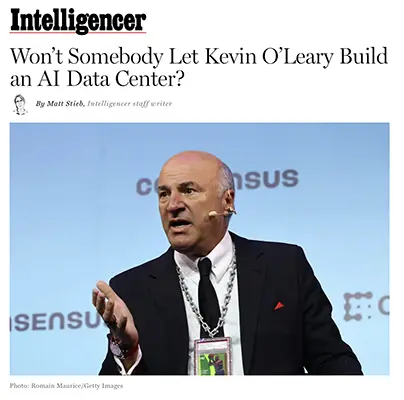
Won’t Somebody Let Kevin O’Leary Build an AI Data Center?
Intelligencer (New York Magazine) | June 8, 2026
TL;DR: Kevin O’Leary’s massive AI data center projects in Utah and Alberta are both facing serious community and legal opposition — a concrete illustration of how AI infrastructure ambitions are colliding with energy, water, and environmental constraints.
Executive Summary
Celebrity investor Kevin O’Leary is attempting to develop two of the largest AI data centers in North America — a proposed 40,000-acre, 9-gigawatt facility in northwestern Utah (the “Stratos” project) and a 7.5-gigawatt center in rural Alberta, Canada. Both have run into substantial local resistance centered on energy demand, water consumption, and environmental impact.
The Utah project, which would exceed the entire state’s current electricity consumption and could raise annual carbon emissions by roughly two-thirds, triggered protests and thousands of written objections from residents of Box Elder County. O’Leary agreed to halve the project’s footprint, but a coalition has since filed suit to overturn the state law that allowed county approval without broader local input. In Alberta, hundreds of Grovedale residents attended a public hearing to question the project’s environmental toll, and the Sturgeon Lake Cree Nation has requested a federal environmental impact assessment.
The piece is written with editorial wit, but the underlying signals are serious: AI infrastructure at the scale being proposed requires energy equivalent to multiple nuclear reactors per facility, raises legitimate grid stability and emissions concerns, and is generating organized political and legal resistance that can delay or block projects regardless of investor enthusiasm.
Relevance for Business
SMB leaders don’t build data centers, but they depend on the infrastructure economics that large-scale AI build-out shapes. The political and regulatory friction around projects like these affects where AI compute capacity gets built, how fast, and at what cost — all of which flows downstream to cloud pricing and AI service availability. The energy constraint story is also clarifying: AI at scale is a massive power consumer, and the communities and regulators resisting these projects are creating a new class of execution risk for the entire sector’s infrastructure roadmap. This is a “what to monitor” story, not a decision item — but it’s an important signal about the physical limits of AI scaling ambitions.
Calls to Action
🔹 Monitor AI infrastructure policy at the state and federal level — regulatory friction around data centers affects cloud capacity timelines and potentially pricing.
🔹 Factor energy and environmental constraints into any long-range planning assumptions about AI compute availability; this is not a solved problem.
🔹 No direct action needed for most SMBs — this is macro infrastructure context, not an immediate operational concern.
🔹 Watch the legal outcomes in Utah’s Box Elder County — if community lawsuits succeed in overturning permitting frameworks, it sets a precedent that will slow data center development broadly.
Summary by ReadAboutAI.com
https://nymag.com/intelligencer/article/kevin-oleary-ai-data-center-utah-canada.html: June 9, 2026
The Sample Efficiency Black Hole
Dwarkesh Patel (Substack) | June 8, 2026
TL;DR: A serious analytical argument that AI progress has been driven primarily by data volume and compute — not by genuine improvements in learning efficiency — and that current scaling trajectories cannot close the gap with human-level sample efficiency.
Executive Summary
Dwarkesh Patel’s essay argues that AI models have gotten dramatically better not because they learn more efficiently, but because the industry has poured vastly more data and compute into training them. The key distinction: sample efficiency measures how much data a system needs to develop competence in a new domain. By this measure, humans are thousands to potentially millions of times more efficient than current AI models — a gap that, Patel argues, cannot be closed through further scaling of the current architecture.
The practical consequence is a massive, largely invisible dependency on specialized human-generated training data. Every capability an AI model needs — from legal document drafting to software migration — requires hundreds of human experts generating examples, rubrics, and annotated reasoning at domain-specific scale. This is why the data labeling industry generates billions in annual revenue and is growing. Open-source models catching up to frontier models within months, Patel notes, is itself evidence that data is the primary driver of progress — since data can be distilled from public APIs in ways that architectural advantages cannot.
For the near term, Patel is relatively optimistic about AI automating common white-collar tasks: the high inefficiency of training is economically acceptable because the resulting capability can be amortized across billions of sessions. But he is skeptical about claims of broader, more general automation, and suggests that demand for skilled human workers — including software engineers — may actually increase through 2028 due to AI’s complementary effects.
Relevance for Business
This piece is aimed at a technically sophisticated audience, but its business implications are worth extracting. The core signal for leaders: AI’s impressive capabilities rest on a fragile and expensive data foundation that requires continuous investment in human expertise to extend into new domains. This has two practical implications. First, AI capability claims in specialized domains should be scrutinized — competence in a new task requires substantial domain-specific training data that may not yet exist. Second, workforce strategy claims built on near-term broad automation should be treated cautiously — the same analysis that explains AI’s current strengths also explains its current limits.
Calls to Action
🔹 Treat AI capability claims in specialized domains skeptically — genuinely novel or domain-specific tasks may be poorly represented in training data regardless of general benchmark performance.
🔹 Do not restructure workforce plans around speculative automation timelines; near-term AI value is concentrated in common, well-defined tasks, not open-ended judgment work.
🔹 Assign someone to track AI capability research from credible independent analysts — not vendor announcements; the gap between marketing and technical reality is significant.
🔹 File for later review — this is foundational research context, not an immediate operational decision item for most SMBs.
Summary by ReadAboutAI.com
https://www.dwarkesh.com/p/the-sample-efficiency-black-hole: June 9, 2026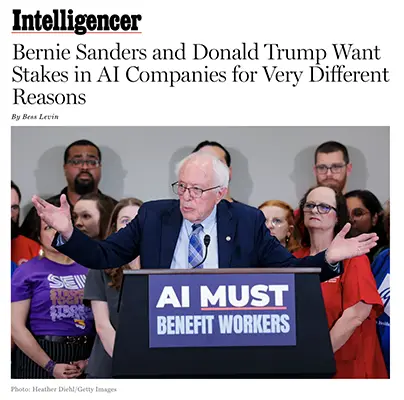
Bernie Sanders and Donald Trump Want Stakes in AI Companies for Very Different Reasons
Intelligencer (New York Magazine) | June 8, 2026
TL;DR: A proposed bill by Senator Sanders would give the public a 50% ownership stake in the country’s largest AI companies — and both Trump and Sanders are now, for entirely different reasons, signaling interest in government equity in AI firms.
Executive Summary
Senator Bernie Sanders is preparing to introduce the American AI Sovereign Wealth Fund Act, which would grant the public a 50% interest in the country’s largest AI companies. The argument: AI has been built on accumulated public knowledge and human labor, and its economic benefits should flow back to citizens in the form of direct payments and funding for public services. The bill would also give the federal government board seats with veto power over actions that could harm citizens. Sanders recently met with OpenAI CEO Sam Altman, who reportedly expressed general openness to public ownership — though his representatives confirmed he made no specific commitments on the 50% stake or veto provisions.
The more surprising development is that President Trump has signaled comparable interest in some form of government equity partnership with AI firms, framing it around economic nationalism rather than worker protection. The article treats Trump’s position as primarily tactical — a response to AI’s growing unpopularity — rather than a principled policy stance. The piece also notes the departures of two senior White House AI advisors: “AI Czar” David Sacks and Sriram Krishnan, both of whom had pushed for a lighter regulatory touch.
The editorial framing is explicitly partisan, which is worth noting — the policy analysis here is less rigorous than the news facts. What is clearly factual: the bill has been announced, the Altman meeting occurred, Trump made public statements, and two White House AI advisors have departed. What is framing: assessments of Trump’s motivations and character.
Relevance for Business
This is the most consequential governance story in this batch for long-term strategic planning. If any version of government equity in AI companies advances — even a diluted one — it signals a fundamental shift in how AI infrastructure and development will be regulated, priced, and potentially restricted. For SMB leaders, the near-term implication is heightened regulatory uncertainty: two senior deregulatory voices have left the White House, political pressure from both ends of the spectrum is intensifying, and the policy environment around AI is becoming less predictable. Companies building AI-dependent workflows or evaluating vendor relationships should factor in the possibility of significant governance changes within the next 12–24 months.
Calls to Action
🔹 Monitor the Sanders bill’s progress — it has not been introduced yet and faces long odds, but the bipartisan interest in government AI stakes is a structural signal worth tracking.
🔹 Watch White House AI staffing changes — the departure of Sacks and Krishnan removes two deregulatory voices; understand how that may shift the administration’s AI posture.
🔹 Assess your AI vendor exposure — if regulatory changes eventually affect pricing, data use, or operational terms at major AI providers, which of your workflows would be most disrupted?
🔹 Do not over-react to current political signals — both Trump’s and Sanders’s positions are early, vague, and likely to evolve; treat this as a monitoring situation, not a decision trigger.
🔹 Prepare a basic AI governance brief for leadership that distinguishes between what is being proposed, what is currently law, and what remains speculative.
Summary by ReadAboutAI.com
https://nymag.com/intelligencer/article/sanders-trump-ai-companies-stake.html: June 9, 2026
VOTERS JUST DID SOMETHING NO U.S. CITY HAS EVER DONE TO STOP AI DATA CENTERS
Fast Company | June 5, 2026
TL;DR: Residents of Monterey Park, California became the first in the U.S. to permanently ban data centers via ballot measure — a precedent with real implications for where and how fast AI infrastructure can be built.
Executive Summary
On June 2, voters in Monterey Park, a Los Angeles County city of roughly 60,000, passed Measure NDC, permanently banning data centers citywide. The vote amends the city’s land use plan and is the first permanent data center prohibition in U.S. history. Other cities have paused or limited new construction — Maine passed a statewide moratorium in April, and a Milwaukee suburb required voter approval for tax incentives — but no municipality had previously moved to block the category in perpetuity.
The vote was directly triggered by a real development: Australian firm HMC StratCap had been quietly advancing a 250,000-square-foot data center in Monterey Park for years before community opposition forced the company to abandon the project. The measure’s framing by city officials focused on energy costs, water consumption, air quality, and the absence of meaningful local job creation. HMC StratCap chose not to fight the ballot measure after backing down.
The broader signal is significant: a Gallup poll cited in the article found that 7 in 10 Americans oppose data center construction in their communities — a number that, if it holds, gives local politicians strong incentive to replicate Monterey Park’s approach. Opposition to AI infrastructure has now moved from protests and lawsuits into binding land use law.
Relevance for Business
This is the most concrete evidence yet that community and regulatory resistance to AI infrastructure is hardening beyond rhetoric. For SMB leaders, the implications are indirect but real: if municipal-level bans spread, they constrain where new AI compute capacity can be built, which tightens supply, and — over time — affects cloud pricing and availability. It also signals a shifting political environment in which AI’s public approval problem is now generating durable policy outcomes, not just headlines. Leaders whose operations depend on continued AI service availability should factor infrastructure constraint risk into longer-range planning.
Calls to Action
🔹 Track whether the Monterey Park model spreads — if other municipalities pursue similar permanent bans, the cumulative effect on data center siting becomes material.
🔹 Factor infrastructure constraint risk into long-range AI cost assumptions — compute pricing is not guaranteed to stay flat or decline if supply-side opposition continues to build.
🔹 For leaders with real estate or local permitting exposure, be aware that data center adjacency is becoming a community relations issue in some markets.
🔹 Do not treat this as an immediate operational risk — this is a slow-moving constraint story, not an acute threat to current AI service availability.
Summary by ReadAboutAI.com
https://www.fastcompany.com/91554036/voters-just-did-something-no-u-s-city-has-ever-done-to-stop-ai-data-centers: June 9, 2026
FACIAL RECOGNITION IS GETTING BETTER AT IDENTIFYING YOU WITH AI. HERE’S HOW IT WORKS.
Fast Company (via The Conversation) | June 5, 2026
TL;DR: AI-powered facial recognition has crossed 99% accuracy in controlled environments — but real-world bias, false positive risks, and active expansion into public infrastructure mean the technology’s governance implications for businesses are now immediate, not theoretical.
Executive Summary
This explainer, written by a University of Dayton facial recognition researcher and republished via The Conversation, describes how AI has materially improved facial recognition accuracy and outlines current and emerging deployment contexts. In controlled settings — airports, border checkpoints, phone authentication — modern deep learning models achieve better than 99% verification accuracy. The TSA is expanding deployment at airports, including in cities hosting FIFA World Cup 2026 matches.
The more consequential section covers persistent failure modes. False positives — matching the wrong person to a database entry — carry serious consequences in security contexts: a wrongful arrest and six-month detention is cited from a 2025 Tennessee case. Accuracy degrades meaningfully in uncontrolled conditions: poor lighting, partial coverage, extreme expressions, and heavy makeup all reduce reliability. More structurally, demographic bias in training data remains a documented problem. A cited report found that systems used by 42 U.S. government agencies produced false identifications of Black and Asian faces 10 to 100 times more frequently than white faces, in some cases leading to wrongful arrests.
Active research directions — volumetric directional patterning, 3D facial geometry, anti-spoofing techniques — are advancing reliability, but the article is honest that real-world performance still lags controlled benchmarks.
Relevance for Business
Facial recognition is no longer a technology leaders can treat as distant or optional to understand. It is being deployed in venues, airports, and public transit that employees and customers encounter regularly. For SMB leaders, the immediate relevance is twofold: as potential deployers (access control, time-tracking, fraud prevention), the bias and false positive risks create real liability exposure; as participants in environments where it’s deployed, the governance and privacy questions are arriving regardless of whether the organization chose to adopt the technology. The EU’s AI Act, state-level biometric privacy laws (Illinois BIPA being the most litigated), and growing public awareness all increase the stakes of uninformed adoption.
Calls to Action
🔹 Do not adopt facial recognition for access, HR, or customer-facing applications without a thorough legal review— biometric data regulations vary significantly by jurisdiction and litigation risk is real.
🔹 If evaluating vendor solutions that use facial recognition, require bias audits across demographic groups as a condition of procurement — 99% average accuracy can mask significantly worse performance for specific populations.
🔹 Brief HR and legal teams on biometric data obligations in your operating jurisdictions — many state laws require explicit consent and impose strict retention and deletion requirements.
🔹 Monitor TSA and public venue deployment — employee and customer friction from false positives in airports or event venues is a reputational and operational risk to prepare for, not just observe.
Summary by ReadAboutAI.com
https://www.fastcompany.com/91552511/facial-recognition-ai-how-it-works: June 9, 2026
NON-CODERS EMBRACE VIBE CODING TO SOLVE DAILY PROBLEMS
Business Insider | May 31, 2026
TL;DR: A ground-level look at how ordinary, non-technical people are using AI coding tools to build small, hyper-specific apps for personal and work problems — a useful corrective to both the hype and the fear around AI’s role in everyday life.
Executive Summary
This piece profiles a range of non-developers — an account manager, a firefighter, a Yale management professor, a journalist — who are using AI coding tools to build working software for narrow, personal problems: wedding seating charts, school pickup logistics, grocery list optimization, hair care tracking. The article calls this “vibe coding” — the practice of directing AI models through iterative prompting to produce functional code without writing it directly.
The key development that enabled this shift, according to the piece, occurred around November 2025: AI models reached the point where they could not only write code but run it, identify bugs, and debug without human hand-holding. Unlike AI-generated prose or images — where quality is subjective — code either works or it doesn’t, giving vibe coding a built-in feedback loop that other AI outputs lack.
The business-relevant observation buried in the feature: vibe coders report actually developing transferable skills rather than bypassing thinking. The process requires precise problem specification, iterative judgment, and debugging intuition — capabilities that carry over. The piece contrasts this with chatbot use, which research links to skill atrophy. The editorial framing is sympathetic and occasionally whimsical, but the underlying signal is real: the barrier between “has technical staff” and “can build custom tools” is collapsing for specific, bounded problems.
Relevance for Business
For SMB leaders, vibe coding represents a meaningful shift in what’s possible for non-technical staff. The pattern emerging — employees building their own micro-tools to solve specific workflow friction — is already showing up in organizations that have given staff access to AI coding tools. This creates both opportunity (cheap, custom automation without developer resources) and governance risk (ungoverned tool creation, shadow IT, inconsistent security practices). Neither outcome is inevitable — the difference is whether leaders treat vibe coding as a capability to cultivate with guardrails or ignore until it becomes a problem.
Calls to Action
🔹 Assess whether your team is already vibe coding informally — in many organizations it’s happening regardless of policy; better to know and shape it than to discover it after the fact.
🔹 Consider a structured vibe coding pilot for one operational team with a well-defined problem — the cost is low and the learning value is high.
🔹 Establish light governance before not after broad adoption: define what tools are permissible, what data can be used, and how outputs get reviewed.
🔹 Treat it as a workforce development signal, not just a productivity story — employees who engage with vibe coding are developing AI fluency that compounds over time.
🔹 Keep expectations appropriately scaled: vibe coding excels at bounded, specific problems with clear success criteria; it is not a substitute for professional software development on complex systems.
Summary by ReadAboutAI.com
https://www.businessinsider.com/vibe-coding-normies-embrace-ai-solve-daily-problems-save-money-2026-5: June 9, 2026
THE AI BACKLASH IS GROWING. HERE’S HOW SMART COMPANIES CAN ADAPT
Fast Company | June 5, 2026
TL;DR: Growing public hostility to AI — especially among younger workers — is converging with real infrastructure constraints to create a new operating environment for business leaders: compute is getting more expensive, public pressure is building, and governance is no longer optional.
Executive Summary
Written by Pete Pachal, a journalist and AI-in-media consultant, this piece argues that the AI industry faces an unprecedented public relations problem that is now generating tangible infrastructure consequences. The evidence he cites is specific: Gallup data showing Gen Z excitement about AI has fallen from 36% to 22% over the past year, while active anger has risen from 22% to 31%. Commencement ceremony protests against AI mentions at multiple universities illustrate that this isn’t fringe sentiment.
Pachal connects the public backlash to the infrastructure picture: as politicians respond to constituent opposition, data center construction is encountering legislative and community resistance that will constrain compute capacity. He points to a real-world instance already in motion — Anthropic’s Claude platform experiencing significant outages in 2026 as demand from Claude Code users outpaces capacity, leading Anthropic to close a compute arbitrage loophole that had allowed subscription users to power third-party apps at scale.
His recommended response is governance-led AI adoption rather than either retreat or unconstrained rollout. The practical model he describes — giving employees room to experiment while building coordination mechanisms that prevent waste and duplication — is illustrated by an agency case where a vibe coding pilot initially saw redundant team projects, but regular internal review led to consolidation around genuinely high-performing use cases. The core framing: the cost of compute is not going to fall the way AI promoters assumed, so organizations need to become deliberate about where they spend it.
Relevance for Business
This is the week’s most directly actionable piece for SMB leaders who are already deploying AI at scale. The infrastructure cost signal — confirmed by Anthropic’s own platform actions — means leaders who built workflows around low-cost compute access need to reassess assumptions. The public sentiment story is also relevant for customer-facing AI: negative public perception of AI, especially among younger consumers and employees, is now a factor in deployment decisions, not just an abstract concern. Organizations that have not yet developed structured AI governance face mounting pressure to do so before compute constraints and employee resistance force the issue.
Calls to Action
🔹 Audit your AI compute consumption now — identify which workflows are high-cost, which are producing measurable value, and which were built on cost assumptions that may no longer hold.
🔹 Develop explicit AI governance before the next budget cycle: define what you’re optimizing for, how you’ll measure it, and who has authority over AI tooling decisions.
🔹 Take the public sentiment data seriously — if 7 in 10 Americans oppose data center construction and Gen Z anger toward AI is rising, your customers and employees may be part of that statistic; ignoring it is a reputational risk.
🔹 Build internal coordination mechanisms for AI experimentation — the agency case study in this piece is a useful model: structured workshops and project reviews that consolidate learning without restricting exploration.
🔹 Revisit vendor dependencies — Anthropic’s subscription policy change is a reminder that platform terms can shift quickly as provider economics tighten; organizations heavily dependent on a single AI provider should develop contingency options.
Summary by ReadAboutAI.com
https://www.fastcompany.com/91551859/ai-backlash-growing-how-smart-companies-can-adapt: June 9, 2026
Nvidia Secures Major South Korean Deals — and Signals the Memory Crunch Is Getting Worse
Reuters | June 8, 2026
TL;DR: Nvidia’s CEO visited Seoul and locked in partnerships with SK Hynix, SK Telecom, Naver, Doosan, LG, and Hyundai — simultaneously securing advanced memory supply and seeding a new wave of AI infrastructure across South Korea.
Executive Summary
The centerpiece is a multi-year supply agreement with SK Hynix — already Nvidia’s largest memory partner — for next-generation memory chips critical to AI data centers. Jensen Huang noted publicly that SK Hynix’s plan to double wafer capacity by 2030 is insufficient to meet AI demand. That’s a significant signal: the memory bottleneck in AI infrastructure is not close to resolved.
Beyond memory, the deals span an unusually broad front. SK Telecom will build a gigawatt-scale AI cloud using Nvidia technology. Naver and Doosan will use Nvidia infrastructure for data centers. LG Group is partnering on humanoid robotics and future data center architecture. Hyundai will deepen AI collaboration across autonomous vehicles, robotics, and manufacturing. The South Korean government is also purchasing Nvidia GPUs for a state AI program.
The deal sweep reinforces a consistent pattern: Nvidia is not just selling chips — it is becoming an infrastructure layer for entire national AI strategies. Its leverage grows with every multi-year commitment it secures.
Relevance for Business
SMBs are not buying AI chips directly, but the memory shortage Huang described affects cloud pricing, GPU availability, and AI API access costs at every level of the market. When the infrastructure layer is constrained, the cost signal eventually reaches smaller buyers.
The concentration of Nvidia’s dominance — now embedded in national infrastructure plans across the US, Europe, and Asia — raises long-term vendor dependency risk for any business building AI capabilities on commodity cloud.
The robotics and autonomous mobility threads are early signals of where AI infrastructure investment is heading next. Leaders in logistics, manufacturing, or field services should track this trajectory.
Calls to Action
🔹 Track AI infrastructure pricing trends: Memory and GPU shortages affect cloud AI costs. Monitor pricing from your cloud and AI API vendors quarterly.
🔹 Assess Nvidia dependency in your AI stack: If your AI tools depend on Nvidia-optimized infrastructure, diversification options are limited but worth understanding.
🔹 Watch the robotics thread: The LG and Hyundai deals signal near-term commercialization of physical AI. Relevant for manufacturing or logistics operations.
🔹 No action required now: These are infrastructure-layer deals. Their effect on SMB operations is indirect and gradual.
Summary by ReadAboutAI.com
https://www.reuters.com/business/media-telecom/sk-hynix-announces-multi-year-tech-deal-with-nvidia-ai-factories-2026-06-07/: June 9, 2026
Google Taps Intel for Three Million AI Chips — and Intel’s Comeback Gets More Credible
Reuters (reporting The Information) | June 8, 2026
TL;DR: Google has reportedly placed a large order with Intel to manufacture its in-house AI chips, signaling both an Intel turnaround in progress and a strategic push by major AI players to reduce dependence on TSMC.
Executive Summary
According to reporting by The Information (cited by Reuters), Google placed an order with Intel to manufacture more than three million tensor processing units (TPUs) for 2028. Nvidia is also reportedly evaluating Intel’s technology for a multi-chip processor, though no order has been placed. Reuters was unable to independently verify the report. Intel and the other companies declined to comment.
The strategic context matters more than the order itself. TSMC has become a critical bottleneck as AI chip demand has surged well beyond available foundry capacity. That constraint is pushing Google, Nvidia, and others to explore Intel as an alternative — not because Intel is the preferred option, but because supply concentration at TSMC is a systemic riskthat large AI buyers can no longer ignore.
Intel’s trajectory has shifted under CEO Lip-Bu Tan. The company has secured customer wins including Tesla (for its 14A process), Apple (preliminary deal reported by WSJ), and now reportedly Google. Political incentives also factor in: the Trump administration has actively encouraged U.S.-based chip manufacturing, and working with Intel aligns with that posture for companies with significant government exposure.
Relevance for Business
This story is primarily relevant as a structural indicator: the AI chip supply chain is being actively diversified at the top of the market. That’s good for long-run AI cost stability, but benefits will take years to materialize.
For SMBs, the more immediate read is that AI capacity constraints are real and structural, not temporary. Cloud providers, AI API vendors, and hardware suppliers are all operating against this backdrop.
Intel’s partial recovery also keeps AMD more competitive for AI workloads — a multivendor chip market is better for buyers than monopoly. Watch for capacity announcements that affect cloud GPU pricing in 2026–2027.
Calls to Action
🔹 Note: this report is unverified — treat as a directional signal, not confirmed fact.
🔹 Monitor cloud GPU availability: If your AI workflows depend on GPU-backed services, track whether your vendor is signaling capacity changes.
🔹 No procurement action needed: This is a 2028 manufacturing story. Practical effects for SMBs are 2–4 years away at minimum.
🔹 Revisit when Intel confirms orders: Confirmation would validate Intel as a serious foundry option, with broader supply chain implications.
Summary by ReadAboutAI.com
https://www.reuters.com/business/google-nvidia-consider-intel-backup-chip-manufacturer-information-reports-2026-06-08/: June 9, 2026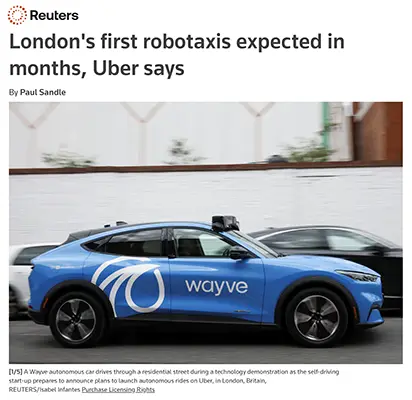
London’s First Robotaxis Are Coming — With Safety Drivers Still in the Seat
Reuters | June 8, 2026
TL;DR: Uber has opened sign-ups for London’s first public robotaxi service, powered by British AI startup Wayve — but regulatory approval is still pending and safety operators will remain behind the wheel at launch.
Executive Summary
Uber announced that Londoners can now register for its forthcoming autonomous ride service, which uses AI from startup Wayve (valued at $8.6 billion following a $1.5 billion raise in February). The vehicles are Ford Mustang Mach-E cars with cameras and radar, tested on London streets since 2018. Regulatory approval from Transport for London is still required before commercial launch, which Uber expects within months.
The service will launch with trained human operators in the driver’s seat — not fully driverless. Riders can choose to accept an autonomous ride or switch to a conventional one at the same price. This frames the launch as a demonstration and trust-building exercise, not a claim of full autonomy.
London’s launch adds to a competitive cluster: Waymo (Google/Alphabet) is also testing in London and plans commercial service this year. Baidu’s Apollo Go will be tested by both Uber and Lyft in London in 2026. Europe has lagged the US and China on autonomous vehicle deployment, primarily due to regulatory complexity and infrastructure challenges.
Relevance for Business
For most SMBs, this is a horizon signal rather than an immediate operational concern. The transportation economics shift — if robotaxis achieve cost parity without human drivers — will affect last-mile logistics, employee travel reimbursement norms, and fleet decisions over time.
The more immediate implication is for businesses in fleet management, logistics, or urban delivery: the competitive landscape for transportation services is entering a multi-year transition. Now is the time to understand options, not to act.
The regulatory path remains the key variable. UK government has signaled intent to fast-track; actual deployment depends on Transport for London approval and early safety record.
Calls to Action
🔹 Monitor UK regulatory decisions: TfL approval and early safety data will shape how quickly this technology scales in other European markets.
🔹 If you operate a fleet or logistics function: Add autonomous vehicle services to your 3-year scenario planning. No action needed now.
🔹 Track Waymo’s London launch: A competing fully driverless service would accelerate the competitive and regulatory timeline.
🔹 Deprioritize for most SMBs: Real-world impact on SMB operations is likely 3–5 years away in the UK, longer elsewhere in Europe.
Summary by ReadAboutAI.com
https://www.reuters.com/world/europe/uber-opens-sign-ups-london-robotaxis-ahead-launch-in-months-2026-06-08/: June 9, 2026
UK Commits £1.1 Billion to Build Domestic AI Infrastructure
Reuters | June 8, 2026
TL;DR: Britain announced a £1.1 billion AI hardware plan at London Tech Week, including a national supercomputer, chip-buying programs, and a VC-backed fund for homegrown chip companies — a deliberate push toward sovereign AI computing capacity.
Executive Summary
The UK government unveiled a multi-component AI infrastructure commitment at London Tech Week. The headline is a £750 million national supercomputer scheduled to deploy in 2030, using a combination of proven and next-generation processors. Of that budget, £400 million is earmarked for chip purchases, including £150 million directed toward inference chips to be purchased this summer from British firms.
Additional components include a £150 million commitment from the British Business Bank (its largest-ever single fund investment) into a fund led by U.S. venture firm Playground Global, targeting UK AI hardware companies. A separate £120 million innovation programme will fund British firms to design, develop, and test new chips.
The framing throughout is sovereign capability — reducing dependence on non-UK chip supply at a time when AI infrastructure is increasingly geopolitically contested. The 2030 supercomputer timeline and the reliance on a U.S. VC firm to lead the hardware fund both reflect the current-state gap in UK chip manufacturing.
Relevance for Business
UK-based businesses, particularly those in AI-intensive sectors, should read this as a signal of government intent to subsidize domestic AI access. Future public compute programs, procurement preferences, or incentives may favor companies using British AI infrastructure.
The chip purchasing programs are the most near-term signal: British chip startups are about to receive significant public funding. If you work with or supply any of those firms, the competitive landscape is changing.
For non-UK businesses, this reflects a broader global pattern: sovereign AI infrastructure is becoming national policy. Expect similar announcements from other governments, each creating their own procurement preferences and market access implications.
Calls to Action
🔹 UK businesses: monitor procurement signals — government AI programs may create preferential access for companies using UK-backed infrastructure.
🔹 Track the British chip investment portfolio: The BBB-backed fund will surface emerging UK hardware vendors worth watching as alternatives to US/Asian incumbents.
🔹 Note the 2030 supercomputer timeline: Near-term impact is limited; this is a capacity-building signal, not an immediate resource.
🔹 Non-UK businesses: watch for similar programs in your jurisdiction — sovereign AI infrastructure investment is becoming a global policy theme with market implications.
Summary by ReadAboutAI.com
https://www.reuters.com/world/uk/uk-sets-out-15-billion-ai-hardware-plan-with-supercomputer-chip-funding-2026-06-08/: June 9, 2026
Amazon Signs Multi-Billion-Dollar Fiber Optics Deal with Corning — AI Infrastructure Runs on Glass, Too
Reuters | June 8, 2026
TL;DR: Amazon and Corning signed a multi-billion-dollar multi-year deal to scale U.S. fiber optic manufacturing for AI data centers, reinforcing that the physical layer of AI infrastructure — not just chips — is a critical capacity constraint.
Executive Summary
Amazon announced a strategic partnership with specialty glass maker Corning to expand domestic production of optical fiber and connectivity products used in data centers. Financial terms were not disclosed beyond the multi-billion-dollar characterization. The deal includes creation of 1,000 jobs at Corning’s North Carolina facilities and a training program with Catawba Valley Community College to develop local technician talent.
Corning’s optical fiber products are foundational in AI data centers, enabling data movement between thousands of processors at scale. The company has already announced plans to expand U.S. optical connectivity manufacturing capacity tenfold and increase domestic fiber production by more than 50%. Last month, Corning signed a similar partnership with Nvidia.
The dual Nvidia and Amazon deals within a month underscore a structural reality: the AI buildout requires parallel investment across multiple physical layers — chips, power, cooling, and now fiber. Corning’s position as a key supplier to both simultaneously makes it a notable chokepoint in the AI supply chain.
Relevance for Business
This story matters less for what Amazon and Corning are doing than for what it signals about the AI infrastructure build cycle. The physical components enabling AI at scale — power, cooling, fiber — are all under strain simultaneously.
For SMBs, the practical implication is continued upward pressure on data center costs and potentially on cloud pricing over the medium term. The major cloud providers are committing billions to infrastructure; those costs will eventually flow through to customers.
For businesses in construction, real estate, or infrastructure services, AI data center buildout represents a substantial demand signal for the next 5–10 years — spanning power, connectivity, land, and skilled labor.
Calls to Action
🔹 Monitor cloud infrastructure pricing: Data center input cost increases (fiber, power, chips) create upward pressure on cloud pricing. Review contracts at renewal.
🔹 If relevant to your sector: AI data center construction is a durable demand signal for real estate, power, and connectivity vendors.
🔹 No immediate action for most SMBs: This is a supply-chain and infrastructure story. Its effects on SMB costs are gradual and indirect.
🔹 Watch for further Corning-type deals: Multiple large-scale fiber partnerships signal the industry recognizes physical layer capacity as a constraint — not just compute.
Summary by ReadAboutAI.com
https://www.reuters.com/technology/amazon-corning-sign-multi-billion-dollar-deal-boost-fiber-optics-manufacturing-2026-06-08/: June 9, 2026
Is AI Reducing IT Costs? Tech Leaders Weigh In
TechTarget | June 5, 2026
TL;DR: AI is adding costs faster than organizations can measure the benefits — and the productivity gains that do exist rarely show up on a balance sheet.
Executive Summary
Seven IT leaders surveyed by TechTarget converge on an uncomfortable verdict: in most organizations, AI has not reduced IT costs. It has added new ones. Spending on model usage, licensing, integration, governance, cybersecurity controls, and vendor management is accumulating on top of existing cloud and infrastructure budgets — not replacing them. The savings that do exist tend to be real but invisible: faster code reviews, non-technical staff solving their own problems, reduced time on repetitive bottlenecks. None of it lands as a line-item credit.
The more nuanced picture is that AI shifts costs rather than eliminates them. One CTO describes paying more for model APIs and orchestration while paying less for contract writers and operational coordinators whose functions have been absorbed into internal workflows. Another notes that when measured by cost-per-unit-of-output, AI has reduced costs significantly — but absolute IT spend is flat or rising. The accounting asymmetry is the core problem: costs have invoices, productivity gains don’t.
The leaders who report genuine ROI share a common pattern: they deployed AI against specific, repeatable operational problems — test automation, help desk triage, code documentation — with clean data and clear process ownership. Those who deployed broadly and hoped for budget relief are still waiting. A recurring warning: companies that reduced headcount expecting AI to fill the gap have sometimes found themselves with fewer experienced staff and an underutilized platform.
Relevance for Business
This is the clearest practitioner-level signal yet that AI ROI is real but narrow, and the path to it is organizational discipline, not tool adoption. SMB leaders face the same dynamic as enterprise CIOs: new licensing and governance costs arrive immediately, measurable savings require deliberate workflow redesign. The hidden cost stack — hallucination remediation, compliance exposure from unreviewed outputs, rework cycles — is particularly dangerous for smaller organizations without dedicated AI oversight capacity. Vendor-side risk is also growing: software providers are monetizing AI as add-ons to products most organizations already underuse.
Calls to Action
🔹 Audit AI spend now against actual output change, not productivity narrative — if you can’t measure the delta, you’re running blind.
🔹 Target AI at specific, bounded problems with verifiable outcomes before expanding deployment; broad rollouts without process redesign tend to add cost layers.
🔹 Build a hidden cost inventory: governance time, error remediation, human review hours, and compliance exposure are real costs that rarely appear in initial projections.
🔹 Evaluate vendor AI add-ons skeptically — most organizations already underuse 75%+ of their current software; paying for AI features on top creates compounding overhead.
🔹 Require workflow retirement as a condition of AI adoption — running old processes in parallel with new AI workflows is where net savings disappear.
Summary by ReadAboutAI.com
https://www.techtarget.com/searchcio/feature/is-ai-reducing-it-costs-tech-leaders-weigh-in: June 9, 2026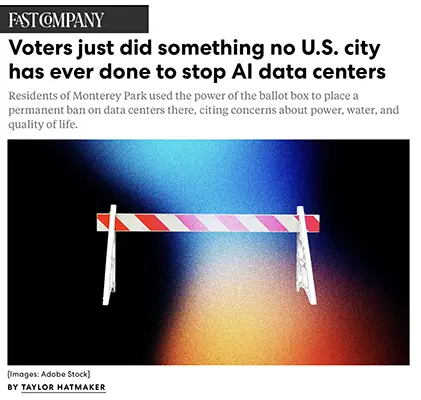

Closing: AI update for June 9, 2026
This week’s edition captures AI at a moment when the technology is delivering real capability while the institutions around it — financial, regulatory, physical, and organizational — are visibly straining to absorb the pace. The most valuable thing SMB leaders can take from these 43 summaries is not any single call to action, but the habit of reading the infrastructure stories, the governance stories, and the workforce stories as a single system — because that is exactly how they will affect your business.
All Summaries by ReadAboutAI.com
↑ Back to Top