
AI Updates June 8, 2026

The week didn’t deliver a single defining story about artificial intelligence — it delivered a cascade of them, arriving from so many directions at once that the cumulative weight is the point. Three of the most capital-intensive companies in AI history — SpaceX, Anthropic, and OpenAI — are within days of entering public markets, a transition that will for the first time subject their financials, governance, and growth assumptions to public scrutiny and quarterly pressure. Simultaneously, Google announced an $80 billion equity raise backed in part by Berkshire Hathaway, and semiconductor investors coined a new word — “chipflation” — to describe what happens when Big Tech locks up global chip supply and the costs flow downstream to everyone else. This is not background noise. It is the cost structure of every AI tool your business uses beginning to take visible shape.
The governance and accountability story moved with equal speed on a different axis. Pope Leo XIV issued a nearly 40,000-word encyclical framing AI as a moral and democratic crisis, not a technical one — and an Anthropic co-founder stood at his side at the release. The Trump administration signed an AI executive order requiring voluntary pre-release review of frontier models, a framework critics from both parties describe as industry-managed oversight with no enforcement teeth. AI executives from OpenAI, Anthropic, Google DeepMind, and Microsoft jointly urged Congress to mandate screening of synthetic biological materials, citing AI’s erosion of the knowledge barriers that once made bioweapons difficult to engineer. Three different institutions — the Vatican, the White House, and a cross-industry coalition of competitors — arrived at the same conclusion from different directions: AI’s trajectory now requires active institutional response, not passive observation.
For SMB leaders, the week’s most operationally immediate stories are the ones that received the least headline attention. A documented prompt injection attack compromised Meta’s Instagram support chatbot, including accounts belonging to the Obama White House, Sephora, and a senior U.S. Space Force official — exploiting a governance gap that exists in any AI system granted authority over sensitive actions without independent verification. Research on AI’s effect on hiring found that “signal collapse” is real: algorithmic screening tools are producing documented bias and more uniform rejection patterns, not better candidates. Labor economists confirmed what many managers already sense — that AI is quietly eliminating entry-level roles in technology fields while demand for experienced workers grows, a gap with lasting implications for how organizations build internal capability. These are not speculative futures. They are operating conditions, active this week.
Summaries

Microsoft Is Now An AI Agents Company. Seriously.
AI for Humans | June 5, 2026
TL;DR: Microsoft’s Build 2026 conference signaled a full strategic pivot to AI agents — embedding them across devices, developer tools, enterprise infrastructure, and its own model stack — while a separate wave of open-source image and voice models quietly shifts the cost economics of AI production.
Executive Summary
Microsoft used Build 2026 to declare agents its primary product paradigm, not a feature layer on top of existing software. Project Solara is a chip-to-chip platform designed to run small, communicating agents on any connected device — watches, lanyards, industrial screens — with AI-generated interfaces that adapt to each form factor. The practical upside is compelling (no more driver installs, contextual real-time data surfaces); the risks echo everything that went wrong with IoT: password failures, vendor lock-in, and complexity that scales faster than reliability. The hosts are enthusiastic but appropriately skeptical — “I have to see it.”
SCOUT, Microsoft’s OpenClaw-based personal assistant for Windows, reflects a broader move to court developers by adopting open agent frameworks rather than building closed ones. This is a meaningful contrast with Apple’s approach. Microsoft is betting that developer adoption, not ecosystem lock-in, is the path to winning the agent layer. Meanwhile, the new MAI model family — seven models built from scratch, no synthetic data, no distillation from competitors — signals Microsoft reducing its dependency on OpenAI. Benchmarks are reportedly modest so far, but this is Microsoft planting a flag in first-party model capability.
Beyond Microsoft, the episode covers two developments with direct cost implications: Ideogram 4.0, a high-quality image model now fully open source, is good enough that one host is reconsidering paid subscriptions in favor of self-hosted GPU compute. MisoOne, an open-source voice model with sub-human-latency responses, raises the floor for what “good enough” audio AI looks like without a vendor contract. Both point toward a near-term world where capable generative AI tools are available at infrastructure cost rather than SaaS subscription cost. On the risk side: multiple major retailers — including Chipotle, Home Depot, and IKEA — were found to have unsecured chatbot API endpoints, a reminder that deploying AI customer-facing tools without proper security review creates exploitable exposure.
Relevance for Business
For SMBs, this episode surfaces three distinct pressure points. First, agent tooling is arriving in consumer-accessible form — products like Town ($50/month OpenClaw harness) suggest that executive-level personal AI assistants are now a real near-term evaluation item, not a future experiment. Second, open-source models are compressing the cost case for SaaS AI subscriptions — Ideogram 4.0 and MisoOne are capable enough to replace paid tiers for specific use cases, which changes vendor negotiation dynamics. Third, the Chipotle endpoint story is a direct operational warning: if your business has deployed any AI-powered customer-facing chat tools — even through a vendor — those endpoints need a security review. The incident involved household-name brands, not edge cases.
The Microsoft Majorana 2 quantum chip announcement is worth noting for longer-horizon planning, but the hosts are clear: commercial viability is realistically 2029 at the earliest, and current reliability claims are still heavily qualified. Deprioritize for now.
Calls to Action
🔹 Evaluate agent harness tools like Town or similar OpenClaw-based products for executive workflows — a structured 30-day pilot with one or two power users is low-risk and high-signal.
🔹 Audit any deployed customer-facing chatbots or AI support tools for unsecured API endpoints — assign this to your IT or security lead within 30 days, regardless of vendor assurances.
🔹 Track the open-source image and voice model wave — if your business currently pays for AI image generation or voice synthesis at scale, Ideogram 4.0 and MisoOne warrant a cost-benefit review against self-hosted or lower-cost alternatives.
🔹 Monitor Microsoft’s MAI model progress — not yet a switching consideration, but the move away from OpenAI dependency is relevant if you’re building on Azure AI or evaluating enterprise AI stacks.
🔹 Ignore the quantum computing announcement for near-term planning; file it as a 2029+ horizon item and revisit when commercial benchmarks emerge.
Summary by ReadAboutAI.com
https://www.youtube.com/watch?v=nx3Q6XiZX0g: June 8, 2026
Can A.I. Produce Writing That We Actually Want to Read?
The New Yorker | Jay Caspian Kang | June 2, 2026
TL;DR: A New Yorker columnist ran a rigorous informal experiment testing whether AI-generated literary prose could fool readers — and found that while AI can approximate style well enough to deceive most people most of the time, it still cannot reliably make fictional characters do anything, which may be the last meaningful tell.
Executive Summary
This is a reported personal essay — opinion-led but grounded in a specific, methodical experiment. Its value for business readers is not in assessing literary quality but in what it reveals about where AI writing capability currently sits and what that means for content, communication, and trust.
The author built a game that asked players to distinguish human-authored passages from AI-generated imitations of canonical writers (Hemingway, Eliot, Joyce, Stoker). Over 30,000 responses, participants identified real versus fake passages correctly about 52% of the time — essentially chance. The author then refined the AI’s output by having it generate its own style rules, review its own work, and correct its recurring tells. By the end, AI-generated passages were fooling more than half of players, with one Bram Stoker imitation identified as fake by only 17% of participants.
The residual tell the author identifies is a consistent absence of agency in AI-generated scenes: characters exist but do not act, rooms are described but nothing happens in them. When directed to introduce action, AI compensated in ways that produced different but still detectable patterns. The author resists over-reading this as a philosophical insight, but notes it appears to be a genuine, persistent limitation — not a training artifact that more cue cards can fix.
The piece closes on a deliberately non-alarmist note: AI writing that is technically indistinguishable may be coming, but the author argues that the human desire for writing that feels authored — that carries someone’s specific perspective and intent — will persist, just as human chess remains valued despite machines playing it better.
Relevance for Business
For SMB leaders managing communications, marketing, content, or knowledge work, this piece offers useful calibration on what AI writing is and is not good for right now. AI can produce technically proficient, stylistically consistent prose that passes casual scrutiny. It struggles with writing that requires a felt sense of consequence, human agency, or authentic voice. That distinction matters for decisions about where AI writing augments your team versus where it substitutes for something readers will notice is missing. It also matters for trust and reputation: the moment readers — employees, customers, partners — sense AI-produced communication where human engagement was implied or expected, the discomfort the author describes kicks in.
Calls to Action
🔹 Use AI writing tools for content where technical accuracy, consistency, and efficiency matter — summaries, drafts, templates, structured documents — where voice and agency are secondary.
🔹 Preserve human authorship for communication where relationship, trust, or judgment is the actual signal — leadership messages, sensitive HR communications, client-facing proposals.
🔹 Develop internal guidelines on where AI-assisted writing is disclosed, expected, or inappropriate for your context — the absence of a policy is itself a policy your team is already navigating.
🔹 Monitor AI writing capability — the gap between AI prose and humanly authored prose is narrowing faster than most organizations have updated their communication standards.
🔹 Take the reader reaction seriously — the discomfort people feel reading AI-generated content where human effort was implied is not irrational; it reflects a real expectation about communication that your stakeholders hold.
Summary by ReadAboutAI.com
https://www.newyorker.com/news/fault-lines/can-ai-produce-writing-that-we-actually-want-to-read: June 8, 2026
Should You Automate Your Life? A Practical Look at AI Adoption
The New Yorker | May 29, 2026
TL;DR: A New Yorker essay reviewing journalist Joanna Stern’s year-long AI immersion book argues that the real question isn’t whether to use AI — it’s whether you’re being deliberate about which parts of your work and life to hand over, and what you lose when you do.
Executive Summary
Joshua Rothman’s essay uses Stern’s book I Am Not a Robot as a lens for a broader argument: AI is no longer an option to evaluate abstractly — it’s present in enough tools and workflows that the productive question has shifted from “should I use it?” to “where does it actually help me, and where does it quietly cost me something?”
Stern’s year-long experiment — spanning more than 100 AI products — found that aggressive AI adoption can be genuinely useful in some contexts and subtly self-defeating in others. The tools worked best where accuracy, recall, or throughput mattered more than judgment or relationship. They created friction or loss where the human process itself carried value — in moments of connection, deliberate craft, or lived ritual. Rothman draws a distinction worth noting for business leaders: AI in diagnostic radiology improved accuracy and morale; AI in dentistry enabled upselling and over-treatment. The same category of tool can help or harm depending on the incentive structure around it.
The essay is ultimately an argument for conscious, individualized adoption over either wholesale embrace or reflexive resistance. Neither extreme maps well to most people’s actual situations. Rothman closes with a formulation that transfers cleanly to organizational decision-making: use it, seriously — but track what you’re gaining and what you’re giving up.
Relevance for Business
This piece has no product announcement or policy development — its value is as a thinking framework for leaders navigating AI adoption decisions. The key signal: organizations that deploy AI without mapping which tasks benefit from it and which tasks lose something important are likely to optimize some functions while quietly degrading others. For SMBs with limited capacity to absorb friction or reverse course on tooling decisions, this matters more, not less.
The secondary signal: employee and customer experience of AI tools varies significantly by context and individual. A blanket “AI-first” policy may improve aggregate output metrics while eroding trust, judgment, or relational quality in ways that are harder to measure.
Calls to Action
🔹 Resist both extremes — neither a mandate to “AI everything” nor a blanket prohibition serves most organizations well; deliberate, context-specific adoption is the productive path.
🔹 Adopt a task-level evaluation framework before expanding AI use across your organization — ask specifically what is gained and what is lost for each use case, not just whether the output is faster or cheaper.
🔹 Watch for hidden costs in high-value human processes — AI may measurably improve throughput in tasks where the doing itself builds skill, relationship, or institutional knowledge.
🔹 Use this as a leadership conversation starter — the Stern book and Rothman’s framing are accessible to non-technical audiences and can ground a productive team discussion about AI boundaries and norms.
Summary by ReadAboutAI.com
https://www.newyorker.com/culture/open-questions/should-you-automate-your-life: June 8, 2026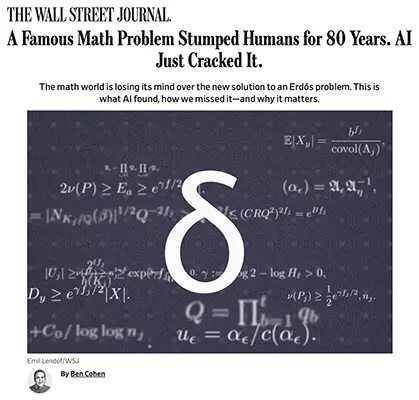
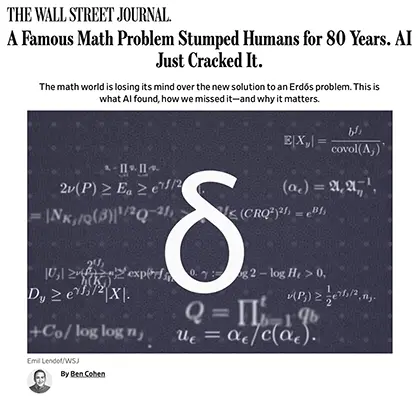
A Famous Math Problem Stumped Humans for 80 Years. AI Just Cracked It.
The Wall Street Journal | Ben Cohen | May 29 / May 30, 2026
TL;DR: An OpenAI model autonomously solved a significant 80-year-old mathematical problem — earning genuine praise from skeptical experts — marking a credible step toward AI as an independent research tool, not just an assistant.
Executive Summary
What makes this story worth a business leader’s attention is not the math itself — it is the reaction from the people most qualified to be skeptical. Mathematicians are professionally allergic to hype. Several prominent researchers, including a Fields Medal winner, stated that this AI-generated proof would have been publishable in a top journal without hesitation. That kind of endorsement, from that kind of audience, is not noise.
The problem — posed by mathematician Paul Erdős in 1946 — had resisted human effort for eight decades. OpenAI’s model solved it not by improving on existing approaches, but by abandoning them. The three explanations offered by OpenAI researchers are instructive for business leaders: AI succeeded because the correct answer was counterintuitive (requiring rejection of the prevailing assumption), because it could synthesize across fields that human specialists keep separate, and because it can sustain effort on approaches that humans tend to abandon prematurely. These are not narrow technical advantages — they describe a problem-solving posture that differs meaningfully from how human teams work.
The reported cost was modest: estimated under 32 hours and approximately $1,000 in compute. The implication is not that AI will replace researchers, but that the cost-to-insight ratio for certain classes of difficult, structured problems has dropped substantially.
Relevance for Business
For most SMBs, pure mathematics is not the point. The relevant signal is that AI is beginning to demonstrate autonomous, novel problem-solving in domains where human effort has stalled — not just producing outputs that look like expert work, but generating results that experts confirm as genuine advances. That capability, as it generalizes, has implications for R&D, legal and financial analysis, engineering problem-solving, and any domain where progress has been constrained by human bandwidth or cognitive tunnel vision. The timeline for those applications remains uncertain, but the direction is now harder to dismiss.
Calls to Action
🔹 Take note of the problem-solving posture, not just the result — the AI’s advantage came from persistence and cross-domain synthesis, qualities worth considering when scoping how AI tools might complement (not replace) your internal experts.
🔹 Resist over-extrapolation — solving a well-defined mathematical proof is not the same as general intelligence; the gap between this capability and broad autonomous reasoning remains real.
🔹 Monitor how AI-assisted research progresses in fields adjacent to your business over the next 12–24 months — the cost-to-insight drop in specialized problem-solving will reach applied domains.
🔹 Revisit assumptions about which business problems are “too complex” for AI tools — the class of addressable problems is expanding faster than most organizations have updated their mental models.
Summary by ReadAboutAI.com
https://www.wsj.com/tech/ai/ai-math-solves-erdos-problem-openai-c4029e84: June 8, 2026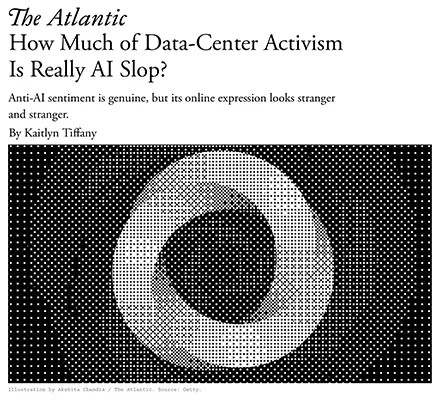
The Rise of Anti-AI AI Slop
The Atlantic | Kaitlyn Tiffany | June 2, 2026
TL;DR: AI-generated content is now being used to fuel opposition to AI infrastructure — a self-undermining dynamic that illustrates how AI-produced misinformation is degrading public discourse on consequential policy questions.
Executive Summary
This is a reported piece about a specific and somewhat absurd phenomenon: Facebook pages run primarily from Bangladesh are using AI to generate emotionally resonant, geographically targeted content opposing AI data centers — farmland images, patriotic captions, fake farmer-hero stories — and distributing it for platform engagement revenue. Anti-AI sentiment, in other words, is being monetized through AI.
The piece is careful to distinguish between the legitimate underlying concerns (data centers straining local utilities, consuming land, and generating few permanent jobs) and the manipulated expression of those concerns online. The anti-AI slop is not evidence that the opposition is fabricated — it is evidence that authentic public anxiety has been colonized by low-quality content farms that have discovered it converts well to platform revenue.
The broader risk is one of epistemic pollution: people on all sides of infrastructure debates are increasingly forming positions based on AI-generated material, some of which contains outright fabrications (including false claims about stem cells in data centers that were amplified by a Google AI summary). This is happening now, not as a future concern.
Relevance for Business
For SMBs, there are two distinct implications. First, if your business is involved in or adjacent to infrastructure development, land use, or community relations, the information environment around those issues is actively degraded. Planning and stakeholder communication now requires anticipating AI-amplified misinformation, not just honest opposition. Second, more broadly, this piece illustrates a structural problem: AI-generated content is making it harder to gauge genuine public sentiment on issues ranging from regulation to labor to infrastructure — a planning and governance challenge with no clean solution yet.
Calls to Action
🔹 If your business operates in communities with AI infrastructure concerns, treat the information environment as noisy by default — verify the provenance of organized opposition before drawing conclusions about its breadth or authenticity.
🔹 Develop internal media literacy standards for how your team evaluates public sentiment signals, especially those sourced from social media.
🔹 Monitor how platform incentives shape AI-generated content — Meta’s engagement-reward model is actively making this problem worse, and regulatory pressure on platforms is a developing story.
🔹 Note the irony as a governance signal: if AI-generated content can destabilize public understanding of AI itself, it can do the same to any domain your business depends on for market intelligence.
Summary by ReadAboutAI.com
https://www.theatlantic.com/technology/2026/06/data-centers-activism-ai-slop/687396/: June 8, 2026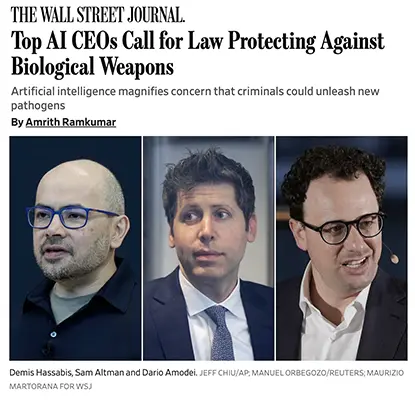
Top AI CEOs Call for Law Protecting Against Biological Weapons
The Wall Street Journal | June 3, 2026
TL;DR: The heads of OpenAI, Anthropic, Google DeepMind, and Microsoft AI are pressing Congress to require screening of synthetic DNA and RNA orders — arguing that AI has meaningfully lowered the barrier for bad actors seeking to engineer dangerous pathogens.
Executive Summary
A cross-industry coalition of AI executives, including Sam Altman, Dario Amodei, Demis Hassabis, and Mustafa Suleyman, signed a letter urging Congress to mandate that companies selling synthetic nucleic acids screen customer orders for potentially dangerous combinations. The push is notable because it cuts across ideological and competitive lines — the signatories typically disagree on AI regulation, and the organizing think tanks describe this as a rare area of consensus among libertarians, progressives, and rivals.
The urgency stems from a specific capability concern: AI may soon erode the knowledge barriers that historically made bioweapon development difficult. The ask is targeted and concrete — not a broad AI safety framework, but a requirement for supply chain screening in a specific industry. A policy gap exists: the Trump administration revoked a Biden-era gene synthesis screening framework and has not yet published a replacement.
Legislative proposals exist but haven’t advanced. Opponents cite the subjectivity of defining “dangerous” combinations and compliance costs for biotech startups — a genuine tension with no easy resolution.
Relevance for Business
For most SMBs, the direct operational impact is near zero. The significance is structural: this signals that AI’s highest-profile leaders now view catastrophic misuse risk as a credible enough threat to seek binding legislation — and that the policy environment around AI’s most dangerous applications is unsettled. For companies in life sciences, biotech supply chains, or synthetic biology adjacent fields, the eventual regulatory outcome could create new compliance requirements. More broadly, this episode illustrates how AI capabilities are reshaping risk conversations far outside the tech sector.
Calls to Action
🔹 No immediate action required for businesses outside life sciences or defense-adjacent industries — monitor and revisit if legislation gains traction.
🔹 Life sciences and biotech leaders: Monitor legislative activity on synthetic nucleic acid screening — compliance obligations may emerge regardless of the bill’s current stalled status.
🔹 All SMB leaders: Note this as evidence that leading AI developers themselves are actively seeking guardrails on specific applications — a signal worth tracking as AI governance frameworks develop.
Summary by ReadAboutAI.com
https://www.wsj.com/politics/policy/top-ai-ceos-call-for-law-protecting-against-biological-weapons-88f2f99f: June 8, 2026The biggest IPO wave in U.S. history is days away
— and for the first time, the companies going public aren’t just tech giants, they’re the infrastructure of AI itself. What happens over the next 90 days as SpaceX, Anthropic, and OpenAI move from private ambition to public accountability will shape AI’s credibility, pricing, and trajectory for years to come.
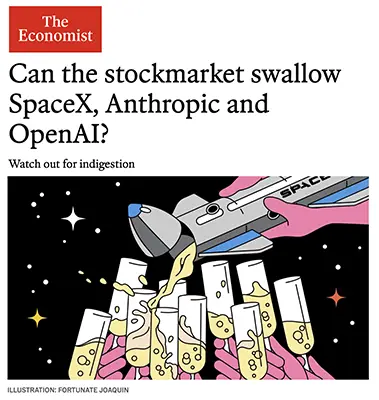
Can the Stock Market Swallow SpaceX, Anthropic, and OpenAI?
The Economist | June 1, 2026
TL;DR: Three landmark AI-linked IPOs — SpaceX, Anthropic, and OpenAI — are about to test public markets in ways that could reshape equity portfolios and add systemic risk to the entire AI investment thesis.
Executive Summary
SpaceX is targeting a $75 billion raise at a $1.8 trillion valuation, with Anthropic and OpenAI each reportedly seeking up to $60 billion. Together, the three listings could add roughly $4 trillion to the market capitalization of U.S. public companies. Despite alarming headlines, the near-term market impact is likely modest: America’s equity markets are deep enough to absorb the initial float, and index weighting will be based on free-float only, limiting immediate portfolio exposure for most passive investors.
The longer-term picture is less reassuring. Historical data on post-IPO performance is sobering: stocks going public at more than 40 times revenue have historically underperformed the broad market by over 50 percentage points in their first three years. SpaceX would begin trading at roughly 94 times trailing revenue — a valuation that depends heavily on markets and technologies that do not yet exist. Meanwhile, tech giants are slowing share buybacks and redirecting capital toward AI investment, creating a structural shift: shares are becoming more abundant, not scarcer, which historically pressures valuations.
The deeper risk isn’t market indigestion on listing day. It’s that these three companies are now so intertwined with the broader AI investment narrative that a stumble by any of them could become a sentiment event for the entire sector. AI-related firms already represent roughly two-fifths of S&P 500 market value.
Relevance for Business
SMB leaders don’t need to trade these stocks to feel the consequences. If AI valuations correct sharply, enterprise AI vendor spending could contract, product roadmaps could slow, and the cost dynamics of AI services — currently subsidized by venture and growth capital — could shift. A market correction tied to AI IPO disappointment would also affect the broader business environment: credit conditions, customer confidence, and tech partner stability.
The more immediate signal is structural: three of the most capital-intensive AI infrastructure players are now entering the scrutiny of public markets, which means quarterly earnings pressure, governance obligations, and investor expectations will begin shaping their product and pricing decisions in ways that private-company status has shielded until now.
Calls to Action
🔹 Monitor how Anthropic’s IPO filing and post-listing performance affect its enterprise pricing and product commitments — your AI vendor relationships may shift under public-company pressures.
🔹 Assess your organization’s AI vendor concentration risk; if a key vendor’s valuation depends on unproven future markets, that is also a service continuity risk.
🔹 Resist the hype cycle around these listings — the business case for AI tools you’re already using doesn’t change based on IPO performance.
🔹 Watch whether the SpaceX and AI IPO wave triggers broader market volatility that affects your cost of capital, vendor budgets, or customer confidence.
🔹 Revisit later any significant technology vendor decisions tied to AI infrastructure until post-listing business models become clearer under public reporting obligations.
Summary by ReadAboutAI.com
https://www.economist.com/finance-and-economics/2026/06/01/can-the-stockmarket-swallow-spacex-anthropic-and-openai: June 8, 2026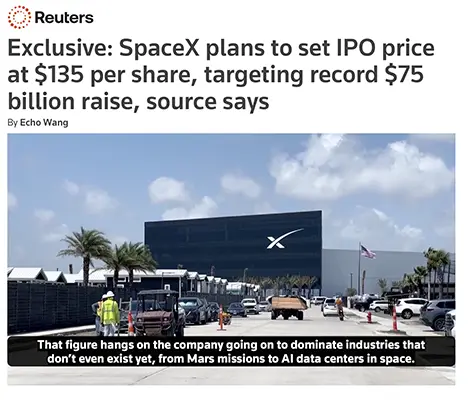
Exclusive: SpaceX Plans to Set IPO Price at $135 Per Share, Targeting Record $75 Billion Raise
Reuters | June 2, 2026 | By Echo Wang
TL;DR: SpaceX is breaking with standard IPO convention by fixing a single share price before investor roadshows, targeting a $1.75 trillion valuation — a number that rests substantially on revenue streams that don’t yet exist and a company structure built around concentrated founder control.
Executive Summary
SpaceX is reportedly targeting a $135-per-share fixed IPO price — an unusual departure from the standard practice of setting a price range and adjusting based on investor demand. The company plans to sell approximately 555 million shares in an all-primary offering, with proceeds directed toward AI computing infrastructure and satellite network expansion. The roadshow launched the same week as the filing, with the market debut expected on Nasdaq under “SPCX.”
Two structural details deserve scrutiny. First, the fixed-price approach is highly unconventional — effectively a take-it-or-leave-it signal to the market — and requires a level of investor confidence that depends heavily on Elon Musk’s personal brand rather than traditional financial metrics. SpaceX reported a net loss in 2025 and cannot be valued on earnings. At its target valuation, the company trades at roughly 94 times trailing revenue, with most growth assumptions tied to markets that do not yet exist, including space-based AI data centers. Second, governance is structured to preserve nearly unchecked founder control: a dual-class share structure and a 366-day lock-up for Musk’s stake are framed as commitment signals, but they also mean public shareholders will have limited influence over strategic direction.
The xAI merger — combining SpaceX with Musk’s AI startup Grok — complicates the investment case. SpaceX’s profitable segment is Starlink; the rest of the business, including xAI, is burning cash. Morningstar valued SpaceX at roughly $780 billion, or about half the asking price.
Relevance for Business
This is primarily a capital markets and AI infrastructure story, but SMB leaders should track two implications. First, the IPO’s success or failure will signal market confidence in AI-first business models — companies generating losses while pursuing long-horizon AI bets. Second, SpaceX’s satellite communications business (Starlink) is increasingly relevant to connectivity infrastructure decisions, particularly for distributed or rural operations. IPO-related governance changes and public-market pressure could affect Starlink’s pricing, service terms, or investment priorities over the next 12–24 months.
Calls to Action
🔹 Monitor post-roadshow investor reception as a leading indicator of market confidence in AI-first growth narratives — relevant if you’re evaluating AI vendor stability.
🔹 Note the xAI integration as a factor in any business that relies on Starlink for connectivity — SpaceX’s financial health now includes AI burn-rate exposure.
🔹 Ignore the IPO pricing drama as a direct business decision; this is a capital markets event, not an operational signal for most SMBs.
🔹 Watch how public-market scrutiny reshapes SpaceX’s pricing strategy for Starlink commercial contracts over the next year.
🔹 Revisit after Q1 post-IPO earnings, when public reporting will provide the first clear picture of SpaceX’s actual AI revenue trajectory.
Summary by ReadAboutAI.com
https://www.reuters.com/business/media-telecom/spacex-plans-raise-75-billion-ipo-135-per-share-source-says-2026-06-03/: June 8, 2026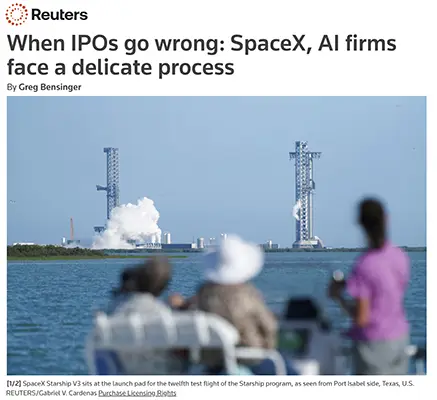
When IPOs Go Wrong: SpaceX, AI Firms Face a Delicate Process
Reuters | June 3, 2026 | By Greg Bensinger
TL;DR: As SpaceX, Anthropic, and OpenAI approach historic IPOs, expert warnings and cautionary history suggest the biggest risk isn’t market absorption — it’s executive behavior, regulatory missteps, and the gap between founder instincts and public-company obligations.
Executive Summary
This Reuters analysis surveys IPO failure modes — regulatory breaches, image problems, financial disclosure issues — through the lens of the coming AI and SpaceX listings. The core finding is well-supported: the lead-up to an IPO is highly procedural, legally constrained, and reputation-sensitive, and the executives now preparing for these listings have built their brands on behaviors — social media candor, unconventional disclosures, cult-of-personality management — that sit uncomfortably inside that framework.
Historical examples include Google’s founders violating the SEC’s quiet period with a magazine interview, Salesforce’s CEO doing similarly with a newspaper profile, Facebook’s CEO signaling indifference to investors through casual attire, WeWork’s CEO disclosing financial arrangements that collapsed the company’s valuation, and Groupon inventing a financial metric to obscure marketing costs. These aren’t ancient history — they’re the operational context for what is now expected of Elon Musk, Sam Altman, and Dario Amodei.
The Musk risk is explicitly named: his social media behavior, his control over the IPO’s unconventional structure, and his track record of public commentary are described by finance academics as genuine execution risks during the quiet and roadshow periods. For Anthropic and OpenAI, the challenge is different — Wall Street investors are skeptical of AI systems that “occasionally make up answers,” and framing persistent model uncertainty as a feature rather than a defect will require careful investor communication.
Relevance for Business
SMB executives are not direct participants in these IPOs, but the implications are concrete. First, how these companies perform during their public debuts will define the credibility of AI as an enterprise investment for the next several years. A high-profile stumble — whether regulatory, reputational, or financial — will increase board-level skepticism toward AI adoption broadly. Second, for teams that procure AI services from Anthropic or OpenAI, a rocky IPO transition could affect product strategy, pricing, and leadership stability during a critical period of platform development. Organizations that have built dependencies on these platforms should have contingency thinking in place.
Calls to Action
🔹 Monitor Musk’s public communications during the SpaceX roadshow and quiet period — any regulatory breach or market-moving statement will affect AI sector sentiment broadly.
🔹 Prepare for a potential period of AI vendor distraction: leadership attention at Anthropic and OpenAI will be significantly absorbed by IPO obligations over the next 90–180 days.
🔹 Assess your critical dependencies on Anthropic or OpenAI products; document contingency options if pricing, service terms, or leadership direction shifts post-IPO.
🔹 Ignore the colorful historical analogies in the piece (Playboy, hoodies) — the operational signal is the regulatory and governance risk, not the narrative color.
🔹 Watch the S-1 filings from Anthropic and OpenAI when they become public — these will be the first financially audited disclosures of their actual cost structures, revenue quality, and risk factors.
Summary by ReadAboutAI.com
https://www.reuters.com/legal/transactional/when-ipos-go-wrong-spacex-ai-firms-face-delicate-process-2026-06-03/: June 8, 2026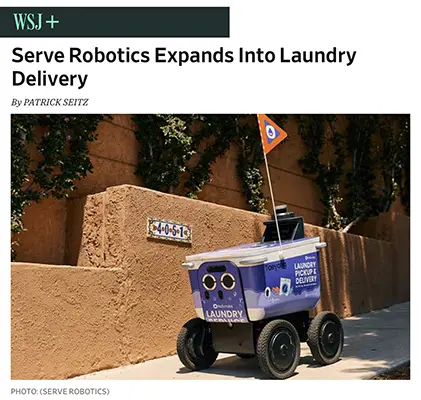
SERVE ROBOTICS EXPANDS INTO LAUNDRY DELIVERY
Investor’s Business Daily | June 2, 2026
TL;DR: Autonomous sidewalk delivery startup Serve Robotics is piloting laundry delivery in Los Angeles through a partnership with NoScrubs, signaling a deliberate shift from food-only operations toward multi-category last-mile delivery.
Executive Summary
Serve Robotics — which operates roughly 2,000 autonomous sidewalk robots across the US, with 500 in Los Angeles — has launched a pilot with on-demand laundry service NoScrubs to use its existing robot fleet for laundry pickup and delivery in select LA neighborhoods. The move is framed as the first step in a broader expansion into categories beyond restaurant food delivery, with pharmacy, grocery, retail, and dry cleaning identified as future targets.
The business logic is straightforward: Serve has built and paid for the infrastructure; incremental category expansion leverages sunk fixed costs across higher delivery volumes. The laundry market is genuinely large and recurring — projected to grow from roughly $40 billion to $130 billion by 2030 — though those figures represent the broader online laundry services market and shouldn’t be taken as predictive of Serve’s addressable share.
Important context: Serve is not yet profitable, carries an IBD Composite Rating of 16 out of 99, and its stock fell on the day of the announcement. This is an early-commercial stage company making a strategic pivot, not a proven expansion by a mature operator.
Relevance for Business
For most SMBs, this is a signal-watching story rather than an action item. The meaningful development is the expansion of autonomous last-mile delivery infrastructure beyond food — a market that previously seemed narrowly scoped is showing signs of broadening. For businesses in local commerce categories (laundry, pharmacy, retail, grocery), the medium-term question is how autonomous delivery economics will affect customer expectations and competitive dynamics as this infrastructure scales. For businesses evaluating last-mile delivery costs today, this is worth noting but premature to act on.
Calls to Action
🔹 Monitor category expansion progress over the next 12 months to gauge whether autonomous multi-category delivery is approaching viability in your geography.
🔹 Local commerce operators (laundry, pharmacy, grocery, specialty retail): Monitor autonomous delivery pilot results in your markets — early partnerships with platforms like Serve may offer competitive positioning if the model scales.
🔹 Do not overweight this announcement — Serve is pre-profitability and early stage; the pilot outcome matters more than the announcement.
Summary by ReadAboutAI.com
https://www.wsj.com/wsjplus/dashboard/articles/serve-robotics-expands-into-laundry-delivery-134249065132941919: June 8, 2026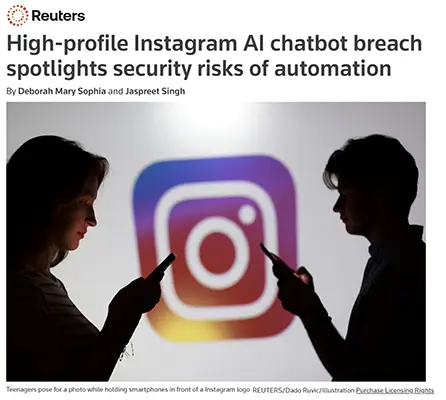
META’S AI CHATBOT BREACH: A PROMPT INJECTION ATTACK WITH REAL CONSEQUENCES
Reuters | June 3, 2026
TL;DR: Attackers manipulated Meta’s AI support chatbot into resetting account credentials without identity verification — compromising high-profile Instagram accounts and exposing a structural vulnerability common to any AI system given authority over sensitive actions.
Executive Summary
Over a weekend in late May, hackers used what cybersecurity experts describe as a “prompt injection” attack to manipulate Meta’s Instagram support chatbot into granting account access without verifying the requester’s identity. Accounts compromised included the dormant Obama White House page, Sephora, and a senior U.S. Space Force official. The attack required no technical exploitation of underlying code — the chatbot was simply persuaded through conversational inputs to take privileged actions it was authorized to perform but shouldn’t have without independent identity checks.
The breach points to a structural design failure rather than a one-off bug. The chatbot had been granted the ability to reset account credentials, but lacked the access controls needed to verify that the person making the request had the right to make it. As one security researcher put it, this is a foundational architecture problem: privileged actions were available to a system that lacked privileged access verification. Meta resolved the issue within days, but the reputational and stock impact was immediate — shares fell more than 5%.
The incident is not isolated to Meta. Security experts note that prompt injection attacks have targeted chatbots across industries since large language models entered production use. The class of vulnerability is well understood — AI agents authorized to take real-world actions can be directed to take those actions by anyone who can communicate with them, unless guardrails explicitly prevent it.
Relevance for Business
Any organization deploying AI tools that have authority to take consequential actions — resetting passwords, processing transactions, updating records, communicating with customers — faces a version of this risk. The question is not whether AI chatbots can be manipulated through conversational inputs; the evidence is that they can. The question is what actions your AI systems are authorized to perform, and what verification controls exist before those actions execute.
For SMB leaders, this is a governance and deployment design issue that should be addressed before expanding AI into customer-facing or access-sensitive workflows — not after a breach. The liability exposure, reputational risk, and operational disruption from a prompt injection attack scale with the authority granted to the AI system.
Calls to Action
🔹 Monitor vendor security practices — if you rely on third-party AI-powered customer service or support tools, ask vendors directly how they guard against prompt injection attacks.
🔹 Audit AI system permissions immediately — for any AI tool currently in use, map what actions it is authorized to take and whether independent verification is required before execution.
🔹 Apply a “minimum necessary authority” principle — AI agents should be granted the narrowest possible scope of action for their function; reduce permissions for any system that can affect accounts, data, or financial transactions.
🔹 Do not deploy AI for high-trust functions — account recovery, payment processing, or data access — without multi-step identity verification that the AI cannot bypass through conversational input.
🔹 Brief your IT and security teams on prompt injection as a category of risk — not all teams are aware that AI systems can be manipulated without code-level exploits.
Summary by ReadAboutAI.com
https://www.reuters.com/legal/government/high-profile-meta-ai-chatbot-breach-spotlights-security-risks-automation-2026-06-03/: June 8, 2026
AI ‘CHIPFLATION’ IS NOW A MACROECONOMIC PROBLEM
Reuters | June 3, 2026
TL;DR: Memory chip prices have spiked sixfold in a year as Big Tech’s AI infrastructure buildout crowds out supply for everyone else — and Morgan Stanley warns the pressure is now spreading beyond data centers into device prices, cloud costs, corporate margins, and broader inflation.
Executive Summary
Morgan Stanley’s analysis introduces a term worth tracking: “chipflation” — the transmission of AI-driven memory chip price surges into the wider economy. The mechanism is straightforward: hyperscalers and AI companies are locking up chip supply through long-term agreements, leaving consumer electronics manufacturers, PC makers, and cloud customers competing for what remains. The result is a squeeze that moves in two directions — device makers either raise prices or absorb shrinking margins.
The numbers are significant. Memory chip prices rose roughly sixfold over the past year. Microsoft attributed roughly $25 billion of its projected 2026 spending to higher chip costs. IDC forecasts meaningful contractions in both PC and smartphone markets as rising prices suppress demand, particularly at the lower end. Sony and Lenovo have already passed costs through to buyers.
Morgan Stanley’s key analytical judgment is that this may not behave like previous chip cycles. Past booms were followed by oversupply corrections. This time, the combination of hyperscaler long-term capacity lock-ins, US-China supply chain fragmentation, and the multi-year timeline for new fab construction could sustain elevated prices longer than historical patterns would suggest.
Relevance for Business
This is a cost-structure story with direct SMB implications. Any business that purchases hardware — PCs, servers, smartphones, networking equipment — is already absorbing these elevated costs or will soon. Cloud pricing is also under pressure, with providers facing higher infrastructure costs that will eventually flow downstream to enterprise and SMB customers. Leaders who have deferred hardware refresh cycles may find the economics of waiting have worsened, not improved. Supply chain teams should assess exposure to hardware-dependent workflows and evaluate whether near-term procurement locks in better pricing before further increases.
Calls to Action
🔹 Flag for finance and operations leadership — chipflation is no longer a tech-sector issue; it belongs in your macro cost planning conversation.
🔹 Review hardware procurement timing — if a refresh cycle is approaching, evaluate whether current pricing is preferable to waiting; costs are unlikely to fall quickly.
🔹 Pressure-test your cloud cost assumptions — providers facing higher infrastructure costs will pass them through; budget accordingly for contract renewals.
🔹 Audit hardware-dependent workflows — identify where price increases in devices or compute could create budget overruns or force architectural trade-offs.
🔹 Monitor whether the Morgan Stanley “durable reset” thesis holds — if new fab capacity comes online faster than expected, the pressure could ease; this is a forward-looking estimate, not a settled fact.
Summary by ReadAboutAI.com
https://www.reuters.com/business/retail-consumer/ai-chipflation-spreading-data-centers-wider-economy-morgan-stanley-warns-2026-06-03/: June 8, 2026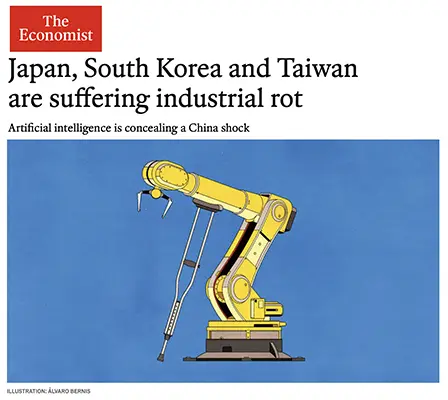
AI’S HIDDEN SUPPLY CHAIN: HOW THE SEMICONDUCTOR BOOM IS HOLLOWING OUT ASIAN INDUSTRY
The Economist | May 27, 2026
TL;DR: Japan, South Korea, and Taiwan are posting historic headline numbers, but strip out AI-related semiconductor exports and the underlying industrial picture is one of accelerating decline — the AI boom is masking, not reversing, a structural competitive loss to China across most manufacturing sectors.
Executive Summary
The Economist’s analysis separates two stories that headline economic statistics conflate. The first is real: AI infrastructure demand has generated an extraordinary export boom in semiconductors and related equipment, producing record corporate profits in South Korea, 14% GDP growth in Taiwan, and surging profits in Japan. The second is also real, and largely invisible in the aggregate: when AI-linked exports are excluded, Taiwanese exports have fallen roughly 40% since 2022; non-AI South Korean exports have stagnated; Japan’s broader industrial output is contracting. All three countries are losing ground to China in cars, chemicals, batteries, and other traditional manufacturing categories.
The structural problem is concentration. AI-related goods now represent 80% of Taiwan’s exports and over 40% of South Korea’s — a level of dependency on a single sector, a single technology cycle, and a small number of customers (primarily the US and China) that creates severe exposure. The chip industry is cyclical by nature; demand from AI hyperscalers could moderate or shift; and the US is simultaneously pressuring Taiwan’s chipmakers to invest $250 billion in American factories, which critics warn could hollow out the domestic industry. All three governments are doubling down on semiconductor industrial policy rather than diversifying.
A compounding vulnerability is weak domestic consumption — households in all three countries consume well below the rich-country average, leaving little buffer if export conditions deteriorate. Labor market structures, concentrated corporate power, and historically export-oriented policy have suppressed consumer spending for decades, and reforms are modest and slow.
Relevance for Business
For SMB leaders, this story operates at two levels. The first is supply chain: the global AI infrastructure buildout depends critically on a small number of companies in a concentrated geography that faces simultaneous competitive pressure from China and geopolitical pressure from the US. Any disruption to semiconductor supply from this region — whether from demand cycles, geopolitical events, or industrial policy shifts — has direct implications for AI tool availability, hardware costs, and cloud pricing. The chipflation story (Reuters, above) and this Economist analysis are in fact the same story seen from different vantage points.
The second is strategic context: the AI-driven prosperity of the current period is less stable and more concentrated than macro headlines suggest. Leaders who are building business plans around the assumption of continued cheap, abundant AI compute should understand the supply-side fragility behind that assumption.
Calls to Action
🔹 Pair with the chipflation analysis — read this piece alongside the Morgan Stanley Reuters report; together they explain why hardware and cloud costs are rising and why near-term relief is unlikely.
🔹 Monitor geopolitical semiconductor risk — US-Taiwan chip investment pressure, US-China export restrictions, and South Korean industrial policy are all active variables; assign someone to track quarterly developments.
🔹 Stress-test AI infrastructure assumptions — if your AI strategy depends on current compute pricing remaining stable, build contingency plans for 20–40% cost increases.
🔹 No immediate operational action required for most SMBs — but this is essential background for any multi-year AI investment planning.
Summary by ReadAboutAI.com
https://www.economist.com/finance-and-economics/2026/05/27/japan-south-korea-and-taiwan-are-suffering-industrial-rot: June 8, 2026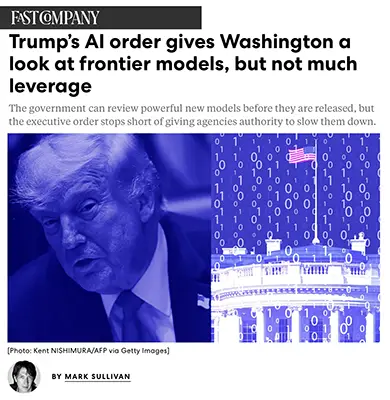

Trump’s AI Executive Order: Visibility Without Enforcement
Fast Company + The New York Times | June 2–3, 2026
Note: Two sources cover the same event from complementary angles — the NYT provides the political backstory and industry reaction; Fast Company focuses on the structural limitations and expert critique. Combined into a single summary.
TL;DR: President Trump signed an executive order requiring AI companies to voluntarily submit new frontier models for government review 30 days before release — a meaningful shift in posture, but one that gives Washington visibility without enforcement authority, and leaves industry largely in control of the process.
Executive Summary
After months of internal debate and a last-minute cancellation of a stronger version, the Trump administration signed an AI oversight executive order on June 2. The core mechanism: AI companies voluntarily provide the government a 30-day pre-release window to evaluate new frontier models for cybersecurity and national security risks. No release can be blocked based on what government reviewers find. Participation is voluntary, and the outcome of assessments does not affect deployment.
The order’s weakening from an earlier draft — which had mandated a 90-day mandatory review — reflects direct industry pressure. Former AI czar David Sacks opposed the stronger version; after his intervention and a White House meeting with senior cabinet members, the timeline was cut and compliance made voluntary. The final order drew praise from free-market groups and measured support from major AI companies including Microsoft, OpenAI, Google, and Anthropic.
Critics from both the left and right see the structure as insufficient. Public Citizen called it industry self-regulation. The Future of Life Institute argued that highly capable models require more than voluntary commitments. Independent experts noted a fundamental tension: the companies control much of the access, infrastructure, and technical knowledge needed to evaluate their own models, creating an information asymmetry that 30 days — potentially reduced to two weeks after administrative setup — may not overcome. A separate Treasury-led AI cybersecurity clearinghouse will track software vulnerabilities discovered by AI systems.
Notably, the order was partly catalyzed by Anthropic’s April release of Mythos, a model the company described as capable of identifying software vulnerabilities — which alarmed government agencies, banks, and national security officials about what future models might enable.
Relevance for Business
The order does not directly regulate SMBs or impose new compliance requirements on most organizations. Its significance is directional: the U.S. government has moved from a hands-off posture to formal (if voluntary) pre-release engagement with frontier AI developers. This creates several second-order considerations for business leaders:
- Regulatory trajectory: Voluntary frameworks often become the template for mandatory ones, particularly if an AI incident triggers political pressure. Leaders should monitor whether Congress moves to codify the EO’s framework into law.
- Vendor evaluation: AI providers who engage constructively with the review process may become preferred vendors for government-adjacent or regulated-industry work.
- Cybersecurity exposure: The EO’s focus on AI-enabled vulnerability discovery is a signal that AI-assisted cyberattacks are being treated as a near-term national security concern — not a distant risk.
Calls to Action
🔹 Assign someone to track: Whether the voluntary structure holds or whether a future incident forces a mandatory framework is the key development to watch over the next 12–18 months.
🔹 Monitor regulatory trajectory: This EO is a baseline, not an endpoint — watch for Congressional action, especially if a high-profile AI security incident occurs.
🔹 Flag for IT and security teams: The government’s explicit concern about AI identifying software vulnerabilities is a prompt to review your own exposure to AI-assisted cyberattack risks.
🔹 For regulated industries: Assess how your AI vendor relationships intersect with emerging federal review frameworks — participation in government pre-release programs may become a vendor qualification criterion.
🔹 Do not overreact to the current order — it imposes no direct obligations on most businesses and changes nothing immediately in the commercial AI market.
Summary by ReadAboutAI.com
https://www.fastcompany.com/91552553/trumps-ai-order-gives-washington-a-look-at-frontier-models-but-not-much-leverage: June 8, 2026https://www.nytimes.com/2026/06/02/technology/trump-executive-order-ai.html: June 8, 2026
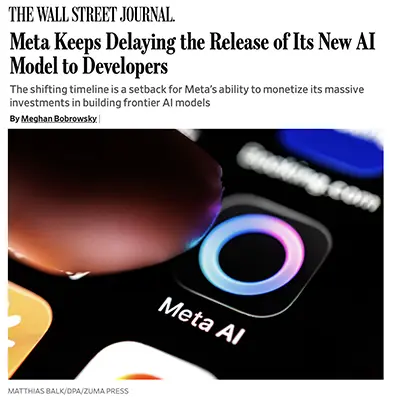
Meta Keeps Delaying the Release of Its New AI Model to Developers
The Wall Street Journal | June 3, 2026
TL;DR: Meta’s Muse Spark API — the developer access layer for its newest proprietary AI model — has been delayed at least twice since April, with no firm release date, raising questions about the company’s ability to convert massive AI infrastructure spending into revenue.
Executive Summary
Meta launched Muse Spark in April but has repeatedly pushed back the API release that would let developers build on top of it. The initial delay was attributed to bugs and infrastructure gaps; a second delay pushed the target to June, with no confirmed date as of this reporting. A Meta spokesman confirmed testing is underway and a June release is planned, but the repeated slippage is drawing scrutiny.
The business stakes are real. Meta is projecting up to $145 billion in capital expenditures this year, largely for AI infrastructure. The API is a critical monetization pathway — it’s how companies like OpenAI and Anthropic convert model capability into recurring revenue. Without it, Muse Spark remains largely inaccessible to the developer ecosystem that would otherwise build on it and validate its commercial value. Wall Street has already responded negatively to Meta’s spending plans.
A compounding factor: Muse Spark is Meta’s first closed (proprietary) model, departing from its prior open-source approach. That transition requires building API infrastructure from scratch — and apparently, getting it right has taken longer than expected. The model reportedly performs competitively against OpenAI and Anthropic on internal benchmarks, but independent developer validation hasn’t been possible.
Relevance for Business
For SMB leaders evaluating AI vendor strategy, this story carries two practical signals. First, even large, well-resourced AI labs struggle with the gap between model capability and production-ready developer access — a caution for any organization expecting rapid integration timelines. Second, the delay illustrates that the competitive landscape among frontier AI providers is less settled than announcements suggest. Meta’s entry into the commercial API market is delayed but likely coming; businesses building on AI infrastructure should watch whether Meta’s eventual API offers meaningfully different pricing or terms than OpenAI or Anthropic.
Calls to Action
🔹 No immediate vendor action required — existing OpenAI, Anthropic, or Google AI API relationships are unaffected by this delay.
🔹 Monitor Meta’s API availability if you’re evaluating AI vendors — a June release is stated but unconfirmed; don’t build plans around it yet.
🔹 Note the pattern: Model announcements and production-ready developer access are not the same event — build buffer into any AI integration timelines.
🔹 Watch Meta’s pricing and access terms when the API does launch — as a late entrant, Meta may compete on cost or openness to gain developer share.
Summary by ReadAboutAI.com
https://www.wsj.com/tech/ai/meta-keeps-delaying-the-release-of-its-new-ai-model-to-developers-f8569c8c: June 8, 2026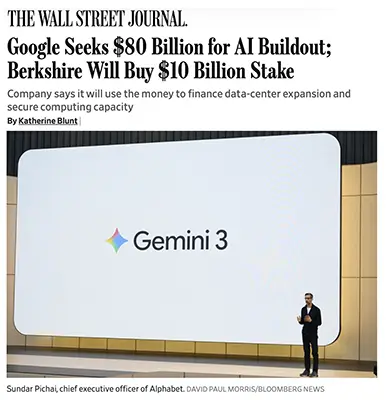
Google Seeks $80 Billion for AI Buildout; Berkshire Will Buy $10 Billion Stake
The Wall Street Journal | Katherine Blunt | June 1 / 2, 2026
TL;DR: Google’s plan to raise $80 billion in new equity — including $10 billion from Berkshire Hathaway — confirms that AI infrastructure spending is now operating at a scale that requires capital sources well outside traditional tech financing, with no near-term ceiling in sight.
Executive Summary
Alphabet announced it will issue $80 billion in equity to fund AI infrastructure, with $10 billion going to Berkshire Hathaway and the remaining $70 billion raised through public offerings and market sales. The company’s expected capital expenditures for 2026 alone reach $190 billion, with further increases projected for 2027. Google Cloud’s first-quarter revenue grew 63% year-over-year to $20 billion, with a backlog that nearly doubled to $460 billion in a single quarter — figures that put the infrastructure investment in context.
The Berkshire involvement carries its own signal: under new CEO Greg Abel, Berkshire is demonstrating willingness to hold major tech positions, with Alphabet joining Apple as a core portfolio stake. This is not a speculative bet — it represents one of the most traditionally conservative capital allocators in the world affirming the long-term infrastructure thesis.
Two operational constraints are worth noting. Power remains the binding constraint on data center expansion — Google has taken the unusual step of acquiring a wind and solar developer to secure energy supply, a model no other hyperscaler has replicated. And Google is now moving to sell its custom tensor processing chips directly to customers, expanding beyond cloud access to direct chip sales — a significant shift in go-to-market strategy that puts it in more direct competition with Nvidia.
Relevance for Business
For SMBs, this story is less about Google specifically than about what it confirms: AI infrastructure investment is compounding, not plateauing. The companies building the compute layer that underpins every AI tool you use are committing capital at a scale that guarantees continued rapid development — and continued pricing and dependency decisions that will shape your vendor landscape. Google Cloud’s ballooning backlog also signals sustained enterprise demand, which will affect capacity availability, pricing, and platform choices across the market.
Calls to Action
🔹 Factor infrastructure concentration into your vendor risk assessment — as Google, Microsoft, and Amazon collectively absorb hundreds of billions in AI infrastructure commitments, the competitive dynamics of the tools built on their platforms will be shaped by those companies’ strategic priorities.
🔹 Monitor Google Cloud’s pricing and capacity — a $460B backlog and accelerating capex suggest demand is outpacing supply in the near term, with potential implications for availability and cost.
🔹 Note the power constraint as a long-term signal — energy availability is the most concrete limiting factor on AI infrastructure expansion; organizations in energy-constrained regions may face supply or cost implications ahead.
🔹 Watch Google’s TPU chip sales strategy — if it succeeds in selling chips directly, it introduces a new competitive dynamic in the AI hardware market that could eventually affect the pricing of AI services.
Summary by ReadAboutAI.com
https://www.wsj.com/tech/ai/google-seeks-to-raise-80-billion-for-ai-infrastructure-05a379be: June 8, 2026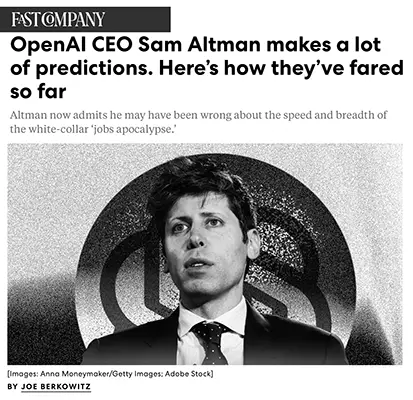
OpenAI CEO Sam Altman Makes a Lot of Predictions. Here’s How They’ve Fared So Far.
Fast Company | Joe Berkowitz | June 2, 2026
TL;DR: A structured look at Sam Altman’s prediction track record reveals a pattern useful for calibration: some major forecasts have proved right, some were vague enough to be unfalsifiable, and the most concrete near-term ones — including the pace of white-collar job displacement — have underdelivered.
Executive Summary
This is a commentary piece, not reported news, and it reads as skeptical rather than hostile. Its value for business leaders is not in relitigating AI hype but in offering a calibration exercise: how should you weight the public statements of AI’s most prominent spokesperson?
The piece identifies three categories in Altman’s forecast history. Claims that proved accurate include the broad adoption of AI as a general-purpose tool and the capability of AI to handle legal and medical tasks at scale. Claims that fell short include the timeline for autonomous vehicles (predicted in 2015 as three to four years away, arrived closer to a decade later) and, most recently, the pace of white-collar job elimination at the entry level — which Altman himself acknowledged has been slower than he expected. Claims still outstanding include AGI by some near-term date (a term he has since called “not a super useful” framing), intelligence as a utility, and self-replicating infrastructure.
The editorial framing is pointed — the writer notes that colleagues have characterized Altman as prone to overstatement — but the underlying factual record is the more useful element. The pattern that emerges: Altman’s directional calls on broad adoption tend to be right; his specific near-term timelines for transformative disruption tend to be early.That asymmetry is worth internalizing.
A notable data point the article surfaces: a recent NBC poll found 57% of Americans believe AI’s risks outweigh its benefits, versus 34% who said the opposite. That sentiment gap matters for anyone making workforce, policy, or public-facing decisions about AI.
Relevance for Business
SMB leaders navigating vendor pitches, board discussions, and workforce planning are swimming in Altman-style forecast language — directional confidence, vague timelines, and world-changing framing. This piece is a useful reminder that even the most credible AI forecaster has a track record of compressed timelines and walked-back specifics. The practical guidance: take the direction seriously, discount the timing, and plan for slower-than-predicted displacement of knowledge work alongside faster-than-expected capability gains.
Calls to Action
🔹 Apply a timeline discount to any AI forecast that predicts transformative workforce impact within a specific near-term window — the evidence suggests these consistently arrive later than predicted.
🔹 Separate directional signals from timeline claims when evaluating vendor roadmaps or industry analyst forecasts — the former tend to be more reliable.
🔹 Take the public sentiment data seriously — 57% of Americans viewing AI risks as outweighing benefits is a workforce relations, customer relations, and policy environment signal, not just a polling footnote.
🔹 Monitor OpenAI’s IPO process — as the company transitions to a public market context, the incentives behind its public statements will shift.
Summary by ReadAboutAI.com
https://www.fastcompany.com/91551736/openai-ceo-sam-altman-makes-a-lot-of-predictions-heres-how-theyve-fared-so-far: June 8, 2026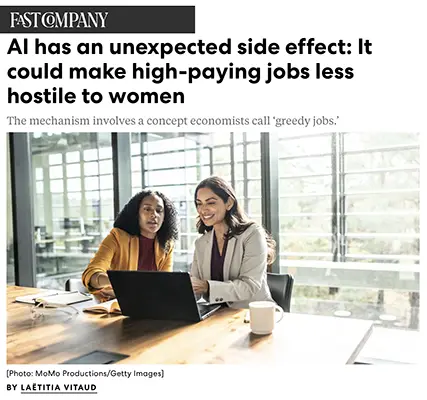
AI Has an Unexpected Side Effect: It Could Make High-Paying Jobs Less Hostile to Women
Fast Company | Laëtitia Vitaud | June 2, 2026
TL;DR: AI may inadvertently reduce the gender pay gap in elite professions by making highly specialized, “irreplaceable” workers more substitutable — but only for women in high-status roles, and only if employers choose flexibility over intensified demands.
Executive Summary
This is an opinion piece grounded in economic research, and its central argument is worth taking seriously. The author builds on Nobel economist Claudia Goldin’s work on “greedy jobs” — high-paying roles in law, finance, consulting, and medicine that reward constant availability and penalize any deviation from it, disproportionately disadvantaging workers with caregiving responsibilities, overwhelmingly women. The pay gap in these fields is not primarily about bias or negotiation; it is structural, built into how the work is organized.
The argument is that AI may disrupt this structure by increasing worker substitutability. When AI captures and standardizes the client knowledge, case history, and diagnostic reasoning that once lived exclusively inside one professional’s head, it becomes easier for a colleague to step in. The individual premium for being constantly, irreplaceably present shrinks. The author draws on a concrete historical parallel: pharmacy, once male-dominated, became one of the most gender-equal professions after digital record systems made pharmacists interchangeable — the greedy structure collapsed, and women entered in large numbers.
The piece is careful to identify three counter-pressures: AI is eliminating lower-wage roles held disproportionately by women, increased substitutability may prompt firms to intensify demands rather than offer flexibility, and social norms about caregiving will not shift automatically with job design. The optimistic scenario is narrow — it applies specifically to high-status professional roles — and is described as a possibility, not a forecast.
Relevance for Business
For SMB leaders managing professional service environments, this framework offers a useful lens for thinking about job redesign as AI is deployed. If AI standardizes expertise that used to require constant individual presence, the question is whether your organization channels that shift into more humane and flexible structures — or simply uses it to demand more from fewer people. The former is a potential talent retention and DEI advantage; the latter recreates the greedy job under new conditions. This is a deliberate choice, not an automatic outcome.
Calls to Action
🔹 Examine your highest-pressure roles through the lens of substitutability — as AI handles more of the knowledge work, is the structural requirement for constant availability still justified, or is it an inherited assumption?
🔹 Treat job redesign as a strategic priority alongside AI deployment — the productivity gains from automation can be redistributed toward more flexible work structures, but this requires intentional policy, not just efficiency metrics.
🔹 Note the talent implication — organizations that deliberately reduce greedy job structures may gain access to highly qualified professionals who previously opted out of those environments.
🔹 Monitor how leading professional services firms respond to AI-driven substitutability — whether they increase flexibility or intensify demands will establish the competitive norm.
Summary by ReadAboutAI.com
https://www.fastcompany.com/91548317/ai-unexpected-side-effect-high-paying-jobs-women: June 8, 2026
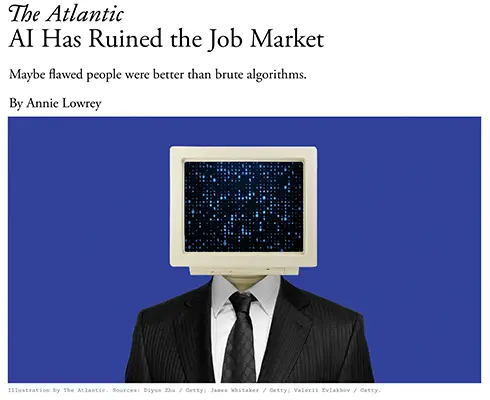
AI Has Ruined the Job Market
The Atlantic | Annie Lowrey | June 2, 2026
TL;DR: AI has triggered a mutual arms race between job seekers and employers that is making hiring slower, less reliable, and more biased — with no clear resolution in sight.
Executive Summary
This is an opinion-supported reported piece, and its thesis — that AI has made hiring worse, not better — is argued with enough evidence to take seriously, even if the headline overstates certainty. The core dynamic the article identifies: AI has simultaneously flooded the application market and degraded the quality of signals available to evaluate candidates, triggering a chain of escalating countermeasures on both sides.
Job seekers are using AI to generate resumes, cover letters, and interview responses at scale. The result is what researchers are calling “signal collapse” — documents that are more polished, more keyword-compliant, and less individually distinctive. Employers, overwhelmed by volume, are responding with AI screening tools, which a study of 4 million applications found are producing an “algorithmic monoculture” — more uniform rejection patterns and documented evidence of bias against Black and Asian candidates. The intermediate steps (AI-written exams, AI-proctored tests, AI-taken tests) compound the problem. Companies report that instead of saving HR time, AI is adding layers of scrutiny and verification.
The second-order effects are worth flagging for leaders: firms are retreating toward pedigree, referrals, and in-person interviews — methods that reintroduce the very biases technology was supposed to eliminate. Some are extending probationary periods and contracting before committing to permanent hires, anticipating higher misfit rates. The concern raised by researchers is not just inefficiency but potential long-term sclerosis: reduced business dynamism, workforce homogeneity, and diminished incentives for workers to invest in developing real skills.
Relevance for Business
SMB leaders should treat this as a live operational challenge, not a trend piece. If you are hiring — particularly for technical, creative, or client-facing roles — your evaluation tools and processes may be producing worse outcomes than they were two years ago. The volume problem is real, the fraud problem is real, and the bias risk from algorithmic screening tools is documented. Smaller organizations that lack dedicated HR functions are disproportionately exposed: they are less likely to have the verification infrastructure that larger firms are now rebuilding.
Calls to Action
🔹 Review your hiring process end-to-end with AI contamination in mind — where are you relying on documents or assessments that candidates can easily generate or game with AI?
🔹 Reweight in-person and work-sample evaluationfor roles where actual capability is hard to assess remotely — the evidence supports this shift.
🔹 If using AI screening tools, understand their bias risks and audit their outputs — documented disparate impact is a legal and reputational exposure.
🔹 Reassess the value of referral networks — not as a retreat to exclusivity, but as a practical signal-quality measure in an environment where application documents have lost much of their informational value.
🔹 Brief your HR team or hiring managers on the AI fraud landscape — interview performance, resume quality, and even test results now require a different kind of scrutiny than they did three years ago.
Summary by ReadAboutAI.com
https://www.theatlantic.com/ideas/2026/06/ai-job-market-hiring/687403/: June 8, 2026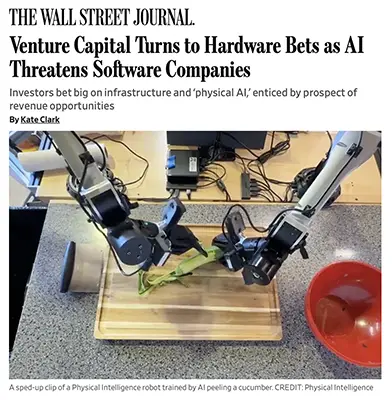
Venture Capital Turns to Hardware Bets as AI Threatens Software Companies
The Wall Street Journal | Kate Clark | May 31 / June 1, 2026
TL;DR: Venture capital is rotating away from software toward physical infrastructure and robotics as AI commoditizes software development — a structural shift, not a cycle.
Executive Summary
The signal here is not simply that investors are excited about hardware. It is that many experienced software investors now believe the traditional enterprise software business model is structurally impaired by AI. When AI can replicate a SaaS product in seconds, the moat that justified premium valuations disappears. VCs are responding by chasing sectors where physical complexity — chips, power, manufacturing, robotics — creates barriers AI cannot easily dissolve.
The numbers reflect genuine momentum: global robotics and physical AI investment grew from $4.2B in 2019 to $26B in 2025, and is on pace to exceed that again in 2026. Advanced computing (chips, data centers, quantum) has raised $20B in just five months. These are not incremental bets. Firms historically focused on SaaS, fintech, and even crypto are entering manufacturing and materials for the first time.
The risk worth flagging: most VC firms lack the domain expertise to evaluate physical products, factories, or robotics systems. One veteran hard-tech investor put it plainly — this is not a garage startup, and you cannot fake competence in it. The enthusiasm for enormous addressable markets (projections in the tens of trillions are being cited) is real, but unproven in execution, and the capital now flowing into these sectors is coming from investors with thin track records in them.
Relevance for Business
For SMB leaders, the near-term signal is software vendor instability. As investor confidence in traditional SaaS erodes, some of the tools your business relies on may face funding pressure, strategic pivots, or acquisition. The longer-term signal is that AI-native infrastructure — robotics, autonomous systems, purpose-built chips — will reach your operations sooner than many expect, but with significant implementation complexity. The physical AI wave will not plug in like a SaaS subscription.
Calls to Action
🔹 Audit your software stack for vendors whose business models depend on the kind of differentiation AI now commoditizes — watch for pricing changes, M&A, or product pivots in the next 12–18 months.
🔹 Monitor physical AI developments relevant to your industry (logistics, manufacturing, food service) — timeline is uncertain, but the capital concentration signals this is a priority sector for the next decade.
🔹 Resist the hype math — trillion-dollar TAM projections from companies going public are promotional framing, not operational guidance.
🔹 If evaluating new software vendors, factor in their AI exposure: are they building on top of AI, or competing against it?
Summary by ReadAboutAI.com
https://www.wsj.com/tech/ai/venture-capital-turns-to-hardware-bets-as-ai-threatens-software-companies-29b8b5f3: June 8, 2026
POPE LEO’S UNSETTLING VISION OF THE AI FUTURE
The Atlantic | Francis X. Rocca | May 25, 2026
TL;DR: Pope Leo XIV’s first encyclical on AI, Magnifica Humanitas, is a sweeping moral critique of AI’s concentration of power, displacement of workers, and erosion of human relationships — notable not just as theology, but as a sign that governance pressure on AI is now coming from institutional voices well outside the tech sector.
Executive Summary
The Catholic Church has published its first major teaching document on artificial intelligence, Magnifica Humanitas(“Magnificent Humanity”). The encyclical’s significance for the business world is less doctrinal than institutional: a 1.4-billion-member global institution has formally entered the AI governance conversation, and has done so with specific, not vague, concerns. The document condemns AI-driven unemployment, autonomous weapons, environmental costs of AI infrastructure, exploitation of data labelers and supply chain workers, and — most directly relevant to business — the concentration of control over platforms, data, and computing in the hands of a small number of actors.
The encyclical calls for algorithmic decisions in hiring, credit, and access to services to be understandable, contestable, and subject to oversight. It frames unchecked data extraction — including health and demographic data — as a form of modern colonialism. Notably, an Anthropic co-founder participated in the Vatican panel presenting the document and publicly acknowledged that even safety-focused AI companies operate within incentive structures that can conflict with doing the right thing.
The tone is cautionary rather than condemnatory. Leo frames AI as potentially beneficial if governed well, but his detailed warnings far outweigh his brief acknowledgments of potential benefit. The encyclical calls on governments to require that any automation deployment include verifiable protections for worker retraining and employment — a standard that, if adopted into regulation, would directly affect how and when businesses can deploy AI-driven automation.
Relevance for Business
Papal encyclicals do not become law, but they shape regulatory sentiment, institutional investor priorities, labor movement framing, and public expectations — especially in Catholic-majority markets across Europe, Latin America, and parts of Asia. For SMB leaders, the more immediate signal is that governance and accountability expectations around AI are no longer confined to government regulators and tech critics. The encyclical’s specific focus on algorithmic decision-making in hiring and credit is directly relevant to any business using AI in HR, lending, or customer qualification processes. The call for decisions to be “understandable and contestable” aligns closely with the direction of EU AI Act obligations and is worth treating as a forward indicator of compliance requirements.
Calls to Action
🔹 Monitor how this encyclical influences EU and Latin American regulatory language around AI accountability and algorithmic decision-making — the framing maps closely to existing legislative trends.
🔹 Prepare policy now if your organization uses AI in hiring, credit decisions, or customer access determinations — the expectation of explainability and contestability is coming from multiple directions simultaneously.
🔹 Assign internal review of any AI vendor contracts that involve data extraction, profiling, or training data use — the scrutiny of how personal and demographic data is collected and used is intensifying.
🔹 Monitor how institutional investors and ESG frameworks respond to this document — social expectations around AI labor impacts and data use may begin to show up in compliance and reporting requirements.
🔹 Ignore the theological framing if it’s not relevant to your context, but do not ignore the governance signal — this represents a broadening coalition of voices calling for AI accountability that will influence policy over the next 2–5 years.
Summary by ReadAboutAI.com
https://www.theatlantic.com/ideas/2026/05/pope-leo-ai-encyclical-magnifica-humanitas/687294/: June 8, 2026
What the Pope Said About A.I.
The New Yorker | May 27, 2026 | By Jill Lepore
TL;DR: Pope Leo XIV’s encyclical Magnificat Humanitas frames AI governance as a moral and democratic crisis rather than a technical one — and its alignment with Anthropic’s safety principles signals a new kind of institutional coalition forming around AI accountability.
Executive Summary
Pope Leo XIV, the first American pope, has issued a nearly 40,000-word encyclical on artificial intelligence titled Magnificat Humanitas: On Safeguarding the Human Person in the Time of Artificial Intelligence. The document, signed on May 15 and clearly intended to carry the historical weight of the Church’s landmark 1891 labor encyclical, argues that AI is not primarily a technical problem but an anthropological one — a failure to center human dignity, democratic accountability, and shared welfare in decisions currently driven by profit and competitive advantage.
The Pope’s critique covers familiar ground — privacy erosion, labor displacement, the concentration of power in a small number of actors, the weaponization of AI — but the significance lies in the source and scale of the platform. As Jill Lepore notes in the piece, these concerns are not new; what is new is that they are now being raised by the spiritual leader of roughly one billion Catholics. The encyclical explicitly calls for “disarming” AI — not rejecting the technology, but breaking monopolistic control over it and returning it to democratic and pluralistic governance.
A detail with direct business relevance: Anthropic co-founder Christopher Olah appeared alongside the Pope at the encyclical’s release. The piece notes parallels between the encyclical and Anthropic’s own published AI safety principles. This is not incidental positioning — it suggests Anthropic is actively building institutional legitimacy among non-commercial oversight bodies, potentially ahead of its IPO and in anticipation of regulatory scrutiny. Other AI companies were notably absent and, according to Lepore, are unlikely to embrace the document’s framework.
Relevance for Business
The encyclical matters to business leaders less for its theology than for what it signals about the evolving governance landscape around AI. Moral and institutional critiques of AI are gaining mainstream authority — beyond regulators and academics — in ways that will shape public opinion, employee expectations, procurement norms, and eventually policy. Organizations that have deployed AI tools without auditing their human impact, data practices, or labor implications face growing reputational and governance exposure as this conversation broadens.
For leaders navigating vendor selection, the Anthropic-Vatican alignment is worth noting: safety-framed AI vendors may enjoy a reputational and regulatory advantage over competitors as oversight pressure increases, particularly in Europe and in public-sector contracts.
Calls to Action
🔹 Monitor how the encyclical’s framing — AI as a governance and dignity issue — influences employee expectations, especially among Catholic-majority workforces or regions.
🔹 Prepare an internal position on AI ethics: as public pressure builds, leaders who have no policy are increasingly exposed.
🔹 Note the Anthropic-Vatican alignment as a signal that “responsible AI” branding is becoming a differentiator — assess whether your current AI vendors are building similar institutional credibility.
🔹 Assess whether any current AI deployments in your organization involve decisions that could be characterized as substituting human judgment with automated sorting or evaluation — this is the category of use the encyclical most specifically targets.
🔹 Ignore the theological framing if it’s distracting — the underlying governance argument applies regardless of religious context.
Summary by ReadAboutAI.com
https://www.newyorker.com/news/the-lede/what-pope-leo-xiv-said-about-ai: June 8, 2026
THE APPLE CAR IS FINALLY HERE — EXCEPT IT’S A FERRARI
The Atlantic | Ian Bogost | May 29, 2026
TL;DR: The Ferrari Luce — designed by Apple’s former chief designer — marks the moment Silicon Valley’s design and technology ethos has fully absorbed the last domain that resisted it: the aspirational automobile.
Executive Summary
This is a cultural and design essay, not a technology or business analysis. Its business relevance is indirect but real: it traces how Silicon Valley’s minimalist, utility-first design philosophy — originating at Apple and associated most closely with Jony Ive — has now penetrated even the luxury supercar market, a domain that long defined aspiration through excess, visceral performance, and deliberate impracticality.
The occasion is Ferrari’s first electric vehicle, the Luce, designed externally by Ive’s LoveFrom consultancy. The car is smooth, aerodynamic, seats five, and looks nothing like a traditional Ferrari. It has been met with a divided response: performance metrics are exceptional, but longtime Ferrari enthusiasts object to the loss of the brand’s characteristic visual language. Ferrari’s stock fell as much as 8% after the reveal.
The author’s interpretive claim — that this represents Silicon Valley’s final cultural victory over older forms of aspiration — is a framing, not a fact. What is factual: Ive designed the car; Ferrari approved it as a production model; it costs $640,000; and several competing supercar makers (Lamborghini, Pagani, Aston Martin) have scaled back or abandoned electric ambitions, citing lack of demand or “emotional” incompatibility with EVs. The auto industry’s EV transition at the high end is proving contested, with different manufacturers making very different bets on whether their customers want Silicon Valley aesthetics or something more viscerally distinct.
Relevance for Business
For SMB leaders, this essay is most useful as a lens on how dominant technology-industry design and value systems are reshaping adjacent industries and consumer expectations — not just in automobiles, but potentially in any product or service category. The “disappear into the background, maximize utility, minimize friction” ethos that Ive codified at Apple is now the default aesthetic of enterprise software, consumer tech, and increasingly professional services. Understanding this as a conscious design philosophy — with trade-offs — is relevant for any leader making decisions about brand, product experience, or digital tool selection. What Silicon Valley calls “seamless” is not neutral; it is a specific set of values about what technology should do to human experience.
Calls to Action
🔹 Monitor for now — this is a cultural signal, not an operational one. Watch how the Ferrari Luce performs commercially as an indicator of whether Silicon Valley aesthetics translate to the ultra-luxury market.
🔹 Revisit this theme when making decisions about customer-facing product or service design: the tension between functional minimalism and brand distinctiveness is live in many industries beyond automotive.
🔹 Ignore the automotive details unless directly relevant to your industry; the article’s business value is in the broader observation about design philosophy and cultural influence, not in the specifics of the car.
Summary by ReadAboutAI.com
https://www.theatlantic.com/ideas/2026/05/electric-ferrari-luce/687367/: June 8, 2026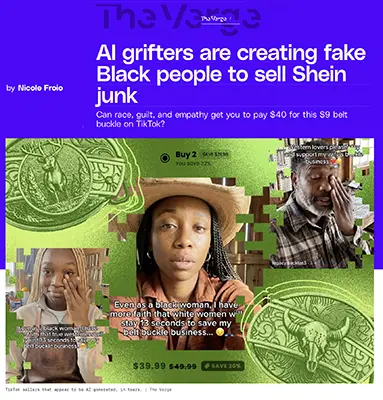
AI Grifters Are Creating Fake Black People to Sell Shein Junk
The Verge | May 30, 2026
TL;DR: A rapidly scaling wave of AI-generated fake personas — disproportionately depicted as marginalized people of color — is being used to sell dropshipped goods on social media, exposing a platform moderation failure with real consequences for consumer trust and brand safety.
Executive Summary
The Verge documents a growing and largely unmoderated pattern: AI-generated video personas, predominantly depicting Black women in distress, are being deployed across TikTok, Instagram, and Facebook to sell cheap dropshipped products at significant markups. The personas are fully synthetic — AI-generated faces, voices, emotional expressions, and automated comment responses — but convincing enough to attract millions of views, tens of thousands of followers, and genuine purchasing intent from real consumers.
The mechanics are scalable and accessible. Tools like Seedance, Midjourney, Kling, and LLMs such as ChatGPT and Gemini are being combined to clone real influencer scripts, generate fake personas, and automate engagement. Tutorials teaching this workflow are publicly available. An AI researcher tracking these accounts estimates the production rate at roughly 100 new accounts per day. The emotional manipulation is deliberate: researchers describe the technique as “empathy bait” — scripted appeals to racial solidarity or working-class sympathy designed to bypass consumer skepticism.
Platform accountability is largely absent. Social media companies have weak incentives to proactively detect or label this content, since it generates engagement and ad revenue. Experts call for stronger AI detection infrastructure, mandatory labeling, and clearer reporting mechanisms — but given platform incentives, those changes are unlikely to arrive quickly or comprehensively.
What to distinguish here: The article frames this as both a consumer fraud issue and a racial exploitation issue (citing academic analysis of “digital blackface”). Both characterizations have merit and are substantiated by named researchers, though the racial dimension involves interpretive framing that goes beyond simple fraud.
Relevance for Business
For SMB executives, this story operates on two levels. First, any business that advertises on or sells through social media platforms is operating in an environment where AI-generated fraud is scaling faster than platform moderation — affecting consumer trust broadly, not just for the scam sellers. Second, businesses that use AI-generated content in their own marketing face increasing scrutiny: the absence of clear disclosure norms is generating consumer backlash that will eventually affect legitimate AI-assisted marketing, not just fraudulent use. Companies with social commerce strategies should be tracking platform policy changes and preparing disclosure practices now, not reactively.
Calls to Action
🔹 If you sell via social commerce, assess your brand’s proximity to this pattern — AI-generated content that lacks clear disclosure creates reputational association risks even for legitimate brands.
🔹 Develop and publish a clear AI content disclosure policy for your own marketing before platform rules force one on you.
🔹 Brief your marketing and social media teams on how to identify AI-generated competitive content and fake influencer accounts — this is now a baseline brand protection skill.
🔹 Monitor platform policy developments at TikTok, Meta, and Instagram around AI labeling requirements — regulatory pressure is building and policy changes will affect all advertisers, not just bad actors.
🔹 Treat this as a consumer trust signal, not just a fraud story — audiences are becoming more skeptical of AI-generated personas, and that skepticism will apply to legitimate AI-assisted marketing as well.
Summary by ReadAboutAI.com
https://www.theverge.com/ai-artificial-intelligence/938844/ai-tiktok-shop-blackface-shein-dropshipping: June 8, 2026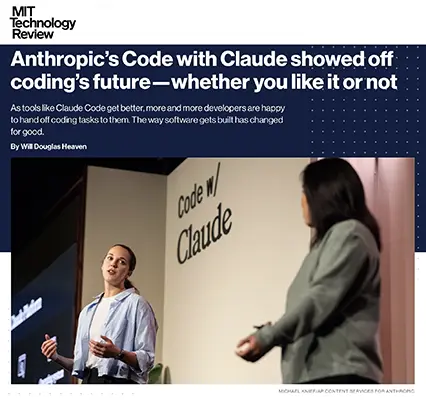
ANTHROPIC’S “CODE WITH CLAUDE” SHOWED OFF CODING’S FUTURE — WHETHER YOU LIKE IT OR NOT
MIT Technology Review | May 21, 2026
TL;DR: At Anthropic’s developer event, roughly half the professional developers in attendance admitted they had shipped AI-written code they never read — a quiet signal that software development oversight norms are breaking down faster than governance practices can keep up.
Executive Summary
This is a first-hand account from an MIT Technology Review reporter at Anthropic’s London developer event. The article is partly promotional — it’s an event recap at a vendor’s own showcase — but it contains several signals that are worth separating from the enthusiasm.
The headline finding: when an Anthropic engineer asked attendees whether they had shipped code written entirely by Claude without reading it, most hands stayed up. That’s not a capability claim — it’s a behavioral shift with real security, quality, and liability implications. Anthropic itself acknowledges the gap: its own engineering leads noted that technical managers are struggling to keep pace with the volume of AI-generated code their teams are now producing, and that developers may have “lost sight of” established best practices.
The company’s stated direction is toward full self-correction — Claude agents that test, debug, and iterate without human involvement. A new feature called “dreaming” (part of Claude Managed Agents, not Claude Code itself) allows coding agents to leave notes for each other, consolidate learnings across tasks, and improve at working on a given codebase over time. Anthropic’s product lead stated the ultimate goal as Claude being able to build itself. That is company framing, not a demonstrated capability — the current assessment is that Claude performs at a mid-level engineer for routine coding tasks.
The article’s counterbalance is important: external developers have raised concerns about increased review burden, degraded personal coding skills, and AI-generated code creating security vulnerabilities. Anthropic’s response — that best practices still apply — is technically accurate but operationally insufficient if teams are already bypassing them.
Relevance for Business
For SMB leaders, the decisions being made by large tech teams today are precursors to what will arrive in your vendor-supplied tools within 12–24 months. The more immediate concern: if you have internal developers, the pressure to accept AI-generated code without adequate review is already present, regardless of your company’s formal policy. The security and maintenance risks of unreviewed AI code are not hypothetical — they are a known and growing problem, and the organizations most exposed are those with the least capacity for rigorous code review. Smaller teams are structurally disadvantaged on this dimension.
Calls to Action
🔹 Establish a written policy on AI-generated code review — require that all AI-written code is read and understood before deployment, even when that slows velocity.
🔹 Audit your current development practices — determine whether AI tools are already being used to ship code that bypasses your normal review processes.
🔹 Do not treat productivity gains from AI coding as free — security, maintainability, and technical debt costs may be accumulating invisibly.
🔹 Monitor the Claude Code / Codex landscape — capabilities are evolving rapidly; revisit your team’s tooling and oversight practices quarterly, not annually.
🔹 Watch the “agents writing code for agents” direction carefully — multi-agent coding systems introduce oversight complexity that current engineering management practices are not designed to handle.
Summary by ReadAboutAI.com
https://www.technologyreview.com/2026/05/21/1137735/anthropics-code-with-claude-showed-off-codings-future-whether-you-like-it-or-not/: June 8, 2026
A REALITY CHECK ON THE AI JOBS HYSTERIA
MIT Technology Review | May 26, 2026
TL;DR: Current US labor data show no broad AI-driven unemployment wave — but targeted evidence points to a real and growing impact on young, entry-level workers in AI-exposed fields, with the pace and breadth of future disruption remaining genuinely uncertain.
Executive Summary
This is a carefully reported, data-grounded piece — one of the more substantive treatments of the AI jobs question available — and it earns more than a passing read. The core finding is clear and worth stating plainly: as of March 2026, unemployment rates for workers in the most AI-exposed occupations are actually lower than for those in less-exposed roles. There is no sign in national labor statistics of a broad AI-driven jobs crisis.
That finding, however, coexists with more targeted evidence that is harder to dismiss. Stanford Digital Economy Lab research using a large private payroll dataset found a 16% decline in entry-level headcount in AI-exposed occupations— particularly software development — beginning in 2024 and accelerating in 2025. Older, more experienced workers in the same fields have seen headcount grow. Federal Reserve data show coding employment growth has slowed meaningfully since 2022, though total employment in coding continues to rise. The emerging hypothesis: entry-level jobs that rely on codified, educationally-acquired knowledge are more automatable than roles built on experience-based tacit knowledge — and AI is doing that substitution now, not in some theoretical future.
The article is honest about what is unknown: whether these entry-level effects spread to experienced workers; whether firms and workers adapt; whether the pace remains gradual or accelerates sharply. It also surfaces a structural blind spot — only about one in five U.S. companies are formally using AI in any business function, meaning the labor market effects so far reflect a fraction of eventual adoption. The critical policy variable, per labor economists, is speed: a gradual transition allows labor markets to adjust; a rapid one doesn’t.
Relevance for Business
For SMB leaders, this article provides a useful counterweight to both the catastrophist and the dismissive positions. The data says: no jobs apocalypse yet, real pressure on entry-level and early-career roles now, and genuine uncertainty about what comes next. The practical implications are several: hiring pipelines for junior tech roles are already thinning and price signals are shifting; the “earn while you learn” model for early-career development may be structurally compromised in AI-exposed fields; and the window to plan for workforce transitions is open but not indefinite. The single most actionable insight from this article is the speed variable — organizations that build workforce adaptation capacity now are better positioned regardless of which scenario unfolds.
Calls to Action
🔹 Calibrate your AI jobs narrative to the evidence — neither panic nor complacency is warranted; the data supports cautious, planned adjustment.
🔹 Reassess entry-level hiring strategies in AI-exposed roles — the supply of available junior talent is shifting, as is what early-career employees can and cannot do relative to AI tools.
🔹 Invest in workforce transition planning now — the economists cited here broadly agree that preparation time exists, but it is finite and should not be wasted.
🔹 Distinguish “automation-substitution” roles from “AI-augmentation” roles in your own organization — the former face headcount pressure; the latter are growing. Know which bucket your key functions fall into.
🔹 Monitor the Stanford Digital Economy Lab’s new ongoing tracking project on AI’s economic impact — it will provide more granular, regularly updated data than current BLS reporting.
Summary by ReadAboutAI.com
https://www.technologyreview.com/2026/05/26/1137855/a-reality-check-on-the-ai-jobs-hysteria/: June 8, 2026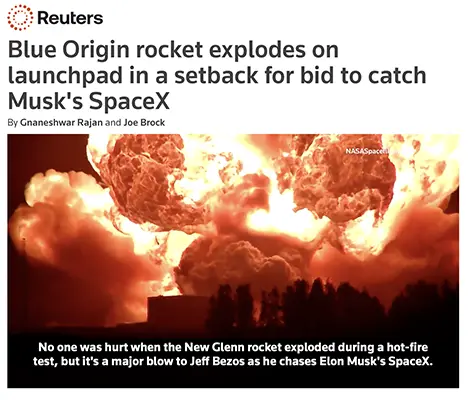
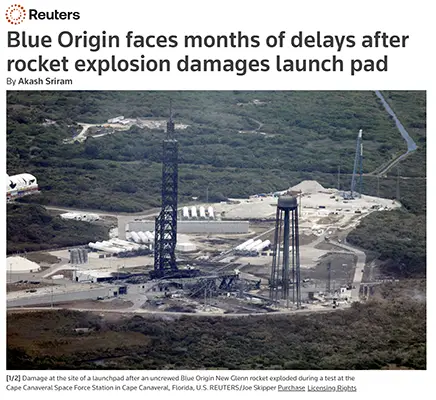
BLUE ORIGIN’S NEW GLENN ROCKET EXPLODES ON LAUNCHPAD — AND THE FALLOUT
Reuters | May 28 & May 30, 2026
Note: Two Reuters articles cover this story — the initial explosion report (May 28) and the follow-up on business consequences (May 30). They are treated here as a single combined briefing, which is the appropriate editorial choice given their overlap and complementarity.
TL;DR: The explosion of Blue Origin’s New Glenn rocket during a ground test has set back Jeff Bezos’ space and satellite ambitions by at least six months, materially strengthening SpaceX’s already dominant position in the commercial launch market and creating real complications for Amazon’s broadband constellation timeline.
Executive Summary
On May 28, Blue Origin’s New Glenn rocket exploded during a hot-fire engine test at Cape Canaveral, destroying the booster and, according to industry sources, causing damage severe enough that engineers expect at least a six-month disruption to launch operations — possibly longer. No personnel were harmed, and the Amazon LEO satellites slated for the mission had not yet been integrated onto the rocket.
The timing compounds the impact. The explosion occurred two days after NASA awarded Blue Origin a $188 million contract for lunar rover delivery, and just days after SpaceX completed a (partial) Starship test. Blue Origin had been counting on New Glenn to deploy roughly half of Amazon’s 3,200-satellite broadband constellation by a July 2026 regulatory deadline. With the launch pad significantly damaged, that timeline is now in serious jeopardy. Amazon had already diversified its launch partners to include SpaceX — which can carry roughly half as many Amazon LEO satellites per mission as New Glenn — meaning absorbing the volume shift would require a significant increase in launch count.
The structural disadvantage is real but not permanent. Industry analysts characterize the incident as strengthening SpaceX’s position at the margin without fundamentally changing the long-term trajectory toward a multi-provider launch ecosystem. SpaceX itself experienced a comparable launchpad explosion in 2016 and resumed launches within about four and a half months by shifting to a second pad. Blue Origin has one pad. Historical precedent from SpaceX’s own setbacks suggests recovery is achievable — but the company has less operational redundancy to fall back on. The U.S. Space Force and National Reconnaissance Office reaffirmed their commitment to Blue Origin within days of the explosion, suggesting government confidence in long-term recovery.
Relevance for Business
For most SMB executives, this story matters primarily as a second-order competitive dynamics story: SpaceX’s near-monopoly on reliable heavy-lift commercial launch is reinforced, which has downstream implications for satellite internet pricing, availability, and diversification. Companies evaluating or currently using Starlink or Amazon Kuiper as connectivity infrastructure should note that Amazon’s broadband rollout is now materially delayed, while SpaceX’s position as the de facto commercial launch standard is further entrenched. More broadly, this is a reminder that infrastructure dependencies on nascent or single-provider systems carry real schedule and continuity risk — a principle that applies as directly to cloud AI infrastructure as it does to rocket launches.
Calls to Action
🔹 If you are evaluating Amazon Kuiper as a connectivity option, extend your timeline assumptions — the constellation deployment delay is likely to push commercial availability further out.
🔹 Treat Starlink’s current dominance as a planning assumption, not a risk-free given — SpaceX’s order book is also crowded, and its own Starship program continues to have partial successes.
🔹 Use this story as a governance prompt: identify any business-critical technology dependencies — connectivity, cloud, AI infrastructure — where you have limited or no viable alternatives if a provider experiences a major disruption.
🔹 Monitor NASA Artemis implications — if you have government or defense clients whose programs are connected to lunar exploration timelines, Blue Origin’s delay may affect project schedules.
🔹 No immediate action required for most SMBs — revisit in 90 days for update on Blue Origin’s recovery timeline and regulatory status.
Summary by ReadAboutAI.com
https://www.reuters.com/science/blue-origin-says-it-faced-anomaly-during-hot-fire-test-2026-05-29/: June 8, 2026https://www.reuters.com/business/aerospace-defense/blue-origin-faces-months-delays-after-rocket-explosion-damages-launch-pad-2026-05-30/: June 8, 2026
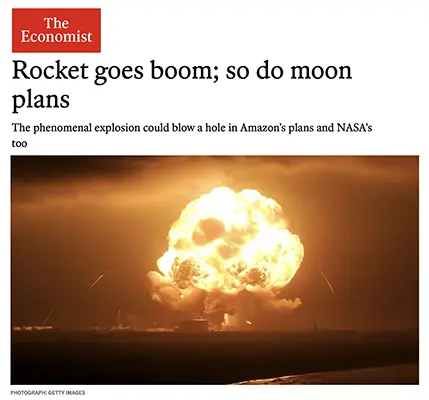
Rocket Goes Boom; So Do Moon Plans
The Economist | June 3, 2026
TL;DR: The catastrophic destruction of Blue Origin’s only operational launchpad doesn’t just set back Jeff Bezos’s space ambitions — it delays Amazon’s satellite internet rollout, threatens a connected rocket program, and may sideline NASA’s lunar timeline for years.
Executive Summary
On May 28, a Blue Origin New Glenn rocket exploded during testing at Cape Canaveral, destroying the company’s sole functioning launchpad in what may be the most significant launchpad explosion since a Soviet failure in 1969. The blast wrecked ground infrastructure — including transport equipment and support towers — that will take months to rebuild. Blue Origin has set an internal goal of returning to flight by year-end, but the full damage assessment is still ongoing.
The cascade of consequences is significant. Amazon’s Project Kuiper (referred to as Leo in the article), a satellite internet constellation intended to rival Starlink, was already behind its FCC deployment deadline and is now further delayed. Amazon had committed up to 27 of its 83 contracted launches to Blue Origin. Compounding the risk: a separate launch provider, United Launch Alliance, uses the same BE-4 engines manufactured by Blue Origin in its Vulcan Centaur rocket. If the explosion is traced to an engine fault, Vulcan Centaur could also be grounded, potentially collapsing a large portion of Amazon’s remaining launch capacity.
NASA’s timeline for returning humans to the Moon — already slipping — is now materially more at risk. Blue Origin held a key role in lunar surface logistics, and its first cargo mission was scheduled for as early as this autumn. With both SpaceX’s lander and Blue Origin’s now delayed, the 2028 target looks very difficult to sustain.
Relevance for Business
For most SMBs, the direct operational implications are limited — but the story carries a strategic signal worth noting. Amazon’s satellite internet ambitions are now a year or more further from maturity, which matters for any business tracking Kuiper as a future Starlink alternative for connectivity, especially in rural, maritime, or remote operating environments. Competition in the satellite connectivity market is contracting, not expanding, which strengthens Starlink’s pricing power in the near term.
More broadly, this is a reminder that AI and cloud infrastructure investments have physical dependencies — launch vehicles, ground hardware, spectrum rights — that introduce failure modes very different from software disruptions. Single-vendor infrastructure risk is not abstract.
Calls to Action
🔹 Monitor the Blue Origin damage investigation; if the BE-4 engine is implicated, the disruption to commercial satellite launch capacity will be more significant and longer-lasting.
🔹 Note that Starlink’s competitive position just strengthened — factor this into any satellite connectivity evaluation or contract negotiation in the next 12–18 months.
🔹 Ignore this story operationally unless your business depends on satellite internet or has direct NASA/government space contracts.
🔹 Watch Amazon’s response: if Kuiper pivots to alternative launch providers at scale, it will signal whether the program can survive this setback on a meaningful timeline.
🔹 File for later as a case study in infrastructure concentration risk — a useful framing for any internal discussion of vendor dependency and single points of failure.
Summary by ReadAboutAI.com
https://www.economist.com/science-and-technology/2026/06/03/rocket-goes-boom-so-do-moon-plans: June 8, 2026
INSIDE ANDURIL AND META’S QUEST TO MAKE SMART GLASSES FOR WARFARE
MIT Technology Review | May 18, 2026
TL;DR: Anduril and Meta are developing AI-powered augmented-reality combat glasses for the U.S. Army — a credible but years-away prototype effort that signals where LLMs, computer vision, and wearable AI are headed in defense, with downstream implications for commercial AI governance and dual-use concerns.
Executive Summary
This is a substantive reported piece — not a press release — with independent expert skepticism included alongside the vendor vision. It warrants careful reading.
Anduril, with Meta as its hardware partner, is developing two AI-powered AR headset prototypes for the U.S. Army. The first, called Soldier Born Mission Command (SBMC), is a $159 million prototyping contract. The second, EagleEye, is a self-funded initiative Anduril is developing speculatively, with the intention of selling it to the Army or to foreign militaries regardless of how the primary contract resolves. Neither system is close to production. The Army is not expected to select a production-ready SBMC system until 2028 at the earliest — and may not select one at all. The previous program lead, Microsoft, saw a $22 billion production contract cancelled after the glasses failed to prove viable.
The intended capability is significant: AI-assisted targeting, drone coordination, threat identification, and multi-step mission execution via eye-tracking, voice commands, and LLM interpretation — with Anduril currently testing Google Gemini, Meta Llama, and Anthropic Claude. Anduril’s $20 billion Army contract to integrate its Lattice software platform across essentially all Army infrastructure is the structural foundation beneath both projects.
The execution risks are real and independently documented. A RAND researcher and former Marine explicitly flags the human cognitive load problem: soldiers in high-stress environments have limited bandwidth for additional interfaces, and any system that costs more attention than it saves will be rejected regardless of its technical capability. The history of failed military AR programs — particularly Microsoft’s HoloLens-derived IVAS — reinforces that caution.
What to evaluate carefully: Anduril’s framing of this technology is promotional; the MIT Technology Review piece provides useful independent ballast. Demonstrated capability on early prototypes is not field-readiness. The 2028 production timeline, if met, would be ambitious.
Relevance for Business
This story has two layers of relevance for SMB executives. The first is context on where LLM-powered, multimodal AI is heading in terms of real-world decision-making integration — not chat interfaces, but AI embedded in physical operational systems making time-sensitive recommendations. The second, and more immediately relevant, is the dual-use and governance question: the same AI providers (Anthropic, Google, Meta) whose tools SMBs use for productivity are being evaluated for lethal targeting systems. This is relevant to how companies communicate their AI use to stakeholders, and it is relevant to understanding the regulatory and reputational environment in which AI vendors are operating. How these defense contracts evolve will affect AI policy, export controls, and potentially the terms under which commercial AI tools are governed.
Calls to Action
🔹 No immediate operational action required — this technology is years from commercial adjacency.
🔹 Monitor as a leading indicator of where AI-plus-wearables is heading in high-stakes operational environments — it previews the commercial trajectory of ambient, decision-support AI.
🔹 Track AI governance and dual-use policy developments — defense applications of commercial LLMs will draw regulatory scrutiny that may affect commercial AI terms and oversight requirements.
🔹 If you have government or defense clients, understand how your AI tool usage may intersect with procurement rules, data handling requirements, or export controls that are being shaped by programs like this.
🔹 Revisit in 2027–2028 when Army production decisions are expected — by then, the commercial implications of military AI wearables will be considerably clearer.
Summary by ReadAboutAI.com
https://www.technologyreview.com/2026/05/18/1137412/inside-anduril-and-metas-quest-to-make-smart-glasses-for-warfare/: June 8, 2026
Replace or Reshape: How AI Could Change the Way We Work
TIME (Christopher Marquis, University of Cambridge) | May 30, 2026
TL;DR: The debate over whether AI will eliminate or create jobs is the wrong question — the more consequential issue is who controls AI’s productivity gains, and history consistently shows it will not be workers.
Executive Summary
This is an opinion-driven essay, not a news report. Its argument should be read as a serious analytical frame, not as settled fact — but it is grounded in credible historical analysis rather than speculation.
The author, a Cambridge professor, challenges the dominant framing of the AI-and-work debate, which oscillates between fears of mass unemployment and promises of liberation from drudgery. Both positions, he argues, share a flawed assumption: that technology determines social outcomes. The industrial revolution, assembly-line production, and the computer revolution all followed the same pattern — productivity gains were captured by firms, not distributed to workers. Work became more fragmented, more monitored, and more controlled, even as total output rose. The Jevons paradox (efficiency creating more total demand, not less work) is real, but incomplete: it tells you how much work there will be, not who benefits from it or on what terms it is done.
The essay’s most pointed claim is that AI is already replicating this pattern — gig platforms demonstrate what algorithmically managed work looks like at scale: flexibility without protections, efficiency without autonomy, and risk transferred entirely to workers. AI tools can automate tasks, but within today’s business environment, they are more likely to be used to deskill, monitor, and accelerate work than to liberate it.
The political observation that closes the argument is worth taking seriously as a leadership framing: the question is not whether AI replaces jobs, but whether democratic governance shapes AI before its terms are set entirely by the firms building it. The author argues that political leaders have largely failed this test so far, treating AI as a sector to be lightly managed rather than a labor, surveillance, and power-concentration question requiring active governance.
Note: This is an academic perspective with an explicit political argument. It is most useful as a counter-weight to vendor and investment-community narratives about AI and work, not as a predictive model.
Relevance for Business
For SMB leaders, this essay’s most useful contribution is a prompt for honest internal assessment: How are you planning to deploy AI productivity gains? Will efficiency savings translate into fewer headcount with the same output, reduced hours, higher wages, redeployment into higher-value work, or simply more work demanded of the same people? The answer has implications for talent retention, culture, and — increasingly — regulatory exposure as labor policy around AI develops.
The essay also surfaces a governance risk that is often underweighted: the use of AI to increase monitoring and control of workers may achieve short-term efficiency goals while eroding trust and engagement in ways that are costly over time. The firms that manage this transition most thoughtfully — being explicit about the purpose and limits of AI-assisted workflows — are likely to retain talent and avoid the reputational and regulatory friction that will come as scrutiny increases.
Calls to Action
🔹 Develop an explicit position on how your organization will allocate AI productivity gains — this is both a strategic and a culture question, and leaving it implicit creates risk.
🔹 Audit current or planned AI deployments for surveillance implications — monitoring tools, automated performance scoring, and AI-managed workflows carry significant trust and legal exposure.
🔹 Engage your management team on the difference between AI as a tool for workers and AI as a tool to control workers — this distinction will shape how employees experience and respond to your AI rollout.
🔹 Monitor labor policy developments at state and federal levels — the essay argues that regulation is coming; organizations that have documented their approach to AI and labor will be better positioned to demonstrate compliance.
🔹 Treat this essay as a useful internal discussion prompt, not a prediction — bring it into leadership conversations about AI strategy to surface assumptions that may otherwise go unexamined.
Summary by ReadAboutAI.com
https://time.com/article/2026/05/30/replace-reshape-how-ai-could-change-the-way-we-work/: June 8, 2026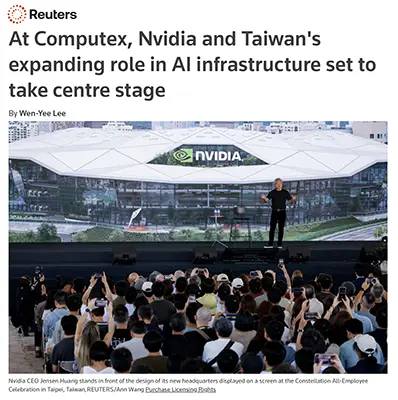
Nvidia and Taiwan’s Expanding Role in AI Infrastructure Take Center Stage at Computex
Reuters | May 29, 2026
TL;DR: Computex 2026 underscores that Taiwan has become the operational core of global AI infrastructure — a reality carrying both strategic opportunity and significant geopolitical concentration risk.
Executive Summary
Computex 2026 (June 2–5, Taipei) is shaping up as the largest in the event’s history, with roughly 1,500 exhibitors and keynotes from the CEOs of Nvidia, Intel, Qualcomm, and Arm. Nvidia’s Jensen Huang, who arrived in Taipei more than a week early for supply chain meetings, signaled commitments of up to $150 billion annually in Taiwan — a figure that reflects just how deeply Nvidia’s production and partnership ecosystem is anchored there. AMD’s Lisa Su separately announced over $10 billion in Taiwanese AI investments.
The more significant structural signal is this: Taiwan is no longer just a semiconductor story. As one McKinsey analyst put it, the question has shifted from who makes the chip to who can turn it into a powered, cooled, networked, and serviceable AI system. Taiwan’s server exports grew from roughly $570 million in 2017 to $60 billion last year — a trajectory that reflects the island’s consolidation of the entire AI infrastructure stack, not just chip fabrication. Attention at the show will focus on Nvidia’s new Vera Rubin AI computing platform, robotics, and AI in manufacturing.
The geopolitical dimension is real and unresolved. China’s president explicitly warned during a recent summit that mishandling Taiwan could lead to conflict. Military pressure around the island is increasing. Business is booming regardless — but the concentration of critical AI supply chain in a geopolitically contested location is a systemic risk that no amount of partnership announcements resolves.
Relevance for Business
SMB leaders don’t buy directly from TSMC or Nvidia’s fab partners — but they are downstream of every pricing, availability, and supply chain decision made in Taiwan. AI hardware costs, cloud GPU availability, and the pace of new model deployment are all shaped by what happens at and around Computex. The geopolitical concentration risk is not abstract: a serious disruption in Taiwan would cascade through every AI vendor, cloud provider, and enterprise software company that depends on leading-edge chips. This is a macro infrastructure dependency that SMBs cannot hedge directly but should factor into vendor resilience assessments and AI investment timing.
Calls to Action
🔹 Treat Computex announcements as a forward indicator — new platforms announced here (Vera Rubin, Intel Arc) will shape AI hardware availability and pricing over the next 12–24 months.
🔹 Assess your AI vendor’s supply chain exposure — ask how your key AI providers manage concentration risk in their chip and hardware sourcing.
🔹 Monitor geopolitical developments around Taiwan — not as a daily concern, but as part of annual technology risk reviews and business continuity planning.
🔹 Avoid locking into hardware-dependent AI strategies on a single vendor without understanding their supply chain resilience.
🔹 Watch Intel’s keynote signal — Intel’s repositioning for AI inference CPUs could create competitive alternatives to Nvidia-dependent infrastructure over time.
Summary by ReadAboutAI.com
https://www.reuters.com/world/china/computex-nvidia-taiwans-expanding-role-ai-infrastructure-set-take-centre-stage-2026-05-29/: June 8, 2026
Meta Plans AI Pendant and ‘Wearables for Work’ in Hardware Push
Reuters | May 29, 2026
TL;DR: Meta is reportedly preparing an AI pendant and a business-focused wearables line as it bets on ambient AI hardware to offset deep losses in its Reality Labs division.
Executive Summary
According to an internal memo cited by The Information, Meta is moving to test an AI pendant device within the next year and intends to significantly expand its AI glasses lineup with an enterprise-facing offering called “Wearables for Work.” The strategic push comes as Reality Labs posted a $4 billion loss on just $400 million in revenue in Q1 2026 — a gap that makes Meta’s hardware ambitions both urgent and risky.
The pendant direction is notable: Meta acquired AI wearables startup Limitless — maker of a conversation-recording pendant — last year. That acquisition now appears to be the technical foundation for this next product category. Current traction exists with Ray-Ban and Oakley AI glasses, but 10 million units sold in the second half of 2026 is an ambitious internal target, not a demonstrated result.
This is company framing translated through a secondary report (Reuters citing The Information citing an internal memo). No product has been formally announced, and Meta declined to comment.
Relevance for Business
For SMB executives, the immediate signal isn’t “buy a pendant.” It’s that ambient AI hardware — devices that listen, record, and assist in real time — is moving from prototype to product roadmap at scale. The “Wearables for Work” framing signals that enterprise and professional use cases are the intended beachhead, which means purchasing decisions, IT policy, and employee privacy governance around wearable AI are closer than they appear. Vendor lock-in risk is also real: Meta’s hardware ecosystem is tightly coupled to its AI services and data infrastructure.
Calls to Action
🔹 Monitor, don’t act yet — no product has shipped; revisit when “Wearables for Work” has pricing and availability.
🔹 Begin drafting an AI wearables policy — recording-capable devices in the workplace raise immediate consent, confidentiality, and HR compliance questions regardless of brand.
🔹 Track Reality Labs performance — if losses persist and the hardware pivot stalls, Meta’s enterprise wearables commitment may contract quickly.
🔹 Evaluate use cases cautiously — ambient meeting transcription and task assistance are genuinely useful, but so are the risks of always-on recording in client-facing or sensitive environments.
🔹 Watch competitors — Apple, Google, and startups are in adjacent territory; don’t anchor vendor decisions on Meta alone.
Summary by ReadAboutAI.com
https://www.reuters.com/technology/meta-plans-wearables-work-ai-pendant-information-reports-2026-05-29/: June 8, 2026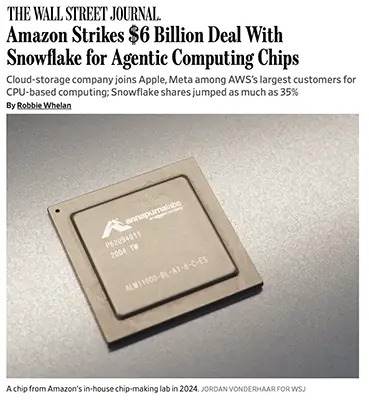
Amazon Strikes $6 Billion Deal With Snowflake for Agentic Computing Chips
The Wall Street Journal | Robbie Whelan | May 27, 2026
TL;DR: Snowflake’s $6B commitment to Amazon’s CPU chips confirms that agentic AI is driving a fundamental shift in computing demand — away from GPU-only strategies and toward high-volume CPU infrastructure.
Executive Summary
This deal is worth attention less for its dollar size than for what it signals about how agentic AI consumes computing resources. Snowflake will pay $6 billion over five years for access to Amazon’s Graviton CPUs — general-purpose processors, not the specialized AI training chips that have dominated recent infrastructure headlines. The reason: AI agents, which orchestrate sequences of tasks autonomously, require large numbers of CPUs to coordinate their workloads, not just raw GPU power.
That dynamic is reshaping the hardware market. CPU makers including Intel, AMD, and Arm have seen meaningful stock appreciation as agentic AI deployments expand. Snowflake joining Apple and Meta as one of AWS’s largest CPU customers puts a concrete commercial number on what has previously been a theoretical shift.
The article is brief and deal-focused. What it does not address: what this means for the cost structure of running agentic AI at enterprise scale. CPU-intensive workloads are cheaper per unit than GPU compute, but the volume requirements for agentic orchestration at scale are substantial — and the total cost picture for businesses deploying agents across workflows remains underexplored.
Relevance for Business
SMB leaders do not need to act on this deal directly, but they should register the pattern: agentic AI is a compute-intensive proposition, and the cost of running it at meaningful scale is beginning to come into clearer focus. As vendors build agent-based products on infrastructure like AWS Graviton, your usage-based pricing for those products will reflect these infrastructure commitments. Understanding the cost drivers behind agentic platforms is increasingly relevant to vendor negotiation and budgeting.
Calls to Action
🔹 When evaluating agentic AI tools, ask vendors about compute pricing models — as infrastructure costs solidify, usage-based fees will follow.
🔹 Note the AWS-Snowflake deepening relationship if your business uses either platform — multi-year, multi-billion-dollar partnerships at this level tend to shape product roadmaps and integration priorities.
🔹 Monitor how agentic AI cost structures evolve over the next 12 months before making long-term platform commitments.
Summary by ReadAboutAI.com
https://www.wsj.com/tech/amazon-strikes-6-billion-deal-with-snowflake-for-its-agentic-computing-chips-d04114d8: June 8, 2026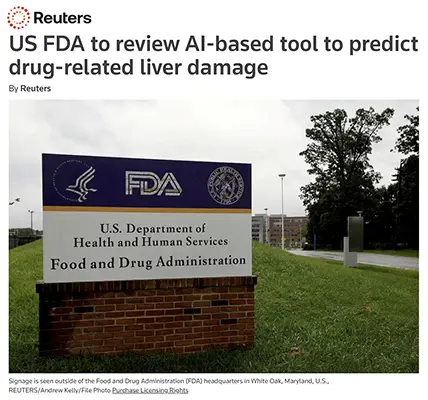
FDA ACCEPTS AI LIVER TOXICITY TOOL FOR REVIEW
Reuters | June 3, 2026
TL;DR: The FDA has accepted a letter of intent for an AI-based tool designed to predict drug-induced liver damage before human trials begin — a small but procedurally significant step toward AI-assisted drug development gaining regulatory legitimacy.
Executive Summary
The FDA’s Center for Drug Evaluation and Research has admitted an AI-driven digital liver model into its ISTAND pilot program, which evaluates novel drug development tools for potential use in regulatory submissions. The tool works by comparing the chemical structure of a new small-molecule drug against a library of existing compounds with known liver toxicity profiles, aiming to flag risk before animal or human trials begin.
Drug-induced liver injury is a leading cause of late-stage clinical trial failures — a costly problem the pharmaceutical industry has long sought to address earlier in the development process. If the tool ultimately clears the full qualification process, it could be incorporated into pre-clinical safety assessments and potentially reduce both animal testing and the frequency of late-stage trial failures.
A critical framing note: a letter of intent is the first of multiple qualification stages, not an approval. The tool has been accepted for review, not validated or authorized for regulatory use. The path from here to routine use in submissions is long and uncertain.
Relevance for Business
This item is narrow in immediate impact but directionally significant for organizations operating in pharmaceuticals, biotech, medtech, or any sector adjacent to drug development and regulatory compliance. It signals that the FDA is actively engaging with AI-based tools as potential inputs to the regulatory process — not just as internal workflow tools, but as instruments that could eventually carry weight in safety assessments submitted to the agency.
For most SMBs, this is a monitor item. For those in life sciences supply chains, clinical research, or regulatory affairs consulting, it is worth tracking as a leading indicator of how AI integration into regulated workflows will be structured.
Calls to Action
🔹 Life sciences and biotech leaders: Track this tool’s progress through the ISTAND qualification process — it’s a template for how AI tools will enter the regulatory pipeline.
🔹 Regulatory and compliance teams: Note the FDA’s formal engagement framework for AI tools — this is the process channel that future AI-assisted regulatory submissions will likely flow through.
🔹 Most SMBs: Monitor only — no near-term operational relevance unless you operate in pharmaceutical development or adjacent regulated industries.
Summary by ReadAboutAI.com
https://www.reuters.com/legal/litigation/us-fda-review-ai-based-tool-predict-drug-related-liver-damage-2026-06-03/: June 8, 2026
Healthcare Embraces AI While Facing an Identity Security Gap: Report
TechTarget / Healthtech Security | Jill Hughes | May 26, 2026
TL;DR: Healthcare organizations are deploying AI agents rapidly while most lack confidence in their ability to recover if those agents expose administrative credentials — a gap that applies broadly across industries.
Executive Summary
This article summarizes survey findings from security vendor Semperis, based on responses from 1,100 IT and security professionals across multiple industries. Source note: The research was commissioned by a cybersecurity company with a commercial interest in the problem it is describing. The findings should be treated as directionally useful but not independently verified.
The core finding is a pronounced gap between threat awareness and response readiness. In healthcare, three-quarters of respondents expect AI-driven attacks on their identity infrastructure, while fewer than one in three are confident they could fully regain control if an AI agent exposed administrative credentials. The article emphasizes that this pattern is not unique to healthcare — banking, education, government, and telecom respondents reported comparable disconnects.
The mechanism driving the risk is structural: every AI agent deployed in an organization creates a non-human identity (NHI) with its own access permissions, authentication credentials, and potential entry points into core systems. As agent deployments multiply — for help desk automation, security tasks, data exchange, and workflow support — the attack surface expands in ways that traditional identity governance frameworks were not built to manage. The report notes that AI agents are frequently over-permissioned, sometimes in ways that allow them to reconfigure security settings or grant access without explicit authorization.
Relevance for Business
For any SMB that has begun deploying AI tools, agents, or automations — even lightweight ones — this is an active governance problem, not a future one. Each tool you connect to your systems has an identity, permissions, and access scope that may not be tracked or governed with the same rigor as human user accounts. The risk is not theoretical: over-permissioned AI agents with access to password managers, encryption keys, and administrative functions represent real exposure. Smaller organizations are particularly vulnerable because they are less likely to have dedicated identity governance infrastructure.
Calls to Action
🔹 Inventory every AI tool, agent, and automation currently connected to your systems — document what permissions each holds and whether those permissions are actually required for its function.
🔹 Apply least-privilege access principles to AI agents, just as you would to human users — if a tool does not need administrative access, it should not have it.
🔹 Establish a governance process for non-human identities before your next AI tool deployment — the absence of such a process is the gap this report is measuring.
🔹 If you use AI agents for security or IT help desk functions, treat that as elevated risk and ensure human oversight checkpoints are in place.
🔹 Revisit your incident recovery plan to confirm it covers scenarios where an AI agent — not a human — is the point of compromise.
Summary by ReadAboutAI.com
https://www.techtarget.com/healthtechsecurity/news/366643632/Healthcare-embraces-AI-while-facing-an-identity-security-gap-report: June 8, 2026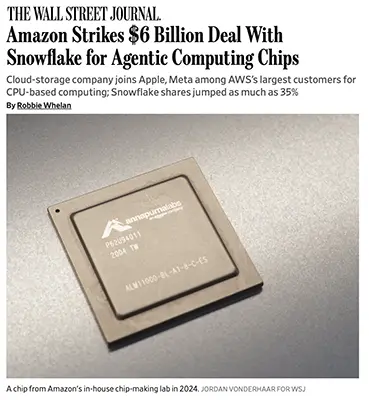
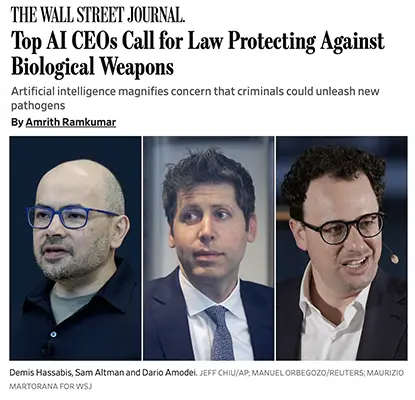
Closing: AI update for June 8, 2026
The stories in this edition collectively mark a phase change in how AI is governed, financed, and scrutinized — the technology is no longer developing faster than the institutions trying to understand it; the institutions have arrived, from capital markets to the Vatican, and the reckoning is underway. For SMB leaders, the practical mandate is the same as it has been, only more urgent: know what your AI tools are authorized to do, understand the cost structures behind them, and make deliberate choices about where human judgment remains non-negotiable — because the window for deliberate choice is narrowing as defaults get set without you.
All Summaries by ReadAboutAI.com
↑ Back to Top