
AI Updates: November 16, 2026
In less than two weeks, Jensen Huang went from calling his dealings with a Megaspeed executive “completely normal” to resigning as Nvidia’s CEO, with CFO Colette Kress stepping in as interim chief and the company naming its first-ever board chair. This week’s coverage digs beneath the headlines. A fast-growing Singapore operator won priority access to Nvidia chips despite visible warning signs. Nvidia’s general counsel contacted export-control officials about an investigation into that customer. And the CEO ran the company with roughly 60 direct reports and no succession plan. Add the circular financing that ties Nvidia to the neoclouds and AI labs that buy its chips, and the story is about vendor concentration as much as personal conduct. The lessons translate directly to smaller firms: know who owns your compute providers, make conflict-of-interest rules apply at the top, and write down who leads if your key person can’t.
The scandal has also become a cultural event, and some of the lighter coverage carries real lessons. Writers have compiled Hollywood “honey trap” parallels, a fashion column read Huang’s leather jackets as evidence in hindsight, and Elon Musk offered to hire him on X. The internet answered with a wave of AI-generated parodies built on the very technology Nvidia’s chips power. Beneath the jokes is a serious finding: a convincing face-swap of a real executive now takes minutes and a few photos, and labeling the clips as AI didn’t stop viewers from asking whether they were real. The midterms showed the same pattern, with the feared election-swinging deepfake replaced by ridicule and persuasion spreading through private channels. A French literary-prize scandal adds a related point for anyone publishing content: undisclosed AI use became a firestorm, while disclosed use drew a shrug.
Meanwhile, Anthropic has set an IPO range valuing the company at roughly $1.26 to $1.41 trillion, below the figures floated in recent months, with its own suppliers, including Google, Nvidia and AMD, among the cornerstone investors. Investors are treating the debut as a referendum on whether AI spending can pay off, and the result could shape vendor pricing and funding across the sector. Beyond the two headline stories, this issue covers United Airlines blocking AI agents from booking flights, the erosion of search as a free traffic source, Warby Parker’s privacy-first bet on Google AI glasses, Netflix’s first AI-branded feature, an RV boom near data center construction sites, and a measured case for studying AI consciousness. Across all 35 summaries, the deciding questions for SMB leaders are about governance, trust and who controls the customer relationship, more than about what the technology can do.
Vendor-neutrality note: Several summaries in this post discuss Anthropic, including its IPO, its investors and its research on Claude. ReadAboutAI.com uses Anthropic’s Claude in its editorial production. Nothing in this post is investment advice.
Summaries
SNL Spoofs the Tech Revolution
When Saturday Night Live chooses a Nvidia leadership scandal over national politics for its cold open, the people running the AI economy have clearly become mainstream public figures, and their personal conduct now counts as business news. We open this edition with the sketch and two reports on it, read for what they say about key-person risk, dependence on a few big vendors, and the week’s outages, not for the jokes.
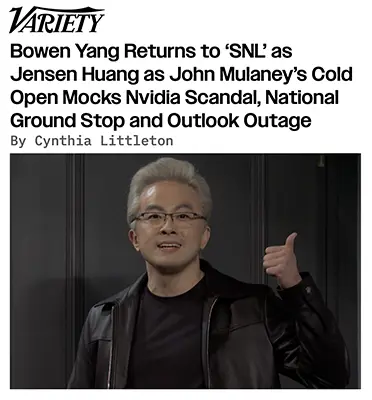
Bowen Yang Returns to ‘SNL’ as Jensen Huang as John Mulaney’s Cold Open Mocks Nvidia Scandal, National Ground Stop and Outlook Outage
Variety | Cynthia Littleton | November 14, 2026
Source type: Entertainment trade coverage — primarily a sketch recap with limited added reporting.
| TL;DR / KEY TAKEAWAY Variety’s write-up is useful mainly for the context the sketch leaves out — Huang’s forced exit after three decades and new allegations of relationships with Nvidia employees turn a spy story into a corporate-governance story. |
Executive Summary
Most of the piece recaps the sketch and its cast. The decision-relevant additions are factual context: Huang resigned under pressure on Nov. 12 from the company he led for more than 30 years, and in the days after the espionage allegation surfaced, further allegations emerged that he had relationships with two Nvidia employees. Those employee allegations are reported, not adjudicated — but they shift the issue from personal misjudgment toward workplace conduct and board oversight.
Variety also places the week’s infrastructure failures side by side — a five-hour national air-travel ground stop and an Outlook outage lasting close to 24 hours — describing them as disruptions that “exposed the vulnerabilities of our wired world.” Its description of tech billionaires as having flexed outsized power over politics and culture is editorial framing, not a finding. Remaining detail (host promotion, tour dates, musical guest) does not change understanding.
Relevance for Business
Founder-led dependence is a governance risk at any scale. A company built around one leader for three decades lost that leader in days. SMBs that rely on a founder, a key salesperson, or a single technical lead face the same continuity exposure, in miniature.
Conduct with employees is what turns a scandal into a liability. The alleged workplace relationships — more than the spy angle — are the kind of issue that creates HR, legal, and reputational exposure for any employer.
Vendor due diligence should include leadership stability. Key suppliers, including AI and cloud providers, carry their own key-person risk; renewal conversations are the natural time to ask about continuity.
Calls to Action
◆ Assign internal review: confirm succession and continuity plans for your own critical roles, including who holds key credentials and vendor relationships.
◆ Prepare policy: revisit workplace-relationship and conflict-of-interest disclosure policies so they apply clearly to senior leaders.
◆ Monitor: whether Nvidia’s board discloses investigation findings or governance changes — that, not the coverage, will indicate lasting impact.
◆ Ignore for now: celebrity, casting and promotional detail.
Summary by ReadAboutAI.com
https://variety.com/2026/tv/news/bowen-yang-jensen-huang-snl-cold-open-john-mulaney-tech-1236947900/: November 16, 2026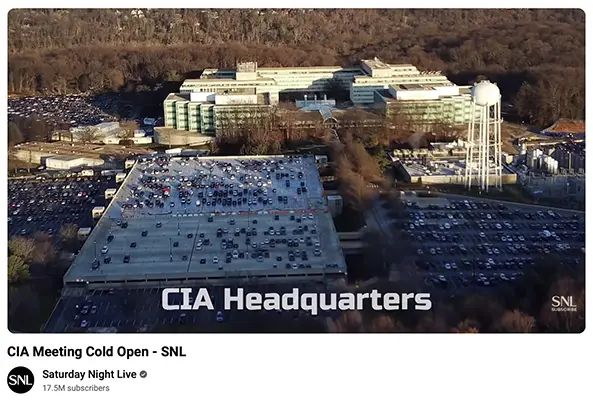
CIA Meeting Cold Open – SNL
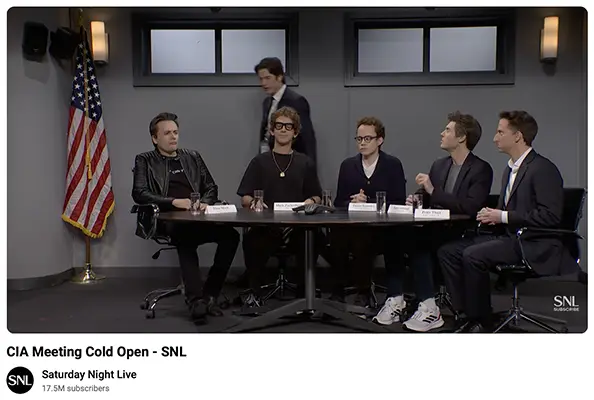
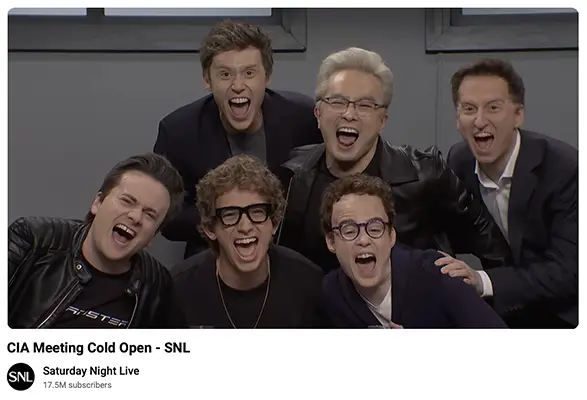
SNL’s “CIA Meeting” Cold Open Turns the Jensen Huang Scandal Into a Security Briefing for AI’s Power Class
Saturday Night Live (NBC) | Cold Open, host John Mulaney | November 14, 2026
Source type: Satire / entertainment transcript. Sketch dialogue is comedy, not reporting; only the underlying news events are factual.
| TL;DR / KEY TAKEAWAY When SNL stages a CIA lecture for the heads of OpenAI, Anthropic, Meta, Palantir and X, the signal is not the jokes — it is that mainstream culture now treats AI’s leaders as one concentrated power class whose personal conduct and system failures carry public consequences. |
Executive Summary
The sketch imagines a CIA official schooling five tech leaders — Sam Altman, Dario Amodei, Peter Thiel, Mark Zuckerberg and Elon Musk — on spotting espionage honeytraps, before Bowen Yang appears as Jensen Huang. The real event underneath is Huang’s resignation from Nvidia this week after reports of an affair with an alleged Chinese spy. Everything else — the meeting, the dialogue, the personalities — is satire and should be read that way.
Three real-world threads run through the comedy. First, key-person and insider risk at the companies supplying AI’s core infrastructure: one executive’s private conduct became a security and market story. Second, reliability: Thiel’s defensive challenge, “Name one time technology has let us down,” is immediately undercut by the same week’s nationwide FAA ground stop and Microsoft Outlook outage. Third, concentration of wealth and influence in a handful of individuals — with AI-lab chiefs like Altman and Amodei now billed alongside Musk and Zuckerberg as household names.
Limits matter here. The sketch says nothing about AI capability, and several jokes rely on crude ethnic and sexual-orientation humor that offers no insight. Its value for leaders is as a read on public sentiment, not as commentary on any company’s strategy.
Relevance for Business
Vendor concentration is now a visible, public risk. Nvidia’s chips sit underneath nearly every AI service SMBs buy. A sudden leadership change at a single supplier can ripple into pricing, supply, and policy decisions that reach your cloud and software bills — even if you never buy from Nvidia directly.
Outages are the practical lesson, not the punchline. The two failures the sketch cites — grounded flights and a widespread email outage — are the realistic scenarios for most firms: single-provider dependence in communications, cloud and, increasingly, AI tools.
Social engineering is not a billionaire problem. Relationship-based approaches and pretexting target managers with access to data, finances, or customer systems at companies of every size.
Trust and reputation exposure: employees and customers increasingly form views about AI through the personalities of its leaders. When those leaders become a comedy shorthand for unaccountable power, internal AI adoption messaging that leans on vendor brands may land poorly.
Calls to Action
◆ Assign internal review: map which critical workflows depend on a single provider (email, cloud, AI model) and confirm fallback options — this week’s outages are your test case.
◆ Act now: refresh social-engineering awareness for staff with access to sensitive data, finances, or systems; include relationship-based and off-hours approaches, not just phishing.
◆ Monitor: Nvidia’s leadership transition and any supply, pricing, or export-policy effects that could reach AI and cloud costs.
◆ Test cautiously: frame internal AI rollouts around your own tools, controls and outcomes rather than vendor celebrities.
◆ Ignore for now: the sketch’s portrayals of individual executives — entertainment, not due diligence.
| Vendor-neutrality note: Anthropic CEO Dario Amodei is portrayed in this sketch. ReadAboutAI.com uses Anthropic’s Claude in its production workflow. |
Summary by ReadAboutAI.com
https://www.youtube.com/watch?v=R_8UPhJNrZ4: November 16, 2026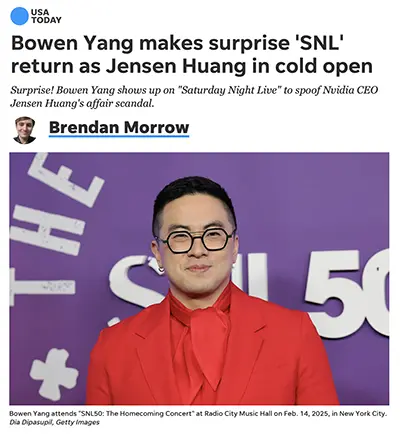
Bowen Yang Makes Surprise ‘SNL’ Return as Jensen Huang in Cold Open
USA TODAY | Brendan Morrow | Updated November 15, 2026
Source type: Consumer entertainment news — thin recap; summarized briefly.
| TL;DR / KEY TAKEAWAY USA Today’s coverage confirms that the Nvidia leadership scandal displaced national politics as the week’s top comedy target — a sign that AI-industry leadership is now consumer headline news, not a trade-press story. |
Executive Summary
The article is a straightforward recap. Its notable details: the cold open was, in the paper’s words, “a rare one that didn’t parody the president,” the Huang scandal also led that night’s Weekend Update, and the sketch bundled the scandal with the week’s other dominant stories — the FAA’s nationwide ground stop and the Microsoft Outlook outage. The rest covers casting, Yang’s return, and scheduling.
One incidental signal: the article page itself carries a publisher-generated “AI Overview” summary, a small example of mainstream news outlets deploying AI to summarize their own reporting for readers.
Relevance for Business
AI leadership is now part of the general public’s frame of reference. Customers and employees are forming opinions about AI companies from entertainment and consumer news — which affects how AI-powered products and internal AI initiatives are received.
Tech leaders and tech failures are being bundled together in public perception. Organizations that market heavily on AI or rely visibly on big-tech platforms share some of that reputational exposure.
Calls to Action
◆ Monitor: public sentiment toward major AI providers as an input to how you position AI features with customers.
◆ Revisit later: the business implications will come from Nvidia’s governance and leadership response, not from entertainment coverage.
◆ Ignore for now: casting and scheduling detail.
Summary by ReadAboutAI.com
https://www.usatoday.com/story/entertainment/tv-streaming/2026/11/15/snl-cold-open-bowen-yang-jensen-huang/92791633007/: November 16, 2026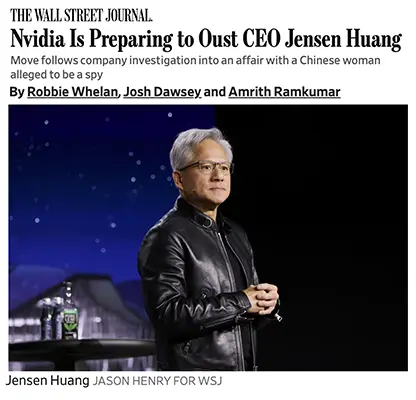
NVIDIA IS PREPARING TO OUST CEO JENSEN HUANG
The Wall Street Journal | Robbie Whelan, Josh Dawsey and Amrith Ramkumar | November 12, 2026
Exclusive. Overtaken within hours by Huang’s resignation and people considered for CEO, summary #7.
TL;DR: The most valuable company in the AI economy is losing its founder-CEO with no named successor and a CEO who openly rejected succession planning, a risk Nvidia’s own proxy statement had warned about.
Executive Summary
The WSJ reports that Nvidia’s board was preparing to remove Huang after two affairs: one with suspected Chinese intelligence asset Alice Huang, and one with Kimberly Powell, a direct report who runs Nvidia’s healthcare business. Shares fell almost 8% premarket. The Justice Department is now leading multiple investigations involving Alice Huang, and Commerce has been investigating Megaspeed since late 2024.
The governance detail that matters most: Huang had about 60 direct reports and has said he doesn’t believe in formal succession planning, even though Nvidia’s proxy says the company is “highly dependent on the services of our longstanding executive team.” Lawmakers are also examining Trump’s approval of chip sales to China. That creates political exposure that could shape export policy after Huang. Fact vs. pending: The board meeting and second affair are reported by sources. The decision itself was not yet announced.
Relevance for Business
- A flat, founder-centered structure is efficient until the founder leaves.
- Disclosing a risk in filings did not prevent it.
- A new Nvidia CEO could reset partner programs, China strategy and pricing.
Calls to Action
🔹 Act now: If your own leadership is concentrated in one person, document interim authority and key relationships this quarter.
🔹 Monitor: Nvidia’s successor and early signals on partners, allocation and China.
🔹 Monitor: Congressional scrutiny of past export approvals.
🔹 Ignore for now: Celebrity framing.
Summary by ReadAboutAI.com
https://www.wsj.com/business/nvidia-is-preparing-to-oust-nvidia-ceo-jensen-huang-30f421ad: November 16, 2026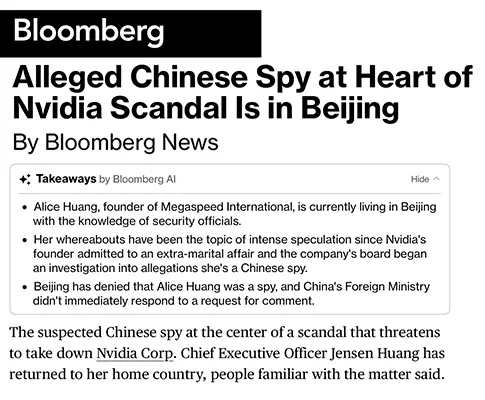
ALLEGED CHINESE SPY AT HEART OF NVIDIA SCANDAL IS IN BEIJING
Bloomberg News | November 11, 2026
TL;DR: The headline is Alice Huang’s reported return to Beijing, but the bigger revelations are that Megaspeed imported more than $4.6B in Nvidia products, won Nvidia Cloud Partner status days after an ownership shuffle, and Nvidia’s general counsel called the top U.S. export-control official about the investigation into it.
Executive Summary
Anonymous sources say Alice Huang is living in Beijing with Chinese security officials’ knowledge. Beijing denies she is a spy. Bloomberg’s reconstruction of Megaspeed is the substance. It was spun out of a Chinese gaming firm months after Biden-era chip curbs, passed through a British Virgin Islands entity in her name and then a Singapore shell company, and became an Nvidia Cloud Partner days after that final sale. Its imports were worth more than 1,000 times its 2023 cash balance. In 2025, Nvidia’s general counsel phoned the Commerce under secretary who oversees export controls about the Megaspeed probe. Whether he asked for anything specific is unknown. Fact vs. claim: Trade data comes from records Bloomberg analyzed. Her location rests on anonymous sources.
Relevance for Business
- Nvidia’s partner status failed as a quality signal.
- A vendor contacting regulators about its customer’s investigation is a governance red flag, and a likely focus for Congress.
- Neocloud GPU providers in Southeast Asia carry hidden geopolitical risk.
Calls to Action
🔹 Assign internal review: For any smaller GPU cloud provider you use, confirm where the hardware sits, who ultimately owns the provider, and whether it faces investigation.
🔹 Monitor: Fallout from Nvidia’s contact with Commerce.
🔹 Revisit later: Changes to Nvidia’s partner vetting and their effect on allocation.
Summary by ReadAboutAI.com
https://www.bloomberg.com/news/articles/2026-11-12/alleged-chinese-spy-at-center-of-nvidia-firestorm-is-in-beijing: November 16, 2026
A Mystery Businessman Introduced Jensen Huang to His Paramour. It Was Her Husband.
The Wall Street Journal | Lingling Wei | November 11, 2026
TL;DR: Beneath the tabloid headline, the WSJ’s real finding is that an investing couple with a record of regulatory trouble won priority Nvidia partner status, then allegedly sent restricted chips into China. That makes this a partner-vetting failure at the AI economy’s most important supplier, not just a story about one executive’s conduct.
Executive Summary
The WSJ reports that Alice Huang’s husband, Shanghai financier Kang Wei, introduced her to Jensen Huang, whom he had known for about a decade, and appeared to accept the relationship that followed. For business readers, the more important material is how the couple built Megaspeed International. They turned a Singapore gaming subsidiary into an AI data-center operator in 2023 and, according to WSJ sources, won “Nvidia cloud partner” priority access to chips by naming Alibaba as an anchor customer. They then allegedly moved some servers into China.
The couple’s history was not hidden. China’s securities regulator fined Kang and their firm in 2018, Kang was detained in Shanghai this year over market-manipulation inquiries, and Singapore put an exit ban on Alice Huang in 2025. Potential investors say the couple promised to triple investors’ money in three years and claimed they could get Nvidia chips into China. If those accounts are accurate, the warning signs were visible to counterparties well before the headlines.
Fact vs. claim: The U.S., Singapore and Taiwan investigations are confirmed. The transshipment allegations rest largely on unnamed sources. Megaspeed says it complies with export rules, Beijing denies any spying, and the couple could not be reached.
Relevance for Business
- Your compute supply chain has intermediaries you probably haven’t vetted. Top-tier partner status was not proof of a sound partner.
- Partner programs can be gamed. Expect tighter vetting, which could reshape GPU availability through smaller providers.
- Personal relationships at the top are a governance risk that ordinary controls are not built to catch.
Calls to Action
🔹 Assign internal review: If you buy GPU compute or AI hosting through smaller providers, find out who owns them, where the hardware sits, and how they handle export compliance.
🔹 Prepare policy: Make sure conflict-of-interest rules cover executives’ personal ties to vendors and partners.
🔹 Monitor: Watch the Megaspeed investigations, which may set new vetting standards for chip buyers in Southeast Asia.
🔹 Ignore for now: The marital details.
Summary by ReadAboutAI.com
https://www.wsj.com/tech/ai/a-mystery-businessman-introduced-jensen-huang-to-his-paramourher-husband-1ec3b581: November 16, 2026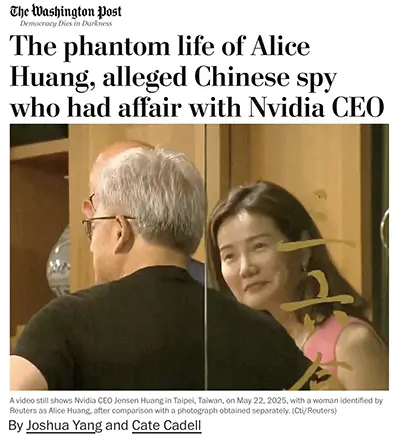
The Phantom Life of Alice Huang, Alleged Chinese Spy Who Had Affair With Nvidia CEO
The Washington Post | Joshua Yang and Cate Cadell | November 10, 2026
TL;DR: Basic facts about the executive at the center of the Nvidia crisis still can’t be verified, and that opacity is the lesson: a partner buying billions of dollars of Nvidia hardware was led by someone whose background couldn’t be confirmed.
Executive Summary
The Post couldn’t confirm Alice Huang’s age, hometown, education or work history, and found no record of her claimed state-broadcaster jobs. Her social accounts are gone. A former colleague’s Weibo post about her vanished within hours, and that account was then suspended. A former CIA China analyst said her background “smells like a legend to me,” meaning a fabricated cover identity. The clearer red flag for business: Megaspeed’s assets grew from $33 million to $3 billion in one year. One China scholar notes that this scale is beyond typical Chinese intelligence operations, which points to a commercial chip-diversion business that spies may have exploited rather than a spy front.
Fact vs. framing: The espionage claim rests on U.S. intelligence that hasn’t been made public. Beijing denies it. The Post couldn’t verify the Kang Wei marriage, which the WSJ reported as fact a day later.
Relevance for Business
- Rapid, unexplained growth at a partner should trigger due diligence.
- When basic facts about a counterparty’s leadership can’t be confirmed, treat that as a risk.
- Expect stricter know-your-customer rules for GPU buyers in Asia, which could affect cloud capacity and pricing.
Calls to Action
🔹 Assign internal review: Verify ownership and leadership of fast-growing vendors that handle sensitive technology or data.
🔹 Monitor: Whether U.S. officials make their evidence public.
🔹 Revisit later: New Commerce Department rules for vetting chip buyers.
Summary by ReadAboutAI.com
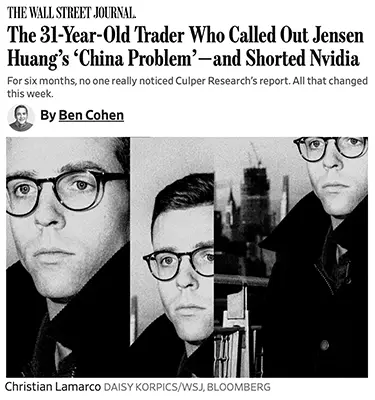
https://www.washingtonpost.com/world/2026/11/10/phantom-life-alice-huang-alleged-chinese-spy-who-had-an-affair-with-nvidia-ceo/: November 16, 2026The 31-Year-Old Trader Who Called Out Jensen Huang’s “China Problem”—and Shorted Nvidia
The Wall Street Journal (Science of Success column) | Ben Cohen | November 11, 2026
TL;DR: A three-person short-selling firm published the core of the Nvidia China story six months before mainstream coverage, and the market ignored it. That is a reminder that serious vendor risks often show up first in adversarial, easy-to-dismiss places.
Executive Summary
In May, Culper Research published a 40-page report flagging Nvidia’s China exposure and the CEO’s close relationship with Alice Huang. Its thesis: “We are short Nvidia for one reason: the company has a significant China problem.” Nvidia’s stock hit a record the next day. Culper’s methods are the useful part for executives: expert-network interviews with former employees, Singaporean and Malaysian corporate filings, and public video. All of it was public or purchasable. Nvidia has since lost more than $1 trillion in market value.
Framing caution: The column tells a vindication story in hindsight. Short sellers profit when stocks fall, Culper has been sued for defamation over past work, and parts of its Nvidia case were unverified speculation when published. Being proven right later doesn’t mean the evidence was conclusive at the time.
Relevance for Business
- Analyst consensus gave no warning about Nvidia. A small adversarial researcher did.
- Nvidia sits underneath nearly every AI tool you use. A valuation shock there can reach vendor pricing and roadmaps.
- Open-source due diligence is cheap and works for any critical partner.
Calls to Action
🔹 Monitor: Add short-seller reports, regulatory actions and lawsuits involving critical vendors to your risk watchlist. Treat them as leads, not conclusions.
🔹 Revisit later: Check whether Nvidia’s valuation drop changes terms from AI vendors that depend on Nvidia.
🔹 Ignore for now: The trader’s backstory.
Summary by ReadAboutAI.com
https://www.wsj.com/business/nvidia-short-seller-culper-jensen-huang-0e0cec38: November 16, 2026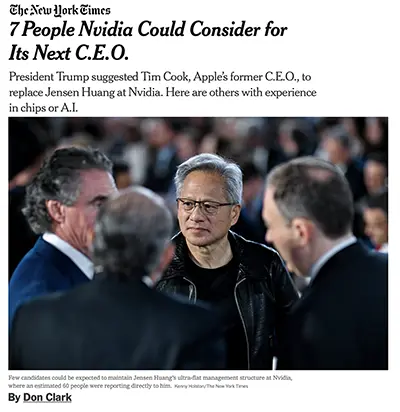
7 PEOPLE NVIDIA COULD CONSIDER FOR ITS NEXT C.E.O.
The New York Times | Don Clark | November 12, 2026
TL;DR: Replacing Huang may be harder than replacing Steve Jobs was. Nvidia’s problem isn’t only finding a leader; it’s taking apart a structure built around one person.
Executive Summary
Interim CEO Colette Kress knows the company’s operations and has Wall Street’s trust, but she lacks deep technical expertise. The list of possible permanent CEOs falls into three groups. Insiders: Kress, and Ian Buck, the architect of Nvidia’s CUDA software platform. Big-name outsiders: Tim Cook, whom President Trump publicly suggested, and Apple chip chief Johny Srouji. Executives from rival or adjacent chip companies: Arm’s Rene Haas, AMD’s Forrest Norrod and Broadcom’s Charlie Kawwas. Each brings a trade-off between technical depth, management breadth, Washington relationships and public profile. No one has all four.
The most revealing detail is structural. Huang reportedly had about 60 direct reports, far beyond the dozen or so recruiters consider workable. One search-firm partner said “things have to change structurally immediately.” The flat structure fed Nvidia’s speed and culture, but it also concentrated decisions, relationships and institutional knowledge in one person. Whoever takes over will probably have to reorganize while the company is under pressure: market losses, a congressional inquiry and earnings next week. That adds execution risk regardless of who’s chosen.
Relevance for Business
This is a useful case study in key-person and succession risk. Many SMBs run on a founder with too many direct reports and the key relationships in their head. Nvidia shows that the cost isn’t only losing that person; it’s the reorganization forced on the company at the worst possible time. For Nvidia customers, a leadership transition could mean changes to pricing, partnerships or roadmap priorities over the next year.
Calls to Action
🔹 Assign internal review: Count your leaders’ direct reports and identify single points of failure in key decisions and relationships.
🔹 Prepare policy: Document a succession plan, including an interim leader, even an informal one.
🔹 Monitor: Track who Nvidia appoints. An outsider from a rival company or a non-technical CEO would signal a different strategic direction.
Summary by ReadAboutAI.com
https://www.nytimes.com/2026/11/12/technology/jensen-huang-nvidia-successor.html: November 16, 2026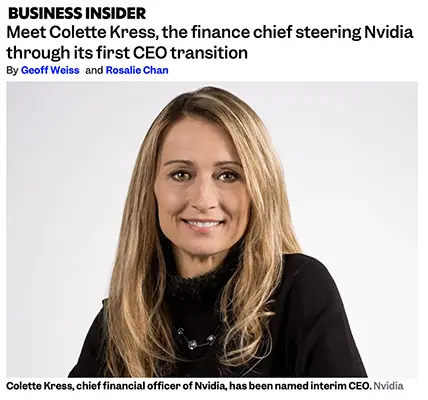
MEET COLETTE KRESS, THE FINANCE CHIEF STEERING NVIDIA THROUGH ITS FIRST CEO TRANSITION
Business Insider | Geoff Weiss and Rosalie Chan | November 12, 2026
TL;DR: Nvidia’s first leadership transition in 33 years puts a trusted CFO in charge, creates a separate board chair, and opens the CEO search to outsiders. The first real test is the Nov. 17 earnings call.
Executive Summary
The board will “consider internal and external candidates” for permanent CEO. Kress has been central to Nvidia’s partnerships with cloud providers and startups, and has publicly pointed to agentic AI as the next driver of demand for compute. The structural news matters more than the profile. Harvey Jones becomes Nvidia’s first board chair, but he has been a director since the company’s founding, so the new role adds little fresh outside oversight. Kress also inherits a flat structure with about 60 direct reports, which made succession planning hard. Fact vs. framing: The analyst praise and Kress’s statement are expected framing. The board’s decisions and the earnings date are the facts.
Relevance for Business
- The Nov. 17 earnings call will show whether the shock reaches the business or stays in the stock.
- A long-serving chair is a limited fix. Investors may push for more independent board members.
- Nvidia’s agentic AI demand story is unlikely to change under interim leadership.
Calls to Action
🔹 Monitor: Nov. 17 earnings for changes in guidance, China exposure, supply allocation or customer financing.
🔹 Monitor: Whether the CEO search leans toward an outside candidate, which would be more likely to bring strategic change.
🔹 Act now: Name an interim successor for your own key leadership roles. Nvidia had none.
Summary by ReadAboutAI.com
https://www.businessinsider.com/colette-kress-nvidia-cfo-interim-ceo-jensen-huang-resigns-2026-11: November 16, 2026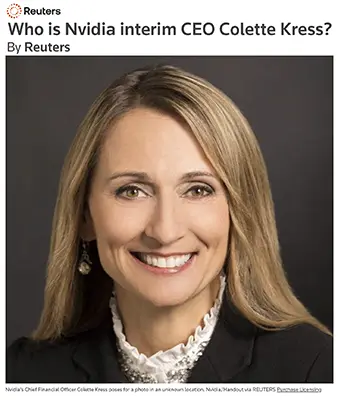
WHO IS NVIDIA INTERIM CEO COLETTE KRESS?
Reuters | Akash Sriram | November 12, 2026
TL;DR: Nvidia’s interim leader is a finance executive, not a product visionary. That signals the board’s first priority is stability and investor confidence, not a new strategic direction.
Executive Summary
Kress has been Nvidia’s CFO since 2013, after about 25 years in finance at Texas Instruments, Microsoft and Cisco. She oversaw Nvidia’s finances as revenue grew from $4.13 billion to $215.9 billion. Reuters says the board “ousted” Huang, while other outlets describe a resignation. The governance detail worth noting: Nvidia executives work at will, with no severance or change-in-control agreements. That gives the board flexibility, but it also means there are no contractual retention incentives during an unsettled transition.
Relevance for Business
- Interim finance leadership usually means near-term continuity in roadmaps and partner terms.
- Retaining talent is the real risk. Rivals may try to recruit Nvidia leaders during the CEO search.
Calls to Action
🔹 Monitor: Senior Nvidia executive departures over the next quarter.
🔹 Revisit later: Nvidia’s strategy once a permanent CEO is named.
🔹 Ignore for now: Wealth and biography details.
Summary by ReadAboutAI.com
https://www.reuters.com/technology/who-is-nvidia-interim-ceo-colette-kress-2026-11-12/: November 16, 2026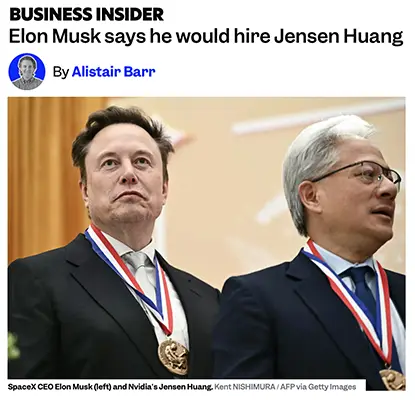
Elon Musk Says He’d Hire Nvidia CEO Jensen Huang If Board Ousts Him
Business Insider | Alistair Barr | November 11, 2026
TL;DR: Musk’s public offer to hire Huang is a social-media gesture, not a job offer. Its real signal is that elite AI leadership talent stays valuable even after a scandal, and big GPU buyers would love to have it.
Executive Summary
Thin source: brief, paywalled item. Published before Huang’s exit was confirmed on November 12. After reports that Nvidia’s board was preparing to remove Huang, Musk replied to a post on X urging him to hire Huang: “That would be an honor.” BI compares it to Larry Ellison hiring Mark Hurd at Oracle weeks after HP pushed him out in 2010. The article itself notes this is an expression of interest, not an offer.
What matters is the logic, not the tweet. Musk’s companies are among the largest buyers of Nvidia GPUs, and Huang’s knowledge of chips, supply chains and ecosystem deals would be a strategic asset to any major AI compute buyer. If Huang ends up at a rival or a big customer, that would add to the uncertainty Nvidia already faces.
Relevance for Business
This isn’t directly actionable for SMBs. It mainly shows that top AI talent and relationships are concentrated in a few people and companies. Moves like this could change who controls compute supply, which affects pricing and access for everyone downstream.
Calls to Action
🔹 Ignore for now: Treat the post as noise unless it turns into an actual hire.
🔹 Monitor: Watch where Huang goes next. A move to a major GPU buyer or competitor would matter more than this comment.
Summary by ReadAboutAI.com
https://www.businessinsider.com/elon-musk-hire-nvidia-ceo-jensen-huang-if-board-ousts-2026-11: November 16, 2026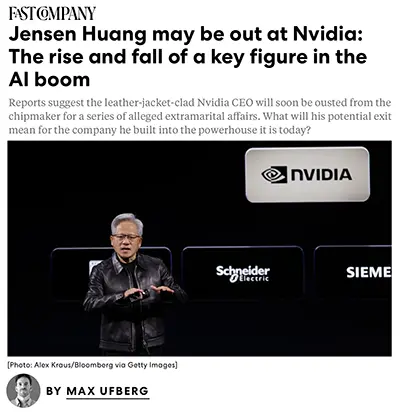
JENSEN HUANG MAY BE OUT AT NVIDIA: THE RISE AND FALL OF A KEY FIGURE IN THE AI BOOM
Fast Company | Max Ufberg | November 11, 2026
TL;DR: Nvidia had no COO, no named successor, and a CEO who reportedly didn’t believe in succession planning. The scandal turned a long-ignored governance weakness into a crisis.
Executive Summary
Published before Huang’s exit was confirmed on November 12. Much of the piece retells Nvidia’s history: the early GPU bet, the 2006 CUDA software platform that opened GPUs to uses beyond graphics, and the AI boom that pushed quarterly revenue to roughly $96 billion, nearly all of it from data centers. The more useful part for executives is the governance analysis. Huang had about 60 direct reports, no chief operating officer, and no publicly identified successor, and he reportedly dismissed succession planning altogether. That setup gave Nvidia speed, but it concentrated the risk in one person.
The article also clarifies the different types of legal exposure. The woman involved in the first affair was an executive at Megaspeed, a Singapore data-center company and Nvidia customer that had previously been investigated by the U.S. Commerce Department over possible chip diversion to China. That raises export-control and national-security questions; a government official described it as more than personal misconduct, saying “This is not just personal foibles.” The second affair, with a subordinate, creates a separate workplace-conduct and governance liability. Huang also faces a closed-door request from three House committee chairs and a proposed shareholder class action. The board, it turns out, had grounds to act on several fronts at once.
Relevance for Business
Strip away the scale and the drama, and this is a governance lesson every founder-led company should take seriously: no succession plan, too many direct reports, no strong second-in-command, and loose oversight of how leaders deal with customers and subordinates. For Nvidia customers, the Megaspeed detail is a reminder that export-control compliance and customer due diligence are getting more scrutiny across the AI supply chain.
Calls to Action
🔹 Act now: If your company has no documented succession or interim leadership plan, create one.
🔹 Prepare policy: Review conflict-of-interest and workplace-relationship policies, and make sure they apply to the top leaders too.
🔹 Assign internal review: If you resell, distribute or buy advanced chips or AI hardware, check that your export-control and customer due-diligence practices hold up.
🔹 Monitor: Follow the congressional inquiry and shareholder litigation for signs of new governance expectations for AI companies.
Summary by ReadAboutAI.com
https://www.fastcompany.com/91640747/jensen-huang-may-be-out-at-nvidia-the-rise-and-fall-of-one-of-the-key-figures-in-the-ai-boom: November 16, 2026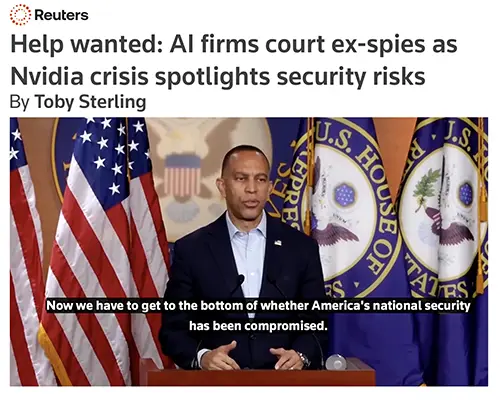
Help Wanted: AI Firms Court Ex-Spies as Nvidia Crisis Spotlights Security Risks
Reuters | Toby Sterling | November 12, 2026
TL;DR: The Nvidia scandal is pushing frontier AI and chip firms to hire former intelligence officers. Executive-targeted espionage is now treated as a real business risk, but most companies still don’t plan for it.
Executive Summary
AI, chip and tech companies are hiring more counterintelligence talent. Hiring data shows OpenAI, Anthropic and Nvidia posting explicit counterintelligence roles in the last couple of years, mostly paying $200K–$500K. Top corporate security chiefs can earn $1M–$4M. OpenAI and Anthropic have added former NSA and CIA leaders to their boards and advisory councils. ASML runs an internal intelligence unit and is hiring a counterintelligence officer in Taiwan, close to its biggest customer, TSMC. A recent OpenAI incident, in which a hidden recording device was found in an executive conference room, shows the threat isn’t only theoretical.
The more important point is where security attention is missing. A former ASML security chief says most companies, “I’d say 90%, completely ignore that risk”: the risk of executives being befriended, compromised or coerced. Security teams spend most of their time on AI-driven hacking and on protecting data as their own companies adopt AI. Boards tend to dismiss the human-targeting threat as far-fetched. Nvidia says no secrets were compromised, and China denies the spy allegations. Either way, the case shows that one executive’s personal exposure can become a crisis for the whole company.
Vendor-neutrality note: ReadAboutAI.com uses Claude (Anthropic) in production. Anthropic is one of several firms mentioned here.
Relevance for Business
Most SMBs won’t hire former spies, but the underlying risk carries over. Your trade secrets, client data and leadership team can be targets, especially if you work in AI, defense supply chains, semiconductors or other sensitive sectors. The talent shortage also cuts two ways: security expertise is getting more expensive, and big AI firms are hiring away the experienced people smaller companies would also want. Suppliers and partners of major AI firms should also expect stricter vetting and security requirements to work their way down the supply chain.
Calls to Action
🔹 Assign internal review: Find out whether your security planning covers insider threats and executive targeting, not only cyberattacks.
🔹 Prepare policy: Brief leaders and key staff on social-engineering approaches, including the ones that look like chance meetings.
🔹 Monitor: Watch for new security or vetting requirements from large AI or chip customers you supply.
🔹 Test cautiously: If you’re in a sensitive sector, consider a fractional or consultant-based security assessment instead of a full-time hire.
Summary by ReadAboutAI.com
https://www.reuters.com/legal/litigation/help-wanted-ai-firms-court-ex-spies-nvidia-drama-spotlights-security-risks-2026-11-12/: November 16, 2026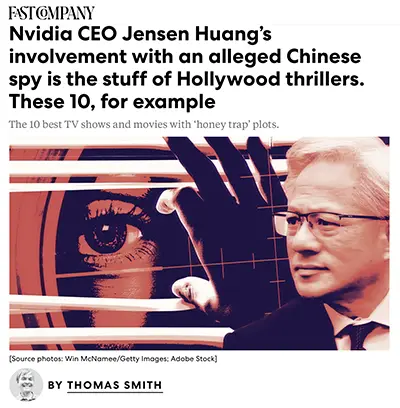
Nvidia CEO Jensen Huang’s Involvement With an Alleged Chinese Spy Is the Stuff of Hollywood Thrillers. These 10, for Example
Fast Company · Thomas Smith · November 11, 2026
| TL;DR / A lightweight culture piece that frames the Nvidia leadership scandal as a classic “honey trap” story — little new information, but a reminder that the episode is now as much a reputational narrative as a governance one. |
Executive Summary
The news content is limited to a brief recap: Huang has admitted to an affair with a former executive at Singapore-based Megaspeed who is accused — not proven — of working with the Chinese government. Nvidia’s board is investigating and says it has no reason to believe trade secrets were compromised. The remainder lists film and TV examples of seduction-based espionage, closing with Ex Machina’s AI-as-manipulator premise.
The editorial signal is not in the list itself but in what it shows: the scandal has moved from business coverage into mainstream culture framing, which tends to harden public narratives regardless of how the investigation turns out.
Editor’s note: This is a pop-culture list with minimal news content. Consider whether it fits the briefing or belongs in the AI and pop culture archive instead.
Fast Company Hollywood List:
1. THE AMERICANS (2013 – 2018)
2. RED SPARROW (2018)
3. LUST, CAUTION (2007)
4. NOTORIOUS (1946)
5. THE LITTLE DRUMMER GIRL (2018)
6. BLACK BOOK (2006)
7. THE HANDMAIDEN (2016)
8. M. BUTTERFLY (1993)
9. FROM RUSSIA WITH LOVE (1963)
10. EX MACHINA (2014)
Relevance for Business
– Reputational stories outrun the facts. Once a governance issue becomes a pop-culture narrative, the company loses control of the framing — a risk for any leadership team.
– The underlying business lesson — insider and relationship-based security risk at the executive level — applies well beyond Nvidia.
Calls to Action
◆ Assign internal review: Confirm that executive conflict-of-interest and relationship-disclosure policies exist and apply to leadership, not just staff.
◆ Ignore for now: The listicle itself; rely on Items 1–13 and #21–22 for the substantive scandal coverage.
◆ Monitor: The board investigation’s findings, which matter far more than the narrative.
Summary by ReadAboutAI.com
https://www.fastcompany.com/91639932/jensen-huang-hollywood-spy-thrillers: November 16, 2026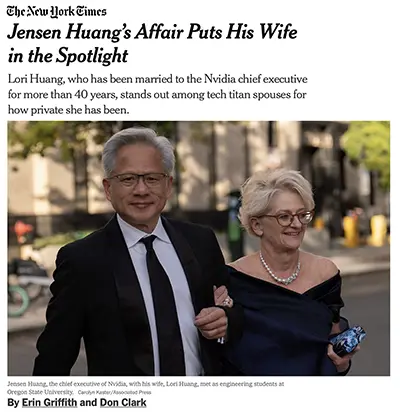
Jensen Huang’s Affair Puts His Wife in the Spotlight
The New York Times | Erin Griffith and Don Clark | November 11, 2026
Source type: human-interest profile
TL;DR: This is mainly a portrait of a very private spouse. The detail that matters for governance is ownership: Lori Huang co-controls a trust holding more than half of Jensen Huang’s roughly 922 million Nvidia shares and solely controls another trust worth about $5 billion.
Executive Summary
The Times profiles Lori Huang, a trained chip engineer and Huang’s wife of 41 years, who leads a foundation with about $9 billion in assets and has stayed out of public view. The useful facts are structural. Two of the couple’s children and a son-in-law work at Nvidia, and the couple co-trustee a large share of the CEO’s stake. Any change in the marriage could affect one of the most important ownership positions in the AI supply chain. Speculation about the marriage’s future is the paper’s framing, not reported fact.
Relevance for Business
- Founder-led companies concentrate risk in ownership as well as leadership.
- Family members in senior roles make independence and succession harder questions during a crisis.
- For most SMB leaders, this is a reason to look at your own continuity planning, not to act on Nvidia.
Calls to Action
🔹 Ignore for now: The personal narrative.
🔹 Monitor: SEC filings for any changes to Huang family trust holdings.
🔹 Assign internal review (founder- or family-led firms): Check key-person, ownership-continuity and family-employment policies.
Summary by ReadAboutAI.com
https://www.nytimes.com/2026/11/11/technology/jensen-huang-affair-lori-huang.html: November 16, 2026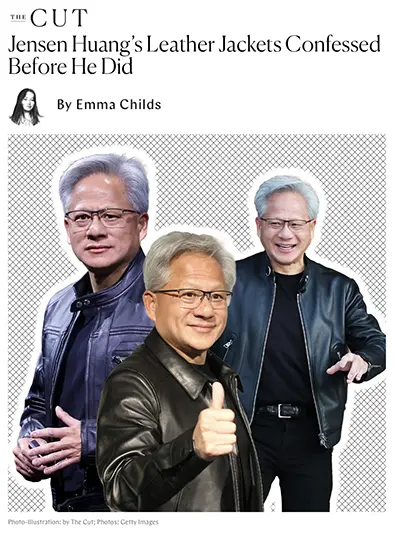
JENSEN HUANG’S LEATHER JACKETS CONFESSED BEFORE HE DID
The Cut | Emma Childs | Updated November 12, 2026
TL;DR: A satirical fashion column uses Huang’s signature leather jackets to mock his downfall. Its only real business point is how quickly a founder’s carefully built personal brand can turn into a liability.
Executive Summary
Source type: humor/opinion column from a fashion outlet. Industry Watch treatment recommended. The column treats Huang’s well-known taste for high-end leather jackets, which became as much his trademark as the black turtleneck was for Steve Jobs, as a clue in hindsight to his personal conduct. Most of the piece is snark and speculation about his marriage, and it doesn’t hold up as analysis. A few reported details are worth knowing. Huang has been called to a closed-door congressional session next week. The Times reported that the woman involved was allegedly recruited by China’s Ministry of State Security to gather information on Nvidia’s AI chips. And one of Huang’s signed jackets sold at Sotheby’s this summer for nearly $1 million, which shows how much his image had become a valuable asset in its own right.
The useful signal is personal-brand concentration. Nvidia built marketing, merchandise and keynote theater around Huang as an icon. When a company’s identity is tied that closely to one person, that person’s reputation is effectively a corporate asset, and a corporate risk.
Relevance for Business
SMBs whose brand depends on a founder or a visible leader face the same exposure on a smaller scale. A personal controversy can reach customers, partners and recruiting quickly, and cultural commentary will reframe your brand on its own terms, whether or not it’s fair.
Calls to Action
🔹 Assign internal review: Gauge how much your brand and sales depend on one leader’s public persona.
🔹 Ignore for now: The column’s personal speculation has no decision value.
Summary by ReadAboutAI.com
https://www.thecut.com/article/jensen-huangs-leather-jackets-confessed-before-he-did.html#: November 16, 2026Could A.I. Be Conscious? It’s Definitely Possible.
The New York Times (Guest Essay) · Toni Sims · November 1, 2026
| TL;DR / An NYU ethics researcher argues that AI consciousness is an open question that deserves evidence-based study, not dismissal — a debate that is still philosophical for most businesses but is beginning to shape how AI labs, regulators, and customers think about these systems. |
| Vendor-neutrality disclosure: ReadAboutAI.com uses Anthropic’s Claude in its editorial production. This essay discusses Anthropic research on Claude substantively and should be read with that relationship in mind. |
Executive Summary
Sims, a researcher at NYU’s Center for Mind, Ethics and Policy, makes a calibrated rather than sensational case: since no one fully understands consciousness — or exactly how large language models work — confident claims in either direction are unjustified. She notes that in a 2022 survey of consciousness scientists, very few ruled out machine consciousness entirely, and proposes judging AI the way researchers assess animal minds: by combining evidence from behavior, internal mechanisms, and how capabilities develop.
Her main example is Anthropic research on Claude, which found internal representations that the model uses across many tasks, loosely resembling the “global workspace” some neuroscientists link to human consciousness; altering or suppressing those representations changed the model’s reasoning and self-descriptions. She is explicit that this does not establish consciousness and that Anthropic makes no such claim — it only shows that relevant evidence can be gathered.
The argument cuts both ways. Sims warns that wrongly dismissing AI consciousness could mean mistreatment at enormous scale, while wrongly assuming it could misdirect moral concern and weaken human control over tools that should serve people. She is not advocating building conscious AI; she wants designers and regulators to take the question seriously now.
Relevance for Business
– No operational change today. Nothing here alters how SMBs should buy or use AI tools in the near term.
– Expect the topic to reach governance and policy discussions. AI labs are investing in this research, and regulators and advocacy groups may follow — which could eventually affect product design and usage terms.
– Customer perception is the nearer-term issue. Employees and customers already anthropomorphize chatbots; how your business describes AI agents and assistants (“thinks,” “feels,” “understands”) carries trust and reputational implications.
– Treat claims about machine minds — from vendors or critics — as unsettled science, not marketing or settled fact.
Calls to Action
◆ Ignore for now: Any operational or purchasing change based on AI-consciousness debates.
◆ Prepare policy: Set plain-language guidelines for how your company describes AI tools to customers and staff, avoiding overstatement of what they are or understand.
◆ Monitor: Whether AI-welfare considerations begin to appear in vendor policies, product behavior, or regulation.
◆ Revisit later: As research matures, reassess whether it affects AI governance frameworks relevant to your industry.
Summary by ReadAboutAI.com
https://www.nytimes.com/2026/11/01/opinion/ai-consciousness-ethics.html: November 16, 2026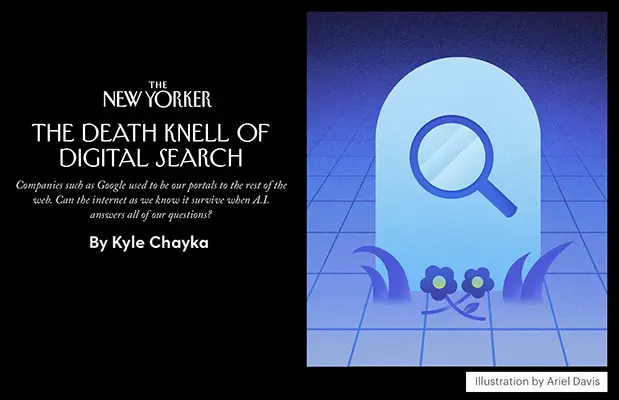
THE DEATH KNELL OF DIGITAL SEARCH
The New Yorker (Infinite Scroll column) · Kyle Chayka · November 9, 2026
TL;DR: AI-generated answers are replacing search clicks — weakening Google’s ad economics and starving websites of referral traffic — and SMBs that depend on search for discovery should treat declining organic traffic as structural, not cyclical.
SUMMARY
Chayka’s column is part personal complaint — AI summaries crowding out ordinary search in Gmail, Maps, and Google — and part market argument. The market evidence is the more important half: Google executives acknowledged weaker monetization on AI-driven searches, and Alphabet shares then fell by nearly a quarter in one day, erasing about $500 billion. When users get answers without clicking through, the ads around those answers lose value, and so does the traffic publishers and merchants rely on.
Competitive pressure compounds the problem. An OpenAI executive claims ChatGPT now handles about one-fifth of Google’s volume of search-like queries — a company claim, not independently verified — and Menlo Ventures data cited in the piece shows Gemini’s share of business AI spending falling sharply year over year. Websites are responding defensively: Reddit reported search referrals down by more than a million a week in October and is moving toward requiring logins, trading casual discoverability for protection from AI scraping.
Read the headline as framing. The author argues the open web is giving way to AI-mediated walled gardens, citing Google’s move to tie Gemini to Search access in its education suite. That is a reasonable read of the incentives — massive AI infrastructure spending has to be recouped — but search isn’t dead. Its value as a free traffic source is eroding.
RELEVANCE FOR BUSINESS
- SEO-driven traffic is becoming less reliable. If customers get answers inside AI tools, fewer of them reach your site — even when your content informed the answer.
- Paid search economics may shift. Lower monetization on AI results could change ad formats, pricing, and placement; watch cost per lead rather than assuming last year’s benchmarks hold.
- Owned channels gain value: email lists, direct relationships, communities, and repeat customers are less exposed to platform changes.
- Gating content protects it from scraping but reduces discoverability — a trade-off every content-producing business will face.
- AI features bundled into core platforms raise vendor-dependence and lock-in questions for software decisions.
CALLS TO ACTION
🔹 Act now: Pull organic search referrals for the past 12–18 months from your analytics and flag any sustained decline.
🔹 Assign internal review: Check whether your business appears accurately in AI assistant answers for your core products and services — the new storefront check.
🔹 Test cautiously: Structure key content so AI tools can cite it (clear facts, FAQs, pricing, locations), and measure whether it actually drives inquiries.
🔹 Prepare policy: Decide which content you want AI systems to crawl and which you want gated or protected.
🔹 Monitor: Google’s ad-product changes for AI results and any movement in your paid-search cost per lead.
Summary by ReadAboutAI.com
https://www.newyorker.com/culture/infinite-scroll/the-death-knell-of-digital-search: November 16, 2026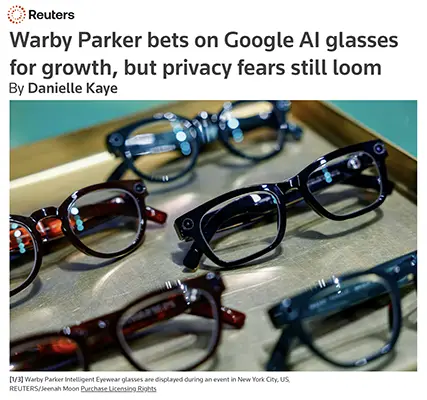
Warby Parker Bets on Google AI Glasses for Growth, but Privacy Fears Still Loom
Reuters | Danielle Kaye | November 12, 2026
TL;DR: Warby Parker is entering the AI glasses market with Google and Samsung and treating privacy as a selling point. Public distrust and venue-level bans are now the category’s main constraint, not the technology.
Executive Summary
Warby Parker’s new Gemini-powered smart glasses work much like Meta’s Ray-Ban and Oakley models, which held over 80% of AI glasses shipments in the first half of 2026. The pitch is privacy built in from the start. Google says it won’t train AI on footage from the glasses. The glasses block facial recognition of bystanders, redact faces before video reaches Gemini, ban targeted ads, and have a recording light that’s hard to tamper with. Google’s XR lead openly admits that in this category, “understandably, trust was lost.” Investors are already pricing in success: Warby shares are up nearly 40% this year, and management expects the glasses to add several points to Q4 revenue growth.
Read these privacy features as company commitments, not proven safeguards. Meta also has a recording light, so the real difference depends on policy and enforcement, which haven’t been tested at scale. Restrictions are growing. A major UK pub chain limits the glasses, Norway plans temporary bans in certain locations, and Australia is considering a ban in government workplaces. Shipment growth has also slowed since late 2025. Privacy advocates point out that no-training promises don’t address the core concern: strangers recording other people.
Relevance for Business
As more brands and price points arrive, camera-equipped glasses will show up in your workplace, stores and client meetings, whether you allow them or not. That affects confidentiality in meetings, customer privacy, trade-secret protection and employee monitoring, especially in healthcare, legal, finance, retail and anywhere with sensitive screens or documents. There’s also a vendor angle: Google, Meta and their partners are building a new consumer AI interface that could eventually affect how customers search, shop and find businesses.
Calls to Action
🔹 Prepare policy: Write workplace and on-premises rules for recording wearables, covering where they’re allowed, consent and signage.
🔹 Assign internal review: Identify settings where covert recording would create legal or confidentiality exposure.
🔹 Monitor: Track regulatory moves such as Norway’s and Australia’s, which could become templates elsewhere.
🔹 Ignore for now: Hold off on building customer-facing experiences for AI glasses until adoption and trust stabilize.
Summary by ReadAboutAI.com
https://www.reuters.com/business/retail-consumer/warby-parker-bets-google-ai-glasses-growth-privacy-fears-still-loom-2026-11-12/: November 16, 2026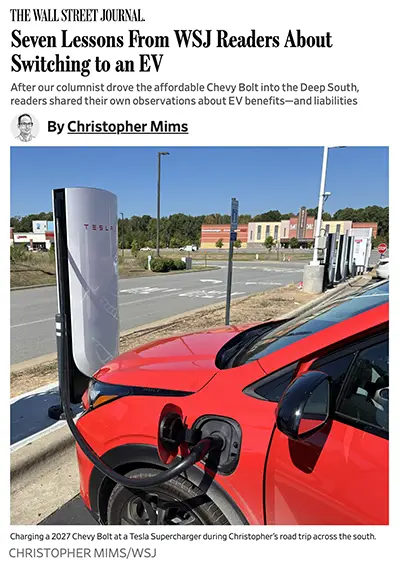
Seven Lessons From WSJ Readers About Switching to an EV
The Wall Street Journal · Christopher Mims · November 12, 2026
| TL;DR / Reader feedback on EV ownership finds the economics work best with home charging and predictable driving patterns, while AI-powered driver assistance is increasingly part of the purchase decision — useful context for any business weighing fleet electrification. |
Executive Summary
Drawing on roughly 2,000 reader responses to a Deep South road trip, Mims argues that common objections are often overstated: fast-charging stops roughly match normal road-trip breaks, and home charging makes per-mile costs far lowerthan gasoline, while maintenance needs drop sharply. The real limits are concrete — long daily mileage, very cold climates (range losses of a quarter or more), towing, and no access to home or depot charging.
The AI-relevant thread is driver-assistance technology such as GM’s Super Cruise and Tesla’s Full Self-Driving. Readers cite reduced fatigue and, for some older drivers, retained independence. Mims notes these systems can disengage suddenly or behave erratically and still require an attentive driver — the gap between marketing and supervised reality matters, particularly for liability.
Editor’s note: This is AI-adjacent coverage— the AI angle is limited to driver-assistance systems.
Relevance for Business
– Fleet economics hinge on charging access and route patterns, not vehicle price alone; short, predictable routes with depot charging favor EVs.
– Driver-assistance features carry liability and policy questions for business vehicles — who is responsible when a supervised system errs?
Calls to Action
◆ Assign internal review: If evaluating fleet EVs, model costs against actual routes, climate, towing needs, and charging access.
◆ Prepare policy: Set rules for employee use of driver-assistance features in company vehicles.
◆ Revisit later: Reassess as longer-range, lower-cost models reach the market.
Summary by ReadAboutAI.com
https://www.wsj.com/business/autos/electric-vehicles-pros-cons-438709ac: November 16, 2026
THE WORST THING ABOUT AI WRITING
The Atlantic · Kyle Berlin · November 11, 2026
TL;DR: A French literary-prize scandal over a novel allegedly written with AI shows how quickly AI-authorship accusations become reputational and political firestorms — and how weak current tools are for settling them.
SUMMARY
Haitian Canadian author Thélyson Orélien’s novel became a French best seller and prize winner this fall before an anonymous account published AI-detection results claiming the analyzed chapters were entirely machine-written. Admitted plagiarism in his earlier work followed, the Goncourt academy disqualified him, and his Quebec publisher later said he had used AI and cut ties — though his French publisher still sells the book. Orélien has denied the AI allegations and condemned the backlash.
The episode split quickly along political lines. Critics on the left questioned the reliability of AI detectors and noted that accusations have fallen disproportionately on Black writers; critics on the right cast it as proof that literary institutions reward ideology over quality. The detection evidence itself sits in a gray zone — the article cites research suggesting the tool’s false-positive rate is low, but detector output is probabilistic evidence, not proof. Tellingly, this year’s Goncourt winner openly acknowledged light ChatGPT use, and it was treated as a joke rather than a scandal because it was disclosed.
Berlin’s own argument — this is criticism, not reporting — is that the deeper problem predates AI: readers and institutions can mistake a worthy cause for good work, and AI’s ease may flood the field with competent-sounding but flat writing, marked by tells such as repetitive “not X, but Y” constructions and stilted dialogue.
Note: The uploaded copy ends mid-sentence; this summary reflects the available text.
RELEVANCE FOR BUSINESS
- Disclosure is the dividing line. The same behavior was a scandal when concealed and a shrug when acknowledged — a direct lesson for marketing, communications, and client-facing content.
- AI detectors are being used as public evidence, sometimes by anonymous accusers. Businesses that publish content, or evaluate work from staff, freelancers, or applicants, face risk from both undisclosed AI use and false accusations.
- Generic AI prose is increasingly recognizable, and content that reads as machine-made can erode customer trust even when it is accurate.
- Using detection scores to discipline staff or reject vendors carries fairness and legal exposure, especially where bias concerns exist.
CALLS TO ACTION
🔹 Prepare policy: Set a clear AI-disclosure standard for published and client-facing content: what requires disclosure, and how.
🔹 Assign internal review: Keep drafting and editing records for important content so provenance can be shown if questioned.
🔹 Test cautiously: If you use AI detectors in hiring, freelance review, or training, treat results as a prompt for conversation, not a verdict.
🔹 Act now: Edit AI-assisted drafts for generic patterns and voice before publishing — quality, not just accuracy, protects reputation.
Summary by ReadAboutAI.com
https://www.theatlantic.com/books/2026/11/french-ai-literary-scandal-and-black-writers/689375/: November 16, 2026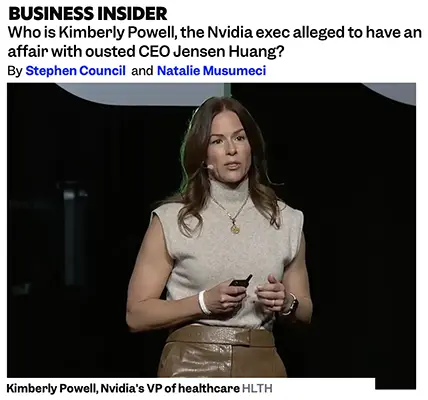
WHO IS KIMBERLY POWELL, THE NVIDIA EXEC ALLEGED TO HAVE AN AFFAIR WITH OUSTED CEO JENSEN HUANG?
Business Insider | Stephen Council and Natalie Musumeci | November 12, 2026
Explainer, partly paywalled. Key news: Huang resigned as CEO Thursday, Nov 12.
TL;DR: The affair with a direct report turned a murky national-security controversy into a clear conflict-of-interest breach. That gave the board a clean basis to act, and Huang resigned.
Executive Summary
Business Insider reports that Huang resigned Thursday, a day after the NYT reported his relationship with Powell, Nvidia’s VP of healthcare, who reported directly to him and had worked with him for 18 years. Nvidia’s code of conduct, which opens with a letter from Huang, lists personal relationships as a potential conflict of interest. The board backed Huang through contested espionage claims, then lost confidence within a day once a reporting-line relationship surfaced. Sensitivity note: The useful material is the governance mechanics, not the individual’s biography.
Relevance for Business
- Clear policy breaches end careers faster than contested allegations.
- Conflict-of-interest policies only matter if they apply at the top.
- Nvidia’s healthcare AI unit faces leadership disruption.
Calls to Action
🔹 Prepare policy: Make sure relationship and conflict-of-interest rules explicitly cover senior leaders and include a disclosure path that bypasses the person involved.
🔹 Monitor (healthcare and life sciences firms): Changes in Nvidia’s healthcare group.
🔹 Ignore for now: Personal details.
Summary by ReadAboutAI.com
https://www.businessinsider.com/kimberly-powell-nvidia-exec-tied-to-jensen-huang-2026-11: November 16, 2026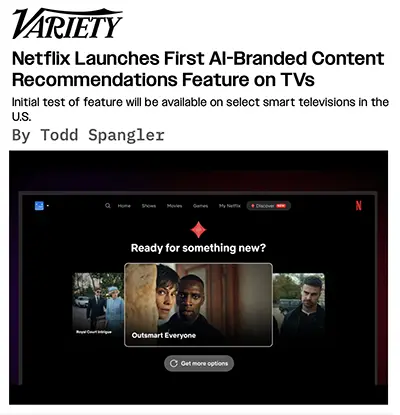
NETFLIX LAUNCHES FIRST AI-BRANDED CONTENT RECOMMENDATIONS FEATURE ON TVS
Variety | Todd Spangler | November 3, 2026
TL;DR: Netflix has used AI behind the scenes for years, but this is the first feature it’s labeling as AI, and it’s aimed at reversing a drop in viewer engagement. Using the AI label in the product is now a deliberate business choice, not just a technical detail.
Executive Summary
Source type: news report built mostly on a company announcement. AI Discover is rolling out to a limited group of English-language U.S. subscribers on smart TVs. Instead of the usual rows of titles, viewers pick a theme based on mood, audience or available time, and the app generates personalized recommendations in real time. Viewers can refine the results or tell Netflix not to show certain titles again. It isn’t a chatbot, and it’s excluded from kids’ profiles. Netflix calls it its “test kitchen” and suggests that features that work may move into the main app.
Separate what’s new from the framing. Personalized recommendations aren’t new; they’ve been at the core of Netflix for more than a decade. What’s new is putting AI in front of customers and tying it directly to a business problem: viewing per subscriber has dropped, enough that Netflix recently replaced its content chief. Whether a new way to browse can fix an engagement problem that’s really about content is unproven. The broader point is that Netflix is putting AI across its business: generative AI in about 300 productions, and a $587 million acquisition of an AI filmmaking-tools company this spring.
Relevance for Business
This is a model for how established companies are deploying customer-facing AI: limited rollout, a narrow use case, guardrails (no kids’ profiles), customer feedback built in, and no open-ended chatbot. That’s a sensible, low-risk pattern for SMBs adding AI to their own products or customer experience. It also shows that calling something “AI” is a marketing decision. Use the label where it helps customers, and don’t oversell what’s really an incremental improvement.
Calls to Action
🔹 Test cautiously: If you’re adding AI to customer-facing tools, start with a narrow, guided use case before trying open-ended chat.
🔹 Prepare policy: Decide when and how you label features as AI-powered, and which customer groups (such as minors) should be excluded.
🔹 Monitor: Watch whether Netflix expands AI Discover. That would be evidence the approach is lifting engagement.
Summary by ReadAboutAI.com
https://variety.com/2026/tv/news/netflix-launches-ai-discover-content-recommendations-1236937769/: November 16, 2026
WINNEBAGO HO!
Business Insider · Rani Molla · November 11, 2026 · Industry Watch
TL;DR: The AI data center construction boom is creating a temporary local economy — RV dealers and campgrounds near sites are thriving on worker-housing demand — but that demand has a built-in end date and growing political headwinds.
SUMMARY
Traveling crews building AI data centers are increasingly buying RVs and travel trailers instead of paying for scarce or expensive local lodging, using per diems to finance housing they can take to the next job. That demand is propping up an RV industry otherwise in a slump — US wholesale shipments were down 13.7% year to date through September — with one Texas dealer estimating that about half its business now comes from data center workers, up from roughly 15–20% from all project workers before the buildout.
The effects are operational as well as financial. Campgrounds built for tourists are effectively becoming landlords, handling long-term tenants, late rent, package deliveries, and heavier facility wear, with waitlists at some parks. A worker-housing operator near Meta’s Louisiana campus has grown from 300 to 1,500 beds and expects to double again. Dealers have adapted their marketing, from geofenced ads targeting phones near construction sites to hotel-versus-RV cost calculators.
The demand is project-bound. Meta expects more than 7,500 jobs at its Louisiana campus during peak construction but about 1,000 once it is operating. Political resistance is also rising: Texas — roughly one in five planned or under-construction US data center buildings — elected a governor who backs a statewide moratorium on new approvals, and several localities voted to restrict or ban new facilities. Hastily built RV parks may be worth little once crews move on.
RELEVANCE FOR BUSINESS
- The AI buildout creates real but temporary local demand for housing, food, services, trades, and retail near construction sites — a boom-and-bust pattern, not durable growth.
- Don’t build fixed capacity on construction-phase demand. Operating-phase employment is a fraction of the peak.
- Geofenced advertising is a practical, low-cost model for any local business targeting a concentrated, temporary workforce.
- Political risk is now part of the data center equation — moratoriums and local bans can stall projects local businesses are counting on.
CALLS TO ACTION
🔹 Monitor: If you operate near a planned or active data center site, track project timelines and local approval politics closely.
🔹 Test cautiously: Short-term offers or services aimed at construction crews, without long-term capital commitments.
🔹 Revisit later: How operating-phase employment and local tax effects compare with construction-phase projections.
Summary by ReadAboutAI.com
https://www.businessinsider.com/data-center-workers-living-in-rv-park-housing-per-diem-2026-11: November 16, 2026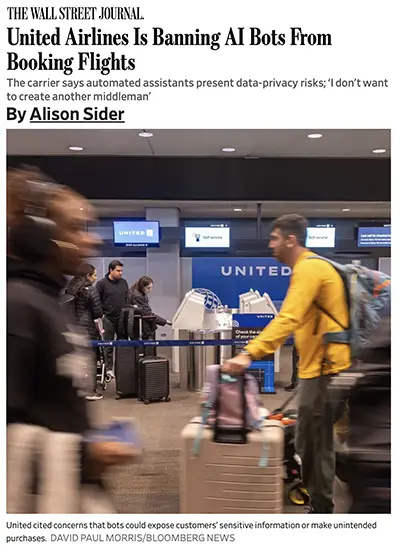
UNITED AIRLINES IS BANNING AI BOTS FROM BOOKING FLIGHTS
The Wall Street Journal · Alison Sider · November 11, 2026
TL;DR: United will block personal AI agents from completing purchases on its systems — an early, high-profile sign that agentic commerce will be gated by the companies that own the customer relationship, not just by what the technology can do.
SUMMARY
United says third-party AI assistants can still surface its fares and schedules but won’t be allowed to transact on its site. The stated rationale is data privacy, unintended purchases, and regulatory compliance: federal rules require travelers to see certain disclosures and make certain attestations — such as confirming their bags carry no explosives — that an agent cannot legitimately make on a passenger’s behalf.
The safety framing is real, but it isn’t the whole story. CEO Scott Kirby openly said he doesn’t want a new intermediary between United and its customers — a replay of the airline industry’s long fight with online travel agencies over fare display and ad reach. The underlying contest is over who owns the customer relationship. United joins Amazon in keeping purchasing bots out, while peers are split: Delta permits authenticated agents with extra safeguards on sensitive bookings, American allows some agent purchases through partners, and Southwest is testing a ChatGPT plug-in.
The policy is largely preemptive. United says agent bookings remain rare, and Uber’s figures show how early this is: across roughly 320 million Halloween-week trips and orders, AI agents placed about 500 food orders and four ride bookings. But with OpenAI (via its Odessia acquisition) and Meta (Muse) pushing hard into travel planning, pressure to set a policy will rise faster than actual volume.
RELEVANCE FOR BUSINESS
- If you sell online, you will soon need a deliberate AI-agent policy — block, allow, or allow only authenticated agents. Doing nothing is a choice too, and it defaults to whatever the platforms decide.
- Agents threaten what United is protecting: direct customer data, upsell opportunities, and advertising reach. For SMBs built on direct relationships, that is a strategic exposure, not a technical one.
- Blocking has costs as well. If agents become a meaningful discovery channel, businesses that can’t be transacted with may simply be routed around. Large brands can afford to wait; smaller ones have less leverage.
- Liability is unsettled: who is responsible when an agent makes an unintended purchase — the customer, the agent provider, or the merchant? Expect refunds and chargebacks to test this.
CALLS TO ACTION
🔹 Assign internal review: Check whether your e-commerce, booking, or account systems can identify agent-driven traffic and transactions today. United can; many SMB platforms can’t.
🔹 Prepare policy: Draft a position on agent transactions covering authentication, purchase limits, refunds, and which actions (attestations, signatures, age-restricted items) always require a human.
🔹 Test cautiously: If agents could plausibly drive sales in your category, consider read-only exposure (pricing and availability) before allowing full checkout.
🔹 Monitor: Whether Delta’s authenticated-agent model or the Amazon/United blocking stance becomes the norm — that split will shape what platforms and payment providers standardize on.
🔹 Ignore for now: Rebuilding sales channels around agent volume. Current numbers don’t justify it.
Summary by ReadAboutAI.com
https://www.wsj.com/tech/ai/united-airlines-is-banning-ai-bots-from-booking-flights-5b514b38: November 16, 2026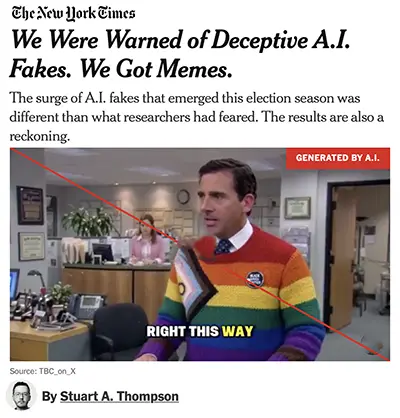
WE WERE WARNED OF DECEPTIVE A.I. FAKES. WE GOT MEMES.
The New York Times | Stuart A. Thompson | November 12, 2026
TL;DR: The feared election-eve deepfake never showed up in the 2026 midterms. Instead AI fakery mostly took the form of absurd memes. The threat hasn’t gone away; it has changed shape and moved toward persuasion, ridicule and private channels.
Executive Summary
Researchers have warned before every U.S. election since 2020 that a convincing deepfake could swing results. In 2026, the dominant form of AI content was parody: obviously fake videos of candidates and celebrities dancing, celebrating or being mocked, some with millions of views. Experts found no case of a viral, election-changing deepfake passed off as real footage. Canadian research found a similar pattern: memes and jokes got the large majority of views of AI election content.
That’s a partial relief, not an all-clear. Hundreds of AI-generated political ads ran, some deceptive and undisclosed. A few targeted candidates with realistic fake statements, and some memes used racist stereotypes. Researchers say the more dangerous fakes now target partisans who are already inclined to believe them and spread through group chats and private groups, where they’re harder to monitor or correct. As one researcher put it, the threat “is taking different forms than what we expected.” Even obvious fakes can make criticism stick in people’s minds.
Relevance for Business
The same pattern applies to companies. The likelier risk isn’t one perfect fake. It’s ongoing ridicule, misleading parody and targeted content in closed channels aimed at your brand, leaders or products. Monitoring public social media alone will miss a lot of it. Disclosure rules for AI-generated ads are also likely to tighten after this cycle, which could affect your own marketing.
Calls to Action
🔹 Monitor: Watch for new state or federal disclosure rules on AI-generated advertising.
🔹 Prepare policy: Set internal standards for labeling AI-generated content in your own marketing.
🔹 Revisit later: Update your reputation-monitoring approach to account for content spreading in private groups and messaging apps.
Summary by ReadAboutAI.com
https://www.nytimes.com/2026/11/12/technology/artifical-intelligence-fakes-midterm-memes.html: November 16, 2026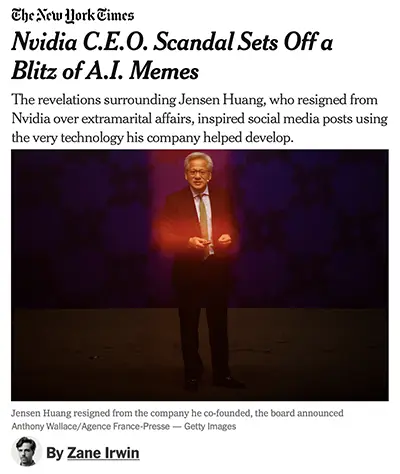
NVIDIA C.E.O. SCANDAL SETS OFF A BLITZ OF A.I. MEMES
The New York Times | Zane Irwin | November 12, 2026
TL;DR: The internet turned Huang’s scandal into a wave of AI-generated videos made with the technology his chips power. Realistic fakes of any public executive now take minutes and a few photos, and labels don’t stop people from believing them.
Executive Summary
Within days of the revelations, AI-generated parodies put Huang into music videos, movie scenes and the viral concert “kiss-cam” moment. Several of the clips reached millions of views. Many were made by AI enthusiasts who admired Huang. One creator said he produced a convincing face-swap video in about five minutes using four images found on Google and a readily available AI tool. Another made his with an open-source tool on his phone without getting out of bed.
The key detail is how people reacted, not the jokes. Many clips were labeled as AI-generated, yet one creator was surprised how many viewers still asked, “Is this real?” Labeling helps but doesn’t settle the question of trust. The irony that Nvidia’s own technology made this possible is a sideshow. The durable point is that the cost and skill needed to make believable fake video of a real person has dropped to nearly zero.
Relevance for Business
Any executive or business with photos online can now be faked convincingly. Parody can quickly turn into impersonation, fraud or reputational damage, such as fake CEO videos used in payment scams or misleading clips that spread faster than corrections. Most SMBs don’t have a playbook for responding when synthetic media of their leaders goes viral.
Calls to Action
🔹 Prepare policy: Set a response plan for synthetic media involving your leaders or brand: who checks, who responds, and how.
🔹 Act now: Require out-of-band verification for any payment or sensitive request made by video or voice, even when it appears to come from a known executive.
🔹 Monitor: Track platform labeling and takedown policies and how consistently they’re enforced.
Summary by ReadAboutAI.com
https://www.nytimes.com/2026/11/12/world/asia/nvidia-ceo-huang-ai-memes.html: November 16, 2026
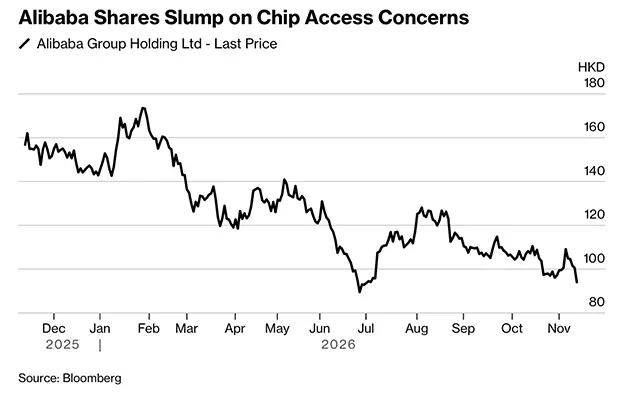
ALIBABA SHARES DROP 7% AS NVIDIA SAGA TRIGGERS CHIP ACCESS FEARS
Bloomberg News | Jeanny Yu | November 11, 2026
TL;DR: The scandal is becoming an export-enforcement story. Chinese AI stocks fell on fears that the gray market for restricted Nvidia chips is about to be shut down.
Executive Summary
Alibaba, which rents Nvidia chips through Megaspeed, fell as much as 7.3%, and model makers Z.AI and MiniMax dropped at least 8%. Analysts say Chinese clouds stockpiled chips this year, but a long crackdown would delay their AI development. One researcher called the gray market “an open secret and a glaring loophole” in U.S. controls. Nvidia’s China lobbying is now compromised, and Beijing is warning Washington not to use the scandal to justify new restrictions. Fact vs. speculation: The share moves are fact. A crackdown is analyst expectation.
Relevance for Business
- Expect more paperwork, end-use checks and delays for anyone buying or reselling GPUs internationally.
- Chinese models’ pricing pressure on U.S. AI services could ease, or those models could become less dependable as options.
- Geopolitics is now a pricing input for AI services.
Calls to Action
🔹 Monitor: New Commerce actions against intermediaries in Southeast Asia.
🔹 Test cautiously: If you use Chinese-developed models or APIs, keep a fallback ready.
🔹 Revisit later: The outcome of the U.S.-China leaders’ meeting.
Summary by ReadAboutAI.com
https://www.bloomberg.com/news/articles/2026-11-12/alibaba-shares-drop-7-as-nvidia-saga-triggers-chip-access-fears: November 16, 2026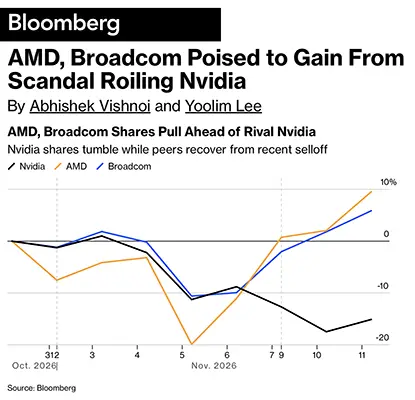
AMD, Broadcom Poised to Gain From Scandal Roiling Nvidia
Bloomberg · Abhishek Vishnoi and Yoolim Lee · November 12, 2026
| TL;DR / Investors are betting that Nvidia’s leadership turmoil opens a window for rivals — AMD, Broadcom, and Google’s custom chips — but switching away from Nvidia remains slow and costly, so near-term market-share shifts are more likely to be modest than dramatic. |
Executive Summary
AMD and Broadcom shares rose while Nvidia fell nearly 7% in premarket trading after a Wall Street Journal report that Nvidia’s board was preparing to remove Huang; the company is reportedly working with an outside firm on potential successors and has no clear succession plan. The concentration at stake is large: Nvidia accounted for more than 60% of AI computing supply in the second quarter, per Epoch AI estimates — more than double runner-up Alphabet.
Analysts quoted see AMD (GPUs) and Broadcom and Alphabet (custom AI chips) as near-term beneficiaries, with Samsung potentially gaining if new leadership reshuffles suppliers. Chinese chipmakers could benefit if US export scrutiny tightens. But the article’s own sources add the important caveat: custom chips can’t replace GPUs across the board, and migrating AI workloads is expensive and slow. Note too that this is investor positioning, not evidence of customers actually switching — and analyst commentary about rivals’ gains carries its own market incentives.
The larger signal is about single-supplier dependence. A leadership crisis at the dominant AI chip vendor is prompting the whole industry to reconsider concentration risk — the same question smaller firms face with their own AI vendors.
Relevance for Business
– SMBs don’t buy AI chips, but they inherit the supply chain. Cloud AI pricing and capacity depend heavily on Nvidia; disruption there could affect the cost and availability of the AI services you use.
– Diversification is becoming mainstream strategy. Large cloud providers will likely expand alternatives to Nvidia, which over time could add more pricing competition in AI compute.
– Leadership and key-person risk at vendors is real — and it can reach customers even when the product itself is unaffected.
– The US–China dimension (export rules, trade negotiations) adds geopolitical uncertainty to AI hardware supply.
Calls to Action
◆ Monitor: Nvidia’s succession decision and whether major cloud providers shift AI workloads toward alternative chips.
◆ Assign internal review: Identify where your critical AI tools depend on a single underlying provider, and what a disruption would mean for cost or service.
◆ Revisit later: AI compute pricing over the next two to three quarters; more competition could eventually lower costs.
◆ Ignore for now: Investment-driven “winners and losers” narratives; they don’t change near-term SMB tool decisions.
Summary by ReadAboutAI.com
https://www.bloomberg.com/news/articles/2026-11-12/nvidia-turmoil-lifts-amd-broadcom-on-bets-for-business-gains: November 16, 2026
HOW ANTHROPIC STACKS UP AGAINST SOME OF THE BIGGEST US IPOS
Reuters | Shashwat Chauhan | November 12, 2026
TL;DR: Anthropic is pursuing one of the largest IPOs ever, at a valuation of up to $1.4 trillion. It will be a public test of whether investors still believe in AI returns as costs, rates and regulatory risk rise.
Executive Summary
Thin source: mostly a chart comparison; the text is brief. Anthropic and some existing shareholders aim to raise up to about $64 billion in the IPO, plus $26 billion through a separate private placement with cornerstone investors Google, Nvidia and AMD. Only SpaceX’s $75 billion offering in June was larger. The deal is going ahead despite a recent tech selloff driven by doubts about AI returns, higher borrowing costs and post-election regulatory uncertainty. A Swissquote analyst calls it “an important test of appetite for AI-related investments.”
Two points stand out. First, the cornerstone investors are also Anthropic’s suppliers: chipmakers and a cloud provider whose revenue depends on AI labs buying compute. That’s the same circular-financing pattern behind the neocloud selloff (see Article 26), and Nvidia’s participation comes just as its own leadership is in turmoil. Second, a valuation this large bets on future revenue, not current earnings. How the IPO performs will tell you a lot about how much capital the AI sector can keep drawing in.
Vendor-neutrality note: ReadAboutAI.com uses Claude (Anthropic) in production. This summary is not an endorsement or an investment view.
Relevance for Business
For SMBs that use Claude or other frontier AI models, a successful IPO would give Anthropic more capital for capacity, product development and stability. It would also bring public-market pressure toward revenue growth, which could eventually show up in pricing, packaging or enterprise focus. A weak debut would signal tighter funding across the AI sector, with possible knock-on effects for smaller AI vendors that depend on investor money.
Calls to Action
🔹 Monitor: Track pricing day and early trading as a gauge of AI funding conditions overall.
🔹 Revisit later: After the IPO, review your AI vendors’ pricing and terms for changes driven by public-market pressure.
🔹 Ignore for now: For operational decisions, the IPO headlines don’t change which AI tools you should use today.
Summary by ReadAboutAI.com
https://www.reuters.com/legal/transactional/how-anthropic-stacks-up-against-some-biggest-us-ipos-2026-11-12/: November 16, 2026
ANTHROPIC TO SEEK $1.3 TRILLION VALUATION IN IPO
The Wall Street Journal · Berber Jin and Corrie Driebusch · November 10, 2026
TL;DR: Anthropic has set an IPO range valuing it at roughly $1.26–$1.41 trillion — a meaningful markdown from earlier expectations that signals investors are demanding more discipline on AI valuations, even for a fast-growing company.
Vendor-neutrality disclosure: ReadAboutAI.com uses Anthropic’s Claude in its editorial production. This summary reports on Anthropic and should be read with that relationship in mind. Nothing here is investment advice.
SUMMARY
According to its filing, Anthropic plans to sell 825 million shares at $70–$78 each, raising about $61 billion at the midpoint, alongside a separate ~$26 billion placement with large investors including Google and AMD. Shares are expected to begin trading on Nasdaq under the ticker ANT next week, per people familiar with the matter. The company disclosed an annualized revenue run rate of about $81 billion as of the end of October.
The more telling detail is the price cut. A valuation near $2 trillion had been floated months earlier, and investors expected about $1.5 trillion as recently as a week before the filing; after last Thursday’s steep selloff in AI stocks, major investors pushed the range lower. That fits a broader pattern — OpenAI’s latest round reportedly raised less than half its target at a below-target valuation. Co-founders also plan modest share sales (about $250 million each), which is routine but worth noting.
The IPO is being treated as a barometer for the whole AI trade: a strong debut would ease doubts about whether AI spending can pay off; a weak one would reinforce them. Keep in mind that run rate is a forward estimate, not reported annual revenue, and the midpoint valuation works out to roughly 16 times that figure (our calculation) — a price that assumes continued rapid growth.
RELEVANCE FOR BUSINESS
- Vendor stability cuts both ways. A large IPO brings substantial capital and public disclosure obligations — more transparency for business customers — but also quarterly earnings pressure that can shape pricing, product priorities, and contract terms.
- The AI market is repricing. Lower valuations across leading labs suggest investors want evidence of returns; expect vendors to push harder on monetization through price changes, usage tiers, and enterprise upsells.
- Concentration risk: deep financial ties between AI labs and big tech (Google and AMD participate here) reinforce dependence on a small number of providers.
- The relevance for SMBs isn’t the stock — it’s what public-market pressure does to the tools you buy.
CALLS TO ACTION
🔹 Monitor: IPO pricing and early trading as a read on AI market sentiment — and whether vendors tighten pricing afterward.
🔹 Assign internal review: List the AI vendors your business depends on and review contract terms for pricing changes and data use.
🔹 Prepare policy: Avoid single-vendor dependence for critical workflows where practical; keep a tested alternative.
🔹 Ignore for now: Changing AI tool choices based on IPO headlines. Fit, cost, and reliability should drive those decisions.
Summary by ReadAboutAI.com
https://www.wsj.com/wsjplus/dashboard/articles/anthropic-ipo-valuation-8337b669: November 16, 2026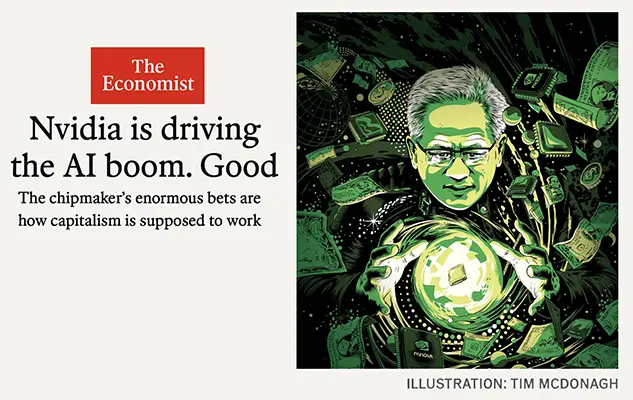
NVIDIA IS DRIVING THE AI BOOM. GOOD.
The Economist (Leaders / cover editorial) | September 3, 2026
Opinion. Published about two months before the scandal, included as pre-crisis context.
TL;DR: Weeks before the crisis, The Economist argued that Nvidia’s roughly $1 trillion in customer-financing deals was sound capitalism, not a bubble. In hindsight, it shows how much AI-boom risk sat with one company and one leader, a risk the editorial never considered.
Executive Summary
The editorial acknowledges the bear case: Cisco-style vendor financing, credit exposure that could reach $200 billion by 2029 per Morgan Stanley, a growing share of the market going to competitors’ chips, and shrinking R&D intensity. It then rests the bull case on $99 billion in cash, about $200 billion in annual cash generation and fast-growing AI revenue, and concludes that shareholders bear the downside: “That is how capitalism is supposed to work.”
Editorial evaluation: The financial analysis holds up, but the piece frames risk only in terms of markets and demand. It celebrates Huang’s star status without weighing key-person, governance or geopolitical risk, which is exactly what hit. And its claim that losses fall chiefly on shareholders sits awkwardly next to its own figures on Nvidia’s weight in the market.
Vendor-neutrality note: This piece cites Anthropic’s revenue as evidence of AI demand. ReadAboutAI.com uses Anthropic’s Claude in production.
Relevance for Business
- When your chip supplier also finances your AI vendors, risk compounds.
- A strong balance sheet did not protect Nvidia from a leadership crisis.
- Judge bullish analysis by what it leaves out.
Calls to Action
🔹 Assign internal review: Map which AI vendors depend on Nvidia financing or allocation, and where you have alternatives.
🔹 Monitor: Whether new leadership pulls back on customer financing.
🔹 Ignore for now: The abstract bubble debate.
Summary by ReadAboutAI.com
https://www.economist.com/leaders/2026/09/03/nvidia-is-driving-the-ai-boom-good: November 16, 2026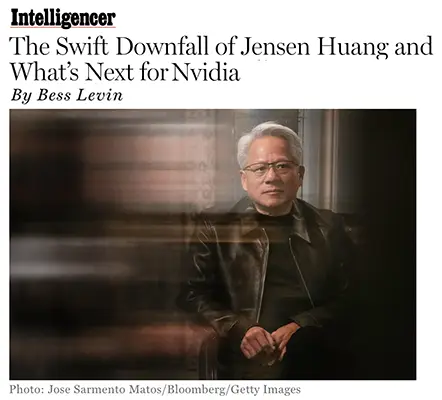
THE SWIFT DOWNFALL OF JENSEN HUANG AND WHAT’S NEXT FOR NVIDIA
New York Magazine / Intelligencer | Bess Levin | November 12, 2026
Commentary-heavy timeline. Satirical, politically pointed tone. Most facts are aggregated from the NYT, WSJ and Bloomberg.
TL;DR: In two weeks, Huang went from public denial to resignation. The most useful detail for business readers is that a federal export-control investigation into an Nvidia customer was reportedly paused after Nvidia’s lawyer contacted investigators, which points to a governance and political-access problem larger than one executive.
Executive Summary
The piece lays out the sequence:
- Oct. 29: Intelligence concerns are reported, and Huang calls his dealings with Alice Huang “completely normal and not unusual.”
- Nov. 5–7: Lawmakers from both parties demand answers.
- Nov. 8: Huang admits the affair, and the board says it has confidence in him.
- Nov. 10: Wachtell Lipton is hired to run the investigation.
- Nov. 11: The second affair is reported.
- Nov. 12: Huang resigns. Colette Kress becomes interim CEO, and Nvidia names its first-ever board chair. Shares fall about 11%.
Three details, all reported first elsewhere, stand out:
- A classified memo warned administration officials about the relationship last year.
- The Commerce investigation into Megaspeed reportedly stalled after Nvidia’s general counsel emailed investigators.
- When a bystander filmed Huang with Powell, his security staff reportedly asked the person to sign an NDA.
Fact vs. framing: The timeline is useful, but much of the piece is political commentary. Treat its characterizations as opinion and its facts as secondhand.
Relevance for Business
- Initial denials age badly. The 10 days between “completely normal” and the admission are central to the legal exposure.
- Political closeness cuts both ways. Nvidia’s influence in Washington now invites scrutiny from both parties, and that could produce harsher export rules.
- The governance repairs are basic. A first independent chair and an outside investigator are standard fixes for a company of Nvidia’s size.
Calls to Action
🔹 Assign internal review: Check whether executives can contact regulators about investigations involving your company or partners without legal and board oversight.
🔹 Monitor: Congressional probes into Nvidia’s export dealings and the stalled Commerce case.
🔹 Prepare policy: Set rules for how security staff and executives handle incidents involving leadership. Using NDAs to suppress evidence creates legal and reputational risk.
🔹 Ignore for now: The political commentary.
Summary by ReadAboutAI.com
https://nymag.com/intelligencer/article/jensen-huang-nvidia-downfall.html: November 16, 2026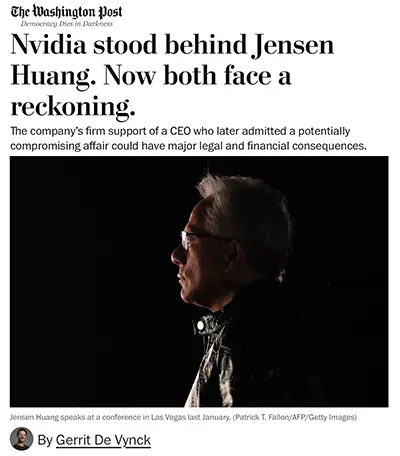
Nvidia Stood Behind Jensen Huang. Now Both Face a Reckoning.
The Washington Post | Gerrit De Vynck | November 12, 2026
TL;DR: The story has moved from espionage to legal and governance exposure. Huang’s earlier denials may support securities-fraud claims, a shareholder lawsuit has already been filed, and experts say Nvidia’s board lacked the national-security expertise its business required.
Executive Summary
On Sunday, Nvidia’s board said it “has confidence in Jensen,” and President Trump said he believed Huang. By Wednesday, after reports of a second affair, with an executive who reports to Huang, the board met to decide his future. The White House stayed out of it, and shares fell nearly 6% premarket.
Legal exposure is now the main issue. Nvidia and Huang denied the relationship before he admitted it. A law professor says: “Lying publicly about the company and about risks to the company is securities fraud.” A shareholder suit has been filed in California, and more are expected. Experts criticize a long-tenured board with limited national-security experience. Nvidia’s investments in its own customers, including OpenAI and Anthropic, mean its troubles could spread through the AI ecosystem. Fact vs. speculation: The lawsuit is real. Prosecution is one expert’s view of what’s possible. Huang’s removal was still pending when the article ran.
Vendor-neutrality note: This article mentions Nvidia’s investment in Anthropic. ReadAboutAI.com uses Anthropic’s Claude in its production workflow.
Relevance for Business
- Denying first and admitting later turns a reputational problem into a legal one.
- Board expertise needs to match the company’s risk profile.
- AI vendors are financially tied to one another, so Nvidia’s troubles could reach your AI tool providers.
- Key-person risk exists at every size.
Calls to Action
🔹 Act now: Review your crisis-communications protocol. Avoid categorical denials until the facts are verified.
🔹 Monitor: Nvidia’s leadership decision and its effect on roadmaps, chip allocation and pricing.
🔹 Monitor: Funding and pricing signals from AI vendors that depend on Nvidia capital.
🔹 Prepare policy: Document succession plans for the CEO and key executives.
Summary by ReadAboutAI.com
https://www.washingtonpost.com/technology/2026/11/12/nvidia-jensen-huang-denied-his-alleged-affair-then-story-changed/: November 16, 2026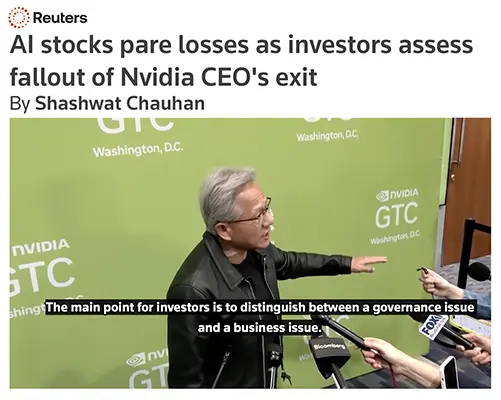
AI Stocks Pare Losses as Investors Assess Fallout of Nvidia CEO’s Exit
Reuters | Shashwat Chauhan | November 12, 2026
TL;DR: Huang’s exit hit the stocks of companies that rely on Nvidia’s money (the “neoclouds”) hardest, while rivals AMD and Broadcom gained. The bigger risk is that Nvidia’s role as the AI sector’s financier makes its leadership problems everyone’s problem.
Executive Summary
With CFO Colette Kress named interim CEO, Nvidia shares recovered from a drop of more than 14% during the day to close about 5% down. Bargain hunting and record retail buying helped. Even so, the company was on track to fall below a $4 trillion market value for the first time since mid-2025, after losing more than $1 trillion in a month. The pressure didn’t start with the scandal: rising rates, high tech debt, and regulatory worries after the midterms were already weighing on the stock.
The more revealing details are who fell and who rose. Nvidia-backed AI cloud providers CoreWeave and Nebius dropped sharply. Nebius also cut its 2026 revenue forecast because of capacity delays. Super Micro fell on reports of a possible DOJ probe tied to the scandal. One trader asked whether a weakened Nvidia, often called “the ‘Bank of AI'”, could cut off funding to smaller companies that depend on it. That’s the circular-financing risk: Nvidia invests in companies that buy its chips. Meanwhile AMD and Broadcom rose more than 4% each on the bet that turmoil at Nvidia opens doors for alternative chip suppliers. Nvidia’s earnings next week will be the first real test.
Relevance for Business
If your AI tools run on smaller GPU cloud providers or AI-first platforms funded by Nvidia, a funding squeeze could show up as price increases, capacity delays or provider instability. Nebius’s forecast cut is an early warning. The rivals’ stock gains also point to a possible move toward a more diverse chip and cloud supply over time, which could eventually ease pricing and lock-in. For now, it’s a vendor-concentration risk worth tracking.
Calls to Action
🔹 Assign internal review: Map which of your AI vendors depend on Nvidia-backed infrastructure or neocloud providers.
🔹 Monitor: Watch Nvidia’s upcoming earnings and any comments about its investment and financing commitments.
🔹 Test cautiously: For important AI workloads, check whether providers can run on alternative chips or major hyperscaler clouds.
🔹 Revisit later: Hold off on long-term infrastructure commitments to smaller GPU providers until the funding picture settles.
Summary by ReadAboutAI.com
https://www.reuters.com/business/retail-consumer/global-ai-stocks-sink-nvidia-crisis-deepens-sector-selloff-2026-11-12/: November 16, 2026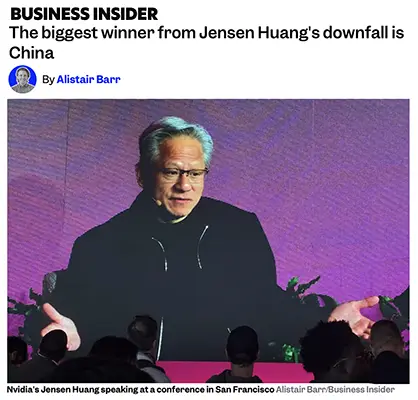
The Biggest Winner From Jensen Huang’s Downfall Is China
Business Insider | Alistair Barr | November 12, 2026
TL;DR: BI argues Huang’s ousting weakens America’s AI lead and helps China. That’s an analyst-driven opinion, not an established fact, but it shows how much of the AI race is now tied to one executive and one company.
Executive Summary
Source type: analysis/opinion column (paywalled). Barr argues that the roughly $300 billion wiped off Nvidia’s value in after-hours trading on the news of Huang’s likely exit shows what one CEO is “worth.” He cites Bernstein’s Stacy Rasgon, who halved his Nvidia price target and warned that “the primary beneficiary of Jensen’s removal as Nvidia’s CEO would clearly be China.” Another analyst called removing Huang a strategic mistake unless the investigation turns up something disqualifying. Barr acknowledges the board had real legal and governance obligations, especially given the national-security angle.
Separate the framing from the facts. Pinning a $300B drop on Huang alone oversimplifies a stock that had already lost more than $1 trillion in a month because of rates, debt and regulatory worries (see Article 26). The China argument is plausible but speculative: it assumes that losing Huang would meaningfully slow Nvidia’s execution, and Nvidia’s chip roadmap, customers and supply chain don’t disappear overnight. The more durable point is the key-person risk: a large part of U.S. AI infrastructure depends on one company whose strategy was closely tied to its founder.
Relevance for Business
For SMB leaders, the useful takeaway isn’t about geopolitics. It’s that key-person and governance risk in your AI vendors is real. If one executive’s exit can shake the most important company in AI, the same exposure exists, on a smaller scale, at the AI startups and vendors you depend on. The piece also suggests AI policy will be framed more and more as national competition, which could affect export rules, chip access and regulation.
Calls to Action
🔹 Monitor: Track who Nvidia names as permanent CEO and any change in strategy or partnerships.
🔹 Assign internal review: In vendor evaluations, add founder dependence and governance stability as factors.
🔹 Revisit later: Look at the geopolitical claims again once there’s evidence of actual impact on Nvidia’s execution or China’s position.
Summary by ReadAboutAI.com
https://www.businessinsider.com/nvidia-ceo-jensen-huang-downfall-benefits-china-ai-race-2026-11: November 16, 2026
Nvidia Stock Gets Its First Boost of the Jensen Huang Scandal Era. What’s Driving Shares Higher Today?
Fast Company · Sarah Fielding · November 11, 2026
| TL;DR / Nvidia’s brief stock rebound came not from anything Nvidia did but from strong results at CoreWeave, an AI cloud provider it partly owns — a reminder of how tightly interlinked, and mutually exposed, the AI infrastructure market has become. |
Executive Summary
Nvidia shares rose more than 4% in premarket trading after a steep slide — down about 15% over five days and 26% over the month amid the Huang scandal. The catalyst was CoreWeave, which reported third-quarter revenue of $3.66 billion, up 168% year over year and above estimates, and nudged its full-year outlook higher. CoreWeave’s own shares jumped after having fallen roughly 40% in the prior month on fears of AI overspending.
The link is more than sentiment. Nvidia invested $2 billion in CoreWeave in January and is now its second-largest shareholder; CoreWeave is also a major buyer of Nvidia chips. That circularity — a supplier investing in its own customers — means good news amplifies across the sector, but so does bad news.
The relief appears fragile. Analysts at Baird downgraded Nvidia to Neutral and Morgan Stanley dropped it from its top picks, while the board’s investigation continues and the CEO’s future remains unresolved.
Timing note: The gain described was premarket on Nov. 11. Bloomberg (#22) reported Nvidia falling about 7% the following morning after reports that the board was preparing to remove Huang, so this bounce was short-lived.
Relevance for Business
– AI infrastructure is a tightly coupled system. Chipmakers, cloud providers, and AI labs are financially intertwined, so trouble at one can quickly affect pricing and capacity across others.
– Neocloud providers are volatile. If you rent AI compute from specialized providers like CoreWeave, recognize that their fortunes swing with market sentiment and investor funding, not only with demand.
– One quarter of strong results doesn’t settle the AI overspending debate; expect continued swings that could affect vendor pricing and stability.
Calls to Action
◆ Monitor: Nvidia board developments and further neocloud earnings as signals of AI infrastructure stability.
◆ Assign internal review: If you depend on a specialized AI cloud provider, review contract terms, exit options, and data portability.
◆ Ignore for now: Day-to-day stock moves; they say little about the tools your business uses.
Summary by ReadAboutAI.com
https://www.fastcompany.com/91640260/nvidia-stock-rises-today-first-boost-ceo-jensen-huang-scandal: November 16, 2026Closing: AI update for November 16, 2026
Two events this week will test these stories: Nvidia’s November 17 earnings call, the first look at whether the scandal has reached the business, and Anthropic’s market debut, a public read on how much capital the AI sector can still attract. Whichever way they break, the durable work for SMB leaders stays the same: know who stands behind your AI vendors, document who leads if a key person can’t, and decide now how your business will handle AI agents, synthetic media and AI disclosure.
All Summaries by ReadAboutAI.com
↑ Back to Top