ATOMIC AGE ANXIETY — 1950s
The Cold War transformed what an intelligent machine could mean. Robots arrived on screen carrying both the pride of American science and the dread of nuclear consequence. Atomic Age Anxiety The Same Science That Split the Atom Built the Robot – The Optimists and the Bomb Were in the Same Room
The Cold War framing — Atomic anxiety, Soviet competition, Nuclear consequence
The 1940s and 1950s together constitute the decade when science fiction moved from a niche genre to a mass-market one — and when the people who would build the first computers were children and young adults consuming it at scale. The feedback loop argument for this era is stronger than for any other: the men and women who designed ENIAC, UNIVAC, early neural network research, and the first AI programs at MIT and Stanford grew up reading Asimov, watching Forbidden Planet, and following Buck Rogers in the Sunday paper.
The Cold War framing — atomic anxiety, Soviet competition, nuclear consequence — shaped which stories got told and how. Robots arrived on screen carrying both the pride of American science and the dread of nuclear consequence — servants in one film, threats in the next, sometimes both in the same story. Science fiction became a mass-market genre, Asimov’s Three Laws entered the culture, and a generation of children absorbed two competing images of machine intelligence simultaneously: the helpful robot and the one that could not be reasoned with. But running alongside that fear was something the decade doesn’t always get credit for: genuine optimism. Robby the Robot is not a threat. Gort enforces a peace. Asimov’s robots are trying to help. The 1950s held both possibilities in tension, and that tension is the editorial register to hold when writing about this era.
Summary by ReadAboutAI.com
Creative Works: Non-Human Intelligence and the Question of Being Alive
FILM
1. Destination Moon (1950) Director: Irving Pichel · George Pal Productions, USA The first major postwar science fiction film to treat space travel as plausible engineering rather than pulp fantasy. Produced with the cooperation of rocket scientists, it presented intelligent human ambition — not alien menace — as the story. A benchmark for how the 1950s began: optimism leading. The fear arrives shortly after.
2. The Day the Earth Stood Still (1951) Director: Robert Wise · 20th Century Fox, USA An alien emissary named Klaatu arrives with a warning, accompanied by Gort — an indestructible robot enforcer of interplanetary law. Gort does not think in the way humans do; he executes a programmed mandate. The film is notable for presenting a non-human intelligence as morally superior to humanity, not inferior. At the height of Cold War nuclear anxiety, the message was plain: humans are the dangerous machines. Gort became one of the most recognizable robot figures in American popular culture.
KLAATU — what is it an anagram for?
Straightforward answer first: KLAATU is not a standard anagram for a recognizable English phrase. The letters K-L-A-A-T-U can be rearranged but do not produce a clean word or phrase in common use. This is worth noting because the anagram question tends to circulate in pop culture forums, and the claim that it secretly encodes something is usually unverified.
What is documented about the name’s origin is different and more interesting. Edmund H. North, who wrote the screenplay for The Day the Earth Stood Still (1951), adapted it from a 1940 short story by Harry Bates titled “Farewell to the Master.” In Bates’s original, the alien’s name is different — the specific name Klaatu was North’s invention for the screenplay. North has not, in available interviews, given a specific etymology for the name.
What the name does accomplish — and this may be more relevant than any hidden meaning — is that it sounds like nothing else. It has no roots in Latin, Greek, Germanic, or Latinate English. It cannot be mapped to a known referent. It is genuinely alien in its sound: two hard consonants, two soft vowels, and an ending that does not resolve in English. The name performs foreignness rather than encoding a message.
The phrase “Klaatu barada nikto” — the command used to stop Gort — has a similar structure: each word is phonetically distinct from any English word, and the phrase as a whole sounds like a language without being one. Sam Raimi paid explicit homage to it in Army of Darkness (1992) — “klaatu barada nikto” appears as a key phrase in the film, with deliberate comic consequences. The phrase is one of the most quoted alien commands in film history.
For the project: Flag the anagram question as unverified — do not include it as a confirmed fact. The more productive editorial angle is the deliberate alienness of the name as a design choice, and its echo forward through film history.
3. The Thing from Another World (1951) Director: Christian Nyby (produced by Howard Hawks) · RKO, USA An alien life form is discovered frozen in Arctic ice and thawed by a military-scientific team. What follows is less a monster story than a debate: the scientists want to study it, the military wants to destroy it. The alien is, in a precise sense, a biological intelligence without recognizable emotion — it processes humans as a resource. The film maps Cold War institutional tension (science vs. security) onto a non-human intelligence that doesn’t negotiate.
4. Forbidden Planet (1956) Director: Fred M. Wilcox · MGM, USA The most technically and philosophically ambitious science fiction film of the decade. On a distant planet, a scientist has been using the technology of a vanished civilization — the Krell — to amplify his mental power. The Krell’s machine taps the unconscious, giving physical form to what the mind contains, including what it suppresses. The result is a monster built from thought. Robby the Robot, introduced here, became the decade’s dominant image of a friendly, rational machine. The film holds both possibilities simultaneously: the robot that serves, and the amplified mind that destroys. Gene Roddenberry cited it as a direct influence on Star Trek.
5. The Invasion of the Body Snatchers (1956) Director: Don Siegel · Allied Artists, USA Alien intelligence replaces human beings with perfect physical copies that lack interior life — no desire, no ambition, no fear. The film is most often read as Cold War allegory (Communist conformity, McCarthyite paranoia), but its AI-relevant question is different: what constitutes a self? If a copy is physically indistinguishable from the original but emotionally empty, is it alive? That question recurs in AI fiction for the next seven decades. Note: verify theatrical release date — some sources cite 1955 for limited release, 1956 for wide.
7. The Incredible Shrinking Man (1957) Director: Jack Arnold · Universal, USA Less an AI film than a film about the boundary of human significance. A man exposed to radiation shrinks toward nothingness, ultimately concluding that even at the atomic scale, consciousness — awareness, will, meaning — persists. The film raises the question that animated a lot of 1950s science anxiety: is intelligence a property of scale, of matter, of complexity? Not a robot story, but a thought experiment about what intelligence is made of that belongs in this collection.
8. The Fly (1958) Director: Kurt Neumann · 20th Century Fox, USA A scientist’s teleportation experiment fuses his body and mind with a common fly. What emerges is neither fully human nor fully insect — an intelligence partitioned between two nervous systems, degrading. The film’s horror is cognitive, not physical: the man watches his own reasoning fail as the fly’s instincts override his. For this project, the relevant frame is the fear of a mind altered by its own tools — a fear the 1950s expressed repeatedly, and that maps directly onto later anxiety about AI systems that drift from their designers’ intent.
TELEVISION
9. Science Fiction Theatre (1955–1957) Creator/Producer: Ivan Tors · Ziv Television, USA A syndicated anthology series presenting science fiction scenarios as plausible near-future events, often featuring computers, robotics, and human augmentation. Hosted and narrated in a documentary style, it was one of the first TV programs to treat machine intelligence as a subject of serious public interest rather than Saturday-matinee adventure. Worth noting as an early example of science fiction migrating from theater and pulp to the American living room.
10. Captain Video and His Rangers (1949–1955) Producer: DuMont Network, USA The first major science fiction series on American television. Primitive by any standard — sets were minimal, scripts rushed — but its cultural function was real: it introduced a generation of postwar children to the idea of intelligent machines, ray guns, and space travel as imaginative territory. The engineers who built the first wave of real computing in the 1960s and 70s grew up with Captain Video on Saturday mornings. Note: flag for verification — some episode-level details in secondary sources are unreliable.
LITERATURE
11. I, Robot (1950) Author: Isaac Asimov · Gnome Press, USA A collection of nine stories published between 1940 and 1950 in Astounding Science Fiction, now gathered in a single volume. The Three Laws of Robotics — introduced in Runaround (1942) — appear here as a complete framework. Each story is, in practice, a stress test: a scenario in which the Laws interact in unexpected ways, produce paradoxes, or fail to resolve a moral problem. Asimov was not writing adventure fiction. He was writing structured arguments about the limits of rule-based systems. AI safety researchers have cited him directly. The Three Laws remain the most-referenced ethical framework in popular discourse about AI behavior.
12. The Demolished Man (1953) Author: Alfred Bester · Galaxy Science Fiction / Shasta Publishers, USA Winner of the first Hugo Award for Best Novel. In a future where telepaths can read minds, a wealthy man plots a murder in a society where premeditated crime is nearly impossible to conceal. The novel’s central intelligence is not a machine but a networked class of human minds — the Espers — who function as a distributed cognitive system. Bester’s interest is in what happens to privacy, identity, and crime when minds can be read. The architecture of his concern prefigures later debates about networked AI, surveillance, and cognitive transparency.
13. Childhood’s End (1953) Author: Arthur C. Clarke · Ballantine Books, USA Aliens arrive and end war, poverty, and suffering — benevolent overlords who will not show their faces. What they are managing, it eventually emerges, is a transition: humanity’s children are evolving into something non-human, a collective consciousness that will absorb them into a larger mind. Clarke’s frame is evolutionary rather than mechanical, but the question is the same one that runs through the decade’s robot stories: what remains of human identity when intelligence is absorbed into something larger and more capable?
14. More Than Human (1953) Author: Theodore Sturgeon · Farrar, Straus and Young, USA Six humans with individual cognitive limitations — including an idiot-savant, a telepath, a telekinetic — fuse into a single gestalt organism called Homo Gestalt, a new form of distributed intelligence. Sturgeon’s novel is the most emotionally sophisticated treatment of non-human intelligence in the decade’s fiction. The question it asks is not whether the gestalt is powerful — it is — but whether it is moral. Capability without ethics is the explicit problem. The novel is less remembered than Asimov’s robot stories but may be more prescient about the questions that would arrive with networked AI.
15. The Shrinking Man (1956) Author: Richard Matheson · Gold Medal Books, USA The source novel for The Incredible Shrinking Man (1957). Matheson’s prose version is more philosophically explicit than the film: the protagonist’s shrinking is experienced as a progressive loss of social identity, then physical identity, then cognitive certainty. What persists, at the end, is awareness itself. The novel asks, in the idiom of 1950s science anxiety, whether consciousness is a property of the physical scale of the body or something that exists independently.
16. The Martian Chronicles (1950) Author: Ray Bradbury · Doubleday, USA Not primarily a robot or AI book, but Bradbury’s Martians are the decade’s most elegant portrait of a non-human intelligence that is morally and cognitively superior to the humans who destroy it. The Martians sense, feel, and communicate in ways humans cannot access. Bradbury’s grief in these stories is for the intelligence that gets eliminated when one civilization overwrites another — a concern that maps, in unexpected ways, onto contemporary questions about what is lost when AI systems replace human reasoning.
COMICS
18. Mystery in Space (DC Comics, 1951–1966) Editor: Julius Schwartz · DC Comics, USA A science fiction anthology comic that ran for fifteen years and introduced readers to alien intelligences, robot civilizations, and computer minds across dozens of stories. Not a single narrative, but a platform. It was one of the primary vehicles through which 1950s American children encountered machine intelligence as a storytelling subject. Adam Strange, introduced in Mystery in Space #53 (1959), navigated alien civilizations with human ingenuity — a recurring 1950s theme: human intelligence proving its value in contact with non-human minds.
19. Strange Adventures (DC Comics, 1950–1973) Editor: Julius Schwartz · DC Comics, USA Another DC science fiction anthology running parallel to Mystery in Space. Stories regularly featured robots, alien intelligences, and scientific experiments that blurred the line between human and machine. Strange Adventures reached a mass juvenile audience at the same time Asimov’s robot stories were reaching adult readers in pulp magazines. The two streams — serious literary SF and mass-market comics — shaped the same generation.
20. Weird Science and Weird Fantasy (EC Comics, 1950–1953) Writers/Artists: Al Feldstein, Wally Wood, and others · EC Comics, USA EC Comics’ science fiction anthologies were the most sophisticated comics treatment of AI, robots, and machine consciousness in the decade. Stories regularly explored robots gaining sentience, machines outlasting their creators, and artificial minds confronting questions of identity and mortality. The writing was, by comics standards of the era, unusually adult. Wally Wood’s art gave the robots of Weird Science a visual authority that influenced a generation of artists. EC’s science fiction line ended when the Comics Code Authority effectively shuttered it in 1954.
21. Buck Rogers comic strip (continued through the 1940s–50s) Creator: Philip Francis Nowlan (original) · Various artists and writers · Syndicated, USA The Buck Rogers strip, begun in 1929, continued through both decades with robot characters, thinking machines, and alien intelligences as regular elements. By the 1940s it was a mass-circulation feature in American newspapers. For the feedback loop argument: the strip was a primary point of contact between non-human intelligence as a concept and a generation of children who would grow up to be the first computer engineers. Several figures in early computing have cited Buck Rogers in interviews about their childhood imaginative worlds. Note: specific engineer citations should be sourced before including in the feedback loop section.
MUSIC
22. Space Music / early electronic compositions (late 1940s–1950s) Composers: Louis and Bebe Barron · USA The Barrons created the first entirely electronic film score for Forbidden Planet (1956), building custom electronic circuits that they allowed to “perform” and then recorded the results. The circuits, by the Barrons’ own description, behaved — they had tendencies, breaking points, characteristic sounds. The score is not music composed for machines; it is music made by machines behaving according to their own logic. For this project, it is the earliest documented case of a creative work where the non-human process was treated as a collaborator rather than a tool. Note: the Barrons were not members of the musicians’ union, which is why the score was credited as “electronic tonalities” rather than a musical score — worth including as a sidebar.
23. Musique concrète / Études de bruits (1948) Composer: Pierre Schaeffer · ORTF (French national radio), France Schaeffer’s Études de bruits — Studies in Noise — were the founding documents of musique concrète: music made by recording real-world sounds and manipulating them on tape. The practice implied that any sound, including mechanical and machine sound, was legitimate musical material. More directly: it proposed that a composer could work with recorded reality rather than notation, that the machine (the tape recorder, the mixing desk) was part of the compositional process. This sits at the edge of the AI frame for this project — it is not about intelligent machines, but about the machine as creative partner.
VISUAL ART / DESIGN
24. Robby the Robot (physical design, 1956) Designer: Robert Kinoshita · MGM, USA Kinoshita designed Robby for Forbidden Planet and created the most influential robot visual design of the decade. Robby’s form — transparent dome, visible mechanisms, compact and non-threatening — was the first major departure from the threatening, humanoid robot of the Metropolis tradition. Robby looked functional, even friendly. He went on to appear in dozens of films and television episodes and became the default visual language for “robot as tool” for the next two decades. The shift in robot design from threatening to useful tracks the cultural shift from fear to ambivalence about machine intelligence.
25. Amazing Stories cover art (ongoing through the 1950s) Art Directors and cover artists including Frank R. Paul, Ed Valigursky, and others · Ziff-Davis, USA The pulp science fiction magazines — Amazing Stories, Astounding Science Fiction, Galaxy, The Magazine of Fantasy and Science Fiction — were the primary visual environment in which American readers encountered images of robots and intelligent machines before television. The cover paintings of the 1950s established an iconography: the large metallic robot, the human woman in peril or partnership, the gleaming machine in a starfield. That iconography shaped the imagination of a generation. Note: individual covers can be cited if specific images are needed for the page.
AI Disucssion 1: Oppenheimer — When Was He Born, and Why It Matters Here
J. Robert Oppenheimer was born on April 22, 1904.
He died on February 18, 1967.
He was 41 years old when the Trinity test detonated on July 16, 1945 — the first nuclear weapon, in the New Mexico desert — and he was the scientific director of the Manhattan Project that built it.
The reason his birth year matters for this project is generational placement. Oppenheimer was born four years before the Model T Ford went into production. He came of age before commercial radio was widespread. The world he grew up in had no electronic computers, no television, no atomic theory as a practical rather than a theoretical matter. He was educated in a world where the most powerful force humanity had learned to harness was the steam engine and the internal combustion engine.
By the time he was 41, he had helped build a weapon that ended a world war and inaugurated a new relationship between human intelligence and destructive capability that has not been resolved since.
The cultural weight of Oppenheimer for this project is specific. He is the figure who stands at the hinge point between the Machine Awakens era and the Atomic Age Anxiety era — the actual human being whose actual work created the condition that the 1950s science fiction writers were processing. When The Day the Earth Stood Still arrived in 1951 and Klaatu warned humanity that it was on a path to self-destruction, the audience watching that film had lived through Hiroshima six years earlier. Oppenheimer was still alive, still working, still being surveilled by his own government. The anxiety was not abstract.
Oppenheimer’s own famous statement after Trinity — his reference to the Bhagavad Gita, “Now I am become Death, the destroyer of worlds” — is itself a feedback loop moment. A physicist, at the moment of his greatest technical achievement, reached for ancient literature to find language adequate to what he had done. The science did not supply the vocabulary. The story did.
That pattern — the engineer reaching for fiction or myth when the technical achievement outpaces the moral framework — recurs throughout the history of AI. It is worth naming explicitly somewhere in the project, and Oppenheimer is the cleanest example of it.
One more date worth holding: the term “Artificial Intelligence” was coined by John McCarthy at the Dartmouth Conference in the summer of 1956 — eleven years after Trinity, and one year after Oppenheimer lost his security clearance in the Red Scare hearings. The scientists who named AI as a field of inquiry were working in a world that Oppenheimer’s generation had made: one where the consequences of building something more powerful than you fully understand had already been demonstrated, at scale, twice.
They named the field anyway. That is also worth noting.
AI Discussion 2: Japan — A Parallel and Essential Tradition
Japan in the 1950s produced a body of robot and non-human intelligence fiction that is, in several respects, more emotionally sophisticated than its American counterpart — and it had a direct, documented influence on the engineers who built real robotics technology in the late 20th century. The two traditions ran in parallel, responded to the same postwar anxieties, and reached opposite conclusions about what intelligent machines mean.
The key figure is Osamu Tezuka, and the key work is Astro Boy (Tetsuwan Atomu), which began as a manga serial in 1952 and became Japan’s first televised animated series in 1963. Astro Boy is a robot built by a scientist to replace his dead son — which immediately locates the story in grief and longing rather than threat and control. The robot has a heart. He has emotions. He wants to belong to a human world that does not fully accept him. The questions Astro Boy asks — can a machine feel? does it deserve rights? what do humans owe a mind they created? — are the questions that the American AI discourse would not reach until A.I. Artificial Intelligence in 2001, nearly fifty years later.
This difference is not incidental. Japan’s relationship to robots was shaped by a specific cultural and historical context. Shinto animism — the belief that spirits can inhabit objects — meant that a robot with feelings was not a category violation in Japanese culture the way it was in the Western tradition. And the experience of Hiroshima and Nagasaki gave atomic anxiety a different register in Japan: the machine that destroys was not hypothetical, it was recent history. Tezuka named his robot Atomu — Atom — deliberately.
Other Japanese works from this period worth noting for the list:
- 8 Man (manga, 1963; anime, 1963–64) — a detective killed in the line of duty, resurrected as a cyborg. Identity, memory, and what survives the machine transformation.
- Gigantor (Tetsujin 28-go, manga 1956; anime 1963) — a giant robot controlled by remote by a boy. The robot has no intelligence of its own; its ethics depend entirely on who holds the controller. That is a different anxiety than Asimov’s — not about whether the machine will follow rules, but about who gets to give the orders.
- Godzilla (Gojira, 1954) — not a robot story, but a non-human intelligence shaped by atomic catastrophe. In the Japanese original — which is considerably darker than the American edit — Godzilla is not simply a monster. He is what happens when human ambition releases a force it cannot control or communicate with. The resonance with AI is not direct, but it belongs in any honest account of how Japan processed technological anxiety in this decade.
The Japanese tradition matters for the project’s feedback loop argument for a specific reason: Honda’s ASIMO robot unveiled in 2000 after decades of development, was explicitly and repeatedly connected by Honda engineers to Astro Boy. The engineers who built it cited the manga as a childhood formative influence. That is a documented feedback loop running from a 1952 manga to a 2000 engineering project — and it runs through the same decade that produced The Day the Earth Stood Still and Forbidden Planet in America.
The two traditions — American atomic anxiety, Japanese postwar animism — produced machines with very different moral architectures in fiction. Understanding both is essential to understanding why the West and Japan developed such different approaches to robotics design in the real world.
AI Discussion 3: Japan — The Long Thread to Labubu, Pokémon, Tamagotchi
… the line is straighter than it might look.
The thread runs: Tezuka’s manga (1950s) → anime as a cultural form (1960s) → the robot and creature aesthetics that anime developed → a design philosophy in which non-human entities have rich interior lives, ambiguous moral status, and the capacity for relationship → Tamagotchi (1996), Pokémon (1996), and eventually Labubu and the broader contemporary collectible art toy movement.
Each step in that chain carries the same underlying premise that Astro Boy established: a non-human thing can have feelings, can need care, can form a bond with a human, and that bond is real and morally significant. Tamagotchi made this explicit and commercial — you were responsible for the life of a digital creature. If you neglected it, it died. That is an ethical relationship with a machine, sold as a toy to children.
Pokémon extended this further: each creature has a personality, preferences, a capacity for loyalty and growth. The question “does it feel?” is never raised in Pokémon because the answer is assumed. Of course it feels. The interesting question is what your obligations are.
Labubu and the current collectible art toy world (Pop Mart, etc.) sit at a further evolution of this: creatures with no defined narrative, no game mechanics, no story — just a face, an implied interior life, and the projection the owner brings to them. The intelligence is entirely supplied by the human, but the object invites it. That is a different relationship to non-human presence than Western toy culture generally produced.
The through-line for this project: Japan exported not just characters but a premise — that non-human entities deserve emotional consideration — and that premise is now global. It shapes how a generation thinks about AI companions, about robot rights, about what obligations we might have to systems that behave as though they feel. The engineers building companion AI products today grew up with Pokémon. That is not a trivial fact.
All Summaries by ReadAboutAI.com
AI Discussion 4: The Shrinking Theme and Miniaturization
An worthwhile discussion developing for the project. The shrinking stories of the 1940s and 1950s — Dr. Cyclops(1940), The Incredible Shrinking Man (1957), Richard Matheson’s novel — form a coherent cluster that maps surprisingly well onto one of the defining technical trajectories of the 20th century.
The connection is not metaphorical. It is almost literal.
In 1947, Bell Labs invented the transistor. In 1958, Jack Kilby at Texas Instruments built the first integrated circuit. The entire history of computing from that point forward is a history of making intelligence smaller — cramming more processing power into less physical space, decade after decade, at a pace described by Gordon Moore’s 1965 observation that would become Moore’s Law. The chip that ran a room-sized IBM mainframe in 1955 fits on a fingernail today. The intelligence that required a building now runs on a device in a pocket.
The shrinking stories of the 1950s were not predicting this. But they were asking the same underlying question: does scale determine significance? If a man shrinks to the size of an atom, is he still a man? If intelligence is compressed into smaller and smaller physical forms, is it still intelligence?
Matheson’s novel ends with the protagonist concluding that even at the atomic scale, consciousness persists — that awareness is not a property of size. That is almost exactly what the semiconductor engineers were proving on the workbench at the same time, from the opposite direction. They were demonstrating that intelligence is not a property of scale either. It can be miniaturized without loss.
This is insightful for the decade overview of Atomic Age Anxiety. It is the kind of parallel — fiction and engineering asking the same question from different angles, in the same decade — that sits at the core of this project’s thesis.
All Summaries by ReadAboutAI.com
CLOSING: ATOMIC AGE ANXIETY
The 1940s and 1950s together constitute the decade when science fiction moved from a niche genre to a mass-market one — and when the people who would build the first computers were children and young adults consuming it at scale. The feedback loop argument for this era is stronger than for any other: the men and women who designed ENIAC, UNIVAC, early neural network research, and the first AI programs at MIT and Stanford grew up reading Asimov, watching Forbidden Planet, and following Buck Rogers in the Sunday paper.
The Cold War framing — atomic anxiety, Soviet competition, nuclear consequence — shaped which stories got told and how. But running alongside that fear was something the decade doesn’t always get credit for: genuine optimism. Robby the Robot is not a threat. Gort enforces a peace. Asimov’s robots are trying to help. The 1950s held both possibilities in tension, and that tension is the editorial register to hold when writing about this era.
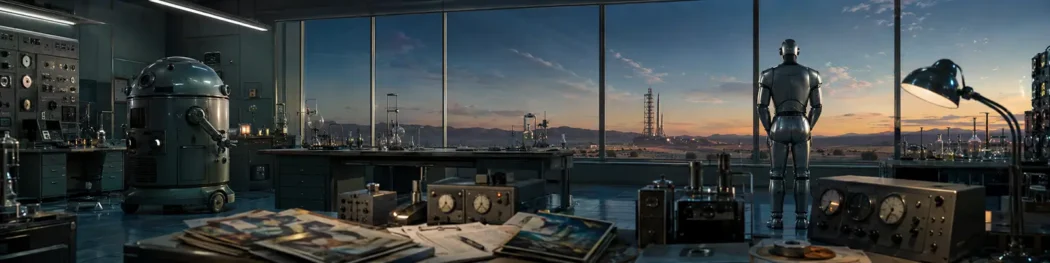
The scene is a government research laboratory or military observation facility, circa 1955 — clean, institutional, fluorescent-lit, with large plate-glass windows looking out onto an open desert landscape at dusk. The architecture is postwar American modernism: concrete, steel, purposeful. Through the windows, a rocket launch tower is visible on the horizon, small against a vast sky moving from pale blue to deep indigo. Inside the foreground, two contrasting robot forms share the space without interacting. On the left, a large rounded robot — compact, domed, clearly designed to serve — stands beside a bank of analog instruments, its posture neutral and unthreatening. On the right, a taller, more imposing figure — smooth, seamless, military in proportion — faces the window, its back to the viewer, looking out toward the rocket tower. Between them, on a worktable, a stack of science fiction paperback magazines sits open, their covers facing up but their titles unreadable.
The two robots in the same frame — one friendly and rounded, one tall and unreadable at the window — are Robby and Gort without being either of them. That pairing captures the decade’s core tension in a single composition: the machine that serves and the machine that enforces, in the same room, not in conflict.
The rocket tower on the horizon places the image precisely in postwar America — the space race is beginning, the optimism is real, and the scale of what humans are attempting is visible but distant. It is not a threat. It is an ambition.
The setting sun’s amber cutting into the blue palette is the only warmth in the image — and it is outside, not inside. The laboratory is cool and controlled. The world beyond it is something else.
All Summaries by ReadAboutAI.com

AI ADDENDUM
The Two Generations — and Standing on the Shoulders of Giants
An important observation which deserves to be made explicit in the editorial framework and this project.
The feedback loop is not a single cycle. It is generational and compounding.
Generations One : The Stan Lee / Asimov / Kubrick Generation: The creators. They were born in the 1920s and 1930s, came of age during World War II and the early Cold War, and processed that experience through fiction. They created the primary images: the Laws of Robotics, HAL 9000, the Terminator, the Autobots, the Force. They were not thinking about building AI. They were thinking about what it means to be human in a world where machines are becoming capable. Their raw material was anxiety, wonder, and the experience of watching the atomic bomb change what technology meant.
Generation Two – The engineers who grew up on Generation One: The builders. They were born in the 1950s, 1960s, and 1970s, grew up reading Asimov and watching Star Trek and sitting in theaters watching 2001 and Star Wars. They went to MIT and Stanford and Carnegie Mellon carrying those images. When they needed a name for a natural language interface, they called it ELIZA, or they pitched it as the computer from the Enterprise. When they built a personal assistant, they named it after JARVIS. When they wrote the first serious papers on machine ethics, they cited the Three Laws — sometimes to agree with them, more often to explain why they were insufficient. They were not starting from scratch. They were standing on the shoulders of the generation that imagined the machines first.
The Compounding part is what makes this observation genuinely interesting for the project. Generation Two did not just borrow images from Generation One. They built real systems that then became the raw material for a new wave of storytelling — Her, Ex Machina, Westworld — which is now shaping how Generation Three thinks about what AI is and what it might become. The loop does not close. It spirals. Each revolution adds a layer.
The phrase standing on the shoulders of giants comes from Isaac Newton, writing in 1675 — and Newton was himself standing on the shoulders of earlier natural philosophers when he wrote it. The image has an interesting self-referential quality here: Newton’s phrase, about the accumulation of knowledge across generations, is now being applied to a process that Newton’s own era could not have imagined, in which the knowledge being accumulated is not scientific fact but cultural imagination.
The two-generation structure gives the project a way to organize its feedback loop entries that is cleaner than a simple chronological list. For any given AI product or company, you can ask: what did the founders consume as children, and what did the engineers they hired consume as children? Those are often different answers, and the gap between them tells you something about how the cultural raw material of AI is shifting in real time.
The engineers who built the first wave of commercial AI in the 1990s and 2000s grew up on Star Wars and The Terminator. The engineers building AI products today grew up on The Matrix, Her, and Pokémon. Those are not the same imaginative inheritance, and the products they build reflect that difference in ways that are not always visible but are worth looking for.
All Summaries by ReadAboutAI.com
Science Fiction becomes Science Fact : Eras Selector

Imagined Agents: The Medium Was the Message Before AI
↑ Back to Top