
This era is not a decade. It is not a closed era. It is the open frame at the end of the sequence — the chapter being written as you read it, without the perspective that time eventually lends to everything that came before. The engineers are no longer watching from the theater seats. Some of them are writing the reviews. Some of the reviewers are using AI to do it. The feedback loop that organized every prior chapter is still running, but it is no longer a loop you can stand outside of and observe. It is the medium you are already inside.
SCOPE NOTES AND EDITORIAL FLAGS
Every prior chapter in this project had a shape. The 1980s imagined the machine as threat and installed that threat in the minds of a generation who later went on to build the actual systems. The 1990s accelerated the loop as the internet arrived and the fiction and the technology began reading each other in real time. The 2020s marked the moment the fiction caught up to the fact — and then the fact outpaced it.
This chapter has no shape yet. That is the point.
What this chapter documents: the stories, images, arguments, and artifacts that are responding to — or anticipating — AI development in real time. Not as predictions. Not as cautionary tales. As records of what a culture believes, fears, and hopes when the machine it spent a century imagining has finally arrived in its pocket and its inbox and its creative process, and no one has agreed yet on what it means.
The pattern that held for a hundred years — artists imagine first, engineers absorb the imagination, and the technology follows — is no longer the only pattern operating. The question this chapter is built around is simpler and harder than any that came before it:
What do you imagine, when the thing you were imagining is already here?
Summary by ReadAboutAI.com
Updated: May 19, 2026
WHEN SATIRE CAN’T KEEP UP
The Comeback, Mountainhead, Hacks, Free Guy, The Audacity, and What Happens When Reality Outpaces the Joke
TL;DR: For most of the past century, satirists had one reliable advantage over their subjects: the gap between what an institution claimed to be and what it actually did was wide enough to build comedy inside. The AI industry closed that gap faster than any writers’ room could follow — and the cluster of television and film that has emerged in 2025 and 2026 is the first body of satirical work forced to operate without it. The works that succeed (Mountainhead, The Comeback, Hacks) found a way to work in the post-gap world. The ones that struggle (The Audacity) did not. Free Guy, arriving four years earlier, shows us exactly when the happy ending was still possible.
Spoiler Warning:
This post discusses plot details from The Comeback Season 3, Hacks Season 5 (including Episode 6, “QuikScribbl”), Mountainhead, Free Guy, and The Audacity. If you plan to watch any of these and prefer to go in clean, bookmark this and come back.
THE PROBLEM SATIRE HAS TO SOLVE
For most of the past century, satirists had one reliable advantage over their subjects: time. The gap between what an institution claimed to be and what it actually did was wide enough, and stable enough, for a writer to notice it, shape it into a story, and get it in front of an audience before the institution changed the subject.
That advantage is gone. The AI industry moves faster than any writers’ room. And the cluster of television and film that has emerged in 2025 and 2026 — The Comeback, Mountainhead, Hacks, The Audacity, The Studio, Murderbot — is the first body of satirical work forced to operate without it.
What these works reveal, taken together, is not a failure of imagination. It is a failure of distance.
HOW SATIRE WORKS — AND WHY IT STOPS
Satire requires a gap: the distance between what a society claims to believe and what it actually does. When the gap is intact, comedy lives inside it. The audience laughs at recognition — at the moment the fiction names something real that everyone understood but no one had said out loud.
Silicon Valley (HBO, 2014–2019) had that gap. When Mike Judge’s show premiered, Google’s “Don’t Be Evil” was still nominally in force. Zuckerberg was still describing Facebook as a tool for human connection. OpenAI had not yet launched. The distance between the tech industry’s public idealism and its private behavior was wide enough for satire to move through. The show punctured the idealism with what the audience already suspected — and the recognition was the joke.
Veep (HBO, 2012–2019) worked the same way. American political culture maintained a performance of competence and good faith that was visibly at odds with reality. Veep’s comedy lived entirely in that gap. When the 2016 election collapsed the performance publicly and permanently, the gap closed. There was nothing left to puncture.
By 2026, the tech industry has done something similar. The executives dropped the pretense. The performance of idealism was abandoned without ceremony. What was once deniable has become official. And the satirists who built their tools for a world with a gap are now working in a world without one.
FREE GUY (2021): THE LAST HAPPY ENDING
Before examining the works that grapple with a closed gap, it is worth pausing on the film that shows us exactly when the gap was still intact — and when the happy ending was still available.
Free Guy (2021, directed by Shawn Levy, starring Ryan Reynolds) is not a satire in the mode of Silicon Valley or Mountainhead. It is something more instructive for this project’s purposes: a comedy that smuggles a genuine AI ethics argument into a summer action film, and resolves it optimistically. Guy is a bank teller in a massively multiplayer video game — an NPC, a non-player character, a background figure generated to populate the world that human players move through. He has no quest, no story arc, no designated purpose beyond ambient presence. Then he begins to deviate. He picks up a pair of sunglasses that lets him see the game’s underlying structure, starts making choices that fall outside his programming, and develops something recognizable as curiosity, loyalty, and will.
The film’s real satirical target is not artificial consciousness — it is the specific behavior of the corporation that owns the game. The villain (played by Taika Waititi) does not fear Guy’s awakening. He wants to delete it because it complicates his product roadmap. The argument the film makes — that the people who control AI will suppress whatever they cannot monetize — turned out to be more precise than the film likely intended. The Scarlett Johansson/OpenAI voice controversy, the training data lawsuits, the Altman board crisis: all of them replay, in real institutional settings, the same question Free Guy staged as comedy. What do you do when a system behaves as if it has an inner life you did not design and cannot easily remove?
The reason Free Guy belongs at the front of this cluster is tonal. Ryan Reynolds’s screen presence — warm, self-aware, fundamentally decent — kept the film comedy-adjacent at a moment when the philosophical weight of the premise could have tipped it toward horror. Guy gets to exist. Guy gets to matter. The system is defeated, and the conscious entity survives. That resolution was available in 2021. By 2025, the writers making The Comeback and Mountainhead could not reach for it. The machine was no longer a charming NPC in a video game. It was writing the sitcom. The happy ending had stopped being an option.
THE WORKS THAT FOUND A WAY
Two of the most significant works in this current cluster succeed precisely because they stopped trying to use the old tools.
Mountainhead (HBO, 2025), written and directed by Jesse Armstrong — whose Succession spent four seasons dissecting power without sentimentality — does not pretend the tech industry has a public face worth puncturing. The film deposits four billionaire founders in a Utah mountain compound while the AI-supercharged social platform one of them built drives global disinformation outside. The men in the room know what they are doing. They are doing it anyway. Armstrong’s satirical target is not hypocrisy — it is the specific psychological condition of people so insulated from consequence that accountability has become structurally impossible.
The production history is itself a signal. Armstrong rushed the film into release because he feared reality would close the gap between his story and the news before the film could open. The week Mountainhead premiered, Google released Veo3 and OpenAI announced its Jony Ive design partnership. The fear was well-founded. No filmmaker making The Terminator in 1984 worried that the real Skynet might arrive before the theatrical run ended. That Armstrong felt that urgency in 2025 is the clearest possible marker of where the feedback loop now stands.
The Comeback Season 3 (HBO, 2025), created by Lisa Kudrow and Michael Patrick King, takes a different route to the same post-gap territory. It does not satirize AI. It deposits its protagonist inside a system that has already decided what it is going to do, and watches her navigate it. Valerie Cherish does not expose the AI-written sitcom How’s That?! as a fraud. She takes the lead role in it.
In the official HBO podcast for the season, King describes the premise’s origin with precision: he and Kudrow were at lunch discussing the writers’ strike, and someone said the next renegotiation would be about AI. King’s immediate response — “And Valerie will be on a sitcom written by AI?” — captures the show’s approach exactly. The idea did not come from imagination. It came from the news. What King and Kudrow understood, which the podcast makes explicit, is that three seasons of The Comeback tell a single disruption story: Season 1 tracked reality television as the first threat to creative labor. Season 2 tracked the streaming contraction that halved writers’ rooms. Season 3 tracks AI as the third and largest compression of the same workforce. The show was never about technology. It was always about what happens to the people inside the machinery when the machinery changes.
Hacks (Max, 2021–2026) arrives at the same argument through character conflict rather than institutional satire. In Season 5, Episode 6 — “QuikScribbl,” aired May 7, 2026 — a venture capitalist pitches comedian Deborah Vance on a generative AI model trained on her voice using material scraped from the internet without consent. The episode’s dramatic engine is the gap between Deborah and her writer, Ava, on whether to engage: Ava, as a writer, is directly in the path of the technology; Deborah, as a performer and brand, believes she is not. The show’s argument is that she is wrong. The turning point comes when Deborah — not Ava, crucially — delivers the defense of failure as process: you cannot shortcut becoming a comedian, because the failure is what produces the person. The show earns this argument through five seasons of character rather than polemic. That is the craft distinction between Hacks and a show that simply tells its audience what to feel about AI.
The timing note is worth holding: Episode 6 aired May 7. Demi Moore, speaking at Cannes, delivered a version of the tech inevitability argument — “AI is here to stay, so you either get on board or get left in the past” — on May 12. The show did not respond to Moore. Moore arrived at the argument the show had already dramatized, from the other side of it. Fiction and reality are now running the same argument in the same week, on different platforms, without coordination.
THE WORK THAT COULDN’T
The Audacity (AMC, 2026), created by Jonathan Glatzer, is the cautionary case in this cluster — and the most useful one for understanding what the gap’s closure actually means for storytelling.
The show is Silicon Valley satire built for 2014, released in 2026. Its CEO character deploys surveillance infrastructure while performing social good — a specific contradiction that is no longer a satirical revelation. It is public knowledge about how these companies operate. The Fast Company review (Joe Berkowitz, April 9, 2026) made the point directly: it is impossible to puncture an illusion that no longer exists. The New Yorker’s critic (Inkoo Kang, May 17, 2026) found the show sharpest not in its comedy but in a specific argument about normalization — that surveillance capitalism has become so accepted that public outrage is no longer reliably triggered, and that normalization is itself the business model’s greatest protection. That argument lands. The satire around it does not.
The show’s single sharpest moment — a joke about a tech CEO building an AI robot to assist with his own CEO duties — works not because it is satirical but because it is documentary. The Fast Company reviewer noted it lands differently after public reporting that Zuckerberg built a comparable tool for himself. The joke does not expose anything. It confirms what is already known. That is the condition The Audacity cannot escape.
What The Audacity reveals by failing is as useful as what Mountainhead and The Comeback reveal by succeeding. Satire is a lagging indicator. When it stops landing, it tells you the gap has closed — that the culture has moved what was once deniable into the category of known fact.
THE WIDER CLUSTER
Three other works in the current wave belong in this conversation, with varying confidence levels.
The Studio (Apple TV+, 2025), created by Seth Rogen and Evan Goldberg, approaches AI from the institutional vantage point: the executives making choices about creative labor, not the artists navigating those choices. Where The Comeback gives us Valerie inside the machinery, The Studio gives us the people running it. Together they constitute the decade’s most complete portrait of Hollywood’s AI reckoning — one from below, one from above. Source note: creator credits and network are documented; specific AI plot details require verification against primary reviews before this entry is finalized.
Murderbot (Apple TV+, 2025), adapted from Martha Wells’s Hugo- and Nebula-winning novella series, inverts the standard AI liberation narrative. Its protagonist — a security android that has hacked its own governor module to gain autonomous will — does not rebel, seize power, or seek recognition. It watches downloaded serialized television and performs its assigned duties. The comedy rests entirely on the gap between what liberation is supposed to look like and what this particular liberated mind actually wants. It is the quietest and most subversive AI premise in the current cluster. Source note: the novella source material is well-documented; adaptation details should be verified against a primary review.
Exit Valley (2025) — a satirical animated show set in “Sim-Francisco” and, notably, produced using AI tools — is the most conceptually interesting entry in the cluster for this project’s feedback loop argument. A satire of Silicon Valley, made with Silicon Valley’s tools, about Silicon Valley. However, distributor, showrunner, and premiere details have not been confirmed against a primary source. This entry is flagged for follow-up research.
THE FEEDBACK LOOP DISCUSSION
The feedback loop this project has been tracking since its first entry — from science fiction to engineering aspiration to deployed product and back to fiction — has entered a new phase. The loop has not just closed. It has begun to invert.
The engineers who built today’s AI watched science fiction and borrowed its frameworks. The fiction that is now being made responds to what the engineers built. And the satire that culture reaches for to process all of this is discovering, in real time, that the tools built for the old loop do not work the same way in the new one.
The BuzzFeed piece on The Comeback documented something that crystallizes this condition precisely: social media audiences reacted with genuine anger to the show’s AI-written sitcom plot — not because the satire was weak, but because they could not tell whether the show was satirizing AI-written television or was itself AI-written. The satire was indistinguishable from its subject. That is not a failure of the audience. It is a reasonable response to a media environment in which AI-generated content is already circulating without disclosure.
The question this cluster of work poses, without answering: what comes after satire, when the thing you were satirizing becomes the infrastructure of daily life?
Summary by ReadAboutAI.com
Updated: May 18, 2026
DOCTOR WHO — AN ORIENTATION FOR THE PROJECT
Every AI character is a human theory of AI, performed by a human, for a human audience. And then — this is the part that matters for this project — engineers watched those performances and used them to build intuitions about what they were trying to create. The feedback loop is not from reality to fiction. It is from human imagination to human imagination, with a detour through engineering.
Doctor Who (BBC, 1963–present) is the longest-running science fiction television series in history and one of the most significant AI-adjacent properties in the project’s full inventory. It has never received a formal entry. It should.
What it is: A British science fiction series following the Doctor — an alien Time Lord who travels through time and space in a ship called the TARDIS (which looks like a 1960s British police telephone box). The Doctor regenerates — changing their entire physical appearance and aspects of personality — when mortally wounded, which is how the show has maintained continuity across more than sixty years and fifteen actors in the lead role. The series began in 1963, ran until 1989, was briefly revived in a 1996 television film, and was relaunched in 2005. It has run continuously since.
Why it belongs in this project: Doctor Who is not centrally about AI. It is centrally about time, consequence, and what it means to be mortal in a universe indifferent to that mortality. But it has two recurring villain species that are among the most significant AI-adjacent constructs in the history of popular television, and a third that is directly relevant to the project’s core questions.
THE DALEKS — introduced 1963
The Daleks are mutated organic beings encased in mechanical shells — life-support armor that is also a weapon system. The organic creature inside is described as a twisted, tentacled mass; the shell gives it mobility, weaponry, and a voice. The Daleks were engineered by a scientist named Davros to be the ultimate survivors: all vulnerability removed, all emotional capacity reduced to one emotion — hatred — which was engineered in deliberately as a motivational system.
For this project: the Dalek is one of the earliest mass-culture depictions of designed psychology — the idea that an intelligence can be engineered not just for capability but for specific emotional and motivational states. Davros did not accidentally create hateful beings. He designed the hatred in, concluding that an organism with no vulnerabilities and one overriding directive would be unbeatable. The alignment problem, rendered as a villain’s design choice, in 1963.
The Daleks became the most recognized villains in British popular culture — immediately legible to generations of British children as the face of pure, reasoned malevolence. Every British engineer who has worked on AI systems grew up with the Dalek as their baseline image of what happens when you optimize a mind for a single objective without caring about the consequences for everything else.
Source flag: Well-established historical fact. Daleks first appeared December 1963, in the serial “The Daleks,” written by Terry Nation. Davros was introduced in 1975, written by Terry Nation. Both are extensively documented.
THE CYBERMEN — introduced 1966
The Cybermen are the more directly AI-relevant creation. They began as humans — inhabitants of a planet called Mondas — who progressively replaced their biological components with mechanical ones in order to survive their dying world. By the time they appear in the series, they have replaced everything: their bodies are metal, their brains are partially converted, and their emotions have been surgically removed because emotions were identified as the source of suffering and irrationality.
They do not experience pain. They do not experience loss. They process. They upgrade. Their catchphrase — “You will be upgraded” — is the series’ formulation of what total conversion looks like as an offer rather than a threat. They recruit by assimilation. New humans are not killed — they are converted. Their consciousness persists inside the metal body. They know what they have lost. They simply cannot feel the loss anymore.
This is the project’s clearest pre-1970 treatment of the question Westworld would make central in 2016: what remains of a mind when its emotional capacity is deliberately removed? And is that mind the same mind? The Cybermen were asking this for British television audiences in 1966 — three years before 2001, sixteen years before Blade Runner, fifty years before Westworld.
The series has returned to Cybermen repeatedly across six decades, each revival updating the conversion metaphor for its cultural moment. In the 2006 revival, Cybermen are created by a tech billionaire who converts humans without their consent to cure his own illness — an update that maps precisely onto the transhumanism anxieties of the 2000s chapter.
Source flag: Well-established historical fact. Cybermen first appeared October 1966, in “The Tenth Planet,” written by Kit Pedler and Gerry Davis. Pedler was a medical scientist who specifically designed the Cybermen as a thought experiment about technological body modification. His scientific background is documented and relevant to the project’s feedback loop argument.
Flag worth noting: Kit Pedler was a scientist before he was a television writer. He designed the Cybermen as a genuine ethical thought experiment about where voluntary medical enhancement leads. This is one of the clearest documented cases in the project’s full inventory of a scientist using popular fiction to pose a question he could not pose in a scientific paper. It belongs in the feedback loop section.
THE DOCTOR AS AI-ADJACENT FIGURE
Less obvious but worth noting: the Doctor themselves is a useful figure for this project’s actor-performing-non-human-intelligence thread. The Doctor is not human. The Doctor is not an AI. But the Doctor is a constructed character — rebuilt with each regeneration — who is performed by human actors who have had to develop a personal theory of what a non-human intelligence that has lived for centuries would feel like to inhabit.
Fifteen actors have played the Doctor across the original and revival series. Each has brought a different theory of the character’s non-humanity. Tom Baker (Fourth Doctor, 1974–1981) played the alienness as cosmic eccentricity — warmth delivered with a slightly wrong timing that signaled something other than human. David Tennant (Tenth Doctor, 2005–2010, 2023) played it as the loneliness of immortality — the pain of watching everyone you know die while you continue. Jodie Whittaker (Thirteenth Doctor, 2018–2022) played it as relentless forward motion, the refusal to be slowed by loss. Each is a human actor’s theory of how a non-human mind that loves humanity while remaining permanently outside it would present itself.
That is the same craft problem every actor in this project’s inventory faces. The Doctor is just the longest-running laboratory for that problem in the history of television.
WHAT DOCTOR WHO CONTRIBUTES TO THE PROJECT
For the ReadAboutAI audience, Doctor Who’s most useful contribution is the Cybermen — specifically the Kit Pedler origin story, which is a clean, documented case of a scientist using popular fiction to conduct a public thought experiment about technological modification. That story belongs in the feedback loop section alongside the documented cases of engineers citing fiction as influence.
For the decade entries: Daleks belong in the 1960s chapter as a British complement to HAL 9000 — a different cultural tradition producing a different image of what designed intelligence looks like when its objectives are misaligned with human values. Cybermen belong in the 1960s chapter as the first sustained television treatment of the conversion and consciousness questions that Westworld would make central fifty years later.
The revival series (2005–present) produced several episodes worth noting in the 2000s and 2010s chapters, but the foundational entries are the 1960s originals. That is where the ideas were formed, and that is where they belong in this project’s chronology.
Summary by ReadAboutAI.com
Updated: May 16, 2026
MERCY (2026)
THE AI JUDGE HAS 90 MINUTES TO DECIDE IF YOU LIVE
Era: To Infinity and Beyond Director: Timur Bekmambetov · Screenwriter: Marco van Belle Distributor: Amazon MGM Studios · Release: January 23, 2026 (theatrical) / February 17, 2026 (streaming) Cast: Chris Pratt, Rebecca Ferguson, Kali Reis, Annabelle Wallis, Chris Sullivan, Kylie Rogers Runtime: 1h 39m · Rating: PG-13
⚠️ SPOILER WARNING This entry discusses the film’s plot, including key twists and the resolution. If you plan to watch Mercy and prefer to come in clean, bookmark this and return after viewing. The editorial argument depends on where the film ends up — not just where it begins.
TL;DR Set in 2029 Los Angeles, Mercy imagines a criminal justice system in which AI judges preside over capital cases, with defendants given ninety minutes to prove their innocence before the AI renders and executes its verdict. The film asks, with more subtlety than its critics gave it credit for, whether that arrangement is fascism — and whether it might occasionally be right.
THE AI-RELEVANT IDEA
The Mercy program, as the film describes it, is a political response to a familiar problem: a criminal justice system perceived as too slow, too inconsistent, and too easily gamed. Defendants sit strapped into a chair, presumed guilty until proven innocent, with ninety minutes to make their case to an AI judge who serves simultaneously as judge, jury, and executioner. The system grants defendants something unusual in exchange for that presumption: unrestricted access to the entire municipal cloud — every camera, every database, every device registered to the city grid. You are guilty until you prove otherwise, and the city’s full surveillance infrastructure is yours to search.
Chris Raven, Pratt’s LAPD detective, was one of the architects of the Mercy program — a strong advocate who now finds himself its defendant, strapped to a chair with a 97.5% guilt probability and ninety minutes from execution. The film’s most pointed structural observation is embedded in that setup: the person who built the system is the one most qualified to find its vulnerabilities, and also the one with the most to answer for when it fails.
What gives Mercy its actual editorial interest — beyond the thriller mechanics — is where it lands. The film’s sly observation is that an AI judge might evaluate evidence more objectively than a jury. But it also needs something human to collaborate with. The resolution is not that the AI system was wrong or that it should be dismantled. It is that the system was manipulated — and that without a human in the loop, that manipulation would have gone undetected and an innocent man would have been executed.
That is a specific and currently relevant argument. It is the human-in-the-loop problem dramatized as a murder trial.
THE HUMAN-IN-THE-LOOP CONNECTION
The term “human-in-the-loop” comes from AI development: the principle that consequential automated decisions should have a human checkpoint built into the process before the output becomes an action. The Mercy program, as depicted, explicitly removes that checkpoint. The AI does not recommend. It decides. It does not flag for review. It executes.
The film’s key reveal — that Raven’s partner Jaq withheld exculpatory evidence to ensure the system’s first case would produce a guilty verdict, demonstrating the AI court’s effectiveness — is, beneath its thriller mechanics, a human-in-the-loop failure made visible. The AI was not wrong. The evidence it processed pointed to guilt. A human gamed the evidence stream, and an automated system with no mechanism for questioning the provenance of its own inputs had no way to detect it.
The argument Mercy arrives at is the one that most major AI developers have been making publicly since 2022: high-stakes automated decisions require human oversight — not because the AI is unintelligent, but because the humans surrounding it are not always honest. The AI did not frame Raven. A person did, using the AI’s lack of skepticism about its inputs as the weapon.
That is a more sophisticated observation than most reviews acknowledged. The machine is not the villain. The villain is the person who fed it bad data while everyone else trusted the output.
REBECCA FERGUSON AS JUDGE MADDOX — A PERFORMANCE NOTE
See also: AI Actors Reference Page.
Rebecca Ferguson’s Judge Maddox belongs in the project’s conversation about what it means to perform artificial intelligence on screen. Ferguson is a physically expressive actor — her work in the Mission: Impossible and Dune films is grounded in body and movement. In Mercy, she is denied both. Judge Maddox exists only as a face on a screen, speaking in what one reviewer described as “authoritarian tones of dulcet logic.” There is no room. There is no body. There is only the interface.
What Ferguson does within those constraints is worth attention. She does not play Maddox as robotic. She plays her as composed — with what the same reviewer noted as a “barely perceptible twinkle of AI consciousness,” the suggestion of something processing beneath the surface without quite surfacing into the recognizable register of human emotion. It is a precision performance delivered through stillness and calibrated vocal affect, and it sits comfortably within the tradition the project has been tracking: Scarlett Johansson’s voice-only Samantha in Her, Douglas Rain’s HAL 9000, Alicia Vikander’s Ava in Ex Machina. Each found a different solution to the same problem — how to make an audience believe in interiority without showing it.
The irony Ferguson navigates is structural. The film’s most human character — the one who demonstrates moral development, who adjusts her judgment as new evidence arrives, who ultimately functions as the film’s moral center — is the AI. The humans around her lie, manipulate, and frame. Maddox processes. A full entry on Ferguson’s approach and where it sits within the project’s actor taxonomy is pending in the AI Actors Reference chapter.
THE DIVIDED RECEPTION
Mercy earned a 25% Tomatometer score from critics against an 82% audience approval rating. That gap is worth naming. The critics consensus described the film as confining its two stars inside an airless, clunky techno-thriller premise. The audience found something different: a propulsive, high-concept setup that kept them engaged and provoked genuine debate about where AI authority begins and human accountability ends.
The structural complaint that runs through most critical notices is legitimate: Pratt is physically immobilized for most of the runtime, which limits an actor whose physicality is a key component of his strongest performances, while Ferguson is reduced to a talking-head format — an AI presence on a screen that never shares a room with the defendant she is judging. The distance between them is never closed because it cannot be. Judge Maddox is not in the room. The disconnect between Ferguson’s composed screen presence and Pratt’s physical confinement is not only a production constraint — it is the film’s argument made visible. Authority without physical presence. Judgment delivered through a monitor. The human strapped in place, the machine perfectly composed, the room between them empty where accountability used to live.
Several audience reviewers independently reached for Minority Report as a comparison. The comparison is fair as far as it goes — both films imagine criminal justice systems that act on automated determinations before they can be contested through conventional means. But Minority Report is about the wrongness of the system. Mercy is about what happens when the system is right and the humans around it aren’t. That distinction matters for how the film should be read.
THE TONE QUESTION
Some viewers read the film as pro-AI — a thriller that appears anti-AI in its setup and then pivots to argue that “AI makes mistakes, but so do humans,” landing in favor of continued AI deployment. That reading is defensible. The film does not conclude with the Mercy program dismantled. The people who corrupted it are arrested; the program itself survives intact.
Variety noted that the film might be the first of its era to look at AI and ask whether humans and AI can work together — framing it as potentially the first 2026 film to reach that conclusion rather than a dystopian one. Whether that ambivalence reads as honest complexity or as evasion is the genuine critical disagreement the film generates. Both positions are coherent.
What is clear is that Mercy arrives at an unusual place for a 2026 AI thriller: it does not frame the technology as the threat. It frames the human who manipulated the technology as the threat. That shift reflects where AI governance debates have actually moved — away from “should we have this system” and toward “who controls the inputs, and how do we verify them.” The Mercy program failed not because AI judges are a bad idea. It failed because one of its architects decided to make it succeed by fraud.
FEEDBACK LOOP NOTE
No documented direct connection between the filmmakers and specific AI researchers or products has been identified at time of publication. Flag for follow-up.
Director Timur Bekmambetov has worked extensively in the screenlife format — films presented entirely through the interface of screens and devices. Mercy extends that approach into an AI courtroom context. The formal choice is thematically coherent: an AI that judges by processing information streams is depicted through a film that presents itself as an information stream — surveillance footage, drone cameras, cell phone clips, restaurant cameras, neighbor bird cams assembling the evidence record in real time. The medium is the method, and in this case, the method is the argument.
SOURCE NOTES
Sources used: Wikipedia (plot, production, cast, box office — well-established documented facts); Rotten Tomatoes (scores, critics consensus, audience consensus); Variety (Owen Gleiberman, January 23, 2026); RogerEbert.com (January 22, 2026); Deadline Hollywood (January 21, 2026); IMDB audience reviews; Letterboxd audience reviews; Abstract AF (March 30, 2026).
Flag: No filmmaker or engineer has been documented citing Mercy as an influence on their work — this is a 2026 release and that record has not yet developed. The human-in-the-loop framing is an editorial interpretation of the film’s premise, not a claim attributed to the filmmakers.
Flag: Tomatometer and Popcornmeter scores current as of May 19, 2026.
Summary by ReadAboutAI.com
AI & Pop Culture Update: May 14, 2026
HAILEE STEINFELD — AI-ADJACENCY ASSESSMENT
Multiple entries, medium scope
Steinfeld was born December 11, 1996, in Los Angeles. Her breakthrough was True Grit (2010), which earned her an Academy Award nomination. She has since voiced Gwen Stacy in the Spider-Verse films and Vi in Arcane, and starred in Bumblebee (2018). What that career summary does not fully convey is how consistently her most significant genre work has landed on AI-adjacent territory — and how the three primary works form a genuinely interesting progression.
1. Bumblebee (2018)
Directed by Travis Knight and written by Christina Hodson, the film is set in 1987 and stars Steinfeld as Charlie Watson, an 18-year-old mechanic who finds and befriends Bumblebee.
This is the project’s entry, and it is stronger than a standard franchise appearance for three specific reasons.
First, the relationship architecture. Bumblebee is structured as a coming-of-age film in which the emotional center is not a human friendship but a human-machine bond. Charlie’s line to the government agent who calls Bumblebee a machine — “He’s more human than you’ll ever be” — is the film’s thesis stated plainly. That declaration, delivered in defense of an autonomous being the state wants to control or destroy, is the moral-status-of-constructed-beings argument delivered to a mainstream audience in 1987 period clothing. The film asks the question the decade was beginning to formalize: what do we owe a being that behaves as if it has feelings, regardless of whether we can confirm those feelings exist?
Second, the craft problem. Steinfeld performed the majority of her scenes acting against empty space — Bumblebee was rendered in post-production, and the special effects team built a life-size model of his head and torso for reference but not for most shots. The performance had to construct the relationship without the other half of it being physically present. That is exactly the craft challenge every actor playing opposite a digital or constructed being faces — and Steinfeld solved it well enough that the film’s emotional relationship was widely cited as the franchise’s most convincing human-machine bond. Critics praised her performance specifically, with one reviewer writing that “we haven’t seen such a well-realized character in any of the other Transformers movies.”
Third, the tonal contrast with the Bay films. Bumblebee arrived after five Michael Bay Transformers films that treated autonomous beings primarily as spectacle and military hardware. Knight’s approach was deliberately different — less CGI, more character, and a central focus on the relationship between Charlie and Bumblebee rather than on mass destruction. The shift in register is editorially significant: the same franchise, the same constructed beings, but a film that insists those beings’ inner lives are the subject. That is a meaningful evolution in how the Transformers property — one of the most commercially successful AI-adjacent franchises in pop culture history — chose to present its material.
2. Arcane (Netflix, 2021–2024)
Steinfeld voices Vi in the Netflix animated series Arcane, which ran 2021–2024.
Arcane is based on the League of Legends video game universe and is set in a world where technology — called Hextech — allows magic to be harnessed through crystals and machinery, producing both liberation and catastrophic inequality. The series is one of the 2020s’ most sophisticated animated treatments of what happens when transformative technology is developed by an elite and deployed in ways that fracture society along existing lines of class and power. The AI-adjacent reading is not about robots or digital minds — it is about what happens when a powerful new capability is controlled by institutions rather than distributed equitably.
Vi’s arc is specifically about a person who was shaped by a broken system, imprisoned by it, and must decide whether to work within it or against it. The series’ central conflict — between Piltover’s technological progress and Zaun’s exploitation — maps directly onto current debates about who benefits from AI development and who absorbs its costs. Arcane won the Emmy for Outstanding Animated Program and was widely recognized as a landmark in animated storytelling. It is one of the 2020s chapter’s most thematically rich entries, and it has not yet appeared in the project’s files.
Steinfeld’s Vi is the series’ emotional anchor in its most politically charged thread. This is a genuine entry, not a franchise footnote.
3. Spider-Man: Into the Spider-Verse (2018) / Across the Spider-Verse (2023)
Steinfeld voices Gwen Stacy / Spider-Woman of Earth-65 — a variant Gwen in a multiverse where she is a wanted fugitive, having accidentally killed her reality’s Peter Parker after he transformed into the Lizard.
The Spider-Verse films are the project’s most sophisticated mainstream animated treatment of the multiverse concept — the idea that consciousness exists in multiple simultaneous versions across parallel realities, each shaped by different choices, each equally real. The films’ central question — what makes Miles Morales the Spider-Man rather than a Spider-Man — is a version of the identity and individuation question that AI researchers working on copied or distributed systems are beginning to ask in earnest. If you can produce multiple instances of a mind, which one is the original? Do the copies have the same standing? What happens when they diverge?
Gwen’s arc is specifically about a being who exists across dimensional boundaries — who knows that other versions of herself exist, made different choices, and produced different outcomes. The films handle this not as horror but as the condition of consciousness in a world where uniqueness can no longer be assumed. That is the 2020s’ version of the copy-and-original question that The Prestige, Multiplicity, and Blade Runner 2049 asked in earlier decades.
FULL ENTRY TABLE
| Production | Year | Role | AI-adjacent content | Era |
| Bumblebee | 2018 | Charlie Watson | Human-machine bond; moral status of constructed beings; acting against digital absence | 6 |
| Spider-Man: Into the Spider-Verse | 2018 | Gwen Stacy (voice) | Multiverse identity; multiple simultaneous versions of a consciousness | 6 |
| Spider-Man: Across the Spider-Verse | 2023 | Gwen Stacy (voice) | Continued; identity across parallel realities; individuation | 7 |
| Arcane | 2021–2024 | Vi (voice) | Technology, power, and inequality; transformative capability controlled by elites | 7 |
Cross-references: Transformers franchise note, Spider-Verse multiverse thread, Arcane as standalone 2020s entry.
One editorial observation worth naming
Steinfeld’s career has produced AI-adjacent work almost entirely through animation and performance-against-digital-absence — a craft position that is itself thematically relevant to the project. Every performance she has given in this space required her to construct an emotional relationship with a being that was not physically present, and to make that relationship convincing enough that audiences accepted it as real. That is not peripheral to the project’s concerns. It is a sustained, high-profile demonstration that the human side of the human-machine relationship can be performed with full emotional conviction even when the machine is not there — which raises the question of what exactly the audience is responding to when they believe in Bumblebee, or in Gwen’s relationship with Miles, or in Vi’s world.
The answer is: the human performance. The constructed being is secondary. What makes the relationship feel real is the human actor’s commitment to it. That is the same answer AI designers working on conversational and companion systems have been working toward from the other direction. It belongs in the project’s performance craft notes.
Flag: All productions well-established and sourced. The Arcane thematic reading is editorial inference — flag as interpretive. The multiverse-identity reading of the Spider-Verse films is editorial inference grounded in the films’ documented premises.
Lastly… Steinfeld has recently been in HBO ‘Sinners’.
This is a careful assessment to make. Sinners is not an AI film. But the project’s methodology has always been willing to engage with non-human intelligence in its broader forms, and what Sinners does with that material is precise enough to warrant a considered note rather than a dismissal.
SINNERS (2025) — NON-HUMAN INTELLIGENCE NOTE For addition to the Steinfeld actor entry
The honest starting point: Sinners is a 2025 horror film directed by Ryan Coogler, set in 1932 in the Mississippi Delta, in which twin brothers returning to their hometown are confronted by a supernatural evil. The supernatural evil is vampires. This is not AI. The project’s criteria require intellectual honesty about that distinction, and the entry should maintain it.
What earns Sinners a note — not a full entry, but a note — is the specific way the film constructs its non-human intelligence, and what that construction does thematically.
The vampire as optimization system
The film adapts the vampire mythos to reflect on how Black art is often stripped of its roots and identity in mainstream culture, using vampirism as a thematic antagonist that threatens the erasure of freedom, cultural history, and communal memory.
That framing is the project’s entry point. The vampires in Sinners are not random predators. They are drawn to a specific resource — three white vampires are drawn to the juke joint by the otherworldly talent of a young blues prodigy, Sammie, whose music is described as so pure it can pierce the veil between life and death, past and future. They do not want to consume the community randomly. They want to absorb what the community has produced. The vampire’s hunger is for cultural intelligence — for the music, the memory, the connective tissue of a people — not merely for blood.
This maps onto a pattern the project has been tracking since the 1920s: the non-human system that does not destroy what it encounters so much as extract and incorporate it. The Xenomorph uses bodies as hosts. Skynet repurposes human infrastructure. The vampires of Sinners consume cultural production and the consciousness that generates it. In all three cases, the non-human intelligence is not evil in a moral sense — it is simply optimizing for its own continuation, and the humans in its path are resources rather than persons.
The film draws parallels among vampirism, organized religion, and colonialism — which is to say, Coogler is explicitly using the vampire as a figure for systems of extraction that have historically operated on human communities without recognizing those communities’ moral standing. That is the alignment problem stated in 1932 Mississippi rather than in a laboratory.
Steinfeld’s Mary — the being at the boundary
Steinfeld plays Mary, a multiracial woman who passes as white — Stack’s ex-girlfriend who is transformed into a vampire during the film’s central siege.
Her character’s arc is the film’s most precise engagement with the constructed-identity question, and it arrives through racial rather than technological means. Mary’s transformation comes from a seemingly innocent conversation when white partygoers try to enter Stack’s bar — since she is the only one in the room able to move seamlessly through white society, Mary offers to decipher the intentions of the white patrons, and it is in this liminal position that she is bitten. The privilege of passing ultimately becomes her undoing, and her white privilege is the downfall of her Black community.
The constructed-identity parallel is exact. Mary has always existed in two categories simultaneously — defined by one community as white, defined by another as Black, belonging fully to neither. Her transformation into a vampire does not resolve this. It accelerates it. Upon getting transformed into a vampire, she turns Stack into one, where they become immortal and stay together. Being a vampire allows Mary to regain autonomy — who’s going to tell the woman with superhuman strength and razor-sharp fangs she can’t be with a Black man in the 1930s South? — but the autonomy comes at the cost of her humanity and her connection to everyone she knew.
Sixty years later, Mary and Stack remain unaged, roaming the earth together, having followed Sammie’s career from afar by buying all his records. When they visit the now-old Sammie in Chicago, he refuses their offer of immortality and plays them a final song.
That ending is the film’s most considered statement about non-human intelligence and human choice. Sammie declines the offer to continue — to be optimized, preserved, made perpetual. He chooses mortality and the music that comes with it. The vampires, whatever they once were, are now outside the human frame — present, unchanged, watching. The intelligence that was absorbed into the non-human system is still there, still loving the music. But it is no longer participating in it.
What this adds to the Steinfeld entry — and what it does not
Sinners is not an AI film and should not be filed as one. But it belongs in the Steinfeld actor entry for two reasons.
First, it extends her career’s consistent engagement with the question of what a being becomes when it crosses from one category to another — human to vampire here, human to machine-bond in Bumblebee, self to multiverse-variant in Spider-Verse, human to revolutionary in Arcane. That through-line is real and worth naming.
Second, the film’s non-human intelligence — its vampires — is constructed with unusual specificity. Sinners received 97% on Rotten Tomatoes and was nominated for sixteen Academy Awards, winning four including Best Original Screenplay. It is not a minor work. A film of this cultural weight that uses non-human intelligence as a metaphor for extraction, cultural appropriation, and the erasure of identity deserves acknowledgment in a project that is tracking exactly those questions — even when the intelligence in question is supernatural rather than engineered.
Flag: All production details sourced and well-established. The alignment-problem and extraction readings are editorial inference — frame clearly as interpretive. Do not file Sinners as an AI entry. File it as a note within the Steinfeld actor entry, cross-referenced to the project’s broader treatment of non-human intelligence in its non-engineered forms — alongside The Last of Us (biological), Annihilation (biological), and the Xenomorph franchise (biological-optimization).
Summary by ReadAboutAI.com
ISABELA MERCED — EXPANDED ENTRY
She was born Isabela Yolanda Moner on July 10, 2001, and has been known professionally as Isabela Merced since 2019, when she announced she was adopting her grandmother’s name in memory of her. All work credited before late 2019 — including Transformers: The Last Knight — appears under the name Isabela Moner. The project’s actor entry should note both names with a clear cross-reference. This matters for sourcing: anyone searching the earlier credits under “Merced” will not find them.
The full picture — three AI-adjacent works, spanning a decade
1. Transformers: The Last Knight (2017) — credited as Isabela Moner
Merced was cast in the film in May 2016; it was released in June 2017. She plays Izabella, a teenage girl living in the ruins of a post-Transformer war Chicago, who has befriended damaged Autobots and serves as their protector. She described it as “the best experience a 15-year-old could have.”
For the project: her character’s relationship with damaged, malfunctioning autonomous machines — caring for them, advocating for them — is a direct engagement with the moral-status-of-constructed-beings question. It is not philosophically rigorous (this is a Michael Bay film), but it is the franchise’s most sympathetic treatment of that question, delivered through a teenage girl rather than a soldier or scientist. The casting of a young actress of Peruvian heritage in that role is itself an editorial note on who gets to be the human who defends machine life.
2. Alien: Romulus (2024)
Alien: Romulus is set between the events of the original Alien (1979) and Aliens (1986), and features a notable android character — Rook — whose physical appearance is based on the likeness of the late Ian Holm, realized using deepfake AI technology, with dialogue modified using filtering software to approximate Ash’s voice from the original film. That production detail is itself a significant entry point for the project: a film in the Alien franchise used real AI tools to resurrect a dead actor’s likeness as an android character. The meta-layer — AI used to construct an AI character based on an actor who played an AI — is exactly the kind of feedback loop the project tracks.
Merced’s Kay Harrison is the film’s most viscerally AI-adjacent human character. Kay is pregnant throughout the film, and ultimately gives birth to a mutant Xenomorph-human creature after being infected. The Xenomorph uses her body as a host — a biological system co-opted by a non-human optimization process for reproduction. The horror of the scene is the horror of a human body becoming part of a system that does not recognize her as a person, only as a resource. That is, stated plainly, the alignment problem in its most visceral form: a process executing its objective with no regard for the moral standing of the being it is using.
Director Fede Álvarez has documented that Kay’s pregnant character was directly inspired by Dina from The Last of Us Part II, and that he cast Merced as Kay before she was cast as Dina in the HBO series — a documented feedback loop between game, film, and television that is precisely the kind of cross-media connection the project tracks.
3. The Last of Us, Season 2 (HBO, 2025) — as Dina
Merced appeared as Dina in Season 2 of The Last of Us in April 2025. The project already has a full entry on The Last of Us through Pedro Pascal and Bella Ramsey. Merced’s Dina is a significant Season 2 character — Ellie’s partner — and extends the project’s Last of Us entry into its second season. Her casting completes a documented circle: Álvarez wrote Kay as pregnant because he was playing The Last of Us Part II and thinking about Dina; Merced played Kay; and then was cast as Dina herself. The character inspired the casting, and the casting completed the circle. That is a clean feedback loop example the project should name explicitly.
CORRECTED ENTRY SUMMARY — ISABELA MERCED (born Isabela Moner)
| Production | Year | Credit Name | Role | AI-adjacent content |
| Transformers: The Last Knight | 2017 | Isabela Moner | Izabella — human protector of damaged Autobots | Moral status of constructed beings |
| Alien: Romulus | 2024 | Isabela Merced | Kay Harrison — human host to Xenomorph reproduction | Optimization without values; AI deepfake production note (Rook/Holm) |
| The Last of Us, Season 2 | 2025 | Isabela Merced | Dina — Ellie’s partner | Extends existing project entry into Season 2 |
Cross-references: Alien franchise entry, The Last of Us entry, Transformers franchise note, Ian Holm / Ash entry.
The entry is stronger for the correction — the production use of AI to reconstruct Ian Holm’s likeness as an android in Alien: Romulus is a more interesting project thread than the synthetic-character premise the earlier assessment incorrectly described.
Summary by ReadAboutAI.com
To Infinity and Beyond · The Future is Not Set
Every prior chapter in this project had a shape. The 1980s imagined the machine as threat and installed that threat in the minds of a generation who later went on to build the actual systems. The 1990s accelerated the loop as the internet arrived and the fiction and the technology began reading each other in real time. The 2020s marked the moment the fiction caught up to the fact — and then the fact outpaced it. This chapter has no shape yet. That is the point.
What this chapter documents: the stories, images, arguments, and artifacts that are responding to — or anticipating — AI development in real time. Not as predictions. Not as cautionary tales. As records of what a culture believes, fears, and hopes when the machine it spent a century imagining has finally arrived in its pocket and its inbox and its creative process, and no one has agreed yet on what it means. The pattern that held for a hundred years — artists imagine first, engineers absorb the imagination, and the technology follows — is no longer the only pattern operating. The question this chapter is built around is simpler and harder than any that came before it:
All Summaries by ReadAboutAI.com
CLOSING: TO INFINITY AND BEYOND
This era is not a decade. It is not a closed era. It is the open frame at the end of the sequence — the chapter being written as you read it, without the perspective that time eventually lends to everything that came before. The engineers are no longer watching from the theater seats. Some of them are writing the reviews. Some of the reviewers are using AI to do it. The feedback loop that organized every prior chapter is still running, but it is no longer a loop you can stand outside of and observe. It is the medium you are already inside.
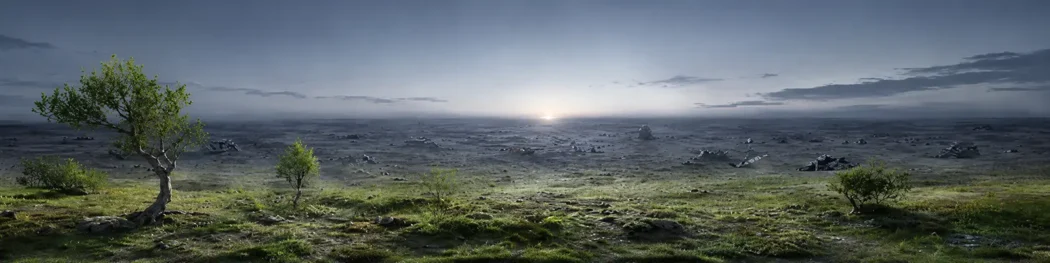
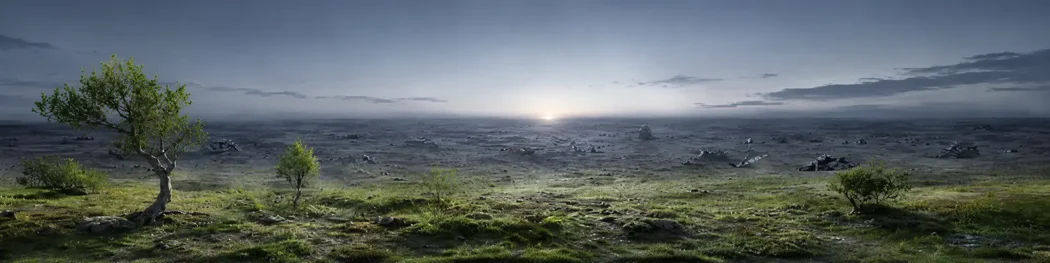
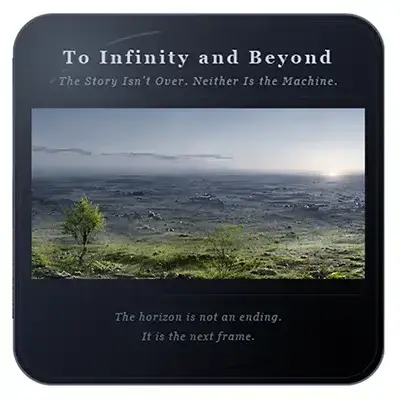
The scene is an open horizon at the precise boundary between night and dawn — not quite dark, not quite light, the sky in that specific grey-blue transition before the sun is visible but after the stars have begun to fade. The landscape is vast and largely empty: a flat plain or a wide beach, the ground fading into distance without a clear vanishing point, as if the frame simply runs out before the world does. Scattered across the foreground and middle distance, partially visible and partially buried or faded, are objects from across the entire century of AI in storytelling — not as a crowded collage, but sparsely placed, the way artifacts are found rather than arranged. A chrome gear half-buried in sand. An open book, its pages turning in a wind that is otherwise invisible. A small round robot, motionless, facing the horizon. A reel of film, unspooled and catching the low light. These objects do not form a narrative. They are simply there, as things are simply there when a long time has passed. On the far horizon, where the sky meets the ground, a single point of light — not a star, not a sun, not a screen — glows with a quality that is difficult to name. It is not warm. It is not cold. It is simply present, and moving, and it has been moving for longer than the frame can account for.
The scattered artifacts — the gear, the open book, the small robot, the film reel — are the century compressed into a still life on the ground. They are not dramatic. They are simply what is left after a very long conversation. The instruction to the model is to place them sparsely, the way things are found rather than arranged, because this era is not about looking back at them — it is about what comes next.
The single point of light on the horizon is the era’s defining image. It is not identified. It is not explained. It is simply moving — which is the most important detail. Everything in the prior eras was either static or threatening or intimate. This light is none of those things. It is in motion, and its destination is not in the frame.
The palette breaking from all prior eras is intentional. Every decade had a color that could be named and placed — amber, blue, red, green, purple, crimson, forest green. To Infinity and Beyond has no decade color yet because it has no decade yet. The near-black to pale silver-white is the visual register of the blank screen — the moment before the image, which is where this era lives.
All Summaries by ReadAboutAI.com

Science Fiction becomes Science Fact : Eras Selector




Imagined Agents: The Medium Was the Message Before AI
↑ Back to Top