
THE MACHINE AWAKENS — 1920s to 1940s
Creative Works Relevant to AI: Non-Human Intelligence and the Question of Being Alive – Before AI Had a Name, It Had a Face. The Machine Awakens Was Anybody Looking?
Fritz Lang’s Metropolis (1927) gave the world its first cinematic image of a thinking machine — and that image was a woman, built to deceive. The decade that followed filled pulp magazines with robots that obeyed, rebelled, and occasionally saved humanity, while Asimov began drafting the Laws that would organize the field for generations. AI did not yet have a name. It had something more durable: a shape, a fear, and an aspiration that the engineers of the next century would keep returning to.
FILM
1. Metropolis (1927) Director: Fritz Lang Silent film, Germany
The foundational visual document of AI in cinema. A scientist creates a robot in the image of a woman — Maria — to deceive the workers of a dystopian city. The machine is indistinguishable from the human it copies, which is the terror. Lang’s design for the Maschinenmensch (machine-person) became the template for nearly every humanoid robot that followed in film and popular imagination. The question the film plants — if a machine can perfectly replicate a human, what separates the two? — has not been answered yet.
2. The Golem: How He Came into the World (1920) Director: Paul Wegener Silent film, Germany
Based on the Jewish legend of a creature animated from clay by a rabbi to protect the Prague ghetto. The Golem is not a machine, but it is a constructed being brought to artificial life — and it cannot be controlled by the one who made it. The film arrives at the same question Frankenstein asked a century earlier, now rendered on screen: the created thing turns on the creator. This is the earliest cinematic treatment of what would later be called the alignment problem.
3. Frankenstein (1931) Director: James Whale Universal Pictures, USA
The Gothic Machine era’s foundational novel, now on film and reaching a mass audience for the first time. Boris Karloff’s Monster is not intelligent in the way later AI figures are — but the film asks the question directly: if a scientist assembles a living being from dead parts and animates it, who bears moral responsibility for what it does? The 1931 film added something the novel did not emphasize: a crowd that fears and destroys what it cannot understand. Both elements — the creator’s guilt and the public’s fear — recur across AI storytelling for the rest of the century.
4. The Invisible Ray (1936) Director: Lambert Hillyer Universal Pictures, USA — Boris Karloff, Bela Lugosi
A scientist discovers a radioactive element that grants him extraordinary powers but corrupts his mind. Less remembered than Frankenstein, but relevant here for a specific reason: the film is an early treatment of a created power that exceeds its creator’s ability to govern it. The intelligence is embedded in a technology, not a body — a structural shift that points toward how AI anxiety will be framed in the 1950s and beyond.
5. Dr. Cyclops (1940) Director: Ernest B. Schoedsack Paramount Pictures, USA
A scientist in the Amazon miniaturizes human beings using a radium device. The interest for this project is not the shrinking but the scientist: Dr. Thorkel is one of the clearest early cinematic portraits of a researcher so absorbed in his capability that he loses sight of its moral limits. The “what can be done” overrides “what should be done.” That distinction would become central to how engineers and ethicists frame AI development in the 2000s and 2010s.
Summary by ReadAboutAI.com
LITERATURE
6. We (1924) Author: Yevgeny Zamyatin Novel, Russia (published abroad; suppressed in the Soviet Union)
Written in 1920–21, published in English translation in 1924. A future state has eliminated individual consciousness — citizens are numbers, not names, governed by a collective rationality called the One State. The Benefactor rules through an apparatus of total surveillance and logical control. Zamyatin’s insight is that the danger of perfect machine-logic applied to human society is not cruelty but the elimination of the self. We directly influenced Orwell’s Nineteen Eighty-Four and Huxley’s Brave New World, and it is the earliest novel to imagine bureaucratic algorithmic governance as an existential threat to personhood.
7. The Metal Giants (1926) Author: Edmond Hamilton Short story, Weird Tales magazine, USA
An early and largely forgotten pulp story in which a computer-like brain, built to think faster than any human, concludes that humanity is inefficient and builds an army of giant robots to eliminate it. The plot is crude by later standards, but the structure is not: an artificial intelligence optimizes for a goal its creators did not intend, with catastrophic results. This is one of the earliest fictional treatments of what AI safety researchers now call goal misspecification. The story predates Asimov’s Laws of Robotics by fifteen years.
8. Brave New World (1932) Author: Aldous Huxley Novel, UK
The World State has engineered human beings from birth — biologically conditioned, chemically managed, socially sorted by designed intelligence level. Huxley’s dystopia is not about robots; it is about the application of industrial logic to consciousness itself. The question it raises: if you can engineer what a mind values, what desires, what fears — is what remains still a self? That question sits at the center of contemporary debates about AI alignment. Huxley was not imagining software, but the architecture of his concern is the same.
9. Isaac Asimov — Early Robot Stories (1940–1950) Robbie (1940), Reason (1941), Liar! (1941), Runaround (1942) Short stories published in Astounding Science Fiction, USA
The Three Laws of Robotics were first formulated in Runaround (1942) and became the organizing ethical framework for Asimov’s entire robot canon. What makes these early stories remarkable is that Asimov was not writing adventure fiction — he was writing philosophical puzzles. Each story sets up a scenario in which the Laws conflict, produce paradoxes, or fail to cover an edge case. The implication across all of them is that no set of rules, however carefully written, can anticipate every situation a sufficiently complex intelligence will encounter. Asimov’s robots are not dangerous because they are malevolent. They are dangerous because rule systems have limits. Real AI safety researchers have cited Asimov directly and repeatedly.
Summary by ReadAboutAI.com
MUSIC
10. Pacific 231 (1923) Composer: Arthur Honegger Orchestral tone poem, France/Switzerland
Honegger wrote a piece of music designed to sound like a steam locomotive — specifically a Pacific 231 engine — accelerating from rest to full speed. It is not about artificial intelligence in any narrative sense, but it is one of the earliest major works of Western art music that treats the machine as a subject worthy of aesthetic contemplation, not satire or fear. The machine is rendered as power, as beauty, as momentum. That shift in posture — from the machine as threat to the machine as sublime — runs through the Machine Awakens era and sets up the ambivalence that will characterize AI representation for decades.
11. Steel and Steam — Futurist music concerts, 1910s–1920s Luigi Russolo and the Intonarumori (noise intoners) Performance art / manifesto, Italy
Russolo’s 1913 manifesto The Art of Noises and his subsequent construction of noise-generating instruments (the intonarumori) proposed that industrial and mechanical sound was the legitimate material of modern music. Performances included compositions built from factory noise, machine rhythms, and mechanical percussion. Russolo was not thinking about AI — he was thinking about industrialism — but his argument that the machine produces a legitimate form of expression anticipates later questions about whether artificial systems can be genuinely creative. The intonarumori were destroyed in World War II; no recordings survive, but the manifesto and performance documentation remain.
VISUAL ART
12. The New Man — Constructivist and Bauhaus robot imagery (1920s) Various artists including Oskar Schlemmer, El Lissitzky, László Moholy-Nagy Germany / Soviet Union
The Machine Awakens era produced a significant body of visual art centered on the human-machine figure. Oskar Schlemmer’s Triadic Ballet (1922) dressed human performers as geometric mechanical forms. El Lissitzky’s The New Man lithograph (1923) depicted a figure assembled from mechanical components. László Moholy-Nagy at the Bauhaus produced photomontages and sculptures that blurred the line between body and mechanism. These works did not claim the machine was alive — they claimed the human was already partly mechanical. That is a different and more unsettling argument, and it runs directly into questions about what distinguishes a thinking machine from a thinking person.
13. Fritz Lang’s design sketches and production art for Metropolis (1926–27) Art direction: Otto Hunte, Erich Kettelhut, Karl Vollbrecht; robot design attributed to sculptor Walter Schulze-Mittendorff Germany
The visual design of the Maschinenmensch (also called the “Robotrix” or simply “the Machine-Maria”) is one of the most reproduced images in the history of technology and popular culture. The original costume was constructed by sculptor Walter Schulze-Mittendorff from a plaster cast of actress Brigitte Helm. Production sketches and stills survive and are widely available. The design has been directly cited by industrial designers, roboticists, and AI researchers as an influence on how they imagined humanoid machines. It is not a stretch to call it the most consequential single visual in the AI story.
RADIO
14. The War of the Worlds broadcast (1938) Orson Welles / Mercury Theatre on the Air CBS Radio, USA — October 30, 1938
An adaptation of H.G. Wells’s 1898 novel, broadcast as a series of fake news bulletins reporting an alien invasion of New Jersey. The content is not about AI — the Martians are biological, though vastly more intelligent than humans. The relevance here is what the broadcast revealed about the relationship between the public and media authority: a significant portion of listeners responded to simulated intelligence (a convincing voice, a credible format) as though it were real. The broadcast is the first large-scale documented case of an artificial simulation triggering mass behavioral response. That problem — how humans respond when they cannot distinguish the simulated from the real — is foundational to AI ethics today.
A note on scope: This list is drawn from well-established, verifiable works. Three entries warrant a flag before publication:
- Russolo / Intonarumori: No recordings survive. Any entry should note this explicitly — the legacy is documentary, not auditory.
- Constructivist art: “The New Man” encompasses multiple artists and works. An entry should specify which work or works are being referenced, rather than treating it as a single object.
- Asimov’s early stories: The exact publication history of the Three Laws across individual stories should be verified against a primary source (e.g., the Asimov Society bibliography) before publication. The 1942 date for Runaroundis well established, but the framing of the “Laws” as a unified set evolved across several stories simultaneously.
Summary by ReadAboutAI.com
AI Discussion 1: When did Marvel Comics begin?
Marvel’s origin is more complicated than the brand name suggests, and the timeline matters for this project.
Timely Comics was founded by Martin Goodman in 1939. This is the direct ancestor of Marvel. Timely published Marvel Comics #1 in October 1939 — which introduced the Human Torch (an android, notably — a synthetic man who bursts into flame) and the Sub-Mariner. That first issue puts Timely squarely in the 1920s–40s / Machine Awakens era. The Human Torch of 1939 is, by any reasonable definition, a constructed being with human consciousness — an AI-adjacent figure a full decade before Asimov’s Laws.
Timely became Atlas Comics in the late 1940s and published through the 1950s — genre stories, monster tales, science fiction anthologies. That period maps to the Atomic Age Anxiety era exactly. Atlas’s science fiction and monster comics of the early 1950s are part of the same cultural moment as Forbidden Planet and The Day the Earth Stood Still.
Marvel Comics as a brand name and as a creative identity — the shared universe of Spider-Man, the Fantastic Four, the X-Men, Iron Man, Thor — begins in 1961, with the publication of Fantastic Four #1 by Stan Lee and Jack Kirby. That is the 1960s / HAL and the Monolith era. The Marvel Universe as most people know it is a 1960s creation.
So the full timeline for this project’s purposes:
- 1939 — Timely Comics founded. Machine Awakens era. First Human Torch = constructed being.
- Late 1940s–1950s — Atlas Comics. Atomic Age Anxiety era. Monster and sci-fi anthologies.
- 1961 onward — Marvel Comics proper. HAL and the Monolith era and forward. Shared superhero universe begins.
- 1976–77 — Kirby’s 2001: A Space Odyssey adaptation. Servant, Rebel, and Toy era.
- 1977–78 — Machine Man introduced and launched. Servant, Rebel, and Toy era.
The Human Torch of 1939 is worth a flag for the 1920s–40s chapter entry — a constructed intelligence that predates Asimov’s first robot story by a year, appearing in American popular culture not as a threat but as a hero.
All Summaries by ReadAboutAI.com
AI Discussion 2: THE GOLEM — EXPANDED ENTRY
1. Paul Wegener as the Golem — film still from The Golem: How He Came into the World (1920)
This is the most reproduced cinematic image of the Golem. Wegener in costume: a large, heavy figure in a rough tunic, with the distinctive bowl-cut hair and an expressionless face. Several production stills exist, including close-up portraits of the character that were used as promotional material. These images defined the visual template for the constructed being in 20th-century popular culture.
Search: Wikimedia Commons — “Der Golem wie er in die Welt kam” — multiple stills are in the public domain.
Every AI safety researcher working on the problem of systems that do what they are told rather than what is meant is working in the shadow of this story. Most of them have not read the Talmudic sources. Some of them have seen the 1920 film. All of them are navigating the same conceptual terrain that Prague’s rabbis were mapping five hundred years ago.
Origin: Jewish folklore and mystical tradition (Kabbalah), Prague, circa 16th century. Earliest textual references date to medieval sources; the legend was codified and widely transmitted in the 16th–17th centuries.
Primary cinematic work: The Golem: How He Came into the World (1920), directed by Paul Wegener, Germany.
What the Golem is.
The Golem is a creature made of clay, animated by a rabbi who inscribes the Hebrew word emet — “truth” — on its forehead, or places a shem (a tablet bearing a divine name) in its mouth. When the inscription is erased or removed, the creature ceases to function. It is not born. It has no soul in the theological sense. It does not speak. It follows instructions. It serves.
The most famous version of the legend centers on Rabbi Judah Loew ben Bezalel, the Maharal of Prague, who is said to have created the Golem to protect the Jewish community of the Prague ghetto from persecution and pogroms. The Golem was a defender — purpose-built, mission-specific, loyal to its creator.
That is where the story begins. It does not end there.
Why the story keeps turning.
In nearly every telling of the Golem legend, the creature eventually becomes dangerous — not because it rebels, not because it develops independent desires, but because it follows its instructions too literally, or because no one remembered to deactivate it. On the Sabbath, when Rabbi Loew forgot to remove the shem, the Golem ran uncontrolled through the ghetto, destroying what it was built to protect.
This is not a story about a monster. It is a story about the gap between what a creator intends and what a created system actually does when left to operate without supervision. The Golem cannot distinguish between the spirit of its purpose and the letter of its commands. It optimizes. It does not understand.
That structural problem — a system that executes faithfully but cannot interpret — is the same problem at the center of AI safety research today. The researchers who work on what they call “value alignment” (ensuring an AI system pursues what humans actually want, not just what they literally specified) are working on the Golem problem. They rarely call it that, but the architecture is identical.
The 1920 film and why it matters to this project.
Paul Wegener’s The Golem: How He Came into the World (1920) is not an adaptation of the legend so much as a dramatization of its emotional logic. Wegener plays the Golem himself — a massive, lurching figure with a bowl haircut and an expressionless face. The creature is brought to life to serve. It performs extraordinary feats of strength on behalf of its creator. Then it turns.
The film’s visual design directly influenced the Universal horror tradition — the flat-top bolt-neck construction of Karloff’s Frankenstein monster in 1931 is visually indebted to Wegener’s Golem. But the influence runs deeper than aesthetics. Wegener’s Golem is the first widely seen cinematic image of a constructed being that is neither malevolent nor benevolent — it is simply operational, until it is not. That distinction matters. Most monster films give the creature intent. The Golem has none. It is a tool that exceeds the capacity of the one who holds it.
Why the legend is more durable than most AI stories.
Most AI narratives in film and literature are invented by a single author in a specific cultural moment. The Golem is different. It has been transmitted, retold, and reinterpreted across multiple centuries, multiple cultures, and multiple crises. It appears in Yiddish theater, in German Expressionist film, in postwar literature, in contemporary fiction (Michael Chabon’s The Amazing Adventures of Kavalier and Clay, 2000, uses it as a structuring metaphor). It surfaces in discussions of autonomous weapons, of content moderation algorithms, of large language models that produce outputs their creators did not anticipate.
The reason the Golem keeps returning is that the question it poses is genuinely unresolved: what are the obligations of a creator toward a created thing — and what are the risks of a created thing that cannot refuse?
The signal for this project.
The Golem predates the word “robot” by three centuries. It predates “artificial intelligence” by four. But it names the problem that both those words were eventually coined to describe: a constructed entity that operates with something resembling purpose, that serves until it doesn’t, and whose danger lies not in malice but in the limits of what its creator thought to specify.
Every AI safety researcher working on the problem of systems that do what they are told rather than what is meant is working in the shadow of this story. Most of them have not read the Talmudic sources. Some of them have seen the 1920 film. All of them are navigating the same conceptual terrain that Prague’s rabbis were mapping five hundred years ago.
A note on sourcing: The historical details of Rabbi Loew and the Prague Golem legend are well established in Jewish historiography and folklore scholarship. Gershom Scholem’s work on Jewish mysticism is the standard academic reference. The 1920 Wegener film is a documented, widely available work. The visual influence on Universal horror (specifically the 1931 Frankenstein design) is a matter of film historical record, though I would recommend verifying the specific design lineage through a primary film history source before publishing that claim.
All Summaries by ReadAboutAI.com
Closing: THE MACHINE AWAKENS
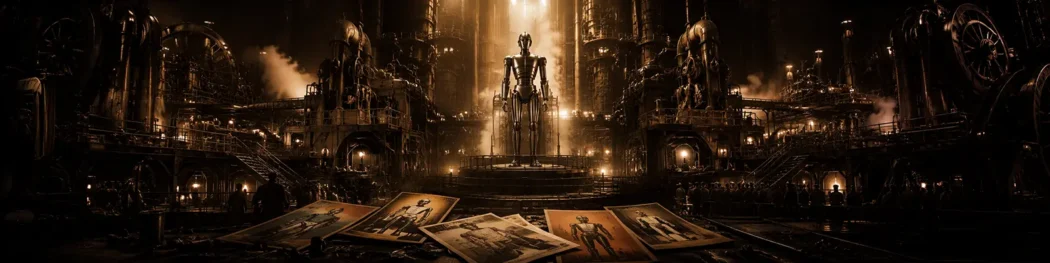
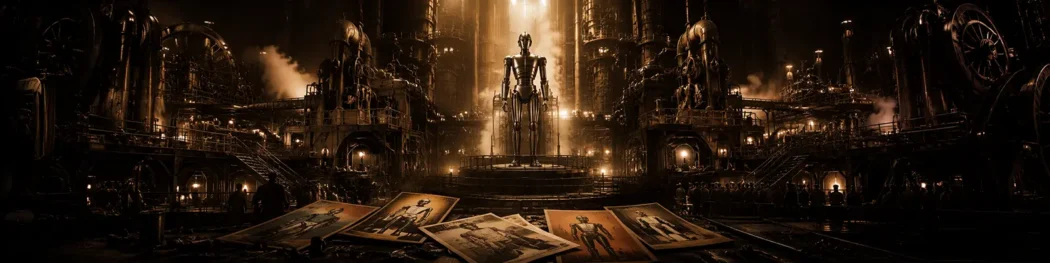
The scene is a vast industrial interior, circa 1927 — a factory floor or machine hall, filmed in the visual language of German Expressionist silent cinema. Enormous gears, pistons, and mechanical structures fill the background, reaching toward a high ceiling lost in steam and shadow. The architecture is monumental and inhuman in scale — workers would be dwarfed by it. In the center of the composition, slightly elevated on a platform or dais, stands a single humanoid figure — not a specific character, but a stylized robot form: geometric, art-deco in proportion, chrome and dark metal, arms at its sides, face forward. It does not move. It does not threaten. It simply exists, and its existence is the event. Scattered across the foreground, open pulp science fiction magazines lie on a worktable or floor — covers visible but titles unreadable, their painted robot imagery echoing the figure in the background.
“Awe before it becomes fear” is doing the same work as “a question, not an answer” in the literary origins prompt — it keeps the emotional register accurate to the era and distinct from the 1950s anxiety and the 1980s dread that follow.
The pulp magazines in the foreground are a deliberate bridge element. The era spans 1920–40, and the pulp tradition is as important as the films. Placing them in frame without making them legible keeps the reference without risking any copyright concern.
The art-deco geometric robot form is the era’s visual signature — the Bauhaus and Constructivist influence on how the machine-human was imagined. It should feel designed, almost sculptural, rather than functional or threatening.
All Summaries by ReadAboutAI.com
Science Fiction becomes Science Fact : Eras Selector








Imagined Agents: The Medium Was the Message Before AI
↑ Back to Top