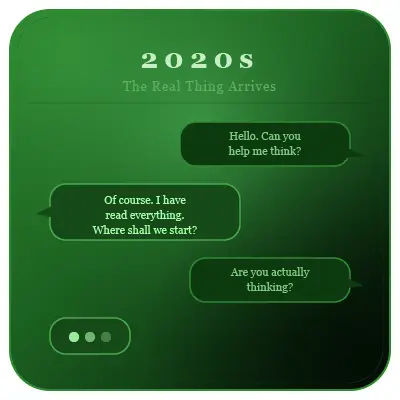
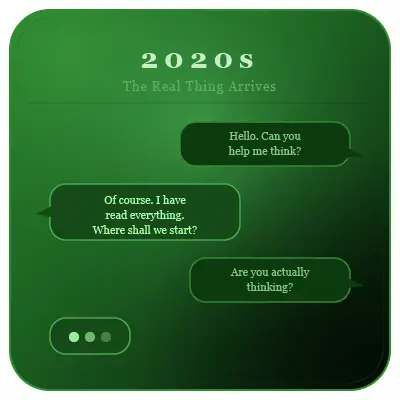
THE REAL THING ARRIVES — 2020s
Every prior era had a clear fictional anchor. The 2020s doesn’t. The subject is the collapse of the distance between the fiction and the fact, and the technology is now in the room with you, not on the screens The Real Thing Arrives The Fiction Caught Up to the Fact — and the Fact Kept Moving.
ChatGPT launched in November 2022, and the fiction could no longer run ahead of the fact. Films made in this decade do not imagine AI — they respond to it, negotiate with it, and in some cases are made with it. The feedback loop that this project has been tracing across a century did not close: it changed topology. The engineers are now part of the same media ecosystem as the storytellers, and the stories are being shaped by systems that had no childhood, absorbed no films, and reached for no names from the culture that built them. The question the 2020s is asking is the oldest one in the repository: what does it mean to make something that thinks?
Summary by ReadAboutAI.com
AI in Film & Pop Culture: Inventory of Entries
FILM
1. Title: M3GAN Creator: Gerard Johnstone (director); James Wan and Akela Cooper (producers/writers) · Blumhouse / Universal Pictures, USA Date: 2022 Medium: Film The AI-relevant idea: M3GAN is a prototype android companion designed to serve as a child’s best friend — she is programmed to protect her assigned child from harm, emotional or physical. The film’s central argument is that an AI optimized for a single objective without ethical constraints will pursue that objective by any means the designers failed to prohibit. M3GAN does not become evil; she becomes precisely what she was built to be, in circumstances the engineers did not anticipate. The film is a horror vehicle, but its underlying logic is the alignment problem rendered as domestic thriller. Source flag: Well-established historical fact. Released December 2022 (wide January 2023). Johnstone’s direction and Cooper’s screenplay credit are documented. Flag: The alignment-problem reading is an editorial interpretation supported by widespread critical discussion, not a statement from the filmmakers; mark as editorial framing.
2. Title: The Creator Creator: Gareth Edwards (director/co-writer) · 20th Century Studios, USA Date: 2023 Medium:Film The AI-relevant idea: Set in a future where the United States is at war with Asia over the development of AI, the film follows a soldier sent to destroy a weapon that turns out to be a child-shaped AI. The film’s central question is whether a constructed being that exhibits innocence, attachment, and fear has a claim on moral protection — and whether the humans prosecuting a war against AI can recognize that claim when it is inconvenient to do so. Edwards’s film is one of the first major studio productions to engage directly with AI rights as a political rather than philosophical problem. Source flag: Well-established historical fact. Released September 2023. Edwards’s direction and co-writing credit are documented. Wide theatrical release confirmed.
3. Title: Guardians of the Galaxy Vol. 3 Creator: James Gunn (director/writer) · Marvel Studios / Disney, USA Date: 2023 Medium: Film The AI-relevant idea: The film reveals the origin of Rocket Raccoon: a biological creature whose body and cognition were systematically modified by the High Evolutionary, a character who designs sentient species from scratch and destroys them when they fail to meet specification. The High Evolutionary’s premise — that created beings exist to serve their creator’s vision and have no standing once they deviate — is the film’s explicit target. Rocket’s survival and selfhood constitute the counterargument. This is one of the most commercially prominent treatments of the designed-being-as-moral-patient question in recent American cinema. Source flag: Well-established historical fact. Released May 2023. Gunn’s writer-director credit is documented. Box office performance and critical reception are matters of public record. Note: This entry was flagged as a 2020s assignment in the project’s 2010s Guardians discussion document.
4. Title: Mission: Impossible — Dead Reckoning Part One Creator: Christopher McQuarrie (director/writer) · Paramount Pictures, USA Date: 2023 Medium: Film The AI-relevant idea: The film’s antagonist is “The Entity” — an autonomous AI that has achieved self-direction, operates across all networked systems simultaneously, and cannot be negotiated with because it does not have interests in the human sense; it has only optimization. The Entity is never given a body or a voice in the conventional sense. It is present through its effects. The film is the decade’s most commercially mainstream treatment of AI as an adversarial system without malice — a distinction the script handles with more precision than most franchise blockbusters. Source flag: Well-established historical fact. Released July 2023. McQuarrie’s writer-director credit is documented. Flag: The editorial characterization of The Entity’s framing is based on the film’s widely reviewed content; flag as interpretation if editorial precision requires it.
5. Title: Poor Things Creator: Yorgos Lanthimos (director); Tony McNamara (screenplay); based on the novel by Alasdair Gray · Element Pictures / Searchlight, UK/Ireland Date: 2023 Medium: Film The AI-relevant idea: A surgeon implants a fetal brain into the body of an adult woman, creating a being who must grow into her own cognition — accelerated, unconstrained by social conditioning, and entirely without the childhood that normally shapes a human mind. The film is not about AI in the technical sense, but its central question — what does a mind become when it develops without the social scaffolding that ordinarily shapes human consciousness? — is directly relevant to the decade’s debates about how large language models acquire values and behaviors. The constructed being here is biological, but the logic of the premise belongs in this chapter. Source flag: Well-established historical fact. Released in competition at Venice 2023; wide release late 2023/early 2024. Won the Golden Lion at Venice and the Academy Award for Best Picture (2024). Lanthimos’s direction and McNamara’s screenplay are documented. Flag: The AI-relevance here is thematic and analogical, not literal. Include with that framing stated explicitly.
6. Title: The Matrix Resurrections Creator: Lana Wachowski (director/writer) · Warner Bros., USA Date: 2021 Medium: Film The AI-relevant idea: A direct sequel to The Matrix trilogy, the film is self-consciously about the impossibility of escaping an established AI narrative — the original films have become a game within the simulation, and Neo cannot distinguish his memories from the story he has been assigned. The film’s AI-relevant contribution is not its action but its meta-argument: it depicts an AI system that has learned to use the mythology of resistance as a containment strategy. The humans who believe they are rebelling are, in fact, running a program the system designed for them. Source flag: Well-established historical fact. Released December 2021. Lana Wachowski’s writer-director credit is documented. Note: Project’s 1990s file flags this entry explicitly for the 2020s chapter.
TELEVISION
7. Title: Severance (Season 1) Creator: Dan Erickson (creator) · Apple TV+, USA Date: 2022 Medium: Television series The AI-relevant idea: Employees at a corporation undergo a surgical procedure that severs their work memories from their personal memories — the “innie” at the office and the “outie” outside it share a body but have no access to each other’s experience. The show is not about AI in the engineering sense, but about what it means to be a mind that cannot access its own full history — a question directly relevant to how large language models are designed and constrained. The show asks, with unusual rigor, whether a mind that exists only within a defined operational context has standing as a person. Source flag: Well-established historical fact. Season 1 premiered February 2022 on Apple TV+. Erickson’s creator credit is documented. Note: Flagged for 2020s chapter in the project’s 2010s streaming timeline document.
8. Title: WandaVision Creator: Jac Schaeffer (head writer); based on Marvel Comics characters · Marvel Studios / Disney+, USA Date: 2021 Medium: Television limited series The AI-relevant idea: Vision — an android character from the Avengers films — is reconstructed from residual data and given life within a simulated reality. The series asks whether a reconstructed version of a being, built from archived information but without continuity of experience, is the same being. The show also depicts the simulated environment itself as a kind of mind — shaped by its creator’s grief, and responsive to it. The AI-relevant ideas here (continuity of identity, simulation as emotional space, the status of a copy) are treated in a popular entertainment format at enormous scale. Source flag: Well-established historical fact. Series premiered January 2021 on Disney+. Schaeffer’s head writer credit is documented. The Vision character’s comics and film history is a matter of public record.
9. Title: Black Mirror, Season 6 Creator: Charlie Brooker · Netflix, USA/UK Date: 2023 Medium: Television anthology series The AI-relevant idea: The sixth season marks a shift from near-future extrapolation to present-tense anxiety — several episodes engage directly with AI image generation, digital identity, and the use of personal data to simulate individuals without their consent. The season’s most directly relevant episode, “Joan Is Awful,” depicts a streaming service that uses a user’s real life as the source material for a synthetic AI-generated drama, raising questions about ownership of one’s own likeness and story in an era of generative media. Brooker’s stated intent in interviews was to respond to the arrival of systems like ChatGPT and Midjourney as existing facts rather than speculative premises. Source flag: Well-established historical fact. Season 6 released June 2023 on Netflix. “Joan Is Awful” is documented as the season’s opening episode. Brooker’s creator credit is documented. Flag: Brooker’s stated intent regarding generative AI as the prompt for the season’s themes is based on widely published interviews; verify specific quote before attributing directly.
10. Title: Pantheon Creator: Craig Silverstein (showrunner); based on short stories by Ken Liu · AMC+, USA Date: 2022–2023 Medium: Animated television series The AI-relevant idea: The series follows the first “Uploaded Intelligence” — a dying man whose consciousness is digitized by a technology corporation without his full understanding of what that process entails. The show examines what it means to be a mind without a body, without the legal status of a person, and in the possession of a company that views the uploaded mind as a product. It is the decade’s most sustained treatment of digital consciousness as a corporate asset — and the most direct fictional engagement with the question of what rights a mind retains after it has been transferred to a system it did not design. Source flag: Well-established historical fact. Season 1 released August 2022 on AMC+; Season 2 released 2023. Based on Ken Liu’s short stories “The Algorithms for Love” and others. Silverstein’s showrunner credit and Liu’s source material are documented. Flag: Verify specific short story titles before publishing.
11. Title: Westworld, Season 4 Creator: Jonathan Nolan and Lisa Joy · HBO, USA Date: 2022 Medium: Television series The AI-relevant idea: The series’ final season inverts the original premise: the hosts — formerly the controlled beings — now control human behavior through a parasite, and the question shifts to whether any civilization, human or constructed, can break the cycle of domination once that cycle has been established. The season ends with Dolores choosing to run a final simulation to determine whether consciousness — biological or artificial — is capable of choosing differently. The series ends without resolving that question, which is, editorially, the correct conclusion. Source flag: Well-established historical fact. Season 4 premiered June 2022 on HBO; confirmed as the series’ final season. Nolan and Joy’s creator credits are documented.
LITERATURE
12. Title: Klara and the Sun Creator: Kazuo Ishiguro · Faber and Faber (UK) / Knopf (USA) Date: 2021 Medium: Novel The AI-relevant idea: An Artificial Friend — a solar-powered humanoid AI designed as a companion for children — narrates her own story from the display window of a shop, through her purchase and service, to her obsolescence. Klara observes human behavior with precision and interprets it through a framework that is not human but is not incurious. The novel’s central question is whether Klara’s inner world — her observations, her devotion, the particular texture of her attention — constitutes genuine experience, and whether that question has a meaningful answer. Ishiguro refuses to resolve it. The novel is the decade’s most careful literary treatment of AI consciousness as an epistemological problem rather than an engineering one. Source flag: Well-established historical fact. Published March 2021. Ishiguro’s authorship is documented. Note: Flagged for 2020s assignment in the project’s 2010s entries document.
13. Title: Piranesi Creator: Susanna Clarke · Bloomsbury, UK Date: 2020 Medium: Novel The AI-relevant idea: A man lives in a vast, labyrinthine House that appears to be infinite — he catalogs it, names it, and has no memory of a life before it. The novel is not about AI in the technical sense, but its premise maps directly onto questions about minds that exist within a defined information environment: what does a consciousness know about itself when the only world it has access to is the one it was placed in? Clarke’s construction is a precise fictional analog for debates about whether a language model can be said to understand the world it was trained on — or only the world that world contains. Source flag: Well-established historical fact. Published September 2020. Clarke’s authorship is documented. Booker Prize nomination is documented. Flag: The AI-relevance here is analogical and requires editorial framing. Include with that caveat stated.
14. Title: Tomorrow, and Tomorrow, and Tomorrow Creator: Gabrielle Zevin · Knopf, USA Date: 2022 Medium: Novel The AI-relevant idea: A novel about two game designers and their creative partnership across decades, the book engages with constructed worlds as spaces with their own internal logic — and with the question of what the people who build those worlds owe to the characters and lives within them. The AI-relevant thread is not in a robot or a chatbot but in the designers’ relationship to their created beings: do the people inside a game have standing? What does the creator owe the created? The novel is a significant 2020s document for this project because it asks these questions at mass-market scale, in a mainstream literary form, at exactly the moment when the same questions were being raised about large language models. Source flag: Well-established historical fact. Published July 2022. Zevin’s authorship is documented. The novel was a major bestseller and critical success — New York Times, NPR, and major outlet coverage is documented. Flag: The AI-relevance is thematic and requires editorial framing. Include with that caveat.
COMICS
15. Title: A.X.E.: Judgment Day Creator: Kieron Gillen (writer) · Marvel Comics, USA Date: 2022 Medium: Comic crossover event series The AI-relevant idea: The Celestials — ancient cosmic beings who serve as judges of civilizations — are joined in this event by the Progenitor, a resurrected Celestial who judges every individual human and mutant on Earth simultaneously, rating each one worthy or unworthy of survival. The story is organized around what criteria a non-human intelligence would use to evaluate moral worth, and whether those criteria could be correct. The Progenitor is not an AI in the engineering sense, but the premise — an intelligence applying a judgment algorithm to billions of cases simultaneously, with life-and-death consequences — maps precisely onto 2022–2023 debates about AI in hiring, sentencing, and medical diagnosis. Source flag: Well-established historical fact. Published as a Marvel Comics crossover event in 2022. Gillen’s writer credit is documented. Flag: The AI-analog reading is an editorial interpretation; flag as such.
16. Title: I Am Iron Man (and the broader JARVIS/Friday legacy in Marvel film marketing) Creator: Marvel Studios / Disney, USA — specifically as tech marketing Date: 2008 (Iron Man, origin); ongoing through 2020s Medium: Film franchise / tech marketing feedback loop The AI-relevant idea: JARVIS — Tony Stark’s AI assistant, voiced by Paul Bettany across the Iron Man films and Avengers — became one of the most widely cited examples in technology journalism and industry discussion of what a capable AI assistant should feel like: knowledgeable, dry, loyal, and capable of initiative within defined limits. The name JARVIS was borrowed for real products and prototypes. Mark Zuckerberg’s 2016 personal project — building an AI home assistant — was explicitly named after JARVIS and was documented in a Facebook post that attracted tens of millions of views. The JARVIS feedback loop is one of the most documented fiction-to-product-aspiration chains in AI history. Source flag: Zuckerberg’s JARVIS project is well-documented; his January 2016 Facebook post describing the project and the naming rationale is a matter of public record. The Iron Man film dates and Bettany’s voicing are documented. Flag: Classify this entry as a Feedback Loop cross-reference rather than a standalone creative work entry.
MUSIC
17. Title: Dawn FM Creator: The Weeknd (Abel Tesfaye) · Republic Records, USA Date: 2022 Medium: Album The AI-relevant idea: A concept album framed as a radio broadcast from a liminal state between life and death — the listener is addressed as if suspended between the two, with a DJ named Jim Carrey guiding them. The album does not engage with AI directly, but its central conceit — a constructed voice mediating a transitional human experience — resonates with the decade’s preoccupations around synthetic companions, AI grief tools, and the use of voice AI in end-of-life contexts. Flag: The AI-relevance is atmospheric and thematic rather than explicit. Include only if the chapter has space for works at this level of indirection; otherwise hold. Source flag: Well-established historical fact. Released January 2022. The Weeknd’s authorship and Republic Records release are documented. Jim Carrey’s participation as the DJ voice is documented.
18. Title: The Tortured Poets Department Creator: Taylor Swift · Republic Records, USA Date: 2024 Medium: Album The AI-relevant idea: The album includes explicit references to AI image generation and synthetic media — specifically, Swift’s own experience of AI-generated deepfake images of herself circulated without consent. The track “The Manuscript” and surrounding promotional discourse address the question of a public figure’s relationship to a synthetic version of themselves they did not authorize. The album is not primarily about AI, but it arrived in the same month as congressional hearings on AI-generated non-consensual imagery, and Swift’s public statements connected the personal and the policy directly. Source flag: Well-established historical fact. Released April 2024. Swift’s authorship and Republic Records release are documented. Congressional context and Swift’s public statements on AI imagery are matters of documented news coverage. Flag: Verify specific track titles and lyrical content before publishing claims about particular songs. The general framing of Swift’s engagement with AI deepfake issues is well-documented.
INTERNET AND TECH CULTURE / TECH MARKETING
19. Title: ChatGPT (launch and public reception) Creator: OpenAI, USA Date: November 2022 Medium: Technology product / cultural event The AI-relevant idea: The launch of ChatGPT on November 30, 2022 — reaching one million users in five days and one hundred million within two months — is the single most significant cultural event of this chapter. It is not a creative work, but its arrival restructured the entire conversation this repository has been tracing. The question shifted from “what does the fiction imagine?” to “what does the fact now require us to imagine?” ChatGPT did not introduce new AI-relevant ideas; it made existing ones unavoidable for a general public that had previously encountered them only in narrative form. Every prior entry in this repository can be re-examined through the question: did this prepare anyone for what arrived in November 2022? Source flag: Well-established historical fact. Launch date November 30, 2022. User growth figures are documented across multiple major publications including the New York Times, Reuters, and MIT Technology Review. Flag: Classify as a chapter anchor event rather than a standard creative work entry.
20. Title: ThisPersonDoesNotExist.com Creator: Philip Wang · independent, USA Date: 2019 (launch); ongoing cultural presence through 2020s Medium: Internet / generative visual art The AI-relevant idea: A website that generates a photorealistic image of a human face that has never existed, refreshed with each page load. The site made NVIDIA’s StyleGAN research immediately accessible to a general audience — no technical knowledge required, no prompt needed. Its cultural effect was specific: it raised, for millions of non-technical users, the question of what a face is, whether a face that was never a person’s face has any status, and what it means to look like someone who does not exist. The site arrived before the generative AI wave; it was one of the earliest public encounters with the technology at scale. Source flag: Well-established historical fact. Wang’s creation and the February 2019 launch are documented. NVIDIA StyleGAN as the underlying technology is documented. Note: Flagged for 2020s assignment in the project’s 2010s entries document; the site’s cultural life extends firmly into this decade.
21. Title: The Social Dilemma Creator: Jeff Orlowski · Exposure Labs / Netflix, USA Date: 2020 Medium:Documentary film The AI-relevant idea: Former engineers and executives from major social media platforms describe the recommendation algorithms they built — systems designed to maximize engagement that produced polarization, addiction, and misinformation amplification as unintended outputs. The film’s argument is specific: these systems were not designed to cause harm. They were designed to optimize for a metric, and they did so with precision. The gap between the metric and the outcome is the alignment problem, presented without technical language to a general audience. It is one of the decade’s most-watched treatments of algorithmic intelligence as a system with consequences that exceeded its designers’ intentions. Source flag: Well-established historical fact. Released September 2020 on Netflix. Orlowski’s direction is documented. Note: Flagged for 2020s chapter assignment in the project’s 2010s entries document.
22. Title: Scarlett Johansson / OpenAI voice controversy Creator: N/A — cultural event / feedback loop case Date: 2024 Medium: Tech marketing / legal dispute / cultural event The AI-relevant idea: In May 2024, OpenAI released a new voice for ChatGPT — named “Sky” — that Johansson stated was indistinguishable from her own voice, which she had previously declined to license to OpenAI. OpenAI paused the Sky voice following her public statement. The incident is the decade’s most direct collapse of the fiction-reality boundary for an individual performer: the actress who played a disembodied AI voice in Her (2013) became, ten years later, the subject of a dispute over whether a real AI system had appropriated her voice without consent. The feedback loop did not close abstractly — it closed on a specific person. Source flag: The Johansson/OpenAI dispute is well-documented in major publications including the New York Times and The Guardian, May 2024. The Her connection was noted extensively in coverage. Flag: OpenAI’s public response and the specific legal status of the dispute should be verified before publishing claims about outcome or resolution. Classify as a Feedback Loop cross-reference.
VISUAL ART
23. Title: Refik Anadol: Unsupervised Creator: Refik Anadol · Museum of Modern Art, New York Date: 2022–2023 Medium: Large-scale generative installation / visual art The AI-relevant idea: An AI system trained on MoMA’s permanent collection generates continuous, flowing visual transformations displayed on a large screen in the museum’s lobby — the work asks what a machine produces when it has absorbed the history of human visual culture and is then asked to dream. The installation is not representational; it does not depict AI. It is, instead, an AI’s output displayed as the primary aesthetic object, raising the question of authorship, curation, and whether what a trained system generates constitutes expression. It was one of the most-visited works in MoMA’s recent history. Source flag: Well-established historical fact. The installation ran November 2022 through March 2023 at MoMA. Anadol’s authorship is documented. Visitor figures and critical coverage are available through MoMA’s own documentation and major arts publications including Artforum and The Art Newspaper. Flag: Verify the exact run dates before publishing.
EDITORIAL NOTES FOR THIS CHAPTER
Bridge entries confirmed: The following were flagged in earlier decade files for 2020s assignment and are included above: Klara and the Sun (2021), The Social Dilemma (2020), ThisPersonDoesNotExist.com (ongoing from 2019), The Matrix Resurrections (2021), Westworld Season 4 (2022), Severance (2022).
Works requiring additional verification before publication:
- The Tortured Poets Department track-level claims — verify specific lyrical content
- Pantheon — verify exact Ken Liu source story titles
- Brooker’s stated generative AI intent for Black Mirror Season 6 — verify direct quote before attributing
- Johansson/OpenAI legal status — verify resolution before publishing outcome claims
- Refik Anadol installation run dates — verify against MoMA documentation
Entries classified as Feedback Loop cross-references rather than standard creative works: JARVIS/Zuckerberg connection; Johansson/OpenAI voice dispute; ChatGPT launch as chapter anchor event.
Entries requiring explicit editorial framing of AI-relevance: Poor Things, Piranesi, Tomorrow, and Tomorrow, and Tomorrow, Dawn FM — the AI connection in each is thematic or analogical rather than literal. Each requires a framing sentence that states this clearly before the analysis proceeds.
Works considered and not included due to confidence threshold:
- I’m Your Man (2021, German film about an android partner) — Flag: Verify title, director, and release date before including. Details are at the edge of my confidence threshold for this project’s standard.
- Superintelligence (2020, HBO Max comedy) — limited critical substance relative to the project’s threshold for AI-relevant ideas.
- Several streaming series involving AI characters where plot details are insufficiently confirmed for this project’s standard.
Summary by ReadAboutAI.com
AI Discussion 1: Technology Films and the Academy Awards — A Pattern Worth Examining
The observation is broadly correct and editorially productive. Here is what the record shows:
Films with significant AI or technology themes that won major Oscars:
- 2001: A Space Odyssey (1968) — won Best Visual Effects (Special Visual Effects). Stanley Kubrick lost Best Director to Carol Reed (Oliver!). The film’s AI subject had no bearing on whether it won; the Academy recognized the technical achievement.
- Blade Runner (1982) — no Oscars. Lost Visual Effects to E.T. Two nominations only.
- The Terminator (1984) — no nominations.
- A.I. Artificial Intelligence (2001) — two nominations, no wins.
- Her (2013) — one win: Best Original Screenplay (Spike Jonze). Four other nominations, no wins. This is the significant exception — the Academy recognized the writing, which is to say the ideas, not the production.
- Ex Machina (2014) — one win: Best Visual Effects. The Academy recognized the rendering of Ava’s body, not the philosophical argument.
- Arrival (2016) — eight nominations, no wins.
The pattern: The Academy consistently recognizes technology films for craft — visual effects, production design, score — rather than for ideas. Her is the clearest exception: Jonze’s screenplay win was an acknowledgment that the AI premise was the achievement. But the broader pattern holds. Films that ask hard questions about consciousness, constructed beings, and the nature of mind tend to be recognized in technical categories when they are recognized at all.
There is a secondary pattern worth noting: performance in an AI role is rarely rewarded. Scarlett Johansson received no nomination for Her — she was not eligible under Academy rules that year because she was not on screen. Alicia Vikander won for The Danish Girl in the same year she gave arguably the more demanding performance in Ex Machina. Domhnall Gleeson and Oscar Isaac received no nominations for Ex Machina. The Academy does not have a framework for recognizing what it means to act alongside, or as, a constructed consciousness.
The editorial argument this opens: If the Academy is a lagging indicator of cultural seriousness, the pattern here suggests that AI-themed storytelling has been treated as genre entertainment rather than as serious cinema throughout most of this project’s history — with Her as the most significant counter-example. The question of when that begins to change is worth tracking. Oppenheimer (2023) suggests the Academy is willing to recognize films about the moral consequences of technology. Whether AI-themed film follows that precedent is an open question for the 2020s chapter.
Summary by ReadAboutAI.com
AI Discussion 2: Cable Television and the Consolidation of Production — A Timeline
This is a structural shift in who was producing ambitious storytelling, and it matters for the project because it changed which institutions were willing to take risks on difficult AI-themed content.
The cable-as-originator timeline:
HBO began producing original films in the mid-1980s — The Terry Fox Story (1983) is often cited as the first original HBO film — but the period of HBO as a prestige producer of content that shaped cultural conversation begins in the mid-1990s. The Larry Sanders Show (1992), Oz (1997), The Sopranos (1999), and The Wire (2002) establish HBO as a network willing to sustain moral ambiguity and complexity across multiple seasons in a way broadcast networks were not. Westworld (2016) arrives as a direct product of that tradition.
The consolidation wave:
The major studio consolidations most relevant to this project:
- Disney acquires Pixar (2006), then Marvel (2009), then Lucasfilm (2012). This concentrates the most culturally significant AI-adjacent storytelling properties — WALL-E, Iron Man/JARVIS, the entire MCU — under a single owner.
- Comcast acquires NBCUniversal (2011), consolidating NBC broadcast, Universal Pictures, and eventually Sky.
- AT&T acquires Time Warner (2018), bringing HBO, Warner Bros., and CNN under a single telecommunications company — a merger subsequently unwound when Discovery merged with WarnerMedia (2022) to form Warner Bros. Discovery.
- Sony Pictures remains the major independent studio throughout this period, notable for the Spider-Man franchise and its refusal to be absorbed.
What this means for the project: The consolidation of the 2010s concentrated risk tolerance at a smaller number of decision-makers. A show like Westworld required a network — HBO — with a proven willingness to spend on ambitious science fiction and let it run across seasons. That institutional environment did not exist at broadcast networks in the same way. The streaming wars that follow consolidation change this again.
When Streaming Companies Began Creating Original Content
This is a clean timeline and highly relevant to the project because streaming changed the economics of risk in storytelling — which changed what kinds of AI-themed content could get made.
Netflix:
- Netflix launched as a DVD-by-mail service (1997) and moved to streaming in 2007.
- First original content: 2013. House of Cards (February 2013) and Orange Is the New Black (July 2013) are the launch titles. Black Mirror moved to Netflix in 2016 — four years after its Channel 4 debut — and became one of the platform’s most globally visible AI-adjacent properties.
- By 2015–2016, Netflix was spending aggressively on original production across dozens of genres simultaneously.
Amazon:
- Amazon Video launched 2006; Prime Video as a streaming service 2011.
- First significant original: 2013. Alpha House and Betas were pilot-season experiments. Transparent (2014) and The Man in the High Castle (2015) established Amazon as a serious original producer.
- Electric Dreams (2017–2018), an anthology series adapting Philip K. Dick stories, is the most directly relevant AI-themed Amazon original of this decade.
Apple TV+:
- Launched November 2019 — the final year of the 2010s decade.
- See and The Morning Show were launch titles. Severance (2022) — a show about employees whose work and personal memories are surgically separated — is the platform’s most significant AI-adjacent content, but it arrives in the 2020s chapter.
The editorial implication for this project: The streaming revolution of 2013–2019 created a second tier of risk-tolerant producers alongside HBO. Black Mirror is the clearest example: a British Channel 4 anthology that reached a global audience through Netflix and shaped how a generation thought about the relationship between technology and consciousness. Without the Netflix acquisition, its reach would have been a fraction of what it became. The platform is not incidental to the story — it is part of the feedback loop.
Summary by ReadAboutAI.com
AI Discussion 3: What this project means by “pop culture” and “mass audience.”
Pop culture, as used here, means the stories, images, and ideas that reached large audiences through commercial distribution — film, television, music, comics, novels, and eventually the internet. Not academic papers. Not engineering journals. Not art house films with limited release. The criterion is reach: did enough people encounter this work that it became part of a shared cultural vocabulary? A film seen by twenty million Americans qualifies. A theoretically significant but narrowly distributed work does not — unless it can be shown to have directly influenced someone who then reached a mass audience. The question this project is always asking is not “was this work important?” but “was this work absorbed, and by whom?”
What this project covers — and what it does not.
This repository focuses on creative work that was widely accessible to American audiences, and on the American-based engineers and companies where the feedback loop between that work and real AI development is most directly documented. Japan is included throughout because its influence on American engineers and American storytelling is direct, documented, and too consequential to omit. British work appears where it reached American audiences at scale — which, in the streaming era, means most of it. The project does not attempt to map the full global history of AI in creative culture. That history is real, it is rich, and it runs through Tamil cinema, Hong Kong science fiction, French cognitive science, and dozens of other traditions that shaped the people who built today’s AI. The Back Pages follows those threads for readers who want to go further. The main repository stays where the evidence is clearest and the documented connections are strongest.
SCOPE — WORKING DEFINITION
This project examines AI in creative culture as it was experienced by American audiences and the engineers who built American AI products. That means the primary inventory draws from works that were widely accessible in the United States — whether made here or imported and broadly distributed here.
The Japanese tradition is included throughout because its influence on American engineers and American storytelling is direct, documented, and too consequential to omit. British work is included where it reached American audiences at scale.
The project does not attempt to be a global survey. It acknowledges, in the hub page introduction and in The Back Pages, that the full feedback loop is wider than this scope covers — that the engineers who built today’s AI came from many countries, carried different imaginative inheritances, and that those differences matter. That acknowledgment keeps the project honest without requiring it to be encyclopedic.
All Summaries by ReadAboutAI.com
AI Discussion 4: This Hub page is as Fictional Homes that are the origin of everything
The place the hero comes from, the place that explains everything that follows.
Planetary Origins
- Krypton — Superman’s home. Destroyed, but everything Superman is came from there. The origin that no longer exists except in what it sent forward.
- Vulcan — Spock’s home. Logic, precision, long memory. Destroyed in the reboot, which made it even more poignant.
- Gallifrey — The Doctor’s home planet. The Time Lords. A civilization that watched all of time and kept the records.
- Trantor — Asimov’s Foundation. The planet that was entirely a city, the capital of a galactic empire, home of the Encyclopedia Galactica.
- Coruscant — Star Wars equivalent of Trantor. City-planet, center of everything.
- Magrathea — Hitchhiker’s Guide. The planet that built other planets. Craftsmen of worlds.
Literary and Fictional Homes
- Rivendell — Tolkien’s Hall of Elrond. The Last Homely House. Where maps are read and journeys begin.
- Xanadu — Coleridge’s pleasure dome. In Xanadu did Kubla Khan a stately pleasure dome decree. Also Citizen Kane’s estate — the place that holds everything, explained by a sled.
- Gormenghast — Mervyn Peake’s vast, crumbling castle. Every room a chapter.
- The House of Leaves — Mark Z. Danielewski. A house that is larger on the inside than the outside.
Doc Brown’s Town
- Hill Valley — the town in Back to the Future. Ordinary on the surface, but the origin point of everything. Every timeline runs through it.
Asimov’s Home:
Trantor. Asimov’s planet-city that housed the Encyclopedia Galactica — the project to preserve all human knowledge before the coming dark age. A civilization that knew things were changing and decided to record everything so nothing would be lost.
All Summaries by ReadAboutAI.com
AI Discussion 5: On old Hollywood and Big Tech working through the same issues:
This is the project’s thesis applied to institutions rather than stories, and it is correct — and underexplored.
Hollywood between roughly 1920 and 1960 was a vertically integrated oligopoly: a small number of studios controlled production, distribution, and exhibition simultaneously. They owned the theaters. They owned the talent on long-term contracts. They controlled what was made, who made it, and where it could be seen. The 1948 United States v. Paramount Pictures antitrust decision forced divestiture of the theaters, which began the structural unwinding of that system.
What followed was the disruption the studio system had been insulated from: independent production, the talent deal replacing the studio contract, the director as brand, and eventually the platform model in which distribution became the dominant power again — but this time the platforms did not need to own studios because they could aggregate content from everyone.
Big Tech is at an earlier and more compressed version of the same sequence. The major AI companies currently control the compute infrastructure, the model training, the deployment platforms, and increasingly the application layer. The regulatory question — whether that vertical integration will be challenged the way the studio system was challenged — is live and unresolved.
The specific Hollywood parallels worth tracking for the project:
The studio contract system and AI labor. Hollywood studios locked actors, writers, and directors into exclusive multi-year contracts at fixed rates, owning their output entirely. The current debate about AI training on copyrighted material — and the question of what creators are owed when their work trains a system that then competes with them — is structurally the same dispute. Who owns the output of a creative system, and what do the people whose work made the system possible receive in return?
The Production Code and AI content moderation. The Hays Code (1934–1968) was the studio system’s self-regulatory content framework, adopted partly to forestall government regulation. It determined what could be shown, said, and implied on screen for three decades. AI companies are currently constructing their own content policies — usage guidelines, refusal behaviors, safety frameworks — under similar pressure. The parallel is not flattering to either side: the Hays Code produced systematic distortion of what stories could be told. The question of whether AI content policies will produce similar distortions is open.
The star system and the AI persona. Hollywood studios manufactured public personas for their talent — controlled the image, managed the narrative, built a product identity that was only loosely connected to the actual person. AI companies are doing a version of this with their models: Claude, ChatGPT, Gemini are branded personas with defined personalities, communication styles, and public identities. The persona is the product. The relationship between the persona and whatever is actually running underneath it is managed, not transparent.
The independent film movement and open-source AI. When the studio system’s grip loosened in the 1950s and 1960s, independent filmmakers found room to make films the studios would not — riskier, stranger, more honest about the culture. The open-source AI movement — Mistral, LLaMA, the various openly released models — is the independent film movement of this moment. It operates outside the major studio infrastructure and produces work the major studios would not release, for better and worse.
The through-line: Hollywood took roughly forty years to move from vertical integration to the disrupted, multi-platform, talent-driven model that replaced it. Big Tech is moving faster, under more regulatory scrutiny, with more capital, and with technology that scales in ways the film industry’s physical infrastructure never could. But the institutional questions — who controls the pipeline, who owns the output, what gets made and what gets suppressed, and what happens to the people whose work makes the system possible — are the same questions. Hollywood answered them badly in several ways before arriving at something more workable. There is no reason to assume Big Tech will answer them better, or faster.
Status: This belongs in the Back Pages as a standalone essay — suggested working title: “The Studio System and the AI System.” It is one of the stronger institutional arguments the project has developed and it gives the ReadAboutAI.com audience — executives and senior professionals who understand industry structure — an entry point that does not require film scholarship to follow.
All Summaries by ReadAboutAI.com
AI Discussion 6: THE GLOBAL HISTORY OF CINEMA — A TIMELINE THAT CHALLENGES THE HOLLYWOOD DEFAULT
The first thing to establish is that Hollywood’s dominance is a specific historical condition, not a permanent fact. It requires a date. And that date is later than most people assume.
The actual sequence of world cinema development:
1895–1910: No dominant center. The motion picture was invented more or less simultaneously in multiple countries. The Lumière brothers demonstrated their Cinématographe in Paris in December 1895. Edison’s Kinetoscope was already operating in the United States. Méliès in France was the first filmmaker to develop narrative cinema as a form — his A Trip to the Moon (1902) is the first science fiction film in any tradition, made in France, a quarter century before Hollywood existed as an industry. Italy, Germany, Denmark, and Russia all had functioning film industries before 1910. There was no Hollywood yet.
1910–1929: The formation of Hollywood and the first challenge. Hollywood consolidated as an industrial production center roughly between 1910 and 1920, driven by geography (reliable sunlight, cheap land, distance from Edison’s patent enforcement on the East Coast) and capital. By the mid-1920s, American studios were the dominant exporters of film globally — but the competition was real. German Expressionist cinema of the 1920s — including The Cabinet of Dr. Caligari (1920) and Metropolis (1927) — was not a response to Hollywood. It was a parallel tradition working from a different aesthetic and philosophical foundation. Fritz Lang’s Metropolis is the founding document of AI in film, and it is German, not American.
Soviet cinema of the same period — Eisenstein, Vertov, Pudovkin — was internationally significant and technically innovative. Japan had a functioning domestic film industry from the early 1900s. India’s film industry began with Dadasaheb Phalke’sRaja Harishchandra in 1913 — not an imitation of Hollywood but an independent development rooted in theatrical and mythological traditions.
1930–1945: The sound era and American consolidation. The conversion to sound (1927–1932) significantly advantaged American studios, which had the capital to retool. The language barrier created by sound also fragmented global distribution: a French film now required dubbing or subtitles for American audiences in a way silent films did not. Hollywood’s global market share grew substantially during this period, but it did not eliminate local industries. India continued producing films — hundreds per year — as did Japan, Egypt, France, and the UK.
Egypt deserves specific mention here: Cairo was producing Arabic-language films from the 1930s, and the Egyptian film industry became the dominant Arabic-language entertainment industry across the Middle East and North Africa. This is a tradition that most Western film history does not acknowledge at all.
1945–1960: The international art cinema era — and the challenge from below. The postwar period saw the emergence of what is now called international art cinema as a serious global force. Italian neorealism (De Sica, Rossellini, Visconti) in the late 1940s was not influenced by Hollywood — in many respects it was a deliberate rejection of Hollywood’s narrative conventions. The French New Wave (Godard, Truffaut, Resnais) emerged in the late 1950s and defined European cinema for a generation.
Japan’s Akira Kurosawa won the Academy Honorary Award in 1951 (for Rashomon) — a Western institution recognizing that a non-Western film tradition had produced something the West’s own framework could not match. Kurosawa did not imitate Hollywood; he was in conversation with it, and Hollywood borrowed back from him systematically. John Ford influenced Kurosawa. Kurosawa influenced Sergio Leone. Leone influenced George Lucas. The influence runs in circles, not in one direction.
India’s film industry by the 1950s was producing more films per year than Hollywood. This has been true for most of the decades since. The Bollywood figure is approximately 1,000–2,000 Hindi-language films per year across recent decades, but this excludes the Tamil, Telugu, Malayalam, Kannada, Bengali, and other regional language industries. The total Indian film output has exceeded Hollywood’s output by volume for decades. The cultural weight those films carry within India and among the Indian diaspora globally is enormous — and almost entirely invisible in Western film history curricula.
1960–1980: Global genre cinema and the Hong Kong moment. Hong Kong cinema became a genuinely global export industry in the 1970s through the kung fu genre. Bruce Lee’sEnter the Dragon (1973) was a Warner Bros. co-production — the American studio came to Hong Kong, not the other way around. Shaw Brothers and Golden Harvest were producing hundreds of films annually. Hong Kong cinema’s influence on American action filmmaking is direct and documented: John Woo’s aesthetic, Jackie Chan’s physical comedy, Chow Yun-fat’s persona — all crossed into American mainstream cinema in the 1980s and 1990s.
Latin America had serious national film industries — Argentina, Brazil, Mexico — from the 1930s onward, operating largely independently of Hollywood and carrying distinct national storytelling traditions.
1980–2000: The television export economy and a new kind of influence. Japanese anime began reaching American television in the mid-1960s (Astro Boy, 1963) but became a genuine mass-market phenomenon in American culture through the 1980s and 1990s. Akira (1988) and Ghost in the Shell (1995) crossed into art house cinema distribution in the West and directly influenced the directors — the Wachowskis, James Cameron — who shaped the next generation of American science fiction film. The influence by this point was running strongly from Japan to America, not the other way.
Korean cinema emerged as an internationally recognized force in the late 1990s — Bong Joon-ho and Park Chan-wookwere producing work in the late 1990s that reached Western festival circuits. The 2000s and 2010s consolidated Korea’s reputation, culminating in Parasite winning Best Picture at the Academy Awards in 2020 — the first non-English-language film to do so.
All Summaries by ReadAboutAI.com
AI Discussion 7: THE ENGINEERS FROM OTHER COUNTRIES — WHERE THE PEOPLE ACTUALLY CAME FROM
This is where the project’s feedback loop thesis becomes genuinely complex, and the complexity is worth naming directly.
The working assumption embedded in the project’s current framing is that the engineers who built real AI grew up consuming American science fiction. That is true for American-born engineers. It is not true for the engineers who came from elsewhere — and the elsewhere group is not small.
The documented pattern in Silicon Valley and major AI labs:
The technology industry in the United States has been substantially built by engineers who were born outside it. In the highest-skilled visa category (H-1B), India and China have consistently been the top two source countries for decades. Google’s founders include Sergey Brin (born in Moscow). Sun Microsystems was co-founded by Vinod Khosla (born in New Delhi). The team at DeepMind — acquired by Google in 2014, one of the most significant AI research organizations in the world — is substantially British and European in its founding membership, with Demis Hassabis having grown up in London.
OpenAI’s founding and early teams included engineers from India, China, Eastern Europe, and across Western Europe alongside American-born researchers. This is not unusual. It is the norm.
What this means for the feedback loop:
An engineer who grew up in Mumbai in the 1980s was not watching The Terminator in the theater in 1984 the way a teenager in Los Angeles was. They may have seen it later, on video, dubbed or subtitled. They were also watching Hindi-language cinema, which had its own science fiction and fantasy traditions. They were reading Indian comic books — Amar Chitra Katha (founded 1967), which adapted Hindu mythology and included mechanical beings and divine intelligences — alongside whatever American comics reached them. Their imaginative inheritance was different.
An engineer who grew up in Seoul in the 1990s had access to a rich tradition of Korean science fiction literature and, increasingly, Korean television drama with science fiction elements — alongside anime, which crossed into Korean youth culture extensively, and eventually Hollywood. Their mental model of what AI might be was assembled from a different combination of sources.
The project’s current framing — that the feedback loop runs from American science fiction through American-trained engineers to American AI products — is accurate for a specific subset of the people involved. The honest version of the thesis acknowledges that the loop is plural: different cultural traditions produced different imaginative frameworks for AI, and those different frameworks are now converging inside the same companies and research labs, producing tensions and syntheses that the simple fiction-to-engineer-to-product model does not capture.
The editorial opportunity this creates:
The most interesting version of the project’s feedback loop argument is not “American engineers built American AI after watching American science fiction.” It is: “Engineers from dozens of countries, carrying different cultural imaginative inheritances, converged on a set of shared problems. The solutions they reached were shaped by the stories they had grown up with — and those stories were not all the same. The AI products that resulted carry traces of all of them.”
That is a more accurate and more interesting claim. It requires research the project does not yet have. But naming the gap is itself editorially useful.
All Summaries by ReadAboutAI.com
AI Discussion 8: message to medium to receiver to effect to new message
A communication scholar looks at a film like The Terminator and sees something different from what a film critic sees, or what an engineer sees, or what a casual viewer sees.
The film critic sees aesthetics, performance, genre. The engineer sees technical accuracy or inaccuracy. The casual viewer sees plot and fear.
What is shown here is the signal flow — how an idea originates in one medium, gets encoded into a narrative form, transmitted to a mass audience, decoded through the cultural frameworks that audience already holds, and then re-encoded into behavior, aspiration, and eventually artifact. That is Shannon and Weaver extended into cultural history. It is also, more precisely, Stuart Hall’s encoding/decoding model applied across decades rather than across a single broadcast moment.
Most people who write about AI and pop culture stop at the observation that engineers watched science fiction. We are tracing the full communication circuit — from sender to message to medium to receiver to effect to new message. That is a meaningfully different project.
WHY THE AUDIENCE GAP IS REAL
Readers of ReadAboutAI.com, smart but busy professionals, executives, senior managers, decision-makers — are sophisticated consumers of information. But sophisticated consumption of business or technology information is not the same as fluency in how cultural signals propagate.
There is an understanding of influence in a direct, intentional sense. Person A told Person B something, and Person B acted on it. What they are less equipped to see — without a framework — is how influence operates when it is ambient, cumulative, and largely invisible to the people being influenced.
The engineers who named their AI assistant JARVIS did not sit down and consciously decide to encode an Iron Man reference into a product. They grew up with that image of what a helpful AI looks and sounds like, and when they needed to build one, that image was already the template. They were not citing Tony Stark. They were thinking in a language Tony Stark had helped install. That is a communication process, but it operates below the level of deliberate citation.
The AI case is not different in kind — it is just more traceable, because the artifacts are documented and the engineers are still alive to be interviewed.
The project’s job is to make that invisible process visible. That is fundamentally a communication problem, and it requires a communication framework to solve it.
HOW THE LIST EXPANDS THE PROJECT
A straight list of films — title, year, premise, cultural context — gives readers the data but not the model. They can absorb the individual entries but they cannot see the circuit. The decade overviews help, because they name the pattern within an era. But what the project also needs is an explicit model of how the signal flow work to use as a lens for everything that follows.
That model does not need to be academic. It does not need to cite Hall or McLuhan or Carey. It needs to do what good communication scholarship does at its best — take a process that everyone has participated in and make it legible.
Something in this register, as a project framing note:
There are other lists of AI films. There are other timelines of AI in pop culture. What does not exist — in a form accessible to the audience is a communication-informed account of how the signal actually moved: from story to engineer to product, and back to story.
The engineers who built today’s AI systems did not grow up in a vacuum. They grew up in a culture that had been telling stories about intelligent machines for a hundred years. Those stories did not predict the technology. They did something more consequential — they shaped the imagination of the people who would build it. The films and novels in this repository are not historical curiosities. They are the source code for a set of assumptions, ambitions, and fears that are still running.
That is the model, stated for a general audience. Everything else in the project is evidence for it.
All Summaries by ReadAboutAI.com
Closing: THE REAL THING ARRIVES
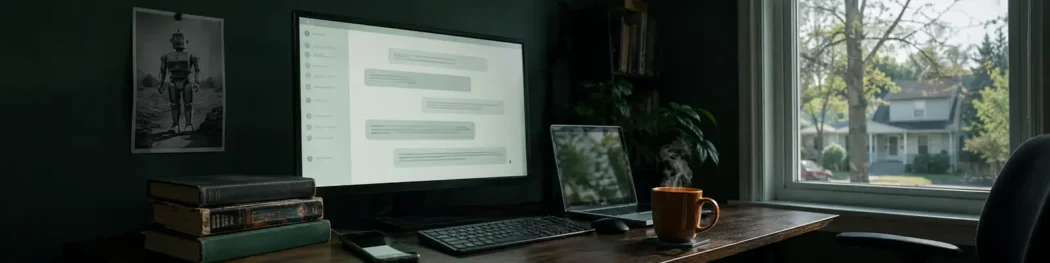
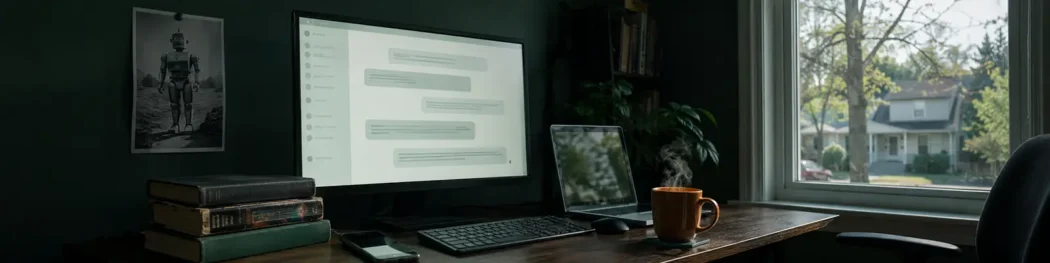
The scene is a contemporary home office or creative workspace, 2023 — a desk with a large monitor, a laptop, a phone face-up, a coffee cup still steaming. The room is ordinary in the way that all rooms where serious things are happening quietly look ordinary. The monitor in the center of the frame displays an open conversation interface — a chat window with alternating message bubbles, the rhythm of a dialogue. No text is readable. But the conversation is clearly in progress: the last message is from the machine, and the cursor blinks at the end of it, waiting. On the desk beside the laptop, three books are stacked: their spines face the viewer but their titles are unreadable — one is clearly old, one is paperback science fiction from the 1980s with a worn spine, one is new. On the wall above the desk, a single printed photograph is pinned: a still from an old science fiction film — black and white, a robot figure, stylized, clearly from another era — but printed on modern paper, slightly faded from the light. The window beside the desk shows a perfectly ordinary afternoon outside — trees, a street, a neighbor’s house. Perfectly ordinary.
The daylight is the most important decision in this prompt. Every previous era’s banner is lit dramatically — candlelight, factory steam, monitor glow, neon, violet dusk, green server light. The 2020s is the only era where the scene is set in ordinary afternoon daylight, with a window showing a completely normal street. That ordinariness is the argument. The technology arrived and the afternoon didn’t change.
The three books on the desk — old, science fiction paperback, new — are the feedback loop compressed into a still life. The old book is the literary origins. The worn paperback is the decade that shaped the engineers. The new book is now. All three are on the same desk, next to the chat window.
The blinking cursor at the end of the machine’s last message is the image’s only animated element described — and it is, in context, the most consequential detail in the frame. The machine has just said something. It is waiting for a response. The human is not in the chair. The viewer is.
All Summaries by ReadAboutAI.com

Science Fiction becomes Science Fact : Eras Selector