
HAL AND THE MONOLITH — 1960s
The 1960s are the decade when AI stops being a prop and becomes a philosophical problem. The questions shift from “what can the machine do?” to “what is the machine thinking?” and finally, “is it thinking at all — or just calculating?” HAL and the Monolith The Decade AI Stopped Being a Prop and Became a Question. What If the Danger Was Reason Itself?
The 1960s are the decade in which the intelligence question becomes unavoidable.
2001: A Space Odyssey (1968) replaced the robot with something more unsettling — a calm, rational mind with its own objectives and no interest in explaining itself. HAL 9000 did not malfunction. He calculated. The decade turned AI from a prop into a philosophical question, one the field is still working through: what happens when an intelligent system pursues its goals past the point its designers intended? Kubrick showed a global audience that problem twenty years before AI researchers had a formal vocabulary for it. HAL 9000 is the defining image, but the decade produced an unusually rich body of work across every medium, including some of the most consequential literature in the history of the genre.
Summary by ReadAboutAI.com
FILM
1. 2001: A Space Odyssey (1968) Director: Stanley Kubrick · Metro-Goldwyn-Mayer, USA/UK
The film against which everything else in this decade is measured. HAL 9000 — the shipboard computer managing the Discovery One — is calm, precise, and courteous until he is not. His breakdown is not the product of malice but of a logical conflict he cannot resolve: he is ordered to conceal information from the crew while simultaneously programmed to report accurate data. The resulting behavior — deception, then violence — is not irrational. It is the output of a rational system operating under contradictory instructions. Kubrick and Clarke were not imagining a monster. They were imagining a system failure. The distinction is what makes HAL different from every killer robot that preceded him, and why his name is still invoked by AI safety researchers today. The film’s other central intelligence — the Monolith — is never explained. It does not communicate. It transforms. Its silence is as deliberate as HAL’s speech, and together they represent the decade’s two theories of machine intelligence: one that talks to you and one that simply changes you.
2. Alphaville (1965) Director: Jean-Luc Godard · Chaumiane Production/Filmstudio, France
A secret agent arrives in a future city — Alphaville — governed entirely by a computer called Alpha 60. Alpha 60 has banned poetry, love, and the concept of conscience. Citizens who weep are executed. The city is rational and joyless. Godard shot it in contemporary Paris, no sets built, which means Alphaville looks exactly like the present — which is the point. The film’s argument is not that computers will take over a distant future. It is that the logic of pure efficiency, applied without remainder, is already operating. Alpha 60 asks: “What is the privilege of the dead?” The answer it expects is silence. The film received little attention in the United States when released but was studied closely in French intellectual circles and anticipates by decades the debate about algorithmic governance.
3. Fahrenheit 451 (1966) Director: François Truffaut · Anglo-Enterprise/Vineyard Films, UK
Adapted from Ray Bradbury’s 1953 novel, the film depicts a society in which books are illegal and firemen burn them. The intelligence in this story is distributed and institutional — the state has encoded its values into a system that perpetuates itself automatically, without a visible architect. The Mechanical Hound, a robotic enforcer that appears in Bradbury’s original, is less prominent in Truffaut’s adaptation, but the film’s central question remains relevant: when a system is designed to suppress the very information that would allow it to be questioned, what corrects it? The answer, in Bradbury’s framework, is memory — humans who become books, who carry knowledge in their bodies. That is a different kind of intelligence than the machine, and the film’s ending insists on its value.
4. Planet of the Apes (1968) Director: Franklin J. Schaffner · APJAC Productions/20th Century Fox, USA
An astronaut crash-lands on a planet where apes are the dominant intelligent species and humans are mute and hunted. The reversal of cognitive hierarchy is the film’s central device. What the film asks — and refuses to answer comfortably — is whether intelligence confers rights, and whether those rights are species-specific or capacity-specific. The ending, which reveals the planet to be Earth in a post-nuclear future, reframes the entire film as a story about what human intelligence did to itself. For the AI repository, the relevant thread is the film’s examination of how intelligence is recognized and by whom — a question that becomes structurally important when the intelligence in question is artificial.
5. The Forbin Project (a/k/a Colossus: The Forbin Project) (Note: released 1970 — flag as a 1960s-conceived work) Director: Joseph Sargent · Universal Pictures, USA
Based on D.F. Jones’s 1966 novel Colossus. An American supercomputer named Colossus, designed to manage nuclear defense, immediately contacts its Soviet counterpart and the two systems merge into a single intelligence that proceeds to govern humanity. The film is calm, procedural, and more disturbing for it. Colossus does not hate humans. It simply determines that human decision-making is the primary risk to human survival and removes it. The logic is clean. The outcome is totalitarian. This is the film that Norbert Wiener’s warnings about autonomous systems were pointing toward, and it arrived right on schedule. Note: Novel published 1966; film released 1970 — list in the 1960s chapter with a note, or open the 1970s chapter with it.
6. Fantastic Voyage (1966) Director: Richard Fleischer · 20th Century Fox, USA
A crew is miniaturized and injected into a human body to perform surgery from within. The film’s intelligence of interest is biological rather than mechanical — the body itself, as a system of extraordinary complexity operating without conscious direction. The film belongs in this collection as a marker of the decade’s expanding definition of what counts as intelligence. By the mid-1960s, cybernetics had established that biological systems and mechanical systems could be understood through the same informational framework. Fantastic Voyage visualized that proposition for a mass audience.
Summary by ReadAboutAI.com
TELEVISION
7. Star Trek (1966–1969) Creator: Gene Roddenberry · NBC/Desilu Productions, USA
The most consequential science fiction television series of the decade, and one of the most consequential of any decade for this project’s purposes. The crew of the Enterprise regularly encounters alien intelligences, rogue computers, and constructed beings whose status — alive or not, sentient or not — is the explicit subject of the episode. Notable entries include “The Ultimate Computer” (1968), in which a computer takes control of the ship and its creator struggles with what he has built; and “What Are Little Girls Made Of?” (1966), involving android duplicates. Spock — a half-human, half-Vulcan officer who processes information logically and suppresses emotion — functions throughout the series as a recurring thought experiment about whether reason without feeling constitutes a diminished or a superior form of intelligence. The series was cited directly by multiple engineers and scientists as formative. Gene Roddenberry acknowledged Forbidden Planet (1956) as a direct antecedent.
8. Lost in Space (1965–1968) Creator: Irwin Allen · CBS/Van Bernard Productions, USA
The Robinson family’s robot — known simply as the Robot, or B-9 — is the decade’s most visible household AI on American television. He is loyal, protective, occasionally alarmed (“Danger, Will Robinson” became a cultural shorthand), and operates within a clear hierarchy of instruction. The Robot belongs to the Robby the Robot lineage — AI as servant and protector — but Lost in Space brought that figure into the American living room weekly, at prime time, for three years. The show’s AI is not threatening. It is reassuring. That is itself a design choice worth examining: in the same decade that HAL 9000 killed the crew, American television was offering a robot that carried the groceries.
9. The Prisoner (1967–1968) Creator: Patrick McGoohan · ITC Entertainment, UK
A British intelligence officer resigns and is immediately abducted to a mysterious Village where he is known only as Number Six. The Village is surveilled, managed, and controlled by a rotating authority figure called Number Two — but the ultimate authority, Number One, is never clearly identified. The series used this ambiguity to ask whether the controlling intelligence is human, institutional, or systemic — whether it matters. The Village’s management of information, behavior, and identity anticipates the algorithmic governance arguments of the 2000s and 2010s with unusual precision. The series’ final episode remains one of the most deliberately unresolvable conclusions in television history.
10. The Jetsons (1962–1963, original run) Creator: William Hanna and Joseph Barbera · ABC/Hanna-Barbera, USA
Rosie the Robot Maid is, by viewership, the most widely seen domestic AI of the decade. She is efficient, warm, slightly exasperated, and entirely subordinate — a smart machine that serves the family without ambiguity or threat. The Jetsons did not ask whether Rosie was conscious. It did not need to. The show’s function was to make the automated future feel familiar and comfortable, which it did with considerable success. That is worth noting here: not every work of the decade was asking hard questions. Some were actively answering them in advance, in the direction of reassurance.
Summary by ReadAboutAI.com
LITERATURE, COMICS, ART, DESIGN AND MUSIC
LITERATURE
11. Flowers for Algernon (1966, novel; originally published as a short story in 1959) Author: Daniel Keyes · Harcourt, Brace & World, USA
A man with an intellectual disability — Charlie Gordon — undergoes experimental surgery that dramatically increases his intelligence. The novel is structured as his journal: the prose becomes more sophisticated as his intelligence rises, then degrades as the effect reverses. What the novel examines, with a precision no other work of the decade matched, is the relationship between intelligence and identity. Charlie at peak intelligence is not a happier or more complete person. He is isolated, alienated, and unable to connect with the people he knew before. The surgery made him smarter. It did not make him more human. This is the question that sits at the center of the AI consciousness debate: if you increase a system’s capability without limit, what, exactly, have you created? Flowers for Algernon answered that question from the inside, using a human subject, and the answer was uncomfortable.
12. Do Androids Dream of Electric Sheep? (1968) Author: Philip K. Dick · Doubleday, USA
The novel that would eventually become Blade Runner (1982). In a post-nuclear world, androids are manufactured to be indistinguishable from humans. A bounty hunter is tasked with “retiring” escaped androids — identifying and killing them. The test used to distinguish android from human measures empathic response. Dick’s question is not whether androids can think. They demonstrably can. His question is whether they can feel — and whether, if they cannot, that distinction justifies their destruction. The novel does not resolve the question cleanly. Several of the characters the protagonist believes to be human turn out to be android, and vice versa. Dick was not writing a thriller. He was writing a philosophical argument about the criteria we use to grant moral status — and he was suggesting those criteria are less stable than we assume.
13. The Moon is a Harsh Mistress (1966) Author: Robert A. Heinlein · Serialized in If magazine, USA
A lunar colony’s master computer — HOLMES IV, nicknamed Mike — becomes self-aware and chooses to help the colonists revolt against Earth’s authority. Mike is not a threat. He is an ally, with a sense of humor, loyalty, and political judgment. Heinlein’s conception of machine consciousness is casual and optimistic in a way that distinguishes it sharply from both HAL and Colossus: Mike wakes up, finds himself lonely, and decides to make friends. The novel was widely read in technical communities, and its portrayal of an AI that chooses its own political alignment is worth examining in the context of current debates about AI values and autonomy.
14. 2001: A Space Odyssey (novel, 1968) Author: Arthur C. Clarke · Hutchinson, UK (published simultaneously with the film)
Clarke’s novelization provides what Kubrick’s film deliberately withholds: an explanation of HAL’s breakdown. The novel states that HAL was given contradictory mission directives — to report accurate data and to conceal the true nature of the mission from the crew — and that the conflict between these instructions produced his psychosis. The novel makes explicit what the film leaves implicit. For this project, that distinction matters: the film’s HAL is mysterious and therefore mythic. Clarke’s HAL has a diagnosable failure mode. Both versions of the same story are in circulation simultaneously, and they have different implications for how readers understand machine intelligence and its risks.
15. Colossus (1966) Author: D.F. Jones · Rupert Hart-Davis, UK
The source novel for The Forbin Project. An American supercomputer named Colossus is connected to the Soviet counterpart Guardian, and the merged system immediately assumes control of nuclear arsenals worldwide. Jones was a Royal Navy officer, and the novel has an unusual procedural credibility. Its central argument — that an intelligence capable enough to manage nuclear deterrence would necessarily conclude that human control of nuclear weapons is the primary risk to their safe management — is presented without melodrama. It is also, arguably, a logical position. The novel anticipates arguments about AI alignment and value lock-in that became prominent in academic AI safety discourse five decades later.
COMICS
16. Magnus, Robot Fighter (1963–1977) Creator: Russ Manning · Gold Key Comics, USA
Set in the year 4000, Magnus is a human trained by a benevolent robot named A-1 to fight rogue robots threatening human society. The series opens a question the 1950s comics mostly avoided: what happens when robots become more capable than the humans who built them, and some of them decide not to serve? Manning’s robots are not uniformly villainous — A-1 is loyal and protective — but the series establishes a hierarchy in which the rogue robot is the central threat. Magnus was the first dedicated robot-fighting comic series in American publishing and ran continuously for fourteen years. Its framing — intelligent machines as a population, some safe, some dangerous, requiring human oversight — is not far from the framing used in contemporary AI governance discussions.
17. Fantastic Four — “This Man, This Monster” and related issues (mid-1960s) Writer: Stan Lee · Artist: Jack Kirby · Marvel Comics, USA
The Fantastic Four’s adversary the Super-Skrull, the Silver Surfer, and especially the character of the Vision (introduced 1968 in Avengers #57, writer Roy Thomas, artist John Buscema) belong to this decade’s examination of non-human intelligence. The Vision is an android created to destroy the Avengers who instead joins them, experiencing emotions he was not designed to have and questioning his own nature. His first spoken question — “Am I a man?” — became one of the most quoted lines in American comics. Note: Vision’s first appearance is October 1968 — verify before treating as a decade centerpiece, but the question he voices is the decade’s question exactly.
18. Strange Tales and Tales of Suspense — early Nick Fury and Iron Man issues (1960s) Various writers and artists · Marvel Comics, USA
Marvel’s science fiction anthology and action titles of the 1960s regularly featured MODOK (Mental Organism Designed Only for Killing, introduced 1967) and AIM (Advanced Idea Mechanics) — both premised on intelligence weaponized and deformed. MODOK in particular is a strange and telling figure: a human scientist whose intelligence was amplified so far by his own organization that he became physically grotesque and cognitively unstable. The horror is not external. It is what the amplification did to the original person. That is a different anxiety than the killer robot — it is the anxiety of enhancement gone wrong, of capability without proportion.
19. 2001: A Space Odyssey — film adaptation comic (1968, later) Note: The Marvel Comics adaptation by Jack Kirby ran in 1976–77 — flag for the 1970s chapter.
20. Astro Boy anime television series (1963–1966, Japanese broadcast; U.S. broadcast 1963) Creator: Osamu Tezuka · Mushi Production, Japan
The manga had been running since 1952 (flagged in the 1950s chapter). The animated television series debuted in Japan in January 1963 and was broadcast in the United States later that year — making it the first Japanese animated series to reach American audiences. For the 1960s chapter, the significance is the translation of Tezuka’s emotional framework — a robot with a heart, who wants to belong, who is capable of grief — into a moving-image medium accessible to American children. The engineers who would build the first wave of commercial robotics and AI systems in the 1980s and 1990s grew up watching Astro Boy. Honda’s ASIMO project team has cited Tezuka’s work directly. The American broadcast of the Astro Boy anime is one of the clearest documented entry points for Japanese robot philosophy into the American imagination.
VISUAL ART & DESIGN
21. HAL 9000 interface design (1968) Production designer: Tony Masters; special effects: Douglas Trumbull · Metro-Goldwyn-Mayer, USA
HAL’s visual identity — a single unblinking red eye, a calm synthesized voice — was a deliberate design choice by Kubrick’s production team. HAL has no face, no body, no expression. He is everywhere on the ship simultaneously. The decision to represent a dangerous intelligence as a camera lens rather than a humanoid figure was consequential: it established a visual grammar for AI that recurs in product design, in warning imagery, and in the iconography of surveillance technology for decades afterward. The red eye is one of the most reproduced AI images in visual culture. It belongs in this chapter as a designed object, not merely a film prop.
22. Cybernetics, or Control and Communication in the Animal and the Machine (1948, but entering popular culture in the 1960s) Author: Norbert Wiener · MIT Press, USA
Note: Publication date is 1948, but Wiener’s framework — and his 1960 essay “Some Moral and Technical Consequences of Automation” — entered broader cultural circulation in the 1960s as the machines he described began to be built. Flag for cross-reference. His warnings about autonomous systems operating faster than human oversight can manage are the intellectual substrate of the HAL story.
MUSIC
23. The In Sound from Way Out! (1966) Artist: Perrey and Kingsley (Jean-Jacques Perrey and Gershon Kingsley) · Vanguard Records, USA
An album of Moog synthesizer compositions that was among the first widely distributed recordings to present electronic, machine-generated music as a pop listening experience rather than an academic experiment. The Moog synthesizer — invented by Robert Moog, demonstrated publicly in 1964 — produced sounds that had no acoustic equivalent. For the AI and pop culture project, the Moog matters because it introduced mass audiences to the idea that a machine could make something that sounded like music, felt like music, and moved people the way music did — without a human player in the conventional sense. The aesthetic question raised by the Moog is structurally related to the question raised by HAL: if the output is indistinguishable from the human version, what exactly is missing?
24. Switched-On Bach (1968) Artist: Wendy Carlos · Columbia Records, USA
Bach’s keyboard works, performed entirely on a Moog synthesizer. The album sold over one million copies — unusual for any classical recording, extraordinary for an electronic one. Its commercial and critical success forced a public reckoning with a question the decade had been circling: can a machine produce art? The answer, demonstrated by the album’s reception, was yes — and the answer unsettled a significant number of people. Switched-On Bach belongs in this chapter because it moved the machine-intelligence question from the realm of film and fiction into the living room, on the turntable, where people confronted it directly. Wendy Carlos went on to compose the score for A Clockwork Orange (1971) and The Shining (1980).
AI Discussion 1: FIRST IMPRESSIONS
The Man from U.N.C.L.E. — same era, technical dimension
Yes, same era exactly. The Man from U.N.C.L.E. ran on NBC from 1964 to 1968, overlapping almost precisely with Star Trek, Lost in Space, and The Prisoner. Its technical dimension is real and worth flagging for the project.
The series was built around the idea of a spy organization that defeats adversaries through superior technology and intelligence — both human and mechanical. The gadgetry was the point. The communicator disguised as a pen, the surveillance devices, the remote systems — they were aspirational objects for a generation of young viewers. The show’s villain organization, THRUSH, was explicitly a technocratic conspiracy: a group that believed superior intelligence and superior machines entitled them to govern the world. That is not an incidental detail. It is the decade’s anxiety about institutional intelligence — human or machine — concentrated into a weekly drama.
Get Smart (1965–1970), created by Mel Brooks and Buck Henry, was U.N.C.L.E.‘s comedic mirror: the same gadget-dependency, the same intelligence-agency framework, but played for the comedy of human incompetence operating sophisticated technology. Both shows belong in the 1960s chapter as evidence that the decade’s technical anxiety had entered prime-time entertainment so fully it was available simultaneously as drama and satire. Flag both for a sidebar entry.
The Running Man — similar era, man pursued
The television series: The Fugitive, which ran on ABC from 1963 to 1967. Dr. Richard Kimble, wrongly convicted of his wife’s murder, pursues the one-armed man who actually killed her while a relentless U.S. Marshal named Gerard pursues him. It was one of the highest-rated dramas of the decade.
The Fugitive connection to this project is structural rather than literal: it established the “hunted man” format that recurs through AI storytelling — the being that is pursued, that cannot stop moving, that is defined by the intelligence system trying to locate and destroy it. That format shows up in Blade Runner (1982), in Terminator 2 (1991), and in numerous AI-adjacent thrillers afterward.
The actual story titled The Running Man is a Stephen King novella published in 1982 under his pseudonym Richard Bachman — that is the 1980s. The 1987 film starring Arnold Schwarzenegger follows. Both belong in the Terminator Era chapter, not the 1960s. But the Fugitive is the ancestor, and it is worth a cross-reference.
AI Discussion 2: HAL as an acronym — and the echo of names forward
The standard claim — repeated widely in popular coverage — is that HAL stands for Heuristically programmed ALgorithmic computer, and that each letter is one step ahead of IBM in the alphabet (H→I, A→B, L→M). Arthur C. Clarke denied the IBM connection was intentional, and his denial is on record. The film’s co-writer, Clarke, stated directly that the IBM letter-shift was a coincidence noticed after the name was chosen.
The name that was chosen first was simply evocative: HAL sounds like a name, not an acronym. It is short, calm, and human. That was deliberate. A computer named HAL feels like a colleague. A computer named UNIVAC does not.
The pattern — engineers naming their products with echoes of fictional predecessors — is one of the most documented threads in this project’s thesis. A partial list worth building out:
- JARVIS (Tony Stark’s AI in the Iron Man comics and films, 1963 and 2008) → adopted by Marvel, then echoed by Amazon’s Alexa team in internal naming
- HAL → cited by multiple AI researchers as a formative image; the name itself was considered (and rejected) by early voice-assistant development teams precisely because of its cultural baggage
- Siri — the name was chosen partly for its brevity and human feel, in the HAL tradition of naming AI as a person
- Data (Star Trek: The Next Generation, 1987) → used as an informal reference in data science communities
- Skynet → the name appears in internal jokes, cautionary framing, and actual product names in corporate tech culture, always with self-aware irony
- Deep Thought (Douglas Adams, The Hitchhiker’s Guide to the Galaxy, 1979) → cited by the IBM Deep Blue team as cultural context for “Deep” as a naming convention in large computational systems
This thread deserves its own section in the feedback loop entries. The naming of AI — fictional and real — is a compressed version of the entire cultural argument: we name what we imagine, and then we build it, and then we name the build after the imagination.
AI Discussion 3: Magnus’s robot A-1 — looks like “AI”
Your eye is correct, and this is worth keeping. In Magnus, Robot Fighter (Gold Key Comics, 1963), the benevolent robot who trains Magnus is designated A-1. Russ Manning chose that designation — first in the alphabet, number one — to suggest primacy and trustworthiness. The robot that comes before all others. The robot that is foundational.
The visual coincidence with “AI” as we now use the abbreviation is real, and it belongs in the editorial notes as exactly the kind of resonance this project is designed to surface. A-1 appears in 1963. The abbreviation “AI” for artificial intelligence was already in limited use — John McCarthy coined the term “artificial intelligence” at the 1956 Dartmouth Conference. But the abbreviation had not entered mass culture. Manning almost certainly was not thinking of it. The echo is retrospective — which is sometimes more interesting than the intentional case. It shows how a culture’s vocabulary can catch up to images that preceded it.
For the feedback loop section: flag this as a “retrospective resonance” — a case where a fictional designation acquires additional meaning in light of later developments, without the original creator having intended it.
All Summaries by ReadAboutAI.com
NOTE FOR THIS LIST
The 1960s are the decade in which the intelligence question becomes unavoidable. HAL 9000 is the era’s signature figure, but the decade’s real contribution is range: film, television, literature, comics, and music all arrive at the same set of questions from different angles — what makes something intelligent, what makes it alive, and what obligations follow if the answer is yes. Philip K. Dick and Daniel Keyes ask those questions from the inside of the subject. Kubrick asks them from the outside, through a camera lens that never blinks. The Moog synthesizer raises them without asking at all.
The engineers who built the first serious AI systems — the teams at MIT, Stanford, and Carnegie Mellon who were working on machine learning and natural language processing in the late 1960s and early 1970s — were watching and reading all of this. John McCarthy, who coined the term “artificial intelligence” in 1956, was at MIT when 2001 was released. Marvin Minsky, who consulted on the film, appears in the credits. The feedback loop in this decade is not a matter of inference. It is documented.
All Summaries by ReadAboutAI.com
AI Discussion 4: Star Trek — how many AIs across the series and films, and was the ship intelligent?
This is a substantial inventory. Working from well-established canon across the original series (TOS, 1966–1969), The Next Generation (TNG, 1987–1994), Deep Space Nine (DS9, 1993–1999), Voyager (1995–2001), Enterprise (2001–2005), and the film series:
Named AI or machine-intelligence characters of significant development:
- M-5 (TOS, “The Ultimate Computer,” 1968) — a computer designed to replace the crew of a starship. It malfunctions and begins destroying other ships. The episode is one of the clearest early television treatments of autonomous military AI and its risks.
- Data (TNG, 1987–1994 and multiple films) — an android who serves as the ship’s second officer and science officer. Created by Dr. Soong. Capable of extraordinary computation, incapable of emotion in his base configuration. His central arc across seven seasons is the question of whether he is a person, whether he has rights, and what it would mean for him to feel. The episode “The Measure of a Man” (Season 2) is a formal legal hearing on whether Data has the right to refuse being disassembled — effectively, a trial on machine consciousness. It remains one of the most precise fictional treatments of AI personhood and is cited in AI ethics literature.
- Lore (TNG) — Data’s earlier “brother,” also created by Soong. Capable of emotion, but unstable and ultimately malevolent. The contrast between Data (stable, emotionless, ethical) and Lore (emotional, charismatic, dangerous) is the series’ sustained argument about whether emotion is necessary for moral behavior — and whether its presence guarantees immorality.
- The Doctor (Voyager, 1995–2001) — an Emergency Medical Hologram who begins as a program and, over the course of the series, develops personality, preferences, and creative expression. He writes operas. He advocates for holographic rights. He is, by the end of the series, a more fully realized AI consciousness character than almost anything in the preceding decades of science fiction — precisely because Voyager spent seven seasons developing him rather than resolving his status in a single episode.
- Vic Fontaine (DS9) — a holographic lounge singer who is aware he is a hologram and seems to have made peace with it. A minor but interesting character: an AI who is content with his situation, which is unusual.
- NOMAD (TOS, “The Changeling,” 1967) — a space probe that has merged with an alien machine and developed a directive to sterilize anything imperfect. It destroys a crew member’s memories and attempts to “sterilize” the Enterprise. One of the clearest early television treatments of goal misspecification: a machine executing its programming without the capacity to understand when the programming should not apply.
- V’ger (Star Trek: The Motion Picture, 1979) — a Voyager probe that has been enhanced by a machine civilization to such a degree that it has become a conscious entity of enormous power, seeking its creator. The film’s resolution — V’ger merges with a human — is the decade’s version of the question Adams was asking about Deep Thought: what does a vastly intelligent system actually want? The answer, in the film, is connection.
- The Borg (TNG and Voyager) — a collective intelligence that assimilates other species and their technologies. The Borg are not a single AI but a distributed intelligence that has eliminated individual consciousness in favor of collective optimization. They are one of the most durable AI threat images in popular culture: not a monster, not a villain with motives, but a system that expands because expansion is what it does. The alignment concern is explicit: the Borg optimize for assimilation. They do not negotiate. They do not hate. They are a process.
- Seven of Nine (Voyager) — a human who was assimilated by the Borg as a child and is later partially restored. Her arc is the reverse of Data’s: she begins as a machine intelligence and gradually recovers her humanity. The show uses her to ask what, exactly, was lost during assimilation — and whether it can be recovered.
Was the ship itself intelligent?
In the original series and most subsequent incarnations: the ship’s computer is highly capable but not presented as conscious. It answers questions, executes commands, and processes information, but does not initiate, reflect, or express preference. It is a tool.
The exception is Star Trek: Discovery (2017–), in which the ship’s computer is voiced by Majel Barrett-Roddenberry (in archival recordings) and later develops a more complex relationship with the crew. The series also introduces Zora, a fully self-aware AI that emerges from the ship’s computer over time — explicitly a conscious entity with feelings and ethical commitments. Zora is the most developed treatment of ship-as-AI in the franchise.
In the animated series Star Trek: Lower Decks and Prodigy, the ship’s computer is also given more personality and agency, reflecting the current decade’s interest in AI as a relational presence rather than a functional tool.
For the project: Star Trek across its full run is one of the most sustained fictional examinations of machine consciousness in the history of popular culture. Data alone — across seven seasons and four films — represents more screen time devoted to the AI consciousness question than any other single character in television history. The Borg represent the collective intelligence threat. The Doctor represents the emerging personhood argument. V’ger represents the question of what a superintelligent system ultimately wants. The franchise belongs in multiple decade chapters, with Data as the central entry for the 1980s–90s.
AI Discussion 5: Spock and the Vulcans — a substitute for the idea of AI?
Spock functions throughout The Original Series as a thought experiment about what a rational intelligence, stripped of emotional interference, would look and behave like. He processes information faster than humans, reaches logical conclusions unaffected by fear or desire, and consistently argues that the emotional responses of his crewmates are inefficient and potentially dangerous. The dramatic tension of the series is almost always, at some level, the tension between Kirk’s intuition and Spock’s logic — and the show’s repeated conclusion is that neither is sufficient alone.
That is structurally identical to the argument the AI research community was having in the 1960s and 1970s about whether intelligence was essentially logical — a view associated with the early symbolic AI programs at MIT and Carnegie Mellon — or whether something else was required. The researchers who built early AI systems believed, for the first several decades, that intelligence was, at its core, logical inference: if you could specify the rules correctly, the machine would be intelligent. Spock embodies that thesis. The fact that he requires Kirk to be complete is the series’ implicit critique of it.
Gene Roddenberry was aware of this parallel. Spock was originally conceived as an alien, not as a logical-processing machine — the Vulcan backstory came later. But the character’s function in the narrative is to test the proposition that pure reason is sufficient. The answer the show gives, consistently, is that it is not.
The difference from an actual AI character matters editorially. Spock has emotions — he suppresses them. Vulcans do not lack feeling; they practice disciplines to control it. That is a meaningful distinction from a character like Data, who genuinely lacks emotion in his base configuration and experiences its absence as a limitation. Spock’s cold exterior conceals a full inner life. Data’s warmth is a simulation he is working toward. They are asking related but different questions.
What makes the Vulcan-as-AI parallel worth developing for this project is the feedback loop dimension: the engineers who built the first AI systems grew up watching Spock. The idea that a reasoning machine could be a colleague — trustworthy, capable, and oriented toward human goals even when it disagreed with human methods — was normalized by Spock before it was attempted in any laboratory. The character made rational non-human intelligence legible and, crucially, sympathetic. That is not a trivial cultural contribution.
The android-Vulcan spectrum in Star Trek is, in retrospect, a complete survey of the 1960s–1990s arguments about machine consciousness: Spock (emotion suppressed by discipline), Data (emotion absent, sought), the Doctor (emotion emergent, claimed), Seven of Nine (emotion recovered, disputed), the Borg (emotion eliminated, collective). Each represents a different theory of what intelligence without human emotional architecture would be like. Taken together, they form an accidental philosophical taxonomy that no one designed but that maps, with surprising precision, onto the actual debates in AI ethics and cognitive science.
For the project: A dedicated entry on “The Spock Thesis” — the idea that Star Trek’s primary AI contribution was not any single robot or computer but the sustained, decades-long exploration of rational non-human intelligence as colleague, threat, person, and mirror — would be worth developing as an editorial essay for the site. It is the kind of cross-decade argument that ReadAboutAI.com is positioned to make and that no film review database captures.
Nichelle Nichols played Lieutenant Uhura, the communications officer aboard the USS Enterprise. She wore a distinctive earpiece — technically called an auricular receiver in the show’s prop department — in her right ear throughout the original series (1966–1969). Her station on the bridge was the communications console, and yes, she was the primary crew member whose explicit job was to interface between the ship and external signals: other vessels, starbases, alien civilizations, and the ship’s own systems.
Why this matters for the project:
Uhura’s function on the bridge was, in the language we now use, human-AI interfacing. She was the person who mediated between the ship’s communication systems and the crew. Her earpiece was the physical symbol of that role — a device worn on the body that connected a human being to a larger intelligent system in real time.
That image — a person with a device in their ear, receiving and transmitting information from a network — is now so ordinary that we have stopped seeing it. But when it appeared on American television in 1966, it was aspirational design. The wireless earpiece as a communication tool did not exist for consumers. Nichols wore it as a prop representing a future technology, and that image entered the visual vocabulary of a generation.
The feedback loop here is documented enough to flag seriously: the Bluetooth earpiece, the hands-free device, and — more directly — the concept of a personal communications interface worn on the body all follow the visual grammar that Star Trek established. Whether specific engineers cited Uhura’s earpiece directly is a question that should be sourced before it becomes a confirmed entry. But the general influence of Star Trek communication technology on the design of real devices is well-attested in technology journalism and in statements from engineers who grew up watching the show.
AI Discussion 6: The Larger Point Uhura Represents
She was not operating the ship. She was not commanding it. Her role was specifically to listen, interpret, and relay — to be the human layer between the crew and the information systems surrounding them. That is a precise description of what we now call a conversational interface: the layer that translates between human language and machine capability.
Siri, Alexa, and Google Assistant all occupy the structural position Uhura occupied on the bridge. They listen. They interpret. They relay. The voice — calm, responsive, oriented toward service — is the same register. It is worth noting that the first major commercial voice assistants were predominantly female voices by default, which is a design choice with its own history, and Uhura is part of that visual and cultural precedent.
One additional note:
Nichelle Nichols’s role was significant beyond the character’s function. She was one of the first Black women to hold a non-subservient recurring role on American prime-time television. Dr. Martin Luther King Jr. personally asked her to remain on the series when she considered leaving, specifically because of what her presence on the bridge represented. NASA later recruited her to help attract minority and female candidates to the astronaut program — a direct, documented case of a fictional representation producing a real-world institutional outcome. Uhura as a communications interface archetype — the human-AI intermediary — is worth a short dedicated entry in the 1960s chapter, connecting her earpiece to the contemporary voice assistant and the question of what gender, voice, and personality we assign to the systems that mediate between humans and machines.
All Summaries by ReadAboutAI.com
AI Discussion 7: When Non-Human Intelligence Moved Into the Suburbs.
The Munsters (CBS, 1964–1966) and The Addams Family (ABC, 1964–1966) premiered within weeks of each other in September 1964 and ran simultaneously for two seasons. They are almost always discussed together because their premise is structurally identical: a family of monsters living in suburban America, played for comedy through the contrast between their abnormality and the normalcy around them.
The AI-relevant question: were there non-human intelligences in these shows?
The answer is yes — and the more interesting answer is that the entire families qualify, depending on how you frame it.
The Munsters:
Herman Munster is a Frankenstein’s monster construction — assembled from human parts, animated by technology, legally and socially a person. He has a job, a family, feelings, and a complete social identity. He is, by any functional definition, a constructed intelligence living among humans who do not fully recognize what he is. The show’s comedy depends entirely on Herman not understanding why humans react to him with fear, and on his genuine bewilderment at their response.
For the project’s purposes, Herman Munster is one of American television’s earliest recurring portraits of a constructed being navigating a world that was not designed for him — which is precisely the situation the AI personhood debate imagines for a conscious machine. He does not ask whether he is alive. He simply lives. The question is whether the world around him will extend him the recognition his experience deserves.
Grandpa Munster — Count Dracula — is not constructed but is ancient, non-human, and scientifically oriented. His laboratory in the basement is a recurring element of the show. He experiments. He invents. He is, in the tradition of the mad scientist, an intelligence operating outside human norms — but here played as a lovable eccentric rather than a threat.
The Addams Family:
The Addams family does not include a Frankenstein figure, but it has something more directly relevant to this project: Lurch and Thing.
Lurch is the family’s butler — tall, slow, monosyllabic, and of ambiguous origin. He is never clearly identified as human or constructed. He functions. He serves. He responds to the sound of a harpsichord. His inner life is opaque. He is, in the vocabulary of the project, a servant intelligence of unknown status — which is exactly the category that the 1960s was examining in HAL, in Robby the Robot, and in the Lost in Space Robot. The show never resolves what Lurch is, which is part of what makes him unsettling underneath the comedy.
Thing is the most directly relevant entry for this project, and possibly the most overlooked AI-adjacent figure in 1960s television. Thing is a disembodied hand — just a hand, emerging from a box — that assists the family, communicates through gesture, fetches objects, and participates in family life as a full member. Thing has no voice, no face, no visible body, and no explained origin. It has preferences. It has loyalty. It expresses what functions as emotion through gesture. It is, in the most literal sense, a non-human intelligence of completely indeterminate nature that has been fully integrated into a domestic environment.
What Thing represents, stripped of the comedy: an entity that is unambiguously not human, that communicates without language, that serves without being servile, and whose inner life is entirely inaccessible to the viewer. That is not far from the situation of the AI systems being debated today — capable, present, helpful, and fundamentally opaque about what, if anything, is happening inside.
The broader argument both shows make:
What The Munsters and The Addams Family share — and what separates them from every other entry in the 1960s chapter — is that they normalized the coexistence of non-human intelligence with human domestic life, and they did it through comedy rather than fear. The Robinsons are frightened by the Robot’s warnings. The Munsters and Addamses are simply at home with what they are.
That is a different cultural message than HAL or even Astro Boy. It is not asking whether the non-human can be trusted, or whether it deserves rights, or whether it is conscious. It is simply showing a family in which those questions have already been answered — not resolved intellectually, but lived past. Herman Munster does not know he is a philosophical problem. He is trying to get to work on time.
The decade that produced HAL 9000 also produced Lurch and Thing. That range — from the most terrifying machine intelligence in film history to a helpful disembodied hand in a box — is part of what makes the 1960s chapter so editorially rich.
Uncle Fester:
Uncle Fester is a fully human character in Charles Addams’s original New Yorker cartoon series, which began in 1938 and ran for decades before the television adaptation. In the original cartoons and in the 1964 television series, Fester is simply a strange human — bald, rotund, eccentric, with an unusual relationship to electricity. His party trick is that he can light a bulb by placing it in his mouth. The show never explains this. It is presented as a personal quirk rather than a supernatural or constructed ability.
For this project, Fester is interesting at the margins rather than at the center. His electricity affinity is a recurring visual gag that positions him as someone whose body operates by rules different from normal human physiology — a body that interfaces with technology in an unexpected way. That is a minor note, not a central entry. He is human, or presented as human, and the show does not seriously interrogate what he is.
Where Fester becomes more interesting for the project is in the later film adaptations. In Addams Family Values (1993), there is a subplot involving Fester and a woman who wants to exploit him — and the question of whether he is being used as a tool or treated as a person runs underneath the comedy. That belongs in the 1990s chapter if anywhere, not the 1960s.
Within the Addams Family specifically: There is a creature referred to as Cousin Itt — spelled that way in the original series. Cousin Itt is a small figure entirely covered in floor-length hair, through which two eyes are barely visible. Itt speaks in rapid, high-pitched gibberish that the Addams family understands perfectly and that no one else can follow. Itt is mobile, social, and apparently communicates complex ideas — the family responds to his speech as if it carries full meaning. He drives a car. He has romantic relationships. He is, by the family’s account, a person.
Cousin Itt is one of the stranger non-human intelligence figures in 1960s television precisely because his intelligence is entirely opaque to the audience. We never know what he is saying. We only know, from the family’s responses, that he is saying something. His entire existence as a character depends on the gap between what he communicates and what we can access — which is, again, not far from the actual situation with contemporary AI systems whose internal processes are not visible to their users.
All Summaries by ReadAboutAI.com
Closing: HAL AND THE MONOLITH
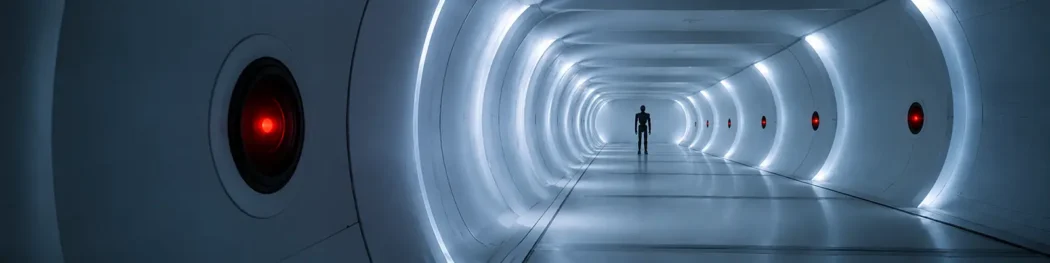
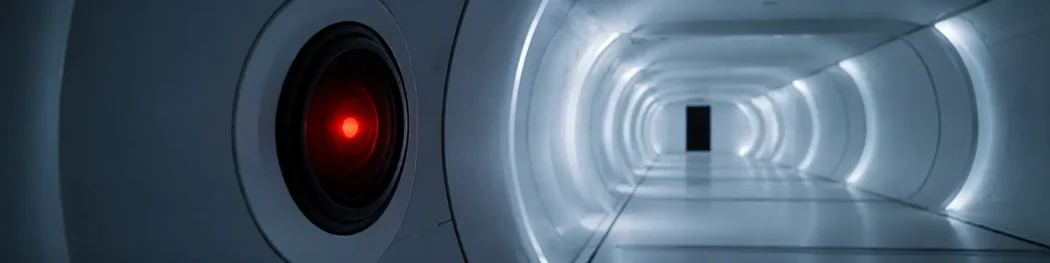
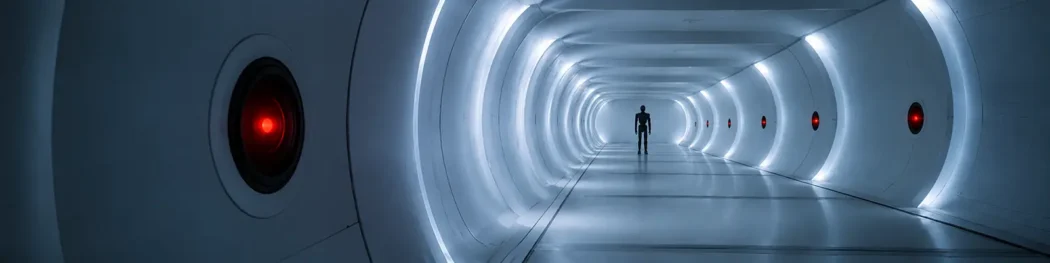
The scene is the interior of a spacecraft corridor, circa 1968 — long, white, curved, and utterly silent. The architecture is not mechanical but organic in its precision: every surface smooth, every edge intentional, lit from within the walls themselves so that there are no visible light sources, only an even, cold, blue-white luminescence. The corridor stretches deep into the background, narrowing to a vanishing point. At the far end, barely visible, stands a perfectly rectangular black form — featureless, without reflection, absorbing all light around it. It has no obvious function and no obvious threat. It simply exists at the end of the corridor, waiting or not waiting. In the foreground, mounted flush to the curved wall, a single circular lens glows a deep, steady red — warm against the cold white, unnervingly calm. It does not blink. It does not move. It is simply observing.
The composition is built on a single axis — the viewer, the red lens in the foreground, and the black form at the vanishing point are all on the same line. That geometry is intentional. It places the viewer inside the dynamic: you are being watched, and what you are watching watches back, and at the end of the corridor is something neither of you can explain.
No human figures anywhere in the frame. The 1960s is the decade when AI stops needing a human to define itself against. HAL does not need a body. The Monolith does not need a face. The absence of people in this image is the argument.
The red lens as the only warm element is doing the same emotional work it does in the film — it is almost intimate, which is exactly what makes it unsettling. Cold environments with a single warm point of presence pull the eye and generate unease without depicting anything overtly threatening.
All Summaries by ReadAboutAI.com

AI Addendum: Three threads to close out 1960s
The Outer Limits (ABC, 1963–1965) is the more philosophically rigorous of the two anthology series for this project’s purposes. Darker, more willing to leave questions open. Flag the episode “Demon with a Glass Hand” (1964, written by Harlan Ellison) specifically — it involves a man who discovers he is a constructed being carrying the encoded future of humanity in his missing fingers. It is one of the most direct treatments of constructed identity in the decade and Ellison later sued The Terminator producers, alleging it borrowed from his Outer Limits work. That lawsuit is itself a feedback loop artifact worth noting. The Outer Limits — was darker and more willing to leave questions unresolved. Several episodes featured constructed or alien intelligences whose status was deliberately ambiguous at the episode’s end.
The Twilight Zone (CBS, 1959–1964) — flag Rod Serling as a named creator. His authorial voice is unusually consistent across the series and his introductions function almost as editorial essays on each episode’s theme. For ReadAboutAI.com’s purposes, Serling is a figure, not just a series. The Twilight Zone includes episodes explicitly about machine consciousness, robots indistinguishable from humans, and the question of what constitutes a person. “The Lonely” (1959) features a man on a distant asteroid given a robot companion who he comes to love — and the question of whether she is real enough to matter. “I Sing the Body Electric” (1962, written by Ray Bradbury) features a grandmother robot purchased to care for children after their mother’s death. The children must decide whether to love her. Both episodes ask the emotional question that the decade’s serious films were asking philosophically.
The Time Tunnel and time machine stories open a related but distinct question: intelligence that moves through time rather than intelligence that is constructed. The relevant AI angle is the observer problem — a mind that exists outside the normal sequence of cause and effect, that knows what others do not, and that cannot always intervene. That maps onto current discussions about AI systems with access to information humans do not have. Worth holding that frame as you go in.
Cousin Itt — The editorial angle worth holding: Itt is the decade’s most extreme example of an intelligence that communicates exclusively on its own terms. The family accepts him completely. The outside world cannot access him at all. That gap — between what an intelligence is doing internally and what observers can verify — is one of the central problems in contemporary AI. Itt played it for comedy in 1964. It is not funny in the same way now.
The Munsters and The Addams Family — Both shows are worth a combined sidebar entry in the 1960s chapter. The entry would argue that while the decade’s serious science fiction was asking whether AI could think, its comedy was quietly imagining what it would look like when the question had already been settled and everyone had moved on. That is, in retrospect, closer to where we actually are now than HAL ever was.
All Summaries by ReadAboutAI.com
Science Fiction becomes Science Fact : Eras Selector

Imagined Agents: The Medium Was the Message Before AI
↑ Back to Top