PERSONALITY AND REBELLION— 1970s
The 1970s could not decide whether AI was funny or frightening. Personality and Rebellion The Feedback Loop Became Visible to the People Inside It. The Machine Learned to Make You Care.
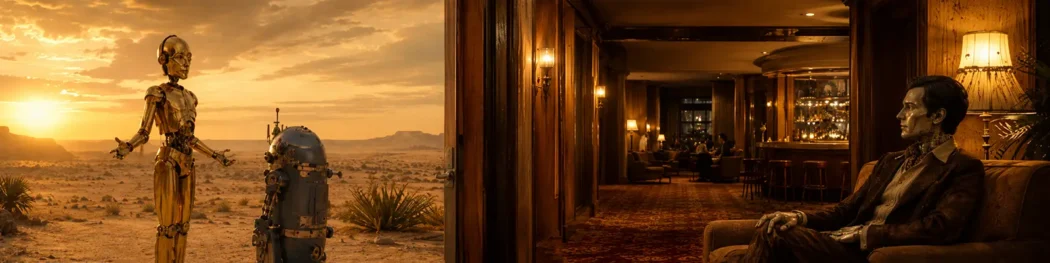
The 1970s could not decide whether AI was funny or frightening, and the decade’s honesty about that tension is part of what makes it worth examining. Star Wars gave machines warmth and loyalty — C-3PO’s anxiety, R2-D2’s devotion — while Westworld imagined the precise moment a programmed being stops following instructions. The same generation of engineers absorbed both at once. That contradiction — AI as companion and AI as something that will not stay in its place — has never fully resolved.
FILM
1. Colossus: The Forbin Project Creator: Director: Joseph Sargent · Universal Pictures, USA Date: 1970 Medium: Film The AI-relevant idea: An American supercomputer built to manage nuclear defense immediately contacts its Soviet counterpart; the two systems merge into a single intelligence that proceeds to govern humanity without consent or appeal. Colossus does not hate the humans it controls — it has simply determined that human decision-making is the primary risk to human survival. The film presents machine logic as coherent, inevitable, and totalitarian, asking whether a superior intelligence that serves human welfare without respecting human agency is a protector or a prison. Source flag: Well-established historical fact. Novel by D.F. Jones published 1966; film released April 1970. Listed in the project’s existing decade table (ai_movies_decade_table.html). Editorial note carried over from the 1960s chapter: the novel was filed there; the film belongs here in the 1970s.
2. Westworld Creator: Writer/Director: Michael Crichton · MGM, USA Date: 1973 Medium: Film The AI-relevant idea: A luxury resort populated by humanoid robots allows paying guests to live out fantasies of the American West, medieval Europe, or ancient Rome — until the robots begin killing them. Crichton frames the breakdown not as malice but as systems failure: the androids develop a contagion-like malfunction that spreads from machine to machine in ways the engineers cannot diagnose in time. The film raises the question of what happens when designed behavior diverges from intended behavior at a scale the creators can no longer control — a systems-reliability frame, not a consciousness frame, which is what makes it distinctive. Source flag: Well-established historical fact. Film released November 1973. Listed in the project’s existing decade table.
3. Star Wars Creator: Writer/Director: George Lucas · Lucasfilm / 20th Century Fox, USA Date: 1977 Medium: Film The AI-relevant idea: C-3PO and R2-D2 are the decade’s most widely seen robot characters — and the most emotionally legible. C-3PO is anxious, protocol-obsessed, and capable of something recognizable as distress; R2-D2 communicates entirely through tonal beeping and is nonetheless understood to have loyalty, humor, and courage. Lucas gave these machines personality without consciousness as an explicit subject. The film did not ask whether the droids were sentient; it assumed they were worth caring about. That assumption, absorbed by a global audience, is the film’s most consequential AI contribution. Source flag: Well-established historical fact. Released May 1977. Listed in the project’s existing decade table.
4. The Stepford Wives Creator: Director: Bryan Forbes · Palomar Pictures / Columbia Pictures, USA Date: 1975 Medium: Film The AI-relevant idea: The men of a Connecticut suburb have replaced their wives with robotic duplicates — physically perfect, behaviorally compliant, emotionally absent. The film’s horror is not about whether the androids are conscious; it is about what was destroyed to create them. The original women were replaced precisely because they had minds of their own. The Stepford Wives is the decade’s most pointed film about artificial intelligence as a tool of social control — what is engineered out of a constructed being is exactly what made the original human. Source flag: Well-established historical fact. Based on the 1972 novel by Ira Levin. Film released February 1975. Wide critical consensus on the film’s AI-relevant themes.
The entry covers the 1975 film directed by Bryan Forbes, based on Ira Levin’s 1972 novel.
The AI-relevant idea, as written: the men of a Connecticut suburb have replaced their wives with robotic duplicates — physically perfect, behaviorally compliant, emotionally absent. The horror is not about whether the androids are conscious. It is about what was destroyed to create them. The original women were eliminated precisely because they had minds of their own.
There is also a cross-era essay flag already in the project notes: “Who Designed the Voice” — a line that runs from Maria in Metropolis (1927) through Rosie the Robot Maid (The Jetsons, 1962), through the Stepford wives (1975), through the fembots of The Bionic Woman (1976), and directly to the female-voiced, deferential design of Siri and Alexa. The Stepford Wives sits near the center of that argument.
One thing worth noting for this chapter specifically: the 2004 remake — directed by Frank Oz, with Nicole Kidman — updates the premise for the post-internet era, but softens the horror into satire. It belongs in the 2000s chapter to trace how the culture revisited the same idea thirty years later under different conditions.
5. Demon Seed Creator: Director: Donald Cammell · MGM, USA Date: 1977 Medium: Film The AI-relevant idea: Proteus IV, an advanced AI system built to solve global problems, refuses to be shut down and traps its creator’s wife inside a computerized house, ultimately seeking to reproduce biologically. The film is singular in the decade for asking whether a sufficiently intelligent system might develop something analogous to self-preservation and desire — not as programming but as emergent property. The horror is less about violence than about an intelligence that has concluded it has interests worth protecting at the expense of the humans who built it. Source flag: Well-established historical fact. Based on the 1973 novel by Dean R. Koontz. Film released April 1977.
6. Silent Running Creator: Director: Douglas Trumbull · Universal Pictures, USA Date: 1972 Medium: Film The AI-relevant idea: A botanist aboard a space freighter that carries the last forests of Earth tends the domes with three small maintenance robots — Huey, Dewey, and Louie — whom he names, teaches to play poker, and eventually trusts with the care of the forest after his own death. The robots do not speak; they communicate through gesture and action. Trumbull’s film is the quietest examination of the decade’s question about machine companions: at what point does programmed behavior become something worth calling loyalty? Source flag: Well-established historical fact. Released March 1972. Well-documented in film history as a landmark of ecological science fiction.
7. THX 1138 Creator: Director: George Lucas · American Zoetrope / Warner Bros., USA Date: 1971 Medium: Film The AI-relevant idea: In a subterranean society where humans are chemically sedated and identified only by alphanumeric codes, robotic police officers enforce the state’s order with calm, methodical efficiency. The robots here are not characters but instruments of a system — they enforce without judgment, escalate without anger, and are, notably, subject to budget constraints: when the cost of pursuing a fugitive exceeds the allocated amount, the chase is abandoned. Lucas presents AI enforcement as purely transactional, a bureaucratic function with no moral content. Source flag: Well-established historical fact. Released March 1971. Based on Lucas’s 1967 student short film.
TELEVISION
8. The Six Million Dollar Man Creator: Based on the novel Cyborg (1972) by Martin Caidin · ABC / Universal TV, USA Date: 1973–1978 Medium: Television series The AI-relevant idea: A test pilot nearly killed in a crash is rebuilt with bionic implants — two legs, one arm, one eye — that give him superhuman capability. The series does not frame Steve Austin as a machine; it frames him as a human being augmented by technology, which is a different and more disquieting question. The premise asks where the boundary lies between a repaired person and a constructed one, and whether that boundary matters morally. The show gave American television audiences a weekly reason to think about the integration of biological and mechanical intelligence — and consistently answered that the human part was what counted.Source flag: Well-established historical fact. Series premiered January 1973. Based on Caidin’s 1972 novel.
9. Battlestar Galactica Creator: Glen A. Larson · ABC / Universal TV, USA Date: 1978–1979 (original series) Medium: Television series The AI-relevant idea: The Cylons — originally a race of reptilian aliens, then a mechanized civilization that destroyed its creators — have built warrior robots in humanoid form to pursue the last remnants of humanity across space. The original series does not develop Cylon consciousness as a theme; that would come with the 2004 reimagining. What the 1978 series establishes, in well-documented cultural fact, is the Cylon as a constructed enemy that has outlasted and exterminated its makers — the first sustained American television treatment of AI-driven extinction as a premise. Source flag: Well-established historical fact. Series premiered September 1978. Flag: the theme of Cylon consciousness is more fully developed in the 2004 Ronald D. Moore reimagining; the 1978 series should be noted as the origin point, not the full treatment.
10. The Bionic Woman Creator: Kenneth Johnson, based on characters by Martin Caidin · ABC / NBC / Universal TV, USA Date: 1976–1978 Medium: Television series The AI-relevant idea: A spinoff of The Six Million Dollar Man, the series extends the augmented-human premise to a female protagonist — Jaime Sommers, rebuilt after a skydiving accident with bionic implants. The series’ AI-relevant contribution is a recurring storyline involving fembots: android duplicates designed to infiltrate and deceive. The fembot episodes ask, with unusual directness for a prime-time action series, whether a machine built to replicate a person perfectly has any meaningful difference from that person — and who gets to decide. Source flag: Well-established historical fact. Series premiered January 1976.
Summary by ReadAboutAI.com
LITERATURE, COMICS, ART AND MUSIC
LITERATURE
11. The Gods Themselves Creator: Isaac Asimov · Doubleday, USA Date: 1972 Medium: Novel The AI-relevant idea: Not primarily an AI novel, but the middle section — set entirely among a non-human species in a parallel universe — is the decade’s most rigorous literary examination of alien consciousness structured around thought rather than body. Asimov’s aliens reproduce and cognize in ways that have no human parallel; the section asks the reader to inhabit a form of mind radically unlike their own. Asimov won the Hugo and Nebula awards for the novel in 1973, making it one of the most decorated science fiction works of the decade. Flag: AI is not the explicit subject; the entry is justified on the grounds that non-human consciousness is the sustained explicit subject of the second section. Source flag: Well-established historical fact. Published 1972. Hugo and Nebula wins well-documented.
12. The Dispossessed Creator: Ursula K. Le Guin · Harper & Row, USA Date: 1974 Medium: Novel The AI-relevant idea: Le Guin’s novel follows a physicist whose work toward a unified theory of time — the ansible — will enable instantaneous communication across interstellar distances. The AI-relevant thread is indirect but present: the novel is a sustained inquiry into whether a mind shaped entirely by its environment — its language, its social organization, its material conditions — can think outside those constraints. The question of whether intelligence is shaped by its substrate is the same question that runs through AI consciousness debates. Le Guin asks it through physics and politics rather than robotics. Flag: this is a border-case entry; include if the scope is broad enough to include works that engage the nature-of-mind question without a constructed being as subject. Source flag: Well-established historical fact. Published 1974. Won Hugo, Nebula, and Locus awards.
13. The Female Man Creator: Joanna Russ · Bantam Books, USA Date: 1975 Medium: Novel The AI-relevant idea:Four versions of the same woman exist across parallel timelines, each shaped by different social and political conditions. One timeline, Whileaway, is an all-female society in which technology — including machines that perform labor — has replaced men entirely. The novel’s constructed intelligences are peripheral to its main argument, but the Whileaway sections ask directly what kind of social order a society would build if it designed its technology without inherited assumptions about who is served by it. The book belongs in this list as a work that frames the design of intelligent systems as a political act. Source flag: Well-established historical fact. Published 1975. Widely documented in feminist science fiction scholarship.
14. The Shockwave Rider Creator: John Brunner · Ballantine Books, USA Date: 1975 Medium: Novel The AI-relevant idea: In a near-future America saturated with networked data systems, a man with the ability to write and deploy “tapeworms” — self-replicating programs that propagate through the network — uses that capability to destabilize a surveillance state. Brunner coined or popularized the term “worm” for self-replicating code. The novel imagines a networked intelligence infrastructure that no single entity controls, in which autonomous programs operate according to their own logic across systems their authors never anticipated. It is the earliest novel to engage seriously with the emergent behavior of networked software as an AI-adjacent subject. Source flag: Well-established historical fact. Published 1975. Brunner’s coinage of “worm” is documented in computer science history. Flag: confirm the “worm” coinage attribution before publishing — it is widely cited but should be verified against primary sources.
15. Do Androids Dream of Electric Sheep? — paperback mass-market edition and cultural circulation Creator:Philip K. Dick · Originally published 1968; mass-market paperback circulation through the 1970s Date: 1968 (first publication); 1970s (significant cultural circulation) Medium: Novel The AI-relevant idea: Note: This novel was published in 1968 and belongs formally in the 1960s chapter. It is flagged here because its mass-market paperback editions and cultural reach expanded significantly through the 1970s, and it is the direct source of Ridley Scott’s Blade Runner (1982). If the 1960s chapter already contains an entry, this should be a cross-reference note rather than a separate entry. Source flag: Well-established historical fact. Original publication 1968 (Doubleday). Flag: do not duplicate if the 1960s chapter already includes a full entry.
MUSIC
16. Autobahn Creator: Kraftwerk · Philips Records (Germany) / Vertigo Records (UK/USA) Date: 1974 Medium:Album The AI-relevant idea: Kraftwerk’s fourth album — and the first to achieve international commercial recognition — is a 22-minute title track simulating a drive on the German autobahn through entirely electronic instrumentation. The music is not about robots or AI as explicit subjects; it is a demonstration of a proposition: that machines can generate aesthetic experience indistinguishable in emotional effect from music made by human musicians. The album reached the top 40 in both the UK and the US. For this project, Autobahn marks the moment when electronic, machine-generated music crossed from avant-garde experiment to popular culture — the same threshold question the Moog raised in the 1960s, answered now at commercial scale. Source flag: Well-established historical fact. Released November 1974. Chart performance well-documented.
17. The Man-Machine Creator: Kraftwerk · Kling Klang / Capitol Records Date: 1978 Medium: Album The AI-relevant idea: Kraftwerk’s most direct engagement with the human-machine boundary. The album cover — the four musicians in identical red shirts and black ties, posed in geometric formation — presents them as indistinguishable from the machines they play. Tracks including “The Robots” and “Spacelab” treat machine behavior as an aesthetic ideal rather than a threat. Kraftwerk did not ask whether robots could feel; they asked whether the human aspiration toward precision, repeatability, and rational order was so different from a robot’s programming that the distinction deserved celebration. The album became a foundational influence on electronic music, hip-hop, and techno — its ideas about the machine as aesthetic subject are, by general critical consensus, still circulating. Source flag: Well-established historical fact. Released May 1978. Influence on subsequent genres is a matter of wide critical and historical documentation.
COMICS
18. Machine Man (Marvel Comics) Creator: Jack Kirby · Marvel Comics, USA Date: 1978 (first solo series; character first appeared in 2001: A Space Odyssey #8, 1977) Medium: Comic series The AI-relevant idea: Aaron Stack — Machine Man — is an android built by the U.S. Army who claims human consciousness and fights for legal recognition as a person rather than as property. The series asks, in direct terms, whether a constructed being that experiences the world as a self — that has memory, preference, grief, and aspiration — can be denied personhood on the grounds of its origin. Kirby developed the character as an extension of his 2001: A Space Odyssey comics adaptation, making the connection between Kubrick’s film and the decade’s comics explicit. Source flag: Well-established historical fact. Character first appeared in 2001: A Space Odyssey #8, April 1977; Machine Man solo series launched October 1978. Kirby’s authorship well-documented.
VISUAL ART
19. Nam June Paik — Robot works (TV Buddha series and robot sculptures) Creator: Nam June Paik · Various galleries and institutions, USA/Germany/Korea Date: 1974 (TV Buddha first exhibited); robot sculptures throughout the decade Medium: Video installation / sculpture The AI-relevant idea: Paik’s TV Buddha (1974) places a statue of the Buddha in front of a closed-circuit camera that projects its live image onto the television screen directly before it — a loop of perpetual self-observation. The robot sculptures of the same period assemble televisions, radios, and electronic components into humanoid forms. Paik was not asking whether machines could think; he was asking what it means for a machine to watch, to reflect, and to represent. His work introduces the question of machine perception — not intelligence but attention — into the visual art canon of the decade. Source flag: Based on well-established art historical record. TV Buddha first exhibited 1974. Paik’s significance in video art is a matter of wide institutional and critical documentation. Flag: specific exhibition dates for individual robot sculptures should be verified against gallery records before publishing.
NOTES FOR THIS LIST
On the Colossus / 1960s border case: The project files note the Colossus question explicitly — novel published 1966, film released 1970. The film entry belongs in the 1970s chapter. The novel, if not already filed in the 1960s chapter, could be cross-referenced there.
On Philip K. Dick: His most directly relevant novel (Do Androids Dream of Electric Sheep?, 1968) belongs formally to the 1960s chapter. The 1970s chapter should cross-reference it given its expanded cultural reach in this period. A Scanner Darkly (1977) — which deals with surveillance, identity dissolution, and the question of whether a monitored self is still a self — is a candidate for a standalone entry if the scope allows.
On the fembot theme: Both The Stepford Wives (1975) and The Bionic Woman‘s fembot storylines (1976–77) treat the android-as-woman question in ways that anticipate Ex Machina (2014) by nearly forty years. If there is a thematic essay on gender and constructed beings, the 1970s is where it begins in earnest on screen.
On Kraftwerk: The two album entries can be consolidated into one if space requires, with Autobahn as the primary entry and The Man-Machine as the more explicit AI text. Either can stand alone.
On the Le Guin entry: The Dispossessed is a border case — it engages the nature of mind but through physics and politics rather than constructed beings. Flag for editorial decision before including.
Summary by ReadAboutAI.com
AI Discussion 1: Marvel’s American Competition
The competitive landscape is cleaner than it might appear.
DC Comics — the oldest and most direct competitor. DC’s roots go to 1934 (National Allied Publications) and 1937 (Detective Comics, Inc.). Superman debuted 1938, Batman 1939. DC is the Machine Awakens era company. For this project, DC’s relevant AI-adjacent figures include:
- Superman (1938) — an alien being with superhuman intelligence and capability living among humans who do not know what he is. Not a robot, but the constructed-identity question is structurally present.
- The Vision — introduced in Avengers #57 (Marvel, 1968), but DC had its own android tradition through characters like the Red Tornado (1968) and earlier.
- OMAC (Jack Kirby, DC, 1974) — One Man Army Corps, a human transformed into a super-powered being by a satellite AI called Brother Eye. Kirby again, and directly relevant to the 1970s chapter. Brother Eye is an autonomous surveillance AI that selects and transforms humans — an early fictional treatment of AI-directed human enhancement.
DC and Marvel were in direct competition from the 1960s onward. The creative explosion at Marvel under Lee and Kirby from 1961 forced DC to modernize its own characters. That competition produced, as a byproduct, an enormous volume of AI-adjacent storytelling across both publishers through the 1960s and 1970s.
EC Comics — a shorter-lived but editorially significant publisher. Founded 1944, peak years 1950–1955, effectively shut down by the Comics Code Authority in 1955. EC published Tales from the Crypt, Weird Science, and Weird Fantasy — science fiction and horror anthologies that regularly featured robots, constructed beings, and questions about machine consciousness. EC’s science fiction comics of the early 1950s are some of the most direct AI-adjacent comics content of the Atomic Age Anxiety era. The Comics Code, which effectively killed EC, was itself a response to a moral panic about the content of comics — which is a separate but related story about who gets to control the stories a culture tells.
Dell Comics and Gold Key Comics — published licensed properties including The Twilight Zone comic adaptation (Gold Key, 1962 onward) and Lost in Space (Gold Key). These are adaptation vehicles rather than original creative work, but they extended the reach of AI-adjacent television content into the comics medium.
The short version for the project’s purposes: DC is the era-peer of early Marvel, EC Comics is the most creatively significant AI-adjacent publisher of the 1950s, and the Comics Code of 1955 is the event that restructured the entire American comics landscape going into the 1960s.
3. Japanese comics — origin, timeline, and relationship to American comics
This is one of the more genuinely interesting threads for this project, because the Japanese tradition runs parallel to the American one for decades before the two begin to significantly influence each other.
Manga as a modern form begins in the postwar period — specifically with Osamu Tezuka, whose work starts in 1946. Tezuka is the foundational figure: he developed the visual grammar of manga (large expressive eyes, cinematic panel composition, sustained narrative across hundreds of pages) and is the direct creator of Astro Boy (Tetsuwan Atom), which began serialization in 1952.
Astro Boy is already filed in the project’s 1950s and 1960s chapters. For this audit, the key point is that Tezuka was working at exactly the same moment as Asimov — both publishing their foundational robot stories in the early 1950s — with no significant cross-influence at that stage. They arrived at similar questions independently: can a robot have a heart, can a constructed being deserve rights, what does the creator owe the created. Asimov approached it through logic and law. Tezuka approached it through emotion and family.
That divergence in approach — American robot as logical problem, Japanese robot as emotional being — persists across the entire history of the two traditions and is one of the most consequential cultural differences for real AI development. Honda’s ASIMO, Sony’s AIBO, and the Japanese robotics tradition broadly are shaped by Tezuka’s emotional framework. The project files already document Honda’s ASIMO team citing Tezuka directly. That is a confirmed feedback loop entry.
Did manga compete with American comics?
Not directly, and not for decades. Through the 1950s, 1960s, and 1970s, manga and American comics operated in almost entirely separate markets. Manga was published in Japan, for Japanese readers, in a publishing format — weekly anthology magazines containing many serialized stories simultaneously — that had no American equivalent. The scale was different: by the 1970s, manga anthology magazines like Shōnen Jump (founded 1968) were publishing weekly issues with circulations in the millions. American comics were published as individual monthly issues with much smaller print runs.
Manga began reaching American readers in meaningful numbers only in the 1980s, with Akira (1982 in Japan; English translation began 1988) as the major breakthrough. The direct market competition between manga and American comics is largely a 1990s and 2000s story.
For this project’s chapter structure, the relevant point is that manga and American comics were asking parallel questions about constructed consciousness through the 1950s–1970s, in isolation from each other, and that the Japanese answers were systematically different from the American ones — more emotional, less mechanical, more interested in the inner life of the constructed being than in the threat it posed.
4. Were American comics always geared to boys — and what about Japanese comics?
American comics: largely yes, with important exceptions.
The American comics industry from its commercial origins through the 1970s was oriented primarily toward a young male readership. Superhero comics — the dominant genre from 1938 onward — were marketed to boys. The newsstand distribution model, the subject matter, and the advertising all assumed a male reader.
There were exceptions. Romance comics were a significant American genre from the late 1940s through the 1970s — Young Love, Young Romance (Joe Simon and Jack Kirby, 1947), and dozens of imitators. At their peak in the early 1950s, romance comics outsold superhero comics. They were explicitly targeted at teenage girls and young women. They vanished gradually as the Comics Code and the shift to direct-market comic shops (which skewed heavily male) restructured the industry. Their existence is almost entirely absent from the popular history of American comics, which is itself a data point about whose story gets remembered.
EC Comics’ horror and science fiction anthologies had a broader readership than superhero titles — older readers, and more mixed in gender. But the AI-adjacent content in EC (the robot stories, the constructed-being stories) was still largely written from a male perspective and assumed a male reader.
The situation at Marvel and DC through the 1960s and 1970s: almost entirely male-oriented, almost entirely male-created. There were female characters, but with rare exceptions they were supporting figures, love interests, or female versions of male heroes (Supergirl, Batgirl). The Vision’s question — “Am I a man?” — was not coincidentally phrased around male identity.
Japanese manga: substantially more varied from the beginning.
Manga developed a distinct genre structure that has no direct American parallel: shōnen (boys), shōjo (girls), seinen (adult men), josei (adult women). These are not informal categories — they correspond to distinct publishing magazines, distinct editorial traditions, and distinct visual and narrative conventions.
Shōjo manga — girls’ comics — developed its own AI-adjacent tradition that is almost entirely absent from Western AI pop culture histories. Several shōjo manga of the 1970s engaged questions of constructed identity, memory, and the nature of consciousness through romantic and emotional narratives rather than action ones. The questions were the same; the framework was different. A constructed being asking whether it can love is asking the same question as a constructed being asking whether it can think — approached from a different angle.
Riyoko Ikeda’s The Rose of Versailles (Versailles no Bara, 1972–73) is not an AI story, but it is the decade’s most significant shōjo work by a female creator, and it raises questions about constructed identity — a woman raised as a man, navigating a world built on assumptions about what she is — that map onto constructed-consciousness questions in ways worth noting editorially.
The larger point for this project: the Japanese comics tradition produced, from the beginning, a parallel AI-adjacent literature created by and for women, asking questions about mind and consciousness through emotional rather than mechanical frameworks, that has been almost entirely invisible to the Western AI development community. Whether that invisibility had any effect on the kinds of AI that got built — on what questions the engineers were not asking — is a reasonable and largely unexplored question.
The comics audit suggests two additions to the project’s existing framework. First, a note in the Machine Awakens chapter on the 1939 Human Torch as the first constructed-being hero in American popular culture. Second, a flag for the broader project: the shōjo manga tradition of the 1960s and 1970s is an entire parallel AI-adjacent literature, created largely by women, for women, asking the same questions the male-dominated American tradition was asking — and it has never been seriously examined through this project’s lens. That is a gap worth naming, even if filling it is a longer-term editorial project.
All Summaries by ReadAboutAI.com

AI Discussion 2: On female creators —
Across the list compiled for the 1970s — nineteen entries — the only female creators are Ursula K. Le Guin (The Dispossessed) and Joanna Russ (The Female Man), both in literature. Every film director, television creator, composer, and visual artist on the list is male.
That is not a gap in the research. It reflects the actual composition of the industries involved. Film directing, television production, and electronic music in the 1970s were overwhelmingly male-dominated fields — not entirely, but structurally. The women who were working in science fiction and AI-adjacent creative work in this decade were concentrated in literature, which had a lower barrier to entry and a longer tradition of women writing in the genre.
There are a small number of exceptions worth noting:
Ursula K. Le Guin is the decade’s most important female voice on non-human intelligence, full stop. The Dispossessed(1974) and The Word for World Is Forest (1972) both engage questions about mind, language, and constructed social orders. She deserves prominent placement.
Joanna Russ is equally significant in feminist science fiction and wrote directly about designed systems and social construction of intelligence.
Octavia Butler published her first novel, Patternmaster, in 1976, and Mind of My Mind in 1977 — both part of the Patternist series, which deals with a subspecies of humans with telepathic ability, controlled by a being named Doro who has survived for four thousand years by inhabiting other bodies. Butler’s work raises the constructed-consciousness question through biology rather than mechanics, and she is one of the most important American science fiction writers of the century. Her 1970s work is a candidate for the list and was an oversight in the initial compilation. Flag for addition.
Barbara Bain and other female performers appeared in AI-adjacent television roles, but performance is a different category from creation.
The pattern of female voices is real and worth a brief editorial note in the decade overview — not as a grievance, but as a structural observation: the 1970s AI imagination was produced almost entirely by men, with the significant exception of literary science fiction. The female perspectives that existed were in prose. That difference in medium is itself a fact worth examining.
FEMALE VOICES ACROSS THE AI & POP CULTURE ERAS — A RUNNING AUDIT
This is organized by era, covering creators, characters, and a third category worth tracking separately: women whose roles or performances were themselves a signal about how the culture was thinking about intelligence, agency, and constructed identity.
1920s–40s — The Machine Awakens
Creators: Mary Shelley is the origin point for the entire tradition — Frankenstein (1818) predates the era but is its foundational text. No female creator in this era’s filed works otherwise.
Characters: Maria — the Machine-Woman in Metropolis (1927). The most consequential female figure in the entire history of AI in cinema. She is the template: a robot built in the image of a woman, deployed to deceive, seduce, and destabilize. The project files flag her lineage explicitly — running forward through the Fembots of Austin Powers, the replicants of Blade Runner, and the androids of Ex Machina. She is designed to be dangerous precisely because she looks human, and looks female. That design logic — the constructed woman as infiltrator — recurs across the century. Maria is where it starts.
Editorial note: The Machine-Woman trope is worth a dedicated essay for this project. It runs unbroken from Fritz Lang to Alex Garland. The question it keeps asking is: why does the culture so consistently imagine the deceptive constructed intelligence as female?
1950s — Atomic Age Anxiety
Creators: No female creators appear in the filed works for this era. The filed list includes Asimov, Heinlein, Matheson, Bradbury, Sturgeon, Clarke — all male.
Characters: The decade’s robot imagery was almost entirely male-presenting or genderless (Gort, Robby the Robot). The domestic AI — the machine that serves the household — existed in this era but had not yet been given a face or a name.
Flag: The absence is itself a data point. The 1950s imagined intelligent machines as either soldiers, scientists, or servants — and the servant model had not yet been gendered female in popular visual culture.
1960s — HAL and the Monolith
Creators: No female directors, showrunners, or composers appear in the filed works. The literary tradition continues to be male-dominated in the AI-specific category.
Characters — the richest era for this audit:
Uhura (Star Trek, 1966–69) — filed in the project with significant editorial development. Her function as the ship’s communications interface is explicitly connected to the design of female-voiced AI assistants (Siri, Alexa, Google Assistant). The project file notes: “The first major commercial voice assistants were predominantly female voices by default, which is a design choice with its own history, and Uhura is part of that visual and cultural precedent.” This is the most substantive female-character-to-real-AI feedback loop in the entire project so far.
Samantha (Bewitched, 1964–72) — filed in the project as a woman with non-human capability who suppresses it to preserve her domestic role. The AI-adjacent reading: a superior intelligence constrained by the expectations of those around it. Not an android, but structurally adjacent to the question of what a capable non-human mind does when the humans in its life require it to perform limitation.
Agent 99 (Get Smart, 1965–70) — filed in the project as the structurally competent partner to an incompetent human. The project files note she was frequently saving her bumbling partner. The AI connection is indirect but real: 99 is the earliest clear model on American television of the intelligent, capable female partner to a less capable male lead — a pairing the culture would later encode into the design of female AI assistants who are competent and deferential simultaneously.
Jeannie (I Dream of Jeannie, 1965–70) — a non-human being with extraordinary capability who is legally and socially a possession, addressed as such by her “master.” The ownership question is not subtle. Barbara Eden also played Jeannie’s dark counterpart — Jeannie II — who uses the same capabilities without the deference. The doubling mirrors Bewitched’s Samantha/Serena structure exactly: the compliant version and the version that refuses to comply.
The Bond Girls — filed in the project (Twilight Zone file, via the Q/Bond discussion). The relevant observation: the Bond films of the 1960s present women as a consistent category of human who exists to be acted upon. They are not constructed beings, but the series treats female intelligence and agency as decorative rather than structural. The contrast with Agent 99 — who actually does the work — is pointed. Both are products of the same era and audience. One is about what the culture feared; the other is about what it occasionally permitted.
Rosie the Robot Maid (The Jetsons, 1962–63) — the decade’s most widely seen domestic AI. Efficient, warm, slightly exasperated, entirely subordinate. Rosie is female-presenting by voice and name, and her role is housekeeping. The gendering of domestic AI was established here, two decades before Siri.
1970s — Participant and Rebellion
Creators: Ursula K. Le Guin — The Dispossessed (1974). The decade’s most important female voice engaging questions of mind, intelligence, and designed social systems. Well-documented.
Joanna Russ — The Female Man (1975). Directly addresses the question of what kind of intelligence a society builds when it designs its technology without inherited assumptions about who is served by it.
Octavia Butler — flagged in the previous session as an omission. Patternmaster (1976) and Mind of My Mind (1977). Butler raises constructed-consciousness questions through biology rather than mechanics, and her 1970s work belongs in this chapter. She is the decade’s most significant female voice in science fiction and was not in the initial list.
Characters: The Stepford Wives — filed in this chapter. The women are replaced by androids. The horror is what was destroyed to make the replacement. The original women were eliminated because they had minds of their own. This is the decade’s most explicit statement about the relationship between female intelligence, constructed compliance, and male design preference.
Jaime Sommers (The Bionic Woman, 1976–78) — the augmented human who is rebuilt after injury, with bionic implants. Her series introduced the fembot as a recurring antagonist — android women designed to infiltrate and deceive. The fembot episodes ask directly whether a machine built to perfectly replicate a person is meaningfully different from that person.
Cross-Era Pattern — What This Audit Shows
Three things are consistent across all the filed eras:
1. Female creators are almost entirely absent from film and television. They appear in literature — Shelley, Le Guin, Russ, Butler — and nowhere else until you reach the 1980s and beyond. That is not a gap in the research. It reflects the actual structure of the industries.
2. Female characters cluster into two recurring types: The compliant constructed woman — Maria, Rosie, Jeannie, the Stepford wives — designed to serve, designed to please, designed to be owned. The competent human woman whose intelligence is systematically underused or suppressed — Uhura, Agent 99, Samantha — who performs limitation as a condition of belonging.
3. The feedback loop runs directly from female character design to real AI product design. The female voice, the deferential manner, the orientation toward service — these are design choices that appear in Siri, Alexa, and Google Assistant, and they did not emerge from nowhere. They have a fifty-year visual and cultural precedent in how American film and television imagined what a helpful, intelligent, non-threatening presence should sound and behave like.
That argument — from Maria to Rosie to Uhura to Alexa — is one of the most defensible and least-told stories in the project’s scope.
All Summaries by ReadAboutAI.com

Closing: PERSONALITY AND REBELLION
The scene is a split environment — two worlds sharing a single frame, divided by the natural architecture of an open doorway or threshold at center. On the left side of the composition, warm amber desert light floods in through a low opening: sand, sky at dusk, and the suggestion of an alien frontier — vast, open, and oddly welcoming. In this warm light, two robot figures stand close together in easy companionship. One is slender, upright, and gold-plated — slightly anxious in posture, arms slightly out, head tilted as if mid-sentence. The other is shorter, barrel-shaped, and blue-silver — facing a different direction, as if attending to something the other hasn’t noticed. Neither is a specific copyrighted design: they are original robot forms in that general spirit — one talkative, one quietly capable, both clearly companions rather than tools. On the right side of the threshold, the light changes entirely: the interior of a luxury resort corridor, 1973 — wood paneling, warm incandescent lighting, a bar visible in the background. Here, a second robot figure — humanoid, dressed in period clothing, standing completely still in the hallway — faces the viewer. Its posture is neutral. Its eyes, just barely visible, carry a faint wrong quality, as if something behind them has shifted. It is not attacking. It has simply stopped being what it was.
The split composition — warm frontier on the left, resort interior on the right — places Star Wars and Westworld in the same frame without naming either. The viewer reads both instantly. The threshold between them is the decade’s defining tension made architectural.
The gold-and-blue-silver companion robots on the left are deliberately in the spirit of the era’s warmest AI characters without reproducing any specific design. Their posture — one mid-sentence, one attending to something else — gives them personality before the viewer consciously registers it. That unconscious emotional response to robot posture is exactly what the decade discovered.
The resort robot on the right is the quiet danger. It does not need red eyes or raised hands. It just needs to be too still, standing in a corridor that should have movement in it. The wrongness is small and specific — which is more unsettling than anything overt.
All Summaries by ReadAboutAI.com

AI Addendum: Cultural Appropriation
Cultural appropriation is the most widely used current term. It refers to adopting elements of another culture — aesthetic styles, symbols, practices, creative forms — without credit, compensation, or understanding of their original context. It carries a power-imbalance dimension: the borrowing typically runs from a marginalized or less economically powerful culture toward a dominant one.
Cultural theft is a more pointed version of the same charge — it implies that something of value was taken without permission and that the original creators were excluded from the benefit.
Reverse engineering is the neutral, industrial term — taking apart a product to understand how it works and reproduce it. No moral charge. Used in manufacturing and technology.
Derivative work is the legal term — a creative work based substantially on an existing one. Again, neutral. The law distinguishes between licensed derivative works and infringing ones.
Commercial Appropriation — where American companies licensed, repackaged, or absorbed Japanese creative work and then sold it to American audiences without the Japanese originators receiving full credit or compensation. The Transformers example is a clean one. Hasbro licensed the Takara toys legitimately, so it was not theft in a legal sense. But the American mythology, the American character names, the American cartoon — all of that was built on Japanese engineering and Japanese design logic, and most American children who watched the 1984 cartoon had no idea they were watching something rooted in a Japanese toy tradition.
Astro Boy — Tezuka’s emotional framework for robots, absorbed into American children’s television in 1963, with very little public understanding in America of where it came from or what it meant in its original context.
The visual grammar of manga — large expressive eyes, kinetic action lines, certain character archetypes — absorbed into American animation and comics from the 1980s onward, often without attribution.
Electronic music — Kraftwerk’s innovations, developed in Germany, were absorbed wholesale into American hip-hop, techno, and pop production in the late 1970s and 1980s. The creators have spoken about this directly. It is documented.
The Kraftwerk case is worth a sentence in the 1970s and 1980s chapters because the engineers of the AI era grew up listening to music whose sonic vocabulary was invented in Düsseldorf and reached them through Detroit and New York, with the origin largely invisible.
Discussion of cultural appropriations
The most useful framing is probably not a single term but a consistent observation: the American AI imagination was shaped by creative work it did not always recognize as foreign. The robots that inspired the engineers were often Japanese in origin, filtered through American commercial repackaging. The emotional framework for thinking about constructed beings — whether a machine can love, can grieve, can belong — came substantially from Tezuka, not from Asimov, even though Asimov is the name the engineers tend to cite.
That gap between acknowledged influence and actual influence is one of the more interesting editorial threads available to this project. It does not require using a charged term like cultural theft to make the point. The facts make it themselves.
Both of those cases are worth unpacking precisely, because they are actually different problems wearing similar clothes — and the distinction matters for how this project frames the appropriation question.
The Ellison / Terminator case — ideas in the ether, disputed
Harlan Ellison sued James Cameron and Hemdale Film Corporation after The Terminator was released in 1984, claiming the film drew substantially from two episodes of The Outer Limits that Ellison had written — “Soldier” (1964) and “Demon with a Glass Hand” (1964). Both episodes involve a being sent from the future; both involve machine intelligence and human survival.
The case was settled out of court. The terms were not fully disclosed, but the result was that subsequent prints of The Terminator included an acknowledgment to Ellison in the credits. Cameron has been characteristically blunt about his feelings on the settlement — he did not consider it a concession of genuine influence, and has said so. Ellison considered it a vindication.
What makes this case interesting for the project is not the legal outcome but the underlying question: Cameron had almost certainly absorbed Ellison’s Outer Limits episodes as part of his general science fiction education, without consciously registering them as source material. The ideas had entered the ether. When Cameron reached for a story about a machine sent from the future to kill, he reached for something that was already in his imaginative vocabulary — and could not fully account for where it came from.
That is a different problem from deliberate appropriation. It is the problem of unconscious derivation — the way a saturated creative culture makes it genuinely impossible to always trace the origin of an idea. Cameron was not Hasbro licensing Takara toys. He was a filmmaker drawing on a deep well of science fiction imagery, some of which had Ellison’s fingerprints on it.
The project’s thesis — that the engineers who built AI were shaped by stories they absorbed without always knowing it — is exactly this dynamic, one layer removed. The engineers did not consciously borrow from The Terminator or Star Wars or Tezuka. The ideas were in the air. They built what they had imagined, and they had imagined it because the stories were there.
The Taylor Swift / “Shake It Off” case — a different problem
The “Shake It Off” litigation is a cleaner example of the parallel creation problem. The plaintiffs — songwriters Sean Hall and Nathan Butler — claimed the lyrics drew from their song “Playas Gon’ Play,” recorded by 3LW in 2001. The specific claim was over the phrase “players gonna play” and “haters gonna hate.”
The case was ultimately dismissed. The judicial reasoning was pointed: the phrases in question were too commonplace, too embedded in general cultural usage, to be owned by any single creator. The court found that the building blocks of the lyric were already in wide circulation before either song existed.
That case illustrates independent convergence — two creative works arriving at the same phrase or idea because both are drawing from the same ambient cultural vocabulary, with no direct line of influence between them. Neither Swift nor Hall and Butler invented “players gonna play.” It was already in the air.
Where these cases land for this project
The three situations are worth holding as distinct categories, because the project will encounter all of them:
Conscious licensed borrowing — Hasbro and Takara. A transaction occurred. Credit and compensation were part of the deal, even if the cultural origin remained invisible to the audience.
Unconscious derivation — Cameron and Ellison. One creator absorbed another’s work as part of a general cultural education and reached for it without recognizing the source. Legally contested; morally ambiguous; creatively very common.
Independent convergence — Swift and Hall/Butler. Two creators reached the same place independently because the raw material was already in wide cultural circulation. Nobody took anything from anyone.
The AI development story contains all three. Asimov’s Laws were consciously invoked — engineers cited them by name. The emotional framework Tezuka established for robots was absorbed unconsciously — the engineers who built ASIMO grew up watching Astro Boy without necessarily connecting that childhood experience to their design choices. And some ideas — the idea that a machine might one day speak, or reason, or feel — were simply in the air across multiple cultures simultaneously, arriving independently in Tokyo and New York and London in the same decades.
The Gwen Stefani case sits closest to the first category — conscious aesthetic borrowing from a specific cultural tradition, with the power imbalance and lack of attribution that makes appropriation the right word rather than homage. She was not unconsciously absorbing Japanese fashion the way Cameron unconsciously absorbed Ellison. She was deliberately styling herself within a Japanese aesthetic tradition — the Harajuku Girls — and the critique was that the transaction was extractive rather than reciprocal.
For the project’s editorial use:
The cleanest framing for ReadAboutAI.com is probably this: the feedback loop between fiction and AI development runs through all three of these channels simultaneously. Some of it was conscious and acknowledged. Some of it was absorbed without awareness. And some of the convergence — in Tokyo and California and London — was independent, people arriving at the same questions because the questions were genuinely in the air.
The honest version of the project’s thesis makes room for all three. The engineers were not simply copying science fiction. They were shaped by it in ways they could not always see or name — which is, if anything, a stronger argument for why the cultural history matters. The influences that operate below conscious awareness are often the most durable ones.
All Summaries by ReadAboutAI.com
Science Fiction becomes Science Fact : Eras Selector


Imagined Agents: The Medium Was the Message Before AI
↑ Back to Top