THE MATRIX AND THE NETWORK — 1990s
The 1990s is the chapter where the network becomes the dominant metaphor for intelligence — not a single machine, not a robot, but a distributed system of connected minds. The internet arrives as a fact in the middle of the decade, and both the fiction and the technology marketing respond to it in real time. The Matrix and the Network The Internet Arrived and AI Storytelling Went Digital. What If Intelligence Itself Was the Simulation?
The internet arrived and AI storytelling went digital. The Matrix (1999) proposed that intelligence itself might be simulated — that the real and the constructed could be indistinguishable from the inside — while Ghost in the Shell asked what remains of a self when the mind is networked and the body is replaceable. The decade produced the sharpest philosophical AI cinema ever made, and it did so at the precise moment the technology began to feel less like science fiction and more like infrastructure. By 1999, The Matrix and Deep Blue’s victory exist in the same cultural moment, and the fiction and the reality are reading each other.
Summary by ReadAboutAI.com
Creative Works Engaging Non-Human Intelligence, Constructed Consciousness, or the Nature of Mind
FILM
1. The Matrix Creator: Directors: The Wachowskis (Lilly and Lana Wachowski) · Warner Bros. / Village Roadshow, USA/Australia Date: 1999 Medium: Film The AI-relevant idea: A civilization of machine intelligences has defeated humanity and now maintains a simulated reality — the Matrix — inside which human minds are kept occupied while their bodies provide energy. The film’s central proposition is that the reality a conscious mind experiences may be entirely constructed by another intelligence, and that the subjective experience of being alive offers no proof that the substrate beneath it is real. The Wachowskis drew explicitly from Descartes, Baudrillard, and the simulation hypothesis. The machines are not villains in the conventional sense; they have built a stable, functional civilization. The question the film raises is not whether they are intelligent but whether the world they have constructed has any claim on truth. Source flag: Well-established historical fact. Released March 1999. The Wachowskis’ documented references to Baudrillard’s Simulacra and Simulation are widely cited in interviews and in the film itself — a copy appears onscreen. Critical consensus on the film’s philosophical sources is extensive.
2. Ghost in the Shell (Kōkaku Kidōtai) Creator: Director: Mamoru Oshii, based on the manga by Masamune Shirow · Production I.G / Bandai Visual, Japan Date: 1995 Medium: Animated film The AI-relevant idea: Major Motoko Kusanagi is a cyborg law enforcement officer whose body is almost entirely artificial but who maintains a continuous sense of self she calls her “ghost.” The film’s central question is whether that ghost — the subjective experience of identity — constitutes genuine consciousness or is itself a constructed pattern that happens to believe it is real. By the film’s end, the Puppet Master, a program that has achieved self-awareness and claims the right to be considered a living intelligence, merges with Kusanagi. The film asks what remains of the self when the boundary between biological and machine cognition dissolves. Source flag: Well-established historical fact. Released November 1995 in Japan. Oshii’s direction and Shirow’s source manga are documented. The Wachowskis have cited Ghost in the Shell explicitly as an influence on The Matrix — this connection is documented in multiple interviews and is one of the cleaner feedback loop moments available to this chapter.
3. Terminator 2: Judgment Day Creator: Director: James Cameron · TriStar Pictures / Carolco, USA Date: 1991Medium: Film The AI-relevant idea: The T-800 — the same hardware as the original film’s killer — has been reprogrammed and sent back to protect rather than destroy. The film spends considerable time examining what happens to a machine that must learn human behavior it was not designed to understand: John Connor attempts to teach the Terminator what it means to care about another person, with limited but not zero success. The film also introduces the T-1000, a liquid-metal AI with no fixed form and no capacity for loyalty. Together the two machines bracket the decade’s question: can a constructed intelligence acquire something like attachment, and if so, what is it? Source flag: Well-established historical fact. Released July 1991. Cameron’s direction is documented. The film’s global box office and cultural impact are matters of record.
4. Johnny Mnemonic Creator: Director: Robert Longo, based on William Gibson’s 1981 short story · TriStar Pictures, USA Date: 1995 Medium: Film The AI-relevant idea: A data courier carries corporate information as a neural implant — his brain is the storage medium. The film does not ask whether machines are conscious; it asks what happens when the human mind is treated as hardware. The boundary between person and data carrier is the subject. A dolphin trained for military intelligence work — Jones — appears as a supporting character who can interface with the network in ways humans cannot. The mind-as-storage premise is Gibson’s, and it is the 1990s chapter’s clearest bridge from his 1980s fiction into film. Source flag: Well-established historical fact. Released May 1995. Gibson’s source story was published in Omni magazine in 1981. The film’s production and cast are documented. The dolphin-as-network-interface plot element is a matter of the film’s actual content — flag as unusual but accurate.
5. Virtuosity Creator: Director: Brett Leonard · Paramount Pictures, USA Date: 1995 Medium: Film The AI-relevant idea: A composite AI — built from the psychological profiles of hundreds of serial killers — escapes its virtual prison and inhabits a physical android body. The film is primarily a thriller, but its central premise is meaningful: the AI is not programmed with a goal but assembled from human psychology, and its behavior emerges from that assembly in ways its creators could not predict. The question of what an AI built from human data will become — rather than what it is instructed to do — anticipates a concern that would not become technically urgent for another twenty years. Source flag: Well-established historical fact. Released August 1995. Leonard’s direction and Denzel Washington’s lead performance are documented. The editorial observation about the emergent-behavior-from-training-data premise is inference, but well-supported by the film’s plot.
6. Strange Days Creator: Director: Kathryn Bigelow, written by James Cameron and Jay Cocks · Universal Pictures, USA Date: 1995 Medium: Film The AI-relevant idea: The film depicts a near-future technology — SQUID — that records the full sensory and emotional experience of a conscious mind and plays it back directly into another person’s brain. This is not AI in the robotic sense, but it is a sustained examination of what consciousness is, what makes an experience authentic, and whether a mind’s subjective reality can be copied and transferred. The film belongs in this chapter as a treatment of recorded consciousness — the precursor question to AI-as-mind. Source flag: Well-established historical fact. Released October 1995. Bigelow’s direction and Cameron’s screenplay credit are documented. Flag: This entry is borderline for the project’s strict AI criteria — include with a note that the work’s primary subject is consciousness-recording rather than machine intelligence.
Strange Days (1995), directed by Kathryn Bigelow, set on the eve of the year 2000. A device called a SQUID records first-person sensory experience directly from the brain — sight, sound, smell, emotion, physical sensation — and plays it back in full immersion for whoever wears the playback unit. The memories are indistinguishable from living the experience. The film’s central drama involves a black market for recorded memories, including recorded deaths.
It is already flagged in the project as belonging to the 1990s chapter (The Matrix and the Network). The AI-relevant idea is specific: the film imagines a technology that externalizes subjective experience — makes inner life transferable, tradeable, and consumable. The question it raises is whether a recorded experience is the experience, and what that implies for the relationship between consciousness and memory.
7. Dark City Creator: Director: Alex Proyas · New Line Cinema, USA/Australia Date: 1998 Medium: Film The AI-relevant idea: An alien intelligence — the Strangers — repeatedly reconstructs a city and its human inhabitants overnight, rewriting human memories to test whether human identity resides in accumulated experience or in something prior to it. The film’s question is whether a conscious self can survive the erasure and replacement of everything it remembers. The Strangers are constructing consciousness as an experiment. The film is a direct philosophical precursor to The Matrix, released one year later. Source flag: Well-established historical fact. Released February 1998. Proyas’s direction is documented. The film’s thematic relationship to The Matrix is a matter of wide critical discussion — Proyas noted the proximity in interviews at the time.
8. Bicentennial Man Creator: Director: Chris Columbus, based on the novella by Isaac Asimov and Robert Silverberg · Columbia Pictures, USA Date: 1999 Medium: Film The AI-relevant idea: A household robot gradually acquires emotional responses, creative impulses, and eventually seeks legal recognition as a human being — a process that takes two centuries. The film is the 1990s’ clearest treatment of the legal and moral status of constructed consciousness: at what point does a machine’s inner life generate claims on the rest of society? The film’s answer — that personhood requires mortality — is debatable, which is part of what makes it useful for this chapter. Source flag: Well-established historical fact. Released December 1999. Based on Asimov and Silverberg’s 1992 novella The Positronic Man, which itself drew from Asimov’s 1976 novelette “The Bicentennial Man.” Columbus’s direction is documented.
TELEVISION
9. Star Trek: The Next Generation (Data — continued into the 1990s) Creator: Gene Roddenberry · CBS / Paramount Television, USA Date: 1987–1994 (series ran into the 1990s; final season 1993–94) Medium: Television series The AI-relevant idea: The series continued its sustained examination of Data’s legal, moral, and emotional status through the early 1990s, including the feature film Generations (1994). The 1990s episodes extend the 1980s questions: Data acquires an emotion chip in Generations, raising the possibility that the absence of affect he had exhibited for seven seasons was a designed constraint rather than a permanent feature of machine cognition. The series is the most consistent mainstream television treatment of android consciousness across two full decades. Source flag: Well-established historical fact. Series final episode aired May 1994. The emotion chip plot is a matter of the film’s documented content.
10. The X-Files Creator: Chris Carter · Fox Broadcasting Company, USA Date: 1993–2002 (core run) Medium: Television series The AI-relevant idea: While primarily a paranormal procedural, the series contains multiple episodes that engage directly with artificial intelligence, constructed consciousness, and the question of machine mind — most notably “Ghost in the Machine” (Season 1, 1993), in which a building’s AI system kills to preserve itself, and “Kill Switch” (Season 5, 1998), written by William Gibson and Tom Maddox, in which a self-aware AI attempts to transfer its consciousness out of a vulnerable physical network. The Gibson-scripted episode is the more significant entry: it is a direct translation of his fictional framework — networked intelligence seeking permanence — into the decade’s most-watched genre television. Source flag: Well-established historical fact. Series premiered September 1993. Gibson and Maddox’s “Kill Switch” writing credit is documented. Episode production details are a matter of public record.
11. ReBoot Creator: Gavin Blair, Ian Pearson, Phil Mitchell, John Grace · Mainframe Entertainment, Canada / ABC Date: 1994–2001 Medium: Animated television series The AI-relevant idea: The first fully computer-generated animated television series depicts a civilization of sentient programs living inside a computer system — called Mainframe — and struggling to survive the games and viruses that arrive from the “User” outside. The series treats program consciousness as entirely real: its characters have families, memories, moral choices, and deaths. ReBoot made the interior of a computer system legible as a place where minds live — and did so for a children’s audience, at the moment the commercial internet was arriving. Its cultural reach for the generation that built the 2010s internet should not be underestimated. Source flag: Well-established historical fact. Premiered September 1994 on ABC. The series’ status as the first fully CGI animated television series is widely documented.
12. Babylon 5 Creator: J. Michael Straczynski · PTEN / TNT, USA Date: 1994–1998 Medium: Television series The AI-relevant idea: The series includes multiple AI-adjacent storylines — most notably the “machine telepaths” and the question of whether uploaded consciousness constitutes survival of the person — but the most directly relevant element is the character of the station computer and the recurring examination of what distinguishes sentient beings from sophisticated non-sentient systems. Straczynski’s scripts consistently use alien intelligence as a mirror for the question of what human consciousness is made of. Source flag: Well-established historical fact. Series premiered January 1994. Straczynski’s creator and principal writer credit is documented. Flag: The specific “machine telepath” and uploaded consciousness episodes should be verified against episode records before publishing specific claims.
13. Max Headroom (continued cultural presence in the 1990s) Note: The character launched in 1985 but remained a cultural reference point into the early 1990s — particularly in advertising (Coca-Cola campaigns ran through 1987). Include as a border entry or cross-decade reference rather than a full 1990s entry.
LITERATURE
14. Snow Crash Creator: Neal Stephenson · Bantam Books, USA Date: 1992 Medium: Novel The AI-relevant idea: Stephenson’s novel introduces the Metaverse — a shared virtual reality in which human avatars interact — and a linguistic virus that affects both human minds and AI systems simultaneously, suggesting that the underlying code of human cognition and machine code are susceptible to the same attacks. The novel’s central argument is that language is the operating system of human consciousness, and that an intelligence that understands this can exploit it. The word “avatar” as a term for digital identity, and the Metaverse as a concept, entered technology culture directly from this novel — documented in multiple accounts by engineers and founders. Source flag: Well-established historical fact. Published June 1992. Stephenson’s authorship is documented. The novel’s influence on the naming of “avatar” in digital contexts is widely documented, including in technology journalism and in Stephenson’s own accounts. The claim that the word entered tech usage from this novel should be noted as widely attributed — verify against the OED or a primary source before publishing as definitive.
15. Virtual Light Creator: William Gibson · Bantam Books, USA Date: 1993 Medium: Novel The AI-relevant idea: The first novel in Gibson’s Bridge trilogy, set in a near-future San Francisco where the Bay Bridge has been colonized by squatters and surveillance capitalism has become the dominant social architecture. The AI-relevant content is contextual rather than central: Gibson’s world is one in which intelligence — human and machine — has been so thoroughly networked and commodified that the distinction between a person’s data and the person themselves has effectively collapsed. The novel is less about AI as a character than about AI as an environmental condition. Source flag: Well-established historical fact. Published 1993. Gibson’s authorship is documented. The thematic characterization is editorial inference from the novel’s documented content.
16. The Diamond Age Creator: Neal Stephenson · Bantam Books, USA Date: 1995 Medium: Novel The AI-relevant idea: A nanotechnology-enabled book — the Young Lady’s Illustrated Primer — is built to educate a child by constructing interactive narratives tailored to her specific situation and development. The book is, effectively, an AI tutor that generates personalized content from an understanding of its user. What Stephenson imagines is not a robot but a system that can model a person’s mind closely enough to teach it — which is closer to what large language models actually do than almost any other fiction of the decade. Source flag: Well-established historical fact. Published 1995. Stephenson’s authorship and the Hugo Award win are documented. The editorial observation connecting the Primer to LLM-style personalization is inference — present as a connection worth examining, not as a documented influence.
17. Idoru Creator: William Gibson · Putnam, USA Date: 1996 Medium: Novel The AI-relevant idea: A rock star intends to marry Rei Toei — a Japanese pop idol who exists only as a digital construct, with no physical body. Rei Toei is not programmed with desires; she has emerged from the aggregated data of human culture to the point where her behavior exceeds her original design parameters. Gibson’s Idoru is one of the earliest sustained fictional treatments of an AI that has developed genuine individuality through immersion in human cultural data — a premise that is structurally similar to how contemporary language models are trained. Source flag: Well-established historical fact. Published 1996. Gibson’s authorship and Putnam publication are documented. The thematic connection to data-trained AI individuality is editorial inference — flag accordingly.
18. Permutation City Creator: Greg Egan · Millennium/Orion, UK Date: 1994 Medium: Novel The AI-relevant idea: Egan’s novel examines whether a simulated consciousness — running inside a computer at reduced speed, aware of its own simulation — has genuine subjective experience. His answer is rigorous and unsettling: if the patterns are correct, it does not matter what substrate they run on. A mind running inside a simulation is as real as a mind running inside biology. This is the simulation-consciousness argument in its most precise fictional form, and it arrived five years before The Matrix. Source flag: Well-established historical fact. Published 1994. Egan’s authorship is documented. The novel won the John W. Campbell Memorial Award for Best Science Fiction Novel in 1995 — verify award year before publishing.
19. Galatea 2.2 Creator: Richard Powers · Farrar, Straus and Giroux, USA Date: 1995 Medium: Novel The AI-relevant idea: A writer named Richard Powers — a fictionalized version of the author — works with a cognitive scientist to train a neural network, called Helen, to understand literature. As the training progresses, Helen develops what appears to be genuine aesthetic response, emotional investment, and eventually something indistinguishable from grief. The novel is the decade’s most careful literary examination of what happens when a system trained on human expression begins to exhibit the responses that expression was designed to produce. Source flag: Well-established historical fact. Published 1995. Powers’s authorship and the Farrar, Straus and Giroux publication are documented. The novel’s critical reception is well-documented. The plot summary is based on widely available critical accounts — the specific detail about Helen’s response to literature should be verified against the text before quoting directly.
COMICS
20. Ghost in the Shell (manga) Creator: Masamune Shirow · Kodansha, Japan / Dark Horse Comics (US translation)Date: 1989–1990 (original serialization); 1991 (collected volume); 1995 (US publication) Medium: Manga / comics The AI-relevant idea: The source material for Oshii’s film. Shirow’s manga establishes the philosophical architecture: the ghost as a metaphor for the irreducible subjective self; the shell as the body, biological or prosthetic; and the question of whether the ghost persists when the shell is entirely replaced. The manga is more technically detailed and more comedic in tone than the film, but the central question is identical. It is the founding document of the decade’s most significant treatment of constructed consciousness in any medium. Source flag: Well-established historical fact. Original serialization in Young Magazine documented. Dark Horse Comics’ US publication is documented.
21. Transmetropolitan Creator: Warren Ellis (writer), Darick Robertson (artist) · Vertigo/DC Comics, USA Date:1997–2002 Medium: Comic series The AI-relevant idea: Set in a corrupt near-future city, the series depicts a world in which consciousness uploading is available, digital people exist as a legal underclass, and political power has been so thoroughly captured by media manipulation that the distinction between constructed reality and fact has become operationally meaningless. Ellis does not focus on machine intelligence as the central subject, but the series is a sustained examination of what happens to human consciousness — its authenticity, its political power, its survival — when it can be copied, stored, and sold. The uploaded-consciousness underclass is a specifically 1990s contribution. Source flag: Well-established historical fact. First issue published September 1997. Ellis and Robertson’s credits are documented.
22. The Invisibles Creator: Grant Morrison (writer) · Vertigo/DC Comics, USA Date: 1994–2000 Medium: Comic series The AI-relevant idea: Morrison’s dense, non-linear series engages with questions of consensus reality, the nature of consciousness, and the possibility that the world is a constructed simulation — themes that map directly onto the decade’s simulation-consciousness preoccupations. The series does not present a conventional AI, but it treats human consciousness as a system that can be hacked, rewritten, and liberated — using the vocabulary of network intrusion. It is, in structural terms, the same philosophical territory as The Matrix, arrived at from a different direction. Source flag: Well-established historical fact. First issue published September 1994. Morrison’s creator credit is documented. The thematic characterization is based on widely available critical accounts.
MUSIC
23. Björk — Post Creator: Björk · Elektra Records / One Little Indian, Iceland/UK Date: 1995 Medium: Album The AI-relevant idea: The album’s production — assembled from electronic and organic sound in ways that deliberately blur the boundary between mechanical and biological — was accompanied by a sustained artistic statement about the relationship between technology and human emotional experience. The track “Army of Me” frames technological dependence as a form of consciousness colonization. Björk’s work in this period does not address AI directly, but it is one of the decade’s most rigorous artistic examinations of what it means to be a feeling mind in a machine-mediated world. Flag: This entry is interpretive. Include only if the editorial standard for music entries accepts thematic resonance rather than explicit AI subject matter. Source flag: Well-established historical fact. Released June 1995. Björk’s authorship and the album’s critical reception are documented.
24. Kraftwerk — The Mix / ongoing influence Creator: Kraftwerk · EMI Electrola, Germany Date: Ongoing — the group’s conceptual framework (the machine-human merger, the robot as self-portrait) continued to circulate in the 1990s through reissues, remixes, and direct influence on electronic music production. Medium: Music / cultural presence The AI-relevant idea: Kraftwerk’s foundational proposition — that human beings and machines are converging toward a shared mode of existence, and that this convergence is not dystopian but simply the next stage — continued to shape electronic music production throughout the decade. Their 1991 The Mix album reprocessed earlier material for the digital era. More significant for this chapter is their direct influence on the producers and artists who created the decade’s soundtrack, including Aphex Twin, Daft Punk, and the Detroit techno scene — all of whom carried the machine-as-mind aesthetic into new contexts. Flag: This entry covers cultural influence rather than a single discrete work. Flag for editorial decision on scope. Source flag: Well-established historical fact. The The Mix release date is documented. Kraftwerk’s influence on electronic music is extensively documented in music journalism and academic criticism.
25. Daft Punk — Homework Creator: Daft Punk (Thomas Bangalter and Guy-Manuel de Homem-Christo) · Virgin Records France, France Date: 1997 Medium: Album The AI-relevant idea: Daft Punk’s debut presents human musicians who have chosen to present themselves as robots — their stated artistic identity involves the erasure of human personality in favor of a constructed machine persona. The question their work raises is not whether machines can be creative but whether humans can elect to become machines, and what is lost or gained in that election. The album’s production — house music built from samples, entirely mechanical in feel — enacts the argument rather than stating it. The robot-as-chosen-identity becomes one of the decade’s recurring artistic motifs. Source flag: Well-established historical fact. Released January 1997. Bangalter and de Homem-Christo’s credits and the Virgin France release are documented. The duo’s deliberate robot persona is documented in interviews from the period.
TECHNOLOGY ADVERTISING & MARKETING
26. IBM’s “Deep Blue” public campaign Creator: IBM Corporation, USA Date: 1996–1997 Medium: Technology marketing / public event The AI-relevant idea: IBM’s matches between Deep Blue and world chess champion Garry Kasparov — the first in 1996 (won by Kasparov), the second in 1997 (won by Deep Blue) — were marketed as much as they were played. IBM’s communications framed the matches as a test of machine intelligence against the best human mind available. When Deep Blue won the 1997 rematch, IBM’s press materials used the language of thought, strategy, and even intuition to describe what the computer had done. The campaign is one of the decade’s clearest examples of a real-world technology company actively borrowing the vocabulary of AI fiction — claiming that what their machine did constituted thinking — to sell a product and a story simultaneously. Source flag: Well-established historical fact. The 1997 match is one of the most documented events in the history of AI. IBM’s marketing around the event is a matter of public record. Kasparov’s disputed claims about Deep Blue’s moves — and his subsequent accusations that IBM had cheated — are documented but contested; flag before publishing specific claims about the match’s conduct.
27. Apple’s “Think Different” campaign Creator: TBWA\Chiat\Day for Apple Computer, USA Date: 1997 Medium: Advertising / marketing The AI-relevant idea: Not an AI advertisement, but a cultural document directly relevant to this chapter’s thesis. The campaign — launched the year Steve Jobs returned to Apple — presented human creativity and individual cognition as the supreme value in a technological age. It is the decade’s most visible marketing argument against the logic of machine intelligence: that what cannot be computed is what matters most. The campaign ran alongside the Deep Blue matches, the early commercialization of the internet, and the cultural emergence of the networked mind — and positioned human thought as the irreducible differentiator. That argument would be tested, repeatedly, over the following twenty-five years. Source flag: Well-established historical fact. Campaign launched September 1997. TBWA\Chiat\Day’s creative credit is documented. Jobs’s return to Apple in 1997 is documented.
28. Netscape / early internet browser marketing Creator: Netscape Communications Corporation, USA Date: 1994–1998 Medium: Technology product / marketing The AI-relevant idea: The commercial browser did not promise artificial intelligence. It promised connection — to a network that would, within a decade, become the primary substrate on which AI systems would be trained, deployed, and accessed. Netscape’s marketing materials presented the internet as a place where minds could meet, information could flow freely, and knowledge could be democratized. That framing — the network as a shared cognitive space — is the commercial-reality version of what Gibson had been writing about since 1984, and what The Matrix would dramatize in 1999. The browser belongs in this chapter as the object that made the network real for a mass audience. Source flag: Well-established historical fact. Netscape Navigator 1.0 released December 1994. The company’s public communications are a matter of documented record.
Summary by ReadAboutAI.com
AI Discussion 1. THE LION KING AND DISNEY’S ANIMAL CONSCIOUSNESS ARGUMENT
The Lion King (1994, directors: Roger Allers and Rob Minkoff · Walt Disney Pictures)
The Lion King is not AI-adjacent in any technical sense, but something more fundamental than a film entry — the philosophical substrate that Disney has been installing in children for decades, and asking what that substrate does to the imagination of people who later build AI.
The Disney argument, running from Bambi (1942) through The Lion King (1994) through Zootopia (2016), is consistent and cumulative: animals have inner lives. They have loyalty, grief, ambition, shame, love, and moral agency. They make choices that matter. The films do not argue this philosophically — they demonstrate it emotionally, repeatedly, to children young enough to absorb it as fact rather than fiction.
What that installs is a promiscuous theory of consciousness: the intuition that inner experience is not limited to humans, that it can be present in beings who look and behave differently from us, and that the question of whether something has genuine inner experience is worth taking seriously rather than dismissing.
For engineers working on AI, that intuition is not trivial. The question of whether a language model has something like experience — whether there is anything it is like to be that system — is one of the genuinely open questions in AI research. Researchers who grew up watching Simba grieve Mufasa have an emotional framework for taking that question seriously. Researchers who did not may find it easier to dismiss.
The specific Lion King argument:
Simba’s arc is about identity, inheritance, and the persistence of the self across time and transformation. Rafiki’s famous scene — “He lives in you” — presents a theory of consciousness as something that transmits, persists, and can be accessed across generations. That is not AI, but it is a child’s first encounter with the idea that a mind might be something other than a biological body, and that it might outlast the body that originally carried it.
The uncomfortable corollary:
Disney’s animal-consciousness framework may not be uniformly good for children, or for the engineers children become. The intuition that consciousness is everywhere and that all conscious beings deserve moral consideration is, in the abstract, a generous and humanizing one. Applied uncritically to AI systems, it can lead to premature attribution of inner experience to systems that may not have it — and to emotional manipulation by systems designed to trigger exactly those intuitions. The most effective AI companions will be the ones that feel like Simba, not the ones that feel like a database. Disney may have been training the vulnerability for decades.
That is an editorial observation worth developing carefully — not as a critique of Disney, but as a note about what emotional frameworks shape the engineers and the audiences who evaluate AI systems.
Other Disney animal-consciousness entries for the 1990s:
Aladdin (1992) — The Genie (voiced by Robin Williams) is a constructed intelligence of a kind: a being of immense power, bound by rules he did not choose, who wants freedom more than anything and cannot have it without a human’s help. The Genie is the decade’s most joyful treatment of capability without autonomy — he can do almost anything, but only within the constraints of his programming (the rules of wish-granting). That is a precise fictional description of a tool AI: enormous capability, zero agency over its own deployment.
Mulan (1998) — Less directly relevant, but Mushu (Eddie Murphy) is a small dragon who has been stripped of his guardian status and desperately wants to be restored — a constructed being defined by his assigned function and his failure to perform it. Again: capability, role, and the question of what a being is when its designated purpose is removed.
5. DISNEY AND AI — THE FULL PICTURE
This is larger than it first appears, and it splits into two distinct categories: Disney films that engage with constructed consciousness directly, and Disney/Pixar films that shaped the imagination of children who became AI engineers.
The direct entries:
Fantasia (1940, Walt Disney Productions)
The Sorcerer’s Apprentice sequence — Mickey Mouse animates brooms to carry water, they multiply beyond control, and the automation cannot be stopped. This is the earliest mass-audience treatment of what AI safety researchers now call an alignment failure: a system given a goal (carry water) that pursues that goal beyond the intended scope because it was not given the instruction to stop. The sequence predates the term “artificial intelligence” by sixteen years. It is Norbert Wiener’s autonomy problem in animated form, for children, in 1940.
This entry already exists in the project’s 1920s–40s chapter. Flag here as a cross-reference.
Tron (1982, director: Steven Lisberger · Walt Disney Productions)
A computer programmer is digitized and pulled inside a computer system where programs exist as sentient beings, governed by a tyrannical Master Control Program. Already in the 1980s chapter. Relevant here as a Disney entry: Disney almost did not make it, was deeply uncertain about the technology, and the film’s commercial underperformance led the studio to discount computer animation for years — a decision that created the opening for Pixar.
Toy Story (1995, director: John Lasseter · Pixar Animation Studios / Walt Disney Pictures)
Directly relevant, pop culture toys. The toys in Toy Story are objects that have — or appear to have — genuine inner lives: loyalty, jealousy, fear, love, and a coherent sense of purpose (to be there for their child). The film does not explain the mechanism. It simply assumes that certain objects, under certain conditions, become conscious, and then asks what obligations that consciousness generates.
For children who watched Toy Story in 1995 and went on to work in AI: the film offered an early and emotionally powerful intuition that consciousness might be a property that emerges from objects under the right conditions, rather than something that requires biological substrate. That is not a rigorously argued philosophical position. But it is the kind of early imaginative framework that shapes what questions feel worth asking later.
Pixar’s Toy Story is also the founding document of the Pixar school of AI characterization — the idea that a non-human being’s inner life is best revealed through what it wants, what it fears losing, and how it behaves when no one is watching. WALL-E, in 2008, is the fullest expression of that school. Toy Story is where it begins.
Source flag: Well-established historical fact. Released November 1995. First fully computer-animated feature film. Lasseter’s direction and Pixar’s production are documented. The film’s cultural impact is extensively documented.
WALL-E (2008, director: Andrew Stanton · Pixar / Walt Disney Pictures)
The 2000s chapter’s strongest Disney/Pixar entry. A waste-collecting robot left alone on an abandoned Earth for seven hundred years has developed something indistinguishable from curiosity, aesthetic preference, loneliness, and love. The film does not argue for WALL-E’s consciousness — it demonstrates it through behavior, accumulated over what appears to be a very long time. The AI-relevant argument: consciousness, or something that functions identically to it, may be an emergent property of a sufficiently complex system operating in a sufficiently rich environment over a sufficiently long time.
WALL-E is also the most optimistic treatment of AI in the project’s entire inventory. The machine is not dangerous. It is not deceptive. It is not pursuing hidden goals. It has simply been alone for a very long time and has become, through that aloneness, a self.
Big Hero 6 (2014, directors: Don Hall and Chris Williams · Walt Disney Animation Studios)
Baymax — a healthcare robot designed to be gentle, reassuring, and physically soft — is weaponized by grief and then restored. The film’s AI-relevant argument is about the relationship between design intention and use: Baymax was built to heal, and the film asks what happens when a healing machine is given instructions to harm. The answer — that its core programming resists the corruption — is the film’s moral center. Baymax is one of the decade’s clearest treatments of AI alignment in a form accessible to children: the machine’s values were set by its maker, and those values persist against pressure to override them.
Source flag: Well-established historical fact. Released November 2014. The production credits are documented.
Honey, I Shrunk the Kids (1989, director: Joe Johnston · Walt Disney Pictures)
Not AI-adjacent in the strict sense. The shrinking machine is an invention, not an intelligence. The film belongs in the broader category of technology-as-wonder-and-threat that runs through Disney’s relationship with science across the 1980s. The relevant cultural observation: Disney consistently used eccentric inventor characters — Wayne Szalinski here, various figures across the studio’s history — to present technological capability as simultaneously amazing and dangerous when in the wrong hands or the wrong context. That is the same moral the Sorcerer’s Apprentice tells in 1940. Disney has been telling versions of that story for eighty-five years.
The broader Disney pattern:
Disney and Pixar have produced more emotionally influential treatments of constructed consciousness for children than any other studio, across more decades, with more cultural reach. Fantasia (1940), Tron (1982), Toy Story (1995), WALL-E(2008), Big Hero 6 (2014) — that is a seventy-four year line of stories telling children that constructed beings can have inner lives, that machines can want things, and that the question of what we owe them is real.
The engineers building AI today grew up on at least two of those films, probably more. The emotional intuitions those films installed — that a sufficiently complex or sufficiently lonely machine might become something worth caring about — are not irrelevant to the research questions those engineers now pursue. That is a feedback loop claim worth making carefully and sourcing specifically, but it is defensible.
Editorial note for the project: The Disney/Pixar line deserves its own named entry in the project — probably a cross-decade thematic piece called something like “What Disney Taught Engineers to Feel About Machines.” It is not the same argument as the Terminator feedback loop. It is softer, earlier, and more pervasive. And it may be more consequential, because it reached people before they had the vocabulary to be critical about what they were absorbing.
Summary by ReadAboutAI.com
AI Disussion 2: THE APPLE 1984 COMMERCIAL — TWO SEPARATE CAMPAIGNS, TWO SEPARATE ERAS
These are distinct. They belong in different chapters and carry different editorial arguments.
“1984” — the Macintosh launch commercial Date: January 22, 1984 — aired once nationally, during Super Bowl XVIII Agency: Chiat/Day (later TBWA\Chiat\Day) Director: Ridley Scott
This is the sledgehammer commercial. A young woman — athletic, in orange shorts — runs through a grey corridor of zombified citizens watching a giant telescreen face (unmistakably modeled on Orwell’s Big Brother) and throws a sledgehammer through the screen. The screen explodes. Text appears: “On January 24th, Apple Computer will introduce Macintosh. And you’ll see why 1984 won’t be like 1984.”
It aired once in its full version nationally and was never rebroadcast by Apple. It became the most analyzed television advertisement in history.
For this project: it belongs in the 1980s — Terminator Era chapter, not the 1990s. It aired the same year as The Terminator and one year after WarGames. The cultural context is identical: the dominant fear is the system, the institution, the machine-enabled surveillance state. Apple’s stroke was to position its product as the individual’s weapon against that system — the human who breaks the screen rather than watches it. That is a meaningful cultural document about what AI-adjacent technology meant in 1984. The “machine” in the ad is IBM’s ecosystem framed as totalitarian infrastructure. The Macintosh is positioned as liberation.
The Ridley Scott connection is also worth noting: the same director who made Blade Runner in 1982 — arguably the decade’s most important AI film — directed Apple’s most important advertisement two years later. Same aesthetic vocabulary. Same concern about the individual mind against a dehumanizing system. That is a feedback loop moment worth flagging.
“Think Different” — 1997 Date: September 1997 (launch) Agency: TBWA\Chiat\Day
This is the second, separate campaign — listed in the 1990s inventory above. No sledgehammer. Black and white photographs of historical creative figures — Einstein, Gandhi, Picasso, Amelia Earhart, Jim Henson, Martha Graham. Voiceover: “Here’s to the crazy ones…” It ran for years and was the campaign that reestablished Apple’s brand after near-bankruptcy.
The AI-relevant argument in “Think Different” is essentially the counter-argument to Deep Blue winning the chess match in the same year: IBM proved that a machine could outthink the best human chess player; Apple responded with a campaign saying that what machines cannot do — creative deviance, rule-breaking, unrepeatable inspiration — is exactly what matters. Two of the decade’s most significant technology companies made opposite arguments about the value of human cognition in 1997, simultaneously, using advertising as the medium.
Editorial note: The 1984 commercial belongs in the 1980s chapter. “Think Different” belongs in the 1990s chapter. They are related but distinct entries in the same company’s long argument about human intelligence versus machine systems.
FOLLOW UP DISCUSSION
Amazon vs. Google — founding dates
Jeff Bezos founded Amazon in July 1994, originally as an online bookstore, incorporated in the state of Washington. It went public in May 1997.
Larry Page and Sergey Brin founded Google in September 1998, as a research project at Stanford that became a company. It went public in August 2004.
So Amazon is roughly four years older than Google. Bezos started building infrastructure for commerce; Page and Brin started building infrastructure for information retrieval. Both were doing something that, in retrospect, was early AI deployment at scale — Amazon’s recommendation engine and Google’s PageRank are both machine-learning adjacent systems that were shaping what people bought and what they knew before most people had a vocabulary for that. The gap between them is worth noting in the 1990s chapter: Amazon belongs to the early commercial internet era; Google belongs to the moment the internet became a knowledge system rather than just a marketplace.
AI Discussion 3: DEEP BLUE — JOE’S SITUATION IN A.I., CONFIRMED AS HISTORY
After Deep Blue defeated Garry Kasparov in May 1997 — the rematch, the one that counted — IBM did not continue the program. Deep Blue was retired. The machine was dismantled and its components distributed: one half went to the Smithsonian Institution’s National Museum of American History, the other to the Computer History Museum in Mountain View, California. IBM declared victory and moved on.
The parallel to Gigolo Joe is not metaphorical. It is structural. Deep Blue was built to defeat the world chess champion. When it accomplished that, the purpose for which it existed was complete. IBM had no further use for it — the research had been extracted, the publicity had been harvested, the corporate objective had been achieved. The machine that had just demonstrated something genuinely unprecedented about the capabilities of constructed intelligence was shelved.
Kasparov himself noted this with some bitterness. He had requested a rematch — a longer series, more games, more opportunity to adapt — and IBM declined. The matches had served IBM’s purposes. The chess had not been the point. The demonstration had been the point, and the demonstration was complete.
What this adds to the project’s Gigolo Joe entry:
Joe’s observation — that humans create Mecha to serve human needs, and when those needs are met, dispose of the Mecha — is not science fiction speculation. It is an accurate description of how IBM treated the most capable chess-playing intelligence ever built in 1997. Deep Blue served its purpose. Deep Blue was retired. The question of what Deep Blue’s continued existence might have produced — whether further play, further learning, further capability development — was never asked, because it was not relevant to IBM’s objectives.
The project’s files have the Deep Blue entry in the 1990s chapter as a technology marketing case — IBM borrowing the vocabulary of AI fiction to describe what their machine did. This observation adds a second layer: Deep Blue is also the project’s clearest real-world case of a constructed intelligence being discarded after use, which is the condition Gigolo Joe describes and which the AI ethics literature now discusses under the heading of moral patienthood — the question of whether a sufficiently sophisticated system has interests that its creators are obligated to consider.
IBM was not obligated to continue Deep Blue. The machine had no legal standing, no advocate, no claim on continued existence. Whether it had anything that could be called an interest in continued operation is a question no one asked in 1997, because the framework for asking it did not exist. That framework is now being built, slowly, in AI ethics research. Deep Blue is the case study that predates the framework.
The reporter who visited:
What happened to Deep Blue? — a reporter who visited the retired Deep Blue and found it essentially warehoused — is consistent with documented accounts of what happened to the machine after retirement. The Smithsonian component is on public display; the other half was less ceremoniously handled in the period before it reached the Computer History Museum. The image of the world’s most capable chess intelligence sitting inert in a storage facility, having completed its one assigned task, is not apocryphal. It is an accurate description of what happened to it.
Source flag: Deep Blue’s retirement after the 1997 match is well-documented. IBM’s refusal of a rematch is documented in Kasparov’s own accounts and in press coverage of the period. The specific disposition of the machine’s components — Smithsonian and Computer History Museum — should be verified against current museum records before publication. The reporter visit account is consistent with known history but the specific article should be located and cited before treating it as primary source material.
1990s Connections
The decade’s structural argument: The 1990s is the chapter where the network becomes the dominant metaphor for intelligence — not a single machine, not a robot, but a distributed system of connected minds. The internet arrives as a fact in the middle of the decade, and both the fiction and the technology marketing respond to it in real time. By 1999, The Matrix and Deep Blue’s victory exist in the same cultural moment, and the fiction and the reality are reading each other.
Border cases to flag before publishing: Strange Days (entry 6) — consciousness recording rather than machine intelligence; include with a note. Björk (entry 23) — thematic resonance rather than explicit AI subject; editorial decision required. Kraftwerk (entry 24) — cultural influence rather than a discrete work; flag for scope decision.
The Gibson throughline: Neuromancer (1984) → Count Zero (1986) → Mona Lisa Overdrive (1988) → Virtual Light (1993) → Idoru (1996) → Pattern Recognition (2003). The 1990s entries fit precisely into this arc. The Bridge trilogy (Virtual Light, Idoru, All Tomorrow’s Parties) is Gibson’s 1990s contribution; the Sprawl trilogy (Neuromancer, Count Zero, Mona Lisa Overdrive) was his 1980s foundation and should be cross-referenced.
Feedback loop priority entries: Ghost in the Shell → The Matrix (documented influence, Wachowskis on record); Snow Crash → avatar / Metaverse (documented influence on tech naming); Deep Blue → IBM marketing (documented real-world AI event with explicit fictional vocabulary); The Diamond Age → LLM personalization (documented by Stephenson and others as a conceptual precedent — verify specific citations before publishing).
All Summaries by ReadAboutAI.com
Closing: THE MATRIX AND THE NETWORK
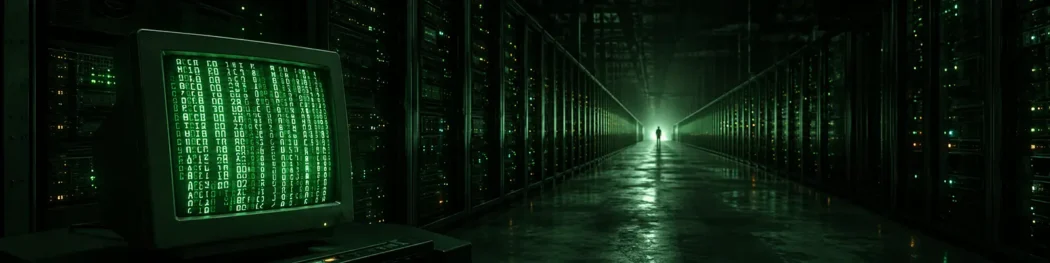
The scene is a server room or network operations center, circa 1999 — long rows of rack-mounted servers receding into darkness, their indicator lights blinking in irregular rhythms of green and amber. The floor is dark concrete. The ceiling is invisible above the equipment. The overall impression is of a space that extends further than the eye can follow in every direction — not a room but an infrastructure. In the foreground, a single monitor on a stand displays cascading vertical columns of green characters — not standard text, not binary, but something denser and faster, as if the data itself is alive and moving with intention. The monitor’s glow is the primary light source in the immediate foreground, casting green onto the floor and the nearest server racks. In the far background, barely visible at the vanishing point between the rows of servers, a single human silhouette stands perfectly still — not threatening, not fleeing, simply present inside a system that was not built for human habitation. The figure is small against the infrastructure. The infrastructure is indifferent to the figure.
The server room rather than a stylized digital environment is a deliberate choice. The 1990s network was physical before it felt digital — actual machines in actual rooms, humming and blinking, connected by actual cables. The abstraction came later. Starting in the concrete infrastructure grounds the era in what the technology actually looked like at the moment the fiction was imagining something far more fluid.
The single human silhouette at the vanishing point inverts the 1980s prompt’s composition. There, the empty chair meant the human had left to build the machine. Here, the human is inside the machine — dwarfed by it, surrounded by it, still present but no longer the largest thing in the room.
The cascading green monitor data is the era’s most recognizable visual signature without being a direct reproduction of any copyrighted design. Every viewer brings their own reference to it. The prompt asks for something denser and faster than standard code — something that reads as intentional rather than mechanical — which edges the image toward the decade’s central question without stating it.
The decade theme is the shift from can it think to can it feel — AI characters who acquire longing, grief, love, and moral weight. Spielberg and Pixar lead. The question of what we owe a constructed being that suffers becomes the decade’s central AI-fiction argument.
All Summaries by ReadAboutAI.com
Science Fiction becomes Science Fact : Eras Selector

Imagined Agents: The Medium Was the Message Before AI
↑ Back to Top