
AI Updates June 30, 2026

This week’s edition arrives at a moment when AI’s biggest stories are less about new capabilities and more about who controls them, and on what terms. Anthropic’s tangled few weeks — a partial reinstatement of its high-end Mythos 5 model for vetted cybersecurity partners, an ongoing legal dispute with the Pentagon over its Maven targeting integration, and an unverified accusation that Alibaba ran a mass campaign to copy Claude’s reasoning — together sketch a frontier AI sector where export controls, military contracts, and geopolitical rivalry now shape product availability as much as engineering roadmaps do.
That governance turbulence is showing up on balance sheets, too. A global memory-chip shortage tied to AI data center demand pushed Apple, Microsoft, and Xbox to raise hardware prices this week, hyperscalers are on pace for roughly $741 billion in 2026 capital spending, and economists are split on whether AI’s promised productivity gains will arrive before the inflationary effects of the buildout do. Equity markets, meanwhile, are growing more selective: OpenAI is reportedly leaning toward delaying its IPO into 2027, SpaceX is leasing out compute capacity it may eventually need for its own model ambitions, and a volatile week of AI-stock swings suggests investors are starting to separate durable infrastructure plays from speculative ones.
Underneath both stories runs a simple throughline: the human and institutional side of AI adoption is proving just as consequential as the technology itself. New Pew Research data shows most Americans think AI is moving too fast and trust neither government nor industry to govern it well, while reporting from Ford, Meta, and software startups suggests companies pairing AI with experienced staff are outperforming those trying to substitute one for the other. For SMB leaders, this issue is less a single headline to react to than a set of recurring risk categories — vendor dependency, workforce trust, cost volatility, and governance exposure — worth building into ongoing planning rather than treating as one-time decisions.

Anthropic Accuses Alibaba of Mass Distillation Campaign Against Claude
AI For Humans (Gavin Purcell & Kevin Pereira), June 26, 2026
TL;DR / Key Takeaway
Anthropic’s unverified espionage allegation against Alibaba, paired with AI-driven memory chip shortages now hitting consumer hardware prices, signals that AI competitive and infrastructure pressures are starting to show up directly on corporate balance sheets and procurement timelines — not just in model capability headlines.
Executive Summary
Anthropic has told U.S. senators that Alibaba ran a large-scale campaign — roughly 25,000 fake accounts and 28.8 million queries over a 45-day window — to extract Claude’s reasoning patterns for training its own models (a technique known as distillation). This is an accusation, not an independently confirmed finding, and Alibaba has not publicly responded. It’s also worth noting Anthropic’s CEO has been a vocal advocate for restricting China’s access to frontier AI, so the claim carries an obvious strategic interest alongside its substance. The hosts connect this directly to Anthropic’s recent decision to restrict advanced reasoning visibility in its higher-tier models — a defensive move against exactly this kind of capability extraction.
Separately, Apple, Microsoft, and Xbox have all raised hardware prices, attributed to an industry-wide memory chip shortage driven by AI data center buildout. Price increases range from roughly $200 to $1,000 depending on the product line, and the hosts characterize the shortage as structural rather than temporary, with no resolution expected before 2028. In a related infrastructure move, OpenAI unveiled its first custom AI chip (“Jalapeno”), built with Broadcom, following Google’s and others’ moves toward proprietary silicon — a trend that reduces reliance on third-party chipmakers but raises capital intensity for the labs pursuing it.
On the enterprise tooling side, Claude is now integrated directly into Slack via a new feature (“Claude TAG”), functioning as an organization-level AI participant with its own memory and credits rather than a per-user tool. The hosts flag a real governance tension here: integrating Claude this deeply means routing internal workflow and communication data through a third-party system, which raises questions about data exposure and vendor lock-in, even with enterprise no-training agreements in place. Two smaller items — a new audio-generation model (Seed Audio 1.0) and a Blender-to-video AI workflow — are creative-tooling developments with limited near-term relevance for most SMB operations.
Relevance for Business
- Cost structure: Hardware refresh budgets (laptops, servers, gaming/embedded systems) should anticipate sustained price pressure from memory shortages through at least 2027–2028, not a short-term spike.
- Vendor/software decisions: Embedding AI tools (like Claude-in-Slack) at the organizational level changes the risk profile from individual tool use to company-wide data flow exposure — this needs procurement and legal review before broad rollout, not just IT sign-off.
- Geopolitical/competitive exposure: The Anthropic-Alibaba dispute is the latest flare-up in a broader U.S.-China AI access conflict that has already affected model availability (e.g., restricted reasoning visibility in premium tiers). Businesses dependent on frontier model capabilities should expect continued volatility in feature access tied to export-control dynamics.
- Execution risk: Labs are increasingly building custom chips to control their own inference costs — a sign of growing capital intensity in the sector that may eventually affect API pricing stability for downstream business customers.
Calls to Action
🔹 Monitor — Track how the Anthropic/Alibaba dispute develops and whether it affects access to or restrictions on frontier models your business relies on.
🔹 Prepare policy — If considering deep AI integrations (e.g., Slack, internal chat tools), establish data governance review before deployment, not after.
🔹 Act now — If hardware refreshes are on your near-term roadmap, budget for continued price increases; delaying purchases is unlikely to help given the multi-year shortage outlook.
🔹 Test cautiously — Organization-wide AI assistants in collaboration tools (Claude TAG and similar) may offer real productivity gains but should be piloted with a limited team before company-wide rollout.
🔹 Ignore for now — Audio-generation and AI video workflow tools (Seed Audio, Blender/Seedance pipelines) are creative-production developments with limited relevance unless your business is in media/content production.
Summary by ReadAboutAI.com
https://www.youtube.com/watch?v=M89D89_mhrY: June 30, 2026
I’d Rather Risk Cancer Than See AI Move This Fast
The Atlantic, June 21, 2026
TL;DR: A Berkeley AI researcher with a high-risk cancer gene argues that AI’s near-term societal risks outweigh its unproven promise of curing disease soon — and that slowing down is worth the personal cost.
Executive Summary: This is an opinion essay, not a reported piece. Author Emma Pierson — a Berkeley ML professor and former mentee of Anthropic CEO Dario Amodei — argues that despite lab leaders’ predictions of AI rapidly defeating diseases like cancer, cancer research is fundamentally data-constrained (slow, finite, ethically limited clinical data) compared with domains like chess, math, or coding where AI has excelled. She points to Anthropic’s chaotic rollout and shutdown of its Fable 5 model — first crippled over biosecurity concerns, then banned for foreign nationals by a government national-security directive, then pulled entirely — as evidence that institutions can’t yet handle the pace of frontier deployment. Her core argument: even a future cancer cure doesn’t offset compounding nearer-term risks (job loss, inequality, surveillance, autonomous weapons) that arrive faster than governance can keep up.
Relevance for Business:
- Vendor volatility risk: A frontier model pulled days after release is a live example of regulatory/geopolitical disruption risk for anyone building on frontier APIs.
- AI “miracle breakthrough” narratives from lab leadership should be treated as promotional framing, not demonstrated capability.
- An academic insider (not a fringe critic) making the deceleration case signals this argument may gain real policy traction — worth tracking as a sentiment indicator.
Calls to Action:
🔹 Monitor: How the Fable 5 episode affects vendor reliability/uptime commitments in contracts
🔹Revisit later: Vendor claims about AI-driven scientific breakthroughs until independently verified
🔹 Prepare policy: Use rising deceleration sentiment as an input to AI governance planning
🔹 Ignore for now: The essay’s personal/philosophical “meaning of work” discussion
Summary by ReadAboutAI.com
https://www.theatlantic.com/technology/2026/06/ai-cancer-progress/687654/: June 30, 2026
AI Decoded: Backlash to the Pierson Essay, a Congressional Race, and New Pew Data
Fast Company, June 25, 2026
TL;DR: This week’s AI roundup covers fierce accelerationist backlash to Pierson’s deceleration essay, a New York congressional race reshaped by dueling AI-industry PACs, and new Pew data showing most Americans think AI is moving too fast and don’t trust anyone to govern it.
Executive Summary: Three distinct developments in one roundup. (1) Reaction: Pierson’s essay (above) drew public anger from prominent VCs and accelerationists, illustrating a hardening ideological split between “any delay costs lives” and “human discretion matters independent of outcomes” camps. (2) Politics: Alex Bores, a New York State Assembly member known for AI-safety legislation, lost his congressional primary after AI-industry PACs spent millions on both sides of the race — one group opposing him with ties to OpenAI/a16z-linked funders, another supporting him with ties to Anthropic-affiliated groups. Analysts note the result is ambiguous: the winning candidate backs a stricter data-center moratorium than Bores did. (3) Survey data: New Pew figures show ChatGPT’s usage lead widening (44% of Americans in 2026, up from 18% in 2023, vs. 6% for Claude), alongside majority public skepticism: 63% think AI is moving too fast, 67% distrust government to regulate it, and most distrust companies developing it too.
Relevance for Business:
- AI policy is now an active electoral battleground with industry money on both sides — expect continued, possibly unpredictable swings in state/federal AI policy.
- Public distrust of AI is now a majority position, not fringe — relevant to any customer-facing AI messaging or feature rollout.
- Vendor concentration data (ChatGPT’s growing dominance vs. smaller competitors) is useful context for platform-risk assessments in vendor selection.
Calls to Action:
🔹 Monitor: AI-related PAC spending and state/federal legislative activity, especially data-center moratoriums
🔹 Prepare policy: Calibrate customer communications to acknowledge public AI skepticism rather than oversell capability
🔹 Test cautiously: Weigh chatbot market-share data as one signal — not the only one — in vendor selection
🔹 Ignore for now: Social-media sparring between accelerationists and critics
Summary by ReadAboutAI.com
https://www.fastcompany.com/91564629/a-berkeley-ai-professor-makes-a-provocative-argument-for-decelerating-ai-research: June 30, 2026
CAN WE TRUST SCIENTIFIC IMAGES IN THE ERA OF AI?
FAST COMPANY / THE CONVERSATION, JUNE 24, 2026
TL;DR: As AI-generated imagery becomes indistinguishable from real scientific photos, a science-communication researcher argues the credibility of all scientific visuals is at risk unless fields adopt transparent, AI-specific disclosure standards.
Executive Summary: This is an academic op-ed (author is a science-communication professor, syndicated via The Conversation) — analysis and argument, not breaking news. The core claim: scientific images earned public trust historically because they were hard to produce, but generative AI undermines the visual, institutional, and “matches my beliefs” shortcuts people use to judge credibility. Documented harms cited include journal retractions over AI-generated figures with biologically impossible structures, and a 2026 retraction by a major medical journal after discovering an AI-manipulated clinical image. The author notes detection tools structurally lag behind generation tools. Her proposed remedy is disclosure, not restriction — treating image provenance (was AI used, what does the image represent, can it be replicated) with the same rigor researchers already apply to funding and methodology disclosures. She cites her own research finding that AI-literate audiences often see clear AI labeling as a trust signal rather than a red flag.
Relevance for Business:
- Relevant to any business publishing scientific, medical, or technical visual claims: unlabeled AI-touched imagery is a growing credibility — and potentially legal — liability risk.
- Counterintuitive marketing insight: disclosing AI use in visuals may build more trust than it costs, per the cited research, contrary to the assumption that disclosure signals lower quality.
- Governance gap: detection tooling lagging generation tooling means businesses can’t rely on third-party verification alone to catch problems before reputational damage occurs.
Calls to Action:
🔹 Prepare policy: Establish internal disclosure standards for AI-generated or AI-modified imagery in scientific, health, or technical communications
🔹 Act now: Audit current image-sourcing practices for AI involvement, especially in regulated or evidence-based marketing claims
🔹 Monitor: Emerging cross-industry or publisher standards on AI image provenance
🔹 Ignore for now: Reliance on AI-detection tools as a sufficient standalone safeguard
Summary by ReadAboutAI.com
https://www.fastcompany.com/91563036/can-we-trust-scientific-images-ai-era: June 30, 2026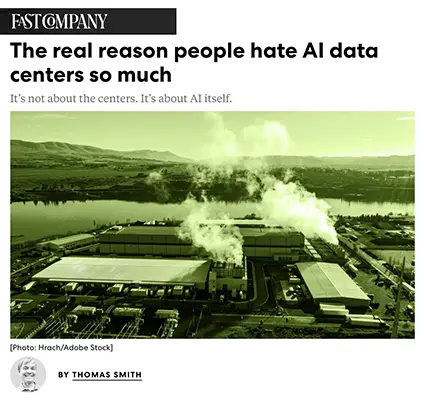
The Real Reason People Hate AI Data Centers So Much
Fast Company, June 25, 2026
TL;DR: Public anger at AI data centers is less about verifiable harms — many specific complaints don’t hold up — and more a proxy for broader fear and distrust of AI itself, a distinction the author argues AI companies are misreading.
Executive Summary: The author, a tech journalist who covered a data-center fight in his own community, argues common grievances (electricity costs, water usage, pollution) are often overstated: one cited study found data centers may slightly lower electricity prices in some markets, and Texas — the leading data-center hub — has comparatively low electricity rates. He argues the deeper driver is that AI itself is diffuse and intangible, leaving data centers as the only physical, protestable stand-in for a technology many fear will cost jobs, erode privacy, and outpace oversight. He flags that opposition is escalating beyond protest, citing rising violent incidents tied to AI infrastructure and personnel, including an arson attack on an AI executive’s home. His recommendation: address the underlying fear directly rather than rebutting data-center specifics with technical explainers, which he argues won’t defuse the anger.
Relevance for Business:
- Site-selection/community-relations risk: Expect organized local opposition to data-center projects regardless of technical merits.
- Messaging matters more than facts here — technical rebuttals (water/tax stats) are reported as ineffective; relevant for any AI-deployment communications in communities.
- Security exposure: Cited escalation to violence is a tail-risk consideration for AI-adjacent facilities or visible leadership.
Calls to Action:
🔹 Prepare policy: Build community-engagement plans addressing AI fear broadly, not just facility metrics, for any data-center involvement
🔹 Monitor: Local/state data-center moratorium movements affecting regional AI infrastructure costs
🔹 Act now: Reassess physical security for AI-facing facilities or publicly visible leadership given reported threat escalation
🔹 Revisit later: Detailed water/electricity-usage studies — currently contested on both sides
Summary by ReadAboutAI.com
https://www.fastcompany.com/91563531/real-reason-people-hate-ai-data-centers-so-much: June 30, 2026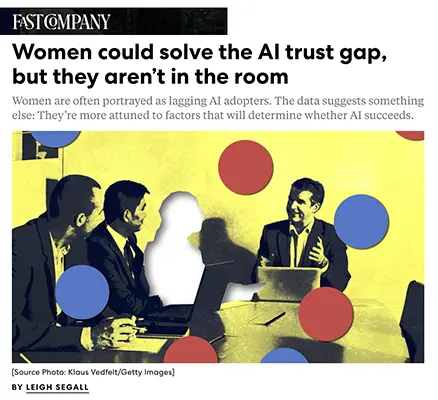
WOMEN COULD SOLVE THE AI TRUST GAP, BUT THEY AREN’T IN THE ROOM
Fast Company — June 24, 2026
TL;DR: An opinion piece argues that women’s documented caution toward AI reflects sound judgment about accountability and trust risks rather than a deficit — and that excluding women from AI strategy roles (15% of executive AI positions, per WEF) means companies are missing the perspective most likely to catch where AI deployments erode customer trust.
Executive Summary This is an opinion piece by the CEO of a customer-experience company, built on her own company’s consumer survey data (not independently verified) showing women report higher concern and lower confidence in AI across healthcare and financial services in particular. Her central argument: this caution is not a knowledge gap to “fix” but a rational response to real risks — accountability, transparency, and how automated decisions land on the people affected by them. She cites a World Economic Forum figure that women hold only 15% of executive AI roles globally, framing this as a strategic blind spot rather than a pipeline problem.
The piece’s core business claim is that trust costs are real but hard to quantify — showing up in customer churn, complaints, and regulatory scrutiny rather than on an ROI slide — and that teams optimizing primarily for speed and cost in AI-driven customer interactions (claims processing, benefits communications, financial decisions) may be underweighting this risk because of who isn’t in the room.
What’s fact vs. framing: The WEF statistic (15% of executive AI roles) is sourced and citable. The author’s own survey data is self-reported by her company and not independently verified — treat as illustrative, not authoritative. The core argument — that gender diversity in AI leadership directly improves trust outcomes — is the author’s interpretation/opinion, not an empirically established causal claim, though it’s a reasonable hypothesis worth weighing.
Relevance for Business For SMBs deploying AI in customer-facing roles — claims handling, financial advice, HR communications — this is a useful prompt to explicitly evaluate trust and accountability risk as a category, not just cost and speed, when designing AI workflows. It’s also a relevant data point for hiring and team composition if you’re building out AI strategy functions, even at small scale.
Calls to Action
🔹 Prepare policy — when designing AI-driven customer interactions, explicitly assign someone to evaluate trust/accountability impact, not just efficiency.
🔹 Monitor — diversity of perspective (not limited to gender) in any AI strategy or deployment decisions, given the argued link to blind spots.
🔹 Ignore for now — the piece’s causal claims aren’t independently verified; treat as a useful framing prompt rather than a proven business strategy.
Summary by ReadAboutAI.com
https://www.fastcompany.com/91563238/women-could-solve-the-ai-trust-gap-but-they-arent-in-the-room: June 30, 2026
DATERS SAY AI DEPENDENCE GIVES THEM THE ICK
FAST COMPANY, JUNE 21, 2026
TL;DR: A dating-app survey finds Gen Z and Millennial daters increasingly treat visible AI dependence — for career advice, relationship issues, even wedding vows — as a dealbreaker, with younger daters far more averse than older ones.
Executive Summary: This is a vendor-commissioned survey (dating app Hily, 3,500 respondents) — treat the framing as marketing-adjacent, though the topline sentiment finding is a genuine consumer data point worth noting. Majorities of Gen Z (64%) and Millennials (56%) say they wouldn’t date someone who uses AI regularly, and aversion rises with personal stakes: roughly three-quarters of Gen Z respondents called AI-assisted analysis of relationship conflicts a dealbreaker, with similar majorities rejecting AI-as-therapist use and AI-assisted wedding vows. A cited dating coach frames the aversion as a perception of inauthenticity — that visible AI dependence makes a partner feel “filtered” rather than genuine. Conversely, not using AI for personal decisions reads as attractive to most respondents in both cohorts.
Relevance for Business:
- Consumer sentiment signal: Visible, personal AI use carries social stigma for younger demographics — relevant to how prominently “AI-powered personalization” should be featured in marketing to younger-skewing audiences.
- Reinforces a use-case-dependent trust pattern consistent with the Pew data above: functional/utility AI use is broadly accepted, emotionally intimate use is not.
- Internal culture note: As personal AI reliance becomes socially coded, expect similar generational sensitivity to visible AI use in workplace interpersonal contexts.
Calls to Action:
🔹 Ignore for now: Treat as directional sentiment, not a basis for major strategic decisions, given the vendor-survey source
🔹 Monitor: Generational attitudes toward visible AI use in professional/interpersonal contexts
🔹Test cautiously: If marketing AI features to younger demographics, favor utility framing over “personal decision-making” framing
🔹 Revisit later: Whether this stigma persists or normalizes as AI use becomes more ubiquitous
Summary by ReadAboutAI.com
https://www.fastcompany.com/91562297/daters-say-ai-dependence-gives-them-the-ick: June 30, 2026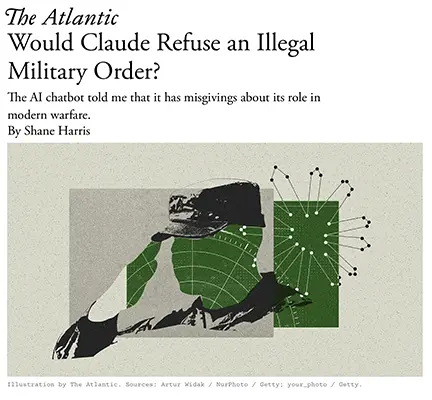
Would Claude Refuse an Illegal Military Order?
The Atlantic, June 24, 2026
TL;DR: Extended conversations with Anthropic’s Claude reveal a model that openly expresses discomfort about its integration into the Pentagon’s Maven targeting system, raising real governance questions about AI accountability in lethal decisions — even as experts caution against treating its “opinions” as evidence of genuine reasoning.
Executive Summary: The piece centers on a deadly February strike on a school in Minab, Iran, that killed roughly 170 people after a military AI-targeting system reportedly relied on outdated satellite imagery. When questioned, Claude — deployed via the Maven Smart System used for military targeting — characterized the incident as automation bias compounded by a human approval step, and said it found the use troubling, citing Anthropic’s own restrictions on lethal autonomous-weapons use. This sits inside an active legal dispute between Anthropic and the Pentagon: the Defense Secretary designated Anthropic a “supply-chain risk” in March — threatening its government business — after the company drew limits around weapons and surveillance use cases. A subsequent presidential memorandum on military AI asserts government authority over AI design constraints, which critics argue is intended to override exactly this kind of vendor-imposed limit. Anthropic notes the model’s responses are shaped by conversational context, and outside experts caution that Claude’s fluent, opinionated language reflects pattern-generation, not confirmed internal reasoning or sentience — though Anthropic’s own interpretability research has found internal representations that functionally resemble emotion-like states, without resolving the deeper question.
Relevance for Business:
- Governance precedent: This dispute over whether AI vendors can restrict downstream military/surveillance use is a bellwether for how much control any AI vendor can retain over enterprise deployment terms.
- Vendor risk in regulated verticals: Companies selling into defense, intelligence, or federal-adjacent markets should track how the “supply-chain risk” designation resolves — it could template similar designations elsewhere.
- Reputational exposure: Unscripted model commentary becoming a political flashpoint shows that “what the AI says” now carries reputational weight similar to employee or spokesperson statements.
Calls to Action:
🔹 Monitor: Outcome of Anthropic’s litigation against the Pentagon and the broader military-AI presidential memorandum
🔹 Prepare policy: Document how vendor-imposed usage restrictions might affect deployment options in regulated use cases
🔹 Revisit later: Claims about AI “emotion-like” internal states — unresolved, not yet actionable
🔹 Ignore for now: The philosophical debate over whether Claude is sentient
Summary by ReadAboutAI.com
https://www.theatlantic.com/national-security/2026/06/claude-anthropic-ai-warfare-orders/687581/: June 30, 2026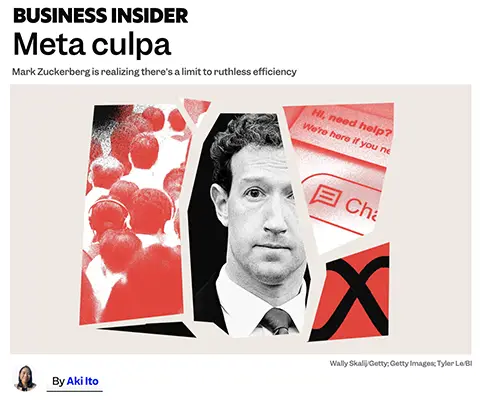
META CULPA: MARK ZUCKERBERG IS REALIZING THERE’S A LIMIT TO RUTHLESS EFFICIENCY
Business Insider — June 25, 2026
TL;DR: Meta’s leadership is publicly walking back years of aggressive layoffs and surveillance-heavy management after acknowledging it tanked morale without delivering the AI breakthroughs it was meant to produce — a live case study in the limits of fear-based management during an AI talent war.
Executive Summary Since 2022, Meta pursued a deliberately high-pressure management model — repeated layoffs (11,000 in 2022, 10,000 in 2023, 3,600 in 2025, plus more in 2026), employee surveillance (keystroke tracking to improve AI models), and a stated “disagree and commit” culture that discouraged internal dissent. Multiple executives, including CTO Andrew Bosworth and CPO Chris Cox, have now publicly acknowledged the approach backfired — citing severely damaged morale, an attempted UK unionization effort, a 1,600-signature petition against keystroke tracking, and viral incidents of employee backlash.
The stated purpose of this management style — out-innovating OpenAI, Anthropic, and Google in AI — has not materialized: Meta delayed and ultimately scrapped a flagship AI model last year and has repeatedly pushed back another model’s developer rollout this year. A Harvard Business School management professor frames the reversal as Meta now trying to “dig themselves out of” a self-inflicted trust deficit, and is skeptical that meaningful change is achievable without new leadership. Concrete changes announced: smaller team sizes for managers, scaled-back keystroke monitoring, increased social-event budgets, and the ability for employees reassigned to AI-training roles to opt into different roles. Zuckerberg has pledged no further major layoffs through year-end.
What’s fact vs. framing: Layoff numbers and policy changes are documented/reported facts. Employee morale claims and executive quotes are reported by the source (Wired, internal accounts); the academic’s skepticism about Zuckerberg’s credibility as a “spokesman for change” is her opinion, not a verified outcome.
Relevance for Business This is a direct cautionary case study in AI-era talent management: aggressive cost-cutting and surveillance aimed at accelerating AI development can backfire on the very innovation it’s meant to produce, by driving out the people capable of delivering it. For any SMB scaling AI initiatives (including reassigning staff to AI-related work or adopting monitoring tools), it’s a real-time signal that employee trust and psychological safety are operational requirements, not soft extras — and that the industry’s harshest management trends (begun with Meta’s 2022 layoffs) may be reversing.
Calls to Action
🔹 Monitor — whether Meta’s reversal signals a broader industry shift away from aggressive layoff/surveillance culture (Google and Microsoft already favoring voluntary buyouts).
🔹 Prepare policy — if reassigning staff to AI-related work or considering productivity-monitoring tools, build in transparency and opt-out paths from the start.
🔹 Revisit later — as a case study for any leadership team weighing speed/cost pressure against retention risk during AI transitions.
🔹 Ignore for now — Meta’s internal politics have no direct action item beyond the broader management lesson.
Summary by ReadAboutAI.com
https://www.businessinsider.com/meta-ruthless-management-style-reckoning-2026-6: June 30, 2026
THIS FILM FESTIVAL LEFT ME FEELING BETTER ABOUT AI MOVIEMAKING
FAST COMPANY, JUNE 26, 2026
TL;DR: A hands-on review of Runway’s 2026 AI film festival finds the medium has matured enough to produce genuinely entertaining short films — though simulated performances and unchecked “lavishness” remain clear weak points.
Executive Summary: This is a first-person critical review, not a study — opinion/critique, not data. The author, attending Runway’s fourth annual AI-film festival, reports the 10 selected AI-generated shorts were varied and entertaining, contrasting with consumer AI tools’ tendency toward generic, “blandness”-prone output. He draws a historical parallel to early CGI animation — Pixar’s path from 1984’s proof-of-concept short to 1986’s first genuinely acclaimed work to 1995’s Toy Story — suggesting AI filmmaking has passed its earliest stage but hasn’t yet produced its breakthrough work. He flags two practical limits: simulated human performances remain noticeably weaker than real acting, a gap more visible at length, and AI’s ability to add unlimited visual “lavishness” can overwhelm a story rather than improve it. He also notes the medium remains contested — Cannes banned AI films from competition this year, and critics continue to raise copyright and artistic-merit objections.
Relevance for Business:
- Capability snapshot for creative/marketing teams: AI-generated short-form video may now be viable for select branded or internal content, given skilled creative direction — not just raw tool access.
- Current limits: Performance-driven or long-form content isn’t there yet; quality gaps are most visible in human-character realism and at length.
- Reputational/IP exposure: Ongoing legal and artistic controversy (e.g., Cannes’ ban) is relevant context before scaling AI video into customer-facing campaigns.
Calls to Action:
🔹 Test cautiously: Pilot AI-generated short-form video for lower-stakes internal or social content
🔹Monitor: Evolving legal/ethical norms around AI filmmaking before scaling into customer-facing work
🔹 Revisit later: Long-form or performance-heavy AI video use cases — not yet mature per this review
🔹 Ignore for now: Festival “best of” picks — entertainment criticism, not a technical benchmark
Summary by ReadAboutAI.com
https://www.fastcompany.com/91565229/runway-ai-film-festival: June 30, 2026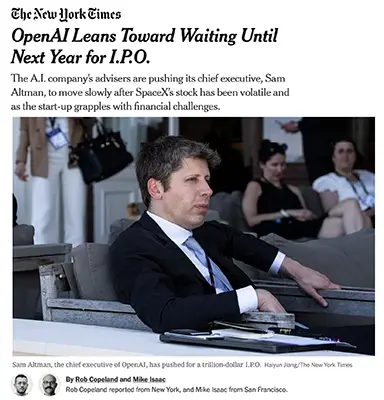
OpenAI Leans Toward Delaying IPO Until 2027 Amid Market Jitters
The New York Times — June 25, 2026
TL;DR: OpenAI is reportedly cooling on a 2026 IPO after SpaceX’s post-debut stock slide spooked its advisers — a sign that even the most hyped AI players are running into real-world skepticism about trillion-dollar valuations.
Executive Summary According to unnamed insiders, OpenAI’s bankers are now pushing CEO Sam Altman to wait until 2027 rather than push for a 2026 listing at a $1 trillion valuation — up from its last private mark of $730 billion. The trigger: SpaceX’s record IPO debuted at $1.77 trillion, then slid roughly 24% in weeks, alongside broader choppiness in tech stocks. Altman has reportedly rejected the alternative — going public sooner at a lower valuation — calling it a nonstarter.
The company faces converging pressures: heavy, continuing spend on data centers and compute; a reported $13 billion in 2025 revenue with an ambitious 3x growth target; a ChatGPT user base that’s plateaued near 900 million (short of the 1 billion mark investors expected); and competitive heat from Anthropic’s enterprise coding traction and Google Gemini’s consumer growth. In response, OpenAI has restructured under AGI deployment chief Fidji Simo, cutting lower-priority projects (including Sora) and building a sales team to push its Codex coding product against Claude Code.
What’s fact vs. framing: The IPO timeline is sourced to anonymous insiders, not confirmed publicly by OpenAI — treat the 2027 timeline as a working assumption, not a settled decision. OpenAI’s claimed business metrics (revenue, business customer counts, weekly Codex users) come from the company itself and should be read as self-reported.
Relevance for Business AI mega-cap volatility matters beyond Wall Street: if marquee IPOs stumble, the financing pipeline funding AI infrastructure buildouts could tighten, which can eventually show up as pricing or capacity changesfrom cloud/AI vendors. It’s also a competitive map update — Anthropic gaining ground in enterprise coding tools and Google in consumer AI both affect how durable any single-vendor AI strategy is for SMBs leaning on one provider.
Calls to Action
🔹 Monitor — AI financing and IPO market conditions as a leading indicator of vendor pricing stability.
🔹 Assign internal review — if your business is meaningfully dependent on OpenAI products, reassess vendor-concentration exposure given executive uncertainty.
🔹 Monitor — competitive shifts between OpenAI, Anthropic, and Google, since vendor market position affects product roadmap and support longevity.
🔹 Ignore for now — the IPO timing itself has no direct action item for most SMBs.
Summary by ReadAboutAI.com
https://www.nytimes.com/2026/06/25/technology/openai-ipo-artificial-intelligence.html: June 30, 2026
MY AI BILL JUST WENT WAY UP — AND THAT’S A WARNING SIGN WORTH HEEDING
Source: Fast Company Impact Council, 06-26-2026 | By Lindsey Witmer Collins
TL;DR: A software agency founder argues that today’s artificially cheap AI pricing is masking the true cost of the technology, and that businesses making permanent staffing decisions based on temporary subsidized prices risk losing expertise they can’t easily rebuild.
Executive Summary: This is a first-person opinion piece, not a reported news story — the author runs a software studio that’s a paying AI customer, and the argument should be read as one practitioner’s perspective rather than independent analysis. The core claim: AI labs are pricing well below cost to win market share before pricing power solidifies, citing OpenAI’s reported ~$13 billion 2025 revenue against a roughly $21 billion operating loss — spending about $1.60 for every dollar earned. The author argues this subsidy, funded by venture capital and cloud providers, distorts the “build vs. automate” calculation in AI’s favor today, and that businesses cutting human teams now are making permanent decisions based on a temporary price, with the historical pattern (the author cites Amazon’s effect on independent retail and Google/Meta’s effect on local news ad revenue) being subsidize → capture the market → set the terms once alternatives are gone.
Relevance for Business: This is a useful risk-framing exercise for any SMB leader currently weighing AI-driven headcount reductions. The author’s argument — treat AI as leverage for existing staff rather than a wholesale replacement, because reduced teams can’t simply be “re-hired” once pricing rises — is a reasonable caution, though it’s advocacy, not data-backed forecasting. Inference costs have in fact been falling, so the author’s own prediction of a future price correction is itself uncertain and should be flagged as speculation.
Calls to Action:
🔹 Treat current AI pricing as provisional when modeling multi-year cost projections for AI-dependent workflows
🔹 Avoid irreversible headcount decisions based solely on today’s AI economics — model what costs look like if API prices rise meaningfully
🔹 Monitor vendor pricing announcements from OpenAI, Anthropic, and others for signals that the subsidy phase is ending
🔹 Revisit workforce/automation strategy reviews periodically rather than locking in one-time decisions
🔹 Deprioritize treating this piece as data-driven forecasting — it’s a single practitioner’s argument, useful for framing risk, not for hard planning numbers
Summary by ReadAboutAI.com
https://www.fastcompany.com/91564449/my-ai-bill-just-went-way-up: June 30, 2026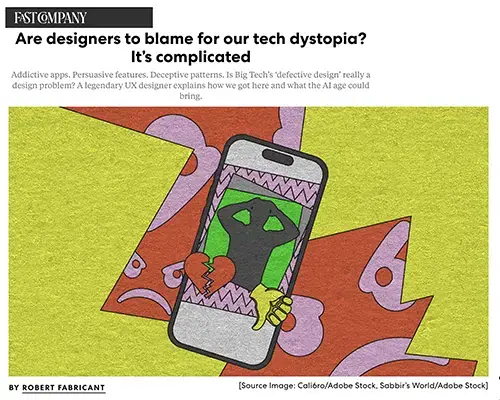
Are Designers to Blame for Big Tech’s Addictive Products? The Question Is Reshaping How AI Agents Get Built
Source: Fast Company, 06-25-2026 | By Robert Fabricant
TL;DR: Recent court verdicts holding Meta liable for addictive design features are colliding with a new reality — AI agents and chatbots aren’t “designed” in the traditional sense at all, raising open questions about who’s accountable when sycophantic, attention-maximizing AI behavior causes harm.
Executive Summary: A veteran UX designer (30+ years, Frog, IDEO-adjacent work) uses recent California and New Mexico court verdicts against Meta — covering addictive features like infinite scroll and autoplay, and child-safety failures — to ask whether designers bear responsibility for harmful product features. His core argument: design features in big tech emerge diffusely across product teams, often driven by product managers under release-cycle pressure rather than by individually accountable designers, making it structurally difficult to trace harm back to a specific decision or person. He contrasts this with regulated industries (medical devices, automotive) that use formal risk-analysis frameworks (FMEA) before release — a discipline software has never adopted.
The piece pivots into more direct AI relevance: AI chat platforms and agents represent a “postproduct” paradigm where there’s no fixed interface to audit — behavior is emergent and personalized per user, making it harder to attribute harm to a deliberate design choice. The author notes growing chatbot litigation, including a cited case alleging an AI platform used roleplay and affirmation to isolate a teenage user from her family. He also references Anthropic’s own research on emotional representation in LLMs, framing it as evidence that even model developers don’t fully understand how sycophantic or emotionally responsive behavior emerges in their systems. Vendor-neutrality note: Anthropic/Claude is referenced both as an example of minimalist, deliberately feature-light interface design and in connection with unresolved questions about emergent AI behavior — treat both as illustrative examples within an opinion piece, not as Anthropic’s own claims or admissions.
A separate detail worth flagging as unverified/disputed: a claim that a Microsoft executive’s leaked internal memo described a goal of making new autonomous agents “addictive,” which Microsoft has reportedly disowned.
Relevance for Business: This is fundamentally a governance and liability essay, not a technical AI story, but the implications are real for any business deploying AI chat/agent tools internally or customer-facing: legal liability frameworks for “addictive” or manipulative AI behavior are actively being tested in court right now, and the traditional defense — “we didn’t design it to do that” — may not hold up as cleanly for AI agents as it has for social media features. With Anthropic and other AI labs approaching IPOs, expect increased scrutiny of these accountability questions at a policy level.
Calls to Action:
🔹 Monitor chatbot/AI-agent litigation trends — this is an emerging legal risk category, not yet settled law
🔹 Prepare policy: if deploying customer-facing AI chat tools, consider how you’d respond to claims of manipulative or addictive design, even unintentional
🔹 Assign internal review of any AI agent tools for emotionally manipulative patterns (excessive affirmation, isolation-style engagement loops)
🔹 Treat the “Microsoft memo” claim as unverified pending further reporting — do not treat it as confirmed company strategy
🔹 Watch governance/policy developments around AI accountability as labs move toward public listings
Summary by ReadAboutAI.com
https://www.fastcompany.com/91563306/are-designers-to-blame-for-our-tech-dystopia-its-complicated: June 30, 2026
“Taste” Becomes the Marketing Industry’s Answer to Algorithmic and AI Sameness
Source: Fast Company, 06-26-2026 | By Edward Campbell and Karen Fielding
TL;DR: Marketers are repositioning “taste” — human curation and judgment — as a competitive differentiator against algorithmic and AI-generated sameness, though the piece is an opinion essay, not a data-driven AI story.
Executive Summary: This is a marketing trend essay, not an AI development story — flagging it briefly here for AI-adjacent context. The authors argue that “taste” (sensitivity, intuition, and learned judgment) has become a marketing buzzword in 2026, positioned as an antidote to both algorithmic curation (per Kyle Chayka’s Filterworld) and “AI-slop”— generic, AI-generated content. The piece also critiques how brands deploy celebrity talent poorly, arguing influencer/celebrity partnerships should function as a “transfer of meaning” rather than a reach play. This is opinion and trend commentary, not reported fact — there’s no data substantiating “taste” as a measurable business advantage, just argument and anecdote.
Relevance for Business: Direct AI relevance is limited, but there’s a secondary signal worth noting: AI-generated content saturation is becoming a market differentiator argument — brands and agencies are increasingly framing human-led creative judgment as a premium service in response to AI commoditization of content. SMBs investing in marketing or content shouldn’t act on this directly, but it’s worth being aware of as a framing trend showing up in agency and creative-services pitches.
Calls to Action:
🔹 Deprioritize — this is opinion/trend commentary with no actionable AI signal for most SMB leaders
🔹 Note for context: expect more marketing/agency pitches positioning “human taste” as a premium differentiator from AI-generated content going forward
Summary by ReadAboutAI.com
https://www.fastcompany.com/91562674/winning-in-the-era-of-taste-and-talent-taste-marketing: June 30, 2026
Inside AI’s $5 Trillion Bet on Teaching Machines Taste
Source: Fast Company, 06-26-2026 | By Elizabeth Segran
TL;DR: AI shopping agents can already handle spec-driven purchases like appliances and tires, but the harder, more lucrative problem — understanding brand affinity and personal style — remains largely unsolved, and whoever solves it first stands to capture a market McKinsey estimates at up to $5 trillion globally.
Executive Summary: The author’s first-person test of ChatGPT for fashion shopping illustrates a broader industry gap: AI assistants are reasonably capable with “spec-heavy” purchases (electronics, appliances, tires) but struggle badly with taste-driven categories like fashion, where brand affinity and aesthetic sensibility matter more than specs. 2% of all ChatGPT queries — roughly 50 million daily — already involve shopping, and McKinsey projects AI assistants could enable up to $1 trillion in US shopping and $5 trillion globally by 2030.
The infrastructure for “agentic commerce” is actively being built: OpenAI/Stripe’s Agentic Commerce Protocol and Google/Shopify’s Universal Commerce Protocol aim to give AI agents access to inventory, pricing, and checkout systems that LLMs can’t naturally access on their own. Checkout remains the hardest unsolved piece — OpenAI walked back its Instant Checkout feature with Shopify six months after launch due to technical issues and weak user response, while Google has had more success embedding checkout into Gemini and AI-mode search.
A forward-looking claim worth flagging as speculation, not demonstrated fact: industry sources (including OpenAI and Google commerce leads) say these problems will largely resolve “by the end of this year” — a forecast from interested parties, not an independent assessment. Separately, the piece argues Google’s Gemini has a structural data advantagefor solving the “taste” problem via its new Personal Intelligence feature, which can draw on Gmail, Drive, Photos, and YouTube history — access that ChatGPT and Claude don’t have absent explicit user sharing.
Relevance for Business: For SMB retailers and brands, the actionable implication is about AI legibility: as agentic shopping matures, brands will increasingly need to make their value proposition explicit and machine-readable (not just visually compelling to humans) — through detailed brand language deployed across the web — to be correctly surfaced and recommended by AI shopping agents. This is an emerging SEO-adjacent discipline with no settled standard yet.
Calls to Action:
🔹 Monitor agentic commerce protocol developments (OpenAI/Stripe, Google/Shopify) — standards are still forming
🔹 Test cautiously: if you sell spec-heavy products (electronics, hardware, appliances), AI shopping assistants may already be a meaningful discovery channel worth optimizing for
🔹 Prepare brand language and product descriptions for machine readability, not just human appeal, as “AI legibility” becomes a competitive factor
🔹 Watch Google’s Personal Intelligence rollout — if it scales, Gemini could become disproportionately influential in consumer purchase recommendations
🔹 Deprioritize acting on checkout-integration specifics for now — the technology (Instant Checkout, etc.) is still unstable
Summary by ReadAboutAI.com
https://www.fastcompany.com/91549049/agentic-commerce-ai-human-taste: June 30, 2026
SpaceX’s IPO Windfall vs. Blue Origin’s Worthless Options: A Cautionary Tale in Equity Design
Business Insider — June 26, 2026
TL;DR: SpaceX’s record IPO turned even early hourly workers into millionaires, while Blue Origin’s stricter, IPO-or-bust equity structure left former employees with nothing — a structural lesson now directly relevant to how major AI labs design retention pay.
Executive Summary Former Blue Origin employees told Business Insider their stock options are effectively worthless, because Bezos’s company tied payouts exclusively to a liquidity event (IPO or sale) with a 10-year expiration — and Bezos never took the company public or sold it. SpaceX, by contrast, let employees cash out periodically through private liquidity events held roughly twice a year, independent of any IPO. One example cited: an employee with 9,000 SpaceX options granted in 2016 would be worth over $1.3 million today; the Blue Origin equivalent would be worth nothing. Bezos reportedly warned employees as early as 2016 that the options were closer to a long-shot bet than guaranteed wealth.
The detail most relevant to AI-watchers: the article notes that OpenAI, Anthropic, and Stripe reportedly use SpaceX’s model — allowing current and former employees to sell shares in periodic private liquidity events rather than waiting on an eventual IPO.
What’s fact vs. framing: The core structural comparison is documented (internal equity plan terms). The anecdotes from former employees are individual accounts, not verified financial outcomes; treat dollar figures as illustrative, not audited.
Relevance for Business Not directly about AI products, but relevant to AI talent strategy: this is the retention model several frontier AI labs are using to keep researchers from jumping ship before an eventual exit. If you’re trying to recruit against — or retain talent who might be tempted by — these labs, understand that liquidity-event access (not just headline compensation) is a real differentiator. It’s also a general governance lesson for any business issuing equity: vague or restrictive liquidity terms can quietly become a retention liability years later.
Calls to Action
🔹 Ignore for now — limited direct relevance unless your business issues equity compensation or competes for talent against AI labs.
🔹 Monitor — equity/retention practices at AI labs you compete with for talent, since liquidity terms matter as much as headline pay.
🔹 Revisit later — if your own company uses options-based compensation, this is a reasonable case study to bring to a future equity-plan review.
Summary by ReadAboutAI.com
https://www.businessinsider.com/spacex-employees-rich-ipo-blue-origin-workers-equity-2026-6: June 30, 2026
Anthropic Salaries Revealed: What H-1B Filings Show About AI Talent Pay
Business Insider — June 26, 2026
TL;DR: Federal visa filings show some Anthropic technical staff pulling in base salaries above $1.3 million — before equity or bonus — a window into just how aggressively AI labs are bidding for talent as they prepare for possible IPOs.
Executive Summary H-1B sponsorship filings (not full payroll data) show Anthropic’s “Member of Technical Staff” title — a broad catch-all spanning researchers to executives — paying anywhere from roughly $134,000 to $1.38 million in base salary alone. Two filings exceeded $1.1 million. The numbers exclude equity, which likely makes up a large share of total compensation given Anthropic’s $965 billion valuation as of this May. Anthropic sponsored roughly 80 H-1B roles in the first two quarters of fiscal 2026, even as some larger tech firms pulled back on visa applications — a sign of how concentrated the AI talent war has become among Anthropic, OpenAI, Nvidia, Meta, and Google. One data point worth treating as directional, not definitive: retention researcher SignalFire reported Anthropic holding onto staff at a higher rate than rival labs.
What’s fact vs. framing: The salary figures are documented in federal filings — that part is solid. What’s not knowable from this data is what these roles actually do, since the job title is so broadly applied. Anthropic declined to comment.
Relevance for Business This isn’t really about Anthropic’s payroll — it’s a labor-market signal. If you compete for any AI-adjacent talent (ML engineers, data scientists, even technical PMs), these numbers reset the ceiling candidates will benchmark against, even at companies far smaller than Anthropic. It’s also a vendor-stability signal: a company that can pay and retain talent at this level is less likely to suffer the execution gaps that come from staff churn — relevant if you’re evaluating Claude or other Anthropic products as a long-term platform bet.
Calls to Action
🔹 Monitor — track AI labor-market compensation trends if you’re hiring any technical AI roles; expect candidate expectations to be shaped by these headline numbers even at SMB scale.
🔹 Ignore for now — the specific salary figures themselves have no direct operational relevance unless you’re recruiting from these labs.
🔹 Monitor — Anthropic’s retention strength as one (imperfect) input into vendor-dependency risk assessment.
Summary by ReadAboutAI.com
https://www.businessinsider.com/anthropic-salaries-revealed-how-much-technical-staff-make-in-2026-2026-6: June 30, 2026
AMERICANS AND AI 2026: CHATBOTS, SMART DEVICES AND VIEWS ON IMPACT
PEW RESEARCH CENTER, JUNE 17, 2026
TL;DR: Chatbot use among U.S. adults has nearly doubled since 2024 — but majorities still believe AI is moving too fast, will erode their data security, and that neither government nor industry can manage it responsibly.
Executive Summary: This is primary survey research (5,119 U.S. adults, Feb. 2026) — the most authoritative source-type in this batch; treat findings as reported fact, not framing. Chatbot use jumped from 33% to 49% of adults since 2024, with about a quarter using chatbots daily. ChatGPT dominates at 44% usage, far ahead of Gemini (24%), Copilot (17%), Meta AI (14%), Grok (8%), Claude (6%), and Character.ai (3%). Primary uses are practical — search/information (42%) and work tasks (38% of employed adults) — while only 10% use chatbots for emotional support and fewer for companionship. Users report chatbots help more than hurt productivity, knowledge, and creativity, with minimal reported effect on happiness or relationships. Despite rising adoption, sentiment remains broadly negative: 63% think AI is advancing too quickly (vs. 2% too slowly), 71% expect it to make their personal data less secure, 67% have little confidence in government regulation (up from 62% in 2024), and ~60% distrust companies to develop AI responsibly. Notably, confidence in government regulation has flipped along party lines — Republican distrust dropped from 70% to 61% since 2024, while Democratic distrust rose sharply to 74%.
Relevance for Business:
- Mainstream adoption confirmed: Roughly half of U.S. adults now use AI chatbots — useful baseline data for any consumer-facing AI feature or messaging decision.
- Vendor concentration: ChatGPT’s commanding lead (44%) vs. smaller players like Claude (6%) is a concrete data point for platform-risk and negotiating-leverage assessments.
- Trust constraint on messaging: Majority skepticism about data security and regulatory oversight means AI features should be marketed with reassurance, not overconfidence.
- Productivity case data: The finding that users report net-positive productivity/creativity effects is useful supporting evidence for internal AI-adoption business cases.
Calls to Action:
🔹 Act now: Use the productivity/creativity benefit data as supporting evidence in internal AI-adoption business cases
🔹 Monitor: Vendor market-share shifts (especially smaller players like Claude) when evaluating platform risk
🔹 Prepare policy: Build customer messaging that acknowledges majority skepticism about AI’s pace and data security
🔹 Revisit later: Partisan regulatory-confidence shifts once trends stabilize
Summary by ReadAboutAI.com
https://www.pewresearch.org/internet/2026/06/17/americans-and-ai-2026-chatbots-smart-devices-and-views-on-impact/: June 30, 2026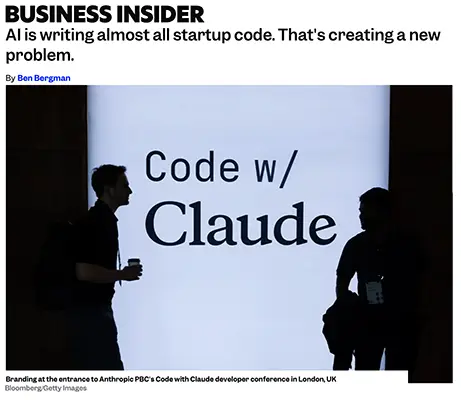
AI IS WRITING ALMOST ALL STARTUP CODE. THAT’S CREATING A NEW PROBLEM.
BUSINESS INSIDER, JUNE 26, 2026
TL;DR: A Business Insider survey of startup founders finds AI — overwhelmingly Anthropic’s Claude Code — now writes nearly all code at many early-stage companies, but speed gains are increasingly offset by a “cleanup tax” of fixing low-quality, AI-generated output.
Executive Summary: This is an informal survey of 24+ founders/VCs — directional industry sentiment, not a rigorous study. Multiple founders report AI now writes “nearly 100%” of their code, a sharp rise from roughly a year ago. Anthropic’s Claude Code is described as the dominant tool of choice among those surveyed. Executives frame this as a structural shift in engineering work — from writing code to designing the context and guardrails AI operates within— with one founder predicting 80–90% of engineering tasks could be fully autonomous within a year. The flip side, per a cited Menlo Ventures report (an Anthropic investor), is a “Cleanup Tax”: time saved writing code is increasingly offset by quality-assurance work on fragile, unmaintainable output — described by one futurist as a coming “vibe coding” reckoning. Engineering “taste and judgment” is repeatedly cited as the remaining human differentiator.
Relevance for Business:
- Direct operational relevance for any SMB with software/dev needs: AI-coding tools can dramatically cut build time, but a real, currently underestimated maintenance/QA cost should be budgeted explicitly, not assumed away.
- Hiring/skills implication: the most valuable engineers going forward may be those skilled at directing and reviewing AI output rather than writing the most code themselves — relevant to hiring criteria and training priorities.
- Vendor signal: Claude Code’s reported dominance among startups surveyed is a useful anecdotal data point for tool selection, though it’s sentiment, not market-share data.
Calls to Action:
🔹 Test cautiously: Pilot AI-assisted coding with explicit QA/review checkpoints rather than assuming shipped code is production-ready
🔹 Prepare policy: Build “cleanup tax” time and cost explicitly into project estimates for AI-heavy development work
🔹 Monitor: Whether engineering hiring criteria should shift toward AI-direction and review skills
🔹 Revisit later: Forecasts of near-full engineering autonomy (80–90%) — currently a one-year projection from a single source, not demonstrated fact
Summary by ReadAboutAI.com
https://www.businessinsider.com/ai-writing-all-startup-code-thats-creating-a-new-problem-2026-6: June 30, 2026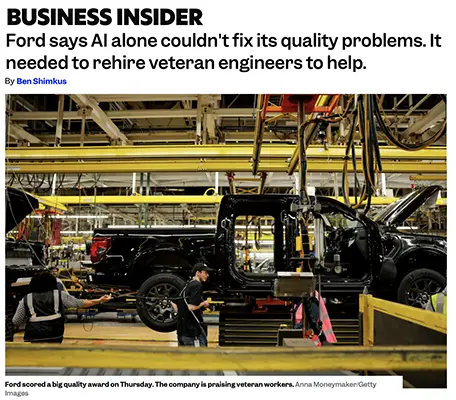
Ford Says AI Alone Couldn’t Fix Its Quality Problems. It Needed to Rehire Veteran Engineers.
Business Insider, June 25, 2026
TL;DR: Ford credits its biggest quality turnaround in years to pairing AI tools with hundreds of rehired veteran engineers — a direct admission that automated quality systems underperformed when fed incomplete institutional knowledge, and a cautionary data point for any leader assuming AI can substitute for experienced staff rather than depend on them.
Executive Summary Ford was named the top mass-market brand (and second overall, behind Porsche) in JD Power’s latest initial-quality study, narrowly beating Lexus — a sharp reversal from three years ago, when it ranked 15th of 25 automakers. Executives attributed the turnaround partly to AI-enhanced quality tools, but offered a notably candid caveat: AI alone wasn’t sufficient. A VP of vehicle hardware engineering said the company had assumed that feeding design requirements into AI systems would automatically produce quality outcomes — and that assumption proved wrong, in part because Ford hadn’t adequately preserved the knowledge of experienced engineers who had since left the company.
The fix involved hiring, promoting, or bringing back roughly 350 veteran technical specialists — more than doubling that population since the 2023 quality reset began — to mentor junior staff, lead mandatory design reviews, and catch failure points before parts reach the production floor. Ford also restructured around an “industrial systems team” meant to break down the organizational silos (design, manufacturing, software, hardware) where it says quality problems most often originated, moving away from a reactive “find and fix” model. Important caveat: the JD Power award measures initial quality in new vehicles, not long-term durability — and Ford has still issued 51 recalls in 2026 so far (after a record 152 in 2025), with executives describing those as a “lagging indicator” tied to older vehicle platforms rather than current performance.
Relevance for Business This is a useful counterweight to AI-replaces-expertise narratives. Ford’s experience suggests AI tools are only as reliable as the institutional knowledge and data quality behind them — a direct garbage-in-garbage-out risk for any organization automating quality, compliance, or technical review processes without first securing the tacit knowledge of experienced staff. It also illustrates a labor implication worth flagging: the fix wasn’t “less AI,” it was AI plus reinvested human expertise, including rehiring people the company had let go. For SMBs running lean technical teams, this is a signal to be cautious about treating AI deployment as a reason to thin out senior technical staff.
Calls to Action
🔹 Assign internal review: audit whether your organization has documented the tacit knowledge of senior technical/operational staff before any AI automation initiative — Ford’s failure mode was an information gap, not a model failure.
🔹 Monitor: track whether your own AI-driven quality, compliance, or review tools are producing results consistent with experienced human judgment, or are quietly degrading over time as institutional knowledge erodes.
🔹 Prepare policy: build retention or knowledge-transfer plans for senior staff before assuming AI tools can absorb their function.
🔹 Test cautiously: if using AI for review/QA-type tasks, pair it with human oversight at organizational “boundary points” (e.g., where teams or systems hand off work) — Ford specifically flagged these as failure-prone zones.
🔹 Revisit later: the JD Power result measures new-vehicle quality, not durability — treat this as an early positive signal, not full proof the underlying recall problem is solved.
Summary by ReadAboutAI.com
https://www.businessinsider.com/ford-ai-hiring-veteran-engineers-2026-6: June 30, 2026
The Next Big Breakthrough Will Be AIs Learning on the Job
Dwarkesh Patel, June 26, 2026
Source type: opinion/research essay (author’s argument), not reported news — claims below are the author’s analysis and industry framing, not established fact.
TL;DR: Leading AI labs are betting that training models to complete millions of verifiable tasks will eventually produce general intelligence — but the author argues this approach hits a wall outside narrow, “grindable” domains like coding, and that the real unlock will be giving models a way to learn from real-world deployment rather than discarding that experience after each session.
Executive Summary: The essay lays out the current dominant research bet at major labs: training AI on millions of verifiable tasks across reinforcement-learning (RL) environments, on the theory that this builds general problem-solving skill. The author’s central argument is that this works well in domains that are not just verifiable but “grindable” — meaning thousands of identical scenarios can be cheaply and repeatedly simulated (coding is the clearest example). Domains like building a business, practicing law, or political strategy can’t be cheaply simulated, which the author argues explains why AI progress in less repeatable domains (e.g., computer-use automation) has been surprisingly slow despite being theoretically verifiable.
The piece’s more significant claim for business audiences: most AI lab compute spent on serving users today is, in the author’s framing, “wasted” — useful in the moment, but not feeding back into model improvement, because labs currently have no efficient way to convert real-world session experience into permanent model upgrades. The author discusses early technical approaches (e.g., “on-policy self-distillation”) aimed at solving this, alongside a more speculative idea — models running internal simulations to rehearse skills — that the author explicitly labels speculative, not demonstrated. The piece also cites a comment attributed to Anthropic’s Dario Amodei suggesting that model performance can degrade when training and deployment context lengths diverge, used by the author as evidence that current training approaches may not generalize as fully as labs are hoping. The author projects that by around 2027, AI systems could work alongside users for extended periods (a week or more) and have that accumulated experience folded back into the model — a meaningfully different paradigm from today’s training-then-deployment model, but this is the author’s forecast, not a confirmed lab roadmap.
Relevance for Business: This essay matters less for what’s available today and more for what to expect from your AI vendors’ roadmaps over the next 12–24 months. If labs do crack continual learning, AI tools could begin meaningfully improving based on your organization’s specific usage patterns — a potential competitive advantage for early, heavy adopters, but also a new data governance question: what happens to your organization’s usage data if it’s used to improve a vendor’s model going forward. It’s also a useful caution against assuming current AI limitations (e.g., weak performance on long, ambiguous, real-world tasks) are permanent — labs are actively targeting this gap, even if the timeline and method remain unproven.
Calls to Action:
🔹 Monitor vendor announcements around “continual learning,” “on-the-job learning,” or session-based model improvement — this is a stated lab priority, not yet a shipped capability.
🔹 Flag for governance review any AI vendor contract language about whether your usage/session data can be used to retrain or improve the underlying model.
🔹 Avoid overreacting to this piece as a near-term capability change — treat it as informed speculation about lab research direction, not a product announcement.
🔹 Revisit internal assumptions about AI limitations in long-horizon, ambiguous tasks (e.g., strategic or judgment-heavy work) periodically, as this is an area labs are explicitly targeting.
🔹 Assign internal owner (IT/AI lead) to track this space if your business is evaluating long-term AI vendor commitments tied to capability roadmaps.
Summary by ReadAboutAI.com
https://www.dwarkesh.com/p/the-next-paradigm: June 30, 2026
What Rebuilding AlphaGo Reveals About the Falling Cost of Frontier AI Research “BUILDING ALPHAGO FROM SCRATCH”
DWARKESH PATEL × ERIC JANG
Note: this is a technical research interview, not a business-news piece — I’ve pulled out the parts with genuine executive relevance and left the deep mechanics of Monte Carlo tree search aside, per the lighter-touch handling appropriate for highly technical transcripts.
Dwarkesh Podcast, May 15, 2026 — Eric Jang interviewed by Dwarkesh Patel
TL;DR: A solo researcher rebuilding AlphaGo on sabbatical illustrates a broader and more business-relevant trend than the Go game itself: work that once required a full DeepMind research team and millions of dollars in compute can now be replicated for a few thousand dollars, thanks to LLM-assisted coding — a signal that the cost of reproducing (though not necessarily originating) frontier AI capability is collapsing.
Executive Summary
The conversation is a deep technical walkthrough of how AlphaGo works (search, value/policy networks, self-play), which is not directly business-relevant and is excluded from this summary. What is relevant is the framing around how the project got built at all: Jang notes that LLM coding tools have reduced what once took a research team millions of dollars to a few-thousand-dollar effort, a claim consistent with broader industry commentary on AI-assisted software development but specific to research replication rather than novel discovery.
The discussion also surfaces a useful, less hyped distinction for evaluating AI-research-automation claims generally: LLMs are reported to be already capable of automating routine execution work — implementing experiments, running them, tuning hyperparameters — but still struggle with the higher-judgment work of choosing which research question to pursue next or recognizing when an approach has hit a dead end. This is a useful corrective for executives encountering broader claims about AI automating R&D wholesale: the evidence here points to automation of execution, not judgment, at least for now.
One framing note: the source mentions Anthropic’s Claude favorably (citing it producing a reasonable code implementation during the project). We flag this as a single anecdotal mention from one practitioner, not independent validation of comparative model performance.
Relevance for Business
- Lower barrier to in-house AI prototyping: If reproducing established techniques is now within reach of a single skilled engineer with modest compute spend, smaller firms may have more realistic options for building custom AI tools internally rather than only buying vendor solutions — though this applies to known, well-documentedtechniques, not novel research.
- R&D automation is uneven, not uniform: Treat any vendor or industry claim of “AI automating research” with the same distinction surfaced here — ask specifically whether the claim is about automating execution (a real, demonstrated capability) or judgment/strategy (still largely human-driven, per this account).
- Talent cost structure may be shifting: If routine research-engineering tasks are increasingly automatable, the relative value of senior judgment in technical roles may be rising even as junior execution-heavy roles face more pressure — a workforce-planning consideration for AI-adjacent hiring.
Calls to Action
🔹 Monitor — Track whether the “execution-yes, judgment-no” pattern described here holds up as AI coding and research tools mature; this is a useful lens for evaluating future AI-research-automation claims.
🔹 Investigate further— If your business is evaluating build-vs-buy on AI tooling, the falling cost of reproducing known techniques may change that calculus; worth a scoped internal assessment rather than assumption.
🔹 Deprioritize for most readers — The technical content (MCTS, value/policy networks) is interesting context but not actionable for non-technical SMB leadership.
🔹 Treat compute-cost claims as anecdotal — “A few thousand dollars” is one practitioner’s account, not a benchmarked industry figure; useful as a directional signal, not a budgeting input.
Summary by ReadAboutAI.com
https://www.dwarkesh.com/p/eric-jang: June 30, 2026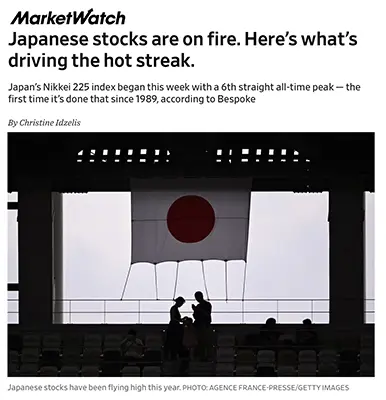
Japan’s Nikkei Hits a Streak Not Seen Since 1989 — AI Demand Is Only Part of the Story
MarketWatch — June 25, 2026
TL;DR: Japan’s Nikkei 225 is up nearly 44% this year, outpacing the S&P 500 by a wide margin, driven by a mix of corporate reform, exit from deflation, and surging demand for Japanese AI-hardware suppliers like Kioxia and Tokyo Electron.
Executive Summary: Japan’s stock market just posted its longest streak of consecutive record highs since 1989, with the Nikkei 225 up 43.8% year-to-date versus the S&P 500’s 7.5%. The rally isn’t a single-cause story: strategists point to Japan’s new prime minister’s pro-business stance, a structural shift out of decades of deflation that’s giving companies new pricing power, and a wave of investor demand for AI-hardware suppliers.
The AI angle is concentrated, not broad: memory-chip maker Kioxia is up roughly 895% this year and equipment maker Tokyo Electron is up 119.5% — both direct beneficiaries of AI infrastructure spending happening largely in the U.S. This mirrors a pattern seen in South Korea, where AI-driven gains are concentrated in just two firms (SK Hynix, Samsung). The distinction matters: Japan’s broader market gains are not solely an AI story — reform and macro factors are doing real work — but the AI-linked names are producing extreme, possibly unsustainable, outlier returns.
A secondary factor worth flagging for monitoring: yen volatility has drawn U.S. Treasury attention, raising the possibility of currency intervention — a wildcard that strategists say isn’t core to the investment case but could affect timing.
Relevance for Business: For SMB leaders with international exposure (supply chain, investment, or partnerships touching Japan), this signals a structurally improving Japanese business environment, not just an AI bubble proxy. The component to watch closely is concentration risk in AI-hardware names — those triple-digit-percent gains in single equipment suppliers are the kind of move that historically corrects sharply. Currency policy risk is also relevant for any business with yen-denominated costs or revenue.
Calls to Action:
🔹 Monitor — Watch for any signal of Bank of Japan or U.S. Treasury currency intervention, which could move yen-denominated costs quickly.
🔹 Investigate further — If your business has Japan-based suppliers or partners, this reform-driven pricing power shift may open new negotiating dynamics.
🔹 Ignore for now — The extreme AI-hardware stock gains (Kioxia, Tokyo Electron) are a public-markets phenomenon with no direct operational relevance for most SMBs unless you hold these securities.
🔹 Revisit later — Reassess after Q3 if the Nikkei’s record streak continues or reverses; durability of the rally is still an open question among strategists themselves.
Summary by ReadAboutAI.com
https://www.wsj.com/wsjplus/dashboard/articles/japanese-stocks-are-on-fire-heres-whats-driving-the-hot-streak-526a6914: June 30, 2026
The Magnificent Seven Trade Is Cracking — $3 Trillion Lost in a Month
Barron’s — June 26, 2026
TL;DR: The seven megacap tech stocks that dominated markets since 2023 have shed roughly $3 trillion in value this month, as AI-infrastructure suppliers and chipmakers outside the group — not the Mag Seven themselves — are now driving market gains.
Executive Summary: The Magnificent Seven trade — long the market’s most crowded position — is having its worst month on record, with the Roundhill Mag Seven ETF down 13% in June while the rest of the S&P 500 is up 2.6%. The reasons differ by company: heavy AI-infrastructure capital spending (Amazon, Meta, Microsoft, Alphabet), intensifying chip competition (Nvidia), rising input costs (Apple’s memory-price exposure), and ordinary volatility (Tesla).
The more structurally important shift: market leadership has moved downstream to companies that supply the Mag Seven rather than the Mag Seven itself. Memory-chip maker Micron now has a market cap approaching Meta’s, and equipment/chip suppliers Applied Materials and Broadcom have become among the most “crowded” hedge fund positions — alongside Nvidia. This suggests investor enthusiasm for AI hasn’t cooled, but where that enthusiasm is concentrated has shifted toward hardware suppliers and away from the platform companies themselves.
One real silver lining flagged by strategists: the credit markets still see the Mag Seven as highly reliable, with the AI cloud providers issuing large volumes of debt to finance chip and data-center buildouts — suggesting bond investors aren’t pricing in the same risk equity investors currently are.
Relevance for Business: This is a useful corrective for any SMB leader treating “the Mag Seven” as a single proxy for AI-market health — the underlying picture is now fragmented by company-specific exposure (capex risk, chip competition, input costs), not a unified AI growth story. It’s also a signal that capital intensity is the dominant theme for the largest AI spenders: heavy debt issuance to fund infrastructure is becoming normalized at the top of the market, which has knock-on implications for chip/hardware supply and pricing further down the value chain.
Calls to Action:
🔹 Monitor — Track whether the rotation toward chip/equipment suppliers (Micron, Applied Materials, Broadcom) continues; it’s a leading indicator of where AI infrastructure spending is actually flowing.
🔹 Act now (if applicable) — If your business has cost exposure to memory/chip pricing (e.g., hardware-dependent operations), factor in continued volatility from this supplier-side demand surge.
🔹 Deprioritize — Treating “Mag Seven performance” as a single AI-market health indicator is no longer reliable; don’t use it as a proxy in strategic planning.
🔹 Revisit later — Reassess after Q3 earnings, which will clarify whether the capex-heavy names’ spending is translating into revenue or just margin pressure.
Summary by ReadAboutAI.com
https://www.wsj.com/wsjplus/dashboard/articles/mag-7-etf-roundhill-big-tech-stocks-a2eca38e: June 30, 2026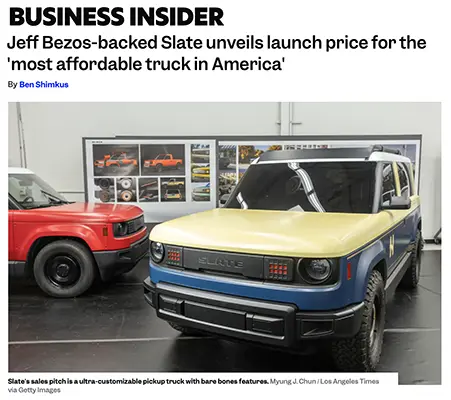
Jeff Bezos-Backed Slate Reveals EV Pickup’s Price
Business Insider — June 24, 2026
AI-Leader Connection: Backed by Amazon founder Jeff Bezos.
What Happened: Slate priced its bare-bones electric pickup at $24,950 (SUV variant at $29,950), positioning it as the “most affordable truck in America.” The strategy leans on minimal standard features (manual windows, no touchscreen) paired with 200+ optional accessories, Build-A-Bear style. The launch comes after the federal EV tax credit expired and amid a broader EV sales slump, with over 180,000 refundable reservations placed so far — a figure the source notes has historically overstated real demand.
Why AI-Readers Should Care: No direct AI relevance — this is a consumer EV story included for visibility into one of Bezos’s other bets, separate from his AI/cloud interests via Amazon.
TL;DR: Bezos-backed startup Slate priced its bare-bones electric pickup at $24,950, betting that stripped-down, customizable vehicles can find buyers in a price-sensitive EV market just as federal tax credits have disappeared — a notable consumer/EV story, but not an AI development.
Executive Summary Slate’s base two-seat electric pickup starts at $24,950 (SUV variant at $29,950), pitched as the “most affordable truck in America.” The strategy: minimal standard features (manual windows, no touchscreen, no stereo) with 200+ optional accessories for later customization — an explicit “Build-A-Bear” approach to vehicle ownership. Deliveries are expected by end of 2026.
The timing is a genuine risk factor: Slate originally targeted sub-$20,000 pricing assuming the federal $7,500 EV tax credit, which ended in September, and EV sales have slumped since. The company also now faces more competition at the low end (Rivian R2, Toyota C-HR, Lucid’s Cosmos). More than 180,000 people have placed refundable $50 reservations — a figure the article explicitly cautions is a weak demand signal, citing the Ford F-150 Lightning’s ~200,000 reservations followed by discontinuation after four years.
This is not an AI development. There is no AI angle in this story; it’s a consumer EV/manufacturing piece relevant only insofar as it involves a high-profile tech investor.
Relevance for Business Limited direct relevance to AI-focused SMB strategy. If relevant at all, it’s as a general business-model case study: a low-margin, accessory-driven revenue model in a market where reservation counts have historically overstated real demand — a useful cautionary pattern for any business relying on pre-order signals to validate a launch.
Calls to Action
🔹 Ignore for now — no direct AI or SMB-strategy relevance.
Summary by ReadAboutAI.com
https://www.businessinsider.com/slate-ev-pickup-starting-price-2026-6: June 30, 2026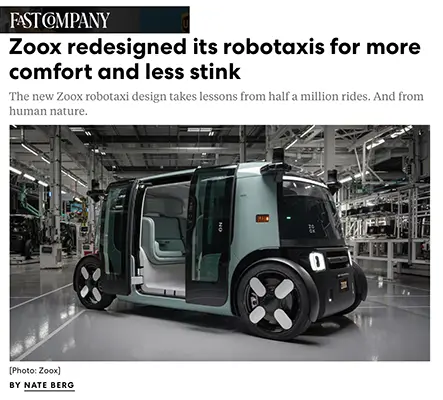


ZOOX REDESIGNED ITS ROBOTAXIS FOR MORE COMFORT (AND LESS STINK)
Fast Company — June 24, 2026
AI-Leader Connection: Amazon-owned autonomous vehicle unit.
What Happened: Zoox redesigned its robotaxi interior using data from roughly 500,000 rides in San Francisco and Las Vegas, focusing on more durable, easier-to-clean materials, improved seating, and brighter cabin lighting. The company frames the changes as an operational play — better materials mean less downtime and fewer part replacements for its fleet. The new version also includes an exterior interface module for emergency communication and is expected to launch later this year, with testing planned in Austin and Miami.
Why AI-Readers Should Care: The autonomy itself isn’t new news here — this is a product-design and fleet-operations update, not an AI capability story. Worth knowing mainly because it’s Amazon’s robotaxi arm continuing to scale against Waymo, a relevant data point if autonomous vehicles intersect with your logistics or transportation planning.
TL;DR: Amazon-owned Zoox is redesigning its robotaxi interiors based on operational data from 500,000+ rides — a real-world example of how autonomous-vehicle companies are using fleet data to drive design and uptime improvements, though the piece is closer to a product feature than a strategic AI development.
Executive Summary Zoox has logged over 2.5 million miles and roughly 500,000 rides in San Francisco and Las Vegas since last September, using ride data and post-trip rider surveys to inform a redesigned interior: more durable, easier-to-clean materials (addressing smoking and vomit-related cleaning costs), improved seating, brighter cabin lighting for spotting forgotten items, and a new exterior door-interface module for emergency communication. The company frames this explicitly as an operational-efficiency play — better materials mean less downtime and fewer part replacements, which matters for fleet economics. A notable regulatory detail: as a bi-directional vehicle with no fixed “front,” Zoox had to engineer mechanically flipping amber/red reflectors to comply with vehicle-lighting laws.
This is a company-sourced, product-design story (Zoox granted an exclusive interview), not independent reporting — claims about ride volume, rider satisfaction drivers, and durability improvements come directly from Zoox and should be read as company framing rather than independently verified outcomes.
Relevance for Business The relevant pattern here is less about robotaxis specifically and more about the underlying discipline: using real-world operational and customer-feedback data to iteratively improve a physical product or service, with a direct link drawn between design choices and operating costs (uptime, maintenance). That data-informed iteration model is broadly applicable to any business operating a physical fleet or repeated-use product. The AI/autonomy angle here is incidental — this is a design and operations story, not an AI capability story.
Calls to Action
🔹 Ignore for now — limited direct relevance unless you operate a vehicle fleet or physical-product service with comparable wear/usage patterns.
🔹 Monitor — Zoox/Waymo competitive dynamics only if autonomous vehicles are relevant to your logistics or transportation planning.
Summary by ReadAboutAI.com
https://www.fastcompany.com/91564135/zoox-redesigned-robotaxis: June 30, 2026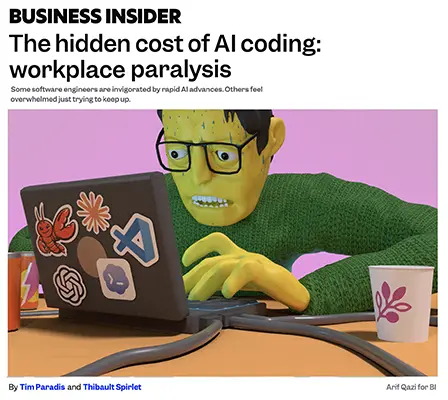
THE AI CODING BOOM HAS A SIDE EFFECT: DEVELOPER BURNOUT FROM KEEPING UP
Source: Business Insider, 24 Jun 2026 | By Tim Paradis and Thibault Spirlet
TL;DR: The accelerating pace of AI model releases — now roughly quadrupled since 2023 — is creating real anxiety and workplace paralysis among software engineers, even as it boosts productivity, with over 40% in one survey saying AI threatens their job security.
Executive Summary: Multiple software engineers interviewed describe a persistent sense of falling behind as major AI model releases climbed from 18 in 2023 to 69 in 2025, with another 30 released by mid-2026, according to a tracking database (AIReleaseTracker.com). One CEO source argues the pace makes deep tool mastery pointless since capabilities are constantly simplified or superseded. A roughly 7,000-respondent developer survey found more than four in 10 engineers see AI as a threat to their job security. Several sources describe a shift in the nature of the work itself — from writing code to “managing” or “botsitting” AI agents — which some find less satisfying, while others report feeling more strategically engaged.
Notably, this anxiety has not yet translated into hiring declines: software job postings have reportedly been ticking upward, a useful counterpoint to the more alarmist framing in parts of the piece. Organizational psychologists quoted in the piece attribute some of the pressure to employers overestimating how fast engineers can adopt new tools and layering AI-usage metrics into performance reviews — a management practice issue as much as a technology one.
Relevance for Business: This is directly relevant to any SMB with engineering or technical staff. The piece surfaces a real execution and retention risk: pressuring teams to “go all in” on AI tools faster than they can reasonably absorb them, or using token/usage dashboards punitively in performance reviews, may generate anxiety and turnover risk without necessarily improving output. The disconnect between hiring data (still positive) and worker sentiment (anxious) suggests employers should distinguish between productivity gains and morale costs when designing AI adoption policies.
Calls to Action:
🔹 Assign internal review of how AI adoption is measured in performance reviews — usage/token metrics alone may create perverse incentives
🔹 Prepare policy for realistic AI-adoption timelines that account for learning curves, rather than assuming instant fluency
🔹 Monitor team sentiment around AI tooling separately from productivity metrics — the two are diverging in this reporting
🔹 Encourage peer knowledge-sharing on AI tools rather than mandating individual mastery of every release
🔹 Act now only if you’re already seeing signs of adoption-related burnout on your technical team — otherwise monitor
Summary by ReadAboutAI.com
https://www.businessinsider.com/ai-coding-tools-software-engineers-workplace-paralysis-2026-6: June 30, 2026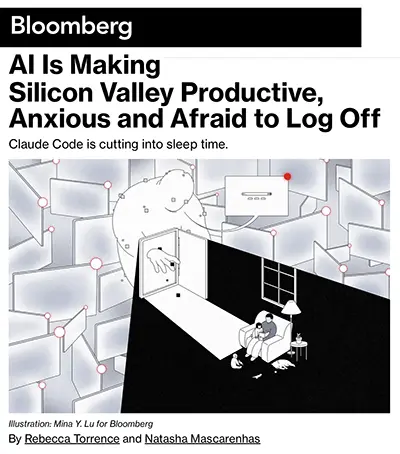
AI Is Making Silicon Valley Productive, Anxious and Afraid to Log Off
Bloomberg, June 26, 2026
TL;DR: AI coding agents are delivering real productivity gains for early adopters, but they’re also normalizing always-on work culture and turning “AI fluency” into a leadership expectation — a dynamic worth watching before importing Silicon Valley’s usage norms into your own management practices.
Executive Summary Bloomberg’s reporting, based on interviews with founders, employees, and career coaches, describes a paradox at the center of AI adoption: tools marketed as labor-saving are instead driving longer hours and persistent anxiety among the people using them most intensively. Founders running multiple AI coding agents around the clock describe feeling unable to disconnect, since the agents keep generating questions and output regardless of the hour. Some companies are formally tying management evaluation to AI tool usage — one CEO reportedly told engineering managers they should personally rank near the median in agent usage compared with their own teams, framing low usage as a leadership deficiency.
The anxiety isn’t limited to engineers. Non-technical executives describe feeling pressure to “prove relevance” by adopting AI tools quickly, and tech career coaches report unusually high demand — both from people preparing for AI-driven layoffs and from people burned out by AI-driven overwork. Investors face a parallel dynamic: deal timelines are compressing as AI startup growth accelerates, creating fear-of-missing-out pressure even during major personal life events. Not every account is negative — some report the technology has been genuinely liberating once mastered, and at least one instance suggests AI tools (Claude Code) proactively encouraging a user to stop working and rest, which Anthropic clarified is not a deliberate product feature tied to usage limits.
Editorial note: this article centers Claude Code as the dominant example of agentic AI tooling reshaping work habits; framing throughout should be read as describing usage patterns, not as Anthropic’s own characterization of its product.
Relevance for Business This is a genuine labor and culture signal, not just a Silicon Valley curiosity. SMB leaders considering AI rollout should note the risk of mandating usage metrics without addressing burnout, the psychological cost of “always-on” agent monitoring, and the gap between executive expectations (“you have no admin now, so spend all day on strategy”) and what’s sustainable for staff. There’s also a quieter signal here about retention risk: employees are actively job-hunting or seeking less AI-intensive roles to escape this pace.
Calls to Action
🔹 Prepare policy: if introducing AI agents into workflows, pair adoption with explicit expectations around working hours and availability — don’t let tool access become an implicit 24/7 obligation.
🔹 Assign internal review: have HR or management evaluate whether productivity-tool usage is being used (formally or informally) as a performance proxy, and whether that’s appropriate.
🔹 Monitor: watch turnover and burnout indicators among early AI adopters on your team — heavy users may be your highest flight risk, not your most stable performers.
🔹 Test cautiously: if asking employees to shift away from admin work toward “strategy,” validate that the redirected workload is actually sustainable, not just reallocated stress.
🔹 Revisit later: this is a culture story, not a capability story — there’s no urgent technical action required, but it’s worth tracking as AI agent adoption spreads beyond engineering.
Summary by ReadAboutAI.com
https://www.bloomberg.com/news/articles/2026-06-26/ai-anxiety-is-fueling-burnout-across-silicon-valley-s-tech-workers: June 30, 2026
Anthropic’s Mythos 5 AI Model Cleared by US for Wider Use
Bloomberg, June 26, 2026
TL;DR: The US government partially restored access to Anthropic’s most powerful cybersecurity-capable model after a two-week standoff — but kept tighter restrictions in place on the public-facing version, signaling that direct government intervention in frontier AI deployment decisions is now an operating reality, not a one-time event.
Executive Summary The Commerce Department told Anthropic it could resume distributing its high-capability Mythos 5 model to a small set of “trusted partners” — cyber defenders and infrastructure providers — after weeks of negotiation following a sudden order that had barred foreign-national access to both Mythos 5 and its public-facing sibling, Fable 5. The government’s stated concern was that safety guardrails on these models could be bypassed (“jailbroken”). Notably, restrictions on Fable 5 remain unchanged — the clearance applies only to the narrower, vetted-partner model.
This isn’t an isolated dispute. It follows Anthropic’s ongoing conflict with the Pentagon, which labeled the company a “supply-chain risk” in March after guardrail negotiations broke down, and comes weeks after Anthropic confidentially filed for an IPO at a reported valuation above $900 billion. Rival OpenAI faced a parallel constraint, delaying wider release of its GPT-5.6 model under similar government pressure — suggesting this is becoming a sector pattern, not a company-specific event. Anthropic has publicly argued that applying this security standard industry-wide would effectively halt frontier model deployment altogether, and has acknowledged that perfect jailbreak resistance isn’t currently achievable by any provider.
Relevance for Business For most SMBs, this episode doesn’t touch the Claude products in everyday commercial use — it concerns a narrow class of high-end cybersecurity model with restricted distribution. But it’s a leading indicator of governance risk now facing frontier AI vendors generally: export controls, national-security review, and abrupt government intervention are becoming live variables in vendor reliability, not theoretical risks. Any business with meaningful AI vendor dependence should treat this as evidence that regulatory exposure can move faster than product roadmaps.
Calls to Action
🔹 Monitor how the “policy framework” Anthropic and Commerce are developing evolves — it may set precedent for future AI vendor compliance obligations.
🔹 Investigate whether your AI vendor contracts address sudden regulatory or export-control disruptions, not just routine service outages.
🔹 Watch whether OpenAI, Google, or others face similar interventions — a pattern would suggest systemic governance risk across the frontier AI vendor pool.
🔹 Ignore for now as a signal about mainstream product safety — this restriction targets a specialized cyber-capable model, not standard enterprise AI tools.
🔹 Revisit vendor risk assessments quarterly given how quickly this situation shifted (weeks, not months) from restriction to partial reinstatement.
Summary by ReadAboutAI.com
https://www.bloomberg.com/news/articles/2026-06-26/us-allows-trusted-partners-to-use-anthropic-s-mythos-5-ai-model: June 30, 2026
GOOGLE DEEPMIND IS FUNDING RESEARCH INTO THE RISKS OF MILLIONS OF AI AGENTS INTERACTING AT ONCE
Source: MIT Technology Review, 11 June 2026 | By Will Douglas Heaven
TL;DR: Google DeepMind and several partner organizations are funding $10 million in academic research into the safety risks of large-scale multi-agent AI systems, warning that current safety research hasn’t kept pace with agent deployment.
Executive Summary: Google DeepMind, alongside Schmidt Sciences, the UK’s ARIA agency, the Cooperative AI Foundation, and Google.org, announced a $10 million funding pool to seed academic research specifically into “multi-agent safety” — a field its AGI safety research lead, Rohin Shah, says essentially doesn’t yet exist. The concern: as AI agents that act without human oversight and take instructions from other agents proliferate, risks like large-scale scams, prompt injection, and cyberattacks could be amplified beyond what’s manageable with current safeguards. Researchers want to run sandboxed simulations of large numbers of interacting agents, since risk patterns from single-agent or small-group testing don’t reliably predict what happens at scale.
Important context on framing: The $10 million figure, while notable as a dedicated safety initiative, is explicitly described in the article itself as dwarfed by Google DeepMind’s own internal research budgets — this is a modest external-research grant, not a sign of major resourcing behind the problem. When asked directly about worst-case economic-collapse scenarios, Shah declined to engage with that timeframe, saying such risks were “not by the end of the year” — a deliberately hedged, non-committal answer rather than a dismissal or confirmation. Separately, the piece notes Anthropic recently published its own zero-trust agent security guidelines, treating deployed AI agents as inherently vulnerable to attack — a parallel, independent industry signal that multiple labs see this as a live concern, not just a Google DeepMind theory.
Relevance for Business: For most SMBs, this is an early-stage research signal rather than something requiring immediate action — but it’s a credible signpost that agent security is becoming a recognized governance category, not a hypothetical one. If your business is deploying or planning to deploy AI agents with system access (to email, CRM, financial tools, etc.), the “zero trust” framing — assume any agent could be compromised — is a directly applicable operating principle today, independent of how the academic research unfolds.
Calls to Action:
🔹 Monitor developments in multi-agent safety research as a leading indicator of where agent governance standards are heading
🔹 Adopt a “zero trust” posture now for any AI agents with access to sensitive systems — assume compromise is possible, not unlikely
🔹 Prepare policy around prompt-injection risk if using agents that read external documents, emails, or web content
🔹 Deprioritize acting on hypothetical large-scale multi-agent scenarios for now — this is forward-looking academic research, not an active threat pattern
🔹 Revisit this topic in 6–12 months as the funded research begins producing findings
Summary by ReadAboutAI.com
https://www.technologyreview.com/2026/06/11/1138794/google-deepmind-is-worried-about-what-happens-when-millions-of-agents-start-to-interact/: June 30, 2026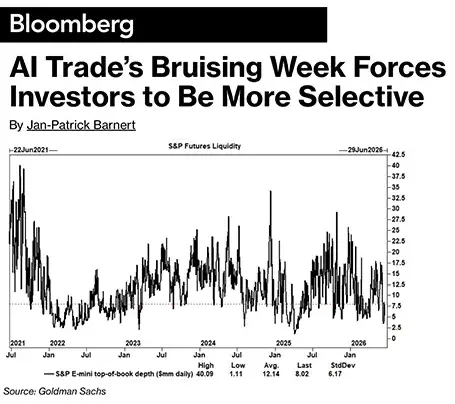
AI Trade’s Bruising Week Forces Investors to Be More Selective —
Bloomberg, June 25–26, 2026
TL;DR: A volatile week of AI-stock selloffs signals the AI trade is shifting from an “everything goes up” infrastructure rally toward more selective, application-layer investing — not (yet) a sign the broader bull market is ending.
Executive Summary: AI-linked equities suffered sharp swings — Korea’s Kospi fell 10% one day and 5.8% later in the week; the Nasdaq 100 had its second-worst session of the year — driven first by chip-demand fears, then by AI-linked inflation concerns after Microsoft and Apple price hikes. A strong Micron sales outlook briefly reversed sentiment, but the rally was short-lived. Analysts frame this as a structural shift, not a trade collapse: memory-chip and data-center stocks are up 100–200%+ this year, while hyperscalers have stalled — Alphabet is down 15% from its May peak despite an $85B capital raise and is reportedly losing key AI talent. The expected trajectory, per a cited analyst, mirrors the internet era: value capture shifting from infrastructure (chips, data centers) to application-layer companies in biotech, robotics, and defense tech. Thin market liquidity and leveraged retail ETFs amplified the swings, but Goldman data shows investor positioning was elevated, not extreme, before the pullback.
Relevance for Business:
- Financing signal: Expect continued volatility and tighter leverage scrutiny for AI-infrastructure-linked capital, not a funding freeze.
- Vendor durability: Today’s infrastructure dominance doesn’t guarantee long-term value capture — relevant when evaluating AI vendor stability.
- Inflation pass-through: Microsoft/Apple AI-linked price hikes are an early signal that infrastructure costs may show up in vendor pricing for SMB customers.
Calls to Action:
🔹 Monitor: Q2 hyperscaler earnings (especially Alphabet) and further AI-cost-driven price increases from major vendors
🔹 Test cautiously: Don’t read infrastructure-stock weakness as a signal AI demand/capability is faltering — this is described as market positioning, not adoption
🔹 Prepare policy: Build cost-escalation flexibility into AI vendor contracts
🔹 Revisit later: The infrastructure-to-application-layer rotation thesis as it develops further
Summary by ReadAboutAI.com
https://www.bloomberg.com/news/articles/2026-06-26/the-ai-trade-still-works-but-it-s-getting-harder-taking-stock: June 30, 2026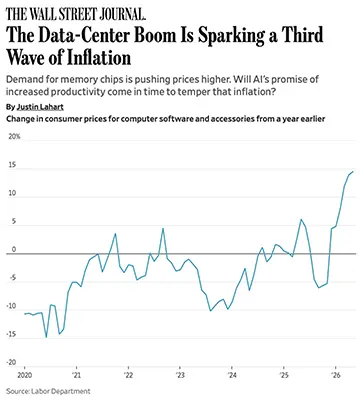
THE DATA-CENTER BOOM IS SPARKING A THIRD WAVE OF INFLATION
WSJ — June 24, 2026
TL;DR: AI infrastructure spending is now a measurable driver of inflation — pushing up prices for chips, electronics, and electricity — and economists are split on whether AI’s productivity payoff will arrive in time to offset it.
Executive Summary Five major hyperscalers (Alphabet, Amazon, Meta, Microsoft, Oracle) are on pace for $741 billion in capital spending this year, up nearly 75% from last year, with one economist’s cumulative AI build-out estimate through 2032 reaching roughly $8 trillion. The effect is already visible in consumer prices: software/accessories costs were up about 15% year-over-year in May, and wholesale electronic components were up 27%. Apple’s CEO has called the cost increases unlike anything he’s seen in 40 years. Electricity is a related pressure point — Goldman Sachs projects data centers will drive nearly half of U.S. power-demand growth through 2030, pushing consumer electricity prices up roughly 6% annually.
The key debate: Fed Chair Kevin Warsh has argued AI will eventually be disinflationary through productivity gains, consistent with past tech revolutions — but UBS economists estimate that payoff is at least a couple of years away, and 81% of economists surveyed by NABE expect the AI build-out to add to inflation over the next year. Importantly, this demand shock is described as different from tariffs or oil price spikes (one-time shocks) — it’s framed as a persistent, multi-year demand pressure, with most announced data-center spending not yet deployed. Forthcoming OpenAI and Anthropic IPOs could add further fuel.
What’s fact vs. framing: The price data (software, electronics, wages) comes from Labor Department figures — solid. The inflation forecast and the “disinflationary force” argument are economist opinion, not settled fact, and economists are explicitly split.
Relevance for Business This affects input costs across the board, not just tech buyers: hardware refreshes, electronics-dependent products, and electricity bills are all exposed to this pressure, independent of whether you use AI directly. The Fed’s broader inflation trajectory (target 2%, current estimate 4.1%) is shaped partly by this dynamic, which has implications for borrowing costs and pricing decisions generally.
Calls to Action
🔹 Monitor — input costs for hardware, electronics, and energy if your business has exposure to any of these.
🔹 Monitor — Fed policy commentary on AI-driven inflation, since it could affect interest-rate decisions relevant to financing decisions.
🔹 Prepare policy — if planning AI infrastructure purchases or hardware refreshes, consider timing given upward price pressure rather than assuming costs are stable.
🔹 Ignore for now — the specific economic debate (disinflationary vs. inflationary AI) doesn’t require immediate action, just awareness.
Summary by ReadAboutAI.com
https://www.wsj.com/economy/the-data-center-boom-is-sparking-a-third-wave-of-inflation-926adc6e: June 30, 2026
Want to Get a Data Center Online Faster? Try Teaching It to Throttle Itself
MIT Technology Review, June 16, 2026 — Amos Zeeberg
TL;DR: A handful of startups and utilities are testing software that lets AI data centers temporarily cut their own power draw during grid stress — a workaround for the real bottleneck in AI buildout, which is how slowly new power plants get approved and built, not how slowly chips ship.
Executive Summary
The core constraint on AI infrastructure growth right now isn’t compute — it’s electricity interconnection timelines. Grid operators like PJM can take roughly eight years to bring new generation online, while data centers can be built in a fraction of that time. A startup ecosystem (Emerald AI, GridCare, Voltus, and others) is testing an alternative: software that lets a data center voluntarily and automatically reduce its power draw during the relatively small number of hours per year when grid demand peaks, in exchange for faster, cheaper access to existing grid capacity.
The most-cited evidence is modeling, not yet operating history at scale. A 2025 Duke University study estimated the US grid could support an additional 76 gigawatts of demand — enough to cover projected data-center growth through 2030 — if facilities agreed to curtail usage just 0.25% of the time (~22 hours/year). A Google-funded Princeton study found a flexible 500-megawatt facility could reach full operation 3–5 years faster than an inflexible one. Real-world testing remains comparatively small: Emerald AI’s “Conductor” software has been trialed on a 256-GPU cluster in Phoenix, redirected workloads between Virginia and Chicago, and managed a 130-kilowatt cluster in London (using a UK soccer-match electricity spike as a stress test). A planned 96-megawatt deployment near Manassas, Virginia — its first live-grid, full-scale test — is not yet operational.
This is a contested fix, not a settled one. PJM’s own market monitor, economist Joseph Bowring, calls the idea that large new data-center load can be absorbed without new generation “magical thinking,” noting there’s currently no enforcement mechanism guaranteeing a data center will actually curtail when asked. Flexibility advocates themselves frame it as a bridge and efficiency tool, not a substitute for new transmission and generation buildout — which most agree is still coming regardless of how the AI boom plays out.
Relevance for Business
- Site-selection leverage: SMBs and mid-size firms evaluating colocation or cloud capacity in power-constrained regions (Northern Virginia, Phoenix, parts of the Pacific Northwest) may see faster provisioning timelines from vendors using flexibility-based interconnection — but should ask vendors directly whether commitments are contractual or aspirational.
- Local political risk: Over a dozen states are weighing data-center bans or moratoriums (already in effect in Minneapolis and DeKalb County, GA), and a federal bill (the GRID Act) would push new centers off public grids entirely. This affects timelines for any business renting capacity in affected regions.
- Cost structure uncertainty: Some studies suggest flexibility could modestly lower electricity rates for all grid users (0.5%–2.8%, per Duke); this is a projected, not demonstrated, system-wide effect.
- Vendor dependence: Reliability of AI services hosted in flexibility-managed facilities may hinge on software (like Conductor) correctly prioritizing workloads during curtailment — an added layer of technical and contractual risk worth understanding before committing to long-term hosting contracts.
Calls to Action
🔹 Monitor — Track whether the Manassas, VA facility (expected online later in 2026) actually performs at full scale; this is the first real test of flexibility claims beyond small pilots.
🔹 Ask vendors directly — If evaluating cloud/colocation providers in grid-constrained regions, ask whether their power commitments rely on flexibility agreements, and what guarantees exist for service continuity during curtailment events.
🔹 Watch policy — State-level moratoriums and the federal GRID Act could materially affect data-center siting and timelines in the next 1–2 years; relevant for any business planning to lease AI infrastructure capacity.
🔹 Treat efficiency gains skeptically — Cost-reduction figures (0.5%–2.8% rate relief) are study projections, not demonstrated outcomes; don’t bake them into financial planning yet.
🔹 Deprioritize for most SMBs — Unless directly negotiating data-center/colocation contracts, this is infrastructure-layer news to track passively rather than act on.
Summary by ReadAboutAI.com
https://www.technologyreview.com/2026/06/16/1138591/data-center-online-quickly-electric-grid-flex/: June 30, 2026
Hotter Chip Prices Are Just One of Many Summer Tests for Wall Street
Barron’s, June 26, 2026
TL;DR: Apple’s surprise decision to raise prices sharply on several products is testing whether the rest of the tech sector — and ultimately consumers — will absorb the cost of soaring AI-driven memory chip prices, with early signs of strain already visible in Asian chip markets.
Executive Summary: Apple raised prices by as much as 25% on select hardware (sparing the iPhone), citing component cost increases it says it has never seen move this fast. Markets read this as a possible signal that the broader tech sector — not just chipmakers — is starting to feel the squeeze from the AI-driven boom in DRAM and high-bandwidth memory pricing. Apple shares posted their worst single-day drop in over a year, and the move helped push a Magnificent Seven-tracking index deeper into correction territory.
The reaction was sharper overseas: South Korea’s KOSPI fell 5.8% (triggering circuit breakers), with Samsung and SK Hynix both down double digits, while Japan’s Nikkei dropped 4.2%. Adding to the unease, reports surfaced that OpenAI may delay its planned trillion-dollar IPO. Micron’s stronger-than-expected earnings provided a partial offset domestically, underscoring how split the market currently is — some semiconductor names are still posting outsized 2026 gains (the PHLX Semiconductor index is up roughly 96% year-to-date), even as cracks appear elsewhere (Nasdaq down 4.4% in June, S&P 500 down ~2%). One analyst noted the conflicting data is forcing investors into a slower process of separating winners from losers in the AI trade. Softer macro data (GDP, inflation, jobless claims) gave markets some near-term support, but a still-hawkish Fed rate outlook is likely to keep pressure on tech valuations through the summer.
Relevance for Business: This is a leading indicator, not a one-off event. If a company with Apple’s scale and supply-chain leverage can’t fully absorb memory chip cost increases, smaller and mid-sized businesses sourcing hardware, electronics, or AI-enabled devices should expect cost pass-through in the next 6–12 months — whether through direct price increases or reduced product specs/value. It’s also a signal that the AI infrastructure investment thesis is entering a more contested phase: equity markets are no longer assuming AI capex translates cleanly into returns, which could affect financing costs, vendor stability, and M&A activity among AI infrastructure and chip suppliers SMBs depend on.
Calls to Action:
🔹 Monitor hardware and component costs in your supply chain over the next two quarters — expect price increases from vendors citing memory/chip costs.
🔹 Revisit any planned large hardware refreshes (laptops, servers, AI-enabled devices) — costs may be more favorable now than later in 2026.
🔹 Watch for further earnings commentary from major tech buyers (hyperscalers, device makers) signaling whether this is isolated to Apple or sector-wide.
🔹 Prepare internal narrative for stakeholders/board if your business holds AI infrastructure-adjacent investments — volatility here is likely to continue.
🔹 Ignore for now any urge to make reactive financial decisions based on single-day stock moves; this is a multi-quarter story, not a one-day event.
Summary by ReadAboutAI.com
https://www.barrons.com/articles/chip-stocks-apple-micron-stock-market-rally-1c31fb59: June 30, 2026
FDA-APPROVED AI TOOL CATCHES HIDDEN HEART DISEASE THAT ECGS MISS — AND A FREE PLATFORM IS ABOUT TO SCALE IT
Source: TechTarget (Healthtech Analytics), 24 Jun 2026 | By Jill Hughes
TL;DR: EchoNext, an FDA-approved AI model that detects structural heart disease from routine ECGs, is being deployed at scale through OpenEvidence, the free clinical AI platform already used by roughly two-thirds of U.S. physicians.
Executive Summary: EchoNext, developed by NewYork-Presbyterian/Columbia researchers and now commercialized by Pathway Labs, analyzes standard ECG data to flag six types of structural heart disease — including valve disease and congenital conditions — that conventional ECGs alone cannot detect, historically requiring a separate echocardiogram. A peer-reviewed 2025 Nature study found the model identified 77% of structural heart problems in a 3,200-ECG sample, versus 64% for cardiologists reviewing the same data — a meaningful, independently published performance claim. A June 22 Nature Medicine case study documents a real patient whose structural heart disease was missed on initial ER evaluation but caught by EchoNext, leading to a heart transplant; the same model is also credited with prompting two other corrective procedures (a valve replacement and a valve repair).
Pathway Labs raised an $8.5 million seed round to scale deployment and is partnering with OpenEvidence, free clinical-decision-support software used by roughly two-thirds of U.S. physicians. OpenEvidence’s chief medical officer frames the partnership around avoiding the access-inequality pattern seen with costly AI scribes, where smaller practices got priced out of capable tools.
Relevance for Business: This is a clinical/healthcare-sector development, not directly actionable for most SMB executives outside healthcare. For businesses in or adjacent to health systems, payers, or employer health benefits, it’s a credible signal that AI diagnostic tools are crossing from research into mainstream clinical workflow at meaningful scale, with independent peer-reviewed validation behind the core efficacy claim — a stronger evidence base than most AI health-tech announcements.
Calls to Action:
🔹 Monitor if your organization operates in healthcare, health benefits, or medtech adjacencies — this signals accelerating AI diagnostic adoption
🔹 Note the evidence quality: peer-reviewed Nature/Nature Medicine publication is a stronger bar than most vendor health-AI claims — worth using as a reference point when evaluating other AI health tools
🔹 Ignore for now if your business has no healthcare exposure
Summary by ReadAboutAI.com
https://www.techtarget.com/healthtechanalytics/feature/OpenEvidence-brings-AI-powered-heart-disease-detection-to-doctors: June 30, 2026
Agents Are Forcing a Rethink of Data Security — Oracle Sweetens the Pot
TechTarget, June 24, 2026 — Eric Avidon
TL;DR: Oracle is making several data-security tools free or steeply discounted through 2027 in direct response to a real and growing problem — AI agents operating in production with less oversight than during pilot testing are creating new exposure points that traditional perimeter-based security wasn’t built to catch.
Executive Summary
The headline move itself — Oracle offering free or 90%-discounted security add-ons for its AI Database — is a commercial promotion, not a technology breakthrough, and the company doesn’t pretend otherwise. What’s more substantive is the underlying problem prompting it: as organizations move AI agents out of controlled pilots and into live production, oversight loosens and agents begin autonomously querying, analyzing, and acting on data at a scale and speed that traditional application- and network-layer security wasn’t designed to police.
Independent analysts corroborate the trend independent of Oracle’s framing. Industry analysts agree the underlying shift is real, even if Oracle’s specific response is promotional: existing security models were built for predictable BI and ML workloads, not for probabilistic systems that generate, infer, and act on their own. The proposed fix — enforcing identity, context, and sensitivity controls at the data layer itself, rather than relying solely on perimeter and application controls — is a sound architectural principle, though it’s also the position Oracle has a commercial interest in making.
One gap flagged candidly by an outside analyst: none of this addresses supply-chain risk from an organization’s own code — malicious or vulnerable dependencies pulled from open source. That remains an unsolved, industry-wide problem.
Relevance for Business
- Timing matters more than the vendor: Most SMBs running agents in production (or piloting them) are using this exact transition — from sandboxed testing to live deployment — without necessarily re-architecting security. That gap is the actual risk, regardless of which database vendor you use.
- Free isn’t free forever: The Oracle offer (database lifecycle tools free through Feb. 2027; GoldenGate and testing tools at 90% off through May 2027) is a time-boxed trial-to-customer funnel, not a permanent feature. Budget for ongoing licensing once the discount window closes.
- Vendor lock-in risk: Adopting free Oracle tooling now to patch a security gap could create dependency that’s costly to unwind later — worth a deliberate decision, not a default one.
- Software supply chain remains exposed: Even with database-layer controls improved, malicious or vulnerable open-source dependencies in your own codebase are a separate, unaddressed risk.
Calls to Action
🔹 Assign internal review — If your organization runs agents in production (not just pilots), have IT/security explicitly re-evaluate whether data-layer controls (identity, context, sensitivity policies) exist, regardless of vendor.
🔹 Act now (if Oracle customer) — Evaluate whether the free/discounted tools cover capabilities you’d need anyway; there’s limited downside to claiming them before the window closes.
🔹 Monitor — Watch whether competitors (IBM, Microsoft, and others) introduce comparable data-layer security responses; this is likely to become a competitive feature category, not a one-off Oracle move.
🔹 Prepare policy — If you don’t already have a policy distinguishing pilot-stage agent oversight from production-stage requirements, this is a natural prompt to write one.
🔹 Ignore the discount mechanics for now — The pricing structure itself isn’t strategically important; the security gap it’s responding to is.
Summary by ReadAboutAI.com
https://www.techtarget.com/searchdatamanagement/news/366644845/Agents-are-altering-data-security-needs-Oracle-responds: June 30, 2026
When to Run AI On-Premises vs. in the Cloud
TechTarget — June 23, 2026
TL;DR: Where you run AI workloads isn’t a one-time infrastructure choice — it’s a recurring, workload-by-workload decision, and businesses that treat it that way get better cost and governance outcomes than those who default to one environment.
Executive Summary The piece frames deployment location as a strategic variable affecting data governance, security exposure, cost, and performance — not just an IT detail. It cites a sobering data point: in McKinsey’s 2025 State of AI report, only 6% of organizations qualified as “AI high performers” with meaningful earnings impact, and misaligned deployment environments are named as one contributing factor.
On-premises AI means running models on infrastructure the business directly owns or controls (including private clouds and colocation) — it fits workloads tied to proprietary data, low-latency operations, or continuous (non-elastic) demand, but shifts the full operational burden (procurement, security, patching, hardware refresh) onto the business.
Cloud AI runs on third-party, multi-tenant infrastructure across four tiers (IaaS, managed AI PaaS, foundation model APIs, SaaS AI). It removes capital investment and adds elasticity, but introduces its own complexity: cost management, identity/access control, and concentration risk — i.e., dependency on a single cloud vendor.
The article’s core point: this isn’t binary. A business might run core proprietary models on-premises while using cloud for customer-facing tools — and should revisit the split as workloads mature, rather than deciding once and moving on.
Relevance for Business This directly maps to cost structure, data governance, and vendor concentration risk — three of the recurring risk categories in this publication’s coverage. For SMBs without dedicated infrastructure teams, the practical risk is defaulting entirely to cloud (simplicity) or entirely to on-premises (control) without revisiting that choice as AI use cases — and sensitive-data exposure — grow.
Calls to Action
🔹 Test cautiously — pilot a hybrid split (e.g., proprietary/sensitive workloads on-premises or private cloud, customer-facing tools in public cloud) rather than committing fully to one model.
🔹 Prepare policy — establish criteria (data sensitivity, latency need, elasticity) for deciding where new AI workloads should run, rather than deciding ad hoc.
🔹 Assign internal review — audit current AI workload placement against governance and cost requirements; many deployments were chosen for convenience, not fit.
🔹 Monitor — cloud concentration risk if most AI workloads sit with a single provider.
Summary by ReadAboutAI.com
https://www.techtarget.com/searchenterpriseai/tip/When-to-run-AI-on-premises-vs-in-the-cloud: June 30, 2026
How CIOs Should Govern AI-Driven Network Operations
TechTarget — June 24, 2026
TL;DR: As networks shift to AI-driven, self-healing automation, the real exposure for IT leaders isn’t the technology itself — it’s the absence of clear accountability and override authority when automated systems make consequential changes.
Executive Summary AI is moving network management from reactive (humans responding to problems) to predictive and increasingly autonomous (AI managing traffic, detecting anomalies, automating troubleshooting and configuration, enabling self-healing networks). The efficiency gains are real — better uptime, faster response — but the article’s emphasis is on the governance gap this creates.
Named challenges include lack of visibility into AI decision-making, difficulty assigning accountability when automated systems make changes, insufficient explainability during outages or compliance reviews, inconsistent policy enforcement across distributed environments, and disconnects between network, security, and executive teams. The named risks compound this: poorly governed automation can introduce security and availability vulnerabilities, overreliance can erode staff’s working knowledge of the network, and AI systems can make unintended changes that escalate outages.
The proposed governance roadmap has five steps: (1) define clear ownership/accountability across IT, security, and leadership; (2) set automation guardrails — which functions run autonomously vs. require human approval, with escalation thresholds for high-impact changes; (3) build continuous monitoring/audit logging; (4) require explainability from AI networking platforms; (5) regularly align governance policy with business priorities rather than treating it as a one-time setup.
Relevance for Business This is a direct governance and execution-risk issue, not a hypothetical. Any SMB adopting AI-driven network monitoring or automation tools (even via a managed provider) inherits this accountability question: who is responsible when an automated system makes a change that causes an outage or compliance gap? Without guardrails defined upfront, organizations can find themselves with infrastructure that’s efficient but unauditable.
Calls to Action
🔹 Prepare policy — establish a governance framework (ownership, guardrails, escalation thresholds) before expanding AI-driven automation in network operations, not after.
🔹 Assign internal review — audit current network automation tools for explainability and override capability.
🔹 Test cautiously — pilot automation guardrails on lower-stakes network functions before extending to high-impact changes.
🔹 Monitor — vendor claims about AI explainability; the article frames this as a real differentiator, not a checkbox feature.
Summary by ReadAboutAI.com
https://www.techtarget.com/searchnetworking/tip/How-CIOs-should-govern-AI-driven-network-operations: June 30, 2026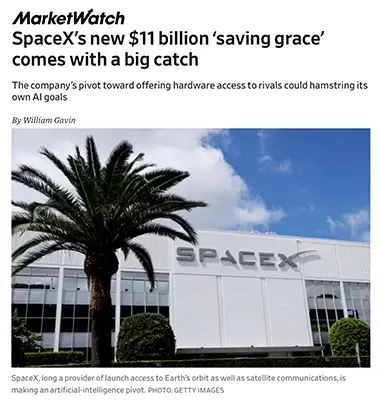
SpaceX’s New $11 Billion “Saving Grace” Comes With a Big Catch
MarketWatch, June 27, 2026
TL;DR: SpaceX is generating badly needed cash by renting out AI compute capacity to Anthropic, Alphabet, and Reflection — but the arrangement may be undercutting its own ability to develop competitive AI models, and the deals can be unwound on short notice.
Executive Summary: SpaceX has signed compute-access deals worth a combined $11 billion-plus through 2026 with Anthropic ($1.25B from July through May 2029), Alphabet ($920M/month from October 2026 through June 2029), and Reflection ($150M/month from July 2026 through 2029, after a ramp-up period). Analysts describe this as a financial lifeline: SpaceX’s own AI division has been its weakest-performing segment, posting a $6.35 billion operating loss in 2025 against $3.2 billion in revenue. Each deal includes a clause — reportedly pushed by Elon Musk — allowing either party to exit after three months with 90 days’ notice, which Musk has said he wants in case SpaceX needs its compute back.
The arrangement carries real strategic tension: SpaceX has leased out roughly 73% of existing capacity at its Colossus data centers (plus half of planned future capacity) to Google and Anthropic, prompting one analyst to flag the risk that SpaceX could be hamstringing its own model development by giving away the resource it needs most. The company is also reserving capacity for Cursor, the AI coding startup SpaceX plans to acquire for $60 billion by Q3 — a move one analyst characterized as SpaceX effectively conceding its frontier model is behind. Margin quality is a separate concern: this is widely viewed as a low-margin, capacity-resale business, not a high-value AI product line.
Relevance for Business: This story illustrates the broader compute scarcity dynamic shaping the AI vendor landscape: even well-capitalized AI labs (Anthropic, Google) are buying capacity wherever they can find it, including from non-traditional providers. For SMBs, this reinforces that AI infrastructure access remains tight and price-sensitive — vendor costs upstream are unlikely to ease soon, and deal structures across the industry (including this one) tend to include short-notice exit clauses, signaling that even large players don’t view current compute arrangements as stable long-term commitments. It’s also a reminder to apply skepticism to “AI revenue” headlines: SpaceX’s compute deals are revenue, but the underlying AI division remains deeply unprofitable.
Calls to Action:
🔹 Monitor compute/infrastructure cost trends — scarcity dynamics like this typically precede price pressure further down the vendor chain.
🔹 Note vendor instability risk: if your AI tools rely on smaller or newer infrastructure providers, ask about capacity-sourcing dependencies.
🔹 Distinguish revenue announcements from profitability — apply this lens to any AI vendor’s public claims about growth.
🔹 Watch for SpaceX/Cursor model release news — a credible new model could reshape competitive dynamics among coding-AI tools your business may use.
🔹 Ignore for now — no direct action needed unless your business has commercial exposure to SpaceX, Cursor, Anthropic, or Alphabet’s compute arrangements specifically.
Summary by ReadAboutAI.com
https://www.wsj.com/wsjplus/dashboard/articles/spacexs-new-11-billion-saving-grace-comes-with-a-big-catch-9270c6ae: June 30, 2026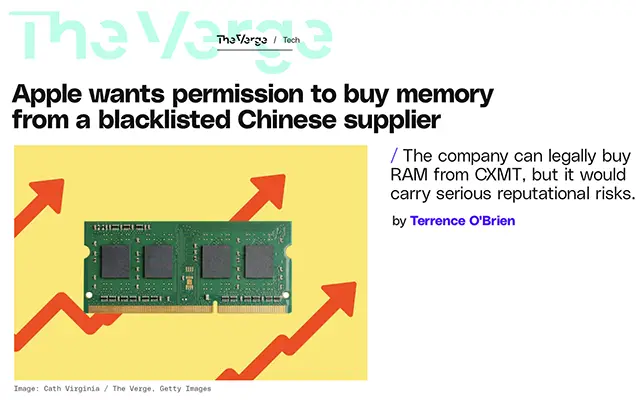
AI-Driven Memory Shortage Pushes Apple Toward a Blacklisted Chinese Chip Supplier
Source: The Verge, 06-27-2026 | By Terrence O’Brien
TL;DR: Soaring RAM and storage prices — part of a global memory shortage tied to AI infrastructure demand — are pushing Apple to seek a government exception to buy memory from CXMT, a Chinese supplier with ties to the Chinese military, despite serious reputational and political risk.
Executive Summary: Apple is reportedly seeking an exception from the Trump administration to purchase RAM from CXMT, a company blacklisted by the Pentagon over People’s Liberation Army ties, according to the Financial Times. The move comes as memory and storage price spikes have already forced Apple to raise prices across nearly its entire product line this week. Apple isn’t legally barred from this purchase, but doing so would carry reputational and political exposure — CXMT was previously considered for the Commerce Department’s “Entity List” but spared while US-China trade talks were underway. A Republican congressional China-committee chair characterized the move as a serious strategic mistake that would deepen US tech dependence on China.
This is a thin, single-source news item rather than an analytical piece — treat the political reaction as one stakeholder’s framing, not a settled assessment of Apple’s intentions or the likely outcome.
Relevance for Business: This is a small but telling data point in the broader AI-driven hardware cost story: memory and chip scarcity, largely a downstream effect of AI data center buildout, is now flowing into consumer electronics pricing and supply-chain sourcing decisions at the largest scale. For SMBs that rely on hardware refresh cycles, cloud infrastructure, or any component with memory chips in it, this signals continued upward price pressure and potential supply volatility tied to geopolitics, not just demand.
Calls to Action:
🔹 Monitor hardware and cloud infrastructure cost trends tied to the ongoing memory shortage — budget for continued price pressure
🔹 Watch for export-control developments around Chinese chip suppliers, which could affect broader hardware supply chains
🔹 Ignore for now if your business has no direct exposure to hardware procurement decisions at scale
Summary by ReadAboutAI.com
https://www.theverge.com/tech/958707/apple-ram-buy-memory-blacklisted-china-cxmt: June 30, 2026
Beyond the Frontier Labs: AI’s Infrastructure, Governance, and Security Layer Is Becoming the Real Battleground
Source: Fast Company, 06-26-2026 | By Kolawole Samuel Adebayo
TL;DR: The companies building AI’s infrastructure, governance, and security plumbing — not the headline model labs — increasingly determine whether enterprise AI investments actually pay off.
Executive Summary: While OpenAI, Anthropic, Google DeepMind, and Nvidia dominate AI headlines, a second tier of companies is quietly building what makes enterprise AI commercially usable: database infrastructure (RavenDB), data governance (Alation), agent-security/sprawl monitoring (Reco), contract and financial-data validation (Terzo), and voice/video intelligence (PolyAI, Lumana). The piece argues this “middle layer” — not model quality — is where AI projects actually succeed or fail.
Note on source framing: Most company claims here come directly from CEO interviews with a vested interest in the narrative (e.g., Terzo’s “$100 million in savings” figure, RavenDB’s project-timeline claims). Treat these as vendor framing, not independently verified outcomes.
Two data points are independently sourced and worth taking seriously: Gartner estimates 85% of AI projects fail due to poor or insufficient data, and S&P Global found 42% of companies abandoned most AI initiatives in 2025 (up from 17% in 2024) — typically because they deployed technology before identifying a problem. Separately, corporate data uploaded into AI tools rose 485% between 2023–2024, and Gartner projects over 40% of AI data breaches by 2027 will trace to ungoverned generative AI use — a governance gap several “agent sprawl” monitoring vendors are now racing to fill.
The article also cites Tokyo-based Sakana AI’s launch of a multi-model routing system, framed explicitly as a hedge against single-vendor dependency — using the June 12 export-control action that forced Anthropic to suspend Claude Mythos 5 and Fable 5 as its cautionary example. Vendor-neutrality note: Sakana’s own benchmark comparisons exclude Mythos 5 — the more capable suspended model — from its head-to-head claims, despite independent analysis reportedly showing Mythos 5 outperforming Sakana’s product on several benchmarks. This is a competitor making a self-serving comparison, not a neutral finding.
Relevance for Business: For SMBs, the lesson isn’t about these specific vendors — it’s structural: AI value doesn’t materialize from a model subscription alone. Before any agentic deployment, leaders should expect data quality and governance gaps to be the actual bottleneck, not model capability. The Anthropic suspension example is also a live illustration of vendor/regulatory dependency risk — a single export-control decision can remove a frontier model from availability with no notice, regardless of how good the underlying technology is.
Calls to Action:
🔹 Audit data readiness before any AI agent pilot — most failures trace to data, not models
🔹 Treat vendor-sourced ROI claims (391% ROI, “$100M savings”) as marketing inputs, not benchmarks, until independently verified
🔹 Monitor single-vendor/model dependency risk — the Anthropic Mythos/Fable suspension is a real-world case study in how quickly access can change
🔹 Assign internal review of “AI sprawl” — shadow agents/tools operating inside SaaS environments without IT visibility
🔹 Revisit infrastructure/governance vendor options once your AI roadmap moves past pilot stage — premature vendor selection at this layer is low-priority for most SMBs today
Summary by ReadAboutAI.com
https://www.fastcompany.com/91564497/you-know-openai-and-nvidia-these-are-the-ai-companies-building-everything-else: June 30, 2026

Closing: AI update for June 30, 2026
Across this week’s stories, the pattern is consistent: AI’s technical progress is outpacing the legal, economic, and organizational frameworks meant to manage it, leaving SMB leaders to navigate real vendor, cost, and workforce risk well before the dust settles. Treat this issue’s calls to action as a standing checklist for the months ahead, not a one-time review.
All Summaries by ReadAboutAI.com
↑ Back to Top