
AI Updates June 1, 2026

AI Developments
This week’s edition arrives at a moment when AI is no longer a single story. Across 34 summaries drawn from the past week’s most substantive coverage, a few unmistakable through-lines emerge — and together they describe an AI landscape that is maturing in ways that are simultaneously more powerful, more costly, more contested, and more consequential than the optimistic framing of 18 months ago suggested.
The capability race is accelerating, but so is the accountability gap. Anthropic’s Mythos model class is weeks from general release. Microsoft is rebuilding Copilot from scratch after conceding that its original rollout confused more users than it helped. Snowflake is thriving by embedding AI into its core product rather than bolting it on. Micron and Marvell are joining Nvidia in the trillion-dollar AI infrastructure club. And across the model landscape, the next wave of significantly more powerful AI is not a forecast — it is a timeline. At the same time, the costs of moving fast are becoming harder to ignore: vendor lock-in, unbudgeted governance overhead, failed pilots that consume bandwidth without producing returns, and workforce disruptions that are landing unevenly across industries and roles.
SpaceX’s long-anticipated IPO filing adds another dimension to watch: the prospectus reveals a company that has quietly merged launch dominance, satellite broadband, AI compute, and defense infrastructure into a single investment thesis — and how public markets receive that story will tell us something meaningful about where capital believes the AI-era infrastructure race is heading. The Blue Origin launchpad explosion the same week — delaying Amazon’s rival satellite constellation — was an unplanned reminder that the physical infrastructure underpinning AI’s ambitions is more fragile than the narratives around it.
AI is also entering terrain that is explicitly political, moral, and geopolitical. Pope Leo XIV’s encyclical Magnifica Humanitas brought the full weight of the Catholic Church into the governance debate, naming concentration of AI power, algorithmic accountability, and labor displacement as urgent ethical concerns — and an Anthropic co-founder stood at the podium alongside him. The Anthropic-Pentagon dispute over AI targeting — which resulted in a contract ban now in litigation — is a live case study in what happens when vendor ethics clauses collide with government operational demands. The political conversation in Washington is fragmenting along unexpected lines, with AI backlash emerging across party affiliations. And Europe is moving to control satellite spectrum, AI infrastructure, and data sovereignty in ways that will affect any business operating internationally. For SMB executives and managers, the practical implication is clear: AI decisions are no longer purely technical. They carry strategic, governance, reputational, and political weight that belongs at the leadership level.
Summaries

Claude Opus 4.8 Lands; Anthropic’s “Mythos” Model Is the One to Watch
TL;DR: Opus 4.8 is a real but modest upgrade — same price, slightly better benchmarks, more natural interaction — but Anthropic’s buried headline is that a significantly more powerful model class (“Mythos”) is weeks away from general release.
Executive Summary
Anthropic released Claude Opus 4.8 on May 29, a point upgrade to its flagship model. The practical improvements are incremental: modestly better benchmark scores, a “warmer” conversational tone, improved knowledge collaboration, and a new adjustable thinking-depth control (high/medium/low) that mirrors a feature already in GPT. Pricing holds steady from the prior version. For most business users already integrated with Claude, the change will be noticeable but not disruptive.
The more consequential signal is buried in the same announcement: Anthropic’s next model tier, internally referenced as “Mythos,” is expected to reach general availability within weeks. The hosts characterize it as substantially more capable than 4.8 — significant enough that the current release may function more as a bridge than a destination. Anthropic cites ongoing cybersecurity evaluation as the primary delay. Whether that framing reflects genuine caution or standard pre-launch positioning is worth noting, but the timeline appears firm.
The podcast also covers a broader AI cultural flashpoint worth tracking: Amazon MGM has greenlit three generative AI content series for Prime Video, triggering severe backlash — including credible threats — against the creators involved. The creative industries’ confrontation with AI is escalating from protest to personal harassment, with real implications for how any business deploying AI-generated content publicly manages reputational and legal exposure. Separately, ElevenLabs added a Stan Lee voice clone to its licensed voice library alongside a new dubbing product that preserves tone, emotion, and lip-sync across languages — a genuine capability milestone for multilingual content operations.
Relevance for Business
For organizations using Claude in production: Opus 4.8 is a low-friction upgrade with no cost change, but the smarter move may be to hold significant AI workflow investment until Mythos arrives and can be properly evaluated. Adjustable thinking modes are a useful cost-management lever — relevant given well-documented CEO-level concern about runaway AI token spend.
The Amazon/creator backlash story is not just entertainment news. Any SMB using or planning to use AI-generated content in customer-facing, brand, or creative contexts faces a live reputational governance question. The public tolerance threshold for AI in creative work is lower than most vendors communicate, and the liability surface is expanding.
ElevenLabs’ dubbing advances are directly relevant to businesses with multilingual content needs — marketing, training, customer support — where the quality gap between human and AI voiceover has narrowed materially.
Calls to Action
🔹 Continue using Claude 4.8 as-is — same price, better performance, no migration friction required.
🔹 Flag the Mythos release for an internal review cycle — schedule a brief capability evaluation when it ships; don’t invest heavily in workflow redesign until you can test the actual uplift.
🔹 Activate a content governance policy if your business creates or uses AI-generated media publicly — the backlash environment around AI content is escalating, and a clear internal standard reduces exposure.
🔹 Evaluate ElevenLabs Dubbing V2 if you operate in multilingual markets — the emotion-and-sync-preserving capability is a meaningful step change for localization workflows.
🔹 Monitor the “Mythos” and GPT-6/Gemini 3.5 release cycle — multiple major model launches appear clustered in June/July 2026; this is the right window to revisit your AI vendor and tooling strategy.
Summary by ReadAboutAI.com
https://www.youtube.com/watch?v=pMBotGuXFjg: June 1, 2026
THIS FILM COST $500,000 TO MAKE. $400,000 WAS AI COMPUTE COSTS.
THE WALL STREET JOURNAL, MAY 20, 2026
TL;DR / Key Takeaway: AI-generated filmmaking may lower some production barriers, but the Hell Grind example shows that compute costs, iteration, consistency, and human craft remain major constraints.
EXECUTIVE SUMMARY
The Wall Street Journal reports on Hell Grind, a 95-minute AI-generated film from Higgsfield AI that was screened at Marché du Film, the marketplace connected to Cannes. The project cost about $500,000, with roughly 80% of the budget spent on AI compute, making the film less a cheap replacement for Hollywood production than a showcase for the company’s AI video tooling.
The most important business signal is that AI video production still requires extensive human direction and repeated generation. According to the article, each short clip required many iterations, long prompts, and technical filmmaking knowledge around camera composition, lighting, continuity, physics, and visual consistency. The first 25 minutes alone involved more than 16,000 initial generations that were narrowed to 253 final shots.
For executives, this is a useful reality check. AI can compress timelines and open new creative possibilities, but “make me a movie” is not how production-quality output works. The bottleneck shifts from cameras and crews to compute budgets, prompt engineering, review cycles, visual consistency, and domain expertise. The economics may improve, but today’s AI video remains operationally intensive.
RELEVANCE FOR BUSINESS
For SMB leaders in marketing, training, media, education, entertainment, or customer communications, the article suggests that AI video can be useful — but not automatically cheap or effortless. Short-form campaigns, concept tests, product mockups, internal explainers, and visual prototypes may be practical sooner than polished long-form storytelling.
The larger lesson is that AI content creation still requires taste, editing, oversight, and budget discipline. Businesses should avoid assuming that generative video eliminates creative labor. It changes where the labor sits.
CALLS TO ACTION
🔹 Start with short-form AI video use cases, such as ads, explainers, prototypes, or training clips.
🔹 Budget for iteration and compute, not just tool subscriptions.
🔹 Keep creative professionals in the loop to manage pacing, style, continuity, and brand fit.
🔹 Test AI video for preproduction and concepting before relying on it for final polished assets.
🔹 Track cost per usable output, because many generated clips may be discarded.
Summary by ReadAboutAI.com
https://www.wsj.com/cio-journal/this-cannes-film-cost-500-000-to-make-400-000-was-ai-compute-costs-a823b08d: June 1, 2026
THE POPE GRASPS THE LIMITS OF AI
THE ATLANTIC, MAY 27, 2026
TL;DR / Key Takeaway: The Atlantic frames Pope Leo XIV’s AI encyclical as a warning that AI’s deepest risk may be the outsourcing of human judgment, care, and moral responsibility to systems controlled by a small technical elite.
EXECUTIVE SUMMARY
The Atlantic’s Elizabeth Bruenig interprets Pope Leo XIV’s encyclical as less a narrow statement about AI hazards and more a defense of human limitation, imperfection, and dignity. The argument is that AI should be understood within a long history of technologies that promise power and efficiency while creating new risks of exploitation, dependency, and moral confusion.
The article’s central business-relevant point is that AI can weaken human judgment when organizations allow automated systems to handle decisions that require responsibility, empathy, or moral reasoning. Examples include hiring, medical approvals, military targeting, and other high-stakes choices. The issue is not only whether AI makes mistakes; it is whether institutions gradually lose the habit of human accountability.
For executives, the piece adds an important governance lens. AI tools may improve speed and consistency, but they also embed the values and assumptions of the people and companies that build them. As more organizations depend on AI systems, the moral and operational choices of a small group of technology providers may quietly shape decisions across many industries.
RELEVANCE FOR BUSINESS
For SMB leaders, this article is a reminder that AI governance should not be reduced to cybersecurity, compliance, or productivity. The deeper management question is: Which decisions should remain meaningfully human, even if software can assist?
This matters for customer trust, employee morale, brand reputation, and legal exposure. Businesses that delegate sensitive decisions to opaque tools may gain short-term efficiency while creating long-term accountability problems. The strongest AI policies will define not only acceptable use, but also non-delegable human responsibilities.
CALLS TO ACTION
🔹 Identify decisions that should never be fully automated, especially those involving people’s opportunities, safety, care, or rights.
🔹 Require human review for high-impact AI outputs, rather than treating AI recommendations as final.
🔹 Ask vendors how their systems are trained, evaluated, and governed, especially for decision-support tools.
🔹 Add moral and reputational risk to AI reviews, not just cost, accuracy, and speed.
🔹 Train managers to challenge AI outputs, not simply accept them because they appear efficient.
Summary by ReadAboutAI.com
https://www.theatlantic.com/ideas/2026/05/pope-leo-ai-catholic-church/687298/: June 1, 2026
Pope Leo’s Unsettling Vision of the AI Future
The Atlantic | Francis X. Rocca | May 25, 2026
TL;DR: The Catholic Church’s first AI encyclical reads less as a balanced assessment than as a detailed moral indictment — and its warnings about corporate concentration, worker displacement, and algorithmic accountability are ones business leaders can’t easily dismiss.
Executive Summary
Pope Leo XIV has issued Magnifica Humanitas, the first papal encyclical devoted entirely to artificial intelligence, moving faster on the topic than any of his predecessors moved on the Industrial Revolution. The document frames AI as potentially beneficial but structurally dangerous — and the weight of the text falls heavily on the danger side. Its expressions of concern are detailed and specific; its expressions of hope are brief and largely left to the reader’s inference.
The encyclical’s critique lands on several pressure points that intersect directly with business practice: labor displacement (especially among young workers), environmental costs of AI infrastructure, data extraction practices it likens to a new form of colonialism, and algorithmic decision-making in credit, hiring, and access to services. On that last point, Leo is pointed — when algorithms determine who gets a loan or a job, those decisions must be “understandable, contestable and subject to oversight.” This is less a philosophical position than a governance standard increasingly reflected in emerging regulation.
The document also targets concentration of AI power — warning that when control over platforms, data, and compute consolidates in few hands, public accountability erodes. Notably, Christopher Olah, co-founder of Anthropic, participated in the encyclical’s formal presentation and publicly acknowledged that even frontier AI labs operate under incentives that can conflict with doing the right thing — an unusual moment of candor attached to a major institutional document. The encyclical explicitly rejects Silicon Valley ideologies of transhumanism and posthumanism, framing the drive toward technological perfectibility as a threat to vulnerable people.
Relevance for Business
This isn’t a document SMB leaders need to operationalize — but it does signal shifting institutional and regulatory expectations that will shape the environment in which AI tools are deployed. The encyclical’s language on algorithmic accountability, data governance, and worker protection mirrors language increasingly appearing in EU AI regulation, U.S. state-level legislation, and ESG reporting frameworks. When a global institution with over a billion followers formalizes these concerns in a teaching document, it accelerates cultural and political pressure on the businesses — and vendors — that build and deploy AI.
For SMBs specifically: vendor due diligence, data use transparency, and workforce communication around AI adoption are becoming reputational and compliance considerations, not just operational ones. The Church’s framing of health and demographic data as extractive “new rare earths” will likely resonate in policy conversations about data monetization.
Calls to Action
🔹 Monitor regulatory signals — the encyclical’s language on algorithmic transparency and worker protection tracks closely with emerging AI governance frameworks; this is a leading indicator of where compliance requirements may land.
🔹 Audit your AI vendor stack for data practices — the document’s critique of data extraction as a form of dominance raises legitimate questions about what your vendors do with user and employee data.
🔹 Prepare a workforce communication posture — if you’re deploying AI tools that touch hiring, scheduling, or performance management, have a clear, human-accountable explanation ready; the expectation of explainability is growing.
🔹 Don’t overweight the theological framing — the policy prescriptions here are substantively mainstream; strip the encyclical of its religious context and you have a document that largely aligns with what European regulators and many institutional investors already expect.
🔹 Note the Anthropic signal separately — a co-founder of a leading AI lab publicly endorsing the need for external critics and safety advocates at a papal press event is an unusual data point worth tracking as an indicator of where frontier AI self-governance conversations are heading.
Summary by ReadAboutAI.com
https://www.theatlantic.com/ideas/2026/05/pope-leo-ai-encyclical-magnifica-humanitas/687294/: June 1, 2026
WHO IS CHRISTOPHER OLAH? ANTHROPIC EXEC TALKS AI WITH POPE LEO XIV
FAST COMPANY, MAY 26, 2026
TL;DR / Key Takeaway: The Vatican’s AI intervention signals that AI governance is no longer only a technical or regulatory issue — it is becoming a moral, labor, and power-concentration issue that business leaders cannot ignore.
EXECUTIVE SUMMARY
Fast Company reports on an unusual Vatican event in which Pope Leo XIV presented a major encyclical on artificial intelligence with Anthropic cofounder Christopher Olah present. The core signal is not the novelty of a tech executive appearing alongside the pope, but the alignment between a religious leader and an AI insider around concentration of power, labor displacement, and the need for broader public oversight.
Olah, known for AI interpretability research, framed himself as concerned rather than promotional. His remarks acknowledged that frontier AI labs operate within incentives that can conflict with the public good, and he warned that AI development remains concentrated among a small number of wealthy countries and powerful organizations. The article positions this as a rare moment when technical expertise and moral authority converged around the question of who should decide how AI is deployed.
For executives, the business relevance is clear: AI adoption is not simply about productivity gains. It increasingly carries reputation risk, workforce implications, governance expectations, and public scrutiny. As AI systems move into decision-making roles, companies may face rising pressure to explain not only what tools they use, but why, under whose oversight, and with what safeguards.
RELEVANCE FOR BUSINESS
For SMB executives and managers, this article matters because it shows how the AI conversation is expanding beyond Silicon Valley. Religious institutions, labor advocates, regulators, and civil society groups are increasingly treating AI as a question of human dignity, economic fairness, and institutional responsibility. Businesses using AI will need to prepare for a world where “we used the best available tool” may not be enough justification.
The practical issue is governance. Even smaller firms may need clear policies on AI-assisted hiring, customer service, employee monitoring, content generation, and workflow automation. The companies that move early on transparent use, human oversight, and accountability will be better positioned if public expectations harden.
CALLS TO ACTION
🔹 Review where AI touches human-impact decisions, including hiring, evaluation, customer disputes, pricing, and access to services.
🔹 Create a basic AI governance statement explaining what your business will and will not automate.
🔹 Avoid framing AI only as efficiency technology; prepare for questions about labor, fairness, and accountability.
🔹 Monitor public and regulatory sentiment, especially around AI concentration, worker displacement, and opaque decision-making.
🔹 Keep humans visibly accountable for decisions that affect employees, customers, or vulnerable groups.
Summary by ReadAboutAI.com
https://www.fastcompany.com/91548080/who-is-christopher-olah-anthropic-cofounder-ai-pope-leo: June 1, 2026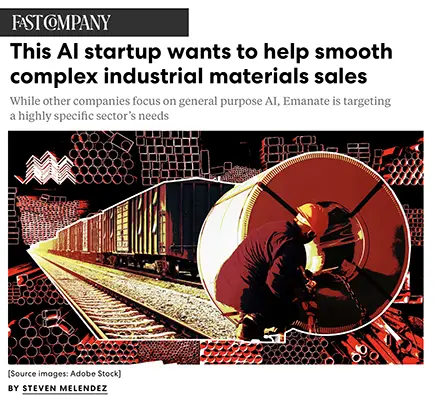
Vertical AI for Industrial Sales: Startup Emanate Bets on Sector-Specific Agents Over General-Purpose Tools
Fast Company | May 8, 2026
TL;DR: A small startup is making the case that AI deployed inside a specific, complex industry — with deep integration into existing systems — outperforms generic AI tools, and its early results claim revenue lifts of 40% or more for industrial materials sellers.
Executive Summary
Emanate is building AI sales agents designed exclusively for the industrial materials sector — manufacturers, distributors, and service providers dealing in steel, aluminum, pipe, and wire. The core problem it addresses is genuine: quote generation in this space can take three to four weeks using conventional systems, and the complexity of bespoke orders, pricing data, and customer history has historically resisted automation. Emanate argues that recent improvements in underlying AI models — particularly over the last six to eight months — have finally made near-instantaneous automated quoting viable.
The company’s differentiation isn’t the AI model itself but what it calls the “harness”: a layer of custom integrations connecting AI agents to ERP databases, past sales correspondence, proprietary knowledge repositories, and other internal data. Onboarding takes eight to twelve weeks, not days — a meaningful friction point that also functions as a competitive moat. The company tracks concrete pre/post deployment metrics (quotes processed, human hours, leads handled) and claims revenue growth of 40% or more for customers, positioning itself around revenue expansion rather than cost-cutting.
This is a founder-led, 10-person company backed by Andreessen Horowitz and M13. The claims are internally framed and not yet independently verified. The 40% revenue lift figure is the company’s own, not third-party audited.
Relevance for Business
The Emanate model illustrates a broader strategic question facing SMB leaders: whether a sector-specific AI tool — with high setup cost and long onboarding — delivers better ROI than a general-purpose AI platform that deploys faster but fits less precisely. For any business with complex, high-value sales processes (quote-heavy, relationship-driven, data-intensive), this is a live decision. The industrial materials angle is narrow, but the framework applies across distribution, manufacturing services, specialty chemicals, and similar B2B environments. Leaders should also note the vendor dependency risk: a 12-week integration using proprietary harness architecture creates significant switching costs.
Calls to Action
🔹 If your business involves complex, bespoke quoting or long sales cycles, use this as a prompt to evaluate whether your current AI tools are genuinely embedded in your workflows or just layered on top of them.
🔹 Before committing to any AI sales tool, require vendors to define their pre/post measurement approach — Emanate’s clinical baseline-and-track model is the right standard to demand.
🔹 Assess the true onboarding cost of any specialized AI tool: 8–12 weeks of integration represents real labor, disruption, and opportunity cost that must appear in your ROI model.
🔹 Monitor how sector-specific AI vendors develop over the next 12–18 months — this space is early, and consolidation or failure of niche players is a real risk before the market matures.
🔹 Treat any startup’s revenue-lift claims (40%+) as aspirational until independently validated — request customer references and audit methodology before making procurement decisions.
Summary by ReadAboutAI.com
https://www.fastcompany.com/91538530/emanate-ai-startup-complex-industrial-materials-sales: June 1, 2026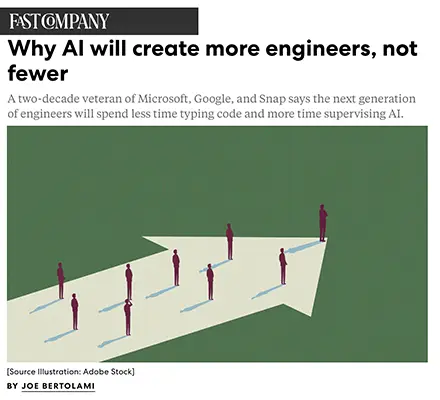
WHY AI WILL CREATE MORE ENGINEERS, NOT FEWER
FAST COMPANY, MAY 24, 2026
TL;DR / Key Takeaway: AI may reduce the value of routine coding, but it raises the value of engineering judgment, system design, supervision, and technical accountability.
EXECUTIVE SUMMARY
Fast Company publishes an argument from Joe Bertolami, a veteran of Microsoft, Google, and Snap, that AI will not eliminate software engineers so much as change what engineering work means. His core claim is that coding was never the whole job; software engineering is really about solving problems, managing complexity, making trade-offs, and building systems that work in the real world.
The useful signal is the shift from specialist coder to AI-orchestrating generalist. AI agents can generate code, tests, APIs, logs, and boilerplate, but they still require human oversight to decide what should be built, whether outputs are safe, and how systems will behave under production pressure. The article also flags risks that executives should not dismiss: loss of junior training pathways, skill atrophy among engineers who over-rely on AI, and cognitive exhaustion from supervising multiple agent workflows.
For business leaders, the takeaway is not “hire fewer engineers.” It is that software capability may become more broadly available, while experienced engineering judgment becomes more important. Companies that treat AI as a headcount-cutting tool may lose ground to competitors that use it to expand product development, automate internal systems, and solve previously uneconomic problems.
RELEVANCE FOR BUSINESS
For SMB executives and managers, this matters because AI will make custom software, internal automation, and workflow improvement more accessible. But it also raises the bar for technical leadership. Businesses will need people who can translate business needs into AI-assisted technical execution — and who can recognize when the AI output is fragile, insecure, or misaligned.
The management challenge is training. If AI absorbs junior-level tasks, companies need new apprenticeship models so future technical leaders still develop judgment. The hidden risk is not fewer engineers today; it is a weaker engineering pipeline tomorrow.
CALLS TO ACTION
🔹 Use AI to expand engineering capacity, not only to reduce labor cost.
🔹 Protect junior learning pathways through structured mentorship, review, and AI-assisted apprenticeships.
🔹 Train engineers to supervise agents, including testing, security review, and architecture judgment.
🔹 Watch for skill atrophy when teams rely too heavily on generated code they cannot evaluate.
🔹 Measure productivity by shipped value and system quality, not just code volume.
Summary by ReadAboutAI.com
https://www.fastcompany.com/91544366/why-ai-will-create-more-engineers-not-fewer: June 1, 2026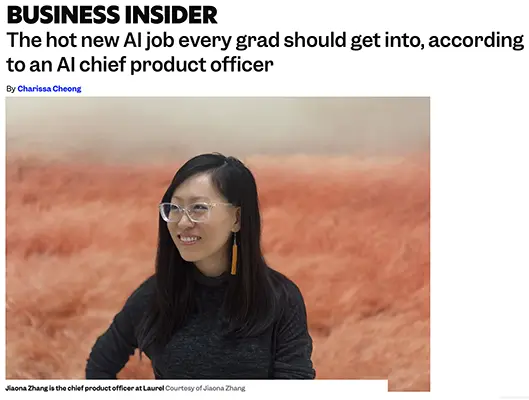
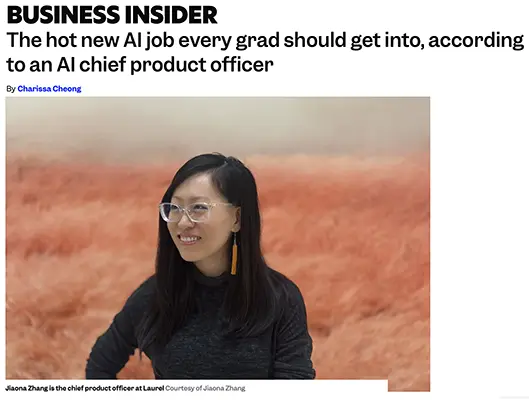
THE HOT NEW AI JOB EVERY GRAD SHOULD GET INTO
BUSINESS INSIDER, MAY 26, 2026
TL;DR / Key Takeaway: The emerging “AI workflows” or “AI Ops” role shows that entry-level opportunity may shift from doing isolated tasks to redesigning how work gets done with AI.
EXECUTIVE SUMMARY
Business Insider reports on Jiaona Zhang’s view that new graduates should look for “AI workflows” roles — jobs focused on identifying where AI can improve operations and then implementing those changes across departments. Zhang, chief product officer at Laurel and an adjunct lecturer at Stanford, argues that this role can become the new version of business operations, with employees scaling their impact by automating work across teams.
The useful signal is that AI adoption is creating a translation role between business needs and technical execution. These employees may not be traditional software engineers, but they understand workflows, tools, automation opportunities, and measurable time savings. The article points to similar roles emerging under titles such as “AI business automation engineer.”
For executives, this suggests a practical hiring and training path. Companies do not only need AI researchers or machine-learning engineers. They need operationally curious employees who can observe work, identify repetitive bottlenecks, build or coordinate AI-enabled automations, and prove value through saved time, improved throughput, or better customer response.
RELEVANCE FOR BUSINESS
For SMB leaders, this is one of the most actionable workforce ideas in the AI economy. Many businesses do not need a full AI department, but they do need someone responsible for finding repeatable workflow improvements and turning them into usable systems.
The role also creates an entry-level path at a time when AI may reduce traditional junior tasks. A motivated new hire who can save a sales, finance, marketing, HR, or operations team several hours per week can quickly become valuable.
CALLS TO ACTION
🔹 Create an internal “AI workflows” responsibility, even before making it a formal role.
🔹 Ask each department to identify repetitive tasks that could be improved with AI assistance.
🔹 Measure automation value in time saved, errors reduced, and throughput improved.
🔹 Train early-career employees to combine process knowledge with AI tools.
🔹 Avoid random tool experimentation; focus on workflows with clear owners and measurable outcomes.
Summary by ReadAboutAI.com
https://www.businessinsider.com/stanford-lecturer-hot-ai-job-grad-workflows-entry-level-2026-5: June 1, 2026
REPUBLICANS ARE LOST IN THE AI WILDERNESS
INTELLIGENCER, MAY 2026
TL;DR / Key Takeaway: AI is becoming a mainstream political liability, with jobs, data centers, state regulation, and Big Tech distrust reshaping how both parties talk about technology.
EXECUTIVE SUMMARY
Intelligencer argues that the U.S. political conversation around AI has shifted from bipartisan enthusiasm to public unease, leaving Republicans especially exposed because the Trump administration embraced a largely deregulatory, pro-industry approach. The piece frames AI backlash as a political opening for Democrats and a growing internal conflict for conservatives.
The most important signal is that AI is no longer contained inside technology policy. It now overlaps with energy prices, data-center construction, labor displacement, youth safety, state-level authority, Big Tech power, and U.S.-China competition. The article describes several competing conservative positions: libertarian acceleration, MAGA-style skepticism of concentrated tech power, labor-focused concern, and state-level resistance to federal preemption.
For executives, the practical takeaway is that AI policy may become less predictable. Companies should not assume that pro-innovation rhetoric will translate into stable, permissive rules. As public concern grows, leaders may face stricter requirements around data centers, workforce impacts, child safety, algorithmic accountability, and local approvals. AI strategy increasingly requires political risk awareness, not just software evaluation.
RELEVANCE FOR BUSINESS
For SMB executives and managers, this matters because political conflict can quickly become operational friction. Local opposition to data centers can affect energy availability and costs. State-level AI laws can complicate compliance. Labor-focused legislation can require new disclosure or reporting practices. Public distrust can affect customer sentiment toward AI-powered products and services.
The broader business lesson is that AI adoption is entering the same public legitimacy cycle that has shaped other powerful industries. Companies that treat AI as merely a productivity tool may be caught off guard by employee, customer, regulator, or community concerns.
CALLS TO ACTION
🔹 Track AI regulation at both state and federal levels, especially if your business operates across multiple states.
🔹 Prepare for public concern around AI and jobs, even if your own use is modest.
🔹 Document how AI tools are used internally, including human review, vendor choice, and data handling.
🔹 Monitor energy and infrastructure issues, especially if your business depends on cloud AI services.
🔹 Avoid partisan assumptions; AI skepticism is emerging across political lines.
Summary by ReadAboutAI.com
https://nymag.com/intelligencer/article/republicans-are-lost-in-the-ai-wilderness.html: June 1, 2026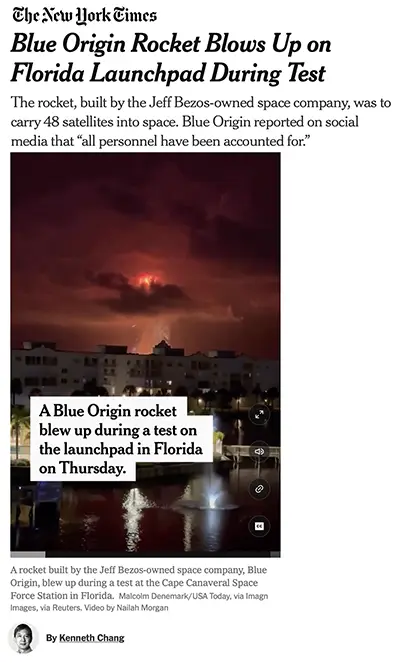
BLUE ORIGIN’S LAUNCHPAD EXPLOSION SETS BACK AMAZON’S SATELLITE AMBITIONS AND NASA’S MOON TIMELINE
The New York Times | May 28, 2026
TL;DR: A pre-launch engine test destroyed Blue Origin’s only New Glenn launchpad, delaying Amazon’s Leo satellite network and creating real uncertainty for NASA’s Artemis moon program — a reminder that the commercial space sector’s infrastructure is more fragile than its ambitions suggest.
Executive Summary
Blue Origin’s New Glenn rocket exploded on the launchpad at Cape Canaveral during a routine hotfire engine test on the evening of May 28. No personnel were injured, but the launchpad — the company’s only facility capable of launching the 322-foot rocket — was badly damaged. Repair is expected to take months at minimum. The rocket had been scheduled to carry 48 satellites for Amazon’s Leo internet constellation, a direct competitor to SpaceX’s Starlink. Those satellites were not aboard at the time.
The consequences extend beyond Amazon. Blue Origin is one of two companies NASA has contracted to carry astronauts from lunar orbit to the moon’s surface; the program depends on multiple New Glenn launches. NASA’s Artemis III mission — scheduled for next year — required Blue Origin participation in orbital docking practice, and that participation is now in jeopardy. NASA has also recently awarded Blue Origin contracts for two additional New Glenn launches supporting Artemis IV and V moon rover missions as soon as 2028.
New Glenn has a mixed flight record: three launches to date, with a debris-ending third flight due to a second-stage malfunction. The explosion adds to a pattern of reliability questions. SpaceX CEO Elon Musk expressed sympathy publicly — a gesture notable given that SpaceX’s Starlink competes directly with Amazon’s Leo, and SpaceX is NASA’s other contracted lunar lander provider.
Relevance for Business
For most SMBs, the direct operational exposure is minimal. The relevant signals are strategic and second-order. Amazon’s Leo constellation — intended to deliver global broadband internet, including in underserved and rural markets — is now delayed indefinitely. Businesses that have been monitoring Leo as a future connectivity option (particularly those in areas with limited broadband infrastructure) should adjust their timelines accordingly and not rely on Leo as a near-term alternative to existing providers. More broadly, this event reinforces that commercial space infrastructure, including satellite internet services, carries significant execution and timeline risk that should be factored into any planning scenario that depends on it. Finally, the NASA program impacts are a reminder that AI and technology supply chains are increasingly intertwined with government space programs — and that disruptions in one domain ripple across others.
Calls to Action
🔹 If your organization was evaluating Amazon’s Leo satellite service as a future connectivity option, push that timeline out — this setback makes near-term availability significantly less certain.
🔹 Do not treat commercial satellite internet as a reliable infrastructure alternative until launch and service records are substantially more consistent than they are today.
🔹 For businesses in sectors tied to federal space contracts (defense, aerospace supply chain, remote sensing, communications), monitor NASA’s response to potential Artemis timeline disruption — it may affect downstream procurement and program schedules.
🔹 Use this event as a prompt to audit any operational planning assumptions that depend on emerging space-based services; flag those dependencies as high-uncertainty inputs.
🔹 Monitor for updates on launchpad repair timeline and Blue Origin’s investigation findings — the root cause will determine how long recovery actually takes and whether the New Glenn program faces deeper structural questions.
Summary by ReadAboutAI.com
https://www.nytimes.com/2026/05/28/science/blue-origin-explosion-rocket.html: June 1, 2026
SPACEX WARNS HUMANS MAY SUFFER ‘SAME FATE AS DINOSAURS’ IN EYE-POPPING IPO PITCH
INTELLIGENCER, MAY 21, 2026
TL;DR / Key Takeaway: SpaceX’s IPO pitch blends real infrastructure dominance with enormous future claims, making it a useful example of how AI, space, and existential framing can inflate investor expectations.
EXECUTIVE SUMMARY
Intelligencer examines SpaceX’s IPO prospectus, emphasizing the gap between the company’s real achievements and the sweeping claims used to frame its future. The filing describes a mission tied to multiplanetary life and vast markets, while also revealing substantial losses, heavy AI spending, Starlink’s central revenue role, and risks tied to Grok and X.
The practical signal is that SpaceX is no longer just a launch company. Its investor story now combines rockets, satellite broadband, AI compute, social media, defense relevance, and long-term space settlement. That makes the company strategically important, but also harder to evaluate using normal business categories. The same prospectus can support both a bullish infrastructure thesis and a skeptical view of overextended ambition.
For executives, the broader lesson is to treat grand AI-related market claims carefully. A large total addressable market is not the same as proven revenue, profit, or execution capacity. SpaceX has unique assets, but the IPO pitch also illustrates how AI can be used to expand a company’s narrative far beyond its current fundamentals.
RELEVANCE FOR BUSINESS
For SMB executives and managers, this matters because the same pattern appears in smaller vendor pitches: companies attach AI to a broader future story, then use that story to justify valuation, pricing, or strategic urgency. Leaders need to separate current utility from future narrative.
The article also highlights reputation and governance risks around AI products such as Grok. AI systems with provocative modes, misinformation exposure, or unsafe outputs can create brand and regulatory risk, even when attached to otherwise powerful companies.
CALLS TO ACTION
🔹 Separate proven revenue streams from speculative AI upside when evaluating vendors or investments.
🔹 Be cautious with total-addressable-market claims, especially when they rely on distant future use cases.
🔹 Assess AI product risk as brand risk, not only technical risk.
🔹 Watch SpaceX’s IPO as a signal for how public markets price AI infrastructure narratives.
🔹 Avoid adopting vendor language that overstates inevitability or underplays execution risk.
Summary by ReadAboutAI.com
https://nymag.com/intelligencer/article/elon-musk-spacex-ipo-elon-musk-revelations.html: June 1, 2026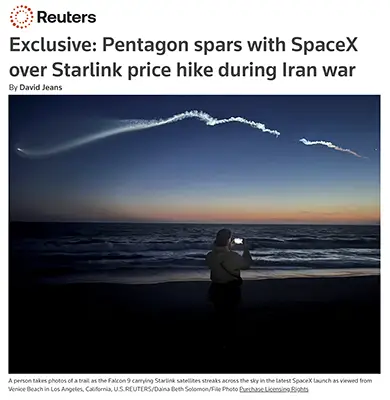
PENTAGON SPARS WITH SPACEX OVER STARLINK PRICE HIKE DURING IRAN WAR
REUTERS, MAY 26, 2026
TL;DR / Key Takeaway: Reuters’ reporting shows that the Pentagon’s reliance on Starlink gives SpaceX unusual leverage over military operations, pricing, and communications access during conflict.
EXECUTIVE SUMMARY
Reuters reports that SpaceX and the Pentagon clashed over Starlink pricing during the Iran war, after Starlink-connected LUCAS drones became part of U.S. military operations. According to Reuters, SpaceX argued that the Pentagon was paying roughly $5,000 per terminal when the use case fit a much higher tier closer to $25,000, and the Pentagon ultimately agreed to the higher fee.
The central issue is dependency. Starlink has become difficult to replace because it offers broad coverage, battlefield communications, and support for unmanned systems. Reuters notes that no other company currently offers a comparable alternative at scale, which gives SpaceX leverage even when the customer is the U.S. military.
For business leaders, this is a clear example of single-vendor concentration risk. When one supplier becomes essential to operations, pricing disputes, outages, policy changes, or strategic disagreements can become operational vulnerabilities. The lesson applies far beyond defense: cloud AI platforms, model providers, cybersecurity vendors, payment processors, and communications networks can all become points of leverage.
RELEVANCE FOR BUSINESS
For SMB executives and managers, the immediate military details matter less than the operating principle: when a vendor provides a critical layer of infrastructure, dependence can become expensive and hard to unwind.
This article also highlights the growing overlap between commercial technology and public-sector power. SpaceX’s commercial scale strengthens its bargaining position with government, while government contracts strengthen its strategic importance. Businesses should expect similar dynamics in AI infrastructure, where a few companies may control essential compute, models, platforms, or distribution channels.
CALLS TO ACTION
🔹 Identify single-vendor dependencies in cloud, AI, communications, payments, cybersecurity, and logistics.
🔹 Negotiate pricing and service terms before high-stakes usage begins.
🔹 Develop fallback plans for outages, disputes, or policy changes.
🔹 Monitor vendor concentration in AI infrastructure, especially where alternatives are weak.
🔹 Treat mission-critical vendors as strategic risk factors, not just suppliers.
Summary by ReadAboutAI.com
https://www.reuters.com/business/aerospace-defense/pentagon-spars-with-spacex-over-starlink-price-hike-during-iran-war-2026-05-26/: June 1, 2026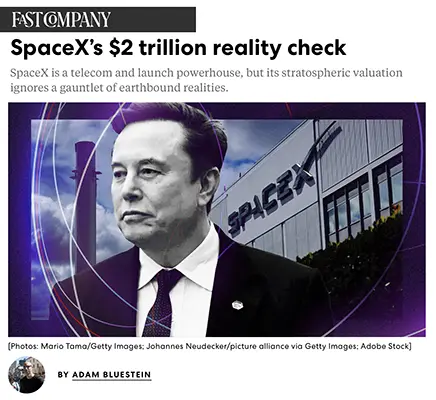
SPACEX’S $2 TRILLION REALITY CHECK
FAST COMPANY, MAY 26, 2026
TL;DR / Key Takeaway: Fast Company frames SpaceX’s IPO as a clash between extraordinary infrastructure advantage and very real execution limits around launch capacity, AI data centers, capital spending, and valuation discipline.
EXECUTIVE SUMMARY
Fast Company argues that SpaceX’s potential $1.75 trillion to $2 trillion valuation depends less on today’s fundamentals and more on a future vision combining launch dominance, Starlink, AI infrastructure, and space-based compute. The article credits SpaceX’s real advantages — especially launch scale and Starlink’s revenue base — while warning that the company’s future claims depend on difficult technical, financial, and geopolitical assumptions.
The strongest business signal is that space, AI, telecom, and defense are merging into one infrastructure story. SpaceX is not merely selling launches; it is positioning itself as a platform for communications, military data transport, AI compute, and eventually orbital data centers. But several constraints remain unresolved: launch bottlenecks, Starship execution, AI division losses, heavy capital expenditures, heat and radiation issues for orbital computing, and the economics of building infrastructure in space.
For executives, this is a disciplined reminder that infrastructure revolutions do not scale on narrative alone. Even dominant companies face physical constraints, capital intensity, regulatory oversight, and execution timelines. SpaceX may be uniquely positioned, but its valuation appears to assume many future businesses succeed at once.
RELEVANCE FOR BUSINESS
For SMB leaders, the takeaway is not to become space-industry analysts. It is to recognize how AI infrastructure is pushing into adjacent systems: launch markets, satellite broadband, defense networks, data centers, energy, and compute. These shifts can influence connectivity, cloud pricing, supply chains, national-security policy, and vendor concentration.
The article also provides a useful lens for evaluating any AI infrastructure claim: ask what is proven now, what depends on future technical breakthroughs, what requires massive capital, and what could be blocked by regulation or physical limits.
CALLS TO ACTION
🔹 Treat AI infrastructure claims with discipline; separate today’s operations from long-range ambitions.
🔹 Watch Starlink and launch capacity as indicators of SpaceX’s real near-term business strength.
🔹 Monitor AI compute economics, especially depreciation, energy, utilization, and customer concentration.
🔹 Be cautious about vendors selling distant future platforms as current business certainty.
🔹 Track satellite and space infrastructure as part of the broader AI supply chain.
Summary by ReadAboutAI.com
https://www.fastcompany.com/91546081/spacex-ipo-reality-check: June 1, 2026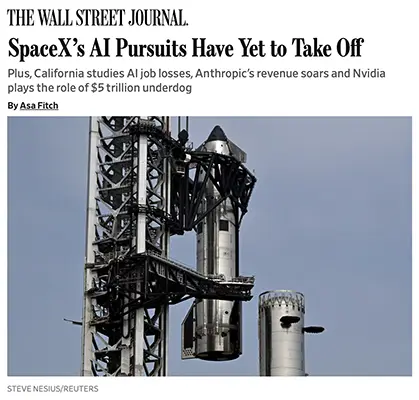
SPACEX’S AI PURSUITS HAVE YET TO TAKE OFF
THE WALL STREET JOURNAL, MAY 26, 2026
TL;DR / Key Takeaway: SpaceX’s AI business appears far less proven than its launch and Starlink operations, raising questions about whether AI infrastructure spending can justify the valuation attached to it.
EXECUTIVE SUMMARY
The Wall Street Journal reports that SpaceX’s IPO filing shows a strong combination of launch services and Starlink broadband, but a much shakier AI business. The company’s AI-related revenue has largely come from X rather than a mature standalone AI operation, while losses have expanded as AI computing depreciation and capital spending have grown.
The core signal is that AI compute can generate large revenue while still creating heavy financial pressure. SpaceX has invested aggressively in data centers and AI chips, and its deal to rent compute to Anthropic could bring in major revenue. But the article raises a practical concern: if SpaceX is renting out large amounts of compute, that may suggest it does not yet have more profitable internal uses for that capacity through Grok or its own AI products.
For executives, this is a useful reality check. The AI infrastructure boom is not automatically the same as a software-margin business. Chips, data centers, depreciation, energy, and utilization rates all matter. A company can look strategically positioned and still face weak unit economics if demand, pricing, and internal product traction do not align.
RELEVANCE FOR BUSINESS
For SMB executives and managers, the lesson is to separate AI capability from AI business model strength. Many companies are investing heavily in AI, but not all AI spending produces defensible advantage. Compute capacity is valuable, but AI cloud services are competitive and capital-intensive.
This matters when evaluating vendors. A flashy AI roadmap does not guarantee stability, profitability, or strategic clarity. Leaders should ask whether a vendor’s AI offering is core to its business, subsidized by another division, or still searching for durable economics.
CALLS TO ACTION
🔹 Evaluate AI vendors by business model, not only technical capability.
🔹 Ask whether AI services are profitable, subsidized, or dependent on speculative growth.
🔹 Watch depreciation and infrastructure costs as signals of pressure in AI-heavy companies.
🔹 Avoid overcommitting to vendors whose AI strategy is still unproven.
🔹 Distinguish internal AI products from rented compute or resale-style revenue.
Summary by ReadAboutAI.com
https://www.wsj.com/tech/ai/spacexs-ai-pursuits-have-yet-to-take-off-3c25e91e: June 1, 2026
US SPACE FORCE AWARDS SPACEX $2.29 BILLION CONTRACT FOR MILITARY SPACE DATA NETWORK
REUTERS, MAY 26, 2026
TL;DR / Key Takeaway: SpaceX’s new Space Force contract reinforces that low-Earth-orbit satellite networks are becoming core national-security infrastructure, not just commercial broadband systems.
EXECUTIVE SUMMARY
Reuters reports that the U.S. Space Force awarded SpaceX a $2.29 billion fixed-price contract to build a secure, high-speed satellite communications backbone connecting military sensors and weapons platforms worldwide. The Space Data Network Backbone is intended to provide high-capacity, low-latency transport and support missile warning, tracking, and interceptor coordination.
The business signal is that SpaceX’s satellite capabilities are moving deeper into defense architecture. The network is expected to work with the Space Development Agency’s Transport Layer as part of a broader military data-transport system. This is not simply “internet from space.” It is a move toward real-time military data routing, where sensor information, targeting, and response systems depend on resilient space-based connectivity.
For executives, this highlights a larger AI-era pattern: the same commercial technologies that support consumer broadband, remote business connectivity, and cloud access are also becoming strategic infrastructure. SpaceX’s role is expanding because it combines launch capacity, satellite operations, software, and government contracting at a scale few competitors can match.
RELEVANCE FOR BUSINESS
For SMB leaders, the immediate procurement details may feel distant, but the downstream implications matter. Defense demand can accelerate innovation, increase network reliability, and expand coverage, but it can also concentrate strategic infrastructure in a small number of companies.
This matters for businesses relying on satellite connectivity, logistics, remote operations, maritime services, agriculture, construction, energy, or emergency response. When a commercial provider becomes central to national security, its capacity, pricing, regulatory treatment, and public scrutiny can shift.
CALLS TO ACTION
🔹 Track satellite connectivity as critical infrastructure, especially for remote or mobile operations.
🔹 Avoid assuming commercial networks are purely commercial; defense demand can affect priorities and pricing.
🔹 Assess whether your business depends on a single connectivity provider in remote or high-risk environments.
🔹 Watch government contracts as a signal of vendor durability and strategic importance.
🔹 Monitor SpaceX competitors, because procurement agencies may seek alternatives to reduce concentration risk.
Summary by ReadAboutAI.com
https://www.reuters.com/science/us-space-force-awards-spacex-229-billion-contract-military-space-data-network-2026-05-26/: June 1, 2026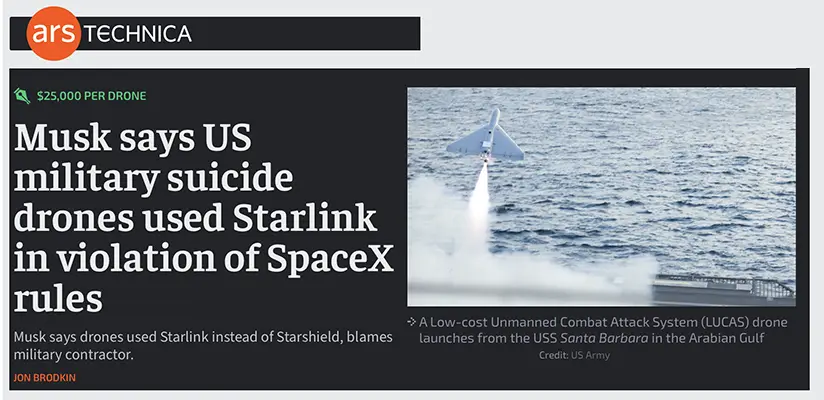
MUSK SAYS US MILITARY SUICIDE DRONES USED STARLINK IN VIOLATION OF SPACEX RULES
ARS TECHNICA, MAY 26, 2026
TL;DR / Key Takeaway: The Starlink drone dispute shows how commercial AI-adjacent infrastructure is becoming military infrastructure, creating pricing, control, and accountability risks when private networks become mission-critical.
EXECUTIVE SUMMARY
Ars Technica reports on a dispute between SpaceX, Elon Musk, and the Pentagon over the use of Starlink or Starshield connections on U.S. military drones during the Iran war. Musk disputed Reuters’ framing but also acknowledged that commercial Starlink had allegedly been used for military purposes, which he said violated SpaceX’s terms of service. The issue centered on LUCAS drones, relatively low-cost one-way attack systems, and whether the Pentagon should pay a much higher Starshield-related fee for connectivity.
The core signal is not only a contract dispute. It is that connectivity has become part of the weapon system. A drone’s effectiveness increasingly depends not just on hardware, but on satellite links, routing, bandwidth, permissions, and service terms controlled by a private company. That creates a new kind of dependency: military operations, commercial pricing models, and corporate terms of service can collide in real time.
For executives, this is a broader lesson about AI-era infrastructure. Whether the use case is battlefield drones, cloud AI, autonomous vehicles, or emergency communications, organizations are becoming dependent on private networks they do not fully control. The more operationally important the system, the more leaders need to understand service limits, escalation paths, pricing triggers, and failure modes.
RELEVANCE FOR BUSINESS
For SMB executives and managers, this matters as a dependency case study. Your business may not use Starlink or military systems, but it may rely on cloud platforms, AI APIs, telecom providers, payment systems, cybersecurity vendors, or logistics networks whose rules can change under pressure.
The practical lesson is that vendor infrastructure is not neutral. Terms of service, pricing tiers, acceptable-use rules, and contractual ambiguity can become business risks when systems are used in new or high-stakes ways.
CALLS TO ACTION
🔹 Review vendor terms for mission-critical services, especially cloud, connectivity, AI, payments, and security platforms.
🔹 Clarify acceptable-use limits before deploying tools in unusual, regulated, or high-risk workflows.
🔹 Identify backup providers or fallback procedures for services that could halt operations.
🔹 Treat pricing escalation clauses as operational risk, not just procurement detail.
🔹 Monitor Starlink/Starshield disputes as a signal of how private infrastructure providers gain leverage.
Summary by ReadAboutAI.com
https://arstechnica.com/tech-policy/2026/05/musk-says-us-military-suicide-drones-used-starlink-in-violation-of-spacex-rules/: June 1, 2026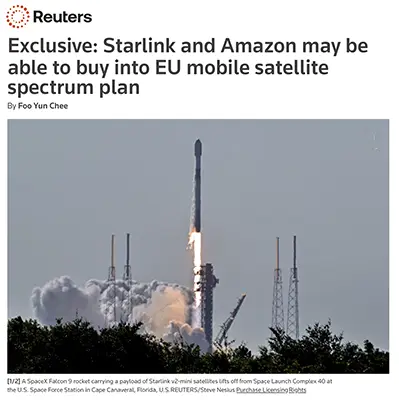
STARLINK AND AMAZON MAY BE ABLE TO BUY INTO EU MOBILE SATELLITE SPECTRUM PLAN
REUTERS, MAY 26, 2026
TL;DR / Key Takeaway: Europe’s satellite spectrum plan shows the tension between technological sovereignty and practical dependence on U.S. satellite operators.
EXECUTIVE SUMMARY
Reuters reports that Starlink and Amazon’s low-Earth-orbit satellite business may be allowed to acquire part of a European mobile satellite spectrum plan, while most of the spectrum would be reserved for European companies. The proposal comes as Europe seeks to expand satellite connectivity and reduce dependence on U.S. technology, with the EU’s IRIS2 constellation expected to receive some spectrum.
The core signal is that governments want technological sovereignty, but infrastructure realities complicate that ambition. Starlink and Amazon have scale, deployment experience, and capital. Europe wants resilience, security, and domestic capability, but may still need to leave room for non-European firms to meet connectivity goals.
For executives, this reflects a broader AI and infrastructure pattern: national and regional governments are increasingly trying to control strategic technology layers — chips, cloud, data centers, satellites, models, and spectrum — while still relying on global suppliers. The result may be more regional rules, procurement restrictions, and partnership requirements.
RELEVANCE FOR BUSINESS
For SMB leaders, this matters if they rely on satellite internet, international connectivity, mobile services, logistics, travel, maritime operations, defense-adjacent work, or European customers. Regulatory decisions over spectrum can affect service availability, pricing, coverage, and vendor choice.
The broader lesson is that AI-era infrastructure is becoming geopolitical. Businesses should expect more fragmentation between U.S., European, Chinese, and regional technology ecosystems, especially where connectivity and security overlap.
CALLS TO ACTION
🔹 Monitor regional technology rules if your business operates internationally or serves EU customers.
🔹 Do not assume one connectivity provider will have equal access across all markets.
🔹 Watch Europe’s sovereignty strategy, especially around satellite, cloud, AI, and data infrastructure.
🔹 Evaluate vendor exposure to geopolitical restrictions before building critical workflows on one provider.
🔹 Track IRIS2 and competing satellite networks as potential future alternatives to U.S.-led systems.
Summary by ReadAboutAI.com
https://www.reuters.com/business/aerospace-defense/european-companies-set-receive-two-thirds-future-mobile-satellite-spectrum-rest-2026-05-26/: June 1, 2026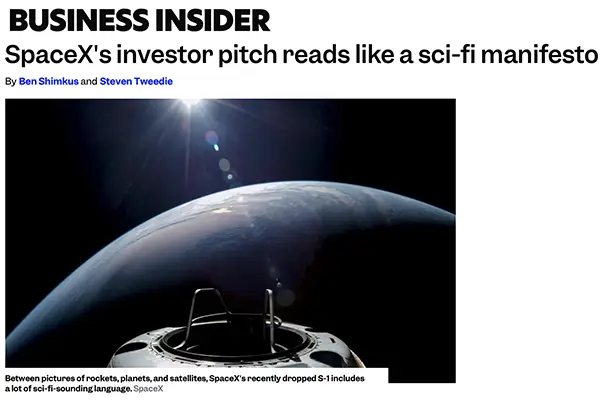
SPACEX’S S-1 FILING IS A VISION DOCUMENT DRESSED AS A PROSPECTUS — AND THAT’S THE POINT
Business Insider | May 21, 2026
TL;DR: SpaceX’s IPO filing reads more like a civilizational mission statement than a standard financial disclosure — which tells leaders something important about how the company is positioning itself to investors, and why that matters beyond the space industry.
Executive Summary
Business Insider’s reading of SpaceX’s S-1 filing is essentially a cultural analysis: the document is laced with science fiction references, speculative terminology, and cosmic ambition that sits alongside standard financial disclosures. The piece is light and observational in tone, cataloguing phrases like “Kardashev Type II civilization,” “orbital AI compute,” “cryogenic propellant transfer in microgravity,” and “lunar mass driver” — not as technical explanations but as signals of how SpaceX frames its pitch to investors.
The more substantive executive signal buried in the piece: SpaceX explicitly acknowledges it is betting on “future markets” that do not yet exist, and that the company itself believes these industries “will develop over time.” That is a meaningful disclosure. The filing also introduces “orbital AI compute” — the idea of placing data centers in space to sidestep earthly constraints like power, water, and cooling costs. This concept has attracted interest from figures including Sam Altman, Jensen Huang, and Jeff Bezos, though all have acknowledged it is years from viability. The article is not an analysis of SpaceX’s financials; it is a tone piece and should be read as such.
Relevance for Business
The direct SMB relevance here is limited — SpaceX is not a vendor or partner most leaders will engage with. The indirect relevance is more useful. The filing illustrates how a company can successfully use aspirational framing to attract capital for speculative infrastructure — a dynamic that mirrors how many AI vendors currently position products to enterprise buyers. The “orbital AI compute” concept is worth flagging for leaders tracking long-term data infrastructure trends, but it belongs firmly in the “years away, monitor only” category. More immediately, the SpaceX IPO itself, if it proceeds, will be a significant market event that shapes investor appetite across adjacent tech sectors.
Calls to Action
🔹 File this as background context, not an action item — SpaceX’s speculative markets (asteroid mining, orbital compute) are genuine future bets, not near-term business developments.
🔹 Note the “orbital AI compute” concept as a long-horizon signal: if space-based data infrastructure becomes viable, it could eventually affect cloud pricing and architecture decisions, but not within any current planning cycle.
🔹 Apply the same critical lens to AI vendor pitches that this piece implicitly applies to SpaceX: distinguish between demonstrated capability, credible roadmap, and vision-level speculation.
🔹 If your organization has any exposure to space-sector suppliers or customers, monitor the SpaceX IPO for market signals about sector confidence and capital availability.
🔹 Deprioritize for now — revisit when SpaceX’s IPO timeline, valuation, and financials are more fully disclosed and independently analyzed.
Summary by ReadAboutAI.com
https://www.businessinsider.com/spacex-s1-filing-elon-musk-scifi-manifesto-2026-5: June 1, 2026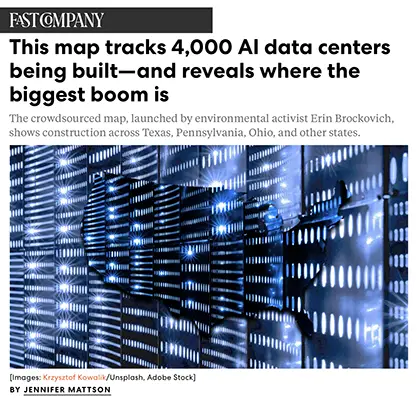
ERIN BROCKOVICH’S DATA CENTER MAP TURNS LOCAL RESISTANCE INTO A NATIONAL VISIBILITY TOOL
Fast Company | May 28, 2026
TL;DR: A crowdsourced map tracking over 4,000 AI data center sites — organized by the environmental activist famous for taking on PG&E — is consolidating community opposition into a national-scale accountability mechanism that businesses and developers should watch.
Executive Summary
Environmental activist Erin Brockovich has launched a public, crowdsourced map tracking more than 4,000 AI data center locations across the United States, categorizing them as operational, under construction, proposed, or community-reported concerns. The map’s top concentrations are in Texas, Pennsylvania, Ohio, and Georgia — with a single location in Sulphur Springs, Texas accounting for the largest cluster of community reports. Of the 2,716 crowdsourced reports filed as of late May, the top concerns are water supply impacts (41%), strain on the electric grid (22%), and general health effects (18%).
The article is primarily descriptive, but the signal is real. Brockovich brings specific reputational weight to this effort: her successful campaign against PG&E — a $333 million settlement — established a playbook for translating community environmental concern into legal and regulatory pressure. The map is not a lawsuit, but it is the kind of organized, publicly accessible documentation that supports one. A separate Arizona State University study referenced in the piece adds that data centers create localized “heat islands,” raising surrounding temperatures by as much as 4 degrees — adding a climate dimension to existing concerns about water, air quality, and grid stress.
The article should be read alongside the Washington Post diesel generator investigation from the same week: together, they represent a coordinated, multi-front escalation of public accountability pressure on the data center sector.
Relevance for Business
For most SMBs, the direct exposure remains indirect — but it is growing. If your business operates near a data center corridor, sources power from a grid under data center pressure, or has ESG commitments tied to supply chain environmental performance, this is a live business issue. More broadly, the map’s existence signals that community opposition to AI infrastructure is becoming organized, documented, and publicly searchable — which increases the likelihood of regulatory action, permitting challenges, and project delays. Businesses dependent on cloud services should monitor whether planned data center capacity in their region faces community or regulatory friction that could affect service availability or pricing.
Calls to Action
🔹 Search the Brockovich map (brockovichdatacenter.com) for data centers near your facilities or operational regions — understanding your proximity to contested sites informs both ESG reporting and operational risk assessment.
🔹 If your business is in real estate, construction, utilities, or local government contracting, treat this map as an early-warning signal for permitting and development friction in affected regions.
🔹 For organizations with formal ESG commitments, assess whether your cloud and AI infrastructure providers have data center exposure in high-concern areas — this is becoming a reportable supply chain risk.
🔹 Monitor whether the Brockovich effort transitions from awareness to legal action — the PG&E precedent suggests that is the intended trajectory, not just a publicity campaign.
🔹 Revisit your cloud provider’s public commitments on water use and community impact: if those commitments are vague or unverified, ask directly before your next contract renewal.
Summary by ReadAboutAI.com
https://www.fastcompany.com/91549212/ai-data-center-map-reveals-where-biggest-boom-is-erin-brockovich: June 1, 2026https://brockovichdatacenter.com/: June 1, 2026
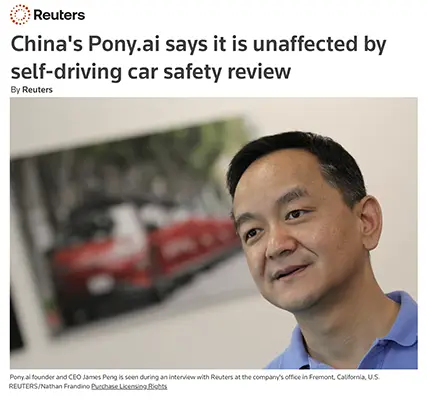
CHINA’S PONY.AI SAYS IT IS UNAFFECTED BY SELF-DRIVING CAR SAFETY REVIEW
REUTERS, MAY 26, 2026
TL;DR / Key Takeaway: Pony.ai’s continued robotaxi expansion shows that autonomous vehicle deployment is advancing despite safety reviews, but regulation, reliability, and public trust remain gating factors for scale.
EXECUTIVE SUMMARY
Reuters reports that Chinese autonomous driving company Pony.ai says its operations have not been affected by a national safety review following a robotaxi outage involving Baidu’s Apollo Go. CEO James Peng said the review focused on how companies and local authorities ensure safe autonomous driving operations, while Pony.ai has completed its evaluations and is continuing expansion plans.
The business signal is that China’s robotaxi sector is still pushing toward scale, even as regulators respond to reliability concerns. Pony.ai plans to expand its fleet significantly and raise revenue targets, while also exploring international opportunities. At the same time, the article makes clear that the industry remains financially and operationally unsettled: Pony.ai reported rapid revenue growth but also a widened quarterly loss.
For executives, autonomous driving remains a useful case study in AI commercialization. The technology is moving from demonstration to deployment, but scaling it requires regulatory approval, safety validation, fleet economics, city-level coordination, and public confidence. The lesson extends beyond transportation: AI systems that act in the physical world face a higher trust burden than software tools that only generate text or analysis.
RELEVANCE FOR BUSINESS
For SMB leaders, the direct impact may be limited unless they operate in logistics, delivery, transportation, insurance, mobility, or urban services. But the broader lesson is highly relevant: AI deployment becomes harder when systems interact with the real world, public infrastructure, or human safety.
This article also shows how AI competition is becoming geopolitical and city-specific. Chinese firms, U.S. firms, and local players are competing across Europe, Asia, and the Middle East. Business leaders should watch autonomous vehicle deployment as a signal of how governments balance innovation, safety, domestic competition, and foreign technology dependence.
CALLS TO ACTION
🔹 Monitor autonomous vehicle progress if your business touches logistics, delivery, mobility, insurance, or urban operations.
🔹 Separate pilot success from scalable economics; fleet growth does not automatically mean profitability.
🔹 Watch safety regulation closely, especially where AI systems operate in public or physical environments.
🔹 Use AV deployment as a model for AI risk planning: real-world AI requires testing, monitoring, accountability, and fallback procedures.
🔹 Do not assume global AI markets will standardize quickly; local rules and public tolerance will shape adoption.
Summary by ReadAboutAI.com
https://www.reuters.com/world/asia-pacific/chinas-ponyai-says-it-is-unaffected-by-self-driving-car-safety-review-2026-05-26/: June 1, 2026
MICRON JOINS $1 TRILLION CLUB AS AI RACE POWERS MEMORY CHIP BOOM
REUTERS, MAY 26, 2026
TL;DR / Key Takeaway: Micron’s $1 trillion milestone shows that the AI infrastructure boom is expanding beyond GPUs into memory, storage, supply constraints, and data-center capacity.
EXECUTIVE SUMMARY
Reuters reports that Micron briefly surpassed $1 trillion in market value as investor attention broadened from GPU makers to memory-chip suppliers. Micron’s shares surged after UBS sharply raised its price target, reflecting rising demand for memory chips used to store and move data in AI systems.
The business signal is that AI infrastructure is not only about Nvidia-style processors. Advanced AI systems require high-bandwidth memory, storage, networking, power, and data-center buildout. Micron’s rise reflects a broader supply-chain reality: as Big Tech commits to long-term AI data-center spending, memory demand is tightening and pricing power is shifting toward suppliers.
For executives, this matters because AI costs are shaped by the full hardware stack. If memory shortages persist, the cost and availability of AI services may be affected even for companies that never buy chips directly. Supply constraints can influence cloud pricing, vendor margins, model deployment costs, and the pace at which AI tools become cheaper.
RELEVANCE FOR BUSINESS
For SMB leaders, this article is a reminder that AI is tied to physical infrastructure. Software tools may feel virtual, but their price and reliability depend on chips, memory, data centers, energy, and supply chains.
The practical takeaway is to watch AI cost assumptions carefully. If memory and compute remain constrained, vendors may pass costs to customers through higher subscriptions, usage limits, premium tiers, or slower feature rollouts.
CALLS TO ACTION
🔹 Monitor AI infrastructure costs, including compute, memory, cloud pricing, and usage-based billing.
🔹 Avoid assuming AI tools will always get cheaper quickly.
🔹 Track vendor pricing changes as chip and memory demand tightens.
🔹 Budget for AI usage growth, especially where employees begin using tools heavily across workflows.
🔹 Watch memory-chip supply as a signal of broader AI capacity constraints.
Summary by ReadAboutAI.com
https://www.reuters.com/world/china/micron-joins-1-trillion-club-ai-race-powers-memory-chip-boom-2026-05-26/: June 1, 2026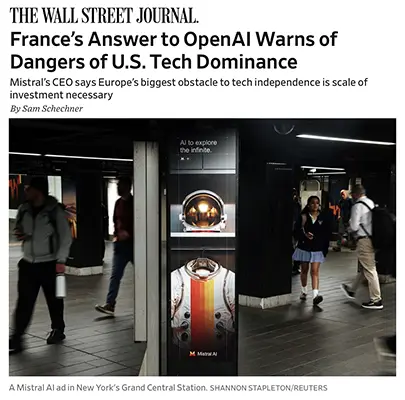
France’s Answer to OpenAI Warns of Dangers of U.S. Tech Dominance
The Wall Street Journal, May 28, 2026
TL;DR / Key Takeaway: Mistral’s push for European AI independence shows that AI competition is no longer only about better models — it is about sovereignty, infrastructure, defense, and who controls access to future capabilities.
Executive Summary
Mistral AI is positioning itself as Europe’s strongest answer to U.S. and Chinese AI dominance, arguing that Europe cannot afford to depend on foreign technology providers if advanced AI systems become central to science, industry, government, and defense. The company is emphasizing European-hosted models, local data centers, and strategic autonomy, while also shifting its message from pragmatic enterprise AI toward the broader race for AGI or “superintelligence.”
The article’s core signal is not simply that Mistral wants to compete with OpenAI. It is that AI infrastructure is becoming a geopolitical dependency, similar to energy, chips, defense systems, and cloud computing. Mistral’s challenge is scale: U.S. competitors can spend tens of billions ahead of demand, while Mistral is tying data-center financing more closely to signed contracts and revenue visibility.
For business leaders, the most practical implication is vendor-dependence risk. AI strategy now includes questions about where models are hosted, who controls access, what governments may restrict, and whether critical workflows are tied to providers outside a company’s legal or operational comfort zone.
Relevance for Business
For SMB executives, this article reinforces that AI vendor selection should not be based only on model performance or price. Leaders should consider data residency, service continuity, national/regional regulation, cloud dependence, and long-term vendor concentration. Companies operating internationally may face growing pressure to use regionally compliant AI services, especially in regulated sectors, defense-adjacent industries, public services, and sensitive data environments.
Calls to Action
🔹 Map your AI dependencies: Identify which AI tools rely on U.S., Chinese, European, or other infrastructure providers.
🔹 Ask vendors about hosting and continuity: Clarify where data is processed and what happens if access rules change.
🔹 Avoid single-vendor lock-in for critical workflows where business continuity matters.
🔹 Monitor European AI providers such as Mistral if your company has customers, partners, or compliance exposure in Europe.
🔹 Treat “sovereign AI” as a risk-management issue, not just a political slogan.
Summary by ReadAboutAI.com
https://www.wsj.com/wsjplus/dashboard/articles/mistral-chases-ai-superintelligence-to-counter-u-s-dominance-b2a44fa1: June 1, 2026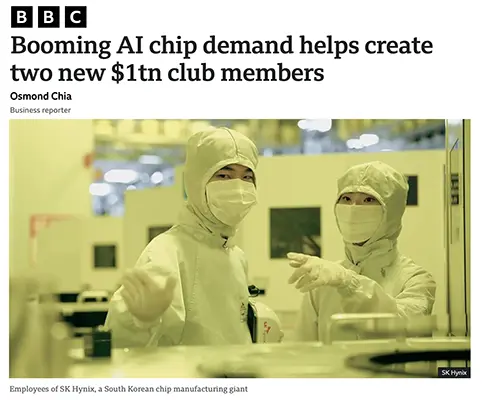
Booming AI Chip Demand Helps Create Two New $1tn Club Members
BBC, May 2026
TL;DR / Key Takeaway: The rise of SK Hynix and Micron shows that AI demand is lifting the memory-chip layer of the supply chain, not just Nvidia and the most visible AI platform companies.
Executive Summary
The BBC reports that SK Hynix and Micron have crossed the $1 trillion valuation mark as demand for AI data centers drives investor enthusiasm for memory-chip suppliers. The important signal is that AI infrastructure demand is broadening across the semiconductor ecosystem. High-performance AI systems require not only GPUs but also advanced memory, networking, packaging, power systems, and data-center capacity.
SK Hynix’s role as a major Nvidia supplier and Micron’s stock surge show how AI investment is reshaping market expectations for companies that sit underneath the most visible AI applications. The article also points to a larger market question: whether valuations are reflecting durable infrastructure demand or whether some investors are pricing in growth that may be difficult to sustain.
For business leaders, the practical takeaway is that AI remains constrained by physical supply chains. The software tools may feel digital and instantly available, but the economics depend on chips, memory capacity, data centers, electricity, and manufacturing concentration.
Relevance for Business
SMB executives should read this less as stock-market news and more as a reminder that AI pricing and availability are tied to infrastructure scarcity. If memory chips, GPUs, or data-center capacity remain tight, AI tools may become more powerful but not necessarily cheaper or easier to procure at scale. Companies building AI-heavy workflows should plan for vendor pricing changes, capacity limits, and dependence on a small number of global suppliers.
Calls to Action
🔹 Track AI infrastructure constraints as part of software and cloud budgeting.
🔹 Expect uneven AI pricing if demand for chips and memory continues to exceed supply.
🔹 Ask vendors how they manage compute capacity, especially for mission-critical AI services.
🔹 Avoid building workflows that assume unlimited cheap AI usage.
🔹 Monitor signs of an AI investment bubble, but separate market speculation from real infrastructure demand.
Summary by ReadAboutAI.com
https://www.bbc.com/news/articles/cnvp9dq0p3go: June 1, 2026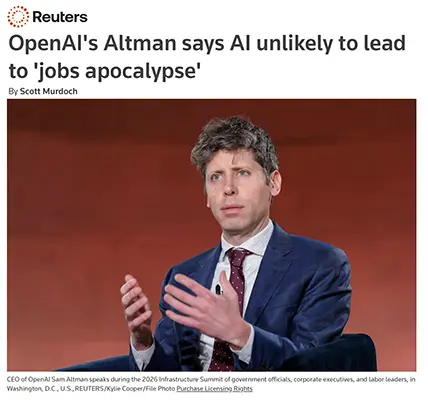
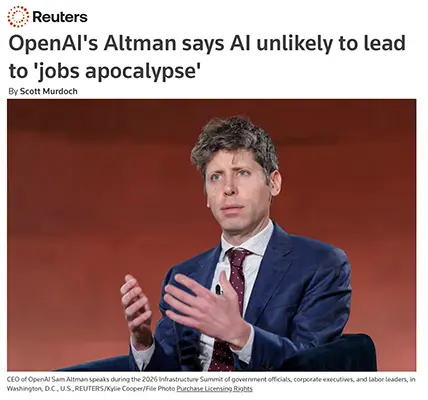
OPENAI’S ALTMAN SAYS AI UNLIKELY TO LEAD TO ‘JOBS APOCALYPSE’
REUTERS, MAY 26, 2026
TL;DR / Key Takeaway: Sam Altman’s revised view on AI and jobs suggests that AI adoption may reshape work more slowly and unevenly than early forecasts implied, but workforce planning still cannot be postponed.
EXECUTIVE SUMMARY
Reuters reports that OpenAI CEO Sam Altman now believes AI is unlikely to produce the broad “jobs apocalypse” some in the industry have warned about. Speaking at a Commonwealth Bank of Australia event, Altman said AI has not yet eliminated entry-level white-collar jobs at the scale he once feared, and he acknowledged that OpenAI was more accurate on technical progress than on near-term social and economic effects.
The most useful business signal is not that job disruption is off the table. It is that AI’s impact on work is proving more complicated than simple replacement narratives suggest. Altman pointed to the “human part” of work — trust, interaction, judgment, and relationship management — as a reason some roles may resist full automation. That is consistent with what many companies are seeing: AI can absorb tasks, drafts, summaries, analysis, and routine communications, but it does not automatically replace the social function of many jobs.
For executives, this argues for a more measured labor strategy. AI may not instantly erase whole categories of office work, but it can still change workflows, reduce headcount growth, alter entry-level training pathways, and pressure employees to do more with fewer resources. The risk is not only mass layoffs; it is organizational redesign without adequate planning.
RELEVANCE FOR BUSINESS
For SMB leaders, the takeaway is to avoid both extremes: do not assume AI will replace large portions of your workforce immediately, but do not ignore the cumulative effect of task automation. The practical question is: which tasks are becoming cheaper, faster, or more automatable — and which human relationships still create business value?
This matters for hiring, training, software purchasing, and role design. Managers should identify where AI can improve productivity without damaging customer trust, employee development, or institutional knowledge. Entry-level work deserves special attention because it often includes repetitive tasks that are easy to automate but also serve as the training ground for future managers.
CALLS TO ACTION
🔹 Map tasks before mapping jobs; identify which activities AI can assist, reduce, or eliminate.
🔹 Protect human-touch workflows where trust, negotiation, care, or judgment matter.
🔹 Reassess entry-level roles so automation does not quietly remove the training pipeline.
🔹 Track productivity gains honestly, including time saved, error rates, customer experience, and employee stress.
🔹 Avoid workforce planning based on vendor hype; use internal pilots and measurable outcomes.
Summary by ReadAboutAI.com
https://www.reuters.com/world/asia-pacific/openais-altman-says-ai-unlikely-lead-jobs-apocalypse-2026-05-26/: June 1, 2026
AI Tools Are Transforming Muslim Worship. Religious Scholars Are Conflicted
TIME, May 26, 2026
TL;DR / Key Takeaway: AI is moving into highly personal and values-based domains, showing both the usefulness of specialized tools and the danger of generic AI systems giving advice without cultural, religious, or community context.
Executive Summary
TIME examines how AI tools are being adopted in Muslim religious practice, including Quran recitation apps such as Tarteel and faith-specific assistants trained on Islamic sources. The strongest business signal is broader than religion: AI is becoming embedded in trust-heavy, identity-sensitive, emotionally significant areas of life, where accuracy alone is not enough.
The article contrasts specialized tools that support learning or translation with more risky uses, such as asking mainstream chatbots for spiritual or personal guidance. Religious scholars and Muslim technologists raise concerns that general-purpose AI systems may reflect the values, assumptions, or blind spots of their builders, especially when users rely on them for advice that traditionally depends on human community, authority, and context.
For executives, this is a useful reminder that AI products are never culturally neutral in practice. When tools enter sensitive domains — religion, health, HR, education, mental health, finance, or legal guidance — organizations must think beyond functionality and consider trust, authority, bias, escalation paths, and when a human must remain in the loop.
Relevance for Business
SMB leaders may not be building religious AI tools, but many are already deploying AI in customer service, employee support, training, marketing, or advisory contexts. This article highlights the risk of context collapse: AI may answer confidently while missing the social, cultural, emotional, or ethical meaning of the question. That creates reputational exposure when customers or employees feel misunderstood, misdirected, or harmed.
Calls to Action
🔹 Define sensitive-use boundaries before deploying AI in customer or employee-facing roles.
🔹 Use domain-specific sources and expert review when AI touches legal, HR, medical, financial, cultural, or values-based topics.
🔹 Build escalation paths to humans for emotionally complex or high-consequence interactions.
🔹 Test outputs across diverse user contexts, not just for accuracy but for appropriateness.
🔹 Avoid presenting AI as an authority figure unless its limits, sources, and oversight are clear.
Summary by ReadAboutAI.com
https://time.com/article/2026/05/26/ai-muslim-worship/: June 1, 2026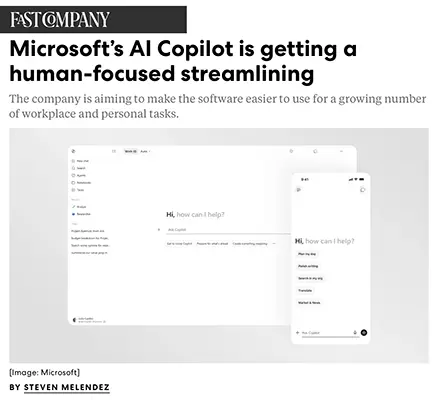
MICROSOFT REBUILDS COPILOT AROUND HOW PEOPLE ACTUALLY WORK — NOT HOW ENGINEERS IMAGINED THEY WOULD
Fast Company | May 28, 2026
TL;DR: Microsoft is simplifying Copilot from the ground up after early versions frustrated users with complexity — a concession that speed-to-market AI deployment often creates adoption problems that require costly redesign.
Executive Summary
Microsoft has reorganized its Copilot leadership — naming its first chief design officer for Microsoft 365 and a new EVP of Copilot — and is redesigning the product interface to address a real problem: earlier versions were overloaded with features, confusing to navigate, and slower than users expected. The redesign starts from a blank page, building up only the features most commonly needed, applying load-time improvements (reportedly more than 2x faster), and using “progressive disclosure” — showing advanced options only when contextually relevant.
Within Microsoft 365 apps like Word, PowerPoint, and Outlook, AI prompts will adapt based on what the user is doing at that moment, and users gain finer control over how Copilot interacts with their documents — limiting it to chat, or focusing it on a specific section. The underlying message is a strategic correction: Microsoft deployed Copilot broadly and fast, leaving many users unsure what any given Copilot could do. The redesign is an attempt to consolidate and clarify. Microsoft’s internal testing shows the simplified interface increases Copilot usage — though this is self-reported data.
The longer-term vision is meaningful: Microsoft is deliberately blurring the line between consumer and enterprise Copilot experiences, arguing that workers now expect their business tools to match the ease of their personal apps. Features like Work IQ — allowing Copilot to access company data across Microsoft 365 — point toward deeper organizational integration, with security and compliance commitments framed as guardrails rather than constraints.
Relevance for Business
For SMBs already using Microsoft 365 with Copilot, this redesign is directly relevant to adoption rates and ROI. Low Copilot usage in organizations is frequently a UX problem, not a capability problem — and if the simplified interface meaningfully reduces friction, it could unlock value from licenses already being paid for. The more cautionary signal: Microsoft’s own acknowledgment that earlier Copilot versions confused users confirms what many SMB managers have privately observed — rushed AI feature rollouts create adoption drag that is expensive to reverse. Leaders evaluating Microsoft’s AI roadmap should also note the increasing integration depth: as Copilot connects more deeply to internal data via Work IQ, the governance and data access policy questions become more consequential.
Calls to Action
🔹 If your organization has Microsoft 365 Copilot licenses with low adoption rates, assess whether interface confusion is the primary barrier — the redesign may resolve this without requiring additional training investment.
🔹 Before the updated Copilot experience rolls out to your enterprise accounts, brief managers on what’s changing and what to expect — this is a low-cost way to convert a product update into an adoption moment.
🔹 Review your organization’s data access policies in Microsoft 365 before Work IQ or similar features are enabled — knowing what data Copilot can reach is a governance requirement, not an afterthought.
🔹 Treat Microsoft’s concession that early Copilot was confusing as a broader lesson: rapid AI feature deployment without UX validation creates adoption costs that show up later in productivity and training budgets.
🔹 Monitor Microsoft’s consumer-enterprise integration roadmap — the blurring of personal and work AI tools has privacy and data separation implications that will require policy decisions.
Summary by ReadAboutAI.com
https://www.fastcompany.com/91549191/microsofts-ai-copilot-is-getting-a-human-focused-streamlining: June 1, 2026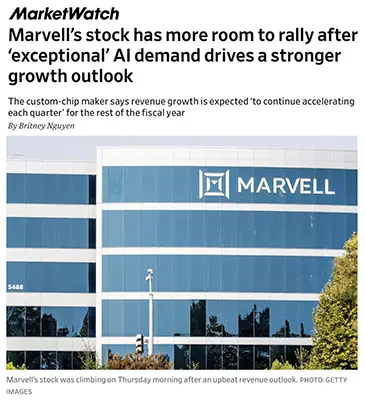
Marvell’s Stock Has More Room to Rally After ‘Exceptional’ AI Demand Drives a Stronger Growth Outlook
MarketWatch, May 28, 2026
TL;DR / Key Takeaway: Marvell’s upgraded outlook shows that the AI infrastructure boom is expanding beyond GPUs into custom chips, optical networking, and data-center interconnects.
Executive Summary
Marvell raised its revenue outlook after reporting strong demand tied to AI data-center growth. The company’s strength is not simply another sign of enthusiasm for AI stocks; it points to a more specific infrastructure shift. As AI data centers grow larger and more complex, performance increasingly depends on moving data efficiently between chips, servers, and systems, not just on buying more GPUs.
Marvell highlighted demand for custom silicon, optical interconnects, scale-up networking, and related technologies. That matters because AI infrastructure is becoming a full-stack buildout: chips, memory, networking, power, cooling, software, and facility design all have to scale together. Bottlenecks in one layer can slow or raise the cost of the entire system.
The business takeaway is that AI spending is creating winners across the supply chain, but it is also making AI adoption more dependent on specialized infrastructure providers. For customers, this can mean faster AI services over time, but also higher concentration risk, more complex vendor ecosystems, and continued pressure on cloud and compute pricing.
Relevance for Business
SMB executives do not need to track Marvell as investors to understand the signal. The article shows why AI services remain expensive and infrastructure-constrained: the industry is still building the physical and networking backbone needed to support enterprise AI demand. Businesses should expect continued changes in AI pricing, performance, and availability as data-center architecture evolves.
Calls to Action
🔹 Watch AI infrastructure costs, because model prices may reflect upstream constraints in chips, networking, and data centers.
🔹 Ask cloud and AI vendors about performance guarantees, especially for latency-sensitive or high-volume use cases.
🔹 Avoid assuming AI costs will fall smoothly; infrastructure bottlenecks may keep pricing uneven.
🔹 Treat AI vendor reliability as a supply-chain issue, not only a software issue.
🔹 Monitor custom-chip trends because they may shape which cloud platforms gain cost or performance advantages.
Summary by ReadAboutAI.com
https://www.wsj.com/wsjplus/dashboard/articles/marvells-stock-seesaws-as-exceptional-ai-demand-drives-a-stronger-growth-outlook-05324935: June 1, 2026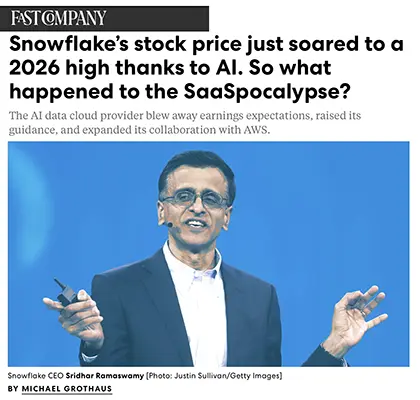
SNOWFLAKE’S STRONG QUARTER IS A DATA POINT IN THE SAAS SURVIVAL DEBATE — NOT A VERDICT
Fast Company | May 28, 2026
TL;DR: Snowflake’s blowout Q1 results and raised guidance suggest that AI-native data platforms can thrive in the current environment, but this is one company’s story, not a verdict on SaaS broadly.
Executive Summary
Snowflake reported Q1 fiscal 2027 results that materially beat analyst expectations: total revenue of $1.39 billion (up 33% year-over-year), product revenue of $1.33 billion (up 34%), and earnings per share of 39 cents against an expected 32. Forward guidance for Q2 product revenue of $1.415–$1.42 billion also exceeded the $1.37 billion consensus. The stock jumped roughly 38% in premarket trading — recovering a year-to-date decline that had exceeded 20%.
The article frames this in the context of the “SaaSpocalypse” narrative — the concern that generative and agentic AI will make legacy SaaS platforms obsolete. Snowflake’s results push back on that framing, at least for platforms that have repositioned around AI use cases. Its product allows companies to run AI workloads and agentic applications directly on top of cloud-stored data (AWS, Google Cloud, Azure), which makes it a participant in AI deployment rather than a casualty of it. Reinforcing the forward confidence: Snowflake committed to spending an additional $6 billion on AWS and Graviton AI chips over the next five years — not the move of a company anticipating deteriorating conditions.
The SaaSpocalypse narrative, however, remains relevant for SaaS vendors that have not reoriented around AI. Salesforce’s stock decline over the same period reflects this divergence. The market is separating AI-integrated platforms from legacy-positioned ones, and that separation will continue.
Relevance for Business
For SMB leaders evaluating their software stack, the Snowflake results carry a practical signal: platforms that have embedded AI deeply into their core value proposition are outperforming those that have layered it on as a feature. If your organization uses Snowflake or comparable data cloud tools, the strong trajectory suggests the platform is investing aggressively and unlikely to be disrupted in the near term. More broadly, leaders should evaluate every SaaS vendor they depend on through the lens of this divergence: is the vendor an AI enabler, an AI adapter, or an AI laggard? The answer increasingly affects both product roadmap risk and contract renewal leverage.
Calls to Action
🔹 If your organization uses Snowflake or similar AI-native data platforms, the current trajectory supports continued investment — but monitor vendor concentration risk given the scale of Snowflake’s AWS commitment.
🔹 Audit your SaaS vendor portfolio for AI positioning: vendors that have not integrated AI into core workflows face growing competitive pressure and potential roadmap stagnation.
🔹 Do not treat Snowflake’s performance as a general SaaS market signal — it reflects a specific repositioning strategy, not sector-wide resilience.
🔹 If your organization is considering new data platform investments, use this quarter’s results as a prompt to evaluate Snowflake’s competitive position against alternatives before locking into multi-year agreements.
🔹 Track the SaaSpocalypse narrative over the next two quarters — Snowflake’s results may reflect genuine durability or a brief sentiment recovery; time will clarify which.
Summary by ReadAboutAI.com
https://www.fastcompany.com/91549756/snow-stock-price-today-snowflake-soars-ai-data-cloud-aws: June 1, 2026
The AI Budget You’re Missing: Eight Costs That Don’t Show Up Until It’s Too Late
TechTarget | May 21, 2026
TL;DR: The most damaging costs of enterprise AI adoption are strategic, not technical — and most organizations don’t discover them until they’ve already accumulated.
Executive Summary
This piece makes a useful and underappreciated argument: the AI costs that show up in vendor proposals — infrastructure, licensing, integration — are the ones organizations are best equipped to manage. The costs that cause real damage tend to be invisible until they’ve compounded. The eight categories identified cover a spectrum from failed pilots and perpetual experimentation, to governance retrofitting, talent attrition, human oversight overhead, model degradation, architectural lock-in, and reputational exposure.
A few signals worth elevating for executive audiences. First, 95% of enterprise generative AI pilots reportedly fail to deliver measurable ROI or scale beyond experimentation (MIT, 2025) — and the indirect costs of those failures (unwinding systems, rebuilding team trust, re-engineering workflows) typically exceed the direct spend. Second, “human in the loop” is frequently sold as a safeguard feature but functions in practice as a recurring, unbudgeted operating cost: if staff aren’t trained to work with AI outputs efficiently, oversight becomes slower and more expensive than the tasks it replaced. Third, architectural lock-in is underappreciated: when businesses build tightly around a single model API, pricing changes, model deprecation, or performance shifts can require rebuilding significant portions of the AI stack — sometimes at a cost approaching the original build. Fourth, reputational risk from AI outputs is asymmetric: strong performance quickly becomes a baseline expectation, while failures attract disproportionate attention.
The article leans on practitioner voices rather than independent data, and some framing reflects the consulting and vendor perspectives of its sources. The core diagnostic, however, is sound.
Relevance for Business
SMB leaders planning or expanding AI deployment should treat this as a pre-investment checklist, not a post-mortem. The “perpetual pilot” trap is especially relevant for smaller organizations where AI projects often stall in experimentation without ever reaching production — consuming internal bandwidth and creating competitive lag while generating no operational return. Governance and compliance costs also tend to be underestimated: organizations that deploy first and govern later typically pay more in rework, documentation, and legal review than those that build appropriate oversight in from the start.
Calls to Action
🔹 Before approving any new AI initiative, require a budget line for hidden costs: governance, retraining, human oversight, and failure/unwind scenarios — not just licensing and infrastructure.
🔹 Audit current AI pilots: if any have been in testing for more than six months without a defined path to production, assess whether they should be accelerated, restructured, or stopped.
🔹 Evaluate your vendor contracts for model deprecation clauses and pricing change provisions — lock-in risk is real and often embedded in API-dependent architectures.
🔹 Invest in user enablement alongside deployment; untrained staff using AI tools can reduce productivity rather than improve it.
🔹 Assign governance ownership to a named internal role before expanding AI deployment — retrofitting compliance after the fact is consistently more expensive than building it in.
Summary by ReadAboutAI.com
https://www.techtarget.com/searchenterpriseai/tip/8-AI-costs-leaders-dont-always-budget-for-but-should: June 1, 2026
Is AI Really Cheaper Than Human Workers?
TechTarget, May 22, 2026
TL;DR / Key Takeaway: AI may reduce labor costs in the right workflows, but many companies are undercounting the integration, governance, oversight, maintenance, and disruption costs required to make AI work in production.
Executive Summary
TechTarget challenges the simple claim that AI is cheaper than human labor. The article argues that many organizations compare AI tools against salaries while leaving out the operational costs of implementation, data readiness, training, quality assurance, governance, model maintenance, and human review. In some cases, those costs can materially weaken or erase the expected savings.
The strongest point is that AI works best when applied to high-volume, repeatable, rule-based tasks where the fixed costs of deployment can be spread across enough work. It is less likely to be cost-effective in low-volume, judgment-heavy, relationship-driven, highly regulated, or rapidly changing environments. This is especially important because many companies are using AI-related efficiency claims to justify layoffs before proving durable business value.
For leaders, the article turns AI ROI into a management discipline. The key question is not “How many roles can AI replace?” but whether the new AI-enabled system performs better after factoring in accuracy, supervision, workflow redesign, employee knowledge loss, customer impact, and long-term maintenance.
Relevance for Business
For SMBs, this is a direct warning against buying AI on headline promises. Smaller companies often have less spare capacity for failed rollouts, hidden integration work, or employee disruption. AI can absolutely create leverage, but only when leaders define the business outcome, measure the baseline, pilot carefully, and include human oversight where the risks justify it.
Calls to Action
🔹 Calculate full AI cost of ownership, not just subscription or API fees.
🔹 Prioritize high-volume, repeatable workflows before trying to automate complex judgment work.
🔹 Stage-gate AI rollouts with clear success metrics before scaling.
🔹 Budget for maintenance, retraining, governance, and human review as ongoing operating costs.
🔹 Do not cut staff before proving the AI system actually performs better than the current workflow.
Summary by ReadAboutAI.com
https://www.techtarget.com/searchcio/feature/Is-AI-cheaper-than-human-workers: June 1, 2026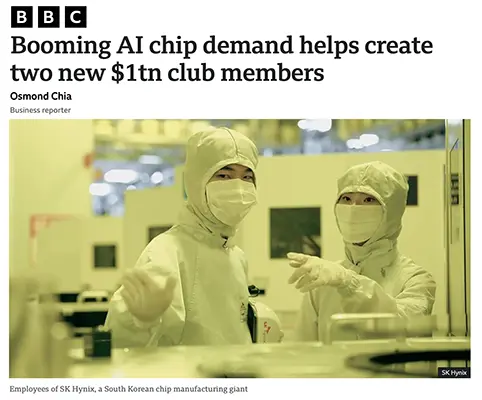
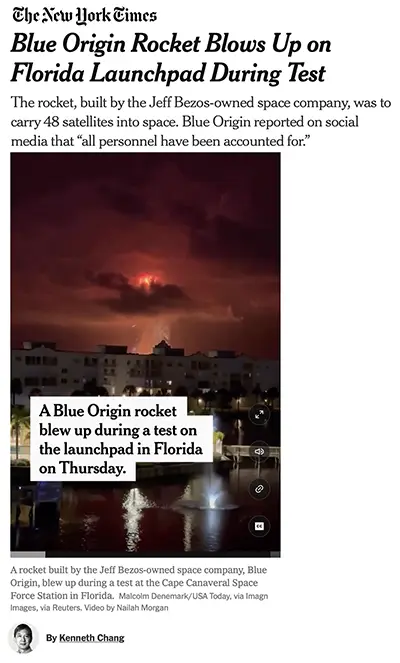

Closing: AI update for June 1, 2026
The clearest signal across this week’s 34 summaries is not that AI is arriving — it’s that the gap between deploying AI and governing it well is widening, and the organizations that close that gap deliberately will hold a durable advantage over those that don’t. Use what’s here to ask harder questions, set clearer standards, and make better decisions about where AI earns its place in your operation.
All Summaries by ReadAboutAI.com
↑ Back to Top